Hubbry Logo
search
logo
2251826

Phase space

logo
Community Hub0 Subscribers
Read side by side
from Wikipedia

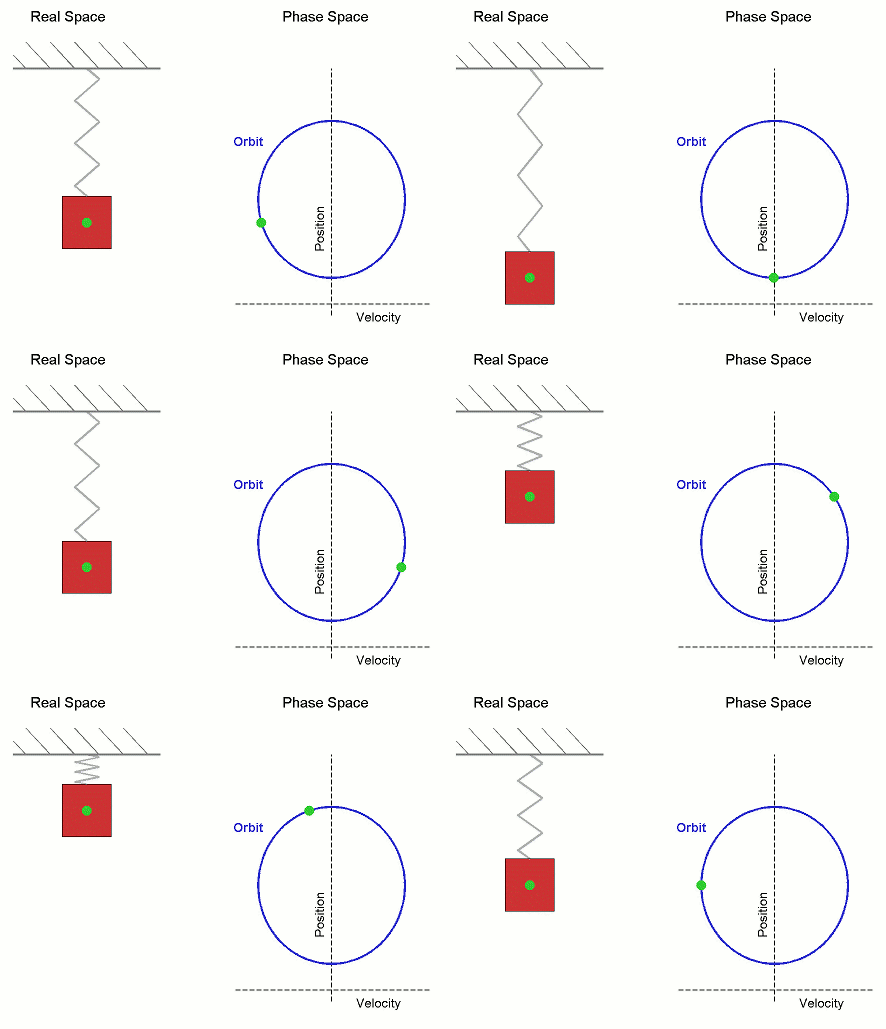
Diagram showing the periodic orbit of a mass-spring system in simple harmonic motion. (The velocity and position axes have been reversed from the standard convention in order to align the two diagrams)

The phase space of a physical system is the set of all possible physical states of the system when described by a given parameterization. Each possible state corresponds uniquely to a point in the phase space. For mechanical systems, the phase space usually consists of all possible values of the position and momentum parameters. It is the direct product of direct space and reciprocal space.[clarification needed] The concept of phase space was developed in the late 19th century by Ludwig Boltzmann, Henri Poincaré, and Josiah Willard Gibbs.[1]

Principles

[edit]

In a phase space, every degree of freedom or parameter of the system is represented as an axis of a multidimensional space; a one-dimensional system is called a phase line, while a two-dimensional system is called a phase plane. For every possible state of the system or allowed combination of values of the system's parameters, a point is included in the multidimensional space. The system's evolving state over time traces a path (a phase-space trajectory for the system) through the high-dimensional space. The phase-space trajectory represents the set of states compatible with starting from one particular initial condition, located in the full phase space that represents the set of states compatible with starting from any initial condition. As a whole, the phase diagram represents all that the system can be, and its shape can easily elucidate qualities of the system that might not be obvious otherwise. A phase space may contain a great number of dimensions. For instance, a gas containing many molecules may require a separate dimension for each particle's x, y and z positions and momenta (6 dimensions for an idealized monatomic gas), and for more complex molecular systems additional dimensions are required to describe vibrational modes of the molecular bonds, as well as spin around 3 axes. Phase spaces are easier to use when analyzing the behavior of mechanical systems restricted to motion around and along various axes of rotation or translation – e.g. in robotics, like analyzing the range of motion of a robotic arm or determining the optimal path to achieve a particular position/momentum result.

Evolution of an ensemble of classical systems in phase space (top). The systems are a massive particle in a one-dimensional potential well (red curve, lower figure). The initially compact ensemble becomes swirled up over time.

Conjugate momenta

[edit]

In classical mechanics, any choice of generalized coordinates qi for the position (i.e. coordinates on configuration space) defines conjugate generalized momenta pi, which together define co-ordinates on phase space. More abstractly, in classical mechanics phase space is the cotangent bundle of configuration space, and in this interpretation the procedure above expresses that a choice of local coordinates on configuration space induces a choice of natural local Darboux coordinates for the standard symplectic structure on a cotangent space.

Statistical ensembles in phase space

[edit]

The motion of an ensemble of systems in this space is studied by classical statistical mechanics. The local density of points in such systems obeys Liouville's theorem, and so can be taken as constant. Within the context of a model system in classical mechanics, the phase-space coordinates of the system at any given time are composed of all of the system's dynamic variables. Because of this, it is possible to calculate the state of the system at any given time in the future or the past, through integration of Hamilton's or Lagrange's equations of motion.

In low dimensions

[edit]

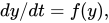
For simple systems, there may be as few as one or two degrees of freedom. One degree of freedom occurs when one has an autonomous ordinary differential equation in a single variable, with the resulting one-dimensional system being called a phase line, and the qualitative behaviour of the system being immediately visible from the phase line. The simplest non-trivial examples are the exponential growth model/decay (one unstable/stable equilibrium) and the logistic growth model (two equilibria, one stable, one unstable).
The phase space of a two-dimensional system is called a phase plane, which occurs in classical mechanics for a single particle moving in one dimension, and where the two variables are position and velocity. In this case, a sketch of the phase portrait may give qualitative information about the dynamics of the system, such as the limit cycle of the Van der Pol oscillator shown in the diagram.

Here the horizontal axis gives the position, and vertical axis the velocity. As the system evolves, its state follows one of the lines (trajectories) on the phase diagram.

Phase portrait of the Van der Pol oscillator
[edit]

Phase plot

[edit]

A plot of position and momentum variables as a function of time is sometimes called a phase plot or a phase diagram. However the latter expression, "phase diagram", is more usually reserved in the physical sciences for a diagram showing the various regions of stability of the thermodynamic phases of a chemical system, which consists of pressure, temperature, and composition.

Phase portrait

[edit]
Potential energy and phase portrait of a simple pendulum. Note that the x-axis, being angular, wraps onto itself after every 2π radians.
Phase portrait of damped oscillator, with increasing damping strength. The equation of motion is

In mathematics, a phase portrait is a geometric representation of the orbits of a dynamical system in the phase plane. Each set of initial conditions is represented by a different point or curve.

Phase portraits are an invaluable tool in studying dynamical systems. They consist of a plot of typical trajectories in the phase space. This reveals information such as whether an attractor, a repellor or limit cycle is present for the chosen parameter value. The concept of topological equivalence is important in classifying the behaviour of systems by specifying when two different phase portraits represent the same qualitative dynamic behavior. An attractor is a stable point which is also called a "sink". The repeller is considered as an unstable point, which is also known as a "source".

A phase portrait graph of a dynamical system depicts the system's trajectories (with arrows) and stable steady states (with dots) and unstable steady states (with circles) in a phase space. The axes are of state variables.

Phase integral

[edit]

In classical statistical mechanics (continuous energies) the concept of phase space provides a classical analog to the partition function (sum over states) known as the phase integral.[2] Instead of summing the Boltzmann factor over discretely spaced energy states (defined by appropriate integer quantum numbers for each degree of freedom), one may integrate over continuous phase space. Such integration essentially consists of two parts: integration of the momentum component of all degrees of freedom (momentum space) and integration of the position component of all degrees of freedom (configuration space). Once the phase integral is known, it may be related to the classical partition function by multiplication of a normalization constant representing the number of quantum energy states per unit phase space. This normalization constant is simply the inverse of the Planck constant raised to a power equal to the number of degrees of freedom for the system.[3]

Applications

[edit]
Illustration of how a phase portrait would be constructed for the motion of a simple pendulum
Time-series flow in phase space specified by the differential equation of a pendulum. The X axis corresponds to the pendulum's position, and the Y axis its speed.

Chaos theory

[edit]

Classic examples of phase diagrams from chaos theory are:

Quantum mechanics

[edit]

In quantum mechanics, the coordinates p and q of phase space normally become Hermitian operators in a Hilbert space.

But they may alternatively retain their classical interpretation, provided functions of them compose in novel algebraic ways (through Groenewold's 1946 star product). This is consistent with the uncertainty principle of quantum mechanics. Every quantum mechanical observable corresponds to a unique function or distribution on phase space, and conversely, as specified by Hermann Weyl (1927) and supplemented by John von Neumann (1931); Eugene Wigner (1932); and, in a grand synthesis, by H. J. Groenewold (1946). With J. E. Moyal (1949), these completed the foundations of the phase-space formulation of quantum mechanics, a complete and logically autonomous reformulation of quantum mechanics.[4] (Its modern abstractions include deformation quantization and geometric quantization.)

Expectation values in phase-space quantization are obtained isomorphically to tracing operator observables with the density matrix in Hilbert space: they are obtained by phase-space integrals of observables, with the Wigner quasi-probability distribution effectively serving as a measure.

Thus, by expressing quantum mechanics in phase space (the same ambit as for classical mechanics), the Weyl map facilitates recognition of quantum mechanics as a deformation (generalization) of classical mechanics, with deformation parameter ħ/S, where S is the action of the relevant process. (Other familiar deformations in physics involve the deformation of classical Newtonian into relativistic mechanics, with deformation parameter v/c;[citation needed] or the deformation of Newtonian gravity into general relativity, with deformation parameter Schwarzschild radius/characteristic dimension.)[citation needed]

Classical expressions, observables, and operations (such as Poisson brackets) are modified by ħ-dependent quantum corrections, as the conventional commutative multiplication applying in classical mechanics is generalized to the noncommutative star-multiplication characterizing quantum mechanics and underlying its uncertainty principle.

Thermodynamics and statistical mechanics

[edit]

In thermodynamics and statistical mechanics contexts, the term "phase space" has two meanings: for one, it is used in the same sense as in classical mechanics. If a thermodynamic system consists of N particles, then a point in the 6N-dimensional phase space describes the dynamic state of every particle in that system, as each particle is associated with 3 position variables and 3 momentum variables. In this sense, as long as the particles are distinguishable, a point in phase space is said to be a microstate of the system. (For indistinguishable particles a microstate consists of a set of N! points, corresponding to all possible exchanges of the N particles.) N is typically on the order of the Avogadro number, thus describing the system at a microscopic level is often impractical. This leads to the use of phase space in a different sense.

The phase space can also refer to the space that is parameterized by the macroscopic states of the system, such as pressure, temperature, etc. For instance, one may view the pressure–volume diagram or temperature–entropy diagram as describing part of this phase space. A point in this phase space is correspondingly called a macrostate. There may easily be more than one microstate with the same macrostate. For example, for a fixed temperature, the system could have many dynamic configurations at the microscopic level. When used in this sense, a phase is a region of phase space where the system in question is in, for example, the liquid phase, or solid phase, etc.

Since there are many more microstates than macrostates, the phase space in the first sense is usually a manifold of much larger dimensions than in the second sense. Clearly, many more parameters are required to register every detail of the system down to the molecular or atomic scale than to simply specify, say, the temperature or the pressure of the system.

Optics

[edit]

Phase space is extensively used in nonimaging optics,[5] the branch of optics devoted to illumination. It is also an important concept in Hamiltonian optics.

Medicine

[edit]

In medicine and bioengineering, the phase space method is used to visualize multidimensional physiological responses.[6][7]

See also

[edit]
Applications
Mathematics
Physics

References

[edit]

Further reading

[edit]
[edit]
Revisions and contributorsEdit on WikipediaRead on Wikipedia
from Grokipedia
In physics, phase space is a multidimensional space that represents all possible states of a dynamical system, with each axis corresponding to a coordinate such as position or momentum, allowing a complete description of the system's configuration at any instant.[1] For a classical system of N particles in three-dimensional space, the phase space is typically 6N-dimensional, comprising 3N position coordinates and 3N momentum coordinates, forming a comprehensive framework for analyzing trajectories and evolutions under Hamiltonian mechanics.[2] The concept originated in the late 19th century amid efforts to formalize statistical mechanics, with early contributions from Ludwig Boltzmann, who introduced the concept of "phase" in 1872 to describe the distribution of molecular states, and the term "phase space" coined by J. Willard Gibbs in 1902, with refinements by Henri Poincaré emphasizing its role in ensemble theory and ergodic behavior.[3] In classical statistical mechanics, phase space underpins key principles such as Liouville's theorem, which states that the phase space volume occupied by an ensemble of systems remains constant over time due to the incompressible flow of trajectories, enabling predictions of thermodynamic properties from microscopic dynamics.[4] This conservation property highlights phase space's utility in bridging deterministic mechanics with probabilistic descriptions of large systems. In quantum mechanics, phase space adapts to the uncertainty principle through quasi-probability distributions, such as the Wigner function, which provides a phase-space representation of the density operator while revealing interference effects and the classical limit. These formulations, developed prominently by Eugene Wigner in 1932, allow quantum states to be visualized in a continuous phase space despite the discrete nature of observables, facilitating comparisons between classical and quantum behaviors in areas like quantum optics and many-body physics.[5] Beyond fundamental theory, phase space concepts extend to applications in chaos theory, where Poincaré sections map complex trajectories to lower dimensions, and in engineering fields like control systems, aiding the analysis of stability and attractors.[6]

Fundamental Principles

Definition and Coordinates

In classical mechanics and statistical mechanics, the concept of phase space, developed in the late 19th century including contributions from Ludwig Boltzmann, was advanced by Josiah Willard Gibbs in his 1902 book Elementary Principles in Statistical Mechanics, where he explicitly termed it "phase space" while representing the states of a mechanical system in a multidimensional space.[7] This framework was further formalized within Hamiltonian mechanics, building on William Rowan Hamilton's 1834 reformulation of dynamics, where phase space provides a complete description of a system's evolution. Phase space is mathematically defined as the cotangent bundle $ T^*Q $ of the configuration space $ Q $, which parameterizes all possible positions of the system; for a system with $ n $ degrees of freedom, the phase space has dimension $ 2n $, and each point $ (q, p) $ uniquely specifies the state of the system at a given time, encompassing both positional and momentum information.[1] In this construction, the configuration space $ Q $ is typically a manifold of dimension $ n $, such as $ \mathbb{R}^n $ for unconstrained particles, and the cotangent bundle equips it with fiber coordinates representing momenta, enabling a symplectic structure that preserves the geometry under dynamics.[8] The standard coordinates of phase space consist of generalized position coordinates $ q_i $ (for $ i = 1, \dots, n $) and their conjugate momenta $ p_i $, defined via the Lagrangian as $ p_i = \frac{\partial L}{\partial \dot{q}_i} $, where $ L $ is the system's Lagrangian.[8] For a single particle in one dimension, phase space is two-dimensional with coordinates $ (q, p) $, where $ q $ is position and $ p = m \dot{q} $ is momentum; for $ N $ non-interacting particles in three dimensions, it extends to $ 6N $-dimensional space with coordinates $ ( \mathbf{q}_1, \mathbf{p}_1, \dots, \mathbf{q}_N, \mathbf{p}_N ) $.[1] The dynamics on this space are governed by the Hamiltonian $ H(q, p, t) $, the total energy expressed in terms of these coordinates, through Hamilton's equations:
dqidt=Hpi,dpidt=Hqi. \frac{dq_i}{dt} = \frac{\partial H}{\partial p_i}, \quad \frac{dp_i}{dt} = -\frac{\partial H}{\partial q_i}.
These equations describe trajectories in phase space as integral curves of the Hamiltonian vector field.[8] Canonical transformations are coordinate changes $ (q, p) \to (Q, P) $ that preserve the form of Hamilton's equations and the symplectic structure of phase space, ensuring that the new coordinates $ Q_i, P_i $ also satisfy the conjugate pairing and the fundamental Poisson brackets $ {q_i, p_j} = \delta_{ij} $.[8] Such transformations maintain the geometric integrity of phase space, allowing equivalent descriptions of the same dynamics.

Conjugate Variables

In Hamiltonian mechanics, conjugate variables form pairs consisting of generalized coordinates $ q_i $ and their corresponding momenta $ p_i $, where the momenta are defined through the Legendre transformation of the Lagrangian $ L(q, \dot{q}, t) $ to the Hamiltonian $ H(q, p, t) $, specifically $ p_i = \frac{\partial L}{\partial \dot{q}_i} $.[9][10] This pairing elevates the velocities $ \dot{q}_i $ to independent dynamical variables $ p_i $, enabling a symmetric formulation of the equations of motion in phase space.[11] The symplectic structure of phase space arises from these conjugate pairs, endowing the space with a Poisson bracket that encodes the fundamental algebraic relations: $ {q_i, p_j} = \delta_{ij} $, $ {q_i, q_j} = 0 $, and $ {p_i, p_j} = 0 $, where $ \delta_{ij} $ is the Kronecker delta.[12][13] More generally, for smooth functions $ f $ and $ g $ on the phase space, the Poisson bracket is defined as
{f,g}=i(fqigpifpigqi), \{f, g\} = \sum_i \left( \frac{\partial f}{\partial q_i} \frac{\partial g}{\partial p_i} - \frac{\partial f}{\partial p_i} \frac{\partial g}{\partial q_i} \right),
which satisfies bilinearity, antisymmetry, and the Jacobi identity, thereby defining a Poisson algebra on the manifold.[12][14] This bracket governs the time evolution of any function $ f $ via $ \frac{df}{dt} = {f, H} + \frac{\partial f}{\partial t} $, where $ H $ is the Hamiltonian, yielding Hamilton's equations as a special case for $ f = q_i $ or $ p_i $.[8][13] Canonical coordinates refer to any set of variables $ (Q_k, P_k) $ obtained from the original $ (q_i, p_i) $ via point transformations that preserve the fundamental Poisson brackets, ensuring the symplectic structure remains invariant.[15][16] Such transformations maintain the form of Hamilton's equations and are essential for simplifying problems in classical mechanics.[17] Darboux's theorem guarantees that any symplectic manifold admits a local coordinate system where the symplectic form takes the canonical Darboux form $ \sum_i dq_i \wedge dp_i $, affirming the local existence of conjugate coordinates around any point.[18][19] This result underscores the uniformity of symplectic geometry, implying no local invariants beyond the dimension in such spaces.[20]

Liouville's Theorem

Liouville's theorem states that in Hamiltonian systems, the volume of any region in phase space remains invariant under time evolution, implying an incompressible flow where phase space volumes neither expand nor contract despite the deformation of their shapes.[21][22] This invariance underscores the deterministic and reversible nature of classical Hamiltonian dynamics, ensuring that the measure of accessible states is preserved along trajectories.[21] The theorem was originally proved by Joseph Liouville in 1838 in the context of differential equations, without explicit reference to phase space or mechanics.[23] An independent proof was provided by Carl Gustav Jacob Jacobi around 1842, later published in 1866, where he applied it to mechanical systems using Hamilton's equations.[24] To sketch the proof, consider the velocity field in phase space derived from Hamilton's equations for conjugate variables qiq_i and pip_i: q˙i=Hpi\dot{q}_i = \frac{\partial H}{\partial p_i} and p˙i=Hqi\dot{p}_i = -\frac{\partial H}{\partial q_i}, so the field is v=(Hp1,,Hq1,)\mathbf{v} = \left( \frac{\partial H}{\partial p_1}, \dots, -\frac{\partial H}{\partial q_1}, \dots \right).[22] The divergence is
v=i(qiHpi+pi(Hqi))=0, \nabla \cdot \mathbf{v} = \sum_i \left( \frac{\partial}{\partial q_i} \frac{\partial H}{\partial p_i} + \frac{\partial}{\partial p_i} \left( -\frac{\partial H}{\partial q_i} \right) \right) = 0,
since the mixed partial derivatives commute.[22] By the divergence theorem, the rate of change of a phase space volume VV is
dVdt=V(v)dV=0. \frac{dV}{dt} = \int_V (\nabla \cdot \mathbf{v}) \, dV = 0.
[22]
Geometrically, the time evolution corresponds to a canonical transformation that preserves the symplectic 2-form ω=idqidpi\omega = \sum_i dq_i \wedge dp_i, ensuring the flow maintains the volume element dV=ωn/n!dV = \omega^n / n! for an nn-degree-of-freedom system.[21] This preservation highlights how Hamiltonian flows act like shear deformations in phase space, distorting shapes without altering volumes.[21]

Low-Dimensional Representations

One-Dimensional Systems

In one-dimensional systems, the phase space is a two-dimensional plane parameterized by the position coordinate $ q $ and its conjugate momentum $ p $, representing the state of a system with a single degree of freedom.[25] Trajectories in this space trace the evolution of the system under the governing dynamics, with the Hamiltonian $ H(q, p) $ determining the flow.[26] A canonical example is the simple harmonic oscillator, governed by the Hamiltonian $ H = \frac{p^2}{2m} + \frac{1}{2} k q^2 $, where $ m $ is the mass and $ k $ is the spring constant.[27] The constant-energy contours form closed elliptical trajectories in the $ (q, p) $ plane, as the total energy $ E = H $ remains fixed, yielding $ p = \pm \sqrt{2m \left( E - \frac{1}{2} k q^2 \right)} $.[26] The parametric equations for the motion are $ q(t) = A \cos(\omega t + \phi) $ and $ p(t) = -m \omega A \sin(\omega t + \phi) $, where $ A $ is the amplitude, $ \omega = \sqrt{k/m} $, and $ \phi $ is the initial phase; plotting these parametrically produces the ellipse.[27] These closed orbits reflect periodic motion, with the area enclosed by the trajectory proportional to the action variable, preserved under Hamiltonian dynamics as per Liouville's theorem.[25] For a free particle, the Hamiltonian simplifies to $ H = \frac{p^2}{2m} $, with no potential term.[25] Since $ \dot{p} = -\frac{\partial H}{\partial q} = 0 $, momentum $ p $ is constant, resulting in straight-line trajectories parallel to the $ q $-axis at fixed $ p = \sqrt{2m E} $.[28] This illustrates unbounded motion without oscillation, where position evolves linearly as $ q(t) = q_0 + \frac{p}{m} t $. In contrast, a damped harmonic oscillator introduces dissipation, modifying the equations to $ \ddot{q} + 2\beta \dot{q} + \omega^2 q = 0 $, where $ \beta > 0 $ is the damping coefficient.[25] This non-Hamiltonian system produces spiraling inward trajectories in phase space, with amplitude decaying exponentially and energy loss causing the orbit to contract toward the origin.[29] The phase space volume contracts at a rate $ \nabla \cdot \mathbf{v} = -2\beta < 0 $, violating the area preservation of Liouville's theorem applicable to conservative systems.[25]

Two-Dimensional Systems

In classical mechanics, systems with two degrees of freedom possess a four-dimensional phase space spanned by the generalized coordinates q1,q2q_1, q_2 and their conjugate momenta p1,p2p_1, p_2.[30] This structure arises because each degree of freedom contributes two dimensions to the phase space, allowing trajectories to evolve on three-dimensional energy hypersurfaces within the full four-dimensional manifold.[30] Due to the high dimensionality, direct visualization is challenging, so common projections onto two-dimensional planes, such as the (q1,p1)(q_1, p_1) or (q2,p2)(q_2, p_2) subspace, are employed to reveal qualitative behaviors while marginalizing over the other variables.[31] For uncoupled harmonic oscillators, the Hamiltonian takes the separable form
H=i=12(pi22m+12kqi2), H = \sum_{i=1}^2 \left( \frac{p_i^2}{2m} + \frac{1}{2} k q_i^2 \right),
where mm is the mass and kk the spring constant, assuming identical parameters for simplicity.[32] The trajectories in the full phase space are then the Cartesian product of independent elliptical orbits in each (qi,pi)(q_i, p_i) plane, with constant areas enclosed by each ellipse determined by the action variables.[33] Projections onto a single (qi,pi)(q_i, p_i) plane thus show isolated ellipses, while the full dynamics exhibit Lissajous figures when projecting onto coordinate-momentum mixed planes, reflecting the incommensurate frequencies if ω1ω2\omega_1 \neq \omega_2.[34] In coupled oscillators, such as two masses connected by springs, the coupling introduces off-diagonal terms in the potential, leading to normal modes where the system decouples into independent oscillators after a linear transformation to normal coordinates.[32] These modes manifest as in-phase (beating with lower frequency) and out-of-phase (higher frequency) oscillations, with the phase space trajectories becoming separable in action-angle variables after diagonalization.[34] The action variables JiJ_i quantify the energy in each mode, while angle variables θi\theta_i track the phases, enabling a toroidal representation of the invariant tori on which motion occurs.[33] Projections of these trajectories often reveal quasi-periodic filling of annular regions, hinting at the underlying separability.[32] A canonical example of non-separable dynamics is the double pendulum, with two degrees of freedom corresponding to the angles θ1,θ2\theta_1, \theta_2 and angular momenta pθ1,pθ2p_{\theta_1}, p_{\theta_2}. In this four-dimensional phase space, trajectories for small amplitudes approximate tori from linearized normal modes, but larger energies produce chaotic orbits that appear as tangled, space-filling curves in projections like (θ1,pθ1)(\theta_1, p_{\theta_1}), indicating exponential sensitivity to initial conditions. These projections capture the transition from regular to chaotic motion, where nearby trajectories diverge rapidly, though the full chaos analysis resides in higher-dimensional applications. To manage the four-dimensional complexity, especially in periodically driven two-degree-of-freedom systems, Poincaré sections provide a reduction to two-dimensional stroboscopic maps by recording intersections of trajectories with a chosen hypersurface, such as when a phase variable equals a constant.[31] For instance, in a driven double oscillator, sampling at driving period intervals yields points in a (q1,p1)(q_1, p_1) plane that reveal invariant curves for integrable cases or scattered points for chaotic ones, effectively lowering the dimensionality for analysis.[31] This technique preserves the symplectic structure and highlights periodic orbits as fixed points in the map.[31]

Phase Plot

A phase plot is a graphical representation of a dynamical system's trajectory in phase space, depicting the evolution of state variables such as position and velocity over time to form a curve that traces the system's path.[29] This visualization eliminates the explicit dependence on time, focusing instead on the relationship between the variables themselves.[35] Phase plots are constructed through parametric plotting of the solutions to the governing differential equations, where one state variable is plotted against another as derived from the system's dynamics.[35] For instance, in a one-dimensional system like simple harmonic motion, the plot of velocity versus position yields an ellipse for undamped cases, illustrating the closed orbit corresponding to periodic behavior.[29] In higher dimensions, however, direct visualization of phase plots becomes limited, as projecting multi-variable trajectories onto two or three dimensions can obscure the full structure. One key advantage of phase plots is their ability to reveal qualitative aspects of the system's dynamics—such as periodic, quasi-periodic, or aperiodic motion—without requiring explicit analytical or numerical solutions to the equations.[35] This approach allows for intuitive insight into the trajectory's shape and stability, aiding in the analysis of oscillatory or rotational behaviors. The early development of phase plots is attributed to Henri Poincaré's work in celestial mechanics around 1890, where he used such graphical methods to explore trajectories in the three-body problem, laying foundational techniques for visualizing complex orbital dynamics.

Phase Portrait

A phase portrait provides a qualitative representation of the global structure of trajectories in the phase space of a dynamical system, illustrating the flow defined by the vector field across the entire space. It consists of a collection of representative trajectories that reveal the overall behavior, including how solutions evolve from various initial conditions without solving the equations explicitly. This visualization is particularly useful in low-dimensional systems, such as two-dimensional phase planes, where the portrait captures the topological features of the flow.[36][37] Key elements of a phase portrait include equilibrium points, where the vector field vanishes, classifying the local dynamics as sinks (stable nodes or foci), sources (unstable nodes or foci), or saddles based on the nature of nearby trajectories. Stable and unstable manifolds emanate from these points, with stable manifolds attracting trajectories and unstable manifolds repelling them, often forming separatrices that divide the phase space into regions of distinct behavior. Additionally, homoclinic orbits connect a single equilibrium point to itself, while heteroclinic orbits link distinct equilibria, both contributing to the portrait's global topology by highlighting invariant sets and barriers to flow.[38][39] To analyze these elements, linearization is employed around each equilibrium point by computing the Jacobian matrix of the vector field, whose eigenvalues determine the local phase portrait type. For a two-dimensional autonomous system given by
x˙=f(x,y),y˙=g(x,y), \dot{x} = f(x, y), \quad \dot{y} = g(x, y),
equilibrium points satisfy f(x,y)=0f(x^*, y^*) = 0 and g(x,y)=0g(x^*, y^*) = 0. The Jacobian JJ at (x,y)(x^*, y^*) is
J=(fxfygxgy)(x,y), J = \begin{pmatrix} \frac{\partial f}{\partial x} & \frac{\partial f}{\partial y} \\ \frac{\partial g}{\partial x} & \frac{\partial g}{\partial y} \end{pmatrix}_{(x^*, y^*)},
with trace τ=tr(J)\tau = \operatorname{tr}(J) and determinant Δ=det(J)\Delta = \det(J). The eigenvalues are roots of λ2τλ+Δ=0\lambda^2 - \tau \lambda + \Delta = 0; the equilibrium is a stable node if τ<0\tau < 0 and Δ>0\Delta > 0 with real eigenvalues of the same sign, a saddle if Δ<0\Delta < 0, and a focus if the eigenvalues are complex with negative real part for stability. Basins of attraction, regions converging to a particular attractor, are delineated by these manifolds and orbits in the full portrait.[40][37][41] A canonical example is the Van der Pol oscillator, modeled by x¨μ(1x2)x˙+x=0\ddot{x} - \mu (1 - x^2) \dot{x} + x = 0 for μ>0\mu > 0, rewritten in phase space as x˙=y\dot{x} = y, y˙=μ(1x2)yx\dot{y} = \mu (1 - x^2) y - x. The origin is the sole equilibrium, an unstable focus, surrounded by a stable limit cycle that appears as a closed orbit in the phase portrait, attracting all nearby trajectories and demonstrating self-sustained oscillations central to nonlinear dynamics.[42]

Phase Integral

The phase integral, also known as the action integral, is defined as the line integral pdq\oint p \, dq taken over a closed path in phase space, where pp is the momentum and qq is the position coordinate.[43] This integral quantifies the action associated with a periodic orbit in the system.[43] In classical mechanics, the phase integral plays a central role in the formulation of action-angle variables, which are canonical coordinates suited for integrable Hamiltonian systems with periodic motion.[43] The action variable JJ is given by J=12πp(q)dqJ = \frac{1}{2\pi} \oint p(q) \, dq, where the integral is evaluated over one complete cycle of the motion.[44] In these coordinates, the Hamiltonian depends only on the actions H=H(J)H = H(J), and the conjugate angle variables ϕ\phi evolve linearly with time.[43] The frequency ω\omega of the motion is then ω=HJ\omega = \frac{\partial H}{\partial J}.[45] Moreover, the action JJ serves as an adiabatic invariant, remaining constant under slow variations of system parameters, such as in gradually changing potentials.[46] Historically, the phase integral was instrumental in the old quantum theory developed by Niels Bohr in 1913 and extended by Arnold Sommerfeld in 1916, where it formed the basis for the quantization condition pdq=nh\oint p \, dq = n h (with nn an integer and hh Planck's constant) to predict atomic energy levels.[47] In two-dimensional phase space, the phase integral JJ corresponds directly to the area AA enclosed by the orbit, via the relation J=A/2πJ = A / 2\pi.[44] This geometric interpretation underscores its utility in visualizing conserved quantities for bounded motion.

Applications in Physics

Dynamical Systems and Chaos Theory

In dynamical systems, phase space serves as the arena for visualizing and analyzing the time evolution of states governed by ordinary differential equations (ODEs), where each trajectory corresponds to a unique solution curve parametrized by time. These trajectories encapsulate the deterministic unfolding of the system, revealing fixed points, limit cycles, or more complex behaviors depending on the nonlinearity and dimensionality. In dissipative systems, characterized by contraction in certain phase space directions, trajectories from diverse initial conditions converge toward attractors—invariant sets of finite measure that capture the long-term dynamics, such as stable equilibria or periodic orbits.[48][49] Chaos emerges in nonlinear dynamical systems when trajectories exhibit extreme sensitivity to initial conditions, a phenomenon quantified by Lyapunov exponents that measure the average exponential rates of divergence or convergence in phase space. The largest Lyapunov exponent λ\lambda is given by
λ=limt1tlnδx(t)δx(0), \lambda = \lim_{t \to \infty} \frac{1}{t} \ln \left| \frac{\delta \mathbf{x}(t)}{\delta \mathbf{x}(0)} \right|,
where δx(t)\delta \mathbf{x}(t) denotes the infinitesimal separation between nearby trajectories at time tt; a positive λ\lambda signifies local instability and chaotic motion, as small perturbations grow exponentially. Strange attractors, which underpin chaotic regimes in dissipative systems, possess fractal dimensions—typically non-integer values between the topological and embedding dimensions—arising from the intricate folding and stretching of phase space volumes, leading to self-similar structures with infinite detail at finer scales. Illustrative examples highlight phase space's role in chaos. The Lorenz attractor, derived from a three-dimensional truncation of Navier-Stokes equations for atmospheric convection, manifests as a butterfly-shaped strange attractor in the projection of its phase space (variables xx, yy, zz), where trajectories weave chaotically between lobes, never repeating yet bounded by dissipation.[50] Similarly, the Hénon map, a discrete two-dimensional system defined by iterations xn+1=1axn2+ynx_{n+1} = 1 - a x_n^2 + y_n and yn+1=bxny_{n+1} = b x_n (with parameters a=1.4a=1.4, b=0.3b=0.3), produces a fractal strange attractor in the (x,y)(x, y) plane, demonstrating how simple quadratic maps can yield dense, non-periodic orbits sensitive to initial points. Ergodicity in chaotic dynamical systems implies that, for almost all initial conditions on an invariant measure, the time average of an observable along a single trajectory equals the spatial average over the relevant phase space subset, such as an energy surface. This equivalence facilitates the use of long-time simulations to approximate ensemble properties and connects to measure-preserving flows in Hamiltonian chaos via Liouville's theorem, ensuring incompressible evolution in phase space.

Statistical Mechanics and Thermodynamics

In statistical mechanics, phase space serves as the arena for describing ensembles of systems, where the positions and momenta of particles define the microscopic states. The microcanonical ensemble corresponds to an isolated system with fixed energy, volume, and particle number, represented by a uniform probability distribution over the hypersurface of constant energy in phase space. The entropy $ S $ is then given by $ S = k \ln \Omega $, where $ k $ is Boltzmann's constant and $ \Omega $ is the volume of the accessible phase space divided by $ h^{3N} N! $, with $ h $ being Planck's constant and $ N $ the number of particles, ensuring dimensional consistency and accounting for particle indistinguishability.[51][52] The canonical ensemble, applicable to systems in thermal contact with a heat reservoir at temperature $ T $, employs a Boltzmann distribution for the probability density $ \rho $ in phase space, given by $ \rho \propto \exp(-\beta H) $, where $ \beta = 1/(kT) $ and $ H(q,p) $ is the Hamiltonian. The partition function $ Z $, which normalizes this distribution and encodes thermodynamic properties, is computed as the phase space integral $ Z = \frac{1}{h^{3N} N!} \int \exp(-\beta H(q,p)) , dq , dp $. This integral over the entire phase space yields quantities like the Helmholtz free energy via $ F = -kT \ln Z $, linking microscopic dynamics to macroscopic thermodynamics.[51][52][53] Liouville's theorem plays a crucial role by guaranteeing the conservation of phase space volume under Hamiltonian evolution, which underpins the stationarity of equilibrium distributions in both ensembles. This incompressibility of phase space flow ensures that probability densities remain constant along trajectories, allowing time-independent ensemble averages for equilibrium states.[51][54] The ergodic hypothesis further justifies the use of ensemble averages by positing that, for sufficiently chaotic systems, the time average of an observable equals the phase space average over the ensemble, enabling the equivalence of temporal and statistical descriptions in thermodynamics. This assumption, essential for deriving equilibrium properties from dynamical evolution, holds for most physical systems of interest.[55]

Quantum Mechanics

In quantum mechanics, phase space formulations provide a bridge between classical and quantum descriptions by representing quantum states as quasi-probability distributions over position and momentum. The Wigner-Weyl transform, introduced by Eugene Wigner in 1932, maps quantum operators and states onto functions in phase space, enabling a reformulation of quantum mechanics in terms of these distributions.[56] The central object is the Wigner function $ W(q, p) $, defined for a wave function $ \psi(q) $ as
W(q,p)=1πψ(q+y)ψ(qy)e2ipy/dy, W(q, p) = \frac{1}{\pi \hbar} \int_{-\infty}^{\infty} \psi^*(q + y) \psi(q - y) e^{2 i p y / \hbar} \, dy,
which transforms the density operator into a phase-space representation.[56] This function generalizes the classical phase-space probability density, recovering classical statistical mechanics in the semiclassical limit as $ \hbar \to 0 $. Key properties of the Wigner function include its marginal distributions: integrating over momentum yields the position probability density $ \int W(q, p) , dp = |\psi(q)|^2 $, while integrating over position gives the momentum space probability $ \int W(q, p) , dq = |\tilde{\psi}(p)|^2 / (2\pi \hbar) $.[56] Unlike classical probabilities, the Wigner function can take negative values, a hallmark of non-classical quantum behavior that signals interference effects without a direct classical analog; the volume of negativity quantifies this quantumness.[57] The algebraic structure of quantum phase space relies on the Moyal bracket, the quantum counterpart to the classical Poisson bracket, which governs dynamics and operator products. Defined as
{f,g}M=2fsin(2(qppq))gp=p,q=q, \{f, g\}_M = \frac{2}{\hbar} f \sin\left( \frac{\hbar}{2} (\partial_q \partial_{p'} - \partial_p \partial_{q'}) \right) g \bigg|_{p'=p, q'=q},
it arises from the antisymmetric part of the Moyal star product, deforming classical commutators into a non-commutative phase-space multiplication. Time evolution of the Wigner function follows the von Neumann equation in this framework, yielding $ \partial W / \partial t = { H, W }_M $, where $ H(q, p) $ is the Weyl-transformed Hamiltonian; this equation preserves the quasi-probability structure under unitary dynamics. Wigner's original work laid the foundation for applications in quantum optics, where the function characterizes non-classical light states like squeezed vacuum through negativity and higher-order correlations, and in quantum state tomography, enabling full reconstruction of quantum systems from phase-space measurements such as homodyne detection.[56][58][59]

Optics

In geometric optics, phase space provides a framework for representing light rays as points in a coordinate system where the horizontal axis denotes position $ q $ and the vertical axis denotes optical momentum $ p = n \sin \theta $, with $ n $ as the refractive index and $ \theta $ as the ray angle relative to the optical axis.[60] This representation allows the evolution of ray bundles through optical elements to be tracked as transformations in phase space, preserving the structure of the bundle in lossless systems. The conservation of etendue, defined as the phase space volume occupied by the rays, follows from Liouville's theorem and holds for reversible optical transformations without absorption or scattering. For beam characterization in paraxial optics, the Wigner distribution function serves as a phase space representation of the beam's intensity and phase, particularly for partially coherent light. It is given by
W(q,p)=1λ2ψ(qr2)ψ(q+r2)eikprd2r, W(q, p) = \frac{1}{\lambda^2} \iint \psi^*\left(q - \frac{r}{2}\right) \psi\left(q + \frac{r}{2}\right) e^{-i k p \cdot r} \, d^2 r,
where $ \psi $ is the complex field amplitude, $ \lambda $ is the wavelength, and $ k = 2\pi / \lambda $.[60] The area in phase space enclosed by the Wigner distribution relates directly to beam quality, quantified by the factor $ M^2 $, which measures deviation from an ideal Gaussian beam; for a diffraction-limited beam, $ M^2 = 1 $, and the phase space area is $ \lambda / 4 $ per transverse dimension.[61] The ABCD matrix formalism describes linear optical transformations, such as those induced by lenses and mirrors, as symplectic mappings in phase space that preserve the determinant of the transformation matrix (equal to 1 for lossless systems). A ray vector $ \begin{pmatrix} q \ p \end{pmatrix} $ at the output is obtained via $ \begin{pmatrix} q' \ p' \end{pmatrix} = \begin{pmatrix} A & B \ C & D \end{pmatrix} \begin{pmatrix} q \ p \end{pmatrix} $, enabling efficient simulation of beam propagation through complex systems.[62] An illustrative example is the propagation of a Gaussian beam, where the invariant emittance $ \varepsilon = \frac{1}{2\pi} \iint dq , dp $ remains constant and equals $ \lambda / 4\pi $ for a fundamental mode, capturing the minimum phase space volume due to diffraction.[63] In lossless optical systems, the etendue
G=n2cosθdqdθ G = n^2 \iint \cos \theta \, dq \, d\theta
is conserved, linking the spatial extent and angular spread of the beam across transformations.[64]

Applications in Other Fields

Engineering and Control Theory

In engineering and control theory, phase space provides a foundational framework for representing and analyzing dynamic systems through state-space models. These models describe the evolution of a system's state vector $ \mathbf{x}(t) \in \mathbb{R}^n $, which captures all relevant variables in the phase space, via the linear differential equation $ \dot{\mathbf{x}} = A \mathbf{x} + B \mathbf{u} $, where $ A $ is the state matrix, $ B $ is the input matrix, and $ \mathbf{u} $ is the control input.[65] The output $ \mathbf{y} = C \mathbf{x} + D \mathbf{u} $ relates the phase space states to measurable quantities, with $ C $ and $ D $ as output matrices.[65] This representation, introduced by Kalman, unifies time-domain analysis and enables the design of controllers that manipulate trajectories within the phase space to achieve desired behaviors.[65] Stability analysis in phase space often employs Lyapunov's direct method, which assesses asymptotic stability without solving the differential equations explicitly. A Lyapunov function $ V(\mathbf{x}) $ is selected as positive definite in the phase space (i.e., $ V(\mathbf{0}) = 0 $ and $ V(\mathbf{x}) > 0 $ for $ \mathbf{x} \neq \mathbf{0} $), and its time derivative along system trajectories must satisfy $ \dot{V}(\mathbf{x}) = \frac{\partial V}{\partial \mathbf{x}} (A \mathbf{x} + B \mathbf{u}) < 0 $ for $ \mathbf{x} \neq \mathbf{0} $ under appropriate control $ \mathbf{u} $.[66] For linear systems, quadratic forms $ V(\mathbf{x}) = \mathbf{x}^T P \mathbf{x} $ (with $ P > 0 $) lead to the Lyapunov equation $ A^T P + P A = -Q $ for some positive definite $ Q $, ensuring phase space trajectories converge to the origin.[66] This approach extends to nonlinear systems by constructing $ V $ to bound phase space regions, guaranteeing global stability when $ \dot{V} $ is negative definite.[66] Reachability and observability concepts leverage phase space to evaluate control system capabilities. Reachability determines if any state in the phase space can be attained from the origin using admissible inputs, quantified by the controllability Gramian $ W_c(T) = \int_0^T e^{A \tau} B B^T e^{A^T \tau} d\tau $, whose rank equals the dimension of the reachable subspace if full.[67] Observability assesses whether initial phase space states can be reconstructed from outputs, via the observability Gramian $ W_o(T) = \int_0^T e^{A^T \tau} C^T C e^{A \tau} d\tau $, ensuring full rank for complete state inference.[67] These Gramians, integrated over phase space evolutions, guide controller design by identifying controllable and observable subspaces, as formalized in linear system theory.[67] For nonlinear systems, phase space partitioning facilitates hybrid control, where the state space is divided into regions with distinct dynamics or control laws. This partitioning, often using hyperplanes or polyhedra, models interfaces between continuous and discrete modes in hybrid systems, enabling stability guarantees via piecewise Lyapunov functions across partitions.[68] Covering halfspaces approximate these boundaries, extending linear methods to handle switching in phase space while preserving reachability properties.[68] A practical example is PID control for second-order systems, visualized in the phase plane of error $ e $ and error rate $ \dot{e} $. The proportional term acts radially toward the origin, the derivative term along switching lines to damp oscillations, and the integral term shifts the effective equilibrium, resulting in spiral trajectories converging to zero error; tuning ensures encirclements avoid limit cycles.[69]

Medicine and Biology

In medicine and biology, phase space provides a framework for analyzing the nonlinear dynamics of physiological systems, enabling the reconstruction of hidden attractors from time series data to distinguish healthy from pathological states. For cardiac dynamics, electrocardiogram (ECG) signals are reconstructed into phase space using Takens' embedding theorem, which guarantees that a time-delay embedding of sufficient dimension preserves the topological structure of the underlying attractor for deterministic systems.[70] This reconstruction typically involves selecting an embedding dimension $ m $ and time delay $ \tau $, transforming the one-dimensional ECG into a higher-dimensional space where trajectories reveal periodic or chaotic behaviors.[71] In normal sinus rhythm, the phase space attractor is compact and low-dimensional, reflecting stable oscillatory dynamics, whereas arrhythmic states like ventricular tachycardia or fibrillation exhibit strange attractors with higher fractal dimensions and disrupted trajectories, indicating loss of synchronization.[72][73] To determine the appropriate embedding dimension for heart rate variability (HRV) analysis in reconstructed phase space, the false nearest neighbors (FNN) method is employed, which identifies the minimal $ m $ where the attractor unfolds without false crossings. The FNN algorithm proceeds as follows: for each point in the $ m $-dimensional embedding, find its nearest neighbor; then project to $ m+1 $ dimensions and compute the ratio $ r_i(m) = \frac{|\mathbf{x}{i}(m+1) - \mathbf{y}{i}(m+1)|}{|\mathbf{x}{i}(m) - \mathbf{y}{i}(m)|} $; a neighbor is deemed false if $ r_i(m) > R_t $ (threshold, often 10–50) or if boundary effects dominate. The percentage of false neighbors drops to near zero at the correct $ m $, typically 3–5 for HRV signals in healthy hearts but increasing in pathological conditions like congestive heart failure, signifying higher dynamical complexity.[74][75][76] In population biology, the Lotka-Volterra predator-prey model exemplifies phase space analysis of ecological interactions, with the two-dimensional space spanned by prey density $ x $ and predator density $ y $. The system is governed by $ \frac{dx}{dt} = \alpha x - \beta x y $ and $ \frac{dy}{dt} = \delta x y - \gamma y $, where parameters represent growth, predation, and death rates, yielding closed periodic orbits around the equilibrium point $ (x^, y^) = (\gamma/\delta, \alpha/\beta) $. These cycles in phase space illustrate oscillatory population fluctuations without damping, contrasting stable equilibria in non-interacting models and providing insights into biodiversity maintenance.[77][78] Neurodynamics leverages phase space to model neuron firing, as in the Hodgkin-Huxley equations, which describe action potentials in a four-dimensional space of membrane potential $ V $ and gating variables $ m, h, n $ for sodium and potassium channels. The dynamics, captured by $ C \frac{dV}{dt} = -g_{Na} m^3 h (V - V_{Na}) - g_K n^4 (V - V_K) - g_L (V - V_L) + I $, along with cubic activation and exponential inactivation terms, produce limit cycle attractors corresponding to repetitive spiking for suprathreshold currents. This 4D representation reveals bifurcations from resting states to oscillatory firing, foundational for understanding neural excitability in biological circuits. Clinical applications include detecting chaotic dynamics in electroencephalogram (EEG) signals for epilepsy diagnosis, with 1990s research establishing nonlinear measures like Lyapunov exponents to quantify pre-ictal transitions. In epileptic seizures, phase space reconstruction of EEG reveals low-dimensional attractors with positive exponents indicating chaos, differing from the higher-dimensional noise-like activity in healthy brains; this approach, pioneered in intracranial EEG analysis, enables seizure prediction by tracking dynamical instability.[79][80]

References

User Avatar
No comments yet.
