




Porosity
View on WikipediaPorosity or void fraction is a measure of the void (i.e. "empty") spaces in a material, and is a fraction of the volume of voids over the total volume, between 0 and 1, or as a percentage between 0% and 100%. Strictly speaking, some tests measure the "accessible void", the total amount of void space accessible from the surface (cf. closed-cell foam).
There are many ways to test porosity in a substance or part, such as industrial CT scanning.
The term porosity is used in multiple fields including pharmaceutics, ceramics, metallurgy, materials, manufacturing, petrophysics, hydrology, earth sciences, soil mechanics, rock mechanics, and engineering.[1]
Void fraction in two-phase flow
[edit]In gas-liquid two-phase flow, the void fraction is defined as the fraction of the flow-channel volume that is occupied by the gas phase or, alternatively, as the fraction of the cross-sectional area of the channel that is occupied by the gas phase.[2]
Void fraction usually varies from location to location in the flow channel (depending on the two-phase flow pattern). It fluctuates with time and its value is usually time averaged. In separated (i.e., non-homogeneous) flow, it is related to volumetric flow rates of the gas and the liquid phase, and to the ratio of the velocity of the two phases (called slip ratio).
Porosity in earth sciences and construction
[edit]Used in geology, hydrogeology, soil science, and building science, the porosity of a porous medium (such as rock or sediment) describes the fraction of void space in the material, where the void may contain, for example, air or water. It is defined by the ratio:

where VV is the volume of void-space (such as fluids) and VT is the total or bulk volume of material, including the solid and void components. Both the mathematical symbols and are used to denote porosity.


Porosity is a fraction between 0 and 1, typically ranging from less than 0.005 for solid granite to more than 0.5 for peat and clay.
The porosity of a rock, or sedimentary layer, is an important consideration when attempting to evaluate the potential volume of water or hydrocarbons it may contain. Sedimentary porosity is a complicated function of many factors, including but not limited to: rate of burial, depth of burial, the nature of the connate fluids, the nature of overlying sediments (which may impede fluid expulsion). One commonly used relationship between porosity and depth is the decreasing exponential function given by the Athy (1930) equation:[3]
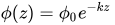
where, is the porosity of the sediment at a given depth () (m), is the initial porosity of the sediment at the surface of soil (before its burial), and is the compaction coefficient (m−1). The letter with a negative exponent denotes the decreasing exponential function. The porosity of the sediment exponentially decreases with depth, as a function of its compaction.


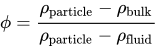
A value for porosity can alternatively be calculated from the bulk density , saturating fluid density and particle density :


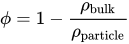
If the void space is filled with air, the following simpler form may be used:
A mean normal particle density can be taken as approximately 2.65 g/cm3 (silica, siliceous sediments or aggregates), or 2.70 g/cm3 (calcite, carbonate sediments or aggregates), although a better estimation can be obtained by examining the lithology of the particles.
Porosity and hydraulic conductivity
[edit]Porosity can be proportional to hydraulic conductivity; for two similar sandy aquifers, the one with a higher porosity will typically have a higher hydraulic conductivity (more open area for the flow of water), but there are many complications to this relationship. The principal complication is that there is not a direct proportionality between porosity and hydraulic conductivity but rather an inferred proportionality. There is a clear proportionality between pore throat radii and hydraulic conductivity. Also, there tends to be a proportionality between pore throat radii and pore volume. If the proportionality between pore throat radii and porosity exists then a proportionality between porosity and hydraulic conductivity may exist. However, as grain size or sorting decreases the proportionality between pore throat radii and porosity begins to fail and therefore so does the proportionality between porosity and hydraulic conductivity. For example: clays typically have very low hydraulic conductivity (due to their small pore throat radii) but also have very high porosities (due to the structured nature of clay minerals), which means clays can hold a large volume of water per volume of bulk material, but they do not release water rapidly and therefore have low hydraulic conductivity.
Sorting and porosity
[edit]
Well sorted (grains of approximately all one size) materials have higher porosity than similarly sized poorly sorted materials (where smaller particles fill the gaps between larger particles). The graphic illustrates how some smaller grains can effectively fill the pores (where all water flow takes place), drastically reducing porosity and hydraulic conductivity, while only being a small fraction of the total volume of the material. For tables of common porosity values for earth materials, see the "further reading" section in the Hydrogeology article.
Porosity of rocks
[edit]Consolidated rocks (e.g., sandstone, shale, granite or limestone) potentially have more complex "dual" porosities, as compared with alluvial sediment. This can be split into connected and unconnected porosity. Connected porosity is more easily measured through the volume of gas or liquid that can flow into the rock, whereas fluids cannot access unconnected pores.
Porosity is the ratio of pore volume to its total volume. Porosity is controlled by: rock type, pore distribution, cementation, diagenetic history and composition. Porosity is not controlled by grain size, as the volume of between-grain space is related only to the method of grain packing.
Rocks normally decrease in porosity with age and depth of burial. Tertiary age Gulf Coast sandstones are in general more porous than Cambrian age sandstones. There are exceptions to this rule, usually because of the depth of burial and thermal history.
Porosity of soil
[edit]Porosity of surface soil typically decreases as particle size increases. This is due to soil aggregate formation in finer textured surface soils when subject to soil biological processes. Aggregation involves particulate adhesion and higher resistance to compaction. Typical bulk density of sandy soil is between 1.5 and 1.7 g/cm3. This calculates to a porosity between 0.43 and 0.36. Typical bulk density of clay soil is between 1.1 and 1.3 g/cm3. This calculates to a porosity between 0.58 and 0.51. This seems counterintuitive because clay soils are termed heavy, implying lower porosity. Heavy apparently refers to a gravitational moisture content effect in combination with terminology that harkens back to the relative force required to pull a tillage implement through the clayey soil at field moisture content as compared to sand.
Porosity of subsurface soil is lower than in surface soil due to compaction by gravity. Porosity of 0.20 is considered normal for unsorted gravel size material at depths below the biomantle. Porosity in finer material below the aggregating influence of pedogenesis can be expected to approximate this value.
Soil porosity is complex. Traditional models regard porosity as continuous. This fails to account for anomalous features and produces only approximate results. Furthermore, it cannot help model the influence of environmental factors which affect pore geometry. A number of more complex models have been proposed, including fractals, bubble theory, cracking theory, Boolean grain process, packed sphere, and numerous other models. The characterisation of pore space in soil is an associated concept.
Types of geologic porosities
[edit]- Primary porosity
- The main or original porosity system in a rock or unconfined alluvial deposit.
- Secondary porosity
- A subsequent or separate porosity system in a rock, often enhancing overall porosity of a rock. This can be a result of chemical leaching of minerals or the generation of a fracture system. This can replace the primary porosity or coexist with it (see dual porosity below).
- Fracture porosity
- This is porosity associated with a fracture system or faulting. This can create secondary porosity in rocks that otherwise would not be reservoirs for hydrocarbons due to their primary porosity being destroyed (for example due to depth of burial) or of a rock type not normally considered a reservoir (for example igneous intrusions or metasediments).
- Vuggy porosity
- This is secondary porosity generated by dissolution of large features (such as macrofossils) in carbonate rocks leaving large holes, vugs, or even caves.
- Effective porosity (also called open porosity)
- Refers to the fraction of the total volume in which fluid flow is effectively taking place and includes catenary and dead-end (as these pores cannot be flushed, but they can cause fluid movement by release of pressure like gas expansion[4]) pores and excludes closed pores (or non-connected cavities). This is very important for groundwater and petroleum flow, as well as for solute transport.
- Ineffective porosity (also called closed porosity)
- Refers to the fraction of the total volume in which fluids or gases are present but in which fluid flow can not effectively take place and includes the closed pores. Understanding the morphology of the porosity is thus very important for groundwater and petroleum flow.
- Dual porosity
- Refers to the conceptual idea that there are two overlapping reservoirs which interact. In fractured rock aquifers, the rock mass and fractures are often simulated as being two overlapping but distinct bodies. Delayed yield, and leaky aquifer flow solutions are both mathematically similar solutions to that obtained for dual porosity; in all three cases water comes from two mathematically different reservoirs (whether or not they are physically different).
- Macroporosity
- In solids (i.e. excluding aggregated materials such as soils), the term 'macroporosity' refers to pores greater than 50 nm in diameter. Flow through macropores is described by bulk diffusion.
- Mesoporosity
- In solids (i.e. excluding aggregated materials such as soils), the term 'mesoporosity' refers to pores greater than 2 nm and less than 50 nm in diameter. Flow through mesopores is described by Knudsen diffusion.
- Microporosity
- In solids (i.e. excluding aggregated materials such as soils), the term 'microporosity' refers to pores smaller than 2 nm in diameter. Movement in micropores is activated by diffusion.
Porosity of fabric or aerodynamic porosity
[edit]The ratio of holes to solid that the wind "sees". Aerodynamic porosity is less than visual porosity, by an amount that depends on the constriction of holes.
Die casting porosity
[edit]Casting porosity is a consequence of one or more of the following: gasification of contaminants at molten-metal temperatures; shrinkage that takes place as molten metal solidifies; and unexpected or uncontrolled changes in temperature or humidity.
While porosity is inherent in die casting manufacturing, its presence may lead to component failure where pressure integrity is a critical characteristic. Porosity may take on several forms from interconnected micro-porosity, folds, and inclusions to macro porosity visible on the part surface. The end result of porosity is the creation of a leak path through the walls of a casting that prevents the part from holding pressure. Porosity may also lead to out-gassing during the painting process, leaching of plating acids and tool chatter in machining pressed metal components.[5]
Measuring porosity
[edit]
Several methods can be employed to measure porosity:
- Direct methods (determining the bulk volume of the porous sample, and then determining the volume of the skeletal material with no pores (pore volume = total volume − material volume).
- Optical methods (e.g., determining the area of the material versus the area of the pores visible under the microscope). The "areal" and "volumetric" porosities are equal for porous media with random structure.[6]
- Computed tomography method (using industrial CT scanning to create a 3D rendering of external and internal geometry, including voids. Then implementing a defect analysis utilizing computer software)
- Imbibition methods,[6] i.e., immersion of the porous sample, under vacuum, in a fluid that preferentially wets the pores.
- Water saturation method (pore volume = total volume of water − volume of water left after soaking).
- Water evaporation method (pore volume = (weight of saturated sample − weight of dried sample)/density of water)
- Mercury intrusion porosimetry (several non-mercury intrusion techniques have been developed due to toxicological concerns, and the fact that mercury tends to form amalgams with several metals and alloys).
- Gas expansion method.[6] A sample of known bulk volume is enclosed in a container of known volume. It is connected to another container with a known volume which is evacuated (i.e., near vacuum pressure). When a valve connecting the two containers is opened, gas passes from the first container to the second until a uniform pressure distribution is attained. Using ideal gas law, the volume of the pores is calculated as
- ,

where
- VV is the effective volume of the pores,
- VT is the bulk volume of the sample,
- Va is the volume of the container containing the sample,
- Vb is the volume of the evacuated container,
- P1 is the initial pressure in the initial pressure in volume Va and VV, and
- P2 is final pressure present in the entire system.
- The porosity follows straightforwardly by its proper definition
- .
- Note that this method assumes that gas communicates between the pores and the surrounding volume. In practice, this means that the pores must not be closed cavities.

- Thermoporosimetry and cryoporometry. A small crystal of a liquid melts at a lower temperature than the bulk liquid, as given by the Gibbs-Thomson equation. Thus if a liquid is imbibed into a porous material, and frozen, the melting temperature will provide information on the pore-size distribution. The detection of the melting can be done by sensing the transient heat flows during phase-changes using differential scanning calorimetry – (DSC thermoporometry),[7] measuring the quantity of mobile liquid using nuclear magnetic resonance – (NMR cryoporometry)[8] or measuring the amplitude of neutron scattering from the imbibed crystalline or liquid phases – (ND cryoporometry).[9]
See also
[edit]References
[edit]- Glasbey, C. A.; G. W. Horgan; J. F. Darbyshire (September 1991). "Image analysis and three-dimensional modelling of pores in soil aggregates". Journal of Soil Science. 42 (3): 479–86. Bibcode:1991EuJSS..42..479G. doi:10.1111/j.1365-2389.1991.tb00424.x.
- Horgan, G. W.; B. C. Ball (1994). "Simulating diffusion in a Boolean model of soil pores". European Journal of Soil Science. 45 (4): 483–91. Bibcode:1994EuJSS..45..483H. doi:10.1111/j.1365-2389.1994.tb00534.x.
- Horgan, Graham W. (1996-10-01). "A review of soil pore models" (PDF). Archived from the original (PDF) on 2005-05-15. Retrieved 2006-04-16.
- Horgan, G. W. (June 1998). "Mathematical morphology for soil image analysis". European Journal of Soil Science. 49 (2): 161–73. doi:10.1046/j.1365-2389.1998.00160.x. S2CID 97042651.
- Horgan, G. W. (February 1999). "An investigation of the geometric influences on pore space diffusion". Geoderma. 88 (1–2): 55–71. Bibcode:1999Geode..88...55H. doi:10.1016/S0016-7061(98)00075-5.
- Nelson, J. Roy (January 2000). "Physics of impregnation" (PDF). Microscopy Today. 8 (1): 24. doi:10.1017/S1551929500057114. Archived from the original (PDF) on 2009-02-27.
- Rouquerol, Jean (December 2011). "Liquid intrusion and alternative methods for the characterization of macroporous materials (IUPAC Technical Report)*" (PDF). Pure Appl. Chem. 84 (1): 107–36. doi:10.1351/pac-rep-10-11-19. S2CID 10472849.
Footnotes
[edit]- ^ Mohammadizadeh, SeyedMehdi; Moghaddam, Mehdi Azhdary; Talebbeydokhti, Naser (2021). "Analysis of Flow in Porous Media using Combined Pressurized-Free surface Network". Journal of Porous Media. 24 (10). Begel House Inc.: 1–15. doi:10.1615/JPorMedia.2021025407. S2CID 235877042.
- ^ G.F. Hewitt, G.L. Shires, Y.V.Polezhaev (editors), "International Encyclopedia of Heat and Mass Transfer", CRC Press, 1997.
- ^ Athy L.F., 1930. Density, porosity and compactation of sedimentary rocks, Bull. Amer. Assoc. Petrol. Geol. v. 14, pp. 1-24.
- ^ Effective and Ineffective Porosity or Total and Effective Porosity Explained at E&P Geology.com Archived 2012-03-13 at the Wayback Machine
- ^ "How to Fix Die Casting Porosity?". Godfrey & Wing.
- ^ a b c F.A.L. Dullien, "Porous Media. Fluid Transport and Pore Structure", Academic Press, 1992.
- ^ Brun, M.; Lallemand, A.; Quinson, J-F.; Eyraud, C. (1977). "A new method for the simultaneous determination of the size and the shape of pores: The Thermoporometry". Thermochimica Acta. 21 (1). Elsevier Scientific Publishing Company, Amsterdam: 59–88. Bibcode:1977TcAc...21...59B. doi:10.1016/0040-6031(77)85122-8.
- ^ Mitchell, J.; Webber, J. Beau W.; Strange, J.H. (2008). "Nuclear Magnetic Resonance Cryoporometry" (PDF). Phys. Rep. 461 (1): 1–36. Bibcode:2008PhR...461....1M. doi:10.1016/j.physrep.2008.02.001.
- ^ Webber, J. Beau W.; Dore, John C. (2008). "Neutron Diffraction Cryoporometry – a measurement technique for studying mesoporous materials and the phases of contained liquids and their crystalline forms" (PDF). Nucl. Instrum. Methods A. 586 (2): 356–66. Bibcode:2008NIMPA.586..356W. doi:10.1016/j.nima.2007.12.004. S2CID 28074381.
External links
[edit]| Investigation and instrumentation |
| ||||||
|---|---|---|---|---|---|---|---|
| Soil |
| ||||||
| Structures (Interaction) |
| ||||||
| Mechanics |
| ||||||
| Numerical analysis software | |||||||
| Related fields | |||||||


| International | |
|---|---|
| National | |
| Other | |

Porosity
View on GrokipediaFundamentals
Definition and Basic Concepts
Porosity, denoted by the symbol , is defined as the fraction of the void volume to the total volume of a material, mathematically expressed as , where represents the volume of voids (pores or empty spaces) and is the total volume of the material.[1] This measure quantifies the degree of openness within a substance, ranging from 0 for a fully dense material with no voids to 1 for a material that is entirely void space.[1] The voids can include interconnected pores, isolated cavities, or fractures, depending on the material's structure. The physical significance of porosity lies in its influence on key material properties, such as permeability (the ease of fluid flow through the material), capacity for fluid storage, mechanical strength, and overall density reduction.[1] High porosity facilitates greater fluid retention and transport, which is critical in applications like filtration or reservoir engineering, while low porosity enhances structural integrity by minimizing weak points.[4] For instance, natural materials like loose sand exhibit high porosity, typically around 30-40%, allowing significant interstitial space for water or air, whereas dense metals, such as wrought iron or steel, have negligible porosity approaching 0%, contributing to their high strength and compactness.[9] Porosity is a dimensionless quantity, commonly expressed as a decimal fraction between 0 and 1 or as a percentage (0% to 100%).[1] The term originates from the Late Latin porōsus (full of pores), entering English in the late 14th century via Old French and Medieval Latin porositas, referring to the quality of containing pores.[10] In scientific usage, particularly in materials and earth sciences, it has been employed since at least the Middle English period to describe void spaces in substances.[11] A basic calculation of porosity can be illustrated using a simple cubic sample of side length . First, determine the total volume . Next, measure the void volume , for example, by saturating the cube with a fluid like water, measuring the dry mass and the saturated mass , then , where is the density of the fluid. Then, compute , yielding a value between 0 and 1; multiply by 100 for percentage if desired. This step-by-step approach provides the foundational porosity value for the material.[12]Void Fraction and Related Terms
In multiphase flow systems, the void fraction, denoted as α, is defined as the fraction of the total volume occupied by the void or gas phase, expressed as α = V_void / V_total, where V_void is the volume of the gas phase and V_total is the total volume of the system.[13] This parameter is particularly relevant in dynamic contexts where voids are filled with fluids or gases, in contrast to porosity, which quantifies the inherent static void spaces within a solid material matrix irrespective of their occupancy.[14] In two-phase flow applications, void fraction plays a crucial role in determining heat transfer coefficients, pressure drops, and flow regime transitions, such as from bubbly to slug or annular flow patterns. For instance, higher void fractions generally increase pressure drops due to enhanced interfacial interactions and accelerative effects in the flow.[15] The average void fraction in pipe flows can be related to the liquid fraction β by the simple relation α = 1 - β, where β represents the volumetric fraction of the liquid phase. A key related term is saturation, defined as S = V_phase / V_void, which measures the volume of a specific phase (e.g., liquid or gas) relative to the available void volume, differing from void fraction by normalizing against the pore or void space rather than the total volume.[16] In practical examples, void fraction influences criticality in nuclear reactors by altering neutron moderation and absorption as steam voids displace coolant, thereby affecting reactivity coefficients.[17] Similarly, in oil-gas pipelines, accurate void fraction estimation is essential for optimizing flow assurance, multiphase metering, and pressure management to prevent issues like slugging.[18] Void fraction in flowing systems is often derived from cross-sectional area measurements or flow rates, with the drift flux model providing a foundational approach:Porosity in Earth Sciences
Porosity in Rocks
Porosity in rocks varies significantly depending on the rock type and geological history. Sedimentary rocks typically exhibit the highest porosities, ranging from 10% to 30%, due to their depositional origins that preserve intergranular spaces.[19] In contrast, igneous rocks generally have low porosities of 0.1% to 10%, often limited to vesicular structures in volcanic varieties like basalt, while metamorphic rocks show even lower values, typically less than 5%, as intense heat and pressure during formation reduce void spaces.[20] However, effective porosity in igneous and metamorphic rocks can increase substantially through fracturing, which creates secondary pathways for fluid flow.[21] Rock porosity forms through primary and secondary processes. Primary porosity arises during rock deposition, primarily as intergranular spaces between sediment grains in sedimentary rocks, such as the pore spaces in unconsolidated sands that later lithify into sandstone.[5] Secondary porosity develops post-formation via mechanisms like chemical dissolution or mechanical fracturing; for instance, in limestone formations, dissolution by acidic groundwater creates karst features, including caves and enlarged fissures, enhancing storage capacity.[22] Fracturing, often induced by tectonic stresses, similarly boosts porosity in otherwise impermeable igneous or metamorphic rocks.[23] These porosity characteristics have critical implications for resource extraction and groundwater management. In sedimentary rocks, high porosity enables significant fluid storage; for example, sandstones with porosities up to 25% serve as effective reservoirs for oil and natural gas, trapping hydrocarbons in pore spaces overlain by impermeable cap rocks.[24] Similarly, porous aquifers in limestone or sandstone formations support water supply, with secondary karst porosity in limestones often providing high-yield wells.[22] Low-porosity rocks like granites, however, rely on fracture networks for any viable extraction potential.[20] A key quantitative aspect of rock porosity is its relationship to burial depth in sedimentary basins, influenced by compaction. This is commonly described by the exponential model , where is porosity at depth , is the surface porosity, and is the compaction coefficient reflecting sediment type and loading.[25] This relationship highlights how progressive burial reduces porosity, impacting reservoir quality over geological time.Porosity in Soils
Soil porosity refers to the volume of voids or pore spaces within unconsolidated soil profiles, typically ranging from 30% to 60% of the total soil volume, with finer-textured soils like clays exhibiting higher porosity (up to 60%) compared to coarser sandy soils (around 30-40%) due to differences in particle packing efficiency.[3][26] Total porosity arises primarily from the arrangement of soil particles and aggregates, where looser packing in fine soils creates more interstitial spaces.[27] The structure of soil pores significantly influences water and air dynamics, with macropores (larger than 75 μm) facilitating rapid drainage and aeration, while micropores (smaller than 30 μm) promote water retention and capillary action.[28] In well-balanced loam soils, which often have a porosity of about 45-50%, this distribution optimally supports both drainage through macropores and moisture holding in micropores, preventing waterlogging while maintaining sufficient hydration.[29] The relationship between porosity (φ) and bulk density (ρ_b) is given by the equation:Geologic Porosity Types
In geologic materials, porosity is classified primarily based on its origin, distinguishing between spaces formed contemporaneously with the rock and those developed subsequently through alteration processes. This genetic approach highlights how porosity evolves in sedimentary rocks, influencing fluid storage and flow in reservoirs such as aquifers and hydrocarbon traps. Primary porosity arises from the initial depositional or crystallization processes, while secondary porosity results from post-formational modifications, and tertiary porosity, though less common, emerges from advanced weathering or dissolution in specific settings like karst terrains.[33][7] Primary porosity consists of intergranular or intercrystalline voids created during sediment deposition or mineral crystallization, remaining largely intact in undeformed rocks. In clastic sediments like sandstones, these pores form between grains during compaction and early cementation, typically exhibiting good connectivity due to the original packing of particles. For instance, undeformed sandstones often preserve intergranular primary porosity at levels of 20-30%, supporting effective permeability in reservoir rocks. This type dominates in well-sorted, quartz-rich sandstones where minimal diagenetic alteration has occurred.[33][7] Secondary porosity develops after rock formation through chemical dissolution or physical fracturing, often enhancing or replacing primary pores and significantly impacting reservoir quality. Chemical processes, such as the dissolution of carbonate cements or grains, create subtypes like vuggy porosity—irregular cavities larger than 1 mm, common in limestones where acid fluids enlarge intergranular spaces—and moldic porosity, formed by the selective removal of fossils or grains, leaving isolated molds in carbonates. Physical processes produce fracture porosity, consisting of cracks that improve connectivity but contribute limited volume, as seen in tectonically stressed sandstones or shales. These subtypes arise during diagenesis, typically in eogenetic (shallow burial) or mesogenetic (deeper burial) stages, and can increase overall porosity by 10-20% in mature reservoirs.[33][34] Tertiary porosity is rare and primarily associated with advanced stages of weathering, uplift, or recent diagenesis in soluble rocks, forming large-scale conduits or caves through extensive dissolution. In karst aquifers, such as those in limestone regions, tertiary porosity manifests as enlarged fractures or channels that dominate groundwater flow, often exceeding secondary features in scale but contributing minimally to total volume (typically <1%). An example includes enhanced secondary porosity via processes like enhanced oil recovery, where injected fluids dissolve minerals to create additional conduits, though this is more an augmentation than a distinct tertiary type. This porosity is fabric-nonselective and telogenetic, occurring post-uplift.[35][34] Classification of geologic porosity relies on criteria such as origin (depositional vs. post-depositional), size (e.g., micropores <0.0625 mm to megopores >4 mm), and connectivity (interconnected networks vs. isolated voids), enabling distinction in sedimentary carbonates and clastics. These attributes determine petrophysical properties, with primary types often showing higher connectivity and secondary/tertiary types varying by process. The table below compares key types with representative examples.| Porosity Type | Origin | Key Characteristics | Examples |
|---|---|---|---|
| Primary (Intergranular) | Sediment deposition or crystallization | Interparticle spaces; good connectivity; size typically 0.01-1 mm | Undeformed sandstones with quartz grain packing[33][7] |
| Secondary (Fracture) | Physical fracturing post-formation | Linear cracks; high connectivity but low volume; size 0.1-10 mm | Tectonically fractured shales in fold belts[33] |
| Secondary (Vuggy) | Chemical dissolution | Irregular cavities; variable connectivity; size >1 mm | Dissolution vugs in carbonate reservoirs like Permian dolomites[33] |
| Secondary (Moldic) | Selective grain dissolution | Isolated molds; poor connectivity; size 0.5-5 mm | Fossil molds in limestone formations[33] |
| Tertiary (Conduit) | Advanced weathering/dissolution | Large channels or caves; excellent connectivity; size >10 mm | Karst conduits in soluble limestones, e.g., Mammoth Cave system[35][34] |