


Community hub
Recent from talks
Contribute something
Nothing was collected or created yet.
Canadian Armed Forces
View on Wikipedia


The Canadian Armed Forces (CAF; French: Forces armées canadiennes, FAC) are the unified military forces of Canada, including sea, land, and air commands referred to as the Royal Canadian Navy, Canadian Army and the Royal Canadian Air Force.[9] Under the National Defence Act, the Canadian Armed Forces are an entity separate and distinct from the Department of National Defence (the federal government department responsible for the administration and formation of defence policy), which also exists as the civilian support system for the forces.[10][11][12]
The commander-in-chief of the Canadian Armed Forces is Charles III, who is represented by the Governor General.[13][14][15] The chief of the Defence Staff is the professional head of the Canadian Armed Forces, who under the direction of the minister of national defence and together with the assistance of the Armed Forces Council, manages the operations of the Canadian Armed Forces.
In 2024, Canada's military expenditure totalled approximately US$29.3 billion, or around 1.3 percent of the country's gross domestic product (GDP) — placing it 16th for military expenditure by country.[5] The Canadian Armed Forces are a professional volunteer force that consists of approximately 68,000 active personnel and 27,000 reserve personnel, with a sub-component of approximately 5,000 Canadian Rangers.[3]
Canada's peacekeeping role during the 20th century has played a major role in its positive global image.[16][17] Canada has long been reluctant to participate in military operations that are not sanctioned by the United Nations (UN),[18][19] such as the Vietnam War or the 2003 invasion of Iraq.[18][19] Since the 21st century, Canadian direct participation in UN peacekeeping efforts greatly declined, with its military participation reallocated to UN-sanctioned operations through the North Atlantic Treaty Organization (NATO).[20]
The CAF operates several other commands, including Canadian Forces Intelligence Command, Canadian Joint Operations Command, and Canadian Special Operations Forces Command. Personnel may belong to either the Regular Force or the Reserve Force, which has four sub-components: the Primary Reserve, Supplementary Reserve, Cadet Organizations Administration and Training Service, and the Canadian Rangers.
History
[edit]Origins and establishment
[edit] | This section needs additional citations for verification. (January 2017) |

Prior to Confederation in 1867, residents of the colonies in what is now Canada served as regular members of French and British forces and in local militia groups. The latter aided in the defence of their respective territories against attacks by other European powers, Indigenous peoples, and later American forces during the American Revolutionary War and War of 1812, as well as in the Fenian raids, Red River Rebellion, and North-West Rebellion. Consequently, the lineages of some Canadian Army units stretch back to the late 18th century, when militia units were formed to assist in the defence of British North America against invasion by the United States.
The responsibility for military command remained with the British Crown-in-Council, with a commander-in-chief for North America stationed in Halifax until the final withdrawal of British Army and Royal Navy units from the city in 1906. Thereafter, the Royal Canadian Navy was formed, and, with the advent of military aviation, the Royal Canadian Air Force. These forces were organized under the Department of Militia and Defence, and split into the Permanent and Non-Permanent Active Militias—frequently shortened to simply The Militia. By 1923, the department was merged into the Department of National Defence.

The first significant overseas deployment of Canadian military forces occurred during the Second Boer War when several units were raised to serve under British command. Similarly, when the United Kingdom entered into conflict with Germany in the First World War, Canadian troops were called to participate in European theatres. Battles that are particularly notable to the Canadian military include the Second Battle of Ypres, the Battle of the Somme, the Battle of Vimy Ridge, the Second Battle of Passchendaele, as well as a series of attacks undertaken by the Canadian Corps during the Hundred Days Offensive.
During this period, a distinctly Canadian army and navy were established, followed by an air force, that, because of the constitutional arrangements at the time, remained effectively under the control of the British government until Canada gained legislative independence from the United Kingdom in 1931, in part due to the distinguished achievement and sacrifice of the Canadian Corps in the First World War.[21][22] In November 1940, the Canadian militia was formally renamed the Canadian Army. However, in the 1950s, Reserve Army forces were once again referred to in official documentation as "Militia", which, although rare, is still used to refer to part-time members.
Canadian Forces entered the Second World War in September 1939, after the Canadian Crown-in-Council declared war on Nazi Germany. Battles and campaigns during the Second World War that was particularly notable to the Canadian military include the Battle of the Atlantic, the Battle of Britain, the Battle of Hong Kong, the Dieppe Raid, the invasion of Sicily and Italy, Operation Overlord, the Siegfried Line Campaign, Operation Veritable, as well as the strategic bombing of German cities.

Conscription for overseas service was introduced only near the end of the war, and only 2,400 conscripts made it into battle. At the end of the Second World War, Canada possessed the fourth-largest air force and fifth-largest naval surface fleet in the world.[23] At one point, Canada was thought to have the third-largest navy in the world, but with the fall of the Soviet Union, new data based on Japanese and Soviet sources found that to be incorrect.[24]
Since 1947, Canadian military units have participated in more than 200 military operations in the world, and completed 72 international operations. Canadian soldiers, sailors, and aviators are considered world-class professionals through conspicuous service during these conflicts and the country's integral participation in NATO during the Korean War, First Gulf War, Kosovo War, and in United Nations Peacekeeping operations, such as the Suez Crisis, Golan Heights, Cyprus, Croatia, Bosnia, Afghanistan, and Libya.
Canada operated an aircraft carrier from 1957 to 1970 during the Cold War. It never engaged in combat but participated in patrols during the Cuban Missile Crisis.
Since unification
[edit]The current iteration of the Canadian Armed Forces dates from 1 February 1968,[25] when the Royal Canadian Navy, Canadian Army, and Royal Canadian Air Force were merged into a unified structure and superseded by elemental commands, known as Air Command, Land Force, and Maritime Command. On 16 August 2011, the names for the three elemental commands were reverted to their historical predecessor, although the unified structure of the Canadian Armed Forces was maintained.[26][27]

Deployment of Land Forces during this period has included NATO efforts in Europe, peacekeeping operations within United Nations-sanctioned conflicts and combat missions. The Canadian Forces deployed in Afghanistan until 2011, under the NATO-led United Nations International Security Assistance Force (ISAF), at the request of the Government of Afghanistan.
The Forces have also deployed domestically to provide aid during emergencies and natural disasters. Over 8,500 military personnel were sent to Manitoba after the 1997 Red River flood to help with evacuation, building dikes, and other flood-fighting efforts.[28] The operation was considered a "public relations bonanza" for the military.[29][30][31] The Forces were also deployed after the North American ice storm of 1998, with relief efforts beginning on 8 January, after the provinces of New Brunswick, Ontario, and Quebec requested aid.[32] Over 16,000 troops were deployed, making it the largest deployment of troops ever to serve on Canadian soil in response to a natural disaster,[30] and the largest operational deployment of Canadian military personnel since the Korean War.[33] The Forces were also deployed to British Columbia from 3 August to 16 September 2003, as a part of Operation Peregrine. The operation was conducted after the province was overwhelmed by 800 separate forest fires, and the provincial government requested federal aid. Over 2,200 soldiers were mobilized, and at its height, more than 2,600 military personnel participated in the 45-day operation.[34]
Early 2000s modernization efforts
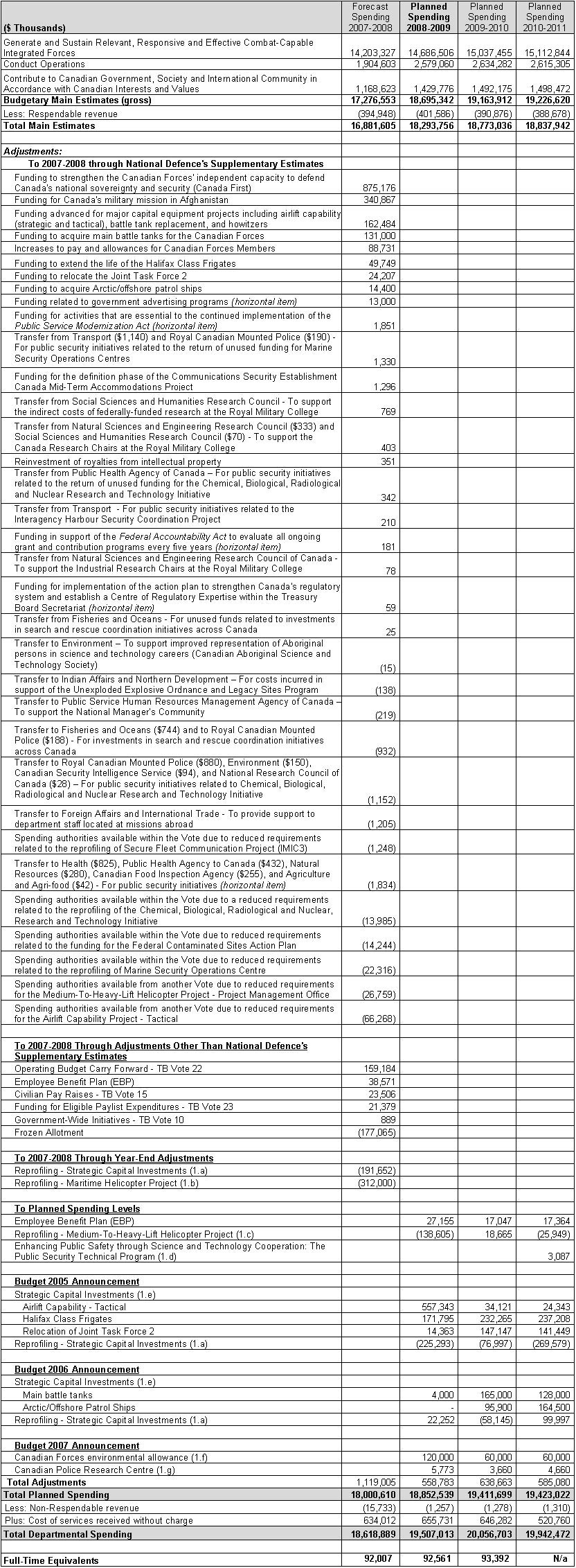
[edit]The Constitution of Canada gives the federal government exclusive responsibility for national defence, and expenditures are thus outlined in the federal budget. For the 2007–2010 fiscal year, the amount allocated for defence spending was CA$6.15 billion which is 1.4 percent of the country's GDP.[35][36] This regular funding was augmented in 2005 with an additional CA$12.5 billion over five years, as well as a commitment to increasing regular force troop levels by 5,000 persons, and the primary reserve by 4,500 over the same period.[37] It was further augmented in 2010, with another CA$5.3 billion over five years being provided to allow for 13,000 more regular force members, and 10,000 more primary reserve personnel, as well as CA$17.1 billion for the purchase of new trucks for the Canadian Army, transport aircraft and helicopters for the Royal Canadian Air Force, and joint support ships for the Royal Canadian Navy.[38]

In 2008, the Government of Canada began efforts, through the "Canada First Defence Strategy", to modernize the Forces, through the purchase of new equipment, improved training and readiness, as well as the establishment of the Canadian Special Operations Regiment. More funds were also put towards recruitment, which had been dwindling throughout the 1980s and 1990s, possibly because the Canadian populace had come to perceive the Forces as peacekeepers rather than as soldiers, as shown in a 2008 survey conducted by the Department of National Defence. The poll found that nearly two-thirds of Canadians agreed with the country's participation in the invasion of Afghanistan, and that the military should be stronger, but also that the purpose of the forces should be different, such as more focused on responding to natural disasters.[39] Then Chief of Defence Staff (CDS) Walter Natynczyk said later that year that, while recruiting has become more successful, the Forces was facing a problem with its rate of loss of existing members, which increased between 2006 and 2008 from 6% to 9.2% annually.[40]
Renewal and re-equipment efforts have resulted in the acquisition of specific equipment (main battle tanks, artillery, unmanned air vehicles and other systems) to support the mission in Afghanistan. It has also encompassed initiatives to renew certain so-called "core capabilities" (such as the air force's medium-range transport aircraft fleet—the C-130 Hercules—and the army's truck and armoured vehicle fleets). In addition, new systems (such as C-17 Globemaster III strategic transport aircraft and CH-47 Chinook heavy-lift helicopters) have also been acquired for the Forces.[41]
Peacekeeping
[edit]
Canada has served in over 50 peacekeeping missions, including every United Nations (UN) peacekeeping effort from its inception until 1989.[42] More than 125,000 Canadians have served in international peacekeeping operations, with approximately 130 Canadians having died during these operations.[43] Canada's support for multilateralism and internationalism has been closely related to its peacekeeping efforts.[44][45][46] Canada actively promotes its domestically shared values through its foreign affairs engagements.[47][48]
Canada's role in the development of and participation in peacekeeping during the 20th century led to its reputation as a positive middle power.[49][50] Canada's successful role in mediating the 1956 Suez Canal Crisis gave it credibility and established it as a country fighting for the common good of all nations.[51][52] The Canadian public came to identify the nation's peacekeeping role as the country's top contribution in international affairs.[53][54][55]
Canada faced controversy over its involvement in some peacekeeping efforts resulting in a military reassessment in the late 1990s.[56] By the 21st century, Canadian direct participation in UN peacekeeping efforts greatly declined, with its military participation reallocated to UN-sanctioned operations through the North Atlantic Treaty Organization (NATO).[57] This military reallocation resulted in a shift towards more militarized and deadly missions, rather than traditional peacekeeping duties.[58]Role of women
[edit]In the 1950s, the recruitment of women was open to roles in medicine, communication, logistics, and administration. The roles of women in the CAF began to expand in 1971 after the department reviewed the recommendations of the Royal Commission on the Status of Women, at which time it lifted the ceiling of 1,500 women personnel, and gradually expanded employment opportunities into the non-traditional areas—vehicle drivers and mechanics, aircraft mechanics, air-traffic controllers, military police, and firefighters.[59]

The department further reviewed personnel policies in 1978 and 1985, after Parliament passed the Canadian Human Rights Act and the Canadian Charter of Rights and Freedoms. As a result of these reviews, the department changed its policies to permit women to serve at sea in replenishment ships and a diving tender, with the army service battalions, in military police platoons and field ambulance units, and most air squadrons.[60]
In 1987, occupations and units with the primary role of preparing for direct involvement in combat on the ground or at sea were still closed to women: infantry, armoured corps, field artillery, air defence artillery, signals, field engineers, and naval operations. On 5 February 1987, the minister of national defence created an office to study the impact of employing men and women in combat units. These trials were called Combat-Related Employment of Women.[60]
All military occupations were open to women in 1989, except submarine service, which opened in 2000. Throughout the 1990s, the introduction of women into the combat arms increased the potential recruiting pool by about 100 percent.[60] Women were fully integrated into all occupations and roles by the government of Jean Chrétien, and by 8 March 2000, even allowed to serve on submarines.[60]
All equipment must be suitable for a mixed-gender force. Combat helmets, rucksacks, combat boots, and flak jackets are designed to ensure women have the same level of protection and comfort as their male colleagues. Women's uniforms are similar in design to men's uniforms, but conform to the female figure, and are functional and practical. Women are also provided with an annual financial entitlement for the purchase of bras.[60]
In 2019, the National Post columnist Christie Blatchford reported, per an anonymous source, that the CAF had been fulfilling employment equity targets for internal job postings by secretly rejecting applications from white males, and by not requiring Indigenous candidates to either write or pass, the Canadian Forces Aptitude Test. However, Brigadier-General Virginia Tattersall (commander of military forces generation, including the Canadian Forces Recruiting Group [CFRG]) said, "There are no occupations that we restrict based on gender", though "diversity is a consideration" and near the end of the recruiting year, "We will look at diversity applicants first."[61]
In March 2021, Lieutenant-Colonel Eleanor Taylor resigned citing sexual misconduct among the top brass.[62] Since then, the CAF has been under pressure over allegations of sexual misconduct. Former justice Louise Arbour, who was tasked to lead a probe into military harassment and sexual misconduct claims in CAF in 2021, issued 48 recommendations to change the culture of the CAF. She said that she saw no basis for the CAF to retain the jurisdiction over sexual offences as it has not improved efficiency, discipline and morale.[63]
Structure
[edit]The Crown has long occupied a central position in the Canadian Armed Forces. The National Defence Act states that "the Canadian Forces are the armed forces of Her Majesty raised by Canada, consisting of one service called the Canadian Armed Forces"[64] and the Constitution Act, 1867, vests command-in-chief of the Forces in the country's sovereign,[13] who, since 1904, has authorized his or her viceroy, the governor general, to exercise the duties ascribed to the post of commander-in-chief and, since 1905, hold the associated title.[65][66] All troop deployment and disposition orders, including declarations of war, fall within the royal prerogative. They previously were issued as orders-in-Council, which must be signed by either the monarch or governor general, but since 1992 deployments have been authorised by the cabinet (until 2003) or by a letter of the prime minister.[67] Under the Westminster system's parliamentary customs and practices, however, the monarch and viceroy must generally follow the advice of his or her ministers in Cabinet, including the prime minister and minister of national defence, who are accountable to the elected House of Commons.

The Canadian Forces' 92,600 personnel are divided into a hierarchy of numerous ranks of officers and non-commissioned members. The governor general appoints, on the advice of the prime minister, the chief of the Defence Staff (CDS) as the highest-ranking commissioned officer in the Armed Forces and its commander. In this role, the CDS heads the Armed Forces Council, which also includes the vice chief of the Defence Staff and the commanders of the Royal Canadian Navy, Canadian Army, Royal Canadian Air Force, Canadian Joint Operations Command, Canadian Special Operations Forces Command, as well as certain other designated personnel. The Armed Forces Council generally operates from National Defence Headquarters (NDHQ) in Ottawa, Ontario. The sovereign and most other members of the Canadian Royal Family also act as colonels-in-chief, honorary air commodores, air commodores-in-chief, admirals, and captains-general of Canadian Forces units, though these positions are ceremonial.
The Canadian Forces operate out of 27 Canadian Forces bases (CFB) across the country, including NDHQ. This number has been gradually reduced since the 1970s with bases either being closed or merged. Both officers and non-commissioned members receive their basic training at the Canadian Forces Leadership and Recruit School in Saint-Jean-sur-Richelieu. Officers will generally either directly enter the Canadian Armed Forces with a degree from a civilian university or receive their commission upon graduation from the Royal Military College of Canada. Specific element and trade training is conducted at a variety of institutions throughout Canada, and to a lesser extent, the world.
As of 2013, the Canadian Forces have 68,000 Regular Force members and 27,000 reservists, bringing the total force to approximately 95,000.[68] These individuals serve on numerous Canadian Forces bases in all regions of the country and are governed by the Queen's Regulations and Orders and the National Defence Act.
Royal Canadian Navy
[edit]_leaves_Pearl_Harbor_in_July_2014.JPG)
The Royal Canadian Navy (RCN), headed by the commander of the Royal Canadian Navy, includes 28 warships and submarines deployed in two fleets: Maritime Forces Pacific (MARPAC) at CFB Esquimalt on the west coast, and Maritime Forces Atlantic (MARLANT) at CFB Halifax on the east coast, as well as one formation: the Naval Reserve Headquarters (NAVRESHQ) at Quebec City, Quebec. The fleet is augmented by various aircraft and supply vessels. The RCN participates in NATO exercises and operations, and ships are deployed all over the world in support of multinational deployments.
Canadian Army
[edit].jpg)
The Canadian Army is headed by the commander of the Canadian Army and is administered through four divisions—the 2nd Canadian Division, the 3rd Canadian Division, the 4th Canadian Division and the 5th Canadian Division—the Canadian Army Doctrine and Training System and the Canadian Army Headquarters.[69][70]
Currently, the Regular Force component of the Army consists of three field-ready brigade groups: 1 Canadian Mechanized Brigade Group, at CFB Edmonton and CFB Shilo; 2 Canadian Mechanized Brigade Group, at CFB Petawawa and CFB Gagetown; and 5 Canadian Mechanized Brigade Group, at CFB Valcartier and Quebec City. Each contains one regiment of artillery, armour, and combat engineers, three battalions of infantry (all scaled in the British fashion), one battalion for logistics, a squadron for headquarters/signals, and several smaller support organizations. A tactical helicopter squadron and a field ambulance are co-located with each brigade but do not form part of the brigade's command structure.
The 2nd, 3rd and 4th Canadian Divisions each have a Regular Force brigade group, and each division except the 1st has two to three Reserve Force brigades groups. In total, there are ten Reserve Force brigade groups. The 5th Canadian Division and the 2nd Canadian Division each have two Reserve Force brigade groups, while the 4th Canadian Division and the 3rd Canadian Division each have three Reserve Force brigade groups. Major training and support establishments exist at CFB Gagetown, CFB Montreal and CFB Wainwright.
Royal Canadian Air Force
[edit]
The Royal Canadian Air Force (RCAF) is headed by the commander of the Royal Canadian Air Force. The commander of 1 Canadian Air Division and Canadian NORAD Region, based in Winnipeg, is responsible for the operational command and control of Air Force activities throughout Canada and worldwide. 1 Canadian Air Division operations are carried out through eleven wings located across Canada. The commander of 2 Canadian Air Division is responsible for training and support functions. 2 Canadian Air Division operations are carried out at two wings. 3 Canadian Space Division is responsible for delivering space power effects in support of Canadian Armed Forces operations, including space domain awareness, space-based support of military operations, and defending and protecting military space capabilities.[71] Wings represent the grouping of various squadrons, both operational and support, under a single tactical commander reporting to the operational commander and vary in size from several hundred personnel to several thousand.
Major air bases are in British Columbia, Alberta, Saskatchewan, Manitoba, Ontario, Quebec, Nova Scotia, and Newfoundland and Labrador, while administrative and command and control facilities are in Winnipeg and North Bay. A Canadian component of the NATO Airborne Early Warning Force is also based at NATO Air Base Geilenkirchen near Geilenkirchen, Germany.
The RCAF and Joint Task Force (North) (JTFN) also maintain at various points throughout Canada's northern region a chain of forward operating locations, each capable of supporting fighter operations. Elements of CF-18 squadrons periodically deploy to these airports for short training exercises or Arctic sovereignty patrols.
Canadian Joint Operations Command
[edit]Canadian Joint Operations Command is an operational element established in October 2012 with the merger of Canada Command, Canadian Expeditionary Force Command and Canadian Operational Support Command. The new command, created as a response to the cost-cutting measures in the 2012 federal budget, combines the resources, roles and responsibilities of the three former commands under a single headquarters.
Canadian Special Operations Forces Command
[edit]
Canadian Special Operations Forces Command (CANSOFCOM) is a formation capable of operating independently but primarily focused on generating special operations forces (SOF) elements to support CJOC. The command includes Joint Task Force 2 (JTF2), the Canadian Joint Incident Response Unit (CJIRU) based at CFB Trenton, as well as the Canadian Special Operations Regiment (CSOR) and 427 Special Operations Aviation Squadron (SOAS) based at CFB Petawawa.
Information Management Group
[edit]Among other things, the Information Management Group is responsible for the conduct of electronic warfare and the protection of the Armed Forces' communications and computer networks. Within the group, this operational role is fulfilled by the Canadian Forces Information Operations Group, headquartered at CFS Leitrim in Ottawa, which operates the following units: the Canadian Forces Information Operations Group Headquarters (CFIOGHQ), the Canadian Forces Electronic Warfare Centre (CFEWC), the Canadian Forces Network Operations Centre (CFNOC), the Canadian Forces Signals Intelligence Operations Centre (CFSOC), the Canadian Forces Station (CFS) Leitrim, and the 764 Communications Squadron. In June 2011 the Canadian Armed Forces Chief of Force Development announced the establishment of a new organization, the Directorate of Cybernetics, headed by a Brigadier-General, the Director General Cyber (DG Cyber). Within that directorate, the newly established CAF Cyber Task Force has been tasked to design and build cyber warfare capabilities for the Canadian Armed Forces.[72][73]
Royal Canadian Medical Service
[edit]The Royal Canadian Medical Service is a personnel branch of the CAF, consisting of all members of medical occupations.
Royal Canadian Dental Corps
[edit]The Royal Canadian Dental Corps is a personnel branch of the CAF.
Canadian Forces Health Services Group
[edit]The Health Services Group is a joint formation that includes over 120 general or specialized units and detachments providing health services to the Canadian Armed Forces. With few exceptions, all elements are under command of the Commander, who may also be appointed Surgeon General when the position is filled by a medical officer, for domestic support and force generation, or temporarily assigned under command of a deployed Joint Task Force through Canadian Joint Operations Command.[74][75]
Canadian Armed Forces Cyber Command
[edit]On 26 September 2024, Canadian Armed Forces Cyber Command (CAFCYBERCOM) was established.[76]
Canadian Armed Forces Reserve Force
[edit]
The Canadian Armed Forces as of 2025[update] have a total reserve force of approximately 50,000 primary and supplementary that can be called upon in times of national emergency or threat. On 30 May 2025, Chief of the Defence Staff General Jennie Carignan and defence deputy minister Stefanie Beck signed a directive which outlined the plan to increase the reserve size from 28,000 to 400,000.[77] Under this plan, 100,000 soldiers will be placed under the Primary Reserve while 300,000 soldiers will be placed under the Supplementary Reserve.[78]
For the current components and sub-components of the Canadian Armed Forces Reserve Force, the order of precedence follows:
- Primary Reserve (26,000),
- Supplementary Reserve (11,000) Prior to 2002 this consisted of:
after 2002 there is no sub-division of the Supplementary Reserve.
- Supplementary Ready Reserve, and
- Supplementary Holding Reserve,
- Cadet Organizations Administration and Training Service (7,500), and
- Canadian Rangers (5,000).[79]
Primary Reserve
[edit]
Approximately 26,000 soldiers, sailors, and airmen,[80] trained to the level of and interchangeable with their Regular Force counterparts, and posted to CAF operations or duties on a casual or ongoing basis, make up the Primary Reserve. This group is represented, though not commanded, at NDHQ by the chief of Reserves and Employer Support, who is usually a major-general or rear-admiral, and is divided into four components that are each operationally and administratively responsible to its corresponding environmental command in the Regular Force—the Naval Reserve (NAVRES), Land Force Reserve (LFR), and Air Reserve (AIRRES)—in addition to one force that does not fall under an environmental command, the Health Services Reserve under the Canadian Forces Health Services Group.
Cadet Organizations Administration and Training Service
[edit]The Cadet Organizations Administration and Training Service (COATS)[81] consists of officers and non-commissioned members who conduct training, safety, supervision and administration of nearly 60,000 cadets aged 12 to 18 years in the Canadian Cadet Organization. The majority of members in COATS are officers of the Cadet Instructors Cadre (CIC) branch of the CAF. Members of the Reserve Force Sub-Component COATS who are not employed part-time (Class A) or full-time (Class B) may be held on the "Cadet Instructor Supplementary Staff List" (CISS List) in anticipation of employment in the same manner as other reservists are held as members of the Supplementary Reserve.
Canadian Rangers
[edit]The Canadian Rangers, who provide surveillance and patrol services in Canada's arctic and other remote areas, are an essential reserve force component used for Canada's exercise of sovereignty over its northern territory.
Defence policy
[edit]Since the Second World War, Canadian defence policy has consistently stressed three overarching objectives:
- The defence of Canada itself;
- The defence of North America in co-operation with US forces;
- Contributing to broader international security.[82]
During the Cold War, a principal focus of Canadian defence policy was contributing to the security of Europe in the face of the Soviet military threat. Toward that end, Canadian ground and air forces were based in Europe from the early 1950s until the early 1990s.
However, since the end of the Cold War, as the North Atlantic Treaty Organization (NATO) has moved much of its defence focus "out of area", the Canadian military has also become more deeply engaged in international security operations in various other parts of the world—most notably in Afghanistan from 2002 to 2014.[83]
The basis for current Canadian defence capability objectives was originally set in the Canada First Defence Strategy,[84] introduced by the former Harper Government in 2008 but is now updated through the Liberal Government's 2017 defence strategy, Strong, Secure and Engaged (SSE). The SSE pledged greater funding to support the Canadian military (particularly in relation to the National Shipbuilding Procurement Strategy) in its primary tasks related to the defence of Canada, the defence of North America and contributing to global security.
In addition to its core missions, the Canadian Armed Forces also contribute to the conduct of Canadian defence diplomacy through a range of activities, including the deployment of Canadian Defence Attachés,[85] participation in bilateral and multilateral military forums (e.g. the System of Cooperation Among the American Air Forces), ship and aircraft visits, military training and cooperation,[86] and other such outreach and relationship-building efforts.
Military expenditures
[edit]The Constitution of Canada gives the federal government exclusive responsibility for national defence, and expenditures are thus outlined in the federal budget. DND’s main estimates for 2023–24 totalled $26.5 billion, including various votes and statutory funding. Operating ($17.9 billion), capital ($6.1 billion), and grants and contributions ($320 million). Most of the budget is allocated to personnel (34%), operating (34%), and capital (22%).[87]
In 2017 the government began to factor in military-related spending from departments such as Veterans Affairs, Public Works, and the Treasury Board when calculating "defence spending".[88] It is believed that this move was made to improve Canada's defence-related NATO reporting metrics.[89]
In 2024 the government announced plans to increase defence spending by $77 billion over twenty years at a rate of 1.76% of GDP. The funds were to be allocated toward new submarines (twelve were planned) and overall force modernisation.[90]
In 2025, the government of Mark Carney announced plans to rapidly increase defence spending to reach the NATO target 2% of GDP by the end of the fiscal year. The plan includes many measures, including increases to pay for Canadian Forces members, acquisition of new equipment for each of the three environmental commands, and the continued support of previously announced procurement projects.[91]
Ranks
[edit]Uniforms
[edit]
Although the Canadian Armed Forces are a single service, there are four similar but distinctive environmental uniforms (DEUs): navy blue (which is actually black) for the navy, rifle green for the army, light blue for the air force, and khaki for special operations. CAF members in operational occupations generally wear the DEU to which their occupation "belongs." CAF members in non-operational occupations (the "purple" trades) are allocated a uniform according to the "distribution" of their branch within the CAF, the association of the branch with one of the former services, and the individual's initial preference. Therefore, on any given day, in any given CAF unit, multiple coloured uniforms may be seen.
The uniforms of the CAF are sub-divided into five orders of dress:[92]
- Ceremonial dress, including regimental full dress, patrol dress, naval high-collar whites, and service-dress uniforms with ceremonial accoutrements such as swords, white web belts, gloves, etc.
- Mess dress, which ranges from full mess kit with mess jacket, cummerbund, or waistcoat, etc., to service dress with bow tie
- Service dress, also called a walking-out or duty uniform, is the military equivalent of the business suit, with an optional white summer uniform for naval CF members
- Operational dress, an originally specialized uniform for wear in an operational environment, is now for everyday wear on base or in garrison
- Occupational dress, which is specialized uniform articles for particular occupations (e.g., medical, dental, firefighter)
Only service dress is suitable for CAF members to wear on any occasion, barring "dirty work" or combat. With gloves, swords, and medals (No. 1 or 1A), it is suitable for ceremonial occasions and "dressed down" (No. 3 or lower), it is suitable for daily wear. Generally, after the elimination of base dress (although still defined for the Air Force uniform), the operational dress is now the daily uniform worn by most members of the CF, unless service dress is prescribed (such as at the NDHQ, on parades, at public events, etc.). Approved parkas are authorized for winter wear in cold climates and a light casual jacket is also authorized for cooler days.

Units of the Canadian Army, Royal Canadian Air Force, and cadets of the Royal Military College of Canada also wear full-dress uniforms. The Army's universal full-dress uniforms includes a scarlet tunic, midnight blue trousers with a scarlet trouser stripe.[93] However, many regiments in the Canadian Army maintain authorized regimental differences from the Army's universal full dress, most notably for its armoured units, Scottish regiments, and Voltigeur/Rifle regiments. The full-dress uniform for cadets at Royal Military College is similar to the Army's universal full dress uniform. Full dress uniforms for units of the Royal Canadian Air Force include a blue tunic, and blue trousers and facings.[93] Naval full dress includes a navy blue tunic and trousers with white facings, although the Canadian Forces dress instructions state that naval full dress is no longer worn.[93]
Authorized headdresses for the Canadian Armed Forces is the: beret, wedge cap, ballcap, Yukon cap, and tuque (toque). Each is coloured according to the distinctive uniform worn: navy (white or navy blue), army (rifle green or "regimental" colour), and air force (light blue). Adherents of the Sikh faith may wear uniform turbans (dastar) (or patka, when operational) and Muslim women may wear uniform tucked hijabs under their authorized headdress. Jews may wear yarmulke under their authorized headdress and when bareheaded. The beret is probably the most widely worn headgear and is worn with almost all orders of dress (with the exception of the more formal orders of Navy and Air Force dress), and the colour of which is determined by the wearer's environment, branch, or mission. Naval personnel, however, seldom wear berets, preferring either service caps or authorized ballcaps (shipboard operational dress), which only the Navy wear. Air Force personnel, particularly officers, prefer the wedge cap to any other form of headdress. There is no naval variant of the wedge cap. The Yukon cap and tuque are worn only with winter dress, although clearance and combat divers may wear tuques year-round as a watch cap. Soldiers in Highland, Scottish, and Irish regiments generally wear an alternative headdress, including the glengarry, balmoral, tam o'shanter, and caubeen instead of the beret. The officer cadets of both Royal Military Colleges wear gold-braided "pillbox" (cavalry) caps with their ceremonial dress and have a unique fur "Astrakhan" for winter wear. The CAF wears the CG634 helmet.
Symbolism and honours
[edit]The Canadian Forces have derived many of their traditions and symbols from the Navy, Army, and Air Force of the United Kingdom, including those with royal elements. Contemporary icons and rituals, however, have evolved to include elements reflective of Canada and the Canadian monarchy. Members of the country's royal family maintain personal relationships with the forces' divisions and regiments.[94][95]
The monarch is regarded as the fount of honour[96][97] and the Canadian system of orders, decorations, and medals includes numerous specifically for the military, such as the Victoria Cross, Order of Military Merit, Cross of Valour, Star of Courage, and Medal of Bravery.[98] The Victoria Cross is the highest honour in Canada. The British version was presented to 94 Canadians and two Newfoundlanders[99] between its creation in 1856 and 1993, when the Canadian Victoria Cross was instituted.[98] No Canadian has received either honour since 1945.[100]
During the unification of the forces in the 1960s, a renaming of the branches took place, resulting in the loss of the royal designations for the Navy and Air Force.[101] On 16 August 2011, the federal Cabinet announced that Air Command was re-assuming the Air Force's original name, Royal Canadian Air Force; Land Force Command the name Canadian Army; and Maritime Command the name Royal Canadian Navy.[102] The government stated that the change was made to better reflect Canada's military heritage and align Canada with other Commonwealth realms whose militaries use the royal designation, while political opponents claimed the changes were more politically motivated and designed to appeal to monarchists in the Conservative party.[103][102]
Military families
[edit]
The portrait of military families in Canada from the 2021 Census had 345,180 military families, making up 3.4% of all families in the country. This group included 53,510 active military families. Among these, 74. 1% were couple families with one partner serving and the other having no military experience, 11. 8% had both partners serving, 7. 5% had one partner serving and the other a Veteran, and 6. 6% were one-parent families with a serving parent. The majority, 291,670, were Veteran families, mainly consisting of couple families where one spouse was a Veteran and the other had no military experience at 87. 6%. Additionally, 6. 5% were one-parent Veteran families and 6. 0% had both partners as Veterans.[104]
More than 80% of military families in Canada were identified as Veteran families, while the remaining percentage was active.The report also highlighted the distribution of active military, Veteran, and non-military families. In Ottawa–Gatineau, 11. 1% were active military families, 7. 8% were Veteran families, and 3. 8% were non-military families. Similar proportions were observed in Halifax and Québec.[104]
Active military families were more likely than Veteran and non-military families to have moved to a different province or territory in the past five years. The report detailed that 24. 1% of couple families and 15. 4% of one-parent families in the active category lived in a different province compared to 4. 0% and 1. 9%, respectively, for Veteran families, and 2. 4% and 1. 9% for non-military families.[104]
See also
[edit].svg)
- Authorized marches of the Canadian Armed Forces
- Canadian Armed Forces order of precedence
- Canadian Forces Military Police
- Canadian Forces Radio and Television
- Canadian war cemeteries
- Canadian war memorials
- Code of Service Discipline
- List of Canadian military occupations
- List of historical equipment of the Canadian military
- List of military equipment of Canada
- Planned Canadian Forces projects
- Postal Branch
Notes
[edit]- ^ Persons 16 years of age, with parental permission, can join the Canadian Armed Forces.
References
[edit]- ^ "Registration of a Badge". Public Register of Arms, Flags and Badges of Canada. Official website of the Governor General. Retrieved 8 November 2021.
- ^ "Confirmation of the blazon of a Flag". Public Register of Arms, Flags and Badges of Canada. Official website of the Governor General. Retrieved 19 March 2025.
- ^ a b c Defence, National (7 February 2025). "Personnel". www.canada.ca. Retrieved 6 July 2025.
- ^ "Current operations list". Government of Canada. 27 March 2013. Retrieved 24 September 2020.
- ^ a b c "Trends in World Military Expenditure, 2024" (PDF). Stockholm International Peace Research Institute. April 2025. Retrieved 18 September 2025.
- ^ Canadian Defence Review Canada's 2011 Top 50 Defence Companies Archived 31 March 2012 at the Wayback Machine. Retrieved on: 15 December 2011
- ^ Canadian Defence Review Canada's 2011 Top 50 Defence Companies Archived 31 March 2012 at the Wayback Machine. Retrieved on: 28 August 2011
- ^ "The World Factbook > Canada > Military". Central Intelligence Agency. 19 November 2015. Retrieved 23 November 2015.
- ^ "National Defence". Government of Canada. Retrieved 11 September 2023.
- ^ "Frequently Asked Questions – What is the relationship between DND and the CAF?". Department of National Defence. 27 July 2013. Archived from the original on 7 November 2016. Retrieved 11 April 2014.
- ^ "About the Canadian Armed Forces". Her Majesty the Queen in Right of Canada. 27 July 2013. Archived from the original on 17 March 2015. Retrieved 3 April 2015.
- ^ "About the Department of National Defence and the Canadian Armed Forces – National Defence Act". Her Majesty the Queen in Right of Canada. 23 May 2013. Archived from the original on 15 February 2023. Retrieved 3 April 2015.
- ^ a b Victoria (29 March 1867). Constitution Act, 1867. III.15. Westminster: Queen's Printer. Retrieved 15 January 2009.
The Command-in-Chief of the Land and Naval Militia, and of all Naval and Military Forces, of and in Canada, is hereby declared to continue to be vested in the Queen.
- ^ Lagassé, Philippe (December 2013). "The Crown's Powers of Commander-in Chief: Interpreting Section 15 of Canada's Constitution Act, 1867" (PDF). Review of Constitutional Studies. 18 (2): 189–220. Archived from the original (PDF) on 4 March 2016. Retrieved 10 November 2015.
- ^ "Governor General of Canada > Commander-in-Chief". Rideau Hall. Archived from the original on 1 December 2007. Retrieved 15 January 2009.
- ^ Sorenson, David S.; Wood, Pia Christina (2005). The Politics of Peacekeeping in the Post-cold War Era. Psychology Press. p. 158. ISBN 978-0-7146-8488-8.
- ^ Sobel, Richard; Shiraev, Eric; Shapiro, Robert (2002). International Public Opinion and the Bosnia Crisis. Lexington Books. p. 21. ISBN 978-0-7391-0480-4.
- ^ a b Massie, Justin (30 April 2019). "Why Canada Goes to War: Explaining Combat Participation in US-led Coalitions". Canadian Journal of Political Science. 52 (3). Cambridge University Press (CUP): 575–594. doi:10.1017/s0008423919000040. ISSN 0008-4239.
- ^ a b Mingst, K.; Karns, M.P. (2019). The United Nations In The Post-cold War Era, Second Edition. Taylor & Francis. p. 63. ISBN 978-1-000-30674-3.
- ^ Linda McQuaig (2010). Holding the Bully's Coat: Canada and the U.S. Empire. Random House Digital. p. 50. ISBN 978-0-385-67297-9.
- ^ Nersessian, Mary (9 April 2007). "Vimy battle marks birth of Canadian nationalism". CTV. Archived from the original on 15 February 2009. Retrieved 20 January 2009.
- ^ Cook, Tim (2008). Shock troops: Canadians fighting the Great War, 1917–1918. Toronto: Viking. ISBN 978-0-670-06735-0.
- ^ World War – Willmott, H.P. et al.; Dorling Kindersley Limited, London, 2004, Page 168
- ^ Stuart, Rob (Fall 2009). "Was the RCN ever the Third Largest Navy?" (PDF). Canadian Naval Review. 5 (3): 4–9. Retrieved 12 November 2019.
- ^ Gilmour, Sarah (17 May 2006). "Navy celebrates 96 years" (PDF). The Maple Leaf. 9: 10. Archived from the original (PDF) on 6 February 2009.
- ^ "Canadian armed forces to be 'royal' once again". BBC News. 16 August 2011. Retrieved 20 January 2016.
- ^ "National Defence Act". Government of Canada. Retrieved 25 August 2016.
- ^ "Canadian military rush to Manitoba flood zone". CBC. Retrieved 2 August 2012.
- ^ Lauri Seidlitz (2000). Canada through the Decades: the 1990s. Weigl Educational Publishers Limited. p. 8. ISBN 978-1-896990-38-5.
- ^ a b Michael Head; Scott Mann (2009). Domestic deployment of the armed forces: military powers, law and human rights. Ashgate Publishing. p. 72. ISBN 978-0-7546-7346-0.
- ^ Rolleson, Kevin; Mitchell, Catherine (14 May 1997). "Thank-you!". Winnipeg Free Press. p. A1.
- ^ Penny Draper (2011). Ice Storm. Coteau Books. p. 192. ISBN 978-1-55050-451-4.
- ^ James F. Miskel (2008). Disaster Response and Homeland Security: What Works, What Doesn't. Stanford University Press. p. 39. ISBN 978-0-8047-5972-4.
- ^ "Operation Peregrine: Canadian Forces Personnel Fighting B.C. Forest Fires". Land Force Western Area. 2009. Archived from the original on 1 January 2013. Retrieved 19 February 2011.
- ^ "Science and Technology Support for National Security: An International Review" (PDF). Defence Science and Technology Organisation. 2007. Archived from the original (PDF) on 29 February 2012. Retrieved 25 January 2012.
- ^ Treasury Board of Canada Secretariat. "Departmental Planned Spending and Full-Time Equivalents". Queen's Printer. Retrieved 2 February 2008.
- ^ Department of Finance (2005). The Budget Speech 2005 (PDF). Canada in the World. Queen's Printer. p. 20. Archived from the original (PDF) on 6 February 2009. Retrieved 2 February 2009.
- ^ Department of National Defence. "'Canada First' National Defence Procurement". Queen's Printer. Archived from the original on 10 October 2011. Retrieved 2 February 2009.
- ^ The Canadian Press (5 September 2005). "Canadians still view troops as peacekeepers: DND poll". CTV. Archived from the original on 6 September 2008. Retrieved 5 September 2008.
- ^ The Canadian Press (21 November 2008). "Military as message for job seekers: we want you". CTV. Archived from the original on 1 August 2012. Retrieved 22 November 2008.
- ^ Department of National Defence "Canada First Defence Strategy | National Defence and the Canadian Forces". Archived from the original on 7 April 2009. Retrieved 6 January 2010.
- ^ Rudderham, M. A. (2008). "Canada and United Nations Peace Operations: Challenges, Opportunities, and Canada's Response". International Journal. 63 (2). [Sage Publications, Ltd., Canadian International Council]: 359–384. doi:10.1177/002070200806300210. ISSN 0020-7020. JSTOR 40204368.
- ^ "Canada and Peacekeeping". The Canadian Encyclopedia. 30 June 2023. Archived from the original on 26 February 2024. Retrieved 14 March 2024.
- ^ Sens, Allen; Stoett, Peter (2013). Global Politics (5th ed.). Nelson Education. p. 6. ISBN 978-0-17-648249-7. Archived from the original on 30 November 2023. Retrieved 26 February 2024.
- ^ Canada, Global Affairs. "Plans at a glance and operating context". GAC. Global Affairs Canada. Archived from the original on 25 September 2020. Retrieved 4 August 2020.
- ^ Munton, Don; Keating, Tom (2001). "Internationalism and the Canadian Public". Canadian Journal of Political Science / Revue canadienne de science politique. 34 (3). Canadian Political Science Association: 517–549. doi:10.1017/S0008423901777992. ISSN 0008-4239. JSTOR 3233002. S2CID 154625162. Archived from the original on 22 September 2023. Retrieved 5 March 2024.
- ^ James, Patrick (1 January 2011). Religion, Identity, and Global Governance. University of Toronto Press. p. 284. ISBN 978-1-4426-4066-5.
- ^ "How Should Canada Promote Democracy and Good Governance Internationally?". Canadian Global Affairs Institute. 1 August 2018. Retrieved 18 March 2025.
- ^ Chapnick, Adam (2011). The Middle Power Project: Canada and the Founding of the United Nations. UBC Press. pp. 2–5. ISBN 978-0-7748-4049-1. Archived from the original on 30 November 2023. Retrieved 26 February 2024.
- ^ Gabryś, M.; Soroka, T. (2017). Canada as a selective power: Canada's Role and International Position after 1989. Societas. Neriton, Wydawnictwo. p. 39. ISBN 978-83-7638-792-5. Archived from the original on 26 February 2024. Retrieved 26 February 2024.
- ^ Donaghy, Greg (2016). "The politics of accommodation: Canada, the Middle East, and the Suez Crisis, 1950–1956". International Journal: Canada's Journal of Global Policy Analysis. 71 (2): 313–327. doi:10.1177/0020702016643261. ISSN 0020-7020.
- ^ Gaffen, Fred (1987). In The Eye of The Storm: A History of Canadian Peacekeeping. Deneau & Wayne Publishers. p. 43.
- ^ Anker, Lane (20 June 2005). "Peacekeeping and Public Opinion". Government of Canada, National Defence, Canadian Defence Academy. Archived from the original on 10 February 2024. Retrieved 26 February 2024.
- ^ Carroll, Michael K (2016). "Peacekeeping: Canada's past, but not its present and future?". International Journal. 71 (1). [Sage Publications, Ltd., Canadian International Council]: 167–176. doi:10.1177/0020702015619857. ISSN 0020-7020. JSTOR 44631172. Archived from the original on 28 February 2024. Retrieved 28 February 2024.
- ^ Murray, R.W.; Gecelovsky, P. (2021). The Palgrave Handbook of Canada in International Affairs. Canada and International Affairs. Springer International Publishing. pp. 187–189. ISBN 978-3-030-67770-1.
- ^ "Honouring 60 Years of United Nations Peacekeeping". United Nations. 29 May 2008. Retrieved 25 March 2024.
- ^ Linda McQuaig (2010). Holding the Bully's Coat: Canada and the U.S. Empire. Random House Digital. p. 50. ISBN 978-0-385-67297-9.
- ^ James, P.; Michaud, N.; O'Reilly, M. (2006). Handbook of Canadian Foreign Policy. Lexington Books. p. 177. ISBN 978-0-7391-5580-6.
- ^ Canada, Veterans Affairs (8 August 2019). "Canada Remembers Women in the Canadian Military - Women and War - Remembering those who served - Remembrance - Veterans Affairs Canada". www.veterans.gc.ca. Retrieved 20 September 2021.
- ^ a b c d e "Backgrounder | Women in the Canadian Armed Forces". National Defence and the Canadian Armed Forces. 14 August 2018. Archived from the original on 11 November 2020. Retrieved 9 March 2020.
- ^ Blatchford, Christie (22 April 2019). "The Canadian Forces Jobs Where Only Women Need Apply". National Post.
- ^ Canada: top female soldier quits over military's failures on sexual misconduct The Guardian, 2021
- ^ Shakil, Ismail (30 May 2022). "Sex crime allegations in Canadian military should be investigated externally, report says". Reuters. Retrieved 31 May 2022.
- ^ Elizabeth II (12 December 2008). National Defence Act. II.14. Queen's Printer. Archived from the original on 30 November 2009.
- ^ "1947 - 1952 The Assignment of Sovereign Powers". Office of the Governor General of Canada. 20 November 2017.
- ^ "Commander-in-Chief". The Governor General of Canada. Archived from the original on 24 January 2021.
- ^ Braden, Alexander J (26 May 2021). "Decision Instruments of the Federal Cabinet: Legally Exercising the "War Prerogative"". Journal of Commonwealth Law. 3: 157–217.
- ^ Government of Canada (21 June 2013). "Frequently Asked Questions 12". Department of National Defence. Archived from the original on 7 November 2016. Retrieved 22 December 2018.
- ^ Government of Canada, National Defence (8 July 2013). "ARCHIVED - Article | Historical Features of the Canadian Army Restored". army-armee.forces.gc.ca. Archived from the original on 16 July 2013. Retrieved 10 July 2013.
- ^ "1st Canadian Division". Archived from the original on 12 March 2014.
- ^ "3 Canadian Space Division". Department of National Defence. 8 August 2022. Retrieved 14 August 2022.
- ^ The Maple Leaf, 22 June 2011, Vol. 14, No. 22, p.3
- ^ Khang Pham, Cyber Security: Do Your Part, The Maple Leaf, Vol. 15, No. 2, February 2012, p.12
- ^ "Canadian Forces Health Services website" Archived 17 February 2012 at the Wayback Machine Retrieved on 18 February 2012
- ^ "Canadian Forces Health Services Group Surgeon General's Report 2010" Archived 27 December 2011 at the Wayback Machine Retrieved on 18 February 2012
- ^ "CAFCYBERCOM – The CAF's New Established Cyber Command". Canadian Defence Review. 26 September 2024. Retrieved 15 January 2025.
- ^ "Canadian military wants mobilization plan in place to boost reserves to 400,000 personnel". Ottawa Citizen. 31 October 2025. Retrieved 2 November 2025.
- ^ "Canadian Military leaders warn of future conflict, push for massive expansion". The Winnipeg Sun. 31 October 2025. Retrieved 2 November 2025.
- ^ Department of National Defence (15 February 2012). "National Defence and the Canadian Forces > CFOA 66-6 Precedence in the Canadian Forces". Queen's Printer for Canada. Archived from the original on 7 February 2012. Retrieved 15 February 2012.
- ^ Department of National Defence (19 December 2008). "National Defence and the Canadian Forces > About DND/CF". Queen's Printer for Canada. Retrieved 2 January 2009.
- ^ "Administrative Order: Implementation of Cadet Organizations Administration and Training Service", NDHQ 1085-30 (D Cdts 6) dated 2 July 2009.
- ^ "About Us – National Defence – Canadian Forces". Archived from the original on 11 October 2014. Retrieved 9 October 2014.
- ^ "Canadian military involvement in Afghanistan formally ends". 12 March 2014. Retrieved 21 August 2017.
- ^ Department of National Defence (30 March 2009). "Canada First Defence Strategy". Archived from the original on 1 April 2009. Retrieved 15 February 2015.
- ^ "Canadian Defence Attaché Network". Outcan.forces.gc.ca. 22 July 2010. Archived from the original on 6 July 2011. Retrieved 23 March 2011.
- ^ For example, through the Military Training and Cooperation Program and its ancillary activities "Military Training Cooperation Program". Archived from the original on 29 April 2011. Retrieved 10 March 2011.
- ^ "Defence Budget". Canada.ca. 25 September 2023. Retrieved 23 January 2025.
- ^ "Strong, Secure, Engaged" (PDF). dgpaapp.forces.gc.ca. Minister of National Defence.
- ^ Scotti, Monique. "Even with new military investments, Canada to fall short of NATO target". Global News.
- ^ Pugliese, David (8 April 2024). "Liberal government defence policy boosts military spending, commits to new purchases of helicopters, missiles, aircraft". Ottawa Citizen. Retrieved 12 April 2024.
- ^ "Canada's new government is rebuilding, rearming, and reinvesting in the Canadian Armed Forces". 9 June 2025. Retrieved 19 June 2025.
- ^ Canada – National Defence: "A-AD-265-000/AG-001 CANADIAN FORCES DRESS INSTRUCTIONS Archived 23 March 2010 at the Wayback Machine"
- ^ a b c "6-1" (PDF). Canadian Armed Forces Dress Instruction. Canadian Armed Forces. 1 June 2001. p. 211. Archived from the original (PDF) on 30 July 2018. Retrieved 11 June 2018.
- ^ Nathan Tidridge (2011). Canada's constitutional monarchy. Dundurn Press. p. 84. ISBN 978-1-4597-0084-0.
- ^ Gary Toffoli. "The Royal Family and the Armed Forces". Canadian Royal Heritage Trust. Archived from the original on 1 July 2007.
- ^ Royal Canadian Mounted Police. "Honours and Recognition Programs: Canadian National Honours". Queen's Printer. Archived from the original on 23 March 2009. Retrieved 20 May 2009.
- ^ Department of National Defence. "Canadian Honours Chart: Sacrifice Medal (SM)". Queen's Printer. Archived from the original on 14 November 2009. Retrieved 2 September 2009.
- ^ a b Christopher McCreery (2005). The Order of Canada: its origins, history, and development. University of Toronto Press. p. 228. ISBN 978-0-8020-3940-8.
- ^ Mike Filey (1993). More Toronto sketches: "the way we were". Dundurn Press. p. 175. ISBN 978-1-55002-201-8.
- ^ Isabel Teotonio (7 March 2007). "Vets irate at Victoria Cross proposal". Toronto Star. Retrieved 12 July 2007.
- ^ Douglas J. Murray; Paul R. Viotti (1994). The defense policies of nations: a comparative study. JHU Press. p. 84. ISBN 978-0-8018-4794-3.
- ^ a b "Restoration of traditional military service names welcomed". Government of New Brunswick. 2011. Retrieved 1 January 2012.
- ^ Fitzpatrick, Meagan (17 August 2011). "Peter MacKay hails 'royal' renaming of military". Canadian Broadcasting Corporation.
- ^ a b c "Military families in Canada". Statistics Canada. 13 January 2025. Retrieved 15 January 2025.
 This article incorporates content that is under an open licence from Statistics Canada - (FAQ).

Further reading
[edit]- Beaudet, Normand (1993). Le Mythe de la défense canadienne. Montréal: Éditions Écosociété. ISBN 2-921561-11-5
- Morton, Desmond (1999). A military history of Canada (4th ed.). Toronto: McClelland and Stewart. ISBN 0-7710-6514-0.
- Rennick, Joanne Benham (2013). "Canadian Values and Military Operations in the Twenty-First Century," Armed Forces & Society 39, No. 3, pp. 511–30
- Leuprecht, Christian & Sokolsky, Joel. (2014). Defense Policy "Walmart Style" Canadian Lessons in "not so grand" Grand Strategy. Armed Forces & Society Journal Online First.
- Granatstein, J. L (2004). Canada's army: waging war and keeping the peace. University of Toronto Press. ISBN 0-8020-8696-9.
- Zuehlke, Mark (2006). Canadian Military Atlas: Four Centuries of Conflict from New France to Kosovo. Douglas & McIntyre. ISBN 978-1-55365-209-0.
- Faces of War at Library and Archives Canada
External links
[edit]
- Official website

- Combat Camera – Official CF photo website
- Canadian Military Documentary channel on YouTube
| Military history | |
|---|---|
| Leadership | |
| Commands | |
| Academies | |
| Lists | |
| Others | |

Evolution of the Military of Canada | |
|---|---|
| Current Canadian Forces | |
| History of the Canadian Forces | |
| Canadian military formation | |
| Military formation in British North America |
|
| Military formation in New France | |

| International | |
|---|---|
| National | |
| Other | |
Canadian Armed Forces
View on GrokipediaHistory
Origins and Establishment (Pre-Confederation to 1867)
The military foundations in the territories that would form Canada originated during the French colonial era in New France, where a militia system emerged as a core defensive mechanism amid persistent threats from Indigenous confederacies and English rivals. By the 1650s, settler communities in settlements like Québec, Montréal, and Trois-Rivières were organized into militia companies, supported by Indigenous allies and limited professional garrisons using tactics suited to the terrain, such as "la petite guerre" involving ambushes and mobility via canoes and snowshoes. In 1669, Louis XIV formalized the requirement for all male Canadiens aged 16 to 60 to enroll, arm themselves, and participate in mandatory training and musters, rendering the militia the primary force until its defeat in the Seven Years' War (1756–1763).[8] After the British conquest in 1760 and the 1763 Treaty of Paris, defence transitioned to British regular army garrisons stationed at strategic forts, with colonial militias restructured under local assemblies to provide auxiliary support. Provincial Militia Acts, varying slightly by jurisdiction, emphasized compulsory enrollment of able-bodied males for home defence, though enforcement often depended on immediate threats like potential American incursions. The 1793 Militia Act in Upper Canada, for instance, mandated service and organization into battalions, enabling rapid mobilization during crises.[9][10] These forces proved essential in the War of 1812, where provincial militias—numbering up to 10,000 in Upper Canada alone at peak—supplemented roughly 6,000 British regulars, contributing to victories at battles like Queenston Heights (October 13, 1812) and the defence of Upper Canada against U.S. invasions. Internal adaptations followed, including volunteer flank companies for specialized roles. The Rebellions of 1837–1838 further tested the system, with loyalist militias aiding British troops in quelling uprisings in Lower and Upper Canada.[9] Reform accelerated in the 1850s amid fears of U.S. filibustering and British troop reductions, culminating in the 1855 Militia Act for the Province of Canada, which authorized a volunteer force expandable to 50,000, funded training camps, and prioritized equipping with modern rifles over outdated muskets. This shift from sedentary, conscript-based units to active volunteers addressed chronic issues like poor readiness, as evidenced by inadequate responses to early Fenian incursions in 1866. By 1867, these disparate provincial militias—totaling around 40,000 on paper across British North America—formed the embryonic structure for national defence, though still heavily reliant on imperial oversight.[9][11]Confederation and Early National Defence (1867–1914)
Following the British North America Act of 1867, which established the Dominion of Canada on July 1, the new federal government assumed primary responsibility for national defence, inheriting the provincial militia systems while British regular troops continued to provide garrison support at key fortifications until their phased withdrawal in the early 1870s.[12] The persistent threat from Fenian incursions across the U.S. border, including raids in 1866 and 1870, accelerated the push for self-reliant defences, fostering greater emphasis on local militia organization over dependence on imperial forces.[13] The Militia Act of 1868 formalized Canada's defence structure by defining the militia as encompassing all male inhabitants aged 18 to 60, with provisions for an active volunteer component subject to annual training and a smaller permanent force for professional duties such as artillery and infantry garrisons.[14][15] This legislation established the Department of Militia and Defence under civilian oversight, though operational command remained with British officers, ensuring alignment with imperial standards.[16] By 1871, amendments authorized a modest permanent active militia of about 500 men, focused on coastal artillery and infantry, marking the inception of a standing Canadian force amid chronic underfunding that limited expansion to volunteer battalions for domestic contingencies.[16] The militia's primary roles in this era included internal security and frontier pacification, as evidenced by its deployment during the North-West Resistance of 1885, where federal authorities mobilized roughly 5,000 troops—comprising militia units, permanent force elements, and North-West Mounted Police—to counter Métis and Indigenous resistance led by Louis Riel.[17] Rail transport via the newly completed Canadian Pacific Railway enabled rapid concentration of forces, culminating in victories at Fish Creek and Batoche that suppressed the uprising by May 1885, though at the cost of 68 Canadian casualties and highlighting logistical strains in remote operations.[17] Canada's inaugural overseas engagement came with the Second Boer War (1899–1902), prompted by a British appeal for colonial support against Boer republics in South Africa; despite initial parliamentary debate over imperial obligations, Prime Minister Wilfrid Laurier authorized volunteer contingents, dispatching the first battalion of 1,000 men in October 1899, followed by additional mounted rifles and artillery units.[18] Over 7,300 Canadians ultimately served, suffering 267 deaths from combat and disease, with units participating in key actions like Paardeberg; this voluntary effort, drawn largely from militia ranks, demonstrated Canada's capacity for expeditionary contributions while sparking domestic debates on autonomy versus empire.[18] Maritime defence lagged behind land forces, relying on Royal Navy protection and ad hoc fisheries patrol vessels operated by the Department of Marine and Fisheries; persistent U.S. naval expansion and imperial strategic shifts prompted the Naval Service Act of May 4, 1910, which founded the Naval Service of Canada (renamed Royal Canadian Navy in 1911) with two obsolete cruisers, HMCS Niobe and Rainbow, crewed initially by a mix of volunteers and transferred British personnel.[19] Pre-war militia reforms under Minister Sir Sam Hughes from 1911 emphasized rifle training and mobile brigades, yet persistent fiscal constraints left Canada's defences oriented toward homeland security rather than imperial projection by 1914.[20]World Wars and Interwar Period (1914–1945)
Canada entered the First World War on August 4, 1914, automatically as a dominion of the British Empire upon the United Kingdom's declaration of war against Germany.[21] The Canadian Expeditionary Force (CEF), formed separately from the pre-existing militia, mobilized over 620,000 personnel by war's end, with more than 66,000 killed and 172,000 wounded.[22][23] Key engagements included the Battle of Vimy Ridge from April 9–12, 1917, where Canadian forces captured the objective after British and French failures, incurring 10,600 casualties including 3,600 fatalities.[24] At the Battle of the Somme in 1916, Canadians suffered over 24,000 casualties.[25] These efforts contributed to the Allied victory and enhanced Canada's international military reputation, though at the cost of approximately 10% of the male population aged 18–45 serving overseas.[26] Following the Armistice on November 11, 1918, the CEF demobilized rapidly, with most troops repatriated by mid-1919 amid some unrest at camps, including riots that resulted in fatalities.[27] The interwar period saw severe reductions in military strength; the Permanent Force, Canada's regular army, dwindled to about 4,000 personnel by 1935, emphasizing a part-time militia focused on coastal defence and internal security rather than expeditionary capabilities.[28] Limited budgets and isolationist policies constrained modernization, leaving equipment outdated and training minimal, as Canada prioritized economic recovery over rearmament despite rising global tensions.[29] Canada independently declared war on Germany on September 10, 1939, seven days after the United Kingdom, mobilizing over one million personnel across all services by 1945.[30][31] The Royal Canadian Navy (RCN) played a pivotal role in the Battle of the Atlantic, escorting convoys and combating U-boats from 1939 to May 1945, with approximately 2,000 personnel killed, the majority in this theater.[32] The Royal Canadian Air Force (RCAF) supported anti-submarine patrols and Bomber Command operations, contributing to Allied air superiority. On land, the Canadian Army participated in the Dieppe Raid on August 19, 1942, suffering over 3,300 casualties in a largely unsuccessful test of amphibious assault tactics.[33] In the Italian Campaign from 1943–1945, over 93,000 Canadians served, incurring more than 25,000 casualties including 5,900 deaths, with notable actions in Sicily (2,310 casualties, 562 killed) and advances up the peninsula.[34][35] The Normandy invasion on June 6, 1944, saw 14,000 Canadians land, with 1,074 casualties on D-Day alone, followed by intense fighting through the Battle of Normandy.[36] These operations demonstrated Canada's capacity for combined arms warfare, though high casualties underscored the costs of large-scale commitments.[37]Cold War Era and Unification (1945–1990)
Following the Second World War, the Canadian military demobilized from over 780,000 personnel to a peacetime strength of approximately 51,000 by 1947, comprising 26,000 in the army, 10,000 in the Royal Canadian Navy (RCN), and 15,000 in the Royal Canadian Air Force (RCAF), as resources shifted toward reconstruction and emerging Soviet threats.[38] Canada's initial Cold War engagement came with the Korean War (1950–1953), deploying 26,791 personnel under United Nations command, including infantry battalions, naval destroyers for blockade and shore bombardment, and RCAF transport squadrons; this effort resulted in 516 Canadian fatalities and marked the nation's first combat involvement since 1945.[39] [40] As a founding signatory of the North Atlantic Treaty on April 4, 1949, Canada committed to collective defence against potential Warsaw Pact aggression, stationing army brigade groups, RCAF squadrons, and RCN vessels in Europe; by the mid-1950s, up to 10,000 troops were forward-deployed in West Germany and France at bases such as Lahr and Marville, contributing to NATO's integrated air defense and ground deterrence.[41] [42] Concurrently, in response to Soviet bomber capabilities, Canada partnered with the United States to form the North American Air Defense Command (NORAD) on May 12, 1958, funding and operating radar chains including the Pinetree Line (1950s), Mid-Canada Line (1950s), and Distant Early Warning (DEW) Line (1957 onward) across the Arctic to provide early warning of aerial incursions.[43] [44] These commitments strained budgets, prompting efficiency reviews; total armed forces strength grew to about 115,000 by the early 1960s before fiscal constraints led to reductions.[45] Reforms accelerated under Minister of National Defence Paul Hellyer, who in his 1964 White Paper advocated integrating service headquarters to curb administrative overlap and procurement redundancies, arguing that separate branches fostered inefficiency amid limited funding.[46] This culminated in the Canadian Forces Reorganization Act, effective February 1, 1968, which unified the RCN, Canadian Army, and RCAF into a single Canadian Armed Forces (CAF) under a centralized command, introducing a common rank structure, green service uniform, and shared logistics to purportedly save $360–400 million annually in operating costs.[47] [48] Hellyer dismissed resisting chiefs of staff and enforced the changes despite parliamentary debate, viewing unification as essential for modern warfare interoperability rather than preserving naval, army, or air force traditions.[47] Unification provoked immediate backlash, including mass resignations of over 30 senior officers, formal protests from serving personnel, and a 1969 RCAF association petition signed by thousands decrying the loss of branch-specific expertise and identity; critics contended the reforms prioritized political control over operational effectiveness, leading to procurement delays and morale erosion that persisted into the 1970s.[47] In parallel, Prime Minister Pierre Trudeau's 1969 review halved European deployments from 9,800 to 5,000 troops, withdrawing tactical air wings and emphasizing mobile forces over static garrisons, while redirecting savings toward domestic programs amid perceptions of reduced Soviet invasion risks.[41] By the 1980s, the CAF sustained reduced NATO contributions—such as 4 Canadian Mechanized Brigade Group in Lahr, maritime patrols in the Atlantic, and CF-18 fighter intercepts under NORAD—totaling hundreds of thousands of personnel rotations over the era, though chronic underfunding limited equipment modernization and readiness compared to peers.[42] [41] These adjustments reflected Canada's middle-power strategy, balancing alliance obligations with fiscal realism, but unification's long-term effects included ongoing inter-service tensions that unification advocates claimed streamlined joint operations.[47]Post-Cold War Deployments and Reforms (1990–2001)
Following the dissolution of the Soviet Union in 1991, the Canadian Armed Forces transitioned from Cold War-era forward deployments in Europe to a greater emphasis on United Nations peacekeeping and rapid reaction capabilities, amid substantial budget constraints imposed by the federal government to realize a "peace dividend." Personnel strength declined from approximately 87,000 in 1990 to around 60,000 by the end of the decade, reflecting fiscal austerity measures that prioritized deficit reduction over military readiness.[49] [50] These cuts necessitated operational efficiencies and a doctrinal shift outlined in the 1992 Defence Policy Statement, which advocated for versatile, deployable forces suitable for coalition operations rather than mass mobilization.[51] Canada's first major post-Cold War combat involvement was Operation Friction during the 1990–1991 Gulf War, where over 4,000 personnel supported the multinational coalition to expel Iraqi forces from Kuwait. Naval contributions included four warships conducting blockade and mine-clearing operations in the Persian Gulf and Red Sea, while Royal Canadian Air Force CF-18 Hornets flew 2,700 sorties from bases in Qatar and Turkey, enforcing no-fly zones and striking ground targets without incurring losses.[52] [53] No ground combat troops were committed, aligning with Canada's policy of avoiding direct offensive land engagements, though logistics and aerial refueling support extended to allied operations.[54] Subsequent humanitarian and stabilization missions exposed operational and leadership deficiencies. In 1992–1993, under Operation Hope, approximately 750 Canadian Airborne Regiment personnel deployed to Somalia as part of the UN-authorized Unified Task Force to secure aid distribution amid famine and clan warfare. The mission deteriorated following the March 1993 torture and beating death of Somali teenager Shidane Arone by Canadian soldiers, prompting the Somalia Inquiry (1993–1997), which revealed systemic failures in training, discipline, and rules of engagement adherence.[55] [56] The scandal resulted in the regiment's disbandment in 1995, courts-martial of involved personnel, and high-level resignations, including the dismissal of the Chief of the Defence Staff.[57] Peacekeeping in the Balkans dominated Canadian deployments through the 1990s, with over 10,000 personnel rotating through UN Protection Force (UNPROFOR) missions in Croatia and Bosnia-Herzegovina starting in 1992 under Operation Harmony. Canadian troops enforced ceasefires, protected UN safe areas, and engaged in direct combat, notably during the 1993 Medak Pocket operation where a company from the 2nd Battalion, Royal Canadian Regiment, repelled Croatian forces attempting to ethnically cleanse Serb villages, resulting in confirmed Croatian atrocities upon advancing.[58] [59] These missions transitioned to NATO-led Implementation Force (IFOR) and Stabilization Force (SFOR) after the 1995 Dayton Accords, with Canadians providing infantry battlegroups, engineers, and military police until 2001, sustaining 23 fatalities from hostile actions, mines, and accidents.[60] The Somalia Affair catalyzed internal reforms, including enhanced ethics training, improved military justice processes via the 1998 National Defence Act amendments, and greater emphasis on leadership accountability to prevent abuses in expeditionary settings.[61] Budgetary pressures further drove structural changes, such as the 1994 Special Commission on the Restructuring of the Reserves and the adoption of lighter, more mobile force structures to compensate for reduced numbers, though equipment modernization lagged, with aging platforms like Sea King helicopters persisting without timely replacements.[62] By 2001, these adaptations positioned the Forces for emerging asymmetric threats, though chronic underfunding sowed long-term readiness gaps.[63]21st-Century Operations and Challenges (2001–2025)
In response to the September 11, 2001 terrorist attacks, the Canadian Armed Forces deployed a naval task group to the Arabian Sea under Operation Apollo as part of Operation Enduring Freedom, conducting maritime interdiction and escort duties from October 2001 to November 2002.[64] Ground contributions followed, with Canadian special forces operating in Afghanistan from late 2001, transitioning to broader involvement under the International Security Assistance Force (ISAF) in 2002.[64] By 2003, Canada led the ISAF command in Kabul, but the mission intensified in 2006 with the transfer to Kandahar Province, where Canadian battle groups faced heavy combat against Taliban insurgents.[64] Task Force Kandahar, comprising up to 2,500 personnel at peak, conducted counter-insurgency operations from 2006 to 2011, suffering the highest per-capita casualties among NATO contributors with 158 soldiers killed in action or from related causes out of over 40,000 who served in Afghanistan between 2001 and 2014.[65] Combat roles included direct engagements, reconstruction efforts, and training Afghan forces, but the mission drew domestic controversy over costs and effectiveness, leading to a phased withdrawal completed in March 2014.[66] In August 2021, the CAF returned briefly for Operation Apollo to oversee evacuations from Kabul amid the Taliban's resurgence, airlifting over 3,700 people including Afghan allies.[67] Parallel to Afghanistan, Canada participated in the 2011 NATO-led intervention in Libya under Operation Mobile, deploying CF-18 Hornet fighters that conducted over 600 sorties and dropped approximately 700 bombs, accounting for about 10% of NATO's air strikes to enforce a no-fly zone and protect civilians from Muammar Gaddafi's forces.[68] Following the territorial defeat of ISIS in Iraq and Syria, the CAF contributed to Operation Impact from 2014, initially with air strikes—CF-18s flew 1,500+ sorties and released 600+ munitions between October 2014 and February 2016—before shifting to advisory, training, and special operations roles with up to 850 personnel advising Iraqi and Kurdish forces.[69] The mission evolved into non-combat support by 2016, continuing into the 2020s as part of NATO's capacity-building in the region.[70] The CAF maintained NATO commitments, including air policing in Iceland, maritime operations in the Mediterranean, and leading enhanced Forward Presence in Latvia with a battle group since 2017, expanded to brigade size by 2025 amid Russian aggression in Ukraine.[71] However, these operations highlighted persistent challenges: chronic underfunding, with defence spending hovering around 1.3% of GDP—below the NATO 2% target—resulting in equipment shortages and deferred maintenance affecting nearly half of army assets.[49] Procurement delays plagued major acquisitions, including the Victoria-class submarines plagued by mechanical failures since 2000, stalled shipbuilding for new frigates and joint support ships, and a protracted fighter replacement process where the F-35 was selected in 2010, canceled in 2015, and recommitted in 2023 for 88 aircraft amid interoperability needs with allies.[72][73] Recruitment and retention crises intensified in the 2010s and 2020s, with the CAF facing a shortfall of approximately 16,000 personnel, exacerbated by inefficient processing—only 13% of applicants from 2022-2025 were enrolled despite 192,000 applications—and internal issues like the sexual misconduct scandal that eroded trust and readiness.[74][49] Overall readiness fell to 26% below targets by 2025, with supply chain disruptions and parts shortages sidelining vehicles and aircraft, limiting deployability for Arctic sovereignty patrols against Russian and Chinese incursions.[75] Successive governments' fiscal restraint, prioritizing domestic programs over defence, contributed to these gaps, though pledges for increased spending post-2022 Ukraine invasion aimed to address them, with actual delivery lagging due to bureaucratic hurdles.[76][77]Organizational Structure
High Command and Governance
The governance of the Canadian Armed Forces (CAF) is established by the National Defence Act, which created the Department of National Defence (DND) in 1922 to oversee defence policy, administration, and support for the CAF. The DND operates as a civilian-military dyad, with the Minister of National Defence, a member of the federal Cabinet, holding ultimate responsibility for defence matters and exercising authority on behalf of the Government of Canada.[1] The Governor General serves as the ceremonial Commander-in-Chief, representing the monarch, but operational command resides with the Minister through the chain of command.[1] [78] At the apex of military leadership is the Chief of the Defence Staff (CDS), the senior serving officer in the CAF, appointed by the Governor General on the advice of the Prime Minister.[79] The CDS is responsible for the overall command, control, and administration of the CAF, including military strategy, operational planning, readiness, and advising the Minister on defence requirements.[1] As of July 2024, General Jennie Carignan holds the position of CDS, having assumed command following a change-of-command ceremony; she is the first woman to serve in this role.[79] The CDS reports directly to the Minister and oversees subordinate commands, including the Vice Chief of the Defence Staff, who assists in administration and operations, as well as the commanders of the Royal Canadian Navy, Canadian Army, Royal Canadian Air Force, and joint operations commands.[1] [80] Civilian oversight is provided by the Deputy Minister of National Defence, who manages DND's policy, programs, and resources in partnership with the CDS, ensuring alignment between government priorities and military execution.[1] This structure emphasizes accountability to Parliament through the Minister, with the CDS maintaining professional military advice independent of direct political interference, though subject to ministerial direction on operations.[81] The National Defence Act delineates the chain of command, prohibiting any bypassing of the CDS by subordinate officers without authorization, to preserve unity and discipline. Governance also involves specialized entities like the Judge Advocate General for military justice and the Canadian Forces Grievance Board for independent review of complaints, both operating outside the direct chain of command to enhance fairness.Royal Canadian Navy
The Royal Canadian Navy (RCN) serves as the maritime component of the Canadian Armed Forces, tasked with conducting operations across the spectrum of maritime security, including sovereignty enforcement, international alliances, and power projection. Following the 1968 unification of Canada's military services, the RCN functioned as Maritime Command until its restoration as an independent naval identity in 2011, emphasizing its role in generating combat-ready forces for domestic and expeditionary missions.[82] The service maintains a blue-water capability, with deployments supporting NATO commitments, counter-piracy efforts, and Arctic patrols, though operational tempo has been constrained by equipment sustainment and human resource limitations.[83] Commanded by a Vice-Admiral serving as Commander of the Royal Canadian Navy and Chief of the Naval Staff, the organization reports through the Chief of the Defence Staff to the Minister of National Defence, with headquarters located in Ottawa.[84] Key formations include Maritime Forces Atlantic based in Halifax, Nova Scotia; Maritime Forces Pacific in Esquimalt, British Columbia; and the Naval Reserve division headquartered in Quebec City, which collectively oversee fleet operations, training, and reserve integration.[85] [82] The RCN employs approximately 8,400 regular force sailors, 4,100 primary reservists, and 3,800 civilian personnel, though persistent recruitment and retention shortfalls—exacerbated by training bottlenecks and competition from civilian sectors—have reduced deployable units, with reports indicating severe under-manning across surface combatants as of late 2025.[82] [86] The fleet composition centers on multi-role platforms suited for anti-submarine warfare, air defence, and patrol duties, comprising 12 Halifax-class frigates (FFH 330 series), which form the backbone of expeditionary task groups despite their average age exceeding 30 years and ongoing modernization delays.[87] Supporting these are 12 Kingston-class maritime coastal defence vessels for near-shore operations and mine countermeasures, alongside six Harry DeWolf-class Arctic and offshore patrol ships designed for northern sovereignty assertion, with deliveries completing in 2024.[88] Submarine capabilities rest on four Victoria-class boats, originally acquired from the United Kingdom in the 1990s, which underwent mid-life upgrades but continue to face availability issues due to maintenance backlogs.[89] Auxiliary support includes the interim auxiliary oiler replenishment vessel MV Asterix, bridging the gap until the two Protecteur-class joint support ships enter service in the late 2020s. Major bases anchor operations on both coasts: Canadian Forces Base Halifax, home to the Atlantic fleet and fleet maintenance facility, and Canadian Forces Base Esquimalt, which hosts Pacific commands, the Naval Training Centre, and submarine support.[82] These installations facilitate task group formations typically consisting of up to four surface combatants, a replenishment ship, and a submarine for sustained deployments.[89] Modernization efforts, including the $80 billion Canadian Surface Combatant program for 15 new frigates based on the Type 26 design, aim to replace aging assets by the 2030s, while submarine recapitalization debates persist amid fiscal pressures and strategic shifts toward Indo-Pacific and Arctic threats. However, procurement delays and personnel deficits have drawn criticism for undermining readiness, with independent analyses highlighting that the current force structure struggles against peer competitors without expanded investment in crewing and sustainment.[86] [90]Canadian Army
The Canadian Army is the land component of the Canadian Armed Forces, responsible for generating and sustaining combat-capable ground forces for domestic defence, disaster response, and international deployments. Headquartered in Kingston, Ontario, it operates under the command of a lieutenant-general who reports to the Chief of the Defence Staff, with a structure designed to integrate regular and reserve elements for rapid mobilization. As of 2024, the Army maintains approximately 21,000 regular force personnel and 17,000 primary reservists, though the broader Canadian Armed Forces face ongoing shortages of about 14,000 regular members despite meeting short-term recruitment intake targets in 2025.[91][4] The Army's operational framework centers on the 1st Canadian Division, a high-readiness formation for expeditionary tasks, supported by four regional divisions (2nd, 3rd, 4th, and 5th Canadian Divisions) that oversee training, administration, and readiness across provinces. These divisions encompass combat arms branches including the Royal Canadian Armoured Corps (equipped with Leopard 2 main battle tanks and light armoured vehicles), Royal Canadian Infantry Corps, and Royal Regiment of Canadian Artillery, alongside combat support units such as the Corps of Royal Canadian Engineers and Communications and Electronics Branch. Reserve units, including the Canadian Rangers for northern sovereignty patrols, augment regular forces, with a total primary reserve strength contributing to a combined operational capacity.[92][93] In response to escalating global threats and domestic demands, the Army initiated the "Inflection Point 2025" reforms in 2025, aiming to restructure from a regionally static model to a more agile, division-centric organization capable of sustaining brigade-level deployments abroad while addressing equipment readiness and personnel retention challenges. This includes enhanced focus on modernization programs for vehicles, artillery, and soldier systems, amid criticisms of delayed procurements and maintenance backlogs that have impacted operational availability. The reforms seek to align the Army with NATO commitments, such as forward presence in Latvia, by prioritizing deployable units over administrative divisions.[93][94][95]Royal Canadian Air Force
The Royal Canadian Air Force (RCAF) is the aviation branch of the Canadian Armed Forces, responsible for air defence, surveillance of Canadian and North American airspace through NORAD commitments, search and rescue operations covering over 10 million square kilometres, tactical and strategic airlift, and support to ground and maritime forces in domestic and expeditionary roles.[96] [97] Established in its current form following the restoration of the royal prefix in 2011 after unification under the Canadian Forces in 1968, the RCAF maintains operational readiness amid ongoing modernization efforts.[98] As of fiscal year 2024-2025, the RCAF employs 15,650 regular force personnel and 2,162 primary reserve members, though shortages persist in critical trades such as pilots, with only 1,374 trained effective pilots against 1,559 authorized positions as of September 2023.[99] [100] The service operates from 13 wings across Canada, including fighter operations at 4 Wing Cold Lake, Alberta, and 3 Wing Bagotville, Quebec; air mobility and search and rescue at 8 Wing Trenton, Ontario; and maritime patrol at 14 Wing Greenwood, Nova Scotia.[101] Organizationally, the RCAF is commanded by the Chief of the Air Staff, who advises the Chief of the Defence Staff on air and space power, supported by the RCAF Command Chief Warrant Officer for enlisted matters.[97] It is structured into three primary divisions: 1 Canadian Air Division (1 CAD), headquartered in Winnipeg, Manitoba, which oversees tactical aviation operations, commands the Canadian NORAD Region, and serves as Joint Force Air Component Commander; 2 Canadian Air Division (2 CAD), responsible for recruiting, education, and training including ab initio flight training; and 3 Canadian Space Division, focused on space domain awareness, satellite communications, and defensive space operations in alignment with national defence policy.[97] These divisions coordinate through wings and squadrons, such as 1 Wing Kingston for tactical helicopter support with CH-146 Griffon and CH-147 Chinook fleets, and 19 Wing Comox for Pacific surveillance.[101] The RCAF's equipment includes approximately 390 active aircraft, encompassing 76 CF-188 Hornets for multi-role fighter duties pending replacement by 88 F-35A Lightning II jets under contracts signed in 2023 and 2024; strategic transports like 5 CC-177 Globemaster IIIs; tactical airlifters including 17 CC-130H/J Hercules; maritime helicopters such as 22 CH-148 Cyclones, which achieved initial operational capability in 2018 but faced delays in full maritime integration; and utility helicopters like 15 CH-147F Chinooks delivered from 2018 onward.[102] [103] Training platforms include CT-155 Hawks and CT-156 Harvards, while patrol assets feature CP-140 Auroras transitioning to upgraded CP-140A Arcturus for intelligence, surveillance, and reconnaissance until retirement around 2030.[103] Procurement challenges, including cost overruns and integration issues with platforms like the Cyclone, have strained readiness, contributing to reduced deployable squadron strength and reliance on allied support in missions such as NATO air policing.[104]Joint Operations and Special Forces Commands
The Canadian Joint Operations Command (CJOC) serves as the primary operational command for the Canadian Armed Forces, responsible for generating, deploying, and sustaining forces for domestic defence, continental operations in support of North America, and international missions to promote security. Established on 5 October 2012 through the amalgamation of Canada Command (focused on domestic and continental operations) and the Canadian Expeditionary Force Command (handling overseas deployments), CJOC consolidated command structures to enhance efficiency amid post-2011 defence reviews.[105] Headquartered in Ottawa at the Major-General George R. Pearkes Building, it is led by a lieutenant-general or vice-admiral, with deputy commanders from the Royal Canadian Navy, Canadian Army, and Royal Canadian Air Force to ensure tri-service integration.[106] [107] CJOC oversees a framework of regional joint task forces aligned with Canada's six military regions, including Joint Task Force North for Arctic and northern operations, and the 1st through 5th Canadian Divisions functioning as readiness formations for their respective areas (Atlantic, Quebec, central Canada, and western provinces). These elements support rapid response to natural disasters, sovereignty patrols, and NATO or UN commitments, such as Operation Nanook in the Arctic or multinational exercises. Excluding specialized entities like NORAD and special operations, CJOC directs approximately 80% of CAF operational activities, emphasizing joint interoperability through standardized planning and logistics.[106] [108] ![Canadian Special Operations Regiment freefall jump at Hurlburt Field][center] The Canadian Special Operations Forces Command (CANSOFCOM), formed in February 2006 to unify disparate special capabilities post-Afghanistan experiences, specializes in high-risk missions including counter-terrorism, hostage rescue, direct action, and unconventional warfare. Reporting directly to the Chief of the Defence Staff rather than through CJOC, it maintains operational independence to preserve secrecy and agility, with headquarters in Ottawa's Colonel By Building. CANSOFCOM's structure integrates a joint headquarters with five subordinate units totaling around 1,500 personnel as of 2023, drawn from all CAF elements and supported by interagency partners.[109] [110] [111] Key units include Joint Task Force 2 (JTF 2), established in 1993 as Canada's premier counter-terrorist unit based in Ottawa, specializing in special reconnaissance and precision strikes; the Canadian Special Operations Regiment (CSOR), raised in 2006 at CFB Petawawa for direct action, mobility, and foreign internal defence with capabilities in austere environments; and the Canadian Joint Incident Response Unit (CJIRU) in Trenton, focused on chemical, biological, radiological, and nuclear (CBRN) threat mitigation since 2002. Aviation support comes from 427 Special Operations Aviation Squadron at CFB Petawawa, equipped with CH-146 Griffon helicopters for insertion/extraction since 2007, while the Canadian Special Operations Training Centre in Shannon provides selection, advanced tactics, and language training for all units. CANSOFCOM has deployed extensively, including over 6,000 personnel-days in Iraq against ISIS from 2014-2019 and ongoing support to NATO's enhanced Forward Presence in Latvia.[110] [112]Personnel Composition
Regular Force and Reserves
The Regular Force forms the full-time, standing component of the Canadian Armed Forces (CAF), tasked with meeting ongoing domestic and international operational requirements, including combat deployments, peacekeeping, and disaster response. Members serve continuously, receiving full salaries, benefits, and training to maintain high readiness levels. As of September 2024, the Regular Force numbered approximately 63,500 personnel across the Royal Canadian Navy, Canadian Army, and Royal Canadian Air Force.[99] The Department of National Defence aims to expand this to 71,500 by fiscal year 2032, though persistent shortfalls have constrained capabilities.[4] The Reserve Force augments the Regular Force by providing part-time personnel for training, augmentation, and domestic operations, with the flexibility to transition to full-time service during surges or mobilizations under the National Defence Act. Reserve Force members are compensated at approximately 92.8% of Regular Force pay rates, reflecting differences such as no relocation requirements.[113] It encompasses four sub-components: the Primary Reserve (operational part-time units integrated with Regular formations), the Supplementary Reserve (former Regular or Primary members available for recall), the Cadet Organizations Administration and Training Service (supporting youth programs), and the Special Reserve Category (specialized roles like chaplains).[114] The Primary Reserve, the largest sub-component, stood at about 22,500 members in September 2024, with a target of 30,000; it includes Army Reserve units for territorial defence, Naval Reserve for maritime support, and Air Reserve for aviation augmentation.[99][114] Supplementary Reservists, numbering in the thousands but not precisely tracked in recent aggregates, serve voluntarily or can be compelled in emergencies.[115] Both Regular and Reserve components have encountered significant recruitment and retention difficulties, contributing to an overall CAF shortfall of roughly 14,000 qualified personnel as of May 2025.[116] Inefficient processes, including prolonged medical and security screenings, result in only one in thirteen applicants advancing to basic training, exacerbating attrition rates that outpace enlistments.[116][117] Fiscal year 2024-2025 saw progress with 6,706 new Regular Force accessions—a 55% increase over prior years—but Reserves face parallel delays, limiting their ability to fill augmentation roles effectively.[4]| Component | Approximate Strength (Sep 2024) | Authorized/Target Strength |
|---|---|---|
| Regular Force | 63,500 | 71,500 |
| Primary Reserve | 22,500 | 30,000 |
Recruitment, Retention, and Demographics
The Canadian Armed Forces (CAF) faces persistent challenges in recruitment despite recent improvements, with the Department of National Defence targeting 71,500 Regular Force members and 30,000 Primary Reserve members, yet remaining approximately 14,000 personnel short as of mid-2025. Between April 1, 2022, and March 31, 2025, the CAF received 191,981 applications, increasing annually from 43,934 in 2022–23 to 77,431 in 2024–25, and in the 2025–26 fiscal year, Regular Force applications are up nearly 13% so far, but only 14,946 applicants (about 1 in 13) were successfully recruited to basic training, falling short of the target ratio of 1 in 8–12. Process delays, with median times of 245–271 days compared to a 100–150 day goal, contributed to high attrition, as 54% of applicants (103,684) dropped out voluntarily, though the CAF lacks comprehensive data on reasons such as frustration with bureaucracy or uncompetitive offers. A backlog in security clearance quality checks grew from around 20,000 to 23,000 applications during this period, exacerbating delays. However, fiscal year 2024–25 saw 6,706 new Regular Force enlistees, a 55% increase over the prior year and a 10-year high, surpassing recruitment targets through streamlined processes and targeted outreach to Indigenous peoples and visible minorities, though women's representation remained below goals. Retention issues compound recruitment shortfalls, with overall attrition rates around 6.6%, but higher among new recruits—particularly during basic military qualification, where voluntary departures are linked to inadequate housing and support. The Auditor General noted that insufficient military housing impacts retention, as substandard accommodations deter both newcomers and longer-serving members from staying. Specific occupations and demographics, such as certain technical trades, experience elevated attrition due to workload pressures and limited career progression, though the CAF has identified these for targeted interventions like improved compensation announced in August 2025. Net personnel losses exceed gains in some periods, with the force 12,000 below its 2017 target of 101,500 as of early 2025, underscoring systemic challenges like understaffed recruiting roles and training infrastructure deficits. Demographically, the CAF reflects efforts to mirror Canada's diversity but lags in key areas. As of December 2024, women comprise 16.6% of Regular Force and Primary Reserve personnel combined.| Category | Women's Representation |
|---|---|
| Overall (Regular + Primary Reserve) | 16.6% |
| Navy | 20.6% |
| Army | 14.2% |
| Air Force | 20.2% |
| Officers (Total) | 19.9% |
| Non-Commissioned Members (Total) | 15.5% |
Training and Professional Development
Basic training for non-commissioned members of the Canadian Armed Forces (CAF) is conducted through the Basic Military Qualification (BMQ) program at the Canadian Forces Leadership and Recruit School (CFLRS) in Saint-Jean-sur-Richelieu, Quebec, lasting 10 weeks and emphasizing physical fitness, weapon handling, fieldcraft, and military discipline.[121][122] The curriculum allocates approximately 62% of time to classroom instruction, 25% to field exercises, and 13% to evaluation, preparing recruits for subsequent occupational training.[123] Officer candidates undergo Basic Military Officer Qualification (BMOQ) at the same facility, a 12-week course that builds on BMQ elements with added focus on leadership, ethics, and command responsibilities.[124][125] Post-basic training, personnel advance to environment-specific and trade qualification courses at specialized institutions, such as the Royal Military College of Canada (RMC) in Kingston, Ontario, for officer development under the Regular Officer Training Plan (ROTP), which integrates a bachelor's degree with military instruction over four years.[126][127] Naval personnel train at facilities like the Canadian Forces Fleet School in Esquimalt, British Columbia, while air force members attend schools such as 1 Canadian Forces Flying Training School in Moose Jaw, Saskatchewan, for flight and technical qualifications. Advanced training includes joint exercises and specialized programs, such as those for special operations forces emphasizing freefall parachuting and tactical skills.[128] Professional military education (PME) forms a tiered system for career progression, with non-formal PME providing tools for junior ranks and formal courses at institutions like the Canadian Forces College advancing strategic acumen for senior leaders.[129][130] Non-commissioned members access the Non-Commissioned Member Subsidized Training and Education Plan (NCMSTEP) for subsidized college or university studies to qualify for promotions.[131] However, training pipelines face bottlenecks, with the CAF training fewer personnel than required for operational targets amid recruitment shortfalls and infrastructure constraints as of 2025.[132][133] Efforts to expand CFLRS capacity, including additional cohorts, seek to mitigate these issues and support reconstitution goals.[134]Defence Policy and Commitments
Strategic Doctrine and Priorities
The strategic doctrine of the Canadian Armed Forces (CAF) is articulated in the 2024 policy update Our North, Strong and Free: A Renewed Vision for Canada's Defence, which builds upon the 2017 framework Strong, Secure, Engaged. This doctrine emphasizes an agile, integrated force structure capable of addressing hybrid threats, including state actors like Russia and China, while prioritizing sovereignty assertion, alliance interoperability, and technological adaptation. Core operational concepts include rapid response capabilities, joint all-domain operations, and resilience against cyber and informational warfare, reflecting a shift toward contested environments over traditional peacekeeping roles.[135][136] Key priorities center on three interconnected pillars: strength at home, security in North America, and engagement abroad. Domestically, the doctrine identifies Arctic sovereignty as the "most urgent and important task," driven by climate-induced accessibility, resource competition, and foreign incursions, necessitating enhanced surveillance, infrastructure, and mobile forces in the North.[135][137] This includes investments in northern bases, unmanned systems, and all-weather mobility to deter aggression and support civil authorities amid environmental changes. Continentally, priorities focus on modernizing the North American Aerospace Defense Command (NORAD) through a $8.1 billion allocation over five years for over-the-horizon radars, satellites, and fighter integration, underscoring binational defence against aerospace and maritime threats from peer competitors.[135][138] Internationally, the CAF doctrine commits to NATO's Article 5 collective defense, with deployments to Eastern Europe under Operation Reassurance and contributions to multinational battlegroups in Latvia, aiming for sustained high-readiness forces amid Russian aggression.[135] Engagement extends to the Indo-Pacific via freedom-of-navigation operations and partnerships under Canada's Indo-Pacific Strategy, alongside selective UN stabilization missions, but subordinates expeditionary roles to core northern and continental imperatives. The policy projects defence spending rising to 1.76% of GDP by 2029-30 to fund these aims, though implementation hinges on procurement reforms and personnel reconstitution.[135][139] This framework represents a pragmatic recalibration from prior emphases on multilateralism, prioritizing deterrence in high-threat domains while leveraging alliances for extended reach.[140]Military Expenditures and Funding Trends
Canada's defence expenditures have historically lagged behind NATO commitments, averaging approximately 1% of GDP from 2013 to 2020, reflecting a pattern of fiscal restraint amid competing domestic priorities such as social programs and debt reduction.[141] This underinvestment contributed to equipment obsolescence and operational constraints, as documented in successive audits by the Department of National Defence (DND) and the Parliamentary Budget Officer (PBO), which highlighted deferred maintenance and procurement delays.[142] Absolute spending in constant 2015 Canadian dollars rose modestly from $19.9 billion in 2014 to $29.9 billion in 2023, driven by inflation adjustments rather than proportional growth relative to GDP expansion.[143] Post-2022, amid Russia's invasion of Ukraine and heightened NATO scrutiny, funding accelerated, with military expenditures increasing 6.8% year-over-year to $29.3 billion USD (1.3% of GDP) in 2024 per Stockholm International Peace Research Institute (SIPRI) data.[144] The DND's fiscal year 2024 outlays reached $34.5 billion CAD, comprising 6.7% of total federal spending, though significant lapses—such as $1.57 billion unspent in 2022-2023—underscore execution challenges, with 92% of lapsed funds reallocated to future years but often eroded by bureaucratic inefficiencies.[145][146] The 2024 policy framework, "Our North, Strong and Free," committed $8.1 billion over five years and $73 billion over 20 years, targeting Arctic sovereignty and NATO interoperability, yet PBO projections prior to mid-2025 adjustments foresaw only a peak of 1.49% of GDP in 2025-2026 before stabilizing below the 2% threshold.[147][142] By June 2025, Canada pledged to achieve NATO's 2% of GDP target by March 2026, five years ahead of prior timelines, with 2025-2026 allocations projected at $62.7 billion CAD amid alliance-wide pressure for sustained hikes.[148][149] This shift positions Canada as the 27th of 31 NATO members in per-GDP terms at 1.37% for 2024, trailing peers like Latvia and Poland, while absolute outlays rank seventh in the alliance due to economic scale.[7][76] Funding trends emphasize capital investments (e.g., 20% of budgets earmarked for equipment under NATO guidelines), but critics from institutions like the Fraser Institute argue that historical shortfalls—exacerbated by procurement scandals and political deferrals—necessitate verifiable execution metrics beyond announcements to rebuild capabilities.[150]| Year | Defence Spending (% of GDP) | Approximate Spending (CAD billions, nominal) |
|---|---|---|
| 2015 | 1.0% | 20.1 |
| 2020 | 1.4% | 26.5 |
| 2023 | 1.31% | 29.0 |
| 2024 | 1.37% | 34.5 |
| 2025 (proj.) | ~1.4-1.5% | 62.7 (announced) |
International Alliances and Obligations
The Canadian Armed Forces (CAF) maintain primary obligations through membership in the North Atlantic Treaty Organization (NATO), established as a founding signatory on April 4, 1949, committing to collective defence under Article 5, which stipulates that an armed attack against one member is considered an attack against all.[41] This alliance forms a cornerstone of Canadian security policy, involving contributions to multinational operations, enhanced forward presence battlegroups in Eastern Europe since 2017, and air policing missions.[152] In response to evolving threats, Canada pledged in June 2025 to achieve NATO's 2% of GDP defence spending target ahead of schedule, alongside joining a new Defence Investment Pledge aiming for 5% of GDP by 2035, with 3.5% allocated to core military capabilities, amid historical shortfalls where spending hovered below 1.4% for over a decade prior.[153] [77] Binational commitments include the North American Aerospace Defence Command (NORAD), renewed in 2006 and under modernization since 2022, focusing on integrated air and maritime warning, surveillance, and control for North American airspace against threats like ballistic missiles and cruise missiles.[154] The CAF provides personnel, aircraft such as CF-18 fighters for intercepts, and radar stations, sharing operational control with the United States to deter and respond to incursions.[155] NORAD obligations emphasize continental defence, with Canada contributing to exercises and infrastructure upgrades amid Arctic security challenges.[138] Canada participates in the Five Eyes intelligence alliance with the United States, United Kingdom, Australia, and New Zealand, originating from World War II signals intelligence sharing and formalized post-war, enabling military applications through joint threat assessments, cyber defence, and signals intelligence collection at stations like CFS Alert.[156] This partnership supports CAF operations by providing shared situational awareness, though it imposes no formal treaty-based military obligations beyond bilateral and multilateral cooperation.[157] Voluntary international engagements include United Nations peacekeeping, where Canada has contributed to over 50 missions since 1956, but current deployments remain limited, with 59 uniformed personnel across six UN operations as of recent counts, reflecting a decline from peaks in the 1990s.[158] [159] Operations like PRESENCE sustain capacity-building in regions such as the Sahel and Ukraine, aligning with Canada's peace operations strategy without binding defence pacts.[160] Bilateral ties, notably with the US through integrated defence production and with the UK via training agreements and joint exercises, supplement multilateral frameworks, including UK access to Canadian training areas.[161] [162]Capabilities and Modernization
Equipment and Procurement Programs
The Canadian Armed Forces' equipment spans ground, maritime, and air domains, with procurement programs emphasizing modernization to address capability gaps identified in recent policy updates like the 2025-26 Departmental Plan. These efforts prioritize interoperability with NATO allies, Arctic operations, and high-intensity conflict readiness, though historical delays and funding shortfalls have constrained fleet sizes and serviceability rates.[95] In the land domain, the Canadian Army fields Leopard 2 main battle tanks, Light Armoured Vehicle (LAV) variants for mobility and firepower, and M777 towed 155 mm howitzers as primary artillery. Procurement initiatives include the Armoured Combat Support Vehicle project for engineering and recovery capabilities, and artillery modernization to acquire 80-98 self-propelled 155 mm howitzers to replace aging towed systems. The Inflection Point 2025 initiative restructures Army units with updated equipment for rapid deployment. Additional acquisitions encompass Switchblade loitering munitions announced in February 2025 and M142 HIMARS rocket systems approved in October 2025.[163][164][165][166] The Royal Canadian Navy maintains 12 Halifax-class frigates for multi-role operations and 4 Victoria-class submarines, the latter plagued by extended refits limiting operational availability to often fewer than two boats at sea. Key programs include the Harry DeWolf-class Arctic and Offshore Patrol Ships, with 8 vessels contracted and multiple commissioned by 2025 for northern sovereignty patrols, and the Canadian Surface Combatant project to deliver 15 new frigates starting in the early 2030s. The establishment of the Defence Investment Agency in fall 2025 aims to accelerate these naval acquisitions.[87][167] The Royal Canadian Air Force operates a fleet of approximately 390 aircraft, including around 79 CF-18 Hornet fighters extended in service amid delays. The Future Fighter Capability Project commits to 88 F-35A Lightning II jets, with initial deliveries anticipated in the mid-2020s to achieve full operational capability by 2032. Other efforts encompass P-8A Poseidon multi-mission aircraft for maritime patrol replacing CP-140 Auroras, CC-330 Husky tankers for strategic airlift, and the Future Aircrew Training program introducing 23 Astra II trainers alongside other platforms in 2025.[102][168][103][169]| Major Procurement Project | Description | Status as of 2025 |
|---|---|---|
| Future Fighter Capability Project | 88 F-35A stealth fighters to replace CF-18s | Contract signed; initial aircraft deliveries pending[168] |
| Canadian Surface Combatant | 15 Type 26 frigates for multi-domain warfare | Design phase advancing; construction to commence soon[163] |
| Arctic/Offshore Patrol Ships | 8 ice-capable vessels for northern operations | Multiple in service; program nearing completion[163] |
| Canadian Multi-Mission Aircraft | P-8A Poseidon for surveillance and anti-submarine warfare | Acquisition approved; integration ongoing[163] |
Operational Readiness and Reforms
The Canadian Armed Forces (CAF) have faced persistent challenges in achieving operational readiness, with internal assessments indicating that only slightly more than half of force elements were prepared to respond to a NATO crisis call as of early 2024.[171] Official targets aim for 90% readiness across force elements by March 31, 2025, but fiscal year 2022-23 data showed maritime fleets at just 51.2% readiness, reflecting broader shortfalls in equipment availability and sustainment.[172] Personnel strength stood at approximately 63,500 Regular Force members and 23,000 Primary Reserves in 2024, falling short of authorized levels by nearly 13,000, which has constrained deployable units and concurrency for multiple operations.[172][173] Key impediments include recruitment inefficiencies and training bottlenecks, where only one in 13 applicants from April 2022 to March 2025 progressed to basic training, despite 192,000 applications received; the Auditor General's October 2025 report concluded that the CAF failed to recruit and train sufficient personnel to meet operational needs.[74][174] Equipment sustainment lags due to procurement delays and supply chain vulnerabilities, such as shortages in ammunition and spare parts, exacerbating risks in high-threat environments.[93] Defence spending at 1.45% of GDP in 2024 remained below NATO's 2% guideline, limiting investments in maintenance and modernization.[175] Reforms under the Chief of the Defence Staff and Deputy Minister directive, issued March 2025, mandate development of a CAF Sustainment Readiness policy by May 2025 to integrate risk management and prioritize high-readiness units.[176] The Department of National Defence has adjusted timelines, deferring 95% Regular Force staffing and 90% equipment readiness goals to 2032-33, while advancing procurement through a proposed centralized agency to streamline acquisitions.[177][178] A national defence industrial strategy, slated for release by December 2025, seeks to bolster domestic production and address shortages, alongside the CAF Digital Campaign Plan for enhanced force development.[179][180] The Auditor General recommended monitored actions to fill understaffed occupations, with the government accepting findings to reform recruitment processes.[74][181]Technological Integration and Innovation
The Department of National Defence (DND) and Canadian Armed Forces (CAF) have pursued technological integration through dedicated programs such as Innovation for Defence Excellence and Security (IDEaS), launched in 2018 with over $1 billion allocated to fund Canadian innovators addressing defence challenges via competitive projects, challenges, and rapid prototyping.[182] IDEaS emphasizes dual-use technologies, including AI and unmanned systems, to bridge gaps between research and operational deployment, though evaluations indicate limited transition to procurement due to bureaucratic hurdles.[183] Complementing this, the Rapid Innovative Technology Adoption Process (RITAP), introduced to counter rapidly evolving threats, enables accelerated testing and integration of commercial technologies, prioritizing interoperability with NATO allies.[184] In artificial intelligence, the CAF's 2024 AI Strategy outlines a path to become an AI-enabled force by 2030, focusing on automated decision-making, predictive maintenance, and ethical data analytics while integrating AI into command, control, and logistics.[185] Applications include AI-driven threat detection in simulations and enhanced situational awareness, but adoption lags peers like the U.S. and U.K., constrained by ethical guidelines prohibiting fully autonomous lethal systems and insufficient data infrastructure.[186] Cybersecurity efforts advanced with the establishment of Canadian Forces Cyber Command (CAFCYBERCOM) in 2024, consolidating offensive and defensive operations in partnership with the Communications Security Establishment (CSE), enabling active cyber responses to state-sponsored threats from actors like China and Russia.[187] This builds on prior investments in secure networks, though institutional gaps persist in scaling cyber forces amid rising threats documented in the 2025-2026 National Cyber Threat Assessment.[188] Unmanned systems integration has accelerated post-2022 Ukraine observations, with the Royal Canadian Navy procuring RCN-ISTAR uncrewed aerial systems in 2025 for maritime surveillance, extending operational reach without risking personnel.[189] The CAF pursues medium-altitude long-endurance remotely piloted aircraft systems (RPAS) via the SkyGuardian project, aiming for persistent ISR capabilities by the late 2020s, while IDEaS funds counter-uncrewed aerial systems (CUAS) prototypes up to $500,000 per concept to protect forward deployments.[190][191] Ground and naval unmanned vehicles remain developmental, hampered by procurement delays and a historical failure to capitalize on early domestic drone expertise, resulting in reliance on allied systems for high-threat environments.[192] Broader infrastructure modernization, via the Information Technology Infrastructure (ITI) project, replaces legacy networks with secure, interoperable systems supporting joint command and control, funded through multi-year defence budgets.[193] These initiatives reflect causal pressures from peer competition and Arctic sovereignty needs, yet empirical reviews highlight persistent underinvestment yielding uneven readiness compared to NATO commitments.[194]Controversies and Criticisms
Internal Misconduct and Cultural Issues
The Canadian Armed Forces (CAF) has faced persistent allegations of sexual misconduct, including harassment and assault, dating back decades but gaining prominence following the 2015 External Review into Sexual Misconduct and Sexual Harassment led by Marie Deschamps, a former Supreme Court of Canada justice. The report documented a toxic workplace environment where such behaviors were widespread, with victims reluctant to report due to fear of reprisal and inadequate institutional responses; it estimated that up to 25% of female CAF members experienced harassment, and recommended independent oversight, cultural reforms, and external reporting mechanisms.[195] [196] In response, the CAF launched Operation Honour in 2015 to eradicate sexual misconduct, but the initiative was discontinued in March 2021 after internal evaluations identified critical shortcomings, including the absence of a coherent campaign plan, insufficient strategic guidance from leadership, and failure to foster measurable cultural change, resulting in no significant reduction in incidents.[197] [198] A 2022 Independent External Comprehensive Review further criticized the CAF's handling, noting ongoing barriers to reporting and a culture that prioritized institutional protection over victim support.[199] Senior military leadership has been implicated in multiple cases, with at least 13 high-ranking officers accused or charged with sexual misconduct since early 2021, including harassment and assault allegations against figures such as former chief of defence staff Jonathan Vance and vice-chief Art McDonald, leading to resignations and investigations by military police.[200] [201] These incidents, alongside class-action lawsuits filed by former members since 2016 alleging systemic failures in addressing sex-based discrimination and assault, have eroded trust in command structures.[202] Recent examples include a 2025 investigation into Canadian soldiers sharing explicit photos without consent and a sexual assault reported at a CAF facility in Latvia involving poor management response.[203] [204] Broader cultural issues have compounded these problems, with critics attributing recruitment and retention crises partly to an overemphasis on diversity, equity, and inclusion (DEI) policies that some argue dilute merit-based standards and warrior ethos in favor of identity-focused quotas.[205] Retired CAF officers have publicly contended that such initiatives, including expanded roles for underrepresented groups without commensurate adjustments to physical or operational rigor, contribute to lowered readiness and internal discord, as evidenced by stalled enlistment targets amid a shrinking force.[206] Reports of hateful conduct, including racism and extremism, spiked in 2024 after years of decline, with internal data showing increased incidents despite ongoing culture change efforts by the Department of National Defence.[207] [208] Official surveys, such as Statistics Canada's 2023 analysis, continue to reveal elevated rates of sexual misconduct, underscoring that institutional reforms have yet to resolve underlying permissive attitudes toward wrongful behavior.[209]Readiness Gaps and Resource Shortfalls
The Canadian Armed Forces (CAF) have faced persistent personnel shortages, with the Regular Force strength falling below authorized levels for years. In 2020-21, the CAF reported significant gaps in recruitment and retention, contributing to reduced operational capacity across services.[210] By 2024, former Defence Minister Bill Blair described the situation as a "death spiral," exacerbated by inefficient recruitment processes that led to applicant attrition and failure to meet enrollment targets.[211] The Department of National Defence's 2025-26 plan delayed achieving 95% staffing for the Regular Force until March 31, 2027, while extending army and navy readiness targets by up to seven years due to ongoing shortfalls.[212] These human resource deficiencies have compounded equipment maintenance challenges, limiting deployable assets. In September 2025, supply chain disruptions and parts shortages sidelined Canadian army vehicles during NATO exercises in Latvia, highlighting inadequate sustainment funding despite procurement investments.[75] Government budget cuts in 2024 created a $150 million shortfall in the army's equipment maintenance allocation, reducing serviceability rates and forcing reliance on deferred repairs.[72] Auditor General reports have linked personnel gaps directly to lower equipment availability, as insufficient technicians and operators curtailed routine upkeep and training.[213] Evaluations of land forces readiness indicate that expanding recruitment without parallel equipment investments risks worsening these shortages, potentially straining logistics further.[214] Funding constraints have underpinned these operational gaps, with Canada's defence expenditures historically lagging NATO benchmarks. As of 2024-25, military spending stood at 1.29% of GDP, projected to peak at 1.49% in 2025-26 before stabilizing below the 2% alliance target.[142] While June 2025 announcements pledged accelerated progress toward 2% under Prime Minister Mark Carney, implementation delays in prior budgets have perpetuated under-resourcing for concurrency—simultaneous domestic and international commitments.[215] This has impaired the CAF's ability to meet NATO readiness standards, including rapid response to Baltic deployments, where structural shortfalls in training and personnel have tested force generation limits.[216] Integrated strategic analyses confirm that without addressing these intertwined gaps, the CAF risks diminished deterrence and alliance contributions.[210]Policy and Deployment Debates
Canada's defence policy has been marked by ongoing debates over its commitment to NATO's 2% of GDP spending guideline, with the country historically allocating around 1.3-1.4% of GDP to defence, placing it among the alliance's lowest contributors. In 2024, the government pledged to reach the 2% target by 2032 through the "Our North, Strong and Free" policy update, which includes investments in equipment and personnel, but the Parliamentary Budget Office projected this would require an additional $8-10 billion annually by the target year, straining federal finances amid competing domestic priorities. Critics, including U.S. officials and NATO allies, argue that Canada's underinvestment undermines collective deterrence against Russia, particularly given threats in Eastern Europe and the Arctic, while proponents of fiscal restraint contend that efficiency reforms and targeted spending, rather than raw increases, better address capability gaps without inflating bureaucracy. Public opinion remains split, with two-thirds supporting the pledge in principle but resistance to tax hikes or cuts elsewhere to fund it. Deployment policies have sparked contention between traditional emphases on multilateral peacekeeping and demands for robust combat readiness in alliance operations. Canada's post-Cold War shift toward expeditionary missions, exemplified by the 2001-2014 Afghanistan combat deployment involving over 40,000 personnel and 158 fatalities, challenged the national self-image as a "peacekeeper nation," a narrative rooted in 1950s-1990s UN missions but overstated given historical warfighting roles in both world wars and Korea. Advocates for reviving UN blue-helmet contributions, which fell to under 100 personnel by 2020 from peaks of 3,000+, argue it aligns with Canadian values of diplomacy and multilateralism, yet operational analyses highlight peacekeeping's limitations in high-threat environments like Mali, where CAF rotations faced ambushes and equipment shortfalls, prompting withdrawals. Instead, recent doctrines prioritize NATO interoperability and deterrence, as seen in enhanced Latvia battlegroup commitments since 2017, though recruitment shortfalls—projected at 16,000 vacancies in 2025—limit sustained deployments. Arctic sovereignty assertions fuel debates over resource allocation amid Russian militarization and Chinese incursions, with Russia's 2022 Ukraine invasion halting cooperation and exposing vulnerabilities in Canada's vast northern domain. The 2022-2024 policy framework commits to NORAD modernization, including over-the-horizon radars and F-35 integration by 2032, but critics decry insufficient forward-operating capabilities, such as delayed icebreaker procurement, leaving patrols reliant on aging assets and U.S. support. Proponents of assertive deployments cite empirical needs for domain awareness against hybrid threats, including submarine incursions, while fiscal realists question the causal link between Arctic investments and direct security gains versus bolstering southern alliances. On Ukraine, Ottawa has eschewed combat troop commitments, providing $13 billion in aid including training for 50,000 Ukrainian forces since 2022, but military leaders warn that CAF overstretch from global rotations hampers escalation options, reflecting broader tensions between risk-averse policy and alliance expectations for burden-sharing.Traditions, Symbols, and Support
Ranks, Uniforms, and Insignia
The Canadian Armed Forces (CAF) utilize a hierarchical rank structure that applies uniformly across the Royal Canadian Navy (RCN), Canadian Army (CA), and Royal Canadian Air Force (RCAF), with branch-specific titles and insignia to reflect environmental distinctions established since unification in 1968. Commissioned officer ranks commence at Officer Cadet (OCdt) and ascend through Second Lieutenant (Army/RCAF) or Acting Sub-Lieutenant (RCN), Sub-Lieutenant/Lieutenant, Lieutenant, Captain/Lieutenant (Navy), Lieutenant-Commander/Major, Commander/Lieutenant-Colonel, Captain (Navy)/Colonel, Commodore/Brigadier-General, Rear-Admiral/Major-General, Vice-Admiral/Lieutenant-General, to Admiral/General as the apex ranks. Non-commissioned members (NCMs) begin as recruits or basic trades and advance from Private (Army), Ordinary Seaman (RCN), or Aviator (RCAF) to Corporal/Able Seaman, Master Corporal/Leading Seaman, Sergeant/Petty Officer, Warrant Officer, Master Warrant Officer, and Chief Warrant Officer, the latter serving in appointment roles such as regimental sergeant major equivalents.[217][218][219] Rank insignia vary by branch and dress order: Army and RCAF officers display pips (five-pointed stars) and crowns or crossed swords on shoulder slips or epaulettes, while RCN officers employ gold sleeve stripes (curls) for seniority above lieutenant, with flag officers featuring executive curls; NCM chevrons or hooks appear on sleeves or Velcro panels. On operational clothing, insignia are embroidered in subdued or high-visibility thread—such as white, black, or blue—to maintain low observability or functionality in field conditions, with common slip-ons standardized across branches for interoperability.[220][218] CAF uniforms adhere to the Canadian Forces Dress Instructions, which define seven primary orders from No. 1 Ceremonial Dress—featuring historical elements like scarlet tunics (Army), blue tunics with plumes (RCAF), or high-collared jackets (RCN summer white variant)—to No. 5B Operational Dress for routine tasks. Service Dress No. 3, the most common for daily and office wear, consists of rifle green jackets and trousers for CA personnel, navy blue jackets with trousers or skirts for RCN, and air force blue for RCAF, often paired with undress ribbons and trade badges. Operational combat clothing employs the Canadian Disruptive Pattern (CADPAT) digital camouflage, originally issued in Temperate Woodland (TW) variant since 2000 and Arid Regions (AR) for desert operations, with the Multi-Terrain (MT) pattern introduced in the Modernized Combat Uniform rollout beginning February 2024, prioritizing high-readiness units for enhanced versatility across environments.[221][222][223] Beyond rank insignia, CAF personnel wear embroidered or metal qualification badges denoting specialist skills (e.g., parachutist wings, cyber operator flashes) and unit badges representing formations, regiments, or squadrons—such as the CA's crossed rifles or RCAF's eagle—to signify affiliation and heritage. These are positioned on shoulders, chests, or sleeves per dress regulations, with a centralized gallery ensuring approval and preventing unauthorized variations that could undermine discipline. Primary badges emphasize operational identity, while secondary ones commemorate achievements, all governed to project cohesion and professionalism.[224][220]Honours, Heraldry, and Ceremonial Practices
The honours and awards system for the Canadian Armed Forces (CAF) integrates with the national Canadian Honours System, overseen by the Governor General through the Chancellery of Honours and coordinated by the Directorate of Honours and Recognition (DH&R) at the Department of National Defence.[225][226] This framework recognizes military service, valour, and merit via orders, decorations, and medals, with precedence outlined in official charts for wear on uniforms.[227] Key military honours include the Canadian Forces Decoration (CD), a long service award granted for 12 years of qualifying service, featuring silver and gold clasps for additional 12-year increments, and the Order of Military Merit, which honours exceptional military leadership and professionalism in three grades: Commander (COMM), Officer (OMM), and Member (MMM).[228] Valour decorations, such as the Cross of Valour (CV) for supreme heroism risking life, the Star of Military Valour (SMV) for valour in combat presence, and the Medal of Military Valour (MMV) for valour in non-combat hazards, are presented for acts performed by CAF members.[229] Campaign and commemorative medals, including those for operations like the Gulf and Afghanistan Service Medal (GSM), further denote participation in specific conflicts or peacekeeping missions.[227] Heraldry within the CAF encompasses badges, flags, and emblems that symbolize unit identity, heritage, and operational roles, fostering cohesion and tradition.[224] The Canadian Heraldic Authority, operating under the Governor General, grants these distinctive marks, incorporating elements like anchors for naval units, crossed swords for army formations, and eagles for air force elements, often surmounted by a Royal Crown and maple leaves to reflect national and monarchic ties.[230][231] Official galleries maintain records of these badges for army, navy, air force, and special operations units, ensuring visual distinction and pride.[232] Flags include the overarching Canadian Forces flag, branch-specific ensigns, and camp or unit colours, used in parades and ceremonies to represent organizational allegiance.[233] These heraldic devices draw from British military precedents while adapting Canadian symbols, prohibiting unauthorized alterations to preserve integrity.[234] Ceremonial practices in the CAF emphasize discipline, respect, and historical continuity, governed by manuals on drill, customs, and traditions derived largely from British origins.[235] Standard protocols include salutes to superiors and national symbols, executed with precision during inspections, guards, and honours for dignitaries, signaling mutual trust among service members.[236] Key events encompass Sunset (Retreat) ceremonies, featuring bugle calls and lowering of colours at dusk; Freedom of the City parades, where units march through municipal streets in formal acknowledgement of civic bonds; and mess dinners with structured toasts to the Sovereign and allies.[236][237] These practices, including musical marches and deportment, reinforce routine and morale, with ad hoc units like ceremonial guards performing public duties such as Changing of the Guard on Parliament Hill during summer months.[235] Commemorative observances, aligned with Veterans Affairs guidelines, incorporate sentries and wreaths at memorials to honour fallen personnel.[238]