Recent from talks
Nothing was collected or created yet.
Savaiʻi
View on Wikipedia

Key Information
Savaiʻi is the largest and highest island both in Samoa and in the Samoan Islands chain. The island is also the sixth largest in Polynesia, behind the three main islands of New Zealand and the Hawaiian Islands of Hawaii and Maui. While it is larger than the second main island, Upolu, it is significantly less populated.
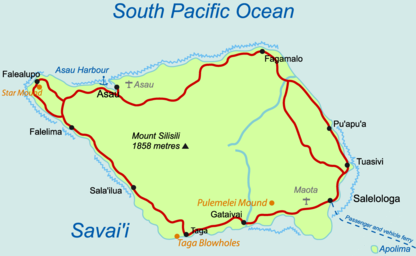
Samoans sometimes refer to the island of Savaiʻi as Salafai: This is its classical Samoan name, and is used in formal oratory and prose. The island is home to 43,958 people (2016 census), and they make up 24% of the population of Samoa.[1] The island's only township and ferry terminal is called Salelologa. It is the main point of entry to the island, and is situated at the east end of Savaiʻi. A tar sealed road serves as the single main highway, connecting most of the villages. Local bus routes also operate, reaching most settlements.
Savaiʻi is made up of six itūmālō (political districts). Each district is made up of villages that have strong traditional ties with each other — of kinship, history, and land — and that use similar matai (titles for their village chiefs). Savaiʻi's relatively limited ecotourism operations are organized mostly at the village level. The Mau, Samoa's non-violent movement for political independence during colonialism in the early 1900s, had its beginnings on Savaiʻi, with the Mau a Pule movement.[2]
The island is the largest shield volcano in the South Pacific. Its most recent eruptions were in the early 1900s. Its central region comprises the Central Savaiʻi Rainforest, extending over 72,699 hectares (726.99 square kilometres; 280.69 square miles) which is the largest contiguous rainforest in Polynesia. It is dotted with more than 100 volcanic craters and contains most of Samoa's native species of flora and fauna, making it one of the world's most globally significant conservation areas.[3]
Society and culture
[edit]

Faʻa Sāmoa, the unique traditional culture and way of life in Samoan society, remains strong in Savaiʻi, where there are fewer signs of modern life and less development than on the island of Upolu, where the capital, Apia, is located.
Samoan society is communal and based on extended family relationships and socio-cultural obligations, so that kinship and genealogies are important. These faʻa Sāmoa values are also associated with concepts of love (alofa), service (tautua) to family and community, respect (faʻaaloalo) and discipline (usitaʻi).[4] Most families are made up of a number of different households situated close to each other.
Like the rest of Samoa, Savaiʻi is made up of villages with most of the land collectively owned by families or ʻaiga. Most people on Savaiʻi, 93% of the island population, live on customary land.[1] The heads of the family are called matai, the holders of family names and titles. An extended family can have a number of chiefs with different chief titles. Men and women in Samoa have equal rights to chief titles which are bestowed by consensus of the extended family. Traditionally, male and female roles are defined by labours and tasks, chiefly status and age. Women play an important role contributing to family decisions as well as village governance.[5] Elders are revered and respected. Social relationships are dictated by cultural etiquettes of politeness and common greetings.
The Samoan language has a 'polite' and formal variant used in Samoan oratory and ceremony as well as in communication with elders, guests, people of rank and strangers. In all villages, the majority of people are largely sustained by plantation work and fishing[6] with financial assistance from relatives working in Apia or overseas. Most people live in coastal villages although there are some settlements inland such as the villages of Aopo, Patamea and Sili.
Behind the villages are cultivated plantations with crops of taro, cocoa koko, coconuts popo, yams palai, ʻava, fruit and vegetables as well other native plants such as pandanus for weaving ʻie tōga fine mats and bark for tapa cloth.
There is a church in every village, mostly Christian denominations.[7] Sunday is sacred and a day of rest as 98% of Samoans identify themselves as religious. White Sunday is one of the most important days of the year in Samoa when children are treated with special attention by their families and community.
History
[edit]World War II
[edit]During World War II, Savaiʻi came under the Allies 'Samoa Defense Group' which included Upolu, Tutuila and Wallis Island and later extended in 1944 to cover bases in other islands such as Bora Bora and the Cook Islands. A military governor of the Samoa Defense Group was Brigadier General Henry L. Larsen who had secret orders mandating a defensive position of the islands from east to west. The code name for the entire group of islands was "Straw" and the code name for Savaiʻi was "Strawman". The code for Upolu was "Strawhat", Tutuila "Strawstack" while Wallis Island was "Strawboard". A small base was set up on the central north coast village of Fagamalo, which had a wharf and anchorage. Fagamalo was the main village for the colonial administration at the time on Savaiʻi, situated where the small post office is today.
In its present unprotected state, Western Samoa is a hazard of first magnitude for the defense of American Samoa. The conclusion is inescapable that if we don't occupy it the Japanese will and there may not be a great deal of time left.
—8 February 1943 Report on Western Samoa defence by 2nd Marine Brigade's intelligence officer, Lieutenant Colonel William L. Bales.[8]
On 18 May 1942 the 3rd Marine Brigade with 4,853 officers and men were on Upolu and Savaiʻi under the command of Brigadier General Charles D. Barrett.
1839 Wilkes Expedition
[edit]
In October 1839, Savaiʻi and the Samoa Islands were surveyed by the famous United States Exploring Expedition led by Charles Wilkes. The survey of Savaiʻi was performed by Lieutenant-Commandant Ringgold aboard the U.S. Brig Porpoise. Wilkes and other ships in the expedition were surveying Upolu and Tutuila at the same time. The Porpoise first touched down at the village of Sapapaliʻi. Some of the team, Dr Pickering and Lieutenant Maury were dropped off while the brig surveyed the island's coastline and tides. Dr Pickering and the lieutenant were hosted by the resident missionary at Sapapaliʻi, the Reverend Mr. Hardie. The Porpoise examined the bay of Palauli where there was a missionary station under the supervision of a Mr M'Donald. Wilkes' report also described Saleaula village, Asau at the west end of the island and 'the beautiful village of Falealupo' which was under the charge of a Tongan missionary. At the 'north point' of the island, the brig found 'good anchorage' in the bay of Matautu (where the village of Fagamalo is situated). The brig was anchored and the harbour surveyed. Wilkes' wrote that this was the harbour on the island where a vessel could anchor in safety. Here, in Matautu, the explorers noticed a difference with other parts of Savaiʻi.
A great difference in form, physiognomy and manners...was observed here, as well as a change in the character of many articles of manufacture. The warclubs and spears were of uncommon form, and neatly made.
On 24 October, Wilkes writes, that the Porpoise arrived back at Sapapaliʻi village, having been gone nine days. The team met paramount chief Malietoa and his son at the village. With local guides Dr Pickering had travelled some way into the interior of the island, reaching one side of a volcanic crater about one thousand feet above the sea and some seven miles (11 km) inland.[9]
One 10 November 1839, the Wilkes Expedition weighed anchor at Apia and sailed westward, and on 11 November, had lost sight of Savaiʻi.

Notable places and people
[edit]- Archaeology in Samoa has uncovered prehistoric settlements inland in many parts of the island including sites at Sapapaliʻi village and Vailoa in Palauli district.
- The exiled orator Lauaki Namulauulu Mamoe (died 1915), leader of the Mau a Pule, a resistance group against colonial rule in the early 1900s, was from the traditional sub-district of Safotulafai.
- The missionary John Williams (1796–1839) arrived in the village of Sapapaliʻi in 1830. Sapapaliʻi was also a base for the Malietoa title on Savaiʻi. A plaque by the main road in the village commemorates Williams' landing.
- In pre-history, the village of Safotu was a settlement for Tongans.
- Olaf Frederick Nelson, another exiled leader of the Mau movement in the 1920s, was born in Safune.
- The Pulemelei Mound in Palauli is the largest and most ancient structure in Polynesia.
- Pio Taofinuʻu (1923–2006), the first Polynesian cardinal and bishop, was from the village of Falealupo, Savaiʻi.
- Reverend George Pratt (1817–1894), a missionary of the London Missionary Society during the 1800s, lived in Matautu on the north coast. Pratt authored the first Samoan English language dictionary A Grammar and Dictionary of the Samoan Language, with English and Samoan Vocabulary, first printed in 1862.[10] Pratt's valuable dictionary records many old words of special interest–specialist terminology, archaic words and names in Samoan tradition. It contains sections on Samoan poetry and proverbs, and an extensive grammatical sketch.[11]
- Activist Leilua Lino is from Asau on the island. In 2019 she was presented with a Commonwealth Innovation for Sustainable Development Award by Prince Harry.[12][13]
Politics
[edit]With the country's independence in 1962, Samoa incorporates both traditional political structures alongside a western parliamentary system. The modern national Government of Samoa, based in the capital Apia with the roles of Prime Minister, Members of Parliament and western styled political structure, is referred to as the Malo. Only Samoans with chief matai titles are eligible to become Members of Parliament.
Alongside Samoa's national and modern political structure is traditional authority vested in family chiefs (matai). The term Pule is applied to traditional authority in Savaiʻi.
The word Pule refers to appointments or authorities conferred on certain clans or individuals, sometime in the political history of Samoa. This traditional Pule authority was centred in certain villages around Savaiʻi. In the early 20th century, these Pule areas on Savaiʻi island were Safotulafai, Saleaula, Safotu, Asau, Satupaʻitea and Palauli.[14] Safotu, Asau, Satupaʻitea and Vailoa (Palauli district) gained 'Pule' status at different times in the 19th Century, and together with the two older Pule districts, Safotulafai and Saleaula, became the six Pule centres on Savaiʻi.[15]
In 1908, the 'Mau a Pule' resistance movement to colonial rule, which grew to become the national Mau movement, began on Savaiʻi and represented traditional authority against the German administration of Samoa. The equivalent term 'Tumua' is associated with traditional authority on Upolu island.
At the local level throughout Samoa, traditional authority is vested in a chiefs' council (fono o matai) in each village. The fono o matai carry out 'village law' and socio-political governance based on their traditional authority and faʻa Samoa. The authority of the matai is balanced against central government, the Malo. Most of the matai are males, however, the women in each village also have a voice in domestic affairs through the women's committees.

The main government administration offices of the Malo on Savaiʻi are situated in the village of Tuasivi, 10 minutes north of the ferry terminal and market at Salelologa. There's a district hospital, police station, post office and court houses in Tuasivi.
Vaʻai Kolone, a matai and businessman from Vaisala, at the west end of the island, became the Prime Minister of Samoa twice in the 1980s.
Samoa has 11 political districts (itūmālō) and 6 are in Savaiʻi; Faʻasaleleaga, Gagaʻemauga, Gagaʻifomauga, Palauli, Satupaʻitea and Vaisigano.
Scenery and landscape
[edit]Savaiʻi is mountainous, fertile and surrounded by coral reefs.[16] Lonely Planet describes the Savaiʻi landscape as 'spectacular tropical terrain'.[17] The island has a gently sloping profile, reaching a maximum altitude of 1,858 metres at Mt Silisili, the highest peak in the country and the Samoa Islands chain. Volcanic craters in the highlands are strung across the central ridges from Tuasivi (literally, backbone) village in the east towards Cape Mulinuʻu to the west.[18] The lava fields at Saleaula village on the central north coast[19] are the result of volcanic eruptions from Mt Matavanu (1905–1911). Most of the coastline are palm fringed beaches and there are rainforests, waterfalls, caves, freshwater pools, blowholes and coral reefs. There are also numerous archaeological sites, including star mounds, fortifications and pyramids such as the Pulemelei Mound in Palauli district. Archaeology in Samoa has uncovered many pre-historic settlements including sites at Vailoa and Sapapaliʻi.
Myths and legends
[edit]
Rich in Polynesian history and oral tradition, Savaiʻi is mentioned in myths and legends across the Pacific Islands and has been called the "Cradle of Polynesia."[20]
The name of the island comes from the myth of the brother and sister Sava and I'i.
Samoan mythology tells stories of different gods. There were gods of the forest, the seas, rain, harvest, villages, and war.[21] There were two types of gods: atua, who had non-human origins, and aitu, who were of human origin. Tagaloa was a supreme god who made the islands and the people. Mafuiʻe was the god of earthquakes. There were also a number of war gods. Nafanua, Samoa's warrior goddess, hails from the village of Falealupo at the west end of the island, which is also the site of the entry into Pulotu, the spirit world. Nafanua's father Saveasiʻuleo was the god of Pulotu.[22] Another well-known legend tells of two sisters, Tilafaiga and Taema, bringing the art of tattooing to Samoa from Fiti. Tilafaiga is the mother of Nafanua. The freshwater pool Mata o le Alelo 'Eyes of the Demon' from the Polynesian legend Sina and the Eel is situated in the village of Matavai on the north coast in the village district of Safune.[23] Another figure of legend is Tui Fiti, who resides at Fagamalo village in the village district of Matautu on the central north coast. The village of Falelima is associated with a dreaded spirit deity called Nifoloa.
Savaiʻi is known as the "Soul of Samoa." "Here the 20th century has put down the shallowest roots, and the faʻa Samoa—the Samoan way—has the most meaning."[24]
Flora and fauna
[edit]
Flora
[edit]The tropical climate and fertile soil results in a variety of flora. Vegetation types include littoral, wetland and volcanic vegetation. Rainforests include coastal, lowland and montane forests (above 500m elevation). Cloud forests are located in the highest elevations of the island which are often under cloud cover with wet conditions. At Mt Silisili, cloud forest occurs above 1200 m elevation. The Savaiʻi forest is dominated by a 15 to 20 m high canopy of Dysoxylum huntii, Omalanthus acuminatus, Reynoldsia pleiosperma and Pterophylla samoensis. Other common trees include Coprosma savaiiense, Psychotria xanthochlora, Spiraeanthemum samoense and Streblus anthropophagorum.[25] There are nearly 500 species of flowering plants and about 200 species of ferns in Samoa, making it richer than that of any tropical Polynesian island other than those in the Hawaiian archipelago.[26] About 25% of the species are endemic to Samoa.[27]
The variety of tropical plant life is also a material source for floral adornment, tapa cloth, ʻie toga, perfumes, coconut oil as well as herbs and plants for traditional medicines.[28] Common plants with everyday usage include the smooth reddish purple leaves of the ti (Dracaena terminalis) plant used with coconut oil for traditional massage, fofo, and the dried root stems of Piper methysticum (Latin "pepper" and Latinized Greek "intoxicating") are mixed with water for the important ʻava ceremony conducted during cultural events and gatherings.
Fauna
[edit]
Animal species include fruit bats such as the Samoa flying-fox (Pteropus samoensis), land and seabirds, skinks and geckos. The birdlife of Samoa includes a total of 82 species, of which 11 are endemic, found only in Samoa. Endemic birdlife found only on Savaiʻi include species such as the Samoan white-eye (Zosterops samoensis) which is only found in the high cloud forests and alpine scrub around Mt Silisili, and Samoan moorhen (Gallinula pacifica), which was last recorded in 1873 near Aopo with possible sightings in 1984 and 2003.[29] The tooth-billed pigeon, (Didunculus strigirostris), also known as the manumea is also endemic and now increasingly rare, leading to the current proposition to upgrade it to critically endangered. It is the national bird of Samoa and is found on some of the local currency. It is likely that the extensive loss of lowland forest, hunting and invasive species are responsible for the decline of this stunning species.
Samoa has more native species of ferns and butterflies than New Zealand, a country 85 times larger.[30] In 2006, research samples of the blue moon butterfly species (Hypolimnas bolina) on Savaiʻi found that males accounted for just 1% of the population and had almost been wiped out by an invasive species. Sampling a year later showed a dramatic comeback and recovery to 40%.[31]
The surrounding Pacific Ocean, coral reefs and lagoons are rich in marine life and some are harvested as an important source of food in an economy that is mainly subsistence with locals reliant on the land and the ocean for survival. Dolphins, whales and porpoises migrate through Samoa's waters.[32] The Palolo reef worm (Eunice viridis) is a Samoan cuisine delicacy which appear in the ocean only one day of the year. Palolo has cultural significance and entire villages flock to the sea for harvest.
Surrounded by a variety of tropical fauna, Samoan mythology is rich with stories of animals incorporated into their culture, traditional beliefs and way of life.
Conservation
[edit]
The island is rich in biodiversity and endemic native species which are also highly threatened. The Central Savaiʻi Rainforest comprising 72,699 hectares is the largest continuous patch of rainforest in Polynesia and contains most of Samoa's native species.[3] Seventy percent of Samoa's settlements are by the coast with increasing threat from climate change and sea level rising. As most of the land in Samoa is under customary ownership, conservation projects are developed with the approval and cooperation of villages. The Government of Samoa supports conservation covenants for three natural areas on Savaiʻi, the Falealupo Rainforest Preserve, Tafua Rainforest Preserve and Aopo Cloud Forest Reserve. The conservation projects are a partnership between the local matai and villages, government, conservation organisations and international funding[33] such as the United Nations Development Programme (UNDP). These support community based projects in villages, many of which are developed with international support and micro financing in areas of sustainable livelihoods, land management and conservation on both land and in coastal marine areas. There are wetlands in the village of Satoʻalepai on the central north coast where large sea green turtles (Chelonia mydas) are kept by the locals as an eco-tourism experience for visitors and provide extra income for communities. Another turtle habitat is at the village of Auala on the north west coast.
Travel information
[edit]
Ferry terminal
[edit]Salelologa is the main port and township, situated at the east end of the island where the inter-island ferry terminal is located. A regular passenger and vehicle ferry operates seven days a week in the Apolima Strait between Salelologa and Mulifanua wharf on Upolu. The ferry crossing takes about 90-minutes with views of Apolima and Manono islands to the south. The ferries operate only during the day. Local buses and taxis are available at the terminal and township. There's also a wharf at Asau at the north west end of the island, sometimes used for yachting.
Driving
[edit]Savaiʻi has an excellent tar-seal road circling the island. A leisurely drive around the island takes under 3 hours. The scenic drive is mostly along the coastline where most of the locals live in villages. Driving in Samoa is on the left side of the road, effective from 7 September 2009 when the government changed the law to bring motoring in line with neighbouring countries. Samoa is the first country in the 21st century to switch to driving on the left.[34]
Airport
[edit]
Maota Airport is a small airstrip with basic facilities situated 10-minutes south of Salelologa ferry terminal and township. Flights operate between Maota and Asau airstrip and Faleolo International Airport on Upolu. The inter-island flights take about 30-minutes.[35] Asau Airport is an airstrip at the north west end of the island which mainly services chartered flights.[36]
Amenities
[edit]A local market (open Monday – Saturday) at Salelologa sells fresh produce of fruit, vegetables and local crafts. There are also clothing stores, several small supermarkets, a wholesaler, petrol stations, bakeries, budget hotels and accommodation,[37] buses, taxis, rental car companies as well as public amenities such as internet access, banks and Western Union money transfer outlets. There are small local shops in every village around Savaiʻi, selling basic groceries. Markets and most shops in Samoa close on Sundays with smaller outlets opening late afternoon after church services.
Hospitals
[edit]The main hospital on Savaiʻi is the Malietoa Tanumafili II Hospital, situated in Tuasivi village.[38] Another district hospital is in Safotu, on the central north coast.
Tourism
[edit]

Cultural context
[edit]With most of the land in Samoa under customary ownership with local governance by matai, tourism experiences take place on village land and within local culture. There are hotels, but like the rest of Samoa, many villages provide beach fale accommodation for visitors all around the island such as Manase on the central north coast.[39] These are small local businesses run by families within their villages and most of the income goes directly back to the community. There are island tours, diving, fishing, plantation trips, treks and other tourism related activities. Most shops are closed on Sundays with a few re-opening after church services in late afternoon. Every day, evening prayer (sa) takes place in every village around dusk before the evening meal and lasts about half an hour. It is usually signalled by the sound of a conch shell or the ringing of the church bell. The sa usually means no loud noise or walking through the village commons. Matai sometimes stand by the side of the main road, which pass through village land, to slow down traffic until prayers are over. Tourism is overseen by the government Samoa Visitors' Bureau, situated in the capital Apia, which can also help to settle disputes. At the village level, much of the country's civil and criminal matters can be dealt with directly by the matai chief village councils.
The last sunset in the world
[edit]The village of Falealupo on the westernmost point of Savaiʻi, is just 20 miles (32 km) from the dateline. It was arguably the last place in the world to see the sunset until a time zone change at end of 2011.[40] Falealupo was the site of Millennium 2000 celebrations and reported by the BBC as 'the last place on earth to enter the new millennium.'[41] Falealupo also has protected rainforests.
Surfing
[edit]Savaiʻi has surfing off reef breaks all around the island, with more waves during summer on the north coast and the south coast in winter.[42] The conditions are not for novice surfers and there can be dangerous undercurrents and rips. Satuiatua on the south-west coast attracts surfers. Other surfing spots around Savaiʻi include breaks off the villages of Lano, Aganoa Beach by Tafua, Lefagaoaliʻi, Lelepa and Fagamalo.
Tourism development
[edit]In 2008, an American company South Pacific Development Group (SPDG) obtained a 120-year lease for 600 acres (2.4 km2) of prime oceanfront customary land in Sasina, to build a luxury resort estimated to cost $450 – US$500 million. The developers pay less than one penny per square foot of land per month. The development will include a casino, timeshares and a cultural centre. The company is expecting to receive the casino licence for Savaiʻi island in a new law legalising casinos proposed by the government,[43] the Casino and Gambling Bill 2010 tabled to parliament by the prime minister Tuilaepa Aiono Sailele Malielegaoi in March 2010.[44]
The announcement of the tourist development raised concern among environmental group O Le Siʻosiʻomaga Society about the impact of the development.[45] The Samoa Hotel Association also expressed concern at the size of the development and its impact on the island's environment and infrastructure.[46] The development is supported by the Government of Samoa. The lease is unprecedented in Samoa where 80% of the land is under customary ownership, 6% freehold and the rest owned by the government.[47]
Film
[edit]Moana (1926), one of the earliest documentaries made in the world, was filmed in Safune on the central north coast. The film was directed by Robert J. Flaherty who lived with his wife and children in Safune for more than a year. A cave with a pool in Safune was converted into a film processing laboratory and two young men from the village were trained to work there. Flaherty cast people from Safune in the film including local boy Taʻavale who played the lead role of 'Moana'. Another boy called Peʻa played the role of Moana's younger brother. Peʻa later became a chief with the title Taulealeausumai from the village of Faletagaloa. Playing the lead female role in the film was Faʻagase, a girl from Lefagaoaliʻi. The film also showed the young hero 'Moana' receiving a peʻa, a traditional Samoan tattoo.
Geography
[edit]

Savaiʻi island lies north west of Upolu. These two largest islands of Samoa are separated by the Apolima Strait which is about 8 miles (13 km) wide with the small inhabited islands of Manono and Apolima between them. Savaiʻi island is of volcanic origin and the mountainous interiors are covered with dense rain forests. The surrounding landscape consists of fertile plateaux and coastal plains with numerous rivers and streams.
Climate
[edit]
The climate is oceanic tropical with high temperatures and humidity. The heaviest rainfall occurs between the months of November and April, and cyclones, which are relatively frequent, are most likely to occur during these same months.[25] Two cyclones, Cyclone Ofa (1990) and Cyclone Valerie (1991)[48] caused extensive damage on the north and west coast of Savaiʻi.
Geology
[edit]Savaiʻi is the largest shield volcano in the South Pacific[49] and only 3% is above water.[50] It is an active volcano, which last erupted in 1905–1911 with lava flows that destroyed villages on the central north coast. The island is formed by a massive basaltic shield volcano which rises from the seafloor of the western Pacific Ocean. A possible model for the formation of the volcanic Samoa island chain is explained by the Samoa hotspot situated at the east end of the Samoa Islands. In theory, the Samoa hotspot is a result of the Pacific Tectonic Plate moving over a 'fixed' deep and narrow mantle plume spewing up through the Earth's crust. The Samoa islands generally lie in a straight line, east to west, in the same direction the Plate is moving. In the classic hotspot model, primarily based on studies of the Hawaii hotspot, the volcanic islands and seamounts further away from the Samoa hotspot should be progressively older. However, Savaiʻi, the most western of the Samoa island chain, and Taʻu Island, the most eastern of the Samoa islands, both erupted in the 20th century, data which is an enigma for scientists.[51] Taʻu last erupted in 1866. Another discrepancy in the data from the Samoa islands is that subaerial rock samples from Savaiʻi were too young by several million years to fit the classic hotspot model of age progression in an island chain, raising arguments among scientists that the Samoa islands does not have a plume origin. The nearness of Savaiʻi and the Samoa island chain to the Tonga Trench at the south became a possible explanation for these discrepancies as well as the possibility that the islands were formed by magma seeping through cracks in stressed fracture zones.[50] However, in 2005, an international team gathered further submarine samples from the deep flanks and rifts of Savaiʻi. Tests on these later samples showed much older ages, about five million years old, that fit the hotspot model.[52] The discovery in 1975 of Vailuluʻu Seamount 45 km east of Taʻu in American Samoa has since been studied by an international team of scientists and contribute towards understanding of the Earth's fundamental processes.[53]

Prehistoric geological formations on Savaiʻi have created natural sites such as the Alofaʻaga Blowholes and Moso's Footprint. The Peʻapeʻa Cave, named after the swallows that inhabit it, is a lava tube one kilometre in length, formed during the Mt Matavanu eruptions.[19]
Volcanic activity
[edit]The island consists of a large shield volcano similar in form to the Hawaiian volcanoes. Savaiʻi remains volcanically active, with recent eruptions from Matavanu between 1905 and 1911. The Matavanu eruptions flowed towards the central north coast and destroyed villages including Saleaula. Other recent volcanic eruptions include Mata o le Afi in 1902 and Mauga Afi in 1725. The lava field at Saleaula are extensive enough to be visible in high altitude photographs.[54]
Education
[edit]Samoa education system
[edit]Like the rest of the country, the education system on Savaiʻi is mostly public education covering primary and secondary schooling in villages. Education in Samoa is compulsory for children aged 5-years to 14-years or until the completion of Year 8.
- Primary education – Year 1 – 8 (8-years)
- Secondary education – Year 9 – 13 (5-years)
Entrance to secondary education is determined by a National Examinination at Year 8. Top achievers in government schools can enter Samoa College on Upolu island with the next group offered places at Vaipouli College in Gagaʻemauga district on the island's central north coast. The rest attend the nearest secondary school in their district. With most of the land in the country under customary ownership in village settlements, schooling and education is a joint responsibility between the government and villages, governed at the local level by matai.
Cost
[edit]Village responsibility
[edit]In both primary and secondary schools across Samoa, villages are responsible for school buildings, equipment, furniture, fundraising and collection of school fees.[55] With most of the population living off their land in a mostly traditional way of life with little paid employment available, villages such as Falealupo were forced to sell logging rights to their native forests in 1990, to pay for their school buildings, following threat of closure from the government. An American ethnobotanist, Paul Cox, who had lived in the village with his family, raised funds internationally to save the school and create a conservation covenant with matai to protect their native forest.[56]
Government responsibility
[edit]The government is responsible for teachers, curriculum and educational materials as well as assessments and exams administered under the Ministry of Education, Sports and Culture.[57] The government also employs School Review Officers who are the main liaison with schools.
International aid
[edit]The government receives international aid for education from countries such as New Zealand, Australia and Japan through their foreign aid programmes. In 2006, a bilateral partnership between Ausaid (Australia) and NZAID (New Zealand) with the Asia Development Bank launched an education sector program (ESPII) focusing on primary and secondary education over a number of years. The contribution from AUSaid is up to $14 million[58] dollars with NZAID committing NZ$12.5 million over five years.[59] Australia is also contributing $2 million towards a School Fee Grant Scheme to 163 primary schools during 2009–2010.[58] Japan International Cooperation Agency (JICA) also constributes significant aid towards education.[60]
Tertiary education
[edit]Most opportunities for tertiary education in the country are available on Upolu island, the location of the National University of Samoa and the Alafua Campus of the regional University of the South Pacific. International volunteer programmes including the American Peace Corps also provide teachers throughout schools in Savaiʻi and the rest of the country.
School calendar
[edit]
| School Terms | Dates | Duration |
|---|---|---|
| Term 1 | 1 February – 15 May | (15 weeks) |
| Term 2 | 7 June – 3 September | (13 weeks) |
| Term 3 | 20 September – 10 December | (12 weeks) |
| School holidays | 2010 dates |
|---|---|
| 15 May – 6 June | |
| 5–19 September | |
| 11 December – 30 January |
List of schools in Savaiʻi
[edit]There are 9 secondary schools and 48 primary schools on the island.[61]
Public library
[edit]Savaiʻi Public Library is the only public library on the island. It is situated by the old market in the township of Salelologa at the east end of Savaiʻi. The library is a branch of the central Samoa Public Library in the capital Apia on Upolu island.[62]
Public holidays
[edit]Public holidays;[55]
| Holiday | Date |
|---|---|
| Good Friday | Varies |
| Easter Monday | Varies |
| Mother's Day | 10 May |
| Samoa Independence Day | 1 June (celebrations) |
| Father's Day | 9 August |
| White Sunday (2nd Sunday of October) | Varies |
| Christmas Day | 25 December |
| Boxing Day | 26 December |
Samoa gained political independence from New Zealand on 1 January 1962. However, independence celebrations take place on 1 June, each year.[63]
Gallery
[edit]-
Savaiʻi island from space (NASA photo)
-
Historic church in Safotu village.
-
View from Pulemelei Mound
-
Mu Pagoa Waterfall in Palauli district.
-
Stone church in Satupaʻitea on Savaiʻi c. 1908
-
Local bus
-
Lava fields on Savaiʻi
-
Sunset at Sapapaliʻi
-
Samoa fire dance siva afi
-
Beach fale, popular in eco-tourism in villages around the coast.
-
Fishing canoe (vaʻa) with small outrigger
-
View from the ferry with tiny Apolima island and Savaiʻi coast (right).
-
Mount Matavanu volcano, 1906
-
Breadfruit tree (Artocarpus altilis), a staple food in Samoa.
-
Roast coacoa koko beans grown locally for hot Samoan koko drink.
See also
[edit]- Archaeology in Samoa for archaeology on Savaiʻi
- Architecture of Samoa
- Districts of Samoa (political districts)
- Culture of Samoa
- Samoa Islands
- Samoan language
- Samoa Tourism Authority
References
[edit]- ^ a b c "Final Population and Housing Census 2006". Samoa Bureau of Statistics. July 2008. Archived from the original on 1 January 2011.
- ^ Meleisea, Malama; Meleisea, Penelope Schoeffel (1987). Lagaga A Short History of Western Samoa. editorips@usp.ac.fj. p. 117. ISBN 978-982-02-0029-6. Retrieved 26 July 2014.
- ^ a b "Priority Sites for Conservation in Samoa: Key Biodiversity Areas" (PDF). Archived from the original (PDF) on 8 March 2022. Retrieved 1 January 2017.
- ^ 3. Culture and identity – Samoans – Te Ara Encyclopedia of New Zealand Faʻa Sāmoa, Samoan culture, New Zealand Encyclopaedia Archived 2 November 2012 at the Wayback Machine
- ^ Ember, Carol R.; Ember, Melvin (2003). Encyclopedia of Sex and Gender Men and Women in the World's Cultures Topics and Cultures A-K – Volume 1; Cultures L-Z -. Springer. p. 802. ISBN 978-0-306-47770-6. Retrieved 26 July 2014.
- ^ "Gagaemauga 3 District: Community-based Adaptation for Gagaemauga 3 District | Adaptation Learning Mechanism". adaptationlearning.net. Archived from the original on 7 January 2011.
- ^ CHAPTER V — A Samoan Village | NZETC An Introduction to Samoan Custom by F.J.H. Grattan, Chapter V, A Samoan Village, p. 53 Archived 23 December 2010 at the Wayback Machine
- ^ "THE SAMOAN HISTORICAL CALENDAR, 1606–2007" (PDF). p. 37. Archived from the original (PDF) on 28 December 2016.
- ^ Wilkes, Charles (1849). Narrative of the United States Exploring Expedition During the Years 1838, 1839, 1840, 1841, 1842. C. Sherman. p. 110.
- ^ Garrett, John (1982). To live among the stars Christian origins in Oceania. University of the South Pacific. p. 126. ISBN 978-2-8254-0692-2. Retrieved 26 July 2014.
- ^ Pratt, George. "Title: A Grammar and Dictionary of the Samoan Language, with English and Samoan vocabulary, NZ Licence CC-BY-SA 3.0". NZ Electronic Text Centre, Victoria University of Wellington. Archived from the original on 18 March 2012. Retrieved 5 December 2009.
- ^ "Duke of Sussex presents innovation awards at Commonwealth 70th anniversary garden party | The Commonwealth". 11 April 2021. Archived from the original on 11 April 2021. Retrieved 28 October 2021.
- ^ "The journey of a survivor – Leilua receives Commonwealth Innovation award". ECPAT. 9 July 2019. Retrieved 28 October 2021.
- ^ Tumua and Pule. — Construction and significance in the Political history of Samoa | NZETC An Account of Samoan History up to 1918 by Teʻo Tuvale, NZ Licence CC-BY-SA 3.0, NZ Electronic Text Centre. Retrieved 31 October 2009 Archived 30 March 2012 at the Wayback Machine
- ^ Soʻo, Asofou (2008). Democracy and Custom in Sāmoa An Uneasy Alliance. editorips@usp.ac.fj. p. 75. ISBN 978-982-02-0390-7. Retrieved 26 July 2014.
- ^ "Samoa." The Columbia Encyclopedia, Sixth Edition. 2008. Encyclopedia.com. 3 Oct. 2009 [1]
- ^ "Introducing Savai'i". www.lonelyplanet.com. Archived from the original on 13 April 2014.
- ^ "Savaiʻi | island, Samoa". Encyclopædia Britannica. Archived from the original on 13 October 2013.
- ^ a b "Where the wild things blow". The Sydney Morning Herald. 28 June 2009. Archived from the original on 4 November 2012.
- ^ "Samoa: History". www.pacificislandtravel.com. Archived from the original on 18 February 2012.
- ^ Culbertson, Philip; Agee, Margaret Nelson; Makasiale, Cabrini ʻOfa (2007). Penina Uliuli Contemporary Challenges in Mental Health for Pacific Peoples. University of Hawaii Press. p. 68. ISBN 978-0-8248-3224-7. Retrieved 26 July 2014.
- ^ Turner, George (2006). Samoa, a Hundred Years Ago and Long Before. Echo Library. p. 123. ISBN 978-1-4068-3371-3. Retrieved 26 July 2014.
- ^ "Living Heritage -Marcellin College – Sina and the Eel". livingheritage.org.nz. Archived from the original on 29 October 2012.
- ^ Robert Booth, "The two Samoas still coming of age," in National Geographic Magazine, Vol. 168, No. 4, October 1985, p. 469
- ^ a b "FAO Workshop – Data Collection for the Pacific Region – FRA WP 51". fao.org. Archived from the original on 9 June 2013.
- ^ "Savaiʻi, Western Samoa, as a Pacific-Asia Biodiversity (PABITRA) Transect Site". Archived from the original on 13 July 2011. Retrieved 18 October 2009.
- ^ [2] Government of Samoa, 1998
- ^ Ministry of Natural Resources and Environment – Latest Articles Module Samoa Government Ministry of Natural Resources
- ^ "Species factsheet". Birdlife International. 2010. Archived from the original on 30 June 2007.
- ^ James Atherton, ed. (2010). "Report:Vaega Faʻatauainamole Faʻasaoi Samoa, Priority Sites for Conservation in Samoa: Key Biodiversity Areas" (PDF). Conservation International – Pacific Islands Programme, Samoa Ministry of Natural Resources and Environment, Secretariat of the Pacific Regional Environment Programme. Archived from the original (PDF) on 20 January 2022. Retrieved 6 February 2021.
- ^ "Samoan butterflies evolving fast". Discovery Channel News. 12 July 2007. Archived from the original on 12 October 2012.
- ^ "SAMOA ONLINE". wsamoa.ws. Archived from the original on 27 February 2012.
- ^ [3] Report to the Convention of Biological Diversity, Government of Samoa, 1998
- ^ "Samoa switches to driving on left". BBC News. 7 September 2009. Archived from the original on 5 August 2011.
- ^ "SavaiʻI Guide Overview". Archived from the original on 3 July 2009. Retrieved 22 September 2009.
- ^ [4] South Pacific Regional Environment Programme (SPREP), 21-7-2007. Retrieved 26 October 2009
- ^ "WEBSITE.WS – Your Internet Address For Life™". mysamoatours.ws. Archived from the original on 12 December 2013.
- ^ [5] Medicine Uncharted Organisation. Retrieved 25 April 2010 Archived 13 September 2009 at the Wayback Machine
- ^ [6], Beach Fales:Sustainable Eco-Tourism and Cultural Preseravation in Samoa by Rachel Rasela Dolgin]
- ^ "Samoa to move the International Dateline". Herald Sun. 7 May 2011. Archived from the original on 2 May 2016.
- ^ "Global party reaches Hawaii". BBC News. 1 January 2000.
- ^ "Samoa A-Z Visitors Guide – safety, Samoa, Savaiʻi, Saʻmoana beach resort, scuba diving, shopping, sinalei reef resort & spa, siufaga beach resort, siva, smoking, sport & recreation, squash, stevenson, suicide, sun protection, sundays, supermarkets, surfing, swimming". Samoa A-Z Visitors Guide. Archived from the original on 3 March 2013.
- ^ "Samoa, an investment opportunity". South Pacific Development Group LLC. Archived from the original on 8 March 2012. Retrieved 6 July 2010.
- ^ Senara Brown, Alan Ah Mu (16 March 2010). "Casino warning". Samoa Observer. Archived from the original on 5 March 2012.
- ^ "SAVAII RESORT PROPOSAL RAISES CONCERN". Pacific Islands Report. 11 July 2008. Retrieved 6 February 2021.[dead link]
- ^ "Samoa Hotel Association worried about size of Savaii project". RNZ. 10 July 2008. Retrieved 6 February 2021.
- ^ "Samoa department warns that sale of customary land is illegal". RNZ. 15 May 2002. Retrieved 6 February 2021.
- ^ "Samoa". U.S. Department of State.
- ^ Rottman, Gordon L. (2002). World War 2 Pacific island guide. Greenwood Publishing Group. p. 88. ISBN 978-0-313-31395-0. Retrieved 26 July 2014.
- ^ a b "Samoa Found To Be in Path of Geological Hotspots, Adding Fuel To Debate Over Origins of Volcanic Chains". Science Daily. Adapted from materials provided by Oregon State University. 17 June 2008. Archived from the original on 14 May 2013.
- ^ Lippsett, Laurence (3 September 2009). "Voyage to Vailuluʻu". Woods Hole Oceanographic Institution. Archived from the original on 6 March 2014.
- ^ Koppers, A. A.; Russell, J. A.; Staudigel, H.; Hart, S. R. (2006). "New 40Ar/39Ar Ages for Savaiʻi Island Reinstate Samoa as a Hotspot Trail with a Linear Age Progression". AGU Fall Meeting Abstracts. 2006: V34B–02. Bibcode:2006AGUFM.V34B..02K.
- ^ Hart; et al. (8 December 2000). "Vailuluʻu undersea volcano: The New Samoa" (PDF). G3, An Electronic Journal of the Earth Sciences, American Geophysical Union. Research Letter, Vol. 1. Paper number 2000GC000108. ISSN 1525-2027. Archived from the original (PDF) on 29 February 2004.
- ^ "Savaiʻi". Archived from the original on 23 December 2010. Retrieved 23 December 2010. at OceanDots.com
- ^ a b "2010 School Calendar". Samoa Ministry of Education, Sports & Culture. Archived from the original on 12 February 2013. Retrieved 27 May 2010.
- ^ "Falealupo matai defend Nafanua Cox". Samoa Observer. 25 January 2009. Archived from the original on 5 March 2012.
- ^ "Strategic Policies and Plan, July 2006 – June 2015". Samoa Ministry of Education, Sports & Culture. 30 June 2006.
- ^ a b "Aid activities in Samoa". Government of Australia. Archived from the original on 6 March 2012. Retrieved 27 August 2010.
- ^ "NZAID Samoa". New Zealand Government. Archived from the original on 20 August 2010. Retrieved 27 August 2010.
- ^ "Activities in Samoa". Japan International Cooperation Agency. Archived from the original on 8 March 2012. Retrieved 27 August 2010.
- ^ "Savaiʻi Schools". Samoa Ministry of Education, Sports & Culture. Archived from the original on 20 December 2013. Retrieved 27 May 2010.
- ^ "History of Libraries in Samoa". Library Association of Samoa. Archived from the original on 27 November 2013. Retrieved 27 May 2010.
- ^ "Celebrations of Samoa's Independence Day". Te Ara Encyclopedia of New Zealand. Archived from the original on 20 October 2012. Retrieved 30 May 2010.
External links
[edit]- Building a 3D model for land-use and nature conservation planning, Savaii Island, Samoa; Rudolf Hahn CTA FAO 2015 youtube video
- Looking for the Manumea. An ecological survey in community conservation areas, Savaii Island, Samoa; Rudolf Hahn CTA FAO 2014 youtube video
- "Savaiʻi". Global Volcanism Program. Smithsonian Institution.
13°35′S 172°25′W / 13.583°S 172.417°W
- Final 2006 Samoa Census Report, Samoa Bureau of Statistics, July 2008
- Savaii Samoa Tourism Association
- Samoa Tourism Authority
- Sydney Morning Herald travel article June 2009
- Surfing Samoa on Youtube
- The Samoan Historical Calendar 1606 – 2007 by Stan Sorensen, Historian, Office of the Governor, American Samoa & Joseph Theroux
- First Samoan dictionary, 3rd edition (1893) by Rev. George Pratt
- Library Association of Samoa website Archived 28 September 2018 at the Wayback Machine
Savaiʻi
View on GrokipediaGeography
Location and physical extent
Savaiʻi constitutes the largest island within the Independent State of Samoa, forming the westernmost major landmass of the Samoan archipelago in the central South Pacific Ocean. Positioned between approximately 13°20′ and 13°50′ S latitude and 171°50′ and 173° W longitude, it lies roughly 100 kilometers west of Upolu, the second-largest island, separated by the Apolima Strait.[7] The island spans an area of 1,707 square kilometers (659 square miles), accounting for over 60% of Samoa's total land area. It extends about 80 kilometers (50 miles) in length from east to west and reaches up to 40 kilometers (25 miles) in width at its broadest point, presenting a roughly rectangular shape with a rugged, mountainous interior.[8][9] Savaiʻi's coastline measures approximately 200 kilometers, characterized by volcanic black sand beaches, cliffs, and fringing reefs along much of its perimeter. The island's maximum elevation occurs at Mount Silisili, rising to 1,858 meters (6,095 feet) near the center, underscoring its dominantly volcanic origin and topographic prominence within Polynesia.[8][10]Topography and landforms
Savaiʻi displays the characteristic topography of a basaltic shield volcano, forming a broad, low-angle dome that rises to an elevation of 1,858 meters at Mount Silisili, the island's highest point.[2] The island extends approximately 75 kilometers in length along a WNW-ESE trending rift zone, with a central high plateau transitioning to steeper flanks.[2] This structure supports dense tropical rainforests in elevated interior regions, while coastal lowlands feature lighter vegetation adapted to marine influences.[11] The terrain includes numerous cinder cones and lava cones scattered across the broad crest and flanks, contributing to a rugged volcanic landscape with over 450 identified cones.[2] [12] Extensive lava fields, such as the Saleaula field spanning 76 square kilometers, dominate parts of the interior, formed by historical flows of a'a and pahoehoe basalt.[12] Lava tubes, including the 1-kilometer-long Pe'ape'a Cave created during the early 20th-century Matavanu eruption, represent additional subterranean landforms.[12] Coastal landforms are shaped by wave action on volcanic rock and include fringing coral reefs partially buried by late-stage lava flows in some areas.[2] Prominent features encompass iron-bound cliffs, sea arches, and blowholes like those at Alofaaga (Taga), where ocean waves surge through fractured lava tubes to produce sprays up to 30 meters high.[12] Tectonic influences are evident in raised shorelines uplifted 3–4 meters and fault scarps, such as the 65-meter scarp at Fagafau.[12] Waterfalls, including the short but scenic Mu Pagoa fall, add to the diverse hydrological landforms in the volcanic terrain.[12]Climate and weather patterns
Savaiʻi experiences a tropical rainforest climate, classified as Af under the Köppen system, marked by consistently high temperatures, elevated humidity, and substantial year-round precipitation influenced by its equatorial position and mountainous topography.[13] Annual mean temperatures hover around 27°C (81°F), with daily highs typically reaching 30–32°C (86–90°F) and lows of 23–25°C (73–77°F), showing minimal seasonal variation due to the stable trade wind patterns and ocean surroundings.[14] The island's central volcanic highlands, including Mount Silisili at 1,858 m (6,096 ft), amplify orographic rainfall on windward southern and eastern slopes, where annual precipitation often exceeds 4,000 mm (157 in), while leeward areas receive somewhat less, around 2,500–3,000 mm (98–118 in).[13][15] The wet season spans November to April, coinciding with the southern summer and warmer sea surface temperatures that fuel convective activity and tropical cyclones; during this period, monthly rainfall in low-lying coastal areas averages 200–400 mm (8–16 in), with frequent afternoon showers and thunderstorms.[13] In contrast, the dry season from May to October features reduced precipitation of 50–150 mm (2–6 in) per month, dominated by steady southeast trade winds that lower relative humidity to 70–80% and provide clearer skies, though brief showers remain common.[16] Wind speeds average 10–20 km/h (6–12 mph) year-round, strengthening during the dry season trades, while the wet season sees occasional gusts exceeding 50 km/h (31 mph) ahead of passing systems.[14] Tropical cyclones pose the primary weather hazard, forming over the South Pacific basin from November to April, with peak activity in December–February; these events can deliver extreme rainfall over 500 mm (20 in) in 24 hours, storm surges, and winds up to 250 km/h (155 mph), as seen in historical impacts on Samoa's western islands like Savaiʻi.[13][16] The Samoa Meteorological Service monitors these via regional forecasts, noting that while cyclone frequency averages 4–10 per South Pacific season, local effects vary with track proximity, with Savaiʻi's exposed southwestern coast particularly vulnerable to swells and erosion.[17] Relative to Upolu, Savaiʻi's larger landmass and elevation result in more variable microclimates, including cooler upland temperatures dropping to 15–20°C (59–68°F) at higher altitudes during trade wind episodes.[18]Geology
Volcanic formation and structure
Savaiʻi originated from hotspot volcanism associated with the Samoa hotspot, where a mantle plume beneath the Pacific Plate induces partial melting and magma ascent, forming a chain of volcanic islands as the plate moves northwestward.[19] The island represents the subaerial portion of a massive shield volcano, with only about 3% of its total volume exposed above sea level, the remainder submerged as seamounts and guyots.[9] Shield volcanoes like Savaiʻi are characterized by broad, gently sloping profiles built from low-viscosity basaltic lava flows erupting from central vents and fissures.[20] The geological structure features a central edifice rising to 1,863 meters at Mount Silisili, constructed from interbedded layers of basalt lava flows and tephra deposits accumulated during post-erosional eruptive phases.[20] Older Fagaloa Volcanics, dating to over 1 million years ago based on reverse magnetic polarity, form the basement underlying much of Savaiʻi and adjacent Upolu, while younger rejuvenated volcanics dominate the surface, with the bulk of subaerial rocks younger than 0.39 million years old.[21][19] These rejuvenated lavas exhibit basaltic compositions transitioning from tholeiitic to alkalic, reflecting evolved magmatic systems influenced by the hotspot's interaction with the plate.[22] Savaiʻi's formation involved initial shield-building phases around 5.5 to 4.5 million years ago, followed by prolonged erosion exposing older rocks, and subsequent rejuvenated activity that rebuilt the upper structure, including historic vents like Matavanu.[20] The island's volcanic pile includes rift zones with aligned fissures and cones, indicative of flank eruptions common in oceanic hotspots, contributing to its elongated shape approximately 70 km long and 40 km wide.[23] Seismic profiles and bathymetric data reveal submerged extensions, confirming the volcano's overall basaltic shield morphology extending thousands of meters below sea level.[24]Historical eruptions and lava flows
The most significant historical eruption on Savaiʻi occurred at the Matavanu vent from August 4, 1905, to 1911, producing a strombolian to vulcanian event with a Volcanic Explosivity Index (VEI) of 2.[25] Initial activity began with ash emissions from a scoria cone in the northeastern interior, followed by voluminous basaltic lava flows that advanced toward the coast.[4] These flows, totaling up to one cubic kilometer in volume, buried five villages including Saleaula and expanded the island's landmass by reaching the sea along broad fronts.[26] [27] Lava flows from Matavanu intermittently advanced over six years, occasionally generating small tsunamis upon entering the ocean via avalanching material.[26] The resulting Saleaula lava field covers extensive coastal plains, preserving remnants such as half-buried churches and a notable grave site where lava reportedly parted around it.[27] No human fatalities were recorded, though the eruption displaced communities and altered the northeastern coastline permanently.[28] Prior historical activity on Savaiʻi includes at least two additional eruptions in the 20th century, though less documented, contributing to ongoing shield volcano growth through similar effusive lava flows.[9] These events underscore the island's persistent volcanic hazard, with flows primarily confined to rift zones and lacking significant explosive phases beyond Matavanu.[2]Seismic and geological risks
Savaiʻi faces significant seismic risks due to its location in the South Pacific, where regional tectonics generate large earthquakes capable of producing tsunamis. The most devastating recent event was the magnitude 8.1 earthquake on September 29, 2009, centered approximately 200 km south of the island, which triggered waves up to 10 meters high along Savaiʻi's southern coast, causing extensive damage, over 140 deaths across Samoa, and destruction of villages.[29][30] Historical precedents include the 1917 tsunami from an earthquake in the Samoa-Tonga region and events in 1907 impacting Savaiʻi, underscoring recurrent tsunami threats from subduction-related seismicity nearby.[31][32] Post-2009, the island experiences ongoing subsidence at rates of 8-16 mm/year, exacerbated by viscoelastic relaxation, contributing to accelerated relative sea-level rise and heightened coastal vulnerability.[33] Volcanic risks remain elevated on Savaiʻi, a monogenetic basaltic shield volcano in the Samoan hotspot chain, where future eruptions could occur at new vents anywhere on the island, as seen in the 1905-1911 Matavanu eruption that produced extensive lava flows reaching the sea and generating small tsunamis via littoral explosions.[2][26] Potential hazards include lava flows, pyroclastic density currents, ballistic projectiles, and lahars, with hazard maps delineating zones based on historical patterns and topography.[34][6] Seismic precursors often accompany activity, enabling monitoring via stations, though the island's youth—active within the last century—implies low but non-zero probability of renewal.[6] Other geological hazards include landslides and rockfalls, prevalent in volcanic formations like the Fagaloa and Salani basalts due to steep terrain and heavy rainfall, posing risks to infrastructure and settlements.[35] Overall, ThinkHazard assesses a moderate volcanic threat and notes a 10% probability of a damaging earthquake within 50 years, emphasizing the need for preparedness in this intraplate setting influenced by distant plate boundaries.[30][36]History
Ancient settlement and Polynesian origins
The earliest human settlement of the Samoan archipelago, encompassing Savaiʻi as its largest island, occurred approximately 2,900 to 3,500 years ago, or between 900 and 1500 BCE, based on radiocarbon dating of archaeological remains and human bones.[37][38] These settlers represented the vanguard of Polynesian expansion into Remote Oceania, arriving via deliberate voyaging in outrigger canoes equipped for long-distance ocean travel, likely guided by knowledge of winds, currents, and celestial navigation.[39] The archipelago's isolation—over 2,000 kilometers east of Fiji—required advanced maritime capabilities, distinguishing this migration from earlier Austronesian dispersals in Near Oceania. Archaeological evidence links these pioneers to the Lapita cultural complex, whose distinctive dentate-stamped pottery first appeared in the Bismarck Archipelago around 1500–1300 BCE before spreading eastward.[40] In Samoa, Lapita artifacts are rare and confined to a handful of first-millennium BCE sites, including one with pottery sherds confirming coastal origins, though subsequent settlements shifted inland due to resource pressures or environmental factors.[41] The Lapita people, proto-Polynesian Austronesian speakers, carried subsistence practices such as root crop horticulture, fishing, and pig husbandry, which supported initial colonization; genetic studies corroborate a bottleneck event around this period, with Samoan populations deriving from a small founding group that admixed minimally with local Melanesian populations.[42][37] On Savaiʻi specifically, excavations and surveys document prehistoric settlement patterns featuring dense inland villages predating European contact, as evidenced by structural remains and earthworks like the Pulemelei mound complex, which reflect post-Lapita cultural elaboration rather than initial arrival points.[43][44] This inland focus aligns with the island's volcanic topography and fertile uplands, enabling population growth and the development of hierarchical societies by the early centuries CE, foundational to Samoan Polynesian identity. Oral traditions preserved in Samoan genealogy (e.g., the tagata māoloa lineages) echo these migrations but lack independent verification beyond archaeological correlations.[45]European exploration and early contact
The first documented European sighting of Savaiʻi occurred on 17 December 1787, during the French expedition commanded by Jean-François de Galaup, comte de La Pérouse, which passed the western Samoan islands including Savaiʻi after violent encounters elsewhere in the archipelago; however, no canoes approached the ships off Savaiʻi, precluding direct contact.[46] In June 1791, the British frigate HMS Pandora, under Captain Edward Edwards—tasked with capturing mutineers from HMS Bounty—sighted Savaiʻi and traded at sea with islanders for birds and fowls, observing ceremonial applications of turmeric by locals who appeared unfamiliar with European vessels.[46] Russian naval officer Otto von Kotzebue visited Savaiʻi in April 1824 aboard the Predpriyatie, engaging in cautious barter for pigs and fruits using iron and beads, though locals deceived the crew by substituting a dog for a promised pig, highlighting emerging wariness toward outsiders.[46] The London Missionary Society's John Williams arrived in 1830, establishing initial peaceful missionary efforts on Savaiʻi, where he noted the term Papālagi for Europeans and leveraged their perceived technological superiority to foster alliances with local chiefs.[46] French trader Gabriel Lafond de Lurcy followed in 1831, trading at Savaiʻi and Apia while documenting the cultural premium placed on beads as status symbols.[46] In October 1839, the United States Exploring Expedition, led by Lieutenant Charles Wilkes, conducted a systematic survey of Savaiʻi, mapping its coasts, documenting villages, and interacting with inhabitants over approximately one month in the Samoan group, yielding ethnographic and hydrographic data that advanced European knowledge of the island.[47] These early interactions, primarily involving sea trade for provisions like coconuts, yams, and poultry in exchange for metal tools and cloth, introduced iron implements and firearms to Savaiʻi, gradually altering local power dynamics while occasional deceptions or disputes underscored mutual suspicions.[46] Whalers and beachcombers began sporadic visits in the early 19th century, supplementing explorer contacts but often exacerbating intertribal conflicts through arms proliferation.[46]Colonial administration and conflicts
German colonial rule over Savaiʻi commenced in 1900 as part of German Samoa, following the Anglo-German Agreement that partitioned the Samoan archipelago. Governor Wilhelm Solf, appointed in 1900, centralized administration from Apia on Upolu but extended oversight to Savaiʻi through district commissioners and police forces, prioritizing copra production via land concessions to the Deutsche Handels- und Plantagengesellschaft (D.H.P.G.). On Savaiʻi, this involved alienating communal lands for plantations, often bypassing traditional matai consent, which strained relations with local chiefly hierarchies.[48][49] Tensions escalated in 1908 amid disputes over chiefly succession and German vetoes of Samoan council decisions, leading to the Mau a Pule resistance on Savaiʻi under orator chief Lauaki Namulauʻulu Mamoe. This movement challenged Solf's authority on governance and land issues, mobilizing villages against perceived overreach. Confrontations peaked in early 1909, prompting Solf to declare martial law; on April 19, Lauaki and 71 adherents were arrested and exiled to Saipan aboard the SMS Jaguar, effectively dismantling the group and asserting colonial dominance.[50][51][52] New Zealand forces occupied German Samoa, including Savaiʻi, on August 29, 1914, encountering no armed opposition from the German garrison. A military administration persisted until May 1920, when League of Nations C Mandate status formalized New Zealand's civil governance, with Administrator George Richardson imposing policies like head taxes and warrant chief systems that marginalized traditional structures on Savaiʻi.[53][54][55] Resentment fueled the resurgence of the Mau independence movement in 1927, drawing from Savaiʻi precedents like Mau a Pule, as chiefs protested economic impositions and cultural erosion. While centered on Upolu, Savaiʻi participants boycotted colonial taxes and courts; escalation occurred on December 28, 1929 ("Black Saturday"), when New Zealand police fired on unarmed Mau in Apia, killing 11 and wounding dozens, heightening calls for self-rule across islands including Savaiʻi.[56][50][57]Independence and modern developments
Western Samoa, including Savaiʻi, achieved independence from New Zealand on January 1, 1962, marking the first such event for a Pacific island nation and establishing a constitutional monarchy under Prime Minister Fiamē Mataʻafa Mulinuʻu II, with traditional matai chiefs integrated into the parliamentary system.[58][59] The new constitution preserved fa'amatai governance alongside democratic elements, and Samoa joined the Commonwealth of Nations in 1970.[60] Independence celebrations occur annually on June 1, reflecting cultural emphasis over the formal date.[5] In 1990, a referendum extended universal suffrage to all adults over 21, previously limited to matai titleholders, broadening political participation across islands including Savaiʻi.[60] The nation renamed itself Samoa in 1997, dropping "Western" to assert sovereignty amid regional distinctions from American Samoa.[5] Post-independence, Savaiʻi maintained stronger adherence to traditional Samoan customs compared to more urbanized Upolu, with slower modernization supporting communal land tenure and subsistence agriculture.[5] Severe tropical cyclones posed recurrent challenges, notably Ofa in February 1990 and Val in December 1991, which inflicted widespread damage equivalent to multiple times Samoa's GDP, affecting infrastructure and agriculture on Savaiʻi through high winds exceeding 200 km/h and flooding.[61][62] Recovery efforts emphasized resilient rebuilding, while Cyclone Heta in January 2004 further strained coastal communities. The 2009 Mw 8.0 earthquake-generated tsunami primarily devastated Upolu's south coast but prompted nationwide enhancements in early warning systems and evacuation protocols.[63] Infrastructure initiatives have accelerated in recent decades, including road upgrades, wharf expansions, and port developments like Asau Harbor on Savaiʻi to boost connectivity and trade, as outlined in national plans prioritizing the island's growth.[64] These efforts, supported by international aid, aim to balance economic diversification—through tourism and copra exports—with preservation of Savaiʻi's rural character, though challenges persist from geographic isolation and vulnerability to climate events.World War II impacts
During World War II, Savaiʻi formed part of the Allied Samoa Defense Group, which encompassed Upolu, Tutuila, and Wallis Island to safeguard South Pacific supply lines against Japanese expansion. United States forces established a military presence on Savaiʻi following their arrival in Western Samoa on March 27, 1942, primarily for defensive purposes amid fears of invasion under plans like the Japanese Operation FS, though no combat occurred on the island. Troop numbers remained limited compared to Upolu, where the bulk of American personnel—peaking at thousands—were concentrated for logistics and airfield construction.[65][66] The U.S. military presence provided Savaiʻi residents with wage labor opportunities in support roles, such as construction and logistics, fostering short-term economic gains through cash inflows and exposure to modern skills like mechanics and engineering. This mirrored broader wartime shifts in Western Samoa, where military spending alleviated pre-war subsistence challenges, though infrastructure developments like roads were more pronounced on Upolu. Samoan men from Savaiʻi occasionally volunteered for Allied service, contributing to units that emphasized island defense, but participation was smaller than in American Samoa's formations.[65] Socially, the era introduced cultural exchanges via American troops, including access to canned goods, films, and manufactured items, which subtly influenced local customs without major disruptions to communal structures. By 1944, as Pacific threats receded, U.S. forces began withdrawing from Savaiʻi, leaving behind minor facilities but no lasting bases, with the island reverting to New Zealand oversight. These experiences accelerated post-war aspirations for self-governance, though immediate impacts on Savaiʻi were overshadowed by Upolu's role as a key staging area.[65]Demographics
Population distribution and trends
Savaiʻi recorded a population of 45,175 in the 2021 Samoa Population and Housing Census conducted by the Samoa Bureau of Statistics.[67] This figure accounts for approximately 22% of Samoa's national total of 205,557 residents.[67] The island's inhabitants are predominantly distributed in rural villages along the coastline, with sparse settlement in the rugged interior due to volcanic terrain and limited arable land suitable for dense habitation.[67]| District | Population (2021) |
|---|---|
| Fa'asaleleaga | 15,363 |
| Palauli | 8,792 |
| Itu'oalii | 7,216 |
| Aiga-i-le-Tai | 5,880 |
| Salega | 3,584 |
| Satupa'itea | 1,819 |
