


Community hub
Recent from talks
Contribute something
Nothing was collected or created yet.
Shipwrecking
View on Wikipedia | This article has multiple issues. Please help improve it or discuss these issues on the talk page. (Learn how and when to remove these messages)
|


Shipwrecking as a noun is the loss of a ship, and as a verb it means to cause irreparable damage to a ship which will cause such loss.[1] Modes of shipwrecking include by running aground or sinking, which can be the consequence of a wide range of possible causes. An abandoned vessel which is not a wreck is a derelict. The resulting physical remains of a wrecked ship are called shipwreck or wreckage.[2]
Causes
[edit]
Possible causes for shipwrecking include collision causing the ship to flood and sink; the stranding of a ship on rocks, land or shoal; poor maintenance, resulting in a lack of seaworthiness; or the destruction of a ship either intentionally or by violent weather. Factors for the loss of a ship may include:
- poor design or failure of the ship's equipment or hull - pressure hull
- instability, due to poor design, improperly stowed cargo, cargo that shifts its position or the free surface effect
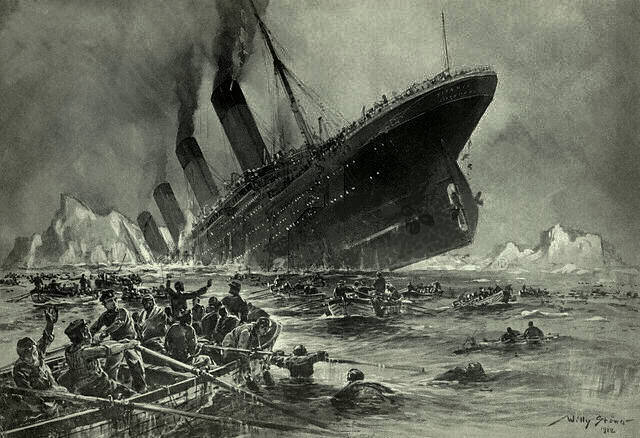
- navigation errors and other human errors, leading to collisions (with another ship, rocks, an iceberg (RMS Titanic), etc.) or running aground (Costa Concordia)
- bad weather and powerful or large waves or gale winds: This often leads to a vessel being swamped by waves, holed on rocks or a reef, or capsizing, also referred to as foundering
- warfare, piracy, mutiny, or sabotage including: guns, torpedoes, depth charges, mines, bombs and missiles
- fire
- biofouling, such as accumulation of polychaete and other tube worms on wood hulls[citation needed][clarification needed]
- overloading - either cargo or icing, and displacement exceeding the plimsoll line[clarification needed]
- intentional sinking (scuttling)
- to form an artificial reef
- for wreck diving
- use as a target ship for training or testing weapons
- as a blockship to create an obstacle to close a harbour, river, etc. against enemy ships
- to prevent a ship from falling into an enemy's hands (e.g. Admiral Graf Spee)
- to destroy a derelict ship that poses a menace to navigation
- as part of an insurance scam
Design and equipment failure
[edit]One of the best known examples of a shipwreck due to poor design is the capsize of Swedish warship Vasa in Stockholm harbour 1628. She was unstable, with insufficient beam for her weight distribution and her lower gun deck had too low free-board for good seaworthiness. Poor design allowed the ferry MS Herald of Free Enterprise to put to sea with open roll-on/roll-off bow doors, with tragic consequences. Failure or leaking of the hull is a serious problem that can lead to the loss of buoyancy or loss of stability due to the free surface effect and the subsequent sinking or capsize of the vessel. Even the hulls of large modern ships have cracked in heavy storms. Leaks between the hull planks of wooden vessels are a particular problem.[citation needed]
Equipment failure caused the shipwreck of cruiseferry Estonia in 1994. The stress of stormy seas on the hull and especially the bow caused the bow visor to break off, in turn tearing the watertight bow door open and letting seawater flow onto the car deck. She capsized with tragic consequences.[3] Failure of pumps can lead to the loss of a potentially salvageable ship with only a minor leak or fire.[citation needed]
Failure of the means of propulsion, such as engines, sails or rigging, can lead to the loss of a ship. When the ship's movement is determined only by currents or the wind and particularly by storms, a common result is that the ship is unable to avoid natural hazards like rocks, shallow water or tidal races. Loss of propulsion or steering can inhibit a ship's ability to safely position itself in a storm, even far from land. Waves attacking a ship's side can overwhelm and sink it.[citation needed]
Instability and foundering
[edit]Instability is caused by the centre of mass of the ship rising above the metacenter resulting in the ship tipping on its side or capsizing. To remain buoyant, the hull of a vessel must prevent water entering the large air spaces of the vessel (known as downflooding). Clearly for the ship to float, the normally submerged parts of the hull will be watertight, but the upper parts of the hull must have openings to allow ventilation to compartments, including the engine room, for crew access, and to load and unload cargo. In a swamping by waves or capsize water can enter these openings if not watertight. If a ship sinks after capsizing, or as a consequence of a being overwhelmed by waves, a leak in the hull, or other water ingress, it may be described as having foundered or foundering.[4] Large ships are designed with compartments to help preserve the necessary buoyancy.
Bad weather
[edit]

On 25 October 2012, the tall ship Bounty (a replica of the original HMS Bounty sank in a hurricane. The vessel left New London, Connecticut, heading for St. Petersburg, Florida, initially going on an easterly course to avoid Hurricane Sandy.[5] On 29 October 2012 at 03:54 EDT, the ship's owner called the United States Coast Guard for help during the hurricane after losing contact with the ship's master. He reported she was taking on water off the coast of North Carolina, about 160 miles (260 km) from the storm, and the crew were preparing to abandon ship. There were sixteen people aboard, two of whom did not survive the sinking.[6] An inquiry into the sinking was held by the United States Coast Guard in Portsmouth, Virginia, from 12 to 21 February 2013;[7] at which it was concluded that Captain Walbridge's decision to sail the ship into the path of Hurricane Sandy was the cause, and the inquiry found this to have been a "reckless decision".[8]
Poor weather can cause several problems:
- high winds
- low visibility
- cold weather
- high waves
Wind causes waves which result in other difficulties. Waves make navigation difficult and dangerous near shallow water. Also, waves create buoyancy stresses on the structure of a hull. The weight of breaking waves on the fabric of the ship force the crew to reduce speed or even travel in the same direction as the waves to prevent damage. Also, wind stresses the rigging of sailing ships.
The force of the wind pushes ships in the direction of the wind. Vessels with large windage suffer most. Although powered ships are able to resist the force of the wind, sailing vessels have few defences against strong wind. When strong winds are imminent, sailing vessels typically have several choices:
- try to position themselves so that they cannot be blown into danger
- shelter in a harbour
- anchor, preferably on the leeward side of a landform
Many losses of sailing ships were caused by sailing, with a following wind, so far into a bay that the ship became trapped upwind of a lee shore, being unable to sail into the wind to leave the bay. Low visibility caused by fog, mist and heavy rain increase the navigator's problems. Cold can cause metal to become brittle and fail more easily. A build-up of ice can cause instability by accumulating high on the ship, or in severe cases, crush the hull if the ship becomes trapped in a freezing sea.
Rogue waves
[edit]According to one scientist who studies rogue waves, "two large ships sink every week on average, but the cause is never studied to the same detail as an air crash. It simply gets put down to 'bad weather'."[9] Once considered mythical and lacking hard evidence for their existence, rogue waves are now proven to exist and known to be a natural ocean phenomenon. Eyewitness accounts from mariners and damages inflicted on ships have long suggested they occurred; however, their scientific measurement was only positively confirmed following measurements of the "Draupner wave", a rogue wave at the Draupner platform in the North Sea on January 1, 1995, with a maximum wave height of 25.6 metres (84 ft) (peak elevation of 18.5 metres (61 ft)). During that event, minor damage was also inflicted on the platform, far above sea level, confirming that the reading was valid. Their existence has also since been confirmed by satellite imagery of the ocean surface.[10]
Fire
[edit]Fire can cause the loss of ships in many ways. The most obvious way would be the loss of a wooden ship which is burned until watertight integrity is compromised (e.g. Cospatrick). The detonation of cargo or ammunition can cause the breach of a steel hull. An extreme temperature may compromise the durability properties of steel, causing the hull to break on its own weight. Often a large fire causes a ship to be abandoned and left to drift (e.g. MS Achille Lauro). Should it run aground beyond economic salvage, it becomes a wreck.
In extreme cases, where the ship's cargo is either highly combustible (such as oil, natural gas or gasoline) or explosive (nitrates, fertilizers, ammunition) a fire onboard may result in a catastrophic conflagration or explosion. Such disasters may have catastrophic results, especially if the disaster occurs in a harbour, such as the Halifax Explosion.
Navigation errors
[edit]
Many shipwrecks have occurred when the crew of the ship allowed the ship to collide with rocks, reefs, icebergs, or other ships. Collision has been one of the major causes of shipwreck. Accurate navigation is made more difficult by poor visibility in bad weather. Also, many losses happened before modern navigation aids such as GPS, radar and sonar were available. Until the 20th century, the most sophisticated navigational tools and techniques available - dead reckoning using the magnetic compass, marine chronometer (to calculate longitude) and ships logbook (which recorded the vessel's heading and the speed measured by log) or celestial navigation using marine chronometer and sextant - were sufficiently accurate for journeys across oceans, but these techniques (and in many cases also the charts) lacked the precision to avoid reefs close to shore.
The Scilly naval disaster of 1707, which claimed nearly 2,000 lives and was one of the greatest maritime disasters in the history of the British Isles, is attributed to the mariner's inability to find their longitude. This led to the Longitude Act to improve the aids available for navigation. Marine chronometers were as revolutionary in the 19th century as GPS is today. However the cost of these instruments could be prohibitive, sometimes resulting in tragic consequences for ships that were still unable to determine their longitude, as in the case of the Arniston.
Even today, when highly accurate navigational equipment is readily available and universally used, there is still scope for error. Using the incorrect horizontal datum for the chart of an area may mislead the navigator, especially as many charts have not been updated to use modern data. It is also important for the navigator to appreciate that charts may be significantly in error, especially on less frequented coasts. For example, a recent revision of the map of South Georgia in the South Atlantic showed that previous maps were in some places in error by several kilometres.
Over the centuries, many technological and organizational developments have been used to reduce accidents at sea including:
- International Regulations for Preventing Collisions at Sea
- Pilotage aids including lighthouses and sea marks
- Basic navigation tools such as the magnetic compass, nautical chart, marine chronometer, sextant, log and sounding line
- Advanced navigation tools such as radio communication, radar navigation, gyrocompass, sonar, hyperbolic Radio navigation and satellite navigation
- Inspection of shipbuilding quality and maintenance of seaworthiness of the ship such as "A1 at Lloyd's"
- Intelligence and better defences to protect the ship from acts of violence, war and piracy
- Use of fireproof/nonflammable materials to prevent fires from spreading rapidly, and modern fire-fighting agents such as gases and foams that do not compromise the buoyancy and stability of the vessel as quickly as water.
- Built-in devices to delay flooding long enough for rescue ships to retrieve survivors and/or tow the ship to the nearest shipyard for repairs, such as watertight compartments and pumps.
See also
[edit]References
[edit]- ^ “Shipwrecking.” Merriam-Webster.com Thesaurus, Merriam-Webster, https://www.merriam-webster.com/thesaurus/shipwrecking. Accessed 10 Oct. 2025.
- ^ “Shipwreck.” Merriam-Webster.com Dictionary, Merriam-Webster, https://www.merriam-webster.com/dictionary/shipwreck. Accessed 10 Oct. 2025.
- ^ "21 Conclusions". Final report on the MV ESTONIA disaster of 28 September 1994. Helsinki: Joint Accident Investigation Commission. 1997. Archived from the original on 2 June 2001.
- ^ Joseph, Palmer (1975). Jane's Dictionary of Naval Terms. London: Mcdonald and Jane's. ISBN 0-356-08258-X.
- ^ Morgenstein, Mark (29 October 2012). "Sandy claims 'Bounty' off North Carolina". CNN. Archived from the original on 29 October 2012. Retrieved 29 October 2012.
- ^ Koenig, Seth (13 June 2014). "Coast Guard finds ill-fated ship Bounty avoided tighter safety standards, repair warnings by Maine shipyard". Bangor Daily News. Archived from the original on 16 June 2014. Retrieved 9 June 2015.
- ^ "US Coast Guard Media Advisory, January 10, 2013". US Coast Guard Newsrom. U.S. Department of Homeland Security. Archived from the original on 12 April 2015. Retrieved 31 January 2015.
- ^ "Sinking of Tall Ship Bounty". National Transportation Safety Board. 6 February 2014. Archived from the original on 21 February 2014. Retrieved 11 February 2014.
- ^ "Ship-sinking monster waves revealed by ESA satellites". European Space Agency. July 21, 2004. Archived from the original on July 24, 2014.
- ^ "Freak waves spotted from space". BBC News. July 22, 2004. Archived from the original on July 24, 2004. Retrieved May 22, 2010.
Further reading
[edit]- Hans Blumenberg, Shipwreck with Spectator: Paradigm of a Metaphor for Existence (Cambridge, Massachusetts: MIT Press, 1997)
External links
[edit]
- Maritimequest Shipwreck Database (Downloadable Excel file)
- NOAA Wrecks and Obstructions Database Archived 2021-07-23 at the Wayback Machine
- Shipwrecks and Smuggling Archived 2011-05-03 at the Wayback Machine - a learning resource from the British Library archives
- Shipwrecks UK, providing context, thematic information and detail for more than 45,000 shipwrecks in the seas surrounding Britain and Ireland, including revealing maps.
| International | |
|---|---|
| National | |
| Other | |

Shipwrecking
View on GrokipediaDefinition and Classification
Definition
Shipwrecking, also known as wrecking, is the practice of salvaging crews, vessels, cargo, and valuables from shipwrecks that have run aground or sunk, typically near shorelines.[1] This activity involves recovering property from maritime casualties and is governed by laws that incentivize rescuers with a share of the salvaged value. A "wreck" in this context, as defined under international maritime law such as the 2007 Nairobi International Convention on the Removal of Wrecks, refers to any sunken or stranded ship, including its parts or onboard objects, that may pose navigation, environmental, or safety risks.[6] Shipwrecking distinguishes itself from the shipwreck event—the destruction or loss of a vessel—by focusing on post-incident recovery efforts. The term "wrecking" emerged in historical maritime contexts, particularly in regions like the Florida Keys, to describe organized salvage operations rather than the act of ship destruction. In legal and insurance terms, shipwrecking aligns with marine salvage principles, where successful recovery can lead to awards, but differs from formal contracts by often being opportunistic. Unlike temporary strandings that allow refloating, shipwrecking typically addresses permanent losses requiring extraction of goods or removal of hazards. As of 2024, with approximately 27 large ships lost annually worldwide, shipwrecking remains relevant for economic recovery and humanitarian aid, though modern regulations emphasize environmental protection.[7]Types of Shipwrecks
Shipwrecks are primarily classified according to the dominant mechanism that leads to the vessel's loss, enabling analytical distinctions in maritime safety studies and incident investigations. The core categories encompass sinking (or foundering) through uncontrolled water ingress, grounding on submerged obstacles or shorelines, collision with other vessels or fixed objects, and breakup resulting from excessive structural stress.[8][9] These classifications stem from standardized maritime accident reporting frameworks used by organizations like the International Maritime Organization (IMO), which aggregate data on vessel casualties to inform prevention strategies. Sinking, also termed foundering, occurs when a vessel takes on water faster than it can be expelled, leading to progressive flooding and eventual submersion. This type often involves breaches in the hull from various stressors, resulting in the ship settling on the seabed intact or partially disassembled. For example, a generic cargo vessel might founder after sustained heavy weather compromises its watertight integrity, displacing its cargo and crew before full immersion.[10] Grounding, or stranding, happens when a ship runs aground on reefs, sandbars, or coastal shallows, often halting its progress and exposing it to wave action that can exacerbate damage. A typical case involves a container ship wedged on a shoal, where tidal forces and poor visibility contribute to the wreck's immobilization without immediate sinking.[11] Collision wrecks arise from impacts between moving vessels or between a vessel and stationary structures like piers or rocks, causing structural deformation and potential capsizing. In such incidents, a passenger liner striking another ship in fog-shrouded waters exemplifies the rapid onset of hull rupture and loss of buoyancy. Breakup wrecks, conversely, involve the vessel's disintegration under mechanical or environmental loads, such as longitudinal bending in rough seas that snaps the hull amidships. This category frequently overlaps with others but is distinguished by the fragmentation of the ship's framework into multiple sections.[12][9] Beyond these mechanistic types, shipwrecks are further subdivided by context or intent, including intentional wrecks deliberately scuttled for purposes like creating artificial reefs to bolster marine habitats. Wartime wrecks result from combat actions such as torpedoing or aerial bombing, leaving vessels in varied states from intact hulks to scattered debris fields. Natural disaster-induced wrecks, such as those from tsunamis, involve vessels displaced or inundated by extreme wave forces, often stranding them far inland or shattering them against coastlines, as seen in events like the 2004 Indian Ocean tsunami that wrecked numerous fishing boats and ferries.[13] In modern maritime practice, the International Hydrographic Organization (IHO) employs standardized frameworks to categorize wrecks with respect to navigational hazards, distinguishing between non-dangerous wrecks (those with sufficient overlying water depth) and dangerous wrecks (typically those with less than 20 meters of clearance in areas where surrounding depths exceed this threshold, posing collision risks to surface navigation). Hazardous wrecks are marked on charts with specific symbols to alert mariners, emphasizing their potential to obstruct fairways or create uncharted obstacles. For instance, a wartime wreck like a sunken submarine might be deemed hazardous if its mast protrudes near shipping lanes, requiring clearance surveys.[14][15] This IHO approach aids in prioritizing removal or marking efforts to mitigate broader risks to global shipping.Historical Context
Ancient and Medieval Shipwrecks
Shipwrecking in ancient times was heavily influenced by the limitations of wooden vessel construction and rudimentary navigation, leading to frequent losses in the Mediterranean Sea. One prominent example is the Uluburun shipwreck, dated to approximately 1320 BCE off the coast of Kaş, Turkey, which carried a diverse cargo indicative of extensive Bronze Age trade networks. The vessel transported around 10 tons of copper and tin ingots in a 10:1 ratio suitable for bronze production, along with luxury items such as ivory tusks, ostrich eggs, glass ingots, and pottery containing foodstuffs. Constructed from Lebanese cedar using pegged mortise-and-tenon joints and a proto-keel, the ship's design reflected early advancements but was vulnerable to structural stresses in open waters, as evidenced by the scattered remains recovered from depths exceeding 150 feet. These technological constraints, including the lack of a true keel for stability, contributed to the wreck's fate during what was likely a long-distance voyage involving multiple civilizations. In the medieval period, shipwrecks became more common in the North Atlantic due to ambitious exploration and trade routes undertaken by Vikings between the 9th and 11th centuries. Viking longships and knorrs, clinker-built with overlapping oak planks for flexibility, enabled voyages to Iceland, Greenland, and beyond but were prone to disasters from fog, ice fields, and navigational errors known as hafvilla, or "sea-maze," where crews lost their bearings without compasses. Remains from sites like the Roskilde fjord in Denmark, including five 11th-century ships deliberately sunk as blockships, highlight the era's maritime risks, though accidental wrecks along northern coasts often resulted from open-sea storms overwhelming these shallow-draft vessels. Early Polynesian voyages across the Pacific also faced similar perils, with limited archaeological evidence of failures due to perishable wooden canoes and favorable currents, underscoring the high stakes of non-industrial navigation. Archaeological investigations have provided crucial insights into these pre-modern shipwrecks, revealing patterns of trade and loss through preserved artifacts. In the Mediterranean, thousands of ancient wrecks have been documented by 2024, with preservation aided by anaerobic seabed conditions that slow wood decay, particularly in low-oxygen environments like the Black Sea where even fabrics and bones endure. Techniques such as sonar mapping and deep-water diving have uncovered sites like the Uluburun, yielding over 22,000 dives' worth of data on hull fragments and cargo distribution. In the North Atlantic, Viking wrecks benefit from colder waters that inhibit biological degradation, allowing recovery of strakes and anchors that inform on clinker construction's strengths and vulnerabilities. Societal responses to shipwrecking evolved from ancient salvage practices to formalized medieval rights. In Roman times, the Lex Rhodia de iactu, incorporated into the Digest of Justinian, governed jettisoning cargo to lighten ships in peril, ensuring shared liability among owners while affirming that wrecked goods remained the property of their original holders unless proven abandoned. Professional divers, or urinatores, were employed for recovery, as documented in inscriptions from Ostia around 150 CE. By the medieval era in Europe, "wreck rights" or ius naufragii granted coastal lords or finders ownership of unclaimed wreckage after a year and a day, balancing incentives for salvage against shippers' interests, though reforms under figures like Edward I of England in the late 13th century protected lives by awarding wrecks to owners if humans, animals, or even cats survived. These laws reflected the era's economic reliance on maritime trade amid persistent navigational hazards.Age of Sail and Industrial Era
The Age of Sail, spanning roughly the 15th to mid-19th centuries, marked a period of intensified global exploration and trade that dramatically elevated shipwreck rates, as European powers ventured into largely uncharted waters with fleets of wooden vessels prone to structural weaknesses. Wooden hulls, constructed from oak or pine and often burdened by heavy cannonry, were particularly vulnerable to rot from shipworms (Teredo navalis), storm-induced splintering, and leaks exacerbated by prolonged exposure to saltwater, leading to frequent foundering during long voyages.[16] Inaccurate or absent nautical charts compounded these risks, as navigators relied on rudimentary portolan maps that failed to account for reefs, shoals, and shifting currents in distant oceans, resulting in numerous groundings during expeditions to the Americas, Africa, and Asia.[17] A stark example occurred during the Spanish Armada of 1588, when storms scattered the fleet of approximately 130 ships off the Irish coast, causing at least 24 to wreck on rocky shores and contributing to a total loss of 63 vessels overall.[18] As the Industrial Era dawned in the early 19th century, the transition to steam-powered ironclad ships introduced new wreck dynamics while amplifying economic consequences through larger cargo capacities and faster transatlantic routes. Steam propulsion reduced reliance on wind but increased collision hazards in foggy or crowded sea lanes, as exemplified by the SS Arctic disaster on September 27, 1854, when the Collins Line paddle steamer collided with the smaller French steamship SS Vesta off Newfoundland, sinking within hours and claiming over 300 lives due to inadequate lifeboats and crew panic.[19] Heightened maritime traffic, driven by booming trade in cotton, coal, and manufactured goods, escalated the stakes, with wrecks often involving valuable consignments that could bankrupt owners without insurance protections. During the Irish Potato Famine migrations of the 1840s, overcrowded "coffin ships"—derelict sailing vessels hastily repurposed for emigrant transport—suffered from disease, malnutrition, and structural failures, leading to the loss of at least 60 such vessels at sea or on North American coasts.[20] Shipwrecks profoundly influenced culture and commerce during this era, inspiring literary works and spurring institutional innovations in risk management. Daniel Defoe's 1719 novel Robinson Crusoe drew from the real-life ordeal of Scottish sailor Alexander Selkirk, who was marooned on Juan Fernández Island in 1704 after disputing his captain's navigation, surviving four years amid isolation that mirrored the perils of shipboard life and castaway survival.[21] Concurrently, the rising frequency of losses prompted the formalization of marine insurance; Edward Lloyd's coffeehouse in London, established around 1688, evolved into a marketplace where underwriters assessed risks for transoceanic voyages, laying the foundation for Lloyd's of London as a cornerstone of global shipping protection by the 18th century.[22] These developments reflected broader shifts from exploratory gambles to industrialized maritime enterprise, where wrecks transitioned from mere navigational tragedies to catalysts for economic safeguards.Causes
Structural and Equipment Failures
Structural and equipment failures represent a significant category of intrinsic vessel weaknesses that can precipitate shipwrecks, often stemming from design inadequacies or material degradation rather than external forces. These failures compromise the ship's ability to maintain integrity and stability, leading to progressive flooding, loss of propulsion, or capsizing. In historical and modern contexts, such issues have arisen from suboptimal engineering choices, including insufficient redundancy in critical systems and vulnerabilities in construction materials.[23] Design flaws, particularly those affecting stability, frequently involve a high center of gravity, which reduces the vessel's resistance to rolling and increases the risk of capsizing. For instance, roll-on/roll-off (Ro-Ro) ferries like the MS Herald of Free Enterprise in 1987 suffered from inadequate stability due to their open car decks and elevated load positioning, allowing rapid free surface effects to destabilize the ship when water ingress occurred. This design vulnerability highlighted the need for enhanced intact stability criteria in passenger vessels, as low metacentric heights in such configurations can lead to sudden loss of righting moment.[24][25] Equipment breakdowns further exacerbate risks through propulsion failures or hull integrity losses. In steamship eras, boiler explosions were a notorious cause of catastrophic propulsion failure; the 1865 SS Sultana on the Mississippi River, overloaded with passengers, experienced a boiler rupture that fragmented the vessel, killing over 1,800 people due to the sudden release of high-pressure steam and structural disintegration. Modern equivalents include engine room flooding or component failures that halt maneuverability. Hull corrosion in metal ships, driven by electrochemical reactions between steel and seawater, progressively weakens plating and seams, potentially causing breaches during routine operations; without proper cathodic protection, this galvanic and pitting corrosion can reduce hull thickness by typically 0.1-0.2 mm per year in saline environments.[26][27] Prominent case studies illustrate these failures' interplay. The 1912 RMS Titanic's sinking was accelerated by substandard wrought-iron rivets in the hull, which contained high slag inclusions that embrittled under impact, popping along 100 meters of the starboard side and compromising watertight bulkheads designed with insufficient height to contain flooding across multiple compartments. Similarly, the 2015 SS El Faro cargo ship's loss involved a hull breach from an unsecured scuttle allowing rapid flooding, compounded by propulsion loss when the main engine ingested water, leading to total structural compromise despite the vessel meeting regulatory strength standards. These incidents underscore how material and compartmentalization flaws amplify damage propagation.[28][29] At the core of stability assessments lies the engineering principle of metacentric height (GM), a key metric for evaluating a ship's initial transverse stability. GM is calculated as the difference between the height of the metacenter (KM) above the keel and the height of the center of gravity (KG) above the keel: Here, KM derives from the vessel's waterplane area and volume displacement via the formula , where KB is the keel-to-buoyancy center distance and (with I as the second moment of the waterplane area and V as displaced volume); KG is determined from weight distribution. A positive GM (typically 0.15–0.5 meters for safe operation) ensures the righting arm restores equilibrium after a heel, while a negative value signals instability and capsizing risk. This straightforward derivation, rooted in Archimedes' principle and hydrostatics, allows naval architects to predict behavior without complex simulations, emphasizing the need to minimize KG through low cargo placement.[30][31]Environmental Factors
Environmental factors play a critical role in shipwrecking by generating forces that overwhelm vessel stability and structural integrity. Severe weather events, such as storms and hurricanes, produce high winds, massive waves, and storm surges that can capsize or ground ships. For instance, Hurricane Katrina in 2005 generated waves up to approximately 17 meters high in the Gulf of Mexico, destroying 46 oil platforms and damaging numerous vessels through direct impact and flooding.[32] Wind shear, the rapid change in wind speed or direction over short distances, further complicates vessel handling by creating uneven forces on the hull and superstructure, often leading to loss of steering control or unintended drift.[33] These weather extremes can exacerbate pre-existing structural weaknesses, such as hull fatigue, by amplifying stress on compromised components. Rogue waves, also known as freak waves, represent another potent environmental threat, manifesting as isolated swells that exceed surrounding wave heights by more than double. The first instrumentally recorded rogue wave occurred on January 1, 1995, at the Draupner oil platform in the North Sea, where a 25.6-meter wave struck amid 12-meter seas, damaging the platform's structure without capsizing it.[34] These waves can reach heights over 30 meters in extreme cases and pose a high risk to superstructures, potentially shearing off bridges or antennas due to their steep fronts and concentrated energy. Statistically, rogue waves are rare in moderate sea states, yet their unpredictability makes them a persistent hazard for maritime operations. Beyond atmospheric phenomena, oceanic currents, reduced visibility from fog, floating ice hazards, and seismic-induced tsunamis contribute significantly to shipwreck incidents. Strong ocean currents, such as the Agulhas Current off South Africa, can accelerate vessels toward shallow reefs or alter courses unpredictably, leading to groundings. Dense fog impairs visibility, fostering collisions; a notable example is the 1854 incident off Newfoundland where the steamship Arctic collided with the Vesta in heavy fog, resulting in over 350 deaths. Icebergs pose collision risks in polar and subpolar waters, as evidenced by multiple warnings issued to the RMS Titanic on April 14, 1912, reporting fields of icebergs and pack ice in the North Atlantic, though the ship struck one regardless. Seismic events trigger tsunamis that devastate coastal and offshore vessels; the 2004 Indian Ocean tsunami, generated by a magnitude 9.1 earthquake, destroyed thousands of fishing boats and stranded larger ships across Indonesia, Sri Lanka, and India, with over 2,000 boats lost in India alone.[35] To mitigate these risks, predictive models rely on oceanographic data for forecasting wave conditions. The significant wave height (Hs), a key metric for assessing sea state severity, is calculated as approximately four times the standard deviation of surface wave elevations, derived from continuous measurements by buoy sensors that record elevation variations over time. This formula, Hs ≈ 4σ (where σ is the standard deviation), provides mariners with estimates of average maximum wave heights in a given period, enabling route adjustments during forecasted extremes. Data from global buoy networks, such as those operated by the National Data Buoy Center, underpin these models by offering real-time statistical inputs for wave spectra analysis.[36]Human Errors
Human errors constitute a primary cause of shipwrecks, encompassing navigational misjudgments, operational oversights, and flawed decision-making that compromise vessel safety. According to analyses of maritime casualties from 1990 to 2020, human factors account for 80-85% of incidents, including collisions, groundings, and structural failures, often stemming from preventable actions by crew members or management.[37] These errors interact with environmental conditions but originate from individual or systemic lapses in judgment and procedure adherence. Navigational blunders frequently involve misinterpretation of charts, routes, or electronic aids like GPS, leading to unintended groundings or collisions. A notable example is the 2007 grounding of the bulk carrier Pasha Bulker off Nobbys Beach, Australia, where the master failed to adequately ballast the vessel despite gale warnings and made a poorly controlled course change in extreme weather, resulting in the ship dragging anchor and running aground.[38] Similarly, GPS malfunctions or overreliance on automated systems have caused disasters, such as the 1995 grounding of the passenger ship Royal Majesty on Rose and Crown Shoal near Nantucket, Massachusetts, after a GPS antenna cable failure switched the system to inaccurate dead-reckoning mode; watch officers overlooked verification cues from alternative navigation tools like Loran-C, exacerbating the 17-mile deviation.[39] Operational lapses, including overloading beyond stability limits, inadequate maintenance, and fatigue-induced errors, further heighten wreck risks. The 1987 sinking of the ferry Doña Paz in the Philippines, the deadliest peacetime maritime disaster with 4,386 fatalities, was aggravated by severe overloading—carrying nearly 4,000 passengers against a capacity of 1,518—coupled with crew negligence in safety protocols.[40] Fatigue, often from extended watches and irregular schedules, contributes to about 25% of marine casualties, impairing alertness and decision-making, as seen in cases where exhausted watchkeepers fail to detect hazards.[41] In wartime contexts, human actions like intentional attacks or evasive maneuvers have led to widespread sinkings, distinct from peacetime errors but equally rooted in decision-making. During World War II, German U-boat campaigns sank over 2,800 Allied merchant ships through targeted torpedo strikes and convoy disruptions, severely disrupting supply lines and contributing to thousands of losses.[42] Frameworks like the Human Factors Analysis and Classification System (HFACS), adapted for maritime use (HFACS-MA), provide structured analysis of these errors by categorizing them into layers: unsafe acts (e.g., skill-based errors or violations), preconditions (e.g., fatigue or poor training), inadequate supervision, and organizational influences (e.g., resource mismanagement). Studies applying HFACS to commercial vessel accidents from 2006-2011 identified supervision failures as significant in collisions and groundings, with organizational factors present in up to 28% of cases, enabling targeted prevention.[43]Wrecking Process
Stages of Shipwreck Events
Shipwreck events typically unfold in a chronological sequence beginning with initial distress, progressing through escalating damage, and culminating in the vessel's total loss. This progression is influenced by the vessel's design, the nature of the damage, and environmental conditions, often leading to rapid deterioration if not mitigated. Understanding these stages is crucial for damage control and survival strategies, as they dictate the window for intervention and evacuation.[44] The initial distress phase occurs when water ingress begins, often through hull breaches, failed watertight compartments, or overflow, causing the ship to list or lose stability. Water enters at a rate determined by the size of the opening and the hydrostatic pressure, approximated using Torricelli's law derived from [Bernoulli's principle](/page/Bernoulli's principle). To calculate the inflow velocity, consider the fluid dynamics: the speed of water exiting (or entering) an orifice is given by , where is gravitational acceleration (approximately 9.81 m/s²) and is the height of the water surface above the orifice; this equates the kinetic energy at the orifice to the potential energy lost from the surface. The volumetric flow rate (in m³/s) is then , with as the breach area (m²). For a compartment of volume , the approximate time to flood is , though this simplifies as decreases over time, requiring integration for precision. The standard time to flood a compartment of constant cross-sectional area through a hole of area is approximately , for initial height . In practice, for a 1 m² breach at 5 m head, m³/s (≈ 594 m³/min), flooding a 500 m³ compartment in ≈50 seconds without countermeasures. This phase demands immediate bilge pumping and sealing to prevent progression.[45] As damage progresses, flooding spreads to adjacent compartments, leading to heeling, trimming, or structural stress that can cause capsizing or breaking. In foundering sequences, water first accumulates in the bilges, raising the center of gravity and reducing freeboard; if unchecked, it overflows to lower decks, then propagates upward through vents or doors, eventually submerging the main deck and compromising buoyancy. This stage often lasts minutes to hours, depending on compartmentation, with progressive flooding accelerating due to ship motions like rolling, which slosh water and equalize levels across bulkheads.[46] The final stages involve total submergence in deep water or stranding on shallow seabeds, followed by post-wreck settling. Submergence occurs when reserve buoyancy is exhausted, the vessel plunging stern-first or rolling over, often in under 10 minutes for large ships once the deck floods. Stranding happens if the ship grounds before sinking fully, as in deliberate beachings to avert total loss. After impact, the wreck settles into the seabed through sediment displacement and burial, with initial burial rates variable but up to several centimeters per year in soft mud, stabilizing over decades as currents erode or deposit material around the hull. This settling alters the site's formation, embedding artifacts and influencing long-term preservation.[47][48] Survivor accounts highlight common phases aligned with abandon ship protocols, emphasizing timed evacuation to maximize survival. Under the International Convention for the Safety of Life at Sea (SOLAS), crews must muster within minutes of the distress signal, don lifejackets, and launch survival craft, with passenger ships required to enable full abandonment in 30 minutes from the signal. These protocols, drilled weekly, have reduced fatalities by ensuring phased response from alert to immersion.[49]Collision and Grounding Dynamics
Collision mechanics in shipwrecks involve the rapid transfer of kinetic energy from the moving vessel to structural deformation and fracture upon impact with another ship or object. The primary energy involved is the initial kinetic energy of the striking vessel, given by , where is the mass and is the velocity relative to the target; this energy is dissipated through plastic deformation, fracture, and some hydrodynamic damping in the surrounding water. According to the work-energy theorem, the average impact force can be approximated as , where is the deformation distance over which the energy is absorbed, highlighting how force scales quadratically with velocity for a given deformation path. This transfer often leads to localized crushing and tearing in the struck ship's side shell, with energy absorption depending on the bow geometry of the striking vessel—such as a sharp bulbous bow causing concentrated fracture—and the structural layout of both ships.[50] Grounding dynamics differ from collisions by involving prolonged contact with the seabed, resulting in hull abrasion from frictional sliding and structural stress from uneven loading along the keel. As the ship slides or pivots over rocks or soft sediment, abrasive forces erode the outer hull plating, while racking and bending moments induce high tensile and compressive stresses in the hull girder, potentially leading to bottom rupture if the grounding energy exceeds the material's fracture toughness. For instance, the 1989 grounding of the Exxon Valdez tanker ruptured eight of its cargo tanks due to these stresses, releasing over 250,000 barrels of crude oil. Mathematical models for grounding loads typically couple rigid-body dynamics with soil-structure interaction, predicting peak forces from the ship's momentum and seabed resistance.[51][52] The severity of damage in both collisions and groundings is modulated by key factors including impact speed, collision angle, and hull material properties. Higher speeds amplify kinetic energy quadratically, increasing intrusion depth and breach extent—for example, velocities above 10 knots can double the deformed volume compared to lower speeds in side impacts. Oblique angles (e.g., 45–90 degrees) distribute energy over a larger area, reducing penetration but potentially causing more extensive tearing along frame lines, whereas head-on angles concentrate forces for deeper local damage. Material choice significantly affects outcomes: steel hulls (e.g., NV A-grade mild steel with yield strength around 235 MPa) absorb more energy through ductile deformation than fiberglass composites, which fracture brittlely at lower strains, though high-strength steels like Domex 355 enhance resistance by up to 50% via improved strain hardening. A historical case illustrating these interactions is the 1956 collision between the SS Andrea Doria and MS Stockholm, where the Stockholm's ice-breaking bow at approximately 18 knots and a near-perpendicular angle pierced the Andrea Doria's starboard side, leading to catastrophic flooding despite steel construction.[50][53] Modern simulation tools, particularly computational fluid dynamics (CFD) coupled with finite element analysis (FEA), enable precise prediction of breach sizes and structural responses in collision and grounding scenarios. These models incorporate fluid-structure interaction (FSI) to account for hydrodynamic forces like added mass and damping, which can alter the effective impact energy by 10–20% during oblique collisions. For grounding, CFD simulates seabed topology and soil erosion, estimating breach dimensions from dynamic pressures and shear stresses on the hull bottom. Such tools, validated against full-scale accident data, support probabilistic risk assessments by varying parameters like speed and angle to forecast damage extents.[54]Consequences
Human and Economic Losses
Shipwrecks have historically inflicted severe human tolls, with the 1915 sinking of the RMS Lusitania by a German U-boat claiming 1,198 lives out of 1,959 aboard, marking one of the deadliest peacetime maritime disasters of the early 20th century.[55] Similarly, the 1994 sinking of the MS Estonia ferry in the Baltic Sea resulted in 852 deaths, primarily from drowning and hypothermia, devastating families and prompting major safety reforms in European ferry operations.[56] These events highlight peaks in casualties driven by rapid sinkings and inadequate evacuation, often exceeding 50% fatality rates in pre-modern safety eras. Advancements in life-saving equipment, such as improved lifeboats and international regulations, have dramatically reduced modern fatality rates in commercial shipping incidents. According to the European Maritime Safety Agency (EMSA), from 2015 to 2024, 609 lives were lost across 416 reported marine casualties in European waters, with an annual average of about 61 fatalities (including 17 in 2024), reflecting a downward trend and fatality rates below 1% in many vessel types due to enhanced emergency protocols.[57] Globally, total vessel losses dropped to a record low of 27 ships over 100 gross tons in 2024, down 20% from 2023, minimizing large-scale loss of life.[58] Economically, shipwrecks impose substantial costs on vessels, cargo, and salvage operations, with major incidents often exceeding $1 billion in insured losses. For instance, the 2012 Costa Concordia grounding and capsizing led to total insured payouts of $1.5–2 billion, encompassing hull damage, wreck removal, and passenger compensation.[59] Container ships and tankers, valued at $100–500 million each depending on size, amplify these figures when fully lost with cargo.[60] Beyond direct damages, shipwrecks disrupt global trade and local economies, as seen in the 2021 Ever Given grounding in the Suez Canal, which blocked the waterway for six days and caused daily indirect losses estimated at $9.6 billion from delayed shipments and rerouting.[61] The Estonia disaster similarly halted Baltic Sea ferry services, affecting tourism and fishing communities reliant on the route, with recovery efforts costing millions and long-term economic ripple effects on regional trade.[56] While precise global annual figures vary, maritime total losses in 2024 contributed to insured claims in the hundreds of millions, underscoring ongoing vulnerabilities despite declining incident rates.[58]Environmental Impacts
Shipwrecks pose significant environmental threats through oil and fuel spills, which release persistent hydrocarbons into marine ecosystems, leading to long-term contamination of water columns and sediments. The 2002 Prestige oil tanker disaster off the coast of Spain exemplifies this risk, where approximately 63,000 tonnes of heavy fuel oil spilled, polluting over 3,000 kilometers of coastline across Spain, France, and Portugal and causing widespread mortality among seabirds, fish, and intertidal organisms.[62][63] Similarly, the 2020 grounding of the MV Wakashio bulk carrier in Mauritius resulted in about 1,000 tonnes of very low sulfur fuel oil leaking into a sensitive lagoon, smothering mangroves, seagrasses, and coral reefs while threatening biodiversity in a UNESCO-protected wetland.[64][65] In May 2025, the Liberian-flagged container vessel MSC Elsa 3 sank off the Kerala coast, India, leaking about 450 tonnes of oil and hazardous cargo, leading to significant ecological stress on benthic organisms and disruptions to local fishing communities.[66] Wreck sites also serve as vectors for invasive species and debris dispersion, exacerbating ecological disruptions by providing substrates for non-native organisms and releasing hazardous materials. Deliberately sunk shipwrecks, such as those off the Florida Keys, have been colonized by non-native mollusks like the veined rapa whelk, which hitchhike via hull fouling and establish populations on artificial reefs, outcompeting native species.[67] Over 8,500 World War II-era shipwrecks worldwide, many still laden with unexploded munitions, continue to leak oil, explosives, and chemical agents into ocean floors, with projections indicating peak pollution risks this decade from approximately 6 billion gallons of potential fuel release.[68] Direct impacts on marine life include physical destruction of habitats and chemical contamination leading to bioaccumulation in food webs. Groundings, such as the 2010 incident involving the MV Shen Neng 1 on Australia's Great Barrier Reef, crushed coral structures across several hectares and leaked three tonnes of oil, altering community compositions and increasing disease prevalence in surviving colonies for years afterward.[69][70] Metal-hulled wrecks leach heavy metals like copper, arsenic, and lead, which bioaccumulate in fish and invertebrates, potentially magnifying through trophic levels and causing physiological stress, reduced reproduction, and toxicity in predators including seabirds and humans.[71] Long-term monitoring of wreck sites is essential to mitigate ongoing threats, with international frameworks emphasizing in situ preservation as protected areas to safeguard both cultural and ecological values. The UNESCO 2001 Convention on the Protection of the Underwater Cultural Heritage promotes protocols for inventorying sites, establishing no-disturbance zones, and conducting periodic assessments to track pollutant diffusion and biodiversity shifts.[72][73] Case studies like the Wakashio spill highlight the need for such monitoring, where sediment sampling three years post-incident revealed persistent fuel residues in mangroves, underscoring the value of UNESCO-guided rehabilitation efforts in vulnerable ecosystems.[74]Salvage and Recovery
Salvage Techniques
Salvage techniques encompass a range of methods aimed at recovering wrecked vessels, their cargo, and associated data following maritime incidents. These approaches prioritize restoring buoyancy, refloating structures, and minimizing further damage, often combining traditional mechanical interventions with modern technologies. Primary methods focus on immediate stabilization, while advanced tools enable operations in challenging environments, all governed by economic models that incentivize success. One foundational technique involves patching and pumping to achieve partial recovery of partially submerged or grounded ships. Divers or remotely operated vehicles (ROVs) identify and seal hull breaches using flexible patches, collision mats, or cofferdams to create watertight compartments, followed by high-capacity pumps that remove ingress water and restore buoyancy.[75] This method proved effective in numerous operations, such as the 2012 Costa Concordia salvage, where extensive patching allowed for controlled dewatering over months.[76] For full refloating, heavy-lift cranes and powerful tugs are deployed to lift or pull vessels free, particularly in shallow or canal settings. In the 2021 Ever Given incident in the Suez Canal, a fleet of eleven tugs with combined horsepower exceeding 20,000 and bollard pulls up to 285 tonnes, alongside dredgers removing 30,000 cubic meters of sand, successfully refloated the 224,000-tonne container ship after six days.[77][78] Advanced technologies extend salvage capabilities to deep-sea wrecks beyond human reach. ROVs, equipped with cameras, manipulators, and sensors, conduct inspections, cargo recovery, and structural assessments in extreme depths without risking lives. The 1986 exploration of the RMS Titanic at 3,800 meters marked a milestone, where the ROV Jason Jr. penetrated the wreck's interior to capture images and artifacts, paving the way for subsequent deep-water operations.[79] Saturation diving complements ROVs for shallower interventions, allowing divers to live in pressurized chambers and work at depths up to 500 meters for extended periods, as in systems deployed by Shanghai Salvage for wreck removal and oil recovery.[80] Economic viability drives the adoption of these techniques, primarily through the Lloyd's Open Form (LOF) contract, a standard "no cure, no pay" agreement where salvors receive a reward—typically 5-15% of the property's post-salvage value—only upon successful recovery.[81] This model encourages efficient operations, with success rates particularly high for shallow-water wrecks due to easier access and lower risks, enabling recovery in accessible coastal zones. Legal frameworks, such as international salvage conventions, briefly underpin these efforts by defining reward criteria and environmental obligations. Historically, shipwreck salvage evolved from 19th-century wrecking practices, where coastal communities in regions like the Florida Keys used schooners and manual labor to haul cargo from stranded vessels, often in hazardous reef conditions.[1] By the mid-20th century, mechanized diving and pumps formalized operations, leading to today's integration of AI-assisted mapping. In 2025, initiatives like the AI4Shipwrecks dataset from Lake Huron employ machine learning on bathymetric data to detect and map wrecks autonomously, enhancing planning for salvage teams.[82]Legal and Ethical Considerations
The legal framework governing shipwrecking is primarily shaped by international maritime law, which emphasizes flag state jurisdiction and obligations for wreck removal. Under the United Nations Convention on the Law of the Sea (UNCLOS) of 1982, the flag state—the nation under whose registry a vessel sails—retains primary jurisdiction over its ships and associated wrecks on the high seas, including authority to regulate salvage and removal activities.[83][84] This jurisdiction extends to ensuring compliance with environmental and navigational safety standards, though UNCLOS itself lacks specific provisions for wreck removal and instead addresses archaeological and historical wrecks under Articles 149 and 303, which grant preferential rights to states of cultural or historical origin for their protection.[83] Complementing UNCLOS, the Nairobi International Convention on the Removal of Wrecks (2007), administered by the International Maritime Organization (IMO), imposes uniform rules requiring the registered owner to locate, mark, and remove wrecks in a contracting state's exclusive economic zone if they pose hazards to navigation, the marine environment, or other vessels, with costs borne by the owner through compulsory insurance.[85] Ownership disputes often arise between claims of abandonment—where finders may assert rights under salvage law—and assertions of cultural heritage or sovereign immunity. In the case of abandoned wrecks, maritime law traditionally applies the "law of finds," allowing salvage rights if the owner has relinquished control, but this is contested for state-owned or historical vessels.[86] A prominent example is the 2007 discovery by Odyssey Marine Exploration of the wreck of the Spanish frigate Nuestra Señora de las Mercedes in international waters off Portugal, containing an estimated $500 million in silver coins; a U.S. federal court ruled in 2009 that the wreck remained Spanish sovereign property under flag state jurisdiction and treaty obligations, ordering the return of the cargo and rejecting Odyssey's salvage claim.[87][88] Ethical considerations in shipwreck handling revolve around balancing commercial treasure hunting with cultural preservation and environmental responsibility. The UNESCO Convention on the Protection of the Underwater Cultural Heritage (2001) establishes principles prohibiting the commercial exploitation of underwater sites over 100 years old, advocating in situ preservation and international cooperation to treat such wrecks as shared heritage rather than commodities, with 80 states parties as of 2025.[89] This contrasts with salvage practices that prioritize recovery for profit, raising moral dilemmas about disturbing sites that may serve as war graves or archaeological records. Additionally, environmental liability underscores ethical duties, as exemplified by the U.S. Oil Pollution Act (OPA) of 1990, which holds vessel owners strictly liable for cleanup costs and damages from oil discharges, including those from sunken wrecks that leak pollutants, with liability caps of the greater of $3,100 per gross ton or $24,107,600 for double-hull tank vessels over 3,000 gross tons as of 2023 (current as of 2025) unless gross negligence is proven.[90][91] Recent IMO efforts, such as the 2023 updates to guidelines on inventories of hazardous materials in ships (MEPC.379(80)), indirectly support wreck management by enhancing pre-casualty assessments to mitigate pollution risks from wrecks, reinforcing owner-funded remediation under existing conventions.Prevention Strategies
Technological Innovations
Technological innovations in shipwreck prevention have primarily focused on enhancing navigation accuracy, vessel stability, and real-time monitoring to mitigate risks associated with collisions, groundings, and environmental hazards. The Automatic Identification System (AIS), mandated by the International Maritime Organization (IMO) since 2002 for certain vessels, broadcasts real-time vessel positions, speeds, and courses, enabling proactive collision avoidance by integrating with radar and other sensors. Studies indicate that AIS integration with existing systems improves target identification and tracking, significantly lowering the probability of maritime collisions in congested waters.[92] Complementing AIS, the Electronic Chart Display and Information System (ECDIS) replaces traditional paper charts with digital overlays of GPS data, radar, and depth soundings, reducing navigational workload and cross-track deviations from planned routes.[93] Human factors evaluations show ECDIS can decrease positioning errors, thereby enhancing overall safety in dynamic sea conditions.[94] Satellite integration, particularly through Global Navigation Satellite Systems (GNSS) like GPS, has further refined these tools by providing precise positional data, minimizing human-induced navigation discrepancies that previously contributed to groundings.[95] Advancements in stability technologies have addressed vulnerabilities to capsizing and loss of control in adverse weather. Dynamic positioning (DP) systems employ computer-controlled thrusters and propellers to maintain vessel heading and position without anchors, crucial for operations in rough seas where traditional methods fail.[96] Experimental analyses demonstrate that DP configurations, such as thruster biasing, can increase roll damping and reduce platform motion by approximately 16% in simulated wave conditions.[97] Ballast management systems, including automated water transfer between tanks, optimize vessel trim and stability by countering uneven loads or wave-induced heel, essential for safe transit in high seas.[98] These systems ensure transverse stability, reducing hull stress and the risk of structural failure under dynamic loads.[99] Monitoring innovations leverage artificial intelligence (AI) for predictive analytics, forecasting threats like severe weather and structural fatigue to preempt wrecks. AI models process data from sensors, satellites, and historical records to predict hull stress and wave patterns, allowing route adjustments that avoid extreme conditions.[100] For instance, machine learning applications in maritime operations can anticipate rogue waves and optimize fuel efficiency while enhancing safety, with accuracy improvements in wind and sea state predictions reaching 10-20% over traditional methods.[101] Drone-based inspections represent another leap, enabling non-invasive hull and structural assessments without dry-docking and identifies corrosion or damage early to prevent failure-related incidents.[102] Key historical innovations underscore these advancements' impacts. Following the 1912 Titanic disaster, the International Convention for the Safety of Life at Sea (SOLAS) in 1914 mandated lifeboat capacity for all passengers and crew, a requirement that evolved through subsequent amendments to include rigorous drills and equipment standards, contributing to a marked decline in loss-of-life incidents from sinkings.[103] Overall, SOLAS protocols have correlated with reduced marine casualties since 1974, as evidenced by global accident data showing fewer total losses per voyage.[104]Regulatory Frameworks
Regulatory frameworks for shipwreck prevention encompass a range of international conventions and national implementations designed to enforce safety standards, prevent pollution, and ensure compliance through inspections and enforcement mechanisms. The International Convention for the Safety of Life at Sea (SOLAS), first adopted in 1914 following the Titanic disaster and consolidated in its current form in 1974 with ongoing amendments, establishes minimum safety standards for ship construction, equipment, and operations to protect human life at sea.[105] Key updates effective from January 2020 enhanced requirements for lifeboat maintenance, passenger ship stability after collisions or groundings, and water level detectors on cargo ships.[106] Complementing SOLAS, the International Convention for the Prevention of Pollution from Ships (MARPOL), adopted in 1973 and supplemented by the 1978 Protocol, regulates operational discharges and accidental pollution from ships to minimize environmental risks that could lead to or exacerbate shipwrecks. At the national level, these conventions are implemented through targeted oversight and directives. In the United States, the Coast Guard conducts port state control inspections on foreign-flagged vessels to verify compliance with SOLAS and MARPOL, including checks on structural integrity, lifesaving appliances, and pollution prevention equipment, with authority to detain non-compliant ships. In the European Union, Directive 2009/16/EC establishes a harmonized port state control regime, mandating inspections of all foreign ships in EU ports to identify and eliminate substandard vessels, while also facilitating the implementation of the 2007 Nairobi International Convention on the Removal of Wrecks, which requires owners to insure against wreck removal costs and enables states to remove hazardous wrecks. This directive supports broader EU efforts to integrate international standards into regional policy, reducing the incidence of wrecks through proactive vessel monitoring. Enforcement relies heavily on port state control (PSC) mechanisms, which allow port authorities to inspect and detain ships regardless of flag state, promoting global accountability. The Paris Memorandum of Understanding (MoU) on Port State Control, established in 1982 among European and North Atlantic maritime authorities, coordinates inspections and maintains a blacklist of high-risk ships based on detention rates, leading to a substantial reduction in total ship losses—estimated at over 50% from the early 1980s levels of more than 200 annual losses to fewer than 100 by the 2000s, attributed to improved compliance and fewer substandard vessels operating.[107] Similarly, blacklisting under the Paris MoU has detained thousands of deficient ships annually, directly contributing to safer maritime operations. Despite these advances, gaps persist in addressing emerging technologies, prompting updates such as the International Maritime Organization's (IMO) ongoing development of regulations for maritime autonomous surface ships (MASS). The IMO's MASS Code, with non-mandatory adoption expected in 2026 for voluntary application and mandatory entry into force on January 1, 2032, aims to mitigate new risks like cyber vulnerabilities and remote operation failures that could increase wreck potential by establishing goal-based standards for safety, security, and environmental protection.[108]References
- https://www.coastalwiki.org/wiki/Statistical_description_of_wave_parameters