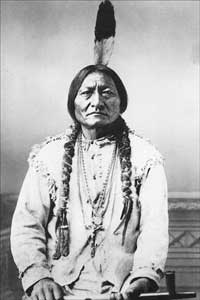

Sioux
View on Wikipedia
The Sioux or Oceti Sakowin (/suː/ SOO; Dakota/Lakota: Očhéthi Šakówiŋ [oˈtʃʰeːtʰi ʃaˈkoːwĩ]) are groups of Native American tribes and First Nations people from the Great Plains of North America. The Sioux have two major linguistic divisions: the Dakota and Lakota peoples (translation: 'friend, ally' referring to the alliances between the bands). Collectively, they are the Očhéthi Šakówiŋ, or 'Seven Council Fires'. The term Sioux, an exonym from a French transcription (Nadouessioux) of the Ojibwe term Nadowessi, can refer to any ethnic group within the Great Sioux Nation or to any of the nation's many language dialects.
Key Information


Before the 17th century, the Santee Dakota (Isáŋyathi: 'Knife', also known as the Eastern Dakota) lived around Lake Superior with territories in present-day northern Minnesota and Wisconsin. They gathered wild rice, hunted woodland animals, and used canoes to fish. Wars with the Ojibwe throughout the 18th century pushed the Dakota west into southern Minnesota, where the Western Dakota (Yankton, Yanktonai) and Lakota (Teton) lived. In the 19th century, the Dakota signed land cession treaties with the United States for much of their Minnesota lands. The United States' failure to make treaty payments or provide rations on time led to starvation and the Dakota War of 1862, which resulted in the Dakota's exile from Minnesota. They were forced onto reservations in Nebraska, North Dakota, and South Dakota, and some fled to Canada. After 1870, the Dakota people began to return to Minnesota, creating the present-day reservations in the state. The Yankton and Yanktonai Dakota (Iháŋktȟuŋwaŋ and Iháŋktȟuŋwaŋna; 'Village-at-the-end' and 'Little village-at-the-end'), collectively also called by the endonym Wičhíyena, lived near the Minnesota River before ceding their land and moving to South Dakota in 1858. Despite ceding their lands, their treaty with the US government allowed them to maintain their traditional role in the Očhéthi Šakówiŋ as the caretakers of the Pipestone Quarry, a cultural center for Sioux people. Considered the Western Dakota, they have in the past been erroneously classified as Nakota.[2] Nakota are the Assiniboine and Stoney of Western Canada and Montana.
The Lakota, also called Teton (Thítȟuŋwaŋ; possibly 'dwellers on the prairie'), are the westernmost Sioux, known for their Plains Indians hunting and warrior culture. With the arrival of the horse in the 18th century, the Lakota became a powerful tribe on the Northern Plains by the 1850s. They fought the US Army in the Sioux Wars and defeated the 7th Cavalry Regiment at the Battle of Little Big Horn. The armed conflicts with the US ended with the Wounded Knee Massacre.
Throughout the 20th and 21st centuries, the Dakota and Lakota continued to fight for their treaty rights, including the Wounded Knee incident, Dakota Access Pipeline protests, and the 1980 Supreme Court case United States v. Sioux Nation of Indians, in which the court ruled that the US government had illegally taken tribal lands covered by the Fort Laramie Treaty of 1868 and that the tribe was owed compensation plus interest. As of 2018, this amounted to more than $1 billion; the Sioux have refused the payment, demanding instead the return of the Black Hills. Today, the Sioux maintain many separate tribal governments across several reservations and communities in North Dakota, South Dakota, Nebraska, Minnesota, and Montana in the United States and reserves in Manitoba and Saskatchewan in Canada.
Etymology
[edit]
The Sioux people refer to their whole nation of people (sometimes called the Great Sioux Nation) as the Očhéthi Šakówiŋ (meaning 'Seven Council Fires'). Each fire symbolizes an oyate (people or nation). Today the seven nations that comprise the Očhéthi Šakówiŋ are:
- Thítȟuŋwaŋ (also known collectively as the Lakota or Teton)
- Bdewákaŋthuŋwaŋ, Waȟpéthuŋwaŋ, Waȟpékhute, and Sisíthuŋwaŋ (also known collectively as the Santee or Eastern Dakota)
- Iháŋkthuŋwaŋ and Iháŋkthuŋwaŋna (also known collectively as the Yankton/Yanktonai or Western Dakota).[3][4]
They are also referred to as the Lakota or Dakota based on dialect differences.[3][4] In any of the dialects, Lakota or Dakota translates as 'friend, ally', referring to the alliances between the bands.[3][4]
The name Sioux was adopted in English by the 1760s from French. It is abbreviated from the French Nadouessioux, first attested by Jean Nicolet in 1640.[3] The name is sometimes said to be derived from Nadowessi (plural Nadowessiwag),[5] an Ojibwe-language exonym for the Sioux meaning 'little snakes'[6] or 'enemy'[7][8][9] (compare nadowe 'big snakes', used for the Iroquois).[10] The French pluralized the Ojibwe singular Nadowessi by adding the French plural suffix -oux to form Nadowessioux, which was later shortened to Sioux.[5] The Proto-Algonquian form *na·towe·wa, meaning 'Northern Iroquoian', has reflexes in several daughter languages that refer to a small rattlesnake (massasauga, Sistrurus).[11] An alternative explanation is derivation from an (Algonquian) exonym, na·towe·ssiw (plural na·towe·ssiwak), from a verb *-a·towe· meaning 'to speak a foreign language'.[12] The current Ojibwe term for the Sioux and related groups is Bwaanag (singular Bwaan), meaning 'roasters'.[13][14] Presumably, this refers to the style of cooking the Sioux used in the past.
In recent times, some of the tribes have formally or informally reclaimed traditional names: the Rosebud Sioux Tribe is also known as the Sičháŋǧu Oyáte, and the Oglala often use the name Oglála Lakȟóta Oyáte, rather than the formal Oglala Sioux Tribe or OST. The alternative English spelling of Ogallala is considered incorrect.[3]
Culture
[edit]Traditional social structure
[edit]The traditional social structure of the Očhéthi Šakówiŋ strongly relied on kinship ties that extend beyond human interaction and includes the natural and supernatural worlds.[15][16] Mitákuye Oyás’iŋ ('all are related') represents a spiritual belief of how human beings should ideally act and relate to other humans, the natural world, the spiritual world, and to the cosmos.[17] The thiyóšpaye represents the political and economic structure of traditional society.
Thiyóšpaye (community) kinship
[edit]
Prior to the arrival of Europeans, the different Očhéthi Šakówiŋ villages (oyáte, 'tribe, nation') consisted of many thiyóšpaye ('camp circles'), which were large extended families united by kinship (thiwáhe, 'immediate family').[18] Thiyóšpaye varied in size, were led by a leader appointed by an elder council and were nicknamed after a prominent member or memorable event associated with the band. Dakota ethnographer Ella Cara Deloria noted the kinship ties were all-important, they dictated and demanded all phrases of traditional life:
"I can safely say that the ultimate aim of Dakota life, stripped of accessories, was quite simple: one must obey kinship rules; one must be a good relative. No Dakota who participated in that life will dispute that… every other consideration was secondary—property, personal ambition, glory, good times, life itself. Without that aim and constant struggle to attain it, the people would no longer be Dakotas in truth. They would no longer even be human. To be a good Dakota, then, was to be humanized, civilized. And to be civilized was to keep the rules imposed by kinship for achieving civility, good manners, and a sense of responsibility toward every individual dealt with".[18]
During the fur trade era, the thiyóšpaye refused to trade only for economic reasons. Instead the production and trade of goods was regulated by rules of kinship bonds.[19] Personal relationships were pivotal for success: in order for European-Americans to trade with the Očhéthi Šakówiŋ, social bonds had to be created.[19] The most successful fur traders married into the kinship society, which also raised the status of the family of the woman through access to European goods.[20] Outsiders are also adopted into the kinship through the religious Huŋkalowaŋpi ceremony. Early European explorers and missionaries who lived among the Dakota were sometimes adopted into the thiyóšpaye (known as "huŋka relatives"), such as Louis Hennepin who noted, "this help'd me to gain credit among these people".[21] During the later reservation era, districts were often settled by clusters of families from the same thiyóšpaye.[22]
Religion
[edit]
The traditional social system extended beyond human interaction into the supernatural realms.[17] It is believed that Wakȟáŋ Tháŋka ('Great Spirit/Great Mystery') created the universe and embodies everything in the universe as one.[15] The preeminent symbol of Sioux religion is the Čhaŋgléska Wakȟaŋ or medicine wheel ('sacred hoop'), which visually represents the concept that everything in the universe is intertwined.[23] The creation stories of the Očhéthi Šakówiŋ describe how the various spirits were formed from Wakȟáŋ Tháŋka.[24] Black Elk describes the relationships with Wakȟáŋ Tháŋka as:
"We should understand well that all things are the works of the Great Spirit. We should know that He is within all things: the trees, the grasses, the rivers, the mountains, and all the four-legged animals, and the winged peoples; and even more important, we should understand that He is also above all these things and peoples. When we do understand all this deeply in our hearts, then we will fear, and love, and know the Great Spirit, and then we will be and act and live as He intends".[23]
Prayer is believed to invoke relationships with one's ancestors or spiritual world.[18] The Lakota word for 'prayer', wočhékiye, means 'to call on for aid, to pray, to claim relationship with'.[15] Their primary cultural prophet is Ptesáŋwiŋ, White Buffalo Calf Woman, who came as an intermediary between Wakȟáŋ Tháŋka Tȟáŋka and humankind to teach them how to be good relatives by introducing the Seven Sacred Rites and the čhaŋnúŋpa (sacred pipe).[23] The seven ceremonies are Inípi (purification lodge), Haŋbléčheyapi (crying for vision), Wiwáŋyaŋg Wačhípi (Sun Dance), Huŋkalowaŋpi (making of relatives), Išnáthi Awíčhalowaŋpi (female puberty ceremony), Tȟápa Waŋkáyeyapi (throwing of the ball) and Wanáǧi Yuhápi (soul keeping).[23] Each part of the sacred pipe (stem, bowl, tobacco, breath, and smoke) is symbolic of the relationships of the natural world, the elements, humans and the spiritual beings that maintain the cycle of the universe.[25]
Dreams can also be a means of establishing relationships with spirits and are important to the Očhéthi Šakówiŋ.[17] One can gain supernatural powers through dreams. Dreaming of the Wakíŋyaŋ (thunder beings) is believed to involuntarily make someone a Heyókȟa, a sacred clown.[26] Black Elk, a famous Heyókȟa said: "Only those who have had visions of the thunder beings of the west can act as heyokas. They have sacred power and they share some of this with all the people, but they do it through funny actions".[27]
Governance
[edit]Historical leadership organization


The thiyóšpaye of the Očhéthi Šakówiŋ assembled each summer to hold council, renew kinships, decide tribal matters, and participate in the Sun Dance.[28] The seven divisions selected four leaders known as Wičháša Yatápika from among the leaders of each division.[28] Being one of the four leaders was considered the highest honor for a leader; however, the annual gathering meant the majority of tribal administration was cared for by the usual leaders of each division. The last meeting of the Seven Council Fires was in 1850.[28] The historical political organization was based on individual participation and the cooperation of many to sustain the tribe's way of life. Leaders were chosen based upon noble birth and demonstrations of chiefly virtues, such as bravery, fortitude, generosity, and wisdom.[28]
- Political leaders were members of the Načá Omníčiye society and decided matters of tribal hunts, camp movements, whether to make war or peace with their neighbors, or any other community action.[29]
- Societies were similar to fraternities; men joined to raise their position in the tribe. Societies were composed of smaller clans and varied in number among the seven divisions.[28] There were two types of societies: Akíčhita, for the younger men, and Načá, for elders and former leaders.[28]
- Akíčhita (Soldier) societies existed to train warriors, hunters, and to police the community.[29] There were many smaller Akíčhita societies, including the Kit-Fox, Strong Heart, Elk, and so on.[29]
- Leaders in the Načá societies, per Načá Omníčiye, were the tribal elders and leaders. They elected seven to ten men, depending on the division, each referred to as Wičháša Itȟáŋčhaŋ ("chief man"). Each Wičháša Itȟáŋčhaŋ interpreted and enforced the decisions of the Načá.[29]
- The Wičháša Itȟáŋčhaŋ elected two to four shirt-wearers, who were the voice of the society. They settled quarrels among families and also foreign nations.[28] Shirt-wearers were often young men from families with hereditary claims of leadership. However, men with obscure parents who displayed outstanding leadership skills and had earned the respect of the community might also be elected. Crazy Horse is an example of a common-born shirt-wearer".[28]
- A Wakíčhuŋza 'pipe-holder' ranked below the "Shirt Wearers". The pipe-holders regulated peace ceremonies, selected camp locations, and supervised the Akíčhita societies during buffalo hunts.[29]
Gender roles
[edit]Within the Sioux tribes, there were defined gender roles. The men in the village were tasked as the hunters, traveling outside the village.[30] The women within the village were in charge of making clothing and similar articles while also taking care of, and owning, the house.[30][31] However, even with these roles, both men and women held power in decision-making tasks and sexual preferences were flexible and allowed.[30][31] The term wíŋtke refers to men who partook in traditional feminine duties while the term witkówiŋ ('crazy woman') was used for women who rejected their roles as either mother or wife to be a prostitute.[30]
Funeral practices
[edit]Traditional funeral practices
[edit]
It is a common belief amongst Siouan communities that the spirit of the deceased travels to an afterlife. In traditional beliefs, this spiritual journey was believed to start once funeral proceedings were complete and spanned over a course of four days. Mourning family and friends took part in that four-day wake in order to accompany the spirit to its resting place.[32] In the past, bodies were not embalmed but put up on a burial tree or scaffold for one year before a ground burial. A platform to rest the body was put up on trees or, alternately, placed on four upright poles to elevate the body from the ground.[33] The bodies were securely wrapped in blankets and cloths, along with many of the deceased personal belongings and were always placed with their head pointed towards the south. Mourning individuals spoke to the body and offer food as if it were still alive.[34] This practice, along with the Ghost Dance, helped individuals mourn and connect the spirits of the deceased with those who were alive.[35] The only time a body was buried in the ground right after their death was if the individual was murdered: the deceased were placed in the ground with their heads towards the south, while faced down along with a piece of fat in their mouth.[35]
Contemporary funeral practices
[edit]According to Pat Janis, director of the Oglala Sioux Tribe's Burial Assistance Program, funeral practices of communities today are often a mix of traditions and contemporary Christian practices. While tree burials and scaffold burials are not practiced anymore, it is also now rare to see families observe a four-day wake period. Instead, the families opt for one- or two-day wake periods which include a funeral feast for all the community. Added to the contemporary funeral practices, it is common to see prayers conducted by a medicine man along with traditional songs often sung with a drum. One member of the family is also required to be present next to the body at all times until the burial.[32] Gifts are placed within the casket to aid with the journey into the afterworld, which is still believed to take up to four days after death.[32]
Music
[edit]History
[edit]Creation stories
[edit]There are a number of creation stories within the tribes.[36][37] One widely noted creation story for Dakota people is at Bdóte, the area where the Minnesota and Mississippi Rivers meet.[36] Lakota people relate to Wind Cave in South Dakota as their site of emergence.[38]
Ancestral Sioux
[edit]The ancestral Sioux most likely lived in the Central Mississippi Valley region and later in Minnesota for at least two or three thousand years.[39] The ancestors of the Sioux arrived in the northwoods of central Minnesota and northwestern Wisconsin from the Central Mississippi River shortly before 800 AD.[39] Archaeologists refer to them as the Woodland Blackduck-Kathio-Clam River Continuum.[39] Around 1300 AD, they adopted the characteristics of a northern tribal society and became known as the Seven Council Fires.[39]
First contact with Europeans
[edit]The Dakota are first recorded to have resided at the source of the Mississippi River and the Great Lakes during the seventeenth century.[40] They were dispersed west in 1659 due to warfare with the Iroquois. During the 1600s, the Lakota began their expansion westward into the Plains, taking with them the bulk of people of the Očhéthi Šakówiŋ.[41][42] By 1700 the Dakota were living in Wisconsin and Minnesota. As the Sioux nation began expanding with access to horses, the Dakota were put in a weakened position to defend the eastern border: new diseases (smallpox and malaria) and increased intertribal warfare (between the migration of tribes fleeing the Iroquois into their territory of present-day Wisconsin) put a strain on their ability to maintain their territory.[42] As a result, their population in the Mississippi valley is believed to have declined by one-third between 1680 and 1805.[42]
French trade and intertribal warfare
[edit]
Late in the 17th century, the Dakota entered into an alliance with French merchants.[43] The French were trying to gain advantage in the struggle for the North American fur trade against the English, who had recently established the Hudson's Bay Company. Algonquian peoples such as the Ojibwe, Potawatomi and Odawa were among the first to trade with the French as they migrated into the Great Lakes region.[42] Upon their arrival, Dakota were in an economic alliance with them until the Dakota were able to trade directly for European goods with the French.[42] The first recorded encounter between the Sioux and the French occurred when Radisson and Groseilliers reached what is now Wisconsin during the winter of 1659–60. Later visiting French traders and missionaries included Claude-Jean Allouez, Daniel Greysolon Duluth, and Pierre-Charles Le Sueur who wintered with Dakota bands in early 1700.[44]
The Dakota began to resent the Ojibwe trading with the hereditary enemies of the Sioux, the Cree and Assiniboine.[42] Tensions rose in the 1720s into a prolonged war in 1736.[42] The Dakota lost their traditional lands around Leech Lake and Mille Lacs as they were forced south along the Mississippi River and St. Croix River Valley as a result of the battles.[42] These intertribal conflicts also made it dangerous for European fur traders: whichever side they traded with, they were viewed as enemies from the other.[42] For example, in 1736 a group of Sioux killed Jean Baptiste de La Vérendrye and twenty other men on an island in Lake of the Woods for such reasons.[45] However, trade with the French continued until the French gave up North America in 1763. Europeans repeatedly tried to make truce between the warring tribes in order to protect their interests.[42]

One of the larger battles between the Dakota and Ojibwe took place in 1770 fought at the Dalles of the St. Croix. According to William Whipple Warren, a Métis historian, the fighting began when the Meskwaki (Fox) engaged the Ojibwe (their hereditary enemies) around St. Croix Falls.[46] The Sioux were the former enemies of the Meskwaki and were enlisted to make a joint attack against the Ojibwe.[46] The Meskwaki were first to engage with the large Ojibwe war party led by Waubojeeg: the Meskwaki allegedly boasted to the Dakota to hold back as they would quickly destroy their enemies. When the Dakota joined the battle, they had the upper hand until Sandy Lake Ojibwe reinforcements arrived.[46] The Dakota were driven back and Warren states: "Many were driven over the rocks into the boiling floods below, there to find a watery grave. Others, in attempting to jump into their narrow wooden canoes, were capsized into the rapids".[46] While Dakota and Ojibwe suffered heavy losses, the Meskwaki were left with the most dead and forced to join their relatives, the Sauk people.[46] The victory for the Ojibwe secured control of the Upper St. Croix and created an informal boundary between the Dakota and Ojibwe around the mouth of the Snake River.[46]
As the Lakota entered the prairies, they adopted many of the customs of the neighboring Plains tribes, creating new cultural patterns based on the horse and fur trade.[39] Meanwhile, the Dakota retained many of their Woodlands features.[39] By 1803, the three divisions of the Sioux (Western/Eastern Dakota and Lakota) were established in their different environments and had developed their own distinctive lifeways.[39] However, due to the prevalent cultural concept of thiyóšpaye (community), the three divisions maintained strong ties throughout the changing times to present day.[47]
Treaties and reservation period beginnings
[edit]In 1805, the Dakota signed their first treaty with the American government. Zebulon Pike negotiated for 100,000 acres of land at the confluence of the St. Croix River about what now is Hastings, Minnesota and the confluence of the Minnesota River and Mississippi River about what now is St. Paul, Minnesota.[48] The Americans wanted to establish military outposts and the Dakota wanted a new source of trading. An American military post was not established at the confluence of the St. Croix with the Mississippi, but Fort Snelling was established in 1819 along the Minnesota and Mississippi rivers.[39] In return, Dakota were promised the ability to "pass and repass, hunt, or make other uses of the said districts as they have formerly done".[49]

In an attempt to stop intertribal warfare and to better able to negotiate with tribes, the American government signed the 1825 Treaty of Prairie du Chien with the Dakota, Ojibwe, Menominee, Ho-Chunk, Sac and Fox, Iowa, Potawatomi, and Odawa tribes.[48] In the 1830 Treaty of Prairie de Chien, the Western Dakota (Yankton, Yanktonai) ceded their lands along the Des Moines river to the American government. Living in what is now southeastern South Dakota, the leaders of the Western Dakota signed the Treaty of April 19, 1858, which created the Yankton Sioux Reservation. Pressured by the ongoing arrival of Europeans, Yankton chief Struck by the Ree told his people, "The white men are coming in like maggots. It is useless to resist them. They are many more than we are. We could not hope to stop them. Many of our brave warriors would be killed, our women and children left in sorrow, and still we would not stop them. We must accept it, get the best terms we can get and try to adopt their ways."[50] Despite ceding their lands, the treaty allowed the Western Dakota to maintain their traditional role in the Očhéthi Šakówiŋ as the caretakers of the Pipestone Quarry, which is the cultural center of the Sioux people.[50]

With the creation of Minnesota Territory by the US in 1849, the Eastern Dakota (Sisseton, Wahpeton, Mdewakanton, and Wahpekute) people were pressured to cede more of their land. The reservation period for them began in 1851 with the signing of the Treaty of Mendota and the Treaty of Traverse des Sioux.[51] The Treaty of Mendota was signed near Pilot Knob on the south bank of the Minnesota River and within sight of Fort Snelling. The treaty stipulated that the Mdewakanton and Wahpekute bands were to receive US$1,410,000 in return for relocating to the Lower Sioux Agency on the Minnesota River near present-day Morton, Minnesota along with giving up their rights to a significant portion of southern Minnesota.[51] In the Treaty of Traverse des Sioux, the Sisseton and Wahpeton bands of the Dakota ceded 21 million acres for $1,665,000, or about 7.5 cents an acre.[48] However, the American government kept more than 80% of the funds with only the interest (5% for 50 years) being paid to the Dakota.[48]
The US set aside two reservations for the Sioux along the Minnesota River, each about 20 miles (30 km) wide and 70 miles (110 km) long. Later the government declared these were intended to be temporary, in an effort to force the Sioux out of Minnesota.[48] The Upper Sioux Agency for the Sisseton and Wahpeton bands was established near Granite Falls, Minnesota, while the Lower Sioux Agency for the Mdewakanton and Wahpekute bands was established about thirty miles downstream near what developed as Redwood Falls, Minnesota. The Upper Sioux were not satisfied with their reservation because of low food supplies, but as it included several of their old villages, they agreed to stay. The Lower Sioux were displaced from their traditional woodlands and were dissatisfied with their new territory of mostly prairie.
The US intended the treaties to encourage the Sioux to convert from their nomadic hunting lifestyle into more European-American settled farming, offering them compensation in the transition. By 1858, the Dakota only had a small strip of land along the Minnesota River, with no access to their traditional hunting grounds.[48] They had to rely on treaty payments for their survival, which were often late.[48] The forced change in lifestyle and the much lower than expected payments from the federal government caused economic suffering and increased social tensions within the tribes. By 1862, many Dakota were starving and tensions erupted in the Dakota War of 1862.[48]
Dakota War of 1862 and the Dakota diaspora
[edit]
By 1862, shortly after a failed crop the year before and a winter starvation, the federal payment was late. The local traders refused to issue any credit to the Dakota. One trader, Andrew Myrick, went so far as to say, "If they're hungry, let them eat grass."[52]
On August 16, 1862, the treaty payments to the eastern Dakota arrived in St. Paul, Minnesota, and were brought to Fort Ridgely the next day. However, they arrived too late to prevent the war. On August 17, 1862, the Dakota War began when a few Santee men murdered a white farmer and most of his family. They inspired further attacks on white settlements along the Minnesota River. On August 18, 1862, Little Crow of the Mdewakanton band led a group that attacked the Lower Sioux Agency (or Redwood Agency) and trading post located there. Later, settlers found Myrick among the dead with his mouth stuffed full of grass.[53] Many of the upper Dakota (Sisseton and Wahpeton) wanted no part in the attacks[54][55] with the majority of the 4,000 members of the Sisseton and Wahpeton opposed to the war. Thus their bands did not participate in the early killings.[56] Historian Mary Wingerd has stated that it is "a complete myth that all the Dakota people went to war against the United States" and that it was rather "a faction that went on the offensive".[55]
Most of Little Crow's men surrendered shortly after the Battle of Wood Lake at Camp Release on September 26, 1862. Little Crow was forced to retreat sometime in September 1862. He stayed briefly in Canada but soon returned to the western Minnesota. He was killed on July 3, 1863, near Hutchinson, Minnesota while gathering raspberries with his teenage son. The pair had wandered onto the land of a settler Nathan Lamson, who shot at them to collect bounties. Once it was discovered that the body was of Little Crow, his skull and scalp were put on display by the Minnesota Historical Society in St. Paul, Minnesota. The State held the trophies until 1971 when it returned the remains to Little Crow's grandson. For killing Little Crow the state increased the bounty to $500 when it paid Lamson.
.jpg)
On November 5, 1862, a military tribunal found 303 mostly Mdewakanton tribesmen guilty of rape, murder and atrocities of hundreds of Minnesota settlers. They were sentenced to be hanged. The men had no attorneys or defense witnesses, and many were convicted in less than five minutes.[57] President Abraham Lincoln commuted the death sentences of 284 of the warriors, while signing off on the hanging of 38 Santee men on December 26, 1862, in Mankato, Minnesota. It was the largest mass-execution in US history, on US soil.[58] The men remanded by order of President Lincoln were sent to a prison in Iowa, where more than half died.[57]
Afterwards, the US Congress annulled all treaty agreements with the eastern Dakota and expelled the eastern Dakota with the Forfeiture Act of February 16, 1863, meaning all lands held by the eastern Dakota, and all annuities due to them, were forfeited to the US government.[39][59] During and after the hostilities, the majority of eastern Dakota fled Minnesota for the Dakota territory or Canada. Some settled in the James River Valley in a short-lived reservation before being forced to move to Crow Creek Reservation on the east bank of the Missouri River.[57] There were as few as 50 eastern Dakota left in Minnesota by 1867.[39] Many had fled to the Santee Sioux Reservation in Nebraska (created 1863), the Flandreau Reservation (created 1869 from members who left the Santee Reservation), the Lake Traverse and Spirit Lake Reservations (both created 1867).[59] Those who fled to Canada throughout the 1870s now have descendants residing on nine small Dakota Reserves, five of which are located in Manitoba (Sioux Valley, Dakota Plain, Dakota Tipi, Birdtail Creek, and Canupawakpa Dakota) and the remaining four (Standing Buffalo, White Cap, Round Plain [wahpeton], and Wood Mountain) in Saskatchewan. A few Dakota joined the Yanktonai and moved further west to join with the Lakota bands to continue their struggle against the United States military, later settling on the Fort Peck Reservation in Montana.[57]
Westward expansion of the Lakota
[edit]Prior to the 1650s, the Thítȟuŋwaŋ division of the Očhéthi Šakówiŋ known as the Lakota was noted as being located east of the Red River,[60] and living on the fringes of the prairies and woods of the prairies of southern Minnesota and the eastern Dakotas by at least 1680.[39] According to Baptiste Good's winter count, the Lakota had horses by 1700.[60] While the Dakota continued a subsistence cycle of corn, wild rice and hunting woodland animals, the Lakota increasingly became reliant on bison for meat and its by-products (housing, clothing, tools) as they expanded their territory westward with the arrival of the horse.[39] After their adoption of horse culture, Lakota society centered on the buffalo hunt on horseback.

By the 19th century, the typical year of the Lakota was a communal buffalo hunt as early in spring as their horses had recovered from the rigors of the winter. In June and July, the scattered bands of the tribes gathered together into large encampments, which included ceremonies such as the Sun Dance. These gatherings afforded leaders to meet to make political decisions, plan movements, arbitrate disputes, and organize and launch raiding expeditions or war parties. In the fall, people split into smaller bands to facilitate hunting to procure meat for the long winter. Between the fall hunt and the onset of winter was a time when Lakota warriors could undertake raiding and warfare. With the coming of winter snows, the Lakota settled into winter camps, where activities of the season, ceremonies and dances as well as trying to ensure adequate winter feed for their horses.[61]
They began to dominate the prairies east of the Missouri river by the 1720s. At the same time, the Lakota branch split into two major sects, the Saône who moved to the Lake Traverse area on the South Dakota–North Dakota–Minnesota border, and the Oglála-Sičháŋǧu who occupied the James River valley. However, by about 1750 the Saône had moved to the east bank of the Missouri River, followed 10 years later by the Oglála and Sičháŋǧu (Brulé). By 1750, they had crossed the Missouri River and encountered Lewis and Clark in 1804. Initial United States contact with the Lakota during the Lewis and Clark Expedition of 1804–1806 was marked by a standoff. Lakota bands refused to allow the explorers to continue upstream, and the expedition prepared for battle, which never came.[62] In 1776, the Lakota defeated the Cheyenne for the Black Hills, who had earlier taken the region from the Kiowa.[63] The Cheyenne then moved west to the Powder River country,[63] and the Lakota made the Black Hills their home.
As their territory expanded, so did the number of rival groups they encountered. They secured an alliance with the Northern Cheyenne and Northern Arapaho by the 1820s as intertribal warfare on the plains increased amongst the tribes for access to the dwindling population of buffalo.[39] The alliance fought the Mandan, Hidatsa and Arikara for control of the Missouri River in North Dakota.[39] By the 1840s, their territory expanded to the Powder River country in Montana, in which they fought with the Crow. Their victories over these tribes during this time period were aided by the fact those tribes were decimated by European diseases. Most of the Mandan, Hidatsa and Arikara were killed by smallpox and almost half the population of the Crow were killed due to smallpox, cholera and other diseases.[39] In 1843, the southern Lakotas attacked Pawnee Chief Blue Coat's village near the Loup in Nebraska, killing many and burning half of the earth lodges,[64] and 30 years later, the Lakota again inflicted a blow so severe on the Pawnee during the Massacre Canyon battle near Republican River.[65] By the 1850s, the Lakota were known as the most powerful tribe on the Plains.[39]
Fort Laramie Treaty of 1851
[edit]
The Fort Laramie Treaty of 1851 was signed on September 17, 1851, between US treaty commissioners and representatives of the Cheyenne, Sioux, Arapaho, Crow, Assiniboine, Mandan, Hidatsa, and Arikara Nations. The treaty was an agreement between nine more or less independent parties. The treaty set forth traditional territorial claims of the tribes as among themselves.[66] The United States acknowledged that all the land covered by the treaty was Indian territory and did not claim any part of it. The boundaries agreed to in the Fort Laramie treaty of 1851 were used to settle a number of claims cases in the 20th century.[67] The tribes guaranteed safe passage for settlers on the Oregon Trail and allowed roads and forts to be built in their territories in return for promises of an annuity in the amount of fifty thousand dollars for fifty years. The treaty should also "make an effective and lasting peace" among the eight tribes, each of them often at odds with a number of the others.[68]
The treaty was broken almost immediately after its inception by the Lakota and Cheyenne attacking the Crow over the next two years.[69] In 1858, the failure of the United States to prevent the mass immigration of miners and settlers into Colorado during the Pike's Peak Gold Rush, also did not help matters. They took over Indian lands in order to mine them, "against the protests of the Indians,"[70] and founded towns, started farms, and improved roads. Such immigrants competed with the tribes for game and water, straining limited resources and resulting in conflicts with the emigrants. The US government did not enforce the treaty to keep out the immigrants.[70]
The situation escalated with the Grattan affair in 1854 when a detachment of US soldiers illegally entered a Sioux encampment to arrest those accused of stealing a cow, and in the process sparked a battle in which Chief Conquering Bear was killed.[71]
Though intertribal fighting had existed before the arrival of white settlers, some of the post-treaty intertribal fighting can be attributed to mass killings of bison by white settlers and government agents. The US Army did not enforce treaty regulations and allowed hunters onto Native land to slaughter buffalo, providing protection and sometimes ammunition.[72] One hundred thousand buffalo were killed each year until they were on the verge of extinction, which threatened the tribes' subsistence. These mass killings affected all tribes thus the tribes were forced onto each other's hunting grounds, where fighting broke out.[73][74][75]
On July 20, 1867, an act of Congress created the Indian Peace Commission "to establish peace with certain hostile Indian tribes".[76] The Indian Peace Commission was generally seen as a failure, and violence had reignited even before it was disbanded in October 1868. Two official reports were submitted to the federal government, ultimately recommending that the US cease recognizing tribes as sovereign nations, refrain from making treaties with them, employ military force against those who refused to relocate to reservations, and move the Bureau of Indian Affairs from the Department of the Interior to the Department of War. The system of treaties eventually deteriorated to the point of collapse, and a decade of war followed the commission's work. It was the last major commission of its kind.
From 1866 to 1868, the Lakota fought the United States Army in the Wyoming Territory and the Montana Territory in what is known as Red Cloud's War (also referred to as the Bozeman War). The war is named after Red Cloud, a prominent Lakota chief who led the war against the United States following encroachment into the area by the US military. The Sioux victory in the war led to their temporarily preserving their control of the Powder River country.[77] The war ended with the Treaty of Fort Laramie of 1868.
Fort Laramie Treaty of 1868
[edit]
The Treaty of Fort Laramie (also the Sioux Treaty of 1868[a]) was an agreement between the US and the Oglala, Miniconjou, and Sicangu bands of Lakota people, Yanktonai Dakota and Arapaho Nation, following the failure of the first Fort Laramie treaty, signed in 1851. It established the Great Sioux Reservation including ownership of the Black Hills, and set aside additional lands as "unceded Indian territory" in areas of South Dakota, Wyoming, and Nebraska, and possibly Montana.[b] It established that the US government would hold the authority to punish not only white settlers who committed crimes against the tribes but also tribe members who committed crimes and who were to be delivered to the government rather than face charges in tribal courts. It stipulated that the government would abandon forts along the Bozeman Trail, and included a number of provisions designed to encourage a transition to farming, and move the tribes "closer to the white man's way of life." The treaty protected specified rights of third parties not partaking in the negotiations, and effectively ended Red Cloud's War.
The treaty overall, and in comparison with the 1851 agreement, represented a departure from earlier considerations of tribal customs, and demonstrated instead the government's "more heavy-handed position with regard to tribal nations, and ... desire to assimilate the Sioux into American property arrangements and social customs."[79] According to one source, "animosities over the treaty arose almost immediately" when a group of Miniconjou were informed they were no longer welcome to trade at Fort Laramie, being south of their newly established territory. This was notwithstanding that the treaty did not make any stipulation that the tribes could not travel outside their land, only that they would not permanently occupy outside land. The only travel expressly forbidden by the treaty was that of white settlers onto the reservation.[80]
The government eventually broke the terms of the treaty following the Black Hills Gold Rush and an expedition into the area by George Armstrong Custer in 1874 and failed to prevent white settlers from moving onto tribal lands. Rising tensions eventually lead again to open conflict in the Great Sioux War of 1876.[81][82][83]: 46 The 1868 treaty was modified three times by the US Congress between 1876 and 1889, each time taking more land originally granted, including unilaterally seizing the Black Hills in 1877.[79] The treaty formed the basis of the 1980 Supreme Court case, United States v. Sioux Nation of Indians, in which the court ruled that tribal lands covered under the treaty had been taken illegally by the US government, and the tribe was owed compensation plus interest. As of 2018, this amounted to more than $1 billion. The Sioux have refused the payment, demanding instead the return of their land.
Great Sioux War of 1876 and the Wounded Knee Massacre
[edit]The ongoing raids and battles on the northern Plains that lasted from 1850 to 1890 are collectively known as the Sioux Wars. Included are the Dakota War of 1862 (1862–1864), Red Cloud's War (1866–1868) and the Black Hills War which includes the Battle of the Little Bighorn(1876–1877); the Massacre at Wounded Knee in 1890 is considered the end of the Sioux wars and the beginning of a new era for Dakota and Lakota people.


The Great Sioux War of 1876, also known as the Black Hills War, was a series of battles and negotiations that occurred in 1876 and 1877 between the Lakota, Northern Cheyenne, and the United States. The cause of the war was the desire of the US government to obtain ownership of the Black Hills. Gold had been discovered in the Black Hills and settlers began to encroach onto tribal lands, and the Sioux and Cheyenne refused to cede ownership to the United States.[63] The earliest engagement was the Battle of Powder River, and the final battle was the Wolf Mountain. Included are the Battle of the Rosebud, Battle of Warbonnet Creek, Battle of Slim Buttes, Battle of Cedar Creek, and the Dull Knife Fight.
Among the many battles and skirmishes of the war was the Battle of the Little Bighorn, often known as Custer's Last Stand, the most storied of the many encounters between the US army and mounted Plains tribes. The Battle of the Little Bighorn, known to the Lakota as the Battle of the Greasy Grass[84] and also commonly referred to as Custer's Last Stand, was an armed engagement between combined forces of the Lakota, Northern Cheyenne, and Arapaho tribes and the 7th Cavalry Regiment of the United States Army. The battle, which resulted in the defeat of US forces, was the most significant action of the Great Sioux War of 1876. It took place on June 25–26, 1876, along the Little Bighorn River in the Crow Indian Reservation in southeastern Montana Territory.[85]
The fight was an overwhelming victory for the Lakota, Northern Cheyenne, and Arapaho, who were led by several major war leaders, including Crazy Horse and Chief Gall, and had been inspired by the visions of Sitting Bull. The US 7th Cavalry, a force of 700 men, suffered a major defeat while under the command of Lieutenant Colonel George Armstrong Custer. Five of the 7th Cavalry's twelve companies were annihilated and Custer was killed. The total US casualty count included 268 dead and 55 severely wounded (six died later from their wounds),[86] including four Crow scouts and at least two Arikara scouts. The Little Bighorn Battlefield National Monument honors those who fought on both sides. That victory notwithstanding, the US leveraged national resources to force the tribes to surrender, primarily by attacking and destroying their encampments and property. The Great Sioux War took place under the presidencies of Ulysses S. Grant and Rutherford B. Hayes. The Agreement of 1877 (19 Stat. 254, enacted February 28, 1877) officially annexed Sioux land and permanently established Indian reservations.

The Wounded Knee Massacre was the last major armed conflict between the Lakota and the United States. It was described as a massacre by General Nelson A. Miles in a letter to the Commissioner of Indian Affairs.[87] On December 29, 1890, five hundred troops of the 7th Cavalry Regiment, supported by four Hotchkiss guns (a lightweight artillery piece capable of rapid fire), surrounded an encampment of the Lakota bands of the Miniconjou and Hunkpapa[88] with orders to escort them to the railroad for transport to Omaha, Nebraska. By the time it was over, 25 troopers and more than 150 Lakota Sioux lay dead, including men, women, and children. It remains unknown which side was responsible for the first shot; some of the soldiers are believed to have been the victims of "friendly fire" because the shooting took place at point-blank range in chaotic conditions.[89] Around 150 Lakota are believed to have fled the chaos, many of whom may have died from hypothermia.[90]
Following a three-day blizzard, the military hired civilians to bury the dead Lakota. The burial party found the deceased frozen; they were gathered up and placed in a mass grave on a hill overlooking the encampment from which some of the fire from the Hotchkiss guns originated. It was reported that four infants were found alive, wrapped in their deceased mothers' shawls. In all, 84 men, 44 women, and 18 children reportedly died on the field, while at least seven Lakota were mortally wounded.[91]
For this 1890 offensive, the American army awarded twenty Medals of Honor, its highest commendation. Contemporary Native American activists have urged the medals to be withdrawn, calling them "medals of dishonor". According to Lakota William Thunder Hawk, "The Medal of Honor is meant to reward soldiers who act heroically. But at Wounded Knee, they didn't show heroism; they showed cruelty". In 2001, the National Congress of American Indians passed two resolutions condemning the Medals of Honor awards and called on the US government to rescind them.[92]
1890–1920s: Assimilation era
[edit]Land allotment
[edit]
By the 1880s, the Dakota and Lakota tribes were fragmented onto reservations which diminished in size over time. They lost hundreds of thousands of acres by the 1920s. In 1887, the United States Congress passed the General Allotment Act (Dawes Act), which began the assimilation of Dakota and Lakota people by forcing them to give up their traditional way of life. The Dawes Act ended traditional systems of land tenure, forcing tribes to adapt government-imposed systems of private property and to "assume a capitalist and proprietary relationship with property" that did not previously exist.[93] In 1889, North Dakota and South Dakota were holding statehood conventions and demanded reduction of the Great Sioux Reservation, which was established by the Fort Laramie Treaty of 1868.[94] Just months before those states were admitted to the Union in November 1889, Congress had passed an act which partitioned the Great Sioux Reservation into five smaller reservations,.[94] Tribal leaders such as John Grass, Gall, and Sitting Bull opposed the bill, which created the following five reservations:
- Standing Rock Sioux Reservation with its agency at Fort Yates;
- Cheyenne River Reservation, with its agency on the Missouri River near the Cheyenne River confluence (later moved to Eagle Butte following the construction of Oahe Dam);
- Lower Brule Indian Reservation, with its agency near Fort Thompson;
- Rosebud Indian Reservation, with its agency near Mission, South Dakota; and
- Pine Ridge Reservation (Oglala Lakota), with its agency at Pine Ridge, South Dakota near the Nebraska border.
After the boundaries of these five reservations was established, the government opened up approximately 9 million acres (36,000 km2), one-half of the former Great Sioux Reservation, for public purchase for ranching and homesteading.[95] Much of the area was not homesteaded until the 1910s, after the Enlarged Homestead Act increased allocations to 320 acres (1.3 km2) for "semi-arid land".[96]
Boarding schools
[edit]

Besides the loss of land, the Dawes Act also "outlawed Native American culture and established a code of Indian offenses regulating individual behavior according to Euro-American norms of conduct." Any violations of this code were to be "tried in a Court of Indian Offenses on each reservation." Included with the Dawes Act were "funds to instruct Native Americans in Euro-American patterns of thought and behavior through Indian Service schools" which forced many of the tribes into sending their children to boarding schools.
Boarding schools were intended to "kill the Indian to save the man", which meant the destruction of Dakota and Lakota societies: children were taken away from their families, their traditional culture and kinship roles.[97][98] They were dressed in Eurocentric clothing, given English names, had their hair cut and were forbidden to speak their languages.[98][99] Their religions and ceremonies were also outlawed and forbidden.[99] The goal was to teach academic studies in English, vocational skills suited to Euro-American society such as farming in order to replace traditional lifeways.[98] These schools were overcrowded and had poor sanitary conditions, which led to infectious diseases and students running away or dying while at the schools.[99][97] The schools achieved mixed outcomes of traumatic experiences for many while others such as Charles Eastman, Ella Cara Deloria, Luther Standing Bear and Zitkala-Sa were able to use the education to their advantage to help their people.
1930s–1960s: Reorganization Act and Relocation Act
[edit]The Indian Reorganization Act (IRA) sought to overturn many of the policies of the Dawes Act by reversing the traditional goal of cultural assimilation of the tribes into American society. The IRA "ended land allotment, prohibited non-consensual land seizure, recognized tribal governments, encouraged the writing of tribal constitutions, and empowered Native people to manage their own resources".[100] Between 1934 and 1945, the tribes voted on their government constitutions. The Yankton Sioux Tribe is the only tribe in South Dakota that did not comply with the IRA and chose to keep its traditional government, whose constitution was ratified in 1891.[101] The Spirit Lake Tribe and Standing Rock Tribe also voted against the IRA.[102] Because their constitution are not written under the authority of the IRA, they had to established tribal corporations which are managed separately from the tribal government in order to apply for loans.[102] In Minnesota, the IRA recognized the Dakota tribes as communities, allowing them to reestablish their reservations and to repurchase land lost during the Dakota War of 1862. The Lower Sioux and Prairie Island reservations formed constitutions in 1936, the Upper Sioux formed as a community in 1938 and wrote a constitution in 1995, and the Shakopee Mdewakanton officially formed an IRA government in 1969.[100]
Despite the IRA giving more land rights to the tribes, the federal government seized thousands of acres of land through the Flood Control Act of 1944 by creating the Oahe Dam. As a result of the dam's construction the Cheyenne River Indian Reservation lost 150,000 acres (61,000 hectares) bringing it down to 2,850,000 acres (1,150,000 ha) today. The Standing Rock Sioux Reservation lost 55,993 acres (22,660 ha) leaving it with 2,300,000 acres (930,000 ha). Much of the land was taken by eminent domain claims made by the Bureau of Reclamation. Over and above the land loss, most of the reservations' prime agricultural land was included in the loss. Most of the land was unable to be harvested (to allow the trees to be cut down for wood) before the land was flooded over with water.[103] One visitor to the reservations later asked why there were so few older Indians on the reservations and was told that "the old people had died of heartache" after the construction of the dam and the loss of the reservations' land.[104] As of 2015, poverty remains a problem for the displaced populations in the Dakotas, who are still seeking compensation for the loss of the towns submerged under Lake Oahe, and the loss of their traditional ways of life.[105]
The Indian Relocation Act of 1956 encouraged many tribal members to leave their reservation homes for cities. Some tribes had a dramatic loss of population: the Yankton Sioux Tribe fell to only 1,000 members living on the reservation in the 1950s; the Santee Sioux Reservation lost 60 percent of its population (by 1962, only 2,999, mostly elderly people remained).[39] Roosevelt's New Deal and Johnson's War on poverty brought new schools, roads, health clinics, and housing to the reservations.[39]
1970s: Wounded Knee incident
[edit]
Conflicting political values from "traditionalists" against the new form of government promoted through the Indian Reorganization Act created long-lasting tensions on the reservations.[106] The accusations of corruption by tribal leaders would lead to the Wounded Knee incident which began on February 27, 1973, when the town of Wounded Knee, South Dakota was seized by followers of the American Indian Movement (AIM). The occupiers controlled the town for 71 days while various state and federal law enforcement agencies such as the Federal Bureau of Investigation and the United States Marshals Service laid siege.
The members of AIM were protesting what they said was the local corrupt government, along with federal issues affecting Indian reservation communities, as well as the lack of justice from border counties. Native Americans from many other communities, primarily urban areas, mobilized to come and join the occupation. The FBI dispatched agents and US Marshals to cordon off the site. Later a higher-ranking DOJ representative took control of the government's response. Through the resulting siege that lasted for 71 days, twelve people were wounded, including an FBI agent left paralyzed. In April at least two people died of gunfire, after which the Oglala Lakota called an end to the occupation). Additionally, two other people, one of them an African American civil rights activist, Ray Robinson, went missing, and are believed to have been killed during the occupation, though their bodies have never been found.[107][108] Afterward, 1200 American Indians were arrested. Wounded Knee drew international attention to the plight of American Indians and AIM leaders were tried in a Minnesota federal court. The court dismissed their case on the basis of governmental prosecutorial misconduct.[109] However, Leonard Peltier was convicted of murdering two FBI agents in a June 26, 1975, shooting on the Pine Ridge Reservation in South Dakota.
1980s–present: Self-determination
[edit]After the Wounded Knee Incident, the Dakota and Lakota continued to push for their tribal rights and self-determination.
Black Hills Land claims
[edit]The Sioux never accepted the legitimacy of the forced deprivation of their Black Hills reservation.[110] Throughout the 1920s–1950s, they pushed their Black Hills land claim into federal court. After 60 years of litigation in the Court of Claims, the Indian Claims Commission, the US Congress, the Supreme Court heard the case in 1980 and ruled that the federal government had illegally taken the Black Hills and awarded more than $100 million in reparations to the tribes. Stating that the land was never for sale, the tribes have refused to accept the money which is now over one billion dollars.[111]
Republic of Lakotah
[edit]After the Wounded Knee Incident in 1973, the International Indian Treaty Council was formed to support grassroots Indigenous struggles for human rights, self-determination and environmental justice through information dissemination, networking, coalition building, advocacy and technical assistance. This influenced activists who declared that they had founded the Republic of Lakotah in 2007. The Lakota Freedom Delegation, a group of controversial Native American activists, declared on December 19, 2007, the Lakota were withdrawing from all treaties signed with the United States to regain sovereignty over their nation. One of the activists, Russell Means, claimed that the action was legal and cites natural, international and US law.[112] The group considers Lakota to be a sovereign nation, although as yet the state is generally unrecognized. The proposed borders reclaim thousands of square kilometres of North and South Dakota, Wyoming, Nebraska and Montana.[113] Not all leaders of the Lakota Tribal Governments support or recognize the declaration.
Foster care system
[edit]Throughout the decades, thousands of Native American children were forcibly removed from their homes and sent to boarding schools with a primary objective of assimilating Native American children and youth into Euro-American culture, while at the same time providing a basic education in Euro-American subject matters. Many children lost knowledge of their culture and languages, as well as faced physical and sexual abuse at these schools. In 1978, the government tried to put an end to these boarding schools (and placement into foster families) with the Indian Child Welfare Act (ICWA), which says except in the rarest circumstances, Native American children must be placed with their relatives or tribes. It also says states must do everything it can to keep native families together.
In 2011, the Lakota made national news when NPR's investigative series called Lost Children, Shattered Families aired.[114] It exposed what many critics consider to be the "kidnapping" of Lakota children from their homes by the state of South Dakota's Department of Social Services.[114] The NPR investigation found South Dakota has the most cases which fail to abide by the ICWA. In South Dakota, Native American children make up less than 15 percent of the child population, yet they make up more than half of the children in foster care.[114] The state receives thousands of dollars from the federal government for every child it takes from a family, and in some cases, the state gets even more money if the child is Native American.[114]
Lakota activists Madonna Thunder Hawk and Chase Iron Eyes worked with the Lakota People's Law Project as they sought to end what they claimed were unlawful seizures of Native American Lakota children in South Dakota and to stop the state practice of placing these children in non-Native homes.[115] They are currently working to redirect federal funding away from the state of South Dakota's Department of Social Systems to a new tribal foster care programs.[115] In 2015, in response to the investigative reports by NPR, the Lakota People's Law Project as well as the coalition of all nine Lakota/Dakota reservations in South Dakota, the Bureau of Indian Affairs updated the ICWA guidelines to give more strength to tribes to intervene on behalf of the children, stating, "The updated guidelines establish that an Indian child, parent or Indian custodian, or tribe may petition to invalidate an action if the Act or guidelines have been violated, regardless of which party's rights were violated. This approach promotes compliance with ICWA and reflects that ICWA is intended to protect the rights of each of these parties."[116] The new guidelines also not only prevent courts from taking children away based on socioeconomic status but give a strict definition of what is to be considered harmful living conditions.[116] Previously, the state of South Dakota used "being poor" as harmful.[116]
Protest against the Dakota Access oil pipeline
[edit]
In the summer of 2016, Sioux Indians and the Standing Rock Sioux Tribe began a protest against construction of the Dakota Access oil pipeline, also known as the Bakken pipeline, which, if completed, is designed to carry hydrofracked crude oil from the Bakken oil fields of North Dakota to the oil storage and transfer hub of Patoka, Illinois.[117] The pipeline travels only half a mile north of the Standing Rock Sioux reservation and is designed to pass underneath the Missouri River and upstream of the reservation, causing many concerns over the tribe's drinking water safety, environmental protection, and harmful impacts on culture.[118][119][120] The pipeline company claims that the pipeline will provide jobs, reduce American dependence on foreign oil and reduce the price of gas.[121]
The conflict sparked a nationwide debate and much news media coverage. Thousands of indigenous and non-indigenous supporters joined the protest, and several camp sites were set up south of the construction zone. The protest was peaceful, and alcohol, drugs and firearms were not allowed at the campsite or the protest site.[122] On August 23, Standing Rock Sioux Tribe released a list of 87 tribal governments who wrote resolutions, proclamations and letters of support stating their solidarity with Standing Rock and the Sioux people.[123] Since then, many more Native American organizations, environmental groups and civil rights groups have joined the effort in North Dakota, including the Black Lives Matter movement, Vermont Senator Bernie Sanders, the 2016 Green Party presidential candidate Jill Stein and her running mate Ajamu Baraka, and many more.[124] The Washington Post called it a "National movement for Native Americans."[125]
Return of Artifacts
[edit]In November 2022, 150 sacred artifacts were repatriated to the Lakota Sioux peoples.[126] They were stored for more than a century at the Founders Museum in Barre, Massachusetts.[126] However, these are just a small fraction of circa 870,000 Native American artifacts (including nearly 110,000 human remains) that are still at prestigious colleges, museums and the federal government.[126]
Language
[edit]
The Sioux comprise three closely related language groups:
- Eastern Dakota (also known as Santee-Sisseton or Dakhóta)
- Santee (Isáŋyáthi: Bdewákhathuŋwaŋ, Waȟpékhute)
- Sisseton (Sisíthuŋwaŋ, Waȟpéthuŋwaŋ)
- Western Dakota (or Yankton-Yanktonai or Dakȟóta)
- Yankton (Iháŋktȟuŋwaŋ)
- Yanktonai (Iháŋktȟuŋwaŋna)
- Lakota (or Lakȟóta, Teton, Teton Sioux)
The earlier linguistic three-way division of the Sioux language identified Lakota, Dakota, and Nakota as varieties of a single language, where Lakota = Teton, Dakota = Santee-Sisseton and Nakota = Yankton-Yanktonai.[11] However, the latest studies[4][127] show that Yankton-Yanktonai never used the autonym Nakhóta, but pronounced their name roughly the same as the Santee (i.e. Dakȟóta).
These later studies identify Assiniboine and Stoney as two separate languages, with Sioux being the third language. Sioux has three similar dialects: Lakota, Western Dakota (Yankton-Yanktonai) and Eastern Dakota (Santee-Sisseton). Assiniboine and Stoney speakers refer to themselves as Nakhóta or Nakhóda[4] (cf. Nakota).
The term Dakota has also been applied by anthropologists and governmental departments to refer to all Sioux groups, resulting in names such as Teton Dakota, Santee Dakota, etc. This was mainly because of the misrepresented translation of the Odawa word from which Sioux is derived.[28]
Ethnic and modern geographical divisions
[edit]
(the map still misnames the Yankton-Yanktonai grouping as Nakota)


The Sioux are divided into three ethnic groups, the larger of which are divided into sub-groups, and further branched into bands. The earliest known European record of the Sioux identified them in Minnesota, Iowa, and Wisconsin.[11] After the introduction of the horse in the early 18th century, the Sioux dominated larger areas of land—from present-day Central Canada to the Platte River, from Minnesota to the Yellowstone River, including the Powder River country.[29]
The Sioux maintain many separate tribal governments scattered across several reservations and communities in North America: in the Dakotas, Minnesota, Nebraska, and Montana in the United States; and in Manitoba, and southern Saskatchewan in Canada. Today, many Sioux also live outside their reservations.
Isáŋyathi (Santee or Eastern Dakota)
[edit]
In the past, they were a woodland people who thrived on hunting, fishing, and farming.[128]
Migrations of Ojibwe from the east in the 17th and 18th centuries, with muskets supplied by the French and British, pushed the Dakota further into Minnesota and west and southward. The US gave the name Dakota Territory to the northern expanse west of the Mississippi River and up to its headwaters.[11] Today, the Santee live on reservations, reserves, and communities in Minnesota, Nebraska, South Dakota, North Dakota, and Canada. However, after the Dakota war of 1862 many Santee were sent to Crow Creek Indian Reservation and in 1864 some from the Crow Creek Reservation were sent to the Santee Sioux Reservation.
- Santee division (Eastern Dakota) (Isáŋyathi)[4]
- Mdewakantonwan (Bdewékhaŋthuŋwaŋ 'Spirit Lake Village')[4]
- notable persons: Little Crow
- Sisseton (Sisíthuŋwaŋ, perhaps meaning 'Fishing Grounds Village')
- Wahpekute (Waȟpékhute, 'Leaf Archers')[4]
- notable persons: Inkpaduta
- Wahpetonwan (Waȟpéthuŋwaŋ, 'Leaf Village')[4]
- notable persons: Charles Eastman (Ohiyesa)
- Mdewakantonwan (Bdewékhaŋthuŋwaŋ 'Spirit Lake Village')[4]
Iháŋkthuŋwaŋ-Iháŋkthuŋwaŋna (Yankton-Yanktonai or Western Dakota)
[edit]
The Iháŋkthuŋwaŋ-Iháŋkthuŋwaŋna, also known by the anglicized names Yankton (Iháŋkthuŋwaŋ: 'End village') and Yanktonai (Iháŋkthuŋwaŋna: 'Little end village'), consist of two bands or two of the Seven Council Fires. According to Nasunatanka and Matononpa in 1880, the Yanktonai are divided into two sub-groups known as the Upper Yanktonai and the Lower Yanktonai (Hunkpatina).[11] Today, most of the Yanktons live on the Yankton Indian Reservation in southeastern South Dakota. Some Yankton live on the Lower Brule Indian Reservation and Crow Creek Indian Reservation. The Yanktonai are divided into Lower Yanktonai, who occupy the Crow Creek Reservation; and Upper Yanktonai, who live in the northern part of Standing Rock Indian Reservation, on the Spirit Lake Tribe in central North Dakota, and in the eastern half of the Fort Peck Indian Reservation in northeastern Montana. In addition, they reside at several Canadian reserves, including Birdtail, Oak Lake, and Moose Woods.[4]
They were involved in quarrying pipestone. The Yankton-Yanktonai moved into northern Minnesota. In the 18th century, they were recorded as living in the Mankato region of Minnesota.[129]
- Yankton-Yanktonai division (Western Dakota) (Wičhíyena)
Thítȟuŋwaŋ (Teton or Lakota)
[edit]Prior to obtaining horses in the 17th century, the Lakota were located near present-day Minnesota. Dominating the northern Great Plains with their light cavalry, the western Sioux quickly expanded their territory to the Rocky Mountains (which they call Heska, 'white mountains') by the 1800s.
Their traditional diet includes bison and corn. They traditionally acquired corn mostly through trade with the eastern Sioux and their linguistic cousins, the Mandan and Hidatsa along the Missouri River prior to the reservation era.[11] The name Teton or Thítȟuŋwaŋ is archaic among the people, who prefer to call themselves Lakȟóta.[4] Today, the Lakota are the largest and westernmost of the three groups, occupying lands in both North and South Dakota.
- Teton division (Lakota) (Thítȟuŋwaŋ,[4] perhaps meaning 'Dwellers on the Prairie'):
- Oglála (perhaps meaning 'Those Who Scatter Their Own')
- notable persons: Crazy Horse, Red Cloud, Black Elk, Iron Tail, Flying Hawk, and Billy Mills (Olympian)
- Hunkpapa (Húŋkpapȟa,[4] meaning 'Those who Camp by the Door' or 'Wanderers')
- notable persons: Sitting Bull
- Sihasapa (Sihásapa, 'Blackfoot Sioux',[4] not to be confused with the Algonquian-speaking Piegan Blackfeet)
- notable persons: John Grass (Matȟó Watȟákpe)
- Miniconjou (Mnikȟówožu, 'Those who Plant by Water')[4]
- notable persons: Lone Horn and Touch the Clouds
- Sicangu (Sičháŋǧu, 'Burned Thigh'). Translated into French as Brulé.[4]
- notable persons: Spotted Tail
- Sans Arc (French translation of Itázipčho, 'Those Without Bows')[4]
- notable persons: Black Hawk (Čhetáŋ Sápa')
- Two Kettles (Oóhenuŋpa, 'Two Boilings')[4]
- notable persons: Eagle Woman That All Look At (Waŋblí Ayútepiwiŋ)
- Oglála (perhaps meaning 'Those Who Scatter Their Own')
Reservations and reserves
[edit]
In the late 19th century, railroads wanted to build tracks through Indian lands. The railroad companies hired hunters to exterminate the bison herds, the Plains Indians' primary food supply. The Dakota and Lakota were forced to accept US-defined reservations in exchange for the rest of their lands and farming and ranching of domestic cattle, as opposed to a nomadic, hunting economy. During the first years of the Reservation Era, the Sioux people depended upon annual federal payments guaranteed by treaty for survival.
In Minnesota, the treaties of Traverse des Sioux and Mendota in 1851 left the Dakota with a reservation 20 miles (32 km) wide on each side of the Minnesota River.
Today, half of all enrolled Sioux in the United States live off-reservation. Enrolled members in any of the Sioux tribes in the United States are required to have ancestry that is at least 1/4 degree Sioux (the equivalent to one grandparent).[131]
In Canada, the Canadian government recognizes the tribal community as First Nations. The land holdings of these First Nations are called Indian reserves.
| Reserve/Reservation[3] | Community | Bands residing | Location |
|---|---|---|---|
| Fort Peck Indian Reservation | Assiniboine and Sioux Tribes | Hunkpapa, Upper Yanktonai (Pabaksa), Sisseton, Wahpeton, and the Hudesabina (Red Bottom), Wadopabina (Canoe Paddler), Wadopahnatonwan (Canoe Paddlers Who Live on the Prairie), Sahiyaiyeskabi (Plains Cree-Speakers), Inyantonwanbina (Stone People), and Fat Horse Band of the Assiniboine | Montana, US |
| Spirit Lake Reservation
(Formerly Devil's Lake Reservation) |
Spirit Lake Tribe
(Mni Wakan Oyate) |
Wahpeton, Sisseton, Upper Yanktonai | North Dakota, US |
| Standing Rock Indian Reservation | Standing Rock Sioux Tribe | Lower Yanktonai, Sihasapa, Upper Yanktonai, Hunkpapa | North Dakota, South Dakota, US |
| Lake Traverse Indian Reservation | Sisseton Wahpeton Oyate | Sisseton, Wahpeton | South Dakota, US |
| Flandreau Indian Reservation | Flandreau Santee Sioux Tribe | Mdewakanton, Wahpekute, Wahpeton | South Dakota, US |
| Cheyenne River Indian Reservation | Cheyenne River Sioux Tribe | Minneconjou, Sihasapa, Two Kettle, Sans Arc | South Dakota, US |
| Crow Creek Indian Reservation | Crow Creek Sioux Tribe | Lower Yanktonai, Mdewakanton | South Dakota, US |
| Lower Brule Indian Reservation | Lower Brule Sioux Tribe | Sicangu (Brule) | South Dakota, US |
| Yankton Sioux Indian Reservation | Yankton Sioux Tribe | Yankton | South Dakota, US |
| Pine Ridge Indian Reservation | Oglala Lakota | Oglala, few Sicangu | South Dakota, US |
| Rosebud Indian Reservation | Rosebud Sioux Tribe (also as Sicangu Lakota or Upper Brulé Sioux Nation)
(Sičháŋǧu Oyate) |
Sićangu (Brulé), few Oglala | South Dakota, US |
| Upper Sioux Indian Reservation | Upper Sioux Community
(Pejuhutazizi Oyate) |
Mdewakanton, Sisseton, Wahpeton | Minnesota, US |
| Lower Sioux Indian Reservation | Lower Sioux Indian Community | Mdewakanton, Wahpekute | Minnesota, US |
| Shakopee-Mdewakanton Indian Reservation
(Formerly Prior Lake Indian Reservation) |
Shakopee Mdewakanton Sioux Community | Mdewakanton, Wahpekute | Minnesota, US |
| Prairie Island Indian Community | Prairie Island Indian Community | Mdewakanton, Wahpekute | Minnesota, US |
| Santee Indian Reservation | Santee Sioux Nation | Mdewakanton, Wahpekute | Nebraska, US |
| Sioux Valley Dakota Nation Reserve, Fishing Station 62A Reserve* | Sioux Valley First Nation | Sisseton, Mdewakanton, Wahpeton, Wahpekute | Manitoba, Canada |
| Dakota Plains Indian Reserve 6A | Dakota Plains First Nation | Wahpeton, Sisseton | Manitoba, Canada |
| Dakota Tipi 1 Reserve | Dakota Tipi First Nation | Wahpeton | Manitoba, Canada |
| Birdtail Creek 57 Reserve, Birdtail Hay Lands 57A Reserve, Fishing Station 62A Reserve* | Birdtail Sioux First Nation | Mdewakanton, Wahpekute, Yanktonai | Manitoba, Canada |
| Canupawakpa Dakota First Nation, Oak Lake 59A Reserve, Fishing Station 62A Reserve* | Canupawakpa Dakota First Nation | Wahpekute, Wahpeton, Yanktonai | Manitoba, Canada |
| Standing Buffalo 78 | Standing Buffalo Dakota Nation | Sisseton, Wahpeton | Saskatchewan, Canada |
| Whitecap Reserve | Whitecap Dakota First Nation | Wahpeton, Sisseton | Saskatchewan, Canada |
| Wood Mountain 160 Reserve, Treaty Four Reserve Grounds Indian Reserve No. 77* | Wood Mountain Lakota First Nation | Assiniboine (Nakota), Hunkpapa | Saskatchewan, Canada |
- Reserves shared with other First Nations
Population history
[edit]In year 1762 lieutenant James Gorrell complained about a lack of funds to disperse adequate presents to the 30,000 Sioux warriors for whom he estimated he had responsibility, which would indicate a total population of around 150,000 people (on average 5 persons per one warrior).[132][133] Such high population appears to be confirmed by French Jesuits who visited 40 Sioux villages in 1660 and counted 5,000 men only in five of them (on average 1,000 men per village). Almost a century after Gorrell's estimate, in 1841, George Catlin estimated the Sioux as up to 50,000 people, and mentioned that they had just lost approx. 8,000 dead to smallpox a few years prior. Alexander Ramsey (Indian Affairs 1849) estimated that in 1846 the Sioux had 5,000 lodges averaging over 10 people per lodge, indicating a population of over 50,000. During the second half of the 19th century Sioux population further declined. In 1865 the Sioux were estimated at up to 40,000 people. Indian Affairs 1880 returned 31,747 people. The census of 1890 returned 25,675. Indian Affairs 1900 returned 27,169. The census of 1910 returned 23,318 (including 14,284 Tetons). In addition Canadian Indian Affairs counted 2,000 Sioux in Canada in 1886.[134]
During the 20th and 21st centuries Sioux population has rebounded, reaching 207,456 in the USA according to the 2020 census.[135]
Notable Sioux
[edit]Historical
[edit]

- Šóta (Old Chief Smoke) — an original Oglala Lakota head chief
- Siŋté Glešká (Spotted Tail) — Sicangu (Brulé) chief who resisted joining Red Cloud's War
- Thaóyate Dúta (Little Crow/His Red Nation) — Mdewakanton Dakota chief and warrior
- Tȟatȟáŋka Íyotake (Sitting Bull) — Famous Hunkpapa Lakota chief and holy man
- Tȟašúŋke Witkó (Crazy Horse) — Famous Oglala Lakota warrior
- Maȟpíya Ičáȟtagye (Touch the Clouds) – Minneconjou Lakota chief and warrior
- Maȟpíya Lúta (Red Cloud) — Famous Oglala Lakota chief and spokesperson
- Heȟáka Sápa (Black Elk) — Famous Oglala Lakota medicine and holy man
- Ité Omáǧažu (Rain-in-the-Face) — Hunkpapa Lakota war chief
- Tȟáȟča Hušté (Lame Deer) — Mineconju Lakota holy man and spiritual preserver
- Wí Sápa (Black Moon) — Miniconjou Lakota chief
- Matȟó Héȟloǧeča (Hollow Horn Bear) — Sicangu Lakota leader
- Phizí (Gall) — Hunkpapa Lakota war chief
- Ógle Lúta (Red Shirt) — Oglala Lakota warrior and chief
- Inkpáduta (Scarlet Point/Red End) — Wahpekute Dakota war chief
- Waŋbdí Tháŋka (Big Eagle) — Mdewakanton Dakota chief
- Tamaha (One Eye/Standing Moose) — Mdewekanton Dakota scout for the U.S. during War of 1812
- Óta Kté (Luther Standing Bear/Plenty Kill) — Oglala Lakota writer and actor
- Núŋp Kaȟpá (Two Strike) — Sicangu Lakota chief
- Čhetáŋ Sápa (Black Hawk) — Itázipčho Lakota ledger artist
- Tȟatȟóka Íŋyaŋke (Running Antelope) — Hunkpapa Lakota chief
- Matȟó Watȟákpe (John Grass/Charging Bear) — Sihasapa Lakota chief
- Tȟatȟáŋka Ská (White Bull) — Miniconjou Lakota warrior and nephew of Sitting Bull
- Waŋblí Kté (Kill Eagle) — Sihasapa Lakota warrior and leader
- Šúŋkawakȟáŋ Tȟó (Blue Horse) — Oglala chief, warrior, educator, and statesman
- Matȟó Wayúhi (Conquering Bear) — Sičháŋǧu Lakota chief
- Čhetáŋ Kiŋyáŋ (Flying Hawk) — Oglala Lakota chief, philosopher, and historian
- Matȟó Wanáȟtake (Kicking Bear) — Oglala born Miniconjou Lakota warrior and chief
- Uŋpȟáŋ Glešká (Spotted Elk/Big Foot) — Miniconjou Lakota chief
- Hé Waŋžíča (Lone Horn) — Miniconjou Lakota chief
- Kȟaŋǧí Yátapi (Crow King/Medicine Bag That Burns) — Hunkpapa Lakota war chief
- Wičháša Tȟáŋkala (Little Big Man/Charging Bear) — Oglala Lakota warrior
- Šúŋka Khúčiyela (Low Dog) — Oglala Lakota chief and warrior
- Wašíčuŋ Tȟašúŋke (American Horse) ("The Younger") — Oglala Lakota chief
- Wašíčuŋ Tȟašúŋke (American Horse) ("The Elder") — Oglala Lakota chief
- Tȟašúŋke Kȟokípȟapi (Young Man Afraid Of His Horses) — Oglala Lakota chief
- Ištáȟba (Sleepy Eye) — Sisseton Dakota chief
- Ohíyes’a (Charles Eastman) — Author, physician, and reformer
- Colonel Gregory "Pappy" Boyington — World War II fighter ace and Medal of Honor recipient; 1/4 Sioux
- Charging Thunder (1877–1929), Blackfoot Sioux chief who was part of Buffalo Bill's Wild West Show in 1903, but remained in England when the show returned to America. He married Josephine, an American horse trainer who had just given birth to their first child, Bessie, and together they settled in Darwen, before moving to Gorton. His name became George Edward Williams, after registering with the British immigration authorities to enable him to find work. Williams ended up working at the Belle Vue Zoo as an elephant keeper. He died from pneumonia on July 28, 1929. His interment was at Gorton's cemetery.
- Ziŋtkála-Šá (Gertrude Simmons Bonnin) — Author, educator, musician, and political activist
Contemporary
[edit]
Contemporary Sioux people are listed under the tribes to which they belong.
By individual tribe
[edit]- Assiniboine and Sioux Tribes of the Fort Peck Indian Reservation
- Cheyenne River Sioux Tribe of the Cheyenne River Reservation
- Crow Creek Sioux Tribe of the Crow Creek Reservation
- Flandreau Santee Sioux Tribe
- Lower Brule Sioux Tribe of the Lower Brule Reservation
- Rosebud Sioux Tribe of the Rosebud Indian Reservation
- Shakopee Mdewakanton Sioux Community
- Sisseton Wahpeton Oyate
- Standing Rock Sioux Tribe of North & South Dakota
- Yankton Sioux Tribe of South Dakota
- Spirit Lake Dakota Tribe
References
[edit]- ^ Norris, Tina; Vines, Paula L.; Hoeffel, Elizabeth M. (January 2012). "The American Indian and Alaska Native Population: 2010" (PDF). United States Census Bureau. United States Department of Commerce. Archived (PDF) from the original on May 5, 2012. Retrieved September 9, 2012.
- ^ for a report on the long-established blunder of misnaming as "Nakota", the Yankton and the Yanktonai, see the article Nakota
- ^ a b c d e f Johnson, Michael (2000). The Tribes of the Sioux Nation. Osprey Publishing Oxford. ISBN 1-85532-878-X.
- ^ a b c d e f g h i j k l m n o p q r s t Ullrich, Jan (2008). New Lakota Dictionary (Incorporating the Dakota Dialects of Yankton-Yanktonai and Santee-Sisseton). Lakota Language Consortium. pp. 1–2. ISBN 978-0-9761082-9-0.
- ^ a b NAA MS 4800 [59]. Three drafts of On the Comparative Phonology of Four Siouan Languages. James O. Dorsey papers, circa 1870–1956, bulk 1870–1895. National Anthropological Archives, Smithsonian Institution
- ^ "Among the Sioux". The New York Times. Archived from the original on July 4, 2017. Retrieved November 30, 2023.
- ^ Sehgal, Paul (October 22, 2019). "'Lakota America' Puts the Tribe of Sitting Bull and Crazy Horse Front and Center". The New York Times. Archived from the original on March 21, 2023. Retrieved November 30, 2023.
- ^ ohtadmin (August 30, 2018). "Countries and Their Capitals". Lakota Times. Archived from the original on December 11, 2023. Retrieved November 30, 2023.
- ^ Frederic C. Wagner III (2016). Participants in the Battle of the Little Big Horn: A Biographical Dictionary. McFarland & Company; 2nd edition. p. 117. ISBN 978-1476664590. Archived from the original on December 11, 2023. Retrieved November 30, 2023.
- ^ Learn about the history of the Sioux Indians Archived April 14, 2012, at the Wayback Machine. Indians.org. Retrieved on 2012-07-08.
- ^ a b c d e f Riggs, Stephen R. (1893). Dakota Grammar, Texts, and Ethnography. Washington Government Printing Office, Ross & Haines, Inc. ISBN 0-87018-052-5.
{{cite book}}: ISBN / Date incompatibility (help) - ^ "Sioux". Dictionary.com. Archived from the original on October 14, 2007. Retrieved September 5, 2007.
- ^ "a Dakota". The Ojibwe People's Dictionary. University of Minnesota Board of Regents. Archived from the original on November 1, 2015. Retrieved August 29, 2015.
- ^ Ningewance, Patricia M. (2009). Zagataagan, A Northern Ojibwe Dictionary, Anishinaabemowin Ikidowinan gaa-niibidebii'igadegin dago gaye ewemitigoozhiibii'igaadegin, Ojibwe-English Volume 2. 61 King St. Sioux Lookout ON. Canada: Kwayaciiwin Education Resource Centre. p. 81. ISBN 978-1-897579-15-2.
{{cite book}}: CS1 maint: location (link) - ^ a b c Neihardt, John (1984). The Sixth Grandfather: Black Elk's teachings given to John G. Neihardt. Lincoln: University of Nebraska Press. ISBN 978-0-8032-6564-6. OCLC 45729827.
- ^ Robert T.F. Downes (July 9, 2024). "Natural Dialectics: Māori & Sioux Ecosophy Encounters the Rule of Law". The Journal of International Relations, Peace Studies, and Development. 9 (1). ISSN 2429-2133.
- ^ a b c Ruml, Mark (2010). "Mitákuye Owás'į (All My Relatives): Dakota Wiconi (Way of Life) and Wicozani Waste (Well-Being)". Aboriginal Policy Research. 6 (3–4). Thompson Educational Publishing: 187–202.
- ^ a b c Deloria, Ella (1998). Speaking of Indians. Lincoln: University of Nebraska Press. ISBN 978-0-8032-6614-8. OCLC 38884640.
- ^ a b Whelan, Mary (Spring 1993). "Dakota Indian Economics and the Nineteenth-Century Fur Trade". Ethnohistory. 40 (2). Duke University Press: 249. doi:10.2307/482203. JSTOR 482203.
- ^ Sundstrom, Linea (2002). "Steel Awls for Stone Age Plainswomen: Rock Art, Religion, and the Hide Trade on the Northern Plains". Plains Anthropologist. 47 (181). Plains Anthropological Society: 99–119. doi:10.1080/2052546.2002.11949234. S2CID 162616450.
- ^ Ruml, Mark (2009). "The Dakota Little People and the Tree-Dweller Dreamers: A matter of respect". Studies in Religion/Sciences Religieuses. 38 (3–4). SAGE Publications: 507–531. doi:10.1177/00084298090380030601. ISSN 0008-4298. S2CID 143879263.
- ^ Pickering, Kathleen (2000). Lakota culture, world economy. Lincoln: University of Nebraska Press. p. 8. ISBN 978-0-8032-3690-5. OCLC 50699906.
- ^ a b c d Elk, Black (1953). The sacred pipe: Black Elk's account of the seven rites of the Oglala Sioux. Norman: University of Oklahoma Press. ISBN 978-0-8061-2124-6. OCLC 772729.
{{cite book}}: ISBN / Date incompatibility (help) - ^ Dooling, D. M. (2000). The sons of the wind: the sacred stories of the Lakota. Norman: University of Oklahoma Press. ISBN 978-0-8061-3224-2. OCLC 42708159.
- ^ "Sacred Pipe of the Lakota Sioux". The Pluralism Project. Archived from the original on June 22, 2020. Retrieved June 20, 2020.
- ^ Lewis, Thomas H (1974). "The Heyoka Cult in Historical and Contemporary Oglala Sioux Society". Anthropos. 69 (1/2). JSTOR: 17–32. JSTOR 40458509.
- ^ Black Elk; John G. Neihardt (October 16, 2008). Black Elk Speaks: Being the Life Story of a Holy Man of the Oglala Sioux, the Premier Edition. SUNY Press. pp. 149–. ISBN 978-1-4384-2540-5. Archived from the original on March 19, 2017. Retrieved June 20, 2020.
- ^ a b c d e f g h i Hassrick, Royal B.; Maxwell, Dorothy; Bach, Cile M. (1964). The Sioux: Life and Customs of a Warrior Society. University of Oklahoma Press. ISBN 0-8061-0607-7.
{{cite book}}: ISBN / Date incompatibility (help) - ^ a b c d e f Mails, Thomas E. (1973). Dog Soldiers, Bear Men, and Buffalo Women: A Study of the Societies and Cults of the Plains Indians. Prentice-Hall, Inc. ISBN 0-13-217216-X.
- ^ a b c d Medicine, Beatrice (1985). "Child Socialization among Native Americans: The Lakota (Sioux) in Cultural Context". Wíčazo Ša Review. 1 (2): 23–28. doi:10.2307/1409119. JSTOR 1409119.
- ^ a b "Plains Indian – Credo Reference". search.credoreference.com. Archived from the original on June 30, 2019. Retrieved June 30, 2019.
- ^ a b c Koskan, Danie (November 15, 2014). "Native American funerals have changed but retain unique qualities". Rapid City Journal. Archived from the original on May 6, 2019. Retrieved May 6, 2019.
- ^ Doyle, Susan B. (2000): Journeys to the Land of Gold. Emigrant Diaries from the Bozeman Trail, 1863–1866. Helena
- ^ Wood, W. Raymond and Thomas D. Thiessen (1987): Early Fur Trade on the Northern Plains. Canadian Traders Among the Mandan and Hidatsa Indians, 1738–1818. Norman and London
- ^ a b Mooney, James. The Ghost Dance Religion and Wounded Knee. New York: Dover Publications; 1896
- ^ a b "Minnesota Historical Society". mnhs.org. November 4, 2008. Archived from the original on August 25, 2023. Retrieved January 10, 2024.
- ^ Robert T.F. Downes (July 9, 2024). "Natural Dialectics: Māori & Sioux Ecosophy Encounters the Rule of Law". The Journal of International Relations, Peace Studies, and Development. 9 (1). ISSN 2429-2133.
- ^ "Wind Cave National Park (U.S. National Park Service)". nps.gov. October 14, 2020. Archived from the original on June 7, 2023. Retrieved January 10, 2024.
- ^ a b c d e f g h i j k l m n o p q r Guy, Gibbon (2008). The Sioux The Dakota and Lakota Nations. New York, New York: John Wiley & Son.
- ^ Hyde, George E. (1984). Red Cloud's Folk: A History of the Oglala Sioux Indians. Norman: University of Oklahoma Press. p. 3. ISBN 0-8061-1520-3.
- ^ Johnson, Michael; Smith, Jonathan (2000). Tribes of the Sioux Nation. Oxford: Osprey Publishing. p. 3. ISBN 1-85532-878-X.
- ^ a b c d e f g h i j McMahon, Eileen; Karamanski, Theodore (2010). North Woods River: the St. Croix River in Upper Midwest History. Madison, Wisconsin: University of Wisconsin Press.
- ^ van Houten, Gerry (1991). Corporate Canada An Historical Outline. Toronto: Progress Books. pp. 6–8. ISBN 0-919396-54-2.
- ^ Gibbon, Guy E (2003). The Sioux: The Dakota and Lakota Nations. Blackwell. pp. 48–52. ISBN 1-55786-566-3.
- ^ "Where is the real Massacre Island?". Archived from the original on June 14, 2013. Retrieved April 28, 2013.
- ^ a b c d e f Warren, William (1984). History of the Ojibway people. St Paul, Minnesota: Minnesota Historical Society Press. ISBN 9780873511629.
- ^ Pexa, Chris (2019). Translated nation: rewriting the Dakhota Oyate. Minneapolis, Minnesota: University of Minnesota Press.
- ^ a b c d e f g h "Minnesota Treaties". Minnesota Historical Society. August 14, 2012. Archived from the original on August 25, 2019. Retrieved August 25, 2019.
- ^ Orsi, Jared (2013). Citizen explorer: the life of Zebulon Pike. Oxford, New York: Oxford University Press.
- ^ a b Landrum, Cynthia (2019). Acculturation of the Dakota Sioux: the boarding school experience for students at Flandreau and Pipestone Indian Schools. Lincoln, London: UNP-Nebraska.
- ^ a b "Treaty of Mendota". Minnesota Historical Society. January 29, 2013. Archived from the original on August 25, 2019. Retrieved August 25, 2019.
- ^ Dillon, Richard (1993). North American Indian Wars. City: Booksales. p. 126. ISBN 1-55521-951-9.
- ^ Steil, Mark; Post, Tim (September 26, 2002). "Let them eat grass". Minnesota Public Radio. Archived from the original on January 28, 2012. Retrieved September 21, 2011.
- ^ Wingerd, Mary Lethert (2010). North country: the making of Minnesota. Delegard, Kirsten. Minneapolis: University of Minnesota Press. ISBN 9780816673353. OCLC 670429639.
- ^ a b "479: Little War on the Prairie". This American Life. April 15, 2018. Archived from the original on August 29, 2019. Retrieved December 6, 2018.
- ^ Linder, Douglas. "The Dakota Conflict (Sioux Uprsing) Trials of 1862". www.famous-trials.com. Archived from the original on August 29, 2019. Retrieved December 6, 2018.
- ^ a b c d War for the Plains. Time-Life Books. 1994. ISBN 0-8094-9445-0.
- ^ Steil, Mark; Post, Tim (September 26, 2002). "Execution and expulsion". Minnesota Public Radio. Archived from the original on January 27, 2012. Retrieved October 2, 2011.
- ^ a b "Aftermath / U.S-Dakota War of 1862". Minnesota Historical Society. July 3, 2012. Archived from the original on August 29, 2019. Retrieved August 29, 2019.
- ^ a b "Lakota Horses". North Dakota Studies. State Historical Society of North Dakota. Archived from the original on April 8, 2019. Retrieved August 29, 2019.
- ^ Hyde, George E. Red Cloud's Folks: A History of the Oglala Sioux Norman: University of Oklahoma Press, 1937, p. 160; Price, Catherine, The Oglala People, 1841–1879 Lincoln: University of Nebraska Press, pp. 13–16
- ^ The Journals of the Lewis and Clark Expedition, University of Nebraska.
- ^ a b c Liberty, Margot (2006). "Cheyenne Primacy: The Tribes' Perspective As Opposed To That Of The United States Army; A Possible Alternative To "The Great Sioux War Of 1876". Friends of the Little Bighorn. Archived from the original on October 31, 2019. Retrieved January 13, 2008.
- ^ Jensen, Richard E.: The Pawnee Mission, 1834–1846. Nebraska History, Vol. 75, No. 4 (1994), pp. 301–310, p. 307, column III.
- ^ Riley, Paul D.: The Battle of Massacre Canyon. Nebraska History, Vol. 54, No. 2 (1973), pp. 221–249.
- ^ Paragraph 69, Report to The President By The Indian Peace Commission Archived September 13, 2019, at the Wayback Machine, January 7, 1868
- ^ See Meyer, Roy W.: The Village Indians of the Upper Missouri. The Mandans, Hidatsas, and Arikaras. Lincoln and London, 1977, p. 186. Sutton, Imre (Ed.): Irredeemable America. The Indians Estate and Land Claims. Albuquerque, 1985.
- ^ Kappler, Charles J.: Indian Affairs. Laws and Treaties. Washington, 1904. Vol. 2, p. 594. http://digital.library.okstate.edu/kappler/Vol2/treaties/sio0594.htm Archived 2014-08-12 at the Wayback Machine
- ^ Michno, Gregory (2006). "The Indian Trail of Broken Treaties" (PDF). Wild West. p. 40. Archived (PDF) from the original on September 20, 2020. Retrieved August 29, 2019.
With the treaty duly agreed to and signed, the Lakotas promptly went north, and over the next two years, attacked the Crows, invaded their lands in what became Wyoming and Montana, moved in, and drove them out. The Cheyenne joined in the attacks in 1853.
- ^ a b Paragraph 35 Report to the President by the Indian Peace Commission, January 7, 1878 Archived September 13, 2019, at the Wayback Machine
- ^ See e.g. Bettelyoun, Susan Bordeaux and Josephine Waggoner: With My Own Eyes. A Lakota Woman Tells Her People's History. Lincoln and London, 1998, pp. 53–54. Fowler, Loretta: Arapaho and Cheyenne Perspectives. From the 1851 Treaty to the Sand Creek Massacre. American Indian Quarterly, Fall 2015, Vol. 39, No. 4, pp. 364–390, p. 367.
- ^ Andrew C. Isenberg, The Destruction of the Bison: An Environmental History, 1750–1920 Cambridge University Press, 2000, p. 127
- ^ "J. Weston Phippen, 'Kill Every Buffalo You Can! Every Buffalo Dead Is an Indian Gone', The Atlantic, May 13, 2016". The Atlantic. May 13, 2016. Archived from the original on August 29, 2019. Retrieved August 29, 2019.
- ^ Carolyn Merchant, American Environmental History: An Introduction, Columbia University Press, 2007, p.20
- ^ John C. Ewers, Intertribal Warfare as the Precursor of Indian-White Warfare on the Northern Great Plains, The Western Historical Quarterly, Vol. 6, No. 4 (Oct., 1975), pp. 397–410
- ^ Indian Peace Commission (January 7, 1868). "Report to the President by the Indian Peace Commission". Furman University. Archived from the original on August 7, 2020. Retrieved August 29, 2019.
- ^ *Brown, Dee (1970). Bury My Heart at Wounded Knee, ch. 6. Bantam Books. ISBN 0-553-11979-6.
- ^ Robinson, III, Charles M. (September 12, 2012). A Good Year to Die: The Story of the Great Sioux War. Random House Publishing Group. ISBN 9780307823373. Retrieved April 23, 2018.
- ^ a b Matson, Laura (2017). "Treaties & Territory: Resource Struggles and the Legal Foundations of the US/American Indian Relationship". Open Rivers: Rethinking The Mississippi. University of Minnesota Libraries. Archived from the original on March 15, 2018. Retrieved March 14, 2018.
- ^ McChristian, Douglas C. (March 13, 2017). Fort Laramie: Military Bastion of the High Plains. University of Oklahoma Press. ISBN 9780806158594. Archived from the original on December 20, 2020. Retrieved April 23, 2018.
- ^ "Wyoming: Fort Laramie National Historic Site". National Park Service. Archived from the original on March 10, 2018. Retrieved March 9, 2018.
- ^ "Black Hills Expedition (1874)". Smithsonian Institution Archives. Archived from the original on March 10, 2018. Retrieved March 9, 2018.
- ^ Viegas, Jennifer (2006). The Fort Laramie Treaty, 1868: A Primary Source Examination of the Treaty that Established a Sioux Reservation in the Black Hills of Dakota. The Rosen Publishing Group. ISBN 9781404204386. Retrieved April 27, 2018.
- ^ "The Battle of the Greasy Grass". Smithsonian. Archived from the original on April 5, 2019. Retrieved December 7, 2014.
- ^ Kappler, Charles J (1904): Indian Affairs. Laws and Treaties. Vol. 2. Washington, pp. 1008–1011.
- ^ Scott, Douglas D; et al. (2013). Archaeological Perspectives on the Battle of the Little Bighorn. Norman, OK: University of Oklahoma Press. p. 244. ISBN 978-0806132921. Archived from the original on January 17, 2017.
- ^ Letter: General Nelson A. Miles to the Commissioner of Indian Affairs, March 13, 1917.
- ^ Liggett, Lorie (1998). "Wounded Knee Massacre – An Introduction". Bowling Green State University. Archived from the original on December 5, 2011. Retrieved March 2, 2007.
- ^ Strom, Karen (1995). "The Massacre at Wounded Knee". hanksville.org. Archived from the original on November 27, 2020. Retrieved August 11, 2007.
- ^ Jackson, Joe (October 25, 2016). Black Elk: The Life of an American Visionary. Macmillan. ISBN 9780374253301.
- ^ Josephy, Jr., Alvin M., Trudy Thomas, and Jeanne Eder. Wounded Knee: Lest We Forget. Billings, Montana: Buffalo Bill Historical Center, 1990.
- ^ "Lakota~WOUNDED KNEE: A Campaign to Rescind Medals: story, pictures and information". Footnote.com. Archived from the original on December 31, 2013. Retrieved August 17, 2011.
- ^ Blansett, Kent (2015). Crutchfield, James A.; Moutlon, Candy; Del Bene, Terry (eds.). The Settlement of America: An Encyclopedia of Westward Expansion from Jamestown to the Closing of the Frontier. Routledge. pp. 161–162. ISBN 9780765619846.
- ^ a b "To divide a portion of the reservation of the Sioux Nation of Indians in Dakota into separate reservations". American Indian and Alaskan Native Documents in the Congressional Serial Set: 1817–1899. February 1, 2018. Archived from the original on May 24, 2020. Retrieved April 16, 2020.
- ^ Gonzalez, Mario (1999). The politics of hallowed ground: Wounded Knee and the struggle for Indian sovereignty. Urbana: University of Illinois Press. p. 257. ISBN 0-252-02354-4. OCLC 36621712.
- ^ Raban, Bad Land, p. 23
- ^ a b Little, Becky (August 16, 2017). "How Boarding Schools Tried to 'Kill the Indian' Through Assimilation". HISTORY. Archived from the original on April 14, 2020. Retrieved April 16, 2020.
- ^ a b c "Section 5: Indian Boarding Schools". North Dakota Studies. Archived from the original on April 29, 2020. Retrieved April 16, 2020.
- ^ a b c "Indian Boarding Schools". The U.S.-Dakota War of 1862. November 4, 2008. Archived from the original on May 21, 2020. Retrieved April 16, 2020.
- ^ a b "Indian Reorganization Act in Minnesota". MNopedia. April 16, 2020. Archived from the original on July 21, 2020. Retrieved April 16, 2020.
- ^ Pritzker, Barry (2000). A Native American encyclopedia: history, culture, and peoples. Oxford New York: Oxford University Press. p. 341. ISBN 978-0-19-513877-1. OCLC 42683042.
- ^ a b "Section 3: Tribal Governments". North Dakota Studies (in German). Archived from the original on April 29, 2020. Retrieved April 16, 2020.
- ^ Carrels, Peter (1999). Uphill Against Water. University of Nebraska Press. ISBN 0-8032-6397-X.
- ^ "The Indians Are Getting Uppity". Ilze Choi. dickshovel.com. Archived from the original on February 12, 2009. Retrieved April 5, 2009.
- ^ Lee, Trymaine. "No Man's Land: The Last Tribes of the Plains. As industry closes in, Native Americans fight for dignity and natural resources". MSNBC – Geography of Poverty Northwest. Archived from the original on May 18, 2020. Retrieved September 28, 2015.
- ^ Reinhardt, Akim (2007). Ruling Pine Ridge: Oglala Lakota politics from the IRA to Wounded Knee. Lubbock: Texas Tech University Press. ISBN 978-0-89672-601-7. OCLC 71004236.
- ^ "Ray Robinson: Whatever happened to the civil rights activist at Wounded Knee?". Missing Persons of America. July 15, 2014. Archived from the original on August 26, 2014. Retrieved August 22, 2014.
- ^ Lammers, Dirk (February 20, 2014). "FBI confirms activist Ray Robinson was killed in South Dakota in 1973". The Grio. Archived from the original on July 25, 2020. Retrieved August 22, 2014.
- ^ "American Indian Movement (AIM)". Minnesota History. Archived from the original on October 12, 2007. Retrieved September 26, 2010.
- ^ "U.S. v. Sioux Nation" 448 US 371 at 384.
- ^ Cutlip, Kimbra (November 7, 2018). "In 1868, Two Nations Made a Treaty, the U.S. Broke It and Plains Indian Tribes are Still Seeking Justice". Smithsonian Magazine. Archived from the original on April 22, 2020. Retrieved April 16, 2020.
- ^ Descendants of Sitting Bull and Crazy Horse break away from US Archived June 9, 2007, at the Wayback Machine, Agence France-Presse news Archived 2008-08-21 at the Wayback Machine
- ^ Harlan, Bill (December 21, 2007). "Lakota group secedes from U.S." Rapid City Journal. Archived from the original on July 12, 2009. Retrieved December 28, 2007.
- ^ a b c d Laura, Sullivan (October 25, 2011). "Native Foster Care: Lost Children, Shattered Families". NPR. Archived from the original on April 11, 2018. Retrieved December 11, 2018.
- ^ a b "Reuniting Children and Families". Lakota People's Law Project. Archived from the original on December 15, 2018. Retrieved December 12, 2018.
- ^ a b c "Feds Strengthen ICWA Guidelines". Lakota People's Law Project. February 26, 2015. Archived from the original on December 15, 2018. Retrieved December 12, 2018.
- ^ Healy, Jack (August 23, 2016). "Occupying the Prairie: Tensions Rise as Tribes Move to Block a Pipeline". The New York Times. ISSN 0362-4331. Archived from the original on March 7, 2017. Retrieved August 24, 2016.
- ^ Hopkins, Christopher Dean (September 8, 2016). "More Than A Year After Spill, Colorado's Gold King Mine Named Superfund Site". NPR. Archived from the original on February 3, 2018. Retrieved September 8, 2016.
- ^ "Pipeline Spills Oil into Yellowstone River Again". January 21, 2015. Archived from the original on September 12, 2016. Retrieved September 8, 2016.
- ^ Robert T.F. Downes (July 9, 2024). "Natural Dialectics: Māori & Sioux Ecosophy Encounters the Rule of Law". The Journal of International Relations, Peace Studies, and Development. 9 (1). ISSN 2429-2133.
- ^ "What is the benefit of the Dakota Access Pipeline? – Dakota Access Pipeline Facts". Dakota Access Pipeline Facts. Archived from the original on February 3, 2018. Retrieved February 2, 2018.
- ^ Thompson, Dave (August 18, 2016). "Dakota Access Pipeline construction stopped". news.prairiepublic.org. Archived from the original on August 21, 2016. Retrieved August 24, 2016.
- ^ "Native Nations Rally in Support of Standing Rock Sioux". Indian Country Today Media Network.com. August 23, 2016. Archived from the original on August 25, 2016. Retrieved August 24, 2016.
- ^ "Arrest warrants issued for Jill Stein, running mate after N.D. protest". USA Today. Archived from the original on January 9, 2018. Retrieved September 8, 2016.
- ^ "Showdown over oil pipeline becomes a national movement for Native Americans". Washington Post. Archived from the original on September 8, 2016. Retrieved September 8, 2016.
- ^ a b c "Massachusetts museum returns sacred items to Sioux tribes". NBC News. November 7, 2022. Archived from the original on November 7, 2022.
- ^ Parks, D. R.; DeMallie, R. J. (1992). "Sioux, Assiniboine, and Stoney Dialects: a Classification". Anthropological Linguistics. 34 (1–4).
- ^ "Santee Sioux Nation History". Nebraska Indian Community College. Archived from the original on November 23, 2018. Retrieved November 22, 2018.
- ^ OneRoad, Amos E.; Skinner, Alanson (2003). Being Dakota: Tales and Traditions of the Sisseton and Wahpeton. Minnesota Historical Society. ISBN 0-87351-453-X.
- ^ not to be confused with the Oglala thiyóšpaye bearing the same name, "Unkpatila", the most famous member of which was Crazy Horse
- ^ "Enrollment Ordinance". tribalresourcecenter.org. Archived from the original on September 28, 2007.
- ^ Royce Blaine, Martha (1979). The Ioway Indians. University of Oklahoma Press. p. 45. ISBN 978-0-8061-2728-6.
- ^ James Gorrell
- ^ Krzywicki, Ludwik (1934). Primitive society and its vital statistics. Publications of the Polish Sociological Institute. London: Macmillan. pp. 536–537.
- ^ "Distribution of American Indian tribes: Sioux People in the US".
- ^ officially the Treaty with the Sioux–Brulé, Oglala, Miniconjou, Yanktonai, Hunkpapa, Blackfeet, Cuthead, Two Kettle, Sans Arcs, and Santee–and Arapaho, 1968[78]
- ^ depending on the interpretation of article XVI
Further reading
[edit]- Chaky, Doreen (2014). Terrible justice: Sioux Chiefs and U.S. Soldiers on the Upper Missouri, 1854–1868. University of Oklahoma Press. ISBN 9780870624148.
- Hassrick, Royal B (1977). The Sioux: life and customs of a warrior society. University of Oklahoma Press. ISBN 0-8061-0607-7. Archived from the original on May 8, 2016. Retrieved November 12, 2015.
- Gibbon, Guy E (2003). The Sioux: the Dakota and Lakota nations. Blackwell. ISBN 1-55786-566-3. Archived from the original on May 5, 2016. Retrieved November 12, 2015.
- McLaughlin, Marie L (2010). Myths and Legends of the Sioux. BiblioBazaar. ISBN 978-1-141-80554-9. Archived from the original on May 21, 2016. Retrieved November 12, 2015.
- Hyde, George E (1993). A Sioux chronicle. University of Oklahoma Press. ISBN 0-8061-2483-0. Archived from the original on June 17, 2016. Retrieved November 12, 2015.
- Standing Bear, Luther; Brininstool, E A (2006). My People the Sioux. University of Nebraska Press. ISBN 0-8032-9332-1.
- In the Shadow of Wounded Knee Archived July 26, 2012, at the Wayback Machine August 2012 National Geographic (magazine) with Reservation map history Archived July 19, 2012, at the Wayback Machine
External links
[edit]
Official
[edit]- Official site of the Cheyenne River Reservation
- Official site of the Fort Peck Reservation
- Official site of the Spirit Lake Reservation
- Official site of the Standing Rock Sioux Reservation
- Official site of the Lake Traverse Reservation
- Official site of the Flandreau Reservation
- Official site of the Crow Creek Reservation
- Official site of the Lower Brule Reservation
- Official site of the Yankton Reservation
- (Archived) Official site of the Pine Ridge Reservation
- Official site of the Rosebud Reservation
- Official site of the Upper Sioux Reservation
- Official site of the Lower Sioux Reservation
- Official site of the Shakopee Mdewakanton Sioux Community
- Official site of the Prairie Island Community
- Official site of the Sioux Valley Dakota Nation
- (Archived) Official site of the Birdtail Sioux First Nation
- Official site of the Canupawakpa Dakota First Nation
- Official site of the Whitecap Dakota First Nation
- Official site of the Dakota Tipi First Nation
- (Archived) Official site of the Dakota Plains First Nation
| Historic and present tribes | |
|---|---|
| Present languages | |
| Present reservations | |
| Present tribal colleges and universities | |
| Historic figures | |
| Historic events | |
| Historic reservations | |
| Historic communities | |
| Historic sacred places | |
| Other historic places | |
| Precontact peoples | |
| Precontact communities |
|
| Other precontact places |
|
| Other topics | |

| International | |
|---|---|
| National | |
| Other | |

Sioux
View on GrokipediaNames and Terminology
Etymology of "Sioux"
The exonym "Sioux" derives from the French colonial adaptation of an Ojibwe (Anishinaabe) term used by neighboring Algonquian-speaking peoples to refer derogatorily to the Dakota as enemies.[10][11] The Ojibwe word is reconstructed as nadowe-is-iw-ug or natowessiwak (plural), literally translating to "little snakes" or "adders," with nadowe denoting "snake" (often applied metaphorically to rivals, akin to calling Iroquoian peoples "big snakes").[10] This term reflected longstanding intertribal conflicts, as the Ojibwe expanded westward in the 17th century, displacing the Dakota from regions around Lake Superior and into the Minnesota River valley.[11] French fur traders and explorers, encountering the term during early 17th-century contacts in the Great Lakes region, rendered it as Nadouessioux or Nadosswioux, appending the French plural suffix -oux (pronounced "oo") to the Ojibwe form.[10] By 1761, the shortened English form "Sioux" appeared in North American records, applied broadly to the Dakota-speaking peoples (encompassing Santee, Yanktonai, and Teton divisions).[10] Alternative linguistic analyses link it to Ottawa (Odawa) na:towe:ssi, from a root implying "to speak a foreign language," underscoring its connotation as "foreigners" or "outsiders" rather than a self-identifier.[10] The Dakota themselves use endonyms such as Dakȟóta (eastern dialects, meaning "allies" or "friends"), Lakȟóta (western), or Nakȟóta (central), collectively referring to the Océti Šakówiŋ ("Seven Council Fires") confederacy.[10] "Sioux" thus carries no intrinsic meaning in Siouan languages and has been critiqued by some tribal members as a colonial imposition perpetuating an adversarial framing, though it remains in widespread academic and legal usage (e.g., in U.S. treaties from 1805 onward).[12][11]Tribal Self-Names and Dialects
The Sioux peoples collectively refer to themselves as the Oceti Sakowin, meaning "Seven Council Fires," encompassing the seven traditional divisions or oyate that formed their alliance.[13] These divisions include the Bdewakantonwan, Wahpekute, Wahpetonwan, and Sissetonwan (collectively Eastern Dakota), the Yankton and Yanktonai (Western Dakota), and the Teton (Lakota).[13] The term Oceti Sakowin reflects their historical confederacy structure, where each "fire" represented a council of related bands sharing kinship, territory, and governance.[1] Individual divisions and subgroups identify using variants of the term Dakota, Nakota, or Lakota, all derived from roots meaning "friend," "ally," or "to consider as friends," emphasizing alliance and kinship in their social organization.[14] The Eastern Dakota (Santee) use Dakota, the Western Dakota (Yankton and Yanktonai) use Nakota, and the Lakota (Teton) use Lakota; these names are not merely labels but self-descriptions tied to dialectal speech patterns.[15] The phonetic variation—d in Dakota, n in Nakota, and l in Lakota—stems from a systematic sound shift in the proto-Siouan consonant d, which mutually distinguishes the groups while preserving semantic unity.[1] The Sioux language belongs to the Siouan family and features these three mutually intelligible dialects: Dakota (spoken primarily by Eastern groups), Lakota (by Tetons), and Nakota (by Yankton and Yanktonai, though now the least spoken).[1][15] Dialectal differences are mainly phonological and lexical, with core grammar and vocabulary shared across them, allowing speakers from different divisions to communicate effectively despite regional variations accumulated over centuries of geographic separation.[15] For instance, the word for "I" is waŋ in Dakota but waŋčí in Lakota, reflecting minor but consistent divergences that reinforce subgroup identities without hindering intertribal council functions.[16]Linguistic Classification
Siouan Language Family
The Siouan language family encompasses a group of Indigenous languages historically spoken across central North America, from the Great Plains to the Southeastern Woodlands, with some extensions into southern Canada. Linguistic reconstruction efforts, such as those compiled in the Comparative Siouan Dictionary, identify Proto-Siouan as the common ancestor, with divergences estimated at several millennia, including a split from the related Catawban branch around 4,000 years ago or more.[17][18] The family is characterized by polysynthetic verb structures, where words incorporate multiple morphemes to convey complex ideas, and features like active-stative alignment in some branches.[19] Classification typically divides Siouan into Western and Eastern branches, with Western Siouan further subdivided into the Missouri River (including Mandan, Hidatsa, and Crow) and Mississippi Valley groups; Eastern Siouan includes now-extinct languages like Tutelo and Biloxi from the Ohio Valley and Southeastern regions.[17] The Mississippi Valley branch, which directly encompasses the Sioux languages, comprises the Dakotan (Dakota, Lakota, Nakota, Assiniboine, and Stoney) and Dhegiha (Omaha-Ponca, Osage, Kansa, Quapaw) subgroups, along with Chiwere (Iowa-Otoe-Missouria).[17][19] This branch reflects historical migrations along river valleys, correlating with archaeological evidence of Siouan-speaking peoples' movements from the Ohio region westward by the late prehistoric period.[20] Within this framework, the Sioux languages—collectively termed Dakotan—form a closely related cluster often treated as dialects of a single language due to high mutual intelligibility, particularly between Lakota and Western Dakota varieties.[21] Lakota, spoken by the Teton Sioux, and Dakota, used by Eastern and Yanktonai groups, diverged relatively recently, with phonological distinctions like Lakota's /l/ corresponding to Dakota's /d/.[19] Nakota represents an intermediate form, primarily among Yankton and some Assiniboine speakers. These languages exhibit shared Siouan traits, such as ejective consonants and verb-subject-object word order flexibility, but have incorporated loanwords from Algonquian neighbors due to prolonged contact.[22] As of the early 21st century, Siouan languages are critically endangered, with fluent first-language speakers numbering fewer than 40,000 across the family, concentrated in the Dakotan subgroup.[23] Lakota has approximately 2,000 fluent speakers, primarily in South Dakota and surrounding states, while Dakota variants total around 300 fluent speakers in Minnesota and nearby areas; many communities report higher numbers of second-language learners through revitalization programs.[24] Efforts to document and revive these languages, including dictionaries and pedagogical materials, draw on archival recordings from the 19th and 20th centuries, underscoring the family's vulnerability to language shift following historical disruptions like forced assimilation policies.[19] In Canada, Siouan speakers, mainly Stoney and Dakota, numbered about 2,965 in 2021, with limited daily use.[25]Dialects and Subgroups
The Sioux language, part of the Siouan family, encompasses three mutually intelligible dialects—Dakota, Nakota, and Lakota—that align with the primary ethnic subgroups of the Sioux peoples.[15] These dialects exhibit phonological variations, notably in the pronunciation of certain consonants: the Proto-Siouan *d sound is realized as /d/ in Dakota, /n/ in Nakota, and /l/ in Lakota, while other differences include vowel shifts and lexical items influenced by geographic separation across the Great Plains.[26] The dialects developed as the Sioux bands migrated westward from woodland areas in present-day Minnesota to prairie territories, fostering distinct speech patterns tied to specific subgroups by the 18th century.[27] The Dakota dialect (also termed Dakhóta) is spoken by the Eastern Dakota subgroups, including the Santee divisions such as Mdewakanton, Wahpeton, Wahpekute, and Sisseton-Wahpeton bands, primarily in eastern regions like Minnesota and eastern South Dakota.[15] This dialect features sub-variations, such as Santee and Sisseton, and remains in use among communities preserving oral traditions and place names.[26] Eastern Dakota speakers historically occupied riverine and woodland environments, contributing to dialect stability through localized kinship networks. The Nakota dialect (Dakȟóta or Nakȟóta) corresponds to the Western Dakota subgroups, namely the Yankton and Yanktonai (Ihanktonwan and Ihanktonwana), who ranged across central South Dakota and parts of Nebraska.[27] This middle dialect bridges eastern and western forms, with fewer speakers today due to assimilation pressures, but it retains distinct nasalized phonemes and terminology for bison-hunting practices central to these bands' semi-nomadic lifestyle.[28] The Lakota dialect (Lakȟóta), the most widely documented and spoken today with revitalization efforts, is associated with the Teton or Western Sioux subgroups, comprising seven bands: Oglala, Brulé (Sicangu), Hunkpapa, Blackfeet (Sihasapa), Miniconjou (Itazipco), Sans Arc (Oohenunpa), and Two Kettle.[15] Predominant in western South Dakota, Wyoming, and Montana, Lakota emphasizes lateral fricatives and has been preserved through 19th-century ethnographies and modern immersion programs, reflecting the Tetons' dominance in post-contact horse culture and resistance movements.[29] Across all dialects, core grammatical structures—such as subject-object-verb order and polysynthetic verb forms—remain consistent, underscoring their unity as variants of a single language rather than discrete tongues.[26]Ethnic Divisions
Eastern Dakota (Santee)
The Eastern Dakota, commonly referred to as the Santee Sioux, comprise four principal bands: the Mdewakanton (Bdewákaŋthuŋwaŋ, meaning "dwellers at the spirit lake"), Wahpeton (Waȟpéthuŋwaŋ, "dwellers among the leaves"), Sisseton (Sisíthuŋwaŋ, "dwellers of the fish ground" or marsh), and Wahpekute (Waȟpékȟute, "shooters among the leaves"). These bands traditionally occupied woodland territories in what is now southern Minnesota, eastern South Dakota, and parts of Wisconsin and Iowa, relying on a mixed economy of maize, squash, and bean agriculture supplemented by hunting deer, elk, and bison, as well as fishing in rivers like the Minnesota and Mississippi.[6][30] European contact intensified after French traders arrived in the mid-17th century, introducing firearms and fostering alliances against rivals like the Ojibwe, which facilitated Santee expansion but also dependence on trade goods. By the 1830 Treaty of St. Peters, the Santee ceded lands east of the Mississippi River, receiving annuities in return, though delivery delays and trader corruption eroded trust. Further land losses occurred via the 1851 Treaties of Traverse des Sioux and Mendota, which assigned the bands to a reduced reservation along the Minnesota River in exchange for $1.77 million in payments and goods, much of which was undermined by unauthorized deductions for debts.[6][31] Tensions culminated in the U.S.-Dakota War of 1862, triggered on August 17 when annuity payments failed to arrive amid U.S. Civil War diversions, leaving bands facing starvation after poor harvests and withheld rations; four young Mdewakanton men killed five settlers at Redwood Agency, prompting leader Little Crow (Taóyate Dúta) to authorize attacks despite internal divisions. The conflict, spanning August 18 to September 26, involved raids on settlements, resulting in approximately 450–800 settler deaths and the destruction of agencies at Lower Sioux and Yellow Medicine; U.S. forces, bolstered by 1,500 troops and militia, defeated Dakota warriors at battles such as Wood Lake on September 23.[32][33] Post-war military commissions tried over 400 Santee prisoners in rapid proceedings from September to November 1862, convicting 303 of murder or rape; President Lincoln commuted most sentences, but approved 39 executions (one reprieved), leading to the hanging of 38 men in Mankato, Minnesota, on December 26, 1862—the largest mass execution in U.S. history. Surviving Santee, numbering around 1,600, were imprisoned at Fort Snelling until April 1863, then exiled to Crow Creek Reservation in Dakota Territory; by 1866, 247 were relocated to the Santee Reservation along the Niobrara River in Nebraska under military supervision.[34][31][35] Today, Santee descendants form federally recognized tribes including the Santee Sioux Tribe of Nebraska (established 1866, with approximately 2,662 enrolled members and 759 residents on its Knox County reservation as of recent census data) and the Flandreau Santee Sioux Tribe in South Dakota (about 700 enrolled, many on reservation lands). These communities maintain cultural practices such as the Dakota language (an Eastern Siouan dialect) and annual wóžupi (harvest) ceremonies, while economies blend subsistence farming, ranching, and federal support.[36][37][38]Western Dakota (Yankton-Yanktonai)
The Western Dakota, also known as the Nakota or Wičhíyena, comprise the Yankton (Iháŋkthuŋwaŋ, meaning "those who dwell at the end" or "end village dwellers") and Yanktonai (Iháŋkthuŋwaŋna, "little end village dwellers") subgroups of the Sioux people.[39] These groups traditionally occupied territories centered along the Missouri River in present-day southeastern South Dakota, with the Yankton ranging from the Big Sioux River eastward to the vicinity of the Niobrara River, and the Yanktonai extending northward toward the James River watershed and into parts of Minnesota and North Dakota.[40] [16] Unlike the more nomadic Lakota to the west, the Western Dakota practiced semi-sedentary lifestyles, combining bison hunting with maize, bean, and squash cultivation in riverine villages, supplemented by gathering wild plants and fishing.[41] The Yanktonai further divide into the Upper Yanktonai (primarily in northern bands) and Lower Yanktonai (Húŋkpathina), reflecting historical settlement patterns and alliances, with the Lower group often aligning more closely with Eastern Dakota bands in intertribal relations.[40] Their dialect of the Sioux language, part of the broader Siouan family, exhibits transitional features: it retains some Eastern Dakota "d" sounds (e.g., "Dakota") while shifting others toward the Lakota "l" or "n" (e.g., intermediate forms like "Nakota" in some contexts), though Yankton and Yanktonai speakers typically self-identify linguistically as Dakota rather than distinctly Nakota, which more precisely denotes related Assiniboine variants.[42] Social organization emphasized kinship ties, with villages governed by councils of chiefs and warriors, and tipis arranged in circular camps during seasonal hunts.[16] European contact began in the late 18th century via French fur traders, fostering alliances that positioned the Western Dakota as intermediaries in the trade network, though they faced pressures from Ojibwe expansions eastward and Lakota westward.[41] The Lewis and Clark Expedition encountered Yankton bands in August 1804 near present-day Yankton, South Dakota, describing them as hospitable and numbering around 2,500 individuals across several villages.[41] The pivotal Yankton Treaty of 1858, signed on April 19 and ratified February 16, 1859, saw the Yankton cede approximately 11 million acres to the United States in exchange for a 430,000-acre reservation along the Missouri River, annuities, and rights to the Pipestone Quarry, which Chief Struck by the Ree (Wáȟčáȟčinžažé) advocated to preserve as a sacred site for multiple tribes.[43] [44] Yanktonai bands participated peripherally in earlier pacts like the 1825 Prairie du Chien treaty but largely avoided the 1862 U.S.-Dakota War, which primarily involved Eastern Dakota.[45] Post-treaty, land allotments under the 1887 Dawes Act fragmented holdings, reducing the Yankton Reservation to scattered parcels amid non-Indian settlements, while Yanktonai dispersed across reservations including Standing Rock, Crow Creek, and Spirit Lake.[41] By the late 19th century, Yankton population stabilized around 2,000, with Yanktonai at approximately 4,000, though epidemics and conflicts eroded numbers from pre-contact estimates exceeding 6,000 combined.[46] Today, the federally recognized Yankton Sioux Tribe governs from Marty, South Dakota, with enrolled membership exceeding 6,000, many residing off-reservation; Yanktonai descendants number several thousand across multi-tribal agencies, maintaining cultural practices like the Sun Dance and pipe ceremonies despite assimilation pressures.[43] [47]Lakota (Teton)
The Lakota, also designated as the Teton or Tetonwan, form the westernmost and most populous division of the Sioux confederacy, distinguished by their adaptation to the Great Plains environment following migrations westward from woodland areas near the upper Mississippi River. This group emerged as semi-nomadic equestrian hunters reliant on bison herds, acquiring horses through trade and capture from Spanish colonial sources in the 18th century, which enabled greater mobility and dominance in intertribal conflicts. Their self-designation, Lakȟóta, translates to "those who consider themselves allies," reflecting kinship-based alliances among subgroups.[48][49] The Lakota comprise seven principal bands, collectively termed the Seven Council Fires (Očhéthi Šakówiŋ in their language), which historically convened for decision-making and ceremonies: Oglála ("they scatter"), Síčhaŋǧu (Brulé, "burnt thighs"), Húŋkpapȟa ("head of the camp circle"), Mnikȟówožu (Miniconjou, "those who plant"), Sihásapa (Blackfeet, "black feet"), Itázipčho (Sans Arc, "without bow"), and Oóhenunpa (Two Kettles, "two boiling" or "two kettles"). These bands maintained distinct leadership and territories but cooperated in warfare and hunting, with fluid intermarriage reinforcing unity. The Lakota language, a mutually intelligible dialect of the Siouan family, features an "L" sound variant differing from the Dakota "D" and Nakota "N" pronunciations in eastern divisions.[50][51][52] Traditionally occupying expansive territories across present-day western South Dakota, eastern Wyoming, northwestern Nebraska, and southwestern North Dakota, the Lakota claimed the Black Hills (Paha Sapa) as a sacred core area for spiritual practices and resource gathering, including pipestone quarries essential for ceremonial pipes. By the early 19th century, their range extended via bison pursuits, overlapping with neighboring tribes like the Cheyenne and Arapaho, whom they sometimes allied against common foes such as the Crow and Pawnee. Population estimates prior to intensive European contact vary, but archaeological and early trader accounts suggest several tens of thousands across bands, sustained by seasonal migrations tracking bison migrations.[49][53]Pre-Columbian Origins
Ancestral Migrations
The ancestors of the Sioux peoples, encompassing the Dakota, Nakota, and Lakota divisions, originated among Siouan-speaking groups whose proto-language homeland linguistic evidence places in the Ohio River Valley or central Mississippi Valley region approximately 3,000 years ago, with subsequent dispersals northwestward over centuries.[20] Archaeological associations link early Siouan populations to late prehistoric cultures in the upper Midwest, including evidence of semi-sedentary communities reliant on maize agriculture, hunting, and gathering in the Great Lakes and Minnesota areas by around 800 AD.[54] Specific sites such as Granite Falls, Browns Valley, and Waconia in Minnesota yield artifacts confirming the presence of Dakota ancestors in the region by the late Woodland period (circa 500–1000 AD), indicating a gradual shift from eastern woodland environments to riverine and prairie margins.[52] These migrations were likely propelled by population pressures, resource competition, and intertribal conflicts, as Siouan groups adapted to changing climates and pursued game like deer and early bison herds encroaching from the west.[55] By the post-1000 AD era, the core Sioux bands had consolidated in what is now Minnesota and adjacent territories, maintaining village-based societies along rivers like the Mississippi and Minnesota, with evidence of fortified settlements reflecting defensive needs amid rivalries with Algonquian and other neighbors.[56] Oral accounts preserved among Dakota and Lakota elders describe ancestral journeys from wooded eastern homelands to open prairies, often framed as following sacred directives or fleeing adversaries, though these traditions lack precise chronological markers and align variably with archaeological timelines.[57] The Teton (Lakota) subgroup's further westward expansion onto the Northern Great Plains accelerated in the 17th century, driven by the pursuit of expanding bison populations and acquisition of horses via trade or capture from southern tribes, transitioning the Sioux from woodland horticulture to mobile equestrian hunting economies by around 1700.[55][58] This phase marked the culmination of ancestral migrations, positioning the Sioux as dominant Plains actors, though earlier Dakota groups remained more tied to Minnesota's river valleys until displaced by later pressures.[16] Genetic and linguistic studies corroborate this trajectory, showing continuity with eastern Siouan branches while highlighting adaptive divergences in the Plains context.[59]Early Societies and Economies
The ancestral societies of the Sioux, particularly the Eastern Dakota (Santee), developed in the Upper Mississippi River Valley during the Oneota archaeological tradition, roughly from AD 900 to 1650. These communities resided in semi-permanent villages along riverine environments, constructing rectangular lodges covered with birchbark or mats. Social organization revolved around kinship networks, with extended family groups (tiyóšpaye) forming the core units, governed by headmen selected for wisdom and consensus-based councils rather than strict hierarchies.[16][60] Economically, these early Sioux groups pursued a diversified strategy combining horticulture, hunting, fishing, and gathering to mitigate environmental risks. Women primarily managed agriculture, cultivating maize, beans, squash, and sunflowers using wooden digging sticks and hoes, supplemented by wild rice harvesting in wetland areas. Men focused on hunting deer, elk, and smaller game with bows and arrows, as well as communal bison drives where feasible, though large-scale buffalo pursuits intensified only after westward migrations. Fishing with nets and spears from canoes provided protein, while trade networks exchanged goods like catlinite (pipestone) from quarries in southwestern Minnesota for copper, shells, and other materials, indicating inter-regional connections predating European influence.[30][61][62] This village-oriented lifeway supported population densities higher than later nomadic phases, with evidence from Oneota sites revealing shell-tempered pottery, agricultural tools, and burial practices reflecting spiritual beliefs in animism and ancestor veneration. Archaeological linkages to Siouan languages and oral traditions support the identification of Oneota peoples as direct forebears of the Dakota, though debates persist on exact ethnic continuities due to limited written records. By the late pre-contact period, pressures from intertribal conflicts foreshadowed shifts toward greater mobility, but the foundational mixed economy sustained resilience against climatic variability.[63][64]Historical Timeline
Initial European Contact (17th-18th Centuries)
The earliest documented interactions between Europeans and the Sioux (Dakota peoples) took place in the mid-17th century, primarily with French explorers and fur traders venturing into the Great Lakes region from New France. French traders, seeking beaver pelts for the European market, began establishing informal trade networks with the Eastern Dakota (Santee) bands in present-day Minnesota and Wisconsin around 1660, following expeditions by Pierre-Esprit Radisson and Médard Chouart des Groseilliers. These explorers wintered south of Lake Superior during 1659–1660, encountering Dakota groups and proposing alliances for fur procurement, though such overtures were often rebuffed due to cultural mistrust and substitution of trade representatives.[65][66] Initial exchanges involved Dakota supplying furs in return for metal tools, cloth, and firearms, which augmented traditional economies based on hunting, gathering, and nascent agriculture. By the late 17th century, these contacts intensified as French coureurs des bois penetrated Dakota territories along river systems like the Mississippi and Minnesota, fostering dependency on European goods while introducing indirect pressures through intertribal dynamics. The French prioritized alliances with Algonquian groups such as the Ojibwe, supplying them with guns that enabled displacement of Dakota bands from woodland areas toward the prairies; this shift, accelerating after 1700, compelled many Dakota to adapt to bison hunting and reduced their access to prime fur-trapping grounds.[33] French records from around 1660 estimated the Sioux population at approximately 28,000 individuals across villages in the upper Mississippi Valley, reflecting a pre-epidemic baseline before later 18th-century smallpox outbreaks.[67] In the 18th century, contacts expanded westward with explorers like Pierre Gaultier de Varennes, sieur de La Vérendrye, who in 1738 reached the Missouri River region and documented skirmishes with Teton (Lakota) bands resisting French advances toward Mandan villages. Trade posts proliferated, such as those near Lake Pepin by the 1720s, where Dakota exchanged bison robes and deerskins for ammunition and kettles, strengthening economic ties but exacerbating warfare as firearms proliferated among rivals.[68] These interactions remained predominantly economic and militaristic, with minimal missionary influence until the century's end, as French policy emphasized commerce over settlement or conversion in Sioux territories. Disease impacts were limited in the 17th century but grew severe by the 1780s, when smallpox epidemics halved some Plains populations, including Lakota groups recently incorporating horses obtained via southern trade routes.[46] Overall, initial contacts facilitated technological exchange but catalyzed territorial realignments and population stresses through competitive arms races and pathogen introduction.French Alliances and Intertribal Wars
The Dakota divisions of the Sioux established trade relations with French explorers and merchants in the mid-to-late 17th century, exchanging furs for metal tools, cloth, and especially firearms, which enhanced their military capabilities amid regional competition for resources and trade routes.[69][70] These alliances were pragmatic, driven by mutual economic interests rather than formal treaties, as French traders sought to secure interior fur supplies bypassing hostile intermediaries like the Fox.[71] By the early 18th century, such exchanges had integrated Sioux groups into broader French commercial networks extending from the Great Lakes to the upper Mississippi River.[72] A key manifestation of these alliances occurred during the Fox Wars (1712–1733), a series of conflicts where French forces, facing Meskwaki (Fox) resistance to colonial trade dominance, recruited Dakota Sioux warriors as auxiliaries due to longstanding enmity between the two tribes.[73][74] The Meskwaki, perceiving French preferential treatment of Sioux trading partners as a strategic betrayal, ambushed convoys and disrupted routes, prompting retaliatory campaigns in which Sioux participation helped isolate the Fox and contributed to their near-destruction by 1733.[75] This cooperation yielded Sioux access to more ammunition and goods but also sowed intertribal discord, as French diplomacy struggled to balance alliances without alienating other groups.[76] Firearms from French trade, however, proved double-edged, fueling escalated intertribal warfare with rivals like the Ojibwe, who as longstanding French partners acquired guns earlier and in greater volume, enabling territorial expansion into Dakota-held lands during the 1720s.[77] Intense fighting from 1736 to 1760 displaced eastern Dakota bands southward and westward from Minnesota woodlands, as Ojibwe raids—bolstered by European weaponry—overwhelmed traditional Sioux bow-and-arrow tactics in ambushes and open battles.[70][77] French mediators occasionally intervened to curb violence threatening fur yields, but their primary incentive remained profit, inadvertently amplifying conflicts by arming competitors without resolving underlying territorial disputes.[73] By mid-century, these dynamics had shifted Sioux strategies toward prairie adaptation and horse-mounted warfare, setting precedents for later expansions.[70]Expansion and Conflicts (19th Century)
In the early 19th century, the Lakota divisions of the Sioux continued their westward expansion across the northern Great Plains, building on equestrian adaptations from the prior century to pursue bison herds and secure vast hunting territories. By the 1820s, Lakota bands such as the Oglala and Brulé had pushed beyond the Missouri River, displacing or subjugating groups like the Arikara and establishing seasonal camps in the Black Hills and Powder River regions.[78] This migration was driven by demographic growth, access to horses for mobility and warfare, and the economic imperative of bison hunting, which supplied hides for trade with European fur traders.[78] Epidemics, including smallpox outbreaks in the 1780s and 1830s, weakened rival tribes like the Mandan and Crow, facilitating Sioux dominance without equivalent losses among the expanding groups.[79] Expansion involved sustained intertribal conflicts, as Lakota warriors raided and battled neighbors to control prime grazing lands and trade routes. From the 1810s to the 1840s, the Lakota clashed repeatedly with the Crow over territory in present-day Wyoming and Montana, culminating in the Lakota's effective control of the Powder River country by mid-century; Crow losses included key hunting grounds, forcing their retreat northward.[78] Initial alliances with the Cheyenne against common foes like the Crow fractured by the 1830s, leading to skirmishes over overlapping ranges, while ongoing enmity with the Pawnee persisted due to competition for central Plains resources.[80] These wars were not merely territorial but tied to horse theft, revenge cycles, and access to bison, which numbered in the tens of millions across the Plains until overhunting pressures mounted later in the century.[30] Meanwhile, the eastern Santee Dakota faced mounting pressures from American settlement rather than opportunities for expansion, as treaties like those of 1830 ceded lands east of the Mississippi, confining them to reduced Minnesota River Valley reserves.[81] Tensions escalated in the 1850s with annuity delays and land encroachments, setting the stage for the U.S.-Dakota War of 1862, triggered by famine and failed treaty payments amid the Civil War.[82] On August 17, 1862, Santee warriors under Little Crow attacked the Lower Sioux Agency, killing approximately 450 settlers over six weeks before U.S. forces suppressed the uprising, resulting in over 300 Dakota deaths and the execution of 38 prisoners on December 26, 1862—the largest mass execution in U.S. history.[82] This conflict displaced thousands of Dakota westward, exacerbating intertribal strains as refugees integrated with Yankton and Lakota kin.[33] By the 1860s, Lakota expansion intersected with U.S. overland trails, sparking direct conflicts like the 1865 killing of miners in the Black Hills vicinity and the Grattan Massacre of 1854, where a Sioux attack on a U.S. military detachment near Fort Laramie killed 29 soldiers over a cow dispute.[7] These incidents reflected growing friction as emigrant traffic disrupted bison migrations, prompting Lakota resistance that foreshadowed larger wars.[83] The Sioux's military prowess, honed through decades of intertribal raiding, allowed them to maintain sovereignty over an estimated 150,000 square miles of the Plains until federal incursions intensified post-Civil War.[78]Treaties and Land Cessions
The Sisseton and Wahpeton bands of the Eastern Dakota (Santee Sioux) signed the Treaty of Traverse des Sioux on July 23, 1851, ceding approximately 25 million acres of land in present-day Minnesota, Iowa, and South Dakota to the United States in exchange for annuities, reservations, and other provisions.[84] This treaty, negotiated by U.S. commissioners including Luke Lea, opened vast territories to white settlement while reserving a strip of land along the Minnesota River for the bands, though subsequent interpretations and actions reduced even these holdings.[85] Shortly thereafter, on August 5, 1851, the Mdewakanton and Wahpekute bands concluded the Treaty of Mendota, ceding similar expanses east of the Mississippi and along its tributaries, totaling over 24 million acres, with promises of perpetual annuities and a reservation near the Minnesota River.[86] These 1851 treaties marked the initial major land cessions by the Santee Sioux, driven by pressures from intertribal conflicts, fur trade decline, and U.S. expansion, but implementation disputes over annuity delays contributed to the U.S.-Dakota War of 1862, after which most Santee lands were forfeited and the bands confined to smaller reservations.[84] For the Western Dakota (Yankton and Yanktonai) and Lakota (Teton) divisions, the Treaty of Fort Laramie, signed September 17, 1851, by representatives of multiple tribes including various Sioux bands, defined territorial boundaries rather than immediate cessions, acknowledging Sioux claims to a vast region encompassing the Black Hills, Powder River country, and parts of present-day Wyoming, Montana, and the Dakotas, in exchange for rights of passage for emigrants and military posts along trails.[87] This agreement aimed to secure peace amid Oregon Trail traffic but failed to prevent violations, leading to conflicts like Red Cloud's War (1866–1868). The subsequent Treaty of Fort Laramie, ratified April 29, 1868, established the Great Sioux Reservation—spanning about 60 million acres in western South Dakota and Nebraska—for the Lakota, Yanktonai, and Arapaho, explicitly designating the Black Hills as unceded territory and requiring U.S. consent for any further land transfers.[7] Post-1868, U.S. policy shifted toward reservation confinement and land allotment. The 1877 Act of Congress authorized the seizure of the Black Hills following gold discoveries in 1874, abrogating the 1868 treaty's unceded status without Sioux consent, as affirmed in United States v. Sioux Nation of Indians (1980), where the Supreme Court ruled the taking unlawful but awarded compensation the Sioux rejected.[88] The 1889 Sioux Agreement, ratified by Congress despite failing to secure the three-fourths adult male approval stipulated in the 1868 treaty, partitioned the Great Sioux Reservation into six smaller agencies (Pine Ridge, Rosebud, Cheyenne River, Standing Rock, Lower Brule, Crow Creek), ceding over 9 million acres to public domain and further eroding tribal land bases through allotments under the 1887 Dawes Act.[89] These cessions, often ratified amid starvation rations and military pressure, reduced Sioux holdings from treaty-era expanses to fragmented reservations totaling under 15 million acres by 1900, with ongoing disputes over treaty violations persisting into modern litigation.Major Wars and Resistance
The Dakota War of 1862, also known as the Santee Sioux Uprising, erupted in Minnesota when Santee Dakota bands, facing starvation due to delayed annuity payments and treaty violations from the 1851 Treaties of Traverse des Sioux and Mendota, launched attacks on August 17 against settlers and U.S. forces.[82][33] The conflict lasted six weeks, resulting in the deaths of hundreds of settlers, over 70 U.S. soldiers, and numerous Dakota warriors, with leaders like Little Crow directing raids that killed up to 500 civilians before U.S. reinforcements under Colonel Henry Sibley suppressed the uprising by late September.[90][91] In the aftermath, 303 Dakota men were sentenced to death by military tribunals; President Abraham Lincoln commuted most sentences, but 38 were executed on December 26, 1862, in the largest mass execution in U.S. history, while thousands of Dakota were imprisoned or exiled from Minnesota.[92] Congress subsequently abrogated all treaties with the Dakota on February 16, 1863, confiscating their remaining lands.[82] Red Cloud's War (1866–1868) pitted Oglala Lakota leader Red Cloud and allied Cheyenne and Arapaho against U.S. troops constructing forts along the Bozeman Trail through prime buffalo hunting grounds in the Powder River Country, violating informal agreements.[93] Key engagements included the Fetterman Fight on December 21, 1866, where Sioux and Cheyenne warriors under Red Cloud ambushed and killed Captain William Fetterman and 80 soldiers, and the Wagon Box Fight on August 25, 1867, where improved U.S. weaponry inflicted heavier Sioux losses.[94] The U.S. conceded defeat, abandoning the forts in 1868 and signing the Treaty of Fort Laramie, which recognized Sioux control over the Powder River region and the Black Hills, marking the only major Plains Indian victory over the U.S. Army in the 19th century.[93] The Great Sioux War (1876–1877), triggered by the U.S. violation of the 1868 treaty through the Black Hills gold rush and failure to prevent white encroachment, involved Lakota leaders Sitting Bull and Crazy Horse uniting non-treaty bands against U.S. campaigns to force reservations.[95] On June 17, 1876, at the Battle of the Rosebud, General George Crook's 1,000 troops clashed with 1,500 Lakota and Cheyenne, withdrawing after heavy fighting that delayed Crook's support for the subsequent disaster. Eight days later, on June 25, Lieutenant Colonel George Custer's 7th Cavalry regiment—divided into battalions totaling about 600 men—attacked a massive encampment of 7,000–10,000 Lakota, Cheyenne, and Arapaho at the Little Bighorn River, where warriors numbering 900–2,000 annihilated Custer's immediate command of 210 soldiers, though other battalions survived. U.S. forces regrouped with overwhelming numbers, defeating Sioux forces at Slim Buttes (September 1876) and Wolf Mountain (January 1877), compelling Sitting Bull's flight to Canada and Crazy Horse's surrender in May 1877, effectively ending large-scale armed resistance.[95] The Ghost Dance movement, emerging in 1889 among Lakota Sioux on reservations amid cultural suppression and economic despair, promised spiritual renewal and the return of the buffalo through ritual dances inspired by Paiute prophet Wovoka, but U.S. agents interpreted it as a prelude to uprising.[96] Tensions peaked with Sitting Bull's arrest and killing on December 15, 1890, prompting followers to join Chief Big Foot's band fleeing to Pine Ridge; on December 29, at Wounded Knee Creek, the 7th Cavalry disarmed Big Foot's 350 mostly ill and unarmed Lakota, leading to a massacre where over 250 were killed—predominantly women and children—by rifle and Hotchkiss gun fire amid a possible accidental shot sparking panic. The event, with U.S. losses at 25 killed, symbolized the close of Sioux military resistance, as survivors scattered and the Ghost Dance was suppressed.[96]Reservation Era and Assimilation Policies
Following the conclusion of the Great Sioux War in 1877, surviving Lakota bands were compelled to relocate to designated agencies within the Great Sioux Reservation, established by the Treaty of Fort Laramie in 1868, which had originally encompassed approximately 60 million acres including the Black Hills.[81] U.S. military enforcement and withholding of rations ensured compliance, with key agencies such as Pine Ridge, Rosebud, and Standing Rock serving as administrative centers for population control and annuity distribution. By 1880, the Lakota population on these reservations numbered around 15,000, facing severe hardships from buffalo extermination and restricted hunting grounds.[87] The reservation system intensified under assimilation policies designed to dismantle communal land tenure and traditional governance. The Dawes Severalty Act of February 8, 1887, authorized the division of reservation lands into individual allotments of 160 acres per head of household, with "surplus" lands opened to non-Indian settlement, resulting in the loss of over 90 million acres of tribal territory nationwide by 1934.[97] For the Lakota, this fragmented holdings on reservations like Pine Ridge, where allotments were often unsuitable for agriculture, leading to rapid land alienation through tax defaults and fraudulent sales; by 1934, tribal land holdings had shrunk by more than 90 percent from pre-allotment levels.[98] Congressional efforts to further partition the Great Sioux Reservation culminated in the Act of March 2, 1889, which divided it into six smaller reservations—Pine Ridge, Rosebud, Cheyenne River, Standing Rock, Lower Brule, and Crow Creek—ceding roughly 9 million acres to white settlement despite opposition from two-thirds of Lakota voters in a coerced ratification process.[89] This legislation required the abandonment of traditional nomadic practices in favor of sedentary farming, with provisions for irrigation and stock-raising, though implementation yielded minimal success due to arid conditions and inadequate support.[99] Cultural assimilation was enforced through off-reservation boarding schools, modeled after the Carlisle Indian Industrial School founded in 1879, where Lakota children faced mandatory enrollment, prohibition of native languages, and regimentation to erase tribal identities under the mantra "kill the Indian, save the man."[100] On-reservation schools, such as those at Pine Ridge, echoed these practices, contributing to intergenerational trauma and a literacy rate below 50 percent among adults by the early 20th century, as traditional knowledge transmission was disrupted.[101] Resistance to these impositions manifested in the Ghost Dance movement of 1890, a spiritual revival led by Paiute prophet Wovoka and adopted by Lakota leaders like Sitting Bull, which U.S. authorities interpreted as a prelude to uprising amid reservation destitution. On December 29, 1890, at Wounded Knee Creek on the Pine Ridge Reservation, the 7th Cavalry Regiment, seeking to disarm Big Foot's Miniconjou and Hunkpapa band of approximately 350 Lakota, initiated a massacre that killed at least 250, including over 100 women and children, with Hotchkiss guns firing indiscriminately into the camp.[102] The event, resulting in 20 soldier deaths mostly from friendly fire, symbolized the termination of Lakota armed autonomy and accelerated full subjugation to federal oversight.[103]20th Century Reorganization and Activism
The Indian Reorganization Act (IRA) of June 18, 1934, reversed aspects of prior assimilation policies by halting further land allotments under the Dawes Act, restoring some surplus lands to tribal ownership, and authorizing tribes to adopt constitutions and charters for self-governance under federal supervision.[104] Several Sioux tribes, including the Oglala Sioux Tribe of Pine Ridge, adopted IRA frameworks, ratifying a constitution and bylaws in 1936 that established an elected tribal council with 17 members selected by district to manage reservation affairs.[105] The Flandreau Santee Sioux Tribe similarly embraced the IRA to form a constitutional government aimed at reducing federal oversight.[106] However, adoption was contested; traditional full-blood Sioux on reservations such as Pine Ridge and Rosebud rejected the IRA, fearing it imposed alien bureaucratic structures that eroded customary leadership and spiritual authority in favor of elected councils beholden to the Bureau of Indian Affairs (BIA).[107] The Yankton Sioux Tribe's internal debates over the IRA exemplified this tension, resulting in factional divisions that stalled unified reorganization.[108] By the mid-20th century, IRA-organized Sioux tribal governments grappled with persistent economic hardship, land loss from prior allotments (reducing Sioux holdings by over 90 million acres nationally), and BIA dominance in approving budgets and ordinances.[109] The 1953 House Concurrent Resolution 108 and subsequent termination policies threatened to dissolve federal recognition and services for some tribes, prompting Sioux leaders to mobilize through organizations like the National Congress of American Indians (founded 1944) to defend treaty obligations and block terminations, which largely spared Sioux reservations.[110] Activism intensified in the 1960s amid broader civil rights struggles, with urban Sioux confronting discrimination in cities like Minneapolis, where police brutality against Native people spurred the founding of the American Indian Movement (AIM) on July 28, 1968, by activists including Sioux-affiliated members.[111] AIM emphasized sovereignty, treaty enforcement, and community self-defense, drawing Sioux participation due to reservation grievances. Oglala Lakota Russell Means emerged as a prominent AIM leader, advocating for reclaiming treaty lands and critiquing BIA corruption.[112] The 1973 Wounded Knee occupation symbolized peak Sioux activism: on February 27, approximately 200 Oglala Lakota, AIM members, and supporters seized the Pine Ridge site of the 1890 massacre to protest tribal president Richard Wilson's alleged authoritarianism, election irregularities, and BIA complicity, while demanding fulfillment of the 1868 Fort Laramie Treaty provisions for Sioux territorial rights.[112] [111] The 71-day standoff involved an FBI and National Guard siege, exchanges of gunfire, and two deaths—one Native activist and one U.S. marshal—ending on May 8, 1973, with amnesty negotiations but no immediate treaty concessions.[112] This event, preceded by the 1972 Trail of Broken Treaties caravan that occupied BIA headquarters in Washington, D.C., amplified national awareness of Sioux poverty (e.g., Pine Ridge unemployment exceeding 80% in the era), cultural erosion, and governance failures under IRA structures, catalyzing federal reviews of treaty claims and self-determination initiatives.[113]Self-Determination and Recent Developments (1970s-Present)
The occupation of Wounded Knee in 1973, led by members of the American Indian Movement (AIM) and Oglala Lakota activists on the Pine Ridge Reservation, exemplified early self-determination activism among the Sioux. Initiated on February 27, the 71-day standoff protested alleged corruption by tribal chairman Richard Wilson, violations of treaties, and federal interference in tribal affairs, resulting in two deaths, multiple injuries, and over 1,200 arrests.[112][114][115] This event galvanized national attention to Sioux grievances and accelerated demands for tribal autonomy. The Indian Self-Determination and Education Assistance Act of 1975 marked a policy shift, authorizing tribes to contract with the federal government to manage programs in health, education, and welfare previously administered by the Bureau of Indian Affairs. For Sioux tribes, including the Oglala and Rosebud, this enabled direct control over services, fostering administrative capacity and reducing bureaucratic oversight, though implementation faced funding shortfalls and legal disputes over support costs.[116][117] In United States v. Sioux Nation of Indians (1980), the U.S. Supreme Court ruled that the 1877 seizure of the Black Hills violated the Fifth Amendment, awarding $17.1 million plus interest—valued at over $100 million by 1980—but the Sioux tribes rejected the payment, insisting on return of the 1,300-square-mile territory as affirmed by the 1868 Fort Laramie Treaty.[118] The Standing Rock Sioux Tribe's opposition to the Dakota Access Pipeline in 2016 highlighted contemporary sovereignty assertions, with protests beginning in April against the 1,172-mile project's route near the reservation, citing risks to the Missouri River water supply and disturbance of sacred sites. Drawing thousands of participants, the encampments involved blockades and legal challenges, leading to federal review and temporary halts, but the pipeline was completed and operational by June 2017 after court rulings upheld permits, underscoring tensions between tribal rights and energy infrastructure development.[119][120] Sioux tribes have pursued economic self-determination through initiatives like the Indian Gaming Regulatory Act of 1988, which permitted casino operations on reservations, generating revenue for the Shakopee Mdewakanton Sioux Community exceeding $1 billion annually by the 2010s, though many other Sioux reservations, such as Pine Ridge, report poverty rates above 50% and unemployment near 90% due to geographic isolation and limited diversification. Bison restoration efforts, as on the Rosebud Sioux's 28,000-acre Wolakota Buffalo Range established in 2020, aim to revive traditional economies and cultural practices amid ongoing federal dependency. Tribal governance under the Indian Reorganization Act frameworks has evolved with self-determination contracts, yet faces challenges from internal disputes and Supreme Court decisions limiting jurisdiction over non-members.[121][122][123]Traditional Culture
Kinship and Social Organization
The traditional kinship system of the Oceti Sakowin, encompassing the Dakota, Nakota, and Lakota divisions of the Sioux, revolves around the principle of being a good relative, which dictates behaviors of reciprocity, generosity, and mutual obligation extending beyond immediate family to encompass a wide network of kin.[124] [16] This system, as documented by Yankton Dakota ethnographer Ella Deloria, integrates blood ties, affinal relations, and fictive kinship to form a cohesive social fabric, where individuals address relatives with specific terms reflecting roles such as secondary parents or siblings-in-law, thereby distributing child-rearing and support responsibilities across the group.[125] [126] The foundational unit of this organization is the tiyospaye, an extended family or camp circle comprising multiple nuclear families (tiwahe) linked by descent, marriage, and shared residence, typically numbering several dozen to a few hundred members who camped together in circular arrangements for mobility and defense during nomadic periods.[126] [127] [128] Within the tiyospaye, authority derived from consensus and the demonstrated abilities of leaders, such as headmen or itancan (leaders), rather than strict heredity, ensuring decisions on migration, hunting, and conflict aligned with collective welfare.[127] [129] Marriage practices reinforced these ties, often exogamous to avoid intra-tiyospaye unions and promote alliances, with brides typically joining the husband's camp while maintaining strong links to their natal kin, as illustrated in Deloria's accounts of Dakota women's roles in bridging families.[125] [130] At a broader level, tiyospaye aggregated into bands—semi-autonomous groups of extended families sharing linguistic and territorial affiliations, such as the Oglala or Brulé among the Lakota Tetons— which in turn composed the oyate, the overarching tribal nation governed by councils of elders, warriors, and wicasa wakan (holy men) convened for intertribal decisions. [30] [129] Unlike some Woodland tribes, Sioux social structure lacked formalized clans or moieties, relying instead on fluid kinship networks that adapted to ecological pressures like buffalo hunting, with tiyospaye leaders coordinating raids and ceremonies to maintain harmony. This decentralized yet interconnected organization, observed in 19th-century ethnographic records, prioritized survival through distributed leadership and relational ethics over hierarchical castes.[127]Religion and Cosmology
The traditional cosmology of the Sioux peoples—comprising the Dakota, Nakota, and Lakota divisions—posits an interconnected universe animated by wakan, a sacred, vital force inherent in all phenomena, from natural elements to human endeavors. This animistic framework emphasizes harmony between the physical world, spiritual entities, and human actions, with rituals serving to perpetuate cosmic balance.[131][30] Ethnographic accounts, such as those from 19th-century observers and later Lakota informants, describe the cosmos as structured around cardinal directions (east, south, west, north), zenith (sky father), nadir (earth mother), and a central axis linking these realms, all pervaded by spiritual presences requiring respect to avert misfortune.[132] At the core of Sioux spirituality lies Wakan Tanka, translated as "Great Mystery" or "Great Sacred," denoting not a singular anthropomorphic deity but a collective unity of superior powers or manifestations of sacred energy that underpin creation and sustenance.[133][131] Among the Lakota, Wakan Tanka encompasses sixteen aspects, including primordial forces like the sun, moon, and thunder beings, as well as components of the human soul, reflecting a metaphysics where the divine permeates multiplicity without rigid hierarchy.[134] This conception aligns with Dakota and Nakota traditions, where similar reverence for pervasive sacredness informs daily conduct and ceremonial life, though Lakota variants received extensive documentation through figures like 20th-century ethnographers drawing on oral transmissions.[135] Key narratives, preserved orally and recounted in sources like Lakota legend, trace cosmic origins to emergence from a primordial void or watery abyss, with beings like the trickster Iktomi or dual creators shaping the world through acts of will and conflict.[136] The sacred pipe (čhaŋnúŋpa), central to cosmology as a microcosm of the universe—its stem as the male sky, bowl as the female earth—originates from the White Buffalo Calf Woman, who appeared approximately 19 generations ago to instruct the seven Lakota councils in its use for prayer, unity, and renewal.[137][138] Crafted from red catlinite quarried at sacred sites like Pipestone in Minnesota, the pipe facilitates communion with Wakan Tanka, channeling smoke as visible breath of spirits to bind human intent with cosmic order.[139] Spiritual practices, including vision quests undertaken by adolescents in isolation to encounter guardian spirits, underscore personal integration into the cosmological web, where dreams reveal one's role amid interdependent forces.[140] Beliefs in an afterlife involve souls journeying westward or ascending via scaffolds for notables, maintaining ties to the living through ongoing influence, as evidenced in funeral customs elevating chiefs' remains to commune with ancestors.[141] These elements, rooted in pre-colonial oral traditions and resilient despite 19th-century suppressions, form a worldview prioritizing relational ethics over dogmatic theology, with empirical adaptations to environmental cues like seasonal cycles guiding ritual efficacy.[142]Warfare and Raiding Practices
Warfare and raiding formed a core element of traditional Sioux society, particularly among the Lakota and Dakota divisions, where success in combat conferred prestige, wealth, and social standing to young men.[143] These activities served multiple purposes, including revenge for past losses, acquisition of horses and captives, and defense of hunting territories against rivals such as the Pawnee, Crow, and Ojibwe.[144] Prior to European contact, pedestrian tactics dominated, featuring small raiding parties that employed ambushes and close-quarters combat with bows, arrows, clubs, and spears.[144] [145] The introduction of horses around 1700 via trade from southern tribes revolutionized Sioux warfare, transforming them into highly mobile equestrian warriors by the mid-18th century.[146] Mounted raiders conducted swift, stealthy night attacks on enemy camps to steal horses, which symbolized wealth and power; such thefts were viewed as an honorable rite of passage, with captured animals often redistributed to widows or the needy to demonstrate generosity.[146] This horse culture peaked from the 1750s to the 1870s, enabling larger-scale intertribal conflicts and buffalo pursuits that expanded Lakota territory across the northern Plains.[146] A hallmark of Sioux combat was counting coup, where warriors gained greater honor by touching a live enemy with a coup stick or bare hand rather than killing from afar, emphasizing personal bravery over mere lethality.[143] Primary weapons included sinew-backed recurve bows capable of penetrating armor at range, long lances for charging, and stone-headed war clubs for melee.[145] [144] Tactics favored hit-and-run strikes over pitched battles, with war parties avoiding decisive engagements unless numerically superior. Military organization relied on akicita systems, elite warrior groups functioning as tribal police to maintain camp order, enforce hunt regulations, and lead raids.[147] Selected from proven fighters in various societies like the Strong Hearts or Kit Foxes, akicita ensured discipline during expeditions and coordinated larger defensive actions against intruders.[148] Scalping and mutilation of fallen foes occurred as symbols of victory, though prestige prioritized non-lethal feats like coup over body counts.[144] These practices underscored a cultural valorization of courage and skill, sustaining Sioux dominance on the Plains until reservation confinement curtailed traditional raiding.[146]Gender Roles and Division of Labor
In traditional Sioux societies, encompassing the Dakota, Lakota, and Nakota divisions, the division of labor was predominantly structured by gender, reflecting adaptations to a nomadic, bison-dependent economy on the Great Plains prior to Euro-American contact. Men primarily undertook hunting expeditions for large game like bison, which required physical strength and skill with bows, spears, and later horses; they also conducted warfare, raiding for horses and resources, and crafted weapons and tools essential for these pursuits.[149][150] This specialization enabled efficient resource acquisition, as men's roles focused on high-risk, mobile activities that sustained the band's protein supply and defended territory. Women managed the intensive post-hunt processing and domestic economy, including butchering carcasses, drying and storing meat into pemmican for portability, tanning hides into clothing and tipis, gathering wild plants, roots, and berries for supplementary nutrition, and erecting and dismantling encampments during seasonal migrations.[149][150] They also bore primary responsibility for child-rearing, teaching survival skills through observation and imitation, and supervised communal food distribution from collective hunts, often through women's societies that enforced social norms at gatherings.[151] These tasks were viewed as dignified and interdependent, forming a cooperative equilibrium where women's labor transformed raw resources into durable goods, such as robes and utensils, supporting band mobility and resilience during winters or scarcity.[152][153] While gender roles exhibited variability—such as rare instances of women participating in combat or men assisting in camp setup—they were not rigidly hierarchical but functionally complementary, with women retaining ownership of tipis, household goods, and sometimes horses acquired through their spouses' raids.[150][151] Polygyny reinforced this system by distributing labor across multiple wives, enhancing productivity in hide preparation and childcare without overburdening individuals.[151] Anthropological accounts emphasize that this division, learned via mythology and daily practice, prioritized efficiency over equality, enabling Sioux bands to thrive in harsh environments until disruptions from settler encroachment and bison decline in the mid-19th century compelled shifts toward mixed subsistence.[152][154]Ceremonial and Artistic Traditions
The ceremonial traditions of the Sioux, collectively known as Oceti Sakowin, are anchored in the chanunpa, or sacred pipe, said to have been presented by White Buffalo Calf Woman, establishing a framework for spiritual practices emphasizing renewal, purification, and communion with the divine.[155] This pipe complex underpins seven core rites, including the Inipi (sweat lodge) for physical and spiritual cleansing using steam from heated stones in a domed structure of willow and hides, the Hanbleceya (vision quest) involving solitary fasting on isolated hilltops to receive guiding visions, and the Wiwanyang Wacipi (Sun Dance), a communal rite of sacrifice where participants fast and dance gazing at the sun to regenerate the people and buffalo herds.[143][156][157] These ceremonies, integral to Sioux cosmology, incorporate vocal songs and drumming to invoke spiritual forces, with the Sun Dance featuring prolonged rhythmic dancing around a central pole symbolizing the tree of life.[158] U.S. government bans on practices like the Sun Dance from the late 19th century until the 1970s drove them underground, yet oral transmission and selective documentation by ethnographers preserved their continuity among Lakota and Dakota communities.[159] The pipe itself, carved from red pipestone quarried at sites like Pipestone National Monument, serves in rituals to seal agreements, prayers, and treaties, embodying the union of earth and sky.[160] Artistic traditions among the Sioux manifest in both functional decoration and historical narration, with women historically dominating quillwork—using dyed porcupine quills sewn onto hides for clothing, cradles, and ceremonial pouches—preceding European contact by centuries.[161][2] Glass beadwork emerged in the mid-19th century via trade, supplanting quills on similar items and incorporating geometric patterns symbolizing natural and spiritual motifs.[162] Pictographic arts, primarily by men, include pre-reservation hide paintings depicting warfare, hunts, and visions, evolving into ledger drawings on repurposed paper after bison decline, and winter counts—annual symbolic glyphs on hides or skins chronicling tribal events for mnemonic and historical purposes.[163][164] These forms, often tied to ceremonial regalia or storytelling, reflect a realist style prioritizing narrative over abstraction, with examples like the Battiste Good winter count dating events from the early 1800s.[165]Modern Society and Reservations
Reservation System and Geography
The reservation system governing Sioux lands emerged from 19th-century U.S. policies that confined tribes to designated territories after conflicts and treaty revisions, with the Bureau of Indian Affairs administering federal trust responsibilities over these areas. The original Great Sioux Reservation, defined by the 1868 Treaty of Fort Laramie, was fragmented by the Dawes Act of 1887 and the Act of March 2, 1889, which divided it into six primary reservations for Lakota divisions: Cheyenne River, Crow Creek, Lower Brule, Pine Ridge, Rosebud, and Standing Rock.[53][9] These trust lands afford tribes internal sovereignty, including jurisdiction over civil matters and natural resources, though subject to federal oversight and restrictions on land sales without approval. The core Sioux reservations occupy the northern Great Plains, predominantly in western and central South Dakota, with extensions into North Dakota, encompassing semi-arid prairies, rolling hills, and river valleys along the Missouri River. The Cheyenne River Sioux Reservation, situated in central South Dakota, spans approximately 4,227 square miles of grassland and lacustrine terrain, including Lake Oahe impoundments.[166] The Pine Ridge Reservation in southwestern South Dakota covers about 3,500 square miles, featuring rugged Badlands formations, pine-covered ridges, and limited arable land suited primarily for ranching.[167] Rosebud Sioux Reservation in south-central South Dakota extends over roughly 1,380 square miles of mixed prairie and woodland, while Standing Rock Reservation straddles the South Dakota-North Dakota line across about 3,594 square miles of expansive plains and Missouri River bottomlands.[168][169] Dakota and Nakota reservations, such as the Sisseton-Wahpeton Oyate's Lake Traverse Reservation, lie farther east, spanning northeastern South Dakota and southeastern North Dakota across seven counties with fragmented trust parcels totaling over 100,000 acres amid agricultural lowlands and lakes.[170] Smaller holdings include the Yankton Sioux Reservation in southeastern South Dakota along the Missouri (approximately 40 square miles of trust land) and the Santee Sioux in Nebraska. Geographic features across these areas include short-grass prairies adapted to continental climates with cold winters, hot summers, and low precipitation averaging 15-20 inches annually, constraining water availability and supporting sparse vegetation dominated by buffalo grass and yucca.| Major Sioux Reservation | Primary Dialect Group | State(s) | Approximate Land Area (sq mi) |
|---|---|---|---|
| Cheyenne River | Lakota | SD | 4,227 |
| Pine Ridge | Lakota | SD | 3,500 |
| Standing Rock | Lakota | SD, ND | 3,594 |
| Rosebud | Lakota | SD | 1,380 |
Governance Structures
The governance structures of modern Sioux reservations, encompassing both Dakota and Lakota divisions, are predominantly organized through elected tribal councils established under frameworks influenced by the Indian Reorganization Act (IRA) of June 18, 1934, which authorized tribes to adopt constitutions granting self-governing authority while maintaining federal oversight via the Bureau of Indian Affairs (BIA).[110] [172] This act ended the Dawes Act's allotment policy, restored some lands to tribal control, and promoted elected bodies to replace traditional kinship-based leadership, though adoption varied; for instance, the Yankton Sioux Tribe rejected the IRA in a 1935 vote, leading to alternative organizational forms without a formal IRA constitution.[108] [173] In Lakota reservations, such as Pine Ridge (Oglala Sioux Tribe), the tribal council serves as the supreme legislative body, comprising an elected president, vice president, and representatives from 18 geographic districts, each handling local issues like resource allocation and community services before council-wide decisions on budgets, law enforcement, and federal negotiations.[174] [175] The Oglala Sioux Tribal Constitution, ratified in 1936 under the IRA, vests authority in a business council of eligible voters but operates through these elected officials, with terms typically lasting four years and elections managed by tribal election boards to ensure representation across districts like Eagle Nest and Wakpamni Lake.[176] Similar structures exist in other Lakota councils, such as the Cheyenne River Sioux Tribe, where a 17-member council elected by district apportions seats proportionally and oversees executive functions including health services and economic development.[177] Dakota groups, like the Santee on reservations in Minnesota and Nebraska, follow comparable elected models, with councils enacting ordinances on civil matters, taxation, and enrollment, though judicial systems often derive limited authority from the Indian Civil Rights Act of 1968, restricting tribal courts from imposing sentences exceeding one year or $5,000 fines without federal extensions.[178] Tribal sovereignty allows regulation of internal affairs, but BIA approval is required for major leases or constitutions, and disputes over leadership—such as frequent impeachments or factional challenges—have led to instability in bodies like the Rosebud Sioux Tribe council.[175] Efforts to incorporate traditional elements persist, with some councils consulting elder advisory groups (e.g., akin to historical wicasitancan kinship leaders) for ceremonial or dispute resolution, blending elected democracy with customary consensus to address modern challenges like resource management.[179]Economic Activities and Challenges
The primary economic activities on Sioux reservations include ranching, limited agriculture, tourism, and gaming operations where permitted. Ranching and cattle production remain central on lands like the Pine Ridge Reservation, supporting small-scale operations amid arid conditions and fragmented land holdings.[180] Tourism draws visitors to cultural sites, historical landmarks such as the Badlands, and events tied to Lakota heritage, generating supplemental income through crafts, guiding, and lodging, though seasonal and vulnerable to external factors.[181] Gaming, enabled by the Indian Gaming Regulatory Act of 1988, has proven lucrative for certain eastern Dakota tribes; for instance, the Shakopee Mdewakanton Sioux Community derives substantial per capita distributions from casino revenues, contributing to Minnesota tribal gaming totals exceeding $1.6 billion annually as of recent years.[182] However, success varies widely, with western Lakota reservations like Pine Ridge featuring minimal gaming infrastructure and relying more heavily on federal transfers, which constitute approximately 90% of reservation income.[183] Economic challenges are acute, marked by persistently high poverty and unemployment rates that exceed national averages. On the Pine Ridge Reservation, home to the Oglala Lakota, poverty affects over 53% of residents, with unemployment reaching as high as 89% in some estimates, and per capita income at roughly $7,773 compared to the U.S. average of $27,599.[184] [123] These figures reflect broader Native American reservation trends, where joblessness averages above 10.5% nationally but spikes due to geographic isolation, limited industrial development, and skill mismatches from inadequate education infrastructure.[185] Land tenure issues exacerbate stagnation: federal trust status prevents full private ownership, leading to fractionated heirship that fragments parcels and deters investment, while bureaucratic hurdles restrict leasing and development.[186] Water access poses a critical barrier, particularly for agriculture and ranching on semi-arid reservations. Tribes like the Standing Rock Sioux have contested pipelines such as Dakota Access over spill risks to the Missouri River, their primary water source, highlighting unresolved treaty rights and inadequate infrastructure that leaves many households without reliable potable water.[187] [188] Federal settlements quantify reserved water rights—often senior to state allocations—but utilization remains low, under 10% in some western cases, due to missing irrigation systems, high development costs, and environmental constraints.[189] Dependence on federal aid perpetuates cycles of underemployment, as programs disincentivize local enterprise, while broader factors like historical land allotments under the Dawes Act of 1887 reduced viable economic bases, contributing to enduring disparities despite some poverty reductions from 2010 to 2020.[190] Efforts like tribal micro-lending and cultural tourism initiatives show promise but face scalability limits amid these structural impediments.[191]Social Issues and Health Crises
The Oglala Lakota on the Pine Ridge Reservation experience extreme poverty, with rates estimated at over 50% and unemployment approaching 90%, contributing to widespread social instability including high rates of domestic violence and child neglect.[192][193] Crime rates on Sioux reservations exceed national averages, with inadequate law enforcement and judicial systems exacerbating issues like gang activity and sexual assault, as documented in federal reports on tribal justice challenges.[193] Substance abuse, particularly alcoholism, afflicts approximately 80% of families on Pine Ridge, leading to death rates from alcohol-related causes 552% higher than the U.S. average and contributing to fetal alcohol syndrome prevalence.[194][195] Diabetes rates among Lakota Sioux are 800% above national norms, driven by dietary shifts from traditional foods to processed options amid food insecurity, resulting in complications like amputations and kidney failure that strain limited Indian Health Service resources.[195][196]| Health Indicator | Rate on Pine Ridge (vs. U.S. Average) |
|---|---|
| Alcoholism mortality | 552% higher[195] |
| Diabetes mortality | 800% higher[195] |
| Suicide (teen) | 150% higher[184] |
| Infant mortality | 300% higher[184] |
| Tuberculosis | 800% higher[184] |
Population Dynamics
Historical Population Changes
Pre-European contact estimates for the total Sioux population, encompassing the Eastern Dakota (Santee and Yankton/Yanktonai) and Western Lakota (Teton) divisions, place the figure at approximately 28,000 individuals around 1655, based on early French explorer accounts adjusted for family and warrior ratios.[46] This number reflects a semi-sedentary woodland existence in the Minnesota River valley and upper Mississippi region, prior to westward migration driven by conflicts with Ojibwe groups and adoption of equestrian bison hunting. Subsequent epidemics, particularly the smallpox outbreak of 1780–1782, inflicted severe losses, reducing the population by an estimated 38% to about 17,500 by 1785, as documented in traveler reports and corroborated by demographic reconstructions accounting for mortality rates exceeding 50% in affected bands.[46] By the early 19th century, the Sioux population had partially recovered to around 18,800 by 1805, with the Lakota comprising roughly 45% or 8,500, per U.S. explorer Zebulon Pike's observations adjusted for undercounts in band-specific tallies.[46] Further epidemics, including measles and whooping cough in 1837 (claiming ~400 Yanktonai) and cholera-smallpox combinations in 1849–1850 (killing ~500 Brulé Lakota), interspersed with intertribal warfare like the 1855 Blue Water Creek battle (85 Brulé fatalities), tempered growth but did not reverse it overall.[46] The shift to mobile Plains adaptations—horses, tipis, and large-scale buffalo hunts—facilitated territorial expansion into the Black Hills and Dakotas, enabling population rebound to ~27,000 total Sioux by 1881, with Lakota at 16,110, as agency enumerations post-treaty confinement indicate stabilized fertility and reduced nomadic dispersal.[46] The U.S.-Dakota War of 1862 disproportionately impacted Eastern Dakota bands, resulting in ~300–400 combat deaths, mass executions (38 at Mankato), and exile of survivors to reservations or Canada, halving Santee numbers from pre-war estimates of 7,000–8,000. Western Lakota, less directly engaged until the 1876 Great Sioux War (hundreds killed at Little Bighorn and subsequent pursuits), maintained relative demographic resilience through decentralized bands until reservation consolidation. Bureau of Indian Affairs rolls reported 31,747 Sioux in 1880, dropping to 25,675 in the 1890 U.S. Census amid Wounded Knee Massacre casualties (~150–300) and ongoing tuberculosis outbreaks, before rebounding to 27,169 by 1900 per agency counts.[201]| Year | Total Sioux Estimate | Key Division Notes | Primary Factors |
|---|---|---|---|
| 1655 | 28,000 | Pre-migration baseline | Explorer ratios (Radisson)[46] |
| 1785 | 17,500 | Post-smallpox nadir | Epidemic mortality (38% decline)[46] |
| 1805 | 18,800 | Lakota: 8,500 | Partial recovery; Pike/Tabeau data[46] |
| 1881 | 27,000 | Lakota: 16,110 | Agency rolls; Plains adaptation growth[46] |
| 1890 | 25,675 | Reservation era | U.S. Census; war/disease effects[202] |
Contemporary Demographics
As of 2023, the Oglala Sioux Tribe, the largest federally recognized Sioux tribe, reports over 52,000 enrolled members, many of whom reside off the Pine Ridge Reservation in South Dakota.[167] The Rosebud Sioux Tribe has approximately 22,350 enrolled members, primarily associated with the Sicangu Lakota band.[204] The Standing Rock Sioux Tribe, spanning North and South Dakota, has an estimated 15,568 enrolled members.[205] Other notable tribes include the Yankton Sioux Tribe with about 11,000 members and the Sisseton-Wahpeton Oyate with around 14,000, contributing to a collective enrolled population exceeding 140,000 across Dakota, Lakota, and Nakota divisions in the United States.[53][206] In the 2020 U.S. Census, 207,684 individuals self-identified as Sioux (alone or in combination with other races), a figure that surpasses enrolled tribal counts due to ancestry-based reporting rather than blood quantum or descent requirements enforced by tribes.[207] Enrollment criteria vary by tribe but typically require at least one-quarter Sioux ancestry verified through documented lineage, leading to discrepancies between census self-identification and official membership. Approximately half of enrolled Sioux live off-reservation, with substantial communities in urban centers like Rapid City and Sioux Falls in South Dakota, Bismarck in North Dakota, and the Twin Cities metropolitan area in Minnesota.[208] Sioux populations are concentrated in the Great Plains states, with South Dakota hosting the majority—about 75,000 American Indians overall, predominantly Sioux—followed by North Dakota, Minnesota, and Nebraska.[208] On-reservation densities remain high in areas like Pine Ridge (over 46,000 enrolled via BIA records) and Cheyenne River, though poverty and limited infrastructure drive out-migration.[209] The median age among American Indians in these regions is lower than the national average, around 32 years, reflecting higher fertility rates but also elevated infant mortality compared to non-Native populations.[207]| Tribe | Approximate Enrolled Members (Recent Estimates) | Primary Reservation Location |
|---|---|---|
| Oglala Sioux | 52,000 | Pine Ridge, SD |
| Rosebud Sioux | 22,350 | Rosebud, SD |
| Standing Rock Sioux | 15,568 | Fort Yates, ND/SD |
| Yankton Sioux | 11,000 | Marty, SD |
| Crow Creek Sioux | 3,429 | Fort Thompson, SD |