Hubbry Logo
Sub-orbital spaceflightSub-orbital spaceflightMain
Open search
Sub-orbital spaceflight
Community hub
Sub-orbital spaceflight
logo
8 pages, 0 posts
0 subscribers
Be the first to start a discussion here.
Sub-orbital spaceflight
from Wikipedia
Video of sub-orbital spaceflight of Black Brant IX sounding rocket
Sub-orbital human spaceflight (FAI-defined space border)
Name Year Flights Location
Mercury-Redstone 3
Mercury-Redstone 4
1961 2 Cape Canaveral
X-15 Flight 90
X-15 Flight 91
1963 2 Edwards AFB
Soyuz 18a 1975 1 Baikonur Cosmodrome
SpaceShipOne Flight 15P
SpaceShipOne Flight 16P
SpaceShipOne Flight 17P
2004 3 Mojave Air and Space Port
Blue Origin NS-16[1]
Blue Origin NS-18
Blue Origin NS-19
2021 3 Corn Ranch
Blue Origin NS-20
Blue Origin NS-21

Blue Origin NS-22

2022 3
Blue Origin NS-25
Blue Origin NS-26
Blue Origin NS-28
2024 3
Blue Origin NS-30
Blue Origin NS-31
Blue Origin NS-32
Blue Origin NS-33
Blue Origin NS-34
Blue Origin NS-36
2025 6
Sub-orbital human spaceflight (United States-defined space border; excluding those above)
Name Year Flights Location
X-15 Flight 62 1962 1 Edwards AFB
X-15 Flight 77
X-15 Flight 87
1963 2
X-15 Flight 138
X-15 Flight 143
X-15 Flight 150
X-15 Flight 153
1965 4
X-15 Flight 174 1966 1
X-15 Flight 190
X-15 Flight 191
1967 2
X-15 Flight 197 1968 1
Soyuz MS-10 2018 1 Baikonur Cosmodrome
VSS Unity VP-03 2018 1 Mojave Air and Space Port
VSS Unity VF-01 2019 1
VSS Unity Unity21
VSS Unity Unity22
2021 2 Spaceport America
VSS Unity Unity25
Galactic 01
Galactic 02
Galactic 03
Galactic 04
Galactic 05
2023 6 Spaceport America
Galactic 06
Galactic 07
2024 2 Spaceport America

A sub-orbital spaceflight is a spaceflight in which the spacecraft reaches outer space, but its trajectory intersects the surface of the gravitating body from which it was launched. Hence, it will not complete one orbital revolution, will not become an artificial satellite nor will it reach escape velocity.

For example, the path of an object launched from Earth that reaches the Kármán line (about 83 km [52 mi] – 100 km [62 mi][2] above sea level), and then falls back to Earth, is considered a sub-orbital spaceflight. Some sub-orbital flights have been undertaken to test spacecraft and launch vehicles later intended for orbital spaceflight. Other vehicles are specifically designed only for sub-orbital flight; examples include crewed vehicles, such as the X-15 and SpaceShipTwo, and uncrewed ones, such as ICBMs and sounding rockets.

Flights which attain sufficient velocity to go into low Earth orbit, and then de-orbit before completing their first full orbit, are not considered sub-orbital. Examples of this include flights of the Fractional Orbital Bombardment System.

A flight that does not reach space is still sometimes called sub-orbital, but cannot officially be classified as a "sub-orbital spaceflight". Usually a rocket is used, but some experimental sub-orbital spaceflights have also been achieved via the use of space guns.[3]

Altitude requirement

[edit]
Isaac Newton's Cannonball. Paths A and B depict a sub-orbital trajectory.

By definition, a sub-orbital spaceflight reaches an altitude higher than 100 km (62 mi) above sea level. This altitude, known as the Kármán line, was chosen by the Fédération Aéronautique Internationale because it is roughly the point where a vehicle flying fast enough to support itself with aerodynamic lift from the Earth's atmosphere would be flying faster than orbital speed.[4] The US military and NASA award astronaut wings to those flying above 50 mi (80 km),[5] although the U.S. State Department does not show a distinct boundary between atmospheric flight and spaceflight.[6]

Orbit

[edit]

During freefall the trajectory is part of an elliptic orbit as given by the orbit equation. The perigee distance is less than the radius of the Earth R including atmosphere, hence the ellipse intersects the Earth, and hence the spacecraft will fail to complete an orbit. The major axis is vertical, the semi-major axis a is more than R/2. The specific orbital energy is given by:

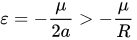
where is the standard gravitational parameter.

Almost always a < R, corresponding to a lower than the minimum for a full orbit, which is

Thus the net extra specific energy needed compared to just raising the spacecraft into space is between 0 and .

Speed, range, and altitude

[edit]

To minimize the required delta-v (an astrodynamical measure which strongly determines the required fuel), the high-altitude part of the flight is made with the rockets off (this is technically called free-fall even for the upward part of the trajectory). (Compare with Oberth effect.) The maximum speed in a flight is attained at the lowest altitude of this free-fall trajectory, both at the start and at the end of it.[citation needed]

If one's goal is simply to "reach space", for example in competing for the Ansari X Prize, horizontal motion is not needed. In this case the lowest required delta-v, to reach 100 km altitude, is about 1.4 km/s. Moving slower, with less free-fall, would require more delta-v.[citation needed]

Compare this with orbital spaceflights: a low Earth orbit (LEO), with an altitude of about 300 km, needs a speed around 7.7 km/s, requiring a delta-v of about 9.2 km/s. (If there were no atmospheric drag the theoretical minimum delta-v would be 8.1 km/s to put a craft into a 300-kilometer high orbit starting from a stationary point like the South Pole. The theoretical minimum can be up to 0.46 km/s less if launching eastward from near the equator.)[citation needed]

For sub-orbital spaceflights covering a horizontal distance the maximum speed and required delta-v are in between those of a vertical flight and a LEO. The maximum speed at the lower ends of the trajectory are now composed of a horizontal and a vertical component. The higher the horizontal distance covered, the greater the horizontal speed will be. (The vertical velocity will increase with distance for short distances but will decrease with distance at longer distances.) For the V-2 rocket, just reaching space but with a range of about 330 km, the maximum speed was 1.6 km/s. Scaled Composites SpaceShipTwo which is under development will have a similar free-fall orbit but the announced maximum speed is 1.1 km/s (perhaps because of engine shut-off at a higher altitude).[citation needed][needs update]

For larger ranges, due to the elliptic orbit the maximum altitude can be much more than for a LEO. On a 10,000-kilometer intercontinental flight, such as that of an intercontinental ballistic missile or possible future commercial spaceflight, the maximum speed is about 7 km/s, and the maximum altitude may be more than 1300 km. Any spaceflight that returns to the surface, including sub-orbital ones, will undergo atmospheric reentry. The speed at the start of the reentry is basically the maximum speed of the flight. The aerodynamic heating caused will vary accordingly: it is much less for a flight with a maximum speed of only 1 km/s than for one with a maximum speed of 7 or 8 km/s.[citation needed]

The minimum delta-v and the corresponding maximum altitude for a given range can be calculated, d, assuming a spherical Earth of circumference 40000 km and neglecting the Earth's rotation and atmosphere. Let θ be half the angle that the projectile is to go around the Earth, so in degrees it is 45°×d/10000 km. The minimum-delta-v trajectory corresponds to an ellipse with one focus at the centre of the Earth and the other at the point halfway between the launch point and the destination point (somewhere inside the Earth). (This is the orbit that minimizes the semi-major axis, which is equal to the sum of the distances from a point on the orbit to the two foci. Minimizing the semi-major axis minimizes the specific orbital energy and thus the delta-v, which is the speed of launch.) Geometrical arguments lead then to the following (with R being the radius of the Earth, about 6370 km):

The altitude of apogee is maximized (at about 1320 km) for a trajectory going one quarter of the way around the Earth (10000 km). Longer ranges will have lower apogees in the minimal-delta-v solution.

(where g is the acceleration of gravity at the Earth's surface). The Δv increases with range, leveling off at 7.9 km/s as the range approaches 20000 km (halfway around the world). The minimum-delta-v trajectory for going halfway around the world corresponds to a circular orbit just above the surface (of course in reality it would have to be above the atmosphere). See lower for the time of flight.

An intercontinental ballistic missile is defined as a missile that can hit a target at least 5500 km away, and according to the above formula this requires an initial speed of 6.1 km/s. Increasing the speed to 7.9 km/s to attain any point on Earth requires a considerably larger missile because the amount of fuel needed goes up exponentially with delta-v (see Rocket equation).

The initial direction of a minimum-delta-v trajectory points halfway between straight up and straight toward the destination point (which is below the horizon). Again, this is the case if the Earth's rotation is ignored. It is not exactly true for a rotating planet unless the launch takes place at a pole.[7]

Flight duration

[edit]

In a vertical flight of not too high altitudes, the time of the free-fall is both for the upward and for the downward part the maximum speed divided by the acceleration of gravity, so with a maximum speed of 1 km/s together 3 minutes and 20 seconds. The duration of the flight phases before and after the free-fall can vary.[citation needed]

For an intercontinental flight the boost phase takes 3 to 5 minutes, the free-fall (midcourse phase) about 25 minutes. For an ICBM the atmospheric reentry phase takes about 2 minutes; this will be longer for any soft landing, such as for a possible future commercial flight.[citation needed] Test flight 4 of the SpaceX 'Starship' performed such a flight with a lift off from Texas and a simulated soft touchdown in the Indian Ocean 66 minutes after liftoff.

Sub-orbital flights can last from just seconds to days. Pioneer 1 was NASA's first space probe, intended to reach the Moon. A partial failure caused it to instead follow a sub-orbital trajectory, reentering the Earth's atmosphere 43 hours after launch.[8]

To calculate the time of flight for a minimum-delta-v trajectory, according to Kepler's third law, the period for the entire orbit (if it did not go through the Earth) would be:

Using Kepler's second law, we multiply this by the portion of the area of the ellipse swept by the line from the centre of the Earth to the projectile:

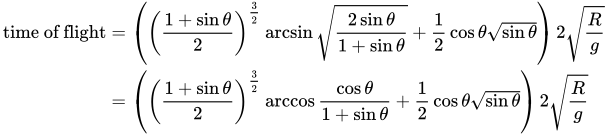
This gives about 32 minutes for going a quarter of the way around the Earth, and 42 minutes for going halfway around. For short distances, this expression is asymptotic to .

From the form involving arccosine, the derivative of the time of flight with respect to d (or θ) goes to zero as d approaches 20000 km (halfway around the world). The derivative of Δv also goes to zero here. So if d = 19000 km, the length of the minimum-delta-v trajectory will be about 19500 km, but it will take only a few seconds less time than the trajectory for d = 20000 km (for which the trajectory is 20000 km long).

Flight profiles

[edit]
Profile for the first crewed American sub-orbital flight, 1961. Launch rocket lifts the spacecraft for the first 2:22 minutes. Dashed line: zero gravity.
Science and Mechanics cover of November 1931, showing a proposed sub-orbital spaceship that would reach an altitude 700 miles (1,100 km) on its one-hour trip from Berlin to New York.

While there are a great many possible sub-orbital flight profiles, it is expected that some will be more common than others.

The X-15 (1958–1968) was launched to an altitude of 13.7 km by a B-52 mothership, lifted itself to approximately 100 km, and then glided to the ground.

Ballistic missiles

[edit]

The first sub-orbital vehicles which reached space were ballistic missiles. The first ballistic missile to reach space was the German V-2, the work of the scientists at Peenemünde, on October 3, 1942, which reached an altitude of 53 miles (85 km).[9] Then in the late 1940s the US and USSR concurrently developed missiles all of which were based on the V-2 Rocket, and then much longer range Intercontinental Ballistic Missiles (ICBMs). There are now many countries who possess ICBMs and even more with shorter range Intermediate Range Ballistic Missiles (IRBMs).[citation needed]

Tourist flights

[edit]

Sub-orbital tourist flights will initially focus on attaining the altitude required to qualify as reaching space. The flight path will be either vertical or very steep, with the spacecraft landing back at its take-off site.

The spacecraft will shut off its engines well before reaching maximum altitude, and then coast up to its highest point. During a few minutes, from the point when the engines are shut off to the point where the atmosphere begins to slow down the downward acceleration, the passengers will experience weightlessness.

Megaroc had been planned for sub-orbital spaceflight by the British Interplanetary Society in the 1940s.[10][11]

In late 1945, a group led by M. Tikhonravov K. and N. G. Chernysheva at the Soviet NII-4 academy (dedicated to rocket artillery science and technology), began work on a stratospheric rocket project, VR-190, aimed at vertical flight by a crew of two pilots, to an altitude of 200 km (65,000 ft) using captured V-2.[12]

In 2004, a number of companies worked on vehicles in this class as entrants to the Ansari X Prize competition. The Scaled Composites SpaceShipOne was officially declared by Rick Searfoss to have won the competition on October 4, 2004, after completing two flights within a two-week period.

In 2005, Sir Richard Branson of the Virgin Group announced the creation of Virgin Galactic and his plans for a 9-seat capacity SpaceShipTwo named VSS Enterprise. It has since been completed with eight seats (one pilot, one co-pilot and six passengers) and has taken part in captive-carry tests and with the first mother-ship WhiteKnightTwo, or VMS Eve. It has also completed solitary glides, with the movable tail sections in both fixed and "feathered" configurations. The hybrid rocket motor has been fired multiple times in ground-based test stands, and was fired in a powered flight for the second time on 5 September 2013.[13] Four additional SpaceShipTwos have been ordered and will operate from the new Spaceport America. Commercial flights carrying passengers were expected in 2014, but became cancelled due to the disaster during SS2 PF04 flight. Branson stated, "[w]e are going to learn from what went wrong, discover how we can improve safety and performance and then move forwards together."[14]

Scientific experiments

[edit]

A major use of sub-orbital vehicles today is as scientific sounding rockets. Scientific sub-orbital flights began in the 1920s when Robert H. Goddard launched the first liquid fueled rockets, however they did not reach space altitude. In the late 1940s, captured German V-2 ballistic missiles were converted into V-2 sounding rockets which helped lay the foundation for modern sounding rockets.[15] Today there are dozens of different sounding rockets on the market, from a variety of suppliers in various countries. Typically, researchers wish to conduct experiments in microgravity or above the atmosphere.

Sub-orbital transportation

[edit]

Research, such as that done for the X-20 Dyna-Soar project suggests that a semi-ballistic sub-orbital flight could travel from Europe to North America in less than an hour.

However, the size of rocket, relative to the payload, necessary to achieve this, is similar to an ICBM. ICBMs have delta-v's somewhat less than orbital; and therefore would be somewhat cheaper than the costs for reaching orbit, but the difference is not large.[16]

Due to the high cost of spaceflight, suborbital flights are likely to be initially limited to high value, very high urgency cargo deliveries such as courier flights, military fast-response operations or space tourism.[opinion]

The SpaceLiner is a hypersonic suborbital spaceplane concept that could transport 50 passengers from Australia to Europe in 90 minutes or 100 passengers from Europe to California in 60 minutes.[17] The main challenge lies in increasing the reliability of the different components, particularly the engines, in order to make their use for passenger transportation on a daily basis possible.

SpaceX is potentially considering using their Starship as a sub-orbital point-to-point transportation system.[18]

Notable uncrewed sub-orbital spaceflights

[edit]
  • The first sub-orbital space flight was on 20 June 1944, when MW 18014, a V-2 test rocket, launched from Peenemünde in Germany and reached 176 kilometres altitude.[19]
  • Bumper 5, a two-stage rocket launched from the White Sands Proving Grounds. On 24 February 1949 the upper stage reached an altitude of 248 miles (399 km) and a speed of 7,553 feet per second (2,302 m/s; Mach 6.8).[20]
  • Albert II, a male rhesus macaque, became the first mammal in space on 14 June 1949 in a sub-orbital flight from Holloman Air Force Base in New Mexico to an altitude of 83 miles (134 km) aboard a U.S. V-2 sounding rocket.
  • USSR – Energia, 15 May 1987, a Polyus payload which failed to reach orbit
  • SpaceX IFT-7, 16 January 2025, a Starship flight test which blew up during ascent, forcing airline flights to alter course to avoid falling debris and setting back Elon Musk's flagship rocket program.[21][22] There were also numerous reports of damage on the ground.[23] It is, to date, the most massive object launched into a sub-orbital trajectory.

Crewed sub-orbital spaceflights

[edit]

Above 100 km (62.14 mi) in altitude.[a]

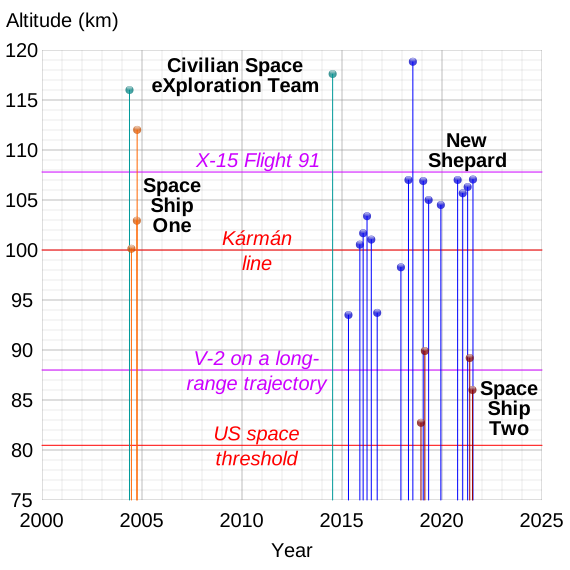
Timeline of Space­Ship­One, Space­Ship­Two, CSXT and New Shepard sub-orbital flights. Where booster and capsule achieved different altitudes, the higher is plotted. In the SVG file, hover over a point to show details.
Date (GMT) Mission Crew Country Remarks
1 1961-05-05 Mercury-Redstone 3 Alan Shepard  United States First crewed sub-orbital spaceflight, first American in space
2 1961-07-21 Mercury-Redstone 4 Virgil Grissom  United States Second crewed sub-orbital spaceflight, second American in space
3 1963-07-19 X-15 Flight 90 Joseph A. Walker  United States First winged craft in space
4 1963-08-22 X-15 Flight 91 Joseph A. Walker  United States First person and spacecraft to make two flights into space
5 1975-04-05 Soyuz 18a Vasili Lazarev
Oleg Makarov
 Soviet Union Failed orbital launch. Aborted after malfunction during stage separation
6 2004-06-21 SpaceShipOne flight 15P Mike Melvill  United States First commercial spaceflight
7 2004-09-29 SpaceShipOne flight 16P Mike Melvill  United States First of two flights to win Ansari X-Prize
8 2004-10-04 SpaceShipOne flight 17P Brian Binnie  United States Second X-Prize flight, clinching award
9 2021-07-20 Blue Origin NS-16 Jeff Bezos
Mark Bezos
Wally Funk
Oliver Daemen
 United States First crewed Blue Origin flight
10 2021-10-13 Blue Origin NS-18 Audrey Powers
Chris Boshuizen
Glen de Vries
William Shatner
 United States Second crewed Blue Origin flight
11 2021-12-11 Blue Origin NS-19 Laura Shepard Churchley
Michael Strahan
Dylan Taylor
Evan Dick
Lane Bess
Cameron Bess
 United States Third crewed Blue Origin flight
12 2022-03-31 Blue Origin NS-20 Marty Allen
Sharon Hagle
Marc Hagle
Jim Kitchen
George Nield
Gary Lai
 United States Fourth crewed Blue Origin flight
13 2022-06-04 Blue Origin NS-21 Evan Dick
Katya Echazarreta
Hamish Harding
Victor Correa Hespanha
Jaison Robinson
Victor Vescovo
 United States Fifth crewed Blue Origin flight
14 2022-08-04 Blue Origin NS-22 Coby Cotton
Mário Ferreira
Vanessa O'Brien
Clint Kelly III
Sara Sabry
Steve Young
 United States Sixth crewed Blue Origin flight
15 2024-05-19 Blue Origin NS-25 Mason Angel
Sylvain Chiron
Ed Dwight
Kenneth Hess
Carol Schaller
Gopichand Thotakura
 United States Seventh crewed Blue Origin flight
16 2024-08-29 Blue Origin NS-26 Nicolina Elrick
Rob Ferl
Eugene Grin
Eiman Jahangir
Karsen Kitchen
Ephraim Rabin
 United States Eighth crewed Blue Origin flight
17 2024-11-22 Blue Origin NS-28 Henry (Hank) Wolfond
Austin Litteral
James (J.D.) Russell
Sharon Hagle
Marc Hagle
Emily Calandrelli
 United States Ninth crewed Blue Origin flight
18 2025-02-25 Blue Origin NS-30 Lane Bess
Jesús Calleja
Tushar Shah
Richard Scott
Elaine Chia Hyde
Russell Wilson
 United States Tenth crewed Blue Origin flight
19 2025-04-14 Blue Origin NS-31 Aisha Bowe
Amanda Nguyen
Gayle King
Katy Perry
Lauren Sánchez
Kerianne Flynn
 United States Eleventh crewed Blue Origin flight. All female crew.
20 2025-05-31 Blue Origin NS-32 Dr. Gretchen Green
Jesse Williams
Aymette (Amy) Medina Jorge
Paul Jeris
Jaime Alemán
Mark Rocket
 United States Twelfth crewed Blue Origin flight.
21 2025-06-29 Blue Origin NS-33
  • Allie Kuehner
  • Carl Kuehner
  • Leland Larson
  • Freddie Rescigno, Jr.
  • Owolabi Salis
  • James Sitkins
 United States Thirteenth crewed Blue Origin flight.
22 2025-08-03 Blue Origin NS-34
 United States Fourteenth crewed Blue Origin flight.
23 2025-10-08 Blue Origin NS-36
  • Clint Kelly III
  • Aaron Newman
  • Jeff Elgin
  • Vitalii Ostrovsky
  • Danna Karagussova
  • William H. Lewis
 United States Fifteenth crewed Blue Origin flight.

Crewed vertically-launched suborbital flights

[edit]

Most manned rocket flights were either orbital spaceflights or flights of rocket-powered aircraft, which were launched horizontally. Manned vertically launched suborbital flights were before the first launch of New Shepard rare and often the result of a failure of a manned rocket for orbital spaceflight. The following list shows all manned vertically launched suborbital rocket flights.

Date (GMT) Mission Crew Launch vehicle Apogee Country Remarks
1961-05-05 Mercury-Redstone 3 Alan Shepard Mercury-Redstone Launch Vehicle 187.5 km  United States first American in space
1961-07-21 Mercury-Redstone 4 Virgil Grissom Mercury-Redstone Launch Vehicle 190.3 km  United States second American in space
1975-04-05 Soyuz 18a Vasili Lazarev
Oleg Makarov
Soyuz 192 km  Soviet Union Failed orbital launch. Aborted after malfunction during stage separation
1983-09-26 Soyuz 7K-ST No.16L Vladimir Titov
Gennadi Strekalov
Soyuz 0.65 km  Soviet Union Launch abort
1986-01-28 STS-25 Francis R. "Dick" Scobee
Michael J. Smith
Ellison S. Onizuka
Judith A. Resnik
Ronald E. McNair
Gregory B. Jarvis
S. Christa McAuliffe
Space Shuttle Challenger 20 km  United States Space Shuttle Challenger disaster, all astronauts on board were killed
2014-01-30 Hughes 1 Mike Hughes self-built rocket 0.419 km  United States Mike Hughes got injured
2018-03-24 Hughes 2 Mike Hughes self-built rocket 0.572 km  United States
2018-10-11 Soyuz MS-10 Aleksey Ovchinin
Nick Hague
Soyuz 93 km  Russia Failed orbital launch
2020-02-22 Hughes 3 Mike Hughes self-built rocket 1.5 km  United States Mike Hughes killed at crash landing as parachute was destroyed at launch
2021-07-20 Blue Origin NS-16 Jeff Bezos
Mark Bezos
Wally Funk
Oliver Daemen
New Shepard 107 km  United States First crewed Blue Origin flight
2021-10-13 Blue Origin NS-18 Audrey Powers
Chris Boshuizen
Glen de Vries
William Shatner
New Shepard 107 km  United States Second crewed Blue Origin flight
2021-12-11 Blue Origin NS-19 Laura Shepard Churchley
Michael Strahan
Dylan Taylor
Evan Dick
Lane Bess
Cameron Bess
New Shepard 107 km  United States Third crewed Blue Origin flight
2022-03-31 Blue Origin NS-20 Marty Allen
Sharon Hagle
Marc Hagle
Jim Kitchen
George Nield
Gary Lai
New Shepard 107 km  United States Fourth crewed Blue Origin flight
2022-06-04 Blue Origin NS-21 Evan Dick
Katya Echazarreta
Hamish Harding
Victor Correa Hespanha
Jaison Robinson
Victor Vescovo
New Shepard 107 km  United States Fifth crewed Blue Origin flight
2022-08-04 Blue Origin NS-22 Coby Cotton
Mário Ferreira
Vanessa O'Brien
Clint Kelly III
Sara Sabry
Steve Young
New Shepard 107 km  United States Sixth crewed Blue Origin flight
2024-05-19 Blue Origin NS-25 Mason Angel
Sylvain Chiron
Ed Dwight
Kenneth Hess
Carol Schaller
Gopichand Thotakura
New Shepard 107 km  United States Seventh crewed Blue Origin flight
2024-08-29 Blue Origin NS-26 Nicolina Elrick
Rob Ferl
Eugene Grin
Eiman Jahangir
Karsen Kitchen
Ephraim Rabin
New Shepard 105 km  United States Eighth crewed Blue Origin flight
2024-11-22 Blue Origin NS-28 Henry (Hank) Wolfond
Austin Litteral
James (J.D.) Russell
Sharon Hagle
Marc Hagle
Emily Calandrelli
New Shepard 107 km  United States Ninth crewed Blue Origin flight
2025-02-25 Blue Origin NS-30 Lane Bess
Jesús Calleja
Tushar Shah
Richard Scott
Elaine Chia Hyde
Russell Wilson
New Shepard 107 km  United States Tenth crewed Blue Origin flight
2025-04-14 Blue Origin NS-31 Aisha Bowe
Amanda Nguyen
Gayle King
Katy Perry
Lauren Sánchez
Kerianne Flynn
New Shepard 106 km  United States Eleventh crewed Blue Origin flight
2025-05-31 Blue Origin NS-32 Dr. Gretchen Green
Jesse Williams
Aymette (Amy) Medina Jorge
Paul Jeris
Jaime Alemán
Mark Rocket
New Shepard 104 km  United States Twelfth crewed Blue Origin flight.
2025-06-29 Blue Origin NS-33
  • Allie Kuehner
  • Carl Kuehner
  • Leland Larson
  • Freddie Rescigno, Jr.
  • Owolabi Salis
  • James Sitkins
New Shepard 106 km  United States Thirtheenth crewed Blue Origin flight.
2025-08-03 Blue Origin NS-34
New Shepard 104 km  United States Fourteenth crewed Blue Origin flight.
2025-10-08 Blue Origin NS-36
  • Clint Kelly III
  • Aaron Newman
  • Jeff Elgin
  • Vitalii Ostrovsky
  • Danna Karagussova
  • William H. Lewis
New Shepard 107 km  United States Fifteenth crewed Blue Origin flight.

Future of crewed sub-orbital spaceflight

[edit]

Private companies such as Virgin Galactic, Armadillo Aerospace (reinvented as Exos Aerospace), Airbus,[24] Blue Origin and Masten Space Systems are taking an interest in sub-orbital spaceflight, due in part to ventures like the Ansari X Prize. NASA and others are experimenting with scramjet-based hypersonic aircraft which may well be used with flight profiles that qualify as sub-orbital spaceflight. Non-profit entities like ARCASPACE and Copenhagen Suborbitals also attempt rocket-based launches.

Suborbital spaceflight projects

[edit]

See also

[edit]

Notes

[edit]

References

[edit]
Revisions and contributorsEdit on WikipediaRead on Wikipedia
from Grokipedia
Sub-orbital spaceflight refers to a in which a or ascends into , typically crossing the at 100 kilometers (62 miles) altitude, but lacks the orbital velocity required to enter a stable around , instead following a parabolic ballistic path that returns it to the planet's surface after a brief period of freefall. This form of spaceflight, distinct from orbital missions that circle for extended durations, provides short windows of microgravity—often lasting several minutes—for scientific experiments, technology testing, and human , with flight times typically ranging from 10 to 20 minutes from launch to landing. Early sub-orbital efforts focused on sounding rockets for atmospheric research, but manned sub-orbital flights marked pivotal milestones in human . On May 5, 1961, Alan B. Shepard became the first American in space aboard the mission (Freedom 7), completing a 15-minute sub-orbital flight launched from that reached an apogee of 187 kilometers (116 miles). This was followed on July 21, 1961, by Virgil "Gus" Grissom's Liberty Bell 7 flight, the second successful U.S. manned sub-orbital mission, which further validated the Mercury capsule design and human tolerance to space conditions. Sub-orbital vehicles operate via vertical launch (e.g., rocket-powered ascent) or air-launch systems (e.g., dropped from carrier aircraft), emphasizing reusability to reduce costs and enable frequent operations. In the commercial sector, pioneered under U.S. Federal Aviation Administration (FAA) regulations since the 1980s, companies have advanced reusable systems for paying passengers and payloads. Blue Origin's New Shepard rocket, a fully reusable vertical-launch system, has conducted multiple crewed sub-orbital flights since 2021, carrying participants above the Kármán line for weightless experiences and returning via parachute landing. Similarly, Virgin Galactic's SpaceShipTwo, air-launched from a mothership, achieved its first commercial sub-orbital flight with passengers in 2023, offering sub-orbital tourism from Spaceport America in New Mexico. These developments, supported by FAA experimental permits for research and development, have spurred a growing market for sub-orbital access, with applications in microgravity research, astronaut training, and emerging space tourism projected to expand through the 2030s.

Definition and Fundamentals

Altitude Requirements and Boundaries

Sub-orbital spaceflight is defined by its failure to achieve sustained orbital , resulting in trajectories that reach significant altitudes but return to without circling the planet. The primary altitude boundary distinguishing space from the atmosphere is the , established at 100 kilometers (62 miles) above mean by the (FAI), the international governing body for aeronautic and astronautic records. This threshold marks the point where aerodynamic flight becomes impractical, as the atmosphere is too thin to generate sufficient lift for conventional , necessitating orbital speeds for sustained flight. In the United States, a lower altitude of 80 kilometers (50 miles) is used by the (FAA) and the Department of Defense to qualify flights for astronaut wings, recognizing participants who reach this height during sub-orbital missions. This criterion applies to both military and commercial crewed flights, emphasizing the demonstration of activities essential to public safety or mission benefit beyond mere altitude attainment. Sub-orbital flights typically traverse the upper , extending from approximately 12 to 50 kilometers, where absorption stabilizes temperatures, and into the , ranging from 50 to 85 kilometers, characterized by decreasing temperatures and increasing meteoric activity that can influence vehicle re-entry dynamics. These layers provide the transitional environment where sub-orbital vehicles experience minimal drag during ascent and apogee but encounter denser air upon descent. Flights continue into the , from approximately 85 to 600 kilometers, where atomic oxygen and other sparse gases absorb high-energy solar radiation, leading to high kinetic temperatures (up to 2,000 K) despite low density, affecting satellite drag and auroral phenomena; the at 100 km lies within this layer. The Kármán line's establishment traces to the mid-20th century, when aerospace engineer calculated the altitude at which aerodynamic lift equals the required for orbital flight, yielding approximately 83.8 kilometers based on Earth's radius and gravitational parameters. During discussions in the and involving the and FAI, this figure was rounded upward to 100 kilometers for practical record-keeping, reflecting a consensus on a clear, verifiable boundary despite the theoretical value's slight discrepancy.

Distinction from Orbital Flight

Sub-orbital spaceflight differs fundamentally from orbital flight in terms of and requirements. Orbital flight demands a sustained tangential that enables a spacecraft to follow a closed elliptical or circular path around , where gravitational pull is continuously balanced by the vehicle's , preventing it from falling back to the surface. In contrast, sub-orbital flight traces a parabolic ballistic arc, launching vertically or at a shallow to reach a maximum altitude known as the apogee before pulls the vehicle into a symmetric descent, intersecting 's surface without completing an . This distinction arises because sub-orbital trajectories treat the launch and sites as the theoretical perigee points of a highly eccentric that effectively "clips" the , whereas orbital paths maintain both perigee and apogee above the atmosphere. The core mechanical difference lies in the specific mechanical energy of the trajectory, given by the equation ε=v22μr,\varepsilon = \frac{v^2}{2} - \frac{\mu}{r}, where vv is the , μ\mu is Earth's gravitational parameter (approximately 3.986×10143.986 \times 10^{14} m³/s²), and rr is the radial distance from Earth's center. For both sub-orbital and orbital flights, ε<0\varepsilon < 0 indicates a bound , but sub-orbital paths have insufficient or improper orientation to avoid surface intersection, resulting in non-sustaining motion. Orbital flight requires additional to circularize the path, ensuring the perigee remains elevated. demands underscore this: achieving necessitates about 28,000 km/h (7.8 km/s), while sub-orbital peaks typically reach Mach 3–7 (approximately 3,700–8,500 km/h), depending on mission profile and apogee, forgoing the horizontal acceleration needed for insertion. These energetic and path differences have practical implications for design and operations. Sub-orbital profiles enable simpler vertical recovery near the launch site, often via powered descent or parachutes, promoting reusability without the intense thermal stresses of atmospheric reentry. Orbital missions, however, require precise deorbit burns to lower perigee into the atmosphere, followed by high-speed reentry (up to 28,000 km/h) that demands advanced heat shields and aerodynamic control for safe landing, complicating recovery and increasing constraints.

Technical Characteristics

Trajectory, Speed, and Range

Sub-orbital spaceflight follows a ballistic , where the vehicle is propelled to a peak altitude before falling back to under without achieving orbital . In the flat-Earth approximation, the horizontal range RR of such a trajectory is given by R=v02sin(2θ)gR = \frac{v_0^2 \sin(2\theta)}{g}, where v0v_0 is the initial , θ\theta is the launch angle relative to the horizontal, and gg is the acceleration due to (approximately 9.8 m/s²). For vertical launches typical of many sounding rockets (θ=90\theta = 90^\circ), sin(2θ)=0\sin(2\theta) = 0, resulting in minimal horizontal range as the vehicle ascends and descends nearly along the same path. During the boost phase, sub-orbital vehicles accelerate to velocities ranging from approximately 1.4 km/s for short flights reaching 100 km altitude to 7 km/s for longer-range profiles akin to (ICBM) tests. At apogee, the highest point of the trajectory, the horizontal component approaches zero for near-vertical paths, while vertical is zero, marking the transition to free-fall. Sounding rockets, for instance, often achieve burnout speeds of 1–5 km/s to attain apogees of 50–1,500 km, with horizontal ranges typically limited to a few hundred kilometers in lofted configurations. In contrast, ICBM analogs can cover 1,000–2,000 km or more in sub-orbital tests, demonstrating the scalability of these profiles for extended horizontal extents. Several factors influence the range and shape of sub-orbital trajectories. The launch angle optimizes range at 45° under ideal conditions but is adjusted higher (e.g., 70–90°) for space-reaching profiles to prioritize altitude over distance. Atmospheric drag, quantified by Fd=12ρv2CdAF_d = \frac{1}{2} \rho v^2 C_d A (where ρ\rho is air , vv is velocity, CdC_d is the , and AA is the cross-sectional area), significantly reduces range during ascent and descent in the lower atmosphere, particularly for vehicles with high velocities and large areas. Gravitational becomes relevant for ranges exceeding a few hundred kilometers, as Earth's spherical shape requires treating the path as an elliptical segment rather than a flat parabola, affecting downrange accuracy in long sub-orbital flights. Sub-orbital trajectories are categorized as pure vertical or lofted based on launch inclination. Pure vertical profiles, common in sounding rockets, maximize altitude with negligible horizontal displacement, enabling brief microgravity experiments directly above the launch site. Lofted trajectories, used in systems, incorporate a shallower to achieve greater horizontal range while still reaching , as seen in ICBM paths that arc across continents before re-entry.

Flight Phases and Duration

Sub-orbital flights typically proceed through three primary phases: powered ascent, coasting to apogee, and re-entry with descent. During the powered ascent, the provides to accelerate the vehicle away from the launch site, lasting approximately 2 to 5 minutes depending on the vehicle configuration, after which the engine cuts off and the vehicle separates from any boosters. Following ascent, the vehicle enters a coasting phase, reaching its peak altitude or apogee where it experiences microgravity for about 3 to 5 minutes, allowing for brief periods of suitable for simple experiments or passenger activities. This microgravity exposure, typically 3 to 5 minutes in duration for many profiles, provides researchers with a short window to conduct observations in a near-vacuum environment before gravitational forces begin to dominate again. The re-entry and descent phase follows, lasting 5 to 10 minutes, during which the vehicle encounters atmospheric friction, often requiring heat shields to manage thermal loads from high-speed re-entry, and employs parachutes, wings, or retro-thrust for controlled landing. Recovery methods vary by , including in water for capsule-based systems like early missions, parachute-assisted ground landings for vertical rockets, or runway glides for winged vehicles. Overall flight durations for sub-orbital missions range from 10 to 20 minutes for short-range vertical profiles, such as those used in space tourism or sounding rockets, encompassing the full sequence from launch to touchdown. For longer-range ballistic trajectories, total times can extend to 30 to 40 minutes, primarily due to extended coasting periods.

Applications and Profiles

Military and Ballistic Uses

Sub-orbital spaceflight plays a central role in military applications through , which follow unpowered parabolic trajectories after an initial powered ascent, reaching altitudes below those required for orbital insertion. These weapons, including short-range ballistic missiles (SRBMs) with ranges under 1,000 km, medium-range ballistic missiles (MRBMs) from 1,000 to 3,000 km, and intercontinental ballistic missiles (ICBMs) exceeding 5,500 km, operate entirely within sub-orbital regimes. The German , first successfully launched in , marked the inaugural operational ballistic missile, achieving apogees of up to 176 km during tests and demonstrating the feasibility of sub-orbital rocketry for strategic strikes. Guidance systems in these missiles primarily rely on inertial navigation, which uses gyroscopes and accelerometers to track position, velocity, and orientation without external references, enabling autonomous flight over vast distances. Propulsion varies between liquid-fueled engines, offering higher for longer-range systems like early ICBMs, and solid-fueled motors, prized for their simplicity, rapid launch readiness, and storability in MRBMs and modern ICBMs. ICBM apogees typically peak at around 1,200 km, underscoring their sub-orbital nature while maximizing range through efficient boost phases. Advanced payloads enhance sub-orbital missiles' lethality, notably through multiple independently targetable reentry vehicles (MIRVs), which deploy several warheads from a single booster, each capable of striking separate targets with independent guidance post-separation. MIRVs, first operationalized on U.S. Minuteman III ICBMs in the 1970s, complicate missile defenses by saturating interception capabilities and allowing flexible targeting. In strategic deterrence, these systems provide rapid global reach, with flight times ranging from 10 to 30 minutes for ICBMs depending on launch-to-target distance, enabling assured retaliation and doctrines. Emerging hypersonic glide vehicles (HGVs), boosted to sub-orbital altitudes before gliding at speeds exceeding Mach 5, blur distinctions between traditional ballistic trajectories and sustained , offering maneuverability to evade defenses. Deployed on MRBMs and ICBMs by nations like and , HGVs extend sub-orbital technology's tactical utility in precision strikes. efforts have shaped development, as exemplified by the 1987 Intermediate-Range Nuclear Forces (INF) Treaty, which eliminated all U.S. and Soviet ground-launched ballistic missiles with ranges between 500 and 5,500 km, thereby constraining MRBM and (IRBM) proliferation until its termination in 2019.

Scientific and Research Missions

Sub-orbital spaceflight plays a crucial role in scientific and research missions through the use of sounding rockets, which launch payloads into brief trajectories to conduct experiments in the upper atmosphere and near-space environment. These vehicles, such as the Black Brant series and Terrier-Orion configurations, enable researchers to deploy instruments for targeted investigations without achieving orbit. NASA's Sounding Rockets Program Office, for instance, supports approximately 20 such missions annually, focusing on disciplines like heliophysics, astrophysics, and Earth science. Sounding rocket missions typically last 5 to 20 minutes, reaching apogees between 100 and 1,500 km, allowing payloads to traverse regions inaccessible to ground-based or orbital platforms. During the coast phase of flight, experiments benefit from several minutes of microgravity conditions, facilitating studies that require weightless environments. Common research areas include ultraviolet (UV) astronomy, where instruments capture high-resolution spectra of celestial objects unfiltered by Earth's atmosphere; plasma physics, examining ionospheric interactions and auroral phenomena; and biology, testing cellular responses or material behaviors in microgravity. For example, the Black Brant V rocket supports payloads of 272 to 590 kg for solar physics and atmospheric studies, while the Terrier-Improved Orion handles lighter loads up to 363 kg for geospace research. Payloads are designed for recovery to enable and reuse, typically deploying parachutes for descent to land or water. Systems like the O-give Recovery System Assembly integrate parachutes in the payload , ensuring controlled re-entry and retrieval, often from splashdowns near launch sites. This recovery process supports iterative experimentation, with land-based options using multiple parachute types for precise landings. Key launch sites include NASA's on , , which hosts frequent U.S. missions, and Space Center in , operated by the for European and international campaigns. NASA's initiative collaborates globally, providing access to these facilities for diverse payloads and fostering programs like student-led experiments. The primary value of these missions lies in their ability to yield high-cadence, in-situ data during intense exposure periods, such as rapid traversals of the for plasma measurements or unobscured UV observations of stars, which are infeasible from ground telescopes or prolonged orbital flights due to atmospheric interference or limited resolution. This brief window enables cost-effective validation of theories and technologies before scaling to satellite missions.

Space Tourism Ventures

Sub-orbital space tourism has emerged as a pioneering sector within commercial spaceflight, offering paying passengers brief journeys beyond Earth's atmosphere for recreational purposes. Key players include , which operates the air-launched sub-orbital , providing approximately 90-minute flights that reach altitudes qualifying as under international standards. As of November 2025, has paused revenue flights since 2023 to focus on developing its Delta-class vehicles, with commercial operations expected to resume in 2026. Tickets for these flights are priced at $600,000 per seat as of 2025, with the company announcing plans to increase prices further starting with sales resumption in 2026 for its next-generation Delta class vehicles. Another major entrant is , utilizing its vertical-launch rocket for sub-orbital missions that follow a ballistic . does not publicly disclose exact ticket prices but requires a refundable $150,000 deposit for reservations, with industry estimates placing costs between $200,000 and $300,000 per seat for subsequent flights after the inaugural auction that fetched $28 million. Passengers on these ventures experience a signature highlight of 3 to 4 minutes of during the apex of the flight, allowing them to float freely within and observe the curvature of against the blackness of . This microgravity period, combined with panoramic views from altitudes exceeding 100 kilometers, forms the core appeal of the tourist profile. Regulatory oversight falls under the U.S. (FAA), which licenses commercial space operators and designates participants as "space flight participants" rather than full crew unless they perform essential vehicle operations. To qualify for FAA wings, individuals must demonstrate activities critical to public safety during the flight, excluding most tourists who are passive observers. The market has shown steady growth, with reporting over 600 tickets sold prior to 2023, many at earlier prices of $200,000 to $250,000, creating a backlog that supports ongoing operations. , by October 2025, had completed its 36th flight overall, including approximately 15 crewed missions that carried 86 individuals into space, reflecting a ramp-up in frequency with six human flights in 2025 alone. These developments have not been without challenges; 's program suffered a major setback in 2014 when its prototype disintegrated mid-flight due to premature deployment of the feathering system, killing one pilot and injuring the other. The incident, investigated by the , highlighted risks in experimental aerospace testing and led to enhanced safety protocols. Economically, sub-orbital tourism serves as an accessible gateway to broader experiences, potentially fostering interest in more advanced orbital travel by familiarizing affluent customers with . The global market, dominated by sub-orbital segments, was valued at $888.3 million in 2023 and is projected to reach $10.09 billion by 2030, growing at a compound annual rate of 44.8%, driven by increasing flight cadences and technological maturation. This expansion could enable over 1,000 annual sub-orbital flights by the end of the decade, as reusable vehicle efficiencies reduce costs and regulatory frameworks stabilize. Business models emphasize high-margin, low-volume operations, with revenues from ticket sales supplemented by merchandise, training, and sponsorships, positioning the sector as a catalyst for the wider commercial economy.

Transportation Concepts

Sub-orbital spaceflight has been conceptualized as a revolutionary mode of rapid global transportation, enabling point-to-point (P2P) travel between distant locations on Earth in significantly reduced times compared to conventional . Proponents envision flights covering intercontinental distances, such as to New York, in 30 to by leveraging sub-orbital trajectories that reach altitudes above 100 km but do not achieve orbital velocity. This approach utilizes reusable rocket vehicles to ascend vertically, coast through the near-vacuum of , and descend to a site, potentially transforming for passengers and cargo. Key technical hurdles must be overcome for viable P2P sub-orbital transport. Passengers would experience sustained high-g forces of 3 to 5 g during ascent and re-entry phases, necessitating specialized seating, training, or g-suits to mitigate physiological stresses like those encountered in fighter jet maneuvers. Infrastructure challenges include the development of offshore floating platforms or hardened landing zones to accommodate vertical rocket operations, as traditional airports lack the capacity for such high-energy arrivals. Additionally, fuel efficiency remains a concern, with sub-orbital rockets requiring far more propellant per passenger-kilometer than jet aircraft, though advancements in reusable systems aim to reduce operational costs over time. Economic challenges further hinder widespread commercial suborbital point-to-point passenger service. Initial operations would be extremely expensive; even with reusability, low costs require thousands of flights to achieve economies of scale through high volume, which is difficult without preexisting demand, presenting a chicken-and-egg problem. Early services would thus likely be ultra-premium, priced far above airline fares, or limited to cargo and military uses. Several proposed systems highlight the engineering pathways toward sub-orbital P2P transport. In the , Boeing explored concepts for a sub-orbital capable of transporting up to 50 passengers across the globe in under an hour, emphasizing vertical with reusable boosters. ' Skylon project, a proposed hybrid air-breathing/rocket-powered integrating (Synergetic Air-Breathing Rocket Engine) technology to enable efficient ascent using atmospheric oxygen before switching to onboard propellants, was conceptualized in the for sub-orbital hops but was abandoned following the company's in 2024. These designs draw on sub-orbital range capabilities exceeding 10,000 km to support transoceanic routes. Environmental considerations are central to the feasibility of sub-orbital transport. Early analyses suggest that CO2 emissions per passenger for a sub-orbital flight could be 10 to 20 times higher than for subsonic air travel, primarily due to the energy-intensive . However, the adoption of green propellants, such as methane-oxygen mixtures, and optimized trajectories could lower this impact, potentially making sub-orbital P2P competitive with in terms of lifecycle emissions if reusability minimizes footprints.

Historical Uncrewed Flights

Early Pioneering Efforts

The V-2 rocket, developed by Nazi Germany during World War II under the direction of Wernher von Braun, marked the inception of sub-orbital spaceflight with its pioneering liquid-propellant technology. On June 20, 1944, a V-2 test launch from Peenemünde achieved an apogee of 176 kilometers, becoming the first human-made object to reach outer space by surpassing the Kármán line at 100 kilometers. Powered by a turbopump-fed engine using ethanol and liquid oxygen as propellants, the V-2 demonstrated scalable liquid fuel propulsion capable of generating 25 tons of thrust, a breakthrough that enabled sustained high-altitude trajectories beyond prior sounding rocket limits. Additionally, the rocket incorporated an early telemetry system using pulse-time modulation to transmit real-time data on velocity, altitude, and engine performance back to ground stations, laying groundwork for remote monitoring in subsequent flights. Following the war's end in 1945, both the and the seized V-2 hardware and expertise to advance their rocketry programs, conducting over 300 combined launches in the late 1940s that refined sub-orbital capabilities. In the U.S., facilitated the relocation of over 1,600 German scientists, including von Braun, to White Sands Proving Ground in , where the Army Ordnance Corps assembled and launched approximately 67 captured V-2s between 1946 and 1952 for upper-atmosphere research. These flights gathered data on cosmic radiation and aerodynamics, with one notable 1947 launch reaching 170 kilometers while carrying biological specimens. Building on this, the 1949 Bumper program integrated a V-2 first stage with a solid-fuel upper stage, achieving a record apogee of 393 kilometers on February 24 during Bumper 5—the first successful U.S. two-stage flight—and demonstrating multi-stage separation for extended sub-orbital ranges. Parallel efforts in the involved reverse-engineering the V-2 into the R-1 missile, with production authorized in 1947 under Sergei Korolev's OKB-1 design bureau. The first R-1 launch occurred on September 17, 1948, from , with the first successful launch on October 10, 1948, followed by about 30 test flights through 1949 that validated domestic manufacturing of liquid-propellant engines and guidance systems, reaching altitudes up to 90 kilometers. These early R-1 missions served as geophysical probes, measuring ionospheric conditions and magnetic fields to support nascent , while inheriting the V-2's for altitude and trajectory feedback. Together, these pre-1960s initiatives established core technologies like inertial guidance and high-thrust , transitioning sub-orbital flight from wartime weaponry to scientific exploration.

Modern Sounding Rockets and Tests

The Sounding Rocket Program, established in 1959, has conducted over 3,000 uncrewed sub-orbital launches to support atmospheric and space science research, enabling rapid deployment of instruments to altitudes exceeding 100 km. A key vehicle in this program is the Terrier-Improved Malemute, a two-stage capable of reaching approximately 600 km altitude with payloads up to several hundred kilograms, used for missions studying ionospheric dynamics and technology demonstrations. For instance, in fiscal year 2023, the program executed 11 missions with an 82% success rate, focusing on disciplines such as and . Internationally, the (ESA) has utilized the series since 1991 for microgravity experiments, providing up to 14 minutes of weightlessness at altitudes around 800-900 km, with the most recent launch occurring in 2017. In , the S-310, a single-stage solid developed by , continues to support upper atmospheric observations, achieving altitudes of about 150 km with a 310 mm diameter configuration; it remains active for recovery experiments and has seen launches as recently as July 2025, such as S-310-46. Recent examples highlight the role of sounding rockets in auroral research, such as the 2024 KINET-X mission, which deployed a Black Brant XII-a from NASA's Poker Flat Research Range to simulate auroral conditions by releasing barium and releasing chemical tracers into the , revealing insights into plasma interactions and particle acceleration. Advancements in reusable testbeds have expanded sub-orbital testing capabilities. Blue Origin's conducted 16 uncrewed development flights before its first crewed mission in July 2021, validating vertical takeoff and landing systems and escape mechanisms, with the final uncrewed test on April 14, 2021, reaching over 100 km before the first crewed mission. Similarly, SpaceX's program has progressed through integrated flight tests (IFTs) from IFT-1 in April 2023, which achieved stage separation but ended in an , to IFT-7 on January 16, 2025, where the upper stage exploded over the Atlantic approximately 8.5 minutes after launch due to an onboard fire, providing critical data on reusability and high-altitude performance across seven sub-orbital profiles.

Historical Crewed Flights

Government-Sponsored Missions

Government-sponsored crewed sub-orbital spaceflights emerged during the as nations raced to demonstrate capabilities, with the and leading the efforts through their respective space agencies. The U.S. initiated these missions using the , a modified version of the Army's Redstone . On May 5, 1961, Alan B. Shepard piloted the Freedom 7 spacecraft on , the first American crewed spaceflight, achieving an apogee of 187 kilometers (116.5 statute miles) and completing a 15-minute ballistic trajectory that splashed down 486 kilometers (302 statute miles) downrange in the Atlantic Ocean. This flight tested human performance in and under , with Shepard experiencing peak g-forces of approximately 6 during ascent and up to 11 g during reentry deceleration. Following Shepard's success, Virgil I. "Gus" Grissom flew on July 21, 1961, aboard Liberty Bell 7, reaching a similar apogee of 190 kilometers (118 statute miles) in a 15-minute, 37-second flight that confirmed the reliability of the system despite a post-landing capsule sinking due to a hatch issue. Later in the , the joint U.S. Air Force-NASA-Navy X-15 program advanced sub-orbital research through hypersonic flights, bridging and . Piloted by test pilots including , the X-15 achieved two flights above the 100-kilometer Karman line—the internationally recognized boundary of space—with Walker's August 22, 1963, mission reaching 108 kilometers (67.1 miles) at Mach 5.58. Overall, the program conducted 13 flights exceeding 80 kilometers (50 miles, the U.S. Air Force's space threshold), providing data on high-altitude , , and pilot control in near-space conditions. These missions emphasized rigorous training and safety measures to mitigate risks from high g-forces and potential launch failures. Astronauts and pilots underwent centrifuge training to simulate accelerations up to 6 g or more, building tolerance for the physiological stresses of ascent and reentry, as seen in Shepard's and Grissom's experiences. Safety systems included the Mercury capsule's launch escape tower, capable of separating the spacecraft from the booster in emergencies using a solid-fuel motor, and the X-15's ballistics for high-altitude recovery. Such protocols ensured pilot survival and mission success, informing future orbital and sub-orbital endeavors.

Commercial and Private Achievements

The pioneering achievement in private crewed sub-orbital spaceflight came with , developed by and funded by , which completed three qualifying flights for the in 2004. The first of these, flight 15P on June 21, 2004, marked the inaugural privately funded human spaceflight, piloted by , who reached an altitude of approximately 100 kilometers, crossing the . Subsequent X Prize flights on September 29 and October 4, 2004, also piloted by Melvill and respectively, demonstrated reusability and carried additional passengers, securing the $10 million prize as the first non-governmental vehicle to achieve sub-orbital spaceflight twice within two weeks. Virgin Galactic advanced commercial sub-orbital tourism with its SpaceShipTwo vehicle, VSS Unity, resuming crewed operations after significant delays stemming from the 2014 crash of VSS Enterprise during a test flight, which killed co-pilot Michael Alsbury and led to extensive safety redesigns and regulatory reviews. A milestone was Unity 22 on July 11, 2021, Virgin Galactic's first fully crewed mission, carrying founder along with three other mission specialists to an apogee of about 86 kilometers, above the U.S. Air Force's 80 km (50-mile) definition of space but below the international 100 km Kármán line, enabling brief and views of Earth's curvature. From 2023 onward, the company conducted a series of commercial flights under the Galactic designation, including on June 29, 2023, which carried the first paying passengers to similar altitudes above 80 km but below 100 km, and subsequent missions up to Galactic 07 on June 8, 2024, accommodating over 20 passengers across these operations focused on tourism and research. However, operations faced interruptions, including a 2024 grounding after an alignment pin detached from the mothership during a flight, and a broader pause on commercial missions announced in early 2024 to transition to a next-generation vehicle, halting Unity flights through at least mid-2026. Blue Origin's program has emerged as a leader in routine private sub-orbital flights, with its first crewed mission, NS-16 on July 20, 2021, transporting founder , his brother Mark, aviator , and student to over 100 kilometers altitude in an automated capsule. The program expanded rapidly, conducting multiple crewed flights annually, including NS-18 on October 13, 2021, which carried actor as the oldest person to reach at age 90. By October 2025, had completed its 36th flight, NS-36 on October 8, with 80 unique individuals having flown on 15 crewed missions, emphasizing accessibility for civilians, researchers, and celebrities while achieving full reusability of both booster and capsule.

Current and Future Developments

Ongoing Commercial Projects

is advancing its Delta-class spaceship program, the successor to , with the first vehicle expected to begin revenue-generating payload flights in late 2025 and transition to private astronaut missions in 2026. The company aims to expand its fleet through a proposed $300 million capital raise to accelerate production, enabling higher flight cadence for sub-orbital and , as confirmed in its third-quarter 2025 financial results. Each Delta-class ship is designed to carry up to six passengers or additional payloads, supporting increased operational tempo as resumes commercial service after a pause for development. Blue Origin continues to scale its New Shepard sub-orbital system, having conducted 15 crewed flights through October 2025 (NS-36 on ) and multiple uncrewed missions throughout the year to support payloads and . The company is integrating lessons from into broader reusable vehicle development, while 's orbital debut in January 2025 included pathfinder tests that inform sub-orbital trajectory validations for future hybrid missions; a second flight on November 13, 2025, demonstrated successful booster landing at sea, advancing reusability technologies applicable to sub-orbital systems. Blue Origin's ongoing sub-orbital operations emphasize rapid reusability, with the booster landing successfully on over 35 flights by November 2025. In , Spanish firm PLD Space is advancing reusability technologies through ground and drop tests for its orbital launcher, building on the 2023 sub-orbital demonstrator flight to validate recovery systems such as propulsive landings and stage separation for low-cost access to space. These 2025 efforts, including a September burst test of the first stage, focus on enabling reusable operations for small payloads. Similarly, SpaceX's program includes sub-orbital hop tests as part of its 2025 flight campaign, with the 11th integrated test in October demonstrating high-altitude maneuvers critical for Mars mission preparations, such as heat shield performance and landing precision. Regulatory advancements have facilitated these projects, with the FAA issuing a record 148 commercial licenses in fiscal year 2024, reflecting streamlined processes under the 2020 Part 450 rule that consolidate launch and reentry approvals. Following the NS-25 parachute deployment anomaly in May 2024, the FAA closed its mishap investigation without requiring major design changes, allowing to resume flights and contributing to broader licensing efficiencies for sub-orbital operators. In December 2024, the FAA further simplified payload reviews and risk assessments to support increased sub-orbital activity.

Emerging Technologies and Prospects

Advances in reusability are pivotal for the scalability of sub-orbital spaceflight, with vertical propulsive landing technologies enabling faster and reduced operational costs. SpaceX's system has demonstrated this through iterative sub-orbital test flights, including successful propulsive landings in 2025 that advance full reusability for both sub-orbital and higher missions. Similarly, air-launch platforms like Stratolaunch's Roc carrier aircraft support reusable hypersonic vehicles, as evidenced by the Talon-A2's second successful flight and recovery in March 2025, which reached hypersonic speeds and returned intact for potential sub-orbital applications. Hybrid propulsion systems promise to bridge atmospheric and spaceflight regimes, facilitating efficient single-stage sub-orbital trajectories. Although ' engine, a precooled hybrid air-breathing designed for seamless transition from jet to mode, encountered setbacks following the company's in late 2024, alternative hybrid technologies are progressing. For instance, bluShift Aerospace is developing hybrid engines for eco-friendly sub-orbital launches, with a test flight planned from by late 2025 to validate low-emission for small payloads. Complementing this, Reaction Dynamics' Aurora mission will test a novel hybrid from Australia's Koonibba Test Range in 2025, aiming to enhance reliability for frequent sub-orbital operations. Beyond tourism, sub-orbital spaceflight offers broader applications, including deployment and testing. Air-launch systems like Stratolaunch enable the release of small via vehicles such as the XL , allowing precise sub-orbital trajectories for missions that do not require full orbital insertion, thereby optimizing use and accessibility for nanosatellites. In , sub-orbital flights provide a cost-effective platform for validating technologies, such as low-cost de-orbiting devices for small , which were tested to ensure controlled re-entry and reduce long-term orbital clutter. Projections indicate significant growth, with sub-orbital potentially accommodating tens of thousands of passengers annually by 2040, fueled by market expansion at a 20-25% CAGR through 2032 and further innovations in accessibility. Key challenges persist in achieving widespread adoption, particularly reducing costs to under $10,000 per ticket while navigating international . Economic analyses highlight the need for high flight cadences and mature reusability to offset development expenses, with current sub-orbital operations facing barriers in scaling to make such prices viable without subsidies or breakthroughs in propulsion efficiency. The , signed by multiple nations, reinforce principles like peaceful use and debris avoidance, with implications for sub-orbital flights through requirements for transparency in operations and interoperability, potentially shaping regulatory frameworks for commercial ventures.

References

Add your contribution
Related Hubs
User Avatar
No comments yet.