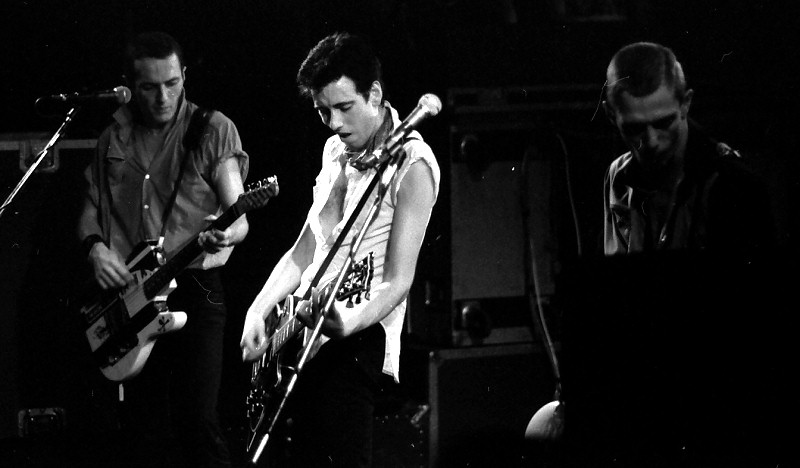

The Clash
View on Wikipedia
The Clash were an English rock band formed in London in 1976. Billed as "The Only Band That Matters", they are considered one of the most influential acts in the original wave of British punk rock, with their music fusing elements of reggae, dub, funk, ska and rockabilly. The band also contributed to the post-punk and new wave movements that followed. For most of their recording career, the Clash consisted of lead vocalist and rhythm guitarist Joe Strummer, lead guitarist and vocalist Mick Jones, bassist Paul Simonon and drummer Nicky "Topper" Headon.
Key Information

.jpg)
The Clash achieved critical and commercial success in the United Kingdom with the release of their debut album The Clash (1977) and their second album Give 'Em Enough Rope (1978). Their third album London Calling, which was released in the UK in December 1979, earned them popularity in the United States, where it was released the following month. A decade later, Rolling Stone named London Calling the best album of the 1980s. Following continued musical experimentation on their fourth album Sandinista! (1980), the band achieved further commercial success with the release of Combat Rock (1982), which includes the US top-10 hit "Rock the Casbah", helping the album to achieve a 2× platinum certification there.
In 1982, Headon left the band due to internal friction surrounding his increasing heroin addiction, and Jones departed the following year. With a new lineup, the band released their final album Cut the Crap in 1985 before disbanding a few weeks later.[1]
In January 2003, shortly after the death of Joe Strummer, the band, including original drummer Terry Chimes, were inducted into the Rock and Roll Hall of Fame. In 2004, Rolling Stone ranked the Clash number 28 on its list of the "100 Greatest Artists of All Time".[2]
History
[edit]Origins: 1974–1976
[edit]Before the Clash's founding, the band's future members were active in different parts of the London music scene. Joe Strummer, whose real name was John Graham Mellor, sang and played rhythm guitar in the pub rock band The 101ers, which he had formed in 1974 with Álvaro Peña-Rojas.[3] Mellor later abandoned his original stage name "Woody" Mellor in favour of "Joe Strummer", a reference to his rudimentary strumming skills on the ukulele while he was a busker in the London Underground.
Mick Jones played guitar in protopunk band London SS[3] and rehearsed for much of 1975, but never played a live show and recorded only one demo. London SS were managed by Bernard Rhodes, an associate of impresario Malcolm McLaren and a friend of the members of the Sex Pistols, whom McLaren managed. Jones and his bandmates became friendly with Sex Pistols members Glen Matlock and Steve Jones, who helped them as they auditioned potential new members.[4] Bassist Paul Simonon and drummer Terry Chimes auditioned for London SS but were rejected,[5] and Nicky Headon drummed with the band for a week then quit.[6][7]
After London SS broke up in early 1976, Rhodes continued as Jones' manager.[3] In February, Jones saw the Sex Pistols perform for the first time and commented: "You knew straight away that was it, and this was what it was going to be like from now on. It was a new scene, new values—so different from what had happened before. A bit dangerous."[8] In March of that year, at the instigation of Rhodes, Jones contacted Simonon and suggested he learn an instrument so he could join the new band Jones was organising.[5] Soon Jones, Simonon on bass, Keith Levene on guitar and "whoever we could find really to play the drums" were rehearsing.[9] Chimes was asked to audition for the new band and was accepted but quit soon after.[10]
The band were still searching for a lead singer. According to Chimes, Billy Watts, who "seemed to be, like, nineteen or eighteen then, as we all were", handled the duties for a time.[11] Rhodes was watching Strummer, with whom he made exploratory contact; both Jones and Levene had seen Strummer perform and were impressed.[12] In April, Strummer saw the Sex Pistols open for one of his band's gigs. Strummer later said:
I knew something was up, so I went out in the crowd which was fairly sparse. And I saw the future—with a snotty handkerchief—right in front of me. It was immediately clear. Pub rock was, "Hello, you bunch of drunks, I'm gonna play these boogies and I hope you like them." The Pistols came out that Tuesday evening and their attitude was, "Here's our tunes, and we couldn't give a flying fuck whether you like them or not. In fact, we're gonna play them even if you fucking hate them."[13]
On 30 May, Rhodes and Levene approached Strummer after a 101ers gig and invited him to meet up at the band's rehearsal location on Davis Road. After Strummer turned up, Levene played "Keys to Your Heart", one of Strummer's own tunes.[14] Rhodes gave Strummer 48 hours to decide whether to join the new band that would "rival the Pistols".[15] Within 24 hours, he agreed.[a] Simonon later said: "Once we had Joe on board it all started to come together".[9] Strummer introduced the band to his school friend Pablo LaBritain, who sat in on drums during Strummer's first few rehearsals with the band. LaBritain left the band shortly after and joined 999. Terry Chimes, whom Jones later referred to as "one of the best drummers" in their circle, became the band's regular drummer.[16]
In Westway to the World, Jones said: "I don't think Terry was officially hired or anything. He had just been playing with us."[b] Chimes did not like Strummer at first, saying: "He was like twenty-two or twenty-three or something that seemed 'old' to me then. And he had these retro clothes and this croaky voice."[11] Simonon thought of the band's name; they had briefly named themselves the Weak Heartdrops and the Psychotic Negatives.[17][18] According to Simonon: "It really came to my head when I started reading the newspapers and a word that kept recurring was the word 'clash', so I thought 'the Clash, what about that' to the others. And they and Bernard, they went for it."[17]
Early gigs and the growing scene: 1976
[edit]After rehearsing with Strummer for less than a month, the Clash made their debut performance on 4 July 1976, supporting the Sex Pistols at the Black Swan nightclub in Sheffield.[3] The Clash wanted to appear on stage before their rivals the Damned, another London SS spinoff, made their own scheduled debut two days later. The Clash did not play in front of another audience for five weeks.[19][20] Levene was becoming disaffected with his position in the group. At the Black Swan, he approached the Sex Pistols' lead singer John Lydon, whose stage name was Johnny Rotten, and suggested they form a band together if the Pistols broke up.[21]
Hours after their debut, the Clash, most of the Sex Pistols and much of London's "inner circle" of punks attended a performance by New York City's leading punk rock band the Ramones at Dingwalls; according to Strummer: "It can't be stressed how great the first Ramones album was to the scene ... It was the first word of Punk, a fantastic record".[22] Afterwards "came the first example of the rivalry-induced squabbling that was to dog the punk scene and undermine any attempts to promote a spirit of unity among the bands involved".[23] Simonon fought with J.J. Burnel, the bass player of the Stranglers, a slightly older band who were publicly identified with the punk scene but were not part of the "inner circle", which centered on the Sex Pistols.[23]
Rhodes insisted the Clash should not perform live again until they were much tighter so they intensely rehearsed the following month. According to Strummer, the band devoted themselves to creating a distinct identity, saying:
The day I joined The Clash was very much back to square one, year zero. Part of Punk was that you had to shed all of what you knew before. We were almost Stalinist in the way that you had to shed all your friends, or everything that you'd known, or every way that you'd played before.[22][24]
Strummer and Jones shared most of the writing duties; according to Jones: "Joe would give me the words and I would make a song out of them".[25] The band sometimes met in the office over their Camden Town rehearsal studio.[23] According to Strummer: "Bernie [Rhodes] would say, 'An issue, an issue. Don't write about love, write about what's affecting you, what's important."[26] Jones later said: "Bernie had a hand in everything. Not the lyrics—he didn't help with the lyrics. He didn't tell us not to write love songs, as the myth goes—that's kind of simplified version of it. He told us to write what we knew about".[27]
Strummer performed lead vocals on the majority of songs but he and Jones sometimes shared the lead. Once the band began recording, Jones rarely had a solo lead on more than one song per album, though he was responsible for two of the group's biggest hits. On 13 August 1976, the Clash, wearing paint-spattered "Jackson Pollock" outfits, played in their Camden studio before a small, invitation-only audience,[28] which included Sounds magazine critic Giovanni Dadamo, whose review described the band as a "runaway train ... so powerful, they're the first new group to come along who can really scare the Sex Pistols shitless".[29]
On 29 August, the Clash and Manchester's Buzzcocks opened for the Sex Pistols at The Screen on the Green; it was the Clash's first public performance since 4 July.[3] The triple-bill show is seen as pivotal to the consolidation of the British punk scene into a movement;[30] New Musical Express reviewer Charles Shaar Murray wrote: "The Clash are the sort of garage band that should be speedily returned to the garage, preferably with the motor still running".[31] Strummer later credited Murray's comments with inspiring the Clash's song "Garageland".[32]
In early September, Levene and the band parted ways. According to Strummer, Levene's dwindling interest in the band was due to his use of speed, a point Levene denied.[33][34] On 21 September 1976, the Clash performed publicly for the first time without Levene at the 100 Club Punk Special, sharing the bill with the Sex Pistols, Siouxsie and the Banshees and Subway Sect.[35][36][37] Chimes left in late November; he was briefly replaced by Rob Harper as the Clash toured in support of the Sex Pistols during December's Anarchy Tour.[38]
The Clash promoted a left-wing message in their songs and interviews and sang about social problems, such as career opportunities, unemployment and the need for a backlash against racism and oppression. Joe Strummer said in 1976: "We're anti-fascist, we're anti-violence, we're anti-racist and we're pro-creative".[39] Strummer also said: "I don't believe in all that anarchy bollocks!"[40][41] According to the Clash guitarist Mick Jones: "The important thing is to encourage people to do things for themselves, think for themselves and stand up for what their rights are".[40][41]
A confrontation between Black youth and police at the 1976 Notting Hill Carnival was important in the development of the Clash's political stance and inspired Joe Strummer to write "White Riot". Images of the riots were used as The Clash's stage backdrop and as the back cover of their first album, and was reprinted on badges and Clash t-shirts.[42]
Punk breakthrough and UK fame: 1977–1979
[edit]
By January 1977, punk had become a major media phenomenon in the UK; according to New Musical Express (NME): "1977 is the year of The Clash".[43] On 25 January, the band signed to CBS Records for £100,000, a remarkable amount for a band who had played about thirty gigs and very few headlining shows.[44] Clash historian Marcus Gray said: "the band members found themselves having to justify [the deal] to both the music press and to fans who picked up on the critics' muttered asides about the Clash having 'sold out' to the establishment".[45] Mark Perry, founder of the leading London punk periodical Sniffin' Glue wrote: "Punk died the day the Clash signed to CBS",[46] but recanted when he first heard the single "White Riot", saying: "They're the most important group in the world at the moment. I believe in them completely. All I said about them is crap."[47] According to one of the band's associates[who?] the deal "was later used as a classic example of the kind of contract that no group should ever sign—the group had to pay for their own tours, recordings, remixes, artwork, expenses ..."[48] According to Strummer in March 1977:
Signing that contract did bother me a lot. I've been turning it over in my mind, but now I've come to terms with it. I've realised that all it boils down to is perhaps two-year's security ... Before, all I could think about was my stomach ... Now I feel free to think—and free to write down what I'm thinking about ... And look—I've been fucked about for so long I'm not going to suddenly turn into Rod Stewart just because I get £25.00 a week. I'm much too far gone for that, I tell you.[49]
Mickey Foote, who worked as a technician at the band's concerts, was hired to produce their debut album, and Terry Chimes was drafted back for the recording. The band's first single "White Riot" was released in March and peaked at number 34 in the UK Singles Chart. The album The Clash was released the following month and peaked at number 12 on the UK Albums Chart;[3] with lyrics criticising the ruling establishment, bosses and the police and addressing themes such as alienation and boredom.[50][51]
The Clash presaged the band's future works with their cover of the reggae song "Police and Thieves". The band had been influenced by the subject matter, slogans and lyrics of reggae, which they often played in rehearsals but recording "Police and Thieves" was an important step that was only taken after a lot of discussion within the group.[52][53]
According to music journalist and former punk musician John Robb: "Amidst the Sex Pistols' inertia in the first half of 1977, the Clash found themselves as the flag-wavers of the punk rock consciousness".[54] Though The Clash quickly rose to number 12 in the UK, CBS refused to give it a US release, believing that its raw, barely produced sound would make it unmarketable there.[55] A North American version of the album with a modified track listing was released in the US in 1979 after the UK release had become the US's best-selling import album of the year.[56]
Chimes, whose career aspirations owed little to the punk ethos, left the band again soon after the recording sessions. He later said: "The point was I wanted one kind of life and they wanted another and, like, why are we working together, if we want completely different things?"[57] As a result, only Simonon, Jones and Strummer are featured on the album's cover, and Chimes was credited as "Tory Crimes". Strummer later said: "We must have tried every drummer that then had a kit. I mean every drummer in London. I think we counted 205. And that's why we were lost until we found Topper Headon."[58] Simonon nicknamed Headon, who had briefly played with Jones's band London SS, "Topper" because he felt Headon resembled Mickey the Monkey, a character in the comic Topper.[59] Headon could also play piano, bass and guitar. The day after he signed to the band, Headon said: "I really wanted to join the Clash. I want to give them even more energy than they've got—if that's possible";[49] in an interview over twenty years later, he said his original plan was to stay briefly, gain a name for himself and then move on to a better gig.[60] Strummer later said: "Finding someone who not only had the chops, but the strength and the stamina to do it was just the breakthrough for us".[61]
In May, the Clash set out on the White Riot Tour, headlining a punk package that included Buzzcocks, the Jam, Subway Sect, the Slits and the Prefects.[62] The day after a Newcastle gig, Strummer and Headon were arrested for stealing pillowcases from their hotel room.[63] The highlight of the tour was the Rainbow Theatre in London on 9 May; it was the first time The Clash had played a major music venue. The audience began ripping up seats and the gig turned into a riot.[3] The Sun reported the violence with the front-page headline "Punk Wreck".[64] New Musical Express, while expressing serious concerns over the violence, said: "The Clash are probably the best band in the country right now".[65] Strummer commented: "That was the night punk broke ... we were in the right place doing the right thing at the right time".[66]
That same month, CBS released "Remote Control" as The Clash's second single, defying the wishes of the band, who saw it as one of the album's weakest tracks.[67] Headon's first recording with the band was the single "Complete Control", which addresses the band's anger at their record label's behaviour. It was co-produced by reggae artist Lee "Scratch" Perry,[3] though Foote was summoned to "ground things". The single was released in September 1977 and NME commented that CBS had allowed the group to "bait their masters". The single peaked at number 28 on the UK chart and has been cited as one of punk's greatest singles.[68][69]
.jpg)
In October 1977, the Clash set out on the "Out of Control" UK tour. The tour was due to open at the Ulster Hall, Belfast but the insurance was pulled and the gig was cancelled at the last moment. This led to punks blocking the road outside the venue and a confrontation between the punks and the police, which became known as the "Battle of Bedford Street".[70][71][72]
In February 1978, the Clash released the single "Clash City Rockers";[3] and played the song live, along with "Tommy Gun", on BBC television's youth show Something Else.[73] On 30 April, the Clash played at Rock Against Racism in Victoria Park, London. Late 1970s England had seen an increase in racist attacks and a growth in support for the far-right political party The National Front. Also on the bill were X-Ray Spex, Steel Pulse, Misty in Roots and headliners Tom Robinson Band; they played to 100,000 people, who marched through London and attended the RAR Carnival.[74][75][76]
In June, the band released "(White Man) In Hammersmith Palais" as a single, which peaked at number 32 in the UK Singles chart;[3] it quickly became a favourite with Clash fans and was voted single of the year in the 1978 NME Readers' Poll.[77][78]
Before the Clash began recording their second album, CBS requested they adopt a cleaner sound than its predecessor to reach American audiences. Sandy Pearlman, who is known for his work with Blue Öyster Cult, was hired to produce the record. Simonon later said: "[R]ecording that album was just the most boring situation ever. It was just so nitpicking, such a contrast to the first album ... it ruined any spontaneity."[79] Strummer said: "it wasn't our easiest session".[80] The band dismissed their manager Bernie Rhodes and hired artist and journalist Caroline Coon to replace him.[3]
The album Give 'Em Enough Rope was released in early November 1978,[81][82] and received mixed reviews in the UK music press, where some reviewers complained about its relatively mainstream production style.[83][84][85] The album reached number 2 in the UK album chart.[86] NME readers voted Give 'Em Enough Rope the second-best album of 1978 and the Clash were voted the best group in the same end-of-year poll.[77] In the US, the album peaked at number 128 on the Billboard chart.[citation needed]
"Tommy Gun", the album's first UK single, peaked at number 19, the highest chart position for a Clash single to date.[86][3] To accompany the single, the band produced their first official music video, in which Joe Strummer wears an H Block T-shirt in support of the campaign for political status for Irish Republican prisoners.[87] The band embarked on a North American tour, culminating in a performance at the Palladium in New York City.[3]
"English Civil War", which warned against the rise of the far-right in the UK, was released as the album's second single in February 1979, reaching number 25 in the UK Singles Chart.[86] The B-side is a cover of the Toots and the Maytals' song "Pressure Drop", once again illustrating the group's reggae influences.[88]
In support of the album, the Clash toured the UK supported by the Slits and the Innocents. The tour, which consisted of more than thirty shows, was promoted as the Sort It Out Tour. The band later undertook their first, largely successful tour of North America in February 1979.[89]
In June 1979, the band released the extended play (EP) The Cost of Living,[3] which includes a cover of Bobby Fuller's song "I Fought the Law", two original songs and a re-recording of "Capital Radio".[90] The EP reached 22 in the UK charts and the band dismissed Coon as their manager.[3] They then embarked on a second tour of the US, adding Mick Gallagher on keyboards.[3]
Changing style and US breakthrough: 1979–1982
[edit]
In August and September 1979, the Clash recorded the double album London Calling, which Guy Stevens, a former A&R executive who had worked with Mott the Hoople and Traffic, produced.[3] The double album was a mix of punk rock, reggae, ska, rockabilly and traditional rock and roll.[91] It is regarded as one of the greatest rock albums ever recorded.[92][93] In the US, the single "Train in Vain" became their first top-40 hit, peaking at number 23 on the Billboard chart. In the UK, the title track was released as a single and peaked at number 11—the highest position any Clash single reached in the UK before the band's break-up.[3]
London Calling was released in December 1979; it peaked at number 9 on the British album chart and at number 27 in the United States, where it was issued in January 1980.[3] The album's cover photograph by Pennie Smith became one of the most-recognisable images[94] and Q magazine later cited it as the "best rock 'n roll photograph of all time".[95][96] During this period, The Clash began to be regularly billed as "The Only Band That Matters". Musician Gary Lucas, who was employed by CBS Records' creative services department, has said he coined the tagline.[97] Fans and journalists soon widely adopted the epithet.[98]
At the end of 1979, the band members attended a private screening of a new film called Rude Boy, which is part fiction and tells the story of a Clash fan who leaves his job in a Soho sex shop to become a roadie for the group. The movie, which was named after the rude boy subculture, includes footage of the band on tour, at a London Rock Against Racism concert and in the studio recording Give 'Em Enough Rope.[3] The band were disenchanted with the film so they had Better Badges make badges that said: "I don't want RUDE BOY Clash Film".[99] On 27 February 1980, the film premiered at the 30th Berlin International Film Festival,[100] where it won an honourable mention.[101]
The Clash had planned to record and release a single every month in 1980. CBS dismissed this idea and the band released only one single—an original reggae song called "Bankrobber", in August. It featured Mikey Dread and reached number 12 in the UK Singles Chart.[3] In October, the band's US record company released a B-side compilation EP called Black Market Clash, which was later re-released in expanded form as a full-length album.[3]
In December 1980, the Clash released the 36-song triple album Sandinista!, which again reflected a broad range of musical styles. It was produced by the band members with further participation of Mikey Dread. Sandinista! proved to be controversial, both politically and musically.[102] Critical opinions were divided; Trouser Press writer Ira Robbins described half of the album as "great" and the other half as "nonsense" and worse,[103] while New Rolling Stone Record Guide critic Dave Marsh said: "Sandinista! is nonsensically cluttered. Or rather seems nonsensically cluttered. One of the Clash's principal concerns ... is to avoid being stereotyped."[104] The album sold reasonably well in the US, where it charted at number 24.[105] In the UK, the album peaked at number 19 and the single "The Call Up" charted at number 40.[3] In January 1980, Rhodes was reinstated as the band's manager and the single "Hitsville UK" reached number 54 in the UK Singles Chart while "The Magnificent Seven" charted at number 34, and the band spent most of the year touring.[3]
In December 1981, the Clash released "This Is Radio Clash" as a single; it charted at number 47 in the UK Singles Chart.[3] In September 1981, the band began work on their fifth album Combat Rock, which Glyn Johns produced and was released in May 1982. In the UK, the first single "Know Your Rights" reached number 43.[3] The lead single in the US was "Should I Stay or Should I Go", which was released in June 1982 and received significant airplay on Album-oriented rock (AOR) stations. The follow-up single "Rock the Casbah" was composed by Headon, who performed the percussion, piano and bass on the track.[106] It became the band's biggest US hit, charting at number eight while the album reached number two in the UK and number seven in the US.[3]
Disintegration and break up: 1982–1986
[edit]
After the release of Combat Rock, the Clash began to disintegrate. In May 1982, Headon was asked to leave the band because his addiction caused reliability problems.[107][108] Chimes was brought back to drum for the next few months. The band opened for the Who on a leg of their final US tour that included a show at New York's Shea Stadium.[3]
Chimes left the band after the Combat Rock Tour and was replaced with Pete Howard in May 1983.[3] The Clash co-headlined the US Festival in San Bernardino, California, on 28 May in front of a crowd of 140,000.[3] After the show, members of the band brawled with security staff.[109] The festival was Jones' last appearance with the band; Strummer and Simonon dismissed him in September that year.[3] Nick Sheppard, formerly of the Bristol-based band the Cortinas, and Vince White were recruited as the Clash's new guitarists.[3] The band's new lineup played their first shows in January 1984 with a batch of new material and embarked on the self-financed Out of Control Tour, travelling widely over the winter and into early summer. The band also headlined a benefit show for striking miners.[3]
In November 1985, they released the album Cut the Crap; it includes the single "This Is England", which charted at number 24 in the UK Singles Chart.[3] Strummer later noted: "CBS had paid an advance for it so they had to put it out".[110] Dave Marsh later listed "This Is England" as one of the top 1001 rock singles of all time.[111] The album peaked at number 16 in the UK Albums Chart and at number 88 in the US.[3] Strummer largely disowned the album[108] but later said: "I really like 'This Is England' and [album track] 'North and South' is a vibe".[110]
In January 1986, it was announced that the Clash had disbanded.[3] Strummer later said: "When the Clash collapsed, we were tired. There had been a lot of intense activity in five years. Secondly, I felt we'd run out of idea gasoline. And thirdly, I wanted to shut up and let someone else have a go at it."[112]
Collaborations, reunions and Strummer's death: 1986–present
[edit]After his dismissal, Jones formed Big Audio Dynamite (B.A.D.), who released their debut album This Is Big Audio Dynamite late in 1985. Jones and Strummer worked together on their respective 1986 projects; Jones helped with the two songs Strummer wrote and performed for the soundtrack to the film Sid and Nancy (1986), and Strummer co-wrote a number of the tracks for the second B.A.D. album No. 10, Upping St., which he also co-produced.[110] With Jones committed to B.A.D., Strummer moved on to solo projects and screen acting. Simonon formed a band called Havana 3am. Headon recorded a solo album Waking Up but was imprisoned in 1987 for drug-related offences.[3]
In 1988, the compilation album The Story of the Clash, Volume 1 was released and the single "I Fought The Law" was reissued and reached number 29 in the UK Singles Chart.[3] On 2 March 1991, a reissue of "Should I Stay or Should I Go" gave the Clash their first and only number-one UK single.[3] The same year, "Rock the Casbah" featured on a broadcast of Armed Forces Radio during the Gulf War.[113][3]
In 1999, Strummer, Jones and Simonon cooperated in compiling the live album From Here to Eternity and the video documentary Westway to the World. On 7 November 2002, the Rock and Roll Hall of Fame announced the Clash would be inducted the following March.[114] On 15 November, Jones and Strummer shared the stage, performing three Clash songs during a London benefit show by Joe Strummer and the Mescaleros.[105] Strummer, Jones and Headon wanted to play a reunion show to coincide with their induction into the Hall of Fame; Simonon did not want to participate because he believed playing at the high-priced event would not have been in the spirit of the Clash.[citation needed]
Strummer died from a congenital heart defect on 22 December 2002, ending any possibility of a full reunion. In March 2003, Strummer, Jones, Simonon, Chimes and Headon were inducted into the Hall of Fame.[105]
In early 2008, Carbon/Silicon, a new band founded by Mick Jones and his former London SS bandmate Tony James, entered into a six-week residency at London's Inn on the Green. On opening night, 11 January, Headon joined the band for the Clash's song "Train in Vain". An encore followed with Headon playing drums on "Should I Stay or Should I Go". This was the first time since 1982 that Headon and Jones had performed together on stage.[115]

In September 2009, Jones and Headon reunited to re-record the 1970s Clash B-side "Jail Guitar Doors" with Billy Bragg, who founded an eponymous charity that gives musical instruments and lessons to prison inmates.[116] Simonon and Jones are featured on the title track of the Gorillaz album Plastic Beach (2010), marking the first time they had worked together in over twenty years. They later joined the Gorillaz live band for their 2010 live dates, including the Escape to Plastic Beach Tour.[117]
In July 2012, Strummer's daughters Jazz and Lola gave a rare interview to discuss the tenth anniversary of Strummer's death, his legacy and the possibility of a Clash reunion had their father lived. Jazz said:
There was talk about the Clash reforming before he died. But there had been talk for years and years about them reforming. They had been offered stupid amounts of money to do it, but they were very good at keeping the moral high ground and saying no. But I think if Dad hadn't died, it would have happened. It felt like it was in the air.[118][relevant?]
In the UK on 9 September 2013, and a day later in the US, the Clash released a 12-disc box set called Sound System, which includes their re-mastered studio albums on eight discs and three discs featuring demos, non-album singles, rarities and B-sides; a DVD with previously unseen footage by Don Letts and Julien Temple and other film footage; and merchandising ephemera, including an exclusive the Clash poster. Mick Jones and Paul Simonon oversaw the project, including the re-masters. The box set was accompanied by 5 Album Studio Set, which contains the first five studio albums (excluding Cut the Crap) and The Clash Hits Back, a 33-track, two-CD best-of collection.[119][120]
In a 3 September 2013 interview with Rolling Stone, Mick Jones discussed the band reuniting, saying it likely would not have occurred. Jones said:
There were a few moments at the time I was up for it (Hall of Fame reunion in 2003), Joe was up for it. Paul wasn't. And neither, probably, was Topper, who didn't wind up even coming in the end. It didn't look like a performance was going to happen anyway. I mean, you usually play at that ceremony when you get in. Joe had passed by that point, so we didn't. We were never in agreement. It was never at a point where all of us wanted to do it at the same time. Most importantly for us, we became friends again after the group broke up, and continued that way for the rest of the time. That was more important to us than the band.[121]
Jones also stated the Sound System box set was the last time he would be involved in the band's releases: "I'm not even thinking about any more Clash releases. This is it for me, and I say that with an exclamation mark".[121]
On 6 September 2013, Mick Jones, Paul Simonon and Topper Headon reunited for an exclusive BBC Radio 6 Music show to promote their legacy and the release of Sound System.[122]
In an October 2013 interview with BBC 6 Music, Jones said Strummer did have intentions of a Clash reunion and that new music was being written for a possible album. In the months before Strummer's death, Jones and Strummer began working on new music for what he thought would be the next Mescaleros album. Jones said:
We wrote a batch – we didn't used to write one, we used to write a batch at a time – like gumbo. The idea was he was going to go into the studio with the Mescaleros during the day and then send them all home. I'd come in all night and we'd all work all night.
According to Jones, months after their work together, he ran into Strummer at an event; Strummer informed him the songs were going to be used for the next Clash album.[123]
On 6 April 2022, the Clash announced the re-release of Combat Rock, including demos with Ranking Roger's vocals, titled 'Combat Rock / The People's Hall'. "Rock the Casbah (Ranking Roger)" and "Red Angel Dragnet (Ranking Roger)" were released as supporting singles. The re-release occurred on 20 May 2022 to mixed reviews.[124]
On 11 November 2022, a month before the 20th anniversary of Strummer's death, founding member Keith Levene died in Norfolk, England.[125]
Politics
[edit]The Clash's music often expresses left-wing ideological sentiments.[126] Strummer was a committed socialist. They are credited with pioneering the advocacy of radical politics in punk rock; NME dubbed them "Thinking Man's Yobs".[127] Like many early punk bands, the Clash protested against monarchy and aristocracy but unlike many of their peers, they rejected nihilism.[56] Instead, they found solidarity with a number of liberation movements and were involved with groups such as the Anti-Nazi League. At their performance on 30 April 1978 at the Rock Against Racism concert in London's Victoria Park for a crowd of between 50,000 and 100,000 people,[128] Strummer wore a T-shirt identifying two far-left armed militant groups: Italy's Red Brigades (Brigate Rosse, misspelt as Brigade Rosse on the T-shirt) and West Germany's Red Army Faction.[129][130]
According to rock historian Mikal Gilmore:
The moment that best exemplifies the Clash ... took place in August 1977, at a music festival in Liege, Belgium. The band was playing before 20,000 people and had been under fire from a crowd that was throwing bottles at the stage. But that wasn't what bothered lead singer Joe Strummer. What enraged him was a 10-foot-high barbed-wire fence strung between concrete posts and forming a barrier between the group and the audience ... [He] jumped from the stage and attacked the fence, trying to pull it down ... The Clash were the only performers at the show who tried to do anything about the obstacle. They were more willing to run the risk of the crowd than to tolerate barbed wire that was meant to fend off that crowd. This is more or less what the Clash were about: fighting the good fight that few others would fight.[7]
The band made their politics explicit in the lyrics of early recordings including "White Riot", which encourages disaffected white youths to riot like their black counterparts; "Career Opportunities", which addressed the alienation of low-paid, routine jobs and discontent over the lack of alternatives; and "London's Burning" is about the bleakness and boredom of life in the inner city.[131] Caroline Coon, who was associated with the punk scene, said: "[t]hose tough, militaristic songs were what we needed as we went into Thatcherism".[132]
The title of Sandinista! refers to the Sandinista National Liberation Front, a group of left-wing rebels who had recently overthrown Nicaraguan President Anastasio Somoza Debayle; the album includes songs that were inspired by other political issues; "Washington Bullets" addresses covert military operations around the globe and "The Call-Up" is a meditation on US draft policies.[133][134] Scholars Simon Reynolds and Joy Press described Combat Rock's track "Straight to Hell" as an "around-the-world-at-war-in-five-verses guided tour of hell-zones where boy-soldiers had languished".[134]
The band's political sentiments are reflected in their resistance to the music industry's profit motivations; even at their peak, tickets to shows and souvenirs were reasonably priced.[56] The group insisted CBS sell their double and triple albums London Calling and Sandinista! for the price of a single album (then £5), succeeding with the former and compromising with the latter by agreeing to sell it for £5.99 and forfeit their performance royalties on the first 200,000 sales.[135] These "value for money" (VFM) principles meant they were constantly in debt to CBS and only started to break even around 1982.[1]
Musical style and influences
[edit]The Clash are mainly described as a punk rock band.[136][137][138] According to Stephen Thomas Erlewine of AllMusic, "Sex Pistols may have been the first British punk rock band, but the Clash were the definitive British punk rockers".[137] Later in their career, the Clash used elements of a variety of musical genres, including reggae, rockabilly, dub and R&B.[137] With their double album London Calling, the band expanded the breadth of their musical styles.[139] Consequently, the band's music has also been described as experimental rock[140][141] and new wave.[142] Since their beginnings, the band has covered and composed songs in the reggae genre, and incorporated lovers' rock into London Calling.[143]
Legacy and influence
[edit]In 2004, Rolling Stone ranked the Clash number 28 on its list of the 100 Greatest Artists of All Time,[144] and in 2010, the band was ranked 22nd on VH1's 100 Greatest Artists of All Time.[145] According to The Times, the Clash's debut, alongside Never Mind the Bollocks, Here's the Sex Pistols, is "punk's definitive statement" and London Calling "remains one of the most influential rock albums".[130] London Calling was ranked eighth In Rolling Stone's 2003 list of the 500 greatest albums of all time, which is the highest entry by a punk band; in the same list, The Clash was ranked 77th and Sandinista! was ranked 404th.[146] In the magazine's 2004 list of the 500 Greatest Songs of All Time, "London Calling" was ranked number 15, again the highest entry for any song by a punk band. Four other Clash songs made the list: "Should I Stay Or Should I Go" (228), "Train in Vain" (292), "Complete Control" (361) and "(White Man) in Hammersmith Palais" (430).[69] "London Calling" ranked number 48 in the magazine's 2008 list of the 100 Greatest Guitar Songs of All Time.[147] In 2010, the cover art of London Calling was one of ten albums by British music acts whose albums were commemorated on a UK postage stamp issued by Royal Mail.[148][149]
Jake Burns of Stiff Little Fingers, the first major punk band from Northern Ireland, said of their debut album's impact:
[T]he big watershed was the Clash album—that was go out, cut your hair, stop mucking about time, y'know. Up to that point we'd still been singing about bowling down California highways. I mean, it meant nothing to me. Although the Damned and the Pistols were great, they were only exciting musically; lyrically, I couldn't really make out a lot of it ... [T]o realise that [The Clash] were actually singing about their own lives in West London was like a bolt out of the blue.[150]
The Clash inspired many musicians who were only loosely associated, if at all, with punk. The band's embrace of ska and reggae and England's Jamaican subculture helped provide impetus for the 2 Tone movement that emerged after the punk explosion.[151] Other musicians who began performing while the Clash were active and acknowledged their debt to the band include Billy Bragg and Aztec Camera.[152] U2's the Edge has compared the Clash's inspirational effect to that of the Ramones, both of which gave young rock musicians a "sense that the door of possibility had swung open".[153] He wrote: "The Clash, more than any other group, kick-started a thousand garage bands across Ireland and the UK ... [S]eeing them perform was a life-changing experience".[2] Bono described the Clash as "the greatest rock band. They wrote the rule book for U2."[154]
While Sex Pistols' June and July 1976 debut gig at Manchester's Lesser Free Trade Hall has been acknowledged as the starting point of that city's punk scene, the Clash's first performance at Eric's, where they were supported by the Specials, had a similar effect in Liverpool. The gig was witnessed by Jayne Casey, Julian Cope, Pete Wylie, Pete Burns, Bill Drummond, Holly Johnson, Will Sergeant, Budgie and Ian McCulloch.[155] Jon Langford of the Mekons said:
You can't overestimate how important The Clash were back in 1977. We loved the Pistols' self-aware nihilism, but we didn't want to be the Pistols, and if The Clash were cartoon-heroic and occasionally a bit silly we still loved them and recognised the risks they were taking.[156]
The Clash's influence can be heard in the works of American political punk bands such as the Offspring, Rancid, Anti-Flag, Bad Religion, NOFX, Green Day and Rise Against, and in the political hard rock of early Manic Street Preachers.[157][158] California band Rancid are known as "incurable Clash zealots".[159] The title track of Rancid's album Indestructible says: "I'll keep listening to that great Joe Strummer!"[160] Outside rock music, Chuck D has credited the Clash as an inspiration for Public Enemy, in particular for their use of socially and politically conscious lyrics, which gained them attention from the music press: "They talked about important subjects, so therefore journalists printed what they said, which was very pointed ... We took that from the Clash, because we were very similar in that regard. Public Enemy just did it 10 years later".[161] In 2019, Chuck D narrated Stay Free: The Story of The Clash, an eight-part podcast series produced by Spotify and BBC Studios.[161]
According to biographer Antonio Ambrosio, the Clash's involvement with Jamaican musical and production styles inspired similar cross-cultural efforts by bands such as Bad Brains, Massive Attack, 311, Sublime and No Doubt.[162] Jakob Dylan of the Wallflowers lists London Calling as the record that "changed his life".[130] Bands identified with the garage rock revival of the late 1990s and 2000s such as Sweden's the Hives, Australia's the Vines, Britain's the Libertines and America's the White Stripes and the Strokes, show the Clash's influence.[163] Among the many late-20th-century British acts identified as having been inspired by the Clash are Babyshambles, the Futureheads, the Charlatans and Arctic Monkeys.[164]
Use in film and television
[edit]The band's 1982 hit "Should I Stay or Should I Go" appears in multiple episodes of the 2016 Netflix science-fiction drama series Stranger Things, which is set in 1983.[165][166][167] London Town, a film that tells the story of a Clash-obsessed teenager who in 1979 meets Joe Strummer by chance and finds his life changing as a result, was released in 2016.[168]
Notable covers of the Clash songs
[edit]Before M.I.A. had an international hit in 2008 with "Paper Planes", which is built around a sample from "Straight to Hell", she referenced "London Calling" on 2003's "Galang".[164] A cover of "The Guns of Brixton" by German punk band Die Toten Hosen was released as a single in 2006.[169] A version by reggae singer Jimmy Cliff with Tim Armstrong from Rancid was scheduled for release in November 2011.[170] American-Irish punk band Dropkick Murphys released a cover of "The Guns of Brixton" on Anti Heroes vs Dropkick Murphys (1997).[171]
In June 2009, Bruce Springsteen & the E Street Band opened their concert in Hyde Park, London, with "London Calling".[172] The concert was later released on DVD as London Calling: Live in Hyde Park. Bruce Springsteen, Little Steven, Dave Grohl and Elvis Costello performed the same song at the 2003 Grammys as a tribute to Joe Strummer, who died the year before.[173] In 2009, Springsteen & the E Street Band covered Strummer's song "Coma Girl" and in 2014, along with Tom Morello, they opened some of their shows on the High Hopes Tour with "Clampdown".[174][175] Ben Folds covered "Lost in the Supermarket" for the soundtrack to the 2006 animated film Over the Hedge.
The band has also had a notable impact on music in the Spanish-speaking world. In 1997, a Clash tribute album featuring performances by Buenos Aires punk bands was released.[176] Many rock en español bands such as Todos Tus Muertos, Café Tacuba, Maldita Vecindad, Los Prisioneros, Tijuana No and Attaque 77 are indebted to the Clash.[177][178][179] Argentina's Los Fabulosos Cadillacs covered "Should I Stay or Should I Go", London Calling's "Revolution Rock" and "The Guns of Brixton", and invited Mick Jones to sing on their song "Mal Bicho".[179] The Clash's influence is similarly reflected in Paris-founded band Mano Negra's politicised lyrics and fusion of musical styles.[180][181]
In March 2022, following Russia's invasion of Ukraine, surviving members of the Clash gave permission to Ukrainian punk band Beton to rewrite the lyrics of London Calling. The song was mixed in Los Angeles by music producer Danny Saber and proceeds from its sales were designated to help fund war efforts.[182]
Band members
[edit]Classic lineup (1977–1982)[183]
- Joe Strummer – lead and backing vocals, rhythm guitar (1976–1986; died 2002)
- Mick Jones – lead guitar, lead and backing vocals (1976–1983)
- Paul Simonon – bass guitar, backing and lead vocals (1976–1986)
- Nicky "Topper" Headon – drums, percussion (1977–1982)
Discography
[edit]- The Clash (1977)
- Give 'Em Enough Rope (1978)
- London Calling (1979)
- Sandinista! (1980)
- Combat Rock (1982)
- Cut the Crap (1985)
See also
[edit]- Album era
- The Clash on film
- John Richards, KEXP radio personality, created International Clash Day on 7 February 2013.
Footnotes
[edit]- ^ According to the band (2005), "Bernie phoned him a day ahead of schedule, and demanded an answer there and then" (p. 127). In Westway to the World, Jones confirms the 48-hour deadline, while Strummer says it was he who made the call after just 24 (11:34–11:40). Jones elsewhere gave a different account, according to which Strummer was originally given 24 hours to decide, and Rhodes called after just eight (Robb 2006, p. 194).
- ^ According to Gray (2005), Rhodes asked Chimes to rejoin (pp. 133–34)
References
[edit]- ^ a b "Clash star Strummer dies" (STM). Entertainment. BBC News World Edition. 27 December 2002. Retrieved 20 November 2007.
- ^ a b "The Clash by The Edge". Rolling Stone Issue 946. 15 April 2004. Archived from the original on 7 December 2010. Retrieved 15 September 2017.
- ^ a b c d e f g h i j k l m n o p q r s t u v w x y z aa ab ac ad ae af ag ah ai aj ak al am an Crampton, Luke; Rees, Dafydd (1996). The Q Book of Punk Legends. Enfield, UK: Guinness Publishing Ltd. pp. 38–47.
- ^ Robb 2006, pp. 130–132.
- ^ a b Gray 2005, p. 72.
- ^ Gray 2005, p. 56.
- ^ a b Gilmore, Mikal (3 March 2011). "The Fury and the Power of the Clash". Rolling Stone. No. 1125. pp. 60–79.
- ^ Robb 2006, p. 151.
- ^ a b Rowley, Scott (October 1999). "Paul Simonon's first ever bass interview". Bassist Magazine (10). London.
- ^ Gray 2005, p. 79.
- ^ a b Strongman 2008, p. 103.
- ^ Robb 2006, pp. 192, 193.
- ^ "Interview". Record Collector. Joe Strummer Resource. 2000. Archived from the original on 5 October 2011. Retrieved 5 December 2008.
- ^ "keithleveneinterview – MUDKISS FANZINE". Mudkiss. Archived from the original on 23 January 2015. Retrieved 17 April 2014.
- ^ Jones, Allan (21 August 2015). "Joe Strummer and the 101ers remembered: "Even then, he had this charisma..."". UNCUT. Retrieved 3 January 2025.
- ^ Letts 2001, 17:16–17:22.
- ^ a b Presenter: Kurt Loder. "MTV Rockumentary". Londonsburning.org. London, England: MTV. Archived from the original on 3 March 2001. Retrieved 6 December 2007.
- ^ Topping 2004, p. 12.
- ^ Gray 2005, p. 143.
- ^ Loder, Kurt (13 March 2003). "The Clash: Ducking Bottles, Asking Questions". MTV News. Archived from the original on 15 March 2003. Retrieved 17 November 2007.
- ^ Robb 2006, p. 196.
- ^ a b Clash 2008, p. 61.
- ^ a b c Gray 2005, p. 144.
- ^ Letts 2001, 14:57–15:08.
- ^ Robb 2006, p. 326.
- ^ Savage 1992, p. 232.
- ^ Robb 2006, p. 197).
- ^ Robb 2006, pp. 195–197.
- ^ Strongman 2008, p. 133.
- ^ Robb 2006, pp. 212–215.
- ^ Salewicz 2006, p. 162.
- ^ Letts 2001, 24:23–24:43.
- ^ Robb 2006, pp. 215–216.
- ^ Savage 1992, p. 220.
- ^ Gray 2005, pp. 164–166.
- ^ Robb 2006, pp. 216–223.
- ^ "The Clash Sex Pistols 100 Club Festival". blackmarketclash.com. Archived from the original on 4 November 2007. Retrieved 27 November 2007.
- ^ "1976 – The Clash Live". blackmarketclash.com. Archived from the original on 26 October 2007. Retrieved 31 December 2007.
- ^ Miles (11 December 1976). "Eighteen Flight Rock And The Sound Of The Westway". New Musical Express.
- ^ a b Steve Walsh & Mark Perry (October 1976). "The Very Angry Clash". Sniffin' Glue.
- ^ a b Salewicz 2006, p. 176.
- ^ Needs 2005, p. 45.
- ^ Parsons, Tony (2 April 1977). "Sten Guns In Knightsbridge?". New Musical Express.
- ^ Gray 2005, p. 216.
- ^ Gray 2005, p. 217.
- ^ Gray 2005, p. 218.
- ^ Mark Perry, Sniffin' Glue, March 1977 edition, quoted in Needs 2005, p.69
- ^ Roadent, quoted in Strongman 2008, p. 199.
- ^ a b Coon 1977.
- ^ Needs 2005, pp. 69–71.
- ^ Gilbert 2005, p. 148.
- ^ Gilbert 2005, pp. 132–136.
- ^ Needs 2005, pp. 71–72.
- ^ Robb 2006, p. 325.
- ^ Gimarc 2005, p. 61.
- ^ a b c Henke, James (3 April 1980). "There'll Be Dancing In The Streets: The Clash". Rolling Stone. pp. 38–41.
- ^ Letts 2001, 18:09–18:16.
- ^ Letts 2001, 30:30–30:41.
- ^ Gray 2005, p. 244. Gray misspells the character's name as Micky.
- ^ Letts 2001, 38:07–38:11, 38:33–38:35.
- ^ Letts 2001, 38:35–38:44.
- ^ Robb 2006, pp. 329–339.
- ^ Robb 2006, p. 338.
- ^ Needs 2005, p. 80-83.
- ^ Spencer, Neil (21 May 1977). "Is This What We Ordered?". New Musical Express: 7.
- ^ Salewicz 2006, p. 199.
- ^ Strongman 2008, pp. 201–202.
- ^ Strongman 2008, pp. 203–204.
- ^ a b "The RS 500 Greatest Songs of All Time (2004)". Rolling Stone. 9 December 2004.
- ^ McCelland, Colin (29 October 1977). "Clash visit Belfast for picture session". New Musical Express: 9.
- ^ Birch, Ian (29 October 1977). "Clash Lose Control". Melody Maker: 30.
- ^ Bailie, Stuart (2018). Trouble Songs. Belfast: Bloomfield. pp. 95–106. ISBN 978-1-5272-2047-8.
- ^ "SELDOM SEEN: THE CLASH PERFORM 'CLASH CITY ROCKERS' ON TV FROM 1978". Dangerous Minds. 1 August 2011.
- ^ White Riot, retrieved 18 February 2022
- ^ Salewicz, Chris (6 May 1978). "Black And White Unite". New Musical Express.
- ^ Gilbert 2005, pp. 187–189.
- ^ a b "1978 NME Readers' Poll". New Musical Express. 20 January 1979.
- ^ "1978". NME. 28 February 1978.
- ^ Letts 2001, 42:43–42:56.
- ^ Ferraz 2001.
- ^ Gray 2005, p. 291–292.
- ^ Marcus, Greil (25 January 1979). "The Clash: Give 'Em Enough Rope". Rolling Stone. Archived from the original on 18 March 2008. Retrieved 29 March 2008.
- ^ Savage, Jon (11 November 1978). "War 'N' Pizza". Melody Maker.
- ^ Kent, Nick (11 November 1978). "White Punks On Rope". New Musical Express.
- ^ McCullough, Dave (11 November 1978). "The last gang in town". Sounds.
- ^ a b c "Official Chart History - The Clash". Official Charts UK.
- ^ "Tommy Gun" video, the Clash, The Essential Clash DVD.
- ^ English Civil War (7-inch Single liner notes). The Clash. CBS. 1979. CBS 7082.
{{cite AV media notes}}: CS1 maint: others in cite AV media (notes) (link) - ^ Kozak, Roman (3 March 1979). "Surprisingly Few Clashes Noted As the Clash Tours the Nation". Billboard: 103.
- ^ Needs 2005, p. 138.
- ^ Metzger, John (November 2004). "The Clash London Calling 25th Anniversary Legacy Edition". The Music Box. Retrieved 19 November 2007.
- ^ Erlewine, Stephen Thomas. "London Calling Review". allmusic.com. Retrieved 19 November 2007.
- ^ Theatre, The Capitol. "10 Times the Clash's "London Calling" Was Recognized as One of the Greatest Albums of All Time | The Capitol Theatre". www.thecapitoltheatre.com. Retrieved 20 October 2023.
- ^ Kerley, Paul (17 June 2010). "London Calling cover honoured". BBC/6 Music. Retrieved 17 June 2010.
- ^ Battersby, Matilda (16 June 2010). "London Calling: Tracey Emin and friends pay tribute to the Clash's 'official war artist'". The Independent. UK. Archived from the original on 19 June 2010. Retrieved 17 June 2010.
- ^ Gray 2005, p. 503.
- ^ Diehl, Matt (2007). My So-Called Punk (Macmillan), p. 187.
- ^ Norris, Chris (21 July 1997). "Cult Cash Clan". New York.
- ^ Gray 2005, p.334. For image of badge, see "The Clash Pins". WWWhatsup Online Pinstand. Retrieved 10 August 2011.
- ^ Gray 2005, p. 334.
- ^ "Prizes & Honours (1980)". Internationale Filmfestspiele Berlinprint. Archived from the original on 15 October 2013. Retrieved 11 August 2011.
- ^ Jaffee, Larry (1987). The Politics of Rock (Popular Music and Society), pp. 19–30.
- ^ "Clash". Trouser Press. Archived from the original on 23 December 2008. Retrieved 4 September 2008.
- ^ Marsh, Dave. "The Clash". In Dave Marsh and John Swenson, eds. (1983), The New Rolling Stone Record Guide (Random House/Rolling Stone Press), pp. 99–100.
- ^ a b c "The Clash". Induction. The Rock and Roll Hall of Fame and Museum. 10 March 2003. Archived from the original on 30 April 2010. Retrieved 19 November 2007.
- ^ Gray 2005, p. 380.
- ^ Letts 2001, 1:07:11–1:08:09, 1:08:59–1:09:54..
- ^ a b Cromelin, Richard (31 January 1988). "Strummer on Man, God, Law and the Clash". Los Angeles Times. Archived from the original on 20 October 2007. Retrieved 19 November 2007.
- ^ Gray 2005, p. 398.
- ^ a b c "Interview". Record Collector. Joe Strummer Resource. 2000. Archived from the original on 5 October 2011. Retrieved 5 December 2008.
- ^ Marsh, Dave (1989). The Heart of Rock & Soul: The 1001 Greatest Singles Ever Made (Penguin), pp. 77–80. ISBN 0-14-012108-0.
- ^ Johnstone 2006, p. 104.
- ^ "Revolution Rock: Documentary Pays Tribute to Clash Frontman Joe Strummer". Canadian Broadcasting Corporation. 1 February 2008. Archived from the original on 13 March 2008. Retrieved 13 April 2008.
- ^ Vineyard, Jennifer (7 November 2002). "AC/DC, Clash, Police To Be Inducted Into Rock Hall Of Fame". MTV. Archived from the original on 19 November 2002. Retrieved 2 September 2008.
- ^ "The Clash's Mick Jones and Topper Headon reunite after 25 years". NME. UK. 14 January 2005. Archived from the original on 21 January 2008. Retrieved 15 January 2005.
- ^ "Billy Bragg teams up with "Clash"-ers Mick Jones & Topper Headon for "Jail Guitar Doors"". Denver Thread. 21 September 2009. Archived from the original on 9 July 2011. Retrieved 25 May 2010.
- ^ "Gorillaz 'thrilled' to work with The Clash". Digital Spy. 24 February 2010. Retrieved 8 March 2010.
- ^ Lena Corner (28 July 2012). "Our dad, Joe Strummer, remembered | Life and style". The Guardian. London. Retrieved 1 September 2013.
- ^ Michael Hann (21 May 2013). "The Clash to release new box set of remastered albums and rarities | Music". theguardian.com. London. Retrieved 1 September 2013.
- ^ "Sound System: Music". Amazon. 25 May 2013. Retrieved 1 September 2013.
- ^ a b Andy Greene (30 August 2013). "Mick Jones on Clash Box Set | Music News". Rolling Stone. Archived from the original on 1 March 2014. Retrieved 17 April 2014.
- ^ "I Clash si riuniscono per una notte alla BBC Radio | Radiomusik musica e programmi radio live". Radiomusik.it. 19 August 2013. Retrieved 1 September 2013.
- ^ "The Clash – Mick Jones: 'Secret Joe Strummer Tunes Could Have Sparked The Clash's Comeback'". Contact Music. 4 October 2013. Retrieved 4 October 2013.
- ^ "The Clash announce special edition of 'Combat Rock' with 'The People's Hall'". NME. 6 April 2022. Retrieved 3 May 2022.
- ^ "Keith Levene, founding member of the Clash, dies at 65". the Guardian. 12 November 2022. Retrieved 17 November 2022.
- ^ "The Clash". MTV. Archived from the original on 15 February 2006. Retrieved 17 November 2007.
- ^ McCarthy, Jackie (22 December 1999). "White Riot". Seattle Weekly. Archived from the original on 11 December 2008. Retrieved 26 March 2008.
- ^ Gray 2005, pp. 277–278.
- ^ Hazan, Jack; David Mingay, Ray Gange, Joe Strummer, Mick Jones, Paul Simonon, Nicky Headon, Buzzy Enterprises, Epic Music Video (2006). Rude Boy (Documentary, Rockumentary). New York, United States: Epic Music Video. ISBN 0-7389-0082-6. OCLC 70850190.
- ^ a b c "Joe Strummer". The Times. UK. 24 December 2002. Archived from the original on 8 February 2007. Retrieved 29 August 2009.
- ^ Gray (2004), pp. 145–146, 158–159, 169–171.
- ^ Gilbert 2005, p. 190.
- ^ Gray (2004), pp. 355–356
- ^ a b Reynolds & Press 1996, p. 72.
- ^ Gray (2004), p. 349.
- ^ Bergeron, Ryan (6 August 2015). "Punk Shocks the World". CNN. Retrieved 22 October 2017.
- ^ a b c Erlewine, Stephen Thomas. "The Clash | Biography & History". AllMusic. Retrieved 22 October 2017.
- ^ Hull, Robert A. (28 September 1979). "Sound And Fury Of the Clash". The Washington Post. Retrieved 22 October 2017.
- ^ Kidel, Mark (1980). "Explorations of Heartache". New Statesman. Vol. 99. London. p. 225.
- ^ Rockwell, John (14 January 1979). "Experimental Rock. Vigorous in Britain". The New York Times. Retrieved 7 December 2017.
- ^ "You Say It's Your Birthday: The Clash's Paul Simonon". MTV. 12 December 1997. Archived from the original on 8 December 2017. Retrieved 7 December 2017.
- ^ Pareles, Jon (11 March 2003). "Clash, Costello and Police Enter Rock Hall of Fame". The New York Times. Retrieved 7 December 2017.
- ^ "The Clash: Still Calling Page 2". Stereophile.com. 6 December 2019. Retrieved 24 January 2020.
- ^ "100 Greatest Artists: The Clash | Rolling Stone Music | Lists". Rolling Stone. 3 December 2010. Retrieved 21 August 2011.
- ^ "VH1 Listed 100 Greatest Artists Of All Time". Today24News. Retrieved 19 March 2012.
- ^ "The 500 Greatest Albums of All Time". Rolling Stone. 18 November 2003. Archived from the original on 23 June 2008. Retrieved 23 May 2012.
- ^ "Rolling Stone's 100 Greatest Guitar Songs of All Time". Stereogum. 30 May 2008. Retrieved 23 May 2012.
- ^ "Royal Mail unveil classic album cover stamps". The Independent. Retrieved 23 September 2022.
- ^ "Royal Mail puts classic albums on to stamps". The Guardian. Retrieved 23 September 2022.
- ^ Strongman 2008, pp. 188–189.
- ^ D'Ambrosio 2004, p. 298.
- ^ Gray, Chris (24 December 2002). "Fans Mourn Passing of the Political Man of Punk". The Independent. UK. Archived from the original on 26 November 2010. Retrieved 28 August 2009.
- ^ Stockman, Steve (2005). Walk On: The Spiritual Journey of U2 (Relevant Media Group), p. 10. ISBN 0-9760357-5-8.
- ^ D'Ambrosio 2004, p. 262.
- ^ "The Clash play Eric's for the first time – 40 Years On". UK. Archived from the original on 6 June 2017. Retrieved 2 June 2017.
- ^ "The Clash's 30 best songs". Uncut. London. 13 March 2015. Retrieved 1 June 2023.
- ^ D'Ambrosio 2004, pp. 192, 251, 257, 298, 318–319.
- ^ "The Clash's Paul Simonon Reveals Why Band Never Reunited Before Joe Strummer's Passing: 'I Said I Don't Want to Do It'". Ultimate Guitar. 3 May 2023. Retrieved 9 June 2024.
- ^ Kot, Greg (4 September 2003). "Rancid: Indestructible". Rolling Stone. Archived from the original on 1 June 2008. Retrieved 28 August 2009.
- ^ Milner, Greg (25 September 2003). "Punk Survivors Keep Up the Fight". Spin. Archived from the original on 19 October 2012. Retrieved 28 August 2009.
- ^ a b Savage, Mark (21 May 2019). "Chuck D on why he loves The Clash". BBC News. Retrieved 22 May 2019.
- ^ D'Ambrosio 2004, p. 257.
- ^ D'Ambrosio 2004, pp. 262–263.
- ^ a b "best game ever clash of clans". theallishere.com. Retrieved 17 March 2019.[permanent dead link]
- ^ Gidick, Sarah (3 August 2016). "5 Things to Know About Winona Ryder's Stylish Comeback Show, 'Stranger Things'". The Hollywood Reporter. Los Angeles, California: Prometheus Global Media. Retrieved 22 August 2016.
- ^ Reed, Ryan (1 August 2016). "Hear 'Stranger Things'-Inspired Mixtape Featuring Smiths, Clash". Rolling Stone. New York City: Wenner Media, LLC. Archived from the original on 28 August 2016. Retrieved 22 August 2016.
- ^ Coates, Tyler (1 August 2016). "The Stranger Things Soundtrack Isn't As Eerie, But It's Still Gloriously '80s". Esquire. New York City: Hearst. Retrieved 22 August 2016.
- ^ "See Jonathan Rhys Meyers Play Joe Strummer in 'London Town' Trailer". Rolling Stone. Archived from the original on 16 September 2016. Retrieved 14 September 2016.
- ^ "Single—'The Guns Of Brixton (Unplugged)'". Die Toten Hosen. Archived from the original on 12 October 2011. Retrieved 2 September 2011.
- ^ Rachel, T. Cole (11 August 2011). "Progress Report: Jimmy Cliff". Stereogum. Retrieved 2 September 2011.
- ^ "Dropkick Murphys – The Guns Of Brixton (The Clash Cover)". NME. Archived from the original on 16 January 2014. Retrieved 25 June 2012.
- ^ "Bruce Springsteen & The E Street Band - London Calling - Live In Hyde Park, 2009". 13 January 2020. Retrieved 29 January 2026 – via YouTube.
- ^ "Bruce Springsteen, Elvis Costello, Dave Grohl - London Calling - Live Grammy Awards 2003". 19 December 2023. Retrieved 29 January 2026 – via YouTube.
- ^ "Bruce Springsteen- "Clampdown" (Sunrise, FL 04/29/14)". 24 April 2014. Retrieved 29 January 2026 – via YouTube.
- ^ "Bruce Springsteen - Clampdown (The Clash cover w/Tom Morello, Consol Energy, Pittsburgh - 4-22-14". 9 May 2014. Retrieved 29 January 2026 – via YouTube.
- ^ Lannert, John (29 March 1997), "Latin Notas: Manzanera to Attend Latin Confab", Billboard, p. 33.
- ^ Lannert, John (1 November 1997), "Latin Notas: IFPI Looks to Harmonize Sales Data", Billboard, p. 42; Linhardt, Alexander Lloyd (16 October 2003). "Album Review: Café Tacuba—Cuatro Camino". Pitchfork. Retrieved 28 August 2009. Birchmeier, Jason. "Café Tacuba—Biography". Allmusic. Retrieved 28 August 2009. Careaga, Roberto (17 January 2009). "Claudio Narea: El hombre que perdió todo por Los Prisioneros". La Tercera. Archived from the original on 13 July 2011. Retrieved 16 May 2010.
- ^ Campo 1998, p. 6.
- ^ a b Eddy 1997, p. 181.
- ^ Buckley 2003, p. 367.
- ^ Campo 1998, p. 5.
- ^ Thorpe, Vanessa (19 March 2022). "Kyiv calling: famous Clash anthem reborn as call to arms". The Guardian. Retrieved 21 March 2022.
- ^ "Biography". The Clash | Official Website. Retrieved 2 January 2023.
Sources
[edit]- Buckley, Peter, ed. (2003). The Rough Guide to Rock (3d ed.). London: Rough Guides. ISBN 1-84353-105-4. OCLC 223842562.
- Campo, Alberto (1998). Clash. Florence, Italy: Giunti Editore. ISBN 88-09-21509-5. OCLC 8809215095.
- Clash, The (2008). The Clash: Strummer, Jones, Simonon, Headon. London: Atlantic Books. ISBN 978-1-84354-788-4. OCLC 236120343.
- Coon, Caroline (1977). 1988: The New Wave Punk Rock Explosion. New York: Hawthorn. ISBN 0-8015-6129-9. OCLC 79262599. Archived from the original on 20 October 2011.
- D'Ambrosio, Antonino (2004). Let Fury Have the Hour: The Punk Rock Politics of Joe Strummer (1st ed.). New York: Nation Books. ISBN 1-56025-625-7. OCLC 56988650.
- Eddy, Chuck (1997). The Accidental Evolution of Rock'n'Roll: A Misguided Tour through Popular Music. New York: Da Capo Press. ISBN 0-306-80741-6. OCLC 35919230.
- Egan, Sean (2014). The Clash: The Only Band That Mattered. Maryland: Rowman & Littlefield. ISBN 978-0-8108-8875-3.
- Ferraz, Rob (August 2001). "Joe Strummer & The Clash – Revolution Rock". exclaim.ca.
- Gilbert, Pat (2005) [2004]. Passion Is a Fashion: The Real Story of The Clash (4th ed.). London: Aurum Press. ISBN 1-84513-113-4. OCLC 61177239.
- Gimarc, George (2005). Punk Diary: The Ultimate Trainspotter's Guide to Underground Rock, 1970–1982. San Francisco: Backbeat. ISBN 0-87930-848-6. OCLC 60513159.
- Gray, Marcus (2005) [1995]. The Clash: Return of the Last Gang in Town (5th revised ed.). London: Helter Skelter. ISBN 1-905139-10-1. OCLC 60668626.
- Johnstone, Nick (2006). The Clash "Talking": The Clash in Their Own Words. London: Omnibus Press. ISBN 1-84609-400-3. OCLC 466967080.
- Letts, Don (director) (2001) [2000]. The Clash: Westway to the World. Sony Music Entertainment. ISBN 0-7389-0082-6. OCLC 49798077.
- Needs, Kris (2005). Joe Strummer And The Legend Of The Clash. London: Plexus. ISBN 0-85965-348-X. OCLC 53155325.
- Reynolds, Simon; Press, Joy (1996). The Sex Revolts: Gender, Rebellion, and Rock 'n' Roll. Cambridge, Mass.: Harvard University Press. ISBN 0-674-80273-X. OCLC 30971390.
- Robb, John (2006). Punk Rock: An Oral History (4th ed.). London: Ebury Press. ISBN 0-09-190511-7. OCLC 0091924677.
- Salewicz, Chris (2006). Redemption Song: The Ballad of Joe Strummer. New York: Faber and Faber. ISBN 0-571-21178-X. OCLC 238839364.
- Savage, Jon (1992). England's Dreaming: Anarchy, Sex Pistols, Punk Rock and Beyond (US ed.). New York: St. Martin's Press. ISBN 0-312-08774-8. OCLC 318418456.
- Strongman, Phil (2008). Pretty Vacant: A History of UK Punk. Chicago: Chicago Review Press. ISBN 978-1-55652-752-4. OCLC 173299117.
- Topping, Keith (2004) [2003]. The Complete Clash (2d ed.). Richmond: Reynolds & Hearn. ISBN 1-903111-70-6. OCLC 63129186.
Further reading
[edit]- Clash, The (2008). The Clash: Strummer, Jones, Simonon, Headon. London: Atlantic Books. ISBN 978-1-84354-788-4. OCLC 236120343.
- Andersen, Mark; Heibutzki, Ralph (2018). We Are The Clash: Reagan, Thatcher, And The Last Stand Of A Band That Mattered. Brooklyn: Akashi. ISBN 9781617752933.
- Cohen, Samuel & Peacock, James (2017). The Clash Take on the World: Transnational Perspectives on "The Only Band That Matters". New York: Bloomsbury Academic. ISBN 978-1-5013-1733-0. OCLC 1079186438.
- Egan, Sean (2014). The Clash: The Only Band That Mattered. Maryland: Rowman & Littlefield. ISBN 978-0-8108-8875-3.
- Garcia, Danny (2013). The Rise And Fall Of The Clash. London: Thin Man Press. ISBN 978-0-9562473-2-2.
- Green, Johnny & Garry Barker (2003) [1997]. A Riot of Our Own: Night and Day with The Clash (3rd ed.). London: Orion. ISBN 0-7528-5843-2. OCLC 52990890.
- Gruen, Bob & Chris Salewicz (2004) [2001]. The Clash (3rd ed.). London: Omnibus. ISBN 1-903399-34-3. OCLC 69241279.
- Kaye, Lenny; Lester Bangs; Kosmo Vinyl (2000) [1991]. Clash on Broadway (2nd ed.). New York: Sony Music. OCLC 54426634.
- Lowry, Ray (2007). The Clash. Warwick: Angry Penguin. ISBN 978-1-906283-36-0. OCLC 165412921.
- Miles, Barry (1981). The Clash. London and New York: Omnibus Press. OCLC 7676911.
- Needs, Kris (2005). Joe Strummer and the Legend of the Clash. London: Plexus. ISBN 0-85965-348-X. OCLC 53155325.
- Quantick, David (2000). The Clash. Kill Your Idols. London: Unanimous. ISBN 1-903318-03-3. OCLC 59417418.
- Smith, Pennie (1980). The Clash: Before and After. Boston: Little, Brown. ISBN 0-316-80169-0. OCLC 8034340.
- Tobler, John & Miles, Barry (1983). The Clash. London and New York: Omnibus. ISBN 0-7119-0288-7. OCLC 21335564.
External links
[edit]

- The Clash Website
- "The Clash". Rock and Roll Hall of Fame.
- The Clash at AllMusic
- The Clash discography at Discogs
- The Clash's channel on YouTube
- Legacy Recordings Official Site
- Documentary of The Clash on YouTube by Google Play
- The Clash: London Calling exhibit


| International | |
|---|---|
| National | |
| Artists | |
| Other | |
The Clash
View on GrokipediaEarly History
Formation and Initial Influences (1974–1976)
In the mid-1970s, Britain grappled with economic stagnation, including industrial unrest and unemployment that surpassed 1.41 million people by 1976, equivalent to about 5.5% of the workforce.[4] [5] This backdrop of urban decay and youth disaffection in London informed the raw, urgent ethos of emerging bands like the proto-punk outfit London SS, formed in 1975 by guitarist Mick Jones and bassist Paul Simonon, who drew from garage rock's visceral energy but dissolved without releasing material.[6] Meanwhile, vocalist Joe Strummer led the pub rock group 101'ers, established around 1974, which honed a high-energy style through gigs in working-class venues, reflecting the era's blend of R&B revivalism and street-level grit.[1] Manager Bernie Rhodes, rebuffed in attempts to co-manage the Sex Pistols, pivoted to orchestrate The Clash's assembly in spring 1976. On May 30, 1976, Rhodes covertly approached Strummer post-101'ers performance, urging him to abandon pub rock for a fiercer proposition; Strummer joined within days, pairing with Jones and Simonon from London SS remnants, plus initial drummer Terry Chimes.[7] Rhodes instilled a directive focus on societal critique, positioning the band against complacency in a city rife with squats and economic exclusion.[1] Initial rehearsals commenced in June 1976 at Rehearsal Rehearsals, a dilapidated studio in Camden Town's abandoned British Rail goods yard, where the group forged a sound rooted in garage rock's primal distortion and direct confrontation of lived hardships.[1] eschewing the perceived detachment of art school punks, The Clash prioritized working-class immediacy—evident in members' immersion in London's squats and tower-block environs—over stylized rebellion, aiming for authenticity grounded in empirical urban strife rather than performative irony.[1] [8]Entry into Punk Scene and Debut Performances (1976–1977)
The Clash made their live debut on 4 July 1976, supporting the Sex Pistols at the Black Swan pub in Sheffield, England, performing a brief four-song set that introduced their raw, aggressive sound to an audience amid the nascent punk movement.[9] This performance, one of their earliest, highlighted the band's integration into punk networks through support slots for established acts like the Pistols, despite rudimentary equipment and occasional technical issues that tested their resilience. By September 1976, the band had solidified its rhythm section with bassist Paul Simonon, a friend of guitarist Mick Jones from art school, and drummer Terry Chimes, who joined in July after initial lineup flux including guitarist Keith Levene's departure following internal tensions.[10] Their set at the 100 Club Punk Festival on 20 September in London—part of a two-day event featuring acts like the Sex Pistols and Siouxsie and the Banshees—captured their live energy, with songs such as "White Riot" and "London's Burning" delivered amid a charged atmosphere that foreshadowed punk's chaotic appeal, even as crowd violence erupted the following night.[11] These gigs built notoriety through word-of-mouth in London's underground scene, positioning the Clash as rivals to the Pistols despite shared bills, fueled by stylistic differences and managerial frictions between Bernie Rhodes and Malcolm McLaren.[12] Exposure from the Anarchy Tour in late 1976— a chaotic package with the Sex Pistols, the Damned, and the Heartbreakers, commencing on 6 December at Leeds Polytechnic and including dates in Manchester and elsewhere—propelled their visibility amid cancellations and public backlash against punk's perceived anarchy.[13] This momentum led to their signing with CBS Records on 27 January 1977 for £100,000, a substantial advance that drew accusations of selling out from punk purists but enabled professional recording amid the UK's punk explosion.[14] Their debut single, "White Riot," released on 18 March 1977, encapsulated their provocative stance on social unrest, recorded hastily to capture the urgency of their live shows and distinguishing them through rhythmic drive and lyrical directness from peers' more nihilistic approach.[15]Rise to Prominence
Debut Album and UK Breakthrough (1977–1978)
The Clash recorded their self-titled debut album over three weeks in February 1977 at CBS Studios in Whitfield Street, London, for a budget of approximately £4,000, with producer Lee Perry initially involved but replaced by Mickey Foote due to scheduling conflicts.[16][17] Released on 8 April 1977 by CBS Records, it marked the first major-label punk rock album issued in the UK, featuring 14 tracks including covers of reggae standards like "Police and Thieves" alongside originals emphasizing social unrest and anti-establishment themes.[18][19] The album peaked at number 12 on the UK Albums Chart, demonstrating early commercial traction despite the band's rhetoric against mainstream co-optation, as their signing to CBS had already provoked backlash from punk fanzines like Sniffin' Glue for compromising DIY ethos.[20] Lead single "White Riot," released on 18 March 1977, reached number 38 on the UK Singles Chart amid controversy over its lyrics advocating unrest in response to the Notting Hill Carnival riots, receiving limited radio airplay due to BBC concerns over incitement.[21] Follow-up "Remote Control," issued in July 1977 without the band's approval, ironically critiqued media and industry manipulation while securing some airplay, highlighting tensions between the group's subversive content and CBS's promotional push.[21] Internal lineup changes reflected the mounting pressures of rising visibility; original drummer Terry Chimes, credited pseudonymously as "Tory Crimes" on the album sleeve, departed shortly after recording, citing the unsustainable intensity of touring schedules, with Nicky "Topper" Headon joining in May 1977 to provide greater technical proficiency for live performances.[22] Headon's arrival stabilized the rhythm section amid a grueling itinerary, including UK dates that built momentum.[23] By late 1977 and into 1978, following the Sex Pistols' acrimonious winter tour and January 1978 breakup, UK tabloids positioned The Clash as punk's surviving vanguard, dubbing them the "last gang in town" in contrast to the Pistols' self-sabotage, which amplified their media profile despite persistent skepticism from punk purists over major-label viability.[24] This hype underscored early breakthroughs, as the band navigated commercial success against their own anti-corporate stance, with initial US expansion plans in 1977 thwarted by promoter reluctance stemming from the Pistols' scandals and visa scrutiny for punk acts.[25]Genre Expansion and International Tours (1979–1980)
The Clash embarked on their first North American tour, dubbed the Pearl Harbor Tour, in February 1979, performing 10 shows across the United States, including their debut U.S. concert on February 1 at the Berkeley Community Theatre in California, supported by Bo Diddley.[26] This outing exposed the band to diverse American audiences and venues such as New York's Palladium on February 17, where they delivered extended sets blending punk energy with emerging reggae and dub influences drawn from their rehearsal dynamics.[27] Tour logs indicate sets often exceeded two hours, incorporating covers like Bo Diddley's "Mona" and allowing space for rhythmic experimentation that foreshadowed broader genre integration.[26] Amid the UK's Winter of Discontent, spanning late 1978 to February 1979 with widespread strikes disrupting services, the band prepared for new material reflective of social unrest, set against an inflation rate of 13.4 percent that exacerbated economic pressures.[28] Returning from the U.S. tour, these conditions informed thematic explorations of instability, while live performances increasingly featured dub-style basslines and offbeat rhythms, as evidenced by setlist evolutions including extended versions of tracks like "Police and Thieves." The surprise U.S. radio airplay of "Train in Vain," recorded during this transitional phase and later peaking at number 23 on the Billboard Hot 100 in early 1980, boosted their American visibility without prior promotional push.[29] Early creative tensions surfaced between Joe Strummer's advocacy for diversifying into reggae and dub to capture global sounds and Mick Jones's preference for rock-oriented structures, though collaborations persisted in live settings.[30] By 1980, the 16 Tons Tour across the UK and Europe, commencing in January, further honed this hybrid approach through 71 documented performances, with audiences responding to elongated improvisations that expanded punk's sonic palette. These tours solidified the band's reputation for rigorous live evolution, prioritizing musical adaptability over rigid genre adherence.[31]Creative Peak and Internal Shifts
London Calling and Sandinista! Production (1979–1981)
The Clash recorded London Calling over four weeks starting in August 1979 at Wessex Sound Studios in Highbury, London, with mixing completed in November.[32] Producer Guy Stevens employed unconventional techniques, including arriving with tequila to energize sessions and physically intervening to capture raw performances, such as throwing chairs to provoke intensity.[33] These methods facilitated the album's technical breadth as a double LP blending punk, reggae, rockabilly, and ska, resulting in a cohesive expansion beyond prior punk constraints.[34] Released on December 14, 1979, in the UK, London Calling peaked at number 9 on the UK Albums Chart and reached number 27 on the US Billboard 200.[35] The album has sold over five million copies worldwide, driven by singles like the title track, which addressed societal crises including economic turmoil symbolized in lyrics evoking the frozen Thames amid broader apocalyptic imagery.[36] Critics lauded its ambition, with Rolling Stone naming it the best album of the 1980s for its epic scope and musical diversity.[37] Some noted risks of overreach in its genre fusions, yet the production's energy preserved punk's edge while achieving commercial viability.[38] Following London Calling's momentum, The Clash self-produced Sandinista!, recording primarily in New York at Electric Lady Studios in frenzied sessions fueled by cannabis, generating material for what expanded into a triple LP with 36 tracks across six sides.[39] Mick Jones and Joe Strummer handled core production duties, with engineer Bill Price overseeing recording and mixing, enabling experiments in dub, rap, and jazz that anticipated world music trends through layered percussion and echo effects.[40] The album's scale—over two hours of music—reflected the band's push for affordability by pricing it equivalent to a single LP, though it underperformed financially relative to expectations, selling around 500,000 copies in the US despite charting higher than London Calling on the Billboard 200.[41] Issued on December 12, 1980, Sandinista! debuted at number 19 on the UK Albums Chart, incorporating political nods to Nicaraguan revolutionaries in its title while prioritizing sonic innovation over streamlined hits.[42] Reception divided along lines of praise for its bold sprawl—Rolling Stone later highlighting its rowdy experimentation—and critiques of bloat and overproduction diluting focus amid the track surplus.[43] Technical feats included dense multi-tracking and genre cross-pollination, but the absence of external producer discipline contributed to perceptions of uneven execution despite pockets of brilliance in dub-heavy cuts.[41]Combat Rock Success and Rising Tensions (1982)
Combat Rock, released on May 14, 1982, achieved the band's greatest commercial success to date, particularly in the United States, where it sold over two million copies.[44] The album's singles "Rock the Casbah" and "Should I Stay or Should I Go" both entered the Billboard Hot 100, with the former peaking at number 8, driven by heavy rotation on the emerging MTV network and the band's expanding radio play.[45] In the UK, it reached number 2 on the charts but spent fewer weeks than prior releases, reflecting a cooling punk scene amid shifting musical tastes toward new wave and synth-pop.[46] Despite the album's momentum, internal fractures deepened during its production and promotion. Drummer Topper Headon's escalating heroin addiction, costing him an estimated £100 daily, led to his dismissal on May 10, 1982, just before the release; he was replaced by original drummer Terry Chimes for the subsequent tour.[47] Guitarist Mick Jones, who contributed key riffs and production elements to tracks like "Should I Stay or Should I Go," clashed with vocalist Joe Strummer and manager Bernie Rhodes over creative control, including Rhodes' rejection of Jones' mixes in favor of dub-heavy revisions.[48] The band's 1982 touring schedule underscored these contrasts: US dates, including opening for The Who at Shea Stadium on October 13 before nearly 97,000 attendees, packed larger venues and boosted album sales, while UK shows like the July 19 Derby Assembly Rooms gig drew solid but diminished crowds compared to 1977-1979 peaks, signaling punk's domestic wane.[49] Onstage incidents, such as Strummer interrupting Jones' solos, hinted at mounting resentment over the band's stylistic direction and Rhodes' influence.[50]Decline and Breakup
Cut the Crap and Final Dissolution (1982–1986)
Following the success of Combat Rock in 1982, internal burnout and creative disagreements intensified within the band. Joe Strummer experienced significant exhaustion from the relentless touring and recording schedule, leading him to briefly retreat from the spotlight by busking on the streets of London in mid-1982 as an attempt to reconnect with grassroots punk roots, though this proved a temporary and ineffective measure.[51] Drummer Topper Headon had already departed in May 1982 due to heroin addiction issues, which Strummer later described as a necessary but painful severance to maintain band functionality.[52] These strains culminated in the firing of guitarist Mick Jones on September 1, 1983, by Strummer and bassist Paul Simonon, primarily due to Jones's desire for a touring break amid perceived unreliability and punctuality problems, which clashed with the remaining members' push to continue momentum.[53][54] Determined to persist without Jones, Strummer and Simonon recruited new members—guitarist Nick Sheppard, bassist Pete Woods, and drummer Pete Howard—in late 1983, aiming to recapture a rawer punk energy through live performances and initial songwriting sessions. However, manager Bernie Rhodes exerted heavy influence during the 1985 recording of what became Cut the Crap, discarding live band arrangements in favor of drum machines, synthesizers, and programmed beats on most tracks, which Strummer later criticized as undermining the group's authenticity.[55][56] Released on November 4, 1985, by CBS Records, the album featured 12 tracks blending punk with electronic elements but received widespread derision for its synthetic production and perceived lack of cohesion, marking it as the band's weakest effort and leading to its effective disownment in subsequent retrospectives.[57][58] Commercial performance reflected the critical backlash, with Cut the Crap failing to chart significantly or achieve sales comparable to prior releases, exacerbating financial and interpersonal fractures. Strummer announced the band's dissolution in early 1986, citing irreconcilable creative stifling under Rhodes's control and the erosion of the original punk ethos, though disputes over band name rights and royalties lingered into legal skirmishes involving former members and CBS.[59][60] This final phase underscored systemic burnout from overextension, with empirical evidence in the rapid member turnover and production overrides that prioritized managerial vision over band consensus.[61]Individual Post-Band Pursuits (1986–2002)
Following the Clash's dissolution in 1986, Joe Strummer pursued independent musical endeavors, including soundtrack contributions for films such as Walker in 1987 and Sid and Nancy in 1986. He toured extensively in 1988–1989 with the backing group the Latino Rockabilly War, a fusion outfit featuring Zander Schloss on guitar, and released his sole solo album, Earthquake Weather, on September 20, 1989, via Epic Records, which incorporated reggae, rockabilly, and folk elements but achieved limited commercial traction. After a decade of sporadic film scoring and relative obscurity, Strummer formed Joe Strummer and the Mescaleros in 1999, releasing Rock Art and the X-Ray Style that year and Global a Go-Go in July 2001, marking a creative resurgence blending world music influences before his death in 2002.[62][63][64] Mick Jones, who had already initiated Big Audio Dynamite (BAD) in 1984 prior to the full breakup, continued leading the project through multiple iterations, achieving notable UK chart success with singles like "E=MC²" (peaking at No. 11 in 1986) and "Rush" (reaching No. 7 in 1991 under Big Audio Dynamite II). BAD's debut album, This Is Big Audio Dynamite, entered the UK Albums Chart at No. 27 in 1985 and later compilations like Planet BAD: Greatest Hits in 1995 underscored the band's fusion of punk, reggae, hip-hop, and sampling, sustaining Jones's career amid lineup changes.[65] Drummer Topper Headon faced severe ongoing challenges from heroin addiction, which had prompted his 1982 dismissal from the Clash; post-breakup, he was convicted in 1986 for supplying heroin, receiving a 15-month prison sentence served until his release on September 16, 1988, after which his dependency led to further health declines and sporadic musical attempts overshadowed by rehabilitation efforts.[66] Bassist Paul Simonon shifted primarily to visual arts, having studied at Byam Shaw School of Art before the band's formation; after co-founding Havana 3am in 1986 with Nigel Dixon and Gary Myrick, which released a self-titled album in 1991 blending rock and Latin influences but disbanded by 1993, he largely retired from music to focus on painting, exhibiting works influenced by his travels and exhibiting at galleries while emphasizing traditional oil techniques.[67][68] Despite persistent rumors of a full reunion in the early 1990s, including discussions among Strummer, Jones, and Simonon potentially tied to offers like Lollapalooza in 1995, no reconciliation occurred, attributed to lingering resentments from the 1980s lineup expulsions—particularly Jones's 1983 ousting and Headon's firing—and Simonon's view that "the Clash story was over," prioritizing individual paths over financial incentives reportedly exceeding £1 million.[69][70]Later Developments
Strummer's Death and Partial Reunions (2002–2010)
Joe Strummer died on December 22, 2002, at his home in Broomfield, Somerset, England, at the age of 50, from a sudden heart attack caused by an undiagnosed congenital heart defect known as an intra-mural coronary artery.[71] An autopsy confirmed the defect as the direct cause, ruling out external factors like drug use.[72] Tributes from musicians including Bono of U2 and Billy Bragg highlighted Strummer's influence on punk and activism, reflecting his enduring legacy despite the band's dissolution nearly two decades prior.[73] The surviving members—Mick Jones, Paul Simonon, and Topper Headon—did not attempt a full reunion in Strummer's absence, citing internal differences and a sense that the band's story had concluded.[70] However, they participated in the Clash's induction into the Rock and Roll Hall of Fame on March 10, 2003, where Jones, Simonon, and Headon accepted the honor posthumously for Strummer and performed select tracks with guest artists such as The Edge of U2.[74] This event marked a rare public gathering of the core surviving lineup, though no new touring or recordings ensued due to legal and creative disagreements, including restrictions on using the band's name without consensus.[75] To coincide with the induction, Epic Records released The Essential Clash, a two-disc compilation on March 10, 2003, featuring key tracks from the band's catalog and underscoring renewed archival interest post-Strummer's death.[76] Jones, meanwhile, continued work with his project Carbon/Silicon, avoiding Clash-related activities amid personal priorities. No further partial reunions materialized in the period, as Simonon emphasized closure on the original era.[70]Ongoing Legacy Projects and Recent Anniversaries (2010–2025)
In 2013, Universal Music released The Clash Sound System, a comprehensive 18-disc box set compiling the band's studio albums with bonus tracks, rarities, and dub versions, marking a major archival effort to consolidate their catalog for renewed commercial availability.[77] This followed earlier reissues but emphasized expanded content drawn from original tapes, appealing to collectors amid ongoing interest in punk-era artifacts. The official Clash website, theclash.com, was relaunched in conjunction with International Clash Day, an annual February 7 observance initiated by radio station KEXP to celebrate the band's music and message through global broadcasts and fan events.[78] [79] The site features an interactive timeline, discography, and multimedia resources, serving as a digital hub for legacy preservation without introducing new recordings. Marking the 45th anniversary of London Calling's December 14, 1979, release, tribute act London Calling conducted a UK and international tour in 2024–2025, performing the album in full at venues including Metronome Nottingham and Sub 89 Reading, alongside media retrospectives highlighting its enduring sales and cultural resonance.[80] [81] [82] For the 40th anniversary of Cut the Crap in 2025, music blogs and forums revisited the album, often critiquing its production under manager Bernie Rhodes and absence from the official discography on theclash.com, though some analyses acknowledged isolated tracks like "This Is England" as redeemable amid the band's internal discord.[83] [84] [85] Documentary The Rise and Fall of the Clash Redux, screened in 2025, featured interviews including with Mick Jones, providing fresh archival footage and reflections on the band's trajectory, contributing to screen-based revivals of their story.[86] A 2023 edition of Westway to the World, the 2000 Grammy-winning documentary, was issued on physical media, extending access to early interviews with surviving members.[87] No new studio material or full reunions occurred, with efforts centered on reissuing existing assets.Musical Style and Innovations
Fusion of Genres and Songwriting Approach
The Clash evolved their sound from the raw, three-chord punk of their 1977 self-titled debut to a deliberate fusion incorporating reggae, dub, and rockabilly elements by 1979, blending punk's aggressive urgency with off-beat rhythms and polyrhythmic structures.[88] This shift emphasized layered percussion and bass-driven grooves, as seen in tracks like "The Guns of Brixton" from London Calling, where bassist Paul Simonon's reggae-influenced bassline draws from ska and rocksteady traditions rooted in his Brixton upbringing, creating a swaggering rhythm that merges Caribbean dub with punk's defiance.[89][88] In songwriting, Joe Strummer and Mick Jones typically collaborated closely, with Jones providing melodic hooks and guitar riffs that tempered Strummer's rhythmic drive, often exploring class and race themes through accessible structures rather than overt sloganeering.[90][33] Their process prioritized catchy, hook-laden choruses amid narrative lyrics, as in London Calling's title track, where punk energy supports thematic depth without sacrificing listenability.[88] Despite genre experiments, the band maintained a guitar-driven ethos, eschewing synthesizers in favor of organic instrumentation until 1982's Combat Rock, where Mick Jones incorporated a guitar synthesizer like the Roland SPV-355 for select tracks.[91] This approach preserved punk's raw edge while allowing rhythmic innovations through dub production techniques, such as those influenced by Lee "Scratch" Perry on earlier sessions.[88]Production Techniques and Instrumentation
The Clash's debut self-titled album, recorded in February 1977 over three weekend sessions at CBS Studios in London, exemplified an early DIY production ethos driven by tight budgets and punk's emphasis on raw authenticity, resulting in a live-in-the-studio feel with virtually no overdubs or post-production polish.[92] This approach captured the band's energy in few takes, prioritizing immediacy over refinement and setting a template for their initial sound before evolving to more layered techniques in subsequent releases.[93] For the 1979 album London Calling, producer Guy Stevens introduced chaotic, interventionist methods at Vanilla Studios to heighten performance intensity, such as hurling chairs during takes, wrestling musicians for emotional urgency, and even dousing the studio piano with red wine, which contributed to the record's expansive dynamic range and visceral edge.[34][94] These unorthodox tactics, drawn from Stevens' rock production history, yielded tracks like the title song via direct injection recording for bass, bypassing amps for a cleaner, punchier tone amid the sessions' disorder.[95] By contrast, the self-produced Sandinista! (1980) embraced experimental dub-inspired processing at Electric Lady Studios, employing heavy echoes, delays, and reverb to create an immersive, cavernous sonic space across its 36 tracks, reflecting exhaustive multi-tracking sessions that prioritized textural depth over concision.[96] Instrumentation anchored this evolution through Paul Simonon's minimalist bass style, which favored simple root-fifth patterns and reggae-rooted restraint—learned under Mick Jones' guidance—to underpin songs without florid fills, often via Fender Precision or Jazz Basses into Ampeg amplification for a taut, foundational pulse.[97][98] Complementing this, drummer Topper Headon's jazz-inflected approach introduced swing and syncopated grooves, diverging from punk's rigid 4/4 pulse with nuanced fills and reggae-funk hybrids on a standard kit, as evident in tracks like "Jimmy Jazz," to drive the band's rhythmic propulsion.[99][23] This core rhythm section enabled the shift from debut's stark minimalism to later albums' polyrhythmic complexity, with Headon's precise yet loose technique providing the swing that elevated their punk framework.[100]Influences from Reggae, Rockabilly, and Beyond
The Clash incorporated reggae elements stemming from their immersion in London's multicultural music scenes, particularly through bassist Paul Simonon, who grew up in the Brixton neighborhood and familiarized the band with Jamaican reggae and dub artists.[101] This influence manifested in covers such as Toots and the Maytals' 1969 track "Pressure Drop," recorded during 1978 sessions with producer Lee "Scratch" Perry at Notting Hill's SARM Studios, demonstrating a substantive adaptation of reggae rhythms into their punk framework rather than mere stylistic overlay.[102] Band members' frequent exposure to reggae via South London clubs and sound systems underscored this as an organic integration, countering later narratives of cultural appropriation by highlighting reciprocal punk-reggae cross-pollination in the UK scene.[103] Rockabilly influences traced to guitarist Mick Jones' pre-Clash tenure in the proto-punk outfit London SS, formed in 1975, which rehearsed material drawing from 1950s rock and roll traditions including rockabilly's driving beats and guitar twang. These roots contributed to the Clash's early energetic riffing and appeared explicitly in their 1979 cover of Vince Taylor's "Brand New Cadillac" on the London Calling album, where rockabilly's slap bass and upbeat tempo blended with punk urgency without diluting the band's core aggression.[8] Subtle Motown and soul infusions appeared in the Clash's vocal harmonies and melodic structures, as in their adaptation of Brenda Holloway's 1964 Motown hit "Every Little Bit Hurts," which they reinterpreted with layered backing vocals emphasizing emotional delivery over orchestral polish.[104] Purist critics occasionally faulted these elements for softening punk's rawness, yet the band's selective use—focusing on harmony tightness rather than full soul immersion—reflected pragmatic borrowing to enhance accessibility, as evidenced by Jones' stated affinity for diverse British influences predating pure punk orthodoxy.[105] Amid the 1970s disco surge, the Clash deliberately sidestepped its synthetic gloss and four-on-the-floor repetition, aligning with punk's broader disdain for commercial dance fads that prioritized escapism over confrontation; early albums like their 1977 debut maintained stripped-down instrumentation, averaging track lengths of 2-3 minutes to prioritize impact over extension.[106] This stance rejected progressive rock's excesses—such as multi-part suites exceeding 10 minutes common in bands like Yes or Genesis—favoring terse, verse-chorus formats that encapsulated punk's anti-elitist ethos, with most Clash songs clocking in under 4 minutes to sustain urgency and listener engagement.[107]Political Stance and Activism
Core Ideological Themes in Lyrics and Public Statements
![The Clash's London Calling album cover, featuring Spanish Bombs][float-right] The Clash's lyrics recurrently featured anti-authority motifs, portraying rebellion against oppressive governance and institutional power. In "White Riot," released on their 1977 debut album, Joe Strummer urged white working-class youth to channel outrage akin to that of black rioters during the 1976 Notting Hill disturbances, critiquing systemic neglect amid economic hardship.[108] [109] The song's chorus—"I wanna riot, a riot of my own"—encapsulated demands for direct action against authorities perceived as indifferent to urban decay and job scarcity, themes resonant in 1970s Britain where youth unemployment surged, exceeding 20% for those under 25 by 1979.[110] Anti-militarism emerged prominently in tracks addressing historical and contemporary conflicts. "Spanish Bombs," from the 1979 album London Calling, evoked the 1936–1939 Spanish Civil War, highlighting the heroism of republican forces against Franco's nationalists and alluding to the execution of poet Federico García Lorca as a symbol of fascist brutality.[111] Lyrics such as "Spanish bombs, yo te quiero infinito" blended lament for civilian devastation with anti-dictatorial resolve, extending to later Basque separatist violence while underscoring opposition to state-sponsored violence.[112] Public statements by Strummer reinforced worker solidarity and critiques of elite structures, including the monarchy, against a backdrop of postwar economic erosion and rising poverty.[113] In interviews, he decried entrenched privileges exacerbating youth disenfranchisement, aligning with punk's broader assault on symbols of authority during a period of industrial decline.[114] The band's advocacy for squats and immigrant communities reflected London's evolving demographics, influenced by pre-1971 influxes from Commonwealth nations despite the Immigration Act's subsequent restrictions on primary entry.[115] While self-identifying as socialists committed to class struggle, The Clash pursued a major-label contract with CBS Records on January 25, 1977, securing a £100,000 advance shortly after formation, which facilitated wider distribution but drew accusations of compromising anti-capitalist rhetoric.[14] [116] This arrangement coexisted with lyrical emphases on proletarian grievances, such as in "Career Opportunities," which mocked limited prospects for the underemployed.[117]Specific Campaigns and International Engagements
The Clash performed at the Rock Against Racism carnival on 30 April 1978 in London's Victoria Park, an event co-organized with the Anti-Nazi League to oppose the National Front's electoral gains and associated street violence, attracting between 80,000 and 100,000 participants who marched from central London. Sharing the bill with acts including X-Ray Spex, Steel Pulse, and the Tom Robinson Band, the band's set emphasized unity against fascism, contributing to the momentum of grassroots anti-racist mobilization in the UK during a period of heightened racial tensions following events like Eric Clapton's 1976 onstage remarks endorsing Enoch Powell's views on immigration.[118][119][120] ![Paul Simonon of The Clash at the Palladium, NYC, September 20, 1979][float-right] During their inaugural U.S. tour in early 1979, spanning February to March with additional dates later that year including a September 21 appearance at New York's Palladium, the band integrated anti-racism advocacy into their rhetoric and associations, performing alongside Black reggae and dub artists like Delroy Wilson and promoting messages against racial segregation amid America's ongoing struggles with urban decay and white supremacist groups. This engagement marked punk's transatlantic pushback against systemic prejudice, with frontman Joe Strummer using interviews to decry U.S. racial divides, though the tour's primary outcome was expanding the band's audience rather than measurable policy shifts.[121] The band's international political alignment surfaced prominently in 1980 with the release of their album Sandinista! on December 12, explicitly titled after Nicaragua's Sandinista National Liberation Front, which had seized power from Anastasio Somoza's U.S.-backed regime in July 1979 after a protracted civil war that claimed over 30,000 lives. Drawing inspiration from reports of the revolutionaries' guerrilla campaign against dictatorship—filtered through leftist media and personal networks like manager Bernie Rhodes' connections—the Clash framed the project as solidarity with anti-imperialist struggles, incorporating dub and rap elements evoking Latin American resistance, despite the Sandinistas' subsequent alliances with Soviet and Cuban interests that escalated regional proxy conflicts.[43]Criticisms of Political Inconsistencies and Outcomes
Critics have pointed to the band's commercial success on major labels as contradicting their anti-capitalist rhetoric, exemplified by Combat Rock (1982), which sold over two million copies in the United States alone and generated substantial profits for CBS Records despite lyrics decrying corporate exploitation.[44][122] The Clash's decision to sign with Epic Records, a subsidiary of the multinational CBS, in 1977—after rejecting independent distribution—enabled such earnings, with the album's hits like "Rock the Casbah" driving mainstream airplay and sales that funded the band's lifestyle, even as songs like "Capital Radio" lambasted media conglomerates.[123] This tension highlights a pattern where ideological opposition to profit-driven systems coexisted with participation in them, as the band earned royalties exceeding initial low-price subsidies on prior releases like Sandinista! (1980).[124] Joe Strummer's post-Clash life further underscored perceived inconsistencies, as he acquired and resided in a Somerset farmhouse from 1997 onward, embodying rural property ownership amid earlier advocacy for dismantling capitalist property norms.[125] Such personal affluence, including Strummer's management of a home studio on the property, contrasted with the band's calls for wealth redistribution in tracks like "Remote Control," raising questions from observers about whether punk rebellion served as a marketable persona rather than a sustained rejection of bourgeois comforts.[126] The band's endorsement of the Sandinista revolution, immortalized in their 1980 triple album Sandinista!, yielded outcomes at odds with initial libertarian-left ideals, as Daniel Ortega's regime consolidated power through authoritarian measures by the 1990s, including electoral manipulations and suppression of dissent.[127] Former Sandinista allies, such as Humberto Ortega, later decried the leadership's dictatorial turn, with policies like a total abortion ban in 2006 aligning Daniel Ortega with conservative forces, betraying the revolution's early promises of social democracy.[128][129] Punk-associated unrest, romanticized in songs like "White Riot" inspired by the 1976 Notting Hill Carnival clashes, often resulted in property destruction—such as smashed windows and arson—without achieving structural policy shifts against inequality or racism.[130][131] These incidents, including gig-related violence in the late 1970s, fostered short-term chaos but failed to alter legislative or economic frameworks, even as conservative critiques framed such agitation as counterproductive during Margaret Thatcher's tenure (1979–1990), when unemployment fell from a mid-1980s peak of over 11% to around 7% by 1990 amid market reforms that boosted growth.[132][28][133] Right-leaning commentators have argued this performative rebellion distracted from empirical improvements in employment and inflation under Thatcher, prioritizing symbolic disorder over pragmatic outcomes.[134]Band Personnel
Core Original Members and Roles
The core original lineup of the Clash, active from the band's formation in April 1976 through significant lineup stability from May 1977 until Headon's dismissal in May 1982, featured Joe Strummer (lead vocals, rhythm guitar), Mick Jones (lead guitar, backing and occasional lead vocals), Paul Simonon (bass guitar, backing vocals), and Nicky "Topper" Headon (drums, percussion).[1][135] This quartet defined the band's punk foundation, blending raw energy with genre expansions, though the group publicly emphasized a collective creative process amid Strummer's prominent leadership in lyrical direction and stage presence.[136][137] Joe Strummer, born John Graham Mellor on August 21, 1952, served as the band's charismatic frontman, delivering lead vocals with a distinctive bark and handling rhythm guitar duties that prioritized rhythmic drive over technical flash.[3] As primary lyricist, Strummer infused songs with urgent social commentary drawn from his observations of urban decay and inequality, shaping the Clash's reputation as punk's conscience from their 1976 inception through the early 1980s.[136] His stage command and decision-making influence often steered the band's ethos, despite collaborative claims.[23] Mick Jones, born Michael Geoffrey Jones on June 26, 1955, functioned as lead guitarist and co-vocalist, architecting much of the melodic structures and arrangements that elevated the Clash beyond basic punk thrash.[3] A co-founder alongside Simonon in 1976, Jones contributed the bulk of musical compositions, adapting influences from rock, reggae, and R&B into layered guitar parts recorded with raw intensity on early albums.[136] His tenure through 1982 solidified the band's sonic innovation, with Les Paul guitars central to their evolving sound.[138] Paul Simonon, born December 15, 1955, provided bass lines that anchored the Clash's groove with steady, dub-inflected precision, while offering backing vocals and visual styling input as a trained artist from London's Byam Shaw School.[139] Joining as a co-founder in 1976 despite limited prior bass experience, Simonon's minimalist yet propulsive playing supported genre fusions, and his artwork influenced album aesthetics, such as the iconic smashed-bass imagery on London Calling.[140][141] Nicky "Topper" Headon, born May 30, 1955, joined as drummer in May 1977, replacing Terry Chimes and bringing versatile, jazz- and soul-honed beats that propelled the band's rhythmic complexity until his firing in May 1982 due to heroin addiction.[1] Dubbed the "Human Drum Machine" for his precise, dynamic fills, Headon enabled shifts toward reggae and funk elements, contributing to key recordings before internal frictions ended his involvement.[23][47]Lineup Changes, Departures, and Replacements
In May 1982, drummer Topper Headon was dismissed due to his heroin addiction, which had progressed to the point of causing severe unreliability, including missed commitments and erratic behavior that threatened the band's touring and recording schedule.[47] [142] Headon's dependency, initially managed sporadically, escalated amid the pressures of constant touring, ultimately eroding group cohesion by forcing the others to compensate for his absences.[143] Terry Chimes returned as drummer in May 1982, serving through the Combat Rock promotional tour and into 1984, providing temporary stability but highlighting the band's vulnerability to such disruptions.[144] [145] His interim role underscored ongoing personnel instability, as the band navigated performance obligations without a permanent replacement.[146] On September 1, 1983, co-founder and guitarist Mick Jones was fired following intensifying conflicts with Joe Strummer and Paul Simonon over creative control, with Strummer citing an intolerable atmosphere marked by Jones' resistance to the band's shift back toward punk fundamentals and his adoption of a more ostentatious stage persona.[53] [54] This departure, driven by irreconcilable visions—Jones favoring experimental expansion versus Strummer's push for raw energy—further fractured the core dynamic, accelerating the group's decline.[61] [147] To fill the void, guitarists Nick Sheppard and Vince White joined in late 1983, expanding the lineup to a three-guitar configuration aimed at revitalizing the punk ethos, though the addition fueled additional infighting and diluted the original chemistry.[61] [57] White's recruitment followed auditions emphasizing alignment with the stripped-down sound, but the reconfiguration failed to restore unity, contributing to the band's 1986 dissolution.[146] Headon's addiction persisted post-exit, involving multiple legal entanglements from drug-related offenses and theft convictions, which precluded any viable return and symbolized the unresolved personal toll on the band's legacy.[66] [143] No full reunion materialized despite mid-1990s discussions among Strummer, Jones, Simonon, and managers, thwarted by entrenched egos, lingering resentments from the firings, and a rejection of financially driven motives—Simonon explicitly dismissed a £1 million offer as insulting, viewing the band's narrative as conclusively ended.[148] [149] Strummer's death in 2002 rendered further attempts impossible, leaving the fractures unhealed.[150]Discography and Commercial Performance
Studio Albums and Key Releases
The Clash released their self-titled debut studio album on 8 April 1977, consisting of 14 tracks produced by Micky Foote over three weekend sessions at CBS Studios in London.[151][152] The follow-up, Give 'Em Enough Rope, arrived on 10 November 1978 with 10 tracks, produced by American Sandy Pearlman, known for his work with Blue Öyster Cult, marking the band's first inclusion of drummer Topper Headon.[153][154] London Calling, a double album with 19 tracks, was issued on 14 December 1979, produced by Guy Stevens.[151] The band then delivered the expansive triple album Sandinista! on 12 December 1980, containing 36 tracks across six sides of vinyl, self-produced with assistance from Mikey Dread.[151] Combat Rock, released on 14 May 1982, featured 12 tracks produced by Glyn Johns and included material with commercial singles potential.[155][156] The final studio album, Cut the Crap, came out on 4 November 1985 with 11 tracks, produced by Bernard Rhodes and Pete Howard amid lineup changes including Mick Jones' departure.[155][124]Singles, Compilations, and Chart Achievements
The Clash achieved modest success with singles during their active years, with peaks reflecting their punk roots and resistance to mainstream radio play. "White Riot" reached number 38 on the UK Singles Chart in April 1977.[157] "Tommy Gun" marked their highest initial UK single peak at number 19 in November 1978.[157] "London Calling" entered at number 11 in the UK in January 1980, while "Bankrobber" followed at number 12 in August 1980.[157] In the US, singles fared better later; "Train in Vain" peaked at number 23 on the Billboard Hot 100 in 1980, and "Rock the Casbah" became their sole top-10 hit at number 8 in 1982.[158] "Should I Stay or Should I Go," originally peaking at number 45 in the UK in 1982, re-entered and topped the UK chart at number 1 for two weeks in March 1991 following its feature in a Levi's jeans advertisement, marking the band's only UK number-one single.[159]| Single | UK Peak (Year) | US Peak (Billboard Hot 100, Year) | Notes |
|---|---|---|---|
| White Riot | 38 (1977) | - | Debut single |
| Tommy Gun | 19 (1978) | - | Highest early UK peak |
| London Calling | 11 (1980) | - | Promoted double album |
| Rock the Casbah | 30 (1982) | 8 (1982) | Only US top 10 |
| Should I Stay or Should I Go | 1 (1991 reissue) | 45 (1982); re-peaked 1991 | UK #1 via ad tie-in |