



Community hub
Recent from talks
Contribute something
Nothing was collected or created yet.
Share taxi
View on WikipediaA share taxi, shared taxi, taxibus, or jitney or dollar van in the US, marshrutka in former Soviet countries, or a minibus in European countries and Turkey, is a mode of transport which falls between a taxicab and a bus. Share taxis are a form of paratransit. They are vehicles for hire and are typically smaller than buses. Share taxis usually take passengers on a fixed or semi-fixed route without timetables, sometimes only departing when all seats are filled. They may stop anywhere to pick up or drop off their passengers. They are most common in developing countries and inner cities.[1]
The vehicles used as share taxis range from four-seat cars to minibuses, midibuses, covered pickup trucks, station wagons, and trucks. Certain vehicle types may be better-suited than others.[2] They are often owner-operated.
An increase in bus fares usually leads to a significant rise in usage of share taxis. Liberalization is often encouraged by libertarian urban economists, such as Richard Allen Epstein of the University of Chicago, James Dunn of Rutgers, and Peter Gordon of the University of Southern California, as a more "market-friendly" alternative to public transportation. However, concerns over fares, insurance liabilities, and passenger safety have kept legislative support for the concept decidedly tepid.
Some share taxi services are forms of demand responsive transport and include shared shuttle bus service to airports. Some can be booked online using mobile apps.
Operation
[edit]Terminus
[edit]A given share taxi route may start and finish in fixed central locations, and landmarks may serve as route names or route termini.
In other places there may be no formal termini, with taxis simply congregating at a central location,[3] instead.
The term "rank" denotes an area, specifically built for taxi operators by a municipality or city, where commuters may start and end their journey.
Route
[edit]Where they exist, shared taxis provide service on set routes within and sometimes between towns.
After a shared taxi has picked up passengers at its terminus, it proceeds along a semi-fixed route where the driver may determine the actual route within an area according to traffic conditions. Drivers will stop anywhere to allow riders to disembark, and may sometimes do the same when prospective passengers want to ride.
Vehicle ownership
[edit]Most share taxis are operated under one of two regimes. Some share taxis are operated by a company. For example, in Dakar there are company-owned fleets of hundreds of car rapides.[4] In the Soviet Union, share taxis, known as marshrutka, were operated by state-owned taxi parks.[5] There are also individual operators in many countries. In Africa, while there are company share taxis, individual owners are more common. Rarely owning more than two vehicles at a time, they will rent out a minibus to operators, who pay fuel and other running costs, and keep revenue.[4]
Syndicates
[edit]In some places, like some African cities and also Hong Kong, share taxi minibuses are overseen by syndicates, unions, or route associations.[4] These groups often function in the absence of a regulatory environment[4] and may collect dues or fees from drivers[4] (such as per-use terminal payments,[4] sometimes illegally), set routes,[4] manage terminals, and fix fares.[4] Terminal management may include ensuring each vehicle leaves with a full load of passengers.[4]
Because the syndicates represent owners, their regulatory efforts tend to favor operators rather than passengers,[4] and the very termini syndicates upkeep can cost delays and money for passengers as well as forcing them to disembark at inconvenient locations, in a phenomenon called "terminal constraint".[4]
By location
[edit]Africa
[edit]Some Francophone African countries use the term taxi-brousse ('bush taxi', often spelled with a space rather than a hyphen in English[6]) for share taxis.[7]
In some African cities, routes are run between formal termini,[4] where the majority[8] of passengers board.[4] In these places, the share taxis wait for a full load of passengers prior to departing, and off-peak wait times may be in excess of an hour.[4]
In Africa, regulation is mainly something that pertains to the vehicle itself not its operator[4] or its mode of operation.[citation needed]
African minibuses are difficult to tax,[4] and may operate in a "regulatory vacuum" perhaps because their existence is not part of a government scheme, but is simply a market response to a growing demand for such services.[4] Route syndicates[4] and operator's associations[4] often exercise unrestricted control, and existing rules may see little enforcement.[4]
In many traffic-choked, sprawling, and low-density African cities, minibuses are used.[4] Some or even most African bush taxis are old Peugeot and Renault models. (specifically Peugeot 504 and Peugeot 505 models).
Algeria
[edit]In Algeria, taxis collectifs ply fixed routes with their destination displayed.[9] Rides are shared with others who are picked up along the way,[10] and the taxi will leave only when it seats all the passengers it can.[11] While stations, set locations to board and disembark, exist,[11] prospective passengers flag down a taxi collectif when they want a ride.[9]
Operating inter-[11] and intra-city,[citation needed] taxis collectifs that travel between towns may be called interwilaya taxis.[11]
Along with all forms of public transport in Algeria, the Foreign Affairs and International Trade Canada recommend against using these share taxis.[10] The Irish Department of Foreign Affairs asks that you use taxis recommended by a hotel.[12]
Burkina Faso
[edit]In Ouagadougou, capital of Burkina Faso, the share taxi or taxi brousse[13] role is not filled by the traditional African minibus.[4]
Democratic Republic of the Congo
[edit]Those in Kinshasa, DRC, (or perhaps just the Kongo people) may call share taxis fula fula meaning "quick quick".[14]
There was no independent transport authority in the city of Kinshasa as of 2008.[4]
Cameroon
[edit]Share taxis do exist in Cameroon, but as of 2008 minibuses cannot be used for this purpose, by law.[4] That same year, Douala, Cameroon, also was without an independent transport authority.[4]
Egypt
[edit]Egyptian share cabs are generally known as micro-bus (mekrobass ميكروباص or mašrūʿ مشروع, "project"; plural mekrobassāt ميكروباصات or mašarīʿ مشاريع). The second name is used by Alexandrians.
Micro-buses are licensed by each of the governorates of Egypt as taxicabs, and are generally operated privately by their drivers. Although each governorate attempts to maintain a consistent paint scheme for them, in practice the color of them varies wildly, as the "consistent" schemes have changed from time to time and many drivers have not bothered to repaint their cars.
Rates vary depending on distance traveled, although these rates are generally well known to those riding the micro-bus. The fares also depend on the city. Riders can typically hail micro-buses from any point along the route, often with well-established hand signals indicating the prospective rider's destination, although certain areas tend to be well-known micro-bus stops.
Like the Eastern European marshrutka, a typical micro-bus is a large van, most often a Toyota HiAce or its Jinbei equivalent, the Haise, and the latter is produced by the Bavarian Auto Manufacturing Group in 6th of October City in Egypt. Smaller vans and larger small buses are also used.
Ethiopia
[edit]Minibus taxis in Ethiopia are one of the most important modes of transport in big cities like Addis Ababa. They are preferred by the majority of the populace over public buses and more traditional taxicabs because they are generally cheap, operate on diverse routes, and are available in abundance. All minibus taxis in Ethiopia have a standard blue-and-white coloring scheme, much as New York taxis are yellow. Minibus taxis are usually Toyota HiAces, frequent the streets. They typically can carry 11 passengers, but will always have room for another until that is no longer the case. The minibus driver has a crew member called a weyala whose job is to collect the fare from passengers.
In 2008, publicly operated public transport was available in Addis Ababa in addition to that provided by the minibuses.[4] A fleet of 350 large buses may operate for this purpose,[citation needed] as such a number does exist.[4] Also as of 2008, the city lacks an independent transport authority,[4] but some regulation, such as that controlling market entry, does exist.[4]
Route syndicates may be present but are described as "various".[4]
Ghana
[edit]


In Ghana and neighboring countries, share taxis are called tro tro. They are privately owned[15] minibus that travel fixed routes[15] and leave when filled to capacity. While there are tro tro stations,[15][16][17] these shared taxis can also be boarded anywhere along the route.[15]
Operated by a driver and a bus conductor, who collects money, shouts out the destination, and is called a "mate",[15] many are decorated with slogans and sayings, often religious, and few operate on Sundays.[17] A 2010 report by The World Bank found that Tro tro are used by 70% of Ghanaian commuters.[15] This popularity may be because in cities such as Accra had only basic public transportation save for these small minibuses.[4] An informal means of transportation, in Ghana they are licensed by the government, but the industry is self-regulated.[15] In Accra, syndicates include GPRTU and PROTOA.[4]
Aayalolo, a bus rapid transit system opened in November 2016; however, most people continued to use trotros as of 2019.[18]
The term "tro tro" is believed to derive from the Ga word tro, "threepence", because the conductors usually asked for "three three pence", which was the standard bus fare in the 1940s, when Ghana still used the British West African pound and later the Ghanaian pound.[19] Alternatively, its origin is not "three times three pence" but rather "threepence [thruhpnce, tro] each": doubling a coin's name in the vernacular means "that coin for each person (or item)". Three pence was the price per passenger in the early 1960s, when pounds/shillings/pence were still in use, including threepence coins, before decimalization of the currency into cedi and pesewa in 1965.

In Ghana, tro tro are licensed by the government, but the industry is self-regulated.[15] There was no independent transport authority as of 2008 in the capital, Accra.[4] In the absence of a regulatory environment, groups called syndicates oversee share taxis. These may collect dues, set routes, manage terminals, and fix fares.[4] In Accra as of 2008, such syndicates include Ghana Private Road Transport Union and PROTOA.[4]
Despite the regulatory challenges, the service was regulated during the COVID-19 pandemic in Ghana. There was 98% compliance to guidelines on physical distancing, although guidelines on individual use of face masks were more difficult to enforce.[20]
Ivory Coast
[edit]In the Ivory Coast, gbaka is a name for minibus public transports.[4] The transport regulator in Abidjan, Ivory Coast, is Agence de Gestion des Transports Urbains[4] or AGETU.[4] As of 2008, Abidjan public transport was serviced by large buses as well as minibuses.[4] Syndicates include UPETCA and SNTMVCI.[4]
Kenya
[edit]In Kenya, regulation does extend to operators[21][22] and mode of operation (such as routes used)[citation needed] as well as the vehicle.[23]
Madagascar
[edit]

Mali
[edit]In Mali, share taxis are called sotrama and dourouni.[4] As of 2008, Bamako, Mali, has no independent transport authority,[4] but share taxi activity could fall under regulator Direction de la régulation et du contrôle du transport urbain (municipal) or DRCTU control.[4]
Morocco
[edit]
In Morocco, intercity share taxis are called grand taxis. They are generally old full-size Mercedes-Benz sedans, and seat six or more passengers.[26]
Nigeria
[edit]In Nigeria, both minibusses (called danfo[4]) and midibuses (molue)[4] may be operated as share taxis. Such forms of public transport may also be referred to as bolekaja, and many bear slogans or sayings.[14]
The term kia kia may be used in Yorùbáland to refer to minibus public transports, and means "quick quick".[14]
Lagos, Nigeria, has a transport-dedicated regulator, Lagos Metropolitan Area Transport Agency (LAMATA).[4] Outside of Lagos, most major cities in Africa have similar systems of transport. Syndicates in Lagos include the National Union of Road and Transport Workers (NURTW).[4]
Rwanda
[edit]
Minibus public transports in Rwanda may be called coaster buses,[27] share taxis, or twegerane.[4] The latter could easily be a word meaning "stuffed" or "full".[27] As of 2020, in Kigali, Rwanda, syndicates include RFTC, Kigali Bus Services, and Royal Express.
South Africa
[edit]
.jpg)
Over 60% of South African commuters use shared minibus taxis, which are 16 seater commuter buses, sometimes referred to as kombis, or more colloquially known as 'quantum',for only the Toyota HiAce. Many of these vehicles are unsafe and not roadworthy, and often dangerously overloaded. Since the 1980s, share taxis have been severely affected by turf wars.[28] Prior to 1987, the taxi industry in South Africa was highly regulated and controlled. Black taxi operators were declined permits in the Apartheid era and all minibus taxi operations were, by their very nature, illegal. Post-1987, the industry was rapidly deregulated, leading to an influx of new minibus taxi operators, keen to make money off the high demand for this service. Taxi operators banded together to form local and national associations. Because the industry was largely unregulated and the official regulating bodies corrupt,[citation needed] these associations soon engaged in anti-competitive price fixing and exhibited gangster tactics – including the hiring of hit-men and all-out gang warfare.[29] During the height of the conflict, it was common for taxi drivers to carry shotguns and AK-47s to shoot rival taxi drivers and their passengers on sight.[citation needed]
Along with new legislation, the government has instituted a recapitalization scheme to replace the old and un-roadworthy vehicles with new 18- and 35-seater minibusses. These new minibus taxis carry the South African flag on the side and are notably more spacious and safe.
Tanzania
[edit]
Minivans and minibuses are used as vehicles for hire and referred to as dala dala in Tanzania. While dala dala may run fixed routes picking up passengers at central locations, they will also stop along the route to drop someone off or allow a prospective passenger to board. Before minibuses became widely used, the typical dala dala was a pick-up truck with benches placed in the truck bed.[30]
In Dar es Salaam, as of 2008, publicly operated minibus service also exists.[4]
They are usually run by both a driver and a bus conductor called a mpigadebe, literally meaning "a person who hits a debe" (a 4-gallon tin container used for transporting gasoline or water). The name is in reference to the fact that conductors often hit the roof and side of the van to attract customers and to notify the driver when to leave the station.
Often crowded, they have their routes allocated by a Tanzania transport regulator, Surface and Marine Transport Regulatory Authority (SUMATRA),[4] but syndicates also exist and include DARCOBOA.[4]
Tunisia
[edit]
Share taxis in Tunisia are called louages and follow fixed or semi-fixed routes, departing from stations when full.[31][32] In French, the name means "rental." Departing only when filled with passengers not at specific times, they can be hired at stations.[33] Louage ply set routes, and fares are set by the government. At most louage stations, tickets must be purchased at a booth and given to the driver.
In contrast to other share taxis in Africa, louage are sparsely decorated. These white vans sport a single colored stripe that alerts potential passengers to the type of transport they offer. Red-striped vans travel from one state to another, Blue which travels from city to city within a state, and yellow which serves rural locales.[33] Blue-striped louage can also be seen.[33] Small placards atop the vans specify either a van's exact destination or the town in which it is registered.
Prior to the introduction of vans, French-made station wagons were used as louages.[34]
West Africa
[edit]The term kia kia may be used in Yorùbáland to refer to minibus public transports, and means "quick quick".[14]
Asia
[edit]
Hong Kong
[edit]Public light buses (Chinese: 公共小型巴士), also known as minibus or maxicab (Chinese: 小巴), run the length and breadth of Hong Kong, through areas which the standard bus lines cannot or do not reach as frequently, quickly or directly. They are 16 or 19 seater minibuses. Public Light Bus are differentiated from usual minibuses with their red coloured roof, and with very few exceptions, lack of route numbers. With no timetable, drivers can depart when they deem the passenger count on board is financially equitable. Special features include its high speeds (up to 110 km/h on some routes; which is illegal when exceeding the 80 km/h limit) and permission for the driver to end the journey prematurely, even with passengers on board. Although within their right to charge the full fare, drivers usually lower or omit the fare if they are unable to deliver the passenger to the promised destination.
Typically offering a faster and more efficient transportation solution due to their small size, limited carrying capacity, frequency, and diverse range of routes, although they are generally slightly more expensive than standard buses, minibusses carry a maximum of 19 seated passengers. Standing passengers are not allowed.
There are two types of public light minibus: green and red. Both types have a cream-coloured body, the distinguishing feature being the colour of the external roof, and the type of service that the colour denotes: green is like regular transit bus with fixed number, route, schedule and fare (but generally not fixed stops); red is a shared taxi, operating on semi-fixed route unregulated, with the driver waiting for enough passengers to justify leaving, as his income depends on the revenue.
Cyprus
[edit]In Cyprus, there are privately owned share taxis that travel to set destinations and board additional passengers en route called service taxis.[35]
India
[edit]In India, several cities have minibuses apart from the presence of three-wheeler taxi-cabs called rickshaws. Minibuses are especially popular in the city of Kolkata for intra-city travel but are also present elsewhere. It is also a crucial mode of public transport in the Himalayan region and in the hilly tracts of Northeast India, as other modes of transport are infrequent or absent altogether.
Shared taxis have been operating in Mumbai, India, since the early 1970s. These are point-to-point services that operate during peak hours. During off-peak hours they ply like regular taxis; they can be hailed anywhere on the roads and passengers are charged by the meter. During peak hours they will take a full cab load of passengers to a more or less common destination. The pick-up points are usually fixed, and sometimes (but not always) marked by a sign saying "shared taxis". Cabs typically line up at this point during peak hours.
They sometimes display their general destination on their windscreens, and passengers get in and wait for the cab to fill up, which leave when full. Fares are fixed and much lower than the metered fare to the same destination, but higher than a bus or train fare.
Such informal arrangements also exist in other Indian cities. Share jeeps are a common form of transportation in the Himalayas, the North Eastern States, and elsewhere.[36]
Indonesia
[edit]Angkutan Kota (lit. 'city transport'), abbreviated as angkot, are shared taxis in Indonesia widely operating throughout the country, usually with microbuses. In some places there were also three-wheelers which are called bemo (such as autorickshaws based on the Daihatsu Midget) but these have been phased out. The older version of Angkot is called oplet. The name of this transportation differs from each different province or area in the country. In Jakarta, it is called angkot or "mikrotrans", in other parts such as in Sulawesi, the term mikrolet (shortened "mikro") is more widely used especially in Manado. In Makassar it is called "pete-pete", in Malang it is called "angkota", in Medan it is called "sudako", in Indonesian Papua it is called "taksi", in Aceh it is called "labi-labi", and in Samarinda it is called "minibus" (but even within the city itself is also called angkot).
Share taxis operated across rural/village routes are called angkutan desa (lit. 'village transport'), abbreviated as angkudes. Angkot and angkudes run accordingly to their exact routes and may stop at any class of bus stations (A, B, and C-Type bus stations).[37] Additionally, passengers can stop the van anywhere along its route, and it is not required to stop at a bus stop.[38]
In 2017, Jakarta launched OKTrip, a cooperation with Kooperasi Wahana Kalpika to provide an angkot with an integrated fare with Transjakarta. The system was then continuously refined, birthing Mikrotrans, an angkot that is integrated with the wider Transjakarta system. Passengers are not required to pay a fare, but are required to tap a cash card.[39]
In 2023, Surabaya also launched Wirawiri Suroboyo, a feeder system wholly run by the Department of Transport. Passengers are still required to pay fares when boarding a Wirawiri angkot, but are handed tickets that are integrated with the wider Suroboyo Bus and select Trans Semanggi Suroboyo corridors.[40] Several cities have followed Surabaya's model, including Donggala.[41]
-
 An Mikrotrans angkot operated by Transjakarta in Jakarta
 -

-
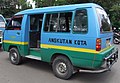 A traditional share taxi or angkot in Bandung
.jpg)
_(cropped).jpg)
.jpg)
Iran
[edit]
In Iran, a share taxi is usually called "taxi", while a non-share is called "ajans"/اژانس, pronounced [aʒans]. Four passengers share a taxi and sometimes there is no terminus and they wait in the street side and blare their destination to all taxis until one of them stops. These are regular taxis but if somebody wants to get a non-share taxi he can call for an ajans (taxi service) for himself or wait in the street side and say "Darbast" (which means non-share). It means he is not interested in sharing the taxi and is consequently willing to pay more for the privilege.
Minibuses, with a capacity of 18 passengers, and van taxis, with a capacity of 10 passengers are other kinds of share transport in Iran.[42]
Israel
[edit]
In Hebrew: מונית שירות monit sherut, pl. Hebrew: מוניות שירות moniyot sherut is a word meaning "service taxi". Referring to vans or minibuses[43][44] that serve as share taxis in Israel, these can be picked up from anywhere on their route. They follow fixed routes[43] (sometimes the same routes as public transport buses) and usually leave from the initial station only when full.[45] Moniyot sherut operate both inter-[43][46] and intra-city.[43] Payment is often done by passing money to the driver in a "human chain" formed by the passengers seated before. The change (and the receipt, when requested) are returned to the person who paid by the same means. In intra-city routes, where they compete with official buses, the drivers usually coordinate their travel by radio so that they can arrive at the bus station just before public transport buses and take the most passengers.
Monit sherut is one of the only forms of transit accessible to many Israelis during Shabbat, as most public transportation in the country closes down between sunset on Friday and nightfall on Saturday.
In Israel, Mercedes are used, owned generally by Arabs, and very efficient, having space for 7–8 people, and having loosely fixed routes, dropping a passenger either at a specific terminus or going a little out of the way to facilitate the passenger.[citation needed]
Philippines
[edit].jpg)

The most popular means of public transportation in the Philippines as of 2007,[47] jeepneys were originally made out of US military jeeps left over from World War II[48] and are known for their color and flamboyant decoration.[47] The jeepneys are built by local automobile repair shops from a combination of prefabricated elements (from a handful of Filipino manufacturers) and improvisation and in most cases equipped with "surplus" or used Japanese SUV or light truck engines, drive train, suspension and steering components (from recycled vehicles in Japan).
They have not changed much since their post-war creation, even in the face of increased access to pre-made vehicles, such as minibuses.[citation needed] However, due to the government's Public Utility Vehicle Modernization Program, Jeepneys and other modes of transportation must comply to the newer Philippine National Standards which is more compliant with international standards.
Older jeepneys have the entrance on the back, and there is space for two people beside the driver (or more if they are small) while the modern jeepneys have two doors on the right side of the vehicle. The back cab of the Jeepney is equipped with two long bench seats along the sides and the people seated closest to the driver are responsible for passing the fare of new passengers forward to the driver and the change back to the passenger. The start and end point of the jeepney route is often a jeepney terminal, where there is a queue system so only one jeepney plying a particular route is filled at a time, and where a person helps the driver to collect fares and fill the vehicles with people, usually to more than comfortable capacity.
Preferring to leave only when full and only stop for a crowd of potential passengers,[49] riders can nonetheless disembark at any time; and while jeepneys ply fixed routes,[47] these may be subject to change over time.[50] New ones may need approval from a Philippine transport regulator.[51] Jeepney stations do exist.[52]
Another share taxi that is also common in the Philippines is the UV Express which uses Compact MPVs and vans as its form factor. These vehicles seat 10–18 people and charge an additional 2 Philippine peso per kilometer (as of 2013).
Thailand
[edit]Literally "two rows"[citation needed] a songthaew or song thaew[53] (Thai สองแถว, Lao: ສອງແຖວ [sɔ̌ːŋtʰíw]) is a passenger vehicle in Thailand[53] and Laos[54] adapted from a pick-up[54] or a larger truck and used as a share taxi. They are also known as baht buses.
Turkey and Northern Cyprus
[edit].jpg)
In Turkey and Northern Cyprus, dolmuşlar (singular dolmuş, pronounced "dolmush") are share taxis that run on set routes within and between cities. These cars or minibuses display their routes on a signboard behind the windscreen. Some cities may only allow dolmuş to pick up and drop passengers at designated stops, and terminals also exist. The word derives from Turkish for "full" or "stuffed", as these share taxis depart from the terminal only when a sufficient number of passengers have boarded. Visitors to Turkey have been surprised by the speed of dolmuş travel.[55] There are also minibuses (Minibus) In the outskirts of cities like Istanbul, that take people from Point A to Point B, however they can get really crowded. They also have stops that are not usually labelled.
Traveling intra and inter-city, the privately owned minibuses are overseen by a governance institution; routes are leased and vehicles licensed. Passengers board anywhere along the route as well as at termini and official stations. Dolmuşlar in Turkish-controlled Northern Cyprus display their routes but don't follow timetables.
West Bank, Palestine
[edit]Share taxis are often called "ser-vees" (service taxi) in the West Bank. Minibuses are often used in lieu of vans. Ford Transit vans were often a popular vehicle for conversion, resulting in the generic trademark "Ford" and "Fordat"(pl) being used to describe minibusses of various makes, replacing aging Mercedes sedans.[43]
Oceania
[edit]New Zealand
[edit]In New Zealand the first widespread motor vehicle services were shared taxi services termed service cars; a significant early provider was Aard, operating elongated Hudson Super Sixes.[56] By 1930, there were 597 service cars.[57] Aard was taken over by New Zealand Railways Road Services in 1928.[56]


Shared taxis in New Zealand nowadays are referred to as shuttles or shuttle vans.
Shared buses or vans are available in many more developed countries connecting frequent destinations, charging a fixed fee per passenger. The most common case is a connection between an airport and central city locations. These services are often known as shuttles. Such services usually use smaller vehicles than normal buses and often operate on demand. An air traveler can contact the shuttle company by telephone or Internet, not necessarily in advance; the company will ensure that a shuttle is provided without unreasonable delay. The shuttle will typically connect one airport with several large hotels, or addresses in a specified area of the city. The shuttle offers much of the convenience of a taxi, although it takes longer, at a price that is significantly lower for one or two passengers. Scheduled services between an airport and a hotel, usually operated by the hotel, are also called shuttles. In many cases the shuttle operator takes the risk of there not being enough passengers to make the trip profitable; in others, there is a minimum charge when there are not enough passengers.
Usually, there are regulations covering vehicles and drivers; for example in New Zealand under NZTA regulations, shuttles are only allowed to have up to eleven passenger seats, and the driver must have a passenger endorsement (P) on their driver's license.
Europe
[edit].jpg)
Former Soviet Union
[edit]

Moldova
[edit]In Moldova, share taxis are called rutiere (singular rutieră). Introduced in 1981, they are private, owner-operated minibuses that operate along fixed routes. In cities, each rutieră route has a given number, as in the case of buses or trolleybuses.
Netherlands
[edit]Besides the conventional deeltaxi, there are treintaxis in some Dutch towns. Operated on behalf of the Netherlands Railways,[citation needed] they run to and from railway stations and the ride is shared with additional passengers picked up along the way. Tickets can be purchased at railway ticket offices or from the cabdriver, but treintaxis must be ordered by phone unless boarding at a railway station.[58]
Bulgaria
[edit]
Marshrutkas are rare in Bulgaria. As of 2021, only a single route operates in Sofia, while 10 lines operate in Plovdiv.[59] They are customized passenger vans that have been modified to include large windows in the back, rails and handles. Marshrutkas are commonly white, although their colour varied, and are partially covered in advertising. In some cases, seating has been modified — popular routes carrying more passengers typically have more standing space. Examples of van models include Peugeot Boxer, Citroën Jumper, Ford Transit, Iveco Daily and Renault Master. They have a fixed fare; the fare is paid upon boarding. Marshrutkas were not obliged to stop anywhere on the route, although they did slow down around popular spots. Marshrutka drivers were asked to stop and pick one up in a taxi-like manner; the getting-off was arranged with the driver, often by just standing up and approaching the door. Sometimes the driver would ask for consent to veer off the route to avoid a traffic jam or roadworks.
Romania
[edit]In Romania, microbuze or maxi-taxi supplied the need of affordable public transportation in smaller towns when some local administrations abolished the expensive community-owned systems of buses. In Bucharest, this form of transportation appeared in 1977, when the ITB began using them as a peak-hour service, beginning to use Irannational-made Mercedes-Benz T2 vans, being supplemented in 1983 by Rocar-TV 35M vans. Prior to this, in 1973, the ITB experimented with what was called at the time "fixed taxi lines", which ran between the Drumul Taberei, Titan and Berceni housing estates and picked up and stopped passengers on request, before discontinuing the experiment the following year.
In 1990, the newly founded RATB sold off its operations to private operators, who began using them in competition to the RATB. They enjoyed wide popularity, especially from 2003 to 2007, and from 2011 onwards, when the RATB lost the rights to operate suburban routes. On the Black Sea shore, it is very common to travel from Constanţa or Mangalia to the resorts on minibuses (microbuze), especially in those resorts where the competing train service is far from the beach and/or lodging facilities. These minibuses have been criticised for their shady operations, lack of safety and primitive transportation conditions.
Greece
[edit]In Athens, Greece most taxis were share taxis,[60] but since the country joined the EU in 1981, this tradition started to disappear.
United Kingdom
[edit]In 2018, Arriva launched shared taxi service Arriva Click in Liverpool and Sittingbourne and Kent Science Park in the United Kingdom.[61]
Northern Ireland
[edit]In some towns in Northern Ireland, notably certain districts in Ballymena, Belfast, Derry and Newry, share taxi services operate using Hackney carriages and are called black taxis. These services developed during The Troubles as public bus services were often interrupted due to street rioting. Taxi collectives are closely linked with political groups – those operating in Catholic areas with Sinn Féin, those in Protestant areas with loyalist paramilitaries and their political wings.
Typically, fares approximate those of Translink operated bus services on the same route. Service frequencies are typically higher than on-bus services, especially at peak times, although limited capacities mean that passengers living close to the termini may find it difficult to find a black taxi with seats available in the rush hour.
Switzerland
[edit]Major providers of share taxis in Switzerland are Telebus Kriens LU, Taxito, myBuxi, Kollibri by Swiss Postal Bus, and Pikmi by VBZ Verkehrsbetriebe Zurich ZH.
North America
[edit]Barbados
[edit]Most areas of Barbados are served by ZRs, which run in addition to the government-run bus service.
Dominican Republic
[edit]In the Dominican Republic, share taxis are privately owned vehicles[62] running fixed routes[63][62] with no designated stops.[63]
Foreign Affairs and International Trade Canada advises against traveling in the Dominican Republic carros públicos because doing so makes passengers targets for robbery, and because the taxis are known to, "disregard traffic laws, often resulting in serious accidents involving injuries and sometimes death."[64] The United States Department of State also warns that using them is hazardous, due to pickpockets, and are sometimes passengers are robbed by the drivers themselves.[62]
Haiti
[edit]
Tap taps, gaily painted buses[65] or pick-up trucks, and publiques, usually older saloon cars,[66] serve as share taxis in Haiti. Tap taps are privately owned and ornately decorated.[65] They follow fixed routes; won't leave until filled with passengers; and many feature wild colors, portraits of famous people, and intricate, hand-cut wooden window covers.[65] Often they are painted with religious names or slogans.[14] Riders can disembark at any point in the journey. Their name refers to "fast motion".[14]
The publiques operate on fixed routes and pick up additional passengers all along the way.[66]
While saying not to use any form of public transport in Haiti, the Foreign Affairs and International Trade Canada advises against tap tap travel especially.[67] The United States Department of State also warns travelers not to use tap taps, "because they are often overloaded, mechanically unsound, and driven unsafely."[68]
Saint Lucia
[edit]In Saint Lucia, waychehs are a name for minibus public transports using Toyota HiAce.
Canada
[edit]In Vancouver, British Columbia, Canada, in the 1920s, jitneys competed directly with the streetcar monopoly operating along the same routes as the streetcars, but jitneys were charging lower fares.[69]
In Quebec, share taxis or jitneys are called taxis collectifs[70] (in English "shared taxis"[71]) or transport collectif par taxi, literally "public transport by taxi".[72] (which the STM translates in English as "taxibus"[73]) and are operated by subcontractors to the local transit authorities on fixed routes.
In the case of Montréal, the fare is the same as the local bus fare, but no cash and transfers are issued or accepted; in the case of the STL, only bus passes.[71] The Réseau de transport de Longueuil accepts regular RTL tickets and all RTL and some Réseau de transport métropolitain TRAM passes.
Guatemala
[edit]In Guatemala, ruleteros, minibus share taxis, pick up and discharge passengers along major streets.[74][75]
United States
[edit]

In the United States, share taxis are called jitneys or dollar vans. They are typically modified passenger vans, and often operate in urban neighborhoods that are underserved by public mass transit or taxis. Some are licensed and regulated, while others operate illegally. They operate at designated stops or can be hailed from the street.
Both common names – dollar van and jitney – originated similarly. Jitney is an archaic term for an American nickel, the common fare for early jitneys. In the late 20th century, when a typical fare was one dollar, the corresponding name came into usage, though "jitney" is still also common.[76] It is generally a small-capacity vehicle that follows a rough service route, but it can go slightly out of its way to pick up and drop off passengers. In many US cities such as Pittsburgh and Detroit, the term jitney refers to an unlicensed taxi cab.
They are often owned and used by members of inner-city communities, such as African/Caribbean American, Latino, and Asian-American populations. Travelers cite cost and greater frequency as factors in choosing jitneys over larger bus service, whereas safety and comfort are cited for choosing buses.
The first jitneys in the United States operated in Los Angeles, California in 1914. By 1915, there were 62,000 nationwide. Local regulations, demanded by streetcar companies, forced jitneys out of business in most places. By the end of 1916, only 6,000 jitneys remained.[77] Operators were referred to as "jitney men." They were so successful that the city government banned them at the request of the streetcar operators.
Atlanta
[edit]Jitneys were popular in Atlanta from 1915 to 1925 as an alternative to streetcars.[78] In Atlanta, jitneys run along Buford Highway.
New York City
[edit]In New York City, dollar vans serve major areas that lack adequate subway service in transit deserts. The vans pick up and drop off anywhere along a route, and payment is made at the end of a trip. During periods when limited public mass transit is unavailable, dollar vans were the only feasible method of transportation for many commuters.[79][80] In such situations, city governments may pass legislation to deter price gouging.[81] Most dollar vans operate illegally, due to possible rules and fines.[82] Dollar vans and other jitneys mainly serve low-income, immigrant communities in transit deserts, which lack sufficient bus and subway service.[83]
New Jersey
[edit]In New Jersey, 6,500 jitney buses are registered, and are required to have an "Omnibus" license plate, which denotes the vehicle's federal registration. They are also required to undergo inspection by the state MVC mobile inspection team on the vehicles' companies' property twice a year, and be subject to surprise inspection. Drivers of jitneys are required to qualify for a Class B or Class C Commercial Drivers License (CDL), depending on whether the vehicle seats up to 15 or 30 passengers. Violations against a driver's CDL must be resolved and result in payment of fines prior to resumption of driving on the driver's part, with retesting required if the driver waits longer than three years to resolve the issues.[84]
Denser urban areas of northern New Jersey, such as Hudson, Bergen and Passaic County, are also served by dollar vans,[83][85][86] which are commonly known as jitneys, and most of which are run by Spanish Transportation and Community Line, Inc. Nungessers, along the Anderson Avenue-Bergenline Avenue transit corridor is a major origination/termination point, as are 42nd Street in Manhattan, Newport Mall and Five Corners in Jersey City, and GWB Plaza in Fort Lee. These interstate vans are under the purview of the federal government.[83]

In Atlantic City the Atlantic City Jitney Association operates a jitney service that travels the main strip of casinos. One of the routes also services the new cluster of casinos west of Atlantic City proper.
Hudson County commuters who prefer NJ Transit buses, for example, cite senior citizen discounts and air conditioning among their reasons, which has led some jitney operators to display bumper stickers advertising air conditioning aboard their vehicles in order to lure passengers. Some who prefer the buses will nonetheless take the jitneys if they arrive before the buses, as they pass bus stops more frequently than the buses and are cheaper.[84][87] Others choose buses because, they claim, jitney drivers are less safe, and are prone to using cell phones and playing loud music while driving. Although Union City jitney driver Samuel Martinez has complained that authorities unfairly target them and not the larger buses, North Bergen Patrol Commander Lt. James Somers has contended that jitneys are less safe, and sometimes exhibit higher levels of aggressive driving in order to pick up passengers, which has led to arguments among drivers. Somers also stated that police can only stop a vehicle that appears to have an obvious problem, and that only certified inspectors from the state MVC can stop a vehicle for less apparent, more serious problems.[84]
Dollar vans may change ownership over the course of decades, and the mostly immigrant drivers are subject to police searches. Between 1994 and 2015, the TLC issued 418 van licenses, although the vast majority of vans are unlicensed. Licensed vans cannot pick up at New York City bus stops, and all pick-ups must be predetermined and all passengers logged. Additionally, in the 1980s and 1990s, the predominantly black and mostly immigrant dollar van drivers stated that they were harassed "day and night" by the New York City Police Department (NYPD), with some van drivers having their keys confiscated and thrown away by NYPD officers.[83]
Over the course of the 2000s, surprise inspections in Hudson County, New Jersey have been imposed on jitney operators, whose lack of regulation, licensing or regular scheduling has been cited as the cause for numerous fines. A series of such inspections of the vans on Bergenline Avenue in June 2010 resulted in 285 citation violations, including problems involving brake lights, bald tires, steering wheels, suspensions, exhaust pipes, and emergency doors welded shut. An early July 2010 surprise inspection by the Hudson County Prosecutor's Office, which receives federal funding for regulating jitneys, found 23 out of 33 jitneys to be unsafe, which were taken out of service.[84][88] Claims have also been made that jitneys cause congestion and undermine licensed bus service. Drivers of these vans have also developed a reputation for ignoring traffic laws in the course of competing for fares, picking up and dropping off passengers at random locations, and driving recklessly.[87]
On July 30, 2013, an accident occurred at 56th Street and Boulevard East in West New York, New Jersey, in which Angelie Paredes, an 8-month-old North Bergen resident, was killed in her stroller when a full-sized[89] jitney bus belonging to the New York-based Sphinx company toppled a light pole. The driver, Idowu Daramola of Queens, was arrested and charged with a number of offenses, including using a cell phone while driving.[90][91][92] Officials also stated that he was speeding;[87] however, this was later disputed by an investigator to the scene who concluded that there was insufficient evidence to determine the speed of the bus.[89] At an August 6 press conference, legislators including U.S. Representative Albio Sires, New Jersey State Senator Nicholas Sacco, State Assembly members Vincent Prieto, Charles Mainor and Angelica Jimenez, West New York Mayor Felix Roque, Weehawken Mayor Richard Turner, Guttenberg Mayor Gerald Drasheff, Freeholder Junior Maldonado and Hudson County Sheriff Frank Schillari, noted that problems with jitneys existed since the 1980s, and called for stricter regulations for drivers and bus companies. This included increased monitoring and enforcement, and heightened participation by the public in identifying poor drivers,[92] as jitneys had been exempt from regulations imposed on buses and other forms of transportation.
In February 2014, New Jersey Governor Chris Christie signed Angelie's Law, strengthening regulations on commuter buses.[93][94]
Several companies run vans in Northern New Jersey, often following similar routes to New Jersey Transit buses but at a slightly lower price and greater frequency. The most common routes have an eastern terminus on street level in Manhattan, either near the Port Authority Bus Terminal or the George Washington Bridge Bus Station.[95] Often, several different companies ply the same route.
Miami
[edit]In Miami, jitneys (also known as the Miami Mini Bus) run through various neighborhoods, mostly those stretching between Downtown Miami to The Mall at 163rd Street in North Miami Beach, Florida. Miami has the country's most comprehensive jitney network, due to Caribbean influence.
San Francisco
[edit]Jitneys ran in San Francisco from late 1914 to January 2016. In the 1910s, there were more than 1,400 jitneys operating in the city. However, by 2016, declining ridership combined with mounting penalties for traffic citations made the operations unprofitable.[96]
Houston
[edit]The Houston Wave, Houston's first jitney service in 17 years, operated between 2009 and 2019. It expanded into a network of buses operating within Loop 610 and to all special event venues in Houston.
Latin America
[edit]In Puerto Rico and the Dominican Republic, "carros públicos" (literally "public cars") are share taxis.[97] Carros Publicos set routes with several passengers sharing the ride[98] and others picked up throughout the journey.[97]
In Puerto Rico the industry is regulated by the Puerto Rico Public Service Commission.[3]
While these cars do travel inter-city, they may not be available for longer, cross-island travel.[3] Stations may exist in cities, and Puerto Rican carros públicos may congregate in specific places around town.[3]
Mexico
[edit]There are some areas in which traditional buses and minibuses cannot operate due to the size restrictions of the streets and overhanging objects. Some of these places are served by share taxis that are regulated by the state or city. The share taxis charge the standard minibuses fare.
Central and South America
[edit]Argentina
[edit]Colectivos operated as share taxis from the late 1920s until the 1950s in Buenos Aires, Argentina when they were integrated into the public transportation system. Vehicles still known as colectivos operate throughout the country, but have long been indistinguishable from buses.[99]
Chile, Peru and Guatemala
[edit]
Often share taxi routes in Mexico are ad hoc arrangements to fill in gaps in regular public transportation, and many operate inter-city as well as local routes. In many rural areas, they are the only public transportation.
In some cases, truck/taxi combination vehicles have evolved to transport light goods as well as passengers. Heavily used share taxi routes often evolve into regulated microbus public transit routes, as has occurred in Mexico City and in Lima.
Taxis colectivos are also found in Peru, Chile, Guatemala, and Argentina, where they are most commonly referred to simply as colectivos, although in some places they have become essentially standard buses.[99]
References
[edit]- ^ Urban transportation systems: choices for communities (p. 254). Archived 2023-02-09 at the Wayback Machine Sigurd Grava. McGraw-Hill Professional, 2003. 840 pp. 0071384170, 9780071384179.
- ^ Cervero, Robert (September 1992). "Fostering Commercial Transit: Alternatives in Greater Los Angeles" (PDF). Reason. No. 146. Archived from the original on 2006-12-30.
- ^ a b c d Q&A Archived 2020-11-04 at the Wayback Machine nytimes.com, February 21, 1988.
- ^ a b c d e f g h i j k l m n o p q r s t u v w x y z aa ab ac ad ae af ag ah ai aj ak al am an ao ap aq ar as at au av aw ax ay Kumar, Ajay; Barrett, Fanny (January 2008). "Stuck in Traffic" (PDF).
- ^ RAF-977DM marshrutnoye taksi, "Avtomobil Na Sluzhbie, No.28, DeAgostini, 2012, ISSN 2223-0440 (in Russian)
- ^ Wulf, Volker; Misaki, Kaoru; Randall, Dave; Rohde, Markus (2018). "Travelling by Taxi Brousse in Madagascar. An Investigation into Practices of Overland Transportation" (PDF). Media in Action (1). University of Siegen: 57–97. doi:10.25969/mediarep/16218. Archived (PDF) from the original on 18 January 2023.
- ^ Gbadamassi, Falila (10 August 2017). "Les vieux modèles Peugeot-Citroën, guimbardes à l'épreuve des routes africaines". France Info (in French). Archived from the original on 21 January 2023.
- ^ "OOH! Mass urbanisation and the South African taxi commuter". 2 October 2013. Archived from the original on 25 October 2020.
- ^ a b Transport in Algiers: Local transport; Taxi Archived 2020-04-02 at the Wayback Machine lonelyplanet.com
- ^ a b TRAVEL REPORT Algeria: 9. TRAVEL AND CURRENCY Archived 2012-09-19 at the Wayback Machine Foreign Affairs and International Trade Canada Official Site
- ^ a b c d Oakes, Jonathan (2008). Bradt Travel Guide: Algeria. Bradt Travel Guides. ISBN 978-1-84162-232-3. Archived from the original on 2023-02-09.
- ^ Travel Advice: Algeria; Road Safety Archived 2020-03-14 at the Wayback Machine Irish Department of Foreign Affairs Official Site
- ^ Bamas, Stanislas Marie Maximilien (1998). "Le développement des transports routiers de voyageurs: l'exemple du Burkina Faso". Pays enclavés. 9 (1): 83–98. Archived from the original on 21 January 2023.
- ^ a b c d e f Thompson, Robert Farris (Spring 1996). "Tap-Tap, Fula-Fula, Kíá-Kíá: The Haitian Bus in Atlantic Perspective". African Arts. 29 (2 Special Issue: Arts of Vodou): 41. doi:10.2307/3337365. JSTOR 3337365.
- ^ a b c d e f g h Blaustein, Susan M. (September 29, 2010). "Report from the Field: The Tro-Tro – An Essential Mode of Transport in Accra, Ghana". Columbia University.
- ^ Ham, Anthony (2009). West Africa. Lonely Planet. ISBN 978-1-74104-821-6. Archived from the original on 2023-02-09.
- ^ a b Briggs, Philip; Rushton, Katherine (2007). Ghana: The Bradt Travel Guide. Bradt Travel Guides. ISBN 978-1-84162-205-7.
- ^ "The effects of the introduction of a bus rapid transit system on commuter choices in Ghana" (PDF). International Growth Centre. September 2019.
- ^ "TroTro: Transport for the People by the People". www.ghanaweb.com.
- ^ Dzisi, Emmanuel Komla Junior; Dei, Oscar Akunor (2020-08-03). "Adherence to social distancing and wearing of masks within public transportation during the COVID 19 pandemic". Transportation Research Interdisciplinary Perspectives. 7 100191. Bibcode:2020TrRIP...700191D. doi:10.1016/j.trip.2020.100191. ISSN 2590-1982. PMC 7396893. PMID 34173465.
- ^ Nairobi Today: the Paradox of a Fragmented City; Hidden $ Centz: Rolling the Wheels of Nairobi Matatu. Mbugua wa-Mungai. (p. 371). Archived 2023-02-09 at the Wayback Machine edited by Helene Charton-Bigot, Deyssi Rodriguez-Torres. African Books Collective, 2010. 404 pp. 9987080936, 9789987080939.
- ^ Nairobi Today: the Paradox of a Fragmented City; Hidden $ Centz: Rolling the Wheels of Nairobi Matatu. Mbugua wa-Mungai (p. 376). Archived 2023-02-09 at the Wayback Machine edited by Helene Charton-Bigot, Deyssi Rodriguez-Torres. African Books Collective, 2010. 404 pp. 9987080936, 9789987080939.
- ^ Kenya (p. 383). Archived 2023-02-09 at the Wayback Machine Tom Parkinson, Max Phillips, Will Gourlay. Lonely Planet, 2006. 352 pp. 1740597435, 9781740597432.
- ^ a b c d e Wulf, Volker; Misaki, Kaoru; Randall, Dave; Rohde, Markus (2018). "Travelling by Taxi Brousse in Madagascar. An Investigation into Practices of Overland Transportation" (PDF). Media in Action (1). University of Siegen: 57–97. doi:10.25969/mediarep/16218. Archived (PDF) from the original on 18 January 2023. Retrieved 2023-01-19.
- ^ "Madagascar". Lonely Planet: Africa (14th ed.). Lonely Planet. 2017. ISBN 9781787011472. Archived from the original on 7 February 2023. Retrieved 20 January 2023.
- ^ Silcox, John; Christmas, Sam (21 August 2021). ""Merci dix": A swansong for Morocco's Mercedes Grand Taxis". BBC News.
- ^ a b No more 'twegerane' in commuter Coaster buses Archived 2018-09-19 at the Wayback Machine newtimes.co.rw, March 11, 2011.
- ^ "Taxis". Johannesburg.
- ^ "From Low-Intensity War to Mafia War: Taxi violence in South Africa (1987–2000) – Jackie Dugard" (PDF). May 2001. Archived from the original on 2012-02-09.
- ^ "Travel Guide to Zanzibar". zanzibar.org. Archived from the original on 2005-07-06.
- ^ Sykes, Hugh (2 November 2014). From our Own Correspondent: Appearance and Reality. BBC (Audio).
- ^ Stevenson, John (13 December 2014). "Bizerte: Tunisia's Secret Tourism Weapon: Framed by Wide Sandy Beaches Dotted by Unimposing Resorts, Bizerte, Tunisia's Northernmost City, Offers an Unrivalled Quaintness, Surpassing the Country's More Tourism Centred Destinations".
- ^ a b c Zaafrani, Omar (January 17, 2009). "The Tunisian louage is a vehicle of a different stripe". thenational.ae. The National.
- ^ "How Green Is the Desert". The New York Times. November 28, 1999. Archived from the original on 2020-11-07.
- ^ Cyprus Archived 2023-02-09 at the Wayback Machine Vesna Maric. Lonely Planet, 2009. 268 pp. 4th ed. ISBN 9781741048032.
- ^ Sarina Singh, India, Lonely Planet, 2005.
- ^ Azis, R.; Asrul (2018). Pengantar Sistem dan Perencanaan Transportasi (in Indonesian). Yogyakarta: Deepublish. p. 200. ISBN 978-602-475-356-6.
- ^ "Wajib Catet Ini Daftar Trayek Angkot di Depok". Republika (in Indonesian). 14 February 2022.
- ^ "Beda Antara JakLingko dan Mikrotrans dalam Transportasi Jakarta". tirto.id (in Indonesian). 6 September 2024.
- ^ "Wira Wiri Suroboyo: Solusi Transportasi Ramah Kantong di Tengah Kemacetan". tirto.id (in Indonesian). 4 October 2024.
- ^ Wati, Nila (13 December 2024). "Rute Serta Tarif Bus Trans Donggala dan Angkutan Perkotaan Feeder, Mulai Rp10.000 Hingga Gratis - Sulteng Membangun". sultengmembangun.id (in Indonesian). Archived from the original on 2025-09-03. Retrieved 2025-09-03.
- ^ Yeganeh, Sayna Firoozi; Khademi, Navid; Farahani, Hojatollah; Besharat, Mohammad Ali (December 2022). "A qualitative exploration of factors influencing women's intention to use shared taxis: A study on the characteristics of urban commuting behavior in Iran". Transport Policy. 129: 90–104. doi:10.1016/j.tranpol.2022.10.001.
- ^ a b c d e Amelia Thomas, Michael Kohn, Miriam Raphael, Dan Savery Raz, Israel and the Palestinian Territories, p. 431. Archived 2023-02-09 at the Wayback Machine Lonely Planet, 2010. 468 pp. 6th ed. 1741044561, 9781741044560.
- ^ Frommer's Israel. Archived 2023-02-09 at the Wayback Machine Robert Ullian. Frommer's, 2010. 544 pp. 0470618205, 9780470618202.
- ^ GUIDE TO 13 MAJOR WAY STATIONS Archived 2020-08-28 at the Wayback Machine nytimes.com, March 4, 1984.
- ^ INTERNATIONAL ISSUE; Going Abroad Without Going Broke Archived 2020-11-05 at the Wayback Machine nytimes.com, March 11, 1990.
- ^ a b c "Manila's jeepney pioneer fears the end of the road". Reuters. November 20, 2007. Archived from the original on 2015-12-08.
- ^ Otsuka, Keijiro; Kikuchi, Masao; Hayami, Yujiro (January 1986). "Community and Market in Contract Choice: The Jeepney in the Philippines". Economic Development and Cultural Change. 34 (2): 279–98. doi:10.1086/451528. ISSN 0013-0079. JSTOR 1153851. S2CID 155062784.
- ^ Rowthorn, Chris; Bloom, Greg (2006). Philippines. Lonely Planet. p. 454. ISBN 978-1-74104-289-4. Archived from the original on 2023-02-09.
- ^ JEEPNEY ROUTES Archived 2020-08-07 at the Wayback Machine wayblima.com
- ^ City Council pushes for new jeepney route Archived 2020-03-02 at the Wayback Machine philstar.com, September 06, 2010.
- ^ Philippines (p. 114). Archived 2023-02-09 at the Wayback Machine Chris Rowthorn, Greg Bloom. Lonely Planet, 2006. 492 pp. 9th ed. 1741042895, 9781741042894.
- ^ a b Island Escape From Bangkok Archived 2020-11-06 at the Wayback Machine nytimes.com, April 20, 1997.
- ^ a b Side Trips by Frommer's. Luang Namtha & the Far North: Getting There; By Air Archived 2023-02-09 at the Wayback Machine nytimes.com, "Frommer's content excerpted from Frommer's Southeast Asia, 4th Edition © 2007, Wiley Publishing, Inc".
- ^ "Innovation: From dolmuş to Uber". Hürriyet Daily News. December 2, 2019.
- ^ a b Alexander Turnbull Library, Map New Zealand, Godwit/Random House, Auckland 2006
- ^ "Kōrero: Coaches and long-distance buses Whārangi 3 – Service cars". Te Ara – The Encyclopedia of New Zealand. Archived from the original on 2020-03-18.
- ^ "Transport in The Netherlands: Train; Treintaxi". Lonely Planet. Archived from the original on 2015-02-27.
- ^ "Община Пловдив - България - Маршрутки". Plovdiv.bg.
- ^ Gerrard, Mike (2009). National Geographic Traveler Greece (3, illustrated ed.). National Geographic Books. p. 336. ISBN 978-1-4262-0396-1. Archived from the original on 2023-02-09.
- ^ "Uber-style bus service planned for city". BBC News. 26 June 2018. Archived from the original on 8 July 2020.
- ^ a b c "Dominican Republic: Country Specific Information; Crime". United States Department of State. Archived from the original on 2013-12-03.
- ^ a b Dominican Republic Transportation: Carro Publicos Archived 2020-04-14 at the Wayback Machine dr1.com
- ^ "TRAVEL REPORT: Dominican Republic; 9. TRAVEL AND CURRENCY". Foreign Affairs and International Trade Canada. Archived from the original on 2012-09-19.
- ^ a b c Haiti's 'Tap Tap' Bus Art Flourishes After Quake Archived 2014-01-22 at the Wayback Machine PBS Newshour, March 30, 2010.
- ^ a b Transport in Port-au-Prince: Local transport; Taxi Archived 2012-10-15 at the Wayback Machine lonelyplanet.com
- ^ "TRAVEL REPORT Haiti: 9. Travel and Currency". Foreign Affairs and International Trade Canada. Archived from the original on 2012-09-19.
- ^ "Travel Warning: Haiti". United States Department of State. Archived from the original on 2013-11-12.
- ^ "Report of Dr. Adam Shortt, commissioner investigating the economic conditions and operations of the British Columbia Electric Railway Company and subsidiary companies, and to decide definitely as to the possibility of street car service being maintained in competition with the jitneys, publ. BC Electric Railway Company Limited, Vancouver, 1917". Archived from the original on July 8, 2018.
- ^ "Taxis: Choisissez votre circuit". Société de transport de Laval (in French). 2012-12-05. Archived from the original on 2007-12-02. Retrieved 2022-09-28.
- ^ a b "Shared taxis". Archived from the original on 2022-10-25.
- ^ "Le transport collectif par taxi". Société de transport de Montréal (STM) (in French). Archived from the original on 2009-12-11.
- ^ "Taxibus service". Société de transport de Montréal. Archived from the original on 2006-10-26.
- ^ "Guatemala: Local Transportation". ediplomat.com. June 8, 2004. Archived from the original on 2018-09-28.
- ^ Valdez, Sandra (May 16, 2011). "Ruleteros regresan por falta de buses en barrios" [Ruleteros return because of lack of buses in poor neighborhoods]. Prensa Libre (in Spanish). Guatemala. Archived from the original on 2011-08-14.
- ^ Page, Walter Hines; Page, Arthur Wilson (April 1915). "The March Of Events: The Jitney". World's Work. XXIX: 618. Archived from the original on 2023-02-09.
- ^ Eckert, Ross D.; Hilton, George W. (March 1972). "The Jitneys". Journal of Law and Economics. 15 (2). Chicago: The University of Chicago: 293–325. doi:10.1086/466738. JSTOR 724795. S2CID 222327593.
- ^ Chambliss, Julian C. (2008). "A Question of Progress and Welfare: The Jitney Bus Phenomenon in Atlanta, 1915-1925". Georgia Historical Quarterly. 92 (4): 486–506.
- ^ Henderson, Christopher (December 22, 2005). "Crowds Overrun LIRR Station While Traffic Crawls In Jamaica". Queens Chronicle. Archived from the original on 2018-01-26.
- ^ Joiner, Bryan (January 20, 2005). "Long Stalemate Expected After Union Quits Strike Negotiations". Queens Chronicle. Archived from the original on 2018-03-16.
- ^ Richardson, Lynda (December 12, 1999). "As Transit Strike Looms, 'Dollar Vans' and Ferries Are Poised to Cash In". The New York Times. Archived from the original on November 23, 2015.
- ^ Kavanagh, Brian (September 25, 2023). "Chinatown pols seek to exempt dollar vans from congestion pricing". New York State Senate.
- ^ a b c d Reiss, Aaron (June 27, 2014). "New York's Shadow Transit". The New Yorker. Archived from the original on September 24, 2015.
- ^ a b c d Tirella, Tricia (July 25, 2010). "Fierce competition surrounds jitney buses" Archived 2016-05-20 at the Wayback Machine The Union City Reporter
- ^ "Minutes of the Meeting Of the Historic New Bridge Landing Park Commission". March 6, 2008
- ^ Cowen, Richard & Bautista, Justo (November 3, 2006). "Police arrest 7 in jitney hijacking". The Bergen Record.
- ^ a b c Semple, Kirk (August 13, 2013). "New Jersey Jitney Drivers Squeezed Between Competition and Demands for More Safety". The New York Times. Archived from the original on September 11, 2016.
- ^ Hague, Jim (May 13, 2007). "Erratic driving, lack of licensing: Prosecutor's Office cracks down on commuter vans". The Hudson Reporter
- ^ a b Haydon, Tom (June 22, 2016). "Bus driver charged in crash that killed infant breaks down at trial". NJ.com. Archived from the original on 2016-06-23.
- ^ "Family Devastated After Death Of Infant In West New York Bus Crash". CBS News. July 31, 2013. Archived from the original on September 23, 2015.
- ^ Williams, Barbara (August 4, 2013). "Family to hold public prayer vigil for infant girl killed in West New York jitney bus accident" Archived 2014-02-21 at the Wayback Machine. NorthJersey.com.
- ^ a b Passantino, Joseph (August 11, 2013). "Never again, legislators say" Archived 2016-08-09 at the Wayback Machine. The Hudson Reporter.
- ^ "N.J. Pols Introduce 'Angelie's Law' Targeting Distracted Commuter Van Drivers". CBS New York. January 30, 2014. Archived from the original on September 20, 2015.
- ^ Conte, Michaelangelo (March 5, 2014). "'Angelie's Law' makes jitney victim a hero because of lives that will be saved". NJ.com. Archived from the original on March 4, 2016.
- ^ "Jitney Buses of New Jersey". Jitney Buses of New Jersey.
- ^ "The Last Ride of the Jitney". SF Weekly. March 9, 2016.
- ^ a b On becoming Nuyoricans Archived 2023-02-09 at the Wayback Machine Angela Anselmo, Alma Rubal-Lopez. Peter Lang, 2005. 172 pp. 0820455202, 9780820455204.
- ^ PUERTO RICO'S QUIET EDGE Archived 2020-08-28 at the Wayback Machine nytimes.com, March 31, 1985.
- ^ a b "The design evolution of the colectivo" (in Spanish). Archived from the original on 2018-09-28.
External links
[edit] Media related to Share taxis at Wikimedia Commons

| Types |  | |
|---|---|---|
| Elements | Oneway Cab
| |
| In media | ||
| see also | ||

| Bus service | |
|---|---|
| Rail | |
| Vehicles for hire | |
| Carpooling | |
| Ship | |
| Cable | |
| Other transport | |
| Locations | |
| Ticketing and fares |
|
| Routing | |
| Facilities | |
| Scheduling | |
| Politics | |
| Technology and signage | |
| Models | |
| Other topics | |

Share taxi
View on GrokipediaHistorical Development
Origins in Early Collective Transport
The practice of collective passenger transport, involving multiple individuals sharing a hired vehicle to distribute travel costs, predates modern automobiles and originated with horse-drawn conveyances in Europe. Stagecoaches, first developed in the late 15th century in the region of modern-day Hungary and spreading across continental Europe by the 16th century, represented an early organized system where 6 to 12 passengers could occupy a single enclosed coach drawn by four or more horses. These vehicles operated on predefined routes between post stations or inns, with fares charged per passenger segment to cover relay teams of horses and driver expenses, enabling economical long-distance mobility for merchants, officials, and the affluent who pooled resources rather than traveling privately. By the early 17th century, regular stagecoach lines had expanded, such as the inaugural public service from Edinburgh to Leith in Scotland around 1610, which formalized shared ridership as a commercial enterprise.[3] In urban contexts, the omnibus emerged as a precursor to intra-city shared transport during the early 19th century, adapting stagecoach principles for denser populations. Pioneered by Stanislas Baudry in Bordeaux, France, in September 1828, the omnibus was a larger, sprung horse-drawn vehicle designed to carry up to 16 passengers along fixed city routes for a uniform fare, typically equivalent to a fraction of private carriage costs. This innovation addressed growing demand in industrializing cities by offering scheduled stops and capacity for collective boarding, quickly proliferating to Paris by 1829 with over 100 vehicles in operation within a year, and influencing similar deployments in London (1831) and New York (1830), where an omnibus service along Broadway accommodated 12 to 14 riders.[4] Unlike exclusive hackney carriages, which served individuals or small groups, omnibuses emphasized volume ridership to achieve profitability, laying groundwork for economies of scale in passenger aggregation that later characterized share taxi operations.[5] These horse-drawn systems demonstrated causal efficiencies in collective transport: by amortizing fixed costs like animal maintenance and vehicle depreciation across multiple fares, operators undercut private alternatives while serving routes underserved by foot or individual conveyances. However, limitations such as rigid schedules, weather dependency, and capacity constraints—omnibuses often overloaded in peak hours—highlighted needs for flexibility that automobiles would address a century later. Empirical records from the era, including fare logs and route manifests, confirm ridership surges; for instance, Parisian omnibuses transported over 20 million passengers annually by the 1840s, underscoring the viability of shared models in pre-industrial urban expansion.[4] Source biases in contemporary accounts, often from private operators resisting competition, occasionally exaggerated congestion issues, but operational data affirm the foundational role of these vehicles in evolving public mobility paradigms.20th-Century Expansion and Jitneys
The jitney system originated in the United States in 1914, when L. P. Draper in Los Angeles began charging passengers a nickel fare in his Ford Model T for shared rides along established routes, marking the transition of collective transport from horse-drawn vehicles to automobiles.[6] The term "jitney" derived from slang for a five-cent coin, reflecting the standard fare that undercut streetcar prices and appealed to cost-conscious riders.[7] This model quickly proliferated due to surging automobile ownership, which rose from approximately 6,000 vehicles nationwide in 1900 to 1 million by 1913, enabling individuals to repurpose personal cars for income generation without formal infrastructure.[8] By 1915, jitneys operated in over 90 U.S. cities, with estimates of 62,000 vehicles in service by mid-decade, capturing up to 20-50% of urban passenger traffic in locales like Los Angeles and Atlanta.[9] Operators typically followed fixed or semi-fixed routes paralleling streetcar lines but offered greater flexibility, such as door-to-door deviations and off-peak service, filling gaps left by rigid public transit schedules and serving underserved areas, including Black neighborhoods where formal systems often underinvested.[10] In Atlantic City, New Jersey, for instance, jitney service commenced in 1915 and persists today as one of the few surviving unregulated examples, demonstrating sustained viability in tourist-heavy environments.[11] The expansion faced backlash from streetcar companies, which lost revenue—sometimes 30-50% in affected cities—prompting lobbying for regulations that imposed licensing, insurance requirements, and route restrictions by 1916-1918.[12] Municipalities in places like Seattle and Atlanta enacted ordinances framing jitneys as safety hazards or unfair competitors, effectively curtailing operations in most areas by the early 1920s, though pockets endured where demand outpaced enforcement.[8] This regulatory suppression redirected entrepreneurial energy toward bus systems but established jitneys as a prototype for informal shared mobility, influencing later global adaptations of share taxis in less regulated markets.[9]Post-War and Post-Colonial Proliferation
Following World War II, surplus military vehicles facilitated the emergence of share taxi systems in several regions. In the Philippines, jeepneys originated from U.S. Army jeeps abandoned after 1945, which locals modified into extended passenger vehicles to address wartime destruction of transport infrastructure; by the early 1950s, they operated on fixed routes in Manila, carrying up to 20 passengers at low fares.[13][14] Similarly, in Turkey, dolmuş services began in Istanbul during the 1940s using converted American cars to provide affordable, route-based transport amid postwar urban growth and limited formal options.[15][16] In post-colonial contexts, share taxis proliferated across Africa and Asia as newly independent nations faced rapid urbanization and insufficient public infrastructure inherited from colonial eras, which prioritized export routes over internal passenger needs. Ghana's tro-tros, introduced in the 1960s shortly after 1957 independence, evolved from privately owned minibuses charging a standard threepence fare—deriving the name from the Ga word "tro"—to serve growing commuter demands in cities like Accra, where African operators filled gaps left by underfunded state systems.[17][18] In Kenya, post-1963 independence, matatus emerged in the 1960s using pickup trucks and later minibuses for fixed inter-urban routes, named after the Kikuyu phrase for a 30-cent fare (three 10-cent coins), expanding significantly in the 1980s amid economic pressures and population booms that outpaced bus services.[19][20] These systems thrived due to private entrepreneurship in unregulated markets, high unemployment, and recessions, enabling flexible service where formal transport failed.[21] By the late 20th century, share taxis dominated informal transport in developing regions, comprising up to 70% of urban mobility in sub-Saharan African cities, as colonial legacies of sparse rail and road networks proved inadequate for post-independence demographic shifts.[22] In Madagascar and other francophone African states, taxi-brousses similarly arose post-independence to connect rural areas underserved by state buses.[23] This expansion reflected causal drivers like vehicle imports, local adaptation, and demand for cost-effective, door-to-door alternatives, though often amid safety and regulatory challenges.[24]Definition and Characteristics
Core Operational Features
Share taxis provide shared passenger transport along fixed or semi-fixed routes, utilizing vehicles such as sedans, vans, or minibuses to carry multiple unrelated passengers who board and alight at various points en route.[25] These services typically originate from central terminals or ranks where vehicles congregate, and they operate without fixed schedules, departing primarily when occupancy reaches capacity to ensure profitability for independent operators.[26] [27] Passengers are recruited by drivers or conductors who shout destinations or use signage to attract riders, often allowing flexible pickups and drop-offs along the route, including minor deviations to meet demand while adhering to the primary path.[25] Fares are collected in cash by the driver or an onboard assistant, generally structured as a fixed rate per seat for the full route or prorated by distance traveled, enabling cost-sharing among passengers.[26] This model predominates in urban and interurban settings of developing countries, where it accounts for substantial shares of daily trips, such as over 25% in some cities like Tehran.[26] Vehicles are frequently overloaded beyond official capacities to maximize revenue, with informal syndicates or individual owners managing operations amid limited regulation, leading to high-frequency service responsive to real-time demand rather than pre-set timetables.[27] Safety features are minimal, relying on standard vehicle maintenance by operators, though enforcement varies by jurisdiction.Distinctions from Taxis, Buses, and Ride-Hailing Apps
Share taxis, also known as collective taxis or jitneys in various contexts, operate by filling vehicles with multiple unrelated passengers along fixed or semi-fixed routes, departing from terminals or stands primarily when a minimum number of passengers board, rather than providing the exclusive, metered, door-to-door service characteristic of traditional taxis.[26] Traditional taxis, by contrast, serve individual or small groups with point-to-point transport, often regulated under fare structures that prioritize personalized routing without shared occupancy beyond the hiring party.[28] This shared occupancy model in share taxis reduces per-passenger costs but introduces wait times at loading points, distinguishing it from the immediate dispatch of solitary taxi hires.[29] In comparison to public buses, share taxis employ smaller vehicles—typically minibuses or vans seating 10 to 20 passengers—and lack rigid timetables, allowing departures based on demand fill-up, which enables greater responsiveness to fluctuating passenger volumes but can result in variable headways.[30] Public buses, operated by centralized authorities, adhere to scheduled services with fixed stops and larger capacities (often 40+ passengers), prioritizing high-volume corridors under subsidized or regulated frameworks that ensure predictability but reduce adaptability to low-density routes.[31] Share taxis thus bridge gaps in bus coverage, such as rural extensions or off-peak hours, through private operator initiative, though this flexibility often comes without the safety oversight or infrastructure integration of formal bus systems.[32] Unlike ride-hailing apps such as Uber, which coordinate primarily private or algorithm-matched pooled rides via digital platforms with dynamic pricing and GPS-tracked routing, share taxis function through informal, cash-based systems where drivers solicit passengers at ranks or roadside without pre-booking or electronic dispatch. Ride-hailing emphasizes on-demand convenience for specific origins and destinations, often with vetted drivers and insurance protocols, whereas share taxis aggregate passengers en route in a collective manner predating app technology, relying on cultural norms and driver discretion for operations in regions with limited formal infrastructure.[33] This analog approach in share taxis fosters accessibility in cash economies but exposes users to unregulated variability absent in app-mediated services.[34]| Feature | Share Taxi | Traditional Taxi | Public Bus | Ride-Hailing App |
|---|---|---|---|---|
| Occupancy | Multiple unrelated passengers | Exclusive to hirer(s) | Multiple, scheduled | Private or matched pooling |
| Route Structure | Fixed/semi-fixed, hail along way | Point-to-point, flexible | Fixed stops | Dynamic, origin-destination |
| Scheduling | Demand-driven (fill-up) | On-demand immediate | Fixed timetable | Real-time app request |
| Booking/Payment | Informal, cash at terminal/ride | Metered hail or dispatch | Ticket/pre-paid | App-based, card/dynamic pricing |
| Vehicle Size | Small (10-20 seats) | Sedan/van (4-7 seats) | Large (40+ seats) | Varies, often private vehicle |