


Community hub
Recent from talks
Contribute something
Nothing was collected or created yet.
Assyrian sculpture
View on Wikipedia| Part of a series on |
| Assyrians |
|---|
 |
| Assyrian culture |
| By country |
| Assyrian diaspora |
| Language |
| Subgroups |
| Religion |
| By location |
| Persecution |

,_c._645-635_BC,_British_Museum_(16722368932).jpg)
Assyrian sculpture is the sculpture of the ancient Assyrian states, especially the Neo-Assyrian Empire of 911 to 612 BC, which was centered around the city of Assur in Mesopotamia (modern-day Iraq) which at its height, ruled over all of Mesopotamia, the Levant and Egypt, as well as portions of Anatolia, Arabia and modern-day Iran and Armenia. It forms a phase of the art of Mesopotamia, differing in particular because of its much greater use of stone and gypsum alabaster for large sculpture.
Much the best-known works are the huge lamassu guarding entrance ways, and Assyrian palace reliefs on thin slabs of alabaster, which were originally painted, at least in part, and fixed on the wall all round the main rooms of palaces. Most of these are in museums in Europe or America, following a hectic period of excavations from 1842 to 1855,[1] which took Assyrian art from being almost completely unknown to being the subject of several best-selling books, and imitated in political cartoons.[2]
The palace reliefs contain scenes in low relief which glorify the king, showing him at war, hunting, and fulfilling other kingly roles. Many works left in situ, or in museums local to their findspots,[3] have been deliberately destroyed in the recent occupation of the area by ISIS, the pace of destruction reportedly increasing in late 2016, with the Mosul offensive.[4]
Other surviving types of art include many cylinder seals,[5] a few rock reliefs, reliefs and statues from temples, bronze relief strips used on large doors,[6] and small quantities of metalwork.[7] A group of sixteen bronze weights shaped as lions with bilingual inscriptions in both cuneiform and Phoenician characters, were discovered at Nimrud.[8] The Nimrud ivories, an important group of small plaques which decorated furniture, were found in a palace storeroom near reliefs, but they came from around the Mediterranean, with relatively few made locally in an Assyrian style.[9]
Palace reliefs
[edit]
The palace reliefs were fixed to the walls of royal palaces forming continuous strips along the walls of large halls. The style apparently began after about 879 BC, when Ashurnasirpal II moved the capital to Nimrud, near modern Mosul in northern Iraq.[10] Thereafter, new royal palaces, of which there was typically one per reign, were extensively decorated in this way for the roughly 250 years until the end of the Assyrian Empire.[11] There was subtle stylistic development, but a very large degree of continuity in subjects and treatment.[12]
Compositions are arranged on slabs, or orthostats, typically about 7 feet high, using between one and three horizontal registers of images, with scenes generally reading from left to right. The sculptures are often accompanied with inscriptions in cuneiform script, explaining the action or giving the name and extravagant titles of the king.[13] Heads and legs are shown in profile, but torsos in a front or three-quarters view, as in earlier Mesopotamian art.[14] Eyes are also largely shown frontally. Some panels show only a few figures at close to life-size, such scenes usually including the king and other courtiers,[15] but depictions of military campaigns include dozens of small figures, as well as many animals and attempts at showing landscape settings.
Campaigns focus on the progress of the army, including the fording of rivers, and usually culminates in the siege of a city, followed by the surrender and paying of tribute, and the return of the army home. A full and characteristic set shows the campaign leading up to the siege of Lachish in 701; it is the "finest" from the reign of Sennacherib, from his palace at Nineveh and now in the British Museum.[16] Ernst Gombrich observed that none of the many casualties ever come from the Assyrian side.[17] Another famous sequence there shows the Lion Hunt of Ashurbanipal, in fact the staged and ritualized killing by King Ashurbanipal of lions already captured and released into an arena, from the North Palace at Nineveh. The realism of the lions has always been praised, and the scenes are often regarded as "the supreme masterpieces of Assyrian art", although the pathos modern viewers tend to feel was perhaps not part of the Assyrian response.[18]
There are many reliefs of minor supernatural beings, called by such terms as "winged genie", but the major Assyrian deities are only represented by symbols. The "genies" often perform a gesture of purification, fertilization or blessing with a bucket and cone; the meaning of this remains unclear.,[19] Especially on larger figures, details and patterns on areas such as costumes, hair and beards, tree trunks and leaves, and the like, are very meticulously carved. More important figures are often shown larger than others, and in landscapes more distant elements are shown higher up, but not smaller than, those in the foreground, though some scenes have been interpreted as using scale to indicate distance. Other scenes seem to repeat a figure in a succession of different moments, performing the same action, most famously a charging lion. But these were apparently experiments that remain unusual.[20]

The king is often shown in narrative scenes, and also as a large standing figure in a few prominent places, generally attended by winged genies. A composition repeated twice in what is traditionally called the "throne-room" (though perhaps it was not) of Ashurbanipal's palace at Nimrud shows a "Sacred Tree" or "Tree of Life" flanked by two figures of the king, with winged genies using the bucket and cone behind him. Above the tree one of the major gods, perhaps Ashur the chief god, leans out of a winged disc, relatively small in scale. Such scenes are shown elsewhere on the robe of the king, no doubt reflecting embroidery on the real costumes, and the major gods are normally shown in discs or purely as symbols hovering in the air. Elsewhere the tree is often attended to by genies.[21]
Women are relatively rarely shown, and then usually as prisoners or refugees; an exception is a "picnic" scene showing Ashurbanipal with his queen.[22] The many beardless royal attendants can probably be assumed to be eunuchs, who ran much of the administration of the empire, unless they also have the shaved heads and very tall hats of priests.[23] Kings are often accompanied by several courtiers, the closest to the king probably often being the appointed heir, who was not necessarily the oldest son.[24]
The enormous scales of the palace schemes allowed narratives to be shown at an unprecedentedly expansive pace, making the sequence of events clear and allowing richly detailed depictions of the activities of large numbers of figures, not to be paralleled until the Roman narrative column reliefs of the Column of Trajan and Column of Marcus Aurelius.[25]
-
 Dying lion, Lion Hunt of Ashurbanipal, North Palace, Nineveh
 -
 Prisoners and cavalry, Lachish relief
 -

-
 Eunuch attendants carry furniture and a bowl
,_c._645-635_BC,_British_Museum_(16722131531).jpg)


Lamassu
[edit]
Lamassu were protective minor deities or spirits, the Assyrian version of the "human-headed bull" figure that had long figured in Mesopotamian mythology and art. Lamassu have wings, a male human head with the elaborate headgear of a divinity, and the elaborately braided hair and beards shared with royalty. The body is that of either a bull or a lion, the form of the feet being the main difference. Prominent pairs of lamassu were typically placed at entrances in palaces, facing the street and also internal courtyards. They were "double-aspect" figures on corners, in high relief, a type earlier found in Hittite art. From the front they appear to stand, and from the side, walk, and in earlier versions have five legs, as is apparent when viewed obliquely. Lamassu do not generally appear as large figures in the low-relief schemes running round palace rooms, where winged genie figures are common, but they sometimes appear within narrative reliefs, apparently protecting the Assyrians.[26]
The colossal entrance way figures were often followed by a hero grasping a wriggling lion, also colossal and in high relief; these and some genies beside lamassu are generally the only other types of high relief in Assyrian sculpture. The heroes continue the Master of Animals tradition in Mesopotamian art, and may represent Enkidu, a central figure in the ancient Mesopotamian Epic of Gilgamesh. In the palace of Sargon II at Khorsabad, a group of at least seven lamassu and two such heroes with lions surrounded the entrance to the "throne room", "a concentration of figures which produced an overwhelming impression of power".[27] The arrangement was repeated in Sennacherib's palace at Nineveh, with a total of ten lamassu.[28] Other accompanying figures for colossal lamassu are winged genies with the bucket and cone, thought to be the equipment for a protective or purifying ritual.[29]
Lamassu also appear on cylinder seals. Several examples left in situ in northern Iraq have been destroyed in the 2010s by ISIL when they occupied the area. Colossal lamassu also guarded the start of the large canals built by the Assyrian kings.[30] In the case of temples, pairs of colossal lions guarding the entrances have been found.[31]
Construction
[edit]
There are outcrops of the "Mosul marble" gypsum rock normally used at several places in the Assyrian realm, though not especially close to the capitals. The rock is very soft and slightly soluble in water, and exposed faces degraded, and needed to be cut into before usable stone was reached. There are reliefs showing quarrying for Sennacherib's new palace at Nineveh, though concentrating on the production of large lamassu. Blocks were extracted, using prisoners of war, and sawed into slabs with long iron saws. This may have happened at the palace site, which is certainly where the carving of orthostats was done, after the slabs had been fixed into place as a facing to a mud-brick wall, using lead dowels and clamps, with the bottoms resting on a bed of bitumen.[32] For some reliefs an "attractive fossiliferous limestone" is used, as in several rooms in the South-West Palace at Nineveh.[33] In contrast to the orthostats, the lamassu were carved, or at least partly so, at the quarry, no doubt to reduce their enormous weight.[34]
The alabaster stone is soft but not brittle, and very suitable for detailed carving with early Iron Age tools. There can be considerable differences in style, and quality, between adjacent panels, suggesting that different master carvers were allocated these. Probably the master drew or incised the design on the slab before a team of carvers laboriously cut away the background areas and finished carving the figures. Scribes then set out any inscriptions for cutters to follow, after which the slab was polished smooth, and any paint added.[35] Scribes are shown directing carvers in another relief (on the Balawat Gates) showing the creation of a rock relief; presumably they ensured that the depiction of royal and religious aspects of the subjects was as it should be.[36]
The reliefs only covered the lower parts of the walls of rooms in the palaces, and higher areas were often painted, at least in patterns, and at least sometimes with other figures. Brightly coloured carpets on the floor completed what was probably a striking decor, largely in primary colours. None of these have survived, but we have some door-sills carved with repeated geometric motifs, presumed to imitate the carpets.[37]
After the palaces were abandoned and lost their wooden roofs, the unbaked mud-brick walls gradually collapsed, covering the space in front of the reliefs, and largely protecting them from further damage from the weather. Relatively few traces of paint remain, and these are often on heads and faces – hair and beards were black, and at least the whites of eyes white. Possibly metal leaf was used on some elements, such as small scenes shown decorating textiles. Julian Reade concludes that "It is nonetheless puzzling that more traces of painting [on sculpture] have not been recorded".[38]
Other narrative reliefs
[edit]
Apart from the alabaster wall reliefs, all found in palaces, other objects carrying relatively large reliefs are bronze strips used to reinforce and decorate large gates. Parts of three sets have survived, all from the 9th century BC and the relatively minor city of Imgur-Enlil, modern Balawat. The Balawat Gates were all double gates about 20 foot high, with both the front and back sides decorated with eight bronze repoussé strips, each carrying two registers of narrative reliefs some five inches high. There were presumably equivalents at other Assyrian sites, but at the collapse of the empire the buildings at Balawat caught fire "before they had been efficiently looted" by the enemy, and remained hidden in the ashes and rubble;[39] gypsum slabs were not worth the trouble of looting, unlike bronze. The subjects were similar to the wall reliefs, but on a smaller scale; a typical band is 27 centimetres high, 1.8 metres wide, and only a millimetre thick.[40]
In stone there are reliefs of a similar size on some stelae, most notably two in rectangular obelisk form, both with stepped tops like ziggurats. These are the early 11th-century White Obelisk of Ashurnasirpal I and the 9th century Black Obelisk of Shalmaneser III, both in the British Museum, which also has the fragmentary "Broken Obelisk" and "Rassam Obelisk". Both have reliefs on all four sides in eight and five registers respectively, and long inscriptions describing the events. The Black and Rassam Obelisks were both set up in what seems to have been the central square in the citadel of Nimrud, presumably a very public space, and the White in Nineveh. All record much the same types of scenes as the narrative sections of wall-relief, and the gates. The Black Obelisk concentrates on scenes of the bringing of tribute from conquered kingdoms, including Israel, while the White also has scenes of war, hunting, and religious figures. The White Obelisk, from 1049–1031, and the "Broken Obelisk" from 1074–1056, predate the earliest known wall-reliefs by 160 years or more, but are respectively in worn and fragmentary condition.[41]
The Black Obelisk is of special interest as the lengthy inscriptions, with names of places and rulers that could be related to other sources, were of importance in the decipherment of cuneiform script.[42] The Obelisk contains the earliest writing mentioning both the Persian and Jewish peoples, and confirmed some of the events described in the Bible, which in the 19th century was regarded as timely support for texts whose historical accuracy was under increasing attack.[43] Other, much smaller pieces with helpful inscriptions were a set of sixteen weight measures in the form of lions.[44]
Statues and portrait stelae
[edit]
There are very few large free-standing Assyrian statues and, with one possible exception (below), none have been found of the major divinities in their temples. Possibly others existed; any in precious metals would have been looted as the empire fell. Two statues of kings are similar to the portraits in palace reliefs, though seen frontally. They came from temples, where they showed the king's devotion to the deity. The Statue of Ashurnasirpal II is in the British Museum, and that of Shalmaneser III in Istanbul.[45]
There is a unique female nude statue in the British Museum, missing its extremities, which was found in the temple of Ishtar at Nineveh. The pubic hair is carefully represented. It carries an inscription on the back that King Ashur-bel-kala erected it for the "titilation" or enjoyment of the people. It might represent Ishtar, goddess of love among other things,[46] in which case it would be the only known Assyrian statue of a major divinity. All these have standing poses, though seated statues were already known in Mesopotamian art, for example about a dozen statues of Gudea, who ruled Lagash c. 2144 – 2124 BC.[47]
Like other Near-Eastern cultures, the Assyrians erected stelae for various purposes, including marking boundaries. Many just carry inscriptions, but there are some with significant relief sculpture, mostly a large standing portrait of the king of the day, pointing at symbols of the gods, similar in pose to those in palace reliefs, surrounded by a round-topped frame.[48]
Similar figures of kings are shown in rock reliefs, mostly around the edges of the empire. Those shown being made on the Balawat Gates are presumably the ones surviving in poor condition near the Tigris Tunnel. The Assyrians probably took the form from the Hittites; the sites chosen for their 49 recorded reliefs often also make little sense if "signalling" to the general population was the intent, being high and remote, but often near water. The Neo-Assyrians recorded in other places, including metal reliefs on the Balawat Gates showing them being made, the carving of rock reliefs, and it has been suggested that the main intended audience was the gods, the reliefs and the inscriptions that often accompany them being almost of the nature of a "business report" submitted by the ruler.[49] A canal system built by the Neo-Assyrian king Sennacherib (reigned 704–681 BC) to supply water to Nineveh was marked by a number of reliefs showing the king with gods.[50]
Other reliefs at the Tigris tunnel, a cave in modern Turkey believed to be the source of the river Tigris, are "almost inaccessible and invisible for humans".[51] Probably built by Sennacherib's son Esarhaddon, Shikaft-e Gulgul is a late example in modern Iran, apparently related to a military campaign.[52] The Assyrians added to the Commemorative stelae of Nahr el-Kalb in modern Lebanon, where Ramses II, Pharaoh of Egypt, had rather optimistically commemorated the boundary of his empire many centuries earlier; many later rulers added to the collection.[53] The Assyrian examples were perhaps significant in suggesting the style of the much more ambitious Persian tradition, beginning with the Behistun relief and inscription, made around 500 BC for Darius the Great, on a far grander scale, reflecting and proclaiming the power of the Achaemenid Empire.
-
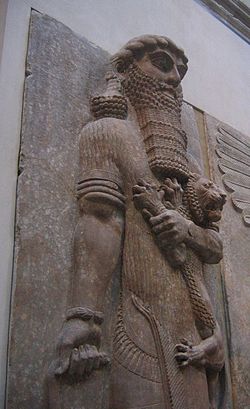 High relief hero clutching lion, from the entrance to the throne room at Khorsabad
 -
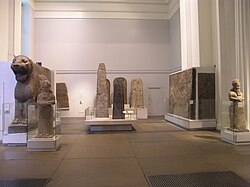 Group displayed in the British Museum, including a lion from a temple entrance, and the Black and White Obelisks
 -
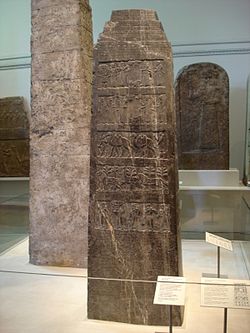 The Black Obelisk of Shalmaneser III in the British Museum, the White Obelisk of Ashurnasirpal I just behind
 -
 Shalmaneser III receives tribute from Sua, king of Gilzanu, on the Black Obelisk
 -
 Unique Assyrian female nude statue from the temple of Ishtar at Nineveh
 -

-
 Three royal stelae at the British Museum
 -
 Lion weight; 6th-4th century BC; bronze; height: 29.5 cm, width: 24.8 cm; Louvre

,_Centre_Island_%2B_North_Wall-_~_Assyrian_Empire_%2B_-Lamassu,_Stela%27s,_Statue%27s,_Obelisk%27s,_Relief_Panel%27s_%26_Full_Projection.1.jpg)


.jpg)


.jpg)
Excavations
[edit]_(cropped).jpg)
Iraq was part of the Ottoman Empire throughout the 19th century, and the government was content to allow foreign excavations and the removal of finds with little hindrance. Even in the 1870s excavators were often only regulated by a regime intended for mining operations, and had to pay a tax based on a proportion of the value of material removed.[54]
The character of the palace reliefs made excavation relatively straightforward, if the right site was chosen. Assyrian palaces were built on high mud-brick platforms. Test trenches were started in various directions, and once one of them had hit sculpture, the trenches had only to follow the lines of the wall, often through a whole suite of rooms. Most trenches could be open to the sky, but at Nimrud, where one palace overlay another, tunnels were necessary in places.[55] Layard estimated "that he had exposed nearly two miles of sculptured walls in Sennacherib's palace alone", not to mention the Library of Ashurbanipal he found there.[56] His excavation practices left a lot to be desired by modern standards; the centres of rooms were not only not excavated, but the material removed from the trench in one room might be deposited in another, compromising later excavations.[57] Typically the slabs were sawn to roughly a third of their original depth, to save weight in carrying them back to Europe,[58] which was typically more complicated and difficult than digging them up.[59]
Botta
[edit]
The first hint of future discoveries came in 1820 when Claudius Rich, British Resident (a sort of local ambassador or consul) in Baghdad, and an early scholar of the ancient Near East, went to Mosul and the site of ancient Nineveh, where he was told of a large relief panel that had been found and soon broken up. His account was published in 1836; he also brought back two small fragments.[60] In 1842 the French consul in Mosul, Paul-Émile Botta, hired men to dig at Kuyunjik, the largest mound at Nineveh. Little was found until a local farmer suggested they try Khorsabad (ancient Dur-Sharrukin) nearby, where "a short trial was dramatically successful", as a palace of Sargon II was found a few feet below the surface, with plentiful reliefs, although they had been burned and disintegrated easily.[61]
Press reports of Botta's finds, from May 1843, interested the French government, who sent him funds and the Académie des Inscriptions et Belles-Lettres sent him Eugène Flandin (1809–1889), an artist who had already made careful archaeological drawings of Persian antiquities in a long trip beginning in 1839. Botta decided there was no more to find at the site in October 1844, and concentrated on the difficult task of getting his finds back to Paris, where the first large consignments did not arrive until December 1846. Botta left the two huge lamassu now in the British Museum as too large to transport; Henry Rawlinson, by now British Resident in Baghdhad, sawed them into several pieces for transport in 1849.[62] In 1849 Monument de Ninive was published, a sumptuously illustrated and exemplary monograph in 4 volumes by Botta and Flandin.
Layard and Rassam
[edit]
Austen Henry Layard (1817–1894) was in the early 1840s "a roving agent attached to the embassy at Constantinople", who had already visited Nimrud in 1840. In 1845 he persuaded Sir Stratford Canning, the ambassador in Constantinople, to personally fund an expedition to excavate there. On his first day digging at Nimrud, with only six workers in November 1845, slabs were found, initially only with inscriptions, but soon with reliefs. He continued to dig until June 1847, with the British government, through the British Museum, taking over the funding from Canning in late 1846, repaying his expenditure. The volume of finds was such that getting them back to Britain was a major task, and many pieces either were reburied, or reached other countries. Layard had recruited the 20-year old Hormuzd Rassam in Mosul, where his brother was British Vice-consul, to handle the pay and supervision of the diggers, and encouraged the development of his career as a diplomat and archaeologist.[63]
Layard returned to England in June 1847, also taking Rassam, who he had arranged to study at Cambridge. He left a few workers, mainly to keep other diggers off the sites, as the French were digging again. His finds were arriving in London, to great public interest, which he greatly increased by publishing a string of books, especially Nineveh and its Remains in 1849. The mistaken title arose because Henry Rawlinson had at that point become convinced that the Nimrud site was actually the ancient Nineveh, though he changed his mind soon after.[64] By October 1849 Layard was back in Mosul, accompanied by the artist Frederick Cooper, and continued to dig until April 1851, after which Rassam took charge of the excavations.[65] By this stage, thanks to Rawlinson and other linguists working on the tablets and inscriptions brought back and other material, the Assyrian cuneiform was at the least becoming partly understood,[66] a task that progressed well over the next decade.
Initially Rassam's finds dwindled, in terms of large objects, and the British even agreed to cede the rights to half the Kuyunjik mound to the French, whose new consul, Victor Place, had resumed digging at Khorsabad. The British funds were running out by December 1853, when Rassam hit upon the palace of Ashurbanipal, which was "in some respects the finest sculptured palace of all", in the new French area of Kuyunjik. Fortunately, Place had not started digging there, and according to Rassam "it was an established rule that whenever one discovered a new palace, no one else could meddle with it, and thus,... I had secured it for England".[67] The new palace took until 1855 to clear, being finished by the Assyrian Exploration Fund, established in 1853 to dig for the benefit of British collections.[68]

Although it was not yet realized, by "the close of excavations in 1855, the hectic Heroic Age of Assyrian archaeology ended", with the great majority of surviving Assyrian sculpture found. Work has continued up to the present day, but no new palaces have been found at the capitals, and finds have mostly been isolated pieces, such as Rassam's discovery in 1878 of two of the Balawat Gates. Many of the pieces reburied have been re-excavated, some very quickly by art dealers, and others by the Iraqi government in the 1960s, leaving them on display in situ for visitors, after the sites were configured as museums. These were already damaged in wars in the 1990s,[69] and have probably been systematically destroyed by Daesh in the 2010s.[70]
Collections
[edit]As a result of the history of excavations, much the best single collection is in the British Museum, followed by the site museums and other collections in Iraq, which in the 20th century were the largest holdings when taken together,[71] though after the wars of the 21st century their current holdings are uncertain. The fate of the considerable number of pieces that have been found and then reburied is also uncertain. At the peak of excavations, the volume found was too large for the British and French to manage, and many pieces either were diverted at some point on their journey to Europe, or were given away by the museums. Other pieces were excavated by diggers working for dealers. As a result, there are significant groups of large lamassu corner figures and palace relief panels in Paris, Berlin, New York, and Chicago.[72] Many other museums have panels, especially a group of college museums in New England, with the museum at Dartmouth College having seven panels.[73] Altogether there are some 75 pieces in the United States.[74]
Apart from the British Museum, in the United Kingdom, the Ashmolean Museum has 10 reliefs (2 large, 8 small) [75]Bristol City Museum and Art Gallery has 3 large reliefs,[76] and the National Museum of Scotland (2.4 x 2.2 m),[77] and Victoria and Albert Museum one relief each.[78]
Notes
[edit]- ^ Reade, 5–17; see Larsen in further reading
- ^ Oates, 6–8; Hoving, 40
- ^ Reade, 5
- ^ In November 2016 the situation remains unclear. Browne, Gareth, "Isis flattened ancient capital after shipping out its treasures" in The Times (London), 19 November 2016 says that the most serious damage to Nimrud was done in late 2016, as the allied forces moved to retake Mosul, where the museum also had an important collection.
- ^ Frankfort, 198–199
- ^ Frankfort, 164–167
- ^ Frankfort, 194–196
- ^ British Museum Collection
- ^ Frankfort, 313–315, 319–322 (and see index); Honour & Fleming, 77; Nimrud ivories press release, British Museum
- ^ Reade, 25
- ^ Reade, 56–60, on the latest reliefs
- ^ Grove
- ^ Frankfort, 157
- ^ Grove
- ^ Reade, 42–43
- ^ Reade, 56 (quoted), 65–71
- ^ The Story of Art (in its chronological place; there are too many editions to give a page number)
- ^ Honour & Fleming, 76–77; Reade, 72–79, 73 quoted; Frankfort, 186–192; Hoving, 40–41
- ^ Frankfort, 146–148
- ^ Honour & Fleming, 75–77
- ^ Reade, 36–38
- ^ Reade, 47; image
- ^ Reade, 43–44
- ^ 42–43
- ^ Frankfort, 168; Honour & Fleming, 73, 75–77
- ^ Frankfort, 147–148, 154; Reade, 28-29
- ^ Frankfort, 147–148, 148 quoted; Reade, 29
- ^ Grove
- ^ Reade, 38
- ^ Reade, 50
- ^ Reade, 23-24 (British Museum example illustrated below)
- ^ Reade, 25–26
- ^ Grove
- ^ Oates, 52
- ^ Reade, 27
- ^ Reade, 21
- ^ Reade, 29–31
- ^ Reade, 7, 29–30, 30 quoted
- ^ Reade, 32, quoted; Frankfort, 164–167
- ^ British Museum collection database; Frankfort, 164
- ^ Reade, 32, 35, 63–64; Frankfort, 167; White, British Museum page
- ^ Reade, 12
- ^ Reade, 62–71
- ^ British Museum collection database
- ^ Reade, 22–23
- ^ British Museum
- ^ Frankfort, 93-98
- ^ Reade, 20–22
- ^ Kreppner, throughout; 368 for 49 reliefs
- ^ Kreppner, 371; Malko, Helen, "Neo-Assyrian Rock Reliefs: Ideology and Landscapes of an Empire", Metropolitan Museum, accessed 28 November 2015
- ^ Kreppner, 374–375
- ^ Kreppner, 369–370; Van der Spek, R.J., "The Assyrian Royal Rock Inscription from Shikaft-i Gulgul", Iranica Antiqua, vol XII, 1977
- ^ Reade, 22; Grove
- ^ Reade, 11
- ^ Reade, 9–12
- ^ Reade, 14
- ^ Oates, 5
- ^ Cohen & Kangas, 5
- ^ Reade, 11, 15-16
- ^ Reade, 6; Oates, 1–2
- ^ Reade, 7; Oates, 3
- ^ Reade, 7
- ^ Reade, 9–12; Oates, 2–6
- ^ Oates, 6–8; Reade, 12
- ^ Reade, 12–14
- ^ Hoving, 40
- ^ Reade, 14–15
- ^ Reade, 14–15
- ^ Reade, 16–17, 16 quoted
- ^ Iconic Ancient Assyrian Sites Ravaged in ISIS's Last Stand in Iraq, by Kristin Romey, AINA repeating National Geographic
- ^ Reade, 5; Grove
- ^ Reade, 5; Grove
- ^ Hood Museum of Art, collection search on "Assyrian"
- ^ Hoving, 40
- ^ Ashmolean page
- ^ Bristol page
- ^ "Edinburgh, Assyrian Relief Fact File". Archived from the original on 2017-08-09. Retrieved 2017-08-09.
- ^ Assyrian Relief at V&A
References
[edit]
| External videos | |
|---|---|
 | |
 Assyrian Art: Ashurbanipal Hunting Lions, Smarthistory Assyrian Art: Ashurbanipal Hunting Lions, Smarthistory |
- Cohen, Ada, Kangas, Stephen E., Assyrian Reliefs from the Palace of Ashurnasirpal II, 2010, University Press of New England, ISBN 9781584658177
- Frankfort, Henri, The Art and Architecture of the Ancient Orient, Pelican History of Art, 4th ed 1970, Penguin (now Yale History of Art), ISBN 0140561072
- "Grove": Russell, John M., Section 6. "c 1000–539 BC., (i) Neo-Assyrian." in Dominique Collon, et al. "Mesopotamia, §III: Sculpture." Grove Art Online, Oxford Art Online, Oxford University Press, accessed 19 November 2016, subscription required
- Hugh Honour and John Fleming, A World History of Art, 1st edn. 1982 (many later editions), Macmillan, London, page refs to 1984 Macmillan 1st edn. paperback. ISBN 0333371852
- Hoving, Thomas. Greatest Works of Western Civilization, 1997, Artisan, New York, ISBN 9781885183538
- Kreppner, Florian Janoscha, "Public Space in Nature: The Case of Neo-Assyrian Rock-Reliefs", Altorientalische Forschungen, 29/2 (2002): 367–383, online at Academia.edu
- Oates, D. and J. Oates, Nimrud, An Assyrian Imperial City Revealed, 2001, London: British School of Archaeology in Iraq, full PDF (332 pages) Archived 2022-09-23 at the Wayback Machine ISBN 978-0903472258
- Reade, Julian, Assyrian Sculpture, 1998 (2nd edn.), The British Museum Press, ISBN 9780714121413
Further reading
[edit]- Collins, Paul, Assyrian Palace Sculptures, 2008, British Museum, ISBN 0714111678, 9780714111674
- Crawford, Vaughn Emerson, Harper, Prudence Oliver, Pittman, Holly, Assyrian Reliefs and Ivories in the Metropolitan Museum of Art: Palace Reliefs of Assurnasirpal II and Ivory Carvings from Nimrud, 1980, Metropolitan Museum of Art, ISBN 0870992600, 9780870992605
- Kertai, David, The Architecture of Late Assyrian Royal Palaces, 2015, Oxford University Press, ISBN 0198723180, 9780198723189
- Larsen, Mogens Trolle, The Conquest of Assyria: Excavations in an Antique Land, 1840–1860, 1996, Psychology Press, ISBN 041514356X, 9780415143561
- Ornan, Tallay, The Triumph of the Symbol: Pictorial Representation of Deities in Mesopotamia and the Biblical Image Ban, 2005, Saint-Paul, ISBN 3525530072, 9783525530078, google books
- Russell, John M., Sennacherib's ‘Palace without Rival’ at Nineveh, 1991, Chicago
Assyrian sculpture
View on GrokipediaHistorical Overview
Old Assyrian Period (c. 2025–1364 BC)
During the Old Assyrian period, Assyrian artistic production emphasized portable and functional objects over monumental sculpture, reflecting the society's focus on long-distance trade rather than territorial expansion or palace-building. Large-scale stone carvings, such as reliefs or statues, are absent from the archaeological record, with no evidence of the gypsum slabs or guardian figures that defined later Assyrian art. Instead, glyptic art dominated, particularly cylinder seals crafted from durable stones like hematite and black steatite, which authenticated trade documents in Assyrian merchant colonies such as Kanesh in Anatolia. These seals featured incised scenes of worshippers approaching enthroned deities, often with linear, stylized figures emphasizing sharp facial features and ritual gestures, serving both administrative and symbolic purposes in a commerce-driven economy.[11] Small-scale carvings in ivory and bronze supplemented this glyptic tradition, including motifs like female sphinxes with Hathor-style curls or kneeling lion-headed figures, likely imported or influenced by interactions with southern Mesopotamia and Anatolia. Votive offerings from temples in Assur, such as the Ishtar sanctuary, occasionally included terracotta or metal figurines, but these lack the permanence and scale of stone sculpture. The scarcity of durable sculptural works may stem from Assur's urban constraints and vulnerability to invasions, prioritizing ephemeral or concealable art forms amid political instability toward the period's end around 1364 BC. This contrasts with the textual abundance from cuneiform archives, which highlight economic rather than artistic achievements.[11]Middle Assyrian Period (c. 1363–912 BC)
The Middle Assyrian Period marked an initial phase in the evolution of Assyrian imperial sculpture, characterized by cultic and commemorative works that emphasized royal piety and military achievements, though surviving examples are fewer and smaller in scale than those from the subsequent Neo-Assyrian era. Artifacts from this time, primarily in stone such as alabaster and limestone, include altars, pedestals, and early relief panels, often associated with temple dedications rather than extensive palace decorations. These pieces reflect a transitional style, with figures depicted in rigid, frontal poses focused on ritual acts, laying groundwork for the more dynamic narratives of later Assyrian art.[12] Under Tukulti-Ninurta I (r. 1243–1207 BC), who expanded Assyrian territory and constructed major temples including one to Ishtar in Assur, several sculptural works survive from religious contexts. A notable example is an alabaster altar from the Ishtar Temple, measuring approximately 58 cm in height, 57.5 cm in width, and 23.5 cm in thickness, featuring bas-relief carvings of the king performing worship before divine symbols or a fire altar, underscoring themes of divine favor and ritual devotion.[13] [14] Similarly, cultic pedestals dedicated to deities like Nuska, found in temple complexes, bear inscriptions and reliefs depicting the king in supplicatory poses, highlighting the integration of sculpture with religious architecture.[15] These objects, housed in collections such as the Ancient Orient Museum in Istanbul, demonstrate early experimentation with low-relief techniques on portable stone blocks.[16] Tiglath-Pileser I (r. 1114–1076 BC), renowned for campaigns reaching the Mediterranean and Anatolia, commissioned sculptures celebrating conquests and hunts, including nāḫirū panels in Assur that portrayed royal hunts with exotic animals like lions and previously unseen beasts imported from distant regions. These works, likely orthostat-like slabs, served propagandistic purposes by visualizing the king's dominion over nature and foes, with stylistic elements such as stylized animal forms prefiguring Neo-Assyrian hunt reliefs. Additionally, rock-cut reliefs attributed to him, such as one near the Tigris River source depicting the king in profile with accompanying inscriptions, represent rare outdoor monumental sculpture adapted to natural settings during frontier expeditions.[17] The period's sculptures, while not yet employing the vast gypsum slabs of later palaces, thus established motifs of royal power through divine and martial imagery.[18]Neo-Assyrian Period (911–609 BC)
The Neo-Assyrian period represented the pinnacle of Assyrian sculptural production, with kings commissioning vast quantities of stone reliefs and colossal statues to decorate newly constructed palaces in capital cities such as Nimrud, Khorsabad, and Nineveh. These works, primarily carved from gypsum, alabaster, and limestone slabs, served propagandistic purposes by glorifying the ruler's military prowess, ritual piety, and divine favor through detailed narrative scenes of conquests, hunts, and ceremonies.[2][19] The scale was monumental, with wall panels often exceeding 2 meters in height and guardian figures weighing tens of tons, reflecting the empire's wealth derived from systematic conquest and tribute extraction.[20] Under Ashurnasirpal II (r. 883–859 BC), the Northwest Palace at Nimrud featured extensive low-relief carvings depicting the king in ritual attire alongside apkallu (winged protective spirits), sacred trees, and attendants bearing offerings, emphasizing themes of royal authority and cosmic order.[19] These gypsum panels, originally painted and arranged in continuous friezes, illustrated processions and symbolic motifs rather than strict historical chronology, with the king's figure repeated to underscore his centrality.[21] Shalmaneser III (r. 858–824 BC) continued this tradition, as seen in the Black Obelisk, a 2.4-meter limestone monolith inscribed and relieved with scenes of tribute-bearing foreigners approaching the king, including the earliest known portrait of an Israelite ruler, Jehu. Sargon II (r. 721–705 BC) advanced sculptural grandeur at Khorsabad, erecting colossal lamassu—human-headed winged bulls over 4 meters tall—at gateways, carved in high relief to project five legs for dynamic approach views.[22] Palace walls bore gypsum reliefs of sieges, deportations, and hunts, executed with finer detail and occasional high-relief elements to convey depth and movement.[23] Later kings like Sennacherib and Ashurbanipal at Nineveh refined narrative complexity; the latter's North Palace reliefs from circa 645–635 BC portray lion hunts with unprecedented realism, showing the king spearing beasts amid chaos, attendants releasing animals from cages, and dying lions in agonized poses, likely staged events symbolizing triumph over chaos.[24][25] Techniques involved quarrying local stone, transporting massive blocks via rivers, and precise carving with iron tools to achieve shallow incisions for shading and texture, though evidence of original pigmentation remains trace in some pieces.[22] Sculptures declined with the empire's collapse after 612 BC, as Nineveh's fall led to destruction and looting of many works, though surviving examples in museums preserve the era's emphasis on power through visual dominance.[26]Materials and Techniques
Primary Materials and Sourcing
Assyrian sculptors primarily utilized gypsum alabaster, a soft, translucent form of gypsum also termed Mosul marble, for monumental reliefs, orthostats, and statues due to its workability with iron and copper tools, enabling detailed incisions and low-relief carving.[4] [2] This material, initially white but prone to yellowing and erosion upon exposure, predominated in Neo-Assyrian palace decorations from sites like Nimrud and Nineveh, where panels measured up to 2 meters high and depicted kings, deities, and conquests.[27] Sourcing occurred from local quarries in northern Mesopotamia, notably the Balatai mountains east of Nineveh, as attested by cuneiform inscriptions on reliefs specifying extraction sites for specific slabs.[28] Mount Nipur, another identified source, supplied similar gypsum deposits, facilitating efficient transport via rivers or sledges to construction sites.[29] Royal annals and relief depictions further document quarrying and hauling of colossal blocks, underscoring state-organized labor for material procurement.[30] Limestone served as a secondary material for larger free-standing figures and architectural bases, offering greater durability despite requiring harder tools for shaping, while rarer instances involved magnesite or bronze castings for ritual objects.[31] [29] Gypsum's prevalence reflected Assyrian adaptation to regional geology, prioritizing aesthetic fineness over longevity in interior palace contexts protected from weathering.[32]Carving Methods and Tools
Assyrian sculptors primarily employed subtractive carving techniques on blocks of gypsum alabaster, a relatively soft stone that allowed for intricate detailing using contemporary metal tools.[2] This process involved roughing out the basic forms with larger chisels before refining surfaces and contours with finer implements, often executed in workshops near quarries or directly at construction sites for monumental pieces. Evidence from surviving reliefs indicates systematic removal of material to achieve low to high relief depths, typically 5–10 cm for palace panels, with precise undercutting for dynamic shadows and depth illusion.[33] Key tools included iron and copper chisels, which were hammered to incise lines, define musculature, and shape figures; iron variants, available by the 9th century BC, enabled harder strikes on the gypsum without frequent re-sharpening.[2] Abrasives such as quartz sand or emery were applied with leather or wood rubbers for smoothing and polishing, removing tool marks and enhancing the stone's natural translucency, as seen in the fine finishes of Neo-Assyrian lion hunts and banquet scenes.[34] Drills, likely bow-driven with copper bits, were used sparingly for perforating eyes, jewelry, or architectural elements, building on earlier Mesopotamian lapidary traditions adapted for larger-scale work.[35] Work was collaborative, with master sculptors overseeing teams of apprentices who specialized in repetitive motifs like cuneiform inscriptions or floral borders, ensuring uniformity across extensive wall sequences spanning hundreds of meters, as in Ashurbanipal's North Palace at Nineveh (c. 645–635 BC).[33] Tool marks visible under magnification—such as parallel striations from toothed chisels—confirm these methods, with gypsum's solubility to water aiding in cleaning debris during carving without damaging the matrix.[2] No direct archaeological assemblages of Assyrian sculptors' toolkits have been extensively published, but analogies from contemporaneous metalworking and building sites suggest mallets, wedges, and measuring rods complemented the chisels for alignment and proportioning.[36]Scale and Engineering Feats
Assyrian sculptors produced colossal lamassu figures, typically 3 to 5 meters in height and weighing 20 to 40 tons, carved from single blocks of alabaster or gypsum.[37] [38] These guardian statues, such as those from the Northwest Palace at Nimrud measuring approximately 3.5 by 3.71 meters, demanded advanced quarrying techniques to extract massive stones from regional deposits.[39] Transportation involved gangs of laborers dragging roughed-out blocks on sledges over rollers along leveled roads constructed from quarry rubble, as depicted in contemporary reliefs showing the movement of similar monumental sculptures.[40] Erection at palace gates required precise assembly and positioning to achieve the double-aspect illusion, with five legs ensuring the figures appeared stationary from the front and ambulatory from the side.[38] Palace wall reliefs further exemplified engineering prowess through the production and installation of hundreds of thin alabaster slabs, each often exceeding 2 meters in height and weighing 900 to 2,000 kilograms.[41] [42] Quarrying and hauling these slabs to sites like Nimrud or Nineveh constituted a logistical feat, with evidence from relief scenes illustrating river transport on rafts and overland sledges for heavy stone loads.[4] Once positioned along mudbrick walls, artisans carved intricate narratives in low relief directly on site, coordinating multi-slab compositions to depict continuous scenes of conquest and ritual without visible seams.[4] This systematic coverage of palace interiors—spanning kilometers of wall surface in complexes like Ashurnasirpal II's Northwest Palace—underscored the empire's capacity for large-scale stone manipulation and organizational efficiency.[2] Smaller monuments, such as the Black Obelisk of Shalmaneser III, stood about 1.97 meters tall, carved from a single limestone block and inscribed with over 200 lines of cuneiform detailing military campaigns.[43] Engineering challenges extended to free-standing statues and stelae, transported and erected using similar sledging methods, though on a reduced scale compared to gate guardians.[40] Overall, these achievements relied on specialized labor forces, iron tools for fine detailing, and imperial infrastructure, enabling the Assyrians to rival contemporaneous monumental works in Egypt and the Levant.[4]Major Types of Sculpture
Monumental Gate Guardians (Lamassu and Similar Figures)
Monumental gate guardians in Assyrian sculpture, known as lamassu, consist of colossal composite figures typically featuring the body of a bull or lion, eagle wings, and a bearded human head crowned with a horned cap signifying divinity. These sculptures, often paired at palace and city entrances, served an apotropaic function to avert evil spirits and intruders while symbolizing royal power and divine protection. Crafted primarily during the Neo-Assyrian period from 911 to 609 BC, they represent a pinnacle of monumental stone carving, with examples reaching heights of over 4 meters and weights exceeding 10 tons.[22][44][45] The lamassu were hewn from single blocks of alabaster or gypsum, materials quarried locally in northern Mesopotamia, allowing for seamless monolithic forms that enhanced their imposing presence. Sculptors employed techniques such as direct carving on site to minimize transport risks, incorporating five legs per figure—two visible from the front for a stationary stance and four from the side for a dynamic gait—to create an illusion of movement and vigilance from multiple angles. Inscriptions on the figures often bore the commissioning king's name, genealogy, and dedications to gods like Ashur, reinforcing the monarch's legitimacy and the guardians' protective efficacy.[22][46][45] Prominent examples include those from Ashurnasirpal II's Northwest Palace at Nimrud (ancient Kalhu), dated to 883–859 BC, where human-headed winged lions flanked gateways amid extensive building campaigns that reshaped the city as the Assyrian capital. Similarly, at Dur-Sharrukin (Khorsabad), Sargon II erected lamassu around 713–707 BC to guard his new citadel's entrances, with pairs featuring detailed cuneiform texts describing their role in securing paths and repelling foes. These figures, alongside related shedu (male counterparts) and hero motifs clutching lions, underscore a consistent Neo-Assyrian emphasis on hybrid iconography blending human intellect, animal strength, and avian swiftness to embody supernatural guardianship.[45][39][22]Palace Wall Reliefs and Narrative Sequences
![Ashurbanipal hunting lions, gypsum relief from North Palace, Nineveh][float-right] Palace wall reliefs in Assyrian sculpture primarily featured large slabs of gypsum or limestone carved in low relief, lining the lower sections of royal palace interiors to convey royal power and divine mandate. These panels, often exceeding 2 meters in height and spanning entire room walls, formed continuous friezes that wrapped around chambers, with scenes originally enhanced by polychrome painting for added vibrancy and depth.[7][24] Narrative sequences dominated the compositions, structured in horizontal registers that unfolded events chronologically from right to left, employing a continuous style where figures repeated across scenes to depict progression without strict spatial isolation. This technique allowed extended storytelling, such as multi-slab depictions of military sieges or hunts, integrating textual inscriptions from royal annals to label key figures and outcomes. Materials like fine-grained gypsum from local quarries facilitated intricate detailing of musculature, weaponry, and attire, achieved through shallow carving with iron tools and abrasives for polishing.[47] In the Northwest Palace of Ashurnasirpal II at Nimrud (883–859 BC), over 600 slabs documented campaigns against western foes, tribute-bearing processions, and ritual banquets, emphasizing the king's role as warrior and patron. Similarly, Sennacherib's Southwest Palace at Nineveh illustrated the 701 BC siege of Lachish in sequential panels showing assault ramps, battering rams, and prisoner deportations, corroborated by excavated arrowheads and skeletal remains at the site. Ashurbanipal's North Palace reliefs (c. 645–635 BC) advanced narrative dynamism in lion hunt cycles, portraying staged combats in arenas with the king wielding bow and spear against released beasts, symbolizing mastery over chaos while reflecting controlled ceremonial practices rather than wild pursuits.[20][24] These reliefs prioritized hierarchical proportions—kings towering over subordinates—and formulaic poses for readability, yet incorporated empirical observations of anatomy and engineering, such as accurate siege machinery and ethnic attire variations, distinguishing subjects by costume and physiognomy to reinforce Assyrian dominance. While interpretive biases in modern scholarship sometimes overemphasize brutality, the sequences align with cuneiform records of expansions, serving both commemorative and didactic functions for elite audiences in throne rooms and courtyards.[19]Free-Standing Statues of Rulers and Deities
Free-standing statues of Assyrian rulers and deities, distinct from reliefs and colossal guardians, were primarily votive offerings placed in temples to affirm royal devotion and sustain divine presence, with production peaking during the Middle and Neo-Assyrian periods. These sculptures, often carved from imported hard stones like magnesite to symbolize conquest and access to exotic resources, involved specialized sculptors under royal oversight, as evidenced by administrative letters detailing rituals and maintenance. Survival is limited due to deliberate destruction, material recycling during conquests, and environmental decay, leaving textual and iconographic records to supplement rare archaeological finds.[48][49] A key surviving example of a royal statue is that of Ashurnasirpal II (r. 883–859 BC), the only known intact Neo-Assyrian kingly figure in the round, carved from magnesite atop a reddish dolomite base and originally installed in the temple of Ishtar Sharrat-niphi at Nimrud. Standing approximately 1.9 meters tall including base, with the figure itself 113 cm high, it portrays the bare-headed king in a short-sleeved tunic and fringed shawl, gripping a ceremonial sickle in his right hand and a mace in his left, his curled beard and long hair rendered with precise detail. An inscription on the chest enumerates the king's achievements and piety, underscoring the statue's role in perpetuating royal legitimacy before the goddess. Excavated in 1850, it exemplifies the technical prowess in achieving frontal rigidity combined with subtle anatomical realism.[50][51] Statues of deities, central to cult practices, were similarly free-standing but even scarcer in the archaeological record, often depicted in reliefs as portable figures looted from subjugated cities, with texts recording commissions in stone, gold, or silver for installation in sanctuaries like those of Ashur or Ishtar. Neo-Assyrian kings such as Shalmaneser III oversaw their production alongside royal effigies, involving purification rites and placement in temple cellas to receive offerings. A rare preserved instance is the unique nude female statue from the Ishtar temple at Nineveh, erected during the reign of Ashur-bel-kala (r. 1073–1056 BC), likely representing the goddess in her erotic aspect or an attendant, its inscription indicating intent for allure within the cult context. This limestone figure, the sole known Assyrian depiction of female nudity in sculpture, highlights deviations from typical stylized forms toward functional symbolism in divine representation.[48][52]Stelae, Orthostats, and Commemorative Monuments
Assyrian stelae were freestanding upright stone slabs, typically carved from limestone or basalt, erected in public spaces, temples, or frontier regions to proclaim royal victories, construction projects, and divine favor. These monuments combined dense cuneiform inscriptions narrating the king's exploits with occasional low-relief carvings depicting submission of enemies or ritual scenes, serving as propagandistic tools to legitimize rule and deter rebellion. In the Middle Assyrian period, examples include the stela of Shamshi-Adad V (c. 824–811 BC), which records military campaigns and temple dedications, featuring the king in ritual pose before deities. Neo-Assyrian rulers expanded this tradition, as seen in Sargon II's (722–705 BC) stelae from sites like Ashdod and Kition, fragmentary basalt pieces detailing suppressions of revolts in Philistia and Cyprus around 711 BC, emphasizing Assyrian dominance over vassal states.[53][54] Orthostats formed the lower courses of palace and temple walls, consisting of massive rectangular stone slabs—often over 2 meters high and deeply carved with narrative reliefs—to shield mud-brick upper structures from moisture while visually asserting imperial power through depictions of warfare, royal hunts, and apkallu (sage) figures. Prevalent from the 9th century BC in capitals like Nimrud (Kalhu) and Khorsabad (Dur-Sharrukin), these gypsum or limestone panels progressed in complexity, evolving from geometric motifs in earlier examples to intricate battle sequences under Ashurnasirpal II (883–859 BC), where soldiers impale enemies amid sieges. Their placement at eye level facilitated public viewing during ceremonies, reinforcing the king's role as warrior and builder. Excavations at Nimrud's Northwest Palace revealed over 200 such orthostats, many transported to museums like the Louvre, highlighting standardized workshop production.[55] Commemorative monuments, such as obelisks, blended stele-like functions with taller, four-sided forms to catalog extended annals of tribute and conquests. The Black Obelisk of Shalmaneser III (858–824 BC), a 1.98-meter black limestone pillar erected in 825 BC at Nimrud's central courtyard, bears five stacked relief registers showing the king receiving obeisance from rulers including Jehu of Israel ("son of Omri"), alongside 190 lines of inscription tallying campaigns and spoils from 36 years of rule. Similarly, the White Obelisk, a 2.85-meter white limestone artifact from Nineveh attributed to Ashurnasirpal I (1049–1031 BC), features the earliest surviving Assyrian figural narratives: processions of tribute-bearers with exotica like muslins and monkeys, and banquet scenes evoking royal generosity. These pieces, distinct from palace reliefs by their portability and dedicatory intent, were often set in temple precincts to invoke perpetual divine witness to Assyrian hegemony.[56][43][57]Iconography and Interpretation
Symbolism of Power, Divinity, and Kingship
Assyrian sculptures conveyed kingship as a divinely sanctioned institution through motifs blending martial dominance, ritual piety, and supernatural guardianship. Kings appeared in reliefs as central, invincible figures performing libations before divine standards or gods, emphasizing their role as high priests of Ashur who mediated between the human and divine realms to secure cosmic order.[58] For instance, panels from Ashurnasirpal II's palace at Nimrud (r. 883–859 BCE) depict the king in ritual robes wielding a mace—a symbol of authority derived from the gods—flanked by sacred trees representing fertility and eternal kingship under divine protection.[59] Protective hybrid figures like the lamassu, stationed at palace gateways during the Neo-Assyrian period (911–609 BCE), fused human heads for wisdom, bovine or leonine bodies for strength, and eagle wings for swiftness, embodying the apotropaic power that shielded the king's realm from chaos and affirmed his alignment with astral deities.[58] These colossal statues, such as those from Sargon II's palace at Khorsabad (r. 722–705 BCE), projected the monarch's potency as an extension of celestial forces, with five legs in profile views to suggest unyielding vigilance from multiple angles.[58] Scenes of royal lion hunts further symbolized the king's prowess in subduing primordial threats, a privilege reserved for the ruler as protector of his people and enforcer of order against anarchy. Reliefs from Ashurbanipal's North Palace at Nineveh (r. 668–627 BCE) illustrate the king drawing his bow against charging lions in staged arenas, where the beasts embodied raw chaos; his triumph underscored divine favor and the ideological fusion of personal valor with imperial mandate.[60] [61] Tribute and victory motifs, as on the Black Obelisk of Shalmaneser III (r. 859–824 BCE), showed foreign rulers prostrating before the enthroned king, often accompanied by divine symbols like the winged disk of Ashur, reinforcing hierarchical dominion as a reflection of heavenly hierarchy and the king's unassailable status.[58] Such iconography propagated the notion of Assyrian hegemony as eternally ordained, blending religious devotion with political ideology to legitimize expansionist rule.[58]Depictions of Warfare, Hunting, and Conquest
![Ashurbanipal hunting lions, gypsum relief from North Palace, Nineveh][float-right] Assyrian palace reliefs prominently featured scenes of warfare, illustrating the king's role in leading military campaigns, besieging enemy cities, and executing captives to assert dominance and divine mandate. Carved in low relief on large gypsum alabaster slabs, typically 2 meters high, these panels lined the walls of royal palaces such as those at Nimrud, Khorsabad, and Nineveh during the Neo-Assyrian period (911–609 BC). For example, reliefs from Ashurnasirpal II's Northwest Palace at Nimrud (r. 883–859 BC) depict the king, protected by the god Ashur, storming fortified cities, with enemy chariots overturning and soldiers impaled on stakes, emphasizing brutal tactics to deter rebellion.[62][63] Siege warfare was rendered with technical detail, as seen in Sennacherib's reliefs from his Southwest Palace at Nineveh commemorating the 701 BC conquest of the Judean city of Lachish. These slabs show Assyrian engineers constructing earthen ramps, deploying battering rams and archers, and defenders hurling firebrands from walls, culminating in the deportation of women and children laden with spoils. The king appears enthroned, receiving obeisance from captives, highlighting hierarchical victory and the extraction of tribute to fund imperial expansion. Excavated in 1847 by Austen Henry Layard, over 20 panels survive, originally spanning three rooms and painted in vibrant colors now faded.[64][65] ![Prisoners and cavalry, Lachish relief][center] Hunting scenes, especially ritual lion hunts, paralleled warfare motifs by portraying the monarch conquering chaotic forces akin to battlefield foes. Ashurbanipal's gypsum reliefs from Nineveh's North Palace (c. 645–635 BC) capture the king in dynamic poses—drawing bows from chariots or stabbing lions on foot—amidst attendants, musicians, and slain beasts with anatomically precise wounds conveying agony and ferocity. These staged events, held in arenas, symbolized cosmic order restored, with the king's prowess elevated through oversized scale and divine symbols; panels from Room S' and Room C, excavated by Hormuzd Rassam in the 1850s, measure up to 1 meter wide each.[24][60] Conquest imagery extended to processions of subjugated peoples bearing tribute—exotic animals, metals, and goods—flanking victorious armies, as in Sargon II's Khorsabad reliefs (r. 722–705 BC) showing cavalry herding prisoners. Such depictions, recurrent across reigns, served to propagandize territorial gains from campaigns spanning Anatolia to Egypt, with numerical boasts in inscriptions like Ashurnasirpal's claims of flaying thousands, corroborated by skeletal evidence of mass executions at sites like Tell Masaikh.[7]Scholarly Debates on Realism, Propaganda, and Brutality
Scholars debate the extent of realism in Assyrian sculpture, weighing stylized conventions against elements suggesting observational accuracy. Assyrian artists employed longstanding Mesopotamian conventions, such as standardized facial features and hierarchical scaling, which prioritized ideological consistency over individual portraiture or photographic likeness.[58] However, detailed renderings of foreign landscapes, attire, and physiques indicate an intent to convey recognizable otherness, potentially drawing from direct observation during campaigns.[58] Davide Nadali argues that reliefs, such as those from Sennacherib's fifth campaign in the Palace without Rival at Nineveh (circa 700 BCE), blend convention with "live sketches" that reinvent battle narratives for visual impact, favoring royal ideology over verbatim historical fidelity.[66] The propagandistic function of Assyrian reliefs is widely recognized, with sculptures serving as tools to assert imperial dominance and divine sanction. Palace walls, lined with sequences glorifying kings like Ashurnasirpal II (883–859 BCE) and Ashurbanipal (668–627 BCE), depicted rulers as invincible warriors and builders, omitting Assyrian setbacks to project unassailable power.[58] Julian Reade posits that these images targeted elite visitors and foreign envoys, reinforcing Assyrian superiority through scenes of tribute reception and conquest, such as Sennacherib's Lachish siege reliefs (701 BCE), where Assyrian forces systematically subdue rebels.[58] This selective narrative framing aimed to deter rebellion by visualizing inevitable subjugation, though access was restricted to palace interiors rather than broad public display. Depictions of brutality in Neo-Assyrian art, including impalement, flaying, and decapitation, spark debate over their reflection of routine warfare versus deliberate exaggeration for effect. Catalogues identify 22 distinct atrocity types across 56 scenes, primarily targeting enemy elites and soldiers, as in Ashurbanipal's North Palace reliefs showing Elamite decapitations (circa 645 BCE).[67] These acts aligned with broader Near Eastern military practices, suggesting historical veracity rather than unique Assyrian excess, yet their prominence served to underscore domination for divine and royal affirmation over mass intimidation.[67] Reade notes the exclusion of Assyrian casualties, enhancing propagandistic invincibility, while some scholars view the graphic detail—evident in the contorted poses of victims—as ritualistic emphasis on chaos subdued by order, not mere terror tactics.[58]Archaeological Context
Early Modern Excavations (19th Century)
The earliest systematic excavations of Assyrian sites in the 19th century were initiated by French diplomat and archaeologist Paul-Émile Botta, who began digging at Khorsabad (ancient Dur-Sharrukin) in 1842 under the auspices of the Louvre Museum. Botta's team uncovered the palace complex of Sargon II (r. 722–705 BCE), revealing monumental wall reliefs depicting royal processions, divine figures, and mythical scenes, as well as colossal human-headed winged bulls known as lamassu that guarded gateways. These discoveries, including gypsum slabs and statues shipped to Paris despite losses during transport in 1844, marked the first major exposure of Neo-Assyrian monumental sculpture to the modern world, confirming the existence of a sophisticated artistic tradition previously known only through biblical and classical texts.[68][69] Building on Botta's efforts, British archaeologist Austen Henry Layard commenced excavations at Nimrud (ancient Kalhu) in 1845, supported by the British Museum and assisted by local scholar Hormuzd Rassam. Layard's work at the Northwest Palace of Ashurnasirpal II (r. 883–859 BCE) yielded hundreds of finely carved alabaster reliefs illustrating banquets, genii with sacred trees, and protective spirits, alongside the Black Obelisk of Shalmaneser III (r. 858–824 BCE) featuring narrative friezes of tribute and conquests. Further digs uncovered lamassu figures over 3 meters tall and free-standing statues, with Layard employing hundreds of workers to tunnel through mud-brick ruins, extracting and shipping approximately 127 large sculptures and panels by 1847.[70][68] Layard shifted to Nineveh's Kuyunjik mound in 1847, exposing the Southwest Palace of Sennacherib (r. 704–681 BCE) and later Ashurbanipal's North Palace (r. 668–627 BCE), where teams retrieved extensive gypsum relief cycles portraying sieges, lion hunts, and court rituals—most notably the dynamic Ashurbanipal lion hunt series demonstrating anatomical precision and dramatic composition. These efforts, continuing until 1851, amassed over 2,000 relief fragments for the British Museum, fundamentally reshaping perceptions of Assyrian imperial art as a pinnacle of ancient Near Eastern stone carving. Rassam, continuing under British auspices in the 1850s and later independently, recovered additional panels from Nineveh and bronze relief-banded gates at Balawat, though his methods drew criticism for less rigorous documentation compared to Layard's.[70][68]20th-Century Systematic Digs
The transition to systematic archaeological methods in the 20th century marked a departure from the exploratory digs of the previous era, emphasizing stratigraphic recording, contextual analysis, and preservation of architectural features to better understand Assyrian sculptural programs within their palace and temple settings. These excavations, often sponsored by universities and museums, yielded supplementary sculptural material that complemented earlier discoveries, including glazed relief bricks, fragmentary wall panels, and guardian figures, while providing stratigraphic evidence for dating and original placement.[71] At Khorsabad (ancient Dūr-Šarrukīn), the University of Chicago's Oriental Institute conducted excavations from 1928 to 1935 under directors Edward Chiera and Gordon Loud, uncovering extensive remains of Sargon II's palace complex. This work revealed additional gypsum wall reliefs depicting court scenes, genies, and mythical beasts, as well as fragments of colossal lamassu guardians at gateways, executed in the characteristic Neo-Assyrian style with intricate cuneiform inscriptions. The systematic approach included detailed mapping of the site's layout, which confirmed the sculptures' roles in ritual and propagandistic contexts, with over 200 relief slabs documented before their transport to institutions like the Oriental Institute Museum.[71] In Nineveh, R. Campbell Thompson led British Museum-sponsored digs from 1927 to 1932, focusing on the Temple of Nabû on the Kuyunjik mound. These efforts recovered numerous glazed high-relief bricks featuring Assyrian motifs such as deities, sacred trees, and royal figures, some inscribed with fragments of royal names attributable to Sennacherib or Esarhaddon. The bricks, fired for durability and colored with blues and yellows, represented a specialized sculptural medium used in temple facades, with Thompson's team employing photographic and epigraphic documentation to link them to broader palace relief traditions. Approximately 100 such bricks were excavated, providing evidence of color-enhanced Assyrian artistry previously underrepresented in black-and-white gypsum reliefs.[72] The most prolonged 20th-century campaign occurred at Nimrud (ancient Kalḫu), where Max Mallowan directed excavations for the British School of Archaeology in Iraq from 1949 to 1958, succeeded by David Oates until 1963. This work targeted palaces like those of Ashurnasirpal II and Shalmaneser III, unearthing fragmentary orthostats, lion hunt reliefs, and architectural sculpture fragments, including ivory-inlaid elements integrated with stone carvings. Mallowan's stratigraphic methods clarified multi-phase construction, revealing how sculptures were repaired or overlaid across reigns, with key finds such as throne room reliefs reinforcing narratives of kingship and conquest. Over 14 seasons, the digs documented more than 50 sculptural fragments, enhancing understanding of Nimrud's role as a sculptural production center.[73]Recent Discoveries and Ongoing Work (21st Century)
In May 2025, archaeologists from Heidelberg University excavated fragments of a monumental gypsum relief in the ancient city of Nineveh, depicting King Ashurbanipal (r. 668–627 BC) flanked by the deities Ashur and Ishtar.[74] The 12-ton artifact, originally spanning about 5.5 meters in length and 3 meters in height, was discovered in the Southwest Palace and offers unprecedented detail on Assyrian divine-royal interactions, with Ashur shown in a winged disk and Ishtar bearing symbols of fertility and war.[75] This find, pieced from over 30 fragments, underscores the technical sophistication of Neo-Assyrian carving, where gypsum allowed for intricate low-relief work under dim palace lighting.[76] September 2025 saw the unearthing of the largest known lamassu—a human-headed winged bull statue—in Mosul, near Nineveh's ruins, during clearance of an ancient gateway damaged by ISIS in 2015.[77] Measuring over 5 meters in height and weighing approximately 18 tons, the limestone figure dates to the reign of Sargon II (721–705 BC) and exemplifies protective apotropaic sculpture, with five legs for dynamic frontal and side views.[78] In October 2025, a German-led team at Tell Nabi Yunus (part of Nineveh) revealed fifteen additional monumental lamassu statues and well-preserved bas-reliefs within a Neo-Assyrian military palace, including scenes of royal hunts and processions that highlight imperial propaganda motifs.[79] These sculptures, many intact despite modern conflicts, were positioned to guard palace entrances, reinforcing the Assyrian emphasis on hybrid guardian forms blending bovine strength, avian flight, and human intellect. Ongoing excavations emphasize site stabilization and post-conflict recovery. The Penn Museum's Nimrud Project, active since 2015, has documented sculpted elements in the Temple of Ninurta, including two remarkably preserved shrines from the 9th–7th centuries BC uncovered in 2024, amid broader efforts to map and restore palace reliefs damaged by looting and demolition.[80] Complementary work at Nimrud in 2022–2023 focused on stratigraphic analysis of sculptural contexts, yielding fragments of orthostats and confirming sequential layering of relief programs across Assyrian capitals.[81] The Land of Nineveh Archaeological Project, directed by Italian and Iraqi teams since the early 2010s, continues geophysical surveys and targeted digs east of Nineveh, integrating 3D modeling of reliefs to trace urban expansion under Sennacherib (r. 705–681 BC) and beyond, while addressing threats from urban encroachment.[82] These initiatives prioritize empirical documentation over interpretive speculation, leveraging remote sensing to minimize invasive digs and preserve fragile gypsum sculptures vulnerable to humidity and seismic activity.[83]Preservation and Modern Issues
Global Museum Collections
 The British Museum in London houses the world's largest collection of Assyrian sculptures, comprising over 200 square meters of carved stone reliefs and large-scale statues primarily from the palaces of Nimrud, Nineveh, and Balawat, excavated in the mid-19th century by Austen Henry Layard under Ottoman permits.[84][85] Notable pieces include the Lion Hunt reliefs from Ashurbanipal's North Palace at Nineveh (circa 645–635 BCE), depicting dynamic scenes of royal lion hunting, and the Black Obelisk of Shalmaneser III (circa 825 BCE), a freestanding monument showing tribute bearers and conquests.[86] These artifacts, displayed in dedicated galleries (Rooms 6–10), illustrate Neo-Assyrian imperial themes of kingship, warfare, and ritual.[20] The Louvre Museum in Paris features significant holdings from the Palace of Sargon II at Khorsabad (Dur-Sharrukin), uncovered by Paul-Émile Botta's excavations starting in 1843, which prompted the establishment of its Assyrian museum in 1847.[87] Key exhibits include monumental lamassu (human-headed winged bulls) from palace gateways, carved around 713–706 BCE to serve as protective genii, and reconstructed courtyard elements evoking the original architectural context.[88][22] In the United States, the Metropolitan Museum of Art in New York maintains an Assyrian Sculpture Court reinstallation (opened 2022) displaying gypsum relief panels from Ashurnasirpal II's Northwest Palace at Nimrud (circa 883–859 BCE), acquired partly through John D. Rockefeller Jr.'s 1933 gift and earlier purchases.[4][89] These include scenes of apkallu (winged sages) and courtiers, arranged to mimic palace walls and highlight the sculptures' original polychrome finishes and ritual functions.[90] The Vorderasiatisches Museum in Berlin's Pergamon complex holds Assyrian palace reconstructions and artifacts, such as a 9th-century BCE human-headed winged bull from Nimrud and alabaster reliefs of eagle-headed figures, drawn from 19th- and early 20th-century digs.[91][92] Smaller but noteworthy collections exist elsewhere, including at the Brooklyn Museum (reliefs from Ashur-nasir-pal II's palace) and the Getty Villa (exhibition loans of palace art).[93][94] These global dispersals, resulting from permitted excavations, preserve thousands of pieces amid regional instability, though they fuel ongoing repatriation debates addressed separately.[26]Threats from Conflict and Looting (Including ISIS Destruction)
Assyrian archaeological sites in northern Iraq, including Nimrud and Nineveh, have faced severe threats from armed conflicts since the 2003 U.S.-led invasion, which destabilized governance and enabled widespread looting driven by economic hardship and black-market demand.[95] Post-invasion chaos led to the plunder of unexcavated sites, with satellite imagery and ground reports indicating thousands of looting pits at Assyrian mounds like Nimrud by 2008, exacerbating the loss of in-situ sculptures and reliefs.[96] The Iraq National Museum in Baghdad, housing Assyrian artifacts, suffered looting in April 2003, though its Assyrian sculpture gallery remained largely intact; an estimated 15,000 items were stolen overall, many later recovered through international efforts, but site-specific Assyrian pieces continued to vanish into illicit trade.[97] [98] The rise of the Islamic State (ISIS) from 2014 intensified these dangers through deliberate iconoclasm targeting pre-Islamic heritage as idolatrous, alongside opportunistic looting for funding.[99] At Nimrud (ancient Kalhu), a key Neo-Assyrian capital with palaces featuring monumental reliefs of kings like Ashurnasirpal II, ISIS militants bulldozed and detonated structures on March 5, 2015, reducing the Northwest Palace—famed for its carved orthostats depicting conquests and rituals—to rubble and erasing irreplaceable stratigraphic context.[100] [101] In Nineveh, near Mosul, ISIS demolished sections of the ancient city walls and the Mashki Gate in 2016 using bulldozers, damaging potential loci for unexcavated reliefs, while earlier attacks on the Mosul Museum involved smashing Assyrian statues and replicas of winged bulls, though many originals had been preemptively relocated.[102] [103] ISIS's actions combined ideological erasure—framed in propaganda as purging pagan symbols—with economic motives, as demolitions sometimes masked prior artifact extraction for sale, per UNESCO and Iraqi assessments; this dual threat compounded losses at sites like Assur, where conflict-related instability persists alongside risks from urbanization and neglect.[104] [105] Post-ISIS liberation in 2017 revealed extensive damage, but ongoing vulnerabilities in Iraq's fragile security environment continue to imperil remaining Assyrian sculptures, underscoring the causal link between political vacuum and heritage devastation.[106]Repatriation Claims and Ownership Disputes
Repatriation claims for Assyrian sculptures primarily originate from the Iraqi government and cultural advocates, asserting that artifacts excavated from sites like Nimrud and Nineveh belong to Iraq as part of its national heritage, regardless of 19th-century acquisition methods under Ottoman authority.[107] These claims target major Western collections, including the British Museum's holdings from Austen Henry Layard's 1840s excavations at Nineveh and Nimrud, where reliefs were divided via a partage system permitting export of duplicates and excavator shares.[108] Museums counter that such acquisitions were legal at the time, with permissions from Ottoman sultans like Abdulmejid I, and emphasize superior preservation amid Iraq's history of looting and conflict-related damage.[108] Ownership disputes intensified post-2003 Iraq invasion, with Iraq demanding returns of items allegedly taken illicitly, though core Assyrian palace reliefs from systematic 19th-century digs remain contested rather than repatriated. The British Museum has returned specific looted pieces, such as a rare Assyrian plaque identified in online auctions and repatriated in 2020 after provenance verification, but resists broader claims for its foundational collection.[109] In September 2024, a carved stone panel depicting a winged genie, stolen from an Iraqi site in the early 1990s and held in UK police storage for 22 years, was returned to Iraq, highlighting cooperation on illicit trade but not resolving disputes over legally acquired sculptures.[110] Advocacy efforts include artist Michael Rakowitz's 2023 proposal to donate a contemporary sculpture to the British Museum or Tate Modern in exchange for repatriating an Assyrian lamassu to Iraq, underscoring debates over cultural restitution versus institutional holdings; the museum did not accept the offer. Similar pressures apply to the Louvre's Khorsabad reliefs from Paul-Émile Botta's 1840s excavations, with exhibitions occasionally featuring items of questionable provenance amid broader Mesopotamian repatriation calls.[111] Critics of repatriation argue that Iraq's institutional instability, evidenced by ISIS's 2015 destruction of Nimrud sculptures, risks artifact loss, prioritizing global accessibility and conservation over nationalist retention.[112] Iraqi officials maintain that improved security post-ISIS warrants returns to foster national unity, though no major Assyrian sculptures from 19th-century collections have been repatriated as of 2025.[113]Cultural Legacy
Influence on Later Near Eastern and Western Art
Assyrian monumental sculpture profoundly shaped Achaemenid Persian art, as the Persians, having conquered the Assyrian heartland by 612 BCE, incorporated key techniques and iconographic elements into their palace decorations at sites like Persepolis (founded c. 515 BCE) and Susa. Achaemenid reliefs adopted the Assyrian method of low-relief narrative panels on orthostats and glazed bricks, depicting imperial tribute processions, royal hunts, and guardian figures, which served similar propagandistic purposes of glorifying the king's power and divine mandate.[114][32] For example, the Apadana staircase at Persepolis features orderly ranks of subject peoples bearing gifts, echoing the detailed ethnic diversity and hierarchical compositions in Neo-Assyrian reliefs from Nineveh, such as those of Ashurbanipal (r. 668–627 BCE).[115] Mythical motifs from Assyrian sculpture, including human-headed winged bulls (lamassu) and combat scenes between lions and bulls, were adapted in Achaemenid works, though stylized with greater symmetry and less narrative depth to emphasize cosmic order over Assyrian brutality.[116] Comparative analyses of lamassu sculptures reveal evolutionary refinements in Achaemenid versions, such as enhanced proportions and integration into architectural gateways, reflecting direct borrowing refined for Persian multiculturalism.[116] Decorative elements like floral friezes, rosettes, and throne-daises also show continuity, as Persian kings replicated Assyrian styles for seating and processional imagery to legitimize their rule over former Mesopotamian territories. This synthesis extended Assyrian influence into later Near Eastern traditions, including Urartian bronzework and Mannaean reliefs, where winged genies and sacred trees persisted as symbols of protection and fertility up to the 7th–6th centuries BCE.[117][118] In Western art, Assyrian sculpture's impact emerged post-rediscovery during 1840s excavations at Nimrud and Nineveh by Austen Henry Layard, whose findings of palace reliefs—over 2,000 panels shipped to the British Museum by 1855—sparked widespread fascination and stylistic emulation in 19th-century Europe.[26] This "Assyrian revival" influenced Victorian architecture and decorative arts, with motifs like lamassu guardians, cuneiform friezes, and hunting scenes appearing in jewelry, furniture, and buildings such as the Assyrian Court at the Crystal Palace (1854), blending oriental exoticism with neoclassical forms.[119] Layard's publications, including Nineveh and Its Remains (1849), disseminated these elements, prompting artists to adopt Assyrian realism and scale in works evoking imperial might, though often sanitized for European tastes amid debates over the art's "barbaric" vigor versus Greek idealism.[26] Such revivals waned by the late 19th century but informed early 20th-century modernism's interest in ancient non-Western forms, underscoring Assyrian sculpture's role in broadening Eurocentric art historical narratives.[119]Enduring Insights into Assyrian Society and Imperial Realism
Assyrian sculptures, particularly palace reliefs, reveal an imperial ideology centered on the king's role as the invincible agent of the god Ashur, tasked with expanding the realm and maintaining order against chaos.[58] Military conquest scenes, such as those from Sennacherib's palace depicting the 701 BCE siege of Lachish, illustrate advanced Assyrian tactics including battering rams, archers, and sappers undermining walls, underscoring the empire's logistical sophistication and ruthless efficiency in subjugating rebels.[120] These depictions categorize foreigners—tributaries, equals like Urartu, or defeated foes—through distinct clothing and postures, evidencing a bureaucratic classification system that reinforced Assyrian dominance over diverse regions from the Levant to Iran.[58] The realism in these carvings, with anatomical precision in human figures and animals, conveys imperial control over both human enemies and nature, as seen in Ashurbanipal's lion hunt reliefs from Nineveh (ca. 645–635 BCE), where the king spears charging lions from his chariot, symbolizing his duty to protect the civilized order.[120] Unlike idealized Mesopotamian predecessors, Assyrian artists unflinchingly portrayed enemy mutilation and mass deportation—over 200,000 from Judah alone under Sennacherib—while Assyrian soldiers remain unharmed, projecting invulnerability and deterrent propaganda to instill fear and loyalty among subjects and visitors.[121] This selective realism highlights causal mechanisms of empire: terror as a tool for compliance, evidenced by scenes of impalement and flaying intended for palace audiences, including elites and foreign envoys.[58] Social insights emerge from hierarchical compositions and attendant figures, such as beardless eunuchs in menial roles under Sennacherib, indicating internal power structures where castrated officials managed administration amid military expansion.[58] Tribute panels on the Black Obelisk of Shalmaneser III (825 BCE) depict kings like Israel's Jehu bowing with goods from across the empire, from ivory to metals, illustrating economic extraction and cultural assimilation policies that sustained Assyrian hegemony through forced labor and resource flows.[43] These elements collectively portray a society prizing martial discipline, divine mandate, and pragmatic incorporation of foreign motifs—like Phoenician ivories—reflecting confidence in an ordered, expansive polity rather than isolationist purity.[58]References
- https://commons.wikimedia.org/wiki/Category:Tukulti-Ninurta_I