


Community hub
Recent from talks
Contribute something
Nothing was collected or created yet.
Iraq Museum
View on WikipediaThe Iraq Museum (Arabic: المتحف العراقي) is the national museum of Iraq, located in Baghdad. It is sometimes informally called the National Museum of Iraq. The Iraq Museum contains precious relics from the Mesopotamian, Abbasid, and Persian civilizations.[1] It was looted during and after the 2003 Invasion of Iraq. Despite international efforts, only some of the stolen artifacts have been returned.[2] After being closed for many years while being refurbished, and rarely open for public viewing, the museum was officially reopened in February 2015.[3]
Key Information


Foundation
[edit]After World War I, archaeologists from Europe and the United States began several excavations throughout Iraq. In an effort to keep those findings from leaving Iraq, Gertrude Bell (a British traveller, intelligence agent, archaeologist, and author) began collecting the artifacts in a government building in Baghdad in 1922. In 1926, on the 14th of June, the Iraqi government moved the collection to a new building and established the Baghdad Antiquities Museum, with Bell as its director.[4] Bell died later that year; the new director was Sidney Smith.[5]
In 1966, the collection was moved again, to a two-story, 45,000-square-meter (480,000-square-foot) building in Baghdad's Al-Ṣāliḥiyyah neighborhood in the Al-Karkh district on the east side of the Tigris River. It is with this move that the name of the museum was changed to the Iraq Museum. It was originally known as the Baghdad Archaeological Museum.
Bahija Khalil became the director of the Iraq Museum in 1983. She was the first woman director[6] and she held that role until 1989.
Collections
[edit]
Due to the archaeological riches of Mesopotamia, the museum's collections are considered to be among the most important in the world, and it has a fine record of scholarship and display. The British connection with the museum — and with Iraq — has resulted in exhibits always being displayed bilingually, in both English and Arabic. It contains important artifacts from the over 5,000-year-long history of Mesopotamia in 28 galleries and vaults.
The collections of The Iraq Museum include art and artifacts from ancient Sumerian, Assyrian and Babylonian civilizations. The museum also has galleries devoted to collections of both pre-Islamic and Islamic Arabian art and artifacts. Of its many noteworthy collections, the Nimrud gold collection—which features gold jewelry and figures of the precious stone that date to the 9th-century BCE—and the collection of stone carvings and cuneiform tablets from Uruk are exceptional. The Uruk treasures date to between 3500 and 3000 BCE.[4]
Damage and losses during 2003 war
[edit]
In the months preceding the 2003 Iraq war, starting in December and January, various antiquities experts, including representatives from the American Council for Cultural Policy asked the Pentagon and the UK government to ensure the museum's safety from both combat and looting, but no promises were made. U.S. forces did not bomb the site, despite them bombing a number of uninhabited Iraqi archaeological sites.
On April 9, 2003, the last of the museum curators and staff left the museum, including director Nawala Al-Mutawalli.[7] Iraqi forces engaged U.S. forces a few blocks away, as well as the nearby Special Republican Guard compound. Lt. Col. Eric Schwartz of the U.S. third Infantry Division declared that he "was unable to enter the compound and secure it since they attempted to avoid returning fire at the building. Sniper positions, discarded ammunition, and 15 Iraqi Army uniforms were later discovered in the building". The positions turned out to be museum arranged sandbags and protective foam support and mitigation barriers for large size artefacts, the uniforms and ammunition turning out to belong to the museum curators and staff (being reserve military personnel in state of war) and to the contrary to the U.S. statement, no traces of any serious engagement were detected anywhere in the museum and its surrounding yard. Iraqi staff as a protective measure had built a fortified wall along the western side of the compound, allowing concealed movement between the front and rear of the museum, and the U.S. forces could have secured the museum by simply encircling and isolating it preventing the looters from accessing the facility.[8]
Thefts took place between April 10 and 12, and when a number of museum staff returned to the building on April 12, they fended off further attempts by looters to enter the museum and had to wait until April 16 for the deployment of the U.S. forces around the museum. A special team headed by Marine Col. Matthew Bogdanos initiated an investigation on April 21. His investigation indicated that there were three separate thefts by three distinct groups over the four days. While the staff instituted a storage plan to prevent theft and damage (also used during the Iran–Iraq War and the first Gulf War), many larger statues, steles, and friezes had been left in the public galleries, protected with foam and surrounded by sandbags.[2] Forty pieces were stolen from these galleries, mostly the more valuable ones. Of these only 13 had been recovered as of January 2005, including the three most valuable: the Sacred Vase of Warka (though broken in fourteen pieces, which was the original state it was found in when first excavated), the Mask of Warka, and the Bassetki Statue.[8]
According to museum officials, the looters concentrated on the heart of the exhibition: "the Warka Vase, a Sumerian alabaster piece more than 5,000 years old; a bronze Uruk statue from the Akkadian period, also 5,000 years old, which weighs 660 pounds; and the headless statue of Entemena. The Harp of Ur was torn apart by looters who removed its gold inlay."[9] Among the stolen artefacts is the bronze Bassetki Statue, a life-size statue of a young man, originally found in the village Basitke in the northern part of Iraq, an Akkadian Empire piece that goes back to 2300 B.C. and the stone statue of King Schalmanezer, from the eighth century BC.[10]
In addition, the museum's above-ground storage rooms were looted. Approximately 3,100 excavation site pieces (jars, vessels, pottery shards, etc.) were stolen, of which only 3,000 have been recovered. The thefts did not appear to be discriminating; for example, an entire shelf of fakes was stolen, while an adjacent shelf of much greater value was undisturbed.[8]
The third occurrence of theft was in the underground storage rooms. The thieves attempted to steal the most easily transportable objects, which had been intentionally stored in the most remote location possible. Of the four rooms, the only portion disturbed was a single corner in the furthest room, where cabinets contained 100 small boxes containing cylinder seals, beads, and jewelry. Evidence indicated that the thieves possessed special master keys to the cabinets but dropped them in the dark. Instead, they stole 10,000 small objects that were lying in plastic boxes on the floor. Of them, only 2,500 have approximately been recovered.[8]

One of the most valuable artifacts looted was a headless stone statue of the Sumerian king Entemena of Lagash. The Entemena statue, "estimated to be 4,400 years old, is the first significant artifact returned all the way from the United States and by far the most important piece found outside Iraq. American officials declined to discuss how they recovered the statue."[11][12] The statue of the king, located in the center of the museum's second-floor Sumerian Hall, weighs hundreds of pounds, making it the heaviest piece stolen from the museum – the looters "probably rolled or slid it down marble stairs to remove it, smashing the steps and damaging other artifacts."[11][12]
The U.S. Immigration and Customs Enforcement (ICE) announced the recovery of the statue of King Entemena of Lagash on July 25, 2006, in the United States again. The statue was returned to the Iraq government.[13] It was discovered in the United States with the help of Hicham Aboutaam, an art dealer in New York.[13]
International reaction to the looting
[edit]The U.S. government was criticised for doing nothing to protect the museum after occupying Baghdad.[14] Dr Irving Finkel of the British Museum said the looting was "entirely predictable and could easily have been stopped."[15] Martin E. Sullivan, chairman of the U.S. president's Advisory Committee on Cultural Property, and U.S. State Department cultural advisers Gary Vikan and Richard S. Lanier resigned in protest at the failure of US forces to prevent the looting.[16]
The extent of the looting of The Iraq Museum has been disputed. Based on a miscommunication by the first crews on the scene, and the empty display cases in the main galleries that in most cases had held objects which museum curators had removed before the First Gulf War and invasion, news organizations for weeks reported that as much as 170,000 catalogued lots (501,000 pieces) had been looted. The accurate figure was around 15,000 items, including 5,000 extremely valuable cylinder seals.
On April 12, 2003, The Associated Press reported: "The famed Iraq National Museum, home of extraordinary Babylonian, Sumerian and Assyrian collections and rare Islamic texts, sat empty Saturday – except for shattered glass display cases and cracked pottery bowls that littered the floor."
On April 14, National Public Radio's Robert Siegel announced on All Things Considered: "As it turned out, American troops were but a few hundred yards away as the country's heritage was stripped bare."
Reacting to the loss, French President Jacques Chirac on April 16, 2003, declared the incident "a crime against humanity."[citation needed]
When asked why the U.S. military did not try to guard the museum in the days after the invasion succeeded, Gen. Richard Myers, chairman of the Joint Chiefs of Staff, said "If you remember, when some of that looting was going on, people were being killed, people were being wounded ... It's as much as anything else a matter of priorities." Civil Affairs expert William Sumner, who was tasked with handling arts, monuments and archives, explained that the postwar Civil Affairs planners "didn't foresee the marines as going out and assigning marine units as security ... The issue of archaeological sites was considered a targeting problem," to be dealt with by those flying bombing missions.[17] Secretary of Defense Donald Rumsfeld, speaking about the museum's looting, said "stuff happens"[18] and "to try to pass off the fact of that unfortunate activity to a deficit in the war plan strikes me as a stretch," and described the period of looting in general as "untidiness." Secretary of State Colin Powell said, "The United States understands its obligations and will be taking a leading role with respect to antiquities in general but this museum in particular," but all such promises were only partially honoured considering the staggering increase in Iraqi archaeological site looting during the U.S. occupation period of Iraq.
Two weeks after the museum thefts, Dr. Donny George Youkhanna, General Director Research Studies for the Board of Antiquities in Iraq, stated of the looting, "It's the crime of the century because it affects the heritage of all mankind." After the U.S. Marines set up headquarters in Baghdad's Palestine Hotel, Dr Youkhanna confirmed that he personally went there to plead for troops to protect the museum's onsite collection, but no guards were sent for another three days.
Attempts to recover lost items
[edit].jpg)
A few days later, agents of the FBI were sent to Iraq to search for stolen Museum property. UNESCO organized an emergency meeting of antiquities experts on April 17, 2003, in Paris to deal with the aftermath of the looting and its effects on the global art and antiquities market.
On April 18, 2003, the Baghdad Museum Project was formed in the United States with a proposal to assure the Iraq Museum every possibility of the eventual safe return of its collection, even if that is to take hundreds of years. Rather than focus only on law enforcement and the current antiquities market, the group set its mission as being to (1) establish a comprehensive online catalog of all cultural artifacts in the museum's collection, (2) create a virtual Baghdad Museum that is accessible to the general public over the Internet, (3) build a 3D collaborative workspace within the virtual Baghdad Museum for design and fundraising purposes, and (4) establish a resource center within the virtual Baghdad Museum for community cultural development. Various ancient items believed looted from the museum have surfaced in neighboring countries on their way to the United States, Israel, Europe, Switzerland, and Japan, and even on eBay.
On May 7, 2003, U.S. officials announced that nearly 40,000 manuscripts and 700 artifacts belonging to the Iraq Museum in Baghdad were recovered by U.S. Customs agents working with museum experts in Iraq. Some looters had returned items after promises of rewards and amnesty, and many items previously reported missing had actually been hidden in secret storage vaults prior to the outbreak of war. On June 7, 2003, the U.S. occupation authorities announced that world-famous treasures of Nimrud were preserved in a secret vault in the Iraqi Central Bank.[19] The artifacts included necklaces, plates, gold earrings, finger and toe rings, bowls and flasks. But, around 15,000 and the tiny items including some of the most valuable artifacts on the antiquities markets remain missing.
The museum has been protected since its looting, but archaeological sites in Iraq were left almost entirely unprotected by coalition forces, and there has been massive looting, starting from the early days of the warfare and between summer 2003 and the end of 2007. Estimates are that 400–600,000 artifacts have been plundered. Iraqi sculptor Mohammed Ghani Hikmat spearheaded efforts by the Iraqi artist community to recover artworks looted from the museum.[20] Approximately 150 of Hikmat's pieces were stolen from the museum alone.[20] Hikmat's group has only recovered approximately 100 of the museum's works, as of September 2011.[20]
United States Marine Colonel, and Manhattan Assistant District Attorney Matthew Bogdanos led the search for these stolen artifacts for over five years from 2003.[21] Up to the year 2006 approximately 10,000 artifacts were recovered through his efforts.[22][23] Antiquities recovered include the Warka Vase and the Mask of Warka.[22][24]
The Oriental Institute (Chicago) took the very first and most outstanding initiative to inform the rest of the world about the ransacking of the Iraqi Museum's collection during the US-led invasion of Iraq. The institute set up a new webpage (named Lost Treasures from Iraq)[3] on its website on April 15, 2003, just a few days after this plundering, sending a worldwide message about the lost, stolen, or probably “status unknown” artifacts. In addition, the website created a mass mailing list (“IraqiCrisis”)[25] about the lost items from the Iraq Museum. However, the pertinent webpage about the looted Mesopotamian artifacts from the Iraq Museum was last updated on April 10, 2008, and then archived. The website seems to not update its information after then. Gradually, many artifacts which were labeled by the Lost Treasure from Iraq website as stolen or status unknown were found to be on display at museums inside Iraq for several years before the US-led invasion of Iraq.[26] In addition, many others were still safe at the Iraq Museum and were not pillaged. This reflects prominent miscommunication and/or disconnection between the pertinent bodies responsible for the storage, registration, and display of these artifacts. As of December 16, 2022, the databases of the Iraq Museum on the Lost Treasures from Iraq appear not to be updated after April 14, 2008, to correct this.[27]
-
![Cylinder seal from Tell Agrab, Iraq, on display at the Sulaymaniyah Museum, Iraq since 1961. The Lost Treasures from Iraq designates it as "feared to be stolen".[28]](//upload.wikimedia.org/wikipedia/commons/thumb/0/00/Cylinder_seal%2C_white_marble._Two_goats%2C_two_shrines%2C_and_stars._Jemdet_Nasr_period%2C_3100-2900_BCE%2C_from_Tell_Agrab%2C_Iraq._Sulaymaniyah_Museum%2C_Iraq.jpg/250px-Cylinder_seal%2C_white_marble._Two_goats%2C_two_shrines%2C_and_stars._Jemdet_Nasr_period%2C_3100-2900_BCE%2C_from_Tell_Agrab%2C_Iraq._Sulaymaniyah_Museum%2C_Iraq.jpg) Cylinder seal from Tell Agrab, Iraq, on display at the Sulaymaniyah Museum, Iraq since 1961. The Lost Treasures from Iraq designates it as "feared to be stolen".[28]
Cylinder seal from Tell Agrab, Iraq, on display at the Sulaymaniyah Museum, Iraq since 1961. The Lost Treasures from Iraq designates it as "feared to be stolen".[28] -
![Head of a Sumerian male worshipper from Tell Asmar (Eshnunna), Iraq, on display at the Sulaymaniyah Museum, Iraq since 1961. The Lost Treasures from Iraq designates it as "status unknown".[29]](//upload.wikimedia.org/wikipedia/commons/thumb/0/0d/Limestone_head_of_a_Sumerian_male_worshipper_from_Tell_Asmar_%28ancient_Eshnunna%29%2C_Iraq._Early_Dynastic_Period%2C_c._2400_BCE._Sulaymaniyah_Museum%2C_Iraq.jpg/250px-Limestone_head_of_a_Sumerian_male_worshipper_from_Tell_Asmar_%28ancient_Eshnunna%29%2C_Iraq._Early_Dynastic_Period%2C_c._2400_BCE._Sulaymaniyah_Museum%2C_Iraq.jpg) Head of a Sumerian male worshipper from Tell Asmar (Eshnunna), Iraq, on display at the Sulaymaniyah Museum, Iraq since 1961. The Lost Treasures from Iraq designates it as "status unknown".[29]
Head of a Sumerian male worshipper from Tell Asmar (Eshnunna), Iraq, on display at the Sulaymaniyah Museum, Iraq since 1961. The Lost Treasures from Iraq designates it as "status unknown".[29] -
![Headless statue of a Sumerian male worshipper, from Khafajah, Iraq, on display at the Sulaymaniyah Museum, Iraq since 1961. The Lost Treasures from Iraq does not mention any status.[30]](//upload.wikimedia.org/wikipedia/commons/thumb/4/49/Headless_statue_of_a_Sumerian_man%2C_from_Khafajah%2C_Early_Dynastic_Period%2C_2900-2350_BCE._The_Sulaymaniyah_Museum.jpg/250px-Headless_statue_of_a_Sumerian_man%2C_from_Khafajah%2C_Early_Dynastic_Period%2C_2900-2350_BCE._The_Sulaymaniyah_Museum.jpg) Headless statue of a Sumerian male worshipper, from Khafajah, Iraq, on display at the Sulaymaniyah Museum, Iraq since 1961. The Lost Treasures from Iraq does not mention any status.[30]
Headless statue of a Sumerian male worshipper, from Khafajah, Iraq, on display at the Sulaymaniyah Museum, Iraq since 1961. The Lost Treasures from Iraq does not mention any status.[30] -
![Male Statuette from Khafajah, Iraq. On display at the Iraq Museum. The Lost Treasures from Iraq designates it as "status unknown".[31]](//upload.wikimedia.org/wikipedia/commons/thumb/e/ec/Male_Statuette_from_Nintu_Temple%2C_Khafajah%2C_Iraq.jpg/250px-Male_Statuette_from_Nintu_Temple%2C_Khafajah%2C_Iraq.jpg)
-
![Quadriga from Tell Agrab, Iraq. On display at the Iraq Museum. The Lost Treasures from Iraq designates it as "status unknown".[32]](//upload.wikimedia.org/wikipedia/commons/thumb/8/86/Model_of_a_chariot_drawn_by_four_horses_abreast._Quadriga_consists_of_a_chariot_and_a_charioteer_with_four_onagers._From_Tell_Agrab%2C_Iraq._Early_Dynastic_period%2C_2600-2370_BCE._Iraq_Museum.jpg/250px-thumbnail.jpg) Quadriga from Tell Agrab, Iraq. On display at the Iraq Museum. The Lost Treasures from Iraq designates it as "status unknown".[32]
Quadriga from Tell Agrab, Iraq. On display at the Iraq Museum. The Lost Treasures from Iraq designates it as "status unknown".[32]
![Cylinder seal from Tell Agrab, Iraq, on display at the Sulaymaniyah Museum, Iraq since 1961. The Lost Treasures from Iraq designates it as "feared to be stolen".[28]](https://en.wikipedia.org/wiki/File:Cylinder_seal,_white_marble._Two_goats,_two_shrines,_and_stars._Jemdet_Nasr_period,_3100-2900_BCE,_from_Tell_Agrab,_Iraq._Sulaymaniyah_Museum,_Iraq.jpg)
![Head of a Sumerian male worshipper from Tell Asmar (Eshnunna), Iraq, on display at the Sulaymaniyah Museum, Iraq since 1961. The Lost Treasures from Iraq designates it as "status unknown".[29]](https://en.wikipedia.org/wiki/File:Limestone_head_of_a_Sumerian_male_worshipper_from_Tell_Asmar_(ancient_Eshnunna),_Iraq._Early_Dynastic_Period,_c._2400_BCE._Sulaymaniyah_Museum,_Iraq.jpg)
![Headless statue of a Sumerian male worshipper, from Khafajah, Iraq, on display at the Sulaymaniyah Museum, Iraq since 1961. The Lost Treasures from Iraq does not mention any status.[30]](https://en.wikipedia.org/wiki/File:Headless_statue_of_a_Sumerian_man,_from_Khafajah,_Early_Dynastic_Period,_2900-2350_BCE._The_Sulaymaniyah_Museum.jpg)
![Male Statuette from Khafajah, Iraq. On display at the Iraq Museum. The Lost Treasures from Iraq designates it as "status unknown".[31]](https://en.wikipedia.org/wiki/File:Male_Statuette_from_Nintu_Temple,_Khafajah,_Iraq.jpg)
![Quadriga from Tell Agrab, Iraq. On display at the Iraq Museum. The Lost Treasures from Iraq designates it as "status unknown".[32]](https://en.wikipedia.org/wiki/File:Model_of_a_chariot_drawn_by_four_horses_abreast._Quadriga_consists_of_a_chariot_and_a_charioteer_with_four_onagers._From_Tell_Agrab,_Iraq._Early_Dynastic_period,_2600-2370_BCE._Iraq_Museum.jpg)
Recent work
[edit]At various Iraq reconstruction conferences, the Baghdad Museum Project gave presentations to the reconstruction community advocating the preservation of Iraq's cultural heritage in rebuilding projects. On August 27, 2006, Iraq's museum director Dr. Donny Youkhanna fled the country to Syria, as a result of murder threats he and his family members had received from terrorist groups that were assassinating all remaining Iraqi intellectuals and scientists.[33] Youkhanna held the position of visiting professor in the anthropology department of Stony Brook State University of New York until his death in March 2011.[1]
On June 9, 2009, the treasures of the Iraq Museum went online for the first time as Italy inaugurated the Virtual Museum of Iraq Archived June 11, 2009, at the Wayback Machine.[34] On November 24, 2009, Google announced that it would create a virtual copy of the museum's collections at its own expense, and make images of four millennia of archaeological treasures available online, free, by early 2010.[35][36] It is unclear the extent by which Google's effort overlaps with Italy's previous initiative. Google's Street View service was used to image much of the museum's exhibit areas and, as of November 2011, these images are online.
In 2017, forty ancient Iraqi artefacts drawn from the Iraq Museum and spanning six millennia, from the Neolithic Age to the Parthian Period, were shown alongside contemporary artworks at the Venice Biennale.[37] Most of these objects had never previously left Iraq, excluding a few that were recently recovered after the 2003 lootings of the museum. Commissioned by Ruya Foundation, the exhibition 'Archaic' attracted over 5,500 visitors during the preview week of the 57th Biennale, and was critically acclaimed by the press.[38][39][40]
Reopening
[edit]The museum opened its doors only sporadically between September 1980, during the Iran-Iraq War,[41][42] and 2015. After the U.S. invasion and occupation of Iraq, the museum was rarely opened, including an opening on July 3, 2003, for several hours for a visit by journalists and Coalition Provisional Authority head Paul Bremer, as a signal that things were returning to normal. In December 2008, the museum was opened for a photo opportunity for Ahmad Chalabi, who returned a number of artifacts supposedly handed in to him by Iraqis. On February 23, 2009, the museum was opened at the behest of Iraqi prime minister Maliki, to demonstrate that things were returning to normal. Many archaeological officials protested against this opening, arguing that conditions were not yet safe enough to put the museum at risk; the museum's director was fired for airing her objections.
In a ceremony to mark the occasion, Qahtan Abbas, Iraq's tourism and antiquities minister, said that only 6,000 of the 15,000 items looted from the museum in 2003 had been returned.[43] And an estimated 600,000 archaeological pieces were looted by groups and militias allied with the United States since 2003, according to a book published in 2009.[44] In September 2011 Iraqi officials announced the renovated museum will permanently reopen in November, protected by new climate control and security systems. The United States and Italian governments have both contributed to the renovation effort.[45]
Official reopening
[edit]On February 28, 2015, the museum was officially reopened by Iraqi Prime Minister Haider al-Abadi.[46] The museum also has items taken from the Mosul Museum, as ISIS has taken it over.[citation needed]
Recovery
[edit]On September 7, 2010, the Associated Press reported that 540 looted treasures were returned to Iraq.[47][48][49]
638 stolen artifacts were returned to the Iraq Museum after they were located in the office of Prime Minister Nouri al-Maliki.[50]
On January 30, 2012, a 6,500-year-old Sumerian gold jar, the head of a Sumerian battle axe and a stone from an Assyrian palace were among 45 relics returned to Iraq by Germany. Up to 10,000 of the Iraq Museum pieces are still missing, said Amira Eidan, general director of the museum at the time of the recovery.[51]
On August 3, 2021, multiple global news sites reported that the US has returned 17,000 looted ancient artifacts to Iraq, previously part of the collection at the Museum of the Bible.[52][53][54]
On March 8, 2023, the Federal Bureau of Investigation returned an ivory and gold leaf furniture piece dating back 7,500 years ago. It was previously on display at the Michael C. Carlos Museum. The museum purchased the artifact in 2006; its provenance records claimed it had previously been bought to the United States in 1969. After FBI agents determined that the records were falsified, the museum handed the artifact over to the FBI in December 2022. The FBI states that this is the first time an artifact looted from the Iraq Museum has been found in the possession of an American museum.[55][56]
Gallery
[edit]-

-

-
 Sumerian worshiper from Tell Asmar
 -
 Sumerian Statues from Eshnunna and Khafajah of Diyala region, Iraq Museum
 -
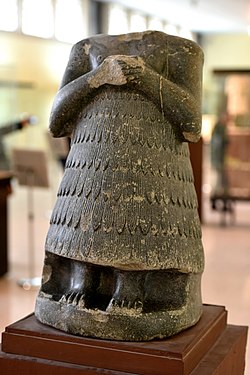 Statue of Entemena
 -
 The Great Golden Lyre from Ur
 -
 Terracotta lion from Shaduppum (Tell Harmal)
 -
 The lady at the window, part of the Nimrud ivories
 -
 Ivory statuette, part of the Nimrud ivories
 -
 The Assyrian gallery at the Iraq Museum
 -
 Throne dais of Shalmaneser III from Fort Shalmaneser
 -
 Statue of Sanatruq, king of Hatra
 -

-
 Iraq Museum, Baghdad, Iraq


See also
[edit]
References
[edit]- ^ a b Renowned Iraqi Scholar, Dr Donny George Youkhana, Appointed to Faculty at Stony Brook, The Graduate Review. Stony Brook University Archived November 10, 2007, at the Wayback Machine
- ^ a b Poole, Robert M. (February 2008). "Looting Iraq". Smithsonian Magazine. Archived from the original on July 3, 2012. Retrieved February 22, 2008.
- ^ a b "Lost Treasures from Iraq". Oriental Institute. Archived from the original on December 16, 2022. Retrieved December 16, 2022.
- ^ a b "National Museum of Iraq" Archived April 2, 2015, at the Wayback Machine. Encyclopædia Britannica, Encyclopædia Britannica Online. Encyclopædia Britannica Inc., 2012. Retrieved February 6, 2012
- ^ https://www.worldhistory.org/article/1355/the-iraq-museum-a-brightness-in-the-darkness/
- ^ "Iraqi 'treasure' Lamia Al Gailani Werr dies in Amman". The National. January 19, 2019. Archived from the original on July 30, 2020. Retrieved December 6, 2019.
- ^ "Details of National Museum of Iraq looting emerge". The Art Newspaper - International art news and events. June 30, 2003. Archived from the original on March 23, 2025. Retrieved March 23, 2025.
- ^ a b c d Bogdanos, Matthew (2005). "Pieces of the Cradle". Marine Corps Gazette (January 2005). Marine Corps Association: 60–66.
- ^ Thanassis Cambanis and Charles M. Sennott. Looters Pillage Babylon Leaving Iraqis, Archeologists Devastated. The Boston Globe Knight Ridder/Tribune Business News. April 21, 2003,
- ^ Newsweek. The Last Word: Donny George. A Real-Life Treasure Hunt. Newsweek International. March 21, 2007. Available: http://www.msnbc.msn.com/id/7169977/site/newsweek/ Archived June 17, 2006, at the Wayback Machine
- ^ a b Barry Meier and James Glanz. Looted treasure returning to Iraq national museum. Archived 2019-09-05 at the Wayback Machine The New York Times. July 26, 2006
- ^ a b "Sumerian statue looted from Iraq found by U.S. investigators". Arts. Canadian Broadcasting Corporation. July 26, 2006. Archived from the original on April 3, 2015. Retrieved March 1, 2015.
- ^ a b Meier, Barry; Glanz, James (July 26, 2006). "U.S. Helps Recover Statue and Gives It Back to Iraqis". The New York Times. Archived from the original on October 17, 2015. Retrieved March 1, 2015.
- ^ Robbing the Cradle of Civilization Archived March 10, 2007, at the Wayback Machine, Deutsche Welle, April 18, 2003
- ^ Talbot, Ann. US government implicated in planned theft of Iraqi artistic treasures. 19 April 2003. World Socialist Web Site. Retrieved 10 July 2020
- ^ US experts resign over Iraq looting Archived March 10, 2015, at the Wayback Machine, BBC News, April 18, 2003
- ^ Rothfield, Lawrence The Rape of Mesopotamia (Chicago: The University of Chicago Press, 2009), 82–83.
- ^ Donald Rumsfeld book admits 'misstatements' over WMD sites Archived September 6, 2017, at the Wayback Machine, The Guardian, February 8, 2011.
- ^ "Treasures of Nimrud found in vault: Missing Iraqi pieces far fewer than thought", Sunday Gazette-Mail, June 8, 2003, Hamza Hendawi
- ^ a b c Schmidt, Michael S. (September 28, 2011). "Mohammed Ghani Hikmat, Iraqi Sculptor, Dies at 82". New York Times. Archived from the original on September 25, 2011. Retrieved September 28, 2011.
- ^ Denton, Andrew (May 29, 2006). "Colonel Matthew Bogdanos". Enough Rope. Australian Broadcasting Corporation. Archived from the original on April 2, 2015. Retrieved March 1, 2015.
- ^ a b Bruce Cole (September 2006). "Treasure Hunting in Baghdad – A Conversation with Matthew Bogdanos". Humanities. 27 (5). Archived from the original on April 2, 2015. Retrieved March 1, 2015.
- ^ Hobson, Katherine (October 3, 2004). "P.S. Do you have the Ark?". U.S. News & World Report. Archived from the original on December 13, 2013.
- ^ "2003: Recovering History". Timeline. www.marines.com. Archived from the original on November 29, 2011. Retrieved March 1, 2015.
- ^ "Lost Treasures From Iraq IraqCrisis, A Moderated List". Oriental Institute. Retrieved December 16, 2022.
- ^ Amin, Osama Shukir Muhammed. "Lost Treasures From Iraq: Revisited & Identified". World History Encyclopedia. Retrieved December 16, 2022.
- ^ "Iraq Museum Database". Oriental Institute. Retrieved December 16, 2022.
- ^ "Lost Treasures from Iraq--Objects". Oriental Institute. Retrieved 16 December 2022.
- ^ "Lost Treasures from Iraq--Objects". Oriental Institute. Retrieved 16 December 2022.
- ^ "Lost Treasures from Iraq--Objects". Oriental Institute. Archived from the original on 16 December 2022. Retrieved 16 December 2022.
- ^ "Lost Treasures from Iraq--Objects". Oriental Institute. Retrieved 16 December 2022.
- ^ "Lost Treasures from Iraq--Objects". Oriental Institute. Archived from the original on 25 November 2022. Retrieved 16 December 2022.
- ^ Leading Iraq archaeologist flees Archived August 29, 2006, at the Wayback Machine, BBC News, August 26, 2006
- ^ Italy puts Baghdad Museum online Archived 2020-03-22 at the Wayback Machine, Agenzia ANSA Società Cooperativa, June 9, 2009
- ^ Iraq's national museum to showcase its treasures online with aid of Google Archived October 5, 2016, at the Wayback Machine, The Guardian, November 24, 2009
- ^ Google Chief Announces Plan in Baghdad to Put Iraqi Artifacts Online Archived October 10, 2016, at the Wayback Machine, The New York Times, November 24, 2009
- ^ Ruya Foundation, Archaic the Iraq Pavilion at the 57th Venice Biennale, March 10, 2017 [1] Archived 2019-04-12 at the Wayback Machine
- ^ Wullschläger, Jackie (12 May 2017). "Financial Times". Archived from the original on 2019-08-08. Retrieved 2019-08-08.
- ^ Cotter, Holland (May 22, 2017). "Venice Biennale: Whose Reflection Do You See? (Published 2017)". The New York Times. Archived from the original on February 21, 2023.
- ^ The Times
- ^ Amin, Osama Shukir Muhammed. "The Iraq Museum: A Brightness in the Darkness". World History Encyclopedia. Archived from the original on November 15, 2024. Retrieved March 12, 2025.
- ^ Amin, Osama Shukir Muhammed. "The Iraq Museum & Three Wars: Three Steps from Hell". World History Encyclopedia. Archived from the original on November 27, 2024. Retrieved March 12, 2025.
- ^ Iraq reopens looted national museum Archived February 25, 2009, at the Wayback Machine Aljazeera. March 2009
- ^ Rothfield, Lawrence (April 2009). The Rape of Mesopotamia: Behind the Looting of the Iraq Museum (1 ed.). University of Chicago Press. ISBN 978-0-226-72945-9. Retrieved March 1, 2015. E-book ISBN 978-0-226-72943-5
- ^ Lawler, Andrew After Long Hiatus, Iraq Museum to Open Its Doors Archived October 1, 2011, at the Wayback Machine. Science Magazine, September 26, 2011
- ^ "Looted Iraqi Museum in Baghdad reopens 12 years on". BBC News. British Broadcasting Corporation. February 28, 2015. Archived from the original on March 1, 2015. Retrieved March 1, 2015.
- ^ "Looted treasures are returned to Iraq - AP World News - the Charleston Gazette - West Virginia News and Sports -". Archived from the original on April 6, 2012. Retrieved April 11, 2011.
- ^ "Looted treasures back in Iraq, but don't plan on seeing them | McClatchy". Archived from the original on September 21, 2010. Retrieved April 11, 2011.
- ^ "Prized treasures return to Baghdad | PRI's the World". Archived from the original on April 1, 2011. Retrieved April 11, 2011.
- ^ "Missing Iraqi antiquities located in PM Maliki's office". BBC News. September 20, 2010. Archived from the original on October 29, 2018. Retrieved June 20, 2018.
- ^ Kami, Aseel (January 30, 2012) "Sumerian gold jar, other relics returned to Iraq" Archived October 17, 2015, at the Wayback Machine Reuters Retrieved February 6, 2012
- ^ Baghdad, Reuters in (August 3, 2021). "US to return 17,000 looted ancient artifacts to Iraq". the Guardian. Retrieved August 5, 2021.
{{cite web}}:|first=has generic name (help) - ^ Arraf, Jane (August 3, 2021). "Iraq Reclaims 17,000 Looted Artefacts, Its Biggest-Ever Repatriation". The New York Times. ISSN 0362-4331. Archived from the original on June 20, 2022. Retrieved August 5, 2021.
- ^ Al-Heeti, Abrar (August 4, 2021). "Iraq reclaims 17,000 looted ancient artifacts held in the US". CNET. Retrieved August 5, 2021.
- ^ "Stolen Art Returned to Iraq". Federal Bureau of Investigation. March 9, 2023. Retrieved September 13, 2024.
- ^ "Stolen 2,700-year-old artifact returned to Iraq with help from FBI Boston". CBS News. Boston. March 9, 2023. Retrieved September 13, 2024.
News and editorials
[edit]- Bogdanos, Matthew (June 17, 2009). "Matthew Bogdanos". Conversations with Allan Wolper (Interview). Interviewed by Allan Wolper. WBGO. Archived from the original on January 14, 2017. Retrieved July 27, 2009.
- The Ghost in the Baghdad Museum, The New York Times, April 2, 2006, by Roger Cohen.
- Thousands of Iraqi artifacts found, CNN, May 7, 2003.
- Missing Antiquities: Loss Estimates Are Cut on Iraqi Artifacts, but Questions Remain, The New York Times, May 1, 2003.
- Relics: Experts' Pleas to Pentagon Didn't Save Museum, The New York Times, April 16, 2003.
- Antiquities: Curators Appeal for a Ban on Purchase of Iraqi Artifacts, The New York Times, April 16, 2003.
- Hundreds of looted items returned to Iraqi museum, CNN Web Site, November 11, 2003.
- Iraq and Ruin, The Guardian, May 2, 2003, Neal Ascherson interview with Donny George.
- Donny George: A Real-Life Treasure Hunt, Newsweek, March 21, 2005.
External links
[edit]
- https://www.theiraqmuseum.com/
- Dan Cruickshank Under Fire (Raiders Of The Lost Art) Archived October 17, 2015, at the Wayback Machine
- The Virtual Museum of Iraq Archived June 11, 2009, at the Wayback Machine
- Lost Treasures from Iraq Illustrated site by University of Chicago
- The 2003– Iraq War & Archaeology Archived March 28, 2016, at the Wayback Machine
- Bogdanos, Matthew. The Casualties of War: The Truth about the Iraq Museum American Journal of Archaeology, 109, 3 (July 2005)
- Bogdanos, Matthew. Thieves of Baghdad - and of the World's Cultural Property
- University of Chicago
- Rothfield, Lawrence. The Rape of Mesopotamia: Behind the Looting of the Iraq Museum, excerpt


Iraq Museum
View on GrokipediaHistorical Development
Establishment and Founding
The Iraq Museum traces its origins to the early post-World War I period, when the newly established Kingdom of Iraq, under British influence, sought to institutionalize the preservation of its archaeological heritage amid excavations yielding significant Mesopotamian artifacts. Gertrude Bell, a British archaeologist and political advisor who had advocated for Iraqi statehood, was appointed Honorary Director of the Department of Antiquities in 1922, enabling her to coordinate artifact recovery and storage.[9] Her efforts intensified following Leonard Woolley's 1922 excavations at Ur, where she halted the export of treasures like the Royal Tombs' grave goods, insisting they belong to Iraq's national patrimony.[10] This initiative culminated in the formal establishment of the Baghdad Archaeological Museum on June 14, 1926, when the Iraqi government relocated assembled collections to a purpose-built facility in Baghdad, with Bell as its inaugural director.[9] The founding aligned with the 1924 Antiquities Law, which mandated that excavation finds remain in Iraq to foster cultural continuity in the emergent nation-state. Bell's directorship, lasting until her death by overdose on July 12, 1926, focused on cataloging and displaying early acquisitions from Sumerian and Babylonian sites, laying the groundwork for what would evolve into the National Museum of Iraq.[11][12] The institution's creation underscored a deliberate policy to centralize and protect artifacts previously dispersed or at risk of foreign acquisition, prioritizing empirical stewardship over colonial-era partitioning of finds.[10]Expansion and Mid-20th Century Growth
The collections of the Iraq Museum expanded considerably during the 1930s and 1940s, fueled by systematic archaeological excavations conducted under the 1924 Antiquities Law, which required foreign expeditions to share significant portions of their discoveries with the Iraqi state.[3] This influx of artifacts from Mesopotamian sites, including Sumerian, Akkadian, and Babylonian periods, outgrew the museum's original facilities by 1932, prompting initial plans for a dedicated expansion.[3] To accommodate the burgeoning holdings, the Iraqi government acquired 45,000 square meters of land in Baghdad's Al-Salihiyyah District on May 26, 1938, commissioning German architect Werner March to design a modern structure.[13] The cornerstone was laid in 1940, but World War II interrupted construction, delaying progress until the postwar era.[13] Relative political stability and economic prosperity under the Hashemite monarchy in the late 1940s and 1950s enabled renewed investment in cultural institutions, including intensified excavations that further enriched the museum's reserves with artifacts from sites like Ur and Nineveh.[13] Work resumed on December 28, 1955, with King Faisal II formally laying the foundation stone on March 24, 1957.[13] The project concluded in 1963, costing 1,250,000 Iraqi dinars, and the facility—encompassing 13 galleries, administrative offices, conservation laboratories, and a library—opened to the public on November 9, 1966, after the collections were transferred from interim storage sites like the Qushla Building.[13][3] Under Director General Taha Baqir (1959–1963), this relocation solidified the museum's capacity to display and preserve Iraq's prehistoric and ancient heritage amid growing national emphasis on archaeological stewardship.[3]Operations Under Ba'athist Rule
Following the Ba'ath Party's seizure of power in July 1968, the Iraqi government prioritized cultural heritage as a pillar of national identity, substantially increasing the budget for the Department of Antiquities by more than 80% over the subsequent decade to fund excavations, site preservation, and museum enhancements.[14] This investment facilitated major archaeological projects, including digs at Mesopotamian sites, with resulting artifacts accessioned into the Iraq Museum's collections to underscore the regime's claim to ancient civilizational continuity.[14] The museum's operations were integrated into state apparatus under the State Board of Antiquities and Heritage, emphasizing centralized control over heritage management.[15] Under Saddam Hussein's presidency from 1979, the museum served propagandistic functions, promoting exhibits that equated Ba'athist rule with the grandeur of figures like Nebuchadnezzar II, including displays from reconstructed sites such as Babylon where modern bricks bore inscriptions crediting Saddam personally.[16] A new wing was constructed in 1983 with Italian government assistance, expanding storage and exhibition space for holdings exceeding 500,000 items by the late 1980s.[9] Operations persisted amid the Iran-Iraq War (1980–1988), though resource strains and military activities damaged peripheral sites; the museum itself avoided direct hits, maintaining cataloging and conservation efforts under regime oversight.[17] The 1990–1991 Gulf War prompted closure of the museum in January 1991 after coalition airstrikes damaged its roof, but curators relocated thousands of artifacts to underground vaults, averting comprehensive loss.[9] United Nations sanctions from 1990 onward curtailed maintenance, repairs, and international collaborations, leaving the facility shuttered until a symbolic reopening on April 28, 2000—timed to coincide with Saddam Hussein's birthday—as a regime showcase of resilience.[9] In the ensuing years, partial operations resumed with restricted access, focused on inventory and selective displays, while staff, predominantly Ba'ath Party members, prepared contingency measures including secret artifact concealment amid escalating tensions.[18][9]Collections and Holdings
Overview of Scope and Significance
The Iraq Museum maintains a vast collection of artifacts documenting over 7,000 years of human activity in Mesopotamia, encompassing prehistoric settlements through the rise and decline of major empires.[19] The holdings primarily feature objects from Sumerian, Akkadian, Assyrian, and Babylonian cultures, including pottery, metalwork, glass, and monumental sculptures recovered from systematic excavations across Iraq.[9] These materials illustrate foundational developments in urban planning, cuneiform writing, and governance structures that originated in the region.[10] As the principal repository for archaeological finds from Iraq since the 1920s, the museum preserves evidence of innovations central to early civilization, such as the wheel, codified laws, and large-scale irrigation systems.[20] Its significance lies in providing tangible records of societal evolution without reliance on later textual accounts, offering direct insights into technological and cultural advancements predating recorded history in other regions.[10] The collection extends to later periods, including Parthian and Islamic artifacts, though the core emphasis remains on Mesopotamian antiquity, underscoring Iraq's role as the cradle of Western Asian civilizations.[9]Key Artifacts by Civilization and Period
The Iraq Museum's collections span Mesopotamian civilizations, with key artifacts exemplifying artistic and cultural achievements from the Sumerian period onward. Sumerian holdings, dating primarily to the Uruk and Early Dynastic phases (c. 3500–2000 BCE), include monumental works from southern Iraq's city-states. The Warka Vase, an alabaster vessel approximately 1 meter tall from the temple of Inanna at Uruk (c. 3200–3000 BCE), features carved friezes depicting a ritual procession with offerings to the goddess, representing one of the earliest known narrative reliefs in art history.[21] The Statue of Entemena, a diorite figure of the Lagash ruler (c. 2400 BCE), originally dedicated to the god Ningishzida, stands about 70 cm tall and exemplifies Sumerian votive sculpture despite its headless state following recovery from 2003 looting.[22] From the Royal Cemetery at Ur, the Great Golden Lyre (c. 2500 BCE), reconstructed with gold, silver, lapis lazuli, and shell inlays on a wooden frame, features a bull-headed frontispiece and was unearthed in a royal tomb, highlighting elite burial practices and musical traditions.[23] Akkadian artifacts (c. 2334–2154 BCE) underscore the empire's imperial bronze-working prowess. The Bassetki Statue, a copper alloy figure of a seated nude male (c. 2300–2200 BCE) bearing an inscription of Naram-Sin, measures around 45 cm and demonstrates advanced lost-wax casting techniques, recovered after being looted in 2003.[24] Assyrian collections focus on northern Mesopotamian imperial art from the Neo-Assyrian period (c. 911–612 BCE). The Throne Dais of Shalmaneser III, a limestone platform from Fort Shalmaneser at Nimrud (c. 845 BCE), bears bas-reliefs of tributary kings and deities, illustrating Assyrian conquests and diplomacy across its multi-paneled surface. The Nimrud Ivories, comprising hundreds of carved elephant ivory panels and figures (9th–7th centuries BCE) excavated from palace storerooms, depict motifs influenced by Phoenician, Egyptian, and local styles, including hunting scenes, mythical creatures, and female figures, with many pieces restored post-looting.[25] Babylonian holdings (Old and Neo-Babylonian, c. 1894–539 BCE) include cuneiform tablets and architectural elements, such as those from Sippar's library (c. 6th century BCE) containing administrative and literary texts, reflecting scholarly and bureaucratic advancements, though fewer monumental sculptures remain compared to Assyrian displays.[26] Later Parthian-era artifacts from Hatra (c. 1st–3rd centuries CE) feature Hellenistic-Roman influences. The Statue of Sanatruq I, a larger-than-life marble depiction of the Hatra king (c. 140–180 CE) from the city's Tenth Temple, stands over 2 meters with an Aramaic inscription on its base, portraying regal attire and posture blending local and imperial styles.[27]The 2003 Looting Incident
Context of the Iraq War and Regime Collapse
The Ba'athist regime under Saddam Hussein, which seized power in a 1968 coup and consolidated under Hussein's presidency from 1979, had been progressively weakened by prolonged conflicts and international isolation. The Iran-Iraq War (1980–1988) resulted in over 500,000 Iraqi military deaths and massive economic strain, depleting resources and infrastructure. Subsequent invasion of Kuwait in 1990 provoked the Gulf War coalition response in 1991, leading to the destruction of much of Iraq's conventional military and imposition of UN sanctions that halved GDP and caused widespread civilian hardship through the 1990s.[28] By early 2003, Hussein's forces were further degraded by internal purges, corruption, and reliance on poorly trained conscripts, rendering organized resistance improbable against a modern invasion. In the post-9/11 context, the United States under President George W. Bush prioritized Iraq due to intelligence assessments alleging active programs for chemical, biological, and nuclear weapons, as well as purported ties to al-Qaeda.[28] On March 17, 2003, Bush issued a 48-hour ultimatum for Hussein to relinquish power, citing the imminent threat of weapons of mass destruction (WMD) as justification for preemptive action to prevent their potential use or proliferation.[28] The invasion commenced on March 20 with a U.S.-led coalition of approximately 150,000 troops launching from Kuwait, employing "shock and awe" airstrikes to paralyze command structures.[29] Major combat operations lasted until April 9, when coalition forces entered Baghdad unopposed after Iraqi Republican Guard units disintegrated or fled, symbolizing regime collapse with the toppling of Hussein's statue in Firdos Square.[30] The abrupt fall of Hussein's government created an immediate power vacuum in Baghdad, as central authority evaporated without transitional security measures in place. Iraqi police and military abandoned posts, enabling unchecked civilian disorder amid economic desperation and score-settling against Ba'athist symbols.[31] Subsequent investigations, including the 2004 Duelfer Report by the Iraq Survey Group, confirmed no WMD stockpiles or active production existed at invasion time, attributing prior intelligence claims to flawed sources and Hussein's deceptive posturing to deter regional foes.[32] This rapid disintegration facilitated widespread anarchy, including opportunistic looting of public institutions from April 10 onward, as coalition priorities focused on military objectives over civil order restoration.[31]Sequence and Mechanics of the Looting
As Baghdad fell to coalition forces in early April 2003, the Iraq National Museum, lacking guards and with its staff having evacuated on April 8 amid advancing U.S. troops, became vulnerable to intrusion.[33][18] Saddam Hussein's paramilitary forces had entered the museum complex on April 8, reportedly removing some artifacts and weapons beforehand, though the extent of organized pre-looting by regime elements remains disputed among eyewitness accounts.[18] The primary wave of looting commenced on April 10, when crowds of local opportunists and apparent professional thieves forced entry through unsecured doors and possibly windows into the museum's galleries, offices, and storage vaults.[33][34] Over the subsequent 36 to 48 hours—spanning April 10 to April 12—looters systematically targeted portable, high-value items such as cylinder seals, statuettes, ivories, and ritual vessels, using rudimentary tools like clubs and potentially sledgehammers to smash display cases and pry open vaults.[35][36] Some groups demonstrated prior knowledge of the collections, bypassing replicas in favor of originals and even ransacking administrative areas to seize records that could aid in authenticating stolen goods, suggesting elements of premeditation amid the post-regime power vacuum.[18] Bags and improvised carriers facilitated the removal of an estimated 15,000 objects, with looters operating in disorganized mobs rather than coordinated teams, though select thefts indicated specialized actors linked to international markets.[33][35] By April 12, museum staff returned to find extensive damage, including overturned shelves dumped into bags for quick extraction, and appealed to nearby U.S. forces for protection, which was initially denied due to operational priorities.[18] The spree concluded before U.S. troops finally stationed tanks at the site on April 16, by which point the core thefts had occurred without external intervention, exacerbating losses from the absence of basic security measures like sealed vaults or on-site defenses.[35] This sequence underscores how rapid institutional collapse enabled both haphazard and targeted depredation, with mechanics relying on physical force against fragile infrastructure rather than sophisticated evasion tactics.[8]Quantified Losses and Physical Damage
During the looting of the Iraq National Museum from April 10 to 12, 2003, approximately 15,000 artifacts were stolen, including cylinder seals, jewelry, and items from excavation sites, with insiders responsible for nearly 11,000 pieces from storage areas.[37] Initial media reports exaggerated the figure at 170,000 items, but investigations by U.S. Marine Col. Matthew Bogdanos and museum officials confirmed the lower total through inventory audits.[38] Of these, over 5,000 had been recovered by mid-2005 via amnesties and international seizures, though more than 8,000 remained missing as of 2018.[37][33] Physical damage to the museum's structure included a large hole in the Assyrian gallery entrance from a U.S. tank round, dozens of bullet holes in exterior walls, and over 120 wooden doors smashed in offices and laboratories.[20] At least 28 galleries were ransacked, with display cases broken and artifacts ripped from walls, while ground-floor storerooms saw objects thrown from shelves, resulting in some irreparable breakage.[39] Specific artifacts sustained direct harm, such as the Warka Vase being hacked from its base and the Great Lyre from Ur having gold elements torn off during removal.[20] Vandalism also affected records and inventories, complicating later assessments, though no comprehensive count of fully destroyed items exists beyond incidental smashing during theft.[40]Causes and Responsibilities for the Looting
Pre-War Institutional Vulnerabilities
International sanctions imposed following Iraq's 1990 invasion of Kuwait severely constrained the State Board of Antiquities and Heritage (SBAH), the overseeing body for the Iraq National Museum, leading to drastic reductions in funding and operational capacity throughout the 1990s and early 2000s.[17][20] These measures, including a UN trade embargo, resulted in layoffs of SBAH personnel, insufficient vehicles for site inspections, and an overall starvation of resources that hampered maintenance, documentation, and enforcement of antiquities laws.[20] Economic hardship exacerbated by sanctions fueled widespread poverty, driving illicit excavation and a black market in antiquities that eroded institutional protections long before 2003.[20] Security at the museum relied heavily on a contingent of approximately 50 guards, who were housed near a single small back entrance for access control, but this system proved inadequate against determined intruders, as evidenced by the 1991 Gulf War aftermath when over 5,000 artifacts were looted from regional museums under SBAH jurisdiction, with around 3,500 still unrecovered.[20] Pre-2003, the facility lacked modern surveillance technologies such as alarms or CCTV, and guards were not equipped to repel organized thefts, reflecting regime priorities that favored military expenditures over cultural infrastructure amid ongoing isolation.[20] While staff implemented basic precautions like padding sculptures and sealing entrances with cinder blocks in anticipation of conflict, these measures were ad hoc and under-resourced, underscoring systemic underinvestment.[20] Under Ba'athist rule, the museum functioned as an extension of the regime's propaganda apparatus, with staffing dominated by party loyalists who prioritized political alignment over professional curatorship, fostering internal vulnerabilities such as incomplete inventories and potential complicity in artifact trafficking by regime insiders.[18][20] By early 2003, the institution employed about 53 staff members, many of whom were women, but political control deterred robust security enhancements and encouraged a culture of opacity, where antiquities served regime interests, including occasional sales to fund elite networks.[18] This politicization, combined with sanctions-induced decay, left the museum structurally fragile, as highlighted by pre-invasion warnings from scholars like McGuire Gibson, who in October 2002 alerted U.S. officials to the high risk of looting due to these entrenched weaknesses.[20]Immediate Post-Invasion Factors
Following the rapid collapse of Saddam Hussein's regime and the entry of U.S. forces into central Baghdad on April 8, 2003, the Iraq National Museum was left unguarded as most staff had evacuated amid ongoing fighting, with only one security guard remaining on site.[20] A U.S. tank round struck the museum's facade that day, exacerbating the vulnerability, while the absence of any imposed curfew or martial law in the immediate aftermath created a power vacuum that enabled widespread disorder across the city.[20] Coalition forces, prioritizing military objectives and the relatively small troop presence—approximately 150,000 personnel for the invasion—did not allocate resources to secure non-combat sites like the museum, despite its proximity to U.S. positions.[5] On April 10, 2003, looters first breached the unprotected back entrance, with professional thieves using glasscutters to target storerooms containing thousands of artifacts, while opportunistic crowds ransacked galleries and offices over the next two days.[20] Museum director Dr. Donny George appealed directly to nearby U.S. troops for protection during the looting, noting their tanks were stationed at adjacent intersections, but received no intervention as soldiers remained focused elsewhere.[41] The looting persisted unchecked until April 12, when international media presence and the return of museum staff, who barred doors and posted signs claiming U.S. protection, halted further incursions; U.S. forces finally secured the perimeter on April 16.[20] These immediate factors—primarily the unchallenged breakdown of local law enforcement, delayed Coalition prioritization of cultural security amid operational constraints, and the museum's exposed state in a high-chaos zone near Haifa Street—directly facilitated the theft of approximately 15,000 items, including cuneiform tablets and ancient sculptures, though initial estimates inflated losses to 170,000 before revisions based on inventories.[20][42] The episode underscored how the swift regime overthrow, without concurrent stabilization measures for fixed assets, amplified risks foreseen by pre-invasion expert warnings but unaddressed in real-time response.[43]Diverse Attributions and Empirical Assessments
Attributions for the 2003 looting of the Iraq National Museum diverged sharply, with some sources emphasizing U.S. military negligence in failing to secure the site despite prior warnings from archaeologists and the provision of site coordinates by organizations like the Archaeological Institute of America in January and April 2003.[44] Others attributed primary responsibility to Iraqi civilians and organized local thieves who exploited the post-regime power vacuum, noting that looting commenced on April 10, immediately after the fall of Saddam Hussein's government on April 9, and concluded by April 12—before U.S. forces established protection on April 16.[20] [5] Pre-invasion factors, including Saddam-era neglect of security infrastructure and a thriving black market fueled by international demand, were cited by analysts as enabling conditions that amplified the chaos.[20] Empirical investigations, such as U.S. Marine Colonel Matthew Bogdanos's probe, identified two distinct looting phases: professional thieves targeting high-value items like approximately 5,000 cylinder seals and jewelry from storage on April 10, followed by opportunistic locals seizing furniture and electronics through April 12, resulting in roughly 15,000 stolen artifacts rather than the initially reported 170,000.[37] [20] Bogdanos's team recovered over 5,500 items, attributing thefts to Iraqi insiders and locals without evidence of foreign military complicity, though media coverage often overstated losses and implied deliberate U.S. orchestration absent substantiation.[5] The University of Chicago's Oriental Institute report corroborated this, documenting U.S. tanks positioned 50-150 meters away during the initial breaches but prioritizing combat operations and weapons of mass destruction searches amid limited troop deployments.[20] Causal assessments grounded in timelines and recovery data underscore the regime's collapse as the proximate trigger, creating anarchy where Iraqi perpetrators acted on economic desperation and market incentives, while U.S. forces' ad hoc planning—lacking dedicated cultural heritage units unlike World War II precedents—contributed secondarily through delayed response in a rapidly advancing campaign.[5] No verified evidence supports claims of U.S.-facilitated theft, though institutional failures in anticipating post-invasion disorder bear scrutiny, with the small invasion force size precluding comprehensive site security.[44] These findings, drawn from on-site forensics and staff accounts, reject narratives of equivalent blame between invaders and looters, prioritizing the agency of local actors in a foreseeable but unmitigated vacuum.[37]Recovery and Repatriation Efforts
Initial Investigations and Amnesties
In the immediate aftermath of the April 10–12, 2003, looting at the Iraq Museum, a U.S. Marine Corps investigative team, led by Colonel Matthew Bogdanos—a reserve officer with expertise in classics and prosecutorial experience—arrived in Baghdad to assess the damage, identify perpetrators, and initiate recoveries.[45][37] The team's forensic examination revealed three distinct phases of theft: systematic break-ins to 28 storage rooms by museum insiders targeting high-value items like cylinder seals (approximately 10,000 stolen); opportunistic ransacking of administrative offices by locals seeking office equipment and cash; and selective removals of about 50 premium artifacts from display cases by knowledgeable professionals familiar with the collection's layout.[37][46] Contrary to early media reports of organized international smuggling rings, Bogdanos's preliminary findings emphasized local opportunism and internal complicity over external orchestration, with no substantiated evidence of U.S. military involvement in the thefts.[45][37] To prioritize artifact recovery over punitive measures, Bogdanos implemented a "no questions asked" amnesty program in May 2003, publicly advertising that individuals returning items would face no prosecution, regardless of origin.[47][48] This approach, disseminated via radio, newspapers, and community outreach, yielded rapid results; for instance, the smashed Warka Vase—a Sumerian artifact dating to circa 3200 BCE—was returned anonymously in June 2003 after being broken into 15 pieces during its theft.[49] By early July 2003, the amnesty had facilitated the return of nearly 1,500 items directly from individuals, often under claims of safekeeping, complemented by about 1,500 seizures based on tips, totaling around 3,000 recovered pieces at that stage.[47] Bogdanos described encounters with returnees as cooperative, stating he would forgo interrogation in favor of acknowledgment and tea to build trust.[47] These early efforts, however, recovered only a fraction of the estimated 15,000 stolen antiquities from the museum's galleries and stores, with ongoing challenges including the dispersal of items into local markets and the lack of comprehensive pre-looting inventories.[50][47] The amnesty's success underscored the value of non-adversarial incentives in post-conflict recovery but highlighted systemic issues, such as inadequate initial security and the insiders' prior knowledge of vault locations, which had enabled unhindered access during the power vacuum.[37] Investigations continued to probe staff involvement, though prosecutions were deprioritized to sustain return momentum.[45]International and US-Led Recovery Operations
The U.S. military established a dedicated task force on April 16, 2003, led by Marine Colonel Matthew Bogdanos, to investigate the Iraq National Museum looting and prioritize artifact recovery over criminal prosecutions.[50] The team, drawn from counterterrorism units, entered the museum on April 21, 2003, to assess damage, inventory losses, and pursue leads through local informants, amnesty incentives, and raids on suspected storage sites in Baghdad.[51] This effort recovered approximately 5,000 items initially stored within the museum complex and an additional 1,000 from external locations by mid-2003, including the Bassetki Statue (circa 2250 BCE), seized during a November 2003 operation in a private Baghdad residence.[37] Bogdanos' approach emphasized non-confrontational returns, yielding high-profile pieces such as the Warka Mask and Warka Vase through voluntary surrenders prompted by public appeals and intelligence.[5] International cooperation amplified U.S. operations via Interpol's issuance of red notices for stolen items and coordination with global law enforcement, enabling seizures at borders and auctions.[52] Agencies like U.S. Homeland Security Investigations (HSI) integrated with foreign customs services, repatriating over 5,000 Iraqi artifacts since 2007, including museum-specific cylinder seals and reliefs intercepted en route to markets in Europe and the U.S.[53] Collaborative initiatives, such as the University of Chicago's Iraq Museum Project launched in 2003, provided digital inventories and provenance tracking to aid international identification and return efforts.[54] By 2022, New York-based investigators under Bogdanos returned seven Mesopotamian and Neo-Babylonian seals looted from the museum, traced through dealer networks and auction records.[55] These operations recovered roughly half of the estimated 15,000 looted museum items by the mid-2000s, though challenges persisted due to porous borders and black-market dispersal, with ongoing U.S.-Iraq bilateral agreements facilitating later returns like 17,000 artifacts in 2021, some verified as museum provenance.[56] Empirical assessments indicate that while U.S.-led recoveries mitigated immediate losses, systemic gaps in pre-invasion securing and post-looting tracking limited full restitution, as evidenced by persistent gaps in high-value inventories.[37]Long-Term Repatriations and Outcomes
Following initial recoveries in 2003–2005, long-term repatriation efforts for artifacts looted from the Iraq National Museum relied on sustained international investigations, diplomatic negotiations, and voluntary returns prompted by amnesties and legal pressures. U.S. agencies such as the Department of Justice, Homeland Security Investigations, and the FBI collaborated with Interpol and Iraqi authorities to track items appearing in auctions, private collections, and museums, often using digital databases and provenance scrutiny to identify looted pieces. Iraqi officials offered amnesties extending into the 2010s, encouraging smugglers to return items without prosecution, which yielded sporadic successes but was hampered by incomplete inventories and forged documentation.[6][57] Notable repatriations included the return of cylinder seals and stamp seals looted in 2003, repatriated by U.S. officials in December 2022 after seizure from private holders; these Mesopotamian artifacts dated back thousands of years. In March 2023, the FBI returned a bronze furniture fitting with a sphinx motif stolen during the museum looting, recovered via international tips and forensic analysis. Earlier, the Mask of Warka—a Sumerian artifact—was repatriated in 2003 but exemplifies the pattern of delayed recoveries, with similar high-profile items like the diorite vase of Entemena remaining missing despite leads. By 2025, the Metropolitan Museum of Art surrendered several Mesopotamian relics linked to post-2003 Iraqi looting networks, including items tied to dealer Robin Symes, following criminal probes. These efforts recovered specific museum pieces amid broader returns of smuggled Iraqi antiquities, though museum-specific tallies distinguish them from site loot.[55][58][59] Outcomes remain incomplete, with approximately 15,000 items looted from the museum in April 2003, of which around 7,000–8,000 have been recovered as of 2025, leaving 7,000–10,000 unaccounted for, including cylinder seals, statues, and cuneiform tablets dispersed on black markets or in undisclosed collections. Many missing artifacts bear irreversible damage from hasty smuggling, such as erased inscriptions or fragmentation, reducing their scholarly value. The museum's collection integrity is partially restored through these returns, but gaps persist in documenting early Mesopotamian, Assyrian, and Babylonian sequences, complicating research and exhibitions. Ongoing challenges include provenance disputes—where buyers claim legitimate acquisition—and resource strains on Iraqi institutions, underscoring that while repatriations mitigate losses, systemic vulnerabilities to illicit trade endure without fortified global enforcement.[6][60][57]Post-Looting Restoration and Reopenings
Facility Repairs and Security Upgrades
Following the 2003 looting, initial facility repairs to the Iraq National Museum commenced in early 2004, focusing on cleaning debris, restoring structural integrity, and rewiring electrical systems to address damage from ransacking and fires.[20] These efforts included replacing smashed doors—over 120 in the museum complex—and repairing shattered display cases, with basic infrastructure upgrades such as air conditioning, office furniture, and computers prioritized to enable inventory work.[10] By mid-2004, the museum had been largely refurbished, incorporating new laboratories for artifact conservation and generators for reliable power amid Iraq's unstable grid.[20] Security upgrades were integrated into the refurbishment process starting in 2004, with the installation of a state-of-the-art electronic system featuring surveillance cameras, guardhouses, perimeter fences, and motion detectors to prevent repeat intrusions.[13] [5] Under the leadership of antiquities director Donny George, additional physical barriers were added, such as reinforced entry points to make unauthorized access more difficult, complemented by trained guards funded through international aid like Italy's site protection programs.[20] By 2013, exterior enhancements included high concrete blast walls and routine bag checks by armed personnel, reflecting adaptations to ongoing insurgent threats.[61] Further renovations progressed unevenly through the 2000s and 2010s, with only five of the museum's 30 exhibition halls fully restored by 2013 due to funding shortages and security disruptions, though U.S. and Italian assistance supported targeted hall overhauls.[61] By 2015, security had evolved to include rooftop soldiers with machine guns behind sandbags, interior cameras, and special forces patrolling the perimeter, enabling a full reopening amid persistent risks.[62] These measures, while improving baseline protection, highlighted vulnerabilities from the museum's urban location near government sites, prompting proposals for relocation to a more secure 50-acre site outside Baghdad.[62]Phased Reopenings from 2009 Onward
The Iraq National Museum underwent a partial reopening on February 23, 2009, nearly six years after the 2003 looting, with Prime Minister Nuri Kamal al-Maliki inaugurating eight exhibition halls displaying approximately 5,500 recovered artifacts spanning Mesopotamian civilizations.[63][64][65] This event occurred despite objections from the Ministry of Culture, which argued that thousands of relics remained uncatalogued and storerooms disorganized, rendering the facility unprepared for public access.[65][10] Iraqi, American, and European scholars also criticized the move as premature, citing inadequate security upgrades and incomplete restoration efforts that risked further damage to vulnerable items.[10] Following the 2009 partial opening, the museum operated on a limited basis, with sporadic public access constrained by ongoing security threats and incomplete refurbishments.[66] In August 2014, two newly renovated halls were unveiled, marking incremental progress toward broader accessibility amid continued recovery of looted items.[67] The facility achieved a milestone with its official full reopening on February 28, 2015, presided over by Prime Minister Haider al-Abadi, following extensive renovations that addressed post-looting damage and incorporated enhanced cataloging systems.[68][69][66] This phase enabled public entry from March 1, 2015, showcasing over 8,000 artifacts, including key Sumerian and Assyrian pieces, with UNESCO noting the event as a symbol of cultural resilience amid ISIS threats to heritage sites elsewhere in Iraq.[70][71] Subsequent challenges led to another closure period, culminating in a reopening on March 7, 2022, after a three-year hiatus attributed to security concerns and maintenance needs.[72] By this point, repatriation efforts had recovered nearly one-third of the estimated 15,000 looted items from 2003, supporting expanded exhibitions while persistent funding shortages limited full operational capacity.[70][72] These phased reopenings reflected pragmatic adaptations to Iraq's volatile security environment, prioritizing artifact protection over uninterrupted access, though critics maintained that rushed timelines in earlier stages compromised long-term preservation.[10]Exhibitions and Public Access Milestones
The Iraq Museum briefly reopened to the public on July 3, 2003, less than three months after the April looting, featuring an exhibition of royal treasures from Nimrud, including ivories and other artifacts excavated by Iraqi archaeologists decades earlier; this marked their first display at the museum since discovery.[73] The event drew limited attendance amid ongoing insecurity but symbolized initial efforts to resume public access despite thousands of missing items.[45] Following years of restoration and recovery operations, the museum partially reopened on February 23, 2009, with select galleries accessible to visitors for the first time since 2003, showcasing artifacts from Mesopotamian civilizations including Sumerian statues, Assyrian reliefs, and Babylonian pieces.[63] [74] This phased access prioritized secure halls housing approximately 15,000 surviving items, though full restoration lagged due to funding shortages and threats from insurgent attacks.[75] The museum achieved full public reopening on February 28, 2015, 12 years after the invasion-related looting, with all galleries operational and displaying recovered artifacts such as winged bull statues (lamassu) and cuneiform tablets, coinciding with international condemnation of ISIS destruction of sites like Nimrud.[68] [70] By this point, nearly one-third of the estimated 15,000 looted pieces had been repatriated, enabling comprehensive exhibitions spanning prehistoric to Islamic eras.[76] Access remained intermittent due to security protocols, with visitor numbers constrained by Baghdad's volatility. Subsequent milestones included a three-year closure starting in 2019 amid anti-government protests and pandemic restrictions, followed by reopening on March 7, 2022, which featured restored modern Iraqi artworks looted in 2003, such as pieces by Jawad Selim and Fayiq Hassan, highlighting ongoing repatriation successes.[72] [77] In April 2022, the museum exhibited additional recovered antiquities from the 2003 thefts, underscoring persistent recovery efforts despite incomplete inventories.[77] As of late 2025, the facility entered maintenance closure, projected to resume public access in early 2026, reflecting chronic infrastructure challenges.[78]Contemporary Status and Preservation
Current Operations and Digitization
The Iraq Museum, administered by the State Board of Antiquities and Heritage, halted public admissions in July 2025 for a scheduled 190-day maintenance phase, enabling specialized interventions on facilities and collections.[79] [78] This period addresses accumulated wear from prior reopenings and security demands, with the facility projected to resume operations around January 2026.[79] Institutional functions continue uninterrupted during closure, exemplified by President Abdul Latif Jamal Rashid's inspection on October 8, 2025, emphasizing heritage safeguarding as a state priority.[80] Prior to this, the museum maintained restricted visitor entry since its 2015 relaunch, enforcing stringent security protocols amid regional instability.[81] Digitization initiatives for the museum's holdings have been sporadic, with a notable 2009 partnership between Iraqi authorities and Google producing digital scans of roughly 14,000 artifacts to enable virtual exhibitions and mitigate physical access risks.[82] [83] These efforts aimed to document Mesopotamian relics preemptively against looting threats, though implementation details and public availability remain constrained.[84] Contemporary projects under SBAH oversight prioritize repatriation and physical restoration over expansive digital cataloging of the museum's core inventory, with broader Iraqi heritage digitization targeting manuscripts, excavation archives, and World Heritage documentation rather than comprehensive artifact imaging.[85] [86] Such targeted approaches reflect resource allocation toward immediate recovery needs, as evidenced by the reintegration of over 27,000 repatriated items since 2021.[87]