


Community hub
Recent from talks
Contribute something
Nothing was collected or created yet.
Boeing 747
View on Wikipedia
The Boeing 747 is a long-range wide-body airliner designed and manufactured by Boeing Commercial Airplanes in the United States between 1968 and 2023. After the introduction of the 707 in October 1958, Pan Am wanted a jet 2+1⁄2 times its size, to reduce its seat cost by 30%. In 1965, Joe Sutter left the 737 development program to design the 747. In April 1966, Pan Am ordered 25 Boeing 747-100 aircraft, and in late 1966, Pratt & Whitney agreed to develop the JT9D engine, a high-bypass turbofan. On September 30, 1968, the first 747 was rolled out of the custom-built Everett Plant, the world's largest building by volume. The 747's first flight took place on February 9, 1969, and the 747 was certified in December 1969. It entered service with Pan Am on January 22, 1970. The 747 was the first airplane called a "Jumbo Jet" as the first wide-body airliner.
Key Information


The 747 is a four-engined jet aircraft, initially powered by Pratt & Whitney JT9D turbofan engines, then General Electric CF6 and Rolls-Royce RB211 engines for the original variants. With a ten-abreast economy seating, it typically accommodates 366 passengers in three travel classes. It has a pronounced 37.5° wing sweep, allowing a Mach 0.85 (490 kn; 900 km/h) cruise speed, and its heavy weight is supported by four main landing gear legs, each with a four-wheel bogie. The partial double-deck aircraft was designed with a raised cockpit so it could be converted to a freighter airplane by installing a front cargo door, as it was initially thought that it would eventually be superseded by supersonic transports.
Boeing introduced the -200 in 1971, with uprated engines for a heavier maximum takeoff weight (MTOW) of 833,000 pounds (378 t) from the initial 735,000 pounds (333 t), increasing the maximum range from 4,620 to 6,560 nautical miles [nmi] (8,560 to 12,150 km; 5,320 to 7,550 mi). It was shortened for the longer-range 747SP in 1976, and the 747-300 followed in 1983 with a stretched upper deck for up to 400 seats in three classes. The heavier 747-400 with improved RB211 and CF6 engines or the new PW4000 engine (the JT9D successor), and a two-crew glass cockpit, was introduced in 1989 and is the most common variant. After several studies, the stretched 747-8 was launched on November 14, 2005, using the General Electric GEnx engine first developed for the 787 Dreamliner (the inspiration for the -8 in the name), and was first delivered in October 2011. The 747 is the basis for several government and military variants, such as the VC-25 (Air Force One), E-4 Emergency Airborne Command Post, Shuttle Carrier Aircraft, and some experimental test aircraft such as the YAL-1 and SOFIA airborne observatory.
Initial competition came from the smaller trijet widebodies: the Lockheed L-1011 (introduced in 1972), McDonnell Douglas DC-10 (1971) and later MD-11 (1990). Airbus competed with later variants with the heaviest versions of the A340 until surpassing the 747 in size with the A380, delivered between 2007 and 2021. Freighter variants of the 747 remain popular with cargo airlines. The final 747 was delivered to Atlas Air in January 2023 after a 54-year production run, with 1,574 aircraft built. As of October 2025[update], 65 Boeing 747s (4.1%) have been lost in accidents and incidents, in which a total of 3,746 people have died.
Development
[edit]Background
[edit]
In 1963, the United States Air Force (USAF) began a series of study projects on a very large strategic transport aircraft. Although the C-141 Starlifter was being introduced, officials believed that a much larger and more capable aircraft was needed, especially to carry cargo that would not fit in any existing aircraft. These studies led to initial requirements for the CX-Heavy Logistics System (CX-HLS) in March 1964 for an aircraft with a load capacity of 180,000 pounds (81.6 t) and a speed of Mach 0.75 (430 kn; 800 km/h), and an unrefueled range of 5,000 nautical miles (9,300 km; 5,800 mi) with a payload of 115,000 pounds (52.2 t). The payload bay had to be 17 feet (5.18 m) wide by 13.5 feet (4.11 m) high and 100 feet (30 m) long with access through doors at the front and rear.[1]
The desire to keep the number of engines to four required new engine designs with greatly increased power and better fuel economy. In May 1964, airframe proposals arrived from Boeing, Douglas, General Dynamics, Lockheed, and Martin Marietta; engine proposals were submitted by General Electric, Curtiss-Wright, and Pratt & Whitney. Boeing, Douglas, and Lockheed were given additional study contracts for the airframe, along with General Electric and Pratt & Whitney for the engines.[1]
The airframe proposals shared several features. As the CX-HLS needed to be able to be loaded from the front, a door had to be included where the cockpit usually was. All of the companies solved this problem by moving the cockpit above the cargo area; Douglas had a small "pod" just forward and above the wing, Lockheed used a long "spine" running the length of the aircraft with the wing spar passing through it, while Boeing blended the two, with a longer pod that ran from just behind the nose to just behind the wing.[2][3] In 1965, Lockheed's aircraft design and General Electric's engine design were selected for the new C-5 Galaxy transport, which was the largest military aircraft in the world at the time.[1] Boeing carried the nose door and raised cockpit concepts over to the design of the 747.[4]
Proposal
[edit]The 747 was conceived while air travel was increasing in the 1960s.[5] The era of commercial jet transportation, led by the enormous popularity of the Boeing 707 and Douglas DC-8, had revolutionized long-distance travel.[5][6] In this growing jet age, Juan Trippe, president of Pan American Airways (Pan Am), one of Boeing's most important airline customers, asked for a new jet airliner 2+1⁄2 times size of the 707, with a 30% lower cost per unit of passenger-distance and the capability to offer mass air travel on international routes.[7] Trippe also thought that airport congestion could be addressed by a larger aircraft.[8]

In 1965, Joe Sutter was transferred from Boeing's 737 development team to manage the design studies for the new airliner, already assigned the model number 747.[9] Sutter began a study with Pan Am and other airlines to better understand their requirements. At the time, many thought that long-range subsonic airliners would eventually be superseded by supersonic transport aircraft.[10] Boeing responded by designing the 747 so it could be easily adapted to carry freight and remain in production even if sales of the passenger version declined.[11]
In April 1966, Pan Am ordered 25 Boeing 747-100 aircraft for US$525 million[12][13] (equivalent to $3.9 billion in 2024 dollars). During the ceremonial 747 contract-signing banquet in Seattle on Boeing's 50th Anniversary, Juan Trippe predicted that the 747 would be "…a great weapon for peace, competing with intercontinental missiles for mankind's destiny".[14] As launch customer,[15][16] and because of its early involvement before placing a formal order, Pan Am was able to influence the design and development of the 747 to an extent unmatched by a single airline before or since.[17]
Design
[edit]Ultimately, the high-winged CX-HLS Boeing design was not used for the 747, although technologies developed for their bid had an influence.[18] The original design included a full-length double-deck fuselage with eight-across seating and two aisles on the lower deck and seven-across seating and two aisles on the upper deck.[19][20] However, concern over evacuation routes and limited cargo-carrying capability caused this idea to be scrapped in early 1966 in favor of a wider single deck design.[15] The cockpit was therefore placed on a shortened upper deck so that a freight-loading door could be included in the nose cone; this feature produced the 747's distinctive "hump".[21] In early models, what to do with the small space in the pod behind the cockpit was not clear, and it was initially specified as a "lounge" area with no permanent seating.[22] (A different configuration that had been considered to keep the flight deck out of the way for freight loading had the pilots below the passengers, and was dubbed the "anteater".)[23]

One of the principal technologies that enabled an aircraft as large as the 747 was the high-bypass turbofan engine.[24] This engine technology was thought to be capable of delivering twice the power of the earlier turbojets while consuming one-third less fuel. General Electric had pioneered the concept but was committed to developing the engine for the C-5 Galaxy and did not enter the commercial market until later.[25][26] Pratt & Whitney was also working on the same principle and, by late 1966, Boeing, Pan Am and Pratt & Whitney agreed to develop a new engine, designated the JT9D to power the 747.[26]
The project was designed with a new methodology called fault tree analysis, which allowed the effects of a failure of a single part to be studied to determine its impact on other systems.[15] To address concerns about safety and flyability, the 747's design included structural redundancy, redundant hydraulic systems, quadruple main landing gear and dual control surfaces.[27] Additionally, some of the most advanced high-lift devices used in the industry were included in the new design, to allow it to operate from existing airports. These included Krueger flaps running almost the entire length of the wing's leading edge, as well as complex three-part slotted flaps along the trailing edge of the wing.[28][29] The wing's complex three-part flaps increased wing area by 21% and lift by 90% when fully deployed compared to their non-deployed configuration.[30]
Boeing agreed to deliver the first 747 to Pan Am by the end of 1969. That date left 28 months to design the aircraft, just two-thirds of the normal time.[31] The schedule was so fast-paced that the people who worked on it were given the nickname "The Incredibles".[32] Developing the aircraft was such a technical and financial challenge that management was said to have "bet the company" when it started the project.[15] Due to its massive size, Boeing subcontracted the assembly of subcomponents to other manufacturers, notably Northrop and Grumman (later merged into Northrop Grumman in 1994) for fuselage parts and trailing edge flaps respectively, Fairchild for tailplane ailerons,[33] and Ling-Temco-Vought (LTV) for the empennage.[34][35]
Assembly plant
[edit]
Boeing did not have a plant large enough to assemble the giant airliner, so they chose to build a new plant. The company considered locations in about 50 cities,[36] and eventually decided to build the new plant some 30 miles (50 km) north of Seattle on a site adjoining a military base at Paine Field near Everett, Washington.[37] It bought the 780-acre (320 ha) site in June 1966.[38]
Developing the 747 had been a major challenge, and building its assembly plant was also a huge undertaking. Boeing president William M. Allen asked Malcolm T. Stamper, then head of the company's turbine division, to oversee construction of the Everett factory and to start production of the 747.[39] To level the site, more than four million cubic yards (three million cubic meters) of earth had to be moved.[40] Time was so short that the 747's full-scale mock-up was built before the factory roof above it was finished.[41] The plant is the largest building by volume ever built, and has been expanded several times to permit construction of other models of Boeing wide-body commercial jets.[37]
Flight testing
[edit].jpg)
Before the first 747 was fully assembled, testing began on many components and systems. One important test involved the evacuation of 560 volunteers from a cabin mock-up via the aircraft's emergency chutes. The first full-scale evacuation took two and a half minutes instead of the maximum of 90 seconds mandated by the Federal Aviation Administration (FAA), and several volunteers were injured. Subsequent test evacuations achieved the 90-second goal but caused more injuries. Most problematic was evacuation from the aircraft's upper deck; instead of using a conventional slide, volunteer passengers escaped by using a harness attached to a reel.[42] Tests also involved taxiing such a large aircraft. Boeing built an unusual training device known as "Waddell's Wagon" (named for a 747 test pilot, Jack Waddell) that consisted of a mock-up cockpit mounted on the roof of a truck. While the first 747s were still being built, the device allowed pilots to practice taxi maneuvers from a high upper-deck position.[43]
In 1968, the program cost was US$1 billion[44] (equivalent to $6.9 billion in 2024 dollars). On September 30, 1968, the first 747 was rolled out of the Everett assembly building for the world's press and representatives of the 26 airlines that had ordered the airliner.[45] Over the following months, preparations were made for the first flight, which took place on February 9, 1969, with test pilots Jack Waddell and Brien Wygle at the controls[46][47] and Jess Wallick at the flight engineer's station. Despite a minor problem with one of the flaps, the flight confirmed that the 747 handled extremely well. The 747 was found to be largely immune to "Dutch roll", a phenomenon that had been a major hazard to the early swept-wing jets.[48]
Delays and certification
[edit]
During later stages of the flight test program, flutter testing showed that the wings suffered oscillation under certain conditions. This difficulty was partly solved by reducing the stiffness of some wing components. However, a particularly severe high-speed flutter problem was solved only by inserting depleted uranium counterweights as ballast in the outboard engine nacelles of the early 747s.[49] This measure caused some concern when these aircraft crashed, for example El Al Flight 1862 at Amsterdam in 1992 with 622 pounds (282 kg) of uranium in the tailplane (horizontal stabilizer); detailed investigations showed, however, that the best estimate of the exposure to depleted uranium was ".. several orders of magnitude less than the workers' limit for chronic exposure."[50][51]
The flight test program was hampered by problems with the 747's JT9D engines. Difficulties included engine stalls caused by rapid throttle movements and distortion of the turbine casings after a short period of service.[52] The problems delayed 747 deliveries for several months; up to 20 aircraft at the Everett plant were stranded while awaiting engine installation.[53] The program was further delayed when one of the five test aircraft suffered serious damage during a landing attempt at Renton Municipal Airport, the site of Boeing's Renton factory. The incident happened on December 13, 1969, when a test aircraft was flown to Renton to have test equipment removed and a cabin installed. Pilot Ralph C. Cokely undershot the airport's short runway and the 747's right, outer landing gear was torn off and two engine nacelles were damaged.[54][55] However, these difficulties did not prevent Boeing from taking a test aircraft to the 28th Paris Air Show in mid-1969, where it was displayed to the public for the first time.[56] Finally, in December 1969, the 747 received its FAA airworthiness certificate, clearing it for introduction into service.[57]
The huge cost of developing the 747 and building the Everett factory meant that Boeing had to borrow heavily from a banking syndicate. During the final months before delivery of the first aircraft, the company had to repeatedly request additional funding to complete the project. Had this been refused, Boeing's survival would have been threatened.[16][58] The firm's debt exceeded $2 billion, with $1.2 billion owed to the banks setting a record for all companies. Allen later said, "It was really too large a project for us."[59] Ultimately, the gamble succeeded, and Boeing held a monopoly in very large passenger aircraft production for many years.[60]
In service
[edit]
On January 15, 1970, First Lady Pat Nixon christened Pan Am's first 747 at Dulles International Airport in the presence of Pan Am chairman Najeeb Halaby.[61] Instead of champagne, red, white, and blue water was sprayed on the aircraft. The 747 entered service on January 22, 1970, on Pan Am's New York–London route;[62] the flight had been planned for the evening of January 21, but engine overheating made the original aircraft (Clipper Young America, registration N735PA) unusable. Finding a substitute delayed the flight by more than six hours to the following day when Clipper Victor (registration N736PA) was used.[63][64] The 747 enjoyed a fairly smooth introduction into service, overcoming concerns that some airports would not be able to accommodate an aircraft that large.[65] Although technical problems occurred, they were relatively minor and quickly solved.[66]
Improved versions
[edit].jpg)

After the initial 747-100, Boeing developed the -100B, a higher maximum takeoff weight (MTOW) variant, and the -100SR (Short Range), with higher passenger capacity.[67] Increased maximum takeoff weight allows aircraft to carry more fuel and have longer range.[68] The -200 model followed in 1971, featuring more powerful engines and a higher MTOW. Passenger, freighter and combination passenger-freighter versions of the -200 were produced.[67] The shortened 747SP (special performance) with a longer range was also developed, and entered service in 1976.[69]
The 747 line was further developed with the launch of the 747-300 on June 11, 1980, followed by interest from Swissair a month later and the go-ahead for the project.[70]: 86 The 300 series resulted from Boeing studies to increase the seating capacity of the 747, during which modifications such as fuselage plugs and extending the upper deck over the entire length of the fuselage were rejected. The first 747-300, completed in 1983, included a stretched upper deck, increased cruise speed, and increased seating capacity. The -300 variant was previously designated 747SUD for stretched upper deck, then 747-200 SUD,[71] followed by 747EUD, before the 747-300 designation was used.[72] Passenger, short range and combination freighter-passenger versions of the 300 series were produced.[67]
In 1985, development of the longer range 747-400 began.[73] The variant had a new glass cockpit, which allowed for a cockpit crew of two instead of three,[74] new engines, lighter construction materials, and a redesigned interior. Development costs soared, and production delays occurred as new technologies were incorporated at the request of airlines. Insufficient workforce experience and reliance on overtime contributed to early production problems on the 747-400.[15] The -400 entered service in 1989.[75]
In 1991, a record-breaking 1,087 passengers were flown in a 747 during a covert operation to airlift Ethiopian Jews to Israel.[76] Generally, the 747-400 held between 416 and 524 passengers.[77] The 747 remained the heaviest commercial aircraft in regular service until the debut of the Antonov An-124 Ruslan in 1982; variants of the 747-400 surpassed the An-124's weight in 2000. The Antonov An-225 Mriya cargo transport, which debuted in 1988, remains the world's largest aircraft by several measures (including the most accepted measures of maximum takeoff weight and length); one aircraft has been completed and was in service until 2022 when it was destroyed. The Scaled Composites Stratolaunch is currently the largest aircraft by wingspan.[78]
Further development
[edit]
After the arrival of the 747-400, several stretching schemes for the 747 were proposed. Boeing announced the larger 747-500X and -600X preliminary designs in 1996.[79] The new variants would have cost more than US$5 billion,[79] and interest was not sufficient to continue.[80] In 2000, Boeing offered the more modest 747X and 747X stretch derivatives as alternatives to the Airbus A38X. However, the 747X family was unable to attract enough interest to enter production. A year later, Boeing switched from the 747X studies to pursue the Sonic Cruiser,[81] and after the Sonic Cruiser program was put on hold, the 787 Dreamliner.[82] Some of the ideas developed for the 747X were used on the 747-400ER, a longer range variant of the 747-400.[83]
After several variants were proposed but abandoned, some industry observers became skeptical of new aircraft proposals from Boeing.[84] However, in early 2004, Boeing announced plans for the 747 Advanced that were eventually adopted. Similar in nature to the 747-X, the stretched 747 Advanced used technology from the 787 to modernize the design and its systems. The 747 remained the largest passenger airliner in service until the Airbus A380 began airline service in 2007.[85]

On November 14, 2005, Boeing announced it was launching the 747 Advanced as the Boeing 747-8.[86] The last 747-400s were completed in 2009.[87] As of 2011[update], most orders of the 747-8 were for the freighter variant. On February 8, 2010, the 747-8 Freighter made its maiden flight.[88] The first delivery of the 747-8 went to Cargolux in 2011.[89][90] The first 747-8 Intercontinental passenger variant was delivered to Lufthansa on May 5, 2012.[91] The 1,500th Boeing 747 was delivered in June 2014 to Lufthansa.[92]
In January 2016, Boeing stated it was reducing 747-8 production to six per year beginning in September 2016, incurring a $569 million post-tax charge against its fourth-quarter 2015 profits. At the end of 2015, the company had 20 orders outstanding.[93][94] On January 29, 2016, Boeing announced that it had begun the preliminary work on the modifications to a commercial 747-8 for the next Air Force One presidential aircraft, then expected to be operational by 2020.[95]
On July 12, 2016, Boeing announced that it had finalized an order from Volga-Dnepr Group for 20 747-8 freighters, valued at $7.58 billion (~$9.68 billion in 2024) at list prices. Four aircraft were delivered beginning in 2012. Volga-Dnepr Group is the parent of three major Russian air-freight carriers – Volga-Dnepr Airlines, AirBridgeCargo Airlines and Atran Airlines. The new 747-8 freighters would replace AirBridgeCargo's current 747-400 aircraft and expand the airline's fleet and will be acquired through a mix of direct purchases and leasing over the next six years, Boeing said.[96]
End of production
[edit]On July 27, 2016, in its quarterly report to the Securities and Exchange Commission, Boeing discussed the termination of 747 production due to insufficient demand.[97] With a firm order backlog of 21 aircraft and a production rate of six per year, program accounting had been reduced to 1,555 aircraft.[98] In October 2016, UPS Airlines ordered 14 -8Fs to add capacity, with options for 14, added in February 2018 to increase the total to 28 -8Fs on order.[99][100] The backlog then stood at 25 aircraft, though several of these were orders from airlines that no longer intended to take delivery.[101]

On July 2, 2020, it was reported that Boeing planned to end 747 production in 2022 upon delivery of the remaining jets for UPS and the Volga-Dnepr Group, due to low demand.[102] On July 29, 2020, Boeing confirmed that the final 747 would be delivered in 2022 as a result of "current market dynamics and outlook" stemming from the COVID-19 pandemic, according to CEO David Calhoun.[103] The last aircraft, a 747-8F for Atlas Air registered N863GT, rolled off the production line on December 6, 2022,[104] and was delivered on January 31, 2023.[105] Boeing hosted an event at the Everett factory for thousands of workers as well as industry executives to commemorate the delivery.[106]
Design
[edit]
The Boeing 747 is a large, wide-body (two-aisle) airliner with four wing-mounted engines. Its wings have a high sweep angle of 37.5° for a fast, efficient cruise speed[21] of Mach 0.84 to 0.88, depending on the variant. The sweep also reduces the wingspan, allowing the 747 to use existing hangars.[15][107] Its seating capacity is over 366 with a 3–4–3 seat arrangement (two aisles with three seats on each side and four seats in the middle) in economy class and a 2–3–2 layout in first class on the main deck. The upper deck has a 3–3 seat arrangement in economy class and a 2–2 layout in first class.[108]
Seated above the main deck, the cockpit creates a hump. This raised cockpit allows front loading of cargo on freight variants.[21] The upper deck behind the cockpit provides space for a lounge and/or extra seating. The "stretched upper deck" became available as an alternative on the 747-100B variant and later as standard beginning on the 747-300. The upper deck was stretched further on the 747-8. The 747 cockpit roof section also has an escape hatch from which crew can exit during an emergency if they cannot do so through the cabin.
The 747's maximum takeoff weight ranges from 735,000 pounds (333 t) for the -100 to 970,000 pounds (440 t) for the -8. Its range has increased from 5,300 nautical miles (9,800 km; 6,100 mi) on the -100 to 8,000 nautical miles (15,000 km; 9,200 mi) on the -8I.[109][110]
_arrives_London_Heathrow_17Oct2010_arp.jpg)
The 747 has redundant structures along with four redundant hydraulic systems and four main landing gears each with four wheels; these provide good support on the ground and safety in case of tire blow-outs. The main gear are redundant so that landing can be performed on two opposing landing gears if the others are not functioning properly.[111] The 747 also has split control surfaces and was designed with sophisticated triple-slotted flaps that minimize landing speeds and allow the 747 to use standard-length runways.[112]
For transportation of spare engines, the 747 can accommodate a non-functioning fifth-pod engine under the aircraft's port wing between the inner functioning engine and the fuselage.[113][114] The fifth engine mount point was used by Virgin Orbit's LauncherOne program to carry an orbital-class rocket to cruise altitude where it was deployed.[115][116]
Operational history
[edit]After the aircraft's introduction with Pan Am in 1970, other airlines that had bought the 747 to stay competitive began to put their own 747s into service.[117] Boeing estimated that half of the early 747 sales were to airlines desiring the aircraft's long range rather than its payload capacity.[118][119] While the 747 had the lowest potential operating cost per seat, this could only be achieved when the aircraft was fully loaded; costs per seat increased rapidly as occupancy declined. A moderately loaded 747, one with only 70 percent of its seats occupied, used more than 95 percent of the fuel needed by a fully occupied 747.[120] Nonetheless, many flag-carriers purchased the 747 due to its prestige "even if it made no sense economically" to operate. During the 1970s and 1980s, over 30 regularly scheduled 747s could often be seen at John F. Kennedy International Airport.[121]
The recession of 1969–1970, despite having been characterized as relatively mild, greatly affected Boeing. For the year and a half after September 1970, it only sold two 747s in the world, both to Irish flag carrier Aer Lingus.[122][123] No 747s were sold to any American carrier for almost three years.[59] When economic problems in the US and other countries after the 1973 oil crisis led to reduced passenger traffic, several airlines found they did not have enough passengers to fly the 747 economically, and they replaced them with the smaller and recently introduced McDonnell Douglas DC-10 and Lockheed L-1011 TriStar trijet wide bodies[124] (and later the 767 and Airbus A300/A310 twinjets). Having tried replacing coach seats on its 747s with piano bars in an attempt to attract more customers, American Airlines eventually relegated its 747s to cargo service and in 1983 exchanged them with Pan Am for smaller aircraft;[125] Delta Air Lines also removed its 747s from service after several years.[126] Later, Delta acquired 747s again in 2008 as part of its merger with Northwest Airlines, although it retired the Boeing 747-400 fleet in December 2017.[127]
International flights bypassing traditional hub airports and landing at smaller cities became more common throughout the 1980s, thus eroding the 747's original market.[128] Many international carriers continued to use the 747 on Pacific routes.[129] In Japan, 747s on domestic routes were configured to carry nearly the maximum passenger capacity.[130]
Variants
[edit]The 747-100 with a range of 4,620 nautical miles (8,556 km), was the original variant launched in 1966. The 747-200 soon followed, with its launch in 1968 and the shorter 747SP launched in 1973. The 747-300 was launched in 1980 and was followed by the 747-400 in 1985. Ultimately, the 747-8 was announced in 2005. Several versions of each variant have been produced, and many of the early variants were in production simultaneously. The International Civil Aviation Organization (ICAO) classifies variants using a shortened code formed by combining the model number and the variant designator (e.g. "B741" for all -100 models).[131]
747-100
[edit]
The first 747-100s were built with six upper deck windows (three per side) to accommodate upstairs lounge areas. Later, as airlines began to use the upper deck for premium passenger seating instead of lounge space, Boeing offered an upper deck with ten windows on either side as an option. Some early -100s were retrofitted with the new configuration.[132] The -100 was equipped with Pratt & Whitney JT9D-3A engines. No freighter version of this model was developed, but many 747-100s were converted into freighters as 747-100(SF).[133] The first 747-100(SF) was delivered to Flying Tiger Line in 1974.[134] A total of 168 747-100s were built; 167 were delivered to customers, while Boeing kept the prototype, City of Everett.[135] In 1972, its unit cost was US$24M[136] (180.4M today).
747SR
[edit]Responding to requests from Japanese airlines for a high-capacity aircraft to serve domestic routes between major cities, Boeing developed the 747SR as a short-range version of the 747-100 with lower fuel capacity and greater payload capability. With increased economy class seating, up to 498 passengers could be carried in early versions and up to 550 in later models.[67] Intended for shorter routes and thus more turn arounds, the 747SR had an economic design life objective of 52,000 flights during 20 years of operation, compared to 24,600 flights in 20 years for the standard 747.[137] The initial 747SR model, the -100SR, had a strengthened body structure and landing gear to accommodate the added stress accumulated from a greater number of takeoffs and landings.[138] Extra structural support was built into the wings, fuselage, and the landing gear along with a 20% reduction in fuel capacity.[139]
.jpg)
The initial order for the -100SR – four aircraft for Japan Air Lines (JAL, later Japan Airlines) – was announced on October 30, 1972; rollout occurred on August 3, 1973, and the first flight took place on August 31, 1973. The type was certified by the FAA on September 26, 1973, with the first delivery on the same day. The -100SR entered service with JAL, the type's sole customer, on October 7, 1973, and typically operated flights within Japan.[38] Seven -100SRs were built between 1973 and 1975, each with a 520,000-pound (240 t) MTOW and Pratt & Whitney JT9D-7A engines derated to 43,000 pounds-force (190 kN) of thrust.[140]
Following the -100SR, Boeing produced the -100BSR, a 747SR variant with increased takeoff weight capability. Debuting in 1978, the -100BSR also incorporated structural modifications for a high cycle-to-flying hour ratio; a related standard -100B model debuted in 1979. The -100BSR first flew on November 3, 1978, with first delivery to All Nippon Airways (ANA) on December 21, 1978. A total of 20 -100BSRs were produced for ANA and JAL.[141] The -100BSR had a 600,000 pounds (270 t) MTOW and was powered by the same JT9D-7A or General Electric CF6-45 engines used on the -100SR. ANA operated this variant on domestic Japanese routes with 455 or 456 seats until retiring its last aircraft in March 2006.[142]
In 1986, two -100BSR SUD models, featuring the stretched upper deck (SUD) of the -300, were produced for JAL.[143] The type's maiden flight occurred on February 26, 1986, with FAA certification and first delivery on March 24, 1986.[144] JAL operated the -100BSR SUD with 563 seats on domestic routes until their retirement in the third quarter of 2006. While only two -100BSR SUDs were produced, in theory, standard -100Bs can be modified to the SUD certification.[141] Overall, 29 Boeing 747SRs were built.[145]
747-100B
[edit]
The 747-100B model was developed from the -100SR, using its stronger airframe and landing gear design. The type had an increased fuel capacity of 48,070 US gal (182,000 L), allowing for a 5,000-nautical-mile (9,300 km; 5,800 mi) range with a typical 452-passenger payload, and an increased MTOW of 750,000 lb (340 t) was offered. The first -100B order, one aircraft for Iran Air, was announced on June 1, 1978. This version first flew on June 20, 1979, received FAA certification on August 1, 1979, and was delivered the next day.[146] Nine -100Bs were built, one for Iran Air and eight for Saudi Arabian Airlines.[147][148] Unlike the original -100, the -100B was offered with Pratt & Whitney JT9D-7A, CF6-50, or Rolls-Royce RB211-524 engines. However, only RB211-524 (Saudia) and JT9D-7A (Iran Air) engines were ordered.[149] The last 747-100B, EP-IAM was retired by Iran Air in 2014, the last commercial operator of the 747-100 and -100B.[150]
747SP
[edit]
The development of the 747SP stemmed from a joint request between Pan American World Airways and Iran Air, who were looking for a high-capacity airliner with enough range to cover Pan Am's New York–Middle Eastern routes and Iran Air's planned Tehran–New York route. The Tehran–New York route, when launched, was the longest non-stop commercial flight in the world. The 747SP is 48 feet 4 inches (14.73 m) shorter than the 747-100. Fuselage sections were eliminated fore and aft of the wing, and the center section of the fuselage was redesigned to fit mating fuselage sections. The SP's flaps used a simplified single-slotted configuration.[151][152] The 747SP, compared to earlier variants, had a tapering of the aft upper fuselage into the empennage, a double-hinged rudder, and longer vertical and horizontal stabilizers.[153] Power was provided by Pratt & Whitney JT9D-7(A/F/J/FW) or Rolls-Royce RB211-524 engines.[154]
The 747SP was granted a type certificate on February 4, 1976, and entered service with launch customers Pan Am and Iran Air that same year.[152] The aircraft was chosen by airlines wishing to serve major airports with short runways.[155] A total of 45 747SPs were built,[135] with the 44th 747SP delivered on August 30, 1982. In 1987, Boeing re-opened the 747SP production line after five years to build one last 747SP for an order by the United Arab Emirates government.[152] In addition to airline use, one 747SP was modified for the NASA/German Aerospace Center SOFIA experiment.[156] Iran Air, the last civil operator of the type, retired its final 747-SP (EP-IAC) in June 2016.[157][158]
747-200
[edit]
While the 747-100 powered by Pratt & Whitney JT9D-3A engines offered enough payload and range for medium-haul operations, it was marginal for long-haul route sectors. The demand for longer range aircraft with increased payload quickly led to the improved -200, which featured more powerful engines, increased MTOW, and greater range than the -100. A few early -200s retained the three-window configuration of the -100 on the upper deck, but most were built with a ten-window configuration on each side.[159] The 747-200 was produced in passenger (-200B), freighter (-200F), convertible (-200C), and combi (-200M) versions.[160]
The 747-200B was the basic passenger version, with increased fuel capacity and more powerful engines; it entered service in February 1971.[71] In its first three years of production, the -200 was equipped with Pratt & Whitney JT9D-7 engines (initially the only engine available). Range with a full passenger load started at over 5,000 nmi (9,300 km; 5,800 mi) and increased to 6,000 nmi (11,000 km; 6,900 mi) with later engines. Most -200Bs had an internally stretched upper deck, allowing for up to 16 passenger seats.[161] The freighter model, the 747-200F, had a hinged nose cargo door and could be fitted with an optional side cargo door,[71] and had a capacity of 105 tons (95.3 tonnes) and an MTOW of up to 833,000 pounds (378 t). It entered service in 1972 with Lufthansa.[162] The convertible version, the 747-200C, could be converted between a passenger and a freighter or used in mixed configurations,[67] and featured removable seats and a nose cargo door.[71] The -200C could also be outfitted with an optional side cargo door on the main deck.[163]
The combi aircraft model, the 747-200M (originally designated 747-200BC), could carry freight in the rear section of the main deck via a side cargo door. A removable partition on the main deck separated the cargo area at the rear from the passengers at the front. The -200M could carry up to 238 passengers in a three-class configuration with cargo carried on the main deck. The model was also known as the 747-200 Combi.[71] As on the -100, a stretched upper deck (SUD) modification was later offered. A total of ten 747-200s operated by KLM were converted.[71]
After launching the -200 with Pratt & Whitney JT9D-7 engines, on August 1, 1972, Boeing announced that it had reached an agreement with General Electric to certify the 747 with CF6-50 series engines to increase the aircraft's market potential. Rolls-Royce followed 747 engine production with a launch order from British Airways for four aircraft. The option of RB211-524B engines was announced on June 17, 1975.[149] The -200 was the first 747 to provide a choice of powerplant from the three major engine manufacturers.[164] In 1976, its unit cost was US$39M (215.5M today).
A total of 393 of the 747-200 versions had been built when production ended in 1991.[165] Of these, 225 were -200B, 73 were -200F, 13 were -200C, 78 were -200M, and 4 were military.[166] Iran Air retired the last passenger 747-200 in May 2016, 36 years after it was delivered.[167] As of July 2019[update], five 747-200s remain in service as freighters.[168]
747-300
[edit].jpg)
The 747-300 features a 23-foot-4-inch-longer (7.11 m) upper deck than the -200.[72] The stretched upper deck (SUD) has two emergency exit doors and is the most visible difference between the -300 and previous models.[169] After being made standard on the 747-300, the SUD was offered as a retrofit, and as an option to earlier variants still in-production. An example for a retrofit were two UTA -200 Combis being converted in 1986, and an example for the option were two brand-new JAL -100 aircraft (designated -100BSR SUD), the first of which was delivered on March 24, 1986.[70]: 68, 92
The 747-300 introduced a new straight stairway to the upper deck, instead of a spiral staircase on earlier variants, which creates room above and below for more seats.[67] Minor aerodynamic changes allowed the -300's cruise speed to reach Mach 0.85 compared with Mach 0.84 on the -200 and -100 models, while retaining the same takeoff weight.[72] The -300 could be equipped with the same Pratt & Whitney and Rolls-Royce powerplants as on the -200, as well as updated General Electric CF6-80C2B1 engines.[67]
Swissair placed the first order for the 747-300 on June 11, 1980.[170] The variant revived the 747-300 designation, which had been previously used on a design study that did not reach production. The 747-300 first flew on October 5, 1982, and the type's first delivery went to Swissair on March 23, 1983.[38] In 1982, its unit cost was US$83M (270.4M today). Besides the passenger model, two other versions (-300M, -300SR) were produced. The 747-300M features cargo capacity on the rear portion of the main deck, similar to the -200M, but with the stretched upper deck it can carry more passengers.[154][171] The 747-300SR, a short range, high-capacity domestic model, was produced for Japanese markets with a maximum seating for 584.[172] No production freighter version of the 747-300 was built, but Boeing began modifications of used passenger -300 models into freighters in 2000.[173]
A total of 81 747-300 series aircraft were delivered, 56 for passenger use, 21 -300M and 4 -300SR versions.[174] In 1985, just two years after the -300 entered service, the type was superseded by the announcement of the more advanced 747-400.[175] The last 747-300 was delivered in September 1990 to Sabena.[67][176] While some -300 customers continued operating the type, several large carriers replaced their 747-300s with 747-400s. Air France, Air India, Japan Airlines, Pakistan International Airlines, and Qantas were some of the last major carriers to operate the 747-300. On December 29, 2008, Qantas flew its last scheduled 747-300 service, operating from Melbourne to Los Angeles via Auckland.[177] In July 2015, Pakistan International Airlines retired their final 747-300 after 30 years of service.[178] Mahan Air was the last passenger operator of the Boeing 747-300. In 2022, their last 747-300M was leased by Emtrasur Cargo. The 747-300M was later seized by the US Department of Justice in 2024.[179]
747-400
[edit].jpg)
The 747-400 is an improved model with increased range. It has wingtip extensions of 6 ft (1.8 m) and winglets of 6 ft (1.8 m), which improve the type's fuel efficiency by four percent compared to previous 747 versions.[180] The 747-400 introduced a new glass cockpit designed for a flight crew of two instead of three, with a reduction in the number of dials, gauges and knobs from 971 to 365 through the use of electronics. The type also features tail fuel tanks, revised engines, and a new interior. The longer range has been used by some airlines to bypass traditional fuel stops, such as Anchorage.[181] A 747-400 loaded with 126,000 pounds (57,000 kg) of fuel flying 3,500 miles (3,000 nmi; 5,600 km) consumes an average of 5 US gallons per mile (12 L/km).[182][183] Powerplants include the Pratt & Whitney PW4062, General Electric CF6-80C2, and Rolls-Royce RB211-524.[184] As a result of the Boeing 767 development overlapping with the 747-400's development, both aircraft can use the same three powerplants and are even interchangeable between the two aircraft models.[185]
The -400 was offered in passenger (-400), freighter (-400F), combi (-400M), domestic (-400D), extended range passenger (-400ER), and extended range freighter (-400ERF) versions. Passenger versions retain the same upper deck as the -300, while the freighter version does not have an extended upper deck.[186] The 747-400D was designed for short-range operations with maximum seating for 624. So winglets were not included though they can be retrofitted.[187][188] Cruising speed is up to Mach 0.855 on different versions of the 747-400.[184]
The passenger version first entered service in February 1989 with launch customer Northwest Airlines on the Minneapolis to Phoenix route.[189] The combi version entered service in September 1989 with KLM, while the freighter version entered service in November 1993 with Cargolux. The 747-400ERF entered service with Air France in October 2002, while the 747-400ER entered service with Qantas,[190] its sole customer, in November 2002. In January 2004, Boeing and Cathay Pacific launched the Boeing 747-400 Special Freighter program,[191] later referred to as the Boeing Converted Freighter (BCF), to modify passenger 747-400s for cargo use. The first 747-400BCF was redelivered in December 2005.[192]
In March 2007, Boeing announced that it had no plans to produce further passenger versions of the -400.[193] However, orders for 36 -400F and -400ERF freighters were already in place at the time of the announcement.[193] The last passenger version of the 747-400 was delivered in April 2005 to China Airlines. Some of the last built 747-400s were delivered with Dreamliner livery along with the modern Signature interior from the Boeing 777. A total of 694 of the 747-400 series aircraft were delivered.[135] At various times, the largest 747-400 operator has included Singapore Airlines,[194] Japan Airlines,[194] and British Airways.[195][196] As of July 2019[update], 331 Boeing 747-400s were in service;[168] there were only 10 Boeing 747-400s in passenger service as of September 2021.
747 LCF Dreamlifter
[edit]_Dreamlifter_(49856836836)_(cropped).jpg)
The 747-400 Dreamlifter[197] (originally called the 747 Large Cargo Freighter or LCF[198]) is a Boeing-designed modification of existing 747-400s into a larger outsize cargo freighter configuration to ferry 787 Dreamliner sub-assemblies. Evergreen Aviation Technologies Corporation of Taiwan was contracted to complete modifications of 747-400s into Dreamlifters in Taoyuan. The aircraft flew for the first time on September 9, 2006, in a test flight.[199] Modification of four aircraft was completed by February 2010.[200] The Dreamlifters have been placed into service transporting sub-assemblies for the 787 program to the Boeing plant in Everett, Washington, for final assembly.[197] The aircraft is certified to carry only essential crew with no passengers.[201]
747-8
[edit]
Boeing announced a new 747 variant, the 747-8, on November 14, 2005. Referred to as the 747 Advanced prior to its launch, Boeing selected the designation 747-8 to show the connection with the Boeing 787 Dreamliner, as the aircraft would use technology and the General Electric GEnx engines from the 787 to modernize the design and its systems.[202][203][204] The variant is designed to be quieter, more economical, and more environmentally friendly. The 747-8's fuselage is lengthened from 232 feet (71 m) to 251 feet (77 m),[205] marking the first stretch variant of the aircraft.
The 747-8 Freighter, or 747-8F, has 16% more payload capacity than its predecessor, allowing it to carry seven more standard air cargo containers, with a maximum payload capacity of 154 short tons (140 t) of cargo.[206] As on previous 747 freighters, the 747-8F features a flip up nose-door, a side-door on the main deck, and a side-door on the lower deck ("belly") to aid loading and unloading. The 747-8F made its maiden flight on February 8, 2010.[207][208] The variant received its amended type certificate jointly from the FAA and the European Aviation Safety Agency (EASA) on August 19, 2011.[209] The -8F was first delivered to Cargolux on October 12, 2011.[210]
The passenger version, named 747-8 Intercontinental or 747-8I, is designed to carry up to 467 passengers in a 3-class configuration and fly more than 8,000 nautical miles (15,000 km; 9,200 mi) at Mach 0.855. As a derivative of the already common 747-400, the 747-8I has the economic benefit of similar training and interchangeable parts.[211] The type's first test flight occurred on March 20, 2011.[212] The 747-8 has surpassed the Airbus A340-600 as the world's longest airliner, a record it would hold until the 777X, which first flew in 2020. The first -8I was delivered in May 2012 to Lufthansa.[213] The 747-8 received 155 total orders, including 106 for the -8F and 47 for the -8I as of June 2021[update].[135] The final 747-8F was delivered to Atlas Air on January 31, 2023, marking the end of the production of the Boeing 747 series.[105] The final aircraft was registered as N863GT.[214]
Government, military, and other variants
[edit]


- VC-25 – This aircraft is the U.S. Air Force very important person (VIP) version of the 747-200B. The U.S. Air Force operates two of them in VIP configuration as the VC-25A. Tail numbers 28000 and 29000 are popularly known as Air Force One, which is technically the air-traffic call sign for any United States Air Force aircraft carrying the U.S. president.[215] Partially completed aircraft from Everett, Washington, were flown to Wichita, Kansas, for final outfitting by Boeing Military Airplane Company.[216] Two new aircraft, based around the 747-8, are being procured which will be designated as VC-25B.[217]
- E-4B – This is an airborne command post designed for use in nuclear war. Three E-4As, based on the 747-200B, with a fourth aircraft, with more powerful engines and upgraded systems delivered in 1979 as an E-4B, with the three E-4As upgraded to this standard.[218][219] Formerly known as the National Emergency Airborne Command Post (referred to colloquially as "Kneecap"), this type is now referred to as the National Airborne Operations Center (NAOC).[219][220]
- Survivable Airborne Operations Center - In April 2024, Sierra Nevada Corporation was awarded a contract to develop and build the Survivable Airborne Operations Center aircraft to replace the Boeing E-4 NAOC. Five 747-8Is were purchased from Korean Air for conversion, with the contract calling for nine in total.[221][222]
- YAL-1 – This was the experimental Airborne Laser, a planned component of the U.S. National Missile Defense.[223]
- Shuttle Carrier Aircraft (SCA) – Two 747s were modified to carry the Space Shuttle orbiter. The first was a 747-100 (N905NA), and the other was a 747-100SR (N911NA). The first SCA carried the prototype Enterprise during the Approach and Landing Tests in the late 1970s. The two SCA later carried all five operational Space Shuttle orbiters.[224]
- C-33 – This aircraft was a proposed U.S. military version of the 747-400F intended to augment the C-17 fleet. The plan was canceled in favor of additional C-17s.[225]
- KC-25/33 – A proposed 747-200F was also adapted as an aerial refueling tanker and was bid against the DC-10-30 during the 1970s Advanced Cargo Transport Aircraft (ACTA) program that produced the KC-10 Extender. Before the 1979 Iranian Revolution, Iran bought four 747-100 aircraft with air-refueling boom conversions to support its fleet of F-4 Phantoms.[226] There is a report of the Iranians using a 747 Tanker in H-3 airstrike during Iran–Iraq War.[227] It is unknown whether these aircraft remain usable as tankers. Since then there have been proposals to use a 747-400 for that role.[228]
- 747F Airlifter – Proposed US military transport version of the 747-200F intended as an alternative to further purchases of the C-5 Galaxy. This 747 would have had a special nose jack to lower the sill height for the nose door. System tested in 1980 on a Flying Tiger Line 747-200F.[229]
- 747 CMCA – This "Cruise Missile Carrier Aircraft" variant was considered by the U.S. Air Force during the development of the B-1 Lancer strategic bomber. It would have been equipped with 50 to 100 AGM-86 ALCM cruise missiles on rotary launchers. This plan was abandoned in favor of more conventional strategic bombers.[230]
- MC-747 – Two separate studies from the 1970s and 2005, the first by Boeing and the second by ATK and BAE Systems, to horizontally store up to four Peacekeeper ICBMs or seven Minutemen above bomb bay-like doors in the first study,[231][232] and to vertically store twelve Minutemen or 32 JDAM-equipped conventional missiles for launch from in situ tubes in the second.[233][234]
- 747 AAC – A Boeing study under contract from the USAF for an "airborne aircraft carrier" for up to 10 Boeing Model 985-121 "microfighters" with the ability to launch, retrieve, re-arm, and refuel. Boeing believed that the scheme would be able to deliver a flexible and fast carrier platform with global reach, particularly where other bases were not available. Modified versions of the 747-200 and Lockheed C-5A were considered as the base aircraft. The concept, which included a complementary 747 AWACS version with two reconnaissance "microfighters", was considered technically feasible in 1973.[235]
- Evergreen 747 Supertanker – A Boeing 747-200 modified as an aerial application platform for fire fighting using 20,000 US gallons (76,000 L) of firefighting chemicals.[236]
- Stratospheric Observatory for Infrared Astronomy (SOFIA) – A former Pan Am Boeing 747SP modified to carry a large infrared-sensitive telescope, in a joint venture of NASA and DLR. High altitudes are needed for infrared astronomy, to rise above infrared-absorbing water vapor in the atmosphere.[237][238]
- A number of other governments also use the 747 as a VIP transport, including Bahrain, Brunei, India, Iran, Japan, Kuwait, Oman, Pakistan, Qatar, Saudi Arabia and United Arab Emirates. Several Boeing 747-8s have been ordered by Boeing Business Jet for conversion to VIP transports for several unidentified customers.[239]
Proposed variants
[edit]Boeing studied a number of 747 variants that did not advance beyond the concept stage.
747 trijet
[edit]During the late 1960s and early 1970s, Boeing studied the development of a shorter 747 with three engines, to compete with the smaller Lockheed L-1011 TriStar and McDonnell Douglas DC-10. The center engine would have been fitted in the tail with an S-duct intake similar to the L-1011's. Overall, the 747 trijet would have had more payload, range, and passenger capacity than either of the two other aircraft. However, engineering studies showed that a major redesign of the 747 wing would be necessary. Maintaining the same 747 handling characteristics would be important to minimize pilot retraining. Boeing decided instead to pursue a shortened four-engine 747, resulting in the 747SP.[240]
747-500
[edit]In January 1986, Boeing outlined preliminary studies to build a larger, ultra-long haul version named the 747-500, which would enter service in the mid- to late-1990s. The aircraft derivative would use engines evolved from unducted fan (UDF) (propfan) technology by General Electric, but the engines would have shrouds, sport a bypass ratio of 15–20, and have a propfan diameter of 10–12 feet (3.0–3.7 m).[241] The aircraft would be stretched (including the upper deck section) to a capacity of 500 seats, have a new wing to reduce drag, cruise at a faster speed to reduce flight times, and have a range of at least 8,700 nmi; 16,000 km, which would allow airlines to fly nonstop between London, UK and Sydney, Australia.[242]
747 ASB
[edit]Boeing announced the 747 ASB (Advanced Short Body) in 1986 as a response to the Airbus A340 and the McDonnell Douglas MD-11. This aircraft design would have combined the advanced technology used on the 747-400 with the foreshortened 747SP fuselage. The aircraft was to carry 295 passengers over a range of 8,000 nmi (15,000 km; 9,200 mi).[243] However, airlines were not interested in the project and it was canceled later that year.
747-500X, -600X, and -700X
[edit]
Boeing announced the 747-500X and -600X at the 1996 Farnborough Airshow.[79] The proposed models would have combined the 747's fuselage with a new wing spanning 251 feet (77 m) derived from the 777. Other changes included adding more powerful engines and increasing the number of tires from two to four on the nose landing gear and from 16 to 20 on the main landing gear.[244]
The 747-500X concept featured a fuselage length increased by 18 feet (5.5 m) to 250 feet (76 m), and the aircraft was to carry 462 passengers over a range up to 8,700 nautical miles (16,100 km; 10,000 mi), with a gross weight of over 1.0 Mlb (450 tonnes).[244] The 747-600X concept featured a greater stretch to 279 feet (85 m) with seating for 548 passengers, a range of up to 7,700 nmi (14,300 km; 8,900 mi), and a gross weight of 1.2 Mlb (540 tonnes).[244] A third study concept, the 747-700X, would have combined the wing of the 747-600X with a widened fuselage, allowing it to carry 650 passengers over the same range as a 747-400.[79] The cost of the changes from previous 747 models, in particular the new wing for the 747-500X and -600X, was estimated to be more than US$5 billion.[79] Boeing was not able to attract enough interest to launch the aircraft.[80]
747X and 747X Stretch
[edit]As Airbus progressed with its A3XX study, Boeing offered a 747 derivative as an alternative in 2000; a more modest proposal than the previous -500X and -600X with the 747's overall wing design and a new segment at the root, increasing the span to 229 ft (69.8 m).[245] Power would have been supplied by either the Engine Alliance GP7172 or the Rolls-Royce Trent 600, which were also proposed for the 767-400ERX.[246] A new flight deck based on the 777's would be used. The 747X aircraft was to carry 430 passengers over ranges of up to 8,700 nmi (16,100 km; 10,000 mi). The 747X Stretch would be extended to 263 ft (80.2 m) long, allowing it to carry 500 passengers over ranges of up to 7,800 nmi (14,400 km; 9,000 mi).[245] Both would feature an interior based on the 777.[247] Freighter versions of the 747X and 747X Stretch were also studied.[248]

Like its predecessor, the 747X family was unable to garner enough interest to justify production, and it was shelved along with the 767-400ERX in March 2001, when Boeing announced the Sonic Cruiser concept.[81] Though the 747X design was less costly than the 747-500X and -600X, it was criticized for not offering a sufficient advance from the existing 747-400. The 747X did not make it beyond the drawing board, but the 747-400X being developed concurrently moved into production to become the 747-400ER.[249]
747-400XQLR
[edit]After the end of the 747X program, Boeing continued to study improvements that could be made to the 747. The 747-400XQLR (Quiet Long Range) was meant to have an increased range of 7,980 nmi (14,780 km; 9,180 mi), with improvements to boost efficiency and reduce noise.[250][251] Improvements studied included raked wingtips similar to those used on the 767-400ER and a sawtooth engine nacelle for noise reduction.[252] Although the 747-400XQLR did not move to production, many of its features were used for the 747 Advanced, which was launched as the 747-8 in 2005.[253]
Operators
[edit]In 1979, Qantas became the first airline in the world to operate an all Boeing 747 fleet, with seventeen aircraft.[254]
As of July 2019[update], there were 462 Boeing 747s in airline service, with Atlas Air and British Airways being the largest operators with 33 747-400s each.[255]
The last US passenger Boeing 747 was retired from Delta Air Lines in December 2017. The model flew for almost every American major carrier since its 1970 introduction.[256] Delta flew three of its last four aircraft on a farewell tour, from Seattle to Atlanta on December 19 then to Los Angeles and Minneapolis/St Paul on December 20.[257]
As the IATA forecast an increase in air freight from 4% to 5% in 2018 fueled by booming trade for time-sensitive goods, from smartphones to fresh flowers, demand for freighters is strong while passenger 747s are phased out. Of the 1,574 produced, 890 are retired; as of 2018[update], a small subset of those which were intended to be parted-out got $3 million D-checks before flying again. Young -400s were sold for 320 million yuan ($50 million) and Boeing stopped converting freighters, which used to cost nearly $30 million. This comeback helped the airframer financing arm Boeing Capital to shrink its exposure to the 747-8 from $1.07 billion in 2017 to $481 million in 2018.[258]
In July 2020, British Airways announced that it was retiring its 747 fleet.[259][260] The final British Airways 747 flights departed London Heathrow on October 8, 2020.[261][262]
Orders and deliveries
[edit]| Year | Total | 2023 | 2022 | 2021 | 2020 | 2019 | 2018 | 2017 | 2016 | 2015 | 2014 | 2013 | 2012 | 2011 | 2010 | 2009 | 2008 | 2007 | 2006 |
|---|---|---|---|---|---|---|---|---|---|---|---|---|---|---|---|---|---|---|---|
| Orders | 1,573 | – | – | 5 | 1 | – | 13 | 6 | 18 | 6 | 2 | 13 | 7 | 3 | 1 | 5 | 2 | 16 | 53 |
| Deliveries | 1,573 | 1 | 5 | 7 | 5 | 7 | 6 | 14 | 9 | 18 | 19 | 24 | 31 | 9 | – | 8 | 14 | 16 | 14 |
| Year | 2005 | 2004 | 2003 | 2002 | 2001 | 2000 | 1999 | 1998 | 1997 | 1996 | 1995 | 1994 | 1993 | 1992 | 1991 | 1990 | 1989 | 1988 | 1987 | 1986 |
|---|---|---|---|---|---|---|---|---|---|---|---|---|---|---|---|---|---|---|---|---|
| Orders | 46 | 10 | 4 | 17 | 16 | 26 | 35 | 15 | 36 | 56 | 32 | 16 | 2 | 23 | 31 | 122 | 56 | 49 | 66 | 84 |
| Deliveries | 13 | 15 | 19 | 27 | 31 | 25 | 47 | 53 | 39 | 26 | 25 | 40 | 56 | 61 | 64 | 70 | 45 | 24 | 23 | 35 |
| Year | 1985 | 1984 | 1983 | 1982 | 1981 | 1980 | 1979 | 1978 | 1977 | 1976 | 1975 | 1974 | 1973 | 1972 | 1971 | 1970 | 1969 | 1968 | 1967 | 1966 |
|---|---|---|---|---|---|---|---|---|---|---|---|---|---|---|---|---|---|---|---|---|
| Orders | 42 | 23 | 24 | 14 | 23 | 49 | 72 | 76 | 42 | 14 | 20 | 29 | 29 | 18 | 7 | 20 | 30 | 22 | 43 | 83 |
| Deliveries | 24 | 16 | 22 | 26 | 53 | 73 | 67 | 32 | 20 | 27 | 21 | 22 | 30 | 30 | 69 | 92 | 4 | – | – | – |
Boeing 747 orders and deliveries (cumulative, by year):

- Orders Deliveries — as of February 2023[update]
Model summary
[edit]| Model Series | ICAO code[131] | Deliveries | |
|---|---|---|---|
| 747-100 | B741 / BSCA[a] | 167 | 205 |
| 747-100B | 9 | ||
| 747-100SR | B74R | 29 | |
| 747SP | B74S | 45 | 45 |
| 747-200B | B742[b] | 225 | 393 |
| 747-200C | 13 | ||
| 747-200F | 73 | ||
| 747-200M | 78 | ||
| 747 E-4A | 3 | ||
| 747-E4B | 1 | ||
| 747-300 | B743 | 56 | 81 |
| 747-300M | 21 | ||
| 747-300SR | 4 | ||
| 747-400 | B744 / BLCF[c] | 442 | 694 |
| 747-400ER | 6 | ||
| 747-400ERF | 40 | ||
| 747-400F | 126 | ||
| 747-400M | 61 | ||
| 747-400D | B74D | 19 | |
| 747-8I | B748 | 48 | 155 |
| 747-8F | 107 | ||
| 747 Total | 1,573 | ||
- ^ BSCA refers to 747 Shuttle Carrier Aircraft, used by NASA.
- ^ B742 includes the VC-25, two 747-200Bs modified for the U.S. Air Force.
- ^ BLCF refers to the 747-400LCF Dreamlifter, used to transport components for the Boeing 787 Dreamliner program.
Orders and deliveries through to the end of February 2023.
Accidents and incidents
[edit]As of November 2023[update], the 747 has been involved in 173 aviation accidents and incidents,[263] including 65 hull losses (53 in-flight accidents),[264] causing 3,746 fatalities.[265] There have been several hijackings of Boeing 747s, such as Pan Am Flight 73, a 747-100 hijacked by four terrorists, resulting in 20 deaths.[266] The 747 also fell victim to several mid-air bombings, two of which resulted in major fatalities and hull losses, Air India Flight 182 in 1985, and Pan Am Flight 103 in 1988.[267][268][269]
The deadliest aviation accident, the Tenerife airport disaster, resulted from pilot error and communications failure, while the Japan Air Lines Flight 123 and China Airlines Flight 611 crashes stemmed from improper aircraft repair due to a tail-strike. Korean Air Lines Flight 007 was shot down by a Soviet Su-15TM interceptor in 1983 after it had violated Soviet airspace for over 12 minutes, causing US President Ronald Reagan to authorize the then-strictly-military global positioning system (GPS) for civilian use.[270][271] South African Airways Flight 295, a 747-200M Combi, which crashed on 28 November 1987 due to an in-flight fire, led to the mandate of adding fire-suppression systems on board Combi variants.[272][273]
A handful of crashes have been attributed to 747 design flaws, mainly older 747 classic (100/200/300/SP) variants. United Airlines Flight 811, which suffered an explosive decompression mid-flight on February 24, 1989, led the National Transportation Safety Board (NTSB) to issue a recommendation that the Boeing 747-100 and 747-200 cargo doors similar to those on the Flight 811 aircraft be modified to those featured on the Boeing 747-400. TWA Flight 800, a 747-100 that exploded in mid-air on July 17, 1996 due to sparking from the old and cracked electrical wires inside the fuel tank, where voltage levels exceeded the maximum limit, causing ignition of the fuel vapors inside the tank.[274] This finding led the FAA to adopt a rule in July 2008 requiring installation of an inerting system in the center fuel tank of most large aircraft, after years of research into solutions. At the time, the new safety system was expected to cost US$100,000 to $450,000 per aircraft and weigh approximately 200 pounds (91 kg).[275] Two 747-200F freighters - China Airlines Flight 358 on December 29, 1991, and El Al Flight 1862 on October 4, 1992, crashed after the fuse pins for an engine (no. 3) broke off shortly after take-off due to metal fatigue, and instead of simply dropping away from the wing, the engine knocked off the adjacent engine and damaged the wing.[276] Following these crashes, Boeing issued a directive to examine and replace all fuse pins found to be cracked. The lack of adequate warning systems combined with flight crew error led to a preventable crash of Lufthansa Flight 540 in November 1974, which was the first fatal crash of a 747,[277][278] while an instrument malfunction leading to crew disorientation caused the crash of Air India Flight 855 on New Years Day in 1978.[279][280]
Other incidents did not result in any hull losses, but the planes suffered certain damages and were put back into service after repair. On July 30, 1971, Pan Am Flight 845 struck approach lighting system structures while taking off from San Francisco for Tokyo, Japan; the plane dumped fuel and landed back. The cause was pilot error with improper calculations, and the plane was repaired and returned to service.[281] On June 24, 1982, British Airways Flight 9, a Boeing 747-200, registration G-BDXH, flew through a cloud of volcanic ash and dust from the eruption of Mount Galunggung, suffering an all engine flameout; the crew restarted the engines and successfully landed at Jakarta. The volcanic ash caused windscreens to be sandblasted along with engine damage and paint rip-off; the plane was repaired with engines replaced and returned to service.[282] On December 11, 1994, on board Philippine Airlines Flight 434 from Manila to Tokyo via Cebu, a bomb exploded under a seat, killing one passenger; the plane landed safely at Okinawa despite damage to the plane's controls. The bomber, Ramzi Yousef, was caught on 7 February 1995 in Islamabad, Pakistan, and the plane was repaired, but converted for cargo use.[283]
Preserved aircraft
[edit]Aircraft on display
[edit]

As increasing numbers of "classic" 747-100 and 747-200 series aircraft have been retired, some have been used for other uses such as museum displays. Some older 747-300s and 747-400s were later added to museum collections.
- 20235/001 – 747-121 registration N7470 City of Everett, the first 747 and prototype, is at the Museum of Flight, Seattle, Washington.[284]
- 19651/025 – 747-121 registration N747GE at the Pima Air & Space Museum, Tucson, Arizona, US.[285]
- 19778/027 – 747-151 registration N601US nose at the National Air and Space Museum, Washington, D.C.[286]
- 19661/070 – 747-121(SF) registration N681UP preserved at a plaza on Jungong Road, Shanghai, China.[287]
- 19896/072 – 747-132(SF) registration N481EV at the Evergreen Aviation & Space Museum, McMinnville, Oregon, US.[288][289]
- 20107/086 – 747-123 registration N905NA, a NASA Shuttle Carrier Aircraft, at the Johnson Space Center, Houston, Texas, US.[290][291]
- 20269/150 – 747-136 registration G-AWNG nose at Hiller Aviation Museum, San Carlos, California.[292]
- 20239/160 – 747-244B registration ZS-SAN nicknamed Lebombo, at the South African Airways Museum Society, Rand Airport, Johannesburg, South Africa.[293]
- 20541/200 – 747-128 registration F-BPVJ at Musée de l'Air et de l'Espace, Paris, France.[294]
- 20770/213 – 747-2B5B registration HL7463 at Jeongseok Aviation Center, Jeju, South Korea.[295]
- 20713/219 - 747-212B(SF) registration N482EV at the Evergreen Aviation & Space Museum, McMinnville, Oregon, US.[296]
- 20781/221 – 747SR-46 registration N911NA, originally built as the first 747SR for Japan Airlines as JA8117, and later converted into a NASA Shuttle Carrier Aircraft, at Joe Davies Heritage Airpark, California, US.[297][298]
- 20825/223 - 747-200 registration SX-OAB at the site of Ellinikon International Airport, Athens, Greece. After over 20 years sitting at the closed airport, it was moved to a permanent location within the boundaries of the airport and put on display as part of the ongoing regeneration work.[299]
- 21134/288 – 747SP-44 registration ZS-SPC at the South African Airways Museum Society, Rand Airport, Johannesburg, South Africa.[300]
- 21549/336 – 747-206B registration PH-BUK at the Aviodrome, Lelystad, Netherlands.[301]
- 21588/342 – 747-230B(M) registration D-ABYM preserved at Technik Museum Speyer, Germany.[302]
- 22145/410 – 747-238B registration VH-EBQ at the Qantas Founders Outback Museum, Longreach, Queensland, Australia.[303]
- 21942/471 – 747-212B registration N642NW nose at the Museum of Aeronautical Science in Narita, Japan, near Narita International Airport.[304][305]
- 22455/515 – 747-256BM registration EC-DLD Lope de Vega nose at the National Museum of Science and Technology, A Coruña, Spain.
- 23719/696 – 747-451 registration N661US at the Delta Flight Museum, Atlanta, Georgia, US. This particular plane was the first 747-400 in service, as well as the prototype.[306]
- 24354/731 – 747-438 registration VH-OJA at Shellharbour Airport, Albion Park Rail, New South Wales, Australia.[307]
- 25811/1018 – 747-436 registration G-CIVB preserved at Cotswold Airport, UK as an event space.[308]
- 21441/306 - SOFIA - 747SP-21 registration N747NA at Pima Air and Space Museum in Tucson, Arizona, US. Former Pan Am and United Airlines 747SP bought by NASA and converted into a flying telescope, for astronomy purposes. Named Clipper Lindbergh.[309][310]
Other uses
[edit]
Upon its retirement from service, the 747 which was number two in the production line was dismantled and shipped to Hopyeong, Namyangju, Gyeonggi-do, South Korea where it was re-assembled, repainted in a livery similar to that of Air Force One and converted into a restaurant. Originally flown commercially by Pan Am as N747PA, Clipper Juan T. Trippe, and repaired for service following a tailstrike, it stayed with the airline until its bankruptcy. The restaurant closed by 2009,[311] and the aircraft was scrapped in 2010.[312]
A former British Airways 747-200B, G-BDXJ, is parked at the Dunsfold Aerodrome in Surrey, England and has been used as a movie set for productions such as the 2006 James Bond film, Casino Royale using the fictional registration N88892 and N9747P.[313][314] The airplane also appears frequently in the television series Top Gear, which is filmed at Dunsfold.
The Jumbo Stay hostel, using a converted 747-200 formerly operated by Singapore Airlines and registered as 9V-SQE, opened at Arlanda Airport, Stockholm in January 2009.[315][316] It closed in March 2025 after the owner declared bankruptcy.[317]
A former Pakistan International Airlines 747-300 was converted into a restaurant by Pakistan's Airports Security Force in 2017.[318] It is located at Jinnah International Airport, Karachi.[319]
The wings of a 747 have been repurposed as roofs of a house in Malibu, California.[320][321][322][323]
In 2023, a Boeing 747-412, retired from Lion Air, was turned into a steak restaurant in Bekasi, Indonesia. The aircraft had been sitting since 2018 but the construction of the restaurant was delayed due to the COVID-19 pandemic.[324][325]
Two used 747-400s were cannibalized to build the Scaled Composites Stratolaunch aircraft.[326]
Specifications
[edit] |

At the top: 747-100 (dorsal, cross-section, and front views). Side views, in descending order: 747SP, 747-100, 747-400, 747-8I, and 747LCF.
| Model | 747SP[327] | 747-100[327] | 747-200B[327] | 747-300[327] | 747-400[328] | 747-8[329] |
|---|---|---|---|---|---|---|
| Cockpit crew | Three (captain, first officer, flight engineer) | Two (captain, first officer) | ||||
| Typical seats | 276 (25F, 57J, 194Y) | 366 (32F, 74J, 260Y) | 400 (34F, 76J, 290Y) | 416 (23F, 78J, 315Y) | 467 (24F, 87J, 356Y) | |
| Exit limit[a][330] | 400 | 440/550 | 550/660 | 495/605 | ||
| Cargo | 3,900 cu ft (110 m3) | 6,190 cu ft (175 m3), 30×LD1 | 5,655 cu ft (160.1 m3) | 6,345 cu ft (179.7 m3) | ||
| Length | 184 ft 9 in (56.3 m) | 231 ft 10 in (70.7 m) | 250 ft 2 in (76.25 m) | |||
| Cabin width | 239.5 in (6.08 m)[328] | |||||
| Wingspan | 195 ft 8 in (59.6 m) | 211 ft 5 in (64.4 m) | 224 ft 7 in (68.5 m) | |||
| Wing area | 5,500 sq ft (511 m2) | 5,650 sq ft (525 m2)[331] | 5,960 sq ft (554 m2)[332] | |||
| Wing sweep | 37.5°[333][334][335] | |||||
| Aspect ratio | 7 | 7.9 | 8.5 | |||
| Tail height | 65 ft 5 in (19.9 m) | 63 ft 5 in (19.3 m) | 63 ft 8 in (19.4 m) | 63 ft 6 in (19.4 m) | ||
| MTOW[336] | 630,000–696,000 lb (285.8–315.7 t) |
735,000–750,000 lb (333.4–340.2 t) |
775,000–833,000 lb (351.5–377.8 t) |
875,000–910,000 lb (396.9–412.8 t)[337] |
975,000–987,000 lb 442.3–447.7 t | |
| OEW[336] | 325,660–336,870 lb (147.72–152.80 t) |
358,000–381,480 lb (162.39–173.04 t) |
376,170–388,010 lb (170.63–176.00 t) |
384,240–402,700 lb (174.29–182.66 t) |
394,088–412,300 lb (178.755–187.016 t) |
485,300 lb (220.1 t) |
| Fuel capacity[336] |
48,780–50,360 US gal (184,700–190,600 L) |
47,210–48,445 US gal (178,710–183,380 L) |
52,035–52,410 US gal (196,970–198,390 L) |
53,985–63,705 US gal (204,360–241,150 L) |
63,034 US gal (238,610 L) | |
| Turbofan (×4) | Pratt & Whitney JT9D or Rolls-Royce RB211 or General Electric CF6 | PW4000 / CF6 / RB211 | GEnx-2B67 | |||
| Thrust (×4) | 46,300–54,750 lbf (206.0–243.5 kN) |
43,500–51,600 lbf (193–230 kN) |
46,300–54,750 lbf (206.0–243.5 kN) |
46,300–56,900 lbf (206–253 kN) |
56,750–63,300 lbf (252.4–281.6 kN) |
66,500 lbf (296 kN) |
| MMo[330] | Mach 0.92 | Mach 0.9 | ||||
| Cruise speed | econ. 907 km/h (490 kn; 564 mph), max. 939 km/h (507 kn; 583 mph)[338][339] | Mach 0.855 (504 kn; 933 km/h; 580 mph) | ||||
| Range | 5,830 nmi (10,800 km; 6,710 mi)[b] |
4,620 nmi (8,560 km; 5,320 mi)[c] |
6,560 nmi (12,150 km; 7,550 mi)[c] |
6,330 nmi (11,720 km; 7,280 mi)[d] |
7,285–7,670 nmi (13,492–14,205 km; 8,383–8,826 mi)[e] |
7,730 nmi (14,320 km; 8,900 mi)[f][340] |
| Takeoff | 9,250 ft (2,820 m) | 10,650 ft (3,250 m) | 10,900 ft (3,300 m) | 10,900 ft (3,300 m) | 10,700 ft (3,300 m) | 10,200 ft (3,100 m) |
Cultural impact
[edit].jpg)
Following its debut, the 747 rapidly achieved iconic status. The aircraft entered the cultural lexicon as the original Jumbo Jet, a term coined by the aviation media to describe its size,[341] and was also nicknamed Queen of the Skies.[342] Test pilot David P. Davies described it as "a most impressive aeroplane with a number of exceptionally fine qualities",[343]: 249 and praised its flight control system as "truly outstanding" because of its redundancy.[343]: 256
Appearing in over 300 film productions,[344] the 747 is one of the most widely depicted civilian aircraft and is considered by many as one of the most iconic in film history.[345] It has appeared in film productions such as the disaster films Airport 1975 and Airport '77, as well as Air Force One, Die Hard 2, and Executive Decision.[346][347]
See also
[edit]Related development
- Boeing 747 LCF
- Boeing 747-8
- Boeing 747-400
- Boeing 747SP
- Boeing E-4
- Boeing VC-25
- Shuttle Carrier Aircraft
Related lists
References
[edit]Notes
[edit]- ^ a b c Norton 2003, pp. 5–12.
- ^ Boeing CX-HLS Model, Boeing Corporate Archives, 1963/64.
Models of Boeing C-5A proposal and Lockheed's Archived September 12, 2016, at the Wayback Machine (Korean); next page. - ^ "Lockheed C-5 Galaxy, Partners in Freedom." Archived December 14, 2007, at the Wayback Machine NASA, 2000, see images in "Langley Contributions to the C-5". Retrieved: December 17, 2007.
- ^ Jenkins 2000, pp. 12–13.
- ^ a b Norris & Wagner 1997, p. 13.
- ^ "Boeing Multimedia Image Gallery 707". The Boeing Company. Archived from the original on January 11, 2012. Retrieved December 8, 2007.
- ^ Branson, Richard (December 7, 1998). "Pilot of the Jet Age". Time. Archived from the original on December 11, 2022. Retrieved December 11, 2022.
- ^ "Innovators: Juan Trippe". Chasing the Sun. PBS. Archived from the original on May 8, 2006.
- ^ Sutter 2006, pp. 80–84.
- ^ "Air travel, a supersonic future?". BBC News, July 17, 2001. Retrieved: December 9, 2007.
- ^ Slutsken, Howard (November 7, 2017). "How Boeing's 747 jumbo jet changed travel". CNN. Retrieved February 8, 2024.
- ^ "490-seat jetliner ordered". Lewiston Morning Tribune. Idaho. Associated Press. April 14, 1966. p. 1.
- ^ "Pan Am orders giant jets". Deseret News. Salt Lake City, Utah. UPI. April 14, 1966. p. A1.
- ^ Simons, Graham (2014). The Airbus A380: A History. Pen and Sword. p. 31. ISBN 978-1-78303-041-5.
- ^ a b c d e f Rumerman, Judy. "The Boeing 747". U.S. Centennial of Flight Commission, 2003. Retrieved: April 30, 2006.
- ^ a b Noland, David. "Passenger Planes: Boeing 747." "Info please" (Pearson Education). Retrieved: April 30, 2006.
- ^ Irving 1994, p. 359.
- ^ "Lockheed C-5 Galaxy, Partners in Freedom." Archived December 14, 2007, at the Wayback Machine NASA, 2000. Retrieved: December 17, 2007.
- ^ Boeing 747 "Double Decker" Early Proposed Design Model at Boeing Corporate Archives – mid-to-late 1960s Archived May 12, 2015, at the Wayback Machine
(alternate image) Archived May 12, 2015, at the Wayback Machine - ^ Irving 1994, p. 282.
- ^ a b c Sutter 2006, p. 93.
- ^ Jenkins 2000, p. 17.
- ^ "Airwaysnews Resources and Information". airwaysnews.com. Archived from the original on June 16, 2015.
- ^ Mecham, M. "In review: 747, Creating the World's First Jumbo Jet and Other Adventures from a Life in Aviation." Aviation Week and Space Technology, Vol. 165, No. 9, September 4, 2006, p. 53.
- ^ "GE Aviation: CF6." Archived December 17, 2007, at the Wayback Machine GE Aviation. Retrieved: December 9, 2007.
- ^ a b Colson, Michael S. "Mechanical Engineering 100 Years of Flight." Archived December 26, 2007, at the Wayback Machine memagazine.org. Retrieved: December 9, 2007.
- ^ Sutter 2006, pp. 121, 128–131.
- ^ Norris & Wagner 1997, pp. 25–26.
- ^ Rudolph, Peter (September 1996). "High-Lift Systems on Commercial Subsonic Airliners" (PDF). ntrs.nasa.gov. NASA. Archived (PDF) from the original on October 9, 2022. Retrieved September 16, 2019.
- ^ Jenkins 2000, p. 19.
- ^ Sutter 2006, pp. 96–97.
- ^ Norris & Wagner 1997, p. 19.
- ^ Seo 1984, p. 40.
- ^ Sutter 2006, p. 132.
- ^ "747 cut forces Northrop Grumman to take pre-tax charge". FlightGlobal. January 13, 1999. Retrieved August 24, 2023.
- ^ Pascall, Glenn R. "Everett and Renton react differently to Boeing". Puget Sound Business Journal, September 26, 2003. Retrieved: December 17, 2007.
- ^ a b "Major Production Facilities – Everett, Washington". The Boeing Company. Archived from the original on November 15, 2007. Retrieved April 28, 2007.
- ^ a b c d "747 Milestones." Archived May 24, 2011, at the Wayback Machine The Boeing Company. Retrieved: December 17, 2007.
- ^ Boyer, Tom. "Boeing legend Malcolm Stamper dies". Seattle Times, June 17, 2005. Retrieved: December 17, 2007.
- ^ Irving 1994, p. 310.
- ^ Irving 1994, p. 365.
- ^ Irving 1994, p. 383.
- ^ "History – 747 Commercial Transport". The Boeing Company. Archived from the original on March 16, 2010. Retrieved April 29, 2006.
- ^ "Building a legend". Flight International. June 24, 1989.
- ^ "All but off the Ground". Time, October 4, 1968. Retrieved: December 17, 2007.
- ^ "The Giant Takes Off". Time. Retrieved: December 13, 2007.
- ^ "Boeing 747, the Queen of the Skies" and "Celebrates 35th Anniversary". The Boeing Company. February 9, 2004. Archived from the original on December 7, 2004. Retrieved December 17, 2007.
- ^ Irving 1994, p. 417-418.
- ^ Irving 1994, p. 428.
- ^ Uijt de Haag, P. A. M.; Smetsers, R. C. G. M.; Witlox, H. W. M.; Krüs, H. W.; Eisenga, A. H. M. (2000). "Evaluating the risk from depleted uranium after the Boeing 747-258F crash in Amsterdam, 1992" (PDF). Journal of Hazardous Materials. 76 (1): 39–58. Bibcode:2000JHzM...76...39U. doi:10.1016/S0304-3894(00)00183-7. ISSN 0304-3894. PMID 10863013. Archived (PDF) from the original on October 9, 2022.
- ^ van der Keur, Henk. "Uranium Pollution from the Amsterdam 1992 Plane Crash". Laka Foundation, May 1999. Retrieved: May 16, 2007.
- ^ Irving 1994, pp. 441–446.
- ^ "The Trouble with Jumbo". Time, September 26, 1969.
- ^ Irving 1994, p. 436.
- ^ "Aircraft Incident Report 5-0046" (PDF). National Transportation Safety Board. August 26, 1970. Archived (PDF) from the original on October 9, 2022. Retrieved August 19, 2022.
- ^ "The Paris Air Show in facts and figures." Archived October 31, 2015, at the Wayback Machine Reuters, June 14, 2007. Retrieved: June 3, 2011.
- ^ "Boeing 747-400". Jane's All the World's Aircraft, October 31, 2000. Retrieved: July 15, 2011.
- ^ Irving 1994, pp. 437–438.
- ^ a b Heppenheimer, T. A. (1998). The Space Shuttle Decision. NASA. pp. 302=303.
- ^ "Jumbo challenge" Flightglobal.com, November 6, 1997. Retrieved: July 15, 2011.
- ^ "President's wife christens giant jet". Eugene Register-Guard. (Oregon). Associated Press. January 15, 1970. p. 5A.
- ^ Norris & Wagner 1997, p. 48.
- ^ "Jumbo and the Gremlins". Time, February 2, 1970. Retrieved: December 20, 2007.
- ^ "About the 747 Family". Boeing Commercial Airplanes. Archived from the original on October 2, 2012.
- ^ "Breaking the Ground Barrier". Time, September 8, 1967. Retrieved: December 19, 2007.
- ^ "Jumbo Beats the Gremlins". Time, July 13, 1970. Retrieved: December 20, 2007.
- ^ a b c d e f g h "Boeing 747 Classics". The Boeing Company. Retrieved: December 15, 2007.
- ^ "Solutions Center." Archived October 15, 2015, at the Wayback Machine The Boeing Company. Retrieved: December 13, 2007.
- ^ "Boeing 747SP." Archived October 30, 2006, at the Wayback Machine Airliners.net. Retrieved: November 23, 2007.
- ^ a b Bowman, Martin W. (2000). Boeing 747. Marlborough: Crowood. ISBN 1-86126-242-6. OCLC 42912717.
- ^ a b c d e f "Aircraft Owner's and Operator's Guide: 747-200/300"(PDF). Archived October 9, 2011, at the Wayback MachineAircraft Commerce. Retrieved: July 15, 2011.
- ^ a b c "Boeing 747-300". Airliners.net. Retrieved: June 3, 2011.
- ^ Lawrence and Thornton 2005, p. 54.
- ^ Salpukas, Agis. "J.A.L. Orders 15 More of Boeing's 747-400s". Time, July 1, 1988. Retrieved: December 17, 2007.
- ^ Norris & Wagner 1997, p. 88.
- ^ "El Al Israel Airlines' History. The 1990s". El Al Israel Airlines. July 24, 2021. Retrieved July 24, 2021.
- ^ Angelucci, Angelucci (2001). World Encyclopedia of Civil Aircraft. Spain: Chartwell Books. p. 403. ISBN 0-7858-1389-6.
- ^ Malik, Tariq (April 13, 2019). "Stratolaunch Flies World's Largest Plane for the First Time". Space.com. Retrieved April 17, 2025.
- ^ a b c d e "Boeing Outlines the "Value" of Its 747 Plans". The Boeing Company. September 2, 1996. Archived from the original on October 24, 2008. Retrieved June 7, 2011.
- ^ a b "BA warms to A3XX plan". Flight International, March 19, 1997. Retrieved: December 17, 2007.
- ^ a b "Boeing Shelves 747X to Focus on Faster Jet". People's Daily, March 30, 2001. Retrieved: December 17, 2007.
- ^ Taylor, Alex III. "Boeing's Amazing Sonic Cruiser…" Fortune, December 9, 2002. Retrieved: December 17, 2007.
- ^ "Boeing Launches New, Longer-Range 747-400". The Boeing Company. November 28, 2000. Archived from the original on July 6, 2009. Retrieved December 17, 2007.
- ^ Holmes, Stanley. "Boeing's Reborn 747." Archived December 8, 2007, at the Wayback Machine Business Week, November 16, 2005.
- ^ "A380 superjumbo lands in Sydney". BBC News. Retrieved: December 10, 2007.
- ^ "Boeing Launches New 747-8 Family". The Boeing Company. November 14, 2005. Archived from the original on November 24, 2005. Retrieved December 17, 2007.
- ^ "Downhill for the jumbo." Archived February 11, 2009, at the Wayback Machine The Sydney Morning Herald, January 9, 2009. Retrieved: February 9, 2009.
- ^ Ostrower, Jon. "Boeing's 747-8F lifts off on maiden flight". Flightglobal.com, February 8, 2010.
- ^ "Boeing Sets 747-8 Freighter Delivery Schedule for Mid-Year 2011". The Boeing Company, September 30, 2010.
- ^ Trimble, Stephen. "Boeing pushes 747-8F delivery back to mid-2011/" Air Transport Intelligence News via Flight global, September 30, 2010. Retrieved: February 22, 2011.
- ^ "Lufthansa conducts inaugural flight of world's first Boeing 747-8 Intercontinental passenger aircraft from Frankfurt to Washington, D.C." (Press release). Boeing. June 1, 2012.
- ^ "Boeing Delivers 1,500th 747". Boeing, June 28, 2014.
- ^ "Jumbo jet demise draws a step closer". Financial Times. January 22, 2016. Archived from the original on December 10, 2022.
- ^ Ostrower, Jon (January 22, 2016). "Boeing to Cut Production of 747s". The Wall Street Journal.
- ^ "Boeing starts work on replacing Air Force One". Air Force Times. February 1, 2016.
- ^ "Volga-Dnepr Group acquires 20 Boeing 747-8 freighters". Air Transport World. July 12, 2016.
- ^ The Boeing Company (July 27, 2016). "Form 10-Q Quarterly report" (PDF). Securities and Exchange Commission. Archived (PDF) from the original on October 9, 2022.
it is reasonably possible that we could decide to end production of the 747
- ^ "Boeing's 747 Struggles Indicate Large-Aircraft Market Decline". Aviation Week. August 1, 2016.
- ^ "Boeing: UPS Orders 14 Additional 747-8 Freighters, Plus Four 767 Freighters". boeing.com. Retrieved March 10, 2018.
- ^ "Fifty years on, Boeing's 747 clings to life as cargo carrier". Reuters. February 8, 2019.
- ^ "UPS orders 14 747-8 Freighters". Flight Global. October 27, 2016.
- ^ Johnsson, Julie (July 2, 2020). "Boeing Quietly Pulls Plug on the 747, Closing Era of Jumbo Jets". Bloomberg.
- ^ Hemmerdinger, Jon (July 29, 2020). "Boeing slashes output, delays 777X to 2022 and confirms end for 747". Flightglobal. Retrieved August 3, 2020.
- ^ Josephs, Leslie (December 6, 2022). "Boeing's last 747 has rolled out of the factory after a more than 50-year production run". CNBC.
- ^ a b Chokshi, Niraj; Menghistab, Meron Tekie; Tamayo, Jovelle; Wasson, Lindsey (January 31, 2023). "The Last Boeing 747 Leaves the Factory". The New York Times. ISSN 0362-4331.
- ^ "Boeing bids farewell to an icon, delivers last 747 jumbo jet". Associated Press. January 31, 2023. Retrieved February 1, 2023.
- ^ Bowers 1989, p. 508.
- ^ "Airplane description" (PDF). May 1984. Archived from the original (PDF) on June 19, 2006. Retrieved June 19, 2006. The Boeing Company. Retrieved: December 13, 2007.
- ^ "Boeing 747-100/200/300 Technical Specifications". The Boeing Company. Retrieved: December 13, 2007.
- ^ "Boeing 747-8 Technical Specifications". The Boeing Company. Retrieved: December 13, 2007.
- ^ Sutter 2006, pp. 128–131.
- ^ Sutter 2006, pp. 121–122.
- ^ "Special Report: Air India Flight 182". airdisaster.com. 2008. Archived from the original on October 7, 2009. Retrieved December 13, 2007.
- ^ "Her Majesty the Queen Against Ripudaman Singh Malik and Ajaib Singh Bagri". Supreme Court of British Columbia. Retrieved: December 13, 2007.
- ^ "Virgin Orbit performs LauncherOne aircraft flight tests". SpaceNews.com. August 28, 2018. Retrieved November 22, 2018.
- ^ Bergin, Chris. "Cosmic Girl takes LauncherOne on its first captive carry flight test – NASASpaceFlight.com". NASASpaceflight.com. Retrieved November 22, 2018.
- ^ "Ready or Not, Here Comes Jumbo". Time, January 19, 1970. Retrieved: December 19, 2007.
- ^ Smith, Bruce A. "Boeing Shuns Very Large Jets While Aiming for Longer Range." Aviation Week and Space Technology, January 1, 2001, pp. 28–29.
- ^ 747X vs A380 "How to Reduce Congestion" (PDF). Archived February 16, 2008, at the Wayback Machine Department of Aerospace and Ocean Engineering, Virginia Tech. Retrieved: December 10, 2007.
- ^ "Airline reporting on fuel consumption." Archived December 20, 2007, at the Wayback Machine Miljominsteriet (Danish Environmental Protection Agency). Retrieved: December 13, 2007.
- ^ "Boeing 747 On Deathwatch: How Boeing's New 777X Will Kill Its Jumbo Jet Predecessor, Once The Queen Of The Skies". International Business Times. May 4, 2013.
- ^ Supplementary Estimates, 1971–72 – Vote 41: Transport and Power, vol. 257, Houses of the Oireachtas, November 25, 1971, p. 9,
The company took delivery of two Boeing 747s (Jumbos) in March 1971, and they went into service in April and May. The Aerlínte fleet now consists of 6 Boeing 707-320s and 2 Boeing 747s.
- ^ "Aer Lingus On Its Own". Flight International. March 25, 1971.
A SECOND 747 will be delivered to Aer Lingus-Irish within the next two weeks to join the first which arrived in Dublin on March 6.
- ^ "Planes for Rough Weather". Time, August 3, 1970. Retrieved: December 20, 2007.
- ^ "American Airlines History". American Airlines. Retrieved: June 3, 2011.
- ^ Davies 1990, p. 96.
- ^ "Final 747 flight now scheduled for Monday". Delta News Hub. Retrieved May 10, 2018.
- ^ "Turning Today's Challenges into Opportunities for Tomorrow". The Boeing Company. Retrieved: December 10, 2007.
- ^ Aboulafia, Richard (March 1, 2004). "Commercial Transport Market Still in Rough Shape". Aviation Week and Space Technology. Archived from the original on January 12, 2012. Retrieved December 10, 2007.
- ^ Wallace, James. "A380 buyer keeps mum about possible luxuries aboard cruise ship of the skies". Seattle Post-Intelligencer, January 24, 2005. Retrieved: June 3, 2011.
- ^ a b "ICAO Document 8643". International Civil Aviation Organization. Retrieved: April 13, 2013.
- ^ "Boeing 747". Aircraft Spotting. Retrieved: December 7, 2007.
- ^ "FAA Regulatory and Guidance Library (PDF)." Archived January 10, 2018, at the Wayback Machine FAA. Retrieved: December 12, 2007. See reference to Supplementary Type Certificates for freighter conversion.
- ^ "Still in Love With a 50 Year Old!". CargoForwarder Global. February 3, 2019. Archived from the original on January 21, 2023. Retrieved January 21, 2023.
- ^ a b c d "747 Model Orders and Deliveries data." Archived September 28, 2018, at the Wayback Machine The Boeing Company, April 2021. Retrieved: October 24, 2020.
- ^ "Airliner price index". Flight International. August 10, 1972. p. 183.
- ^ Jenkins 2000, p. 40.
- ^ Kane 2004, p. 534.
- ^ Itabashi et al. 1995, p. 155.
- ^ Bowers 1989, pp. 516–517.
- ^ a b Airclaims Jet Programs 1995
- ^ "ANA to Retire the Boeing 747SR on March 10" Japan Corporate News Network. Retrieved: December 8, 2015.
- ^ "Boeing 747-146B/SR/SUD aircraft" Archived December 15, 2007, at the Wayback Machine, Airliners.net.
- ^ "JAL Aircraft Collection". Japan Airlines. Retrieved: December 15, 2007.
- ^ "747 Model Orders and Deliveries data." Archived September 28, 2018, at the Wayback Machine The Boeing Company, April 2021. Retrieved: October 24, 2020.
- ^ Airclaims Jet program 1995
- ^ "Saudia Orders 4 Boeing 747's". The New York Times. Reuters. March 31, 1981. ISSN 0362-4331. Retrieved December 12, 2007.
- ^ Norris & Wagner 1997, pp. 52–53.
- ^ a b Airclaims Jet Programs 1995, p. 111.
- ^ "The world's last 747-100 makes final flight with Iran Air". Arabian Aerospace. January 22, 2014. Retrieved March 12, 2015.
- ^ Norris & Wagner 1997, p. 71.
- ^ a b c "The Story of the B747SP". 747sp.com. Retrieved: December 15, 2007.
- ^ Kane 2003, p. 546.
- ^ a b "747 Airplane Characteristics for Airport Planning". The Boeing Company. Retrieved: December 15, 2007.
- ^ "Red, White And Q Farewell For Qantas Aircraft". Qantas, March 4, 2002. Retrieved: June 4, 2008.
- ^ "The SOFIA Boeing 747SP." Archived November 13, 2006, at the Wayback Machine NASA SOFIA Science Center. Retrieved: December 31, 2009.
- ^ Iran Aviation Tour October 2015, October 13, 2015
- ^ The last B747-SP is going to retire on 15 June, retrieved May 29, 2016
- ^ "747 windows". Plexoft. Retrieved: December 15, 2007.
- ^ Norris & Wagner 1997, pp. 60–61.
- ^ Jenkins 2000, p. 43.
- ^ "Boeing 747 – About the 747 Family." Archived June 15, 2006, at the Wayback Machine The Boeing Company. Retrieved: December 6, 2007.
- ^ "Boeing 747-200." Archived October 26, 2016, at the Wayback Machine CivilAviation.eu. Retrieved: December 15, 2007.
- ^ Jenkins 2000, pp. 46, 50–53.
- ^ "747 background." Archived June 15, 2006, at the Wayback Machine The Boeing Company. Retrieved: December 13, 2007.
- ^ "747 Classics Technical Specifications". The Boeing Company. Retrieved: December 6, 2007.
- ^ "Iran Air retires last remaining pax B747-200". ch-aviation.
- ^ a b Thisdell and Seymour Flight International July 30 – August 5, 2019, p. 39.
- ^ "Boeing 747-300." Archived August 11, 2004, at the Wayback Machine airliners.net.
- ^ "Seven Series". The Boeing Company. Archived from the original on March 28, 2010. Retrieved December 15, 2007.
- ^ Jenkins 2000, p. 97.
- ^ "Boeing 747-100/-200/-300/-SP airport report." (pdf) The Boeing Company, May 2011. Retrieved: September 1, 2014.
- ^ "Boeing Delivers First 747-300 Special Freighter To Atlas Air". The Boeing Company. Archived from the original on October 27, 2000. Retrieved December 17, 2007.
- ^ "Technical Specifications – 747 Classics", The Boeing Company. Retrieved: July 11, 2008
- ^ Lawrence and Thornton 2005
- ^ "Seven series". The Boeing Company. Archived from the original on March 28, 2010. Retrieved December 17, 2007.
- ^ "Qantas's final Boeing 747-300 heads for graveyard." Archived September 7, 2017, at the Wayback Machine The Age. Retrieved: January 21, 2009.
- ^ Drum, Bruce (June 29, 2015). "PIA to retire its last Boeing 747 "within a month"". World Airline News. Archived from the original on August 21, 2016. Retrieved July 17, 2016.
- ^ Arshad, Minnah (February 12, 2024). "U.S. seizes Boeing 747 cargo plane that Iranian airline sold to Venezuelan company". USA Today. Retrieved April 13, 2025.
- ^ "Assessment of Wingtip Modifications to Increase the Fuel Efficiency of Air Force Aircraft". National Academies Press, 2007, p. 33.
- ^ "JAL 2007". Japan Airlines. Retrieved: December 14, 2007.
- ^ Bland, Alastair. "How Bad Is Air Travel for the Environment?". Smithsonian Magazine. Retrieved September 29, 2020.
- ^ "Boeing: Commercial Airplanes – 747 Fun Facts". September 12, 2012. Archived from the original on September 12, 2012. Retrieved September 29, 2020.
- ^ a b "747 specifications", The Boeing Company. Retrieved December 16, 2007.
- ^ "RB211-524 Interchangeability". Hong Kong Aero Engine Services Limited. Archived from the original on March 14, 2018. Retrieved August 27, 2018.
- ^ "Boeing 747-400 Freighter Family". The Boeing Company. Retrieved: December 17, 2007.
- ^ "Boeing 747-400/-400ER airport report." (pdf) The Boeing Company, May 2011. Retrieved: September 1, 2014.
- ^ "Japan Airlines To Receive 100th Boeing 747 Aircraft". Japan Airlines, November 19, 1998. Retrieved: December 17, 2007.
- ^ "Queen of its time". Airliner World. August 20, 2009. Archived from the original on August 22, 2016. Retrieved August 6, 2016.
- ^ "Boeing 747-400ER Family". The Boeing Company. Retrieved: October 16, 2007.
- ^ "Boeing and Cathay Pacific Airways Launch 747-400 Special Freighter". The Boeing Company, January 7, 2004. Retrieved: July 18, 2015.
- ^ "First 747-400 Boeing Converted Freighter Redelivered to Cathay Pacific". The Boeing Company, December 19, 2005. Retrieved: July 18, 2015.
- ^ a b Wallace, James. "747-400 passenger is no more". Seattlepi.com, March 17, 2007. Retrieved June 7, 2011.
- ^ a b "Singapore Airlines Boeing 747-400 Fleet World's Largest". The Boeing Company, October 13, 1994. Retrieved: December 14, 2007.
- ^ "British Airways set for fleet revamp". The Boeing Company, August 2005. Retrieved: December 14, 2007.
- ^ "British Airways Boeing 747-400". BritishAirways.com. Retrieved January 21, 2017.
- ^ a b "Final Boeing 747 Dreamlifter Enters Service". The Boeing Company. Retrieved: July 15, 2011.
- ^ "Evergreen Aviation press releases". Evergreen Aviation, July 20, 2007. Retrieved: December 17, 2007.
- ^ "Boeing 747 Large Cargo Freighter Completes First Flight". The Boeing Company, September 9, 2006.
- ^ Mecham, Michael. "Boeing Puts Last Dreamlifter In Service". Aviation Week, February 16, 2010.
- ^ "Boeing 747 Dreamlifter Achieves FAA Certification". The Boeing Company, June 4, 2007. Retrieved: December 17, 2007.
- ^ Kingsley-Jones, Max (November 13, 2012). "IN FOCUS: Boeing 747-8 technical description & cutaway". Flight Global. Retrieved January 10, 2025.
- ^ "747-8 Over Mt. Rainier". Boeing. Retrieved January 10, 2024.
By working together with customers and applying the innovative new technologies of the 787 Dreamliner, Boeing was able to create the 747-8 family. In fact, the designation 747-8 was chosen to show the technology connection between the 787 and the new 747.
- ^ "Boeing 747, the 'Queen of the Skies,' Celebrates 35th Anniversary" Archived October 9, 2017, at the Wayback Machine. Boeing, February 9, 2004.
- ^ Steinke, Sebastian. "Boeing launches 747-8". Flug Revue, January 2006. Retrieved: July 15, 2011.
- ^ "Boeing 747-8 Freighter". Deagel. Retrieved: December 8, 2007.
- ^ "Boeing 747-8 Freighter Successfully Completes First Flight". The Boeing Company. Retrieved: July 15, 2011
- ^ "Pictures & Video: Boeing's 747-8F lifts off on maiden flight". Flight International, February 8, 2010. Retrieved: February 9, 2010.
- ^ Ostrower, Jon. "747-8F and 787 delivery dates come into focus". Air Transport Intelligence news via Flightglobal.com, August 24, 2011.
- ^ Ostrower, Jon. "Boeing delivers first 747-8F". Flightglobal.com, October 12, 2011.
- ^ Norris, G. "Boeing freezes the 747-8I design". Aviation Week, 2007. Retrieved: December 8, 2007.
- ^ "First 747-8I Takes to the Air" AINOnline, March 20, 2011. Retrieved: March 26, 2011.
- ^ Norris, Guy. "Boeing 747-8I Set For Pre-Delivery Evaluation Flights In Germany". Aviation Week, December 6, 2011. Retrieved: March 26, 2011.
- ^ Guo, Fangzhong (February 1, 2023). "Boeing Delivers Last Ever 747 to Atlas Air". Airline Geeks. US. Retrieved April 6, 2025.
- ^ "Factsheets: VC-25 – Air Force One". Air Force. U.S. Air Force. July 1, 2003. Retrieved November 30, 2020.
- ^ Taylor 1988, pp. 370–371.
- ^ Macias, Amanda; Breuninger, Kevin (February 27, 2018). "The White House cuts $3.9 billion deal with Boeing for two new Air Force Ones". CNBC. Retrieved November 30, 2020.
- ^ Bowers 1989, p. 528–529.
- ^ a b Donald and Lake 1996, pp. 76–77.
- ^ Terdiman, Donald (July 23, 2013). "Aboard America's Doomsday command and control plane". CNET. Retrieved November 30, 2020.
- ^ "Korean Air sells five jets to US aerospace firm Sierra Nevada". CNA. Mediacorp. May 2024. Archived from the original on May 12, 2024. Retrieved May 11, 2024.
- ^ "Sierra Nevada Corporation Will Build E-4B 'Doomsday' Plane Replacement". April 27, 2024.
- ^ "Airborne Laser returns for more testing". Air Force. Archived from the original on March 8, 2007. Retrieved November 30, 2020.
- ^ Gibbs, Yvonne, ed. (August 7, 2017). "NASA Armstrong Fact Sheet: Shuttle Carrier Aircraft". NASA. Retrieved November 30, 2020.
- ^ Tirpak, John A. (February 1996). "Airlift Moves Up and Out". Air Force Magazine. Retrieved June 30, 2025.
- ^ Hamilton, S. "Boeing advanced 747 as tanker (PDF)". Leeham Company, September 11, 2007. Retrieved: December 17, 2007.
- ^ "H3 airstrike". MEMIM Encyclopedia. Archived from the original on January 29, 2016. Retrieved January 20, 2016.
- ^ "KC-33A: Closing the Aerial Refuelling and Strategic Air Mobility Gaps (PDF)". Air Power Australia Analysis APA-2005-02, April 16, 2005. Retrieved: December 17, 2007.
- ^ AFMD-82-123 Improper Lobbying Activities by the Department of Defense on the Proposed Procurement of the C-5B Aircraft https://www.gao.gov/assets/210/205747.pdf
- ^ Jenkins 1999.
- ^ "Boeing 747 Nuke Launcher – Found And Explained". Found And Explained – Aviation Stories, Facts and Animations!. May 13, 2021. Retrieved May 18, 2024.
- ^ "MC-747 – Aerospace Projects Review Blog". aerospaceprojectsreview.com. September 11, 2013. Retrieved May 18, 2024.
- ^ Mizokami, Kyle (August 4, 2016). "That Time a Defense Contractor Wanted to Put ICBMs on 747s". Popular Mechanics. Retrieved May 18, 2024.
- ^ "Flying Boomers – The Unwanted Blog". up-ship.com. August 19, 2011. Retrieved May 18, 2024.
- ^ "Investigation of a Micro-Fighter / Airborne Aircraft Carrier Concept" (PDF). Defense Technical Information Center. September 1973. Archived from the original (PDF) on November 13, 2014. Retrieved November 21, 2015.
- ^ "Supplementary Type Certificate ST01912LA Installation and removal of internal tanks, associated systems and support structure for the aerial dispersant of liquids" Archived August 22, 2011, at the Wayback Machine. US Federal Aviation Administration, October 27, 2006.
- ^ "Stratospheric Observatory for Infrared Astronomy 308911 SOFIA Quick Facts" (PDF). nasa.gov. National Aeronautics and Space Administration. 2010. p. 1. Archived (PDF) from the original on October 28, 2009. Retrieved December 2, 2010.
- ^ "Stratospheric Observatory For Infrared Astronomy (SOFIA)". The University of Chicago: Department of Astronomy & Astrophysics. Archived from the original on June 10, 2010. Retrieved December 2, 2020.
- ^ "Boeing nets 57 new orders, including big VIP planes." Archived February 4, 2016, at the Wayback Machine Seattle Times. Retrieved: December 14, 2007.
- ^ Jenkins 2000, pp. 69–71.
- ^ Sherwell, Chris (January 15, 1986). "Boeing plans propfan engines for bigger jumbos in 1990s" (PDF). Financial Times. No. 29829. Singapore. p. 1.
- ^ Donne, Michael (January 20, 1986). "Fly London to Sydney...non-stop" (PDF). Technology. Financial Times. No. 29833. p. 5.
- ^ "Boeing offers 747ASB" (PDF). Flight International. June 7, 1986. Archived (PDF) from the original on October 9, 2022. Retrieved October 6, 2012.
- ^ a b c Patterson, James W. "Impact of New Large Aircraft on Airport Design (PDF)". Federal Aviation Administration, March 1998. Retrieved: December 17, 2007.
- ^ a b "Boeing 747 Celebrates 30 Years in Service". The Boeing Company (Press release). September 2, 1996. Archived from the original on June 6, 2013. Retrieved December 17, 2007.
- ^ "Boeing Commits To Produce New Longer-Range 767-400ER". The Boeing Company (Press release). September 13, 2000. Archived from the original on August 12, 2012. Retrieved December 17, 2007.
- ^ "Customer Symposium Highlights Future Boeing 747 Models". The Boeing Company (Press release). June 29, 2000. Archived from the original on October 11, 2012. Retrieved December 17, 2007.
- ^ Morris, John (July 24, 2000). "Boeing in No Hurry to Launch 747X". Aviation Week. Archived from the original on August 12, 2011. Retrieved December 18, 2007.
- ^ "Boeing Launches New, Longer-Range 747-400". The Boeing Company (Press release). Archived from the original on July 6, 2009. Retrieved December 17, 2007.
- ^ "Boeing Offers New 747-400X Quiet Longer Range Jetliner". The Boeing Company, February 26, 2002. Retrieved: December 17, 2007.
- ^ "GE's CF6 Engine Models Tailored For Boeing's 747-400XQLR Wide-Body." Archived June 11, 2009, at the Wayback Machine GE Aviation, March 25, 2002.
- ^ Steinke, Sebastian. "Boeing Proposes 747-400X Quiet Longer Range". Flug Revue Online, May 2002. Retrieved: July 15, 2011.
- ^ Kingsley-Jones, Max. "IN FOCUS: Boeing 747-8 technical description & cutaway". Flight Global, November 13, 2012.
- ^ All Jumbos Australian Transport February 1979 p. 22.
- ^ Thisdell and Seymour Flight International July 30 – August 5, 2019, pp. 25, 39–40.
- ^ Edward Russell (October 12, 2017). "US 747s fly into the sunset". Flightglobal.
- ^ Edward Russell (December 19, 2017). "US 747s bow out with final Delta flight". Flightglobal.
- ^ Julie Johnsson (May 16, 2018). "Boeing 747s Are Back From the Dead". Bloomberg.
- ^ "British Airways retires entire 747 fleet after travel downturn". BBC News. July 17, 2020. Retrieved November 30, 2020.
- ^ Goodinson, Elena (July 17, 2020). "British Airways retires iconic Boeing 747 fleet – in pictures". The Guardian. Retrieved November 30, 2020.
- ^ "Final flight for British Airways' last two Heathrow-based Boeing 747 planes". BBC News. October 8, 2020. Retrieved November 30, 2020.
- ^ Brady, Edna (October 8, 2020). "British Airways' last Heathrow-based 747s take off for final flights". Sky News. Retrieved November 30, 2020.
- ^ "Boeing 747 occurrences". Flight Safety Foundation. Retrieved January 1, 2024.
- ^ "Boeing 747 hull-loss occurrences". Flight Safety Foundation. Retrieved January 1, 2024.
- ^ "Boeing 747 Statistics". Flight Safety Foundation. Retrieved January 1, 2024.
- ^ "ASN Aircraft accident Boeing 747-121 N656PA Karachi-Quaid-E-Azam International Airport". Aviation-safety.net. August 30, 2017. Retrieved August 30, 2017.
- ^ "Air India Flight 182 - Aviation Safety Network".
- ^ "Pan Am Flight 103 - Aviation Safety Network".
- ^ "Philippine Air Lines Flight 434 - Aviation Safety Network".
- ^ McDuffie, Juquai (June 19, 2017). "Why the Military Released GPS to the Public". Popular Mechanics. Archived from the original on January 28, 2020. Retrieved June 14, 2022.
- ^ Viktor Belenko. "What Really Happened To KAL Flight 007" (PDF). CIA. Retrieved June 1, 2025.
- ^ "Lessons Learned From Transport Airplane Accidents: Fire". Federal Aviation Administration. Archived from the original on February 25, 2013. Retrieved July 25, 2011.
- ^ "Airworthiness Directive 93-07-15". Federal Aviation Administration. May 2, 1993. Archived from the original on January 29, 2018. Retrieved July 25, 2011.
- ^ "Aircraft Accident Report: In-flight Breakup Over the Atlantic Ocean Trans World Airlines Flight 800" (PDF). NTSB/Aar-00/03. August 23, 2000. Archived from the original (PDF) on June 15, 2013. Retrieved June 24, 2013.
- ^ "Airlines Ordered to Cut Fuel-Tank Explosion Risk". Wall Street Journal, July 17, 2008, p. B5. Note: Cargo aircraft and smaller regional jets and commuter aircraft are not subject to this rule.
- ^ "ASN Aircraft accident Boeing 747-258F 4X-AXG Amsterdam". Aviation-safety.net. Retrieved December 9, 2013.
- ^ "Case Study: Lufthansa - Flight 540 - Boeing 747-130, November 20, 1974" (PDF). Blue Skies: GainJet Aviation Safety Magazine (3). GainJet Aviation. January 13, 2022. Archived from the original (PDF) on February 17, 2018. Retrieved January 21, 2024.
- ^ "The First B-747 Goes Down Just After Takeoff". avstop.com. Retrieved May 5, 2020.
- ^ "Lufthansa Flight 540". Aviation Safety Network.
- ^ "Air India Flight 855". Aviation Safety Network.
- ^ "Pan Am Flight 845 - Aviation Safety Network".
- ^ "British Airways Flight 9 - Aviation Service Network".
- ^ "Philippine Airlines Flight 434 - Airline Safety Network".
- ^ "Boeing 747-121". Museum of Flight. US. Retrieved July 15, 2011.
- ^ "GE Aviation Donates 747-100 Testbed to Museum". Australian Aviation. Australia. November 19, 2018. Retrieved June 23, 2025.
- ^ "Historic Aircraft Lands at Air and Space Museum". WTOP News. January 16, 2007. Archived from the original on June 20, 2007.
- ^ R., Stefano (July 8, 2017). "Boeing 747-121(A/SF) - Untitled Aviation Photo". Airliners.net. Retrieved November 15, 2024.
- ^ "Artifact Pick of the Week – Boeing 747". Evergreen Air & Space Museum. June 25, 2013. Archived from the original on May 17, 2021. Retrieved November 30, 2020.
- ^ "FAA Registry: Aircraft Inquiry: N-481EV". FAA. Retrieved November 30, 2020.
- ^ "N905NA (1970 Boeing 747-123 owned by National Aeronautics and Space Administration) Aircraft Registration". FlightAware.
- ^ "Shuttle replica lifted and put on top of 747 carrier". space-travel.com.
- ^ "Boeing 747-100 Nose Section and Cockpit". Hiller Aviation Museum. Archived from the original on January 19, 2021. Retrieved November 30, 2020.
- ^ ""Lebombo": Boeing 747-244B". SAA Museum Society. Retrieved November 30, 2020.
- ^ "Boeing 747-128 F-BPVJ". Musée Air + Espace (in French). Retrieved November 30, 2020.
- ^ "제주도 하이킹 여행기 9 : 정석항공관, 산굼부리" [Jeju Island Hiking Travelogue 9: Jeongseok Aviation Museum, Sangumburi]. The Blue Sky (in Korean). Korea. June 23, 2003. Article #44. Archived from the original on July 22, 2011.
- ^ "This is indeed a full-sized Boeing 747 passenger plane atop the Evergreen Aviation & Space Museum in McMinnville, Oregon". Library of Congress. US. May 19, 2018. Retrieved June 22, 2025.
- ^ "N911NA (1973 747-SR-46 owned by NATIONAL AERONAUTICS AND SPACE ADMINISTRATION) Aircraft Registration". FlightAware. Retrieved September 18, 2025.
- ^ "Shuttle Carrier Aircraft 911's Final Journey - NASA". Retrieved September 18, 2025.
- ^ Kokkinidis, Tasos (February 23, 2024). "Aristotle Onassis' Historic Olympic Airways Plane Displayed in Athens". Greek Reporter. Retrieved April 11, 2024.
- ^ ""Maluti": Boeing 747SP-44". SAA Museum Society. Retrieved November 30, 2020.
- ^ "Boeing 747 Jumbo Jet". Luchvaart Museum Aviodrome (in Dutch). Retrieved November 30, 2020.
- ^ "Aircraft Photo of D-ABYM | Boeing 747-230BM | Lufthansa | AirHistory.net #754240". Airhistory.net. Retrieved March 10, 2025.
- ^ "The Museum". Qantas Founders Museum. Archived from the original on January 22, 2021. Retrieved December 1, 2020.
- ^ Kobayashi, Shinobu (April 15, 2012). "Preserving a Boeing 747 nose". www.aero.or.jp (in Japanese). Retrieved November 25, 2024.
- ^ "航空科学博物館でB747-200型の一般公開がはじまる | FlyTeam ニュース". FlyTeam(フライチーム) (in Japanese). Retrieved November 25, 2024.
- ^ Kruse, Brian (May 2, 2016). "Retired 747-400 takes road trip home to Flight Museum". Delta News Hub. Delta Air Lines, Inc. Retrieved November 29, 2016.
- ^ "Boeing 747-438 "VH-OJA, City of Canberra"". HARS Aviation Museum. Retrieved December 1, 2020.
- ^ "Negus and Cotswold Airport". Events at Cotswold Airport. Retrieved July 23, 2025.
- ^ Fisher, Alise (December 8, 2022). "NASA's Retired SOFIA Aircraft Finds New Home at Arizona Museum". NASA. Retrieved December 12, 2022.
- ^ "Stratospheric Observatory for Infrared Astronomy" (PDF). NASA. Archived from the original (PDF) on August 18, 2023. Retrieved February 12, 2023.
- ^ "Dark Roasted Blend: Abandoned Boeing 747 Restaurant (and Other Plane Conversions)." Archived July 12, 2017, at the Wayback Machine darkroastedblend.com, April 21, 2009. Retrieved: April 22, 2009.
- ^ "Historic 747 reaches grim end in South Korea". Chicago Tribune, December 13, 2010. Retrieved: December 13, 2010.
- ^ Wastnage, Justin. "James Bond Casino Royale modified Boeing 747-XXX on show ahead of movie première." Flight International, August 29, 2006. Retrieved: January 2, 2012.
- ^ "747 is 'Airbourne'". Dunsfold Park, March 2011. Retrieved January 2, 2012.
- ^ "Swedish Hotel Fashioned From An Old Jumbo Jet" Tayfun King, Fast Track, BBC World News (November 23, 2008)
- ^ Finighan, Adrian. "Jumbo Jet Hostel" CNN Money (February 11, 2009)
- ^ Noëth, Bart (March 22, 2025). "Iconic Jumbo Stay 747 hotel at Stockholm Arlanda declares bankruptcy, may be sold for scrap". Aviation24. Belgium. Retrieved April 5, 2025.
- ^ "Old PIA plane takes new flight as airport security turns it into restaurant: reports". Dawn.com. May 31, 2017. Retrieved October 8, 2020.
- ^ "ASF says its PIA jumbo jet 'restaurant' actually an officers' mess". The Express Tribune. June 3, 2017. Retrieved October 8, 2020.
- ^ Amelar, Sarah. "The 747 Wing House". Architectural Record, April 2012. Retrieved: August 21, 2012.
- ^ Tuzee, Michelle. "Malibu 'Wing House' made of 747 plane parts". KABC-TV, May 17, 2011. Retrieved: August 21, 2012.
- ^ Istook, Marc. "The wing house – a house made out of an old Boeing 747" Yahoo! News, March 3, 2012. Retrieved: August 21, 2012.
- ^ Derringer, Jaime. "The 747 wing house". Design Milk, September 7, 2011. Retrieved: August 21, 2012.
- ^ "Pesawat SMB". Steak 21. Indonesia. Retrieved December 7, 2024.
- ^ "First and largest private jet restaurant in Indonesia". Antara Foto. Indonesia. January 31, 2024. Retrieved December 7, 2024.
- ^ "Paul Allen's Stratolaunch Emerges from Hangar for Fueling Tests". www.flyingmag.com. June 1, 2017. Retrieved July 2, 2025.
- ^ a b c d "747-100/-200/-300/-SP" (PDF). Startup. Boeing. 2007. Archived (PDF) from the original on October 9, 2022.
- ^ a b "747-400" (PDF). Startup. Boeing. May 2010. Archived (PDF) from the original on October 9, 2022.
- ^ "747-8 Airplane Characteristics for Airport Planning" (PDF). Boeing. December 2012. Archived (PDF) from the original on October 9, 2022.
- ^ a b "Type Certificate Data Sheet NO. A20WE" (PDF). FAA. February 27, 2015. Archived from the original (PDF) on December 25, 2016. Retrieved September 12, 2016.
- ^ "Premiere of Boeing 747-8 Intercontinental". Lufthansa. February 13, 2011. Archived from the original on December 30, 2012.
- ^ "Boeing 747-8 technical description & cutaway". Flight Global. November 13, 2012.
- ^ Martin Bowman (2014). Boeing 747: A History. Pen and Sword. ISBN 978-1-4738-3823-9.
- ^ "Statistical Data for the Boeing-747-400 Aircraft in Commercial Operations" (PDF). FAA. January 2005. Archived (PDF) from the original on October 9, 2022.
- ^ "Commercial aircraft of the world" (PDF). Flight International. September 4, 1991. Archived (PDF) from the original on October 9, 2022.
- ^ a b c "Boeing 747-100/-200/-300/-SP ACAPS" (PDF). Boeing Airplanes. May 2011. Archived (PDF) from the original on October 9, 2022.
- ^ "Boeing 747-400/-400ER ACAPS" (PDF). Boeing Airplanes Co. May 2011. Archived (PDF) from the original on October 9, 2022.
- ^ "Boeing 747-100/200". Aircraft Technical Data & Specifications. Airliners.net.
- ^ "Boeing 747-300". Aircraft Technical Data & Specifications. Airliners.net.
- ^ "Boeing revises "obsolete" performance assumptions". FlightGlobal. August 3, 2015.
- ^ Haenggi 2003, p. 9.
- ^ Sutter 2006, p. 279.
- ^ a b Davies, David P. (1971). Handling the Big Jets: An Explanation of the Significant Differences in Flying Qualities Between Jet Transport Aeroplanes and Piston Engined Transport Aeroplanes, Together with Some Other Aspects of Jet Transport Handling (3rd ed.). Air Registration Board. ISBN 0903083019.
- ^ "Category:Boeing 747". impdb.org. Retrieved April 1, 2015.
- ^ "The most iconic aircraft in film history". chapman-freeborn.com. August 6, 2013. Retrieved April 1, 2015.
- ^ "Executive Decision". Movie Ramblings. Retrieved: December 17, 2007.
- ^ "Air Force One". Rotten Tomatoes. Retrieved: December 17, 2007.
Bibliography
[edit]- Bowers, Peter M. (1989). Boeing Aircraft Since 1916. London: Putnam Aeronautical Books. ISBN 0-85177-804-6.
- Davies, R.E.G. Delta: An Airline and Its Aircraft: The Illustrated History of a Major U.S. Airline and the People Who Made It. McLean, VA: Paladwr Press, 1990. ISBN 0-9626483-0-2.
- Donald, David and Lake, Jon. Encyclopedia of World Military Aircraft. London: Aerospace Publishing, 1996. ISBN 1-874023-95-6.
- Haenggi, Michael. Boeing Widebodies. St. Paul, MN: MBI Publishing Co., 2003. ISBN 0-7603-0842-X.
- Irving, Clive (1994). Wide Body: The Making of the Boeing 747. Philadelphia: Coronet. ISBN 0-340-59983-9.
- Itabashi, M., K. Kawata and S. Kusaka. "Pre-fatigued 2219-T87 and 6061-T6 aluminium alloys". Structural Failure: Technical, Legal and Insurance Aspects. Milton Park, Abingdon, Oxon.: Taylor & Francis, 1995. ISBN 978-0-419-20710-8.
- Jenkins, Dennis R. (1999). B-1 Lancer, The Most Complicated Warplane Ever Developed. New York: McGraw-Hill. ISBN 0-07-134694-5.
- Jenkins, Dennis R. (2000). Boeing 747-100/200/300/SP. AirlinerTech Series. Vol. 6. North Branch, Minnesota: Specialty Press. ISBN 1-58007-026-4.
- Kane, Robert M. Air Transportation: 1903–2003. Dubuque, IA: Kendall Hunt Publishing Co., 2004. ISBN 0-7575-3180-6.
- Lawrence, Philip K. and David Weldon Thornton. Deep Stall: The Turbulent Story of Boeing Commercial Airplanes. Burlington, VT: Ashgate Publishing Co., 2005, ISBN 0-7546-4626-2.
- Norris, Guy; Wagner, Mark (1997). Boeing 747: Design and Development Since 1969. St. Paul, Minnesota: MBI Publishing Co. ISBN 0-7603-0280-4.
- Norton, Bill. Lockheed Martin C-5 Galaxy. North Branch, MN: Specialty Press, 2003. ISBN 1-58007-061-2.
- Orlebar, Christopher. The Concorde Story. Oxford: Osprey Publishing, 5th ed., 2002. ISBN 1-85532-667-1.
- Seo, Hiroshi. Boeing 747. Worthing, West Sussex: Littlehampton Book Services Ltd., 1984. ISBN 0-7106-0304-5.
- Sutter, Joe (2006). 747: Creating the World's First Jumbo Jet and Other Adventures from a Life in Aviation. Washington, District of Columbia: Smithsonian Books. ISBN 978-0-06-088241-9.
- Taylor, John W. R. (editor). Jane's All the World's Aircraft 1988–89. Coulsdon, UK: Jane's Defence Data, 1988. ISBN 0-7106-0867-5.
- Thisdell, Dan and Seymour, Chris. "World Airliner Census". Flight International, July 30 – August 5, 2019, Vol. 196, No. 5697. pp. 24–47. ISSN 0015-3710.
Further reading
[edit]- Ingells, Douglas J. 747: Story of the Boeing Super Jet. Fallbrook, CA: Aero Publishers, 1970. ISBN 0-8168-8704-7.
- The Great Gamble: The Boeing 747. The Boeing – Pan Am Project to Develop, Produce, and Introduce the 747. Tuscaloosa: University of Alabama Press, 1973. ISBN 0-8173-8700-5.
- Lucas, Jim. Boeing 747 – The First 20 Years. Browcom Pub. Ltd, 1988. ISBN 0-946141-37-1.
- Wright, Alan J. Boeing 747. Hersham, Surrey: Ian Allan, 1989. ISBN 0-7110-1814-6.
- Minton, David H. The Boeing 747 (Aero Series 40). Fallbrook, CA: Aero Publishers, 1991. ISBN 0-8306-3574-2.
- Shaw, Robbie. Boeing 747 (Osprey Civil Aircraft series). London: Osprey, 1994. ISBN 1-85532-420-2.
- Baum, Brian. Boeing 747-SP (Great Airliners, Vol. 3). Osceola, WI: Motorbooks International, 1997. ISBN 0-9626730-7-2.
- Falconer, Jonathan. Boeing 747 in Color. Hersham, Surrey: Ian Allan, 1997. ISBN 1-882663-14-4.
- Gilchrist, Peter. Boeing 747-400 (Airliner Color History). Osceola, WI: Motorbooks International, 1998. ISBN 0-7603-0616-8.
- Henderson, Scott. Boeing 747-100/200 In Camera. Minneapolis, MN: Scoval Publishing, 1999. ISBN 1-902236-01-7.
- Pealing, Norman, and Savage, Mike. Jumbo Jetliners: Boeing's 747 and the Widebodies (Osprey Color Classics). Osceola, WI: Motorbooks International, 1999. ISBN 1-85532-874-7.
- Shaw, Robbie. Boeing 747-400: The Mega-Top (Osprey Civil Aircraft series)/ London: Osprey, 1999. ISBN 1-85532-893-3.
- Wilson, Stewart. Boeing 747 (Aviation Notebook Series). Queanbeyan, NSW: Wilson Media Pty. Ltd, 1999. ISBN 1-876722-01-0 .
- Wilson, Stewart. Airliners of the World. Fyshwick, Australia: Aerospace Publications Pty Ltd., 1999. ISBN 1-875671-44-7.
- Birtles, Philip. Boeing 747-400. Hersham, Surrey: Ian Allan, 2000. ISBN 0-7110-2728-5.
- Bowman, Martin. Boeing 747 (Crowood Aviation Series). Marlborough, Wilts.: Crowood, 2000. ISBN 1-86126-242-6
- Dorr, Robert F. Boeing 747-400 (AirlinerTech Series, Vol. 10). North Branch, MN: Specialty Press, 2000. ISBN 1-58007-055-8.
- Gesar, Aram. Boeing 747: The Jumbo. New York: Pyramid Media Group, 2000. ISBN 0-944188-02-8.
- Gilchrist, Peter. Boeing 747 Classic (Airliner Color History). Osceola, WI: Motorbooks International, 2000. ISBN 0-7603-1007-6.
- Graham, Ian. In Control: How to Fly a 747. Somerville, MA: Candlewick, 2000. ISBN 0-7636-1278-2.
- Nicholls, Mark. The Airliner World Book of the Boeing 747. New York: Osprey Publishing, 2002. ISBN 0-946219-61-3.
- March, Peter. The Boeing 747 Story. Stroud, Glos.: The History Press, 2009. ISBN 0-7509-4485-4.
- Eames, Jim (2022). The Mighty 747: Australia's Queen of the Skies. Crows Nest, NSW: Allen & Unwin. ISBN 9781760877118.
- Spaeth, Andreas; Thomas, Geoffrey (2022). Boeing 747: Memories of the Jumbo Jet / Boeing 747: Erinnerungen an den Jumbojet (in English and German). Berlin: Delius Fine Books. ISBN 9783949827006.
External links
[edit]
- "747-8". Boeing.
- "747-100 cutaway". FlightGlobal.
- Debut of Boeing 747. British Movietone News. October 1, 1968.
- "Photos: Boeing 747-100 Assembly Line In 1969". Aviation Week & Space Technology. April 28, 1969.
- "Aircraft Owner's & Operator's Guide: 747-200/-300" (PDF). Aircraft commerce. June 2005. Archived from the original (PDF) on October 9, 2011. Retrieved July 16, 2011.
- "Boeing 747 Aircraft Profile". FlightGlobal. June 3, 2007.
- Negroni, Christine (July 2014). "747: The World's Airliner". Air & Space Magazine.
- "This Luxury Boeing 747-8 for the Super-Rich is a Palace in the Sky". popular mechanics. February 24, 2015.
- "How Boeing and Pan Am created an airliner legend". flightglobal. April 15, 2016.
- "Boeing 747: Evolution of a Jumbo, As Featured On Aviation Week's Covers". Aviation Week. August 2016.
- "Boeing's Jumbo jet celebrates golden jubilee". FlightGlobal. February 8, 2019.
- Guy Norris (February 8, 2019). "Boeing's Queen of the Skies Marks 50th Anniversary Of First Flight". Aviation Week & Space Technology.
- Guy, Norris. "Evolution of a Widebody: 50 Years of the Boeing 747". Aviation Week & Space Technology.
- "The 747 Takes Off: The Dawn of the Jumbo Jet Age". Digital Exhibit. Northwestern University Transportation Library. January 2020.
- Jens Flottau (January 26, 2023). "How Boeing's 747 Revolutionized Air Travel". Aviation Week & Space Technology.


| International | |
|---|---|
| National | |
| Other | |

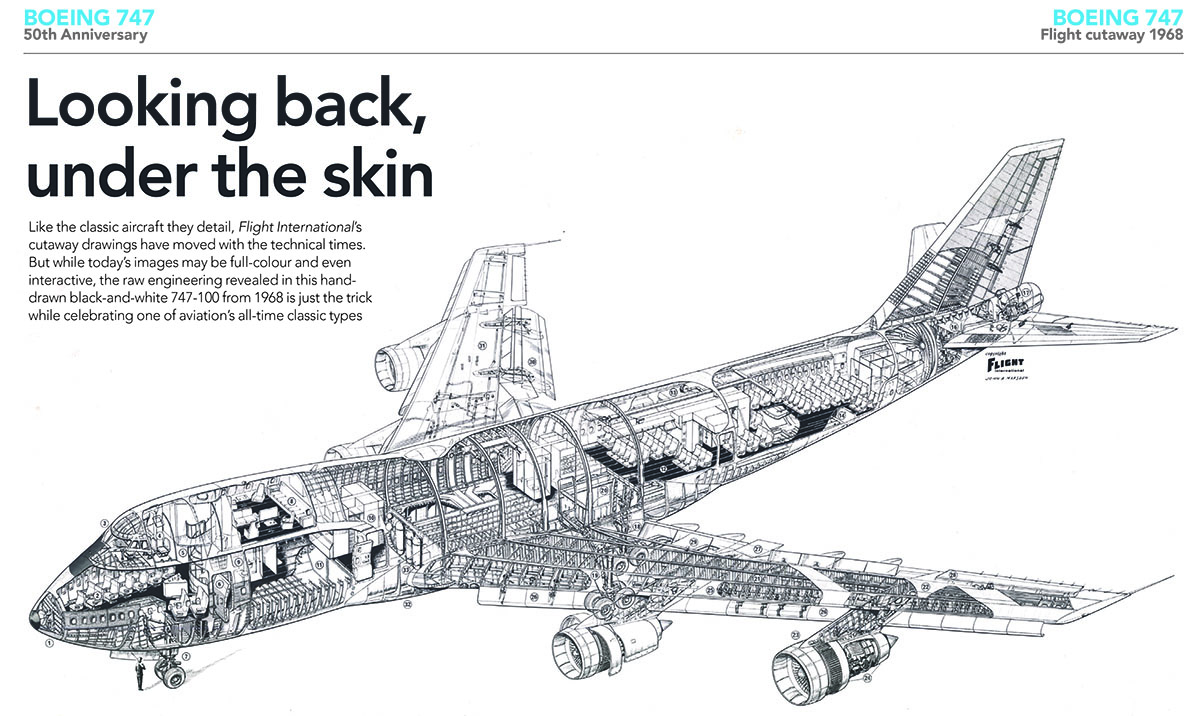
Boeing 747
View on GrokipediaDevelopment
Origins and initial concept
In the early 1960s, surging global air travel demand prompted major airlines to seek aircraft capable of carrying significantly more passengers than existing models like the Boeing 707, which seated around 150-200 in typical configurations.[4] Pan American World Airways (Pan Am), under president Juan Trippe, identified the need for a "jumbo jet" roughly double the capacity of the 707, aiming for efficiencies in long-haul operations that could lower per-seat costs through scale.[5] Trippe approached Boeing leadership, including president William Allen, to develop such an airplane, emphasizing versatility for both passengers and future cargo conversion with a nose-loading door to accommodate oversized freight.[6] Boeing initiated formal studies for a wide-body airliner in 1965, reassigning engineer Joe Sutter from the 737 program to lead the effort under vice president Malcolm Douglas.[7] Sutter's team conceptualized a four-engine jet with a fuselage diameter of about 20 feet, enabling twin-aisle seating for up to 500 passengers in high-density layouts, while incorporating a distinctive upper-deck "hump" initially intended to house controls above a full-width main-deck cargo hold for freighter adaptability.[8] This design drew from earlier airline consultations, including American Airlines' 1965 requests for high-capacity, short-to-medium-range options, though Pan Am's vision prioritized transoceanic routes.[9] On April 13, 1966, Pan Am committed as launch customer with an order for 25 Boeing 747-100 aircraft at $22 million each, totaling $525 million—a figure equivalent to billions in modern terms—and securing Boeing's high-stakes investment in the project despite internal debates over supersonic alternatives.[8][10] The commitment validated the subsonic jumbo concept over riskier ventures, with Pratt & Whitney tasked later that year to develop the high-bypass JT9D turbofan engines to power the unprecedented scale.[11] This phase marked Boeing's shift toward economies of scale in aviation, betting company survival on the 747's success amid competition from rivals like Lockheed.[12]Design process and engineering innovations
The design of the Boeing 747 was led by engineer Joe Sutter, who was reassigned from the 737 program in summer 1965 to head the effort under Boeing's new 747 division.[7] Sutter directed a team of approximately 4,500 engineers and specialists, focusing on creating the first wide-body commercial airliner capable of carrying over 400 passengers on long-haul routes.[13] The process emphasized scalability from existing Boeing jet designs while addressing demands for higher capacity and efficiency, driven by airline requirements for aircraft that could economically transport larger numbers of passengers amid growing global air travel in the 1960s.[14] A pivotal engineering decision was the adoption of a raised cockpit positioned above the main fuselage, enabling the installation of a hinged nose section for cargo loading in freighter variants without obstructing the flight deck.[15] This innovation stemmed from the program's dual-purpose mandate to serve both passenger and freight roles, reflecting pragmatic foresight into market uncertainties; the upper deck hump, initially sized for a lounge, provided structural space for the cockpit while allowing full-width main deck utilization.[16] The wide-body fuselage configuration, with a diameter of 20 feet, permitted a twin-aisle layout seating 10 abreast in economy, doubling capacity over narrow-body predecessors and reducing per-seat operating costs through economies of scale.[17] Propulsion innovations included the integration of high-bypass-ratio turbofan engines, specifically the Pratt & Whitney JT9D, which delivered 43,500 pounds of thrust per engine—nearly double that of contemporary jets—while improving fuel efficiency by bypassing a larger proportion of air around the core.[18] The 747's wing design incorporated a high-aspect-ratio swept wing with span-loading optimizations and leading-edge slats for enhanced low-speed performance, critical for safe operations given the aircraft's unprecedented size and weight exceeding 800,000 pounds at takeoff.[19] These features, validated through extensive wind-tunnel testing and subscale modeling, prioritized structural integrity and aerodynamic stability, with the fuselage cross-section derived from first-principles scaling of pressure vessel mechanics to withstand cabin pressurization cycles.[20] The design process also introduced modular assembly techniques, leveraging Boeing's expertise in aluminum alloy fabrication for the semi-monocoque structure, which facilitated rapid prototyping and iteration amid tight timelines imposed by launch customer commitments.[15] Innovations in landing gear, featuring four main bogies with 16 wheels total, distributed loads on runways not yet widened for such mass, ensuring compatibility with existing infrastructure.[17] Overall, these engineering choices balanced risk in unproven large-scale aerodynamics with empirical data from prior programs, establishing benchmarks for safety margins and redundancy in critical systems.[18]Prototype construction and flight testing
Construction of the Boeing 747 prototype commenced at the newly built Everett Factory in Washington state, with assembly progressing through 1968. The aircraft, a 747-100 model registered as N7470 and designated RA001, was christened City of Everett in honor of the facility's location.[21][22][23] The prototype rolled out of the assembly line on September 30, 1968, marking the completion of initial fabrication and integration of major components, including the distinctive upper deck and four Pratt & Whitney JT9D turbofan engines. The rollout ceremony drew an estimated crowd of over 50,000 spectators, highlighting the aircraft's significance as a technological leap in wide-body aviation.[21][22][24] Following extensive ground testing, including taxi runs and systems checks at Paine Field adjacent to the Everett plant, the prototype achieved its maiden flight on February 9, 1969. Pilots Jack Waddell and Brien Wygle, with flight engineer Jess Wallick, commanded the 1-hour-15-minute sortie, which confirmed stable handling characteristics and basic aerodynamic performance up to 20,000 feet.[25][9][21] The subsequent flight test campaign utilized five dedicated aircraft, accumulating more than 1,400 hours over ten months to validate structural integrity, propulsion efficiency, and avionics functionality under varied conditions. Testing encompassed high-altitude climbs, simulated failures, and endurance runs, culminating in data essential for FAA certification.[9][25]Certification challenges and delays
The Boeing 747's flight test program commenced on February 9, 1969, following the rollout of the prototype RA-001 earlier that year, and involved four test aircraft accumulating over 1,000 flight hours to validate the design's airworthiness under Federal Aviation Administration (FAA) scrutiny.[7] This phase was critical for certifying the aircraft's novel features, including its massive scale, partial double-deck configuration, and high-bypass turbofan propulsion, but encountered significant hurdles that extended testing timelines.[26] Primary challenges stemmed from the Pratt & Whitney JT9D engines, the world's first high-bypass turbofans deployed on a commercial airliner, which proved unreliable due to their untested nature and developmental immaturity. Issues included frequent compressor stalls triggered by rapid throttle movements, fan blade failures, engine casing distortions and ovalization under load, and uncontained engine failures, necessitating 55 engine replacements across the test fleet—far exceeding norms, such as the single change during the Boeing 737's testing.[26][27][28] Pylon mounting problems exacerbated engine integration difficulties, as the JT9D's nacelle deformed non-circularly under operational stresses, compromising attachment integrity and requiring design modifications to enhance rigidity and vibration damping. Additionally, early tests revealed insufficient aircraft damping, halting flights temporarily for aerodynamic and structural adjustments to prevent flutter risks. These propulsion and structural certification demands, compounded by the FAA's rigorous evaluation of the 747's unprecedented size and complexity, delayed progress but were addressed through iterative fixes and ground simulations.[28][7] Despite these setbacks, the FAA issued type certification for the 747-100 on December 30, 1969, enabling entry into commercial service shortly thereafter, though early operational reliability issues persisted into initial airline deployments.[29] The program's success underscored the risks of pioneering technologies without prior large-scale validation, influencing future engine certification protocols to prioritize maturity.[27]Entry into service and early production
The Boeing 747 received Federal Aviation Administration (FAA) certification for commercial passenger service on December 30, 1969, following extensive flight testing that validated its airworthiness and compliance with safety standards.[9] The first production aircraft, designated as a 747-121 and registered N733PA with the name Clipper Young America, was delivered to launch customer Pan American World Airways (Pan Am) on December 12, 1969.[30] This delivery marked the transition from prototype development to operational deployment, with the aircraft prepared for revenue service after ground checks and crew familiarization. Pan Am inaugurated commercial operations with the 747 on January 22, 1970, operating Flight 2 from New York's John F. Kennedy International Airport to London's Heathrow Airport, carrying 332 passengers and 18 crew members.[9] [31] The scheduled departure on the evening of January 21 was postponed due to an engine malfunction, but the subsequent flight demonstrated the aircraft's capability for transatlantic routes with significantly higher passenger capacity than preceding jetliners.[32] Early flights emphasized the 747's role in democratizing long-haul travel, though initial operations were limited by the need for specialized ground handling equipment and airport infrastructure adaptations to accommodate its size. Early production focused on fulfilling Pan Am's foundational order of 25 aircraft, placed in April 1966 for $525 million, which provided the commitment necessary to launch the program.[33] Subsequent orders from airlines including Trans World Airlines (TWA) and Lufthansa supported initial output, with Boeing delivering the first units at a measured pace to ensure quality amid the novel engineering challenges of the wide-body design.[34] By the end of 1970, production had commenced on variants tailored for high-density short routes, reflecting growing demand, though total deliveries remained modest in the program's nascent phase due to certification timelines and supply chain integration for components like the Pratt & Whitney JT9D engines.[35] Cumulative deliveries reached 268 aircraft through 1975, indicating a gradual ramp-up as operators gained confidence in the type's reliability.[36]Evolution of derivative models
The 747-200 series, certified in 1971, represented the first major derivative evolution from the baseline 747-100, incorporating more powerful Pratt & Whitney JT9D-7 engines for improved thrust, increased maximum takeoff weight up to 833,000 pounds, and extended range capabilities exceeding 6,800 nautical miles, enabling trans-Pacific operations without refueling.[37][38] This variant also introduced options for stretched upper decks in later submodels and structural reinforcements for higher gross weights, with Boeing delivering 396 units overall, many converted to freighters post-passenger service.[39] Sub-variants like the 747-200B further enhanced fuel capacity by 10% through additional center wing tanks and aerodynamic refinements, entering service in February 1971 with operators such as United Airlines, while the 747-200F freighter debuted in 1972 with a large forward nose door for cargo loading, addressing growing air freight demands amid economic expansion in the 1970s.[37] Specialized short-range adaptations, including the 747SR for high-density domestic routes in Japan with reinforced structure for up to 550 passengers and 747SP with a shortened fuselage for ultra-long-range flights up to 7,650 nautical miles, emerged in the mid-1970s to meet niche market needs, though production remained limited to 45 SR and 45 SP units due to operator-specific requirements.[40] The 747-300, launched in 1980 and certified in 1982, extended the upper deck by 23 feet for additional premium seating capacity, boosting total passengers to around 600 in high-density configurations, and integrated quieter, more efficient engines like the Rolls-Royce RB211-524, which reduced noise by 10 decibels compared to earlier models.[38] First delivered to Air France in 1983, it emphasized passenger comfort with optional lounges and improved cabin pressurization, but sales totaled only 56 passenger units amid competition from twinjets, prompting a shift toward freighter conversions.[41] A pivotal redesign came with the 747-400, program launch in October 1985, featuring a two-pilot digital glass cockpit that eliminated the flight engineer position, wingtip extensions with winglets for 2-3% fuel savings, and advanced engines such as the Pratt & Whitney PW4000 series offering 10% better efficiency over predecessors.[42] First flight occurred on April 29, 1988, with FAA certification in January 1989, enabling entry into service with Northwest Airlines that year; over 694 were produced, including combi and freighter versions with side cargo doors, sustaining the type's viability into the 2000s despite rising fuel costs.[43][44] The final evolutionary step, the 747-8 announced in 2005, stretched the fuselage by 18.3 feet for 467-passenger capacity in the -8I passenger model and incorporated raked wingtips, advanced GEnx-2B67 engines with 10% lower fuel burn per seat, and composite structures borrowed from the 787 Dreamliner for 16% operating cost reductions versus the -400.[45] Maiden flight in 2010 led to -8F freighter certification in 2011, prioritizing cargo market dominance with a 20% payload increase to 308,000 pounds, though passenger uptake lagged with only 47 -8I deliveries by production end in 2023, reflecting shifts to efficient twins like the 777X.[46][47]Production ramp-up and facility expansions
To support production of the Boeing 747, the company acquired 780 acres adjacent to Paine Field in Everett, Washington, in June 1966 for a dedicated manufacturing facility.[48] Construction of the Everett plant began shortly thereafter, with the first 113 production workers arriving on January 3, 1967, and the initial 747 nose section delivered from Wichita, Kansas, on November 21, 1967.[48] Completed in 1967, the facility became the world's largest building by volume, spanning 98.3 acres with an interior volume of 472 million cubic feet, designed specifically to assemble the oversized 747 airframe using overhead cranes for major components.[49] The Everett factory enabled rapid scaling of 747 production following the prototype rollout on September 30, 1968, and the first delivery to Pan American World Airways on December 13, 1969.[48] Deliveries accelerated, reaching the 100th aircraft to Braniff International Airways by February 11, 1971, reflecting an effective initial rate exceeding one per week in the early phase after certification.[48] Over the first decade from 1969 to 1979, production averaged 2.9 aircraft per month, fluctuating between 2 and 5 monthly as demand grew and manufacturing efficiencies improved.[50] Subsequent facility expansions supported sustained output and variant introductions. A major addition in 1978–1979 increased capacity, followed by a 1,914,000-square-foot extension in 1993 to accommodate production of extended-range models like the 747-400.[51] These enhancements, built on the original 1.2-mile-long high-bay structure, allowed Boeing to maintain rates up to 5 per month into the early 2000s before market shifts led to gradual reductions.[50][52]Decision to end production
Boeing announced on July 2, 2020, that it would end production of the 747-8 after fulfilling 16 outstanding orders, primarily for freighters, with completion targeted for 2022.[53] [54] This decision reflected sustained low demand for four-engine widebodies, as airlines shifted toward twin-engine aircraft offering superior fuel efficiency and reliability on long-haul routes, enabled by extended-range twin-engine operational performance standards (ETOPS) that minimized the operational advantages of quadjets.[55] [56] The 747-8 program, launched in 2005 to modernize the type with updated engines and avionics, arrived amid a market transition away from hub-and-spoke models favoring massive aircraft toward point-to-point networks with smaller, more flexible planes; passenger orders ceased after the final 747-8 Intercontinental delivery to Korean Air in July 2017, leaving only sporadic freighter demand from operators like Atlas Air and UPS to justify continued assembly.[57] [55] Higher per-seat operating costs, including maintenance for four engines versus two, and rising fuel prices further eroded the 747's competitiveness against rivals like the Boeing 777 and Airbus A350.[55] With inventory drawdown and no new commitments, Boeing redirected resources to twin-engine programs such as the 777X, whose certification delays to 2025 underscored broader industry challenges but did not revive quadjet interest.[58] The final 747-8 Freighter (line number 1574) rolled out from the Everett factory on December 6, 2022, after which the assembly line was idled.[3] [56] Delivery to Atlas Air occurred on January 31, 2023, concluding 54 years of production that yielded 1,574 aircraft across all variants.[59] [60]Design and technical features
Airframe structure and aerodynamic innovations
The Boeing 747's airframe employs a semi-monocoque construction, with the fuselage primarily fabricated from aluminum alloys such as 2024-T3 sheet for skin panels and extrusions, chosen for its balance of strength, fatigue resistance, and workability in large-scale riveting and machining processes.[61] Wing spars and main structural longerons also utilize high-strength aluminum alloys, while secondary structures incorporate early applications of carbon-fiber composites for weight savings in non-critical areas.[62] The fuselage is assembled from multiple cylindrical sections—nose, forward upper and lower lobes, center body integrated with the wing carry-through structure, and aft section—joined via precision machining and riveting to distribute loads efficiently across the fail-safe design, which includes multiple load paths to maintain integrity under damage.[63] A key structural innovation is the partial double-deck fuselage, featuring a widened lower section for eight-abreast seating and a raised forward upper deck hump spanning from the cockpit to just aft of the wings, providing additional volume without compromising the structural box formed by the wing carry-through and keel beam.[45] The flight deck is elevated above the main deck to allow conversion to freighter configuration via a hinged nose or side cargo door, preserving fuselage cross-section integrity for cargo loading while minimizing aerodynamic penalties from protrusions. This layout supports a maximum takeoff weight exceeding 735,000 pounds in early variants, with the center section housing fuel tanks and integrating the wing roots for optimal load transfer.[64] Aerodynamically, the 747 pioneered advanced high-lift systems for its era, incorporating 15 leading-edge devices per wing: Krueger flaps outboard of the engine nacelles for high deflection at low speeds, and intruding leading-edge flaps inboard to enhance airflow attachment.[65] These pair with triple-slotted trailing-edge Fowler flaps that extend and camber to increase wing camber and area by 21%, boosting maximum lift by up to 90% during takeoff and landing, enabling short-field performance despite the aircraft's size.[66] The supercritical wing airfoil sections, with 37.5-degree sweep and moderate dihedral, delay transonic drag rise for efficient Mach 0.85 cruise, while inboard and outboard ailerons, along with split spoilers, provide precise roll control and lift dumping.[45] These features, validated through extensive wind-tunnel testing, contributed to the 747's ability to achieve 5,000-6,000 nautical mile range at entry into service in 1970, balancing structural mass with aerodynamic efficiency.[65]Powerplant and propulsion systems
The Boeing 747 employs a four-engine configuration with high-bypass turbofan engines mounted in underwing pods to provide the thrust required for its maximum takeoff weight exceeding 800,000 pounds. This quadjet layout ensures redundancy and sufficient power for long-range operations, with each engine contributing to total thrust outputs ranging from approximately 174,000 lbf in early models to over 260,000 lbf in later variants.[67][68] The original 747-100 series was exclusively powered by Pratt & Whitney JT9D turbofans, the first high-bypass ratio engines applied to a wide-body airliner, entering service in 1970. These dual-spool engines featured a 93.4-inch fan diameter and delivered takeoff thrust ratings from 43,500 lbf in the JT9D-3 variant to up to 56,000 lbf in later sub-variants like the JT9D-7 series, enabling the aircraft's initial certification and operations.[67][69][70] Beginning with the 747-200 series, Boeing offered engine alternatives to meet diverse airline preferences for performance, maintenance, and fuel efficiency: General Electric CF6 dual-spool turbofans and Rolls-Royce RB211 three-spool turbofans. The CF6-50 variant provided around 51,000–52,500 lbf of thrust, while the RB211-524 delivered up to 50,000 lbf, with the three-spool design of the RB211 offering advantages in fuel economy despite added weight.[71][72] In the 747-400, powerplants evolved with higher-thrust options including the Pratt & Whitney PW4000 series at 56,200–63,300 lbf, GE CF6-80C2 at up to 62,100 lbf, and Rolls-Royce RB211-524G/H at 59,500–60,500 lbf, incorporating improvements in bypass ratios and materials for 10–25% better specific fuel consumption over earlier models.[73][71][44] The final 747-8 variant utilizes four General Electric GEnx-2B67 turbofans, rated at 66,500 lbf each for a total of 266,000 lbf, featuring a 105-inch fan, chevron nozzles for noise reduction, and advanced composites derived from the GE90 for enhanced efficiency and emissions compliance.[68][74][75]| Variant Series | Engine Options | Takeoff Thrust per Engine (lbf) |
|---|---|---|
| 747-100 | Pratt & Whitney JT9D-3/7 | 43,500–56,000 |
| 747-200 | JT9D-7, GE CF6-50, RR RB211-524 | 50,000–53,000 |
| 747-400 | PW4000, CF6-80C2, RB211-524G/H | 56,200–63,300 |
| 747-8 | GE GEnx-2B67 | 66,500 |
Avionics, cockpit, and operational systems
The Boeing 747 flight deck is elevated above the main fuselage on the upper forward section, a design choice that facilitates the addition of a nose cargo door for freighter variants without compromising pilot access or visibility. Introduced with the 747-100 in 1970, the cockpit features side-by-side seating for the captain and first officer, a central console, and— in early models—a dedicated flight engineer station with over 50 analog gauges, including 16 engine-specific instruments. The curved instrument panel enhances ergonomic visibility, while the layout supports a crew of three in initial configurations.[76][27] The original avionics emphasized redundancy and innovation, marking the first commercial airliner with an inertial navigation system (INS) as standard equipment via three Carousel IV units adapted from Apollo program technology. These gyroscopic systems computed precise latitude, longitude, and up to eight waypoints, eliminating the role of a celestial navigator on long-haul flights. The consolidated automatic flight control system (AFCS) integrated autopilot, flight director, dual-channel yaw damper, and autothrottle, controlled via a single-mode selector panel at eye level for seamless manual-automatic transitions. Triple redundancy protected major systems, with quadruple redundancy in flight controls and four independent hydraulic circuits ensuring operational integrity amid failures.[76][17] Later variants digitized these capabilities: the 747-400, certified in 1989, deployed a glass cockpit with six cathode-ray tube displays—including primary flight displays (PFD), multi-function displays (MFD), and engine indicating and crew alerting system (EICAS)—alongside three flight management computers (FMC) handling route optimization, fuel management, and navigation data fusion from INS, GPS, VOR, DME, and ILS sources, thereby obviating the flight engineer. The 747-8 upgraded to liquid crystal displays (LCD), added electronic checklists and optional electronic flight bags (EFB), and incorporated the Rockwell Collins CISS 2100 for enhanced terrain awareness warning system (TAWS) and traffic collision avoidance system (TCAS). These evolutions supported Category III autoland capability in equipped aircraft and reduced crew workload through automated performance calculations and precise positioning.[76][27]Performance specifications and capabilities
The Boeing 747's performance is defined by its high-subsonic cruise capabilities, with typical speeds of Mach 0.85 (approximately 490 knots or 907 km/h at cruise altitude), which facilitate efficient transcontinental and transoceanic operations across variants.[64] Service ceilings reach up to 45,100 feet (13,747 meters), allowing the aircraft to operate above most weather systems for enhanced fuel efficiency and safety.[77] Maximum takeoff weights (MTOW) progressed significantly over the production run, starting at 735,000 pounds (333,400 kg) for the 747-100 and reaching 987,000 pounds (447,696 kg) for the 747-8 freighter and passenger models, enabling greater fuel and payload capacities.[78][79] Range performance varies by configuration and payload; early 747-100 models achieved up to 4,880 nautical miles (9,045 km) with typical passenger loads of around 385, while later 747-400ER variants extended this to 7,670 nautical miles (14,205 km).[80][64] The 747-200B offered intermediate capabilities with a range of approximately 7,100 nautical miles (13,149 km) under optimal conditions.[77] Fuel capacity varied significantly by variant and directly influenced range and operational capabilities. Early variants like the 747-100 held about 48,400 US gallons (183,000 liters). The 747-400 (the most produced passenger model) had a maximum fuel capacity of 57,285 US gallons (216,840 liters), while the later 747-8 Intercontinental increased this to 63,034 US gallons (238,610 liters), and the 747-8 Freighter had 59,734 US gallons (226,095 liters). These increases supported the progressive enhancements in range across the 747 family.[81][64][79] Payload capacities underscore the 747's dual-role proficiency in passenger and cargo service. Passenger variants like the 747-400 support up to 148,716 pounds (67,457 kg) of payload, accommodating 400-500 passengers depending on seating density, whereas freighter models such as the 747-8F handle 292,400 pounds (132,630 kg), suitable for oversized cargo over distances up to 4,200 nautical miles (7,778 km).[64][79] These metrics reflect iterative improvements in engine thrust, aerodynamics, and structural reinforcements, with takeoff field lengths at sea level and standard conditions ranging from 10,000 to 11,000 feet at MTOW across models.[64]| Variant | MTOW (pounds) | Max Range (nmi, typical payload) | Cruise Speed (Mach) | Max Payload (pounds) |
|---|---|---|---|---|
| 747-100 | 735,000 | 4,880 | 0.84 | ~120,000 (passenger)[78][80] |
| 747-200B | 826,000 | 7,100 | 0.85 | ~140,000 (passenger)[77] |
| 747-400 | 875,000 | 7,260 | 0.85 | 148,716 (passenger); 271,000 (freighter)[64] |
| 747-8F | 987,000 | 4,200 (max payload) | 0.845 | 292,400[79] |
Variants
747-100 series and short-range adaptations
The Boeing 747-100, the inaugural production variant of the airliner, conducted its maiden flight on February 9, 1969.[11] The type received FAA certification in December 1969, enabling commercial operations.[82] Pan American World Airways took delivery of the first 747-100 on December 12, 1969, and introduced it to revenue service on January 22, 1970, with flight Clipper Victor from John F. Kennedy International Airport in New York to London Heathrow.[30] [9] Equipped with four Pratt & Whitney JT9D-3 or -7 turbofan engines each producing up to 43,500 pounds of thrust, the 747-100 featured a maximum takeoff weight of 735,000 pounds, a wingspan of 195 feet 8 inches, and length of 231 feet 10 inches.[83] [40] In a standard configuration, it seated 366 passengers across three classes with a range of approximately 5,300 nautical miles, though high-density all-economy layouts could accommodate up to 480 occupants at the expense of range.[83] Early production emphasized long-haul intercontinental routes, with initial operators including Pan Am and later airlines such as Northwest Orient and Lufthansa adapting it for transatlantic and transpacific service.[85] To address demand for high-frequency, short-haul operations on dense routes like Japan's domestic network, Boeing introduced the 747-100SR (Short Range) variant, featuring structural reinforcements to the wings, fuselage, and landing gear for enduring up to 44,000 flight cycles—nearly double the standard 747-100's fatigue life.[86] The SR sacrificed range for payload by reducing fuel capacity from 53,985 U.S. gallons to 37,896 gallons, enabling configurations with 484 to 550 seats in all-economy class while maintaining the JT9D powerplants.[86] [87] Japan Airlines placed the 747-100SR into service on October 7, 1973, primarily for shuttle flights between Tokyo and Osaka, where it facilitated rapid passenger turnover and supported peak-hour demands exceeding 500 daily boardings per aircraft.[88] A further adaptation, the 747SR SUD (with a 7-foot-7-inch stretched upper deck added in 1986 via a mid-life retrofit), increased capacity to 563 or 569 passengers on select units, extending the variant's utility until retirements in the 2000s.[88] [87] Only 20 SR and seven SUD aircraft were produced exclusively for Japanese operators, underscoring their niche role in high-density regional markets rather than competing with narrower-body jets on less congested routes.[86]747-200 and extended-range developments
The Boeing 747-200 series represented an evolutionary advancement over the 747-100, incorporating more powerful engine options including the Pratt & Whitney JT9D-7, General Electric CF6, and Rolls-Royce RB211, along with structural reinforcements to accommodate a higher maximum takeoff weight (MTOW) of up to 833,000 pounds (378 metric tons).[4] These enhancements increased fuel capacity to approximately 53,611 U.S. gallons (202,900 liters), extending the aircraft's range beyond the 747-100's capabilities, with typical improvements allowing for up to 6,850 nautical miles (12,680 km) in certain configurations compared to the earlier model's roughly 5,300 nautical miles (9,800 km).[37][89] The prototype achieved its first flight on October 11, 1970, following development focused on intercontinental efficiency demands from airlines.[90] The passenger-oriented 747-200B variant, featuring strengthened wings and fuselage for greater payload and range, entered revenue service in February 1971.[77] This model supported optional higher gross weights, enabling operators to prioritize either payload or extended range by adjusting fuel loads, with reinforced landing gear and brakes to handle the augmented MTOW.[91] Combi configurations like the 747-200M allowed mixed passenger-cargo operations, while the convertible 747-200C facilitated quick switches between passenger and freighter roles via removable seats and flooring.[72] Freighter development culminated in the 747-200F, optimized for all-cargo transport with a main deck payload capacity of 105 short tons (95 metric tons) and a side cargo door for pallet loading.[77] It entered service in 1972 with Lufthansa as the launch customer, benefiting from the same range extensions as passenger models but prioritized for volume cargo on transoceanic routes.[4] These variants collectively addressed airline needs for versatile, long-haul operations, with over 400 747-200 series aircraft produced by the mid-1980s.[92]747-300 with upper-deck extensions
The Boeing 747-300, introduced as a stretched-upper-deck evolution of the 747-200, featured a significantly extended upper deck measuring 7.11 meters (23 feet 4 inches) longer than its predecessor, enabling additional seating and amenities while maintaining the overall fuselage length.[93] This modification, initially designated as the 747SUD (stretched upper deck), addressed airline demands for higher passenger capacity without extending the main deck, which would have complicated cargo loading and structural reinforcements.[94] The redesign incorporated two additional emergency exit doors on the upper deck to comply with evacuation requirements for the increased occupant load, marking the first 747 variant with such upper-level exits.[72] Development of the 747-300 began in the late 1970s, with the prototype achieving first flight on October 5, 1982, followed by certification and entry into service on March 28, 1983, with launch customer Saudi Arabian Airlines operating the type on long-haul routes.[95] Key innovations included a straight, wider staircase replacing the earlier spiral design for improved passenger flow between decks, an optional forward flight crew rest area above the cockpit, and compatibility with third-generation high-bypass turbofan engines such as the Pratt & Whitney PW4000, General Electric CF6-80C2, or Rolls-Royce RB211-524D, which reduced fuel consumption by approximately 25% compared to earlier powerplants.[93] These enhancements yielded a typical three-class configuration accommodating up to 366 passengers, representing about a 10% capacity increase over the 747-200, with a maximum range of around 12,400 kilometers depending on engine fit and loading.[96] Production totaled 81 new-build 747-300 airframes between 1982 and 1991, alongside limited conversions from existing 747-200s offered by Boeing to extend their utility.[97] The variant saw adoption by operators including KLM, Japan Airlines, and Lufthansa for high-density international services, though it bridged the analog cockpit era without the digital avionics upgrades of the subsequent 747-400.[98] By the mid-2010s, most passenger 747-300s had been retired or converted to freighters amid rising fuel costs and competition from twin-engine widebodies, with surviving examples primarily in cargo roles or limited regional operations as of 2025.[99]747-400 and digital avionics upgrades
The Boeing 747-400 represented a significant evolution in the 747 series, emphasizing cost reductions through advanced technology and efficiency gains. Development was announced in September 1984 at the Farnborough Airshow, targeting a 10% operating cost reduction via more efficient engines and extended range capabilities.[100] The prototype achieved its maiden flight on April 29, 1988, from Boeing's Everett facility, validating enhancements like wingtip extensions and winglets that increased span by 17 feet (5.2 meters) over prior models.[101] Certification followed in January 1989, with initial commercial service commencing that month on Northwest Airlines' Minneapolis-Phoenix route.[102] Central to the 747-400's upgrades was the transition to a fully digital glass cockpit, enabling two-pilot operations by eliminating the flight engineer's station present in earlier variants. This featured six cathode-ray tube (CRT) displays for primary flight instruments, navigation, engine parameters, and the Engine Indicating and Crew Alerting System (EICAS), integrated with three flight management computers for automated navigation and performance optimization.[103] [76] The digital avionics suite incorporated advanced inertial reference systems, flight directors, and autoland capabilities, reducing crew workload and enhancing precision in low-visibility conditions.[104] These changes stemmed from Boeing's response to airline demands for lower operating costs, as the analog-heavy cockpits of the 747-100 through -300 required three crew members, inflating labor expenses. Aerodynamic and propulsion refinements further distinguished the 747-400, with optional tail fuel tanks extending maximum range to approximately 7,260 nautical miles (13,450 km) in passenger configuration.[44] Winglets and lighter composite materials contributed to a 4-5% fuel efficiency improvement over the 747-300, supported by engine options including the General Electric CF6-80C2, Pratt & Whitney PW4000, and Rolls-Royce RB211-524G, each offering higher thrust-to-weight ratios and bypass efficiencies.[105] [73] Structural carbon brakes and lightweight aluminum alloys in the airframe also reduced weight, aiding overall performance without compromising the 833,000-pound (378,000 kg) maximum takeoff weight option.[103] These upgrades solidified the 747-400 as the best-selling 747 variant, with over 690 units produced, driven by its balance of capacity, range, and technological modernity.[106]747-8 and final evolutionary improvements
The Boeing 747-8 represented the final major evolutionary step in the 747 family, launched in 2005 to extend the type's competitiveness against larger widebodies like the Airbus A380 through fuselage stretching, engine upgrades, and aerodynamic refinements.[107] The variant encompassed both passenger (747-8I) and freighter (747-8F) models, with the freighter achieving first flight on February 8, 2010, followed by the passenger version on March 20, 2011.[108][109] Key improvements included a 5.6-meter fuselage extension over the 747-400, increasing overall length to 76.3 meters and enabling up to 467 seats in a three-class configuration for the -8I, alongside General Electric GEnx-2B67 high-bypass turbofans delivering 66,500 pounds of thrust each for enhanced efficiency.[107][110] Aerodynamic enhancements featured raked wingtips spanning 68.4 meters and a supercritical wing section, reducing drag and yielding approximately 20% better fuel efficiency per seat compared to the 747-400, with the -8I offering a range of 7,730 nautical miles.[107][111] The flight deck incorporated modern avionics such as multifunction displays, electronic flight bags, and head-up displays, while the freighter variant emphasized a larger main deck cargo door and reinforced flooring for 140 tons payload.[112] The FAA certified the 747-8F on August 19, 2011, with entry into service that October via Cargolux, followed by FAA type certification for the -8I on December 14, 2011, and commercial debut with Lufthansa in June 2012.[113] Production totaled 155 units, predominantly freighters due to subdued passenger demand, with the line concluding in December 2022 after final delivery to Atlas Air in early 2023.[114] Operators included Lufthansa as the sole major passenger carrier with 19 -8Is, alongside cargo users like Cargolux, Korean Air, and Atlas Air.[115] The program's end stemmed from airlines' shift toward twin-engine aircraft like the Boeing 777X and Airbus A350, which offer superior per-seat economics, extended twin-engine operations (ETOPS) reliability, and lower maintenance costs amid rising fuel prices and hub-to-hub route consolidation favoring efficient point-to-point networks over capacity-intensive quadjets.[55] This market realignment, accelerated by post-2008 economic pressures and the COVID-19 downturn, rendered further 747 evolutions uneconomical despite the -8's technical merits.[55]Freighter, combi, and special-purpose variants
The Boeing 747 freighter variants were designed for dedicated cargo operations, incorporating reinforced main deck floors capable of supporting palletized and containerized loads, large upward-hinged nose-loading doors for oversized freight, and optional side cargo doors aft of the wing for additional flexibility. The 747-200F, introduced concurrently with the passenger -200 in 1971, featured a maximum payload of approximately 105 metric tons and entered commercial service in 1973, enabling efficient transport of bulky items that exceeded the capabilities of earlier freighters like the DC-8F.[116][71] Subsequent freighters built on this foundation with enhanced aerodynamics and powerplants. The 747-400F, which combined the -200F's main deck cross-section with the -400's extended wing and advanced avionics, rolled out on March 8, 1993, and offered increased cargo volume including space for 10-foot-high pallets, supporting payloads up to around 113 metric tons over ranges exceeding 4,000 nautical miles.[1][117] The final iteration, the 747-8F, achieved a payload capacity of 140 metric tons—16% greater than the -400F—through fuselage stretching by 5.6 meters and optimized GE GEnx-2B67 engines, with deliveries commencing in 2011 to operators like Cargolux.[118] These models dominated long-haul air cargo markets, with strengthened fuselage structures and roller floors facilitating rapid loading via onboard systems or external equipment.[119] Combi variants allowed mixed passenger and cargo operations on the main deck, partitioning the forward section for seating while reserving the aft area for freight, with reinforced bulkheads and fire suppression systems to meet certification requirements. The 747-200M Combi, available from the early 1970s, accommodated up to 238 passengers in a three-class layout alongside substantial cargo volumes in the lower holds and main deck rear, serving airlines on routes with variable demand like transatlantic flights.[72] Later, the 747-400M Combi incorporated digital cockpits, winglets, and flexible configurations for simultaneous passenger and cargo revenue, with the first rollout in June 1989 and operations emphasizing quick reconfiguration between all-passenger and mixed modes.[73] These aircraft proved economical for carriers balancing belly cargo limitations of pure passenger jets with dedicated freighter costs.[120] Special-purpose variants extended the 747's utility beyond standard commercial roles through extensive modifications. The Boeing 747 Large Cargo Freighter (LCF), or Dreamlifter—a heavily altered 747-400 with a bulbous fuselage extension increasing internal volume to 65,000 cubic feet—facilitated oversize transport of Boeing 787 components from global suppliers to assembly sites, with four units converted and operational from 2007 onward using specialized belly-loading ramps.[121] Additionally, the 747-400 Special Freighter (SF) program converted existing passenger -400s into cargo-configured aircraft with nose and side doors, preserving much of the original structure while adding cargo-handling provisions, entering service in the 2010s to extend fleet life amid demand for cost-effective conversions.[122] Other adaptations included testbed configurations, such as Boeing's 747-200 and -400 flying testbeds (FTBs) equipped with pylon-mounted engines for propulsion system evaluations, and limited conversions for airborne observatories or tankers, though these remained niche compared to production freighters.[123] These variants underscored the 747's structural robustness, enabling diverse missions without compromising the core airframe's proven reliability.[124]Military, government, and VIP conversions
The E-4B serves as the U.S. Air Force's Advanced Airborne Command Post, functioning as a National Airborne Operations Center during national emergencies, including nuclear crises, and supporting Federal Emergency Management Agency disaster relief efforts.[125] Derived from the Boeing 747-200B and equipped with four General Electric CF6-50E2 turbofan engines, it incorporates electromagnetic pulse hardening, nuclear and thermal shielding, upgraded satellite communications, and enhanced air-conditioning systems for mission crew operations.[125] The aircraft supports in-flight refueling for extended endurance beyond 12 hours unrefueled and operates above 30,000 feet.[125] Four E-4B units remain active with the 595th Command and Control Group at Offutt Air Force Base, Nebraska; the first was delivered in January 1980, with the fleet fully upgraded from initial E-4A configurations by 1985.[125] The YAL-1 Airborne Laser testbed, based on a Boeing 747-400F freighter, was designed to detect, track, and destroy tactical ballistic missiles during their boost phase using a megawatt-class chemical oxygen iodine laser mounted in a nose turret.[126] Jointly developed by Boeing, Lockheed Martin, and Northrop Grumman starting in 1996, modifications to the airframe began in 2002, with the first flight occurring on July 18, 2002, and in-flight laser testing commencing in March 2007.[126] It achieved successful intercepts of liquid- and solid-fuel ballistic missile targets on February 11, 2010, meeting program criteria for high-energy laser engagement.[126] Despite these milestones, the U.S. Department of Defense canceled the $5 billion program in February 2011 citing prohibitive costs, technical complexities in scaling to operational fleets, and limited strategic value against proliferating missile threats; the sole prototype was stored and ultimately scrapped in September 2014.[126] The VC-25A comprises two militarized Boeing 747-200B aircraft configured for U.S. presidential transport under the Air Force One call sign, operated by the 89th Airlift Wing at Joint Base Andrews.[127] Delivered in 1990 following extensive modifications by Boeing including aerial refueling capability, self-defense electronic countermeasures, and secure command-communications suites, the VC-25A supports global missions with a maximum takeoff weight of 833,000 pounds and fuel capacity of 53,611 gallons.[128][127] These platforms enable mid-air refueling to extend range and include reinforced structures for secure operations.[128] Replacement VC-25B variants based on 747-8 airframes, ordered in 2015, remain in development amid delays, with initial operational capability projected beyond 2026.[129] VIP conversions of Boeing 747 series aircraft typically involve stripping commercial interiors for bespoke luxury refits, including master suites, conference areas, dining facilities, and advanced entertainment systems tailored for heads of state or high-net-worth individuals.[130] Boeing Business Jets announced a turnkey 747-8 VIP service in October 2025, encompassing aircraft acquisition, custom design oversight, interior completion, and certification, leveraging nearly 5,000 square feet of adaptable cabin volume.[130] Completion costs for such projects range from $25 million for basic layouts to over $150 million for elaborate configurations, often handled by specialized firms like Greenpoint Technologies.[131] Notable operators include the Abu Dhabi Amiri Flight and Saudi Arabian government fleets, which maintain 747-400 and 747-8 variants for royal transport with enhanced range and privacy features.[132] A proposed C-33 military freighter variant for augmenting C-17 Globemaster III heavy-lift capacity was evaluated in the 1990s but canceled due to budgetary constraints and procurement decisions favoring alternative platforms.[124]Unbuilt and proposed variants
In the early design phases of the Boeing 747 during the late 1960s and early 1970s, Boeing evaluated a trijet configuration to reduce operating costs compared to the quadjet layout, featuring a shortened fuselage, redesigned wings, and a new tail with the third engine mounted centrally at the rear.[97] This proposal aimed to achieve better fuel efficiency for medium-haul routes but was abandoned in favor of the established four-engine design to meet airline requirements for long-range overwater flights under ETOPS-equivalent reliability standards at the time.[133] By the mid-1980s, Boeing proposed the 747-500 as a mid-generation update with enhanced range and efficiency, incorporating advanced composites in the wings and new high-bypass engines, but it progressed no further than conceptual studies due to insufficient airline commitments.[133] In 1996, Boeing formally announced the 747-500X and 747-600X at the Farnborough Airshow as stretched derivatives of the 747-400, featuring a redesigned 251-foot (76 m) span wing with raked wingtips, winglets, and engines such as the GE90 or PW4000 series for improved aerodynamics and fuel burn reduction of up to 25%.[134] The -500X was projected to carry 490 passengers over 10,200 miles (16,400 km), while the -600X extended the fuselage by an additional 40 feet (12 m) for 620 passengers, targeting ultra-long-haul markets; however, these were shelved in January 1997 amid the Asian financial crisis, weak demand forecasts, and development costs estimated at $4-7 billion, as airlines favored smaller, point-to-point aircraft over very large jets.[135] [136] Responding to Airbus's A380 development in the late 1990s, Boeing proposed the 747X family in 2000, including the 747X Stretch with an extended upper deck spanning the full fuselage length, capacity for 500-650 passengers, new composite wings with a 260-foot (79 m) span, and generalized electric actuators for weight savings.[137] Variants encompassed passenger models, a 150-ton payload freighter, and an ultra-long-range 747-400XQLR extension for routes exceeding 9,000 miles (14,500 km), but the program was canceled in 2001 after market analysis indicated insufficient orders—Boeing secured only tentative interest from carriers like British Airways—prompting a strategic pivot to efficient twinjets like the 777-200LR and 787, which better aligned with shifting demand toward hub-bypassing networks.[97] [137] A separate 747-700X concept, envisioning even greater stretch and advanced materials, remained at the preliminary stage without detailed specifications or airline backing.[97] These unbuilt proposals underscored Boeing's repeated assessments of scaling the 747 platform against evolving economic realities, where high development risks and airline preferences for flexibility outweighed potential capacity gains.Operational history
Commercial passenger and cargo operations
The Boeing 747 entered commercial passenger service on January 22, 1970, when Pan American World Airways operated its inaugural revenue flight from New York to London Heathrow, carrying 332 passengers.[138] The aircraft received FAA type certification for passenger operations on December 30, 1969, enabling this milestone that marked the start of wide-body, high-capacity long-haul travel.[9] With typical seating for 366 passengers in a three-class configuration on early -100 models, the 747 facilitated economies of scale in air transport, allowing airlines to serve routes with volumes previously uneconomical for smaller jets.[139] Subsequent variants expanded operational capabilities; the 747-400, introduced in 1989, offered seating for up to 416 passengers in standard three-class layouts and featured two-pilot cockpits with advanced digital avionics, reducing crew requirements and operational costs.[122] Over its service life, the 747 fleet has transported approximately 5.9 billion passengers across 57 billion nautical miles, underscoring its dominance in transoceanic and intercontinental routes during the late 20th century.[140] Peak passenger utilization occurred in the 1980s and 1990s, with major operators including Delta Air Lines, which flew 747s from 1970 to 1977 and reintroduced them from 2008 to 2017 for high-density Pacific routes.[141] By the 2010s, passenger operations declined as fuel-efficient twin-engine aircraft like the Boeing 777 and Airbus A350 captured market share on long-haul routes, benefiting from extended twin-engine operations (ETOPS) regulations that permitted reliable overwater flights with fewer engines.[142] As of 2025, only a handful of airlines maintain 747 passenger fleets, including Lufthansa with 19 active 747-8s, Korean Air with five 747-8 Intercontinentals, Air China, and Rossiya Airlines, primarily for premium-heavy or high-demand corridors where the quadjet's capacity remains advantageous.[143] In parallel, the 747 established a robust presence in commercial cargo operations, beginning with convertible variants like the 747-200C introduced by Lufthansa in 1972, which allowed quick reconfiguration between passenger and freight roles.[122] Dedicated freighters followed, such as the 747-200F in the early 1970s and the 747-400F, first delivered in May 1993 with a maximum takeoff weight of 910,000 pounds and a range of about 4,970 nautical miles fully loaded.[119] These models excelled in oversized cargo transport via nose-loading doors, supporting global supply chains for perishables, electronics, and machinery. More than 260 747 freighters remain active as of 2023, operated by carriers like Atlas Air, UPS, and Cargolux, outlasting passenger retirements due to the type's unmatched volume capacity—up to 140 tons per flight—and reliability in point-to-point heavy-lift missions.[116] Production concluded with the final 747-8F delivered to Atlas Air in January 2023, after which focus shifted to sustaining existing fleets amid rising demand for e-commerce freight.Military and government applications
The United States Air Force operates two VC-25A aircraft, modified Boeing 747-200B airliners designated for presidential transport and known as Air Force One when carrying the President.[144] These aircraft, with tail numbers 28000 and 29000, feature extensive communications suites, aerial refueling capability, and defensive systems, enabling global reach without reliance on foreign bases.[127] The VC-25 fleet entered service in 1990, replacing earlier VC-137 Stratoliners, and two VC-25B replacements based on the Boeing 747-8 are under development with delivery expected no earlier than 2026.[128] The E-4B Advanced Airborne Command Post, nicknamed "Nightwatch," comprises four militarized Boeing 747-200 aircraft serving as the National Airborne Operations Center for continuity of government during national emergencies.[125] Equipped with EMP-hardened avionics, satellite communications, and battle staff facilities for up to 112 personnel, the E-4B supports command and control of U.S. nuclear forces and can remain airborne for extended periods with in-flight refueling.[145] Originally entering service as E-4As in 1974, the upgraded E-4B variant has been operational since 1980 and continues in active duty as of 2025, with plans for replacement under the Survivable Airborne Operations Center program.[125] The Boeing YAL-1 Airborne Laser, mounted on a modified 747-400F freighter, was developed as a prototype directed-energy weapon system for boost-phase interception of ballistic missiles.[146] The program, initiated in the early 2000s under the U.S. Missile Defense Agency, achieved a successful intercept of a short-range ballistic missile target on February 11, 2010, using a megawatt-class chemical oxygen iodine laser housed in a nose turret.[147] Despite demonstrations, the YAL-1 was canceled in 2012 due to technical challenges, high costs exceeding $5 billion, and doubts about scalability against longer-range threats; the sole prototype was stored at Davis-Monthan AFB before scrapping in 2014.[146] Limited aerial refueling applications include the KC-747 tanker demonstrator, a modified Boeing 747-100 prototype tested by Boeing in the 1970s with a flying boom capable of offloading over 400,000 pounds of fuel.[148] Although not adopted by the U.S. military due to size and redundancy with smaller tankers like the KC-135, a single KC-747 variant operated with the Iranian Air Force from 1970 until its reported destruction by Israeli forces in 2025.[149] No other major militaries have fielded 747-based tankers in operational fleets. Several governments employ Boeing 747 variants for VIP transport, often with military-operated squadrons. China's People's Liberation Army Air Force uses Boeing 747-8I aircraft for presidential missions, featuring customized interiors and secure communications as an upgrade over older Ilyushin Il-62s.[150] Similarly, nations including the United Kingdom, Saudi Arabia, and Japan have historically utilized 747s for head-of-state travel, though many have transitioned to smaller jets amid fleet modernizations.[151]Major operators and fleet utilization
Japan Airlines operated the largest historical fleet of Boeing 747s, accumulating over time through various passenger and cargo variants since the 1970s.[152] Pan American World Airways served as the launch customer, pioneering commercial 747 passenger service in 1970 and establishing the type's role in long-haul operations.[153] Other significant historical operators included British Airways, Lufthansa, and United Airlines, which deployed dozens of 747s for transatlantic and transpacific routes during the jet age's peak.[153] As of 2025, approximately 300 Boeing 747s remain active worldwide, with cargo variants comprising the majority.[154] Atlas Air leads as the largest operator with 65 aircraft, focused on freighter and charter services including 17 747-8Fs and 39 747-400Fs.[155] UPS Airlines follows with 43 freighters supporting its global express cargo network.[156] Cargolux operates 26 747-400 and -8 freighters, while Kalitta Air maintains 22 for specialized cargo hauling.[156][157] Among passenger carriers, Lufthansa sustains the largest fleet of 27 aircraft, comprising eight 747-400s and nineteen 747-8s for premium long-haul routes.[158] Korean Air, Air China, and Rossiya continue limited 747 passenger operations on select high-capacity international flights.[143] Fleet utilization has shifted heavily toward cargo, where 747 freighters average 11 to 16 daily block hours on extended international routes to meet e-commerce and logistics demands.[159] Remaining passenger 747s operate at lower frequencies on peak-demand corridors, often exceeding 1,000 monthly flights per major operator like Lufthansa.[160] This high cargo utilization underscores the type's enduring efficiency for voluminous, time-sensitive shipments despite the rise of twin-engine competitors.[154]Orders, deliveries, and market performance
Pan American World Airways placed the initial order for 25 Boeing 747-100 aircraft on April 9, 1966, launching the program with a $525 million commitment equivalent to over $4 billion in 2023 dollars.[161] Subsequent early orders came from airlines including Lufthansa, Qantas, and Japan Airlines, reflecting confidence in the aircraft's capacity for high-density long-haul routes amid growing transoceanic demand.[162] The first delivery occurred on December 13, 1969, to Pan Am, with commercial service commencing on January 22, 1970, on the New York-London route.[58] Boeing delivered a total of 1,574 747 aircraft across all variants from 1969 to January 31, 2023, when the final 747-8F freighter was handed over to Atlas Air, marking the end of production after 54 years.[58] The 747-400 variant achieved the highest sales with 694 units delivered between 1989 and 2009, benefiting from digital avionics, extended range, and fuel-efficient engines that addressed early models' operational costs.[163] Other variants included 81 passenger and combi 747-300s delivered in the 1980s, and 154 747-8s (primarily freighters) from 2011 to 2023.[164] Freighter and combi configurations accounted for approximately 598 units overall, sustaining demand as passenger quadjets faced efficiency challenges.[163] Market performance peaked in the late 1980s and early 1990s, with 122 orders in 1990 alone, driven by the 747-400's entry into service and expansion of global routes.[163] However, sales declined post-2000 as regulatory advancements in ETOPS certification enabled twin-engine jets like the Boeing 777 and 787 to capture long-haul market share through lower per-seat costs and route flexibility, reducing the economic rationale for four-engine aircraft on many routes.[165] By the 2010s, passenger 747 orders dwindled to near zero, with production sustained only by freighter demand from operators like UPS and Atlas Air; the 747-8 program ended without backlog after fulfilling 16 outstanding units in 2022.[58] Despite this, the type's cumulative sales exceeded 1,500 units, establishing Boeing's dominance in widebody production during aviation's jet age expansion, though it ultimately yielded to fuel-efficient alternatives amid rising oil prices and environmental pressures.[163]Safety record and incidents
Statistical overview of accidents and survivability
As of 2023, 1,574 Boeing 747 aircraft had been delivered worldwide, with 64 hull-loss accidents recorded in the Aviation Safety Network database since the type's commercial introduction in 1970.[166] These hull losses represent approximately 4% of the total fleet, though the rate varies by variant and operational era, with early models (747-100 through -300 and SP) experiencing higher exposure due to longer service in diverse global environments.[167] Hull-loss accident rates, measured per million departures, stand at 0.59 for the classic variants (747-100/-200/-300/SP) and 0.07 for the advanced 747-400, reflecting improvements in design, avionics, and crew training over time; the 747-8 has recorded zero hull losses in limited operations.[167] Fatal accident rates follow a similar trend, with the 747-400 at 0.06 per million flights, outperforming earlier models and contributing to the type's reputation for structural robustness despite its size.[168] Overall, commercial jet accident rates, including those involving widebodies like the 747, have declined 40% in the last two decades amid rising global departures.[167] Survivability in 747 accidents is influenced by factors such as crash dynamics, fire suppression, and evacuation procedures, with aviation safety analyses indicating a 23.9% survival rate across fatal incidents involving the type.[169] In broader commercial aviation, approximately 64% of accidents from 1965 to 2010 were deemed survivable, often due to the aircraft's reinforced fuselage and redundant systems allowing partial intactness post-impact.[170] Of the 64 documented 747 hull losses, at least 32 involved no onboard fatalities, underscoring causal factors like pilot error or maintenance issues over inherent design flaws in many cases.[166]| Variant | Hull-Loss Rate (per million departures) | Fatal Accident Rate (per million flights) | Example Total Hull Losses |
|---|---|---|---|
| 747-100/-200/-300/SP | 0.59[167] | ~1.02 (earlier models)[168] | 17+ (subset)[167] |
| 747-400 | 0.07[167] | 0.06[168] | 2 (subset)[167] |
| 747-8 | 0.00[167] | 0.00 | 0[167] |
Causes of major hull losses and engineering lessons
Major hull losses of the Boeing 747 have predominantly resulted from a combination of structural fatigue exacerbated by inadequate repairs, fuel system vulnerabilities to ignition sources, and pylon design deficiencies leading to engine detachment, though external factors like sabotage have also contributed in isolated cases.[171] Structural failures account for approximately 3% of all 747 hull losses, underscoring the rarity but severity of engineering-related breakdowns when they occur.[171] One of the deadliest engineering-linked incidents was Japan Airlines Flight 123 on August 12, 1985, involving a Boeing 747SR that suffered a rear pressure bulkhead rupture due to an improper repair following a 1978 tailstrike, which weakened the bulkhead and led to explosive decompression, vertical stabilizer loss, and crash into Mount Takamagahara, killing 520 of 524 aboard.[172] The repair, performed by Boeing technicians, deviated from specifications by using a single-row rivet pattern instead of a double-row, reducing fatigue resistance and allowing crack propagation over seven years.[173] This highlighted causal vulnerabilities in pressure bulkhead design and repair certification, prompting regulatory mandates for enhanced non-destructive testing and repair oversight in widebody aircraft, influencing subsequent fatigue monitoring protocols across Boeing models.[174] Fuel tank explosions represent another critical engineering shortfall, exemplified by TWA Flight 800 on July 17, 1996, where a Boeing 747-100 disintegrated mid-flight off Long Island due to ignition of flammable vapors in the nearly empty center wing tank, likely triggered by an electrical short in wiring adjacent to the tank.[175] National Transportation Safety Board analysis confirmed the explosion's origin in the tank's flammable mixture, absent mechanical failure elsewhere, with contributing factors including inadequate separation of electrical systems from fuel vapors.[176] Lessons derived included the adoption of nitrogen inerting systems to suppress tank flammability, retrofitted on later 747 variants and mandated for new designs, alongside wiring insulation upgrades to mitigate arcing risks, reducing explosion probabilities by displacing oxygen in ullage spaces.[175] Engine pylon failures underscored attachment system flaws, as in El Al Flight 1862 on October 4, 1992, a Boeing 747-200F freighter that lost both left engines due to fatigue-induced fracture of the inboard midspar fuse pin during initial climb from Amsterdam, causing asymmetric thrust, loss of control, and crash into an apartment complex, killing 47 total.[177] Investigation revealed the pylon's thin-walled fuse pin corroded and fatigued under cyclic loads, with certification inadequately accounting for shear stresses during engine changes; overload then severed the outboard pin.[178] Resulting engineering reforms involved redesigning pylon fuse pins for thicker walls and corrosion-resistant materials, plus mandatory ultrasonic inspections during maintenance, enhancing detachment resistance and informing broader nacelle integration standards.[177] These incidents, while comprising a minority of the 747's approximately 64 hull losses from over 1,500 produced, drove causal realism in aviation engineering by emphasizing first-principles scrutiny of fatigue propagation, ignition suppression, and load-path redundancies, yielding iterative improvements like supplemental structural inspections and enhanced certification for aging fleets.[179] Maintenance lapses amplified design sensitivities in roughly 4-5% of commercial jet accidents fleet-wide, reinforcing protocols for precise adherence to service bulletins.[180]Regulatory responses and safety enhancements
The Tenerife airport disaster on March 27, 1977, involving two Boeing 747s, prompted the International Civil Aviation Organization (ICAO) and national regulators including the FAA to mandate standardized phraseology in air traffic control communications to eliminate ambiguities such as the use of "takeoff" versus "departure," reducing miscommunication risks.[181] This incident also accelerated the adoption of Crew Resource Management (CRM) training programs worldwide, emphasizing assertive cockpit communication and authority gradient awareness to mitigate hierarchical errors.[182] Additionally, regulators required grooved runway surfaces to enhance wet-weather braking and friction, alongside improved taxiway lighting and signage to prevent runway incursions.[183] Following the Japan Airlines Flight 123 crash on August 12, 1985, caused by a faulty aft pressure bulkhead repair leading to explosive decompression, the FAA and Japan's aviation authorities issued airworthiness directives mandating rigorous inspections of fuselage repairs, particularly doubler patches, with non-destructive testing for hidden defects.[184] These measures included enhanced tear strap designs for better crack propagation resistance and stricter certification for structural modifications, influencing global maintenance standards to prioritize original design integrity over expedited fixes.[184] The accident underscored causal links between deferred maintenance and fatigue failure, prompting regulators to enforce periodic bulkhead integrity checks on aging 747s.[185] The in-flight cargo fire on South African Airways Flight 295 on November 28, 1987, highlighted vulnerabilities in manual firefighting reliance, leading the FAA to require active smoke detection and overhead fire suppression systems in Class C cargo compartments of passenger aircraft, including 747 variants, rather than passive barriers alone.[186] This regulatory shift, effective by the early 1990s, mandated halon or equivalent suppressants with automatic discharge capabilities, directly addressing ignition sources from undeclared hazardous cargo.[186] In response to the TWA Flight 800 explosion on July 17, 1996, attributed to a fuel tank ignition from degraded wiring arcing, the FAA implemented enhanced wiring inspection protocols under 14 CFR Part 25, requiring operators to assess insulation chafing and connector corrosion on older 747s every 10-15 years.[187] Subsequent rules in 2001 and 2008 introduced fuel tank inerting systems using nitrogen-enriched air to reduce flammability in center wing tanks, retrofitted on many 747-400s and later models, cutting explosion risks by over 90% based on empirical testing.[188] These enhancements extended to broader aging aircraft programs, including repetitive inspections for fuel quantity indication system (FQIS) wiring bundles.[187] Ongoing FAA airworthiness directives for the 747 fleet, as of 2025, address persistent issues like lower lobe fatigue cracking and flap track corrosion, requiring ultrasonic inspections and reinforced patches on high-cycle aircraft to maintain structural margins.[189] These cumulative regulatory actions have contributed to declining fatal accident rates for 747 operations, from 1.5 per million departures in the 1970s to under 0.1 by the 2010s, reflecting iterative causal mitigations rather than inherent design flaws.[190]Economic and industrial impact
Production economics and workforce contributions
The Boeing 747's production was centered at the Everett Factory in Washington state, constructed specifically for the program in 1967 at a cost exceeding $100 million (equivalent to approximately $900 million in 2023 dollars), featuring the world's largest building by volume at 472 million cubic feet to accommodate the aircraft's unprecedented scale.[191] Development costs for the 747 program totaled between $1.2 billion and $2 billion in late 1960s dollars (roughly $10 billion to $20 billion adjusted for inflation), funded in part by a $525 million order from Pan American World Airways for 25 aircraft in 1966.[192][193] Over its 54-year production run from 1968 to 2022, Boeing manufactured 1,574 747 aircraft, surpassing the break-even threshold of approximately 400 units and generating substantial long-term profitability despite initial financial risks that nearly bankrupted the company.[3][194] Unit list prices evolved from around $20 million for early 747-100 models to $418 million for the 747-8 Intercontinental by 2019, with actual production costs per aircraft declining over time due to economies of scale, though precise margins varied by variant and contract.[195] The 747 program demanded a highly skilled workforce, peaking at tens of thousands of direct employees at Everett, where machinists and assemblers developed pioneering techniques for handling massive components, such as automated riveting and precision alignment of the fuselage's upper lobe.[191] This labor force, often unionized under the International Association of Machinists, contributed to innovations in large-scale aerospace manufacturing, including the use of overhead cranes for ferrying parts and modular assembly processes that influenced subsequent wide-body programs.[196] Average annual pay for Boeing machinists reached about $75,000 by the 2020s, supporting generational economic stability in the Puget Sound region through direct employment and multiplier effects in supply chains.[196] Production challenges, including labor strikes in 1969 and later years, intermittently disrupted output but underscored the workforce's critical role in achieving the program's commercial success.[197]Role in global aviation expansion and trade
The Boeing 747's entry into service on January 22, 1970, revolutionized long-haul passenger aviation by introducing unprecedented capacity and range, allowing airlines to carry up to 366 passengers in standard three-class configurations over distances exceeding 5,000 nautical miles nonstop.[198] This scale, approximately 2.5 times larger than contemporaries like the McDonnell Douglas DC-8, enabled per-seat operating costs to drop by roughly 50%, making intercontinental travel accessible to middle-class consumers and spurring a boom in global tourism and business mobility.[198] [5] Airlines such as Pan American World Airways, the launch customer, rapidly expanded routes to Europe, Asia, and beyond, with the type's efficiency fostering the development of hub-and-spoke networks that amplified aviation's reach.[5] In parallel, the 747's design facilitated the conversion of passenger models into freighters from the mid-1970s, introducing large nose-door access for oversized cargo and payloads up to 124 metric tons, which transformed air freight logistics.[116] [199] These capabilities supported just-in-time manufacturing and the rapid shipment of high-value, perishable, and time-sensitive goods—such as electronics, pharmaceuticals, and fresh produce—across continents, underpinning the acceleration of global trade volumes that grew from $6.45 trillion in 1990 to over $28 trillion by 2022.[200] [201] By enabling efficient transport of items too large or urgent for sea freight, the 747 freighter fleet, numbering over 260 active units as of 2023, became indispensable for supply chains, particularly during disruptions like the COVID-19 pandemic when it handled disproportionate shares of e-commerce and medical cargo.[202] [203] The aircraft's dual role in passenger and cargo operations directly contributed to aviation's expansion as a vector of economic globalization, with air cargo's speed advantage—delivering goods in days versus weeks by sea—facilitating offshoring, integrated markets, and regional specialization in production.[200] For instance, the 747's ability to accommodate outsized freight volumes supported industries reliant on global sourcing, while its long-range endurance connected remote markets, enhancing trade flows between North America, Europe, and Asia-Pacific hubs.[199] Over its service life, the type has cumulatively transported billions of passengers and millions of tons of cargo, with Boeing estimating air trade's historical growth at 2.6% annually from 2003 to 2023, a trajectory the 747 variants helped sustain through their versatility and reliability.[200]Competitive dynamics and market displacement
The Boeing 747 entered service in 1970 amid competition from trijet widebodies like the McDonnell Douglas DC-10 and Lockheed L-1011 TriStar, which debuted in 1971 and 1972, respectively, and seated 250-350 passengers at lower acquisition costs but with inferior range and payload flexibility for ultra-long-haul operations. The 747's design advantages, including its partial double-deck fuselage enabling capacities up to 500 in dense configurations and superior trans-Pacific performance, propelled it to market leadership, with airlines favoring its scalability for hub-and-spoke networks during the 1970s oil crises when fuel efficiency was secondary to capacity utilization. By the mid-1980s, the 747 family had outsold rivals, with the DC-10 achieving around 440 deliveries and the L-1011 only 250, hampered by the latter's development delays, higher unit costs, and engine issues tied to Rolls-Royce's bankruptcy.[204] The 1990s introduced Airbus's A340 quadjet as an ETOPS-limited alternative, but regulatory advancements in extended twin-engine operations (ETOPS)—evolving from 120-minute diversions in 1985 to 330+ minutes by the 2000s—enabled efficient twins like the Boeing 777 (1995 debut) and Airbus A330 to encroach on quadjet domains, offering 20-30% better seat-mile fuel economy through larger, high-bypass engines and reduced drag. Rising fuel prices post-2000, peaking at over $100 per barrel in 2008, amplified these disparities, as the 747-400's four engines consumed roughly 12-15% more fuel per passenger than comparable twins on routes over 5,000 nautical miles, prompting airlines to retire older 747s for 777s in fleets like British Airways and United. The 747's market share in new long-haul orders dwindled from dominance in the 1980s (over 40% of widebody deliveries) to under 10% by the 2010s, driven by point-to-point routing preferences that favored aircraft sizing to direct demand rather than oversized hubs.[205][206] Direct rivalry peaked with the Airbus A380's 2007 entry, marketed for high-density routes with 550-850 seats, yet it secured only 251 orders versus the 747's cumulative 1,500+ deliveries, as airlines balked at its $400+ million list price, slot constraints at non-upgraded airports, and inflexibility amid liberalized markets favoring 300-400 seat twins like the Boeing 777X and Airbus A350. Boeing's 747-8 (2011 debut) attempted revival with stretched fuselage and GE GEnx engines for 10-12% efficiency gains, but passenger variants garnered just 47 orders—none from U.S. carriers—due to the 777's entrenched economics, leading to 747-8I production halt in 2017 and full program end in December 2022 after 1,574 total units. Cargo variants persisted longer, leveraging the 747's nose door for outsized loads, yet face displacement from converted high-density passenger twins amid e-commerce shifts to faster, smaller shipments.[207][208]Legacy
Technological advancements and enduring influence
The Boeing 747 introduced the high-bypass-ratio turbofan engine to commercial wide-body aviation through the Pratt & Whitney JT9D, which provided significantly improved fuel efficiency and thrust compared to prior low-bypass engines, enabling the aircraft's massive scale with takeoff weights exceeding 700,000 pounds.[27][209] This engine technology, debuting on the 747-100 in 1969, set a precedent for future airliners by prioritizing bypass ratios that reduced noise and emissions while supporting longer ranges.[45] The 747 also pioneered triple redundancy across major systems and quadruple redundancy in flight controls and hydraulics, enhancing reliability for large-scale operations where single failures could be catastrophic.[17] Subsequent variants incorporated avionics advancements, such as the inertial navigation system standard on the baseline model, which automated long-haul positioning without ground references.[210] The 747-400, certified in 1989, featured a two-crew digital cockpit with six CRT displays, eliminating the flight engineer role and integrating electronic flight instrument systems for reduced workload.[73] Structural innovations included lighter alloys, composites, and raked wingtips in later models like the 747-8, optimizing aerodynamics and extending range to over 8,000 nautical miles.[45] The 747's design established wide-body architecture as the norm for high-capacity, long-range flight, influencing competitors like the Airbus A380 and modern twins such as the Boeing 777 by demonstrating economies from high-volume seating and cargo holds.[211] It lowered per-seat-mile costs dramatically, facilitating global network expansions and mass air travel by enabling hub-and-spoke models that concentrated traffic at major airports.[27] Airports adapted infrastructure, including larger gates and runways, to accommodate the 747's 225-foot wingspan and underfuselage freight capabilities, which persist in freighter conversions handling over 50% of global air cargo volume today.[5] Even as production ended in 2023, the type's redundancy and modularity inform safety standards and simulation training across the fleet.[27]Current status and future prospects as of 2025
Production of the Boeing 747 ended in January 2023 with the delivery of the final 747-8F to Atlas Air, concluding a 54-year run that produced 1,574 aircraft.[58] As of late 2025, over 300 Boeing 747s remain active worldwide, with the vast majority converted to or originally configured for cargo operations due to their large main-deck capacity and nose-loading doors, which facilitate oversized freight handling.[154] Leading cargo operators include Atlas Air with 65 aircraft (including 17 747-8Fs and 39 747-400Fs), UPS with 43, Cargolux with 29, and Kalitta Air.[156] Passenger operations have sharply declined, limited to a handful of carriers such as Lufthansa, which plans to operate 27 Boeing 747s in 2025, primarily 747-8s for long-haul routes.[158] Korean Air is retiring its remaining five 747-8 Intercontinentals by March 2025, while Air China and Rossiya continue limited service with older models.[212] Around 85 aircraft persist in passenger configuration, but high fuel consumption and maintenance costs—exacerbated by the shift toward twin-engine jets with extended-range twin-engine operational performance (ETOPS) certification—drive ongoing retirements.[154] Looking ahead, no resumption of 747 production is anticipated, as Boeing has repurposed manufacturing facilities for newer programs like the 777X, reflecting market demand for more fuel-efficient widebodies.[56] Passenger 747s are expected to vanish from commercial fleets by the early 2030s, with Lufthansa targeting 747-400 retirement by 2028.[213] Cargo variants may endure longer, supported by e-commerce growth and the lack of direct quadjet replacements offering equivalent volume, though operators face competitive pressure from converted 777Fs and emerging freighters; full phase-out could extend into the 2040s for high-density routes.[214]Cultural and symbolic significance
The Boeing 747, widely known as the "Queen of the Skies," represents a pinnacle of aerospace engineering and the democratization of long-haul air travel, with its distinctive upper-deck hump evolving into a visual emblem of the jet age's ambition and scale.[1][215] This nickname, embraced in aviation circles for its evocation of grandeur and reliability, originated from marketing efforts highlighting the aircraft's unprecedented capacity to carry over 400 passengers, which halved per-seat costs on transoceanic routes and expanded global connectivity for middle-class travelers.[5][216] Symbolizing American industrial prowess and globalization, the 747 powered airlines like Pan Am in their pursuit of worldwide networks, enabling rapid cultural and economic exchanges that reshaped international relations post-1970.[198][217] Its introduction coincided with surging demand for mass air transport, fostering a perception of the skies as a democratized frontier rather than an elite domain.[9] In popular culture, the 747 has permeated media as a motif of prestige and spectacle, appearing in films like Tenet (2020) for dramatic crash sequences and customized by rock band Iron Maiden as "Ed Force One" for global tours since the 1980s, while actor John Travolta's ownership of a 747-400 underscores its allure among celebrities.[218][215] Since August 23, 1990, modified Boeing 747-200B variants have operated as the U.S. presidential aircraft VC-25A, known as Air Force One, projecting symbols of executive authority and national technological edge during state visits and crises.[128][219]References
- https://www.[airliners.net](/page/Airliners.net)/aircraft-data/boeing-747-100-200/97