


Community hub
Recent from talks
Contribute something
Nothing was collected or created yet.
Ahmednagar
View on Wikipedia
Ahmednagar, officially Ahilyanagar,[4][5] is a city in, and the headquarters of, the Ahmednagar district, Maharashtra, India.[6] Ahmednagar has several dozen buildings and sites from the Nizam Shahi period.[7] Ahmednagar Fort, once considered almost impregnable, was used by the British to detain Jawaharlal Nehru (the first prime minister of India) and other Indian Nationalists before Indian independence. A few rooms there have been converted to a museum. During his confinement by the British at Ahmednagar Fort in 1944, Nehru wrote the book The Discovery of India.[8] Ahmednagar is home to the Indian Armoured Corps Centre & School (ACC&S), the Mechanised Infantry Regimental Centre (MIRC), the Vehicle Research and Development Establishment (VRDE) and the Controllerate of Quality Assurance Vehicles (CQAV).[9] Training and recruitment for the Indian Army Armoured Corps takes place at the ACC&S.[10]
Key Information


Ahmednagar is a relatively small town and shows less development than the nearby western Maharashtra cities of Mumbai and Pune. Ahmednagar is home to 19 sugar factories and is also the birthplace of the cooperative movement.[11][citation needed] Due to scarce rainfall, the city often suffers from drought. Marathi is the primary language for daily-life communication. The city administration has recently published a plan of developing the city by year 2031.[12]
Etymology
[edit]Ahmednagar took its name from Ahmad Nizam Shah I, who founded the town in 1494[13] on the site of a battlefield where he won a battle against superior Bahamani forces.[14] It was close to the site of the village of Bhingar.[14] With the breakup of the Bahmani Sultanate, Ahmad established a new sultanate in Ahmednagar, also known as Nizam Shahi dynasty.[15]
History
[edit]The town Ahmednagar was founded in 1494 by Ahmad Nizam Shah I on the site of a more ancient city, Bhingar.[13] With the breakup of the Bahmani Sultanate, Ahmad established a new sultanate in Ahmednagar, also known as Nizam Shahi dynasty.[16] The establishment of the city is described in major contemporary historical works. One account, from Sayyid ‘Ali b. ‘Aziz Allah Tabataba’i's Burhān-i ma’āsir, notes the planned nature of the construction:[17]
An auspicious day was selected, and the surveyors, architects and builders obeyed the king’s commands, and laid out and began to build the city in with its palaces, houses, squares and shops, and laid around it fair gardens.
Another chronicler, Muhammad Qasim Hindushah Astarabadi, known as Firishta, discusses the founding in his Tārīkh-i Firishta. His work suggests the design, particularly the inclusion of gardens with palaces and pavilions both inside and outside the city walls, followed the conventions of a post-Timurid city. Firishta describes:[18]
“In 900, he laid the foundation of a city in the vicinity of the Sina river, to which he gave the name of Ahmadnagar. So great exertions were made in erecting buildings by the king and his dependents, that in the short space of two years the new city rivalled Baghdad and Cairo in splendour.”
It was one of the Deccan sultanates, which lasted until its conquest by Mughal emperor Shah Jahan in 1636. Aurangzeb, the last Mughal emperor, who spent the latter years of his reign, 1681–1707, in the Deccan, died in Ahmednagar and is buried at Khuldabad,[19] near Aurangabad in 1707, with a small monument marking the site.[citation needed]
In 1759, the Peshwa of the Marathas obtained possession of the place from Nizam of Hyderabad and in 1795 it was ceded by the Peshwa to the Maratha chief Daulat Rao Sindhia. In 1803 Ahmednagar was besieged by a British force under Richard Wellesley and captured.[13] It was afterward restored to the Marathas but again came into the possession of the British in 1817, according to the terms of the Treaty of Poona,[13] and was known as Ahmednuggur.
In 19th century American Christian missionaries opened first modern schools in this town. According to a report there were four girls' school running under the superintendence of Cynthia Farrar around the 1850s. Mahatma Jyotirao Phule visited them and got inspired to open school for girls in Poona. Later, he enrolled his wife Savitribai Phule in Farrar's school in a teacher's training program. Farrar was from America and spent his entire life in Ahmednagar running her schools, these girls' schools were one of the first such kind in the country.[20]
During the First World War, Ahmednagar was the site of a camp for Prisoners of War, mainly for German and Austrian civilian internees and the captured crews of German ships, but also some Turkish soldiers captured in Mesopotamia.
On 31 May 2023, Eknath Shinde (the chief minister of Maharashtra) announced that Ahmednagar would be renamed "Ahilya Nagar", in honour of Ahilyabai Holkar[21] who was Rani of Indore, within the Maratha Confederacy in the late 18th-century. Deputy chief minister Devendra Fadnavis spoke at the same meeting, referring to Shinde's government as "pro-Hindutva", and asked Shinde to rename the district "Ahilyanagar"; Shinde replied: "The state government has accepted your demand to rename Ahmednagar as Ahilyadevi Holkar Nagar".[22] The BJP demanded that Ahmednagar be renamed.[23] Rais Shaikh (group leader of the Samajwadi Party in the Maharashtra Legislative Assembly) said that "The Maha Yuti government is implementing the 'Yogi pattern' of creating an illusion of development by changing the names of cities without doing anything for development"[24] and accused the government of "distorting history".[24] On 13 March 2024, the Maharashtra state cabinet announced that they had approved the renaming of Ahmednagar at the same time as they announced the renaming of seven railway stations in Mumbai.[4][23] On 4 October 2024, the Maharashtra state government notified the state revenue and forest department of the change of name, who published this in the gazette on 8 October 2024.[5]
Military base
[edit]Ahmednagar is home to:
- Indian Armored Corps Centre & School (ACC&S)
- Mechanized Infantry Regimental Centre (MIRC)
- Vehicle Research and Development Establishment (VRDE)
- Controllerate of Quality Assurance Vehicles (CQAV)
Training and recruitment for the Indian Army Armored Corps take place at the ACC&S. Formerly, the city was the Indian base of the British Army's Royal Tank Corps/Indian Armored Corps, amongst other units. The town houses the second-largest display of military tanks in the world and the largest in Asia.[25][failed verification]
Geography
[edit]Climate
[edit]Situated in the rain shadow region of the Western Ghats, Ahmednagar has a hot semi-arid climate (Köppen BSh). The climate is hot throughout the year and sweltering during the pre-monsoon months from March to mid-June, whilst monsoon rainfall averages less than a third of that received in Mumbai and about a tenth what is received in Mahabaleshwar on the crest of the mountains.[citation needed]
| Climate data for Ahmednagar (1991–2020, extremes 1901–2012) | |||||||||||||
|---|---|---|---|---|---|---|---|---|---|---|---|---|---|
| Month | Jan | Feb | Mar | Apr | May | Jun | Jul | Aug | Sep | Oct | Nov | Dec | Year |
| Record high °C (°F) | 36.1 (97.0) |
38.9 (102.0) |
43.2 (109.8) |
43.5 (110.3) |
44.0 (111.2) |
43.3 (109.9) |
37.7 (99.9) |
39.5 (103.1) |
38.2 (100.8) |
39.7 (103.5) |
35.6 (96.1) |
35.6 (96.1) |
44.0 (111.2) |
| Mean daily maximum °C (°F) | 30.5 (86.9) |
32.7 (90.9) |
36.4 (97.5) |
38.8 (101.8) |
38.7 (101.7) |
33.3 (91.9) |
29.6 (85.3) |
29.2 (84.6) |
29.8 (85.6) |
32.1 (89.8) |
31.1 (88.0) |
30.7 (87.3) |
32.8 (91.0) |
| Mean daily minimum °C (°F) | 11.1 (52.0) |
12.9 (55.2) |
16.4 (61.5) |
20.5 (68.9) |
22.4 (72.3) |
22.5 (72.5) |
21.6 (70.9) |
20.7 (69.3) |
20.6 (69.1) |
18.5 (65.3) |
15.1 (59.2) |
11.0 (51.8) |
17.9 (64.2) |
| Record low °C (°F) | 1.8 (35.2) |
2.8 (37.0) |
7.5 (45.5) |
9.5 (49.1) |
15.2 (59.4) |
17.0 (62.6) |
16.5 (61.7) |
12.2 (54.0) |
10.7 (51.3) |
10.6 (51.1) |
5.6 (42.1) |
3.3 (37.9) |
1.8 (35.2) |
| Average rainfall mm (inches) | 0.3 (0.01) |
0.6 (0.02) |
1.6 (0.06) |
4.8 (0.19) |
19.3 (0.76) |
135.7 (5.34) |
93.5 (3.68) |
116.5 (4.59) |
153.5 (6.04) |
65.5 (2.58) |
14.2 (0.56) |
2.6 (0.10) |
608.1 (23.94) |
| Average rainy days | 0.0 | 0.1 | 0.4 | 0.6 | 1.1 | 6.7 | 6.1 | 5.5 | 7.7 | 3.5 | 0.7 | 0.1 | 32.5 |
| Average relative humidity (%) (at 17:30 IST) | 36 | 30 | 25 | 24 | 28 | 56 | 67 | 69 | 68 | 58 | 51 | 44 | 46 |
| Source: India Meteorological Department[26][27] | |||||||||||||
Demographics
[edit]As of 2011 Indian census,[29] Ahmednagar had a population of 350,859. Ahmednagar has a sex ratio of 961 females per 1000 males and an average literacy rate of 84%, higher than the national urban average of 79.9%.[30] 10% of the population is under 6 years of age.
At the time of the 2011 Census of India, 68.01% of the population spoke Marathi, 9.43% Hindi, 8.59% Urdu, 4.86% Telugu, 4.31% Marwari, 1.35% Sindhi and 0.95% Gujarati as their first language.[31]
Pilgrimage and tourism
[edit]


- Meherabad, the Samadhi of Shri Avatar Meher Baba, is a place of pilgrimage, particularly on the anniversary of his death, Amartithi. His later residence was at Meherazad (near Pimpalgaon village), approximately nine miles north of Ahmednagar.[32]
- Shani Shingnapur - Temple of Lord Shani
- Shri Munjaba Tample, Ukkadgaon – In Shrigonda Taluka about 60 km from Ahmednagar main city. It has four big statue of Ganapati, Mahadev (Shankar), Vishnu and Hanuman. Thousands of devotees visit this place.
- Ahmednagar Fort (Bhuekot Killa) – Built by Ahmed Nizam Shah in 1490, this is one of the best-designed and most impregnable forts in India. As of 2013[update], it is under the control of the military command of India.[33]
- Tomb of Salabat Khan II – also called the Chand Bibi Palace,[34] this is a solid three-storey stone structure situated on the crest of a hill 13 km from Ahmednagar city.
- Cavalry Tank Museum – The Armoured Corps Centre and School has created a museum with an extensive collection of 20th-century armoured fighting vehicles.[35]
- Ralegan Siddhi – a village which is a model for environmental conservation. Social activist Anna Hazare is from Ralegan Siddhi.
- Pimpri Gawali – a village in Parner taluka, about 25 km away from Ahmednagar and known for the watershed development and agribusiness activities.
- Avhane, Shevgaon – Temple of Ganesh (Nidrista/Sleeping)
- Jamgaon – Place in Parner taluka with a historic 18th-century palace built by Mahadaji Shinde
- Mahatma Phule Krishi Vidyapeeth, Rahuri Mahatma Phule Krishi Vidyapeeth is an agricultural university at Rahuri, named after an activist and social reformer of 19th century. It is one of four agricultural universities in the state.[36]
- Mula Dam: It is 52 km from the Ahilyanagar City
Transport
[edit]Air
[edit]Ahmednagar has 1 airport, the nearest domestic airport at Shirdi at 90 km. While the nearest International Airport is at Pune.
Ahmednagar city has air connectivity by seaplane service. The seaplane port is located at the Mula Dam water reservoir, 30 minutes away from Ahmednagar City. The service has been offered by Maritime Energy Heli Air Services Pvt. Ltd. (MEHAIR) from 22 September 2014. Ongoing flights are available from Juhu, Mumbai to Mula Dam.[citation needed]
Rail
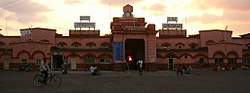
[edit]Ahmednagar railway station (station code: ANG) belongs to Solapur Division of Central Railway zone of the Indian Railways. Ahmednagar has rail connectivity with Pune, Manmad, Kopargaon, Shirdi, Daund, Goa, Nasik and other metro-cities like New Delhi, Mumbai, Chennai, Kolkata, Bangalore, Ahmedabad. 41 express trains stop at this station.[citation needed] There is still a demand for direct rail connectivity to other major cities of India.[37] Ahmednagar station will now be a part of the Pune railway division. 24 stations of the Daund-Ankai section will be merged with Pune railway division. The Daund-Ankai section is currently under the management of the Solapur railway division. The change to the Pune division will increase the chances of starting DEMU services between Ahmednagar and Pune stations.[38]
One of the oldest and important railway projects of Ahmednagar railway station was Kalyan-Ahmednagar railway project which was in planning stage since British regime. It was referred to as 3rd ghat project. The survey of this project was carried out in 1973, 2000, 2006, 2014 etc. This project was in pink book in 2010. Unfortunately, this project could not be completed. The alignment length of this project was 184 km and it could have been shortest route for Marathwada, Andhra and Telangana. The major challenge for this project was proposed 18.96 km tunnel in malshej ghat section.[39]
Malshej Kriti Samiti is following for Kalyan Ahmednagar railway project. Kalyan-Murbad section, the first phase of this project, is already under survey stage.[40]
A survey of Ahmednagar-Aurangabad Railway line with 120 km length was also carried out in March 2021. The DPR Report of this project is under preparation.[41]
Ahmednagar-Karmala railway option is also getting explored. Ahmednagar railway station will become an important railway junction in future to the level similar to Daund railway junction. A Kalyan-Murbad-Ahmednagar line is also possible in future.[42]
Road
[edit]Ahmednagar is well connected by road with major cities of Maharashtra and other states. It has four lane road connectivity to:
National Highway 222 from Kalyan to Nirmal near Adilabad in Telangana passes through the city. The Maharashtra State Road Transport Corporation (MSRTC) and different private transport operators provide bus service connecting the city to all parts of the state.
Ahmednagar has three main bus stands:
- MSRTC Tarakpur Bus Stand – All buses passing through Ahmednagar stop here.[43]
- Maliwada Bus Stand – The buses going to Aurangabad/ Jalgaon/ Akola halt here.[44]
- Pune Bus Stand – Buses going to Pune/Mumbai halt here.
Intra-city transport
[edit]- Autorickshaws, including share autorickshaws
- Bus service established by the Municipal Corporation. The main bus routes in the city are:
- Maliwada Bus Stand to Nirmalnagar via:
- Delhi Gate
- Patrakar Chowk
- Premdan Chowk
- Professor Colony
- Pipeline Road
- Maliwada Bus Stand to Dr. Vikhe Patil College, Vilad Ghat via:
- Delhi Gate
- Patrakar Chowk
- Premdan Chowk
- Savedi Naka
- Nagapur MIDC
- New Nagapur
- Maliwada us stand to Kedgaon via:
- Sakkar Chowk
- Kinetic Chowk
- Railway Flyover
- Ambikanagar
- Maliwada Bus Stand to Bhingar via:
- Market Yard Chowk
- Nagar College
- GPO Chowk
- Ahmednagar Fort
- Shukrawar Bazaar
- Bhingar Wes
- Maliwada Bus Stand to Nimbalak via:
- Delhi Gate
- Patrakar Chowk
- Premdan Chowk
- Savedi Naka
- Nagapur MIDC
Politics
[edit]Ahmednagar Municipal Council was upgraded to a municipal corporation in 2003. As of 2022, Rohini Shendage of Shiv Sena was the incumbent mayor. Ahmednagar city is represented in the central and state legislatures by the Ahmednagar Lok Sabha and Ahmednagar City Vidhan Sabha seats respectively. The sitting MP was Dr.Sujay Vikhe Patil as of 2022, while the sitting MLA was Sangram Jagtap.
Media and communication
[edit]- Newspapers:
- TV channels:
- CMN Channel
- News Today 24 Ahmednagar
- ATV Ahmednagar
- Radio:
- 104 MY FM
- AIR Nagar FM
- Radio City
- Dhamaal 24
- Radio Nagar FM
- Internet:
Internet facilities are provided by several service providers.
Notable people
[edit]- Malik Ambar, Siddi military leader and guerilla fighter against Mughal Empire
- Sadashiv Amrapurkar, film and theatre actor
- Rajanikant Arole, doctor, Magsaysay award Winner, Padmabhushan
- Meher Baba, spiritual leader
- John Barnabas, evolutionary biologist
- Chand Bibi, Nizamshahi princess, defended Ahmednagar Fort against the Mughal forces of Akbar
- Madhu Dandavate, Indian politician
- Michael J. S. Dewar, theoretical chemist
- Cynthia Farrar, American missionary
- Anna Hazare, Gandhian and social activist
- Adhik Kadam, social activist, social entrepreneur and philanthropist
- Pramod Kamble, painter and sculptor
- Zaheer Khan, cricketer
- Anna Leonowens, educator, feminist, author of The English Governess at the Siamese Court (1870)
- Spike Milligan, 1918–2002, comedian and author
- Shahu Modak, film actor
- Bahirji Naik, head of Intelligence Agency of Maratha Army
- Popatrao Baguji Pawar, Padmashri, Sarpanch Hiware Bazar
- Ajinkya Rahane, cricketer
- Anand Rishiji, Jain saint
- Sai Baba of Shirdi, spiritual master
- Narayan Waman Tilak, Christian writer, poet, pastor
References
[edit]- ^ "Cities having population 1 lakh and above" (PDF). censusindia. The Registrar General & Census Commissioner, India. Retrieved 29 December 2012.
- ^ National Commissioner Linguistic Minorities 50th report, page 131 Archived 8 July 2016 at the Wayback Machine. Government of India. Retrieved 15 July 2015.
- ^ "Urban Agglomerations/Cities having population 1 lakh and above" (PDF). Censusindia. The Registrar General & Census Commissioner, India. Retrieved 29 December 2012.
- ^ a b "Ahmednagar renamed as Ahilya Nagar: Maharashtra Cabinet approves name change". The Economic Times. 13 March 2024.
- ^ a b Pawar, Tushar (10 October 2024). "Maharashtra's Ahmednagar is now officially Ahilyanagar". The Times of India. ISSN 0971-8257. Retrieved 3 January 2025.
- ^ Banerjee, Shoumojit (31 May 2023). "Now, Ahmednagar to be renamed 'Ahilyanagar' after famed Maratha queen Ahilyabai Holkar". The Hindu. ISSN 0971-751X. Retrieved 3 January 2025.
- ^ Sohoni, Pushkar (2015). Aurangabad with Daulatabad, Khuldabad, and Ahmadnagar. London; Mumbai: Deccan Heritage Foundation; Jaico. ISBN 9788184957020.
- ^ Moraes, Frank (1 January 2007). Jawaharlal Nehru. Jaico Publishing House. p. 319. ISBN 978-81-7992-695-6.
- ^ "Government Polytechnic Ahemadnagr". gpnagar.ac.in. Retrieved 27 February 2025.
- ^ Sainik Samachar: The Pictorial Weekly of the Armed Forces. 1988. p. 14.
- ^ "District Specialities | Ahilyanagar | India". ahilyanagar.maharashtra.gov.in. Archived from the original on 20 February 2025. Retrieved 27 February 2025.
- ^ Nagarick (6 June 2007). "Ahmednagar by year 2031". Nagarick.blogspot.com. Retrieved 23 November 2011.
- ^ a b c d Chisholm, Hugh, ed. (1911). . Encyclopædia Britannica. Vol. 1 (11th ed.). Cambridge University Press. p. 432.
- ^ a b The Kingdom of Ahmadnagar. Motilal Banarsidass. 1966. p. 38. ISBN 978-81-208-2651-9.
- ^ Sen, Sailendra (2013). A Textbook of Medieval Indian History. Primus Books. pp. 118–119. ISBN 978-9-38060-734-4.
- ^ Sohoni, Pushkar (2018). The Architecture of a Deccan Sultanate: Courtly Practice and Royal Authority in Late Medieval India. London: I.B. Tauris. ISBN 9781784537944.
- ^ Roxburgh, David J. (27 January 2016). Envisioning Islamic Art and Architecture: Essays in Honor of Renata Holod. BRILL. ISBN 978-90-04-28028-1.
- ^ Roxburgh, David J. (27 January 2016). Envisioning Islamic Art and Architecture: Essays in Honor of Renata Holod. BRILL. ISBN 978-90-04-28028-1.
- ^ "Aurangzeb: Chapter 1 | Stanford University Press". Stanford University Press. Archived from the original on 24 January 2025. Retrieved 27 February 2025.
- ^ "Cynthia Farrar — Missionary woman who inspired Jotirao Phule". 28 January 2023.
- ^ "Maharashtra's Ahmednagar to be renamed as Ahilya Nagar, announces CM Eknath Shinde". Hindustan Times. 31 May 2023.
- ^ Kulkarni, Dhaval S. (3 June 2023). "Why Ahmednagar district in Maharashtra was renamed Ahilyanagar". India Today. Retrieved 24 August 2023.
- ^ a b "Ahmednagar becomes Ahilya Nagar, Maharashtra Cabinet approves name change". Hindustan Times. 13 March 2023.
- ^ a b Marpakwar, Chaitanya (13 March 2024). "Maharashtra cabinet approves renaming of Ahmednagar to Ahilyanagar". The Times of India. ISSN 0971-8257. Retrieved 15 March 2024.
- ^ "The History of Ahmednagar". Ahmednagar.nic.in. 15 August 1947. Archived from the original on 7 October 2011. Retrieved 23 November 2011.
- ^ "Station: Ahmednagar Climatological Table 1991–2020" (PDF). Climatological Normals 1991–2020. India Meteorological Department. Archived from the original (PDF) on 8 April 2024. Retrieved 7 July 2024.
- ^ "Extremes of Temperature & Rainfall for Indian Stations (Up to 2012)" (PDF). India Meteorological Department. December 2016. p. M135. Archived from the original (PDF) on 5 February 2020. Retrieved 30 March 2020.
- ^ "Population by Religion - Maharashtra". censusindia.gov.in. Registrar General and Census Commissioner of India. 2011.
- ^ "Census of India 2001: Data from the 2001 Census, including cities, villages and towns (Provisional)". Census Commission of India. Archived from the original on 16 June 2004. Retrieved 1 November 2008.
- ^ Ministry of Home Affairs, Government of India, "2001 Literacy Rates", Census of India 2001, Ministry of Home Affairs, India
- ^ a b "Table C-16 Population by Mother Tongue: Maharashtra (Town level)". censusindia.gov.in. Registrar General and Census Commissioner of India.
- ^ "Welcome to Mahatma Phule Krishi Vidyapeeth". Archived from the original on 6 September 2013. Retrieved 12 September 2013. Official website
- ^ Rajendra Rajan Fort that held Nehru The Tribune, 12 July 2009
- ^ "Ahmednagar City". ahmednagar.nic.in.
- ^ Tank Museum at ahmednagar.nic.in
- ^ "Maharashtra Krishi Vidyapeeth, Rahuri". Archived from the original on 6 September 2013. Retrieved 12 September 2013.
- ^ "MPs demand better railway connectivity in Maharashtra". The Times of India. 23 February 2012. Retrieved 25 June 2023.
- ^ Dheeraj Bengrut (3 November 2021). "Pune railway division area to increase, 24 stations to be added". Hindustan Times. Retrieved 14 November 2021.
- ^ "कल्याण-नगर रेल्वे हा विकासाचा मार्ग – Development route of Kalyan Ahmednagar railway". Maharashtra Times (in Marathi). 4 August 2017. Retrieved 14 November 2021.
- ^ "संजीवनी देणारा माळशेज घाट रेल्वे मार्ग". 2 March 2016. Retrieved 25 June 2023.
- ^ "Field survey for rail line begins today". The Times of India. 28 February 2021.
- ^ Arkhade, Arvind (2 November 2021). "अहमदनगर-करमाळा नवीन रेल्वे मार्गाबाबत लवकरच निर्णयाची शक्यता". Deshdoot (in Marathi). Archived from the original on 6 December 2022. Retrieved 17 May 2025.
- ^ "Ahmednagar Bus Stand – Google Search". google.co.in. Retrieved 26 October 2017.
- ^ "Bus Stands & Traffic Control Centers Ahmednagar".
External links
[edit]
- Ahmednagar: Places to Visit
- Ahmednagar sultane
- Talukas of Ahmednagar district
- Ahmednagar (Lok Sabha constituency)
 Ahmednagar travel guide from Wikivoyage
- Ahmednagar Bus Stands Center Contact list

| Topics | |||||||||||||
|---|---|---|---|---|---|---|---|---|---|---|---|---|---|
| Regions | |||||||||||||
| Divisions and Districts |
| ||||||||||||
| Million-plus cities in Maharashtra | |||||||||||||
| Other cities with municipal corporations | |||||||||||||
| Government | |||||||||||||

| International | |
|---|---|
| National | |
| Geographic | |
| Other | |

Ahmednagar
View on GrokipediaEtymology
Name Origins and Historical Usage
The name Ahmednagar originates from its founder, Malik Ahmad Nizam Shah I, who established the city in 1494 CE on the left bank of the Sina River, near the site of his 1490 victory over Bahmani forces.[2][8] The designation directly reflects his given name, Ahmad, as he selected the location midway between Junnar and Daulatabad to serve as the new capital of the emerging Nizam Shahi dynasty.[8] An anecdote attributes the specific naming to Salabat Khan, Ahmad's minister, who advised that the city be called Ahmadnagar due to the prominence of individuals named Ahmad in the administration, including the sultan, the qazi, and the commander-in-chief—paralleling the naming of Ahmedabad by Ahmad Shah of Gujarat.[2] A separate legend links the site's auspicious selection to an omen during a hunt, where a fox overpowered a hunting dog, interpreted as a sign of the city's future defensive strength.[8] The name has been in continuous historical usage since 1494 to refer to the city, which functioned as the capital of the Ahmadnagar Sultanate under the Nizam Shahi rulers until its Mughal conquest in 1636.[2][8] It retained this designation through subsequent Mughal overlordship, Maratha dominance, and British colonial governance, with the East India Company formalizing Ahmednagar as the headquarters of the eponymous district in 1818.[2][9]Recent Renaming to Ahilyanagar
The Maharashtra state cabinet approved the renaming of Ahmednagar district and its headquarters city to Ahilyanagar on March 13, 2024, honoring Punyashlok Ahilyadevi Holkar, the 18th-century Maratha queen renowned for her administrative acumen and contributions to infrastructure and justice in the Malwa region.[10][11] The decision followed an initial announcement by Chief Minister Eknath Shinde on May 31, 2023, during an event commemorating Holkar's legacy, reflecting the state government's emphasis on regional historical figures over the city's Mughal-era nomenclature derived from Sultan Ahmed Nizam Shah.[12][13] Final implementation required clearance from the Union Home Ministry, which was granted in early October 2024, leading to the official adoption of Ahilyanagar as the designation for both the district and municipal corporation effective October 5, 2024.[11][12] The Maharashtra government subsequently updated official documentation, including the district's portal to ahilyanagar.maharashtra.gov.in, and issued notifications formalizing the change across administrative records.[14] This renaming aligns with similar initiatives in Maharashtra, such as the redesignation of Bombay to Mumbai, prioritizing indigenous historical associations amid debates on decolonizing place names, though critics have questioned the administrative costs and historical disconnect given Holkar's primary rule centered in Indore rather than Ahmednagar.[15][16] Subsequent actions included the Indian Railways renaming Ahmednagar railway station to Ahilyanagar on September 17, 2025, further embedding the change in public infrastructure to perpetuate Holkar's tribute as a symbol of female leadership and regional pride.[17] The move has been supported by state functionaries as a rectification of colonial and sultanate imprints, with no reported legal challenges as of October 2025, though it necessitates updates to signage, maps, and legal references across government and private sectors.[12][18]History
Pre-Foundational Period
The region of present-day Ahmednagar exhibits traces of early human activity linked to the Mauryan Empire, with administrative references to the vicinity appearing in edicts of Emperor Ashoka circa 240 BCE.[1][19] From approximately 90 BCE to 300 CE, the area fell under the dominion of the Satavahana dynasty, known locally as the Andhrabhrityas, who established administrative control across much of the Deccan plateau.[19] Following this, the Rashtrakuta Dynasty exerted influence over Ahmednagar until around 400 CE, succeeding the Satavahanas amid shifting regional powers that included early trade contacts with Persian entities during the Achaemenid era under Darius I.[19] Medieval governance transitioned through Hindu kingdoms such as the Yadavas of Devagiri, who dominated the Deccan from the 12th to early 14th centuries, until the Delhi Sultanate's incursions disrupted local rule around 1294 CE.[19] The Bahmani Sultanate, founded in 1347 CE by Ala-ud-Din Hasan Bahman after rebelling against Delhi's Tughlaq overlords, incorporated the Ahmednagar territory into its domain, dividing the Deccan into provinces for administrative efficiency.[19][20] By the late 15th century, the weakening Bahmani Sultanate saw governors like Malik Ahmad Nizam-ul-Mulk, appointed over key districts including Junnar and Pathri, consolidate power in the region; in 1490 CE, he proclaimed independence, setting the stage for the formal establishment of Ahmednagar as a capital four years later on the site of a prior battlefield victory.[21][22]Nizam Shahi Dynasty and Founding
The Nizam Shahi dynasty emerged from the fragmentation of the Bahmani Sultanate in the late 15th century, when regional governors asserted autonomy amid the central authority's decline. Malik Ahmad Nizam Shah I, a prominent Bahmani noble and military leader, declared independence on May 28, 1490, establishing the Ahmadnagar Sultanate and founding the Nizam Shahi line, which ruled over territories in the northwestern Deccan region encompassing parts of present-day Maharashtra.[23][24] This move capitalized on the Bahmanis' internal strife, including succession disputes and fiscal weaknesses, allowing Ahmad to consolidate power through military campaigns against rival factions and local Hindu chieftains. Ahmad selected a strategic site for his capital, founding the city of Ahmadnagar (named after himself) around 1490–1494 on elevated terrain near the Sina River, which provided defensive advantages and agricultural fertility from surrounding black cotton soil.[23][22] The location, previously known as Bhinar during Yadava rule, was fortified early in the dynasty's tenure, with Ahmad constructing the initial Ahmednagar Fort to serve as a bulwark against incursions from neighboring sultanates like Bijapur and Golconda.[25] This establishment marked a shift toward Persianate administrative practices, including land revenue systems and architectural patronage blending Indo-Islamic styles, which bolstered the dynasty's legitimacy and economic base through trade in cotton, indigo, and horses.[26] Under Ahmad's rule (1490–1510), the dynasty expanded by subduing coastal strongholds like Danda-Rajapuri and forging alliances, such as with the Khandesh Sultanate, to counter Berar threats, laying the groundwork for Nizam Shahi dominance in Deccan politics until Mughal interventions in the 17th century. His successors, including Burhan Nizam Shah I, further developed the city as a cultural hub, commissioning mosques and tombs that reflected Shia influences amid Sunni-Shia tensions in the region.[24] ![Ahmednagar fort entrance.jpg][float-right]Mughal, Maratha, and Colonial Conflicts
The Ahmednagar Sultanate endured prolonged conflicts with the Mughal Empire beginning in the late 16th century under Akbar, who sought to expand into the Deccan. Initial Mughal gains, including the temporary occupation of Ahmednagar in 1600, proved short-lived due to effective resistance led by Malik Ambar, an Abyssinian military leader serving as regent. Ambar employed guerrilla tactics and fortified defenses, reclaiming the capital multiple times and inflicting defeats on Mughal forces, such as at the Battle of Bhatvadi in September 1624, where his army repelled a joint Mughal-Bijapur assault.[27][28] Mughal persistence culminated in the sultanate's annexation in 1636 during Shah Jahan's reign, when forces under Prince Aurangzeb captured the remaining territories after the execution of the last Nizam Shahi ruler, Murtaza Nizam Shah II. This incorporated Ahmednagar into the Mughal suba of Ahmednagar, subordinating it to imperial administration amid ongoing Deccan campaigns. The conquest followed years of sieges and alliances, with Bijapur and Golconda briefly accepting Mughal suzerainty to avert similar fates.[24][29] As Mughal authority waned in the 18th century, Maratha forces under Shivaji and later the Peshwas challenged control over Ahmednagar. Shivaji's raids in the 1670s brought Maratha cavalry near the city, clashing with Mughal garrisons and disrupting supply lines. By the early 1700s, Peshwa Balaji Vishwanath and successors expanded Maratha influence, integrating Ahmednagar into their confederacy's Deccan domains. Conflicts persisted as Marathas extracted tribute (chauth) from Mughal holdings, with Peshwa Baji Rao I's campaigns in the 1720s-1730s further eroding imperial presence, though nominal Mughal suzerainty lingered until Maratha dominance solidified.[30] Colonial conflicts peaked during the Second Anglo-Maratha War, when British East India Company forces under Arthur Wellesley besieged Ahmednagar Fort in August 1803. Held by Maratha troops loyal to Daulat Rao Scindia, the fort fell on August 12 after British artillery breached walls and infantry scaled them using ladders and mines, resulting in minimal casualties for the attackers. This victory, the war's opening engagement, secured a strategic base for British advances into Maratha territory, paving the way for defeats at Assaye and Argaum. The fort subsequently served as a British military outpost and later a prison.[31]British Rule and Independence Era
Following the Third Anglo-Maratha War (1817–1818), British forces annexed Ahmednagar territories after defeating the Peshwa, establishing direct control over the region by 1818.[19] The area, previously under Maratha influence, was integrated into the Bombay Presidency, where it formed part of the Central Division until 1947.[32] Early British administration faced resistance, including Koli uprisings in the western hills around 1822, which were suppressed to consolidate order after nearly two decades of rule.[33] Ahmednagar Fort served as a key military cantonment, hosting British artillery and infantry units primarily from 1849 to 1921.[34] The region experienced economic challenges, such as famines in the late 19th century, where colonial market ideologies influenced relief policies, often prioritizing free trade over direct intervention.[35] During the Quit India Movement of 1942, British authorities imprisoned prominent Indian National Congress leaders in Ahmednagar Fort to curb the campaign, including Jawaharlal Nehru, Vallabhbhai Patel, and Abul Kalam Azad, from August 1942 until their release in 1945.[36] [37] Nehru, during his over 1,000 days of confinement there, authored The Discovery of India.[36] This incarceration aimed to dismantle the movement's leadership but highlighted the fort's role in the final phase of British suppression before India's independence in 1947.[38]Post-Independence Development
Following India's independence on August 15, 1947, Ahmednagar district was incorporated into Bombay State, with administrative continuity from the British-era district formation in 1818.[32] The district became part of the newly formed state of Maharashtra on May 1, 1960, under the Bombay Reorganisation Act, which bifurcated the bilingual Bombay State into Marathi- and Gujarati-speaking entities amid linguistic reorganization demands.[39][32] A pivotal post-independence development was the expansion of the cooperative sector, particularly in agriculture, addressing chronic drought and agrarian distress in the region's rain-fed plateau. In 1950, the Pravara Sahakari Sakhar Karkhana Ltd., Asia's first cooperative sugar factory, was established at Pravaranagar in Rahata taluka by Vithalrao Vikhe Patil, enabling small farmers to collectively process sugarcane and access better markets, thereby increasing rural incomes and employment.[40][41] This model spurred a cooperative sugar boom, with Ahmednagar emerging as a hub hosting over a dozen such factories by the late 20th century, supported by state policies promoting cooperatives under the Multi-unit Cooperative Societies Act of 1942 and subsequent national frameworks.[42] The initiatives also fostered ancillary infrastructure, including irrigation canals along the Pravara River tributary and educational institutions like engineering colleges tied to the cooperatives, transforming arid talukas into viable sugarcane belts despite persistent water scarcity.[41] Administrative and infrastructural enhancements included railway expansions, such as the electrification of the Daund-Manmad line by the 1980s, improving connectivity to Mumbai and northern markets, though the district remained classified among India's 250 most backward in 2006 due to uneven growth and reliance on rain-fed farming.[32]Geography
Location and Topography
Ahmednagar is situated in the Ahmednagar district of Maharashtra state in western India, approximately 120 kilometers northeast of Mumbai and 200 kilometers from Pune. The city lies at coordinates 19°06′N 74°45′E and serves as the district headquarters.[43] Its elevation averages 661 meters above sea level, placing it on the elevated Deccan Plateau.[44] The topography of Ahmednagar reflects the basaltic lava flows characteristic of the Deccan Traps, resulting in undulating plains interspersed with low hills and plateaus. The surrounding district features physiographic divisions including hill and ghat sections in the west, foothills, and broader plateau and plain areas extending eastward.[45] [46] Prominent hill ranges include the northward Kalsubai-Adala extension of the Sahyadri, the central Baleshwar range, and the southern Harishchandra hills, which bound the region and contribute to varied relief.[8] Drainage is dominated by rivers such as the Pravara—a tributary of the Godavari—the Mula, Sina, and Dhora, which traverse the terrain and support alluvial deposits in lower valleys. The district spans 17,114 square kilometers, with the city's locale exhibiting moderate slopes conducive to agriculture amid the plateau's generally flat to gently rolling expanses.[47] [48]Climate and Environmental Factors
Ahmednagar district experiences a tropical climate divided into four seasons: a cold winter from December to February, a hot summer from March to early June, the southwest monsoon from June to September, and a post-monsoon transition from October to November.[49] May is the hottest month, recording a mean daily maximum temperature of 38.9 °C and a minimum of 22.4 °C, while December is the coldest with a mean maximum of 28.5 °C and minimum of 11.7 °C.[49] Recorded extremes include a high of 43.7 °C on 9 May 1960 and a low of 2.2 °C on 7 January 1945.[49] Annual rainfall averages 578.8 mm, with about 77% concentrated in the monsoon period and September as the wettest month; the district records around 35 rainy days per year on average.[49] Situated in a rain shadow zone of the Western Ghats, precipitation shows high variability, historically ranging from 51% to 159% of normal, contributing to semi-arid conditions.[49] Relative humidity remains low at about 20% in afternoons during the dry months of February to May, rising to 60-80% in the monsoon, while winds are light to moderate year-round, intensifying from southwest to northwest directions during rains.[49] Prominent environmental challenges stem from water scarcity and resource degradation, driven by low rainfall, intensive agriculture, and urbanization. Groundwater depletion is widespread due to overexploitation for irrigation, with declining water levels observed across the district and acute scarcity in non-monsoon periods.[45] Climate variability has further intensified fluctuations in groundwater depth to below ground level from 1996 to 2016.[50] Rivers such as the Ghod and Sina suffer pollution from agricultural runoff, industrial effluents, and domestic wastewater, leading to basin degradation and impaired water quality.[51][52]Demographics
Population Statistics and Trends
As per the 2011 Indian census, the population of Ahmednagar city within municipal limits was 350,859.[4] The corresponding urban agglomeration, including adjacent outgrowths, numbered 379,845 residents.[4] The sex ratio stood at 961 females per 1,000 males for the city proper, with a child sex ratio (ages 0-6) of 887.[4] Spanning 58 square kilometers, Ahmednagar city exhibited a population density of 6,049 persons per square kilometer in 2011.[53] This density reflects concentrated urban development amid surrounding rural expanses in Maharashtra's Ahmednagar district, where the overall district population reached 4,543,159, with urban areas comprising about 20% of the total.[3] Post-2011 trends indicate moderated growth, aligning with decelerating urban expansion observed across Maharashtra, where state-level decadal increases fell from 22.3% (1991-2001) to 15.99% (2001-2011).[3] Projections based on historical patterns and demographic modeling estimate the city's population at around 432,000 by 2025, implying an average annual growth rate of approximately 1.7% since 2011.[54] Alternative estimates for the metropolitan area place the 2023 figure at 418,000, with continued annual increments of 1-1.5%.[55] These projections account for factors such as internal migration and natural increase but remain provisional pending the delayed 2021 census.Religious and Linguistic Composition
According to the 2011 Indian census, Hindus constitute the largest religious group in Ahmednagar city, accounting for 75.69% of the population (approximately 265,000 individuals out of a total city population of 350,859).[4] Muslims form the second-largest group at 15.64% (about 54,900 people), reflecting historical influences from the Nizam Shahi Dynasty's founding of the city in 1494.[4] Jains represent 4.35% (roughly 15,300), Christians 2.57% (around 9,000), and Buddhists 0.85% (about 3,000), with smaller communities including Sikhs and others making up the remainder.[4]| Religion | Percentage | Approximate Number |
|---|---|---|
| Hinduism | 75.69% | 265,000 |
| Islam | 15.64% | 54,900 |
| Jainism | 4.35% | 15,300 |
| Christianity | 2.57% | 9,000 |
| Buddhism | 0.85% | 3,000 |
Socio-Economic Indicators
Ahmednagar district recorded a literacy rate of 79.1% in the 2011 Census, with male literacy at 86.8% and female literacy at 70.9%.[57] The sex ratio stood at 939 females per 1,000 males, reflecting limited improvement from 940 in 2001.[57] These figures indicate moderate progress in education access, though gender disparities persist, particularly in rural areas where female literacy lags.[58] The district's Human Development Index (HDI) was 0.720 as of 2011, classifying it as high human development, though below Maharashtra's state average of 0.752.[57] Per capita Net District Domestic Product (NDDP) at current prices reached ₹211,423 in 2022-23, up from ₹158,173 in 2019-20, driven by agricultural and industrial contributions.[57] Multidimensional poverty headcount ratio declined from approximately 35% in 2015-16 to 22.6% in 2019-21 per NFHS data, with intensity of deprivation falling from 46.6% to 44.4%, signaling reductions in health, education, and living standard deprivations.[59] District-level unemployment data is unavailable, but Maharashtra's rural rate was 2.2% in 2022-23, suggesting low overall joblessness amid agrarian employment dominance.[57]| Indicator | Value (Year) | Source |
|---|---|---|
| Literacy Rate (Total/Male/Female) | 79.1%/86.8%/70.9% (2011) | Economic Survey of Maharashtra 2023-24[57] |
| Sex Ratio | 939 (2011) | Economic Survey of Maharashtra 2023-24[57] |
| HDI | 0.720 (2011) | Economic Survey of Maharashtra 2023-24[57] |
| Per Capita NDDP (Current Prices) | ₹211,423 (2022-23) | Economic Survey of Maharashtra 2023-24[57] |
| MPI Headcount Ratio | 22.6% (2019-21) | NITI Aayog National MPI 2023[59] |
Economy
Agricultural Base
Agriculture constitutes the primary economic sector in Ahmednagar district, accounting for 29.43% of the gross district domestic product in fiscal year 2021-22.[60] It engages 46.47% of the workforce as cultivators and 22.27% as agricultural laborers, underscoring its role in local livelihoods.[61] The sector's prominence stems from the district's fertile black soils and access to irrigation, though constrained by semi-arid conditions with annual rainfall averaging 500-700 mm, predominantly during the monsoon season. The predominant soil types include medium to deep black soils, ideal for water-retentive crops, alongside shallower grey and reddish variants in upland areas.[62] Deep black soils support intensive cultivation of sugarcane and cotton, while medium black soils favor millets like jowar and bajra. Shallow soils limit productivity to drought-resistant crops such as pulses. Approximately 389,400 hectares feature shallow grey soils, 142,700 hectares medium deep black, and 63,400 hectares deep black, influencing crop selection and yields across talukas.[63] Major crops reflect a mix of cash and food grains, with sugarcane dominating as the leading cash crop due to cooperative processing infrastructure. In 2022-23 advance estimates, principal crops included cereals (jowar, bajra, wheat), pulses, cotton, and horticultural produce like onions and grapes, though district-specific area and production data highlight sugarcane's extensive cultivation on irrigated lands. Traditional kharif crops like bajra and cotton prevail in rainfed areas, while rabi wheat and summer sugarcane rely on supplemental water. Irrigation covers about 32.27% of the cultivated area, predominantly through wells (71.46%, including lift irrigation schemes) and canals from rivers like the Godavari and Pravara, supplemented by dugwells (167,261 units irrigating 119,359 ha) and tubewells (20,320 units irrigating 54,383 ha) as of 2018.[62][45] Groundwater dependence exposes farming to depletion risks in drought-prone talukas, prompting adoption of farm ponds and watershed projects to enhance net irrigated area and resilience.[64] These practices have incrementally boosted productivity, though erratic monsoons and soil erosion remain challenges to sustainable output.Industrial and Cooperative Sectors
Ahmednagar district's industrial landscape is characterized by a mix of large-scale manufacturing and micro, small, and medium enterprises (MSMEs), with significant clustering in automobiles, engineering, chemicals, pharmaceuticals, and agro-processing. As of the early 2010s, the district hosted 45 large-scale industries, including pharmaceutical facilities operated by Sun Pharmaceuticals Ltd. and engineering units by Larsen & Toubro Ltd., focusing on products such as electric motors, sugar, and alcohol.[65] Medium and small-scale industries totaled 4,510 units, comprising 3,353 micro enterprises and 1,156 small ones, generating approximately 56,609 jobs and an investment of Rs. 45,871 lakh, with an annual turnover of Rs. 4,214 crore.[65] The auto and engineering cluster alone provided direct employment to 7,952 workers and indirect jobs to 3,050 others, supported by five industrial estates under the Maharashtra Industrial Development Corporation (MIDC), such as the Ahmednagar estate spanning 591 hectares with 1,028 operational units.[65] The cooperative sector forms a cornerstone of the district's economy, positioning Ahmednagar as a pioneer in India's cooperative movement, initiated by figures like Vithalrao Vikhe Patil. It hosts 19 sugar factories—the highest number in Maharashtra—many structured as cooperatives, alongside distilleries, spinning mills, paper mills, and dairy operations that drive rural industrialization and farmer incomes.[66] [65] The Pravara Sahakari Sakhar Karkhana, established in 1948 at Pravaranagar, marked Asia's first industrial cooperative venture, exemplifying integrated rural development through sugar production and ancillary activities.[66] Dairy cooperatives further bolster the sector by aggregating milk production and ensuring stable procurement for local farmers, contributing to diversified agro-based processing.[66] These cooperatives emphasize self-reliance, with potential for expansion in agro-based units like oil mills and animal husbandry products, though growth remains tied to agricultural inputs and infrastructure.[65]Recent Economic Growth and Challenges
Ahmednagar district's Gross District Domestic Product (GDDP) at current prices increased from ₹85,784 crore in 2019–20 to ₹1,17,317 crore in 2022–23, driven by recovery from the COVID-19 downturn and sustained contributions from agriculture and allied sectors.[57] At constant 2011–12 prices, real GDDP dipped to ₹61,660 crore in 2020–21 amid pandemic disruptions but rebounded to ₹72,347 crore by 2022–23, registering annual growth rates of approximately 10% from 2020–21 to 2021–22 and 6.6% thereafter.[57] Per capita Net District Domestic Product (NDDP) at current prices similarly advanced from ₹1,58,173 in 2019–20 to ₹2,11,423 in 2022–23, surpassing the pace of population growth and aligning with broader state trends in sectoral diversification.[57] The district's economy, which contributes around 3.2–3.5% to Maharashtra's GSDP, relies heavily on primary activities, with ₹12,153 crore allocated under the 2023–24 Annual Credit Plan specifically for agriculture to support initiatives like natural farming missions targeting over 6 lakh hectares.[57] Post-2020 growth has been bolstered by government schemes enhancing farm credit and infrastructure, including expanded road networks to 21,050 km by 2022–23, facilitating better market access for produce like sugarcane and onions.[57] Persistent challenges include vulnerability to climate variability, with recurrent droughts and untimely rains causing significant crop losses; in 2023–24, statewide compensation of ₹1,700.50 crore was disbursed to over 22 lakh farmers across 16.55 lakh affected hectares, underscoring agriculture's exposure in rain-fed areas like Ahmednagar.[57] The district's drought-prone status has led to declarations of drought-affected talukas and villages in recent years, exacerbating farmer indebtedness, rural migration, and reduced productivity, as evidenced by agricultural drought indices showing prolonged dry spells through 2023.[67][68] Limited industrial diversification heightens dependence on monsoon reliability, constraining broader economic resilience despite state-level efforts in credit and adaptation programs.[57]Government and Politics
Administrative Framework
Ahmednagar district, officially designated as Ahilyanagar district, functions under the revenue administration of the Government of Maharashtra, where the District Collector and District Magistrate holds the position of chief executive, overseeing revenue collection, law and order, and developmental coordination. As of the latest records, Dr. Pankaj Ashiya, IAS, serves as the District Collector.[69] The administrative setup includes additional roles such as Resident Deputy Collector and Deputy Collectors for revenue, supporting district-level governance.[69] For decentralized management, the district is subdivided into seven revenue divisions and fourteen talukas, facilitating local revenue administration, land records, and panchayat oversight.[70] Each taluka is headed by a Tehsildar responsible for sub-district operations.| Revenue Division | Talukas |
|---|---|
| Nagar Division | Nagar, Nevasa |
| Karjat Division | Karjat, Jamkhed |
| Pathardi Division | Pathardi, Shevgaon |
| Shrigonda Division | Shrigonda, Parner |
| Sangamner Division | Sangamner, Akole |
| Shirdi Division | Rahata, Kopargaon |
| Shrirampur Division | Shrirampur, Rahuri |