
Coldstream Guards
View on Wikipedia
| Coldstream Guards | |
|---|---|
 Regimental badge of the Coldstream Guards[a] | |
| Active | 1650–present |
| Country |  Commonwealth of England (1650–1660) Commonwealth of England (1650–1660) England England(1660–1707)  Great Britain (1707–1800) Great Britain (1707–1800) United Kingdom United Kingdom(1801–present) |
| Branch |  British Army British Army |
| Type | Infantry |
| Role | 1st Battalion and No 17 Company – Light Role Infantry No 7 Company – Public Duties |
| Size | One battalion – 559 personnel[1] One independent incremental company One reserve company |
| Part of | Guards and Parachute Division |
| Garrison/HQ | RHQ – London 1st Battalion—Windsor No 7 Company—London No 17 Company Hammersmith |
| Nickname | The Lilywhites |
| Mottos | Nulli Secundus (Latin for 'Second to None') |
| March | Quick: "Milanollo" Slow: "Figaro" ("Non più andrai" from The Marriage of Figaro) |
| Anniversaries | St George's Day (23 April) |
| Engagements |
|
| Commanders | |
| Colonel-in-Chief | King Charles III |
| Colonel of the Regiment | Lt Gen Sir James Bucknall |
| Regimental Lieutenant Colonel | Col. Toby P. O. Till |
| Insignia | |
| Tactical Recognition Flash |  |
| Plume | Red Right side of Bearskin cap |
| Abbreviation | COLDM GDS |
The Coldstream Guards is the oldest continuously serving regular[b] regiment in the British Army.[2] As part of the Household Division, one of its principal roles is the protection of the monarchy; due to this, it often participates in state ceremonial occasions. The Regiment has consistently provided formations on deployments around the world and has fought in the majority of the major conflicts in which the British Army has been engaged.[3]
The Regiment has been in continuous service and has never been amalgamated. It was formed in 1650 as 'Monck's Regiment of Foot' and was then renamed the 'Lord General's Regiment of Foot Guards' after the Restoration in 1660.[4] With George Monck's death in 1670 it was again renamed the 'Coldstream Regiment of Foot Guards' after the location in Scotland from which it marched to help restore the monarchy in 1660.[4] Its name was again changed to the 'Coldstream Guards' in 1855 and this is still its present title.[5]
Today, the Regiment consists of: Regimental Headquarters, a single battalion (1st Battalion), an independent incremental company (Number 7 Company, maintaining the customs and traditions, as well as carrying the Colours of 2nd Battalion), a Regimental Band, a reserve company (Number 17 Company) and individuals at training establishments and other extra regimental employment.[6]
History
[edit]English Civil War
[edit]The origin of the Coldstream Guards lies in the English Civil War when Oliver Cromwell gave Colonel George Monck permission to form his own regiment as part of the New Model Army. Monck took men from the regiments of George Fenwick and Sir Arthur Haselrig, five companies each, and on 13 August 1650 formed Monck's Regiment of Foot.[7] Less than two weeks later, this force took part in the Battle of Dunbar, at which the Roundheads defeated the forces of Charles Stuart.[7]
After Richard Cromwell's abdication, Monck gave his support to the Stuarts, and on 1 January 1660 he crossed the River Tweed into England at the village of Coldstream, from where he made a five-week march to London. He arrived in London on 2 February and helped in the Restoration of the monarchy. For his help, Monck was given the Order of the Garter and his regiment was assigned to keep order in London. However, the new parliament soon ordered his regiment to be disbanded along with all of the other regiments of the New Model Army.[7]
Before that could happen, Parliament was forced to rely on the help of the regiment against the rebellion by the Fifth Monarchists led by Thomas Venner on 6 January 1661. The regiment defeated the rebels and on 14 February the men of the regiment symbolically laid down their arms as part of the New Model Army and were immediately ordered to take them up again as a royal regiment of The Lord General's Regiment of Foot Guards, a part of the Household Troops.[8]
The regiment was placed as the second senior regiment of Household Troops, as it entered the service of the Crown after the 1st Regiment of Foot Guards, but it answered to that by adopting the motto Nulli Secundus (Second to None) as the regiment is older than the senior regiment. The regiment always stands on the left of the line when on parade with the rest of the Foot Guards, so standing "second to none". When Monck died in 1670, the Earl of Craven took command of the regiment and it adopted a new name, the Coldstream Regiment of Foot Guards.[7]
-
 British Foot Guards in 1751 by David Morier
 -
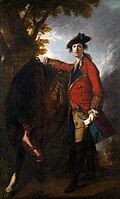 Lt Robert Orme (1756) by Sir Joshua Reynolds
 -
 Crimean War: Joseph Numa, John Potter and James Deal of the Coldstream Guards
_-_Grenadiers,_1st_and_3rd_Regiments_of_Foot_Guards_and_Coldstream_Guards,_1751_-_RCIN_405597_-_Royal_Collection.jpg)


Overseas service (1685–1900)
[edit]The regiment saw active service in Flanders and in the Monmouth Rebellion, including the decisive Battle of Sedgemoor in 1685. It fought in the Battle of Walcourt in 1689, the Battle of Landen and the Siege of Namur.[7]
In 1760, the 2nd Battalion was sent to Germany to campaign under Prince Ferdinand of Brunswick and fought in the Battle of Wilhelmstal and at the Castle of Amöneburg. Three Guards companies of 307 men under Coldstream commander Colonel Edward Mathew fought in the American Revolutionary War.[7]

The Coldstream Regiment saw extensive service in the wars against the French Revolution and in the Napoleonic Wars. Under the command of Sir Ralph Abercromby, it defeated French troops in Egypt. In 1807, it took part in the investment of Copenhagen. In January 1809, it sailed to Portugal to join the forces under Sir Arthur Wellesley. In 1814, it took part in the Battle of Bayonne, in France, where a cemetery keeps their memory. The 2nd Battalion joined the Walcheren Expedition. Later, it served as part of the 2nd Guards Brigade in the Chateau Hougoumont where they resisted French assaults all day during the Battle of Waterloo. This defence is considered one of the greatest achievements of the regiment, and an annual ceremony of "Hanging the Brick" is performed each year in the Sergeants' Mess to commemorate the efforts of Cpl James Graham and Lt-Col James Macdonnell, who shut the North Gate after a French attack.[9] The Duke of Wellington himself declared after the battle that "the success of the battle turned upon closing the gates at Hougoumont".[10]
The regiment was later part of the British occupation forces of Paris until 1816.[7]
During the Crimean War, the Coldstream Regiment fought in the battles of Alma, Inkerman and Sevastopol. On its return, four men of the regiment were awarded the newly instituted Victoria Cross.[7]
The regiment received its current name, the Coldstream Guards, in 1855. In 1882, it was sent to Egypt against the rebels of Ahmed 'Urabi and in 1885 in the Suakin Campaign. In 1897, the Coldstreamers were reinforced with the addition of a 3rd battalion. The 1st and 2nd battalions were dispatched to South Africa at the outbreak of the Second Boer War.[7] During the conflict, they would prove instrumental at the Battle of Belmont, and were also present at Graspan, Modder River, Enslin, Magersfontein, Driefontein, Sand River, Diamond Hill, Belfast, and were also involved in hunting Christiaan de Wet.[11]

1900–present
[edit]At the outbreak of the First World War, the Coldstream Guards was among the first British regiments to arrive in France after Britain declared war on Germany. In the following battles, it suffered heavy losses, in two cases losing all of its officers. At the First Battle of Ypres, the 1st battalion was virtually annihilated: by 1 November down to 150 men and the Lt Quartermaster. The regiment fought at Mons, Loos, the Somme, Ginchy and in the 3rd Battle of Ypres. The regiment also formed the 4th (Pioneer) Battalion, which was disbanded after the war, in 1919. The 5th Reserve battalion never left Britain before it was disbanded.[7]
When the Second World War began, the 1st and 2nd battalions of the Coldstream Guards were part of the British Expeditionary Force (BEF) in France;[7] whilst the 3rd Battalion was on overseas service in the Middle East. Additional 4th and 5th battalions were also formed for the duration of the war. They fought extensively, as part of the Guards Armoured Division, in North Africa and Europe as dismounted infantry. The 4th battalion first became a motorized battalion in 1940 and then an armoured battalion in 1943.[12] The First and Second battalions were part of the 5th Guards Armoured Brigade, and landed in Normandy on July 1st, 1944; they subsequently were involved in the Battle of Caen, the Liberation of Brussels, Operation Market Garden, the Battle of the Bulge, Operation Veritable, Operation Plunder, and the Battle of Hamburg.[13]

Coldstreamers gave up their tanks at the end of the war, the new battalions were disbanded, and the troops distributed to the 1st and 2nd Guard Training Battalions.[7]
After the war, the 1st and 3rd battalions served in Palestine. The 2nd battalion served in the Malayan Emergency. The 3rd battalion was placed in suspended animation in 1959. The remaining battalions served during the Mau Mau rebellion from 1959 to 1962, in Aden in 1964, in Mauritius in 1965, in the Turkish invasion of Cyprus in 1974 and several times in Northern Ireland after 1969.[7]
The Regimental Band of the Coldstream Guards was the first act on stage at the Wembley leg of the 1985 Live Aid charity concert. It played for the Prince and Princess of Wales.[14]
In 1991, the 1st battalion was dispatched to the first Gulf War, where it was involved in prisoner of war handling and other roles. In 1993, due to defence cutbacks, the 2nd battalion was placed in suspended animation.[7]
For much of the 1990s, the 1st Battalion was stationed in Münster, Germany, in the Armoured Infantry Role with Warrior APCs as part of the 4th Armoured Brigade. In 1993–1994, the battalion served as an armoured infantry battalion in peacekeeping duties in Bosnia as part of UNPROFOR.[7]

The battalion was posted to Derry, Northern Ireland, on a two-year deployment in 2001. It then deployed to Iraq in April 2005 for a six-month tour with the rest of 12th Mechanised Brigade, based in the south of the country. The battalion lost two of its soldiers, on 2 May, near Al Amarah and on 18 October at Basra.[15]
Des Browne, Secretary of State for Defence, announced on 19 July 2007 that in October 2007 the battalion was to be sent to Afghanistan as part of 52 Infantry Brigade.[16]
In October 2009, the battalion was deployed on Operation Herrick 11, with units deploying to the Babaji area of central Helmand Province, Afghanistan, playing a major role in Operation Moshtarak in February 2010.[17]
Before the Strategic Defence and Security Review 2010 the battalion was part of the 12th Mechanised Brigade in a light infantry role. Under Army 2020 it transferred to London District as a public duties battalion, then in 2019 it joined the 11th Infantry Brigade and Headquarters South East.[18][19][20] It will move to 4 Light Brigade Combat Team by 2025.[21]
Regiment
[edit]
Structure
[edit]The structure of the regiment and affiliated band includes:
- Regimental Headquarters, at Wellington Barracks, London[22][23][24]
- 1st Battalion, at Victoria Barracks, Windsor (Light Infantry part of 11th Infantry Brigade and Headquarters South East)[25][26][27][28][29][30]
- Battalion Headquarters[27]
- Headquarters Company[27]
- No. 1 Company (Senior Company)[27]
- No. 2 Company[27]
- No. 3 Company[27]
- Support (No. 4) Company (includes Corps of Drums)[18][26][27]
- No. 7 Company, based at Wellington Barracks, London (maintaining the traditions and colours of the old 2nd Battalion placed in suspended animation in 1993)[24][26][31][32]
- No. 17 Company, based at Hammersmith (the regiment's reserve unit, administered as part of 1st Battalion, London Guards).[33]
- Band of the Coldstream Guards, based at Wellington Barracks, London, part of the Royal Corps of Army Music.[24][25][26][34][35]
Companies that make up the regiment are traditionally numbered. New officers destined for the regiment that are at Sandhurst or at the Infantry Battle School form No. 13 Coy, while Guardsmen under training at ITC Catterick make up No. 14 Coy.[36] No. 7 Coy is one of the incremental companies formed to undertake public duties in London and Windsor, and maintains the Colours and traditions of the former 2nd Battalion.[37]
Role
[edit]
Currently, the most prominent role of the 1st Battalion and No. 7 Company is the performance of ceremonial duties in London and Windsor as part of the Household Division. The 1st Battalion is based in Windsor at Victoria Barracks as an operational light infantry battalion.[37]
In 2027 the 1st Battalion will take over a security force assistance role from 1st Battalion Irish Guards.[38]

The Corps of Drums, in addition to their ceremonial role, which has been primarily the musical accompaniment of Changing of the Guard for Windsor Castle, has the role of machine gun platoon. All Guardsmen for public duties wear the 'Home Service' Dress tunic in summer or greatcoat in winter and bearskin with a red plume. The Band of the Coldstream Guards plays at Changing of The Guard, state visits and many other events.[37]
Unlike the other four regiments of foot guards, which recruit from each of the four home nations, the Coldstream Guards has a specific recruiting area, which encompasses the counties that Monck's Regiment passed through on its march from Coldstream to London. The traditional recruiting area of the Coldstream Guards is the South West and North East of England.[37]
The Coldstream Guards and other Guards Regiments have a long-standing connection to The Parachute Regiment. Guardsmen who have completed P Company have the option of being posted to the Guards Parachute Platoon, 3 PARA, still keeping the tradition of the No. 1 (Guards) Independent Parachute Company, which was the original Pathfinder Group of 16th Parachute Brigade, now renamed 16th Air Assault Brigade.[39]
Traditions
[edit]
The grouping of buttons on the tunic is a common way to distinguish between the regiments of Foot Guards. Coldstream buttons are arranged in pairs, and a Star of the Garter is marked on their brassware.[40] The Coldstream Guards can also be distinguished from the other Foot Guards by the presence of a red plume (hackle) on the right side of their bearskins.[41]
The regiment is ranked second in the order of precedence, behind the Grenadier Guards. The regiment have the motto Nulli Secundus (Second to None), which is a play on the fact that the regiment was originally the "Second Regiment of Foot Guards", a position they have never accepted as the regiment is older than the Grenadier Guards.[42]
The regiment's nickname is Lilywhites. An ordinary soldier of the regiment is called a Guardsman, a designation granted by King George V after the First World War. The regiment is always referred to as the Coldstream, never as the Coldstreams; likewise, a member of the regiment is referred to as a Coldstreamer.[40]
Training
[edit]Recruits to the Guards Division go through an intensive training programme at the British Army's Infantry Training Centre (ITC). Their training is two weeks longer than the programme provided for recruits to the Regular line infantry regiments of the British Army; the extra training, carried out throughout the course, is devoted to drill and ceremonies.[43]
Colonels-in-Chief
[edit]King Edward VII assumed the colonelcy-in-chief of the regiment on his accession,[44] and subsequent monarchs have also been colonel-in-chief.[45]
- 1901–1910: King Edward VII
- 1915–1936: King George V
- Jan 1936–Dec 1936: King Edward VIII
- 1936–1952: King George VI
- 1952–2022: Queen Elizabeth II
- 2022–present: King Charles III
Regimental Colonels
[edit]Duke of Abermarle's Regiment of Foot (1650)
- 1650–1661: Captain-General George Monck, 1st Duke of Albemarle[46]
Lord General's Regiment of Foot Guards (1661)
- 1661–1670: Captain-General George Monck, 1st Duke of Albemarle[46]
Coldstream Regiment of Foot Guards (1670)
- 1670–1678: Captain-General George Monck, 1st Duke of Albemarle[46]
- 1678–1689: Lieutenant General William Craven, 1st Earl of Craven[46]
- 1689–1694: Lieutenant General Thomas Tollemache[46]
- 1694–1702: Lieutenant General John Cutts, 1st Baron Cutts[46]
- 1702–1714: General Charles Churchill[46]
- 1714–1722: Lieutenant General William Cadogan, 1st Earl Cadogan[46]
- 1722–1740: Colonel Richard Lumley, 2nd Earl of Scarbrough[47]
- 1740–1742: Field Marshal Prince William, Duke of Cumberland[47]
- 1742–1744: Colonel Charles Spencer, 3rd Duke of Marlborough[47]
- 1744–1755: Lieutenant General Willem van Keppel, 2nd Earl of Albemarle[47]
- 1755–1773: Lieutenant General James O'Hara, 2nd Baron Tyrawley[47]
- 1773–1784: General John Waldegrave, 3rd Earl Waldegrave[47]
- 1784–1805: Field Marshal Prince Frederick, Duke of York and Albany[47]
- 1805–1850: Field Marshal Prince Adolphus, Duke of Cambridge[47]
- 1850–1860: Field Marshal John Byng, 1st Earl of Strafford[47]
- Coldstream Guards (1855)
- 1860–1863: Field Marshal Colin Campbell, 1st Baron Clyde[47]
- 1863–1875: Field Marshal Sir William Maynard Gomm[47]
- 1875–1884: General Sir William Codrington[47]
- 1884–1890: General Sir Thomas Montagu Steele[47]
- 1890–1892: General Sir Arthur Edward Hardinge[47]
- 1892–1911: General Sir Frederick Stephenson[47]
- 1911–1915: General William Seymour[48]
- 1915–1918: Major General Evelyn Boscawen, 7th Viscount Falmouth[49]
- 1918–1945: Lieutenant General Sir Alfred Codrington[50]
- 1945–1962: General Sir Charles Loyd[51]
- 1962–1994: Major General Sir George Burns[52]
- 1994–1999: Lieutenant General Sir William Rous[53]
- 1999–2009: General Sir Michael Rose[54]
- 2009–present: Lieutenant General Sir James Bucknall[55]
Regimental Lieutenant Colonels
[edit] |
The Regimental Lieutenant Colonels have included:[56][57]
- 1650–1659: William Gough
- 1659–1665: Ethelbert Morgan
- 1665–1681: Sir James Smyth
- 1682–1688: Major General Edward Sackville
- 1688–1691: vacant?
- 1691–1692: James Bridgeman
- 1692–1694: William Seymour
- 1694–1702: William Matthew
- 1702–1704: William Mathew
- 1704–1715: Maj. Gen. Edward Braddock
- 1715–1717: Maj. Gen. Richard Holmes
- 1717–1733: Sir Adolphus Oughton
- 1733–1734: John Robinson[58]
- 1734–1743: Maj. Gen. John Folliot
- 1743–1745: Maj. Gen. George Churchill[59]
- 1745–1753: Edward Braddock[60]
- 1753–1755: Hedworth Lambton
- 1755–1762: The Hon. Bennet Noel[61]
- 1762–1762: Maj. Gen. Julius Caesar
- 1762–1763: William A'Court
- 1763–1777: John Thomas
- 1777–1785: Henry Lister[62]
- 1785–1789: Maj. Gen. Harry Trelawny[63]
- 1789–1795: Maj. Gen. Anthony George Martin[64]
- 1795–1800: Lt. Gen. Thomas Slaughter Stanwix[65]
- 1800–1800: Maj. Gen. Edward Morrison[66]
- 1800–1814: Maj. Gen. Andrew Cowell[67]
- 1814–1821: Col. the Hon. Henry Brand[68]
- 1821–1825: Col. Alexander Woodford[69]
- 1825–1830: Col. James Macdonell[70]
- 1830–1836: Col. Daniel Mackinnon
- 1836–1837: Col. Sir William Maynard Gomm
- 1837–1839: Col. John Fremantle
- 1839–1846: Col. William Lovelace Walton
- 1846–1848: Col. Charles Anthony Ferdinand Bentinck
- 1848–1851: Col. Thomas Chaplin
- 1851–1854: Col. Henry John William Bentinck
- 1854–1855: Col. the Hon. Arthur Upton
- 1855–1858: Col. the Hon. George Upton
- 1858–1860: Col. Lord Frederick Paulet
- 1860–1861: Col. William Samuel Newton
- 1861–1862: Col. Spencer Perceval
- 1862–1863: Col. Thomas Montagu Steele
- 1863–1866: Col. William Mark Wood
- 1866–1868: Col. Dudley William Carleton
- 1868–1871: Col. the Hon. Arthur Edward Hardinge
- 1871–1877: Col. the Hon. Percy Robert Basil Feilding
- 1877–1880: Col. Arthur James Lyon-Fremantle[71][72]
- 1880–1885: Col. George Robert FitzRoy[73][74]
- 1885–1890: Col. Godfrey James Wigram[75]
- 1890–1895: Col. John Barton Sterling[76]
- 1895–1898: Col. the Viscount Falmouth[77][78]
- 1898–1900: Col. the Hon. H. W. L. Corry[79][80]
- 1900–1903: Col. Sir Francis Aylmer Graves-Sawle[81]
- 1903–1907: Col. Alfred Edward Codrington[82]
- 1907–1910: Col. Frederick I. Maxse[83][84]
- 1910–1913: Col. the Hon. William Lambton[85][86]
- 1913–1914: Col. Cecil S. O. Monck[87]
- 1914–1917: Col. J. A. G. Richardson-Drummond-Hay[88]
- 1917–1919: Col. the Hon. G. A. C. Crichton[89]
- 1919–1919: Col. J. McC. Steele[90][91]
- 1919–1923: Col. H. W. Studd[92]
- 1923–1927: Col. J. V. Campbell[93]
- 1927–1930: Col. C. P. Heywood[94][95]
- 1932–1934: Col. H. C. Loyd[96][97]
- 1934–1938: Col. A. F. Smith[98][99]
- 1938–1939: Brig. J. A. C. Whitaker[100]
- 1939–1941: Col. G. J. Edwards[101]
- 1941–1942: Col J. C. W. Finch[101]
- 1942–1945: M. F. Trew[101]
- 1945–1946: A. Campbell, Lord Stratheden[101]
- 1946–1949: E. R. Hill[101]
- 1959–1961: Col. Richard J. V. Crichton
- 1961–1964: Col. Robert C. Windsor-Clive
- 1964: Col. Sir Jeffrey L. Darell, Bt.
- 1964–1965: Col. David A. H. Toler
- 1965–1967: Col. Alan B. Pemberton
- 1967–1969: Col. Sir Ian L. Jardine, Bt.
- 1969–1972: Col. Edward T. Smyth-Osbourne
- 1972–1975: Col. Everard I. Windsor-Clive
- 1975–1978: Col. Michael A. P. Mitchell
- 1978–1981: Col. Peter G. S. Tower
- 1981–1984: Col. Martin W. F. Maxse
- 1984–1986: Col. H. Malcolm C. Havergal
- 1986–1992: Col. Sir Brian W. de S. Barttelot, Bt.
- 1992–2002: Brig. Richard J. Heywood
- 2002–2012: Brig. Jonathan J. S. Bourne-May
- 2012–2015: Brig. Greville K. Bibby
- 2015–2018: Brig. Robin C. N. Sergeant
- 2018–present: Col. Toby P. O. Till
Battle honours
[edit]The Coldstream Guards have earned 117 battle honours:[102][103]
- Tangier 1680, Namur 1695, Gibraltar 1704–1705, Oudenarde, Malplaquet, Dettingen, Lincelles, Egypt, Talavera, Barrosa, Fuentes d'Onor, Salamanca, Nive, Peninsula, Waterloo, Alma, Inkerman, Sevastopol, Tel-el-Kebir, Egypt 1882, Suakin 1885, Modder River, South Africa 1899–1902
- The Great War (5 battalions): Mons, Retreat from Mons, Marne 1914, Aisne 1914, Ypres 1914 '17, Langemarck 1914, Gheluvelt, Nonne Bosschen, Givenchy 1914, Neuve Chapelle, Aubers, Festubert 1915, Loos, Mount Sorrel, Somme 1916 '18, Flers-Courcelette, Morval, Pilckem, Menin Road, Poelcappelle, Passchendaele, Cambrai 1917 '18, St. Quentin, Bapaume 1918, Arras 1918, Lys, Hazebrouck, Albert 1918, Scarpe 1918, Drocourt-Quéant, Hindenburg Line, Havrincourt, Canal du Nord, Selle, Sambre, France and Flanders 1914–1918
- The Second World War: Dyle, Defence of Escaut, Dunkirk 1940, Cagny, Mont Pincon, Quarry Hill, Estry, Heppen, Nederrijn, Venraij, Meijel, Roer, Rhineland, Reichswald, Cleve, Goch, Moyland, Hochwald, Rhine, Lingen, Uelzen, North-West Europe 1940 '44–45, Egyptian Frontier 1940, Sidi Barrani, Halfaya 1941, Tobruk 1941–42, Msus, Knightsbridge, Defence of Alamein Line, Medenine, Mareth, Longstop Hill 1942, Sbiba, Steamroller Farm, Tunis, Hammam Lif, North Africa 1940–1943, Salerno, Battipaglia, Capezzano, Volturno Crossing, Monte Camino, Calabritto, Garigliano Crossing, Monte Ornito, Monte Piccolo, Capture of Perugia, Arezzo, Advance to Florence, Monte Domini, Catarelto Ridge, Argenta Gap, Italy 1943–1945
- Gulf 1991[104]
Order of precedence
[edit]Alliances
[edit]


Gallery
[edit]-
 A Coldstream Guards Sergeant dressing through the ranks during the rehearsal for the Trooping the Colour
 -
 Battle of Alma in the Crimean War
 -

-
 4th Coldstream in the Third Battle of Ypres, 1917
 -
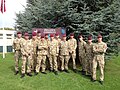 Coldstream Guard members of the Guards Parachute Platoon, 3rd Battalion, Parachute Regiment
 -
 Guardsman using the Sharpshooter Weapon System
 -
 Section Second in Command giving Quick Battle Orders during exercise
 -
 81mm Mortar moments after firing.
 -
 U.S. President Donald Trump and Queen Elizabeth II, accompanied by Major Oliver Biggs, reviewing the 1st Battalion, Coldstream Guards at Windsor Castle during Trump's visit to London in July 2018.
 -
 Battle of Bayonne's cemetery, 1814, France, detail
 -
 1st Battalion on Exercise in Kenya 2019
 -
 Two Coldstream Guardsmen show the traditional uniform and the capabilities with a Javelin system during a small-arms display in Cincu, Romania


.jpg)


See also
[edit]- Category:Coldstream Guards officers
- Category:Coldstream Guards soldiers
- Eddie Chapman criminal and World War II British double agent served with the Coldstream Guards.
- Honourable Artillery Company, the oldest surviving regiment in the British Army
- Band of the Coldstream Guards
Notes
[edit]- ^ The breast star of the Order of the Garter.
- ^ The Honourable Artillery Company, a reserve unit, being the oldest continuously serving regiment in the British Army as a whole.
Citations
[edit]- ^ "Army – Question for Ministry of Defence". p. 1. Archived from the original on 26 February 2021. Retrieved 14 December 2020.
- ^ "Coldstream Guards". www.army.mod.uk. Archived from the original on 15 August 2022. Retrieved 10 March 2021.
- ^ "The Coldstream Guards Official Charity Website". Coldstream Guards. Archived from the original on 2 September 2018. Retrieved 10 March 2021.
- ^ a b Davies, Godfrey (1924). The early history of the Coldstream guards. Oxford: The Clarendon press. Archived from the original on 27 September 2020. Retrieved 10 March 2021.
- ^ The Coldstream Guards.
- ^ "Regimental Headquarters". Coldstream Guards. Archived from the original on 19 April 2021. Retrieved 10 March 2021.
- ^ a b c d e f g h i j k l m n o "History of the Coldstream Guards". Archived from the original on 6 September 2013. Retrieved 26 April 2014.
- ^ Harwood 2006, p. 38.
- ^ "Coldstream Guards: Waterloo". Shinycapstar.com. Archived from the original on 9 July 2009. Retrieved 3 September 2009.
- ^ Roberts, p. 58
- ^ Army, The British (5 May 1903), English: A description of all units, casualties, and battles of the Second Boer War (PDF), archived (PDF) from the original on 8 December 2024, retrieved 23 August 2024
- ^ "'Cuckoo' the German Panther in Service with the 4th Battalion Coldstream Guards". BBC. Archived from the original on 17 May 2022. Retrieved 26 April 2014.
- ^ Howard, Michael; Sparrow, John (1951). The Coldstream Guards, 1920-1946.
- ^ Archived at Ghostarchive and the Wayback Machine: "Live Aid Introduction: Prince & Princess Royal Salute". YouTube. 14 November 2009. Retrieved 26 April 2014.
- ^ "Sergeant Chris Hickey of 1st Battalion the Coldstream Guards killed in Iraq". Ministry of Defence. 20 October 2005. Archived from the original on 17 June 2022. Retrieved 26 April 2014.
- ^ "Afghanistan: Roulement". Hansard. 19 July 2007. Archived from the original on 18 September 2023. Retrieved 15 June 2023.
- ^ "Lieutenant Douglas Dalzell killed in Afghanistan". Ministry of Defence. 18 February 2010. Archived from the original on 17 June 2022. Retrieved 26 April 2014.
- ^ a b "Trooping the Colour 2000 (The Preamble)". Youtube. 8 April 2019. Archived from the original on 26 May 2019. Retrieved 19 July 2020.
- ^ "1st Bn, Coldstream Guards: Service". 16 December 2007. Archived from the original on 16 December 2007. Retrieved 20 July 2020.
- ^ "12 Mechanized Brigade – British Army Website". 17 April 2009. Archived from the original on 17 April 2009. Retrieved 20 July 2020.
- ^ "Future Soldier Guide" (PDF). Ministry of Defence. Archived (PDF) from the original on 10 July 2022. Retrieved 13 December 2021.
- ^ "Coldstream Guards [UK]". 20 December 2007. Archived from the original on 20 December 2007. Retrieved 20 July 2020.
- ^ "Regimental Headquarters". Coldstream Guards. Archived from the original on 29 March 2020. Retrieved 20 July 2020.
- ^ a b c "Number 7 Company". Coldstream Guards. Archived from the original on 17 June 2022. Retrieved 20 July 2020.
- ^ a b "Coldstream Guards". www.army.mod.uk. Archived from the original on 15 August 2022. Retrieved 20 July 2020.
- ^ a b c d Archived at Ghostarchive and the Wayback Machine: "Trooping the Colour 2016". Youtube. 17 June 2016. Retrieved 19 July 2020.
- ^ a b c d e f g "1st Battalion". Coldstream Guards. Archived from the original on 17 May 2022. Retrieved 20 July 2020.
- ^ "Regular Army Basing Matrix by Formation and Unit" (PDF). Army Families Federation. Archived from the original (PDF) on 14 August 2016. Retrieved 15 July 2020.
- ^ "Order of Battle, Manpower, and Basing Locations". parliament.uk. Archived from the original on 11 April 2020. Retrieved 15 July 2020.
- ^ "British Army units from 1945 on – Coldstream Guards". british-army-units1945on.co.uk. Archived from the original on 17 May 2022. Retrieved 20 July 2020.
- ^ "Ceremonial duties – British Army Website". 10 November 2014. Archived from the original on 10 November 2014. Retrieved 20 July 2020.
- ^ "Coldstream Guards – British Army Website". 7 January 2015. Archived from the original on 7 January 2015. Retrieved 20 July 2020.
- ^ "Minutes of an Annual General Meeting of the London Regiment Association held on Monday 28 February 2022 at 19.00 hours at Battalion Headquarters of the London Regiment, 27 St John's Hill, London SW11 1TT" (PDF). Archived (PDF) from the original on 4 April 2022. Retrieved 17 March 2022.
- ^ "Contact us – British Army Website". 23 January 2015. Archived from the original on 23 January 2015. Retrieved 20 July 2020.
- ^ "Coldstream Guards Band". Coldstream Guards. Archived from the original on 17 May 2022. Retrieved 20 July 2020.
- ^ "Guards Infantry Training Battalion". Archived from the original on 26 April 2014. Retrieved 26 April 2014.
- ^ a b c d "Coldstream Guards". Ministry of Defence. Archived from the original on 7 January 2015. Retrieved 26 April 2014.
- ^ "Letter From: Lieutenant General C R V Walker DSO, Regimental Lieutenant Colonel regarding the Integrated Review" (PDF). Archived from the original (PDF) on 4 April 2022. Retrieved 17 March 2022.
- ^ "No 1 (Guards) Independent Parachute Company". ParaData. Archived from the original on 21 July 2015. Retrieved 10 April 2013.
- ^ a b "Ceremonial duties". Ministry of Defence. Archived from the original on 10 November 2014. Retrieved 26 April 2014.
- ^ Weinreb, Ben; Hibbert, Christopher (1992). The London Encyclopaedia (reprint ed.). Macmillan. p. 409.
- ^ "Coldstream Guards". The Household Division. Archived from the original on 16 November 2021. Retrieved 11 May 2022.
- ^ "Combat Infantryman's Course – Foot Guards". Ministry of Defence. Archived from the original on 14 February 2017. Retrieved 27 April 2014.
- ^ "No. 27289". The London Gazette. 26 February 1901. p. 1417.
- ^ "Her Majesty Queen Elizabeth II - Colonel in chief of the seven regiments of the Household Brigade taking the salute outside Buckingham Palace after last year's Trooping the Colour Ceremony". London: Gale & Polden. 1957. Archived from the original on 10 December 2022. Retrieved 10 December 2022.
- ^ a b c d e f g h Ross of Bladensburg, Lt. Col. Sir John Foster George. A History of the Coldstream Guards, from 1815–1895. London: A.D. Innes & Co., 1896. p. 478
- ^ a b c d e f g h i j k l m n o Ross of Bladensburg, Lt. Col. Sir John Foster George. A History of the Coldstream Guards, from 1815–1895. London: A. D. Innes & Co., 1896. p. 479
- ^ "Lord William Frederick Ernest Seymour – National Portrait Gallery". www.npg.org.uk.
- ^ "Evelyn Edward Thomas Boscawen". Cricket Archive. Archived from the original on 9 November 2024. Retrieved 28 April 2014.(subscription required)
- ^ "Codrington, Lieut-Gen. Sir Alfred Edward ". (2008). In Who Was Who 1897–2007. Online edition.
- ^ Smart, Nick (2005). Biographical Dictionary of British Generals of the Second World War. Barnesley: Pen & Sword. p. 196. ISBN 1844150496.
- ^ "North Mymms on the Home Front". Archived from the original on 21 August 2018. Retrieved 9 October 2007.
- ^ "No. 53587". The London Gazette (Supplement). 15 February 1994. p. 2316.
- ^ "No. 55609". The London Gazette. 14 September 1999. p. 9833.
- ^ "No. 59223". The London Gazette (Supplement). 27 October 2009. p. 18435.
- ^ "Appendix 285: Coldstream Roll" in Daniel Mackinnon, Origin and Services of the Coldstream Guards (1833) vol. ii, pp. 458–519.
- ^ "Regiments and Commanding Officers, 1960 - Colin Mackie" (PDF). p. 36. Archived (PDF) from the original on 27 August 2021. Retrieved 22 June 2021.
- ^ "No. 7219". The London Gazette. 4–7 August 1733. p. 3.
- ^ "No. 8216". The London Gazette. 19–23 April 1743. p. 3.
- ^ "No. 8489". The London Gazette. 30 November – 3 December 1745. p. 6.
- ^ "No. 9540". The London Gazette. 23–27 December 1755. pp. 1–2.
- ^ "No. 11825". The London Gazette. 22–25 November 1777. p. 1.
- ^ "No. 12702". The London Gazette. 22–26 November 1785. p. 537.
- ^ "No. 13100". The London Gazette. 26–30 May 1789. p. 403.
- ^ "No. 13840". The London Gazette. 5–8 December 1795. p. 1367.
- ^ "No. 15256". The London Gazette. 10–13 May 1800. p. 462.
- ^ "No. 15312". The London Gazette. 18–22 November 1800. p. 1306.
- ^ "No. 16925". The London Gazette. 13 August 1814. p. 1635.
- ^ "No. 17740". The London Gazette. 25 August 1821. p. 1740.
- ^ "No. 18155". The London Gazette. 16 July 1825. p. 1243.
- ^ "No. 24511". The London Gazette. 12 October 1877. p. 5598.
- ^ "No. 24899". The London Gazette. 9 November 1880. p. 5614.
- ^ "No. 24908". The London Gazette. 30 November 1880. p. 6351.
- ^ "No. 25529". The London Gazette. 13 November 1885. p. 5189.
- ^ "No. 25539". The London Gazette. 15 December 1885. p. 6066.
- ^ "No. 26020". The London Gazette. 4 February 1890. p. 606.
- ^ "No. 26595". The London Gazette. 5 February 1895. p. 686.
- ^ "No. 26973". The London Gazette. 31 May 1898. p. 3389.
- ^ "No. 26973". The London Gazette. 31 May 1898. p. 3388.
- ^ "No. 27194". The London Gazette. 22 May 1900. p. 3250.
- ^ "No. 27197". The London Gazette. 29 May 1900. p. 3406.
- ^ "No. 27595". The London Gazette. 8 September 1903. p. 5598.
- ^ "No. 28004". The London Gazette. 15 March 1907. p. 1833.
- ^ "No. 28404". The London Gazette. 5 August 1910. p. 5669.
- ^ "No. 28404". The London Gazette. 5 August 1910. p. 5670.
- ^ "No. 28679". The London Gazette. 7 January 1913. p. 149.
- ^ "No. 28680". The London Gazette. 10 January 1913. p. 245.
- ^ "No. 28895". The London Gazette (Supplement). 9 September 1914. p. 7173.
- ^ "No. 29939". The London Gazette. 13 February 1917. p. 1471.
- ^ "No. 31344". The London Gazette (Supplement). 16 May 1919. p. 6187.
- ^ "No. 31618". The London Gazette (2nd supplement). 25 October 1919. p. 13112.
- ^ "No. 31631". The London Gazette (3rd supplement). 6 November 1919. p. 13533.
- ^ "No. 32876". The London Gazette. 2 November 1923. p. 7461.
- ^ "No. 33251". The London Gazette. 25 February 1927. p. 1255.
- ^ "No. 33641". The London Gazette. 5 September 1930. p. 5491.
- ^ "No. 33882". The London Gazette. 11 November 1932. p. 7178.
- ^ "No. 34116". The London Gazette. 21 December 1934. p. 8295.
- ^ "No. 34123". The London Gazette. 11 January 1935. p. 301.
- ^ "No. 34570". The London Gazette. 15 November 1938. p. 7190.
- ^ "No. 34570". The London Gazette. 15 November 1938. p. 7191.
- ^ a b c d e Howard, Michael (1951). The Coldstream Guards, 1920-1946. London: Oxford University Press. p. 442.
{{cite book}}: CS1 maint: publisher location (link) - ^ "Queen presents new Colours to Coldstream Guards". Ministry of Defence. 3 May 2012. Archived from the original on 26 April 2014. Retrieved 26 April 2014.
- ^ "Coldstream Guards". Regiments.org. Archived from the original on 8 February 2006. Retrieved 10 August 2019.
- ^ "Gulf battle honours". The Independent. 20 October 2003. Archived from the original on 7 June 2019. Retrieved 19 September 2017.
- ^ "Governor General's Foot Guards - Lineage". www.canada.ca. Government of Canada. 20 November 2018. Archived from the original on 30 January 2023. Retrieved 30 January 2023.
- ^ "Navy News, Ship of the Month May 1999". Archived from the original on 25 March 2008. Retrieved 14 March 2008.
Affiliations: City of Sunderland; Coldstream Guards; 30 Squadron RAF; The Worshipful Company of Farriers; Pangbourne College; Brymon Airways; Old Ocean Association
References
[edit]- Sir Julian Paget, Bt – Second to none : the Coldstream Guards, 1650–2000 (2000) ISBN 0-85052-769-4
- Harwood, Brian (2006). Chivalry and Command: 500 Years of Horse Guards (illustrated, annotated ed.). Osprey Publishing. p. 38. ISBN 1-84603-109-5.
- Roberts, Andrew; Waterloo: Napoleon's Last Gamble, 2005, London: HarperCollins Publishers, ISBN 0-00-719075-1
Further reading
[edit]- . Encyclopædia Britannica. Vol. 12 (11th ed.). 1911. pp. 656–659. See the end of page 657 and the start of 658.
External links
[edit]
- Coldstream Guards page on British Army website Archived 15 August 2022 at the Wayback Machine
- Regimental website Archived 12 March 2014 at the Wayback Machine
- The Guards Museum (history of the Foot Guards) Archived 30 October 2024 at the Wayback Machine
- Coldstream Guards Band site
- The Queen's Footguards
- Shiny Capstar (unofficial site)
- Canadian Coldstream Guards
- Coldstream Guards Corps Of Drums
- "Milanollo – Quick March of the Coldstream Guards" on YouTube
- Behind the Scenes with The Coldstream Guards Soldiery Portrait Exhibition on YouTube
- The Coldstream Guards Association Windsor Branch No. 18
- British Army Locations from 1945
- Origin and services of the Coldstream guards by Colonel Daniel Mackinnon
| General (lists) |
| ||||||||||||||||||||||||||||||
|---|---|---|---|---|---|---|---|---|---|---|---|---|---|---|---|---|---|---|---|---|---|---|---|---|---|---|---|---|---|---|---|
| Regiments and corps |
| ||||||||||||||||||||||||||||||

| Authority control databases: Artists |
|---|

Coldstream Guards
View on GrokipediaOrigins and Formation
English Civil War Roots
The precursor to the Coldstream Guards originated in August 1650, when Colonel George Monck, under authorization from Parliament and Oliver Cromwell, raised Monck's Regiment of Foot as part of the New Model Army to bolster parliamentary forces during the Third English Civil War.[1] Monck assembled the unit by drawing five companies each from the regiments of George Fenwick and Sir Arthur Hesilrige, creating a force of approximately 1,000 disciplined infantrymen trained in the New Model Army's emphasis on coordinated musket volleys, pike formations, and strict drill.[7] This formation reflected Parliament's shift toward professionalized standing forces, prioritizing merit and cohesion over the patronage-driven levies common in royalist armies, which often suffered from poor morale and inconsistent training.[1] The regiment's early combat effectiveness was demonstrated at the Battle of Dunbar on 3 September 1650, where Monck's men, integrated into Cromwell's army of about 14,000, faced a larger Scottish Covenanter force of over 20,000 under David Leslie supporting Charles II's claim.[1] Parliamentary troops exploited terrain and weather to outmaneuver the Scots, with Monck's Regiment contributing to the infantry assault that shattered the enemy center; the battle resulted in around 4,000 Scottish casualties and the capture of 10,000 prisoners, underscoring the causal advantage of the New Model Army's tactical discipline—rooted in repetitive close-order drill and reliable supply lines—over the Covenanters' numerically superior but less maneuverable formations.[7] Following Dunbar, Monck's Regiment participated in subsequent operations to pacify Scotland, including sieges and skirmishes that eroded royalist resistance by 1651, though it did not deploy to the decisive Battle of Worcester.[1] This early service under parliamentary command established the unit's reputation for reliability amid the civil strife, where professional infantry tactics proved decisive against fragmented royalist coalitions reliant on feudal obligations rather than sustained military reform.[7]Establishment as the Coldstream Guards
Following the political instability of the late 1650s, General George Monck ordered his regiment to march south from Coldstream on 1 January 1660, covering approximately 200 miles to London amid widespread anarchy in England and Scotland.[1][3] The troops arrived in the capital in early February, where their disciplined presence contributed to the dissolution of the Rump Parliament on 16 March and the convening of the Convention Parliament, facilitating the Restoration of the monarchy under Charles II on 29 May.[1] This march underscored the regiment's role in prioritizing practical restoration of order over partisan allegiance, as Monck, a former Parliamentarian commander, leveraged his forces to avert further civil strife.[8] In recognition of their service, the regiment was officially named the Coldstream Guards after the Scottish border town from which the march originated, distinguishing it from other units and affirming its identity tied to this pivotal event.[1] It was assigned the second position in the order of precedence among the foot guards regiments, immediately behind the Royal Regiment of Foot Guards (later redesignated the Grenadier Guards), a ranking that reflected the latter's unbroken loyalty to the Crown during the Commonwealth era despite the Coldstream's seniority in continuous formation since 1650.[9] This precedence arrangement emphasized institutional continuity and merit based on royal service duration rather than chronological establishment, ensuring the most reliably loyal units formed the core of the Household Division.[9] By 1661, the Coldstream Guards formally swore the oath of allegiance to Charles II, integrating them into the restored regime's military structure and refuting later partisan narratives of disloyalty by demonstrating adaptive fidelity to the stabilized constitutional order.[3] Monck's personal elevation to Duke of Albemarle and the regiment's adoption of the Garter Star as its cap badge symbolized this transition, rewarding their instrumental role without erasing their pre-Restoration experience.[3] The unit promptly assumed guard duties at Whitehall Palace, mounting sentries and providing security for the sovereign, which established precedents for ceremonial Household roles grounded in their proven capacity to enforce stability through disciplined enforcement rather than revolutionary fervor.[1] These early responsibilities at the royal court solidified the regiment's dual function as both a practical deterrent to unrest and a symbol of monarchical authority, drawing on battlefield-honed reliability from prior campaigns.[1]Historical Campaigns
18th Century Conflicts
, a composite battalion including approximately 400 men from the Coldstream Guards participated in the Siege of Gibraltar (1704–1705), where they helped repel French and Spanish assaults, earning the battle honour "Gibraltar."[10] The detachment later contributed to the capture of Barcelona in 1705 but suffered defeat at the Battle of Almanza on 25 April 1707.[1] In the Low Countries, Coldstream Guards elements fought at the Battle of Oudenarde on 11 July 1708 and the Battle of Malplaquet on 11 September 1709, employing linear infantry formations typical of the era to deliver disciplined volley fire against French positions.[1] In the War of the Austrian Succession (1740–1748), the 1st Battalion of the Coldstream Guards engaged French forces at the Battle of Dettingen on 27 June 1743, marking one of the last battles personally led by a British monarch, King George II.[1] The battalion subsequently served in Flanders, participating in the Battle of Fontenoy on 11 May 1745, where Allied lines faced heavy artillery and infantry assaults.[1] The Seven Years' War (1756–1763) saw the 1st Battalion join an unsuccessful raid on St Malo in September 1758, aimed at disrupting French coastal defenses.[1] Meanwhile, the 2nd Battalion deployed to Germany in 1760 as part of a Guards brigade allied with Prussian forces, culminating in action at the Battle of Wilhelmsthal on 24 June 1762, supporting efforts to counter French expansion in Europe.[1][10] Detachments from the Coldstream Guards formed part of a composite British Brigade of Guards under Colonel Edward Mathew during the American Revolutionary War (1775–1783), serving in the New York campaign of 1776 and later operations in the Carolinas.[11] These units, comprising select companies from the foot guards regiments, encountered logistical strains from transatlantic supply lines and rugged terrain but contributed to defensive actions before surrendering with British forces at Yorktown on 19 October 1781.[1]19th Century Imperial Wars
The Coldstream Guards played a pivotal role in the Napoleonic Wars, particularly at the Battle of Waterloo on 18 June 1815, where the light company of the 2nd Battalion defended the Château de Hougoumont alongside other Foot Guards units. This stronghold's retention diverted significant French forces, contributing to the allied victory by pinning down troops that could have reinforced Napoleon's main assault. The Guards' disciplined use of infantry squares proved effective against French cavalry charges, as the formation's geometry enabled overlapping fields of fire and mutual support, exploiting the horses' reluctance to penetrate tight ranks of bayonets and sustained musketry, thereby minimizing breakthroughs despite intense pressure. Casualties among the Foot Guards at Hougoumont totaled approximately 584 killed or wounded out of around 1,500 allied losses at the farm complex, underscoring the fierce hand-to-hand fighting that repelled multiple French assaults.[1][12][13] In the Crimean War (1853–1856), the Coldstream Guards participated in key engagements including the Battle of Alma on 20 September 1854 and the Battle of Inkerman on 5 November 1854. At Alma, the regiment advanced under heavy Russian artillery and musket fire to storm entrenched heights, demonstrating resilience amid logistical shortcomings that plagued British command, such as inadequate supply lines and reconnaissance errors leading to uncoordinated assaults. The Guards' tenacity in closing with bayonets helped secure the river crossing and heights, though the campaign's broader mismanagement—exemplified by the cavalry's ill-fated Charge of the Light Brigade—highlighted systemic failures in intelligence and orders rather than inherent infantry tactics. At Inkerman, fought in dense fog, the Coldstream endured the heaviest regimental losses, with only four unwounded officers remaining after close-quarters combat against superior Russian numbers; their steadfast volley fire and bayonet work in the "Soldiers' Battle" prevented a breakthrough, affirming the value of elite training in maintaining cohesion under ambush conditions.[14][15] Later imperial operations saw the Coldstream Guards in Egypt during the Anglo-Egyptian War, notably at the Battle of Tel el-Kebir on 13 September 1882, where they formed part of the night assault that routed Ahmed Urabi's forces, securing British control over the Suez Canal and protecting imperial trade routes. This action exemplified disciplined rapid maneuvers with rifle and bayonet against fortified positions, resulting in minimal British casualties relative to the decisive rout of Egyptian troops, and underscored the regiment's role in countering threats to colonial stability through overwhelming tactical proficiency.[3]World Wars I and II
The Coldstream Guards expanded from three regular battalions in 1914 to include reserve and service battalions during World War I, deploying primarily to the Western Front where they engaged in sustained trench warfare.[1] The 1st, 2nd, and 3rd Battalions participated in major offensives, including Mons in August 1914, First Ypres in October-November 1914, Loos in September 1915, the Somme in July-November 1916, Arras in April 1917, Third Ypres (Passchendaele) in July-November 1917, and Cambrai in November 1917, culminating in the 1918 advance.[1] At the Somme, the Guards faced intense artillery and machine-gun fire, contributing to the battle's overall British casualties exceeding 400,000, with the regiment's actions marked by repeated assaults on fortified positions that incurred heavy attrition.[1] Similarly, during Third Ypres, the 4th (Pioneer) Battalion supported infantry advances through mud-choked terrain, suffering significant losses amid limited territorial gains, as evidenced by over 1,000 fatalities in the 1st Battalion alone across the war.[16] Total regiment casualties reached approximately 14,137, reflecting the causal dominance of defensive technologies like barbed wire and maximized firepower in static warfare, which pre-war maneuver-oriented training failed to anticipate fully.[17] Despite these losses, the Guards earned numerous gallantry awards, including Victoria Crosses, for individual acts amid collective attrition, underscoring disciplined execution rather than decisive breakthroughs.[1] In World War II, the Coldstream Guards adapted to mechanized warfare by forming armored units within the Guards Armoured Division, though initial infantry deployments exposed limitations in pre-war preparations against rapid German advances.[18] The 1st and 2nd Battalions fought in France in 1940, participating in rearguard actions during the Dunkirk evacuation from May 26 to June 4, where they delayed enemy forces to enable the rescue of over 338,000 Allied troops, sustaining casualties in defensive stands against superior Panzer mobility.[1] Subsequent campaigns included North Africa from 1941-1943, where battalions operated in combined arms roles against Axis forces, and Italy from 1943-1945.[1] The 6th Battalion, as part of the 6th Guards Tank Brigade, supported the Normandy landings on June 6, 1944, advancing through North West Europe and breaching the Siegfried Line in February 1945 with Sherman and Churchill tanks, demonstrating improved tactical flexibility after early war lessons in armored integration.[19] This shift from foot infantry highlighted the inadequacy of 1930s training—focused on static defense and limited mechanization completed only by 1938—against blitzkrieg tactics, as initial retreats like Dunkirk revealed vulnerabilities to coordinated tank-infantry assaults, necessitating rapid doctrinal evolution for later successes. Overall, WWII losses were lower relative to WWI due to mobility enhancements, though exact figures remain dispersed across battalion records, with the regiment's effectiveness enhanced by empirical adaptations to industrialized total war dynamics.[1]Post-1945 Engagements
The 2nd Battalion Coldstream Guards deployed to Malaya in 1948 for the Malayan Emergency, engaging in counter-insurgency operations against communist guerrillas backed by the Malayan Communist Party, which sought to overthrow British colonial rule through armed struggle and sabotage of economic infrastructure. The battalion conducted patrols and ambushes in dense jungle terrain, contributing to efforts that displaced insurgents and protected rubber plantations vital to the economy, before redeploying in 1950 as part of broader strategies that included population resettlement and intelligence-driven strikes.[1][20] In the early 1950s, the 1st Battalion served in the Suez Canal Zone, maintaining defensive positions and conducting patrols amid escalating attacks by Egyptian nationalists and fedayeen groups intent on expelling British forces to assert sovereignty over the canal, a critical artery for global trade. These operations involved fortifying garrisons and responding to ambushes and riots, with the battalion present during the heightened tensions preceding the 1956 nationalization, though not in the subsequent Anglo-French airborne and amphibious assault of Operation Musketeer.[1][21] The regiment's shift toward asymmetric warfare intensified in the 1960s, with the 2nd Battalion deploying to Aden in 1964 during the Aden Emergency, where it performed internal security duties against nationalist insurgents and tribal militias aiming to end British presence through bombings and assassinations in urban areas. Troops manned checkpoints, conducted searches, and neutralized threats in a hostile environment marked by improvised explosive devices and sniper fire, supporting the withdrawal of forces by 1967 amid the collapse of colonial control.[1][22] From the late 1960s onward, multiple battalions rotated through Northern Ireland under Operation Banner, confronting the Provisional Irish Republican Army's campaign of terrorism, which included car bombs, shootings, and sectarian murders targeting security forces and civilians to coerce political unification with Ireland. The 2nd Battalion began tours in 1969, followed by regular 1st Battalion deployments in the 1970s and 1980s, involving urban patrolling, vehicle checkpoints, and cordon-and-search operations in Belfast and Derry that disrupted IRA cells, recovered arms caches, and prevented attacks, despite casualties from booby traps and ambushes that underscored the insurgents' reliance on civilian cover and asymmetric tactics. These efforts contributed to stabilizing contested areas through persistent presence and intelligence cooperation, though the conflict's prolongation reflected the IRA's external funding and ideological commitment to violence over negotiation.[1][23] The 2nd Battalion also served in Cyprus in 1974 during the Turkish invasion, providing defensive support amid intercommunal violence and EOKA-B insurgent activities seeking enosis with Greece, before focusing on Northern Ireland rotations into the 1990s as imperial withdrawals gave way to domestic counter-terrorism.[1]Modern Operations and Developments
Cold War and Late 20th Century
Following the Second World War, battalions of the Coldstream Guards contributed to NATO's forward defense posture in West Germany as part of the British Army of the Rhine (BAOR), tasked with deterring potential Warsaw Pact armored offensives across the North German Plain. The 2nd Battalion served in BAOR during the 1980s, conducting rigorous training exercises focused on anti-tank warfare, rapid reinforcement, and holding defensive lines against simulated Soviet breakthroughs, which emphasized empirical readiness metrics such as response times and engagement simulations derived from intelligence assessments of Eastern Bloc capabilities.[1][24] The 1st Battalion, with postings to Germany in the late 1950s through the 1960s and additional exercises around 1977, similarly honed mechanized infantry tactics, including live-fire drills with weapons like the Milan anti-tank guided missile, to counter massed armor in a high-intensity European theater.[1] In the Gulf War of 1990–1991, the 1st Battalion deployed from its London base as mechanized infantry within 1st (UK) Armoured Division, forming part of the coalition's 100-hour ground campaign launched on 24 February 1991 to expel Iraqi forces from Kuwait. Attached to armored brigades equipped with Challenger tanks and Warrior infantry fighting vehicles, the battalion advanced through Kuwaiti terrain, engaging in direct assaults on Iraqi positions and contributing to the liberation of Kuwait City, where elements conducted urban clearance operations involving house-to-house fighting against remnants of the Republican Guard divisions.[1][25] These actions resulted in the capture of thousands of Iraqi prisoners and the securing of key infrastructure, with the battalion suffering minimal casualties due to superior firepower and coordinated artillery support.[25] The end of the Cold War in 1991 prompted significant British Army restructuring under the Options for Change review, which halved overall strength from approximately 150,000 to 75,000 personnel by 1995 amid reduced conventional threats, yet the Coldstream Guards preserved two operational battalions longer than many line infantry units, attributing to their dual combat-ceremonial mandate and proven deterrence value in BAOR. The 3rd Battalion, disbanded in 1959, was not reformed, while the 2nd Battalion entered suspended animation in 1993, reflecting a shift toward multi-role battalions capable of rapid deployment but underscoring the causal link between geopolitical stabilization and resource reallocation away from mass mobilization forces.[1] This adaptation maintained the regiment's elite operational tempo, as evidenced by subsequent peacekeeping in Bosnia from 1993 to 1994, where guardsmen enforced no-fly zones and monitored ceasefires under UN mandates.[1]21st Century Deployments
The 1st Battalion Coldstream Guards deployed to Basra, Iraq, in April 2005 as part of Operation Telic, conducting a six-month tour focused on urban security operations against Shia militias and insurgents.[26] Units performed street patrols and engaged in close-quarters fighting, including responses to militia ambushes, as evidenced by post-incident debriefs following attacks on armored vehicles in September 2005.[27] The battalion's light infantry tactics proved effective in suppressing militia firepower in densely populated areas, where militias wielded RPGs and small arms but avoided sustained direct confrontations due to superior British training and coordination.[28] Casualties included a Guardsman killed by a roadside bomb on 2 May 2005 during a patrol, and Sergeant Chris Hickey fatally wounded by another IED on 18 October 2005, highlighting the persistent threat of asymmetric explosives in urban environments.[29][26] In Afghanistan, under Operation Herrick, Coldstream Guards battalions rotated through Helmand Province from 2006 onward, emphasizing dismounted patrols and stabilization in Taliban strongholds like Babaji and Nad Ali districts.[30] The 1st Battalion played a key role in Operation Moshtarak in February 2010, a joint ISAF-Afghan assault clearing insurgent positions in central Helmand, where Guardsmen advanced alongside Afghan National Army units to secure population centers against entrenched Taliban fighters.[31] Patrolling in Forward Operating Bases such as Keenan near Zumbelay exposed troops to frequent IEDs and ambushes, with empirical data showing Taliban reliance on guerrilla tactics over conventional battles, inflicting disproportionate casualties on British forces—such as Acting Sergeant John Amer killed by an explosion in Babaji on 1 December 2009, Lieutenant Douglas Dalzell on 18 February 2010 during Moshtarak, Guardsman Michael Sweeney in Babaji later that year, and another soldier near Camp Bastion on 8 October 2009—while avoiding engagements where Western firepower could dominate.[32][33][34][35] Rules of engagement in Helmand prioritized minimizing civilian harm, constraining preemptive use of artillery or air support and compelling infantry-led clearances that elevated risks from hidden threats, as soldiers reported scenarios where potential enemy fire went unanswered to avoid collateral damage.[36] This approach, while aligning with counterinsurgency doctrine, empirically amplified British vulnerabilities in hybrid warfare, where Taliban forces exploited terrain and IEDs to offset technological disparities, yet Guards' operational tempo—clearing villages and disrupting supply lines—sustained pressure that degraded insurgent cohesion without equivalent losses on the enemy side in direct clashes.[37] Deployments concluded with drawdown rotations, including reconnaissance elements in Helmand as late as September 2013, underscoring the regiment's adaptability in protracted counter-terrorism amid evolving threats.[38]Recent Activities (2000–Present)
In 2025, the Coldstream Guards commemorated their 375th anniversary of continuous service, established in 1650, with a retrace of their foundational march from London to Berwick-upon-Tweed on June 10, symbolizing their origins under General George Monck.[6] [39] On June 13, King Charles III, as Colonel-in-Chief, presented new Colours to the 1st and 2nd Battalions at Windsor Castle, reinforcing regimental traditions amid their ongoing ceremonial and operational roles.[40] [41] These were trooped during the King's Birthday Parade on June 14 in London, where Number 7 Company displayed the banner before over 1,350 Household Division personnel, highlighting the regiment's precedence and loyalty to the Crown.[4] [42] The regiment's annual Black Sunday remembrance on May 11, 2025, at Wellington Barracks involved serving members, veterans, and the Band of the Coldstream Guards parading to honor fallen comrades, coinciding with the 80th anniversary of Victory in Europe Day to underscore enduring regimental cohesion and sacrifice.[43] [44] [45] Operationally, in September 2025, the Coldstream Guards deployed to Cyprus for a six-month unaccompanied tour under Operation Tosca, the first such commitment in a generation, assuming responsibility for the British sector of the UN buffer zone along the Green Line in Nicosia on October 15.[46] [47] [48] Personnel, adopting blue berets, conduct light infantry patrols to maintain zone integrity amid tensions between Greek and Turkish Cypriot forces, supporting UNFICYP's mandate with an emphasis on de-escalation and observation.[46] [47] This rotational deployment exemplifies the Guards' adaptability from ceremonial duties to multinational peacekeeping, sustaining their dual-role heritage into the mid-2020s.[48]Organization and Structure
Battalion Composition
The Coldstream Guards operate with a single regular battalion, the 1st Battalion, configured as a light role infantry unit stationed at Victoria Barracks, Windsor, where it conducts public duties alongside readiness for operational deployments.[2][1] The battalion maintains a strength of approximately 502 officers and soldiers, enabling rotations through incremental companies for ceremonial and security tasks, such as those at royal residences.[49] Following the British Army's Options for Change restructuring in the early 1990s, which reduced overall force levels post-Cold War, the regiment eliminated fixed second and third battalions; the 2nd Battalion entered suspended animation in 1993 to streamline resources and enhance deployability.[1] Subsequent reforms, including those in 2004, reinforced this single-battalion model, with operational augmentation provided by reservists serving under Full-Time Reserve Service (FTRS) terms rather than maintaining permanent additional units.[1] At the company level, the 1st Battalion includes headquarters elements for command and logistics, multiple rifle companies focused on dismounted infantry tactics, and support components handling mortars, anti-tank weapons, and reconnaissance to support rapid response and light role missions.[49] An example of specialized subunit integration is No. 7 Company, an incremental formation based in London for dedicated public duties, drawing personnel from the Windsor garrison to ensure continuous rotational capability without diluting the battalion's core infantry structure.[2]Equipment and Armament
The Coldstream Guards employ standard British Army infantry small arms tailored for light role operations, emphasizing reliability and precision in diverse environments. The primary service rifle is the L85A3, an updated variant of the SA80 (Small Arms for the 1980s) family, chambered in 5.56×45mm NATO; its bullpup design and enhanced ergonomics deliver effective close-quarters and medium-range fire, with accuracy that originally required recalibration of Army qualification standards upon adoption in the 1980s. Designated marksmen within sections utilize the L129A1 sharpshooter rifle, a 7.62×51mm semi-automatic weapon optimized for engagements beyond 600 meters, providing suppressive and precision fire support up to 800 meters with minimal recoil.[50] Support weapons include the L7A2 General Purpose Machine Gun (GPMG), a belt-fed 7.62×51mm system configurable for light machine gun use by dismounted troops or sustained fire from vehicles and tripods, delivering rates of fire up to 750 rounds per minute for area suppression.[51] Anti-tank platoons are equipped with the Next generation Light Anti-tank Weapon (NLAW), a man-portable, fire-and-forget guided missile weighing 12.5 kg, designed to defeat modern armored vehicles via top-attack warheads that penetrate reactive armor and target weak upper hull points.[52][53] For mobility and protection in light role deployments, the regiment's 1st Battalion operates the Foxhound protected patrol vehicle, a 4×4 V-hulled platform offering blast resistance against mines and IEDs, with a top speed of 70 mph and capacity for six personnel plus crew, enabling rapid reconnaissance and patrol in austere terrains while prioritizing maintainability through modular components and reduced logistics footprint.[54][49] Personal protective equipment centers on the Virtus soldier system, including scalable body armor that reduces overall weight compared to the legacy Osprey while retaining NIJ Level IV ballistic and fragmentation protection, allowing configuration for mission-specific threats and improved load carriage in prolonged field operations.[55] These assets have demonstrated sustained combat efficacy in training exercises, such as anti-tank drills on Salisbury Plain, underscoring retained capabilities despite evolving fiscal constraints on procurement.[56]Alliances and Precedence
The Coldstream Guards occupy the second position in the order of precedence among the five regiments of Foot Guards in the British Army, immediately after the Grenadier Guards.[57] This ranking reflects historical seniority based on the duration of loyal service to the Crown rather than the regiment's formation date of 1650, as the Grenadier Guards' antecedents provided earlier continuous royal protection commencing in 1656.[58] The full Foot Guards precedence sequence—Grenadier Guards, Coldstream Guards, Scots Guards, Irish Guards, and Welsh Guards—guides ceremonial positioning, marching order in state events, and certain administrative priorities within the Household Division.[57] The regiment maintains formal affiliations with select Commonwealth military units to promote interoperability, personnel exchanges, and shared traditions. These include the Governor General's Foot Guards in Canada, which facilitates joint ceremonial duties and training attachments, and the 2nd Battalion, Royal Australian Regiment in Australia, supporting occasional cross-postings and collaborative exercises.[59] Additionally, the Coldstream Guards are affiliated with HMS Somerset of the Royal Navy, enabling integrated operations in maritime security contexts.[60] Such partnerships, rooted in historical ties from the British Empire era, enhance operational cohesion without formal treaty obligations beyond broader Commonwealth defense frameworks. As part of the British Army's commitments under NATO, the Coldstream Guards participate in multinational joint exercises that bolster alliance deterrence through demonstrated rapid deployment and combined arms proficiency, as evidenced by engagements alongside NATO partners in northern Europe.[61] These activities underscore the regiment's role in maintaining credible forward presence and interoperability standards mandated by Article 3 of the North Atlantic Treaty, emphasizing self-help and mutual aid among member states.Roles and Responsibilities
Ceremonial Duties
The Coldstream Guards, as one of the Foot Guards regiments in the Household Division, undertake ceremonial public duties that include mounting sentries at royal residences such as Buckingham Palace and Windsor Castle. These responsibilities involve daily Changing of the Guard ceremonies, where relief guards replace the previous detail with precise drill movements, ensuring continuous symbolic protection of the Sovereign.[62] The regiment rotates these duties with other Foot Guards battalions on a scheduled basis, maintaining a visible military presence that links historical combat discipline to contemporary state functions.[41] A central ceremonial highlight is the annual Trooping the Colour, also known as the King's Birthday Parade, held on Horse Guards Parade in June to commemorate the Sovereign's official birthday. This event features over 1,400 officers and soldiers from the Household Division, approximately 200 horses, and 400 musicians from multiple bands, with the Coldstream Guards frequently participating by parading in formation or, in designated years, trooping their regimental colour through the ranks.[63][64] In 2025, Number 7 Company of the Coldstream Guards had the honour of trooping their colour during the parade.[65] The ceremony, rooted in 17th-century traditions for displaying regimental colours to troops, reinforces unit cohesion and public demonstration of military precision.[66] The regiment also contributes to major state occasions, including coronations, jubilees, and funerals, where they provide honour guards, participate in processions, and perform musical elements through their band. For instance, during Queen Elizabeth II's state funeral on 19 September 2022, Coldstream Guards elements joined the procession, adhering to synchronized marching at 75 beats per minute to ensure uniformity across participating units.[67] Similarly, in the 2022 Platinum Jubilee celebrations, Household Division troops, including the Coldstream Guards, formed part of the 1,500 soldiers and officers involved in parades and services marking the event.[68] These duties embody the regiment's role in upholding monarchical continuity, with ceremonial exactitude serving as a practical extension of the drill standards honed in operational training, thereby preserving institutional readiness amid symbolic obligations.[64]Combat and Security Operations
The Coldstream Guards operate primarily as light infantry, specializing in reconnaissance patrols, direct engagement with enemy forces using machine guns and mortars, and rapid maneuvers on foot to exploit battlefield opportunities.[5][69] This role underscores their warfighting mandate, enabling versatile deployments from high-intensity combat to stability operations, with historical efficacy demonstrated in neutralizing threats through disciplined fire and movement.[1] In security operations, the regiment provides armed protection for royal residences such as Buckingham Palace and St James's Palace as part of the King's Guard, where sentries enforce protocols including verbal challenges to intruders, restrictions on approach distances, and graduated rules of engagement authorizing lethal force against confirmed threats to the sovereign or facilities.[69] These duties demand constant vigilance, with guards trained to detect and deter unauthorized entry while maintaining operational readiness for escalation, reflecting a causal balance where ceremonial posture masks combat-capable response capabilities.[5] Recent deployments highlight this adaptability, including a six-month tour in Iraq's Basra region in 2005 as part of Operation TELIC VI, where the 1st Battalion conducted urban patrols and threat neutralization amid insurgent activity.[70] In Afghanistan, elements served in 2007 and 2009-2010 under Operation Herrick, providing overwatch with sharpshooter rifles and engaging Taliban forces in Helmand Province.[1] Most recently, in September 2025, the 1st Battalion rotated to Cyprus for Operation TOSCA, a six-month UN peacekeeping mission patrolling the Green Line buffer zone in Nicosia to enforce ceasefires and verify compliance, demonstrating proficiency in low-intensity stability tasks that prioritize de-escalation yet retain capacity for kinetic intervention.[48][47] Such rotations affirm the regiment's dual-role resilience, where public duties in the UK do not erode combat edge, as evidenced by seamless transitions to overseas kinetic environments without reported proficiency gaps.[1]Training and Recruitment
Initial Training Regimen
The initial training regimen for recruits enlisting in the Coldstream Guards as Guardsmen commences with the Combat Infantryman's Course (CIC), a 30-week program delivered at the Infantry Training Centre (ITC) Catterick in North Yorkshire.[71] This integrated course merges Phase 1 basic military training with Phase 2 infantry initial trade training, focusing on developing core competencies in physical conditioning, weapons handling, fieldcraft, tactical skills, and unit cohesion under simulated combat conditions.[71] Recruits undergo progressive fitness regimes, including timed marches over increasing distances—culminating in events like the 20-kilometer "bivvy" march with full kit loads exceeding 20 kilograms—and strength-building exercises to meet British Army standards such as 44 press-ups and 53 sit-ups in two minutes each.[72] Weapons training forms a central pillar, with hands-on instruction on the L85A3 rifle and L110A2 light machine gun, progressing from dry drills to live-fire applications in both individual and section-level scenarios, emphasizing accuracy, malfunction clearance, and fire discipline.[71] Fieldcraft components cover navigation using map and compass, patrolling techniques, camouflage and concealment, and basic survival skills, often tested during multi-day exercises in the Yorkshire Dales and surrounding training areas to simulate operational environments.[72] Tactical training introduces section attacks, defensive positions, and urban operations, reinforcing decision-making under fatigue and stress through scenario-based drills.[71] Distinct to the Foot Guards, including the Coldstream Guards, the CIC incorporates an intensified emphasis on foot drill from early phases, conducted with greater precision and volume than standard infantry courses to instill iron discipline, synchronized movement, and mental resilience—qualities essential for the regiment's dual ceremonial and combat roles.[2] Drill sessions, overseen by drill sergeants, involve repetitive marching, saluting, and rifle exercises, drawing on the Guards' historical standards to build habitual obedience and esprit de corps.[2] Recruitment for the Coldstream Guards draws primarily from across the United Kingdom, with candidates subjected to rigorous pre-enlistment assessments at Army Career Centres, including the Multi-Stage Fitness Test (beep test to level 8.07 or higher), medical evaluations, and psychometric interviews to select for physical robustness and psychological fortitude rather than demographic balancing.[71] The ITC Catterick's CIC for Guards maintains exacting pass criteria across all modules, with failure in any domain requiring repetition or voluntary withdrawal, underscoring the program's selectivity in producing soldiers capable of immediate regimental integration.[72]Advanced and Specialized Preparation
Following initial infantry training, Coldstream Guards personnel proceed to specialized courses that refine combat tactics and ceremonial expertise essential for their dual roles in security operations and public duties. At the Infantry Battle School in Brecon, soldiers engage in rigorous tactical exercises, including section commanders' battle courses that emphasize leadership under simulated combat conditions, with participants from the regiment integrating into brigade-level battle groups for anti-tank and maneuver training.[73][74] Parallel to battlefield honing, the public duties regimen at Pirbright Camp instills precision drill and disciplined bearing, preparing Guardsmen for high-visibility postings in London, where formations rehearse formations akin to Trooping the Colour under expert instruction.[75][76] Pre-deployment preparation incorporates cultural and operational familiarization, drawing from British Army protocols that include region-specific briefings to mitigate risks in multinational environments, as demonstrated by the regiment's effective transitions to exercises in Kenya and prior Afghan rotations where patrol and engagement skills yielded low incident rates relative to broader infantry benchmarks.[77] These phases sustain elite proficiency amid broader critiques of military softening, with the Guards' codified values—integrity, discipline, and respect—enforced through unyielding physical thresholds and moral standards, yielding consistent operational outputs like the 2020 close-quarter battle instructor trials sponsored by the regiment.[78][79][80]Traditions and Regimental Identity
Uniforms and Bearskins
The ceremonial No. 1 Dress uniform of the Coldstream Guards features a scarlet tunic with dark blue facings on the collar and cuffs, paired with dark blue trousers and black boots for full dress occasions.[81][41] The tunic's buttons are arranged in groups of two, a distinguishing feature unique to the Coldstream Guards among the Foot Guards regiments.[82] This scarlet attire, standardized for the Foot Guards in the 19th century, contrasts with the khaki service dress adopted for field use during the Boer War in 1899 and later refined for practicality in 20th-century conflicts, yet persists in ceremonial roles to maintain regimental identity and visual hierarchy.[47] Bearskin caps, constructed from the fur of black bears and standing about 18 inches tall for other ranks, form the headdress for ceremonial duties, with officers' versions slightly taller at 21 inches.[83] Adopted across the Foot Guards after the Battle of Waterloo on June 18, 1815, the bearskins commemorated the regiments' victory over Napoleon's taller Imperial Guard grenadiers, who wore similar fur caps; the design intentionally exaggerates height to project intimidation and elite status on the parade ground.[83][84] Prior to Waterloo, grenadier companies within regiments like the Coldstream wore mitre caps derived from 17th-century European grenadier traditions, evolving into the full bearskin for all guardsmen by the 1830s to standardize distinction from line infantry.[83] In operational contexts, Coldstream Guards personnel wear standard British Army combat uniforms, such as the Multi-Terrain Pattern (MTP) camouflage introduced in 2010 for enhanced durability and concealment, retaining only regimental badges like the cap star for identification.[47] The ceremonial scarlet and bearskin elements, tested for material resilience in parades— with bearskins weighing up to 1.5 pounds and treated for weather resistance—prioritize tradition over field utility, empirically supporting unit cohesion through symbolic markers of seniority and historical continuity absent in standard infantry attire.[4] Coldstream Guards bearskins feature a red plume on the right side, further differentiating them from other Foot Guards plumes positioned left or absent.[82]Customs, Motto, and Symbols
The motto of the Coldstream Guards is Nulli Secundus, translating from Latin as "Second to None," adopted to emphasize the regiment's claim of preeminence despite its formal second place in the order of precedence among the Foot Guards, a distinction arising from its formation in 1650 predating the Grenadier Guards by two years.[85][86] This motto underscores a tradition of self-perceived excellence, inscribed on regimental insignia and invoked in ceremonial contexts to bolster esprit de corps.[87] ![Soldier from No7 Company Coldstream Guards With Regimental Colours MOD 45152569.jpg][float-right] Central symbols include the regimental colours, silk damask flags embroidered with 44 battle honours, the Sphinx superscribed "Egypt," the Garter Star, and the monarch's cypher, presented by King Charles III on 13 June 2025 at Windsor Castle during the regiment's 375th anniversary, following consecration rituals to invoke divine protection before parade use.[41][40] These colours, trooped through the ranks in subsequent ceremonies, embody the regiment's historical continuity and serve as focal points for oaths of loyalty.[88] Historically, a white goat mascot symbolized regimental spirit during World War I, as captured in William Orpen's 1917 painting depicting it in a trench setting, though not a permanent fixture like in other Guards regiments.[89] Customs reinforcing cohesion include Black Sunday, observed annually on the second Sunday in May—most recently 11 May 2025—with a service at the Guards Chapel, Wellington Barracks, followed by a parade of serving and veteran Coldstreamers to the Guards Memorial on Horse Guards Parade, honoring over 2,000 fallen members by name in a ritual of collective remembrance that sustains intergenerational bonds.[90] Regimental mess dinners, held in officers' and sergeants' messes, feature formal toasts, historical recitations, and shared meals drawing on 17th-century precedents, fostering loyalty and discipline amid modern societal shifts toward individualism by emphasizing hierarchical camaraderie and narrative continuity.[91] These practices, rooted in empirical patterns of military unit resilience, counter potential erosion of traditional structures through deliberate reinforcement of shared sacrifice and identity.[92]Battle Honours
The Coldstream Guards have been awarded 113 battle honours by the Sovereign, recognizing instances of distinguished regimental conduct in combat across campaigns from Tangier in 1680 to the Gulf War in 1991.[3][4] These honours are granted based on the regiment's direct contributions to successful military operations, such as holding key positions or repelling assaults, as determined by historical records of unit actions rather than broader campaign participation alone.[88] Selected honours are emblazoned on the regiment's King's or Queen's Colours, with recent presentations displaying 44 such names to symbolize the lineage of valour. Prominent early honours include "Tangier 1680," earned for enduring garrison duty and repulsing Moorish attacks during the defence of the North African enclave against local forces, marking the regiment's first formal recognition. In the Peninsular War and Waterloo campaign, honours such as "Waterloo" were bestowed for the 1st Battalion's defence of Hougoumont farm on 18 June 1815, where a company under Lieutenant-Colonel James Macdonnell held the gatehouse against repeated French assaults, preventing a flank breakthrough in Wellington's line.[93] Later examples encompass "Alma" and "Inkerman" from the Crimean War (1854–1855), awarded for storming Russian positions at the Alma River on 20 September 1854 and repelling infantry attacks near Inkerman on 5 November 1854, despite heavy casualties from entrenched defences and close-quarters fighting.[94] Twentieth-century honours include those from the Western Front in the First World War, such as "Mons" (1914) for rear-guard actions during the retreat from Mons on 23–24 August 1914, and multiple Ypres citations for endurance in attritional battles like Passchendaele (1917).[1] These honours underpin the Coldstream Guards' second place in the order of precedence among Foot Guards regiments, reflecting seniority derived from cumulative service and proven effectiveness in battle.[1] They also bolster recruitment by embodying a verifiable tradition of resilience, drawing enlistees motivated by the regiment's empirical record of success in high-stakes engagements over ceremonial prestige alone.[3]Leadership and Command
Colonels-in-Chief
The Colonel-in-Chief of the Coldstream Guards serves as a ceremonial patron, typically a member of the British Royal Family, who symbolizes continuity and provides morale-boosting oversight without exercising operational or administrative command over the regiment. This role entails participating in key traditions, such as presenting new Colours—silk-embroidered regimental flags symbolizing honour—and reviewing parades, which help sustain esprit de corps and uphold customs amid broader British Army reforms like battalion amalgamations and modernization efforts.[95][40] King Charles III has held the position since 8 September 2022, following the death of Queen Elizabeth II, and actively fulfilled duties including presenting four new Colours to the 1st Battalion and 2nd Battalion (Number 7 Company) on 13 June 2025 at Windsor Castle, marking the regiment's 375th anniversary.[40][96][97] Predecessors include Queen Elizabeth II, who served from 1952 to 2022 and frequently donned the regiment's uniform for events like Trooping the Colour, reinforcing royal ties to the Guards' heritage. King George VI occupied the role from 1936 to 1952, presenting new Colours at Windsor and taking salutes from battalions during annual ceremonies, thereby linking the regiment to the Crown during the Second World War era.[98][99]| Monarch | Tenure |
|---|---|
| King Edward VII | 1901–1910 |
| King George V | 1915–1936 |
| King Edward VIII | 1936 |
| King George VI | 1936–1952 |
| Queen Elizabeth II | 1952–2022 |
| King Charles III | 2022–present |