Hubbry Logo
Electric chargeElectric chargeMain
Open search
Electric charge
Community hub
Electric charge
logo
8 pages, 0 posts
0 subscribers
Be the first to start a discussion here.
Electric charge
Electric charge
from Wikipedia
Electric charge
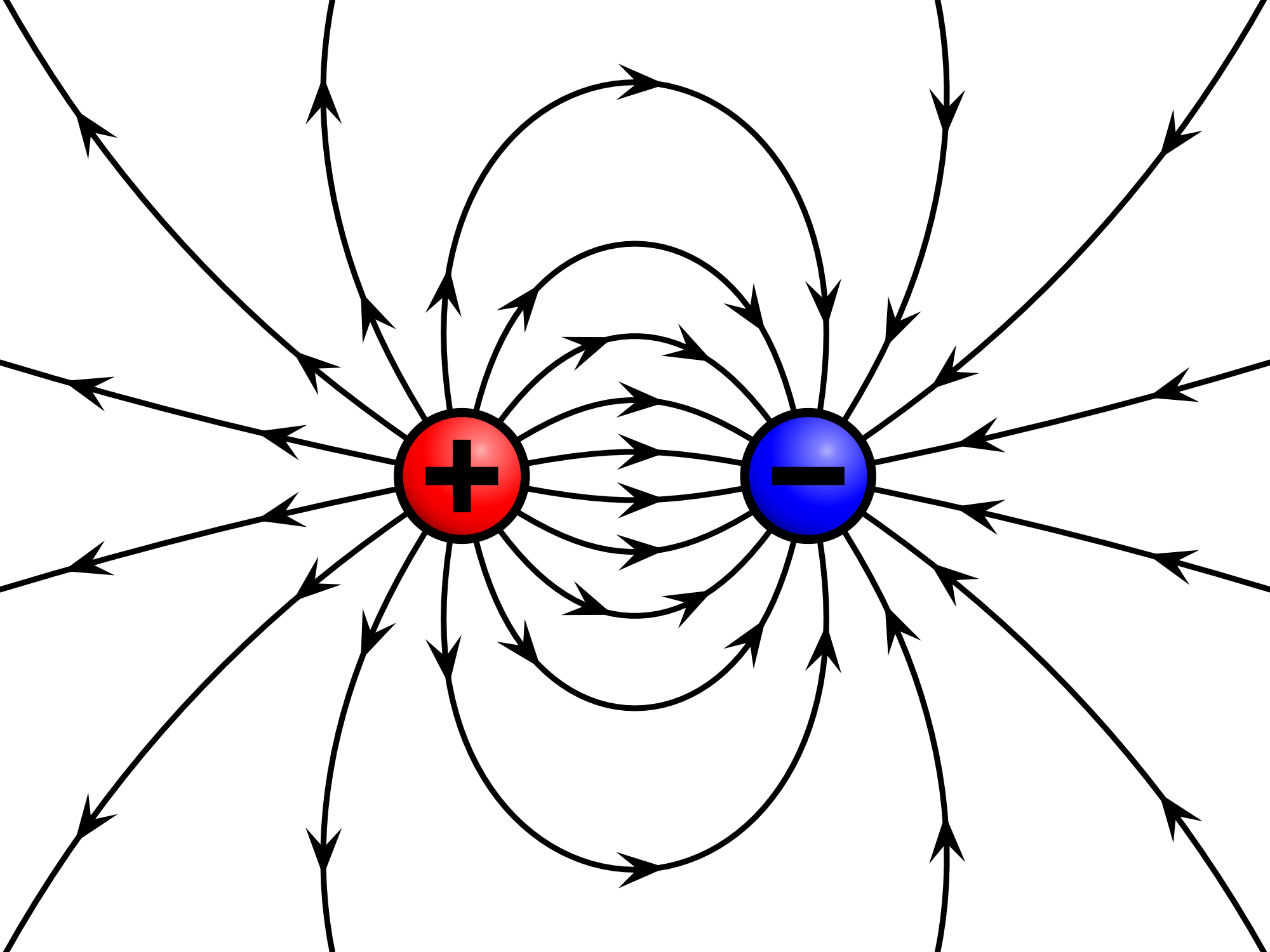
Electric field of a positive and a negative point charge
Common symbols
q
SI unitcoulomb (C)
Other units
In SI base unitsA⋅s
Extensive?yes
Conserved?yes
Dimension

Electric charge (symbol q, sometimes Q) is a physical property of matter that causes it to experience a force when placed in an electromagnetic field. Electric charge can be positive or negative. Like charges repel each other and unlike charges attract each other. An object with no net charge is referred to as electrically neutral. Early knowledge of how charged substances interact is now called classical electrodynamics, and is still accurate for problems that do not require consideration of quantum effects.

In an isolated system, the total charge stays the same - the amount of positive charge minus the amount of negative charge does not change over time. Electric charge is carried by subatomic particles. In ordinary matter, negative charge is carried by electrons, and positive charge is carried by the protons in the nuclei of atoms. If there are more electrons than protons in a piece of matter, it will have a negative charge, if there are fewer it will have a positive charge, and if there are equal numbers it will be neutral. Charge is quantized: it comes in integer multiples of individual small units called the elementary charge, e, about 1.602×10⁻¹⁹ C,[1] which is the smallest charge that can exist freely. Particles called quarks have smaller charges, multiples of 1/3e, but they are found only combined in particles that have a charge that is an integer multiple of e. In the Standard Model, charge is an absolutely conserved quantum number. The proton has a charge of +e, and the electron has a charge of −e.

Today, a negative charge is defined as the charge carried by an electron and a positive charge is that carried by a proton. Before these particles were discovered, a positive charge was defined by Benjamin Franklin as the charge acquired by a glass rod when it is rubbed with a silk cloth.

Electric charges produce electric fields.[2] A moving charge also produces a magnetic field.[3] The interaction of electric charges with an electromagnetic field (a combination of an electric and a magnetic field) is the source of the electromagnetic (or Lorentz) force,[4] which is one of the four fundamental interactions in physics. The study of photon-mediated interactions among charged particles is called quantum electrodynamics.[5]

The SI derived unit of electric charge is the coulomb (C) named after French physicist Charles-Augustin de Coulomb. In electrical engineering it is also common to use the ampere-hour (A⋅h). In physics and chemistry it is common to use the elementary charge (e) as a unit. Chemistry also uses the Faraday constant, which is the charge of one mole of elementary charges.

Overview

[edit]
Diagram showing field lines and equipotentials around an electron, a negatively charged particle. In an electrically neutral atom, the number of electrons is equal to the number of protons (which are positively charged), resulting in a net zero overall charge

Charge is the fundamental property of matter that exhibits electrostatic attraction or repulsion in the presence of other matter with charge. Electric charge is a characteristic property of many subatomic particles. The charges of free-standing particles are integer multiples of the elementary charge e; we say that electric charge is quantized. Michael Faraday, in his electrolysis experiments, was the first to note the discrete nature of electric charge. Robert Millikan's oil drop experiment demonstrated this fact directly, and measured the elementary charge. It has been discovered that one type of particle, quarks, have fractional charges of either −1/3 or +2/3, but it is believed they always occur in multiples of integral charge; free-standing quarks have never been observed.

By convention, the charge of an electron is negative, −e, while that of a proton is positive, +e. Charged particles whose charges have the same sign repel one another, and particles whose charges have different signs attract. Coulomb's law quantifies the electrostatic force between two particles by asserting that the force is proportional to the product of their charges, and inversely proportional to the square of the distance between them. The charge of an antiparticle equals that of the corresponding particle, but with opposite sign.

The electric charge of a macroscopic object is the sum of the electric charges of the particles that it is made up of. This charge is often small, because matter is made of atoms, and atoms typically have equal numbers of protons and electrons, in which case their charges cancel out, yielding a net charge of zero, thus making the atom neutral.

An ion is an atom (or group of atoms) that has lost one or more electrons, giving it a net positive charge (cation), or that has gained one or more electrons, giving it a net negative charge (anion). Monatomic ions are formed from single atoms, while polyatomic ions are formed from two or more atoms that have been bonded together, in each case yielding an ion with a positive or negative net charge.

Electric field induced by a positive electric charge
Electric field induced by a negative electric charge
Electric field induced by a positive electric charge (left) and a field induced by a negative electric charge (right).

During the formation of macroscopic objects, constituent atoms and ions usually combine to form structures composed of neutral ionic compounds electrically bound to neutral atoms. Thus macroscopic objects tend toward being neutral overall, but macroscopic objects are rarely perfectly net neutral.

Sometimes macroscopic objects contain ions distributed throughout the material, rigidly bound in place, giving an overall net positive or negative charge to the object. Also, macroscopic objects made of conductive elements can more or less easily (depending on the element) take on or give off electrons, and then maintain a net negative or positive charge indefinitely. When the net electric charge of an object is non-zero and motionless, the phenomenon is known as static electricity. This can easily be produced by rubbing two dissimilar materials together, such as rubbing amber with fur or glass with silk. In this way, non-conductive materials can be charged to a significant degree, either positively or negatively. Charge taken from one material is moved to the other material, leaving an opposite charge of the same magnitude behind. The law of conservation of charge always applies, giving the object from which a negative charge is taken a positive charge of the same magnitude, and vice versa.

Even when an object's net charge is zero, the charge can be distributed non-uniformly in the object (e.g., due to an external electromagnetic field, or bound polar molecules). In such cases, the object is said to be polarized. The charge due to polarization is known as bound charge, while the charge on an object produced by electrons gained or lost from outside the object is called free charge. The motion of electrons in conductive metals in a specific direction is known as electric current.

Unit

[edit]

The SI unit of quantity of electric charge is the coulomb (symbol: C). The coulomb is defined as the quantity of charge that passes through the cross section of an electrical conductor carrying one ampere for one second.[6] This unit was proposed in 1946 and ratified in 1948.[6] The lowercase symbol q is often used to denote a quantity of electric charge. The quantity of electric charge can be directly measured with an electrometer, or indirectly measured with a ballistic galvanometer.

The elementary charge is defined as a fundamental constant in the SI.[7] The value for elementary charge, when expressed in SI units, is exactly 1.602176634×10⁻¹⁹ C.[1]

After discovering the quantized character of charge, in 1891, George Stoney proposed the unit 'electron' for this fundamental unit of electrical charge. J. J. Thomson subsequently discovered the particle that we now call the electron in 1897. The unit is today referred to as elementary charge, fundamental unit of charge, or simply denoted e, with the charge of an electron being −e. The charge of an isolated system should be a multiple of the elementary charge e, even if at large scales charge seems to behave as a continuous quantity. In some contexts it is meaningful to speak of fractions of an elementary charge; for example, in the fractional quantum Hall effect.

The unit faraday is sometimes used in electrochemistry. One faraday is the magnitude of the charge of one mole of elementary charges,[8] i.e. 9.648533212...×104 C.

History

[edit]
Coulomb's torsion balance

From ancient times, people were familiar with four types of phenomena that today would all be explained using the concept of electric charge: (a) lightning, (b) the torpedo fish (or electric ray), (c) St Elmo's Fire, and (d) that amber rubbed with fur would attract small, light objects.[9] The first account of the amber effect is often attributed to the ancient Greek mathematician Thales of Miletus, who lived from c. 624 to c. 546 BC, but there are doubts about whether Thales left any writings;[10] his account about amber is known from an account from early 200s.[11] This account can be taken as evidence that the phenomenon was known since at least c. 600 BC, but Thales explained this phenomenon as evidence for inanimate objects having a soul.[11] In other words, there was no indication of any conception of electric charge. More generally, the ancient Greeks did not understand the connections among these four kinds of phenomena. The Greeks observed that the charged amber buttons could attract light objects such as hair. They also found that if they rubbed the amber for long enough, they could even get an electric spark to jump,[citation needed] but there is also a claim that no mention of electric sparks appeared until late 17th century.[12] This property derives from the triboelectric effect. In late 1100s, the substance jet, a compacted form of coal, was noted to have an amber effect,[13] and in the middle of the 1500s, Girolamo Fracastoro, discovered that diamond also showed this effect.[14] Some efforts were made by Fracastoro and others, especially Gerolamo Cardano to develop explanations for this phenomenon.[15]

In contrast to astronomy, mechanics, and optics, which had been studied quantitatively since antiquity, the start of ongoing qualitative and quantitative research into electrical phenomena can be marked with the publication of De Magnete by the English scientist William Gilbert in 1600.[16] In this book, there was a small section where Gilbert returned to the amber effect (as he called it) in addressing many of the earlier theories,[15] and coined the Neo-Latin word electrica (from ἤλεκτρον (ēlektron), the Greek word for amber). The Latin word was translated into English as electrics.[17] Gilbert is also credited with the term electrical, while the term electricity came later, first attributed to Sir Thomas Browne in his Pseudodoxia Epidemica from 1646.[18] (For more linguistic details see Etymology of electricity.) Gilbert hypothesized that this amber effect could be explained by an effluvium (a small stream of particles that flows from the electric object, without diminishing its bulk or weight) that acts on other objects. This idea of a material electrical effluvium was influential in the 17th and 18th centuries. It was a precursor to ideas developed in the 18th century about "electric fluid" (Dufay, Nollet, Franklin) and "electric charge".[19]

Around 1663 Otto von Guericke invented what was probably the first electrostatic generator, but he did not recognize it primarily as an electrical device and only conducted minimal electrical experiments with it.[20] Other European pioneers were Robert Boyle, who in 1675 published the first book in English that was devoted solely to electrical phenomena.[21] His work was largely a repetition of Gilbert's studies, but he also identified several more "electrics",[22] and noted mutual attraction between two bodies.[21]

In 1729 Stephen Gray was experimenting with static electricity, which he generated using a glass tube. He noticed that a cork, used to protect the tube from dust and moisture, also became electrified (charged). Further experiments (e.g., extending the cork by putting thin sticks into it) showed—for the first time—that electrical effluvia (as Gray called it) could be transmitted (conducted) over a distance. Gray managed to transmit charge with twine (765 feet) and wire (865 feet).[23] Through these experiments, Gray discovered the importance of different materials, which facilitated or hindered the conduction of electrical effluvia. John Theophilus Desaguliers, who repeated many of Gray's experiments, is credited with coining the terms conductors and insulators to refer to the effects of different materials in these experiments.[23] Gray also discovered electrical induction (i.e., where charge could be transmitted from one object to another without any direct physical contact). For example, he showed that by bringing a charged glass tube close to, but not touching, a lump of lead that was sustained by a thread, it was possible to make the lead become electrified (e.g., to attract and repel brass filings).[24] He attempted to explain this phenomenon with the idea of electrical effluvia.[25]

Gray's discoveries introduced an important shift in the historical development of knowledge about electric charge. The fact that electrical effluvia could be transferred from one object to another, opened the theoretical possibility that this property was not inseparably connected to the bodies that were electrified by rubbing.[26] In 1733 Charles François de Cisternay du Fay, inspired by Gray's work, made a series of experiments (reported in Mémoires de l'Académie Royale des Sciences), showing that more or less all substances could be 'electrified' by rubbing, except for metals and fluids[27] and proposed that electricity comes in two varieties that cancel each other, which he expressed in terms of a two-fluid theory.[28] When glass was rubbed with silk, du Fay said that the glass was charged with vitreous electricity, and, when amber was rubbed with fur, the amber was charged with resinous electricity. In contemporary understanding, positive charge is now defined as the charge of a glass rod after being rubbed with a silk cloth, but it is arbitrary which type of charge is called positive and which is called negative.[29] Another important two-fluid theory from this time was proposed by Jean-Antoine Nollet (1745).[30]

Up until about 1745, the main explanation for electrical attraction and repulsion was the idea that electrified bodies gave off an effluvium.[31] Benjamin Franklin started electrical experiments in late 1746,[32] and by 1750 had developed a one-fluid theory of electricity, based on an experiment that showed that a rubbed glass received the same, but opposite, charge strength as the cloth used to rub the glass.[32][33] Franklin imagined electricity as being a type of invisible fluid present in all matter and coined the term charge itself (as well as battery and some others[34]); for example, he believed that it was the glass in a Leyden jar that held the accumulated charge. He posited that rubbing insulating surfaces together caused this fluid to change location, and that a flow of this fluid constitutes an electric current. He also posited that when matter contained an excess of the fluid it was positively charged and when it had a deficit it was negatively charged. He identified the term positive with vitreous electricity and negative with resinous electricity after performing an experiment with a glass tube he had received from his overseas colleague Peter Collinson. The experiment had participant A charge the glass tube and participant B receive a shock to the knuckle from the charged tube. Franklin identified participant B to be positively charged after having been shocked by the tube.[35] There is some ambiguity about whether William Watson independently arrived at the same one-fluid explanation around the same time (1747). Watson, after seeing Franklin's letter to Collinson, claims that he had presented the same explanation as Franklin in spring 1747.[36] Franklin had studied some of Watson's works prior to making his own experiments and analysis, which was probably significant for Franklin's own theorizing.[37] One physicist suggests that Watson first proposed a one-fluid theory, which Franklin then elaborated further and more influentially.[38] A historian of science argues that Watson missed a subtle difference between his ideas and Franklin's, so that Watson misinterpreted his ideas as being similar to Franklin's.[39] In any case, there was no animosity between Watson and Franklin, and the Franklin model of electrical action, formulated in early 1747, eventually became widely accepted at that time.[37] After Franklin's work, effluvia-based explanations were rarely put forward.[40]

It is now known that the Franklin model was fundamentally correct. There is only one kind of electrical charge, and only one variable is required to keep track of the amount of charge.[41]

Until 1800 it was only possible to study conduction of electric charge by using an electrostatic discharge. In 1800 Alessandro Volta was the first to show that charge could be maintained in continuous motion through a closed path.[42]

In 1833, Michael Faraday sought to remove any doubt that electricity is identical, regardless of the source by which it is produced.[43] He discussed a variety of known forms, which he characterized as common electricity (e.g., static electricity, piezoelectricity, magnetic induction), voltaic electricity (e.g., electric current from a voltaic pile), and animal electricity (e.g., bioelectricity).

In 1838, Faraday raised a question about whether electricity was a fluid or fluids or a property of matter, like gravity. He investigated whether matter could be charged with one kind of charge independently of the other.[44] He came to the conclusion that electric charge was a relation between two or more bodies, because he could not charge one body without having an opposite charge in another body.[45]

In 1838, Faraday also put forth a theoretical explanation of electric force, while expressing neutrality about whether it originates from one, two, or no fluids.[46] He focused on the idea that the normal state of particles is to be nonpolarized, and that when polarized, they seek to return to their natural, nonpolarized state.

In developing a field theory approach to electrodynamics (starting in the mid-1850s), James Clerk Maxwell stops considering electric charge as a special substance that accumulates in objects, and starts to understand electric charge as a consequence of the transformation of energy in the field.[47] This pre-quantum understanding considered magnitude of electric charge to be a continuous quantity, even at the microscopic level.[47]

Role of charge in static electricity

[edit]

Static electricity refers to the electric charge of an object and the related electrostatic discharge when two objects are brought together that are not at equilibrium. An electrostatic discharge creates a change in the charge of each of the two objects.

Electrification by sliding

[edit]

When a piece of glass and a piece of resin—neither of which exhibit any electrical properties—are rubbed together and left with the rubbed surfaces in contact, they still exhibit no electrical properties. When separated, they attract each other.

A second piece of glass rubbed with a second piece of resin, then separated and suspended near the former pieces of glass and resin causes these phenomena:

  • The two pieces of glass repel each other.
  • Each piece of glass attracts each piece of resin.
  • The two pieces of resin repel each other.

This attraction and repulsion is an electrical phenomenon, and the bodies that exhibit them are said to be electrified, or electrically charged. Bodies may be electrified in many other ways, as well as by sliding. The electrical properties of the two pieces of glass are similar to each other but opposite to those of the two pieces of resin: The glass attracts what the resin repels and repels what the resin attracts.

If a body electrified in any manner whatsoever behaves as the glass does, that is, if it repels the glass and attracts the resin, the body is said to be vitreously electrified, and if it attracts the glass and repels the resin it is said to be resinously electrified. All electrified bodies are either vitreously or resinously electrified.

An established convention in the scientific community defines vitreous electrification as positive, and resinous electrification as negative. The exactly opposite properties of the two kinds of electrification justify our indicating them by opposite signs, but the application of the positive sign to one rather than to the other kind must be considered as a matter of arbitrary convention—just as it is a matter of convention in mathematical diagram to reckon positive distances towards the right hand.[48]

Role of charge in electric current

[edit]

Electric current is the flow of electric charge through an object. The most common charge carriers are the positively charged proton and the negatively charged electron. The movement of any of these charged particles constitutes an electric current. In many situations, it suffices to speak of the conventional current without regard to whether it is carried by positive charges moving in the direction of the conventional current or by negative charges moving in the opposite direction. This macroscopic viewpoint is an approximation that simplifies electromagnetic concepts and calculations.

At the opposite extreme, if one looks at the microscopic situation, one sees there are many ways of carrying an electric current, including: a flow of electrons; a flow of electron holes that act like positive particles; and both negative and positive particles (ions or other charged particles) flowing in opposite directions in an electrolytic solution or a plasma.

The direction of the conventional current in most metallic wires is opposite to the drift velocity of the actual charge carriers; i.e., the electrons.

Conservation of electric charge

[edit]

The total electric charge of an isolated system remains constant regardless of changes within the system itself.[49] : 4 This law is inherent to all processes known to physics and can be derived in a local form from gauge invariance of the wave function. The conservation of charge results in the charge-current continuity equation. More generally, the rate of change in charge density ρ within a volume of integration V is equal to the area integral over the current density J through the closed surface S = ∂V, which is in turn equal to the net current I:

\oiint

Thus, the conservation of electric charge, as expressed by the continuity equation, gives the result:

The charge transferred between times and is obtained by integrating both sides:

where I is the net outward current through a closed surface and q is the electric charge contained within the volume defined by the surface.

Relativistic invariance

[edit]

Aside from the properties described in articles about electromagnetism, electric charge is a relativistic invariant. This means that any particle that has electric charge q has the same electric charge regardless of how fast it is travelling. This property has been experimentally verified by showing that the electric charge of one helium nucleus (two protons and two neutrons bound together in a nucleus and moving around at high speeds) is the same as that of two deuterium nuclei (one proton and one neutron bound together, but moving much more slowly than they would if they were in a helium nucleus).[50][51]

See also

[edit]

References

[edit]
[edit]
Revisions and contributorsEdit on WikipediaRead on Wikipedia
from Grokipedia
Electric charge is a fundamental physical property of certain subatomic particles that determines their interactions via the electromagnetic force, manifesting as attraction between opposite charges and repulsion between like charges. It exists in two types—positive and negative—with protons carrying a positive charge of +e and electrons carrying a negative charge of -e, where e is the , exactly 1.602 176 634 × 10^{-19} coulombs (C), the SI unit of charge. Charge is quantized, meaning it occurs only in discrete multiples of the , such that the net charge q on any object is q = ne, where n is an . Additionally, electric charge is conserved, as the total charge in an remains constant; charge cannot be created or destroyed, only transferred between objects or redistributed within them. These properties underpin phenomena ranging from to the behavior of atoms and molecules in chemical bonds. The magnitude of the electrostatic force between two point charges follows , given by F = |q_1 q_2| / r^2, where is Coulomb's constant (8.99 × 10^9 N m²/C²), q_1 and q_2 are the charges, and r is the distance between them, decreasing with the square of the separation. Stationary charges produce , while moving charges also generate , collectively forming the basis of as described by . In everyday matter, atoms are electrically neutral due to equal numbers of protons and electrons, but imbalances lead to charged objects and currents in conductors.

Fundamentals

Definition and Properties

Electric charge is a fundamental of certain subatomic particles that governs their interactions via the electromagnetic . It is an intrinsic characteristic, meaning it cannot be altered without changing the particle's identity, and exists in two types: positive and negative. Positive charge is carried by protons in atomic nuclei, while negative charge is carried by electrons orbiting the nucleus. The interaction between charged particles follows the rule that like charges repel each other, whereas unlike charges attract, forming the basis of electrostatic forces. Electric charge is conserved in all physical processes, meaning the total charge in an remains constant regardless of interactions or transformations. Additionally, charge is quantized, occurring only in discrete units rather than continuous values, though the precise nature of this quantization is explored further elsewhere. In neutral atoms, the number of protons equals the number of electrons, resulting in zero net charge due to the equal magnitude but opposite signs of their charges. Electrical effects arise from charge imbalances, such as the gain or loss of electrons, which create ions with net positive or negative charge and enable phenomena like conductivity or electrostatic attraction. Charged particles serve as sources of electromagnetic fields; stationary charges produce , while moving charges also generate , underlying the unified electromagnetic interactions in nature.

Quantization of Electric Charge

The quantization of electric charge, inferred from the laws of , was explicitly proposed by in 1874, who calculated the value of the fundamental unit of charge from electrochemical data and named it the "electron" in 1891. This idea was advanced by early measurements, including those by John Sealy Edward Townsend in 1897, who determined the charge on gaseous ions using cloud droplets. It was experimentally confirmed by Robert A. Millikan through his oil-drop experiment in 1909, where he observed that the charges on tiny oil droplets suspended in an were always integer multiples of a base value, demonstrating the discrete nature of charge. Millikan's results provided direct evidence that charge is not continuous but comes in fundamental packets, laying the groundwork for understanding subatomic particles. The ee, defined as the charge of a single proton or the magnitude of the electron's charge, serves as this fundamental unit, with a value of exactly 1.602176634×10191.602176634 \times 10^{-19} coulombs as established by the redefinition of the SI units and listed in the 2022 CODATA adjustment. All observed electric charges in nature are integer multiples of ee, such as +e+e for protons and e-e for electrons. This quantization implies a discrete atomic structure, where protons carry +e+e, electrons carry e-e, and neutrons carry zero charge, explaining the stability and electrical neutrality of atoms. In the of , quarks possess fractional charges of ±13e\pm \frac{1}{3}e or ±23e\pm \frac{2}{3}e, but ensures that quarks are never observed in isolation, binding them into color-neutral hadrons with integer multiples of ee. This confinement mechanism, a consequence of , maintains the observed quantization of charge at the macroscopic and atomic scales.

Units and Measurement

The Coulomb

The coulomb, symbol C, is the derived unit of electric charge in the (SI). It is defined as the electric charge transported through a surface by a of one in one second, mathematically expressed as Q=I×tQ = I \times t, where QQ is charge in s, II is current in amperes, and tt is time in seconds. The serves as the base SI unit for , from which the derives its definition as C=As\mathrm{C} = \mathrm{A \cdot s}. Following the 2019 revision of the SI, effective 20 May 2019 and adopted by the 26th General Conference on Weights and Measures (CGPM), the was redefined by fixing the ee at exactly 1.602176634×10191.602\,176\,634 \times 10^{-19} s when expressed in SI units, thereby anchoring the coulomb to fundamental physical constants rather than experimental realizations. The coulomb's historical development traces back to 19th-century systems in the centimetre-gram-second (CGS) framework, where electric charge was measured in the electrostatic unit (, based on in vacuum) and the electromagnetic unit (abcoulomb, linked to current in the electromagnetic system). The practical coulomb emerged at the 1881 International Electrical Congress in , defined as the charge from one international over one second to facilitate applications. This evolved into the absolute metre-kilogram-second- (MKSA) system, with the CGPM's 1948 resolution shifting from "international" prototype-based units to absolute definitions, and the 10th CGPM in 1954 establishing the as a base unit, culminating in the formal adoption of the SI in 1960 by the 11th General Conference on Weights and Measures (CGPM). In practical terms, one coulomb represents a substantial amount of charge, equivalent to approximately 6.24×10186.24 \times 10^{18} elementary charges, given the fixed value of ee. Everyday electric charges, such as those in static electricity, are far smaller, typically on the order of nanocoulombs (10^{-9} C) to microcoulombs (10^{-6} C).

Measuring Electric Charge

One of the earliest methods for detecting the presence and sign of electric charge involved the use of an , a device consisting of a metal rod with lightweight leaves or a needle that deflects due to electrostatic repulsion when charged. Developed in the , the gold-leaf electroscope, for instance, allowed qualitative assessment by observing the degree of deflection, which indicated the relative amount of charge; a positively charged object would repel similarly charged leaves, while an oppositely charged one would attract them. This instrument served as the primary tool for charge detection throughout the 18th and 19th centuries, enabling early experiments in without quantitative precision. A pivotal advancement in quantifying electric charge came with Robert Millikan's oil-drop experiment in 1909, which measured the by observing charged oil droplets suspended between two horizontal metal plates in a chamber. Tiny oil droplets were introduced into the chamber and ionized by X-rays or air particles, acquiring a charge that caused them to move under an applied ; Millikan adjusted the voltage across the plates to balance the downward gravitational force against the upward electric force, allowing droplets to hover stationary. By measuring the terminal velocity of falling droplets without the field and repeating the process for various charges, Millikan determined that charges were discrete multiples of a fundamental unit, yielding a value for the of approximately 1.592 × 10^{-19} C after extensive refinements over six years. In modern contexts, absolute measurement of electric charge, particularly in high-energy particle beams, relies on the Faraday cup, a simple cylindrical collector that captures charged particles and measures the total induced charge via a low-impedance circuit. This device provides direct, dose-rate-independent quantification by integrating the beam current over time, with designs optimized for suppressing secondary electrons to achieve accuracies better than 0.1% in proton or ion beams. For detecting very low charges, such as those produced in ionization chambers for radiation monitoring, electrometers serve as high-sensitivity amplifiers capable of resolving currents from picoamperes to microamperes. These instruments, often paired with ionization chambers, measure charge from ion pairs created by radiation, achieving detection limits as low as 0.5 Bq/m³ in controlled volumes. Measuring fractional charges associated with quarks presents significant challenges due to quantum chromodynamics confinement, which prevents isolation of individual ; instead, evidence for their charges of +2/3 or -1/3 elementary units is inferred indirectly from experiments at accelerators like CERN's Large Electron-Positron Collider or . In these high-energy lepton-nucleon collisions, the scattering cross-sections and structure functions reveal quark distributions and their effective charges through patterns in electromagnetic and weak interactions, but direct verification is complicated by the short-lived, composite nature of hadrons and the need for precise modeling of effects. Ongoing experiments at facilities such as the LHC continue to refine these inferences, though absolute fractional charge measurement remains elusive without violating confinement.

Historical Development

Early Observations

One of the earliest recorded observations of electric effects dates back to around 600 BCE, when the philosopher noted that , known in Greek as elektron, could attract lightweight objects such as feathers and straw after being rubbed with wool or fur. This phenomenon, now understood as generated by , was anecdotal and not systematically studied at the time, but it marked the initial recognition of attractive forces beyond mechanical or magnetic influences. Thales' observation, preserved through later accounts by and others, highlighted amber's unique property among natural materials, though no causal explanation was proposed. In the , English physician William Gilbert advanced these early notions through systematic experimentation detailed in his 1600 De Magnete, Magneticisque Corporibus, et de Magno Magnete Tellure (On the Magnet, Magnetic Bodies, and the Great Magnet of the Earth). Gilbert distinguished electric attraction from magnetic effects, observing that while attracted iron, materials like , , and exhibited similar attractive properties only when rubbed and dry, and these forces did not persist like . He coined the term "electric" from the Greek elektron to describe this amber-like force, introducing the electricus for substances capable of such attraction, thereby laying foundational terminology that separated as a distinct . To detect these subtle forces, Gilbert invented the versorium, a lightweight pivoting needle that deflected toward charged objects, enabling more precise qualitative measurements of electric attraction. By the early , experiments with frictional intensified, particularly through the work of English instrument maker and experimenter . rubbed glass rods or tubes with silk or dry cloth, producing visible electric effects such as the attraction of small particles like and the generation of sparks when the charged glass was brought near conductors. In a notable advancement, he evacuated glass globes partially and rubbed them, observing luminous glows—termed "barometric light"—emanating from the glass in the low-pressure environment, which intensified the and provided early insights into the interaction between and . These demonstrations, reported in his 1709 book Physico-Mechanical Experiments on Various Subjects, built on Gilbert's distinctions and fueled growing interest in electric phenomena, though initial confusions with persisted until further clarification in subsequent decades.

Key Discoveries

In the mid-18th century, conducted pioneering experiments that linked to laboratory phenomena, proposing a single-fluid theory of electricity where charge resulted from an excess or deficiency of this fluid. Through systematic tests with Leyden jars and frictional machines, Franklin demonstrated that electrical effects could be transferred and stored, coining the terms "positive" for excess fluid and "negative" for deficiency to describe charged states. His 1752 , performed during a in with assistance from his son , involved flying a silk kite with a hemp and silk string attached to a key, capturing ambient electrical charge from the air and producing sparks that confirmed lightning as an electrical discharge. This work directly inspired Franklin's invention of the shortly thereafter, a grounded metal conductor designed to safely direct electrical charges from structures to the ground, earning him the Royal Society's in 1753. In 1785, quantified the force between electric charges using a torsion balance, a device he refined to measure minute torsional forces in thin filaments. By suspending charged pith balls on a silver wire and observing their repulsion at varying distances—such as a quadrupled force when distance halved from 36° to 18° angular separation—Coulomb established that the repulsive force between like charges is directly proportional to the product of their charges and inversely proportional to the square of the distance between them. This , derived from precise angular measurements (e.g., 567° torsion for 8.5° displacement), provided the first mathematical framework for electrostatic interactions and was published in the Memoirs of the . Alessandro Volta's invention of the in 1800 marked a breakthrough by producing the first sustained , consisting of stacked alternating and silver (or ) discs separated by brine-soaked , with each cell generating voltage through chemical reactions at the metal- interfaces. This device, demonstrated to in 1801, refuted Luigi Galvani's animal theory by showing that metallic contact and action drove the current, enabling continuous flows that powered early electrolytic decompositions, such as water into and oxygen by William Nicholson and Anthony Carlisle later that year. Building on Volta's apparatus in the 1830s, formulated the laws of , quantifying the relationship between electric charge and chemical reactions through experiments decomposing , acids, and salts using voltaic batteries and galvanometers. His , established by 1832, states that the mass of a substance altered at an is directly proportional to the quantity of passed, as shown in equal decompositions from standardized currents (e.g., 8 battery pulses matching 30 machine turns for ). The second law, refined by 1833–1834, asserts that these masses are proportional to the substance's chemical equivalent weights, with precise measurements like 58.53 units for tin and 103.5 for lead confirming definite electrochemical action independent of current intensity. These principles, detailed across Faraday's Experimental Researches in , linked charge transfer to atomic affinities, laying the groundwork for . At the close of the 19th century, J.J. Thomson's 1897 experiments with in low-pressure tubes identified the as the fundamental negative , using magnetic and electrostatic deflections to measure its (m/e) at approximately 1.7 × 10^{-7} esu—about 1/1836 that of a . By applying crossed fields and observing consistent deflections independent of the cathode material or residual gas, Thomson concluded that consisted of streams of subatomic "corpuscles," uniform particles much smaller than atoms, challenging the indivisibility of matter and establishing the particulate nature of electric charge. This discovery, published in the , initiated the field of subatomic physics.

Electric Charge in Phenomena

Static Electricity

Static electricity arises from the buildup of electric charge imbalances on the surfaces of insulators, typically through the , where friction between two dissimilar materials leads to the transfer of electrons from one to the other. When two materials contact and rub, the one with a greater tendency to lose electrons becomes positively charged, while the other gains electrons and becomes negatively charged; this process, known as contact electrification, creates separated charges that do not flow freely due to the insulating nature of the materials. The extent of charge transfer depends on the materials involved, as quantified by the triboelectric series, which ranks substances according to their affinity for gaining or losing electrons during contact. In the triboelectric series, materials are ordered from those that tend to acquire a positive charge (electron donors) at the top to those that acquire a negative charge (electron acceptors) at the bottom. For example, rubbed against becomes positively charged as it loses s to the silk, while hard rubber rubbed against becomes negatively charged by gaining electrons from the fur. This ranking predicts the direction of charge transfer: when two materials are brought into contact, electrons flow from the one higher in the series to the one lower, resulting in electrostatic attraction or repulsion once separated. The forces between these separated static charges are governed by , which describes the electrostatic interaction between point charges in a . For two point charges q1q_1 and q2q_2 separated by a rr, the magnitude of the force FF is given by: F=14πϵ0q1q2r2F = \frac{1}{4\pi\epsilon_0} \frac{|q_1 q_2|}{r^2} where ϵ0\epsilon_0 is the , and the proportionality constant k=14πϵ09×109Nm2/C2k = \frac{1}{4\pi\epsilon_0} \approx 9 \times 10^9 \, \mathrm{N \cdot m^2 / C^2}. Like charges repel, and unlike charges attract, with the force decreasing as the inverse square of the ; this law applies directly to static charges on insulators, where the charges remain localized rather than dissipating. A common manifestation of is the mild shock experienced when touching a metal object after walking on a , as between shoes and transfers electrons to the body, creating a negative charge buildup. This excess charge discharges rapidly through the conductor upon contact, producing a visible spark and audible snap. On a larger scale, represents a massive static discharge, where charge separation in thunderclouds—negative at the base and positive aloft—builds up until the overcomes air's insulating properties, resulting in a sudden neutralization current of up to 30,000 amperes.

Electric Currents

Electric current represents electric charge in motion and is defined as the rate at which charge flows past a point in a conductor, expressed as I=ΔQΔtI = \frac{\Delta Q}{\Delta t}, where II is the current, ΔQ\Delta Q is the change in charge, and Δt\Delta t is the time interval. In metallic conductors, this flow primarily involves free electrons, whose random thermal motion is superimposed with a small directed under an applied ; typical drift velocities are around 10410^{-4} m/s, enabling currents despite the electrons' much higher average speeds of about 10610^6 m/s. The ability of materials to support electric currents depends on the presence and mobility of charge carriers. Conductors, such as metals, possess abundant free electrons that facilitate current flow with low resistance; insulators lack sufficient free charges, impeding current significantly; semiconductors exhibit intermediate behavior due to a limited number of charge carriers that can be modulated; and electrolytes conduct via the movement of ions in solution rather than electrons. Ohm's law relates the voltage VV across a conductor to the current II and resistance RR through V=IRV = IR, with current magnitude influenced by mobility and density in the material. In practical applications, batteries chemically separate charges at electrodes to establish a voltage that sustains currents in circuits, powering devices from small to vehicles. Electric currents are essential in power distribution systems, where they are transmitted at high voltages through conductors to deliver efficiently over vast distances with reduced losses.

Fundamental Laws and Properties

Conservation of Charge

The law of conservation of electric charge states that the total amount of electric charge in an isolated system remains constant over time, meaning that electric charge can neither be created nor destroyed, only transferred between objects or separated into positive and negative components. This principle implies that for any closed system undergoing physical or chemical processes, the net change in charge is zero, expressed as ΔQ=0\Delta Q = 0. It arises fundamentally from the gauge invariance of electromagnetism in quantum electrodynamics. Classical experiments demonstrate this conservation through charge separation without net creation. For instance, when a neutral is rubbed with , electrons transfer from the glass to the silk, leaving the rod with a positive charge equal in magnitude to the negative charge gained by the silk, ensuring the total charge remains zero. Similar results occur in charging by contact, where two neutral conductors touch and share charge equally, preserving the overall total. These observations, confirmed through precise measurements of charge via electroscopes and other devices, show no violation in macroscopic systems. In , conservation holds to extraordinary precision across high-energy interactions. During beta-minus decay, a (charge 0) transforms into a (charge +1), an (charge -1), and an antineutrino (charge 0), maintaining net charge zero. Likewise, in , a high-energy (charge 0) near an creates an electron-positron pair (charges -1 and +1), again with net charge conserved at zero. Experimental tests, such as searches for forbidden decays like the electron decaying into a and , yield lifetimes exceeding 6.6×10286.6 \times 10^{28} years, while limits on fractional charges include the 's charge being (0.2±0.8)×1021e(-0.2 \pm 0.8) \times 10^{-21} e and the 's charge less than 1046e10^{-46} e. This law prohibits the creation or annihilation of charge except in equal and opposite pairs, forming the basis for Kirchhoff's current law in electrical circuits, where the algebraic sum of currents at any junction is zero to prevent charge accumulation. Although hypothetical magnetic monopoles in cosmological models could theoretically introduce mechanisms challenging electric charge conservation if observed, no such particles have been detected, and the law remains unviolated in all verified processes.

Relativistic Invariance

In , the total electric charge QQ of a system is a , meaning it remains invariant across all inertial reference frames, even as the ρ\rho transforms due to effects like . This invariance arises because, although the volume element contracts in the direction of relative motion—altering the observed density—the product of density and volume yields a constant total charge when integrated over space. For a point charge or localized distribution at rest in one frame, observers in moving frames see a boosted current but the same net charge, ensuring no frame-dependent variation in the fundamental quantity. The relativistic treatment formalizes this through the four-current vector Jμ=(ρc,J)J^\mu = (\rho c, \mathbf{J}), where ρ\rho is the charge density and J\mathbf{J} is the current density in three dimensions, with cc the speed of light. Under Lorentz transformations, the components of JμJ^\mu mix as parts of a four-vector, transforming covariantly between frames, but the space-time integral of J0J^0 (proportional to charge) over a hypersurface remains unchanged due to the invariance of the four-volume element. This structure guarantees that the total charge Q=ρdVQ = \int \rho \, dV is frame-independent, as the contraction in length parallel to the boost is exactly compensated by the increase in density, preserving the integral. This invariance is crucial for the consistency of under , as it ensures retain their form in all inertial frames without implying frame-dependent charge creation or annihilation. The covariant divergence-free condition μJμ=0\partial_\mu J^\mu = 0 encodes both local and global invariance, preventing inconsistencies in electromagnetic interactions across boosts. Without this property, relativistic electrodynamics would fail to describe phenomena like or field transformations uniformly. Experimental confirmation comes from high-precision measurements in and particle accelerators, where charge neutrality of matter holds to better than 102110^{-21} despite relativistic speeds of inner electrons in heavy atoms (up to v0.8cv \approx 0.8c) balancing nuclear charge. In accelerators like the LHC, protons and electrons at energies exceeding TeV maintain their elementary charges ee or e-e invariantly, as verified by tracking and , aligning with relativistic predictions without observed deviations.

References

Add your contribution
Related Hubs
User Avatar
No comments yet.