Dual space
Dual space
Main page

Dual space

logo
Community Hub0 subscribers
Read side by side
from Wikipedia

In mathematics, any vector space has a corresponding dual vector space (or just dual space for short) consisting of all linear forms on together with the vector space structure of pointwise addition and scalar multiplication by constants.

The dual space as defined above is defined for all vector spaces, and to avoid ambiguity may also be called the algebraic dual space. When defined for a topological vector space, there is a subspace of the dual space, corresponding to continuous linear functionals, called the continuous dual space.

Dual vector spaces find application in many branches of mathematics that use vector spaces, such as in tensor analysis with finite-dimensional vector spaces. When applied to vector spaces of functions (which are typically infinite-dimensional), dual spaces are used to describe measures, distributions, and Hilbert spaces. Consequently, the dual space is an important concept in functional analysis.

Early terms for dual include polarer Raum [Hahn 1927], espace conjugué, adjoint space [Alaoglu 1940], and transponierter Raum [Schauder 1930] and [Banach 1932]. The term dual is due to Bourbaki 1938.[1]

Algebraic dual space

[edit]

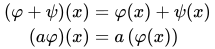
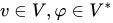
Given any vector space over a field , the (algebraic) dual space [2] (alternatively denoted by [3] or [4][5])[nb 1] is defined as the set of all linear maps (linear functionals). Since linear maps are vector space homomorphisms, the dual space may be denoted .[3] The dual space itself becomes a vector space over when equipped with an addition and scalar multiplication satisfying:

for all , , and .

Elements of the algebraic dual space are sometimes called covectors, one-forms, or linear forms.

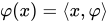
The pairing of a functional in the dual space and an element of is sometimes denoted by a bracket: [6] or .[7] This pairing defines a nondegenerate bilinear mapping[nb 2] called the natural pairing.

Finite-dimensional case

[edit]

If is finite-dimensional, then has the same dimension as . Given a basis in , it is possible to construct a specific basis in , called the dual basis. This dual basis is a set of linear functionals on , defined by the relation

for any choice of coefficients . In particular, letting in turn each one of those coefficients be equal to one and the other coefficients zero, gives the system of equations

where is the Kronecker delta symbol. This property is referred to as the bi-orthogonality property.

For example, if is , let its basis be chosen as . The basis vectors are not orthogonal to each other. Then, and are one-forms (functions that map a vector to a scalar) such that , , , and . (Note: The superscript here is the index, not an exponent.) This system of equations can be expressed using matrix notation as


Solving for the unknown values in the first matrix shows the dual basis to be . Because and are functionals, they can be rewritten as and .

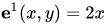
In general, when is , if is a matrix whose columns are the basis vectors and is a matrix whose columns are the dual basis vectors, then

where is the identity matrix of order . The biorthogonality property of these two basis sets allows any point to be represented as

even when the basis vectors are not orthogonal to each other. Strictly speaking, the above statement only makes sense once the inner product and the corresponding duality pairing are introduced, as described below in § Bilinear products and dual spaces.

In particular, can be interpreted as the space of columns of real numbers, its dual space is typically written as the space of rows of real numbers. Such a row acts on as a linear functional by ordinary matrix multiplication. This is because a functional maps every -vector into a real number . Then, seeing this functional as a matrix , and as an matrix, and a matrix (trivially, a real number) respectively, if then, by dimension reasons, must be a matrix; that is, must be a row vector.

If consists of the space of geometrical vectors in the plane, then the level curves of an element of form a family of parallel lines in , because the range is 1-dimensional, so that every point in the range is a multiple of any one nonzero element. So an element of can be intuitively thought of as a particular family of parallel lines covering the plane. To compute the value of a functional on a given vector, it suffices to determine which of the lines the vector lies on. Informally, this "counts" how many lines the vector crosses. More generally, if is a vector space of any dimension, then the level sets of a linear functional in are parallel hyperplanes in , and the action of a linear functional on a vector can be visualized in terms of these hyperplanes.[8]

Infinite-dimensional case

[edit]

If is not finite-dimensional but has a basis[nb 3] indexed by an infinite set , then the same construction as in the finite-dimensional case yields linearly independent elements () of the dual space, but they will not form a basis.

For instance, consider the space , whose elements are those sequences of real numbers that contain only finitely many non-zero entries, which has a basis indexed by the natural numbers . For , is the sequence consisting of all zeroes except in the -th position, which is 1. The dual space of is (isomorphic to) , the space of all sequences of real numbers: each real sequence defines a function where the element of is sent to the number

which is a finite sum because there are only finitely many nonzero . The dimension of is countably infinite, whereas does not have a countable basis.

This observation generalizes to any[nb 3] infinite-dimensional vector space over any field : a choice of basis identifies with the space of functions such that is nonzero for only finitely many , where such a function is identified with the vector
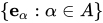
in (the sum is finite by the assumption on , and any may be written uniquely in this way by the definition of the basis).

The dual space of may then be identified with the space of all functions from to : a linear functional on is uniquely determined by the values it takes on the basis of , and any function (with ) defines a linear functional on by

Again, the sum is finite because is nonzero for only finitely many .

The set may be identified (essentially by definition) with the direct sum of infinitely many copies of (viewed as a 1-dimensional vector space over itself) indexed by , i.e. there are linear isomorphisms
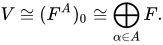
On the other hand, is (again by definition), the direct product of infinitely many copies of indexed by , and so the identification

is a special case of a general result relating direct sums (of modules) to direct products.

If a vector space is not finite-dimensional, then its (algebraic) dual space is always of larger dimension (as a cardinal number) than the original vector space. This is in contrast to the case of the continuous dual space, discussed below, which may be isomorphic to the original vector space even if the latter is infinite-dimensional.

The proof of this inequality between dimensions results from the following.

If is an infinite-dimensional -vector space, the arithmetical properties of cardinal numbers implies that

where cardinalities are denoted as absolute values. For proving that it suffices to prove that which can be done with an argument similar to Cantor's diagonal argument.[9] The exact dimension of the dual is given by the Erdős–Kaplansky theorem.

Bilinear products and dual spaces

[edit]

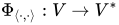
If V is finite-dimensional, then V is isomorphic to V. But there is in general no natural isomorphism between these two spaces.[10] Any bilinear form on gives a mapping of into its dual space via

where the right hand side is defined as the functional on V taking each to . In other words, the bilinear form determines a linear mapping

defined by

If the bilinear form is nondegenerate, then this is an isomorphism onto a subspace of V. If V is finite-dimensional, then this is an isomorphism onto all of V. Conversely, any isomorphism from V to a subspace of V (resp., all of V if V is finite dimensional) defines a unique nondegenerate bilinear form on V by

Thus there is a one-to-one correspondence between isomorphisms of V to a subspace of (resp., all of) V and nondegenerate bilinear forms on V.

If the vector space V is over the complex field, then sometimes it is more natural to consider sesquilinear forms instead of bilinear forms. In that case, a given sesquilinear form ⟨·,·⟩ determines an isomorphism of V with the complex conjugate of the dual space
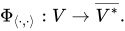
The conjugate of the dual space can be identified with the set of all additive complex-valued functionals f : VC such that

Injection into the double-dual

[edit]

There is a natural homomorphism from into the double dual , defined by for all . In other words, if is the evaluation map defined by , then is defined as the map . This map is always injective;[nb 3] and it is always an isomorphism if is finite-dimensional.[11] Indeed, the isomorphism of a finite-dimensional vector space with its double dual is an archetypal example of a natural isomorphism. Infinite-dimensional Hilbert spaces are not isomorphic to their algebraic double duals, but instead to their continuous double duals.

Transpose of a linear map

[edit]

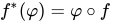
If f : VW is a linear map, then the transpose (or dual) f : WV is defined by

for every . The resulting functional in is called the pullback of along .

The following identity holds for all and :

where the bracket [·,·] on the left is the natural pairing of V with its dual space, and that on the right is the natural pairing of W with its dual. This identity characterizes the transpose,[12] and is formally similar to the definition of the adjoint.

The assignment ff produces an injective linear map between the space of linear operators from V to W and the space of linear operators from W to V; this homomorphism is an isomorphism if and only if W is finite-dimensional. If V = W then the space of linear maps is actually an algebra under composition of maps, and the assignment is then an antihomomorphism of algebras, meaning that (fg) = gf. In the language of category theory, taking the dual of vector spaces and the transpose of linear maps is therefore a contravariant functor from the category of vector spaces over F to itself. It is possible to identify (f) with f using the natural injection into the double dual.

If the linear map f is represented by the matrix A with respect to two bases of V and W, then f is represented by the transpose matrix AT with respect to the dual bases of W and V, hence the name. Alternatively, as f is represented by A acting on the left on column vectors, f is represented by the same matrix acting on the right on row vectors. These points of view are related by the canonical inner product on Rn, which identifies the space of column vectors with the dual space of row vectors.

Quotient spaces and annihilators

[edit]

Let be a subset of . The annihilator of in , denoted here , is the collection of linear functionals such that for all . That is, consists of all linear functionals such that the restriction to vanishes: . Within finite dimensional vector spaces, the annihilator is dual to (isomorphic to) the orthogonal complement.

The annihilator of a subset is itself a vector space. The annihilator of the zero vector is the whole dual space: , and the annihilator of the whole space is just the zero covector: . Furthermore, the assignment of an annihilator to a subset of reverses inclusions, so that if , then

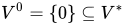
If and are two subsets of then

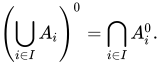
If is any family of subsets of indexed by belonging to some index set , then

In particular if and are subspaces of then

and[nb 3]

If is finite-dimensional and is a vector subspace, then

after identifying with its image in the second dual space under the double duality isomorphism . In particular, forming the annihilator is a Galois connection on the lattice of subsets of a finite-dimensional vector space.

If is a subspace of then the quotient space is a vector space in its own right, and so has a dual. By the first isomorphism theorem, a functional factors through if and only if is in the kernel of . There is thus an isomorphism

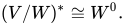
As a particular consequence, if is a direct sum of two subspaces and , then is a direct sum of and .

Dimensional analysis

[edit]

The dual space is analogous to a "negative"-dimensional space. Most simply, since a vector can be paired with a covector by the natural pairing to obtain a scalar, a covector can "cancel" the dimension of a vector, similar to reducing a fraction. Thus while the direct sum is a -dimensional space (if is -dimensional), behaves as an -dimensional space, in the sense that its dimensions can be canceled against the dimensions of . This is formalized by tensor contraction.


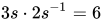
This arises in physics via dimensional analysis, where the dual space has inverse units.[13] Under the natural pairing, these units cancel, and the resulting scalar value is dimensionless, as expected. For example, in (continuous) Fourier analysis, or more broadly time–frequency analysis:[nb 4] given a one-dimensional vector space with a unit of time , the dual space has units of frequency: occurrences per unit of time (units of ). For example, if time is measured in seconds, the corresponding dual unit is the inverse second: over the course of 3 seconds, an event that occurs 2 times per second occurs a total of 6 times, corresponding to . Similarly, if the primal space measures length, the dual space measures inverse length.

Continuous dual space

[edit]

When dealing with topological vector spaces, the continuous linear functionals from the space into the base field (or ) are particularly important. This gives rise to the notion of the "continuous dual space" or "topological dual" which is a linear subspace of the algebraic dual space , denoted by . For any finite-dimensional normed vector space or topological vector space, such as Euclidean n-space, the continuous dual and the algebraic dual coincide. This is however false for any infinite-dimensional normed space, as shown by the example of discontinuous linear maps. Nevertheless, in the theory of topological vector spaces the terms "continuous dual space" and "topological dual space" are often replaced by "dual space".

For a topological vector space its continuous dual space,[14] or topological dual space,[15] or just dual space[14][15][16][17] (in the sense of the theory of topological vector spaces) is defined as the space of all continuous linear functionals .

Important examples for continuous dual spaces are the space of compactly supported test functions and its dual the space of arbitrary distributions (generalized functions); the space of arbitrary test functions and its dual the space of compactly supported distributions; and the space of rapidly decreasing test functions the Schwartz space, and its dual the space of tempered distributions (slowly growing distributions) in the theory of generalized functions.

Properties

[edit]

If X is a Hausdorff topological vector space (TVS), then the continuous dual space of X is identical to the continuous dual space of the completion of X.[1]

Topologies on the dual

[edit]

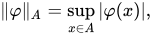
There is a standard construction for introducing a topology on the continuous dual of a topological vector space . Fix a collection of bounded subsets of . This gives the topology on of uniform convergence on sets from or what is the same thing, the topology generated by seminorms of the form

where is a continuous linear functional on , and runs over the class

This means that a net of functionals tends to a functional in if and only if


Usually (but not necessarily) the class is supposed to satisfy the following conditions:

  • Each point of belongs to some set :
  • Each two sets and are contained in some set :
  • is closed under the operation of multiplication by scalars:

If these requirements are fulfilled then the corresponding topology on is Hausdorff and the sets

form its local base.

Here are the three most important special cases.

  • The strong topology on is the topology of uniform convergence on bounded subsets in (so here can be chosen as the class of all bounded subsets in ).

If is a normed vector space (for example, a Banach space or a Hilbert space) then the strong topology on is normed (in fact a Banach space if the field of scalars is complete), with the norm
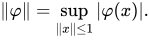
  • The stereotype topology on is the topology of uniform convergence on totally bounded sets in (so here can be chosen as the class of all totally bounded subsets in ).
  • The weak topology on is the topology of uniform convergence on finite subsets in (so here can be chosen as the class of all finite subsets in ).

Each of these three choices of topology on leads to a variant of reflexivity property for topological vector spaces:

  • If is endowed with the strong topology, then the corresponding notion of reflexivity is the standard one: the spaces reflexive in this sense are just called reflexive.[18]
  • If is endowed with the stereotype dual topology, then the corresponding reflexivity is presented in the theory of stereotype spaces: the spaces reflexive in this sense are called stereotype.
  • If is endowed with the weak topology, then the corresponding reflexivity is presented in the theory of dual pairs:[19] the spaces reflexive in this sense are arbitrary (Hausdorff) locally convex spaces with the weak topology.[20]

Examples

[edit]

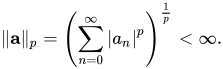
Let 1 < p < ∞ be a real number and consider the Banach space  p of all sequences a = (an) for which

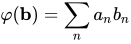
Define the number q by 1/p + 1/q = 1. Then the continuous dual of p is naturally identified with q: given an element , the corresponding element of q is the sequence where denotes the sequence whose n-th term is 1 and all others are zero. Conversely, given an element a = (an) ∈ q, the corresponding continuous linear functional on p is defined by

for all b = (bn) ∈ p (see Hölder's inequality).

In a similar manner, the continuous dual of  1 is naturally identified with  ∞ (the space of bounded sequences). Furthermore, the continuous duals of the Banach spaces c (consisting of all convergent sequences, with the supremum norm) and c0 (the sequences converging to zero) are both naturally identified with  1.

By the Riesz representation theorem, the continuous dual of a Hilbert space is again a Hilbert space which is anti-isomorphic to the original space. This gives rise to the bra–ket notation used by physicists in the mathematical formulation of quantum mechanics.

By the Riesz–Markov–Kakutani representation theorem, the continuous dual of certain spaces of continuous functions can be described using measures.

Transpose of a continuous linear map

[edit]

If T : V → W is a continuous linear map between two topological vector spaces, then the (continuous) transpose T′ : W′ → V′ is defined by the same formula as before:

The resulting functional T′(φ) is in V′. The assignment T → T′ produces a linear map between the space of continuous linear maps from V to W and the space of linear maps from W′ to V′. When T and U are composable continuous linear maps, then

When V and W are normed spaces, the norm of the transpose in L(W′, V′) is equal to that of T in L(V, W). Several properties of transposition depend upon the Hahn–Banach theorem. For example, the bounded linear map T has dense range if and only if the transpose T′ is injective.

When T is a compact linear map between two Banach spaces V and W, then the transpose T′ is compact. This can be proved using the Arzelà–Ascoli theorem.

When V is a Hilbert space, there is an antilinear isomorphism iV from V onto its continuous dual V′. For every bounded linear map T on V, the transpose and the adjoint operators are linked by

When T is a continuous linear map between two topological vector spaces V and W, then the transpose T′ is continuous when W′ and V′ are equipped with "compatible" topologies: for example, when for X = V and X = W, both duals X′ have the strong topology β(X′, X) of uniform convergence on bounded sets of X, or both have the weak-∗ topology σ(X′, X) of pointwise convergence on X. The transpose T′ is continuous from β(W′, W) to β(V′, V), or from σ(W′, W) to σ(V′, V).

Annihilators

[edit]

Assume that W is a closed linear subspace of a normed space V, and consider the annihilator of W in V′,

Then, the dual of the quotient V / W can be identified with W, and the dual of W can be identified with the quotient V′ / W.[21] Indeed, let P denote the canonical surjection from V onto the quotient V / W; then, the transpose P′ is an isometric isomorphism from (V / W )′ into V′, with range equal to W. If j denotes the injection map from W into V, then the kernel of the transpose j′ is the annihilator of W:
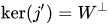
and it follows from the Hahn–Banach theorem that j′ induces an isometric isomorphism V′ / WW′.

Further properties

[edit]

If the dual of a normed space V is separable, then so is the space V itself. The converse is not true: for example, the space  1 is separable, but its dual  ∞ is not.

Double dual

[edit]
This is a natural transformation of vector addition from a vector space to its double dual. x1, x2 denotes the ordered pair of two vectors. The addition + sends x1 and x2 to x1 + x2. The addition +′ induced by the transformation can be defined as for any in the dual space.

In analogy with the case of the algebraic double dual, there is always a naturally defined continuous linear operator Ψ : VV′′ from a normed space V into its continuous double dual V′′, defined by

As a consequence of the Hahn–Banach theorem, this map is in fact an isometry, meaning ‖ Ψ(x) ‖ = ‖ x for all xV. Normed spaces for which the map Ψ is a bijection are called reflexive.

When V is a topological vector space then Ψ(x) can still be defined by the same formula, for every xV, however several difficulties arise. First, when V is not locally convex, the continuous dual may be equal to { 0 } and the map Ψ trivial. However, if V is Hausdorff and locally convex, the map Ψ is injective from V to the algebraic dual V′ of the continuous dual, again as a consequence of the Hahn–Banach theorem.[nb 5]

Second, even in the locally convex setting, several natural vector space topologies can be defined on the continuous dual V′, so that the continuous double dual V′′ is not uniquely defined as a set. Saying that Ψ maps from V to V′′, or in other words, that Ψ(x) is continuous on V′ for every xV, is a reasonable minimal requirement on the topology of V′, namely that the evaluation mappings

be continuous for the chosen topology on V′. Further, there is still a choice of a topology on V′′, and continuity of Ψ depends upon this choice. As a consequence, defining reflexivity in this framework is more involved than in the normed case.

See also

[edit]

Notes

[edit]

References

[edit]

Bibliography

[edit]
[edit]
Revisions and contributorsEdit on WikipediaRead on Wikipedia
from Grokipedia
In linear algebra, the dual space $ V^* $ of a vector space $ V $ over a field $ \mathbb{F} $ (such as $ \mathbb{R} $ or $ \mathbb{C} $) is the vector space consisting of all linear functionals on $ V $, that is, all linear maps from $ V $ to $ \mathbb{F} $.[1] The dual space inherits the structure of a vector space under pointwise addition and scalar multiplication of functionals.[2] If $ V $ has finite dimension $ n $, then $ V^* $ also has dimension $ n $, establishing a natural isomorphism between $ V $ and $ V^* $. Given a basis $ {e_1, \dots, e_n} $ for $ V $, there exists a corresponding dual basis $ {e^1, \dots, e^n} $ for $ V^* $ satisfying $ e^i(e_j) = \delta_{ij} $, the Kronecker delta, which uniquely determines coordinates in the dual space.[2] The bidual $ V^{**} $, or dual of the dual, contains $ V $ via the natural evaluation map $ \hat{v}: V^* \to \mathbb{F} $ defined by $ \hat{v}(\phi) = \phi(v) $ for $ \phi \in V^* $, and this embedding is an isomorphism for finite-dimensional spaces.[2] In the context of linear transformations, the dual space facilitates the definition of the dual map or transpose: for a linear map $ T: V \to W $, its dual $ T^: W^ \to V^* $ is given by $ (T^* \psi)(v) = \psi(T v) $ for $ \psi \in W^* $ and $ v \in V $, preserving the structure of homomorphisms between spaces.[2] Beyond algebra, in functional analysis, the continuous dual refers to the space of continuous linear functionals on a topological vector space, which coincides with the algebraic dual for finite-dimensional normed spaces but differs in infinite dimensions, underpinning concepts like weak topologies and reflexivity in Banach spaces.[3] Dual spaces are fundamental in applications ranging from optimization and quantum mechanics (via bra-ket notation) to representation theory, where they encode covectors and multilinear forms.

Algebraic dual space

Definition

In linear algebra, given a vector space VV over a field KK, the algebraic dual space, denoted VV^*, is defined as the set of all linear functionals on VV, that is, all linear maps ϕ:VK\phi: V \to K.[1] The elements of VV^* are called linear functionals, and VV^* itself forms a vector space under the operations of pointwise addition and scalar multiplication: for ϕ,ψV\phi, \psi \in V^*, vVv \in V, and cKc \in K,
(ϕ+ψ)(v)=ϕ(v)+ψ(v),(cϕ)(v)=cϕ(v). (\phi + \psi)(v) = \phi(v) + \psi(v), \quad (c \phi)(v) = c \cdot \phi(v).
These operations endow VV^* with the structure of a vector space over KK.[4] To confirm that VV^* is indeed a vector space, note that the zero element is the zero functional 0:VK\mathbf{0}: V \to K defined by 0(v)=0\mathbf{0}(v) = 0 for all vVv \in V, which is linear since it preserves addition and scalar multiplication in the codomain. Addition and scalar multiplication in VV^* preserve linearity because if ϕ\phi and ψ\psi are linear, then for any v1,v2Vv_1, v_2 \in V and cKc \in K,
(ϕ+ψ)(v1+v2)=ϕ(v1+v2)+ψ(v1+v2)=ϕ(v1)+ϕ(v2)+ψ(v1)+ψ(v2)=(ϕ+ψ)(v1)+(ϕ+ψ)(v2), (\phi + \psi)(v_1 + v_2) = \phi(v_1 + v_2) + \psi(v_1 + v_2) = \phi(v_1) + \phi(v_2) + \psi(v_1) + \psi(v_2) = (\phi + \psi)(v_1) + (\phi + \psi)(v_2),
and similarly for scalar multiplication, ensuring the result remains linear. The additive inverses and other vector space axioms follow from those of KK. The concept of the dual space originated in the late 19th century within the development of linear algebra, but it was formalized in the early 20th century, particularly by Hans Hahn in 1927, who introduced it in the context of normed linear spaces as part of his work leading to the Hahn-Banach theorem.[5] This algebraic construction laid the groundwork for later extensions in functional analysis by figures such as Stefan Banach.[6] As a concrete example, consider V=KnV = K^n, the vector space of nn-tuples over KK. Each linear functional ϕ(Kn)\phi \in (K^n)^* corresponds to a row vector a=(a1,,an)Kn\mathbf{a} = (a_1, \dots, a_n) \in K^n, where ϕ(x)=ax=i=1naixi\phi(\mathbf{x}) = \mathbf{a} \cdot \mathbf{x} = \sum_{i=1}^n a_i x_i for x=(x1,,xn)Kn\mathbf{x} = (x_1, \dots, x_n) \in K^n, and the vector space structure on (Kn)(K^n)^* matches that of row vectors under componentwise operations.[1]

Finite-dimensional case

When the vector space VV over a field KK is finite-dimensional with dimV=n<\dim V = n < \infty, the algebraic dual space VV^* is also finite-dimensional, and dimV=n\dim V^* = n.[7] This equality of dimensions follows from the fact that the dual space consists of all linear functionals from VV to KK, and the space of such functionals has a basis in one-to-one correspondence with a basis of VV.[8] Moreover, VV is isomorphic to VV^*, though the isomorphism is not canonical and depends on the choice of a basis for VV.[7] A key construction in this setting is the dual basis. Let {e1,,en}\{e_1, \dots, e_n\} be a basis for VV. Then there exists a unique basis {e1,,en}\{e^1, \dots, e^n\} for VV^*, called the dual basis, such that ei(ej)=δije^i(e_j) = \delta_{ij} for all i,j=1,,ni, j = 1, \dots, n, where δij\delta_{ij} is the Kronecker delta (equal to 1 if i=ji = j and 0 otherwise).[9] This dual basis provides a concrete way to express any linear functional ϕV\phi \in V^* as a unique linear combination ϕ=i=1nϕ(ei)ei\phi = \sum_{i=1}^n \phi(e_i) e^i.[10] In coordinates with respect to the basis {e1,,en}\{e_1, \dots, e_n\}, linear functionals in VV^* can be represented as row vectors. Specifically, for ϕV\phi \in V^*, its coordinate representation is the row vector (ϕ(e1),,ϕ(en))(\phi(e_1), \dots, \phi(e_n)), and if vVv \in V has coordinate column vector (v1,,vn)T(v_1, \dots, v_n)^T with v=j=1nvjejv = \sum_{j=1}^n v_j e_j, then ϕ(v)=(ϕ(e1),,ϕ(en))(v1vn)\phi(v) = (\phi(e_1), \dots, \phi(e_n)) \begin{pmatrix} v_1 \\ \vdots \\ v_n \end{pmatrix}.[4] This matrix multiplication interprets the action of the dual space on VV in a familiar computational form. The finite-dimensional structure also implies reflexivity: the natural evaluation map ev:VV\mathrm{ev}: V \to V^{**} defined by evv(ϕ)=ϕ(v)\mathrm{ev}_v(\phi) = \phi(v) for vVv \in V and ϕV\phi \in V^* is a linear isomorphism.[7] Here, VV^{**} is the double dual, the dual of VV^*. The map is injective because if evv=0\mathrm{ev}_v = 0, then v=0v = 0 by the separating property of VV^* on VV, and surjective because dimV=dimV\dim V = \dim V^{**}.[10] This isomorphism identifies VV with a subspace of VV^{**}, embedding vectors as evaluation functionals.

Infinite-dimensional case

In the infinite-dimensional case, the algebraic dual space VV^* of a vector space VV over a field KK with K2|K| \geq 2 exhibits significantly different properties compared to the finite-dimensional setting, primarily due to cardinal arithmetic. If VV has a Hamel basis of infinite cardinality κ\kappa, then the dimension of VV^* is Kκ|K|^\kappa, which strictly exceeds κ\kappa.[11] This follows from the isomorphism VKBV^* \cong K^B, where BB is a basis of VV with B=κ|B| = \kappa, as linear functionals are uniquely determined by their arbitrary values on BB, yielding a vector space of dimension Kκ|K|^\kappa.[12] Consequently, there exists no isomorphism between VV and VV^* in the infinite-dimensional case, as their dimensions differ: dimV=κ<Kκ=dimV\dim V = \kappa < |K|^\kappa = \dim V^*.[13] Unlike the finite-dimensional scenario, where a natural dual basis provides a canonical isomorphism, no such canonical identification is possible here without imposing additional structure, such as a topology.[11] A concrete example illustrates this disparity: consider V=K(N)V = K^{(\mathbb{N})}, the vector space of sequences in KK with only finitely many nonzero terms, which has dimension 0\aleph_0. The dual VV^* then consists of all (arbitrarily supported) sequences in KNK^\mathbb{N}, so dimV=K0>0\dim V^* = |K|^{\aleph_0} > \aleph_0.[12] In this setup, a dual basis to the standard countable basis of VV exists but spans only the subspace of functionals with finite support relative to that basis; the full Hamel basis for VV^* must have cardinality K0|K|^{\aleph_0}, which is uncountable and typically non-constructive to specify explicitly.[11] Further pathologies arise in the double dual VV^{**}. The dimension of VV^{**} is KKκ|K|^{|K|^\kappa}, vastly larger than dimV\dim V^*, and the canonical injection VVV \to V^{**} given by vv^v \mapsto \hat{v}, where v^(f)=f(v)\hat{v}(f) = f(v) for fVf \in V^*, is injective but not surjective.[12] This embedding identifies VV with a proper subspace of VV^{**}, highlighting the absence of reflexivity in the purely algebraic setting for infinite dimensions.[11]

Bases and dimension

Given a basis $ B = {e_i}{i \in I} $ of a vector space $ V $ over a field $ K $, the dual basis $ {e^i}{i \in I} $ of the algebraic dual space $ V^* $ is defined by the property that $ e^i(e_j) = \delta_{ij} $ for all $ i, j \in I $, where $ \delta_{ij} $ is the Kronecker delta (1 if $ i = j $, 0 otherwise).[9] This construction ensures that the dual basis is linearly independent and spans $ V^* $ in the algebraic sense.[9] Every linear functional $ \phi \in V^* $ admits a unique representation in coordinates with respect to the dual basis: $ \phi = \sum_{i \in I} \phi(e_i) e^i $, where the sum is finite (i.e., has finite support) even if $ I $ is infinite, reflecting the algebraic nature of the dual space.[11] This uniqueness follows from the linear independence of the dual basis and the fact that any linear functional is determined by its values on the basis of $ V $.[9] In the finite-dimensional case, if $ \dim V = n < \infty $, then $ \dim V^* = n $ as well, since the dual basis has the same cardinality as the original basis.[12] For infinite-dimensional $ V $, the algebraic dimension satisfies $ \dim V^* = |K|^{\dim V} $ in the sense of cardinal arithmetic, which equals $ 2^{\dim V} $ when $ K = \mathbb{R} $ or $ \mathbb{C} $ and $ \dim V $ is infinite.[11][12] More precisely, if $ \dim V $ is infinite and $ |K| \geq 2 $, the cardinality of $ V^* $ is $ |K|^{\dim V} $, reflecting that linear functionals are determined by arbitrary assignments of values from $ K $ to the basis elements of $ V $, with finite support in linear combinations.[14] A concrete example arises with the vector space $ V = K[x] $ of polynomials over $ K $, which has Hamel basis $ B = {1, x, x^2, \dots } $ with $ \dim V = \aleph_0 $. The corresponding dual basis consists of linear functionals $ e^n $ for $ n \geq 0 $ such that $ e^n(p) $ extracts the coefficient of $ x^n $ in $ p(x) = \sum_{k=0}^\infty a_k x^k $, satisfying $ e^n(x^m) = \delta_{nm} $.[11] Thus, $ \dim V^* = |K|^{\aleph_0} $, which is the cardinality of all sequences in $ K $.[12]

Bilinear forms and pairings

A bilinear form on a vector space $ V $ over a field $ K $ is a function $ B: V \times V \to K $ that is linear in each argument separately, meaning $ B(av + bw, u) = a B(v, u) + b B(w, u) $ and $ B(v, au + bw) = a B(v, u) + b B(v, w) $ for all scalars $ a, b \in K $ and vectors $ v, w, u \in V $.[15] This structure allows bilinear forms to encode inner product-like behaviors in abstract vector spaces. Equivalently, any bilinear form $ B $ corresponds to a unique linear map $ \phi_B: V \to V^* $, where $ V^* $ denotes the algebraic dual space of $ V $, defined by $ B(v, w) = \langle v, \phi_B(w) \rangle $ for all $ v, w \in V $, with $ \langle \cdot, \cdot \rangle $ the natural evaluation pairing between $ V $ and $ V^* $.[16] This identification highlights the intimate connection between bilinear forms and dual spaces, as $ B $ essentially "lifts" elements of $ V $ into functionals via the second argument. The bilinear form $ B $ is called non-degenerate if the associated map $ \phi_B: V \to V^* $ is injective (meaning if $ B(v, w) = 0 $ for all $ w \in V $ implies $ v = 0 $, and similarly for the left action). In the finite-dimensional case, non-degeneracy implies $ \phi_B $ is bijective, thereby inducing a natural isomorphism $ V \cong V^* $. In infinite dimensions, non-degeneracy embeds $ V $ injectively into a proper subspace of $ V^* $.[15] Specific classes of bilinear forms include symmetric forms, where $ B(v, w) = B(w, v) $ for all $ v, w \in V $, and alternating forms, where $ B(v, v) = 0 $ for all $ v \in V $. A canonical example is the standard dot product on $ \mathbb{R}^n $, defined by $ B(v, w) = v_1 w_1 + \cdots + v_n w_n $, which is symmetric and non-degenerate, yielding the isomorphism $ \mathbb{R}^n \cong (\mathbb{R}^n)^* $ via coordinate functionals.[7] More broadly, a pairing refers to a bilinear map $ \langle \cdot, \cdot \rangle : V \times W \to K $ between two vector spaces $ V $ and $ W $, linear in each factor. If this pairing separates points in $ W $—that is, if $ \langle v, w \rangle = 0 $ for all $ v \in V $ implies $ w = 0 $—then it induces an injective linear map $ W \to V^* $ given by $ w \mapsto (v \mapsto \langle v, w \rangle ) $, allowing $ W $ to be identified as a subspace of $ V^* $.[17] In the finite-dimensional setting, suppose $ V $ has basis $ { e_1, \dots, e_n } $; then the matrix representation of $ B $ is the Gram matrix $ G $ with entries $ G_{ij} = B(e_i, e_j) $, and $ B $ is non-degenerate if and only if $ \det G \neq 0 $.[15] This determinant condition provides a concrete algebraic test for the isomorphism $ V \cong V^* $.

Dual mappings and constructions

Transpose of a linear map

Given a linear map $ T: V \to W $ between vector spaces over a field $ F $, the transpose (or dual map) $ T^: W^ \to V^* $ is the linear map defined by $ (T^* \psi)(v) = \psi(T v) $ for all $ \psi \in W^* $ and $ v \in V $, where $ V^* $ and $ W^* $ denote the algebraic dual spaces.[10] This construction preserves linearity: for scalars $ \alpha, \beta \in F $ and $ \psi_1, \psi_2 \in W^* $, $ (T^(\alpha \psi_1 + \beta \psi_2))(v) = \alpha (T^ \psi_1)(v) + \beta (T^* \psi_2)(v) $.[18] The transpose exhibits several key properties relating the structure of $ T $ to that of $ T^* $. Specifically, if $ T $ is injective, then $ T^* $ is surjective; conversely, if $ T $ is surjective, then $ T^* $ is injective.[19] In the finite-dimensional case, the dimensions satisfy $ \dim(\ker T^) = \dim(\coker T) $, where $ \coker T = W / \im T $, following from the rank-nullity theorem applied to the dual spaces, since $ \dim V^ = \dim V $ and $ \dim W^* = \dim W $.[20] In terms of bases, suppose $ {v_i} $ and $ {w_j} $ are bases for $ V $ and $ W $, respectively, with dual bases $ {v_i^} $ and $ {w_j^} $. If the matrix of $ T $ with respect to these bases is $ A $ (whose columns are the coordinates of $ T(v_i) $ in the $ {w_j} $-basis), then the matrix of $ T^* $ with respect to the dual bases is the transpose $ A^T $.[21] For the concrete case where $ V = F^m $ and $ W = F^n $ with standard bases, $ T $ is represented by an $ n \times m $ matrix $ A $, and $ T^* $ acts by pre-multiplication with $ A^T $, so $ T^* \psi = \psi \circ A $ for $ \psi: F^n \to F $.[22] Regarding the double dual, the transpose of $ T^* $ is a map $ T^{}: V^{} \to W^{} $. In the algebraic setting, $ T^{} $ coincides with the action of $ T $ under the canonical injection $ V \to V^{**} $, but this identification yields an isomorphism only when $ V $ and $ W $ are finite-dimensional; in infinite dimensions, the canonical map is injective but generally not surjective.[9]

Annihilators and quotient spaces

In the context of a vector space VV over a field KK and a subspace UVU \subseteq V, the annihilator of UU, denoted UU^\perp, is defined as the set of all linear functionals in the dual space VV^* that vanish on every element of UU:
U={ϕVϕ(u)=0 uU}. U^\perp = \{ \phi \in V^* \mid \phi(u) = 0 \ \forall \, u \in U \}.
This set forms a subspace of VV^*.[23][24] When VV is finite-dimensional, the dimension of the annihilator satisfies the relation dimU=dimVdimU\dim U^\perp = \dim V - \dim U. This follows from the fact that the annihilator corresponds to the kernel of the restriction map from VV^* to UU^*, which has dimension dimU\dim U, and the first isomorphism theorem for vector spaces yields the codimension.[25][26] The annihilator also provides a natural isomorphism with the dual space of the quotient V/UV/U. Specifically, there is a canonical linear map π:(V/U)V\pi^*: (V/U)^* \to V^* defined by (π(φ))(v)=φ(π(v))(\pi^*(\varphi))(v) = \varphi(\pi(v)), where π:VV/U\pi: V \to V/U is the projection. This map is injective, and its image is precisely UU^\perp, establishing the isomorphism (V/U)U(V/U)^* \cong U^\perp. Equivalently, the map sending ψU\psi \in U^\perp to the functional on V/UV/U given by ψ~(v+U)=ψ(v)\tilde{\psi}(v + U) = \psi(v) is an isomorphism.[25][26][10] Applying the annihilator construction twice yields further insights. In general, (U)U(U^\perp)^\perp \cong U^{**} via the dual of the quotient isomorphism V/UUV^*/U^\perp \cong U^*, and via the canonical injection j:VVj: V \to V^{**}, we have j(U)(U)Vj(U) \subseteq (U^\perp)^\perp \subseteq V^{**}. When UU (or equivalently VV) is finite-dimensional, jj is an isomorphism, so (U)=j(U)U(U^\perp)^\perp = j(U) \cong U. In the infinite-dimensional case where dimU=\dim U = \infty, the inclusion j(U)(U)j(U) \subsetneq (U^\perp)^\perp is generally strict.[25][10] As an illustrative example, consider V=RnV = \mathbb{R}^n with the standard dual basis, and let U=span{e1}U = \operatorname{span}\{e_1\}, where e1=(1,0,,0)e_1 = (1, 0, \dots, 0). The annihilator UU^\perp consists of all linear functionals ϕ(Rn)\phi \in (\mathbb{R}^n)^* such that ϕ(e1)=0\phi(e_1) = 0, which are precisely those that vanish on the first coordinate. Identifying (Rn)Rn(\mathbb{R}^n)^* \cong \mathbb{R}^n via the standard inner product, UU^\perp corresponds to the hyperplane orthogonal to e1e_1, having dimension n1n-1.[23][25]

Double dual and canonical injection

The double dual space of a vector space $ V $ over a field $ k $, denoted $ V^{**} $, is defined as the algebraic dual of the dual space $ V^* $, consisting of all $ k $-linear functionals from $ V^* $ to $ k $.[27] A canonical linear map $ j: V \to V^{**} $, known as the canonical injection (or natural embedding), is given by $ j(v)(\phi) = \phi(v) $ for all $ v \in V $ and $ \phi \in V^* $. This construction identifies each vector $ v $ with the evaluation functional on $ V^* $ that picks out the value of any functional at $ v $. The map $ j $ is always linear by the linearity of evaluation.[28] The injectivity of $ j $ follows from the fact that $ V^* $ separates points on $ V $: if $ j(v) = 0 $, then $ \phi(v) = 0 $ for every $ \phi \in V^* $. Using the axiom of choice, one can construct a Hamel basis for $ V $ containing $ v $ (assuming $ v \neq 0 $) and define a functional $ \phi $ that is 1 on $ v $ and 0 on the rest of the basis, yielding $ \phi(v) = 1 $, a contradiction. Thus, the algebraic dual $ V^* $ always admits a separating family of functionals under the axiom of choice, ensuring $ j $ is injective.[9] When $ V $ is finite-dimensional, $ j $ is an isomorphism, establishing that $ V \cong V^{} $ as vector spaces. This reflexivity holds because the dimensions satisfy $ \dim V = \dim V^* = \dim V^{} $, and $ j $ is both injective and surjective in this case.[29] In the infinite-dimensional case, however, $ j(V) $ forms a proper subspace of $ V^{} $, so $ V $ is not isomorphic to its double dual. For a concrete example, let $ V = \bigoplus_{n=1}^\infty k $ be the vector space of sequences in $ k $ with only finitely many nonzero terms (direct sum of countably many copies of $ k $). Then $ V^* \cong \prod_{n=1}^\infty k $, the space of all sequences in $ k $ (direct product), via the action on basis vectors. The double dual $ V^{} $ consists of all linear functionals on this product space, which has cardinality larger than that of $ V $ (assuming $ k $ is infinite), containing elements beyond the image of $ j $, such as functionals that sum over infinite supports in a linear fashion not representable by finite-support evaluations.[30]

Continuous dual space

Definition and properties

In the context of a topological vector space $ V $ over a field $ K $ (typically $ \mathbb{R} $ or $ \mathbb{C} $), the continuous dual space, denoted $ V' $, consists of all continuous linear functionals $ \phi: V \to K $. These are linear maps that are continuous with respect to the topology on $ V $, forming a vector subspace of the algebraic dual $ V^* $, which comprises all linear functionals regardless of continuity.[27] When $ V $ is a normed space, a linear functional $ \phi $ is continuous if and only if it is bounded, meaning there exists $ M > 0 $ such that $ |\phi(v)| \leq M |v| $ for all $ v \in V $.[31] The space $ V' $ inherits the structure of a topological vector space under pointwise operations: addition $ (\phi + \psi)(v) = \phi(v) + \psi(v) $ and scalar multiplication $ (c\phi)(v) = c \phi(v) $ for $ \phi, \psi \in V' $, $ c \in K $, and $ v \in V $.[27] If $ V $ is normed, $ V' $ is closed under uniform convergence on the unit ball.[31] In a Hausdorff topological vector space $ V $, the continuous dual $ V' $ separates points: for any distinct $ v, w \in V $, there exists $ \phi \in V' $ such that $ \phi(v) \neq \phi(w) $.[32] For example, when $ V = \mathbb{R}^n $ is equipped with the Euclidean topology, every linear functional is continuous, so $ V' $ coincides with the algebraic dual $ V^* $.[3] The Hahn-Banach theorem ensures the existence of non-zero continuous linear functionals on subspaces and their extensions to the whole space while preserving boundedness, providing a foundational tool for constructing elements of $ V' $.[33]

Topologies on the dual space

In the context of a locally convex topological vector space VV over R\mathbb{R} or C\mathbb{C}, the continuous dual space VV' can be equipped with several standard topologies derived from the duality pairing ϕ,v=ϕ(v)\langle \phi, v \rangle = \phi(v) for ϕV\phi \in V' and vVv \in V. These topologies facilitate the study of continuity and convergence in infinite-dimensional settings, where the norm topology on VV' may be too coarse or restrictive.[34] The weak* topology on VV', denoted σ(V,V)\sigma(V', V), is the coarsest topology making all evaluation maps evv:VKev_v: V' \to \mathbb{K}, ϕϕ(v)\phi \mapsto \phi(v), continuous for each vVv \in V. It is generated by the seminorms pv(ϕ)=ϕ(v)p_v(\phi) = |\phi(v)|, vVv \in V. This topology renders VV' Hausdorff provided that VV' separates points in VV, which holds for Hausdorff locally convex spaces. A net (ϕα)(\phi_\alpha) in VV' converges to ϕV\phi \in V' in the weak* topology if and only if ϕα(v)ϕ(v)\phi_\alpha(v) \to \phi(v) for every vVv \in V. If $ V $ is a separable Banach space, then the weak* topology restricted to the closed unit ball of $ V' $ is metrizable.[34][35] The compact-open topology, or topology of uniform convergence on compact subsets of VV, denoted τc\tau_c, has as a subbasis the sets
{ϕV:supvKϕ(v)ψ(v)<ε} \{\phi \in V' : \sup_{v \in K} |\phi(v) - \psi(v)| < \varepsilon\}
for compact KVK \subset V, ε>0\varepsilon > 0, and ψV\psi \in V'. For locally convex VV, this topology coincides with the Mackey topology in certain cases and ensures continuity of linear maps when VV has a rich supply of compact sets. It is finer than the weak* topology and locally convex. The strong dual topology, denoted β(V,V)\beta(V', V), is the topology of uniform convergence on bounded subsets of VV. It is generated by the seminorms pB(ϕ)=supvBϕ(v)p_B(\phi) = \sup_{v \in B} |\phi(v)|, where BVB \subset V ranges over the bounded sets. This topology is finer than both the weak* and compact-open topologies, making VV' a complete locally convex space when VV is a Fréchet space, and it aligns with the norm topology on VV' when VV is a Banach space.[36][34] Among these, the weak* topology is the weakest, ensuring VV' is always locally convex, while the strong dual topology is the strongest polar topology compatible with the duality. In Banach spaces, Alaoglu's theorem asserts that the closed unit ball {ϕV:ϕ1}\{\phi \in V' : \|\phi\| \leq 1\} is compact in the weak* topology, providing a fundamental tool for existence results in optimization and approximation. This compactness fails in the norm or strong topologies.[34][37]

Reflexivity and double dual

In the context of continuous dual spaces, the double dual VV'' of a topological vector space VV is endowed with the weak^* topology, defined as the weakest topology making all evaluation maps ϕ^:VR\hat{\phi}: V'' \to \mathbb{R} (or C\mathbb{C}), ϕ^(F)=F(ϕ)\hat{\phi}(F) = F(\phi) for ϕV\phi \in V', continuous. The canonical embedding j:VVj: V \to V'', given by j(v)(ϕ)=ϕ(v)j(v)( \phi ) = \phi(v) for vVv \in V and ϕV\phi \in V', is linear and continuous from the original topology on VV to the weak^* topology on VV''; moreover, jj is injective whenever VV is a Hausdorff topological vector space.[38] A topological vector space VV is said to be reflexive if the canonical embedding j:Vj(V)j: V \to j(V) is a topological isomorphism, where VV carries its original topology and j(V)j(V) is equipped with the subspace topology induced by the weak^* topology on VV''. For Banach spaces, reflexivity is equivalent to jj being surjective (hence an isometric isomorphism), in which case the original norm topology on VV coincides with the weak topology on bounded sets and also with the pullback of the weak^* topology via jj. By Kakutani's theorem, a Banach space VV is reflexive if and only if its closed unit ball is weakly compact.[39][40] Hilbert spaces provide a canonical example of reflexive spaces: the Riesz representation theorem identifies the continuous dual HH' of a Hilbert space HH isometrically with HH itself via the inner product, ϕ(v)=u,v\phi(v) = \langle u, v \rangle for some uHu \in H, implying that the canonical embedding j:HHj: H \to H'' is surjective and thus an isomorphism. More generally, by James' theorem, a Banach space VV is reflexive if and only if every continuous linear functional on VV attains its norm on the closed unit ball of VV.[41][42] Reflexive Banach spaces exhibit several key properties related to their topologies and geometry. The closed unit ball BVB_V of a reflexive Banach space VV is weakly compact, and by the Krein-Milman theorem, BVB_V equals the weak closure of the convex hull of its extreme points; moreover, infinite-dimensional reflexive spaces possess uncountably many extreme points in BVB_V.[43][40] A prominent example of a non-reflexive Banach space is 1\ell^1, the space of absolutely summable sequences: its continuous dual is \ell^\infty, the space of bounded sequences, but the double dual ()(\ell^\infty)^* properly contains 1\ell^1 as the image j(1)j(\ell^1), consisting of functionals representable by absolutely summable sequences, while ()(\ell^\infty)^* includes additional singular functionals on \ell^\infty that vanish on c0c_0 (the subspace of sequences converging to zero). Thus, j:1(1)j: \ell^1 \to (\ell^1)'' is a proper embedding, confirming non-reflexivity.[44]

Examples and applications

Finite-dimensional examples

In the finite-dimensional Euclidean space Rn\mathbb{R}^n, the algebraic dual space (Rn)(\mathbb{R}^n)^* consists of all linear functionals on Rn\mathbb{R}^n, which can be identified with Rn\mathbb{R}^n itself through the standard dot product x,y=xy\langle x, y \rangle = x \cdot y, where each functional ϕy(z)=yz\phi_y(z) = y \cdot z for yRny \in \mathbb{R}^n.[45] This identification is canonical and preserves the vector space structure, with the dimension of the dual space equaling nn.[10] In the presence of the standard Euclidean topology, the continuous dual space coincides with the algebraic dual, as every linear functional is continuous.[9] For the space of m×nm \times n matrices Mm×n(K)M_{m \times n}(\mathbb{K}) over a field K\mathbb{K} (such as R\mathbb{R} or C\mathbb{C}), the dual space has dimension mnmn and can be identified with Mn×m(K)M_{n \times m}(\mathbb{K}) via the trace inner product A,B=Tr(ATB)\langle A, B \rangle = \operatorname{Tr}(A^T B), where each functional is given by ϕB(A)=Tr(BTA)\phi_B(A) = \operatorname{Tr}(B^T A).[46] This pairing induces an isomorphism, and under the Frobenius norm (derived from the trace inner product), all algebraic dual elements are continuous.[47] The space of polynomials Pn(K)P_n(\mathbb{K}) of degree at most nn over K\mathbb{K} provides another example, where the dual space Pn(K)P_n(\mathbb{K})^* admits bases formed by evaluation functionals at n+1n+1 distinct points s0,,sns_0, \dots, s_n, defined by ϕsj(p)=p(sj)\phi_{s_j}(p) = p(s_j) for pPn(K)p \in P_n(\mathbb{K}).[45] Alternatively, coefficient functionals extracting the coefficients in the monomial basis also span the dual.[48] Equipped with the supremum norm on a compact interval, all these functionals are continuous, making the continuous dual identical to the algebraic dual.[45] Over the complex numbers, the dual of Cm\mathbb{C}^m is naturally represented by row vectors, where a functional ϕ\phi acts as ϕ(z)=wz\phi(z) = w z for a row vector wC1×mw \in \mathbb{C}^{1 \times m} and column vector zCmz \in \mathbb{C}^m, under the standard topology.[45] This representation highlights the isomorphism between Cm\mathbb{C}^m and its dual, facilitated by the Hermitian inner product. In finite-dimensional optimization, elements of the dual space appear as Lagrange multipliers, where for a constrained problem minf(x)\min f(x) subject to g(x)=0g(x) = 0, the multipliers λ\lambda lie in the dual of the constraint space, enabling the formulation of the Lagrangian L(x,λ)=f(x)+λg(x)\mathcal{L}(x, \lambda) = f(x) + \lambda \cdot g(x).[49]

Common infinite-dimensional examples

In infinite-dimensional settings, the continuous dual spaces of classical Banach spaces often admit explicit identifications that differ markedly from their algebraic duals, which consist of all linear functionals without continuity requirements. A prominent example is the sequence space p\ell^p for 1p<1 \leq p < \infty, whose continuous dual (p)(\ell^p)^* is isometrically isomorphic to q\ell^q, where 1p+1q=1\frac{1}{p} + \frac{1}{q} = 1.[50] The duality pairing is given by x,y=n=1xnyn\langle x, y \rangle = \sum_{n=1}^\infty x_n y_n for x=(xn)px = (x_n) \in \ell^p and y=(yn)qy = (y_n) \in \ell^q, with the operator norm on q\ell^q ensuring boundedness: for any ϕ(p)\phi \in (\ell^p)^*, there exists a=(an)qa = (a_n) \in \ell^q such that ϕ(x)=n=1anxn\phi(x) = \sum_{n=1}^\infty a_n x_n and ϕ=aq<\|\phi\| = \|a\|_q < \infty.[50] When p=1p=1, the conjugate exponent q=q = \infty, so (1)(\ell^1)^* \cong \ell^\infty, where functionals act via summation against bounded sequences.[50] A parallel duality holds for the function spaces Lp(μ)L^p(\mu) over a σ\sigma-finite measure space (X,A,μ)(X, \mathcal{A}, \mu), where 1p<1 \leq p < \infty: the continuous dual (Lp(μ))(L^p(\mu))^* is isometrically isomorphic to Lq(μ)L^q(\mu) under the pairing f,g=Xfgdμ\langle f, g \rangle = \int_X f \, g \, d\mu for fLp(μ)f \in L^p(\mu) and gLq(μ)g \in L^q(\mu).[51] This identification follows from the Riesz representation theorem for LpL^p spaces, which characterizes bounded linear functionals as integration against LqL^q functions, again with ϕ=gq<\|\phi\| = \|g\|_q < \infty.[51] For p=1p=1, the dual is L(μ)L^\infty(\mu).[51] Another key example is the space C(K)C(K) of continuous real- or complex-valued functions on a compact Hausdorff space KK, equipped with the sup norm. Its continuous dual C(K)C(K)^* is isometrically isomorphic to the space M(K)M(K) of finite signed regular Borel measures on KK, via the pairing f,μ=Kfdμ\langle f, \mu \rangle = \int_K f \, d\mu for fC(K)f \in C(K) and μM(K)\mu \in M(K).[52] This follows from the Riesz–Markov–Kakutani representation theorem, which ensures every bounded linear functional on C(K)C(K) arises uniquely from such a measure, with the total variation norm μTV\|\mu\|_{TV} matching the dual norm.[52] The weak* topology on M(K)M(K) is particularly useful for studying convergence of sequences of measures in this dual space.[52] In the context of Sobolev spaces, the continuous dual of H01(Ω)H_0^1(\Omega) for a bounded domain ΩRn\Omega \subset \mathbb{R}^n with smooth boundary is H1(Ω)H^{-1}(\Omega), the dual space consisting of distributions.[53] Elements of H1(Ω)H^{-1}(\Omega) act on H01(Ω)H_0^1(\Omega) via the pairing v,u=Ωfudx+i=1nΩgiuxidx\langle v, u \rangle = \int_\Omega f u \, dx + \sum_{i=1}^n \int_\Omega g_i \frac{\partial u}{\partial x_i} \, dx, where vv is represented by f,giL2(Ω)f, g_i \in L^2(\Omega), with the norm v1=inf{(f22+i=1ngi22)1/2}\|v\|_{-1} = \inf \left\{ \left( \|f\|_2^2 + \sum_{i=1}^n \|g_i\|_2^2 \right)^{1/2} \right\} over all such representations. Alternatively, via the Riesz representation theorem, there exists a unique wH01(Ω)w \in H_0^1(\Omega) such that v,u=Ω(wu+wu)dx\langle v, u \rangle = \int_\Omega (w u + \nabla w \cdot \nabla u) \, dx for all uH01(Ω)u \in H_0^1(\Omega).[53] This structure highlights how boundary conditions influence the dual, with H01(Ω)H1(Ω)H_0^1(\Omega)^* \cong H^{-1}(\Omega) for functions vanishing on Ω\partial \Omega.[53] A notable distinction in infinite dimensions is the size of the algebraic versus continuous duals. For instance, the algebraic dual of 2\ell^2 comprises all linear functionals on sequences, which is vastly larger (in cardinality and without norm structure) than the continuous dual (2)2(\ell^2)^* \cong \ell^2 under the Hilbert space inner product x,y=n=1xnyn\langle x, y \rangle = \sum_{n=1}^\infty x_n \overline{y_n}.[50] Continuity imposes the boundedness condition supx21ϕ(x)<\sup_{\|x\|_2 \leq 1} |\phi(x)| < \infty, restricting functionals to those representable by 2\ell^2 sequences.[50]

Hahn-Banach theorem and extensions

The Hahn-Banach theorem provides a fundamental tool for extending linear functionals on normed vector spaces while preserving bounds, playing a central role in the study of dual spaces. In its analytic form for normed spaces over the real or complex field, the theorem states that if VV is a normed vector space, MM a subspace of VV, and ϕ:MK\phi: M \to \mathbb{K} (where K=R\mathbb{K} = \mathbb{R} or C\mathbb{C}) a bounded linear functional satisfying ϕ(x)x|\phi(x)| \leq \|x\| for all xMx \in M, then there exists a bounded linear extension ψ:VK\psi: V \to \mathbb{K} such that ψ(x)x|\psi(x)| \leq \|x\| for all xVx \in V and ψ=ϕ\|\psi\| = \|\phi\|.[54] This extension is achieved without increasing the norm of the functional, ensuring the continuous dual space VV^* inherits key structural properties from subspaces.[55] A key corollary is that every non-trivial normed space has a non-trivial continuous dual space. For any xVx \in V with x0x \neq 0, consider the one-dimensional subspace M=span{x}M = \operatorname{span}\{x\} and define ϕ(tx)=tx\phi(tx) = t \|x\| for tKt \in \mathbb{K}; this satisfies ϕ(y)y|\phi(y)| \leq \|y\| for yMy \in M, so Hahn-Banach extends it to ψV\psi \in V^* with ψ(x)=x\psi(x) = \|x\| and ψ=1\|\psi\| = 1.[56] Consequently, the dual separates points: for distinct x,yVx, y \in V, there exists fVf \in V^* such that f(x)f(y)f(x) \neq f(y), as the functional separating xyx - y from 0 witnesses this.[57] In the complex case, the theorem adapts by treating the real and imaginary parts separately or directly using a sublinear majorant p(x)=xp(x) = \|x\|. Specifically, if ϕ:MC\phi: M \to \mathbb{C} is C\mathbb{C}-linear and bounded, it extends to ψ:VC\psi: V \to \mathbb{C} preserving the bound, since the real part Reϕ\operatorname{Re} \phi is a real-linear functional dominated by \|\cdot\|, extendable via the real version, and the imaginary part follows analogously or via phase adjustment.[56] This ensures the result holds uniformly for both real and complex scalars without altering the core extension mechanism.[54] Applications include the existence of bounded functionals attaining their norms: for any xVx \in V, the extension constructed above yields fVf \in V^* with f=1\|f\| = 1 and f(x)=xf(x) = \|x\|, confirming that the unit ball of VV^* attains its supremum on the unit ball of VV.[57] The geometric form further asserts that if AA and BB are disjoint convex sets in a normed space with AA open, there exists fVf \in V^* with f=1\|f\| = 1 and Ref(a)<αRef(b)\operatorname{Re} f(a) < \alpha \leq \operatorname{Re} f(b) for all aAa \in A, bBb \in B, and some αR\alpha \in \mathbb{R}; this implies supporting hyperplanes for convex sets at boundary points, where a hyperplane {zV:Ref(z)=Ref(x0)}\{z \in V : \operatorname{Re} f(z) = \operatorname{Re} f(x_0)\} touches the set at x0x_0 without crossing it.[58] The standard proof relies on Zorn's lemma for the extension aspect. First, a base step extends any bounded linear functional from a subspace to a one-codimensional enlargement by solving for the value on a new vector vv satisfying the bound via the inequality p(vm)ϕ(m)p(v - m) \geq \phi(m) for mMm \in M, yielding a unique choice in [inf(ϕ(m)+p(vm)),sup(ϕ(m)+p(v+m))][\inf (\phi(m) + p(v - m)), \sup (-\phi(m) + p(v + m))].[57] The collection of all such partial extensions, ordered by inclusion of domains, forms a partially ordered set where chains have upper bounds (unions), so Zorn's lemma guarantees a maximal extension, which must cover VV by density or direct construction.[54] Analytic extensions in several complex variables build on this, adapting to plurisublinear majorants for holomorphic functionals, though the linear case remains the foundation.[59] A notable application in infinite-dimensional dual spaces is the construction of functionals beyond standard representations. In L(μ)L^\infty(\mu), Hahn-Banach yields continuous linear functionals not representable as integration against L1(μ)L^1(\mu) elements; for instance, Banach limits on L([0,1])\ell^\infty \subset L^\infty([0,1]) extend the limsup functional from the subspace of convergent sequences to a shift-invariant positive functional on all bounded sequences, with lim infxnL(x)lim supxn\liminf x_n \leq L(x) \leq \limsup x_n and L(x)=limxnL(x) = \lim x_n for convergent xx, but not arising from any g1g \in \ell^1.[60]

References

User Avatar
No comments yet.