


Community hub
Recent from talks
Contribute something
Nothing was collected or created yet.
Eastern Romance languages
View on Wikipedia| Eastern Romance | |
|---|---|
| Geographic distribution | Southeast Europe Eastern Europe |
| Linguistic classification | Indo-European |
Early forms | |
| Subdivisions | |
| Language codes | |
| Glottolog | east2714 (Eastern Romance) |
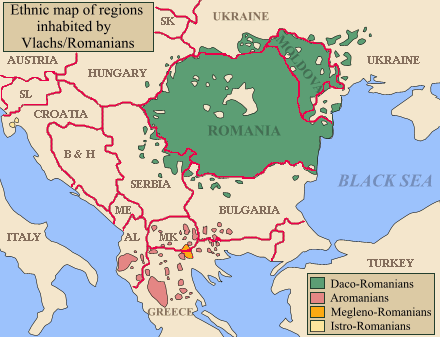
 Regions inhabited nowadays by Eastern Romance-speakers | |
The Eastern Romance languages[1] are a group of Romance languages. The group comprises the Romanian language (Daco-Romanian), the Aromanian language and two other related minor languages, Megleno-Romanian and Istro-Romanian.[2][3][4]
The extinct Dalmatian language (otherwise included in the Central Romance group) is sometimes included as part of the Eastern Romance group,[5][6][7] being considered a bridge between Italian and Romanian.[8][9] Some classifications of the Romance languages consider Eastern and Central Romance to form a clade (often simply called "Eastern Romance", with "Eastern Romance proper" referred to as Balkan or Daco-Romance),[1] but nowadays Central Romance are more often grouped with the Western Romance languages as "Italo-Western".
Languages
[edit]Eastern Romance comprises Romanian (or Daco-Romanian), Aromanian, Megleno-Romanian and Istro-Romanian, according to the most widely accepted classification of the Romance languages.[1][10][11][12][13] The four languages are sometimes labelled as dialects of Romanian[1] and developed from a common ancestor[13] known as Common Romanian.[14] They are surrounded by non-Romance languages.[15] Judaeo-Spanish (or Ladino) is also spoken in the Balkan Peninsula, but it is rarely listed among the other Romance languages of the region because it is rather an Iberian Romance language that developed as a Jewish dialect of Old Spanish in the far west of Europe, and it began to be spoken widely in the Balkans only after the influx of Ladino-speaking refugees into the Ottoman Empire in the 16th century.[12]
Internal classification
[edit]Within the Glottolog database, the languages are classified as follows:[16]
- Eastern Romance
- Aromanian
- Northern Romanian
- Eastern Romanian
- Istro-Romanian
Peter R. Petrucci, by contrast, states that Common Romanian had developed into two major dialects by the 10th century, and that Daco-Romanian and Istro-Romanian are descended from the northern dialect, while Megleno-Romanian and Aromanian are descended from the southern dialect.[17]
- Eastern Romance
- Northern Romanian
- Southern Romanian
Samples of Eastern Romance languages
[edit]Note: the lexicon used below is not universally recognized.
| Istro-Romanian[18][19][20] | Aromanian[21][22] | Megleno-Romanian[23] | Romanian | Italian | Spanish | Portuguese | French | Latin source | English |
|---|---|---|---|---|---|---|---|---|---|
| pićor | cicior | picior | picior | gamba | (pierna) | perna | jambe | petiolus/gamba | leg |
| kľeptu | cheptu | kľeptu | piept | petto | pecho | peito | poitrine | pectus | chest |
| bire | ghine | bini | bine | bene | bien | bem | bien | bene | well, good |
| bľerå | azghirari | zber | zbiera/a rage | ruggire | rugir | rugir | rugir | bēlāre/rugīre | to roar |
| fiľu | hilj | iľu | fiu | figlio | hijo | filho | fils | filius | son |
| fiľa | hilje | iľe | fiică | figlia | hija | filha | fille | fīlia | daughter |
| ficåt | hicat | ficat | fegato | hígado | fígado | foie | fīcātum | liver | |
| fi | hire | ire | a fi | essere | ser | ser | être | fuī/esse/sum | to be |
| fľer | heru | ieru | fier | ferro | hierro | ferro | fer | ferrum | iron |
| vițelu | yitsãl | vițål | vițel | vitello | (ternero) | vitelo | veau | vitellus | calf |
| (g)ľerm | iermu | ghiarmi | vierme | verme | verme (gusano) | verme | ver | vermis | worm |
| viu | yiu | ghiu | viu | vivo | vivo | vivo | vif/vivant | vīvus/vīvēns | alive |
| vipt | yiptu | vipt | cibo (vitto) | comida (victo) | comida (vitualha) | victuaille (archaic) | victus | food, grain, victuals | |
| mľe(lu) | njel | m'iel | miel | agnello | (cordero), añal (archaic) | anho, cordeiro | agneau | agnellus | lamb |
| mľåre | njare | m'ari | miere | miele | miel | mel | miel | mel | honey |
See also
[edit]References
[edit]- ^ a b c d Schulte 2009, p. 230.
- ^ Hammarström, Forkel & Haspelmath 2019, [1].
- ^ Agard 1984, p. 250.
- ^ Hall 1950, p. 16.
- ^ Swiggers 2011, p. 272.
- ^ Sampson 1999, p. 298.
- ^ Hall 1950, p. 24.
- ^ Posner 1996, p. 195.
- ^ Harris 1997, p. 22.
- ^ Mallinson 1988, p. 23.
- ^ Posner 1996, pp. 217–218.
- ^ a b Lindstedt 2014, p. 168.
- ^ a b Maiden 2016, p. 91.
- ^ Sala, Marius (2012). De la Latină la Română] [From Latin to Romanian]. Editura Pro Universitaria. p. 33. ISBN 978-606-647-435-1.
- ^ Posner 1996, p. 217.
- ^ Hammarström, Harald; Forkel, Robert; Haspelmath, Martin; Bank, Sebastian (2023-07-10). "Glottolog 4.8 - Eastern Romance". Glottolog. Leipzig: Max Planck Institute for Evolutionary Anthropology. doi:10.5281/zenodo.7398962. Retrieved 2023-11-20.
- ^ Petrucci 1999, p. 4.
- ^ Bărdășan, Gabriel (2011), Lexicul Istroromân Moștenit din Latină. Suprapuneri și Diferențieri Interdialectale [Istro-Romanian vocabulary inherited from Latin. Interdialectal Overlaps and Differentiations] (in Romanian), archived from the original on 2019-07-25, retrieved 2019-09-01 – via diacronia.ro
- ^ Dănilă, Ioan (2007), "Istroromâna în viziunea lui Traian Cantemir", The Proceedings of the "European Integration – Between Tradition and Modernity" Congress [Istro-Romanian in the vision of Traian Cantemir] (in Romanian), vol. 2, pp. 224–231, archived from the original on 2019-07-25, retrieved 2019-09-01 – via diacronia.ro
- ^ Burlacu, Mihai (2010). "Istro-Romanians: The Legacy of a Culture". The IstroRomanian in Croatia.
- ^ Caragiu Marioțeanu, Matilda, "Dialectul Aromân" [The Aromanian Dialect] (PDF), Avdhela Project – Library of Aromanian Culture (in Romanian), archived (PDF) from the original on 2018-10-24, retrieved 2019-09-01
- ^ Vătășescu, Cătălina (2017), "Atlasul lingvistic al dialectului aromân, bază pentru cercetarea raporturilor aromâno-albaneze" [The linguistic atlas of the Aromanian dialect as a ground for a comparative research with the Albanian language], Fonetică și dialectologie (in Romanian), vol. XXXVI, pp. 215–221, archived from the original on 2019-07-25, retrieved 2019-09-01 – via diacronia.ro
- ^ Dialectul Meglenoromân (PDF), archived (PDF) from the original on 2019-07-25, retrieved 2019-09-01
Sources
[edit]- Agard, Frederick Browning (1984). A Course in Romance Linguistics Volume 2: A Diachronic View. Georgetown University Press. ISBN 0-87840-074-5.
- Hall, Robert A. Jr. (1950). "The Reconstruction of Proto-Romance". Language. 26 (1). Linguistic Society of America: 6–27. doi:10.2307/410406. JSTOR 410406.
- Harris, Martin (1997). Harris, Martin; Vincent, Nigel (eds.). The Romance Languages. Taylor & Francis. pp. 1–25. ISBN 978-0-415-16417-7.
- Hammarström, Harald; Forkel, Robert; Haspelmath, Martin (2019). "Catalogue of languages and families". Jena: Max Planck Institute for the Science of Human History. Archived from the original on 2020-05-02. Retrieved 2019-07-15.
- Posner, Rebecca (1996). The Romance Languages. Cambridge University Press. ISBN 978-0-52-128139-3.
- Sampson, Rodney (1999). Nasal Vowel Evolution in Romance. Oxford University Press. ISBN 978-0-19-823848-5.
- Schulte, Kim (2009). "Loanwords in Romanian". In Haspelmath, Martin; Tadmor, Uri (eds.). Loanwords in the World's Languages: A Comparative Handbook. De Gruyter Mouton. pp. 230–259. ISBN 978-3-11-021843-5.
- Swiggers, Pierre (2011). "Mapping the Romance Languages of Europe". In Lameli, Alfred; Kehrein, Roland; Rabanus, Stefan (eds.). Language Mapping: Part I. Part II: Maps. De Gruyter Mouton. pp. 269–301. ISBN 978-3-11-021916-6.
- Harris, Martin (1988). Harris, Martin; Vincent, Nigel (eds.). The Romance Languages. Oxford University Press. pp. 1–25. ISBN 978-0-19-520829-0.
- Lindstedt, Jouko (2014). "Balkan Slavic and Balkan Romance: from congruence to convergence". In Besters-Dilger, Juliane; Dermarkar, Cynthia; Pfänder, Stefan; Rabus, Achim (eds.). Congruence in Contact-Induced Language Change: Language Families, Typological Resemblance, and Perceived Similarity. Walter de Gruyter. pp. 168–183. ISBN 978-3-11-033834-8.
- Maiden, Martin (2016). "Romanian, Istro–Romanian, Megleno–Romanian, and Arumanian". In Ledgeway, Adam; Maiden, Martin (eds.). The Oxford Guide to the Romance Languages. Oxford University Press. pp. 91–125. ISBN 978-0-19-967710-8.
- Mallinson, Graham (1988). "Rumanian". In Harris, Martin; Vincent, Nigel (eds.). The Romance Languages. Oxford University Press. pp. 391–419. ISBN 978-0-19-520829-0.
- Sala, Marius (2012). De la Latină la Română] [From Latin to Romanian]. Editura Pro Universitaria. p. 33. ISBN 978-606-647-435-1.
- Petrucci, Peter R. (1999). Slavic Features in the History of Rumanian. München: LINCOM Europa. ISBN 38-9586-599-0.

Eastern Romance languages
View on GrokipediaOverview
Definition and Scope
The Eastern Romance languages constitute a distinct branch of the Romance language family, originating from the Vulgar Latin spoken in the eastern regions of the Roman Empire, particularly the Balkans, and diverging significantly from the Italo-Dalmatian and Western Romance groups due to prolonged isolation and contact with non-Romance substrates such as Dacian and later Slavic languages.[3][1] This branch is characterized by its geographic separation from the core Italic territories, leading to unique evolutionary paths that set it apart from the more centrally located Romance varieties.[3] The core languages within this branch include Daco-Romanian (commonly known as standard Romanian, along with its dialects such as Moldovan), Aromanian, Megleno-Romanian, and Istro-Romanian, all of which share a common proto-Romanian ancestor and exhibit mutual intelligibility to varying degrees, though they are often treated as separate languages rather than mere dialects.[1] These languages developed in the context of the Balkan linguistic area (Sprachbund), incorporating shared areal features from neighboring non-Romance languages without losing their fundamental Romance structure.[1] Debated cases, such as the extinct Dalmatian language, are typically excluded from the Eastern Romance classification due to its stronger affinities with the Italo-Dalmatian group and its coastal Adriatic distribution, which aligns more closely with central rather than eastern Balkan developments.[3][4] In terms of scope, the Eastern Romance languages are spoken by approximately 24-26 million people worldwide, with the vast majority being native speakers of Daco-Romanian (around 24 million), supplemented by smaller communities of Aromanian (about 210,000), Megleno-Romanian (roughly 5,000), and Istro-Romanian (fewer than 1,000 fluent speakers).[1][2] These speakers are concentrated primarily in Romania and Moldova, with significant diaspora populations in the Balkans (such as in Greece, North Macedonia, Albania, and Serbia) and further afield due to migration.[1] The branch's demographic weight is thus dominated by Romanian, underscoring its role as the primary representative of Eastern Romance linguistic heritage.[2]Geographic and Demographic Distribution
The Eastern Romance languages are predominantly distributed across Southeastern and Eastern Europe, with Romanian serving as the dominant member concentrated in Romania and Moldova, where it accounts for over 90% of all speakers worldwide.[5] Aromanian is mainly spoken in the Balkan Peninsula, particularly in Greece, Albania, and North Macedonia, while Megleno-Romanian is limited to villages in northern Greece and North Macedonia. Istro-Romanian, the smallest branch, survives in isolated communities in the Istrian Peninsula of Croatia. These distributions reflect the historical continuity of Romance-speaking groups amid Slavic and other linguistic expansions in the region. Demographically, Romanian has approximately 24 million native speakers (as of 2025), making it the largest Eastern Romance language by far and one of the most spoken Romance languages globally.[6][7] In contrast, Aromanian is estimated to have around 210,000 speakers (as of 2018), primarily ethnic Aromanians (also known as Vlachs) scattered across the Balkans, though exact figures vary due to assimilation pressures. Megleno-Romanian has about 5,000 speakers (as of 2025), confined to small ethnic enclaves and facing significant decline. Istro-Romanian is critically endangered, with fewer than 1,000 fluent speakers (as of 2024), mostly elderly, and active efforts to document and revive it in Croatia.[8][9][10] Significant diaspora communities have emerged due to 20th-century migrations, particularly for Romanian speakers, with large populations in Italy (over 1 million as of 2024), Spain (around 620,000 as of 2024), the United States (over 400,000 as of 2025), and Israel (tens of thousands as of recent estimates, largely from post-Holocaust Jewish emigration).[11][12][13][7] These groups maintain the language through cultural associations, though intergenerational transmission is challenged in host countries. Smaller Aromanian and other Balkan Romance diasporas exist in Romania and Western Europe, often resulting from economic migration. Historical shifts in distribution were profoundly influenced by post-Ottoman migrations in the late 19th and early 20th centuries, when Balkan independence movements and wars displaced Vlach (Aromanian and Megleno-Romanian) communities, leading to resettlement in urban centers or across new national borders. Post-World War II upheavals, including border redrawings, ethnic expulsions, and communist-era policies, further altered patterns, with Romanian speakers affected by internal deportations and later waves of emigration to the West after 1989. These events reduced compact speaking areas for minority varieties while expanding Romanian's global footprint through labor migration.[14][15]Historical Development
Origins in Vulgar Latin
The Eastern Romance languages trace their origins to the Roman conquest and subsequent colonization of the Balkan provinces, particularly Dacia and Moesia, where Vulgar Latin was introduced as the language of administration, military, and settlement. The conquest of Dacia occurred during Trajan's Dacian Wars from 101 to 106 AD, culminating in the annexation of the region north of the Danube in 106 AD, which established the province of Dacia as a key area for intensive Latin settlement by colonists, veterans, and administrators from across the empire.[16] Moesia, already a Roman province since 29 BC and divided into Upper and Lower Moesia by 86 AD, served as a staging ground and complementary region for Latin speakers, facilitating the spread of Vulgar Latin through urban centers like Sarmizegetusa and Naissus.[17] This colonization involved the relocation of significant populations, estimated in the tens of thousands, who brought spoken Vulgar Latin, distinct from Classical Latin, into contact with local Indo-European languages such as Dacian and Thracian.[18] Vulgar Latin in these eastern provinces developed unique features influenced by the pre-Roman substrate languages, notably Dacian in the core Dacian territory and Thracian elements in the broader Balkan context, contributing to an early form of what would become the Balkan sprachbund. The Dacian substrate is evident in limited lexical borrowings, such as words for local flora and fauna (e.g., Romanian brânză 'cheese' possibly from Dacian brânza), which integrated into the Vulgar Latin lexicon during the Roman period, reflecting bilingualism among settlers and indigenous populations.[19] Thracian influences, shared across the Balkans, introduced areal features like postposed definite articles and certain syntactic patterns that later characterized Eastern Romance, emerging from prolonged contact in a multilingual environment.[20] This eastern variant of Vulgar Latin diverged early from its western counterparts due to geographical isolation and substrate pressures, with phonological shifts such as the preservation of Latin /e/ and /o/ in unstressed positions appearing in regional speech by the 3rd century.[21] The first attestations of this eastern Vulgar Latin appear in inscriptions from the 2nd to 3rd centuries AD, providing evidence of spoken forms in everyday use. In Moesia Inferior, Latin verse inscriptions emerge around the late 2nd to early 3rd century, displaying vulgar features like simplified case endings and phonetic spellings (e.g., domus as domos).[22] Similarly, in Dacia, epigraphic records from military and civilian contexts, such as dedications and funerary texts, show Vulgar Latin traits including the loss of neuter gender distinctions and adverbial formations, indicating a spoken language already adapting to local conditions.[23] By the 4th and 5th centuries, following Emperor Aurelian's withdrawal of Roman administration from Dacia in 271 AD, the region experienced increased isolation, accelerating linguistic divergence as Latin speakers retreated to mountainous areas, separated from the empire's western core.[24] The Migration Period, marked by Germanic and Slavic invasions from the 6th to 7th centuries, further shaped the continuity of Vulgar Latin in the Balkans by disrupting urban centers but preserving it in rural, isolated refugia. Gothic and other Germanic groups passed through without fully displacing Latin speakers, while Slavic migrations in the 6th century led to superstrate influences but allowed Latin continuity in remote Transylvanian and Carpathian communities, where the language evolved uninterrupted into proto-Romanian forms.[25] This isolation fostered resilience, with Eastern Romance maintaining core Vulgar Latin structures amid the formation of a multi-ethnic Balkan linguistic area.[26]Divergence and Influences
The divergence of Eastern Romance languages from Western Romance branches occurred largely due to geographic and cultural isolation following the barbarian invasions and Slavic migrations of the 6th to 10th centuries. After the Roman withdrawal from Dacia in 271 CE, the region faced successive waves of Germanic, Hunnic, and Avar incursions, which fragmented Latin-speaking communities and severed ties with the more stable Italic and Gallic provinces where Western Romance evolved. The Slavic migrations, beginning around the 6th century, further entrenched this split as South and East Slavic groups settled across the Balkans and Carpathians, enveloping Romance speakers in a sea of Slavic dialects and limiting mutual influences with Western Latin derivatives. This isolation preserved a distinct Vulgar Latin substrate in the East while fostering early contact-induced changes, setting Eastern Romance apart in its developmental trajectory. While Daco-Romanian developed primarily north of the Danube in the Carpathian-Danubian area, the other varieties—Aromanian, Megleno-Romanian, and Istro-Romanian—emerged south of the Danube in Moesia, Macedonia, and the Adriatic coast, respectively, with Aromanian and Megleno-Romanian showing stronger continuity in Byzantine territories and Istro-Romanian retaining more isolated features due to its western position.[27][3] A primary influence shaping Eastern Romance was the extensive Slavic lexical borrowing, resulting from centuries of coexistence and bilingualism after the migrations. In Romanian, Slavic-origin words comprise approximately 15% of the lexicon, with contributions from South Slavic (about 8.4%), Bulgarian/Serbian (5.4%), and minor inputs from Ukrainian and others; these entered in waves from the 8th century onward, mediated partly by Old Church Slavonic used in Orthodox liturgy until the 17th century. Common domains include kinship, agriculture, emotions, and administration—examples include da ("yes," from Slavic da), nevastă ("wife," from nevěsta), and slavă ("glory," from slava). This heavy integration, far exceeding Slavic impact on Western Romance, underscores the cultural dominance of Slavic neighbors during the medieval period.[28] Additional layers of influence arose during the Byzantine and Ottoman eras (14th–19th centuries), introducing Greek, Albanian, and Turkish elements through trade, administration, and conquest. Greek borrowings in Romanian totaled around 278 words, mostly indirect via South Slavic intermediaries during the Byzantine phase, with direct entries like agonisi ("struggle," from Greek agōnizesthai) and arvună ("earnest money," from arrabōn) in ecclesiastical and commercial spheres; the Phanariot Greek administration (1711–1821) added over 1,100 terms, though many faded post-independence. Turkish loanwords proliferated under Ottoman suzerainty, numbering in the thousands across Balkan Romance varieties, covering urban life, cuisine, and governance—such as cafea ("coffee," from Turkish kahve) and dulap ("wardrobe," from dolap)—reflecting prolonged subjugation and cultural exchange. Albanian contributions remained negligible, limited to shared pre-Roman substrata rather than direct borrowings, with no significant influx documented for this period. These multilayered contacts enriched Eastern Romance vocabulary without supplanting its core Latin structure.[29] The re-emergence of Eastern Romance as standardized literary languages coincided with 19th-century national awakenings in the Romanian principalities, driven by Romantic ideals and anti-imperial sentiments. Intellectual movements like the Transylvanian School (Școala Ardeleană), active from the late 18th to mid-19th century, emphasized Latin roots to counter Hungarian and Slavic dominance, advocating phonetic orthography and compiling dictionaries such as the 1825 Elementa linguae daco-romanae sive valachicae. Key figures including Samuil Micu, Gheorghe Șincai, and Ion Heliade Rădulescu pushed for unification amid the 1848 revolutions, culminating in the 1860 adoption of a Latin-based alphabet and the 1866 grammar by August Treboniu Laurian, which purged excessive Slavisms and established a supra-dialectal standard. This standardization process transformed Romanian from a cluster of regional vernaculars into a cohesive national language, facilitating unification under the Romanian state in 1859 and literary flourishing.[24] In the 20th century, modern challenges included Soviet-era Russification in Moldova (annexed as the Moldavian SSR in 1940), which imposed Russian as a prestige language and rebranded Romanian as "Moldovan" to foster a distinct identity. This policy enforced Cyrillic script until 1989, promoted bilingual education, and introduced Russian loanwords—augmenting the lexicon in technical, administrative, and ideological domains—while suppressing Latin-oriented reforms; by the 1980s, Russian proficiency was near-universal among urban Moldovans, diluting pure Romanian usage. Post-independence in 1991, efforts reversed some changes, but lingering bilingualism persists.[30] Romania's EU accession in 2007 and Moldova's pro-European orientation have further shaped language dynamics, reinforcing Romanian's status while countering residual Russification. In Romania, integration aligned language policy with EU multilingualism standards, boosting English and French over Russian influences. For Moldova, Romania's membership intensified debates on identity, leading to the 2023 constitutional recognition of Romanian as the official language (reversing the Soviet-era "Moldovan" label) and increased Latin-script usage; however, it also heightened bilingual tensions in Russian-speaking regions like Transnistria, complicating EU alignment aspirations.[31][32] These developments have promoted standardization and European linguistic norms across Eastern Romance communities.Classification
Internal Classification
The Eastern Romance languages are internally classified into two primary branches: the Daco-Romanian group, which encompasses standard Romanian and its northern dialects, and the Balkan Romance group, comprising Aromanian, Megleno-Romanian, and Istro-Romanian.[33][34] This division emerged during the Common Romanian period before the 9th century, reflecting geographic separation and differential influences from surrounding languages.[33] Within the Balkan Romance branch, Aromanian forms a dialect continuum across southern Balkan regions, exhibiting significant internal variation but unified by shared substrate effects from ancient Greek and Illyrian.[34] Megleno-Romanian occupies a transitional position between Aromanian and Daco-Romanian, displaying hybrid features such as partial retention of Latin case distinctions alongside stronger Balkan Sprachbund traits.[10] Istro-Romanian, spoken in isolated pockets of Istria (Croatia), is the most divergent, heavily shaped by prolonged contact with Venetian, leading to innovations like monophthongization of diphthongs (e.g., /wa/ to /o/) and loss of syllable-final /l/.[10] Hierarchically, the structure can be described as a bifurcated tree: Eastern Romance splits into Daco-Romanian (northern clade) and Balkan Romance (southern clade), with the latter further subdividing into a central continuum (Aromanian and Megleno-Romanian) and a peripheral outlier (Istro-Romanian).[33] Classification relies on shared innovations from Vulgar Latin, including phonological shifts such as rhotacism of intervocalic /n/ to /ɾ/ (shared with certain Daco-Romanian dialects).[33][10] Morphologically, all exhibit suffixed definite articles (e.g., Daco-Romanian omul 'the man', Aromanian omul, Megleno-Romanian omul, Istro-Romanian omŭl), a postpositive enclisis unique among Romance languages, alongside retention of a two-case system (nominative-accusative vs. genitive-dative).[35][33] These criteria underscore common descent while highlighting divergence through areal contacts.[1] Debates persist on whether the Eastern Romance languages constitute a single tight-knit branch or if Istro-Romanian represents a relic form detached early from the proto-language, potentially splitting directly from Common Romanian rather than via Daco-Romanian mediation.[33][10] Proponents of unity emphasize shared Balkan features, but Istro-Romanian's minimal Balkanization and Venetian adstratum argue for its peripheral status, with some viewing it as a conservative dialect continuum rather than a fully integrated member.[34]Relations to Western and Southern Romance Languages
The Eastern Romance languages, including Romanian and its relatives, share a common origin in Vulgar Latin with Western and Southern Romance languages, but form a distinct primary branch of Romance due to early divergence from the main Italo-Western continuum east of the Adriatic.[3] The exact phylogenetic position remains debated, with some classifications aligning it closely with Italo-Dalmatian due to lexical conservatisms, while others emphasize its independence.[36] A key shared trait is the retention of core Latin vocabulary and inflectional morphology, with Eastern Romance exhibiting approximately 70% lexical overlap with languages like Italian and French.[2] Unlike Western Romance languages such as French and Spanish, which largely simplified the Latin case system to nominative-accusative only through analytic prepositions, Eastern Romance preserves a synthetic two-case system for nouns (nominative-accusative and genitive-dative), reflecting a more conservative evolution from Latin declensions.[37] Divergences from Western Romance are pronounced in syntax and phonology, stemming from Eastern Romance's separation from the main Romance continuum and lack of significant Germanic substrate influence. For instance, while Western languages like Spanish and Portuguese developed preposed definite articles from Latin demonstratives, Eastern Romance innovated postposed enclitic articles (e.g., Romanian lupul 'the wolf'), a feature unique among Romance tongues and aligned with Balkan areal patterns.[24] Additionally, Eastern Romance avoided the Germanic-induced sound shifts seen in Western varieties, such as the lenition and palatalization in French (e.g., Latin cantare to French chanter), preserving closer Latin-like consonants due to predominant Slavic and local substrate contacts instead.[3] Relations to Southern Romance, particularly the Italo-Dalmatian group (e.g., Italian and extinct Dalmatian), show stronger lexical ties, with Eastern Romance maintaining high vocabulary similarity to Italian—often exceeding that with Western languages—due to shared conservative retention of Latin roots without heavy Germanic overlay.[2] However, syntactic features diverge markedly, as Eastern Romance adopted Balkanized structures like postposed articles and evidential mood markers through the Balkan sprachbund, a convergence area involving Slavic, Greek, and Albanian that reshaped its grammar beyond Italo-Dalmatian norms.[38] In Romance phylogeny, Eastern languages form a distinct eastern clade, branching off before the Gallo-Iberian and Italo-Western split, but their Balkan integrations create a hybrid profile distinct from both Western simplification and Southern conservatism.[3]Individual Languages
Romanian
Romanian is the predominant Eastern Romance language, serving as the official language of Romania per Article 13 of the country's constitution, which states that "In Romania, the official language is Romanian."[39] It holds the same status in Moldova, where the Constitutional Court ruled in 2013 that the official state language is Romanian, affirming its equivalence to the "Moldovan language" referenced in prior legal texts.[40] Upon Romania's accession to the European Union in 2007, Romanian became one of the bloc's 24 official languages, facilitating its use in EU institutions and documentation.[41] With approximately 24 million speakers worldwide, of which the vast majority are native, primarily in Romania and Moldova, it forms the core of the Daco-Romanian dialect continuum, which encompasses regional varieties such as Moldovan (spoken in Moldova and northeastern Romania), Transylvanian (in central and northwestern Romania), and others like Banat and Oltenian, all mutually intelligible and based on a common standard.[7][42] The earliest surviving document in Romanian is Neacșu's Letter from 1521, a missive written in Old Romanian using the Cyrillic script, marking the onset of the language's written record and providing insight into 16th-century Wallachian society.[43] Subsequent religious and legal texts in the 16th century, such as psalters and law collections, further established a literary foundation, though writing remained sporadic until the 18th century. A pivotal reform occurred in the 1860s, when the Romanian Academy formalized the adoption of the Latin alphabet—first in Wallachia in 1860 and then in Moldova in 1862—replacing the Cyrillic script to align with the language's Latin roots and facilitate cultural ties with Western Europe.[44] Today, Romanian sustains a robust literary tradition, with works spanning poetry, novels, and drama that reflect national identity and historical themes, alongside widespread use in media, including national television, radio, and print outlets in both Romania and Moldova. It is the primary medium of instruction in education systems across these countries, from primary schools to universities, promoting literacy rates above 98% in Romania. While the standard orthography is uniform and Latin-based, minor variations persist in Moldova, such as occasional Russicism-influenced spellings in informal contexts, though official usage aligns fully with Romanian norms since the post-Soviet transition to Latin script in the 1980s.[45][46]Aromanian
Aromanian, also known as Macedo-Romanian or Arumanian, is an Eastern Romance language spoken primarily by the Aromanian people, a traditionally transhumant community with a heritage rooted in nomadic shepherding across the Balkan mountains.[47] The language has an estimated 250,000 speakers who use it as their mother tongue, concentrated mainly in Greece—particularly among Macedonian Aromanians in regions like Epirus and Western Macedonia—Albania, and North Macedonia, with smaller communities in Bulgaria, Serbia, and diaspora populations in Romania, Germany, and beyond.[48] This distribution reflects historical migrations tied to pastoral economies, where Aromanians moved seasonally with livestock between highland pastures and lowland markets.[49] Aromanian exhibits significant dialectal variation, with four main groups traditionally identified: the Grăi (including subgroups like Grivas from the Gramos area), Farsherot, Gramustean, and Pindean, each associated with specific geographic zones in the Pindus Mountains and surrounding areas.[50] These dialects show partial mutual intelligibility among themselves and with standard Romanian, though differences in phonology, vocabulary, and syntax—shaped by intense contact with Greek, Albanian, and Slavic languages—can hinder full comprehension. Within the Eastern Romance branch, Aromanian forms a distinct subgroup alongside Romanian, Megleno-Romanian, and Istro-Romanian, often classified as a conservative offshoot preserving archaic Latin features. Historically, Aromanian thrived during the Ottoman era, when speakers enjoyed relative cultural autonomy as non-Muslim subjects, maintaining vibrant oral traditions and trade networks across the empire until the Balkan Wars of 1912–1913 redrew borders and fragmented communities.[51] In the 20th century, assimilation pressures intensified through nation-building policies in host countries: Greek-only education policies closed Aromanian schools by 1948, while in Albania and North Macedonia, communist regimes promoted majority languages, leading to a sharp decline from over 500,000 speakers at the century's start.[48] Urban migration and socioeconomic shifts further eroded transmission, rendering the language definitely endangered. As of 2025, revitalization efforts continue amid ongoing challenges.[52] Revitalization efforts remain limited but ongoing, with some bilingual schooling available in Albania for Aromanian communities in areas like Korçë and Gjirokastër, supported by post-1990s legal recognitions of minority rights.[53] Cultural associations, such as the Society of Aromanians in Athens and various Vlach groups in North Macedonia, promote the language through literature, folklore festivals, and informal classes, though official standardization and institutional support lag in most countries.[49] These initiatives aim to preserve Aromanian's role in Balkan cultural identity amid ongoing endangerment.[54]Megleno-Romanian
Megleno-Romanian is a variety of the Eastern Romance languages spoken by a small community primarily in the Moglena region along the border between Greece and North Macedonia.[55] The language has an estimated 5,000 to 5,200 speakers, concentrated in seven villages, including Archaia (also known as Oshchima) in Greece and Hrupista in North Macedonia.[55][56] Linguistically, Megleno-Romanian exhibits hybrid characteristics that blend features of Aromanian and standard Romanian, while showing significant influence from Bulgarian and other South Slavic languages in its vocabulary, morphology, and syntax.[57] This transitional nature positions it as a bridge between southern Balkan Romance varieties like Aromanian and the northern Daco-Romanian.[34] The language is critically endangered, with no standardized form and reliance predominantly on oral traditions for transmission among remaining speakers. As of 2025, speaker numbers and transmission remain low despite documentation.[55] Documentation efforts began with collections in the early 20th century by scholars such as Gustav Weigand and Theodor Capidan, followed by more comprehensive linguistic surveys in the post-2000 period led by researchers like Petar Atanasov.[57][55]Istro-Romanian
Istro-Romanian, also known as Vlashki or Zheyanski, is the smallest and most isolated member of the Eastern Romance language group, spoken primarily in the northeastern part of the Istrian Peninsula in Croatia.[58] The language is confined to a handful of villages, including Žejane (Jeiani), Šušnjevica (Suşnieviţa), Brdo (Bârdo), and others such as Nova Vas (Noselo), Jasenovik (Sucodru), Kostrčani (Costârcean), and Letaj (Letai).[59] It has fewer than 1,000 speakers worldwide, with only around 100 fluent speakers remaining in Istria, predominantly middle-aged and elderly individuals who are bilingual in Croatian.[58][60] Intergenerational transmission is minimal, with few children or youth actively using the language, contributing to its status as severely endangered. As of 2025, revitalization continues through digital resources and community programs, though speaker numbers remain critically low.[58] The origins of Istro-Romanian are debated among scholars. Some trace migrations from Transylvania's Ţara Moților region in the 14th and 15th centuries, while others suggest it was brought to Istria by Balkan Vlachs from the Dalmatian hinterland in the early 16th century. Historical records attest to speakers from the 15th century, with earlier references to Romance-speaking groups in the area dating back to 940 CE. The language developed as a Daco-Romance variety, diverging from other Eastern Romance branches between 500 and 1100 CE.[59][58] During the 20th century, significant emigration to coastal cities like Rijeka and Pula, as well as abroad to the United States, Australia, Canada, Italy, and France, accelerated language shift and assimilation, resulting in more speakers in the diaspora than in the original villages.[59] Linguistically, Istro-Romanian exhibits unique admixtures from Venetian (Italian) and Slavic languages due to Istria's long history of multilingualism, with Romanian-derived vocabulary comprising about 60% of its lexicon, 20% Slavic borrowings, and influences from Greek, Turkic, Hungarian, and Germanic sources.[60] It retains archaic Latin features, such as rhotacism (e.g., bene evolving to bire), which preserve older Romance phonological patterns not commonly found in other Eastern Romance varieties.[59] This isolation distinguishes it within the Eastern Romance classification, setting it apart from the more interconnected Balkan-oriented languages like Romanian and Aromanian.[58] Preservation efforts for Istro-Romanian gained momentum in the late 20th century, with the language listed as "seriously endangered" in UNESCO's Red Book of Endangered Languages (estimated 500 speakers in 1993).[59] It was recognized as intangible cultural heritage in Croatia in 2007 and protected under the European Charter for Regional or Minority Languages in 2010.[58] Initiatives include documentation projects, such as a corpus of 55 hours of audio and video recordings from 44 speakers archived at the Endangered Languages Archive, alongside community efforts like language classes, festivals, phrasebooks, children's books, and online resources supported by diaspora organizations.[58][59]Linguistic Features
Phonology
The Eastern Romance languages exhibit a phonology that retains several features from Vulgar Latin while showing innovations influenced by prolonged contact with non-Romance languages in the Balkans. Shared traits include a relatively conservative inventory compared to Western Romance, with limited lenition of intervocalic stops—retaining plosives like /b, d, g/ rather than developing widespread fricatives as in Italian or Spanish—and a vowel system that preserves mid-vowels /e/ and /o/ without the extensive diphthongization seen elsewhere in the family.[61] These languages generally maintain seven to nine oral vowels, including central unrounded vowels /ə/ and /ɨ/, which are rare in other Romance branches but mark a key divergence. Consonant systems feature palatal affricates derived from Latin velars before front vowels, and prosodic patterns that echo Latin's variable stress while incorporating Balkan intonational contours.[62] Vowel systems across Eastern Romance are characterized by the retention of Latin mid-vowels /e/ and /o/, alongside the development of central vowels /ə/ (schwa) from unstressed /a/ and /ɨ/ from raised /a/ in pre-nasal or pre-r contexts. In Romanian, the inventory comprises seven monophthongs (/i e ə a ɨ o u/) and two rising diphthongs (/e̯a o̯a/), with diphthongization often triggered by stress on mid-vowels, as in Latin pēdem > Romanian picior /piˈtʃjor/ 'foot'.[63] Aromanian similarly includes at least five basic vowels (/a e i o u/) plus central /ə/ and /ɨ/ in southern varieties, where /ə/ contrasts with /ɨ/ under stress (e.g., /ˈskəpə/ 'he/she finished' vs. /ˈd͡zɨku/ 'I say'), though northern dialects merge them into a variable /ə/.[64] Megleno-Romanian and Istro-Romanian follow suit, with /ə/ and /ɨ/ appearing in unstressed and raised positions, respectively, but showing less diphthongal complexity; for instance, Istro-Romanian exhibits metaphony raising tonic vowels based on final unstressed vowels without full diphthongization.[62] These central vowels, phonemically marginal yet contrastive, underscore the group's isolation from Western Romance vowel reductions.[63] Consonant shifts prominently include palatalization of velars /k/ and /g/ before front vowels, yielding affricates /tʃ/ and /dʒ/ across the group, as in Latin cervus > Romanian cerb /tʃerb/ 'deer' and similar forms in Aromanian t͡ʃervu.[65] This process, part of the second Romance palatalization, is more uniform in Eastern Romance than in Western varieties. Aromanian additionally preserves labio-velar approximants like /w/ (from Latin /u̯/), and in some dialects, labialized velars /kʷ gʷ/ from Latin qu- gw-, contributing to its distinct articulatory profile (e.g., /kʷ/ in kʷand 'when').[66] Unlike Western Romance, where lenition frequently voices or fricativizes stops intervocalically, Eastern varieties conserve occlusives, with only partial voicing in Romanian (e.g., /p t k/ remain voiceless between vowels).[61] Prosody in Eastern Romance mirrors Latin's mobile stress, which can fall on any syllable but predominantly on the penultimate, as in Romanian cásă /ˈkasə/ 'house' versus casá /kaˈsa/ 'the house'.[2] This variability contrasts with the fixed penultimate stress of many Italo-Western languages. Intonation patterns show Balkan Sprachbund influence, particularly in rising contours for yes/no questions, akin to Serbian and Greek, diverging from the falling patterns in Western Romance; for example, Romanian interrogatives often end in high pitch, enhancing the perceptual Slavic-like quality.[62] Variations include Istro-Romanian's metaphony, where unstressed final vowels raise the tonic (e.g., affecting mid-vowel height without diphthongs), and Aromanian's syllable structure permitting complex onsets like /sk-/ , reflecting overall phonological conservatism relative to Western lenition-heavy evolutions.[67]Morphology and Syntax
The Eastern Romance languages, including Romanian, Aromanian, Megleno-Romanian, and Istro-Romanian, display a simplified nominal morphology compared to Latin, featuring a two-case system that merges nominative and accusative on one hand, and genitive and dative on the other, with the vocative typically aligning with the nominative.[68] This reduction reflects historical analytic tendencies, though the genitive-dative plural often employs a dedicated suffix like Romanian -lor. A key innovation shared across these languages is the postpositive definite article, suffixed directly to the noun as an enclitic, which marks definiteness through gender- and number-sensitive endings; for instance, in Romanian, om 'man' becomes omul 'the man' with the masculine singular suffix -ul.[69] This suffixed article system, absent in Western Romance languages, exemplifies agglutinative influences from Balkan contact and is uniformly present in the Eastern branch, though with minor variations in form among the dialects.[70] Verbal morphology in Eastern Romance languages preserves the four conjugation classes inherited from Latin, characterized by distinct thematic vowels and stem patterns for tenses such as the present indicative.[71] For example, Romanian verbs like cânta (first conjugation), vedea (second), auzi (third), and dormi (fourth) follow these paradigms, with synthetic forms for most tenses but increasing analytic constructions due to regional influences. The future tense is formed periphrastically using the auxiliary a voi 'to want' followed by the infinitive, as in Romanian voi cânta 'I will sing', a structure that parallels developments in other Balkan languages and contrasts with the synthetic futures of Western Romance.[72] This auxiliary-based future underscores the analytic shift in the group, while retaining Latin-like person and number marking in the auxiliary paradigm.[73] Syntactically, Eastern Romance languages exhibit features of the Balkan sprachbund, including the predominant postposition of attributive adjectives after the noun, as in Romanian casa mare 'the big house', which differs from the variable pre- and postnominal placement in Western Romance.[74] Clitic pronouns, functioning as indirect and direct objects, are typically proclitic to the verb or auxiliary, with a single paradigm for both nominal and verbal uses—a convergence shared with Slavic and Greek in the region; for example, Romanian î-mi dau 'they give me' places the dative clitic î-mi before the verb.[75] Interrogative structures often incorporate optional particles influenced by Slavic contact, such as the yes/no particle oare in Romanian, as in Oare vii? 'Are you coming?', which softens or focuses questions in a manner atypical of Western Romance.[76] Overall, these languages are more analytic than their Western counterparts, favoring periphrasis and fixed word order (subject-verb-object) over inflectional richness, yet they incorporate agglutinative elements like article suffixation from prolonged Balkan interactions.[77]Lexicon and Borrowings
The lexicon of the Eastern Romance languages is predominantly derived from Vulgar Latin, reflecting their origins in the Roman provinces of the Balkans, though extensive contact with neighboring languages has introduced substantial borrowings that vary across the group. In Romanian, approximately 70% of the basic vocabulary consists of Latin-derived words, a higher retention rate compared to the other Eastern Romance varieties, which exhibit lower proportions due to intensified substrate influences from pre-Roman Dacian elements and heavier superstrate layers from later contacts.[2] This Latin core includes everyday terms for family, body parts, and basic actions, such as mână ('hand') from Latin manus and frate ('brother') from Latin frater. In contrast, Aromanian, Megleno-Romanian, and Istro-Romanian show reduced Latin retention—estimated at around 50-60% in core lexicon—owing to greater integration of local Balkan substrates and regional superstrates that reshaped their vocabularies during medieval migrations and settlements.[78] Borrowings constitute a significant portion of the Eastern Romance lexicon, with Slavic languages exerting the most pervasive early influence across all varieties, entering primarily between the 6th and 12th centuries via South Slavic intermediaries like Bulgarian and Old Church Slavonic. In Romanian, Slavic loans account for 14-20% of the vocabulary, particularly in the basic lexicon, including the affirmative particle da ('yes'), borrowed from Proto-Slavic da.[28][24] These borrowings often fill semantic gaps in administration, religion, and social relations, such as slavă ('glory') from Slavic slava. Greek contributions are more prominent in the southern varieties, especially Aromanian, where continuous contact with Modern Greek has introduced numerous terms related to pastoral life and daily activities; examples include caimen ('cemetery') and buf ('ox'), reflecting the Aromanians' traditional herding economy.[79] Turkish loanwords, acquired during Ottoman rule (14th-19th centuries), appear in all Eastern Romance languages, predominantly in administrative and commercial domains, such as Romanian divan ('council' or 'sofa') from Turkish divan and bacșiș ('tip') from Turkish bahşiş.[80] Regional loans from Hungarian and Albanian further diversify the lexicon, particularly in border areas. Hungarian borrowings in Romanian, numbering over 1,000 items and comprising about 1.6% of the total vocabulary, often pertain to agriculture and household items, with phonological adaptations like aphaeresis in dăvăsi ('to drown') from Hungarian odavészni.[28][81] Albanian influences are more limited and regional, mainly affecting Aromanian and Megleno-Romanian through shared Balkan contact, with a few lexical items like Romanian balaur ('dragon') possibly tracing to Albanian substrates, though direct loans remain sparse and debated.[82] In semantic fields tied to the Balkan environment, Eastern Romance languages exhibit unique shared vocabulary for flora and fauna as part of the Balkan sprachbund, including terms like Romanian arici ('hedgehog') and Aromanian equivalents derived from Slavic prototypes, such as klenъ for 'maple', which highlight areal convergence rather than direct inheritance. In modern Romanian, French and English have emerged as influential superstrates, especially in technical and cultural domains since the 19th century. French loans make up 12-38% of specialized vocabulary, including maritime and scientific terms like barometru ('barometer') from French baromètre and ciclon ('cyclone') from French cyclone, driven by Romania's alignment with Western Europe.[83][28] English borrowings, accelerating post-1989, are prominent in media and technology, often as "luxury" items like download and feedback, comprising a growing but unquantified share in contemporary usage.[84] Purist movements in the 19th and 20th centuries, led by the Transylvanian School, actively promoted neologisms from Latin, Italian, and French to supplant Slavic words, replacing terms like război ('war', Slavic) with belic or răzbel (Latin-derived), though many such innovations succeeded only partially in standardizing the lexicon.[24] These efforts underscored a nationalistic drive to emphasize the Romance heritage, reducing Slavic elements from about 20% in the basic vocabulary to a more integrated but diminished presence today.[24]Writing and Standardization
Scripts and Orthographies
The Eastern Romance languages have historically utilized scripts influenced by their geographic and cultural contexts, primarily Cyrillic and Latin variants, with the latter becoming predominant in modern usage. Romanian, the most widely spoken Eastern Romance language, was initially written using a Cyrillic alphabet from the 16th to the 19th centuries, particularly for religious and administrative texts under Orthodox Church influence.[85] This script evolved from Slavonic models adapted to Romanian phonology, as seen in early manuscripts such as the Psaltirea Voronețului (16th century), a translation of the Psalms from an Old Church Slavonic source that represents one of the oldest surviving Romanian texts.[86] The shift to a Latin-based alphabet began in the 19th century amid efforts to align with Western European norms and emphasize Latin heritage; a pivotal decree in 1860 by Prince Alexandru Ioan Cuza, proposed by scholar Ion Heliade Rădulescu, mandated the transition, which the Romanian Academy formalized in 1862.[85] The contemporary Romanian orthography employs a 31-letter Latin alphabet incorporating diacritics—such as ă (breve a), â and î (circumflex a and i), ș (s with comma below), and ț (t with comma below)—to represent specific vowel and consonant sounds, with rules codified by the Romanian Academy in 1932 and refined post-1989 to restore pre-communist conventions.[85] These diacritics are encoded under ISO/IEC 8859-16, ensuring compatibility in digital contexts while preserving phonetic accuracy.[87] In contrast, the other Eastern Romance languages—Aromanian, Megleno-Romanian, and Istro-Romanian—lack fully standardized orthographies due to their minority status and historical oral traditions, often relying on ad hoc adaptations of Latin scripts or regional alternatives.[8] Aromanian is variably transcribed using Latin orthographies resembling Albanian (with digraphs like dh and sh) in Romania and North Macedonia, or Greek script in Greece, reflecting local linguistic environments and avoiding a unified system.[8] Megleno-Romanian employs a basic Latin script, supported by tools like Keyman keyboards for digital input, but without institutional standardization, leading to inconsistent representations across dialects spoken in Greece and North Macedonia.[88] Istro-Romanian, spoken in Croatia's Istrian peninsula, has no established written tradition until the 20th century and uses phonetic transcriptions based on the International Phonetic Alphabet or modified Romanian Latin orthographies, with multiple systems developed ad hoc for preservation efforts since the 1920s.[89][90] These minority languages face orthographic challenges stemming from diglossic contexts, where speakers alternate between their heritage script and the dominant Latin or Greek/Cyrillic systems of host countries, complicating documentation and education.[91] Efforts toward unification, such as symposia on Aromanian writing standardization held in 1997, highlight ongoing attempts to develop consistent Latin-based systems amid these pressures.[92]Modern Standardization Efforts
In Romania, the Romanian Academy, established in 1866, has played a central role in standardizing the language through its philological section, which formalized orthography, grammar, and vocabulary beginning in the late 19th century.[93] Following the 1989 revolution, standardization efforts intensified to align the language across borders, particularly with Moldova, where the 1989 language law declared Romanian the state language, replacing Soviet-era "Moldovan" designations.[94] This culminated in the 2013 Constitutional Court ruling affirming Romanian as the official language and the 2023 parliamentary amendment updating all legislation to use "Romanian" explicitly, facilitating linguistic unification.[95][96] For minority Eastern Romance languages, Albania's Law No. 96/2017 on the Protection of National Minorities recognizes Aromanians as a national minority and guarantees their right to education in the Aromanian language, including access to lessons, textbooks, and teacher training in areas of traditional residence where demand exists.[97] In Croatia, protections for Istro-Romanian emerged in the 1990s amid post-independence minority policies; by 1997, it was listed in the national Register of Cultural Goods, entitling it to preservation measures under cultural heritage laws, though without full national minority status.[98] International frameworks have bolstered these efforts, with Romania's 2007 ratification of the European Charter for Regional or Minority Languages (ECRML) supporting minority language promotion, while Croatia's 1997 ratification addresses Istro-Romanian in monitoring reports, recommending enhanced legal bases for its use in education and media.[99][100] Digital initiatives, such as the Romanian Academy's CoRoLa project launched in 2018, have developed large-scale corpora exceeding 1.2 billion tokens for written texts and 152 hours of oral recordings, enabling natural language processing applications and broader standardization since 2010.[101] These efforts have led to greater media presence, including Aromanian publications and broadcasts established since the 1990s in Albania, yet non-Romanian varieties like Aromanian, Megleno-Romanian, and Istro-Romanian remain severely endangered, with speaker numbers declining due to assimilation and limited institutional support.[102]Comparative Samples
Aromanian
The following excerpt is the Lord's Prayer in Aromanian, as documented in linguistic studies of the Fărșăroț dialect, a variety spoken in the 20th century across the Balkans. Tatã a nostu tsi eshti tu tser, si ayisiascã numa a Ta, s’yinã amirãria a Ta, si facã vrearea a Ta, cum tu tser, ashã sh'pisti loc. Pãnia a nostã, atsa di cathi dzuã, dãnu sh’azã, sh‘ yiartãni amartiili a nosti, ashe cum li yiãrtãm sh’noi a amãrtor a noci, sh’nu ni du la pirazmo, ma viagljãni di atsel rãu. Cã a Ta esti amirãria sh'puteria, a Tatãlui shi Hiljãlui shi a Ayiului Spirit, tora, totãna sh’tu eta a etilor. Amin. An approximate English translation reads: Our Father who art in heaven, hallowed be thy name. Thy kingdom come, thy will be done on earth as it is in heaven. Give us this day our daily bread, and forgive us our trespasses, as we forgive those who trespass against us. And lead us not into temptation, but deliver us from evil. For thine is the kingdom and the power and the glory, of the Father and of the Son and of the Holy Spirit, now and forever. Amen.Megleno-Romanian
This excerpt presents the Lord's Prayer in Megleno-Romanian, recorded in early 20th-century ethnographic collections from the villages in the Moglena region of Greece and North Macedonia.[103] Tată a nostru, cari șoaz ăn țer, sfint-ăi numea Ta, s-vină ąmpirățǫ́l’ă Ta, s-facă vrearea Ta, cum ăn țer șa și pri pimint. Pǫ́inea noastră țea di toati zǫ́lili, s-nă u dai az, și nă l’artă grișătura noastră, șa cum și noi l’artǫ́m grișăturili lă noștri. Și s-nu nă laș noi ăn picati, și s-nă păzești di țela rǫ́ų. Ămin! An approximate English translation is: Our Father who art in heaven, hallowed be thy name. Thy kingdom come, thy will be done on earth as it is in heaven. Give us this day our daily bread, and forgive us our wrongdoings, as we also forgive those who wrong us. And lead us not into falling, but protect us from that evil. Amen.Istro-Romanian
The Lord's Prayer in the Žejane dialect of Istro-Romanian is shown below, drawn from a 1928 publication aimed at preserving the language among communities in Istria, Croatia.[104] Ciåia nostru carle-ș în cer, neca se lume tev posvete, neca vire cesaria te, necå fie voľa te, cum ăi in cer, așa și pre pemint. Păra nostra de saca zi de-na-vo asiez. Și na scuze pecatele nostre cum și noi scuzeim lu ceľi carľi na ofendes. Și nu duce pre noi in napast ma na zbave de cela revu. [Că a ta jesti împărăția i puterea i slava în vecji. Amin.] An approximate English translation: Our Father who art in heaven, may thy name be hallowed, may thy kingdom come, may thy will be done, as in heaven so on earth. Give us our daily bread for today. And forgive us our sins as we forgive those who offend us. And do not lead us into trial but save us from that evil. [For thine is the kingdom and the power and the glory forever. Amen.]Key Vocabulary Comparisons
To illustrate the lexical continuity and divergence among the Eastern Romance languages, the following table compares 12 core terms drawn from basic domains such as numbers, body parts, family, and everyday objects. These cognates primarily derive from Vulgar Latin, with some reflecting shared phonological shifts or innovations from contact languages like Slavic. Forms are standardized based on representative dialects, with etymological notes where relevant. Data for Istro-Romanian are informed by the Swadesh list.[105]| English | Latin | Romanian (Daco-Romanian) | Aromanian | Megleno-Romanian | Istro-Romanian | Etymological Notes |
|---|---|---|---|---|---|---|
| one | unus | unu | unu | unu | ur | Direct from Latin; Istro-Romanian shows vowel reduction typical of its isolated development. |
| two | duo | doi | doi | doi | doi | Shared palatalization from Latin /duo/; consistent across all varieties. |
| three | tres | trei | treji | treji | trei | From Latin /tres/ with intervocalic /r/ preservation; Aromanian and Megleno-Romanian add /j/ as a Balkan feature. |
| head | caput | cap | cap | cap | kap | Retained Latin core with minor vowel shifts; Istro-Romanian /k/ reflects local phonetic influence. |
| eye | oculus | ochi | oci | ochi | oclju | From Latin /oculus/; Istro-Romanian preserves a form closer to the Latin root, while others show vowel simplification. |
| hand | manus | mână | mão | mão | mâr | Evolved from Latin /manus/ with nasal vowel development; Istro-Romanian form shows similar extension. |
| foot | pes | picior | picior | picior | pičor | Shared replacement of Latin /ped-/ with form from *peduculum across all Eastern Romance varieties. |
| bone | ossum | os | os | os | os | Direct Latin retention with minimal change; shared across all for skeletal terms. |
| skin | cutis | piele | piele | piilă | koža | Latin /cutis/ > "piele" in most; Istro-Romanian uses Slavic loan "koža," indicating contact replacement. |
| mother | mater | mamă | mămĂ | măiče | måje | From Latin /mater/; affectionate forms prevail across varieties. |
| father | pater | tată | tăt | tată | čåče | Slavic-influenced "tată" shared in most, with diminutive forms; Istro-Romanian uses affectionate variant. |
| brother | frater | frate | frate | frate | frate | Shared innovation from Slavic *bratrъ, supplanting Latin /frater/ across all Eastern Romance varieties due to early Balkan convergence.[106] |
| house | casa | casă | casă | casă | cåsa | From Latin /casa/; Istro-Romanian retains unpalatalized /a/ akin to Italian "casa," reflecting Adriatic contact. |
| water | aqua | apă | apă | apă | åpę | Characteristic Eastern Romance shift from Latin /aqua/ to /ap-/ with final vowel loss; uniform pattern. |
References
- https://en.wiktionary.org/wiki/Appendix:Istro-Romanian_Swadesh_list