Hubbry Logo
Fala languageFala languageMain
Open search
Fala language
Community hub
Fala language
logo
8 pages, 0 posts
0 subscribers
Be the first to start a discussion here.
Fala language
Fala language
from Wikipedia
Fala
Xalimego
Native toSpain
RegionNW Extremadura
Native speakers
(11,000 cited 1994)[1]
Early forms
Language codes
ISO 639-3fax
Glottologfala1241
  Fala
Fala language is located in Spain
Fala language
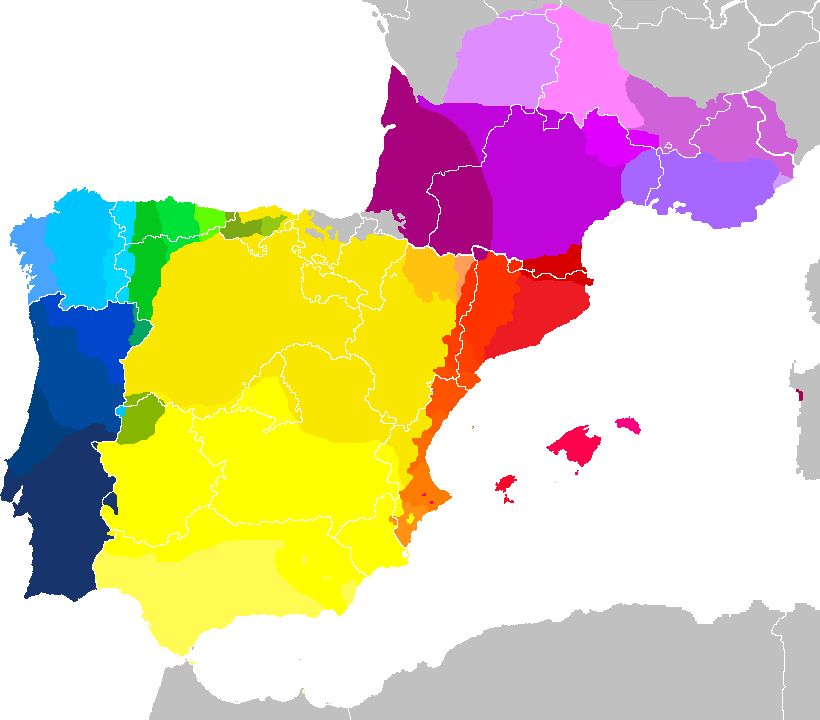
Area of the Fala language.

Fala ("speech", also called Xalimego[2]) is a Western Romance language commonly classified in the Galician–Portuguese subgroup, with some traits from Leonese, spoken in Spain by about 10,500 people, of whom 5,500 live in a valley of the northwestern part of Extremadura near the border with Portugal. The speakers of Fala live in the towns of Valverde del Fresno (Valverdi du Fresnu), Eljas (As Ellas) and San Martín de Trevejo (Sa Martín de Trevellu). These are within the valley of Jálama, in the comarca of Sierra de Gata.

Other names sometimes used for the language are Fala de Jálama or Fala de Xálima, but neither of them is used by the speakers themselves, who call their linguistic varieties lagarteiru (in Eljas), manhegu / mañegu (in San Martín de Trevejo) and valverdeiru (in Valverde del Fresno).[3]

History

[edit]

Origins

[edit]

In the Middle Ages, mixed varieties of Portuguese and Leonese could be found along the border between Leon and Portugal, represented in texts such as the Foro de Castelo Rodrigo (13th century). Although there is no documentation on the colonization and repopulation of this area in the 13th century, there are several hypotheses of Galician citizens moving to protect the frontier against Muslims as a punishment imposed by the Leonese king, or the delivery of the territories to various military orders by Kings Alfonso IX and Fernando II.

In general, philologists in favor of the Galician theory support the hypothesis that the valley is an isolated region and, therefore, the Galician colonists maintain their way of speaking in a "pure" form because of the lack of external influences. However, the valley is contiguous to the Portuguese border, making it a good candidate to be classified into the lands exchanged by Castille and Portugal, by the Treaty of Alcanices. Previously, during the reconquista, the border had a snaky shape. The treaty was done to make it straighter, which broadly was achieved by delivering the Ribacoa to Portugal (Guarda, the ancient border post, is now 40 km westwards of the new one), and receiving the lands east of the Erges-Tagus-Sever rivers, [citation needed] 180 km of frontier delimitated by water-courses. The agreement among monarchs didn't force the populations to a re-settlement, so a few have changed of country, not by their own will, but due to the change of borders.

Recent

[edit]
A sign in Spanish and Fala in San Martín de Trevejo

On August 3, 1992, the association Fala i Cultura was founded, among its goals being the compilation of a common grammar (based on the Galician one) and the commemoration of u día da nosa fala (the day of our language) celebrated once a year from 1992 in Eljas, 1993 in Valverde and 1994 in San Martín.[citation needed]

It was not until 1998 that the first literary work in Fala was published: Seis sainetes valverdeiros, written by Isabel López Lajas and published in 1998 by Edicións Positivas (Santiago de Compostela). It was on this date that the Gabinete de Iniciativas Transfronterizas (Office of Cross-Border Initiatives) started to take interest in Fala and to promote its study, publishing in 1999 scientific works and celebrating in May a "Congress on A Fala".[citation needed]

On June 14, 2000, Fala was recognized by the Ministry of Culture of the Junta de Extremadura as Bien de Interés Cultural.[4] Nowadays, although the inhabitants of Jalama Valley can speak Spanish, most of them are bilingual because at home and in other activities outside school, they continue using the local language.

Sociolinguistic surveys

[edit]

In 1992,[5] a survey conducted by José Enrique Gargallo Gil (a professor at the University of Barcelona) collected the following data regarding the use of Spanish in family conversation:

  • 4 of the 29 respondents from San Martín used Spanish when speaking with their family (13.8%)
  • In Eljas the figure dropped to only 3 out of 54 respondents (5.6%)
  • In Valverde, 25 of 125 respondents used Spanish in this context (20%).

In September/December 1993 a survey was published in issue No. 30 of Alcántara Magazine by José Luis Martín Galindo, which showed the opinion of the people in San Martín de Trevejo as to the nature of Fala in the following percentages:

  • Believe that Fala is a dialect of Spanish: 13%
  • Believe that Fala is a dialect of Portuguese: 20%
  • Believe that Fala is an autonomous language: 67%

The survey involved only twenty people (over 960 neighbours) and there was no alternative answer for those respondents who believed that Fala is a dialect of Galician. It is argued that the absence of this option was logical since theories about the possible relation of Fala with Galician were hardly known.

In 1994, a new study showed that 80% of respondents learned to speak Spanish in school. The percentage of parents who claim to use Fala when speaking with their children was as follows:

  • 100% in Eljas
  • 85% in San Martin
  • 73% in Valverde.

Phonology

[edit]

Orthography

[edit]

It has no regular orthography and when it is written it is based on Spanish. This proposed alphabet based on Portuguese has 23 letters: [6]

Upper case letters
A B C D E F G H I J L M N O P Q R S T U V X Z
Lower case letters
a b c d e f g h i j l m n o p q r s t u v x z

Comparative vocabulary

[edit]

Some Fala vocabulary are shown in the table below.[7]

Latin Galician Fala Extremaduran Portuguese Spanish English
hodie hoxe hoxii hoy hoje hoy today
localem lugar lugal lugal lugar lugar place
dicere dicir izil izil dizer decir to say/to tell
oculus ollo ollu oju olho ojo eye
aqua auga agua áugua água agua water
creare crear crial crial criar crear to create

See also

[edit]

References

[edit]
[edit]
Revisions and contributorsEdit on WikipediaRead on Wikipedia
from Grokipedia
Fala, also known as Xalimego, is a minority Romance spoken by fewer than 5,000 primarily in the Jálama (Val de Xálima) of northeastern , . It is confined to the three villages of Valverde del Fresno (Valverdi du Fresnu), Eljas (As Ellas), and San Martín de Trevejo (Sa Martín de Trebellu), where it serves as the vernacular tongue for up to 90% of the approximately 4,500 residents. Classified as part of the Ibero-Romance subgroup with affinities to Galician- and some Leonese influences, Fala exhibits three mutually intelligible varieties—Valverdeñu, Lagarteiru, and Mañegu—each tied to one of the speaking communities, though its precise phylogenetic position remains debated among linguists. Originating from medieval repopulation efforts in the 12th–13th centuries, the preserves an oral tradition rooted in , shaped by prolonged contact with Spanish and along the border region. Despite official recognition as Extremadura's historic-cultural patrimony since 2001, Fala confronts serious endangerment from demographic decline, aging speakers, and external linguistic pressures, prompting community-led revitalization through orthographic standardization and educational initiatives that emphasize local identity over external impositions.

History

Origins in medieval settlement

The Fala language emerged in the Jálama Valley of northwestern during the late 12th and early 13th centuries, as part of the Christian repopulation (repoblación) efforts following the reconquest of the region from Muslim rule. The valley, encompassing the modern villages of Valverde del Fresno, Eljas, and San Martín de Trevejo, had been sparsely inhabited or abandoned after the Almohad period, and was incorporated into the Kingdom of León under kings Fernando II (r. 1157–1188) and Alfonso IX (r. 1188–1230). These monarchs oversaw the conquest of key sites, such as Trevejo castle around 1184, after which military orders like the and the managed settlement to secure the frontier against and secure agricultural lands. Repopulation involved granting charters (fuero) to attract colonists, with early settlers documented as originating from nearby Leonese territories like Salvaleón and Torre de Mata, but broader migration drew from the northwest , particularly Galicia and northern . These settlers introduced a variant of medieval Galician-Portuguese, the dominant vernacular in the Kingdom of Galicia, which formed the core substrate of Fala. Linguistic evidence, including retained archaic phonological features like the preservation of intervocalic /l/ and nasal vowels, aligns with this Galician-Portuguese base rather than local Castilian or extreme Leonese dialects. Portuguese philologist Luís Filipe Lindley proposed that Fala specifically derives from the speech of Galician colonists who repopulated the adjacent Riba-Coa region (modern territory bordering the valley) in the early , with the language's distinct retention attributed to the valley's rugged isolation, limiting subsequent Castilian influence. This theory is supported by toponymic evidence, such as place names reflecting Galician- morphology (e.g., endings in -ego or -ueu), and contrasts with older views positing indigenous Celtic-Roman continuity or heavier Leonese overlay, which lack strong empirical backing from comparative . By the mid-, under the repopulation charters of 1184–1252, the community's linguistic profile was established, setting the stage for Fala's evolution amid minimal external contact.

Evolution through early modern period

The Fala language, preserved in the isolated Valle de Xálima, underwent limited phonological and lexical evolution during the early modern period, retaining archaic Galician-Portuguese traits such as nasal vowels and intervocalic voiceless stops amid broader Romance standardization elsewhere. Geographic barriers, including steep terrain and dense forests, restricted contact with Castilian-speaking regions, fostering endogamous communities that prioritized internal cohesion over assimilation. Administrative fragmentation further insulated the speech: Valverde del Fresno and Eljas fell under the Orden de Alcántara (linked to Cáceres), while San Martín de Trevejo aligned with the Orden de San Juan (tied to Salamanca), delaying unified linguistic pressures until provincial reforms in 1833. Border proximity to introduced sporadic lexical borrowings, particularly in trade-related vocabulary, though core grammar and syntax remained stable, diverging from evolving modern Galician and Portuguese. 17th- and 18th-century Iberian conflicts, including wars with , disrupted adjacent areas like Cedillo—repopulated by Portuguese speakers by 1791 for economic incentives—but the core Fala villages experienced negligible demographic shifts, sustaining oral transmission without written attestation. Etnocentric attitudes among speakers reinforced this stasis, viewing Fala as intrinsic to local identity akin to the landscape itself, countering gradual Castilian encroachment seen in peripheral dialects. By the late , Fala's varieties—mañegu in San Martín, valverdeiru in Valverde, and lagarteiru in Eljas—exhibited dialectal differentiation rooted in medieval substrates, with Valverde showing earliest mild Castilianization due to slightly greater accessibility, yet overall vitality persisted through communal insularity rather than innovation.

20th-century documentation and decline

The first systematic linguistic attention to Fala in the occurred during visits to the Valle de Xálima by Spanish philologist Ramón Menéndez Pidal and Federico de Onís in 1910, where they collected oral data and noted its distinct Romance features amid local Portuguese influences. In 1927, Portuguese linguist José Leite de Vasconcelos published early analyses positing a direct Portuguese origin for Fala, based on phonetic and lexical parallels, marking one of the initial scholarly efforts to classify it beyond local folklore. Mid-century documentation remained sparse, with Menéndez Pidal's 1960 reflections drawing comparisons between Fala varieties and medieval Galician- texts like the Foros de Castelo Rodrigo, emphasizing archaic retentions not preserved in or modern Portuguese. Systematic field surveys intensified in the late , including Jesús C. Rey Yelmo's work from 1991 to 1997, which documented phonological, morphological, and sociolinguistic patterns in San Martín de Trevejo through direct informant interviews, culminating in publications like A fala. La fala de San Martín de Trevejo: O Mañegu in 1999. These efforts, alongside studies by Enrique Costas (1992–1995) on normalization and José Enrique Gargallo Gil's 1999 dialectal analysis of the three core villages, shifted focus toward preservation amid growing awareness of endangerment. Fala's decline accelerated throughout the 20th century due to pervasive Spanish assimilation pressures, including mandatory Castilian-only education under the Franco regime (1939–1975), which marginalized regional tongues as threats to national unity, and administrative that confined Fala to informal domestic spheres. Emigration from rural Valle de Xálima villages to urban for economic opportunities further eroded transmission, fostering where Spanish dominated public life, schools, and media, reducing active speakers to intergenerational household use by century's end. By the 1990s, approximately 5,000 speakers remained, primarily elderly, prompting the 1992 founding of the Asociación Fala y Cultura to advocate and counter obsolescence through orthographic reforms and cultural initiatives like Domingo Frades Gaspar's 1994 Vamus a falal, the era's first sustained Fala-language text. The first original literary work, Seis sainetes valverdeiros by Isabel López Lajas, appeared in 1998, signaling late-century revitalization attempts against entrenched shift.

Linguistic Classification and Debates

Affiliation with Galician-Portuguese continuum

The Fala language is classified as a member of the Galician-Portuguese subgroup within the , descending from the medieval Galician-Portuguese that gave rise to modern Galician and . This affiliation stems from 13th-century repopulation of the Jálama Valley by Galician settlers, with historical records indicating approximately 85% of early colonists originated from Galician territories. Key phonological traits linking Fala to the continuum include the retention of Latin initial /f/ (e.g., fillu from filium, contrasting with Spanish hijo), final vowels /u/ and /i/ in place of /o/ and /e/ (e.g., fumu for ""), and the evolution of Latin /au/ to /oi/ (e.g., oiru for ""). Morphologically, Fala preserves Galician-Portuguese infinitival r/l interchange (e.g., or cantar) and lexical overlaps, such as shared vocabulary for everyday terms with both Galician and . These features distinguish it from neighboring while aligning it closely with the continuum's core innovations. Scholarly consensus, as articulated by linguists like Costas González (1999, 2011), positions Fala as a peripheral variety of this continuum, though earlier theories emphasized dominance (Vasconcelos 1927–1933) or Astur-Leonese substrates (Cintra 1959). Subsequent analyses reject singular attributions, attributing hybrid traits to geographic isolation and substrate contacts without undermining the Galician- foundation. This classification supports Fala's recognition as a distinct yet continuum-affiliated , with ongoing debates reflecting both linguistic evidence and local identity assertions.

Leonese and other substrate influences

The Fala language exhibits notable influences from Leonese, part of the Astur-Leonese , primarily through historical contact and settlement patterns rather than a deep pre-Romance substrate. During the in the 12th and 13th centuries, the Valley of Jálama was repopulated by settlers from the Kingdom of León, including speakers of Leonese varieties, alongside Galician-Portuguese migrants under rulers like Alfonso IX. This admixture layered Leonese traits onto a predominant Galician-Portuguese base, as proposed by scholars such as Luís Lindley Cintra (1959), who described Fala as Old Galician infused with "Leonisms," and Manuel Rodríguez Casas Maia (1977), who identified Leonese elements dating to the 13th century. Later analyses, including those by María Isabel Martín Durán (1999), classify Fala as a Leonese subdialect adapted through Galician-Portuguese contact within the shared Leonese kingdom history. Phonological features attributed to Leonese include non-diphthongization of tonic mid vowels e and o (retaining forms like falal 'to speak' from Latin fabulare, akin to Old Leonese patterns) and the evolution of Latin ly to ll (e.g., allu 'garlic' from allium). Intervocalic d-deletion (e.g., falau 'spoken' from hablado) and final -r lateralization (e.g., comel 'eat!' from comer) align with Astur-Leonese traits observed in regional Galician-Portuguese varieties. Vowel shifts, such as -e to -i and -o to -u in certain contexts (e.g., noite/noiti 'night', cavalo/cavalu 'horse'), and implosive r/l confusion favoring l (e.g., cantal 'sing', sel 'be'), reflect proximity to Leonese-speaking areas in the Sierra de Gata and northern Extremadura. Morphological markers include Leonese-influenced preterite perfect forms in dialects like manhegu and lagarteiru, such as cantórim 'we sang' (contrasting with cantaram in valverdeiru). Lexical and derivational elements, such as the -ai ending from Latin -ATEM (e.g., verdai 'truth' from veritatem), stem from Leonese contact via Astur-Leonese communities in adjacent zones like El Rebollar. These influences, termed leonesismos or extremeñismos in local studies, arose from centuries of bilingualism and migration, overlaying the core Galician-Portuguese structure without dominating it. Regarding deeper substrates, Fala shares the Celtic lexical remnants typical of northwestern Ibero-Romance languages (e.g., words for animals or ), inherited via the Galician-Portuguese continuum from pre-Roman Lusitanian or Celtiberian elements, but no unique non-Romance substrate specific to Fala's Leonese layer has been empirically isolated beyond general Iberian patterns. Ongoing Castilian superstrate pressure has introduced competing innovations, diluting some archaic Leonese retentions.

Language versus dialect status controversy

The of Fala as a distinct or as a within the broader Galician-Portuguese continuum remains contested among linguists, influenced by both structural similarities to neighboring Romance varieties and unique sociolinguistic developments due to geographic isolation. Traditionally, Fala has been grouped under the Galician-Portuguese subgroup of , sharing core phonological, morphological, and lexical features with Galician and northern , such as the preservation of medieval /f/ initials (e.g., *filhu > fillu "son") and distinctions. However, its location in the isolated valleys of , surrounded by Castilian-speaking areas, has led to , incorporating Leonese and Astur-Leonese substrate elements like certain consonant clusters and vocabulary items absent in standard Galician or . Proponents of dialect status emphasize and continuum membership, arguing that Fala represents a transitional variety bridging Galician-Portuguese and Leonese influences without sufficient divergence to warrant separate language categorization under strictly genetic criteria. Linguistic analyses, such as those examining patterns, position Fala as a peripheral of the Galician-Portuguese branch, with over 80% lexical overlap with Galician in basic vocabulary lists, though reduced intelligibility arises more from archaic retentions and regionalisms than systemic innovation. This view aligns with historical , where Fala's features are seen as extensions of medieval settlement patterns from Galician-Portuguese speakers in the 13th-15th centuries, without evidence of a complete linguistic break. Critics of independent status note that similar debates apply to other Ibero-Romance varieties, where political boundaries rather than linguistic rupture drive separation claims. Advocates for recognizing Fala as a full highlight sociolinguistic factors, including low practical (estimated at 60-70% with standard Galician due to dialectal drift and habits) and a strong endogamous speaker identity tied to the three core villages (Valverde del Fresno, Eljas, and San Martín de Trevejo). Assessments using frameworks like UNESCO's Language Vitality Index and (EGIDS) rate Fala as a distinct entity at "definitely endangered" level, with institutional support efforts since the 1990s, including orthographic standardization in 2012 and regional legislative mentions in Extremadura's 2011 document. Local organizations like AFALA assert its , rejecting dialect subordination on grounds that speakers do not identify with Galician or cultural spheres and maintain oral traditions independent of those standards. This perspective gained traction in academic works emphasizing Fala's "linguistic " status, where isolation fostered hybrid traits not reducible to parent dialects, supporting calls for protections under Spain's autonomous community frameworks.

Geographic Distribution

Core speaking villages

The Fala language is natively spoken in three core villages in the Valle del Jálama, located in the northern part of the , , , adjacent to the border with . These villages—Valverde del Fresno, Eljas, and San Martín de Trevejo—constitute the primary geographic enclave where Fala has been maintained as a , with speakers numbering around 5,000 to 6,000 individuals concentrated in this area as of the early . The isolation of the valley, characterized by rugged terrain in the Sierra de Gata, has historically limited external linguistic influences, allowing Fala to persist amid dominant Spanish usage elsewhere in . In Valverde del Fresno (Fala: Valverdi du Fresnu), the largest of the three with a municipal of about 2,000, Fala serves as the everyday among elders, often alongside Spanish in bilingual contexts. Eljas (As Ellas), a smaller settlement with fewer than 500 residents, exhibits similar patterns of intergenerational transmission, though younger speakers increasingly favor Spanish due to and media exposure. San Martín de Trevejo (Sa Martín de Trevellu), known for cultural initiatives like bilingual signage, maintains Fala in local traditions and informal settings, with efforts to document and teach it locally. Across these villages, Fala's vitality is tied to familial and communal use, but census data indicate a decline in fluent speakers under age 40, reflecting broader dynamics.

Dialectal variations across communities

The Fala language is characterized by three mutually intelligible dialectal varieties, each primarily spoken in one of the three core villages of the Valle del Jálama in Cáceres province, , : Valverde del Fresno, Eljas, and San Martín de Trevejo. These varieties—valverdeiru (or valverdeñu) in Valverde del Fresno, lagarteiru in Eljas, and mañegu (or manhegu) in San Martín de Trevejo—reflect local identities and exhibit phonological, lexical, and intonational differences shaped by historical isolation and varying degrees of contact with neighboring languages like and Galician-Portuguese. The lagarteiru variety of Eljas is regarded as the most conservative and archaic, preserving older Galician-Portuguese features such as certain systems and intonation patterns closer to medieval Ibero-Romance substrates, with less pervasive Spanish influence compared to the other dialects. In contrast, valverdeiru in Valverde del Fresno represents the most innovative form, showing greater assimilation of Castilian elements, including simplified intonation akin to Spanish declarative patterns and lexical borrowings that mark it as the most modern evolutionary stage. The mañegu of San Martín de Trevejo occupies an intermediate position, blending archaic retention with moderate innovations, including intonation that aligns more closely with Galician-Portuguese than the valverdeiru but diverges from the lagarteiru's conservatism. Despite these variations, speakers across communities maintain high due to frequent inter-village interactions, shared cultural events, and a collective sense of linguistic unity under the umbrella term "a Fala de Xálima." Lexical distinctions often center on local toponyms and everyday terms—for instance, self-designations tied to village names—while phonological shifts, such as differential treatment of intervocalic consonants or diphthongization, further delineate boundaries without impeding comprehension. Efforts toward , including orthographic proposals since the 1980s, aim to bridge these dialects by prioritizing common core features, though local pride in varietal distinctiveness persists.

Sociolinguistic Profile

Current speaker demographics and endangerment

The Fala language is spoken exclusively in the rural villages of Valverde del Fresno, Eljas, and San Martín de Trevejo, located in the Valle del Jálama within Cáceres province, , , near the Portuguese border. As of 2024, Valverde del Fresno has a population of 2,142; Eljas, 705; and San Martín de Trevejo, 859, yielding a combined resident base of roughly 3,706 individuals. Speakers are overwhelmingly bilingual in Spanish, with proficiency in Fala varying by age: near-universal among those over 50, but declining among younger cohorts due to education and media dominance in Spanish. Estimates place the total number of speakers at no more than 5,000, representing 80–90% vernacular competence within the core communities, though active daily use is lower. Fala faces endangerment from systematic , driven by economic migration, compulsory Spanish-medium schooling, and pressures since the mid-20th century. Intergenerational transmission has weakened, with household surveys showing 5–14% of families in these villages preferring Spanish for intra-family communication as of early 2000s data, a trend likely accelerated by . No formal vitality score is assigned, but the language's restricted geographic scope, small speaker base, and limited institutional support classify it as endangered, with revitalization efforts—such as community documentation projects since 2018—focusing on orthographic standardization and digital archiving to counter attrition. Despite these initiatives, demographic aging and out-migration portend further decline without broader policy intervention.

Bilingualism patterns and language shift

All speakers of Fala are bilingual in Fala and Spanish (Castilian), with Spanish serving as the dominant language in formal, educational, administrative, and external communication contexts. Fala is typically acquired as the first language in the home within the core villages of Valverde del Fresno, Eljas, and San Martín de Trevejo, while Spanish is introduced as a second language through schooling starting around age 3, leading to effortless code-switching among proficient speakers. Surveys indicate high daily use of Fala in intra-community social interactions, including family conversations and local texting, but Spanish predominates in intergenerational exchanges with children and in interactions beyond the valley. Language shift toward Spanish is evident, driven by exclusive Spanish-medium , , population depopulation, and perceptions of Spanish's greater prestige and utility. Intergenerational transmission is declining, with some parents opting to speak Spanish to children due to stigma or anticipated economic advantages, resulting in reduced among younger cohorts. Speaker estimates stand at approximately 5,000–11,000, concentrated in the three villages (total ~3,586 as of ), but aging demographics and low birth rates exacerbate vulnerability, with revitalization efforts like community projects and local radio attempting to stem attrition. No formal institutional support exists for Fala in schools or media, accelerating the shift despite bilingual signage and cultural initiatives in the Gata Mountains area.

Phonology

Consonant inventory and alternations

The consonant inventory of Fala consists of approximately 25 phonemes, aligning closely with other Western Ibero-Romance languages while featuring distinctive fricatives and affricates such as /ʒ/ and /ʤ/, which mark its Galician-Portuguese affiliation and differentiate it from neighboring Spanish dialects. These include stops (/p, b, t, d, k, g/), fricatives (/f, v, s, z, ʃ, ʒ, θ/), nasals (/m, n, ɲ, ŋ/), laterals (/l, ʎ/), rhotic approximants (/ɾ, r/), affricates (/ʧ, ʤ/), and the palatal approximant /j/. Voiced dental fricatives /ð/ occur as allophones or in dialectal variants, often from lenition processes.
Place/MannerBilabialLabiodentalDental/AlveolarPostalveolarPalatalVelar
Stopsp, bt, dk, g
Fricativesf, vs, z, θʃ, ʒ
Affricatesʧ, ʤ
Nasalsmnɲŋ
Lateralslʎ
Rhoticsɾ, r
j
This inventory reflects historical developments from Latin, including palatalization of clusters like Latin *pl, cl, fl > /ʧ/ (e.g., *plēnus > cheu 'full') and *ly, c’l, g’l, t’l > /ʎ/ (e.g., *alliō > allu ''). Orthographic representations vary by and proposal, with /ʃ/ as or , /ʒ/ as <ẋ> or , and /ʤ/ as , prioritizing phonemic transparency over etymological fidelity. Consonant alternations in Fala are prominent in intervocalic and coda positions, driven by and simplification inherited from medieval Galician-Portuguese substrates. Intervocalic /d/ frequently deletes, as in falau from *falado 'spoken', a pattern reducing consonant clusters in verbal endings. Final /r/ lateralizes to in dialects of Eljas and San Martín de Trevejo (e.g., comer > come 'eat'), while /s/ sonorizes to [ʒ] before vowels (e.g., presa 'hurry' as [ˈpɾeʒa]). mergers and shifts occur dialectally, with /z/ alternating with /ʒ/ or /ʤ/ in words like casa 'house' ([ˈkaθa], [ˈkaʃa], or [ˈkaða]), reflecting substrate Leonese influences and contact-induced variability across the core villages. Final consonants like /z/ may drop (e.g., *capaz > capa 'able'), and /l, n/ assimilate or elide in clusters (e.g., *dēitāre > ita 'to add'). These processes vary by community—Mañegu (Valverde del Fresno) preserves more fricatives, while Lagarteiru shows stronger —underscoring Fala's micro-dialectal fragmentation.

Vowel system and diphthongs

The Fala language features a vowel system characteristic of medieval Galician- varieties, comprising seven oral s in unstressed syllables (/a, ɛ, e, i, ɔ, o, u/) and five in stressed syllables (/a, e, i, o, u/), with mid vowels exhibiting open and close distinctions primarily in unstressed contexts. Unlike modern , Fala lacks phonological of vowels, distinguishing it from neighboring Gallo- languages and aligning it more closely with Leonese-influenced Romance systems. Stressed mid vowels /e/ and /o/ do not diphthongize as in Spanish (e.g., *ie, *ue), preserving monophthongal quality, while unstressed /e/ and /o/ remain distinct from high vowels but may reduce in final position to /i/ and /u/ (e.g., *fome > [fomi], *fumo > [fumu]).
PositionCloseClose-midOpen-midOpen
Frontieɛ
Centrala
Backuoɔ
This inventory reflects historical retention from Old Portuguese, with dialectal variations across the three main varieties (Mañegu of San Martín de Trevejo, Lagarteiru of Eljas, and Valverdeiru of Valverde del Fresno); for instance, realizations of /e/ may shift toward in compounds like *leite > leit in some idiolects. No phonemic or contrastive nasal vowels are attested, though may occur allophonically before nasal consonants. Diphthongs in Fala include both falling and rising types, such as /ai, ei, oi, au, ou, eu/, arising from historical evolutions like Latin *au > oi (e.g., *aurum > oiru 'gold') and cluster-induced changes like *tr > /air/ (e.g., *patris > pairi 'father's'). These are stressed and behave as unitary syllables, with orthographic representation varying by dialect (e.g., -oi- retained in conservative forms). Unlike Spanish, tonic mid vowels resist breaking into diphthongs, but sequences like /ou/ and /ei/ appear in lexical items influenced by substrate Leonese elements. Dialects show minor realizations, such as variable gliding in /ai/ toward [ɛi] in rapid speech, but no systematic triphthongs or novel diphthongs beyond Romance norms.

Suprasegmental features

Fala features lexical stress typical of , with primary stress placement varying by word class and morphology, often defaulting to the penultimate in polysyllables, akin to patterns in neighboring Spanish and Galician-Portuguese varieties. Monosyllabic words generally lack accent marks except in specific cases, while stressed diphthongs at word boundaries (e.g., au, ou, eu) are realized without orthographic indication, and hiatus involving a stressed closed followed by an unstressed open may employ acute accents (e.g., tíu 'uncle'). Adverbs derived with -menti retain the stress of the base (e.g., fácilmenti 'easily'), reflecting morphological inheritance. Intonation in Fala has been analyzed through acoustic studies employing metrical-autosegmental frameworks on semi-spontaneous and read speech from speakers across its three varieties: valverdeiru (Valverde del Fresno), lagarteiru (San Martín de Trevejo), and mañegu (Eljas). The most frequent nuclear pitch accent configuration is (L+)H* L%, characterized by a low or low-rising initial pitch target followed by a high tone on the stressed and a low boundary tone, occurring prominently in declarative sentences and both absolute (yes/no) and partial (wh-) interrogatives. This contour exhibits similarities to Spanish intonation, particularly in the more Spanish-influenced valverdeiru variety, while lagarteiru and mañegu align closer to Galician-Portuguese prosodic patterns, highlighting dialectal gradients shaped by contact with dominant languages. No tonal system is attested, and rhythm aligns with the syllable-timed characteristics of Ibero-Romance languages, though empirical data on duration or intensity modulations remain limited. Varietal differences in prosody underscore ongoing Spanishization, especially in valverdeiru, where castilianized features may attenuate Galician-Portuguese intonational traits.

Grammar

Nominal and pronominal morphology

The Fala language exhibits a nominal system characteristic of Western Romance languages, with nouns inflected for two genders—masculine and feminine—and two numbers—singular and plural. Gender is primarily lexical, determined by the noun's ending or semantic class, as in ovella/oveya/ovelha (sheep, feminine) or mininu (child, masculine). Plural formation typically involves adding -s or -es to the singular stem, with phonetic adjustments for ease of articulation, yielding forms such as pesoas/persoas (people) from singular pessoa, corazós/corazons (hearts) from corazón, or pedras/peiras (stones) from pedra. No morphological case marking exists; nominal relations are expressed via prepositions like de (of, from) and word order. Definite articles distinguish and number: masculine singular u or o (varying by , e.g., u portu in Eljas and Valverde del Fresno, o portu in San Martín de Trevejo), feminine singular a or unha, with plurals os/as. Indefinite articles follow similar patterns, with un/una for singular and uns/unas for , though examples are less frequently attested in descriptions. Articles may contract with prepositions, such as du/do from de u/o (of the, masculine). Adjectives agree with nouns in and number, showing endings like -u/-a for singular and -os/-as for ; dialectal variation affects forms, e.g., medicu (Eljas), mecu (San Martín), meicu (Valverde) for "doctor" (masculine singular). Diminutives, formed with -iñu/-iña, also inflect accordingly, as in amiguiñu (little friend, masculine).
CategoryMasculine SingularMasculine PluralFeminine SingularFeminine Plural
Definite Articleu/o (e.g., u pairi)osa/unhaas
Example Nounmininu (child)mininusmadroñeira (strawberry tree)madroñeiras
Adjective Agreementcapaz (able)capazescapazcapazes
Pronominal morphology includes tonic and forms, with personal pronouns marking person, number, and sometimes in third person. First-person singular is ei (I), second-person singular tu (you), and clitics like me (me) or le (him/her/it/to him). Examples include ei nõ me queixo (I do not complain) and le disu u pairi (he said to the father, or the father said to him, context-dependent). pronouns/adjectives inflect for and number, e.g., mei (my, masculine, as in mei ilmanu "my brother") and miña (my, feminine, as in miña hermana "my sister"). distinguish proximity and , such as esti (this, masculine/neuter) in de esti (from this) and aquela (that, feminine). Relative and other pronouns are sparsely documented, with dialectal differences influencing placement and contraction in speech.
Pronoun TypeExample FormsUsage Example
Personal (1st sg.)eiEi nun me queisu (I'm not complaining)
Personal Cliticle, meLe disu ù pairi (he said to the father)
Possessivemei (m.), miña (f.)Miña hermana (my sister)
Demonstrativeesti (this), aquela (that f.)De esti (from this)

Verbal conjugation patterns

The verbal system of Fala adheres to the tripartite conjugation classes typical of Galician-Portuguese varieties, distinguished by infinitive endings: first conjugation in -ar (e.g., falal 'to speak'), second in -er, and third in -ir. These classes determine stem formation and thematic vowels, with synthetic inflections marking person and number in tenses such as the present indicative and . Unlike Spanish, Fala preserves Latin initial /f-/ in verbs like falal (cf. Spanish hablar), and exhibits non-diphthongization of mid vowels in stressed positions, yielding forms without the Spanish ie or ue alternations. Present indicative conjugations show dialectal divergence across the three main varieties—Lagarteiru (Eljas), Mañegu (San Martín de Trevejo), and the Valverde del Fresno variant—with variations primarily in the second person singular due to phonetic reductions and affrication. For instance, the verb faze/fai 'to do/make' (from Latin facere) yields fais in Lagarteiru, facis in Valverde, and fadis in Mañegu for the second person singular query form Qué fais/facis/fadis? 'What are you doing?'. Third person singular forms retain archaic simplifications, as in poi for poder 'to be able' (cf. Spanish puede, pode). Past participles demonstrate systematic of intervocalic and final -d, a hallmark of Fala morphology diverging from both Spanish and standards: e.g., falau or chegau 'arrived/spoken' instead of hablado/falado or chegado. This pattern extends to compound tenses, where the auxiliary avêr 'to have' combines with such participles, though full paradigms remain undocumented in primary sources due to the language's and limited standardization. and forms follow Galician-Portuguese synthetic patterns, with stems augmented by thematic vowels and endings like -ava for imperfects, but exhibit local innovations such as final -r lateralization in infinitives (e.g., cantal [kantaɬ]). Subjunctive moods preserve fusional endings akin to medieval Galician-Portuguese, with -a for first/third singular in -ar verbs, though dialectal leveling toward Spanish influences has been noted in younger speakers. Irregular verbs like sêr 'to be' and ir 'to go' show stem suppletion and vowel shifts, e.g., past forms without Latin perfect survivals common in conservative Ibero-Romance. These patterns underscore Fala's retention of pre-16th-century features amid contact-induced erosion, with no evidence of analytic periphrases dominating over synthetic forms as in modern Spanish.

Syntactic structures

Fala exhibits a predominantly Subject-Verb-Object (SVO) in declarative sentences, aligning with standard Romance patterns. This canonical is evident in simple clauses such as U mininu comi queisu de leiti de ovella ("The boy eats sheep’s milk cheese"). Variations in verb forms across the three main varieties—xalimego (Valverde del Fresno), mañegu (Eljas), and palurdo (San Martín de Trevejo)—affect but preserve the SVO sequence; for instance, interrogatives like Qué fais? (Eljas), Qué facis? (Valverde), or Qué fadis? (San Martín) all maintain subject-verb adjacency before the object or complement. Subordinate clauses are introduced by conjunctions such as purque ("because"), forming complex sentences with embedded structures, as in Vo cun presa a buscal a ilmana María purque anda presa ("I go in a hurry to look for sister María because she’s in a hurry"). Dative constructions employ pronouns preceding the verb, exemplified by le disu u pairi ("he said to the father"), where le functions as an indirect object marker. Prepositional phrases frequently contract with articles, yielding forms like du ("of the"), na ("in a"), or da ("of a"), which integrate into phrases and adverbials to build syntactic cohesion, as seen in As pesoas du pisu d’abaixu falan de corazós ("The people downstairs talk about hearts"). Coordination relies on conjunctions like y ("and") to link clauses or phrases, contributing to compound sentence formation: O dagalitu comi queisu de leiti de ovella y ei nun me queisu ("The eats sheep’s cheese and I don’t complain"). These patterns reflect conservative Ibero-Romance traits, with intervocalic deletions (e.g., falau "spoken" from falado) and occasional final shifts (e.g., "to sing" from cantar) influencing morphological boundaries without disrupting core syntactic hierarchies. Empirical descriptions from field-based analyses confirm the prevalence of simple declarative clauses, with limited documentation of advanced structures like passives or relative clauses, underscoring Fala's and regional isolation.

Lexicon

Romance core and semantic fields

The core lexicon of Fala, comprising approximately the foundational vocabulary inherited from Vulgar Latin, aligns closely with other Ibero-Romance languages, particularly in semantic fields related to kinship, daily necessities, and environmental elements. Words such as pairi ("father," from Latin pater), leiti ("milk," akin to Portuguese leite), and noiti ("night," retaining the non-diphthongized Latin nocte) exemplify this Romance substrate, preserving archaic forms not always evident in neighboring Spanish. These patrimonial terms constitute the bulk of basic expressions used in everyday discourse across Fala's three varieties—Valverdeiru, Mañegu, and Lagarteiru—demonstrating lexical stability despite geographic isolation. In semantic fields like and , Fala favors forms resonant with Galician- substrates over Castilian innovations; for instance, soide ("") parallels Portuguese saúde more than Spanish salud, reflecting a historical continuum from medieval Galician-Portuguese dialects. Food-related vocabulary, such as queisu ("cheese") and ovella ("sheep"), further underscores this core, with minimal non-Romance intrusions in unborrowed domains. and material descriptors, including oiru ("," from Latin aurum) and roblis ("oak trees"), maintain Latin-derived , often exhibiting phonetic traits like retention of initial f- (e.g., falal "to speak" vs. Spanish hablar).
Semantic FieldFala ExampleLatin EtymonPortuguese CognateSpanish Cognate
Kinshippairi (father)paterpaipadre
Sustenanceleiti (milk)lacleiteleche
Time/Naturenoiti (night)noctenoitenoche
Materialsoiru (gold)aurumourooro
Daily Statecheu (full)plenuscheiolleno
While the Romance core remains robust in these fields, peripheral lexicon shows increasing Spanish loanwords (e.g., persoas from personas), attributed to bilingualism and , though community efforts prioritize native terms to mitigate "vocabulary poisoning." Lexical variation persists across varieties—for example, medicu/mecu/meicu ("doctor")—yet mutual intelligibility is high, with over 9,000 entries documented per dialect in recent dictionaries. This structure underscores Fala's position as a conservative Galician-Portuguese offshoot with Leonese admixtures, rather than a mere .

Comparative vocabulary with neighbors

The lexicon of Fala, a Western Romance language spoken in the Val de Xálima region of , , exhibits strong affinities with Galician- varieties due to shared medieval origins, while incorporating lexical borrowings and phonetic adaptations from as the dominant regional superstrate. with Portuguese is estimated at around 85-90% in core vocabulary, reflecting conserved patrimonial terms from , whereas Spanish influence manifests in approximately 20-30% of everyday through loans and semantic shifts, particularly in administrative, modern, and technical domains. Galician parallels are evident in rural and domestic terms, though Fala's isolation has fostered unique innovations and retentions not found in standardized Galician. Internal variation across Fala's three main varieties—mañegu (San Martín de Trevejo), lagarteiru (Eljas), and valverdeiru (Valverde del Fresno)—further nuances comparisons, with phonetic shifts like intervocalic /d/ retention or prepalatal fricatives distinguishing it from neighbors. For instance, Fala preserves Latin initial /f-/ in verbs like "falal" (to speak), aligning with Portuguese "falar" and Galician "falar" against Spanish "hablar," but adopts Spanish-derived forms in compounds such as "computadol" alongside Portuguese-influenced "computador" for computer. Doublets are common, as in "costas" (back, from Portuguese) versus potential Spanish "espalda," illustrating bilingual interference.
EnglishFala (examples across varieties)SpanishPortugueseGalicianNotes on divergence
EyeolluojoolhoolloDiphthongization /oʎu/ closer to Galician-Portuguese; Spanish shifts to /x/.
MilkleitilecheleiteleiteRetained Latin /lakte/; Spanish palatalization absent.
Liverfígaduhígadofígadofigado/d/ retention vs. Spanish loss; aligns with Portuguese.
EyebrowceiẋacejasobrancelhacellaPrepalatal /ʃ/ unique; Portuguese uses compound form.
HeelcalcañaltalóncalcanharcalcañarSpanish semantic specialization; Fala retains descriptive term akin to Portuguese.
NeckpescozucuellopescoçopescozoPortuguese-like form with /z/; Spanish simplifies to /k/.
Goldoiruoroouroouro/oi/ diphthong vs. Spanish monophthong /o/.
Smokefumuhumofumofume/u/ ending vs. Spanish /o/; Latin retention.
Such correspondences underscore Fala's transitional status, with higher lexical overlap in basic verbs and nouns with (e.g., shared innovations like "pairi" for ) than with Spanish, where calques and loans prevail in abstract or borrowed terms. Studies note that while core resists full Castilianization, contact-induced changes accelerate in younger speakers, potentially eroding archaic Galician-Portuguese elements.

Orthography and Writing System

Pre-standardization usage

Prior to formal standardization efforts in the late 20th and early 21st centuries, the Fala language, spoken in the villages of Valverde del Fresno, Eljas, and San Martín de Trevejo in , , functioned primarily as an with minimal written attestation. Most historical documents in the region, including administrative, religious, and personal records, were composed exclusively in Spanish, reflecting the dominance of Castilian as the prestige for literacy and official purposes. Fala speakers, who were typically literate only in Spanish, rarely committed their to writing, leading to a scarcity of pre-1990s texts; early mentions, such as in Pascual Madoz's Diccionario geográfico-estadístico-historia de España (1845–1850), describe the speech variety but provide no Fala-scripted examples. When occasional writings in Fala did occur—such as folk songs, local inscriptions, or personal notes—they employed ad hoc adaptations of Spanish orthography, resulting in significant inconsistencies. These variations were particularly pronounced in representing Fala's four sibilant phonemes (/s/, /z/, /ʃ/, /ʒ/), which lack direct equivalents in standard Spanish, often leading to phonetic approximations using Spanish graphemes like s, z, x, or digraphs. Dialectal differences among the varieties—Valverdeñu, Lagarteiru, and Mañegu—further exacerbated orthographic divergence, with no unified conventions; for instance, the same word might appear as casa in one dialect's rendering and kasa or caſa in another's, depending on the writer's intuition or regional pronunciation. This patchwork approach hindered broader documentation and contributed to Fala's marginalization, as writers deferred to Spanish norms to ensure readability among outsiders. The first substantial literary work in Fala, Seis sainetes valverdeiros by Isabel López Lajas, appeared only in 1998, marking a shift from sporadic, non-standardized usage toward deliberate literary expression, though earlier 20th-century linguistic studies by scholars like Federico de Onís (1910 correspondence) began transcribing oral samples with improvised orthographies for academic purposes. These pre-standardization practices underscored Fala's reliance on oral transmission, with writing serving auxiliary roles in cultural preservation rather than systematic recording.

Modern orthographic reforms and challenges

Efforts to standardize Fala emerged in the late amid growing interest in , building on early written representations like Arreidis: Palabras y Ditus Lagarteirus (1999) and Vamus a Falal: Notas pâ coñocel y platical en nosa fala (2000), which reflected native speakers' intuitive spellings but lacked systematic rules. A more formal proposal in 2015 by Antonio Corredera Plaza and collaborators advocated a Portuguese-influenced system, incorporating diacritics such as <ã> and <õ>, systematic omission of intervocalic (e.g., metai for "half"), and alignment with Galician-Portuguese to emphasize Fala's historical roots. This approach faced rejection from speakers, who viewed it as imposing external ideological biases and erasing dialectal variations among the three main towns—Eljas, San Martín de Trevejo, and Valverde del Fresno—leading to limited adoption. The prevailing modern standard, Ortografía da Fala, was developed collaboratively starting in 2015 and finalized in 2017 by linguist Miroslav Valeš and the Asociación Cultural ‘A Nosa Fala’, prioritizing flexibility to accommodate the language's internal variants while using familiar Spanish-based graphemes. Key features include tolerance for phonetic alternations (e.g., versus in infinitives), representations of with , , , or for [ʒ], and variable vowels in function words like conjunctions ( or ). Distributed in booklets in March 2017, it garnered broad community support, with surveys from 2017–2018 indicating 84% approval among respondents and 89.88% favoring its use in school instruction. This orthography has facilitated subsequent resources, including a children's in 2020 and an adult exceeding 50,000 entries (editing phase as of 2021), alongside educational materials like student corpora and the Anduriña gazette. Persistent challenges include Fala's historical oral tradition, which has resulted in no unified written norm and heavy reliance on Spanish for documentation, complicating literacy development. Inter-town phonological and lexical differences foster resistance to full unification, as speakers prioritize local identities over a homogenized standard, evidenced by opposition in Valverde del Fresno where 26 of 30 respondents rejected variation-erasing proposals. Ideological tensions, such as debates over affiliation with Galician or Portuguese, exacerbate divisions, with external proposals often distrusted for perceived cultural imposition. Absent official governmental recognition and resources—despite a 2001 regional decree acknowledging Fala—these efforts depend on volunteer associations, facing further hurdles from an aging speaker base (approximately 4,300 as of recent estimates) and limited teacher training. Public inscriptions, such as town signs in variants like Valverdeñu or Mañegu, demonstrate ad hoc assertions of identity but underscore ongoing inconsistencies due to these unresolved issues.

Revitalization and Cultural Role

Community-driven preservation efforts

Local cultural associations have spearheaded preservation initiatives since the early 1990s, with the founding of the Asociación Fala i Cultura on August 3, 1992, explicitly tasked with developing a standardized grammar drawing from Galician norms to unify the variants spoken in Valverde del Fresno, San Martín de Trevejo, and Eljas. This grassroots effort emphasized speaker involvement to foster a sense of ownership over linguistic documentation and standardization, countering the historical oral transmission that had previously limited formal resources. The Asociación Cultural A Nosa Fala, based in the Valle de Jálama, has focused on and public awareness, notably co-authoring a 2018 manifesto with the Além association to press for Spain's ratification of the European Charter for Regional or Minority Languages, highlighting Fala's and the need for legal protections to halt assimilation into Spanish. These campaigns underscore community resistance to linguistic erosion driven by migration and in Spanish, prioritizing empirical documentation of usage patterns over unsubstantiated revival claims. Ongoing projects include community-led language workshops and refinement efforts, where native speakers collaborate on practical tools like dictionaries and teaching materials to transmit Fala to younger generations amid a speaker base estimated at around 6,000. Such initiatives, often funded through local cultural grants, have produced resources like unified spelling guides, though challenges persist due to limited institutional support beyond Fala's designation as a . These efforts reflect a causal emphasis on intergenerational transmission to maintain vitality, with documented increases in youth participation in festivals and classes validating their incremental impact.

Barriers to recognition and future prospects

The Fala language faces significant barriers to formal recognition, primarily due to its lack of official status within Spain's autonomous community of , where Spanish remains the sole co-official . Despite being declared an "Asset of Cultural Interest" by the Extremadura government in 2001, this designation provides cultural protection but does not confer legal rights to use in , administration, or media, limiting institutional support and perpetuating its classification as a dialect rather than a distinct . With an estimated 4,500 to 10,000 speakers concentrated in three small villages—Valverde del Fresno, Eljas, and San Martín de Trevejo—Fala's geographic isolation and small demographic base exacerbate vulnerability to assimilation pressures from dominant Spanish, including widespread bilingualism and lexical borrowing that speakers perceive as "poisoning" the language's purity. Intergenerational transmission is declining, particularly among youth who prioritize Spanish for socioeconomic mobility, further hindered by historical orthographic inconsistencies that impeded written and literary development until recent community-led reforms. Future prospects for Fala hinge on sustained community-driven initiatives, such as orthographic standardization projects initiated in the early , which aim to enhance and cultural expression amid documented . These efforts, including linguistic by academics and local associations, have fostered a near-100% rate among motivated speakers and increased visibility through festivals and publications, yet they lack broader governmental integration into school curricula or . Without expanded recognition at national or European levels—potentially through advocacy for endangered Romance varieties—Fala risks accelerated decline, as global patterns indicate minority languages without institutional backing lose speakers at rates exceeding 50% per generation in similar contexts. Optimistic trajectories depend on leveraging digital tools for transmission and resolving identity debates that position Fala as a Galician-Portuguese affiliate distinct from regional Spanish dialects, though persistent economic migration from the Jálama Valley continues to erode the speaker base.

References

Add your contribution
Related Hubs
User Avatar
No comments yet.