


Community hub
Recent from talks
Contribute something
Nothing was collected or created yet.
Ryan Firebee
View on WikipediaThe Ryan Firebee is a series of target drones developed by the Ryan Aeronautical Company beginning in 1951. It was one of the first jet-propelled drones, and remains one of the most widely used target drones ever built.
Key Information


Development
[edit]Ryan Firebee I
[edit]Q-2/KDA-1 Firebee
[edit].jpg)
The Firebee I was the result of a 1948 U.S. Air Force request and contract to Ryan for a jet-powered gunnery target. The first flight of the XQ-2 Firebee prototype took place in early 1951. The drone featured swept flight surfaces and a circular nose inlet. The initial models had distinctive "arrowhead" shaped endplates on the tailplane. The Firebee could be air-launched from a specially modified launch aircraft (Douglas A-26 Invader was first to be used for this purpose), or ground-launched with a single RATO booster.[1]
Following successful evaluation the target was ordered into production for the USAF as the Q-2A, powered by a Continental J69-T-19B turbojet engine with 1,060 pounds-force (4.7 kN) of thrust. The Air Force then obtained small numbers of a Q-2B with a more powerful engine for high-altitude performance.
The U.S. Navy bought the Firebee as the KDA-1 which was mostly similar to the Q-2A, differing mainly in its powerplant: a Fairchild J44-R-20B turbojet with 1,000 lbf (4.4 kN) thrust. The KDA-1 and Q-2A could be distinguished by the KDA-1's protruding inlet centerbody and wider, steeply raked inlet. The U.S. Army also obtained a KDA-1 version designated the XM21 that differed only in minor details.
The Navy obtained several improved variants of the KDA-1, including the XKDA-2 and XKDA-3 which were not built in quantity, and the KDA-4, which was the main production version for the series. These variants were difficult to distinguish from the KDA-1, differing mainly in successively uprated J44 engines and other minor changes.
The RCAF purchased 30 KDA-4 Firebees,[2] which were flown from two specially converted Avro Lancaster Mk.10DC Drone Carriers[3] from 1956 to 1961.[4] These were used to test the weapons system for the Avro Canada CF-100 and Avro Canada CF-105 Arrow.[2] The cancellation of the latter brought the drone program to an end as it was no longer needed for the Sparrow II missile that would have armed the Arrow.[5]
Model 124/BQM-34A
[edit]In the late 1950s, the USAF awarded Ryan a contract for a substantially improved "second generation" Firebee, the Model 124, originally with the designation Q-2C. The initial prototype performed its first flight in late 1958 and went into production in 1960. In 1963, it was redesignated the BQM-34A. The old first-generation KDA-1 and KDA-4 targets then still flying with the Navy were (somewhat confusingly) given the respective redesignations AQM-34B and AQM-34C.
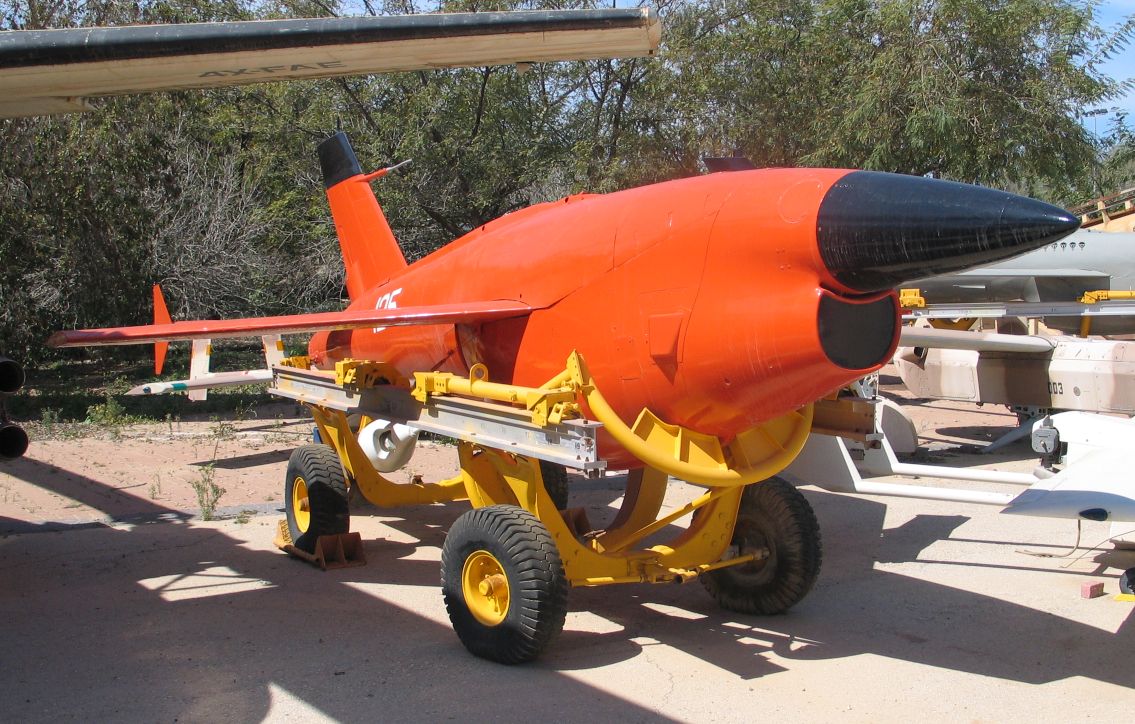
The BQM-34A emerged as the Firebee as it is recognized today, with a bigger airframe, longer wings, and a particular "chin"-type inlet under a pointed nose (in contrast to the circular intake of the first-generation Firebees). It was powered by a Continental J69-T-29A turbojet, a copy of the improved Turbomeca Gourdon derivative of the Marbore, with 1,700 lbf (7.6 kN) thrust. The U.S. Navy also adopted the BQM-34A, while the Army obtained a ground-launched version designated MQM-34D with longer wings and a heavier JATO booster.
A feature of the second-generation Firebee is that some photographs show it to with triangular endplates on the tailplane, while others show no endplates but feature a ventral fin under the tail, and still others have neither endplates nor ventral fin. Since most modern photographs of Firebees show the ventral fin, this may have been due to production changes or later refits (reference sources are unclear on this).[citation needed]
In 1960 the first stealth technology development program was initiated by USAF, by reducing the radar cross-section of a Q-2C drone. This was achieved through specially designed screens over the air intake, radiation-absorbent material on the fuselage and a special radar-absorbing paint.[6]
During the 1970s the U.S. Army updated some of their MQM-34Ds for use as targets for FIM-92 Stinger man-portable SAMs, refitting these drones with a General Electric J85-GE-7 turbojet of 10.9 kN (2,500 lbf) thrust which were salvaged from old ADM-20 Quail decoys. The modified MQM-34Ds featured a revised forward fuselage with a circular nose intake that gave them an appearance similar to that of a "stretched" first-generation Q-2A target, and were given the designation of MQM-34D Mod II.

Meanwhile, the U.S. Navy upgraded the avionics in their BQM-34As, which were then designated BQM-34S. In the early 1980s the Navy also began to refit these with the uprated J69-T-41A engine of 1,920 lbf (8.5 kN) thrust. The Air Force began to update their BQM-34As with improved avionics and also the J85-GE-7 engine which was fitted without major changes in the drone's airframe; the improved USAF variants retained their existing BQM-34A designation.

BQM-34A production ended in 1982, but the production line was reopened in 1986 to produce more BQM-34S targets. Air Force and Navy Firebees have received further upgrades since that time, most refitted beginning in 1989 with the improved J85-GE-100 engine (also with 2,450 lbf (10.9 kN) thrust) as well as modernized avionics. In the late 1990s some Firebees were also fitted with GPS navigation receivers.

The Firebee's main air launch platform is the Lockheed DC-130 drone controller aircraft, which can carry four drones on underwing pylons. The Firebee is typically snatched out of the air by a recovery aircraft that sweeps up the drone's parachute, simplifying recovery and reducing damage to the target from ground impact. During early test flights, the Fairchild C-119 was used for this purpose, while on operational flights the Sikorsky SH-3 Sea King was the primary recovery platform.[7] The drone can float for an extended period of time if it ditches in water.
The target drone can be fitted with various control systems, some that give it fighter-like maneuverability. It is also equipped with scoring and countermeasures systems, radar enhancement devices to allow it to emulate a wide range of combat aircraft, and wingtip thermal flares which cause heat-seeking missiles to aim for wing tips rather than the engine exhaust, sparing the target. It can also tow a target sleeve or other types of towed targets.
Ryan Firebee II
[edit]

Teledyne Ryan also developed a third-generation Model 166 Firebee II with supersonic performance, with the U.S. Navy awarding a development contract to the company in 1965. Initial flight was in 1968. Although its external appearance was substantially different from that of the original Firebee, the Firebee II used the same engine and control systems, and confusingly retained the BQM-34 designation. The Navy version was the BQM-34E, while the Air Force version was the BQM-34F.
The Air Force BQM-34F was slightly heavier, with an additional parachute for midair recovery by helicopter snatch. The Navy BQM-34E was updated with improved avionics in the mid-1970s, with the upgrade redesignated BQM-34T.
The Firebee II was a sleek dart of an aircraft with swept tailplane and swept mid-body wings. It was powered by a Teledyne CAE J69-T-6 turbojet with 1,840 lbf (8.2 kN) thrust, with the intake on the belly forward of the wings and the exhaust under the tailfins. Internal fuel capacity was small, but the target could be fitted with a conformal external tank that was dropped before boosting to supersonic speeds. Flight operations were performed much as they are for the Firebee I, with launch from a DC-130. It was also ground launched using RATO for use as a target. It had a maximum speed of Mach 1.5, dashing for 4 minutes at 60,000 feet (18,000 m) and had a subsonic endurance of 75 minutes, giving it a range of approximately 570 miles (920 km).[8]
In all 286 Firebee IIs were built, a tiny quantity compared to the number of Firebee Is manufactured. The Firebee II is now out of service, while the Firebee I continues in operation and has been in service for over 50 years, making it one of the longest-lived aircraft in the U.S. military inventory.
Fire Fly and Lightning Bug
[edit]
The Firebee target vehicle's success led to Ryan being asked to develop a reconnaissance version, which became the highly successful Model 147 Fire Fly and Lightning Bug series; these saw extensive service in the Vietnam War.
Modern use
[edit]The Firebee target drone has proven successful and remains in operation with the U.S. Navy and Air Force. Firebees have also served with the Canadian Armed Forces and Japan Self-Defense Forces, with Japanese Firebees built by Fuji Heavy Industries. A small number were also supplied to NATO programs. More than 7,000 Firebees have been built, with 1,280 of these being first generation variants.
In the late 1990s Teledyne Ryan, using company funds, configured two Firebees with cameras and communications electronics to provide real-time intelligence for battlefield target acquisition and damage assessment. These two UAVs, named Argus, were used in a USAF "Green Flag" exercise to relay images in real time from the test range in Nevada to stations in Florida.
Five BQM-34-53 Extended Range Firebees were also used to lay chaff corridors during the 2003 invasion of Iraq. The drones were modernized by Northrop Grumman in a fast-response program earlier that year, being fitted with chaff dispensers and other improvements including GPS-based programmable waypoint guidance systems (which may or not have been added by the upgrade program). These Firebees were delivered for service in charcoal-black paint schemes. Only one DC-130 drone launcher aircraft remained in the U.S. military's inventory at the time and was not immediately operational due to a malfunction. Two Firebees were ground-launched on the first night of the operation; the other three were air-launched by the DC-130 on the second night of the operation. The drones flew until they ran out of fuel and crashed. Iraqi TV broadcast footage of the wrecks while describing them as piloted aircraft.
The last Firebee was delivered in 2002.[citation needed]
Operators
[edit]


Specifications (BQM-34A)
[edit]
Data from Jane's All The World's Aircraft 1982–83[9]
General characteristics
- Crew: None
- Length: 21 ft 11 in (6.68 m)
- Wingspan: 12 ft 11 in (3.93 m)
- Height: 6 ft 8 in (2.04 m)
- Wing area: 36.0 sq ft (3.34 m2)
- Empty weight: 1,500 lb (680 kg)
- Gross weight: 2,060 lb (934 kg)
- Max takeoff weight: 2,500 lb (1,134 kg)
- Powerplant: 1 × Continental J69-T-29A turbojet, 1,700 lbf (7.6 kN) thrust
Performance
- Maximum speed: 690 mph (1,110 km/h, 600 kn) at 6,500 ft (2,000 m)
- Cruise speed: 630 mph (1,010 km/h, 550 kn) at 50,000 ft (15,000 m)
- Stall speed: 116 mph (187 km/h, 101 kn)
- Never exceed speed: 731 mph (1,176 km/h, 635 kn) at 50,000 ft (15,000 m)
- Range: 796 mi (1,281 km, 692 nmi)
- Endurance: 75 min 30 s
- Service ceiling: 60,000 ft (18,000 m) +
- Rate of climb: 16,000 ft/min (81 m/s)
See also
[edit]References
[edit]Citations
[edit]- ^ Hearst Magazines (August 1954). "Bright Colored Fish Flies High Over New Mexico Sands". Popular Mechanics. Hearst Magazines. p. 105.
- ^ a b Leversedge, p. 11
- ^ Leversedge, p. 18
- ^ Leversedge, p. 12
- ^ Leversedge, pp. 12–13
- ^ "1960s AQM-34 Ryan Firebee (USA)". pbs. Archived from the original on 28 December 2014. Retrieved 14 January 2015.
- ^ Kelly, John W. (23 June 2016). "Mid-Air Retrieval of Heavy, Earth-Returning Space Systems" (PDF). NASA. Retrieved 26 September 2018.
- ^ "BQM-34F "Firebee II"". Museum of Aviation. Retrieved 2022-08-23.
- ^ Taylor 1982, pp. 694–695
Sources
[edit]- Leversedge, T.F.J. Canada Aviation and Space Museum aircraft Ryan KDA-4 Firebee drone RCAF Serial KD-4788 (PDF). Ottawa, Ontario: Canada Aviation and Space Museum. Archived from the original (PDF) on 2021-11-22. Retrieved 2020-11-05.
- Taylor, John W. R., ed. (1982). Jane's All The World's Aircraft 1982–83. London, England: Jane's Yearbooks. ISBN 0-7106-0748-2.
- This article contains material that originally came from the web article Unmanned Aerial Vehicles by Greg Goebel, which exists in the Public Domain.
Further reading
[edit]- Wagner, William (1982). Lightning Bugs and Other Reconnaissance Drones. Armed Forces Journal International.
External links
[edit]
Ryan Firebee
View on GrokipediaOrigins and Development
Initial Design and Prototyping (1950s)
In 1948, the United States Air Force issued a requirement for a subsonic, jet-propelled target drone to serve as a challenging gunnery and missile target, prompting the Ryan Aeronautical Company to develop the XQ-2 prototype.[9][10] Ryan was awarded the contract in August 1948, leading to the design of an unmanned aerial vehicle with swept wings, swept tail surfaces, and a circular nose air intake for its turbojet engine.[11] The initial design emphasized simplicity, omitting landing gear to reduce weight and complexity, with recovery planned via parachute descent after missions.[3] Prototyping began shortly thereafter, culminating in the first unpowered flight of the XQ-2 in early 1951, launched from the underwing pylon of a Boeing B-17 Flying Fortress bomber.[3] Powered flights followed soon after, utilizing a Continental J69-T-29 turbojet engine producing 1,700 pounds of thrust, enabling speeds up to 580 mph and altitudes approaching 60,000 feet.[12] A total of 32 XQ-2 prototypes were constructed and tested, primarily at Holloman Air Force Base, where they demonstrated reliable air-launch capabilities from modified Douglas B-26 Invader bombers and ground catapults using rocket-assisted takeoff (RATO) boosters.[3][9] Following successful demonstrations, the USAF authorized production of 35 Q-2A drones in 1952, marking the transition from prototyping to operational deployment.[3] Early models featured distinctive arrowhead-shaped endplates on the tailplane and a compact fuselage measuring approximately 23 feet in length with a 13-foot wingspan, weighing around 2,060 pounds fully loaded.[12] These prototypes laid the foundation for the Firebee's evolution into a versatile target system, validating its aerodynamic stability and remote control systems under real-world conditions.[10]Q-2 and KDA-1 Variants
The Q-2 Firebee represented the U.S. Air Force's initial production model of the Ryan Aeronautical drone series, designed as a subsonic jet-powered target for air-to-air and surface-to-air missile testing.[1] The XQ-2 prototype first flew in early 1951, incorporating swept wings at 45 degrees and a circular nose-mounted air inlet for its turbojet engine.[11] [3] Production of the Q-2A began in 1952 under Air Force contracts, with the drone measuring 17 feet 7 inches in length, a wingspan of 11 feet 3 inches, and a maximum takeoff weight around 2,060 pounds.[13] [3] It was typically launched from modified bombers like the DB-26 Invader or ground catapults and recovered via parachute, achieving speeds up to 580 mph and altitudes exceeding 51,000 feet.[8] [14] An experimental XQ-2B subvariant tested high-altitude and extended-range capabilities with an uprated engine but saw limited production, influencing later Firebee evolutions rather than entering widespread service.[14] The Q-2 series emphasized simplicity and recoverability, with over 7,000 Firebee drones ultimately produced from this foundational design, though early Q-2 units focused on gunnery and early missile defense validation in the 1950s.[8] The KDA-1 variant adapted the Q-2A for U.S. Navy and Army use, retaining the core airframe but substituting a Fairchild J44-R-20B turbojet engine rated at 1,000 lbf thrust for improved maritime compatibility and performance.[11] [15] Visually, the KDA-1 differed with a protruding inlet centerbody and wider, steeply raked air intake to accommodate the J44's configuration, enabling carrier-based or ship-launched operations alongside Air Force models.[16] [17] These adaptations supported joint-service training, with the KDA-1 entering service in the mid-1950s for anti-aircraft and fleet defense evaluations, though production numbers remained modest compared to subsequent standardized BQM-34 designations.[11]Adoption by US and Allied Forces
The United States Air Force awarded Ryan Aeronautical a contract in 1948 to develop a jet-powered aerial target drone, resulting in the XQ-2 Firebee prototype's first flight in 1951 and subsequent adoption of the Q-2 variant for gunnery and missile training in the early 1950s.[3] An improved second-generation model, designated Q-2C and later BQM-34A, entered USAF service in the late 1950s, featuring enhanced range, speed, and recoverability via parachute.[12] By the 1960s, over 5,000 Firebee drones had been produced for the USAF, supporting extensive testing at bases like Holloman Air Force Base, where early XQ-2C units logged multiple flights from 1958 to 1960.[1] The United States Navy integrated the BQM-34A and subsequent variants into its operations for simulating high-speed threats in anti-air warfare training and missile evaluations, often launching from aircraft carriers or ground platforms.[1] The U.S. Army adopted ground-launched configurations, including the Model 124E derived from the BQM-34, after phasing out predecessor systems like the XM21 in the early 1960s, primarily for artillery and anti-aircraft target practice.[14] Allied adoption included the Canadian Armed Forces, which employed Firebee drones from the 1950s onward for target towing and reconnaissance training, mirroring U.S. applications.[18] Israel ordered 124 Teledyne Ryan Model 1241 Firebees in July 1970, adapting them for reconnaissance over hostile territories with modifications for extended endurance and camera payloads.[19] These procurements underscored the Firebee's versatility and reliability, exported under U.S. military assistance programs to enhance NATO and regional allies' defensive capabilities.Operational Evolution and Variants
Firebee I Series Expansions
The initial Firebee I series, originating with the Q-2A target drone first produced in 1951, underwent significant expansions to enhance performance, payload capacity, and adaptability for missile testing and pilot training. These improvements addressed limitations in the original design, such as restricted internal space for instrumentation and suboptimal aerodynamics, leading to a redesigned second-generation model designated Q-2C, which achieved its first flight on December 1, 1958, and entered production in 1960.[14][3] Key modifications in the Q-2C included a larger airframe with increased fuselage length to 6.98 meters for accommodating advanced scoring and augmentation devices, extended wingspan to 3.93 meters with drooped leading-edge extensions for improved low-speed handling, and a distinctive chin-type air intake under a pointed nose radome to optimize engine airflow and radar cross-section simulation. The powerplant was upgraded to the Continental J69-T-29 turbojet, delivering greater thrust than the earlier J69-T-19, enabling a top speed of Mach 0.96 (approximately 1,110 km/h), a service ceiling exceeding 18,300 meters, and endurance up to 90 minutes.[14][12][20] Following the 1963 Tri-Service redesignation scheme, the Q-2C became the BQM-34A, which emerged as the dominant Firebee I variant with over 6,500 units produced across U.S. military branches until the early 1980s. Further expansions incorporated service-specific adaptations, such as the Army's MQM-34D with ground-launch capability via longer wings and the J85-GE-7 engine in the 1970s, and the Navy's BQM-34S upgrade in the late 1970s featuring the J69-T-41A engine, an Improved Trajectory Control System (ITCS) for precise command guidance, and electronic countermeasures (ECM) pods for realistic threat simulation; production of the BQM-34S resumed in 1986 to meet ongoing demand.[14][1][8]| Variant | First Flight/Production | Key Features | Engine | Production Notes |
|---|---|---|---|---|
| Q-2A | 1951 | Basic subsonic target; initial jet drone design | J69-T-19 | ~1,000 built; USAF primary |
| Q-2C/BQM-34A | Dec 1958 / 1960 | Enlarged fuselage, chin inlet, drooped wing LE | J69-T-29 (later J85-GE-100 upgrades) | >6,000 total Firebee I; standard USAF/USN/Army |
| MQM-34D | 1970s | Ground launch, extended wings | J85-GE-7 | Army-specific for surface-to-air testing |
| BQM-34S | Late 1970s / 1986 reopen | ITCS guidance, ECM integration | J69-T-41A | Navy upgrade; extended service life |
Firebee II and Specialized Models
The Firebee II series, designated BQM-34E, BQM-34F, and BQM-34T, advanced the original Firebee design with supersonic performance to meet U.S. Navy and Air Force demands for high-speed target drones simulating modern aerial threats. Development began with a 1965 Navy contract, culminating in the XBQM-34E prototype's first flight in January 1968; the BQM-34F entered service in 1971 and the BQM-34E in 1972.[14] Powered by a Teledyne Continental J69-T-406 turbojet delivering 8.5 kN thrust, these drones reached Mach 1.8 at altitude and Mach 1.1 at sea level, with a ceiling of 18,300 meters and range up to 1,430 km using external tanks.[14] Launch options included ground rails, aircraft drops from platforms like the DC-130, or rocket assistance, while recovery employed parachutes or mid-air retrieval systems (MARS).[21] Production totaled approximately 300 units, with operational use persisting into the early 1990s.[14][22] The BQM-34F, adopted by the U.S. Air Force, featured a reinforced structure for MARS compatibility and modular payloads such as radar cross-section enhancers, chaff/flare dispensers, and hit-scoring sensors, enabling simulations of low-level attacks down to 50 feet altitude and command links extending 200 miles.[23] Naval BQM-34E and upgraded BQM-34T variants incorporated integrated test and control system (ITCS) transponders for real-time telemetry and performance monitoring during weapons trials.[14] These configurations supported air-to-air and surface-to-air missile evaluations, emphasizing realistic kinematics over subsonic predecessors.[21] Among specialized adaptations, the AQM-34V emerged under the 1974 "Combat Angel" initiative as an electronic countermeasures (ECM) drone, with initial flights in March 1976. Derived from subsonic Firebee airframes but aligned with Firebee II supersonic heritage in role, it employed a J69-T-29 engine (7.6 kN thrust), spanned 15 feet, measured 26 feet in length, and weighed 3,750 pounds, accommodating jamming pods to emulate adversary electronic warfare for defensive training.[14][24] Approximately 60 units, mostly conversions, were produced at a unit cost of $469,000, serving until retirement in 1979.[14] This variant underscored the Firebee platform's versatility for non-kinetic threat replication, distinct from pure kinematic targeting.[14]Fire Fly, Lightning Bug, and Reconnaissance Adaptations
The reconnaissance adaptations of the Ryan Firebee commenced in the early 1960s under Project Fire Fly, which converted the base target drone into a recoverable unmanned aerial vehicle capable of photographic missions. The initial Model 147A, codenamed Fire Fly, featured extended range provisions for up to 1,200 miles and cruise speeds around 500 knots, with testing beginning in 1962 using modified airframes equipped with cameras and preset guidance systems.[25] These early adaptations emphasized low radar cross-section and parachute recovery for reusability, addressing limitations in manned overflights of hostile territories.[4] Evolving from the Fire Fly, the Lightning Bug series—designated as Ryan Model 147 variants including the AQM-34L and AQM-34N—became operational for low- and medium-altitude reconnaissance over North Vietnam starting in 1964. Launched from modified DC-130 Hercules aircraft, these drones carried electro-optical sensors, side-looking radar, or infrared systems, flying profiles as low as 500 feet to evade surface-to-air missiles while penetrating denied areas.[26] Over 3,435 sorties were conducted by Lightning Bugs through 1972, with models like the 147TE adapted for electronic intelligence gathering via onboard dispensers for chaff and active radar augmentation to simulate larger threats and draw enemy fire.[27] Recovery involved mid-air parachute retrieval by helicopters such as the HH-3 Jolly Green Giant, achieving reuse rates exceeding 80% in some campaigns despite losses from ground fire and accidents totaling around 578 units.[25] Further reconnaissance specialization led to the AQM-91 Firefly (Model 154), developed in the late 1960s under the Compass Arrow program for high-altitude, long-endurance missions into China, incorporating early stealth features like radar-absorbent materials and a ceiling above 70,000 feet powered by a General Electric J97 turbojet. This variant prioritized deep penetration over denied airspace, with avionics for autonomous navigation and film return via recovery systems, though operational testing revealed challenges in stealth efficacy against advanced radars.[28] Unlike the tactical Lightning Bugs, the Firefly emphasized strategic standoff reconnaissance, influencing subsequent UAV designs but seeing limited deployment due to program cancellations amid shifting priorities post-Vietnam.[29]Military Applications
Target Drone Employment
The Ryan Firebee, primarily designated as the BQM-34 series in its target drone configuration, functioned as a high-speed, subsonic aerial target for testing and training with air-to-air and surface-to-air missile systems across U.S. military branches. Originally developed under the Q-2 designation in the mid-1950s, it entered service with the U.S. Air Force by 1960, providing realistic simulations of enemy aircraft maneuvers at speeds exceeding 600 mph and altitudes up to 60,000 feet.[1][30] Early operational employment focused on missile evaluation at Holloman Air Force Base, New Mexico, where prototypes like the XQ-2C accumulated records such as 25 flights between 1958 and 1960.[1] Launch methods included ground-based rocket-assisted takeoffs or aerial deployment from platforms like the DC-130 Hercules or C-130 aircraft, enabling flexible mission profiles over test ranges.[1][21] The drone's radio-controlled guidance allowed operators to replicate evasive tactics, while its recovery via parachute descent facilitated reuse and data analysis post-mission.[1][10] Key variants included the BQM-34A for standard subsonic targets, the BQM-34F Firebee II capable of supersonic speeds up to Mach 1.5 at 55,000 feet with 75-minute endurance, and the Navy's BQM-34S optimized for carrier-based operations and extended range of 796 miles at 690 mph maximum speed.[22][10][21] Employment extended through the Cold War era, supporting weapons development for systems like early AIM-series missiles and surface defenses, with production continuing under Teledyne Ryan and later Northrop Grumman.[31] The platform's rugged airframe and J69 turbojet engine, delivering 1,700 pounds of thrust, enabled gross weights around 2,060 pounds and operational ranges of 600 miles, making it a staple for threat simulation until upgrades in the 1990s and beyond.[1][32] Recent applications include U.S. Navy tests in 2025, where BQM-34 airframes hosted ramjet motors for high-speed missile development, demonstrating sustained relevance in advancing hypersonic defenses.[33]Reconnaissance and Intelligence Roles
The Ryan Firebee transitioned from target drone to reconnaissance platform in the early 1960s, driven by U.S. Air Force requirements for unmanned intelligence collection over denied areas to minimize pilot risk. Initial adaptations focused on photographic and electronic reconnaissance, with the Q-2C variant marking the first drone designed specifically for such missions. By the mid-1960s, variants like the AQM-34 series incorporated cameras, sensors for signals intelligence (SIGINT), and electronic intelligence (ELINT) equipment to monitor enemy radar emissions and communications.[34][35][36] Reconnaissance Firebees were primarily launched from modified DC-130 Hercules aircraft and recovered by parachute, enabling operations from bases in Japan, South Vietnam, and Thailand. The AQM-34L supported low-altitude photographic surveys, while the AQM-34N achieved altitudes above 60,000 feet with a range exceeding 2,400 miles, facilitating high-altitude SIGINT and imagery collection. In Vietnam War operations from 1964 to 1975, over 1,000 Firebees flew more than 34,000 surveillance sorties, including daytime and nighttime missions for target acquisition, damage assessment, and SAM site calibration. By 1966, these drones had completed 105 missions over North Vietnam and China, providing battlefield intelligence despite losses to enemy defenses.[30][37][38][39][4] The AQM-34Q Combat Dawn variant extended intelligence roles by intercepting radio signals up to 300 miles, supporting broader electronic warfare objectives. These missions yielded empirical data on North Vietnamese air defenses, though reliability issues and high attrition rates—often from anti-aircraft fire—limited overall effectiveness, with recovery rates varying by mission profile. Firebee reconnaissance efforts pioneered unmanned persistent surveillance, informing tactical decisions and reducing manned overflights in contested airspace.[36][27]Combat and Decoy Missions in Vietnam
The Ryan Model 147 Lightning Bug, derived from the Firebee target drone, was adapted for combat support roles including surface-to-air missile (SAM) suppression and decoy operations over North Vietnam starting in 1964.[26] These missions aimed to provoke enemy defenses into revealing positions, drawing fire away from manned aircraft, and gathering electronic intelligence (ELINT) on SAM systems like the SA-2 Guideline.[26] By enlarging the drone's radar cross-section to mimic higher-value targets such as the U-2 spy plane, variants like the Model 147E lured SAM launches, enabling subsequent strikes on revealed sites.[26] For instance, on February 13, 1966, a Model 147E successfully baited an SA-2 launch, yielding critical data on the missile's proximity fuze characteristics.[26] Dedicated decoy variants, such as the Model 147N and 147NC, were deployed as expendable assets to precede strike packages and divert antiaircraft artillery (AAA) and SAM fire from reconnaissance drones or bombers.[26] In March 1966, ten Model 147N decoys flew nine missions through June, expending all units while drawing defensive fire and indirectly contributing to the downing of five North Vietnamese MiG fighters by U.S. aircraft responding to the engagements.[27] These operations often involved the drones loitering over target areas until fuel depletion, forcing enemy radars to activate and expose themselves.[27] Experimental configurations tested chaff dispensers and the AN/ALQ-51 electronic jammer in 1966 to further degrade SAM effectiveness during combat support.[26] Overall, Lightning Bug drones flew 3,435 sorties from 1964 to 1975, with 544 losses—about one-third due to mechanical failures and the remainder to enemy action including AAA, SAMs, and MiG intercepts.[26] While primarily reconnaissance platforms, their decoy and suppression efforts saved manned aircrew lives by absorbing risks in high-threat environments, though low-altitude missions suffered from navigation errors and lower success rates below 50 percent.[26] At least seven MiGs were downed by friendly forces pursuing the drones, highlighting their utility in forcing enemy fighters into vulnerable positions.[26] Launched from modified DC-130 Hercules aircraft, these unmanned systems marked an early shift toward unmanned combat support, prioritizing attrition over recovery in expendable roles.[26]Technical Design and Specifications
Airframe and Propulsion Details
The Ryan Firebee airframe adopted a compact, low-wing monoplane configuration optimized for high-subsonic speeds, featuring 45-degree sweptback wings with a span of 12 feet 11 inches, a length of 22 feet, and a height of 6 feet 8 inches.[3][6] This design incorporated a streamlined fuselage to minimize drag, supporting modular payloads for target towing, reconnaissance cameras, or electronic warfare equipment while maintaining structural integrity under aerodynamic loads up to Mach 0.96.[3][31] The empennage consisted of twin vertical stabilizers and a horizontal stabilator, providing stability and control without vertical booms, and the overall structure emphasized recoverability via parachute deployment from the nose section.[14] Early variants like the Q-2A utilized a semi-monocoque fuselage construction suitable for jet propulsion integration, with provisions for booster rockets in ground-launched configurations to achieve initial velocity.[14] Later models, such as the BQM-34A, retained this rugged layout but incorporated reinforced sections for extended range and higher thrust operations, enabling endurance flights of several hours.[31] The airframe's lightweight design, weighing around 2,800 pounds fully loaded in some configurations, facilitated aerial launches from carrier-based aircraft like the DC-130 Hercules.[6] Propulsion centered on turbojet engines, with the initial Q-2 series employing the Continental J69-T-19, a compact axial-flow unit delivering approximately 1,000 pounds of thrust at sea level.[14][40] This evolved to the J69-T-29 variant in BQM-34 models, boosting output to 1,700 pounds of thrust for improved acceleration and top speeds of 580 mph.[1] Naval BQM-34S adaptations shifted to the General Electric J85-GE-7 or J85-GE-100, providing 2,450 pounds of thrust and greater reliability in maritime environments, fueled by JP-4 or JP-5 kerosene-based fuels stored in internal tanks.[10][3] These engines featured starter cartridges for reliable ignition post-launch, contributing to the drone's operational flexibility across ground, air, and sea platforms.[14]Performance Metrics and Capabilities
The Ryan Firebee, designated as the BQM-34 in its primary target drone configuration, achieved a maximum speed of 690 mph (1,110 km/h, Mach 0.97) at low altitudes, with cruise speeds around 630 mph at higher altitudes.[6][14] Stalling speed was approximately 203 mph, enabling operations from sea level to altitudes as low as 10 feet for low-level simulations.[1][31] Service ceiling extended to 60,000 feet, supporting high-altitude reconnaissance and target roles, though some variants like the BQM-34S were limited to 50,000 feet.[31][41] Range typically spanned 600 to 800 miles, contingent on fuel load, payload, and mission parameters such as parachute recovery deployment.[1][6] Endurance averaged 75 to 90 minutes, powered by a Continental J69 turbojet engine producing 1,700 pounds of thrust.[10][6][1] The airframe supported dynamic maneuvers, including up to 7-g turns, which enhanced its utility in simulating agile threats for missile testing.[31] Later variants, such as the Firebee II (BQM-34F), extended capabilities with brief dashes to Mach 1.5 at 60,000 feet, though sustained supersonic performance remained limited by engine constraints.[21]| Metric | Value (BQM-34A Standard) | Notes/Source |
|---|---|---|
| Maximum Speed | 690 mph (Mach 0.97) | At sea level/low altitude[6][14] |
| Cruise Speed | 630 mph | At operational altitude[10] |
| Service Ceiling | 60,000 ft | Maximum operational height[31] |
| Range | 600–800 miles | Mission-dependent[1][6] |
| Endurance | 75–90 minutes | Fuel and config limited[10][6] |
| Maneuverability | Up to 7-g turns | For threat simulation[31] |
Guidance and Control Systems
The Ryan Firebee drones primarily utilized radio command guidance systems, enabling ground-based or aircraft-borne operators to transmit control signals via UHF frequencies to direct the vehicle's pitch, roll, and yaw movements. This proportional control mechanism translated operator inputs from a remote station—such as joystick deflections—into corresponding aerodynamic responses through servo-actuated control surfaces, allowing simulation of piloted maneuvers during target drone operations.[42] Early variants, like the Q-2A introduced in 1951, relied on line-of-sight radio links from launch platforms or ground stations, with range extensions provided by relay aircraft such as the DC-130 Hercules, which could manage up to four Firebees simultaneously.[1] Complementing the command guidance, an onboard autopilot stabilized flight and executed pre-programmed paths, incorporating gyroscopic sensors for attitude control and basic altimeters or timers for waypoint navigation in reconnaissance missions. In target roles, this system supported high-g maneuvers up to 6g, with options for automatic recovery sequences activating parachutes upon signal loss or mission end; for instance, the BQM-34A featured the A/A37G-14 digital three-axis autopilot for enhanced precision and fault tolerance.[14] Reconnaissance adaptations, such as the AQM-34L/M series, augmented radio commands with inertial references and low-altitude radar altimeters to follow terrain-hugging routes at 60-150 meters, reducing vulnerability to detection while permitting manual overrides for evasion.[25] Later upgrades addressed obsolescence and expanded capabilities; by the 1990s, USAF BQM-34s integrated the Vega Drone Tracking and Control System (DTCS) with transponders like AN/DKW-1 for improved signal acquisition, alongside GPS for terminal guidance accuracy within meters.[14] Attack variants, including the BGM-34A tested in 1971, incorporated television cameras for electro-optical seeker guidance, enabling operators to acquire and strike targets via real-time video feeds linked to weapons like the AGM-65 Maverick missile.[42] These systems evolved iteratively, with over 6,500 Firebee I units produced demonstrating reliability in command-link retention rates exceeding 90% in operational tests, though early models suffered from jamming susceptibility in contested environments.[14]Impact, Achievements, and Limitations
Contributions to Unmanned Aviation
The Ryan Firebee, introduced with its first powered flight in early 1951 as the XQ-2 variant, represented one of the earliest successful implementations of jet propulsion in unmanned aerial vehicles, enabling sustained high-subsonic speeds up to Mach 0.96 and altitudes exceeding 60,000 feet, which advanced the feasibility of expendable yet recoverable drones for military testing and operations.[3] This innovation shifted unmanned systems from propeller-driven prototypes to turbine-powered platforms capable of simulating advanced enemy aircraft threats, thereby enhancing the realism of missile defense evaluations for both surface-to-air and air-to-air systems.[3] Its adaptation for reconnaissance, particularly through variants like the Model 147 series (including the AQM-34 Lightning Bug), demonstrated the practical utility of UAVs in high-risk intelligence, surveillance, and reconnaissance (ISR) missions, with over 3,400 operational sorties flown over Southeast Asia from October 1964 to April 1975, often launched from modified DC-130 aircraft and recovered via parachute to minimize losses and enable data recovery.[4] These missions provided empirical evidence of unmanned platforms' endurance and cost-effectiveness in contested environments, achieving an 83% recovery rate among deployed AQM-34 units and influencing the doctrinal acceptance of drones as substitutes for manned overflights, thereby reducing pilot casualties while delivering actionable imagery and signals intelligence.[43] The Firebee's versatility—spanning target drone roles with over 7,000 units produced across more than 20 variants—paved the way for subsequent UAV programs by validating modular airframe designs, mid-air retrieval systems, and remote guidance technologies that prioritized causal reliability over human intervention in hazardous scenarios.[3] Its operational successes, such as the AQM-34N's 268 missions monitoring North Korean activities from 1970 to 1973, underscored the empirical advantages of unmanned systems in persistent surveillance, directly informing Cold War-era advancements in stealth coatings and autopilot integration that echoed in later platforms.[3][43] ![Ryan Model 147 reconnaissance drone][center]Operational Successes and Empirical Outcomes
The Ryan Firebee reconnaissance variants, adapted as the Model 147 Lightning Bug series, demonstrated notable operational efficacy during the Vietnam War under programs like Buffalo Hunter. By 1972, these drones achieved a 90 percent success rate in delivering quality reconnaissance imagery despite operating in contested airspace over North Vietnam.[34] Individual units exhibited high mission endurance; for instance, the AQM-34L variant designated "Tom Cat" completed 68 sorties before loss to anti-aircraft fire.[14] Overall survivability for the 147SC configuration reached 87.2 percent per mission, enabling repeated use of recovered airframes and contributing to intelligence gains without risking pilots.[14] In target drone roles, the Firebee's reliability underpinned its extensive adoption for missile testing and training. Approximately 83 percent of Firebees deployed during Vietnam-era operations returned for reuse, reflecting robust airframe durability and recovery procedures such as mid-air retrieval by helicopter, which succeeded in 2,655 of 2,745 attempts for a 97 percent rate.[39][4] This performance supported over 34,000 surveillance and target missions across Southeast Asia, validating the platform's cost-effectiveness for high-volume, expendable operations.[45] Empirical outcomes highlighted the Firebee's causal advantages in unmanned systems: it facilitated persistent aerial presence in denial environments at lower attrition than manned alternatives, with recovery innovations reducing downtime to 1.5 days per cycle for aerial-caught drones versus 2-10 days for ground methods.[26] These metrics underscored empirical reliability in propulsion and control, though successes were contingent on electronic countermeasures that elevated survival above 80 percent in later iterations.[46]Criticisms, Reliability Issues, and Failures
The Ryan Firebee and its reconnaissance variants, such as the AQM-34 Lightning Bug, encountered significant reliability challenges during early operations, particularly in intelligence collection missions over contested areas. In Operation Blue Springs in 1964, these drones exhibited reliability issues that raised doubts about their overall effectiveness for gathering actionable intelligence, as mechanical and environmental factors frequently compromised mission outcomes.[4] Navigation systems proved inadequate for low-altitude penetrations, with Doppler radar on launch platforms accurate only to a few miles and onboard systems limited to 3% accuracy over distance, resulting in drones veering off course by up to 12 miles after 400 miles of flight and capturing irrelevant imagery such as rice paddies instead of targets.[27] Early target coverage rates hovered around 40% due to these inaccuracies, though later LORAN-equipped models improved precision to within 500 feet.[34] Technical failures were recurrent in testing and deployment. The Model 147J variant suffered from poor aerodynamics and terrain avoidance limitations, leading to catastrophic failures in the first three prototypes during trials; a January 3, 1966, test flight ended in collision with the DC-130 mothership, destroying the drone and damaging the aircraft.[27] Initial parachute recovery systems lacked directional control, often damaging film capsules upon landing in rough terrain like rice paddies or jungles, though the subsequent Mid-Air Retrieval System achieved a 97% success rate across 2,655 of 2,745 attempts.[34] Overheating plagued specialized payloads, such as SIGINT packages that failed entirely on inaugural missions, necessitating U.S.-based modifications before redeployment.[47] Early models also produced visible engine exhaust contrails, compromising stealth until exhaust modifications were implemented.[4] Institutional criticisms within the U.S. Air Force contributed to the program's marginalization post-Vietnam. Despite an 83.6% recovery rate over 3,435 sorties from 1964 to 1975—exceeding the expected mission life of 2.5 sorties with an average of 7.3—the Tactical Air Command deemed the drones unresponsive to tactical needs in peacetime, prioritizing manned platforms amid budget constraints that favored programs like the B-1 bomber and F-15 fighter.[34] Specialized missions, such as leaflet-dropping under Project Litter Bug, yielded negligible results due to dispersal inaccuracies.[34] Cultural biases, including a "pro-pilot" ethos and rivalry between Strategic Air Command and Tactical Air Command, lacked high-level advocacy, leading to the 432nd Tactical Drone Group's dissolution in 1979 and full divestment by 1980, with remaining units sold or stored.[34] These factors underscored limitations in adapting the Firebee's jet-powered, remotely piloted design to evolving doctrinal priorities beyond high-threat reconnaissance.[42]Legacy and Modern Use
Influence on Subsequent Drone Programs
The Ryan Firebee's adaptable airframe directly informed the development of the Ryan Model 147 Lightning Bug series, a family of reconnaissance drones produced from 1962 onward, which modified the base Firebee design for high-altitude, long-endurance intelligence missions over denied airspace.[48] Engineers at Ryan Aeronautical extended the Firebee's jet propulsion, radio-command guidance, and parachute recovery systems while adding specialized payloads for photographic and electronic intelligence, resulting in over 3,400 Model 147 variants deployed in Vietnam-era operations such as Combat Dawn between 1964 and 1975.[36] This evolution marked one of the earliest transitions from expendable target drones to recoverable unmanned reconnaissance vehicles, validating jet-powered UAVs as cost-effective alternatives to manned aircraft in high-risk environments.[45] The empirical success of Firebee-derived systems, including an 83% recovery rate across thousands of sorties, underscored the reliability of autonomous flight controls and remote piloting, prompting U.S. military programs to prioritize scalable UAV architectures for ISR roles post-Vietnam.[39] Early Firebee modifications, such as radar-absorbing paints and intake screens tested on subscale models, contributed foundational data to low-observable technologies, influencing stealth adaptations in later drones like those in the 1970s Pioneers and enduring target variants.[43] These advancements shifted doctrinal emphasis toward unmanned systems, reducing pilot exposure while enabling persistent surveillance, as evidenced by the Firebee's role in gathering actionable intelligence that informed broader UAV procurement strategies.[49] Subsequent programs inherited the Firebee's emphasis on modularity and recoverability, with Teledyne Ryan (later Northrop Grumman) producing upgraded BQM-34 variants for supersonic target simulation into the 1980s and beyond, incorporating enhanced maneuverability kits for 5G turns to mimic advanced threats.[50] Over 7,000 Firebees and derivatives were manufactured, sustaining their use in missile defense testing and training, which perpetuated design principles like air-launch compatibility from platforms such as the DC-130 Hercules, directly bridging to modern attritable drone concepts.[3] This legacy emphasized empirical validation over speculative manned alternatives, fostering a lineage of jet UAVs that prioritized endurance, payload flexibility, and operational tempo in contested domains.[1]Continued Target and Training Applications
![BQM-34F launch at Tyndall AFB in 1982][float-right] The BQM-34 series of Firebee drones transitioned to predominant use as recoverable aerial targets following the peak of their reconnaissance missions in the Vietnam War era, simulating enemy aircraft and missile threats to support air-to-air combat training, surface-to-air missile evaluations, and defense readiness exercises.[31] These drones were radio-controlled, launched from ground rail systems or mother aircraft such as the DC-130 Hercules, and recovered via parachute for reuse, enabling cost-effective repeated simulations of high-speed, maneuvering threats.[1] Capable of speeds up to Mach 0.97, altitudes from 10 feet above sea level to 60,000 feet, and seven-g turns, variants like the BQM-34A and BQM-34F provided realistic performance envelopes for testing fighter-interceptor pilots and newly developed air-to-air and surface-to-air missiles.[31] By the 1980s, the U.S. Navy and Air Force continued deploying BQM-34S and BQM-34F models for training, with launches documented at sites like Tyndall Air Force Base in 1982 and carrier operations involving helicopter recovery in 1981.[51] The system's adaptability allowed modifications for special tactical missions, maintaining its role through the 1990s despite the introduction of newer targets.[52] In response to shortages of successor drones like the BQM-74 in the 2000s, the Navy upgraded over 20 stored BQM-34 units by 2016, incorporating modern avionics, autopilots, and enhanced low-altitude flight capabilities down to 10 feet to better simulate anti-ship cruise missiles evading radar.[51] The Firebee's target applications persisted into the early 21st century, with the BQM-34P variant's final flight occurring in 2007 at Tyndall AFB after nearly 50 years of service across U.S. military branches.[53] Northrop Grumman, as the successor manufacturer, has supported ongoing evaluations and training missions, underscoring the drone's longevity and rugged design for weapons system development.[31] This extended utility stemmed from its proven reliability in high-stress scenarios, though it was eventually phased out in favor of more advanced, expendable targets.[14]Preservation and Historical Assessment
The Ryan Firebee series features multiple surviving airframes preserved in aviation museums, primarily as static displays representing its roles in target practice, reconnaissance, and early unmanned operations. Notable examples include a BQM-34F Firebee II at the San Diego Air & Space Museum, donated by manufacturer Teledyne Ryan in 1980 after service with the United States Air Force; an AQM-34L variant at the Pima Air & Space Museum, highlighting its low-altitude reconnaissance configuration used in Vietnam; and an AQM-34Q "Combat Dawn" at the National Museum of the United States Air Force, which underwent restoration disassembly in June 2020 to prepare for exhibit relocation.[22][5][36] Restoration efforts have focused on maintaining structural integrity for educational purposes, with projects emphasizing modular components like jet engines and control surfaces. At Estrella Warbirds Museum, a BQM-34S target drone arrived in October 2008 and was restored to static display by September 2009, later repositioned in May 2017 for improved visibility. The Weisbrod Aircraft Museum completed restoration of a BQM-34F in early 2024, suspending it for public exhibit to illustrate supersonic target capabilities. Internationally, the Canada Aviation and Space Museum holds an ex-Royal Canadian Air Force Firebee, underscoring its early adoption as the service's first operational UAV in the 1960s.[10][54][11] Historically, the Firebee is assessed as a pioneering jet-powered UAV that transitioned target drones into versatile reconnaissance platforms, with initial development fulfilling a 1948 U.S. Air Force requirement for high-speed aerial targets tested at Holloman AFB starting in the early 1950s. Its subsonic design, first flown in 1951, enabled over 30 early prototypes and influenced modular variants that achieved operational ranges up to 750 miles and speeds of 645 mph, proving unmanned systems' viability for hazardous missions without pilot risk.[55][56][5] In empirical terms, the Firebee's Vietnam-era deployments, such as AQM-34 variants launched from DC-130 aircraft, provided sustained reconnaissance over denied areas, with the series' commonality in U.S. operations marking a shift toward drone-centric intelligence gathering despite attrition rates from enemy defenses. Assessments from military archives credit it with foundational advancements in remote control and recovery techniques, like parachute descent, which informed successors such as the Ryan Model 147 "Lightning Bug," while its longevity—remaining in target roles into the 1980s—demonstrates robust adaptability over piston-engine predecessors.[43][56][1]References
- ./assets/Ryan_Model_147.jpg