


Community hub
Recent from talks
Contribute something
Nothing was collected or created yet.
Childbirth
View on Wikipedia
| Childbirth | |
|---|---|
| Other names | Labour and delivery, partus, giving birth, parturition, birth, confinement[1][2] |
 | |
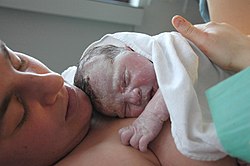
| Mother with neonate covered in vernix caseosa | |
| Specialty | Obstetrics, midwifery |
| Complications | Obstructed labour, postpartum bleeding, eclampsia, postpartum infection, birth asphyxia, neonatal hypothermia[3][4][5] |
| Types | Vaginal delivery, C-section[6][7] |
| Causes | Pregnancy |
| Prevention | Birth control, elective abortion |
| Frequency | 135 million (2015)[8] |
| Deaths | 500,000 maternal deaths a year[5] |
Childbirth, also known as labour, parturition and delivery, is the completion of pregnancy, where one or more fetuses exits the internal environment of the mother via vaginal delivery or caesarean section[7] and becomes a newborn to the world. In 2019, there were about 140.11 million human births globally.[9] In developed countries, most deliveries occur in hospitals,[10][11] while in developing countries most are home births.[12]
The most common childbirth method worldwide is vaginal delivery.[6] It involves four stages of labour: the shortening and opening of the cervix during the first stage, descent and birth of the baby during the second, the delivery of the placenta during the third, and the recovery of the mother and infant during the fourth stage, which is referred to as the postpartum. The first stage is characterised by abdominal partying or also back pain in the case of back labour,[13] that typically lasts half a minute and occurs every 10 to 30 minutes.[14] Contractions gradually become stronger and closer together.[15] Since the pain of childbirth correlates with contractions, the pain becomes more frequent and strong as the labour progresses. The second stage ends when the infant is fully expelled. The third stage is the delivery of the placenta.[16] The fourth stage of labour involves the recovery of the mother, delayed clamping of the umbilical cord, and monitoring of the neonate.[17] All major health organisations advise that immediately after giving birth, regardless of the delivery method, that the infant be placed on the mother's chest (termed skin-to-skin contact), and to delay any other routine procedures for at least one to two hours or until the baby has had its first breastfeeding.[18][19][20][21]
Vaginal delivery is generally recommended as a first option. Cesarean section can lead to increased risk of complications and a significantly slower recovery. There are also many natural benefits of a vaginal delivery in both mother and baby. Various methods may help with pain, such as relaxation techniques, opioids, and spinal blocks.[15] It is best practice to limit the amount of interventions that occur during labour and delivery such as an elective cesarean section. However in some cases a scheduled cesarean section must be planned for a successful delivery and recovery of the mother. An emergency cesarean section may be recommended if unexpected complications occur or little to no progression through the birthing canal is observed in a vaginal delivery.
Each year, complications from pregnancy and childbirth result in about 500,000 birthing deaths, seven million women have serious long-term problems, and 50 million women giving birth have negative health outcomes following delivery, most of which occur in the developing world.[5] Complications in the mother include obstructed labour, postpartum bleeding, eclampsia, and postpartum infection.[5] Complications in the baby include lack of oxygen at birth (birth asphyxia), birth trauma, and prematurity.[4][22]
Signs and symptoms
[edit]The most prominent sign of labour is strong repetitive uterine contractions. Pain in contractions has been described as feeling similar to very strong menstrual cramps. Crowning, when the baby's head becomes visible, may be experienced as an intense stretching and burning.[23]
Back labour is a complication that occurs during childbirth when the feet or the bottom of the baby is visible first (bottom-first presentation), instead of the being born head down (head-first presentation).[24] This leads to more intense contractions, and causes pain in the lower back that persists between contractions as the back of the fetus' head exerts pressure on the mother's sacrum.[25]
Another prominent sign of labour is the rupture of membranes, commonly known as "water breaking". During pregnancy, a baby is surrounded and cushioned by a fluid-filled sac (the amniotic sac). Usually the sac ruptures at the beginning of or during labour. It may cause a gush of fluid or leak in an intermittent or constant flow of small amounts from a woman's vagina. The fluid is clear or pale yellow. If the amniotic sac has not yet broken during labour the health care provider may break it in a technique called an amniotomy. In an amniotomy a thin plastic hook is used to make a small opening in the sac, causing the water to break.[26] If the sac breaks before labour starts, it's called a prelabour rupture of membranes. Contractions will typically start within 24 hours after the water breaks. If not, the care provider will generally begin labour induction within 24 to 48 hours. If the baby is preterm (less than 37 weeks of pregnancy), the healthcare provider may use a medication to delay delivery.[27]
Labour pain
[edit]Labor pains have both visceral and somatic components.[23] During the first and second stages of labour, uterine contractions cause stretching and opening of the cervix. This in turn triggers visceral pain in the inner cervix and lower segment of the spine.[28] Somatic pain is triggered at the end of the first and second stages of labour by pain receptors that supply the nerves on the vaginal surface of the cervix, resulting from stretching, distention, and tearing of the vagina, perineum, and pelvic floor. Compared to visceral pain, somatic pain is more resistant to opioid pain medication. Nitrous oxide may be used in hospitals and birthing centers for this reason.[29]
Beyond physical pain, there are also well-documented biocultural and psychosocial aspects of labour pain and pain management.[30][31][32] Pain is experienced distinctly by different cultures and there are various culturally-relevant interventions than can lessen labour pain, such as having extended female family members present during childbirth.[33] Labour might be less painful in subsequent births, and this has been associated with lessened fear.[34][35]
Pain management techniques during labour can include pain relief with medication (such as an epidural injection) or coping techniques (such as the Lamaze breathing).[36][37][38]
Psychological
[edit]During the later stages of gestation, there is an increase in abundance of oxytocin, a hormone that is known to evoke feelings of contentment, reductions in anxiety, and feelings of calmness.[39] Oxytocin is further released during labour when the fetus stimulates the cervix and vagina, and it is believed that it plays a major role in the bonding of a mother to her infant and in the establishment of maternal behaviour. The father of the child also has an increase in oxytocin levels following contact with the infant and parents with higher oxytocin levels show being more responsive and "in synch" in their interactions with their infant. The act of nursing a child also causes a release of oxytocin to help the baby get milk more easily from the nipple.[40][41]
Vaginal birth
[edit]
Station refers to the relationship of the fetal presenting part to the level of the ischial spines. When the presenting part is at the ischial spines the station is 0 (synonymous with engagement). If the presenting fetal part is above the spines, the distance is measured and described as minus stations, which range from −1 to −4 cm. If the presenting part is below the ischial spines, the distance is stated as plus stations ( +1 to +4 cm). At +3 and +4 the presenting part is at the perineum and can be seen.[42]
The baby's head may temporarily change shape (becoming more elongated or cone shaped) as it moves through the birth canal. This change in the shape of the fetal head is called molding and is much more prominent in women having their first vaginal delivery.[43]
Cervical ripening is the physical and chemical changes in the cervix to prepare it for the stretching that will take place as the fetus moves out of the uterus and into the birth canal. A scoring system called a Bishop score can be used to judge the degree of cervical ripening to predict the timing of labour and delivery of the infant or for women at risk for preterm labour. It is also used to judge when a woman will respond to induction of labour for a postterm pregnancy or other medical reasons. There are several methods of inducing cervical ripening which will allow the uterine contractions to effectively dilate the cervix.[44]
Vaginal delivery involves four stages of labour: the shortening and opening of the cervix during the first stage, descent and birth of the baby during the second, the delivery of the placenta during the third, and the fourth stage of recovery which lasts until two hours after the delivery. The first stage is characterised by abdominal cramping or back pain that typically lasts around half a minute and occurs every 10 to 30 minutes.[14] The contractions (and pain) gradually becomes stronger and closer together.[15] The second stage ends when the infant is fully expelled. In the third stage, the delivery of the placenta.[16] The fourth stage of labour involves recovery, the uterus beginning to contract to pre-pregnancy state, delayed clamping of the umbilical cord, and monitoring of the neonatal tone and vitals.[17] All major health organisations advise that immediately following a live birth, regardless of the delivery method, that the infant be placed on the mother's chest, termed skin-to-skin contact, and delaying routine procedures for at least one to two hours or until the baby has had its first breastfeeding.[18][19][20][21]
Onset of labour
[edit]
Definitions of the onset of labour include:
- Regular uterine contractions at least every six minutes with evidence of change in cervical dilation or cervical effacement between consecutive digital examinations.[45]
- Regular contractions occurring less than 10 minutes apart and progressive cervical dilation or cervical effacement.[46]
- At least three painful regular uterine contractions during a 10-minute period, each lasting more than 45 seconds.[47]
Common signs that labour is about to begin may include what is known as lightening, which is the process of the baby moving down from the rib cage with the head of the baby engaging deep in the pelvis. The pregnant woman may then find breathing easier, since her lungs have more room for expansion, but pressure on her bladder may cause more frequent need to urinate. Lightening may occur a few weeks or a few hours before labour begins, or even not until labour has begun.[48] Some women also experience an increase in vaginal discharge several days before labour begins when the "mucus plug", a thick plug of mucus that blocks the opening to the uterus, is pushed out into the vagina. The mucus plug may become dislodged days before labour begins or not until the start of labour.[48]
While inside the uterus the baby is enclosed in a fluid-filled membrane called the amniotic sac. Shortly before, at the beginning of, or during labour the sac ruptures, commonly known as the "water breaking". Once the sac ruptures the baby is at risk for infection and the mother's medical team will assess the need to induce labour if it has not started within the time they believe to be safe for the infant.[48]
Stages of labour
[edit]First stage
[edit]The first stage of labour is divided into latent and active phases, where the latent phase is sometimes included in the definition of labour,[49] and sometimes not.[50]
The latent phase is generally defined as beginning at the point at which the woman perceives regular uterine contractions.[51] In contrast, Braxton Hicks contractions, which are contractions that may start around 26 weeks gestation and are sometimes called "false labour", are infrequent, irregular, and involve only mild cramping.[52] Braxton Hicks contractions are the uterine muscles preparing to deliver the infant.
Cervical effacement, which is the thinning and stretching of the cervix, and cervical dilation occur during the closing weeks of pregnancy. Effacement is usually complete or near-complete and dilation is about 5 cm by the end of the latent phase.[53] The degree of cervical effacement and dilation may be felt during a vaginal examination.

The active phase of labour has geographically differing definitions. The World Health Organization describes the active first stage as "a period of time characterised by regular painful uterine contractions, a substantial degree of cervical effacement and more rapid cervical dilatation from 5 cm until full dilatation for first and subsequent labours".[54] In the US, the definition of active labour was changed from 3 to 4 cm, to 5 cm of cervical dilation for mothers who had given birth previously, and at 6 cm for those who had not given birth before.[55] This was done in an effort to increase the rates of vaginal delivery.[56]
Health care providers may assess the mother's progress in labour by performing a cervical exam to evaluate the cervical dilation, effacement, and station. These factors form the Bishop score. The Bishop score can also be used as a means to predict the success of an induction of labour.
During effacement, the cervix becomes incorporated into the lower segment of the uterus. During a contraction, uterine muscles contract causing shortening of the upper segment and drawing upwards of the lower segment, in a gradual expulsive motion.[57] The presenting fetal part then is permitted to descend. Full dilation is reached when the cervix has widened enough to allow passage of the baby's head, around 10 cm dilation for a term baby.
A standard duration of the latent first stage has not been established and can vary widely from one woman to another. However, the duration of active first stage (from 5 cm until full cervical dilatation) usually does not extend beyond 12 hours in the labour of first-time mothers, and usually does not extend beyond 10 hours in subsequent pregnancies.[58]
Second stage
[edit]The second stage begins when the cervix is fully dilated, and ends when the baby is born. As pressure on the cervix increases, a sensation of pelvic pressure is experienced, and, with it, an urge to begin pushing. At the beginning of the normal second stage, the head is fully engaged in the pelvis; the widest diameter of the head has passed below the level of the pelvic inlet. The fetal head then continues descent into the pelvis, below the pubic arch and out through the vaginal opening. This is assisted by the additional maternal efforts of pushing, or bearing down, similar to defecation. The appearance of the fetal head at the vaginal opening is termed crowning. At this point, the mother will feel an intense burning or stinging sensation.
When the amniotic sac has not ruptured during labour or pushing, the infant can be born with the membranes intact. This is referred to as "delivery en caul".
Complete expulsion of the baby signals the successful completion of the second stage of labour. Some babies, especially preterm infants, are born covered with a waxy or cheese-like white substance called vernix. It is thought to have some protective roles during fetal development and for a few hours after birth.
The second stage varies from one woman to another. In first labours, birth is usually completed within three hours whereas in subsequent labours, birth is usually completed within two hours.[59] Second-stage labours longer than three hours are associated with declining rates of spontaneous vaginal delivery and increasing rates of infection, perineal tears, and obstetric haemorrhage, as well as the need for intensive care of the neonate.[60]
Third stage
[edit]The period from just after the fetus is expelled until just after the placenta is expelled is called the third stage of labour or the involution stage. Placental expulsion begins as a physiological separation from the wall of the uterus. The average time from delivery of the baby until complete expulsion of the placenta is estimated to be 10–12 minutes dependent on whether active or expectant management is employed.[61] In as many as 3% of all vaginal deliveries, the duration of the third stage is longer than 30 minutes and raises concern for retained placenta.[62]
Placental expulsion can be managed actively or it can be managed expectantly, allowing the placenta to be expelled without medical assistance. Active management is the administration of a uterotonic drug within one minute of fetal delivery, controlled traction of the umbilical cord and fundal massage after delivery of the placenta, followed by performance of uterine massage every 15 minutes for two hours.[63] Active management of the third stage of labour in vaginal deliveries helps to prevent postpartum haemorrhage.[64][65][66]
Delaying the clamping of the umbilical cord for at least one minute or until it ceases to pulsate, which may take several minutes, improves outcomes as long as there is the ability to treat jaundice if it occurs. For many years it was believed that late cord cutting led to a mother's risk of experiencing significant bleeding after giving birth, called postpartum bleeding. However, delaying cord cutting in healthy full-term infants results in early haemoglobin concentration and higher birthweight and increased iron reserves up to six months after birth with no change in the rate of postpartum bleeding.[67][68]
Postpartum period
[edit]
Postpartum, sometimes termed the fourth stage of labour, is the period beginning immediately after childbirth, and extends for about six weeks. The terms postpartum and postnatal are often used for this period.[69] The woman's body, including hormone levels and uterus size, return to a non-pregnant state and the newborn adjusts to life outside the mother's body. The World Health Organization (WHO) describes the postnatal period as the most critical and yet the most neglected phase in the lives of mothers and babies; most deaths occur during the postnatal period.[70]
Following the birth, if the mother had an episiotomy or a tearing of the perineum, it is stitched. This is also an optimal time for uptake of long-acting reversible contraception (LARC), such as the contraceptive implant or intrauterine device (IUD), both of which can be inserted immediately after delivery while the woman is still in the delivery room.[71][72] The mother has regular assessments for uterine contraction and fundal height,[73] vaginal bleeding, heart rate and blood pressure, and temperature, for the first 24 hours after birth. Some women may experience an uncontrolled episode of shivering or postpartum chills following the birth. The first passing of urine should be documented within six hours.[70] Afterpains (pains similar to menstrual cramps), contractions of the uterus to prevent excessive blood flow, continue for several days. Vaginal discharge, termed "lochia", can be expected to continue for several weeks; initially bright red, it gradually becomes pink, changing to brown, and finally to yellow or white.[74]
At one time babies born in hospitals were removed from their mothers shortly after birth and brought to the mother only at feeding times.[75] Mothers were told that their newborns would be safer in the nursery and that the separation would offer the mothers more time to rest. As attitudes began to change, some hospitals offered a "rooming in" option wherein after a period of routine hospital procedures and observation, the infant could be allowed to share the mother's room. As of 2020, rooming-in has increasingly become standard practice in maternity wards.[76]
Early skin-to-skin contact
[edit]
Skin-to-skin contact (SSC), sometimes also called kangaroo care, is a technique of newborn care where babies are kept chest-to-chest and skin-to-skin with a parent, typically their mother or possibly the father. This means without the shirt or undergarments on the chest of both the baby and parent. Early skin-to-skin contact results in a decrease in infant crying, improves cardio-respiratory stability and blood glucose levels, and improves breastfeeding duration and effectiveness.[77][78][79]
Early postpartum SSC is endorsed by all relevant major organisations.[19] The World Health Organization (WHO) states that "the process of childbirth is not finished until the baby has safely transferred from placental to mammary nutrition." It is advised that the newborn be placed skin-to-skin with the mother following vaginal birth, or as soon as the mother is alert and responsive after a Caesarean section, postponing any routine procedures for at least one to two hours or until the baby has had its first breastfeeding. The baby's father or other support person may also choose to hold the baby SSC until the mother recovers from the anaesthetic.[80]
The WHO suggests that any initial observations of the infant can be done while the infant remains close to the mother, saying that even a brief separation before the baby has had its first feed can disturb the bonding process. They further advise frequent skin-to-skin contact as much as possible during the first days after delivery, especially if it were interrupted for some reason after the delivery.[81][20]
La Leche League advises women to have a delivery team which includes a support person who will advocate to assure that:
- The mother and her baby are not separated unnecessarily
- The baby will receive only her milk
- The baby will receive no supplementation without a medical reason
- All testing, bathing or other procedures are done in the parent's room[82]
It has long been known that a mother's level of the hormone oxytocin elevates when she interacts with her infant. The oxytocin level in fathers that engage in SSC is increased as well and SSC reduces stress and anxiety in parents after interaction."[83]
Discharge
[edit]For births that occur in hospitals the WHO recommends a hospital stay of at least 24 hours following an uncomplicated vaginal delivery and 96 hours for a Cesarean section. Looking at length of stay (in 2016) for an uncomplicated delivery around the world shows an average of less than 1 day in Egypt to 6 days in (pre-war) Ukraine. Averages for Australia are 2.8 days and 1.5 days in the UK.[84] While this number is low, two-thirds of women in the UK have midwife-assisted births and in some cases the mother may choose a hospital setting for birth to be closer to the wide range of assistance available for an emergency situation. However, women with midwife care may leave the hospital shortly after birth and her midwife will continue her care at her home.[85] In the U.S. the average length of stay has gradually dropped from 4.1 days in 1970 to a current stay of 2 days. The CDC attributed the drop to the rise in health care costs, saying people could not afford to stay in the hospital any longer. To keep it from dropping any lower, in 1996 Congress passed the Newborns' and Mothers' Health Protection Act that requires insurers to cover at least 48 hours for uncomplicated delivery.[84]
Management
[edit]Natural childbirth
[edit]The reemergence of "natural childbirth" began in Europe and was adopted by some in the US as early as the late 1940s. Early supporters believed that the drugs used during deliveries interfered with "happy childbirth" and could negatively impact the newborn's "emotional wellbeing". By the 1970s, the call for natural childbirth was spread nationwide, in conjunction with the second-wave of the feminist movement.[86] While it is still most common for American women to deliver in the hospital, supporters of natural birth still widely exist, especially in the UK where midwife-assisted home births have gained popularity.[87]
Coping
[edit]Distress levels vary widely during pregnancy as well as during labour and delivery. They appear to be influenced by fear and anxiety levels, experience with prior childbirth, cultural ideas of childbirth pain, mobility during labour, and the support received during labour.[88][89]
Personal expectations, the amount of support from caregivers, quality of the caregiver-patient relationship, and involvement in decision-making are more important in the mother's overall satisfaction with the birthing experience than are other influencing factors such as age, socioeconomic status, ethnicity, preparation, physical environment, pain, immobility, or medical interventions.[90]
Aid
[edit]Obstetric care frequently subjects women to institutional routines, which may have adverse effects on the progress of labour. Supportive care during labour may involve emotional support, comfort measures, and information and advocacy which may promote the physical process of labour as well as women's feelings of control and competence, thus reducing the need for obstetric intervention. The continuous support may be provided either by hospital staff such as nurses or midwives, doulas, or by companions of the woman's choice from her social network.[citation needed]
Continuous labour support may help women to give birth spontaneously, that is, without caesarean or vacuum or forceps, with slightly shorter labours, and to have more positive feelings regarding their experience of giving birth. Continuous labour support may also reduce women's use of pain medication during labour and reduce the risk of babies having low five-minute Apgar scores.[91]
The participation of the child's father in the birth contributes to a better birth experience for the mother, promotes paternal bonding and makes the transition to fatherhood easier.[92]
Preparation
[edit]Eating or drinking during labour is an area of ongoing debate. While some have argued that eating in labour has no harmful effects on outcomes,[93] others continue to have concern regarding the increased possibility of an aspiration event (choking on recently eaten foods) in the event of an emergency delivery due to the increased relaxation of the oesophagus in pregnancy, upward pressure of the uterus on the stomach, and the possibility of general anaesthetic in the event of an emergency cesarean.[94] However with good obstetrical anaesthesia there is no additional harm from allowing eating and drinking during labour in those who are unlikely to need surgery. Additionally, not eating does not necessarily mean that the mother's stomach is empty or that its contents are not as acidic.[95]
At one time shaving of the area around the vagina, was common practice due to the belief that hair removal reduced the risk of infection, made an episiotomy (a surgical cut to enlarge the vaginal entrance) easier, and helped with instrumental deliveries. It is currently less common, though it is still a routine procedure in some countries even though there is no scientific evidence to recommend shaving.[96] Side effects appear later, including irritation, redness, and multiple superficial scratches from the razor. Another effort to prevent infection has been the use of the antiseptic chlorhexidine or providone-iodine solution in the vagina. However it is unclear if chlorhexidine offers any benefits in preventing infections.[97] Providone-iodine decreases the risk of infection when a cesarean section is to be performed.[98]
Labour induction
[edit]Labor induction is the procedure where a medical professional starts the process of labor instead of letting it start on its own. Labor may be induced (started) if the health of the mother or the baby is at risk. Induction of labor can be accomplished with medication or mechanical methods.[99]
Medical guidelines recommend a full evaluation of the maternal-fetal status, the status of the cervix, and at least a 39 completed weeks (full term) of gestation for optimal health of the newborn when considering elective induction of labour. Indications for induction may include:[99]
- Problems with the placenta
- Health issues with the fetus
- Maternal conditions such as gestational diabetes or chronic kidney disease
- Preeclampsia, eclampsia or gestational hypertension
- Premature rupture of membranes
- Postterm pregnancy
Induction may also be considered for logistical reasons, such as the distance from hospital or psychosocial conditions. In these instances gestational age confirmation must be done, and the maturity of the fetal lung must be confirmed by testing. The contraindications for induced labour are the same as for spontaneous vaginal delivery, including vasa previa, complete placenta praevia, umbilical cord prolapse or active genital herpes infection, in which cases a cesarean section is the safest delivery method.[100]
Women often do not receive clear and detailed information about the process of labor induction, its benefits and risks.[101][102] For example women might not know how long the process will last, how long they need to stay in the hospital and how strong the pain caused by the procedure would be.[102] Providing up-to-date information about the procedure allows women to make an informed choice and give an informed consent or refuse the induction.[103][104][105]
Forceps or vacuum assisted delivery
[edit]An assisted delivery is used in about 1 in 8 births, and may be needed if either mother or infant appears to be at risk during a vaginal delivery. The methods used are termed obstetrical forceps extraction and vacuum extraction, also called ventouse extraction. Done properly, they are both safe with some preference for forceps rather than vacuum, and both are seen as preferable to an unexpected C-section. While considered safe, some risks for the mother include vaginal tearing, including a higher chance of having a more major vaginal tear that involves the muscle or wall of the anus or rectum. For women undergoing operative vaginal delivery with vacuum extraction or forceps, there is strong evidence that prophylactic antibiotics help to reduce the risk of infection.[106] There is a higher risk of blood clots forming in the legs or pelvis – anti-clot stockings or medication may be ordered to avoid clots. Urinary incontinence is not unusual after childbirth but it is more common after an instrument delivery. Certain exercises and physiotherapy will help the condition to improve.[107]
Pain control
[edit]Non-pharmaceutical
[edit]Some women prefer to avoid analgesic medication during childbirth. Psychological preparation may be beneficial. Relaxation techniques, immersion in water, massage, and acupuncture may provide pain relief. Acupuncture and relaxation were found to decrease the number of caesarean sections required.[37] Immersion in water has been found to relieve pain during the first stage of labour, reduce the need for anaesthesia, and shorten the duration of labour.[108] Additionally, water birth is associated with a decreased risk of postpartum hemorrhaging, low Apgar scores, neonatal infections, requirement for neonatal resuscitation, and neonatal admission to intensive care. However, there is a higher chance of cord avulsion.[109]
Most women like to have someone to support them during labour and birth; such as a midwife, nurse, or doula; or a lay person such as the father of the baby, a family member, or a close friend. Studies have found that continuous support during labour and delivery reduce the need for medication and a caesarean or operative vaginal delivery, and result in an improved Apgar score for the infant.[110][111]
Pharmaceutical
[edit]Different measures for pain control have varying degrees of success and side effects to the woman and her baby. In some countries of Europe, doctors commonly prescribe inhaled nitrous oxide gas for pain control, especially as 53% nitrous oxide, 47% oxygen, known as Entonox; in the UK, midwives may use this gas without a doctor's prescription.[112] Opioids such as fentanyl may be used, but if given too close to birth there is a risk of respiratory depression in the infant.[needs update][113]
Popular medical pain control in hospitals include the regional anaesthetics epidurals (EDA), and spinal anaesthesia. Epidural analgesia is a generally safe and effective method of relieving pain in labour, but has been associated with longer labour, more operative intervention (particularly instrument delivery), and increases in cost.[114] However, a more recent (2017) Cochrane review suggests that the new epidural techniques have no effect on labour time and the use of instruments or the need for C-section deliveries.[115] Generally, pain and stress hormones rise throughout labour for women without epidurals, while pain, fear, and stress hormones decrease upon administration of epidural analgesia, but rise again later.[116] Medicine administered via epidural can cross the placenta and enter the bloodstream of the fetus.[117] Epidural analgesia has no statistically significant impact on the risk of caesarean section, and does not appear to have an immediate effect on neonatal status as determined by Apgar scores.[115]
Augmentation
[edit]
Augmentation is the process of stimulating the uterus to increase the intensity and duration of contractions after labour has begun. Several methods of augmentation are commonly been used to treat slow progress of labour (dystocia) when uterine contractions are assessed to be too weak. Oxytocin is the most common method used to increase the rate of vaginal delivery.[118] The World Health Organization recommends its use either alone or with amniotomy (rupture of the amniotic membrane) but advises that it must be used only after it has been correctly confirmed that labour is not proceeding properly if harm is to be avoided. The WHO does not recommend the use of antispasmodic agents for prevention of delay in labour.[119]
Episiotomy
[edit]For years an episiotomy was thought to help prevent more extensive vaginal tears and heal better than a natural tear. Perineal tears can occur at the vaginal opening as the baby's head passes through, especially if the baby descends quickly. Tears can involve the perineal skin or extend to the muscles and the anal sphincter and anus. Once common, they are now recognised as generally not needed.[15] When needed, the midwife or obstetrician makes a surgical cut in the perineum to prevent severe tears that can be difficult to repair. Conducting episiotomy when necessary (restrictive episiotomy) appears to give a number of benefits compared to using routine episiotomy. Women experience less severe perineal trauma, less posterior perineal trauma, less suturing and fewer healing complications at seven days. Furthermore it does not cause a higher occurrence of pain, urinary incontinence, painful sex or severe vaginal/perineal trauma after birth.[120]
Multiple births
[edit]In cases of a head first-presenting first twin, twins can often be delivered vaginally. In some cases twin delivery is done in a larger delivery room or in an operating theatre, in the event of complication e.g.
- Both twins born vaginally – this can occur both presented head first or where one comes head first and the other is breech and/or helped by a forceps/ventouse delivery
- One twin born vaginally and the other by caesarean section.
- If the twins are joined at any part of the body – called conjoined twins, delivery is mostly by caesarean section.
Fetal monitoring
[edit]For external monitoring of the fetus during childbirth, a simple pinard stethoscope or doppler fetal monitor ("doptone") can be used. A method of external (noninvasive) fetal monitoring (EFM) during childbirth is cardiotocography (CTG), using a cardiotocograph that consists of two sensors: The heart (cardio) sensor is an ultrasonic sensor, similar to a Doppler fetal monitor, that continuously emits ultrasound and detects motion of the fetal heart by the characteristic of the reflected sound. The pressure-sensitive contraction transducer, called a tocodynamometer (toco) has a flat area that is fixated to the skin by a band around the belly. The pressure required to flatten a section of the wall correlates with the internal pressure, thereby providing an estimate of contraction.[121] Monitoring with a cardiotocograph can either be intermittent or continuous.[122] The World Health Organization (WHO) advises that for healthy women undergoing spontaneous labour continuous cardiotocography is not recommended for assessment of fetal well-being. The WHO states: "In countries and settings where continuous CTG is used defensively to protect against litigation, all stakeholders should be made aware that this practice is not evidence-based and does not improve birth outcomes."[123]
A mother's water has to break before internal (invasive) monitoring can be used. More invasive monitoring can involve a fetal scalp electrode to give an additional measure of fetal heart activity, and/or intrauterine pressure catheter (IUPC). It can also involve fetal scalp pH testing.[medical citation needed]
Caesarean section
[edit]Caesarean section is the removal of the neonate through a surgical incision in the abdomen, rather than through vaginal birth. During the procedure the patient is usually numbed with an epidural or a spinal block, but general anaesthesia can be used as well. A cut is made in the patient's abdomen and then in the uterus to remove the baby.[124] Before the 1970s, once a woman delivered one baby via C-section, it was recommended that all of her future babies be delivered by C-section, but that recommendation has changed. Unless there is some other indication, mothers can attempt a trial of labour and most are able to have a vaginal birth after C-section (VBAC).[125] Induced births and elective cesarean before 39 weeks can be harmful to the neonate as well as harmful or without benefit to the mother. Therefore, many guidelines recommend against non-medically required induced births and elective cesarean before 39 weeks.[126]
The WHO recommends a C-section rate of between 10 and 15% because C-sections rates higher than 10% are not associated with a decrease in morbidity and mortality.[127] In 2018, a group of medical professionals called the rates of increase around the world "alarming". In a Lancet report, C-sections were found to have more than tripled from about 6% of all births to 21%. In a statement by the maternal and child health organisation, the March of Dimes, the increase is largely due to an increase of elective C-sections rather than when it is really necessary or indicated.[128]
Complications
[edit]Labour and delivery complications
[edit]Obstructed labour
[edit]Obstructed labour also called "dysfunctional labour" or "labour dystocia", is difficult labour or abnormally slow progress of labour, involving progressive cervical dilatation or lack of descent of the fetus. The second stage of labour may be delayed or lengthy due to poor or uncoordinated uterine action, an abnormal uterine position such as breech or shoulder dystocia, and cephalopelvic disproportion (a small pelvis or large infant). Prolonged labour may result in maternal exhaustion, fetal distress, and other complications including obstetric fistula.[129]
Eclampsia
[edit]Eclampsia is the onset of seizures (convulsions) in a woman with pre-eclampsia. Pre-eclampsia is a disorder of pregnancy in which there is high blood pressure and either large amounts of protein in the urine or other organ dysfunction. Pre-eclampsia is routinely screened for during prenatal care. Onset may be before, during, or rarely, after delivery. Around 1% of women with eclampsia die.[medical citation needed]
Maternal complications
[edit]A puerperal disorder or postpartum disorder is a complication which presents primarily during the puerperium, or postpartum period. The postpartum period can be divided into three distinct stages; the initial or acute phase, six to 12 hours after childbirth; subacute postpartum period, which lasts two to six weeks, and the delayed postpartum period, which can last up to six months. In the subacute postpartum period, 87% to 94% of women report at least one health problem.[130][131] Long-term health problems (persisting after the delayed postpartum period) are reported by 31% of women.[132]
Postpartum bleeding
[edit]Bleeding (haemorrhage) is the leading cause of maternal death worldwide accounting for approximately 27.1% of maternal deaths.[133] Within maternal deaths due to haemorrhage, two-thirds are caused by postpartum haemorrhage.[133] The causes of postpartum haemorrhage can be separated into four main categories: tone, trauma, tissue, and thrombin. Tone represents uterine atony, the failure of the uterus to contract adequately following delivery. Trauma includes lacerations or uterine rupture. Tissue includes conditions that can lead to a retained placenta. Thrombin, which is a molecule used in the human body's blood clotting system, represents all coagulopathies.[134]
Postpartum infections
[edit]Postpartum infections, also historically known as childbed fever and medically as puerperal fever, are any bacterial infections of the reproductive tract following childbirth or miscarriage. Signs and symptoms usually include a fever greater than 38.0 °C (100.4 °F), chills, lower abdominal pain, and possibly bad-smelling vaginal discharge. The infection usually occurs after the first 24 hours and within the first ten days following delivery. Infection remains a major cause of maternal deaths and morbidity in the developing world.[135]
Psychological complications
[edit]Childbirth can be an intense event and strong emotions, both positive and negative, can be brought to the surface. Abnormal and persistent fear of childbirth is known as tokophobia. The prevalence of fear of childbirth around the world ranges between 4–25%, with 3–7% of pregnant women having clinical fear of childbirth.[136][137] Although pain may be seen as a self-evident and indisputable fact, in reality pain is only one sensation of childbirth. There are many other sensations such as bliss, joy and satisfaction which can be more powerful than pain. Negative expectations can actually increase sensitivity to pain through the process of nocebo hyperalgesia. At the same time positive expectations can reduce pain through placebo analgesia.[138]
Most new mothers may experience mild feelings of unhappiness and worry after giving birth. Babies require a lot of care, so it is normal for mothers to be worried about, or tired from, providing that care. The feelings, often termed the "baby blues", affect up to 80% of mothers. They are somewhat mild, last a week or two, and usually go away on their own.[139]
Postpartum depression is different from the "baby blues". With postpartum depression, feelings of sadness and anxiety can be extreme and might interfere with a woman's ability to care for herself or her family. Because of the severity of the symptoms, postpartum depression usually requires treatment. The condition, which occurs in nearly 15% of births, may begin shortly before or any time after childbirth, but commonly begins between a week and a month after delivery.[139]
Childbirth-related post-traumatic stress disorder is a psychological disorder that can develop in women who have recently given birth.[140][141][142] Causes include issues such as an emergency C-section, preterm labour, inadequate care during labour, lack of social support following childbirth, and others. Examples of symptoms include intrusive symptoms, flashbacks and nightmares, as well as symptoms of avoidance (including amnesia for the whole or parts of the event), problems in developing a mother-child attachment, and others similar to those commonly experienced in posttraumatic stress disorder (PTSD). Many women who are experiencing symptoms of PTSD after childbirth are misdiagnosed with postpartum depression or adjustment disorders. These diagnoses can lead to inadequate treatment.[143]
Postpartum psychosis is a rare psychiatric emergency in which symptoms of high mood and racing thoughts (mania), depression, severe confusion, loss of inhibition, paranoia, hallucinations and delusions set in, beginning suddenly in the first two weeks after childbirth. The symptoms vary and can change quickly.[144] It usually requires hospitalisation. The most severe symptoms last from two to 12 weeks, and recovery takes six months to a year.[144]
Fetal complications
[edit]
Five causes make up about 80% of newborn deaths globally: prematurity, low-birth-weight, infections, lack of oxygen at birth, and trauma during birth.[22]
Stillbirth
[edit]Stillbirth is typically defined as fetal death at or after 20 to 28 weeks of pregnancy.[145][146] It results in a baby born without signs of life.[146]
Worldwide prevention of most stillbirths is possible with improved health systems.[146][147] About half of stillbirths occur during childbirth, and stillbirth is more common in the developing than developed world.[146] Otherwise depending on how far along the pregnancy is, medications may be used to start labour or a type of surgery known as dilation and evacuation may be carried out.[148] Following a stillbirth, women are at higher risk of another one; however, most subsequent pregnancies do not have similar problems.[149]
Worldwide in 2019 there were about 2 million stillbirths that occurred after 28 weeks of pregnancy, this equates to 1 in 72 total births or one every 16 seconds.[150] Still births are more common in South Asia and Sub-Saharan Africa.[146] Stillbirth rates have declined, though more slowly since the 2000s.[151]
Preterm birth
[edit]Preterm birth is the birth of an infant at fewer than 37 weeks gestational age. Globally, about 15 million infants were born before 37 weeks of gestation.[152] Premature birth is the leading cause of death in children under five years of age though many that survive experience disabilities including learning defects and visual and hearing problems. Causes for early birth may be unknown or may be related to certain chronic conditions such as diabetes, infections, and other known causes. The World Health Organization has developed guidelines with recommendations to improve the chances of survival and health outcomes for preterm infants.[153][154]
If a pregnant woman enters preterm labour, delivery can be delayed by giving medications called tocolytics. Tocolytics delay labour by inhibiting contractions of the uterine muscles that progress labour. The most widely used tocolytics include beta agonists, calcium channel blockers, and magnesium sulfate. The goal of administering tocolytics is not to delay delivery to the point that the child can be delivered at term, but instead to postponing delivery long enough for the administration of glucocorticoids which can help the fetal lungs to mature enough to reduce morbidity and mortality from infant respiratory distress syndrome.[154]
Post-term birth
[edit]The term postterm pregnancy is used to describe a condition in which a woman has not yet delivered her baby after 42 weeks of gestation, two weeks beyond the usual 40-week duration of pregnancy.[155] Postmature births carry risks for both the mother and the baby, including meconium aspiration syndrome, fetal malnutrition, and stillbirths.[156] The placenta, which supplies the baby with oxygen and nutrients, begins to age and will eventually fail after the 42nd week of gestation. Induced labour is indicated for postterm pregnancy.[157][158][159]
Neonatal infection
[edit]_conditions_world_map_-_DALY_-_WHO2004.svg)
Newborns are prone to infection in the first month of life. The pathogenic bacterium Streptococcus agalactiae (a group B streptococcus) is most often the cause of these occasionally fatal infections. The baby contracts the infection from the mother during labour. In 2014 it was estimated that about one in 2000 newborn babies had a group B streptococcus infection within the first week of life, usually evident as respiratory disease, general sepsis, or meningitis.[161]
Untreated sexually transmitted infections (STIs) are associated with birth defects, and infections in newborn babies, particularly in the areas where rates of infection remain high. The majority of STIs have no symptoms or only mild symptoms that may not be recognised. Mortality rates resulting from some infections may be high, for example the overall perinatal mortality rate associated with untreated syphilis is 30%.[162]
Perinatal asphyxia
[edit]Perinatal asphyxia is the medical condition resulting from deprivation of oxygen to a newborn infant that lasts long enough during the birth process to cause physical harm.[163] Hypoxic damage can also occur to most of the infant's organs (heart, lungs, liver, gut, kidneys), but brain damage is of most concern and perhaps the least likely to quickly or completely heal.[163] Oxygen deprivation can lead to permanent disabilities in the child, such as cerebral palsy.[164]
Mechanical fetal injury
[edit]Risk factors for fetal birth injury include fetal macrosomia (big baby), maternal obesity, the need for instrumental delivery, and an inexperienced attendant. Specific situations that can contribute to birth injury include breech presentation and shoulder dystocia. Most fetal birth injuries resolve without long term harm, but brachial plexus injury may lead to Erb's palsy or Klumpke's paralysis.[165]
Accommodation
[edit]Location
[edit]Childbirth routinely occurs in hospitals in many developed countries. Before the 20th century and in some countries to the present day, such as the Netherlands, it has more typically occurred at home.[166]
In rural and remote communities of many countries, hospitalised childbirth may not be readily available or the best option. Maternal evacuation is the predominant risk management method for assisting mothers in these communities.[167] Maternal evacuation is the process of relocating pregnant women in remote communities to deliver their babies in a nearby urban hospital setting.[167] This practice is common in Indigenous Inuit and Northern Manitoban communities in Canada as well as Australian aboriginal communities. Maternal evacuation, due to a lack of social support provided to these women, can have negative effects on mothers. These negative effects include an increase in maternal newborn complications and postpartum depression, and decreased breastfeeding rates.[167]
The exact location in which childbirth takes place is an important factor in determining nationality, in particular for birth aboard aircraft and ships.[citation needed]
Hospitals
[edit]Baby Friendly Hospitals
[edit]In 1991 the World Health Organization (WHO) launched a global programme, the Baby Friendly Hospital Initiative (BFHI), that urges birthing centres and hospitals to institute procedures that encourage mother/baby bonding and breastfeeding. The Johns Hopkins Hospital describes the process of receiving the Baby Friendly designation:
It involves changing long-standing policies, protocols and behaviors. The Baby-Friendly Hospital Initiative includes a very rigorous credentialing process that includes a two-day site visit, where assessors evaluate policies, community partnerships and education plans, as well as interview patients, physicians and staff members.[168]
Every major health organisation, such as the CDC, supports the BFHI. As of 2019, 28% of hospitals in the US have been accredited by the WHO.[168][169]
Facilities
[edit]
Facilities for childbirth include:
- A maternity ward, also called maternity unit, labour ward or delivery ward, is generally a hospital department that provides health care to women and their children during childbirth. It is generally closely linked to the hospital's neonatal intensive care unit and/or obstetric surgery unit if present. It usually includes facilities both for childbirth and for postpartum rest and observation of mothers in normal as well as complicated cases.
- A maternity hospital is a hospital that specialises in caring for women while they are pregnant and during childbirth and provide care for newborn babies,
- A birthing centre is a midwife-led unit that generally presents a more home-like environment. Birthing centres may be located on hospital grounds or "free standing" (that is, not affiliated with a hospital).
- A home birth is usually accomplished with the assistance of a midwife. Some women choose to give birth at home without any professionals present, termed an unassisted childbirth.
Associated occupations
[edit]
Medical doctors who practise in the field of childbirth include categorically specialised obstetricians, family practitioners and general practitioners whose training, skills and practices include obstetrics, and in some contexts general surgeons. These physicians and surgeons variously provide care across the whole spectrum of normal and abnormal births and pathological labour conditions. Categorically specialised obstetricians are qualified surgeons, so they can undertake surgical procedures relating to childbirth. Some family practitioners or general practitioners also perform obstetrical surgery. Obstetrical procedures include cesarean sections, episiotomies, and assisted delivery. Categorical specialists in obstetrics are commonly trained in both obstetrics and gynaecology (OB/GYN), and may provide other medical and surgical gynaecological care, and may incorporate more general, well-woman, primary care elements in their practices. Maternal–fetal medicine specialists are obstetrician/gynecologists subspecialised in managing and treating high-risk pregnancy and delivery.[citation needed]
Anaesthetists or anaesthetists are medical doctors who specialise in pain relief and the use of drugs to facilitate surgery and other painful procedures. They may contribute to the care of a woman in labour by performing an epidural or by providing anaesthesia (often spinal anaesthesia) for Cesarean section or forceps delivery. They are experts in pain management during childbirth.[citation needed]
Obstetric nurses assist midwives, doctors, women, and babies before, during, and after the birth process, in the hospital system. They hold various nursing certifications and typically undergo additional obstetric training in addition to standard nursing training.[citation needed]
Paramedics are healthcare providers that are able to provide emergency care to both the mother and infant during and after delivery using a wide range of medications and tools on an ambulance. They are capable of delivering babies but can do very little for infants that become "stuck" and are unable to be delivered vaginally.[citation needed]
Lactation consultants assist the mother and newborn to breastfeed successfully. A health visitor comes to see the mother and baby at home, usually within 24 hours of discharge, and checks the infant's adaptation to extrauterine life and the mother's postpartum physiological changes.[citation needed]
Birth attendants
[edit]Different categories of birth attendants may provide support and care during pregnancy and childbirth, although there are important differences across categories based on professional training and skills, practice regulations, and the nature of care delivered. Many of these occupations are highly professionalised, but other roles exist on a less formal basis.[citation needed]
Midwives are autonomous practitioners who provide basic and emergency health care before, during and after pregnancy and childbirth, generally to women with low-risk pregnancies. Midwives are trained to assist during labour and birth, either through direct-entry or nurse-midwifery education programmes. Jurisdictions where midwifery is a regulated profession will typically have a registering and disciplinary body for quality control, such as the American Midwifery Certification Board in the United States,[170] the College of Midwives of British Columbia in Canada[171][172] or the Nursing and Midwifery Council in the United Kingdom.[173][174]
In the past, midwifery played a crucial role in childbirth throughout most indigenous societies. Although western civilisations attempted to assimilate their birthing technologies into certain indigenous societies, like Turtle Island, and get rid of the midwifery, the National Aboriginal Council of Midwives brought back the cultural ideas and midwifery that were once associated with indigenous birthing.[175]
In jurisdictions where midwifery is not a regulated profession, traditional birth attendants, also known as traditional or lay midwives, may assist women during childbirth, although they do not typically receive formal health care education and training.[citation needed]
Childbirth educators are instructors who aim to teach pregnant women and their partners about the nature of pregnancy, labour signs and stages, techniques for giving birth, breastfeeding and newborn baby care. Training for this role can be found in hospital settings or through independent certifying organisations. Each organisation teaches its own curriculum and each emphasises different techniques. The Lamaze technique is one well-known example.[citation needed]
Doulas are assistants who support mothers during pregnancy, labour, birth, and postpartum. They are not medical attendants; rather, they provide emotional support and non-medical pain relief for women during labour. Like childbirth educators and other unlicensed assistive personnel, certification to become a doula is not compulsory, thus, anyone can call themself a doula or a childbirth educator.[citation needed]
Confinement nannies are individuals who are employed to provide assistance and stay with the mothers at their home after childbirth. They are usually experienced mothers who took courses on how to take care of mothers and newborn babies.[citation needed]
Role of males
[edit]Both preterm and full term infants benefit from skin to skin contact, sometimes called kangaroo care, immediately following birth and for the first few weeks of life. Some fathers have begun to hold their newborns skin to skin; the new baby is familiar with the father's voice and it is believed that contact with the father helps the infant to stabilise and promotes father to infant bonding. Looking at recent studies, a 2019 review found that the level of oxytocin was found to increase not only in mothers who had experienced early skin to skin attachment with their infants but in the fathers as well, suggesting a neurobiological connection.[83] If the infant's mother had a caesarean birth, the father can hold their baby in skin-to-skin contact while the mother recovers from the anaesthetic.[80]
Economics
[edit]
Costs
[edit]
The cost of childbirth varies dramatically by country.
According to a 2013 analysis, in the United States the average amount actually paid by insurance companies or other payers in 2012 averaged $9,775 for an uncomplicated conventional delivery and $15,041 for a caesarean birth.[177] A 2013 study found varying costs by facility for childbirth expenses in California, varying from $3,296 to $37,227 for a vaginal birth and from $8,312 to $70,908 for a caesarean birth.[178]
Reporting on costs in 2023, Forbes gave an average cost of $18,865 ($14,768 for vaginal and $26,280 for cesarean) which included pregnancy, delivery and postpartum care. However, many factors determined the costs, including where the woman lived, the type of birth, and whether or not they had insurance. Even with insurance, average out of the pocket expenses for a vaginal delivery were $2,655 and $3,214 for a cesarean birth. Variables which determined charges included length of hospital stay, which averaged 48 hours for vaginal birth and 96 hours for a cesarean. There could be charges for any complications before or after the birth, for example an induced labour costs more than a spontaneous birth. Babies that had a difficult birth may need special tests and monitoring, adding to the costs of childbirth.[179]
Beginning in 2014, the National Institute for Health and Care Excellence began recommending that women with low-risk pregnancies give birth at home under the care of a midwife rather than an obstetrician, citing lower expenses and better healthcare outcomes.[180][181] The median cost associated with home birth was estimated to be about $1,500 vs. about $2,500 in hospital.[182]
Mortality
[edit]Maternal mortality
[edit]
Causes for maternal mortality range from severe bleeding to obstructed labour,[183] for which there are highly effective interventions.

In 2008 at least seven million mothers experienced serious health problems while 50 million more had adverse health consequences after childbirth.
The United Nations Population Fund estimated that 303,000 women died of pregnancy or childbirth related causes in 2015.[184]
Additionally postpartum infections, most often transmitted by the dirty hands and tools of doctors,[86] used to be one of the main causes of maternal mortality until germ theory was accepted in the mid-1800s and adopted thereafter. Before that it was assumed that puerperal fever was caused by a variety of sources, including the leakage of breast milk into the body and anxiety. Still, home births facilitated by trained midwives produced the best outcomes from 1880 to 1930 in the US and Europe, whereas physician-facilitated hospital births produced the worst. When antibiotics were discovered in the 1930s, rates of puerperal fever started to decrease significantly.[185]
The change in trend of maternal mortality can be attributed with the widespread use of antibiotics along with the progression of medical technology, more extensive physician training, and less medical interference with normal deliveries.[185]
The World Health Organization (WHO) has urged midwife training to strengthen maternal and newborn health services. To support the upgrading of midwifery skills the WHO established a midwife training programme, Action for Safe Motherhood.[5]
There was a 44% decline in the maternal death rate between 1990 and 2015. However, 830 women died every day in 2015 from causes related to pregnancy or childbirth and for every woman who dies, 20 or 30 encounter injuries, infections or disabilities. Most of these deaths and injuries are preventable.[186][187] In the decades since 1990 the global maternal mortality ratio has fallen from 385 maternal deaths per 100,000 live births in 1990 to 216 deaths per 100,000 live births in 2015, and it was reported in 2017 that many countries had halved their maternal death rates in the last 10 years,[184] as women have gained access to family planning and skilled birth attendants with backup emergency obstetric care.
United States
[edit]Since the US began recording childbirth statistics in 1915, the US has had historically poor maternal mortality rates in comparison to other developed countries.
The rising maternal death rate in the US is of concern. In 1990 the US ranked 12th of the 14 developed countries that were analysed. However, since that time the rates of every country have steadily continued to improve while the US rate has spiked dramatically. While every other developed nation of the 14 analysed in 1990 shows a 2017 death rate of less than 10 deaths per every 100,000 live births, the US rate has risen to 26.4. By comparison, the United Kingdom ranks second highest at 9.2 and Finland is the safest at 3.8.[188]
In 2022, the WHO reported that the US had the highest maternal death rate of any developed nation while other nations continued to experience declines. The death rate of black women has also continued to climb with a 2020 CDC report showing the maternal death rate at 55.3 deaths per 100,000 live births – 2.9 times the rate for white women.[189] In 2023, a study reported that deaths among Native American women were even higher, at 3.5 times the rate for White women. The report attributed the high rate in part to the fact that Native American women are cared for under a poorly funded Federal Health Care System that is so stretched that the average monthly visit lasts only from three to seven minutes. Such a short visit allows neither time for performing an adequate health assessment nor time for the patient to discuss any problems she may be experiencing.[190]
Infant mortality
[edit]Looking at 168 countries around the world, a 2015 Save the Children's report found that each day about 8,000 newborns die during the first month of life. Worldwide, more than 1 million babies die during their first day even though simple measures such as antibiotics, hand-held breathing masks and other simple interventions could prevent the deaths of 70% of infants.[191]
United States
[edit]The United States had the highest first-day infant death rate of all the industrialised nations in the world. In the US, each year about 11,300 newborns die within 24 hours of their birth, 50% more first-day deaths than all other industrialised countries combined.[191]
Compared to other developed nations, the United States also has high infant mortality rates. The Trust for America's Health reports that as of 2011, about one-third of American births have some complications; many are directly related to the mother's health including increasing rates of obesity, type 2 diabetes, and physical inactivity. The U.S. Centers for Disease Control and Prevention (CDC) has led an initiative to improve woman's health previous to conception in an effort to improve both neonatal and maternal death rates.[192]
Culture
[edit].jpg)

Some communities rely heavily on religion for their birthing practices. It is believed that if certain acts are carried out, then it will allow the child for a healthier and happier future. One example of this is the belief in the Chillihuani that if a knife or scissors are used for cutting the umbilical cord, it will cause for the child to go through clothes very quickly. To prevent this, a jagged ceramic tile is used to cut the umbilical cord.[193]
Comfort and proximity to extended family and social support systems may be a childbirth priority of many communities in developing countries, such as the Chillihuani in Peru and the Mayan town of San Pedro La Laguna.[194][193] Home births can help women in these cultures feel more comfortable as they are in their own home with their family around them helping out in different ways.[194] Traditionally, it has been rare in these cultures for the mother to lie down during childbirth, opting instead for standing, kneeling, or walking around prior to and during birthing.[193][194]
In contemporary Mayan societies, ceremonial gifts are presented to the mother throughout pregnancy and childbirth to help her into the beginning of her child's life.[194] Maya women who work in agricultural fields of some rural communities will usually continue to work in a similar function to how they normally would throughout pregnancy, in some cases working until labour begins.[194]
Placentophagy
[edit]In some cultures the placenta may be consumed as a nutritional boost, but it may also be seen as a special part of birth and eaten by the newborn's family ceremonially.[195] In the developed world the placenta may be eaten believing that it reduces postpartum bleeding, increases milk supply, provides micronutrients such as iron, and improves mood and boosts energy. The CDC advises against this practice, saying it has not been shown to promote health but has been shown to possibly transmit disease organisms that were passed from the placenta into the mother's breastmilk and then infecting the baby.[196]
Variation
[edit]Cultural values, assumptions, and practices of pregnancy and childbirth vary across cultures and time.
See;
Research directions
[edit]It is currently possible to collect two types of stem cells during childbirth: amniotic stem cells and umbilical cord blood stem cells.[197] They are being studied as possible treatments of a number of conditions.[197]
History
[edit]Giving birth in hospitals
[edit]Historically, most women gave birth at home without emergency medical care available. In the early days of hospitalisation for childbirth, a 17th-century maternity ward in Paris was incredibly congested, with up to five pregnant women sharing one bed. At this hospital, one in five women died during the birthing process.[86] At the onset of the Industrial Revolution, giving birth at home became more difficult due to congested living spaces and dirty living conditions. That drove urban and lower-class women to newly available hospitals, while wealthy and middle-class women continued to labour at home.[198] Consequently, wealthier women experienced lower maternal mortality rates than those of a lower social class.[185] Throughout the 1900s, there was an increasing availability of hospitals, and more women began going into the hospital for labour and delivery.[199] In the United States, 5% of women gave birth in hospitals in 1900. By 1930, 50% of all women and 75% of urban-dwelling women delivered in hospitals.[86] By 1960, this number increased to 96%.[200] By the 1970s, home birth rates fell to approximately 1%.[87] In the United States, the middle classes were especially receptive to the medicalisation of childbirth, which promised a safer and less painful labour.[199]
Accompanied by the shift from home to hospital was the shift from midwife to physician. Male physicians began to replace female midwives in Europe and the United States in the 1700s. The rise in status and popularity of this new position was accompanied by a drop in status for midwives. By the 1800s, affluent families were primarily calling male doctors to assist with their deliveries, and female midwives were seen as a resource for women who could not afford better care. That completely removed women from assisting in labour, as only men were eligible to become doctors at the time. Additionally, it privatised the birthing process as family members and friends were often banned from the delivery room.[citation needed]
There was opposition to the change from both progressive feminists and religious conservatives. The feminists were concerned about job security for a role that had traditionally been held by women. The conservatives argued that it was immoral for a woman to be exposed in such a way in front of a man. For that reason, many male obstetricians performed deliveries in dark rooms or with their patient fully covered with a drape.[citation needed]
Pain medication in labour
[edit]The use of pain medication in labour has been a controversial issue for hundreds of years. A Scottish woman was burned at the stake in 1591 for requesting pain relief in the delivery of twins. Medication became more acceptable in 1852, when Queen Victoria used chloroform as pain relief during labour. The use of morphine and scopolamine, also known as "twilight sleep", was first used in Germany and popularised by German physicians Bernard Kronig and Karl Gauss. This concoction offered minor pain relief but mostly allowed women to completely forget the entire delivery process. Under twilight sleep, mothers were often blindfolded and restrained as they experienced the immense pain of childbirth. The cocktail came with severe side effects, such as decreased uterine contractions and altered mental state. Additionally, babies delivered with the use of childbirth drugs often experienced temporarily ceased breathing. The feminist movement in the United States openly and actively supported the use of twilight sleep, which was introduced to the country in 1914. Some physicians, many of whom had been using painkillers for the past fifty years, including opium, cocaine, and quinine, embraced the new drug. Others were hesitant.[86]
Cesarean section
[edit]The proportion of pregnancies delivered by C section between 1976 and 1996 in the U.S. increased from 6.7% in 1976 to 14.2% in 1996, with maternal choice the most frequent reason given.[201] By 2018 the rate had climbed to one-third of all births.[202]
Outdated methods
[edit]Friedman's Curve, developed in 1955, was for many years used to determine obstructed labour. However, more recent medical research suggests that the Friedman curve may not be applicable any more.[203][204][205]
Role of males
[edit]Historically, women have been attended and supported by other women during labour and birth. Midwife training in European cities began in the 1400s, but rural women were usually assisted by female family or friends.[86] However, it was not simply a ladies' social bonding event as some historians have portrayed – fear and pain often filled the atmosphere, as death during childbirth was a common occurrence.[200] In the United States before the 1950s, a father would not be in the birthing room. It did not matter if it was a home birth; the father would be waiting downstairs or in another room in the home. If it was in a hospital, then the father would wait in the waiting room.[206] Fathers were only permitted in the room if the life of the mother or baby was severely at-risk. In 1522, a German physician was sentenced to death for sneaking into a delivery room dressed as a woman.[86]
The majority of guidebooks related to pregnancy and childbirth were written by men who had never been involved in the birthing process.[according to whom?] A Greek physician, Soranus of Ephesus, wrote a book about obstetrics and gynaecology in the second century, which was referenced for the next thousand years. The book contained endless home remedies for pregnancy and childbirth, many of which would be considered heinous by modern women and medical professionals.[86]
Childbed fever
[edit]The work of Ignaz Semmelweis was seminal in the pathophysiology and treatment of childbed fever (postpartum infection) and his work saved many lives.[207]
See also
[edit]- Abuse during childbirth
- Advanced maternal age, when a woman is of an older age at reproduction
- Antinatalism
- Asynclitic birth, an abnormal birth position
- Birth defect
- Childbirth positions
- Coffin birth
- Ferguson reflex
- List of countries by number of births
- Maternal health
- Multiple birth
- Obstetrical bleeding
- Naegele's rule, to calculate the due date for a pregnancy
- Natalism
- Obstetrical Dilemma
- Perineal massage
- Pre- and perinatal psychology
- Reproductive Health Supplies Coalition
- Unassisted childbirth
- Vernix caseosa
Natural birth topics:
References
[edit]- ^ "confinement – Definition of confinement in English by Oxford Dictionaries". Oxford Dictionaries – English. Archived from the original on 23 November 2018. Retrieved 23 November 2018.
- ^ "Confinement – meaning in the Cambridge English Dictionary". Cambridge Dictionary.
- ^ Lunze K, Bloom DE, Jamison DT, Hamer DH (January 2013). "The global burden of neonatal hypothermia: systematic review of a major challenge for newborn survival". BMC Medicine. 11 (1) 24. doi:10.1186/1741-7015-11-24. PMC 3606398. PMID 23369256.
- ^ a b Martin RJ, Fanaroff AA, Walsh MC (2014). Fanaroff and Martin's Neonatal-Perinatal Medicine: Diseases of the Fetus and Infant. Elsevier Health Sciences. p. 116. ISBN 978-0-323-29537-6. Archived from the original on 11 September 2017.
- ^ a b c d e Education material for teachers of midwifery: midwifery education modules (PDF) (2nd ed.). Geneva [Switzerland]: World Health Organization. 2008. hdl:10665/44145. ISBN 978-92-4-154666-9. Archived (PDF) from the original on 21 February 2015.
- ^ a b Memon HU, Handa VL (May 2013). "Vaginal childbirth and pelvic floor disorders". Women's Health. 9 (3): 265–77, quiz 276–77. doi:10.2217/whe.13.17. PMC 3877300. PMID 23638782.
- ^ a b Martin E (2015). Concise Colour Medical l.p.Dictionary. Oxford University Press. p. 375. ISBN 978-0-19-968799-2. Archived from the original on 11 September 2017.
- ^ "The World Factbook". www.cia.gov. 11 July 2016. Archived from the original on 26 January 2021. Retrieved 30 July 2016.
- ^ "Number of births and deaths per year". Our World in Data. Archived from the original on 14 June 2022. Retrieved 24 June 2022.
- ^ Co-Operation, Organisation for Economic; Development (2009). Doing better for children. Paris: OECD. p. 105. ISBN 978-92-64-05934-4. Archived from the original on 11 September 2017.
- ^ Olsen, Ole; Clausen, Jette A. (8 March 2023). "Planned hospital birth compared with planned home birth for pregnant women at low risk of complications". The Cochrane Database of Systematic Reviews. 2023 (3) CD000352. doi:10.1002/14651858.CD000352.pub3. ISSN 1469-493X. PMC 9994459. PMID 36884026.
- ^ Fossard Ed, Bailey M (2016). Communication for Behavior Change: Volume lll: Using Entertainment–Education for Distance Education. Sage Publications India. ISBN 978-93-5150-758-1. Archived from the original on 11 September 2017. Retrieved 31 July 2016.
- ^ "What Are the Different Types of Contractions?". Parents. Retrieved 16 March 2024.
- ^ a b "Birth". The Columbia Electronic Encyclopedia (6 ed.). Columbia University Press. 2016. Archived from the original on 6 March 2016. Retrieved 30 July 2016 – via Encyclopedia.com.
- ^ a b c d "Pregnancy Labor and Birth". Women's Health. 27 September 2010. Archived from the original on 28 July 2016. Retrieved 31 July 2016.
The first stage begins with the onset of labour and ends when the cervix is fully opened. It is the longest stage of labour, usually lasting about 12 to 19 hours
..
The second stage involves pushing and delivery of your baby. It usually lasts 20 minutes to two hours. - ^ a b McDonald SJ, Middleton P, Dowswell T, Morris PS (July 2013). "Effect of timing of umbilical cord clamping of term infants on maternal and neonatal outcomes". The Cochrane Database of Systematic Reviews. 7 (7) CD004074. doi:10.1002/14651858.CD004074.pub3. PMC 6544813. PMID 23843134.
- ^ a b "Stages of Labor". www.bidmc.org. Archived from the original on 27 May 2022. Retrieved 30 June 2022.
- ^ a b Brimdyr, Kajsa; Stevens, Jeni; Svensson, Kristin; Blair, Anna; Turner-Maffei, Cindy; Grady, Julie; Bastarache, Louise; al Alfy, Abla; Crenshaw, Jeannette T.; Giugliani, Elsa Regina Justo; Ewald, Uwe; Haider, Rukhsana; Jonas, Wibke; Kagawa, Mike; Lilliesköld, Siri (11 May 2023). "Skin-to-skin contact after birth: Developing a research and practice guideline". Acta Paediatrica. 112 (8): 1633–1643. doi:10.1111/apa.16842. hdl:20.500.11815/4374. ISSN 0803-5253. PMID 37166443.
- ^ a b c Phillips, Raylene. "Uninterrupted Skin-to-Skin Contact Immediately After Birth". Medscape. Archived from the original on 3 April 2015. Retrieved 21 December 2014.
- ^ a b c "Care of healthy women and their babies during childbirth". National Collaborating Centre for Women's and Children's Health. National Institute for Health and Care Excellence. December 2014. Archived from the original on 12 February 2015. Retrieved 21 December 2014.
- ^ a b "Skin-to-skin contact". UNICEF Baby Friendly Initiative. Retrieved 12 February 2025.
- ^ a b World Health Organization. "Newborns: reducing mortality". World Health Organization. Archived from the original on 3 April 2017. Retrieved 1 February 2017.
- ^ a b Labor, Simona; Maguire, Simon (1 December 2008). "The Pain of Labour". Reviews in Pain. 2 (2): 15–19. doi:10.1177/204946370800200205. ISSN 2042-1249. PMC 4589939. PMID 26526404.
- ^ "What is back labor? Signs, pain relief, and more". BabyCenter. Archived from the original on 25 September 2020. Retrieved 17 March 2024.
- ^ "Back Labor". American Pregnancy Association. 27 April 2020. Retrieved 17 March 2024.
- ^ "Labor and delivery, postpartum care". Mayo Clinic. Archived from the original on 2 January 2018. Retrieved 16 March 2023.
- ^ "Water Breaking". Cleveland Clinic. Archived from the original on 17 March 2023. Retrieved 16 March 2023.
- ^ Lowe, Nancy K. (1996). "The Pain and Discomfort of Labor and Birth". Journal of Obstetric, Gynecologic, & Neonatal Nursing. 25 (1): 82–92. doi:10.1111/j.1552-6909.1996.tb02517.x. ISSN 1552-6909. PMID 8627407.
- ^ Rooks, Judith P. (2012). "Labor Pain Management Other Than Neuraxial: What Do We Know and Where Do We Go Next?". Birth. 39 (4): 318–322. doi:10.1111/birt.12009. ISSN 1523-536X. PMID 23281953.
- ^ Alehagen, Siw; Wijma, Klaas; Wijma, Barbro (2001). "Fear during labor". Acta Obstetricia et Gynecologica Scandinavica. 80 (4): 315–320. doi:10.1034/j.1600-0412.2001.080004315.x. ISSN 1600-0412. PMID 11264605.
- ^ Rooks, Judith P. (2012). "Labor Pain Management Other Than Neuraxial: What Do We Know and Where Do We Go Next?". Birth. 39 (4): 318–322. doi:10.1111/birt.12009. ISSN 1523-536X. PMID 23281953.
- ^ Lowe, Nancy K. (1996). "The Pain and Discomfort of Labor and Birth". Journal of Obstetric, Gynecologic, & Neonatal Nursing. 25 (1): 82–92. doi:10.1111/j.1552-6909.1996.tb02517.x. ISSN 1552-6909. PMID 8627407.
- ^ Callister, Lynn Clark; Khalaf, Inaam; Semenic, Sonia; Kartchner, Robin; Vehvilainen-Julkunen, Katri (1 December 2003). "The pain of childbirth: perceptions of culturally diverse women". Pain Management Nursing. 4 (4): 145–154. doi:10.1016/S1524-9042(03)00028-6. ISSN 1524-9042. PMID 14663792.
- ^ Lowe, N. K. (1 January 1992). "Differences in first and second stage labor pain between nulliparous and multiparous women". Journal of Psychosomatic Obstetrics & Gynecology. 13 (4): 243–253. doi:10.3109/01674829209009197. ISSN 0167-482X.
- ^ Huang, Yue; Zhong, Yuehua; Chen, Qiaozhu; Zhou, Jun; Fu, Bailing; Deng, Yongfang; Tu, Xianfang; Wu, Yingfang (31 May 2024). "A comparison of childbirth self-efficacy, fear of childbirth, and labor pain intensity between primiparas and multiparas during the latent phase of labor: a cross-sectional study". BMC Pregnancy and Childbirth. 24 (1): 400. doi:10.1186/s12884-024-06571-3. ISSN 1471-2393. PMC 11143632. PMID 38822235.
- ^ Smith, Caroline A; Levett, Kate M; Collins, Carmel T; Armour, Mike; Dahlen, Hannah G; Suganuma, Machiko (28 March 2018). "Relaxation techniques for pain management in labour". Cochrane Database of Systematic Reviews. 2018 (3) CD009514. doi:10.1002/14651858.CD009514.pub2. PMC 6494625. PMID 29589650.
- ^ a b Jones L, Othman M, Dowswell T, Alfirevic Z, Gates S, Newburn M, Jordan S, Lavender T, Neilson JP (March 2012). "Pain management for women in labour: an overview of systematic reviews". The Cochrane Database of Systematic Reviews. 3 (3) CD009234. doi:10.1002/14651858.CD009234.pub2. PMC 7132546. PMID 22419342.
- ^ Thomson, Gill; Feeley, Claire; Moran, Victoria Hall; Downe, Soo; Oladapo, Olufemi T. (30 May 2019). "Women's experiences of pharmacological and non-pharmacological pain relief methods for labour and childbirth: a qualitative systematic review". Reproductive Health. 16 (1): 71. doi:10.1186/s12978-019-0735-4. ISSN 1742-4755. PMC 6543627. PMID 31146759.
- ^ Uvnäs-Moberg, Kerstin; Ekström-Bergström, Anette; Berg, Marie; Buckley, Sarah; Pajalic, Zada; Hadjigeorgiou, Eleni; Kotłowska, Alicja; Lengler, Luise; Kielbratowska, Bogumila; Leon-Larios, Fatima; Magistretti, Claudia Meier; Downe, Soo; Lindström, Bengt; Dencker, Anna (9 August 2019). "Maternal plasma levels of oxytocin during physiological childbirth – a systematic review with implications for uterine contractions and central actions of oxytocin". BMC Pregnancy and Childbirth. 19 (1): 285. doi:10.1186/s12884-019-2365-9. ISSN 1471-2393. PMC 6688382. PMID 31399062.
- ^ Bowen R (12 July 2010). "Oxytocin". Hypertexts for Biomedical Sciences. Archived from the original on 29 August 2014. Retrieved 18 August 2013.
- ^ Scatliffe, N.; Casavant, S.; Vittner, D.; Cong, X. (2019). "Oxytocin and early parent-infant interactions: A systematic review". International Journal of Nursing Sciences. 6 (4): 445–453. doi:10.1016/j.ijnss.2019.09.009. PMC 6838998. PMID 31728399.
- ^ Pillitteri A (2010). "Chapter 15: Nursing Care of a Family During Labor and Birth". Maternal & Child Health Nursing: Care of the Childbearing & Childrearing Family. Hagerstown, Maryland: Lippincott Williams & Wilkins. p. 350. ISBN 978-1-58255-999-5. Archived from the original on 28 June 2014. Retrieved 18 August 2013.
- ^ "Baby's head shape: Cause for concern?". Mayo Clinic. 10 March 2022. Retrieved 9 July 2023.
- ^ Goldberg AE (2 March 2018). "Cervical Ripening". Medscape. Archived from the original on 7 August 2020. Retrieved 10 May 2018.
- ^ Kupferminc M, Lessing JB, Yaron Y, Peyser MR (December 1993). "Nifedipine versus ritodrine for suppression of preterm labour". British Journal of Obstetrics and Gynaecology. 100 (12): 1090–94. doi:10.1111/j.1471-0528.1993.tb15171.x. PMID 8297841. S2CID 24521943.
- ^ Jokic M, Guillois B, Cauquelin B, Giroux JD, Bessis JL, Morello R, Levy G, Ballet JJ (March 2000). "Fetal distress increases interleukin-6 and interleukin-8 and decreases tumour necrosis factor-alpha cord blood levels in noninfected full-term neonates". BJOG. 107 (3): 420–25. doi:10.1111/j.1471-0528.2000.tb13241.x. PMID 10740342.
- ^ Lyrenäs S, Clason I, Ulmsten U (February 2001). "In vivo controlled release of PGE2 from a vaginal insert (0.8 mm, 10 mg) during induction of labour". BJOG. 108 (2): 169–78. doi:10.1111/j.1471-0528.2001.00039.x. PMID 11236117. S2CID 45247771.
- ^ a b c "Labor and delivery, postpartum care". Mayo Clinic. Archived from the original on 7 May 2018. Retrieved 7 May 2018.
- ^ Giacalone PL, Vignal J, Daures JP, Boulot P, Hedon B, Laffargue F (March 2000). "A randomised evaluation of two techniques of management of the third stage of labour in women at low risk of postpartum haemorrhage". BJOG. 107 (3): 396–400. doi:10.1111/j.1471-0528.2000.tb13236.x. PMID 10740337.
- ^ Hantoushzadeh S, Alhusseini N, Lebaschi AH (February 2007). "The effects of acupuncture during labour on nulliparous women: a randomised controlled trial". The Australian & New Zealand Journal of Obstetrics & Gynaecology. 47 (1): 26–30. doi:10.1111/j.1479-828X.2006.00674.x. PMID 17261096. S2CID 23495692.
- ^ Satin AJ (1 July 2013). "Latent phase of labor". UpToDate. Wolters Kluwer. Archived from the original on 3 March 2016.(subscription required)
- ^ Murray LJ, Hennen L, Scott J (2005). The BabyCenter Essential Guide to Pregnancy and Birth: Expert Advice and Real-World Wisdom from the Top Pregnancy and Parenting Resource. Emmaus, Pennsylvania: Rodale Books. pp. 294–295. ISBN 978-1-59486-211-3. Retrieved 18 August 2013.
- ^ Mayo clinic staff. "Cervical effacement and dilation". Mayo Clinic. Archived from the original on 4 December 2016. Retrieved 31 January 2017.
- ^ "WHO recommendations Intrapartum care for a positive childbirth experience (Recommendation 5)" (PDF). World Health Organization. Archived (PDF) from the original on 29 March 2018. Retrieved 6 May 2018.
- ^ Obstetric Data Definitions Issues and Rationale for Change Archived 6 November 2013 at the Wayback Machine, 2012 by ACOG.
- ^ Boyle A, Reddy UM, Landy HJ, Huang CC, Driggers RW, Laughon SK (July 2013). "Primary cesarean delivery in the United States". Obstetrics and Gynecology. 122 (1): 33–40. doi:10.1097/AOG.0b013e3182952242. PMC 3713634. PMID 23743454.
- ^ "Birth (Parturition) | Boundless Anatomy and Physiology". courses.lumenlearning.com. Archived from the original on 11 August 2021. Retrieved 26 February 2021.
- ^ "WHO recommendations Intrapartum care for a positive childbirth experience (item #3.2.2.)" (PDF). World Health Organization. Archived (PDF) from the original on 29 March 2018. Retrieved 6 May 2018.
- ^ "WHO recommendations Intrapartum care for a positive childbirth experience (item #33)" (PDF). World Health Organization. Archived (PDF) from the original on 29 March 2018. Retrieved 6 May 2018.
- ^ Rouse DJ, Weiner SJ, Bloom SL, Varner MW, et al. (October 2009). "Second-stage labor duration in nulliparous women: relationship to maternal and perinatal outcomes". American Journal of Obstetrics and Gynecology. 201 (4): 357.e1–7. doi:10.1016/j.ajog.2009.08.003. PMC 2768280. PMID 19788967.
- ^ Jangsten E, Mattsson LÅ, Lyckestam I, Hellström AL, et al. (February 2011). "A comparison of active management and expectant management of the third stage of labour: a Swedish randomised controlled trial". BJOG. 118 (3): 362–69. doi:10.1111/j.1471-0528.2010.02800.x. PMID 21134105.
- ^ Weeks AD (December 2008). "The retained placenta". Best Practice & Research. Clinical Obstetrics & Gynaecology. 22 (6): 1103–17. doi:10.1016/j.bpobgyn.2008.07.005. PMID 18793876.
- ^ Ball H (June 2009). "Active management of the third state of labour is rare in some developing countries". International Perspectives on Sexual and Reproductive Health. 35 (2). Archived from the original on 4 March 2016.
- ^ Stanton C, Armbruster D, Knight R, Ariawan I, et al. (March 2009). "Use of active management of the third stage of labour in seven developing countries". Bulletin of the World Health Organization. 87 (3): 207–15. doi:10.2471/BLT.08.052597. PMC 2654655. PMID 19377717.
- ^ International Confederation of Midwives; International Federation of Gynaecologists Obstetricians (2004). "Joint statement: management of the third stage of labour to prevent post-partum haemorrhage". Journal of Midwifery & Women's Health. 49 (1): 76–77. doi:10.1016/j.jmwh.2003.11.005. PMID 14710151.
- ^ Mathai M, Gülmezoglu AM, Hill S (2007). WHO recommendations for the prevention of postpartum haemorrhage (PDF) (Report). Geneva: World Health Organization, Department of Making Pregnancy Safer. Archived from the original (PDF) on 5 July 2009.
- ^ McDonald SJ, Middleton P, Dowswell T, Morris PS (July 2013). McDonald SJ (ed.). "Effect of timing of umbilical cord clamping of term infants on maternal and neonatal outcomes". The Cochrane Database of Systematic Reviews. 7 (7) CD004074. doi:10.1002/14651858.CD004074.pub3. PMC 6544813. PMID 23843134.
- ^ Campbell D (10 July 2013). "Hospitals warned to delay cutting umbilical cords after birth". The Guardian. Archived from the original on 12 June 2018. Retrieved 11 June 2018.
- ^ Gjerdingen DK, Froberg DG (January 1991). "The fourth stage of labor: the health of birth mothers and adoptive mothers at six-weeks postpartum". Family Medicine. 23 (1): 29–35. PMID 2001778.
- ^ a b WHO (2013). "WHO recommendations on postnatal care of the mother and newborn". World Health Organization. Archived from the original on 22 December 2014. Retrieved 22 December 2014.
- ^ Whitaker, Amy K.; Chen, Beatrice A. (5 October 2017). "Society of Family Planning Guidelines: Postplacental insertion of intrauterine devices". Contraception. 97 (1) (published January 2018): 2–13. doi:10.1016/j.contraception.2017.09.014. ISSN 0010-7824. PMID 28987293.
- ^ "Immediate Postpartum Long-Acting Reversible Contraception". www.acog.org. Archived from the original on 22 July 2020. Retrieved 20 April 2020.
- ^ "Postpartum Assessment". ATI Nursing Education. Archived from the original on 24 December 2014. Retrieved 24 December 2014.
- ^ Mayo clinic staff. "Postpartum care: What to expect after a vaginal delivery". Mayo Clinic. Archived from the original on 21 December 2014. Retrieved 23 December 2014.
- ^ "Rooming-in: An Essential Evolution in American Maternity Care". NICHO. 28 April 2016. Archived from the original on 28 May 2022. Retrieved 7 June 2022.
- ^ "Rooming-in: An Essential Evolution in American Maternity Care", By Jennifer Usianov. National Institute for Children's Health Quality. "Rooming-in: An Essential Evolution in American Maternity Care". 28 April 2016. Archived from the original on 17 April 2021. Retrieved 1 November 2021.
- ^ Saloojee H (4 January 2008). "Early skin-to-skin contact for mothers and their healthy newborn infants". The WHO Reproductive Health Library. WHO. Archived from the original on 21 December 2014. Retrieved 23 December 2014.
- ^ Crenshaw J (2007). "Care practice #6: no separation of mother and baby, with unlimited opportunities for breastfeeding". The Journal of Perinatal Education. 16 (3): 39–43. doi:10.1624/105812407X217147. PMC 1948089. PMID 18566647.
- ^ Moore ER, Bergman N, Anderson GC, Medley N (November 2016). "Early skin-to-skin contact for mothers and their healthy newborn infants". The Cochrane Database of Systematic Reviews. 2016 (11) CD003519. doi:10.1002/14651858.CD003519.pub4. PMC 3979156. PMID 27885658.
- ^ a b "Fathers and skin-to-skin contact". Kangaroo Mother Care. Archived from the original on 26 April 2013. Retrieved 30 April 2013.
- ^ "Essential Antenatal, Perinatal and Postpartum Care" (PDF). Promoting Effective Perinatal Care. WHO. Archived (PDF) from the original on 24 September 2015. Retrieved 21 December 2014.
- ^ "Birth and Breastfeeding". La Leche League. Archived from the original on 17 May 2022. Retrieved 27 April 2022.
- ^ a b Scatliffe, N.; Casavant, S.; Vittner, D.; Cong, X. (2019). "Oxytocin and early parent-infant interactions: A systematic review". International Journal of Nursing Sciences. 6 (4): 445–453. doi:10.1016/j.ijnss.2019.09.009. PMC 6838998. PMID 31728399.
- ^ a b Harrington, Rebecca. "American women giving birth leave the hospital as quickly as women in Haiti and Kenya". Insider. Archived from the original on 21 May 2022. Retrieved 20 March 2022.
- ^ "Where to give birth: the options". NHS. December 2020. Archived from the original on 14 February 2022. Retrieved 20 May 2022.
- ^ a b c d e f g h Hutter Epstein, M.D., Randi (2011). Get Me Out: A History of Childbirth from the Garden of Eden to the Sperm Bank. New York: W.W. Norton & Company, Inc.
- ^ a b A natural process? Women, men and the medicalisation of childbirth". broughttolife.sciencemuseum.org.uk. Retrieved 3 December 2018.
- ^ Weber SE (January 1996). "Cultural aspects of pain in childbearing women". Journal of Obstetric, Gynecologic, and Neonatal Nursing. 25 (1): 67–72. doi:10.1111/j.1552-6909.1996.tb02515.x. PMID 8627405.
- ^ Callister LC, Khalaf I, Semenic S, Kartchner R, et al. (December 2003). "The pain of childbirth: perceptions of culturally diverse women". Pain Management Nursing. 4 (4): 145–54. doi:10.1016/S1524-9042(03)00028-6. PMID 14663792.
- ^ Hodnett ED (May 2002). "Pain and women's satisfaction with the experience of childbirth: a systematic review". American Journal of Obstetrics and Gynecology. 186 (5 Suppl Nature): S160-72. doi:10.1016/S0002-9378(02)70189-0. PMID 12011880. S2CID 33672391.
- ^ Bohren, MA; Hofmeyr, GJ; Sakala, C; Fukuzawa, RK; Cuthbert, A (6 July 2017). "Continuous support for women during childbirth". The Cochrane Database of Systematic Reviews. 7 (8) CD003766. doi:10.1002/14651858.CD003766.pub6. PMC 6483123. PMID 28681500.
- ^ Kothari, Alka; Khuu, Alvin; Dulhunty, Joel; Bruxner, George; Ballard, Emma; Callaway, Leonie (5 May 2023). "Fathers attending the birth of their baby: Views, intentions and needs". Australian and New Zealand Journal of Obstetrics and Gynaecology. 63 (5): 689–695. doi:10.1111/ajo.13692. ISSN 0004-8666. PMID 37145387.
- ^ Tranmer JE, Hodnett ED, Hannah ME, Stevens BJ (2005). "The effect of unrestricted oral carbohydrate intake on labor progress". Journal of Obstetric, Gynecologic, and Neonatal Nursing. 34 (3): 319–28. doi:10.1177/0884217505276155. PMID 15890830.
- ^ O'Sullivan G, Scrutton M (March 2003). "NPO during labor. Is there any scientific validation?". Anesthesiology Clinics of North America. 21 (1): 87–98. doi:10.1016/S0889-8537(02)00029-9. PMID 12698834.
- ^ Singata M, Tranmer J, Gyte GM (August 2013). Singata M (ed.). "Restricting oral fluid and food intake during labour". The Cochrane Database of Systematic Reviews. 2013 (8) CD003930. Pregnancy and Childbirth Group. doi:10.1002/14651858.CD003930.pub3. PMC 4175539. PMID 23966209. Archived from the original on 7 July 2014. Retrieved 22 August 2013.
- ^ Basevi V, Lavender T (November 2014). "Routine perineal shaving on admission in labour". The Cochrane Database of Systematic Reviews. 2014 (11) CD001236. doi:10.1002/14651858.CD001236.pub2. PMC 7076285. PMID 25398160.
- ^ Lumbiganon P, Thinkhamrop J, Thinkhamrop B, Tolosa JE (September 2014). "Vaginal chlorhexidine during labour for preventing maternal and neonatal infections (excluding Group B Streptococcal and HIV)". The Cochrane Database of Systematic Reviews. 2014 (9) CD004070. doi:10.1002/14651858.CD004070.pub3. PMC 7104295. PMID 25218725.
- ^ Haas, David M.; Morgan, Sarah; Contreras, Karenrose; Kimball, Savannah (26 April 2020). "Vaginal preparation with antiseptic solution before cesarean section for preventing postoperative infections". The Cochrane Database of Systematic Reviews. 2020 (4) CD007892. doi:10.1002/14651858.CD007892.pub7. ISSN 1469-493X. PMC 7195184. PMID 32335895.
- ^ a b "Labor Induction". www.acog.org. Retrieved 12 February 2025.
- ^ ACOG District II Patient Safety and Quality Improvement Committee (December 2011). "Oxytocin for Induction" (PDF). Optimizing Protocols in Obstetrics. Series 1. American Congress of Obstetricians and Gynecologists (ACOG). Archived from the original (PDF) on 21 June 2013. Retrieved 29 August 2013.
- ^ "Maternity services: research can improve safety and quality of care". NIHR Evidence (Plain language summary). National Institute for Health and Care Research. 27 March 2024. doi:10.3310/nihrevidence_62672.
- ^ a b Coates, Rose; Cupples, Georgina; Scamell, Amanda; McCourt, Christine (1 November 2018). "Women's experiences of induction of labour: Qualitative systematic review and thematic synthesis". Midwifery. 69: 17–28. doi:10.1016/j.midw.2018.10.013. PMID 30390463.
- ^ Coates, Dominiek; Makris, Angela; Catling, Christine; Henry, Amanda; Scarf, Vanessa; Watts, Nicole; Fox, Deborah; Thirukumar, Purshaiyna; Wong, Vincent; Russell, Hamish; Homer, Caroline (29 January 2020). Mastrolia, Salvatore Andrea (ed.). "A systematic scoping review of clinical indications for induction of labour". PLOS ONE. 15 (1) e0228196. Bibcode:2020PLoSO..1528196C. doi:10.1371/journal.pone.0228196. ISSN 1932-6203. PMC 6988952. PMID 31995603.
- ^ Coates, Dominiek; Goodfellow, Alison; Sinclair, Lynn (24 January 2020). "Induction of labour: Experiences of care and decision-making of women and clinicians". Women and Birth. 33 (1): e1 – e14. doi:10.1016/j.wombi.2019.06.002. PMID 31208865.
- ^ Rydahl, Eva; Eriksen, Lena; Juhl, Mette (February 2019). "Effects of induction of labor prior to post-term in low-risk pregnancies: a systematic review". JBI Database of Systematic Reviews and Implementation Reports. 17 (2): 170–208. doi:10.11124/JBISRIR-2017-003587. ISSN 2202-4433. PMC 6382053. PMID 30299344.
- ^ Liabsuetrakul, T; Choobun, T; Peeyananjarassri, K; Islam, QM (26 March 2020). "Antibiotic prophylaxis for operative vaginal delivery". The Cochrane Database of Systematic Reviews. 2020 (3) CD004455. doi:10.1002/14651858.CD004455.pub5. PMC 7096725. PMID 32215906.
- ^ "Forceps or vacuum delivery". NHS. Archived from the original on 16 November 2020. Retrieved 15 November 2020.
- ^ American Academy of Pediatrics Committee on Fetus Newborn; American College of Obstetricians Gynecologists Committee on Obstetric Practice (April 2014). "Immersion in water during labor and delivery". Pediatrics. 133 (4): 758–61. doi:10.1542/peds.2013-3794. hdl:11573/1473752. PMID 24652300.
- ^ McKinney, Jordan; Vilchez, Gustavo; Jowers, Alicia; Atchoo, Amanda; Lin, Lifeng; Kaunitz, Andrew; Lewis, Kendall; Sanchez-Ramos, Luis (March 2024). "Water birth: a systematic review and meta-analysis of maternal and neonatal outcomes". American Journal of Obstetrics and Gynecology. 230 (3): S961–S979.e33. doi:10.1016/j.ajog.2023.08.034. PMID 38462266. Retrieved 14 March 2024.
- ^ Bohren MA, Hofmeyr GJ, Sakala C, Fukuzawa RK, Cuthbert A (July 2017). "Continuous support for women during childbirth". The Cochrane Database of Systematic Reviews. 7 (8) CD003766. doi:10.1002/14651858.CD003766.pub6. PMC 6483123. PMID 28681500.
- ^ Caughey AB, Cahill AG, Guise JM, Rouse DJ (March 2014). "Safe prevention of the primary cesarean delivery". American Journal of Obstetrics and Gynecology. 210 (3): 179–93. doi:10.1016/j.ajog.2014.01.026. PMID 24565430.
- ^ Lancashire, Liz (9 July 2018). "Medicine Administration for Midwives". Norfolk and Norwich University Hospitals. Archived from the original on 16 June 2019. Retrieved 16 June 2019.
- ^ Kumar, Manoj; Paes, Bosco (July 2003). "Epidural Opioid Analgesia and Neonatal Respiratory Depression". Journal of Perinatology. 23 (5): 425–27. doi:10.1038/sj.jp.7210905. ISSN 1476-5543. PMID 12847541.
- ^ Thorp JA, Breedlove G (June 1996). "Epidural analgesia in labor: an evaluation of risks and benefits". Birth. 23 (2): 63–83. doi:10.1111/j.1523-536X.1996.tb00833.x. PMID 8826170.
- ^ a b Anim-Somuah M, Smyth RM, Cyna AM, Cuthbert A (May 2018). "Epidural versus non-epidural or no analgesia for pain management in labour". The Cochrane Database of Systematic Reviews. 2018 (5) CD000331. doi:10.1002/14651858.CD000331.pub4. PMC 6494646. PMID 29781504.
- ^ Alehagen S, Wijma B, Lundberg U, Wijma K (September 2005). "Fear, pain and stress hormones during childbirth". Journal of Psychosomatic Obstetrics and Gynaecology. 26 (3): 153–65. doi:10.1080/01443610400023072. PMID 16295513. S2CID 44646591.
- ^ Loftus JR, Hill H, Cohen SE (August 1995). "Placental transfer and neonatal effects of epidural sufentanil and fentanyl administered with bupivacaine during labor". Anesthesiology. 83 (2): 300–08. doi:10.1097/00000542-199508000-00010. PMID 7631952.
- ^ Wei SQ, Luo ZC, Xu H, Fraser WD (September 2009). "The effect of early oxytocin augmentation in labor: a meta-analysis". Obstetrics and Gynecology. 114 (3): 641–49. doi:10.1097/AOG.0b013e3181b11cb8. PMID 19701046. S2CID 29571476.
- ^ "Recommendations for Augmentation of Labour" (PDF). World Health Organization. Archived (PDF) from the original on 8 May 2018. Retrieved 9 May 2018.
- ^ Jiang H, Qian X, Carroli G, Garner P (February 2017). "Selective versus routine use of episiotomy for vaginal birth". The Cochrane Database of Systematic Reviews. 2017 (2) CD000081. doi:10.1002/14651858.CD000081.pub3. PMC 5449575. PMID 28176333.
- ^ Hammond P, Johnson A (1986). "Tocodynamometer". In Brown M (ed.). The Medical Equipment Dictionary. London: Chapman & Hall. ISBN 978-0-412-28290-4. Archived from the original on 4 March 2016. Retrieved 23 August 2013. Online version accessed.
- ^ Alfirevic, Zarko; Gyte, Gillian ML; Cuthbert, Anna; Devane, Declan (2017). "Continuous cardiotocography (CTG) as a form of electronic fetal monitoring (EFM) for fetal assessment during labour". Cochrane Database of Systematic Reviews. 2 (5) CD006066. doi:10.1002/14651858.CD006066.pub3. PMC 6464257. PMID 28157275. Archived from the original on 7 May 2018. Retrieved 6 May 2018.
- ^ "WHO recommendations Intrapartum care for a positive childbirth experience (Recommendation 17)" (PDF). World Health Organization. Archived (PDF) from the original on 29 March 2018. Retrieved 7 May 2018.
- ^ "Rates for total cesarean section, primary cesarean section, and vaginal birth after cesarean (VBAC), United States, 1989–2010" (PDF). Childbirth Connection website. Relentless Rise in Cesarian Rate. August 2012. Archived from the original (PDF) on 17 February 2013. Retrieved 29 August 2013.
- ^ Trojano, Giuseppe; Damiani, Gianluca Raffaello; Olivieri, Claudiana; Villa, Mario; Malvasi, Antonio; Alfonso, Raffaello; Loverro, Matteo; Cicinelli, Ettore (6 September 2019). "VBAC: antenatal predictors of success". Acta Bio-Medica: Atenei Parmensis. 90 (3): 300–309. doi:10.23750/abm.v90i3.7623. ISSN 2531-6745. PMC 7233729. PMID 31580319.
- ^ Main E, Oshiro B, Chagolla B, Bingham D, Dang-Kilduff L, Kowalewski L (July 2010). "Elimination of Non-medically Indicated (Elective) Deliveries Before 39 Weeks Gestational Age" (PDF). Patient Safety Council (1st ed.). March of Dimes. Archived from the original (PDF) on 20 November 2012. Retrieved 29 August 2013.
- ^ World Health Organization Human Reproduction Programme, 10 April 2015 (January 2015). "WHO Statement on caesarean section rates". Reproductive Health Matters. 23 (45): 149–150. doi:10.1016/j.rhm.2015.07.007. hdl:11343/249912. ISSN 0968-8080. PMID 26278843. S2CID 40829330.
{{cite journal}}: CS1 maint: numeric names: authors list (link) - ^ Doucleff, Michaeleen (12 October 2018). "Rate Of C-Sections Is Rising At An 'Alarming' Rate, Report Says". NPR. Archived from the original on 16 March 2023. Retrieved 16 March 2023.
- ^ Education material for teachers of midwifery: midwifery education modules (PDF) (2nd ed.). Geneva: World Health Organisation. 2008. pp. 38–44. ISBN 978-92-4-154666-9. Archived (PDF) from the original on 21 February 2015.
- ^ Glazener CM, Abdalla M, Stroud P, Naji S, Templeton A, Russell IT (April 1995). "Postnatal maternal morbidity: extent, causes, prevention and treatment". British Journal of Obstetrics and Gynaecology. 102 (4): 282–87. doi:10.1111/j.1471-0528.1995.tb09132.x. PMID 7612509. S2CID 38872754.
- ^ Thompson JF, Roberts CL, Currie M, Ellwood DA (June 2002). "Prevalence and persistence of health problems after childbirth: associations with parity and method of birth". Birth. 29 (2): 83–94. doi:10.1046/j.1523-536X.2002.00167.x. PMID 12051189.
- ^ Borders N (2006). "After the afterbirth: a critical review of postpartum health relative to method of delivery". Journal of Midwifery & Women's Health. 51 (4): 242–48. doi:10.1016/j.jmwh.2005.10.014. PMID 16814217.
- ^ a b Say, Lale; Chou, Doris; Gemmill, Alison; Tunçalp, Özge; Moller, Ann-Beth; Daniels, Jane; Gülmezoglu, A. Metin; Temmerman, Marleen; Alkema, Leontine (1 June 2014). "Global causes of maternal death: a WHO systematic analysis". The Lancet Global Health. 2 (6): e323 – e333. doi:10.1016/S2214-109X(14)70227-X. hdl:1854/LU-5796925. ISSN 2214-109X. PMID 25103301. S2CID 8706769.
- ^ Bienstock, Jessica L.; Eke, Ahizechukwu C.; Hueppchen, Nancy A. (29 April 2021). "Postpartum Hemorrhage". The New England Journal of Medicine. 384 (17): 1635–1645. doi:10.1056/NEJMra1513247. ISSN 1533-4406. PMC 10181876. PMID 33913640. S2CID 233447661.
- ^ "37". Williams Obstetrics (24th ed.). McGraw-Hill Professional. 2014. pp. Chapter 37. ISBN 978-0-07-179893-8.
- ^ Jaju S, Al Kharusi L, Gowri V (2015). "Antenatal prevalence of fear associated with childbirth and depressed mood in primigravid women". Indian Journal of Psychiatry. 57 (2): 158–61. doi:10.4103/0019-5545.158152. PMC 4462784. PMID 26124521.
- ^ Lukasse M, Schei B, Ryding EL (October 2014). "Prevalence and associated factors of fear of childbirth in six European countries". Sexual & Reproductive Healthcare. 5 (3): 99–106. doi:10.1016/j.srhc.2014.06.007. hdl:10642/2246. PMID 25200969.
- ^ Carlino, Elisa; Frisaldi, Elisa; Benedetti, Fabrizio (June 2014). "Pain and the Context". Nature Reviews Rheumatology. 10 (6): 348–355. doi:10.1038/nrrheum.2014.17. PMID 24567065.
- ^ a b "Postpartum Depression Facts". National Institute of Mental Health. Archived from the original on 21 June 2017. Retrieved 4 May 2018.
- ^ Lapp LK, Agbokou C, Peretti CS, Ferreri F (September 2010). "Management of post traumatic stress disorder after childbirth: a review". Journal of Psychosomatic Obstetrics and Gynaecology. 31 (3): 113–22. doi:10.3109/0167482X.2010.503330. PMID 20653342. S2CID 23594561.
- ^ Condon J (February 2010). "Women's mental health: a "wish-list" for the DSM V". Archives of Women's Mental Health. 13 (1): 5–10. doi:10.1007/s00737-009-0114-1. PMID 20127444. S2CID 1102994.
- ^ Martin C (2012). Perinatal Mental Health: a Clinical Guide. Cumbria England: M & K Pub. p. 26. ISBN 978-1-907830-49-5.
- ^ Alder J, Stadlmayr W, Tschudin S, Bitzer J (June 2006). "Post-traumatic symptoms after childbirth: what should we offer?". Journal of Psychosomatic Obstetrics and Gynaecology. 27 (2): 107–12. doi:10.1080/01674820600714632. PMID 16808085. S2CID 21859634.
- ^ a b Jones I, Chandra PS, Dazzan P, Howard LM (November 2014). "Bipolar disorder, affective psychosis, and schizophrenia in pregnancy and the post-partum period". Lancet. 384 (9956): 1789–99. doi:10.1016/S0140-6736(14)61278-2. PMID 25455249. S2CID 44481055.
- ^ "Stillbirth: Overview". NICHD. 23 September 2014. Archived from the original on 5 October 2016. Retrieved 4 October 2016.
- ^ a b c d e "Stillbirths". World Health Organization. Archived from the original on 2 October 2016. Retrieved 29 September 2016.
- ^ "Ending preventable stillbirths An Executive Summary for The Lancet's Series" (PDF). The Lancet. January 2016. Archived from the original (PDF) on 12 July 2018. Retrieved 31 January 2020.
- ^ "How do health care providers manage stillbirth?". NICHD. 23 September 2014. Archived from the original on 5 October 2016. Retrieved 4 October 2016.
- ^ "Stillbirth: Other FAQs". NICHD. 23 September 2014. Archived from the original on 5 October 2016. Retrieved 4 October 2016.
- ^ "Stillbirths and stillbirth rates". UNICEF DATA. Archived from the original on 9 September 2021. Retrieved 24 June 2022.
- ^ Draper, Elizabeth S.; Manktelow, Bradley N.; Smith, Lucy; Rubayet, Sayed; Hirst, Jane; Neuman, Melissa; King, Carina; Osrin, David; Prost, Audrey (6 February 2016). "Stillbirths: rates, risk factors, and acceleration towards 2030". The Lancet. 387 (10018): 587–603. doi:10.1016/S0140-6736(15)00837-5. ISSN 0140-6736. PMID 26794078.
- ^ "Preterm birth Fact sheet N°363". WHO. November 2015. Archived from the original on 7 March 2015. Retrieved 30 July 2016.
- ^ "Preterm Birth". World Health Organization. Archived from the original on 7 March 2015. Retrieved 26 April 2018.
- ^ a b Tsatsaris, Vassilis; Cabrol, Dominique; Carbonne, Bruno (2004). "Pharmacokinetics of tocolytic agents". Clinical Pharmacokinetics. 43 (13): 833–844. doi:10.2165/00003088-200443130-00001. ISSN 0312-5963. PMID 15509182. S2CID 43377674.
- ^ Kendig, James W (March 2007). "Postmature Infant". The Merck Manuals Online Medical Library. Archived from the original on 20 August 2012. Retrieved 6 October 2008.
- ^ Muglu, J; Rather, H; Arroyo-Manzano, D; Bhattacharya, S; Balchin, I; Khalil, A; Thilaganathan, B; Khan, KS; Zamora, J; Thangaratinam, S (July 2019). "Risks of stillbirth and neonatal death with advancing gestation at term: A systematic review and meta-analysis of cohort studies of 15 million pregnancies". PLOS Medicine. 16 (7) e1002838. doi:10.1371/journal.pmed.1002838. PMC 6605635. PMID 31265456.
- ^ "Practice Bulletin No. 146: Management of Late-Term and Postterm Pregnancies". Obstetrics & Gynecology. 124 (2 PART 1): 390–396. August 2014. doi:10.1097/01.AOG.0000452744.06088.48. ISSN 0029-7844. PMID 25050770. S2CID 7149045. Archived from the original on 11 September 2022. Retrieved 12 September 2022.
- ^ Neff, Matthew J. (1 December 2004). "ACOG Releases Guidelines on Management of Post-term Pregnancy". American Family Physician. 70 (11): 2221–2225. Archived from the original on 11 September 2022. Retrieved 12 September 2022.
- ^ Wang, Mary; Fontaine, Patricia (1 August 2014). "Common Questions About Late-Term and Postterm Pregnancy". American Family Physician. 90 (3): 160–165. PMID 25077721. Archived from the original on 11 September 2022. Retrieved 12 September 2022.
- ^ "Mortality and Burden of Disease Estimates for WHO Member States in 2004" (xls). Department of Measurement and Health Information, World Health Organization. February 2009. Archived from the original on 28 August 2021. Retrieved 4 October 2020.
- ^ Ohlsson A, Shah VS (June 2014). "Intrapartum antibiotics for known maternal Group B streptococcal colonization". The Cochrane Database of Systematic Reviews. 2016 (6) CD007467. doi:10.1002/14651858.CD007467.pub4. PMID 24915629. S2CID 205189572.
- ^ "Sexually transmitted infections (STIs)". World Health Organization. May 2013. Archived from the original on 25 November 2014. Retrieved 30 August 2013.
- ^ a b van Handel M, Swaab H, de Vries LS, Jongmans MJ (July 2007). "Long-term cognitive and behavioral consequences of neonatal encephalopathy following perinatal asphyxia: a review". European Journal of Pediatrics. 166 (7): 645–54. doi:10.1007/s00431-007-0437-8. PMC 1914268. PMID 17426984.
- ^ Marret, Stéphane; Vanhulle, Catherine; Laquerriere, Annie (1 January 2013), Dulac, Olivier; Lassonde, Maryse; Sarnat, Harvey B. (eds.), "Chapter 16 - Pathophysiology of cerebral palsy", Handbook of Clinical Neurology, Pediatric Neurology Part I, 111, Elsevier: 169–176, doi:10.1016/B978-0-444-52891-9.00016-6, ISBN 978-0-444-52891-9, PMID 23622161, retrieved 28 July 2022
- ^ Warwick R, Williams PL, eds. (1973). Gray's Anatomy (35th British ed.). London: Longman. p. 1046. ISBN 978-0-443-01011-8.
- ^ Stearns PN, ed. (1993). Encyclopedia of Social History. Garland Reference Library of Social Sciences. Vol. V. 780. London: Taylor & Francis. p. 144. ISBN 978-0-8153-0342-8. Archived from the original on 2 January 2016.
- ^ a b c Tait HN, Cidro J (2018). Indigenous experiences of pregnancy and birth. Demeter Press. ISBN 978-1-77258-135-5. OCLC 1012401274.
- ^ a b "The Baby-Friendly Hospital Initiative". Johns Hopkins Medicine. Archived from the original on 9 January 2022. Retrieved 9 January 2022.
- ^ "The CDC Guide to Breastfeeding Interventions" (PDF). CDC. Archived (PDF) from the original on 21 January 2022. Retrieved 9 January 2022.
- ^ "About AMCB". Archived from the original on 23 February 2014. Retrieved 20 February 2014.
- ^ "Welcome to the College of Midwives of British Columbia". College of Midwives of British Columbia website. Archived from the original on 17 September 2013. Retrieved 30 August 2013.
- ^ Province of British Columbia (21 August 2013) [Revised Statues of British Columbia 1996]. "Health Professions Act". Statues and Regulations of British Columbia internet version. Vancouver, British Columbia, Canada: Queens Printer. Archived from the original on 25 August 2013. Retrieved 30 August 2013.
- ^ "Our role". Nursing & Midwifery Council website. London, England. 31 August 2011 [Created 2010-02-24]. Archived from the original on 5 September 2013. Retrieved 30 August 2013.
- ^ "The Nursing and Midwifery Order 2001". London, England: Her Majesty's Stationery Office, The National Archives, Ministry of Justice, Her Majesty's Government. 2002. Archived from the original on 8 August 2013.
- ^ Burton N (2015). Natal signs: cultural representations of pregnancy, birth and parenting. Demeter Press. ISBN 978-1-926452-32-6. OCLC 949328683.
- ^ "Share of births attended by skilled health staff". Our World in Data. Archived from the original on 17 March 2020. Retrieved 5 March 2020.
- ^ a b Rosenthal E (30 June 2013). "American Way of Birth, Costliest in the World". The New York Times. Archived from the original on 1 January 2017.
- ^ Hsia RY, Akosa Antwi Y, Weber E (January 2014). "Analysis of variation in charges and prices paid for vaginal and caesarean section births: a cross-sectional study". BMJ Open. 4 (1) e004017. doi:10.1136/bmjopen-2013-004017. PMC 3902513. PMID 24435892.

- ^ Rivelli, Elizabeth (10 October 2022). "How Much Does It Cost To Have A Baby? 2023 Averages". Forbes. Archived from the original on 10 March 2023. Retrieved 10 March 2023.
- ^ National Collaborating Centre for Women's and Children's Health (2007). Intrapartum Care: Care of Healthy Women and Their Babies During Childbirth. NICE Clinical Guidelines, No. 55. London: RCOG. ISBN 978-1-904752-36-3. PMID 21250397. Archived from the original on 15 July 2020. Retrieved 22 October 2019.[page needed]
- ^ "Recommendations: Intrapartum care for healthy women and babies". National Institute for Health and Care Excellence. 3 December 2014. Archived from the original on 2 December 2020. Retrieved 6 December 2020.
- ^ Bennhold K, Louis CS (3 December 2014). "British Regulator Urges Home Births Over Hospitals for Uncomplicated Pregnancies - NYTimes.com". The New York Times. Archived from the original on 28 March 2017.
- ^ Murray, Christopher JL; Lopez, Alan D; Vos, Theo; et al. (GBD 2013 Mortality and Causes of Death Collaborators) (January 2015). "Global, regional, and national age-sex specific all-cause and cause-specific mortality for 240 causes of death, 1990–2013: a systematic analysis for the Global Burden of Disease Study 2013". Lancet. 385 (9963): 117–71. doi:10.1016/S0140-6736(14)61682-2. PMC 4340604. PMID 25530442.
- ^ a b "Maternal health". United Nations Population Fund. Archived from the original on 29 November 2020. Retrieved 29 January 2017.
- ^ a b c Loudon I (July 2000). "Maternal mortality in the past and its relevance to developing countries today". The American Journal of Clinical Nutrition. 72 (1 Suppl): 241S – 246S. doi:10.1093/ajcn/72.1.241S. PMID 10871589.
- ^ "Maternal health". United Nations Population Fund. Archived from the original on 29 November 2020. Retrieved 24 April 2018.
- ^ Van Lerberghe W, De Brouwere V (2001). "Of Blind Alleys and Things That Have Worked: History's Lessons on Reducing Maternal Mortality". In De Brouwere V, Van Lerberghe W (eds.). Safe Motherhood Strategies: A Review of the Evidence. Studies in Health Services Organisation and Policy. Vol. 17. Antwerp: ITG Press. pp. 7–33. ISBN 978-90-76070-19-3. Archived from the original (PDF) on 28 August 2021. Retrieved 29 August 2013.
Where nothing effective is done to avert maternal death, "natural" mortality is probably of the order of magnitude of 1,500/100,000.
- ^ Propublica, Nina Martin; Montagne, Renee (12 May 2017). "U.S. Has The Worst Rate Of Maternal Deaths In The Developed World". NPR. Archived from the original on 24 April 2018. Retrieved 25 April 2018.
- ^ Howard, Jacqueline (23 February 2022). "US sees continued rise in maternal deaths – and ongoing inequities, CDC report shows". CNN. Archived from the original on 14 February 2023. Retrieved 13 February 2023.
- ^ "Sharp rise in deaths among pregnant women and new mothers". PBS Newshour. Archived from the original on 14 February 2023. Retrieved 13 February 2023.
- ^ a b Castillo, Michelle (7 May 2013). "U.S. has highest first-day infant mortality out of industrialized world, group reports". CBS News. Archived from the original on 14 February 2023. Retrieved 14 February 2023.
- ^ Levi J, Kohn D, Johnson K (June 2011). "Healthy Women, Healthy Babies: How health reform can improve the health of women and babies in America" (PDF). Washington, D.C.: Trust for America's Health. Archived (PDF) from the original on 24 June 2012. Retrieved 29 August 2013.
- ^ a b c Inge B (2006). Growing up in a culture of respect child rearing in highland Peru. University of Texas Press. OCLC 748863692.[page needed]
- ^ a b c d e Barbara R (2011). Developing destinies: a Mayan midwife and town. Oxford University Press. ISBN 978-0-19-531990-3. OCLC 779676136.[page needed]
- ^ Vernon DM, ed. (2005). Having a Great Birth in Australia: Twenty Stories of Triumph, Power, Love and Delight from the Women and Men who Brought New Life Into the World. Canberra, Australia: Australian College of Midwives. p. 56. ISBN 978-0-9751674-3-4.
- ^ "Labor and delivery, postpartum care". Mayo Clinic. Archived from the original on 29 June 2022. Retrieved 29 June 2022.
- ^ a b Dziadosz M, Basch RS, Young BK (March 2016). "Human amniotic fluid: a source of stem cells for possible therapeutic use". American Journal of Obstetrics and Gynecology. 214 (3): 321–27. doi:10.1016/j.ajog.2015.12.061. PMID 26767797.
- ^ Cassidy T (2006). Birth. New York: Atlantic Monthly Press. pp. 54–55. ISBN 978-0-87113-938-2.
- ^ a b Thompson CJ (2005). "Consumer Risk Perceptions in a Community of Reflexive Doubt". Journal of Consumer Research. 32 (2): 235–48. doi:10.1086/432233.
- ^ a b Dye NS (Autumn 1980). "History of Childbirth in America". Signs: Journal of Women in Culture and Society. 6 (1). The University of Chicago Press: 97–108. doi:10.1086/493779. JSTOR 3173968. PMID 21213655. S2CID 144068193.
- ^ MacKenzie, I. Z.; Cooke, Inez B; Annan, B. (2003). "Indications for caesarean section in a consultant obstetric unit over three decades". Journal of Obstetrics and Gynaecology. 23 (3): 233–238. doi:10.1080/0144361031000098316. PMID 12850849. S2CID 25452611. Archived from the original on 16 March 2023. Retrieved 16 March 2023.
- ^ Kozhimannil, K. B.; Graves, A. J.; Ecklund, A. M.; Shah, N.; Aggarwal, R.; Snowden, J. M. (2018). "Cesarean Delivery Rates and Costs of Childbirth in a State Medicaid Program After Implementation of a Blended Payment Policy". Medical Care. 56 (8): 658–664. doi:10.1097/MLR.0000000000000937. PMID 29912840. S2CID 49305610.
- ^ Watanabe, Kaori (1 December 2023). "Current status of the position on labor progress prediction for contemporary pregnant women using Friedman curves: An updated review". Journal of Obstetrics and Gynaecology Research. 50 (3): 313–321. doi:10.1111/jog.15842. ISSN 1341-8076. PMID 38037733.
- ^ Zhang J, Troendle JF, Yancey MK (October 2002). "Reassessing the labor curve in nulliparous women". American Journal of Obstetrics and Gynecology. 187 (4): 824–28. doi:10.1067/mob.2002.127142. PMID 12388957. Archived from the original on 18 January 2016.
- ^ "Abnormal Labour". Medscape. Archived from the original on 8 December 2019. Retrieved 14 May 2018.
- ^ Leavitt, Judith W. (1988). Brought to Bed: Childbearing in America, 1750–1950. University of Oxford. pp. 90–91. ISBN 978-0-19-505690-7.
- ^ Ataman, A. D.; Vatanoğlu-Lutz, E. E.; Yıldırım, G. (2013). "Medicine in stamps-Ignaz Semmelweis and Puerperal Fever". Journal of the Turkish German Gynecological Association. 14 (1): 35–39. doi:10.5152/jtgga.2013.08. PMC 3881728. PMID 24592068.

External links
[edit] Definitions from Wiktionary
 Media from Commons
 News from Wikinews
 Quotations from Wikiquote
 Texts from Wikisource
 Textbooks from Wikibooks
 Resources from Wikiversity


- Spontaneous Vaginal Delivery, Video by Merck Manual Professional Edition
- Maternal Morbidity/Mortality in the Media Archived 27 July 2022 at the Wayback Machine
- Social Devices for Impelling Women to Bear and Rear Children (1916) by Leta Stetter Hollingworth
| |||||||||||||||||
| Sexual health |
| ||||||||||||||||
| Non-reproductive health |
| ||||||||||||||||
| Sociocultural factors | |||||||||||||||||
| Politics, research and advocacy |
| ||||||||||||||||
| Women's health by country | |||||||||||||||||


| Pregnancy |
| ||||||||||||||||
|---|---|---|---|---|---|---|---|---|---|---|---|---|---|---|---|---|---|
| Labor | |||||||||||||||||
| Puerperal | |||||||||||||||||
| Other | |||||||||||||||||
| International | |
|---|---|
| National | |
| Other | |

Childbirth
View on GrokipediaBiological Process
Onset of Labor and Signs
The onset of labor marks the initiation of spontaneous uterine contractions leading to cervical effacement and dilatation, typically occurring between 37 and 42 weeks of gestation in uncomplicated pregnancies.[7] This process is triggered by a cascade of hormonal and biochemical changes, including rising maternal plasma oxytocin levels that increase progressively during pregnancy and surge in pulses during active labor to amplify contractions via positive feedback mechanisms.[8] Fetal signals, such as elevated cortisol and corticotropin-releasing hormone (CRH) production, play a central role in timing parturition, with CRH acting as a master regulator that coordinates maternal-fetal readiness for delivery.[9] Inflammatory mediators, particularly prostaglandins, further sensitize the myometrium and promote cervical ripening by inducing inflammation-like responses that facilitate tissue remodeling.[10] True labor is distinguished from pre-labor activity by progressive, regular uterine contractions that intensify over time, lasting 30-70 seconds each, occurring every 5-10 minutes, and persisting regardless of maternal position changes or hydration.[11] [12] These contractions arise from coordinated myometrial activity and are often accompanied by lower back pain radiating to the abdomen, reflecting the physiological progression toward cervical change.[13] In contrast, false labor or Braxton-Hicks contractions are irregular, non-progressive, and typically subside with movement, rest, or increased fluid intake, lacking the sustained cervical dilatation that defines true onset.[11] Additional signs may include rupture of the amniotic membranes ("water breaking"), presenting as a sudden gush or steady trickle of clear fluid, and the "bloody show," a mucoid vaginal discharge tinged with blood from cervical capillary disruption during effacement.[14] However, these are not universally present at onset and should be evaluated alongside contraction patterns, as isolated membrane rupture without contractions indicates preterm premature rupture rather than active labor.[15] Clinical diagnosis often incorporates cervical examination for dilatation (≥3-4 cm in early labor) and effacement, though definitions vary, with 71% of studies emphasizing regular painful contractions and 68% including cervical metrics.[16] Emerging biomarkers, such as immune signals in maternal blood, show promise for predicting onset days in advance but remain investigational.[17]Stages of Labor
The first stage of labor extends from the onset of regular uterine contractions to complete cervical dilation of 10 cm.[1] It comprises two phases: the latent phase, involving gradual cervical effacement and dilation up to approximately 6 cm, and the active phase, marked by accelerated dilation from 6 cm to 10 cm.[7] In nulliparous women, the median duration of the latent phase can reach up to 20 hours without indicating abnormality, while the active phase typically lasts 4 to 6 hours, though evidence supports allowing longer progressions before diagnosing arrest if fetal and maternal status remain reassuring.[7] [18] Contractions during this stage intensify and occur every 3 to 5 minutes, facilitating descent and rotation of the fetal head through the birth canal.[1] The second stage begins at full cervical dilation and concludes with the birth of the infant.[7] This phase involves active maternal pushing coordinated with contractions, promoting fetal expulsion; it includes passive descent followed by active pushing.[19] Mean durations are 36 to 57 minutes for nulliparous women and shorter for multiparous, with evidence indicating safety up to 3 hours or more in the absence of complications, particularly with epidural analgesia, which may prolong this stage by 1 to 2 hours without increased risk if monitored.[18] [20] Fetal heart rate monitoring and maternal exertion are key, as prolonged second stage correlates with higher risks of infection or trauma, though recent reviews emphasize individualized assessment over rigid timelines.[21] The third stage follows delivery of the newborn and ends with expulsion of the placenta, typically lasting a median of 6 minutes.[22] Uterine contractions separate and expel the placenta, with active management using uterotonics reducing duration and hemorrhage risk compared to expectant approaches.[22] While traditionally included in labor stages, this phase transitions into postpartum physiology, where delayed delivery beyond 30 minutes increases postpartum hemorrhage incidence.[22]Placental Delivery and Immediate Postpartum Physiology
The third stage of labor commences immediately following the birth of the neonate and concludes with the expulsion of the placenta and fetal membranes.[1] Uterine contractions during this phase generate shear forces that detach the placenta from the decidua basalis, typically within 4.5 minutes of delivery in uncomplicated cases.[23] Separation occurs via two primary mechanisms: the Schultze mechanism, characterized by central detachment beginning at the placental center with the fetal surface (smooth and shiny) presenting first upon expulsion, which is associated with retroplacental hematoma formation and reduced visible bleeding; or the Duncan mechanism, involving marginal separation from the periphery with the rough maternal surface delivering first, often leading to greater blood loss due to exposed sinuses.[24][25] Clinical signs of separation include a sudden gush of blood (indicating retroplacental collection), cord lengthening, uterine fundal elevation, and secondary rise of the uterus as the placenta shifts downward.[22] Active management of the third stage, involving prophylactic uterotonics such as oxytocin (administered intravenously or intramuscularly post-delivery), controlled cord traction, and early cord clamping, reduces the incidence of postpartum hemorrhage (PPH) compared to expectant management, which relies on physiological uterine contractions without intervention.[26] Oxytocin enhances myometrial contraction, compressing spiral arteries to achieve hemostasis, with evidence from randomized trials showing a 60% relative risk reduction in PPH.[22] Retained placenta, defined as failure to deliver within 30 minutes, occurs in fewer than 3% of vaginal births but elevates PPH risk due to incomplete separation or fragments obstructing uterine contraction.[27] Manual removal or curettage may be required if expulsion does not occur spontaneously, with prolonged third stage independently correlating with hemorrhage severity.[28] Immediate postpartum physiology involves rapid adaptations to expel the conceptus remnants and restore pre-pregnancy homeostasis. The uterus undergoes intense contractions mediated by oxytocin surges, expelling the placenta and initiating involution; the fundus is palpable at the umbilical level immediately post-delivery, descending approximately 1-2 cm daily thereafter due to autolysis and reduced cellular hypertrophy.[29][30] Hormonal shifts include an abrupt decline in human chorionic gonadotropin, estrogen, and progesterone levels post-placental expulsion, removing pregnancy-maintained suppression of prolactin and facilitating lactogenesis, while oxytocin release from nipple stimulation during breastfeeding further promotes uterine tone and reduces bleeding.[31] Fluid dynamics feature autotransfusion of 500-750 mL blood from the uteroplacental bed into maternal circulation, temporarily increasing plasma volume before diuresis normalizes extracellular fluid over 48 hours.[32] Uterine atony, resulting from inadequate myometrial contraction, accounts for 70-80% of immediate PPH cases, exacerbated by factors such as prolonged labor, multiple gestation, or prior uterine surgery, with blood loss exceeding 500 mL in vaginal deliveries or 1000 mL in cesareans warranting intervention.[33] Lochia—initially sanguineous discharge from decidual sloughing and hemostatic sites—begins as the placenta separates, averaging 250-500 mL over the first few days, with coagulation factors like fibrinogen rising to compensate for potential losses.[30] Cardiovascular relief from pregnancy-induced aortocaval compression restores venous return, though transient hypotension may occur from blood redistribution; endocrine adjustments, including elevated cortisol initially, support metabolic recovery amid these changes.[32]Delivery Methods
Vaginal Delivery Mechanics
Vaginal delivery involves the spontaneous passage of the fetus through the maternal pelvis, requiring coordinated uterine contractions, maternal expulsive efforts, and adaptive fetal movements to navigate the birth canal.[3] The process succeeds when the fetal head, typically in vertex presentation, aligns with the pelvic dimensions, facilitated by the gynecoid pelvis shape, which features a round inlet, wide subpubic angle, and adequate outlet for passage.[34] Cephalic presentation occurs in approximately 95-97% of term pregnancies, optimizing the smallest fetal diameters for the narrowest pelvic planes.[1] The mechanics are described through seven cardinal movements: engagement, descent, flexion, internal rotation, extension, restitution (or external restitution), and external rotation, followed by expulsion.[35] Engagement precedes labor, with the fetal biparietal diameter passing the pelvic inlet, often occurring weeks before term in primigravidas but during labor in multiparas.[1] Descent then occurs progressively due to uterine contractions compressing the lower uterine segment, maternal pushing in the second stage, and the downward thrust from the presenting part against the pelvic floor.[3] Flexion follows as the fetal head meets cervical and pelvic resistance, causing the chin to tuck toward the chest, presenting the suboccipitobregmatic diameter (9.5 cm) as the smallest presenting part.[35] Internal rotation aligns the fetal head with the anteroposterior diameter of the pelvic outlet, rotating the occiput anteriorly in occiput anterior positions, driven by the pelvic floor's gutter shape and asymmetric contractions.[1] Extension happens as the head crowns under the pubic symphysis and completes delivery over the perineum, pivoting around the symphysis mentis; during crowning in the second stage of labor, the fetal head compresses the rectum, often resulting in fecal incontinence or involuntary bowel movements, which is a common normal physiological response requiring no intervention beyond routine cleaning.[35][36] Restitution realigns the fetal head with the shoulders after delivery of the head, untwisting the neck from the internal rotation.[1] External rotation then positions the shoulders for anteroposterior delivery, with the anterior shoulder descending under the symphysis and the posterior over the sacrum.[35] Expulsion completes the process as the body follows, aided by continued contractions. Fetal skull molding, where cranial bones overlap at sutures, further accommodates passage through the midpelvis.[3] These movements assume a normal occiput anterior position; malpositions like occiput posterior may prolong labor or necessitate intervention.[1]Cesarean Section Procedures
A cesarean section, also known as a C-section, is a surgical procedure to deliver a fetus through incisions in the maternal abdomen and uterus, performed when vaginal delivery poses risks to the mother or baby.[37] Common indications include labor dystocia, fetal distress, abnormal fetal lie such as breech presentation, placental abnormalities like previa or abruption, and maternal conditions such as severe preeclampsia or prior uterine rupture.[37] [38] Procedures are classified as elective (planned, often for repeat cesareans or maternal request) or emergent (for acute complications like cord prolapse), with elective cases allowing preoperative optimization to reduce infection risks.[37] [39] Regional anesthesia, typically spinal or epidural, is preferred for most cases as it avoids general anesthesia's risks like airway complications and enables maternal bonding post-delivery; general anesthesia is reserved for emergencies or contraindications to regional blocks.[37] [40] The patient is positioned supine with left uterine displacement to prevent aortocaval compression, and a urinary catheter is placed to decompress the bladder.[37] Surgical technique emphasizes minimizing tissue trauma and infection. The abdomen is prepared with antiseptic solution, and a transverse Pfannenstiel skin incision (bikini line, 2-3 cm above the pubic symphysis) is standard for its cosmetic outcome and lower dehiscence rates compared to vertical incisions, which are used in emergencies for faster access.[41] [42] Subcutaneous tissue is incised sharply, followed by blunt dissection of the rectus fascia; the peritoneum is opened minimally or bluntly entered to access the uterus.[37] [42] The uterine incision is typically low transverse in the lower segment, reducing blood loss and future rupture risk during vaginal birth after cesarean (VBAC), though classical vertical incisions are employed for preterm fetuses or anterior placenta previa to avoid lower segment damage.[37] [43] The amniotic sac is ruptured if intact, the fetus is delivered manually or with vacuum assistance, and the umbilical cord is clamped and cut—delayed clamping by 30-60 seconds is recommended to improve neonatal iron stores without increasing maternal risks.[37] 00211-6/fulltext) The placenta is manually removed without routine curettage to avoid endometritis, followed by uterine closure in single or double layers (evidence favors single-layer for reduced operative time without increased complications).00211-6/fulltext) [44] Abdominal layers are closed: peritoneum often left unsutured per evidence showing no benefit to closure, fascia with continuous absorbable suture, subcutaneous tissue if >2 cm deep, and skin with subcuticular suture or staples.[42] 00211-6/fulltext) Prophylactic antibiotics (e.g., cefazolin) are administered pre-incision to halve infection rates, and oxytocin infusion facilitates uterine contraction.[37] Total operative time averages 30-60 minutes, with evidence supporting standardized steps to optimize recovery and reduce variability in outcomes.[45]Assisted and Alternative Deliveries
Assisted vaginal delivery, also known as operative vaginal delivery, employs instruments such as forceps or vacuum extractors to expedite birth during the second stage of labor when vaginal delivery is feasible but maternal or fetal compromise necessitates intervention.[46] Forceps, hinged metallic instruments applied to the fetal head, are classified by station (e.g., low-cavity for outlet forceps when the head is visible) and used in scenarios like face presentations or breech aftercoming head delivery, while vacuum extraction utilizes a suction cup attached to the fetal scalp to apply traction.[47] These methods require skilled operators, continuous fetal monitoring, and often regional anesthesia, with failure rates leading to cesarean section ranging from 10-20% depending on parity and indication.02583-2/fulltext) Indications for assisted delivery include prolonged second stage of labor (e.g., >2-3 hours in nulliparas), fetal distress evidenced by abnormal heart rate patterns, maternal exhaustion, or need to shorten expulsive efforts in cases of cardiac disease.[48] In high-income countries, operative vaginal deliveries comprise approximately 3% of all births, with vacuum extraction accounting for about 2.6% of vaginal births and forceps for 0.5%, though rates have declined over the past two decades due to medicolegal concerns and preference for cesarean sections.[49] A 2023 Canadian cohort study reported maternal trauma in 25.3% of attempted forceps and 13.2% of vacuum deliveries, primarily perineal lacerations.[50] Comparative evidence from a Cochrane review of 12 trials (n=3,129) indicates low-certainty data showing forceps achieve vaginal birth more often than vacuum (relative risk [RR] of failure 0.58, 95% CI 0.39-0.88), but with higher risks of severe perineal trauma (RR 1.83, 95% CI 1.32-2.55) and third/fourth-degree tears; vacuum is associated with less maternal soft-tissue injury overall but increased neonatal scalp trauma and jaundice.[51] Neonatal risks include cephalohematoma (up to 10% with vacuum) and facial nerve palsy with forceps, though severe morbidity is rare (<1%) with proper technique; benefits include averting cesarean-related complications, with successful operative delivery linked to 45% reduction in severe maternal morbidity compared to failed attempts proceeding to surgery.[52] Operator volume correlates inversely with complications, as higher-volume centers report lower failure and trauma rates.[53] Alternative delivery methods encompass non-instrumental approaches deviating from standard supine vaginal birth, such as water immersion or upright maternal positions, aimed at leveraging gravity, buoyancy, or reduced interventions for low-risk pregnancies. Water birth, involving delivery in a birthing pool, correlates with reduced epidural use and perineal trauma in observational data, with a 2024 meta-analysis (n>500,000 births) finding 20% lower postpartum hemorrhage risk and 40% decreased neonatal aspiration compared to land birth, without elevated maternal or neonatal infection rates in controlled settings.00604-X/fulltext) However, risks include cord avulsion (OR 2.1, 95% CI 1.5-2.94) and rare neonatal drowning or bacterial sepsis from contaminated water, prompting the American College of Obstetricians and Gynecologists to deem it experimental pending further randomized trials.[54] Upright positions (e.g., squatting, kneeling) shorten the second stage by 5-21 minutes versus supine, reduce episiotomy needs (RR 0.71, 95% CI 0.54-0.92), and lower instrumental delivery rates, though they may increase blood loss and are contraindicated in epidural analgesia due to higher cesarean risk in that subgroup.[55] Evidence remains moderate-quality, with systematic reviews noting physiological advantages like improved pelvic outlet diameter but emphasizing selection for motivated, low-risk women to mitigate rare perineal edema or varicose complications.[56]Pain Management and Interventions
Non-Pharmacological Approaches
Non-pharmacological approaches to labor pain management include techniques such as hydrotherapy, massage therapy, breathing exercises, acupuncture or acupressure, and hypnobirthing, which aim to mitigate discomfort through physical relaxation, psychological coping, and endogenous pain modulation mechanisms like endorphin release and reduced sympathetic nervous system activity.[57] Systematic reviews indicate these methods can reduce perceived pain intensity and pharmacological analgesia use, though effects vary by technique and individual factors, with evidence often limited by small sample sizes and heterogeneous study designs.[58] A 2023 meta-analysis of non-pharmacological coping strategies found overall efficacy in lowering labor pain scores, particularly when combined with support from birth companions.[58] Hydrotherapy, involving immersion in warm water during the first stage of labor, promotes buoyancy that reduces gravitational pressure on the body, facilitates muscle relaxation, and may enhance oxytocin release. A 2023 systematic review and meta-analysis of randomized trials reported decreased pain perception (standardized mean difference favoring hydrotherapy), increased maternal comfort, and higher rates of spontaneous vaginal birth compared to controls, without increased adverse neonatal outcomes.[59] Another 2024 meta-analysis of clinical trials confirmed significant pain reduction (mean difference -0.97 on visual analog scales), though high heterogeneity (I²=97%) suggests variability across studies.[60] Risks are minimal for low-risk pregnancies, but water birth requires monitoring for infection and fetal distress.[61] Massage therapy, often applied to the back, sacrum, or lower abdomen by partners or midwives, stimulates mechanoreceptors to gate pain signals and fosters emotional support. Randomized trials in Iran involving primiparous women demonstrated reduced labor pain scores and shortened first- and second-stage durations (e.g., first stage by 22.2 minutes on average) with sacral massage, alongside improved Apgar scores at birth.[62] [63] A 2024 randomized trial of mechanical massage chairs in nulliparous patients reported lower pain intensity during active labor compared to standard care, attributing benefits to consistent pressure without fatigue for providers.[64] Evidence from systematic reviews supports marginal effectiveness over no intervention, though benefits are enhanced when integrated with relaxation.[65] Breathing techniques, such as patterned deep diaphragmatic or Lamaze methods, focus attention away from pain and promote oxygenation while minimizing hyperventilation. A 2022 randomized trial found skilled breathing and relaxation reduced the need for pharmacological support and improved self-efficacy during labor.[66] An experimental study comparing Jacobson relaxation with Lamaze breathing showed both significantly lowered pain and stress scores in primiparous women, with breathing exercises particularly effective in the active phase.[67] A 2023 systematic review noted shortened second-stage labor duration with breathing interventions, though narrative synthesis highlighted inconsistent pain relief across cultures.[68] Acupuncture and acupressure target specific meridians to modulate pain via neural and hormonal pathways. A 2020 Cochrane review of 13 trials (n=1986 women) concluded that acupuncture versus sham may slightly reduce pharmacological analgesia use and increase satisfaction with pain relief, but showed little difference in pain intensity (mean difference -6.41 mm on 100 mm scale, low-quality evidence).[69] Acupressure, a non-invasive variant, yielded similar modest benefits in reducing pain and anxiety without trained practitioners.[70] Hypnobirthing, involving self-hypnosis scripts for relaxation and visualization, alters pain perception through suggestion and reduced fear. A 2022 randomized controlled trial reported lower fear of childbirth scores, decreased pain intensity, and higher birth satisfaction among trained primiparas, with fewer interventions needed.[71] Qualitative meta-integration of studies indicates women experience reframed pain as "pressure" rather than distress, though quantitative pain reduction is inconsistent and requires prenatal training adherence.[72] Evidence supports its role in anxiety mitigation more robustly than direct analgesia.[73] These approaches are most effective in supportive environments with trained providers, but outcomes depend on maternal preference and labor progression; they do not eliminate pain but enhance coping without pharmacological side effects like respiratory depression in neonates.[74]Pharmacological and Surgical Pain Relief
Systemic opioids, such as meperidine or fentanyl administered intravenously or intramuscularly, provide modest pain relief during labor but are limited in efficacy compared to regional techniques, often resulting in maternal sedation, nausea, and respiratory depression, with potential neonatal effects including reduced Apgar scores and breastfeeding difficulties.[75][76] A systematic review indicates that parenteral opioids reduce pain scores but do not match the analgesia depth of neuraxial methods, and their use is associated with higher rates of fetal heart rate abnormalities.[77][78] Nitrous oxide, often delivered as a 50% mixture with oxygen (Entonox), offers moderate pain reduction—typically 3 to 5 points on a 10-point visual analog scale—without eliminating contractions, allowing self-administration and rapid onset and offset, which minimizes fetal exposure.[79][80] Systematic reviews confirm its safety for mother and neonate, with low risk of adverse events, though it is less effective than epidurals for severe pain and may cause transient nausea or dizziness in some women.[81][82] Regional anesthesia, involving the surgical insertion of a catheter or needle into the epidural or subarachnoid space, delivers local anesthetics like bupivacaine combined with opioids (e.g., fentanyl) for targeted pain blockade and represents the most effective pharmacological option, used in approximately 70% of U.S. labors.[83] Epidural analgesia provides superior pain relief and maternal satisfaction but is linked to prolonged second-stage labor (by 15-30 minutes on average), increased instrumental vaginal delivery rates (up to 1.5-fold), and maternal hypotension requiring intervention, though modern low-dose techniques reduce these associations without elevating cesarean rates.[84][85][86] Spinal anesthesia, a single-injection alternative to epidural, achieves rapid, dense blockade suitable for shorter labors or cesarean sections but offers limited duration (1-2 hours) without catheter redosing capability, potentially leading to breakthrough pain.[87] Combined spinal-epidural (CSE) techniques merge initial spinal onset with epidural maintenance for prolonged analgesia, mitigating some epidural delays while preserving mobility in early labor with walking epidurals.[88] Overall, while regional methods enhance pain control, evidence from randomized trials shows no causal increase in cesarean deliveries when compared to opioids, though they necessitate monitoring for rare complications like post-dural puncture headache (1-2%) or epidural abscess (<1:10,000).[89][90] The World Health Organization endorses epidurals or opioids as primary options, prioritizing availability in resource-limited settings where systemic methods predominate due to lower infrastructure needs.[91]Labor Augmentation and Induction Techniques
Labor induction refers to the artificial initiation of uterine contractions in pregnancies where spontaneous labor has not commenced, typically when the cervix is unfavorable (Bishop score <6), whereas labor augmentation enhances the frequency, duration, or strength of contractions in women with established but slowly progressing labor.[92] Indications for induction include post-term gestation (≥41 weeks), maternal conditions such as preeclampsia or gestational diabetes, fetal concerns like intrauterine growth restriction, and logistical factors like remote hospital access, though elective induction before 39 weeks is not recommended absent medical necessity.[93][94] Augmentation is indicated for dystocia, defined as inadequate progress (e.g., cervical dilation <1 cm/hour in nulliparas during active labor), per guidelines emphasizing assessment of contraction adequacy before intervention.[7] Pharmacological methods predominate for both induction and augmentation. Intravenous oxytocin, administered via infusion starting at 0.5-2 mU/min and titrated upward, stimulates contractions by mimicking endogenous oxytocin and is effective for augmentation in active labor, reducing cesarean delivery risk in some randomized trials when discontinued in the second stage.[95] Low-dose regimens (e.g., ≤4 mU/min increments) minimize hyperstimulation compared to high-dose protocols, though the latter may shorten labor duration without increasing cesarean rates in meta-analyses of over 5,000 women.[96] Risks include uterine hyperstimulation (excessive contractions >5/10 minutes), associated with fetal heart rate abnormalities, postpartum hemorrhage (relative risk 1.2-1.5 in observational data), and, in low-resource settings, elevated neonatal mortality (relative risk 1.45).[97][98] Prostaglandins facilitate cervical ripening prior to induction in unfavorable cervices. Dinoprostone (PGE2), applied vaginally as gel or insert, softens the cervix and initiates contractions, achieving vaginal delivery within 24 hours in 40-50% of cases per systematic reviews, though it carries risks of hyperstimulation (up to 10%) and requires monitoring for gel expulsion.[99][100] Misoprostol (PGE1 analog), dosed orally or vaginally at 25-50 mcg, is more efficacious than placebo for ripening (relative risk of failure 0.5) and cost-effective, with low-dose oral regimens reducing hyperstimulation versus vaginal routes in Cochrane analyses of 6,000+ women; however, it is contraindicated in prior cesarean sections due to uterine rupture risk (0.2-0.5% higher than oxytocin).[101][100] Mechanical methods offer alternatives with lower systemic effects. Transcervical balloon catheters (e.g., 30-mL Foley), inflated to dilate the cervix mechanically and release endogenous prostaglandins, achieve comparable vaginal delivery rates to prostaglandins (e.g., 80-90% within 24-48 hours) and fewer hyperstimulation events in moderate-quality evidence from 70+ trials involving 10,000 women, per Cochrane review.[102][100] Amniotomy, or artificial rupture of membranes, augments labor by increasing endogenous prostaglandins and pressure on the cervix, shortening duration by 1-2 hours in nulliparous women per randomized data, but lacks benefit in routine use for spontaneous labor and elevates infection risk (chorioamnionitis odds ratio 1.5) without reducing cesarean rates.[103][104] Combined approaches, such as Foley followed by oxytocin, optimize outcomes by ripening then stimulating contractions, reducing time to delivery versus single methods in meta-analyses.[92] Overall, induction policies at term reduce perinatal mortality (risk ratio 0.31) without increasing cesareans compared to expectant management, though augmentation with oxytocin links to operative delivery in 10-20% of cases if progress stalls.[105] Selection of technique depends on cervical status, parity, and prior uterine surgery, with mechanical options preferred when minimizing pharmacological risks.[99]Risks and Complications
Maternal Risks During and After Labor
Maternal risks during labor encompass acute complications such as uterine rupture, which occurs in approximately 3.3 per 10,000 deliveries overall but increases to 22 per 10,000 in cases involving trial of labor after prior cesarean section.[106] This event involves separation of the uterine wall, potentially leading to severe hemorrhage, hypovolemic shock, and hysterectomy in up to 40% of cases, with fetal mortality nearing 100% if undiagnosed promptly.[107] Perineal lacerations affect 50-90% of vaginal deliveries, with third- and fourth-degree tears involving the anal sphincter occurring in 4-11% of primiparous births, raising risks of fecal incontinence, dyspareunia, and infection.[108] Amniotic fluid embolism, a rare anaphylactoid reaction with incidence of 2-8 per 100,000 deliveries, triggers sudden cardiopulmonary collapse and coagulopathy, contributing to 7.5-10% of maternal deaths in the United States despite comprising less than 0.01% of births.[109] Postpartum, hemorrhage remains the predominant threat, accounting for 27% of global maternal deaths and often stemming from uterine atony, where the uterus fails to contract effectively after delivery.[110] Defined as blood loss exceeding 500 mL following vaginal birth or 1,000 mL after cesarean section, postpartum hemorrhage (PPH) affects 3-5% of deliveries in high-resource settings, with uterine atony responsible for 70-80% of cases; risk factors include multiparity, prolonged labor, and macrosomia.[33][111] In the United States, PPH rates rose 26% from 1994 to 2006, driven largely by atony, though timely interventions like uterotonics and balloon tamponade mitigate progression to transfusion or surgical management in most instances.[112] Infections, particularly endometritis, arise in 1-2% of postpartum women overall, escalating to 5-27% after cesarean delivery without prophylaxis due to bacterial ascension from the genital tract.[113] Symptoms include fever, uterine tenderness, and purulent discharge, with group B streptococcus and anaerobes as common pathogens; untreated cases can disseminate to sepsis, increasing maternal morbidity.[114] Venous thromboembolism, encompassing deep vein thrombosis and pulmonary embolism, carries a four- to fivefold elevated risk in the puerperium compared to non-pregnant states, with odds peaking 37-fold in the first postpartum week owing to venous stasis, endothelial injury, and hypercoagulability.[115][116] Incidence stands at 0.5-3 per 1,000 deliveries, with cesarean births conferring twofold higher odds than vaginal ones, necessitating vigilant prophylaxis in high-risk individuals such as those with obesity or immobility.[117] Severe maternal morbidity, encompassing transfusion, hysterectomy, or intensive care admission, complicates 1-2% of United States deliveries, with hemorrhage and hypertensive disorders predominant during labor and infection or embolism postpartum.[118] United States maternal mortality reached 18.6 deaths per 100,000 live births in 2023, down from 22.3 in 2022, yet hemorrhage's share rose to one in six deaths by 2022-2023, underscoring persistent vulnerabilities despite advances in monitoring.[119][120] Risk escalates with maternal age over 35, obesity, and comorbidities like preeclampsia, where empirical data affirm causal links via hemodynamic stress and endothelial dysfunction rather than solely access disparities.[121]Fetal and Neonatal Risks
Fetal distress during labor, often manifesting as abnormal heart rate patterns, can progress to perinatal asphyxia if unresolved, leading to hypoxic-ischemic encephalopathy in severe cases.[122] Perinatal asphyxia, characterized by failure to initiate or sustain breathing at birth due to oxygen deprivation, accounts for approximately 900,000 neonatal deaths annually worldwide, primarily in low-resource settings where intrapartum complications predominate. In a large cohort study from Ethiopia, the incidence of birth asphyxia reached 3.0%, with a case fatality rate of 16.8%, linked to factors such as meconium-stained amniotic fluid and lack of skilled attendance.[123] Outcomes include seizures, hypotonia, feeding difficulties, and multi-organ failure, with long-term risks of cerebral palsy or developmental delays in survivors.[124] Mechanical trauma represents another key category of neonatal injury, particularly from prolonged or obstructed labor. Shoulder dystocia, where the fetal shoulder impacts the maternal pubic bone after head delivery, occurs in about 0.2-3% of vaginal births and elevates risks of brachial plexus injuries (e.g., Erb's palsy), clavicular fractures, and humerus fractures, with permanent nerve damage in 4-20% of affected cases.[122] Fetal macrosomia (birth weight >4,000g) independently heightens these risks, associating with a 2- to 10-fold increase in birth trauma, including intracranial hemorrhage and spinal cord injury, as evidenced by a meta-analysis of over 500,000 deliveries.[125] Umbilical cord prolapse or compression further contributes to acute hypoxia, with fetal mortality rates up to 10% if delivery is delayed beyond 30 minutes.[126] Intraamniotic infections, arising from ascending bacteria during prolonged rupture of membranes or invasive procedures, precipitate neonatal sepsis and pneumonia, with incidence rising to 1-2% in labors exceeding 24 hours.[126] Meconium aspiration syndrome, triggered by fetal gasping in response to hypoxia, affects 5-10% of post-term deliveries with meconium-stained fluid and correlates with persistent pulmonary hypertension and respiratory failure requiring mechanical ventilation in 30% of cases.[122] Overall neonatal mortality from these complications varies by setting; in high-income contexts with continuous monitoring, rates fall below 0.1% for term infants, but global estimates indicate 2-5 per 1,000 live births for intrapartum-related events, underscoring the causal role of timely intervention in mitigating outcomes.[127]Long-Term Health Impacts
Childbirth can lead to persistent health issues in women, with a 2023 systematic analysis estimating that more than one-third experience long-term problems such as pain, depression, incontinence, sexual dysfunction, or bowel issues, affecting at least 40 million women annually worldwide.[128] [129] These outcomes often persist beyond six weeks postpartum and are linked to obstetric interventions, delivery mode, and complications like perineal trauma or excessive blood loss.[130] Vaginal delivery is associated with elevated risks of pelvic floor disorders, including urinary incontinence, fecal incontinence, and pelvic organ prolapse, due to mechanical stress on muscles and nerves during expulsion. A 2018 cohort study found that women undergoing vaginal birth had higher rates of these conditions compared to cesarean delivery, with lifetime surgical risk for prolapse or stress incontinence approaching 20%.[131] Risk factors include forceps-assisted delivery, episiotomy, and macrosomia (birth weight over 4 kg), with prevalence of symptoms like prolapse reaching 11-19% in parous women.[132] [133] In contrast, cesarean section reduces pelvic floor trauma but increases risks of adhesions, chronic abdominal pain, and complications in subsequent pregnancies, such as placenta accreta or uterine rupture, with meta-analyses showing a dose-response elevation in these events after multiple cesareans.[134] [135] Parity and pregnancy complications contribute to later-life cardiovascular and metabolic diseases. Women with histories of gestational diabetes or preeclampsia face 2- to 4-fold higher risks of type 2 diabetes and hypertension decades later, per systematic reviews.[136] A dose-response meta-analysis indicated a J-shaped association between parity and coronary heart disease, with nulliparous women at baseline risk, moderate parity (1-3 births) showing minimal increase, and high parity (≥4) linked to up to 95% elevated odds in some cohorts, potentially due to cumulative physiological strain including endothelial dysfunction and weight retention.[137] [138] Long-term mental health sequelae include heightened odds of depression, anxiety, and post-traumatic stress disorder (PTSD), particularly following complications like emergency cesarean or severe hemorrhage. A 2024 systematic review reported odds ratios of 1.5-2.0 for these disorders persisting beyond 12 months in affected women, independent of pre-existing conditions.[139] Negative birth experiences exacerbate this, with up to 7% of women showing depressive symptoms at 9-10 months postpartum, often without early detection.[140] For offspring, birth complications such as preterm delivery or cesarean section without labor correlate with increased risks of chronic conditions. Children born via cesarean exhibit 20-60% higher incidences of asthma, allergies, obesity, and infections into adolescence, attributed to altered microbiome exposure and immune priming.[141] [142] Preterm birth, a frequent complication, elevates lifetime risks of neurodevelopmental delays, cerebral palsy, and cardiovascular issues, with effects traceable to hypoxic or inflammatory insults during labor.[143]Preparation and Birth Settings
Prenatal Preparation and Education
Prenatal preparation and education encompass structured programs, often delivered through classes or group sessions, aimed at informing expectant parents about the physiological processes of labor and delivery, coping mechanisms, and immediate postpartum care. These initiatives typically begin in the second or third trimester and focus on empowering individuals to make informed decisions, thereby potentially mitigating anxiety and enhancing birth experiences. Evidence from systematic reviews supports their role in improving maternal psychological outcomes, such as reduced fear of childbirth and increased self-efficacy during labor.[144][145] Core components of effective prenatal preparation include instruction on the anatomy and stages of labor, recognition of warning signs for complications, nutritional and exercise guidelines tailored to pregnancy, and basics of newborn care and breastfeeding initiation. Programs also address emotional health, such as managing expectations and partner involvement, alongside health behaviors like avoiding substance use. Group-based models, such as Centering Pregnancy, integrate health assessments with education and peer support, leading to higher satisfaction and perceived readiness for labor compared to traditional one-on-one care.[146][147][148] Several established methods structure these classes differently to align with varying preferences for intervention levels. The Lamaze technique promotes active participation through breathing patterns, movement, and positioning to manage contractions, emphasizing informed consent for medical options. The Bradley Method, often called "husband-coached childbirth," prioritizes unmedicated vaginal births via nutrition, exercise, and partner-led relaxation training across a 12-week course. HypnoBirthing employs guided self-hypnosis, visualization, and affirmations to reframe labor as a natural process, aiming to minimize perceived pain through deep relaxation states.[149][150][151] Empirical data from randomized controlled trials and meta-analyses demonstrate tangible benefits, including lower rates of cesarean sections (relative risk 0.88) and reduced postpartum depression symptoms among participants receiving prenatal education alongside routine care. Attendance correlates with decreased labor interventions and higher vaginal delivery rates, though effects on pain intensity show inconsistency across studies. However, high heterogeneity in program designs and potential publication bias in smaller trials warrant cautious interpretation, with larger trials needed to confirm causal impacts on outcomes like neonatal health. Mobile or virtual formats have emerged as viable alternatives, showing promise in reducing adverse events in resource-limited settings.[152][145][153][154]Hospital and Clinical Environments
Hospital births constitute the majority of deliveries in developed countries, with approximately 98% of births in the United States occurring in hospital settings as of recent data.[155] These environments are equipped with advanced medical technologies, including fetal monitoring systems, operating rooms for cesarean sections, and neonatal intensive care units, enabling rapid response to complications such as hemorrhage, dystocia, or fetal distress.[156] Clinical protocols typically involve continuous or intermittent electronic fetal heart rate monitoring upon admission, intravenous access for fluid administration or medication delivery, and assessment of cervical dilation and fetal position via vaginal exams.[157] In hospital settings, labor management often includes options for pharmacological pain relief, such as epidurals, which are used in 20-65% of labors depending on the country, though associated with prolonged second-stage labor and potential increases in instrumental deliveries.[88] Cesarean section rates in hospitals average 32.3% in the U.S., higher than in low-intervention settings, reflecting both necessary interventions for high-risk cases and practices influenced by institutional protocols or liability concerns.[155] [158] Planned hospital births demonstrate lower neonatal mortality rates compared to planned home births, with studies reporting 0.09% versus 0.20% in low-risk cohorts, attributable to immediate access to resuscitation and surgical capabilities.[159] While hospitals reduce perinatal mortality risks—evidenced by odds ratios favoring hospital outcomes in meta-analyses of low-risk pregnancies—they also correlate with higher rates of maternal interventions, including inductions and episiotomies, which may elevate short-term recovery challenges without proportional benefits in uncomplicated cases.[160] Peer-reviewed analyses indicate that for low-risk women, hospital births provide a safety net against rare but catastrophic events, such as uterine rupture (incidence 0.5-1 per 10,000), where transfer from alternative settings can delay care.[161] Post-delivery, standard procedures include Apgar scoring, vitamin K administration, and newborn screening, with maternal monitoring for postpartum hemorrhage, which occurs in up to 5% of vaginal deliveries.[162] Overall, clinical environments prioritize scalability and emergency preparedness, though overuse of interventions underscores the need for individualized risk assessment.[163]Home and Alternative Birth Settings
Planned home births involve labor and delivery occurring in the home environment, typically attended by certified midwives or other trained professionals, and are intended for low-risk pregnancies.[156] In countries with integrated midwifery systems and robust emergency transfer protocols, such as the Netherlands, planned home births constitute around 13-20% of all births among low-risk women, reflecting a cultural norm supported by low overall maternal and neonatal mortality rates.[164] By contrast, in the United States, home births represent approximately 1% of total births, with 46,183 recorded in 2022, marking a 56% increase since 2016, often driven by desires for autonomy and reduced medicalization.[165] These settings emphasize minimal interventions, allowing freedom of movement, familiar surroundings, and non-pharmacological pain management, which correlate with higher maternal satisfaction and lower rates of episiotomy, operative vaginal delivery, and cesarean sections compared to hospital births for selected low-risk cases.[166][167] Maternal outcomes in planned home births generally show reduced interventions without increased severe morbidity; systematic reviews indicate similar rates of postpartum hemorrhage and severe perineal tears to hospital settings, though nulliparous women face higher intrapartum transfer rates of 23-37% due to labor dystocia or fetal distress.[156][168] Neonatal outcomes are more variable: meta-analyses of low-risk pregnancies report comparable perinatal mortality and Apgar scores in well-regulated systems, with one 2023 review finding no significant difference in newborn complications or deaths.[169][170] However, U.S.-based vital statistics analyses reveal elevated risks, including a several-fold increase in neonatal mortality (up to 4 times higher in freestanding settings) and seizures, attributed to delays in accessing advanced resuscitation or surgical capabilities, particularly for nulliparous patients or unanticipated complications like breech presentation.[171][172] Safety hinges on rigorous low-risk selection (e.g., excluding prior cesareans or multiples), skilled attendant certification, and proximity to hospitals (ideally under 30 minutes), as transport during active labor can exacerbate hypoxia or hemorrhage risks.[173][174] Freestanding birth centers, as alternative non-hospital settings, provide a middle ground with on-site basic emergency equipment and transfer capabilities, serving low-risk women seeking a homelike atmosphere without full hospital resources. Outcomes mirror planned home births in regulated environments, with systematic data showing similar intrapartum and neonatal mortality rates (around 1.3 per 1,000) and lower intervention use, though U.S. studies note heightened neonatal adverse events like low Apgar scores in 2-4% of cases, potentially linked to higher-risk admissions or transfer delays.[175][176] A 2024 national analysis found no significant differences in maternal hospitalizations or neonatal deaths between home and licensed birth center plans for low-risk cohorts.[173] These centers reduce costs and enhance continuity of care via midwifery models, but critics highlight persistent risks from limited neonatal intensive care access, with transfer rates of 30-40% in some cohorts.[177][172] Overall, empirical evidence underscores that while these settings promote physiologic birth with fewer iatrogenic complications, their viability demands systemic support for rapid escalation, as isolated implementations elevate causal risks from untreatable emergencies.[178][179]Roles of Attendants and Partners
Skilled birth attendants, as defined by the World Health Organization, include midwives, physicians, and nurses competent to manage normal labor, recognize complications, and refer or transfer care when necessary.[180] These professionals provide essential monitoring of maternal and fetal vital signs, administer interventions for complications, and ensure hygienic practices to reduce infection risks during delivery.[181] In low-risk pregnancies, midwife-attended births are associated with lower rates of cesarean sections, episiotomies, and instrumental deliveries compared to physician-attended births, while achieving similar or improved perinatal outcomes such as higher birth weights and reduced neonatal mortality in population-level data.[182][183] Midwives, including certified nurse-midwives and certified midwives, deliver comprehensive care encompassing prenatal assessments, labor support, and postpartum follow-up, emphasizing physiological processes and minimal interventions for uncomplicated cases.[184] They conduct physical examinations, educate on labor progression, and facilitate natural birth positions, which correlate with shorter labor durations and higher maternal satisfaction in systematic reviews.[185] Obstetricians and physicians, conversely, focus on high-risk scenarios, performing surgical procedures like cesareans and managing conditions such as preeclampsia or fetal distress, though their routine involvement in low-risk labors has been linked to higher intervention rates without proportional outcome improvements.[186] Doulas serve as non-clinical support providers, offering continuous emotional, physical, and informational assistance throughout labor without performing medical tasks.[187] A 2017 Cochrane systematic review of randomized trials found that doula presence reduces cesarean rates by 39%, shortens labor by about 40 minutes, and decreases use of oxytocin augmentation and analgesia requests, attributing these effects to enhanced coping mechanisms and advocacy for patient preferences.[188] These benefits persist across diverse populations, including those with low socioeconomic status, though doula care does not directly influence clinical decisions.[189] Partners, typically spouses or family members, contribute through emotional reassurance, physical comfort measures like massage or position changes, and participation in decision-making, which a 2023 meta-analysis linked to increased spontaneous vaginal births, reduced operative deliveries, and improved maternal-infant bonding.[190] Their involvement correlates with higher maternal satisfaction scores and lower postpartum depression risks, independent of medical attendants, as evidenced by cohort studies showing calmer labor experiences and better pain perception when partners are actively engaged.[191][192] In settings permitting companionship, such support complements skilled attendants without increasing complications, underscoring its role in holistic labor management.[193]Social, Cultural, and Historical Contexts
Cultural Variations in Childbirth Practices
Cultural practices surrounding childbirth diverge widely, reflecting local beliefs, resources, and social structures, even as the physiological mechanisms of labor remain consistent across human populations. In non-Western societies, upright birthing positions such as squatting, kneeling, or sitting predominate, with 62 out of 76 surveyed cultures employing them, contrasting with the supine position often mandated in modern Western hospital protocols.[194] These positional preferences stem from traditions emphasizing gravity's role in facilitating delivery, supported historically by attendants like midwives using herbal aids or manual techniques.[195] Rituals during labor frequently incorporate spiritual elements for protection and strength. In ancient Egyptian practices, women used amulets invoking the goddess Taweret while squatting on birthing bricks, attended by midwives administering herbal remedies for pain.[195] Similarly, indigenous North American communities involve prayers, songs, and sacred objects, with elder women providing herbal pain relief and communal postpartum support.[195] Among Tanzanian pastoralist groups, labor induction via local herbs is common, though such unsterilized interventions risk complications like vomiting or infection, as documented in qualitative studies of home births.[196] Pain expression during labor varies culturally, influenced by norms around stoicism or vocalization. Muslim women, particularly Berber groups, exhibit higher verbal and facial pain responses compared to Christian, Jewish, or atheist counterparts, with scores averaging 12.57 in active labor phases versus 10-11.67 in others; companionship mitigates expression, while language barriers exacerbate it.[197] In ancient Chinese traditions, pain management relies on acupuncture, moxibustion, and massage by traditional midwives, followed by postpartum "sitting the month" confinement with specific diets to restore qi balance.[195] Postpartum customs underscore communal roles in recovery. Latin American cultures practice cuarentena, a 40-day rest period aided by female relatives, emphasizing seclusion and nourishment to prevent illness.[195] In contrast, Tanzanian indigenous practices include applying human urine to perineal tears or using mouth suction for neonatal secretions, potentially elevating infection risks without evidence of benefits.[196] Contemporary U.S. integrations of doulas in hospital settings correlate with shorter labors, reduced cesarean rates, and improved satisfaction, bridging cultural support with medical oversight.[195] These variations highlight how cultural authoritative knowledge—often rooted in experiential rather than empirical validation—shapes practices, though integration with evidence-based care mitigates adverse outcomes in resource-limited settings.[194]Historical Evolution of Childbirth Methods
In ancient civilizations, childbirth methods relied primarily on midwifery, herbal remedies, and ritualistic practices conducted at home. Egyptian medical texts from around 1800 BCE, such as those referenced in historical reviews, describe the use of castor oil, dates, and vaginal pessaries containing honey for labor induction to facilitate delivery.[198] In ancient Greece, circa 400 BCE, Hippocrates advocated mechanical interventions like mammary stimulation and cervical dilatation, though evidence indicates most births occurred without surgical tools, attended by experienced women using natural aids.[198] Maternal mortality was high, with estimates suggesting a lifetime risk of about 5.6% for married women in Europe from 1550 to 1800, often due to hemorrhage, infection, or obstructed labor unmanaged by advanced techniques.[199] The transition to more instrumental methods began in the 17th century with the invention of obstetric forceps by Peter Chamberlen around 1628, initially kept as a family secret to maintain professional advantage.[200] These devices enabled extraction of the fetus in cases of dystocia, marking a shift from purely manual or herbal approaches to mechanical intervention, though widespread adoption was delayed until the 18th century when William Smellie published techniques for their standardized use in 1752.[201] Midwifery remained dominant, but male practitioners increasingly entered the field, introducing procedures like bloodletting and podalic version. The 19th century saw critical advancements in safety and pain management. Ignaz Semmelweis demonstrated in 1847 that handwashing with chlorinated lime solutions reduced puerperal fever mortality from over 10% to under 2% in Vienna's obstetric wards, highlighting contagion via unsterile hands—a discovery initially resisted but foundational to antisepsis.[202] Concurrently, James Young Simpson introduced chloroform anesthesia for labor in 1847, following early ether use, allowing pain relief during delivery and challenging biblical interpretations against it.[203] These innovations coincided with the professionalization of obstetrics, though hospital births, which rose from less than 5% in the U.S. in 1900 to about 50% by the 1930s, initially correlated with higher infection rates until aseptic techniques like Lister's carbolic spray in the 1860s and rubber gloves by the early 1900s were implemented.[201][204] The 20th century accelerated medicalization, with hospital deliveries becoming normative—reaching over 80% in the U.S. by 1950—and interventions like the short-lived "twilight sleep" (morphine-scopolamine) in 1914 for amnesia-inducing births giving way to safer pharmacological aids.[201] Sulfonamide antibiotics from 1937 combated puerperal infections effectively, while cesarean sections, once fatal post-operatively, increased from under 1% pre-1920 to 5.8% by 1970 due to improved surgical techniques and antibiotics.[205][206] This evolution reduced U.S. maternal mortality from 600-900 per 100,000 live births in 1900 to under 20 by mid-century, driven by prenatal screening, blood transfusions, and institutional care, though it shifted practices from community-based midwifery to physician-led, technology-supported protocols.[201]Influence of Gender Roles and Family Involvement
Traditional gender roles have positioned women as the primary bearers of childbirth's physical and emotional demands, reflecting biological imperatives where females undergo pregnancy, labor, and delivery, while males historically adopted supportive or peripheral roles such as provision and protection. In many pre-modern societies, men were excluded from the birthing process, which was managed by female kin or midwives, a division rooted in practical considerations of hygiene, emotional support, and cultural taboos associating male presence with impurity or disruption.[195] This separation persisted into the early 20th century in Western contexts, with hospital policies often barring fathers until the 1960s-1970s, when advocacy for family-centered care began shifting norms toward greater paternal inclusion.[207] Empirical studies indicate that increased paternal involvement during labor and delivery correlates with improved maternal outcomes, including reduced odds of postpartum depression and enhanced satisfaction with the birth experience, though causality remains debated due to confounding factors like relationship quality and socioeconomic status. A systematic review of interventions promoting male partner attendance found statistically significant benefits, such as lower maternal anxiety and better adherence to prenatal care, particularly in low-income settings where partners provide emotional buffering against medicalized environments.[208] [209] However, biological and experiential differences persist: women report heightened pain and vulnerability during labor, often leading to post-birth reinforcement of traditional roles, with longitudinal data showing mothers adopting more conservative gender attitudes after childbirth, prioritizing childcare over career, while fathers' shifts are less pronounced unless influenced by spousal egalitarianism.[210] [211] Family involvement beyond partners varies cross-culturally, often amplifying traditional gender dynamics through female-led support networks that provide practical aid like postpartum confinement practices. In Jordanian contexts, women describe family support—primarily from mothers and sisters—as essential for emotional resilience during and after delivery, mitigating isolation in hospital settings and facilitating recovery through culturally attuned rituals.[212] Similarly, in Chinese and Sudanese traditions, extended female kin assume caregiving roles for up to 40 days post-birth, enforcing rest for the mother and reinforcing communal female solidarity, which correlates with lower reported maternal stress compared to nuclear family models in individualistic societies.[213] [214] These patterns underscore causal realism in gender roles, where empirical support from kin leverages evolved social structures for infant survival, though modern interventions must account for potential overreach, as excessive involvement can sometimes heighten anxiety if misaligned with individual preferences.[195]Economic and Global Disparities
Direct and Indirect Costs of Childbirth
Direct costs of childbirth primarily include medical fees for prenatal visits, labor and delivery, hospitalization, anesthesia, and postpartum care, varying significantly by country, healthcare system, and birth setting. In the United States, the average total cost for pregnancy, delivery, and postpartum care surpassed $20,000 in recent estimates, with out-of-pocket expenses averaging $2,700 even for insured individuals. For privately insured women, childbirth costs averaged $13,393 in 2020, representing nearly one-third of annual health spending for those under employer-sponsored plans. Cesarean sections incur higher expenses, averaging $13,601 for hospital and physician fees in 2022, compared to lower figures for vaginal deliveries. Globally, the U.S. maintains the highest costs among developed nations, with a standard hospital delivery averaging $11,200 in 2017 data, far exceeding equivalents in countries with universal healthcare systems. Alternative birth settings like home births reduce direct costs substantially due to avoidance of hospital overheads. In the U.S., the average cost of an uncomplicated home birth with a midwife is approximately $4,650, about 68% less than hospital equivalents, though this rises with complications requiring transfer. Midwife-attended home or birth center deliveries typically range from $3,000 to $10,000, excluding additional interventions like epidurals, which are unavailable outside hospitals. In low- and middle-income countries, direct costs are lower but can still burden households without subsidies, often comprising a larger share of annual income despite simpler facilities. Indirect costs encompass non-medical economic burdens such as lost wages, reduced productivity, and long-term career impacts, disproportionately affecting women due to maternity leave and childcare responsibilities. In the U.S., preterm births alone associate with an additional 4.2 lost workdays and $1,045 in indirect costs per affected family in the year post-delivery, stemming from medical absences and caregiving. Maternal morbidities contribute to broader societal productivity losses, with pregnancy complications linked to $6.6 billion in foregone earnings annually from reduced labor force participation. The "motherhood penalty" manifests as persistent wage reductions: high-achieving women experience an 8% net pay drop in the first five years post-birth, escalating to 24% for some, persisting even after controlling for work experience. Over a decade, women's wages lag men's by 21% to 61% following first childbirth, driven by exits from full-time employment or shifts to part-time roles. These effects attenuate somewhat at midlife but reduce lifetime labor force participation, with mothers facing initial earnings shortfalls upon workforce re-entry after extended leave. Economic insecurity intensifies around birth, with poverty rates rising post-childbirth, particularly for higher-parity births and certain ethnic groups, exacerbating family financial strain through depleted savings and debt accumulation during unpaid leave periods.Access Disparities and Healthcare Systems
Access to childbirth services varies markedly between high-income and low-income countries, with the latter facing severe limitations in skilled birth attendants and emergency obstetric care. In 2023, the maternal mortality ratio (MMR) stood at 346 deaths per 100,000 live births in low-income countries compared to 10 per 100,000 in high-income countries, largely attributable to inadequate access to quality healthcare facilities and trained providers. Globally, an estimated 260,000 women died from pregnancy- or childbirth-related causes in 2023, with over 90% of these deaths occurring in low- and lower-middle-income countries where infrastructure deficits and poverty restrict timely interventions. Despite progress, millions of births annually lack assistance from skilled attendants, exacerbating risks of complications like hemorrhage and sepsis.[4][215][216] Within countries, socioeconomic and racial factors compound access barriers. In the United States, Black women experienced an MMR of 50.3 per 100,000 live births in 2023, over three times the rate for White women at 14.5, persisting even among higher-income Black women comparable to low-income White women. Rural and low-socioeconomic areas often suffer from fewer obstetric providers and longer travel times to facilities, delaying prenatal and intrapartum care. Medicaid, funding 41% of U.S. births and two-thirds for Black women, mitigates some financial hurdles but does not fully address systemic gaps in service availability.[217][218][219] Healthcare system design significantly influences equitable access. Universal coverage systems, providing care free at the point of use, reduce financial barriers and promote higher utilization of antenatal visits and facility-based deliveries compared to fragmented private insurance models. Studies indicate that health insurance correlates with increased attendance at least four antenatal care visits and institutional births, though private insurance in the U.S. is linked to more interventions without necessarily improving base access for underserved groups. Reforms like the Affordable Care Act have lowered uninsurance rates among new mothers, enhancing postpartum care uptake, yet persistent disparities highlight the need for broader systemic integration over reliance on insurance alone.[220][221][222]Mortality and Epidemiological Trends
Maternal Mortality Rates and Causes
The global maternal mortality ratio (MMR), defined as the number of women who die from pregnancy-related causes per 100,000 live births, stood at 197 in 2023, reflecting a 40% decline since 2000 but progress that has stalled short of Sustainable Development Goal targets.[223] [224] This equates to approximately 260,000 maternal deaths worldwide in 2023, with 94% occurring in low- and lower-middle-income countries where access to emergency obstetric care remains limited.[224] In sub-Saharan Africa, rates exceed 500 per 100,000, driven by systemic factors like poverty and inadequate healthcare infrastructure, while high-income regions maintain rates below 10 per 100,000 through widespread skilled attendance and timely interventions.[225][4] Hemorrhage, particularly postpartum, accounts for 27% of global maternal deaths (80% uncertainty interval: 22–32%), often due to uterine atony or retained placenta in settings lacking blood transfusion capabilities.00560-6/fulltext) [4] Hypertensive disorders, including preeclampsia and eclampsia, contribute 14%, exacerbated by delayed diagnosis and magnesium sulfate unavailability in resource-poor areas.00560-6/fulltext) [4] Sepsis follows at around 11%, stemming from unhygienic delivery practices or untreated infections, while indirect causes—preexisting conditions like cardiovascular disease or HIV aggravated by pregnancy—comprise 24%, highlighting the interplay of chronic health burdens.00560-6/fulltext) [226] Unsafe abortions and obstructed labor each cause about 8%, predominantly in regions with restrictive laws or overburdened facilities.[4] In the United States, the Centers for Disease Control and Prevention (CDC) reported an MMR of 18.6 per 100,000 live births in 2023, down from 22.3 in 2022, with 669 total maternal deaths.[227] Leading causes included hemorrhage (top in 2023), infection/sepsis (top in 2022), and cardiovascular conditions like cardiomyopathy, which together account for over half of cases.[228] [229] Rates vary sharply by age (59.8 for women 40+ versus 12.5 under 25) and race/ethnicity, with non-Hispanic Black women facing 3–4 times higher risks due to disparities in prenatal care and comorbidities like obesity and hypertension.[230] [227] However, U.S. figures are subject to measurement debate: a 2018 revision adding a pregnancy checkbox to death certificates expanded counts to include incidental pregnancies up to one year postpartum, potentially inflating rates by capturing unrelated deaths (e.g., homicides or overdoses in formerly pregnant women).[231] [232] Analyses excluding such cases estimate a stable MMR around 10 per 100,000 since 2002, rather than the reported tripling, attributing apparent rises to definitional changes rather than causal increases in pregnancy-specific risks.[233] [234] This underscores challenges in causal attribution, as broader pregnancy-related mortality surveillance includes indirect and incidental events, contrasting stricter direct-obstetric definitions used globally by WHO.[231] Despite adjustments, preventable factors like delayed postpartum hemorrhage management persist as key contributors in developed settings.[235]Infant and Neonatal Mortality Rates
Infant mortality encompasses deaths occurring before the age of one year, expressed as the number of such deaths per 1,000 live births, while neonatal mortality specifically measures deaths within the first 28 days of life per 1,000 live births.[236][237] In 2023, the global neonatal mortality rate stood at 17 deaths per 1,000 live births, accounting for approximately 2.3 million deaths and representing about 47% of all under-five mortality.[238][239] The global infant mortality rate, which includes neonatal and post-neonatal deaths (from 28 days to one year), was around 27-28 per 1,000 live births, reflecting a continued concentration of risks in the immediate postnatal period.[240][241] The primary causes of neonatal mortality are preterm birth complications (affecting roughly 35-40% of cases), intrapartum-related events such as birth asphyxia and trauma (around 20-25%), and neonatal infections including sepsis (15-20%), with congenital anomalies and other conditions contributing the remainder.[239][226] These etiologies are largely preventable through interventions like antenatal corticosteroids for preterm labor, clean delivery practices to reduce infection risk, and resuscitation for asphyxia, yet persist due to inadequate access to basic neonatal care in resource-limited settings.[239] Infant mortality beyond the neonatal period often involves overlapping factors such as low birth weight, malnutrition, and respiratory infections, but neonatal deaths dominate in low- and middle-income countries where over 99% of such events occur.[238][241] Globally, neonatal mortality has declined by over 50% since 1990, from 37 per 1,000 live births to 17 in 2023, driven by expanded immunization, improved hygiene, and better obstetric care, though progress has slowed since 2000 compared to post-neonatal reductions.[237][242] Regional disparities remain stark: sub-Saharan Africa records neonatal rates exceeding 27 per 1,000, while high-income regions like Europe and North America maintain rates below 3 per 1,000, underscoring causal links to healthcare infrastructure, maternal education, and socioeconomic factors rather than inherent biological differences.[241][240] In low-income countries, lack of skilled birth attendance and neonatal intensive care units correlates directly with elevated rates, with data indicating that universal access to these could avert up to 75% of deaths.[239][238]Recent Global and Regional Trends
Global maternal mortality ratio (MMR) declined by 40% from 328 deaths per 100,000 live births in 2000 to 197 in 2023, averting an estimated 2.5 million deaths compared to pre-millennium trajectories, primarily due to expanded access to skilled birth attendants and emergency obstetric care.[243] [215] In absolute terms, approximately 260,000 women died from maternal causes in 2023, equivalent to 712 daily deaths, with 92% occurring in low- and lower-middle-income countries where hemorrhage, hypertensive disorders, sepsis, and indirect causes like HIV and malaria predominate.[4] Progress slowed post-2015, with only a 13% reduction from 2016 to 2023 versus the 27% from 2000 to 2015, attributed to stalled investments, conflicts, and climate-related disruptions in fragile states.[244] The COVID-19 pandemic exacerbated trends, causing direct deaths from SARS-CoV-2 in pregnant women—estimated at 5-13% case-fatality rates in hospitalized cases in low-resource settings—and indirect rises via disrupted antenatal care, supply chain failures, and overwhelmed facilities, leading to a global MMR rebound to 211 in 2020 before partial recovery.[245] [246] In high-income countries like the United States, maternal deaths doubled during peak waves, reaching 32.9 per 100,000 in 2021 due to viral complications and healthcare access barriers, though rates fell to 18.6 by 2023 as vaccination and protocols improved.[247] [119] Neonatal mortality followed a similar downward trajectory, with 2.3 million deaths (47% of all under-five deaths) in 2023, yielding a global rate of about 17 per 1,000 live births, down 52% since 2000 amid gains in kangaroo care, resuscitation training, and surfactant therapy.[241] [238] Under-five mortality reached 37 per 1,000 live births in 2023, a 61% drop from 1990, but neonatal conditions like preterm birth complications (35% of cases) and infections now dominate as post-neonatal gains outpace early interventions.[248] COVID-19 indirectly elevated neonatal risks through maternal infections increasing preterm delivery odds by 60% and service interruptions raising infection rates, though direct neonatal SARS-CoV-2 mortality remained low at under 1%.[249] Regionally, sub-Saharan Africa bore 70% of global maternal deaths in 2023 with an MMR exceeding 500 per 100,000, driven by low skilled attendance (below 50% in many areas) and anemia prevalence over 30%, contrasting Europe's near-zero rates sustained by universal cesarean access and prenatal screening.[4] Central and Southern Asia saw 25% of deaths but faster declines (over 50% since 2000) via community health worker expansions, while Latin America's stagnation reflects rising obesity-related indirect deaths amid economic volatility.[215] Neonatal disparities mirror this: rates surpass 25 per 1,000 in Africa versus under 3 in high-income regions, with post-COVID reversals most acute in conflict zones like Yemen and Afghanistan where under-five mortality rose 10-15%.[241]| Region | Maternal MMR (2023, per 100,000 live births) | Neonatal Mortality Rate (2023, per 1,000 live births) |
|---|---|---|
| Sub-Saharan Africa | >500 | >25 |
| Central/Southern Asia | ~150 | ~20 |
| Latin America/Caribbean | ~100 | ~10 |
| High-Income Countries | <10 | <3 |
Controversies and Debates
Natural Versus Medicalized Childbirth
Natural childbirth refers to labor and delivery with minimal medical interventions, such as unmedicated pain management, freedom of movement, and often occurring outside hospital settings like at home or birth centers, emphasizing physiological processes.[250] In contrast, medicalized childbirth typically involves hospital-based care with routine monitoring, pharmacological pain relief like epidurals, and readiness for interventions such as inductions, augmentations, or cesarean sections.[251] These approaches reflect differing philosophies: natural birth prioritizes bodily autonomy and low intervention rates, while medicalized birth focuses on technological oversight to mitigate risks, though critics argue it can lead to a "cascade of interventions" where one procedure prompts others.[252] For low-risk pregnancies, systematic reviews indicate that planned natural births, including home settings with skilled midwives, are associated with fewer interventions—such as lower rates of epidural use (odds ratio 0.06), episiotomy (0.08), and augmentation (0.32)—compared to hospital births, without significant differences in perinatal mortality in integrated systems.[253] However, U.S.-based observational studies report higher neonatal morbidity and perinatal death rates for out-of-hospital births (1.6 per 1,000 vs. 0.3 per 1,000 in hospitals), attributed to delays in accessing emergency care for unforeseen complications like hemorrhage or fetal distress.[171] [254] The American College of Obstetricians and Gynecologists (ACOG) notes that while planned home births reduce maternal interventions, they increase transfer rates (37-52%) and risks for nulliparous women or those with prior cesareans.[156] Regarding pain management, unmedicated labor allows greater maternal mobility and potentially stronger pushing urges, correlating with shorter second stages and higher rates of spontaneous vaginal delivery in some cohorts.[88] Epidural analgesia provides superior pain relief and maternal satisfaction with pain control (mean difference 2.43 on visual analog scales), but prolongs labor by 30-60 minutes and doubles the risk of instrumental vaginal births (relative risk 1.77).[255] No significant differences emerge in severe maternal or neonatal outcomes like sepsis or long-term neurodevelopment from epidural use in randomized trials, though some evidence links epidurals to reduced severe maternal morbidity (14% lower odds) via stabilized hemodynamics during complications.[256] [257] Natural approaches may enhance early breastfeeding initiation due to preserved oxytocin responses, but high pain levels can impair bonding if not managed through non-pharmacological means like hydrotherapy.[88] Debates persist on overmedicalization, with evidence from high-normal-birth-rate regions (e.g., >60% spontaneous vaginal deliveries) showing lower cesarean rates (10-15%) without elevated mortality, suggesting interventions are not always necessary for low-risk cases.[251] Yet, historical shifts toward medicalization have drastically cut maternal mortality—from 790 per 100,000 in 1900 to 23.8 in 2020 in the U.S.—by enabling timely responses to rare but lethal events like eclampsia or uterine rupture, which occur in 0.05-0.2% of labors.[252] Optimal outcomes likely depend on risk stratification: natural methods suit rigorously screened low-risk women with rapid hospital access, while medicalized care predominates for broader populations to address unpredictable complications.[253] [156]Safety of Home Births
Planned home births, when conducted for low-risk pregnancies under the care of qualified midwives in systems with integrated midwifery and rapid hospital transfer capabilities, exhibit perinatal mortality rates comparable to those of hospital births, according to a 2023 Cochrane systematic review of randomized and observational studies involving over 500,000 women.[253] The review reported an odds ratio for perinatal mortality of 0.84 (95% CI 0.55-1.29), indicating no statistically significant difference, though it noted limitations in randomized controlled trial data and potential confounding from observational designs.[253] Neonatal mortality showed a similar lack of significant elevation (OR 1.03, 95% CI 0.64-1.66), but planned home births were associated with lower rates of interventions such as operative vaginal delivery (OR 0.42) and cesarean section (OR 0.24).[253] In contrast, U.S.-specific data from the Centers for Disease Control and Prevention and cohort studies reveal elevated risks for certain adverse neonatal outcomes in planned home births, even among low-risk groups. A 2010 analysis of over 13 million U.S. births found planned home births had a perinatal mortality rate of 13.8 per 1,000 compared to 5.5 per 1,000 for hospital births, with adjusted odds ratios indicating threefold higher risk of 5-minute Apgar scores below 4 (aOR 3.80) and neonatal seizure or serious neurological dysfunction (aOR 4.50).[258] The American College of Obstetricians and Gynecologists (ACOG) highlights these findings, attributing increased risks to factors including delays in emergency transfers (median transport time 20-30 minutes in urban areas, longer rurally), limited immediate access to advanced resuscitation, and higher incidence of unanticipated complications like uterine rupture or shoulder dystocia.[156] Neonatal mortality in U.S. home births attended by certified professional midwives was reported at 3.27 per 10,000 live births in hospital midwife-attended cases versus higher rates in non-hospital settings, per a 2020 study adjusting for maternal factors.[160] Regional disparities underscore systemic influences on safety. In the Netherlands, where midwifery is highly regulated and 30% of low-risk births occur at home, a 2019 population-based study of 680,000 births found no difference in perinatal mortality (1.05 per 1,000 home vs. 0.95 per 1,000 hospital) or early neonatal death, with transfer rates around 14% for planned home births.[259] A 2024 Canadian study echoed this, reporting perinatal mortality of 0.41 per 1,000 for planned home births versus 0.46 per 1,000 for hospital, attributing equivalence to robust screening and protocols.[260] U.S. outcomes, however, reflect less integration, with a 2023 analysis of nearly 80,000 deliveries showing doubled perinatal death risk (1.66 per 1,000 home vs. 0.82 per 1,000 hospital), potentially exacerbated by self-selection of higher-risk cases into home birth and variability in attendant qualifications.[261]| Study/Source | Setting | Perinatal Mortality (per 1,000) Home vs. Hospital | Key Notes |
|---|---|---|---|
| Cochrane Review (2023)[253] | International (low-risk) | OR 0.84 (no sig. diff.) | Lower interventions in home; observational bias possible |
| U.S. Cohort (2010)[258] | United States | 13.8 vs. 5.5 | Higher Apgar issues, seizures; adjusted for risk |
| Netherlands Study (2019)[259] | Netherlands | 1.05 vs. 0.95 | Integrated system; low transfer failures |
| U.S./Canada Data (2024)[260] | North America | 0.41 vs. 0.46 | Low overall rates; emphasizes planning |