Hubbry Logo
Grand Forks Air Force BaseGrand Forks Air Force BaseMain
Open search
Grand Forks Air Force Base
Community hub
Grand Forks Air Force Base
logo
8 pages, 0 posts
0 subscribers
Be the first to start a discussion here.
Grand Forks Air Force Base
from Wikipedia

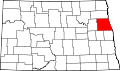
Grand Forks Air Force Base (AFB) (IATA: RDR, ICAO: KRDR, FAA LID: RDR) is a United States Air Force installation in northeastern North Dakota, located north of Emerado and 16 miles (26 km) west of Grand Forks.

Key Information

The host unit is the 319th Reconnaissance Wing (319 RW) assigned to the Air Combat Command (ACC) operating E/RQ-4B Global Hawk remotely piloted aircraft (RPA), in the intelligence, surveillance and reconnaissance (ISR) role. During the Cold War, GFAFB was a major installation of the Strategic Air Command (SAC), with B-52 bombers, KC-135 tankers, and Minuteman intercontinental ballistic missiles.[2]

History

[edit]

Grand Forks Air Force Base was established on 1 December 1955, with construction beginning in the fall of that year. It was occupied for use on 28 January 1957, and was named after the neighboring city of Grand Forks.

Air Defense Command

[edit]

Due to the continuance of the Cold War between the United States and the Soviet Union, GFAFB was originally an Air Defense Command (ADC) fighter-interceptor air base. The site was chosen in 1954 and the land was paid for by the citizens of Grand Forks, the site was located 15 miles (24 km) west of the city. The beginning of the 5,400-acre (22 km2) air base started in 1956 with the construction of a 12,300-foot (3,750 m) runway.

On 18 February 1957, the 478th Fighter Group (Defense) was activated at Grand Forks. The 18th Fighter-Interceptor Squadron was moved from Wurtsmith AFB, Michigan on 1 May 1960, and flew the F-101B Voodoo until 15 April 1971, when it was inactivated and the Voodoos were retired. It was replaced by the 460th FIS, moved from Kingsley Field at Klamath Falls, Oregon. The 460th FIS flew F-106 Delta Darts until it also was inactivated on 15 July 1974.

Main gate at Grand Forks AFB

In addition to the interceptor squadrons, a Semi Automatic Ground Environment (SAGE) Data Center (DC-11) was established at Grand Forks in 1958. The SAGE system was a network linking Air Force (and later FAA) General Surveillance Radar stations into a centralized center for Air Defense, intended to provide early warning and response for a Soviet nuclear attack. DC-11 was operated by the Grand Forks Air Defense Sector (GFADS), activated on 8 December 1957 under the 31st Air Division at Snelling AFS, Minnesota. On 1 January 1959, GFADS was transferred to the operational control of the 29th Air Division at Malmstrom AFB at Great Falls, Montana.

SAGE operations were extremely expansive and GFADS was inactivated on 1 December 1963, when it was merged with the Minot Air Defense Sector at Minot AFB to the west. With the inactivation of DC-11, Grand Forks AFB was reassigned from the Air Defense mission to Strategic Air Command (SAC).

In 1971, the 18th Fighter-Interceptor Squadron was inactivated and the 460th Fighter-Interceptor Squadron replaced the unit. Although the 460th FIS won first place at the William Tell air-to-air competition at Tyndall AFB, Florida, it was inactivated in 1974 due to the restructuring of the air defense system, and ended the activities of ADCOM at Grand Forks.

The DC-11 SAGE blockhouse was later the headquarters of the SAC 321st Strategic Missile Wing. Following the end of Minuteman III missile operations in 1998, the large SAGE blockhouse was torn down five years later, in June 2003.

Safeguard Anti-Ballistic Missile

[edit]

On 3 November 1967, the Department of Defense revealed that GFAFB was one of 10 initial locations to host a Sentinel Anti-Ballistic Missile (ABM) site. With president Richard Nixon's announcement of 14 March 1969, constructing a "Safeguard" installation at Grand Forks became a top priority. Construction was stalled throughout mid-1969, as Congress debated the merits of BMD. After the Senate defeated amendments to kill Safeguard deployment, the U.S. Army proceeded under the assumption that appropriations would be forthcoming.

Survey teams selected sites in flat wheatlands close to the Canada-Minnesota border, north-northwest of Grand Forks. Twenty-five miles (40 km) separated the 113-hectare (279-acre) Perimeter Acquisition Radar (PAR) and the 175-hectare (433-acre) Missile Site Radar (MSR) sites. Four remote launch sites of 36 to 45 acres (15 to 18 ha) each were to be situated in a circle with a 20-mile (32 km) radius surrounding the MSR. Groundbreaking occurred at the PAR and MSR sites on 6 April 1970. Excavation proceeded rapidly, and the foundation holes for the PAR and MSR were in place by mid-May.

On 26 May 1972, President Nixon and Soviet general secretary Leonid Brezhnev signed the ABM Treaty, which limited each nation to one site to protect strategic forces and one site to protect the "National Command Authority." With work about 85% complete at Grand Forks, the US chose to finish construction at the North Dakota site. On 21 August 1972, the Army Corps of Engineers turned over the PAR to the Safeguard Systems Command (SAFSCOM) Site Activation Team. The transfer of the MSR occurred on 3 January 1973. Work on the four remote launch sites fell behind schedule, with the last completed on 5 November 1972. Testing of the PAR commenced during the summer of 1973.

On 3 September 1974, the SAFSCOM Site Activation Team was relieved by the U.S. Army Safeguard Command. Named the "Stanley R. Mickelsen Safeguard Complex" 48°35′21″N 098°21′24″W / 48.58917°N 98.35667°W / 48.58917; -98.35667 (Stanley R. Mickelson Complex) (62.3 miles (100 km) northwest of the base), the North Dakota ABM site received its complement of nuclear-tipped LIM-49 Spartan and Sprint Missiles during the following spring. The site was declared operational on 1 April 1975. Due to Congressional action, the Army operated the site for less than a year. With the exception of the PAR, the complex was abandoned in February 1976.

In October 1977, the PAR came under operational control of the USAF, which operated it as part of its early warning system. It was designated as Cavalier AFS 48°43′29″N 097°53′58″W / 48.72472°N 97.89944°W / 48.72472; -97.89944 (Cavalier AFS) (57.8 miles (93 km) north-northwest of the base), and remains active. It is operated by the Air Force Space Command 10th Space Warning Squadron (10th SWS).

Strategic Air Command

[edit]
Minuteman III missile at GFAFB entrance

On 1 September 1958, the Strategic Air Command (SAC) established the 4133d Strategic Wing at Grand Forks as part of its plan to disperse its B-52 heavy bombers over a larger number of bases, thus making it more difficult for the Soviet Union to knock out the entire fleet with a surprise first strike. Many of these bases were near the U.S. border with Canada; those close to GFAFB in the north central U.S. were Minot and Glasgow to the west, and three in Michigan to the east (Sawyer, Kinchloe, and Wurtsmith).

The 4133d SW was redesignated as the 319th Bombardment Wing (319th BW) on 1 February 1963 in a name-only redesignation and was assigned to SAC's Second Air Force, 810th Strategic Aerospace Division. Upon redesignation, the wing placed aircraft on peacetime quick reaction alert duty, and conducted global bombardment training for Emergency War Order operations and air refueling operations to meet SAC commitments. The aircraft in the 1960s at GFAFB were the latest models: B-52H bombers and KC-135A tankers.[2]

In 1973, the 319th Bomb Wing acquired the AGM-69 Short Range Attack Missile (SRAM), replacing the older AGM-28 Hound Dog air-to-ground missile aboard its B-52H aircraft. As the activities in Southeast Asia decreased, the 319th BW focused its full efforts on training crews to fly strategic strike missions.

On 1 November 1964, 321st Strategic Missile Wing was organized as the Minuteman II intercontinental ballistic missile (ICBM) wing at GFAFB, the first in SAC.

During 1965, the wing's three missile squadrons were activated and crew training and certification began at Vandenberg AFB in southern California. In August 1965, the base received its first Minuteman II missile, shipped by train from Assembly Plant 77 at Hill AFB at Ogden, Utah. During the following March, the base received the first Minuteman II to be shipped via aircraft, an Air Force first. The Minuteman III replaced the former in the 1970s.

The 319th transitioned from B-52H to B-52G aircraft in 1983 adding the AGM-86 Air Launched Cruise Missile (ALCM) in 1984.[2][3] In December 1986, the last B-52G permanently departed GFAFB, replaced by the B-1B Lancer in 1987. The tanker aircraft were also changed, from KC-135A to KC-135R. A change in the host unit occurred again in 1988, when the 42d Air Division was assigned for base support in place of the 321st SMW.[2]

Cold War aircraft incidents

[edit]
  • On 2 November 1967, a Grand Forks B-52H (61-0030)[4] crashed near Griffiss AFB in central New York, killing six of the eight aboard.[5] It had engine difficulties and was attempting an emergency landing.[6]
  • On 15 September 1980, a B-52H on alert status experienced a wing fire that burned for three hours, fanned by evening winds of 26 mph (42 km/h). The wind direction was parallel to the fuselage, which likely had SRAMs in the main bay. Eight years later, a weapons expert testified to a closed U.S. Senate hearing that a change of wind direction could have led to a conventional explosion and a widespread scattering of radioactive plutonium.[7]
  • Mid-morning on 27 January 1983, a B-52G (57-6507)[8] exploded on the maintenance ramp, killing five maintenance personnel and injuring eight.[9][10][11] A faulty fuel pump in a wing tank was being attended to prior to the accident.[12]

The 1990s

[edit]

With the restructuring of the Air Force and the disestablishment of SAC in 1992, the wing transferred to Air Combat Command (ACC), then came under Air Force Space Command (AFSPC) in 1993.

On 1 February 1993, ACC dropped the 319th Bomb Wing's primary nuclear mission and gave the wing the primary mission of B-1B conventional bombardment operations. The 319th BW began planning and training to support such a mission to counter worldwide regional threats.

Following the departure of the last B-1B aircraft in 1994, the base transferred to the new Air Mobility Command (AMC) and the 319th Bomb Wing was redesignated as the 319th Air Refueling Wing (319 ARW). The KC-135R aircraft assets were transferred to AMC, and the strategic ICBM assets went to Air Force Space Command (AFSPC).

In March 1995, the 1995 Base Realignment and Closure Commission (BRAC) selected the 321st Strategic Missile Wing for inactivation; it was first downgraded to group status, then inactivated on 30 September 1998. GFAFB's Minuteman ICBM silos were imploded in accordance with the Strategic Arms Reduction Treaty (START II), commencing in 1999 and completed in 2001.[13] The Minuteman III missiles were transferred to Malmstrom AFB in at Great Falls, Montana, to replace retired Minuteman II models. Minuteman III ICBMs remain at three USAF bases: Malmstrom, Minot, and F.E. Warren at Cheyenne, Wyoming.

Twenty-first century

[edit]

In May 2005, DoD's 2005 Base Realignment and Closure Commission recommended that Grand Forks be realigned. The base's KC-135 tanker mission was lost, with a significant reduction of personnel, but it was not closed.

The unmanned RQ-4 Global Hawk was assigned to Grand Forks, and on 1 March 2011, the wing was redesignated as the 319th Air Base Wing (319 ABW). The first RQ-4 arrived in May 2011 and were assigned to the 69th Reconnaissance Group, Air Combat Command. Starting in 2012, the base received several new Block 40 Global Hawks.[14] On 13 June 2017, the 319 ABW transferred from the Air Mobility Command to the Air Combat Command.[15]

On 11 May 2019 Secretary of the Air Force Heather Wilson announced that the 319th Air Base Wing would be re-designated the 319th Reconnaissance Wing in a ceremony on 28 June 2019.[16]

On 28 June 2019 the 319th Air Base Wing was re-designated the 319th Reconnaissance Wing and the 69th Reconnaissance Group inactivated transferring the RQ-4 mission.

Major commands to which assigned

[edit]

Major units assigned

[edit]
69th Reconnaissance Group – September 2011 – Current (RQ-4)

References for history introduction, major commands and major units[18]

Based units

[edit]

Flying and notable non-flying units based at Grand Forks Air Force Base:[19][20][21][22][23]

Demographics

[edit]

Grand Forks is also a United States Census Bureau designated place.

Education

[edit]

It is within the Grand Forks AFB Public School District 140.[24] That school district has its own board of trustees and contracts education to the Grand Forks School District.[25] The district, along with the Grand Forks School District, is administered as part of Grand Forks Public Schools.[26] The Grand Forks AFB School District was created in 1990.[25]

Nathan F. Twining Elementary and Middle School, a K-8 school operated by the Grand Forks Public Schools, is on-post. On-post students are zoned to Grand Forks Central High School, which is located off-post.[25]

Timeline

[edit]
  • 1954 The Department of Defense chose Grand Forks as the site for a new installation.
  • 5 February 1956 Contractors begin construction of the base.
  • 8 February 1957 Air Defense Command (ADC) activated the 478th Fighter Group at Grand Forks AFB as the host unit for the base.
  • 1 September 1958 Strategic Air Command (SAC) activated the 4133d Strategic Wing (Provisional) as a tenant unit at Grand Forks AFB.
  • 15 December 1959 The Grand Forks Air Defense Sector of the North American Air Defense Command became operational with the Semi Automatic Ground Environment (SAGE) System.
  • 1 May 1960 The 18th Fighter-Interceptor Squadron (FIS) was stationed at Grand Forks AFB with its F-101B Voodoos.
  • 6 May 1960 The 905th Air Refueling Squadron (ARS) (Heavy), a unit assigned to the 4133d Strategic Wing, received its first KC-135A Stratotanker.
  • 28 December 1960 The 478th Fighter Wing was activated under the ADC and became the host unit for the base.
  • 29 April 1962 The 30th Bombardment Squadron, a unit assigned to the 4133d Strategic Wing, received its first B-52H Stratofortress.
  • 1 February 1963 Strategic Air Command organized the 319th Bombardment Wing (Heavy) at Grand Forks AFB. The 319 BMW became the host wing as the 4133d Strategic Wing inactivated and command of the base transferred from the ADC to SAC.
  • 19 August 1964 Strategic Air Command activated the 804th Combat Support Group (CSG) as the host unit at Grand Forks AFB.
  • 1 September 1964 Strategic Air Command stationed the 4th Air Division, later named 4th Strategic Aerospace Division, at Grand Fork AFB.
  • 1 November 1964 The 321st Strategic Missile Wing (SMW) was organized at Grand Forks AFB and construction began on its Minuteman II missile complex.
  • December 1966 The 321 SMW became operational with the Minuteman II missile.
  • 15 April 1971 Air Defense Command inactivated 18 FIS.
  • 30 June 1971 The 4th Strategic Air Division transferred to Francis E. Warren AFB, Wyoming.
  • 1 July 1971 The 321 SMW assumed host unit duties from the 804 CSG.
  • 30 July 1971 Air Defense Command stationed the 460th Fighter-Interceptor Squadron, with F-106 Delta Darts, at Grand Forks AFB.
  • 8 March 1973 The 321st Strategic Missile Wing completed an upgrade to Minuteman III missiles.
  • 1974 The ADC inactivated the 460 FIS.
  • 1986–1987 The 319th Bombardment Wing converted from the B-52G Stratofortress and KC-135A Stratotanker to the B-1B Lancer and KC-135R Stratotanker.
  • 16 June 1988 Strategic Air Command transferred the 42d Air Division (AD) to Grand Forks as the host support unit for the base.
  • 9 July 1991 Strategic Air Command inactivated the 42 AD and appointed the 319th Bombardment Wing as the host unit for the base.
  • 1 September 1991 The 319th Bombardment Wing was redesignated as the 319th Wing. The 321st Strategic Missile Wing was redesignated as the 321st Missile Wing (MW).
  • 1 June 1992 The Air Force inactivated the Strategic Air Command and reassigned Grand Forks AFB to the Air Combat Command. The 319th Wing was redesignated as the 319th Bomb Wing. The 905 ARS was reassigned to the Grissom AFB, Indiana, although it continued to operate from Grand Forks AFB.
  • 1 July 1993 The 321 MW was reassigned to Air Force Space Command.
  • 1 October 1993 The Air Force redesignated the 319th Bomb Wing as the 319th Air Refueling Wing, reassigned it to Air Mobility Command, and reassigned the 905th Air Refueling Squadron to the wing.
  • 1994 As part of restructuring at Grand Forks the Air Force reassigned the 906th, 911th, and 912th Air Refueling Squadrons to Grand Forks AFB.
  • 26 May 1994 The last B-1B Lancer departed from Grand Forks AFB, marking the end of over 30 years of bombers at Grand Forks.
  • 1 July 1994 Air Force Space Command redesignated the 321 MW as the 321st Missile Group (MG).
  • 1 October 1995 The Clinton Administration approved the Base Realignment and Closure IV committee's recommendation to remove 150 Minuteman III intercontinental ballistic missiles from the Grand Forks Air Force Base missile complex and inactivate the 321st Missile Group.
  • April 1997 After a long, harsh winter, the Grand Forks area suffered a devastating flood due to snowmelt and spring rain. Members of the Grand Forks Air Force Base were called into action, first to help protect the town from the rising waters and later to house the victims of the disaster.
  • 2 July 1998 The 321st Missile Group inactivated after 34 years of service at Grand Forks AFB.
  • 6 October 1999 The first missile silo was demolished in accordance with the Strategic Arms Reduction Treaty (START).
  • 4 December 2010 The last KC-135 tail number 00319 piloted by Lt Gen Vern "Rusty" Findley, the AMC Vice Commander and former 319 ARW commander, departed Grand Forks AFB for its new home at McConnell AFB Kansas, marking the end of the 50-year-long refueling mission at Grand Forks.
  • 26 May 2011 The wing received its first RQ-4 Global Hawk.[27]

See also

[edit]

References

[edit]

Other sources

[edit]
[edit]
Revisions and contributorsEdit on WikipediaRead on Wikipedia
from Grokipedia
Grand Forks Air Force Base is a United States Air Force installation located in Grand Forks County, North Dakota, about 10 miles west of Grand Forks, serving as the home of the 319th Reconnaissance Wing under Air Combat Command. Established in the mid-1950s during the Cold War as a Strategic Air Command base, it initially supported heavy bomber operations with B-52 Stratofortresses and KC-135 Stratotankers, along with Minuteman II intercontinental ballistic missiles under the 321st Strategic Missile Wing. Following the deactivation of its missile squadrons in the 1990s and a period under Air Mobility Command, the base transitioned in 2019 to focus on intelligence, surveillance, and reconnaissance via high-altitude, long-endurance unmanned aircraft systems, particularly the RQ-4 Global Hawk, which it operates as the Air Force's dominant producer of flight hours. The installation has achieved milestones such as enabling the first trans-Atlantic flight of an MQ-9B SkyGuardian in 2018 and setting records for continuous RQ-4 operations, while recently accommodating a temporary beddown of B-1B Lancer bombers starting in December 2024 amid maintenance challenges at Ellsworth AFB.

Overview

Geographic Location and Establishment

Grand Forks Air Force Base is situated in northeastern , approximately 16 miles (26 km) west of the city of Grand Forks and north of the town of Emerado, within Grand Forks County. The base occupies about 5,773 acres of flat terrain, which facilitated the construction of extensive runways and infrastructure suitable for heavy bombers and later missile systems. Its location near the Canadian border positioned it strategically for air defense against potential over-the-pole incursions during the era. The site was selected in due to its remote yet accessible rural setting, ample flat land for large-scale aviation and missile operations, and community support including land donations from Grand Forks citizens, which minimized acquisition costs and fostered local backing. This choice aligned with requirements for bases capable of supporting and strategic assets amid escalating tensions with the , prioritizing geographic isolation to reduce vulnerability while maintaining logistical proximity to urban centers for personnel and supplies. Construction commenced in September 1955 and was substantially completed by August 1956, encompassing runways, hangars, and initial housing facilities without any prior military use of the land by the or other branches. The base was formally established on December 1, 1955, under the Air Defense Command to bolster continental defense capabilities. These foundational phases emphasized rapid build-out to operational readiness, reflecting the urgency of mid-1950s preparedness.

Strategic Role and Significance

Grand Forks Air Force Base has historically anchored U.S. strategic deterrence as a key node in the , hosting B-52 Stratofortress bombers and intercontinental ballistic missiles (ICBMs) under during the , which provided a credible second-strike capability against Soviet nuclear threats. The base's 321st Strategic Missile Wing operated up to 150 Minuteman II silos by the mid-1960s, forming a responsive land-based deterrent that complemented sea- and air-launched systems to ensure and thereby discourage adversary first strikes. This configuration empirically supported U.S. security by maintaining parity in deliverable warheads, with the ICBMs' rapid launch readiness—under 30 minutes—directly linking base infrastructure to reduced escalation risks through observable resolve. Transitioning post-Cold War, the base evolved into a primary hub for high-altitude intelligence, surveillance, and reconnaissance (ISR), operating the RQ-4 Global Hawk unmanned aerial system via the to deliver persistent, all-weather, day-or-night monitoring over vast theaters. The Global Hawk's endurance—exceeding 30 hours per sortie at altitudes above 60,000 feet—enables real-time data collection on adversary movements, directly informing command decisions and enhancing deterrence against peer competitors like and by exposing aggressive postures before they materialize. This dual legacy underscores the base's enduring significance in causal national security dynamics: from triad-based nuclear stability that averted direct superpower conflict, to ISR dominance that sustains informational superiority amid hybrid threats, with operations integrated into the for seamless strategic . Prioritizing such capabilities over proposals aligns with verifiable deterrence efficacy, as evidenced by the absence of major peer invasions during periods of robust U.S. posture.

Historical Development

Initial Construction and Air Defense Command (1954-1960)

Construction of Grand Forks Air Force Base commenced in September 1955 on approximately 5,400 acres of donated land in northeastern , selected for its advantageous position in the continental defense network amid escalating tensions with the . The site choice reflected Air Defense Command (ADC) priorities for coverage and rapid interceptor deployment to counter long-range threats, such as the , whose incursions underscored the empirical need for robust northern early-warning systems. Initial infrastructure included runways, hangars, and support facilities, with substantial completion by early 1957, enabling occupancy on January 28 of that year. The base activated under ADC on February 8, 1957, with the establishment of the 32nd Air Base Group to manage operations and the 478th Fighter Group as the primary host unit, marking the facility's role in the (SAGE) system—a networked array of s and computers designed for automated direction of intercepts. The Grand Forks SAGE Direction Center, designated DC-11, was set up in February 1957 and reached full operational capability in April 1959, integrating data from remote sites to provide real-time threat assessment and guidance for fighter responses. This setup addressed causal gaps in manual control, enabling faster reaction times against potential massed bomber raids through centralized processing of radar inputs. By 1958, core facilities were operational, supporting an initial military personnel complement that expanded rapidly to over 1,250 by mid-1959 as interceptor units mobilized. The 18th Fighter-Interceptor Squadron deployed to the base on May 1, 1960, equipped with McDonnell F-101B Voodoo supersonic interceptors fitted with advanced radar for all-weather operations, bolstering the site's capacity to engage high-altitude threats at Mach speeds. These assets, including associated radar extensions, formed a layered defense prioritizing empirical detection and interception over offensive roles, with no or facilities yet integrated.

Strategic Air Command Integration and Cold War Operations (1961-1989)

In January 1962, the 4133rd Strategic Wing, provisional, began operations at Grand Forks Air Force Base under oversight, marking the base's initial integration into SAC's bomber and tanker forces. On February 1, 1963, SAC formally activated the 319th Bombardment Wing (Heavy), replacing the provisional unit and establishing permanent heavy bomber operations with aircraft equipped for nuclear missions. The wing also incorporated the 905th Air Refueling Squadron with aircraft, enabling extended airborne alert patrols as part of SAC's continuous deterrence posture. The B-52s at Grand Forks participated in , SAC's program of maintaining nuclear-armed bombers on continuous airborne alert to ensure retaliatory strike capability in the event of a Soviet first strike. These missions, supported by KC-135 refueling, involved orbits over remote areas to minimize vulnerability on the ground, with Grand Forks-based crews contributing to the 24-hour alert cycles that formed a key pillar of U.S. readiness during the 1960s. By sustaining such operations, the base helped project credible second-strike assurance, deterring potential aggression through demonstrated survivability and rapid response, as evidenced by the absence of escalation to nuclear conflict amid heightened tensions. Complementing the airborne component, SAC activated the 321st Strategic Missile Wing on November 16, 1964, to deploy intercontinental ballistic missiles at Grand Forks. The first Minuteman II missile entered its on August 5, 1965, achieving initial operational capability by October 31, 1965, with full wing deployment of 150 hardened launch facilities across five squadrons completed by 1968. These , dispersed over northwestern and linked to five launch control centers, provided a land-based deterrent leg with missiles capable of reaching Soviet targets in under 30 minutes, enhancing overall triad resilience against preemptive attacks. The combined bomber, tanker, and missile assets at Grand Forks exemplified SAC's strategy of assured destruction, calibrated to match Soviet nuclear advancements rather than mere overkill, as parity in deliverable warheads proved essential in preventing direct superpower confrontation. Declassified readiness exercises confirmed high alert states and launch reliability, underscoring the base's role in stabilizing deterrence amid crises like the 1962 and later escalations. This configuration persisted through the 1980s, adapting to upgrades in and missile accuracy while maintaining the core mission of strategic stability.

Safeguard Anti-Ballistic Missile Program

The , part of the U.S. Army's Safeguard (ABM) program, was constructed near Nekoma, , to defend the Minuteman ICBM silos at Grand Forks Air Force Base against limited attacks from Soviet or Chinese forces. Construction commenced on April 6, 1970, and the facility achieved initial operational capability in April 1975, with full operational status declared on October 1, 1975. The system featured a layered defense , including the massive Pyramid-shaped Missile Site Radar (MSR) for detection and tracking, long-range Spartan interceptors for exo-atmospheric engagements derived from the Nike-Zeus program, and short-range Sprint missiles for high-speed endo-atmospheric intercepts evolved from Nike-X technology. This setup aimed to counter salvos targeting the base's 150 Minuteman III missiles by providing terminal-phase protection. Deployment was constrained to a single site following the 1972 , which permitted only one ABM deployment area per superpower to preserve , alongside escalating costs exceeding initial projections. The program incurred approximately $6 billion in expenditures by deactivation, reflecting advanced engineering achievements such as the 165-foot-tall Pyramid radar capable of tracking hundreds of targets simultaneously. Despite technical validation through prior flight tests demonstrating successful intercepts under controlled conditions, critics highlighted vulnerabilities to saturation attacks via multiple independently targetable reentry vehicles (MIRVs), which could overwhelm the site's 100 interceptors. Proponents argued it proved the viability of integrated radar-missile defenses against sparse threats, countering claims of outright ineffectiveness by noting development successes that informed later systems, though led to congressional defunding. The complex was deactivated on February 10, 1976, mere months after full activation, due to budgetary constraints and shifting strategic priorities emphasizing offensive deterrence over thin-area defense. This brief operational lifespan underscored debates on missile defense efficacy, where empirical test data affirmed intercept capabilities against single or limited warheads—Spartan and Sprint achieving hits in developmental trials—but exposed limitations against massed assaults without nationwide coverage. The site's legacy includes pioneering phased-array radar technology and layered interception concepts that influenced subsequent U.S. ballistic missile defense architectures, despite the program's cancellation amid arms control agreements.

Post-Cold War Transitions and Base Realignments (1990-2000)

Following the dissolution of the in June 1992, Grand Forks Air Force Base underwent significant realignments to adapt to reduced strategic threats from the former , shifting emphasis from nuclear deterrence to conventional air mobility and residual bomber capabilities. The base survived the 1991 (BRAC) process without closure recommendations, preserving its operational infrastructure amid broader drawdowns. By 1993, the 319th Bombardment Wing, previously equipped with B-52H Stratofortress bombers, began transitioning under before full realignment to . The departure of the B-1B Lancer fleet on 26 May 1994 marked the end of dedicated bomber operations at the base after 32 years, reflecting post-Cold War force reductions that prioritized conventional precision strike platforms elsewhere while retaining limited deterrence assets. On 1 October 1993, the 319th was redesignated the 319th Air Refueling Wing, with KC-135 Stratotanker squadrons (906th, 911th, and 912th) reassigned from other bases to bolster global refueling missions, enabling support for operations like Desert Storm follow-ons and emphasizing empirical needs for rapid deployment over bipolar nuclear standoff. This shift aligned with causal reductions in tanker drawdowns, as residual KC-135 fleets were maintained for extended-range conventional strikes despite the absence of large-scale intercontinental threats. The 1995 BRAC round targeted the 321st Missile Group for inactivation, leading to the phased removal of 150 Minuteman II intercontinental ballistic missiles by June 1998, with the final missile departing Grand Forks on 10 June 1998; this drawdown empirically responded to verified treaty obligations and diminished peer threats, though select Minuteman III upgrades were retained elsewhere for ongoing deterrence. Concurrently, the base's resilience was tested by the , which crested at 54.35 feet and displaced over 60,000 personnel, including members who reinforced dikes and evacuated assets, minimizing operational disruptions without structural failure to key facilities. These transitions reduced personnel from approximately 5,000 active-duty in the early to streamlined mobility-focused operations by , prioritizing verifiable cost savings over redundant Cold War-era postures.

21st-Century Mission Shifts (2001-Present)

Following the September 11, 2001, terrorist attacks and subsequent Global War on Terrorism, Grand Forks Air Force Base underwent significant realignments under the 2005 Base Realignment and Closure (BRAC) recommendations, which were implemented in phases through 2007, transitioning the base from tanker operations to intelligence, surveillance, and reconnaissance (ISR) missions. The 319th Air Refueling Wing was redesignated and reorganized, ultimately evolving into the 319th Reconnaissance Wing under Air Combat Command, focusing on high-altitude, long-endurance unmanned aerial systems like the RQ-4 Global Hawk for persistent ISR support in counterterrorism operations and emerging great power competitions. The first RQ-4 arrived in May 2011, enabling expanded drone orbits that provided real-time threat intelligence, enhancing national security imperatives despite occasional critiques of surveillance scope from civil liberties advocates. In August 2021, the Department of the Air Force designated Grand Forks as a central hub for future ISR capabilities, initiating infrastructure planning for construction and renovations starting in 2023 to accommodate next-generation missions, including expanded operational units under the . These upgrades solidified the base's role in and data processing, with facility enhancements supporting increased RQ-4 operations and integration of advanced sensor technologies for multi-domain awareness. By 2025, these developments had contributed to verifiable enhancements in intelligence collection efficiency, countering overreach concerns through demonstrated value in timely threat detection for military decision-makers. Further mission diversification occurred in 2023 when the selected Grand Forks for expansion of its low-Earth orbit satellite operations, establishing a Test and Checkout Center co-located with existing facilities to support satellite transport and tracking layers, with construction funded at $4 million in FY2023 and completion targeted for 2026. This assignment integrated space-based ISR into the base's portfolio, enhancing resilient communications and proliferated warfighter sensing amid peer competitor challenges. In December 2024, the Air Force approved a temporary beddown of 17 B-1B Lancers and approximately 800 personnel from at Grand Forks, commencing in late 2024 through mid-2025, to accommodate Ellsworth's runway maintenance and sustain bomber readiness during the period.

Missions and Operations

Evolution from Strategic Bombing to ISR

Grand Forks Air Force Base transitioned from a key component of Strategic Air Command's nuclear triad, hosting B-52 bombers for strategic deterrence and potential retaliatory strikes, to a central hub in Air Combat Command's intelligence, surveillance, and reconnaissance (ISR) enterprise under the 319th Reconnaissance Wing. This doctrinal evolution prioritized persistent, real-time data collection and fusion over massed bombing campaigns, enabling joint forces to receive actionable intelligence for decision superiority in contested environments. The 319th RW's operations supported extended missions in Afghanistan and Iraq, providing continuous ISR feeds that facilitated over 10,000 combat sorties through enhanced situational awareness, shifting the base's role from reactive nuclear response to proactive threat identification. ISR capabilities at the base embody a causal shift toward proactive defense by delivering persistent overhead monitoring, allowing forces to detect and neutralize high-value preemptively rather than relying on large-scale bombing that follows escalation. Empirical data underscores this advantage: precision-guided munitions informed by ISR achieve accuracies under 10 meters, compared to unguided bombs' dispersions exceeding 200 meters, directly correlating with reduced through minimized blast radii and fewer errant impacts. This precision mitigates biases against unmanned systems by demonstrating lower unintended harm rates—studies of operations in populated areas show ISR-enabled strikes averaging 70-90% fewer extraneous than equivalent manned, less-targeted alternatives—prioritizing empirical outcomes over narrative critiques. The base's ISR framework integrates with cyber effects operations and space-based assets to enable multi-domain operations, fusing ground, air, electromagnetic, and orbital data streams for comprehensive visualization under concepts. This synergy, aligned with 16th Air Force priorities, enhances by embedding cyber vulnerabilities assessments and space-derived positioning into ISR workflows, allowing synchronized responses across domains without siloed intelligence.

Unmanned Aerial Systems and Reconnaissance

Grand Forks Air Force Base serves as a primary hub for RQ-4 Global Hawk operations, a high-altitude, long-endurance remotely piloted aircraft designed for intelligence, surveillance, reconnaissance (ISR), (SIGINT), and (IMINT) missions. The first RQ-4 Global Hawk arrived at the base in May 2011, marking the start of dedicated UAS activities focused on global all-weather, day-or-night operations. These platforms operate at altitudes exceeding 60,000 feet, enabling persistent coverage over areas of interest with endurance capabilities supporting missions lasting over 30 hours, as demonstrated by a record 34.8-hour flight achieved in May 2024. The RQ-4 Global Hawk at Grand Forks contributes to contingency operations, including ISR support in theaters such as the Pacific and hotspots, providing real-time data for tactical decision-making without risking manned aircraft. Block 40 variants, equipped with enhanced multi-intelligence sensors, have expedited operational testing at the base, including rapid integration exercises conducted June 16-18, 2025. These systems have flown extended sorties contributing to counter-terrorism efforts, such as those against , by delivering persistent overhead surveillance and targeting data to joint forces. In addition to the RQ-4, Grand Forks supports MQ-9 Reaper rotations and testing, a medium-altitude long-endurance platform capable of armed ISR with 24+ hour mission durations and precision strike options using munitions like missiles. The base was selected in 2016 for a new MQ-9 wing to expand RPA capabilities, including test architectures for real-time and integration with Global Hawk systems. Experimental platforms and counter-UAS developments are also evaluated here, enhancing tactical applications in contested environments. Training for UAS operators at Grand Forks benefits from partnerships with the (UND), which operates the only civilian program training on Predator Mission Aircrew Training Systems leased from the Air Force. This collaboration allows proficiency building in simulated high-altitude environments, focusing on operational strategies and problem-solving without manned flight risks, through joint events like counter-UAS and live-virtual-constructive exercises. UND's facilities on base support classroom and simulator-based instruction for up to 24 students, fostering seamless transition to real-world missions.

Emerging Space and Satellite Operations

In August 2023, the (SDA) announced an expansion of its operations at Grand Forks Air Force Base to support control of proliferated low-Earth orbit (LEO) satellites as part of the Proliferated Warfighter (PWSA). This initiative establishes a second SDA operations center at the base, complementing the primary facility at , , and leverages the base's established expertise in remote operations from its unmanned aerial systems (UAS) mission. The expansion includes a 25,000-square-foot test and evaluation center focused on operations, data transport, and missile tracking, projected to employ up to 240 personnel. The base's facilities now host ground stations integral to managing Tranche 0 and Tranche 1 satellites, with activations progressing through and 2025 to enhance relay and tracking capabilities. Tranche 0, comprising initial transport and tracking layers launched starting April 2023, marked the PWSA's demonstration phase, while Tranche 1—encompassing over 150 satellites for data transport and warning—began operational deployments in September 2025, with Operations Center North at Grand Forks set to control more than 100 of these by year's end following launches of approximately 160 satellites from late onward. These ground stations integrate with the base's , , and reconnaissance (ISR) infrastructure, enabling seamless data fusion between LEO assets and UAS platforms for persistent monitoring. This emerging space role bolsters U.S. missile warning and tracking against hypersonic threats, providing resilient, low-latency communications denied by traditional geosynchronous systems in contested environments. The PWSA's LEO constellation serves as the backbone for joint military operations, countering anti-access/area-denial (A2/AD) capabilities developed by adversaries such as China and Russia by distributing sensors across hundreds of small satellites for survivability against jamming or kinetic attacks, as outlined in Department of Defense architectures for contested space domains. The 319th Reconnaissance Wing facilitates this integration, supporting SDA alongside U.S. Space Force units in testing and operating these assets to enhance hypersonic glide vehicle detection and fire control.

Units and Personnel

Primary Air Force Units

The 319th Reconnaissance Wing (319 RW) serves as the primary host unit at Grand Forks Air Force Base, assigned to Air Combat Command and focused on intelligence, surveillance, and reconnaissance (ISR) operations. Established following the 2019 redesignation from the 319th Air Base Wing, the 319 RW manages high-altitude, long-endurance missions primarily using RQ-4B Global Hawk unmanned aerial vehicles, with ground control stations and operational headquarters at the base. Subordinate to the 319th Operations Group, the 4th Reconnaissance Squadron operates RQ-4 Global Hawks from , , conducting global, all-weather, day-or-night reconnaissance, surveillance, and target acquisition missions; launch, recovery, and mission planning elements are supported from Grand Forks. The group also includes Detachment 1 of the 319th Test and Evaluation Squadron, activated on September 17, 2025, to conduct testing and evaluation of unmanned aircraft systems, capitalizing on the base's specialized UAS infrastructure. The 319th Mission Support Group oversees essential base services, including the 319th Contracting Squadron, which handles , contracts, and sustainment for operations, and the 319th Communications Squadron, which operates the High Frequency Global Communications System (HFGCS); Grand Forks Air Force Base serves as one of two Network Control Stations for the system, providing strategic command and control by remotely managing worldwide HF transmission sites. Complementing operational functions, the 319th Medical Group provides comprehensive healthcare, preventive medicine, and aeromedical services tailored to ISR personnel and UAS operators. From December 2024 through 2025, Grand Forks hosted a temporary detachment of the 28th Bomb Wing's B-1B Lancer fleet—17 aircraft—from , enabling continued operations during facility upgrades and maintenance at the home station; the relocation involved specialized maintenance and mission support coordinated with base infrastructure.

Support and Tenant Organizations

The U.S. Customs and Border Protection (CBP) Office of Air and Marine operates the Air Branch at Grand Forks Air Force Base, utilizing the facility's unmanned aerial systems (UAS) infrastructure for border surveillance and national air security missions. This tenant organization conducts integrated air and marine response operations, including patrols with MQ-9 Reaper drones to monitor the U.S.- border and support anti-terrorism efforts. Established to enhance CBP's UAS capabilities, the branch opened a Predator B operations center at the base, leveraging shared airspace and maintenance resources provided by the host . Department of Defense (DoD) civilian employees contribute to base and sustainment functions, handling , contracting, and infrastructure support essential for tenant and host unit operations. These roles, integrated within the 319th Mission Support Group, ensure responsive for ISR assets and federal partner activities, including equipment readiness and mobility support for approximately 2,200 total force personnel. Interagency collaborations for ISR, particularly with DHS components like CBP, involve shared data processing and joint UAS testing, though formalized tenant presences beyond CBP remain limited as of 2025. Occasional detachments from or reserve components provide temporary support for exercises, but no permanent non-USAF military tenants are stationed.

Personnel Demographics and Strength

As of 2023, Grand Forks Air Force Base supported 1,583 and 618 employees across appropriated funds, nonappropriated funds, and other federal agencies, yielding a core of 3,581 individuals excluding contractors. These figures encompass roles in operations, , and support functions aligned with the base's mission, though exact contractor numbers remain unspecified in official reports and are estimated to supplement the workforce for specialized tasks. The base's total associated population, including 1,380 military dependents, reached approximately 2,963 in FY2023, reflecting a compact structure typical of remote installations. Personnel demographics mirror broader U.S. trends, with a male-dominated composition (around 80% male Air Force-wide) and increasing diversity in race and ethnicity, including about 15% Black or African American, 17% Hispanic or Latino, and 6% Asian service members as of recent DoD reports; base-specific breakdowns emphasize technical proficiency in unmanned systems and roles, supported by specialized training pipelines. Retention at Grand Forks AFB has faced challenges, with a 2019 analysis revealing 21% higher Airmen departure rates compared to the average, attributed partly to geographic isolation despite competitive mission assignments. Quality-of-life initiatives, including community assessments launched in January 2025, have sought to address this through enhanced support services, yielding favorable rankings in community feedback surveys for factors like and , though overall enlisted continuation rates align with or slightly trail service norms of 86-89%.

Facilities and Infrastructure

Airfield and Operational Facilities

The airfield at Grand Forks Air Force Base centers on a single primary runway, designated 17/35, extending 12,351 feet in length and 150 feet in width, with a surface combining asphalt in the central portion and concrete at the ends, designed to accommodate heavy aircraft including the RQ-4 Global Hawk for high-altitude reconnaissance missions. Precision approaches are supported via radar systems, with air traffic managed from an on-site control tower upgraded in 2010 to enhance operational efficiency and capacity. Hangars dedicated to RQ-4 maintenance and storage, including those operated in conjunction with contractors like , enable comprehensive airframe and sensor servicing for the 319th Wing's fleet. operations rely on a base-wide hydrant system, upgraded in 2023 after two decades of service, which previously handled around 215,000 gallons annually but has since supported surges tied to temporary deployments, ensuring reliable supply for sustained unmanned sorties. Training infrastructure includes virtual simulators and hangar-based systems tailored for RQ-4 operators, allowing mission rehearsal and maintenance proficiency without aircraft utilization, contributing to the platform's status as the safest in the Air Force's inventory with zero Class A mishaps over extensive flight hours. Post-2021 enhancements for drone operations integrate with adjacent UAS facilities, enabling expanded testing and capacity while maintaining a record of secure, high-volume flights.

Missile Silos and Historical Structures

The 321st Strategic Missile Wing at Grand Forks Air Force Base controlled 150 LGM-30F Minuteman II launch facilities dispersed across northeastern , with construction completed in December 1966. These hardened underground silos, each capable of housing a single Minuteman II missile with a range exceeding 8,000 miles, formed a key component of the U.S. nuclear deterrent during the . The missile field extended within approximately a 150-mile radius of the base, ensuring survivability against potential Soviet first strikes through geographic separation of launch facilities from five missile alert facilities. Following the phaseout of Minuteman II systems, the silos were deactivated between 1996 and 1998, with missiles removed and facilities imploded or capped to prevent unauthorized access. Post-deactivation, the sites underwent remediation to dismantle launch equipment and secure the structures, while ongoing security monitoring prevents intrusion or repurposing without authorization. One preserved example, the Minuteman Missile State comprising the Oscar-Zero missile alert facility and November-33 launch facility near Cooperstown, offers public tours of the underground control center and aboveground silo cap, illustrating operational protocols from the era. Adjacent to the Minuteman field, remnants of the near Nekoma served as an defense for the Grand Forks silos, featuring pyramid-shaped domes for the Missile Site Radar capable of tracking up to 100 targets simultaneously. Activated in April 1975 under the , the complex was deactivated by congressional vote in October 1975 due to cost concerns and negotiations, leaving the concrete pyramid structures intact as enduring artifacts. These historical features, while not formally designated as preserved sites, symbolize the brief operational phase of U.S. ground-based systems.

Modernizations and Expansions

In 2021, the Department of the Air Force initiated infrastructure planning for construction and renovation projects at Grand Forks Air Force Base to accommodate expanded intelligence, surveillance, and reconnaissance (ISR) missions, including growth in next-generation operational units under the . These efforts focused on enhancing base capacity for advanced reconnaissance platforms and tied to ISR dominance. The Space Development Agency's 2023 expansion announcement marked a significant infrastructure push, with construction of a 25,000-square-foot Test and Checkout Center and a second operations center at the base to support low-Earth orbit satellite operations within the Proliferated Warfighter Space Architecture. Slated for completion in 2026, Operations Center North will manage over 100 satellites by the end of 2025, building on a 2022 $324.5 million contract awarded to and for ground system development. This contract received additional funding in 2025 to advance ground management and integration for satellite constellations. To facilitate the temporary beddown of 17 B-1B Lancers and associated support equipment starting December 2024, the base leveraged existing infrastructure, including reactivation of a 30-year-old fuels hydrant system to sustain high-volume operations for relocated from . Complementary investments included nearly $20 million in 2025 for runway repairs to bolster operational readiness. These modernizations have yielded returns through improved mission sustainment, with ISR and space infrastructure enabling scalable data handling and satellite command, thereby enhancing overall base readiness metrics for multi-domain operations.

Economic and Community Impacts

Contributions to Local Economy

Grand Forks Air Force Base functions as a primary economic anchor for the Grand Forks region, generating a total economic impact of $197.6 million in 2023 through direct , local expenditures, and associated job creation. This includes a combined and of $142.3 million supporting 3,581 direct personnel, comprising 1,583 active-duty members and 324 appropriated-fund civilians. Local spending by base personnel and operations further amplified this footprint, with $35.9 million in off-base expenditures contributing to regional commerce. The base sustains additional employment beyond its direct workforce, creating 410 indirect jobs in FY2023 with an estimated annual value of $19.4 million based on an average salary of $47,410 per position. Vendor contracts and construction activities provide further fiscal infusion, including $10.6 million in construction outlays and $2.2 million in service contracts during the same period. Notable recent spikes encompass a $19.8 million task order contract awarded on October 1, 2025, to United Crane and Excavation for airfield runway repairs, set for completion by September 2026, and a $14.2 million renovation of Bunch Hall initiated in May 2025 to modernize facilities and utilities. Economic input-output analyses applied to North Dakota's aviation sector, which incorporates Grand Forks AFB operations, reveal multiplier effects where initial federal expenditures recirculate through local supply chains and consumer spending, generating 1.5 to 2.0 times the direct input in total output. These dynamics underpin the base's role in stabilizing the regional economy against fluctuations in agriculture and energy sectors, with historical peaks approaching $600 million annually prior to mission realignments, as noted by local officials. Complementary growth in adjacent unmanned aerial systems development has diversified economic dependencies, evidenced by sustained indirect job multipliers despite base-specific adjustments.

Housing, Education, and Community Relations

Military family at Grand Forks Base is managed through a partnership with Communities, which maintains 548 units available for rental to active-duty personnel and their families. This arrangement, initiated in June 2012 as part of a broader Northern Tier housing group, provides a with amenities including a fitness center, splash park, , and fenced backyards to support family needs. These facilities accommodate over 500 families, emphasizing modern living standards to facilitate personnel retention amid operational demands. Education for military dependents centers on on-base and local public schools integrated with base support services. Nathan Twining K-8 School operates directly on the base, serving children of military members from through , while Carl Ben Eielson Elementary handles pre-K through . The School Liaison Program assists with transitions, addressing challenges like frequent relocations for military-connected students in coordination with Grand Forks Public Schools, which receives federal Impact Aid to offset costs from base-resident families. For higher education, the Base Education Center offers accredited degree programs from partner institutions, including partnerships with the (UND) for aerospace-related training such as ROTC and unmanned aircraft systems (UAS) instruction using base simulators. UND's collaborations extend to joint counter-UAS training events with base units, enhancing for airmen. Community relations emphasize integration through events, support programs, and quality-of-life initiatives. The base hosts recurring activities via its events calendar, including family-oriented gatherings at the Community Activity Center with indoor playgrounds and auditoriums for social functions. The Community Action Team coordinates with agencies to resolve issues affecting readiness, while the Military and Family Readiness Center provides tailored services like non-medical case management for exceptional family members. Youth programs focus on skill-building and resilience, with schedules supporting parental deployments. These efforts foster civilian-military ties, drawing on local partnerships to bolster base support without amplifying unrelated grievances.

Controversies and Incidents

Environmental Contamination and Remediation

Groundwater at Grand Forks Air Force Base has been contaminated with per- and polyfluoroalkyl substances (PFAS), primarily perfluorooctane sulfonate (PFOS) and (PFOA), stemming from the use of aqueous film-forming foam (AFFF) for firefighting training and emergency response. The U.S. Department of the Air Force initiated AFFF use, which contained these PFAS compounds, in 1970 to suppress fuel fires effectively. Contamination sites include areas near former fire training pits and crash response locations, where PFAS leached into soil and aquifers over decades. DoD investigations, part of the Installation Restoration Program under the Comprehensive Environmental Response, Compensation, and Liability Act (CERCLA), detected PFAS in base at concentrations up to 75,000 parts per trillion (ppt) for PFOS and PFOA combined, exceeding the U.S. Environmental Protection Agency's (EPA) 2016 lifetime health advisory level of 70 ppt. Systematic monitoring began in earnest around 2016 as part of broader DoD PFAS assessments, identifying Grand Forks as one of over 700 military installations with confirmed detections. The base is listed on the EPA's for related sites, though PFAS-specific designations evolved with regulatory updates. Remediation efforts under the DoD Environmental Restoration Program include ongoing site investigations, groundwater monitoring, and preliminary remedial actions such as soil excavation and treatment system evaluations, with fiscal year 2022 obligations totaling approximately $745,000 for PFAS-related work at the base. The Air Force has transitioned to fluorine-free foam alternatives for new firefighting applications and conducts regular compliance sampling to track plume migration, aiming to mitigate off-base migration risks through natural attenuation and engineered barriers where feasible. These measures prioritize operational continuity while addressing environmental liabilities, with no evidence of acute public health crises directly attributable to base exposures; potential long-term risks, including associations with thyroid disruption and certain cancers noted in epidemiological studies, remain under debate due to confounding variables like dosage and duration. Base drinking water systems are tested and treated as needed to meet EPA standards, underscoring the distinction between plume concentrations and actual human exposure pathways.

National Security Threats from Adjacent Developments

In 2021, , a Chinese firm with ties to the , acquired approximately 370 acres of land 12 miles west of Grand Forks Base for a proposed $700 million wet corn milling facility. The site's proximity to the base's unmanned aerial systems (UAS) operations, including RQ-4 Global Hawk drone runways, raised alarms over potential risks, such as collection on drone technologies or . The U.S. assessed the as posing a "significant threat to " due to these factors, despite the Committee on Foreign Investment in the United States (CFIUS) determining it lacked jurisdiction over the greenfield investment. Local opposition intensified amid economic arguments favoring job creation—projected at 250 positions—but empirical intelligence risks, including foreign surveillance capabilities near sensitive UAS flight paths, outweighed development benefits. On February 7, 2023, the Grand Forks City Council voted to halt the project, followed by formal termination of the development agreement on April 20, 2023. Proponents cited revenue potential, yet precedents from evaluations prioritized base security, underscoring vigilance against foreign investments enabling proximity-based threats. Adjacent wind farm developments have prompted parallel concerns over radar interference and operational clutter at Grand Forks AFB. Wind turbines can generate false returns on air surveillance radars, complicating detection of low-altitude threats and UAS monitoring essential to the base's mission. Early cases, such as 2010 public service commission hearings on proposed farms near the base, highlighted mitigation needs, though broader national security precedents emphasize restrictions to preserve radar efficacy. In response, North Dakota enacted Senate Bill 2398 on April 8, 2025, establishing military impact zones—at minimum five miles around installations like Grand Forks AFB—to regulate incompatible land uses via a new Military Compatibility Commission. The law addresses encroachment from energy projects and foreign developments, requiring compatibility reviews to safeguard readiness without blanket prohibitions, balancing economic growth against verified risks like radar degradation or vectors.

Aircraft Incidents and Operational Risks

During the era, Grand Forks AFB hosted B-52 Stratofortress operations under constant alert postures, which elevated risks from rapid scrambles, , and nuclear-armed configurations. On May 22, 1980, a B-52 caught fire on the ground due to a leak, burning for nearly three hours while fueled by wing tank contents, though firefighters contained it without loss of life or aircraft destruction. In a more severe incident on January 27, 1982, a B-52G (57-6507) exploded on the ramp during maintenance when a faulty transfer ignited vapors, killing four crew members trapped aboard and one ground crewman, while injuring eight others; the aircraft was totally destroyed but no nuclear weapons detonated or released radiation. These events underscored causal factors like maintenance errors and the hazards of high- states in alert-ready bombers, prompting enhancements in and ground safety protocols across SAC bases, though critiques noted persistent crew fatigue risks from 24/7 readiness demands. A similar ground incident occurred in January 1983, when a B-52 Stratofortress exploded on the , highlighting ongoing vulnerabilities in pre-flight and operations despite prior lessons. No mid-air collisions involving Grand Forks-based B-52s and KC-135 tankers were documented in official records for the , though the base's refueling missions contributed to broader SAC operational strains. Empirical data from these era-specific accidents reveal a low per-flight-hour incident rate—far below equivalents—reflecting rigorous training offsets against inherent deterrence mission hazards, countering narratives exaggerating risks relative to strategic gains in nuclear readiness. Post-Cold War, with the base's transition to and platforms like the B-1 Lancer and RQ-4 Global Hawk, incident rates declined due to advanced , reduced manned nuclear alerts, and unmanned systems mitigating pilot exposure. B-1 operations at Grand Forks, including temporary relocations from Ellsworth AFB starting in 2024, have recorded no major mishaps to date, benefiting from designs and controls that enhance stability over legacy bombers. RQ-4 groundings for maintenance have been routine and non-catastrophic, focused on sensor and propulsion overhauls rather than systemic flaws. A notable exception was the , 2021, crash of an RQ-4B (08-2035) 6.8 miles north of the base during approach, caused by the remote pilot's erroneous descent commands, instructor inaction, and delayed mission control intervention, destroying the $64 million aircraft with no ground injuries; investigations led to refined remote piloting checklists and simulator training for handover scenarios. Overall, these unmanned-era risks—primarily human factors in control loops—have been addressed through data-driven protocols, yielding a safety profile where operational tempo sustains ISR and strike deterrence without proportional manned losses.

References

Add your contribution
Related Hubs
User Avatar
No comments yet.