


Community hub
Recent from talks
Contribute something
Nothing was collected or created yet.
Hermosa Beach, California
View on Wikipedia
Hermosa Beach (Hermosa, Spanish for "Beautiful")[7][8] is a beachfront city in Los Angeles County, California, United States. Its population was 19,728 at the 2020 U.S. census. The city is located in the South Bay region of the Greater Los Angeles area; it is one of the three Beach Cities. Hermosa Beach is bordered by the other two, Manhattan Beach to the north and Redondo Beach to the south and east.
Key Information


The city's beach is popular for sunbathing, beach volleyball, surfing, paddleboarding, bars, cycling and running. The city itself extends only about 15 blocks from east to west and 40 blocks from north to south, with Pacific Coast Highway running down the middle. Situated on the Pacific Ocean, Hermosa's average temperature is 70 °F (21 °C) in the summer and 55 °F (13 °C) in the winter. Westerly sea breezes lessen what can be high summertime temperatures in Los Angeles and elsewhere in the county and help keep the smog away 360 days of the year.
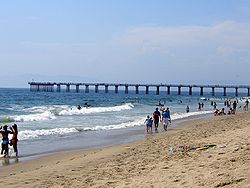
A paved path, called The Strand, runs along Hermosa's beach from Torrance Beach in the south approximately twenty miles north to Santa Monica. The Hermosa Beach Pier is at the end of Pier Avenue, which is one of the beach community's main shopping, dining and entertainment areas.
History
[edit]Hermosa Beach was originally part of the 1784 Rancho San Pedro Spanish land grant that later became the ten-mile (16 km) ocean frontage of Rancho Sausal Redondo. In 1900, a tract of 1,500 acres (6.1 km2) was purchased for $35 per acre from A. E. Pomroy, then owner of the greater part of Rancho Sausal Redondo. Messrs. Burbank and Baker, agents, bought this land for Sherman and Clark who organized and retained the controlling interest in the Hermosa Beach Land and Water Company.
In early days, Hermosa Beach — like so many of its neighboring cities (Inglewood, Lawndale, Torrance) — was one vast sweep of rolling hills covered with fields of grain, mostly barley. During certain seasons of the year large herds of sheep were grazed over this land, and corrals and large barns for storing the grain, as well as providing shelter for horses and farm implements, were located on the ranch between Hermosa and Inglewood. The Spanish words Rancho Sausal Redondo mean a large circular ranch of pasture of grazing land, with a grove of willow on it.
The first official survey was made in the year 1901 for the board walk on the Strand, Hermosa Avenue and Santa Fe Avenue; work on these projects commenced soon after. In 1904 the first pier was built. It was constructed entirely of wood even to the pilings and it extended five hundred feet out into the ocean. The pier was constructed by the Hermosa Beach Land and Water Company. In 1913 this old pier was partly washed away and later torn down and a new one built to replace it. This pier was built of concrete 1,000 feet (300 m) long, and paved with asphalt its entire length. Small tiled pavilions were erected at intervals along the sides to afford shade for fishermen and picnic parties. A bait stand was built eventually out on the end. Soon after, about 1914, an auditorium building was constructed; it has housed various enterprises and at present the public rest rooms, the Los Angeles Life Guard Service, and the local branch of the Los Angeles County Public Library occupy rooms in the building. This pier is municipally owned.

The Los Angeles Pacific Railway, a trolley system, was the first trolley service in Hermosa Beach, running the entire length of Hermosa Ave. on its way from L.A. to Redondo Beach. A few years later it was merged with most other trolley companies in the region to form the new Pacific Electric Railway Company, informally called the Red Cars.[10]
The Santa Fe Railway was the first railroad to run through Hermosa Beach.[11] It was seven blocks from the beach. The street that led to the tracks was called Santa Fe Avenue, but was later renamed Pier Avenue. There was no Santa Fe railway station for Hermosa, but Burbank and Baker built a railway platform on the west side of the tracks near Santa Fe Avenue, and later the railroad company donated an old boxcar to be used as a storage place for freight. In 1926, the Santa Fe built a modern stucco depot and installed Western Union telegraph service in it.
The first city election for city officers was held December 24, 1906. On January 14, 1907, Hermosa Beach became the nineteenth incorporated city of Los Angeles County.
Geography
[edit]
According to the United States Census Bureau, the city has a total area of 1.4 square miles (3.6 km2), all of it land.
Climate
[edit]Average air temperature - (summer 74 °F (23 °C)/ winter, 55 °F (13 °C))
Average water temperature - 60 °F (16 °C) (summer 68 °F (20 °C)/ winter 50 °F (10 °C))
| Climate data for Hermosa Beach, California | |||||||||||||
|---|---|---|---|---|---|---|---|---|---|---|---|---|---|
| Month | Jan | Feb | Mar | Apr | May | Jun | Jul | Aug | Sep | Oct | Nov | Dec | Year |
| Record high °F (°C) | 91 (33) |
92 (33) |
95 (35) |
102 (39) |
97 (36) |
104 (40) |
97 (36) |
98 (37) |
109 (43) |
106 (41) |
101 (38) |
94 (34) |
109 (43) |
| Mean daily maximum °F (°C) | 65.7 (18.7) |
65.7 (18.7) |
66.4 (19.1) |
68.3 (20.2) |
70.0 (21.1) |
72.5 (22.5) |
75.7 (24.3) |
77.0 (25.0) |
76.4 (24.7) |
73.9 (23.3) |
69.9 (21.1) |
65.4 (18.6) |
70.6 (21.4) |
| Mean daily minimum °F (°C) | 48.0 (8.9) |
49.4 (9.7) |
51.3 (10.7) |
53.3 (11.8) |
57.0 (13.9) |
59.9 (15.5) |
63.0 (17.2) |
63.6 (17.6) |
62.5 (16.9) |
58.5 (14.7) |
52.4 (11.3) |
47.8 (8.8) |
55.6 (13.1) |
| Record low °F (°C) | 27 (−3) |
34 (1) |
35 (2) |
42 (6) |
45 (7) |
48 (9) |
52 (11) |
51 (11) |
47 (8) |
43 (6) |
38 (3) |
32 (0) |
27 (−3) |
| Average precipitation inches (mm) | 3.02 (77) |
3.09 (78) |
2.49 (63) |
0.62 (16) |
0.25 (6.4) |
0.08 (2.0) |
0.03 (0.76) |
0.15 (3.8) |
0.22 (5.6) |
0.40 (10) |
1.11 (28) |
1.76 (45) |
13.20 (335) |
| Source: [12][13][14] | |||||||||||||
Hermosa Beach has an average of 325 days of sunshine a year.[15] Because of its location, nestled on a vast open bay (Santa Monica Bay), morning fog and haze is a common phenomenon in May, June and early July (caused by ocean temperature variations and currents). Locals have a particular terminology for this phenomenon: the "May Gray" and the "June Gloom". Overcast skies are common for June mornings, but usually the strong sun burns the fog off by noon.[16] Nonetheless, it will sometimes stay cloudy and cool all day during June, even as other parts of the Los Angeles area will enjoy sunny skies and warmer temperatures. At times, the sun shines east of PCH, while the beach area is overcast.
As a general rule, the temperature is from 5 to 10 °F (−15 to −12 °C) cooler than it is inland. A typical spring day (mid-April) is sunny, pleasant and about 68 °F (20 °C). In the summer, which stretches basically from May to late October, temperatures can reach to the mid-80s Fahrenheit (about 30 °C) at the beach. In early November, it is about 68 °F (20 °C). In late January, temperatures are around 63 °F (17 °C). It is winter, however, when the hot, dry Santa Ana winds are most common. In mid-December 2004, temperatures soared to 84 °F (29 °C) in Santa Monica, for a few straight days, with perfectly sunny skies.
The rainy season is from late October through late March. Winter storms usually approach from the northwest and pass quickly through the Southland. There is very little rain during the rest of the year, on average, there is just about 14 inches of rain per year in the city.
Hermosa Beach usually enjoys a cool breeze blowing in from the ocean, keeping the air fresh and clean. Therefore, smog is less a problem for Hermosa Beach than elsewhere around Los Angeles.
Demographics
[edit]| Census | Pop. | Note | %± |
|---|---|---|---|
| 1910 | 679 | — | |
| 1920 | 2,327 | 242.7% | |
| 1930 | 4,796 | 106.1% | |
| 1940 | 7,197 | 50.1% | |
| 1950 | 11,826 | 64.3% | |
| 1960 | 16,115 | 36.3% | |
| 1970 | 17,412 | 8.0% | |
| 1980 | 18,070 | 3.8% | |
| 1990 | 18,219 | 0.8% | |
| 2000 | 18,566 | 1.9% | |
| 2010 | 19,506 | 5.1% | |
| 2020 | 19,728 | 1.1% | |
| U.S. Decennial Census[17] 1860–1870[18][19] 1880-1890[20] 1900[21] 1910[22] 1920[23] 1930[24] 1940[25] 1950[26] 1960[27][28] 1970[29] 1980[30] 1990[31] 2000[32] 2010[33] 2020[34] | |||
Hermosa Beach first appeared as a city in the 1910 U.S. census as part of the now defunct Redondo Township.[22]
| Race / Ethnicity (NH = Non-Hispanic) | Pop 2000[35] | Pop 2010[36] | Pop 2020[34] | % 2000 | % 2010 | % 2020 |
|---|---|---|---|---|---|---|
| White alone (NH) | 15,822 | 15,780 | 14,563 | 85.22% | 80.90% | 73.82% |
| Black or African American alone (NH) | 141 | 216 | 195 | 0.76% | 1.11% | 0.99% |
| Native American or Alaska Native alone (NH) | 51 | 28 | 31 | 0.27% | 0.14% | 0.16% |
| Asian alone (NH) | 809 | 1,097 | 1,371 | 4.36% | 5.62% | 6.95% |
| Native Hawaiian or Pacific Islander alone (NH) | 35 | 43 | 20 | 0.19% | 0.22% | 0.10% |
| Other race alone (NH) | 38 | 52 | 152 | 0.20% | 0.27% | 0.77% |
| Mixed race or Multiracial (NH) | 417 | 658 | 1,332 | 2.25% | 3.37% | 6.75% |
| Hispanic or Latino (any race) | 1,253 | 1,632 | 2,064 | 6.75% | 8.37% | 10.46% |
| Total | 18,566 | 19,506 | 19,728 | 100.00% | 100.00% | 100.00% |
2020
[edit]The 2020 United States census reported that Hermosa Beach had a population of 19,728. The population density was 13,834.5 inhabitants per square mile (5,341.5/km2). The racial makeup of Hermosa Beach was 76.6% White, 1.0% African American, 0.3% Native American, 7.1% Asian, 0.1% Pacific Islander, 2.5% from other races, and 12.3% from two or more races. Hispanic or Latino of any race were 10.5% of the population.[37]
The census reported that 99.9% of the population lived in households, 0.1% lived in non-institutionalized group quarters, and no one was institutionalized.[37]
There were 9,247 households, out of which 23.6% included children under the age of 18, 38.6% were married-couple households, 8.9% were cohabiting couple households, 25.7% had a female householder with no partner present, and 26.8% had a male householder with no partner present. 36.0% of households were one person, and 8.0% were one person aged 65 or older. The average household size was 2.13.[37] There were 4,633 families (50.1% of all households).[38]
The age distribution was 17.5% under the age of 18, 5.9% aged 18 to 24, 34.1% aged 25 to 44, 29.1% aged 45 to 64, and 13.4% who were 65 years of age or older. The median age was 40.1 years. For every 100 females, there were 104.9 males.[37]
There were 10,038 housing units at an average density of 7,039.3 units per square mile (2,717.9 units/km2), of which 9,247 (92.1%) were occupied. Of these, 45.6% were owner-occupied, and 54.4% were occupied by renters.[37]
In 2023, the US Census Bureau estimated that the median household income was $152,019, and the per capita income was $110,660. About 3.7% of families and 5.3% of the population were below the poverty line.[39]
2010
[edit]The 2010 United States census[40] reported that Hermosa Beach had a population of 19,506. The population density was 13,673.6 inhabitants per square mile (5,279.4/km2). The racial makeup of Hermosa Beach was 16,928 (86.8%) White (80.9% Non-Hispanic White),[41] 229 (1.2%) African American, 49 (0.3%) Native American, 1,111 (5.7%) Asian, 46 (0.2%) Pacific Islander, 325 (1.7%) from other races, and 818 (4.2%) from two or more races. There were 1,632 residents of Hispanic or Latino ancestry, of any race (8.4%).
The Census reported that 19,491 people (99.9% of the population) lived in households, 11 (0.1%) lived in non-institutionalized group quarters, and 4 (0%) were institutionalized.
There were 9,550 households, out of which 1,878 (19.7%) had children under the age of 18 living in them, 3,254 (34.1%) were opposite-sex married couples living together, 460 (4.8%) had a female householder with no husband present, 325 (3.4%) had a male householder with no wife present. There were 710 (7.4%) unmarried opposite-sex partnerships, and 64 (0.7%) same-sex married couples or partnerships. 3,644 households (38.2%) were made up of individuals, and 606 (6.3%) had someone living alone who was 65 years of age or older. The average household size was 2.04. There were 4,039 families (42.3% of all households); the average family size was 2.80.
There were 3,093 residents (15.9%) under the age of 18, 1,242 (6.4%) aged 18 to 24, 8,516 (43.7%) aged 25 to 44, 4,898 (25.1%) aged 45 to 64, and 1,757 (9.0%) who were 65 years of age or older. The median age was 37.0 years. For every 100 females, there were 111.3 males. For every 100 females age 18 and over, there were 112.1 males.
There were 10,162 housing units at an average density of 7,123.5 per square mile (2,750.4/km2), of which 4,255 (44.6%) were owner-occupied, and 5,295 (55.4%) were occupied by renters. The homeowner vacancy rate was 1.0%; the rental vacancy rate was 4.4%. 10,083 people (51.7% of the population) lived in owner-occupied housing units and 9,408 people (48.2%) lived in rental housing units.
According to the 2010 United States census, Hermosa Beach had a median household income of $101,655, with 3.4% of the population living below the federal poverty line.[42]
Economy
[edit]
In 2024, the most common occupations of residents were management, sales, and administrative support. The top employers were: City of Hermosa Beach (168); Von's Companies (121); Lazy Acres (107); Trader Joe's (94); Hermosa Beach School District (90).[43]
The city has 32.5 acres (13.2 ha) of beach, and 1,570 parking meters.[43]
Arts and culture
[edit]
- Fiesta Hermosa: Arts and crafts festival which has taken place for the last 35 years every Memorial Day and Labor Day weekend
- Hermosa Ironman: Unofficial triathlon every July 4, consisting of running a mile in the sand, paddling a mile on a surfboard, and downing a 6-pack of beer. "First to finish without puking wins!"[44][45][46]
- AVP Hermosa Beach Open: Started in 1969 and typically in June. Attracts combinations of pros and near pros. Free event open to everyone.
- ShockBoxx Art Gallery: Located at 6th & Cypress in the arts district. Showcasing domestic and international artists with avant-garde style themes. Free and open to the public. Check the website for show dates.[47]
- Hermosa Beach Film Festival: Started in 2005 and typically in August. Short films from each year are chosen to be screened at the Hermosa Beach Playhouse
- International Surf Festival: Surfing, paddleboarding, pier to pier swim events. Beginning of August
- Hennessey's Paddle Board Festival: U.S. Paddleboard Championships. Typically in July.
- Hermosa Beach Sunset Concert free concert series from bands who perform on the beach. Starts July 31 – August 21 (4 weeks)
- Farmers' Market Every Friday from 12 noon to 4 pm, rain or shine. (Valley Drive between 8th and 10th Streets) Also, every Wednesday from 1pm to 6pm in the Pier Plaza (by the pier)
- Sand and Strand Run The second oldest standing run in the L.A. area. Unique is its course design, with 45% of the run on the Strand and 55% on the beach. February during low tide.
- Shakespeare by the Sea: the South Bay's free Shakespeare in the Park company. Performances run June through August in a variety of venues in Los Angeles and Orange County.[48]
- The Lighthouse Cafe, a seminal West Coast jazz venue, is located in Hermosa Beach.
- The Hermosa Beach Community Drum Circle occurs every third Sunday of the month from noon to 3 pm at Hermosa Pier.
- The Comedy and Magic Club where comedian Jay Leno has been performing since 1978.[49]
- Hermosa has a rich history in punk rock music, with many notable bands including Black Flag, Red Kross, The Descendents, Pennywise, OFF! and Circle Jerks having all lived or rehearsed in town over the years.
- Hermosa Beach Pride, an LGBTQ+ pride parade and festival, has taken place annually in June since 2021.
Parks and recreation
[edit]The wide flat beach makes Hermosa Beach one of the most popular places to play beach volleyball, from professional to amateur. Hermosa Beach is home to the AVP Hermosa Beach Open tournament, and several amateur CBVA tournaments during the year. The Strand stretches north to Santa Monica and south to Redondo Beach, and is a popular place for walkers, joggers and biking. Of the three Beach Cities, only Hermosa Beach owns its own beach. The other two cities' beaches are owned by the county of Los Angeles.
Running parallel to The Strand is a lovely linear trail known today as the Hermosa Valley Greenbelt. Once part of a railroad easement, this narrow 24-acre (97,000 m2) strip had long been the subject of heated controversy and pressure from various commercial interests. After years of litigation and wrangling, the city was poised to permit intensive retail and condominium development in the mid-1980s when a grassroots group spearheaded by activist Rosamond Fogg forced the matter to a vote. The City Council at the time was divided over whether the matter was of much importance but after an energetic and passionate campaign, the citizens found that the greenbelt was a vital recreational resource and mandated its preservation for the use and enjoyment of residents and visitors. This ballot initiative passed by almost 87%, the highest in California history. [citation needed] On the same Ballot, the public approved a referendum added a utility user's tax by 2% to help pay for the purchase, to be sunset after the property was acquired. [citation needed] As a result, the Hermosa Valley Greenbelt has the quality of a rural country lane, home to the monarch butterfly and many bird and animal species. At any time of day or night joggers and walkers enjoy its soft woodchip trails and graceful landscaping. The Greenbelt is also now part of the federal rails to trails network. The AIA R/UDAT (Regional/Urban Design Assistance Team) found that Hermosa Beach, thanks in large part to the existence of the Greenbelt, was a "world class pedestrian city".[50]
Government
[edit]Local government
[edit]According to the 2009 Comprehensive Annual Financial Report, the city's various funds had $32.4 million in revenues, $33.9 million in expenditures, $93.8 million in total assets, $12.2 million in total liabilities, and $23.0 million in cash and investments.[51]
The structure of the management and coordination of city services is:[52]
| City Department | Department Head |
|---|---|
| City Manager | Steve Napolitano[53] |
| Administrative Services Director | Brandon Walker |
| Finance Manager | Henry Chao |
| Human Resources Manager / Risk Manager | Tiffany Nguyen |
| Community Development Director | Alison Becker |
| Community Resources Director | Lisa Nichols |
| Police Chief | Landon Phillips |
| Public Works Director | Joe SanClamente |
The Beach Cities Health District,[54] provides health and wellness services to the residents of Hermosa Beach, Manhattan Beach, and Redondo Beach. The voters of the three beach cities elect the 5-member Board of Directors to 4-year terms. One of 78 California Health Districts,[55] it was created in 1955 as South Bay Hospital and took on its current name in 1993. Beach Cities Health District opened AdventurePlex,[56] a Manhattan Beach fitness center for kids and their families, in 2002. Filled with mazes, tunnels, outdoor rock climbing walls, complex ropes courses, and an indoor gym, AdventurePlex challenges children physically and intellectually in health-focused recreational activities.
The United States Postal Service Hermosa Beach Post Office is located at 565 Pier Avenue.[57]
The Los Angeles County Fire Department has a sectional lifeguard headquarters located at the Hermosa Beach Pier since the new building opened its doors since 2006, currently commanded by Capt. Tracy Lizzotte who leads the entire "Team HB" as part of "Team South" in the L.A. County Lifeguard. Currently located at 1200 The Strand housed a lifeguard garage where response vehicles have parked.
Politics
[edit]In the California State Legislature, Hermosa Beach is in the 24th senatorial district, represented by Democrat Ben Allen, and in the 66th Assembly district, represented by Democrat Al Muratsuchi.[58]
In the United States House of Representatives, Hermosa Beach is in California's 36th congressional district, represented by Democrat Ted Lieu.[59]
In the 2008 presidential election, Barack Obama won 61% of the vote compared to 36% for John McCain.[60]
Education
[edit]Public schools
[edit]Hermosa Beach has its own elementary school and middle school but high school students are served by either Manhattan Beach or Redondo Beach where rankings are in the 80 to 90th percentiles. Hermosa Beach residents are zoned to Hermosa Beach City School District for grades Kindergarten through 8. Before Proposition 13 passed, Hermosa Beach had five elementary schools (North, South, Hermosa View, Prospect Heights, Valley Vista) and one junior high school (Pier Avenue).
Residents of Hermosa Beach were in South Bay Union High School District until 1993, when it dissolved.[61]
In 2005, Hermosa Valley and Hermosa View schools were honored as U.S. Department of Education National Blue Ribbon Schools, along with 33 California schools and less than 300 schools across the nation. The award was based on academic achievement. Hermosa schools are among the top 10% of schools in the state with students scoring at or above the 90% in the highest grade tested in reading and math. For the award, the Department of Education reviewed growth in scores over a three-year period.
The district has three schools:
- Hermosa View Elementary (Pre-k to Grade 2)
- Hermosa Vista Elementary (Grades 3 and 4)
- Hermosa Valley Middle (Grades 5 through 8)
At the high school level, public school students can choose between two schools:
- Mira Costa High School of Manhattan Beach Unified School District or
- Redondo Union High School of the Redondo Beach Unified School District
The Hermosa Beach City School District as a whole received a score of 915[62] on the 2006 California Academic Performance Index, neighboring Manhattan Beach Unified School District scored just below at 906[63] making it one of California's best performing districts. Each individual school also ranks at the top of its respective category.
| School | 2006 API Score |
|---|---|
| Hermosa View Elementary | 950 |
| Hermosa Vista Elementary | |
| Hermosa Valley Middle | 910 |
| Mira Costa High School | 852 |
Private schools
[edit]Hermosa Beach also has one private school:
- Our Lady of Guadalupe School, is a Catholic school with classes TK thru the Eighth Grade. Although it is a religious school, there is no convent so all classes are taught by state credentialed teachers.
At one point the International Bilingual School, a Japanese preparatory school for grades K-9, moved to Hermosa Beach. In 1992 the school moved to Palos Verdes Estates.[64]
Media
[edit]In addition to the Los Angeles Times, Hermosa Beach is served by the hometown Easy Reader, local daily the Daily Breeze and local weekly the Beach Reporter.
Filming location
[edit]- Film
- Carrie (1976)
- Surf II (1984)
- Hardbodies (1987)
- Back to the Beach (1987)
- My Stepmother Is an Alien (1988)
- Men at Work (1990)
- Side Out (1990)
- Point Break (1991)
- Jackie Brown (1997)
- La La Land (2016)
- TV
- The TV show Summerland was partly filmed here.
- Scenes of the TV show The O.C. were filmed on the Hermosa Beach Strand, Pier and Plaza.[65]
- The Beach House on the TV show Beverly Hills, 90210 is located on the north end of The Strand (1994/1995 seasons).
- The city was the site of the start and the first task on The Amazing Race 31.
- In 2019, the fourth season of Veronica Mars filmed primarily in Hermosa Beach, mainly at the Sea Sprite Hotel.[66]
- Photography
- Hermosa's coastline was the site of "Tragedy by the Sea", a Pulitzer-winning photograph taken by local photographer John L. Gaunt.
Notable people
[edit]- Denise Austin (born 1957) – fitness instructor and husband Jeff Austin live in Hermosa Beach.[67]
- Jason Acuña (born 1973) – skateboarder and Jackass TV personality, lives in Hermosa[68]
- Brent Barry (born 1971) – professional basketball player, lives in Hermosa[69][70]
- James M. Bell (1837–1919), U.S. Army brigadier general, retired to Hermosa Beach[71]
- Jack Black (born 1969) – actor, grew up in Hermosa[72]
- Black Flag (founded 1976)- hardcore punk band
- Kevin Burkhardt (born 1974) – Fox Sportscaster – Lives in Hermosa Beach
- Bill Butler (born 1921) – cinematographer
- A.J. Cook (born 1978) – actor[73]
- Ted Coombs (born 1954) – author of For Dummies computer book series
- Adrianne Curry (born 1982) – first winner of America's Next Top Model, lives in Hermosa[74]
- Carson Daly (born 1973) – television personality
- Jacqueline Frank DeLuca (born 1980) – bronze medalist, water polo, 2004 Olympics, born in Hermosa[75]
- Descendents (formed 1977) – punk band
- Grayson Doody (born 2002) – soccer player[76]
- Morgan Ensberg (born 1975) – baseball player
- Jim Finn (born 1976) – football player
- Eric Fonoimoana (born 1969) – professional AVP volleyball player
- Fortunate Youth (formed 2009) – reggae rock band formed by Hermosa Beach residents
- John L. Gaunt (1924–2007) – LA Times photographer and 1955 Pulitzer Prize winner.
- Jim Grabb (born 1964) – tennis player ranked World No. 1 in doubles
- LeRoy Grannis (1917–2011) – surf photographer, co-founder of Surfing magazine
- Kyle Harrison (born 1983) – professional lacrosse player and 2005 Tewaaraton Trophy winner
- Rachel Hunter (born 1969) – model
- Jarret Stoll (born 1982) – hockey player[77]
- Kelly Kahl (born 1966) – television executive
- Mia Klein – winemaker[78]
- Jimmy Kimmel (born 1967) – television personality
- Christopher Knight (born 1957) – actor, The Brady Bunch
- Kim Lyons (born 1973) – personal trainer on The Biggest Loser and Dr. Phil
- Steve Lyons (born 1960) – baseball player and broadcaster
- Gavin MacIntosh (born 1999) – actor, The Fosters and American Fable
- Mae Marsh (1894–1968) – former actress
- Misty May-Treanor (born 1977) – Olympic gold medalist and AVP pro volleyball player
- Tiffany Montgomery (born 1982) – contestant on American Idol
- Warren Miller (1924–2018) – filmmaker on extreme sports
- Rodney Mullen (born 1966) – professional skateboarder
- Ozzie (1906–1975) and Harriet Nelson (1909–1994) – entertainers, actors, TV personalities
- Dylan O'Brien (born 1991) – actor and musician, known for MTV's Teen Wolf
- Meghan Ory (born 1982) – actress
- Ty Page (1953–2017) – professional skateboarder
- Pennywise (formed 1988) – skate punk/melodic hardcore band
- Raymond Pettibon (born 1957) – artist largely associated with the LA Punk scene, notably Black Flag[79]
- Teri Polo – actress, Meet the Parents
- John Reardon (born 1975) – actor and football player
- Peter Revson (1939–1974) – race car driver
- Adam Royer (born 1989) – The Real World: Las Vegas
- Bill Simpson (1940–2019) – race car driver
- Michael Strahan (born 1971) – NFL player and television personality
- Daniel Tosh (born 1975) – television personality
- Leonard Wibberley (1915–1983) – author of The Mouse That Roared
Sister city
[edit]Hermosa Beach has been the sister city of Loreto, Baja California Sur, since 1967.
See also
[edit]
References
[edit]- ^ "City of Hermosa Beach, California". City of Hermosa Beach, California. Archived from the original on February 16, 2019. Retrieved September 12, 2012.
- ^ "California Cities by Incorporation Date". California Association of Local Agency Formation Commissions. Archived from the original (Word) on November 3, 2014. Retrieved August 25, 2014.
- ^ "2019 U.S. Gazetteer Files". United States Census Bureau. Retrieved July 1, 2020.
- ^ "Hermosa Beach". Geographic Names Information System. United States Geological Survey, United States Department of the Interior. Retrieved October 12, 2014.
- ^ "Hermosa Beach (city) QuickFacts". United States Census Bureau. Retrieved April 28, 2022.
- ^ "USPS – ZIP Code Lookup – Find a ZIP+ 4 Code By City Results". Retrieved January 18, 2007.
- ^ "Profile for Hermosa Beach, California, CA". ePodunk. Archived from the original on November 20, 2019. Retrieved September 12, 2012.
- ^ Gannett, Henry (1905). The Origin of Certain Place Names in the United States. Govt. Print. Off. pp. 155.
- ^ Gnerre, Sam (July 6, 2021). "South Bay History: Hermosa Beach's Golden State Silk Mills becomes the West Coast's first silk processing plant". Daily Breeze.
- ^ "Pacific Electric Redondo Beach-Del Rey Line". erha.org. Retrieved March 19, 2018.
- ^ 1896 USGS Topo Map "Redondo Sheet"
- ^ "Zipcode 90254". www.plantmaps.com. Retrieved April 1, 2021.
- ^ "Climate in Hermosa Beach, CA". www.bestplaces.net. Retrieved June 29, 2023.
- ^ "Hermosa Beach, CA Monthly Weather". www.weather.com. Retrieved July 11, 2023.
- ^ "Weatherbase: Historical Weather for Los Angeles, California, United States of America". Weatherbase.com. Retrieved August 13, 2009.
- ^ "Santa Barbara.com: June Gloom". SantaBarbara.com. Retrieved August 13, 2009.
- ^ "Decennial Census by Decade". United States Census Bureau.
- ^ "1870 Census of Population - Population of Civil Divisions less than Counties - California - Almeda County to Sutter County" (PDF). United States Census Bureau.
- ^ "1870 Census of Population - Population of Civil Divisions less than Counties - California - Tehama County to Yuba County" (PDF). United States Census Bureau.
- ^ "1890 Census of Population - Population of California by Minor Civil Divisions" (PDF). United States Census Bureau.
- ^ "1900 Census of Population - Population of California by Counties and Minor Civil Divisions" (PDF). United States Census Bureau.
- ^ a b "1910 Census of Population - Supplement for California" (PDF). United States Census Bureau.
- ^ "1920 Census of Population - Number of Inhabitants - California" (PDF). United States Census Bureau.
- ^ "1930 Census of Population - Number and Distribution of Inhabitants - California" (PDF). United States Census Bureau.
- ^ "1940 Census of Population - Number of Inhabitants - California" (PDF). United States Census Bureau.
- ^ "1950 Census of Population - Number of Inhabitants - California" (PDF). United States Census Bureau.
- ^ "1960 Census of Population - General population Characteristics - California" (PDF). United States Census Bureau.
- ^ "1960 Census of Population - Number of Inhabitants - California" (PDF). United States Census Bureau.
- ^ "1970 Census of Population - Number of Inhabitants - California" (PDF). United States Census Bureau.
- ^ "1980 Census of Population - Number of Inhabitants - California" (PDF). United States Census Bureau.
- ^ "1990 Census of Population - Population and Housing Unit Counts - California" (PDF). United States Census Bureau.
- ^ "2000 Census of Population - Population and Housing Unit Counts - California" (PDF). United States Census Bureau.
- ^ "2010 Census of Population - Population and Housing Unit Counts - California" (PDF). United States Census Bureau.
- ^ a b "P2: Hispanic or Latino, and Not Hispanic or Latino by Race – 2020: DEC Redistricting Data (PL 94-171) – Hermosa Beach city, California". United States Census Bureau.
- ^ "P004: Hispanic or Latino, and Not Hispanic or Latino by Race – 2000: DEC Summary File 1 – Hermosa Beach city, California". United States Census Bureau.
- ^ "P2: Hispanic or Latino, and Not Hispanic or Latino by Race – 2010: DEC Redistricting Data (PL 94-171) – Hermosa Beach city, California". United States Census Bureau.
- ^ a b c d e "Hermosa Beach city, California; DP1: Profile of General Population and Housing Characteristics - 2020 Census of Population and Housing". US Census Bureau. Retrieved June 22, 2025.
- ^ "Hermosa Beach city, California; P16: Household Type - 2020 Census of Population and Housing". US Census Bureau. Retrieved June 22, 2025.
- ^ "Hermosa Beach city, California; DP03: Selected Economic Characteristics - 2023 ACS 5-Year Estimates Comparison Profiles". US Census Bureau. Retrieved June 22, 2025.
- ^ "2010 Census Interactive Population Search: CA – Hermosa Beach city". U.S. Census Bureau. Archived from the original on July 15, 2014. Retrieved July 12, 2014.
- ^ "Census facts". quickfacts.census.gov. Archived from the original on July 1, 2012.
- ^ "Hermosa Beach (City) QuickFacts from the US Census Bureau". Archived from the original on July 1, 2012. Retrieved August 21, 2012.
- ^ a b "City of Hermosa Beach Community Profile". City of Hermosa Beach. 2024.
- ^ "Home – Hermosa Beach Ironman". Hermosa Beach Ironman. Retrieved March 19, 2018.
- ^ "4th of July 2017 in the South Bay – South Bay Events". southbayevents.com. Retrieved March 19, 2018.
- ^ "Run A Mile, Paddle A Mile And Drink A 6-Pack: Matix Clothing Presents The 41st Annual Hermosa Beach Ironman – Adventure Sports Network". transworld.net. July 1, 2015. Retrieved March 19, 2018.
- ^ "ShockBoxx Project Gallery". shockboxxproject.com. Retrieved July 29, 2019.
- ^ "Shakespeare by the Sea". shakespearebythesea.org. Retrieved March 19, 2018.
- ^ "Jay Leno on leaving "The Tonight Show"". cbsnews.com. January 26, 2014. Retrieved March 19, 2018.
- ^ "AIA R/UDAT: Hermosa Beach, CA" (PDF). The American Institute of Architects. October 31, 1992. p. 5. Retrieved October 15, 2022.
- ^ City of Hermosa Beach CAFR Retrieved August 18, 2009
- ^ "City of Hermosa Beach CAFR" (PDF). hermosabch.org. Retrieved March 19, 2018.
- ^ "City Manager". City of Hermosa Beach, California.
- ^ "Home – Beach Cities Health District". bchd.org. Retrieved March 19, 2018.
- ^ List of California Health Districts
- ^ "AdventurePlex". AdventurePlex. Retrieved March 19, 2018.
- ^ "Post Office Location – Hermosa Beach Archived December 8, 2008, at the Wayback Machine." United States Postal Service. Retrieved on December 6, 2008.
- ^ "Final Maps | California Citizens Redistricting Commission". Retrieved September 25, 2025.
- ^ "California's 36th Congressional District - Representatives & District Map". Civic Impulse, LLC.
- ^ "job347B7B46.dat" (PDF). Archived from the original (PDF) on July 8, 2012. Retrieved July 8, 2013.
- ^ Kowsky, Kim (November 5, 1992). "School District Reorganizations Win Handily : The breakup of South Bay Union High School District is approved. But a proposition moving control of two schools from Los Angeles to Rancho Palos Verdes is blocked by a judge". Los Angeles Times. Retrieved October 28, 2020.
- ^ "2006 API Growth LEA List of Schools Report (CA Department of Education)". api.cde.ca.gov.
- ^ "2006 API Growth LEA List of Schools Report (CA Department of Education)". api.cde.ca.gov. Archived from the original on July 17, 2011. Retrieved January 15, 2007.
- ^ Hillinger, Charles. "Students Get a Japanese Education at 2 Palos Verdes Schools." Los Angeles Times. September 29, 1994. Retrieved on March 6, 2014.
- ^ "THE O.C. Filming Locations". Retrieved January 17, 2017.
- ^ Hixon, Michael (May 2, 2019). "Hermosa Beach featured in Season 4 trailer of 'Veronica Mars'". The Daily Breeze. Retrieved August 9, 2020.
- ^ Lerner, Michelle (June 11, 2018). "Jeff and Denise Austin are selling their Alexandria condo". Washington Post. Retrieved October 30, 2018.
- ^ "Property valuation of Manhattan Avenue, Hermosa Beach, CA: 1514, 1520, 1523, 1525, 1527, 1530, 1533, 1534, 1542, 1547 (tax assessments)". city-data.com. Retrieved June 12, 2014.
- ^ Kelley, Steve. "Barry surfing easily the waves of free agency". The Seattle Times. Retrieved June 12, 2014.
- ^ "712 The Strand, Hermosa Beach, CA 90254". blockshopper.com. BlockShopper. Retrieved June 12, 2014.
- ^ "Gen. J. M. Bell Is Dead". Los Angeles Evening Express. Los Angeles, CA. September 17, 1919. p. 10 – via Newspapers.com.
- ^ "Jack Black Biography". starpulse.com. Retrieved June 12, 2014.
- ^ "Criminal Minds Bio: A.J. Cook". cbspressexpress.com. CBS Television Studios. Retrieved December 16, 2014.
- ^ "Property valuation of Monterey Boulevard, Hermosa Beach, CA: 1600, 1601, 1611, 1616, 1619, 1620, 1627, 1630, 1636, 1637 (tax assessments)". city-data.com. Retrieved June 12, 2014.
- ^ "Jacqueline Frank". sports-reference.com. Archived from the original on April 7, 2014. Retrieved June 12, 2014.
- ^ "ORANGE COUNTY SC SIGN DEFENDER GRAYSON DOODY". Orange County SC. January 20, 2025. Retrieved August 12, 2025.
- ^ ""Rachel Hunter and Jarret Stoll pay $3.645M for a house in Hermosa Beach, CA", September 21, 2007". bergproperties.com. Archived from the original on March 21, 2008. Retrieved March 19, 2018.
- ^ Neff, Kristen Jones. "Wonderful Women Winemakers". Edible. Retrieved December 9, 2012.
- ^ "Raymond Pettibon | Art21". PBS. Archived from the original on October 9, 2003. Retrieved July 8, 2013.
External links
[edit]

- Official website

- Hermosa Beach Chamber of Commerce
- Hermosa Beach Historical Society website
- City-Data.com Comprehensive Statistical Data and more about Hermosa Beach

Places adjacent to Hermosa Beach, California | ||||||||||||||||
|---|---|---|---|---|---|---|---|---|---|---|---|---|---|---|---|---|
| ||||||||||||||||


| International | |
|---|---|
| National | |
| Geographic | |
| Other | |
Hermosa Beach, California
View on GrokipediaHistory
Founding and Early Settlement (1900s–1920s)
The area encompassing modern Hermosa Beach formed part of Rancho Sausal Redondo, a Mexican land grant established in 1837 for ranching and agriculture, characterized by rolling hills, barley fields, sheep grazing, corrals, barns, and sand dunes prior to urban development.[8] In 1900, a 1,500-acre tract was purchased for $35 per acre from A.E. Pomroy, the primary owner of the rancho, by agents Burbank and Baker acting for investors Sherman and Clark, who subsequently organized the Hermosa Beach Land and Water Company to oversee subdivision and development.[8] [9] This transaction marked the transition from agrarian use to planned residential and resort-oriented settlement, with the name "Hermosa" selected to evoke the Spanish term for "beautiful," reflecting the site's coastal appeal.[8] Early infrastructure improvements began in 1901 with the first official survey delineating the Strand boardwalk, Hermosa Avenue, and Santa Fe Avenue, alongside installation of water wells and storage tanks to support habitation.[9] [3] By 1904, the company constructed a 500-foot wooden pier extending into the ocean to facilitate recreation and fishing, while the arrival of the Los Angeles Pacific Railway line spurred street paving and initial lot sales, attracting around 530 residents by August 1906.[3] [9] These developments positioned Hermosa Beach as an emerging resort destination amid the broader South Bay land boom, emphasizing beach access and proximity to Los Angeles.[9] Incorporation efforts culminated in the first municipal election on December 24, 1906, followed by official status as a sixth-class city on January 14, 1907, with John Q. Tufts elected as the inaugural mayor and Herman Vetter as city clerk; the city secured a two-mile oceanfront deed from the land company, designating it a public beach playground.[9] [3] The original pier partially collapsed in a 1913 storm and was replaced by a longer 1,000-foot concrete structure completed in 1914, enhancing tourism infrastructure alongside the partial cementing of the Strand boardwalk.[3] Through the 1920s, Hermosa Beach functioned primarily as a resort town, with ongoing subdivision, hotel construction, and civic organizations fostering community growth, though it remained smaller and less industrialized than neighboring Redondo Beach.[9]Mid-20th Century Development and Post-War Boom
During the Great Depression following the 1929 stock market crash, Hermosa Beach experienced economic stagnation after its 1920s growth, with widespread foreclosures leading to the repossession of approximately 1,000 lots—one-sixth of the city's total—due to unpaid taxes.[10] The resort-oriented economy faltered, prompting residents to rely on fishing for sustenance amid high unemployment and bank failures.[10] By 1930, the population stood at 4,796, reflecting limited expansion from the prior decade.[11] Recovery began tentatively in the late 1930s as young families relocated to the area, filling vacant downtown lots with commercial establishments like a Safeway Market, though the 1933 Long Beach earthquake necessitated rebuilding of schools and structures under updated seismic codes by 1934.[10] World War II catalyzed development through the expansion of the South Bay's aerospace industry, which drew workers to Hermosa Beach for proximity to manufacturing hubs in nearby Inglewood and Hawthorne.[12] This influx spurred initial population growth to 7,197 by 1940, with dwelling units totaling 3,384.[10] Post-war demand for housing accelerated the boom, as returning veterans and aerospace employees settled in the affordable coastal suburb, driving the population to 11,763 by 1950 and exceeding 15,000 by 1956.[10] Assessed property valuations tripled from $5,050,665 in 1940 to $20,097,420 by 1957–1958, reflecting widespread residential construction that increased dwelling units to over 5,000 by 1955 and an estimated 6,000 in the ensuing years.[10] Infrastructure investments supported this expansion, including the construction of new elementary schools such as Prospect Heights in 1951 and Valley Vista in 1952 to accommodate growing families, alongside improvements to storm drains and street paving.[10] The post-war era solidified Hermosa Beach's transition from a seasonal resort to a stable bedroom community for the burgeoning Los Angeles aerospace sector, which employed thousands regionally and fueled real estate appreciation.[13] By the mid-1950s, the population neared 17,000, underscoring the suburb's integration into the broader economic dynamism of Southern California's defense-driven growth.[13]Late 20th Century to Present: Environmental and Urban Challenges
In the late 1980s, Hermosa Beach faced renewed pressure to permit oil drilling after acquiring rights to tidelands with estimated reserves, prompting an environmental impact report that evaluated factors including air quality, noise, and aesthetics but ultimately led to permit denials amid safety concerns.[14] A 1995 voter-approved Proposition E reinstated a ban on new drilling, reflecting community priorities for coastal preservation over economic gains from hydrocarbons.[15] Legal disputes persisted, culminating in a 2012 settlement with an oil company requiring a public vote; in 2015, Measure DD passed with 62% support, rejecting drilling and affirming a moratorium due to risks of volatile organic compound emissions, groundwater contamination, and impacts on Santa Monica Bay marine life.[16][17] Coastal erosion and sea-level rise emerged as persistent threats, with assessments identifying increased beach retreat and flooding risks from projected rises of up to three feet by 2100 under moderate scenarios.[18] In response, the city launched a 2020 virtual reality initiative to visualize inundation of public spaces like volleyball courts, facilitating community input on adaptation strategies such as natural infrastructure for flood mitigation.[19] Hermosa Beach's Local Coastal Program update incorporated vulnerability mapping, highlighting "coastal squeeze" effects where rising waters erode sandy shores backed by urban infrastructure, prompting participation in regional grants for resilience planning across 45 miles of Los Angeles County coastline.[20][21] Urban development intensified challenges related to density and infrastructure strain in this compact coastal city of approximately 2.5 square miles. Proposals for structures exceeding the 30-foot height limit, such as a 2025 residential project initially planned at 50 feet, sparked opposition over added traffic congestion, insufficient parking, and erosion of the small-town aesthetic, with residents citing blocked views and diminished property values.[22] The city's PLAN Hermosa framework addresses these by promoting infill development while mitigating impacts through traffic studies and design standards, though a documented trend of housing density loss from demolitions for larger single-family homes has compounded affordability pressures amid high coastal demand.[23] Recent approvals, like downsized apartments in 2025, incorporated mitigation measures but underscored ongoing tensions between growth and livability in an already saturated urban fabric.[24]Geography
Physical Features and Location
Hermosa Beach occupies 1.43 square miles of land in southwestern Los Angeles County, California, within the South Bay region of the Los Angeles metropolitan area.[3] The city centers at geographic coordinates 33°51′44″N 118°24′00″W and lies along the Pacific Ocean, approximately 17 miles southeast of downtown Los Angeles.[25][3] The terrain consists primarily of flat coastal plains with an average elevation of 8 meters (26 feet) above sea level, rising minimally inland from the shoreline.[26] Hermosa Beach features 1.8 miles of sandy oceanfront beach, comprising about 94 acres of public beach area managed under Los Angeles County oversight.[3][13] Positioned within the Los Angeles Basin, the city's western boundary abuts the Pacific Ocean, while its eastern extents approach inland urban areas; it forms part of the contiguous Beach Cities alongside Manhattan Beach to the north and Redondo Beach to the south.[2] The local geography supports a narrow esplanade known as The Strand, paralleling the beach and facilitating pedestrian and bicycle access along the coast.[27]Climate and Environmental Conditions
Hermosa Beach features a warm-summer Mediterranean climate under the Köppen classification Csb, marked by mild temperatures year-round, dry summers, and precipitation concentrated in winter months.[28] Average high temperatures reach 75°F (24°C) during the warmest months of August and September, while lows dip to around 49°F (9°C) in December and January; annual mean temperature hovers near 62°F (17°C).[29] The region receives approximately 12.9 inches (328 mm) of rainfall annually, with February recording the highest average at 3.3 inches (84 mm) and extended dry periods spanning late spring through early fall.[29] Coastal influences moderate extremes, with prevailing westerly sea breezes tempering summer heat and contributing to frequent morning fog layers, particularly from May to October, which often dissipate by midday.[29] Sunshine totals about 3,293 hours per year, supporting extended daylight and clear skies outside fog-prone periods.[30] Environmental conditions reflect the coastal urban setting within the Los Angeles Basin, where air quality typically rates as moderate due to regional ozone and particulate matter from vehicular emissions and industrial activity, though sea breezes aid dispersion.[31] Ocean water quality faces episodic challenges from stormwater runoff carrying bacteria, trash, and pollutants, prompting periodic beach closures; municipal efforts focus on pollution prevention to mitigate impacts on marine life and public health.[32] Coastal erosion persists as a concern, exacerbated by wave action and reduced sediment supply, leading to local adaptation strategies evaluating structural and natural infrastructure options.[33] Drinking water, sourced primarily from groundwater and imported supplies, meets state standards with low contaminant levels as per annual reports.[34]Demographics
Population and Household Composition
As of the 2023 American Community Survey 5-year estimates, Hermosa Beach had a population of 19,248.[35] The 2020 decennial census enumerated 19,728 residents, reflecting modest fluctuations influenced by housing costs and migration patterns in coastal Southern California.[36] The city contained 8,922 households during the 2019–2023 period, with an average household size of 2.15 persons—lower than the national average of 2.5, consistent with urban beach communities favoring smaller living units.[37] Family households comprised 50.2% of the total, while non-family households, often consisting of single individuals or unrelated roommates, made up the remaining 49.8%; this balance underscores the area's appeal to young adults and couples without children, driven by high real estate prices limiting larger family formations.[38] Married-couple households dominate the family category, aligning with census patterns showing 59% of family units as married couples in recent ACS data.[35]Socioeconomic Indicators
Hermosa Beach displays elevated socioeconomic status relative to broader benchmarks, characterized by high incomes and low poverty. The median household income stood at $152,019 for the period 2019-2023, more than 1.5 times the Los Angeles metropolitan area median of $93,525 and nearly double the national figure of $75,149.[39] Per capita income reached $110,660 over the same timeframe, reflecting substantial individual earning capacity amid a coastal economy driven by professional services and real estate. Educational attainment levels are correspondingly high, with 98.3% of residents aged 25 and older holding at least a high school diploma or equivalent, and approximately 70% possessing a bachelor's degree or higher as of recent estimates. This exceeds California averages, where about 85% complete high school and 36% attain a bachelor's degree, correlating with the influx of educated professionals attracted to the area's lifestyle and proximity to Los Angeles employment hubs.[39] Poverty remains low at 5.3% of the population for whom status is determined, well below the U.S. rate of 11.5% and indicative of economic resilience despite high living costs. Unemployment hovered around 4.9% to 5.6% in recent years, aligning closely with national lows during post-pandemic recovery but moderated by seasonal tourism influences.[40][38] Homeownership rates stand at 50.7%, lower than the national average of 65% due to elevated property values—median home prices exceeding $2 million—which favor renters including young professionals and retirees.[36]| Indicator | Hermosa Beach Value (2019-2023) | California Average | U.S. Average |
|---|---|---|---|
| Median Household Income | $152,019 | $91,905 | $75,149 |
| Per Capita Income | $110,660 | $45,333 | $41,261 |
| Poverty Rate | 5.3% | 12.2% | 11.5% |
| Bachelor's Degree or Higher | ~70% | ~36% | ~34% |
Racial and Ethnic Breakdown
As of the 2020 United States Census, Hermosa Beach had a population of 19,728, with the following racial distribution based on self-reported categories: 74.7% White alone, 0.6% Black or African American alone, 0.1% American Indian and Alaska Native alone, 7.4% Asian alone, 0.1% Native Hawaiian and Other Pacific Islander alone, 3.4% some other race alone, and 13.7% two or more races.[37][42] Persons identifying as Hispanic or Latino (of any race) constituted 10.3% of the population, with the majority of non-Hispanic residents being White (approximately 72.8%).[36][43]| Race/Ethnicity | Percentage | Approximate Count |
|---|---|---|
| White alone | 74.7% | 14,731 |
| Asian alone | 7.4% | 1,460 |
| Two or more races | 13.7% | 2,703 |
| Some other race alone | 3.4% | 671 |
| Hispanic or Latino (any race) | 10.3% | 2,032 |
| Black or African American alone | 0.6% | 118 |
Government and Politics
Structure of Local Government
Hermosa Beach operates as a general law city under the Council-Manager form of government, where legislative authority resides with an elected city council and executive functions are delegated to an appointed city manager.[44][45] The city council consists of five members elected at-large by voters to staggered four-year terms, with elections held in even-numbered years.[46] One councilmember is selected annually by peers to serve as mayor for approximately 9.6 months, presiding over meetings, representing the city in ceremonial roles, and voting on council matters as an equal member; a mayor pro tempore is similarly chosen to assume these duties in the mayor's absence.[46] The council's primary responsibilities include setting policy, adopting the annual budget, securing revenues, appointing the city manager, city attorney, and city prosecutor, and overseeing compliance with state and local laws.[46] The city manager, appointed by and serving at the pleasure of the council, acts as the chief executive officer responsible for implementing council policies, managing all city departments and daily operations, and preparing budget recommendations.[47][48] The city treasurer is elected by voters to a four-year term, handling financial administration, while the city clerk position, made appointive via Measure CC approved in November 2019, supports elections, records, and council proceedings.[44] The council also appoints members to various boards and commissions for advisory input on issues like planning and public safety.[44]Political Leanings and Election Outcomes
Hermosa Beach displays relatively balanced political leanings compared to Los Angeles County overall, where Democrats hold a substantial registration advantage. As of recent available city-level data, voter registration consists of approximately 45% Democrats, 23% Republicans, and 24% no party preference, with minor shares for other parties such as American Independent (4%) and Libertarian (2%).[49] This distribution reflects a more competitive partisan environment than the county's broader Democratic dominance, potentially influenced by the city's affluent, coastal demographic that includes independents with conservative fiscal tendencies on issues like taxation and development.[36] In the 2020 presidential election, Donald Trump received 38.3% of the vote in Hermosa Beach, outperforming his statewide Republican share and indicating stronger Republican support locally than voter registration alone might suggest, as no-party-preference voters and some Democrats appear to have crossed over.[36] Joe Biden secured the remainder, consistent with California's decisive Democratic tilt but moderated in this South Bay enclave. Local turnout and precinct-level data from Los Angeles County underscore Hermosa Beach's position as a purple outlier amid surrounding areas, where Republican performance often hinges on turnout among independents concerned with property rights and environmental regulations affecting beach access.[50] City council elections, which are officially non-partisan, emphasize local priorities such as housing density, public safety, and coastal preservation over national ideology, though candidates occasionally reveal affiliations. In the November 2024 municipal election, incumbent Mike Detoy and former councilmember Justin Keegan, both veterans of local governance with records on fiscal restraint and infrastructure, won reelection or return to two of three open seats, defeating challengers amid low turnout typical of off-year races.[51] Past contests, like the 2022 race where Democratic-affiliated candidate Dean Francois placed third without winning, highlight the electorate's preference for pragmatic incumbents over overt partisanship.) Ballot measures on issues like short-term rentals have passed with majorities favoring property owner interests, aligning with conservative-leaning outcomes despite the Democratic registration edge.[52]Policy Debates and Controversies
In the mid-2010s, Hermosa Beach faced intense debate over lifting a longstanding moratorium on offshore oil drilling, proposed by E&B Natural Resources Management LLC in partnership with the city. Proponents argued the project could generate up to $500,000 annually in royalties to fund public services like police and beach maintenance, while utilizing directional drilling from an onshore site to access reserves in the Santa Monica Bay without surface rigs offshore.[53] Opponents highlighted risks of air pollution, potential drilling accidents, and environmental damage to the coastal ecosystem, citing studies on health impacts from emissions and spills in similar operations.[54] The controversy escalated with mutual accusations of misinformation and harassment during campaigning, culminating in Measure O on the March 2015 ballot, which voters rejected by a 79% to 21% margin, preserving the ban.[55] A subsequent 2017 settlement required the city to pay E&B $1.5 million to resolve all claims, avoiding further litigation over the developer's asserted property rights.[56] Short-term vacation rentals (STVRs) under 30 days have been a flashpoint since the city's 2016 ordinance banning them in residential coastal zones to preserve neighborhood character and long-term housing availability, with exemptions for nonconforming uses in select commercial districts like C-2 and C-3.[57] Critics contended the ban restricted public access to beach-adjacent areas, contravening the California Coastal Act's emphasis on maximizing shoreline visitation for non-residents. In 2024, a lawsuit by resident Todd Koerner challenged the policy, leading to a Superior Court ruling in August that deemed the residential ban unenforceable for violating public access mandates, as it limited short-term stays that enable broader coastal enjoyment.[58] A July 2025 preliminary injunction halted enforcement against Koerner, prompting the city to extend limited STVR permissions in commercial zones amid ongoing appeals, though the core residential prohibition persists under litigation.[59] In March 2025, the City Council expanded its anti-camping ordinance to prohibit sleeping or residing overnight in vehicles or tents across all public areas, including beaches and parks, aiming to deter visible homelessness and maintain public safety in this densely populated coastal enclave.[60] The measure followed complaints about encampments impacting tourism and quality of life, with supporters citing enforcement data showing prior restrictions reduced incidents but did not fully address spillover from adjacent urban areas.[61] Detractors argued it criminalizes poverty without providing alternatives, potentially exacerbating regional displacement, though local data indicated minimal unhoused population—fewer than 10 individuals per recent counts—compared to broader Los Angeles County trends.[60] This policy aligns with similar measures in other affluent South Bay municipalities, reflecting tensions between property values, visitor appeal, and state-level pressures for compassionate approaches.Economy
Primary Economic Sectors
The primary economic sectors in Hermosa Beach revolve around leisure and hospitality, which accounted for 23.1% of local employment (1,803 jobs) in 2017, driven primarily by tourism activities such as beach visitation, water sports, and events along the Strand and pier.[62] [5] This sector benefits from the city's coastal location, attracting millions of visitors annually to its 1.5-mile beachfront, supporting businesses in accommodations, food services, and recreational rentals, with retail sales reaching $217 million in 2017, or $11,000 per capita.[62] Education and health services represent the second-largest sector at 18.7% of employment (1,461 jobs) in 2017, encompassing the Hermosa Beach City School District and local healthcare providers serving the resident population of approximately 19,000.[62] [5] Professional and management services follow at 12.2% (953 jobs), reflecting office-based operations in consulting, real estate, and technical fields, often tied to the affluent demographic with median household incomes exceeding $150,000 as of recent estimates.[62] Retail trade constitutes 10.2% of local jobs (797 positions) in 2017, concentrated in commercial corridors like Pier Avenue and downtown areas, where shops, grocery stores such as Trader Joe's and Lazy Acres, and specialty retailers cater to both residents and tourists.[62] Construction has grown notably, comprising 4.6% (359 jobs) with a 115% increase from 2007 levels, fueled by residential and commercial development amid high property values and demand for coastal housing.[62] Overall, the local economy supports about 7,812 jobs against 9,457 households, yielding a jobs-housing ratio of 0.83, indicating reliance on commuting for higher-wage professional roles outside city limits.[62]Real Estate Market and Housing Dynamics
Hermosa Beach features a premium real estate market characterized by high property values driven by its coastal location, limited land availability, and proximity to Los Angeles. The median sale price for homes reached $2.5 million in recent months of 2025, reflecting a 7.5% decline from the prior year amid fluctuating inventory, though July 2025 sales averaged $2,489,375, up 12.4% year-over-year.[63][64] Median listing prices stood at $3 million in August 2025, increasing 15.2% annually, with per-square-foot values around $1,310 for sales and higher for listings up to $1,600.[65][63] The market remains somewhat competitive, with a Redfin competitiveness score of 44 out of 100, as low inventory—typically under 30 active listings—constrains supply relative to demand from high-income buyers seeking beach access.[63][66] Housing stock consists predominantly of single-family detached homes in zoning districts like R-1, which enforce standards for lot size, setbacks, and height to preserve neighborhood character, alongside multi-family and condominium units near commercial zones. Development is restricted by coastal regulations under the California Coastal Commission, which limit density and require environmental reviews, contributing to chronically low new construction; single-family inventory has stabilized at reduced levels post-2022.[67][68] State laws such as SB-9 have enabled some lot splits for up to two units on single-family parcels since 2022, potentially increasing supply modestly, while the city's Housing Element mandates zoning adjustments to accommodate growth targets without overriding local preferences for low-density preservation.[69][70] Ongoing zoning ordinance updates aim to integrate the Local Coastal Program, balancing development flexibility with community standards.[71] Rental dynamics mirror ownership costs, with average monthly rents ranging from $2,917 to $4,775 across unit types in 2025, far exceeding national averages due to seasonal demand from tourists and professionals commuting to Los Angeles.[72][73] One- and two-bedroom apartments command premiums near the Strand, with median rents climbing 1.29% month-over-month to $3,033 in August 2025.[74] Absent rent control ordinances, market forces amplify affordability challenges, as high demand from tech and entertainment sectors sustains upward pressure despite occasional inventory upticks in multi-family segments.[75] Overall, persistent supply constraints from geography and policy foster value appreciation, with average home values at $2.16 million, up 1% annually as of 2025.[76]| Metric | Value (2025) | Year-over-Year Change | Source |
|---|---|---|---|
| Median Home Sale Price | $2.5M | -7.5% | Redfin[63] |
| Median Listing Price | $3M (Aug) | +15.2% | Realtor.com[65] |
| Average Rent | $3,176–$4,775 | Varies by unit | RentCafe/Zillow[75][73] |
| Active Listings | ~30 | Stable low | Active Realty[66] |