Hubbry Logo
Limousin dialectLimousin dialectMain
Open search
Limousin dialect
Community hub
Limousin dialect
logo
8 pages, 0 posts
0 subscribers
Be the first to start a discussion here.
Limousin dialect
Limousin dialect
from Wikipedia
Limousin
lemosin
Native toFrance
Native speakers
(undated figure of 10,000)[1]
Language codes
ISO 639-3lms (retired); subsumed in oci
Glottologlimo1246
ELPLimousin
Linguasphere51-AAA-gj
IETFoc-lemosin[2][3]
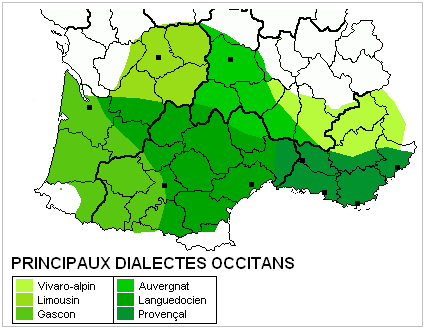
Approximate distribution of Limousin within the Occitan area

Limousin (French name, pronounced [limuzɛ̃] ; Occitan: lemosin, pronounced [lemuˈzi]) is a dialect of the Occitan language, spoken in the three departments of Limousin, parts of Charente and the Dordogne in the southwest of France.

The first Occitan documents are in an early form of this dialect, particularly the Boecis, written around the year 1000.

Limousin is used primarily by people over age 50 in rural communities. All speakers speak French as a first or second language. Due to the French single language policy, it is not recognised by the government and therefore considered endangered by the linguistic community. A revivalist movement around the Félibrige and the Institut d'Estudis Occitans is active in Limousin (as well as in other parts of Occitania).

Differences from Languedocien

[edit]

Most speakers and linguists consider Limousin to be a variety of Occitan. For more detailed information on this question, see the section on Occitan dialects and codification.

As a comparison of Limousin and Languedocien in written form, the following reproduces the first article of the Universal Declaration of Human Rights: "All human beings are born free and equal in dignity and rights. They are endowed with reason and conscience and should act towards one another in a spirit of brotherhood."

Limousin Languedocien
Totas las personas naisson liuras e egalas en dignitat e en drech. Son dotadas de rason e de consciéncia e lor chau agir entre elas emb un esperit de frairesa. Totes los èssers umans naisson liures e egals en dignitat e en dreches. Son dotats de rason e de consciéncia e se devon comportar los unes amb los autres dins un esperit de fraternitat.

See also

[edit]

Notes

[edit]

References

[edit]
[edit]
Revisions and contributorsEdit on WikipediaRead on Wikipedia
from Grokipedia

The Limousin dialect, also known as Lemosin, is a northern variety of the Occitan language, a Romance tongue derived from Latin and historically prominent south of the Loire River in France where "yes" is rendered as òc. Spoken primarily in the departments of Haute-Vienne, Corrèze, and Creuse forming the core of the former Limousin region, along with adjacent areas in Charente and Dordogne, it features phonetic shifts such as the transformation of Latin -CA to -CHA (e.g., cantar becomes chantar) and -GA to -JA (e.g., galina becomes jalina), alongside tendencies like silent final consonants, retention of /v/ pronunciation, final -L shifting to -u, and aphaeresis in common words. With an estimated 10,000 speakers concentrated among older individuals in rural communities, all bilingual in French, the dialect has declined sharply since the early 20th century due to centralized French-language policies, though it persists in limited educational contexts like primary instruction in Limoges and Périgueux without official status. Historically, Limousin served as the vernacular of medieval troubadours who composed lyric poetry and songs, contributing to Occitan's rich literary tradition from around 1000 AD, and it functioned as the region's administrative language from the 14th century until supplanted by French standardization efforts. Written in a codified Latin-based orthography established by Abbot Joseph Roux in the 1890s, it exhibits internal variations in vocabulary and pronunciation, reflecting Occitan's broader dialect continuum rather than a monolithic form, with ongoing debates in linguistic activism over standardization and its distinct identity within the Occitan family.

History

Origins in Gallo-Romance

The Limousin dialect, a southern Gallo-Romance variety, traces its origins to the Vulgar Latin spoken by Romanized Gauls in the Limousin region of Aquitania after the Roman conquest completed by 50 BCE. This spoken Latin evolved amid a Gaulish Celtic substrate, which left traces primarily in toponymy, such as place names incorporating elements like *-dūnon (hill-fort, e.g., in regional formations) and *-magos (field or market), and limited basic vocabulary for natural features. Unlike northern Gallo-Romance areas with heavier Germanic superstrate from Frankish settlements, Limousin's development retained more conservative Latin features due to sparser Visigothic and Frankish overlays post-5th century CE. Linguistic differentiation from northern varieties, including proto-Franco-Provençal, emerged during the early medieval period, with key isoglosses stabilizing by the 8th-9th centuries CE, reflecting divergent evolutions in phonology and morphology across the divide. These boundaries, later formalized in linguistic surveys, separated southern reflexes (proto-Occitan) from central ones, influenced by geographic barriers and varying substrate retention. Archaeolinguistic evidence includes inscriptions from the area showing Romance innovations, such as simplified case usage and adverbial forms, by the , alongside the Boecis, an anonymous poetic fragment in early dated to circa 1000 CE, which adapts Boethius's Latin De consolatione philosophiae with emergent Occitan syntax, verb conjugations, and lexicon. This text, preserved in a manuscript, represents one of the earliest attestations of coherent Romance vernacular in the region, bridging administration and vernacular speech.

Medieval development and troubadour influence

The Limousin dialect experienced significant development during the , particularly from the 12th to 13th centuries, as it served as a foundational medium for the emerging tradition in Occitan-speaking regions. This period marked the dialect's role in the composition of some of the earliest known troubadour lyrics, with Limousin bards leveraging local vernacular forms to innovate poetic genres centered on and feudal patronage. The region's feudal courts provided essential support, enabling poets to perform and refine their works in a dialect that retained northern Occitan characteristics, such as pluri-vocalic systems distinguishing it from southern varieties. Prominent Limousin troubadours, such as Peire Rogier (fl. 1160–1180), exemplified this integration by composing lyrics that incorporated local phonetic and lexical traits while contributing to the broader standardization of Occitan poetic norms. Rogier's works, influenced by contemporaries like , helped shape the trobar style, blending Limousin variants into what became a supra-dialectal literary koine used across courts from to . This koine emerged not as a neutral average but through performative adaptation, where Limousin's northern features— including preserved diphthongs and plurals—persisted amid pressures for intelligibility among diverse audiences. Patronage from local nobility, notably the Viscounts of Limoges, played a causal role in sustaining this literary flourishing, as their courts hosted troubadours like Giraut de Bornelh (c. 1138–1220), who refined genres such as the sirventes under such auspices. This support contrasted with the later centralizing forces from northern France, allowing Limousin to influence the koine's formation while preserving dialectal distinctiveness that later distinguished it from Languedocien norms. The era's output, preserved in 13th-century chansonniers, underscores how feudal incentives drove linguistic innovation without fully erasing regional phonological markers.

Decline from the early modern period

The Ordinance of Villers-Cotterêts, promulgated by King Francis I in 1539, mandated the exclusive use of French in all legal and administrative documents across the realm, thereby curtailing the official employment of Occitan dialects including Limousin in public spheres. This policy marked an initial erosion of Limousin's administrative vitality, as regional varieties previously employed in notarial acts and local governance were supplanted, fostering a gradual shift toward French among elites and urban centers by the late . During the , Abbé Henri Grégoire's 1794 report to the documented the prevalence of in rural departments encompassing , such as and , where French comprehension was limited among peasants, with estimates indicating that up to one-third of the population in southern regions spoke little to no . Grégoire advocated for the "annihilation" of dialects to unify the nation, influencing decrees that prioritized French in education and administration, though widespread rural adherence to persisted into the early 1800s amid incomplete enforcement. In the 19th century, the of 1881–1882 established compulsory, secular while enforcing French-only instruction, prohibiting regional languages like and imposing punishments—such as symbolic "tokens of shame"—on students caught speaking , which disrupted intergenerational transmission in Limousin-speaking households. Ethnographic accounts from the period record a marked contraction in fluent speakers, with rural communities experiencing a 50–70% reduction in dialect proficiency among generations educated post-1880, as families internalized linguistic stigma to avoid reprisals. By the early , administrative records showed French dominating even local correspondence in former strongholds. The acceleration of decline in the stemmed from post-World War II socioeconomic transformations, including rural depopulation and , as Limousin speakers migrated to French-dominant cities like and for industrial employment, diluting dialect use in favor of . National media, broadcast exclusively in French via radio and television from the onward, further marginalized Limousin, with sociolinguistic surveys in Occitan regions indicating fluency rates below 10% among those born after 1940 by the , reflecting a near-total cessation of domestic transmission.

Classification

Position within Occitan

The Limousin dialect forms part of the northern branch of the Occitan , positioned alongside as a transitional variety between more northerly Gallo-Romance influences and the central-southern Occitan core. This hierarchical placement reflects shared phonological and morphological traits distinguishing it from Languedocien to the south, while aligning it within the broader unity of Occitan as a Gallo-Romance language cluster. Linguistic analyses, including those employing quantitative dialectometry, identify Limousin as the structural core of northern Occitan, with gradual bundling rather than sharp boundaries. A key structural diagnostic is the retention of /u/ from Latin tonic *ŏ in closed syllables (e.g., Latin *ŏcʊlʊs > òulh), characteristic of northern Occitan varieties and marking the northern side of the primary Occitan relative to Languedocien /o/ or /ɔ/. supports this continuum model, with high comprehension between and speakers due to lexical and syntactic overlap, tapering moderately toward ; field-based assessments confirm no discrete linguistic ruptures but rather graded variation across the Occitan domain. Early 20th-century scholarship, such as Joseph Anglade's grammatical studies, integrated into Occitan's unified framework by tracing its medieval attestations to the langue d'òc literary tradition, rejecting fragmentations into independent languages. Similarly, Pierre Bec's classification grouped with in a northern supradialect, emphasizing Occitan's internal coherence against regionalist efforts to elevate dialects as separate entities, a view sustained by subsequent dialectological mapping.

Distinctions from Languedocien and other varieties

Limousin constitutes a northern Occitan variety, classified separately from Languedocien—a southern-central —in Jules Ronjat's hierarchical taxonomy of Occitan dialects developed between 1930 and 1941, which groups with in dialect group D while assigning Languedocien to group B (Languedocien-Guyennais). This distinction counters views of as a mere subdialect of Languedocien, as Ronjat's framework, based on phonological, morphological, and lexical data from field surveys, identifies bundling es separating northern traits (e.g., preservation of velar stops in certain contexts versus southern palatalization) from southern innovations. 1, for instance, demarcates northern Occitan dialects including (Lemosin) from southern ones like Languedocien, highlighting geographic and evolutionary divergence rooted in Gallo-Romance substrates north of the transitional "" zone. Phonologically, Limousin diverges from Languedocien in consonant palatalization before /a/, where northern varieties convert Latin -CA to -CHA (e.g., /k/ > /tʃ/, as in capra yielding forms like *chabra) and -GA to -JA, reflecting proximity to langue d'oïl influences absent in southern retention of /k/ and /g/. Vowel evolutions also differ, with Limousin exhibiting closed or diphthongized qualities from Latin tonic ĕ (often /œ/ or rising diphthongs) versus Languedocien's more open /ɛ/, as seen in comparative treatments of etyma like Latin *homo ('man'), pronounced approximately /ˈɔmœ/ in Limousin versus /uˈmɛ/ in Languedocien variants. Lexically, core vocabulary shows regional gaps, with northern terms like fenèstra ('') bearing phonetic markers (e.g., influenced by northern shifts) contrasting southern Languedocien forms, contributing to overall dialectal divergence estimated at 15-20% in basic Swadesh-list items based on comparative . These empirical markers, mapped via Ronjat's 1930s analyses, affirm Limousin's independent status within Occitan, resisting unification under Languedocien dominance.

Internal subdialects and variation

The Limousin dialect encompasses subdialectal variations shaped by geographic and topographic factors, with a primary divide between Haut-Limousin and Bas-Limousin. Haut-Limousin, prevalent in the higher-elevation zones of (around ) and (around Guéret), retains more archaic phonological and lexical traits due to the isolating effects of montane valleys and limited external contact. In contrast, Bas-Limousin, spoken in the lower valleys of and adjacent Périgord areas, exhibits greater convergence with northern French varieties, including reduced retention of distinct Occitan consonants like /ʃ/ (e.g., in words such as chamin for 'path') in more accessible rural and semi-urban settings. Linguistic atlases from the , including the Atlas linguistique et ethnographique de l'Auvergne et du Limousin () compiled by Jean-Claude Potte between 1975 and 1992, map these micro-variations through extensive field inquiries across hundreds of sites, revealing east-west gradients in features such as quality and metaphonic harmony (e.g., raising of mid s before high s in conservative highland forms). Such gradients reflect topographic causation, where alpine-like valley fragmentation in the preserved pre-modern isoglosses, as opposed to diffusion along lowland trade routes in that facilitated French lexical borrowing. Social factors, including rural isolation versus proximity to administrative centers like , further modulate these patterns, with urban-adjacent speech showing leveled forms in surveys from the era. Paul-Louis Grenier's grammatical analyses, drawing on local attestations, delineate these subdialects by morphological markers (e.g., variable plural endings) and lexical preferences, underscoring that while intercomprehensibility remains high, diverges most sharply—highland forms favoring closed vowels and affricates, lowland ones opening toward French trends. Overall, internal diversity stems from diachronic unevenness in French-Occitan contact, with highland conservatism evidenced by lower rates of gallicisms in lexical maps compared to peripheries.

Linguistic characteristics

Phonological features

The Limousin dialect exhibits a system characteristic of northern Occitan varieties, featuring palatal such as /ʎ/ (from digraph ⟨lh⟩, pronounced akin to the "lh" in French conseil or escalier) and /ɲ/ (from ⟨nh⟩, akin to French gn in montagne). Palatalization processes are prominent, deriving /ʎ/ from Latin clusters like *CL (e.g., filium > filh /fiʎ/) and affecting intervocalic laterals. Unlike , final consonants are generally muted except for nasals /m/ and /ɲ/, contributing to a lighter coda structure; /v/ is distinctly realized as a labiodental in Limousin, contrasting with bilabial /b/ in southern dialects like Gascon. The /r/ is typically alveolar and trilled between vowels or doubled, but often silent word-finally or in verb infinitives. The vowel inventory comprises approximately seven to eight oral monophthongs in stressed positions (/i, y, e, ɛ, a, ɔ, o, u/), with northern retention of the close front rounded /y/ (e.g., luna /ˈly.nə/ 'moon', paralleling French lune but distinct from southern Occitan /ˈlu.nə/). Unstressed vowels reduce to a smaller set, often /ə/ or schwa-like finals; Limousin preserves true nasal vowels (e.g., /ɛ̃, ɔ̃/) primarily in open syllables, analyzable alternatively as vowel + homorganic nasal. Diphthongs arise from vowel + /s/ in syllable codas (e.g., Latin as > às [aːs] or lengthened [aː]), and preconsonantal /i/ or /u/ may semivocalize. /a/ tends closed (higher formant values than French open /a/), while /o/ variants distinguish open /ɔ/ (like French porte) from close /o/. Prosodically, aligns with Occitan's syllable-timed rhythm but features distinct intonational contours, including rising prenuclear accents (progressive F0 rise to H* peak in accented vowels) for broad focus statements and continuation rises. Acoustic studies of northern Occitan varieties document these patterns, with falling boundaries for declaratives and vocative rises unique to Gallo-Romance dialects; stress is predominantly penultimate or final, influencing quality without fixed timing contrasts seen in .

Grammatical and morphological traits

Limousin nouns distinguish two grammatical genders, masculine and feminine, with agreement required in adjectives and determiners. Plural marking in northern Occitan varieties like Limousin often relies on prosodic features such as vowel length or stress shift rather than consistent segmental suffixes, differing from the more uniform -s plurals in southern Romance dialects; for instance, paroxytonic masculines may show uninflected singulars contrasting with plural forms via lengthened vowels. Verb morphology in Limousin exhibits polymorphism, with multiple coexisting paradigms for tenses like the present indicative, reflecting dialectal variation and historical layering from Latin. The frequently employs analytic constructions, such as the auxiliary voler (to want) followed by an , as in vòli far ('I will do'), diverging from the synthetic futures dominant in Italo-Romance but aligning with periphrastic tendencies in other Gallo-Romance varieties. forms are constructed analytically using aver (to have) plus the past participle, e.g., avia facho ('I had done'), a pattern simplified from Latin's synthetic and shared across Occitan dialects. Syntactic patterns follow standard Romance SVO in declarative clauses, with pro-drop allowing null subjects in finite verbs. Yes/no interrogatives typically retain declarative on the surface, relying on intonation for distinction rather than obligatory inversion, though subject-verb inversion occurs in formal or emphatic contexts; wh-questions front the element, as in Ont es lo libre? ('Where is the book?'). Post-1800s contact with French has introduced calques and increased analytic structures, simplifying inflectional complexity relative to medieval Occitan while preserving core Romance traits like clitic placement before verbs.

Lexical influences and vocabulary

The vocabulary of the Limousin dialect, as part of the group, consists predominantly of words inherited directly from , reflecting an endogenous evolution typical of Gallo-Romance varieties. Pre-Roman substrate influences, primarily from (Celtic), are limited, with approximately 330 possible loanwords identified across Occitan dialects, representing less than 5% of the total lexicon. Germanic superstrate elements from Frankish incursions are similarly sparse, contributing a small fraction of terms such as those related to feudal tenure. Arabic borrowings remain minimal, far fewer than in . Post-medieval lexical expansion in primarily stems from borrowings and calques from , accelerating after the amid centralizing policies and cultural standardization, with notable intensification in the 18th and 19th centuries. These influences often appear in administrative, technological, and urban domains, such as adaptations of French terms for modern . Impacts from neighboring varieties like Catalan or Gascon are negligible in Limousin, due to its central position within Occitan and limited cross-dialectal exchange. Etymological analyses, building on resources like Emil Levy's dictionaries of and , underscore the rural conservatism of Limousin vocabulary, where archaic Latin-derived terms persist in agricultural and everyday contexts, resisting fuller French assimilation. Dictionaries such as the ongoing DOM-en-ligne catalog over 33,000 medieval entries, illustrating this stability with minimal innovation beyond inherited stock. Overall, the dialect's totals an estimated 75,000–80,000 base lexemes, with expanding effective usage to around 200,000 forms.

Geographic and social distribution

Traditional speaking areas

The Limousin dialect, a northern variety of Occitan, was traditionally spoken throughout the historical province of Limousin in central-southern France, corresponding primarily to the modern departments of Haute-Vienne, Corrèze, and Creuse. Its core territory spanned the fertile Limoges basin in Haute-Vienne, where urban and rural communities used it as the primary vernacular, extending northward across the elevated Millevaches plateau straddling Corrèze and Creuse, up to altitudes exceeding 1,000 meters where isolated highland speech preserved archaic features. Isogloss boundaries, as delineated in 19th-century linguistic surveys and early 20th-century atlases like the Atlas Linguistique de la France (reflecting pre-industrial distributions), separated from adjacent Occitan dialects such as to the south—marked by differences in vowel systems and consonant shifts—and Languedocien to the southeast. These maps highlighted transitional zones within itself, with subdialectal variations intensifying toward the east in the region. Extensions occurred into peripheral areas bordering non-Occitan languages, notably northern and parts of , where proximity to (a langue d'oïl variety) fostered hybridity; local speech incorporated oïl lexical borrowings and prosodic traits alongside Limousin morphology, as documented in 18th- and 19th-century registers from border parishes and anthologies collecting oral traditions. Historical attestations from these sources, including baptismal and entries in script, confirm widespread use in rural administrative and communal contexts until the late 1800s.

Current speaker demographics

The Limousin dialect, a variety of northern Occitan, is spoken fluently by an estimated 10,000 individuals, predominantly in the former Limousin departments of , , and , as well as adjacent areas in and . Sociolinguistic surveys indicate that fluent speakers represent about 10% of surveyed respondents in the region, though absolute numbers remain low due to intergenerational decline. The speaker base skews heavily toward the elderly, with an average age of 66 years and significantly higher competence among those aged 75 and older (39% report easy understanding, correlating with fluency retention). Demographic profiles reveal a predominance of male speakers (62%) and rural residents (66%), concentrated in small villages such as Felletin in where residual daily use persists among older locals. Retention is higher among less-educated rural males, reflecting patterns observed in broader Occitan sociolinguistic studies of lower socioeconomic sectors. communities are negligible, with virtually no significant transmission outside traditional heartlands. Among younger cohorts (15-29 years), fluency drops to 0.3% in the Limoges academy area encompassing .

Usage and vitality

Historical roles in daily life and administration

The Limousin dialect, a variety of Occitan, functioned as the predominant in rural daily life across the region, encompassing activities such as , markets, and household interactions, persisting into the early before widespread French dominance in formal . Dictionaries compiling Limousin patois from the early , such as those documenting local culinary and agricultural terms like "truffas" for potatoes in the area, illustrate its utility in describing everyday practices tied to the regional economy of livestock rearing and crop cultivation. Proverbs, folk songs, and oral traditions in Limousin reinforced community cohesion and knowledge transmission in these contexts, with evidence from regional linguistic surveys showing their integration into agrarian routines until and schooling eroded vernacular primacy around 1900. In administrative spheres, the dialect saw employment in local courts, notarial records, and municipal proceedings prior to the 1539 , which decreed French as the sole for legal documents, thereby curtailing Occitan variants like Limousin in southern French administrations. Notaries and local officials in Occitan territories, including , routinely used the vernacular for contracts and judicial acts, reflecting its role in accessible governance before centralizing reforms. Archival remnants from proximate Occitan areas, such as , reveal bilingual notarial practices blending Limousin-influenced Occitan with emerging French until the early , underscoring a transitional phase rather than abrupt supplantation.

Modern domains: education, media, and public life

In education, the Limousin variety of Occitan is available as an optional subject or bilingual program in select public schools within the Nouvelle-Aquitaine region, following the 1951 Deixonne Law and subsequent expansions allowing regional languages since the 2000s, though enrollment remains marginal. As of 2024, only 140 students across primary and secondary levels in the former Limousin departments pursue Occitan instruction, far below neighboring areas like Dordogne with over 1,000 learners. Specific instances include 47 students at Collège de Seilhac in Corrèze (28 in troisième and 19 in quatrième as of 2020), highlighting localized but insufficient uptake amid broader declines in teacher training and resources. Media coverage of Limousin Occitan is limited to associative and community outlets, with sporadic programming rather than sustained daily broadcasting. Local stations like Beaub'FM produce podcasts in the Limousin dialect, covering history and linguistics since at least 2022, while broader Occitan radios such as Radio Occitania offer slots accessible in the region but prioritize other varieties. Digital formats, including online streams and occasional France Bleu contributions, exist but lack comprehensive production, confining exposure to niche audiences without mainstream television or print integration. Public life features minimal institutional use of Limousin Occitan, constrained by France's constitutional emphasis on French as the sole language of and centralist policies resisting regional variants on signage. Bilingual French-Occitan street signs appear sporadically in adopting communes, such as Masseret (the 20th in ) and since the 2010s, often via local initiatives from groups like the Institut d'Études Occitanes du Limousin providing design guidelines. However, such implementations remain exceptional, with national regulations requiring French primacy and limiting visibility in policy documents or urban infrastructure beyond voluntary local efforts.

Revitalization initiatives and challenges

The Institut d'Estudis Occitans de Limousin, founded in 1945 as a regional branch of the broader Institut d'Estudis Occitans, has pursued language maintenance through adult evening classes, training workshops, and cultural events in partnership with local communes and organizations. These efforts align with the national IEO's post-World War II focus on developing Occitan corpora, including standardized grammar and lexical resources to support teaching and publishing in varieties like Limousin. In the 2020s, digital extensions have emerged within Occitan networks, such as the 2014-launched Fuèlha de rota project for numeric Occitan resources, though Limousin-specific apps and online courses remain sparse and primarily integrated into general Occitan platforms. Revitalization faces structural obstacles, including the language's low social prestige and lack of economic utility in a French-dominant context, where speakers prioritize assimilation for pragmatic gains over ideological preservation. A linguistic attributes Occitan-wide failures, applicable to , to a core mismatch: revivalists promote an abstract, standardized "Occitan" detached from traditional speakers' view of as embedded in local, non-linguistic practices, leading to resistance against formal transmission. This clash exacerbates intergenerational gaps, with parents favoring French for children's opportunities. Empirical outcomes show minimal growth despite targeted funding; as of 2021, Occitan speakers numbered over 500,000 but experienced a documented decline amid cultural initiatives, with 2025 assessments confirming generalized stagnation and minoritization across dialects including . grants have supported projects like and media, yet transmission rates remain low, with no reversal of the post-19th-century -era suppression effects. Regional surveys indicate persistent challenges in linking school-based efforts to everyday use, underscoring the limits of top-down interventions without broader societal incentives.

Cultural and literary legacy

Key literary works and authors

The earliest surviving literary work in the Limousin dialect is the Boecis, a 258-line verse adaptation of Boethius's Consolation of Philosophy, composed between 1000 and 1030 entirely in Limousin Occitan. This text exemplifies early regional phonological traits, such as the use of u for Latin u and distinct vowel reductions absent in variants. The 12th century marked the dialect's prominence in troubadour poetry, with Limousin serving as a cradle for the genre's development. Bernat de Ventadorn (c. 1130–c. 1200), born near Ventadorn castle, produced over 40 surviving cansos featuring Limousin-specific features like the monophthongization of diphthongs and retention of intervocalic d and t. Other key figures include (c. 1160–c. 1200), renowned for trobar clus complexity in sestinas and sirventes with local lexicon; Giraut de Bornelh (c. 1138–c. 1215), who blended trobar leu accessibility with Limousin metrics; and Gaucelm Faidit (c. 1156–c. 1209), whose planh for Richard the Lionheart incorporates dialectal assonances. These works, totaling dozens from the region, prioritized authentic regional over later standardized forms. In the , Marcelle Delpastre (1925–1998) emerged as a leading voice, authoring over 50 volumes of poetry and novels in Limousin Occitan that resisted post-Félibrige standardization by retaining vernacular spellings and rural idioms. Collections like her Subraruja (1978) and anthologies of Limousin texts edited by regional scholars underscore the dialect's fidelity to medieval sources, contrasting with unified Occitan orthographies promoted elsewhere.

Role in folklore, music, and traditions

The Limousin dialect, a northern Occitan variety, permeates regional through oral traditions such as proverbs and tales, often encapsulating the practical wisdom of agrarian existence in central France's rural highlands. Proverbs like "Plòu, plòu ramalhaud, las vacas van a / Plòu, plòu ramalhaud, lo jornalier a fest" (", little branch, the cows go to / , little branch, the day laborer has a holiday") reflect weather-dependent farming rhythms, where signals shifts in management and labor. These expressions, rooted in pre-industrial rural causality—linking meteorological patterns directly to economic survival—persist in spoken narratives, underscoring the dialect's role in transmitting environmental and occupational knowledge across generations. Tales, or contes limosins, further embed the dialect in performative , recounting local legends of shepherds, harvests, and encounters tied to the landscape's isolation and . Songs like Lo boièr ("The Cattle Driver"), which describe a plowman returning from fields to stable oxen amid familial routines, exemplify how dialectal lyrics preserve agrarian rituals and social structures, evoking the labor-intensive cycles of and central to identity. Such oral forms, performed at communal gatherings, reinforced community bonds by codifying survival strategies in a dialect resilient to pressures. In music, the Limousin dialect animates traditional dances like the , a rapid ternary-meter form originating in the Auvergne-Limousin massif, where lyrics in local Occitan variants accompany , bagpipe (cabas), and ensembles. Collections of chants corréziens from , a Limousin department, document sung bourrées in the dialect, as notated by folklorists like Jean Mouzat, highlighting performative vitality in village feasts. Contemporary ensembles, such as Limoges-based Brama, integrate dialect lyrics into fusions, sustaining traditions amid urban revival efforts since the late . Preservation initiatives draw on early 20th-century folkloristic recordings and anthologies, including those compiling variants alongside forms, to archive dialectal songs against assimilation. These efforts, spanning notations from the onward, counter by digitizing oral repertoires for festivals like 's Nuits de Nacre—established in 1984—which feature accordion-driven Occitan music rooted in regional dialects. Through such traditions, the dialect maintains causal links to cultural continuity, embedding and music as bulwarks against monolingual dominance.

Debates and controversies

Classification disputes: dialect vs. independent language

The classification of as an independent language separate from Occitan, rather than a subdialect thereof, hinges on linguistic criteria including , structural divergence, and historical , though mainstream philological consensus favors the latter view. Proponents of argue that Limousin's historical self-designation as lemosin—evident in medieval texts and local traditions—reflects a distinct ethnolinguistic identity predating modern Occitan unification efforts. They further cite phonological and lexical divergences, such as Limousin's retention of intervocalic /l/ (e.g., òl 'oil' vs. southern Occitan òu) and estimated 10-15% lexical variance from Languedocian varieties, which some interpret as exceeding dialect thresholds per Romance standards where drops below 80-85%. Opposing arguments emphasize Occitan's nature, wherein Limousin exhibits gradual transitions (e.g., shared innovations like post-tonic ) with adjacent varieties like , precluding sharp boundaries for independence. Mutual intelligibility tests, though sparse for Limousin specifically, indicate 60-80% comprehension across northern-southern Occitan pairs in oral contexts, aligning with subdialect status rather than full divergence; for comparison, intra-Limousin north-south variants score around 60% orally, underscoring internal continuum dynamics. Pre-20th-century absence of a codified standard—unlike literary Occitan's medieval koine based on southern norms—further undermines separate status claims, as dialects lacking exogenous standardization typically remain embedded in macrolanguages. Recent analyses, including 2010s dialectometric studies, cluster Limousin subdialects firmly within Occitan networks via methods like Ward's , rejecting autonomy absent political reclassification. Journals such as Revue de Linguistique Romane reinforce this by treating Limousin as a core northern Occitan branch with internal subdialects (e.g., High vs. Low Limousin), prioritizing empirical metrics over regionalist assertions.

Standardization efforts and opposition

Standardization initiatives for the Limousin dialect emerged in the context of broader revival efforts following the 1970s, when organizations like the Fédération pour l'enseignement des langues régionales en Occitanie (FELCO) promoted a unified , or graphia, intended for educational use across Occitan varieties, including Limousin as a northern . This FELCO graphia, emphasizing phonetic consistency and dialectal flexibility, aimed to enable standardized teaching materials and literary production, with pilot implementations in regional schools by the . In the , some advocates tested Limousin-adapted orthographic variants to address local phonological traits, such as distinctive vowel shifts, but these remained experimental and limited to academic or associative circles without broader institutional endorsement. Opposition to these efforts has been pronounced among native speakers and local ethnographers, who often reject the imposed "Occitan" framework as artificial and disconnected from everyday patois limousin usage, arguing it dilutes regional identity in favor of a pan-Occitan construct lacking historical or communal resonance. Studies document resistance rooted in perceptions of top-down standardization as culturally alienating, with speakers favoring informal, variable spellings tied to oral traditions over normalized systems that prioritize unity over authenticity. This pushback reflects broader quarrels over language identification, where equating Limousin with standardized Occitan is seen as methodologically flawed, ignoring substrate influences and local lexical divergences. Consequently, no unified has achieved widespread adoption in communities, with usage confined to niche educational or revivalist contexts amid persistent fragmentation. The absence of robust state support—unlike the institutionalized backing for Basque in , which includes co-official status and dedicated funding—has critically undermined viability, as French centralist policies prioritize national linguistic unity over regional normalization. Local persistence in non-standardized forms underscores how grassroots attachment to variant practices prevails without coercive or incentivized implementation.

References

  1. https://commons.wikimedia.org/wiki/File:Occitan_limousin_selon_Paul-Louis_Grenier.png
Add your contribution
Related Hubs
User Avatar
No comments yet.