Hubbry Logo
TheosophyTheosophyMain
Open search
Theosophy
Community hub
Theosophy
logo
8 pages, 0 posts
0 subscribers
Be the first to start a discussion here.
Contribute something
Theosophy
Theosophy
from Wikipedia
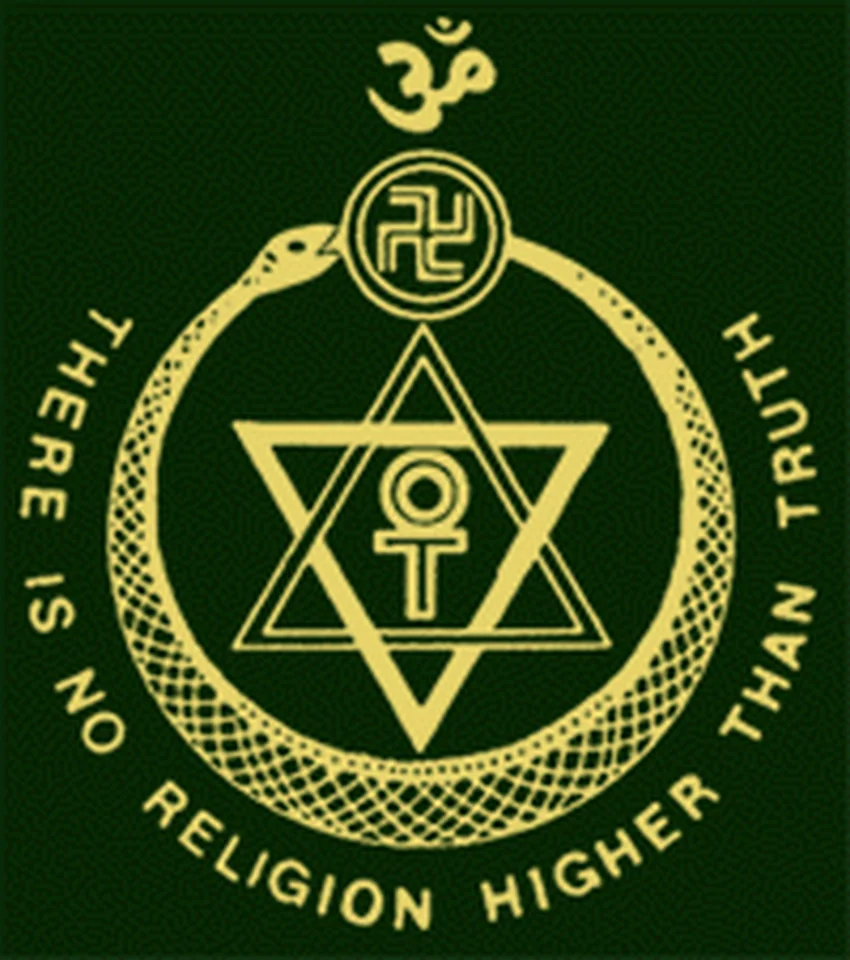
The logo for the Theosophical Society brought together various ancient symbols.

Theosophy is a religious movement established in the United States in the late 19th century. Founded primarily by the Russian Helena Blavatsky and based largely on her writings, it draws heavily from both older European philosophies such as Neoplatonism and Indian religions such as Hinduism and Buddhism. Although many adherents maintain that Theosophy is not a religion, it is variably categorized by religious scholars as both a new religious movement and a form of occultism from within Western esotericism.

As presented by Blavatsky, Theosophy teaches that there is an ancient and secretive brotherhood of spiritual adepts known as the Masters, who are found around the world but primarily centered in Tibet. These Masters were alleged by Blavatsky to have cultivated great wisdom and supernatural powers, and Theosophists believe they initiated the modern Theosophical movement through disseminating their teachings via Blavatsky. Theosophists believe that these Masters are attempting to revive knowledge of an ancient religion once found around the world that will again come to eclipse existing world religions. Theosophy holds a monist position that there exists a single divine Absolute and articulates an emanationist cosmology in which the universe is perceived as outward reflections from this Absolute. The purpose of human life is spiritual emancipation and the human soul undergoes reincarnation upon bodily death according to a process of karma. Universal brotherhood and social improvement are guiding principles, although there is no particular ethical framework.

Theosophy was established in New York City in 1875 with the founding of the Theosophical Society by Blavatsky and Americans Henry Olcott and William Quan Judge. In the early 1880s, Blavatsky and Olcott relocated to India, where they established the Society's headquarters at Adyar, Tamil Nadu. Blavatsky described her ideas in two books, Isis Unveiled and The Secret Doctrine, which became key texts within Theosophy. Following her death in 1891, there was a schism in the Society, with Judge leading the Theosophical Society in America (TSA) to split from the international organization. Under Judge's successor Katherine Tingley, a Theosophical community named Lomaland was established in San Diego, California. At its height in 1895, there were 102 American branches with nearly 6,000 members. The Adyar-based Society was later taken over by Annie Besant, under whom it grew to its largest extent during the late 1920s, before going into decline after the Great Depression. TSA has since been reincorporated as a national section of the global Theosophical Society, which has a global membership of roughly 26,606 across 70 countries, including over 3,550 in the United States.

Theosophy played a significant role in bringing knowledge of Eastern religions to the West and encouraging cultural pride in South Asia. Many prominent artists and writers have also been influenced by Theosophical teachings. Theosophy has an international following, and during the 20th century had tens of thousands of adherents. Theosophical ideas have also inspired over 100 esoteric movements and philosophies, among them Anthroposophy, the Church Universal and Triumphant, and the New Age.

Definition

[edit]

Helena Blavatsky, the founder of Theosophy, insisted that it was not a religion,[1] although she did refer to it as the modern transmission of the "once-universal religion" that she said had existed deep into the human past.[2] Theosophical organizations have maintained the belief that Theosophy should not be labeled a religion;[3] instead, they regard it as a system that embraces what they see as the "essential truth" underlying religion, philosophy, and science.[4] As a result, Theosophical groups allow their members to hold other religious allegiances,[5] resulting in Theosophists who also identify as Christians, Buddhists, or Hindus.[6]

Scholars of religion who have studied Theosophy have characterized it as a religion.[7] In his history of the Theosophical movement, Bruce F. Campbell noted that Theosophy promoted "a religious world-view" using "explicitly religious terms" and that its central tenets are not unequivocal fact, but rather rely on belief.[8] Olav Hammer and Mikael Rothstein termed it "one of the modern world's most important religious traditions".[9] Various scholars have pointed to its eclectic nature; Joscelyn Godwin described it as a "universally eclectic religious movement",[10] while scholar J. Jeffrey Franklin characterized Theosophy as a "hybrid religion" for its syncretic combination of elements from various other sources.[11] More specifically, Theosophy has been categorized as a new religious movement.[12] According to Maria Carlson, Theosophy is a "positivistic religion" "offering a seemingly logical theology based on pseudoscience."[13]

Scholars have also classified Theosophy as a form of Western esotericism.[14] Campbell for instance referred to it as "an esoteric religious tradition",[15] while the historian Joy Dixon called it an "esoteric religion".[16] More specifically, it is considered a form of occultism.[17] Along with other groups such as the Hermetic Order of the Golden Dawn, the Theosophical Society has been seen as part of an "occult revival" that took place in Western countries during the late 19th century.[18] The historian of religion Wouter Hanegraaff noted that Theosophy helped to establish the "essential foundations for much of twentieth-century esotericism".[19] Although Theosophy draws upon Indian religious beliefs, the sociologist of religion Christopher Partridge observed that "Theosophy is fundamentally Western. That is to say, Theosophy is not Eastern thought in the West, but Western thought with an Eastern flavour."[20]

Etymology

[edit]
Blavatsky and Olcott, two of the founding members of the Theosophical Society

At a meeting of the Miracle Club in New York City on 7 September 1875, Blavatsky, Olcott, and Judge agreed to establish an organisation, with Charles Sotheran suggesting that they call it the Theosophical Society.[21] Prior to adopting the name "Theosophical", they had debated various potential names, among them the Egyptological Society, the Hermetic Society, and the Rosicrucian Society.[22]

The term was not new; originally it appeared in the works of early Church Fathers, as a synonym for theology.[23] It derives from Ancient Greek: θεός, romanizedtheós, lit.'god' and Ancient Greek: σοφῐ́ᾱ, romanizedsophíā, lit.'wisdom'; thus meaning "god-wisdom", "divine wisdom", or "wisdom of God".[24] Its esoteric meaning emerged during the Renaissance period, possibly originating in the 1575 Arbatel De Magia Veterum, a Latin grimoire and the first work to draw a dualism between what it calls "anthroposophia" (human knowledge) and "theosophia" (divine knowledge).[25] It had consequently been used in various esoterics contexts for example by the Philaletheians and by the Christian mystic Jakob Böhme.[26] In her book The Key to Theosophy, Blavatsky claims that the term Theosophy had been coined by "the Alexandrian philosophers", especially Ammonius Saccas.[27]

Blavatsky's Theosophy is not the only movement to use the term "theosophy" and this has resulted in scholarly attempts to differentiate the different currents. Godwin drew a division by referring to Blavatskian Theosophy with a capital letter and older, Boehmian theosophy with a lower-case letter.[28] Alternately, the scholar of esotericism Wouter J. Hanegraaff distinguished the Blavatskian movement from its older namesake by terming it "modern Theosophy".[29] Followers of Blavatsky's movement are known as Theosophists, while adherents of the older tradition are termed theosophers.[28] Causing some confusion, a few Theosophists—such as C. C. Massey—were also theosophers.[28] In the early years of Blavatsky's movement, some critics referred to it as "Neo-Theosophy" to differentiate it from the older Christian theosophy movement.[30] The term "Neo-Theosophy" would later be adopted within the modern Theosophical movement itself, where it was used—largely pejoratively—to describe the teachings promoted by Annie Besant and Charles Webster Leadbeater by those who opposed their innovations.[30]

According to the scholar of religion James A. Santucci, discerning what the term "Theosophy" meant to the early Theosophists is "not as obvious as one might think".[31] As used by Olcott, the term "Theosophy" appeared to be applied to an approach that emphasized experimentation as a means of learning about the "Unseen Universe"; conversely, Blavatsky used the term in reference to gnosis regarding said information.[32]

Beliefs and teachings

[edit]

Although the writings of prominent Theosophists lay out a set of teachings, the Theosophical Society itself states that it has no official beliefs with which all members must agree. It, therefore, has doctrine but does not present it as dogma.[33] The Society stated that the only tenet to which all members should subscribe was a commitment "to form a nucleus of the Universal Brotherhood of Humanity without distinction of race, creed, sex, caste or color".[34] This means that there are members of the Theosophical Society who are skeptical about many, or even all, of the Theosophical doctrines while remaining sympathetic to its basic aim of universal brotherhood.[6]

As noted by Santucci, Theosophy is "derived primarily from the writings" of Blavatsky,[35] but revisions and innovations have also been produced by subsequent Theosophists such as Annie Besant and Charles Webster Leadbeater.[36] Blavatsky said that these Theosophical doctrines were not her own invention but had been received from a brotherhood of secretive spiritual adepts whom she referred to as the "Masters" or "Mahatmas".[37]

The Masters

[edit]
Hermann Schmiechen's 1884 depiction of the two Masters with whom Blavatsky was said to be in contact, Koot Hoomi (left) and Morya (right)

Central to Theosophical belief is the idea that a group of spiritual adepts known as the Masters not only presently exist but were responsible for producing early Theosophical texts.[38] For most Theosophists, these Masters are deemed the real founders of the modern Theosophical movement.[39] In Theosophical literature, these Masters are also referred to as the Mahatmas, Adepts, Masters of Wisdom, Masters of Compassion, and Elder Brothers.[39] They are perceived to be a fraternity of human men who are highly evolved in terms of having both moral development and intellectual attainment.[39] They are said to have achieved extra-long life spans,[39] and to have gained supernatural powers, including clairvoyance and the ability to instantly project their soul out of their body to any other location.[40] These are powers they have allegedly attained through many years of training.[40] According to Blavatsky, by the late 19th century, their chief residence was in the Himalayan kingdom of Tibet.[39] She also said that these Masters were the source of many of her published writings.[39]

The Masters are believed to preserve the world's ancient spiritual knowledge,[40] and to represent a Great White Brotherhood or White Lodge, which watches over humanity and guides its evolution.[40] Among those whom the early Theosophists believed as Masters were Biblical figures such as Abraham, Moses, Solomon, and, in the Christian Bible, Jesus, as well as Asian religious figures such as Gautama Buddha, Confucius, and Laozi, and modern individuals such as Jakob Bohme, Alessandro Cagliostro, and Franz Mesmer.[40] However, the most prominent Masters to appear in Theosophical literature are Koot Hoomi (sometimes spelled Kuthumi) and Morya, with whom Blavatsky declared to be in contact.[41] According to Theosophical belief, the Masters approach those deemed worthy to embark on an apprenticeship or chelaship.[42] The apprentice would then undergo several years of probation, during which they would live a life of physical purity, remaining chaste, abstinent, and indifferent to physical luxury.[42] Blavatsky encouraged the production of images of the Masters.[43] The most important portraits of the Masters to be produced were created in 1884 by Hermann Schmiechen.[44] According to scholar of religion Massimo Introvigne, Schmiechen's images of Morya and Koot Humi gained "semi-canonical status" in the Theosophical community,[45] being regarded as sacred objects rather than simply decorative images.[46]

Campbell noted that for non-Theosophists, the hypotheses regarding the existence of the Masters are among the weakest made by the movement.[38] Such statements can be examined and potentially refuted, challenging the existence of the Masters and thereby undermining Theosophical beliefs.[47] The idea of a brotherhood of secret adepts had a long pedigree stretching back several centuries before the foundation of Theosophy; such ideas can be found in the work of the Rosicrucians, and was popularized in the fictional literature of Edward Bulwer-Lytton.[48] The idea of having messages conveyed to a medium through spiritually advanced entities had also been popularized at the time of Theosophy's foundation through the Spiritualist movement.[48]

The ancient wisdom religion

[edit]

According to Blavatsky's teachings, many of the world's religions have their origins in a universal ancient religion, a "secret doctrine" that was known to Plato and early Hindu sages and which continues to underpin every religion.[49] She argued that ancient societies demonstrated a unity of science and religion that humanity has since lost, with their achievements and knowledge far exceeding what modern scholars believe about them.[50] Blavatsky also taught that a secret brotherhood had conserved this ancient wisdom religion throughout the centuries and that members of this fraternity hold the key to understanding miracles, the afterlife, and psychic phenomena and that moreover, these adepts themselves have paranormal powers.[51]

She stated that this ancient religion would be revived and spread throughout humanity in the future, replacing dominant world religions such as Christianity, Islam, Buddhism, and Hinduism.[49] Theosophy emphasized the importance of ancient texts over the popular rituals and customs within various religious traditions.[6] The Theosophical depiction of Buddhism and Hinduism, however, drew criticism both from practitioners of orthodox Buddhist and Hindu traditions, as well as from Western scholars of these traditions, such as Max Müller, who believed that Theosophists such as Blavatsky were misrepresenting the Asian traditions.[6]

Theology and cosmology

[edit]

Theosophy advocates an emanationist cosmology, asserting that the universe is an outward reflection of the Absolute.[52] Theosophy presents the idea that the world as humans perceive it is illusory, or maya,[53] an idea that it draws from Asian religions.[54] Accordingly, Blavatsky taught that a life limited by the perception of this illusory world was ignorant and deluded.[55]

According to Theosophical teaching, each solar system is an emanation of a "Logos" or "Solar Deity", with planetary spirits each overseeing one of the planets.

According to Blavatsky's teaching, every solar system in the universe is the expression of what is termed a "Logos" or "Solar Deity".[56] Below the solar deity are seven planetary spirits or ministers, with each of these celestial beings controlling the evolution on a specific planet.[56] In The Secret Doctrine, Blavatsky stated that each planet had a sevenfold constitution, known as the "Planetary Chains"; these consist not only of a physical globe but also of two astral bodies, two mental bodies, and two spiritual bodies, all overlapping in the same space.[57] According to Blavatsky, evolution occurs in descending and ascending arcs, from the first spiritual globe to the first mental globe, then from the first astral globe to the first physical globe, and then on from there.[58] She said there were different levels of evolution, from mineral to vegetable, animal, human, and then to superhuman or spiritual.[58] Different levels of evolution occur in successive order on each planet; thus, when mineral evolution ends on the first planet, and it proceeds on to vegetable evolution, then mineral evolution begins on the second planet.[58] Theosophy teaches that human evolution is tied to this planetary and wider cosmic evolution.[59]

In The Secret Doctrine, Blavatsky advocated the idea of seven "Root Races", each of which was divided into seven "Sub-Races".[60] In Blavatsky's cosmogony, the first Root Race was created from pure spirit and lived on a continent known as the "Imperishable Sacred Land".[61] The second Root Race, known as the Hyperboreans, were also formed from pure spirit and lived on a land near to the North Pole, which then had a mild climate.[61] The third lived on the continent of Lemuria, which Blavatsky alleged survives today as Australia and Rapa Nui.[62] Blavatsky alleged that during the fourth Round of the Earth,[definition needed] higher beings descended to the planet, with the beginnings of human physical bodies developing and the sexes separating.[63] At this point, the fourth Root Race appeared, living on the continent of Atlantis; they had physical bodies but also psychic powers and advanced technology.[64] She said that some Atlanteans were giants and built such ancient monuments as Stonehenge in southern England and that they also mated with "she-animals", resulting in the creation of gorillas and chimpanzees.[63] The Atlanteans were decadent and abused their power and knowledge, so Atlantis sank into the sea, although various Atlanteans escaped and created new societies in Egypt and the Americas.[63]

The fifth Root Race to emerge was the Aryans, which was found worldwide when she was writing.[63] She believed that the fifth Race would come to be replaced by the sixth, which would be heralded by the arrival of Maitreya, a figure from Mahayana Buddhist mythology.[65] She further believed that humanity would eventually develop into the final, seventh Root Race.[63] At this, she stated that humanity will have reached the end of its evolutionary cycle and that life will withdraw from the Earth.[66] Lachman suggested that by reading Blavatsky's cosmogonical beliefs as a literal account of history, "we may be doing it a disservice."[63] He instead suggested that it could be read as Blavatsky's attempt to formulate "a new myth for the modern age, or as a huge, fantastic science fiction story".[63]

Maitreya and messianism

[edit]

Blavatsky taught that Lord Maitreya—a figure she borrowed from Buddhism—would come to Earth as a messianic figure.[67] Her ideas on this were expanded upon by Besant and Leadbeater.[67] They said that Maitreya had previously incarnated onto the Earth as Krishna, a figure from Hinduism.[67] They also said that he had entered Jesus of Nazareth at the time of the latter's baptism and that henceforth Maitreya would be known as "the Christ".[67] Besant and Leadbeater said that Maitreya would again come to Earth by manifesting through an Indian boy named Jiddu Krishnamurti, whom Leadbeater had encountered playing on a beach at Adyar in 1909.[67] The introduction of the Krishnamurti belief into Theosophy has been identified as a millenarian element.[68]

Personal development and reincarnation

[edit]
Statue of Blavatsky and Olcott at Adyar

According to Theosophy, the purpose of human life is the spiritual emancipation of the soul.[69] The human individual is described as an "Ego" or "Monad" and believed to have emanated from the Solar Deity, to whom it will also eventually return.[59] The human being is presented as composed of seven parts while operating on three separate planes of being.[70] As presented by Sinnett and often repeated in Theosophical literature, these seven parts are the Body (Rupa), Vitality (Prana-Jiva), the Astral Body (Linga Sarira), the Animal Soul (Kama-Rupa), the Human Soul (Manas), the Spiritual Soul (Buddhi), and the Spirit (Atma).[59] According to Theosophical teaching, the latter three of these components are immortal, while the other aspects perish following bodily death.[69] Theosophy teaches that the Spiritual Soul and the Spirit do not reside within the human body alongside the other components but are connected to it through the human soul.[69]

In The Voice of the Silence, Blavatsky said that within each human, there is an eternal, divine facet, which she referred to as "the Master," the "uncreate," the "inner God," and the "higher self." She promoted the idea that uniting with this "higher self" results in wisdom.[55] In that same book, she compared the progress of the human soul to a transition through three halls; the first was that of ignorance, which is the state of the soul before it understands the need to unite with its higher self. The second is the Hall of Learning, in which the individual becomes aware of other facets of human life but is distracted by an interest in psychic powers. The third is the Hall of Wisdom, in which union with the higher self is made; the Vale of Bliss follows this.[55] At this point, the human soul can merge into the One.[55]

Reincarnation and karma

[edit]

Throughout her writings, Blavatsky made a variety of statements about rebirth and the afterlife, and there is a discrepancy between her earlier and later teachings on the subject.[71] Between the 1870s and c. 1882, Blavatsky taught a doctrine called "metempsychosis".[71] In Isis Unveiled, Blavatsky stated that the human soul progresses through more spiritual planes on bodily death.[72] Two years later, she introduced the idea of reincarnation into Theosophical doctrine,[73] using it to replace her metempsychosis doctrine.[74] In The Secret Doctrine, she stated that the spirit was immortal and would repeatedly incarnate into a new, mortal soul and body on Earth.[71] According to Theosophical teaching, human spirits will always be reborn into human bodies and not into those of any other life forms.[69] Blavatsky stated that spirits would not be reborn until some time after bodily death and never during the lifetime of the deceased's relatives.[75]

Blavatsky taught that on the death of the body, the astral body survives for a time in a state called kama-loka, which she compared to limbo, before also dying.[76] According to this belief, the human then moves into its mental body in a realm called devachan, which she compared to Heaven or paradise.[76] Blavatsky taught that the soul remained in devachan for 1000 to 1500 years, although the Theosophist Charles Webster Leadbeater said that it was only 200.[77]

Theosophy espouses the existence of karma as a system that regulates the cycle of reincarnation, ensuring that an individual's actions in one life affect the circumstances of the next one.[78] This belief, therefore, seeks to explain why misery and suffering exist in the world, attributing any misfortune that someone suffers as punishment for misdeeds that they perpetrated in a prior life.[79] In Blavatsky's words, karma and reincarnation were "inextricably interwoven".[80] However, she did not believe that karma had always been the system that governed reincarnation; she believed that it came into being when humans developed egos and that one day will also no longer be required.[80]

Besant and Leadbeater said they were able to investigate people's past lives through reading the akashic record, an etheric store of all the knowledge of the universe.[81] They, for instance, stated to have attained knowledge of their own past lives as monkey-like creatures residing on the moon, where they served as pets to the "Moon-man" (a prior incarnation of the Master Morya), his wife (Koot Humi), and their child (the Lord Maitreya). When they were attacked by "savages" and animals "resembling furry lizards and crocodiles", Besant sacrificed herself to save Morya, and for that act made the karmic evolutionary leap to becoming a human in her next incarnation.[82]

Morality and ethics

[edit]
The Theosophical seal as door decoration in Budapest, Hungary

Theosophy does not express any formal ethical teaching,[83] a situation that generated ambiguity.[84] However, it has expressed and promoted certain values, such as brotherhood and social improvement.[84] During its early years, the Theosophical Society promoted a puritanical attitude toward sexuality, for instance, by encouraging chastity even within marriage.[85]

By 1911, the Theosophical Society was involved in projects connected to a range of progressive political causes.[86] In England, there were strong links between Theosophy and first-wave feminism.[86] Based on a statistical analysis, Dixon noted that prominent English feminists of the period were several hundred times more likely to join the Theosophical Society than the average member of the country's population.[87] Theosophical contingents took part in feminist marches of the period; for instance, a Theosophical group operating under the banner of Universal Co-Freemasonry marched as part of the Women's Coronation Procession in 1911.[86]

Ritual

[edit]

The Theosophical Society did not prescribe specific rituals for adherents to practice.[3] However, ritualized practices have been established by various Theosophical groups; one such group is the Liberal Catholic Church.[3] Another is the meetings of the United Lodge of Theosophists, which has been characterized as having a "quasi-sacred and quasi-liturgical" character.[88]

Historical development

[edit]

The American social situation from which the Theosophical Society emerged was one of great upheaval, and the religious situation was one of challenge to orthodox Christianity. The forces that had surfaced in spiritualism included anticlericalism, anti-institutionalism, eclecticism, social liberalism, and belief in progress and individual effort. Occultism, mediated to America in the form of Mesmerism, Swedenborgianism, Freemasonry, and Rosicrucianism, was present. Recent developments in science led by the 1870s to renewed interest in reconciling science and religion. There was present also a hope that Asian religious ideas could be integrated into a grand religious synthesis.

— Bruce F. Campbell, 1980[89]

The Theosophical Society was largely the creation of two individuals: Helena Blavatsky and Henry Steel Olcott.[90] Established Christianity in the United States was experiencing challenges in the second half of the nineteenth century, a result of rapid urbanization and industrialization, high rates of immigration, and the growing understanding of evolutionary theory which challenged traditional Christian accounts of history.[91] Various new religious communities were established in different parts of the country, among them the Free Religious Association, New Thought, Christian Science, and Spiritualism.[92] Theosophy would inherit the idea—then popular in the United States—that emphasized the idea of free will and the inevitability of progress, including on a spiritual level.[93] It was also influenced by a growing knowledge about Asian religions in the United States.[94]

Prior to her arrival in the United States, Blavatsky had experience with esoteric currents such as Spiritualism.[95] It was through Spiritualism that Blavatsky and Olcott met.[89]

In 1884, Olcott established the first Scottish lodge, in Edinburgh.[96]

In 1980, Campbell noted that Theosophical books were selling at record levels.[90]

In the United States, Judge had been devoting himself to the promotion of Theosophy with little success.[97]

Post-Blavatsky

[edit]

During her lifetime, Blavatsky had suggested to many different people that they would be her successor.[98] Three of the most prominent candidates—Olcott, Judge, and Besant—all met in London shortly after her death to discuss the situation.[97] Judge said that he too was in contact with the Masters, and that they had provided him with a message instructing him to co-delegate the Society's Esoteric Section with Besant.[99] Olcott, however, suspected that the notes from the Masters which Judge was producing were forged, exacerbating tensions between them.[100] Besant attempted to act as a bridge between the two men, while Judge informed her that the Masters had revealed to him a plot that Olcott was orchestrating to kill her.[101] In 1893, Besant came down on Olcott's side in the argument and backed the internal proceedings that Olcott raised against Judge.[102] A two-stage enquiry took place, which concluded that because the Society took no official stance on whether the Masters existed or not, Judge could not be considered guilty of forgery and would be allowed to retain his position.[103] The details of this trial were leaked to the journalist F. Edmund Garrett, who used them as the basis of his critical book, Isis Very Much Unveiled.[104] Judge then announced that the Masters had informed him that he should take sole control of the Esoteric Section, deposing Besant; she rejected his beliefs.[105] Amid calls from Olcott that Judge should stand down, in April 1895 the American section voted to secede from the main Society. Judge remained its leader, but died within a year.[106]

Besant with the child Krishnamurti

Olcott then sent Besant to the United States to gain support for the Adyar-based[citation needed] Society. In this she was successful, gaining thousands of new members and establishing many new branches.[107] Besant had developed a friendship with the Theosophist Charles Webster Leadbeater, and together they co-wrote a number of books.[108] Leadbeater was controversial, and concerns were raised when he was found to have instructed two boys in masturbation. The American Section of the Theosophical Society raised internal charges against him, although Besant came to his defense.[109] In a move probably designed to limit negative publicity for the Society, they accepted his resignation rather than expelling him.[110]

On Olcott's death in 1907, he had nominated Besant to be his successor, and she was then elected to the position with a large majority in June.[111] In her first years as the head of the Society, Besant oversaw a dramatic growth in its membership, raising it by 50%, to 23,000.[112] She also oversaw an expansion of the Adyar property, from 27 to 253 acres.[112] Besant was involved in various activist causes, promoting women's rights in India through the Women's Indian Association and helping to establish both the Central Hindu College and a Hindu girls' school.[112] Besant also began a campaign for Indian Home Rule, founding a group called the Home Rule League.[113] She established the New India newspaper, and after continuing to promote Indian independence in the paper's pages during the First World War she was interned for several months.[114] This helped to boost her status within the independence movement, and at the age of 70 she was appointed President of the Indian National Congress, a largely honorary position.[115]

In December 1908, Leadbeater was readmitted to the Society; this generated a wave of resignations, with the Sydney branch seceding to form the Independent Theosophical Society. Leadbeater traveled to Adyar, where he met a young boy living there, Jiddu Krishnamurti, and pronounced him to be the next incarnation of a figure called the World Teacher. He subsequently took control of the boy's instruction for two years.[116] With Besant, Leadbeater established a group known as the Order of the Star in the East to promote the idea of Krishnamurti as World Teacher.[117] Leadbeater also wanted more ritual within Theosophy, and to achieve this he and J. I. Wedgwood became bishops in the Old Catholic Church.[118] They then split from that to form their own Liberal Catholic Church, which was independent from the Theosophical Society (Adyar) while retaining an affiliation with it.[119] The Church drew most of its membership from the Society and heavily relied upon its resources.[120] However, in 1919 the Church was marred by police investigations into allegations that six of its priests had engaged in acts of pedophilia and Wedgewood—who was implicated in the allegations—resigned from the organization.[121]

The Raja Yoga Academy and the Temple of Peace, Point Loma, San Diego, c. 1915

In retaliation, a "Back to Blavatsky" movement emerged within the Society. Its members pejoratively referred to Besant and her followers as practitioners of "Neo-Theosophy", objecting to the Liberal Catholic Church's allegiance to the Pope, and to the prominence that they were according to Besant and Leadbeater's publications.[122] The main benefactor of the disquiet within the Back to Blavatsky movement was a rival group called the United Lodge of Theosophists.[123] One of the most prominent figures to switch allegiance was B. P. Wadia.[124] The United Lodge of Theosophists had been established in Los Angeles in 1909, when it had split from Judge's Theosophical Society in America, seeking to minimize formal organization.[124] It focused on publishing new editions of Blavatsky and Judge's writings, as well as other books, which were usually released anonymously so as to prevent any personality cults developing within the Theosophical movement.[125]

The Adyar Society membership later peaked at 40,000 in the late 1920s.[126] The Order of the Star had 30,000 members at its height.[126] Krishnamurti himself repudiated these beliefs, insisting that he was not the World Teacher, and then resigned from the Society; the effect on the society was dramatic, as it lost a third of its membership over the coming few years.[127] Besant died in 1933, when the Society was taken over by George Arundale, who led it until 1945; the group's activities were greatly curtailed by World War II.[128]

Judge left no clear successor as leader of the Theosophical Society in America, but the position was taken by Katherine Tingley, who said that she remained in mediumistic contact with Judge's spirit.[129] Tingley launched an international campaign to promote her Theosophical group, sending delegations to Europe, Egypt, and India. In the latter country they clashed with the Adyar-based[citation needed] Theosophical Society, and were unsuccessful in gaining converts.[130] Her leadership would be challenged by Ernest T. Hargrove in 1898, and when he failed he split to form his own rival group.[131] In 1897, Tingley had established a Theosophical community, Lomaland, at Point Loma in San Diego, California.[132] Various Theosophical writers and artists congregated there,[133] while horticultural development was also emphasized.[134] In 1919, the community helped establish a Theosophical University.[135] Longstanding financial problems coupled with an aging population resulted in the Society selling Lomaland in 1942.[136] Meanwhile, Tingley's death in 1929 had resulted in the Theosophical Society in America being taken over by Gottfried de Purucker, who promoted rapprochement with other Theosophical groups in what came to be known as the Fraternisation movement.[137]

Demographics

[edit]
Theosophical Society lodge building in Reykjavík, Iceland
Theosophical Hall in Palmerston North, New Zealand

During its first century, Theosophy established itself as an international movement.[138] Campbell believed that from its foundation until 1980, Theosophy had gained tens of thousands of adherents.[139] He noted that in that latter year, there were about 35,000 members of the Adyar-based[citation needed] Theosophical Society (9000 of whom were in India), c. 5,500 members of the Theosophical Society in America, c. 1,500 members of the Theosophical Society International (Pasadena), and about 1200 members of the United Lodge of Theosophy.[140] Membership of the Theosophical Society reached its highest peak in 1928, with 45,000 members.[141] The HPB Lodge in Auckland, New Zealand, was one of the world's largest, with over 500 members in 1949.[142]

Theosophical groups consist largely of individuals as opposed to family groups.[66] Campbell noted that these members were alienated in ways from conventional social roles and practices.[66]

As noted by Dixon, in the late nineteenth and early twentieth centuries, the Theosophical Society "appealed above all to an elite, educated, middle- and upper-middle-class constituency".[18] It was, in her words, "a religion for the 'thinking classes'."[18] Campbell stated that Theosophy attracted "unconventional, liberal-minded Westerners",[143] and according to Dixon they were among those "who constituted themselves as the humanitarian conscience of the middle classes, a dissident minority who worked in a variety of parallel organizations to critique the dominant bourgeois values and culture."[144]

Campbell also noted that Theosophy appealed to educated Asians, particularly Indians, because it identified Asia as central to a universal ancient religion and allowed Asians to retain traditional religious beliefs and practices within a modern framework.[52]

Reception and legacy

[edit]

Hammer and Rothstein believed that the formation and early history of the Theosophical Society was one of the "pivotal chapters of religious history in the West."[145] The Theosophical Society had significant effects on religion, politics, culture, and society.[146] In the Western world, it was a major force for the introduction of Asian religious ideas.[146] In 1980, Campbell described it as "probably the most important non-traditional or occult group in the last century",[146] while in 2012 Santucci noted that it had had "a profound impact on the contemporary religious landscape".[147]

A Theosophical bookshop in Buenos Aires, Argentina

In approaching Asian religion with respect and treating its religious beliefs seriously, Blavatsky and Olcott influenced South Asian society.[148] In India, it played an important role in the Indian independence movement and in the Buddhist revival.[146] The Indian independence leader Mahatma Gandhi developed much of his interest in Hindu culture after being given a copy of the Bhagavad Gita by two Theosophists.[149] Alongside her support for Indian home rule, Besant had also supported home rule for Scotland, Wales, and Ireland.[150] Campbell suggested that Theosophy could be seen as a "grandfather" movement to this 20th century growth in Asian spirituality.[151] Given the spread of such ideas in the West, some critics have perceived Theosophy's role as being largely obsolete.[152]

Influence on the arts and culture

[edit]

Many important figures, in particular within the humanities and the arts, were involved in the Theosophical movement and influenced by its teachings.[147] Prominent scientists who had belonged to the Theosophical Society included the inventor Thomas Edison, the biologist Alfred Russel Wallace, and the chemist William Crookes.[148]

Theosophy also exerted an influence on the arts,[153] and was especially formative for many early pioneers of abstract art.[154] Hilma af Klint's development of abstraction was directly tied to her work with the Theosophical Society, with the aim of presenting and preserving spiritual concepts visually.[155] The same was true for the Russian expressionist and pioneering abstract painter Wassily Kandinsky, who was interested in Theosophy and Theosophical ideas about colour.[156] The Dutch abstract artist Piet Mondrian was also influenced by Theosophical symbolism.[157]

Theosophical ideas were also an influence on the Irish literary movement of the late 19th and early 20th century, with writers such as Charles Johnston, George Russell, John Eglinton, Charles Weeks, and William Butler Yeats having an interest in the movement.[158] The American adventure fiction writer Talbot Mundy included Theosophical themes in many of his works.[159] He had abandoned his previous allegiance to Christian Science to join the Theosophical faction led by Tingley, joining the Society in 1923 and settling at the Point Loma community.[160]

The turn-of-the-20th century Russian composer Alexander Scriabin, whose metaphysical and mystical views greatly influenced his tonal system and compositional output,[161] became interested in Theosophy while living in Brussels from 1909–10.[citation needed] Other composers whose music was influenced by theosophical concerns include Gustav Holst, Luigi Russolo, Cyril Scott and Edmund Rubbra.[162][163]

Mark Frost cites Theosophy as a direct influence in the writing and creation of the television series Twin Peaks, which itself includes a 'white lodge'.[164]

The character Obadiah Archer from the Valiant Comics universe series "Archer & Armstrong" draws his abilities from Theosophic belief, and the series makes multiple references to Theosophy, Anthroposophy, Völkisch movement and other esoteric schools of thought that believe in the Akashic Plane. The series also ties in the Fascist history of these groups, with a group of connected Nazis living in Tibet. Obadiah Archer is implied to be one of the ascended masters in the Theosophy tradition.

Influence on other religious and esoteric groups

[edit]

Bestsellers and television shows are devoted to Theosophical concepts such as reincarnation and spiritual evolution; the Internet overflows with references to Theosophical concepts such as the human aura (a Google search in May 2012 retrieved 47 million hits) and the chakras (12 million hits). Even truly mainstream media such as the National Geographic Channel present programs devoted to arch-Theosophical themes such as Atlantis, and the spiritual mysteries of Egypt. Terms and ideas created or mediated by spokespersons of the Theosophical Society have over time become household words, and the advent of Theosophy thus marked a fundamental change in the religious lives of countless individuals.

— Olav Hammer and Mikael Rothstein, 2013[9]

The founders of many later new religious movements had been involved in Theosophy.[165] Many esoteric groups—such as Alice Bailey's Arcane School and Rudolf Steiner's Anthroposophy—are "directly dependent" on Theosophy.[146] Although he had split from Theosophy when renouncing Leadbeater's statement that he was the World Teacher, Krishnamurti continued to exhibit Theosophical influences in his later teachings.[166] In 1923 a former Theosophist, the Anglo-American Alice Bailey, established the Arcane School, which also rested on beliefs regarding contact with the Ascended Masters.[167]

Another former Theosophist, the Austrian Rudolf Steiner, split from the Theosophical Society over the statements about Krishnamurti and then established his own Anthroposophical Society in 1913, which promoted Anthroposophy, a philosophy influenced by Theosophical ideas.[168] Rudolf Steiner founded the Anthroposophical Society on 28 December 1912 and he was expelled from the Theosophical Society on 7 March 1913.[169] Despite his departure from the Theosophists, Rudolf Steiner nevertheless maintained a keen interest in Theosophy for the rest of his life.[170]

As Theosophy entered the Völkisch movement of late 19th century Austria and Germany, it syncretized to form an eclectic occult movement known as Ariosophy.[171] The most prominent Ariosophist, the Austrian Guido von List, was influenced by Theosophical ideas in creating his own occult system.[172]

In the United States during the 1930s, the I AM group was established by Guy Ballard and Edna Ballard; the group adopted the idea of the Ascended Masters from Theosophy.[173] The idea of the Masters—and a belief in Morya and Kuthumi—have also been adopted into the belief system of the Church Universal and Triumphant.[174] The Canadian mystic Manly P. Hall also cited Blavatsky's writings as a key influence on his ideas.[175] Theosophical ideas, including on the evolution of the Earth, influenced the teachings of British conspiracist David Icke.[176]

Hammer and Rothstein stated that Theosophy came to heavily influence "popular religiosity" and by the late twentieth and twenty-first centuries was "permeating just about every nook and cranny of contemporary "folk" religious culture" in Western countries.[9] It was a major influence on the New Age milieu of the latter twentieth century.[177] It played an important role in promoting belief in reincarnation among Westerners.[178]

Scholarly research

[edit]
Theosophy Hall in Manhattan, New York City

A considerable amount of literature has been produced on the subject of Theosophy and the Theosophical Society.[179] Most early publications on Theosophy fell into two camps: either apologetic and highly defensive, or highly antagonistic and aggressive towards the movement.[151] As of 2001, the scholar of religion Olav Hammer could still note that books presenting the Theosophical doctrines were mostly apologetic in nature.[180] Examples of such works include William Q. Judge's 1893 book Ocean of Theosophy and Robert Ellwood's 1986 book Theosophy.[180] He noted that most of these works treated Theosophical doctrine as if it were a fixed entity and provided little or no discussion of how they have changed over the decades.[180] Many articles on the historical development of the movement have also appeared in the journal Theosophical History.[180]

Many early scholars of religion dismissed Theosophy as being not worthy of study; Mircea Eliade for instance described Theosophy as a "detestable 'spiritual' hybridism".[181] The academic study of the Theosophical current developed at the intersection of two scholarly sub-fields: the study of new religious movements, which emerged in the 1970s, and the study of Western esotericism.[182] For example, Blavatsky Unveiled Volume 1[183] by theosophical scholar Moon Laramie provides a modern translation and dispassionate analysis of the first seven chapters of Isis Unveiled.

A significant proportion of the scholarship on Theosophy constitutes biographies of its leading members and discussions of events in the Society's history.[179] In contrast to the significant amount of research focused on the first two generations of Theosophists, little has been produced on later figures.[181] Hammer also lamented that while scholarship on Theosophy was developing, it had not focused on the reformulation of Theosophy by Leadbeater and Besant or with the developing ideas of post-Theosophical writers such as Steiner or Bailey.[184] Hammer and Rothstein suggested that the "dearth of scholarly literature" on Theosophy was because "powerful individuals and institutions" in Europe and North America regarded the religion as "ludicrous", thus discouraging scholars from devoting their time to researching it.[181]

See also

[edit]

Sources

[edit]

Footnotes

[edit]
  1. ^ Lachman 2012, p. 137.
  2. ^ Franklin 2018, p. 193.
  3. ^ a b c Campbell 1980, p. 196.
  4. ^ Santucci 2012, p. 234.
  5. ^ Campbell 1980, p. 196; Dixon 2001, p. 4.
  6. ^ a b c d Dixon 2001, p. 4.
  7. ^ Campbell 1980, pp. 38, 72; Godwin 1994b, p. xix; Hammer & Rothstein 2013, p. 2; Franklin 2018, p. 192.
  8. ^ Campbell 1980, pp. 72, 196.
  9. ^ a b c Hammer & Rothstein 2013, p. 2.
  10. ^ Godwin 1994b, p. xix.
  11. ^ Franklin 2018, pp. xiv, 192.
  12. ^ Lowry 2019, p. 70.
  13. ^ Carlson, Maria (2015) [1993]. No Religion Higher Than Truth: A History of the Theosophical Movement in Russia, 1875-1922. Princeton Legacy Library. Princeton University Press. p. 136. ISBN 978-1-4008-7279-4. Retrieved 14 August 2024. Both turned out to be "positivistic religions," offering a seemingly logical theology based on pseudoscience.
  14. ^ Hanegraaff 2013, pp. 130–31.
  15. ^ Campbell 1980, p. 38.
  16. ^ Dixon 2001, pp. 3, 5.
  17. ^ Carlson 1993, p. 3.
  18. ^ a b c Dixon 2001, p. 8.
  19. ^ Hanegraaff 2013, p. 131.
  20. ^ Partridge 2004, pp. 90–91.
  21. ^ Campbell 1980, pp. 27–28; Meade 1980, p. 151; Washington 1993, pp. 53–54; Goodrick-Clarke 2004, p. 7; Lachman 2012, pp. 130–31, 136.
  22. ^ Santucci 2012, p. 232.
  23. ^ Faivre 1994, p. 24.
  24. ^ Faivre 1994, p. 24; Lachman 2012, p. 132.
  25. ^ Faivre 2000, p. 12; Åkerman 1998, p. 53–55.
  26. ^ Washington 1993, p. 55; Goodrick-Clarke 2004, p. 8; Lachman 2012, p. 133.
  27. ^ Partridge 2013, p. 325.
  28. ^ a b c Godwin 1994, p. xii.
  29. ^ Hanegraaff 2013, p. 130.
  30. ^ a b Poller 2018, p. 77.
  31. ^ Santucci 2012, p. 233.
  32. ^ Santucci 2012, pp. 233–234.
  33. ^ Campbell 1980, p. 191; Dixon 2001, p. 4.
  34. ^ Dixon 2001, pp. 3–4.
  35. ^ Santucci 2006, p. 1114.
  36. ^ Campbell 1980, p. 191.
  37. ^ Johnson 1994, p. 1.
  38. ^ a b Campbell 1980, p. 61.
  39. ^ a b c d e f Campbell 1980, p. 53.
  40. ^ a b c d e Campbell 1980, p. 54.
  41. ^ Campbell 1980, pp. 55–56.
  42. ^ a b Campbell 1980, p. 55.
  43. ^ Introvigne 2018, p. 206.
  44. ^ Introvigne 2018, p. 212.
  45. ^ Introvigne 2018, p. 214.
  46. ^ Introvigne 2018, p. 220.
  47. ^ Campbell 1980, p. 199.
  48. ^ a b Campbell 1980, p. 56.
  49. ^ a b Campbell 1980, p. 36.
  50. ^ Campbell 1980, p. 37.
  51. ^ Campbell 1980, pp. 37–38.
  52. ^ a b Campbell 1980, p. 62.
  53. ^ Campbell 1980, p. 47.
  54. ^ Campbell 1980, p. 51.
  55. ^ a b c d Campbell 1980, p. 49.
  56. ^ a b Campbell 1980, p. 63.
  57. ^ Campbell 1980, pp. 43, 63.
  58. ^ a b c Campbell 1980, p. 43.
  59. ^ a b c Campbell 1980, p. 64.
  60. ^ Campbell 1980, p. 44; Lachman 2012, p. 256.
  61. ^ a b Campbell 1980, p. 44; Lachman 2012, p. 255.
  62. ^ Campbell 1980, p. 44; Lachman 2012, pp. 255–256.
  63. ^ a b c d e f g Lachman 2012, p. 256.
  64. ^ Campbell 1980, pp. 44–45; Lachman 2012, p. 256.
  65. ^ Goodrick-Clarke 2008, p. 223.
  66. ^ a b c Campbell 1980, p. 45.
  67. ^ a b c d e Poller 2018, p. 85.
  68. ^ Poller 2018, p. 90.
  69. ^ a b c d Campbell 1980, p. 68.
  70. ^ Campbell 1980, p. 66.
  71. ^ a b c Chajes 2017, p. 66.
  72. ^ Campbell 1980, pp. 38–39.
  73. ^ Campbell 1980, pp. 38–39; Santucci 2012, p. 235.
  74. ^ Chajes 2017, p. 90.
  75. ^ Chajes 2017, p. 91.
  76. ^ a b Campbell 1980, p. 71.
  77. ^ Campbell 1980, p. 72.
  78. ^ Campbell 1980, p. 69.
  79. ^ Campbell 1980, pp. 70, 71.
  80. ^ a b Chajes 2017, p. 72.
  81. ^ Poller 2018, p. 80.
  82. ^ Poller 2018, pp. 80–81.
  83. ^ Campbell 1980, p. 74.
  84. ^ a b Campbell 1980, p. 194.
  85. ^ Godwin 1994, p. 348.
  86. ^ a b c Dixon 2001, p. 5.
  87. ^ Dixon 2001, p. 6.
  88. ^ Campbell 1980, pp. 196–197.
  89. ^ a b Campbell 1980, p. 20.
  90. ^ a b Campbell 1980, p. 2.
  91. ^ Campbell 1980, p. 8.
  92. ^ Campbell 1980, pp. 8–9.
  93. ^ Campbell 1980, p. 18.
  94. ^ Campbell 1980, p. 19.
  95. ^ Santucci 2006, p. 1115.
  96. ^ Shaw 2018, p. 25.
  97. ^ a b Campbell 1980, p. 104.
  98. ^ Campbell 1980, p. 103.
  99. ^ Campbell 1980, pp. 104–105.
  100. ^ Campbell 1980, pp. 105–106.
  101. ^ Campbell 1980, p. 106.
  102. ^ Campbell 1980, pp. 107–108.
  103. ^ Campbell 1980, pp. 108–109.
  104. ^ Campbell 1980, p. 110.
  105. ^ Campbell 1980, pp. 110–111.
  106. ^ Campbell 1980, p. 111.
  107. ^ Campbell 1980, pp. 113–114.
  108. ^ Campbell 1980, pp. 114–115.
  109. ^ Campbell 1980, pp. 115–116.
  110. ^ Campbell 1980, p. 116.
  111. ^ Campbell 1980, pp. 117–118.
  112. ^ a b c Campbell 1980, p. 119.
  113. ^ Campbell 1980, pp. 122–123.
  114. ^ Campbell 1980, pp. 123–124.
  115. ^ Campbell 1980, p. 124.
  116. ^ Campbell 1980, pp. 119–120.
  117. ^ Campbell 1980, p. 121.
  118. ^ Campbell 1980, pp. 125–126.
  119. ^ Campbell 1980, p. 126.
  120. ^ Poller 2018, p. 88.
  121. ^ Campbell 1980, p. 126; Poller 2018, pp. 88–89.
  122. ^ Campbell 1980, pp. 126–127.
  123. ^ Campbell 1980, p. 127.
  124. ^ a b Campbell 1980, p. 143.
  125. ^ Campbell 1980, pp. 143–144.
  126. ^ a b Campbell 1980, p. 128.
  127. ^ Campbell 1980, pp. 128, 130.
  128. ^ Campbell 1980, p. 130.
  129. ^ Campbell 1980, pp. 131, 133.
  130. ^ Campbell 1980, p. 134.
  131. ^ Campbell 1980, p. 135.
  132. ^ Campbell 1980, pp. 135–137.
  133. ^ Campbell 1980, p. 138.
  134. ^ Campbell 1980, pp. 138–139.
  135. ^ Campbell 1980, p. 137.
  136. ^ Campbell 1980, pp. 140–141.
  137. ^ Campbell 1980, pp. 141–142.
  138. ^ Campbell 1980, p. 147.
  139. ^ Campbell 1980, p. 175.
  140. ^ Campbell 1980, p. 177.
  141. ^ Poller 2018, p. 86.
  142. ^ Ravelli, Sandy (13 November 2012). "Theosophy in New Zealand". Theosophy Forward. Archived from the original on 2020-06-17. Retrieved 2020-04-05.
  143. ^ Campbell 1980, p. 94.
  144. ^ Dixon 2001, p. 10.
  145. ^ Hammer & Rothstein 2013, p. 1.
  146. ^ a b c d e Campbell 1980, p. 1.
  147. ^ a b Santucci 2012, p. 240.
  148. ^ a b Campbell 1980, p. 165.
  149. ^ Campbell 1980, p. 172.
  150. ^ Shaw 2018, p. 36.
  151. ^ a b Campbell 1980, p. vii.
  152. ^ Campbell 1980, p. 201.
  153. ^ Hammer & Rothstein 2013, p. 10.
  154. ^ Campbell 1980, p. 169; Hammer & Rothstein 2013, p. 10.
  155. ^ Bashkoff, T., ed., et al., Hilma Af Klint (New York: Solomon R. Guggenheim Museum, 2018).
  156. ^ Campbell 1980, pp. 169–170.
  157. ^ Campbell 1980, pp. 170–171.
  158. ^ Campbell 1980, pp. 165–169.
  159. ^ Taves 1985, p. 153.
  160. ^ Taves 1985, pp. 157–159.
  161. ^ Maria Carlson. 'Fashionable Occultism:TheTheosophical World of Aleksandr Scriabin Archived 2023-04-04 at the Wayback Machine', in Journal of the Scriabin Society of America, 12:1, Winter 2007-2008, pp. 54-62
  162. ^ Dr John Algeo. 'Theosophy and the Zeitgeist', from The American Theosophist (1987)
  163. ^ Cradduck, Lucinda. Spiritual Dimensions in the Music of Edmund Rubbra Archived 2023-04-10 at the Wayback Machine (2023)
  164. ^ Higher peaks in view: The man who wrote Twin Peaks has plans to get weirder. Mark Frost talked to Kevin Jackson about Sherlock and warlocks (1992)
  165. ^ Santucci 2012, pp. 240–241.
  166. ^ Campbell 1980, p. 148.
  167. ^ Campbell 1980, pp. 150–153.
  168. ^ Campbell 1980, pp. 155–158; Poller 2018, p. 86.
  169. ^ Paull, John (2022).Rudolf Steiner: From Theosophy to Anthroposophy (1902–1913) Archived 2022-10-12 at the Wayback Machine, European Journal of Theology and Philosophy, 2 (5): 8-13 .
  170. ^ Paull, John (2018) The Library of Rudolf Steiner: The Books in English Archived 2019-02-08 at the Wayback Machine, Journal of Social and Development Sciences. 9 (3): 21–46.
  171. ^ Gardell 2003, p. 22.
  172. ^ Gardell 2003, p. 23.
  173. ^ Campbell 1980, pp. 1, 161–163.
  174. ^ Campbell 1980, p. 163.
  175. ^ Campbell 1980, pp. 163–165.
  176. ^ Robertson 2016, pp. 25, 133–134.
  177. ^ Dixon 2001, p. 4; Hammer & Rothstein 2013, p. 4.
  178. ^ Chajes 2017, p. 68.
  179. ^ a b Hammer 2001, p. 17.
  180. ^ a b c d Hammer 2001, p. 18.
  181. ^ a b c Hammer & Rothstein 2013, p. 3.
  182. ^ Hammer & Rothstein 2013, pp. 3–4.
  183. ^ Laramie 2020.
  184. ^ Hammer 2001, p. 19.

Bibliography

[edit]
  • Åkerman, Susanna (1998). Rose Cross Over the Baltic: The Spread of Rosicrucianism in Northern Europe. Brill. ISBN 9004110305.
  • Campbell, Bruce F. (1980). Ancient Wisdom Revived: A History of the Theosophical Movement. Berkeley: University of California Press. ISBN 978-0520039681.
  • Carlson, Maria (1993). No Religion Higher than Truth: A History of the Theosophical Movement in Russia, 1875–1922. Princeton, NJ: Princeton University Press. ISBN 978-0691636337.
  • Chajes, Julie (2017). "Reincarnation in H.P. Blavatsky's The Secret Doctrine". Correspondences: An Online Journal for the Academic Study of Western Esotericism. 5: 65–93.
  • Dixon, Joy (2001). Divine Feminine: Theosophy and Feminism in England. The Johns Hopkins University Studies in Historical and Political Science. Baltimore and London: Johns Hopkins University Press. ISBN 0-8018-6499-2.
  • Faivre, Antoine (1994). Access to Western Esotericism. SUNY Series in Western Esoteric Traditions. Albany, NY: State University of New York Press.
  • Faivre, Antoine (2000). Theosophy, Imagination, Tradition: Studies in Western Esotericism. SUNY Press. p. 12. ISBN 9780791444368.
  • Franklin, J. Jeffrey (2018). Spirit Matters: Occult Beliefs, Alternative Religions, and the Crisis of Faith in Victorian Britain. Ithaca and London: Cornell University Press. ISBN 9781501715440.
  • Gardell, Matthias (2003). Gods of the Blood: The Pagan Revival and White Separatism. Durham and London: Duke University Press. ISBN 978-0-8223-3071-4.
  • Godwin, Joscelyn (1994). The Theosophical Enlightenment. Albany: State University of New York Press. ISBN 978-0791421512.
  • Godwin, Joscelyn (1994b). "Foreword". In K. Paul Johnson (ed.). The Masters Revealed: Madame Blavatsky and the Myth of the Great White Lodge. Albany: State University of New York Press. pp. xv–xix. ISBN 978-0791420645.
  • Goodrick-Clarke, Nicholas (2004). Helena Blavatsky. Berkeley: North Atlantic Books. ISBN 978-1-55643-457-0.
  • Goodrick-Clarke, Nicholas (2008). The Western Esoteric Traditions: A Historical Introduction. Oxford: Oxford University Press. ISBN 978-0195320992.
  • Hammer, Olav (2001). Claiming Knowledge: Strategies of Epistemology from Theosophy to the New Age. Leiden and Boston: Brill. ISBN 978-90-04-13638-0.
  • Hammer, Olav; Rothstein, Mikael (2013). "Introduction". In Olav Hammer; Mikael Rothstein (eds.). Handbook of the Theosophical Current. Brill Handbooks on Contemporary Religion. Leiden: Brill. pp. 1–12. ISBN 978-90-04-23596-0.
  • Hanegraaff, Wouter (2013). Western Esotericism: A Guide for the Perplexed. London: Bloomsbury Press. ISBN 978-1441136466.
  • Introvigne, Massimo (2018). "Painting the Masters in Britain: From Schmiechen to Scott". In Christine Ferguson; Andrew Radford (eds.). The Occult Imagination in Britain: 1875–1947. Abingdon and New York: Routledge. pp. 206–226. ISBN 978-1-4724-8698-1.
  • Johnson, K. Paul (1994). The Masters Revealed: Madame Blavatsky and the Myth of the Great White Lodge. Albany: State University of New York Press. ISBN 978-0791420645.
  • Johnston, Jay (2012). "Theosophical Bodies: Colour, Shape, and Emotion from Modern Aesthetics to Healing Therapies". In Cusack, Carol; Norman, Alex (eds.). Handbook of New Religions and Cultural Production. Brill Handbooks on Contemporary Religion. Vol. 4. Leiden: Brill Publishers. pp. 153–170. doi:10.1163/9789004226487_008. ISBN 978-90-04-22187-1. ISSN 1874-6691.
  • Lachman, Gary (2012). Madame Blavatsky: The Mother of Modern Spirituality. New York: Jeremy P. Tarcher/Penguin. ISBN 978-1-58542-863-2.
  • Laramie, Moon (2020). Blavatsky Unveiled: The Writings of H.P. Blavatsky in modern English. Volume I. London: Martin Firrell Company Ltd. ISBN 978-0993178696.
  • Lowry, Elizabeth (2019). "These Lovers are Out of this World: Sex, Consent, and the Rhetoric of Conversion in Abductee Narratives". In Darryl Caterine; John W. Morehead (eds.). The Paranormal and Popular Culture: A Postmodern Religious Landscape. London and New York: Routledge. pp. 68–77. ISBN 978-1-138-73857-7.
  • Meade, Marion (1980). Madame Blavatsky: The Woman Behind the Myth. New York: Putnam. ISBN 978-0-399-12376-4.
  • Partridge, Christopher (2004). The Re-Enchantment of the West Volume. 1: Alternative Spiritualities, Sacralization, Popular Culture, and Occulture. London: T&T Clark International. ISBN 978-0567084088.
  • Partridge, Christopher (2013). "Lost Horizon: H. P. Blavatsky and Theosophical Orientalism". In Olav Hammer; Mikael Rothstein (eds.). Handbook of the Theosophical Current. Brill Handbooks on Contemporary Religion. Leiden: Brill. pp. 309–333. ISBN 978-90-04-23596-0.
  • Poller, Jake (2018). ""Under a Glamour": Annie Besant, Charles Leadbeater and Neo-Theosophy". In Christine Ferguson; Andrew Radford (eds.). The Occult Imagination in Britain: 1875–1947. Abingdon and New York: Routledge. pp. 77–93. ISBN 978-1-4724-8698-1.
  • Robertson, David G. (2016). UFOs, Conspiracy Theories and the New Age: Millennial Conspiracism. London and New York: Bloomsbury Academic. ISBN 978-1-350-04498-2.
  • Santucci, James A. (2006). "Theosophical Society". In Wouter Hanegraaff (ed.). Dictionary of Gnosis and Western Esotericism. Leiden: Brill. pp. 1114–1123. ISBN 978-90-04-15231-1.
  • Santucci, James A. (2012). "Theosophy". In Olav Hammer; Mikael Rothstein (eds.). The Cambridge Companion to New Religious Movements. Cambridge: Cambridge University Press. pp. 231–246. ISBN 978-0521145657.
  • Shaw, Michael (2018). "Theosophy in Scotland: Oriental Occultism and National Identity". In Christine Ferguson; Andrew Radford (eds.). The Occult Imagination in Britain: 1875–1947. Abingdon and New York: Routledge. pp. 23–40. ISBN 978-1-4724-8698-1.
  • Taves, Brian (1985). "Philosophy Into Popular Fiction: Talbot Mundy and The Theosophical Society". Southern California Quarterly. 67 (2): 153–186. doi:10.2307/41171147. JSTOR 41171147.
  • Trompf, Garry W.; Bernauer, Lauren (2012). "Producing Lost Civilisations: Theosophical Concepts in Literature, Visual Media, and Popular Culture". In Cusack, Carol; Norman, Alex (eds.). Handbook of New Religions and Cultural Production. Brill Handbooks on Contemporary Religion. Vol. 4. Leiden: Brill Publishers. pp. 99–131. doi:10.1163/9789004226487_006. ISBN 978-90-04-22187-1. ISSN 1874-6691.
  • Washington, Peter (1993). Madame Blavatsky's Baboon: Theosophy and the Emergence of the Western Guru. London: Secker & Warburg. ISBN 978-0-436-56418-5.

Further reading

[edit]
[edit]
Revisions and contributorsEdit on WikipediaRead on Wikipedia
from Grokipedia

Theosophy is an esoteric religious and philosophical system founded in 1875 in New York City by [[Helena Blavatsky|Helena Petrovna Blavatsky]], [[Henry Steel Olcott|Henry Steel Olcott]], and [[William Quan Judge|William Quan Judge]] through the establishment of the [[Theosophical Society]], which sought to explore the hidden laws of nature, human potential, and universal brotherhood irrespective of distinctions in race, creed, or class. Its core tenets synthesize elements from Eastern and Western traditions, positing an ancient, perennial wisdom—termed "Theosophy" from Greek roots meaning "divine wisdom"—that underlies all major religions and includes doctrines such as karma, reincarnation, spiritual evolution through cycles of manifestation, and the guidance of humanity by ascended "Mahatmas" or masters of wisdom. Blavatsky's foundational texts, [[Isis Unveiled]] (1877) and [[The Secret Doctrine]] (1888), claim to reveal this hidden knowledge drawn from purportedly ancient sources, though they incorporate extensive unacknowledged borrowings from contemporary works, raising questions of originality. The movement's influence extended to promoting comparative study of religions and sciences, fostering global branches of the Society and inspiring later esoteric groups, yet it faced persistent scrutiny for lacking empirical validation of its supernatural claims. Defining controversies include accusations of fraud against Blavatsky, notably the 1884-1885 Coulomb affair where former associates produced letters allegedly proving she staged miracles and forged communications from the Mahatmas, corroborated by the Society for Psychical Research's 1885 Hodgson Report, which concluded systematic deception through confederates and mechanical tricks despite some procedural flaws in the investigation. While the Theosophical Society persists with headquarters in Adyar, India, and continues to advocate its teachings, the absence of verifiable evidence for its extraordinary assertions—such as the existence of the Mahatmas—has led skeptics to view it primarily as a product of 19th-century occult revival rather than rediscovered ancient truth, though it undeniably catalyzed Western interest in non-Christian spiritualities.

Definition and Terminology

Core Principles and Etymology

The term Theosophy originates from the Greek theosophia, combining theos ("" or "divine") and sophia ("wisdom"), denoting wisdom concerning divine matters acquired through mystical or intuitive knowledge rather than rational discourse alone. This traces to Late Greek and usage by the 17th century, where it described esoteric Christian traditions seeking direct apprehension of spiritual truths, distinct from scholastic . In the modern context established by Helena Petrovna Blavatsky, it signifies a synthesized body of ancient esoteric knowledge drawn from Eastern and Western sources, presented as universal truth underlying all religions and philosophies. The foundational principles of Theosophy are codified in the three objects of the , established on September 8, 1875, in : (1) to form a nucleus of the universal brotherhood of humanity, irrespective of race, , , , or color, emphasizing inherent unity among all beings; (2) to encourage the comparative study of , , and , without dogmatic adherence to any single tradition; and (3) to investigate unexplained laws of nature and latent human powers, such as psychical phenomena, through empirical and experiential methods. These objects reflect Theosophy's commitment to ethical , intellectual , and exploration of hidden realities, positioning it as a bridge between material and spiritual insight. Doctrinally, Theosophy posits a monistic wherein an absolute, infinite reality—termed the "One Reality" or Parabrahman—manifests through cyclic processes of and involution across multiple planes of , from the spiritual to the physical. Key tenets include karma as the impersonal law of cause and effect governing moral actions across lifetimes, as the mechanism for soul toward , and the potential for human divinization through self-purification and knowledge. Blavatsky outlined these in works like The Key to Theosophy (), framing them as perennial truths verifiable by initiates, though empirical validation remains contested outside adherent circles. The human constitution is described as septenary, comprising physical, astral, vital, emotional, mental, spiritual, and divine principles, enabling progressive unfoldment from lower to higher states.

Historical Foundations

Establishment of the Theosophical Society in 1875

The Theosophical Society was founded on November 17, 1875, in by Helena Petrovna Blavatsky, a Russian-born occultist, Colonel , an American lawyer and former Union Army officer, and , an Irish-American attorney, along with 17 other charter members. The organizational meeting occurred earlier, on September 8, 1875, at Blavatsky's residence, where the initial purpose was articulated as collecting and diffusing knowledge of the laws governing the universe. Olcott delivered the inaugural address on the official founding date, emphasizing the society's intent to explore unexplained natural laws and human powers beyond prevailing scientific and religious dogmas. The establishment emerged from the mid-19th-century American spiritualist movement, amid widespread interest in mediums and séances following scientific advancements like and challenges to orthodox . Blavatsky and Olcott had connected in when Olcott investigated her claimed supernatural phenomena, including apportations and writings, which he deemed genuine after skeptical scrutiny. Dissatisfied with spiritualism's focus on spirit communications through mediums, the founders sought a broader investigation into ancient wisdom traditions, comparative religion, and occult sciences, positioning the society as a nucleus for universal brotherhood without distinctions of race, creed, or class. Originally, the society's single object was practical: to form a group dedicated to mutual tolerance and the unbiased search for truth in nature's hidden forces, drawing from Eastern philosophies and . This charter reflected Blavatsky's assertion of guidance from hidden "Mahatmas" or adepts, though such claims were not formally part of the founding documents and later faced scrutiny for evidential shortcomings. By late , the group had incorporated elements of and in its structure, with Olcott as president and Blavatsky as corresponding secretary, setting the stage for global expansion despite early limited membership.

Roles of Helena Blavatsky, Henry Steel Olcott, and William Quan Judge

(1831–1891) was the central figure in initiating the , drawing on her experiences as a traveler and claimed occultist to articulate its esoteric doctrines. Arriving in New York in 1873, she engaged with spiritualist circles and began promoting ancient wisdom traditions synthesized from Eastern and Western sources. Blavatsky co-founded the society on September 8, 1875, alongside associates, positioning herself as the conduit for revelations from hidden "Mahatmas" or masters, which formed the society's claimed metaphysical basis. Her role extended to authoring foundational texts and guiding doctrinal development, though later investigations, such as the 1885 Hodgson Report by the , alleged fraud in producing purported master communications, questioning the empirical validity of her contributions. Henry Steel Olcott (1832–1907), a U.S. Army , , and , provided organizational and legal expertise to establish the society's structure. Elected as its first president in 1875, Olcott formalized bylaws, managed finances, and promoted membership growth during its formative years in New York. In 1879, he accompanied Blavatsky to , where they shifted headquarters to Adyar near Madras, expanding the society's influence in ; Olcott focused on reviving interest in , authoring texts like the Buddhist Catechism (1881) and designing the in 1885. His administrative leadership sustained the organization amid internal challenges and Blavatsky's controversies, serving as president until his death. William Quan Judge (1851–1896), an Irish-born New York lawyer, assisted in the society's inception at age 24, contributing to early meetings and legal incorporation. As recording secretary initially and later vice-president of the American section, Judge supported Blavatsky by editing manuscripts, including assistance on (1877), and propagated theosophical ideas through lectures and publications like The Path magazine (1886–1896). Following Blavatsky's death in 1891, Judge led the U.S. branch but faced accusations of forging master letters, culminating in a 1895 split from Olcott's Adyar headquarters; he established the independent , emphasizing loyalty to Blavatsky's original teachings over later developments.

Doctrinal Claims

Alleged Revelations from the Masters

Helena Blavatsky and associates in the claimed to receive communications from advanced spiritual beings known as or Masters, primarily Lal Singh and Morya, through precipitated letters and other means between 1880 and 1884. These messages, addressed mainly to A. P. Sinnett and A. O. Hume, totaled over 100 letters, later compiled and published as The Mahatma Letters to A. P. Sinnett in 1923. The alleged revelations outlined a hidden spiritual hierarchy of adepts preserving esoteric knowledge from ancient civilizations, guiding humanity's evolution without direct interference. The letters purportedly disclosed doctrines on the septenary structure of the and , including seven planes of and principles such as physical body, astral form, , , manas, , and atma. Key teachings emphasized impersonal over anthropomorphic gods, cyclical cosmic through seven rounds on seven globes, and progression via root races across continents like and . They rejected spiritualist as unreliable, attributing genuine phenomena to trained powers rather than spirit intervention, and stressed karma and as mechanisms for spiritual advancement. These communications instructed the formation of an Esoteric Section within the for advanced students, warning against premature public disclosure of secrets. The Masters allegedly positioned Theosophy as a synthesis of Eastern and Western traditions, drawing from Hindu, Buddhist, and Neoplatonic sources to counter materialist and dogmatic religion. However, the authenticity faced immediate scrutiny; in , former associate Emma Coulomb accused Blavatsky of forging letters using hidden compartments and chemicals for precipitation effects. The Society for Psychical Research's 1885 Hodgson Report, after examining and , concluded the letters and related phenomena were fraudulent, produced by Blavatsky and confederates for deception. analysis showed similarities to Blavatsky's script, and no independent verification of the Masters' emerged, despite claims of their Himalayan retreats. While Theosophists later contested the report—citing 1986 SPR revisions acknowledging investigative flaws—no substantiated the transmission, rendering the revelations unverified assertions amid documented inconsistencies.

Primary Texts: Isis Unveiled (1877) and The Secret Doctrine (1888)

Isis Unveiled, published in two volumes in 1877 by Helena Petrovna Blavatsky, serves as the foundational text of Theosophy, subtitled A Master-Key to the Mysteries of Ancient and Modern Science and Theology. The first volume addresses science, critiquing 19th-century materialism and positivism for ignoring metaphysical realities, while arguing that ancient wisdom traditions—drawn from Egyptian, Hindu, and Kabbalistic sources—preserve empirical knowledge of occult forces superior to modern scientific methods. Blavatsky posits that phenomena like magic and miracles are natural laws misunderstood by dogmatic institutions, supported by citations from over 1,200 sources including Hermetic texts and Eastern philosophies, though later analyses have identified extensive unacknowledged borrowings from contemporary occult writers. The second volume focuses on theology, challenging Christian orthodoxy and asserting a universal esoteric doctrine underlying all religions, which she claims derives from a primordial "Secret Doctrine" transmitted by initiates. Blavatsky frames as a plea for spiritual enfranchisement, rejecting both scientific and theological tyranny in favor of direct mystical insight and comparative study of ancient texts. Key arguments include the unity of all existence through correspondences between microcosm and macrocosm, the existence of subtle planes beyond physical perception, and the role of adepts who guard hidden knowledge from profane misuse. The work's structure interweaves of myths, historical anecdotes, and philosophical polemics, aiming to demonstrate that modern rediscovers, rather than originates, truths long encoded in symbolism like the representing concealed natural mysteries. Despite its encyclopedic scope—spanning 1,300 pages—Blavatsky emphasizes that the book unveils only surface layers, with deeper truths accessible only through personal . The Secret Doctrine, Blavatsky's magnum opus published in 1888, expands upon Isis Unveiled in two volumes totaling over 1,500 pages, subtitled The Synthesis of Science, Religion, and Philosophy. Volume I, Cosmogenesis, elucidates the origins and periodic evolution of the universe through seven stanzas from the purportedly ancient Book of Dzyan, a claimed Tibetan esoteric text, describing cycles of manifestation from a absolute, unknowable principle into differentiated matter via divine intelligence or "Fohat." Blavatsky integrates symbolism from Hindu, Buddhist, and Platonic sources to argue for a hierarchical cosmos with seven fundamental forces and planes, critiquing Darwinian evolution as incomplete without spiritual causation and astronomical theories for neglecting cyclic laws evidenced in ancient cosmogonies. Volume II, Anthropogenesis, applies this framework to human origins, positing seven "root races" evolving across planetary rounds on , with modern humanity as the fifth race descending from ethereal predecessors, incorporating as a historical sunk due to moral degradation. Drawing on purportedly secret commentaries, Blavatsky asserts that physical evolution parallels spiritual unfoldment through monads reincarnating across kingdoms, challenging and materialist with parallels from Vedic and Chaldean lore, though the text's reliance on unverifiable manuscripts has drawn scholarly regarding its originality. Together, these volumes claim to restore fragments of the "Secret Doctrine" held by a hidden brotherhood of masters, positioning Theosophy as a bridge reconciling empirical observation with metaphysical necessity, while cautioning that literal interpretation misses the allegorical intent.

Cosmological Framework

Planes of Existence and Universal Structure

In Theosophical cosmology, existence is divided into seven interpenetrating planes of and , reflecting a septenary structure that pervades the universe and corresponds to the seven principles of human constitution. This framework, articulated by in (1888), posits that all manifestation emerges from an undifferentiated absolute through progressive differentiation into these planes, each comprising seven subplanes ranging from denser to subtler states. The planes are not spatially separate but coexist, with higher ones encompassing and influencing lower ones, forming a hierarchical order from the physical to the divine. The lowest plane, the physical (Sthūla), encompasses the tangible material world, including solid, liquid, gaseous, and etheric subplanes perceptible to ordinary senses. Above it lies the astral or kāmic plane, the realm of desires, emotions, and formative energies, serving as an intermediary between physical and mental states. The mental or mānasic plane divides into lower (concrete thought) and higher (abstract, causal) subdivisions, where intellect and individuality operate. These three lower planes (physical, astral, mental) are most directly involved in human incarnation and evolution, interpenetrating to enable sensory experience and psychic phenomena. The four higher planes transcend ordinary human perception: the buddhic plane, associated with and unity consciousness; the ātmīc or nirvanic plane, linked to pure will and spiritual essence; the monadic or anupādaka plane, the realm of individual spiritual sparks from the universal ; and the ādi plane, the highest, formless unity of divine intelligence where cosmic manifestation originates. Blavatsky described the higher triad (ātmā-buddhi-mānas) as arūpa (formless) and spiritual, contrasting with the lower quaternary (kāma-prāna-liṅga śarīra-sthūla śarīra) as rūpa (with form) and material. This structure implies a microcosmic-macrocosmic analogy, where human principles mirror cosmic planes, and the solar system itself operates within these septenary fields during cyclic periods of activity () and rest (). Theosophical texts claim this model synthesizes purported ancient esoteric traditions, such as Hindu lokas and tālas, though Blavatsky presented it as derived from hidden masters' revelations rather than empirical observation. Later interpreters, including , expanded it to nine planes by inserting ādi and anupādaka above ātmīc, but core Blavatskyan doctrine adheres to seven macrocosmic planes. No independent verification of these planes exists beyond subjective clairvoyant reports, which Theosophy attributes to trained adepts' perception of subtle energies.

Spiritual Hierarchy, Adepts, and the Role of Maitreya

In Theosophical teachings, the spiritual hierarchy comprises a structured order of advanced spiritual entities, primarily the , consisting of perfected human beings known as Adepts or Masters who have completed their evolutionary cycle and guide humanity's progress. These beings, often described as residing in hidden retreats such as those in the , operate from higher planes of existence to influence human affairs subtly, fostering moral and intellectual development while adhering to karmic laws. The hierarchy is depicted as an extension of cosmic forces, with approximately 50-60 Masters actively involved in earthly evolution as of early 20th-century accounts, divided into regional overseers akin to spiritual parishes. Adepts, also termed Mahatmas or Elder Brothers, are initiates who have undergone successive initiations—culminating in the fifth for full ship—granting them abilities like perfect recall of past lives, , and the power to project or borrow physical forms temporarily. They select and train disciples through probationary paths, using methods such as to monitor progress and channeling spiritual energies via intermediaries, including the itself as a vehicle for disseminating teachings. Key figures include Master Morya, associated with willpower and governance, and Master Kuthumi, linked to love and wisdom, who purportedly communicated letters and revelations to between 1875 and the 1880s. The hierarchy's structure aligns with the Seven Rays, each governed by a Chohan (Lord of a Ray), directing qualities like power (First Ray) or devotion (Second Ray) to balance evolutionary forces. At the apex of operational roles within this hierarchy stands Lord Maitreya, identified as the Bodhisattva or World Teacher, responsible for imparting divine wisdom during pivotal evolutionary shifts, such as the transition to future human races. In Blavatsky's The Secret Doctrine (1888), Maitreya is portrayed as the fifth in a series of Buddhas, embodying the principle of universal compassion and slated to manifest in forms like the Kalki avatar to restore dharma amid cyclic declines, drawing from Puranic traditions reinterpreted esoterically. Later elaborations position Maitreya as assistant or successor to higher entities, overseeing religious and educational impulses, with anticipated reappearances tied to the emergence of the sixth root race around the close of the 20th century, as echoed in accounts by figures like Nicholas Roerich. This role underscores the hierarchy's soteriological function, where Maitreya serves as a conduit for the Logos' influence, though empirical verification of these entities remains absent, with claims resting on mediumistic and visionary reports prone to skepticism.

Root Races, Cycles, and Human Evolutionary Theory

In Theosophical doctrine, as outlined by Helena Petrovna Blavatsky in (1888), human development occurs through seven successive "root races" during the current fourth planetary round on , each representing a major evolutionary phase spanning millions of years and divided into seven sub-races. The first root race is described as ethereal and astral, emerging in a polar region without physical density, followed by the second (Hyperborean) in northern latitudes, characterized by early corporeality. The third (Lemurian) allegedly developed in regions now submerged, with sub-races adapting to denser forms and rudimentary intellect, while the fourth (Atlantean) is said to have inhabited a vast in the Atlantic, featuring advanced abilities that later atrophied. The fifth root race, termed and contemporaneous with , purportedly began approximately one million years ago, emphasizing intellectual development over prior dominance, with its sub-races including Indo-European branches. The sixth and seventh races are prophesied as future stages, shifting toward spiritual reintegration after the fifth's materialistic peak. These root races unfold within nested cosmic cycles, including planetary rounds—where a monadic life wave circulates through seven globes in a , with as the fourth globe—and larger manvantaras, periods of manifestation alternating with pralayas of dissolution. Each root race's average duration is estimated at about nine million years, aligning with the progression of sub-races that refine human constitution from astral to physical-spiritual forms. Blavatsky posited that the fourth root race marked the manvantara's midpoint of densest materiality, with subsequent races ascending toward etherealization, governed by cyclic laws rather than linear progress. Theosophy's human evolutionary theory integrates these races and cycles into a spiritual framework, positing that evolution originates from divine monads descending through , , and kingdoms before achieving self-consciousness, driven by karma and across vast timescales. Unlike Charles Darwin's mechanism of gradual from pre-human ancestors, Blavatsky described purposeful leaps guided by higher intelligences, rejecting blind material causation and emphasizing an initial involution from spirit into followed by evolution back to . She critiqued for its atheistic implications while acknowledging its empirical observations, arguing that true evolution encompasses septenary principles (physical, astral, etc.) and cosmic periodicity, unsupported by geological or records but derived from alleged Eastern esoteric traditions. This model views current humanity as midway in a cyclic arc, with no empirical verification beyond doctrinal assertion.

Soteriological Elements

Reincarnation, Karma, and Spiritual Evolution

In Theosophy, denotes the successive embodiment of the higher Ego, or reincarnating divine , across multiple lives to enable progressive spiritual development, distinct from the personality which dissolves after death. Helena outlined this as an evolutionary journey from material externalities toward inner spiritual essence, rejecting popular spiritualist interpretations of return as regressive or egoistic. The process involves the Monad, an eternal spiritual principle, descending into denser forms guided by cyclic laws, with each building upon prior experiences to refine . Karma operates as the impersonal of causation, linking actions (causes) from past existences to their corresponding effects in future rebirths, thereby shaping the conditions of physical, mental, and spiritual circumstances without creating or designing outcomes independently. Blavatsky defined karma as the cosmic , originating all subordinate natural laws, which equitably adjusts disparities in and fortune across lifetimes rather than attributing to nature. It encompasses accumulated ( from prior actions, fructifying ( manifesting in the current life, and new causes generated, ensuring no arbitrary but a precise mechanism for moral and evolutionary balance. These doctrines interlink to form the basis of spiritual evolution, posited as the core tenet wherein the inner, immortal aspect of humanity advances through cyclic rebirths influenced by karmic residues, gradually purifying vehicles of consciousness toward adeptship or divine unity. In (1888), Blavatsky emphasized that spiritual evolution, not mere physical Darwinian change, drives the soul's ascent, with karma providing the ethical framework for self-induced progress amid universal cycles. This framework posits no eternal damnation or single-life judgment, but iterative refinement, where ethical actions accelerate evolution while self-centered ones prolong material entanglement. Theosophists maintain these principles derive from ancient esoteric traditions synthesized by Blavatsky, though empirical verification remains absent, relying instead on claimed revelations from hidden masters.

Practices for Personal Development and Ethics

Theosophical approaches to personal development emphasize self-reliant exertion to cultivate intellectual, moral, and spiritual capacities, viewing progress as achievable through individual effort rather than external authority. In The Key to Theosophy (1889), outlines the Theosophical Society's role in assisting fellows toward self-improvement, prioritizing encouragement over judgment of shortcomings. This process aligns with the doctrine of spiritual evolution, where personal growth accelerates the soul's journey across reincarnations by refining the higher self through disciplined inner work. Ethics within Theosophy derive principally from the impersonal law of karma, which governs cause and effect across lives, rendering moral actions essential for accumulating positive effects and mitigating suffering in future embodiments. Blavatsky asserts that Theosophy must inculcate to purify the , as unaddressed moral impurities perpetuate hereditary and karmic ailments beyond mere physical remedies. Key ethical imperatives include , truthfulness, and non-harm, reconciled across religions under a universal system that subordinates personal gain to collective human advancement, as Theosophy positions itself as the essence of . Practitioners are urged to follow the "still small voice" of , informed by higher reason and spiritual , to align conduct with cosmic order. Practical methods for development encompass study of ancient wisdom texts, contemplation to access inner thought realms, and ethical service to foster sympathy and moral culture. Meditation and yogic disciplines, such as those from Patanjali's system, form a core pathway, beginning with yama (restraints like non-violence and truth) and niyama (observances like purity and self-study) to build ethical foundations before advancing to concentration and higher states. The Esoteric Section, established by Blavatsky in 1888, provided structured guidance for advanced personal and humanitarian service, though access required demonstrated moral readiness. These practices aim not at isolated self-perfection but at embodying universal brotherhood, thereby harmonizing personal karma with broader evolutionary cycles.

Organizational Trajectory

Global Expansion and Internal Schisms (1880s-1900s)

Following the publication of Isis Unveiled, the Theosophical Society expanded internationally starting in the late 1870s. In early 1879, founders Helena Blavatsky and Henry Steel Olcott relocated from New York to Bombay, India, marking the society's shift toward an Eastern orientation and establishing its first permanent foothold in Asia. By December 1882, they had acquired property in Adyar near Madras (now Chennai), converting it into the society's global headquarters, which facilitated administrative centralization and attracted local adherents. Olcott's subsequent tours in Ceylon (modern Sri Lanka) from 1880 onward promoted Theosophy alongside Buddhist revival efforts, leading to the formation of branches and alliances with Sinhalese reformers. In the United States, oversaw organizational growth, with the first post-1875 American branch chartered in , in June 1882. By 1886, Judge had formalized the American Section, expanding to at least 14 branches across cities including New York, , and , reflecting renewed interest amid scandals like the 1884 Coulomb affair. European outreach accelerated after Blavatsky's move to in 1887; she established the Blavatsky Lodge of the there in September 1888, drawing intellectuals and laying groundwork for national sections in (1888) and later and . By the early 1890s, the society claimed over 100 branches worldwide, with formal sections in the U.S. (1886), Europe, and (1891), underscoring its transition from a small New York group to a transnational network. Internal tensions simmered through the 1880s, exacerbated by Blavatsky's formation of the Esoteric Section in 1888 as an inner training group, which granted select members privileged access to occult teachings and fueled perceptions of . These strains intensified after Blavatsky's death on May 8, 1891, leaving a among Olcott, , and emerging leader . Disputes peaked in 1894 when circulated purported messages from the "Mahatmas" (spiritual masters), prompting accusations from Besant and Olcott that he forged Blavatsky's signature and impersonated astral communications to consolidate American control. denied the charges, asserting genuine psychic ability, but an investigative committee aligned with Adyar headquarters deemed the evidence against him conclusive in late 1894. The crisis culminated in April 1895, when the American Section's convention rejected Olcott's authority and declared independence, with Judge retaining loyalty from most U.S. branches and forming the Theosophical Society in America. Olcott responded by expelling Judge in August 1895, deepening the rift and splitting the global movement into the Adyar-based parent society under his presidency and Judge's autonomous U.S. entity. Judge's death on March 21, 1896, did not heal the divide; his followers perpetuated the separate lineage, while Adyar under Besant (who became president in 1907) emphasized continuity with Blavatsky's original impulses, though both sides claimed fidelity to core Theosophical doctrines. This schism reduced overall cohesion but allowed divergent interpretations to proliferate into the early 20th century, with Adyar focusing on Eastern esotericism and Judge's group on practical occultism.

Post-Blavatsky Leadership and Branches

Following Helena Blavatsky's death on May 8, 1891, continued as president of the , headquartered at Adyar, , managing administrative affairs until his own death on February 17, 1907. , who had joined the Society in 1889 and become a close associate of Blavatsky, assumed increasing influence in the years immediately after 1891, editing the Society's journal and promoting its teachings in . Besant was elected international president in June 1907, serving until her death on September 20, 1933, during which time she expanded the organization's global reach, establishing lodges in , , and elsewhere, while emphasizing educational and social reform initiatives aligned with theosophical principles. A major schism emerged in 1894-1895 over allegations that , vice-president of the Society and head of its American section, had forged letters purportedly from the "Mahatmas" or spiritual masters who had guided Blavatsky. Olcott, Besant, and others in the Adyar leadership accused Judge of misconduct, prompting Judge to declare independence for the American Section in 1895, renaming it the and rejecting Adyar's authority. Judge maintained until his death on March 21, 1896, that the communications were genuine, attributing the conflict to personal and jurisdictional rivalries rather than fraud. After Judge's passing, Katherine Tingley, who had joined the Society in 1894, assumed leadership of the independent American group, reorganizing it as the Universal Brotherhood and Theosophical Society in 1898. Tingley established a theosophical community called at , , in 1897, focusing on communal living, education through the Raja Yoga Academy, , and as means to foster spiritual development. This branch emphasized practical theosophy, including schools and theaters, but faced financial and internal challenges; after Tingley's death on July 11, 1929, the community relocated in 1942, eventually becoming the Theosophical Society Pasadena, which continues to prioritize Blavatsky's original writings. Further fragmentation occurred with the formation of the United Lodge of Theosophists (ULT) on April 13, 1909, by Robert Crosbie and others, primarily former adherents of Judge's branch dissatisfied with Tingley's leadership and seeking a decentralized structure devoted strictly to disseminating Blavatsky's and her teachers' teachings without additional interpretations. The ULT operates without a central president, focusing on study groups worldwide and rejecting personality cults. In , , leader of the German section under Besant, broke away in 1912-1913 to found the , adapting theosophical ideas toward Christian esotericism and practical applications in , , and medicine, though it diverged significantly from core theosophical cosmology. These divisions reflected ongoing debates over , doctrinal purity, and the interpretation of communications, resulting in four primary organizational streams by the mid-20th century: Adyar, Pasadena, ULT, and .

20th-Century Developments and Krishnamurti's Disavowal (1929)

Following Helena Blavatsky's death in 1891, emerged as a leading figure in the , becoming its president in 1907 and guiding its direction until 1933. Under her leadership, the Society experienced organizational growth through expanded publications, lectures, and the establishment of additional lodges worldwide, particularly in and . Besant collaborated closely with , emphasizing clairvoyant investigations and esoteric practices that diverged from Blavatsky's original teachings, contributing to internal tensions and the formation of splinter groups like the United Lodge of Theosophists in 1909. A pivotal development occurred in April 1909 when Leadbeater, claiming clairvoyant perception, identified 13-year-old Jiddu Krishnamurti and his brother Nityananda at the Adyar beach as potential vehicles for advanced spiritual influences. Besant adopted Krishnamurti, relocating him to England for education, and proclaimed him the future body of the World Teacher, identified with the Maitreya of Theosophical lore. In 1911, the Order of the Star in the East was founded under Besant's auspices to prepare the public for Krishnamurti's expected manifestation, attracting over 30,000 members globally by the 1920s. Tensions culminated on August 3, 1929, at the annual Order camp in Ommen, , where Krishnamurti addressed approximately 3,000 followers and dissolved the organization. He declared that truth constitutes a "pathless land" inaccessible through any organization, religion, , , or , rejecting dependency on gurus or saviors as hindrances to individual realization. Krishnamurti emphasized his decision was independent, uninfluenced by persuasion, and urged members to discard allegiance to him or any authority for genuine understanding. The disavowal repudiated the Theosophical Society's messianic projections onto Krishnamurti, leading to widespread disillusionment among adherents who had invested in the World Teacher narrative. Besant publicly supported the dissolution, framing it as alignment with spiritual freedom, though Leadbeater reportedly viewed the "Coming" as having failed. This event marked a fracture, prompting Krishnamurti's independent philosophical path while the Society continued under Besant's presidency, redirecting focus amid reduced enthusiasm for hierarchical esoteric expectations.

Controversies and Empirical Challenges

Fraud Accusations: The Coulomb Affair (1884) and Hodgson Report (1885)

The Coulomb Affair began in 1884 when Emma Coulomb, a former companion of who had joined the Theosophical Society's Adyar headquarters in (then Madras) around 1880 after assisting in Bombay since 1879, accused Blavatsky of fabricating supernatural phenomena. Following disputes over —where the society's Board of Control alleged the Coulombs had misappropriated funds and requested their departure—Emma Coulomb attempted before providing a cache of letters purportedly written by Blavatsky to her husband Alexis. These letters, handed to missionary Rev. George Patterson in September 1884, detailed methods for staging "miracles," including using a secret sliding panel between Blavatsky's bedroom and an "Occult Room" to deliver Mahatma letters, apported objects like roses or restored items (e.g., a shattered replaced from a purchased set), and astral projections. Patterson published extracts in the Madras Christian College Magazine starting in November 1884, framing the claims amid broader missionary critiques of Theosophy as anti-Christian and potentially seditious against British rule. The accusations prompted the (SPR), founded in 1882, to dispatch 29-year-old investigator Richard Hodgson to in late 1884. Hodgson interviewed the Coulombs, examined the Adyar premises (uncovering a shrine with a movable back panel consistent with the letters' descriptions), collected additional testimony from disaffected associates, and commissioned handwriting analyses attributing disputed Mahatma-related documents to Blavatsky. His 200-page report, published in the SPR's Proceedings in December 1885, concluded that Blavatsky was "one of the most accomplished and interesting impostors in history," asserting all phenomena—including apports, Mahatma communications, and spectral forms—were fraudulent contrivances, possibly aided by the Coulombs, with no evidence of genuine powers. Hodgson further speculated Blavatsky advanced Russian espionage interests, a claim unsubstantiated by later evidence but amplifying the report's sensational impact on Theosophy's credibility. The Coulombs' credibility was compromised by their financial grievances and history of aiding Blavatsky's demonstrations before turning adversarial, while Patterson's publication reflected missionary hostility toward Theosophy's syncretic challenge to Christianity. Hodgson's methodology drew early critiques for selective evidence presentation, witness intimidation, and overreliance on potentially forged or interpolated letters, with omitted testimony (e.g., unexplained bell sounds during events) noted by researchers like Adlai Waterman in the 1950s. Handwriting evidence, pivotal to the fraud attribution, was later re-examined by Vernon Harrison in 1986, revealing three distinct hands inconsistent with Blavatsky's, undermining Hodgson's experts; the SPR's Journal published this analysis, effectively deeming the case against Blavatsky "not proven" due to investigative biases and flaws. Despite these re-evaluations, the 1885 report's initial verdict contributed to schisms within Theosophy and enduring skepticism toward Blavatsky's claims.

Plagiarism Claims and Questioned Sources

Critics, particularly William Emmette Coleman, a former Theosophist turned skeptic, leveled detailed accusations of against Helena Blavatsky's major works. In an 1895 , Coleman documented over 2,000 instances of unacknowledged borrowings in (1877), drawing from more than 100 contemporary Western sources including books on occultism, , , and such as Edward Bulwer-Lytton's Zanoni and Eliphas Lévi's writings, often with verbatim passages or close paraphrases without citation. He argued these compilations formed the bulk of the text, contradicting Blavatsky's claim that the content was derived from "astral light" or direct transmission from spiritual masters rather than library research. Similar charges extended to The Secret Doctrine (1888), where Coleman identified pervasive rehashing from sources like Alexander Wilder's translations of Hermetic texts and various 19th-century esoteric works, estimating it as a "compilation in her own language from a variety of sources" rather than the purported ancient Stanzas of Dzyan. The Book of Dzyan, presented by Blavatsky as a prehistorical Tibetan-Mongolian text accessed via occult means, lacks any independent corroboration or manuscript evidence, leading skeptics to view it as fabricated or synthesized from uncredited materials including Hindu and Buddhist scriptures distorted for Theosophical purposes. Questioned sources further undermine Blavatsky's claims of esoteric authenticity. She frequently referenced obscure or unverifiable ancient texts, such as the or fragments from purported Atlantean records, which align poorly with known archaeological or philological evidence and appear tailored to fit Theosophical cosmology. The Mahatma letters—alleged communications from hidden masters like and Morya—have been scrutinized for inconsistencies, with forensic analyses post-1885 (building on the Hodgson Report's findings of forged handwriting and content) suggesting they were produced by Blavatsky or associates using accessible inks and papers, rather than precipitated supernaturally as claimed. While some modern scholars, like David Reigle, have traced parallels to esoteric Tibetan Buddhist texts unavailable in the West during Blavatsky's era, these do not resolve broader issues of selective quotation, anachronistic interpretations, or the absence of verification, casting doubt on the originality and provenance of Theosophy's foundational materials. Helena Blavatsky's (1888) posits a cosmological framework of seven "Root Races" representing stages of human spiritual and physical evolution, with the current fifth Root Race depicted as more intellectually and spiritually advanced than prior ones, such as the Lemurian (third) and Atlantean (fourth), which are characterized by primitive or materialistic traits. Each Root Race subdivides into seven sub-races, implying graded hierarchies of capacity, with Blavatsky emphasizing "great differences between the intellectual capacities of races" and portraying non- groups as remnants of earlier, less evolved stages. This schema drew from 19th-century racial theories, integrating notions of Aryan superiority while framing them esoterically as karmic-evolutionary progress rather than strictly , though critics contend it reinforced mythic by endorsing inherent racial disparities. Blavatsky rejected materialistic scientific racism, viewing races as transient soul-vehicles in a universal brotherhood, yet her writings have been faulted for ambiguously blending anti-Semitic critiques of with Aryan exaltation, despite classifying as an Aryan branch. Theosophical ideas intersected with eugenics through concepts of "spiritual eugenics," where evolutionary advancement toward higher root races paralleled for superior traits, influencing figures in overlapping circles. , Blavatsky's successor, initially supported Malthusian eugenics before pivoting to Theosophy's karmic evolutionism, which some adherents fused with eugenic visions of ideal motherhood—exemplified in Theosophist writings portraying the goddess as a eugenic for via spiritual reproduction. Offshoots like the Hermetic Order of the Golden Dawn, drawing from Theosophical cosmology, advanced eugenics by advocating practices to cultivate "superior" lineages, reflecting shared premises of hierarchical human improvement absent empirical validation. These links were not doctrinal mandates but arose from Theosophy's emphasis on progressive soul evolution, which paralleled eugenicists' goals of engineering "fitter" populations, though Theosophists prioritized over . Theosophy's Aryan terminology and root-race schema were ideologically appropriated by völkisch movements and in early 20th-century , which distorted Blavatsky's universalist esotericism into ethno-nationalist Aryan supremacy doctrines influencing Nazi-adjacent occultism. and Jörg Lanz von Liebenfels, inspired by Theosophical symbols like the —promoted by Blavatsky as an ancient emblem—developed racist mysticism that fed into , though the regime suppressed Theosophy as foreign and Jewish-influenced, banning societies in 1935. Claims of direct Nazi endorsement of Theosophy overstate the case, as Hitler rejected Blavatsky's Eastern orientations and Mahatmic in favor of biologized , yet selective misuse of her contributed to pseudoscientific justifications for racial policies. Such appropriations highlight Theosophy's vulnerability to ideological hijacking, where esoteric evolutionary hierarchies were recast as mandates for exclusionary purity absent the original anti-sectarian intent.

Lack of Verifiable Evidence and Pseudoscientific Critiques

Theosophical assertions regarding the existence of hidden s or Masters of Wisdom, purportedly advanced adepts communicating esoteric knowledge to Blavatsky via astral means or materialized letters, have consistently lacked independent empirical corroboration. Investigations by the in 1884–1885, detailed in the Hodgson Report, examined claimed phenomena such as apport letters and shrine manifestations at the Theosophical Society's Adyar headquarters; the report concluded that no genuine evidence supported these occurrences, attributing them instead to deliberate deception facilitated by accomplices. Subsequent analyses, including handwriting comparisons and physical examinations of the Mahatma letters, reinforced the absence of verifiable origin, with critics noting reliance on subjective testimony from devotees rather than repeatable observation. Broader Theosophical tenets, such as , , and subtler planes of reality beyond sensory perception, depend on unverifiable personal experiences or clairvoyant claims, rendering them unfalsifiable and incompatible with scientific methodology requiring testable hypotheses and peer-reviewed replication. Proponents like Blavatsky invoked phenomena as empirical proof, yet no controlled experiments—despite opportunities during her lifetime—have demonstrated these under scrutiny, with anecdotal reports often explained by psychological factors like , expectation bias, or cultural priming. Theosophy's emphasis on subjective "inner verification" through or sidesteps external validation, a hallmark of where assertions mimic evidential rigor but evade disproof. The movement's cosmological framework, including sequential root races evolving across planetary chains and lost continents like Lemuria (for the third root race) and Atlantis (for the fourth), draws pseudoscientific criticism for contradicting established fields. Geological evidence shows no remnants of vast land bridges or continents in the Indian or Atlantic Oceans during the millions-of-years timelines Blavatsky outlined in The Secret Doctrine (1888), with plate tectonics and seafloor mapping confirming gradual continental drift rather than cataclysmic submersion of advanced civilizations. Paleontological records similarly lack transitional fossils or artifacts supporting humanoid root races predating Homo sapiens by eons, aligning instead with Darwinian evolution from primate ancestors without hierarchical racial reincarnations. Blavatsky's integration of 19th-century science—such as ether theories or atomic vitalism—often selectively distorted findings to fit occult narratives, predating quantum mechanics but failing predictive tests as empirical physics advanced. Critics from scientific rationalist traditions, including early psychical researchers and later skeptics, argue that Theosophy exemplifies by appropriating scientific language (e.g., , periodicity) for unfalsifiable metaphysics, promoting a "gnostic " inaccessible to non-initiates and thus insulated from . While Theosophists counter that empirical is limited to material planes, this demarcation privileges anecdotal insight over causal mechanisms observable via experiment, undermining claims of universal verifiability. No peer-reviewed studies in , physics, or have substantiated Theosophy's spiritual or karma as operative forces, with reincarnation hypotheses failing rigorous scrutiny against alternative explanations like genetic inheritance or .

Reception, Influence, and Legacy

Impacts on Esoteric Movements and New Age Thought

The Theosophical Society's doctrines, including concepts of , karma, and ascended spiritual masters, profoundly shaped subsequent esoteric traditions, with former members establishing derivative organizations that adapted and diverged from core Theosophical teachings. , who served as General Secretary of the German Section of the Theosophical Society from 1902, expanded its membership from 377 in 1905 to 3,702 by 1913 before breaking away in 1913 to found the , emphasizing human spiritual evolution over Eastern-oriented mysticism while retaining Theosophical elements like and cosmic hierarchies. Similarly, , an initial Theosophist who joined around 1917, separated from the Society in 1920 amid disputes over leadership and doctrine, subsequently authoring over 20 books channeling "Djwhal Khul" that blended Theosophy with Christian esotericism and hierarchical initiations, influencing groups like the Arcane School. These offshoots extended Theosophy's reach into modern occultism by synthesizing with purported Eastern wisdom, popularizing practices such as , , and the notion of hidden masters guiding humanity's progress. The Society's role in disseminating ideas from and to Western audiences facilitated the emergence of movements like the "I AM" Activity and the , which incorporated Theosophical root races and planetary evolution theories despite lacking empirical validation. Critics, including former adherents, have noted that such influences often prioritized subjective revelations over verifiable evidence, perpetuating pseudoscientific claims like telepathic communication with Mahatmas. In thought, Theosophy served as a foundational precursor by framing as an ancient, universal wisdom accessible through personal , influencing 20th-century syntheses of occultism, , and that rejected orthodox religion. Bailey's writings, for instance, introduced terms like "" and concepts of a coming world teacher, which echoed Blavatsky's messianic expectations and permeated movements emphasizing holistic healing, channeling, and global unity. While Theosophy's eclectic borrowing from global traditions spurred cultural exchange, its impact on has been critiqued for diluting rigorous inquiry into syncretic eclecticism, where untested assertions about astral planes and evolutionary leaps supplanted scientific scrutiny. This legacy persists in contemporary spiritualities, though often detached from Theosophy's original organizational structure and Mahatmic revelations, which empirical investigations like the 1885 Hodgson Report had already deemed fraudulent.

Cultural, Artistic, and Literary Influences

Theosophy exerted notable influence on early 20th-century through its emphasis on spiritual dimensions beyond material perception, attracting painters seeking non-representational forms to convey inner truths. , who encountered Helena Blavatsky's writings around 1902, integrated Theosophical ideas into his treatise Concerning the Spiritual in Art (1911), positing that colors and shapes possess innate spiritual vibrations capable of evoking soul-level responses, a concept he credited to traditions including Theosophy. , joining the in 1904, applied its principles of universal harmony and evolution to his geometric abstractions, viewing them as visual equivalents to cosmic order; this underpinned his manifesto and Neo-Plasticism, where pure lines and primary colors symbolized spiritual equilibrium. Swedish artist , influenced by Theosophy from the 1880s via mediums and Blavatsky's cosmology, produced non-objective paintings like her Paintings for the Temple series (1906–1915), predating Kandinsky's abstractions and interpreting Theosophical hierarchies of spiritual planes through symbolic geometry. In literature, Theosophy shaped modernist explorations of mysticism and cyclic history, particularly among Irish writers during the late 19th- and early 20th-century revival. William Butler Yeats, who joined the in 1885 and met Blavatsky in , drew on its doctrines of astral bodies, , and in works like (1925, revised 1937), framing human as gyres of antithetical phases echoing Theosophical antinomies of spirit and matter. Yeats's early involvement, including founding the Dublin Hermetic Society amid Theosophical circles, informed his symbolic poetry, such as in The Secret Rose (1897), where occult hierarchies reflect Blavatsky's root races and evolutionary ascent. This influence extended to broader esoteric motifs in Anglo-Irish literature, though Yeats later critiqued Theosophy's dogmatism in favor of personalized systems derived from . Theosophy's cultural footprint included institutional artistic endeavors, such as the Point Loma Theosophical community's art school (established 1897 under Katherine Tingley), where Symbolist painters like Reginald Machell rendered Theosophical themes of divine unity in murals and canvases, blending Eastern motifs with Western idealism to propagate its universalist ethic. These efforts, while niche, contributed to an occult revival that paralleled fin-de-siècle aesthetics, influencing Symbolist movements by validating syncretic spirituality over empirical realism.

Scholarly and Scientific Evaluations

Scholars in the fields of and esotericism regard Theosophy as a pivotal 19th-century syncretic movement that synthesized elements from , Western occultism, and emerging scientific paradigms, exerting influence on modern and the academic study of . Academic analyses emphasize its role in fostering transcultural esoteric networks and contributing to early methodological approaches in religious scholarship, as explored in edited volumes like Theosophy and the Study of Religion (2022), which highlight Theosophy's impact on institutions such as Harvard's for the Study of . However, these evaluations treat Theosophical doctrines as constructed narratives rather than empirical truths, critiquing their eclectic appropriations—often via mistranslations or selective interpretations of texts—as reflective of colonial-era rather than authentic revelation. From a scientific standpoint, Theosophy's core claims—such as the existence of hidden Mahatmas dictating teachings via means, cyclical root races in , and clairvoyant access to —lack verifiable evidence and contradict established findings in , , and physics. Efforts to align Theosophy with , including the 1895–1908 "occult chemistry" experiments by and , which purported to visualize atomic structures through higher perception and anticipated subatomic particles, relied on non-replicable subjective methods and diverged from subsequent empirical validations like . These initiatives reflect an ambivalent historical posture toward : initial attempts at corroboration in the late gave way to adaptations amid paradigm shifts, but mainstream scientists dismissed them as unfalsifiable speculation unsupported by controlled observation. Critiques from figures like , who in his 1921 Le Théosophisme denounced Theosophy as a fabricated "pseudo-religion" blending incompatible traditions without genuine metaphysical grounding, underscore its deviation from rigorous and empirical standards. Similarly, investigations into associated phenomena, such as the 1885 Society for Psychical Research's Hodgson Report attributing Blavatsky's miracles to deception, have withstood partial methodological challenges, reinforcing evaluations of Theosophy's assertions as pseudoscientific. While some sympathetic analyses claim alignments with later discoveries, these remain unendorsed by peer-reviewed science, positioning Theosophy outside causal realism in favor of unfalsifiable esotericism.

Contemporary Status

Membership Demographics and Global Lodges

The Theosophical Society's global membership stood at approximately 26,000 as of 2017 estimates, distributed across more than 60 countries, reflecting a significant decline from its historical peak of around 45,000 members in 1928. This contraction aligns with broader trends in esoteric organizations, where sustained growth has proven challenging amid competing spiritual movements and . The largest national section remains in , which reported 12,444 registered members in 2007, comprising over 40% of the total at that time, though subsequent declines have likely reduced this proportion. Other significant sections include the , with membership falling from 8,520 in 1927 and 6,119 in 1972 to 3,546 by 2010, and smaller presences in , , and . Demographically, the Society's adherents skew toward older individuals, particularly in Western sections, where local groups have been characterized as "graying and diminishing" due to aging baby boomer cohorts and limited influx of younger members. In , membership draws more from middle-class urban professionals interested in syncretic spirituality, but overall retention remains low, with annual reports from the early indicating persistent net losses across sections. Gender distribution lacks comprehensive , though historical patterns suggest a balanced or slightly female-majority composition, influenced by figures like and . No reliable statistics exist on racial or ethnic breakdowns, but the Society's universalist ethos has attracted diverse participants, from Western intellectuals in the to contemporary seekers in developing regions. The Society organizes through national or regional sections, each overseeing lodges—formal branches requiring at least seven members—and less structured study centers. Globally, these entities number in the hundreds, with concentrations in countries like (hundreds of lodges under its section) and the (approximately 115 local groups combining lodges and centers). Headquarters in Adyar, , serve as the international hub, coordinating over 60 national sections and federations, while independent lodges operate in places like and , hosting lectures and libraries. Recent activities, including preparations for the 150th anniversary in , emphasize lodge-based events to bolster engagement, though structural independence of some groups, such as the United Lodge of Theosophists, fragments the network.

Recent Activities and 150th Anniversary Observances (2025)

In 2024, the held its 149th International Convention at Adyar from December 31 to January 4, 2025, featuring lectures on topics such as "Adyar Today and Future" and public addresses emphasizing joy in Theosophical self-transformation. The Society's American section organized Theosofest 2024, an annual festival with meditation sessions, labyrinth walks, and drumming circles focused on mind-body-spirit practices. Local lodges, such as the National Capital Lodge in , conducted ongoing programs including fall walks discussing Theosophy and winter book discussions starting January 2025. The 150th anniversary of the Society's founding on November 17, 1875, prompted global observances throughout 2025. The 12th World Congress, held July 23–27 in , , under the theme "Toward Insight and Wholeness: Our Role in Shaping the Future," marked both the Society's sesquicentennial and 100 years of its Canadian section, with keynote addresses including Michael Gomes' "150 Years of Theosophy." At Adyar, September 2025 events included reflections on the Society's service and education legacy, followed by an October 1 commemoration of Annie Besant's birth titled "Crossroads of Courage." Further 2025 commemorations featured One Fire: 150 Years of Theosophy, released online starting November 12 for members and groups, premiering fully on , November 17. The American section hosted a hybrid event, "Theosophy's Legacy: 150 Years of Service to Humanity," on November 8. A online occurred on November 23, reflecting on the anniversary across Australasian lodges. The year culminated in the 150th International Convention at Adyar from December 30, 2025, to January 5, 2026, themed "One World, One Life: The Spirit of a New Humanity," incorporating rituals like the Mystic Star and lectures on unity.

References

Add your contribution
Related Hubs
Contribute something
User Avatar
No comments yet.