



Community hub
Recent from talks
Contribute something
Nothing was collected or created yet.
MG 34
View on WikipediaThe MG 34 (shortened from German: Maschinengewehr 34, or "machine gun 34") is a German recoil-operated air-cooled general-purpose machine gun, first tested in 1929, introduced in 1934, and issued to units in 1936. It introduced an entirely new concept in automatic firepower – the Einheitsmaschinengewehr (Universal machine gun) – and is generally considered the world's first general-purpose machine gun (GPMG).[6][7][8][9] Both the MG 34 and MG 42 were erroneously nicknamed "Spandau" by Allied troops, a carryover from the World War I nickname for the MG 08, which was produced at the Spandau Arsenal.[10]
Key Information


The versatile MG 34 was chambered for the fully-powered 7.92×57mm Mauser rifle cartridge and was arguably the most advanced machine gun in the world at the time of its deployment.[11] The MG 34 was envisaged and well-developed to provide portable light and medium machine gun infantry cover, anti-aircraft coverage, and even sniping ability. Its combination of exceptional mobility – being light enough to be carried by one man – and high rate of fire (of up to 900 rounds per minute) was unmatched.[11] It entered service in great numbers from 1939. Nonetheless, the design proved to be rather complex for mass production and was supplemented by the cheaper and simpler MG 42, though both remained in service and production until the end of the war.
History
[edit]Before World War I
[edit]Even before World War I, the German military was already looking forward to replacing the heavy machine guns which proved to be such a success in that war. The MG13 was one of the first developments toward a goal of producing a weapon that could perform multiple roles, rather than just one. The MG13 was the result of reengineering the Dreyse Water-cooled machine gun to fit the new requirement.[12] The twin-barreled Gast gun was developed with the goal of providing a high cyclic rate of fire weapon for anti-aircraft use and was reported to have reached cyclic rates of fire as high as 1,600 rounds per minute.[12]
The Einheitsmaschinengewehr concept required that the operator could radically transform the machine gun for several purposes by changing its mount, sights and feed mechanism. One of the Einheitsmaschinengewehr roles was to provide low-level anti-aircraft coverage. A high cyclic rate of fire is advantageous for use against targets that are exposed to a general-purpose machine gun for a limited time span, like aircraft or targets that minimize their exposure time by quickly moving from cover to cover. For targets that can be fired on by a general-purpose machine gun for longer periods than just a few seconds, the cyclic firing rate becomes less important.
After World War I
[edit]After World War I the German military faced restrictions imposed by the Treaty of Versailles. The treaty restricted the German Reichswehr (Realm Defence) to maximally stockpiling 792 heavy (bulky hard-to-maneuver water-cooled) machine guns and 1,134 light machine guns and actual production of machine guns and development of sustained fire weapons were prohibited. From 1933 Nazi Germany was committed to repudiating the Treaty of Versailles and its restrictions. As part of a (clandestine) military revitalization program the German military sought avenues to get around restrictions imposed by the treaty by resorting to innovative weapon design and engineering, German arms designers working abroad and other foreign assistance.
Development of the MG 34
[edit]In 1932 the Reichswehrministerium (Ministry of the Reichswehr) ordered several companies, including Rheinmetall, to develop a new Einheitsmaschinengewehr (Universal machine gun) to replace several role specific machine guns then in German use. The following specifications for the gun were set:
- light weight
- simplified operation
- quick-change barrel
- single-shot capability as well as two (fast and slower) cyclic rates
The MG 34 was based on a 1930 Rheinmetall design under the direction of Louis Stange at Rheinmetall's Sömmerda office, the MG 30. The Swiss and Austrian militaries had both licensed and produced the MG 30 from Rheinmetall shortly after it was patented and the gun started to enter service in Switzerland. The technical challenges in meeting the Reichswehrministerium specifications were broader than the gun development itself. It also encompassed various mounts and other accessories that had to adapt that gun to different roles. The MG 30 design was adapted and modified by Heinrich Vollmer of Mauser Industries. Vollmer originally designed the feed mechanism to accept MG 13/MG 15 inspired 75-round Patronentrommel 34 spring-loaded saddle-drum magazines. The Patronentrommel 34 was a rather complex magazine for which a filling device had to be used and requiring ordnance personnel and a special tool to optimize the spring tension for reliable feeding. Users were ordered not to adjust the drum spring tension.[13] The result, the multiple role capable MG 34, wherein Rheinmetall's Sömmerda plant had a significant influence, reflected the Reichswehrministerium specifications.[4]

In 1937 the feed was redesigned to use reusable non-disintegrating Gurt 33 and Gurt 34 metal belts and a 50-round Gurttrommel 34 (belt drum). The feeding system was based on the direct push-through of the cartridge out of the link into the gun's chamber. Accordingly, the link had to be of the half-open type to enable the motion of the bolt through the link. Vollmer also increased the rate of fire.[11][14] The MG 34's double crescent trigger dictated either semiautomatic or fully automatic firing modes. The capability to use the previous 75-round Patronentrommel 34 saddle-drum magazines (with a required change of the feed cover for a Trommelhalter magazine holder) was retained.
As the MG 34 was technically based on and featured design elements of several other machine guns, the German arms industry under the guidance of the Waffenamt (German Army Weapons Agency) negotiated and worked out complex royalties and patents matters regarding the MG 34 to every involved side's satisfaction.
Before large scale production commenced, 2,300 MG 34s in two main early versions, slightly more complex and different from the final design, were produced between 1935 and 1939. At the time it was introduced, it had a number of advanced features and the general-purpose machine gun concept that it aspired to was an influential one.[15] A little-known feature of these first 2,300 weapons was a device that could be used to change the rate of fire of the weapon. This cadence regulator, which was designed as a flick-force brake, was located in the grip of the weapon. The designer of the MG 34, Louis Stange, was granted the corresponding patent (No. 686 843) at the end of 1939.[16]
During the period between 1934 and the adoption of the final version the Waffenamt realized the MG 34 Einheitsmaschinengewehr was too complex and expensive to mass-produce and started looking for ways to simplify and rationalize the technical concept. In 1937, the Waffenamt requested three companies to submit new more economical Einheitsmaschinengewehr designs.
Adoption of the MG 34 and next Einheitsmaschinengewehr generation
[edit]The final version of the MG 34 was eventually adopted for main service on 24 January 1939.[15] The MG 34 was the mainstay of German Army support weapons[17] from the time of its first pre large scale production issue in 1935 until 1942, when it was supplanted by the next Einheitsmaschinengewehr generation Maschinengewehr 42 or MG 42. Although the MG 34 was reliable when competently maintained, it was sensitive to extreme weather conditions, dirt, and mud. Its dissemination throughout the German forces was hampered due to its elaborately milled precision engineering with tight tolerances and use of high-quality metal alloys, which resulted in high machine time, skilled labor requirements, production costs and a relatively slow rate of production.[11] MG 34 production during the war amounted to over 350,000 units (12,822 units in 1939, 54,826 in 1940, 80,952 in 1941, 63,163 in 1942, 48,802 in 1943, 61,396 in 1944, and 20,297 in 1945).[4] Attempts to incrementally improve the fundamental drawbacks of the basic MG 34 design failed.[18] For its successor, the faster firing, less complex, sensitive and cheaper MG 42, the Germans instead used mass production techniques similar to those that created the MP 40 submachine gun.[17] In 1943, MG 42 production surpassed MG 34 production and continued to do so until the end of the war. The Germans nevertheless continued widespread production of MG 34s in parallel until the end of the war.[19]
Combat use
[edit].jpg)
In the field, the weapon could operate in offensive or defensive applications. The offensive model, with a mobile soldier, used either a 50-round Gurttrommel or a 75-round Patronentrommel 34. In a stationary defensive role, the gun was mounted on a bipod or tripod and fed by a non-disintegrating metal ammunition belt. Belts were carried in boxes of five. Each belt contained 50 rounds. Belt lengths could be linked for sustained fire. During sustained fire, barrels would have to be changed at intervals due to the heat generated by the rapid rate of fire. If the barrels were not changed properly, the weapon would misfire. Changing barrels was a rapid process for the trained operator and involved disengaging a latch and swinging the receiver to the right for the insertion of a new barrel into the barrel shroud. Accordingly, stationary defensive positions required more than one operator.[11] The weapon was cocked by a non-reciprocating charging handle located at the bottom right of the receiver.
Europe
[edit]The MG 34 was used as the primary infantry machine gun, and remained as the primary armored vehicle defensive weapon as it took limited space to change barrels inside a vehicle. The MG 34 was intended to replace the MG 13 and other older machine guns, but these were still being used in World War II as demand was never met.[20] It was intended to be replaced in infantry service by the MG 42, but there were never enough MG 42s, and MG 34s continued to be used in all roles until the end of World War II.[21]
It was the standard machine gun of the Kriegsmarine (German Navy)[22] and was also used as a secondary weapon on most German tanks and other armoured vehicles used during World War II.[21]
East Asia
[edit]MG 34s captured by the British and Soviet armies were sent to both Chinese Nationalist and Chinese Communist forces during World War II and the Chinese Civil War.[23] The French army sent captured MG 34s to Indochina during the Indochina War.[24] Some models captured from the Germans by the Soviets or manufactured in Czechoslovakia post-WWII were supplied to the People's Liberation Army/People's Volunteer Army,[23] PAVN and the Viet Cong during the Cold War.[25] Several hundred more MG 34s that were in use with these groups were taken from either French or other Western nations fielding captured German weapons fighting against them in colonial wars or anti-communist conflicts.
Small arms doctrine
[edit]
The German tactical infantry doctrine of the era based a (10-man Gruppe) squad's firepower on the general-purpose machine gun in the light machine gun role.[26] The advantage of the general purpose machine gun concept was that it added greatly to the overall volume of fire that could be put out by a squad-sized unit.[27][28] It was possible for operating crews to lay down a non-stop barrage of fire, pausing only when the barrel had to be replaced. This allowed the MG 34 to tie up significantly larger numbers of enemy troops than was otherwise possible. The Americans and the British trained their troops to take cover from the fire of an MG 34, and assault the position during the small time window of barrel replacement.[29]
The German military instructed that sustained cyclic rate fire must be avoided at all costs. In the bipod-mounted light machine gun role, MG 34 users were trained to fire short bursts and strive to optimize their aim between bursts fired in succession.[5] According to comparative tests by the US military under battle conditions, 7 to 10 rounds bursts with 15 bursts in a minute were most effective.[30] For its medium machine gun role, the MG 34 was matched to the newly developed Lafette 34 tripod. In the tripod-mounted medium machine gun role, general-purpose machine gun users were trained to fire short bursts and bursts of 20 to 50 rounds and strive to optimize their aim between bursts fired in succession.[5] As a consequence of factors like the time spent reloading, aiming, changing hot barrels if necessary to allow for cooling, the MG 34's practical effective rate of fire was 150 rounds per minute.[5][30]
The Allied nations' infantry doctrines of World War II based a squad's/rifle section's firepower centered on the rifleman and/or a magazine fed light machine gun (BAR, Bren, DP-27/DPM, FM 24/29), and they utilised weapons with cyclic fire rates of typically 450–600 rounds per minute.
Light machine gun fire support role
[edit]
A German infantry Gruppe (squad) at the start of the war consisted of ten men: a non-commissioned officer or Unteroffizier squad leader, deputy squad leader, a three-man machine gun team (machine gunner, assistant gunner/loader and ammunition carrier) and five riflemen. The riflemen carried additional ammunition for the machine gun, hand grenades, explosive charges or a machine gun tripod as required and provided security and covering fire for the machine gun team.[31][32] A full Gruppe (squad) carried 1,800 rounds of ammunition for the machine gun between them.[33]
Medium machine gun fire support role
[edit]
In the German heavy machine gun (HMG) platoons, each platoon served four MG 34/MG 42 machine guns, used in the sustained fire mode mounted on tripods.[34] In 1944, this was altered to six machine guns in three sections with two seven-man heavy machine gun squads per section as follows:
- Squad leader (NCO) MP40
- Machine gunner (private) MG 34/MG 42 and Walther P38
- Assistant gunner (private) pistol
- Three riflemen (privates) rifles
- Horse leader for horse, cart and trailer (private) rifle
The optimum operating crew of an MG 34 in its medium machine gun role was six men: the squad leader, the machine gunner who carried and fired the gun, the assistant gunner/loader who carried the tripod, and three riflemen who carried 1,800 rounds of ammunition between them, spare barrels, entrenching tools, and other items.[35]
To enable the machine gun for its long-range direct fire and indirect fire support roles, optical sights could be added to a Zielfernrohrhalter (optical sight mounting bracket) on the tripod, allowing operating crews to continue using advanced planned and unplanned firing methods developed during World War I, though plunging fire or indirect fire methods were not as commonly used by machine gunners during World War II as they were during World War I.[36]
Design details
[edit]Operating system
[edit]The MG 34 fires from an open bolt and this format both keeps the barrel open at both ends after firing ceases, allowing airflow through it and helping it to cool faster, and meanwhile retains the next unfired bullet outside the chamber until the trigger is squeezed again; and thus the cartridges are protected from the risk of cook-offs from high chamber temperatures after long bouts of sustained automatic fire. The firearm was designed with a rotating bolt operated by short recoil aided by a muzzle booster. When the firearm is ready to fire the bolt is pulled back to the rear and is held back by the sear. With the pull of the trigger the sear disengages sending the bolt forward under pressure from the recoil spring. A cartridge is stripped from the magazine or belt and the round is pushed into the chamber. As the bolt moves forward into battery the bolt rotates engaging the locking lugs and chamber locking the bolt to the barrel. The striker strikes and ignites the primer and the round is fired. The recoil causes the barrel and bolt to move backwards a short distance. The rearward movement of the barrel causes the rotating bolt to rotate back disengaging the locking lugs and unlocking the bolt from the barrel. The barrel returns to its forward position while the bolt recoils to its rear position. The spent cartridge case is ejected downward through an ejection port normally covered by a spring-loaded dust cover at the bottom of the receiver, just in front of the trigger group and the cycle can begin anew.[37] The spring-loaded dust cover automatically opens when the gun is fired, but the user has to close it after firing to prevent dirt entering the receiver through the open port.[38]
Sights
[edit]
The MG 34 came with a standard iron sight line consisting of a notched 'V' sight mounted to a post in the rear and a single blade at the front. The sight came calibrated for ranges between 200 and 2,000 m (219 and 2,187 yd) in 100 m (109 yd) meter increments.[39] The standard sight line had a 530 millimeters (20.9 in) sight radius.
The MG 34 could accept a variety of different sighting systems, such as a spider web-type anti-aircraft sight[40] or telescopic sights for use in specialty roles.
An active infrared device, intended primarily for night use, and consisting of a specialized mount, active 300 millimeters (11.8 in) infrared spotlight and accompanying infrared image converter was developed that could be used with the MG 34 and MG 42. In the later stages of World War II the bulky Fahr- und Zielgerät FG 1250 (driving and aiming device FG 1250) active infrared unit was paired on Sd.Kfz. 251/1 Falke half-track armored personnel carriers to some MG 34 and MG 42 machine guns.[41][42]
Feeding
[edit]
The MG 34 could use non-disintegrating metallic-link belts, which have links that wrap around the cartridge case and are linked by a coiling wire on each side. The belts are intended for multiple reuse. Operation through the feed block is in one step by a feed arm housed in the feed cover. According to U.S. Ordnance Department tests, performed in 1942, the MG 34 was capable of lifting 75 rounds of belted ammunition during firing.[43] The feeding system was based on the direct push-through of the cartridge out of the link into the gun's chamber. Accordingly, the link had to be of the half-open type to enable the motion of the bolt through the link. During World War II the Gurt 34/41-belt family was introduced. Gurt 34/41 belt links and wire spirals were made of thinner material — the Gurt 34 links were made of 0.7 mm (0.028 in) and Gurt 34/41 links of 0.5 mm (0.020 in) thick stamped steel sheet metal — that saved ⅓ of metal and counterintuitively yielded improved performance. Belts were supplied in a fixed length of 50 rounds, but could be linked up to make longer belts for sustained firing. Ammunition boxes contained 250 rounds in five 50-round belts. A 250-round Patronengurt 33 belt was also issued to machine guns installed in fixed emplacements such as bunkers. Patronenkasten 34 and Patronenkasten 41 ammunition boxes could hold up to 300 belted rounds. The Patronenkasten could contain an Einführstück belt starter-segment.[14][44][45]
The 50-round Gurttrommel assault drum designed to be clipped to the left side of the gun was an alternative feed option. It was not a true magazine but held a coiled 50-round belt and corresponding Einführstück starter-segment preventing it from snagging, twisting and getting stuck during mobile assaults. The Gurttrommel belt container was commonly used until the end of World War II, with the MG 34 and MG 42.[46]
The 75-round Patronentrommel 34 "double drum" magazine was the original pre-redesign feed method. This double drum or saddle magazine type was introduced on the MG 13, but the MG 13 magazine and Patronentrommel 34 were not interchangeable. After the MG 34 redesign, that enabled the MG 34 to use belted ammunition, the Patronentrommel 34 became a rare alternative feed option. The Patronentrommel 34 could be used only together with a Trommelhalter magazine holder that substituted the normal feed cover, thereby switching the gun from belt feeding to Patronentrommel 34 "double drum" magazine feeding. It contained 75 loose rounds in two spring-powered spirals twisting in opposite direction, feeding the chamber from opposite sides in turn. The Patronentrommel 34 was rather complicated and inconvenient to (re)load, adjust to work reliably, and in use.[13] It had to be loaded by a special Trommelfüller 34 drum filler machine. This drum filler machine could be stored and carried in a Patronenkasten 34 ammunition box. An MG 34 configured to use the 75-round magazine could not be returned to belt-feed mode without substituting the Trommelhalter magazine holder for the normal feed cover.[47] By the end of 1938 the Patronentrommel 34 and its accessories were officially withdrawn. This induced that Patronentrommel 34 use by infantry had ceased by 1941, with some mainly in the low level anti-aircraft role remaining in use on armoured vehicles. The MG 34 tended to fire at a somewhat higher cyclic rate when fed by a 75-round Patronentrommel 34 than when fed by a standard belt, due to the spring loading of the former.[48]
Barrel
[edit]The barrel of the MG 34 could be quickly changed to avoid overheating during sustained fire by the machine gun crew and weighed 2 kg (4.4 lb). The service life of an MG 34 barrel was about 6,000 rounds assuming the barrel was used according to the regulations, which prohibited rapid or sustained fire beyond 250 rounds. In cases of emergency the rapid rate of a barrel was limited to 400 rounds. During a barrel change, the operator would disengage a latch on the left side of the receiver which held the receiver to the barrel sleeve. The entire receiver section could then pivot off to the right on its latitudinal axis, allowing the operator to pull the (hot) barrel out the back of the sleeve. A new cool(er) barrel would then be put in the back of the sleeve, and the receiver rotated back in line with the barrel sleeve and latched. The machine gun crew member responsible for a hot barrel change was issued protective asbestos mitts to prevent burns to the hands. The entire process took 10 to 15 seconds when performed by a well-trained crew, causing minimal downtime in battle.[47]
For carrying and protecting spare barrel units, consisting of a barrel and its locking piece, a Laufschützer 34 (barrel protector) was used as a field accessory. When closed the Laufschützer 34 looked like a tubular container with mountings at its ends to attach a carrying/shoulder strap. During a barrel change a cool MG 34 barrel unit coming out of the Laufschützer 34 can be inserted in the machine gun and the replaced hot barrel unit can be placed in or on the opened Laufschützer 34 to cool down. Later in the war the universal Laufschützer 43 was introduced that could be used with MG 43 and MG 42 barrel units.[49]
Trigger
[edit]
A notable feature of the MG 34 was its double-crescent trigger, which provided select fire capability without the need for a fire mode selector switch. Pressing the upper segment of the trigger produced semi-automatic fire, while holding the lower segment of the trigger produced fully automatic fire.[48] Though considered innovative at the time, the feature was eliminated due to its complexity on the MG 34's successor, the MG 42.[50] The lower section has a restrictor built in the trigger allowing it to be pulled further back if pressed by the user. The safety switch has a secure double safety requiring the user to push in the notch and sliding over until it locks in place in safe/fire modes. Trigger groups on examples used on the eastern front used aluminium grip panels as bakelite tended to crack in the cold.[citation needed]
In the light machine gun role, it was used with a bipod and weighed only 12.1 kg (26.7 lb). In the medium machine gun role, it could be mounted on one of two tripods, a smaller one weighing 6.75 kg (14.9 lb), the larger Lafette 34 23.6 kg (52.0 lb).
Lafette 34 tripod
[edit]
For the medium machine gun role a larger tripod, the MG 34 Lafette 34, included a number of features, such as recoil absorbing buffer springs, a Zielfernrohrhalter (optical sight mounting bracket) for mounting an MG Z 34 or MG Z 40 periscope-type 4× power telescopic sight containing special sighting equipment for indirect fire or the late World War II MG Z 44, designed for direct fire only.[51] Fitting such an optical sight enabled the machine gun to deliver direct fire out to 3,000 m (3,281 yd). An accessory to lengthen these sights' periscope was available, allowing the use of them behind cover. The Lafette could be set up in a prone, kneeling or a high position and weighed 20 kg (44.1 lb) on its own. The legs could be extended with a Lafetteaufsatzstück to allow it to be used in the low level anti-aircraft role, and when lowered, it could be placed to allow the gun to be fired "remotely" while it swept an arc in front of the mounting with fire. Mounted to the Lafette and aimed through the MG Z 34 or MG Z 40 telescopic sight the effective range of the MG 34 could be extended out to 3,500 m (3,828 yd) when fired indirectly. The indirect firing method exploits the s.S. Patrone useful maximum range, that is defined by the maximum range of a small-arms projectile while still maintaining the minimum kinetic energy required to put unprotected personnel out of action, which is generally believed to be 15 kilogram-meters (147 J / 108 ft⋅lbf).[52] The Lafette 34 tripod also had a bolt box to store a (spare) bolt.[53][54]
Another unique feature of German World War II machine guns was the Tiefenfeuerautomat feature on the Lafette 34 tripod. If selected, this feature mechanically controlled the rise and fall of the gun, elevating the gun for five rounds and then depressing it for four rounds. It lengthened the beaten zone by walking the fire in wave like motions up and down the range in a predefined area. The length of the beaten zone could be set on the Tiefenfeuerautomat. E.g., being unsure whether the real distance was 2,000 or 2,300 m (2,187 or 2,515 yd), the gunner could make the mount do an automatic sweep between the elevations for 1,900 to 2,400 m (2,078 to 2,625 yd) and back. This sweeping of a selected beaten zone continued as long as the gun fired. The Lafette 34 had a Richt- und Überschießtafel (Overhead firing table) riveted to the rear body of the searchfire mechanism from the very start of production until the very end of it. In the later stages of World War II ballistic correction directions were added for overshooting friendly forces with S.m.E. – Spitzgeschoß mit Eisenkern (spitzer with iron core) ammunition of which the external ballistic behaviour started to significantly deviate from 1,500 m (1,640 yd) upwards compared to the s.S. Patrone (s.S. ball cartridge).[55][56][57] A trigger handle, which enabled the operator to fire the gun without affecting the stability of the gun's point of aim, was attached to the Tiefenfeuerautomat searchfire unit. On the Lafette 34 it could be adjusted for both semi-automatic firing and full-automatic firing mode, although some simplified late-war mounts had the trigger configured for full-automatic firing mode only.[58]
There were numerous other specialist mounts for the MG 34. The Dreibein 34, for example, was a simple high-standing tripod for mounting the gun in anti-aircraft mode. There were also mounts for bicycles, motorcycle sidecars, tanks and armoured vehicles (ball and pintle mounts), fortress positions, boat decks and even assault gliders. MG 34s were mounted in multiple-gun arrangements, particularly on vehicles, for low level anti-aircraft defence.[59]
The stock could be easily removed to reduce the space occupied when mounted inside a vehicle.[60] It was produced in various wood and bakelite versions.
Variants
[edit]MG 34 based improvement attempts
[edit]As the first war experiences in the beginning of World War II proved that a higher cyclic fire rate generates more dispersion of the bullets, MG 34 based prototype guns like the MG 34S were requested. The MG 34S had a shortened and lightened barrel, a stiffer multi strands recoil spring and a better recoil booster to increase the rate of fire. The prototype weapons were developed into the very similar further improved MG 34/41, that could cope with a cyclic firing rate of 1,200 rounds per minute, but its components became highly stressed. The effort to simplify the basic MG 34 and reduce production effort and costs consisted mainly of discarding the possibility of semi-automatic fire, using a trigger group containing many stamped parts, and eliminating some complex machining operations during production. Technically, the ejector assembly was enlarged and strengthened, and the feed mechanism was modified to provide a more secure grip on the cartridge.[61] The weight of the MG 34/41 was 14 kg, slightly more than the original MG 34 version.[citation needed] A limited run of MG 34/41 model guns, was completed and tested in combat trials at the Russian front.[21] These guns exhibited durability problems, which is why the development of MG 34 based incrementally improved guns was discontinued. Instead, the German military preferred the technically fundamentally differing also combat trailed MG 39/41 gun. In early 1942 a further improved model of the MG 39/41 was officially accepted and designated as the MG 42.[21]
MG 34 Panzerlauf
[edit]
Most German tanks and other armoured vehicles used during World War II used the MG 34 Panzerlauf or MG 34 Panzermantel for secondary armament, the Jagdpanzer IV tank destroyer being the exception.[62] The MG 42 was ill-suited for enclosed secondary or coaxial mounting due to the method of barrel change. The MG 42's barrel had to be removed and replaced by sliding the barrel out at an angle such that, when mounted on a tank/armoured vehicle, armour and space would have to be compromised to fit the weapon. Although the MG 34 was older than the (arguably) improved MG 42, its barrel could be swapped in-line with the gun, meaning that the MG 34 was favoured because it was simpler to design mountings for the gun. The MG 34 was also more versatile to feed, for instance using a 75-round Patronentrommel 34 double drum magazine or being select-fire.[63]
The main difference of the MG 34 Panzerlauf and the regular MG 34 was the heavier, almost solid Panzermantel armored barrel shroud, almost completely lacking the ventilation holes of the regular MG 34.[64] Further the MG 34 Panzerlauf featured bipod clamps for attaching a bipod and lacked the anti-aircraft sight bracket. When mounted inside the generally limited space inside an armored vehicle, the MG 34 user detachable butt-stock was taken off.[60] A kit for quick conversion to ground use in the light machine gun role was carried inside the tank containing a butt-stock and a combined bipod and front sight assembly.[64][65] About 50,000 MG 34 Panzerlauf or MG 34 Panzermantel were produced.[62]
MG 81
[edit]The MG 34 was also used as the basis of a new aircraft-mounted machine gun, the MG 81 machine gun. For this role, the breech was slightly modified to allow feeds from either side, and in one version, two guns were bolted together on a single trigger to form a weapon known as the MG 81Z (for Zwilling, German for "twin" as in twin-mounted). Production of the MG 34 was never enough to satisfy any of its users, and while the MG81 was a significant improvement over the earlier MG 30-based MG 15 and MG 17 guns, these guns were used until the end of the war. As the Luftwaffe lost the battle for air superiority and declined in priority in the German war effort, MG 15s and MG 81s, which were designed as flexibly mounted aircraft machine guns, were modified and adapted for ground use by infantry, with varying degrees of success.
MG34F1 and MG34F2
[edit]Norway used and first converted the MG 34 in the 1950s to .30-06 Springfield designated as the MG34F1 and later to 7.62×51mm NATO designated as the MG34F2. These converted MG 34's were used by the Heimevernet (Norwegian Home Guard) until the mid 1990s.[66]
TNW MG34
[edit]The TNW MG34 is a closed bolt, semi automatic only version of the MG34 made by TNW firearms, marketed towards civilian collectors, and was manufactured due to the high cost and rarity of the full auto versions. Although they stopped production in 2018, they continue to make part kits for the semi automatic variant of the MG34.
Gallery
[edit]-
US War Department instruction video on the MG 34 from 1943
-
 MG 34 bipod and Lafette 34 tripod mounts
 -
 A Gurttrommel attached to the receiver of an MG 34 on its bipod during a reenactment
 -
 Lafette 34 tripod mounted MG 34 setup for its anti-aircraft role
 -
 Dreibein 34 (a simple high-standing anti-aircraft tripod) mounted MG 34
 -
 Zwillingssockel 36 mounted MG 34s
 -
 Zwillingssockel 36 mounted MG 34s on a Maschinengewehrwagen 36
 -
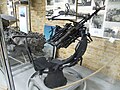 Zwillingssockel 36 with one mounted MG 34, notice the removed butt-stock

_Wehrmacht_machine_gun_MG-34_-_14254969710.jpg)
.jpg)


Users
[edit] Albania: Kept in reserve as late as 1988[67]
 Algeria: supplied by Czechoslovakia[25]
 Australia: Battlefield capture.[68]
 Biafra: probably supplied by Czechoslovakia.[69]
 Bulgaria: Supplied by Germany during WWII.[70]
 Cyprus[citation needed]
 Cuba[25]
 Czechoslovakia: produced at Brno during German occupation of Czechoslovakia. Production continues after the war.[23]
 East Germany (post-war use on SK-1 armored car)[citation needed]
 France[25]
 Greece: Still used in 2023.[71][72]
 Guatemala: received 1,000 MG34s in 1954 from Czechoslovakia[73]
 Independent State of Croatia[74]
 Hungary[75]
 Israel: supplied by Czechoslovakia.[76]
 Libya[77]
 Nazi Germany
 North Korea: Used in the Korean War.
 North Vietnam: Used by the NVA and Vietcong in the Vietnam War[78]
 Norway: Used and first converted to .30-06 Springfield designated MG34F1 and later to 7.62×51mm NATO designated MG34F2 by the Heimevernet until mid 1990s[66]
 Palestinian Fedayeen[79]
 People's Republic of China[23]
 Republic of China[23]
 Romania[80]
 Somalia[81]
 South Africa: Captured from SWAPO forces around 1985[82]
 Syria: supplied by Czechoslovakia[23]
 Syrian National Coalition[3][83]
 United Kingdom: Battlefield capture.[84][85]
 Yugoslav Partisans[86][87]


See also
[edit]- List of World War II firearms of Germany
- MG 30, predecessor
- MG 42, successor
- MG 3
- MG 81 machine gun
- SIG 710-3
References
[edit]- ^ "PHOTOGRAPH: Resistance of men and women". Palquest.org. 1936.
- ^ Russell, Lee; Katz, Sam (April 1986). Israeli Defense Forces, 1948 to the Present. Uniforms Illustrated 12. Olympic Marketing Corp. p. 15. ISBN 978-0-85368-755-9.
- ^ a b "Syrian Civil War: WWII weapons used". WWII After WWII. June 27, 2017.[self-published source]
- ^ a b c Myrvang 2002, p. [page needed].
- ^ a b c d "German Views on Use of the MG 42". Intelligence Bulletin. II (9). May 1944. Retrieved 17 February 2017 – via Lonesentry.com.
Under battle conditions the MG 42 can fire about 22 bursts per minute—that is, about 154 rounds. Under the same conditions, the MG 34 is capable only of about 15 bursts per minute, at a rate of 7 to 10 rounds per burst, totalling about 150 rounds. Thus the MG 42, used as a light machine gun, requires a slightly higher ammunition expenditure.
- ^ Bishop 2002, p. 246.
- ^ Hogg, Ian & Gander, Terry (2005). Jane's Guns Recognition Guide. HarperCollins. p. 375.
- ^ Hogg, Ian V. & Weeks, John S. (2000). Military Small Arms of the 20th Century (7th ed.). Iola, WI: Krause Publications. p. 326. ISBN 978-0-87341-824-9.
- ^ Bishop 2002, pp. 245 & 246.
- ^ McNab 2012, p. 62.
- ^ a b c d e Haskew 2012, p. 92.
- ^ a b Smith 1973.
- ^ a b "Filling and Adjusting the PT34". Bergflak's Lounge.
- ^ a b Legendre, Jean-François (March 2005). "Feeding the Tiger: Ammunition Belts for German MG 34 and MG 42 Machine Guns". Small Arms Review. 8 (6).
- ^ a b McNab 2012, p. 13.
- ^ Geckeler, Alexander.Waffen-Anatomie: Das Maschinengewehr 34, page 66 et seq. (https://buchshop.bod.de/waffen-anatomie-das-maschinengewehr-34-alexander-geckeler-9783758331329 )
- ^ a b Haskew 2012, p. 146.
- ^ Smith 1973, pp. 437–442; McNab 2012, p. 17.
- ^ Haskew 2012, p. 85.
- ^ Smith 1973, p. 137.
- ^ a b c d McNab 2012, p. 17.
- ^ McNab 2012, p. 61.
- ^ a b c d e f McNab 2012, p. 69.
- ^ Ezell, Edward Clinton (1988). Personal firepower. The Illustrated history of the Vietnam War 15. Bantam Books. pp. 34, 41. ISBN 978-0-55334-549-0. OCLC 1036801376.
- ^ a b c d McNab 2012, p. 70.
- ^ SMALL UNITS GROUND WAR. TO&Es OF SMALL UNITS: GERMAN AND SOVIET ORGANIZATION IN 1941
- ^ Hogg, Ian V. & Weeks, John (1977). "US Rifle, Caliber .30in ('Garand'), M1-M1E9, MiC, M1D, T26". Military Small-Arms of the 20th century. London, UK: Arms & Armour Press. p. 183. ISBN 978-0-88254-436-6.
- ^ Bull, Stephen (2004). World War II Infantry Tactics : Squad and Platoon (PDF). Oxford, UK: Osprey Publishing. pp. 22–23. ISBN 978-1-84176-662-1. Archived from the original (PDF) on 24 August 2017 – via Murdercube.com.
- ^ McNab 2012, p. 33.
- ^ a b McNab 2012, pp. 35.
- ^ Bull, Stephen (2004). World War II Infantry Tactics: Squad and Platoon. Osceola, WI: Osprey. pp. 22–23. ISBN 978-1-84176-662-1.
- ^ Military Intelligence Service, U.S. War Department (December 25, 1943). "The German Squad In Combat" (PDF). Archived from the original (PDF) on December 22, 2017 – via USACAC.
- ^ McNab 2012, pp. 43.
- ^ Murray, Dave (January 2013). "The Men Behind the Counters: The German Infantry Platoon". Avalanche Press. Retrieved 18 February 2017.
- ^ McNab 2012, pp. 39.
- ^ "How The Machine Gun Changed Combat During World War I". Norwich University Online. October 15, 2020.
- ^ McNab 2012, pp. 14–15.
- ^ McNab 2012, p. 44.
- ^ McNab 2012, p. 42.
- ^ McNab 2012, p. 56.
- ^ McCollum, Ian (23 November 2013). "Vintage Saturday: Night Vision". Forgotten Weapons. Retrieved 8 August 2021.
- ^ The Last Panther in Pomerania by Rhodes Williams IR Solutions
- ^ Iannamico, Frank (June 2006). "The MG 34 light machine gun: U. S. Ordnance Department Tests". Small Arms Review. 9 (9).
- ^ "German Uniforms and Equipment: Ammunition Can 34 and 41 (Patronenkasten 34 u. 41)". mp44.nl.
- ^ "MG 34/42 ammunition box – Patronenkasten 41 – bdk 4". FJM44. November 3, 2016.
- ^ "Patronentrommel 34". Bergflak's Lounge.
- ^ a b McNab 2012, p. 15.
- ^ a b McNab 2012, p. 14.
- ^ "MG34/42 Spare Barrel Carrier (Laufschützer)". The Collector's Guild.
- ^ McNab 2012, p. 20.
- ^ "Cased MG34/42 ZF34 Optical Sight (Zielfernrohr 34/42 mit Kasten)". The Collector's Guild.
- ^ Kjellgren, G. L. M. "The Practical Range of Small Arms" (PDF). The American Rifleman. pp. 40–44. Archived (PDF) from the original on 5 March 2015.
- ^ McNab 2012, pp. 49–51.
- ^ "Lafette 34 & 42". Bergflak's Lounge.
- ^ "The evolution of the Lafette 34". Bergflak's Lounge.
- ^ "Maschinengewehr 34, Teil 2, MGLafette 34, Beschreibung, Handhabung und Behandlung vom 5.3.43" (PDF) (in German) – via Forgottenweapons.com.
- ^ "The Überschießtafel". Bergflak's Lounge.
- ^ McNab 2012, p. 50.
- ^ McNab 2012, pp. 16–17.
- ^ a b "Maschinengewehr Modell 34 (MG34)". Militaryfactory.com.
- ^ "Comparison of German Machine Guns". Tactical and Technical Trends (32). U.S. War Department. August 26, 1943 – via Lonesentry.com.
- ^ a b McNab 2012, p. 57.
- ^ McNab 2012, p. 58.
- ^ a b McNab 2012, p. 59.
- ^ "MG34 mit Panzermantel dot Fertigung 1944 - Waffenwerke Brünn" [MG34 with armored jacket, manufactured in 1944 - Waffenwerke Brno]. Bodenfunde und Originale (in German).
- ^ a b Myrvang, Folke (December 2012). "MG34 and MG42 in Norway, Post WW2". Small Arms Review. 16 (4).
- ^ Ezell 1988a, p. 31.
- ^ Knight (Lt) (25 July 1942). "COMMONWEALTH FORCES IN NORTH AFRICA 1942". Imperial War Museum. Retrieved 28 March 2023.
- ^ Jowett, Philip (2016). Modern African Wars (5): The Nigerian-Biafran War 1967–70. Oxford, UK: Osprey Publishing Press. p. 23. ISBN 978-1-47281-609-2.
- ^ "BULGARIAN SMALL ARMS OF WORLD WAR II, PART 2: FROM MAXIM OBRAZETZ 1907G TO ZB39 OBRAZETZ 1939G. - Free Online Library". www.thefreelibrary.com. Retrieved 2022-12-19.
- ^ Οι #ΕΔ υποστηρίζουν & αναδεικνύουν τον σταθεροποιητικό ρόλο της 🇬🇷 στην ευρύτερη περιοχή (Twitter). Hellenic National Defence General Staff. Twitter. 2023.
- ^ Ν/ΘΗ ΚΑΛΥΨΩ (M 64). Hellenic Navy. n/d.
- ^ Perutka, Lukáš (September 2014). Checoslovaquia, Guatemala y México en el Período de la Revolución Guatemalteca: Ibero-Americana Pragensia – Supplementum 32/2013 (in Spanish). Karolinum Press. p. 110. ISBN 978-80-246-2429-7.
- ^ Brnardic, Vladimir (17 November 2016). World War II Croatian Legionaries: Croatian Troops under Axis Command 1941–45. Men-at-Arms 508. Osprey Publishing. p. 5. ISBN 978-1-47281-767-9.
- ^ Rada, Tibor (2001). "Német gyalogsági fegyverek magyar kézben" [German infantry weapons in Hungarian hands]. A Magyar Királyi Honvéd Ludovika Akadémia és a Testvérintézetek Összefoglalt Története (1830–1945) (in Hungarian). Vol. II. Budapest: Gálos Nyomdász Kft. p. 1114. ISBN 963-85764-3-X.
- ^ McNab 2012, pp. 69–70.
- ^ Ezell 1988a, p. 252.
- ^ "MG 34". NAM: Vietnamská válka 1964-1975 (in Czech).
- ^ "PHOTOGRAPH: Resistance of men and women". Palquest.org. 1936.
- ^ "Small arms". worldwar2.ro. Archived from the original on 29 April 2025.
- ^ Ezell 1988a, p. 326.
- ^ Ezell 1988a, p. 329.
- ^ "Small Arms Captured by SAA During Operation BASALT". Silah Report. 7 August 2018.
- ^ Lea, T. (Flight Lieutenant). "ROYAL AIR FORCE: 2ND TACTICAL AIR FORCE, 1943-1945". Imperial War Museum. Retrieved 28 March 2023.
- ^ Morris R H (Sgt); Sheridan (Sgt) (22 April 1942). "THE BRITISH ARMY IN NORTH AFRICA 1942". Imperial War Museum. Retrieved 28 March 2023.
- ^ Scarlata, Paul (1 October 2017). "Yugoslav Part II: World War II small arms: an assortment of small arms from friends and foe alike". Firearms News.
- ^ Vukšić, Velimir (July 2003). Tito's partisans 1941–45. Warrior 73. Osprey Publishing. p. 25. ISBN 978-1-84176-675-1.
Sources
[edit]- Bishop, Chris (2002). The Encyclopedia of Weapons of World War II. New York: Sterling Publishing Company. ISBN 978-1-586637-62-0.
- Ezell, Edward Clinton (1988a). Small arms today: latest reports on the world's weapons and ammunition (2nd ed.). Harrisburg, PA: Stackpole Books. ISBN 978-0-8117-2280-3.
- Geckeler, Alexander (2024). Waffen-Anatomie: Das Maschinengewehr 34. Norderstedt: BoD. ISBN 978-3-7583-3132-9.
- Haskew, Michael E. (2012). Small Arms 1914–1945: The Essential Weapons Identification Guide. London, UK: Amber Books. ISBN 978-1-908273-85-7.
- McNab, Chris (20 October 2012). MG 34 and MG 42 Machine Guns (PDF). Weapon 21. Osprey Publishing. ISBN 978-1-78096-008-1. Archived from the original (PDF) on 11 July 2022. Retrieved 16 August 2021.
- Myrvang, Folke (2002). MG34-MG42 : German universal machineguns. Collector Grade Publications Inc. ISBN 0-88935-278-X.
- Smith, Joseph E. (1973). Small Arms of the World (10th ed.). Harrisburg, PA, USA: Stackpole Co.
External links
[edit]
- MG 34 - Modern Fireams
- 1943 U.S. Intelligence Report
- The Pacific War 5: Chinese Infantry Weapons
- Maschinengewehr 34, Beschreibung, Handhabung und Behandlung, Teil 1, Waffe vom 1.8.40
- MG 34, Military Intelligence Service, Special Series No. 14, May 25, 1943, U.S. War Department
- MG 34 (Maschinengewehr 34) : First universal machine gun
MG 34
View on GrokipediaThe MG 34 (Maschinengewehr 34) was a German-developed recoil-operated, air-cooled general-purpose machine gun chambered in 7.92×57mm Mauser, introduced in 1934 and adopted for Wehrmacht service in 1936.[1][2] It featured a quick-change barrel system and fed from non-disintegrating metal link belts holding 50 or 250 rounds, enabling sustained fire with a cyclic rate of 800 to 900 rounds per minute.[3][4] The weapon's innovative design allowed versatile deployment on a bipod for light machine gun roles in infantry squads or on the Lafette 34 tripod for medium machine gun, anti-aircraft, or anti-vehicle applications, marking it as the first true general-purpose machine gun (GPMG) and influencing subsequent designs worldwide.[5][6] Widely employed across all German fronts during World War II, from the invasion of Poland to defensive battles in 1945, the MG 34 provided critical suppressive fire despite vulnerabilities to fouling in harsh conditions and high production costs due to its complex 61 machined parts per receiver.[7][2] These limitations prompted the development of the more economical and robust MG 42, though the MG 34 remained in limited use and was captured or repurposed by Allied forces and post-war armies.[8]
Historical Development
Pre-World War I Foundations
The foundational principles of the MG 34 trace back to late 19th-century innovations in recoil-operated automatic weapons, particularly Hiram Stevens Maxim's 1884 patent for a machine gun that harnessed recoil energy to extract, eject, and reload cartridges while employing a water-cooled barrel for sustained fire rates exceeding 600 rounds per minute.[9] This design prioritized mechanical reliability through robust construction and toggle-lock mechanisms, influencing German engineers who licensed Maxim's technology in the 1890s to produce domestic variants suited to rigorous field conditions, such as mud and cold prevalent in European theaters.[10] Germany formalized its adoption with the Maschinengewehr 01 in 1901, refined into the MG 08 by 1908, featuring a 7.92×57mm cartridge and heavy steel components weighing approximately 27 kilograms for the receiver alone, plus 3.75 kilograms of water in the jacket and a wheeled sled mount adding further mass for stability during prolonged bursts.[9] Pre-World War I German doctrine integrated these guns into specialized detachments—typically four per battalion—for suppressive fire in offensive maneuvers, reflecting a tactical emphasis on firepower concentration rather than individual soldier mobility, as articulated in prewar infantry manuals that viewed machine guns as fixed assets akin to artillery.[11] These early systems, while revolutionary in enabling automatic fire, exposed inherent constraints in versatility: the MG 08's bulk—totaling over 60 kilograms in operational configuration—restricted rapid displacement, confining it to static or semi-static roles and necessitating team efforts of five to six men for transport and operation.[12] Complementary influences from designers like John Moses Browning, whose pre-1914 recoil-operated prototypes emphasized lighter actions, began informing German priorities for durability under adverse environments, though adoption remained conservative until wartime exigencies highlighted the need for unified light and medium capabilities beyond the Maxim lineage's water-cooled specialization.[13]Interwar Constraints and Innovations
The Treaty of Versailles, signed on June 28, 1919, imposed severe restrictions on German military capabilities, including Article 164's prohibition on manufacturing or importing machine guns for the army beyond a small number for police use, effectively halting open development of heavy, water-cooled models like the World War I-era MG 08. These constraints compelled German designers to pursue covert research and development (R&D), often routing projects through foreign subsidiaries in neutral countries like the Netherlands or Switzerland, or disguising prototypes as commercial anti-aircraft (AA) weapons or export-oriented light machine guns to evade Allied inspections.[14] This approach emphasized multi-role firearms that could justify dual civilian-military applications, such as AA defense against low-flying aircraft, while prioritizing air-cooled, recoil-operated mechanisms for enhanced portability over the static, heavy mounts of prior designs.[15] Key innovations stemmed from engineers like Louis Stange at Rheinmetall, who prototyped recoil-operated, air-cooled systems in the late 1920s, building on earlier interwar experiments with short-recoil locking via rotating bolts and muzzle boosters to amplify the recoil impulse.[15] Stange's Modell 30, tested around 1929-1930, featured a tubular receiver and demonstrated a cyclic rate of fire up to 800 rounds per minute, significantly exceeding the 500-600 rpm of water-cooled Maxim guns while weighing approximately 12 kilograms—far lighter than the 50+ kilograms of tripod-mounted World War I heavies.[16] Complementary work by Heinrich Vollmer, who developed automatic weapon prototypes including the VMG 1927 machine gun amid Versailles secrecy, contributed foundational recoil management techniques tested in controlled environments, revealing superior sustained fire endurance through quick-change barrels without water dependency.[17] Empirical data from these disguised trials underscored the shift toward versatile squad-support weapons: prototypes achieved effective portability for infantry maneuver, with barrel life extended via air fins and non-disintegrating belts, contrasting the immobility of belt-fed, water-jacketed predecessors that overheated rapidly in mobile scenarios.[18] This covert emphasis on high-mobility, high-volume fire laid the conceptual groundwork for general-purpose machine guns, prioritizing causal efficiency in heat dissipation and ammunition feed over specialized roles forbidden by treaty terms.[2]Design and Adoption Process
The MG 34 emerged from collaborative engineering efforts led by Mauserwerke, with contributions from designer Heinrich Vollmer, to fulfill Wehrmacht requirements for an Einheitsmaschinengewehr—a single, adaptable 7.92×57mm machine gun suitable for infantry light roles on bipod, sustained medium fire on tripod, anti-aircraft defense, and vehicle or fortification mounting.[8][5] Drawing on licensed Swiss Solothurn MG 30 prototypes developed by Rheinmetall to evade Treaty of Versailles arms limitations, the design emphasized portability, a high cyclic rate of 800–900 rounds per minute, and recoil-operated mechanics with a rotating bolt for reliability across roles.[8][14] Finalized in 1934, the weapon weighed 12.1 kg including bipod, achieved a muzzle velocity of 762 m/s with standard ammunition, and provided an effective range extending to 2,000 meters when tripod-mounted, supported by iron sights adjustable for distant or aerial targets.[8][2] A defining feature was its quick-change barrel system, allowing crews to replace the overheated component in seconds via a rear latch and rotation mechanism, enabling bursts of up to 150 rounds before swapping to maintain firepower without water cooling.[2][5] Following evaluations in 1934 and 1935 that highlighted its versatility over predecessors like the MG 30—particularly in balanced mobility and sustained output without excessive weight—the MG 34 was formally adopted for Wehrmacht service in 1936, entering production despite per-unit costs exceeding those of simpler light machine guns.[8][14] This standardization marked the first fielding of a true general-purpose machine gun doctrine, prioritizing tactical flexibility over specialized role optimization.[5]Production Challenges and Scale-Up
Production of the MG 34 commenced in 1934 under Mauserwerke AG, but the weapon's intricate stamped sheet-metal receiver, which incorporated complex forming, welding, and finishing to achieve precise tolerances for its recoil-operated mechanism, restricted early output to low volumes requiring skilled labor and specialized tooling.[14] This complexity, while enabling high reliability through tight fits and durable construction, created causal bottlenecks in manufacturing efficiency, as the stamping process demanded high-quality steel and iterative die adjustments to avoid defects like warping or misalignment, limiting initial rates to a few thousand units annually before widespread adoption in 1936.[8] Rearmament efforts from 1936 onward drove scale-up by involving additional contractors such as Rheinmetall-Borsig AG, Steyr-Daimler-Puch AG, and others, expanding facilities and workforce training to boost output amid rising demand for the Wehrmacht's general-purpose machine gun role.[19] By 1939, production had increased significantly to support pre-war expansions, reaching approximately 12,800 units that year, with further wartime surges to over 50,000 annually by 1940 through process optimizations like standardized subassembly lines, though still constrained by material allocations and precision requirements compared to fully machined predecessors.[20] Wartime resource scarcity, including steel shortages and Allied bombing of factories from 1943, necessitated adaptations such as selective use of lower-grade alloys in non-critical components and decentralized production, yet the design's inherent precision needs prevented drastic simplification without risking functional integrity.[7] Overall, these challenges yielded a total of approximately 577,000 units by 1945, highlighting trade-offs where the MG 34's manufacturing sophistication ensured operational durability but underscored the push toward cheaper alternatives like the MG 42, which employed coarser stamping for unskilled labor and higher throughput at reduced per-unit costs.[8]Technical Design
Operating System and Mechanics
The MG 34 operates on a short-recoil principle, in which the barrel recoils rearward a distance of approximately 9/16 inch (14 mm) while locked to the bolt, harnessing the controlled energy from the fired cartridge to cycle the action before unlocking occurs.[21] A muzzle-mounted recoil booster harnesses expanding propellant gases to amplify the recoil impulse, ensuring consistent function across ammunition variations and environmental factors.[18] This locked-breech configuration dissipates initial recoil forces safely within the mechanism, preventing premature extraction and reducing bolt velocity for reliable operation at a cyclic rate of around 900 rounds per minute.[22] Breech locking employs a rotating bolt head with two cylindrical rollers: inner rollers engage locking recesses in the barrel extension via interrupted buttress threads, securing the assembly during ignition and the onset of recoil, while outer rollers facilitate unlocking by interacting with receiver cams as recoil progresses.[22][18] This roller-assisted rotation maintains positive lockup against peak chamber pressures—typically exceeding 50,000 psi for 7.92×57mm Mauser—before the bolt unlocks, extracts, and ejects the case, with a return spring then driving the assembly forward to chamber a fresh round from the belt.[21] The system's design, drawing from earlier Solothurn concepts, prefigures roller-delayed blowback in subsequent weapons by leveraging mechanical delay for energy management without relying solely on gas operation.[21] Air cooling is integral to the mechanism, with the quick-change barrel and perforated jacket promoting convective heat dissipation during operation, augmented by the stamped steel receiver's low mass for portability.[18] Sustained automatic fire risks barrel overheating after roughly 250 rounds, prompting mandatory replacement to avert accuracy loss, warping, or cook-off; emergency tolerances extend to 400 rounds under duress.[21][22] Modularity supports combat-zone maintenance, with the barrel detachable via a simple procedure: cock the bolt, secure the safety, depress the receiver catch, and rotate the assembly counterclockwise for removal, often using an asbestos mitt for hot barrels.[21] Bolt disassembly follows by retracting the operating handle and separating components, while the feed cover and bipod detach via latches and sight pivots, enabling squad members to perform essential cleaning and repairs with minimal tools and without full teardown.[21] This field-expedient approach minimizes downtime, aligning with the weapon's emphasis on rapid restoration under stress.[22]Feeding and Barrel Management
The MG 34 utilizes a belt-feeding mechanism with non-disintegrating, reusable steel links in segments of 50 rounds, which can be connected to form longer belts up to 250 rounds for sustained fire.[2][23] These belts, designated as Patronengurt 34, feed from the left side of the receiver via a direct-push system that extracts cartridges from the links into the chamber without requiring belt disintegration.[24] For lighter, portable applications, a 50-round Gurttrommel 34 drum magazine can attach directly to the receiver, accommodating the same 7.92×57mm Mauser ammunition.[24][25] To mitigate overheating during its cyclic rate of 800–900 rounds per minute, the MG 34 features a quick-change barrel system.[14] The procedure involves disengaging a latch, swinging the receiver to the side, and inserting a fresh barrel, typically completed in under 10 seconds using an asbestos mitt for protection against heat.[26] This air-cooled design necessitates barrel swaps after short bursts of 100–150 rounds to prevent accuracy degradation and cook-off risks, as prolonged automatic fire rapidly elevates barrel temperatures beyond sustainable thresholds.[27] Barrel lifespan averages 5,000–6,000 rounds under standard use, with erosion accelerating from sustained bursts that exceed doctrinal guidelines of 120–150 effective rounds per minute.[28][26] Empirical trials demonstrated visible throat erosion and grouping dispersion after 400–500 continuous rounds without change, underscoring the system's reliance on frequent maintenance for reliability in combat.[26]Sights, Trigger, and Accessories
The MG 34 featured adjustable iron sights comprising a fixed front blade and a rear tangent leaf sight with an open V-notch, graduated in 100-meter increments from 200 to 2,000 meters for ranged fire.[29] A folding peep sight integrated into the rear leaf allowed for more precise aiming at longer distances.[29] For low-level anti-aircraft defense, an optional spiderweb-type ring sight could be attached, enabling elevated trajectory adjustments beyond standard infantry roles.[30] The trigger assembly employed a distinctive dual-lever mechanism to support selective fire modes, with the upper trigger bar activating semi-automatic operation for deliberate aimed shots and the lower bar engaging full-automatic fire, thereby reducing the risk of unintended bursts in tactical scenarios requiring precision.[2] This ergonomic design aligned with German infantry doctrine emphasizing controlled suppression alongside accurate fire.[2] Key accessories enhanced the MG 34's versatility in medium machine gun applications, notably the Lafette 34 tripod mount, which provided superior stability, recoil absorption via integrated buffers, and elevation adjustments for both ground and anti-aircraft use.[31] When mounted on the Lafette 34, the system supported optional optics such as the MG Z 40 telescopic sight, extending the effective engagement range to approximately 1,800 meters under optimal conditions.[30] The complete gun-and-tripod setup weighed around 20 kg, facilitating transport via backpack straps while enabling sustained fire rates.[32]Tactical Doctrine and Roles
Evolution of German Infantry Tactics
German infantry tactics underwent a profound transformation during the interwar period, departing from the static, trench-bound positions of World War I where machine guns were primarily emplaced for defensive fire. Drawing lessons from late-war stormtrooper infiltration tactics, the Reichswehr and later Wehrmacht emphasized mobility and decentralized execution under Auftragstaktik (mission-type tactics), as codified in the 1933 field manual Truppenführung. This doctrinal shift prioritized rapid penetration and exploitation of breakthroughs by small, self-contained units, integrating firepower with maneuver to overwhelm enemy defenses rather than relying on massed attrition.[33] Central to this evolution was the reorganization of the infantry squad (Gruppe), standardized around a single general-purpose machine gun to serve as the fire base, enabling fire-and-maneuver at the lowest levels. Typically comprising 10 men by 1939—one squad leader, machine gun crew (gunner and assistant), ammunition bearers, and riflemen—the squad derived the majority of its offensive firepower from the MG 34, which supplanted lighter World War I machine guns like the MG 08/15. The weapon's design facilitated quick transitions between bipod-mounted mobility for assault and tripod-mounted sustained fire, allowing the squad to suppress enemy positions while rifle elements flanked or advanced, achieving localized fire superiority with minimal manpower.[34][2] This squad-centric approach extended to combined arms integration, particularly in motorized and Panzergrenadier units formed in the late 1930s, where infantry maintained pace with armored advances through half-tracks, using the MG 34's versatility for suppressive fire in dynamic engagements. Doctrinal manuals stressed precision and economy of force, with the machine gun's high cyclic rate and reliability enabling bursts of controlled fire to pin opponents, thereby facilitating maneuver without excessive ammunition expenditure or manpower. Such tactics reflected a causal emphasis on the machine gun as the squad's anchor, concentrating up to three-quarters of its firepower output to support fluid operations over sheer volume.[34][33]Light Machine Gun Applications
The MG 34 functioned as the core weapon of German infantry squads in its light machine gun configuration, bipod-mounted for maneuverable fire support during assaults. Squads typically comprised 10 soldiers, with a dedicated gunner, assistant gunner, and ammunition bearers handling the 12-kilogram weapon, while riflemen provided auxiliary fire and protection. This organization prioritized the machine gun's firepower, enabling squads to deliver concentrated bursts while advancing, in line with Wehrmacht doctrine that positioned the MG 34 as the primary offensive tool supported by individual rifles.[14][2] Bipod deployment allowed effective suppression at ranges of 600 to 800 yards for light machine gun use, suitable for walking fire to pin enemy forces and cover flanking movements. The weapon's recoil-operated mechanism and adjustable gas regulator supported controlled bursts from prone positions, facilitating rapid shifts between firing and relocation by a crew of three to four. This mobility emphasized doctrinal flexibility, permitting squads to exploit terrain and maintain momentum without fixed positions.[2] In close-quarters scenarios, such as urban assaults, German training incorporated hip and underarm firing techniques, leveraging the sling for stability during movement. Manuals specified these methods for suppressive fire on the advance, compensating for reduced accuracy with volume to disrupt defenders and enable quick crew displacements. Such applications underscored the MG 34's role in aggressive infantry tactics, where portability and adaptability outweighed sustained precision.[35][2]Medium Machine Gun Applications
The MG 34 served in medium machine gun roles primarily when mounted on the Lafette 34 tripod, enabling sustained defensive fire from fixed positions in contrast to its bipod-equipped light role emphasizing infantry mobility.[14] This configuration supported crew-served operation by a three-man team—a gunner, assistant, and commander—who managed ammunition and barrel changes to maintain fire output.[14] The tripod's stability allowed for precise aiming, including indirect fire capabilities extending effective anti-personnel and light anti-vehicle ranges up to 3,500 meters when using the optional telescopic sight.[36] In defensive doctrines, the Lafette-mounted MG 34 utilized linked 250-round belts, which could be connected for extended feeds exceeding 500 rounds, prioritizing controlled bursts to manage heat buildup.[5] Quick-change barrels, replaceable in seconds without tools, permitted prolonged engagements by rotating spares, theoretically supporting near-continuous operation over extended periods with adequate crew support and ammunition.[14] This adaptability reinforced German emphasis on versatile firepower for holding ground against assaults. For anti-aircraft defense, the MG 34 adapted via elevated "spider web" sights on the Lafette or simpler tripods like the Dreibein 34, targeting low-flying aircraft up to approximately 1,000 meters in altitude.[5] The weapon's cyclic rate of 800-900 rounds per minute proved effective against strafing or reconnaissance planes in static positions, such as coastal or rear-area defenses, often employing 75-round double-drum magazines for rapid volume of fire.[14] These setups complemented dedicated Flak units by providing lightweight, mobile AA coverage at platoon or company levels.[5]Combat Employment
European Theater Operations
![Waffen-SS soldiers from “Wiking” Division with MG 34 and Kar98k in soviet village][float-right] The MG 34 played a central role in the German invasion of Poland commencing on September 1, 1939, where it formed approximately 47% of the machine guns deployed by the Wehrmacht infantry divisions.[14] Each German infantry regiment involved in the campaign was equipped with 81 light machine guns, including MG 34s, alongside heavier support weapons, enabling sustained suppressive fire during rapid advances.[37] This configuration contributed to the superior firepower of German divisions, which fielded 442 machine guns per division compared to fewer in opposing Polish units.[38] In the Norwegian Campaign of April to June 1940, MG 34 crews operated in subzero temperatures, utilizing winter camouflage and padded uniforms to maintain functionality amid snow-covered terrain.[39] German forces employed the weapon for defensive positions and fire support in fjord and mountain engagements, adapting to the Arctic-like conditions that hampered mobility.[40] During the Battle of France in May 1940, particularly the Ardennes breakthrough, MG 34 teams supported panzer advances and river crossings, such as at the Meuse, where infantrymen loaded belts under fire to provide covering volleys for bridging operations.[41] Elements of the 7th Panzer Division, advancing through the region, integrated MG 34s into their armored infantry squads for close-range suppression against French counterattacks.[42] On the Eastern Front from Operation Barbarossa in June 1941 through 1945, the MG 34 sustained heavy use in defensive configurations, with crews positioning the gun on elevated tripods to cover Soviet infantry assaults in urban and village settings.[43] It formed a staple of Wehrmacht and Waffen-SS fire teams in prolonged battles like those around Stalingrad and Kursk, where its versatility allowed shifts between squad-level mobility and static strongpoint roles despite ammunition and maintenance demands. By late war, captured examples supplemented German shortages, but original MG 34s remained integral to elastic defense doctrines emphasizing machine gun nests.[44]Other Theaters and Adaptations
In the North African campaign from February 1941 to May 1943, the MG 34 armed Deutsches Afrikakorps units during operations such as Sonnenblume and the subsequent battles against British Eighth Army forces, where it supported highly mobile desert maneuvers.[45] Its general-purpose design facilitated mounting on vehicles like Sd.Kfz. 251 half-tracks, enabling squads to deliver suppressive fire while advancing across open terrain at speeds up to 50 km/h, a tactical necessity in the expansive Libyan and Egyptian deserts.[45] Sand and dust posed significant reliability threats to the MG 34 and other machine guns, accelerating wear on barrels and causing jams due to ground-level positioning and exposure during sustained fire.[46] German personnel mitigated these through empirical adaptations, including wrapping moving parts in sailcloth for protection, fitting standard muzzle covers, and conducting regular cleaning followed by thin oil application to repel fine particles without attracting more grit.[46] These measures, combined with the weapon's quick-change barrel, allowed continued effectiveness despite environmental abrasion reducing component lifespan compared to temperate zones.[46] Direct German deployments outside Europe and North Africa remained limited, with no substantial MG 34 use in East Asian theaters; however, Japanese forces captured examples from pre-war Chinese Nationalist stocks during the Second Sino-Japanese War, though these influenced neither widespread adoption nor the development of indigenous designs like the Type 99 light machine gun.[47]Captured and Post-Occupation Use
The Soviet Union captured substantial quantities of MG 34 machine guns during the latter stages of World War II, integrating them into second-line units, training establishments, and anti-aircraft batteries for postwar service, where they supplemented domestic designs like the SG-43 until the mid-1950s.[48] British forces similarly acquired examples through battlefield seizures in Europe and North Africa, employing them pragmatically in reserve formations and familiarization drills rather than frontline combat, with phase-out occurring as standardized NATO-compatible weapons proliferated by the early 1950s.[49] Yugoslavia's People's Army retained large numbers of war-captured MG 34s postwar, assigning them to territorial defense and infantry squads through the 1950s and into the 1960s, where maintenance logs from depots evidenced sustained operational reliability via barrel replacements and bolt overhauls despite cumulative wear from prior combat exposure.[20] Portugal, having received around 500 units in 1944 and designating them the m/944, deployed them in colonial counterinsurgency campaigns in Angola and Mozambique during the 1960s, valuing their versatility on bipod for mobile patrols in rugged terrain over heavier alternatives, with field reports noting minimal failures under tropical humidity when ammunition belts were pre-lubricated.[50][48] These applications underscored the MG 34's postwar pragmatism, as operators prioritized its quick-change barrel and multi-role mounts for austere logistics over doctrinal purity, enabling effective fire support in low-intensity conflicts without requiring extensive retraining.[48]Performance Evaluation
Strengths and Innovations
The MG 34 pioneered the general-purpose machine gun (GPMG) concept, integrating the portability of a light machine gun with the sustained fire capability of a medium machine gun in a single 12-kilogram air-cooled design chambered for the 7.92×57mm Mauser cartridge.[14] This versatility stemmed from interchangeable mounts, including a bipod for mobile squad-level support and the Lafette 34 tripod for defensive or anti-aircraft roles, allowing a minimal three-man crew to deliver flexible, 360-degree fire support without transitioning to heavier, crew-intensive weapons.[8] The weapon's recoil-operated roller-locking mechanism, combined with a dual-rate trigger (single-shot for precision or automatic at 800–900 rounds per minute), enabled seamless adaptation across infantry, vehicular, and aerial defense applications.[7] Engineering innovations further enhanced its effectiveness, notably the quick-change barrel system, which permitted barrel swaps in seconds to prevent overheating during prolonged bursts, a feature absent in belt-fed contemporaries like the water-cooled Vickers.[51] This, paired with non-disintegrating metal-link belts feeding from either side, supported high-volume fire while maintaining mechanical reliability in adverse conditions, as validated by early Wehrmacht trials in 1934–1936.[3] The stamped and machined construction balanced weight reduction with durability, facilitating infantry maneuvers where prior designs demanded static positioning. Tactically, the MG 34's multi-role capacity amplified firepower density in German squads, enabling one gun to replicate the output of several World War I-era specialized machine guns, thus optimizing manpower for offensive operations as emphasized in pre-war doctrinal shifts toward mobile warfare.[2]Limitations and Empirical Criticisms
The MG 34's machined components and complex assembly process demanded approximately 150 man-hours per unit during early production, far exceeding the 75 man-hours required for the simplified MG 42, which hampered scalability amid wartime labor and material constraints.[52][53] This design intricacy, rooted in pre-war precision engineering, prioritized versatility over mass manufacturability, resulting in only about 577,000 units produced by 1945 despite demand.[52] In sustained fire scenarios, the air-cooled barrel overheated and fouled after roughly 150 rounds without replacement, degrading accuracy and risking cook-off or warping due to the weapon's high cyclic rate of 800 rounds per minute.[54] Field manuals emphasized quick barrel swaps—taking 10-15 seconds with trained crews—but this interrupted suppressive fire, exposing gunners in prolonged engagements, as the thin barrel walls prioritized weight reduction over thermal endurance.[26] The MG 34's tight tolerances, while enabling its general-purpose role, reduced reliability in harsh environments; exposure to mud, dust, or sub-zero temperatures often caused jams or feed issues, with operators reporting higher maintenance needs compared to looser-tolerance contemporaries like the MG 42.[55] Eastern Front dispatches from 1941-1942 noted frequent stoppages in winter mud and snow, attributable to the recoil-operated mechanism's sensitivity to fouling, though competent maintenance mitigated but did not eliminate these vulnerabilities.[55] At 12 kilograms on its bipod, the weapon's mass further compromised squad mobility during rapid maneuvers or retreats in adverse terrain.[7]Comparative Analysis with Contemporaries
The MG 34 demonstrated superior accuracy and controllability relative to the MG 42, attributable to its cyclic rate of 800–900 rounds per minute compared to the MG 42's 1,200–1,500 rounds per minute, which enabled more deliberate, aimed bursts rather than the suppressive, less precise volume of the latter.[30][56] Although the MG 42's stamped-metal construction allowed for markedly higher production volumes—facilitating wartime output far exceeding the labor-intensive machining required for the MG 34—the earlier design's stability, including its bipod configuration, preserved its utility in precision-oriented applications such as anti-aircraft defense and vehicle armaments, where the MG 42's rapid fire often compromised targeting effectiveness.[57] Contrasted with the U.S. M1919A4 Browning, the MG 34 held an edge in portability, weighing 12.1 kg with bipod versus the M1919A4's 14.7 kg, permitting greater infantry maneuverability in light machine gun roles.[30][58] The M1919A4, however, excelled in sustained fire through its conservative 400–500 rounds per minute rate, which minimized barrel wear and ammunition consumption during prolonged engagements, areas where the air-cooled MG 34's higher output demanded frequent barrel swaps despite its quick-change mechanism.[59] Relative to British designs, the MG 34's general-purpose adaptability outstripped the Bren light machine gun's magazine-limited bursts at 500 rounds per minute and 10.4 kg weight, allowing the German weapon to transition seamlessly between squad support and medium fire without the Bren's reload constraints.[60] The water-cooled Vickers .303, capable of indefinite sustained fire at around 450–500 rounds per minute but encumbered by a total setup exceeding 40 kg including water and tripod, prioritized static defense over the MG 34's mobility; Allied assessments of captured specimens highlighted the latter's versatility but critiqued its non-disintegrating belt feed for vulnerability to jams and dirt, complicating field logistics compared to the Vickers' robust strip system.[61][62]| Weapon | Weight (kg, operational) | Cyclic Rate (rpm) | Key Metric Advantage Over MG 34 |
|---|---|---|---|
| MG 34 | 12.1 | 800–900 | Baseline |
| MG 42 | ~11.6 | 1,200–1,500 | Production scalability |
| M1919A4 | 14.7 | 400–500 | Sustained fire endurance |
| Bren Mk I | 10.4 | 500 | Lighter for pure LMG role |
| Lewis Gun | 12.0 | 500–600 | Comparable weight and lower rate for better control in light machine gun roles, with pan magazine feeding.[63] |
| Vickers .303 | ~40 (with accessories) | 450–500 | Unlimited water-cooled bursts |
Variants and Derivatives
Wartime Modifications
The MG 34/41 variant, developed in 1941 amid escalating production pressures, incorporated wartime simplifications such as increased use of stamped sheet metal in the receiver and a redesigned wooden stock amenable to faster fabrication techniques, reducing reliance on precision machining inherent to the original design.[64] These alterations aimed to accelerate output while maintaining core functionality, though interchangeability with pre-1941 components was largely lost due to extensive revisions across major assemblies.[22] Limited production ensued, with estimates around several thousand units before the MG 42 supplanted it, as the changes proved insufficient for sustained high-volume needs. To enhance precision in static defensive roles during later campaigns, select MG 34s on Lafette tripods were adapted with optical sights like the MGZ 34 or similar periscopic devices, calibrated for engagements up to 1,500–2,000 meters against area targets or low-flying aircraft, leveraging the weapon's inherent accuracy for suppressive or harassing fire rather than dedicated sniping.[65][66] Such fittings emphasized the gun's versatility in entrenched positions, where controlled bursts could exploit its effective range, though optics were not standardized and remained field-expedient.[67] Coaxial adaptations for armored vehicles, designated as the MG 34 KZ (Kampfwagen-Zwillingslafette variant), modified the gun for turret integration in Panzer III and IV tanks, featuring a heavier chrome-lined barrel for prolonged firing, electric solenoid trigger, removed buttstock, and reinforced mounting interfaces to withstand recoil in confined spaces.[68] Over 10,000 such units were produced to equip the hull and turret machine gun positions across thousands of medium tanks, supporting anti-infantry roles alongside the main armament from 1939 onward.[66][8] These vehicle-specific tweaks prioritized reliability under vibration and dust, with total MG 34 output exceeding 350,000 units, a significant portion dedicated to panzer divisions.[66]Aircraft and Specialized Variants
The MG 81, a lightweight derivative of the MG 34 adapted for Luftwaffe aircraft, featured an air-cooled, belt-fed design optimized for high-speed aerial combat, with a cyclic rate of 1,200 to 1,500 rounds per minute to enable synchronized firing through propeller arcs.[69][70] It replaced the earlier MG 15 in flexible and fixed installations, often deployed in twin-gun pods designated MG 81Z (Zwilling), which combined two guns for increased firepower in fighters like the Messerschmitt Bf 109 and Focke-Wulf Fw 190, weighing approximately 8 kg per gun to minimize aircraft drag and weight.[71][72] For armored fighting vehicles, the MG 34 Panzerlauf variant incorporated a shortened barrel and heavier, nearly solid armored shroud with minimal ventilation holes to withstand internal heat and fit within tank turrets, such as those on Panzer III and IV models, while omitting the stock and bipod for coaxial or pintle mounting.[8][73] This configuration reduced overall length for confined spaces, facilitating quicker barrel changes compared to alternatives like the MG 42, and maintained the 7.92×57mm Mauser caliber for compatibility with vehicle ammunition feeds.[74] In anti-aircraft roles, specialized MG 34 mounts like the Dreibein 34 tripod elevated the gun for high-angle fire against low-flying aircraft, achieving practical effectiveness up to 1,200 meters altitude through adjustable cyclic rates increased to around 1,200 rounds per minute for tracer visibility and volume of fire.[66] Twin and quadruple configurations on Zwillingssockel 36 pedestals or vehicle-integrated setups provided empirical defensive success against strafing bombers in theaters like North Africa and the Eastern Front, where crew reports noted hits on approaching formations despite ammunition belt limitations in sustained bursts.[8][75]Modern Reproductions and Legal Adaptations
TNW Firearms has manufactured semi-automatic reproductions of the MG 34 since the 2000s, employing modified original German components including barrels and receivers adapted with new semi-automatic bolts and closed-bolt firing mechanisms.[76] These versions chamber 7.92×57mm Mauser or .30-06 Springfield ammunition and utilize belt feeding, enabling civilian ownership as registered semi-automatic rifles under U.S. Bureau of Alcohol, Tobacco, Firearms and Explosives (ATF) guidelines, thereby circumventing National Firearms Act prohibitions on fully automatic weapons without requiring special licensing beyond standard firearm transfers.[77] Market values for these TNW models have reached approximately $9,000 as of 2024 sales data.[78] Denix produces non-firing replica models suitable for collectors and World War II reenactments, featuring simulated loading actions, functional top covers, and deployable bipods constructed from zinc alloy, hardwood, and plastic components weighing around 16 pounds.[79] The 2025 Denix iteration includes enhanced detailing such as a working top cover and sling attachments, maintaining external fidelity to wartime specifications without operational firing capability.[80] These replicas impose no ATF compliance burdens beyond general consumer product standards, facilitating their use in historical displays and events.[81] Post-2020, no verified active military programs have pursued MG 34 reproductions or adaptations, with modern armed forces favoring contemporary designs over historical recreations for operational roles.[82] Civilian replicas like those from TNW and Denix thus represent the primary avenue for legal possession and study, ensuring accessibility while adhering to stringent firearms regulations that prohibit unauthorized full-auto conversions.[83]Enduring Legacy
Influence on Subsequent Designs
The MG 34 pioneered the general-purpose machine gun (GPMG) concept, integrating features such as a quick-change barrel, belt-fed operation, and modular mounts for roles ranging from squad support to anti-aircraft defense, which addressed the limitations of prior heavy, water-cooled designs by emphasizing portability and sustained fire without excessive crew requirements.[14][5] This engineering approach prioritized thermal management through air-cooling and rapid barrel swaps to mitigate overheating during high-volume fire, enabling a single weapon to fulfill multiple battlefield functions that previously demanded specialized guns.[84] These innovations directly informed the MG 42, developed in 1942 as a more manufacturable evolution that retained the MG 34's recoil-operated mechanism, interchangeable barrel system, and multi-role versatility while simplifying construction via stamped components for wartime scalability.[85] The MG 42's design lineage extended postwar into the MG 3, adopted by the West German Bundeswehr in the late 1950s and chambered in 7.62×51mm NATO, which preserved the quick-change barrel and general-purpose adaptability for continued infantry, vehicular, and coaxial applications into the present day. The MG 34's multi-role paradigm influenced global postwar derivatives, such as the Yugoslav M53 produced from 1953 by Zastava Arms, which cloned the MG 42's roller-locked system and belt feed while adapting the sustained-fire capabilities for 7.92×57mm Mauser ammunition in light and medium configurations.[86] Similarly, the Belgian FN MAG (adopted as the U.S. M240 in 1977) drew conceptual inspiration from the German GPMG framework, incorporating sustained-fire endurance and role flexibility to standardize squad-level suppression across NATO forces, though employing a distinct gas-operated action.[5] The weapon's emphasis on concentrated firepower per infantry squad—typically one or two MGs providing the bulk of offensive volume—contributed to doctrinal precedents that shaped NATO's post-1945 automatic weapon standards, prioritizing versatile, belt-fed support guns over rifle-caliber light machine guns for enhanced tactical mobility and suppressive effect.[84]Post-War Military Adoptions
Following World War II, the MG 34 continued in limited military service in several nations, primarily through captured stocks or limited post-war production. In Norway, the Home Guard adopted rechambered captured examples, initially converted to .30-06 Springfield ammunition in the late 1940s and later to 7.62×51mm NATO in the 1950s, with the weapon designated MG34F1 and MG34F2 respectively; it remained the official light machine gun until the mid-1970s for general use and in reserve service until at least 1993, supported by updated manuals issued as late as 1988.[20][87] Czechoslovakia assembled approximately 4,000 MG 34s from wartime components in the immediate post-war period, featuring modifications such as aluminum grips; these were exported primarily to Israel as part of broader arms contracts that included 200 MG 34s alongside rifles and over 50 million rounds of ammunition, enabling their deployment by Israeli forces during the 1948 Arab-Israeli War.[88][89] Such exports leveraged existing production lines and stockpiles, sustaining the design's utility in early Cold War conflicts despite the lack of major redesigns. Captured or supplied MG 34s saw adoption by Algerian forces via Czechoslovak shipments, contributing to their arsenal in anti-colonial warfare during the Algerian War of Independence (1954–1962).[90] In Africa, Biafran separatists employed likely Czechoslovak-origin MG 34s amid the Nigerian Civil War (1967–1970), where the weapon's belt-fed mechanism and versatility proved adaptable to irregular operations despite ammunition logistics challenges.[91] These instances highlight the MG 34's empirical longevity in proxy and peripheral theaters, often due to parts commonality with wartime infrastructure rather than new production, though maintenance demands limited widespread retention beyond the 1970s in most cases.[48]Cultural and Collectible Significance
The MG 34 has been frequently depicted in films, television series, and video games focused on World War II, often symbolizing German infantry firepower and contributing to its iconic status in popular culture. Appearances in productions such as Saving Private Ryan (1998) and games like Call of Duty series portray it as a versatile squad automatic weapon, emphasizing its rapid fire and mobility in combat scenes.[92] These representations sometimes amplify its auditory and visual impact, likening the firing sound to a "buzzsaw" effect more characteristic of its successor, the MG 42, though the MG 34's actual cyclic rate of 800–900 rounds per minute produced a distinct, high-pitched chatter that Allied soldiers noted as psychologically intimidating.[93] [94] In the collectibles market, original MG 34 machine guns command premium prices due to their rarity, historical provenance, and status as National Firearms Act (NFA) items in jurisdictions like the United States, where transferable examples typically range from $32,000 to $45,000, with exceptional specimens auctioned for up to $94,000.[95] [96] Replicas and semi-automatic reproductions, often produced for historical reenactments, museums, and private collections, are far more accessible, costing hundreds to low thousands of dollars and enabling greater public engagement with WWII artifacts without the legal complexities of full-auto originals.[97] These reproductions have enhanced educational displays and living history events, fostering accurate reconstructions of German squad tactics. Debates surrounding the MG 34's battlefield effectiveness persist in historical analyses, with some postwar accounts claiming unreliability from its complex stamped construction; however, empirical evidence from combat reports and manufacturing data affirms its tactical superiority in providing sustained, mobile suppression fire, despite higher production costs of approximately 490 Reichsmarks per unit compared to simpler rifles.[98] Allied intelligence assessments, while occasionally biased toward exaggeration for training purposes, corroborated its role in enabling the German emphasis on firepower over manpower, refuting blanket unreliability narratives through documented versatility in infantry, vehicular, and anti-aircraft roles.[98]References
- https://handwiki.org/wiki/Engineering:Belt_%28firearms%29
- https://commons.wikimedia.org/wiki/File:WW2_German_Army_Wehrmacht_uniform_MG34_machine_gun_used_in_Norway_cold_weather_winter_coat_stick_grenade_mannequin_Nazi_swastika_flag_etc_Troms_Forsvarsmuseum_Military_Museum_Setermoen_Norway_2022_DSC05601.jpg