


Community hub
Recent from talks
Contribute something
Nothing was collected or created yet.
Viverridae
View on Wikipedia
| Viverridae[2] | |
|---|---|

| |
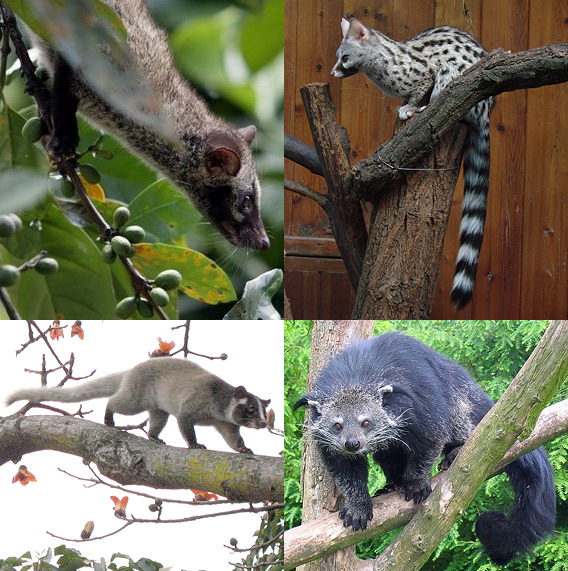
| Viverrids (clockwise from top left): species of Paradoxurus, Genetta, Arctictis and Paguma | |
Scientific classification 
| |
| Kingdom: | Animalia |
| Phylum: | Chordata |
| Class: | Mammalia |
| Order: | Carnivora |
| Infraorder: | Aeluroidea |
| Parvorder: | Viverroidea |
| Family: | Viverridae Gray, 1821 |
| Type genus | |
| Viverra Linnaeus, 1758
| |
| Genera | |
| |

| |
| Distribution of living viverrid species | |
Viverridae is a family of small to medium-sized feliform mammals, comprising 14 genera with 33 species. This family was named and first described by John Edward Gray in 1821.[3] Viverrids occur all over Africa, in southern Europe, and in South and Southeast Asia on both sides of the Wallace Line.[4]
The species of the subfamily Genettinae are known as genets and oyans. The viverrids of the subfamily Viverrinae are commonly called civets; the Paradoxurinae and most Hemigalinae species are called palm civets.
Characteristics
[edit]
Viverrids have four or five toes on each foot and half-retractile claws. They have six incisors in each jaw and molars with two tubercular grinders behind in the upper jaw, and one in the lower jaw. The tongue is rough with sharp prickles. A pouch or gland occurs beneath the anus, but there is no cecum.[3] The male's urethral opening is directed backward.[5]
Viverrids are the most primitive of all the families of feliform Carnivora and clearly less specialized than the Felidae. In external characteristics, they are distinguished from the Felidae by the longer muzzle and tuft of facial vibrissae between the lower jaw bones, and by the shorter limbs and the five-toed hind foot with the first digit present. The skull differs by the position of the postpalatine foramina on the maxilla, almost always well in advance of the maxillopalatine suture, and usually about the level of the second premolar; and by the distinct external division of the auditory bulla into its two elements either by a definite groove or, when rarely this is obliterated, by the depression of the tympanic bone in front of the swollen entotympanic. The typical dental formula is: 3.1.4.23.1.4.2, but the number may be reduced, although never to the same extent as in the Felidae.[4]
Their flesh-shearing carnassial teeth are relatively undeveloped compared to those of other feliform carnivorans.[6] Most viverrid species have a penis bone (a baculum).[7]
Classification
[edit]Living species
[edit]In 1821, Gray defined this family as consisting of the genera Viverra, Genetta, Herpestes, and Suricata.[3] Reginald Innes Pocock later redefined the family as containing a great number of highly diversified genera, and being susceptible of division into several subfamilies, based mainly on the structure of the feet and of some highly specialized scent glands, derived from the skin, which are present in most of the species and are situated in the region of the external generative organs. He subordinated the subfamilies Hemigalinae, Paradoxurinae, Prionodontinae, and Viverrinae to the Viverridae.[4]
In 1833, Edward Turner Bennett described the Malagasy fossa (Cryptoprocta ferox) and subordinated the Cryptoprocta to the Viverridae.[8] A molecular and morphological analysis based on DNA/DNA hybridization experiments suggests that Cryptoprocta does not belong within Viverridae, but is a member of the Eupleridae.[9]
The African palm civet (Nandinia binotata) resembles the civets of the Viverridae, but is genetically distinct and belongs in its own monotypic family, the Nandiniidae. There is little dispute that the Poiana species are viverrids.[2]
DNA analysis based on 29 carnivoran species, comprising 13 Viverrinae species and three species representing Paradoxurus, Paguma and Hemigalinae, confirmed Pocock's assumption that the African linsang Poiana represents the sister group of the genus Genetta. The placement of Prionodon as the sister group of the family Felidae is strongly supported, and it was proposed that the Asiatic linsangs be placed in the monogeneric family Prionodontidae.[10]
| Subfamily | Genus | Species | Image of type species |
|---|---|---|---|
| Viverrinae | Viverra Linnaeus, 1758[12] |
|

|
| Viverricula Hodgson, 1838[15] | Small Indian civet (V. indica) (Geoffroy Saint-Hilaire, 1803)[16] | 
| |
| Civettictis Pocock, 1915[17] | African civet (C. civetta) (Schreber, 1776)[18] | 
| |
| Hemigalinae Gray, 1864[19] | |||
| Hemigalus Jourdan, 1837[20] | Banded palm civet (H. derbyanus) Jourdan, 1837[20] | 
| |
| Cynogale Gray, 1836[21] | Otter civet (C. bennettii) Gray, 1836[21] | 
| |
| Diplogale Thomas, 1912[22] | Hose's palm civet (D. hosei) (Thomas, 1892)[23] | 
| |
| Macrogalidia Schwarz, 1910[24] | Sulawesi palm civet (M. musschenbroekii) (Schlegel, 1877)[25] | 
| |
| Chrotogale Thomas, 1912[22] | Owston's palm civet (C. owstoni) Thomas, 1912[22] | 
| |
| Paradoxurinae Gray, 1864[19] | Paradoxurus Cuvier, 1822[26] |
|
.JPG)
|
| Arctictis Temminck, 1824[30] | Binturong (A. binturong) (Raffles, 1822)[31] | 
| |
| Paguma Gray, 1831[32] | Masked palm civet (P. larvata) (Smith, 1827)[33] | .jpg)
| |
| Arctogalidia Merriam, 1897[34] | Small-toothed palm civet (A. trivirgata) (Gray, 1832)[35] | _(8076736823)_(cut).jpg)
| |
| Genettinae | Genetta Cuvier, 1816[36] |
|
.JPG)
|
| Poiana Gray, 1864[19] |
|

|
Phylogeny
[edit]The phylogenetic relationships of Viverridae are shown in the following cladogram:[1][11][51]
| Viverridae |
| ||||||||||||||||||||||||||||||||||||||||||||||||||||||||||||||||||||||||||||||||||||||||||||||||||||||||||||||||||||||||||||||||||||||||||||||||||||||||||||||||||||||||||||||||||||||||||||||||||||||||||||
_white_background.jpg)
.jpg)
Extinct species
[edit]| Subfamily | Genus | Species |
|---|---|---|
| Viverrinae | Viverra Linnaeus, 1758 | Leakey's civet (V. leakeyi) Leakey, 1982 |
| Semigenetta Helbing 1927 |
| |
| Paradoxurinae | Kichechia Savage, 1965[52] | |
| Tugenictis Morales & Pickford, 2005[54][55] | †T. ngororaensis[54] Morales & Pickford, 2005 | |
| Kanuites Dehghani & Werdelin, 2008[56] | †K. lewisae[56] Dehghani & Werdelin, 2008 | |
| Siamictis Grohé et al., 2020[57] | †S. carbonensis[57] Grohé et al., 2020 |
See also
[edit]References
[edit]- ^ a b c Gaubert, P. & Cordeiro-Estrela, P. (2006). "Phylogenetic systematics and tempo of evolution of the Viverrinae (Mammalia, Carnivora, Viverridae) within feliformians: implications for faunal exchanges between Asia and Africa" (PDF). Molecular Phylogenetics and Evolution. 41 (2): 266–278. Bibcode:2006MolPE..41..266G. doi:10.1016/j.ympev.2006.05.034. PMID 16837215. Archived from the original (PDF) on 2022-08-15. Retrieved 2020-08-01.

- ^ a b c Wozencraft, W. C. (2005). "Family Viverridae". In Wilson, D. E.; Reeder, D. M. (eds.). Mammal Species of the World: A Taxonomic and Geographic Reference (3rd ed.). Johns Hopkins University Press. pp. 548–559. ISBN 978-0-8018-8221-0. OCLC 62265494.
- ^ a b c Gray, J. E. (1821). "On the natural arrangement of vertebrose animals". London Medical Repository. 15 (1): 296–310.
- ^ a b c Pocock, R. I. (1939). "Family Viverridae". The Fauna of British India, including Ceylon and Burma. Vol. Mammalia. – Volume 1. London: Taylor and Francis. pp. 330–332.
- ^ Estes, Richard (1991). The Behavior Guide to African Mammals: Including Hoofed Mammals, Carnivores, Primates. University of California Press. ISBN 978-0-520-08085-0.
- ^ Wozencraft, W. C. (1984). Macdonald, D. (ed.). The Encyclopedia of Mammals. New York: Facts on File. pp. 134–135. ISBN 0-87196-871-1.
- ^ Ewer, R. F. (1998). The Carnivores. Cornell University Press. ISBN 0-8014-8493-6.
- ^ Bennett, E. T. (1833). "Notice of a new genus of Viverridous Mammalia from Madagascar". Proceedings of the Zoological Society of London. 1833: 46.
- ^ Veron, G.; Catzeflis, F. M. (1993). "Phylogenetic relationships of the endemic Malagasy carnivore Cryptoprocta ferox (Aeluroideae): DNA/DNA hybridization experiments". Journal of Mammalian Evolution. 1 (3): 169–185. doi:10.1007/bf01024706. S2CID 21555307.
- ^ Gaubert, P.; Veron, G. (2003). "Exhaustive sample set among Viverridae reveals the sister-group of felids: the linsangs as a case of extreme morphological convergence within Feliformia". Proceedings of the Royal Society B: Biological Sciences. 270 (1532): 2523–2530. doi:10.1098/rspb.2003.2521. PMC 1691530. PMID 14667345.
- ^ a b Nyakatura, K. & Bininda-Emonds, O. R. P. (2012). "Updating the evolutionary history of Carnivora (Mammalia): a new species-level supertree complete with divergence time estimates". BMC Biology. 10: 12. doi:10.1186/1741-7007-10-12. PMC 3307490. PMID 22369503.
- ^ a b Linnaeus, C. (1758). "Viverra". Systema naturæ per regna tria naturæ, secundum classes, ordines, genera, species, cum characteribus, differentiis, synonymis, locis 1 (Tenth ed.). Stockholm: Laurentius Salvius. pp. 43–45.
- ^ Gray, J. E. (1832). "On the family of Viverridae and its generic sub-divisions, with an enumeration of the species of several new ones". Proceedings of the Committee of Science and Correspondence of the Zoological Society of London. 2: 63–68.
- ^ a b Blyth, E. (1862). "Report of Curator, Zoological Department, February 1862". The Journal of the Asiatic Society of Bengal. 31 (3): 331–345.
- ^ Hodgson, B. H. (1838). "Classified Catalogue of Nepalese Mammalia". Annals of Natural History. 1 (2): 152−154.
- ^ Geoffroy Saint-Hilaire, E. (1803). "La Civette de l'Inde". Catalogue des Mammifères du Museum National d'Histoire Naturelle. Paris: Museum National d'Histoire Naturelle. p. 113.
- ^ Pocock, R. I. (1915). "On the Feet and Glands and other External Characters of the Viverrinae, with the description of a New Genus". Proceedings of the Zoological Society of London. 85: 131−149. doi:10.1111/j.1469-7998.1915.00131.x.
- ^ Schreber, J. C. D. (1778). "Die Civette Viverra civetta". Die Säugethiere in Abbildungen nach der Natur, mit Beschreibungen. Erlangen: Wolfgang Walther. pp. 418–420.
- ^ a b c Gray, J. E. (1864). "A revision of the genera and species of viverrine animals (Viverridae), founded on the collection in the British Museum". Proceedings of the Zoological Society of London for the Year 1864: 502–579.
- ^ a b Jourdan, C. (1837). "Mémoire sur deux mammifères nouveaux de l'Inde, considérés comme types des deux genres voisins des Paradoxures, genres Hémigale et Ambliodon". Comptes rendus hebdomadaires des séances de l'Académie des sciences: 442–447.
- ^ a b Gray, J.E. (1836). "Characters of some new species of Mammalia in the Society's collection". Proceedings of the Zoological Society of London. Part IV (October): 87–88.
- ^ a b c Thomas, O. (1912). "Two new Genera and a Species of Viverrine Carnivora". Proceedings of the Zoological Society of London. Part II: 498–503.
- ^ Thomas, O. (1892). "On some Mammals form Mount Dulit, North Borneo". Proceedings of the Zoological Society of London. Part I: 221–226.
- ^ Schwarz, E. (1910). "Notes on some Palm-Civets". The Annals and Magazine of Natural History; Zoology, Botany, and Geology. 8. 5 (29): 422–424.
- ^ Schlegel, H. (1879). "Paradoxurus musschenbroekii". Notes from the Royal Zoological Museum of the Netherlands at Leyden. 1 (Note XIV): 43.
- ^ Cuvier, F. (1822). "Du genre Paradoxure et de deux espèces nouvelles qui s'y rapportent". Mémoires du Muséum d'Histoire Naturelle Paris. 9: 41–48.
- ^ Pallas, P. S. (1778). "Das Zwitterstinkthier". In Schreber, J. C. D. (ed.). Die Säugethiere in Abbildungen nach der Natur, mit Beschreibungen. Erlangen: Wolfgang Walther. p. 426.
- ^ Pallas, P. S. (1778). "Der Boshond". In Schreber, J. C. D. (ed.). Die Säugethiere in Abbildungen nach der Natur, mit Beschreibungen. Erlangen: Wolfgang Walther. p. 451.
- ^ Blanford, W. T. (1885). "A Monograph of the Genus Paradoxurus, F. Cuvier". Proceedings of the Zoological Society of London. 53 (4): 780–808. doi:10.1111/j.1096-3642.1885.tb02921.x.
- ^ Temminck, C. J. (1824). "XVII Genre Arctictis". Monographies de mammalogie. Paris: Dufour & d'Ocagne. p. xxi.
- ^ Raffles, T. S. (1822). "XVII. Descriptive Catalogue of a Zoological Collection, made on account of the Honourable East India Company, in the Island of Sumatra and its Vicinity, under the Direction of Sir Thomas Stamford Raffles, Lieutenant-Governor of Fort Marlborough', with additional Notices illustrative of the Natural History of those Countries". The Transactions of the Linnean Society of London. XIII: 239–274.
- ^ Gray, J. E. (1831). "Paguma". Proceedings of the Committee of Science and Correspondence of the Zoological Society of London. Vol. 1. London: Zoological Society of London. p. 95.
- ^ Smith, C.H. (1827). "Gulo larvatus, the Masked Glutton". In Griffith, E. (ed.). The animal kingdom : arranged in conformity with its organization. Vol. 2. Mammalia. London: G.B. Whittaker. p. 281.
- ^ Merriam, C. H. (1897). "The generic names Ictis, Arctogale, and Arctogalidia". Science. 5 (112): 302. doi:10.1126/science.5.112.302. PMID 17741859. S2CID 5336742.
- ^ Gray, J.E. (1832). "On the Family of Viverridae and its generic subdivisions; with an enumeration of the Species of Paradoxurus, and Characters of several new ones". Proceedings of the Committee of Science and Correspondence of the Zoological Society of London (Part 2): 63–68.
- ^ Cuvier, F. (1816). Cuvier, G. (ed.). Le règne animal distribué d'après son organisation, pour servir de base à l'histoire naturelle des animaux et d'introduction à l'anatomie comparée. Vol. I. Paris: Deterville.
- ^ Linnaeus, C. (1758). "Viverra genetta". Systema naturæ per regna tria naturæ, secundum classes, ordines, genera, species, cum characteribus, differentiis, synonymis, locis 1 (Tenth ed.). Stockholm: Laurentius Salvius. p. 45.
- ^ Schreber, J. C. D. (1778). "Die Bisamkaze Viverra tigrina". Die Säugethiere in Abbildungen nach der Natur mit Beschreibungen. Vol. Dritter Theil. Erlangen: Walther. pp. 425–426.
- ^ Thunberg, C. P. (1811). "Beskrifning och teckning pa Viverra felina". Kungliga Swenska Wetenskaps Academiens Handlingar: 165–168.[permanent dead link]
- ^ Gray, J. E. (1828). "Viverra maculata". Spicilegia zoologica : original figures and short systematic descriptions of new and unfigured animals. London: Treuttel, Wurtz & Co. p. 9.
- ^ Geoffroy Saint-Hilaire, I. (1832). "Descriptions d'une nouvelle espèce du genre Genette. Genetta. Cuv.". Études Zoologiques : Ouvrage comprenant l'histoire et la description d'un grand nombre d'animaux récemment découverts et des observations nouvelles sur plusieurs genres déjà connus. Paris: Lequien Fils. p. 73.
- ^ Rüppell, E. (1835). "Viverra abyssinica. Rüppell". Neue Wirbelthiere zu der Fauna von Abyssinien gehörig. Frankfurt: Siegmund Schmerber.
- ^ Waterhouse, G. R. (1838). "On some New Species of Mammalia from Fernando Po". Proceedings of the Zoological Society of London: 57–61.
- ^ Thomas, O. (1901). "On the more notable Mammals obtained by Sir Harry Johnston in the Uganda Protectorate". Proceedings of the Zoological Society of London. II: 85–90. doi:10.1111/j.1469-7998.1901.tb08165.x.
- ^ Matschie, P. (1902). "Über die individuellen und geographischen Abänderungen der Ginsterkatzen". Verhandlungen des V. Internationalen Zoologen-Congresses zu Berlin, 12.–16. August 1901. Jena: Gustav Fischer. pp. 1128–1145.
- ^ Thomas, O. & Schwann, H. (1906). "The Rudd Exploration of South Africa.—IV. List of Mammals obtained by Mr. Grant at Knysna". Proceedings of the Zoological Society of London. 76 (1–2): 159–168. doi:10.1111/j.1469-7998.1906.tb08427.x.
- ^ Allen, J. A. (1919). "Preliminary notes on African carnivora". Journal of Mammalogy. 1 (1): 23–31. doi:10.2307/1373716. JSTOR 1373716.
- ^ Gaubert, P. (2003). "Description of a new species of genet (Carnivora; Viverridae; genus Genetta) and taxonomic revision of forest forms related to the Large-spotted Genet complex". Mammalia. 67 (1): 85–108. doi:10.1515/mamm.2003.67.1.85. S2CID 84351854.
- ^ Thomson, T. R. H. (1842). "Description of a new species of Genetta, and of two species of Birds from Western Africa". The Annals and Magazine of Natural History; Zoology, Botany, and Geology. 10 (64): 203–205. doi:10.1080/03745484209445224.
- ^ Pocock, R. I. (1907). "Report upon a Small Collection of Mammalia brought from Liberia by Mr. Leonard Leighton". Proceedings of the Zoological Society of London. 77 (November): 1037–1046. doi:10.1111/j.1469-7998.1907.tb06966.x.
- ^ Veron, Geraldine; Bonillo, Céline; Hassanin, Alexandre; Jennings, Andrew (2017). "Molecular systematics and biogeography of the Hemigalinae civets (Mammalia, Carnivora)". European Journal of Taxonomy (285): 1–20. doi:10.5852/ejt.2017.285.
- ^ a b Savage, R. J. G. (1965). "Fossil mammals of Africa: 19, The Miocene Carnivora of East Africa". Bulletin of the British Museum (Natural History). 10 (8): 239–316.
- ^ Adrian, B.; Werdelin, L. & Grossman, A. (2018). "New Miocene Carnivora (Mammalia) from Moruorot and Kalodirr, Kenya" (PDF). Palaeontologia Electronica. 21 (1 10A): 1–19. Bibcode:2018PalEl..21..778A. doi:10.26879/778.
- ^ a b Morales, J. & Pickford, M. (2005). "Carnivores from the Middle Miocene Ngorora Formation (13-12 Ma), Kenya" (PDF). Estudios Geológicos. 61 (3–6): 271–284. doi:10.3989/egeol.05613-668.
- ^ Werdelin, L. (2019). "Middle Miocene Carnivora and Hyaenodonta from Fort Ternan, western Kenya" (PDF). Geodiversitas. 41 (6): 267. Bibcode:2019Geodv..41S.267W. doi:10.5252/geodiversitas2019v41a6. S2CID 146620949.
- ^ a b Dehghani, R. & Werdelin, L. (2008). "A new small carnivoran from the Middle Miocene of Fort Ternan, Kenya". Neues Jahrbuch für Geologie und Paläontologie - Abhandlungen. 248 (2): 233–244. Bibcode:2008NJGPA.248..233D. doi:10.1127/0077-7749/2008/0248-0233.
- ^ a b Grohé, C.; Bonis, L. D.; Chaimanee, Y.; Chavasseau, O.; Rugbumrung, M.; Yamee, C.; Suraprasit, K.; Gibert, C.; Surault, J.; Blondel, C.; Jaeger, J.-J. (2020). "The Late Middle Miocene Mae Moh Basin of Northern Thailand: The Richest Neogene Assemblage of Carnivora from Southeast Asia and a Paleobiogeographic Analysis of Miocene Asian Carnivorans". American Museum Novitates (3952): 1–57. doi:10.1206/3952.1. S2CID 219296152.

External links
[edit]

- "Genet: Wildlife summary". African Wildlife Foundation.
- "Viverridae". AnimalDiversity.org. University of Michigan.
- "Viverridae". ITIS.gov. Integrated Taxonomic Information System.
- Adams, Cecil (May 25, 2001). "Does civet come from tortured cats? Does kopi luwak coffee come from pre-eaten beans?". StraightDope.com.

Viverridae
View on GrokipediaTaxonomy and classification
Subfamilies and genera
Viverridae is a family of small to medium-sized carnivorans within the order Carnivora and suborder Feliformia, named by John Edward Gray in 1821.[5] The family encompasses 14 living genera distributed across Africa and Asia, reflecting a diverse array of semi-arboreal and terrestrial forms adapted to forested and woodland environments.[6] The four recognized subfamilies are Viverrinae (civets), Genettinae (genets and oyans), Paradoxurinae (palm civets and otter civets), and Hemigalinae (banded and Owston's palm civets).[6] These divisions are based on morphological features such as dental structure, cranial anatomy, and perineal gland presence, with Viverrinae featuring robust builds and strong scent glands for territorial marking, while Paradoxurinae often exhibit more elongated snouts and arboreal adaptations.[7]| Subfamily | Genera (with brief distinguishing traits) |
|---|---|
| Viverrinae | Civettictis (African civet): Large, stocky build with bold black-and-white facial markings and coarse fur for nocturnal camouflage. Viverra (large-spotted civets): Elongated bodies with prominent spots, powerful limbs suited for ground-dwelling predation. Viverricula (Malabar civet): Smaller size with dense, spotted pelage adapted to dense undergrowth in southern Asia. |
| Genettinae | Genetta (genets): Slender, agile forms with long tails and retractile claws, emphasizing arboreal agility and spotted coats for blending into foliage. Poiana (African linsangs): Lanky, elongated bodies resembling small cats, with short legs and ringed tails for climbing in African forests. |
| Paradoxurinae | Arctictis (binturong): Bear-like face with whiskers, robust physique, and prehensile lips for fruit consumption in Southeast Asian canopies. Arctogalidia (small-toothed palm civet): Delicate dentition and masked face, facilitating insectivory in Bornean habitats. Macrogalidia (Javan palm civet): Larger size with uniform dark fur, adapted for solitary life in Indonesian islands. Paguma (masked palm civet): Distinctive facial mask and omnivorous diet, common in urban and rural Asian settings. Paradoxurus (Oriental palm civets): Variable pelage patterns, including streaks, with strong climbing abilities in tropical forests. |
| Hemigalinae | Chrotogale (Owston's palm civet): Banded body with short muzzle, specialized for fossorial habits in Indochinese karsts. Cynogale (otter civet): Webbed feet and aquatic adaptations, resembling otters in Sumatran streams. Diplogale (Hose's palm civet): Elongated snout and soft fur, suited for high-altitude mossy forests in Borneo. Hemigalus (banded palm civet): Striking banded tail and torso, enabling camouflage in dense Malaysian vegetation. |
Living species
The Viverridae family comprises 33 extant species across 14 genera and four subfamilies: Viverrinae (6 species), Paradoxurinae (6 species), Hemigalinae (4 species), and Genettinae (17 species).[9][10] These species are primarily Old World carnivorans, with distributions spanning Africa, southern Europe, and Asia. Recent taxonomic reviews, including IUCN assessments up to 2025, have resolved several synonymies (e.g., confirming the distinct status of certain Genetta subspecies as full species) but no new additions since the last major revision in 2010. Below is a grouped enumeration of the species, with scientific and common names, key identifying features, and distribution summaries.[9]Subfamily Viverrinae (6 species)
- Genus Viverra
Viverra civettina (Malabar civet): Elongated body with bold black spots, short legs; endemic to the Western Ghats of India, critically endangered due to habitat loss.
Viverra megaspila (large-spotted civet): Large dark spots on grayish coat, robust build; Southeast Asia including Myanmar, Thailand, and Malaysia.
Viverra taivana (Taiwan civet): Similar to V. zibetha but smaller, with prominent spots; restricted to Taiwan.
Viverra zibetha (large Indian civet): Heavily built with black-and-white markings, musky scent glands; South and Southeast Asia from India to Indonesia. - Genus Viverricula
Viverricula indica (small Indian civet): Compact body with longitudinal stripes, agile climber; widespread across South Asia, Southeast Asia, and southern China. - Genus Civettictis
Civettictis civetta (African civet): Stocky with black-and-white banded legs, strong perianal scent; sub-Saharan Africa in savannas and forests.
Subfamily Paradoxurinae (6 species)
- Genus Paradoxurus
Paradoxurus hermaphroditus (common palm civet): Grayish coat with black mask, nocturnal fruit disperser; widespread in South and Southeast Asia from India to Philippines.
Paradoxurus zeylonensis (golden palm civet): Golden-brown fur, arboreal; endemic to Sri Lanka's wet zone forests.
Paradoxurus jerdoni (brown palm civet): Dark brown pelage, elusive; southern India in evergreen forests. - Genus Paguma
Paguma larvata (masked palm civet): Distinct black mask and stripes, adaptable to human areas; East and Southeast Asia from China to Indonesia. - Genus Arctictis
Arctictis binturong (binturong): Large with bear-like face, shaggy black fur, vocal communicator; Southeast Asian forests from India to Malaysia. - Genus Arctogalidia
Arctogalidia trivirgata (three-striped palm civet): Small with three dorsal stripes, insectivorous; Southeast Asia including Borneo and Sumatra.[6]
Subfamily Hemigalinae (4 species)
- Genus Hemigalus
Hemigalus derbyanus (banded palm civet): Banded dark fur, short muzzle; Southeast Asian rainforests of Malaysia, Thailand, and Indonesia. - Genus Chrotogale
Chrotogale owstoni (Owston's palm civet): Gray with dark spots, crested head; northern Vietnam and southern China, vulnerable to trade. - Genus Cynogale
Cynogale bennettii (Sunda otter civet): Otter-like with webbed feet, semi-aquatic; Indonesian islands of Borneo and Sumatra. - Genus Diplogale
Diplogale hosei (Hose's civet): Long tail twice body length, dark mask; montane forests of Borneo.
Subfamily Genettinae (17 species)
- Genus Genetta
Genetta abyssinica (Ethiopian genet): Large spots on yellowish coat, high-altitude dweller; Ethiopian highlands.
Genetta angolensis (Angolan genet): Rusty spots, savanna adapted; Angola and surrounding regions.
Genetta genetta (common genet): Small spots, versatile habitat user; Africa, Europe (introduced), and Middle East.
Genetta johnstoni (Johnston's genet): Bold black spots, forest specialist; West African forests.
Genetta maculata (pardine genet): Large blotches, widespread; sub-Saharan Africa.
Genetta piscivora (aquatic genet): Aquatic adaptations with webbed feet, rare; Central African rainforests, particularly Congo Basin.
Genetta poensis (Poen's genet): Small size, spotted; West and Central Africa.
Genetta servalina (servaline genet): Small size, spotted like serval; Central and East African forests.
Genetta thierryi (Hausa genet): Fine spots, Sahel regions; West Africa.
Genetta tigrina (Cape genet): Striped tail, agile climber; southern Africa.
Genetta victoriae (giant genet): Largest genet, plain coat; Congo Basin.
Genetta pardina (pardine genet, sometimes synonymized with G. maculata): Spotted variant; West Africa.
Genetta cristata (crested genet): Crested fur, rare; Central Africa.
Genetta felina (South African small-spotted genet): Small spots, southern ranges; South Africa.
Genetta letabae (Letaba genet): Vibrant spots; southern Africa.
Genetta melanocephala (black-headed genet): Dark head, spotted body; East Africa.
Genetta rubiginosa (rusty-spotted genet): Rusty markings; southern Africa. - Genus Poiana
Poiana richardsonii (Richardson's African linsang): Slender with spotted flanks, arboreal; Central and West African forests.
Poiana leightoni (Leighton's linsang): Similar to P. richardsonii but smaller; Central Africa.