


Community hub
0 subscribers8 pages, 0 posts
Recent from talks
All channels
Be the first to start a discussion here.
Be the first to start a discussion here.
Be the first to start a discussion here.
Be the first to start a discussion here.
Contribute something
Welcome to the community hub built to collect knowledge and have discussions related to 1906.
Nothing was collected or created yet.
from Wikipedia

.jpg)
.jpg)
.jpg)
.jpg)

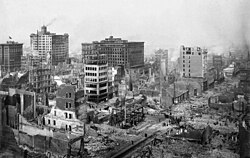
From top to bottom, left to right: The 1906 San Francisco earthquake and fires devastate the city, killing thousands and displacing many more; the Courrières mine disaster in France kills over 1,000 miners, one of Europe’s worst industrial tragedies; the 1906 Atlanta race massacre leaves dozens dead amid racial tensions; the Algeciras Conference attempts to resolve European disputes over Morocco; the Denshawai incident in Egypt sparks nationalist outrage after harsh British reprisals; and the Bambatha Rebellion in Natal sees Zulu resistance crushed by colonial forces.
| Years |
|---|
| Millennium |
| 2nd millennium |
| Centuries |
| Decades |
| Years |
| 1906 by topic |
|---|
| Subject |
| By country |
| Lists of leaders |
| Birth and death categories |
| Establishments and disestablishments categories |
| Works category |
| Gregorian calendar | 1906 MCMVI |
| Ab urbe condita | 2659 |
| Armenian calendar | 1355 ԹՎ ՌՅԾԵ |
| Assyrian calendar | 6656 |
| Baháʼí calendar | 62–63 |
| Balinese saka calendar | 1827–1828 |
| Bengali calendar | 1312–1313 |
| Berber calendar | 2856 |
| British Regnal year | 5 Edw. 7 – 6 Edw. 7 |
| Buddhist calendar | 2450 |
| Burmese calendar | 1268 |
| Byzantine calendar | 7414–7415 |
| Chinese calendar | 乙巳年 (Wood Snake) 4603 or 4396 — to — 丙午年 (Fire Horse) 4604 or 4397 |
| Coptic calendar | 1622–1623 |
| Discordian calendar | 3072 |
| Ethiopian calendar | 1898–1899 |
| Hebrew calendar | 5666–5667 |
| Hindu calendars | |
| - Vikram Samvat | 1962–1963 |
| - Shaka Samvat | 1827–1828 |
| - Kali Yuga | 5006–5007 |
| Holocene calendar | 11906 |
| Igbo calendar | 906–907 |
| Iranian calendar | 1284–1285 |
| Islamic calendar | 1323–1324 |
| Japanese calendar | Meiji 39 (明治39年) |
| Javanese calendar | 1835–1836 |
| Julian calendar | Gregorian minus 13 days |
| Korean calendar | 4239 |
| Minguo calendar | 6 before ROC 民前6年 |
| Nanakshahi calendar | 438 |
| Thai solar calendar | 2448–2449 |
| Tibetan calendar | ཤིང་མོ་སྦྲུལ་ལོ་ (female Wood-Snake) 2032 or 1651 or 879 — to — མེ་ཕོ་རྟ་ལོ་ (male Fire-Horse) 2033 or 1652 or 880 |

Wikimedia Commons has media related to 1906.
1906 (MCMVI) was a common year starting on Monday of the Gregorian calendar and a common year starting on Sunday of the Julian calendar, the 1906th year of the Common Era (CE) and Anno Domini (AD) designations, the 906th year of the 2nd millennium, the 6th year of the 20th century, and the 7th year of the 1900s decade. As of the start of 1906, the Gregorian calendar was 13 days ahead of the Julian calendar, which remained in localized use until 1923.
Events
[edit]January–February
[edit]- January 12 – Persian Constitutional Revolution: A nationalistic coalition of merchants, religious leaders and intellectuals in Persia forces the shah Mozaffar ad-Din Shah Qajar to grant a constitution, and establish a national assembly, the Majlis.
- January 16–April 7 – The Algeciras Conference convenes, to resolve the First Moroccan Crisis between France and Germany.
- January 22 – The SS Valencia strikes a reef off Vancouver Island, Canada, killing over 100 [1](officially 136) in the ensuing disaster.
- January 31 – The Ecuador–Colombia earthquake (8.8 on the Moment magnitude scale), and associated tsunami, cause at least 500 deaths.
- February 7 – HMS Dreadnought is launched, sparking a naval race between Britain and Germany.
- February 11
- Pope Pius X publishes the encyclical Vehementer Nos, denouncing the 1905 French law on the Separation of the Churches and the State.
- Two British members of a poll tax collecting expedition are killed near Richmond, Natal, sparking the Bambatha Rebellion.[2]

March–April
[edit]- March 10 – Courrières mine disaster: An explosion in a coal mine in France kills 1,060.
- March 18 – In France, Romanian inventor Traian Vuia becomes the first person to achieve an unassisted takeoff in a heavier-than-air powered monoplane, but it is incapable of sustained flight.
- April 14 – The Azusa Street Revival, the primary catalyst for the revival of Pentecostalism this century, opens in Los Angeles.
- April 18
- The San Francisco Earthquake (estimated magnitude 7.8) on the San Andreas Fault destroys much of San Francisco, California, killing at least 3,000, with 225,000–300,000 left homeless, and $350 million in damages.
- Xerox, the global digital office machine brand, is founded in Rochester, New York as the Haloid Photographic Company.[3]
- April 23 – In the Russian Empire, the Fundamental Laws are announced at the first state Duma.

May–June
[edit]- May 27
- The first inmates are moved to the Culion leper colony by the American Insular Government of the Philippine Islands.
- Gustav Mahler's Symphony No. 6 receives its premiere at the Saalbau Essen in Germany conducted by the composer.
- May 29 – Karl Staaff steps down as Prime Minister of Sweden over the issue of expanded voting rights. He is replaced by right-wing naval officer and public official Arvid Lindman.
- May 31 – Morral affair: The attempted regicide of Spanish King Alfonso XIII and Queen Victoria Eugenie on their wedding day instead kills 24 bystanders.[4]
- June 7 – Cunard liner RMS Lusitania is launched in Glasgow, as the world's largest ship.
- June 26 – The first autombile racing Grand Prix is the 1906 French Grand Prix held at Le Mans.
July–August
[edit]- July 6 – The Second Geneva Convention meets.
- July 12 – Alfred Dreyfus is exonerated. He is reinstalled in the French Army on July 21, thus ending the Dreyfus affair.
- July 20 – In the Grand Duchy of Finland, a new electoral law is ratified, guaranteeing full women's suffrage, the first in modern Europe.[5] Women can also stand in national elections.
- August 4 – The first Imperial German Navy submarine, U-1, is launched.
- August 16
- 1906 Aleutian Islands earthquake: An earthquake with an estimated magnitude of 8.35 occurs off the Rat Islands in Alaska.
- 1906 Valparaíso earthquake: A magnitude 8.2 earthquake in Valparaíso, Chile leaves approximately 20,000 injured.
- August 23 – Unable to control a rebellion, Cuban President Tomás Estrada Palma requests United States intervention. This leads to the Second Occupation of Cuba, which lasts until 1909.
September–October
[edit]- September 11 – Mahatma Gandhi coins the term Satyagraha, to characterize the nonviolence movement in South Africa.
- September 18 – A typhoon and tsunami kill an estimated 10,000 in Hong Kong.[6]
- September 20 – The RMS Mauretania is launched on the River Tyne, becoming the world's largest ship.
- September 30 – The first Gordon Bennett Cup in ballooning is held, starting in Paris. The winning team, piloting the balloon United States, lands in Fylingdales, Yorkshire, England.
- October 1 – The Grand Duchy of Finland becomes the first nation to include the right of women to stand as candidates when it adopts universal suffrage.
- October 6 – The National Consultative Assembly (Majlis) of Iran convenes for the first time.[7]
- October 11 – A United States diplomatic crisis with Japan arises when the San Francisco public school board orders Japanese students to be taught in racially segregated schools (it is resolved by next year).
- October 16 – Imposter Wilhelm Voigt impersonates a Prussian officer and takes over the city hall in Köpenick for a short time.
- October 23 – An aeroplane of Alberto Santos-Dumont takes off at Bagatelle in France, and flies 60 meters (200 feet). This is the first officially recorded powered flight in Europe.
- October 28 – The Union Minière du Haut Katanga, a mining trust, is created in the Belgian Congo.
November–December
[edit]- November 1 – International Exhibition opens in Christchurch, New Zealand.
- November 3 – SOS becomes adopted internationally as a distress signal (originally for ship-to-shore wireless telegraphy) on inclusion in the service regulations of the first International Radiotelegraph Convention signed in Berlin and coming into effect on 1 July 1908.[8]
- November 18 – The steamboat Dix sinks en route from Seattle to Port Blakely claiming the lives of approximately 50 passengers and crew.
- November 22 – Russian Prime Minister Pyotr Stolypin introduces agrarian reforms, aimed at creating a large class of land-owning peasants.
- December 4 – Alpha Phi Alpha fraternity forms at Cornell University, Ithaca, New York; it is the first Black Greek-lettered collegiate order of its kind.
- December 6 – The Transvaal Colony is granted responsible self-government by Britain.
- December 13 – The United Kingdom, France and Italy sign an agreement to preserve, in Ethiopia, the integrity of the ancient empire of Abyssinia.[9]
- December 15 – The London Underground's Great Northern, Piccadilly and Brompton Railway opens.
- December 22 – The Mw 7.9 1906 Manasi earthquake in Xinjiang, China, kills nearly 300 people.[10]
- December 24 – Reginald Fessenden makes the first radio broadcast: a poetry reading, a violin solo, and a speech, from Brant Rock, Massachusetts.
- December 26 – The world's first feature film, The Story of the Kelly Gang, is first shown, at the Melbourne Athenaeum in Australia.
- December 30 – The All-India Muslim League is founded as a political party in Dhaka in the British Raj; it becomes a driving force for the creation of an independent Pakistan.
Date unknown
[edit]- The BCG vaccine for tuberculosis is first developed.
- Construction begins on the modern-day Great Mosque of Djenné.
- The Simplo Filler Pen Company is founded, later to become the Montblanc Company in Germany.
- HaRishon Le Zion-Yafo Association is officially founded as a sports club in Palestine, predecessor of Maccabi Tel Aviv (Israel).[11]
Births
[edit]January–February
[edit]_-_1967.jpg)


- January 11 – Albert Hofmann, Swiss chemist (d. 2008)
- January 12 – Eric Birley, British historian and archaeologist (d. 1995)
- January 13 – Zhou Youguang, Chinese linguist (d. 2017)
- January 14 – William Bendix, American film, radio and television actor (d. 1964)
- January 15 – Aristotle Onassis, Greek shipping magnate (d. 1975)
- January 16 – Diana Wynyard, English actress (d. 1964)
- January 21 – Igor Moiseyev, Russian choreographer (d. 2007)
- January 22 – Robert E. Howard, American pulp fiction writer (suicide 1936)
- January 28 – Pat O'Callaghan, Irish athlete (d. 1991)
- February 4
- Dietrich Bonhoeffer, German religious, resistance leader (executed 1945)
- Clyde Tombaugh, American astronomer (d. 1997)
- February 5 – John Carradine, American actor (d. 1988)
- February 7
- Oleg Antonov, Soviet aircraft designer (d. 1984)
- Puyi, Last Emperor of China (d. 1967)
- February 8 – Chester Carlson, American physicist, inventor (d. 1968)
- February 10 – Lon Chaney Jr., American actor (d. 1973)
- February 14 – Nazim al-Qudsi, 26th Prime Minister of Syria and 14th President of Syria (d. 1998)
- February 17
- Galo Plaza, 29th President of Ecuador (d. 1987)
- Käte Selbmann, German politician (d. 1962)[12]
- February 18 – Hans Asperger, Austrian pediatrician (d. 1980)
- February 26 – Madeleine Carroll, British actress (d. 1987)
- February 28 – Bugsy Siegel, American gangster (k. 1947)
March–April
[edit]

.jpg)
.JPG)
- March 1
- Phạm Văn Đồng, Prime Minister of Vietnam (d. 2000)
- Abdus Sattar, 8th President of Bangladesh (d. 1985)
- March 6 – Lou Costello, American actor (d. 1959)
- March 13 – Dave Kaye, British pianist (d. 1996)[13][14]
- March 16 – Francisco Ayala, Spanish novelist (d. 2009)
- March 19 – Adolf Eichmann, German war criminal (executed 1962)
- March 20 – Ozzie Nelson, American actor, director and producer (d. 1975)
- March 21 – Jim Thompson, American businessman (disappeared 1967)
- March 25 – A. J. P. Taylor, English historian (d. 1990)
- March 26 – Rafael Méndez, Mexican trumpet player (d. 1981)
- March 31 – Shin'ichirō Tomonaga, Japanese physicist, Nobel Prize laureate (d. 1979)
- April 1 – Alexander Yakovlev, Russian politician, architect of perestroika (d. 1989)
- April 4 – Bea Benaderet, American actress (d. 1968)
- April 5 – Yin Shun, Chinese Buddhist master (d. 2005)
- April 6 – Virginia Hall, American spy with the Special Operations Executive during WWII (d. 1982)
- April 9 – Antal Doráti, Hungarian-born American conductor (d. 1988)
- April 13 – Samuel Beckett, Irish writer, Nobel Prize laureate (d. 1989)
- April 22 – Eddie Albert, American actor and activist (d. 2005)
- April 24 – William Joyce, Irish-American World War II Nazi propaganda broadcaster ("Lord Haw-Haw") (executed 1946)
- April 25
- Joel Brand, Hungarian rescue worker (d. 1964)
- William J. Brennan Jr., Associate Justice of the Supreme Court of the United States (d. 1997)
- A. W. Haydon, American inventor (d. 1982)
- April 28
- Tony Accardo, American gangster (d. 1992)
- Kurt Gödel, Austrian logician, mathematician, and philosopher of mathematics (d. 1978)
- April 29 – Pedro Vargas, Mexican singer and actor (d. 1989)[15]
May–June
[edit]


- May 3 – Mary Astor, American actress and writer (d. 1987)
- May 6 – André Weil, French mathematician (d. 1998)
- May 8 – Roberto Rossellini, Italian director (d. 1977)
- May 11
- Jacqueline Cochran, American aviator (d. 1980)
- Richard Arvin Overton, oldest living man in the United States and oldest surviving American veteran (World War II) (d. 2018)
- May 15 – Humberto Delgado, Portuguese general, politician (d. 1965)
- May 16 – Arturo Uslar Pietri, Venezuelan writer (d. 2001)
- May 19
- Bruce Bennett, American athlete, actor (d. 2007)
- Jimmy MacDonald, Scottish-American sound effects artist, voice actor (d. 1991)
- May 20 – Giuseppe Siri, Italian Roman Catholic cardinal (d. 1989)
- May 27 – Ajahn Buddhadasa, Thai Buddhist monk (d. 1993)
- May 29 – T. H. White, British writer (d. 1964)
- June 3 – Josephine Baker, American-born French entertainer (d. 1975)
- June 6 – Max August Zorn, German-born American mathematician (d. 1993)
- June 15 – Léon Degrelle, Belgian fascist (d. 1994)
- June 17 – James H. Flatley, American admiral, aviator (d. 1958)
- June 19 – Sir Ernst Chain, German-born British biochemist, Nobel Prize laureate (d. 1979)
- June 22
- Anne Morrow Lindbergh, American author, aviator (d. 2001)
- Billy Wilder, Austrian-born American screenwriter, film director and producer (d. 2002)
- June 24 – Pierre Fournier, French cellist (d. 1986)
- June 26
- Viktor Schreckengost, American industrial designer, teacher, sculptor and artist (d. 2008)
- M. P. Sivagnanam, Indian politician (d. 1995)
- June 27 – Catherine Cookson, English author (d. 1998)
- June 28 – Maria Goeppert Mayer, German physicist, Nobel Prize laureate (d. 1972)[16]
July–August
[edit]


.jpg)

- July 1
- Jean Dieudonné, French mathematician, academic (d. 1992)
- Estée Lauder, American cosmetics entrepreneur (d. 2004)
- Ivan Neill, British Army officer and Irish Unionist politician (d. 2001)
- July 2
- Hans Bethe, German-born American physicist, Nobel Prize laureate (d. 2005)
- Károly Kárpáti, Hungarian Jewish wrestler (d. 1996)
- July 3
- Alberto Lleras Camargo, Colombian politician, 20th President of Colombia (d. 1990)
- George Sanders, Russian-born British actor (d. 1972)
- July 4 – Vincent Schaefer, American chemist, meteorologist (d. 1993)
- July 7
- Helene Johnson, African-American poet (d. 1995)
- Satchel Paige, American baseball player (d. 1982)
- July 8 – Philip Johnson, American architect (d. 2005)
- July 9 – Roy Leaper, Australian rules footballer (d. 2002)
- July 10 – Ad Liska, American baseball pitcher (d. 1998)
- July 11 – Herbert Wehner, German politician (d. 1990)
- July 12 – Pietro Tordi, Italian actor (d. 1990)
- July 14 – Stan Devenish Meares, Australian obstetrician, gynaecologist (d. 1994)
- July 16
- Ichimaru, Japanese singer (d. 1997)
- Vincent Sherman, American director, actor (d. 2006)
- James Still, American poet, novelist and folklorist (d. 2001)
- July 17
- Leonila Garcia, 8th First Lady of the Philippines (d. 1994)
- Dunc Gray, Australian track cyclist (d. 1996)
- July 18
- Sidney Darlington, American engineer (d. 1997)
- S. I. Hayakawa, Canadian-born American academic, politician (d. 1992)
- Speed Webb, American jazz drummer, territory band leader (d. 1994)
- July 21 – Caroline Smith, American diver (d. 1994)
- July 23 – Vladimir Prelog, Croatian chemist, Nobel Prize laureate (d. 1998)
- August 5
- Joan Hickson, British actress (d. 1998)
- John Huston, American film director, screenwriter, and actor (d. 1987)
- Wassily Leontief, Russian economist, Nobel Prize laureate (d. 1999)
- August 5 – Marie-José of Belgium, last Queen of Italy (d. 2001)[17]
- August 14 – Horst P. Horst, German photographer (d. 1999)
- August 17 – Marcelo Caetano, Prime Minister of Portugal (d. 1980)
- August 19 – Philo Farnsworth, American inventor (d. 1971)
- August 23 – Zoltan Sarosy, Canadian chess master (d. 2017)
- August 26 – Albert Sabin, Polish-American medical researcher (d. 1993)
- August 27 – Ed Gein, American serial killer (d. 1984)
- August 28 – John Betjeman, English poet (d. 1984)
- August 30 – Joan Blondell, American actress (d. 1979)
September
[edit]

- September 1
- Joaquín Balaguer, 41st, 45th, & 49th President of the Dominican Republic, writer (d. 2002)
- Franz Biebl, German composer (d. 2001)
- Eleanor Burford, English writer (d. 1993)
- September 2 – Barbara Jo Allen, American actress (d. 1974)
- September 4 – Max Delbrück, German biologist, Nobel Prize laureate (d. 1981)
- September 5
- Ralston Crawford, American abstract painter, lithographer, and photographer (d. 1978)
- Sunnyland Slim, American blues pianist (d. 1995)
- September 6 – Luis Federico Leloir, French-born Argentine chemist, Nobel Prize laureate (d. 1987)
- September 8 – Andrei Kirilenko, Soviet politician (d. 1990)
- September 12 – Lee Erwin, American television writer (d. 1972)
- September 17 – J. R. Jayewardene, President of Sri Lanka (d. 1996)
- September 26
- José Figueres Ferrer, 32nd, 34th, & 38th President of Costa Rica (d. 1990)
- Dmitri Shostakovich, Russian composer (d. 1975)
- September 27 – William Empson, English poet, critic (d. 1984)
October
[edit]_(cropped).JPG)

- October 6 – Janet Gaynor, American Academy Award-winning actress (d. 1984)
- October 9
- Georges Marie Anne, politician (d. 2001)[18]
- Léopold Sédar Senghor, 1st President of Senegal (d. 2001)
- October 10 – Rasipuram Krishnaswamy Narayan, Indian novelist (d. 2001)
- October 14
- Imam Hassan al-Banna, Egyptian founder of the Muslim Brotherhood (d. 1949)
- Hannah Arendt, German political theorist (d. 1975)[19]
- October 19 – Bandō Mitsugorō VIII, Japanese actor (d. 1975)
- October 23 – Gertrude Ederle, American swimmer (d. 2003)
- October 24 – Marie-Louise von Motesiczky, Austrian painter (d. 1996)
- October 26 – Primo Carnera, Italian boxer (d. 1967)
- October 27 – Kazuo Ohno, Japanese dancer (d. 2010)
- October 29 – Fredric Brown, American writer (d. 1972)
November–December
[edit]


- November 2
- Ferit Melen, 14th Prime Minister of Turkey (d. 1988)
- Luchino Visconti, Italian theatre, cinema director, writer (d. 1976)
- November 4 – Willie Love, American Delta blues pianist (d. 1953)
- November 5
- Philip Roberts, British general (d. 1997)
- Fred Lawrence Whipple, American astronomer (d. 2004)
- November 9 – Arthur Rudolph, German rocket engineer (d. 1996)
- November 10 – Josef Kramer, German Nazi concentration camp commandant (d. 1945)
- November 13
- Wanrong, last Empress of China (d. 1946)
- Hermione Baddeley, English character actress (d. 1986)
- Eugenio Mendoza, Venezuelan business tycoon (d. 1979)
- November 14
- Albrecht Becker, German production designer, photographer, and actor (d. 2002)
- Louise Brooks, American actress (d. 1985)
- November 15 – Curtis LeMay, United States Air Force general, vice-presidential candidate (d. 1990)
- November 16 – Henri Charrière, French author (d. 1973)
- November 17
- Betty Bronson, American actress (d. 1979)
- Soichiro Honda, Japanese industrialist (d. 1991)
- November 18
- Alec Issigonis, Greek-born British automobile designer (d. 1988)
- Klaus Mann, German writer (d. 1949)
- George Wald, American scientist, Nobel Prize laureate (d. 1997)
- November 19 – Patriarch Paul II Cheikho (b. 1989)
- November 22 – Jørgen Juve, Norwegian football player and journalist (d. 1983)
- November 24 – Don MacLaughlin, American actor (d. 1986)
- December 2
- Peter Carl Goldmark, Hungarian-born American engineer (d. 1977)
- Franz Reichleitner, Austrian SS officer and Nazi concentration camp commandant (d. 1944)
- Donald Woods, Canadian-American film, television actor (d. 1998)
- December 5 – Ahn Eak-tai, Korean composer (d. 1965)
- December 9 – Grace Hopper, American computer scientist, naval officer (d. 1992)
- December 13
- Princess Marina of Greece and Denmark (d. 1968)
- Laurens van der Post, South African author, journalist (d. 1996)
- December 19 – Leonid Brezhnev, Soviet leader (d. 1982)
- December 24 – James Hadley Chase, English writer (d. 1985)
- December 25 – Ernst Ruska, German physicist, Nobel Prize laureate (d. 1988)[20]
- December 26 – Imperio Argentina, Argentinian singer, actress (d. 2003)
- December 27 – Oscar Levant, American pianist, composer, author, comedian, and actor (d. 1972)
- December 30
- Alziro Bergonzo, Italian architect, painter (d. 1997)
- Carol Reed, English film director (d. 1976)
Date Unknown
[edit]- Abdul Aziz Khan Kaka, Pashtun Anti-Colonial Politician who defeated the Imperial Crown's Political Agent, Sir Sahibzada Abdul Qayyum Khan in the elections of 1936 (d. 1987)
Deaths
[edit]January–June
[edit]


- January 1 – Todor Ivanchov, 11th Prime Minister of Bulgaria (b. 1858)
- January 13 – Alexander Stepanovich Popov, Russian physicist (b. 1859)[21]
- January 18 – Sir William Forbes Gatacre, British general (b. 1843)
- January 19 – Bartolomé Mitre, Argentine statesman, military figure and author, 6th President of Argentina (b. 1821)
- January 20 – Maria Cristina of the Immaculate Conception Brando, Italian Roman Catholic nun, saint (b. 1856)
- January 25 – Joseph Wheeler, American general, politician (b. 1836)
- January 29 – King Christian IX of Denmark (b. 1818)
- February 8 – Giuseppina Gabriella Bonino, Italian Roman Catholic religious professed (b. 1843)
- February 9 – Paul Laurence Dunbar, American poet and publisher (b. 1872)[22]
- February 13 – Albert Gottschalk, Danish painter (b. 1866)
- February 18 – John B. Stetson, American hat maker (b. 1830)
- February 26 – Jean Lanfray, Swiss convicted murderer (b. 1874)[23]
- February 27 – Samuel Langley, American astronomer, physicist, and aeronautics pioneer (b. 1834)[24]
- March 1 – José María de Pereda, Spanish writer (b. 1833)
- March 4 – John Schofield, American general (b. 1831)
- March 8 – Henry Baker Tristram, English clergyman, ornithologist (b. 1822)
- March 12 – Manuel Quintana, 15th President of Argentina (b. 1835)
- March 13
- Susan B. Anthony, American civil rights, women's suffrage activist (b. 1820)
- Joseph Monier, French gardener, inventor (b. 1823)
- March 17 – Johann Most, German-American anarchist (b. 1846)[25]
- March 19 – Victor Fatio, Swiss zoologist (b. 1838)
- March 20 – Adeline Dutton Train Whitney, American author of juvenile literature for girls (b. 1824)
- March 23 – Thomas Lake Harris, American poet (b. 1823)
- March 29
- Slava Raškaj, Croatian painter (b. 1877)
- Albert Sorel, French historian (b. 1842)
- April 6 – Alexander Kielland, Norwegian author (b. 1849)
- April 19
- Pierre Curie, French physicist, Nobel Prize laureate (b. 1859)
- Spencer Gore, British tennis player, cricketer (b. 1850)
- April 25 – John Knowles Paine, American composer (b. 1839)
- May 10 – Hashim Jalilul Alam Aqamaddin, Sultan of Brunei (b. 1825)
- May 14 – Carl Schurz, German revolutionary, American statesman (b. 1829)[26]
- May 23 – Henrik Ibsen, Norwegian playwright (b. 1828)
- June 5 – Eduard von Hartmann, German philosopher (b. 1842)[27]
- June 10 – Richard Seddon, 15th Prime Minister of New Zealand (b. 1845)
- June 17 – Harry Nelson Pillsbury, American chess champion (b. 1872)
- June 25 – Stanford White, American architect (b. 1853)
July–December
[edit]


- July 1 – Manuel García, Spanish opera singer, music educator and vocal pedagogue (b. 1805)
- July 11 – Grace Brown, American murder/and or drowning victim (b. 1886)
- July 17 – Carlos Pellegrini, 11th President of Argentina (b. 1846)
- August 6 – George Waterhouse, 7th Prime Minister of New Zealand (b. 1824)
- August 14 – Aniceto Arce, 27th President of Bolivia (b. 1824)
- August 19 – Ezequiél Moreno y Díaz, Colombian Roman Catholic priest, saint (b. 1848)
- September 1 – Giuseppe Giacosa, Italian poet, librettist (b. 1847)
- September 5 – Ludwig Boltzmann, Austrian physicist (b. 1854)
- September 13 – Emily Pitts Stevens, American school founder (b. 1841)
- September 23 – August Bondeson, Swedish author (b. 1844)
- October 9 – Adelaide Ristori, Italian actress (b. 1822)
- October 16 – Varina Davis, First Lady of the Confederate States of America (b. 1826)
- October 19
- Arthur von Mohrenheim, Russian diplomat (b. 1824)
- Charles Pfizer, German-American chemist, co-founder of Pfizer (b. 1824)
- October 22 – Paul Cézanne, French painter (b. 1839)[28]
- October 23 – Vladimir Stasov, Russian music critic (b. 1824)
- October 30 – Gathorne Gathorne-Hardy, 1st Earl of Cranbrook, British politician (b. 1814)
- November 1 – Archduke Otto of Austria (b. 1865)
- November 7 – Todor Burmov, 1st Prime Minister of Bulgaria (b. 1834)
- November 9 – Saint Elizabeth of the Trinity, French Discalced Carmelite religious professed and saint (b. 1880)
- November 12 – William Rufus Shafter, American general (b. 1835)
- November 16 – Mother Veronica of the Passion, Ottoman-born religious leader (b. 1823)
- November 19, – Georgia Cayvan, American stage actress (b. 1857)
- November 28 – Jennie Yeamans, Australian-born American actress (b. 1862)
- November 30
- Sir Edward Reed, British naval architect, author, politician, and railroad magnate (b. 1830)
- John Ward (geologist), English palaeontologist (b. 1837)
- December 7 – Élie Ducommun, Swiss journalist and activist, Nobel Prize laureate (b. 1833)
- December 8 – Sylvia Gerrish, American musical theatre star (b. 1860)
- December 13 – Jan Gerard Palm, Dutch composer (b. 1831)
- December 21 – Rajendrasuri, Indian religious reformer (b. 1827)
- December 30 – Josephine Butler, British feminist, social reformer (b. 1828)
Nobel Prizes
[edit]
References
[edit]- ^ Nowakowski, Teresa. "More Than 100 Died When the S.S. Valencia Wrecked in the 'Graveyard of the Pacific'—Learn Why This Stretch of Coastline Has Claimed Thousands of Ships". Smithsonian Magazine. Retrieved September 15, 2025.
- ^ Stuart, J. (1913). History of the Zulu Rebellion 1906. London: Macmillan and Co.
- ^ Online Fact Book: Xerox at a Glance Archived August 5, 2009, at the Wayback Machine, xerox.com. Article retrieved December 13, 2006.
- ^ Avrich, Paul (1980). "The Martyrdom of Ferrer". The Modern School Movement: Anarchism and Education in the United States. Princeton: Princeton University Press. pp. 27–28. ISBN 0-691-04669-7. OCLC 489692159. Retrieved April 17, 2018.
- ^ If the limited rights in the Isle of Man are disregarded. Kananen, Anitta (March 2006). "Suomi valitsi maailman ensimmäiset naiskansanedustajat" (in Finnish). University of Jyväskylä. Archived from the original on December 3, 2013. Retrieved July 15, 2021.
- ^ "Hongkong Typhoon". Auckland Star. Vol. 37, no. 244. New Zealand. October 19, 1906. p. 5. Archived from the original on December 30, 2017. Retrieved December 30, 2017.
Over 1,000 bodies are recovered, but cabled statements are verified that the number of lives lost totalled about 10,000.
Retrieved via Papers Past. - ^ "Some Notes on the Early Minutes of the Iranian Parliament" (PDF).
- ^ "Article XVI", Service Regulations annexed to the International Radiotelegraphic Convention, Berlin, p. 34, November 3, 1906, archived from the original on November 29, 2023, retrieved October 3, 2023.
- ^ "Tripartite Agreement Regarding the Preservation of the Integrity of Ethiopia (December 13, 1906)". Foreign Relations of the United States. U.S. Department of State. Retrieved September 10, 2025.
- ^ "China: Xinjiang Province". NGDC NCEI. NCEI. Archived from the original on May 7, 2021. Retrieved March 17, 2021.
- ^ "About the club - Maccabi Tel Aviv Football Club". Maccabi Tel Aviv Football Club. Archived from the original on June 12, 2018. Retrieved June 12, 2018.
- ^ Herbst, Andreas (2009). "Selbmann, Käte". Who Was Who in the GDR? (in German). Berlin: Ch. Links Verlag. Retrieved April 12, 2024 – via Bundesstiftung Aufarbeitung.
- ^ England & Wales, Civil Registration Death Index, 1916-2007 [database on-line]. London, England: General Register Office.
- ^ "Notice" (PDF). The London Gazette. July 5, 1940. p. 4137. Archived (PDF) from the original on February 3, 2022. Retrieved February 2, 2022.
- ^ "Pedro Vargas", Last.fm (in Spanish), archived from the original on April 6, 2023, retrieved August 24, 2019
- ^ "The Nobel Prize in Physics 1963". NobelPrize.org. Archived from the original on June 20, 2023. Retrieved April 9, 2022.
- ^ Cope, Rebecca. "The extraordinary life of the beautiful, and radical, last Queen of Italy". Tatler. Archived from the original on March 28, 2023. Retrieved August 17, 2020.
- ^ "Anciens sénateurs Vème République : MARIE ANNE Georges". www.senat.fr. August 13, 2023. Archived from the original on October 16, 2022. Retrieved October 16, 2022.
- ^ Honderich, Ted, ed. (2005). "Arendt, Hannah (1906–1975)". The Oxford Companion to Philosophy. OUP. p. 149. ISBN 978-0-19-103747-4.
- ^ Hawkes, Peter W. (July 1, 1990). "Ernst Ruska". Physics Today. 43 (7): 84–85. Bibcode:1990PhT....43g..84H. doi:10.1063/1.2810640. ISSN 0031-9228.
- ^ "Aleksandr Popov - Engineering and Technology History Wiki". ethw.org. January 13, 2016. Archived from the original on February 27, 2021. Retrieved February 18, 2021.
- ^ "Paul Laurence Dunbar". Poetry Foundation. November 7, 2022. Archived from the original on April 2, 2016. Retrieved November 26, 2021.
- ^ Conrad, Barnaby (February 1, 1997). Absinthe: History in a Bottle. Chronicle Books. pp. g. 4. ISBN 0-8118-1650-8.
- ^ Biographical Index of Former Fellows of the Royal Society of Edinburgh 1783–2002 (PDF). The Royal Society of Edinburgh. July 2006. ISBN 0-902-198-84-X. Archived from the original (PDF) on March 4, 2016. Retrieved April 26, 2022.
- ^ A. T. Lane (1995). Biographical Dictionary of European Labor Leaders. Greenwood Press. p. 674. ISBN 9780313299001.
- ^ Helge Dvorak (2002). "Schurz, Carl Christian". Biographisches Lexikon der Deutschen Burschenschaft (in German). Vol. Band I: Politiker Teilband 5: R-S. Heidelberg: Universitätsverlag C. Winter. pp. 372–376. ISBN 3-8253-1256-9.
- ^ One or more of the preceding sentences incorporates text from a publication now in the public domain: Chisholm, Hugh, ed. (1911). "Hartmann, Karl Robert Eduard von". Encyclopædia Britannica (11th ed.). Cambridge University Press.
- ^ "Paul Cézanne | French artist | Britannica". www.britannica.com. Archived from the original on August 17, 2018. Retrieved May 14, 2023.

Sources
[edit]- The Annual Register of World Events: A Review of the Year: 1906. Longmans, Green. 1907., comprehensive guide to political events worldwide; emphasis on Britain
Further reading
[edit]- Gilbert, Martin. A History of the Twentieth Century: Volume 1 1900-1933 (1997); global coverage of politics, diplomacy and warfare; pp 123 – 42.
- Hazell's Annual for 1907 (1907), worldwide events of 1906; 734pp online
from Grokipedia
1906 (MCMVI) was a common year starting on Monday of the Gregorian calendar, featuring catastrophic disasters, pivotal international diplomacy, and key scientific insights that underscored human vulnerability and ingenuity.[1]
The April 18 San Francisco earthquake, with a magnitude of 7.9 on the San Andreas Fault, triggered fires that razed over 80% of the city, resulting in an estimated 3,000 deaths and rendering 225,000 people homeless.[2][3]
Earlier, on March 10, the Courrières mine disaster in northern France, Europe's deadliest mining accident, claimed 1,099 lives through a coal dust explosion and fire, exposing hazardous working conditions in industrial operations.[4]
Diplomatically, the Algeciras Conference from January to April resolved the First Moroccan Crisis by affirming French economic predominance in Morocco while granting Germany and other powers open trade access, averting broader European conflict through multilateral negotiation.[5]
In the United States, President Theodore Roosevelt signed the Pure Food and Drug Act and Meat Inspection Act in June, establishing federal oversight to combat adulterated products following public outcry over Upton Sinclair's The Jungle.[6]
Scientifically, seismologist Richard Oldham provided evidence for an inner Earth core, while Frederick Gowland Hopkins advanced the concept of accessory food factors (later vitamins) essential for health, laying groundwork for nutritional science.[7]
Lee De Forest's invention of the Audion vacuum tube revolutionized electronics by enabling signal amplification, paving the way for radio broadcasting, which saw its first entertainment transmission on December 24.
These contributions advanced empirical understanding: Thomson's electron discovery shifted physics from classical atomic models to subatomic particles, verified through subsequent experiments like Millikan's oil drop; Moissan's isolation resolved a long-standing chemical challenge, with fluorine's properties confirmed by spectroscopic analysis; Golgi and Cajal's neuron insights, despite initial rivalry over reticular theory, enabled modern neuroscience, as evidenced by later electron microscopy confirming synaptic gaps; Carducci's literature emphasized rigorous scholarship over sentiment; Roosevelt's diplomacy pragmatically halted conflict, though critics noted his expansionist policies elsewhere.[86][45][46]
Events
January–February
On January 16, the Algeciras Conference opened in Spain, involving representatives from 13 nations including the United States, Britain, France, Germany, and others to resolve tensions from Germany's challenge to French influence in Morocco during the First Moroccan Crisis; the conference continued until April 7, ultimately affirming French predominance in Moroccan affairs while establishing international police control.[8] In the ongoing Persian Constitutional Revolution against Qajar autocracy, protesters who had sought sanctuary in Tehran mosques since December 1905 emerged victorious in early January after the shah agreed to dismiss his prime minister and convene a "house of justice" as a consultative assembly, a concession that advanced demands for constitutional limits on royal power and foreshadowed the Majlis's formation later in the year.[9] The United Kingdom's general election unfolded from January 12 to February 8, yielding a landslide victory for the Liberal Party with 397 seats amid campaigns emphasizing free trade and social reforms, while the Labour Representation Committee secured 29 seats, solidifying its transition into the Labour Party and establishing it as a distinct third force in Parliament.[10] On February 9, colonial authorities in the Natal Colony (modern South Africa) declared a state of siege in response to the Bambatha Rebellion, an armed Zulu uprising led by chieftain Bambatha kaMancinza against a new poll tax and land restrictions, which escalated into guerrilla warfare involving thousands and resulted in over 4,000 rebel deaths by year's end.[11] The Royal Navy launched HMS Dreadnought on February 10 from Portsmouth, a battleship completed in under 18 months with ten 12-inch guns in five twin turrets, steam turbine engines enabling 21 knots, and revolutionary "all-big-gun" design that obsoleted mixed-caliber predreadnoughts, spurring an international naval arms race as other powers rushed to match its capabilities.[12] Upton Sinclair's novel The Jungle, serialized earlier in a socialist newspaper, appeared in book form on February 26, graphically detailing immigrant exploitation and filthy conditions in Chicago's meatpacking plants, which galvanized public revulsion and directly influenced President Theodore Roosevelt to push for federal legislation culminating in the Pure Food and Drug Act and Federal Meat Inspection Act signed in June.March–April
On March 10, a catastrophic explosion and fire erupted in the Courrières coal mine near Lens in northern France, killing 1,099 miners and injuring hundreds more, in what remains Europe's deadliest mining disaster.[13] The incident began around 6:30 a.m. when a fire, likely ignited by coal dust accumulation and poor ventilation, triggered a massive methane-fueled blast that collapsed tunnels and blocked escape routes across the mine's extensive network.[14] Rescue efforts recovered only 27 survivors after prolonged entrapment, with operations hampered by unstable structures and toxic gases; the event exposed systemic safety lapses, including inadequate dust control and emergency protocols, prompting widespread strikes by French miners and influencing subsequent labor agitation against company practices.[15] The period's most devastating natural event occurred on April 18, when a magnitude 7.9 earthquake struck off the northern California coast near San Francisco at 5:12 a.m. local time, rupturing about 477 kilometers of the San Andreas Fault from San Juan Bautista to Cape Mendocino.[2][16] Intense shaking persisted for 45 to 60 seconds, collapsing buildings, snapping water mains, and igniting fires from ruptured gas lines and overturned stoves; the blazes, exacerbated by failed firefighting efforts due to broken infrastructure, raged uncontrolled for three days, ultimately destroying over 28,000 structures and rendering 80% of the city uninhabitable.[17] Official death tolls recorded around 700 fatalities, though contemporary estimates based on missing persons and unreported bodies place the figure nearer 3,000, with property damage exceeding $400 million (equivalent to billions today) and displacing nearly 300,000 of San Francisco's 400,000 residents into refugee camps.[3] The quake's effects extended to southern Oregon and Los Angeles, underscoring the region's seismic vulnerability and accelerating advancements in earthquake-resistant building codes and fault mapping in subsequent decades.[2]May–June
On May 10, the First State Duma of the Russian Empire convened in the Tauride Palace in Saint Petersburg, marking the inaugural session of Russia's first elected parliamentary assembly following the October Manifesto of 1905. Tsar Nicholas II addressed the deputies, affirming the Duma's consultative role under the Fundamental Laws, which granted limited legislative powers while preserving autocratic authority. Composed primarily of liberal Kadets and socialists, the assembly quickly clashed with the government over agrarian reforms and civil liberties, leading to contentious debates but no substantive concessions.[18] The eruption of Mount Vesuvius, which began in late March, intensified in early April and continued to pose threats through May, with lava flows destroying villages such as San Sebastiano al Vesuvio and causing over 100 fatalities. The paroxysmal phase on April 5-7 ejected massive volumes of ash and lava, burying agricultural lands and prompting evacuations around Naples; seismic activity and pyroclastic flows persisted into May, exacerbating economic hardship in the region. Observations by volcanologists, including Racioppi, documented the cone's partial destruction, highlighting the eruption's scale as one of Vesuvius's most voluminous since 1631.[19] Recovery efforts in San Francisco from the April 18 earthquake and ensuing fires accelerated in May and June, with the U.S. Army establishing refugee camps housing up to 250,000 displaced residents amid ongoing aftershocks and sanitation challenges. Federal aid, coordinated by President Roosevelt, facilitated water supply restoration and debris clearance, though property losses exceeded $400 million; by late June, temporary structures emerged, and urban planning debates emphasized fire-resistant rebuilding. Approximately 498 deaths were confirmed in the city, with total casualties estimated at 700-800, underscoring the disaster's enduring impact.[2] On June 13, the Denshawai incident unfolded in Egypt's Nile Delta when five British officers hunting pigeons clashed with local villagers, resulting in the death of one officer from heatstroke and a villager from buckshot. British authorities conducted a swift trial, imposing severe sentences including four executions and floggings on 52 defendants, which critics like Lord Cromer decried as disproportionate. The event galvanized Egyptian nationalists, including Mustafa Kamil, amplifying calls for independence and exposing tensions in British colonial administration.[20] The inaugural Grand Prix motor race, organized by the Automobile Club de France, occurred on June 26-27 near Le Mans over a 103-kilometer circuit, featuring 32 entrants from manufacturers like Renault and Fiat. Hungarian driver Ferenc Szisz secured victory for Renault after 12 laps totaling 1,238 kilometers, averaging 84 kilometers per hour, in a contest that emphasized endurance and strategy amid mechanical failures. This event established the Grand Prix formula, influencing international motorsport standards.[21] On June 30, President Theodore Roosevelt signed the Pure Food and Drug Act and the Federal Meat Inspection Act, prohibiting interstate commerce of adulterated or mislabeled food and drugs, with enforcement by the Bureau of Chemistry. Prompted by Upton Sinclair's The Jungle exposing Chicago meatpacking insanitary conditions, the laws mandated accurate labeling and inspections, reducing public health risks from contaminated products like preserved meats containing borax. These measures laid foundational regulatory frameworks, later evolving into FDA oversight.[22]July–August
On July 6, the international conference in Geneva concluded with the adoption of a revised convention for the amelioration of the condition of the wounded and sick in armies in the field, updating the 1864 agreement to incorporate advances in medical practices and expand protections during land warfare.[23] This revision emphasized humane treatment, neutrality of medical personnel, and safeguards against mistreatment of the injured.[24] Alfred Dreyfus, the French army captain wrongfully convicted of treason in 1894 amid antisemitic prejudice, received full exoneration on July 12 when France's Court of Cassation annulled his prior conviction, citing fabricated evidence and judicial errors exposed by years of investigation and public advocacy.[25] He was reinstated as a major and decorated with the Legion of Honor, marking the resolution of the Dreyfus Affair, which had divided French society over issues of justice, military integrity, and religious bias.[26] In the Grand Duchy of Finland, Tsar Nicholas II promulgated a new electoral law on July 20, establishing universal suffrage for all citizens over age 24, including women, and replacing the four-estate diet with a unicameral parliament of 200 members elected by proportional representation.[27] This reform, driven by Finnish autonomy movements amid Russian imperial pressures, positioned Finland as the first European jurisdiction to grant women full voting rights alongside men.[28] Russia's First State Duma, convened in April as a concession to revolutionary unrest following the 1905 uprisings, was dissolved by imperial decree on July 21 after just 72 days, as its demands for land reform and civil liberties clashed with Tsar Nicholas II's autocratic stance.[29] The dissolution triggered the Vyborg Manifesto by dissenting deputies, calling for passive resistance, but led to arrests and martial law enforcement, intensifying suppression of opposition.[30] Tensions escalated in Brownsville, Texas, on the night of August 13–14, when gunfire erupted near Fort Brown, killing a white bartender and wounding a police officer; local residents blamed soldiers of the all-Black 25th Infantry Regiment, prompting President Theodore Roosevelt to order the dishonorable discharge of 167 troops without trial, based on their refusal to identify culprits amid racial animosities.[31] The incident highlighted entrenched prejudices against Black servicemen, though later investigations in 1972 revealed insufficient evidence of their involvement.[32] An 8.2-magnitude earthquake struck offshore near Valparaíso, Chile, on August 16 at 19:55 local time, leveling much of the city and igniting fires that destroyed wooden structures, resulting in approximately 3,800 deaths and widespread devastation across central Chile.[33] The disaster prompted international relief efforts and accelerated urban rebuilding with seismic-resistant designs.[34] The Victor Talking Machine Company began manufacturing the first Victrola phonograph on August 22 in Camden, New Jersey, introducing an internal-horn cabinet model (VV-XVI) that concealed the acoustic horn, making it suitable for home use and boosting popularity of recorded music. Priced at $200, it featured a hand-crank mechanism and played 10-inch discs, revolutionizing consumer access to phonographs previously limited by external horns.[35]September–October
September 11: Mahatma Gandhi, leading Indian immigrants in South Africa, coined the term "Satyagraha" at a mass meeting in Johannesburg's Empire Theatre to signify a commitment to non-violent civil disobedience against the Transvaal government's proposed registration laws discriminating against Asians. Approximately 3,000 attendees pledged resistance, marking the formal start of organized passive resistance campaigns that challenged racial segregation policies.[36][37] September 18: A powerful typhoon struck Hong Kong, generating winds up to 77 miles per hour and a associated tsunami that devastated the harbor and coastal areas, sinking over 2,400 Chinese vessels and 141 European ships while killing an estimated 10,000 people, primarily fishermen and laborers at sea. The disaster caused property damage exceeding one million pounds sterling and disrupted international trade, highlighting vulnerabilities in the colony's infrastructure.[38][39] September 22–24: The Atlanta race riot erupted after local newspapers reported unsubstantiated assaults by Black men on white women, inciting white mobs of up to 5,000 to attack Black neighborhoods, resulting in at least 25 Black deaths, hundreds injured, and widespread property destruction including businesses and homes in areas like Brownsville and Darktown. The violence, fueled by political tensions ahead of gubernatorial elections and sensationalist reporting, led to martial law imposition by state militia, with official counts understating Black casualties due to bodies disposed in the Chattahoochee River.[40][41] October 2: An 8.2 magnitude earthquake struck Valparaíso, Chile, leveling much of the port city, triggering fires, and causing tsunamis that amplified destruction along the coast, with death toll estimates ranging from 2,000 to over 20,000 amid collapsed buildings and disrupted water supplies. The event, one of the most destructive in Chilean history, prompted international aid and accelerated urban rebuilding efforts under government oversight.[42]November–December
On November 8, 1906, U.S. President Theodore Roosevelt departed for Panama, marking the first official foreign trip by a sitting American president; he arrived on November 14 to inspect construction progress on the Panama Canal, emphasizing American engineering feats and issuing warnings against local unrest during his 17-day visit that also included Puerto Rico.[43] In December 1906, the Nobel Prizes were awarded in Stockholm and Oslo, with Theodore Roosevelt receiving the Peace Prize on December 10 for mediating the 1905 Treaty of Portsmouth that ended the Russo-Japanese War, making him the first American laureate in any category and highlighting U.S. diplomatic influence in Asia.[44] Other recipients included French chemist Henri Moissan for isolating fluorine and advancing electrochemistry, and Italian scientists Camillo Golgi and Santiago Ramón y Cajal for discoveries on the nervous system's structure.[45][46] On December 24, 1906, Canadian-American inventor Reginald Fessenden achieved the first long-distance amplitude-modulated radio transmission of human voice and music from his Brant Rock, Massachusetts station, broadcasting a violin rendition of "O Holy Night," a Bible passage, and greetings to receivers as far as Norfolk, Virginia, demonstrating practical wireless telephony over Morse code-only systems.[47] The All-India Muslim League was founded on December 30, 1906, in Dhaka (then Dacca) during the annual All-India Muhammadan Educational Conference, established by Muslim elites including Aga Khan III to advocate for political representation, separate electorates, and safeguards against Hindu-majority dominance in British India's emerging self-governance structures.[48]Scientific Discoveries and Technological Advances
Key Discoveries
In 1906, British seismologist Richard Dixon Oldham published findings from analysis of earthquake seismic waves, providing the first clear evidence for the existence of a dense central core within Earth, distinct from the mantle, based on variations in P-wave and S-wave propagation speeds at depth.[49] His observations, drawn from global teleseismic data including events preceding the April San Francisco earthquake, revealed a shadow zone where S-waves were absent, indicating a liquid outer core incapable of shear wave transmission, a foundational insight into planetary interior structure.[50] German physical chemist Walther Nernst formulated the heat theorem, later recognized as the third law of thermodynamics, stating that as temperature approaches absolute zero, the entropy of a perfect crystal approaches a minimum value, enabling precise calculation of chemical equilibrium constants at low temperatures from heat capacity measurements.[51] This principle, derived from experimental studies on specific heats and published in 1906, resolved discrepancies in low-temperature thermodynamics and laid groundwork for quantum statistical mechanics, earning Nernst the 1920 Nobel Prize in Chemistry for related advancements.[52] On November 3, 1906, German psychiatrist and neuropathologist Alois Alzheimer presented a case study at the 37th Meeting of Southwest German Psychiatrists in Tübingen, describing a 55-year-old patient, Auguste Deter, with progressive memory loss, paranoia, and disorientation linked to cerebral cortex atrophy, miliary foci, and neurofibrillary tangles observed postmortem—hallmarks of what became known as Alzheimer's disease.[53] This report, based on clinical symptoms from 1901 and histological examination after Deter's 1906 death, distinguished the condition as a presenile dementia distinct from typical senility, challenging prevailing views of aging-related decline and initiating systematic study of neurodegenerative pathology.[54] American embryologist Ross Granville Harrison introduced the technique of tissue culture by successfully growing frog embryonic nerve fibers in vitro using a hanging-drop method with lymph clots as a nutrient medium, demonstrating directed outgrowth and branching consistent with the neuron doctrine over rival reticular theories.[55] His 1906 experiments, published in the Journal of Experimental Zoology which he founded that year, provided direct visual evidence of cellular autonomy in development, enabling isolation of tissues for study and founding modern cell biology techniques.[56]Major Inventions and Innovations
In 1906, American inventor Lee de Forest developed the Audion, a three-electrode vacuum tube that functioned as an amplifier and detector for radio signals, marking a pivotal advancement in electronic amplification by enabling the strengthening of weak electromagnetic waves for practical use in communication devices.[57] De Forest filed a patent for the device in January, building on earlier diode technology to introduce a control grid that allowed modulation of electron flow, which laid groundwork for subsequent developments in telephony and broadcasting despite initial limitations in reliability.[58] A major innovation in wireless communication occurred on December 24, when Canadian-American engineer Reginald Fessenden transmitted the first audio radio broadcast—including his own voice reading from the Bible, a violin performance, and a recording of "O Holy Night"—from Brant Rock, Massachusetts, to receivers on ships approximately 100 miles away in the Atlantic Ocean.[59] This amplitude-modulated transmission demonstrated the feasibility of voice and music over radio waves, surpassing prior Morse code-only systems and using a high-frequency alternator for continuous wave generation, though it required further refinement for widespread adoption.[60] Fessenden's experiment, preceded by unannounced tests earlier in the year, highlighted radio's potential beyond point-to-point signaling, influencing the trajectory of mass media.[61]Political and Social Developments
Reforms and Legislation
In the United States, Congress passed the Pure Food and Drug Act on June 30, 1906, signed by President Theodore Roosevelt, which prohibited the manufacture, sale, or transportation of adulterated or misbranded food and drugs across state lines, establishing the federal government's first comprehensive regulation of consumer products to address widespread contamination and deceptive labeling practices.[22] [62] On the same date, the Federal Meat Inspection Act was enacted as a companion measure, mandating ante-mortem and post-mortem inspections of livestock and prohibiting the sale of adulterated meat products in interstate commerce, prompted by exposés of unsanitary conditions in the meatpacking industry.[62] The Hepburn Act, approved June 29, 1906, expanded the authority of the Interstate Commerce Commission to set maximum railroad rates directly, overriding prior judicial limitations and enhancing federal oversight of transportation monopolies.[63] Additionally, the Antiquities Act, signed June 8, 1906, authorized the president to designate national monuments from federal lands to protect archaeological and historical sites, providing the initial legal framework for preserving cultural resources amid growing threats from commercial exploitation.[64] In the United Kingdom, the newly elected Liberal government, following its landslide victory in the January 1906 general election, initiated social welfare measures with the Education (Provision of Meals) Act of 1906, which empowered local education authorities to provide free or subsidized meals to schoolchildren from low-income families, addressing malnutrition observed in urban slums without mandating implementation nationwide.[65] This legislation marked the onset of broader Liberal reforms aimed at alleviating poverty through targeted interventions, though uptake varied due to local funding constraints and opposition from ratepayers concerned about increased taxes.[66] In the Russian Empire, Tsar Nicholas II convened the First State Duma on May 10, 1906 (April 27 Old Style), as a legislative assembly established under the October Manifesto of 1905, granting limited parliamentary powers to approve budgets and laws while retaining imperial veto authority, in response to revolutionary pressures from the 1905 unrest.[18] The Duma's brief session, dissolved after 72 days on July 8 due to conflicts with the government over land reforms and civil liberties, represented an initial, albeit constrained, step toward constitutional governance, with elections yielding a majority of moderate socialists and liberals demanding further democratization.[67] In France, legislative elections held on May 6 and 20, 1906, reinforced the Republican coalition's control, enabling continued implementation of the 1905 law separating church and state by inventorying church property and reallocating ecclesiastical assets to the state, despite papal condemnation in the encyclical Vehementer Nos issued February 11, 1906, which criticized the measures as violating concordat agreements.[68] These elections and enforcement actions solidified laïcité principles, curtailing state funding for religious institutions and promoting secular public administration.Movements and International Relations
The Algeciras Conference, held from January 16 to April 7, 1906, in Algeciras, Spain, addressed the First Moroccan Crisis precipitated by German challenges to French influence in Morocco. Thirteen nations, including the United States, participated, resulting in the Act of Algeciras that affirmed French economic predominance and established an international police force under Franco-Spanish control to maintain order. The United States supported France diplomatically, marking a shift toward alignment with European powers against German expansionism.[69][5] In Russia, the First State Duma convened on April 27, 1906 (Old Style), as a concession following the 1905 Revolution, introducing limited parliamentary representation with 497 elected deputies. Dominated by liberal and moderate socialist factions, it demanded agrarian reforms and civil liberties, leading to irreconcilable conflicts with Tsar Nicholas II, who dissolved it on July 8 after just 72 days. This event highlighted ongoing tensions between autocratic rule and emerging constitutional demands.[70][18] The Denshawai incident on June 13, 1906, in Egypt's Denshawai village involved a clash between British officers hunting pigeons and local villagers protecting their livelihood, resulting in the death of one officer from sunstroke and injuries to others. British authorities responded with severe reprisals, including public floggings and the execution of four villagers in hasty trials, fueling Egyptian nationalist sentiment against colonial occupation.[20] In the United States, the Niagara Movement held its second annual conference from August 15 to 19, 1906, at Harpers Ferry, West Virginia, advocating for full civil rights, opposition to racial segregation, and economic opportunity for African Americans, rejecting accommodationist policies. Led by W.E.B. Du Bois, it issued an "Address to the Country" condemning disenfranchisement and lynching.[71] The Atlanta race massacre from September 22 to 24, 1906, saw white mobs kill at least 25 Black residents and injure over 100, triggered by sensationalized newspaper reports of Black assaults on white women amid economic competition and political rivalries during a gubernatorial election. Underlying causes included rapid urbanization, job scarcity, and heightened racial animosities in a Jim Crow South.[72][40]Natural Disasters and Industrial Crises
Major Earthquakes
In 1906, three earthquakes of magnitude 7.9 or greater struck, causing significant loss of life and property damage across the Americas. The strongest was the Ecuador–Colombia event on January 31, followed by the San Francisco quake on April 18 and the Valparaíso event on August 17. These disasters highlighted vulnerabilities in coastal and urban areas, with tsunamis amplifying destruction in the Ecuador–Colombia case.[73][2] The Ecuador–Colombia earthquake occurred at 15:36 UTC on January 31, with a moment magnitude of 8.8 and epicenter off the coast near Esmeraldas, Ecuador. It ruptured approximately 500–600 km along the subduction zone, triggering a tsunami with waves up to 5 meters that devastated coastal communities in Colombia, killing between 500 and 1,500 people and destroying numerous structures. The quake was felt widely but caused limited direct shaking damage due to its offshore location; instrumental records confirmed it as one of the largest of the 20th century.[73][74][75] On April 18 at 05:12 local time, the San Francisco earthquake struck northern California with a magnitude of 7.9, rupturing about 296 miles of the San Andreas Fault. The shaking lasted up to 45 seconds in San Francisco, where it reached intensity IX on the Modified Mercalli scale, toppling buildings and igniting fires that consumed over 500 city blocks due to ruptured gas lines and inadequate firefighting amid water main breaks. Official estimates place deaths at around 3,000, with 80% of the city's structures damaged or destroyed and economic losses exceeding $400 million (1906 dollars). The event prompted advancements in seismology and building codes.[2][76] The Valparaíso earthquake hit central Chile on August 17 at 00:40 UTC (August 16 local time), with a magnitude estimated at 8.2 Mw and epicenter offshore from the Valparaíso Region. Intense shaking caused widespread collapse of adobe and unreinforced masonry buildings in Valparaíso and Santiago, resulting in approximately 3,800–4,000 fatalities and over 20,000 injuries, alongside property damage valued at $260 million (1906 dollars). The disaster led to extensive rebuilding efforts and influenced urban planning in the region.[33][77]Mining and Other Accidents
The Courrières mine disaster, the deadliest mining accident in European history, struck on March 10, 1906, at the Courrières colliery in northern France's Pas-de-Calais region. An underground fire, likely ignited by open flames used by miners despite known risks of firedamp accumulation, triggered a coal dust explosion that propagated through the workings, collapsing shafts and sealing off escape routes for approximately 1,400 workers on the morning shift. Official records confirm 1,099 deaths, primarily from asphyxiation, burns, and crush injuries, with only 13 survivors rescued after days of grueling efforts hampered by unstable galleries and toxic gases. Compagnie des mines de Courrières, the operator, faced criticism for neglecting safety measures such as improved ventilation, dust suppression, and electric lamps over naked flames, practices recommended by prior inquiries into similar incidents but ignored to prioritize output in France's burgeoning coal industry. Rescue operations revealed bodies entangled in debris up to 1,200 meters from the epicenter, underscoring the explosion's ferocity; autopsies indicated many victims perished rapidly from blast trauma or carbon monoxide poisoning. The catastrophe exposed systemic vulnerabilities in early 20th-century mining, where profit-driven shortcuts exacerbated natural hazards like methane ignition. Public outrage fueled massive strikes involving over 100,000 miners across northern France, demanding better wages, shorter hours, and enforced safety regulations, contributing to the formation of more militant trade unions and influencing subsequent French labor laws. Internationally, the event drew solidarity from European mining communities and prompted technical discussions on preventive engineering, though immediate reforms remained limited amid economic pressures. Elsewhere, a coal dust explosion at the Takashima Coal Mine's Kakise Pit near Nagasaki, Japan, in early March 1906, killed around 250 miners, highlighting parallel risks in Asia's expanding coal sector where mechanization outpaced safety adoption. Smaller incidents, such as the December 22 hoisting cage failure at Breese-Trenton Mine in Illinois, USA, which claimed five lives, underscored routine perils like equipment malfunctions but paled against the scale of Courrières. These events collectively illustrated the era's industrial toll, with mining fatalities driven by combustible atmospheres and inadequate oversight rather than isolated errors.[78][79]Births
January–February
On January 16, the Algeciras Conference opened in Spain, involving representatives from 13 nations including the United States, Britain, France, Germany, and others to resolve tensions from Germany's challenge to French influence in Morocco during the First Moroccan Crisis; the conference continued until April 7, ultimately affirming French predominance in Moroccan affairs while establishing international police control.[8] In the ongoing Persian Constitutional Revolution against Qajar autocracy, protesters who had sought sanctuary in Tehran mosques since December 1905 emerged victorious in early January after the shah agreed to dismiss his prime minister and convene a "house of justice" as a consultative assembly, a concession that advanced demands for constitutional limits on royal power and foreshadowed the Majlis's formation later in the year.[9] The United Kingdom's general election unfolded from January 12 to February 8, yielding a landslide victory for the Liberal Party with 397 seats amid campaigns emphasizing free trade and social reforms, while the Labour Representation Committee secured 29 seats, solidifying its transition into the Labour Party and establishing it as a distinct third force in Parliament.[10] On February 9, colonial authorities in the Natal Colony (modern South Africa) declared a state of siege in response to the Bambatha Rebellion, an armed Zulu uprising led by chieftain Bambatha kaMancinza against a new poll tax and land restrictions, which escalated into guerrilla warfare involving thousands and resulted in over 4,000 rebel deaths by year's end.[11] The Royal Navy launched HMS Dreadnought on February 10 from Portsmouth, a battleship completed in under 18 months with ten 12-inch guns in five twin turrets, steam turbine engines enabling 21 knots, and revolutionary "all-big-gun" design that obsoleted mixed-caliber predreadnoughts, spurring an international naval arms race as other powers rushed to match its capabilities.[12] Upton Sinclair's novel The Jungle, serialized earlier in a socialist newspaper, appeared in book form on February 26, graphically detailing immigrant exploitation and filthy conditions in Chicago's meatpacking plants, which galvanized public revulsion and directly influenced President Theodore Roosevelt to push for federal legislation culminating in the Pure Food and Drug Act and Federal Meat Inspection Act signed in June.March–April
On March 10, a catastrophic explosion and fire erupted in the Courrières coal mine near Lens in northern France, killing 1,099 miners and injuring hundreds more, in what remains Europe's deadliest mining disaster.[13] The incident began around 6:30 a.m. when a fire, likely ignited by coal dust accumulation and poor ventilation, triggered a massive methane-fueled blast that collapsed tunnels and blocked escape routes across the mine's extensive network.[14] Rescue efforts recovered only 27 survivors after prolonged entrapment, with operations hampered by unstable structures and toxic gases; the event exposed systemic safety lapses, including inadequate dust control and emergency protocols, prompting widespread strikes by French miners and influencing subsequent labor agitation against company practices.[15] The period's most devastating natural event occurred on April 18, when a magnitude 7.9 earthquake struck off the northern California coast near San Francisco at 5:12 a.m. local time, rupturing about 477 kilometers of the San Andreas Fault from San Juan Bautista to Cape Mendocino.[2][16] Intense shaking persisted for 45 to 60 seconds, collapsing buildings, snapping water mains, and igniting fires from ruptured gas lines and overturned stoves; the blazes, exacerbated by failed firefighting efforts due to broken infrastructure, raged uncontrolled for three days, ultimately destroying over 28,000 structures and rendering 80% of the city uninhabitable.[17] Official death tolls recorded around 700 fatalities, though contemporary estimates based on missing persons and unreported bodies place the figure nearer 3,000, with property damage exceeding $400 million (equivalent to billions today) and displacing nearly 300,000 of San Francisco's 400,000 residents into refugee camps.[3] The quake's effects extended to southern Oregon and Los Angeles, underscoring the region's seismic vulnerability and accelerating advancements in earthquake-resistant building codes and fault mapping in subsequent decades.[2]May–June
On May 10, the First State Duma of the Russian Empire convened in the Tauride Palace in Saint Petersburg, marking the inaugural session of Russia's first elected parliamentary assembly following the October Manifesto of 1905. Tsar Nicholas II addressed the deputies, affirming the Duma's consultative role under the Fundamental Laws, which granted limited legislative powers while preserving autocratic authority. Composed primarily of liberal Kadets and socialists, the assembly quickly clashed with the government over agrarian reforms and civil liberties, leading to contentious debates but no substantive concessions.[18] The eruption of Mount Vesuvius, which began in late March, intensified in early April and continued to pose threats through May, with lava flows destroying villages such as San Sebastiano al Vesuvio and causing over 100 fatalities. The paroxysmal phase on April 5-7 ejected massive volumes of ash and lava, burying agricultural lands and prompting evacuations around Naples; seismic activity and pyroclastic flows persisted into May, exacerbating economic hardship in the region. Observations by volcanologists, including Racioppi, documented the cone's partial destruction, highlighting the eruption's scale as one of Vesuvius's most voluminous since 1631.[19] Recovery efforts in San Francisco from the April 18 earthquake and ensuing fires accelerated in May and June, with the U.S. Army establishing refugee camps housing up to 250,000 displaced residents amid ongoing aftershocks and sanitation challenges. Federal aid, coordinated by President Roosevelt, facilitated water supply restoration and debris clearance, though property losses exceeded $400 million; by late June, temporary structures emerged, and urban planning debates emphasized fire-resistant rebuilding. Approximately 498 deaths were confirmed in the city, with total casualties estimated at 700-800, underscoring the disaster's enduring impact.[2] On June 13, the Denshawai incident unfolded in Egypt's Nile Delta when five British officers hunting pigeons clashed with local villagers, resulting in the death of one officer from heatstroke and a villager from buckshot. British authorities conducted a swift trial, imposing severe sentences including four executions and floggings on 52 defendants, which critics like Lord Cromer decried as disproportionate. The event galvanized Egyptian nationalists, including Mustafa Kamil, amplifying calls for independence and exposing tensions in British colonial administration.[20] The inaugural Grand Prix motor race, organized by the Automobile Club de France, occurred on June 26-27 near Le Mans over a 103-kilometer circuit, featuring 32 entrants from manufacturers like Renault and Fiat. Hungarian driver Ferenc Szisz secured victory for Renault after 12 laps totaling 1,238 kilometers, averaging 84 kilometers per hour, in a contest that emphasized endurance and strategy amid mechanical failures. This event established the Grand Prix formula, influencing international motorsport standards.[21] On June 30, President Theodore Roosevelt signed the Pure Food and Drug Act and the Federal Meat Inspection Act, prohibiting interstate commerce of adulterated or mislabeled food and drugs, with enforcement by the Bureau of Chemistry. Prompted by Upton Sinclair's The Jungle exposing Chicago meatpacking insanitary conditions, the laws mandated accurate labeling and inspections, reducing public health risks from contaminated products like preserved meats containing borax. These measures laid foundational regulatory frameworks, later evolving into FDA oversight.[22]July–August
On July 6, the international conference in Geneva concluded with the adoption of a revised convention for the amelioration of the condition of the wounded and sick in armies in the field, updating the 1864 agreement to incorporate advances in medical practices and expand protections during land warfare.[23] This revision emphasized humane treatment, neutrality of medical personnel, and safeguards against mistreatment of the injured.[24] Alfred Dreyfus, the French army captain wrongfully convicted of treason in 1894 amid antisemitic prejudice, received full exoneration on July 12 when France's Court of Cassation annulled his prior conviction, citing fabricated evidence and judicial errors exposed by years of investigation and public advocacy.[25] He was reinstated as a major and decorated with the Legion of Honor, marking the resolution of the Dreyfus Affair, which had divided French society over issues of justice, military integrity, and religious bias.[26] In the Grand Duchy of Finland, Tsar Nicholas II promulgated a new electoral law on July 20, establishing universal suffrage for all citizens over age 24, including women, and replacing the four-estate diet with a unicameral parliament of 200 members elected by proportional representation.[27] This reform, driven by Finnish autonomy movements amid Russian imperial pressures, positioned Finland as the first European jurisdiction to grant women full voting rights alongside men.[28] Russia's First State Duma, convened in April as a concession to revolutionary unrest following the 1905 uprisings, was dissolved by imperial decree on July 21 after just 72 days, as its demands for land reform and civil liberties clashed with Tsar Nicholas II's autocratic stance.[29] The dissolution triggered the Vyborg Manifesto by dissenting deputies, calling for passive resistance, but led to arrests and martial law enforcement, intensifying suppression of opposition.[30] Tensions escalated in Brownsville, Texas, on the night of August 13–14, when gunfire erupted near Fort Brown, killing a white bartender and wounding a police officer; local residents blamed soldiers of the all-Black 25th Infantry Regiment, prompting President Theodore Roosevelt to order the dishonorable discharge of 167 troops without trial, based on their refusal to identify culprits amid racial animosities.[31] The incident highlighted entrenched prejudices against Black servicemen, though later investigations in 1972 revealed insufficient evidence of their involvement.[32] An 8.2-magnitude earthquake struck offshore near Valparaíso, Chile, on August 16 at 19:55 local time, leveling much of the city and igniting fires that destroyed wooden structures, resulting in approximately 3,800 deaths and widespread devastation across central Chile.[33] The disaster prompted international relief efforts and accelerated urban rebuilding with seismic-resistant designs.[34] The Victor Talking Machine Company began manufacturing the first Victrola phonograph on August 22 in Camden, New Jersey, introducing an internal-horn cabinet model (VV-XVI) that concealed the acoustic horn, making it suitable for home use and boosting popularity of recorded music. Priced at $200, it featured a hand-crank mechanism and played 10-inch discs, revolutionizing consumer access to phonographs previously limited by external horns.[35]September–October
September 11: Mahatma Gandhi, leading Indian immigrants in South Africa, coined the term "Satyagraha" at a mass meeting in Johannesburg's Empire Theatre to signify a commitment to non-violent civil disobedience against the Transvaal government's proposed registration laws discriminating against Asians. Approximately 3,000 attendees pledged resistance, marking the formal start of organized passive resistance campaigns that challenged racial segregation policies.[36][37] September 18: A powerful typhoon struck Hong Kong, generating winds up to 77 miles per hour and a associated tsunami that devastated the harbor and coastal areas, sinking over 2,400 Chinese vessels and 141 European ships while killing an estimated 10,000 people, primarily fishermen and laborers at sea. The disaster caused property damage exceeding one million pounds sterling and disrupted international trade, highlighting vulnerabilities in the colony's infrastructure.[38][39] September 22–24: The Atlanta race riot erupted after local newspapers reported unsubstantiated assaults by Black men on white women, inciting white mobs of up to 5,000 to attack Black neighborhoods, resulting in at least 25 Black deaths, hundreds injured, and widespread property destruction including businesses and homes in areas like Brownsville and Darktown. The violence, fueled by political tensions ahead of gubernatorial elections and sensationalist reporting, led to martial law imposition by state militia, with official counts understating Black casualties due to bodies disposed in the Chattahoochee River.[40][41] October 2: An 8.2 magnitude earthquake struck Valparaíso, Chile, leveling much of the port city, triggering fires, and causing tsunamis that amplified destruction along the coast, with death toll estimates ranging from 2,000 to over 20,000 amid collapsed buildings and disrupted water supplies. The event, one of the most destructive in Chilean history, prompted international aid and accelerated urban rebuilding efforts under government oversight.[42]November–December
On November 8, 1906, U.S. President Theodore Roosevelt departed for Panama, marking the first official foreign trip by a sitting American president; he arrived on November 14 to inspect construction progress on the Panama Canal, emphasizing American engineering feats and issuing warnings against local unrest during his 17-day visit that also included Puerto Rico.[43] In December 1906, the Nobel Prizes were awarded in Stockholm and Oslo, with Theodore Roosevelt receiving the Peace Prize on December 10 for mediating the 1905 Treaty of Portsmouth that ended the Russo-Japanese War, making him the first American laureate in any category and highlighting U.S. diplomatic influence in Asia.[44] Other recipients included French chemist Henri Moissan for isolating fluorine and advancing electrochemistry, and Italian scientists Camillo Golgi and Santiago Ramón y Cajal for discoveries on the nervous system's structure.[45][46] On December 24, 1906, Canadian-American inventor Reginald Fessenden achieved the first long-distance amplitude-modulated radio transmission of human voice and music from his Brant Rock, Massachusetts station, broadcasting a violin rendition of "O Holy Night," a Bible passage, and greetings to receivers as far as Norfolk, Virginia, demonstrating practical wireless telephony over Morse code-only systems.[47] The All-India Muslim League was founded on December 30, 1906, in Dhaka (then Dacca) during the annual All-India Muhammadan Educational Conference, established by Muslim elites including Aga Khan III to advocate for political representation, separate electorates, and safeguards against Hindu-majority dominance in British India's emerging self-governance structures.[48]Deaths
January–June
- January 13: Alexander Stepanovich Popov, Russian physicist and electrical engineer known for early work on radio transmission, died at age 46 from a cerebral hemorrhage.
- February 9: Paul Laurence Dunbar, American poet and novelist prominent in the Harlem Renaissance precursors for his dialect verse depicting African American life, died at age 33 from tuberculosis complications.
- March 13: Susan B. Anthony, American social reformer and women's suffrage leader who co-founded the National Woman Suffrage Association, died at age 86 from heart failure and pneumonia.
- March 28: William Edington, British trade unionist and politician, died at age 56. His contributions to labor rights included advocating for miners' welfare funds.
- April 11: James Anthony Bailey, American circus proprietor who co-founded the Ringling Bros. and Barnum & Bailey Circus, died at age 58 from heart disease.
- April 19: Pierre Curie, French physicist and Nobel Prize winner in Physics (1903) for research on radioactivity with his wife Marie, died at age 46 after being struck by a horse-drawn vehicle in Paris.
- May 23: Henrik Ibsen, Norwegian playwright renowned for works like A Doll's House challenging social norms, died at age 77 following a series of strokes.
- June 10: Richard Seddon, Prime Minister of New Zealand since 1893, died at age 60 from a heart attack while en route from Australia to New Zealand. His policies advanced social welfare reforms including old-age pensions.
- June 25: Stanford White, American architect instrumental in the Beaux-Arts style and designer of notable New York structures like the original Penn Station, was murdered at age 47 by Harry Kendall Thaw in a jealousy-fueled shooting at the rooftop of Madison Square Garden, which White had designed. The trial highlighted Gilded Age excesses and became a media sensation.
July–December
- July 17 – Carlos Pellegrini (b. 1846), lawyer, journalist, and former president of Argentina (1890–1892), died in Buenos Aires.[80]
- August 24 – Alfred Stevens (b. 1823), Belgian painter known for genre scenes of elegant women, died in Paris.[81]
- September 5 – Ludwig Boltzmann (b. 1844), Austrian physicist who advanced statistical mechanics and the understanding of entropy, died by suicide while vacationing near Trieste amid depression and health issues.[82]
- October 22 – Paul Cézanne (b. 1839), French post-impressionist painter influential in modern art through his emphasis on form and structure, died in Aix-en-Provence from pneumonia following exposure during painting.[83]
- November 12 – William Rufus Shafter (b. 1835), American major general who commanded U.S. forces in the Santiago campaign during the Spanish–American War, died in Bakersfield, California, from an intestinal obstruction complicated by pneumonia.[84]
- December 7 – Élie Ducommun (b. 1833), Swiss journalist and secretary-general of the Inter-Parliamentary Union, co-recipient of the 1902 Nobel Peace Prize for promoting international arbitration, died in Bern from respiratory and heart failure.[85]
Nobel Prizes
Laureates and Contributions
In 1906, the Nobel Prizes recognized advancements in physics, chemistry, physiology or medicine, literature, and peace, as stipulated by Alfred Nobel's will. The awards were announced throughout the year and presented on December 10 in Stockholm and Oslo.| Category | Laureate(s) | Contribution |
|---|---|---|
| Physics | Joseph John Thomson (United Kingdom) | Awarded "in recognition of the great merits of his theoretical and experimental investigations on the conduction of electricity by gases," particularly for discovering the electron in 1897 through cathode ray tube experiments, which demonstrated that atoms consist of smaller charged particles and laid foundational work for atomic structure.[86][87] |
| Chemistry | Henri Moissan (France) | Awarded "in recognition of the great services rendered by him in his investigation and isolation of the element fluorine, and for the adoption in the service of science of the electric furnace called after him," after successfully isolating fluorine in 1886 using electrolysis despite its reactivity, and inventing the Moissan furnace for high-temperature reactions, enabling production of calcium carbide and other compounds.[45][88] |
| Physiology or Medicine | Camillo Golgi (Italy) and Santiago Ramón y Cajal (Spain), jointly | Awarded "in recognition of their work on the structure of the nervous system"; Golgi developed the black reaction (silver nitrate staining) in 1873 to visualize nerve cells, revealing intracellular structures like the Golgi apparatus, while Cajal applied it to support the neuron doctrine, establishing neurons as discrete cells rather than a continuous network, through detailed histological studies.[46][89] |
| Literature | Giosuè Carducci (Italy) | Awarded "not only in consideration of his deep learning and critical research, but above all as a tribute to the creative energy, freshness of style, and lyrical force which characterize his poetic masterpieces," for works blending classical influences with modern Italian themes, including epic poems like Odi barbare (1877–1889) and scholarly editions of ancient texts, reflecting his role as a national poet and critic.[90][91] |
| Peace | Theodore Roosevelt (United States) | Awarded "for his role in bringing to an end the bloody war recently waged between two of the world's great powers, Japan and Russia," through mediating the Treaty of Portsmouth in 1905, which ended the Russo-Japanese War after hosting negotiations in New Hampshire, averting further escalation despite his prior advocacy for military preparedness.[92][44] |