Hubbry Logo
search
logo
2160734

Mechanism design

logo
Community Hub0 Subscribers
Read side by side
from Wikipedia
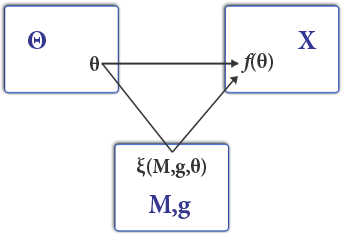
The upper-left space depicts the type space and the upper-right space X the space of outcomes. The social choice function maps a type profile to an outcome. In games of mechanism design, agents send messages in a game environment . The equilibrium in the game can be designed to implement some social choice function .

Mechanism design (sometimes implementation theory or institution design)[1] is a branch of economics and game theory. It studies how to construct rules—called mechanisms or institutions—that produce good outcomes according to some predefined metric, even when the designer does not know the players' true preferences or what information they have. Mechanism design thus focuses on the study of solution concepts for a class of private-information games.

Mechanism design has broad applications, including traditional domains of economics such as market design, but also political science (through voting theory). It is a foundational component in the operation of the internet, being used in networked systems (such as inter-domain routing),[2] e-commerce, and advertisement auctions by Facebook and Google.

Because it starts with the end of the game (a particular result), then works backwards to find a game that implements it, it is sometimes described as reverse game theory.[2] Leonid Hurwicz explains that "in a design problem, the goal function is the main given, while the mechanism is the unknown. Therefore, the design problem is the inverse of traditional economic theory, which is typically devoted to the analysis of the performance of a given mechanism."[3]

The 2007 Nobel Memorial Prize in Economic Sciences was awarded to Leonid Hurwicz, Eric Maskin, and Roger Myerson "for having laid the foundations of mechanism design theory."[4] The related works of William Vickrey that established the field earned him the 1996 Nobel prize.

Description

[edit]

One person, called the "principal", would like to condition his behavior on information privately known to the players of a game. For example, the principal would like to know the true quality of a used car a salesman is pitching. He cannot learn anything simply by asking the salesman, because it is in the salesman's interest to distort the truth. However, in mechanism design, the principal does have one advantage: He may design a game whose rules influence others to act the way he would like.

Without mechanism design theory, the principal's problem would be difficult to solve. He would have to consider all the possible games and choose the one that best influences other players' tactics. In addition, the principal would have to draw conclusions from agents who may lie to him. Thanks to the revelation principle, the principal only needs to consider games in which agents truthfully report their private information.

Foundations

[edit]

Mechanism

[edit]

A game of mechanism design is a game of private information in which one of the agents, called the principal, chooses the payoff structure. Following Harsanyi (1967), the agents receive secret "messages" from nature containing information relevant to payoffs. For example, a message may contain information about their preferences or the quality of a good for sale. We call this information the agent's "type" (usually noted and accordingly the space of types ). Agents then report a type to the principal (usually noted with a hat ) that can be a strategic lie. After the report, the principal and the agents are paid according to the payoff structure the principal chose.

The timing of the game is:

  1. The principal commits to a mechanism that grants an outcome as a function of reported type
  2. The agents report, possibly dishonestly, a type profile
  3. The mechanism is executed (agents receive outcome )

In order to understand who gets what, it is common to divide the outcome into a goods allocation and a money transfer, where stands for an allocation of goods rendered or received as a function of type, and stands for a monetary transfer as a function of type.

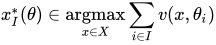
As a benchmark the designer often defines what should happen under full information. Define a social choice function mapping the (true) type profile directly to the allocation of goods received or rendered,

In contrast a mechanism maps the reported type profile to an outcome (again, both a goods allocation and a money transfer )

Revelation principle

[edit]

A proposed mechanism constitutes a Bayesian game (a game of private information), and if it is well-behaved the game has a Bayesian Nash equilibrium. At equilibrium agents choose their reports strategically as a function of type

It is difficult to solve for Bayesian equilibria in such a setting because it involves solving for agents' best-response strategies and for the best inference from a possible strategic lie. Thanks to a sweeping result called the revelation principle, no matter the mechanism a designer can[5] confine attention to equilibria in which agents truthfully report type. The revelation principle states: "To every Bayesian Nash equilibrium there corresponds a Bayesian game with the same equilibrium outcome but in which players truthfully report type."

This is extremely useful. The principle allows one to solve for a Bayesian equilibrium by assuming all players truthfully report type (subject to an incentive compatibility constraint). In one blow it eliminates the need to consider either strategic behavior or lying.

Its proof is quite direct. Assume a Bayesian game in which the agent's strategy and payoff are functions of its type and what others do, . By definition agent i's equilibrium strategy is Nash in expected utility:

Simply define a mechanism that would induce agents to choose the same equilibrium. The easiest one to define is for the mechanism to commit to playing the agents' equilibrium strategies for them.

Under such a mechanism the agents of course find it optimal to reveal type since the mechanism plays the strategies they found optimal anyway. Formally, choose such that

Implementability

[edit]

The designer of a mechanism generally hopes either

  • to design a mechanism that "implements" a social choice function
  • to find the mechanism that maximizes some value criterion (e.g. profit)

To implement a social choice function is to find some transfer function that motivates agents to pick . Formally, if the equilibrium strategy profile under the mechanism maps to the same goods allocation as a social choice function,

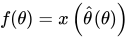
we say the mechanism implements the social choice function.

Thanks to the revelation principle, the designer can usually find a transfer function to implement a social choice by solving an associated truthtelling game. If agents find it optimal to truthfully report type,

we say such a mechanism is truthfully implementable. The task is then to solve for a truthfully implementable and impute this transfer function to the original game. An allocation is truthfully implementable if there exists a transfer function such that


which is also called the incentive compatibility (IC) constraint.

In applications, the IC condition is the key to describing the shape of in any useful way. Under certain conditions it can even isolate the transfer function analytically. Additionally, a participation (individual rationality) constraint is sometimes added if agents have the option of not playing.

Necessity

[edit]

Consider a setting in which all agents have a type-contingent utility function . Consider also a goods allocation that is vector-valued and size (which permits number of goods) and assume it is piecewise continuous with respect to its arguments.

The function is implementable only if
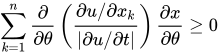
whenever and and x is continuous at . This is a necessary condition and is derived from the first- and second-order conditions of the agent's optimization problem assuming truth-telling.

Its meaning can be understood in two pieces. The first piece says the agent's marginal rate of substitution (MRS) increases as a function of the type,
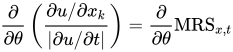
In short, agents will not tell the truth if the mechanism does not offer higher agent types a better deal. Otherwise, higher types facing any mechanism that punishes high types for reporting will lie and declare they are lower types, violating the truthtelling incentive-compatibility constraint. The second piece is a monotonicity condition waiting to happen,[clarification needed]

which, to be positive, means higher types must be given more of the good.

There is potential for the two pieces to interact. If for some type range the contract offered less quantity to higher types , it is possible the mechanism could compensate by giving higher types a discount. But such a contract already exists for low-type agents, so this solution is pathological. Such a solution sometimes occurs in the process of solving for a mechanism. In these cases it must be "ironed". In a multiple-good environment it is also possible for the designer to reward the agent with more of one good to substitute for less of another (e.g. butter for margarine). Multiple-good mechanisms are an area of continuing research in mechanism design.

Sufficiency

[edit]

Mechanism design papers usually make two assumptions to ensure implementability:
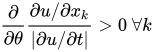
This is known by several names: the single-crossing condition, the sorting condition and the Spence–Mirrlees condition. It means the utility function is of such a shape that the agent's MRS is increasing in type.[clarification needed]

This is a technical condition bounding the rate of growth of the MRS.

These assumptions are sufficient to provide that any monotonic is implementable (a exists that can implement it). In addition, in the single-good setting the single-crossing condition is sufficient to provide that only a monotonic is implementable, so the designer can confine his search to a monotonic .

Highlighted results

[edit]

Revenue equivalence theorem

[edit]

Vickrey (1961) gives a celebrated result that any member of a large class of auctions assures the seller of the same expected revenue and that the expected revenue is the best the seller can do. This is the case if

  1. The buyers have identical valuation functions (which may be a function of type)
  2. The buyers' types are independently distributed
  3. The buyers types are drawn from a continuous distribution
  4. The type distribution bears the monotone hazard rate property
  5. The mechanism sells the good to the buyer with the highest valuation

The last condition is crucial to the theorem. An implication is that for the seller to achieve higher revenue he must take a chance on giving the item to an agent with a lower valuation. Usually this means he must risk not selling the item at all.

Vickrey–Clarke–Groves mechanisms

[edit]

The Vickrey (1961) auction model was later expanded by Clarke (1971) and Groves to treat a public choice problem in which a public project's cost is borne by all agents, e.g. whether to build a municipal bridge. The resulting "Vickrey–Clarke–Groves" mechanism can motivate agents to choose the socially efficient allocation of the public good even if agents have privately known valuations. In other words, it can solve the "tragedy of the commons"—under certain conditions, in particular quasilinear utility or if budget balance is not required.

Consider a setting in which number of agents have quasilinear utility with private valuations where the currency is valued linearly. The VCG designer designs an incentive compatible (hence truthfully implementable) mechanism to obtain the true type profile, from which the designer implements the socially optimal allocation

The cleverness of the VCG mechanism is the way it motivates truthful revelation. It eliminates incentives to misreport by penalizing any agent by the cost of the distortion he causes. Among the reports the agent may make, the VCG mechanism permits a "null" report saying he is indifferent to the public good and cares only about the money transfer. This effectively removes the agent from the game. If an agent does choose to report a type, the VCG mechanism charges the agent a fee if his report is pivotal, that is if his report changes the optimal allocation x so as to harm other agents. The payment is calculated

which sums the distortion in the utilities of the other agents (and not his own) caused by one agent reporting.

Gibbard–Satterthwaite theorem

[edit]

Gibbard (1973) and Satterthwaite (1975) give an impossibility result similar in spirit to Arrow's impossibility theorem. For a very general class of games, only "dictatorial" social choice functions can be implemented.

A social choice function is dictatorial if one agent always receives his most-favored goods allocation,


The theorem states that under general conditions any truthfully implementable social choice function must be dictatorial if,

  1. X is finite and contains at least three elements
  2. Preferences are rational

Myerson–Satterthwaite theorem

[edit]

Myerson and Satterthwaite (1983) show there is no efficient way for two parties to trade a good when they each have secret and probabilistically varying valuations for it, without the risk of forcing one party to trade at a loss. It is among the most remarkable negative results in economics—a kind of negative mirror to the fundamental theorems of welfare economics.

Shapley value

[edit]

Phillips and Marden (2018) proved that for cost-sharing games with concave cost functions, the optimal cost-sharing rule that firstly optimizes the worst-case inefficiencies in a game (the price of anarchy), and then secondly optimizes the best-case outcomes (the price of stability), is precisely the Shapley value cost-sharing rule.[6] A symmetrical statement is similarly valid for utility-sharing games with convex utility functions.

Price discrimination

[edit]

Mirrlees (1971) introduces a setting in which the transfer function t() is easy to solve for. Due to its relevance and tractability it is a common setting in the literature. Consider a single-good, single-agent setting in which the agent has quasilinear utility with an unknown type parameter

and in which the principal has a prior CDF over the agent's type . The principal can produce goods at a convex marginal cost c(x) and wants to maximize the expected profit from the transaction

subject to IC and IR conditions

The principal here is a monopolist trying to set a profit-maximizing price scheme in which it cannot identify the type of the customer. A common example is an airline setting fares for business, leisure and student travelers. Due to the IR condition it has to give every type a good enough deal to induce participation. Due to the IC condition it has to give every type a good enough deal that the type prefers its deal to that of any other.

A trick given by Mirrlees (1971) is to use the envelope theorem to eliminate the transfer function from the expectation to be maximized,

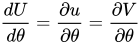
Integrating,
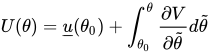
where is some index type. Replacing the incentive-compatible in the maximand,

after an integration by parts. This function can be maximized pointwise.

Because is incentive-compatible already the designer can drop the IC constraint. If the utility function satisfies the Spence–Mirrlees condition then a monotonic function exists. The IR constraint can be checked at equilibrium and the fee schedule raised or lowered accordingly. Additionally, note the presence of a hazard rate in the expression. If the type distribution bears the monotone hazard ratio property, the FOC is sufficient to solve for t(). If not, then it is necessary to check whether the monotonicity constraint (see sufficiency, above) is satisfied everywhere along the allocation and fee schedules. If not, then the designer must use Myerson ironing.

Myerson ironing

[edit]
It is possible to solve for a goods or price schedule that satisfies the first-order conditions yet is not monotonic. If so it is necessary to "iron" the schedule by choosing some value at which to flatten the function.

In some applications the designer may solve the first-order conditions for the price and allocation schedules yet find they are not monotonic. For example, in the quasilinear setting this often happens when the hazard ratio is itself not monotone. By the Spence–Mirrlees condition the optimal price and allocation schedules must be monotonic, so the designer must eliminate any interval over which the schedule changes direction by flattening it.

Intuitively, what is going on is the designer finds it optimal to bunch certain types together and give them the same contract. Normally the designer motivates higher types to distinguish themselves by giving them a better deal. If there are insufficiently few higher types on the margin the designer does not find it worthwhile to grant lower types a concession (called their information rent) in order to charge higher types a type-specific contract.

Consider a monopolist principal selling to agents with quasilinear utility, the example above. Suppose the allocation schedule satisfying the first-order conditions has a single interior peak at and a single interior trough at , illustrated at right.

  • Following Myerson (1981) flatten it by choosing satisfying where is the inverse function of x mapping to and is the inverse function of x mapping to . That is, returns a before the interior peak and returns a after the interior trough.
  • If the nonmonotonic region of borders the edge of the type space, simply set the appropriate function (or both) to the boundary type. If there are multiple regions, see a textbook for an iterative procedure; it may be that more than one troughs should be ironed together.

Proof

[edit]

The proof uses the theory of optimal control. It considers the set of intervals in the nonmonotonic region of over which it might flatten the schedule. It then writes a Hamiltonian to obtain necessary conditions for a within the intervals

  1. that does satisfy monotonicity
  2. for which the monotonicity constraint is not binding on the boundaries of the interval

Condition two ensures that the satisfying the optimal control problem reconnects to the schedule in the original problem at the interval boundaries (no jumps). Any satisfying the necessary conditions must be flat because it must be monotonic and yet reconnect at the boundaries.

As before maximize the principal's expected payoff, but this time subject to the monotonicity constraint

and use a Hamiltonian to do it, with shadow price


where is a state variable and the control. As usual in optimal control the costate evolution equation must satisfy


Taking advantage of condition 2, note the monotonicity constraint is not binding at the boundaries of the interval,
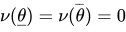
meaning the costate variable condition can be integrated and also equals 0

The average distortion of the principal's surplus must be 0. To flatten the schedule, find an such that its inverse image maps to a interval satisfying the condition above.

See also

[edit]

Notes

[edit]

References

[edit]

Further reading

[edit]
[edit]
Revisions and contributorsEdit on WikipediaRead on Wikipedia
from Grokipedia
Mechanism design is a subfield of microeconomics and game theory focused on designing rules, institutions, or processes—termed mechanisms—to achieve specified social or economic objectives despite agents' private information, strategic incentives, and potential misalignments of interests.[1][2] Unlike traditional game theory, which analyzes strategic behavior under fixed rules, mechanism design operates in reverse: it identifies desirable outcomes (such as efficiency or revenue maximization) and engineers incentives to elicit truthful revelation or coordinated actions leading to those equilibria.[2][3] Pioneered by Leonid Hurwicz in the 1960s and 1970s through foundational concepts like incentive compatibility, the field advanced significantly with Eric Maskin's implementation theory, which specifies conditions under which desired outcomes can be uniquely achieved in equilibrium, and Roger Myerson's refinements on optimal mechanisms, including revenue equivalence in auctions.[4][3] These contributions earned Hurwicz, Maskin, and Myerson the 2007 Nobel Memorial Prize in Economic Sciences for establishing the theoretical foundations enabling rigorous analysis of decentralized decision-making.[3] Applications span auction formats (e.g., spectrum licenses and treasury bills), regulatory schemes for utilities, voting systems, and matching markets like school assignments, where mechanisms mitigate information asymmetries and extract surplus efficiently.[4] While theoretically robust, practical implementations face challenges from behavioral deviations and computational complexity, yet the framework underscores causal links between institutional rules and aggregate welfare.[1]

Overview

Definition and Core Objectives

Mechanism design is a subfield of microeconomics and game theory concerned with the engineering of institutions or rules—known as mechanisms—to achieve prescribed social or economic outcomes in environments where agents hold private information and pursue self-interested objectives.[3] This approach inverts the standard paradigm of game theory, which takes existing rules as given and derives equilibrium behaviors; instead, mechanism design begins with desired outcomes, such as efficient resource allocation or revenue extraction, and works backward to construct incentive-compatible rules that induce agents to act in ways aligning with those goals.[1] At its core, the theory addresses the challenge of incentive compatibility, ensuring that mechanisms elicit truthful revelation of private types (e.g., valuations or costs) as an equilibrium strategy, often via direct revelation mechanisms where agents report their types to a designer who then allocates outcomes accordingly.[4] Pioneered by Leonid Hurwicz in the 1960s and formalized through contributions by Eric Maskin and Roger Myerson—who shared the 2007 Nobel Prize in Economic Sciences for establishing its foundations—the field emphasizes decentralized decision-making under informational asymmetries. Hurwicz's framework highlighted the need for mechanisms to be individually rational, providing agents non-negative expected utility relative to outside options, while balancing feasibility constraints like budget balance or Pareto efficiency.[5] Primary objectives include implementing specific social choice functions, such as maximizing total surplus (efficiency) or a designer's revenue, subject to strategic behavior by informed parties.[4] For instance, in auction settings, objectives often prioritize seller revenue equivalence across formats or buyer surplus extraction, assuming rational expectations and risk neutrality.[4] These goals are pursued through tools like the revelation principle, which equates optimal mechanisms to those where truth-telling dominates, enabling analysis of indirect formats via their direct equivalents.[1] The theory's rigor stems from Bayesian or dominant-strategy formulations, ensuring robustness to agents' incomplete knowledge of others' types.[3]

Distinction from Traditional Game Theory

Mechanism design inverts the analytical approach of traditional game theory. In traditional game theory, the rules of interaction, strategy spaces, and payoff structures are assumed to be fixed exogenously, with the objective of deriving equilibrium strategies and predicting outcomes under rational behavior by agents.[6][7] This framework, originating from foundational works like John von Neumann and Oskar Morgenstern's Theory of Games and Economic Behavior in 1944, emphasizes prediction and analysis of given games, often under complete or incomplete information settings. By contrast, mechanism design positions the designer as an active participant who engineers the game rules—such as message spaces, outcome functions, and transfer rules—to implement a desired social choice function or allocation rule as an equilibrium outcome, despite agents' private information and incentives to misrepresent it.[8][6] The designer must ensure incentive compatibility, meaning truth-telling or direct revelation constitutes an equilibrium strategy, as formalized by Leonid Hurwicz in the 1960s and advanced through the revelation principle by Roger Myerson in 1979 and others. This "engineering" orientation, as termed by Eric Maskin, prioritizes implementability over mere prediction, addressing problems like resource allocation or regulation where asymmetric information prevails.[7] A key implication is that mechanism design requires verifying whether a desired outcome is robust to strategic manipulation, often using Bayesian Nash equilibria under incomplete information, whereas traditional game theory might accept any equilibrium without regard for designer intent.[9] For example, in traditional analyses of markets, equilibria like Walrasian outcomes are studied given price mechanisms, but mechanism design might redesign bidding protocols in spectrum auctions to elicit truthful valuations, as in the 1994 FCC auction informed by theory from Paul Milgrom and others. This distinction underscores mechanism design's normative focus on optimal institutions, drawing on but extending game-theoretic tools to causal intervention in strategic environments.[6]

Historical Development

Precursors and Early Ideas

The intellectual roots of mechanism design extend to 19th-century efforts to engineer alternative economic institutions, such as those proposed by utopian socialists Robert Owen and Charles Fourier, who experimented with cooperative communities to allocate resources without market competition.[10] These initiatives highlighted the practical challenges of designing self-sustaining systems amid individuals' diverse preferences and information, though they lacked formal analysis of incentives.[10] A pivotal precursor emerged in the socialist calculation debate of the interwar period, initiated by Ludwig von Mises in 1920, who contended that central planning could not rationally allocate resources without market prices to signal scarcity and preferences.[5] Oskar Lange countered in 1938 by advocating market socialism, where planners simulate competitive prices through iterative adjustments based on reported data from enterprises, yet this approach presumed truthful revelation without addressing strategic misrepresentation.[10] Friedrich Hayek advanced the critique in 1945, arguing that markets uniquely aggregate dispersed, tacit private knowledge that no central authority could fully elicit or process, framing the core tension between decentralization and informational efficiency that later informed mechanism design.[4] In public goods provision, Paul Samuelson noted in 1954 that selfish agents would underreport preferences to free-ride, rendering voluntary contributions inefficient and underscoring the need for mechanisms inducing truthful behavior—a direct antecedent to incentive compatibility concepts.[4] The foundational tools for analyzing such strategic settings were supplied by game theory, as developed by John von Neumann and Oskar Morgenstern in their 1944 book Theory of Games and Economic Behavior, which modeled interactions where agents act on private information to maximize utility.[11] Early concrete illustrations of incentive-aligned rules appeared in auction contexts; for instance, William Vickrey's 1961 analysis of sealed-bid second-price auctions showed bidders' dominant strategy to reveal true valuations, providing an empirical prototype for designing rules robust to manipulation despite predating systematic theory.[4] These ideas collectively anticipated the formal quest to engineer institutions that achieve socially optimal outcomes under asymmetric information and self-interest.

Formalization and Key Milestones

The formalization of mechanism design began with Leonid Hurwicz's 1960 paper "Optimality and Informational Efficiency in Resource Allocation Processes," where he modeled economic systems as decentralized processes for aggregating private information to achieve Pareto-efficient outcomes despite agents' incentives to misrepresent preferences.[12] Hurwicz conceptualized a mechanism as a tuple comprising a message space for agents' communications, an outcome function mapping messages to allocations and transfers, and an equilibrium notion ensuring informational decentralization, emphasizing incentive compatibility to prevent strategic distortion of information.[4] This framework inverted traditional welfare economics by treating institutions as design variables rather than fixed environments, laying the groundwork for analyzing implementability under incomplete information.[3] Subsequent milestones advanced the theory's analytical tools. In 1971, Edward Clarke introduced the Clarke pivot mechanism, a truthful direct mechanism for public goods provision that charges agents the externality they impose on others, achieving efficiency in quasi-linear settings.[4] Theodore Groves extended this in 1973 with the Groves mechanism, generalizing Clarke's approach to arbitrary quasi-linear utilities while preserving dominant-strategy incentive compatibility, though at the cost of potential budget deficits.[4] Allan Gibbard's 1973 paper on voting scheme manipulation provided early insights into truthful implementation limits, while Roger Myerson's 1979 formalization of the revelation principle established that any equilibrium outcome achievable by an indirect mechanism could be replicated by a direct, truthful one, simplifying design by restricting attention to incentive-compatible direct revelation games.[13] Eric Maskin's 1977 work on Nash implementation clarified sufficiency conditions for designing mechanisms that yield desired social choice functions as equilibria, distinguishing dominant-strategy from Nash criteria and highlighting non-implementability in non-quasi-linear environments.[4] Myerson's 1981 theory of optimal auctions further refined the field by deriving revenue-maximizing mechanisms under asymmetric information, linking virtual valuations to bidder types and establishing the revenue equivalence theorem for symmetric settings.[4] These developments culminated in the 2007 Nobel Prize in Economic Sciences awarded to Hurwicz, Maskin, and Myerson for establishing mechanism design as a foundational tool in economic theory.[3]

Theoretical Foundations

Mechanisms and Incentive Structures

In mechanism design, a mechanism defines the rules by which agents interact to produce outcomes, typically comprising a message space for each agent and functions mapping message profiles to allocations and payments. Direct mechanisms, central to the field since Leonid Hurwicz's foundational work, simplify analysis by having agents report their private types θiΘi\theta_i \in \Theta_i directly, with outcomes determined by y=f(θ)y = f(\theta), where f:ΘYf: \Theta \to Y and YY is the space of feasible outcomes such as resource allocations. This structure assumes agents have private information about their preferences or valuations, and the mechanism seeks to elicit truthful reports despite self-interested behavior.[4][14] Incentive structures within mechanisms ensure that strategic incentives align with desired outcomes, primarily through incentive compatibility (IC) conditions. A mechanism is dominant strategy incentive compatible (DSIC) if, for every agent ii, reporting the true type θi\theta_i maximizes utility regardless of others' reports: ui(θi,f(θi,θi))ui(θi,f(θ^i,θi))u_i(\theta_i, f(\theta_i, \theta_{-i})) \geq u_i(\theta_i, f(\hat{\theta}_i, \theta_{-i})) for all θ^iΘi\hat{\theta}_i \in \Theta_i and θiΘi\theta_{-i} \in \Theta_{-i}, where uiu_i incorporates valuations of allocations and any transfers. In quasi-linear settings—common in applications like auctions, where agent ii's utility is vi(x(θ))ti(θ)v_i(x(\theta)) - t_i(\theta) for allocation xx and payment tit_i—IC imposes monotonicity on allocation rules: higher types must receive at least as much allocation in expectation, ensuring truth-telling is optimal without reliance on probabilistic beliefs about others. Bayesian incentive compatibility (BIC), a weaker form, requires the inequality only in expectation over θi\theta_{-i}'s distribution, allowing mechanisms that are computationally simpler but vulnerable to correlated types or worst-case deviations.[6][4][14] These structures address adverse selection and moral hazard by internalizing externalities via transfers; for instance, in efficient mechanisms, payments compensate for informational rents, where agents with higher types extract positive rents due to IC constraints preventing exclusion. Implementable mechanisms balance efficiency, individual rationality (participation yielding non-negative utility), and budget balance (transfers netting to zero), though trade-offs arise: full efficiency often requires deficits in non-trivial settings, as shown in early impossibility results. Empirical validation in lab experiments confirms that DSIC mechanisms reduce manipulation compared to non-IC alternatives, though real-world deviations occur due to bounded rationality or collusion risks not captured in standard models.[4][9][14]

Revelation Principle

The Revelation Principle states that, in Bayesian mechanism design settings with private information, any social choice function implementable as a Bayesian Nash equilibrium outcome of some indirect mechanism can equivalently be implemented as the truthful equilibrium outcome of a direct incentive-compatible mechanism.[15][6] In a direct mechanism, agents report their private types $ \theta_i \in \Theta_i $ directly, and the designer applies an outcome function $ f(\theta): \Theta \to Y $ to determine allocations and transfers, where $ Y $ denotes the space of possible outcomes, such that truth-telling maximizes each agent's expected utility conditional on others' truth-telling.[16] This equivalence holds under standard assumptions including quasi-linear utilities, independent private values, and the designer's commitment to the mechanism.[17] The proof proceeds by construction: Consider an indirect mechanism with message spaces $ M_i $, outcome function $ g(m) $, and Bayesian Nash equilibrium strategies $ s_i^(\theta_i) $ that yield the desired social choice. Define a direct mechanism where reported types $ \hat{\theta} $ are fed into the equilibrium strategies to simulate messages $ m_i = s_i^(\hat{\theta}_i) $, then $ g(m) $ produces the outcome. For any agent $ i $ with true type $ \theta_i $, misreporting $ \hat{\theta}_i \neq \theta_i $ yields expected utility no better than truth-telling, as the simulated messages replicate the original equilibrium incentives, making $ \hat{\theta}_i = \theta_i $ a Bayesian Nash equilibrium.[15][16] This argument extends the dominant-strategy version—where truth-telling is a dominant strategy regardless of others' behavior—to Bayesian settings by leveraging beliefs over types.[18] The principle implies that mechanism designers can restrict analysis to direct incentive-compatible mechanisms without sacrificing achievable outcomes, reducing the search space from arbitrary message protocols to type-contingent rules satisfying individual rationality and incentive constraints.[6][17] It facilitates deriving impossibility results (e.g., via incentive compatibility alone) and optimal mechanisms, as in Myerson's 1981 auction theory, where truthful reporting simplifies revenue maximization.[19] Formalized by Roger Myerson in his 1979 Econometrica paper on incentive compatibility in bargaining, the Bayesian revelation principle built on Allan Gibbard's 1973 dominant-strategy insights for voting schemes.[19][18] While robust in incomplete-information environments, it fails for fully deterministic mechanisms without randomization or in settings lacking commitment, where indirect protocols may enable outcomes unattainable directly.[20]

Implementability: Necessity and Sufficiency

In the context of Nash equilibrium implementation under complete information, a social choice rule (SCR) f:ΘYf: \Theta \to Y is implementable if there exists a mechanism such that every Nash equilibrium of the mechanism selects outcomes in f(θ)f(\theta) for each true type profile θΘ\theta \in \Theta.[21] Full Nash implementation requires that all Nash equilibria yield outcomes in f(θ)f(\theta). Eric Maskin established that, in environments with at least three agents and rich domains (where preferences are "generic" or sufficiently varied), Maskin monotonicity is a necessary condition for full Nash implementability.[21] [22] Maskin monotonicity stipulates that if f(θ)=yf(\theta) = y and for a perturbed type profile θ\theta', every agent ii who strictly prefers yy to f(θ)f(\theta') under θi\theta_i continues to do so under θi\theta'_i (or is indifferent), while others do not reverse their preferences against yy, then f(θ)=yf(\theta') = y.[21] This condition ensures that small changes in reported types that do not erode support for the selected outcome preserve the outcome, preventing strategic deviations that could undermine equilibrium selection. No-veto-power, an auxiliary condition, requires that for any θ\theta and agent ii, there exists θ\theta' differing only in ii's type such that if all other agents prefer some alternative to f(θ)f(\theta), agent ii can induce that alternative by misreporting.[22] Together, for N3|N| \geq 3, these conditions are sufficient for full Nash implementation via a canonical mechanism where agents announce types and outcomes are chosen with "fines" for deviations.[21] [22] For two-agent settings, Maskin's conditions are necessary but not always sufficient, as demonstrated by counterexamples where monotonic rules fail implementation due to bilateral strategic interdependence; stronger conditions like Condition β\beta (involving preference alignments) are necessary and sufficient in such cases.[23] In Bayesian Nash implementation under incomplete information, a distinct Bayesian monotonicity condition—requiring that shifts in beliefs preserving expected preference for an outcome maintain its selection— is necessary, and with at least three agents, it is sufficient when combined with incentive compatibility and closure under obedience.[21] These characterizations highlight the robustness of monotonicity across equilibrium concepts but underscore domain restrictions, such as unrestricted preferences, for sufficiency.[24]

Key Theorems and Results

Revenue Equivalence Theorem

The Revenue Equivalence Theorem asserts that, in environments with independent private values drawn from symmetric distributions, risk-neutral agents, and mechanisms satisfying incentive compatibility and individual rationality, any two direct mechanisms inducing the same expected allocation probabilities across agent types will generate identical expected revenue for the designer.[25][26] This result implies that revenue depends primarily on the allocation rule rather than the specific payment structure, provided the mechanisms are Bayesian incentive compatible and ensure zero utility for the lowest agent type.[27] The theorem's assumptions include: (i) each agent's value is drawn independently from a continuous distribution identical across agents (symmetric independent private values); (ii) agents are risk-neutral, maximizing expected payoffs; (iii) the mechanism is direct, with agents reporting types truthfully in equilibrium; (iv) the lowest possible type receives zero expected utility, often normalized as the participation constraint; and (v) the allocation rule is monotonically increasing in reported types to ensure incentive compatibility.[26][28] These conditions align with standard single-object auction settings, such as those analyzed by Roger Myerson in 1981, where the seller seeks to maximize revenue from allocating an indivisible good.[25] Proofs typically proceed via the envelope theorem applied to the agent's indirect utility function. For an agent of type vv, the equilibrium utility U(v)U(v) satisfies U(v)=U(v)+vvQ(t)dtU(v) = U(\underline{v}) + \int_{\underline{v}}^{v} Q(t) \, dt, where Q(t)Q(t) is the expected allocation probability for type tt and v\underline{v} is the lowest type with U(v)=0U(\underline{v}) = 0. Payments, derived as p(v)=vQ(v)U(v)p(v) = v Q(v) - U(v), then yield expected revenue as the integral of vQ(v)U(v)v Q(v) - U(v) over the type distribution, which equals [vF(v)f(v)]Q(v)f(v)dv\int [v - \frac{F(v)}{f(v)}] Q(v) f(v) \, dv (virtual valuation form), independent of payment details beyond the shared QQ.[27][25] This integration-by-parts step reveals equivalence for any mechanisms with identical QQ. In auction applications, the theorem equates expected seller revenue across formats like the first-price sealed-bid auction, English auction, and Vickrey (second-price) auction, all of which efficiently allocate to the highest bidder under the assumptions, yielding revenue equal to the expected second-highest value.[28][29] Beyond auctions, it informs procurement or public good provision, where equivalent allocations imply equal designer payments, facilitating analysis by focusing on optimal rules rather than arbitrary transfers.[25] However, equivalence fails without symmetry (e.g., heterogeneous distributions require adjustments via virtual values) or under risk aversion, where revenue rankings diverge, as first-price auctions extract less than second-price ones from risk-averse bidders.[30][31] Extensions to affiliated values or multi-unit settings preserve partial equivalence only under stricter conditions.[25]

Vickrey–Clarke–Groves Mechanisms

The Vickrey–Clarke–Groves (VCG) mechanisms constitute a class of direct revelation mechanisms that elicit truthful reporting of private valuations as a dominant strategy while selecting allocations that maximize aggregate reported welfare in quasi-linear environments.[32] In such settings, agents possess private type θ_i representing their valuation function v_i(x) over outcomes x ∈ X, with utilities u_i(x, t_i) = v_i(x) + t_i for monetary transfer t_i. The mechanism computes the efficient allocation x*(θ) = arg max{x ∈ X} ∑i θ_i(x), where θ_i denotes agent i's reported type, and sets agent i's payment p_i(θ) = [∑{j ≠ i} θ_j(x{-i}(θ_{-i}))] - [∑{j ≠ i} θ_j(x*(θ))], with x{-i}(θ_{-i}) = arg max{x ∈ X} ∑{j ≠ i} θ_j(x) excluding i. This payment structure charges i the difference between others' welfare with and without i's reported influence, effectively internalizing the externality i imposes on the group.[9] Truthful reporting emerges as dominant because, for any fixed reports θ_{-i} from others, agent i's allocation x*(θ) maximizes i's gross utility v_i(x*(θ)) over feasible alternatives, while p_i(θ) depends solely on θ_{-i} and the welfare differential uninfluenced by i's report beyond the allocation choice. Deviating from truth θ_i^* yields at most the same allocation benefit minus the fixed payment term, rendering misreporting non-beneficial regardless of others' strategies.[33] VCG thus achieves dominant strategy incentive compatibility (DSIC) alongside allocative efficiency, as the selected x*(θ^) Pareto-dominates alternatives under true types θ^ due to welfare maximization.[34] The class generalizes earlier constructs: Vickrey's 1961 second-price auction for single-object settings, where the highest bidder wins and pays the second-highest bid, aligns with VCG by excluding the winner's valuation from the price.[32] Clarke's 1971 pivot rule and Groves' 1973 payments extended this to arbitrary social choice problems, with VCG specifying the "Clarke pivot" h_i(θ_{-i}) = ∑{j ≠ i} θ_j(x{-i}(θ_{-i})) among Groves forms t_i(θ) = h_i(θ_{-i}) - ∑_{j ≠ i} θ_j(x*(θ)), ensuring DSIC for efficient x*.[35] Broadly, Groves mechanisms guarantee DSIC for any h_i but may fail efficiency unless x* is welfare-maximizing; VCG enforces both via the pivot choice.[36] While VCG implements the efficient social choice function in dominant strategies—a canonical result in mechanism design—it sacrifices other properties: payments ∑i p_i(θ) generally fail budget balance (may yield surplus or deficit), and individual rationality holds weakly ex post only if no agent's inclusion harms total welfare.[9] In multi-unit auctions, the generalized Vickrey auction (GVA) applies VCG by allocating units to highest marginal valuations and charging each winner the opportunity cost to others, preserving DSIC and efficiency.[32] Computationally tractable for polynomially solvable welfare maximization, VCG's vulnerability to strategic θ{-i} manipulation or collusion underscores its reliance on independent private values and quasi-linearity assumptions.[33]

Impossibility Theorems: Gibbard–Satterthwaite and Myerson–Satterthwaite

The Gibbard–Satterthwaite theorem establishes a fundamental limitation on strategy-proof social choice mechanisms. In a setting with n2n \geq 2 agents and a finite set of alternatives AA where A3|A| \geq 3, a social choice function f:PnAf: \mathcal{P}^n \to A—mapping profiles of strict ordinal preferences P\mathcal{P} to outcomes in AA—is strategy-proof if no agent can benefit by misreporting their true preference when others report truthfully. The theorem states that if ff is strategy-proof and onto (every alternative in AA is selected for some preference profile), then ff must be dictatorial, meaning one agent's preference unilaterally determines the outcome regardless of others' reports.[37][38] This result, independently proven by Gibbard in 1973 and Satterthwaite in 1975, implies that non-dictatorial voting rules inevitably allow strategic manipulation in dominant strategies, undermining truthful revelation in unrestricted preference domains.[39][38] The theorem's proof relies on constructing pivotal voters and showing that strategy-proofness forces the function to depend solely on one agent's ranking. Gibbard's approach demonstrates manipulability by considering schemes equivalent to ordinal voting, while Satterthwaite links it to Arrow's impossibility via correspondence theorems, proving that strategy-proof voting procedures correspond to dictatorial social welfare functions under conditions like Pareto efficiency.[37][38] Implications for mechanism design are profound: in deterministic settings without restricted domains or additional structure (e.g., single-peaked preferences), achieving both incentive compatibility and non-dictatorship requires sacrificing range or efficiency. Extensions relax assumptions, such as probabilistic mechanisms or approximate strategy-proofness, but the core impossibility persists for unrestricted domains. The Myerson–Satterthwaite theorem extends impossibility to Bayesian settings in bilateral trade. Consider a seller with private value vsv_s drawn from distribution FsF_s over [vs,vs][ \underline{v}_s, \overline{v}_s ] and a buyer with vbv_b from FbF_b over [vb,vb][ \underline{v}_b, \overline{v}_b ], independent and continuously distributed, where vb<vs\underline{v}_b < \overline{v}_s (overlapping supports) and Pr(vb<vs)>0\Pr(v_b < v_s) > 0. A mechanism specifies allocation q(vs,vb)[0,1]q(v_s, v_b) \in [0,1] (probability of trade) and transfers ts(vs,vb),tb(vs,vb)t_s(v_s, v_b), t_b(v_s, v_b). The theorem asserts no mechanism exists that is Bayesian incentive compatible (truthful reporting maximizes interim expected utility), interim individually rational (non-negative interim utility for truth-telling), and efficient (q=1q = 1 iff vbvsv_b \geq v_s) while budget-balanced in expectation (E[ts+tb]=0\mathbb{E}[t_s + t_b] = 0).[40][41] Proved by Myerson and Satterthwaite in 1983, the result follows from virtual valuation analysis: efficiency requires trade when vb>vsv_b > v_s, but incentive compatibility and rationality imply the seller's interim utility at low types exceeds zero only if transfers subsidize, violating budget balance.[40] Specifically, for uniform [0,1] distributions, the efficient mechanism would need expected subsidies of 1/12 to satisfy constraints.[42] In mechanism design, this precludes subsidy-free, incentive-compatible efficiency in quasi-linear environments with correlated gains from trade; practical responses include inefficiency (e.g., posted-price trading) or external subsidies, highlighting trade-offs between efficiency, incentives, and self-financing.[40] Both theorems underscore that incentive compatibility often conflicts with efficiency or fairness in multi-agent settings without dictatorships or budgets.[41]

Applications in Practice

Auctions and Resource Allocation

Auctions represent a core application of mechanism design for allocating indivisible resources among agents with private valuations, aiming to achieve efficiency by assigning assets to the highest-value users while extracting revenue through bidding rules. In mechanism design, auction formats are engineered to satisfy incentive compatibility, ensuring truthful bidding as a dominant strategy, and individual rationality, where participation yields non-negative utility. Key theoretical foundations, such as the revenue equivalence theorem, assert that under assumptions of risk neutrality, independent private values, symmetry among bidders, and allocation to the highest bidder, standard auction formats like first-price sealed-bid, second-price sealed-bid (Vickrey), Dutch, and English auctions generate identical expected seller revenue and bidder payoffs.[28][43] The Vickrey auction, a sealed-bid second-price mechanism for a single item, incentivizes truthful revelation by having the highest bidder win but pay the second-highest bid, making deviation from true valuation unprofitable regardless of others' actions. This extends to multi-object settings via Vickrey-Clarke-Groves (VCG) mechanisms, which generalize second-price principles to maximize social welfare by allocating based on reported values and charging payments equal to the externality imposed on others, preserving truthfulness.[44] In practice, pure Vickrey auctions remain uncommon due to vulnerabilities like collusion susceptibility—where a subset of bidders can suppress bids to lower payments—and budget constraints that amplify strategic withholding, though variants appear in niche markets such as philatelic mail sales.[45][46] Prominent real-world implementations include the U.S. Federal Communications Commission's (FCC) spectrum auctions, which allocate radio frequencies for wireless services using simultaneous multi-round auctions (SMRA), a format designed to handle complementarities across licenses while mitigating gaming through activity rules and bid withdrawal penalties. Initiated in July 1994 under authority granted by the Omnibus Budget Reconciliation Act, these auctions have conducted over 100 sales, generating more than $200 billion in gross revenues for the U.S. Treasury by facilitating efficient assignment to telecom operators valuing spectrum for network expansion.[47][48] The SMRA's iterative bidding allows price discovery and reduces winner's curse risks, outperforming prior administrative lotteries or comparative hearings in speed and revenue, though designs evolve to address issues like bidder asymmetry and entry barriers.[49] Auctions also enable resource allocation in environmental policy, such as cap-and-trade systems for pollution permits, where mechanisms auction emission allowances to reveal abatement costs and promote least-cost reductions. In procurement contexts, reverse auctions allocate contracts by having suppliers bid downward, incentivizing cost revelation for public resources like infrastructure projects. These applications underscore mechanism design's role in balancing efficiency, revenue, and robustness against strategic manipulation in high-stakes resource distribution.[50]

Matching Markets and Organ Allocation

Matching markets involve the allocation of indivisible resources between two sides, such as buyers and sellers or students and schools, where preferences are private information and mechanisms must elicit truthful reporting to achieve desirable outcomes like stability and efficiency. In mechanism design, these markets emphasize incentive-compatible rules that prevent strategic manipulation, often building on the concept of stable matchings introduced by Gale and Shapley in 1962, where no pair of agents prefers each other over their assigned partners.[51] The deferred acceptance algorithm, also known as the Gale-Shapley algorithm, produces a stable matching and is strategy-proof for the proposing side—agents who propose cannot benefit from misreporting preferences—making it a cornerstone for practical designs.[52] This framework has been applied to labor markets, notably the National Resident Matching Program (NRMP) in the United States, which pairs medical residents with hospitals. Originally chaotic in the early 20th century due to serial dictatorship-like unraveling, the NRMP adopted a hospital-proposing deferred acceptance mechanism in 1952, which Roth later analyzed and refined to enhance stability and participation; by 1998, Roth's student-proposing variant for the complementary market was implemented to better align incentives.[52] In school choice, cities like Boston and New York City implemented student-proposing deferred acceptance mechanisms in the early 2000s, designed by economists including Roth and Pathak, which improved stability and reduced incentives for strategic behavior compared to prior Boston mechanisms that allowed up to 10% manipulation rates.[53] Theoretical work shows that in large centralized matching markets with random preferences, stable mechanisms are approximately incentive-compatible, with manipulation probabilities vanishing as market size grows, justifying their use despite not being fully strategy-proof in finite settings.[54] Organ allocation exemplifies matching mechanisms in life-saving contexts, particularly kidney transplantation, where over 100,000 patients await donors in the U.S. as of 2023, with living donors enabling paired exchanges to overcome incompatibilities like blood type or tissue mismatch.[55] Mechanism designs for kidney exchange, pioneered by Roth, Sönmez, and Ünver, model patient-donor pairs as agents with priorities over compatible recipients, using algorithms like top trading cycles to form cycles and chains that maximize matches while ensuring incentive compatibility and avoiding hold-up problems where donors retract offers.[56] The New England Program in Kidney Exchange, launched in 2008 by Roth, facilitated 21 transplants in its first year using such mechanisms, expanding nationally through the National Kidney Registry and UNOS's Kidney Paired Donation Program, which by 2022 had enabled thousands of swaps via centralized clearinghouses that prioritize longer chains for altruistic donors.[52] For deceased donor kidneys, the U.S. system under UNOS employs a priority mechanism based on wait time and medical urgency, but recent designs incorporate life-years from transplantation (LYFT) scores to balance efficiency and equity, though evaluations show mixed outcomes in patient survival compared to wait-list priorities.[57] These applications demonstrate how mechanism design trades off stability, incentives, and fairness, with empirical success in increasing transplant rates by 20-30% in exchange programs without evidence of widespread gaming.[58]

Regulatory Mechanisms and Public Goods

In the context of public goods, which are characterized by non-excludability and non-rivalry in consumption, mechanism design seeks to overcome free-riding incentives where agents underreport valuations to avoid contributions. The Vickrey-Clarke-Groves (VCG) mechanism implements the efficient provision level by having agents report valuations for different quantities of the good, selecting the quantity that maximizes the sum of reported valuations minus the cost, and charging each agent an amount equal to the externality they impose on the others' welfare.[44] This payment rule, often using Clarke's pivot variant, ensures dominant-strategy incentive compatibility, making truthful reporting optimal regardless of others' actions.[59] However, VCG typically generates a budget deficit because payments do not cover costs when no single agent is pivotal in altering the outcome, necessitating external subsidies for feasibility.[60] For multi-agent settings, VCG remains the unique direct mechanism that is efficient and Bayesian incentive-compatible for public goods provision, as deviations from its structure lead to either inefficiency or manipulability.[61] Empirical and theoretical analyses confirm its efficiency in lab experiments for small groups deciding on public projects, though participation constraints and interpersonal comparisons of utility pose practical challenges in scaling to large populations.[62] Variants incorporating reciprocity or robust preferences have been proposed to approximate efficiency without full subsidies, but these sacrifice some incentive guarantees.[63] Regulatory applications extend mechanism design to public goods like environmental quality or infrastructure, where regulators face asymmetric information about agents' costs or benefits. In pollution control, tradable emission permits form a mechanism that incentivizes firms to reveal abatement costs through trading, achieving cost-effective reductions in emissions—a public bad whose mitigation provides the public good of cleaner air—while internalizing externalities under incomplete enforcement.[64] For instance, the U.S. Acid Rain Program, implemented in 1995, used permit auctions and trading to cut sulfur dioxide emissions by 50% from 1980 levels by 2010 at lower-than-expected costs, demonstrating how market-like mechanisms elicit private information for efficient regulation.[65] In utility regulation, principal-agent mechanisms for natural monopolies, such as those derived from adverse selection models, set prices and output to maximize welfare subject to firms' private cost reports, trading off rent extraction against productive efficiency; Laffont and Tirole's 1993 framework shows optimal mechanisms involve nonlinear pricing schedules that approximate second-best efficiency.[4] Challenges in regulatory mechanisms include collusion risks, as seen in models where supervisors can be extorted by informed agents, undermining incentive compatibility unless anti-collusion devices like independent audits are incorporated.[66] For climate agreements, mechanism design proposes budget-balanced protocols that compel participation and truthful reporting of abatement costs, avoiding inefficient Nash equilibria in voluntary treaties; simulations indicate such mechanisms could reduce global emissions by aligning incentives without side payments.[67] Overall, while theoretically robust, real-world deployment requires addressing computational demands and behavioral deviations, with evidence from field applications like cap-and-trade underscoring the value of hybrid mechanisms blending auctions and penalties.[68]

Criticisms and Limitations

Fragility to Model Assumptions

Standard mechanism design relies on stringent assumptions about agents' rationality, information structures, and type distributions, which render derived mechanisms vulnerable to real-world deviations. For instance, the theory typically presumes fully rational agents who maximize expected utility under Bayesian updating with common priors, but empirical evidence from laboratory experiments shows systematic deviations due to bounded rationality, such as level-k thinking or heuristic decision-making, undermining incentive compatibility.[69] In such cases, agents may fail to best-respond as predicted, leading to inefficient outcomes or manipulation not anticipated by the designer.[70] Relaxing rational expectations further exposes fragility: when agents hold heterogeneous or biased beliefs about others' strategies, full implementation of social choice functions requires Bayesian incentive compatibility only under weak solution consistency, but for social choice sets, it becomes dispensable, highlighting how standard Bayesian-Nash equilibrium hinges on near-rational expectations for robustness.[71] This implies that mechanisms optimal under rational expectations, like Vickrey-Clarke-Groves, may collapse without them, as agents' arbitrary expectations decouple incentives across types, permitting outcomes outside the designer's intent.[71] Sensitivity to type interdependence and distributional knowledge amplifies these issues; optimal mechanisms, such as those maximizing revenue under independent private values, falter with correlated types or affiliated values, where the winner's curse emerges or efficiency rankings invert without adjusted rules.[72] Robust mechanism design addresses this by seeking interim incentive-compatible allocations invariant to full specification of the environment, but at the expense of forgoing first-best efficiency, as demonstrated in bilateral trade settings where ambiguity over beliefs precludes simple posted-price mechanisms.[73] Empirical applications, including spectrum auctions, reveal that misspecified correlation assumptions lead to revenue shortfalls, underscoring the theory's dependence on unverifiable priors.[72] Quasi-linear utility assumptions, central to many theorems like revenue equivalence, also prove brittle: nonlinear preferences or risk aversion introduce wealth effects that violate individual rationality or budget balance, complicating implementation in public goods or regulatory contexts.[73] Overall, these fragilities explain the gap between theoretical optima—often intricate and informationally demanding—and practical deployments, where simpler, assumption-robust heuristics prevail despite efficiency losses.[74]

Computational and Practical Barriers

Mechanism design problems often involve searching over vast strategy spaces to identify incentive-compatible rules that achieve desired outcomes, rendering exact solutions computationally intractable in many settings. For instance, determining a deterministic mechanism that implements a given social choice function in dominant strategies is NP-complete, even for simple domains like single-parameter settings or voting rules.[75] Similarly, Bayes-Nash implementation faces equivalent hardness, as the problem reduces to solving complex equilibrium computations over agent type distributions.[76] These results stem from the combinatorial explosion in evaluating truthfulness and optimality across possible allocations and payments, with no known polynomial-time algorithms for general cases. Optimal mechanisms frequently yield intricate rules that deviate sharply from simple, intuitive formats like posted prices or uniform auctions, complicating both theoretical analysis and real-world deployment. In revenue maximization for combinatorial auctions, for example, the Myerson-style optimal mechanism requires solving NP-hard subproblems for ironing virtual values and handling multi-dimensional types, often leading to mechanisms with exponential communication requirements.[77] Approximation algorithms exist, such as those achieving constant-factor revenue guarantees via simple mechanisms, but they sacrifice optimality and may fail under correlated valuations or budget constraints.[77] Practical barriers extend beyond computation to include high informational demands and sensitivity to real-world deviations. Mechanisms like the Vickrey-Clarke-Groves (VCG) require agents to report full preference profiles, incurring communication costs that scale poorly with the number of agents or alternatives—polynomial in theory but prohibitive for large-scale applications like spectrum auctions with thousands of bidders.[78] Empirical implementations, such as Google's sponsored search auctions, rely on approximations like generalized second-price formats to mitigate these, yet they introduce vulnerabilities to tacit collusion or shading behaviors not fully captured in quasilinear models.[79] Moreover, automated mechanism design tools demand vast samples to estimate type distributions accurately, with sample complexity growing with the mechanism class's expressiveness, limiting applicability in data-scarce environments.[80] These hurdles underscore the need for robust, computationally efficient proxies, though bridging theory to practice remains an active research challenge.

Normative and Ethical Shortcomings

Mechanism design theory emphasizes incentive-compatible implementations of efficient social choice functions, such as Pareto optimality or revenue maximization, but this welfarist orientation often sidelines normative ideals like distributive equity or Rawlsian justice. Standard mechanisms, by prioritizing allocative efficiency based on private valuations, can allocate scarce resources to agents with higher willingness to pay, thereby reinforcing pre-existing wealth disparities if valuations correlate with economic status rather than need. For example, in auction settings, efficient designs like Vickrey auctions favor bidders with greater financial capacity, potentially exacerbating inequality without adjustments for societal heterogeneity.[81][82] A central normative critique is the "normative gap" between aspirational theories of justice—such as equal opportunity or corrective equity—and the constrained objectives of feasible mechanisms, which focus on properties like strategy-proofness over substantive fairness. This gap arises because mechanism design enacts idealized abstractions (e.g., equal opportunity for welfare) while disregarding non-ideal contexts like historical injustices, thereby obstructing democratic critique of policies by framing debates in technical rather than ethical terms. In the 2005 redesign of Boston Public Schools' assignment system, economists implemented a strategy-proof deferred acceptance algorithm to eliminate gaming advantages, citing fairness in access; however, this overlooked persistent racial segregation legacies from events like the 1974-1988 busing crisis, depoliticizing equity demands by prioritizing implementability.[83] Ethically, mechanism design's performative reliance on economic models risks entrenching power imbalances, as mechanisms may translate economic inequalities into political or social outcomes without explicit ethical safeguards. Critics argue that without integrating political reasoning, designs like quadratic voting or data markets fail to mitigate how structural disparities—such as unequal access to information or resources—undermine intended virtues like participation or redistribution. This can serve as a technology of depoliticization, presenting technically optimal solutions as neutral while sidelining deontological concerns, rights, or group-specific justices in favor of utilitarian aggregates.[84][83]

Recent Advances

Dynamic and Robust Mechanism Design

Dynamic mechanism design addresses environments where agents' private information evolves stochastically over multiple periods, and the designer must specify sequential allocation and payment rules to maximize welfare or revenue while respecting incentive and participation constraints.[85] In quasilinear settings, optimal mechanisms often satisfy martingale conditions on expected allocations, reflecting the principal's inability to commit to future information rents without violating interim individual rationality.[86] For instance, in dynamic monopoly pricing with a buyer whose value follows a Markov process, the seller's optimal policy involves screening based on the history of reported types, leading to allocations that are non-decreasing in current type conditional on past reports.[87] Robust mechanism design relaxes the standard Bayesian assumption of complete knowledge of the type space, correlation structure, or higher-order beliefs, focusing instead on mechanisms that deliver good outcomes across a range of plausible environments.[72] This approach reveals that many Bayesian optima are fragile; for example, in bilateral trade, robust implementation favors simple fixed-price trading over complex auctions when type distributions are uncertain, as the latter rely on precise knowledge of virtual valuations.[88] Robustness criteria, such as universal Bayesian implementation or worst-case performance over ambiguity sets, often prioritize dominant-strategy mechanisms like posted prices, which avoid equilibrium selection issues arising from incomplete common knowledge.[89] Integrating dynamics and robustness highlights tensions between temporal information revelation and environmental uncertainty. In robust dynamic settings, such as repeated auctions with unknown persistence in bidder values, optimal mechanisms may revert to static policies, as dynamic screening fails to robustly extract rents without verifiable type evolution.[90] For example, under ambiguity about Markov transition probabilities, the principal's value from commitment diminishes, rendering history-independent rules approximately optimal even over infinite horizons.[91] Recent work extends this to distributionally robust frameworks, where mechanisms hedge against type distribution misspecification using ambiguity-averse objectives, yielding tractable solutions like calibrated reserve prices in dynamic environments.[92] These advances underscore the practical limits of sophistication in mechanism design, favoring simplicity when model robustness is prioritized over fine-tuned Bayesian efficiency.[93]

Algorithmic Mechanism Design and Computational Integration

Algorithmic mechanism design integrates computational complexity theory into classical mechanism design, emphasizing the construction of incentive-compatible mechanisms that are efficiently computable, particularly when private inputs from self-interested agents must be processed algorithmically. Introduced by Noam Nisan and Amir Ronen in their 1999 paper presented at the ACM Symposium on Theory of Computing, the field addresses the limitations of traditional mechanisms like Vickrey-Clarke-Groves (VCG), which ensure truthfulness but often require exponential time for problems involving combinatorial preferences or network routing.[94][95] For example, in shortest-path auctions, Nisan and Ronen demonstrated that VCG can be approximated within a factor of 2 using polynomial-time truthful mechanisms, balancing incentive properties with tractability.[94] A core challenge in this integration is the inherent tension between dominant-strategy incentive compatibility—which requires mechanisms to elicit truthful reporting regardless of others' actions—and polynomial-time solvability, as agents may strategically manipulate computationally bounded implementations.[96] Computational complexity analyses reveal that finding optimal mechanisms can be NP-hard even in simple settings, such as single-parameter domains, prompting the development of approximation techniques that preserve truthfulness while relaxing efficiency guarantees.[75] In distributed algorithmic mechanism design, agents perform local computations to minimize communication overhead, ensuring mechanisms remain incentive-compatible in decentralized systems like peer-to-peer networks.[97] Recent computational integrations leverage machine learning to automate mechanism synthesis, moving beyond manual design to search spaces of possible rules via reinforcement learning or evolutionary algorithms. For instance, deep mechanism design employs neural networks trained on simulated agent interactions to derive dynamic policies for resource allocation, outperforming static mechanisms in multi-stage environments with up to 20% higher social welfare in empirical tests on spectrum auctions.[98][99] These approaches also extend to AI-driven platforms, where mechanisms aggregate outputs from self-interested large language models via auctions that incentivize high-quality responses, achieving convergence to truthful equilibria in under 100 iterations for tasks like preference elicitation.[100] Such advancements underscore the shift toward robust, data-driven mechanisms resilient to model misspecification and computational noise, though they introduce new verification challenges for incentive guarantees in black-box implementations.[101]

Applications in Digital Platforms and AI

Mechanism design principles underpin the allocation of ad slots in online advertising platforms, where auctions must elicit truthful bids from advertisers with private valuations while maximizing platform revenue and social welfare. Major platforms such as Google employ generalized second-price auctions, which charge winners the bid of the next-highest bidder adjusted for quality scores, approximating the revenue-equivalence of Vickrey auctions under strategic bidding environments.[102] These mechanisms handle billions of daily queries by incorporating click-through rates and bidder constraints, achieving near-optimal efficiency despite computational constraints.[103] In ridesharing platforms like Uber, mechanism design addresses dynamic matching and pricing to balance supply and demand amid asymmetric information between drivers and riders. Surge pricing mechanisms dynamically adjust fares based on real-time scarcity, incentivizing driver participation during peak times and reducing wait times, with empirical studies showing elasticity-driven supply responses that stabilize platform operations.[104] Cost-sharing rules further apply mechanism design to allocate expenses among pooled riders, ensuring incentive compatibility by tying payments to reported utilities and preventing free-riding in multi-passenger trips.[104] These approaches extend to broader sharing economies, optimizing resource allocation in peer-to-peer networks through truthful reporting of preferences.[105] Algorithmic mechanism design integrates computational algorithms with incentive constraints, enabling scalable implementations in digital economies where traditional analytic solutions falter due to complexity. This framework supports automated bidding in ad exchanges and dynamic pricing in e-commerce, ensuring robustness against strategic manipulation in high-frequency trading environments.[95] In AI systems, mechanism design facilitates the creation of incentive-compatible protocols for multi-agent interactions, such as eliciting truthful data contributions in federated learning without monetary transfers. Machine learning techniques automate mechanism synthesis, using deep neural networks to approximate optimal auctions that outperform hand-designed rules in revenue and efficiency, as demonstrated in simulations of sponsored search environments.[106] For instance, differentiable programming enables gradient-based optimization of mechanisms for policy design, learning redistribution rules that align individual incentives with collective outcomes in simulated economies.[98] These AI-driven approaches extend to robust public project funding, where neural networks maximize participation under strategic voting, bridging theoretical ideals with practical deployment in decentralized AI markets.[107]

References

User Avatar
No comments yet.