


Community hub
Recent from talks
Contribute something
Nothing was collected or created yet.
Carnatic Sultanate
View on Wikipedia
_-_Prince_Azim-ud-Daula_(1775%E2%80%931819),_Nawab_of_the_Carnatic_and_His_Son_Azam_Jah_(1800%E2%80%931874)_-_1180953_-_National_Trust.jpg)
Key Information


.png)


The Carnatic Sultanate[a], also known as Carnatic State or Arcot State, was a kingdom in southern India between about 1690 and 1855, ruled by a Muslim nawab under the legal purview of the Nizam of Hyderabad, until their demise.[1][2] They initially had their capital at Arcot in the present-day Indian state of Tamil Nadu. Their rule is an important period in the history of the Carnatic and Coromandel Coast regions, in which the Mughal Empire gave way to the rising influence of the Maratha India, and later the emergence of the British India.
Borders
[edit]The old province, known as the Carnatic, in which Madras (Chennai) was situated, extended from the Krishna River to the Kaveri River, and was bounded on the West by Mysore kingdom and Dindigul, (which formed part of the Sultanate of Mysore). The Northern portion was known as the 'Mughal Carnatic', the Southern the 'Maratha Carnatic' with the Maratha fortresses of Gingee and Ranjankudi. Carnatic thus was the name commonly given to the region of Southern India that stretches from the East Godavari of Andhra Pradesh in the north to the Maratha fort of Ranjangudi in the south (including the Kaveri River delta), and Coromandal Coast in the east to Western Ghats in the west.
History
[edit]With the decline of Vijayanagara Empire in 1646, the Hindu nayaks, established in Madurai, Tanjore and Kanchi, made themselves independent. However, they quickly became tributaries to the kings of Golconda and Bijapur, who divided the Carnatic between them. Mughal Emperor Aurangzeb in 1692 appointed Zulfiqar Khan as the first subahdar of the Carnatic with his seat at Arcot as a reward for his victory over the Marathas led by Rajaram I.[3]
With the decline of the Mughal empire, the Carnatic subah became independent as the Carnatic Sultanate, which controlled a vast territory south of the Krishna River. The Nawab Saadatullah Khan I moved his court from Gingee to Arcot. His successor Dost Ali Khan conquered and annexed Madurai in 1736.
In 1740, the Maratha forces descended on Arcot. They attacked the Nawab, Dost Ali Khan, in the pass of Damalcherry. In the war that followed, Dost Ali, one of his sons Hasan Ali, and a number of prominent persons lost their lives. This initial success at once enhanced Maratha prestige in the south. From Damalcherry, the Marathas proceeded to Arcot, which surrendered to them without much resistance. Chanda Sahib and his son were arrested and sent to Nagpur.
Muhammad Ali Khan Wallajah became the ruler in 1749, however he was not officially crowned until 1752, and he was only recognised as an independent ruler by the Emperor of Delhi in 1765.
The growing influences of the English and the French and their colonial wars had a huge impact on the Carnatic. Wallajah supported the English against the French and Hyder Ali, placing him heavily in debt. As a result, he had to surrender much of his territory to the East India Company. Paul Benfield, an English businessman, made major loans to the Nawab for the purpose of enabling him, who, with the aid of the English, had invaded and conquered the Maratha state of Tanjore, to satisfy some claims of the Dutch at Tranquebar on territories of the Rajah of Tanjore.[4]
The thirteenth Nawab, Ghulam Muhammad Ghouse Khan, died, and the British annexed the Carnatic Nawabdom, applying the doctrine of lapse. Ghouse Khan's uncle Azim Jah was created the first Prince of Arcot (Amir-e-Arcot) in 1867 by Queen Victoria, and was given a tax free-pension in perpetuity.
List of rulers
[edit]| S.No. | Name | Reign began | Reign ended | Notes | |
|---|---|---|---|---|---|
| Subedar of the Carnatic | |||||
| 1 | Zulfiqar Khan Nusrat Jung | 1692 | 1703 | Son of Asad Khan, a renowned nobleman in the court of Emperor Aurangzeb | |
| 2 | Daud Khan Panni | 1703 | 1710 | Before he was made Nawab, the Emperor Aurangazeb appointed him as a leading commander of the Mughal Army. | |
| 3 | Sa'adatullah Khan I | 1710 | 1732 | He was the last Mughal governor who was appointed as Nawab of Carnatic. Belonging to a Navaiyit family,[5] he had no children and so he adopted his brother Ghulam Ali Khan's son Dost Ali Khan as his own and nominated him as successor. | |
| Nawab of the Carnatic | |||||
| 4 | Sa'adatullah Khan I | 1710 | 1732 | He was the last Mughal governor who was appointed as Nawab of Carnatic. Having no children, he adopted his brother Ghulam Ali Khan's son Dost Ali Khan as his own and nominated him as successor. | |
| 5 | Dost Ali Khan | 1732 | 1740 | Nephew of Sa'adatullah Khan I | |
| 6 | Safdar Ali Khan | 1740 | 1742 | Son of Dost Ali Khan | |
| 7 | Nawab Muruza Ali Khan | November 1742 | December 1742 | Cousin and Brother-in-Law of Safdar Ali Khan | |
| 8 | Sa'adatullah Khan II | 1742 | 1744 | Son of Safdar Ali Khan. He was murdered in July 1744 at Arcot. So, with him, the first dynasty of the Nawabs of Arcot came to an end. | |
| 9 | Anwaruddin Khan | 1744 | 3 August 1749 | He was the 1st Nawab of Arcot of the second dynasty. He was of Qannauji Sheikh origin.[6] | |
| 10 | Chanda Shahib | 1749 | 1752 | Son-in-law of the Dost Ali Khan,[7] under whom he worked as a Dewan. Supported the French in Carnatic Wars. | |
| 11 | Muhammad Ali Khan Wala-Jah | 3 August 1749 | 16 October 1795 | Son of Anwaruddin Khan. Supported the British in Carnatic Wars. Moved the capital from Arcot to Chepauk | |
| 12 | Umdat ul-Umara | 1795 | 1801 | Son of Muhammad Ali Khan Wala-Jah | |
| 13 | Azim-ud-Daula | 1801 | 1819 | Signed the Carnatic Treaty, ceding tax rights to the British; Nephew of Umdat ul-Umara | |
| 14 | Azam Jah | 1819 | 1825 | Son of Azim-ud-Daula | |
| 15 | Ghulam Muhammad Ghouse Khan | 1825 | 1855 | Son of Azam Jah. He died in 1855 at the age of 31. He did not leave behind any male heir. | |
Prince of Arcot
[edit]| Lineage | ||||||
|---|---|---|---|---|---|---|
| Amir | Reign | Notes | ||||
| Azim Jah | 1867–1874 | younger son of Azim-ud-Daula
The Chepauk Palace, the official residence of the princes of the Carnatic had been taken over by the British in 1859. He constructed a new residence, the Amir Mahal, in Royapettah. | ||||
| Sir Zahir-ud-Daula Bahadur | 1874–1879 | Son of Azim Jah | ||||
| Intizam-ul-Mulk Muazzal ud-Daula Bahadur | 1879–1889 | younger son of Azim Jah | ||||
| Sir Muhammad Munawar Khan Bahadur | 1889–1903 | nephew of Intizam-ul-Mulk | ||||
| Sir Ghulam Muhammad Ali Khan Bahadur | 1903–1952 | Son of Muhammad Munawar Khan | ||||
| Ghulam Mohiuddin Khan Bahadur | 1952–1969 | younger son of Muhammad Munawar Khan | ||||
| Ghulam Mohammed Abdul Khader | 1969–1993 | Son of Ghulam Mohiuddin Khan | ||||
| Muhammed Abdul Ali | 1993– | Son of Ghulam Mohammed Abdul Khader | ||||
Gallery
[edit]-
![In the year 1702, Nawab Daud Khan, the Mughal Empire's local Subedar of the Carnatic, besieged and blockaded Fort St. George for more than three months,[8] the governor of the fort, Thomas Pitt, was instructed by the British East India Company to vie for peace](//upload.wikimedia.org/wikipedia/commons/thumb/4/4f/Fort_St._George%2C_Chennai.jpg/120px-Fort_St._George%2C_Chennai.jpg) In the year 1702, Nawab Daud Khan, the Mughal Empire's local Subedar of the Carnatic, besieged and blockaded Fort St. George for more than three months,[8] the governor of the fort, Thomas Pitt, was instructed by the British East India Company to vie for peace
In the year 1702, Nawab Daud Khan, the Mughal Empire's local Subedar of the Carnatic, besieged and blockaded Fort St. George for more than three months,[8] the governor of the fort, Thomas Pitt, was instructed by the British East India Company to vie for peace -
 Death of the Nawab Anwaruddin Muhammed Khan in a battle against the French in 1749, by Paul Philippoteaux
 -
 The Siege of Arcot was a major battle fought between Robert Clive and the combined forces of the Mughal Empire's Nawab of the Carnatic, Chanda Sahib, assisted by a small number of troops from the French East India Company
 -
 Muhammad Ali Khan Wallajah, (1717–1795)
 -
 Umdat ul-Umara the Nawab of the Carnatic was a covert ally of Tipu Sultan
 -
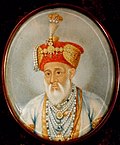 Azim Jah, eleventh and penultimate Nawab of the Carnatic, 1867 to 1874.
 -
 Azim-ud-Daula, Nawab of the Carnatic and his son Azam Jah.
![In the year 1702, Nawab Daud Khan, the Mughal Empire's local Subedar of the Carnatic, besieged and blockaded Fort St. George for more than three months,[8] the governor of the fort, Thomas Pitt, was instructed by the British East India Company to vie for peace](https://en.wikipedia.org/wiki/File:Fort_St._George,_Chennai.jpg)


See also
[edit]


Notes
[edit]References
[edit]- ^ Kenneth Pletcher, ed. (1 April 2010). The History of India. Britannica Educational Publishing. p. 219. ISBN 9781615302017.
- ^ Ramaswami, N. S. (1 January 1984). Political History of Carnatic Under the Nawabs. Abhinav Publications. p. 104. ISBN 9780836412628.
- ^ "Mughal Empire 1526–1707 by Sanderson Beck". San.beck.org. Retrieved 4 March 2012.
- ^ "Benfield, Paul" . Dictionary of National Biography. London: Smith, Elder & Co. 1885–1900.
- ^ Markovits, Claude (1 February 2004). A History of Modern India, 1480–1950. Anthem Press. ISBN 978-1-84331-004-4.
- ^ Uttar Pradesh District Gazetteers: Muzaffarnagar. Government of Uttar Pradesh. 1988. p. 42.
- ^ Naravane, M.S. (2014). Battles of the Honourable East India Company. A.P.H. Publishing Corporation. pp. 151, 154–158. ISBN 9788131300343.
- ^ Terence R. Blackburn. A miscellany of mutinies and massacres in India.
External links
[edit]- Indian Princely States – Arcot Archived 8 June 2002 at the Wayback Machine on uq.net.au
- The House of Arcot (archived)
| Emperors | |||||||||
|---|---|---|---|---|---|---|---|---|---|
| Administration |
| ||||||||
| Conflicts |
| ||||||||
| Architecture |
| ||||||||
| See also | |||||||||
| Successor states | |||||||||

Carnatic Sultanate
View on GrokipediaGeography
Territory and Borders
The Carnatic Sultanate's territory primarily comprised the southeastern coastal plain of the Indian subcontinent, known as the Coromandel Coast, extending along the Bay of Bengal from approximately the Krishna River in the north to the Kaveri River in the south. This domain, established under Mughal subedars and later Nawabs, was bounded westward by the Eastern Ghats and included fertile riverine deltas conducive to agriculture and trade.[4][5] Core administrative districts under Nawabi control encompassed regions corresponding to present-day northern and southern Arcot, Chingleput, Tanjore, Trichinopoly, Madurai, Ramnad, and Tinnevelly in Tamil Nadu, with Arcot serving as the political center after its relocation from Gingee around 1715. Expansions occurred under Dost Ali Khan, who annexed Madurai and Trichinopoly by 1736, extending influence southward toward Cape Comorin.[6][5] Northern borders adjoined the Northern Circars, nominally under the Nizam of Hyderabad until claims of independence in the 1740s, while southern limits interfaced with semi-autonomous nayak polities and later Mysore incursions. Western frontiers remained porous, limited by mountainous terrain and rival Deccan powers, with effective control often confined to lowland areas due to military dependencies on European allies.[7][5] Fluctuations in borders intensified during the Carnatic Wars (1746–1763), as French-supported claimants contested British-backed Nawabs, resulting in territorial concessions and protectorates that diminished direct sovereignty by the late 18th century. European factory enclaves, such as Madras under British control and Pondicherry under French, punctuated the coastline, complicating maritime boundaries.[5]Administrative Divisions
The Carnatic Sultanate was administratively divided into two main subahs under the Nawabs: the Arcot Subah, comprising the districts of Nellore, Chengalpattu, and Arcot; and the Trichy Subah, including Tirunelveli, Madurai, and Trichy districts.[8] These provincial units reflected Mughal influences, with subahdars appointed as governors to oversee local administration, revenue, and military obligations.[8] Subahs were further organized into sarkars, each headed by a faujdar tasked with maintaining law, order, and defense. Sarkars encompassed parganas (equivalent to taluks), managed by shiqqdars who coordinated revenue collection, supported by amils for financial oversight, fotadars as treasurers, qanungos for village accounting, and patwaris for maintaining land records. At the grassroots level, villages (gramams) were governed by kotwals, while smaller hamlets (mathuras) formed the basic units.[8] Parallel to this structure, the poligar system dominated local governance, particularly in southern territories, dividing land into semi-autonomous palayams ruled by hereditary poligar chieftains. Poligars functioned as military governors and revenue intermediaries, collecting tribute and supplying troops to the Nawab in return for territorial control and autonomy. Historical records indicate dozens to up to 72 palayams in regions under nominal Carnatic authority, such as those linked to Madurai, though exact numbers varied due to conflicts and encroachments. This feudal arrangement, inherited from Vijayanagara and Nayak eras, often undermined central control, as poligars resisted Nawabi impositions on tribute and jurisdiction.[9][8] Central administration at Arcot (occasionally shifted to Trichinopoly or Madras) involved a council of ministers, with the Nawab delegating to provincial diwans for revenue, bakshis for military affairs, kotwals for policing, and qazis for Islamic judicial functions. Revenue primarily derived from land assessments categorized by soil fertility, supplemented by rural taxes, customs duties, salt monopolies, and mint operations, though exemptions applied during famines or invasions. The dual central-local framework enabled fiscal extraction but fostered tensions with poligars, contributing to internal instability.[8]Origins
Establishment under Mughal Influence
The Mughal Empire's expansion into the Carnatic region followed Emperor Aurangzeb's successful Deccan campaigns, including the annexation of Golconda in 1687 and Bijapur in 1686, which facilitated control over southern territories previously held by the Qutb Shahi and Adil Shahi dynasties. In 1692, Aurangzeb appointed Zulfikar Khan Nusrat Jung as the inaugural subahdar (provincial governor) of the Carnatic subah, establishing Arcot as the administrative headquarters; this role was bestowed as recompense for Zulfikar Khan's victories against Maratha forces under Rajaram, thereby initiating formalized Mughal governance in the area.[4][10] A decisive consolidation occurred through the eight-year siege of Gingee (Jinji) fort, commencing in September 1690 and culminating in its capture on 8 January 1698 under Zulfikar Khan's command, wresting the stronghold from Maratha occupation and eliminating a key southern resistance bastion. This victory enabled the organization of the Carnatic's southern provinces into a distinct Mughal administrative unit, with Zulfikar Khan assuming the title of Nawab of the Carnatic and overseeing revenue collection, military deployments, and subjugation of local polities such as Tanjore and Madurai, which were compelled to acknowledge imperial suzerainty through tribute payments.[11][2] Successive appointments reinforced this structure, with Daud Khan serving as faujdar under Zulfikar Khan before ascending to Nawab around 1700–1710, focusing on internal stabilization and fiscal reforms amid ongoing Maratha incursions. By 1710, Mohammed Sayyid, appointed as the final direct Mughal governor, adopted the title Saadatullah Khan I and relocated the court permanently from Gingee to Arcot, fostering a nascent hereditary Nawabi lineage while maintaining nominal allegiance to the Mughal throne via the Nizam of Hyderabad's oversight; Saadatullah expanded influence from the Krishna River to the Kaveri, appointing deputies to administer districts and extracting fixed revenues that funded both local defenses and imperial obligations.[12][4]Transition from Hyderabad Deccan
The Carnatic region, encompassing the southeastern coastal territories from the Krishna River to the Kaveri River, initially operated as a subordinate district within the Mughal Deccan subah, subject to the authority of imperial viceroys based in the Deccan highlands.[4] Following the death of Emperor Aurangzeb in 1707 and the ensuing fragmentation of Mughal control, the Deccan viceroyalty under Nizam-ul-Mulk Asaf Jah I evolved into the semi-independent Hyderabad state by 1724, with the Carnatic retaining nominal allegiance as a dependency under the Nizam's legal purview.[13] This arrangement positioned Carnatic governors as appointees answerable to the Nizam, who exercised oversight through revenue obligations and military levies, though practical enforcement waned amid regional power struggles.[14] The pivotal shift toward autonomy commenced with the appointment of Saadatullah Khan I as Nawab of Carnatic in 1710, marking the inception of a distinct Muslim-ruled principality.[4] Saadatullah, originally a Mughal revenue official of Persian origin, relocated the administrative capital from Gingee to Arcot in 1712, centralizing control over an estimated territory yielding annual revenues of approximately 2-3 million rupees through agrarian taxation and trade duties.[4] By designating his nephew Dost Ali Khan as successor in 1732—bypassing standard Mughal or Nizam protocols for non-hereditary posts—Saadatullah effectively transformed the governorship into a hereditary dynasty, reducing direct interference from Hyderabad and fostering local administrative independence.[4] This maneuver capitalized on the Nizam's preoccupation with northern threats and Maratha incursions, allowing Carnatic rulers to retain jagir lands and appoint sub-collectors without prior Hyderabad approval.[15] Dost Ali Khan's reign (1732–1740) further entrenched this detachment, as he expanded influence by subjugating Madurai Nayaks in 1736 and mobilizing forces against Maratha raids, actions undertaken with minimal consultation of the Nizam.[4] His death in 1740 during a battle at Damalcheruvu against Maratha forces under Raghoji Bhonsle triggered a succession dispute between his son Safdar Ali and rival claimant Chanda Sahib, exposing vulnerabilities that prompted Nizam-ul-Mulk's direct intervention in 1743.[16] The Nizam marched south with an army of 30,000, deposing Safdar Ali and installing the loyal Mughal noble Anwaruddin Khan as Nawab, thereby temporarily reasserting Hyderabad's suzerainty through enforced tribute payments estimated at 1.5 million rupees annually.[16] Yet, Anwaruddin's tenure (1744–1749) coincided with escalating French and British rivalries, culminating in his defeat and death at the Battle of Ambur in 1749, which eroded Nizam influence and paved the way for Muhammad Ali Khan Wallajah's ascension under British auspices, accelerating Carnatic's de facto separation from Hyderabad control.[16] This interplay of internal dynastic assertions and external validations underscored the causal drift from Deccan oversight to regional self-rule, sustained by the Nawabs' diplomatic maneuvering amid imperial decline.Historical Development
Mughal Subedars and Early Nawabs (1690–1740)
In the late 17th century, following the Mughal conquest of the Golconda Sultanate in 1687, the Carnatic region—encompassing the southeastern coastal territories from the Krishna River to Cape Comorin—was integrated into the Mughal administrative framework as a subah (province). Emperor Aurangzeb formalized this by appointing Zulfiqar Khan Nusrat Jung, son of the influential wazir Asad Khan, as the first subahdar (governor) of the Carnatic in 1692, with Arcot established as the administrative headquarters. Zulfiqar Khan, leveraging his military experience from Deccan campaigns, focused on consolidating Mughal authority amid local Hindu chieftain resistance and Maratha raids, while fostering tentative relations with European trading companies. His tenure until 1703 emphasized revenue collection and fortification, though exact tribute figures to Delhi remain sparsely documented.[4][17] Zulfiqar Khan's successor, Daud Khan Panni, an Afghan-origin noble previously serving as his deputy and Mughal commander-in-chief in the Deccan since 1701, assumed the nawabship in 1703 upon Zulfiqar's death. Daud Khan intensified efforts to subdue polygars (local zamindars) and expanded influence southward, but his rule was marked by tensions with the English East India Company; in 1702, he blockaded Fort St. George (Madras) for over three months, demanding unpaid customs duties and tribute arrears totaling approximately 4 lakh rupees, an action rooted in enforcing imperial trade monopolies. He also negotiated truces with Maratha leader Shahu in 1711 to mitigate raids, granting them chauth (quarter-revenue) exemptions in exchange for nominal peace. Daud Khan governed until his death in battle against rebellious zamindars near Arcot on January 31, 1710, leaving a legacy of militarized administration but fiscal strains from ongoing campaigns.[6][18] Daud Khan's diwan, Sayyid Muhammad Muzaffar (Sa'adatullah Khan I), a Telugu-origin Sayyid noble, was elevated to nawab in 1710 by Mughal viceregal authorities in the Deccan, transitioning the office toward hereditary patterns amid weakening central oversight post-Aurangzeb's death in 1707. Sa'adatullah shifted the capital firmly to Arcot, implementing administrative reforms such as appointing dubashes (intermediary brokers) to manage revenue farms and granting jagirs (land assignments) to European factors to stimulate port trade at Madras and Pondicherry, yielding annual revenues estimated at 20-30 lakh rupees by the 1720s. He maintained Mughal nominal suzerainty through periodic tribute—around 5 lakh rupees annually initially—while asserting de facto autonomy, suppressing internal revolts like the 1714 Madurai rebellion and balancing alliances with the Nizam of Hyderabad. His rule until February 1732 stabilized the early nawabi structure, though reliance on mercenary armies foreshadowed vulnerabilities.[2][19] Sa'adatullah's nephew and adopted heir, Dost Ali Khan, succeeded in 1732, inheriting a polity increasingly strained by Maratha incursions under Baji Rao I, who demanded chauth payments escalating to 10 lakh rupees by 1739. Dost Ali, focusing on fiscal prudence, curtailed some European concessions but faced diplomatic isolation; his failed overtures to the Nizam for aid culminated in the 1740 Battle of Damalcherry, where he was killed on October 24 alongside two sons, exposing the fragility of Mughal-subordinate governance amid regional power vacuums. This event precipitated succession disputes, eroding the subedar-nawab model's cohesion by 1740.[4][19]Independent Nawabs and Internal Conflicts (1740–1760)
The death of Nawab Dost Ali Khan on 20 May 1740 during a Maratha invasion at the Battle of Damalcherry created a power vacuum in the Carnatic, enabling local rulers to assert greater autonomy amid weakened oversight from the Nizam of Hyderabad.[20] Maratha forces briefly controlled Arcot, extracting tribute and capturing Dost Ali's son-in-law Chanda Sahib, further destabilizing the region.[6] In March 1744, the Nizam appointed Muhammad Anwaruddin Khan as Nawab of Arcot, initiating a phase of relatively independent administration despite nominal subordination to Hyderabad.[21] Anwaruddin consolidated control by subduing rivals such as Mir Asadullah, recovering tribute from the Raja of Tanjore, and dividing provincial responsibilities among his sons, with Mahfuz Khan and Hazrat Ala overseeing Trichinopoly.[21] He repelled a Maratha incursion at Baswapattan around 1746, commanding an army of 69,000 troops.[21] Internal tensions persisted, fueled by factional rivalries between Navayat and Tahiran groups, as well as disputes among Anwaruddin's sons and the assassination of Muhammad Saeed, son of the previous governor Safdar Ali.[21] These conflicts eroded unified governance, setting the stage for broader strife. On 3 August 1749, Anwaruddin, aged 77, was killed at the Battle of Ambur while leading forces against a coalition of Chanda Sahib—recently released from Maratha captivity and claiming the throne as Dost Ali's son-in-law—and Muzaffar Jang, backed by French troops.[21][22] The ensuing succession war pitted Anwaruddin's son Muhammad Ali Khan, who retreated to Trichinopoly, against Chanda Sahib, who proclaimed himself Nawab with French support. Chanda Sahib's forces, numbering around 60,000 including 2,000 Europeans, besieged Trichinopoly in 1751, but British interventions, including Robert Clive's defense of Arcot, shifted momentum. Chanda Sahib was captured and executed in 1752, though his son Raza Sahib prolonged resistance. Muhammad Ali Khan navigated ongoing internal challenges, including familial dissent from brothers aligned with Hyderabad and local rebellions, while leveraging alliances to secure his position. By the mid-1750s, these efforts diminished Deccan influence, fostering de facto independence for the Carnatic Nawabs, though sporadic conflicts persisted until formal Mughal recognition in 1765. The period's turmoil highlighted causal fractures from Mughal decline, enabling rival claimants to exploit European rivalries for local gain.Carnatic Wars and European Entanglements (1746–1763)
The Carnatic Wars, spanning 1746 to 1763, arose from the extension of European conflicts to India, intertwining British and French commercial ambitions with succession disputes among the Nawabs of the Carnatic and the Nizam of Hyderabad. The first war (1746–1748), linked to the War of the Austrian Succession, began when French forces under Bertrand-François Mahé de La Bourdonnais captured Madras from the British in September 1746. Nawab Anwaruddin Khan, appointed by Nizam-ul-Mulk in 1744, demanded the restoration of Madras but suffered defeat at the Battle of Adyar on October 24, 1746, against French troops allied with Chanda Sahib, a claimant to the Carnatic throne and former prisoner of the Marathas. The war concluded with the Treaty of Aix-la-Chapelle in 1748, returning Madras to British control, though local tensions persisted.[23] The second war (1749–1754), unofficial and driven by Joseph François Dupleix's expansionist policy, saw French support for Chanda Sahib and Muzaffar Jang against Anwaruddin and Nasir Jang. At the Battle of Ambur on August 3, 1749, this coalition defeated and killed Anwaruddin, installing Chanda Sahib as Nawab. Anwaruddin's son, Muhammad Ali Khan, fled to Trichinopoly and allied with the British, who countered with Robert Clive's capture of Arcot on August 31, 1751, using 210 Europeans and 300 sepoys against a larger force. Clive defended Arcot during a 50-day siege, diverting Chanda Sahib's army and enabling British victories at Arni and Kaveripakkam in 1751. Chanda Sahib was captured and executed in 1752, leading to Muhammad Ali's recognition as Nawab by 1754 via the Treaty of Pondicherry, though Dupleix's recall to France undermined French gains.[23] The third war (1756–1763), part of the Seven Years' War, intensified rivalry as French Governor-General Thomas Arthur, comte de Lally, sought to reverse British advantages. Lally captured Fort St. David in 1758 but failed at Madras. British forces under Sir Eyre Coote decisively defeated the French at the Battle of Wandiwash on January 22, 1760, with 2,100 Europeans and 3,000 sepoys routing Lally's 4,000 troops, securing British naval superiority. This led to the surrender of Pondicherry on January 16, 1761. Muhammad Ali Khan, bolstered by British protection, solidified his rule as Nawab, marking the effective end of French influence in the Carnatic and the beginning of British paramountcy over the Sultanate's affairs.[23]British Protectorate and Final Nawabs (1763–1855)
Following the Treaty of Paris in 1763, which concluded the Third Carnatic War, Muhammad Ali Khan Wallajah was recognized as the lawful Nawab of the Carnatic by both British and French powers, solidifying his alliance with the British East India Company (EIC) that had supported his claim against French-backed rivals since 1749.[24] The EIC provided military protection and stationed troops in Arcot, in exchange for territorial concessions, revenue-sharing arrangements, and exclusive trading privileges, rendering the Nawab increasingly dependent on British forces for defense against regional threats like Mysore.[25] Muhammad Ali's reign until his death on October 13, 1795, was marked by escalating debts to the EIC and European creditors, totaling millions of rupees, which strained Carnatic finances and led to exploitative revenue extractions from local zamindars and peasants to service these obligations.[24] Upon Muhammad Ali's death, his son Ghulam Husain Ali Khan, known as Umdat ul-Umara, succeeded as Nawab from 1795 to 1801, inheriting the mounting debt crisis that exceeded 10 million rupees.[26] The financial instability prompted negotiations culminating in the Carnatic Treaty of July 31, 1801, whereby Umdat ul-Umara ceded civil and military administration of the Carnatic territories—encompassing districts like North Arcot, South Arcot, Trichinopoly, Madurai, and Tinnevelly—to the British, who assumed direct revenue collection to liquidate debts while granting the Nawab a personal pension and titular sovereignty.[27] This subsidiary alliance formalized British protectorate status, reducing the Nawabs to ceremonial figures with limited authority, as EIC residency oversight ensured compliance and prevented independent alliances.[28] After Umdat ul-Umara's death in 1801, the British recognized Azim-ud-Daula as Nawab (1801–1819), followed by a series of successors including his adopted kin, with the dynasty continuing under strict British supervision.[29] The Nawabs, now pensioners receiving fixed stipends from British-assigned revenues, focused on cultural patronage, particularly Persian literature and poetry at Arcot, fostering exclusive assemblies despite fiscal constraints imposed by debt settlements.[30] Administration shifted to British collectors enforcing permanent settlements, which prioritized debt repayment over local welfare, exacerbating agrarian pressures while maintaining nominal Nawabi dignity.[24] The final Nawab, Ghulam Muhammad Ghouse Khan, ruled titularly from 1825 until his death on October 15, 1855, without producing a male heir, prompting the British to annex the Carnatic outright.[4] Citing the non-hereditary nature of the 1801 treaty—which omitted explicit succession guarantees—and the absence of a direct heir, Governor-General Lord Dalhousie ordered possession of remaining Nawabi assets and territories, integrating them into the Madras Presidency without compensation beyond settling outstanding pensions.[28] This lapse-based annexation, consistent with British policy toward dependent states, ended the Carnatic Nawabdom after nearly a century of progressive erosion under protectorate, transferring full fiscal and political control to the EIC amid broader consolidation of British India.[31]Governance
Administrative System
The administrative system of the Carnatic Sultanate followed the Mughal model, with the Nawab serving as the supreme head of state, functioning as both political and military leader, assisted by a council of ministers responsible for key departments such as revenue, military, and judiciary.[19] The central administration was headquartered in Arcot until Nawab Muhammad Ali Walajah shifted it to Trichinopoly and later Madras in the mid-18th century, where the durbar (royal court) operated under a chief superintendent who managed protocols, noble seating, and ceremonial affairs.[19] Key central officials included the Diwan, who oversaw revenue collection, agricultural assessments, and fiscal policy across the realm; the Bakshi, handling military payroll and provincial army logistics; and the Qazi-ul-Quzzat, the chief judicial authority enforcing Sharia law in civil, criminal, and property disputes.[19] Provincially, the territory was divided into two primary subahs (provinces): the Arcot Subah encompassing Nellore, Chengalpattu, and Arcot districts, and the Trichinopoly Subah covering Tirunelveli, Madurai, and Trichinopoly districts, further subdivided into sarkars (districts), parganas (sub-districts or taluks), and gramams (villages).[19] Subahdars governed these subahs with a typical tenure of three years, focusing on public welfare, law enforcement, and revenue oversight, while operating semi-independently from the Diwan to balance power.[19] Local administration relied on faujdars for district-level military executive duties, including peacekeeping; kotwals for urban policing and order maintenance; and amalguzars as revenue heads who conducted tax assessments and collections, often negotiating exemptions during famines or natural calamities.[19] Zamindars and village headmen handled grassroots revenue gathering and minor disputes, reflecting a hierarchical delegation that ensured Mughal-style central control amid regional autonomy.[19] The revenue system, formalized under Nawab Anwaruddin Khan of the Wallajah dynasty (r. 1744–1749), prioritized land revenue as the primary fiscal base, classifying arable land by fertility (good, moderate, or fertile) to determine assessments, supplemented by rural taxes, customs duties, salt monopolies, and mint operations.[19] Judicial administration emphasized Islamic law, with qazis appointed at every level—from subah to village—to adjudicate cases, though customary Hindu practices persisted in rural parganas under local oversight.[19] Military administration integrated into the civil structure, with the Nawab as commander-in-chief leading forces comprising cavalry (the most emphasized branch), infantry, artillery, and elephantry, managed provincially by sipahsalars and the Bakshi, without a dedicated navy.[19] This framework, inherited from Mughal subahdars like the first Nawab Zulfikar Ali Khan (appointed 1698), evolved under later rulers such as Saadatullah Khan (r. 1710–1732) to accommodate semi-independence from Hyderabad's Nizam while maintaining bureaucratic efficiency until British subsidiary alliances curtailed autonomy post-1763.[19]Revenue and Fiscal Policies
The revenue system of the Carnatic Sultanate centered on land revenue as its principal source, derived primarily from agricultural assessments on cultivated lands across provinces such as Arcot and Trichinopoly. Under Nawab Anwaruddin Khan (r. 1744–1749), lands were systematically surveyed and classified into categories of good, moderate, and fertile quality to establish fair yet demanding assessments, often collected in cash or kind directly from ryots (individual cultivators) without extensive intermediary zamindars.[32] Revenue officers, including the Provincial Diwan for oversight, Amalguzar for accounting, and Amils for local enforcement, maintained meticulous daily records of collections, which were promptly deposited into the royal treasury to support administrative and military expenditures.[19] To mitigate agrarian distress, fiscal policies incorporated exemptions from land revenue during natural calamities, such as droughts, floods, and famines, allowing peasants temporary relief while encouraging the expansion of cultivable areas through state-provided loans. Supplementary revenues augmented the land base, encompassing customs duties levied at ports on traded goods after valuation by qazis, proceeds from the state-controlled salt monopoly, income from royal mints, and irregular rural taxes in the form of gifts or tributes from local dignitaries.[32] These measures aimed to stabilize inflows, though enforcement relied on subahdars and diwans in key subahs, who balanced collection with basic peasant welfare to prevent widespread desertion of fields.[19] Fiscal management, however, was undermined by chronic indebtedness, particularly from the mid-18th century onward, as Nawabs borrowed heavily from European creditors, including British East India Company servants, to fund wars and subsidies. Loans carried usurious rates—often 4% monthly, equating to 48% annually—with territories mortgaged as collateral, empowering lenders to appoint their own amildars and tehsildars for direct revenue extraction, which intensified peasant exploitation through seizures of grain and livestock.[33] Under Muhammad Ali Khan Wallajah (r. 1749–1795), such debts ballooned to an estimated £4.4 million by the late 18th century, including consolidated loans like the 1767 £880,000 tranche at 10% interest and the 1777 £2.4 million at 12%, diverting substantial agrarian output to debt servicing and contributing to economic drain, village depopulation, and famines such as that of 1783.[33] This pattern of revenue farming and collateralization reflected a reactive fiscal strategy, prioritizing short-term liquidity over sustainable agrarian investment, and foreshadowed British intervention, including the 1781 handover of collection rights.[33]Economy
Agricultural Base and Land Revenue
The economy of the Carnatic Sultanate rested primarily on agriculture, with the fertile alluvial plains of the Kaveri River delta supporting intensive wet cultivation, particularly of rice as the staple crop.[33] Dry lands further inland relied on rain-fed millets and other grains, supplemented by limited cash crops such as sugarcane in suitable pockets like Chingleput district toward the late 18th century.[34] Irrigation infrastructure, including canals from the Kaveri and traditional tanks, enabled double-cropping in favored areas like Thanjavur province, though water scarcity in upland regions constrained yields.[35] Land revenue formed the cornerstone of state finances under the Nawabs, assessed through periodic surveys classifying soils as good, moderate, or fertile to determine productive capacity.[36] The Provincial Diwan oversaw administration, delegating to Amalguzars at the district level and Amils at the taluk, who supervised collections often in tandem with zamindars responsible for peasant assessments and enforcement via faujdars.[36] To encourage expansion, Diwans extended loans to cultivators and granted exemptions during droughts or floods, reflecting an intent to sustain output amid variable monsoons.[36] Fiscal pressures from incessant warfare and loans eroded this system, as Nawabs like Muhammad Ali Khan Wallajah mortgaged revenue rights over prime tracts to European creditors at usurious rates—up to 4% monthly interest—allowing direct collection by appointees such as amildars and tehsildars through coercive seizures of grain or bonds.[33] This assignment practice, collateralizing districts like Tirunelveli yielding 300,000 pagodas annually, drained agrarian surplus abroad, estimated at £20 million from 1760 to 1780, while fostering peasant flight and uncultivated fallows; for instance, productive fields in Poonamallee plummeted from 100 to 20 marcal by the 1780s, exacerbating scarcities and famines.[33] Total Nawabi debts reached £4.44 million by the late 18th century, with interest burdens of 10-36% annually compounding the crisis and paving the way for British revenue takeovers, such as the 1781 cession of Tirunelveli management.[33]Trade, Commerce, and European Connections
The commerce of the Carnatic under the Nawabs centered on the export of cotton textiles from the Coromandel Coast ports, where decentralized weaving villages supplied painted, dyed, and printed cloths to European traders. These textiles, including chintz and calicoes, were produced using mordant dyeing techniques and exported primarily to Europe, Southeast Asia, and West Africa, forming a cornerstone of the region's economy alongside agricultural revenues.[37][38] By the early 18th century, following disruptions from Mughal-Maratha conflicts, cloth exports from Coromandel ports such as Madras and Pulicat resumed growth, driven by demand from companies like the Dutch VOC, which allocated 20-25% of its imports to Indian textiles by value in markets like Makassar.[39][40] European connections intensified trade but also introduced rivalries that shaped Nawabi finances. The British East India Company established Fort St. George at Madras in 1639, initially under Vijayanagar permission but later integrated into Carnatic trade networks under Mughal subedars and independent Nawabs, who granted revenue collection rights in the Madras jagir for military support.[24] The French East India Company secured Pondicherry in 1674 from local rulers, using it as a base for textile procurement similar to Madras, though British dominance post-Carnatic Wars curtailed French influence.[41] Nawabs like Muhammad Ali Khan Wallajah (r. 1749–1795) allied with the British, exchanging trade privileges and subsidies for protection against rivals, as formalized in treaties like the 1765 agreement following the Treaty of Allahabad, which recognized his rule while imposing tribute obligations tied to port revenues.[24] These arrangements fueled commerce but engendered fiscal dependencies, with Nawabs borrowing heavily from Company servants to fund wars, leading to concessions on customs duties and revenue assignments from trade-rich districts. By the late 18th century, British control over Madras exports—peaking in textile volumes before industrial competition eroded Indian shares—integrated Carnatic commerce into global circuits, though at the cost of local autonomy as debts escalated, culminating in the 1801 Carnatic Treaty ceding administrative rights to the Company.[42][43] Dutch and Portuguese outposts, such as Pulicat and Nagapattinam, contributed marginally to textile flows but waned against Anglo-French competition, with the former's trade rising to 32% textiles by century's end before overall decline.[44] This European entanglement transformed Carnatic ports from regional hubs into appendages of imperial trade monopolies, prioritizing export extraction over balanced internal commerce.[39]Society and Religion
Demographic Composition
The population of the Carnatic region under the Nawabs of Arcot was overwhelmingly Hindu, comprising chiefly Brahmanical communities that dominated rural and administrative life.[1] Muslims formed a thin minority, largely confined to the ruling nobility, military elites, and urban centers like Arcot, where they originated from Deccan, Persian, and North Indian ancestries introduced during Mughal subahdari.[1] This elite layer, often Pathan or Sayyid in origin, exerted political control but did not significantly alter the broader ethnic fabric, which remained rooted in Tamil-speaking Dravidian groups with Telugu influences from northern poligar chieftains and Vijayanagara-era migrations. Caste structures persisted intact, with Brahmins holding sway over land rents, temple economies, and judicial roles, while Vellalar agriculturists and other Shudra communities formed the agrarian base.[1] Poligars, semi-autonomous Hindu zamindars of Rajput or Telugu descent, governed fortified southern districts, maintaining martial traditions amid Nawabi overlordship. Small Christian enclaves emerged in coastal areas from Portuguese, French, and Danish missionary activities, but remained negligible in scale. No comprehensive censuses exist for the 18th century, reflecting the era's decentralized revenue assessments rather than systematic demographic enumeration.Religious Policies and Hindu-Muslim Relations
The Nawabs of the Carnatic maintained policies of religious tolerance, integrating Hindu administrators into their governance while patronizing both Islamic and Hindu institutions to ensure stability in a predominantly Hindu region. This approach aligned with pragmatic Mughal traditions, avoiding religious impositions like widespread jizya collection or forced conversions, which were not documented in their rule. Hindu zamindars and officials held significant influence, reflecting mutual dependence for revenue collection and military support.[45] Nawab Muhammad Ali Khan Wallajah (r. 1749–1795) exemplified this tolerance by appointing Hindus to most trusted positions in his administration, even as Muslims populated the court, and by extending philanthropy across faiths. He provided substantial donations to major Hindu temples, including the Srirangam Ranganathaswamy Temple complex and the Parthasarathy Temple in Triplicane, alongside support for Sufi shrines. Such patronage included tax exemptions and land grants, as evidenced by endowments like the village of Kaunday in Madurai to the Meenakshi Temple, fostering goodwill and economic ties.[46][47] Earlier rulers, such as Saadatullah Khan I (r. 1710–1732), laid the foundation for this continuity by prioritizing administrative efficiency over religious orthodoxy, relying on local Hindu elites without recorded instances of communal strife or iconoclasm. Numismatic evidence from the Arcot Nawabs' era, including bilingual coins blending Persian and local motifs, underscores their accommodative stance toward Hindu subjects. Hindu-Muslim relations remained cooperative, with interfaith alliances during conflicts like the Carnatic Wars, where religious identity rarely determined loyalties.[48][12]Cultural and Architectural Contributions
The Nawabs of the Carnatic commissioned several notable architectural works, primarily palaces and mosques that incorporated Indo-Islamic elements adapted to local contexts. Muhammad Ali Khan Wallajah (r. 1749–1795) initiated construction of Chepauk Palace in Chennai around 1768, an early exemplar of Indo-Saracenic architecture featuring arched facades, domes, and minarets blended with European influences, serving as the official residence for subsequent Nawabs until the mid-19th century.[49] This structure symbolized the Nawabs' adaptation of Mughal styles to the coastal environment and their alliances with British authorities, who later occupied parts of it post-1855.[50] Wallajah also funded the Wallajah Mosque (Triplicane Big Mosque) in Chennai, completed in 1795, which exemplifies Nawabi patronage of religious architecture with its spacious courtyards, minarets, and intricate stucco work reflective of 18th-century Deccani Islamic design.[51] Later Nawabs, such as Azim-ud-Daula (r. 1801–1819), resided in expanded palace complexes, while the 19th-century Amir Mahal—commissioned around 1870 and designed by British architect Robert Chisholm—further advanced Indo-Saracenic motifs with its ornate balconies and vaulted halls, underscoring the dynasty's role in evolving hybrid architectural traditions amid British oversight.[52] Culturally, the Nawabs fostered an Islamicate milieu in their courts, promoting Persianate arts, language, and administrative aesthetics drawn from Mughal precedents, which influenced local elites in the Carnatic region. Their architectural projects facilitated cultural exchange, integrating Hindu craftsmanship with Islamic forms, though primary patronage centered on Muslim religious and palatial structures rather than broader indigenous performing arts like Carnatic music, which thrived under temple and Hindu royal support elsewhere in South India. This focus reflected the Nawabs' position as Muslim rulers in a predominantly Hindu society, prioritizing dynastic and religious symbolism over extensive secular artistic innovation.[53]Military
Composition and Organization
The military of the Carnatic Sultanate was structured hierarchically, with the Nawab functioning as the supreme Commander-in-Chief responsible for overall command and strategic direction.[19] Subordinate leadership included sipahsalars, who served as field commanders overseeing operational units, while the bakshi acted as the chief military administrative officer, handling logistics, troop welfare, and enforcement of discipline across the provinces of Arcot and Trichinopoly.[19] The army's composition emphasized traditional branches suited to regional warfare, comprising cavalry as the predominant and most valued arm for mobility and shock tactics, supplemented by infantry for holding ground, artillery for sieges and field engagements, and elephantry for intimidation and transport in open battles.[19] Unlike coastal powers such as Hyderabad, the Nawabs maintained no dedicated navy, relying instead on alliances or European proxies for maritime defense.[19] Recruitment drew from local Muslim elites, Hindu poligars (zamindari warriors), and mercenary groups, with cavalry often comprising Turani or Pathan horsemen loyal to the dynasty, though exact unit sizes varied by ruler and fiscal capacity, typically numbering in the thousands for major campaigns.[19] Organization followed Mughal-inspired patterns adapted to the Deccan context, with forces divided into provincial contingents under subahdars for rapid mobilization, emphasizing cavalry-heavy formations for raids and skirmishes against Maratha or Mysore incursions.[19] By the mid-18th century under Nawabs like Muhammad Ali Khan, increasing European influence—particularly British subsidiary alliances—introduced disciplined sepoy infantry battalions trained in linear tactics and musketry, gradually integrating with native cavalry to counter French-backed rivals, though core administrative control remained with the bakshi until the 1801 treaty ceded effective autonomy to the East India Company.[19] This hybrid evolution reflected fiscal dependencies, as military maintenance strained revenues, leading to reliance on tribute and loans for sustaining troop strength.[19]Key Campaigns and Strategies
The Carnatic Nawabs' military engagements in the 18th century focused on succession conflicts and resistance to European incursions, often revealing limitations in traditional tactics against modernized opponents. In the Battle of Adyar on 24 October 1746, Nawab Anwaruddin Khan deployed around 10,000 cavalry and infantry under his son Mahfuz Khan to dislodge a French force of approximately 200-300 troops that had seized Madras from the British. The Carnatic army's massed charges proved ineffective against the French's coordinated musket fire and mobile artillery, resulting in a decisive defeat that underscored the tactical edge of European discipline and firepower.[54][55] Anwaruddin's subsequent campaign culminated in the Battle of Ambur on 3 August 1749, where his forces clashed with a coalition of French-backed claimant Chanda Sahib and local allies; Anwaruddin was killed in the engagement, paving the way for intensified French influence in Carnatic politics. This loss fragmented Nawabi authority, with Muhammad Ali Khan Wallajah emerging as a British-supported rival to Chanda Sahib. The Second Carnatic War (1749-1754) saw Nawabi pretenders leverage European alliances, as Muhammad Ali provided revenue and troops to the British East India Company in exchange for military backing against French proxies.[23] A turning point was the Siege of Arcot from 23 September to 14 November 1751, where British forces under Robert Clive, numbering 210 Europeans, 300 sepoys, and three guns, captured the fort on 31 August and repelled assaults by Chanda Sahib's army of over 10,000 men, including French auxiliaries and war elephants. Clive's defense, relying on fortified positions, limited sorties, and supply resilience despite shortages, forced Chanda Sahib to divert troops from besieging Trichinopoly, bolstering Muhammad Ali's position and leading to his recognition as Nawab under the 1754 Treaty of Pondicherry.[56][57] Nawabi strategies emphasized numerical superiority through levied cavalry, irregular peons (foot soldiers), and occasional war elephants for shock tactics and sieges, alongside fort-based defenses in key centers like Arcot and Trichinopoly. However, these proved vulnerable to European innovations in linear infantry formations, rapid artillery deployment, and naval logistics, prompting Nawabs like Muhammad Ali to adopt subsidiary systems—ceding fiscal and military autonomy for British protection and training. By the late 18th century, during the Anglo-Mysore Wars, Carnatic contingents under British command contributed to campaigns against Hyder Ali and Tipu Sultan, though independent Nawabi initiatives waned; Nawab Umdat ul-Umara's covert support for Tipu in the 1790s led to British annexation of military powers in 1801.[6][58]Rulers
Mughal Subedars of the Carnatic
The Mughal Subedars of the Carnatic were provincial governors appointed directly by the Mughal emperor to administer the southeastern coastal region of India, following its subjugation after the conquest of the Golconda Sultanate in 1687. This subah, encompassing territories from the Krishna River southward to Cape Comorin, was integrated into the Mughal Deccan framework, with Arcot established as the primary administrative seat to facilitate revenue collection, military control, and suppression of local resistances from Hindu nayaks and Maratha raiders. Aurangzeb's appointments emphasized military capability, as the region required robust defense against persistent incursions, reflecting the emperor's strategy to consolidate southern frontiers amid broader Deccan campaigns.[10] In 1692, Aurangzeb appointed Zulfikar Khan Nusrat Jang, a high-ranking noble and son of the imperial wazir Asad Khan, as the inaugural Nawab and Subedar of the Carnatic, rewarding his successes in combating Maratha forces under Sambhaji's successor Rajaram. Zulfikar Khan, leveraging his experience from earlier Deccan operations, focused on fortifying Arcot and organizing local faujdar outposts to curb banditry and extract land revenue from agrarian districts reliant on rice and cotton cultivation. His tenure, lasting until approximately 1703, marked the formal inception of Mughal viceregal authority, though practical control remained tenuous due to overstretched imperial resources and Zulfikar's concurrent roles in broader Deccan viceroyalty.[4] Succeeding Zulfikar Khan, Daud Khan Panni, an ethnic Pashtun Mughal commander known for valor in Aurangzeb's southern expeditions, was elevated to Nawab and Subedar in 1703. Daud Khan prioritized military expeditions against Maratha detachments and recalcitrant poligars (local chieftains), capturing key forts and imposing Mughal iqta land grants to loyal officers, which stabilized revenue flows estimated at several lakhs of rupees annually from fertile Pallava-era territories. He also navigated alliances with regional Hindu rulers, such as the Raja of Madurai, to mitigate rebellions, while establishing Arcot's mint for coinage to bolster local economy. Daud Khan's administration endured until 1710, when he shifted focus to Hyderabad campaigns, entrusting interim duties to deputies like Saadatullah Khan; he perished in 1715 during conflicts with the Nizam-ul-Mulk. His era underscored the subedars' dual role in fiscal extraction—yielding tribute to Delhi—and defensive warfare, yet foreshadowed autonomy as Mughal central authority waned post-Aurangzeb.[6][59]Independent Nawabs of Arcot
The Independent Nawabs of Arcot emerged in the early 18th century as Mughal central authority waned following the death of Emperor Aurangzeb in 1707, allowing local governors to assert greater autonomy in the Carnatic region.[6] These rulers, while nominally owing allegiance to the Mughal throne or the Nizam of Hyderabad, governed de facto independently, expanding their territory from the Krishna River in the north to the Kaveri River in the south.[4] The period marked a transition from viceregal administration to hereditary Muslim dynastic rule centered at Arcot, with a focus on consolidating power against regional Hindu kingdoms and Maratha incursions.[3] Sa'adatullah Khan I, who ruled from 1710 to 1732, is regarded as the founder of this independent line, having been appointed as Mughal subedar but effectively operating autonomously after establishing his court at Arcot.[4] He implemented administrative reforms, including a revenue system based on direct collection from ryots, and suppressed rebellions in Madurai and Tanjore to extend Carnatic influence.[36] Adopting his nephew Dost Ali Khan as successor, Sa'adatullah maintained nominal Mughal ties while fostering a Shia-oriented court amidst a predominantly Sunni Deccan nobility.[60]| Nawab | Reign | Key Events |
|---|---|---|
| Sa'adatullah Khan I | 1710–1732 | Established Arcot as capital; revenue reforms; territorial consolidation.[4] [36] |
| Dost Ali Khan | 1732–1740 | Annexed Madurai Nayak territories in 1736; defeated and killed by Maratha forces under Raghoji Bhonsle at the Battle of Damalcherry in 1740.[6] [61] |
| Safdar Ali Khan | 1740–1742 | Son of Dost Ali; brief rule ended in flight and death during Maratha occupation; minimal consolidation amid invasions.[61] [60] |
| Sa'adatullah Khan II | 1742–1744 | Grandson of Dost Ali; installed as puppet under Maratha influence; overthrown after Nizam's intervention.[61] |
| Anwaruddin Khan | 1744–1749 | Appointed by Nizam ul-Mulk to restore order; suppressed internal revolts; killed at the Battle of Ambur in 1749 against French-backed Chanda Sahib, marking the onset of European interference.[6] [61] [60] |
Nawabs under European Influence
The period of European influence on the Nawabs of the Carnatic began with intensified rivalry between the French and British East India Companies during the mid-18th century, particularly through the Carnatic Wars from 1746 to 1763. Anwaruddin Khan, appointed Nawab in 1744 by the Nizam of Hyderabad, initially maintained relations with both powers but leaned toward the British after the French captured Madras in 1746 during the First Carnatic War. He dispatched forces to reclaim the fort, resulting in the Battle of Adyar on 24 October 1746, where a small French contingent of about 200 Europeans and 700 sepoys defeated his larger army of 10,000, demonstrating European military superiority in discipline and artillery.[62] In the Second Carnatic War (1749–1754), Anwaruddin allied with Nasir Jung, the Nizam's successor, against the French-backed claimants Muzaffar Jung for the Deccan throne and Chanda Sahib for the Carnatic nawabship. This led to the Battle of Ambur on 3 August 1749, where French forces under Joseph François Dupleix, numbering around 500 Europeans and 2,000 Indians, alongside Muzaffar Jung's army, routed Anwaruddin's troops, killing the Nawab and enabling Chanda Sahib's brief installation as puppet Nawab. Anwaruddin's son, Muhammad Ali Khan Wallajah, fled and contested the throne with British support, marking a decisive shift where European companies directly intervened in local successions to secure commercial and strategic advantages.[62][63] British forces, led by Robert Clive, bolstered Muhammad Ali's claim through key actions like the Siege of Arcot in 1751, where Clive's 210 Europeans and 300 sepoys withstood a 53-day assault by Chanda Sahib's 10,000-strong army, including French auxiliaries, preserving Muhammad Ali's foothold. This victory, followed by the British capture of Arcot and defeat of Chanda Sahib at the Battle of Arni in December 1751, culminated in the Treaty of Pondicherry on 11 April 1754, which recognized Muhammad Ali as Nawab, though French influence lingered until the Third Carnatic War. Muhammad Ali, reigning from 1749 to 1795, became a formal ally of the British East India Company, providing troops and resources in exchange for military protection against French and Mysore threats, while granting trading concessions that enhanced British revenue collection in the region.[56] Under Muhammad Ali's rule, European influence manifested in financial dependencies, as the Nawab borrowed extensively from the Company and its private employees to fund wars and administration, accruing debts estimated at over 10 million rupees by the 1760s, secured against future tax revenues. The Treaty of Paris in 1763, ending the Seven Years' War globally, reaffirmed British dominance and Muhammad Ali's position, subordinating French claims in the Carnatic. This era transformed the Nawabs from Mughal appointees into proxies in Anglo-French competition, eroding their autonomy through military pacts and economic leverage, setting the stage for formal protectorate status.[24][62]Nawabs as British Protectorate
The Carnatic Treaty of 1801, signed on 31 July between Nawab Azim-ud-Daula and the British East India Company under Governor-General Lord Wellesley, transformed the Nawabs of Arcot into titular rulers under British protection.[64] This subsidiary alliance required the Nawab to cede control over civil and military administration to the British, who stationed troops in the territory paid for by local revenues, while assuming responsibility for external defense and diplomacy.[64] In practice, the British established a Board of Commissioners to oversee revenue collection, civil justice, and public works across the Carnatic, leaving the Nawab with personal estates and a fixed pension derived from assigned lands.[29] Azim-ud-Daula (r. 1801–1819), nephew of the preceding Nawab Umdat ul-Umara, was the first to govern under this arrangement, retaining ceremonial authority and residence in Arcot but lacking substantive power amid ongoing management of the Nawabs' accumulated debts from prior conflicts.[29] His son, Azam Jah (r. 1819–1825), succeeded briefly, followed by Ghulam Muhammad Ghouse Khan (r. 1825–1855), during whose tenure British oversight intensified to stabilize finances strained by the Carnatic debts—estimated at over £3 million by the late 18th century—through direct revenue farming and debt servicing from territorial yields.[24] [29] This protectorate status ensured British paramountcy in the region, preventing alliances with rivals like the French or Mysore remnants, while the Nawabs maintained a courtly facade supported by stipends, though fiscal dependency eroded their autonomy and fueled local agrarian pressures from revenue demands.[24] The treaty's provisions on succession affirmed British approval rights, culminating in disputes over heritability upon Ghouse Khan's death without male issue in 1855.[65]Princes of Arcot Post-1855
Following the death of Nawab Ghulam Muhammad Ghouse Khan on 7 October 1855 without male heirs, the British East India Company invoked the Doctrine of Lapse to annex the Carnatic state, ending the line of ruling Nawabs and incorporating the territory directly into British India.[60] In recognition of the family's historical service and to provide compensation, the British government settled substantial hereditary pensions on the descendants, totaling around 2.5 lakh rupees annually by the late 19th century, derived from land revenues and secured against default.[3] In 1867, Queen Victoria elevated Azim Jah Bahadur (1800–1874), uncle of the last Nawab and brother of the previous incumbent Azam Jah, to the newly created titular position of Prince of Arcot (Amir-e-Arcot), marking the formal transition from sovereign Nawabs to hereditary princes under British paramountcy.[60] Azim Jah, who had previously acted as regent during minorities in the family, received enhanced honors including a privy purse and the right to maintain a court at Arcot, though real administrative authority rested with British officials.[66] He resided primarily in Madras (now Chennai), overseeing family endowments and waqfs (Islamic charitable trusts) that supported mosques, schools, and orphanages across South India.[67] Azim Jah's successors continued as ceremonial heads of the House of Arcot, preserving Mughal-era titles such as Umdat ul-Umara and managing religious and philanthropic affairs without territorial jurisdiction. The family relocated to the purpose-built Amir Mahal in Chennai in the 1870s, funded partly by pension allowances, which served as their primary residence thereafter.[60] Key responsibilities included custodianship of historic waqfs generating income from properties in Tamil Nadu and beyond, with the princes acting as ex-officio mutawallis (trustees) and mediating community disputes under British oversight until independence.[1] The line of princes is as follows:| Prince | Reign | Key Details |
|---|---|---|
| Azim Jah Bahadur | 1867–1874 | First Prince; elevated by Queen Victoria; focused on family estates and pensions post-annexation.[60] |
| Zahir ud-Daula Bahadur, GCSI | 1874–1879 | Son of Azim Jah; knighted for loyalty during the 1857 rebellion aftermath; expanded waqf administration.[67] |
| Intizam ul-Mulk Bahadur | 1879–1890s | Continued hereditary pensions; emphasized education and religious endowments.[66] |
| Muhammad Munawar Ali Khan Bahadur, KCIE | 1889/1903–1950s | Fourth prince; received knighthood in 1879; managed finances amid British pension reforms.[60] |
| Subsequent princes up to the eighth | Varying | Maintained titular status through independence and into the Republic of India. |