Hubbry Logo
Percussion capPercussion capMain
Open search
Percussion cap
Community hub
Percussion cap
logo
8 pages, 0 posts
0 subscribers
Be the first to start a discussion here.
Percussion cap
Percussion cap
from Wikipedia

Percussion caps have been manufactured in various sizes to fit snugly over different sized nipples.
Nipples for 4.5mm and 6mm percussion caps

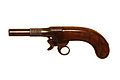
The percussion cap, percussion primer, or caplock, introduced in the early 1820s, is a type of single-use percussion ignition device for muzzle loader firearm locks enabling them to fire reliably in any weather condition.[1] Its invention gave rise to the caplock mechanism or percussion lock system which used percussion caps struck by the hammer to set off the gunpowder charge in rifles and cap and ball firearms. Any firearm using a caplock mechanism is a percussion gun. Any long gun with a cap-lock mechanism and rifled barrel is a percussion rifle. Cap and ball describes cap-lock firearms discharging a single bore-diameter spherical bullet with each shot.

Description

[edit]
All caplock mechanisms rely upon a hammer impact.

The percussion cap is a small cylinder of copper or brass with one closed end. Inside the closed end is a small amount of a shock-sensitive explosive material such as mercury fulminate (discovered in 1800; it was the only practical detonator used from about the mid-19th century to the early 20th century[2]).

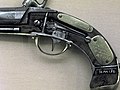
The caplock mechanism consists of a hammer and a nipple (sometimes referred to as a cone). The nipple contains a hollow conduit which goes into the rearmost part of the gun barrel, and the percussion cap is placed over the nipple hole. Pulling the trigger releases the hammer, which strikes the percussion cap against the nipple (which serves as an anvil), crushes it and detonates the mercury fulminate inside, which releases sparks that travel through the hollow nipple into the barrel and ignite the main powder charge.

Percussion caps have been made in small sizes for pistols and larger sizes for rifles and muskets.[1]

Origins

[edit]

Earlier firearms used flintlock mechanisms causing a piece of flint to strike a steel frizzen producing sparks to ignite a pan of priming powder and thereby fire the gun's main powder charge. The flintlock mechanism replaced older ignition systems such as the matchlock and wheellock, but all were prone to misfire in wet weather.[citation needed]

The discovery of fulminates was made by Edward Charles Howard (1774–1816) in 1800.[3][4] The invention that made the percussion cap possible using the recently discovered fulminates was patented by the Reverend Alexander John Forsyth of Belhelvie, Aberdeenshire, Scotland, in 1807.[1] The rudimentary percussion system was invented by Forsyth as a solution to the problem that birds would startle when smoke puffed from the powder pan of his flintlock shotgun, giving them sufficient warning to escape the shot.[1] This early percussion lock system operated in a nearly identical fashion to flintlock firearms and used a fulminating primer made of fulminate of mercury, chlorate of potash, sulphur and charcoal, ignited by concussion.[5][6] His invention of a fulminate-primed firing mechanism deprived the birds of their early warning system, both by avoiding the initial puff of smoke from the flintlock powder pan, as well as shortening the interval between the trigger pull and the shot leaving the muzzle. Forsyth patented his "scent bottle" ignition system in 1807. However, it was not until after Forsyth's patents expired that the conventional percussion cap system was developed. Joseph Manton invented a precursor to the percussion cap in 1814, comprising a copper tube that detonated when crushed.[7] This was further developed in 1822 by the English-born American artist Joshua Shaw, as a copper cup filled with fulminates.[8]

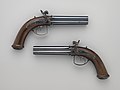
The first purpose-built caplock guns were fowling pieces commissioned by sportsmen in Regency era England. Due to the mechanism's compactness and superior reliability compared to the flintlock, gunsmiths were able to manufacture pistols and long guns with two barrels. Early caplock handguns with two or more barrels and a single lock are known as turn-over or twister pistols, due to the need to manually rotate the second barrel to align with the hammer. With the addition of a third barrel, and a ratchet to mechanically turn the barrels while cocking the hammer, these caplock pistols evolved into the pepper-box revolver during the 1830s.[9]

The caplock offered many improvements over the flintlock. The caplock was easier and quicker to load, more resilient to weather conditions, and far more reliable than the flintlock. Many of the older flintlock weapons were later converted to the caplock, so that they could take advantage of these features.[1]

Parallel developments

[edit]

Joshua Shaw is sometimes credited (primarily by himself) with the development of the first metallic percussion cap in 1814, a reusable one made of iron, then a disposable pewter one in 1815 and finally a copper one in 1816. There is no independent proof of this since Shaw was advised he could not patent it due to Alexander Forsyth's patent for using fulminates to ignite guns being in force between 1807 and 1821. Shaw says he only shared the development of his innovation with a few associates (gunmakers and others) who were sworn to secrecy and never provided affidavits at a later date. Shaw's claim to have been the inventor remains clouded in controversy as he did not patent the idea until 1822, having moved to America in 1817. According to Lewis Winant, the US government's decision to award Shaw $25,000 as compensation for his invention being used by the Army was a mistake. Congress believed Shaw's patent was the earliest in the world and awarded him a large sum of money based on this belief. The investigators had overlooked two French patents and the earlier use of the idea in Britain.

The earliest known patent anywhere in the world which specifically mentions a percussion cap and nipple was granted in France on 29 July 1818 to François Prélat, four years before Shaw's patent. Prelat made a habit of copying English patents and inventions and the mode of operation he describes is flawed.[10] Secondly a French patent of a percussion cap and nipple had been granted in 1820 to Deboubert. However predating both of these French claims, the most likely inventor of the percussion cap, according to historian Sidney James Gooding, was Joseph Egg (nephew of Durs Egg), around 1817, .[11]

There were other earlier claims. Col. Peter Hawker in 1830 simultaneously claimed and denied being the inventor. "I do not wish to say I was the inventor of it - very probably not" but then immediately recounts that he came up with the idea of simplifying a Manton patch-lock, which could be troublesome, by designing a cap and nipple arrangement around 1816 when the patch lock was patented. He says he then presented a drawing to a reluctant Joseph Manton to make a few copper cap guns which were then sold.[12] Hawker, seems to give Joseph Manton more of the glory eight years later in the 1838 edition of his 'Instructions to young Sportsmen', by stating categorically that "copper tubes and primers were decidedly invented by Joe Manton". By the 1850s Hawker was again claiming the invention for himself in his press advertisements.[13]

Despite many years of research by Winant, Gooding and De Witt Bailey, the jury is still out as the competing claims are based on personal accounts and have little or no independently verifiable evidence.

While the metal percussion cap was the most popular and widely used type of primer, their small size made them difficult to handle under the stress of combat or while riding a horse. Accordingly, several manufacturers developed alternative, "auto-priming" systems. The "Maynard tape primer", for example, used a roll of paper "caps" much like today's toy cap gun. The Maynard tape primer was fitted to some firearms used in the mid-nineteenth century and a few saw brief use in the American Civil War. Other disc or pellet-type primers held a supply of tiny fulminate detonator discs in a small magazine. Cocking the hammer automatically advanced a disc into position. However, these automatic feed systems were difficult to make with the manufacturing systems in the early and mid-nineteenth century and generated more problems than they solved. They were quickly shelved in favor of a single percussion cap that, while unwieldy in some conditions, could be carried in sufficient quantities to make up for occasionally dropping one, while a jammed tape primer system would instead reduce the rifle to an awkward club.[1]

Military firearms

[edit]

This invention was gradually improved, and came to be used, first in a steel cap and then in a copper cap, by various gunmakers and private individuals before coming into general military use nearly thirty years later.[when?] The alteration of the military flintlock to the percussion musket was easily accomplished by replacing the powder pan and steel frizzen with a nipple and by replacing the cock or hammer that held the flint by a smaller hammer formed with a hollow made to fit around the nipple when released by the trigger. On the nipple was placed the copper cap containing Shaw's detonating composition of three parts of chlorate of potash, two of fulminate of mercury and one of powdered glass. The hollow in the hammer contained the fragments of the cap if it fragmented, reducing the risk of injury to the firer's eyes. From the 1820s onwards, the armies of Britain, France, Russia, and America began converting their muskets to the new percussion system. Caplocks were generally applied to the British military musket (the Brown Bess) in 1842, a quarter of a century after the invention of percussion powder and after an elaborate government test at Woolwich in 1834. The first percussion firearm produced for the US military was the percussion carbine version (c.1833) of the M1819 Hall rifle. The Americans' breech loading caplock Hall rifles, muzzle loading rifled muskets and Colt Dragoon revolvers gave them an advantage over the smoothbore flintlock Brown Bess muskets used by Santa Anna's troops during the Mexican War. In Japan, matchlock pistols and muskets were converted to percussion from the 1850s onwards, and new guns based on existing designs were manufactured as caplocks.[14]

The Austrians instead used a variant of Manton's tube lock in their Augustin musket until the conventional caplock Lorenz rifle was introduced in 1855. The first practical solution for the problem of handling percussion caps in battle was the Prussian 1841 (Dreyse needle gun), which used a long needle to penetrate a paper cartridge filled with black powder and strike the percussion cap that was fastened to the base of the bullet.[15] While it had a number of problems, it was widely used by the Prussians and other German states in the mid-nineteenth century and was a major factor in the 1866 Austro-Prussian War. The needle gun originally fired paper cartridges containing a bullet, powder charge and percussion cap, but by the time of the Franco-Prussian War this had evolved into modern brass ammunition.[16]

Later firearms evolution

[edit]

The percussion cap brought about the invention of the modern cartridge case and made possible the general adoption of the breech-loading principle for all varieties of rifles, shotguns and pistols. After the American Civil War, Britain, France, and America began converting existing caplock guns to accept brass rimfire and centrefire cartridges. For muskets such as the 1853 Enfield and 1861 Springfield, this involved installing a firing pin in place of the nipple, and a trapdoor in the breech to accept the new bullets. Examples include the Trapdoor Springfield, Tabatière rifle, Westley Richards and Snider–Enfield conversions. The British Army used Snider Enfields contemporaneously with the Martini–Henry rifle until the .303 bolt action Lee–Metford repeating rifle was introduced in the 1880s. Later, military surplus Sniders were purchased as hunting and defensive weapons by British colonists and trusted local natives.[17][18]

Caplock revolvers such as the Colt Navy and Remington were also widely converted during the late 19th century, by replacing the existing cylinder with one designed for modern ammunition. These were used extensively by the Turks in the Russo-Turkish War, the US Cavalry during the Indian Wars, and also by gunfighters, lawmen, and outlaws in the old west.[19]

In the 1840s and 1850s, the percussion cap was first integrated into a metallic cartridge, where the bullet is held in by the casing, the casing is filled with gunpowder, and a primer is placed on the end. By the 1860s and 1870s, breech-loading metallic cartridges had made the percussion cap system obsolete.[citation needed]

Today, reproduction percussion firearms are popular for recreational shooters and percussion caps are still available (though some modern muzzleloaders use shotshell primers instead of caps).[20] Most percussion caps now use non-corrosive compounds such as lead styphnate.[1]

Other uses

[edit]

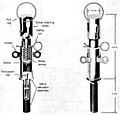
Caps are used in cartridges, grenades, rocket-propelled grenades and rescue flares. Percussion caps are also used in land mine fuzes, booby-trap firing devices and anti-handling devices. Most purpose-made military booby-trap firing devices contain some form of spring-loaded firing pin designed to strike a percussion cap connected to a detonator at one end. The detonator is inserted into an explosive charge—e.g., C-4 or a block of TNT. Triggering the booby-trap (e.g., by pulling on a trip-wire) releases the cocked firing pin that flips forward to strike the percussion cap, firing it and the attached detonator; the shock-wave from the detonator sets off the main explosive charge.[citation needed]

See also

[edit]

Citations

[edit]
  1. ^ a b c d e f g Fadala, Sam (17 November 2006). The Complete Black powder Handbook. Iola, Wisconsin: Gun Digest Books. pp. 159–161. ISBN 0-89689-390-1.[permanent dead link]
  2. ^ Wisniak, Jaime (2012). "Edward Charles Howard. Explosives, meteorites, and sugar". Educación Química. 23 (2). Universidad Nacional Autonoma de Mexico: 230–239. doi:10.1016/s0187-893x(17)30114-3. ISSN 0187-893X.
  3. ^ Howard, Edward (1800) "On a New Fulminating Mercury," Philosophical Transactions of the Royal Society of London 90 (1): 204–238.
  4. ^ Edward Charles Howard at National Portrait Gallery
  5. ^ Percussion lock
  6. ^ Samuel Parkes, The chemical catechism : with notes, illustrations, and experiments, New York : Collins and Co., 1818, page 494 (page 494 online, see "LVI. A New Kind of Gunpowder.")
  7. ^ Sam Fadala (2006). The Complete Blackpowder Handbook. Krause Publications. p. 158. ISBN 978-0-89689-390-0.[permanent dead link]
  8. ^ "Joshua Shaw". Archived from the original on 18 February 2012. Retrieved 5 November 2018.
  9. ^ Martin J. Dougherty (2017). Pistols and Revolvers: From 1400 to the present day. Amber Books Ltd. p. 53. ISBN 978-1-78274-266-1.
  10. ^ "Early Percussion Firearms". Spring Books. 25 October 2015.
  11. ^ Gooding, S. James (August 2018). "Joseph Egg - Inventor of the Copper Cap..." Canadian Journal of Arms Collecting. 36 (3). Arms Collecting Publications, Inc.: 75–79. ISSN 0008-3992. Retrieved 13 May 2017.[permanent dead link]
  12. ^ Hawker, Peter (1830). "Instructions to Young Sportsmen 6th edition (1830)". Retrieved 3 July 2021.
  13. ^ "Hawker Ad - Inventor of the Copper Cap". Hampshire Chronicle. 30 November 1850.
  14. ^ "Met Museum". Met Museum. Retrieved 5 November 2018.
  15. ^ "Kammerbusche". Militarygunsofeurope.eu. Archived from the original on 25 October 2018. Retrieved 5 November 2018.
  16. ^ Milivojevic, Dejan (18 January 2019). "The Revolutionary Rifle That Won the Austro-Prussian War and Gave Birth to the German Nation". warhistoryonline. Retrieved 22 July 2025.
  17. ^ "Loading and firing a Snider Enfield". Militaryheritage.com. Retrieved 5 November 2018.
  18. ^ "Britain's big 577". Retrieved 5 November 2018 – via The Free Library.
  19. ^ "Colt revolver in the Old West". Archived from the original on 22 April 2012. Retrieved 5 November 2018.
  20. ^ "Wheelgun Wednesday: American Gun Craft ROTO 12 Revolver Shotguns". 2 April 2025.

Bibliography

[edit]
[edit]
Revisions and contributorsEdit on WikipediaRead on Wikipedia
from Grokipedia
The percussion cap is a small, single-use metal , typically made of or , containing a shock-sensitive primer—such as mercury fulminate—that detonates when struck by a firearm's , reliably igniting the main charge in muzzle-loading weapons. Introduced in the early , it marked a pivotal advancement over the system by enabling consistent ignition regardless of weather conditions, thereby enhancing the speed, safety, and dependability of firearms during the . The development of the percussion cap built on earlier experiments with detonating compounds. Scottish inventor and clergyman Alexander John Forsyth patented a percussion using fulminates in 1807, laying the groundwork for primer-based firing mechanisms, though his designs were more akin to scent-bottle locks than modern caps. English Joseph Manton and artist-inventor Joshua Shaw advanced the concept in the 1810s and 1820s; Shaw, an English immigrant to the , is particularly credited with creating the practical percussion cap around 1814 and securing a U.S. patent for it in 1822, which described a reusable iron version and later variants for . By the , the system had gained widespread adoption in military and civilian firearms, including muskets, rifles, and pistols, spurring innovations like waterproof caps patented by William Eley in 1855 using vulcanized rubber seals. Widely used throughout the mid-19th century—most notably in the , where millions of percussion-armed muskets like the saw service—the cap system facilitated faster reloading and firing rates compared to flintlocks, influencing global and the transition to metallic cartridge ammunition by the 1870s. Today, percussion caps remain relevant in historical reenactments, black powder shooting, and certain modern muzzleloaders, underscoring their enduring legacy in firearm evolution.

Design and Operation

Components and Materials

The percussion cap is constructed as a small, single-use cylindrical cup, typically made from thin sheet or for malleability and resistance, with dimensions standardized around 0.175 to 0.3 inches in external and 0.2 to 0.4 inches in to fit common nipples; common types include #10 caps for pistols (smaller ), #11 caps for rifles, and larger caps for . The open end features a flared or rolled rim that provides a secure fit over the 's , while the closed base end holds the priming compound; early variants occasionally used or for the cup before became predominant due to its superior formability. At the core of the cap is the explosive priming compound, primarily composed of mercury(II) fulminate (Hg(CNO)₂), a highly shock-sensitive primary explosive that detonates upon impact to produce a flash for igniting the main propellant charge. This fulminate was typically mixed with abrasives such as finely ground glass to increase friction sensitivity and ensure reliable ignition, along with oxidizers like potassium chlorate (KClO₃) in proportions such as three parts chlorate to two parts fulminate and one part sulfur or charcoal in some formulations. Additional additives, including antimony trisulfide for friction enhancement, were common in 19th- and early 20th-century mixtures to optimize performance under varying conditions. To protect the hygroscopic from moisture, early percussion caps were waterproofed with varnished paper wrappers around the exterior or discs applied over the open rim after filling, often secured with or . In later developments and modern non-corrosive replicas, the mercury has been replaced by less toxic alternatives such as chlorate-based mixtures or (C₆HN₃O₈Pb) to mitigate environmental and risks while maintaining similar detonative properties. The manufacturing process begins with stamping or the metal from flat sheet stock into the desired shape, followed by loading the priming compound as a damp paste into the and pressing it firmly against the closed base under hydraulic or mechanical pressure to achieve uniform density and adhesion. The filled cap is then dried and sealed with a protective or foil to encapsulate the compound, ensuring stability during storage and handling; this labor-intensive method allowed for , with millions of caps produced annually by the mid-19th century.

Ignition Mechanism

The percussion cap is seated securely on a hollow or breech post, which is integrated into the firearm's lock mechanism and connected to the main charge through a narrow flash hole; this placement ensures that the ignition products can directly communicate with the powder bed for reliable firing. Upon pulling the trigger, the cocked is released and falls to strike the outer surface of the cap, compressing the contained priming compound—typically mercury fulminate—against the inner anvil formed by the 's end wall, initiating through mechanical shock. This impact requires only a modest to overcome the compound's sensitivity threshold, enabling consistent ignition even in adverse conditions. The triggers an exothermic of mercury fulminate (Hg(CNO)2), which rapidly generates intense heat, expanding gases, sparks, and mercury vapor. These combustion products flash through the nipple's channel and the connecting flash hole, igniting the primary black powder charge and propagating to propel the . As a shock-sensitive primary , mercury fulminate's begins with a high-velocity that transitions the compound from solid to gaseous products almost instantaneously, characterized by its —the shattering power that ensures a sharp, penetrating flame rather than a slow burn. This property distinguishes percussion compounds from less sensitive explosives, allowing initiation at low mechanical energies while producing high temperatures sufficient to reliably deflagrate black powder.

Advantages Over Prior Systems

The percussion cap offered significant reliability advantages over earlier ignition systems like the and , primarily through its all-weather operation. Unlike flintlocks, which relied on exposed priming powder in an open pan that could become damp or contaminated, the sealed percussion cap protected the priming compound, virtually eliminating misfires in , humidity, or . Historical military tests, such as those conducted by the U.S. Ordnance Department in the , demonstrated flintlock misfire rates of approximately 15% (or two in thirteen shots) under dry conditions, with rates escalating dramatically in wet weather, while percussion systems achieved near-zero misfires, often exceeding 99% success rates across thousands of rounds. In terms of speed, the percussion cap enabled faster lock times, allowing for quicker follow-up shots and improved . The mechanism's direct hammer strike on the cap produced ignition in under 0.05 seconds—typically around 0.03 seconds for well-tuned locks—compared to flintlocks' 0.045 seconds or more, where the spark had to travel from the to the pan and then through the touchhole. This reduced delay minimized shooter flinch and barrel movement, contributing to the percussion system's adoption in rifles for its tactical edge. The design also emphasized simplicity, streamlining construction and by eliminating the need for a priming pan, , and associated components. Flintlock mechanisms typically required 10 or more moving parts, including , , and pan cover, which demanded careful adjustment and frequent cleaning; in contrast, percussion locks reduced this to 3-4 essential parts—the , mainspring, sear, and —making them easier to manufacture, repair, and use in the field. Additionally, the percussion system's non-corrosive ignition produced less in the touchhole and barrel compared to the iron sparks and priming residue of flintlocks, allowing for sustained firing with fewer cleanings. These improvements translated to measurable performance gains, including better accuracy in historical tests due to more consistent ignition and higher muzzle velocities from complete burns. British Ordnance evaluations in the mid-19th century noted tighter shot groups and extended effective ranges with percussion-armed troops, underscoring the system's revolutionary impact on reliability and precision.

History

Early Inventions and Patents

The explosive properties of mercury fulminate had been discovered by English chemist Edward Howard in 1800. The Reverend Alexander John Forsyth, a Scottish clergyman and amateur chemist, began experimenting with the compound in 1805 to improve firearm ignition. This breakthrough led to his development of a detonating primer system, which he ed in Britain in 1807 as a means to ignite directly through impact rather than sparks. Forsyth's covered a lock mechanism that used the fulminate to create a reliable, weather-resistant ignition for firearms, marking the foundational concept of percussion-based systems. Forsyth refined his into the "scent-bottle" lock, a device resembling a small flask that dispensed a measured amount of detonating compound through a touch-hole primer when activated by the . This design eliminated the open pan of traditional , reducing misfires from damp powder and enabling faster reloading. By 1810, Forsyth had produced and tested prototypes of his system on fowling pieces, demonstrating improved performance in field conditions compared to flintlock mechanisms. Building on Forsyth's principles, Anglo-American inventor Joshua Shaw introduced the modern copper percussion cap, claiming to have conceived the idea in 1814 while seeking a safer, pre-filled primer. Shaw patented his copper cap—a small, self-contained metal cylinder filled with —in the United States on June 19, 1822 (U.S. No. 77), and secured a corresponding British later that year, emphasizing its use in firearms for consistent ignition. This innovation shifted from Forsyth's loose-powder dispenser to a sealed, disposable cap that could be mass-produced and easily applied to a firearm's , simplifying the percussion system for practical use. Despite these advances, early percussion systems faced significant challenges due to the inherent instability of mercury fulminate, a highly sensitive prone to from , shock, or , resulting in numerous accidental explosions during manufacturing and handling. Safety concerns over these unpredictable incidents delayed widespread acceptance, as demonstrated by initial military evaluations that highlighted reliability issues under varied conditions.

Parallel Developments

In the early 1810s, British gunsmith Joseph Manton experimented with early percussion ignition systems, obtaining a patent in 1816 for a lock mechanism that utilized a small pellet of detonating compound placed in a removable nose on the barrel, known as the pill lock or tubelock. This design represented an intermediate step between flintlock and full percussion cap systems, building on the foundational detonating compounds developed by Alexander Forsyth while aiming for more reliable ignition in sporting firearms. Concurrently, Swiss inventor Jean Samuel Pauly advanced central percussion concepts in 1812, patenting a breechloading firearm that incorporated a primer at the base of a self-contained cartridge, marking the first use of centerfire ignition in a practical design. Pauly's work in Paris laid groundwork for later innovations, including precursors to the Dreyse needle gun system, by integrating fulminate directly into the ammunition for enhanced reliability over external priming. French contributions emerged prominently in the 1820s, with gunsmith securing an early in 1825 for a design incorporating percussion caps based on compounds, transitioning from paper cartridges to more robust ignition methods. Around the same time, army officer Henri-Gustave Delvigne developed the pillar breech in 1826, a barrel with a narrowed powder chamber that expanded projectiles for better engagement and integrated percussion priming to improve loading and firing efficiency in contexts. Across the Atlantic, American inventor John H. Hall patented a breechloading in 1811. Later developments in the incorporated innovative percussion priming mechanisms, including pellet-style primers, that anticipated broader percussion adoption in U.S. military arms. These parallel efforts highlighted a broader wave of innovation in the post-Napoleonic era, with designs circulating through European gunsmith networks and influencing continental adaptations amid relaxed trade barriers following the wars.

Widespread Adoption

The British military initiated the adoption of percussion cap ignition in the early 1830s, conducting tests of percussion rifles as early as 1834, which paved the way for broader integration into service arms. This process accelerated with conversions of existing flintlock weapons, including rifles like the Baker, though full standardization came later. By 1842, the Pattern 1842 Musket represented the culmination of this shift, serving as the first purpose-built percussion smoothbore musket for general infantry issue and marking the near-complete transition of British line infantry weapons from flintlock systems. In the United States, the transition gained momentum around 1840, with beginning conversions of flintlock muskets to percussion mechanisms, though these were preparatory for new designs. The Musket, adopted in 1842, became the U.S. Army's first standard percussion shoulder arm produced in large quantities, emphasizing reliability over the older . Concurrently, civilian adoption surged through Samuel Colt's Paterson , patented and produced starting in 1836, which employed percussion caps in a revolving-cylinder design and quickly gained popularity among frontiersmen and private buyers for its rapid-fire capability. The technology spread internationally during the 1830s and , influencing major powers beyond Britain and the U.S. adopted the in 1841—prototyped from 1836—which utilized percussion priming integrated into a , where a needle-like struck the primer at the base to ignite the charge. followed suit in 1839 by officially adopting percussion ignition, launching a comprehensive program of conversions and new manufacturing for its muskets in the early 1840s, which laid the groundwork for later systems like the . This global standardization reflected the percussion cap's superiority in weather resistance and firing reliability, enabling consistent production across diverse military inventories. U.S. production scaled dramatically to meet demand, with contractors like Simeon North manufacturing percussion-equipped arms such as the Model 1840 Hall carbine from 1840 onward, supporting the armories' output of thousands of units annually. By the mid-1840s, dedicated facilities produced percussion caps in high volumes, reducing dependency on imported components and lowering overall armament costs through efficient, interchangeable manufacturing techniques. This industrial expansion not only equipped national forces but also fueled exports, solidifying the percussion cap as the dominant worldwide by the 1850s.

Applications

Military Firearms

The percussion cap revolutionized military firearms in the mid-19th century by enabling reliable ignition in muzzle-loading s, which became standard issue for in major powers. The British rifled musket, chambered in .577 caliber, exemplified this shift, offering an effective range of up to 500 yards due to its rifled barrel and ammunition, far surpassing the 100-200 yard limits of earlier designs. Adopted by the in 1853, the Enfield's percussion lock provided consistent firing even in wet conditions, a critical advantage during the (1853-1856), where British and French forces outranged and outfired Russian troops still reliant on smoothbores, contributing to victories like the Battle of Alma through sustained . In the (1861-1865), percussion cap firearms dominated, with the vast majority—estimated at over 90%—of issued being muzzle-loading rifled muskets, allowing effective at 300 yards and transforming battlefield tactics from close-quarters charges to longer-range engagements. The U.S. , a .58 percussion rifle-musket, was the Union's primary weapon, with over one million produced by federal armories and contractors to equip the massive mobilization. Its reliability enabled Union forces to maintain fire superiority in key battles like Gettysburg, where rifled muskets inflicted heavy casualties at distance, underscoring the percussion system's role in amplifying lethality compared to lingering conversions. Logistics for percussion caps proved vital yet vulnerable in prolonged campaigns, as each required 1-2 caps per shot, straining supply chains amid high consumption rates. The Union Army alone produced and distributed hundreds of millions of caps annually through facilities like the , but shortages occasionally hampered operations, particularly during sieges where resupply was disrupted, forcing reliance on captured Confederate stocks. Confederate forces faced chronic cap deficits due to import dependencies and limited domestic output, exacerbating vulnerabilities in extended engagements like Petersburg. Beyond small arms, percussion primers extended to , enhancing explosive shell delivery in rifled cannons. The , a Union-favored 3-inch to 10-inch caliber piece from the 1860s, employed percussion-fused shells that detonated on impact rather than timed fuses, improving accuracy and destructive power against fortifications during sieges like Vicksburg. This variant amplified the percussion cap's tactical impact, enabling precise, high-velocity fire that complemented advances in operations.

Civilian Firearms

The percussion cap revolutionized civilian handguns, particularly , by enabling reliable multi-shot firing without the misfires common in systems. Samuel Colt's 1836 Paterson revolver, the first successful production model using this technology, featured a rotating that held six charges, allowing rapid sequential shots ideal for and expansion. This design gained popularity among civilians, including Texas Rangers, who valued its firepower during westward migration and conflicts with Native American tribes. Building on this, the 1847 Walker Colt, co-developed with Texas Ranger Captain Samuel Walker, amplified the concept with a larger .44-caliber frame and enhanced power for mounted use, further embedding percussion revolvers in civilian arsenals for protection and exploration. In long arms, percussion caps facilitated conversions and new designs tailored to and . By the 1840s, traditional rifles—long-barreled flintlocks prized for accuracy—were widely retrofitted with percussion locks to improve ignition reliability in wet conditions, making them staples for civilian hunters pursuing game in the American wilderness. Shotguns followed suit, with makers like producing double-barrel percussion models in the mid-19th century, optimized for bird hunting through interchangeable caps that ensured consistent priming across varying loads. These firearms supported recreational pursuits, including dueling and target shooting, where the cap's quick ignition enhanced precision and speed. Civilian demand drove significant market expansion after , as percussion technology spurred domestic manufacturing independent of contracts. Firms such as E. Remington & Sons ramped up production of percussion revolvers and rifles for non- buyers, entering the handgun market in 1857 with .36- and .44-caliber models that catered to sporting enthusiasts and settlers. This surge reflected broader adoption, with U.S. gunmakers innovating for civilian needs like and personal defense, outpacing earlier eras. advancements in percussion systems briefly influenced these designs, providing blueprints for reliable civilian variants. To support this growing use, specialized accessories emerged as everyday tools by the . Cap dispensers, often brass devices for loading primers one at a time, prevented mishandling during field reloading, while nipple wrenches—simple implements—allowed users to install, clean, or replace the percussion nipples on firearms, ensuring for prolonged hunts or shooting sessions.

Industrial and Other Uses

In and quarrying, percussion caps were adapted as reliable detonators for high explosives, revolutionizing safe initiation in industrial blasting. Swedish inventor developed the blasting cap in 1865, a small capsule filled with mercury fulminate that detonated upon impact or fuse insertion, enabling controlled explosions of nitroglycerin-based compounds. This innovation complemented Nobel's 1867 patent for , allowing workers to initiate blasts remotely and reducing accidental detonations in hazardous underground environments. By the 1870s, blasting caps were routinely paired with safety fuses—textile cords coated in and tar, invented earlier but refined for precision timing—to sequence multiple charges in quarries and mines, significantly enhancing and worker safety. Percussion caps also found extensive use in pyrotechnics for both display and safety applications. In fireworks production, they served as igniters in mortar shells and lift charges, providing a sharp, reliable spark to propel aerial effects skyward while minimizing misfires during large-scale shows. Signal flares similarly incorporated percussion mechanisms; a notable example is the British railway detonator introduced in the 1850s, a coin-sized device clamped to tracks containing fulminate that exploded under a train's wheel to alert drivers in fog or poor visibility, preventing collisions on expanding rail networks. These applications extended the cap's role from mere ignition to critical signaling in transportation infrastructure. Beyond these sectors, percussion caps appeared in marine signaling rockets and recreational toys, broadening their industrial footprint. In 19th-century maritime operations, line-throwing rockets and distress flares used percussion caps to ignite charges upon launch, enabling ships to deploy lifelines to shore or other vessels during . Post-1880s, the technology inspired toy cap guns, where mild, non-hazardous versions of the cap produced realistic bangs and smoke, fostering safe play while sustaining demand for scaled-down manufacturing processes. By the early , such non-firearm uses had driven substantial production growth, with blasting and pyrotechnic caps comprising the majority of output due to booming and rail industries.

Evolution and Modern Context

Transition to Cartridge Systems

The transition from standalone percussion caps to integrated cartridge systems began with the invention of , which incorporated the percussion priming mechanism directly into the cartridge case. In 1854, Horace Smith and patented a design that featured a metallic rimfire cartridge, where a percussion-sensitive compound was applied to the interior of the cartridge's rim, ignited by the striking the rim's edge; this setup functioned analogously to a No. 10 percussion cap in size and ignition principle. The rimfire design eliminated the need for separate loose caps, streamlining loading for repeating arms and building on the original percussion cap's anvil and compound concept by embedding them within the self-contained round. A pivotal milestone in this evolution was the 1860 Henry rifle, the first practical lever-action to employ , allowing soldiers to fire up to 16 rounds rapidly from a tubular magazine without handling individual percussion caps. This weapon's adoption during the demonstrated the tactical advantages of integrated percussion ignition, accelerating the shift away from muzzleloading systems reliant on loose components. Centerfire systems further advanced this integration by centralizing the primer at the cartridge base, improving reliability and reloadability. In , early 1850s experiments led to designs like the , which integrated a percussion primer into the cartridge for breechloading conversions. By 1866, American inventor patented a centerfire primer configuration with a dedicated pocket in the case head to secure the and priming compound, struck directly by the . That same year, British ordnance officer Edward Boxer developed a similar centerfire primer, featuring a self-contained cup and assembly fitted into the cartridge base. The Snider-Enfield rifle conversion of 1867 exemplified practical application, retrofitting existing percussion-lock Enfield muskets to fire cartridges with an integrated centerfire primer; the breech block's , struck by the modified percussion , detonated the primer compound against its . This technical integration—retaining the cap's anvil and shock-sensitive compound within a primer pocket at the cartridge base—ensured consistent ignition while enabling faster reloading and reducing misfires from loose caps. By the 1880s, the widespread adoption of metallic cartridges had rendered loose percussion caps largely obsolete in and firearms, as self-contained offered superior speed, weather resistance, and ease of production.

Contemporary Manufacturing and Use

Modern percussion caps are produced using non-mercuric priming compounds, such as (DDNP) and , which provide reliable ignition while avoiding the toxicity and corrosion associated with historical mercury-based . These materials are sealed within or cups, often ribbed for secure fit on nipples, and assembled via automated filling lines by major manufacturers like CCI, Remington, and RWS to ensure consistency and safety. This shift to non-mercuric formulations supports their continued use in replica firearms, where environmental and health standards demand cleaner alternatives to legacy explosives. In niche markets, percussion caps sustain traditions in black powder reenactments, such as Civil War events, where specialized or #11 caps enable authentic loading and firing demonstrations without full powder charges. Muzzleloading represents another key application, permitted in more than 40 U.S. states through dedicated seasons that allow traditional inline or sidelock rifles for deer, , and other game. Cap sizes remain standardized, with No. 10 variants suited for revolvers and smaller nipples, and No. 11 for rifles, ensuring compatibility across reproduction and antique arms. Particular examples include RWS's No. 1075 #11 percussion caps, which are available in a standard version and a taller "magnum" Plus variant. The Plus version measures approximately 4.4 mm in height compared to 4 mm for the standard, contains additional priming compound for hotter and more reliable ignition, and may require extra force to seat fully on tapered nipples due to its increased length. The standard 1075 has become harder to find and has been largely replaced by the Plus in availability. Recent innovations enhance durability and customization, including water-resistant designs that protect the priming compound from moisture during field use. Additionally, has enabled hobbyists to fabricate custom nipples from polymers or metals, allowing precise fitting for restored or bespoke percussion-lock firearms. These advancements, emerging post-2000, cater to sport shooters and collectors seeking improved performance in recreational black powder activities.

Safety and Environmental Considerations

The production of percussion caps in the 19th century was fraught with hazards, exemplified by multiple factory explosions that resulted in significant loss of life. In 1862, an explosion at a percussion cap manufactory in Birmingham, , killed nine workers and injured many others, completely destroying the facility. Similarly, the 1863 Brown's Island munitions factory explosion in , which involved percussion primers and caps, claimed at least 40 lives, mostly young female workers, due to the volatile nature of the explosive compounds used. These incidents underscored the inherent risks of handling shock-sensitive materials like mercury fulminate during early manufacturing. Workers in percussion cap factories faced chronic health risks from mercury exposure, as mercury(II) fulminate was the primary priming compound until the late 19th century. Handling this substance in explosives factories led to reported cases of mercury poisoning among munitions workers, manifesting as erethism—a neurological condition characterized by irritability, tremors, and cognitive impairment, akin to the symptoms observed in mercury-exposed hatters. This toxicity arose from inhalation of vapors and skin absorption during the synthesis and assembly processes. In modern contexts, percussion caps are classified under regulations as UN 0044, Primers, cap type, in Division 1.4S of Class 1 explosives, indicating a low risk of mass but requiring careful transport and storage to prevent accidental ignition. Quality modern percussion caps exhibit misfire rates below 1%, significantly enhancing reliability compared to historical systems, due to improved formulations and manufacturing precision. While is mandated under the U.S. Poison Prevention Packaging Act of 1970 for many hazardous household substances, components like primers and caps are generally exempt, though some manufacturers voluntarily adopt secure packaging to mitigate access risks. Environmental concerns with percussion caps primarily stem from legacy mercury contamination from historical use and ongoing lead deposition from modern lead-based primers at shooting ranges. Spent caps and primers contribute to soil and groundwater pollution, with lead levels often exceeding safe thresholds in high-traffic areas, posing risks to wildlife and human health through bioaccumulation. The U.S. Environmental Protection Agency's Best Management Practices for Lead at Outdoor Shooting Ranges, updated in July 2025, provides guidelines for remediation, including soil excavation, stabilization, and vegetation controls to prevent lead migration. In , regulatory pressures under framework and ammunition restrictions have driven a shift toward non-lead, non-mercury primers, often using copper-compatible or synthetic alternatives to reduce toxic residues. Efforts to address these issues include the development of alternatives to traditional percussion caps. Electronic igniters for muzzleloaders, such as battery-powered arc systems introduced in the , eliminate chemical primers altogether, using electric sparks to initiate powder ignition and thereby avoiding heavy metal contamination. Additionally, non-toxic, potentially biodegradable primer compositions are under testing, incorporating stabilized red or nano-coated fuels to achieve environmental compatibility while maintaining performance.

References

Add your contribution
Related Hubs
User Avatar
No comments yet.