Hubbry Logo
logo
Quantifier (logic)
Community hub

Quantifier (logic)

logo
0 subscribers
Read side by side
from Wikipedia

In logic, a quantifier is an operator that specifies how many individuals in the domain of discourse satisfy an open formula. For instance, the universal quantifier in the first-order formula expresses that everything in the domain satisfies the property denoted by . On the other hand, the existential quantifier in the formula expresses that there exists something in the domain which satisfies that property. A formula where a quantifier takes widest scope is called a quantified formula. A quantified formula must contain a bound variable and a subformula specifying a property of the referent of that variable.

The most commonly used quantifiers are and . These quantifiers are standardly defined as duals; in classical logic: each can be defined in terms of the other using negation. They can also be used to define more complex quantifiers, as in the formula which expresses that nothing has the property . Other quantifiers are only definable within second-order logic or higher-order logics. Quantifiers have been generalized beginning with the work of Andrzej Mostowski and Per Lindström.

In a first-order logic statement, quantifications in the same type (either universal quantifications or existential quantifications) can be exchanged without changing the meaning of the statement, while the exchange of quantifications in different types changes the meaning. As an example, the only difference in the definition of uniform continuity and (ordinary) continuity is the order of quantifications.

First-order quantifiers approximate the meanings of some natural language quantifiers such as "some" and "all". However, many natural language quantifiers can only be analyzed in terms of generalized quantifiers.

Relations to logical conjunction and disjunction

[edit]

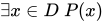
For a finite domain of discourse , the universally quantified formula is equivalent to the logical conjunction . Dually, the existentially quantified formula is equivalent to the logical disjunction . For example, if is the set of binary digits, the formula abbreviates , which evaluates to true.

Infinite domain of discourse

[edit]

Consider the following statement (using dot notation for multiplication):

1 · 2 = 1 + 1, and 2 · 2 = 2 + 2, and 3 · 2 = 3 + 3, ..., and 100 · 2 = 100 + 100, and ..., etc.

This has the appearance of an infinite conjunction of propositions. From the point of view of formal languages, this is immediately a problem, since syntax rules are expected to generate finite statements. A succinct equivalent formulation, which avoids these problems, uses universal quantification:

For each natural number n, n · 2 = n + n.

A similar analysis applies to the disjunction,

1 is equal to 5 + 5, or 2 is equal to 5 + 5, or 3 is equal to 5 + 5, ... , or 100 is equal to 5 + 5, or ..., etc.

which can be rephrased using existential quantification:

For some natural number n, n is equal to 5 + 5.

Algebraic approaches to quantification

[edit]

It is possible to devise abstract algebras whose models include formal languages with quantification, but progress has been slow[clarification needed] and interest in such algebra has been limited. Three approaches have been devised to date:

Notation

[edit]

The two most common quantifiers are the universal quantifier and the existential quantifier. The traditional symbol for the universal quantifier is "", a rotated letter "A", which stands for "for all" or "all". The corresponding symbol for the existential quantifier is "", a rotated letter "E", which stands for "there exists" or "exists".[1][2]

An example of translating a quantified statement in a natural language such as English would be as follows. Given the statement, "Each of Peter's friends either likes to dance or likes to go to the beach (or both)", key aspects can be identified and rewritten using symbols including quantifiers. So, let X be the set of all Peter's friends, P(x) the predicate "x likes to dance", and Q(x) the predicate "x likes to go to the beach". Then the above sentence can be written in formal notation as , which is read, "for every x that is a member of X, P applies to x or Q applies to x".

Some other quantified expressions are constructed as follows,

  • [3]

for a formula P. These two expressions (using the definitions above) are read as "there exists a friend of Peter who likes to dance" and "all friends of Peter like to dance", respectively. Variant notations include, for set X and set members x:

  • [4]
  • [5]

All of these variations also apply to universal quantification. Other variations for the universal quantifier are

  • [citation needed]
  • [6]
  • [7]

Some versions of the notation explicitly mention the range of quantification. The range of quantification must always be specified; for a given mathematical theory, this can be done in several ways:

  • Assume a fixed domain of discourse for every quantification, as is done in Zermelo–Fraenkel set theory.
  • Fix several domains of discourse in advance and require that each variable have a declared domain, which is the type of that variable. This is analogous to the situation in statically typed computer programming languages, where variables have declared types.
  • Mention explicitly the range of quantification, perhaps using a symbol for the set of all objects in that domain (or the type of the objects in that domain).

One can use any variable as a quantified variable in place of any other, under certain restrictions in which variable capture does not occur. Even if the notation uses typed variables, variables of that type may be used.

Informally or in natural language, the "∀x" or "∃x" might appear after or in the middle of P(x). Formally, however, the phrase that introduces the dummy variable is placed in front.

Mathematical formulas mix symbolic expressions for quantifiers with natural language quantifiers such as,

For every natural number x, ...
There exists an x such that ...
For at least one x, ....

Keywords for uniqueness quantification include:

For exactly one natural number x, ...
There is one and only one x such that ....

Further, x may be replaced by a pronoun. For example,

For every natural number, its product with 2 equals its sum with itself.
Some natural number is prime.

Order of quantifiers (nesting)

[edit]

The order of quantifiers is critical to meaning, as is illustrated by the following two propositions:

For every natural number n, there exists a natural number s such that s = n2.

This is clearly true; it just asserts that every natural number has a square. The meaning of the assertion in which the order of quantifiers is reversed is different:

There exists a natural number s such that for every natural number n, s = n2.

This is clearly false; it asserts that there is a single natural number s that is the square of every natural number. This is because the syntax directs that any variable cannot be a function of subsequently introduced variables.

A less trivial example from mathematical analysis regards the concepts of uniform and pointwise continuity, whose definitions differ only by an exchange in the positions of two quantifiers. A function f from R to R is called

  • Pointwise continuous if
  • Uniformly continuous if

In the former case, the particular value chosen for δ can be a function of both ε and x, the variables that precede it. In the latter case, δ can be a function only of ε (i.e., it has to be chosen independent of x). For example, f(x) = x2 satisfies pointwise, but not uniform continuity (its slope is unbounded). In contrast, interchanging the two initial universal quantifiers in the definition of pointwise continuity does not change the meaning.

As a general rule, swapping two adjacent universal quantifiers with the same scope (or swapping two adjacent existential quantifiers with the same scope) doesn't change the meaning of the formula (see Example here), but swapping an existential quantifier and an adjacent universal quantifier may change its meaning.

The maximum depth of nesting of quantifiers in a formula is called its "quantifier rank".

Equivalent expressions

[edit]

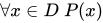
If D is a domain of x and P(x) is a predicate dependent on object variable x, then the universal proposition can be expressed as
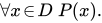
This notation is known as restricted or relativized or bounded quantification. Equivalently one can write,

The existential proposition can be expressed with bounded quantification as
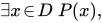
or equivalently

Together with negation, only one of either the universal or existential quantifier is needed to perform both tasks:

which shows that to disprove a "for all x" proposition, one needs no more than to find an x for which the predicate is false. Similarly,

to disprove a "there exists an x" proposition, one needs to show that the predicate is false for all x.

In classical logic, every formula is logically equivalent to a formula in prenex normal form, that is, a string of quantifiers and bound variables followed by a quantifier-free formula.

Quantifier elimination

[edit]

Quantifier elimination is a concept of simplification used in mathematical logic, model theory, and theoretical computer science. Informally, a quantified statement " such that ..." can be viewed as a question "When is there an such that ...?", and the statement without quantifiers can be viewed as the answer to that question.[8]

One way of classifying formulas is by the amount of quantification. Formulas with less depth of quantifier alternation are thought of as being simpler, with the quantifier-free formulas as the simplest.

A theory has quantifier elimination if for every formula , there exists another formula without quantifiers that is equivalent to it (modulo this theory).

Range of quantification

[edit]

Every quantification involves one specific variable and a domain of discourse or range of quantification of that variable. The range of quantification specifies the set of values that the variable takes. In the examples above, the range of quantification is the set of natural numbers. Specification of the range of quantification allows us to express the difference between, say, asserting that a predicate holds for some natural number or for some real number. Expository conventions often reserve some variable names such as "n" for natural numbers, and "x" for real numbers, although relying exclusively on naming conventions cannot work in general, since ranges of variables can change in the course of a mathematical argument.

A universally quantified formula over an empty range (like ) is always vacuously true. Conversely, an existentially quantified formula over an empty range (like ) is always false.


A more natural way to restrict the domain of discourse uses guarded quantification. For example, the guarded quantification

For some natural number n, n is even and n is prime

means

For some even number n, n is prime.

In some mathematical theories, a single domain of discourse fixed in advance is assumed. For example, in Zermelo–Fraenkel set theory, variables range over all sets. In this case, guarded quantifiers can be used to mimic a smaller range of quantification. Thus in the example above, to express

For every natural number n, n·2 = n + n

in Zermelo–Fraenkel set theory, one would write

For every n, if n belongs to N, then n·2 = n + n,

where N is the set of all natural numbers.

Formal semantics

[edit]

Mathematical semantics is the application of mathematics to study the meaning of expressions in a formal language. It has three elements: a mathematical specification of a class of objects via syntax, a mathematical specification of various semantic domains and the relation between the two, which is usually expressed as a function from syntactic objects to semantic ones. This article only addresses the issue of how quantifier elements are interpreted. The syntax of a formula can be given by a syntax tree. A quantifier has a scope, and an occurrence of a variable x is free if it is not within the scope of a quantification for that variable. Thus in

the occurrence of both x and y in C(y, x) is free, while the occurrence of x and y in B(y, x) is bound (i.e. non-free).

Syntax tree of the formula , illustrating scope and variable capture. Bound and free variable occurrences are colored in red and green, respectively.

An interpretation for first-order predicate calculus assumes as given a domain of individuals X. A formula A whose free variables are x1, ..., xn is interpreted as a Boolean-valued function F(v1, ..., vn) of n arguments, where each argument ranges over the domain X. Boolean-valued means that the function assumes one of the values T (interpreted as truth) or F (interpreted as falsehood). The interpretation of the formula

is the function G of n-1 arguments such that G(v1, ..., vn-1) = T if and only if F(v1, ..., vn-1, w) = T for every w in X. If F(v1, ..., vn-1, w) = F for at least one value of w, then G(v1, ..., vn-1) = F. Similarly the interpretation of the formula

is the function H of n-1 arguments such that H(v1, ..., vn-1) = T if and only if F(v1, ..., vn-1, w) = T for at least one w and H(v1, ..., vn-1) = F otherwise.

The semantics for uniqueness quantification requires first-order predicate calculus with equality. This means there is given a distinguished two-placed predicate "="; the semantics is also modified accordingly so that "=" is always interpreted as the two-place equality relation on X. The interpretation of

then is the function of n-1 arguments, which is the logical and of the interpretations of

Each kind of quantification defines a corresponding closure operator on the set of formulas, by adding, for each free variable x, a quantifier to bind x.[9] For example, the existential closure of the open formula n>2 ∧ xn+yn=zn is the closed formula ∃nxyz (n>2 ∧ xn+yn=zn); the latter formula, when interpreted over the positive integers, is known to be false by Fermat's Last Theorem. As another example, equational axioms, like x+y=y+x, are usually meant to denote their universal closure, like ∀xy (x+y=y+x) to express commutativity.

Paucal, multal and other degree quantifiers

[edit]

None of the quantifiers previously discussed apply to a quantification such as

There are many integers n < 100, such that n is divisible by 2 or 3 or 5.

One possible interpretation mechanism can be obtained as follows: Suppose that in addition to a semantic domain X, we have given a probability measure P defined on X and cutoff numbers 0 < ab ≤ 1. If A is a formula with free variables x1,...,xn whose interpretation is the function F of variables v1,...,vn then the interpretation of

is the function of v1,...,vn-1 which is T if and only if

and F otherwise. Similarly, the interpretation of

is the function of v1,...,vn-1 which is F if and only if

and T otherwise.

Other quantifiers

[edit]

A few other quantifiers have been proposed over time. In particular, the solution quantifier,[10]: 28  noted § (section sign) and read "those". For example,

is read "those n in N such that n2 ≤ 4 are in {0,1,2}." The same construct is expressible in set-builder notation as

Contrary to the other quantifiers, § yields a set rather than a formula.[11]

Some other quantifiers sometimes used in mathematics include:

  • There are infinitely many elements such that...
  • For all but finitely many elements... (sometimes expressed as "for almost all elements...").
  • There are uncountably many elements such that...
  • For all but countably many elements...
  • For all elements in a set of positive measure...
  • For all elements except those in a set of measure zero...

History

[edit]

Term logic, also called Aristotelian logic, treats quantification in a manner that is closer to natural language, and also less suited to formal analysis. Term logic treated All, Some and No in the 4th century BC, in an account also touching on the alethic modalities.

In 1827, George Bentham published his Outline of a New System of Logic: With a Critical Examination of Dr. Whately's Elements of Logic, describing the principle of the quantifier, but the book was not widely circulated.[12]

Augustus De Morgan (1806–1871) was the first to use "quantifier" in the modern sense.

William Hamilton claimed to have coined the terms "quantify" and "quantification", most likely in his Edinburgh lectures c. 1840. Augustus De Morgan confirmed this in 1847, but modern usage began with De Morgan in 1862 where he makes statements such as "We are to take in both all and some-not-all as quantifiers".[13]

Gottlob Frege, in his 1879 Begriffsschrift, was the first to employ a quantifier to bind a variable ranging over a domain of discourse and appearing in predicates. He would universally quantify a variable (or relation) by writing the variable over a dimple in an otherwise straight line appearing in his diagrammatic formulas. Frege did not devise an explicit notation for existential quantification, instead employing his equivalent of ~∀x~, or contraposition. Frege's treatment of quantification went largely unremarked until Bertrand Russell's 1903 Principles of Mathematics.

In work that culminated in Peirce (1885), Charles Sanders Peirce and his student Oscar Howard Mitchell independently invented universal and existential quantifiers, and bound variables. Peirce and Mitchell wrote Πx and Σx where we now write ∀x and ∃x. Peirce's notation can be found in the writings of Ernst Schröder, Leopold Loewenheim, Thoralf Skolem, and Polish logicians into the 1950s. Most notably, it is the notation of Kurt Gödel's landmark 1930 paper on the completeness of first-order logic, and 1931 paper on the incompleteness of Peano arithmetic. Per Martin-Löf adopted a similar notation for dependent products and sums in his intuitionistic type theory, which are conceptually related to quantification.

Peirce's approach to quantification also influenced William Ernest Johnson and Giuseppe Peano, who invented yet another notation, namely (x) for the universal quantification of x and (in 1897) ∃x for the existential quantification of x. Hence for decades, the canonical notation in philosophy and mathematical logic was (x)P to express "all individuals in the domain of discourse have the property P", and "(∃x)P" for "there exists at least one individual in the domain of discourse having the property P". Peano, who was much better known than Peirce, in effect diffused the latter's thinking throughout Europe. Peano's notation was adopted by the Principia Mathematica of Whitehead and Russell, Quine, and Alonzo Church. In 1935, Gentzen introduced the ∀ symbol, by analogy with Peano's ∃ symbol. ∀ did not become canonical until the 1960s.

Around 1895, Peirce began developing his existential graphs, whose variables can be seen as tacitly quantified. Whether the shallowest instance of a variable is even or odd determines whether that variable's quantification is universal or existential. (Shallowness is the contrary of depth, which is determined by the nesting of negations.) Peirce's graphical logic has attracted some attention in recent years by those researching heterogeneous reasoning and diagrammatic inference.

See also

[edit]

References

[edit]

Bibliography

[edit]
[edit]
Revisions and contributorsEdit on WikipediaRead on Wikipedia
from Grokipedia
In logic, a quantifier is an operator that binds variables in logical formulas to express the quantity or extent to which a predicate holds for elements in a domain, with the two primary types being the universal quantifier ∀, denoting "for all," and the existential quantifier ∃, denoting "there exists."[1] These operators enable the formulation of statements about collections of objects, such as ∀x (H(x) → M(x)), meaning "all humans are mortal," where H(x) represents the predicate "x is human" and M(x) represents "x is mortal."[1] Quantifiers form a core component of first-order logic (FOL), also known as predicate logic, which extends propositional logic by allowing quantification over individual variables rather than just truth values.[2] The development of quantifiers marked a pivotal advancement in formal logic, originating with Gottlob Frege's introduction of variable-binding quantification in his 1879 Begriffsschrift, a formula language modeled on arithmetic for pure thought that revolutionized logical notation by treating quantifiers as operators over functions and arguments.[3] Frege's system laid the groundwork for modern predicate logic, though his work initially received limited attention; Giuseppe Peano later popularized similar notations in his Formulario Mathematico (begun in 1891), where he introduced the symbol ∃ for existential quantification in 1897 and influenced the standardization of logical symbols.[3] Bertrand Russell further refined these ideas in his 1903 Principles of Mathematics, integrating quantifiers into a comprehensive framework for logicism and addressing paradoxes through type theory, thereby cementing their role in analytic philosophy and mathematics.[3] In FOL, quantifiers operate within a syntax that includes predicates, variables, and connectives, where their scope determines the variables they bind, and rules like De Morgan's laws allow transformations such as ¬∀x P(x) ≡ ∃x ¬P(x), facilitating proofs and equivalences.[2] For instance, ∀x (P(x) ∧ Q(x)) is logically equivalent to ∀x P(x) ∧ ∀x Q(x), but ∀x (P(x) ∨ Q(x)) is not equivalent to ∀x P(x) ∨ ∀x Q(x), highlighting the non-commutativity of quantifiers with disjunction.[2] Beyond basic usage, quantifiers distinguish logical truths—such as ∃x Cube(x) ∨ ∃x ¬Cube(x), which holds in any non-empty domain—from mere tautologies, underscoring FOL's expressive power for mathematical and philosophical reasoning.[2] While second-order logics extend quantification to predicates and relations, first-order quantifiers remain foundational due to their decidability properties in restricted cases and widespread application in automated theorem proving and database query languages.[2]

Fundamentals

Definition and Purpose

In logic, a quantifier is a logical operator that binds variables within predicate logic formulas to specify the extent to which a predicate holds over individuals in a domain of discourse, indicating generality or existence.[4] These operators enable the precise articulation of statements about collections of objects, distinguishing them from simpler logical forms by incorporating variable binding.[5] Quantifiers serve a fundamental purpose in first-order logic (FOL), where they formalize natural language concepts like "all" or "some" into rigorous mathematical statements, allowing reasoning about properties that apply universally or existentially across a domain.[2] This capability extends the expressive power of logic beyond fixed assertions, facilitating the analysis of relations and attributes in mathematical, philosophical, and computational contexts.[4] In contrast to propositional logic, which operates solely on atomic propositions assigned true or false values without variables or binding mechanisms, quantifiers in FOL introduce quantification over non-logical objects, enabling dynamic statements about varying elements.[5] For instance, the formula $ \forall x , P(x) $ asserts that the predicate $ P $ holds for every $ x $ in the domain, while $ \exists x , P(x) $ asserts that there exists at least one $ x $ for which $ P $ holds.[2] Such constructions are essential prerequisites for comprehending the hierarchical structure of predicate logic, where quantifiers interact with predicates to build complex, interpretable expressions.[4]

Universal and Existential Quantifiers

In first-order logic, the universal quantifier, denoted by the symbol \forall, is a logical operator that binds a variable to express that a given predicate holds for every element in the domain of discourse.[6] Formally introduced by Gottlob Frege in his seminal 1879 work Begriffsschrift, the universal quantifier allows for the precise articulation of general statements about all objects within a structure. Its truth condition is that a formula xϕ(x)\forall x \, \phi(x) is satisfied in a model if and only if ϕ(a)\phi(a) holds for every element aa in the domain. A classic example of the universal quantifier is the formalization of the statement "All humans are mortal" as x(Human(x)Mortal(x))\forall x \, (\text{Human}(x) \to \text{Mortal}(x)), which asserts that for every xx in the domain, if xx is human, then xx is mortal. This construction relies on implication to restrict the quantification to the relevant subset of the domain, ensuring the predicate applies universally within that scope. The existential quantifier, denoted by \exists, binds a variable to indicate that there is at least one element in the domain for which the predicate holds. Originating in Frege's framework and later symbolized by Giuseppe Peano in 1897,[7] its truth condition requires that xϕ(x)\exists x \, \phi(x) is true if there exists at least one aa in the domain such that ϕ(a)\phi(a) is satisfied. For instance, "Some humans are philosophers" translates to x(Human(x)Philosopher(x))\exists x \, (\text{Human}(x) \land \text{Philosopher}(x)), meaning there is some xx that is both human and a philosopher. A key logical relation between these quantifiers involves negation: the negation of a universal quantification is equivalent to an existential quantification of the negated predicate, ¬xP(x)x¬P(x)\neg \forall x \, P(x) \equiv \exists x \, \neg P(x), and conversely, ¬xP(x)x¬P(x)\neg \exists x \, P(x) \equiv \forall x \, \neg P(x). These equivalences, known as the quantifier-negation dualities, facilitate transformations in proofs and highlight the complementary nature of the operators. Intuitively, the universal quantifier functions as an analog to an infinite conjunction, asserting uniformity across the entire domain, whereas the existential quantifier resembles an infinite disjunction, requiring satisfaction in just one instance.

Logical Relations

Ties to Conjunction and Disjunction

In finite domains, the universal quantifier can be expressed as a conjunction over all elements in the domain. Specifically, for a finite domain $ D = {a_1, a_2, \dots, a_n} $, the statement $ \forall x , P(x) $ is logically equivalent to the conjunction $ P(a_1) \wedge P(a_2) \wedge \dots \wedge P(a_n) $.[8] Similarly, the existential quantifier over the same finite domain corresponds to a disjunction: $ \exists x , P(x) $ is equivalent to $ P(a_1) \vee P(a_2) \vee \dots \vee P(a_n) $.[8] These equivalences hold because, in a finite setting, every element can be explicitly enumerated, allowing quantified predicates to reduce directly to truth-functional combinations without loss of meaning.[9] These relations have significant implications for proof strategies in finite cases. To establish a universal claim $ \forall x , P(x) $, one can prove the predicate $ P(a_i) $ for each individual $ a_i $ in the domain, effectively verifying the entire conjunction.[10] Conversely, an existential claim $ \exists x , P(x) $ requires demonstrating the disjunction by showing $ P(a_i) $ holds for at least one $ a_i $, often through direct instantiation or case analysis.[11] This reduction to propositional logic simplifies automated reasoning and verification in computational contexts where the domain size is manageable, such as in database queries or program analysis over bounded sets.[9] Historically, these ties motivated the development of predicate logic as an extension of propositional logic. Gottlob Frege's introduction of quantifiers in his 1879 Begriffsschrift aimed to capture relational inferences beyond simple truth tables, treating universal quantification as a form of generalized conjunction to handle generality in mathematical proofs.[12] This innovation, later refined by Bertrand Russell and others, bridged the gap between propositional connectives and higher-order reasoning, enabling logic to formalize arithmetic and set theory.[13]

Behavior in Infinite Domains

In first-order logic, the equivalences between universal and existential quantifiers and their corresponding infinite conjunctions or disjunctions, which hold in finite domains, fail to extend directly to infinite domains due to the syntactic restriction that all formulas must be finite in length. Standard propositional logic lacks mechanisms for infinite conjunctions or disjunctions, preventing the direct reduction of a formula like ∀x P(x) to ∧_{a ∈ D} P(a) over an infinite domain D, as the latter would constitute an infinitary formula outside the language's syntax. This limitation underscores that quantifiers serve as primitive operators rather than mere abbreviations for infinite connectives, ensuring uniform applicability across potentially infinite structures without enumerating all elements. The compactness theorem provides a key insight into the behavior of quantified formulas over infinite domains, stating that a set of first-order sentences is satisfiable if and only if every finite subset is satisfiable. For quantified statements, this implies that the truth of a universal quantifier ∀x P(x) in a model with infinite domain relates to the satisfiability of finite collections of instances P(a_1) ∧ ... ∧ P(a_n), allowing global properties to be verified through local, finite checks despite the domain's infinitude. In practice, this theorem enables the construction of models for theories involving infinite domains by piecing together finite approximations, as seen in non-standard models of arithmetic where compactness extends finite axioms to infinite interpretations. A concrete example illustrates this non-reducibility: the formula ∀x P(x), where the domain is the natural numbers (a countable infinity), cannot be expressed as a finite conjunction of P(0) ∧ P(1) ∧ ... , nor as an infinite one within standard logic, yet it holds in classical models if P is, say, the successor function preserving equality, true for all elements without exhaustive listing. Over uncountable infinities, such as the reals, compactness similarly ensures that satisfiability depends on finite subtheories, preventing the capture of certain cardinality distinctions solely through first-order quantification. This behavior highlights a divergence between classical and intuitionistic logic concerning infinite judgments. In classical logic, universal quantification over infinite domains accepts non-constructive proofs, allowing statements like ∀n ∈ ℕ (P(n)) to be true based on indirect arguments, such as reductio ad absurdum. Intuitionistic logic, however, demands a constructive uniform proof method for all instances, rejecting the law of excluded middle for infinite sets and viewing infinite domains as potentially inexhaustible, thus requiring explicit constructions rather than mere potential satisfaction. This distinction arises from Brouwer's intuitionism, where infinite judgments must be justified by finite mental constructions, limiting the scope of universal claims compared to classical acceptance of completed infinities.

Notation and Syntax

Standard Symbols and Conventions

In first-order logic, the universal quantifier, expressing "for all" or "every," is standardly denoted by the symbol ∀, an inverted "A" introduced by Gerhard Gentzen in 1935 as the "All-Zeichen" (all-sign) by analogy with the existential symbol.[14] The existential quantifier, expressing "there exists" or "some," is denoted by ∃, a rotated "E" first employed by Giuseppe Peano in 1897 to indicate existence.[15] These symbols have become canonical in mathematical logic since the mid-20th century, replacing earlier notations such as Peano's (x) for universal quantification.[16] Quantifiers bind variables by prefixing the formula in which the variable occurs, with the scope of binding typically delimited by parentheses to avoid ambiguity. For instance, in the formula
x(P(x)Q(y)) \forall x \, (P(x) \land Q(y))
, the universal quantifier binds all occurrences of the variable xx within the parenthesized subformula, while yy remains unbound. A variable occurrence is bound if it falls within the scope of a matching quantifier; otherwise, it is free and acts as a placeholder for interpretation in a specific model. In the example above, substituting a term for the free variable yy yields a closed sentence, but free variables must be handled carefully in proofs to avoid unintended bindings.
Common syntactic conventions emphasize clarity through explicit scoping with parentheses, as in
y(R(x,y)zS(z)) \exists y \, (R(x, y) \lor \forall z \, S(z))
, where nested quantifiers bind their respective variables inward. An alternative notation for domain-restricted quantification, often used in set-theoretic contexts, writes
xDP(x) \forall x \in D \, P(x)
to limit the universal quantifier to elements of a set DD, equivalent to the unrestricted form
x(xDP(x)) \forall x \, (x \in D \to P(x))
.[17] Similarly,
xDP(x) \exists x \in D \, P(x)
restricts existence to DD, paralleling
x(xDP(x)) \exists x \, (x \in D \land P(x))
.[17] This restricted form enhances readability in applications like analysis and algebra without altering core syntax.

Prenex Form and Quantifier Placement

In first-order logic, the prenex normal form of a formula is obtained by transforming it such that all quantifiers appear at the beginning, followed by a quantifier-free matrix consisting of atomic formulas connected by logical operators.[18] This form is logically equivalent to the original formula under classical semantics, and every first-order formula can be converted to one in prenex normal form through a series of equivalence-preserving transformations.[19] The prefix typically consists of a sequence of universal (∀) and existential (∃) quantifiers, such as $ Q_1 x_1 Q_2 x_2 \dots Q_n x_n \phi $, where each $ Q_i $ is ∀ or ∃, the $ x_i $ are distinct variables, and $ \phi $ contains no quantifiers.[20] To achieve prenex normal form, quantifiers are systematically moved outward from within the scope of connectives, adhering to specific rules that preserve equivalence while avoiding variable capture. First, implications (→) and equivalences (↔) are eliminated using equivalences like $ \phi \rightarrow \psi \equiv \neg \phi \lor \psi $ and $ \phi \leftrightarrow \psi \equiv (\phi \rightarrow \psi) \land (\psi \rightarrow \phi) $.[21] Negations are then pushed inward past quantifiers, transforming them via $ \neg \forall x , \phi \equiv \exists x , \neg \phi $ and $ \neg \exists x , \phi \equiv \forall x , \neg \phi $. Variable names are renamed if necessary to ensure distinctness and prevent unintended binding. Finally, quantifiers are pulled to the front over conjunctions (∧), disjunctions (∨), and other connectives using distribution rules, such as $ \forall x , (\phi \land \psi) \equiv \forall x , \phi \land \psi $ if $ x $ is not free in $ \psi $, and $ \exists x , (\phi \lor \psi) \equiv \exists x , \phi \lor \psi $ if $ x $ is not free in $ \psi $.[18] For example, the formula $ P(x) \land \forall y , Q(y) $ can be transformed to $ \forall y , (P(x) \land Q(y)) $ since $ x $ is free and $ y $ does not appear in $ P(x) $, maintaining the order of quantifiers. These rules apply similarly for mixed quantifiers, though the resulting form is not unique, as different renaming or ordering steps may yield equivalent but distinct prefixes.[20] While the standard prefix notation places quantifiers before the matrix, some logical systems employ postfix notation, where quantifiers follow the formula they bind, such as $ P(x) : \forall x $ to denote the universal closure.[22] This alternative appears in certain historical or specialized formalisms but is less common in modern first-order logic due to potential ambiguities in scope resolution.[22] Prenex normal form plays a crucial role in automated reasoning and theorem proving, as it standardizes formula structure for subsequent transformations like Skolemization and resolution, facilitating efficient clause generation and satisfiability checks in proof systems.[23] By isolating quantifiers upfront, it simplifies the application of unification algorithms and Herbrand interpretations in resolution-based provers, enhancing computational tractability for complex logical inferences.[24]

Semantics

Interpretations in Models

In model theory, the semantics of first-order quantifiers is defined relative to a structure, or model, which provides an interpretation for the language's non-logical symbols. A model $ M $ consists of a non-empty domain $ D $, the set of objects over which quantification occurs, and an interpretation function $ I $ that assigns meanings to constants, functions, and predicates in the language. Specifically, $ I $ maps constant symbols to elements of $ D $, function symbols of arity $ n $ to functions from $ D^n $ to $ D $, and predicate symbols of arity $ n $ to subsets of $ D^n $.[25][26] The truth of a formula in a model is determined by the satisfaction relation $ \models_M $, which evaluates formulas under a variable assignment $ U $ that maps variables to elements of $ D $. For atomic formulas $ P(t_1, \dots, t_n) $, where $ t_i $ are terms, $ M \models P(t_1, \dots, t_n)[U] $ holds if the tuple of denotations of the terms under $ I $ and $ U $ belongs to the relation assigned by $ I $ to $ P $. Boolean connectives follow standard rules: $ M \models \neg \phi[U] $ if $ M \not\models \phi[U] $, and $ M \models (\phi \wedge \psi)[U] $ if both $ M \models \phi[U] $ and $ M \models \psi[U] $, with analogous definitions for disjunction, implication, and equivalence.[25] The universal quantifier $ \forall x , \phi $ is interpreted such that $ M \models (\forall x , \phi)[U] $ if and only if for every $ d \in D $, $ M \models \phi[U'][d/x] $, where $ U' $ is the assignment identical to $ U $ except that it maps $ x $ to $ d $. Dually, the existential quantifier $ \exists x , \phi $ satisfies $ M \models (\exists x , \phi)[U] $ if and only if there exists some $ d \in D $ such that $ M \models \phi[U'][d/x] $, with $ U' $ modified similarly. For sentences (closed formulas without free variables), satisfaction is independent of $ U $, so $ M \models \phi $ if $ M \models \phi[U] $ for any assignment $ U $. These definitions extend recursively to complex formulas, ensuring that quantifiers range over the entire domain $ D $.[25][26] Herbrand interpretations provide a specialized semantic framework for skolemized forms of first-order formulas, facilitating satisfiability checks by focusing on ground terms. In this setting, a Herbrand universe consists of the ground terms (term constants and compositions under function symbols) of the language, serving as the domain, while functions act as term constructors and predicates are interpreted as relations over these terms. Skolemization replaces existentially quantified variables with Skolem functions depending on preceding universal variables, preserving satisfiability: for a prenex formula $ \forall x_1 \dots \forall x_n \exists y , \phi $, it yields $ \forall x_1 \dots \forall x_n , \phi[f(x_1, \dots, x_n)/y] $ under an expanded signature. A Herbrand interpretation then models the skolemized formula if it satisfies all its ground instances, linking syntactic elimination of quantifiers to semantic evaluation over the Herbrand base of ground atoms.[27]

Scope and Binding

In first-order logic, the scope of a quantifier refers to the syntactic region of a formula over which it governs the occurrences of its associated variable, ensuring that the variable's interpretation is restricted to that subformula. This scope is explicitly delimited by parentheses to maintain clarity and prevent misinterpretation, as the quantifier binds only those variable occurrences within its boundaries. For instance, in the formula x(P(x)Q(y))\forall x (P(x) \land Q(y)), the scope of x\forall x encompasses the entire conjunction P(x)Q(y)P(x) \land Q(y), thereby binding the occurrence of xx in P(x)P(x) while leaving yy unbound and free.[28] Similarly, in y(R(x,y)S(y))\exists y (R(x, y) \lor S(y)), the existential quantifier y\exists y binds both occurrences of yy within its scope, but xx remains free if not governed by another quantifier.[28] Binding occurs when a quantifier associates with and restricts the meaning of variable occurrences inside its scope, transforming those variables from free placeholders—treated as arbitrary but fixed parameters—into bound entities that range over the domain of discourse. Free variables, by contrast, are not subject to any quantifier's influence and function like parameters in open formulas, allowing substitution without altering the formula's structure. An occurrence of a variable is bound if it falls within the scope of a matching quantifier, with the innermost quantifier taking precedence in cases of nesting. For example, in (x(A(x,y)B(x))C(x))(\forall x (A(x, y) \lor B(x)) \land C(x)), the occurrences of xx in A(x,y)A(x, y) and B(x)B(x) are bound by the universal quantifier, whereas the xx in C(x)C(x) is free, and yy remains unbound throughout. This distinction is crucial for formal manipulations, as substitutions must preserve binding to avoid invalid equivalences.[28] To facilitate substitutions and avoid variable capture—where a free variable inadvertently becomes bound by an outer quantifier—alpha-renaming allows the consistent relabeling of bound variables without changing the formula's meaning. This process, also known as alpha-equivalence, ensures that formulas like xP(x)\forall x P(x) are logically equivalent to zP(z)\forall z P(z), provided no free occurrences of zz exist in P(x)P(x). Such renaming is essential in proof systems and automated theorem proving, where variable clashes could lead to erroneous inferences. For example, substituting yy for xx in x(P(x)Q(y))\forall x (P(x) \to Q(y)) requires first renaming the bound xx to zz if yy appears free, yielding z(P(z)Q(y))\forall z (P(z) \to Q(y)) before substitution.[29][30] Scope ambiguities arise in unparenthesized or informally written formulas, where the extent of a quantifier's influence is unclear, but standard conventions resolve them by assigning quantifiers higher precedence than connectives, limiting their scope to the immediate subformula unless explicitly extended. For instance, xP(x)Q(x)\forall x P(x) \to Q(x) is conventionally parsed as (xP(x))Q(x)(\forall x P(x)) \to Q(x), binding xx only in P(x)P(x) and leaving the xx in Q(x)Q(x) free, though explicit parentheses like x(P(x)Q(x))\forall x (P(x) \to Q(x)) would bind both. These conventions, rooted in the syntax of first-order logic, ensure unambiguous parsing while allowing explicit grouping for alternative scopes.[31][32] Quantifiers in first-order logic serve as foundational variable-binding operators, paralleling lambda abstraction in higher-order logics, where both mechanisms abstract over variables to form predicates or functions, enabling expressive power beyond simple propositional structures.[33]

Advanced Quantification

Quantifier Order and Nesting

In first-order logic, quantifier nesting occurs when multiple quantifiers are applied successively, creating dependencies between the variables they bind. For instance, the formula xyR(x,y)\forall x \exists y \, R(x,y) asserts that for every value of xx, there exists some yy (possibly depending on xx) such that the relation RR holds between them, while yxR(x,y)\exists y \forall x \, R(x,y) asserts that there exists a single yy that works for all xx. These nested structures capture complex dependencies, where the choice of values for inner variables can rely on those of outer ones.[34] The order of nested quantifiers is highly sensitive, leading to logically non-equivalent formulas even when the same quantifiers and relation are used. The non-equivalence arises because the existential quantifier in xyR(x,y)\forall x \exists y \, R(x,y) allows yy to vary with xx, which can be formalized using Skolem functions—new function symbols ff such that y=f(x)y = f(x) satisfies R(x,f(x))R(x, f(x)) for each xx, assuming the axiom of choice for existence. In contrast, yxR(x,y)\exists y \forall x \, R(x,y) requires a uniform yy independent of xx, which does not imply the existence of such a function in general models. A counterexample illustrates this: consider a domain of real numbers with R(x,y)R(x,y) as y>xy > x; the first formula holds (for each xx, choose y=x+1y = x+1), but the second fails (no single yy exceeds all xx).[34] This order sensitivity manifests in natural language ambiguities, such as the English sentence "Every boy loves some girl," which can formalize in two non-equivalent ways depending on scope. Under wide scope for "every," it translates to x(Boy(x)y(Girl(y)Loves(x,y)))\forall x (Boy(x) \to \exists y (Girl(y) \wedge Loves(x,y))), meaning each boy loves at least one (possibly different) girl. Under wide scope for "some," it becomes y(Girl(y)x(Boy(x)Loves(x,y)))\exists y (Girl(y) \wedge \forall x (Boy(x) \to Loves(x,y))), meaning there is one girl loved by all boys. These interpretations highlight how quantifier order affects truth conditions, as the first is true in a scenario with multiple girls each loved by specific boys, while the second requires a universal lover.[35] Game-theoretic semantics provides a framework for analyzing nested quantifier prefixes through Ehrenfeucht-Mostowski models, which construct structures with long sequences of indiscernible elements to test equivalence under specific quantifier orders. In these models, players alternate moves corresponding to universal and existential quantifiers in the prefix, with the existential player choosing elements to satisfy dependencies and the universal player challenging them; equivalence holds if structures are indistinguishable after a fixed number of rounds matching the prefix length. This approach, originating in the study of saturated models, reveals how quantifier nesting influences model-theoretic properties like stability and categoricity.[36] From a computational perspective, alternating quantifiers in nested formulas contribute to high complexity, as seen in the quantified Boolean formula (QBF) problem, where formulas with alternating \exists and \forall prefixes are PSPACE-complete. Deciding truth requires evaluating nested choices—existential branches seeking satisfying assignments and universal ones verifying all possibilities—which mirrors PSPACE computations via recursive space-bounded evaluation, with polynomial space sufficing due to Savitch's theorem, but no faster deterministic algorithm known. This alternation encodes path-finding in configuration graphs, underscoring how quantifier order amplifies the challenge beyond NP.[37]

Equivalence Transformations

Equivalence transformations in first-order logic allow for the manipulation of quantified formulas while preserving logical equivalence, facilitating normalization and proof procedures. These transformations include distribution of quantifiers over connectives, rules for relocating quantifiers relative to logical operators (as in deriving prenex normal form), negation pushdown through quantifiers, and Skolemization for eliminating existential quantifiers. Such equivalences are fundamental to automated reasoning and theorem proving, relying on careful attention to variable dependencies to maintain semantic fidelity.[38] Distribution rules enable quantifiers to interact with conjunction and disjunction under specific conditions on free variables. For the universal quantifier, if $ x $ is not free in $ \psi $, then $ \forall x (\phi \wedge \psi) \equiv \forall x \phi \wedge \psi $; similarly, $ \forall x (\phi \vee \psi) \equiv \forall x \phi \vee \psi $. These extend to multiple universals: $ \forall x \phi \wedge \forall x \psi \equiv \forall x (\phi \wedge \psi) $, assuming consistent variable binding. For the existential quantifier, if $ x $ is not free in $ \psi $, then $ \exists x (\phi \vee \psi) \equiv \exists x \phi \vee \psi $; and $ \exists x \phi \vee \exists x \psi \equiv \exists x (\phi \vee \psi) $. Distribution over implication follows after rewriting $ \phi \to \psi $ as $ \neg \phi \vee \psi $: if $ x $ is not free in $ \phi $, then $ \forall x (\phi \to \psi) \equiv \phi \to \forall x \psi $. These rules hold in classical first-order semantics, where models interpret quantifiers over domains, ensuring the transformations preserve truth values.[38][39][40] Prenex equivalences permit moving quantifiers outward across connectives to achieve a form where all quantifiers prefix a quantifier-free matrix, provided relative order and variable scopes are respected. For instance, renaming bound variables to avoid clashes and applying distribution iteratively allows pulling quantifiers to the front: if $ x $ is not free in $ \psi $, then $ \exists x (\phi \wedge \psi) \equiv \exists x \phi \wedge \psi $. A key case involves implications; after converting to disjunctive form, an existential in the consequent can be pulled if the antecedent lacks the variable: specifically, under the condition that $ y $ is not free in $ \phi $, $ \phi \to \exists y \psi \equiv \exists y (\phi \to \psi) $. These transformations are equivalence-preserving only if the order of differing quantifiers (universal and existential) is maintained, as swapping them generally alters meaning.[18] Quantifier negation pushdown inverts the quantifier and applies negation inward, extending De Morgan-like principles to first-order formulas. The core rules are $ \neg \forall x \phi \equiv \exists x \neg \phi $ and $ \neg \exists x \phi \equiv \forall x \neg \phi $, applicable regardless of the formula's complexity as long as bindings are adjusted. For nested quantifiers, negation propagates sequentially: for example, $ \neg \forall x \exists y \phi(x,y) \equiv \exists x \neg \exists y \phi(x,y) \equiv \exists x \forall y \neg \phi(x,y) $, pushing the negation through each layer while flipping the quantifier type. When combined with connectives, further pushdown uses propositional equivalences post-quantifier inversion, such as $ \neg (\forall x \phi \wedge \psi) \equiv \exists x \neg \phi \vee \neg \psi $ if $ x $ not free in $ \psi $. These rules are derivable from the semantics of models, where universal truth requires all domain elements and existential requires at least one, making negation swap the requirements. Beyond basics, in proofs by contradiction, repeated application ensures negation reaches atomic predicates without scope violations.[40] Skolemization replaces existentially quantified variables with Skolem functions or constants, transforming a formula into an equisatisfiable universal form, crucial for Herbrand's theorem on decidability in clausal logic. In prenex form $ \forall x_1 \dots \forall x_n \exists y \psi $, the existential $ y $ is replaced by a Skolem function $ f(x_1, \dots, x_n) $, yielding $ \forall x_1 \dots \forall x_n \psi[y / f(x_1, \dots, x_n)] $; if no preceding universals, use a constant. This preserves satisfiability because the function witnesses the existential choice depending on the universals, as per the axiom of choice in models. Herbrand's theorem leverages this: a set of universally quantified clauses is unsatisfiable if and only if some finite instance over the Herbrand universe (ground terms from function symbols) is propositionally unsatisfiable, enabling reduction to propositional logic for resolution proving. Originally developed by Thoralf Skolem in proving the Löwenheim-Skolem theorem, it underpins automated theorem provers by eliminating existentials without loss of refutational completeness.[41][42]

Quantifier Elimination Techniques

Quantifier elimination refers to the property of certain first-order theories where every formula is logically equivalent to a quantifier-free formula in the same language. This equivalence allows for the reduction of complex quantified expressions to simpler boolean combinations of atomic formulas, facilitating decision procedures for satisfiability and validity within those theories.[43] A seminal example of quantifier elimination occurs in the theory of real closed fields, where Alfred Tarski proved in 1948 that every first-order formula is equivalent to a quantifier-free one, providing a decision method for the elementary theory of the reals. This result, later refined by Abraham Seidenberg in 1959 to include algebraic extensions, relies on the quantifier elimination theorem for projections of semi-algebraic sets. Another prominent case is Presburger arithmetic, the theory of natural numbers under addition, which Mojżesz Presburger showed in 1929 admits quantifier elimination after a suitable expansion of the language with divisibility predicates; an effective procedure was later given by David Cooper in 1972.[43][44] Key algorithms for performing quantifier elimination include cylindrical algebraic decomposition (CAD) for the nonlinear theory of real closed fields and Fourier-Motzkin elimination for linear inequalities over ordered fields. CAD, introduced by George E. Collins in 1975, decomposes Euclidean space into cylindrical cells where sign conditions on polynomials are constant, enabling the elimination of existential quantifiers by projection and ultimately yielding a quantifier-free equivalent. Fourier-Motzkin elimination, dating back to Joseph Fourier's 1826 work and formalized by Theodore Motzkin in 1936, eliminates a variable from a system of linear inequalities by combining positive and negative coefficients, producing an equivalent quantifier-free system; it is particularly efficient for linear real arithmetic but suffers from exponential growth in the number of inequalities.[45][46][47] These techniques find applications in automated theorem proving, where quantifier elimination supports the verification of mathematical statements by reducing them to decidable fragments, as implemented in systems like QEPCAD for real geometry. In constraint solving, modern satisfiability modulo theories (SMT) solvers such as Z3 and MathSAT integrate variants of these methods to handle quantified linear and nonlinear real arithmetic constraints in software verification and optimization problems.[48] However, not all first-order theories admit quantifier elimination; for instance, Peano arithmetic, which includes multiplication, is undecidable by Kurt Gödel's incompleteness theorems of 1931, precluding the existence of such an elimination procedure since quantifier elimination implies decidability.

Extensions

Algebraic Treatments

Algebraic treatments of quantifiers in logic seek to formalize first-order quantification within abstract algebraic structures, providing equational and operational characterizations that parallel syntactic manipulations. These approaches extend Boolean algebras by incorporating operations that model existential and universal quantifiers, enabling the study of logical validity through algebraic identities and homomorphisms. Such frameworks facilitate proofs of completeness, decidability, and representation theorems, bridging logic with universal algebra.[49] In intuitionistic logic, quantifiers are algebraically interpreted using Heyting algebras, which generalize Boolean algebras by replacing the classical complement with a relative pseudocomplement operation defined as ab={cacb}a \to b = \bigvee \{ c \mid a \wedge c \leq b \}. The universal quantifier xϕ(x)\forall x \, \phi(x) corresponds to a necessity-like operation preserving meets, while the existential quantifier xϕ(x)\exists x \, \phi(x) acts as a possibility operation preserving joins; these ensure the algebra captures the intuitionistic rejection of the law of excluded middle for quantified statements. This semantics aligns with Kripke models, where monotonicity in accessibility relations mirrors the algebraic order. Representation theorems show that every Heyting algebra embeds into a complete one via the MacNeille completion, supporting the algebraic study of intuitionistic predicate logic.[50][51] Cylindric algebras, introduced by Alfred Tarski and collaborators, provide an algebraic counterpart to first-order logic with equality, treating quantifiers as cylindrification operations on a Boolean algebra of "dimensions" corresponding to variables. For an algebra over dimension nn, the existential quantifier i\exists_i (binding variable ii) is defined as the cylindrification operation CiC_i, which is a join-preserving unary operation satisfying axioms such as Ci(aCib)=CiaCibC_i (a \cdot C_i b) = C_i a \cdot C_i b, where dijd_i^j are diagonal elements satisfying Cidij=dij=CjdijC_i d_i^j = d_i^j = C_j d_i^j and dijdkl=0d_i^j \cdot d_k^l = 0 if (i,j)(k,l)(i,j) \neq (k,l); this operation abstracts substitution and scoping, with universal quantifiers dualized via complements. These algebras form a variety defined by a finite set of equations, allowing Birkhoff's variety theorem to classify subclasses like representable cylindric algebras, which correspond to set algebras over structures and validate first-order theorems equationally. Non-representable examples highlight limitations in finite-dimensional cases, as shown by Henkin, Monk, and Tarski.[52][49] Polyadic algebras extend cylindric algebras to handle substitutions more flexibly, incorporating operations for multiple variables in relation algebras. Developed by Paul Halmos, a polyadic algebra over a set of variables II includes, besides Boolean operations, quantifiers QαQ_\alpha for αI\alpha \subseteq I and substitutions SτS_\tau for permutations τ:II\tau: I \to I, satisfying axioms like Qα(aSτb)=Qτ1α(Sτab)Q_\alpha (a \cdot S_\tau b) = Q_{\tau^{-1} \alpha} (S_\tau a \cdot b) to model variable renaming without diagonals. Quantifiers act as complete join-preserving maps, enabling algebraic proofs of prenex normal form equivalences. These structures form quasi-varieties, with representation theorems linking full polyadic algebras to term algebras in functional completeness, though infinite dimensions complicate decidability.[53][54] Stone duality extends to quantified logics by dualizing algebraic semantics into topological or locale-based models, where quantifiers correspond to adjoint functors between categories of frames and spaces. In first-order settings, the duality functor from cylindric or polyadic algebras to topological groupoids preserves quantifier operations as continuous maps, with existential quantifiers adjoint to substitution functors; for instance, in nominal Stone duality, atoms (variables) generate a topos where quantifiers are left adjoints to pulling back along renaming. This yields concrete representations: every representable algebra arises as clopen sets on a Stone space equipped with a groupoid action, facilitating topological proofs of completeness for equational theories of quantifiers. Applications include recognizing regular languages with quantifiers via dual automata.[55][56] These algebraic frameworks relate to equational theories through variety theorems, where subclasses closed under homomorphic images, subalgebras, and products (HSP theorem) define the valid equations of first-order fragments. For quantifier logics, the variety generated by representable cylindric algebras captures exactly the first-order validities, as non-equational axioms like cylindrification axioms are derivable in free algebras; completeness follows from the disjunction property in the Lindenbaum algebra. This equational base supports automated theorem proving and model checking in algebraic logic systems.[57][49]

Generalized Quantifiers

Generalized quantifiers extend the expressive power of first-order logic beyond the standard universal (∀) and existential (∃) quantifiers by allowing more flexible interpretations of quantification. Introduced by Andrzej Mostowski in 1957, a generalized quantifier Q over a domain D is formally defined as a subset Q ⊆ ℘(D) × ℘(D), where ℘(D) denotes the power set of D.[58] For a structure with universe M ⊇ D, Q is relativized to M as Q_M = {⟨A, B⟩ ∈ ℘(M) × ℘(M) : ⟨A ∩ D, B ∩ D⟩ ∈ Q}, enabling Q to capture relations between subsets A (the restrictor) and B (the scope) in a model.[58] Per Lindström built on this framework in 1966, integrating generalized quantifiers into first-order predicate logic to formalize their syntax and semantics. He characterized first-order logic in 1969 as the unique extension of elementary logic that satisfies key model-theoretic properties, including compactness (every inconsistent set of sentences has a finite inconsistent subset) and the Löwenheim-Skolem theorem (every satisfiable set of sentences has a countable model), provided the logic relativizes. This theorem demonstrates that first-order logic is maximal among logics with these properties, highlighting how generalized quantifiers can define stronger systems when added. Representative examples illustrate the versatility of generalized quantifiers. The quantifier "majority of" is defined such that Q_M(A, B) holds if |A ∩ B| > |A|/2 for finite A ⊆ M, capturing statements like "a majority of students passed."[59] Similarly, "infinitely many" is given by Q_M(A, B) if A ∩ B is infinite, as in "infinitely many primes are odd," which exceeds the expressive capacity of standard first-order quantifiers in certain infinite domains.[58] Generalized quantifiers exhibit important structural properties that constrain their behavior. Monotonicity refers to preservation of truth under subset inclusions: a quantifier Q is right-increasing if A ⊆ B implies Q_M(A, B) entails Q_M(A, B'), and left-decreasing if A' ⊆ A implies Q_M(A, B) entails Q_M(A', B).[59] Conservativity, a near-universal property in natural language, states that Q_M(A, B) if and only if Q_M(A, A ∩ B), meaning the truth depends only on the intersection within the restrictor.[59] In linguistics, generalized quantifiers provide a semantic foundation for analyzing natural language determiners within Montague grammar, where noun phrases denote type ⟨⟨e,t⟩, t⟩ functions relating properties. Richard Montague's 1973 framework treated determiners like "every" or "some" as binary relations over sets, paving the way for compositional semantics. Jon Barwise and Robin Cooper's 1981 work formalized this for a broader class of expressions, such as "most" or "at least three," deriving logical properties like monotonicity from empirical observations in English and other languages.[59] This integration enables precise modeling of quantifier scope ambiguities and interactions in sentences like "Every farmer who owns a donkey beats it."[59]

Degree and Plural Quantifiers

Degree quantifiers in logic extend the expressive power of standard universal and existential forms by incorporating notions of cardinality thresholds, often drawing from linguistic semantics where they function as generalized quantifiers. Paucal quantifiers, such as "few" or "a couple," denote lower-cardinality thresholds, typically conveying a small number relative to expectations or context, and are characterized as downward-entailing operators that license negative polarity items and scalar implicatures.[60] For instance, "few students passed" implies that the number who passed is small, and replacing "passed" with a stronger alternative like "aced" would preserve truth, reflecting their monotonicity properties.[61] Semantically, these are often formalized as relations between degrees on a scale, where "few As are Bs" holds if the cardinality of As that are Bs is below a contextually determined threshold. Multal quantifiers, including "many" or "most," contrast by expressing higher-cardinality thresholds, frequently interpreted as majority-based or large proportions, and exhibit upward-entailing behavior. "Many students passed" asserts a substantial number, where substituting a weaker predicate like "attended" would maintain truth if the original holds.[61] In generalized quantifier theory, "many" is treated as a monotone increasing function over sets, true when the intersection of the relevant sets exceeds a pragmatic upper-bound threshold, often linked to contextual expectations rather than fixed numerical values. These quantifiers, like their paucal counterparts, integrate degrees into logical forms, allowing nuanced expressions of quantity beyond binary existence. Numerical quantifiers, such as "exactly n" or "at least n," provide precise cardinality semantics within logical frameworks, enabling statements about specific counts in domains. In first-order logic augmented with counting quantifiers, "there exist at least n Fs that are Gs" can be expressed as $ Q_n x (F(x) \land G(x)) $, where $ Q_n $ binds over sets of size at least n, preserving decidability in structures like Presburger arithmetic for addition and ordering.[62] However, such extensions maintain the closure under unary counting but fail to capture properties like graph connectivity or full arithmetic multiplication without further augmentation.[62] Plural quantifiers, exemplified by "all the" or bare plurals like "the students," introduce ambiguities between collective and distributive readings, complicating their logical treatment. In a collective reading, the predicate applies to the group as a unified entity, as in "the students lifted the table," formalized via a plural term ιx (students'(x)) denoting the maximal plurality.[63] Distributive readings, conversely, distribute the predicate over atomic parts, requiring an operator D such that ∀x (x ⊆{AT} ιz students'(z) → lifted'(x, table')), where ⊆{AT} denotes atomic sub-plurality inclusion.[63] These readings arise with quantifiers like numerals or definites, with experimental evidence showing distributive preferences for universals over indefinites due to processing costs.[63] First-order logic (FOL) faces expressiveness challenges with these quantifiers, as standard FOL cannot natively handle plural bindings or precise cardinalities without extensions, often necessitating second-order quantification over sets or relations. For example, collective plural interpretations require quantifying over pluralities, which FOL simulates via monadic second-order logic but loses compactness and Löwenheim-Skolem properties.[64] Numerical quantifiers like "infinitely many" exceed FOL's finite-model capabilities, demanding second-order or infinitary logics for full semantic capture, highlighting the need for hybrid systems in advanced quantification.[62]

Historical Context

Early Developments

The origins of quantifiers in logic can be traced to ancient Greek philosophy, particularly Aristotle's syllogistic system developed in the 4th century BCE. In this framework, universal statements such as "All S are P" expressed categorical affirmations about entire classes or natural kinds, implicitly conveying quantification over subjects without the use of dedicated symbols.[65] These propositions formed the core of deductive arguments, where the quantity (universal or particular) and quality (affirmative or negative) were understood through linguistic structure and metaphysical assumptions about essences, as seen in examples like "All men are mortal."[65] Aristotle's approach, outlined in works such as the Prior Analytics, emphasized necessary inferences from premises but remained tied to term-based logic, lacking formal mechanisms for variable binding or relational expressions.[65] Medieval logicians built upon Aristotelian foundations by developing the theory of supposition in the 12th to 14th centuries, which analyzed how terms in propositions functioned with quantificational properties, effectively treating them as proto-quantifiers.[66] Key figures like Peter of Spain and William of Ockham distinguished modes of supposition, such as determinate (standing for "some" individuals, e.g., in "Some A are B") and confused distributive (standing for "all," e.g., in "All A are B"), allowing terms to vary their reference based on context, including ampliation for tense or modality.[66] This theory, formalized in texts like Ockham's Summa Logicae, provided a semantic tool for handling generality and particularity in syllogisms, bridging ancient categorical logic with more flexible interpretations of terms as standing for collectives or singulars.[66] In the 17th century, Gottfried Wilhelm Leibniz proposed the characteristica universalis, a visionary universal language of symbols designed to formalize reasoning, including quantification over concepts through algebraic calculus.[67] Leibniz imagined decomposing ideas into primitive elements for mechanical computation, enabling disputes to be resolved by "calculating" truths, as he described in works like the Nouveaux Essais (c. 1704).[67] Although unrealized in his lifetime, this project influenced 19th-century logicians by emphasizing symbolic generality, though it treated quantification implicitly within conceptual analysis rather than explicitly.[67] The 19th century saw further algebraic advancements with George Boole's The Mathematical Analysis of Logic (1847) and An Investigation of the Laws of Thought (1854), where generality was handled through class equations like x=vyx = vy to represent "All X are Y," without true quantifiers but using operations over a "universe of discourse."[68] Boole's system generalized syllogistic forms via symbolic manipulation, expressing universals directly and particulars through auxiliary variables, yet it struggled with infinite or relational cases, underscoring limitations in capturing full quantification.[68] Gottlob Frege's Begriffsschrift (1879) marked a pivotal advancement by introducing the first explicit notation for the universal quantifier, represented through a two-dimensional diagrammatic system that clearly indicated variable binding and scope, thereby enabling the formal analysis of quantified propositions in a way that surpassed previous Aristotelian syllogistic limitations.[6] This innovation allowed for the precise articulation of generality in logical expressions, laying the groundwork for modern predicate logic.[6] A pivotal breakthrough came in the 1880s with Charles Sanders Peirce's introduction of explicit quantifiers in relational logic, notably the existential quantifier Σ\Sigma (for "some") in his 1883 "Studies in Logic" and 1885 "On the Algebra of Logic."[69] Peirce used Σ\Sigma to bind variables in expressions like ΣiΣjlij\Sigma_i \Sigma_j l_{ij} (something loves something), extending Boole's algebra to polyadic relations and enabling first-order deductions.[69] Ernst Schröder adopted and systematized Peirce's notation in his Vorlesungen über die Algebra der Logik (1895, vol. 3), incorporating Σ\Sigma for existential and Π\Pi for universal quantification, which solidified their role in modern algebraic logic.[69] Giuseppe Peano further contributed to the development of quantifier notation in his Formulario Mathematico (first edition 1891, with subsequent updates), where he employed symbols such as an inverted epsilon (϶) for class abstraction and ∃ to indicate non-empty classes, effectively expressing existential quantification in forms like ∃(x ϶ …x…). These notations helped popularize and standardize symbolic representations of generality in mathematical logic.[3]

Modern Contributions

In Principia Mathematica (1910–1913), Bertrand Russell and Alfred North Whitehead extended quantificational logic within a ramified type theory to avoid paradoxes arising from unrestricted comprehension, incorporating quantifiers over variables of different type levels to formalize mathematical statements.[70] Central to their system was the axiom of reducibility, which posited that every propositional function is coextensive with a predicative one, thereby permitting the reduction of higher-order quantifiers to simpler forms while preserving the expressive power needed for deriving arithmetic from logic.[70] David Hilbert's epsilon calculus, developed in the 1920s, offered an alternative to explicit quantifiers by introducing the epsilon operator εxϕ(x)\varepsilon x \phi(x), which forms a term denoting an arbitrary xx satisfying ϕ(x)\phi(x) if such an xx exists, otherwise an arbitrary object; this term-forming approach facilitated quantifier elimination and finitistic proofs in Hilbert's program for the foundations of mathematics.[71] The calculus defined existential quantification as xϕ(x)    ϕ(εxϕ(x))\exists x \phi(x) \iff \phi(\varepsilon x \phi(x)) and universal quantification as xϕ(x)    ¬x¬ϕ(x)    ¬ϕ(εx¬ϕ(x))\forall x \phi(x) \iff \neg \exists x \neg \phi(x) \iff \neg \phi(\varepsilon x \neg \phi(x)), enabling logical inferences without direct quantifier manipulation in certain derivations.[71] Alfred Tarski's work in the 1930s established the semantic foundations of model theory, particularly through his definition of truth for formalized languages, which interpreted quantifiers relative to models or structures where satisfaction of quantified formulas depends on the domain and relations assigned to predicates.[72] In his 1933 paper (published in English in 1956), Tarski demonstrated how truth predicates for quantified sentences could be constructed recursively, ensuring that semantic notions like satisfaction align with syntactic structures, thus providing a rigorous basis for evaluating quantifier meanings across different interpretations.[72] Post-war developments expanded quantifier theory beyond standard first-order forms. Andrzej Mostowski's 1957 paper "On a Generalization of Quantifiers" introduced generalized quantifiers as operators binding subsets of the domain rather than single elements, such as the quantifier "there exist infinitely many" defined over sets QP(M)Q \subseteq \mathcal{P}(M) for a model MM, thereby increasing the logic's ability to express cardinality and infinity properties not capturable by traditional \forall and \exists.[73] This framework preserved compactness and Löwenheim-Skolem properties under certain conditions, influencing subsequent extensions of model theory.[73] Per Lindström's 1966 paper "First Order Predicate Logic with Generalized Quantifiers" formalized the integration of Mostowski-style quantifiers into first-order syntax and semantics, defining a quantifier QQ as a class of models satisfying specific conditions and showing that such extensions maintain the completeness and interpolation properties of standard predicate logic when QQ is closed under isomorphism and elementary equivalence.[74] Lindström's characterization theorem further proved that first-order logic is precisely the strongest logic invariant under potential isomorphism, positioning generalized quantifiers as natural enrichments without altering core definability.[74] In recent decades, dependent type theory has advanced quantifier handling within proof assistants like Coq and Agda, where the dependent product type Πx:A.B(x)\Pi x:A.B(x) serves as the universal quantifier x:A.B(x)\forall x:A.B(x) and the dependent sum Σx:A.B(x)\Sigma x:A.B(x) as the existential x:A.B(x)\exists x:A.B(x), with types depending on prior terms to encode propositions and proofs uniformly.[75] This approach, rooted in Martin-Löf's intuitionistic type theory (1984) and implemented in systems since the 1980s, enables machine-checked formalizations of complex quantified statements in mathematics, such as those in homotopy type theory, by treating quantifiers as higher inductive type constructors.[75]

References

User Avatar
No comments yet.