Hubbry Logo
search
logo
2318729

Quantum information

logo
Community Hub0 Subscribers
Read side by side
from Wikipedia
Optical lattices use lasers to separate rubidium atoms (red) for use as information bits in neutral-atom quantum processors—prototype devices which designers are trying to develop into full-fledged quantum computers.

Quantum information is the information of the state of a quantum system. It is the basic entity of study in quantum information science,[1][2][3] and can be manipulated using quantum information processing techniques. Quantum information refers to both the technical definition in terms of Von Neumann entropy and the general computational term.

It is an interdisciplinary field that involves quantum mechanics, computer science, information theory, philosophy and cryptography among other fields.[4][5][6] Its study is also relevant to disciplines such as cognitive science, psychology and neuroscience.[7][8][9][10] Its main focus is in extracting information from matter at the microscopic scale. Observation in science is one of the most important ways of acquiring information and measurement is required in order to quantify the observation, making this crucial to the scientific method. In quantum mechanics, due to the uncertainty principle, non-commuting observables cannot be precisely measured simultaneously, as an eigenstate in one basis is not an eigenstate in the other basis. According to the eigenstate–eigenvalue link, an observable is well-defined (definite) when the state of the system is an eigenstate of the observable.[11] Since any two non-commuting observables are not simultaneously well-defined, a quantum state can never contain definitive information about both non-commuting observables.[8]

Data can be encoded into the quantum state of a quantum system as quantum information.[12] While quantum mechanics deals with examining properties of matter at the microscopic level,[13][8] quantum information science focuses on extracting information from those properties,[8] and quantum computation manipulates and processes information – performs logical operations – using quantum information processing techniques.[14]

Quantum information, like classical information, can be processed using digital computers, transmitted from one location to another, manipulated with algorithms, and analyzed with computer science and mathematics. Just like the basic unit of classical information is the bit, quantum information deals with qubits.[15] Quantum information can be measured using Von Neumann entropy.

Recently, the field of quantum computing has become an active research area because of the possibility to disrupt modern computation, communication, and cryptography.[14][16]

History and development

[edit]

Development from fundamental quantum mechanics

[edit]

The history of quantum information theory began at the turn of the 20th century when classical physics was revolutionized into quantum physics. The theories of classical physics were predicting absurdities such as the ultraviolet catastrophe, or electrons spiraling into the nucleus. At first these problems were brushed aside by adding ad hoc hypotheses to classical physics. Soon, it became apparent that a new theory must be created in order to make sense of these absurdities, and the theory of quantum mechanics was born.[2]

Quantum mechanics was formulated by Erwin Schrödinger using wave mechanics and Werner Heisenberg using matrix mechanics.[17] The equivalence of these methods was proven later.[18] Their formulations described the dynamics of microscopic systems but had several unsatisfactory aspects in describing measurement processes. Von Neumann formulated quantum theory using operator algebra in a way that it described measurement as well as dynamics.[19] These studies emphasized the philosophical aspects of measurement rather than a quantitative approach to extracting information via measurements.

See: Dynamical Pictures

Evolution of: Picture ()
Schrödinger (S) Heisenberg (H) Interaction (I)
Ket state constant
Observable constant
Density matrix constant

Development from communication

[edit]

In the 1960s, Ruslan Stratonovich, Carl Helstrom and Gordon[20] proposed a formulation of optical communications using quantum mechanics. This was the first historical appearance of quantum information theory. They mainly studied error probabilities and channel capacities for communication.[20][21][22] Later, Alexander Holevo obtained an upper bound of communication speed in the transmission of a classical message via a quantum channel.[23][24]

Development from atomic physics and relativity

[edit]

In the 1970s, techniques for manipulating single-atom quantum states, such as the atom trap and the scanning tunneling microscope, began to be developed, making it possible to isolate single atoms and arrange them in arrays. Prior to these developments, precise control over single quantum systems was not possible, and experiments used coarser, simultaneous control over a large number of quantum systems.[2] The development of viable single-state manipulation techniques led to increased interest in the field of quantum information and computation.

In the 1980s, interest arose in whether it might be possible to use quantum effects to disprove Einstein's theory of relativity. If it were possible to clone an unknown quantum state, it would be possible to use entangled quantum states to transmit information faster than the speed of light, disproving Einstein's theory. However, the no-cloning theorem showed that such cloning is impossible. The theorem was one of the earliest results of quantum information theory.[2]

Development from cryptography

[edit]

Despite all the excitement and interest over studying isolated quantum systems and trying to find a way to circumvent the theory of relativity, research in quantum information theory became stagnant in the 1980s. However, around the same time another avenue started dabbling into quantum information and computation: Cryptography. In a general sense, cryptography is the problem of doing communication or computation involving two or more parties who may not trust one another.[2]

Bennett and Brassard developed a communication channel on which it is impossible to eavesdrop without being detected, a way of communicating secretly at long distances using the BB84 quantum cryptographic protocol.[25] The key idea was the use of the fundamental principle of quantum mechanics that observation disturbs the observed, and the introduction of an eavesdropper in a secure communication line will immediately let the two parties trying to communicate know of the presence of the eavesdropper.

Development from computer science and mathematics

[edit]

With the advent of Alan Turing's revolutionary ideas of a programmable computer, or Turing machine, he showed that any real-world computation can be translated into an equivalent computation involving a Turing machine.[26][27] This is known as the Church–Turing thesis.

Soon enough, the first computers were made, and computer hardware grew at such a fast pace that the growth, through experience in production, was codified into an empirical relationship called Moore's law. This 'law' is a projective trend that states that the number of transistors in an integrated circuit doubles every two years.[28] As transistors began to become smaller and smaller in order to pack more power per surface area, quantum effects started to show up in the electronics resulting in inadvertent interference. This led to the advent of quantum computing, which uses quantum mechanics to design algorithms.

At this point, quantum computers showed promise of being much faster than classical computers for certain specific problems. One such example problem was developed by David Deutsch and Richard Jozsa, known as the Deutsch–Jozsa algorithm. This problem however held little to no practical applications.[2] Peter Shor in 1994 came up with a very important and practical problem, one of finding the prime factors of an integer. The discrete logarithm problem as it was called, could theoretically be solved efficiently on a quantum computer but not on a classical computer hence showing that quantum computers should be more powerful than Turing machines.

Development from information theory

[edit]

Around the time computer science was making a revolution, so was information theory and communication, through Claude Shannon.[29][30][31] Shannon developed two fundamental theorems of information theory: noiseless channel coding theorem and noisy channel coding theorem. He also showed that error correcting codes could be used to protect information being sent.

Quantum information theory also followed a similar trajectory, Ben Schumacher in 1995 made an analogue to Shannon's noiseless coding theorem using the qubit. A theory of error-correction also developed, which allows quantum computers to make efficient computations regardless of noise and make reliable communication over noisy quantum channels.[2]

Qubits and information theory

[edit]

Quantum information differs strongly from classical information, epitomized by the bit, in many striking and unfamiliar ways. While the fundamental unit of classical information is the bit, the most basic unit of quantum information is the qubit. Classical information is measured using Shannon entropy, while the quantum mechanical analogue is Von Neumann entropy. Given a statistical ensemble of quantum mechanical systems with the density matrix , it is given by [2] Many of the same entropy measures in classical information theory can also be generalized to the quantum case, such as Holevo entropy[32] and the conditional quantum entropy.


Unlike classical digital states (which are discrete), a qubit is continuous-valued, describable by a direction on the Bloch sphere. Despite being continuously valued in this way, a qubit is the smallest possible unit of quantum information, and despite the qubit state being continuous-valued, it is impossible to measure the value precisely. Five famous theorems describe the limits on manipulation of quantum information.[2]

  1. no-teleportation theorem, which states that a qubit cannot be (wholly) converted into classical bits; that is, it cannot be fully "read".
  2. no-cloning theorem, which prevents an arbitrary qubit from being copied.
  3. no-deleting theorem, which prevents an arbitrary qubit from being deleted.
  4. no-broadcast theorem, which prevents an arbitrary qubit from being delivered to multiple recipients, although it can be transported from place to place (e.g. via quantum teleportation).
  5. no-hiding theorem, which demonstrates the conservation of quantum information.

These theorems are proven from unitarity, which according to Leonard Susskind is the technical term for the statement that quantum information within the universe is conserved.[33]: 94 The five theorems open possibilities in quantum information processing.

Quantum information processing

[edit]

The state of a qubit contains all of its information. This state is frequently expressed as a vector on the Bloch sphere. This state can be changed by applying linear transformations or quantum gates to them. These unitary transformations are described as rotations on the Bloch sphere. While classical gates correspond to the familiar operations of Boolean logic, quantum gates are physical unitary operators.

  • Due to the volatility of quantum systems and the impossibility of copying states, the storing of quantum information is much more difficult than storing classical information. Nevertheless, with the use of quantum error correction quantum information can still be reliably stored in principle. The existence of quantum error correcting codes has also led to the possibility of fault-tolerant quantum computation.
  • Classical bits can be encoded into and subsequently retrieved from configurations of qubits, through the use of quantum gates. By itself, a single qubit can convey no more than one bit of accessible classical information about its preparation. This is Holevo's theorem. However, in superdense coding a sender, by acting on one of two entangled qubits, can convey two bits of accessible information about their joint state to a receiver.
  • Quantum information can be moved about, in a quantum channel, analogous to the concept of a classical communications channel. Quantum messages have a finite size, measured in qubits; quantum channels have a finite channel capacity, measured in qubits per second.
  • Quantum information, and changes in quantum information, can be quantitatively measured by using an analogue of Shannon entropy, called the von Neumann entropy.
  • In some cases, quantum algorithms can be used to perform computations faster than in any known classical algorithm. The most famous example of this is Shor's algorithm that can factor numbers in polynomial time, compared to the best classical algorithms that take sub-exponential time. As factorization is an important part of the safety of RSA encryption, Shor's algorithm sparked the new field of post-quantum cryptography that tries to find encryption schemes that remain safe even when quantum computers are in play. Other examples of algorithms that demonstrate quantum supremacy include Grover's search algorithm, where the quantum algorithm gives a quadratic speed-up over the best possible classical algorithm. The complexity class of problems efficiently solvable by a quantum computer is known as BQP.
  • Quantum key distribution (QKD) allows unconditionally secure transmission of classical information, unlike classical encryption, which can always be broken in principle, if not in practice. Note that certain subtle points regarding the safety of QKD are debated.

The study of the above topics and differences comprises quantum information theory.

Relation to quantum mechanics

[edit]

Quantum mechanics is the study of how microscopic physical systems change dynamically in nature. In the field of quantum information theory, the quantum systems studied are abstracted away from any real world counterpart. A qubit might for instance physically be a photon in a linear optical quantum computer, an ion in a trapped ion quantum computer, or it might be a large collection of atoms as in a superconducting quantum computer. Regardless of the physical implementation, the limits and features of qubits implied by quantum information theory hold as all these systems are mathematically described by the same apparatus of density matrices over the complex numbers. Another important difference with quantum mechanics is that while quantum mechanics often studies infinite-dimensional systems such as a harmonic oscillator, quantum information theory is concerned with both continuous-variable systems[34] and finite-dimensional systems.[8][35][36]

Entropy and information

[edit]

Entropy measures the uncertainty in the state of a physical system.[2] Entropy can be studied from the point of view of both the classical and quantum information theories.

Classical information theory

[edit]

Classical information is based on the concepts of information laid out by Claude Shannon. Classical information, in principle, can be stored in a bit of binary strings. Any system having two states is a capable bit.[37]

Shannon entropy

[edit]

Shannon entropy is the quantification of the information gained by measuring the value of a random variable. Another way of thinking about it is by looking at the uncertainty of a system prior to measurement. As a result, entropy, as pictured by Shannon, can be seen either as a measure of the uncertainty prior to making a measurement or as a measure of information gained after making said measurement.[2]

Shannon entropy, written as a function of a discrete probability distribution, associated with events , can be seen as the average information associated with this set of events, in units of bits:

This definition of entropy can be used to quantify the physical resources required to store the output of an information source. The ways of interpreting Shannon entropy discussed above are usually only meaningful when the number of samples of an experiment is large.[35]

Rényi entropy

[edit]

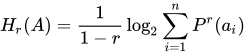
The Rényi entropy is a generalization of Shannon entropy defined above. The Rényi entropy of order r, written as a function of a discrete probability distribution, , associated with events , is defined as:[37]

for and .

We arrive at the definition of Shannon entropy from Rényi when , of Hartley entropy (or max-entropy) when , and min-entropy when .

Quantum information theory

[edit]

Quantum information theory is largely an extension of classical information theory to quantum systems. Classical information is produced when measurements of quantum systems are made.[37]

Von Neumann entropy

[edit]

One interpretation of Shannon entropy was the uncertainty associated with a probability distribution. When we want to describe the information or the uncertainty of a quantum state, the probability distributions are simply replaced by density operators :

where are the eigenvalues of .

Von Neumann entropy plays a role in quantum information similar to the role Shannon entropy plays in classical information.

Applications

[edit]

Quantum communication

[edit]

Quantum communication is one of the applications of quantum physics and quantum information. There are some famous theorems such as the no-cloning theorem that illustrate some important properties in quantum communication. Dense coding and quantum teleportation are also applications of quantum communication. They are two opposite ways to communicate using qubits. While teleportation transfers one qubit from Alice and Bob by communicating two classical bits under the assumption that Alice and Bob have a pre-shared Bell state, dense coding transfers two classical bits from Alice to Bob by using one qubit, again under the same assumption, that Alice and Bob have a pre-shared Bell state.

Quantum key distribution

[edit]

One of the best known applications of quantum cryptography is quantum key distribution which provide a theoretical solution to the security issue of a classical key. The advantage of quantum key distribution is that it is impossible to copy a quantum key because of the no-cloning theorem. If someone tries to read encoded data, the quantum state being transmitted will change. This could be used to detect eavesdropping.

BB84

[edit]

The first quantum key distribution scheme, BB84, was developed by Charles Bennett and Gilles Brassard in 1984. It is usually explained as a method of securely communicating a private key from a third party to another for use in one-time pad encryption.[2]

E91

[edit]

E91 was made by Artur Ekert in 1991. His scheme uses entangled pairs of photons. These two photons can be created by Alice, Bob, or by a third party including eavesdropper Eve. One of the photons is distributed to Alice and the other to Bob so that each one ends up with one photon from the pair.

This scheme relies on two properties of quantum entanglement:

  1. The entangled states are perfectly correlated which means that if Alice and Bob both measure their particles having either a vertical or horizontal polarization, they always get the same answer with 100% probability. The same is true if they both measure any other pair of complementary (orthogonal) polarizations. This necessitates that the two distant parties have exact directionality synchronization. However, from quantum mechanics theory the quantum state is completely random so that it is impossible for Alice to predict if she will get vertical polarization or horizontal polarization results.
  2. Any attempt at eavesdropping by Eve destroys this quantum entanglement such that Alice and Bob can detect.

B92

[edit]

B92 is a simpler version of BB84.[38]

The main difference between B92 and BB84:

  • B92 only needs two states
  • BB84 needs 4 polarization states

Like the BB84, Alice transmits to Bob a string of photons encoded with randomly chosen bits but this time the bits Alice chooses the bases she must use. Bob still randomly chooses a basis by which to measure but if he chooses the wrong basis, he will not measure anything which is guaranteed by quantum mechanics theories. Bob can simply tell Alice after each bit she sends whether he measured it correctly.[39]

Quantum computation

[edit]

The most widely used model in quantum computation is the quantum circuit, which are based on the quantum bit "qubit". Qubit is somewhat analogous to the bit in classical computation. Qubits can be in a 1 or 0 quantum state, or they can be in a superposition of the 1 and 0 states. However, when qubits are measured, the result of the measurement is always either a 0 or a 1; the probabilities of these two outcomes depend on the quantum state that the qubits were in immediately prior to the measurement.

Any quantum computation algorithm can be represented as a network of quantum logic gates.

Quantum decoherence

[edit]

If a quantum system were perfectly isolated, it would maintain coherence perfectly, but it would be impossible to test the entire system. If it is not perfectly isolated, for example during a measurement, coherence is shared with the environment and appears to be lost with time; this process is called quantum decoherence. As a result of this process, quantum behavior is apparently lost, just as energy appears to be lost by friction in classical mechanics.

Quantum error correction

[edit]

QEC is used in quantum computing to protect quantum information from errors due to decoherence and other quantum noise. Quantum error correction is essential if one is to achieve fault-tolerant quantum computation that can deal not only with noise on stored quantum information, but also with faulty quantum gates, faulty quantum preparation, and faulty measurements.

Peter Shor first discovered this method of formulating a quantum error correcting code by storing the information of one qubit onto a highly entangled state of ancilla qubits. A quantum error correcting code protects quantum information against errors.

Journals

[edit]

See also

[edit]

References

[edit]
Revisions and contributorsEdit on WikipediaRead on Wikipedia
from Grokipedia
Quantum information science is an interdisciplinary field that merges principles of quantum mechanics with information theory to study, process, store, and transmit information using quantum systems.[1] At its core, it investigates how quantum phenomena, such as superposition and entanglement, enable fundamentally new ways to handle information that surpass classical limits.[2] This field encompasses quantum computing, communication, sensing, and metrology, drawing on advances in physics, computer science, materials science, and engineering to develop transformative technologies.[3] Central to quantum information science are qubits, the basic units of quantum information, which unlike classical bits (that exist strictly as 0 or 1) can occupy superpositions of multiple states simultaneously, allowing for parallel processing of information.[4] Quantum entanglement, a phenomenon in which the quantum states of two or more particles become linked such that the quantum state of each particle cannot be described independently of the state of the others, even when the particles are separated by large distances, underpins key capabilities like enhanced computational power and secure data transmission.[1] Another defining feature is the no-cloning theorem, which prohibits perfect copying of arbitrary quantum states, providing a natural basis for information security but also posing challenges for error correction in quantum systems.[2] These principles distinguish quantum information from classical theory, enabling tasks like simulating complex quantum systems that are intractable for traditional computers.[4] Applications of quantum information science are poised to revolutionize multiple domains. In quantum computing, algorithms such as Shor's enable efficient factorization of large numbers, threatening classical cryptography while opening doors to drug discovery and materials optimization through molecular simulations.[4] Quantum communication leverages entanglement and the no-cloning theorem for protocols like quantum key distribution (QKD), ensuring provably secure information exchange detectable against eavesdropping.[2] Additionally, quantum sensing exploits superposition for ultra-precise measurements, such as detecting gravitational waves or imaging at the atomic scale, with potential impacts in medicine, navigation, and environmental monitoring.[3] Ongoing research focuses on scaling these technologies, addressing decoherence challenges, and integrating them into practical networks. The United Nations has proclaimed 2025 the International Year of Quantum Science and Technology, marking a century since the inception of quantum mechanics and underscoring the field's transformative potential.[1][5]

Fundamentals

Definition and overview

Quantum information is the field that integrates principles from quantum physics and information science to study the storage, processing, and transmission of information using quantum mechanical systems rather than classical bits.[1] This discipline leverages inherently quantum phenomena, such as superposition and entanglement, to enable novel ways of encoding and manipulating data at the atomic and subatomic scales.[6][7] Unlike classical information theory, which operates on deterministic bits representing either 0 or 1, quantum information exploits the probabilistic nature of quantum states, allowing a single unit—known as a qubit—to embody multiple potential values simultaneously through superposition.[8] This fundamental distinction extends to entanglement, where quantum particles become correlated such that the measurement of one instantly determines the state of the other, regardless of distance, opening pathways for tasks impossible in classical systems.[9] As an interdisciplinary endeavor, quantum information draws from physics, computer science, mathematics, and engineering to develop technologies that push beyond classical limitations. Its potential impacts include dramatically accelerating computational problem-solving for complex simulations, establishing unbreakable encryption for secure communications, and achieving unprecedented precision in sensing applications like medical imaging and environmental monitoring.[10][4][11]

Relation to quantum mechanics

Quantum information science is fundamentally rooted in the principles of quantum mechanics, which describe the behavior of physical systems at microscopic scales. A cornerstone of this framework is the wave-particle duality, first proposed by Louis de Broglie in 1924, positing that particles such as electrons exhibit both wave-like and particle-like properties depending on the experimental context. This duality underpins the probabilistic nature of quantum phenomena, as demonstrated in interference experiments like the double-slit setup adapted to quantum particles. Complementing this is Werner Heisenberg's uncertainty principle, formulated in 1927, which mathematically expresses the inherent limits on simultaneously measuring conjugate variables such as position and momentum, with the product of their uncertainties bounded by ħ/2. These principles highlight the departure from classical intuitions, where objects have definite trajectories and properties. The dynamical evolution of quantum systems is governed by the Schrödinger equation, introduced by Erwin Schrödinger in 1926, which describes how the wave function ψ evolves linearly over time via iħ ∂ψ/∂t = Ĥψ, where Ĥ is the Hamiltonian operator representing the system's energy. Quantum information extends these quantum mechanical foundations by interpreting quantum states not merely as descriptions of physical systems, but as carriers of information that can be manipulated and processed in novel ways. In this paradigm, the abstract Hilbert space of quantum mechanics becomes a resource for encoding and transmitting information, leveraging the intrinsic properties of quantum states to surpass classical limits. This shift is articulated in foundational texts on the subject, which emphasize how quantum mechanics provides the mathematical and physical substrate for information-theoretic applications. A key postulate bridging quantum mechanics to information contexts is the linearity of quantum evolution, ensuring that the time development of states under unitary operators preserves superpositions and interference, combined with the measurement postulate, which induces a non-unitary collapse to probabilistic outcomes upon observation. This linearity allows reversible operations on quantum states, in stark contrast to the often irreversible, deterministic paths of classical mechanics, where information processing lacks such inherent parallelism. Non-local effects, arising from entangled states, further distinguish quantum systems by enabling correlations that defy classical locality without violating relativity. These features establish quantum mechanics as a prerequisite for quantum information, as they enable the exploitation of superposition for parallel information processing, where multiple computational paths can be explored simultaneously.

Core Concepts

Qubits and quantum states

In quantum information theory, a qubit serves as the basic unit of quantum information, generalizing the classical bit to a two-level quantum mechanical system that can exist in a superposition of states.[12] Unlike a classical bit, which is strictly either 0 or 1, a qubit's state is inherently probabilistic and can be manipulated to encode more complex information. The mathematical description of a qubit's state employs the formalism of quantum mechanics, representing it as a normalized vector in a two-dimensional complex Hilbert space. A general pure state of a single qubit is expressed as
ψ=α0+β1, |\psi\rangle = \alpha |0\rangle + \beta |1\rangle,
where 0|0\rangle and 1|1\rangle form the computational basis—an orthonormal set of states analogous to classical 0 and 1—and α,βC\alpha, \beta \in \mathbb{C} are complex coefficients satisfying the normalization condition α2+β2=1|\alpha|^2 + |\beta|^2 = 1. These basis states play a crucial role in quantum measurement: upon observation in the computational basis, the qubit collapses to 0|0\rangle with probability α2|\alpha|^2 or to 1|1\rangle with probability β2|\beta|^2, yielding a definite classical outcome. A useful geometric visualization of single-qubit pure states is provided by the Bloch sphere, which maps the state ψ|\psi\rangle to a point on the surface of a unit sphere in three-dimensional real space. The position on the sphere is determined by the expectation values of the Pauli matrices, with the north pole corresponding to 0|0\rangle, the south pole to 1|1\rangle, and equatorial points representing balanced superpositions. This representation highlights the continuum of possible states and facilitates understanding unitary evolutions as rotations on the sphere. For systems composed of multiple qubits, the total quantum state resides in the tensor product of individual Hilbert spaces, enabling the description of composite systems. For two qubits with states ψ|\psi\rangle and ϕ|\phi\rangle, the joint state is ψϕ=(α10+β11)(α20+β21)|\psi\rangle \otimes |\phi\rangle = (\alpha_1 |0\rangle + \beta_1 |1\rangle) \otimes (\alpha_2 |0\rangle + \beta_2 |1\rangle), expanding to a four-dimensional basis {00,01,10,11}\{|00\rangle, |01\rangle, |10\rangle, |11\rangle\}. This tensor product structure underpins the scalability of quantum information processing, where an nn-qubit system occupies a 2n2^n-dimensional Hilbert space.

Superposition and entanglement

In quantum information, superposition refers to the principle that a quantum system can exist in a linear combination of multiple states simultaneously, enabling the representation of an exponential number of possibilities within a single quantum state. This allows quantum systems to perform computations in parallel across those states, with interference effects arising upon measurement that can amplify correct outcomes or suppress incorrect ones. Mathematically, a general superposition state for a quantum system is expressed as $ |\psi\rangle = \sum_i c_i |i\rangle $, where the $ |i\rangle $ form an orthonormal basis, the coefficients $ c_i $ are complex numbers satisfying $ \sum_i |c_i|^2 = 1 $, and the probability of measuring the system in state $ |i\rangle $ is $ |c_i|^2 $. This form underpins the ability of quantum computers to explore vast state spaces efficiently, as an $ n $-qubit system can represent up to $ 2^n $ basis states in superposition, providing an exponential scaling in the dimensionality of the Hilbert space compared to classical bits. Entanglement describes a quantum state of multiple particles that cannot be expressed as a product of individual states, resulting in correlations between measurements that persist regardless of spatial separation. A canonical example is the Bell state $ \frac{1}{\sqrt{2}} (|00\rangle + |11\rangle) $, where measuring one qubit instantly determines the state of the other, even at arbitrary distances. The phenomenon of entanglement was highlighted in the Einstein-Podolsky-Rosen (EPR) paradox, which questioned the completeness of quantum mechanics by arguing that entangled particles imply instantaneous influences violating locality. John Bell's theorem later formalized this by deriving inequalities that local hidden-variable theories must satisfy; quantum mechanics violates these inequalities, demonstrating non-local correlations inherent to entangled states. Despite these non-local correlations, the no-signaling theorem ensures that entanglement cannot be used to transmit classical information faster than light, as local measurements on one subsystem yield statistics independent of operations on the distant subsystem. This preserves relativistic causality while allowing entanglement to enable correlations stronger than any achievable classically, such as in tasks requiring coordinated outcomes across parties. Superposition and entanglement together provide the foundation for quantum advantage, with superposition enabling the manipulation of exponentially large state spaces for parallel processing, and entanglement facilitating multipartite correlations that surpass classical limits, as seen in protocols for secure key distribution.

Quantum Information Theory

Classical information foundations

Classical information theory provides the foundational framework for quantifying, storing, and transmitting data in deterministic systems, where information is represented by bits as the smallest indivisible units of data.[13] In classical computing and communication, bits are processed sequentially and stored deterministically, with each bit representing a binary state of 0 or 1 without any inherent ambiguity beyond probabilistic sources.[13] This binary structure enables reliable manipulation through logic gates and arithmetic operations, but it imposes fundamental limits on parallelism and security in information handling.[13] A central concept in classical information theory is Shannon entropy, which measures the average uncertainty or information content in a random variable XX with probability distribution p(x)p(x).[13] Formally, it is defined as
H(X)=xp(x)log2p(x), H(X) = -\sum_{x} p(x) \log_2 p(x),
where the logarithm is typically base-2 to yield units in bits.[13] For example, a fair coin flip has entropy H(X)=1H(X) = 1 bit, reflecting maximal uncertainty between two equally likely outcomes, while a deterministic event has zero entropy.[13] This metric quantifies the expected number of bits needed to encode outcomes from the source, serving as a cornerstone for data compression.[13]
Channel capacity extends entropy concepts to communication over noisy channels, defined as the maximum mutual information I(X;Y)I(X;Y) between input XX and output YY, representing the highest rate for reliable information transmission.[13] Mutual information is given by I(X;Y)=H(X)H(XY)I(X;Y) = H(X) - H(X|Y), capturing the reduction in uncertainty about XX provided by YY.[13] For a binary symmetric channel with crossover probability pp, the capacity is C=1h(p)C = 1 - h(p), where h(p)=plog2p(1p)log2(1p)h(p) = -p \log_2 p - (1-p) \log_2 (1-p) is the binary entropy function, illustrating how noise degrades but does not eliminate transmittable information.[13] Two key theorems underpin these ideas: the source coding theorem, which states that no fewer than H(X)H(X) bits per symbol are needed on average to losslessly compress a source (achievable in the limit of large blocks), and the noisy channel coding theorem, which asserts that reliable communication is possible at rates up to the channel capacity CC using appropriate error-correcting codes.[13] These results, proven asymptotically, establish the theoretical bounds for efficient encoding and decoding in classical systems.[13] Despite their power, classical information foundations exhibit limitations, such as the absence of superposition, which confines processing to sequential operations and makes systems vulnerable to eavesdropping, as any interception can be detected only through redundancy rather than inherent security. These constraints motivate quantum extensions, where concepts like Shannon entropy generalize to von Neumann entropy for density operators in quantum channels.

Quantum entropy and measures

In quantum information theory, entropy measures quantify the uncertainty or information content inherent in quantum states and processes, extending classical notions to account for superposition and entanglement. The primary such measure is the von Neumann entropy, which generalizes the Shannon entropy from classical probability distributions to density operators describing quantum systems.[14] The von Neumann entropy $ S(\rho) $ of a density operator $ \rho $ is defined as
S(ρ)=Tr(ρlog2ρ), S(\rho) = -\operatorname{Tr}(\rho \log_2 \rho),
where $ \operatorname{Tr} $ denotes the trace operation, and the logarithm is base-2 for bits of information. This expression arises from the eigenvalues of $ \rho $, mirroring the Shannon entropy $ H(p) = -\sum_i p_i \log_2 p_i $ for a probability vector $ p $, but applied to the spectral decomposition $ \rho = \sum_i \lambda_i | \psi_i \rangle \langle \psi_i | $, yielding $ S(\rho) = -\sum_i \lambda_i \log_2 \lambda_i $. For pure states where $ \rho = |\psi\rangle\langle\psi| $, $ S(\rho) = 0 $, indicating no mixedness, while maximally mixed states achieve maximum entropy, such as $ S(I/d) = \log_2 d $ for a $ d $-dimensional system.[14][15]
Key properties of the von Neumann entropy underpin its utility in quantum information. It is concave, satisfying $ S(\sum_i p_i \rho_i) \geq \sum_i p_i S(\rho_i) $ for probabilities $ p_i > 0 $ and density operators $ \rho_i $, which implies that mixing states cannot decrease average entropy. Subadditivity holds as $ S(\rho_{AB}) \leq S(\rho_A) + S(\rho_B) $, where $ \rho_A = \operatorname{Tr}B(\rho{AB}) $ and similarly for $ \rho_B $, bounding the entropy of a composite system by the sum of subsystem entropies. Strong subadditivity further strengthens this: $ S(\rho_{ABC}) + S(\rho_B) \leq S(\rho_{AB}) + S(\rho_{BC}) $, a non-classical property essential for analyzing quantum correlations and channel capacities. These inequalities facilitate derivations in quantum coding theorems and entanglement theory.[14][15] Building on von Neumann entropy, the quantum mutual information $ I(A:B) $ quantifies total correlations, including classical and quantum components, between subsystems $ A $ and $ B $ of a bipartite state $ \rho_{AB} $. It is defined as
I(A:B)=S(ρA)+S(ρB)S(ρAB), I(A:B) = S(\rho_A) + S(\rho_B) - S(\rho_{AB}),
where $ S(\rho_A) $ and $ S(\rho_B) $ are marginal entropies. For product states $ \rho_{AB} = \rho_A \otimes \rho_B $, $ I(A:B) = 0 $, while entangled or classically correlated states yield positive values; notably, $ I(A:B) \geq 2 S(\rho_A) $ for pure $ \rho_{AB} $, highlighting entanglement's role in excess correlations. This measure is symmetric, non-negative, and satisfies data-processing inequalities, making it a cornerstone for quantum channel analysis.[14]
Quantum generalizations of Rényi entropies provide parameterized families of measures that interpolate between min-entropy ($ \alpha \to \infty )and[vonNeumannentropy](/page/VonNeumannentropy)() and [von Neumann entropy](/page/Von_Neumann_entropy) ( \alpha \to 1 $), useful for robustness in noisy settings and hypothesis testing. The $ \alpha $-Rényi entropy for $ \alpha > 0, \alpha \neq 1 $ is
Sα(ρ)=11αlog2Tr(ρα), S_\alpha(\rho) = \frac{1}{1 - \alpha} \log_2 \operatorname{Tr}(\rho^\alpha),
reducing to the Shannon form in the classical limit and preserving monotonicity under quantum operations for fixed $ \alpha $. These entropies find applications in quantum cryptography for security proofs and in resource theories for bounding entanglement distillation rates, with higher $ \alpha $ emphasizing worst-case uncertainties.[16]
A pivotal application of these entropies is the Holevo bound, which limits the classical information transmittable through a quantum channel. For an ensemble $ {p_i, \rho_i} $ where $ p_i $ are probabilities and $ \rho_i $ are output states, the Holevo quantity is
χ=S(ipiρi)ipiS(ρi), \chi = S\left( \sum_i p_i \rho_i \right) - \sum_i p_i S(\rho_i),
representing the maximum accessible classical information, achievable via collective measurements but not single-copy ones in general. This bound, originally derived for memoryless channels, establishes that quantum communication cannot exceed classical limits without entanglement assistance, influencing capacities in quantum networks.[14]

Quantum Processing

Quantum gates and circuits

Quantum gates are unitary operators that manipulate quantum states in a reversible manner, serving as the fundamental building blocks for quantum information processing.[17] Unlike classical logic gates, quantum gates operate on qubits and preserve the norm of the state vector due to their unitarity, ensuring that information is not lost during computation.[17] The evolution of a quantum state under a gate is governed by the time-dependent Schrödinger equation, $ i \hbar \frac{d}{dt} |\psi(t)\rangle = H |\psi(t)\rangle $, where $ H $ is the Hamiltonian, leading to a unitary time-evolution operator $ U(t) = e^{-i H t / \hbar} $ that satisfies $ U^\dagger U = I $, guaranteeing reversibility. Key single-qubit gates include the Pauli gates, which correspond to rotations by $ \pi $ radians around the respective axes on the Bloch sphere. The Pauli-X gate, represented by the matrix $ X = \begin{pmatrix} 0 & 1 \ 1 & 0 \end{pmatrix} $, flips the computational basis states $ |0\rangle $ to $ |1\rangle $ and vice versa, analogous to a classical NOT gate.[17] The Pauli-Z gate, $ Z = \begin{pmatrix} 1 & 0 \ 0 & -1 \end{pmatrix} $, introduces a phase shift of $ \pi $ to $ |1\rangle $, while the Pauli-Y gate, $ Y = \begin{pmatrix} 0 & -i \ i & 0 \end{pmatrix} $, combines a bit flip and phase shift, rotating around the Y-axis.[17] The Hadamard gate, $ H = \frac{1}{\sqrt{2}} \begin{pmatrix} 1 & 1 \ 1 & -1 \end{pmatrix} $, creates superposition by mapping $ |0\rangle $ to $ \frac{|0\rangle + |1\rangle}{\sqrt{2}} $ and $ |1\rangle $ to $ \frac{|0\rangle - |1\rangle}{\sqrt{2}} $.[17] For multi-qubit operations, the controlled-NOT (CNOT) gate entangles qubits by applying the Pauli-X gate to the target qubit conditional on the control qubit being $ |1\rangle $, with matrix form $ \text{CNOT} = \begin{pmatrix} 1 & 0 & 0 & 0 \ 0 & 1 & 0 & 0 \ 0 & 0 & 0 & 1 \ 0 & 0 & 1 & 0 \end{pmatrix} $ in the computational basis.[17] Together with single-qubit gates, the CNOT forms a universal set: any single-qubit unitary can be decomposed into a product of rotations, such as $ U = e^{-i \alpha I/2} R_z(\beta) R_y(\gamma) R_z(\delta) $, where $ R_n(\theta) = e^{-i \theta \sigma_n / 2} $ and $ \sigma_n $ are Pauli matrices, enabling approximation of arbitrary quantum operations.[17] A quantum circuit is a directed acyclic graph representing a sequence of quantum gates applied to qubits, typically followed by measurements to extract classical outcomes. Gates act on wires symbolizing qubits, with single-qubit gates on one wire and multi-qubit gates spanning multiple wires, allowing the construction of complex computations through composition of these unitary operations.[17] An important limitation arises from the no-cloning theorem, which proves that it is impossible to create an identical copy of an arbitrary unknown quantum state using a unitary operation, as any attempt to clone non-orthogonal states violates the linearity of quantum evolution.[18] This theorem, derived by showing that a universal cloning machine would imply superluminal signaling or contradict quantum linearity, underscores the unique challenges in quantum information processing compared to classical systems.[18]

Quantum algorithms overview

Quantum algorithms leverage principles of quantum mechanics, such as superposition and entanglement, to solve specific computational problems more efficiently than classical algorithms in certain cases. These algorithms operate within the oracle model, where access to a black-box function (or oracle) allows querying input-output pairs without revealing the function's internal structure, enabling analyses of query complexity that highlight quantum advantages.[19] This framework is central to demonstrating speedups, as seen in algorithms that reduce the number of oracle calls from linear to sublinear scales.[20] Grover's algorithm provides a quadratic speedup for unstructured search problems, identifying a marked item in an unsorted database of N elements using O(√N) oracle queries, compared to the classical O(N) requirement.[20] It achieves this through iterative applications of an oracle that flips the phase of the target state and a diffusion operator that amplifies the amplitude of the solution, converging to the marked item with high probability after approximately π/4 √N iterations.[20] This makes it particularly useful for optimization and database querying where exhaustive search is impractical classically. The quantum Fourier transform (QFT) is a key subroutine in many quantum algorithms, efficiently computing the discrete Fourier transform on quantum states and enabling period-finding tasks essential for number-theoretic problems.[21] For an n-qubit state, the QFT applies a unitary transformation whose matrix elements are given by
Fjk=1Nexp(2πijk/N), F_{jk} = \frac{1}{\sqrt{N}} \exp\left(2\pi i j k / N\right),
where N = 2^n, transforming the computational basis into the Fourier basis in O(n^2) gates, exponentially faster than the classical fast Fourier transform's O(n 2^n) operations for quantum-encoded data.[21] Shor's algorithm exploits the QFT to factor large integers in polynomial time, a task believed to be hard classically and foundational to public-key cryptography like RSA.[21] By reducing factoring to finding the period of a modular exponential function via QFT-based order-finding, it runs in O((log N)^3) time for an N-bit number, potentially breaking widely used encryption schemes on sufficiently large quantum computers.[21] Variational quantum algorithms, such as the variational quantum eigensolver (VQE), adopt a hybrid classical-quantum approach for near-term devices, optimizing variational parameters in a parameterized quantum circuit to approximate solutions to combinatorial optimization and quantum chemistry problems.[22] In VQE, a trial wavefunction is prepared on the quantum processor, its expectation value measured to estimate the energy of a Hamiltonian, and classical optimization iteratively refines parameters to find ground-state energies, demonstrating practical utility for molecular simulations where full quantum simulation is intractable classically.[23] Recent advances as of 2025 include Google's Quantum Echoes algorithm, which demonstrates verifiable quantum advantage by measuring out-of-time-order correlators (OTOCs) on a 103-qubit processor, enabling efficient simulation of quantum-chaotic systems beyond classical capabilities.[24]

Applications

Quantum communication protocols

Quantum communication protocols enable the transmission of quantum information through channels that exploit quantum mechanical principles, such as superposition and entanglement, to achieve tasks unattainable with classical methods. These protocols model real-world quantum channels as noisy operations that evolve quantum states in a physically realizable manner, ensuring complete positivity and trace preservation to maintain the probabilistic interpretation of quantum mechanics. A fundamental representation of such channels uses Kraus operators, where a quantum channel E\mathcal{E} acting on a density operator ρ\rho is given by E(ρ)=kKkρKk\mathcal{E}(\rho) = \sum_{k} K_k \rho K_k^\dagger, with the completeness relation kKkKk=I\sum_{k} K_k^\dagger K_k = I guaranteeing trace preservation. This formalism captures decoherence and noise effects, such as amplitude damping or phase flips, by decomposing the channel into a sum of unitary operations followed by partial trace-outs over environmental degrees of freedom.[25] One key protocol leveraging shared entanglement is superdense coding, which allows the transmission of two classical bits using a single qubit, doubling the efficiency of a classical channel under ideal conditions. In this scheme, two parties, Alice and Bob, initially share a maximally entangled Bell state, such as Φ+=12(00+11)|\Phi^+\rangle = \frac{1}{\sqrt{2}} (|00\rangle + |11\rangle). Alice encodes her two-bit message by applying one of four Pauli operations (II, XX, ZZ, or XZXZ) to her qubit and sends it to Bob, who then measures both qubits in the Bell basis to decode the message perfectly. This enhancement relies on the pre-shared entanglement, which correlates the qubits such that local operations on one convey information about the joint state. The protocol assumes a noiseless quantum channel for the qubit transmission but can be analyzed using Kraus operators to quantify fidelity under realistic noise. Complementing superdense coding, quantum teleportation facilitates the transfer of an arbitrary qubit state from Alice to Bob without physically transporting the particle, using a shared entangled pair and a classical communication channel. The process begins with Alice performing a Bell-state measurement on her qubit (in unknown state ψ=α0+β1|\psi\rangle = \alpha|0\rangle + \beta|1\rangle) and one half of the entangled pair, yielding one of four possible outcomes with equal probability. She transmits the two classical bits describing this outcome to Bob, who applies the corresponding Pauli correction (II, XX, ZZ, or XZXZ) to his qubit, reconstructing ψ|\psi\rangle faithfully. This protocol consumes one ebit of entanglement per teleported qubit and requires two classical bits, demonstrating how quantum information can be "teleported" via hybrid quantum-classical signaling, with success verified through process tomography in noisy channels modeled by Kraus operators.[26] Entanglement distribution is crucial for enabling protocols like superdense coding and teleportation over distances, as shared entanglement must first be established between remote parties. A common laboratory method generates polarization-entangled photon pairs via spontaneous parametric down-conversion (SPDC) in a type-II nonlinear crystal, such as beta-barium borate (BBO), pumped by a ultraviolet laser. In this process, a pump photon splits into two lower-energy photons with orthogonal polarizations, producing a state like 12(HV+VH)\frac{1}{\sqrt{2}} (|H V\rangle + |V H\rangle), where HH and VV denote horizontal and vertical polarizations; the pairs are then distributed via optical fibers or free-space links with fidelities exceeding 0.9 in typical setups. For long-distance applications, satellite-based distribution overcomes atmospheric losses, as demonstrated by the Micius satellite, which delivered entangled photons over 1200 km to ground stations using downlink telescopes and adaptive optics to maintain entanglement visibility above 0.8. These methods ensure scalable entanglement resources for quantum networks, with SPDC sources achieving pair generation rates up to millions per second per milliwatt of pump power.[27] The ultimate limits of quantum information transmission are governed by capacity theorems, which quantify the maximum reliable rate over many channel uses. The quantum capacity Q(N)Q(\mathcal{N}) of a channel N\mathcal{N}, defined as the supremum of rates for transmitting qubits with vanishing error, is given by the regularized coherent information limn1nmaxψIc(ψ,Nn)\lim_{n \to \infty} \frac{1}{n} \max_{\psi} I_c(\psi, \mathcal{N}^{\otimes n}), where Ic(ρ,N)=S(N(ρ))Se(ρ,N)I_c(\rho, \mathcal{N}) = S(\mathcal{N}(\rho)) - S_e(\rho, \mathcal{N}) measures the distillable entanglement, with SS the von Neumann entropy and SeS_e the entropy exchange. For degradable channels, this simplifies to a single-letter formula, providing an achievable rate via coherent state encoding and decoding. Seminal results establish that QQ can exceed classical capacities in entanglement-assisted scenarios, with explicit computations for qubit channels like the depolarizing channel yielding Q1H(p)Q \approx 1 - H(p) bits per use for small noise pp, highlighting the advantage of quantum signaling. These theorems guide protocol design by bounding the entanglement and information throughput in noisy environments.[28]

Quantum computation paradigms

Quantum computation paradigms encompass diverse architectural frameworks for harnessing quantum mechanical principles to perform computations, distinct from classical models by leveraging superposition and entanglement at scale. The gate-model, also known as the circuit model, represents the foundational paradigm, where quantum information is processed through sequences of unitary operations on qubits. In this approach, a universal set of quantum gates—such as single-qubit rotations and a two-qubit entangling gate like the controlled-NOT—enables the simulation of any quantum algorithm, achieving Turing completeness for quantum systems. This universality stems from the ability to approximate any unitary transformation on n qubits using a finite gate set, allowing for programmable and flexible computation.[29][30] An alternative paradigm, adiabatic quantum computing, relies on the quantum adiabatic theorem, which guarantees that a system initialized in the ground state of a simple Hamiltonian will remain in the ground state of a slowly evolving Hamiltonian. Computation proceeds by gradually interpolating from an initial Hamiltonian with a known ground state to a final problem Hamiltonian, whose ground state encodes the solution to an optimization problem. This model, proposed for solving NP-hard problems, avoids explicit gate sequences and instead exploits continuous-time evolution, with the runtime determined by the energy gap between ground and excited states during the process. While theoretically equivalent to the gate model in computational power, adiabatic approaches offer potential advantages in hardware implementations tolerant to certain noise types.[31] Measurement-based quantum computing, or one-way quantum computing, shifts the computational burden from unitary gates to measurements on a pre-prepared entangled resource state. Central to this paradigm is the cluster state, a highly entangled multi-qubit state generated via controlled-phase gates on a lattice, which serves as a universal resource for computation. Algorithms are executed through a sequence of single-qubit measurements in adaptive bases on the cluster state, with outcomes feeding back to determine subsequent measurement angles, effectively implementing any quantum circuit. This model decouples state preparation from processing, potentially simplifying fault-tolerant implementations by allowing offline entanglement generation.[32] Physical realizations of these paradigms require hardware platforms capable of manipulating qubits while addressing scalability challenges such as increasing qubit counts, maintaining coherence, and enabling reliable interconnections. Superconducting qubits, fabricated using Josephson junctions in microwave circuits, excel in fast gate operations and integration with semiconductor fabrication, but face hurdles in coherence times limited by material defects and environmental coupling, with current systems exceeding 1,000 qubits amid crosstalk and readout errors.[33] Trapped-ion systems employ electromagnetic traps to confine atomic ions as qubits, offering long coherence times (seconds) and high-fidelity gates via laser interactions, yet scalability is constrained by the need for complex ion shuttling in segmented traps and laser addressing precision for large arrays. Photonic quantum computing encodes qubits in photon polarization or paths, leveraging room-temperature operation and fiber-optic compatibility for distributed systems, but struggles with probabilistic gate operations due to weak nonlinearities and photon loss, necessitating heralding techniques and auxiliary resources to achieve determinism at scale. Across these platforms, hybrid approaches combining elements—such as photonic interconnects for modular scaling—are emerging to mitigate individual limitations.[34][35][36] The DiVincenzo criteria provide a foundational checklist for evaluating quantum hardware suitability across paradigms, stipulating five essential requirements: a scalable array of well-characterized qubits; reliable initialization to a pure state; a universal set of gates or equivalent operations; qubit-specific measurement capability; and sufficient coherence time relative to gate speeds. Additional criteria for quantum communication include interconversion between stationary and flying qubits and faithful transmission over channels. These benchmarks have guided two decades of progress, ensuring that candidate systems can support fault-tolerant quantum computing despite ongoing challenges in error rates and integration.[37]

Quantum cryptography techniques

Quantum cryptography techniques leverage the fundamental principles of quantum mechanics to provide security guarantees that are provably unbreakable by any computationally bounded adversary, primarily through the detection of eavesdropping attempts via disturbances to quantum states. Central to these methods is quantum key distribution (QKD), which enables two parties, often called Alice and Bob, to generate a shared secret key over an insecure channel while ensuring that any interception by an eavesdropper, Eve, introduces detectable errors. The security of QKD stems from the no-cloning theorem, which prevents perfect copying of unknown quantum states, and the monogamy of quantum correlations, making it impossible for Eve to gain full information without altering the transmission in a way that can be statistically verified. The BB84 protocol, proposed by Charles Bennett and Gilles Brassard in 1984, is the foundational QKD scheme and uses polarized single photons to encode bits in two bases. Alice randomly selects either the rectilinear (0°/90°) or diagonal (45°/135°) basis to prepare photons representing bits 0 or 1, sends them to Bob over a quantum channel, and Bob measures each photon in a randomly chosen basis. After transmission, Alice and Bob publicly compare their basis choices via a classical channel and discard mismatched measurements during the sifting phase, retaining roughly half the bits as a raw key. To detect eavesdropping, they sample a subset of the sifted key to estimate the quantum bit error rate (QBER); if it exceeds a threshold (typically around 11% for optimal security), indicating potential interception, they abort. The final secure key is obtained through error correction to handle channel noise and privacy amplification to reduce Eve's information, achieving a key rate proportional to the sifted key length minus leaked information. Experimental implementations of BB84 have demonstrated secure key distribution over distances up to 421 km in fiber optics. The E91 protocol, developed by Artur Ekert in 1991, extends QKD to an entanglement-based approach, utilizing pairs of entangled photons shared between Alice and Bob to generate the key while simultaneously testing for eavesdropping through violations of Bell inequalities. Alice and Bob each receive one photon from an entangled source, such as a parametric down-conversion crystal producing singlet states, and perform measurements in randomly chosen bases: for key generation, they use bases correlated with the entanglement (e.g., Z-basis for bits), and for security checking, they select bases that test CHSH-Bell inequalities (e.g., combinations of X and Z). After measurements, they publicly announce their basis choices and use the Bell test results to bound Eve's information; a sufficient violation (e.g., CHSH value > 2) certifies security against general attacks, as it implies the shared state is sufficiently entangled and not influenced by Eve. The sifted key is processed similarly to BB84 with error correction and privacy amplification. E91's advantage lies in its self-testing of quantum correlations, providing security even against certain implementation flaws, and it has been realized in free-space links over 144 km. A simplified variant, the B92 protocol introduced by Bennett in 1992, reduces the complexity of BB84 by encoding bits using only two non-orthogonal quantum states, such as |0⟩ for bit 0 and |+⟩ (a superposition) for bit 1, sent as polarized photons. Bob measures in a basis that unambiguously discriminates |0⟩ but only probabilistically detects |+⟩, leading to inconclusive results for bit 1 attempts. Alice and Bob sift the key by keeping only conclusive measurements where Bob detects a photon corresponding to bit 0 or an inconclusive outcome interpreted as bit 1 after basis revelation. Eavesdropping is detected via increased inconclusive rates or error rates exceeding the inherent 25% ambiguity bound for non-orthogonal states. B92 requires fewer resources than BB84, as it uses a single basis per party, but achieves lower key rates; it has been implemented experimentally with weak coherent pulses over short distances. The security of these QKD protocols is underpinned by rigorous information-theoretic proofs, establishing that the key is secret and private even against unbounded adversaries, as long as the quantum channel's properties are bounded. For instance, the Csiszár-Körner bound on the secrecy capacity of quantum wiretap channels quantifies the maximum secure key rate as the difference between the mutual information of the legitimate channel and the eavesdropper's channel, ensuring that Eve's accessible information is exponentially small after privacy amplification. These proofs, developed in works by Shor and Preskill (2000) for BB84 and subsequent extensions, reduce security to the disturbance caused by attacks, with finite-key analyses providing practical bounds for real implementations. Over 20 years of theoretical and experimental validation have confirmed QKD's robustness, with global networks like the Chinese Micius satellite demonstrating entanglement-based distribution over 1200 km. As of 2025, satellite-based QKD has advanced further, with Europe's ESA launching trials via the Eagle-1 microsatellite for secure ground-satellite links, China's USTC demonstrating real-time QKD from a quantum microsatellite to mobile ground stations, and the SAGA mission contracted to enhance Europe's sovereign quantum communication capabilities.[38][39]

Challenges

Decoherence and noise

Decoherence refers to the process by which a quantum system loses its coherent superposition of states due to unintended interactions with its surrounding environment, effectively mimicking the collapse of the wave function without invoking measurement.[40] This interaction entangles the system's quantum information with environmental degrees of freedom, leading to the rapid suppression of off-diagonal elements in the system's density matrix and the emergence of classical-like behavior.[41] In quantum information processing, decoherence represents a fundamental barrier, as it degrades the fragile quantum superpositions essential for tasks like computation and communication.[42] The dynamics of decoherence are commonly modeled using open quantum system theory, particularly through Markovian approximations that assume weak coupling to the environment. A standard framework is the Lindblad master equation, which describes the evolution of the system's density operator ρ\rho as
dρdt=i[H,ρ]+k(LkρLk12{LkLk,ρ}), \frac{d\rho}{dt} = -i[H, \rho] + \sum_k \left( L_k \rho L_k^\dagger - \frac{1}{2} \{ L_k^\dagger L_k, \rho \} \right),
where HH is the system's Hamiltonian and the LkL_k are Lindblad operators representing environmental influences.[42] Specific noise models include the amplitude damping channel, which captures energy relaxation from excited to ground states via operators like L=γσL = \sqrt{\gamma} \sigma_- (with γ\gamma as the damping rate and σ\sigma_- the lowering operator); the phase damping channel, modeling pure dephasing that preserves populations but erodes coherences through L=γσzL = \sqrt{\gamma} \sigma_z; and the depolarization channel, which uniformly mixes the state toward the maximally mixed state, often represented by Pauli operators scaled by a decay parameter.[43] These channels provide tractable ways to simulate and quantify decoherence effects in qubit-based systems.[44] Key timescales characterize the rate of decoherence: the longitudinal relaxation time T1T_1, which measures the decay of excited state populations due to energy exchange with the environment, and the transverse relaxation time T2T_2, which quantifies the loss of phase coherence, often related to T21=12T11+Tϕ1T_2^{-1} = \frac{1}{2} T_1^{-1} + T_\phi^{-1} where TϕT_\phi is the pure dephasing time.[45] State preservation is assessed via fidelity metrics, such as the average gate fidelity F=dψψE(ρψ)ψF = \int d\psi \langle \psi | \mathcal{E}(\rho_\psi) | \psi \rangle, where E\mathcal{E} is the noisy quantum channel and the integral is over pure states ψ\psi; high fidelity (e.g., >99%) is crucial for scalable quantum operations but degrades exponentially with decoherence time.[46] In physical implementations, decoherence arises from diverse environmental sources, including thermal noise from phonons or blackbody radiation at finite temperatures, which induces relaxation and dephasing in solid-state qubits.[47] Electromagnetic interference, such as fluctuating magnetic fields from control electronics or cosmic rays, further contributes to phase flips and unwanted couplings in superconducting or ion-trap systems.[48] Initial mitigation strategies focus on environmental isolation, such as cryogenic cooling to millikelvin temperatures to suppress thermal excitations, and electromagnetic shielding to minimize stray fields.[47] Dynamical decoupling techniques apply sequences of fast pulses to refocus dephasing errors, effectively extending coherence times without additional encoding overhead.

Error correction methods

Quantum error correction (QEC) addresses the fragility of quantum information by encoding a single logical qubit into a subspace spanned by multiple physical qubits, thereby detecting and correcting errors without disturbing the encoded state. This principle, first demonstrated theoretically by Peter Shor, relies on redundancy to protect against both bit-flip and phase-flip errors, which are inherent to quantum systems due to interactions with the environment.[49] In this approach, errors are identified through non-demolition measurements that project the system onto error syndromes, allowing corrective operations to be applied conditionally while preserving quantum superposition.[49] The Shor code exemplifies early QEC constructions, encoding one logical qubit into nine physical qubits to correct arbitrary single-qubit errors. It combines three-qubit repetition codes for bit-flip and phase-flip protection, arranged in a concatenated structure where the logical |0⟩ state is represented as \frac{1}{2^{3/2}} \left( |000\rangle + |111\rangle \right)^{\otimes 3}, and the logical |1⟩ as \frac{1}{2^{3/2}} \left( |000\rangle - |111\rangle \right)^{\otimes 3}. Error detection uses parity checks, such as measuring XXX on subsets of qubits to identify bit flips, and ZZZ for phase flips. This code operates within the stabilizer formalism, introduced by Daniel Gottesman, where the code space is the +1 eigenspace of a commuting set of Pauli operators (stabilizers) that define the logical subspace without revealing the encoded information. For the Shor code, the stabilizers include operators like X₁X₂X₃ X₄X₅X₆, X₄X₅X₆ X₇X₈X₉ (for phase flips), Z₁Z₂, Z₂Z₃, Z₄Z₅, Z₅Z₆, Z₇Z₈, Z₈Z₉ (for bit flips), enabling syndrome extraction via ancillary qubits.[49][50] The surface code, a topological QEC scheme, encodes logical qubits on a two-dimensional lattice of physical qubits placed on the edges of a square grid, with stabilizers defined on plaquettes (Z-type) and vertices (X-type). Logical information is stored in non-local excitations (anyons) that require errors along extended paths to cause failure, providing inherent robustness. Syndrome measurement involves ancillary qubits coupled to each stabilizer group, repeated periodically to extract error locations via minimum-weight matching algorithms, achieving error thresholds up to approximately 1% under realistic noise models. This code's planar geometry supports local interactions, making it suitable for fault-tolerant implementations on near-term hardware.[51] The threshold theorem establishes that if the physical error rate per gate or operation falls below a critical threshold—typically around 1% for leading codes like the surface code—arbitrarily long quantum computations can be performed reliably through concatenated levels of error correction, where each level corrects errors from the one below. Proven independently by several groups, this result shows that the logical error rate decreases exponentially with the number of concatenation levels, enabling scalability provided the base error rate is sufficiently low. For instance, under a depolarizing noise model, thresholds range from 0.5% to 3% depending on the code and gate set, with concatenation amplifying protection. Fault-tolerant gates in QEC maintain the code space's integrity during computation, often implemented via transversal operations that apply identical single-qubit gates to corresponding physical qubits in the logical encoding. In the Shor code, for example, transversal Pauli gates (e.g., logical X as X on all nine qubits) commute with stabilizers, preserving the code distance and correcting single errors post-gate. More generally, Clifford gates in stabilizer codes can be fault-tolerantly realized through syndrome-based protocols or lattice surgery in surface codes, ensuring that gate errors do not propagate uncontrollably. These methods underpin universal quantum computation by composing low-error primitives.[49][50] Recent experiments have demonstrated quantum error correction below the surface code threshold, as achieved by Google in December 2024, marking progress toward fault-tolerant computation.[52] Further advances in 2025 include qudit-based QEC beyond break-even.[53]

Historical Development

Origins in quantum mechanics and physics

The foundations of quantum information trace back to the early formalisms of quantum mechanics developed in the 1920s and 1930s, which introduced a state-based description of physical systems essential for later concepts of quantum information processing. Werner Heisenberg's matrix mechanics, introduced in 1925, provided a non-commutative algebraic framework for observables, emphasizing relationships between measurable quantities rather than classical trajectories. This approach laid the groundwork for treating quantum states as abstract entities capable of encoding information. Erwin Schrödinger's wave mechanics, published in 1926, complemented this by describing quantum systems through continuous wave functions, enabling probabilistic interpretations of state evolution that underpin quantum superposition and interference—key to information storage in quantum systems. Paul Dirac's 1930 monograph, The Principles of Quantum Mechanics, synthesized these developments into a relativistic-invariant formalism using bras and kets, formalizing quantum states in Hilbert space and establishing the linear algebraic structure that allows quantum information to be manipulated mathematically. A pivotal moment came in 1935 with the Einstein-Podolsky-Rosen (EPR) paper, which highlighted paradoxes in quantum mechanics arising from entangled states, where measurements on one particle instantaneously correlate with outcomes on a distant partner, challenging classical notions of locality and realism. The authors argued that this "spooky action at a distance" implied quantum mechanics was incomplete, necessitating hidden variables to restore determinism, yet their analysis inadvertently spotlighted entanglement as a resource for non-local quantum correlations central to information theory. This paradox set the stage for probing the informational implications of quantum non-locality. John Bell's 1964 theorem resolved key aspects of the EPR debate by deriving inequalities that local hidden-variable theories must satisfy, while quantum mechanics predicts violations thereof, experimentally confirmed later and demonstrating inherent non-locality in quantum correlations. These correlations, stronger than classical limits, form the basis for quantum information protocols exploiting shared entanglement without classical analogs. In atomic physics, the invention of the maser by Charles Townes and colleagues in 1954 marked an early milestone in coherent quantum control, using stimulated emission in ammonia to amplify microwaves, serving as a precursor to manipulating quantum states for information purposes. The subsequent proposal of the laser in 1958 by Townes and Arthur Schawlow extended this to optical frequencies, enabling precise control over quantum emitters and laying groundwork for quantum optical information processing. Ties to relativity emerged through the no-faster-than-light signaling principle, inherent in quantum mechanics to preserve causality: entangled measurements yield correlations but cannot transmit usable information superluminally, aligning quantum information with special relativity's light-speed limit and preventing paradoxes in space-time. This compatibility ensured quantum mechanics' consistency with relativistic physics, framing quantum information as a framework respecting fundamental physical constraints.

Evolution from information theory and computing

The foundations of quantum information emerged in the mid-20th century as researchers began extending classical information theory to quantum systems. In 1948, Claude Shannon introduced the mathematical theory of communication, establishing concepts like entropy and channel capacity that quantified information transmission in classical systems.[54] This framework inspired subsequent efforts to incorporate quantum mechanics, recognizing that quantum states could potentially enhance information processing beyond classical limits. A pivotal early contribution came in 1973 when Alexander Holevo derived bounds on the amount of classical information transmissible through a quantum channel, showing that it is limited by the von Neumann entropy of the ensemble of quantum states, thus bridging Shannon's entropy to quantum contexts.[55] Holevo's theorem highlighted the no-cloning theorem's implications for quantum communication, setting a theoretical ceiling that classical measurements could not exceed without quantum-specific encoding.[55] The 1980s marked a convergence with computer science, as physicists and theorists explored quantum analogs to classical computing models. In 1982, Richard Feynman proposed that quantum systems could simulate other quantum phenomena more efficiently than classical computers, arguing that a universal quantum simulator would be necessary to model the exponential complexity of quantum many-body problems.[56] Concurrently, in 1980, Paul Benioff formalized a quantum mechanical model of Turing machines using a Hamiltonian framework, demonstrating that universal computation could be realized reversibly at the quantum level without energy dissipation in idealized cases.[57] These works laid the groundwork for viewing quantum mechanics not just as a simulation tool but as a computational paradigm. The integration of quantum ideas with cryptography accelerated in 1984, when Charles Bennett and Gilles Brassard developed the BB84 protocol, the first quantum key distribution scheme that leveraged the uncertainty principle to detect eavesdropping and enable secure classical key exchange over quantum channels.[58] This innovation merged quantum no-cloning with classical information security, proving practical applications for quantum-enhanced cryptography. The 1990s saw explosive growth in quantum algorithms, drawing directly from computer science challenges. In 1994, Peter Shor devised a polynomial-time quantum algorithm for integer factorization and discrete logarithms, exploiting quantum Fourier transforms to solve problems intractable for classical computers and threatening widely used public-key cryptosystems.[59] Building on this momentum, in 1996 Lov Grover introduced a quantum search algorithm that quadratically speeds up unstructured database searches compared to classical exhaustive methods, providing the first demonstrated quantum speedup for a practical problem.[20] By the 2010s, attention turned to practical gaps in quantum networks, such as signal loss over distance, prompting advancements in quantum repeaters. A 2011 review by Duan, Lukin, Cirac, and Zoller outlined protocols using atomic ensembles and linear optics for entanglement distribution, enabling scalable quantum communication architectures that address Holevo's capacity limits in noisy, long-distance channels.[60] These developments extended the interdisciplinary synthesis, evolving quantum information from theoretical extensions of classical theory into a robust field with engineered solutions for real-world constraints. The foundational importance of entanglement was further recognized in 2022, when the Nobel Prize in Physics was awarded to Alain Aspect, John F. Clauser, and Anton Zeilinger for their experiments with entangled photons, confirming quantum mechanics' predictions and advancing applications in quantum information.[61]

References

User Avatar
No comments yet.