Respect all members: no insults, harassment, or hate speech.
Be tolerant of different viewpoints, cultures, and beliefs. If you do not agree with others, just create separate note, article or collection.
Clearly distinguish between personal opinion and fact.
Verify facts before posting, especially when writing about history, science, or statistics.
Promotional content must be published on the “Related Services and Products” page—no more than one paragraph per service. You can also create subpages under the “Related Services and Products” page and publish longer promotional text there.
Do not post materials that infringe on copyright without permission.
Always credit sources when sharing information, quotes, or media.
Be respectful of the work of others when making changes.
Discuss major edits instead of removing others' contributions without reason.
If you notice rule-breaking, notify community about it in talks.
Do not share personal data of others without their consent.
The terms used can vary between different English-speaking countries; many of the phrases described here are particular to the United States and the United Kingdom.
The technical difficulty grading system for aid climbing (both for "original" and an adapted version for "new wave"), which goes: A0, A1, A2, A3, A4, A5 and up to A6 (for "new wave"). See C-grade.[4]
A technique by which a climber descends via a fixed rope that is firmly attached to a fixed anchor point, which is also known as an "abseil station". See tat and cord.
Type of protection that dynamically changes to absorb the shape and strength of a fall; active protection is the opposite of passive protection. See cams and friends.
Part of the alpine climbing system for grading the technical difficulty of alpine climbing routes, which goes: F ("facile/easy"), PD ("peu difficile/little difficult"), AD ("assez difficile/fairly hard"), D ("difficile/difficult"), TD ("très difficile/very hard"), and ED ("extrêmement difficile/extremely difficult"); ED then goes ED1, ED2, ED3, .. etc.[4][6]
alpine knee
An awkward climbing technique where the knee is placed on the hold rather than the foot.[7]
alpine start
Starting a climb very early in the morning, generally before 5:00a.m. (and even much earlier); common to alpine climbing to avoid afternoon rockfalls and melting snow on the route, or to get firmer ice on the glacier travel to and from the route.[2]
An armchair landing
A technique in deep-water soloing for entering shallower water where the climber needs to avoid deeper hazards in the water; executed properly a 30-foot (9.1 m) fall can be absorbed in just 5 feet (1.5 m) of water.[8]
A hazardous mistake of clipping the rope into a quickdraw so the leader's end runs underneath the quickdraw as opposed to over the top of it; if the leader falls, the rope may fold directly over the gate, causing it to open and fail.[1][10]
back-step
A back-step
Stepping on a hold where the outside edge — little toe side — of the shoe touches the rock.[1][11][12]
bail
To retreat from a climb.
ball nut
A type of protection device consisting of a nut and a movable ball used for very small thin cracks.[13]
barn-door
A potential barn door swing to the right
When all four points of contact are on a straight axis, the body can swing uncontrollably on this axis. See flagging.[2]
Glasses that are worn by the belayer to help them avoid having to look upward, which can cause neck strain.[14]
belay gloves
Belay glove
Gloves that are worn by the belayer to protect their skin in the event of sudden rope movement and to aid grip.[14]
belay loop
The strongest point on a climbing harness, and the loop to which a belay device is physically attached.[1][2]
belay off
A climbing command from a belayer to confirm that the friction of belaying has been removed from a climbing rope. It is a standard response to a climber's "off belay" request.[15]
belay on
A climbing command from a belayer to confirm that the friction of belaying has been (re)applied to a climbing rope. It is a standard response to a climber's "on belay" request.[15]
Information on how to complete (or protect) a particular climbing route. See on-sight and flash.[1][2][3]
beta break
In sport climbing, a move on a climbing route other than the move originally intended by the route setter. In bouldering, a move other than the move usually used on the boulder.
A rock-climbing technique for overhangs where the feet "pinch-hold" a foothold by one foot pushing down on it while the other foot pulls up on it (i.e. like the pedals on a bicycle).[17]
Big wall climbing
A long sustained sheer exposed rock climb with at least 6–10 pitches (over 300–500 metres), that typically takes over a day (if not many days), and requires the hauling of food, water, sleeping bags, and the use of portaledges.[1]
Where the belayer uses their body, and not a mechanical belay device, to increase braking force when belaying; usually involves wrapping the rope around their waist or hip.[19]
boinking
A sport climbing technique to get back onto the wall after falling by pulling on the rope to un-weight it, allowing the belayer to take in the slack quickly; avoids the fallen climber having to return to the ground.[20]
bollard
Snow bollard
A large block of rock or ice that is used as an anchor to construct a belay.
The deliberate removal of bolts from a climb; happens on traditional climbing routes (e.g. the Indian Face); also featured in the "bolt wars" of the 1980s and 1990s in the US.[3]
bolt ladder
Sequence of bolts that are so close together, they can be used by aid climbers as a ladder.[2]
The technical difficulty grading system for aid climbing that is "clean" (i.e. no hammeredpitons or bolts), which goes: C0, C1, C2, C3, C4, and C5; also has an A-grade equivalent of the "original" aid grades for "new wave".[4]
An Australian term for a metal hex-headed machine bolt that functions like a bolt but with no fixed bolt hanger; climbers attach to the carrot bolt by using a version of a rivet hanger or by attaching a removable bolt hanger plate.[25]
Type of harness that also covers the upper body to help prevent a rotation in any fall; particularly used when the climber is carrying a heavy pack, or is climbing in an area with crevasses.
chest jam
Jamming the torso into a wide crack, especially to allow the climber to rest.
A broad movement that extended from the earlier free climbing movement, which advocated minimizing any form of climbing that permanently impacted the natural rock surface, such as the use of bolts or pitons in sport climbing.
A type of ice climbing held on climbing walls for mostly professional ice climbers, split into the disciplines of ice lead climbing (on a bolted sport climbing dry-wall route), and ice speed climbing on an iced route. See also UIAA.
A small nut on a loop of wire with a head made of metal (often copper), soft enough to deform during placement, which is often with a hammer; commonly used in aid climbing as a point of placement, remaining fixed in-situ after placement.
Dead hanging
When a climber hangs limp, such that their weight is held by arm ligament tension rather than by muscles.
deadman anchor
Also snow anchor and T-slot
An object which lies horizontally, buried in the snow, serving as an anchor for an attached fixed rope.[34]
deadpoint
A controlled dynamic motion in which the hold is grabbed with one hand at the apex of upward motion of the body, while one or both feet and the other hand maintain contact with the rock.[35] See dynos.
deck
The ground below a climbing route (i.e they fell to the ground and "hit the deck"). See ground fall.[2]
A drug used to inhibit the onset of altitude sickness; otherwise known as acetazolamide.[36]
dihedral
Dihedral
An open book-shaped corner formed at the intersection of two flat rock faces; the opposite of an arête.[1][2]
direttissima
Italian for "shortest link", is the most direct route to the summit of a mountain up the fall line (e.g. the Brandler-Hasse Direttissima on the Cima Grande, Dolomites); origin of the term is often attributed to Emilio Comici who said: "I wish some day to make a route, and from the summit let fall a drop of water, and this is where my route will have gone".[37]
direct start
A new variation of an existing rock climbing route that avoids detours taken before the main line is reached due to their greater difficulty (e.g. Suprême Jumbo Love as a direct start to Jumbo Love).
dirtbag
A climber who lives modestly and often itinerantly, to maximize the amount of time climbing. Practitioners included Jan and Herb Conn and Fred Beckey (from the film: Dirtbag: The Legend of Fred Beckey).[38]
A type of anchor used in soft rock instead of bolts that uses a "baby angle" (piton) hammered into a drilled hole, which some think is better in soft rock than bolts that can crack the rock.[42][43]
drive-by
A deadpoint where one arm crosses over the other to reach a hold that is above and to the side.
drop knee
Also egyptian.
Also knee drop.
Also lolotte.
An advanced rock-climbing technique where the knee is dropped downwards to twist the hips—and the centre of gravity—closer to the rock face, thus increasing the amount of upward reach and torque available to the climber; the unique stresses on the knee can lead to serious injuries.[1][11]
An elastic climbing rope that softens falls to some extent and absorbs the energy of heavy loads. Compare static rope.[30]
dyno
In rock climbing, a dynamic jump or leap to grab an out-of-reach hold; failure to grab the hold will usually result in a fall. See also paddling and campusing.[1][2][44]
Part of the British adjectival grading system that is used to rank the level of risk (a separate grade is given for technical difficulty) of traditional climbing routes, and which goes E1, E2, E3, ... to E11 (an additional metric is used for technical difficulty).[4]
A mountain whose elevation exceeds 8,000 meters (26,247 ft) a.s.l, of which there are only 14 in the world.
eliminate
1. A bouldering move, or series of moves, where certain holds are placed "off bounds".[2]
2. A British climbing term for a route that does not take the most obvious or direct line, and instead 'eliminates' the use of other features to create its line (e.g. not allowing the climber to use a nearby crack in making their ascent).[2]
Using teams of support people (e.g. support climbers, sherpas, and/or equipment porters, etc.), and equipment (e.g. fixed rope, base camps, etc.) in helping the lead climbers reach the eventual summit; opposite of alpine style.
Also figure of four and figure-four move and yaniro
An advanced climbing technique in which the climber hooks a leg over the opposite arm (which needs to be in a good handhold), and then pushes down with this leg to achieve a greater vertical reach; more common in mixed climbing.[2]
figure-nine
Also figure of nine and figure-nine move
A variation of the figure-four move where the "same-side" leg is used instead of the "opposite" leg.[2]
A rock-climbing technique where a leg is held in a position to maintain balance, rather than to support weight, often to prevent a barn-door.[2] There are three types of flagging:[12][11]
normal flag
Flagging foot stays on the same side (e.g. flagging right foot to the right side of the body).[12][11]
reverse inside-flag
Flagging foot is crossed in front of the foot that is on a foothold.[12][11]
reverse outside-flag
Flagging foot is crossed behind the foot that is on a foothold.[12][11]
flake
A thin slab of rock detached from the main face offering a hold, although it may become detached.[2]
flash
To ascend a route on the first attempt, but having obtained beta; with no beta, it is an on-sight.[1][2][46][3]
The French grade system for bouldering, which goes: 1, 2, 3, 4, 5, 6A, 6B, 6C, 7A, 7B, 7C, .... , to 9A; with the American V-grade system, is the most common worldwide boulder-grading system. Font grades are often confused with French grades.[6]
foot jam
Also heel-to-toe jam.
A technique of jamming the foot into a large crack by twisting so that the heel and toes touch the sides.
flapper
The tearing of skin and flesh due to friction with sharp or rough surfaces.
The use of very basic aid climbing techniques (i.e. A0-graded aid techniques such as pulling on climbing protection) to bypass a short section that is not easily climbable, particularly used in big wall climbing.[47]
The French grade system for sport climbing, which goes: 5a, 5b, 5c, 6a, 6b, 6c, 7a, 7b, 7c, .... , to 9c; with the American YDS system, is the most common sport climbing grading system. French grades are often confused with font grades.[6]
French start
Moving off for the second hold without being established on the start holds, thus using the floor as a foothold. In most competition climbing, including IFSC events, starting a climb in this manner invalidates the attempt.[48]
frenchies
An exercise used to develop lock-off strength consisting of pull-ups that stop with the elbows locked at angles between 20 and 160 degrees.
friable
Delicate and easily broken rock, or ice, often dangerously so.
Mountaineering clothing equipment that is worn over the boots and lower leg to give added protection and waterproofing.
Gaston
A climbing grip using one hand with the thumb down and elbow out, like a reverse side pull. The grip maintains friction against a hold by pressing outward toward the elbow. Named for Gaston Rébuffat.[1][2][11]
gate flutter
The unwelcome action of the gate on a carabiner opening during a fall.
A sewn nylon webbing load-bearing device that is worn around the climber's waist and thighs, and to which the climbing rope, and other load-bearing climbing devices, can be attached.[2]
A round hold consisting of a pocket in the rock with a positive lip, varying in size from a single finger (a "mono") to body-sized. The term comes from Hueco Tanks that is notable for huecos, the Spanish term for a "hole".
An artificial pad that is worn on the lower thigh to protect a climber when performing a knee bar; initially controversial as they raised technical standards, but came to be accepted like climbing shoes.[57][58]
Lightweight rigid aluminum ladders are used in expedition style mountaineering to cross crevasses or on difficult sections as a form of aid climbing support (this can also be done with flexible bachar ladders). See also aider.
A technique used to climb off-width cracks pioneered in the late 1970s by Randy Leavitt and Tony Yaniro that uses alternating hand-fist stacks and leg-calf locks; helpful for resting, and when placing protection.[59]
Resting lock off
A climber holding a fixed position with one bent arm, usually while clipping or reaching for another hold with their other arm, or resting. Contrast with dead hang.[1]
In competition bouldering, a marked hold somewhere between the start and zone. It is either worth some number of points (less than the zone) or used as a tiebreaker.
Part of the mixed climbing system for grading the technical difficulty of mixed climbing routes, which goes: M1, M2, M3, M4, M5, M6, and up to M14.[4] See also D-grade.
mantel move
Mantel move
Moving onto a shelf of rock by pressing down on it with the palms until the climber can stand on the "mantel" (i.e. the same action as leaving from the side of a pool).[1][2][12][11]
A route that was bolted by someone (e.g. they bought and installed the bolts) but who was unsuccessful in redpointing it, and it is now considered to be "open" to any climber to try; sometimes the original bolter will leave colored tape on the first bolt(s) to note the route is "not open".[61]
A multi-move dyno where the climber must move quickly through a sequence of intermediate hand holds (neither of which can hold the climber for any period), with their arms mimicking a paddling action and their feet usually in mid-air, before getting to a secure position. See also campusing.[44]
To systematically attain every peak of a designated class of summits (e.g. eight-thousanders), sometimes under prescribed conditions (e.g. in winter), and/or in a prescribed climbing style (e.g. no supplementary oxygen).
A quickdraw but made from a steel cable with steel carabiners that is permanently fixed to the bolt; longer wearing than aluminum quickdraws, and climbers do not need to retrieve them after a climb.[1]
Portaledge
A lightweight foldaway tent platform used in big wall climbing to create a rest point on a sheer rock face.
positive
A hold or part of a hold with a surface facing upwards, or away from the direction it is pulled, facilitating use. A positive hold is the opposite of a sloper.
pressure breathing
Also Whittaker wheeze.
Forcefully exhaling to facilitate O2/CO2 exchange at altitude.
problem
Also bouldering problem or boulder problem.
Used in bouldering to describe the sequence of moves to be overcome.[2]
A mechanical climbing device that allows the rope to move through it in only one direction, examples being the Petzl Micro Traxion or the Camp Lift; PCDs are used in many climbing tasks including gear hauling, belaying, top rope solo climbing and in simul-climbing.[63][64] See also Self-locking device.
project
Also projecting.
An attempt over time to climb a new (worldwide or personal) route or boulder problem as a "project".
2. A type of heavy-duty "all-weather" descender known as an "abseil rack" or a "rappel rack", consisting of metal bars on a U-shaped chassis, which is frequently used in caving. An alternative heavier device is a "whaletail" (also "whale tail") which is a machined block often used by rescuers.[65]
Secondary or intermediate fixed anchor point(s) along the length of a fixed rope (i.e. in addition to the main anchor at the top of the fixed rope) that is used to avoid edges that could increase rope wear.[66]
An energy-saving mountaineering technique where the unweighted (uphill) leg is rested between each forward step, by "locking" the knee of the rear leg.
retro-bolting
The addition of bolts to a route that has already been ascended using traditional climbingprotection. The technique is controversial, with ethical debate on the issues of improving climber safety versus protecting the integrity of the original traditional climbing challenge.[67][68]
A light metal plate with several holes that can be used as a multi-anchor device that several items can be attached to at a belay station, notable versions include the Petzl PAW.
ripped
Term to denote when a piece of protection failed and "ripped-out" of the rock. See zipper fall.[2]
A move in which the crossing arm goes behind the other arm and is so far extended that the body is forced to twist until it ends up facing away from the rock. It was introduced by Antoine Le Menestrel [fr] to climb a route in Buoux called La rose et le vampire8b (5.13d) in 1985.[70]
RURP
A miniature, postage stamp-sized chrome-moly square piton, tied to a wire or rope and hammered into cracks; created by Yvon Chouinard in 1960 for extreme aid climbing routes in Yosemite; acronym for realized ultimate reality piton.[71]
A rock climb with a much lower official climbing grade than probably deserved; sometimes due to a "trick-move" at the crux that once learned, does make the route easier; or due to overly conservative grading.[2]
A type of climbing somewhere between hiking and graded rock climbing; involves climbing the easiest grades.
screamer
1. Shock absorbing sling designed to reduce peak loads in a climbing system. Very commonly used for winter / ice climbing. Made of a nylon webbing structure consisting of one large loop sewn in multiple places to make a shorter length.
The use of a single rope where one or both ends of the rope are attached to fixed anchor points. See fixed rope.
sit start
Also sit down start or SDS
A sit startBouldering term for a route that must be started from a seated position on the ground with hands and feet on prescribed holds; acronyms are SS (sit-start), SDS (sit-down-start), or assis (french); concept invented by John Yablonski.[74]
A technique in mixed climbing and dry-tooling where the ice axe is inverted and the blade wedged into a crack above the climber's head, who then pulls down on the handle of the axe to gain upward momentum. See also undercling pull.[76]
Term to describe pieces of webbing or cord left on a climb (e.g. "I found some old tat") often as part of an irretrievable anchor point that was part of an abseil station.[78]
Talus rocks
An area of large rock fragments on a mountainside where the rocks are stable and not loose like scree.
talon hook
A type of three-pronged climbing hook used for securing the climber to a horizontal edge in the rock face. Each prong contains a curved hook of differing widths for securing onto respective edge sizes when aid climbing.
A big wall climbing technique where the lead climber carries an additional static rope (in addition to their dynamic climbing rope) that hangs (or "trails") behind them as they ascend; the trail rope enables the belayer to pass equipment to the leader during the ascent, and for the leader to haul up equipment as the belayer ascends.[22][62]
A climbing move where the hips "twist" perpendicular to the wall, the inside arm is "locked" on an upper hold, the outside arm holds the body against the wall, and the feet press down to propel the body higher.
The UIAA grade system for rock climbing, which goes: ... VI, VII, VIII, IX, X, XI, .... , to XII; is less common than the French grade system or the American YDS grade system, but still used in Germany and parts of Eastern Europe.[6]
A downward hold which is gripped with the palm of the hand facing upwards.[1][2][11]
undercling pull
After a stein pull is completed, the undercling pull is a mixed climbing technique for continuing to use the hold to gain upward momentum by using the hold to pull into the rock; requires a lot more energy than a stein pull.[76]
A grading system for boulderingproblems invented by John Sherman, which goes: V0, V1, V2, V3, V4, V5, V6, V7, ... , to V17. The V-scale and the French font scale are the most common boulder grading systems in use worldwide.[1][6]
A thin coating of ice that forms over rocks when rainfall or melting snow freezes, which is hard to climb on as there is insufficient depth for crampons to have penetration. See also clear ice and glaze ice.
Part of the ice climbing system for grading the technical difficulty of ice climbing routes, which goes: WI1, WI2, WI3, WI4, WI5, WI6, and up to WI13.[4] See also M-grade.
Round webbing
A hollow and flat nylon strip mainly used to make slings.
webolette
A piece of webbing with eyes sewn into the ends which can be used in place of a cordelette.
weighting
Any time a rope sustains the weight of the climber, e.g. "weighting the rope". This can happen during a minor fall, a whipper (long fall), or simply by resting while hanging on the belay rope. See also hangdogging.
French term for a figure-four move which came from American climber Tony Yaniro's use of it on Chouca8a+ (5.13c).[80]
yo-yo
A free climbing term pre-redpointing, where a falling lead climber returns to the ground to restart, but leaves their rope clipped into the protection — in redpointing, the rope is pulled free from all protection before re-starting the climb.[2]
American system for grading walks, hikes, and climbs; the rock climbing (5.x) goes: 5.7, 5.8, 5.9, 5.10a, 5.10b, 5.10c, 5.10d, 5.11a, .... , 5.14a, 5.14b, 5.14c, 5.14d, 5.15a, etc., and with the French grade system, is the most widely used grading system worldwide for sport climbing.[6]
^Soanes, Catherine and Stevenson, Angus (ed.) (2005). Oxford Dictionary of English, 2nd Ed., revised, Oxford University Press, Oxford, New York, p. 1775. ISBN978-0-19-861057-1.
A glossary of climbing terms is a comprehensive reference compiling the specialized jargon and technical vocabulary essential to the sports of rock climbing, ice climbing, mountaineering, and related disciplines such as bouldering and sport climbing. This lexicon facilitates precise communication among participants, covering everything from equipment and techniques to safety protocols and difficulty grading systems, thereby enhancing understanding and reducing risks in dynamic environments.[1][2]Climbing terminology has evolved alongside the development of the sport, drawing from English, French, and German origins due to historical influences from regions like the Alps and Yosemite, but modern glossaries standardize terms for global use across indoor gyms, outdoor crags, and high-altitude expeditions. Key categories typically include equipment (e.g., carabiners, cams, and ice screws for protection and anchoring); techniques (e.g., belaying, stemming, and dynamic moves like dynos); route features and ethics (e.g., holds such as crimps or jugs, and practices like cleaning gear to minimize environmental impact); and grading scales (e.g., the Yosemite DecimalSystem for rock routes or the UIAA scale for ice). These elements ensure climbers can navigate challenges safely and share knowledge effectively.[1][2][3]The importance of a standardized glossary cannot be overstated, as miscommunication in terminology can lead to accidents; for instance, unclear instructions during a belay or anchor setup have been highlighted in safety analyses by climbing organizations. Beginners benefit from these resources to demystify the sport's lingo, while experts use them to adapt to regional variations, such as British versus American grading nuances. Overall, such glossaries promote inclusivity, technical proficiency, and the ongoing evolution of climbing as a respected athletic and exploratory pursuit.[1][4]
General Climbing Terminology
Aid climbing
Aid climbing is a style of rock climbing in which climbers use equipment, either fixed or removable, attached to the rock to stand on or pull up on, thereby assisting in upward progress rather than relying solely on natural features for handholds and footholds.[5] This contrasts with free climbing, where gear is used only for protection against falls, not for direct progression.[5] Aid techniques are particularly associated with big wall routes, where sections of the rock face lack sufficient natural holds for free ascent.[6]The practice originated in the mid-20th century, gaining prominence during the "Golden Age" of Yosemite big wall climbing in the 1950s and 1960s, when pioneers like Warren Harding and Royal Robbins employed aid methods to conquer previously unclimbable faces such as El Capitan's Nose in 1958.[7] These ascents often involved siege-style tactics, multiple teams, and extensive use of pitons and bolts over weeks or months, marking a shift from exploratory mountaineering to technical rock climbing.[7] By the late 1960s and 1970s, innovations in removable protection gear promoted the "clean climbing" ethos, reducing environmental impact and making aid less common today as free climbing standards have advanced.[7]Aid routes are graded from A0 to A5 based on the difficulty, strenuousness, and risk of the placements, with lower grades indicating more secure and straightforward aid.[8] A0 refers to easy aid, often involving resting on gear or occasional pulls without full commitment, sometimes termed "French free."[9] A1 involves simple placements like nuts or cams in good cracks, allowing progress with minimal tension; A2 requires more awkward positioning and some strenuous moves; A3 features hard, pumpy aid with potential runouts; A4 demands poor or fiddly gear with high risk of whips; and A5 represents extreme aid where placements are tenuous, and a leader fall could result in factor-two forces or worse.[9]Essential equipment for aid climbing includes pitons, which are hammered into cracks for holds; nuts and cams, passive and active devices wedged into fissures for removable protection; etriers, or aiders, which are webbing ladders clipped to gear for stepping up; and daisy chains, adjustable webbing loops worn around the harness to extend reach and connect to protection.[10] These tools enable climbers to "hang" and advance incrementally, often in tandem with hauling systems for multi-pitch big walls.[6]
Alpine climbing
Alpine climbing refers to a style of mountaineering characterized by fast and light ascents of technical routes in high-altitude, remote mountain environments, typically combining elements of rock, ice, and snowclimbing.[11] Unlike more deliberate approaches, it prioritizes minimal gear and bivouacking—often improvised overnight stops without full camps—to cover significant vertical and horizontal distances efficiently.[12] This method emerged as a response to the demanding alpine terrain, where climbers must navigate steep faces, couloirs, and ridges above treeline.[13]Key characteristics of alpine climbing include a strong emphasis on speed to reduce exposure to objective hazards, such as avalanches, rockfall, and serac collapses, which are amplified in glaciated or snowy conditions.[14] Weather plays a critical role, with rapid changes from clear skies to storms posing severe risks, necessitating precise timing and flexibility in plans.[15] Climbers often move in small teams or solo, relying on self-arrest techniques with tools like the ice axe for safety in mixed terrain.[11]Historically, alpine climbing gained prominence in the Alps after World War II, popularized by figures such as Walter Bonatti, who from the early 1950s pioneered bold, technically demanding routes, including solo winter ascents and first traversals of major faces like the north wall of the Matterhorn.[16] Bonatti's lightweight, rapid style exemplified the shift toward efficient, hazard-minimizing ascents in an era of recovering European mountaineering.Preparation for alpine climbing demands meticulous route finding, often using topographic maps and weather forecasts to identify viable lines while avoiding unstable features.[17]Acclimatization is essential at elevations above 3,000 meters, typically achieved by staging ascents—climbing high during the day and descending to sleep at lower altitudes—to allow physiological adaptation and prevent altitude sickness.[18] Lightweight packing is crucial, focusing on versatile essentials like technical clothing, minimal shelter, and high-energy food to maintain mobility without excess weight.[19]
Approach
In rock climbing, the approach refers to the trail or path followed from a parking area or access point to the base of a crag or the start of a climbing route.[20] This segment of the journey is essential for reaching the climbing objective and can involve hiking, scrambling, or navigating varied terrain.[21]Key considerations for an approach include trail conditions, which may range from well-maintained paths to steep, loose, or rocky sections prone to rockfall, requiring careful footing to avoid injury.[22] Distances typically span 1 to 10 miles, though they can extend longer in remote areas, influencing time allocation and physical demands before the actual climb begins.[23] Environmental factors are critical, as informal or multiple "social" trails can lead to soil erosion, vegetation damage, and habitat disruption; established, maintained approaches minimize these impacts by concentrating foot traffic and stabilizing slopes.[24] Organizations like the Access Fund and local climber coalitions often undertake trail maintenance to promote sustainability and reduce ecological footprint.[25]Practical tips for navigating an approach emphasize preparation with specialized gear, such as approach shoes, which combine the support and traction of hiking footwear with the sticky rubber soles of climbing shoes for efficient travel over mixed terrain like dirt paths and rocky scrambles.[26] Climbers should consult guidebooks or digital resources for "beta"—detailed descriptions of trail directions, landmarks, and potential hazards—to ensure safe and efficient navigation without creating new paths.[27]Variations in approaches depend on location and development: established trails, often marked or cairned by access groups, provide reliable access in popular areas, while remote or undeveloped sites may require bushwhacking—off-trail travel through dense vegetation or rugged terrain—which demands heightened navigation skills and increases environmental sensitivity to avoid widening impacts.[28] The approach ultimately serves as the gateway to the route, setting the tone for the climbing experience.[20]
Ascent
In climbing, an ascent refers to the act of successfully climbing upward along a route from bottom to top, typically under one's own power using hands, feet, and climbing aids where permitted.[29] This upward progression distinguishes it from descent and forms the core objective of most climbing endeavors, whether on rock, ice, or artificial walls. A notable variant is the first ascent (FA), which credits the initial documented completion of a route or peak, often by any feasible means, and holds significant historical and cultural value in establishing new lines.[30]Ascents are categorized by style to reflect the climber's approach and skill level. An onsight ascent occurs when a climber leads a route on their first attempt without prior knowledge of the holds, beta (route information), or practice, demanding immediate problem-solving and route-reading abilities.[31] In contrast, a redpoint ascent involves free climbing the route to completion after previous attempts or practice sessions, where falls or rests on gear may have occurred beforehand, but the final lead is clean without weighting protection.[32] A redpoint represents a type of ascent emphasizing persistence and refinement.[33]Climbers often record ascents to track personal progress and achievements, using journals, digital apps, or online platforms to create ticklists—curated logs of completed routes with details like date, style, and notes.[27] These records serve as motivational tools and historical references, allowing climbers to review patterns in performance over time.[34]Ethical considerations in ascents prioritize minimal environmental impact, particularly through clean ascents that avoid techniques or gear causing damage to the rock, such as pitons that scar surfaces.[35] This aligns with broader Leave No Trace principles, encouraging removable protection like nuts and cams to preserve the natural features of climbing areas for future generations.[36]
Bouldering
Bouldering is a style of rock climbing performed without ropes or harnesses on short rock formations, boulders, or artificial walls, typically at low heights of up to 6 meters (about 20 feet), where falls are protected by thick foam crash pads placed on the ground. This ropeless approach distinguishes it from longer routes requiring belay systems, focusing instead on self-contained ascents that demand precise body positioning and efficient energy use over brief sequences of moves. Crash pads serve as the primary protection method, absorbing impact to minimize injury risk from ground falls.[37][38][39]Central to bouldering are its key elements, including power-focused and dynamic movements that prioritize explosive strength, core engagement, and technical precision rather than sustained endurance. Climbers tackle predefined sequences called "problems," which are short routes marked on the rock or wall, often involving crimps, slopers, or pinches that test finger strength and body tension. Successfully completing a problem is termed "sending," which can occur on the first try (a "flash") or after repeated attempts, rewarding problem-solving and adaptation to the rock's features.[40][41][42]The practice traces its origins to the late 19th century in Fontainebleau, France, where alpine climbers used the area's sandstone boulders for strength training and technique honing, marking the first organized bouldering activities. Formal circuits of problems emerged in the mid-20th century, with Fred Bernick establishing the initial painted routes at Fontainebleau's Cuvier Rempart in 1947, influencing global standards for bouldering development. Bouldering surged in popularity during the late 20th century with the advent of indoor gyms in the 1980s, such as Seattle's Vertical World in 1987, which provided year-round access and spurred its growth into a standalone discipline.[43][44][45]Safety in bouldering hinges on proactive measures like deploying multiple crash pads to cover potential landing zones beneath problems and employing spotters—assistants who position themselves to guide a falling climber's body toward the pads without attempting to catch or break the fall, thereby preventing collisions with hard surfaces or other hazards. Proper pad placement involves overlapping them securely under high-risk sections, such as crux moves, while climbers are encouraged to communicate fall intentions and maintain awareness of their trajectory. These practices, when followed, significantly reduce the incidence of common injuries like sprains or fractures from low-height impacts.[38][46][47]
Clean climbing
Clean climbing is a rock climbing technique that employs non-invasive, removable protection devices, such as nuts, cams, and slings, to secure climbers without causing permanent damage to the rock surface, in contrast to the use of pitons that require hammering into cracks.[48] This method emphasizes protection placements that can be easily extracted, preserving the natural integrity of climbing routes.[49]The practice originated in the 1960s, pioneered by climber and equipment innovator Yvon Chouinard, who sought to counteract the environmental degradation caused by widespread piton use on popular routes like those in Yosemite Valley.[50] Chouinard popularized the term "clean climbing" through his 1972 equipment catalog, which included a seminal essay co-authored with Tom Frost and Doug Tompkins, urging climbers to adopt nuts and slings as alternatives to invasive gear.[51]At its core, clean climbing adheres to principles of minimal impact, often aligned with the "leave no trace" ethic, mandating that all protection be removable and that routes remain unaltered for subsequent climbers.[52] This involves careful selection and placement of gear to avoid scarring the rock, promoting a style that respects the vertical wilderness as a shared resource.[35]The adoption of clean climbing profoundly influenced traditional climbing ethics, fostering a community-wide commitment to environmental stewardship and sustainable practices that prioritize rock preservation over ascent at any cost.[53] By the 1970s, it had revolutionized gear design and route development, embedding conservation into the sport's foundational values.[54]
Crack
In rock climbing, a crack refers to a natural fissure or split in the rock face that serves as a primary feature for hand and foot placements or gear insertion during ascent. These formations occur due to geological processes like tectonic stress, creating vertical or diagonal seams that climbers exploit for progress and safety. Cracks are essential in traditional (trad) climbing routes, where they form the backbone of many lines, particularly in granite or sandstone formations.[1][3]Cracks vary significantly in size, ranging from narrow finger cracks—barely wide enough for fingertips—to offwidth cracks exceeding 10 inches (25 cm), which are too wide for simple hand jams but too narrow for full-body chimneying techniques. Climbers advance by jamming body parts such as hands, fists, or feet into these fissures to create friction-based holds, allowing upward movement without relying solely on face features. A specific method like the hand jam, where the hand is cupped and torqued into the crack, exemplifies this approach for hand-sized fissures.[1][3]For protection in trad climbing, cracks provide ideal placements for passive devices like nuts or chocks, which wedge into constrictions, and active devices such as spring-loaded camming devices (cams), which expand to grip the walls. Straight cracks, with parallel sides, offer reliable, uniform surfaces for secure gear and consistent jamming, making them more straightforward for climbers. In contrast, flared cracks—those that widen or narrow irregularly, often diverging upward—complicate both techniques and protection, as they reduce friction for jams and increase the risk of gear blowouts under load, thereby elevating overall route difficulty.[1][3][55]
Crux
In climbing, the crux refers to the most difficult move or sequence of moves on a route, which typically dictates the overall difficulty and grade of the climb.[1][3] This challenging section demands precise technique, strength, and problem-solving, often involving awkward body positions, poor holds, or high exposure that tests a climber's limits.[56]Climbers identify the crux as a distinct segment, such as a specific sequence of holds or an entire pitch on multi-pitch routes, where the terrain shifts dramatically in difficulty compared to surrounding sections.[57] For instance, it might manifest as a bouldery overhang or a technical slab with minimal friction, serving as the pivotal obstacle that separates success from failure.[58]To overcome the crux, climbers employ strategies like hangdogging—repeatedly practicing the section while hanging on the rope to rest and refine beta—or projecting, which involves systematic rehearsals to link moves and build endurance.[59][60] These methods allow for experimentation with foot placements, hand matches, and dynamic sequences until the crux becomes wired.[57]Longer routes, particularly multi-pitch trad or sport climbs, may feature multiple cruxes, each presenting unique challenges that cumulatively influence the route's grade and require varied tactics to navigate.[61]
Descent
In climbing, descent refers to the process of safely traveling downward after completing an ascent, typically involving techniques such as rappelling, downclimbing, or walking off the route.[62] This phase is critical for multi-pitch or alpine routes where direct reversal of the ascent path may not be feasible, and improper execution can lead to accidents.[63]Common descent methods include multi-pitch rappels, where climbers use pre-existing or placed anchors to lower themselves in stages along fixed ropes, often requiring double ropes for retrieval.[64] Fixed descent lines, such as bolted chains or permanent anchors on popular routes, facilitate quicker rappels but demand verification for integrity before use.[62] Downclimbing involves reversing the route by foot, suitable for lower-angled terrain, while walking off uses established trails or easier terrain to reach the ground without ropes, preferred when available to minimize equipment needs.[63]Abseiling serves as the primary technique synonymous with rappelling in many contexts.[62]Effective planning for descent is essential and often incorporated into route beta, which details anchor locations, rope lengths required, and potential walk-off paths to prevent being benighted—caught overnight without shelter.[62] Climbers consult guidebooks, online resources, or local knowledge to map these elements, ensuring sufficient daylight and gear compatibility.[65]Key risks during descent include rope stretch, which can cause unexpected drops near anchors if dynamic ropes are under tension, and stuck ropes in rappels, often due to snags on edges or loose rock, potentially stranding climbers and necessitating prusik ascents.[66] These hazards underscore the need for techniques like rope flicking or weight shifts to avoid jams, with stuck ropes cited as a leading cause of rappel-related incidents.[67]
Exposure
In climbing, exposure refers to the psychological sensation of vertigo or thrill experienced by a climber due to the perception of significant height and open air beneath them, often evoking a heightened awareness of vulnerability.[68] This mental effect arises from the climber's position far above the ground, where the visual and spatial cues amplify the feeling of being suspended in space, distinct from the physical difficulty of the moves.[69] For many climbers, this sensation can blend excitement with anxiety, contributing to the overall allure of certain routes.[70]Several factors influence the degree of exposure on a climb. Route location plays a key role, such as on alpine faces where sheer drops and expansive views intensify the sense of height, or in runout sections where sparse protection placements leave longer stretches of climbing without intermediate anchors.[68] Additionally, the geometry of the terrain—such as overhanging walls or airy traverses—can heighten this psychological impact by removing the reassuring proximity of solid rock or belay ledges below.[69] In lead climbing, exposure is particularly pronounced as the climber advances upward without the security of a top anchor.[70]Exposure adds a profound mental challenge to the climbing experience, demanding focus and emotional resilience beyond technical skill or physical strength.[69] Unlike route grades, which quantify difficulty, exposure is subjective and unrated, yet it profoundly shapes a climber's perception of risk and enjoyment, often turning a moderate climb into a memorable test of nerve.[68]Classic examples include exposed traverses on multi-pitch routes, where climbers must cross narrow ledges or faces with vast voids below, as seen on iconic alpine lines like those in the European Alps.[70] Such sections, while not always the crux in terms of physical demands, can evoke intense psychological tension due to the uninterrupted air space and minimal gear options.[68]
Free climbing
Free climbing is a fundamental technique in rock climbing where the climber ascends using only their hands and feet on natural rock features such as holds, edges, and cracks, without pulling or standing on any artificial aids to make progress. Climbing equipment, such as ropes, harnesses, carabiners, and protection devices like cams or nuts, is employed solely for fall protection and safety, not for resting or advancing the climb. This approach emphasizes the climber's physical skill, strength, and technique to overcome the terrain.[71][72]In contrast to aid climbing, where gear is intentionally used to support the climber's weight—such as hanging in etriers (stirrups) or pulling on placed protection—free climbing prohibits any such assistance for upward movement, even if it means retreating from impossible sections. This distinction became formalized in the early 20th century through the advocacy of climbers like Paul Preuss, who promoted ethical standards favoring natural progression over mechanical aids. By the 1960s and 1970s, free climbing evolved into the dominant style for technical routes, particularly in Yosemite Valley, where innovators like Royal Robbins and the Stonemasters elevated standards through clean, free ascents of challenging big walls, shifting away from the aid-heavy expeditions of the 1950s.[71][72][73][74]Free climbing encompasses several subtypes based on protection methods, all adhering to the core principle of natural hand- and footwork. In lead free climbing, the leader ascends while clipping the rope into pre-placed bolts (sport) or removable gear (trad), with a belayer managing the rope from below. Top-rope free climbing involves the rope already anchored above the climber, providing direct overhead protection for safer practice on moderate terrain. Free soloing represents the unroped variant, where no protection is used, amplifying risk but aligning purely with the free climbing ethos. A pivotal milestone in this evolution was the first free ascent of The Nose route on El Capitan in 1993 by Lynn Hill, who completed the 30-pitch, 5.14a/b challenge over four days, demonstrating the feasibility of freeing iconic aid routes.[72][71][75]
Free solo
Free solo climbing, also known as free soloing, is a form of free climbing in which the climber ascends technical rock faces using only their hands and feet for support, without employing ropes, harnesses, or any protective equipment to arrest a potential fall. This ropeless approach relies entirely on the climber's skill, strength, and mental focus, making any slip potentially fatal due to the heights involved, often exceeding hundreds of feet.[76] Unlike other climbing styles that incorporate safety measures, free soloing eliminates all artificial aids, amplifying the inherent risks and demanding absolute precision on routes that can span multiple pitches.[77]One of the most renowned examples of free solo climbing is Alex Honnold's ascent of the Freerider route on El Capitan in Yosemite National Park on June 3, 2017, where he became the first person to free solo a 5.13a big wall spanning approximately 3,000 feet.[78] Honnold started the climb at 5:32 a.m. without ropes or gear, completing it in 3 hours and 56 minutes, navigating overhanging sections and a notoriously difficult boulder problem known as the Boulder Problem.[79] This feat, documented in the National Geographic film Free Solo, highlighted the extreme physical and psychological demands of the discipline, as Honnold meticulously rehearsed the route over years prior to attempting it ropeless.[80]Psychologically, free solo climbing requires profound confidence, meticulous mental preparation, and the ability to suppress fear responses to maintain focus under life-threatening conditions. Brain imaging of elite free soloist Alex Honnold revealed a reduced amygdala response to threatening stimuli compared to average individuals, contributing to his exceptional calm during high-exposure maneuvers, though he still experiences calculated risk assessment.[81] Practitioners often describe the mindset as a state of heightened presence and self-reliance, where mental rehearsal and visualization techniques build the unwavering control needed to execute moves without hesitation, viewing it as a path to personal transcendence despite the terror it evokes in observers.[82]Free solo ascents remain rare in the climbing community due to their unparalleled danger, with most practitioners limiting them to moderate grades (typically 5.10 or below) where the risk-reward balance allows for controlled execution, though iconic high-grade solos like Honnold's have inspired a niche trend toward bolder attempts.[76] While fatalities underscore the perils—such as occasional accidents on seemingly moderate terrain—advances in training and awareness have not diminished the activity's status as an elite, controversial pursuit, often confined to experienced climbers seeking ultimate freedom from gear.[83]
Grade
In climbing, a grade refers to a standardized rating system that evaluates the overall difficulty of a route or problem, encompassing factors such as technical challenges, physical endurance, mental focus, and exposure to risk. These ratings provide climbers with a benchmark to gauge the demands of a climb relative to their abilities, though they are not absolute measures but rather consensus-based assessments developed over time through community input.[8][84]Grades typically distinguish between the overall difficulty of an entire route—especially for multi-pitch ascents—and the specific challenges of individual pitches, allowing climbers to anticipate variations in intensity along the way. For instance, an overall grade might reflect the sustained nature and commitment required for the full climb, while pitch-specific grades highlight sections demanding particular skills or effort. This dual structure aids in planning ascents, particularly on longer routes where endurance plays a larger role.[8][85]The assignment of grades is inherently subjective, influenced by factors like regional conventions, the climber's physical attributes (such as height or reach), and the style of climbing involved; for example, slab routes may be rated more leniently for those adept at balance and friction techniques compared to those favoring steep, powerful moves. Discrepancies can arise across guidebooks or areas, underscoring that grades serve as guidelines rather than precise metrics.[86][87][88]Climbers rely on grades listed in guidebooks and online databases to select routes that match their experience and goals, enabling safer and more enjoyable outings by avoiding over- or under-challenging themselves. One widely referenced example is the Yosemite Decimal System, which originated in the United States and rates technical difficulty on a numerical scale.[8][89]
Lead climbing
Lead climbing is a style of rock climbing in which the first climber, known as the leader, ascends a route while trailing a rope behind them and periodically clips the rope into protection points fixed or placed in the rock to arrest potential falls.[3] This method contrasts with top-roping by requiring the leader to advance upward without prior anchoring from above, emphasizing route-finding, physical endurance, and risk management as the climber progresses.[90]In lead climbing, the leader ties into one end of the rope and clips it through quickdraws—devices consisting of two carabiners connected by a short sling—attached to bolts or removable gear, while the belayer, stationed at the base, feeds out rope and takes in slack to manage the system.[3] The leader's primary role involves selecting and clipping protection to minimize fall distance, whereas the belayer ensures smooth rope handling to catch the leader if they detach from the rock.[90] This dynamic partnership allows the leader to push personal limits on longer routes, often divided into pitches.Lead climbing occurs in two main variants: sport leading, where pre-drilled bolts provide fixed protection, enabling climbers to focus on technical movement with minimal gear and reduced placement risk; and traditional (trad) leading, where the leader places removable devices like cams and nuts into natural cracks, offering greater adventure and route variety but demanding expertise in gear selection to avoid failures.[91] Sport leading advantages include quicker ascents and accessibility for beginners on bolted routes, while trad leading promotes environmental minimalism by leaving no permanent hardware, though it requires more time and judgment.[92]A key risk in lead climbing is the whipper, a long, uncontrolled fall that occurs when the leader is between clips or unclipped, potentially resulting in greater impact forces due to the distance fallen relative to the rope length out.[3] Such falls heighten injury potential from ground contact or ledge strikes, underscoring the need for proper clipping technique and belay proficiency to mitigate severity.[93]
Pitch
In rock climbing, a pitch refers to a distinct segment of a multi-pitch route that is climbed in one continuous effort by the lead climber, typically spanning 20 to 60 meters and limited by the length of a standard climbing rope.[1][3] This segment concludes at a belay anchor, where the leader establishes a secure station for belaying the follower.[71]Pitches are managed based on terrain and team dynamics; for instance, simulclimbing—where both climbers ascend simultaneously while connected by the rope—effectively shortens the functional length of each pitch to maintain slack and safety between climbers.[94] Belay anchors at pitch ends are often fixed bolts, natural features, or constructed gear placements, providing a stable point for transition.[95]In route descriptions, pitches are numbered sequentially (e.g., Pitch 1, Pitch 2), with each potentially featuring varying levels of difficulty independent of the overall route grade.[96]At the end of a pitch, the leader belays the follower up from the anchor, allowing the team to regroup, clean any placed protection, and swap leads for the next segment if desired.[71]
Redpoint
In rock climbing, a redpoint is defined as a successful free lead ascent of a route without falls or rests on gear, achieved after prior practice sessions on the same route. This ascent credits the climber with a full send, distinguishing it from initial attempts marred by errors. Typically, quickdraws are pre-clipped to bolts during practice, allowing the redpoint effort to emphasize pure movement and endurance rather than gear management.[97]The etymology of "redpoint" traces to the German term "Rotpunkt," coined in the mid-1970s by Kurt Albert, a pioneering climber in Germany's Frankenjura region. Albert marked the starting points of challenging bolted routes with a red dot or X, which he would fill in or cross out upon completing a clean free ascent, symbolizing personal conquest in the emerging sport climbing ethic.[98]To achieve a redpoint, climbers first work the route via hangdogging—practicing crux sections by clipping in and resting on the rope to refine beta and build familiarity—before launching a committed ground-up attempt. This process enables methodical progression on difficult terrain, often over multiple sessions.[60]Redpoints earn credits as official ascents in personal climbing logs, recording the route's grade and style for tracking progress. In competitions, redpoint successes contribute to scoring and awards by tallying clean leads across attempts.[99][100]
Route
In climbing, a route refers to the specific path or sequence of holds, features, and moves that a climber follows to ascend from the base of a rock face, wall, or crag to the top. These paths are often documented in guidebooks, which detail the starting point, line of ascent, difficulty rating, and recommended protection placements to aid climbers in navigation and safety.[1]Routes are classified by their length and protection style. Single-pitch routes span a single rope length, typically under 30 meters (100 feet), allowing completion without intermediate stops, while multi-pitch routes exceed this and are divided into segments called pitches for belaying and progression. Sport routes rely on pre-placed bolts for protection, enabling focus on movement without placing gear, whereas traditional (trad) routes require climbers to insert and remove their own protection devices, such as cams or nuts, into natural cracks. Multi-pitch routes consist of multiple such pitches linked together.[1][71]Beta describes verbal, visual, or instructional information shared about a route's key features, optimal sequences, or techniques to facilitate an ascent, such as pointing out hidden holds or suggesting body positions. Climbers may seek beta from guidebooks, videos, or peers before attempting a route, though "running beta"—advice given during the climb—is sometimes discouraged to preserve the onsight challenge.[1]Many routes include variations, which are alternative lines or modifications to the primary path, often to increase difficulty or provide easier alternatives. A direct start variation, for example, bypasses an initial easier section for a more challenging approach, as seen in additions to established climbs like the East Buttress of Aiguille Extra. Easier variations might detour around crux sections to make the route accessible to a broader range of abilities.[101]
Top roping
Top roping, also known as top-roping, is a climbing technique where the climber is connected to one end of a dynamic rope that passes through a fixed anchor system at the top of the route and extends down to a belayer positioned on the ground below.[102] This configuration ensures that the rope is always taut above the climber, providing immediate support in the event of a slip.[72] The climber typically ties into the rope using a figure-eight knot, while the belayer uses a belay device to manage slack and catch any potential falls.[103]Setting up a top-rope system requires establishing a secure anchor at the summit of the climb or via pre-installed points in indoor facilities. In outdoor settings, this often involves equalizing multiple protection pieces—such as slings around trees, bolts, or natural features—to create a bombproof anchor that distributes load evenly.[104] The rope is then threaded through the anchor, with both strands dropping to the base where the belayer and climber prepare. This setup is particularly suitable for single-pitch routes under 30 meters, minimizing rope drag and edge wear.[105]One key advantage of top roping is the minimal fall distance, usually limited to 1-2 meters or less, which significantly reduces injury risk compared to other methods and allows climbers to practice movements without fear.[72] It fosters technique development by enabling repeated attempts on the same route, building strength, balance, and confidence, especially for novices.[106] Top roping is widely used in indoor climbing gyms, where fixed anchors facilitate quick transitions between routes, and on accessible single-pitch crags suitable for introductory sessions.[103]
Trad climbing
Trad climbing, short for traditional climbing, is a style of lead climbing in which the leader ascends a route by placing removable protection devices into natural rock features, such as cracks and fissures, to safeguard against falls, without relying on pre-drilled bolts or fixed anchors.[107] This approach contrasts with sport climbing by emphasizing the climber's responsibility for protection placement during the ascent, with the second climber subsequently removing the gear to restore the route.[108]The practice demands specialized skills, including keen judgment in evaluating rock quality and crack features to select appropriate gear for secure placements, as well as proficient route-finding abilities to navigate lines without the visual cues provided by fixed bolts.[108] Climbers must assess each potential placement for stability and load-bearing capacity in real time, often under physical strain, which adds a layer of technical and mental challenge beyond pure movement.[109]Historically, trad climbing represented the primary method of rock climbing from its early development through the mid-20th century, with ethics and techniques solidified in areas like Yosemite Valley, where pioneers prioritized minimal environmental impact.[110] It remained dominant until the 1980s, when sport climbing emerged in Europe and gained traction in the U.S., shifting focus toward bolted routes to isolate athletic performance from gear-related variables.[107]Central to trad climbing ethics is the preparation of a personal rack—a curated collection of nuts, cams, and slings tailored to anticipated crack sizes and route characteristics—and the obligation to clean all placed gear upon descent to adhere to leave-no-trace principles.[92] This practice, rooted in clean climbing ideals that promote removable protection to preserve natural rock formations, underscores the style's commitment to environmental stewardship and route integrity.[111]
Via ferrata
A via ferrata, translating from Italian as "iron path," is a form of protected climbing that utilizes fixed installations such as steel cables, ladders, rungs, and bridges bolted directly into the rock or cliff face to enable aided ascents in steep, exposed terrain.[112] These routes originated during World War I in the Dolomites of northern Italy, where they were constructed by Italian and Austro-Hungarian troops to facilitate movement across challenging alpine landscapes amid the mountainous front lines.[113] Today, via ferratas provide a hybrid experience combining hiking, scrambling, and climbing, making steep routes accessible to those with minimal technical experience while still demanding physical fitness and awareness of exposure.[114]Essential equipment for safely traversing a via ferrata includes a dedicated via ferrata kit, typically comprising a lanyard with energy-absorbing shock absorbers and two attachment points connected via carabiners to the fixed cable, ensuring continuous protection against falls.[112] Participants must also wear a full-body or sit harness to secure the lanyard, along with a certified climbing helmet to guard against dislodged rocks or overhead impacts, and sturdy approach shoes for traction on varied surfaces.[112] Gloves are often recommended to protect hands from cable friction, and in some cases, a via ferrata-specific set certified to UIAA or EN standards is mandatory for compliance with safety norms.[112]Difficulty ratings for via ferratas vary by region but commonly follow the UIAA-endorsed Italian scale, which ranges from F (facile, or easy) to ED (estremamente difficile, or extremely difficult), evaluating overall engagement based on length, exposure, technical sections, and physical demands.[112] An F-rated route features low exposure and excellent equipment, suitable for beginners with minimal climbing aids needed; PD (poco difficile, slightly difficult) involves short itineraries with chains or ropes and low verticality; D (difficile, difficult) includes medium-length paths with vertical walls, overhangs, and moderate exposure; TD (traverso difficile, very difficult) presents highly exposed, technical terrain requiring natural holds alongside aids; and ED demands exceptional physical effort on long, extremely exposed routes with few protections.[112] Supplementary sub-grades (1-3) may denote additional factors like physical exertion, environmental hazards, or psychological exposure.[112]Via ferratas are most prevalent in the European Alps, particularly the Dolomites in Italy, where over 200 routes cater to all skill levels and attract hikers, families, and climbers seeking thrilling yet secured alpine adventures without advanced free-climbing skills.[114] Their popularity stems from enhanced accessibility, allowing non-experts to experience dramatic vertical landscapes while the fixed protections offer a sense of security akin to aid climbing but reliant on permanent infrastructure rather than portable gear.[113]
Equipment and Gear
Ascender
An ascender is a mechanical device designed for climbing that attaches to a rope and allows free upward movement while locking securely when downward force is applied, enabling climbers to ascend fixed lines efficiently.[1] These devices typically use cam-based mechanisms to grip the rope sheath without damaging it, providing a reliable hold under body weight or load.[115]Common types include handled ascenders, such as the Jumar, which feature an ergonomic handle for comfortable pulling during prolonged ascents on steep terrain.[1] Micro-ascenders, like the Petzl Tibloc, are compact alternatives suited for prusiking techniques or short ascents, offering lightweight options for emergency use or precise rope management.[116] These variations cater to different climbing scenarios, with handled models preferred for big wall efforts and micro versions for backup or hauling setups.[117]Ascenders find primary application in self-rescue operations, where climbers ascend a stranded rope to regain safety; in hauling systems to lift gear or injured parties; and in big wall aid climbing, facilitating progress on multi-pitch routes with fixed ropes.[115] They interact with the rope as the essential medium, sliding along its length to support vertical advancement without slippage under tension.[1]Proper maintenance is crucial to prevent failure, particularly cleaning to remove dirt, mud, or debris that could impair the cam's grip and lead to slippage.[118] Use a soft brush for initial dirt removal, followed by washing in lukewarm water (maximum 30°C) with pH-neutral soap, then thorough rinsing with fresh water; avoid acids, solvents, or high-pressure sprays that might damage components.[118] Dry naturally away from direct sunlight or heat, and inspect teeth and cams regularly for wear to ensure ongoing performance.[118]
Belay device
A belay device is a mechanical tool used in climbing to manage ropefriction, enabling the belayer to control slack, lower the climber, or arrest a fall during belaying and rappelling.[119] Typically constructed from metal or reinforced plastic, these devices attach to the belayer's harness via a carabiner and thread the climbing rope through their structure to create drag.[119] Examples include the Black Diamond ATC, a versatile tube-style model, and the Petzl GriGri, an assisted-braking variant.[120][121]Belay devices are critical for safety in the belay technique, where the belayer secures the lead or top-rope climber from potential falls.[119]The mechanics of belay devices vary by type, with tube-style devices relying on manual control for braking. In a tube-style device like the ATC, the rope is doubled through a large ring and routed into friction slots; the belayer maintains tension by pulling the brake strand downward, which bends the rope sharply to generate friction and lock it in place.[119][120] Assisted-braking devices, such as the GriGri, incorporate a cam or lever mechanism that engages automatically during a dynamic load, like a fall, to pinch the rope and prevent slippage, though the belayer must still actively manage the brake strand.[121] This auto-locking feature reduces physical effort and enhances security, particularly for less experienced belayers.[119]When selecting a belay device, compatibility with rope diameter and configuration is paramount for effective performance. Tube-style devices like the ATC accommodate single ropes from 8.1 to 11 mm, half ropes from 8.1 mm, and twin ropes from 8.1 mm, making them suitable for multi-pitch trad climbing with double ropes.[120] Assisted devices such as the GriGri are designed for single ropes of 8.5 to 11 mm, offering ease for gym or sport leading but limited for thinner double ropes.[121] Mismatching a device to the rope can lead to inadequate friction or jamming, so climbers consult manufacturer specifications to ensure safe operation.[119]The development of belay devices marked a significant advancement in climbing safety during the 1970s, evolving from rudimentary body belays that wrapped the rope around the belayer's hips or torso for friction.[122] In 1970, an early chain-link prototype was demonstrated at the Plas-y-Brenin National Centre in the UK, capable of holding substantial loads through mechanical friction.[122] This led to the invention of the Sticht Plate by Austrian climber Hans Sticht in the early 1970s, a flat aluminum plate with slots that provided consistent rope control and was rigorously tested for dynamic falls.[122] By 1975, spring-loaded versions emerged, standardizing their use in training and alpine climbing, and paving the way for modern designs that prioritized reliability over body-dependent methods.[122]
Carabiner
A carabiner is a specialized metal connector consisting of an oblong ring with a spring-loaded or locking gate, designed for rapidly and securely linking components of a climbing system, such as ropes, harnesses, and protection devices.[123] In climbing, it functions as a versatile tool for load-bearing connections, adhering to strict safety standards set by organizations like the Union Internationale des Associations d'Alpinisme (UIAA).[124]Carabiners come in various shapes to suit different applications: oval carabiners provide even load distribution for anchors, D-shaped ones offer high strength-to-weight ratios for general use, and pear-shaped (or HMS) carabiners accommodate larger rope diameters and belay devices.[125] They are categorized as non-locking, which rely on a spring-loaded wire or solid bar gate for quick clipping, or locking, featuring mechanisms like screwgates, twist-locks, or ball-locks to prevent accidental opening under load.[126] Materials typically include aluminum alloys for lightweight performance in sport and trad climbing, or steel for enhanced durability in heavy-duty scenarios like rescue or multi-pitch anchors, though steel variants are heavier.[123]Strength ratings for climbing carabiners are measured in kilonewtons (kN) across three axes per UIAA Standard 121 (2018): the major (long) axis closed must withstand at least 20 kN, the minor (cross-loaded) axis at least 10 kN, and the major axis with gate open at least 7 kN, ensuring reliability in fall-arrest scenarios.[124] Typical ratings range from 18 to 25 kN on the major axis closed for aluminum models, with higher values up to 50 kN or more for industrial steel carabiners not primarily intended for climbing.[123][127]In practice, carabiners are used to clip ropes into quickdraws for sport routes, build equalized anchors in trad climbing, and attach climbers to harnesses or belay systems, always oriented to load along the major axis for optimal safety.[125] Non-locking carabiners are favored for speed in lead climbing quickdraw assemblies, while locking types are essential for static setups like rappel anchors.[126]
Chalk
Chalk in climbing refers to a fine powder primarily composed of magnesium carbonate (MgCO₃), which climbers apply to their hands to absorb sweat and enhance friction with rock holds or other surfaces. This drying agent prevents moisture from reducing grip strength, allowing for better control during ascents, particularly on overhanging or friction-dependent routes.[128][129][130]Climbing chalk is available in several forms to suit different preferences and conditions: loose powder for quick application, solid blocks that climbers crush into powder as needed, and liquid chalk that dries into a residue upon evaporation. These are typically stored and dispensed from chalk bags worn on the waist for convenient access mid-climb.[131][132]The use of chalk raises environmental concerns, as airborne dust from loose forms can contribute to poor indoor air quality in climbing gyms by increasing particulate matter levels. Outdoors, chalk residue often stains rock surfaces white, potentially altering pH levels and nutrient conditions that support microbial and plant life on climbing walls.[133][134]As an alternative, some climbers employ rosin—a resin derived from pine trees—to achieve similar drying and tacky grip effects, especially in chalk-restricted areas like certain bouldering venues or indoor facilities aiming to minimize dust.[135][136]
Crash pad
A crash pad is a portable protective mat designed to cushion falls during bouldering, the low-height form of rock climbing that typically does not use ropes. These mats are placed on the ground beneath boulder problems to absorb impact and reduce injury risk from short drops, often folding in a taco-style configuration for easy transport and storage.[137][138]Crash pads are constructed with multiple layers of high-density and open-cell foam to optimize impact absorption and stability. The base layer usually consists of dense closed-cell foam for durability and to prevent bottoming out on uneven terrain, while the top features softer open-cell foam that compresses to dissipate energy from a faller's body. The entire assembly is encased in a rugged ballistic nylon or polyester shell, typically 900D thickness, with reinforced edges and handles for handling rough outdoor use.[139][140][141]Standard crash pads measure approximately 4 by 6 feet when unfolded, providing sufficient coverage for most landing zones, though smaller 3 by 4 foot models exist for portability or spot use. Thickness generally ranges from 4 to 5 inches, and pads can be stacked to increase height for taller problems, enhancing protection without excessive weight.[138][142][143]In use, crash pads are positioned strategically under the climber by a spotter, who also helps guide the body to land feet-first on the mat during a fall, minimizing awkward impacts. This setup is essential for safe bouldering sessions on natural rock formations.[137][144]
Harness
A climbing harness is a critical piece of equipment designed to secure a climber to a rope or belay system, typically constructed from durable nylonwebbing that forms a waistbelt, leg loops, and a central belay loop for rope attachment.[145][146] The belay loop serves as the primary tie-in point, distributing forces evenly during falls and ensuring the climber remains properly positioned relative to the rope.[146] This setup connects the waist and leg components, preventing the harness from riding up in a fall.[147]Common types include the sit harness, which consists of a padded waistbelt and two leg loops connected by the belay loop, making it ideal for rock, sport, and multi-pitch climbing where mobility is key.[148][147] Full-body harnesses, by contrast, encase the entire torso with additional shoulder and chest straps, providing full support and are often used in rescue operations, caving, or for children and smaller climbers to accommodate varying body shapes.[148][149] Climbers typically tie into the harness using a figure-eight knot at the belay loop.[147]Proper fit is essential for safety and comfort, with adjustable leg loops allowing customization for different clothing layers or body types, ensuring the harness sits snugly around the thighs without restricting movement.[150][147] Padding on the waistbelt and leg loops enhances comfort during prolonged hanging or climbing sessions by reducing pressure points and improving breathability.[151][147]Safety standards require harnesses to be certified by the UIAA (under standard 105) and CE (EN 12277), verifying that the belay loop withstands at least 15 kN of force and the overall structure resists abrasion and dynamic loads.[152][153][154] Regular inspection is mandatory, checking for frayed webbing, damaged stitching, or wear indicators on buckles, with immediate retirement if any defects are found to prevent failure.[145][154]
Helmet
A climbing helmet is a protective headgear consisting of a rigid outer shell, typically lined with expanded foam, designed to absorb and dissipate impact energy from falling rocks or other debris during climbing activities. These helmets must meet the UIAA 106 standard (2025 revision), which includes vertical drop tests from 2 meters onto a flat anvil and angled drops onto a curb-shaped anvil, ensuring the peak force transmitted to the head does not exceed 8 kN.[155] The foam lining, often made from materials like expanded polystyrene (EPS) or polycarbonate composites, deforms upon impact to reduce acceleration forces on the skull, providing targeted protection against point impacts common in climbing environments.[156]Climbing helmets vary by intended use, with rock climbing models generally featuring lightweight foam shells with high ventilation for comfort in warmer conditions, while ice climbing helmets prioritize durability with hardshell exteriors and fewer vents to retain warmth in cold, alpine settings.[157] Most modern helmets incorporate adjustable fit systems, such as rear dials or ratcheting mechanisms combined with multi-point chin straps, to ensure a secure, customized fit that prevents shifting during dynamic movements.[158] Hardshell designs, often used in rugged ice or alpine terrain, offer greater resistance to abrasion from ice tools or crampons, whereas softer foam models suffice for rock-focused ascents.[159]Helmets are essential in traditional (trad) climbing and alpine environments, where the risk of rockfall or loose debris is high due to unbolted routes and exposed mountain faces.[160] In sport climbing, where fixed bolts reduce loose rock hazards, helmet use is often optional but still recommended for overhead protection during belaying or in crowded crags. Alpine climbing exemplifies a high-hazard setting where helmets mitigate risks from icefall and serac collapse alongside rock debris.[161]Maintenance involves regular inspection for cracks, dents, or foam compression, with immediate replacement required after any significant impact, as the internal structure may be compromised even if external damage is minimal.[162] Helmets should also be retired after 3-5 years of regular use due to material degradation from UV exposure and sweat, regardless of impacts, to maintain protective integrity.[163]
Ice axe
An ice axe is a multi-purpose tool essential for mountaineers traversing snow- and ice-covered terrain, featuring a metal head with a sharp pick for penetration, a flat adze for chopping or shaping, a handle shaft for gripping, and a spike at the base for planting.[164] The pick allows for secure anchoring into ice or firm snow, while the adze and spike aid in balance and probing during ascent or descent.[165] This versatile implement supports self-arrest in falls, step-cutting on moderate slopes, and anchoring for belays, making it indispensable in alpine climbing environments.[166]Ice axes are categorized into two primary types based on design and intended use: walking axes and technical axes. Walking axes, suitable for general mountaineering on low-angle snow, have straight shafts typically 50–75 cm long, often made of aluminum for lightness, with a classic curved pick for reliable self-arrest.[165] Technical axes, designed for steeper ice and mixed terrain, incorporate curved or modular shafts, reverse-curved picks for better hooking, and ergonomic grips to facilitate prolonged swinging and placement.[167] These distinctions follow UIAA classifications, with Type 1 axes for walking and Type 2 for technical climbing, ensuring appropriate performance without excessive weight.[168]Key techniques involve swinging the pick overhead to embed it in snow or ice for handholds or anchors, maintaining a self-belay by plunging the shaft into snow while ascending moderate slopes to arrest slips.[164] For self-arrest, the user rolls onto the axe with the pick trailing behind, thumb under the adze and fingers over the pick, driving the head into the slope to halt momentum from a fall.[164] Proper grip—such as the self-arrest position with the axe across the chest—enhances control and safety during dynamic maneuvers.[164]The ice axe evolved from the alpenstock, a wooden walking staff used by Alpine shepherds and early 19th-century climbers for balance and probing, dating back centuries in the Alps and Caucasus regions.[169] By the 1840s, it transformed into a dedicated tool with a forged iron head combining pick and adze, enabling step-cutting on ice during ascents like Mont Blanc in 1786, where precursors were paired with hatchet-like implements.[170] Modern developments in the 20th century introduced lightweight aluminum and steel alloys for shafts, ergonomic handles, and wrist leashes—initially simple straps, later adjustable for quick release—to prevent loss during falls while supporting leashless techniques in advanced climbing.[169]
Ice screw
An ice screw is a specialized piece of climbing protection consisting of a hollow chromoly steel tube with sharp, pointed teeth at one end and helical threads along the body, designed to be screwed directly into hard ice to create a secure point for clipping a rope or building anchors.[171] These devices are essential for lead climbing on steep ice formations, such as frozen waterfalls or alpine routes, where they serve as running belays to arrest falls.[172]Ice screws come in various types differentiated primarily by length to suit different ice thicknesses and climbing scenarios. Standard ice screws typically range from 13 cm to 22 cm in length, providing deeper penetration for greater holding power in thick, solid ice; for example, Black Diamond's Express series offers options at 13 cm, 16 cm, 19 cm, and 22 cm, each color-coded for quick identification.[173] Shorter "stubby" variants, such as 10 cm models, are optimized for thin or brittle ice layers where longer screws might not fully engage without risking breakage.[172]Proper placement involves selecting high-quality, clear ice free of fractures, then screwing the ice screw perpendicular to the surface (0°) or at a slight upward angle of 10–15° (teeth pointing up) to maximize strength by leveraging the ice's compressive properties over shear forces.[174] The climber applies steady hand torque using the integrated handle, rotating the screw until the hanger is flush against the ice, while monitoring resistance to ensure consistent threading; many models feature a clear plastic sheath or tube that protects the threads during storage and allows water drainage to prevent buildup inside the hollow core during insertion in wet ice.[175] Placement should avoid old holes or proximity to other screws (at least 12–18 inches apart) to prevent cracking.[176]The strength of an ice screw placement varies with ice quality, length, and angle but is generally rated to at least 10 kN (CE/UIAA standard) for radial loading in good ice, sufficient to hold typical climbing falls.[173] Optimal upward-angled placements in solid ice can achieve pull-out resistances up to approximately 22 kN, while perpendicular insertions yield around 13 kN, and downward angles reduce this to about 9 kN due to increased shear stress.[174] Shorter stubbies maintain similar ratings when fully engaged but offer less margin in marginal ice.[172]
Nut
A nut, also known as a stopper or chock, is a passive protection device in rock climbing consisting of a metal wedge attached to a flexible wire loop, designed to be wedged into a constriction in a crack to arrest a fall by camming against the rock surfaces.[177] Unlike active devices, nuts rely on the shape of the wedge and the narrowness of the placement for security, without mechanical expansion.[177]The use of nuts originated in the 1950s when British climbers began repurposing steel machine nuts scavenged from railroad tracks near Clogwyn Du’r Arddu in Wales, filing their edges and attaching slings to create reliable protection that avoided damaging the rock.[178]Yvon Chouinard advanced this concept in the early 1970s by developing commercial sets like the Hexentric, an asymmetrical hexagonal wedge that fit a wider range of crack sizes, and the Stopper, a tapered symmetric design; these innovations popularized nuts in the United States and promoted "clean climbing" practices.[178]Nuts are available in a range of sizes to accommodate various crack widths, typically from micro units under 0.25 inches (6 mm) for fine fissures to larger ones up to about 1.3 inches (33 mm) for wider placements, with a standard rack often including 10 to 12 pieces covering the most common sizes.[177] Popular sets include Black Diamond Stoppers, which offer 13 sizes in a tapered, symmetric form for precise placements, and Hexentrics (now Black Diamond Hexes), featuring six curved sides in 11 sizes for versatile passive wedging in irregular cracks.[179]Effective placement involves selecting a nut with parallel sides that match the crack's constriction, inserting it at a slight angle to the fall line, and then seating it by bouncing or tapping lightly to ensure it binds securely without wobbling.[108] To verify security, climbers perform a gentle tug test on the wire loop, pulling downward and sideways to confirm the nut does not shift or pop out, though excessive force should be avoided to prevent dislodging it.[108] Nuts enabled the widespread adoption of clean climbing by providing removable protection that leaves no permanent scars on the rock.[178]
Piton
A piton is a metal spike designed for use in rock climbing as a form of protection, hammered into cracks or fissures in the rock to create an anchor point, featuring an eye or ring at one end through which a rope or carabiner can be clipped.[180] These devices, typically made from hardened steel or chromoly alloys, are driven in using a piton hammer and can be removed afterward, though they require precise placement to ensure secure hold without excessive force.[181]Various types of pitons have been developed to suit different crack sizes and rock types, with early designs evolving from basic blades to more specialized shapes. Knifeblade pitons are narrow and flat, ideal for thin, parallel-sided cracks as shallow as 1/2 inch; lost arrow pitons, named for their arrowhead-like taper, offer versatility in depths from 2 to 4 inches and thicknesses of 3/16 to 3/8 inch, making them suitable for granite or other hard rock; and angle pitons, with their V-shaped cross-section, accommodate wider, irregular cracks ranging from 1/2 to 1.5 inches.[181][182] These types remain primarily associated with aid climbing, where they facilitate direct upward progress by clipping into the piton for body weight support.[181]Despite their effectiveness, pitons have significant drawbacks, including permanent scarring and structural damage to the rock from the hammering process and repeated insertions and removals, which can widen cracks, dislodge key flakes, and accelerate deterioration in popular routes.[183] In granite formations, chromoly pitons in particular leave visible scars akin to jackhammer impacts, contributing to ecological degradation in climbing areas like the Shawangunks and Yosemite Valley.[183]Piton use declined sharply after the 1970s with the advent of "clean climbing" ethics, which prioritized non-invasive protection to preserve rock integrity; innovations like nuts and chocks largely replaced pitons, reducing their placement to rare instances in alpine or aid scenarios.[48][183]
Protection
Protection in rock climbing consists of devices placed by the lead climber into natural features of the rock, such as cracks or fissures, to arrest falls by catching the rope and distributing the force to the rock. These placements enable the leader to advance progressively, extending the length of rope between themselves and the belayer while minimizing fall distance. The effectiveness of protection depends on proper placement, rock quality, and the device's holding capacity, which can prevent injury or ground falls during a slip.Protection devices fall into three main categories: passive, active, and fixed. Passive protection, including nuts and chocks, operates without moving parts and relies on constrictions or flares in the rock to wedge securely, providing reliable holds in irregular cracks. Active protection, such as cams, features spring-loaded lobes that expand against parallel-sided cracks to create friction-based grip, allowing placement in a wider range of features. Fixed protection involves bolts, which are mechanically drilled and chemically anchored into the rock for permanent installation, offering consistent security where natural placements are scarce.[184][185]A climber's rack refers to the assortment of protection pieces carried on a route, typically numbering 10 to 20 items to accommodate varying crack sizes and anticipated placements. This selection balances weight, versatility, and redundancy, with climbers often duplicating key sizes for critical sections. In traditional climbing, which relies on such removable gear, the rack's composition directly influences route feasibility and safety margins.[186]The philosophy of protection emphasizes a spectrum from runout routes—characterized by sparse placements that result in longer potential falls and heightened mental focus—to well-protected routes with frequent gear, reducing fall consequences and enabling bolder movement. Runout scenarios demand precise risk assessment and experience, as inadequate spacing can elevate danger despite clean falls, while dense protection fosters accessibility but may alter route character. This balance reflects climbing's ethos of self-reliance and environmental respect.[187][188]
Quickdraw
A quickdraw, also known as a draw or extender, is a specialized piece of climbing equipment consisting of two non-locking carabiners connected by a short, rigid sling often referred to as a dogbone.[3] This design allows climbers to attach the lead rope to a piece of protection, such as a bolt, cam, or nut, while keeping the rope away from the rock to minimize friction and drag.[189] Quickdraws are a staple in both sport climbing, where they connect to fixed bolts, and traditional climbing, where they link to removable gear.[190]The sling in a quickdraw typically measures between 10 and 24 cm in length, with shorter options (10-12 cm) ideal for direct, vertical routes and medium to long ones (17-24 cm) providing greater extension for meandering terrain.[189] Many models incorporate rubber gate keepers—small rubber bands or o-rings—that secure the carabiners in position on the sling, preventing unwanted rotation, cross-loading, and easing the clipping process.[191] Typically, the carabiner intended for protection attachment features a straight gate for secure connection, while the rope-end carabiner uses a bent gate to facilitate smoother rope insertion.[190]In lead climbing, quickdraws play a critical role in reducing rope drag by extending the distance between the protection point and the rope, countering the zigzag path that would otherwise create excessive friction along wandering routes.[192] This extension helps maintain efficient rope flow, lowers the risk of snags, and improves overall safety and performance during ascents.[193]
Rope
In climbing, the rope serves as the primary dynamic lifeline, designed to arrest falls by absorbing energy through controlled elongation. Most modern climbing ropes feature kernmantle construction, consisting of a load-bearing core (kern) made of twisted or braided nylon fibers that provide the majority of the rope's strength—typically 70-80%—and a protective woven sheath (mantle) that guards the core against abrasion, dirt, and UV damage while facilitating handling and knot-tying. This design originated in the mid-20th century and is standardized under EN 892 for dynamic ropes and EN 1891 for low-stretch variants by the International Mountaineering and Climbing Federation (UIAA).[194][195]Climbing ropes are categorized by usage type and stretch characteristics. Dynamic ropes, essential for lead climbing, stretch significantly to dissipate fall energy and reduce impact forces on climbers and gear; they are classified as single ropes (9.5-11 mm diameter, clipped individually into protection, suitable for sport and trad climbing), half ropes (8-9.5 mm, alternated between protection points to reduce rope drag on wandering routes), or twin ropes (7.5-9 mm, used in pairs with both clipped together for added redundancy on glacier or alpine terrain). Static ropes, in contrast, exhibit minimal stretch (under 5%) and are used for hauling loads, rappelling, or rescue operations where energy absorption is unnecessary. All dynamic ropes must meet UIAA certification, with single and half ropes withstanding at least 5 factor-2 falls (a 80 kg mass dropped 4.8 m onto 11 m of rope) and twin ropes at least 12 such falls.[196][197][198]Key performance ratings include impact force and elongation, governed by UIAA standards to ensure safety. The fall factor measures fall severity as the ratio of fall distance to slack rope length (ranging from 0 to 2, with higher factors indicating greater risk), while the rope's maximum impact force— the peak load transmitted during a fall—must not exceed 12 kN for single ropes to prevent gear failure. Elongation is quantified as dynamic (30-40% under first fall load, absorbing up to 40% of an 80 kg climber's energy) and static (under 10% for single ropes when holding an 80 kg weight on 11 m, minimizing bounce during hanging belays). These metrics balance protection with usability, as excessive stretch can cause ground falls on short routes.[199][196][200]Proper care extends a rope's lifespan, typically 1-5 years of active use or up to 10 years in storage, depending on exposure. Store ropes loosely coiled in a cool, dry, dark environment away from chemicals and direct sunlight to prevent UV degradation and chemical weakening; avoid tight figure-eight coils that cause kinks, and use rope bags for transport. Regular inspection involves checking the sheath for fuzzing, cuts, or flat spots indicating core damage—retire the rope immediately if the core is exposed, after any factor-1+ fall, or if sheath wear exceeds 50% in tests. UIAA guidelines recommend washing with mild soap if dirty, but never machine-dry, and retiring based on visual cues rather than age alone for safety.[201][202][203]
Sling
A sling is a loop of durable webbing, either sewn closed or tied from a length of webbing, serving as a versatile piece of climbing equipment for protection and anchoring.[204] These loops are essential for attaching to natural features like trees or rocks, forming part of an anchor system.[205]Slings are commonly constructed from nylon, which provides some elasticity and abrasion resistance, or Dyneema (a type of ultra-high-molecular-weight polyethylene), prized for its low weight and high strength-to-weight ratio.[204]Nylon slings are typically wider (around 18-20 mm) for better handling, while Dyneema versions are narrower (9-11 mm) to minimize bulk.[206]Standard lengths include 120 cm, suitable for girth hitching around anchor points to create secure attachments, and 240 cm for extending reaches or equalizing multiple protection pieces in an anchor build.[204] Shorter 60 cm options exist for compact uses, but longer variants like 240 cm offer flexibility for larger features.[205] Slings are rated to a minimum tensile strength of 22 kN under UIAA and CE standards, making them far stronger per unit weight than climbing ropes, which typically rate 5-10 kN.[207] This strength ensures reliability in load-bearing scenarios while keeping overall pack weight low.[208]Beyond anchors, slings function as gear keepers by looping carabiners or tools to the harness for organized access during ascents.[204] In emergencies, a long sling (such as 180-240 cm) can be tied into an improvised harness using a Swiss seat or similar knot to secure the climber for short rappels or belays when a standard harness fails.[209]
Techniques and Moves
Belay
In climbing, a belay refers to the process by which a belayer manages the climbing rope to allow the climber to ascend safely while providing protection against falls. The belayer feeds out or pays in rope as needed, maintaining control through friction and body positioning to arrest any sudden tension from a fall. This role requires constant attention to the climber's progress and the rope's state, ensuring the system remains secure throughout the ascent.[210]Standard verbal commands facilitate clear communication between the climber and belayer, minimizing misunderstandings during the belay. The sequence typically begins with the climber asking, "On belay?" to confirm readiness, to which the belayer responds, "Belay on!" indicating the rope is threaded and the brake hand is in position. The climber then announces, "Climbing!" and the belayer replies, "Climb!" or "Climb on!" to signal permission to start. During the climb, the climber may call "Slack!" to request loose rope for movement, "Up rope!" or "Tension!" for tighter rope to reduce swing or provide support, and "Falling!" to alert an imminent fall. At the end, the climber says "Off belay!" and the belayer confirms "Belay off!" These commands are essential for coordinated action and are widely standardized in rock climbing practice.[211][212]Belay positions vary based on the route's length and terrain. In single-pitch climbs, the belayer typically stands on the ground, anchored if necessary, to manage the rope from a stable stance. For multi-pitch routes, where pitches exceed a single rope length, hanging belays are common; here, the belayer is suspended from an anchor at the pitch's end, often using equalized protection to distribute weight and prepare for the next lead. This position demands efficient rope management to avoid tangles and ensures the belayer remains oriented toward the climber.[213][214]Common belay errors can compromise safety and lead to accidents, underscoring the need for proper technique. Backstepping occurs when the rope loops behind the belayer's leg during movement, potentially flipping the body and hindering fall arrest if the brake hand loses control. Failing to maintain a full brake—such as momentarily removing the brake hand from the rope or not pulling it down firmly—allows unintended slack, increasing fall distance and impact force. These mistakes often stem from inattention or fatigue and can be mitigated through rigorous training and partner checks. Belaying usually employs a belay device to enhance ropefriction.[215][216]
Beta
In climbing, beta refers to detailed information or advice shared by experienced climbers about how to navigate a specific route or boulder problem, including the optimal sequence of moves, effective rest positions, and strategic gear placements for protection. This guidance helps climbers anticipate challenges and conserve energy, particularly on complex or crux sections of a climb. The term "running beta" specifically describes advice given in real-time during an ascent, often from a belayer or observer.[1]Beta is typically sourced from verbal exchanges with other climbers at the crag, visual demonstrations via videos that illustrate body positioning and hand/foot sequences, or illustrative topos—diagrammatic route maps—in printed or digital guidebooks that highlight key features and difficulties. These resources allow climbers to prepare mentally and physically, though some purists view even basic guidebook descriptions as a form of beta that diminishes the purity of an ascent.[68]Ethically, beta is avoided during onsight attempts, where the goal is a first-ascent without prior knowledge to test raw problem-solving skills, but it becomes valuable when projecting challenging routes over multiple sessions to refine technique and reduce injury risk. Unsolicited beta, known as "spraying beta," is widely regarded as intrusive etiquette, as it can disrupt a climber's focus and independent discovery; climbers are encouraged to ask before offering such input.[68][217]
Bridging
Bridging is a climbing technique that involves pressing the feet, hands, or a combination of both against opposing surfaces to span gaps and maintain stability, typically in features like dihedrals or chimneys. This oppositional force creates friction and counter pressure, allowing climbers to bridge wide spaces without relying solely on direct holds.[218]The technique is commonly applied to stem wide cracks, where climbers place feet on opposite walls to ascend or rest, and in corners to distribute weight and recover energy by engaging large leg muscles. It enables efficient progression in off-width or flared cracks that are too wide for jamming but narrow enough for limb opposition.[219][220]One variation is high-step bridging, in which a climber elevates one leg significantly higher on an opposing surface to reach greater heights while the lower leg provides stabilizing counterforce. Bridging primarily builds leg power and endurance, as it shifts emphasis from arm strength to the quadriceps and adductors for sustained pressure.[221][219]
Chimney
A chimney in climbing refers to a wide, vertical fissure or crack in the rock that is large enough for a climber's body to fit inside, typically ranging from a narrow squeeze (about one to two feet wide) to broader slots that accommodate stemming or other oppositional techniques.[1][222] Climbers ascend chimneys by threading their body through the slot, often using stemming—pressing feet against one wall and the back, hands, or opposite limbs against the other to create friction and support weight.[1] This distinguishes chimneys from narrower cracks, as the space allows for full-body positioning rather than just hand or foot placements.In narrower chimneys, climbers may employ back-and-foot chimneying, where the back braces one wall while feet push against the opposite side. Offwidth chimneys, which are wider and more demanding, often require arm and leg jams to secure the body, combined with twisting or bridging motions to progress upward.[222] These techniques demand significant core strength and endurance, as the awkward body positions can lead to fatigue over longer pitches.Protecting a chimney climb presents unique challenges due to the irregular space and limited gear placements; climbers typically rely on large cams wedged deep into constrictions or smaller nuts and cams positioned higher in any tapering sections.[223] Runouts—sections with sparse protection—are common, requiring careful route planning and precise placements to mitigate fall risks.Iconic examples of offwidth chimneys can be found at Indian Creek in Utah, a renowned sandstone area featuring splitter cracks that often widen into demanding chimney-like sections, such as the 5.13 offwidth Belly Full of Bad Berries.[224]
Clip
In lead climbing, clipping is the act of routing the climbing rope through a carabiner on a quickdraw attached to a fixed bolt or placed gear placement, thereby securing the rope to the rock for fall protection.[225] This process begins by attaching the quickdraw—one end of a short sling equipped with carabiners—to the bolt hanger or gear, followed by inserting the rope into the opposite carabiner.[225] Clipping extends the distance between the protection point and the climber, reducing rope drag and allowing smoother progress up the route.[226]The proper technique emphasizes efficiency and safety: grasp the back bar of the rope-end carabiner with your index and middle fingers while using your thumb to open the gate, then flick the rope through without twisting it.[226] This back-bar method orients the carabiner correctly under load and helps avoid Z-clipping, where the rope skips a previous clip and creates a dangerous zigzag.[227] Climbers should practice this motion on the ground or during top-rope sessions to build muscle memory, ideally using a straight arm to minimize strain and conserve energy.[228]Timing the clip is crucial for maintaining momentum and security; ideally, perform the clip from a stable stance just before entering a strenuous or exposed section, such as when the quickdraw is at waist to chest height.[90] Clipping too low increases fall distance, while delaying until after hard moves heightens risk if fatigue sets in.[90]As a fundamental skill in lead climbing, proficient clipping is vital for safety, as each successive clip shortens potential fall length and builds a reliable protection system that catches the leader if they slip.[228] Regular practice ensures clips are quick and reliable, preventing hesitation that could lead to falls in unprotected terrain.[227]
Crimp
In climbing, a crimp refers to a grip technique where the fingertips hook onto a small edge or hold, with the proximal interphalangeal (PIP) joints of the fingers flexed to approximately 90 degrees to maximize contact and leverage.[229] This position allows climbers to pull downward on narrow ledges, often no wider than the fingertip pads, providing essential purchase on otherwise unusable features.[230]The primary variations are the full crimp and the half crimp. In a full crimp, all fingers are deeply bent at the PIP joints, with the distal interphalangeal (DIP) joints hyperextended and the thumb typically wrapped over the index finger for added security, bringing the palm closer to the wall.[231] The half crimp, by contrast, features a straighter index finger at the PIP joint while the middle, ring, and pinky fingers remain bent, offering a versatile position for edges of varying depth and reducing some strain compared to the full crimp.[232]Crimp grips carry significant risks, particularly to the finger tendons and pulleys, as they generate high compressive forces—up to 31.5 times greater on the A2 pulley than open-hand grips—leading to potential strains or ruptures during eccentric loading.[233] Full crimps exacerbate tendon strain due to the extreme flexion and opposition, making them a common cause of pulley injuries in climbers.[234]To build crimp strength, climbers often use hangboards, which involve controlled hangs from edges in half-crimp or full-crimp positions to progressively overload the fingers and develop tendon resilience.[235] Protocols typically emphasize four-finger half crimps on 20-millimeter edges for balanced gains, with sessions limited to avoid overuse.[236]Crimps are particularly prevalent on overhanging sport routes, where the steep angle demands sustained finger tension to counter body weight and maintain proximity to the wall.[230] Pockets, as similar small holds, can also be gripped in a crimp style when edges are absent.[237]
Dyno
A dyno is a dynamic climbing maneuver in which the climber propels themselves through the air to grasp a hold that is out of static reach, temporarily releasing all contact points with the rock or wall.[3][1] This technique relies on explosive power rather than gradual positioning, distinguishing it from static movements that prioritize balance and control.[238]To execute a dyno effectively, the climber starts by coiling into a low position with high feet for optimal leverage, then drives upward using leg power while keeping arms straight to maximize momentum like a slingshot.[239] Core engagement is crucial during the leap to maintain body alignment, control trajectory, and ensure precise hand placement on the target hold upon arrival.[240] Feet selection should align with the jump's direction—such as placing them laterally for sideward dynos—to generate the necessary push without compromising stability.[241]Dynos form a core element of bouldering, where they enable access to overhanging or spaced-out features on short, ropeless problems.[242] In highball bouldering, which involves taller routes near or above head height, dynos carry heightened risks due to potential falls from elevation, often necessitating careful spotting and crash pads to mitigate injury from awkward landings.[243]Variations of the dyno include static-leaning versions, where the climber uses controlled momentum with brief air time and maintained foot or hand contact for stability, versus full dynos that demand a complete airborne commitment for greater distance.[238][244]
Edging
Edging is a fundamental foot technique in rock climbing that involves precisely placing the edge of the climbing shoe onto small holds, such as ledges, crystals, or horizontal edges, to gain balance and support rather than relying on the shoe's sole for broad contact.[1] This method maximizes the rubber's grip on narrow features, often using the inside edge near the big toe for inward-facing holds or the outside edge for directional stability during movement.[219]The effectiveness of edging heavily depends on the climbing shoe's design, particularly its stiffness and rubber quality. Stiffer soles provide superior support and precision on tiny edges, allowing climbers to exert downward force without the shoe deforming, while softer, stickier rubber enhances friction but may compromise edging power on minute holds.[245] Low-profile heels further aid by increasing contact area and reducing slippage.[219]Edging is particularly vital in slab climbing and technical face routes, where low-angle terrain demands subtle weight shifts and precise foot placements to maintain equilibrium on sparse, small features.[245] In steeper slabs rated 5.12 or higher, climbers often combine edging with slight heel elevation above the toe to optimize stability and body tension.[245]To improve edging proficiency, climbers can incorporate targeted footwork drills such as "precision feet," where one focuses on accurately stabbing the toe onto specific holds before weighting them, or "glue feet," which trains maintaining frozen contact without pivoting to build holding power.[246] Additional practices include using only micro-holds like screw-ons during sessions to simulate real-rock conditions and keeping feet low relative to hand movements for better balance.[246]
Flake
In rock climbing, a flake refers to a thin slab or plate of rock that is partially or fully detached from the main wall, creating a narrow space behind it that climbers can grip or utilize for upward progress.[247] This feature often forms as an overlay or exfoliation layer, allowing climbers to pull on the outer edge while leveraging the void behind for stability during ascents.[92] Flakes typically arise from natural processes like weathering along cracks in the rock, providing a distinct hold type distinct from solid protrusions.[248]Climbers use flakes by jamming hands, fingers, or feet into the space behind the slab to secure purchase, particularly on vertical or overhanging terrain where direct pulling on the edge alone may be insufficient.[247] For protection in traditional climbing, flakes offer opportunities to place gear such as nuts or passive pro behind the detached section, as these minimize the risk of outward prying forces that could dislodge the feature compared to active cams.[92] However, flakes pose significant dangers, as they can break off under body weight or during a fall, potentially leading to injury or route failure; climbers must assess their stability before committing to use.[249]Such features are particularly common in sandstone formations, where layered exfoliation creates numerous detached plates, as seen in areas like Sedona, Arizona, known for its fragile, decomposing red rock that demands cautious handling of these holds.[250]
Flag
In rock climbing, flagging is a fundamental body-positioning technique where a climber extends one leg laterally away from the body, typically to the side opposite the direction of reach, to counterbalance torque and maintain equilibrium on steep terrain.[219] This move helps offset the rotational forces generated when pulling on holds with one side of the body, preventing the hips from barn-dooring—swinging outward and away from the wall—which could lead to loss of control or a fall.[251] By shifting the center of gravity through leg extension, flaggers can achieve greater stability without relying on handholds for balance, allowing for more efficient upward progress.[252]The primary purpose of flagging is to preserve balance and extend reach during dynamic sequences, particularly when all available holds are positioned on one side of the climber's centerline, stacking weight unevenly.[219] This technique is especially valuable on overhanging routes, where gravity pulls the body downward and outward, demanding precise counterweighting to stay engaged with the rock; for instance, a climber might flag the left leg while reaching rightward with the right hand to avoid twisting off-axis.[251] Without flagging, climbers often expend excess energy fighting imbalance, but proper execution conserves strength for crux moves higher up.[252]Variations of flagging adapt to specific foot placements and terrain demands. A heel flag involves extending the leg with the heel pressing against the rock or a subtle feature for added leverage, while a toe flag uses the toe or ball of the foot to hook or smear sideways, providing finer control in tight positions.[253] These adaptations enhance stability on overhangs by allowing the flagged leg to contribute subtle pressure without a full foothold, distinguishing flagging from pulling techniques like the heel hook, which instead uses the heel for upward propulsion.[251]
Foot jam
A foot jam is a fundamental technique in crack climbing where a climber inserts and twists their foot into a crack to create a secure, stable platform for weight-bearing. This method relies on the foot's natural shape and the crack's irregular surfaces to generate friction and opposition, allowing the climber to stand reliably without relying solely on handholds. Done properly, a foot jam provides exceptional security, often more stable than edging on small features outside the crack.[254]To execute a foot jam, the climber bends their knee outward to a roughly 90-degree angle, inserts the toes (typically up to the ball of the foot) sideways into the crack with the sole parallel to one wall, then rotates the knee inward to torque and cam the foot securely against the opposite side. This wedging action expands the foot slightly, locking it in place; only partial insertion is needed for most cracks, as deeper placement risks getting stuck. Removal involves reversing the motion: relax the ankle, swing the knee outward, and slide the foot free. Foot jamming is a lower-body variant of the broader jamming concept, emphasizing torque for purchase in fissures.[254][255]Foot jams accommodate various crack sizes, from narrow toe jams in finger- or hand-sized fissures (about 1-3 inches wide) to fuller foot placements or even knee-assisted jams in wider offwidth cracks (4-8 inches or more). In smaller cracks, the technique focuses on the forefoot for precision, while larger ones allow deeper wedging up to mid-calf for greater stability. Proper foot sizing and flexibility influence effectiveness, with climbers often practicing in hand-crack widths to build proficiency across scales.[255][254]For comfort, climbers select stiff, low-profile shoes with ample padding around the forefoot and ankles to cushion against the pressure and torque, reducing the risk of bruising or skin abrasion during prolonged jams. Over-torquing should be avoided to prevent pain or stuck feet, and maintaining a slight knee bend aids adjustability. In demanding scenarios, additional protective measures like reinforced footwear help mitigate bruising from repeated impacts.[254]Foot jams are essential in offwidth climbing, where cracks are too wide for hand jams but narrow enough for lower-body wedging, enabling upward progress by alternating feet and knees to distribute weight and minimize fatigue. They are equally vital in chimney climbing, providing critical footholds within the walls or side cracks to complement stemming or bridging techniques, especially in flared or irregular formations where other footwork fails.[254][255]
Hand jam
A hand jam is a core technique in crack climbing, involving the insertion of the hand or fist into a parallel-sided crack to generate friction and secure a hold through torque and body weight distribution. The climber places the hand into the crack, typically with the thumb oriented upward or downward, and expands it by tucking the thumb against the palm while keeping the fingers tightly pressed together, creating a wedged position that resists upward pull. This method provides a stable, passive hold that relies on the natural shape of the hand rather than active crimping or pinching, making it essential for ascending hand-sized cracks approximately 2 to 3 inches wide.[256][257]Common variations of hand jams include the cupped hand jam, where the hand forms a C-shape with the thumb tucked inward for a secure fit in narrower cracks, and the fist jam, achieved by clenching the hand into a fist to fill wider sections. For thinner hand cracks, techniques like the thumb-down jam position the hand with the elbow flared outward, allowing the thumb to lock against the rock for added stability, while a thumb-up orientation facilitates smoother progression in vertical splitters. Specialized finger-inclusive methods, such as ring locks—where the index finger stacks over the thumb to form a ring—can enhance hand jams in marginal sizes by distributing pressure across multiple contact points.[258][259][256]As climbers advance up a pitch, hand jams form the basis for progression into larger features; once the crack widens beyond comfortable hand placement, techniques evolve to fist jams for 3- to 4-inch widths, followed by arm torsions or barfing—inserting and twisting the forearm—for off-width sections exceeding 5 inches. This sequential adaptation minimizes energy expenditure and maintains security, with efficient movement involving "windmilling" the arms to alternate jams without removing the lower hand prematurely.[257][254]Frequent hand jamming often results in skin abrasions, splits, or tears from repeated friction against rough rock surfaces, particularly on sandstone or granite. To mitigate these injuries, climbers commonly fashion tape gloves by wrapping athletic tape around the fingers, palm, and back of the hand, creating a protective layer that allows continued ascents while the skin heals; proper taping technique ensures flexibility without restricting jam security.[260][254]
Heel hook
A heel hook is a foot technique in rock climbing where the climber places the heel of one foot on an edge, pocket, or hold positioned above the level of the toes, then activates the hamstrings to pull the heel toward the body, often involving a twist or torque of the hips to bring the center of gravity closer to the wall.[261][3] This maneuver creates an opposing force that secures the foot without relying on downward pressure, distinguishing it from standard edging.[262]The primary benefits of a heel hook include providing a hand rest by transferring weight to the leg, enabling the climber to shake out fatigued fingers during strenuous sections.[263] It also facilitates dynamic pulls by allowing the hooked leg to assist in lifting the body over obstacles, conserving upper-body energy and extending reach on steep terrain.[264]Heel hooks are commonly employed in overhanging routes and bouldering problems, where they help maintain body position on roofs, prows, or arêtes by countering the tendency to swing outward (known as barn-dooring).[263] In bouldering, they are particularly useful on volumes, slopers, and highball tops to torque the hips inward for stability.[3]Effective execution requires significant hamstring flexibility to achieve the full range of motion without strain, as the technique stretches the posterior chain while demanding pulling power from the leg.[263] This can complement balancing moves like the flag, which extends the leg sideways for counterweight.[3]
Layback
The layback, also known as lieback, is a rock climbing technique in which the climber grips and pulls on the vertical edge of a crack or feature with the hands while simultaneously pushing against the opposing face with the feet, positioning the body parallel to the ground and leaning sideways away from the feature.[219][3] This oppositional force creates tension that supports the climber's weight, allowing upward progress without direct insertion into the crack.[265]Layback is commonly applied on corner cracks, or dihedrals, where the angle provides clear opposition between the edge and the adjacent wall, as well as on arêtes, sharp ridgelines that offer an edge for pulling.[266][267] It serves as an alternative to jamming in narrower or less protectable features, enabling climbers to ascend where hand or foot jams are impractical.[265]The technique induces high levels of fatigue, particularly arm pump from the continuous isometric pulling on the hands, and often necessitates smearing the feet across the wall surface to maintain opposition when distinct footholds are absent.[266][219]A key variation employs layback on flakes, detached slabs or blocks that form a pullable edge opposite a stable wall face, making it useful in hybrid terrain where jamming is not viable.[265]
Mantle
In climbing, a mantle is a static technique used to propel the body upward by pressing down on a high hold, effectively treating it like a shelf to lift oneself over an obstacle when no additional handholds are available above. This move transitions from pulling with the arms to pushing, often visualized as pushing oneself out of a low window or over a ledge.[268][269]To execute a mantle, the climber first positions one hand on the highest possible hold, often with fingers curled over the edge for initial grip, while securing a high foot placement—typically using edging for precise support on small features. The body is then pulled upward to a deadpoint, where the arm locks out straight to bring the center of gravity closer to the hold; next, the free hand plants palm-down on the hold, and the hips pivot as the pressing arm extends, using the high foot to rock the body over the ledge for completion.[270][271]Mantles are commonly encountered on low-angle roofs, vertical slabs, and the tops of boulder problems, where the terrain flattens or protrudes, requiring a shift to compression-based movement. This technique demands significant triceps strength for the pressing phase and core engagement to maintain balance and control the pivot, preventing falls from instability.[272][273]
Pinch
A pinch in rock climbing refers to an open-hand grip technique in which the climber squeezes the sides of a hold between the thumb on one side and the fingers on the opposing side, creating compression to support body weight. This method is commonly applied to hold types such as flakes, horns, or dedicated pinch features that allow for thumb opposition.[261][247]Unlike a crimp, which pulls downward on a hold's edge, a pinch emphasizes lateral squeezing for stability. Pinches are classified by width and usability; medium pinches offer sufficient space for a secure thumb-finger opposition across multiple digits, whereas poor or narrow pinches provide minimal contact area, requiring heightened thumb adduction and finger flexion to hold effectively.[274][247]To build pinch strength, climbers use pinch blocks—rectangular wooden implements of varying thicknesses (typically 20-50 mm wide) suspended from weights via a rope—for isometric training. Sessions involve hanging until failure (aiming for 5-10 seconds per effort), with 3-6 sets per arm performed 2-3 times weekly after warm-up, targeting a range of block sizes to develop comprehensive grip power across pinch types.[274][275]Pinches are particularly vital on overhanging terrain, where the hold's orientation or shape renders crimp grips unreliable, enabling climbers to exploit compressible features like flared edges or tufas for progression on steep routes.[274][247]
Smear
In rock climbing, a smear refers to a footwork technique where the climber applies the rubber sole of their shoe directly to a blank or minimally featured rock surface to generate friction for subtle purchase, rather than relying on distinct holds. This method is essential when no clear footholds are available, allowing the climber to "paste" the ball of the foot onto the rock to maintain balance and progress.[219][3]Effective smearing technique involves keeping the heels low to maximize contact between the shoe's rubber and the rock, while shifting body weight directly over the feet to increase downward pressure and friction. Climbers articulate their ankle to conform the sole to the surface, trusting the rubber's grip on even slight textures or rugosities for stability. Unlike edging, which uses the shoe's precise edge on a defined hold, smearing depends on broad surface adhesion.[245][261]Climbing shoes optimized for smearing are typically soft and downturned, with thin, sticky rubber soles that enhance sensitivity and friction on smooth rock. These features allow the foot to mold to the terrain, providing better feedback and grip compared to stiffer models suited for edging.[276][277]Smearing is most commonly employed on low-angle friction slabs, where the rock's gentle incline and lack of cracks or edges demand reliance on shoe-rubber adhesion for upward movement. This terrain tests a climber's patience and body positioning, as improper weight distribution can lead to slippage.[219][245]
Stemming
Stemming is a rock climbing technique where the climber pushes their feet and/or hands outward against two opposing surfaces, such as the walls of a V-shaped corner or dihedral, to generate frictional counterforce for support and upward movement.[219] This oppositional pressure allows the body to remain stable without relying on traditional handholds or footholds, distributing weight primarily through the legs while using arms for balance or additional push.[220] Often synonymous with bridging, stemming is essential in features like chimneys or cracks where direct grips are limited.[278]In progression, particularly within wide dihedrals, climbers adopt a wide stemming stance by placing feet high on each wall, maintaining straight legs for leverage, and advancing by alternately lifting and repositioning one foot upward while keeping core tension to avoid sagging.[279] This method enables efficient ascent in blank sections, emphasizing smooth weight transfer and minimal upper-body exertion to conserve energy over longer pitches.[220]Stemming serves as an effective rest position, permitting the climber to lock into a stable stance with legs bearing most of the load, thereby allowing arms to hang freely for shaking out fatigue and improving recovery during sustained climbs.[220] By equalizing pressure on both surfaces, this technique minimizes pump in the forearms and enhances endurance in otherwise featureless terrain.[219]Advanced stemming, such as aerial variations, involves using unconventional limb combinations—like one hand and one foot for opposition—while keeping other limbs free in the air to reach distant features or execute dynamic transitions, requiring heightened body awareness and flexibility.[280] This approach is particularly useful for short climbers navigating overhanging dihedrals or irregular corners.[281]
Safety and Protection
Abseil
Abseil, also known as rappel, is a controlled descent technique in climbing where the climber descends a fixed rope anchored to the rock or an artificial point, typically used to descend routes after ascending. The term "abseil" is predominantly used in Europe and Australia, while "rappel" is more common in North America.[1] Climbers may face either outward (away from the wall) or inward (toward the wall) depending on the terrain and anchor position, with the brake hand positioned below the friction device to control speed by applying tension to the rope strand.[282]To set up an abseil, a double-rope system is often employed for longer descents, where the midpoint of the rope is threaded through an equalized anchor point—such as a ring, bolt, or master point—to ensure even load distribution and retrievability. The thinner rope should be passed through the anchor first to facilitate pulling after descent, and the ends are checked for equal length to avoid stuck ropes.[62] Common friction devices include the figure-eight descender, designed specifically for rappelling with its looped shape that grips the rope effectively, and the ATC (Air Traffic Controller) tubular device, which provides adjustable friction suitable for single- or double-rope descents when oriented correctly.[283]In rescue scenarios, particularly with retrievable abseil setups using joined ropes or blocking knots at the anchor, knot-passing techniques are critical to continue descent safely. A prusik loop or friction hitch is attached to the rope as a self-belay above the device; the climber stops 30-40 cm before the knot, transfers weight to the prusik, removes the device, re-rigs it below the knot, and resumes descent while maintaining brake-hand control.[284] This contrasts with lowering, a belayer-controlled alternative for shorter descents.[1]
Anchor
In climbing, an anchor is a secure system of individual points of attachment linked together to form a master point, where the climbing rope or climbers connect to be safely secured to the rock, ice, or other terrain. This setup serves as a critical station for belaying, rappelling, or top-roping, distributing loads across multiple components to ensure redundancy and strength under potential falls or dynamic forces. Anchors must withstand forces several times the climber's weight, often incorporating protection elements like slings and carabiners for connection.[285][286]Anchors are categorized into natural and artificial types. Natural anchors utilize features of the environment, such as sturdy trees, boulders, or rock horns, which must be assessed for integrity to avoid failure from rot, looseness, or cracking. Artificial anchors rely on placed or fixed gear, including cams, nuts, or bolts hammered or drilled into cracks or rock faces, providing reliable attachment in gear-dependent terrain like trad climbing routes.[285][287]Building an anchor involves selecting multiple points for redundancy, equalizing them to share the load evenly, and creating a central master point for clipping. Equalization is achieved by using adjustable slings, cordelette, or the climbing rope itself to connect points, ensuring no single component bears the full force; for example, a cordelette can be girth-hitched to gear placements and tied into an overhand knot for the master point. In ice climbing, a V-thread anchor is constructed by drilling two angled holes that intersect to form a V, then threading cord or webbing through to create a durable, low-profile tie-off point.[285][287][286]To verify security, climbers perform a bounce test by applying dynamic body weight—such as jumping or leaning sharply on the master point—to simulate fall forces and check for movement, creaking, or slippage in the components. This assessment confirms the anchor's stability before committing to use, with any doubt prompting reinforcement or rebuilding.[285][286]
Bight
In climbing, a bight refers to a U-shaped bend or loop formed in the middle of a rope, where the rope does not cross over itself, distinguishing it from a full loop or eye.[3] This configuration is fundamental in rope management, allowing climbers to create secure attachments without using the rope's ends.[288]Bights are commonly employed in tying essential knots, such as the munter hitch, where a bight of the brake strand is fed around the climber's rope and clipped into a carabiner to provide friction for belaying or lowering without a dedicated device.[289] Similarly, the figure-eight on a bight utilizes this shape to form a strong, fixed loop in the rope's midpoint for clipping into harnesses or anchors.[288] These applications enable efficient mid-rope connections during ascents or descents.From a safety perspective, incorporating a bight in knot systems minimizes the risk of twists or kinks in the rope, which could compromise friction or lead to uneven loading under tension.[290] Bights are particularly prevalent in rescue scenarios, such as creating attachment points for improvised harnesses or litter systems, and in anchor construction, where they facilitate equalized ties to rock features or gear placements using the climbing rope itself.[291][292]
Cam
A cam, short for spring-loaded camming device (SLCD), is an active form of rock climbing protection designed to secure a climbing rope in cracks by expanding against the rock walls. It features multiple spring-loaded lobes—typically three or four—that retract for insertion and then expand to grip the crack; when a downward load is applied, such as during a fall, the lobes rotate and cam against the walls, increasing frictional resistance and holding power through a wedging action. This mechanism relies on the camming angle, usually between 12° and 15° for optimal performance in materials like aluminum, ensuring the device binds tighter under tension rather than slipping.[293][294]Common types include standard four-lobe SLCDs, which provide symmetrical expansion for parallel-sided cracks, and offset cams, which have lobes of varying sizes to accommodate flaring or irregular cracks by allowing asymmetric placement. Single-lobe cams exist but are less common for general protection, as multi-lobe designs offer greater stability and surface contact. These devices differ from passive protections like nuts, which rely solely on wedging without springs or expansion.[294][293][295]Proper placement involves selecting a crack with parallel walls at least as wide as the cam's expanded range, retracting the lobes by squeezing the trigger, inserting the device perpendicular to the crack, and releasing the trigger to allow spring expansion. A gentle upward tug or rotation then seats the lobes, confirmed by a subtle "click" or resistance, ensuring at least 50-90% lobe contact for secure hold; poor placements in flaring or crumbly rock can reduce effectiveness.[108][296]Prominent brands include Wild Country's Friends, the original SLCD invented by Ray Jardine in 1978 and first commercially produced in the early 1980s, featuring a rigid or flexible stem for precise placement. Black Diamond's Camalots, introduced in 1987, popularized the dual-axle system for smoother lobe action and wider expansion ranges, becoming a staple for trad climbers worldwide.[297][298]
Figure-eight knot
The figure-eight knot is a secure, easily inspectable loop knot essential for tying into a climbing harness via the belay loop. It is tied by forming a loop in the rope, passing the working end around the standing part, and tracing the shape of the number 8 to create an interlocking structure that distributes load evenly. This configuration ensures the knot remains stable under dynamic forces typical in rock climbing, caving, and mountaineering.[299][300]In climbing applications, the figure-eight knot retains approximately 75-80% of the rope's tensile strength, providing reliable performance while minimizing weakening compared to simpler knots.[301] This efficiency stems from its geometry, which avoids excessive sharp bends that could concentrate stress on the rope fibers. The knot's design also facilitates post-load untying, as the central loading of the rope strands reduces jamming.[299]The figure-eight follow-through variant extends the knot's utility for direct attachment to anchors, such as bolts or equalized gear, by threading the working end through the anchor point before retracing the original figure-eight pattern. This method maintains the same security as the standard tie-in while allowing precise placement without additional hardware.[302]Proper inspection is critical to the knot's safety; it must be dressed with all strands parallel and untangled, exhibiting no crossovers or twists in the figure-eight shape, and both tails should extend at least 12 inches (30 cm) to prevent slippage under load. A buddy check, where a partner visually confirms the knot's completion and symmetry, is standard practice to catch incomplete tying, which accounts for most related accidents.[299][303]
Lowering
In rock climbing, lowering refers to the controlled descent of a lead climber or top-roped climber, where the belayer feeds rope through a belay device to gradually return the climber to the ground or belay station.[210] This technique is essential after reaching the top of a route, allowing safe retrieval without the need for the climber to climb down unroped.[213]The process begins with clear verbal commands to ensure coordination: the climber signals "Lower me" or "Ready to lower," and the belayer confirms with "Lowering!" before starting the descent.[213] Throughout the lowering, the belayer must maintain vigilance for rope snags on quickdraws, protection gear, or rock features, pausing if necessary and communicating adjustments like "Snag!" to the climber.[304] A steady, controlled pace is critical, often adjusted based on the climber's feedback such as "Slower" or "Faster."[210]Belay devices like the Petzl GriGri, an assisted-braking model, simplify lowering by incorporating a cam mechanism that locks the rope under sudden loads while allowing smooth feeding when managed properly.[121] These devices reduce physical effort for the belayer compared to tube-style options, making them popular for sport and gym climbing.[305]Key risks include lowering too rapidly, which can cause the climber to hit the ground (grounding) if the rope length is marginal or the descent speed exceeds safe limits.[304] Miscommunication between partners or inadequate belay technique can also contribute to accidents, such as unintended falls or rope drag issues during the process.[304]
Prusik knot
The Prusik knot, also known as a Prusik hitch, is a friction hitch formed by looping a smaller-diameter cord around a larger main rope in a series of wraps, creating a device that slides freely along the rope when unloaded but grips securely under tension.[306] This bidirectional locking mechanism allows it to hold position in either direction, making it versatile for climbing applications where adjustability is essential.[307] The knot's design relies on the differential diameters between the cord and rope, with the wraps constricting under load to generate friction and prevent slippage.[308]Variations of the Prusik knot differ primarily in the number of wraps, which affects grip strength and suitability based on cord thickness relative to the main rope. A 2-wrap Prusik uses two turns of the cord around the rope and is ideal for thinner cords (typically 50-70% of the main rope's diameter), providing a lighter, quicker-sliding option for dynamic use.[309] In contrast, a 3-wrap Prusik employs three turns for enhanced friction, recommended for thicker cords or when maximum holding power is needed on larger-diameter ropes.[309] Both types are tied using a closed loop of cord, often joined with a double fisherman's bend for security.[310]In climbing, the Prusik knot serves critical roles in self-rescue scenarios, such as ascending a fixed rope after a crevasse fall, where two loops—one for the foot and one for the harness—are alternated to climb efficiently using body weight and leg power.[306] It also functions as progress capture in hauling systems, locking the load in place to prevent backsliding during multi-stage pulls in rescue or aid climbing operations.[311] Additionally, it acts as a backup brake for rappelling, attached below the descent device to arrest unintended falls.[312] As a non-mechanical alternative to ascenders, it offers simplicity and reliability in remote environments.[306]The Prusik knot is typically constructed from 5-6 mm nylon accessory cord, which provides the necessary suppleness for smooth sliding and strong gripping without excessive stiffness that could cause jamming.[306] This material choice ensures a tensile strength suitable for body weight support, often rated around 4-7 kN when knotted, balancing durability with lightweight portability for climbing kits.[313]
Runner
In climbing, a runner is a pre-sewn loop of Dyneema or nylonwebbing, typically equipped with two carabiners at each end, serving as a quickdraw variant designed for rapid attachment of the climbing rope to protection points.[189][191] This configuration allows the rope to slide smoothly through the carabiners, reducing friction during ascents on routes with bolts, cams, or other gear placements.[191] Runners differ from basic slings by incorporating the carabiners directly, enabling immediate use without additional hardware assembly.[204]Runners are primarily used to extend the distance between protection placements and the rope, minimizing rope drag on traversing or zigzagging pitches, and can also serve as gear slings for racking equipment like nuts or cams on a climber's harness.[204][206] In anchor construction, they provide quick equalization by clipping multiple points together, enhancing stability at belays or rappels.[285] Their pre-sewn design based on sling material ensures reliability under load, with typical lengths ranging from 12 to 24 inches for versatile application.[314]Durability is a key attribute, with Dyneema offering greater resistance to ultraviolet (UV) degradation and moisture absorption than nylon, maintaining strength over prolonged exposure in harsh environments.[204] However, regular inspection of the stitching is essential, checking for cuts, abrasion, or pulled threads that could compromise the runner's 22 kN minimum breaking strength rating.[315][316] Manufacturers recommend retiring runners after visible damage or approximately 5-10 years of use, depending on exposure.[314]For alpine climbing, Dyneema runners provide significant weight savings—often under 50 grams per unit—allowing climbers to optimize their rack for fast, light ascents in remote terrain without sacrificing protection capacity.[316][317] This material's low bulk and high strength-to-weight ratio make it ideal for multi-pitch routes where every gram counts.[318]
Take
In climbing, a "take" refers to a brief intentional weighting of the rope by the climber to rest or recover, often involving a short fall onto protection gear, or a direct request to the belayer for tension to facilitate this.[3][319] This technique allows the climber to hang supported by the rope, alleviating fatigue in the arms and hands without fully lowering.[320]During route projecting—repeated attempts on a challenging climb—a take is commonly employed at the crux, the most difficult section, enabling the climber to shake out their arms and forearms to reduce lactic acid buildup and restore strength.[321] The belayer manages the take by swiftly removing slack to catch the climber securely.[322]The verbal command "Take!" signals the belayer to immediately tension the rope, preparing for the climber to weight it, whether for a rest or an impending short fall.[3][319]Unlike a whipper, which denotes a long, uncontrolled fall often exceeding 10-20 feet, a take is a controlled, minimal drop typically limited to a few feet for recovery purposes.[320][322]
Z-clip
A Z-clip, also known as Z-clipping, occurs in lead climbing when the climber mistakenly clips the rope segment running from the belayer—below the previous quickdraw—into the next higher quickdraw, resulting in a crossed or "Z"-shaped rope configuration that bypasses the prior protection point.[323][227][324] This error effectively leaves the higher quickdraw unconnected to the live rope above the last protection, failing to advance the anchor point upward as intended in proper clipping technique.[227]The primary consequences of a Z-clip include introducing excess slack into the system, which can increase the distance and severity of a fall since the climber remains connected to the lower quickdraw rather than the higher one.[323][227] Additionally, it generates significant rope drag due to the twisted path, making upward progress more difficult and potentially leading to further errors or exhaustion.[323][324] In some cases, continuing to climb with a Z-clip may also result in a back-clip at the higher point, heightening the risk of the rope unclipping during a fall.[227]To prevent Z-clipping, climbers should always draw the rope for clipping from the segment above the previous quickdraw, ensuring sequential progression by starting the grab near the harness tie-in and sliding the hand downward to the correct live rope.[227][324] After each clip, a quick visual check for proper rope routing—confirming no crossing or back-clipping—helps maintain safety, and belayers can assist by alerting the leader to potential mistakes.[323]Z-clipping is particularly common among beginners and in indoor sport climbing environments where bolts are closely spaced, increasing the likelihood of hasty or misdirected clips.[323]
Grading Systems
British grading system
The British grading system is a dual-component method used to evaluate the difficulty of rock climbs, consisting of an adjectival grade for overall challenge and a technical grade for the crux moves.[325] The adjectival grade captures the route's holistic demands, including technical sections, gear placement, exposure, and psychological factors like commitment on trad routes.[326] Meanwhile, the technical grade focuses narrowly on the most strenuous physical moves, using a numerical scale borrowed from French adjectival notations.[327]Adjectival grades span from Very Difficult (VD) to E10 and higher, with intermediate steps such as Severe (S), Hard Severe (HS), Very Severe (VS), Hard Very Severe (HVS), and then the Extreme series (E1 through E10+), where higher E numbers denote increasing overall risk and complexity.[326] Technical grades range from 4a to 7b, with suffixes like b or c indicating finer difficulty levels within each number; a route might thus be graded E3 5c, signaling a Hard Very Severe overall effort with a 5c crux.[328] This combination allows climbers to gauge both the route's global nature and its peak technical demands.[325]The system originated in the English Lake District during the late 19th century, where pioneer climber O.G. Jones outlined an early four-grade adjectival framework in his 1897 publication Rock Climbing in the English Lake District, classifying routes as Easy, Moderate, Difficult, or Exceptional.[329] This qualitative approach evolved through the early 20th century to include more nuanced descriptors, reflecting growing route complexity.[327] Technical grades were incorporated starting in the 1960s, initially for southern sandstone outcrops in 1963, before nationwide adoption in the 1970s to provide precise move-based assessment alongside the adjectival holistic view.[330]In practice, the British system applies mainly to traditional (trad) climbing in the UK, where the adjectival grade emphasizes protection quality and route commitment, but it also extends to sport climbing for consistency.[325] Grades remain subjective, particularly on friction-dependent routes like slabs, where conditions such as rock dampness or cleanliness can alter perceived difficulty by a sub-grade or more.[326]
Font scale
The Font scale, also known as the Fontainebleau scale, is a French-originated grading system specifically designed for assessing the difficulty of bouldering problems, evaluating the overall challenge rather than isolated moves. It employs numerical grades from 1 to 8 (with potential extensions beyond 8), subdivided for finer distinctions: grades 1 through 5 use plain numbers, while from 6 onward, capital letters A, B, or C denote increasing difficulty within each number (e.g., 6A as the easiest in the 6 range, progressing to 6C as the hardest). An additional "+" suffix further refines the scale by indicating the upper, more demanding portion of a subgrade (e.g., 6A+). This structure allows for precise communication of problem complexity in bouldering contexts.[331]Developed in the iconic Fontainebleau forest south of Paris, France—a historic epicenter of bouldering since the early 20th century—the scale emerged from local climbers' efforts to standardize evaluations of the area's sandstone boulders. By the 1960s, it had evolved into the modern open-ended system still in use today, reflecting the forest's diverse problems that range from slabs to overhangs. The scale's origins tie directly to Fontainebleau's circuits and topos, where grades were first applied to encourage progression among enthusiasts.[87][331]The range spans from grade 1 (basic traverses or easy slabs accessible to novices) to 8c+ (elite-level problems demanding exceptional strength, technique, and precision, often involving dynamic moves or poor holds). Current extensions reach 9A for the most extreme ascents, though 8c+ represents a pinnacle for professional climbers. Qualifiers like the "+" are commonly applied to variations that elevate difficulty, such as adding a sit-start to a standing problem, which typically warrants the suffix due to increased core engagement and lower starting position.[331][332][333]This scale serves as the European standard for bouldering, facilitating comparisons across indoor gyms and outdoor venues like Fontainebleau.[331]
French grading system
The French grading system is a numerical scale primarily used to assess the technical difficulty of sport climbing routes, ranging from 1 (easiest, suitable for beginners) to 9c+ (the current hardest confirmed grade, representing elite-level ascents). This open-ended system originated in France during the 1980s, evolving from earlier European scales to provide a standardized metric for bolted routes.[334][335]Subgrades are denoted by letters a, b, or c following the numeral, offering finer gradations within each level: for example, 6a indicates moderate difficulty, while 6c is significantly harder but still within the 6 range. A plus sign (+) supplements these subgrades for additional precision, marking a route as harder than the base letter but not quite reaching the next (e.g., 7b+ falls between 7b and 7c). Unlike some systems, it avoids minus signs and focuses on the overall route rather than isolated crux sections, incorporating factors like endurance demands, hold quality, and sequence readability.[86][331][335]The system's emphasis on pure technical challenge—ignoring protection placement or objective hazards—makes it ideal for sport climbing, where fixed bolts ensure safety. It has achieved widespread international adoption as the de facto global standard for grading lead climbs, particularly in Europe and beyond, due to its intuitive progression and adaptability to evolving standards.[334][331]
UIAA scale
The UIAA scale, formally known as the UIAA Scale of Difficulty, is the official grading system for assessing the technical difficulty of rock climbing routes, established by the International Climbing and Mountaineering Federation (UIAA). It uses Roman numerals from I (basic scrambling requiring hands for balance) to VI (sustained technical climbing), with higher difficulties extending via + and - modifiers on Roman numerals up to XII for the most extreme routes.[336]Originating from the Welzenbach scale proposed by German alpinist Willo Welzenbach in the mid-1920s for rating multi-pitch routes in the Bavarian Alps, the system initially comprised six levels (I–VI) to quantify free climbing challenges beyond mere adjectival descriptions. In 1967, this framework was formalized and adopted by the UIAA as its standard rock climbing grade, promoting consistency across international alpine endeavors.[337]The scale aligns closely with the French grading system, particularly in the mid-range where UIAA VI equates to French 5 (moderate free climbing), VII to French 6 (strenuous overhangs and small holds), and VIII to French 7 (powerful, sustained moves). This correspondence facilitates cross-referencing in European contexts, though the UIAA emphasizes overall route commitment over isolated cruxes.[338]Widely applied to mountaineering and alpine routes in Europe, the UIAA scale evaluates the hardest single move or short sequence on a route, often combined with commitment grades (I–VII) for multi-day objectives involving exposure and logistics. The UIAA, as the global authority on mountaineering standards, maintains the scale's integrity while certifying related equipment like ropes and harnesses to ensure compatibility with graded ascents.[336]
V-scale
The V-scale, also known as the Hueco scale, is a numerical grading system used exclusively for assessing the difficulty of bouldering problems. It employs whole numbers ranging from V0 (easiest non-beginner problems) to V17 (the current pinnacle of difficulty), providing a straightforward measure where higher numbers indicate greater challenge. Unlike some other systems, the original V-scale avoided intermediate qualifiers like plus or minus signs, emphasizing simplicity for quick assessment and recall among climbers.[339]Developed in the late 1980s and first formalized in the 1991 guidebook Hueco Tanks Climbing and Bouldering Guide, the system originated at Hueco Tanks State Historic Site in Texas, a renowned bouldering destination. It was created by American boulderer John "Vermin" Sherman, whose nickname inspired the "V" designation, to standardize ratings for the area's diverse problems. This innovation built on earlier bouldering traditions but addressed the need for an open-ended, intuitive scale suited to short, ropeless ascents.[339][340]The V-scale's design prioritizes ease of use, with its linear progression of whole numbers allowing climbers to intuitively gauge relative difficulty without complex notations. While modern applications sometimes incorporate "+" or "-" for finer distinctions (e.g., V6+), the core system remains anchored in integer grades for broad accessibility. World-class bouldering typically begins at V15 and above, where problems demand exceptional strength, technique, and precision, with only a handful of climbers having achieved V17 ascents as of 2025.[339][341]
Yosemite Decimal System
The Yosemite Decimal System (YDS) is a grading system developed in the United States to assess the difficulty of rock climbing routes and mountaineering terrain, primarily focusing on free climbing without aids.[103] Introduced by the Sierra Club in 1937, it originated from early classifications in Yosemite Valley and nearby areas like Tahquitz Rock, where climbers needed a standardized way to describe terrain from easy hikes to demanding vertical ascents.[342] The system divides routes into five classes based on the type and technical demands of the terrain, with Class 1 representing flat or easy walking paths requiring no hands, Class 2 involving simple scrambling with occasional hand use for balance, Class 3 denoting more exposed scrambling where hands are used for progress, Class 4 featuring steep terrain that may require a rope for safety despite being climbable without it, and Class 5 encompassing technical free climbing on near-vertical or overhanging rock that demands specialized techniques and equipment.[96]Within Class 5, the YDS employs a decimal scale ranging from 5.0 (basic technical climbing with large holds and good footing) to 5.15d (the hardest confirmed routes as of 2025, requiring exceptional skills, precise footwork, and powerful moves), with the numerical portion indicating increasing technical difficulty based on the hardest single move or short sequence on the route.[343][8] Starting at 5.10, subgrades denoted by letters (a for the easiest, b, c, and d for progressively harder) provide finer differentiation, such as 5.10a being more achievable than 5.10d, which approaches the demands of 5.11a.[344] Grades in the lower range, like 5.9, emphasize technical precision on features such as slabs or cracks, while higher grades like 5.12 incorporate greater physical demands, including dynamic movements on small holds or steep overhangs.[96] This system is widely applied to traditional (trad) climbing routes in North America, where protection placement influences perceived difficulty but is not directly factored into the rating.[345]One common criticism of the YDS is that older routes, particularly those rated in the 5.8 to 5.10 range from the mid-20th century, are often "sandbagged"—rated softer than their actual difficulty due to subsequent grade inflation as climbing standards and techniques evolved.[346] For instance, a classic 5.9 from the 1960s may feel equivalent to a modern 5.10a because early raters underestimated the sustained nature of moves or the impact of route length, leading to inconsistencies across eras and regions.[347] Despite these issues, the YDS remains the dominant grading method in the U.S. for its ability to quantify technical challenges in a way that aids route selection and progression tracking.[342]
Indoor and Bouldering Specific Terms
Campus
In climbing, campusing refers to a dynamic technique involving ladder-like hand movements without using the feet, where the climber matches hands sequentially on rungs, holds, or edges while pulling upward in a series of dyno-style leaps.[3] This method emphasizes upper-body power and coordination, often performed on overhanging terrain to simulate explosive pulls.[348]Campusing is commonly used as a training exercise on a campus board, a specialized tool consisting of spaced rungs that allows climbers to build finger strength and explosive power without foot involvement.[349] It targets plyometric performance, helping climbers develop the ability to generate force rapidly for challenging sequences.[350]However, overuse of campusing carries risks, particularly to the elbows and tendons, as the repetitive eccentric loading and high-intensity pulls can lead to injuries like pulley strains or medial epicondylitis if not balanced with adequate recovery.[351]In practical application, campusing is employed in bouldering cruxes— the hardest, often overhanging sections of a problem—where foot holds are sparse, requiring climbers to bridge holds dynamically with their hands alone to progress.[348] This technique shares similarities with a dyno, a single explosive leap between holds, but extends into continuous hand-over-hand traversal.[3]
Flash
In climbing, a flash refers to successfully ascending a route or boulder problem on the first attempt without falls or rests, but with prior knowledge of the sequence of moves, often obtained through beta provided by others or by observing previous ascents.[3][33] This distinguishes it from an onsight, where the climber has no prior information about the route and must figure out the moves entirely on the fly during the initial attempt.[33][352]The flash style is particularly prevalent in indoor climbing competitions, where the flash format allows participants to watch fellow climbers attempt problems before their own turn, enabling them to incorporate observed beta while limiting each to a single try per route or boulder.[353][354] In such events, flashing a problem earns the highest score, as it demonstrates efficiency and adaptability under competitive pressure.[353]Among ascent styles, a flash holds intermediate prestige: it is less pure than an onsight due to the permitted beta but more impressive than a redpoint, which involves multiple practice sessions on the route.[33][355] This positioning reflects its balance of skill, preparation, and execution in both outdoor and gym settings.[356]
Hangdog
Hangdogging is a technique used in lead climbing where the climber intentionally rests or hangs on the rope and placed protection—such as quickdraws or bolts—to practice difficult moves and sections of a route, rather than completing it in a continuous, uninterrupted manner.[1] This practice enables focused rehearsal of sequences and beta without the risk of repeated ground falls, but it does not qualify as a clean or complete ascent since weight is supported by the gear.[357]The standard style for hangdogging often begins with top-rope practice to familiarize the climber with the route's moves and clipping positions, followed by lead attempts where hangs are taken freely to simulate real leading dynamics and build endurance.[358] This progression allows climbers to refine their technique while managing fatigue and route-specific challenges during extended sessions.Etiquette in hangdogging prioritizes clear, constant communication with the belayer, including calls like "take" to rest on the rope or "up rope" to adjust slack, ensuring the belayer remains attentive and safe.[359] Climbers must also be considerate of their partner's physical and mental load, signaling when a session ends to prevent belayer exhaustion.Multiple hangdog sessions typically lead toward a redpoint, where the climber achieves a clean lead without any hangs.[359]
On-sight
In climbing, an on-sight refers to a clean lead ascent of a route on the first attempt, without any falls, prior practice on the route, or receipt of useful information about it, such as beta from other climbers.[360] This style demands that the climber approach the route entirely fresh, relying solely on immediate visual assessment and physical execution during the climb.[355]Key skills for successful on-sighting include proficient route reading from the ground—identifying holds, mapping sequences, and anticipating crux sections—and rapid adaptation to unexpected challenges like awkward foot placements or subtle features.[361] Climbers must also maintain efficient movement, manage energy through strategic resting, and commit decisively to difficult sections without hesitation, fostering a fluid, exploratory style.[355]On-sighting holds significant value in competitive climbing, where it is the standard format for final rounds in lead events, as it rigorously tests a climber's pure technical ability, mental focus, and decision-making under pressure without the aid of preparation.[360] Elite competitors prioritize cognitive training to enhance these aspects, emphasizing its role in distinguishing top performers.[362] However, crowded climbing areas can hinder on-sighting attempts by inadvertently providing beta through visible ascents or discussions by other climbers, compromising the purity of the effort.[363]
Project
In rock climbing, a project refers to an unsolved route or boulder problem that a climber works on over multiple sessions, typically one that pushes their physical and technical limits. This term is commonly applied in sport climbing and bouldering contexts where the ascent requires repeated practice to memorize sequences, build endurance, and refine technique before achieving a clean redpoint—defined as a lead ascent from the ground without falls or rests on gear.[3]The process of projecting begins with identifying or establishing the line; for new routes, the first ascensionist often bolts the protection points to create a safe path, as pioneered in areas like Smith Rock, Oregon, during the 1980s sport climbing boom. Subsequent sessions involve multiple attempts, starting with top-rope practice to learn crux sections, progressing to lead attempts where climbers may employ hangdogging—rehearsing moves while supported by the rope after falls—to dial in beta without completing full ascents. These efforts can span weeks, seasons, or even years, with climbers returning under optimal conditions to link sections and minimize errors.[364][365]Completion occurs when the climber successfully sends the project via redpoint, marking a significant personal milestone, or they choose to abandon it due to injury, shifting priorities, or insurmountable difficulty. In climbing communities, projected routes foster shared narratives and inspiration; for instance, Smith Rock has long been a hub for such endeavors, with iconic lines like The Tailbone—bolted in 1989 by Alan Watts—remaining unsolved for 36 years until its 2025 free ascent, highlighting the area's reputation for enduring challenges.[366][365]
Send
In climbing, the term "send" is slang for successfully ascending a route or boulder problem without falling or resting on gear, often expressed casually as "I sent it." This usage emphasizes the achievement of a clean, free ascent, distinguishing it from partial progress or failed attempts. The word originated in the climbing community as a shorthand for "sending" a climb to completion, reflecting the sport's focus on personal accomplishment and technical mastery.[3]Various styles of sends highlight different levels of preparation and skill. A flash send involves completing the ascent on the first attempt after receiving beta (information about the moves) or observing another climber, but without prior practice. In contrast, a redpoint send refers to succeeding after multiple sessions of rehearsing the route, marking the culmination of a sustained effort on a challenging project. These distinctions underscore the nuances in how climbers approach and celebrate their successes.[3]Upon achieving a send, climbers frequently engage in immediate celebrations to share the moment's excitement, such as exchanging high-fives with belayers or partners, or capturing photos and videos at the top. These rituals foster camaraderie and provide tangible mementos of the effort. In modern contexts, "send" has permeated indoor gym culture and social media platforms, where climbers post clips of their ascents to inspire others and track progress, amplifying the term's visibility beyond traditional outdoor settings.[367]
Tick
In climbing, a tick refers to the act of recording a successful ascent of a route or boulder problem, serving as a personal or communal documentation of the achievement.[368] This practice originated in traditional logbooks but has evolved with digital tools, where climbers mark routes as completed to create a historical record of their efforts.[369]When logging a tick, climbers typically include key details such as the date of the ascent, the climbing style (e.g., onsight for a first attempt without prior practice, flash with some beta but no falls, or redpoint after working the route), and notes on conditions, difficulties encountered, or personal reflections.[370] These elements help differentiate the quality and context of each ascent, allowing for nuanced tracking beyond mere completion.[370]The main purposes of ticking are to monitor individual progress, celebrate milestones like grade advancements, and share experiences within the community to inspire others or facilitate route recommendations.[369] Digital applications such as Mountain Project and theCrag streamline this process, enabling users to upload photos, rate routes, and generate statistics like tick pyramids for visualizing growth.[370] By recording ascents this way, climbers maintain a tangible link to the event itself.[368]
Warm-up
In rock climbing, a warm-up refers to a preparatory phase involving easy routes or bouldering problems to gradually increase blood flow, elevate body temperature, and activate muscles and tendons before attempting harder climbs.[371] This process helps transition the body from a resting state to one primed for physical exertion, focusing on low-intensity movements that mimic climbing actions without inducing fatigue.[372]A standard warm-up routine typically begins with 5-10 minutes of light cardio, such as jumping jacks or brisk walking, to raise heart rate, followed by dynamic stretching targeting shoulders, hips, and fingers.[373] Climbers then progress to actual climbing, starting on easy grades like 5.4 to 5.6 for roped routes or V0 to V1 problems on the V-scale for bouldering, completing several traverses or short sequences with rests in between to build pump gradually.[374] This structured approach ensures progressive loading, often spanning 15-30 minutes total, to optimize readiness without overexertion.[375]In indoor bouldering facilities, dedicated warm-up areas feature specific low-difficulty boulders, such as long traverses or juggy problems rated VB to V2, designed for repeated ascents and descents to engage grip strength and core stability safely.[376] These setups allow climbers to focus on technique refinement while warming up, often incorporating finger-specific drills like gentle hangs on large holds.[377]The primary benefits of a proper warm-up include injury prevention, particularly reducing the incidence of crimp-induced fingerpulley strains, which are common in climbing due to sudden high-load grips.[372] This preparation not only safeguards against acute issues but also improves overall session performance by facilitating better muscle recruitment.[378]
Specialized and Regional Terms
Arete
An arête is a sharp, narrow ridge or edge of rock formed by the intersection of two planes, protruding outward from a cliff face to create an external corner that climbers ascend by using holds on both sides.[3][320] This feature contrasts with an internal corner, such as a dihedral, by offering exposure to air on multiple sides during the climb.[320] Arêtes can vary from blunt and rounded to acutely defined, resembling the corner of a building, and are common in granite or other crystalline rock formations.[3]Climbers typically employ layback techniques on arêtes, pulling with hands on one side while pushing with feet on the opposite, or face climbing if holds exist on the adjacent walls.[379][380] Layback serves as a key move for navigating the edge's opposition. Thin arêtes heighten the sense of exposure, as their narrow profile positions the climber directly above steep voids, demanding precise balance and footwork.[381]For protection, climbers place nuts in cracks or constrictions along the arête's edge, leveraging the feature's geometry for secure passive gear placements, though sharp edges may require careful rope management to avoid abrasion.[382][383]
Big wall
A big wall refers to a multi-pitch rock climbing route that is exceptionally tall and sheer, typically exceeding 1,000 feet (300 meters) in height and requiring multiple days to ascend due to its scale and difficulty.[384] These routes demand advanced planning and technical skills, often involving a combination of free climbing—where the climber ascends using only hands and feet on natural holds—and aid climbing, in which artificial devices are placed for direct support to progress up blank or overhanging sections.[385] Big walls are most iconically associated with granite formations like El Capitan in Yosemite National Park, California, where the rock's vertical expanse and minimal features necessitate hauling heavy loads of gear.[386]Logistically, big wall ascents require climbers to transport substantial supplies, including food, water, shelter, and climbing equipment, via haul bags pulled up using dedicated ropes and pulleys.[387] Teams typically carry 2 to 4 pounds of food and 4 to 8 pounds of water per person per day, depending on the route's duration and environmental conditions, with total loads often exceeding 100 pounds per climber for multi-day efforts.[388] Overnight stays are managed with portaledges—portable tent-like platforms suspended from anchors—that allow bivouacs hundreds of feet off the ground, turning the climb into a form of "vertical camping."[389] Successful ascents can take anywhere from 3 to 10 days, influenced by team efficiency, weather, and route complexity.[386]Among the most renowned big walls are those on El Capitan, a 3,000-foot (914-meter) monolith. The Nose, first climbed in 1958 by Warren Harding and team over 12 days, follows a prominent central ridge and remains a benchmark for aid-style big walling.[390] The Salathé Wall, established in 1961 by Royal Robbins and others, spans about 35 pitches up the southwest face and is celebrated for its sustained cracks and variety, often taking 4 to 7 days to complete.[391] These routes exemplify the physical and mental endurance required, with hauling systems enabling climbers to manage the prolonged exposure and isolation.[392]
Bolt
In rock climbing, a bolt refers to a permanent anchor drilled into the rock face, most commonly an expansion bolt fitted with a metal hanger that allows climbers to clip their rope or slings for protection on sport routes. These fixed anchors provide reliable belay and intermediate protection points, enabling progression on steep or runout terrain without relying on removable gear. Unlike traditional protection, bolts are intended to remain in place indefinitely, supporting repeated ascents while minimizing the need for repeated placements.[393]Expansion bolts are typically placed using a battery-powered drill to bore a precisely sized hole into solid rock, after which the bolt is hammered or screwed in to expand against the walls, securing it mechanically. In fractured rock, cracks, or softer formations like sandstone, glue-in bolts are preferred; these involve drilling a hole, inserting the stud or eye bolt, and bonding it with epoxyresin for superior holding strength. The standard size for many bolts is 3/8-inch diameter by 2.5 to 3.5 inches in length, offering a balance of strength and ease of installation in hard rock like granite, though longer or larger variants (e.g., 1/2-inch) may be used in softer substrates.[394][395]Bolting practices raise significant ethical debates, particularly in wilderness or protected natural areas, where installing permanent hardware is seen by some as an environmental alteration that compromises pristine rock features and the spirit of adventure climbing. Organizations like the Access Fund advocate for minimal-impact bolting—such as hand-drilling only when necessary and adhering to no-trace principles—to balance safety with preservation, noting that power drilling is often prohibited in U.S. Wilderness areas under the 1964 Wilderness Act to limit installations. These discussions underscore tensions between accessibility for newer climbers and traditional ethics favoring natural protection, with guidelines emphasizing route-specific consensus and regulatory compliance to avoid access restrictions.[396]
Chockstone
A chockstone is a natural rock fragment or stone that has become tightly wedged into a crack or fissure in a larger rock formation, often serving as an improvised hold or protection point in climbing.[1] These features form through geological processes like erosion or rockfall, where smaller pieces jam securely into narrower sections of cracks, creating stable anchors when the surrounding rock is solid.[397]In climbing, chockstones are utilized both as handholds or footholds during ascents and as passive protection by threading a sling or runner around the wedged stone, then clipping the climbing rope to it via a carabiner or girth hitch.[1] Before the advent of modern metal chocks and nuts in the mid-20th century, chockstones represented a primary form of natural protection in traditional climbing, particularly in crack systems where they could bear the load of a fall if properly placed.[398] Climbers test their reliability by gently pulling and twisting the feature to ensure it does not shift, rotate, or wobble, as only those that remain firm are deemed usable.[399]However, chockstones carry significant risks if unstable, as they can dislodge under body weight, dynamic falls, or prolonged stress, potentially leading to injury or failure of the protection system.[399] In softer rock types like sandstone, the wedged stone may crumble or pop out entirely, exacerbating dangers during loading, whereas harder materials provide better security.[399] Unlike surface-attached flakes, which are thinner and more prone to peeling away, chockstones are internal jams that offer deeper embedding but still require careful assessment.[397]Chockstones are commonly encountered in slot canyons, where narrow, deep fissures in sedimentary layers like those in Utah's Capitol Reef National Park frequently feature wedged blocks that climbers must navigate or use for progress.[400] They also appear routinely in granite formations, such as the crack systems of North Early Winters Spire in Washington's North Cascades, where the durable igneous rock enhances their stability for protection in wider cracks and chimneys.[401]
Col
In mountaineering, particularly in alpine environments, a col refers to the lowest point along a ridge or between two peaks, functioning as a natural pass or saddle that connects summits.[2] This feature allows passage without ascending to the full height of either adjacent peak, often marked by a depression in the terrain that drops away in two directions.[402] The term originates from French geographical nomenclature and is widely used in European alpine climbing to describe such topographic low points.[403]Climbers navigate cols strategically to access multi-peak traverses or higher routes, as they provide efficient pathways that reduce unnecessary elevation gain and loss compared to direct ascents.[2] In route planning, identifying a col enables teams to link objectives, such as moving from one summit to another while maintaining momentum on glaciated or rocky terrain.[402] For instance, in the French Alps, the Col du Géant (3,584 m) in the Mont Blanc massif serves as a critical access point for routes on the Dent du Géant and parts of the Mont Blanc traverse, often involving glacier travel and fixed ropes.[404] Similarly, the Col des Bosses (4,304 m) lies on the standard Goûter route to Mont Blanc, where it marks a narrow, exposed saddle before the final summit push along the Bosses Ridge.Approaching a col can range from non-technical scrambling on broader, less steep examples to full climbing efforts on narrower or iced-over variants, depending on snow conditions and exposure.[402] This distinction highlights cols as versatile elements in alpine climbing, where easier ones may involve hand-and-foot travel akin to hiking, while more committing ones demand roped belays and ice axe use.[2]
Dihedral
A dihedral is a rock formation where two planes of rock intersect at an approximately 90-degree angle, creating an inside corner often resembling the spine of an open book. This feature is particularly suited for stemming, the primary technique employed to ascend it.[3][405]When climbing a dihedral, practitioners position their feet on the opposing faces to generate counter-pressure for upward progress, while hands typically grip the edge or any associated crack for additional support and pull. This configuration enables efficient body tension and weight distribution across the two surfaces.[220][406]Dihedrals generally receive lower difficulty grades compared to adjacent face climbing sections, as the geometry facilitates frequent rests through sustained stemming positions that relieve arm strain and allow recovery.[407]Protection in dihedrals is typically excellent for traditional climbing, with the corner's edge often featuring cracks or constrictions ideal for placing cams, nuts, or hexes to secure a lead.[408]
Gully
In climbing, a gully refers to a steep ravine or water-worn channel carved into a mountainside by erosion, typically featuring rocky walls and a V-shaped profile. These formations often accumulate snow or ice, particularly in alpine settings, transforming them into seasonal ice climbing routes or mixed terrain challenges.[409][410][411]Climbers navigate gullies primarily through scrambling techniques, involving hands-on movement over rock, snow, or ice, while downclimbing serves as a key method for controlled descent within these features. In alpine contexts, gullies frequently function as approach or descent paths to higher terrain, allowing efficient access to routes while minimizing exposure on open faces.[412][413][414]Hazards in gullies include loose rock, which can dislodge during ascent or descent, posing risks in confined spaces where evasion is limited. Wet conditions exacerbate dangers by making surfaces slick and increasing the likelihood of slips on mossy or icy sections.[415][416][417]
Horn
In rock climbing, a horn refers to a prominent, protruding knob of rock that extends from the cliff face, often curved or tapered in a manner resembling a bull's horn, making it larger and more substantial than smaller bumps known as knobs. This natural feature serves as a key point for traditional protection, where climbers loop a sling or runner around its base to secure the climbing rope.Horns are particularly useful in multi-pitch trad climbing, as they allow for quick and gear-free placement of protection without damaging the rock, provided the feature is solid and well-attached. The sling is typically girth-hitched or simply draped over the horn and then clipped into the rope system, directing force onto the protrusion during a potential fall. This approach integrates horns into broader natural protection strategies, enhancing route safety on features without artificial hardware.[418]Before relying on a horn for protection, climbers must assess its integrity by visually inspecting for fractures, loose debris, or signs of detachment, followed by a physical test involving a firm sideways pull to verify its bond to the surrounding rock. Such testing is essential, as a poorly attached horn can fail under load, potentially leading to dangerous consequences. Horns are frequently encountered in limestone and tufaceous rock, where geological processes like erosion and deposition create these durable protrusions suitable for slinging.[418]
Jumar
A Jumar is a patented mechanical ascender renowned for its ergonomic handle, enabling efficient one-handed operation during rope ascent in climbing and mountaineering. Developed in Switzerland by inventors Adolph Jüsi and Walter Marti, the device was introduced in 1958 through their company Jümar Pangit in Reichenbach, with Swiss Patent No. 362351 granted in 1962 following an application dated March 22, 1958.[419][420] This innovation stemmed from Jüsi's fieldwork studying eagle nests, where a reliable rope-climbing tool was essential.[419]The core function of a Jumar relies on an eccentric cam mechanism with a ratcheting action: the toothed or serrated cam grips the rope firmly under downward load to prevent slippage, while releasing smoothly when pulled upward for progression.[421] This design ensures secure, unidirectional movement along the rope, often paired with foot loops (étriers) for aided climbing.[422] Modern Jumars are constructed from lightweight aluminum alloys with captive holes for carabiner attachment, enhancing versatility.[423]Jumars are primarily applied for self-ascending fixed ropes in scenarios such as big wall climbing, caving, and artificial aid routes, where climbers progress hand-over-hand while maintaining security.[422] They also serve in hauling systems, acting as progress-capture devices to hold loads during gear transport in mountaineering or rescue operations.[424] Additionally, they support tasks like route cleaning, bolting, and overhead photography in climbing.[422]Compatible with rope diameters ranging from 8 to 13 mm, Jumars perform best on low-stretch static ropes to minimize sheath damage from the cam's teeth, though they meet standards like EN 567 and UIAA for certified use.[423][425] As a specific type of handled ascender, the Jumar has influenced broader rope-ascension techniques in vertical pursuits.[421]
Knob
In rock climbing, a knob is a small, rounded protrusion on the rock face, often bulbous in shape and alternatively known as a chickenhead or blob.[426]Climbers typically use knobs by pinching them between thumb and fingers or underclinging from below to pull upward or stand for foot placement, especially on steep terrain.[230]These holds are prevalent in conglomerate rock, where embedded cobbles protrude to form positive features on slabby or overhanging walls.[427]Knobs can be fragile and prone to breaking under torque or dynamic loading, so climbers often test their stability before committing weight.[427]They are characteristic of Joshua Tree National Park's granite, where quartz knobs provide grip-enhancing texture for hands and feet.[428]
Lieback
In climbing terminology, particularly in the United States, "lieback" serves as slang for the layback technique, a method employed on edges, flakes, or offset cracks where the climber leans away from the rock while opposing forces from hands and feet provide upward progress.[1] This regional variant of the term highlights a pulling action with the hands on one side of the feature and a pushing or smearing motion with the feet on the adjacent face or slab.[265]The lieback demands significant body tension to maintain balance and prevent barn-dooring, where the hips swing outward, compromising stability; climbers often rely on core engagement and precise foot placement, including smearing techniques on low-friction surfaces, to execute it effectively.[429] On crack lieback routes, such as those found in Yosemite or the Creek, the sustained opposition creates a notoriously pumpy challenge, rapidly fatiguing the forearms due to the continuous isometric contractions required.[265]The term "lieback" is used interchangeably with "layback" across climbing communities, though it predominates in American contexts.[1]
Overhang
An overhang in rock climbing refers to a section of terrain where the rock face inclines at an angle greater than 90 degrees from vertical, forming a bulge or protrusion that exceeds the plumb line.[409] This configuration shifts the climber's body weight away from the wall, necessitating upper body pulling strength to progress, as opposed to the pushing power used on vertical or less steep faces.[430] Overhangs demand enhanced core tension and endurance, making them a hallmark of steeper, more athletic climbing challenges.Overhangs vary in severity, ranging from slight bulges—where the angle is just beyond vertical and may allow intermittent foot pushing—to pronounced caves, which are deep, enclosed concavities approaching or reaching horizontal orientation and requiring near-constant pulling.[410] These features test a climber's ability to maintain body position close to the rock while navigating limited holds, often in compact or pocketed rock types.In the Yosemite Decimal System, overhangs commonly appear in routes graded 5.10 and higher, where the increased steepness amplifies the need for powerful moves and precise footwork.[431] Key techniques include heel hooks, where the heel is placed over a hold to torque the body into position, and toe hooks, which involve hooking the toe into a hold to stabilize the lower body and conserve arm strength on steep terrain.[432][433] These foot-dependent methods enable rests and dynamic transitions, distinguishing overhang climbing from slab or vertical efforts.
Pocket
In rock climbing, a pocket refers to a hold formed by a natural or drilled hole or depression in the rock surface, allowing climbers to insert one to four fingers for grip. These holds vary in size, from narrow mono-pockets that accommodate a single finger—typically the middle finger for its strength—to wider multi-finger pockets or jugs that can fit an entire hand, providing varying degrees of security depending on the climber's hand size and the hold's depth. Pockets are commonly found in limestone crags, where erosion creates such features, and they demand precise finger placement and strength.[230][434]Climbers typically engage pockets using crimp grips, where fingers hook over the edge with straight joints, or pinch grips, opposing the thumb against the fingers, especially on the bulbous, tufa-like formations prevalent in limestone areas. This versatility makes pockets a staple in technical routes, requiring a balance of finger isolation and body positioning to avoid slippage. However, improper technique, such as excessive downward pull on isolated fingers, can lead to "pocket pulls," which strain the finger pulleys, tendons, and lumbrical muscles, often resulting in overuse injuries like A2 pulley strains.[435][436]Kalymnos, a Greek island renowned for its bolted sport climbing, exemplifies pocket pulling through its extensive limestone walls riddled with such holds, offering routes from moderate slabs to steep overhangs that emphasize finger strength and precision. Crags like Kastri feature classic pocket sequences, drawing climbers to test their endurance on sun-drenched, sea-view traverses.[437][438]
Ramp
In rock climbing, a ramp refers to an ascending ledge or a rising diagonal piece of rock that provides a sloped surface for progression.[68][409] This feature is typically an inclined slab wide enough for climbers to walk up or employ stemming techniques, where opposite feet or hands press against adjacent walls if the ramp forms part of a dihedral.[439]Ramps often present runout exposure, particularly on longer traverses or easier-angled sections where falls could result in significant swings or ground potential due to limited intermediate holds.[440][441] Protection on ramps tends to be sparse and reliant on natural gear placements, such as cams or nuts in occasional cracks along the ledge, as the smooth or vegetated surfaces may lack consistent constrictions for secure pro.[439]Notable examples include dihedral ramps, such as the left-leaning dihedral/ramp on the first pitch of Long Dong Dihedral in Boulder, Colorado, which combines easy but exposed terrain with a short steep corner above.[439] Ramps share similarities with slabs as related low-angle terrain but are distinguished by their ledged, walkable nature rather than uniform planes.[409]
Roof
In climbing, a roof refers to a horizontal or nearly horizontal section of rock that forms an overhead ceiling, requiring climbers to move upside-down while suspended beneath it. This terrain typically involves an overhang angle approaching 180 degrees from vertical, making it a severe subset of overhanging features where the wall lies parallel to the ground and the climber's body must remain inverted for progression.[442][443][444]Climbing roofs presents unique physical demands, particularly taxing arm endurance as a greater portion of the climber's weight shifts onto the upper body to maintain tension and prevent swinging away from the rock. Effective techniques often rely on core engagement and straight-arm positions to conserve energy, while foot jams—inserting the foot parallel into horizontal cracks for leverage—provide essential stability and weight distribution, allowing climbers to rest or advance without solely relying on handholds.[445][446]Protection in roofs varies by style: sport routes commonly use pre-placed bolts drilled into the ceiling for direct security, while traditional climbing employs gear like nuts or cams placed in horizontal cracks, often requiring opposed or dual placements to counter the downward pull and ensure stability. Iconic examples include the roofs at Yosemite's Cookie Cliff area, such as the renowned Separate Reality, a 5.12a hand-crack roof that exemplifies the athletic demands and aesthetic appeal of this terrain.[177][108][447]
Slab
In rock climbing, a slab refers to a section of rock with an angle less than 90 degrees, typically between 45 and 70 degrees, where the surface is relatively smooth and featureless, relying heavily on friction for ascent. This type of terrain often presents high runout potential, meaning long stretches between protection placements, increasing the risk of injury from falls due to the low-angle nature that allows climbers to slide down the slab.The climbing style on slabs emphasizes precise footwork, including techniques such as smearing—where the climber applies pressure with the entire sole of the shoe to generate friction—and edging, which involves using the shoe's edge on tiny holds or imperfections. Success demands a strong trust in one's feet, as handholds are scarce, requiring climbers to maintain balance and commit to upward progress without over-relying on upper body strength.Slab routes are often considered sandbagged, meaning they are graded lower than their actual difficulty suggests, with the mental crux—the psychological challenge of committing to sparse protection—being a defining factor rather than pure physical exertion. Notable areas for slab climbing include Tuolumne Meadows in Yosemite National Park, California, known for its granite slabs that exemplify this demanding style.


.jpg)


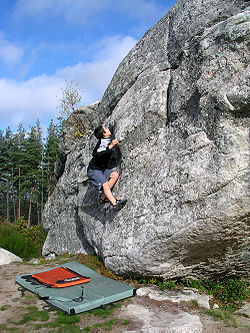


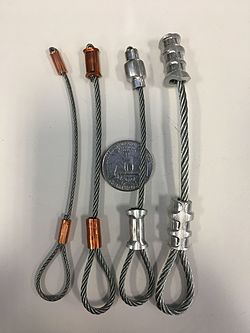


.jpg)


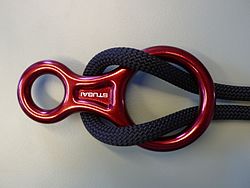


.jpg)


_in_El_Capitan_-_04.jpg)


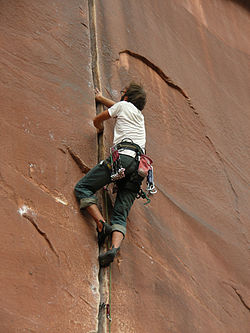


.jpg)


