


Community hub
Recent from talks
Contribute something
Nothing was collected or created yet.
Pandanus
View on Wikipedia
| Pandanus | |
|---|---|

| |
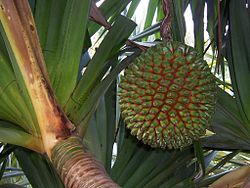
| Fruit of Pandanus utilis | |
Scientific classification 
| |
| Kingdom: | Plantae |
| Clade: | Tracheophytes |
| Clade: | Angiosperms |
| Clade: | Monocots |
| Order: | Pandanales |
| Family: | Pandanaceae |
| Genus: | Pandanus Parkinson[1] |
| Species | |
| Synonyms[1] | |
|
20 synonyms
| |
Pandanus is a genus of monocots with about 578 accepted species.[1] They are palm-like, dioecious trees and shrubs native to the Old World tropics and subtropics. Common names include pandan, screw palm and screw pine. The genus is classified in the order Pandanales, family Pandanaceae,[2][3] and is the largest in the family.[4]
Description
[edit]
The species vary in size from small shrubs less than 1 metre (3+1⁄2 feet) tall, to medium-sized trees 20 m (66 ft) tall, typically with a broad canopy, heavy fruit, and moderate growth rate.[6][self-published source?] The trunk is stout, wide-branching, and ringed with many leaf scars.[7] Mature plants can have branches.[7] Depending on the species, the trunk can be smooth, rough, or warty.[8] The roots form a pyramidal tract to hold the trunk.[9] They commonly have many thick stilt roots near the base, which provide support as the tree grows top-heavy with leaves, fruit, and branches.[10] These roots are adventitious and often branched. The top of the plant has one or more crowns of strap-shaped leaves that may be spiny,[2][3] varying between species from 30 centimetres (12 inches) to 2 m (6+1⁄2 ft) or longer, and from 1.5 cm (5⁄8 in) up to 10 cm (4 in) broad.
They are dioecious, with male and female flowers produced on different plants. The flowers of the male tree are 2–3 cm (3⁄4–1+1⁄4 in) long and fragrant, surrounded by narrow, white bracts. The female tree produces flowers with round fruits that are also bract-surrounded. The individual fruit is a drupe, and these merge to varying degrees forming multiple fruit, a globule structure, 10–20 cm (4–8 in) in diameter and have many prism-like sections, resembling the fruit of the pineapple. Typically, the fruit changes from green to bright orange or red as it matures. The fruits can stay on the tree for more than 12 months.
Evolution
[edit]The oldest credible fossil of the genus is Pandanus estellae, which is known from a silicified fruit found in Queensland, Australia, dating to the Oligocene epoch around 32–28 million years ago.[11] Phylogenetic analyses of the maternal DNA of Pandanus has shown the genus to be divided into two large groups (Clade I and Clade II), with each of those groups further subdivided into two smaller groups (Subclade Ia, Subclade Ib, Subclade IIa, and Subclade IIb).[12][13] The split between Clades I and II was determined to have occurred during the early Miocene, whereas the splits between Subclade Ia and Ib and between Subclade IIa and IIb were determined to have occurred during the Middle Miocene Climatic Optimum.[13]
Taxonomy
[edit]Though often called "pandanus palms", these plants are not closely related to palm trees. The genus is named after the Malay word pandan given to Pandanus amaryllifolius, the genus's most commonly known species.[14] The name is derived from Proto-Austronesian *paŋudaN (which became Proto-Malayo-Polynesian *pangdan and Proto-Oceanic *padran). It has many cognates in Austronesian languages, underscoring its importance in Austronesian cultures, including Atayal pangran; Kavalan pangzan; Thao panadan; Tagalog pandan; Chamorro pahong; Manggarai pandang; Malagasy fandrana, Tongan fā; Tahitian fara; Hawaiian hala all referring to plants of similar characteristics and/or uses whether in the same genus (particularly Pandanus tectorius) or otherwise (in the case of Māori whara or hara; e.g. harakeke).[15][16] Pandanus is traditionally divided into six subgenera (Coronata, Kurzia, Lophostigma, Pandanus, Rykia, and Vinsonia), however molecular phylogenetic analyses have shown these subgenera to not represent the true evolutionary history of Pandanus as all but Coronata are either polyphyletic or paraphyletic.[12][13]
Selected species
[edit]

Note: several species previously placed in Pandanus subgenera Acrostigma and Martellidendron are now in the distinct genera Benstonea and Martellidendron, respectively.[12]
- Pandanus aldabraensis H.St.John
- Pandanus amaryllifolius Roxb. ex Lindl.
- Pandanus balfourii Martelli
- Pandanus barkleyi Balf.f.
- Pandanus boninensis Warb.
- Pandanus candelabrum P.Beauv.
- Pandanus carmichaelii R.E.Vaughan & Wiehe
- Pandanus ceylanicus Solms
- Pandanus christmatensis Martelli
- Pandanus clandestinus Stone
- Pandanus conglomeratus Balf.f.
- Pandanus conoideus Lam.
- Pandanus decastigma B.C.Stone
- Pandanus decipiens Martelli
- Pandanus decumbens Solms
- Pandanus drupaceus Thouars
- Pandanus elatus Ridl.
- Pandanus eydouxia Balf.f.
- Pandanus fanningensis H.St.John
- Pandanus forsteri C.Moore & F.Muell.
- Pandanus furcatus Roxb.
- Pandanus gabonensis Huynh
- Pandanus glaucocephalus R.E.Vaughan & Wiehe
- Pandanus grayorum Calim., Buerki & Gallaher
- Pandanus halleorum B.C.Stone
- Pandanus heterocarpus Balf.f.
- Pandanus iceryi Horne ex Balf.f.
- Pandanus incertus R.E.Vaughan & Wiehe
- Pandanus joskei Horne ex Balf.f.
- Pandanus julianettii Martelli
- Pandanus kaida Kurz
- Pandanus kajui Beentje
- Pandanus lacuum H.St.John ex B.C.Stone
- Pandanus laxespicatus Martelli
- Pandanus livingstonianus Rendle
- Pandanus leram Jones ex R.Millar
- Pandanus microcarpus Balf.f.
- Pandanus montanus Bory
- Pandanus multispicatus Balf.f.
- Pandanus odorifer (Forssk.) Kuntze
- Pandanus obeliscus Thouars
- Pandanus palustris Thouars
- Pandanus parvicentralis Huynh
- Pandanus prostratus Balf.f.
- Pandanus pyramidalis Barkly ex Balf.f.
- Pandanus rigidifolius R.E.Vaughan & Wiehe
- Pandanus sechellarum Balf.f.
- Pandanus spathulatus Martelli
- Pandanus spiralis R.Br.
- Pandanus tectorius Parkinson ex Du Roi
- Pandanus tenuifolius Balf.f.
- Pandanus teuszii Warb.
- Pandanus thomensis Henriq.
- Pandanus tonkinensis B.C.Stone
- Pandanus utilis Bory
- Pandanus vandermeeschii Balf.f.
- Pandanus verecundus Stone
Distribution and habitat
[edit]Pandanus is a Paleotropical genus.[4] The greatest number of species are found in Madagascar and Malaysia.[17][page needed]
Ecology
[edit]These plants grow from sea level to an altitude of 3,300 m (10,800 ft). Pandanus trees are of cultural, health, and economic importance in the Pacific, second only to the coconut on atolls.[18][19] They grow wild mainly in semi-natural vegetation in littoral habitats throughout the tropical and subtropical Pacific, where they can withstand drought, strong winds, and salt spray. They propagate readily from seed, but popular cultivars are also widely propagated from branch cuttings by local people.[2]
Species growing on exposed coastal headlands and along beaches have thick 'stilt roots' as anchors in the loose sand.[2][20] Those stilt roots emerge from the stem, usually close to but above the ground, which helps to keep the plants upright and secure them to the ground.[10]
While Pandanus are distributed throughout the tropical and subtropical islands and coastlines of the Atlantic, Indian and Pacific Oceans,[21][22][23] they are most numerous on the low islands and barren atolls of Polynesia and Micronesia.[24][25][26][27] Other species are adapted to mountain habitats and riverine forests.[28]
The tree is grown and propagated from shoots that form spontaneously in the axils of lower leaves. Pandanus fruits are eaten by animals including bats, rats, crabs, and elephants, but the vast majority of species are dispersed primarily by water.[9] Its fruit can float and spread to other islands without help from humans.[22]
Climate and soil analyses based on a molecular phylogenetic framework have shown that the largest split in Pandanus (between Clades I and II) is also associated with a difference in climate and soil conditions between the two groups.[13] Clade II Pandanus species are associated with more seasonal temperature and precipitation regimes, and more well-draining soils, than Clade I Pandanus species.[13] In addition, this split is also associated with the occurrence of specialized layer of water storage tissue (also known as hydrenchyma) in Clade II species of Pandanus that is thought to aid in their adaptation to more water-stressed environments.[13]
Uses
[edit]Pandanus has multiple uses, which is dependent in part on each type and location. Some Pandanus are a source of food, while others provide raw material for clothing, basket weaving and shelter.
Pandanus leaves are used for handicrafts. Artisans collect the leaves from plants in the wild, cutting only mature leaves so that the plant will naturally regenerate. The leaves are sliced into fine strips and sorted for further processing. Weavers produce basic pandan mats of standard size or roll the leaves into pandan ropes for other designs. This is followed by a coloring process, in which pandan mats are placed in drums with water-based colors. After drying, the colored mats are shaped into final products, such as placemats or jewelry boxes. Final color touch-ups may be applied. The species in Hawaiʻi are called hala, and only the dry leaves (lauhala) are collected and used for Lauhala weaving. Traditions of weaving pandanus to source fabric material were widespread among Polynesians even as they migrated reaching colder latitudes (like the islands of New Zealand) where no pandanus grew, which later Māori generations simply adapted their skills with native plants like Phormium having superficially similar properties, even reflected in their names (e.g. the aforementioned harakeke, and wharariki).[29]
Pandanus leaves from Pandanus amaryllifolius are used widely in Southeast Asian and South Asian cuisines to add a distinct aroma to various dishes and to complement flavors like chocolate. Because of their similarity in usage, pandan leaves are sometimes referred to as the "vanilla of Asia."[30][31][32] Fresh leaves are typically torn into strips, tied in a knot to facilitate removal, placed in the cooking liquid, then removed at the end of cooking. Dried leaves and bottled extract may be bought in some places. Finely sliced pandan leaves are used as fragrant confetti for Malay weddings, graves etc.[citation needed]
Pandan leaves are known as Daun pandan in Indonesian and Malaysian Malay; Dahon ng pandan (lit. 'pandan leaf') or simply pandan in Filipino; 斑蘭 (bān lán) in Mandarin; as ใบเตย (bai toei; pronounced [bāj.tɤ̄ːj]) in Thai, lá dứa in Vietnamese; pulao data in Bengali; and rampe in Sinhalese and Hindi.
In India, particularly in Nicobar Islands, pandanus fruit is staple food of Shompen people and Nicobarese people.[33]
In Sri Lanka, pandan leaves are used heavily in both vegetable and meat dishes and are often grown in homes. It is common practice to add a few pieces of pandan leaf when cooking red or white rice as well.
In Southeast Asia, pandan leaves are mainly used in sweets such as coconut jam and pandan cake. In Indonesia and Malaysia, pandan is also added to rice and curry dishes such as nasi lemak. In the Philippines, pandan leaves are commonly paired with coconut meat (a combination referred to as buko pandan) in various desserts and drinks like maja blanca and gulaman.[34]
In Indian cooking, the leaf is added whole to biryani, a kind of rice pilaf, made with ordinary rice (as opposed to that made with the premium-grade basmati rice). The basis for this use is that both basmati and pandan leaf contains the same aromatic flavoring ingredient, 2-acetyl-1-pyrroline. In Sri Lanka, pandan leaves are a major ingredient used in the country's cuisine.[35]
Kewra (also spelled Kevda or Kevada) is an extract distilled from the pandan flower, used to flavor drinks and desserts in Indian cuisine. Also, kewra or kevada is used in religious worship, and the leaves are used to make hair ornaments worn for their fragrance as well as decorative purpose in western India.[24]
Species with large and medium fruit are edible, notably the many cultivated forms of P. tectorius (P. pulposus) and P. utilis. The ripe fruit can be eaten raw or cooked,[36] while partly ripe fruit should be cooked first.[37] Small-fruited pandanus may be bitter and astringent.[36]
Karuka nuts (P. julianettii) are an important staple food in New Guinea.[38] Over 45 cultivated varieties are known.[39] Entire households will move,[40] and in some areas will speak a pandanus language at harvest time.[41][42] The taste is like coconut[38][39][43] or walnuts.[44]
Throughout Oceania, almost every part of the plant is used, with various species different from those used in Southeast Asian cooking. Pandanus trees provide materials for housing; clothing and textiles including the manufacture of dilly bags (carrying bags), fine mats or ʻie toga; sails,[45] food, medication,[citation needed] decorations, fishing, and religious uses. In the Vanuatu Archipelago, natives make woven fish traps from the hard interior root of the pandanus, made like a cage having a narrow entrance.[46]
-
 Crab claw sail woven from pandan leaves on a tepukei, an ocean-going outrigger canoe from Temotu, Solomon Islands
 -
 A bayong, a traditional Philippine basket woven from karagumoy (P. simplex) leaves in the hexagonal kinab-anan pattern
 -
 Pandan cake flavoured with pandan leaf extract
 -


See also
[edit]- Domesticated plants and animals of Austronesia – Ancient expansion of agriculture
- Wa – Type of outrigger canoe from the Caroline Islands – vessels of the Caroline Islands which traditionally had pandanus mat sails
- Screw pine craft of Kerala
References
[edit]- ^ a b c "Pandanus Parkinson". Plants of the World Online. Royal Botanic Gardens, Kew. Retrieved 2024-06-18.
- ^ a b c d David C. Hyndman (1984). "Ethnobotany of Wopkaimin Pandanus significant Papua New Guinea plant resource". Economic Botany. 38 (3): 287–303. doi:10.1007/BF02859007. S2CID 32883085.
- ^ a b Harold St. John (1968). "Revision of the genus Pandanus Stickman, part 29. New Papuan species in the section Microstigma collected by C. E. Carr" (PDF). Pacific Science. 22 (4): 514–519. hdl:10125/12577.
- ^ a b Stone, B. C.; Huynh, K.-L.; Poppendieck, H.-H. (1998), Kubitzki, Klaus (ed.), "Pandanaceae", Flowering Plants · Monocotyledons: Lilianae (except Orchidaceae), Berlin, Heidelberg: Springer, pp. 397–404, doi:10.1007/978-3-662-03533-7_47, ISBN 978-3-662-03533-7, retrieved 2025-01-31
- ^ "Types of Roots". UCLA Mathias Botanical Garden. Archived from the original on 2005-09-06. Retrieved 2005-10-10.
- ^ "Pandanus Trees in Australia". Gondwananet.com. Archived from the original on 2012-06-08. Retrieved 2012-09-24.
- ^ a b Meyen, Franz Julius Ferdinand (1846). Outlines of the Geography of Plants: With Particular Enquiries Concerning the Native Country, the Culture, and the Uses of the Principal Cultivated Plants on which the Prosperity of Nations is Based, Volumen 7. Ray Society. Retrieved 2012-09-24.
- ^ "Pandanus" (PDF). Stumpman.com.au. Archived from the original (PDF) on 2014-11-29. Retrieved 2014-12-18.
- ^ a b Reginald Edward Vaughan; P. O. Wiehe (1953). "The genus Pandanus in the Mascarene Islands". Journal of the Linnean Society of London, Botany. 55 (356): 1–33. doi:10.1111/j.1095-8339.1953.tb00001.x.
- ^ a b Ugolino Martelli (1908). "The Philippine species of Pandanus". Philippine Journal of Science. 3 (2): 59–72.
- ^ Rozefelds, Andrew C.; Rudall, Paula J.; Herne, Matt C.; Milroy, Anita K.; Bridgeman, Joe (1 May 2022). "A Fossil Syncarpous Fruit from Australia Provides Support for a Gondwanan History for the Screw Pines (Pandanus, Pandanaceae)". International Journal of Plant Sciences. 183 (4): 320–329. doi:10.1086/719431. ISSN 1058-5893. S2CID 247378720.
- ^ a b c Buerki, Sven; Callmander, Martin W.; Devey, Dion S.; Chappell, Lauren; Gallaher, Timothy; Munzinger, Jérôme; Haevermans, Thomas; Forest, Félix (2012). "Straightening out the screwpines: A first step in understanding phylogenetic relationships within Pandanaceae". Taxon. 61 (5): 1010–1020. doi:10.1002/tax.615008. ISSN 1996-8175.
- ^ a b c d e f Wojahn, John M. A.; Callmander, Martin W.; Buerki, Sven (30 January 2025). "Pandanus plastomes decoded: When climate mirrors morphology and phylogenetic relationships". American Journal of Botany (preprint) e16461. doi:10.1002/ajb2.16461. ISSN 1537-2197. PMID 39887358.
- ^ Christenhusz, Maarten J. M.; Fay, Michael F.; Chase, Mark W. (2017). Plants of the World: An Illustrated Encyclopedia of Vascular Plants. University of Chicago Press. p. 140. ISBN 978-0-226-52292-0.
- ^ Wolff, John U. (2018). Proto-Austronesian Phonology with Glossary. Vol. II. Cornell Southeast Asia Program Publications. p. 927. ISBN 978-1-5017-3599-8.
- ^ "Proto-Polynesian Etymologies: *Fara". Te Mära Reo: The Language Garden. The Evolution of Plant Names. Benton Family Trust. Retrieved 2019-01-15.
- ^ Wagner, Warren L.; Herbst, Derral R.; Sohmer, S. H. (1990). Manual of the Flowering Plants of Hawaiʻi. University of Hawaii Press. ISBN 0-8248-1152-6.
- ^ "Pandanus tectorius (pandanus)" (PDF). Agroforestry.net. Retrieved 2012-09-24.
- ^ "pandanus - definition of pandanus by the Free Online Dictionary, Thesaurus and Encyclopedia". Thefreedictionary.com. Retrieved 2012-09-24.
- ^ "Microsoft Word - 5-Seychelles formaté_RM.doc" (PDF). Fao.org. Retrieved 2012-09-24.
- ^ "The mangrove vegetation of the Atlantic Coast of Africa: a review". Epubs.scu.edu.au. Retrieved 2014-12-18.
- ^ a b "Drift Seeds And Drift Fruits: Seeds That Ride The Ocean Currents". Waynesword.palomar.edu. Archived from the original on 2014-12-14. Retrieved 2014-12-18.
- ^ "Revision of the Genus Pandanus Stickman, Part 5 Pandanus of the Maldive Islands and the Seychelles Islands, Indian Ocean" (PDF). Scholarspace.manoa.hawaii.edu. Retrieved 2014-12-18.
- ^ a b López González, Ginés A. (2006). Los árboles y arbustos de la Península Ibérica e Islas Baleares: especies silvestres y las principales cultivadas. Mundi-Prensa. Retrieved 2012-09-24.
- ^ Ramón de Mesonero Romanos; Gervasio Gironella; Vicente Castelló; Angel Fernández de los Ríos; Francisco Navarro Villoslada; Manuel de Assas y de Ereńo; José Muńos Maldonado; Eduardo Gasset y Artime (1852). Semanario pintoresco espańol. Retrieved 2012-09-24.
- ^ D. Agustín Yañez y Girona (1845). Lecciones de historia natural: Botánica. Impr. de Benito Espona y Blay. Retrieved 2016-10-20.
- ^ Benjamin C. Stone (1992). "The New Guinea species of Pandanus section Maysops St. Johns (Pandanaceae)". Blumea. 37 (1): 31–61.
- ^ "West Papua - Mining". Cs.utexas.edu. Retrieved 2012-09-24.
- ^ Harris, W.; Heenan, P.B. (July 1992). "Domestication of the New Zealand flora—an alternative view". New Zealand Journal of Crop and Horticultural Science. 20 (3): 262. doi:10.1080/01140671.1992.10421767.
- ^ "How to Cook With Pandan, the Vanilla of Southeast Asia". Saveur. 10 March 2017. Retrieved 2018-04-28.
- ^ "Discover Pandan Leaves, The Vanilla Of Southeast Asia". Asian Inspirations. Archived from the original on 2018-04-29. Retrieved 2018-04-28.
- ^ Wan, Yan Ling (10 August 2018). "Grocery Ninja: Pandan, the Asian Vanilla". SeriousEats. Retrieved 2025-02-01.
- ^ "The less known Shompens of Great Nicobar Island". The Hindu. 31 October 2015. ISSN 0971-751X. Retrieved 2022-11-29.
- ^ "Buko Pandan". About Filipino Food. 30 November 2016. Retrieved 2018-04-28.
- ^ "Cooking With Kurma - Glossary". kurma.net.
- ^ a b Miller, C.D.; Murai, M.; Pen, F. (1956). "The Use of Pandanus Fruit As Food in Micronesia". Pacific Science. 10. Archived from the original on 2015-10-04. Retrieved 2014-09-03.
- ^ United States Department of the Army (2009). The Complete Guide to Edible Wild Plants. New York: Skyhorse Publishing. p. 91. ISBN 978-1-60239-692-0. OCLC 277203364.
- ^ a b Lim, Tong Kwee (2012). "Pandanus julianettii". Edible Medicinal and Non-Medicinal Plants. Vol. 4. Springer. pp. 128–130. doi:10.1007/978-94-007-4053-2_17. ISBN 978-94-007-4053-2. OCLC 822591349.
- ^ a b Stilltoe, Paul (1983). Roots of the Earth: Crops in the Highlands of Papua New Guinea. Manchester, UK: Manchester university Press. ISBN 978-0-7190-0874-0. LCCN 82-62247. OCLC 9556314.
- ^ Bourke, Richard Michael (May 1988). Taim hangre: variation in subsistence food supply in the Papua New Guinea highlands (PDF). Australian National University. OCLC 224338489. Retrieved 2018-09-27.
- ^ Franklin, Karl J. (September 1972). "A Ritual Pandanus Language of New Guinea". Oceania. 43 (1): 66–76. doi:10.1002/j.1834-4461.1972.tb01197.x. OCLC 883021898.
- ^ Franklin, Karl J.; Stefaniw, Roman (1992). "The 'Pandanus Languages' of the Southern Highlands Province, Papua New Guinea - a further report" (PDF). In Dutton, Tom (ed.). Culture change, language change - case studies from Melanesia. Pacific Linguistics. Canberra: Department of Linguistics Research School of Pacific Studies THE AUSTRALIAN NATIONAL UNIVERSITY. pp. 1–6. doi:10.15144/PL-C120.1. ISBN 978-0-85883-411-8. ISSN 0078-7558. OCLC 260177442. Retrieved 2018-10-25.
- ^ Zebua, Lisye Iriana; Purnamasari, Vita (26 January 2018). "Oil of Pandan Kelapa Hutan (Pandanus jiulianettii Martelli): Physicochemical Properties, Total Phenols, Total Carotene, Vitamin E and Antioxidant Activity" (PDF). Jurnal Biologi Udayana. 21 (2): 71–77. doi:10.24843/JBIOUNUD.2017.vol21.i02.p05. ISSN 2599-2856. OCLC 7347063503. Retrieved 2018-10-20.
- ^ Purwanto, Y.; Munawaroh, Esti (2010). "Etnobotani Jenis-Jenis Pandanaceae Sebagai Bahan Pangan di Indonesia" [Ethnobotany Types of Pandanaceae as Foodstuffs in Indonesia]. Berkala Penelitian Hayati (in Indonesian). 5A: 97–108. doi:10.5072/FK2/Z6P0OQ. ISSN 2337-389X. OCLC 981032990. Archived from the original (PDF) on 2018-10-29. Retrieved 2018-10-25.
- ^ McCoy, Michael (1973). "A Renaissance in Carolinian-Marianas Voyaging". Journal of the Polynesian Society. Archived from the original on 2021-12-28. Retrieved 2015-01-09.
As of 1973, all canoes on Satawal were using dacron sails sewn by the men themselves. Most Carolinian canoes had used canvas acquired during the Japanese presence in the islands. The people of Satawal, however, were reluctant to switch from the cumbersome pandanus-mat sails, probably because canoes and voyaging were included in the elaborate pre-Christian taboo system. Christianity took hold on Satawal during the decades after World War II, and the Islanders then used canvas. When I and Gary Mount, as Peace Corps volunteers, demonstrated the obvious superiority of dacron over the canvas with only a 4-inch square sample, the men agreed to purchase sails for the canoes of the island. As word of the superiority of dacron spread, the people of Ifalik, Elato, Woleai, Pulusuk, Pulap, and Puluwat have equipped at least one canoe on each island with dacron.
- ^ SLICE documentary, The men of the big rock | SLICE | Full documentary on YouTube, The Isle of Futuna / April 2022, minutes 18:39–ff.
Further reading
[edit]- Germplasm Resources Information Network: Pandanus
- Sorting Pandanus names
- Wagner, W. L., Herbst, D. R., & Sohmer, S. H. (1990). Manual of the flowering plants of Hawaiʻi.
- Pandanus species of the Wet Tropics of Queensland, Australia photos and text by Dave Kimble
- Pneumatophores on Pandanus solms-laubachii - photo essay
- Northernmost pandanus in the world, in the Azores Islands, photo.
- Pandanus simplex fruit eaten by Varanus olivaceus, Polillo Island, Philippines.
- "Hala: The Hawaiian Aphrodisiac" Article by Shannon Wianecki describing Hawaiian cultural uses for pandanus. Maui No Ka 'Oi Magazine Volume 15 Number. 1 (Jan 2011).
External links
[edit]
 Media related to Pandanus at Wikimedia Commons
- Biological Analytics of Pandan

| National | |
|---|---|
| Other | |
