


Community hub
Recent from talks
Contribute something
Nothing was collected or created yet.
Selenography
View on Wikipedia

Selenography is the study of the surface and physical features of the Moon (also known as geography of the Moon, or selenodesy).[1] Like geography and areography, selenography is a subdiscipline within the field of planetary science. Historically, the principal concern of selenographists was the mapping and naming of the lunar terrane identifying maria, craters, mountain ranges, and other various features. This task was largely finished when high resolution images of the near and far sides of the Moon were obtained by orbiting spacecraft during the early space era. Nevertheless, some regions of the Moon remain poorly imaged (especially near the poles) and the exact locations of many features (like crater depths) are uncertain by several kilometers. Today, selenography is considered to be a subdiscipline of selenology, which itself is most often referred to as simply "Lunar science."
History
[edit]
The word" selenography" is derived from the Greek word Σελήνη (Selene, meaning Moon) and γράφω (graphō, meaning to write).
The idea that the Moon is not perfectly smooth originates to at least c. 450 BC, when Democritus asserted that the Moon's "lofty mountains and hollow valleys" were the cause of its markings.[2] However, it was not until the end of the 15th century AD that serious selenography begin. Around AD 1603, William Gilbert made the first lunar drawing based on naked-eye observation. Others soon followed, and when the telescope was invented, initial drawings of poor accuracy were made, but soon thereafter improved in tandem with optics. In the early 18th century, the librations of the Moon were measured, which revealed that more than half of the lunar surface was visible to observers on Earth. In 1750, Johann Meyer produced the first reliable set of lunar coordinates that permitted astronomers to locate lunar features. [citation needed]
Lunar mapping became systematic in 1779 when Johann Schröter began meticulous observation and measurement of lunar topography. In 1834 Johann Heinrich von Mädler published the first large cartograph (map) of the Moon, comprising 4 sheets, and he subsequently published The Universal Selenography.[3] All lunar measurement was based on direct observation until March 1840, when J.W. Draper, using a 5-inch reflector, produced a daguerreotype of the Moon and thus introduced photography to astronomy. At first, the images were of very poor quality, but as with the telescope 200 years earlier, their quality rapidly improved. By 1890 lunar photography had become a recognized subdiscipline of astronomy.
Lunar photography
[edit]The 20th century witnessed more advances in selenography. In 1959, the Soviet spacecraft Luna 3 transmitted the first photographs of the far side of the Moon, giving the first view of it in history. The United States launched the Ranger spacecraft between 1961 and 1965 to photograph the lunar surface until the instant they impacted it, the Lunar Orbiters between 1966 and 1967 to photograph the Moon from orbit, and the Surveyors between 1966 and 1968 to photograph and softly land on the lunar surface. The Soviet Lunokhods 1 (1970) and 2 (1973) traversed almost 50 km of the lunar surface, making detailed photographs of the lunar surface. The Clementine spacecraft obtained the first nearly global cartograph (map) of the lunar topography, and also multispectral images. Successive missions transmitted photographs of increasing resolution.
Lunar topography
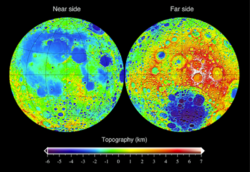
[edit]The Moon has been measured by the methods of laser altimetry and stereo image analysis, including data obtained during several missions. The most visible topographical feature is the giant far-side South Pole-Aitken basin, which possesses the lowest elevations of the Moon. The highest elevations are found just to the northeast of this basin, and it has been suggested that this area might represent thick ejecta deposits that were emplaced during an oblique South Pole-Aitken basin impact event. Other large impact basins, such as the maria Imbrium, Serenitatis, Crisium, Smythii, and Orientale, also possess regionally low elevations and elevated rims.
Another distinguishing feature of the Moon's shape is that the elevations are on average about 1.9 km higher on the far side than the near side. If it is assumed that the crust is in isostatic equilibrium, and that the density of the crust is everywhere the same, then the higher elevations would be associated with a thicker crust. Using gravity, topography and seismic data, the crust is thought to be on average about 50 ± 15 km thick, with the far-side crust being on average thicker than the near side by about 15 km.[4][obsolete source]
Lunar cartography and toponymy
[edit]
 | This section needs additional citations for verification. (March 2024) |
The oldest known illustration of the Moon was found in a passage grave in Knowth, County Meath, Ireland. The tomb was carbon dated to 3330–2790 BC.[5] Leonardo da Vinci made and annotated some sketches of the Moon in c. 1500. William Gilbert made a drawing of the Moon in which he denominated a dozen surface features in the late 16th century; it was published posthumously in De Mondo Nostro Sublunari Philosophia Nova. After the invention of the telescope, Thomas Harriot (1609), Galileo Galilei (1609), and Christoph Scheiner (1614) made drawings also.[6]
Denominations of the surface features of the Moon, based on telescopic observation, were made by Michael van Langren in 1645. Many of his denominations were distinctly Catholic, denominating craters in honor of Catholic royalty and capes and promontories in honor of Catholic saints. The lunar maria were denominated in Latin for terrestrial seas and oceans. Minor craters were denominated in honor of astronomers, mathematicians, and other famous scholars.

In 1647, Johannes Hevelius produced the rival work Selenographia, which was the first lunar atlas. Hevelius ignored the nomenclature of Van Langren and instead denominated the lunar topography according to terrestrial features, such that the names of lunar features corresponded to the toponyms of their geographical terrestrial counterparts, especially as the latter were denominated by the ancient Roman and Greek civilizations. This work of Hevelius influenced his contemporary European astronomers, and the Selenographia was the standard reference on selenography for over a century.
Giambattista Riccioli, SJ, a Catholic priest and scholar who lived in northern Italy authored the present scheme of Latin lunar nomenclature. His Almagestum novum was published in 1651 as summary of then current astronomical thinking and recent developments. In particular he outlined the arguments in favor of and against various cosmological models, both heliocentric and geocentric. Almagestum Novum contained scientific reference matter based on contemporary knowledge, and contemporary educators across Europe widely used it. Although this handbook of astronomy has long since been superseded, its system of lunar nomenclature is used even today.
The lunar illustrations in the Almagestum novum were drawn by a fellow Jesuit educator named Francesco Grimaldi, SJ. The nomenclature was based on a subdivision of the visible lunar surface into octants that were numbered in Roman style from I to VIII. Octant I referenced the northwest section and subsequent octants proceeded clockwise in alignment with compass directions. Thus Octant VI was to the south and included Clavius and Tycho Craters.
The Latin nomenclature had two components: the first denominated the broad features of terrae (lands) and maria (seas) and the second denominated the craters. Riccioli authored lunar toponyms derived from the names of various conditions, including climactic ones, whose causes were historically attributed to the Moon. Thus there were the seas of crises ("Mare Crisium"), serenity ("Mare Serenitatis"), and fertility ("Mare Fecunditatis"). There were also the seas of rain ("Mare Imbrium"), clouds ("Mare Nubium"), and cold ("Mare Frigoris"). The topographical features between the maria were comparably denominated, but were opposite the toponyms of the maria. Thus there were the lands of sterility ("Terra Sterilitatis"), heat ("Terra Caloris"), and life ("Terra Vitae"). However, these names for the highland regions were supplanted on later cartographs (maps). See List of features on the Moon for a complete list.

Many of the craters were denominated topically pursuant to the octant in which they were located. Craters in Octants I, II, and III were primarily denominated based on names from ancient Greece, such as Plato, Atlas, and Archimedes. Toward the middle in Octants IV, V, and VI craters were denominated based on names from the ancient Roman Empire, such as Julius Caesar, Tacitus, and Taruntius. Toward the southern half of the lunar cartograph (map) craters were denominated in honor of scholars, writers, and philosophers of medieval Europe and Arabic regions. The outer extremes of Octants V, VI, and VII, and all of Octant VIII were denominated in honor of contemporaries of Giambattista Riccioli. Features of Octant VIII were also denominated in honor of Copernicus, Kepler, and Galileo. These persons were "banished" to it far from the "ancients," as a gesture to the Catholic Church.[citation needed] Many craters around the Mare Nectaris were denominated in honor of Catholic saints pursuant to the nomenclature of Van Langren. All of them were, however, connected in some mode with astronomy. Later cartographs (maps) removed the "St." from their toponyms.
The lunar nomenclature of Giambattista Riccioli was widely used after the publication of his Almagestum Novum, and many of its toponyms are presently used. The system was scientifically inclusive and was considered eloquent and poetic in style, and therefore it appealed widely to his contemporaries. It was also readily extensible with new toponyms for additional features. Thus it replaced the nomenclature of Van Langren and Hevelius.
Later astronomers and lunar cartographers augmented the nomenclature with additional toponyms. The most notable among these contributors was Johann H. Schröter, who published a very detailed cartograph (map) of the Moon in 1791 titled the Selenotopografisches Fragmenten. Schröter's adoption of Riccioli's nomenclature perpetuated it as the universally standard lunar nomenclature. A vote of the International Astronomical Union (IAU) in 1935 established the lunar nomenclature of Riccioli, which included 600 lunar toponyms, as universally official and doctrinal.
The IAU later expanded and updated the lunar nomenclature in the 1960s, but new toponyms were limited to toponyms honoring deceased scientists. After Soviet spacecraft photographed the far side of the Moon, many of the newly discovered features were denominated in honor of Soviet scientists and engineers. The IAU assigned all subsequent new lunar toponyms. Some craters were denominated in honor of space explorers.
Satellite craters
[edit]Johann H. Mädler authored the nomenclature for satellite craters. The subsidiary craters surrounding a major crater were identified by a letter. These subsidiary craters were usually smaller than the crater with which they were associated, with some exceptions. The craters could be assigned letters "A" through "Z," with "I" omitted. Because the great majority of the toponyms of craters were masculine, the major craters were generically denominated "patronymic" craters.
The assignment of the letters to satellite craters was originally somewhat haphazard. Letters were typically assigned to craters in order of significance rather than location. Precedence depended on the angle of illumination from the Sun at the time of the telescopic observation, which could change during the lunar day. In many cases the assignments were seemingly random. In a number of cases the satellite crater was located closer to a major crater with which it was not associated. To identify the patronymic crater, Mädler placed the identifying letter to the side of the midpoint of the feature that was closest to the associated major crater. This also had the advantage of permitting omission of the toponyms of the major craters from the cartographs (maps) when their subsidiary features were labelled.
Over time, lunar observers assigned many of the satellite craters an eponym. The International Astronomical Union (IAU) assumed authority to denominate lunar features in 1919. The commission for denominating these features formally adopted the convention of using capital Roman letters to identify craters and valleys.
When suitable maps of the far side of the Moon became available by 1966, Ewen Whitaker denominated satellite features based on the angle of their location relative to the major crater with which they were associated. A satellite crater located due north of the major crater was identified as "Z". The full 360° circle around the major crater was then subdivided evenly into 24 parts, like a 24-hour clock. Each "hour" angle, running clockwise, was assigned a letter, beginning with "A" at 1 o'clock. The letters "I" and "O" were omitted, resulting in only 24 letters. Thus a crater due south of its major crater was identified as "M".
Reference elevation
[edit]The Moon obviously lacks any mean sea level to be used as vertical datum. The USGS's Lunar Orbiter Laser Altimeter (LOLA), an instrument on NASA's Lunar Reconnaissance Orbiter (LRO), employs a digital elevation model (DEM) that uses the nominal lunar radius of 1,737.4 km (1,079.6 mi).[7] The selenoid (the geoid for the Moon) has been measured gravimetrically by the GRAIL twin satellites.[8]
Historical lunar maps
[edit]
The following historically notable lunar maps and atlases are arranged in chronological order by publication date.
- Michael van Langren, engraved map, 1645.
- Johannes Hevelius, Selenographia, 1647.
- Giovanni Battista Riccioli and Francesco Maria Grimaldi, Almagestum novum, 1651.
- Giovanni Domenico Cassini, engraved map, 1679 (reprinted in 1787).
- Tobias Mayer, engraved map, 1749, published in 1775.
- Johann Hieronymus Schröter, Selenotopografisches Fragmenten, 1st volume 1791, 2nd volume 1802.
- John Russell, engraved images, 1805.
- Wilhelm Lohrmann, Topographie der sichtbaren Mondoberflaeche, Leipzig, 1824.
- Wilhelm Beer and Johann Heinrich Mädler, Mappa Selenographica totam Lunae hemisphaeram visibilem complectens, Berlin, 1834-36.
- Edmund Neison, The Moon, London, 1876.
- Julius Schmidt, Charte der Gebirge des Mondes, Berlin, 1878.
- Thomas Gwyn Elger, The Moon, London, 1895.
- Johann Krieger, Mond-Atlas, 1898. Two additional volumes were published posthumously in 1912 by the Vienna Academy of Sciences.
- Walter Goodacre, Map of the Moon, London, 1910.
- Mary A. Blagg and Karl Müller, Named Lunar Formations, 2 volumes, London, 1935.
- Philipp Fauth, Unser Mond, Bremen, 1936.
- Hugh P. Wilkins, 300-inch Moon map, 1951.
- Gerard Kuiper et al., Photographic Lunar Atlas, Chicago, 1960.
- Ewen A. Whitaker et al., Rectified Lunar Atlas, Tucson, 1963.
- Hermann Fauth and Philipp Fauth (posthumously), Mondatlas, 1964.
- Gerard Kuiper et al., System of Lunar Craters, 1966.
- Yu I. Efremov et al., Atlas Obratnoi Storony Luny, Moscow, 1967–1975.
- NASA, Lunar Topographic Orthophotomaps, 1978.
- Antonín Rükl, Atlas of the Moon, 2004.
Galleries
[edit]

.jpg)


See also
[edit]
References
[edit]Citations
[edit]- ^ Dictionary of Military and Associated Terms (2005). "selenodesy" (Selenodesy is "that branch of applied mathematics that determines, by observation and measurement, the exact positions of points and the figures and areas of large portions of the moon's surface, or the shape and size of the moon".). US Department of Defense and The free dictionary (online). Retrieved 2010-06-20.
- ^ Neison, Edmund; Nevill, Edmund Neville (1876). The Moon and the Condition and Configurations of Its Surface. Longmans, Green, and Company. p. 81.
democritus moon valleys and mountains.
- ^ Wax and the Honey Moon Archived 2007-07-24 at the Wayback Machine: an account of Maedler's work and the creation of the first wax model of the Moon.
- ^ Mark Wieczorek, M. A.; et al. (2006). "The constitution and structure of the lunar interior". Reviews in Mineralogy and Geochemistry. 60 (1): 221–364. Bibcode:2006RvMG...60..221W. doi:10.2138/rmg.2006.60.3.
- ^ Stooke, Philip J. (February 1994). "Neolithic Lunar Maps at Knowth and Baltinglass, Ireland". Journal for the History of Astronomy. 25: 39–55. Bibcode:1994JHA....25...39S. doi:10.1177/002182869402500103. S2CID 120584696.
- ^ Taton, Reni (2003). Reni Taton; Curtis Wilson; Michael Hoskin (eds.). Planetary Astronomy from the Renaissance to the Rise of Astrophysics, Part A, Tycho Brahe to Newton. General History of Astronomy. Vol. 2. Cambridge University Press. pp. 119–126. ISBN 0-521-54205-7.
- ^ "Moon LRO LOLA Elevation Model 118m v1". Astropedia. USGS.
- ^ Lemoine, Frank G.; Goossens, Sander; Sabaka, Terence J.; Nicholas, Joseph B.; Mazarico, Erwan; Rowlands, David D.; Loomis, Bryant D.; Chinn, Douglas S.; Caprette, Douglas S.; Neumann, Gregory A.; Smith, David E.; Zuber, Maria T. (2013). "High‒degree gravity models from GRAIL primary mission data". Journal of Geophysical Research: Planets. 118 (8). American Geophysical Union (AGU): 1676–1698. Bibcode:2013JGRE..118.1676L. doi:10.1002/jgre.20118. hdl:2060/20140010292. ISSN 2169-9097.
Bibliography
[edit]- Scott L. Montgomery (1999). The Moon and Western Imagination. University of Arizona Press. ISBN 0-8165-1711-8.
- Ewen A. Whitaker (1999). Mapping and Naming the Moon: A History of Lunar Cartography and Nomenclature. Cambridge University Press. ISBN 0-521-62248-4.
- William P. Sheehan; Thomas A. Dobbins (2001). Epic Moon: A history of lunar exploration in the age of the telescope. Willmann-Bell. Bibcode:2001emhl.book.....S.
External links
[edit]
- NASA Catalogue of Lunar Nomenclature (1982), Leif E. Andersson and Ewen A. Whitaker
- The Galileo Project: The Moon
- Observing the Moon: The Modern Astronomer's Guide
- Lunar control networks (USGS)
- The Rise And Fall of Lunar Observing Archived 2017-08-09 at the Wayback Machine, Kevin S. Jung
- Consolidated Lunar Atlas
- Virtual exhibition about the topography of the Moon on the digital library of Paris Observatory
| Physical properties |  | |
|---|---|---|
| Orbit | ||
| Surface and features | ||
| Science | ||
| Exploration | ||
| Time-telling and navigation | ||
| Phases and names | ||
| Daily phenomena | ||
| Related |
| |


Selenography
View on GrokipediaHistorical Development
Early Observations and Theories
Ancient civilizations laid the groundwork for selenography through naked-eye observations of the Moon's phases, eclipses, and prominent surface features, particularly the large dark patches visible as uneven brightness. Babylonian astronomers, from around 700 BCE, systematically recorded lunar eclipses and phases on clay tablets, interpreting them as omens and identifying cycles like the 18-year Saros period for predictions.[8] Greek philosophers advanced these ideas; Anaxagoras (c. 500–428 BCE) explained lunar phases and eclipses by positing the Moon as a solid, rocky body reflecting sunlight, and he referenced the "face" of the Moon formed by contrasting light and dark regions.[9] Aristotle (384–322 BCE) further analyzed the Moon's varying illumination during eclipses, attributing dark spots to regional differences in transparency or density on an otherwise smooth sphere, while using the curved shadow to prove Earth's sphericity.[10] In ancient China, astronomers integrated lunar observations into calendrical systems, noting phases and eclipses, and culturally interpreted the dark maria as a mythical toad or rabbit pounding elixir, reflecting recognition of these surface markings.[11] Medieval Islamic scholars built on these traditions, documenting the Moon's uneven surface with dark and light patches—later termed maria and terrae—through precise measurements; figures like Al-Battani refined eclipse timings, contributing to understandings of visible lunar topography.[12] The transition to the Renaissance brought refined theories, but the advent of the telescope revolutionized selenographic thought. In 1610, Galileo Galilei published Sidereus Nuncius, presenting the first detailed telescopic sketches of the Moon's surface, which revealed prominent mountains up to several kilometers high, circular craters (some with central peaks), and expansive dark regions he likened to Earth's seas.[13] These observations contradicted the classical notion of perfect celestial bodies, showing the Moon as a rugged world with terminator boundaries highlighting light and shadow variations, suggesting geological processes akin to Earth's.[14] Galileo's work implied potential habitability, as the "seas" hinted at water and atmosphere, sparking speculation about lunar life adapted to such terrain. Subsequent astronomers expanded these insights into systematic studies. Johannes Hevelius's Selenographia (1647) compiled over four years of observations using long telescopes he constructed, producing a comprehensive lunar atlas with 150-page maps depicting detailed craters, rilles, and maria, while naming approximately 275 features after contemporaries to honor scientific contributions.[15] Giovanni Battista Riccioli's Almagestum Novum (1651) introduced a enduring nomenclature system, labeling dark plains as maria (e.g., Mare Tranquillitatis) and bright highlands as terrae, with craters named for notable figures like Tycho Brahe; this framework emphasized the Moon's watery or volcanic origins based on observed formations.[16] These discoveries fueled early debates on lunar habitability and surface formation. Inspired by apparent seas and mountains, Johannes Kepler's Somnium (published posthumously in 1634) envisioned a habitable Moon with serpentine inhabitants navigating vast landscapes, drawing parallels to Earth's environments.[17] By the late 17th century, Christiaan Huygens in Cosmotheoros (1698) argued for extraterrestrial life, including on the Moon, based on teleological reasoning that divine creation implied populated worlds, while questioning if maria were liquid seas or dry basins.[18] Bernard le Bovier de Fontenelle's Entretiens sur la pluralité des mondes (1686) popularized these ideas through dialogues, debating whether lunar features arose from water erosion or volcanic activity, reflecting the era's tension between observational evidence and speculative cosmology.[18]Telescopic Era and Initial Mapping
The advent of improved telescopes in the 17th century marked the beginning of detailed selenographic mapping, allowing astronomers to discern finer lunar features beyond the rudimentary sketches of Galileo Galilei. Christiaan Huygens, a Dutch mathematician and physicist, developed superior refracting telescopes with eyepieces that minimized chromatic aberration, achieving magnifications up to 270 times and resolutions sufficient to reveal intricate details of craters and maria. These instruments enabled more accurate hand-drawn representations of the lunar surface, shifting selenography from qualitative descriptions to systematic topographic studies.[19] One of the earliest comprehensive efforts was the 1647 publication Selenographia by Polish astronomer Johannes Hevelius, which included the first detailed full-moon map spanning approximately 40 inches in diameter, based on observations with telescopes magnifying 30 to 40 times. Hevelius's work featured approximately 275 named features, primarily drawn from classical mythology and geography, and incorporated engravings of lunar phases to illustrate topography under varying illumination. This atlas laid foundational techniques for selenography, emphasizing precise sketching and nomenclature. Shortly thereafter, Italian Jesuit Giovanni Battista Riccioli produced a seminal map in his 1651 Almagestum Novum, introducing a Latin-based nomenclature system that honored prominent scientists, philosophers, and explorers—many still in use today, such as Mare Crisium for the "Sea of Crises." Riccioli's map, engraved by his colleague Francesco Grimaldi, divided the Moon into octants and provided a more standardized framework for feature identification, influencing subsequent cartography.[20][21][16][22] In the late 18th century, German astronomer Johann Hieronymus Schröter advanced selenography through meticulous observations at his Lilienthal Observatory, where he constructed large telescopes up to 18 feet in focal length. Between 1791 and 1802, Schröter documented linear features known as "rills" (rimae), narrow sinuous valleys such as Vallis Schröteri, which he identified as potential watercourses or fissures, using differential illumination to measure depths up to 1,000 meters. His Selenotopographische Fragmente compiled hundreds of drawings and measurements, emphasizing quantitative topography and introducing early positional references.[23] The 19th century saw the formalization of the selenographic coordinate system, adapting terrestrial latitude and longitude to the Moon, with latitude measured from the lunar equator and longitude eastward from a prime meridian aligned to pass near the center of Mare Crisium for observational convenience. This system, refined by Wilhelm Beer and Johann Heinrich von Mädler in their 1834 Mappa Selenographica—a four-sheet map at a scale of 38 inches to the lunar diameter—enabled precise positioning of thousands of features through micrometric measurements from a 3.75-inch Fraunhofer refractor. Their accompanying 1837 volume Der Mond cataloged formations with coordinates, establishing standards for accuracy that endured for decades. Complementing this, Wilhelm Gotthelf Lohrmann's posthumously published 25-sheet map (drawn 1824–1836, issued 1878) included a detailed catalog of 2,400 craters with positional data, further refining crater boundaries and elevations based on shadow measurements. These works collectively transitioned selenography into a rigorous, coordinate-based discipline.[24][25][26]Space Age Contributions
The Space Age marked a transformative era in selenography, shifting from Earth-based telescopic observations to direct spacecraft exploration that provided unprecedented detail of the lunar surface. Building on earlier telescopic mapping foundations, the Soviet Luna 3 mission in 1959 achieved the first photographs of the Moon's far side, capturing 29 images from approximately 39,457 miles away and revealing a landscape dominated by craters and mountains, in stark contrast to the near side's maria.[27][28] This breakthrough shattered prior assumptions of hemispheric uniformity. Subsequent U.S. Ranger missions, particularly Ranger 7 in 1964, Ranger 8 in 1965, and Ranger 9 in 1965, delivered the first close-up images of the lunar surface, with Ranger 7 alone transmitting over 4,300 photographs during its controlled impact into Mare Nubium, enabling initial assessments of terrain suitable for future landings.[29][30] The Surveyor program followed with seven soft-landing missions from 1966 to 1968, five of which succeeded in providing direct data on surface texture, soil mechanics, and bearing strength, confirming the regolith's fine-grained, cohesive nature and supporting safe Apollo site selection.[31][32] The Apollo program from 1969 to 1972 represented the pinnacle of early manned selenography, with six successful lunar landings yielding detailed astronaut visual observations, extensive Hasselblad photography, and the return of 382 kilograms of lunar samples across approximately 2,200 individual specimens.[33][34] These samples, collected from diverse geologic contexts including highlands and maria, revolutionized understanding of lunar stratigraphy and chronology, directly informing global geologic mapping efforts by revealing basaltic volcanism and impact histories. Astronauts' on-site descriptions and photographs further refined surface feature interpretations, establishing benchmarks for selenographic nomenclature and analysis. Post-Apollo missions revitalized selenography through orbital remote sensing. The 1994 Clementine mission acquired the first global multispectral images in 11 bands across ultraviolet-visible and near-infrared wavelengths, enabling mineralogical mapping that identified iron- and titanium-rich basalts and anorthositic highlands.[35][36] NASA's Lunar Prospector in 1998 produced a high-resolution gravity model from Doppler tracking data, uncovering mascons and subsurface density variations that elucidated the Moon's internal structure.[37][38] Japan's SELENE (Kaguya) mission, launched in 2007, advanced topographic mapping with its laser altimeter and terrain camera, generating high-resolution elevation data over 99% of the surface at 10-meter resolution and supporting detailed crater and basin studies.[39][40] Recent missions up to 2025 have further enhanced selenographic precision, particularly for the far side and future exploration. China's Chang'e-6 mission in 2024 successfully returned the first samples from the lunar far side, weighing 1.935 kg, providing new insights into the Moon's geological diversity.[41] The Lunar Reconnaissance Orbiter (LRO), operational since 2009, utilizes the Lunar Orbiter Laser Altimeter (LOLA) to compile a global digital elevation model (DEM) from over 2 billion elevation measurements, achieving resolutions down to 118 meters and facilitating comprehensive slope and roughness analyses.[42][43][44] China's Chang'e-4 mission in 2019 accomplished the first soft landing on the lunar far side in Von Kármán crater, providing in-situ images and spectral data that illuminated previously inaccessible regolith properties in the South Pole-Aitken basin.[45][46] NASA's Artemis program, advancing toward Artemis II in 2026 and Artemis III no earlier than mid-2027, previews enhanced in-situ mapping through planned rover deployments and orbital surveys, integrating shape-from-shading algorithms to refine terrain models for sustainable lunar presence.[47][48]Observation and Imaging Methods
Ground-Based Telescopic Techniques
Ground-based telescopic techniques in selenography rely primarily on optical telescopes, including refractors and reflectors, to observe and measure lunar surface features from Earth. Refracting telescopes, which use lenses to focus light, were instrumental in early detailed lunar mappings due to their clarity in producing sharp images of planetary surfaces. Reflecting telescopes, employing mirrors to gather and focus light, became prevalent in the 19th and 20th centuries for selenography because they allow larger apertures without the chromatic aberrations common in refractors, enabling higher light collection for fainter lunar details. The resolving power of these telescopes is fundamentally limited by diffraction, with the Dawes' limit providing an empirical measure of the smallest angular separation resolvable for equal-brightness point sources, given by arcseconds, where is the aperture diameter in millimeters (or equivalently arcseconds for in inches).[49] This limit typically constrains lunar feature resolution to about 1 arcsecond for a 10 cm aperture, translating to roughly 2 km on the Moon's surface at opposition, though atmospheric seeing often degrades practical performance further.[49] Key observational techniques using these telescopes include lunar occultation timing, which profiles topographic features along the Moon's limb. By precisely timing the disappearance or reappearance of stars as the Moon occults them during grazing events, observers can refine the lunar limb profile to sub-kilometer accuracy, aiding in the measurement of crater elevations and mountain heights. Polarimetry measures the polarization of reflected sunlight from the lunar surface to infer regolith properties such as roughness and grain size distribution. Ground-based polarimetric observations, often conducted in multiple bands (e.g., U, B, V, R, I), reveal that the lunar regolith evolves along a specific pathway where median grain size decreases due to micrometeorite impacts, with steeper evolution in high-FeO maria regions compared to highlands.[50] Spectrography, involving the analysis of reflected light spectra from 0.3 to 2.5 microns, provides hints of surface composition by identifying absorption features, such as a narrow band at 0.95 microns attributed to mafic minerals like pyroxene, with spectral slopes varying by region to indicate differences in iron content and maturity.[51] Historical observatories played pivotal roles in advancing these techniques. The Royal Observatory at Greenwich conducted extensive visual and photographic lunar observations in the 19th century, contributing to precise positional measurements and early maps of lunar craters.[52] Similarly, the Paris Observatory, founded in 1667, pioneered selenographic mapping with refractors and later photographic methods, producing detailed atlases that cataloged thousands of features and influenced international nomenclature.[53] Modern sites like Mauna Kea in Hawaii benefit from superior atmospheric conditions, including low turbulence and high altitude, which minimize seeing effects; adaptive optics systems here compensate for residual distortions, enabling infrared spectrographic observations of lunar hydration variations at resolutions approaching 1-2 km.[54] Amateur astronomers have significantly contributed through organized programs, particularly the Lunar Section of the Association of Lunar and Planetary Observers (ALPO), which monitors Transient Lunar Phenomena (TLP) such as brief glows or color changes potentially linked to outgassing or impacts.[55] These systematic visual and telescopic reports, often using modest reflectors or refractors, have documented over 2,000 TLP events since the 1950s, providing data that complements professional studies despite resolution constraints.[56]Lunar Photography and Photogrammetry
Lunar photography originated in the mid-19th century with the pioneering daguerreotype images captured by John Adams Whipple in collaboration with astronomers William Cranch Bond and George Phillips Bond at Harvard College Observatory. The first surviving daguerreotype of the Moon, taken around 1851 using the observatory's Great Refractor telescope, marked a significant advancement over hand-drawn sketches by demonstrating photography's potential for detailed, objective lunar recording.[57][58] Over the subsequent decades, lunar photography evolved from these early silver-plate processes to glass-plate negatives and photographic film, enabling higher resolution and longer exposure times suitable for faint celestial details. By the early 20th century, large observatories like Lick and Mount Wilson produced systematic series of lunar images, which formed the basis for composite atlases. The transition to digital imaging accelerated in the 1970s with the advent of charge-coupled device (CCD) sensors; the first astronomical CCD image of the Moon was recorded in 1974 using a 100x100-pixel camera developed by Fairchild Semiconductor.[59][60] By the 1980s, CCD technology became accessible to amateur astronomers, revolutionizing lunar imaging by allowing real-time capture, noise reduction through stacking multiple frames, and enhanced sensitivity to low light.[61] Photogrammetry in selenography applies principles of stereoscopy to derive three-dimensional information from two-dimensional images, primarily through parallax measurements. In stereoscopic pairing, two photographs of the same lunar region taken from slightly different vantage points—such as during different nights or libration phases—reveal horizontal shifts in feature positions due to the observer's baseline separation. The height of a surface feature above a reference plane is calculated using the parallax disparity , the effective baseline (angular separation), and the focal length of the imaging system, via the formula: This method, adapted from terrestrial surveying, has been instrumental in constructing early elevation profiles from ground-based images, though limited by image resolution and alignment precision.[62] A landmark effort in the 1960s was the Photographic Lunar Atlas, compiled by Gerard P. Kuiper and the University of Arizona Lunar and Planetary Laboratory, which assembled over 3,600 high-quality plates from ground-based observatories worldwide into a comprehensive mosaic covering the visible lunar hemisphere. This atlas, published in 1960, provided standardized orthographic projections essential for pre-Apollo mapping. Its supplement, the Rectified Lunar Atlas of 1963, corrected for perspective distortions to simulate overhead views, facilitating precise feature measurement.[63][64] In contemporary practice, webcam-based whole-disk imaging has democratized high-resolution lunar photography, particularly among amateurs using modified consumer webcams or dedicated planetary cameras attached to modest telescopes. These systems capture video sequences at high frame rates (often 30-60 fps), from which thousands of frames are selected and stacked via software like AutoStakkert! to mitigate noise and produce detailed mosaics of the full lunar disk. Such techniques integrate seamlessly with telescopic observations, enhancing visual studies with quantitative image analysis.[65][66] Ground-based lunar photography faces inherent challenges, including atmospheric seeing, which causes image blurring from Earth's turbulent air layers, often limiting resolution to 1-2 arcseconds even at prime sites. Additionally, lunar libration—oscillations in the Moon's apparent position due to its elliptical orbit and axial tilt—allows visibility of up to 59% of the surface over a full cycle but complicates consistent coverage of marginal zones, requiring observations over months to compile complete maps.[67][68]Spacecraft-Based Remote Sensing
Spacecraft-based remote sensing has revolutionized selenography by enabling high-resolution, global-scale mapping of the lunar surface through orbital and landed instruments that extend beyond visible-light imaging to include altimetry, spectroscopy, and radar techniques. The Lunar Reconnaissance Orbiter (LRO), launched in 2009, carries the Lunar Orbiter Laser Altimeter (LOLA), which uses a five-beam laser system to measure surface elevations with a vertical precision of about 10 cm and a horizontal footprint of approximately 5 m, producing detailed topographic profiles along orbital tracks spaced roughly 50 m apart.[69] This data has facilitated the creation of global digital elevation models (DEMs) with resolutions approaching 60 m in mid-latitudes, essential for understanding lunar geomorphology and landing site selection.[70] Spectrometers aboard spacecraft have provided critical insights into lunar composition, particularly for volatile detection. The Moon Mineralogy Mapper (M3) on India's Chandrayaan-1 mission (2008) was an imaging spectrometer operating from 0.4 to 3 μm, which identified absorption features near 2.8–3.0 μm indicative of hydroxyl (OH) and water (H2O) on the lunar surface, especially in permanently shadowed regions near the poles.[71] Complementing optical methods, radar instruments like LRO's Miniature Radio Frequency (Mini-RF) S-band synthetic aperture radar have probed subsurface structures, using circular polarization ratio (CPR) values greater than 1 to detect potential water ice deposits in shadowed craters, as evidenced by high backscatter returns in areas like Cabeus and Shackleton.[72] Data fusion techniques integrate multi-wavelength datasets to generate comprehensive global mosaics, enhancing resolution and coverage. Japan's SELENE (Kaguya) mission (2007–2009) employed its Terrain Camera to produce stereo images at 10 m resolution, which were fused with altimetry data to create a global DEM with 10–20 m horizontal accuracy, covering the entire lunar surface and revealing subtle topographic features like basin floors and maria boundaries.[73] Similarly, combining LRO's visible, infrared, and radar observations has yielded unified maps that mitigate data gaps, such as those from orbital geometry, to support planetary-scale analyses.[74] Landed missions offer in situ remote sensing for localized, high-fidelity data. China's Chang'e-4 mission (2019) deployed the Yutu-2 rover on the farside, equipped with a panoramic camera for 3D stereo imaging up to several kilometers and an Alpha Particle X-ray Spectrometer (APXS) that analyzed regolith composition via particle-induced X-ray emissions, detecting elements like silicon, iron, and titanium in the Von Kármán crater.[75] NASA's Volatiles Investigating Polar Exploration Rover (VIPER), revived in 2025 for a late-2027 launch via Blue Origin's lander, will use near-infrared spectrometers and a neutron spectrometer to map hydrogen-rich volatiles in the south polar region, targeting shadowed craters for water ice confirmation.[76] As of 2025, LRO continues to contribute through ongoing crater counting from its Narrow Angle Camera images, identifying over 200 new impact sites formed during the mission to refine models of contemporary impact flux rates, estimated at about 0.3–1.0 km² per year for craters larger than 20 m.[77] Commercial efforts, such as Intuitive Machines' IM-1 (2024) and IM-2 (2025) missions, have added imaging payloads like stereo cameras on the Athena lander near Mons Mouton, capturing surface details at sub-meter resolution to support resource prospecting in polar highlands.[78]Lunar Surface Analysis
Topographic Features
The Moon's surface is dominated by three primary topographic features: vast basaltic plains known as maria, rugged highlands, and impact craters of varying morphologies. Maria are low-lying, relatively smooth expanses formed by ancient lava flows that flooded large impact basins, covering approximately 17% of the lunar surface, primarily on the near side. The largest example, Oceanus Procellarum, spans over 2,500 km along its major axis and constitutes a significant portion of these plains, exhibiting subtle undulations and occasional volcanic constructs. In contrast, the highlands form the elevated, heavily cratered terrain that comprises the majority of the lunar surface, characterized by rolling hills and plateaus rising several kilometers above the maria. These highlands display a more irregular topography with prominent peaks and depressions, often exceeding 5 km in relief relative to surrounding basins. Impact craters represent the most ubiquitous topographic elements, resulting from hypervelocity collisions with meteoroids and asteroids throughout the Moon's history. They range from small, bowl-shaped simple craters (typically under 15-20 km in diameter) with raised rims and minimal interior structure, to larger complex craters featuring central peaks, terraced walls, and flat floors. Multi-ring basins, such as Orientale on the western limb, are the grandest scale, with diameters exceeding 300 km and concentric rings of faulted ridges formed by massive impacts that excavated deep into the crust. These craters often exhibit ejecta blankets and ray systems, like the bright, radial streaks emanating from the relatively young Tycho crater, which extend over 1,500 km across the surface. The formation of these features stems from three main processes: impact cratering, volcanism, and global tectonics. Impact cratering dominates the lunar landscape, with collisions excavating material and creating transient cavities that collapse to form the observed morphologies; for instance, the Tycho ray system highlights how fresh impacts eject bright, unweathered regolith in radial patterns. Volcanic activity, concentrated in the Imbrian period (around 3.8-3.2 billion years ago), produced the maria through effusive basaltic eruptions and sculpted sinuous rilles—meandering channels up to several hundred kilometers long and tens to hundreds of meters deep, interpreted as paths of flowing lava that eroded the substrate. Tectonic processes, driven by the Moon's post-formation cooling and contraction, have generated lobate scarps: low, sinuous cliffs up to 10 km long and 100-300 m high, where the crust has been thrust upward along faults, indicating a global radius decrease of about 100 m over billions of years. Morphometric analysis of these features, derived from digital elevation models (DEMs) obtained via laser altimetry, reveals key scaling relationships and surface characteristics. Fresh simple craters typically exhibit a depth-to-diameter ratio of approximately 1:5 (0.2), with depths around 1-2 km for diameters of 10-15 km, transitioning to shallower ratios (0.1 or less) in complex craters due to structural collapse. DEM-based slope statistics highlight regional variations in roughness; for example, highland terrains show steeper average slopes (often 10-20°) compared to the gentler mare surfaces (under 5°), reflecting differences in crater density and modification by impacts. These metrics underscore the Moon's static but differentially preserved topography, with slopes steepening near fresh crater rims and basin walls. A prominent regional variation is the topographic asymmetry between the near and far sides, where the near side hosts expansive maria basins at lower elevations (averaging -1 to -3 km relative to the mean radius), while the far side is predominantly highland with elevations up to +5 km and fewer lowlands. This dichotomy arises from differences in crustal thickness, with the far-side crust averaging 50-60 km compared to 30-40 km on the near side, influencing basin formation and volcanic infilling. Data from missions like the Lunar Reconnaissance Orbiter have refined these observations through high-resolution topography.Elevation and Gravity Models
Selenography relies on standardized reference systems for lunar elevation and gravity to enable precise topographic analysis and mission planning. The Moon's mean radius is defined as 1737.4 km, serving as the baseline for elevation measurements in digital elevation models (DEMs).[79] Elevations are typically expressed relative to this spherical reference, with positive values indicating heights above the mean radius and negative values denoting depressions below it. Gravity models complement these by mapping variations in the lunar gravitational field, often represented through spherical harmonic expansions that capture anomalies down to fine spatial scales. The Gravity Recovery and Interior Laboratory (GRAIL) mission produced high-resolution gravity models, deriving anomalies up to spherical harmonic degree 750, which corresponds to an effective global resolution of approximately 3-4 km at the lunar surface.[80] These models reveal subtle density variations within the lunar interior, essential for understanding crustal structure and subsurface mass distributions. For elevation, the Lunar Orbiter Laser Altimeter (LOLA) instrument aboard the Lunar Reconnaissance Orbiter (LRO) has generated a global DEM with a posting spacing of 5 m, providing unprecedented detail for surface feature analysis.[81] At the lunar south pole, LOLA data show extreme topographic relief, with elevations ranging from approximately -3.8 km at the floor of Shackleton crater to +6.2 km at peaks like Mons Mouton, highlighting the region's rugged terrain suitable for targeted exploration.[82] Mass concentrations, or mascons, manifest as prominent positive gravity anomalies in major impact basins, such as Imbrium, where free-air gravity excesses reach up to 300 mGal.[83] These anomalies arise from dense mantle uplifts and mare basalt infilling, significantly perturbing spacecraft orbits and necessitating corrections in selenographic modeling. By 2025, Artemis program efforts have refined these elevation and gravity models through integrated analyses of LRO and GRAIL datasets, enhancing accuracy for south pole landing site selection and hazard avoidance.[84][85] Such updates incorporate higher-resolution topography to support safe human and robotic operations, prioritizing regions with favorable illumination and resource potential.Geologic and Compositional Mapping
Geologic mapping of the Moon involves delineating stratigraphic units and interpreting the planet's crustal evolution through superposition of layers and impact crater densities. The lunar stratigraphic column is divided into periods such as the Nectarian (approximately 4.1 to 3.92 billion years ago), marked by the formation of major impact basins like Nectaris, and the Imbrian (3.92 to 3.2 billion years ago), characterized by the Imbrium basin event and subsequent mare flooding.[86] Relative dating relies on principles of superposition, where younger units overlie older ones, supplemented by crater size-frequency distributions; for instance, the N(10) isochron method counts craters larger than 10 km in diameter to establish relative ages based on impact flux models.[87][88] Compositional mapping reveals distinct material types across lunar terrains, primarily through remote sensing spectrometers that detect elemental abundances. Highland regions consist predominantly of anorthosites, aluminum-rich rocks dominated by plagioclase feldspar (anorthite, CaAl₂Si₂O₈), formed as flotation crust from a primordial magma ocean.[89] In contrast, mare basalts exhibit iron- and titanium-rich variations, with titanium dioxide (TiO₂) contents ranging from low (<2 wt%) to high (>9 wt%), mapped via ultraviolet-visible-near-infrared reflectance spectra that highlight charge-transfer absorptions in ilmenite-bearing units.[90] Polar cold traps, permanently shadowed craters near the south pole, preserve volatiles such as water ice and hydrogen compounds, sequestered by temperatures below 40 K and detected through Lyman-alpha mapping and thermal infrared observations.[91] Lunar geologic maps, standardized by the U.S. Geological Survey (USGS), classify surface units into formations based on age, composition, and morphology, often at scales like 1:2.5 million for detailed Apollo landing site analyses. These maps identify regolith layers, the unconsolidated surficial material averaging about 10 m thick in mare regions, formed by continuous micrometeorite gardening and impact comminution over billions of years.[92][93] Recent missions have refined these mappings; for example, India's Chandrayaan-3 lander in 2023 analyzed soils at the Shiva Shakti landing site in the lunar south pole region using the Alpha Particle X-ray Spectrometer (APXS), confirming sulfur concentrations of approximately 900–1400 ppm (300–500 ppm higher than Apollo highland samples), along with elevated magnesium and depleted sodium and potassium, suggesting proximity to primitive mantle-derived materials.[94] These findings indicate potential exposure of primitive lunar mantle materials, possibly from the South Pole-Aitken basin impact event ~4.3 billion years ago, supporting the lunar magma ocean model and highlighting resource prospects for volatiles.[94]Cartography and Nomenclature
Principles of Lunar Mapping
Selenographic coordinates form the foundation of lunar mapping, defining positions on the Moon's surface relative to a standardized reference frame. Latitude is measured north or south from the lunar equator, which lies in the plane perpendicular to the Moon's rotational axis, ranging from 90° N at the north pole to 90° S at the south pole. Longitude is measured east or west from the prime meridian, defined as the meridian passing through the mean center of the Earth-facing hemisphere, with positive values increasing eastward toward Mare Crisium and ranging from 0° to 360° or -180° to 180°. [95] [96] Common map projections for lunar cartography balance the need for global coverage with minimal distortion in specific regions. For global views, orthographic projections preserve shapes near the center but introduce distortions at the edges, making them suitable for hemispheric depictions, while sinusoidal equal-area projections maintain accurate area representation across the entire surface, often used for basemaps like those from the Clementine mission. Polar regions employ orthographic or stereographic projections to minimize distortion near the poles; for instance, south pole maps frequently use orthographic projections centered on the pole to facilitate analysis of shadowed craters and potential landing sites. [95] [97] Lunar maps vary in scale and resolution to suit different applications, evolving from historical 1:1,000,000 series for broad overviews to modern products at 1:100,000 or finer. A representative example is the Lunar Reconnaissance Orbiter Camera (LROC) Wide Angle Camera (WAC) global morphology mosaic, which provides near-complete coverage of the lunar surface at 100 meters per pixel, enabling detailed morphological analysis across 99% of the Moon. [98] [99] Standardized map series, developed collaboratively by the International Astronomical Union (IAU) and the United States Geological Survey (USGS), ensure consistency in lunar cartography. These include the 1:1,000,000-scale quadrangle maps covering the entire Moon in 30 sheets, with Clementine mission-derived basemaps providing grayscale or color overlays for albedo, composition, and mineralogy to support geologic interpretation. [100] [101] Key challenges in lunar mapping arise from the Moon's physical and observational properties. Librations—small oscillations in the Moon's rotation—cause distortions in ground-based and low-orbit images by altering the visible disk up to 8° in longitude and latitude, requiring precise corrections using ephemeris data. Unlike Earth mapping, no atmospheric correction is needed due to the Moon's vacuum environment, simplifying photometry but emphasizing the need for radiometric calibration. Polar orthographic projections address illumination challenges at the poles, where permanent shadows complicate feature detection; elevation data from instruments like the Lunar Orbiter Laser Altimeter can be integrated briefly to enhance topographic context in these maps. [95] [102]Toponymy and Feature Naming
Selenography's standardized nomenclature for lunar surface features was established under the auspices of the International Astronomical Union (IAU), founded in 1919, which created Commission 17 on Lunar Nomenclature to address inconsistencies in earlier mappings. This effort was formalized in the 1970s through the IAU's Working Group for Planetary System Nomenclature (WGPSN), established in 1973, to oversee systematic naming across solar system bodies. The system prioritizes permanent, descriptive Latin terms for feature types, ensuring global consistency in scientific communication.[103][104] Lunar features are categorized using specific descriptors: maria for dark, basaltic plains historically mistaken for seas, such as Mare Tranquillitatis (Sea of Tranquility); montes for mountain ranges, like Montes Apenninus; and craters, the most abundant type, often honoring deceased scientists and explorers of high international standing, provided they have been deceased for at least three years. Craters larger than approximately 20 km in diameter are typically named after such figures, exemplified by Tycho crater, commemorating the 16th-century astronomer Tycho Brahe. Smaller features, including those under 100 meters, generally receive descriptive names without personal honors, such as rima for linear rilles or fissures, like Rima Ariadaeus, to denote their morphological characteristics rather than eponymy. Exceptions may apply for features of exceptional scientific interest.[105][106][104] The naming process involves proposals submitted through national astronomical committees or dedicated IAU task groups to the WGPSN, followed by review and approval at IAU General Assemblies, held every three years. By 2025, approximately 1,600 craters have received official IAU names, reflecting incremental additions based on new observations from missions like India's Chandrayaan series; for instance, the 2024 approval of Statio Shiv Shakti honors the Chandrayaan-3 landing site near the lunar south pole. This controlled approach avoids proliferation while accommodating emerging data.[107][108] Despite these advancements, the nomenclature system has faced criticism for historical colonial biases, with early names predominantly honoring European male scientists and nobility, perpetuating underrepresentation of women and non-Western contributors. In the 2020s, inclusivity efforts have intensified, including IAU approvals for features named after female scientists and artists—such as eight craters on the far side dedicated to women creatives in 2024—and scholars from diverse regions, aiming to rectify gender and cultural imbalances identified in analyses of the gazetteer database.[109][110][111]Satellite Crater Systems
In lunar nomenclature, satellite craters refer to smaller craters located near a principal named crater, systematically identified using letter designations (A through Z, omitting I and O to avoid confusion with numbers) to facilitate precise referencing without assigning full names. This convention, established by the IAU and detailed in the NASA Catalogue of Lunar Nomenclature (1985), applies primarily to craters smaller than the naming threshold for personal eponyms, allowing for the cataloging of thousands of subordinate features across the lunar surface. As of the latest updates, over 5,000 satellite craters have been lettered, comprising a significant portion of the approximately 9,000 total named and lettered lunar craters.[112][113] The lettering system distinguishes between the Moon's near side and far side. On the near side, letters are assigned based on historical mappings from the 1960s (e.g., by D.W.G. Arthur et al.), prioritizing proximity and avoiding overlaps, with letters placed on the side of the satellite crater facing the parent crater to indicate association. For the far side, a more standardized "clockface" method is used, where letters correspond to approximate azimuth directions from the parent crater's center: A at 0° (due south), progressing clockwise to Z at 345°–360°, omitting I and O. This azimuthal positioning ensures unambiguous identification, though adjustments are made for overlapping or clustered features to maintain clarity. Letters are typically rendered in a smaller font or positioned radially to visually link the satellite to its parent.[112][114] Satellite crater designations play a crucial role in selenography by enabling detailed topographic and geologic mapping, particularly in crater-saturated regions where primary names alone are insufficient. They are approved alongside parent craters by the IAU's WGPSN and included in official gazetteers, supporting applications from historical atlases to modern missions like the Lunar Reconnaissance Orbiter. Ongoing refinements, such as those proposed in IAU resolutions through 2025, aim to standardize lettering for newly identified features in high-resolution datasets, ensuring consistency with broader planetary nomenclature practices.[104][115]Notable Historical Representations
Pre-Modern Lunar Depictions
Ancient civilizations depicted the Moon through symbolic and observational art on durable media, often integrating astronomical knowledge with mythology and omens. In Babylonian culture, cuneiform tablets from the late second millennium BCE featured illustrations of the lunar disc alongside star positions and zodiacal signs, such as the Great Bull of Heaven (Taurus), reflecting early systematic astronomy.[116] Clay tablets inscribed with lunar eclipse omens, dating to the Old Babylonian period (ca. 2000–1600 BCE), recorded celestial events to predict terrestrial outcomes, blending depiction with predictive lore.[117] Similarly, in ancient China during the Han dynasty (206 BCE–220 CE), silk paintings from elite tombs, like the banner from the Tomb of Lady Dai, portrayed lunar motifs including a toad and rabbit on a crescent moon, symbols tied to the folklore of Chang'e, the moon goddess who ascended after consuming an immortality elixir.[118] Medieval European illuminated manuscripts frequently stylized the Moon as a human face or "Man in the Moon," embodying folklore of a figure punished for Sabbath-breaking, as seen in zodiacal and cosmological illustrations from the 12th to 15th centuries.[119] These representations appeared in texts like prayer books and scientific treatises, where the Moon's phases influenced astrological and religious iconography. In the Islamic world, medieval astrolabes from the 9th to 15th centuries incorporated engravings of lunar phases and eclipse mechanisms, enabling users to compute the Moon's position relative to the stars for prayer times and navigation.[120] Treatises by scholars like ʿAlī ibn ʿĪsā described specialized astrolabes with eccentric wheels simulating lunar cycles, highlighting the instrument's role in visualizing basic lunar features. During the Renaissance, Leonardo da Vinci advanced conceptual depictions in his notebooks, proposing in the Codex Leicester (ca. 1508–1510) that the Moon's visible spots resulted from water-covered surfaces reflecting sunlight, illustrated through sketches of tidal and luminous effects.[121] This water-erosion theory, linking lunar hydrology to earthly geology, marked a shift toward naturalistic explanations in artistic renderings. Non-Western traditions emphasized symbolic lunar divisions without topographic detail. In Mayan codices, such as the Dresden Codex (ca. 11th–12th century CE), the Moon Goddess Ixchel appears as a young woman with a lunar crescent, often paired with rabbits or weaving tools, symbolizing fertility and cycles in mythological narratives.[122] Hindu Vedic texts, including the Rigveda (ca. 1500–1200 BCE), described 27 or 28 lunar mansions (nakshatras) as stellar segments along the ecliptic, conceptualized in astrological lore as divine abodes influencing human affairs, though rarely illustrated topographically in ancient manuscripts.[123] These pre-modern depictions laid cultural foundations that subtly influenced later scientific observations of the Moon.Key Cartographic Milestones
The earliest significant cartographic advancements in selenography occurred in the 17th and 18th centuries, marking the transition from telescopic sketches to systematic mapping. Giovanni Domenico Cassini, working at the Paris Observatory, produced a series of engraved lunar maps between 1669 and 1679, culminating in the first scientifically accurate depiction of the Moon's surface presented to the Académie des Sciences in 1679. These maps, based on precise telescopic observations, divided the lunar disk into quadrants and identified key features with improved detail over prior works, establishing a foundation for coordinate-based selenography.[124] Building on this, Tobias Mayer advanced lunar cartography in the mid-18th century with his posthumously published maps of 1775, which introduced the first latitude-longitude grid system overlaid on the lunar surface. Mayer's work, derived from micrometer measurements of approximately 89 features using a telescope at the Göttingen Observatory, achieved unprecedented positional accuracy of about 1 arcminute, setting standards for future maps that emphasized measurable coordinates over artistic interpretation.[125][126] In the 19th and early 20th centuries, innovations in visualization techniques enhanced the three-dimensional perception of lunar terrain. James Nasmyth and James Carpenter's 1874 publication, The Moon: Considered as a Planet, a World, and a Satellite, featured shaded relief maps created from photographs of plaster models sculpted to replicate observed craters and maria, producing a pioneering 3D-like effect that highlighted topography without direct imaging. This approach influenced subsequent atlases by prioritizing relief shading for geologic interpretation.[127] The Space Age revolutionized selenographic mapping through orbital photography, exemplified by the Lunar Orbiter IV (LOIV) mission in 1967, which produced a comprehensive photographic atlas covering 99% of the Moon's near side at resolutions down to 60 meters per pixel. LOIV's 163 medium- and high-resolution frames, systematically acquired, formed the basis for the Lunar Orbiter Photographic Atlas of the Moon, enabling detailed site selection for Apollo landings and global feature cataloging.[128][129] Modern selenography shifted toward multispectral and high-resolution digital products, with the Clementine mission's 1994 data yielding the first global false-color map released by NASA in 1999, which revealed compositional variations such as iron and titanium abundances across the lunar surface using ultraviolet-visible imaging. This map, at 200 meters per pixel, provided insights into mineral distribution and supported subsequent geochemical studies.[130] The Lunar Reconnaissance Orbiter Camera (LROC), operational since 2009 with key data releases by 2010, delivered interactive GIS layers at 0.5 meters per pixel through its Narrow Angle Cameras, enabling photogrammetric mapping of landing sites and polar regions with unprecedented detail. LROC's mosaics and topographic overlays have facilitated hazard avoidance and resource identification for human exploration.[131] By the 21st century, unified mapping efforts integrated international datasets for Artemis planning, as seen in the U.S. Geological Survey's 2020 Unified Geologic Map of the Moon at 1:5,000,000 scale, which synthesizes LRO imagery with prior Apollo-era maps and incorporates data from recent missions like SELENE for seamless global coverage of stratigraphic units. This digital product, released in 2020, supports site certification and scientific prioritization for sustainable lunar presence. Subsequent efforts, including incorporation of Chang'e-5 sample data into refined stratigraphic models as of 2024, continue to enhance this framework for Artemis initiatives.[132][133]References
- https://en.wikisource.org/wiki/The_Sidereal_Messenger_of_Galileo_Galilei/The_Sidereal_Messenger