Hubbry Logo
SequaniSequaniMain
Open search
Sequani
Community hub
Sequani
logo
8 pages, 0 posts
0 subscribers
Be the first to start a discussion here.
Contribute something
Sequani
Sequani
from Wikipedia
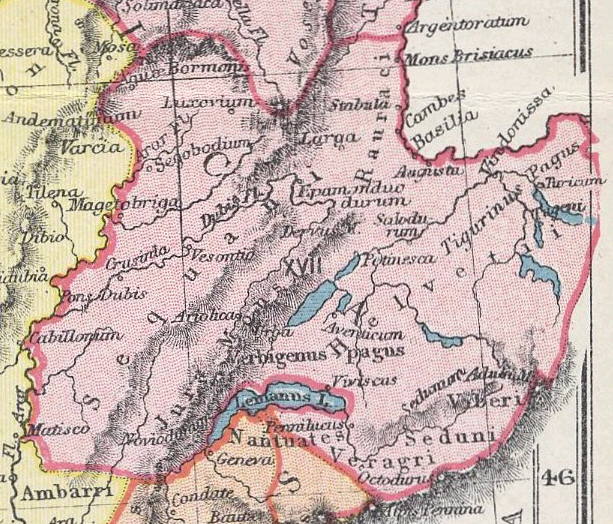
A portion of the map, Gallia, from Butler's 1907 atlas showing the divisions of the diocese of Gaul in the late Roman Empire.[1] According to the key, the map depicts 17 Provinciae Galliae, "Provinces of Gaul," of which the 17th, [Provincia] Maxima Sequanorum, "Greater Sequania," identified with an XVII shown in the Jura Mountains, contains the Sequani and Helvetii.
Gold coins of the Sequani Gauls, 5-1st century BC. Early Gallic coins were often inspired by Greek coinage.[2]
Silver coins of the Sequani Gauls, 5–1st century BC.
A map of Gaul in the 1st century BC, showing the locations of the Celtic tribes.

The Sequani were a Gallic tribe dwelling in the upper river basin of the Arar river (Saône), the valley of the Doubs and the Jura Mountains during the Iron Age and the Roman period.[3]

Name

[edit]

They are named as in Latin Sequani by Caesar (mid-1st c. BC),[4] Livy (late 1st c. BC),[5] Pliny (1st c. AD),[6] and Ammianus Marcellinus (4th c. AD),[7] and in Greek as Sēkoanoi (acc. Σηκοανούς) by Strabo (early 1st c. AD).[8][9]

The Gaulish ethnonym Sequani (sing. Sequanos) stems from the Celtic name of the Seine river, Sequana.[10] This may indicate that their original homeland was located by the Seine.[11]

Geography

[edit]

The country of the Sequani corresponded to Franche-Comté and part of Burgundy.[12] The Jura Mountains separated the Sequani from the Helvetii on the east, but the mountains belonged to the Sequani, as the narrow pass between the Rhone and Lake Geneva was Sequanian.[13] They did not occupy the confluence of the Saône into the Rhone, as the Helvetii plundered the lands of the Aedui there.[14] Extending a line westward from the Jura estimates the southern border at about Mâcon, but Mâcon belonged to the Aedui.[15] Strabo says that the Arar separates the Sequani from the Aedui and the Lingones, which means that the Sequani were on the left, or eastern, bank of the Saône only.[16] On the northeast corner the country of the Sequani touched on the Rhine.[17]

History

[edit]
Shield pattern of the Sequani auxilia palatina unit, according to Notitia dignitatum.

Before the arrival of Julius Caesar in Gaul, the Sequani had taken the side of the Arverni against their rivals the Aedui and hired the Suebi under Ariovistus to cross the Rhine and help them (71 BC). Although his assistance enabled them to defeat the Aedui, the Sequani were worse off than before, for Ariovistus deprived them of a third of their territory and threatened to take another third,[12] while subjugating them into semi-slavery.[citation needed]

The Sequani then appealed to Caesar, who drove back the Germanic tribesmen (58 BC), but at the same time obliged the Sequani to surrender all that they had gained from the Aedui. This so exasperated the Sequani that they joined in the revolt of Vercingetorix (52 BC) and shared in the defeat at Alesia. Under Augustus, the district known as Sequania formed part of Belgica. After the death of Vitellius (69 AD), the inhabitants refused to join the Gallic revolt against Rome instigated by Gaius Julius Civilis and Julius Sabinus, and drove back Sabinus, who had invaded their territory. A triumphal arch at Vesontio (Besançon), which in return for this service was made a colony, possibly commemorates this victory.[12]

Diocletian added Helvetia, and part of Germania Superior to Sequania, which was now called Provincia Maxima Sequanorum, Vesontio receiving the title of Metropolis civitas Vesontiensium. The southern reach of this territory was known as Sapaudia, which became the namesake of the later region of Savoy. Fifty years later, Gaul was overrun by the barbarians, and Vesontio sacked (355 AD). Under Julian, it recovered some of its importance as a fortified town, and was able to withstand the attacks of the Vandals. Later, when Rome was no longer able to afford protection to the inhabitants of Gaul, the Sequani became merged in the newly formed Kingdom of Burgundy.[12]

Major settlements

[edit]

References

[edit]

Further reading

[edit]
Revisions and contributorsEdit on WikipediaRead on Wikipedia
from Grokipedia
The Sequani were a Celtic tribe of ancient who inhabited the eastern region of the territory, encompassing the upper basin of the Arar () River, the valley of the , and the , during the and early Roman era. Their territory lay west of the —separated by the —and east of the , extending eastward to the River and sharing the Arar as a boundary with their western neighbors. The tribe's principal was Vesontio, modern , which served as a strategic center near the and . Renowned for producing the finest salted hog-meat, which was exported to , the Sequani held significant economic influence in the region. Historically, the Sequani were one of the two dominant factions in central , locked in a longstanding rivalry with the for supremacy, a conflict that shaped much of the tribal politics in the area. Inferior in strength to the Aedui, they sought alliances with Germanic tribes, particularly inviting the leader across the around 71 BC to aid against their rivals; this pact allowed Ariovistus to settle within Sequani borders, seizing a third of their land and eventually demanding more, leading to their subjugation. The , longstanding Roman allies, appealed to for intervention, prompting his campaign in 58 BC; Caesar defeated Ariovistus near modern , liberating the Sequani from German control and securing their territory, including Vesontio, for Roman influence while they provided supplies to his legions. This event marked the Sequani's shift from German alliance to reluctant Roman partnership, though they had previously been at variance with over tolls on the Arar River. During the broader (58–50 BC), the Sequani initially remained neutral or supportive of Caesar, but tensions arose as the regained prominence under Roman favor, diminishing Sequani leadership in . The Sequani remained largely loyal to Rome during Vercingetorix's pan-Gallic revolt in 52 BC. Following Caesar's victory at Alesia, the Sequani were fully incorporated into the Roman Republic's province of , undergoing gradual . In the , from the 4th century AD, their heartland formed the core of the province Maxima Sequanorum, centered on Vesontio (renamed as the capital), which endured until the empire's decline and the tribe's absorption into the Burgundian Kingdom around the 5th century.

Name and Etymology

Etymology

The etymology of the name Sequani remains uncertain, though it is possibly related to Celtic river names, such as the (anciently known as Souconna or Arar), reflecting the tribe's location in its upper basin. Similar patterns appear in other Gallic tribal names, using suffixes like -ani to denote ethnic groups often tied to geographical features. The name shares linguistic elements with the goddess , who personified the River and was revered for healing at her sanctuary near the river's source springs (Fontes Sequanae) in , close to the Sequani's territory. This connection highlights broader Celtic river cults.

Ancient Attestations

The earliest surviving attestations of the Sequani appear in Julius Commentarii de Bello Gallico (58–50 BC), where the tribe is referred to in the accusative plural as Sequanos. Caesar describes them as a prominent Gallic people inhabiting the region between the and the , noting their control over key territorial passes and their involvement in inter-tribal rivalries, such as alliances with the against the during the initial stages of the . In the 1st century AD, Pliny the Elder mentions the Sequani by name as Sequani in his Naturalis Historia (Book 4, Chapter 31), listing them among the Gallic tribes in the province of Gallia Belgica, adjacent to the Helvetii and Raurici near the sources of the Rhine. This geographical reference underscores their position in the eastern regions of Roman Gaul, without delving into contemporary political dynamics. Strabo's Geographica (early 1st century AD, Book 4, Chapter 3) provides another primary attestation, rendering the tribal name in Greek as Σεκοανοί (transliterated as Sēkoanoús). He situates the Sequani along the Rhine immediately after the territory of the Helvetii, emphasizing their proximity to the Mediomatrici and the presence of Germanic groups like the Tribocchi within their borders, as part of a broader ethnographic survey of Celtic peoples in the Alpine and Jura regions. Later classical sources include Titus Livius (Livy) in his (late 1st century BC), where the Sequani are referenced in the dative plural as Sequanis in discussions of Roman military engagements in , particularly in the context of alliances with tribes like the against external threats (as summarized in the Periochae of Books 101–105). By the 4th century AD, Ammianus Marcellinus in his (Book 15, Chapter 11) alludes to the former territory of the Sequani as a , highlighting cities like (Vesontio) and within it, reflecting the tribe's integration into the late Roman administrative structure of . These attestations collectively illustrate the Sequani's recognition in Greco-Roman literature as a significant Celtic group, with spellings varying by and language but consistently denoting the same eastern Gallic entity.

Geography and Territory

Physical Landscape

The territory of the Sequani encompassed the upper basin of the River (known in antiquity as the Arar), the River valley, and the , regions that align closely with the modern administrative area of and portions of in eastern . This landscape was characterized by a mix of elevated plateaus, deep river incisions, and forested uplands, with the originating in the Mountains before flowing southward through broad alluvial plains. The , meanwhile, carved a sinuous path through the Jura's karstic terrain, creating narrow gorges and expansive valleys that facilitated seasonal flooding and sediment deposition. The dominated the eastern extent of Sequani lands, forming a formidable barrier of folded limestone ridges rising to over 1,700 meters, which provided inherent defensive advantages due to their steep slopes and limited access routes. One such route, described as narrow and arduous between the Jura and the River, highlighted the challenges of traversing this terrain, where even wagons could barely pass in single file. In the northeast, the territory approached the Rhine River, linking the Sequani's domain to broader transalpine networks while exposing it to influences from across the waterway. Fertile valleys along the and offered prime conditions for , with alluvial soils supporting cultivation and in a landscape noted for its productivity. The region experienced a temperate , marked by cold winters, mild springs and autumns, and warm summers, which sustained practices including cereals, , and rearing. Natural resources were plentiful, with dense forests supplying timber for and fuel, deposits in the Jura facilitating metallurgical activities, and saline springs enabling salt extraction from prehistoric times onward.

Borders and Neighboring Tribes

The territory of the Sequani was bounded to the northeast by the River, where it adjoined the lands of the , with the serving as a natural divider between the two tribes. To the west, the River (ancient Arar) marked the primary boundary with the and the Lingones, facilitating both trade and tensions over control of the fertile valley. Their southern edges approached the territory of the , though indirect through intervening groups, while the north connected with the Lingones. This configuration centered on the River valley and incorporated key passes through the that supported vital trade and migration routes across the and toward the . Geopolitically, these borders shaped the Sequani's interactions with neighbors, marked by enduring rivalries and pragmatic alliances. The River frontier with the was a perennial flashpoint, fueling long-standing enmity over dominance in the resource-rich valley and its riverine commerce. In contrast, the Sequani occasionally forged pacts with other groups, such as the for passage rights through Jura defiles or shared defenses against external threats, highlighting the fluid dynamics of tribal relations in eastern . The Rhine's eastern edge further exposed them to Germanic influences, influencing border fortifications and migratory pressures.

History

Pre-Roman Conflicts and Alliances

The Sequani operated as a tribal in eastern during the 2nd and 1st centuries BC, governed by chieftains who held significant authority, akin to the vergobret title used among neighboring tribes like the . Evidence from their coinage, which began appearing in silver and forms around the mid-1st century BC bearing legends such as "Q. DOCI", suggests a degree of centralized control under these figures, as the issuance of standardized coin types implies oversight by prominent individuals or councils rather than purely decentralized minting. This structure facilitated coordinated responses to external threats, though internal factions occasionally emerged, as seen in the ambitions of chieftain Casticus, son of the former sovereign Catamantaloedes, who sought greater power through alliances. In the 2nd century BC, the Sequani faced intensifying rivalries with the dominant to their west, whose influence extended across much of central and often encroached on Sequani borders along the River valley. To counter this hegemony, the Sequani forged a key alliance with the , a powerful tribe from the , leading to joint military campaigns aimed at regional dominance; these efforts culminated in battles such as the one at Magetobriga around 63 BC, where combined Sequani- forces sought to repel advances. The geographical barriers of the , which defined much of the Sequani territory and isolated them from easier expansion, played a role in shaping these conflicts by channeling warfare into contested river valleys. A pivotal escalation occurred around 71 BC when the Sequani, desperate to tip the balance against the , initially invited the Germanic leader across the to serve as mercenaries with a small force; a major migration followed around 62 BC. 's forces proved decisive, defeating the and securing a Sequani victory, but the alliance soured as payment demands mounted; the Sequani ultimately ceded one-third of their lands east of the to the Germans, who established permanent settlements there, transforming a tactical into a long-term territorial loss. This event highlighted the risks of external dependencies in Gallic politics. As part of the broader Celtic oppida culture of Late La Tène , the Sequani fortified their territory with hillforts in the rugged , such as those near Vesontio, which served as defensive strongholds and administrative centers during these turbulent alliances and wars. These structures, often enclosing up to several hectares with ramparts and ditches, underscored the tribe's emphasis on amid rivalries, enabling them to withstand sieges and mobilize forces effectively until Roman involvement altered the regional balance.

Roman Conquest and Early Imperial Period

The Roman involvement with the Sequani escalated in 58 BC when Julius Caesar, responding to appeals from the Aedui—traditional Roman allies—for protection against Germanic incursions, marched his legions into Sequani territory. The Sequani had earlier invited Ariovistus, king of the Suebi, across the Rhine to aid them in their rivalry with the Aedui, leading to a decisive victory over the Aedui at the Battle of Magetobria around 63 BC. However, Ariovistus subsequently turned on his hosts, seizing one-third of Sequani land for his followers, demanding another third, and extracting hostages and tribute from the tribe, leaving them subjugated and fearful. Caesar confronted Ariovistus near Vesontio (modern Besançon), the Sequani capital, where initial negotiations failed as Ariovistus asserted his right to the conquered lands. The ensuing Battle of the Vosges (also known as the Battle of Ariovistus), fought in 58 BC near modern Mulhouse, resulted in a Roman victory; Ariovistus was wounded and fled across the Rhine with heavy losses, effectively ending the immediate Germanic threat to Gaul. In the aftermath, Caesar wintered his troops among the Sequani to consolidate control, compelling them to restore disputed territories previously seized from the during their conflicts, a measure that weakened Sequani autonomy and reinforced Aedui influence under Roman patronage. This settlement, facilitated during Caesar's stay near after his earlier victory over the , marked the Sequani's initial subordination to without full-scale invasion of their core lands. The intervention not only secured the frontier but also positioned the Sequani as reluctant clients of , bound by obligations of and support. Tensions resurfaced in 52 BC amid the widespread Gallic revolt led by of the , as the Sequani, resentful of Roman demands and favoritism, allied with the rebels despite their prior subjugation. 's strategy sought to unite tribes against Caesar, and Sequani contingents contributed to the Gallic forces, particularly in eastern near their borders. The revolt culminated in the Siege of Alesia, located in Mandubii territory but proximate to Sequani lands in modern ; 's army, including allied warriors from the Sequani and others, was encircled and defeated after a prolonged siege, with Caesar's reinforcements repelling a massive Gallic relief effort. This crushing at Alesia effectively ended organized resistance, subjecting the Sequani to direct Roman oversight and further eroding their independence. Under (27 BC–14 AD), the Sequani were formally integrated into the new province of , established to administer the conquered northeastern territories, with their lands forming a significant portion of the province's eastern sector. Vesontio emerged as a vital administrative hub, hosting Roman officials and serving as a base for provincial governance, though it was not yet elevated to full colonial status. The tribe was obligated to pay annual tribute in grain, livestock, and coinage to the Roman treasury, while also supplying auxiliary troops— and —for imperial legions, contributing to campaigns along the . This period of early imperial rule emphasized pacification and economic incorporation, transforming the Sequani from tribal adversaries into a structured within the Roman framework, though local unrest persisted intermittently.

Late Antiquity and Decline

In the late 3rd century AD, during the administrative reforms of Emperor Diocletian, the territory of the Sequani underwent significant reorganization. The region, previously part of , was expanded to include parts of and , forming the new province of Maxima Sequanorum. Vesontio (modern ) served as the provincial capital, reflecting its strategic importance along the River and its role as a key administrative and economic center. The Sequani demonstrated continued loyalty to amid the instability of the late AD, particularly during the Batavian revolt led by Julius Civilis in 69–70 AD, which briefly inspired the formation of the . While neighboring tribes like the Lingones and Treviri joined the uprising, the Sequani remained steadfast, mobilizing forces to resist the rebels and supporting Roman efforts to restore order. This allegiance helped preserve their privileged status within the during the early imperial period. By the mid-4th century, however, the faced mounting external pressures from Germanic incursions. In 355 AD, during a major by the Alamanni under Chnodomarus, the Sequani's territory was ravaged amid widespread devastation across . These attacks exacerbated the empire's frontier vulnerabilities, prompting defensive reforms under emperors like Julian, who campaigned against the Alamanni in the region. Despite such challenges, Sequani recruits contributed to the late Roman military, forming elite palatina units listed in the as the Sequani seniores and Sequani iuniores, stationed in the field armies of the Western Empire. The marked the beginning of the Sequani's decline as distinct entities. As Roman authority waned, tribes, migrating from the east, invaded and settled in the region around 413 AD, establishing the Kingdom of with its capital initially at Worms and later . The gradually absorbed the Gallo-Roman population of Maxima Sequanorum, including the remnants of Sequani society, leading to their merger into the new kingdom. By the , following Frankish conquests and further integrations, the Sequani had lost their separate ethnic and political identity, fully assimilated into the emerging medieval polities of .

Society and Culture

Economy and Numismatics

The Sequani economy was primarily agricultural, centered on the cultivation of grains such as and in the fertile valleys of the and rivers, complemented by livestock rearing, particularly and pigs, in the upland areas. The exploitation of the ' forests supplied timber for construction and , while iron in the region provided raw materials for tools and weapons, contributing to local self-sufficiency. Salt production, using springs and techniques, was a key industry, enabling the preservation of and supporting exports; the finest salted pork (salsamenta suilia) came from the Sequani and was transported to . The tribe's strategic position facilitated extensive trade networks, with control over Jura passes connecting Gaul to the Rhine River, allowing the exchange of local products like salt, iron, and timber for amber, furs, and slaves with neighboring Helvetii and Germanic groups across the border. These routes, described by Caesar as vital for migrations and commerce, enhanced the Sequani's role as intermediaries in transalpine exchange before Roman intervention disrupted independent trade. In numismatics, the Sequani issued gold staters and silver potin coins from the 5th to 1st century BC, largely imitating Greek prototypes from Massalia, such as the obverse head of Apollo and reverse horse designs, adapted with Celticized features like stylized patterns and abstract motifs. Over 200 distinct types are known, reflecting prolific production at mints in oppida like Vesontio (modern Besançon) and possibly Mathay, indicating a sophisticated monetary system for local and regional transactions. Following the Roman conquest in 52 BC, coinage shifted toward Roman denarii, though local workshops persisted in producing hybrid silver quinarii—crudely copying Roman helmeted busts—until the mid-1st century AD, facilitating integration into the imperial economy.

Religion and Material Culture

The Sequani practiced a polytheistic Celtic religion centered on local deities associated with natural features, particularly rivers and springs, as evidenced by archaeological and epigraphic sources from the late . A prominent example is the worship of , the healing goddess of the River, whose name etymologically links to the Sequani; her cult was centered at the Seine's source in neighboring territory in , attracting regional pilgrims. Pilgrims sought her aid for ailments, leaving votive offerings at her sanctuary, Fontes Sequanae, on the Châtillon Plateau, where excavations from 1836 to 1967 uncovered over 1,500 ex-votos including stone and bronze representations of afflicted body parts such as legs, eyes, and limbs, alongside coins, rings, and statuettes of children and animals. Druidic influence permeated Sequani spiritual life, with druids serving as , judges, and mediators in rituals, sacrifices, and tribal , as described in contemporary Roman accounts of Gallic practices applicable to eastern tribes like the Sequani. Burial sites from the La Tène period reveal a tribal through rich , including weapons, jewelry, and imported items, indicating hierarchical social structures where elites likely patronized druidic ceremonies and seasonal festivals tied to agricultural cycles and natural sacred places like springs and groves. Daily life revolved around fortified oppida in the , where communities engaged in communal rituals honoring deities of and . Material culture reflects this religious worldview through La Tène-style artifacts discovered in Sequani oppida, such as intricately wrought gold and bronze symbolizing status and divine favor, safety-pin fibulae with swirling vegetal motifs used in ritual attire, and wheel-turned vessels often deposited in sacred contexts like bogs or shrines. Later, in Roman service, Sequani bore distinctive patterns featuring a white boss ringed in red or orange-brown on a field, as documented in late Roman military records, blending Celtic warrior traditions with imperial . Following the Roman conquest in 52 BCE, the Sequani adopted syncretic practices, merging with Roman equivalents in temples at key centers like Vesontio, where artifacts such as a statuette of the Celtic god Sucellus (syncretized with Roman Silvanus) and a three-horned figure attest to blended cults emphasizing prosperity and protection. Roman additions to the sanctuary, including two temples constructed around the CE, facilitated this fusion, with inscriptions and mosaics depicting gods like alongside local healing spirits. Some Sequani designs incorporated religious motifs, such as or figures, underscoring symbolic continuity amid economic .

Settlements

Vesontio

Vesontio, the chief of the Sequani, occupied a strategic formed by a tight of the River, which provided natural defenses complemented by artificial fortifications including a rampart constructed by the late 2nd to . The settlement encompassed roughly 120 hectares within the river loop. In its pre-Roman phase, Vesontio functioned as the political and economic hub of the Sequani, hosting tribal assemblies and serving as a major minting center where and silver coins bearing tribal symbols were produced to facilitate and alliances. Its fortified position was pivotal in the Sequani's defenses against incursions by neighboring tribes, notably the , as highlighted in accounts of regional conflicts around 63–61 BC. The Roman conquest in 58 BC initiated Vesontio's transformation, with the city granted the status of Colonia Julia Vesontio around 70 AD under , integrating it into the provincial administrative framework. By the AD, the city underwent extensive , featuring aqueducts for , a central forum for civic activities, and a theater accommodating public spectacles, all constructed amid a shift to stone architecture and orthogonal . Vesontio's enduring significance culminated in the late AD when it became the capital of the newly formed province of Maxima Sequanorum under Diocletian's reforms, overseeing regional governance and military logistics. Archaeological excavations have uncovered substantial evidence of this evolution, including segments of the pre-Roman earth-and-timber ramparts, remnants of Roman bridges spanning the , and over 1,000 inscriptions documenting administrative, religious, and social life from the 1st to 4th centuries AD.

Other Key Sites

Beyond the dominant urban center of Vesontio, the Sequani maintained a network of secondary oppida and rural settlements that underscored the decentralized nature of their territory in eastern Gaul. One of the most prominent was Epomanduodurum, located at Mandeure-Mathay near the Doubs River, which served as a major pre-Roman hillfort during the La Tène finale period (2nd–1st century BC). This oppidum, spanning approximately 35 hectares with fortifications on both riverbanks, featured strategic enclosures like the oval post-supported structure at Champ des Fougères, dating to 90–60 BC, and evidenced early cult activity through ritual deposits including amphorae and local pottery production. By the Roman era, Epomanduodurum expanded into a vast agglomeration exceeding 400 hectares, incorporating a monumental theater (diameter 142 meters, capacity 15,000–18,000) constructed in the 1st century AD under Julio-Claudian influence, and an extensive sanctuary complex at Cloux du Château with temples, altars, and porticos dedicated to deities such as Mars and Minerva, active from the 2nd century BC onward. These features highlight its role as the second-largest Sequani settlement, facilitating trade along the Doubs and Rhine corridors. Peripheral to core Sequani lands but culturally linked through the tribe's etymological ties to the river goddess —whose name derives from the pre-Celtic term for the , with the Sequani dwelling along its upper reaches—the at Source-de-la-Seine represented a significant ritual outlier. Established in the late and flourishing under Roman rule from the , this site featured offerings, including bronze statues and anatomical models, dedicated to as a healing deity, attracting pilgrims across eastern . In the , rural fortified villages exemplified the Sequani's dispersed habitation patterns, with evidence of ironworking and burials dating to the . Sites like Mathay, adjacent to Mandeure, yielded a small with La Tène-era interments, including weapons and pottery, indicative of elites and metallurgical activity tied to local ore resources. Roman integration introduced villas and waystations along the vital Saône-Rhône routes, enhancing connectivity to the frontier. Luxeuil-les-Bains emerged as a key thermal center within Sequani territory during the Gallo-Roman period, exploiting hyperthermal springs (48–63°C) for bathing complexes established by the 1st century AD, which supported both civilian relaxation and near the Jura passes. These installations, including roadside villas with hypocausts and mosaics, dotted the landscape, promoting agricultural estates and transit points that bolstered economic ties between and . Archaeological excavations across these sites reveal a 1st-century BC horizon marked by hoards and La Tène pottery, illuminating population distribution and crisis responses. At Epomanduodurum alone, over 180 Gaulish s (primarily Sequani potins and silver quinarii) were recovered from ritual contexts, alongside wheel-turned ceramics with incised decoration, suggesting hoarding during the and a dispersed populace reliant on riverine and montane resources. Such finds, distributed from the valley to Jura foothills, indicate a semi-urbanized society with clusters of 500–2,000 inhabitants per settlement, adapting to Roman pressures through fortified refugia and metallurgical self-sufficiency.

References

Add your contribution
Related Hubs
Contribute something
User Avatar
No comments yet.