


Community hub
Recent from talks
Contribute something
Nothing was collected or created yet.
Blade
View on Wikipedia
A blade is the sharp, cutting portion of a tool, weapon, or machine, specifically designed to puncture, chop, slice, or scrape surfaces or materials. Blades are typically made from materials that are harder than those they are intended to cut. This includes early examples made from flaked stones like flint or obsidian, evolving through the ages into metal forms like copper, bronze, and iron, and culminating in modern versions made from steel or ceramics. Serving as one of humanity's oldest tools, blades continue to have wide-ranging applications, including in combat, cooking, and various other everyday and specialized tasks.
Blades function by concentrating force at the cutting edge. Design variations, such as serrated edges found on bread knives and saws, serve to enhance this force concentration, adapting blades for specific functions and materials. Blades thus hold a significant place both historically and in contemporary society, reflecting an evolution in material technology and utility.
Uses
[edit]During food preparation, knives are mainly used for slicing, chopping, and piercing.[1]
In combat, a blade may be used to slash or puncture, and may also be thrown or otherwise propelled.[2][3] The function is to sever a nerve, muscle or tendon fibers, or blood vessel to disable or kill the adversary. Severing a major blood vessel typically leads to death due to exsanguination.
Blades may be used to scrape, moving the blade sideways across a surface, as in an ink eraser, rather than along or through a surface. For construction equipment such as a grader, the ground-working implement is also referred to as the blade, typically with a replaceable cutting edge.
Physics
[edit]A simple blade intended for cutting has two faces that meet at an edge. Ideally, this edge would have no roundness but in practice, all edges can be seen to be rounded to some degree under magnification either optically or with an electron microscope. Force is applied to the blade, either from the handle or pressing on the back of the blade. The handle or back of the blade has a large area compared to the fine edge. This concentration of applied force onto the small edge area increases the pressure exerted by the edge. It is this high pressure that allows a blade to cut through a material by breaking the bonds between the molecules, crystals, fibers, etc. in the material. This necessitates the blade being strong enough to resist breaking before the other material gives way.
Geometry
[edit]
The angle at which the faces meet is important as a larger angle will make for a duller blade while making the edge stronger. A stronger edge is less likely to dull from fracture or have the edge roll out of shape.
The shape of the blade is also important. A thicker blade will be heavier and stronger and stiffer than a thinner one of similar design while also making it experience more drag while slicing or piercing. A filleting knife will be thin enough to be very flexible while a carving knife will be thicker and stiffer; a dagger will be thin so it can pierce, while a camping knife will be thicker so it can be stronger and more durable. A strongly curved edge, like a talwar, will allow the user to draw the edge of the blade against an opponent even while close to the opponent where a straight sword would be more difficult to pull in the same fashion. The curved edge of an axe means that only a small length of the edge will initially strike the tree, concentrating force as does a thinner edge, whereas a straight edge could potentially land with the full length of its edge against a flat section of the tree. A splitting maul has a convex section to avoid getting stuck in the wood where chopping axes can be flat or even concave. A khopesh, falchion, or kukri is angled and/or weighted at the distal end so that force is concentrated at the faster moving, heavier part of the blade maximizing cutting power and making it largely unsuitable for thrusting, whereas a rapier is thin and tapered allowing it to pierce and be moved with more agility while reducing its chopping power compared to a similarly sized sword.
A serrated edge, such as on a saw or a bread knife, concentrates force onto the tips of the serrations which increases pressure as well as allowing soft or fibrous material (like wood, rope, bread, and vegetables) to expand into the spaces between serrations. Whereas pushing any knife, even a bread knife, down onto a bread loaf will just squash the loaf as bread has a low elastic modulus (is soft) but high yield strain (loosely, can be stretched or squashed by a large proportion without breaking), drawing serrations across the loaf with little downward force will allow each serration to simultaneously cut the bread with much less deformation of the loaf. Similarly, pushing on a rope tends to squash the rope while drawing serrations across it sheers the rope fibers. Drawing a smooth blade is less effective as the blade is parallel to the direction draw but the serrations of a serrated blade are at an angle to the fibers. Serrations on knives are often symmetric allowing the blade to cut on both the forward and reverse strokes of a cut, a notable exception being Veff serrations which are designed to maximize cutting power while moving the blade away from the user. Saw blade serrations, for both wood and metal, are typically asymmetrical so that they cut while moving in only one direction. (Saws act by abrading a material into dust along a narrow channel, the kerf, whereas knives and similar act by forcing the material apart. This means that saws result in a loss of material and the serrations of a saw also serve to carry metal swarf and sawdust out of the cut channel.)
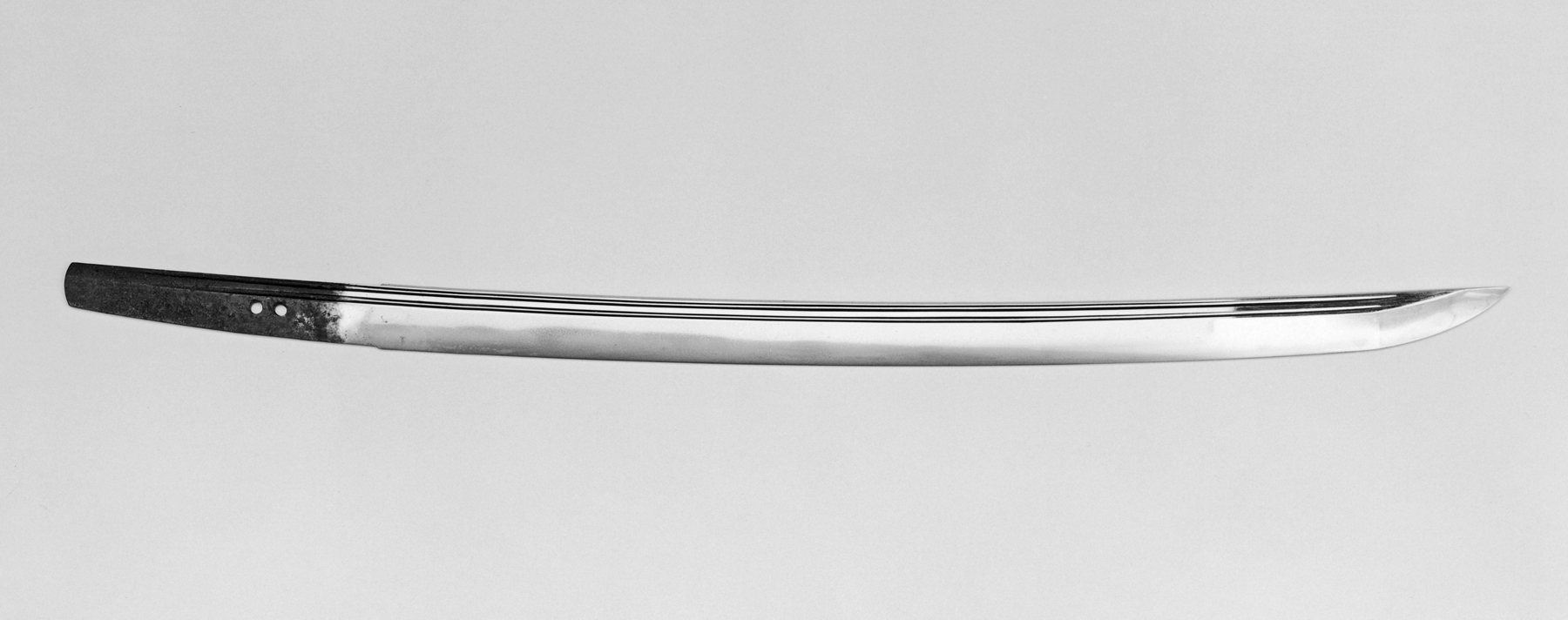
Fullers are longitudinal channels either forged into the blade or later machined/milled out of the blade though the latter process is less desirable. This loss of material necessarily weakens the blade but serves to make the blade lighter without sacrificing stiffness. The same principle is applied in the manufacture of beams such as I-beams. Fullers are only of significant utility in swords. In most knives there is so little material removed by the fuller that it makes little difference to the weight of the blade and they are largely cosmetic.
Materials
[edit]Typically blades are made from a material that is about as hard, though usually harder, than the material to be cut. Insufficiently hard blades will be unable to cut a material or will wear away quickly as hardness is related to a material's ability to resist abrasion. However, blades must also be tough enough to resist the dynamic load of impact and as a general rule the harder a blade the less tough (the more brittle) a material. For example, a steel axehead is much harder than the wood it is intended to cut and is sufficiently tough to resist the impact resulting when swung against a tree while a ceramic kitchen knife, harder than steel, is very brittle (has low toughness) and can easily shatter if dropped onto the floor or twisted while inside the food it is cutting or carelessly stored under other kitchen utensils. This creates a tension between the intended use of the blade, the material it is to be made from, and any manufacturing processes (such as heat treatment in the case of steel blades that will affect a blade's hardness and toughness). A balance must be found between the sharpness and how well it can last. Methods that can circumvent this include differential hardening. This method yields an edge that can hold its sharpness as well as a body that is tough.[4]
Non-metals
[edit]Prehistorically, and in less technologically advanced cultures even into modern times, tool and weapon blades have been made from wood, bone, and stone.[5] Most woods are exceptionally poor at holding edges and bone and stone suffer from brittleness making them suffer from fracture when striking or struck. In modern times stone, in the form of obsidian, is used in some medical scalpels as it is capable of being formed into an exceedingly fine edge. Ceramic knives are non-metallic and non-magnetic. As non-metals do not corrode they remain rust and corrosion free but they suffer from similar faults as stone and bone, being rather brittle and almost entirely inflexible. They are harder than metal knives and so more difficult to sharpen, and some ceramic knives may be as hard or harder than some sharpening stones. For example, synthetic sapphire is harder than natural sharpening stones and is as hard as alumina sharpening stones. Zirconium dioxide is also harder than garnet sharpening stones and is nearly as hard as alumina. Both require diamond stones or silicon carbide stones to sharpen and care has to be taken to avoid chipping the blade. As such ceramic knives are seldom used outside of a kitchen and they are still quite uncommon. Plastic knives are difficult to make sharp and poorly retain an edge. They are largely used as low cost, disposable utensils or as children's utensils or in environments such as air travel where metal blades are prohibited. They are often serrated to compensate for their general lack of sharpness but, as evidenced by the fact they can cut food, they are still capable of inflicting injury. Plastic blades of designs other than disposable cutlery are prohibited or restricted in some jurisdictions as they are undetectable by metal detectors.
Metals
[edit]Native copper was used to make blades by ancient civilizations due to its availability. Copper's comparative softness causes it to deform easily; it does not hold an edge well and is poorly suited for working stone. Bronze is superior in this regard, and was taken up by later civilizations. Both bronze and copper can be work hardened by hitting the metal with a hammer. With technological advancement in smelting, iron came to be used in the manufacturing of blades. Steel, a range of alloys made from iron, has become the metal of choice for the modern age.
Various alloys of steel can be made which offer a wide range of physical and chemical properties desirable for blades. For example, surgical scalpels are often made of stainless steel so that they remain free of rust and largely chemically inert; tool steels are hard and impact resistant (and often expensive as retaining toughness and hardness requires expensive alloying materials, and, being hard, they are difficult to make into their finished shape) and some are designed to resist changes to their physical properties at high temperatures. Steels can be further heat treated to optimize their toughness, which is important for impact blades, or their hardness, which allows them to retain an edge well with use (although harder metals require more effort to sharpen).
Combined materials and heat-treatments
[edit]It is possible to combine different materials, or different heat treatments, to produce desirable qualities in a blade. For example, the finest Japanese swords were routinely made of up to seven sections of metals and even poorer quality swords were often made of two. These would include soft irons that could absorb the energy of impact without fracturing but which would bend and poorly retain an edge, and hard steels more liable to shatter on impact but which retained an edge well. The combination provided a sword that would resist impact while remaining sharp, even though the edge could chip if abused. Pattern welding involved forging together twisted bars of soft (bendable) low carbon and hard (brittle) higher carbon iron.[6] This was done because furnaces of the time were typically able to produce only one grade or the other, and neither was well suited for more than a very limited use blade. The ability of modern steelmakers to produce very high-quality steels of various compositions has largely relegated this technique to either historical recreations or to artistic works. Acid etching and polishing blades made of different grades of steel can be used to produce decorative or artistic effects.
Japanese sword makers developed the technique of differential hardening by covering their sword blades in different thicknesses of clay before quenching. Thinner clay allowed the heated metal to cool faster, particularly along the edge. Faster cooling resulted in a finer crystal structure, resulting in a blade with a hard edge but a more flexible body. European sword makers produced similar results using differential tempering.
Dulling
[edit]Blades dull with use and abuse. This is particularly true of acute blades and those made of soft materials. Dulling usually occurs due to contact between the blade and a hard substance such as ceramic, stone, bone, glass, or metal.

The more acute the blade, the more easily it will dull. As the blade near the edge is thinner, there is little material to remove before the edge is worn away to a thicker section. Thin edges can also roll over when force is applied it them, forming a section like the bottom part of a letter "J". For this reason, straight edge razors are frequently stropped to straighten the edge.
Drawing a blade across any material tends to abrade both the blade, usually making it duller, and the cut material. Though softer than glass or many types of stone used in the kitchen, steel edges can still scratch these surfaces. The resulting scratch is full of very fine particles of ground glass or stone which will very quickly abrade the blade's edge and so dull it.
In times when swords were regularly used in warfare, they required frequent sharpening because of dulling from contact with rigid armor, mail, metal rimmed shields, or other swords,[4] for example. Particularly, hitting the edge of another sword by accident or in an emergency could chip away metal and even cause cracks through the blade.[7] Soft-cored blades are more resistant to fracturing on impact.
Nail pulls
[edit]Folding pocket knives often have a groove cut in the side of the blade near the spine. This is called a nail pull and allows the fingernail to be inserted to swing the blade out of the holder.[8]

Knife patterns
[edit]![[icon]](https://en.wikipedia.org/wiki/File:Wiki_letter_w_cropped.svg) | This section needs expansion. You can help by adding to it. (May 2022) |

Some of the most common shapes are listed below.
- S1
- A straight back blade, also called standard or normal, has a curving edge and a straight back. A dull back lets the wielder use fingers to concentrate force; it also makes the knife heavy and strong for its size. The curve concentrates force on a smaller area, making cutting easier. This knife can chop as well as pick and slice. This is also the best single-edged blade shape for thrusting, as the edge cuts a swath that the entire width of the knife can pass through without the spine having to push aside any material on its path, as a sheepsfoot or drop-point knife would.
- S2
- A trailing-point knife has a back edge that curves upward to end above the spine. This lets a lightweight knife have a larger curve on its edge and indeed the whole of the knife may be curved. Such a knife is optimized for slicing or slashing. Trailing point blades provide a larger cutting area, or belly, and are common on skinning knives.

- S3
- A drop point blade has a convex curve of the back towards the point. It handles much like the clip-point, though with a stronger point typically less suitable for piercing. Swiss army pocket knives often have drop-points on their larger blades.
- S4
- A clip-point blade is like a normal blade with the back "clipped". This clip can be either straight or concave. The back edge of the clip may have a false edge that could be sharpened to make a second edge. The sharp tip is useful as a pick, or for cutting in tight places. If the false edge is sharpened it increases the knife's effectiveness in piercing. As well, having the tip closer to the center of the blade allows greater control in piercing. The Bowie knife has a clip point blade and clip-points are common on pocket knives and other folding knives.[9]
- S5
- A sheepsfoot blade has a straightedge and a straight dull back that curves towards the edge at the end. It gives the most control because the dull back edge is made to be held by fingers. Sheepsfoot blades were originally made to trim the hooves of sheep; their shape bears no similarity to the foot of a sheep.[10]
- S6
- A Wharncliffe blade is similar in profile to a sheep's foot but the curve of the back edge starts closer to the handle and is more gradual. Its blade is much thicker than a knife of comparable size.[11] Wharncliffes were used by sailors, as the shape of the tip prevented accidental penetration of the work or the user's hand with the sudden motion of a ship.
- S7
- A spey point blade (once used for neutering livestock) has a single, sharp, straight edge that curves strongly upwards at the end to meet a short, dull, straight point from the dull back. With the curved end of the blade being closer to perpendicular to the blade's axis than other knives and lacking a point, making penetration unlikely, spey blades are common on Trapper style pocket knives for skinning fur-bearing animals.[10]

- C1
- Leaf blade with a distinctive recurved "waist" adding some curved "belly" to the knife facilitating slicing as well as shifting weight towards the tip meaning that it is commonly used for throwing knives as well as improving chopping ability.

- C2
- A spear point blade is a symmetrically-shaped blade with a point aligned with the centerline of the blade's long axis. True spear-point blades are double-edged with a central spine, like a dagger or spear head. The spear point is one of the stronger blade point designs in terms of penetration stress, and is found on many thrusting knives such as the dagger. The term spear point is occasionally and confusingly used to describe small single-edged blades without a central spine, such as that of the pen knife, a small folding-blade pocket knife formerly used in sharpening quills for writing. Pen-knife may also nowadays refer to a knifelike weapon blade pattern of some of larger pocket knife blades that would otherwise be termed drop-point designs.
- C3
- A needle point blade has a sharply-tapered acuminated point. It is frequently found on daggers such as the stiletto (which had no sharpened edges) and the Fairbairn–Sykes fighting knife. Its long, narrow point reduces friction and increases the blade's penetrative capabilities, but is liable to stick in bone and can break if abused. When the needle point is combined with a reinforced 'T' section running the length of the blade's spine, it is called a reinforced tip. One example of a knife with a reinforced tip is the pesh-kabz.
- C4
- Kris or flame-bladed sword. These blades have a distinct recurved blade form and are sharpened on both sides, typically tapering to (or approximating) a symmetrical point.
- C5
- Referred to in English speaking countries as a "tanto" or "tanto point"— a corruption of the Japanese word tantō, despite the tip bearing no resemblance to a tantō — or as a chisel point, referring to the straightness of the edge that comprises the end of the blade[12] (and not to be confused with a blade said to have a "chisel grind", which would refer to a blade ground on only one side,[13] even though chisels can be ground on one or both sides).[14] It is similar to, but not the same as, some early Japanese swords that had kamasu kissaki ("barracuda tip"), a nearly straight edge at the tip whereas the typical "tanto point" as found in the west has a straight edge. The barracuda tip sword was sharp but also fragile whereas modern tanto points are often advertised as being stronger at the tip for having nearly the whole thickness of the blade present until quite close to the end of the knife. The geometry of the angle under the point gives tanto blades excellent penetration capabilities. For this reason, tanto blades are often found on knives designed for combat or fighting applications,[15] where the user may need to pierce heavy clothing or low-level soft body armor. With a modified tanto, the end is clipped and often sharpened. This brings the tip closer to the center of the blade increasing control of the blade and improves penetration potential by having a finer point and a sharpened back edge.
- C6
- A hawkbill blade is sharpened on the inside edge and is similar to carpet and linoleum knives. The point will tear even if the rest of the knife is comparatively dull. The karambit from Far South-East Asia is a hawkbill knife which is held with the blade extending from the bottom of the fist and the tip facing forward. The outside edge of a karambit may be sharp and if so may also feature a backward-facing point.
- C7
- An ulu (lit. 'woman's knife' in Inuktitut) knife is a sharpened segment of a circle. This blade type has no point, and has a handle in the middle. It is good for scraping and sometimes chopping. The semi-circular version appears elsewhere in the world and is called a head knife. It is used in leatherworking both to scrape down leather (reducing thickness, i.e. skiving), and to make precise, rolling cuts for shapes other than straight lines. The circular version is a popular tool for slicing pizzas. One corner is placed at the edge of the pizza and the blade is rolled across in a diameter cut.
Sword patterns
[edit]
The sharp edges of a sword may be either curved or straight. Curved blades tend to glide more easily through soft materials, making these weapons more ideal for slicing. Techniques for such weapons feature drawing the blade across the opponent's body and back. For straight-edged weapons, many recorded techniques feature cleaving cuts, which deliver the power out to a point, striking directly in at the target's body, done to split flesh and bone rather than slice it. That being said, there also exist many historical slicing techniques for straight-edged weapons. Hacking cuts can be followed by a drawing action to maximize the cut's effectiveness. For more information see Western Martial Arts or kenjutsu.
Some weapons are made with only a single leading edge, such as the sabre or dusack. The dusack has a 'false edge' near the tip, which only extends down a portion of the blade's backside. Other weapons have a blade that is entirely dull except for a sharpened point, like the épée or foil, which prefer thrusts over cuts. A blade cannot perform a proper cut without an edge, and so in competitive fencing such attacks reward no points.
Some variations include:
- The flame blade (an undulated blade, for both psychological effect and some tactical advantage of using a non-standard blade: vibrations and easier parry)
- The colichemarde, found in smallsword
Marks and decoration
[edit]
Blades are sometimes marked or inscribed, for decorative purposes, or with the mark of either the maker or the owner. Blade decorations are often realized in inlay in some precious metal (gold or silver).[16]
Early blade inscriptions are known from the Bronze Age, a Hittite sword found at Hattusa bears an inscription chiseled into the bronze, stating that the blade was deposited as an offering to the storm-god by king Tuthaliya.[17]
Blade inscriptions become particularly popular in the 12th century knightly sword, based on the earlier, 9th to 11th century, the tradition of the so-called Ulfberht swords.[18]
Blade marks can also have meanings. Guild marks are an example. Swords made in cities controlled by guilds might bear the guild's mark, indicating adherence to quality standards or a specific style associated with the guild. Researching guild markings of the period can shed light on the sword's origin and potential quality.[19]
See also
[edit]References
[edit]- ^ Culinary Institute of America (2007). In the Hands of a Chef: The Professional Chef's Guide to Essential Kitchen Tools. John Wiley and Sons. p. 17. ISBN 978-0-470-08026-9.
- ^ Echanis, Michael (1977). Knife Self-Defense for Combat. p. 4. ISBN 978-0-89750-022-7.
- ^ Echanis, Michael (1979). Knife Throwing for Combat. p. 4. ISBN 978-0-89750-058-6.
- ^ a b "Edge Damage on Swords". www.thearma.org. Retrieved 20 March 2018.
- ^ Driscoll, Killian; García-Rojas, Maite (July 2014). "Their lips are sealed: identifying hard stone, soft stone, and antler hammer direct percussion in Palaeolithic prismatic blade production" (PDF). Journal of Archaeological Science. 47: 134–141. doi:10.1016/j.jas.2014.04.008. Retrieved 19 July 2017.
- ^ Maryon, Herbert (1948). "A Sword of the Nydam Type from Ely Fields Farm, near Ely". Proceedings of the Cambridge Antiquarian Society. XLI: 73–76. doi:10.5284/1034398.
- ^ Yang, Jwing-Ming (1999). Taiji Sword, Classical Yang Style. YMAA Publications, p. 20. ISBN 978-1-886969-74-2
- ^ "Blade Nail Nicks and Long Pulls – Old and New".
- ^ Goddard, Wayne (2000). The Wonder of Knifemaking. Krause. pp. 88–89. ISBN 978-0-87341-798-3.
- ^ a b Overton, Mac (1990). "Two traditional designs". Blade Magazine. 17 (12): 48–53.
- ^ Neep, Rod (2005). "Wharncliffe Bladed Knives". Archived from the original on 1 November 2008. Retrieved 30 October 2013.
- ^ "Drawing Lessons: How to Create a Chisel Point - Pencils.com". pencils.com. 13 September 2012. Archived from the original on 21 March 2018. Retrieved 20 March 2018.
- ^ "Why do you use the chisel grind? - Emerson Knives Inc". emersonknives.com. Retrieved 20 March 2018.
- ^ "Sharpening Carving Chisels". www.woodcraft.com. Retrieved 20 March 2018.
- ^ "26 Knife Blade Types in 2021 (with Chart & Shape Explanations)". Marine Approved. 10 April 2021. Retrieved 2 May 2021.
- ^ Ewart Oakeshott, The Sword in the Age of Chivalry (1964)[1]
- ^ Kristian Kristiansen, Thomas B. Larsson, The rise of Bronze Age society: travels, transmissions, and transformations (2005)290.
- ^ Geibig, A. (1991), Beiträge zur morphologischen Entwicklung des Schwertes im Mittelalter.
- ^ "Medieval Sword: Markings, Makers, and Meanings". SwordsSwords.com. Retrieved 11 October 2025.
External links
[edit]Blade
View on GrokipediaDefinition and Overview
Etymology and Definition
The term "blade" derives from Old English blæd, signifying a "leaf" or "leaf-like part," which traces back to Proto-Germanic bladaz and Proto-Indo-European bhle-to-, a derivative of bhel- meaning "to thrive" or "bloom."[1] By Middle English, the word evolved to encompass the flat, broad portion of a sword or knife, particularly its cutting edge, reflecting the resemblance of such implements to foliage in shape and extension.[2] A blade is fundamentally a sharp-edged, typically flat or curved implement integral to tools or weapons, engineered for cutting, slicing, or piercing materials.[3] This core function sets it apart from pointed instruments like awls, which rely on a tapered tip for puncturing or boring holes rather than severing via an extended edge. Blades are broadly classified by edge configuration as single-edged (sharpened on one side only, common in slashing tools) or double-edged (sharpened on both sides for bidirectional cutting); by profile as straight (linear for precise incisions) or curved (arced to enhance slicing motion); and by structural properties as rigid (stiff for heavy-duty tasks) or flexible (bendable for contour-following applications like filleting).[4][5][6] Key anatomical features include the edge, the honed cutting surface; the spine, the thickened dorsal side for reinforcement; the tang, the proximal extension securing the blade to a handle; and the point, the distal apex for penetration.[7]Historical Development
The history of blades begins in the Paleolithic era, when early humans crafted sharp-edged tools from stone materials like flint and obsidian through knapping techniques, enabling efficient cutting, scraping, and hunting activities. These prehistoric blades represented a foundational technological leap, with examples such as Clovis points—fluted projectile points made from flint, chert, or obsidian—dating to approximately 13,000 years ago in North America, often associated with big-game hunting.[8][9][10][11] The Bronze Age transition around 3000 BCE marked the advent of metal blades, with the first cast examples emerging in Mesopotamia and Egypt using copper-arsenic or copper-tin alloys, which provided greater durability and reusability compared to stone. In Mesopotamia, archaeological evidence from sites like Ur reveals early bronze daggers and short swords by 3000 BC, often featuring midribs for structural strength. Egyptian bronze weapons, including daggers, appeared during the early dynastic period (c. 3100–2686 BCE), reflecting advancements in smelting and alloying that supported expanding warfare and trade networks.[12][13][14][15] By the Iron Age (c. 1200 BCE onward), iron blades proliferated across Europe and Asia, supplanting bronze due to iron's abundance and superior hardness when properly worked, leading to longer, more robust swords that influenced military tactics and social hierarchies. In Europe, Celtic designs featured leaf-shaped iron blades up to 80 cm long, emphasizing slashing cuts and often decorated with intricate hilts, as seen in artifacts from the Hallstatt culture (c. 800–450 BCE). Roman advancements included the spatha, a straight, double-edged iron cavalry sword derived from Celtic prototypes, measuring 75–100 cm and optimized for thrusting, which became standard in the Roman legions from the 1st century CE. In Asia, similar iron sword developments occurred, with widespread adoption in regions like Anatolia and India by 1000 BCE.[16][17][18][19] Medieval and Renaissance innovations further refined blade technology, with Damascus steel emerging in the Islamic world from the 8th to 17th centuries as a hallmark of superior metallurgy. This high-carbon crucible steel, forged from Indian wootz ingots in Damascus and other centers, produced blades with distinctive watery patterns, exceptional sharpness, and flexibility, prized for swords in military and ceremonial contexts across the Middle East and beyond. Concurrently in Europe, the longsword developed around the 14th century in the Holy Roman Empire, evolving into a versatile two-handed weapon (90–110 cm long) for both armored and unarmored combat, remaining prominent through the Renaissance until the mid-16th century as firearms rose. These designs underscored blades' cultural roles in warfare, status, and craftsmanship guilds.[20][21][22][23][24] The Industrial Revolution in the 19th century revolutionized blade production through mechanized processes like stamping, forging, and grinding, enabling mass manufacturing of uniform, affordable items that democratized access and introduced disposability. Techniques such as steam-powered rolling mills and precision grinding, pioneered in Europe and the United States, produced high volumes of steel blades for tools, razors, and cutlery, shifting from artisanal forging to factory output and reducing costs dramatically. This era's innovations, including the safety razor with interchangeable disposable blades patented in the late 1800s, laid the groundwork for modern consumer goods. In the 20th and 21st centuries, blades have evolved toward specialized materials like ceramics and composites, addressing demands for extreme durability, precision, and lightweight performance in niche applications. Ceramic blades, developed in the mid-20th century from zirconium oxide, offer corrosion resistance and edge retention for surgical scalpels, kitchen knives, and industrial cutters, with commercial production scaling in the 1980s. Composite blades, incorporating fibers like carbon or glass in polymer matrices, emerged prominently in the late 20th century for aerospace turbine components and wind energy rotors, providing high strength-to-weight ratios; by the 21st century, bio-based and recyclable variants have gained traction for sustainable energy infrastructure. These advancements highlight blades' ongoing adaptation to technological and environmental imperatives.[25][26][27]Design Principles
Geometry and Edge Configuration
Blade geometry encompasses the overall profile, edge configuration, and structural dimensions that define a blade's form and functionality, influencing its suitability for slicing, piercing, or other tasks. Blade profiles refer to the outline shape of the blade, which can be straight or curved, determining the primary cutting motion. Straight profiles, common in thrusting weapons like the Roman gladius or Chinese jian, feature parallel edges along the length, optimizing for linear penetration and control in precise strikes.[28] In contrast, curved profiles, such as those found in scimitars or Japanese katanas, incorporate a single-edged arc that enhances slashing efficiency by drawing the edge across a target during motion.[28] Among knife-specific profiles, the clip-point design tapers the spine toward the tip in a concave curve, creating a sharp, lowered point ideal for detail work and piercing, while the drop-point features a convex spine curve descending to the tip, providing belly for slicing and greater tip strength.[29] Edge geometry focuses on the bevel and angle at which the blade meets to form the cutting edge, directly affecting sharpness and durability. Common bevel types include the V-edge, a symmetrical double-bevel grind forming a wedge-shaped cross-section, which is straightforward to maintain and versatile for general cutting.[30] The chisel edge, or single bevel, angles only one side while leaving the other flat, often used in specialized tools like Japanese sashimi knives for clean, directional slicing with reduced resistance.[30] Included angles typically range from 20° to 30° total for utility blades, balancing keenness for slicing soft materials with sufficient robustness to withstand lateral forces; narrower angles (e.g., 20° total) excel in precision but wear faster, while wider ones (up to 30° total) prioritize edge retention.[31] Key dimensions—blade length, width, and thickness—along with the spine's configuration, establish the blade's structural integrity and handling characteristics. Blade length varies widely, from 7-10 cm in utility knives for close work to 75-110 cm in longswords for extended reach, while width (measured at the base) and thickness influence leverage and resistance to bending.[28] The spine, the unsharpened upper edge, provides rigidity; a thick, diamond-shaped cross-section enhances stiffness for thrusting blades, whereas a thinner lenticular profile allows flexibility in cutting-oriented designs.[32] Point styles optimize the tip for specific actions, with spear points featuring a symmetrical, centered apex for balanced piercing in both utility and weapon blades, and tanto points employing an angular secondary bevel to form a reinforced chisel-like tip that excels in penetration through tough materials over broad slicing.[33] These configurations prioritize either piercing (e.g., acute spear or tanto tips) or slicing (e.g., rounded drop-point tips) based on the blade's intended use.[29] In weapon blades, balance considerations center on the point of balance, or center of gravity, which affects maneuverability and strike control. For medieval cutting swords, this is typically located about 2 inches from the guard along the blade, distributing mass to facilitate agile swings without excessive tip heaviness; deviations can hinder handling, as seen in historical designs where subtle tapers adjust the center forward for thrusting weapons.[32][34]Materials and Composition
Blades are primarily constructed from metals, which dominate due to their balance of strength, sharpness, and workability. Carbon steels, such as 1095 or 1084, containing approximately 0.5-1.5% carbon, offer high edge retention owing to their ability to achieve hardness levels up to 62 HRC on the Rockwell scale, making them suitable for demanding cutting tasks like woodworking or butchery.[35][36] However, these steels are prone to rust in humid environments because of their low chromium content, typically below 1%, requiring regular maintenance for longevity.[35] Stainless steels address corrosion issues through higher chromium levels, often 10-18%, enhancing resistance to oxidation and staining, which is ideal for kitchen or marine applications.[37] For instance, 440C stainless steel, with about 16-18% chromium and 0.95-1.2% carbon, provides moderate edge retention at around 58-60 HRC while maintaining good corrosion resistance, though it sacrifices some toughness compared to carbon steels.[37][38] High-speed steels like M2, alloyed with tungsten and molybdenum, excel in wear resistance and edge retention under high-friction conditions, achieving hardness up to 65 HRC with balanced toughness for industrial blades such as saws or planers.[39][40] Non-metallic materials offer alternatives for specialized sharpness and durability. Ceramic blades made from zirconia oxide (zirconium dioxide) achieve exceptional hardness of 8.5-9 on the Mohs scale, surpassing most steels (around 5-6.5 Mohs), which enables superior edge retention in precision cutting like medical scalpels or food slicing, though they are brittle and prone to chipping under lateral stress.[41] Obsidian, a natural volcanic glass, produces razorsharp edges through its conchoidal fracture pattern, which forms atomically thin cutting surfaces—up to 500 times sharper than high-carbon steel in terms of edge radius—historically used for surgical and ritual blades in ancient cultures.[42][43] Exotic alloys expand blade functionality for unique performance needs. Titanium, often in grades like Ti-6Al-4V, is prized for its low density (about 4.5 g/cm³, roughly 40% lighter than steel) and outstanding corrosion resistance due to a stable oxide layer, making it suitable for lightweight outdoor or diving blades that resist saltwater degradation without sacrificing strength.[44] Damascus steel, a modern pattern-welded composite of layered high- and low-carbon steels forge-welded together, combines aesthetic appeal through its distinctive wavy patterns with enhanced strength and toughness, as the layered structure distributes stress and improves impact resistance over monolithic steels.[45] Key properties like hardness, toughness, and edge retention vary significantly across materials, influencing suitability for specific functions. Hardness, measured on the Rockwell C scale for metals (typically 56-65 HRC for blades) or Mohs for ceramics, correlates with wear resistance but inversely with toughness—the ability to absorb energy without fracturing.[36][46] Edge retention is quantified via CATRA testing, where higher cuts-to-failure (e.g., over 200 cuts on silica-impregnated card for premium steels like M2) indicate sustained sharpness, with alloyed stainless steels like 440C often outperforming simple carbon steels in dry conditions due to finer carbides, while both lag in corrosive ones.[47]| Material | Hardness (Typical) | Toughness (Relative) | Edge Retention (CATRA Example) | Corrosion Resistance |
|---|---|---|---|---|
| Carbon Steel | 58-62 HRC | High | 100-200 cuts | Low |
| 440C Stainless | 58-60 HRC | Medium | 200-300 cuts | High |
| M2 High-Speed | 62-65 HRC | Low | 500-700 cuts | Medium |
| Zirconia Ceramic | 8.5-9 Mohs | Low | >300 cuts (precision tasks) | High |
| Titanium | 36 HRC (annealed) | High | 50-100 cuts | Very High |
| Damascus (Pattern-Welded) | 58-62 HRC | High | 150-250 cuts | Medium (varies) |