


Community hub
Recent from talks
Contribute something
Nothing was collected or created yet.
Sieve
View on Wikipedia


.png)
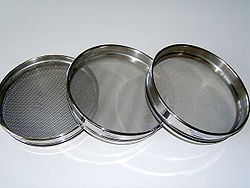
A sieve (/ˈsɪv/), fine mesh strainer, or sift is a tool used for separating wanted elements from unwanted material or for controlling the particle size distribution of a sample, using a screen such as a woven mesh or net or perforated sheet material.[1] The word sift derives from sieve.
In cooking, a sifter is used to separate and break up clumps in dry ingredients such as flour, as well as to aerate and combine them. A strainer (see colander), meanwhile, is a form of sieve used to separate suspended solids from a liquid by filtration.
Sieving
[edit]Sieving is a simple technique for separating particles of different sizes. A sieve such as used for sifting flour has very small holes. Coarse particles are separated or broken up by grinding against one another and the screen openings. Depending upon the types of particles to be separated, sieves with different types of holes are used. Sieves are also used to separate stones from sand. Sieving plays an important role in food industries where sieves (often vibrating) are used to prevent the contamination of the product by foreign bodies. The design of the industrial sieve is of primary importance here.[2]
Triage sieving refers to grouping people according to their severity of injury.
Wooden sieves
[edit]
The mesh in a wooden sieve might be made from wood or wicker. Use of wood to avoid contamination is important when the sieve is used for sampling.[3] Henry Stephens, in his Book of the Farm, advised that the withes of a wooden riddle or sieve be made from fir or willow with American elm being best. The rims would be made of fir, oak or, especially, beech.[4]
US standard test sieve series
[edit]A sieve analysis (or gradation test) is a practice or procedure used (commonly used in civil engineering or sedimentology) to assess the particle size distribution (also called gradation) of a granular material. Sieve sizes used in combinations of four to eight sieves.[5]
| Tyler | Nominal | Sieve | |
|---|---|---|---|
| opening | |||
| — | 5 inch | 125 millimetres (4.9 in) | |
| — | 4.24 inch | 106 millimetres (4.2 in) | |
| — | 4 inch | 100 millimetres (3.9 in) | |
| — | 3+1⁄2 inch | 90 millimetres (3.5 in) | |
| 2.97 inch | 3.0 inch | 75 millimetres (3.0 in) | |
| — | 2+1⁄2 inch | 63 millimetres (2.5 in) | |
| — | 2.12 inch | 53 millimetres (2.1 in) | |
| 2.10 inch | 2 inch | 50 millimetres (2.0 in) | |
| — | 1+3⁄4 inch | 45 millimetres (1.8 in) | |
| 1.48 inch | 1+1⁄2 inch | 37.5 millimetres (1.48 in) | |
| — | 1+1⁄4 inch | 31.5 millimetres (1.24 in) | |
| 1.05 inch | 1.06 inch | 26.5 millimetres (1.04 in) | |
| — | 1 inch | 25.0 millimetres (0.98 in) | |
| 0.883 inch | 7⁄8 inch | 22.4 millimetres (0.88 in) | |
| 0.742 inch | 3⁄4 inch | 19.0 millimetres (0.75 in) | |
| 0.624 inch | 5⁄8 inch | 16.0 millimetres (0.63 in) | |
| 0.525 inch | 0.530 inch | 13.2 millimetres (0.52 in) | |
| — | 1/2 inch | 12.5 millimetres (0.49 in) | |
| 0.441 inch | 7⁄16 inch | 11.2 millimetres (0.44 in) | |
| 0.371 inch | 3⁄8 inch | 9.5 millimetres (0.37 in) | |
In culture
[edit]
In iconography, the sieve was used as a symbol of chastity, in reference to the Latin legend recounting how the vestal virgin Tuccia carried water from the Tiber in a sieve without losing a drop, thus proving her virginity.
At least two portraits of Queen Elizabeth I of England, known as the Virgin Queen, show her holding a sieve in her hand. The earliest was the 1579 portrait by George Gower, showing the 46 year-old queen with a globe as symbol of imperial expansion, and a sieve for her declared virginity.[6] The same symbols appear in a later portrait signed by Quentin Metsys the Younger.[7]
Other types
[edit]- Chinois, or conical sieve used as a strainer, also sometimes used like a food mill
- Cocktail strainer, a bar accessory
- Colander, a (typically) bowl-shaped sieve used as a strainer in cooking
- Flour sifter or bolter, used in flour production and baking
- Graduated sieves, used to separate varying small sizes of material, often soil, rock or minerals
- Mesh strainer, or just "strainer", usually consisting of a fine metal mesh screen on a metal frame
- Laundry strainer, to drain boiling water from laundry removed from a wash copper, usually with a wooden frame to facilitate manual handling with hot contents
- Pickle lifter – Device for lifting pickled goods from a container
- Riddle, used for soil
- Spider, used in Chinese cooking
- Tamis, also known as a drum sieve
- Tea strainer, specifically intended for use when making tea
- Zaru, or bamboo sieve, used in Japanese cooking
- Other uses
- "Sieve" is a common term used in trash-talk referring to a goaltender in ice hockey who lets in too many goals[8]
- "Leaks like a sieve" is an English language idiom to describe a container that has multiple leaks, or, by allegory, an organization whose confidential information is routinely disclosed to the public.
See also
[edit]
- Cheesecloth – Loosely woven carded cotton cloth used primarily in cooking and cheesemaking
- Cloth filter – Method to decontaminate drinking water
- Filtration – Process that separates solids from fluids
- Gold panning – Form of placer mining
- Gyratory equipment – Tool
- Mechanical screening – Separating granulated ore by particle size
- Mesh (scale) – Measurement of particle size
- Molecular sieve – Filter material with homogeneously sized pores in the nanometer range
- Separation process – Method that converts a mixture or solution into two or more distinct products
- Soil gradation – Classification of grainy soils based on the sizes of their grains
- Water filter – Device that removes impurities in water
References
[edit]- ^ Ruhlman, Michael; Bourdain, Anthony (2007). The Elements of Cooking: Translating the Chef's Craft for Every Kitchen. Simon and Schuster. p. 216. ISBN 978-1-4391-7252-0.
- ^ "Powder Checking - Vibrating sieve - Vibrating sifters - PowderProcess.net". www.powderprocess.net.
- ^ B. De Vivo; Harvey Belkin; Annamaria Lima (2008). Environmental Geochemistry: Site Characterization, Data Analysis and Case Histories: Site Characterization, Data Analysis and Case Histories. Elsevier. p. 84. ISBN 978-0-08-055895-0.
- ^ Henry Stephens (1852). The Book of the Farm. Vol. 1. W. Blackwood. pp. 414–416.
- ^ Glover, Thomas J. (1992). Pocket Ref (Second ed.). Littleton, Col.: Sequoia Publishing. ISBN 9780962235900. OCLC 34710295.
- ^ Elizabeth I Sieve Portrait, Folger Shakespeare Library, Washington DC, USA. This is also known as the Plimpton portrait after its donor.
- ^ Ritratto di Elisabetta I, Pinoteca Nazionale di Siena (in Italian)
- ^ "Sieve Chant". uwbadgers.com. Retrieved 9 September 2020.
External links
[edit] Media related to Sieves at Wikimedia Commons
 The dictionary definition of sieve at Wiktionary
 Quotations related to Sieve at Wikiquote


| Authority control databases: National |
|---|

Sieve
View on GrokipediaDefinition and Principles
Definition
A sieve is a physical device designed for particle separation, consisting of a mesh or perforated surface that allows materials to be sorted by size as they pass over or through it. This tool operates by retaining larger particles on the mesh while permitting smaller ones to pass through the apertures, facilitating the classification of granular or powdered substances based on dimensional differences.[7][8] The primary components of a sieve include a rigid frame that provides structural support, the mesh or screen material featuring uniformly spaced apertures, and often a support grid or clamping mechanism to secure the assembly. The frame, typically cylindrical or square, holds the sieve cloth in place, while the mesh—commonly woven wire or perforated plate—defines the separation threshold through its opening sizes. These elements ensure durability and precision during use, with the overall construction adhering to standards for consistent performance in particle analysis.[9][10][11] Sieves serve essential purposes in material processing, such as sorting solids from liquids or other solids in wet or dry conditions, grading particles into size fractions for quality control, and removing impurities to purify bulk materials. In industries like pharmaceuticals, mining, and food production, they enable efficient categorization without chemical alteration, supporting applications from soil analysis to powder formulation.[12][13][14] The separation mechanism in sieving relies on fundamental physical principles, including gravity to draw particles downward through the mesh, vibration to agitate and prevent clogging by creating dynamic voids, or applied pressure to force material flow. Mesh size is quantified either by mesh number, which indicates the number of apertures per linear inch (with higher numbers denoting finer screens), or directly in microns for the aperture width, allowing precise calibration for specific particle ranges. For instance, a 200-mesh sieve typically has openings around 74 microns, balancing throughput and resolution.[15][16][17][18]Sieving Process
The sieving process involves separating particles based on size by passing a sample through a stack of sieves with progressively smaller apertures. The procedure begins with loading a representative sample onto the top sieve of the stack, ensuring the amount is appropriate to avoid overloading, such as 200 ml for meshes around 2 mm or less for finer apertures. Agitation is then applied to facilitate particle movement, either manually through shaking or tapping or mechanically via vibratory shakers that provide three-dimensional motion with controlled amplitude (typically 0-3 mm) and duration until the residue stabilizes, often indicated by less than 0.1% weight change per minute. Finally, the fractions retained on each sieve and the pan are collected, weighed to the nearest 0.1 g, and analyzed to determine the particle size distribution.[19][20] Several factors influence the efficiency of the sieving process. Particle shape affects passage probability, as elongated or irregular shapes may align to pass through apertures larger than their smallest dimension or get caught otherwise. Size distribution determines the sieve stack configuration and sample volume to ensure representative separation without excessive fines overwhelming lower sieves. Moisture content can lead to agglomeration, reducing flow and requiring adjustments like drying the sample beforehand. Sieve aperture uniformity, governed by standards such as ASTM E11, ensures reproducible results by limiting variations in opening sizes to specified tolerances (e.g., average opening deviation of ± variation Y).[15][19][21][7] Sieving actions vary by material properties and desired outcomes. Dry sieving, the most common method, relies on mechanical agitation without liquids and suits non-cohesive granular materials from 40 μm to 125 mm. Wet sieving incorporates a liquid medium, such as water, to disperse fines and prevent clogging in cohesive or moist samples, often followed by drying for weighing. Air-assisted sieving uses compressed air jets to fluidize and propel fine particles (down to 10 μm) through the mesh, ideal for dry powders prone to electrostatic buildup.[15][22][19] Common challenges in sieving include clogging, where near-sized particles block apertures, and blinding, caused by fine or sticky particles adhering to the mesh, both reducing throughput and accuracy. Mitigation strategies involve brushing coarser sieves (>100 mesh) to dislodge residues without damaging the wire cloth, or applying ultrasonics, which transmit high-frequency vibrations (typically 20-36 kHz) to the mesh for deblinding, preventing blockages and extending mesh life.[20][15][23]History
Ancient and Traditional Sieves
The earliest known archaeological evidence for sieves dates to ancient Egypt during the New Kingdom period, where a well-preserved example made from woven reeds and rushes was discovered in the Memphite Region at Lisht North, dating to approximately 1295–1070 BCE. This artifact, with a diameter of about 41 cm, exemplifies early sieving tools used for separating fine particles from coarser materials in grain processing.[24] In contemporary Mesopotamia, similar techniques employed woven reeds or animal hair to sift grains, as indicated by textual and contextual evidence from Sumerian agricultural practices, though physical artifacts are rarer due to perishable materials.[25] Traditional sieves played a vital role in pre-industrial agriculture across various societies, primarily for sifting flour from ground grains and separating seeds from chaff or debris. In ancient Egyptian farming, palm-leaf and stick sieves were essential for the final cleaning of wheat before milling, ensuring the removal of impurities to produce usable meal.[26] These manual tools allowed farmers to refine harvested crops efficiently without mechanized aid. Additionally, in indigenous cultures, sieves facilitated gold panning by straining sediments from riverbeds, as seen in ancient hydrophobic attachment methods using oily animal hair to capture fine gold particles from ore.[27] Cultural adaptations of sieves appeared in diverse regions, such as ancient Rome, where they complemented winnowing processes by further sorting threshed grain after tossing it in the air to remove husks.[28] In medieval Europe, sieves were integral to milling operations, where hand-sifted temse screens separated fine flour from bran in water-powered or manual mills, supporting widespread bread production.[29] Over time, ancient and traditional sieves evolved from simple natural materials like reeds, grasses, and animal hair—prioritized for their availability and flexibility—to more structured basic frames, often wooden, that held woven meshes for durability in repeated agricultural tasks. This progression maintained a focus on manual operation, reflecting the labor-intensive nature of pre-industrial societies without introducing mechanization.[30]Modern Developments
The Industrial Revolution marked a pivotal shift in sieve technology, with British manufacturers pioneering the use of wire mesh for more durable and precise sieving. In 1798, the production of wire cloth on weaving machines enabled the creation of finer, uniform meshes suitable for industrial applications such as mining and agriculture.[31] By the late 19th century, innovations like the steam-powered loom for wire mesh weaving, introduced by Thomas Locker & Co. in 1886, automated the manufacturing process and facilitated the production of steam-powered sieving machines for large-scale material separation.[32] In the 20th century, sieve technology advanced through standardization efforts and mechanical enhancements, particularly for quality control in emerging industries. W.S. Tyler established the foundational standards for test sieves around the 1920s, laying the groundwork for consistent particle size analysis that influenced global practices, including the US Standard Test Sieve Series as a key milestone.[33] The adoption of electric vibrators in mid-century sieving equipment, evolving from pneumatic systems, improved efficiency and precision in operations like powder processing, with widespread use by the 1950s in laboratories and factories.[34] Recent advancements up to 2025 have integrated automation and digital technologies to enhance accuracy and sustainability in sieving. Automated sieve shakers with electromagnetic drives now streamline particle analysis, reducing manual intervention and ensuring reproducible results through programmable 3D motions.[35] Laser etching on sieve frames and meshes provides precise traceability with individual serial numbers, enabling high-precision applications in pharmaceuticals and nanotechnology.[36] Digital sieve shakers equipped with sensors for vibration monitoring and frequency control further optimize performance, as seen in models with integrated manometers for real-time data.[37] Globalization has transformed sieve manufacturing, with mass production shifting to Asia to meet rising demand for cost-effective, high-volume output. Asia's rapid industrialization has driven growth in the sieving equipment market, supported by investments in advanced production technologies.[38] This shift has also prompted a move toward sustainable practices, including energy-efficient designs and reduced e-waste in vibro sifters and industrial sieves.[39]Types and Construction
Hand-Held and Wooden Sieves
Hand-held sieves are portable devices designed for manual operation, typically featuring a handle or rim for easy gripping during small-scale tasks like sifting flour, seeds, or soil. These sieves facilitate the separation of fine particles from coarser ones through simple shaking or tapping motions, making them suitable for household and garden applications. Traditional examples often measure 4 to 12 inches in diameter, allowing for efficient handling without mechanical assistance.[40] Wooden sieves represent a longstanding construction style, utilizing hardwood frames such as ash, beech, oak, elm, or maple for their strength and availability. The frame is typically formed by steaming and bending thin strips into a circular or oval rim, secured with wooden lacing strips or iron tacks, while the mesh consists of woven materials like cane, horsehair, silk, or later galvanised wire stretched taut across the opening. This design offers advantages in durability, as the hardwoods resist wear during repeated use, and low cost, relying on locally sourced timber and natural fibers. For instance, Shaker communities produced such sieves from bentwood rims with horsehair meshes starting in 1810, emphasizing craftsmanship for practical longevity.[41][42][40] Variations include the tambour sieve, or tamis, a drum-shaped wooden model with a fine mesh ideal for aerating and refining flour in baking, originating as one of the oldest sieve styles for culinary refinement. In contrast, riddle sieves employ coarser meshes for gardening, sifting soil to remove stones, roots, and debris while preserving finer tilth for planting. Maintenance of wooden sieves involves protecting against moisture, which can cause warping by unevenly expanding the wood fibers; proper care includes drying thoroughly after use and storing in a low-humidity environment to maintain structural integrity.[43][42][44] Although wooden sieves have declined in widespread use, supplanted by inexpensive plastic versions for everyday convenience, they endure in artisanal baking for their aesthetic and tactile qualities, as well as in crafts and heritage gardening where traditional methods are valued. In Britain, for example, as of 2009 mass production had dwindled to a single craftsman producing up to 120 units weekly; as of the 2020s, the craft persists through individual artisans like Steve Overthrow, highlighting their niche persistence.[42][45]Industrial and Mechanical Sieves
Industrial and mechanical sieves represent large-scale, automated systems designed for high-volume material processing in manufacturing environments, utilizing powered mechanisms to enhance separation efficiency beyond manual methods. These sieves typically employ vibration or rotational forces to stratify particles by size, enabling continuous operation in industrial settings.[46] Key types include rotary, vibrating, and gyratory models. Rotary vibrating sieves generate circular motion through a vertical motor mounted on the sieve frame, with upper and lower eccentric weights attached to the motor shaft creating centrifugal force for multi-directional vibration. Vibrating sieves, often linear or circular, rely on unbalanced motors to produce oscillatory motion that propels material across the screen surface. Gyratory sieves simulate gentle hand-sifting via a high-speed, low-amplitude circular or elliptical motion, driven by a centralized shaft or eccentric system for precise particle classification. Common components across these models include three-phase electric motors, adjustable eccentric weights or blocks to tune vibration amplitude and direction, screen frames, and suspension mounts like rubber isolators to minimize noise and transmit energy effectively.[47][48][49] Industrial designs often feature multi-deck configurations, where stackable screens allow sequential grading of materials into multiple fractions, typically up to five decks for enhanced separation without increasing footprint. These stackable systems support high capacities, ranging from 50 kg/h for fine powders to over 50 tons per hour for bulk aggregates, depending on screen size, material properties, and vibration intensity. For instance, a 2000 mm diameter rotary model can process 1.3 to 2.5 tons per hour of dry solids. Recent innovations include ultrasonic vibrating sieves that use high-frequency ultrasound (20-40 kHz) to prevent mesh blinding for ultra-fine screening down to 20 µm, and smart systems with sensors for real-time monitoring, enhancing efficiency in pharmaceuticals and nano-materials processing as of 2025.[46][50][47][51] In pharmaceuticals, mechanical sifters ensure powder uniformity by removing agglomerates, dust, and oversized particles from granules, achieving consistent particle size distribution critical for tablet formulation and quality control. Similarly, in recycling, gyratory or vibrating separators sort waste streams by classifying plastics, metals, glass, and wood fractions, facilitating efficient material recovery and reducing contamination in downstream processes like extrusion or melting.[46][52] Safety and efficiency are prioritized through enclosed housings with dust-tight seals to contain fine particulates and prevent airborne exposure, often integrated with dust collection systems for compliance with occupational health standards. Variable speed controls, achieved via frequency inverters or adjustable eccentric weights, allow operators to optimize vibration frequency (typically 15–60 Hz, depending on the sieve type and material) for different materials, minimizing energy use and screen wear while enhancing throughput.[53][54]Materials and Design
Traditional Materials
Traditional sieves were primarily constructed using natural materials sourced from local environments, with wood serving as the foundational element for frames due to its availability and workability. In 19th-century American Shaker communities, frames were crafted from bentwood rims made of ash, elm, and maple, selected for their strength, flexibility, and resistance to warping under tension. Ash provided structural rigidity, while elm offered pliability for shaping circular or oval forms, and maple contributed durability for long-term use in sifting tasks like flour or grain processing. These woods allowed for lightweight yet sturdy construction, essential for hand-held tools that required frequent manipulation. For the sieving meshes, natural fibers were woven into screens to create the filtering apertures. Horsehair, derived from animal tails, was a common choice for coarser meshes, prized for its coarse texture, strength, and elasticity, which enabled it to withstand repeated stretching without immediate breakage during sifting. Silk threads formed finer meshes in specialized applications, such as sifting medicinal powders, where their smooth, tightly woven structure allowed precise separation of impurities while maintaining a lightweight profile. Cotton gauze, with its loose open weave, was employed for delicate straining tasks, offering fineness for capturing small particles but exhibiting greater susceptibility to tearing under stress compared to horsehair. These organic materials conferred several advantages, including biodegradability and ease of crafting by hand in pre-industrial settings, where local artisans could shape frames and weave meshes without specialized machinery. However, they also presented limitations, such as vulnerability to moisture-induced rot in wooden frames and fiber degradation from insects or environmental exposure, leading to inconsistent aperture sizes over time due to natural variations in weaving and material stretch. In regions with abundant plant resources, adaptations included bamboo for frames and meshes in Asia, as seen in traditional Japanese and Chinese chaff sieves designed for rice processing, valued for bamboo's rapid renewability and natural flexibility. Similarly, in parts of Africa, such as among Xhosa communities in South Africa, reeds were woven into sieves for straining beer or sifting grains, leveraging the plant's tensile strength and availability in wetland areas. Design-wise, traditional sieves often featured simple interlaced weaves for meshes, such as plain or twill patterns in horsehair to ensure uniform openings, and mortise-and-tenon joints or steam-bent frames for secure assembly without metal fasteners.[40]Contemporary Materials
Contemporary sieve construction increasingly relies on engineered metals like stainless steel and brass to enhance durability, precision, and suitability for specific applications. Stainless steel, particularly grades 304 and 316L, offers superior corrosion resistance, making it ideal for food processing and pharmaceutical industries where hygiene and material integrity are paramount.[55][56] These sieves are often fabricated with woven-wire mesh, ensuring precise aperture control for accurate particle separation down to micrometer scales.[57] In contrast, brass sieves provide non-sparking properties, which are essential in laboratory environments handling flammable or explosive materials, although they are less durable than stainless steel under abrasive conditions.[58][59] Synthetic materials have gained prominence for their flexibility and resistance to harsh chemicals, expanding sieve applications in diverse industrial settings. Nylon and polyester meshes deliver robust chemical resistance—nylon excelling in abrasion and alkali tolerance, while polyester withstands solvents and dilute acids—allowing use in filtration processes involving corrosive substances.[60][61] Polyurethane meshes further contribute durability in high-vibration screening, such as in mining and construction, due to their elasticity and wear resistance.[62] Complementing these, silicone frames enhance overall sieve flexibility, facilitating easier handling and adaptation in dynamic processes like vibratory sifting without compromising structural integrity.[63] Advanced materials are pushing sieve performance boundaries, particularly in demanding environments. Tungsten carbide coatings applied to metal sieve components provide exceptional abrasion resistance, extending service life in high-wear scenarios like aggregate processing, where traditional metals would degrade rapidly.[64] Emerging nano-meshes, fabricated from nanoporous polymers, enable precise microfiltration for applications in biotechnology and water purification, achieving sub-micron selectivity with high throughput as demonstrated in developments as of 2024.[65][66] Sustainability considerations are shaping material choices, with a shift toward recyclable plastics and bio-based composites to minimize environmental footprints in sieve manufacturing. These alternatives, often derived from plant-based polymers or recycled feedstocks, maintain performance while supporting circular economy principles, as seen in broader industrial adoption of eco-friendly polymers for lab and processing equipment.[67]Standards and Specifications
US Standard Test Sieve Series
The US Standard Test Sieve Series, governed by ASTM E11, was officially established in 1925 by the American Society for Testing and Materials (now ASTM International) to standardize sieve specifications for particle size analysis in the United States. This standard defines over 40 designated sieve sizes, ranging from coarse apertures of 125 mm down to fine openings of 20 μm, ensuring consistent classification of materials across laboratories. It applies to woven wire test sieve cloth and the construction of test sieves used in quality control and research settings.[68][7] Sieve designations in the series follow a mesh numbering system where the mesh number inversely corresponds to aperture size, representing the approximate number of openings per linear inch (25.4 mm); for instance, a No. 200 mesh sieve has openings of 75 μm. Frames are typically available in diameters of 3 inches (76 mm), 8 inches (203 mm), or 12 inches (305 mm), with full-height or half-height options to accommodate various testing volumes. These specifications promote uniformity in particle separation for materials like aggregates and powders.[7][69] Construction under ASTM E11 requires woven wire cloth made from stainless steel, brass, or bronze, with uniform square apertures that adhere to strict tolerances for average opening size and wire diameter, ensuring no burrs, kinks, or irregularities that could affect accuracy. Sieves must be mounted in rigid, non-deformable frames to prevent distortion during use. Certification involves calibration grades—compliance, inspection, or calibration—verified through measurement of apertures and wires, often using NIST-traceable glass beads or microspheres to confirm conformance at confidence levels up to 99.73%.[7][70][71] Primarily used in the United States for applications such as soil testing, aggregate grading, and powder characterization in industries like construction and pharmaceuticals, the standard has seen updates through 2024, including refinements to tolerances for finer meshes below 125 μm to enhance precision in modern analytical needs. The ASTM E11-24 revision maintains compatibility with evolving laboratory practices while preserving core specifications.[7][72]International and Calibration Standards
The ISO 3310 series provides the primary international framework for test sieves, with ISO 3310-1 (2016) specifying technical requirements and testing methods for metal wire cloth sieves, and ISO 3310-2 addressing perforated metal plate sieves with round or square apertures. These standards cover aperture sizes from 125 mm down to 20 μm, ensuring consistent performance in particle sizing through defined tolerances on apertures and material properties; for example, average aperture tolerances for sizes greater than 100 μm are typically ±3%, with maximum single aperture deviations up to +5% to account for manufacturing variations.[73][6] Beyond the ISO norms, regional standards like the Tyler series offer metric-adapted equivalents to traditional sieve progressions, promoting compatibility in global testing while maintaining geometric ratios for aperture sizes. The British Standard BS 410 outlines specifications for wire cloth and perforated sieves in the UK, emphasizing aperture accuracy and frame construction, whereas the German DIN 4188 (withdrawn 1992, superseded by ISO 3310-1) detailed dimensions for wire screens used in test sieves.[74][75][76] Calibration procedures for compliance with these standards involve rigorous verification techniques, including microscopic inspection to measure individual apertures and wire diameters along predefined lines, electrical zone sensing for high-precision dimensional analysis, and automated image analysis systems for comprehensive sieve mapping. Laboratories generally conduct full calibrations annually, or more frequently for high-use environments, to verify adherence to tolerance limits and maintain traceability to primary standards.[77][78][79] These standards play a vital role in international trade by guaranteeing sieve interoperability, which is essential for consistent quality control in exported materials like aggregates and powders.[80]Applications
Culinary and Household Uses
In culinary applications, sieves are essential for preparing ingredients by separating solids from liquids or aerating dry goods. Sifting flour through a fine-mesh sieve aerates it, removing lumps and incorporating air to produce lighter batters and doughs for baked items like cakes and cookies.[81][82] Strainers, a type of sieve, are commonly used to drain pasta after boiling, allowing water to pass through while retaining the noodles, or to separate tea leaves from steeped liquid in loose-leaf preparations.[83][81] Fine-mesh sieves also facilitate dusting powdered sugar or cocoa over desserts for even coverage, and they can sift spices to ensure uniform particle size in rubs or sauces.[83][84] Beyond the kitchen, sieves serve practical household functions in cleaning and maintenance tasks. They are used to strain old paint, filtering out clumps and debris to restore smoothness before reuse, often with a mesh screen fitted over a bucket.[85] In gardening, sieves filter garden soil by sifting out rocks, roots, and debris, creating fine, usable earth for planting or potting mixes.[86] For personal care, fine sieves separate jewelry from cleaning solutions or debris, such as rinsing small pieces like rings or chains while capturing dirt particles.[87] Common tool variations include colanders, which function as large-holed sieves for draining voluminous items like pasta or vegetables, and tea strainers, compact mini-sieves designed for individual infusions.[88] For food safety, sieves made from non-reactive materials like stainless steel or nylon are recommended to avoid chemical interactions with acidic ingredients, preventing off-flavors or contamination.[82] In specific cultural recipes, sieves play a key role in traditional preparations. For baking sourdough bread, sifting flour aerates it and removes bran for a finer texture, contributing to the loaf's open crumb structure, though it's optional in rustic styles.[89] In making ricotta cheese, a cheesecloth-lined sieve drains curds from whey after heating milk, yielding creamy results essential for Italian dishes like lasagna or cannoli.[90]Industrial and Scientific Applications
In industrial settings, sieves are essential for particle size analysis during cement production, where they help classify raw materials and clinkers to ensure uniform quality and optimize grinding efficiency. [91] Similarly, in powder coating processes, sieves remove oversized particles and contaminants to achieve consistent film thickness and adhesion, with high-energy vibratory sieves enabling precise control over particle sizes typically between 12 and 80 microns. [92] For wastewater treatment, rotating belt sieves and vibratory screens separate solids from liquids in primary treatment stages, capturing particles as small as 0.35 mm to reduce organic load and facilitate resource recovery like cellulose. [93] In pharmaceuticals, multi-stage sieving employs stacked meshes of varying apertures to fractionate powders, controlling particle distribution for drug formulation stability and bioavailability, often achieving separations down to 10 microns. [94] Scientifically, sieves perform lab granulometry in soil and geology by stacking calibrated meshes to determine grain size distribution, aiding in classification of sediments for geotechnical assessments and environmental studies. [95] In microbiology, membrane sieves with pore sizes of 0.2 to 0.45 microns filter out bacteria and larger microbes from samples, enabling sterile culturing and pathogen detection through size-exclusion mechanisms. [96] For nanotechnology, nano-sieves fabricated with precise pores around 15 nanometers capture and release bioparticles or nanoparticles, supporting applications in drug delivery and material synthesis by enabling selective separation based on size. [97] Specialized uses include grading explosive materials in mining, where sieve analysis ensures uniform particle distribution in dust samples to assess explosibility risks and optimize blast fragmentation, with gradation curves guiding safe handling. [98] In chemistry, catalyst sieving refines particle beds to specific size ranges like 63-106 microns, enhancing reaction selectivity and bed porosity for processes such as CO conversion. [99] Efficiency in these applications is quantified by throughput rates, with industrial vibratory sieves processing 40 to 4500 kg/h depending on mesh size and material, balancing capacity with separation accuracy. [100] Recent advancements integrate artificial intelligence with sieve systems for real-time particle size analysis, using machine vision to monitor distributions in heavy industry and soil testing, improving predictive maintenance and process optimization by 2025. [101] These AI-enhanced setups comply with standards like ASTM for lab applications, enabling automated adjustments to sieving parameters. [102]Cultural and Symbolic Aspects
In Folklore and Art
In European folklore, sieves have long been associated with divination practices known as coscinomancy, where a sieve suspended on shears or scissors would pivot to answer yes-or-no questions, often to identify thieves or locate lost items. This method, documented from ancient Greece through the medieval and early modern periods, symbolized the separation of truth from falsehood, with the sieve's motion interpreted as supernatural guidance.[103] In Japanese yokai legends, sieves appear as protective tools against certain spirits; the one-eyed mikari baba, a hag-like demon who steals eyes from sleeping children, flees from objects with many holes, such as bamboo sieves, which disrupt her ethereal form and trap her gaze. These tales, rooted in Edo-period folklore, portray the sieve as a mundane household item transformed into a ward against supernatural intrusion.[104] Brazilian folklore, influenced by African traditions brought during the transatlantic slave trade, features the saci-pererê, a one-legged trickster spirit who can be captured by throwing a sieve into a whirlwind where he hides, restraining his mischievous whirlwinds and allowing humans to extract favors or punish him. This motif underscores the sieve's role in containing chaos and enforcing order in narratives blending Indigenous, African, and European elements.[105] Sieves hold symbolic significance in Hindu rituals, particularly during Karwa Chauth, where married women view the moon through a sieve (chani) to break their fast, the mesh filtering moonlight to represent the removal of impurities and negativity from marital life, ensuring prosperity and purity in the union. This practice evokes themes of separation and refinement, aligning the sieve with spiritual cleansing in devotional observances.[106] In Renaissance art, the sieve emerged as a potent emblem of chastity, most notably in portraits of Queen Elizabeth I, such as Quentin Metsys the Younger's 1583 Sieve Portrait, where she holds a gold sieve inspired by the Roman Vestal Virgin Tuccia's miracle of carrying Tiber water without spilling, asserting her virgin sovereignty and filtering out unworthy suitors. These works transformed the domestic tool into a political allegory of unbreached integrity.[107] Contemporary artists have repurposed sieves to explore themes of perception and information overload; Spanish sculptor Isaac Cordal's 2012 installation Cement Bleak in London featured colanders (kitchen sieves) mounted under streetlights, casting distorted shadowy faces on pavements to symbolize how urban environments filter and fragment human identity in the digital age. Such pieces critique the selective nature of modern communication, using the sieve's perforations to evoke distorted realities.[108]Idioms and Metaphors
The idiom "have a memory like a sieve" describes a person who is extremely forgetful, likening the mind to a sieve through which information slips away like fine particles. This expression originated in early 19th-century English literature, appearing in an anonymous poem that compared human memory to a leaky container unable to retain contents.[109][110] Another related phrase, "sift the truth," refers to the careful examination of information to separate facts from falsehoods or irrelevancies, drawing from the sieving process of isolating valuable elements. The verb "sift" in this metaphorical sense traces back to Old English siftan, meaning to pass through a sieve, and by the 16th century, it had evolved in English to denote scrutinizing evidence for discernment.[111][112] Proverbs across cultures employ the sieve to convey themes of selectivity and futility. In Italian folklore, "An ass's tail will not make a sieve" illustrates the impossibility of achieving a refined outcome from crude materials, emphasizing inherent limitations.[113] Similarly, the Spanish proverb "A boy's love is water in a sieve" portrays youthful affection as fleeting and impossible to contain, like liquid draining through holes.[113] In literature, the sieve appears as a symbol of impossibility or supernatural defiance. William Shakespeare references it in Macbeth (Act 1, Scene 3), where witches boast of sailing "in a sieve" to distant shores, alluding to folklore beliefs that such vessels allowed witches to traverse stormy seas without sinking, representing defiance of natural laws.[114] Metaphorically, the sieve extends to psychology as a model for information processing, where the mind filters relevant stimuli while discarding the extraneous, akin to cognitive selective attention mechanisms.[115] In politics, it critiques inefficient systems, such as tax policies described as a "sieve" that allows wealth to escape through loopholes, as economist Henry Calvert Simons noted in 1938 regarding progressive taxation's challenges.[116] In contemporary contexts, particularly by the mid-2020s, "data sieve" has emerged in computing to metaphorize algorithms that filter vast datasets, removing noise or side effects to isolate useful outputs, as seen in software frameworks like Sieve for parallel processing.[117][118]References
- https://en.wiktionary.org/wiki/sift