Hubbry Logo
SkirmisherSkirmisherMain
Open search
Skirmisher
Community hub
Skirmisher
logo
8 pages, 0 posts
0 subscribers
Be the first to start a discussion here.
Skirmisher
Skirmisher
from Wikipedia
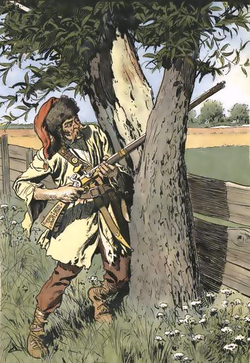
Austrian pandur, c. 1760, using a tree for cover while skirmishing
As with most other modern foot soldiers, the US 6th Marine Regiment, on patrol near Marjah, 2010, routinely uses skirmish formation.

Skirmishers are light infantry or light cavalry soldiers deployed as a vanguard, flank guard or rearguard to screen a tactical position or a larger body of friendly troops from enemy advances. They may be deployed in a skirmish line, an irregular open formation that is much more spread out in depth and in breadth than a traditional line formation. Their purpose is to harass the enemy by engaging them in only light or sporadic combat to delay their movement, disrupt their attack, or weaken their morale. Such tactics are collectively called skirmishing. An engagement with only light, relatively indecisive combat is sometimes called a skirmish even if heavier troops are sometimes involved.

Skirmishers can be either regular army units that are temporarily detached to perform skirmishing or specialty units that were specifically armed and trained for such low-level irregular warfare tactics. Light infantry, light cavalry (historically), and irregular units often specialize in skirmishing. Skirmishers' open formations and smaller numbers can give them superior mobility over the regular forces, allowing them to engage only on favorable terms, taking advantage of better position or terrain, and quickly withdrawing from any threat of superior enemy forces. Though often critical in protecting the main army from sudden enemy advances, skirmishers were historically poor at taking or defending ground from heavy infantry or heavy cavalry.

Ancient history

[edit]
An Agrianian peltast holding three javelins, one in his throwing hand and two in his pelte hand as additional ammunition
Slinger from the Balearic islands, famous for the skill of its slingers

In ancient warfare, skirmishers typically carried bows, javelins, slings and sometimes light shields. Acting as light infantry with their light arms and minimal armour, they could run ahead of the main battle line; release a volley of arrows, sling stones, or javelins; and retreat behind their main battle line before the clash of the opposing main forces. The aims of skirmishing were to disrupt enemy formations by causing casualties before the main battle and to tempt the opposing infantry into attacking prematurely, thus throwing their organization into disarray. Skirmishers could also be effectively used to surround opposing soldiers in the absence of friendly cavalry.

Once preliminary skirmishing was over, skirmishers participated in the main battle by shooting into the enemy formation, or they joined in melée combat with daggers or short swords. Their mobility made skirmishers also valuable for reconnaissance, especially in wooded or urban areas.

In Classical Greece, skirmishers originally had a low status. For example, Herodotus, in his account of the Battle of Plataea of 479 BC, mentioned that the Spartan Army fielded 35,000 lightly armed helots to 5,000 hoplites, but there is no mention of them in his account of the fighting.[1] Often, Greek historians ignored them altogether,[1] but Xenophon distinguished them explicitly from the statary troops.[2] It was far cheaper to equip oneself as lightly armed than a fully-armed hoplite. Indeed, it was common for the lightly armed to go into battle equipped with stones.[3] The low status of skirmishers reflected the low status of the poorer sections of society that made up skirmishers.[4] Additionally, hit-and-run tactics went against the Greek ideal of heroism. Plato gives the skirmisher a voice to advocate "flight without shame" but only to denounce it as an inversion of decent values.[5]

Nevertheless, skirmishers then chalked up significant victories, such as the Athenian defeat at the hands of the Aetolian javelin men in 426 BC and, during the same war, the Athenian victory at the Battle of Sphacteria.[4]

Skirmisher infantry gained more respect in subsequent years, as their usefulness was more widely recognised and as the ancient bias against them waned. Peltasts, light javelin infantry, played a vital role in the Peloponnesian War, and well-equipped skirmisher troops such as thureophoroi and thorakites would be developed to provide a strong mobile force for the Greek and the Macedonian armies.

The Celts did not, in general, favour ranged weapons. The exceptions tended not to include the use of skirmishers. The Britons used the sling and javelin extensively but for siege warfare, not skirmishing.[6] Among the Gauls, likewise, the bow was employed to defend a fixed position.[7] The Celts' lack of skirmishers cost them dearly during the Gallic Invasion of Greece of 279 BC when they found themselves helpless in the face of Aetolian skirmishing tactics.[8] Thracians were famous for their skirmish war tactics and offered their services as mercenaries more than once in the Greek civil wars in ancient times.[9]

In the Punic Wars, despite the Roman and Carthaginian armies' different organisations, both had the role for skirmishers as screening the main armies.[10] The Roman legions had a specialised infantry class, Velites, which acted as skirmish troops who engaged the enemy before the Roman heavy infantry made contact, and the Carthaginians recruited their skirmishers from the native peoples across the Carthaginian Empire.

The Roman army of the late republican and early imperial periods frequently recruited foreign auxiliary troops to act as skirmishers to supplement the citizen legions.

Middle Ages

[edit]

Medieval skirmishers were generally commoners armed with crossbows or longbows. In the 14th century, although long held in disdain by the aristocratic Castilian heavy cavalry, the crossbowmen contributed greatly to the Portuguese victory at the Battle of Aljubarrota. Similarly, English archers played a key role in the English victory over French heavy cavalry at the Battle of Crécy. In the next century, they largely repeated that feat at the Battle of Agincourt.

Early modern period

[edit]

Americas

[edit]

The Seven Years' War and American Revolutionary War were two early conflicts in which the modern rifle began to make a significant contribution to warfare. Despite its lower rate of fire, its accuracy at long range offered advantages over the smoothbore musket, then commonly used by regular armies. In both wars, many American frontiersmen served in the militia. The Continental Army during the American Revolutionary War was assisted by such irregular troops, such as the Minutemen, who engaged in skirmishing tactics by firing from cover, rather than in the open-field engagements that were customary at the time. Their tactics were influenced by experiences in fighting Native Americans. Militia in a skirmish role was particularly effective in the Battle of Cowpens. The character of Natty Bumppo in James Fenimore Cooper's novel The Last of the Mohicans was notably called La Longue Carabine by the French because of his skill with the long rifle, which was common among the Colonials.

Napoleonic Wars

[edit]
Austrian Jäger around 1800, showing the relatively drab uniforms of soldiers specializing in skirmishing in Napoleonic times, as an aid in using cover

During the Napoleonic Wars, skirmishers played a key role in battles; they attempted to disrupt the main enemy force by firing into their close-packed ranks and to prevent enemy skirmishers from doing the same to friendly troops. Because skirmishers generally fought in open order, they could take cover behind trees, houses, towers and similar items, thereby presenting unrewarding targets for small arms and artillery fire. Such tactics often made them vulnerable to cavalry. Some skirmishers had a minor sapper role by placing cheval de frise to deter cavalry.

A skirmish force screening the main body of infantry became so important to any army in the field that eventually, all major European powers developed specialised skirmishing infantry. Examples included the German Jäger, the French voltigeurs and the British riflemen.

Muskets were the predominant infantry weapon of the late 18th century, but the British Army learned firsthand of the importance of rifles during the American Revolutionary War and began experimenting with them shortly thereafter, resulting in the Baker rifle. Although slower to reload and more costly to produce than a musket, it was much more accurate and proved its worth during the Peninsular War. Throughout the conflict, British riflemen could selectively target and eliminate the officers and NCOs of French forces from outside musket range.[11]

During the War of 1812, American riflemen again contributed to British casualties but also had to contend with the revised British light infantry tactics.

A consequence of those wars' experiences was a trend to training line troops to adopt tactics that had been used only by skirmishers.[12]

American Civil War

[edit]

The treatise New American Tactics, by General John Watts de Peyster, advocated making the skirmish line the new line of battle, which was then a revolutionary idea.[13] During the American Civil War, cavalrymen often dismounted and formed a skirmish line to delay enemy troops who were advancing toward an objective. An example was the action of the Union cavalrymen led by Brigadier General John Buford on the first day of the Battle of Gettysburg. Skirmish lines were also used to harass enemy probing missions, hampering the other force from gaining an effective intelligence picture by engaging their scouts, and likewise forcing them to deploy.[14]

Late modern period

[edit]
Modern reconnaissance vehicles can perform skirmishing duties, as is shown here by members of the British 4 Mechanised Brigade, Brigade Reconnaissance Force mounted on Jackals, on a training exercise in Jordan, in preparation for deployment to Afghanistan in 2009

By the late 19th century, the concept of fighting in formation was on the wane. Heavy infantry had disappeared, and all infantry effectively became skirmishers. The term has become obsolete, but as late as World War I, it continued to be associated with battlefield reconnaissance screens, which are essentially modern skirmish lines. As in the American Civil War, the primary role of the infantry skirmish line was to screen the advance of a parent force and to disrupt the enemy's own reconnaissance efforts.[15] With the mechanization of modern warfare, the role of infantry skirmishers was more or less combined with those of light cavalry, as mounted scouts in specialized reconnaissance vehicles took over the responsibility of screening large formations during maneuvers, in addition to conducting their own probing actions.[16]

Cold War and beyond

[edit]

Apartheid South Africa's military doctrine stressed the use of highly-mobile, light-mechanized forces that could cover ground swiftly while they kept heavier enemy armoured and infantry formations off balance and did not engage until the conditions were favourable.[17] The lightly armed South African units used tactics such as rapid movement, flank harassment and confusing the enemy with continuous maneuvering to compensate for their inferiority in firepower when they were faced with Angolan and Cuban forces during the South African Border War.[17] The innovative use of South African reconnaissance units to throw Angolan tank formations into disarray before it lured them into ambushes, effectively deploying the units as skirmishers, was another consistent feature of that conflict.[18]

See also

[edit]

References

[edit]

Sources

[edit]

Further reading

[edit]
[edit]
Revisions and contributorsEdit on WikipediaRead on Wikipedia
from Grokipedia
A skirmisher is a soldier, typically or , who engages in irregular, small-scale combat ahead of or on the flanks of a main formation, using , missile weapons, or to harass, disrupt, and screen against enemy forces. Skirmishers have been a fundamental element of warfare since antiquity, originating as lightly armed troops specialized in mobility and ranged attacks to weaken opponents before close-quarters battle; for instance, in armies, peltasts served as skirmishers hurling javelins to disorder heavier phalanxes. In the , fulfilled similar roles as the lightest infantry class, equipped with javelins and minimal armor to probe enemy lines and provide early warning. Their tactical value lay in exploiting terrain for cover, avoiding decisive engagements, and forcing enemies to deploy prematurely or divide their attention. During the , particularly in the (1799–1815), skirmishers evolved into dedicated units, such as French or British riflemen, who operated in extended order to suppress enemy and with accurate fire while the main line columns advanced. This loose deployment contrasted with rigid linear formations, allowing greater flexibility and marking a shift toward tactics that integrated skirmishing with . In the (1861–1865), skirmishers—often sharpshooters or picked men from line regiments—performed , delayed advances, and protected flanks, operating in a dispersed "skirmish line" to contest ground without committing the full force. The skirmisher role persists in contemporary military doctrine, adapted to mechanized and asymmetric conflicts, where small, agile units conduct reconnaissance, ambushes, or swarming attacks to disrupt larger adversaries, as seen in proposals for "Army skirmishers" emphasizing mobility over massed firepower.

Overview

Definition and Characteristics

A skirmisher is a type of light infantry or light cavalry soldier deployed ahead of or alongside a larger body of friendly troops, specializing in irregular and dispersed combat tactics primarily for screening movements, harassing enemies, and conducting reconnaissance. These troops operate independently or in small groups, emphasizing stealth, initiative, and adaptability to terrain rather than reliance on heavy support or fixed positions. Key characteristics of skirmishers include exceptional mobility due to lighter equipment, proficiency with ranged weapons such as javelins, bows, or early firearms for hit-and-run engagements, and a deliberate avoidance of prolonged close-quarters to minimize casualties. They typically fight in loose, open formations that allow for individual maneuver and cover exploitation, often in close or restricted where their provides an advantage over more cumbersome units. This contrasts sharply with , which advance in rigid, shoulder-to-shoulder formations optimized for coordinated volleys and bayonet assaults in open battles, and , which prioritize massed charges and shock impact with armored mounts and lances or sabers. The term "skirmisher" evolved in English from "skirmish," a word borrowed in the late from escarmouche (an irregular fight or ), itself derived from the verb eskirmir meaning "to fight" or "to defend," rooted in a Germanic term for protection. By the mid-16th century, "skirmisher" specifically denoted soldiers engaged in such tactics, reflecting their role in preliminary or flanking actions distinct from main force engagements.

Tactical Roles and Employment

Skirmishers primarily served to screen main forces from enemy and attack, operating ahead or on the flanks to conceal troop movements and dispositions. They disrupted enemy advances through and probes, forcing opponents to deploy prematurely or divert resources. Additionally, skirmishers gathered by conducting and enemy positions, while providing covering fire to support maneuvers such as advances, retreats, or river crossings. In , skirmishers typically operated in extended order, dispersing into loose formations to maximize mobility and evade counterattacks. They executed hit-and-run attacks, engaging briefly with missiles before withdrawing to avoid close combat, often coordinating by retiring through gaps in the main battle line for protection or resupply. Feigned retreats were a key tactic, luring denser units into vulnerable positions where they could be ambushed or outmaneuvered by heavier troops. This integration with the main line ensured skirmishers enhanced overall flexibility without exposing themselves unduly. Skirmishers exploited effectively, using woods, hills, and broken ground for cover during or ambushes, where their mobility allowed them to outpace pursuers and maintain initiative. In such environments, they could delay enemy forces significantly by seizing or passes. Conversely, in open fields, they faced disadvantages against disciplined volleys or charges, as their light armament and dispersed order left them exposed without rapid support from the main body. Over time, skirmishers' roles evolved from primarily offensive harassment—disrupting and probing in fluid engagements—to more defensive delaying actions, screening retreats and buying time for repositioning in prolonged campaigns. This shift reflected broader tactical developments toward integration, where skirmishers transitioned from independent raiders to essential enablers of maneuvers.

Equipment and Organization

Armaments and Gear

Skirmishers were typically equipped with light missile weapons designed for rapid deployment and harassment from a distance, such as javelins, bows, and slings, which allowed them to engage enemies without closing into range. In forces, peltasts carried bundles of two to three lightweight javelins, often 1-2 meters long with heads and thongs for improved throwing distance up to 90 meters, supplemented by a short slashing (machaira) for close encounters. Roman velites, as early skirmishers, similarly relied on javelins for initial volleys, alongside slings and bows used by auxiliary light troops to soften formations before heavier advanced. These armaments emphasized portability, with total weapon weight rarely exceeding 4 kg, enabling skirmishers to maintain high mobility across varied terrain. Protective gear for skirmishers prioritized speed over defense, featuring minimal armor such as or padded tunics, or none at all, to avoid during evasion and pursuit. Peltasts employed a small, crescent-shaped called the pelte, made of framed with wood and covered in animal hide, weighing about 1 kg and measuring roughly 60 cm across, which provided basic cover without hindering movement. Roman and other Mediterranean followed suit with lightweight cuirasses or simple cloaks for rudimentary protection, forgoing heavy metal plates or large shields that would slow their tactical withdrawal. This approach ensured skirmishers could outpace pursuing heavy troops, as seen in classical battles where unarmored javelineers disrupted phalanxes through . Logistical equipment reflected the need for extended operations, including lightweight packs for carrying rations, spare javelins, and minimal personal items during scouting missions, often limited to 10-15 kg to preserve endurance. Mounted variants, such as skirmishers, utilized hardy horses for rapid and flanking, equipped with simple saddles and bridles rather than cumbersome to facilitate quick dismounts for . By the (16th-18th centuries), skirmisher armaments shifted from thrown and bow-based missiles to weapons, with adopting muskets and early rifles for greater range and penetration, marking the decline of traditional projectiles in European armies. Prussian units, for instance, carried rifled muskets with minimal accoutrements like powder horns and bullet pouches, while French chasseurs used carbines suited to mobile skirmishing. This evolution reduced armor further, as firearms rendered heavy protection obsolete, and logistics adapted to include ammunition carts or horse-borne supplies, enabling sustained fire support in loose-order formations. In the 19th and 20th centuries, equipment advanced to include breech-loading rifles, machine guns, and portable mortars, emphasizing versatility in mechanized warfare, as seen in units like British riflemen during the and U.S. Army Rangers in .

Training and Unit Structure

Skirmisher training prioritizes individual proficiency in marksmanship, stealth, and marching to enable effective harassment and in varied terrains, contrasting with the rigid drill formations emphasized for . This approach fosters self-reliance through arduous regimens, including long-distance hikes and night operations, which build physical stamina and tactical adaptability while minimizing reliance on suited for lighter, mobile loads. Independent decision-making is honed via small-unit exercises like , allowing soldiers to respond to dynamic threats without constant oversight. Recruitment for skirmisher roles typically draws from volunteers, frontiersmen, or ethnic who possess innate , local , and resilience, often selected through demonstrations such as marksmanship contests. These individuals are valued for their adaptability to , with non-elite or younger recruits frequently chosen to leverage their physical vigor and lower exposure risk in forward positions. Ideological commitment or specialized backgrounds, like outdoor expertise, further guide selections to ensure cohesion in isolated operations. Unit structures for skirmishers consist of small, flexible groups ranging from 10 to 50 personnel, organized under junior officers or non-commissioned officers to facilitate rapid deployment as detachments within larger armies. These ad-hoc formations, often subdivided into sections of 12-16 members, emphasize loose intervals for mobility and avoid rigid hierarchies, enabling integration with main forces while maintaining operational independence. Logistics are kept minimal, focusing on man-portable supplies to support extended maneuvers without encumbrance. Command dynamics grant skirmishers high field , with junior leaders empowered to exercise initiative in real-time adjustments, while reporting periodically to line commanders for alignment with broader strategies. This decentralized approach relies on trust in subordinates' judgment, particularly in fluid engagements where communication lags demand on-the-spot decisions, though overall objectives remain dictated by higher echelons. Effective from the front reinforces and ensures coordinated without .

Ancient and Classical Periods

Greek and Hellenistic Skirmishers

In ancient Greek warfare, peltasts emerged as a pivotal type of light infantry, originating from the warlike Thracian tribes in regions encompassing modern southern Bulgaria, European Turkey, eastern Macedonia, and northeastern Greece. These troops, named after their distinctive crescent-shaped pelta shield made of wicker covered with animal skins, were recruited by Greek city-states from the Thracian regions starting around the late 6th century BCE, following Persian influences. Unlike heavily armored hoplites, peltasts wore minimal protection—often just tunics, fox-skin caps, and colorful cloaks—to prioritize mobility, and they carried multiple javelins (ranging from 1¼ to 2¼ yards in length) for throwing, along with a short machaira sword for close encounters. Their Thracian heritage, documented by historians like Herodotus who described their equipment during Xerxes' 480 BCE invasion, made them ideal for irregular tactics in rugged terrains. Peltasts played a crucial screening role in phalanx-based armies, deploying ahead of the heavy hoplite formations to disrupt enemy advances and protect the flanks of the slower, shield-wall infantry. During the Greco-Persian Wars (499–448 BCE), Greek forces, primarily hoplite-centric, faced overwhelming numbers of Persian skirmishers and missile troops; peltasts countered this by harassing the lighter Persian units with hit-and-run javelin volleys, buying time for hoplites to close for decisive melee. This adaptation highlighted the limitations of pure phalanx tactics against mobile foes, as seen in battles like Marathon (490 BCE), where light infantry screened the Greek center against Persian archers and cavalry. By the Peloponnesian War (431–404 BCE), peltasts had become integral to Athenian strategy, exemplified at the Battle of Sphacteria (425 BCE), where 800 Messenian peltasts and 800 archers, supported by other light troops, encircled and defeated 420 elite Spartan hoplites on a forested island off Pylos. Through relentless skirmishing and ambushes, they forced the surrender of 292 Spartans, including 120 Spartiates—a humiliating blow to Sparta's aura of invincibility, as chronicled by Thucydides. This victory underscored peltasts' effectiveness in exploiting the hoplites' vulnerabilities to missile fire and terrain, shifting Greek warfare toward combined arms. The Hellenistic period saw further adaptations of skirmisher tactics under the Macedonian kingdom, particularly in the armies of Philip II and his son , who integrated diverse light troops to complement the sarissa-armed . Alexander's forces emphasized multinational skirmishers for , flanking maneuvers, and pursuit; key among them were the Agrianians, an elite contingent of about 1,000 from the Paeonian tribes in the upper Strymon valley. Equipped with javelins (lonchai), small pelta shields, light armor, and Phrygian helmets, the Agrianians excelled in mountainous terrain, often guarding the right flank and executing special missions, such as outmaneuvering Persians at the (333 BCE). Complementing them were , renowned for their self-bows made of or cedar, small shields, and swords, who provided ranged support on the flanks and participated in sieges like the Persian Gate (330 BCE). These units, numbering in the thousands across Alexander's campaigns, enabled rapid adaptations against vast Achaemenid armies, as at Gaugamela (331 BCE), where their harassment disrupted Persian formations. Following Alexander's death in 323 BCE, the professionalization of in the successor states led to a gradual decline in traditional skirmishers by the post-3rd century BCE. As monarchs like the Antigonids and Seleucids prioritized large, standing phalanxes of Macedonian and for decisive pitched battles, light troops shifted toward hybrid roles, such as the thureophoroi—infantrymen with larger oval shields who could function as both skirmishers and line troops. , often rearmed with javelins for versatility, filled secondary duties, but the emphasis on elite pikemen reduced the prominence of pure peltast-style units, especially after defeats like the Galatian invasion (279 BCE) prompted further tactical consolidation. By the BCE, Roman influences further marginalized these lighter elements in favor of more rigid systems.

Roman and Other Mediterranean Forces

In the Roman manipular legion of the mid-Republic, served as component, consisting of the youngest and poorest citizens who were levied for service. These skirmishers were positioned at the front of the legion's formation, ahead of the heavier , to engage the enemy first with missile weapons and disrupt their lines before withdrawing to the flanks or rear. The were lightly equipped for mobility, carrying a short sword for close combat, several javelins with wooden shafts about two cubits long and iron heads designed to bend on impact, and a small (parma) approximately three feet in diameter for basic protection. They wore no , only a simple (galea) often adorned with animal skins for unit identification, emphasizing speed over defense in their skirmishing role. Each legion had about 40 velites attached to each of the 30 heavy infantry maniples, totaling 1,200 per legion, allowing for flexible screening tactics influenced by earlier Greek peltast formations. Following the Marian reforms of 107 BCE, the velites were phased out as the legion transitioned to a more uniform cohort structure, with all legionaries equipped similarly as heavy infantry and the state providing standardized gear to professional volunteers regardless of wealth. This shift reduced the reliance on class-based light troops, integrating their functions into the main body or outsourcing them to non-citizen auxiliaries. To compensate for the loss of dedicated citizen skirmishers, Roman commanders increasingly depended on auxiliary forces from allied or conquered peoples, particularly for specialized light roles during the Punic Wars and subsequent conquests. Balearic slingers from the Balearic Islands, renowned for their accuracy with lead bullets, were frequently deployed as missile troops to harass enemy formations from afar, supporting legionary advances in Sicily and North Africa. Similarly, Numidian cavalry provided mobile skirmishing with javelins, excelling in hit-and-run tactics that proved decisive at battles like Zama in 202 BCE, where their defection to Rome turned the tide against Carthage. Among other Mediterranean powers, Carthaginian armies employed skirmishers drawn from Libyan and Iberian mercenaries, armed with javelins and small shields to screen their heavier es and African spearmen during engagements with . These troops engaged in probing attacks and feigned retreats, as seen in early clashes of the Second Punic War. In the of , native Egyptian archers served as auxiliary skirmishers, using composite bows to support the Greco-Macedonian in border defenses and campaigns, with reforms under Ptolemy IV around 217 BCE integrating them more effectively into hybrid formations before the . Roman skirmishers and auxiliaries were tactically integrated to soften targets during sieges, such as the bombardment of Carthaginian positions in the Third Punic War, or to counter barbarian mobility in forested terrains. In the disastrous in 9 CE, auxiliary infantry and cavalry accompanied the three legions under , attempting to screen the column against Germanic ambushes, but rain-soaked ground and dense woods hampered their effectiveness, contributing to the near-total annihilation of the force.

Medieval Period

European Skirmishers

In feudal and high medieval , skirmishers served as in armies centered on mounted knights, providing , , and disruption against heavier formations. These troops, often drawn from regional levies or hired mercenaries, operated on the flanks or ahead of main forces to soften enemy lines before decisive engagements. Their effectiveness stemmed from mobility and ranged weapons like bows and crossbows, contrasting with the armored shock tactics of nobility. During the (1337–1453), exemplified skirmishers, contracted by French forces for their renowned precision and discipline. These professional units, organized into relay teams supported by pavise-bearing servants, were deployed to cover advances by knightly . Welsh longbowmen, integrated into English armies as levied archers, countered them effectively, firing arrows at rates of 10–12 per minute from protected positions. At the Battle of Crécy in 1346, these skirmishers clashed decisively, with —numbering around 6,000–12,000—ordered forward by King Philip VI to harass English lines but retreating under withering fire due to wet bowstrings and lack of shields. The approximately 7,000 English and Welsh men, positioned in a V-shaped formation with dismounted knights, repelled multiple French cavalry charges, inflicting heavy casualties and securing victory. This engagement highlighted skirmishers' role in disrupting knightly assaults, marking an evolution from pure foot combatants toward incorporating early elements in later phases. Organizationally, medieval European skirmishers were typically feudal levies—peasant or minor noble conscripts fulfilling service obligations—or specialized mercenaries attached to contingents, limited by the irregular nature of feudal summons that prioritized short campaigns. By the , armies increasingly stiffened these forces with paid professionals, such as Genoese units, to enhance reliability amid the knight-dominated hierarchy. profoundly influenced skirmisher tactics, proving them vital in fragmented landscapes like the ' hilly regions and the Anglo-. In 14th-century , crossbow-armed mercenaries in condottieri bands exploited uneven ground for ambushes and prolonged engagements among rival republics. Similarly, on the , raiders from groups conducted cattle thefts and hit-and-run attacks, often led by magnates like the , to disrupt foes during truces or larger conflicts.

Byzantine, Islamic, and Asian Variants

In the , the theme system organized military districts where local peasant-soldiers, including and horse archers, formed the backbone of defense against Arab incursions and nomadic threats during the medieval period. These units provided rapid mobility to harass invaders, repel minor raids, and delay larger assaults until central reserves could arrive, leveraging fortifications as rallying points. employed flexible formations, such as moving "fortresses" of spearmen screened by horse archers, to counter the feigned retreats and archery volleys of steppe nomads like the and Seljuks. Byzantine tactics integrated these skirmishers with heavy cataphracts, creating composite cavalry forces where light horse archers provided missile support and flanking protection during charges. For instance, at battles like in the and later engagements under Nikephoros Phokas in the , light units feigned retreats to lure enemies into ambushes by armored cataphracts, while squares offered safe havens for repositioning. This synergy emphasized defensive depth on eastern frontiers, adapting Roman legacies to prolonged medieval conflicts with mobile and Turkish forces. In Islamic military traditions, ghazi raiders—frontier holy warriors—and skirmishers played key roles in harassing Crusader armies through suited to desert terrains. These lightly equipped horsemen, often operating in loose tribal formations, used superior mobility to conduct raids, disrupt supply lines, and avoid pitched battles, embodying the ghazi ideal of faith-driven expansion. Armed primarily with composite bows made of wood, horn, and sinew, they delivered accurate volleys from horseback, achieving ranges up to 300 yards and proving decisive in engagements like the in 1187. Asian variants highlighted cavalry-heavy skirmishing adapted to vast steppes and arid landscapes. Mongol horse archers epitomized this in their 13th-century invasions, employing hit-and-run raids with composite bows that outranged most contemporaries, allowing warriors to shoot accurately while galloping at full speed. Their mobility—covering up to 100 kilometers daily by rotating mounts—enabled encirclements and feigned retreats on the steppes, overwhelming sedentary armies through sustained arrow storms and psychological terror during conquests of . In the (960–1279), Chinese units served as infantry skirmishers, firing volleys from behind protective screens of pikemen and archers to target approaching , compensating for slower reloads with high-penetrating bolts in defensive battles against nomadic foes. Across these traditions, skirmishers emphasized terrain-specific mobility: desert horsemen in Islamic forces integrated with heavier cavalry for , while steppe archers like the operated semi-independently but coordinated with lancers for breakthroughs. This approach contrasted with infantry-centric Western models, prioritizing speed and ranged harassment to control expansive frontiers.

Early Modern Era

European Continental Armies

In the , the rise of formations marked a significant resurgence of skirmishing elements within European continental armies, particularly among German mercenary forces known as s. These units combined dense blocks of pikemen for close-quarters defense with arquebusiers who operated on the flanks or in front, functioning as skirmishers to harass enemy lines with dispersed fire before the main engagement. By the mid-16th century, a typical in square formation allocated four "wings" of arquebusiers to this role, enhancing tactical flexibility against traditional . Swedish forces under King further formalized the use of during the (1618–1648), integrating skirmishers into a more mobile combined-arms system. Gustavus reformed his in the 1620s by organizing thinner regiments of about 1,200 men, divided into smaller, agile battalions that emphasized salvo fire from and reduced reliance on pikes, allowing light troops to advance rapidly and engage in skirmishing to support and lighter . These innovations, tested in campaigns like the 1632 Battle of Lützen, enabled Swedish armies to outmaneuver larger Habsburg forces through dispersed screening and . In France, during the Wars of Religion (1562–1598), light infantry roles were increasingly filled by specialized companies within the broader ordonnance system, though often supplemented by foreign mercenaries for reconnaissance and irregular operations. These units, drawn from provincial levies or hired German and Swiss arquebusiers, conducted skirmishing to disrupt enemy advances in the fluid civil conflicts, such as at the 1569 Battle of Jarnac, where dispersed light troops screened royalist cavalry against Huguenot forces. By the late 16th century, French military ordinances under Henry IV began standardizing such light elements to complement the traditional heavy cavalry compagnies d'ordonnance. The under elevated skirmishers to a professionalized status in the mid-18th century, formalizing units as rifle-armed recruited from hunters and foresters. Established in 1744 with initial companies equipped with short-barreled rifles for superior accuracy, these specialized in patrolling, ambushing, and screening the main during the (1740–1748) and (1756–1763), as seen in their effective harassment at the 1757 Battle of . emphasis on their marksmanship and independence from rigid formations distinguished them from earlier light troops. Doctrinal shifts across 16th- to 18th-century European armies transitioned skirmishers from improvised to dedicated troops integral to linear tactics, reflecting a broader evolution toward and mobility. Early eras gave way to Gustavus Adolphus's linear formations in the 1630s, which prioritized disciplined volleys while deploying for forward screening; by the mid-18th century, Prussian and French doctrines under Frederick and formalized these units to counter the vulnerabilities of massed lines, using skirmishers to disrupt enemy cohesion before decisive engagements. This specialization peaked during the Seven Years' War, where light troops comprised up to 10% of field armies, balancing the era's emphasis on firepower and drill.

Colonial and American Contexts

In the colonial Americas, skirmishers emerged as vital components of , heavily influenced by Native American tactics that emphasized mobility, ambush, and terrain exploitation. During the (1754–1763), tribes such as the allied with British forces and demonstrated agile raiding parties that disrupted enemy supply lines and gathered intelligence in forested frontiers. Colonists adopted these irregular methods, integrating Native woodcraft and to counter French and allied indigenous forces, which proved decisive in campaigns like the 1758 advance on . This adaptation marked a shift from rigid European formations to flexible skirmishing suited to North American wilderness. British ranger companies exemplified this evolution, with , raised by Robert Rogers in 1756, serving as scouts and raiders attached to the . Operating along the northern frontiers, these units conducted deep , ambushes, and punitive expeditions, such as the 1759 St. Francis Raid against villages allied with the French. Drawing directly from and other Native tactics, Rogers' men employed single-file marches, in green attire, and dispersed retreats to evade superior numbers, enhancing British intelligence and security in amphibious and overland operations. Their success influenced later colonial , prioritizing marksmanship with rifled weapons over massed volleys. In , Spanish and colonial forces relied on local irregular light troops to patrol vast frontiers and combat indigenous resistance. cavalry, horsemen from the regions of modern and , formed mobile units under Spanish command, excelling in hit-and-run skirmishes against and other tribes during the late . These lightly armed riders, often mobilized for frontier defense, used lances and for rapid pursuits, supporting regular in campaigns like the 1778 development of local , supported by mobilized militia, to repel incursions. forces in similarly deployed ordered as light troops, adapting European models to tropical terrains for scouting and anti-slave revolt operations by the . During the (1775–1783), these traditions culminated in guerrilla-style skirmishers that harassed British regulars. Daniel Morgan's , a Provisional Rifle Corps formed in 1777, specialized in long-range precision fire from cover, targeting officers to sow disorder, as seen at the (1777) where their 300-yard rifle range outmatched musket-armed foes. Employing woodcraft signals like turkey calls and forest ambushes, Morgan's unit disrupted British cohesion and supply lines, contributing to key victories such as Cowpens (1781) through coordinated skirmish lines and feigned retreats. This pre-Revolutionary role underscored skirmishers' value in , blending Native-inspired irregularity with colonial innovation.

19th Century Evolution

Napoleonic and Revolutionary Wars

During the , skirmishers played a pivotal role in the tactics of mass conscript armies, evolving from ad hoc light troops into specialized units that screened advances, harassed enemies, and disrupted formations. The formalized this role through the creation of and tirailleurs, drawn primarily from regiments to form dedicated light companies. , selected for their agility and often shorter stature, were integrated into each battalion's structure by reforms in 1804-1805, with each line regiment assigning one company of approximately 100 men to skirmish duties; these units leaped ahead of main columns to engage enemy outposts and provide , as outlined in the Imperial Decree of 18 February 1808. Tirailleurs, similarly detached from line troops or formed as elite Guard units starting in , operated in loose skirmish order to soften enemy lines before assaults, emphasizing mobility over rigid formations. A notable example of their effectiveness occurred at the Battle of Jena-Auerstedt on 14 October 1806, where French voltigeurs screened Marshal Davout's III Corps at Auerstedt, harassing Prussian battalions and Schützen (riflemen) to cover the main advance amid fog and challenges; this screening delayed Prussian reinforcements and contributed to the French victory despite numerical inferiority. By the later campaigns, such as in 1813-1814, tirailleurs and voltigeurs formed the backbone of French , with up to 18 Guard regiments deploying in extended skirmish lines to contest key positions during the defense against the Sixth Coalition. Opposing French forces, British skirmishers exemplified precision firepower in the (1808-1814). The 95th Regiment of Foot, later known as the Rifle Brigade, equipped with the —a .625-caliber with a 30-inch barrel offering up to 200-300 yards—operated as elite , prioritizing marksmanship over . Trained to use slings for stability and deliberate aimed shots, the 95th's riflemen disrupted French columns at engagements like the Battle of Cacabelos (1809), where individual shots felled officers at long range, forcing enemy withdrawals and protecting Wellington's flanks. Their green uniforms and independent tactics influenced British doctrine, contrasting the line infantry's muskets. In the coalitions against , irregular skirmishers from Eastern allies provided vital mobility and harassment. Russian Cossacks, drawn from frontier hosts like the Don and , served as skirmishers in the 1812 invasion and subsequent 1813-1814 campaigns, conducting raids, ambushes, and to exploit the vast Russian terrain; their lances and sabers targeted French supply lines, capturing thousands of stragglers and contributing to the Grande Armée's attrition. Austrian Grenzer, border infantry from the with the , functioned as semi-regular light troops with 17-18 regiments by 1809, trained in marksmanship with short-barreled muskets; they screened advances in battles like Wagram (1809), where their skirmish lines contested villages and woods against French assaults, earning respect from opponents for their tenacity despite heavy losses. These developments spurred tactical innovations, particularly the use of extended skirmish chains ahead of attack columns, which allowed armies to probe defenses while preserving main forces. French doctrine, as codified in Marshal Davout's Instructions for Skirmishers (1811), directed tirailleurs to form chains one or two men deep, advancing by rushes to suppress enemy and ; this approach integrated light troops into maneuvers, influencing broader strategy. Swiss theorist , observing Napoleonic campaigns, emphasized in The Art of War (1838) the skirmishers' role in grand tactics, advocating their deployment to mask maneuvers and create decisive points of effort, a principle that shaped 19th-century military writings.

American Civil War and Colonial Conflicts

In the , both Union and Confederate forces employed specialized units that evolved from earlier Napoleonic skirmishing traditions, functioning as dedicated marksmen to harass enemy lines and protect flanks. Union , such as Hiram Berdan's 1st and 2nd , were elite regiments selected for marksmanship and equipped with target rifles like the Sharps and models, enabling precise long-range fire. At the in July 1863, Berdan's men advanced in dispersed skirmish formations, five paces apart, to exploit terrain cover and target Confederate officers and artillery crews, contributing to the defense of key positions like . Confederate , organized into battalions like those under Major General Robert Rodes, similarly pushed forward aggressive skirmish lines to disrupt Union movements, as seen at Monocacy in 1864 where they nearly severed Federal retreat routes by targeting gunners from concealed positions. These units inflicted psychological terror and tactical disruption, often operating independently to snipe from elevated or wooded vantage points. Sharpshooters played a critical role in fortifications and perimeter defense, serving as pickets and vedettes to provide early warning against enemy probes. Pickets formed a forward security chain of small posts, each manned by about six soldiers with vedettes—often sentries—positioned ahead to scan for threats, typically 150-400 yards in front of reserves of 50-100 men. In static defenses like those around Petersburg or Vicksburg, these lines used rifle pits constructed from logs and rails for cover, allowing sharpshooters to engage intruders while signaling the main force via shouts or shots. Vedettes, mounted on horseback, extended farther, alerting pickets to Confederate raids or advances, thus preventing surprise attacks on entrenched positions. This system represented an early precursor to more extensive trench networks, emphasizing dispersed, alert screening over massed formations. In contemporaneous colonial conflicts, skirmishing tactics adapted to , with British forces incorporating native units for scouting and harassment. The British Indian Army's regiments, recruited from after the of 1814-1816, served as skirmishers in frontier campaigns, using their khukuri knives and rifles for close-range ambushes and flanking maneuvers during the Anglo-Sikh Wars (1845-1849) and Indian Mutiny (1857). In the of 1879, Zulu impis—regimented warrior bands—employed "buffalo horns" formations where the encircling "horns" acted as mobile skirmishers to outflank British lines, as at , advancing at a jog to close distances rapidly before engaging in melee. African irregulars, including native auxiliaries and levies, supported British columns in wars like the , providing and hit-and-run raids against Zulu forces, though often underarmed and vulnerable to counterattacks. These examples highlighted the blend of traditional mobility with European firepower in colonial skirmishing. Technological advances significantly extended skirmishing effectiveness during this era. Breechloading rifles, such as the Sharps model issued to Federal skirmishers late in the Civil War, allowed faster reloading and sustained fire rates—up to 10 rounds per minute—compared to muzzleloaders, enabling units like Berdan's to maintain pressure on enemy advances without exposing themselves as frequently. This shifted tactics toward more fluid, extended-range engagements, reducing reliance on dense lines. Telegraphs further enhanced coordination by enabling real-time communication between commanders and forward units; Union forces laid over 15,000 miles of wire, allowing generals like to direct skirmish reinforcements promptly during sieges, integrating picket reports into broader strategy without delays from couriers. In colonial theaters, similar wiring supported British outposts, synchronizing patrols with main columns against Zulu impis. These innovations marked a transition from line infantry dominance to more decentralized, information-driven skirmishing.

20th and 21st Centuries

World Wars and Interwar Period

In , German forces pioneered employing stormtroopers as specialized raiders to break the stalemate. These elite units, organized into small, maneuverable squads within attack divisions, advanced rapidly behind short, intense barrages, bypassing strongpoints to penetrate deep into enemy lines during the 1918 Spring Offensive, particularly launched on March 21. Stormtroopers utilized light machine guns, grenades, and flamethrowers for close assaults, achieving initial advances of up to 10 miles on the first day by exploiting weak sectors and fog for surprise. This approach marked an evolution from static warfare, with stormtroopers functioning as modern skirmishers to disrupt command and rear areas before follow-on infantry consolidated gains. Allied forces countered with scouts conducting perilous patrols in no-man's-land to gather on German positions. These small teams from units like the Canadian Infantry Division ventured nightly into the contested zone, mapping wire entanglements, identifying machine-gun posts, and capturing prisoners to assess enemy strength and morale. For instance, in the sector during summer 1916, battalions such as the 26th executed raids confirming aerial observations and revealing specific German regiments. Such emphasized stealth and survival amid and shell craters, providing critical data for larger operations while minimizing exposure. During the , skirmisher-like tactics persisted in preparations for emerging conflicts. In , sissi units—light infantry guerrillas—were trained for independent operations behind enemy lines, drawing on historical ranger traditions to prepare for potential Soviet during the late . These small groups focused on , ambushes, and in forested terrain, influencing strategies. In the (1936-1939), Republican partisans employed guerrilla hit-and-run tactics against Nationalist advances, conducting uncoordinated rural uprisings and ambushes despite lacking centralized command. Such actions, though sporadic, harassed supply lines and tested in a politically fractured context. World War II saw skirmishers adapt to mechanized warfare, with German Aufklärungs units serving as divisional battalions equipped with armored cars and half-tracks for mobile probing. These formations fought for information by raiding flanks, simulating attacks to reveal enemy dispositions, and operating ahead of main forces in panzer divisions from 1939 onward. In the , penal battalions (shtrafbats) were deployed for high-risk probing assaults following in July 1942, using convicted soldiers to spearhead attacks, clear minefields, and capture prisoners amid heavy casualties. In the Pacific theater, U.S. Marine teams conducted pre-invasion scouting during island-hopping campaigns, such as surveys of Engebi and nearby atolls in Operation Catchpole (1944), landing on multiple sites to assess Japanese defenses without engaging major forces. The rise of tactics accelerated the decline of traditional skirmishers by integrating with tanks, , and for synchronized operations. In both world wars, early reliance on foot-mobile raiders gave way to mechanized elements, as seen in German where and armored units supplanted isolated probes by 1940. This shift emphasized speed and firepower over individual skirmishing, rendering standalone roles obsolete in high-intensity fronts by war's end.

Post-World War II and Contemporary Use

In the era, skirmisher roles adapted to , particularly through the Viet Cong's use of extensive networks in for stealthy ambushes and rapid withdrawals against U.S. and allied forces. These underground complexes, spanning approximately 250 kilometers (155 miles) in areas like Cu Chi, allowed small teams of tunnel fighters to emerge as skirmishers, launching hit-and-run attacks before disappearing, thereby disrupting larger conventional units and controlling key terrain. Similarly, during the Soviet-Afghan War from 1979 to 1989, Afghan mujahideen employed classic skirmishing tactics with small, mobile guerrilla bands conducting ambushes and mountain raids against Soviet convoys and outposts. Operating in decentralized groups of 10 to 50 fighters, they used the rugged terrain for hit-and-run engagements, often with mortars and recoilless rifles, inflicting disproportionate casualties while avoiding direct confrontations. Following the Gulf Wars, U.S. forces revived skirmisher functions through advanced in and , with Rangers leading airborne insertions for and route clearance. For example, the 75th Ranger Regiment's executed deep patrols, such as airfield seizures in in 2001, providing real-time intelligence to conventional units. U.S. Marine Corps reconnaissance battalions complemented this by screening flanks and scouting during the 2003 Iraq invasion, as seen in operations around where teams evaded Iraqi ambushes to secure forward positions. These missions increasingly incorporated drone support, with unmanned aerial vehicles like the MQ-1 Predator conducting persistent over 100,000 flight hours by 2005, enabling safer ground scouting and reducing exposure in asymmetric environments. Non-state actors have similarly harnessed skirmisher tactics in , deploying spotters to direct precision strikes and ambushes; , for instance, used networked spotters in and from 2014 onward to coordinate mortar fire and IED emplacements against coalition advances, exploiting urban and rural cover for evasion. This approach allowed small insurgent cells to harass superior forces, as evidenced in battles around where spotter teams relayed targeting data via commercial radios, prolonging territorial control despite air superiority. In the (2022–present), both sides have employed skirmish-like tactics with small squads and drone teams conducting , probing attacks, and harassment to disrupt enemy lines and gather intelligence in a highly contested environment. Current trends reflect a deeper integration of technology into these roles, with systems like the Enhanced Night Vision Goggle-Binocular enhancing by fusing thermal and image intensification for operations beyond 600 meters in darkness. However, dedicated skirmisher units have largely declined in conventional militaries, their functions subsumed into multifunctional forces that prioritize versatility, as seen in the U.S. shift toward integrated drone-special ops teams post-2010, reducing the need for standalone screens.

References

Add your contribution
Related Hubs
User Avatar
No comments yet.