Hubbry Logo
search
logo
2183780

Swift fox

logo
Community Hub0 Subscribers
Read side by side
from Wikipedia

Swift fox[1]
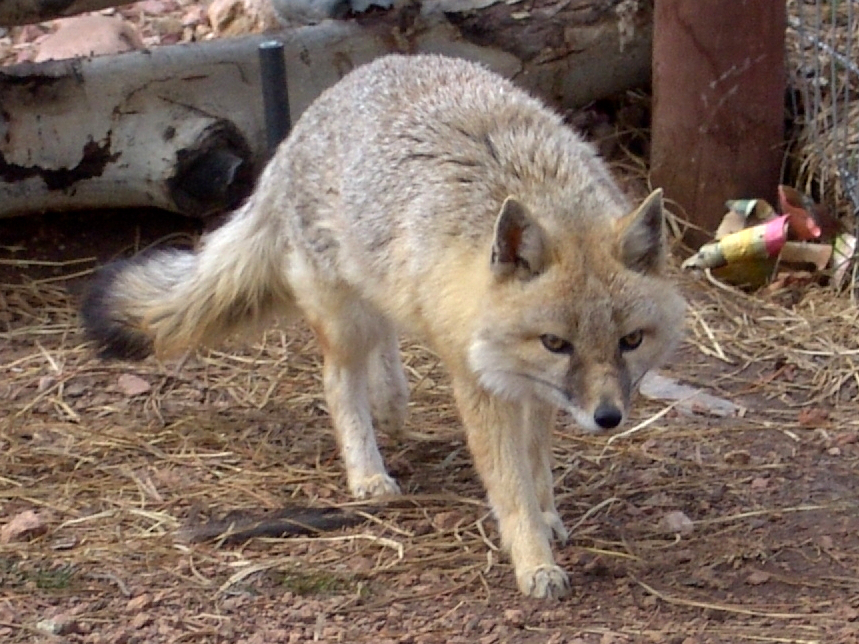
Swift fox at Colorado Wolf and Wildlife Rescue Center
Scientific classification Edit this classification
Kingdom: Animalia
Phylum: Chordata
Class: Mammalia
Order: Carnivora
Family: Canidae
Genus: Vulpes
Species:
V. velox
Binomial name
Vulpes velox
(Say, 1823)
Swift fox range
Synonyms
  • Vulpes velox hebes Merriam, 1902

The swift fox (Vulpes velox) is a small light orange-tan fox around the size of a domestic cat found in the western Great Plains grasslands of North America, such as Montana, Colorado, New Mexico, Kansas, Oklahoma[3] and Texas.[1] It also lives in southern Manitoba, Saskatchewan and Alberta in Canada, where it was previously extirpated.[2] It is closely related to the kit fox (V. macrotis) and some mammalogists classify them as conspecific.[4] However, molecular systematics imply that the two species are distinct.[5] Interbreeding between the two species does occur where their ranges overlap (eastern New Mexico and western Texas), but this hybridization is quite restricted in scope.[6]

The swift fox lives primarily in short-grass prairies and deserts. It became nearly extinct in the 1930s as a result of predator control programs, but was successfully reintroduced later. Currently, the conservation status of the species is considered by the IUCN as Least Concern owing to stable populations elsewhere.[2]

Like most canids, the swift fox is an omnivore, and its diet includes grasses and fruits as well as small mammals, carrion, and insects. In the wild, its lifespan is 3 to 6 years, and it breeds once annually, from late December to March, depending on the geographic region. Pups are born anywhere from March to mid-May, and are weaned at six to seven weeks old.

Description

[edit]
Skull

The swift fox has a dark, grayish, tan coloration that extends to a yellowish tan color across its sides and legs. The throat, chest, and belly range from pale yellow to white in color. Its tail is black-tipped, and it has black patches on its muzzle. Its ears are noticeably large, like those of the kit fox, although slightly farther apart than on the head of the latter. It is about 12 inches (30 cm) in height, and 31 inches (79 cm) long, measuring from the head to the tip of the tail, or about the size of a domestic cat. Its weight ranges from around five to seven pounds.[7] Males and females are similar in appearance, although males are slightly larger.[8]

Distribution and habitat

[edit]

The swift fox lives in short-grass prairies and western grassland. They form their dens in sandy soil on open prairies, in plowed fields, or along fences.[8] It is native to the Great Plains region of North America, and its range extends north to the southern Alberta and Saskatchewan, Canada, and south to Texas. It reaches from western Iowa to Colorado, Kansas, Wyoming, Nebraska, and Montana.[7]

Conservation status

[edit]

The swift fox was once a severely endangered species, due to predator control programs in the 1930s that were aimed mostly at the gray wolf and the coyote.[8] The species was extirpated from Canada by 1938,[2] but a reintroduction program started in 1983[9] has been successful in establishing small populations in southeast Alberta and southwest Saskatchewan, despite the fact that many reintroduced individuals do not survive their first year.[8] Nonetheless, by 1996, 540 foxes had been released around the Alberta-Saskatchewan border and Milk River Ridge areas, parts of the species' original native range.[10] Four years later, those introduced foxes had tripled in number, making the program one of the most successful endangered species reintroduction programs in the world.[11] In May 1999, the Species at Risk Act listed the swift fox as an endangered species in Canada, giving the species further protection for growth.[12] A small, but stable and growing population continues to live freely in the southeastern regions of Alberta, and southwestern regions of Saskatchewan.[10] Canada's national recovery strategy plan was revised in 2008 by the National Swift Fox Recovery Team, with projections of a long-term goal by 2026, "to restore a self-sustaining swift fox population of 1,000 or more mature, reproducing foxes that does not experience greater than a 30% population reduction in any 10-year period".[2]

Exact population numbers of the swift fox are unknown, but it is known that they currently inhabit only 40% of their historic range.[7] In addition to its populations in Canada, there are also swift fox populations in the United States, ranging from South Dakota to Texas. In 1995, the U.S. Fish and Wildlife Service determined that the fox warranted an endangered listing, but other higher priority species precluded its listing.[13] This prompted state wildlife agencies within the fox's range to create the Swift Fox Conservation Team, which worked to implement better swift fox management and monitoring programs.[13] Populations in the United States are stable in the central part of its range,[8] and it is not considered endangered in the United States. The IUCN Red List characterizes it as of Least Concern.[2]

Behavior and ecology

[edit]
A swift fox napping during the day in a zoo

In the wild, the swift fox usually lives 3–6 years, but may live up to 14 years in captivity.[10] It is primarily nocturnal, spending only evenings and nighttime above ground in the summer. Daytime activities are usually confined to the den, but it has been known to spend the warm midday period above ground during the winter.[8] Due to the harsh winter conditions where the swift fox can be found, there is an increase in mortality rates.[14] The swift fox is more heavily dependent on its den than most North American canids, using them as shelter from predators. These dens are usually burrows that are two to four meters in length.[8] It has been known to run very fast, at speeds of over 50 km/h (30 mph).[8] or up to 60 km/h (40 mph) [15] The coyote is the swift fox's main predator, but at times chooses not to consume the swift fox, killing it more often as competition than as prey.[16] Other predators include the American badger, golden eagle, and bobcat.[16] It is also vulnerable to trapping and poisoning, as well as death on highways.[17]

Reproduction

[edit]

Swift foxes are a socially monogamous species, although multiple breeding strategies have been observed.[18] The adult swift fox's breeding season varies with region. In the southern United States, it mates between December and February with pups born in March and early April, while in Canada, the breeding season begins in March, and pups are born in mid-May. The male swift fox matures and may mate at one year, while the female usually waits until her second year before breeding. Adults live in pairs, and although some individuals mate for life, others choose different partners each year. Gestation takes around 51 days, and four to five kits are born.[7][8]

The swift fox only has one litter annually, but may occupy up to thirteen dens in one year, moving because prey is scarce or because skin parasites build up inside the den. Sometimes it makes other burrows from other bigger animals, even though it is completely capable of digging one on its own. Pups are born in the den and typically remain there for approximately one month. A newborn pup's eyes and ears remain closed for ten to fifteen days, leaving it dependent on the mother for food and protection during this time. It is usually weaned around six or seven weeks old and remains with its parents until fall.[8] Recent research has shown that social organization in the swift fox is unusual among canids, since it is based on the females.[19] Females maintain territories at all times, but males emigrate if the resident female is killed or removed.[19]

Diet

[edit]

Like most foxes, the swift fox is an omnivore. Rabbits, mice, ground squirrels, birds, insects, other arthropods, lizards, amphibians, fish and eggs are staples.[7][8] Grasses and fruits round out its diet.[8] However, like any efficient forager, the swift fox takes advantage of seasonal foods.[8] During the summer, adults eat large amounts of insects, including beetles and grasshoppers, and feed their young with larger prey items.[citation needed] Deer and other carrion killed by other animals may also be important food sources.[citation needed]

References

[edit]
[edit]
Revisions and contributorsEdit on WikipediaRead on Wikipedia
from Grokipedia
The swift fox (Vulpes velox) is a small, primarily nocturnal and crepuscular canid endemic to the short- and mixed-grass prairies of North America, recognized as one of the smallest members of the Canidae family on the continent.[1] Weighing 1.4 to 3 kilograms and measuring 70 to 88 centimeters in total length, including a tail of 24 to 35 centimeters, it features a slender build, large ears, and a coat that varies seasonally from dark buffy gray on the back and yellow-tan on the sides in winter to lighter tan in summer, with a white underbelly and black-tipped tail.[2][3][4] As an opportunistic omnivore, its diet primarily consists of small mammals like prairie dogs and rodents, supplemented by birds, insects, and occasional fruits or carrion.[5] Native to the Great Plains region, the swift fox historically ranged from southern Canada through the central United States to northern Mexico, favoring open grasslands, arid plains, and areas with intermixed agriculture such as winter wheat fields.[6][2] These foxes are highly mobile, capable of speeds up to 60 kilometers per hour, and typically live in monogamous pairs or small family groups, using burrows—often appropriated from prairie dogs—for shelter and raising young.[7] Breeding occurs from December to March, with a gestation period of 50 to 60 days leading to litters of 3 to 6 kits born in late spring, primarily in March or April; both parents provide care, and juveniles disperse by fall.[8][7][2] Once abundant across its range, swift fox populations declined sharply in the early 20th century due to habitat loss from agricultural expansion, poisoning campaigns targeting wolves and coyotes, and competition from red foxes.[6] Today, approximately 39% of its historical range retains suitable grassland habitats (as of 2009), with about 52% of high-quality areas occupied, though distribution is patchy and extirpated from parts of the northern U.S. and Canada.[6] The species is listed as Least Concern globally by the IUCN due to stable or recovering populations in core areas, but it holds endangered or threatened status in several U.S. states (e.g., Nebraska, Montana) and is threatened in Canada, where reintroduction efforts since the 1980s—bolstered by recent translocations as of 2025—have supported numbers around 500-600 individuals as of 2015.[9][8][10][11] Ongoing threats include habitat fragmentation, vehicle collisions, and disease, but conservation measures like grassland restoration and reduced pesticide use support its persistence.[6]

Taxonomy and nomenclature

Taxonomy

The swift fox (Vulpes velox) is classified within the kingdom Animalia, phylum Chordata, class Mammalia, order Carnivora, family Canidae, and genus Vulpes.[12][13] The species was historically regarded as a subspecies of the kit fox (Vulpes macrotis), but modern taxonomy treats them as distinct based on morphological traits—including a broader skull, shorter ears, and slightly larger body size in the swift fox—and genetic analyses of mitochondrial DNA that reveal sufficient divergence to warrant separation.[7][14] These differences, combined with ecological adaptations to grassland versus desert habitats, support their recognition as sister species endemic to North America.[15] Subspecies divisions within V. velox include the nominate V. v. velox, found in the southern Great Plains, and V. v. hebes in the northern portions of the range; these are separated primarily by geographic boundaries and subtle cranial variations, such as differences in skull proportions, though the validity of hebes remains debated due to limited genetic support and overlapping traits.[7][16] Phylogenetically, the swift fox and kit fox (V. macrotis) form a North American clade sister to the Arctic fox (V. lagopus), with this split estimated at approximately 0.9 million years ago during the Pleistocene; the broader Vulpes genus, including Old World relatives like the red fox (V. vulpes), diverged earlier, around 3 million years ago.[17]

Etymology and naming

The scientific name Vulpes velox derives from Latin, with vulpes meaning "fox" and velox meaning "swift," alluding to the species' agility.[18][8] Although Meriwether Lewis and William Clark first documented the swift fox during their 1804–1806 expedition across the western United States, describing it on July 8, 1805, as a "kit fox" or small burrowing fox new to science, the formal scientific description came later.[19][20] The species was officially named and described by American naturalist Thomas Say in 1823, based on specimens collected during Major Stephen H. Long's 1819–1820 expedition to the Rocky Mountains.[21][22] The common English name "swift fox" emphasizes its speed and distinguishes it from related species, while indigenous names vary by region; for example, the AaniIh (Gros Ventre) and Nakoda (Assiniboine) peoples refer to it as Nóouhàh-Toka'na.[23] Historically, the swift fox was often confused with the kit fox (Vulpes macrotis) due to morphological similarities, leading to interchangeable use of the names "kit fox" and "swift fox" in early accounts and temporary taxonomic lumping as conspecifics.[21] This confusion persisted into the 19th century, with explorers like Lewis and Clark applying "kit fox" to what is now recognized as the swift fox.[19]

Physical characteristics

Size and build

The swift fox (Vulpes velox) is among the smallest canids in North America, comparable in size to a domestic cat. Adults typically measure 68–88 cm (27–35 inches) in total length from nose to tail tip, stand 30–32 cm (12 inches) at the shoulder, and weigh 1.5–3.0 kg (3.3–6.6 pounds).[10][8] Males exhibit sexual dimorphism, being approximately 8–10% larger than females in body mass and overall dimensions.[10][2] The swift fox possesses a slender, agile build with relatively short legs in proportion to its body, enabling a low profile that aids navigation through open prairie grasslands.[24] Its skeletal structure includes a gracile yet robust skull adapted for occasional digging of dens and a large nasal cavity that supports enhanced olfactory capabilities for scent detection.[25] Subtle sexual dimorphism extends to the dentition, with males having slightly longer canine teeth (dimorphism index of 1.13 for lower canines).[26] This morphology contributes to remarkable speed and agility, with the swift fox capable of bursts up to 60 km/h (37 mph) over short distances, facilitated by a flexible spine, padded feet for traction on uneven terrain, and overall lightweight frame suited to rapid acceleration and evasion in its grassland habitat.[10][27]

Fur and coloration

The swift fox exhibits a pelage characterized by light gray to buff tan coloration on the dorsal surface, transitioning to yellowish tan on the sides and legs, with a creamy white underbelly, throat, chest, and inner ear surfaces. The bushy tail features a distinctive black tip, and black patches mark the sides of the muzzle, enhancing its distinctive facial appearance. These color patterns provide effective camouflage in the open grasslands and prairies of its range.[12][28][29] Seasonal molting adapts the swift fox's coat to environmental conditions, with the winter pelage being longer, denser, and primarily dark buffy-gray dorsally with orange-tan sides for insulation against prairie cold. In contrast, the summer coat is shorter, harsher, and shifts to more reddish or rufous tones, facilitating thermoregulation in warmer months without a dramatic color phase change seen in species like the arctic fox. This molt supports survival in variable climates across the Great Plains.[30][8][2] The swift fox's large, dark-rimmed ears, covered in fine fur, along with prominent mystacial whiskers, aid sensory navigation and prey detection in low-light conditions, complementing its nocturnal habits.[31][8]

Habitat and distribution

Current range

The swift fox (Vulpes velox) currently occupies a core range across the western Great Plains of North America, extending from southern Alberta and Saskatchewan in Canada southward to Texas in the United States. This distribution spans key regions including Montana, Wyoming, Colorado, Kansas, Nebraska, Oklahoma, North Dakota, South Dakota, and New Mexico, primarily within shortgrass prairie habitats. In the U.S., the species occupies approximately 49% of its historical range, covering about 532,337 km² based on surveys from 2014–2018.[32][33] Population densities vary regionally, with stable and relatively higher numbers in central U.S. states such as Kansas (where populations have remained consistent since the 1980s) and Colorado (occupying 95% of suitable habitat across 22 counties), while densities are sparser along northern edges in Alberta, Saskatchewan, and Montana. For example, in New Mexico, densities are estimated at 9.0 individuals per 100 km². In Canada, surveys indicate around 500 individuals in Alberta and Saskatchewan as of 2018.[32][34][32][10] Recent recolonizations, including reintroductions and natural movements, have occurred in parts of South Dakota and New Mexico since 2000, contributing to a 5% expansion in occupied U.S. habitat between 2001–2006 and 2014–2018, alongside documented increases in northeastern Montana. These expansions have helped bridge some gaps, such as through movements across the Missouri River Breaks. Ongoing surveys as of 2023 have confirmed further expansions into novel habitats in Wyoming, and reintroductions in Montana as of 2025 are facilitating connections between populations. However, populations remain fragmented by agricultural expansion, urbanization, and associated infrastructure like highways, with no established presence east of the Mississippi River.[32][11][33]

Historical distribution

Prior to European settlement, the swift fox (Vulpes velox) occupied a continuous range across the shortgrass and mixed-grass prairies of the Great Plains in North America, extending from southern Canada through the central United States to northern Mexico. This historical distribution spanned approximately 1.5 million km², encompassing regions such as central Alberta and Saskatchewan in Canada, southward to central Texas, and eastward to western Iowa and Minnesota, while reaching western limits in central Colorado.[35][36][37] Early European explorers documented the swift fox as an abundant species in these prairie ecosystems. The journals of the Lewis and Clark expedition (1804–1806) frequently noted encounters with swift foxes, describing them as a common predator alongside bison herds in the northern Great Plains, particularly in present-day Montana and the Dakotas. These records highlight the fox's widespread presence and ecological role in pre-colonial grasslands before significant human impacts.[38][20] The swift fox's range began contracting in the late 18th century with the onset of European settlement in the Great Plains, but the most severe declines occurred during the mid- to late 19th century. By 1900, the species had lost approximately 60% of its historical range, primarily due to initial habitat conversion for agriculture and livestock grazing, as well as overhunting for the fur trade, which saw over 117,000 pelts harvested between 1853 and 1877.[35][37][39] The first major impacts intensified in the 1850s to 1880s, as settlement expanded rapidly, fragmenting prairie habitats and reducing prey availability.[40]

Behavior

Activity patterns

The swift fox (Vulpes velox) displays primarily nocturnal activity patterns, with activity peaking during crepuscular periods at dawn and dusk, allowing it to avoid daytime heat and predation risks.[41] In winter, individuals are largely nocturnal, maintaining consistent activity from sunset to sunrise, while in summer they shift to more crepuscular behavior to cope with higher temperatures.[10] During the breeding and pup-rearing season in spring and early summer, adults exhibit increased diurnal activity near dens to provision and guard young.[7] Swift foxes are highly fossorial and spend most daylight hours in underground burrows, emerging primarily at dusk for foraging and other activities.[42] They typically dig their own dens in loamy or sandy soils, constructing multi-entrance burrows that can extend 2–5 meters in length and reach depths of about 1 meter.[7] These dens serve as refuges from extreme weather and predators throughout the year.[10] Unlike some canids, swift foxes do not undertake seasonal migrations but juveniles disperse from natal areas, with males traveling up to 100 km and females up to 50 km to establish new territories.[43] Their nocturnal and crepuscular habits are supported by sensory adaptations, including large ears for acute hearing to detect prey and predators in low light, and a tapetum lucidum in the eyes that enhances vision by reflecting light through the retina.[8][7]

Social behavior

The swift fox exhibits a flexible social structure, typically consisting of monogamous pairs that form the core of family groups, though polygyny and polyandry occur rarely (in approximately 7% of groups in studied populations) under conditions of high population density and low predation pressure.[44] These groups generally include 3–6 individuals, comprising the breeding pair and their offspring, with non-breeding adults—often yearlings—occasionally acting as helpers to assist in pup rearing by providing food and guarding dens, which enhances overall pup survival rates.[10] Pair bonds are generally stable but not always lifelong, and extra-pair matings are common, contributing to genetic diversity within groups.[10] Swift foxes are territorial, with breeding pairs defending home ranges averaging 10–32 km² depending on habitat quality and location, showing substantial spatial overlap within pairs but minimal overlap—particularly among males—with neighboring groups to minimize conflict.[45] Territories are maintained primarily by females, who exhibit stronger site fidelity, while males have slightly larger ranges and lower tolerance for intrusions from other males.[46] Defense involves a combination of scent marking at latrines and boundaries, as well as vocal displays to advertise presence and deter intruders.[47] Communication among swift foxes is multimodal, relying on visual, olfactory, and auditory signals to coordinate group activities and maintain social bonds. Visual cues include body postures and ear positions, such as erect ears signaling alertness or dominance and flattened ears indicating submission or aggression during interactions.[48] Olfactory communication occurs through urine and scat deposits at communal latrines, which serve dual roles in territory demarcation and information exchange about group identity, reproductive status, and individual health.[47] Auditory signals feature a repertoire of vocalizations, including short yips for close-range contact and long-range barking sequences primarily used for territorial advertisement and pair bonding during the breeding season.[49] Dispersal in swift foxes is primarily natal, with juveniles leaving family groups at 4–6 months of age, typically in bimodal peaks during September–October and January–February, to reduce inbreeding and competition for resources.[50] Males disperse more frequently and travel farther than females, with average distances of 10–15 km but recorded maxima up to 191 km, while philopatric females often remain to inherit territories or assist in rearing.[10] Adult dispersal is rarer (about 22% rate) and often triggered by mate loss, with higher mortality risks for dispersers compared to residents.[50]

Ecology

Diet

The swift fox (Vulpes velox) is an omnivorous mesopredator with a diet dominated by small mammals, which comprise approximately 68% of its food intake by volume, primarily rodents (about 60%) and lagomorphs such as rabbits (7%). Insects make up around 24% of the diet, while birds contribute about 8%, and other items including carrion and vegetation account for the remainder.[10] This composition reflects the species' role in grassland ecosystems, where it helps regulate rodent populations through predation.[10] Dietary preferences vary seasonally, with insects—particularly grasshoppers and beetles—peaking in summer when they become highly abundant and can form a substantial portion of the intake, supplementing the more consistent consumption of small mammals.[51] In winter, especially in northern ranges like Canada, the swift fox relies more heavily on voles and other available rodents due to reduced insect availability. Historically, the species scavenged remains of American bison (Bison bison), which provided a reliable carrion source in pre-settlement prairies.[10] As opportunistic feeders, swift foxes employ versatile foraging strategies, including stalking and pursuing small prey with rapid bursts of speed up to 60 km/h, often ambushing rodents detected by keen hearing.[52] They cache excess food in dens or shallow burrows to sustain themselves during periods of scarcity, and adapt by increasing consumption of fruits, grasses, and other vegetation when animal prey is limited.[7] This flexibility underscores their trophic importance as both predators and occasional scavengers in maintaining prairie food webs.[10]

Reproduction

The swift fox exhibits a breeding season that varies by geographic location, typically occurring from late December to early January in the southern United States and in March in Canada.[12] These foxes are generally monogamous, with mated pairs forming long-term bonds that often persist across multiple breeding seasons, though some individuals may select different partners annually.[53] Gestation lasts 50 to 60 days, after which females give birth to a single annual litter of 2 to 6 kits, with an average of 4 to 5.[12][8] Kits are born blind and deaf in a secure den, weighing approximately 50 to 60 grams at birth.[12][3] Both parents contribute to rearing the kits, with the female providing nursing for 6 to 7 weeks until weaning, while males assist in provisioning food and guarding the den.[12][31] Kits remain in the den for about one month, emerging as their eyes and ears open after 10 to 15 days, and they accompany the family group on foraging trips thereafter.[12] By early fall, typically 4 to 5 months after birth, the kits achieve independence and disperse from the family group, though some may remain longer (up to 18 months) with distances generally under 15 km.[8][10] Swift foxes reach sexual maturity at one year of age, with males breeding in their first year and females sometimes delaying until their second.[12] In the wild, where average lifespan is 3-6 years, individuals typically produce only 1 to 2 litters over their lifetime due to high mortality rates.[12]

Predation and mortality

The primary predators of the swift fox (Vulpes velox) are coyotes (Canis latrans), which are responsible for the majority of predation events and account for approximately 31-38% of documented mortalities.[10] Other notable predators include golden eagles (Aquila chrysaetos), which contribute around 8% of predation-related deaths, and American badgers (Taxidea taxus), accounting for about 7%.[10] Raptors such as hawks also occasionally prey on swift foxes, particularly during diurnal activity.[7] In the wild, swift foxes typically live 3–6 years, with many not exceeding an average of 3-6 years due to high mortality pressures; in captivity, they can reach up to 14 years.[10] Mortality rates are elevated among juveniles, with annual survival rates ranging from 0 to 0.63 for those collared at 6 months of age, implying that over 50% often perish in their first year from predation and other factors.[10] Adult annual mortality is lower, around 0.55, though still significant.[54] Roadkill is an emerging non-predatory cause, representing about 7.7% of deaths, but remains secondary to biotic factors.[10] Beyond predation, starvation contributes notably during severe winters, while disease plays a lesser role overall.[10] Rabies cases are rare, with no major outbreaks documented, though swift foxes show exposure to pathogens like canine distemper (52% seropositivity) and canine parvovirus (100% seropositivity) without frequent lethal infections.[10] Parasites, including fleas, are common and may exacerbate health stresses but seldom cause direct mortality.[7] The swift fox's predominantly nocturnal habits help mitigate encounters with daytime predators like eagles.[10]

Conservation and human relations

Conservation status

The swift fox (Vulpes velox) is classified as Least Concern on the global scale by the International Union for Conservation of Nature (IUCN) Red List, with the assessment last updated in 2008 and remaining stable through 2025 due to relatively secure populations in the central United States. However, regional assessments differ significantly; in Canada, the species is designated as Threatened under the federal Species at Risk Act following a 2021 Committee on the Status of Endangered Wildlife in Canada (COSEWIC) evaluation, while it is listed as Endangered under provincial wildlife acts in Alberta and Saskatchewan.[10] In the United States, the swift fox is not federally listed under the Endangered Species Act but is considered Secure in core range states such as Colorado, Kansas, and Wyoming, though it is identified as a species of greatest conservation need in several others.[40] Total adult population size for the swift fox across North America is unknown but likely at least several thousand individuals, with the majority occurring in the United States; the species has experienced about 60% loss of its historical range since the 1800s due to habitat conversion, but populations have remained stable or shown modest increases since the 1990s through natural recovery and conservation actions.[40] In Canada, where the population is smaller and more fragmented, surveys indicate approximately 870 individuals as of 2015, with ongoing monitoring suggesting stable levels into the 2020s.[55] The swift fox receives legal protections primarily through national and provincial frameworks rather than international trade conventions; it is not listed under the Convention on International Trade in Endangered Species of Wild Fauna and Flora (CITES), but harvest is regulated or prohibited in key areas to prevent further declines from fur trapping.[12] In Canada, protections under the Species at Risk Act prohibit harm, possession, or trade, supplemented by provincial bans on hunting in Alberta and Saskatchewan.[10] Population trends are tracked through annual monitoring programs, including camera trap surveys and live-trapping efforts conducted across prairie habitats in Alberta, Saskatchewan, and adjacent U.S. states; these methods have documented occupancy and density.[56]

Threats

The primary threats to swift fox populations stem from human activities that alter their grassland habitats and increase mortality risks. Habitat fragmentation, driven largely by agricultural conversion, has resulted in the loss of approximately 80% of native prairie in Canada and 70% across the North American Great Plains, isolating remaining populations and reducing genetic connectivity.[57] This fragmentation is exacerbated by expanding energy development, such as oil and gas extraction, which introduces linear features like roads and pipelines that further divide habitats. Roads pose a direct mortality risk, with vehicle collisions accounting for 7.7% to 42% of documented deaths in various studies, contributing significantly to annual survival rates that often fall below 50%.[10][58] Indirect poisoning remains a concern through secondary ingestion of rodenticides and predacides used in pest control. Historically, strychnine-laced baits targeted coyotes and wolves from the late 1800s through the 1980s, causing widespread non-target mortality among swift foxes, though usage has declined with regulatory restrictions. Current risks arise from accidental exposure to poisons like strychnine applied for ground squirrel control on farmlands, with potential for high severity in localized areas.[57][59] Increased competition from coyotes, facilitated by the eradication of gray wolves in the early 20th century, intensifies pressure on swift foxes. Without wolves to suppress coyote numbers, coyote densities have risen, leading to direct predation on swift foxes and indirect effects through depletion of shared prey resources like rodents and rabbits. Studies show coyotes responsible for 31% to 85% of swift fox deaths in some regions, limiting population recovery and habitat use.[57][60][61] Climate change poses emerging risks by altering prey availability and habitat suitability through more frequent droughts and shifting precipitation patterns. Droughts reduce populations of insects and small mammals that form the swift fox's diet, potentially lowering reproductive success and survival during harsh conditions. Projections indicate potential range shifts northward and to higher elevations as warming renders southern habitats less viable, with models suggesting overall habitat expansion under moderate emissions scenarios but increased fragmentation in core areas by mid-century.[10][57][62] Fur trapping, while minimal due to low population densities and regulatory oversight, continues in limited U.S. states where swift foxes are classified as furbearers, requiring harvest reporting and tagging. In Canada, where the species is federally endangered, trapping is illegal, providing full protection from this threat.[59][63]

Reintroduction efforts

Reintroduction efforts for the swift fox commenced in Canada in 1983, following the species' extirpation from the country by the mid-20th century, with annual releases into southern Alberta and Saskatchewan continuing until 1997.[64] A total of 805 swift foxes, sourced primarily from captive-bred stock in the United States, were released during this period to restore populations in mixed-grass prairie habitats. These efforts were coordinated by organizations such as the Cochrane Ecological Institute and Wildlife Preservation Canada, employing both hard and soft release techniques to acclimate the animals.[65] As of 2015, the Canadian population was estimated at approximately 870 individuals in Alberta and Saskatchewan, reflecting successful establishment despite initial low survival rates of around 20-30% in early releases.[55] In the United States, reintroduction initiatives began later, with the Blackfeet Tribe and Defenders of Wildlife releasing 123 captive-reared swift foxes on the Blackfeet Indian Reservation in Montana from 1998 to 2002.[66] This program utilized semi-hard releases, where foxes were held in enclosures for several weeks before full release, resulting in adult annual survival rates of 60-73% and juvenile rates of 69-77% five to seven years post-release.[67] More recently, from 2020 to 2024, the Assiniboine and Gros Ventre Tribes at Fort Belknap Indian Reservation, in partnership with the Smithsonian National Zoo and Conservation Biology Institute, reintroduced 139 swift foxes to bridge gaps between existing populations in Canada and Wyoming.[68] Success in these U.S. efforts has been marked by reproduction and territory establishment, with overall survival rates ranging from 40-60% depending on release conditions and monitoring.[11] Captive breeding programs have been central to these reintroductions, with facilities like the Endangered Wolf Center in Missouri and the Cochrane Ecological Institute in Alberta producing litters for translocation, ensuring a steady supply of genetically diverse individuals.[69] Soft release methods, involving pre-release acclimation pens and GPS monitoring collars, have improved post-release survival by allowing foxes to familiarize themselves with local prey and terrain while minimizing dispersal risks.[65] To maintain genetic diversity, source populations from multiple U.S. states and captive lines have been mixed, preventing inbreeding in reintroduced groups.[70] These strategies have advanced toward Canada's long-term recovery goal of 1,000 mature, reproducing individuals by 2026, with ongoing tribal-led monitoring enhancing connectivity across the northern Great Plains.[57]

Cultural significance

The swift fox holds significant cultural value among several Indigenous peoples of the Great Plains, particularly within the Blackfoot Confederacy (Niitsitapi), including the Kainai and Blackfeet, where it is regarded as a sacred animal integral to traditional stories and ceremonies.[71] In Blackfoot oral traditions, the swift fox appears in legends such as "The Animal Bands," symbolizing intelligence, speed, and the spirit of the prairie ecosystem.[71] Similarly, for the Lakota, the swift fox is a key figure in oral histories, embodying adaptability, cleverness, and courage, often invoked as a medicine animal that teaches survival skills like swift escape from danger and locating healing herbs.[72][73] Historically, swift fox pelts were used by Native American communities for clothing and played a role in the 19th-century fur trade, with tribes serving as primary trappers and suppliers to European-American markets, though the species was secondary to more abundant resources like bison.[63][35] In tribal narratives, the swift fox also serves as an indicator of prairie health, reflecting balanced ecosystems in stories passed down through generations.[74] In contemporary contexts, swift fox reintroductions on tribal lands, such as the Oglala Sioux Tribe's 2012 project on the Pine Ridge Reservation, blend ecological restoration with cultural revitalization, reconnecting communities to ancestral knowledge and the animal's symbolic role in warrior societies like the Tokala (Kit Fox Society).[73] These efforts highlight the swift fox's representation of resilience following colonial-era declines, fostering education and artistic expressions on reservations that emphasize its enduring place in Indigenous heritage.[73][75]

References

User Avatar
No comments yet.