Hubbry Logo
Tar-BabyTar-BabyMain
Open search
Tar-Baby
Community hub
Tar-Baby
logo
8 pages, 0 posts
0 subscribers
Be the first to start a discussion here.
Tar-Baby
Tar-Baby
from Wikipedia

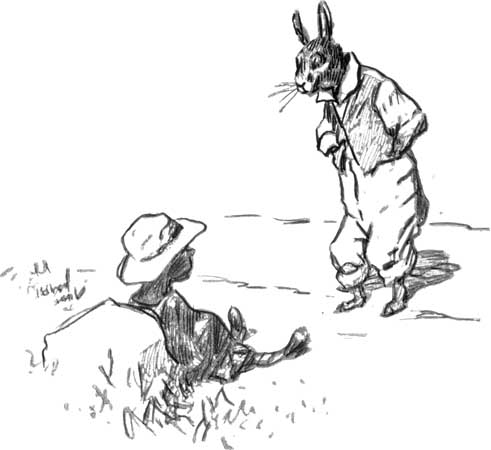
Br'er Rabbit and the Tar-Baby, drawing by E. W. Kemble from "The Tar-Baby", by Joel Chandler Harris, 1904

The Tar-Baby is the second of the Uncle Remus stories published in 1881; it is about a doll made of tar and turpentine used by the villainous Br'er Fox to entrap Br'er Rabbit. The more that Br'er Rabbit fights the Tar-Baby, the more entangled he becomes.

The phrase "tar baby" has acquired idiomatic meanings over the years, including a negative racial connotation.

Publication history

[edit]

Joel Chandler Harris collected the story in its original dialect and included it in his 1881 book, "Uncle Remus, his Songs and his Sayings".[1] His introduction mentions earlier publication of some of his Uncle Remus Stories in the columns of a daily newspaper, The Atlanta Constitution. Harris said these legends had "become a part of the domestic history of every Southern family." Indeed, Theodore Roosevelt (the 26th president of the United States, born in 1858), noted in his autobiography that as a young child he heard Br'er Rabbit tales from his Southern aunt, Anna Bulloch, and that his uncle, Robert Roosevelt, transcribed some of her stories from her dictation.[2]

Plot

[edit]
Br'er Rabbit attacking the Tar-Baby, 1895 illustration

The 'Tar Baby' story comes from the oral tradition of black slaves on the old plantations of the American South, one of many Uncle Remus stories. It features Br'er Fox, who constructs a doll out of a lump of pine tar and dresses it with some clothes. When Br'er Rabbit comes along he addresses the tar "baby" amiably but receives no response. Br'er Rabbit becomes offended by what he perceives as the tar baby's lack of manners, punches it and, in doing so, becomes stuck. The more Br'er Rabbit punches and kicks the tar baby out of rage, the worse he gets stuck.

In Joel Chandler Harris's popular retelling of the tar baby story, the fox then saunters over and gloats, laughing uproariously, and invites the rabbit to his house to "take dinner" with him, saying he has some calamus root and will take no excuse. The little boy listening to the story asks if the fox ate the rabbit, but the storyteller demurs and tells the boy to run off because he's being called. The Harris version seems to end there.

A couple of stories later, though, the tale continues in Harris's story, "How Mr. Rabbit was Too Sharp for Mr. Fox". This ending is now popularly incorporated into the tar baby story:

Now that Br'er Rabbit is stuck, Br'er Fox ponders how to dispose of him. The helpless but cunning Br'er Rabbit pleads, "Do anything you want with me – roas' me, hang me, skin me, drown me – but please, Br'er Fox, don't fling me in dat brier-patch", prompting the sadistic Br'er Fox to do exactly that because he gullibly believes it will inflict the maximum pain on Br'er Rabbit. However, as rabbits are at home in thickets like the brier-patch, the resourceful Br'er Rabbit escapes.

Analysis

[edit]

In folklore studies, the story of the Tar-Baby is classified in the international Aarne-Thompson-Uther Index as tale type ATU 175, "The Tar-Baby and the Rabbit".[3][4]

[edit]

Variations on the tar-baby legend are found in the folklore of more than one culture. In the Journal of American Folklore in 1943, Aurelio M. Espinosa discussed various different motifs within 267 versions of the tar-baby story that were ostensibly 'in his possession'.[5] Espinosa used the existence of similar motifs to argue that the tar baby story and hundreds of other myths throughout the world, despite the significant variations between them, originate from a single ancient Indian myth.[6] The next year, Archer Taylor added a list of tar baby stories from more sources around the world, citing scholarly claims of its earliest origins in India and Iran.[7] Espinosa later published documentation on tar baby stories from a variety of language communities around the world.[8]

Anthropologist Elsie Clews Parsons compiled an extensive list of references of the Tar Baby stories, from North American, Latin American and African publications on folklore.[9]

A very similar West African tale is told of the mythical hero Anansi the Spider. In this version, Anansi creates a wooden doll and covers it over with gum, then puts a plate of yams in its lap, in order to capture the she-fairy Mmoatia (sometimes described as an "elf" or "dwarf"). Mmoatia takes the bait and eats the yams, but grows angry when the doll does not respond and strikes it, becoming stuck in the process.[citation needed]

From The Bahamas, the Tar-Baby story was published by The Journal of American Folklore in 1891 in Some Tales from Bahama Folk-Lore by Charles Lincoln Edwards. Edwards had collected the stories from Green Turtle Cay, Abaco in the summer of 1888. In the tale, B' Rabby refused to dig for water, and didn't help grow the field. He tricks B' Lizard and B' Bouki while they were standing watch by the water and the field. The other animals got tired of his tricks, got together and created a Tar Baby. B' Rabby was caught by Tar Baby and the other animals who wanted to throw him into the sea but he talked them into throwing him into a bush. They threw B' Rabby into the bush and he got away.[10]

In a variant recorded in Jamaica, Anansi himself was once similarly trapped with a tar-baby made by the eldest son of Mrs. Anansi, after Anansi pretended to be dead in order to steal her peas.[11] In a Spanish language version told in the mountainous parts of Colombia, an unnamed rabbit is trapped by the Muñeco de Brea (tar doll). A Buddhist myth tells of Prince Five-weapons (the future Buddha) who encounters the ogre Sticky-Hair in a forest.[12][13][14]

The tar-baby theme is present in the folklore of various tribes of Meso-America and of South America: it is found in such stories[15] as the Nahuatl (of Mexico) "Lazy Boy and Little Rabbit" (González Casanova 1946, pp. 55–67), Pipil (of El Salvador) "Rabbit and Little Fox" (Schultes 1977, pp. 113–116), and Palenquero (of Colombia) "Rabbit, Toad, and Tiger" (Patiño Rosselli 1983, pp. 224–229). In Mexico, the tar baby story is also found among Mixtec,[16] Zapotec,[17] and Popoluca.[18][19] In North America, the tale appears in White Mountain Apache lore as "Coyote Fights a Lump of Pitch".[20] In this story, white men are said to have erected the pitch-man that ensnares Coyote.[20]: 360 

According to James Mooney in "Myths of the Cherokee",[21] the tar-baby story may have been influenced in America by the Cherokee "Tar Wolf" story, considered unlikely to have been derived from similar African stories: "Some of these animal stories are common to widely separated [Native American] tribes among whom there can be no suspicion of [African] influences. Thus the famous "tar baby" story has variants, not only among the Cherokee, but also in New Mexico, Washington [State], and southern Alaska—wherever, in fact, the pine supplies enough gum to be molded into a ball for [Native American] uses".[citation needed]

In the Tar Wolf story, the animals were thirsty during a dry spell, and agreed to dig a well. The lazy rabbit refused to help dig, and so had no right to drink from the well. But she was thirsty, and stole from the well at night. The other animals fashioned a wolf out of tar and placed it near the well to scare the thief. The rabbit was scared at first, but when the tar wolf did not respond to her questions, she struck it and was held fast. Then she struggled with it and became so ensnared that she could not move. The next morning, the animals discovered the rabbit and proposed various ways of killing her, such as cutting her head off, and the rabbit responded to each idea saying that it would not harm her. Then an animal suggested throwing the rabbit into the thicket to die. At this, the rabbit protested vigorously and pleaded for her life. The animals threw the rabbit into the thicket. The rabbit then gave a whoop and bounded away, calling out to the other animals "This is where I live!"[citation needed]

Idiomatic references

[edit]

See also

[edit]

References

[edit]

Further reading

[edit]
[edit]
Revisions and contributorsEdit on WikipediaRead on Wikipedia
from Grokipedia
The Tar-Baby is a doll fashioned from tar and turpentine by Br'er Fox to ensnare the protagonist Br'er Rabbit in an African American folktale rooted in oral traditions from the era of slavery. First committed to print by journalist Joel Chandler Harris in his 1881 book Nights with Uncle Remus: His Songs and His Sayings, the story draws from African "stickfast" motifs predating American captivity, such as those involving the spider trickster Anansi in West African lore. In the plot, Br'er Rabbit approaches the immobile figure, greets it civilly, and upon receiving no reply, assaults it progressively with punches, kicks, and butting, only to find himself adhered fast; he then persuades Br'er Fox against lethal punishments, ultimately securing his release into a thorn-filled briar patch where his agility prevails. The narrative exemplifies trickster dynamics in folklore, with Br'er Rabbit embodying cunning survival against stronger foes, a theme Harris documented from interactions with formerly enslaved storytellers during his youth on a Georgia plantation. Beyond literature, "tar baby" evolved into an idiom for a vexatious quandary that intensifies through mishandled engagement, reflecting the tale's depiction of escalating entanglement. While celebrated for conserving vernacular tales amid cultural shifts, the Uncle Remus corpus, including the Tar-Baby episode, later drew scrutiny for dialect rendering and animal allegories interpreted as endorsing subservience, interpretations contested given the stories' emphasis on subversive wit over literal hierarchy.

Origins and Folklore

African and Global Antecedents

The Tar-Baby motif, involving a ensnared by a sticky anthropomorphic figure after failing to elicit a response, traces to pre-colonial African oral traditions, where adhesive traps symbolized practical defenses against theft in agrarian contexts. Among the of present-day , the spider encounters variants such as a tarred stump disguised as a figure to catch peanut thieves, as documented in West African collections. These narratives, featuring spiders or other cunning protagonists caught in gum, tar, or bird lime, appear in tales from , the Congo region, and the Gold Coast (modern ), often illustrating consequences of greed or overconfidence in outwitting rivals. Such stories reflect causal mechanisms rooted in survival: natural resins and pitches, readily available in tropical environments, served as effective, low-technology snares for , birds, or human poachers pilfering crops, a strategy empirically attested in ethnographic records of subsistence farming. Analogous entrapment motifs recur globally, independent of African diffusion in some cases, underscoring the archetype's universality from shared human experiences with viscous traps. In Native American oral lore, rabbit tricksters confront clay or pitch dummies, as recorded by among the Southern Paiute in the 1870s and paralleled in and Winnebago variants like "Wakaima and the Clay Man," where the protagonist adheres progressively while demanding courtesy. European precedents include medieval fables in the Roman de Renard, with fox or thief figures stuck in pitch, akin to the cycle analyzed by Elsie Clews Parsons. Indian from , such as "The Demon with the Matted Hair" (circa 300 BCE–500 CE), depict adhesion to sticky guardians, suggesting ancient Indo-European or pan-Asian parallels predating transatlantic contact by millennia. These variants, spanning continents, prioritize empirical realism over symbolic overlay, as sticky substances universally enabled passive capture without constant vigilance, a first-principles in pre-industrial societies reliant on stored harvests. Empirical evidence from 19th- and early 20th-century confirms cross-cultural transmission of the African form via the Atlantic slave , with motifs carried as "cultural luggage" by captives from , Congo, and to the . Collectors like Alfred Burdon Ellis (Gold Coast, 1880s) and John Weeks (Lower Congo, early 1900s) documented spider-trickster entrapments mirroring later diaspora versions, while Melville Herskovits (1941) traced their persistence among African-descended communities in and the . Charlotte Sophia (1914) cited slave routes as key vectors, disseminating the tale from Central African ports to U.S. plantations, corroborated by parallels in Brazilian folklore noted by Charles Hartt (1870s). extended this to Pacific diffusion via European sailors interacting with enslaved Africans, though debates linger: some, like Powell, posited Native American primacy based on indigenous collections, yet comparative analyses by Alice Werner (1933) affirm African prototypes as foundational for transatlantic iterations, with over 267 variants indexed by Aurelio Espinosa (1930–1944) favoring diffusion over independent invention in the . This transmission preserved the motif's core logic— immobility punishing presumptuous —untethered from racialized projections later imposed in colonial scholarship.

Joel Chandler Harris's Role in Preservation

Joel Chandler Harris (1848–1908), a Georgia-born journalist, first encountered African American oral folktales during his teenage years as a typesetter on Turnwold Plantation amid the Civil War, where he regularly heard narratives from enslaved storytellers whose traditions predated emancipation. This immersion informed his later systematic collection efforts in the 1870s, as he transcribed tales directly from black informants in rural Georgia settings, prioritizing verbatim capture of spoken forms over literary embellishment to document vanishing postbellum oral customs. By 1876, Harris had joined the Constitution, where he serialized sketches to "preserve in permanent shape" these "curious" plantation legends, culminating in the 1879 debut of the Tar-Baby story as a column feature before its inclusion in the 1880 volume Uncle Remus: His Songs and His Sayings. He deliberately retained phonetic representations of Gullah-influenced dialects—distinctive lowcountry speech patterns blending African linguistic substrates with English—to reflect causal fidelity to informant delivery, rejecting sanitized retellings that would obscure the originals' rhythmic and idiomatic integrity. Harris employed the Uncle Remus narrator frame, modeled on elderly black figures he knew, not as invention but as a device to embed tales in their authentic intergenerational context, explicitly crediting black sources over white authorship claims. This informant-driven approach countered contemporaneous vanishing of the traditions amid , with Harris documenting over 180 stories by his collections' close in 1908. Early 20th-century folklorists, including analyses affirming dialectal and structural precision, validated Harris's accuracy in replicating pre-1865 Southern patterns, distinguishing his work from fabricated local color through empirical alignment with oral fieldwork precedents. Modern critiques framing his efforts as appropriation overlook this verifiable sourcing, as his transcripts align with independent collections of similar motifs from communities, underscoring preservation via direct transcription rather than imposition.

Publication and Early Dissemination

Initial Appearance in

The "Wonderful Tar-Baby Story" debuted in Joel Chandler Harris's series through serialization in The Atlanta Constitution, where Harris served as an associate editor, appearing amid tales that began in 1879 and drew from oral traditions observed on Georgia plantations. The story was collected later that year in Harris's first volume, Uncle Remus: His Songs and His Sayings: The Folklore of the Old Plantation, issued by D. Appleton and Company in November 1881 as the second narrative following "Uncle Remus Initiates the Little Boy." In the book, the tale is framed dialectally as Uncle Remus responding to the white child's inquiry—"Didn't the fox never catch the rabbit, Uncle Remus?"—while the boy eats supper, linking it causally to prior Br'er Rabbit escapades involving deception and evasion against Br'er Fox. This conversational setup, recurring across the volume's nine core stories and interspersed songs, positioned the Tar-Baby episode as a direct continuation, emphasizing the rabbit's entrapment in a tar-and-turpentine figure devised by the fox beside a briar patch. The tales, including the Tar-Baby, achieved swift dissemination via newspaper syndication beyond , reaching audiences in the post-Reconstruction South (after federal oversight ended in ) and evidencing broad readership appeal through requests for continuations and reprints in regional presses. The 1881 volume's release prompted immediate critical notice for preserving dialectal , with sales reflecting empirical demand among white Southern readers seeking nostalgic narratives and Northern audiences interested in ethnographic novelty.

Editions and Dialectical Features

The original publication of the Tar-Baby story appeared in Joel Chandler Harris's Uncle Remus: His Songs and His Sayings in 1880, rendered in a phonetic dialect designed to transcribe the oral speech patterns of Southern African American storytellers from Georgia plantations, featuring contractions such as "Br'er" for "brother," "sezee" for "says he," and elisions like "en" for "and." This dialect drew from Gullah influences and vernacular English documented among formerly enslaved communities, as linguistic analyses have verified its fidelity to 19th-century recordings of similar speech, including vowel shifts and rhythmic intonations absent in exaggerated minstrel caricatures. Early 20th-century compilations, such as those spanning Harris's works from to , largely preserved this to maintain the stories' authenticity to oral traditions, though some compilations introduced minor uniformizations for consistency across volumes, such as standardizing certain phonetic spellings without altering core features. Criticisms portraying the as derivative of minstrelsy overlook from phonologists, who note its alignment with verifiable slave-era rather than stage , thereby preserving causal links to the storytellers' idiomatic expressions that conveyed rhythm and cultural nuance. Post-1960s abridgments and reprints, amid shifting cultural sensitivities, often diluted these features for broader accessibility, substituting phonetic elements like "" with standardized "Brother Rabbit" and reducing dialectal contractions to approximate , which compromised the texts' fidelity to the phonetic authenticity of the source traditions. Some editions excised the framing narrative involving , an elderly Black narrator, to neutralize perceived racial elements, presenting the tales as depersonalized fables and thereby severing the dialectical that embedded the stories in their historical oral . These modifications prioritized over preservation, as evidenced by comparisons of original versus adapted versions, though full reprints like annotated scholarly editions have sustained the unaltered to uphold empirical accuracy.

Narrative Elements

Plot Summary


In Joel Chandler Harris's rendition, Br'er Fox constructs the Tar-Baby by mixing tar with turpentine and positions the figure in the middle of the road, lying in wait from the bushes to observe the outcome. Br'er Rabbit, passing by, repeatedly greets the motionless Tar-Baby and inquires about its well-being, but receives no reply, leading to escalating frustration. He first strikes it with one fist, which adheres to the tar; then with the other fist; subsequently kicks with one foot, followed by the other, losing the use of his limbs; and finally butts it with his head, resulting in complete entrapment.
Br'er Fox then emerges, taunting the stuck Br'er Rabbit by remarking that he appears "stuck up" and declaring that Br'er Rabbit will join him for dinner without excuses, referencing prior deceptions involving calamus root. In the ensuing confrontation detailed in the connected narrative, Br'er Rabbit pleads desperately against being drowned, skinned, or—insistently—not thrown into the briar patch. Br'er Fox, interpreting the briar patch as fitting punishment, hurls him there, enabling Br'er Rabbit to land on his feet and escape, having originated from such terrain.

Characters and Trickster Dynamics


Br'er Rabbit represents the trickster archetype common in oral folklore traditions, employing intellect and improvisation to evade stronger adversaries rather than direct confrontation. His smaller stature relative to predators like Br'er Fox compels reliance on deceptive tactics, as seen when he transforms apparent defeat into escape through feigned pleas that exploit the antagonist's expectations. This pattern underscores causal dynamics where physical disadvantage fosters innovative evasion, paralleling behavioral adaptations in smaller prey species that prioritize unpredictability over strength in survival scenarios.
Br'er Fox functions as the strategic , constructing the tar figure as a lure designed to capitalize on Br'er Rabbit's presumed . The trap's ingenuity lies in its passivity, yet its failure stems from overconfidence in a rigid setup that neglects the trickster's adaptive response, leading to reversed fortunes through unanticipated counter-maneuvering. Such in trap deployment reflects a fundamental misjudgment of behavioral flexibility, where the predator's assumption of inevitability ignores the interplay of wits in asymmetrical conflicts. In the original narrative, these characters operate as anthropomorphic animals devoid of explicit human or racial mappings, embodying universal heuristics on cunning versus force found across diverse cultural tales. This animal-centric framing prioritizes archetypal predator-prey interactions over allegorical overlays, preserving the stories' focus on empirical outcomes of strategic encounters.

Thematic Analysis

Symbolism of Entrapment and Evasion

The Tar-Baby's construction from , a viscous derived from distilled or similar natural hydrocarbons, embodies through where initial contact creates cohesive bonds that intensify with resistance, as the material's high tensile strength prevents disengagement without external . In the tale, Br'er Fox's trap leverages this property to exploit predictable behavioral responses— followed by escalating frustration—resulting in progressive immobilization, a causal sequence mirroring empirical observations of how struggling against pitch-like substances distributes the adherent further across surfaces. This symbolizes the perils of reactive engagement with engineered provocations, where first-principles physics of amplify minor interactions into binding commitments, independent of interpretive overlays. Br'er Rabbit's evasion hinges on , vociferously protesting the briar patch as his direst fate to manipulate Br'er Fox's retaliatory instincts, prompting the very disposal that returns him to his adaptive stronghold of thorny familiarity. This ploy demonstrates agency through environmental mastery and opponent misdirection, a strategy grounded in the archetype's exploitation of assumed vulnerabilities, verifiable across Indo-European and African oral traditions where protagonists feign incapacity to redirect threats advantageously. Causally, the success stems from the rabbit's prior acclimation to the patch's brambles, rendering it a refuge rather than peril, thus inverting the trap's intent via informational asymmetry rather than brute escape. These elements underscore practical lessons in consequence and contrivance over victimhood paradigms, as the protagonist's orchestration of outcomes— from self-entrapment via impulsivity to triumphant redirection—affirms proactive cunning amid constraints, eschewing narratives of inherent powerlessness for observable dynamics of choice and adaptation. The tar's literal stickiness and the briar ruse thus serve as archetypes for how material realities and psychological levers govern entrapment's reversibility, prioritizing verifiable mechanics in folklore's didactic core.

Cultural and Moral Insights

The Tar-Baby narrative imparts a core moral against engaging provocations that invite , as Br'er Rabbit's initial polite greeting to the silent figure escalates into physical , resulting in his adhesion to the tar doll. This sequence underscores the of disengagement in asymmetric disputes, where response amplifies vulnerability rather than resolving insult, a pattern observable in strategies across oral traditions. In African American folklore, the tale exemplifies trickster dynamics favoring intellect over brute force, with Br'er Rabbit's eventual evasion through feigned pleas—prompting Br'er Fox to hurl him into the briar patch, his innate habitat—highlighting self-reliance as a survival mechanism. Anthropological examinations of Br'er Rabbit cycles, derived from African hare-lore adapted in antebellum slave quarters, reveal their function in encoding heuristics for outmaneuvering physically superior adversaries, such as plantation overseers, thereby fostering resilience amid enforced subordination. Records from folklorists document over 200 variants collected from ex-slave narratives in the early 20th century, confirming transmission via communal storytelling to instill cunning as a viable counter to power disparities. Contemporary reinterpretations often sanitize the story's unvarnished portrayal of entrapment and reversal, prioritizing racial allegory over its empirical preservation of causal principles in folklore—namely, that intellectual adaptation neutralizes raw dominance without moral equivocation or passivity. Such critiques, prevalent in academic discourse, overlook the tale's roots in African cultural survivals, where the tar baby's adhesive motif recurs in pre-colonial West African narratives as a metaphor for inescapable lures resolved by wit, thus affirming the original's fidelity to adaptive truths rather than contrived ethical overlays. This raw structure counters passive moral frameworks by privileging active ingenuity, a recurrent theme in global trickster lore empirically linked to marginalized groups' endurance strategies.

Adaptations and Media Representations

Disney's Song of the South

(1946) represents Walt Disney Productions' adaptation of Joel Chandler Harris's Uncle Remus tales into a hybrid live-action and animated , directed by Harve Foster for live-action sequences and for animation. The production, with a budget of $2.125 million, framed the stories within a post-Civil War Georgia plantation narrative, where recounts fables to a young boy. One key animated segment, lasting approximately 12 minutes, directly adapts the "Tar-Baby" tale: Br'er Fox crafts a from and as a trap, which strikes after unanswered greetings, leading to his entrapment and subsequent outwitting of his pursuers through pleas of preferring roasting over return to the briar patch. This sequence preserves the original story's dynamics and dialectical phrasing from Harris's 1881 text, maintaining fidelity to the source material's plot and folkloric elements without alteration for contemporary mores at the time. James Baskett starred as , delivering the tales in live-action while providing voice work for Br'er Fox in animation; his performance earned an in 1948, recognizing his warm portrayal and contributions to the film's dual formats. The accompanying song "," composed by with lyrics by , secured the 1947 Oscar for Best Original Song, underscoring the film's musical acclaim amid its narrative integration of . Production involved extensive location shooting in , and utilized Disney's for animated depth, blending seamlessly with live elements to evoke the oral storytelling tradition. The film achieved verifiable commercial success, grossing an estimated $108 million worldwide across its initial 1946 release and reissues in 1956, 1972, and 1986, bolstering Disney's financial recovery post-World War II. These metrics reflect strong audience reception, with the picture ranking among the studio's top earners until Mary Poppins (1964). Post-1986, U.S. theatrical and home video distribution ceased, attributed by Disney to cultural sensitivities over depictions of Black characters in a plantation setting, despite contemporaneous praise for Baskett's role and the stories' African American folk origins. This withdrawal occurred amid rising institutional critiques from academia and media, often framing the content as endorsing racial hierarchies, though empirical analysis of the tales' trickster agency and Harris's intent to document vernacular culture counters such interpretations as overreading nostalgia for lost agrarian life rather than historical endorsement. Elements from , including the Tar-Baby entrapment, inspired the log flume ride debuting in 1989 across Disney parks, drawing over 10 million annual visitors at its peak through immersive animatronics and scenery. In June 2020, Disney announced retheming to from (2009), with the version opening June 28, 2024, following closures starting January 2023; this change cited activist pressures labeling the source material inherently racist, claims rooted in interpretive readings of dialect and setting rather than direct evidence of malice in the folklore's preservation or the film's metrics of broad appeal.

Other Literary and Folk Variants

In , the tar-baby motif appears in tales, where the spider encounters a sticky figure crafted by a rival, such as , to guard crops like peas. In Martha Warren Beckwith's collection Jamaica Anansi Stories, , feigning illness to shirk planting duties, confronts the unresponsive tar-baby, striking it in escalating frustration until fully ensnared, mirroring the entrapment dynamic but substituting tar with a gum-like in some oral variants to reflect local materials. This adaptation preserves the core causal sequence of provocation leading to self-entrapment, demonstrating the motif's portability across archetypes from African-derived oral traditions. Global variants extend the motif to non-African American contexts, as documented in type indices classifying it under Aarne-Thompson-Uther types 175 (The Tar Baby) and 1310A (Sticky Doll Trap). In Mesoamerican tales, a possum tangles with a buzzard-made pitch figure while scavenging, while South American indigenous stories feature similar resinous traps for thieving animals, with the sticky substance varying as pitch, , or gum to suit regional ecology. Native American versions, including and other Southeastern tribal narratives collected in the late , align closely in plot—predator sets to catch prey, who adheres via repeated assaults—but diverge in agents, such as wolves or bears using tarred effigies against rabbits, underscoring empirical convergence independent of Harris's framing. 20th-century anthologies and outside Harris's influence maintained the motif's integrity through direct transcriptions of oral sources. Bryan Wagner's traces its appearance in European, African, and Asian fables predating widespread American dissemination, such as Hindu stick-fast stories involving traps, evidencing a resilient global resistant to cultural localization. Online repositories, like university digital archives, host unedited variants from field collections, retaining dialectal elements omitted in sanitized retellings, thus preserving causal realism in the trickster's evasion via third-party intervention (e.g., bees or birds freeing the victim) against narrative bowdlerization.

Idiomatic Evolution

Emergence as Metaphor for Sticky Situations

The "tar baby" evolved from a literal element in Joel Chandler Harris's 1881 story into an signifying a predicament that intensifies through efforts to escape it, as the becomes progressively mired by repeated contacts with the adhesive figure. This metaphorical shift draws directly from the narrative's mechanics, where initial engagement leads to compounded adhesion, paralleling causal processes in real-world entanglements such as failed negotiations or escalating commitments. Documented idiomatic employment in commenced soon after the tale's publication, with attributing the figurative sense—denoting inescapable stickiness—to 1882. Linguistic references, including early 20th-century entries, formalize this usage by citing the story's to describe situations mirroring the progressive , as in quagmires where intervention amplifies involvement rather than resolution. The phrase's enduring utility as a descriptor of such dynamics rests on its empirical to observed patterns of worsening under resistance, functioning neutrally to characterize inertias or personal binds without embedding racial connotations in its core applicative logic. This neutrality arises from the metaphor's focus on the physical inevitability of tar's binding properties, abstracted to denote any analogous inertial traps verifiable through experiential recurrence across contexts.

Political and Rhetorical Usages

In political , the "tar baby" has been invoked to depict dilemmas that progressively ensnare advocates or opponents, drawing on its core connotation of inescapable adhesion without implying racial intent. For instance, in July 2006, then-Massachusetts Governor described Boston's overrun Central Artery/Tunnel project—commonly known as the —as a "tar baby" during a Republican fundraiser in , highlighting its tendency to complicate political involvement amid escalating costs exceeding $14 billion and safety failures, including a fatal ceiling collapse earlier that month. Despite the remark aligning with the phrase's established metaphorical use for vexatious entanglements, Romney issued an apology on July 31, 2006, stating he was unaware of potential offensive connotations tied to the tale, amid criticism from outlets framing it as racially insensitive. A similar instance occurred in Canadian parliamentary debate on May 29, 2009, when Conservative MP Pierre Poilievre referred to the proposed carbon tax as a "tar baby" that would "stick to the Prime Minister like glue," critiquing it as a fiscal burden projected to raise household costs by hundreds of dollars annually without verifiable environmental offsets at the time. Poilievre defended the usage in the House of Commons, asserting it as a neutral colloquialism for adhesive problems derived from folklore, rejecting Liberal demands for retraction and refusing to apologize. These cases illustrate a recurring dynamic where the idiom's application to genuine stickiness prompts backlash and calls for contrition, often amplified by media interpretations prioritizing etymological origins over contextual semantics, even absent of derogatory purpose; empirical of transcripts confirms the terms targeted substantive complications rather than demographic traits. Such pressures have led to preemptive retractions in U.S. contexts, contrasting Poilievre's stance, underscoring variances in tolerance for idiomatic precision amid evolving linguistic sensitivities.

Reception and Debates

Historical Praise for Folklore Capture

The Uncle Remus tales by , featuring the Tar-Baby narrative, garnered pre-1960s acclaim for their faithful documentation of African American oral rooted in antebellum life. extolled Harris's rendering of dialect in the 1883 publication , declaring him "the only master the country has produced" for capturing the nuances of Southern patterns derived from enslaved narrators. This endorsement underscored the stories' empirical value in replicating authentic motifs and animal fables passed down through generations of slaves, which Twain himself incorporated into public readings during his tours. Folklorists and anthropologists recognized the tales as a vital archive of vanishing slave-era traditions, with Harris elected as a charter member of the American Society in 1888 alongside for advancing the scholarly collection of Black storytelling. Early 20th-century scholarship, including symposia on preservation, credited Harris with refining and disseminating African-derived fables that reflected the adaptive cunning of enslaved communities, countering their post-Civil erosion through and shifts. Such views positioned the work as an ethnographic benchmark, prioritizing phonetic accuracy over literary embellishment to safeguard cultural artifacts from oral extinction. Commercial metrics further evidenced the stories' cross-demographic resonance, with the inaugural volume : His Songs and His Sayings (1880) selling over 10,000 copies in its first four months and spawning multiple editions that achieved national distribution by the 1890s. This success, spanning white Southern readers nostalgic for regional lore and broader audiences drawn to the tales' moral ingenuity, affirmed their role in empirically bridging folk authenticity with accessible preservation, unmarred by ideological reinterpretation at the time.

Modern Controversies: Racial Readings vs. Empirical Preservation

Since the 1960s, critics have interpreted the Tar-Baby tale as perpetuating of docile slaves content with life, particularly through Joel Chandler Harris's collections and Disney's 1946 film , which drew from these stories and depicted harmonious racial relations during Reconstruction. This view posits the passive tar figure as symbolizing enslaved passivity, with 's entrapment reinforcing submission to authority rather than agency. Such readings, amplified in academic and media analyses amid civil rights-era , contributed to Disney's decision to withhold from home video release and international markets post-1986, citing its portrayal of "stereotypical depictions" of . Counterarguments grounded in folklore scholarship emphasize the tale's African origins, where functions as a embodying resistance: the rabbit's initial entrapment by the tar baby—crafted by the predatory —precedes its outwitting of the foe, mirroring enslaved Africans' use of cunning to subvert oppression, as evidenced in comparative studies of West African spider narratives transmitted via the transatlantic slave trade. reveals no inherent endorsement of docility; instead, the motif underscores to followed by intellectual triumph, with the tar's stickiness evoking real-world tar used in slave punishments, thus highlighting exploitation and evasion rather than . These defenses critique racially inflected interpretations as overlooking the stories' oral preservation by enslaved storytellers, where Harris's transcription aimed to document authentic black amid postbellum erasure risks, not romanticize subjugation. The tar-baby motif's presence in non-African traditions further undermines U.S.-centric racial essentialism: variants appear in pre-Columbian Mesoamerican tales, South American indigenous lore, and even European animal fables, predating American slavery and indicating a universal of entrapment by inert lures overcome through guile, as detailed in global surveys. In 2023, Disney's closure of —rethemed from elements to amid renewed protests—exemplifies causal overreach, prioritizing anachronistic offense over the ride's verifiable non-racist engineering intent and the tale's cross-cultural resilience symbolism, despite fan and scholarly pushback for contextual preservation. Advocates for unexpurgated reprints, such as in anthologies, argue that sanitizing texts distorts empirical history, favoring sensitivity over verifiable cultural agency in trickster narratives. Mainstream critiques often reflect institutional biases toward narrative-driven offense, sidelining primary evidence of the stories' subversive intent among originators.

References

  1. https://en.wikisource.org/wiki/Jamaica_Anansi_Stories/Anansi_and_the_Tar-baby
Add your contribution
Related Hubs
User Avatar
No comments yet.