Hubbry Logo
Testaments of the Twelve PatriarchsTestaments of the Twelve PatriarchsMain
Open search
Testaments of the Twelve Patriarchs
Community hub
Testaments of the Twelve Patriarchs
logo
8 pages, 0 posts
0 subscribers
Be the first to start a discussion here.
Testaments of the Twelve Patriarchs
from Wikipedia
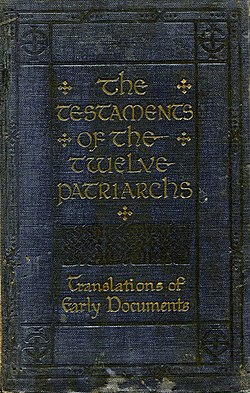
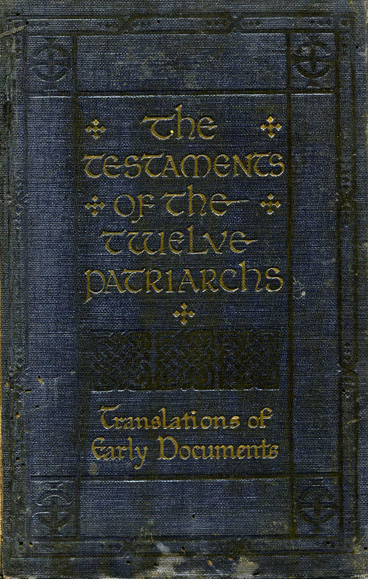
A 1917 edition of the Testaments of the Twelve Patriarchs.

The Testaments of the Twelve Patriarchs is a constituent of the apocryphal scriptures connected with the Bible. It is believed to be a pseudepigraphical work of the dying commands of the twelve sons of Jacob. It is part of the Oskan Armenian Orthodox Bible printed in 1666. Fragments of similar writings were found at Qumran, but opinions are divided as to whether these are the same texts. It is generally considered apocalyptic literature.

The Testaments were written in Hebrew or Greek, and reached their final form in the 2nd century CE. In the 13th century they were introduced into the Western world through the agency of Robert Grosseteste, Bishop of Lincoln, whose Latin translation of the work immediately became popular. He believed that it was a genuine work of the twelve sons of Jacob, and that the Christian interpolations were a genuine product of Jewish prophecy;[1] he accused Jews of concealing the Testaments "on account of the prophecies of the Saviour contained in them."

With the critical methods of the 16th century, Grosseteste's view of the Testaments was rejected, and the book was disparaged as a mere Christian forgery for nearly four centuries.[1] Currently, scholarly opinions are still divided as to whether it is an originally Jewish document that has been retouched by Christians, or a Christian document written originally in Greek but based on some earlier Semitic-language material.[2] Scholarship tends to focus on this book as a Christian work, whether or not it has a Jewish predecessor (Vorlage).

Manuscripts

[edit]

The Testaments are known from fifteen Greek manuscripts; the oldest preserved complete version dates from the tenth century. There is also a Slavonic version, and a Serbian version close it. An Armenian version—which contains fewer Christian interpolations than the Greek version—is attested by about fifty manuscripts. An editio minor (a preliminary edition) of the Armenian version of the Testaments of the Twelve Patriarchs was published in 2012.[3] The early European translations are based on a Latin version made from the Greek text.[4]

Aramaic fragments of documents relating to Levi (1Q21, 4Q213, 4Q213a, 4Q213b, 4Q214, 4Q214a, 4Q214b); Judah (3Q7, 4Q538); and Joseph (4Q539) have been found at Qumran among the Dead Sea Scrolls. An ancient Hebrew fragment of the Testament of Naphtali was also discovered at Qumran at Cave 4 (4Q215).[5]

Fragments of Levi, similar to 1Q21 and dated to the ninth century, were discovered in the genizah of a Karaite synagogue in Cairo.[6] There is also a later medieval Hebrew version of the testament of Naphtali. Analysis of the discrepancies between the different fragments and copies reveals a process of synthesis and interpolation within the text.

The Testaments are not often cited in Patristic literature.

Historical references

[edit]

Ethics

[edit]

Testaments are regarded as exhortatory writings; ethics therefore are fundamental to the text. The Testaments have many different ethical motifs, the foremost of which is adhering to God's commandments. Each testament discusses a certain vice or virtue.

Another theme, extensively discussed by Hollander,[11] is the role that Joseph plays in the ethics. He is often the example of an ethical man, and the deeds of the patriarchs are often weighed against those of Joseph.

As argued by Robert Henry Charles, who studied and translated the Testaments in the beginning of the 20th century,

the main, the overwhelming value of the book lies ... in its ethical teaching, which has achieved a real immortality by influencing the thoughts and diction of the writers of the New Testament, and even those of our Lord.[12]

He writes that the Testaments help to "bridge the chasm that divides the ethics of the Old and New Testaments."[13] To a modern reader, the main value of the Testaments, is not in the variations on biblical text, but in their ethical teachings, as amplified by the following citations:

  • Love the Lord through all your life, and one another with a true heart
  • Love yea one another from the heart; and if a man sin against thee, speak peacefully to him, and in thy soul hold not guile; and if he repent and confess, forgive him. But if he deny it, do not get into a passion with him, lest catching the poison from thee he take to swearing, and so then sin doubly …
  • Love the Lord and your neighbor.
  • Anger is blindness, and does not suffer to see any man with truth
  • Hatred, therefore is evil; etc.

(from The Apocrypha in English. Edited by Rev. R. H. Charles.)

Summary

[edit]
First page of the 10th- or 11th-century Greek manuscript acquired by Grosseteste

The work is divided into twelve books, each purporting to be the last exhortations of one of the twelve titular patriarchs. In each, the patriarch first narrates his own life, focusing on his strengths, virtues, or his sins, using biographical material from both the Hebrew Bible and Jewish tradition. Next, he exhorts his listeners to emulate the one and to avoid the other. Most of the books conclude with prophetic visions.

Reuben

[edit]

The Testament of Reuben is predominantly concerned with admonishing lust, and the sinfulness of Reuben in his having had sexual intercourse with Bilhah, a concubine of his father. It is likely that the author wished to cover the topic of fornication anyway, and assigned it for Reuben to discuss due to Reuben's relationship with Bilhah being recounted in the canonical Bible.

The Testament adds that Reuben spies Bilhah as she bathes in secret; and that when she later becomes drunk, Reuben rapes her. That trope derives from a reading of Genesis 49:4, "wanton as water", as "wanton in water",[14] taken from the Book of Jubilees.[15] This theme is also in 2 Samuel 11:2's account of David and Bathsheba.[16]

The Testament portrays women as the cause of the downfall of the Watchers, and of man in general (excepting Bilhah, in accordance with Jubilees). Joseph is on the other hand portrayed as the ideal, for his resistance against Potiphar's wife.

Simeon

[edit]

The Testament of Simeon is primarily a diatribe against envy. In the Genesis narrative, Simeon is portrayed as having been bound in chains by Joseph, and the author of the Testament argues that Simeon had wanted to kill Joseph due to jealousy, allowing the Testament to continue with a discourse about envy. The narrative of the Testament explains that it was Judah who had sold Joseph into slavery, and goes on to portray Joseph as the ideal of virtue and generosity.

The Testament 5:4-6 in an aside attacks Simeon's children for the sin of miscegenation, Numbers 25. It does not mention the attack on Shechem, which in the Torah Simeon had mounted alongside brother Levi. Instead it posits that Simeon made war against Levi. Kugel concludes that the Testament agreed with Jubilees 30:23 in that the attack on Shechem was "righteous", and so the Testament suppressed the account to deny Simeon credit.[17]

Levi

[edit]

The Testament of Levi is an apocalyptic section. It is one of the longest of the Testaments, and is predominantly concerned with arrogance. Taking the theme of the Levite priesthood, the Testament explains how Levi's descendants corrupted the office by their arrogant disregard for the proper regulations.

Chapter 2-8 involves Levi being taken to heaven and promised the priesthood forever, and then seven angels physically give him the insignia of the priesthood (as described in Exodus). This part parallels the beginning and end of a vision in the Aramaic Levi Document, whence the body of the vision is now lost; and is thought to preserve that part of the text.[18]

In chapters 14-18 Levi cites a "book of Enoch", describing the sins of his descendants, with the promise that at the end there will be a glorious priest who will restore the righteousness of his office. The tropes of Levi's "Book" match those of the "Apocalypse of Weeks" in 1 Enoch.[19]

The Testament has an account of the raid on Shechem. Its take is that Jacob proposed a marriage between Shechem and Dinah, sincerely offering Shechem the option of circumcision. Levi opposed the circumcision from the start. Unlike Jubilees and, if Kugel is right, the Testament of Simeon: to the Testament of Levi, intermarriage is lawful in principle between Israelites and converts. Shechem was excluded for its other crimes.[20]

Aramaic Levi document

[edit]

One way in which this testament is distinguished from the others is by additional footnotes in a Greek version of the manuscript from Mount Athos. These footnotes were found to be translated from a non-apocalyptic precursor of the text in Aramaic, partially preserved in the Dead Sea Scrolls. The find consisted of six fragments in two manuscripts from cave 4 (4Q213-214). A small related fragment was also found in cave 1 (1Q21). According to some sources, these scrolls were dated by the Oriental Institute[21] to between 100-200 BC using radiocarbon dating.

According to James Kugel at Bar-Ilan University, Aramaic Levi is a composite of two documents. One source was "a wisdom apocalypse derived from the exegetical elaboration of Malachi 2:4-7". The other, based on the same exegesis, "described Levi's actual initiation into the priesthood by angels".[22] The narrative frame is based from the Book of Jubilees.[23] The compiler of Aramaic Levi added that the priests would be kings.[24] It is a Hasmonean compilation, 133–100 BCE.[25]

Judah

[edit]

The Testament of Judah is primarily concerned with courage, monetary greed, and fornication. It begins by portraying Judah as idealistically courageous, involving bravery in front of wild beasts, as well as successful military expeditions, sometimes basing the narrative on acts that the canonical bible attributes to Jacob. However, it goes on to present a xenophobic focus, criticizing his marriage to a non-Israelite, as well as his sexual activity with Tamar, his daughter-in-law who at that time was pretending to be a prostitute.

The narrative argues that Judah had sex with Tamar and his wife due to drunkenness, and that he bribed his wife's father in order to be allowed to marry her. It then goes on to instruct that the role of a king is lesser than that of a priest, and that Levi is more important, clearly pointing to the theocratic attitude of the author.

Issachar

[edit]

The Testament of Issachar predominantly concerns asceticism, which the text portrays as virtuous. The narrative however begins by retelling the biblical tale of Leah's purchase of Jacob's nocturnal services by the giving of mandrakes to Rachel. Rachel is portrayed as virtuous for being more chaste than Leah.

The remainder of the narrative portrays Issachar himself as leading a godly and simple agricultural life. This is based on Genesis 49:14-15: Issachar had loved the land such that he "bent his shoulder to the burden" and became a tiller for hire. The same exegesis is at work in the Septuagint and Samaritan Targum of Genesis.[26]

Zebulun

[edit]

Zebulun was the sixth son of Leah and Jacob. He is described as an inventor and philanthropist and the text relates what he learned as a result of the plot against Joseph.

"The copy of the words of Zebulun, which he enjoined on his sons before he died in the hundred and fourteenth year of his life, two years after the death of Joseph. 2 And he said to them: Hearken to me, ye sons of Zebulun, attend to the words of your father. 3 I, Zebulun, was born a good gift to my parents. 4 For when I was born my father was increased very exceedingly, both in the flocks and herds, when with the straked rods he had his portion. 5 I am not conscious that I have sinned all my days, save in thought. 6 Nor yet do I remember that I have done any iniquity, except the sin of ignorance which I committed against Joseph; for I covenanted with my brethren, because they had all agreed that if any one should declare the secret, he should be slain."

Dan

[edit]

The Testament of Dan treats the topics of anger and lying. The main vice, however, is anger.

Dan first explains his feelings of jealousy towards his brother Joseph. The spirit of anger tempted him towards murdering Joseph. Fortunately, the Lord did not deliver Joseph into Dan's hands.

Dan then goes on to explain how the spirit of anger works. It covers your eyes, and distorts your vision. Through this you do not recognise people for who they really are. In the case of Joseph, Dan speaks from experience. Furthermore, it disturbs the mind so that the Lord departs from it and Beliar inhabits it.

Therefore, Dan's children should keep the commandments of the Lord, and stay near to the Lord. Dan goes into more depth through a prediction about the future, including one SER (Sin-Exile-Return[27]) and three LJ (Levi-Judah) passages. In this Dan talks of a saviour arising from Levi and Judah that will set the souls free from Beliar.

Again, Dan reminds his sons to stay near to God, and also to his interceding angel, and the saviour of the Gentiles. If they listen to Dan's warning, then his children will be received by the saviour of the Gentiles and be saved.

The testament ends with an apparent gloss (inasmuch as one can speak of a gloss in a pseudepigraph), which points out that the prophecies of Dan did indeed happen.

Naphtali

[edit]

The Testament of Naphtali has apocalyptic elements in it. It opens with the genealogy of Bilhah, his mother, whose father is said to be Rotheus. His vision represents Levi seizing the sun and Judah the moon. The young man with the twelve palm branches seems to be a reference to the Apostles. Joseph seizes a bull and rides on it. He has a further dream in which he sees a storm at sea and the brethren being separated. Again, there is a reference to the recurrent theme of sexual relations.[28]

A Hebrew fragment of the Testament of Naphtali was discovered at Qumran among the Dead Sea Scrolls taken from Cave 4 (4Q215).

Two versions of a medieval Hebrew Testament of Naphtali exist, with one being a secondary elaboration of the other. These medieval texts are not identical to the Qumran fragment or the Greek version in the Testaments of the Patriarchs. They are believed to represent a translation from a non-Hebrew source, probably Greek.[29]

Gad

[edit]

The Testament of Gad begins with Gad's hatred for Joseph. Chapter Two begins with Gad talking about loving one another. He says 'and now, my children, I exhort you, love ye each one his brother, and put away hatred from your hearts, love'. The moral of Gad is to not hate one another and love all your brethren.

Asher

[edit]

The Testament of Asher is the shortest of the twelve and unlike the others does not begin with a deathbed scene. It is regarding the subject of the two ways to live. The main appeal in Asher is to follow truth with singleness of faith.

Joseph

[edit]

The Testament of Joseph primarily concerns Chastity, and seems heavily to be based on Joseph's resistance against Potiphar's wife that the canonical bible portrays. The narrative contains a large expansion on the attempts of Potiphar's wife to seduce Joseph, portraying her as first threatening Joseph, then employing torture, then flattering Joseph, then plotting to kill her husband so that Joseph would be able to marry her without bigamy, then using love potions, and finally threatening suicide.

Benjamin

[edit]

The Testament of Benjamin is very much an appendix to that of Joseph. It opens with the account Joseph gave Benjamin of how he was sold to the Ishmaelites. He exhorts his descendants against deceit, but, as all his brethren, he warns them against fornication.[28]

Prophecy

[edit]

The Testaments of the Twelve Patriarchs contain a substantial amount of prophecy concerning the coming of the Messiah. From a Christian perspective, a number of statements can be associated with events in the life of Jesus. Many consider this significant since several of the books are thought to predate Jesus.

For example, compare the following passages from the Testament of Levi:

The heavens shall be opened, and from the temple of glory shall come upon him sanctification, with the Father's voice as from Abraham to Isaac. And the glory of the Most High shall be uttered over him, and the spirit of understanding and sanctification shall rest upon him in the water. (Levi 18:21-22)

with this passage from the Gospel of Matthew

As soon as Jesus was baptized, he went up out of the water. At that moment heaven was opened, and he saw the Spirit of God descending like a dove and lighting on him. And a voice from heaven said, "This is my Son, whom I love; with him I am well pleased." (Matthew 3:16–17)

Use in the New Testament

[edit]

Charles called attention to the frequent use of the Testaments of the Twelve Patriarchs by Paul and other writers of the New Testament. In particular:

  • I Thess. ii. 16 is a quotation of Test. Patr., Levi, 6:10-11;
  • Rom. 12:19 is taken from Gad, 6:7;
  • Rom. 12:21 is taken from Benjamin, 4:3;
  • II Cor. 7:10 is a quote from Gad, 5:7;
  • Ephes. 5:6 appeared first in Naphtali, 3:1.[30]

Later scholarship has highly debated this issue.

Availability

[edit]

A copy of the testaments is published in several works including:

  • The Ante Nicene Fathers, Volume VIII
  • The Apocrypha and Pseudepigrapha of the Old Testament in English, ed. Robert Henry Charles (Oxford Univ. Press 1913) volume 2 (pseudepigrapha)
  • The Testaments of the Twelve Patriarchs translated from the Editor's Greek text, Robert Henry Charles (London, 1908)
  • Ancient Testaments of the Patriarchs, by Ken Johnson
  • The Lost Books of the Bible and the Forgotten Books of Eden.[31]
  • The Apocryphal Old Testament, ed. H.F.D. Sparks (1985, Oxford Univ. Press)
  • Testaments of the Twelve Patriarchs (MS Ff.1.24),[32] a 10th century Greek manuscript in the collections of Cambridge University Library
  • The 120-Book Holy Bible and Apocrypha Collection: Literal Standard Version (LSV), Covenant Press (New York, 2023)

See also

[edit]

References

[edit]

Works cited

[edit]

Further reading

[edit]
[edit]
Revisions and contributorsEdit on WikipediaRead on Wikipedia
from Grokipedia
The Testaments of the Twelve Patriarchs is a collection of twelve ancient pseudepigraphal texts, each purporting to be the farewell discourse of one of the twelve sons of the biblical patriarch Jacob, offering ethical exhortations, autobiographical reflections, and eschatological prophecies to their descendants. These works, part of the Old Testament Pseudepigrapha, emphasize moral virtues such as compassion, forgiveness, and temperance while warning against vices like envy, lust, and hatred, often framed within a dualistic worldview pitting good against evil forces led by Beliar. Composed originally in Greek—though some scholars propose an Aramaic or Hebrew Vorlage—the texts survive primarily in Greek manuscripts, with fragments in Armenian, Slavonic, and other languages, and no complete Hebrew version extant. Scholars generally date the core composition to the late second or early first century BCE, likely within a Jewish context during the Second Temple period, possibly reflecting Pharisaic or anti-Hasmonean sentiments, with later Christian interpolations adding explicit messianic references to and other allusions. Each testament follows a structured pattern: an introduction recounting the patriarch's life and sins, ethical instructions tailored to the speaker's character (e.g., Reuben on lust, Levi on priesthood), and a concluding prophetic vision of Israel's future, including themes of exile, return, and messianic saviors from the tribes of Judah and Levi. Key apocalyptic elements include visions of heavenly ascents, the role of angels, and eschatological judgment, blending Jewish with emerging apocalyptic traditions. The text's significance lies in its ethical and theological bridge between Jewish and early Christian thought, influencing later writings like the , though debates persist on the extent of Christian —traditional views see a Jewish base with targeted insertions, while others argue for a predominantly Christian composition drawing on Jewish sources. Modern editions, such as those by R. H. (1908) and H. C. Kee (1983), highlight its role in understanding intertestamental Judaism, with ongoing scholarship examining its Sin-Exile-Return schema and messianic expectations as windows into diverse beliefs.

Origins and Composition

Historical Context

The Second Temple period, encompassing roughly 515 BCE to 70 CE, represented a formative era in , beginning with the reconstruction of the Temple under Persian auspices after the Babylonian and concluding with its destruction by Roman legions under . This epoch witnessed Judaism's adaptation to successive imperial overlords: Persian tolerance allowed for religious autonomy and the codification of Torah observance, while Alexander the Great's conquest in 332 BCE ushered in Hellenistic influences, blending , philosophy, and urban culture with traditional Jewish practices. Tensions arose as some Jews embraced —evident in the adoption of gymnasia and Greek education—while others resisted, fostering a diverse religious landscape marked by sectarian groups like the , , and . Roman intervention from 63 BCE, following Pompey's siege of Jerusalem, imposed direct governance, heavy taxation, and procuratorial oversight, exacerbating revolts and underscoring the fragility of Jewish sovereignty. A pivotal event within this Hellenistic phase was the of 167–160 BCE, sparked by Seleucid king ' desecration of the Temple and prohibition of Jewish rituals, including and Sabbath observance, in a bid to enforce cultural uniformity. Led by the priest and his son , the uprising combined guerrilla warfare with zealous piety, culminating in the Temple's rededication in 164 BCE—an event commemorated in —and the establishment of Hasmonean independence until Roman conquest. This revolt profoundly shaped Jewish literature and thought, promoting ideals of martyrdom, ethical resistance to , and divine favor for the faithful, which resonated in subsequent texts emphasizing moral fortitude amid oppression. Pseudepigrapha emerged as a vital in , comprising writings pseudonymously attributed to ancient figures to lend authority to ethical, wisdom, and apocalyptic teachings amid socio-political turmoil. Testaments, a subset of this corpus, typically framed as patriarchal deathbed discourses, instructed audiences on virtues like and while warning of eschatological judgment, as exemplified by the Testament of Abraham (likely 1st–2nd century CE), which depicts Abraham's heavenly tour revealing divine mercy and retribution, and the Testament of Job, a Hellenistic-era expansion portraying Job's endurance as a model for patient righteousness. These works, alongside others like the Testaments of the Twelve Patriarchs, served didactic purposes, bridging biblical narratives with contemporary concerns over assimilation and fidelity. The Temple's destruction in 70 CE, amid the First Jewish-Roman War, catalyzed a reconfiguration of Jewish religious life, eliminating sacrificial rites and prompting shifts toward rabbinic interpretation and synagogues. Emerging Christian communities, rooted in but increasingly distinct, adapted pseudepigraphal texts—including testaments—to frame their theology, viewing the catastrophe as prophetic vindication of ' warnings and an opportunity to reposition themselves as the true heirs of Israel's covenants. This process unfolded amid frictions with post-Temple , as reinterpreted Jewish scriptures to emphasize spiritual temple imagery over physical restoration.

Authorship and Dating

Scholars widely attribute the Testaments of the Twelve Patriarchs to Jewish authorship, proposing an original composition in Hebrew or dating to approximately 150–100 BCE. This view stems from linguistic features, including Semitisms in the Greek transmission and parallels with other Jewish literature, indicating a pseudepigraphical work framed as deathbed exhortations by sons. The core ethical instructions, emphasizing moral conduct, repentance, and inter-tribal harmony, are considered to predate the destruction of the in 70 CE, as they lack references to that event and align with pre-70 Jewish ethical traditions. Supporting evidence for a pre-Christian Jewish origin includes fragments from , such as the Levi Document (4Q213–214) and related texts like 4Q215 (), which exhibit close thematic and verbal parallels to sections in the Testaments of and . These manuscripts, dated paleographically to the second or first century BCE, suggest that at least portions of the work circulated in Jewish communities before the . In his influential 1908 critical edition, R. H. Charles argued for a unified composition around 109 BCE, linking it to Pharisaic circles during the final years of I, based on allusions to Hasmonean politics and ethical emphases consistent with Pharisaic thought. Contemporary scholarship from 2020 onward continues to highlight the text's layered development, positing an initial Jewish core expanded over time within Pharisaic or proto-rabbinic environments, though debates persist over the extent of unity versus compilation from disparate sources. Key challenges to precise dating arise from the absence of direct ancient citations prior to the second century CE, with the earliest attestations appearing in Christian authors like , raising questions about potential post-70 revisions or transmission biases.

Redaction and Interpolations

The Testaments of the Twelve Patriarchs exhibit a composite nature, with scholars identifying distinct layers of Jewish core material overlaid by later Christian interpolations, primarily dated to around 100–200 CE. These Christian additions include explicit references to as the , such as in Testament of 18, where he is described as a priestly figure who saves humanity from sin, and in Testament of Benjamin 9–10, portraying him as a lamb slain for the Gentiles. motifs appear in passages like Testament of 9–10, linking ritual washing to Christian salvation themes, while anti-Jewish polemic emerges in sections emphasizing the rejection of Jewish law in favor of a through Christ. A key pre-existing Jewish source integrated into the text is the Aramaic Levi Document, fragments of which date to 100–200 BCE and were discovered at ; this material forms the basis of Testament of Levi 2–13, including priestly visions and ethical instructions that predate Christian influence. The document's origins and thematic focus on Levi's priestly role underscore its independent Jewish composition before incorporation into the broader testaments. Redactional stages are theorized to begin with original Jewish ethical testaments from the 2nd century BCE, expanded with apocalyptic prophecies, and subsequently Christianized through interpolations that harmonize the narrative with emerging . Recent scholarship, including the 2022 analysis by the Centre for the Study of and Near Eastern Civilizations (CDAMM), highlights a unique Jewish-Christian interplay, debating the extent of these layers and suggesting the work may represent a 2nd-century CE Christian reworking of Jewish traditions rather than mere additions to a unified Jewish original. Earlier models, such as those by Robert Charles (1908) and the Leiden school led by Marinus de Jonge (1953), posit an initial Jewish composition around 109–106 BCE followed by Christian edits, though the precise boundaries remain contested. Detection of these interpolations relies on methods such as analyzing stylistic inconsistencies, where ethical exhortations flow seamlessly in Jewish sections but disrupt in apocalyptic passages with anachronistic Christian . Theological shifts provide further evidence, notably the transition from dual messianic figures—a priestly from and a kingly one from Judah in Jewish core material—to a singular in interpolated sections, reflecting early Christian unification of messianic expectations. Variant manuscript readings, including Armenian versions with fewer Christian elements, also aid in isolating these layers.

Manuscripts and Editions

Primary Manuscripts

The Testaments of the Twelve Patriarchs survive primarily in Greek manuscripts, with fifteen known witnesses, the oldest complete version dating to the tenth century. These manuscripts, produced mainly in Byzantine scriptoria, exhibit significant textual variations due to scribal interventions and regional transmission patterns. The exemplar MS Ff. 1.24, a codex likely copied in around the late tenth or early eleventh century, contains the full text and includes marginal annotations by the thirteenth-century scholar , reflecting early Western engagement with the work. Other notable Greek codices, such as those edited by R. H. Charles from nine manuscripts in 1908, show a family of interrelated copies from the eleventh to sixteenth centuries, often embedded in broader collections of apocryphal or patristic texts. No complete Greek manuscripts predate the tenth century, though fragmentary evidence suggests earlier circulation; however, the primary early witnesses are non-Greek. The Armenian version provides a complete transmission, based on a Greek Vorlage from the fifth or sixth century, and is considered to preserve fewer Christian interpolations than the Greek, offering a less redacted form of the original composition. This version forms the basis for the 2012 editio minor by Michael E. Stone, drawn from eleven selected manuscripts out of over seventy surviving Armenian copies, many from medieval monastic libraries. The Slavonic translation, dating to the fourteenth century and derived indirectly from Greek via Bulgarian intermediaries, includes unique readings not found in other traditions, such as expanded ethical exhortations in certain testaments. Serbian fragments, closely related to the Slavonic, survive in partial form from similar medieval Slavic contexts, providing additional variant readings for comparative textual analysis. Among the earliest physical artifacts are fragments from Qumran and the Cairo Geniza, attesting to Semitic precursors. The Aramaic Levi fragments (4Q213–214), discovered in Qumran Cave 4 and paleographically dated to the second century BCE, contain portions of priestly instructions and visions paralleling the Testament of Levi, suggesting an independent Aramaic tradition underlying parts of the Greek text. A Hebrew fragment of the Testament of Naphtali (4Q215) from the same cave, dated to the second century BCE, preserves ethical admonitions on natural order, further indicating Jewish origins for individual testaments before their compilation. Later, ninth- and eleventh-century Aramaic Levi fragments from the Cairo Geniza, similar to the Qumran material, were likely copied from an earlier manuscript tradition and highlight the work's circulation in Jewish communities. Textual variants across these witnesses reveal a complex transmission history, with the Armenian often retaining shorter, less interpolated passages compared to the Greek, which shows evidence of Christian additions in messianic prophecies. Scholarly stemmata codicum, such as those proposed by Marinus de Jonge, outline two main Greek families diverging from a hypothetical , with the Armenian and Slavonic branches stemming independently from a pre-Byzantine Greek source; these reconstructions emphasize shared omissions and additions to trace redaction layers.

Modern Editions and Translations

The foundational modern scholarly edition of the Testaments of the Twelve Patriarchs is that of , who published a critical Greek text in 1908 based on principal manuscripts such as the 11th-century Codex S and the 10th-century Ambrosianus, followed by an English translation in 1913 as part of The Apocrypha and Pseudepigrapha of the . ' work established a benchmark by systematically identifying and excising what he viewed as Christian interpolations to reconstruct an underlying Jewish original dated to circa 109–106 BCE, thereby enhancing scholarly access to the text's ethical and apocalyptic elements. Subsequent editions built on Charles' framework while critiquing his dating and theories. In 1975, Marinus de Jonge issued of the Twelve Patriarchs: A Study of Their Text, Composition and Origin, arguing that the work is primarily a Christian composition from the second century CE incorporating earlier Jewish traditions, rather than a predominantly Jewish text with later additions as Charles proposed; this perspective shifted focus toward the Testaments' role in early Christian origins and textual development. De Jonge's , expanded in collaborative volumes through 1985, emphasized the integral nature of Christian motifs and influenced later reconstructions of the text's layered history. Advancements in non-Greek traditions appeared with Michael E. Stone's 2012 An Editio Minor of the Armenian Version of the Testaments of the Twelve Patriarchs, a critical edition drawn from 11 selected manuscripts out of over 70 known Armenian copies, accompanied by an English ; this work highlights the Armenian recension's fidelity to an early Greek archetype and addresses textual variants overlooked in Greek-focused editions. Recent translations have broadened accessibility, including the Scriptural Research Institute's 2020 Testaments of the Patriarchs Collection, which compiles the Twelve Patriarchs alongside related testaments in a modern English rendering aimed at general readers. Digital open-access editions, such as the one on Early Jewish Writings from the early 2000s, reproduce Charles' translation with annotations on scholarly debates, while platforms like Sefaria offer searchable English versions integrated with biblical texts for contemporary study. These resources, including post-2020 updates to digital archives, have addressed gaps in Charles' dating critiques by facilitating access to evidence supporting a second-century BCE Jewish core with second-century CE Christian redactions.

Reception History

Ancient and Medieval References

The Testaments of the Twelve Patriarchs received early attention in patristic literature, with Tertullian (c. 200 CE) referencing a prophecy from the Testament of Levi, drawing on it in works such as Adversus Marcionem (Book 5.1) and Scorpiace (chapter 13). Origen, in the third century, quoted ethical passages from the text, including material from the Testament of Reuben on the destructive nature of sexual sin as a "pit" leading the soul to ruin, which he incorporated into his Homilies on Joshua (15.6). These citations reflect selective engagement with the Testaments' moral and prophetic elements, though overall patristic use remained limited, likely owing to the work's uncertain canonical standing and pseudepigraphical character. Following the fourth century, explicit references to the Testaments disappear from surviving Christian sources, indicating a period of obscurity or non-transmission in the Latin and Greek West. This textual hiatus ended in the thirteenth century with the Latin translation by , , who rendered the Greek version into Latin around 1242 after acquiring a from , thereby reintroducing the work to Western European scholarship and facilitating its dissemination through over eighty surviving manuscripts and early printed editions. In medieval contexts, the maintained circulation within the Armenian Orthodox tradition, where they were included in biblical codices and canon lists, such as that of Gregory of Tat`ew (), often appended at the end of scriptural collections as an authoritative ethical supplement. The text also exerted influence on Byzantine ethical discourse, preserved in Greek manuscripts and echoed in chronicles and moral teachings that emphasized virtues like and temperance, aligning with broader Orthodox emphases on patriarchal wisdom. Recent scholarship, including a 2010 study on the work's Jewish-Christian milieu, underscores this selective early Christian reception, attributing the patristic restraint to theological caution amid diverse .

Early Modern Scholarship

The revival of interest in the Testaments of the Twelve Patriarchs during the was facilitated by the circulation of Robert Grosseteste's 13th-century Latin translation, which appeared in numerous printed collections of apocryphal texts from the 15th and 16th centuries. These editions, often bundled with other pseudepigraphal works, reflected the era's growing fascination with biblical extracanonical literature amid the humanist recovery of ancient manuscripts. The text's ethical and prophetic content was leveraged in theological debates, including polemics against Jewish interpretations, as noted in contemporary chronicles like those of . A notable contribution came in 1593 with Thomas James's Latin edition, which made the Testaments more accessible to scholars studying patristic and apocryphal sources. In the , Heinrich Hottinger examined the Armenian version in his Orientale (1658), highlighting its textual variants and potential value for reconstructing earlier forms of the work, thereby advancing philological analysis of non-Greek traditions. This period also saw the first major Greek edition by John Ernest Grabe in 1698, based on a 10th-century manuscript, which emphasized the text's composite nature. Johann Albert Fabricius further cataloged the Testaments as in his Codex Pseudepigraphus Veteris Testamenti (1713), reprinting Grabe's text and situating it within a broader corpus of ancient Jewish and Christian writings; a second edition followed in 1722 with minor revisions. During the Enlightenment, biblical criticism intensified debates on the work's authenticity, with Grabe and others positing a Jewish core overlaid by Christian interpolations, raising early doubts about its purely Jewish origins and prompting scrutiny of its historical reliability. Pre-20th-century European , including colonial-era efforts to translate Eastern versions like the Armenian, laid groundwork for later critical studies, as recent retrospectives underscore how such translations often served and orientalist agendas.

Thematic Analysis

Ethical Instructions

The ethical instructions in the Testaments of the Twelve Patriarchs constitute a foundational moral framework, drawing on Jewish wisdom traditions to guide readers toward righteous living through a series of exhortations attributed to Jacob's sons. Central to this framework is the doctrine of the two ways, which delineates the path of good—characterized by virtues like truth, purity, and love—from the path of evil, marked by sin and destruction, thereby underscoring human agency in moral choice. This dualistic ethic warns against specific vices, such as lust (exemplified in Reuben's counsel), envy (in Simeon's), and anger (in Levi's), portraying them as gateways to spiritual ruin and communal discord. Joseph emerges as the paradigmatic figure of ethical excellence, embodying in resisting and toward his brothers, serving as a model for overcoming adversity through . The testaments' structure frames these instructions as deathbed legacies, where each imparts practical advice to their descendants, emphasizing toward , compassionate for one's neighbor, and steadfast avoidance of to foster communal harmony and divine favor. These teachings reflect significant influences from biblical sources, particularly the exhortations in Deuteronomy on choosing life over death (Deut. 30:15–19) and the proverbial wisdom in Proverbs advocating prudence and righteousness (Prov. 4:18–19). Ethical parallels also appear with Jewish literature, including the dualistic moral orientations in texts like the , which similarly contrast obedience to the law with transgression. Scholar R. H. Charles highlighted numerous echoes of these instructions in the , such as alignments with the on the Mount's calls for inner purity and peacemaking (Matt. 5:8–9, 21–24). Recent scholarship continues to identify Pharisaic influences in the testaments' ethical emphases on legal observance tempered by moral intent, viewing the work as reflective of pre-Christian Jewish piety that prioritizes heartfelt righteousness over mere ritual. Prophetic warnings occasionally reinforce these ethics by linking moral fidelity to future divine intervention.

Prophetic Elements

The Testaments of the Twelve Patriarchs incorporate prominent prophetic elements through apocalyptic visions and eschatological expectations, distinguishing them from the ethical exhortations elsewhere in the text. At the core of the Jewish compositional layer lies the concept of dual messiahship, envisioning a priestly Messiah from the tribe of Levi and a kingly Messiah from the tribe of Judah, reflecting tensions in Second Temple Judaism over priestly and royal authority. This duality underscores the tribes' elevated roles, with Levi associated with priesthood and Judah with kingship, as prophesied in visions that anticipate their future preeminence amid Israel's trials. Key visions exemplify these themes. In the Testament of Levi 18, a heavenly ascent reveals a new priest "like Melchizedek," who will execute divine judgment, open paradise, and establish a universal priesthood, symbolizing eschatological renewal. Similarly, the Testament of Judah 24 foretells a "star" arising from —echoing Numbers 24:17—to conquer nations, bind Beliar, and usher in an era of peace and prosperity for . These prophecies depict end-times tribulations, including widespread , , and conflict, culminating in through messianic intervention and the restoration of a purified order. In later Christian redactions, this dual framework evolves toward a single messianic figure combining priestly and royal attributes. Apocalyptic motifs permeate these prophecies, portraying Belial's spirits as agents provoking human sin and moral corruption, which precipitate cosmic upheaval and . For example, the Testament of Reuben 2–3 attributes vices like fornication and envy to specific spirits of Belial, while the final judgment envisions their annihilation, as in Testament of Judah 25.3 and Testament of Levi 18.12, leading to the eradication of evil and the inauguration of eternal righteousness. Such imagery draws parallels to Enochic literature, with explicit references to as a conduit of heavenly secrets informing the patriarchs' revelations. Scholarship debates the historical context of these prophecies, often viewing them as critiques of Hasmonean rule. Analysis by Hultgård (1977) identified an initial anti-Hasmonean phase emphasizing separate ideal figures from and Judah before later developments, highlighting resistance to the dynasty's conflation of priestly and kingly powers during the late second century BCE. Ethical lapses by the patriarchs, such as pride or , frequently serve as foils in these visions, foreshadowing judgments that underscore the need for amid prophetic warnings.

Summaries of the Testaments

Reuben

The Testament of Reuben is the shortest of the testaments in the collection, comprising approximately 100 lines in the manuscript tradition. It consists of six chapters in which , the firstborn son of and , addresses his children on his deathbed at the age of 125, two years after Joseph's death, while afflicted by illness. Reuben begins by confessing his grave sin of with , his father's concubine, an act briefly alluded to in Genesis 35:22. He recounts how, at the age of fourteen, he saw bathing naked after a and was overcome by , leading him to lie with her while she was asleep and intoxicated from wine near the tower of Eder by . An angel immediately revealed the transgression to , who mourned deeply and initially cursed , stripping him of his . suffered a seven-month affliction, including and inability to eat or drink, as divine punishment for his . Despite this, he emphasizes his subsequent , for seven full years, abstaining from wine, meat, and all sensual pleasures, and engaging in constant mourning and prayer, which ultimately led to his forgiveness through 's intercession and divine mercy. The ethical core of the testament focuses on warnings against , portraying it as the primary spirit of that ensnares the young and leads to moral downfall. Reuben identifies seven subsidiary spirits arising from the spirit of procreation—fornication, insatiableness, fighting, obsequiousness, , lying, and —which deceive and dominate humanity, beginning with as the root of all . He attributes seductive power to women, blaming Bilhah's immodesty for inciting his passion and advising his sons to shun women's beauty, avoid their company, and recognize them as vessels of iniquity that provoke men to sin through internal desires rather than overt actions. These admonitions underscore as the path to , with urging vigilance against the "evil inclination" to prevent similar lapses. In a brief prophetic conclusion, Reuben foretells future tribulations for arising from moral decay, including division among the tribes, captivity by Gentiles, and subjugation due to sins like , but promises ultimate through a priestly figure from and a king from Judah who will execute righteous judgment and restore the nation.

Simeon

In the Testament of Simeon, the patriarch reflects on his life, beginning with his collaboration with his brother in avenging the violation of their sister by leading the violent assault on the Shechemites, as recounted in Genesis 34, where they deceived and slew the city's men to exact retribution. This act, though initially driven by righteous zeal, is later framed as tainted by underlying passions that Simeon seeks to caution against in his final exhortations to his descendants. Simeon delivers stark warnings against the perils of and , portraying them as the root causes of interpersonal strife and moral downfall, exemplified by his own hidden resentments that nearly fractured familial bonds. He describes the spirit of working together with through hastiness of spirit, inciting vices such as , boasting, strife, , , lying, , , baseness, deceit, and love of glory, which erode brotherly unity and lead to broader ethical lapses if not confronted through and vigilance. These vices, he explains, erode brotherly unity and lead to broader ethical lapses if not confronted through and vigilance. Simeon advises obedience to as the priestly authority among the tribes, positioning him as a guide for righteous conduct amid potential future tribulations. He includes a foretelling vengeance upon Levi's descendants, predicting that their priestly dominance will provoke due to arrogance and overreach, ultimately restoring balance among the tribes. Central to the testament is an emphasis on cultivating brotherly harmony, as Simeon urges his offspring to prioritize and mutual support to transcend the tribal conflicts born from past hatreds and ensure communal prosperity.

Levi

The Testament of Levi presents the third son of and as a foundational figure in Israel's priestly tradition, recounting his life events within the broader biblical context of Genesis 49:5–7, where curses the fierce anger of and following their violent actions but ultimately transforms Levi's zeal into a divine calling for priesthood. At age eighteen, joins in avenging their sister Dinah's rape by slaying and the men of the city, an act framed as righteous zeal for that leads to his heavenly visions and priestly appointment, distinguishing it from mere vengeance and redeeming the brothers' wrath through sacred service. The narrative integrates material from the pre-Christian Aramaic Levi Document (ALD), discovered in fragments at (4Q213–214a, 4Q540–541) and the Cairo Genizah, which preserves early Jewish hymns, detailed priestly instructions on sacrifices and purity laws, and visions of heavenly where angels perform bloodless offerings before the divine throne. In the Testament, these elements are adapted into 's ascent through (chs. 2–3), where he witnesses angelic hierarchies and receives priestly vestments and from seven figures (ch. 8), emphasizing his eternal role in mediating between God and ; the ALD's hymn-like prayer of (e.g., 4Q213) underscores themes of wisdom and holiness, influencing the Greek Testament's ethical framework. Scholarly analysis links these fragments to a third-century BCE composition, predating Christian interpolations and providing the core Jewish substratum for 's testament, expanding on its priestly legacy beyond later redactions. Ethically, the text warns against the dangers of anger inherited from the incident, urging Levi's descendants to pursue , guard against impurity, and embody the "seven mercies" as virtues of , truth, and obedience that counter wrath and secure heavenly rewards (chs. 13–14). Prophetically, chapter 18 envisions a future messianic priest-king from Levi's line who will atone for sins, judge , and usher in eternal , blending royal and sacerdotal authority in a figure who subdues and reveals divine words to all nations.

Judah

The Testament of Judah, the fourth son of and , is presented as his deathbed exhortation to his sons, emphasizing his role as a leader and warrior while reflecting on personal failings and future tribal destiny. This testament is the longest among the non-Joseph narratives in the collection, spanning twenty-five chapters and uniquely exalting the as the source of enduring kingship and . Judah recounts his early exploits as a mighty hunter and conqueror, boasting of outrunning wild animals, slaying beasts like lions and bears, and leading victories against Canaanite kings such as those of Hazor and Tappuah to secure his family's safety in the land. He confesses his central role in the sale of his brother into slavery, driven by envy and hatred, an act that later prompts Joseph's forgiveness toward him. This admission frames Judah's autobiography as one of flawed leadership tempered by familial conflict, drawing from the Genesis 37 narrative but recontextualized as a cautionary personal reflection. A pivotal moral lapse occurs in Judah's encounter with Tamar, his daughter-in-law, whom he mistakes for a prostitute after his sons Er and die due to their wickedness; this leads to the birth of twins Perez and Zerah, whom Judah later acknowledges as righteous offspring. Judah portrays this incident from Genesis 38 as a moment of born of and poor judgment, urging repentance and highlighting its consequences for his lineage. Ethically, Judah warns his sons against the perils of wine, which clouded his judgment and led to promiscuity, declaring that it stirs up the mind to and invites demonic influence. He similarly cautions against the of wealth and possessions, which foster and , and against , which defiles the soul and invites . In contrast, he promotes as a path to , justice as essential for righteous rule, and to maintain moral integrity amid temptations. The testament culminates in prophetic visions of Judah's tribal supremacy, foretelling a perpetual kingdom arising from his line, with rulers who will judge nations in righteousness until a messianic figure emerges. Central to this is the imagery of a star rising from Jacob and a scepter from Judah's lineage, echoing Numbers 24:17, symbolizing a future king who will subdue enemies and bring peace. Judah's prophecy underscores a royal messiah from his descendants, distinct in its emphasis on martial and governmental authority.

Issachar

The Testament of Issachar portrays its namesake as a diligent embodying the biblical description in Genesis 49:14–15, where he is likened to a "strong " that bows its shoulder to bear burdens and submits to forced labor, yet finds in toil without complaint. In the text, Issachar recounts his life as a simple husbandman who labored faithfully for his father , offering firstfruits to , priests, and the needy, and living contentedly with his wife and fields, free from envy or malice toward others. This depiction aligns with broader Jewish traditions valuing honest labor as a path to and divine blessing, as seen in texts like the Mishnah's emphasis on the dignity of agricultural work. Ethically, the testament extols as the paramount , urging Issachar's descendants to avoid luxury, deceit, and the corrupting influences of greed and vainglory, which are depicted as demonic spirits that lead to division and sin. advises living with a "singleness of eye" and heart, loving and neighbor, sharing resources with the poor, and resisting Beliar (a satanic figure) through and hard work rather than cunning schemes. Unlike the confessional tones of testaments like Reuben's, 's narrative maintains a positive, exemplary focus on contentment and uprightness, presenting him as a model of uncomplaining who prospered through adherence to 's law. Prophetically, the text includes a brief warning of among Issachar's descendants, foreseeing their abandonment of simple agrarian life for evil pursuits under Beliar's influence, resulting in dispersion among the Gentiles as punishment for forgetting God's commandments. However, it promises and restoration for those who return to and obedience, encapsulating a concise eschatological amid the collection's broader apocalyptic framework. This short testament, spanning only seven chapters, stands out for its optimistic tone and emphasis on personal virtue, contrasting with the more elaborate warnings in neighboring testaments.

Zebulun

The Testament of Zebulun presents the dying exhortations of , the sixth son of and , delivered at age 114, two years after Joseph's death. recounts his life as a seafarer, aligning with the biblical that his would dwell by the and serve as a haven for ships (Genesis 49:13). He describes himself as the first to construct a with a and , enabling voyages along the Canaanite coast where he caught fish to support his family. During these maritime endeavors, shared his abundant catches generously with strangers, the sick, the elderly, and other needy individuals, including fellow sailors and travelers, without expectation of repayment. This practice of communal sharing extended to inter-tribal aid, as he aided and other foreigners during times of hardship, even secretly providing resources to slaves and the oppressed in fulfillment of patriarchal covenants. Zebulun's ethical teachings emphasize and as core virtues, urging his sons to extend not only to humans but also to animals, mirroring divine goodness. He warns against , recounting how he refused any portion of the 20 pieces of silver from Joseph's sale, viewing it as money, while his brothers used theirs for personal luxuries like , leading to their later . Almsgiving is promoted through personal anecdotes, such as secretly taking a garment from his father's house to clothe a naked man in winter, and walking seven furlongs in with the destitute when unable to provide more. Although he does not explicitly address false oaths in his narrative, Zebulun stresses integrity in dealings, condemning any form of malice or division among kin that could fracture Israelite unity. His life exemplifies these principles, as his merciful actions spared him from the illnesses that afflicted his envious brothers during Joseph's ordeal. The testament includes prophetic elements, where Zebulun laments the future apostasy of his descendants, foreseeing their abandonment of for and dispersion among the nations due to ingratitude and moral failings. However, he envisions eschatological redemption through , promising that in , will remember compassion and gather the tribes, defeating and establishing righteous rule in , with Zebulun's line participating in judgment and resurrection. Unique to this testament are nautical metaphors drawn from 's seafaring experiences, portraying moral life as a voyage requiring wise through trials, much like steering a amid perilous waters, with as the guiding sail. This emphasis on inter-tribal , seen in his aid to other sons of during Joseph's betrayal, underscores a model of mutual support contrasting with individual isolation. concludes by requesting burial near his ancestors in and dies peacefully after blessing his sons.

Dan

The Testament of Dan, the seventh in the sequence of the Testaments of the Twelve Patriarchs, presents Dan as the fifth son of and , portraying him as a figure whose life exemplifies moral failings and the need for . In biblical tradition, Dan is depicted as a tribal who will govern his people like a serpent by the roadside, striking unexpectedly (Genesis 49:16–17). Within the testament, Dan confesses to personal sins, including involvement in plots driven by envy, such as the scheme against , and accuses himself and his tribe of and perverting justice through deceitful actions. Ethically, the text emphasizes the dangers of the spirits of lying and wrath, which Dan identifies as principal vices afflicting his lineage and leading to moral corruption. Dan exhorts his descendants to guard against these by clinging to truth, practicing justice without partiality, and fearing above all, rejecting idols that ensnare the and provoke divine wrath. He stresses that true involves loving both and neighbor, forgiving offenses to overcome anger's blindness, and avoiding that stems from falsehood, positioning these virtues as antidotes to Belial's influence. Prophetically, Dan foretells that and will emanate particularly from his , culminating in a figure of ultimate arising from Dan's line to mislead the nations before the final . This envisions a period of tribulation where the wicked from Dan's descendants will face , while the righteous receive through God's intervention. As a distinctive negative exemplar among , Dan's narrative serves as a of human frailty and the consequences of unchecked vice, with prominent Christian interpolations introducing messianic themes and eschatological in ways that carry anti-Jewish undertones, such as portraying Jewish elements as sources of end-time evil.

Naphtali

The Testament of Naphtali presents the patriarch's final exhortations to his sons, delivered in the 130th year of his life during a feast on the first day of the seventh month. Naphtali recounts his birth to , handmaid, and his naming, which stems from cunning substitution and her affection for him as he was placed on her lap at birth. He describes his own swiftness of foot, likening himself to a deer, a drawn from 's blessing in Genesis 49:21, where is portrayed as "a hind let loose" bearing comely fawns; employed him as a swift messenger for all errands, emphasizing his role in faithful service and obedience to paternal commands. Ethically, the testament stresses adherence to the divine order of creation, urging Naphtali's descendants to perform all works with good intent in the fear of God, avoiding disorder, covetousness, and beguiling words that corrupt purity of heart. It warns against division and favoritism among the tribes, promoting instead obedience to God's law, harmony among brothers, and love for each person according to their station, even toward the wicked, as all are made in God's image. Naphtali cautions that envy or hatred, such as toward the prosperous, leads to self-destruction and mirrors the errors of the Gentiles, Sodom, and the fallen Watchers who altered nature's order. Prophetically, foretells that his disobedient descendants will stray into lawlessness akin to the Gentiles and Sodom, facing captivity and affliction until diminished and scattered, with blessings hindered as a consequence. Restoration will follow through acknowledgment of the and unity, as a compassionate figure brings mercy to the near and far, enabling return to the ancestral land; two visions—one of and Judah seizing sun and moon on the , the other of a storm-tossed ship symbolizing tribal division resolved by 's prayer—underscore future tribulations and ultimate harmony under and Judah's leadership. The testament is notably short and employs an allegorical style, using natural and cosmic imagery to convey moral and prophetic lessons, with a better-preserved medieval Hebrew version in Moses Gaster's Chronicles of Jerahmeel and an ancient Hebrew fragment (4Q215) discovered at , suggesting an early Jewish compositional layer.

Gad

The Testament of Gad, the ninth son of Jacob and Zilpah, recounts Gad's personal experiences and ethical exhortations to his sons, delivered in the 125th year of his life. Gad confesses his intense hatred toward his brother , stemming from jealousy over favoritism and dreams, which led him to participate actively in betrayal by selling him to the for thirty pieces of gold—ten of which he and concealed. This act was driven by covetousness and a desire to eliminate , whom Gad viewed as a threat. Later, Gad expresses profound remorse, having suffered a severe illness of the liver or heart for eleven months as divine punishment for his sin, which was alleviated only through intercession and eventual forgiveness upon reuniting with his brothers. Ethically, Gad warns against the destructive spirit of and retaliation, portraying it as an evil force that collaborates with to incite strife, , and among people, blinding the soul and distorting truth into slander and violence. He emphasizes that hatred prevents adherence to God's commandments, particularly the of one's neighbor, and urges his sons to cultivate , , and instead, as these align with and lead to . The spirits of , Gad explains, foster ongoing conflict by envying the prosperous and amplifying minor offenses into calls for punishment or death, contrasting sharply with love's power to restore life even to . A key teaching appears in Gad 6:7, where he instructs: "But even if he is devoid of and persists in his wickedness, forgive him from the heart and leave vengeance to ," highlighting the need to forgo personal . Prophetically, Gad foresees cycles of vengeance and strife among the tribes of , where hatred will provoke mutual retaliation and wickedness, particularly involving the tribes of Judah and in future conflicts. However, he envisions ultimate and redemption through and , with a messianic Savior arising from Judah and to gather and the Gentiles, bringing an end to enmity and establishing harmony. This distinctive emphasis on leaving vengeance to in Gad 6:7 parallels the New Testament's Romans 12:19, which states, "Beloved, do not avenge yourselves, but rather give place to wrath; for it is written, 'Vengeance is mine, I will repay, says the ,'" underscoring a shared ethic of divine justice over human retribution.

Asher

The Testament of Asher presents the final exhortations of Asher, the tenth son of and , delivered at age 125 to his , emphasizing a life of and equity. Drawing from the biblical in Genesis 49:20, where Asher's territory is promised abundance yielding "royal dainties," the testament portrays him as a prosperous figure whose in and resources was shared justly, avoiding or favoritism to maintain communal harmony. This depiction underscores Asher's balanced existence, marked by unwavering adherence to truth and divine favor without deviation into excess or injustice. Central to the in Asher's testament is the recognition of the double-faced nature inherent in human inclinations, where coexist as two ways set before individuals, demanding a deliberate for to avoid spiritual ruin. Asher advises his sons to shun duplicity—"Do not ye, my children, wear two faces like unto them, of goodness and of wickedness"—and to pursue single-minded , as even righteous deeds corrupted by intent become fully sinful. He specifically cautions against excess in food and drink, which can lead to and loss of , and in judgment, where hasty or biased decisions mirror inner . These teachings employ vivid food metaphors, such as the , which divides the hoof like clean animals but chews its uncleanly, symbolizing those who outwardly appear virtuous yet inwardly harbor vice. Prophetically, Asher envisions blessings of prosperity and divine protection for those who embrace moderation and ethical consistency, contrasting this with warnings of moral decay through sin that will result in dispersion and subjugation by adversaries. The testament maintains a positive, advisory tone, repeatedly urging obedience to God's commandments as the path to salvation and restoration, without descending into overt condemnation. These metaphors for ethical choices parallel aspects of Jewish dietary laws, which distinguish permissible from forbidden foods to promote purity.

Joseph

The Testament of Joseph is the longest of the testaments in the collection, comprising twenty chapters and presenting an expansive, narrative-driven account of Joseph's life that closely parallels but significantly elaborates on the biblical narrative in Genesis 37–50. It begins with Joseph summoning his sons and brothers as he nears death at age 110, recounting his experiences to exhort them toward virtue. The text transforms the Genesis story into a more dramatic, almost novelistic form, emphasizing Joseph's personal trials and moral triumphs over mere historical retelling. Joseph's arc traces his betrayal by his brothers—led in part by Judah's intervention to spare his life—his enslavement and sale to Egyptian traders, and his subsequent rise to prominence in Potiphar's household due to his diligence and divine favor. Upon arriving in , Joseph faces intensified persecution, particularly through repeated sexual temptations from , who attempts to seduce him over eight distinct episodes detailed across chapters 2 through 9. In these accounts, she employs , threats of , magical enchantments on food and drink, and even suicide threats to coerce him, but Joseph consistently resists by fleeing, leaving his garment behind, and relying on and . His follows one such , yet he endures further trials there, including additional advances from the wife during visits, maintaining his through and of God's law. The ethical core of the testament highlights (sōphrosynē), , and non-retaliation as Joseph's defining virtues, portrayed through his refusal to retaliate against his brothers or accusers and his commitment to moral purity amid suffering. These themes culminate in Joseph's of his brothers upon their reunion, urging his descendants to emulate such without vengeance. Prophetically, the text foretells glory for Joseph's descendants through and Manasseh, including periods of exaltation in followed by trials and eventual restoration, all under divine oversight. A visionary element in chapter 19 depicts twelve harts becoming bulls, symbolizing the tribes' transformation and . Distinctively, the Testament of Joseph stands out for its biographical depth and dramatic flair, resembling a Hellenistic romance more than the exhortatory style of other testaments, while serving as an early model for Christian ideals of patient suffering and martyrdom akin to Christ's. Scholarly consensus attributes its core to a second-century BCE Jewish composition, with possible Christian redactions enhancing its typological parallels to .

Benjamin

The Testament of Benjamin serves as the concluding document in the Testaments of the Twelve Patriarchs, offering the deathbed exhortations of youngest son to his own offspring at the age of 125 years. Presented as a sincere and straightforward figure who lived without bitterness or duplicity, Benjamin frames his teachings from the vantage point of the favored youngest sibling, emphasizing his direct observation of family dynamics during Joseph's trials. In the biblical tradition, Benjamin's role as the object of his brothers' protective deception during the famine—where they concealed Joseph's coat as evidence of a beast's attack to test response (Genesis 42–45)—positions him as an eyewitness whose perspective underscores themes of concealed truth and familial reconciliation. Central to Benjamin's ethical instructions are admonitions against slander, internal division, and the destructive influence of Beliar, the adversarial spirit that incites envy and falsehood among kin. He portrays as the model of unwavering brotherly , who endured without harboring resentment and instead sought for his siblings, thereby exemplifying how truth and compassion overcome evil. Benjamin urges his sons to cultivate pure intentions, avoid the "evil eye" of jealousy toward the prosperous or virtuous, and extend mercy to the poor and afflicted, asserting that such conduct shields one from spiritual harm and fosters harmony. Division through hatred, he warns, will lead to Israel's scattering, while unified ensures divine favor and prosperity. Benjamin's prophecies highlight symbols of restoration and eschatological unity, notably the exhumation and transport of Joseph's bones from to as an emblem of and God's covenantal remembrance. This act, foretold as occurring amid Israel's exodus, signifies the triumph over death and , culminating in the rebuilding of the temple and peaceful ingathering of tribes. In a vision of the end times, he describes a messianic deliverer from the lines of Judah and who will bind the —evoking Benjamin's tribal blessing in Genesis 49:27—with the lamb in harmony, destroying Beliar and uniting Gentiles with ; however, this passage bears clear Christian interpolations, reinterpreting the imagery to prefigure Christ as the sinless savior offered for the ungodly. As the collection's capstone, the Testament of Benjamin reinforces the broader work's call to ethical integrity and prophetic expectation through its concise, personal lens, distinctively complementing Joseph's self-narrative by affirming the redemptive power of observed and .

Influence and Legacy

Parallels in the

The Testaments of the Twelve Patriarchs exhibit several textual parallels with writings, particularly in ethical exhortations and eschatological themes, though scholars debate whether these reflect direct influence, shared Jewish-Christian traditions, or Christian interpolations within an originally Jewish framework. One prominent example is found in the Testament of Gad 6:7, which advises, "Therefore, if someone sins against you, speak to him in peace, and you will have peace in your heart and the help of the ," with the specific injunction to "give place to the of " regarding vengeance (Greek: δὸς τὸν θυμὸν τοῦ θεοῦ). This closely echoes Romans 12:19, where Paul writes, "Do not take revenge, my dear friends, but leave room for God’s , for it is written: 'It is mine to avenge; I will repay,' says the ," drawing from Deuteronomy 32:35 but phrasing the restraint on personal vengeance in a manner akin to Gad's counsel. Similarly, portray a cosmic struggle between forces, as in the Testament of Simeon 6:6, stating that "all the spirits of deceit [shall] be given to be trodden under foot, And men shall rule over wicked spirits" in an end-times context, paralleling :12's depiction of warfare "not against flesh and blood, but against the rulers, against the authorities, against the powers of this dark world and against the in the heavenly realms." This shared motif of underscores a common apocalyptic in early Jewish and . Thematic influences also appear, such as the Testament of Joseph's emphasis on forgiveness toward betrayers—Joseph recounts enduring his brothers' wrongs without retaliation, urging, "And if any one seeketh to do evil unto you, do well unto him, and pray for him, and ye shall be redeemed of the from all evil" (Joseph 18:2)—which resonates with the Sermon on the Mount's call in Matthew 5:38-44 to "love your enemies and pray for those who persecute you," rather than seeking retribution. Likewise, the Testament of 18 employs imagery of divine sanctification through the spirit for the messianic , evoking cleansing that parallels the baptismal scene in Matthew 3:11-17, where John proclaims a baptism "with water for " and foretells one who "will baptize you with the and fire." These echoes suggest the Testaments' ethical and ritual motifs informed or coexisted with early Christian teachings. Scholarly debate centers on the nature of these parallels, with Marinus de Jonge arguing in the 1970s that the Testaments represent a Christian reworking of Jewish material, where messianic and ethical elements were adapted to fit a Christian narrative rather than direct borrowing from the into a pre-Christian Jewish text; he identified extensive Christian interpolations that integrate NT-like phrases seamlessly into the structure. More recent 2020s scholarship, including analyses of shared traditions in Jewish , posits that many parallels arise from a common pool of Second Temple Jewish apocalyptic and ethical lore circulating in the first century CE, with Christian authors drawing on such traditions independently of the Testaments themselves, though the text's composite nature—likely finalized in Christian circles by the second century—facilitates these overlaps. Undisputed parallels remain limited to these ethical and spiritual motifs, as broader prophetic elements may stem from later interpolations.

Later Interpretations

In , early Christian interpreters like engaged with the Testaments of the Twelve Patriarchs, incorporating references to its descriptions of spiritual influences on human behavior, such as the enumeration of good and evil spirits in the Testament of Reuben, into his broader allegorical framework for understanding scriptural and extrabiblical texts. 's use of the work reflects its integration into patristic , where such served as vehicles for exploring moral and cosmic dualities through symbolic interpretation. During the medieval period, the Testaments gained renewed attention through the efforts of , , who in the 13th century produced a Latin from a Greek , annotating it extensively for ethical instruction and purposes aimed at converting to . Grosseteste's application emphasized the text's moral exhortations on virtues like temperance and warnings against vices such as , positioning it as a practical guide for in pastoral and polemical contexts. In the 19th and 20th centuries, scholars such as R. H. Charles analyzed the Testaments as a primarily Jewish composition from the second century BCE, with Christian interpolations, viewing it as a valuable source for reconstructing ethical and messianic ideas, including parallels to teachings in the Gospels and Epistles. Charles's critical edition and commentary highlighted its role in illuminating pre-Christian Jewish thought on , , and , influencing subsequent studies. In the , interpretive approaches have diversified, with some scholars framing as a form of ancient "" that creatively expands biblical narratives to bridge Jewish traditions and emerging Christian identities, subverting canonical authority through nostalgic yet innovative retellings. This perspective, as explored in recent analyses, underscores the text's adaptive reception in scribal cultures, appealing to communities navigating religious transitions. Recent scholarship has further examined specific thematic layers, such as the dualistic motifs of spirits influencing human actions, culminating in eschatological triumph, as detailed in a 2022 study that traces these elements to broader apocalyptic traditions. Analyses have probed potential anti-Hasmonean strata, identifying critiques of priestly and royal overreach in the original Jewish core, building on earlier distinctions between pro- and anti-Hasmonean elements. The enduring legacy of the Testaments extends to its influence on , where its visions of cosmic conflict and messianic saviors informed later Jewish and Christian eschatological writings, as noted in seminal studies on pseudepigraphal motifs. In the Reformation era, its ethical emphases on personal piety and communal harmony resonated in Protestant texts, drawing from Grosseteste's translation to support moral reform and anti-clerical critiques.

References

Add your contribution
Related Hubs
User Avatar
No comments yet.