


Community hub
Recent from talks
Contribute something
Nothing was collected or created yet.
Traditionalist Catholicism
View on Wikipedia
 |
| Part of a series on the |
| Catholic Church |
|---|
 |
| Overview |
 Catholic Church portal Catholic Church portal |


| Part of a series on |
| Christianity |
|---|
 |

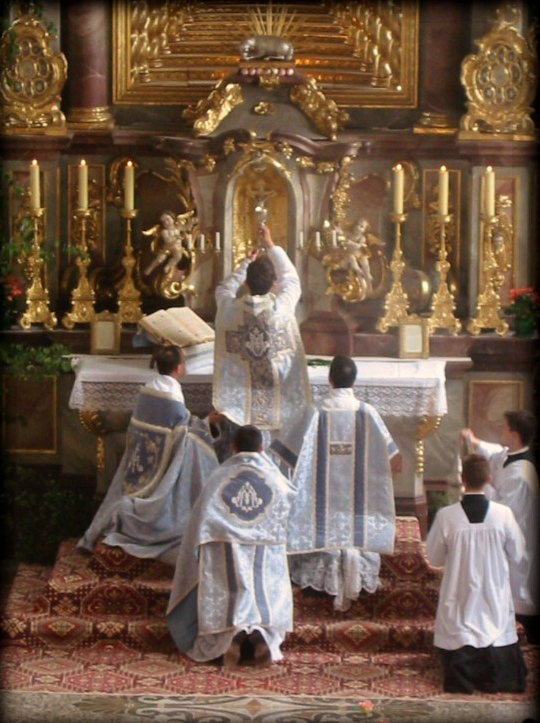
Traditionalist Catholicism is a movement that emphasizes beliefs, practices, customs, traditions, liturgical forms, devotions and presentations of teaching associated with the Catholic Church before the Second Vatican Council (1962–1965).[1][2] Traditionalist Catholics particularly emphasize the Tridentine Mass, the Roman Rite liturgy largely replaced in general use by the post-Second Vatican Council Mass of Paul VI.
Many traditionalist Catholics disliked the liturgical changes that followed the Second Vatican Council, and prefer to continue to practice pre-Second Vatican Council traditions and forms. Some also see present teachings on ecumenism as blurring the distinction between Catholics and other Christians. Traditional Catholicism is often more conservative in its philosophy and worldview, promoting a modest style of dressing and teaching a complementarian view of gender roles.[3]
Some traditionalist Catholics reject the current papacy of the Catholic Church and follow positions of sedevacantism, sedeprivationism, or conclavism. As these groups are no longer in communion with the pope and the Holy See, they are not regarded by the Holy See to be members of the Catholic Church.[4][2] A distinction is often made between these groups (sometimes called radical traditionalists) and those who adhere to current papal authority but prefer traditional practices.[2]
History
[edit]Toward the end of the Second Vatican Council, Father Gommar DePauw came into conflict with Cardinal Lawrence Shehan, Archbishop of Baltimore, over the interpretation of the council's teachings, particularly on liturgical matters. In January 1965, DePauw incorporated an organization called the Catholic Traditionalist Movement in New York State, purportedly with the support of Cardinal Francis Spellman, Archbishop of New York.[5]
By the late 1960s and early 1970s, conservative Catholics opposed to or uncomfortable with the theological, social and liturgical developments brought about by the Second Vatican Council began to coalesce.[6] In 1973, the Orthodox Roman Catholic Movement (ORCM) was founded by two priests, Francis E. Fenton and Robert McKenna, and set up chapels in many parts of North America to preserve the Tridentine Mass.[6] Priests who participated in this were listed as being on a leave of absence by their bishops, who disapproved of their actions.[6]
In 1970, French Archbishop Marcel Lefebvre founded the Society of Saint Pius X (SSPX), made up of priests who would say only the Traditional Latin Mass and who opposed what he saw as excessive liberal influences in the Church after Vatican II. In 1988, Lefebvre and another bishop consecrated four men as bishops without papal permission, resulting in excommunication latae sententiae for all six men directly involved. Some members of the SSPX, unwilling to participate in what they considered schism, left and founded the Priestly Fraternity of Saint Peter (FSSP), which celebrates the Tridentine Mass and is in full communion with the Holy See. In 2009, Pope Benedict XVI lifted the excommunications of the four surviving bishops, but clarified that the society had "no canonical status within the Catholic Church."[7]
The Istituto Mater Boni Consilii (IMBC) was founded in 1985. It is a sedeprivationist religious congregation of clergy who were dissatisfied with the SSPX's position on the Pope, i.e., acknowledging John Paul II as pope but disobeying him. Sedeprivationists hold that the current occupant of the papal office is a duly elected pope but lacks the authority and ability to teach or govern unless he recants the changes brought by the Second Vatican Council.[8]
Some Catholics took the position of sedevacantism, which teaches Pope John XXIII and his successors are heretics and therefore cannot be considered popes, and that the Catholic Church's sacraments are not valid. One sedevacantist group, the Society of Saint Pius V (SSPV), broke off from the SSPX in 1983, due to liturgical disputes. Another sedevacantist group, the Congregation of Mary Immaculate Queen (CMRI), formed spontaneously among the followers of Francis Schuckardt, but he was later expelled due to scandals and CMRI is now more aligned with other sedevacantist groups.
Other groups known as Conclavists have elected their own popes in opposition to the post-Vatican II pontiffs. They are not considered serious claimants except by their very few followers.
Different types
[edit]
Canonically regular with the Holy See
[edit]Since the Second Vatican Council, several traditionalist organizations have been started with or have subsequently obtained approval from the Catholic Church. These organizations accept the documents of the Second Vatican Council and regard the changes associated with the Council (such as the revision of the Mass) as legitimate, but celebrate the older forms with the approval of the Holy See.
- Priestly Fraternity of St Peter (FSSP)
- Institute of Christ the King Sovereign Priest (ICKSP, ICRSS)
- Sons of the Most Holy Redeemer (FSSR)
- Institute of the Good Shepherd (IBP)
- Servants of Jesus and Mary (SJM)
- Canons Regular of the New Jerusalem (CRNJ)
- Canons Regular of Saint John Cantius (SJC)
- Canons Regular of the Holy Cross
- Fraternity of Saint Vincent Ferrer
- Personal Apostolic Administration of Saint John Mary Vianney (PAASJV)
There are also multiple monastic communities, including
- Monastery of Our Lady of the Annunciation of Clear Creek
- Monastery of St. Benedict in Norcia
- Monks of the Most Blessed Virgin Mary of Mount Carmel
- Monastery of Our Lady of the Cenacle
- Le Barroux Abbey
See Communities using the Tridentine Mass for a more detailed list.
Society of Saint Pius X
[edit]The Society of Saint Pius X (SSPX) was founded in 1970, with the authorization of the bishop of Lausanne, Geneva and Fribourg, by Archbishop Marcel Lefebvre. Lefebvre was declared to have incurred automatic excommunication in 1988, after illicit consecrations. In January 2009 the Prefect of the Congregation for Bishops remitted the excommunications the Congregation had declared to have been incurred by the Society's bishops in 1988.[9]
More recently, the Vatican has granted SSPX priests the authority to hear confessions and has authorized local ordinaries, in certain circumstances, to grant delegation to SSPX priests to act as the qualified witness required for valid celebration of marriage.[10] The Our Lady of Guadalupe Monastery in Silver City, New Mexico, which is affiliated with the SSPX, is seeking Vatican approval through the society.[11]
In 2017, a statement from the Holy See said the SSPX had an irregular canonical status "for the time being".[12]
Sedeprivationists
[edit]Sedeprivationists hold the view that the current occupant of the papal office is a duly elected pope but lacks the authority and ability to teach or govern unless he recants the changes brought by the Second Vatican Council. Sedeprivationists teach that the popes from Pope John XXIII onward fall into this category.[8] Sedeprivationism is currently endorsed by two groups:
- Istituto Mater Boni Consilii (IMBC), led by Superior General Fr. Francesco Ricossa;
- Roman Catholic Institute (RCI), led by Bishop Donald Sanborn.
Sedevacantists
[edit]Sedevacantists hold the view that the Vatican II popes have forfeited their position through their acceptance of heretical teachings connected with the Second Vatican Council and consequently there is at present no true pope.[13] This constitutes an act of schism and is an offense which can result in excommunication.[14][15] They conclude, on the basis of their rejection of the revised rite of Mass and of certain aspects of postconciliar Church teaching as false, that the popes involved are also false.[16] This is a minority position among traditionalist Catholics[13][17] and a highly divisive one,[16][17] so that many who hold it prefer to say nothing of their view,[16] while other sedevacantists have accepted episcopal ordination from sources such as Archbishop Pierre Martin Ngô Đình Thục.[17]
The terms sedevacantist and sedevacantism derive from the Latin phrase sede vacante ("while the chair/see [of Saint Peter] is vacant").[13] Sedevacantist groups include:
- Congregation of Mary Immaculate Queen (CMRI), formed in 1967. It operates in North America, South America, Europe, and Asia; is based in Omaha, Nebraska, United States; and is headed by Bishop Mark Pivarunas.
- Society of Saint Pius V (SSPV), formed in 1983 when nine American priests of the Society of Saint Pius X split from the organization over a number of issues including using the liturgical reforms implemented under Pope John XXIII.[18] It operates in North America, is based in Oyster Bay Cove, New York, United States, and was headed by Bishop Clarence Kelly until his death in December 2023.[19]
- Sociedad Sacerdotal Trento (Priestly Society of Trent; SST), formed in 1993 by the priests of the deceased Bishop Moisés Carmona. Its bishop is Bishop Martín Dávila Gandara.
Conclavists
[edit]Conclavism is the belief and practice of some who, claiming that all recent occupants of the papal see are not true popes, elect someone else and propose him as the true pope to whom the allegiance of Catholics is due.
Positions
[edit]Pope Benedict XVI contrasted the "hermeneutic of discontinuity and rupture" that some apply to the Council (an interpretation adopted both by certain traditionalists and by certain "progressives")[20] with the "hermeneutic of reform, as it was presented first by Pope John XXIII in his Speech inaugurating the Council on 11 October 1962 and later by Pope Paul VI in his Discourse for the Council's conclusion on 7 December 1965."[21] He made a similar point in a speech to the bishops of Chile in 1988, when he was still Cardinal Joseph Ratzinger:
Archbishop Lefebvre declared that he has finally understood that the agreement he signed aimed only at integrating his foundation into the "Conciliar Church". The Catholic Church in union with the Pope is, according to him, the 'Conciliar Church' which has broken with its own past. It seems indeed that he is no longer able to see that we are dealing with the Catholic Church in the totality of its Tradition, and that Vatican II belongs to that.[22]
Responding to a comment that some consider tradition in a rigid way, Pope Francis remarked in 2016, "there's a traditionalism that is a rigid fundamentalism; this is not good. Fidelity on the other hand implies growth. In transmitting the deposit of faith from one epoch to another, tradition grows and consolidates itself with the passing of time, as St Vincent of Lérins said [...] 'The dogma of the Christian religion too must follow these laws. It progresses, consolidates itself with the years, developing itself with time, deepening itself with age'."[23]
Radical Traditionalists' assessment of Vatican II
[edit]Radical Traditionalists' claims that substantive changes have taken place in Catholic teaching and practice since the Council often crystallize around the following specific alleged examples:
- Sedevacantist Donald J. Sanborn rejects an ecclesiology that he claims fails to recognize the Catholic Church as the one true church established by Jesus Christ, and instead holds that the Roman Catholic Church is some subset of the church Christ founded. He sees some of the confusion as stemming from an unclear understanding of the phrase "subsists in" which appears in the Vatican II document Lumen gentium, and which the Church has declared applies uniquely to the Catholic Church and means the "perduring, historical continuity and permanence of all the elements instituted by Christ in the Catholic Church, in which the Church of Christ is concretely found on this earth". He claims that this "new ecclesiology" contradicts Pope Pius XII's Mystici corporis Christi and other papal documents.[24]
- The SSPX denounces a teaching on collegiality that attributes to the bishops of the world a share, with the Pope, of responsibility for the Church's governance in a way that it claims is destructive of papal authority and encourages a "national" church mentality that undermines the primacy of the Holy See. It also claims that national bishops' conferences, whose influence greatly increased following the Council, "diminish the personal responsibility of bishop[s]" within their dioceses.[25]
Criticism of the Radical Traditionalists' positions
[edit]Those who in response to these criticisms by certain traditionalists defend the decisions of the Second Vatican Council and the subsequent changes made by the Holy See make the following counterclaims:
- The criticisms are false, exaggerated, or lacking appreciation of the organic character of Tradition, traditionalist criticisms that Dignitatis humanae contradicts the Church's earlier teaching on religious liberty are an example.[26]
- Traditionalists who claim that there has been a break from and discontinuity with the Church's traditional teaching are displaying a Protestant attitude of "private judgment" on matters of doctrine instead of accepting the guidance of the Magisterium of the Church.[27]
- Traditionalists fail to distinguish properly between changeable pastoral practices (such as the liturgy of the Mass) and the unchangeable principles of the Catholic faith (such as the dogmas surrounding the Mass).[28]
- Traditionalists of this kind treat papal authority in much the same way as the dissident, liberal Catholics. While liberals believe that, on sexual matters, "the Pope can teach whatever he wants... but whether or not he should be listened to is very much an open question", the stance of certain traditionalists on the reform of the Mass liturgy and contemporary teachings on ecumenism and religious liberty amounts to the view that, on these issues, "faithful Catholics are always free to resist [the Pope's] folly. [...] As theories of religious dissent go, Catholic liberals couldn't ask for anything more."[29]
- Traditionalists claim that the Second Vatican Council was pastoral (and not infallible), but Paul VI subsequently emphasized the authoritative nature of the Council's teachings.[30]
Reception
[edit]Integrism is traditionalist Catholicism that integrates social and political contexts. Kay Chadwick described Catholic integrism as a holding "anti-Masonic, anti-liberal and anti-Communist" political objectives. She also noted its alignment with the right-wing press and an annual Parisian Joan of Arc procession with participation by both integrists and National Front supporters. A Tridentine Mass was celebrated before the annual National Front party meeting. Lefebvre was fined in France for "racial defamation" and "incitement to racial hatred" for proposing the removal of immigrants – particularly Muslims – from Europe. Lefebvre also supported Latin American dictatorships, Charles Maurras, Philippe Pétain, and the continued occupation of French Algeria.[31]
The Southern Poverty Law Center (SPLC) used the term radical traditionalist Catholics to refer to those who "may make up the largest single group of serious anti-Semites in America, subscribe to an ideology that is rejected by the Vatican and some 70 million mainstream American Catholics. Many of their leaders have been condemned and even excommunicated by the official church."[2] The SPLC claims that adherents of radical traditional Catholicism "routinely pillory Jews as 'the perpetual enemy of Christ'",[2][32] reject the ecumenical efforts of the Vatican, and sometimes assert that all recent Popes are illegitimate.[2] The SPLC says that adherents are "incensed by the liberalizing reforms" of the Second Vatican Council (1962–1965) which condemned hatred for Jewish people and "rejected the accusation that Jews are collectively responsible for deicide in the form of the crucifixion of Christ"[2] and that "Radical traditional Catholics" also embrace "extremely conservative social ideals with respect to women."[2]
The SPLC clarifies: "Radical traditionalist Catholics differ from traditionalist Catholics. The latter embrace the traditions and practices of the preconciliar church while rejecting the Novus Ordo Missae, which updated the Catholic Mass by, among other changes, replacing Latin with vernacular languages. Though they may be critical of the Vatican, the organizations listed here do not represent all those Catholics who call themselves “traditionalists” or prefer the Latin Mass"[2]
Criticism by U.S. Authorities and Advocacy Groups
[edit]In the early 2020s, individuals and organizations associated with the Traditionalist Catholic movement came under scrutiny from U.S. law enforcement and advocacy groups. This attention centered on alleged extremist rhetoric and of traditionalist groups that reject the reforms of the Second Vatican Council.[33] Advocacy organizations monitoring extremism, including the Southern Poverty Law Center (SPLC), had identified a number of groups they describe as promoting antisemitic or conspiratorial views. The FBI cited reports from the SPLC that often employed the label “radical-traditionalist Catholic,” though the majority of Traditionalist Catholic communities are not linked to extremist activity.[33]
Catholic and Secular responses
[edit]Catholic leaders, including the U.S. Conference of Catholic Bishops, criticized the leaked Richmond memorandum, arguing that it was questionably-sourced and risked religious profiling of Catholics.[34] Legal analyses have distinguished between targeted law enforcement investigations and broader claims of deliberate discrimination. Commentators generally concluded that while the Richmond memo contained methodological flaws and raised legitimate questions about terminology, records do not show evidence of a coordinated program directed against Traditionalist Catholics as a whole.[35]
Internal review of anti-Catholic bias
[edit]In January 2023, the FBI’s Richmond Field Office circulated an internal memorandum noting that racially or ethnically motivated violent extremists had expressed interest in “radical-traditionalist Catholic” ideology. The document was withdrawn after it became public.[36] A subsequent review by the Department of Justice Office of Inspector General concluded that the memo did not meet "analytic tradecraft standards" and reflected "errors in professional judgment". The report also stated it found no evidence of malicious intent or of a policy to investigate Catholics on the basis of religion alone.[35]
Congressional Republicans disputed those findings, arguing that the incident pointed to broader problems within the Bureau’s internal products. Staff reports from the House Judiciary Committee and correspondence from members of the Senate Judiciary Committee criticized the Richmond memo as evidence of inadequate safeguards on religious liberty.[37][38] FBI Director Christopher Wray later confirmed that employees had been disciplined or terminated in relation to the memo’s creation.[39] In October 2025, the FBI ended its formal relationship with the SPLC and the Anti-Defamation League, following a reassessment of the Bureau’s reliance on external advocacy groups under FBI Director Kash Patel.[40]
Practices
[edit]Traditionalist Catholicism has been described as "a self-conscious revival of the liturgies, practices, and trappings of an earlier time in the Catholic Church" and this manifests in a number of ways.[41]
Rite of Mass
[edit]
The best-known and most visible sign of Catholic traditionalism is an attachment to the form that the Roman Rite liturgy of the Mass had before the liturgical reform of 1969–1970, in the various editions of the Roman Missal published between 1570 and 1962. This form is generally known as the Tridentine Mass, though traditionalists usually prefer to call it the Traditional Mass. Many refer to it as the Latin Mass, though Latin is the language also of the official text of the post-Vatican II Mass, to which vernacular translations are obliged to conform, and canon law states that "the eucharistic celebration is to be carried out in the Latin language or in another language provided that the liturgical texts have been legitimately approved."[42] In his 2007 motu proprio Summorum Pontificum Pope Benedict XVI relaxed the regulations on use of the 1962 Missel, designating it "an" extraordinary form of the Roman Rite, as opposed to "the" ordinary or normal form, as revised successively by Pope Paul VI and Pope John Paul II.[43][44]
The Pope ruled that priests of the Latin Church can freely choose between the 1962 Roman Missal and the later edition "in Masses celebrated without the people".[45] Such celebrations may be attended by those who spontaneously ask to be allowed.[46] Priests in charge of churches can permit stable groups of laypeople attached to the earlier form to have Mass celebrated for them in that form, provided that the celebrating priest is "qualified to [celebrate] and not juridically impeded".[47] The Society of Saint Pius X welcomed the document, but referred to "difficulties that still remain", including "disputed doctrinal issues" and the notice of excommunication that still affected its bishops.[48]
In 2021, Pope Francis promulgated Traditionis custodes, amending and abrogating parts of Summorum Pontificum.[49]
Individual and private devotions
[edit]Some traditionalist Catholics stress on following customs prevailing immediately before the Second Vatican Council, such as the following:
- Fasting from Midnight until the reception of Holy Communion. The traditional Catholic rule of fasting from midnight until the reception of Holy Communion (this Eucharistic Fast is from both food and liquids), which is required by the 1917 Code of Canon Law, was shortened in 1953 by Pope Pius XII to a 3-hour fast.[50] In 1966, Pope Paul VI reduced the fast further to one hour, a rule included in the 1983 Code of Canon Law.[51] Some traditional Catholic groups require fasting from midnight until they receive Holy Communion at Mass, while others will keep a Eucharistic fast for at least three hours.[52][53]
- Kneeling to receive Communion directly upon the tongue, under the Host species alone, and from the hand of a cleric rather than a layperson. The SSPX regards the practice of receiving communion in the hand (though ancient[54][55] and authorised by the Holy See[56]) as an abuse.[57]
- Women wearing a headcovering when praying at home and when worshipping inside a church which is discussed in 1 Corinthians 11 and required by the 1917 Code of Canon Law. Many Traditionalist Catholic women wear a veil, a hat, or a headscarf when praying at home and when worshipping inside a church.[58][59]
Clothing and lifestyle
[edit]Traditional Catholics, with respect to male and female gender roles, often adhere to the doctrine of complementarianism.[60]
The standards of clothing among Traditional Catholics, based on instructions given by Pope Pius XI and consequently promoted by the Purity Crusade of Mary Immaculate, is referred to as "Mary-like Modesty", which includes for women, wearing sleeves "extending at least to the elbows" and "skirts reaching below the knees", as well as having a neckline no more than two inches with the rest of the bodice fully covered.[61][62]
It is commonplace for women who identify as traditionalist Catholics to wear a head covering (veil) while praying at home and attending celebrations of the Mass.[58]
In the Ukrainian Greek Catholic Church
[edit]Since the Second Vatican Council, various Eastern Catholic Churches have removed some practices and emphases that were derived from those of the Latin Church. Opposition to this has been given relatively high publicity with regard to the Ukrainian Greek Catholic Church (UGCC).
Background
[edit]Even before the Second Vatican Council, the Holy See declared it important to guard and preserve whole and entire forever the customs and distinct forms for administering the sacraments in use in the Eastern Catholic Churches (Pope Leo XIII, encyclical Orientalium Dignitas).[63] Leo's successor Pope Pius X said that the priests of the newly created Russian Catholic Church should offer the Divine Liturgy Nec Plus, Nec Minus, Nec Aliter ("No more, No Less, No Different") than priests of the Russian Orthodox Church and the Old Believers.[64][65]
In the Ukrainian Greek Catholic Church, liturgical de-latinization began with the 1930s corrections of the liturgical books by Metropolitan Andrey Sheptytsky. According to his biographer Cyril Korolevsky, Metropolitan Andrey opposed use of coercion against those who remained attached to Latin liturgical practices, fearing that any attempt to do so would lead to a Greek Catholic equivalent of the 1666 Schism within the Russian Orthodox Church.[66]
De-latinization in the UGCC gained further momentum with the 1964 decree Orientalium Ecclesiarum of the Second Vatican Council) and several subsequent documents. Latinizations were discarded within the Ukrainian diaspora, while among Byzantine Catholics in Western Ukraine, forced into a clandestine existence following the Soviet ban on the UGCC, the latinizations remained, "an important component of their underground practices".[67] In response, some priests, nuns, and candidates for the priesthood found themselves, "forced towards the periphery of the church since 1989 because of their wish to 'keep the tradition'." In some eparchies, particularly those of Ivano-Frankivsk and Ternopil-Zboriv, the bishops would immediately suspend any priest who, "displayed his inclination toward 'traditionalist' practices".[68]
Vlad Naumescu reports that an article in the February 2003 issue of Patriayarkhat, the official journal of the Ukrainian Greek Catholic Church, written by a student of the Ukrainian Catholic University, which since its 1994 foundation has been, "the strongest progressive voice within the Church". The article named priests and parishes in every eparchy in Ukraine as being involved in "a well-organized movement" and who described themselves as "traditionalists". According to the article, they constituted "a parallel structure" with connections with the Society of St. Pius X and with a charismatic leader in Fr. Basil Kovpak, the Pastor of St. Peter and Paul's Church in the suburb of Lviv-Riasne.[69]
According to Vlad Naumescu, "Religious life in a traditionalist parish followed the model of the 'underground church.' Devotions were more intense, with each priest promoting his parish as a 'place of pilgrimage' for the neighboring areas, thus drawing larger crowds on Sunday than his local parish could provide. On Sundays and feast days, religious services took place three times a day (in Riasne), and the Sunday liturgy lasted for two and a half to three hours. The main religious celebrations took place outside the church in the middle of the neighborhood, and on every occasion traditionalists organized long processions through the entire locality. The community was strongly united by its common opponent, re-enacting the model of the 'defender of faith' common to times of repression. This model, which presupposes clear-cut attitudes and a firm moral stance, mobilized the community and reproduced the former determination of the 'underground' believers."[70]
Priestly Society of Saint Josaphat
[edit]The Priestly Society of Saint Josaphat (SSJK), which operates a seminary, Basilian convent, and numerous parishes, receives priestly orders from the bishops of the SSPX. Its superior, Father Basil Kovpak, has accused the UGCC hierarchy of using intense psychological pressure against priests who are reluctant or unwilling to de-Latinise.
In 2003, Cardinal Liubomyr Huzar, Major Archbishops of Kyiv-Galicia, excommunicated Father Kovpak, but this act was later declared null and void by the Roman Rota due to lack of canonical form.
On 22 November 2006, Bishop Richard Williamson, who was then a member of the Society of St. Pius X (SSPX), ordained two priests and seven deacons in Warsaw, Poland, for the SSJK. Fr. John Jenkins, an SSPX priest who was present, later remarked, "We were all very edified by their piety, and I myself was astonished by the resemblance of the atmosphere amongst the seminarians with that which I knew in the seminary – this in spite of the difference of language, nationality and even rite."[71]
Archeparch Ihor Vozniak of Lviv, the Archeparchy in which the PSSJ is most active, denounced the ordinations as a "criminal act", and condemned Fr. Kovpak's participation in the ceremony. He stressed that the two priests whom Bishop Williamson had ordained would not receive faculties within the Archeparchy.[72] Officials of the Lviv archdiocese said that Kovpak could face excommunication, and that "'he deceives the church by declaring that he is a Greek (Byzantine) Catholic priest,' while supporting a group [SSPX] that uses the old Latin liturgy exclusively, eschewing the Byzantine tradition, and does not maintain allegiance to the Holy See."[73]
Father Kovpak's excommunication process was restarted by the hierarchy of the Ukrainian Greek Catholic Church and was confirmed by the Congregation for the Doctrine of the Faith on 23 November 2007.[74]
Sedevacantism and Conclavism in the Ukrainian Greek Catholic Church
[edit]In March 2008 a group of Basilian priests in Pidhirtsi, Ukraine, announced that four of them had been consecrated as bishops in order to save the Ukrainian Greek Catholic Church (UGCC) from heresy and apostasy and in August 2009, they announced the formation of the Ukrainian Orthodox Greek Catholic Church.[75] Having elected Czech Basilian priest Fr. Anthony Elias Dohnal as "Patriarch Elijah", they declared that the Holy See was vacant, establishing the Ukrainian Orthodox Greek Catholic Church (UOGCC).[76][77]
The group was promptly excommunicated by the UGCC,[78] an act that was later confirmed by the Apostolic Signatura[79] and the Congregation for the Doctrine of Faith.[80]
The UOGCC later "elected" a new Pope, Archbishop Carlo Maria Viganò the former Apostolic Nuncio to the United States, in October 2019. Whether Viganò accepted this "election" is unclear.[81]
There have been allegations in both The New York Times and the Lviv-based newspaper Expres that the church leadership is linked to the Russian intelligence services.[82]
Relations with the Holy See
[edit]The Holy See recognises as fully legitimate the preference that many Catholics have for the earlier forms of worship. This was stated in Pope John Paul II's 1988 apostolic letter Ecclesia Dei and Pope Benedict XVI's 2007 motu proprio Summorum Pontificum. The Holy See does not extend its approval to those who oppose the present-day Church leadership, which is reiterated in Traditionis Custodes.[83]
Ecclesia Dei Commission
[edit]The Pontifical Commission Ecclesia Dei was founded in July 1988 in the wake of John Paul II's apostolic letter Ecclesia Dei. Benedict XVI was a member of the Commission during his tenure as Cardinal Prefect of the Congregation for the Doctrine of the Faith. Speaking on 16 May 2007 to the Fifth General Conference of the Bishops of Latin America and the Caribbean, Cardinal Castrillón, the current head of the Commission, said his department had been founded for the care of those "traditionalist Catholics" who, while discontented with the liturgical reform of the Second Vatican Council, had broken with Archbishop Marcel Lefebvre "because they disagreed with his schismatic action in ordaining Bishops without the required papal mandate". He added that at present the Commission's activity is not limited to the service of those Catholics, nor to "the efforts undertaken to end the regrettable schismatic situation and secure the return of those brethren belonging to the Fraternity of Saint Pius X to full communion." It extends also, he said, to "satisfying the just aspirations of people, unrelated to the two aforementioned groups, who, because of their specific sensitiveness, wish to keep alive the earlier Latin liturgy in the celebration of the Eucharist and the other sacraments."[84]
In 2019, Pope Francis suppressed this commission and transferred its responsibilities directly to the Congregation for the Doctrine of the Faith.[85]
Validity of holy orders
[edit]According to the Catholic Church, the conferring of holy orders may be valid but illicit.[86] The Catholic Church considers the orders of traditionalist clergy who are in good standing with the Holy See, such as the clergy of the Priestly Fraternity of Saint Peter or the Institute of Christ the King Sovereign Priest, to be both valid and licit. It sees as valid but illicit the orders of the bishops and priests of the Society of Saint Pius X, and accordingly considers them to be forbidden by law to exercise priestly offices, but still technically priests.[87]
The Holy See declared devoid of canonical effect the consecration ceremony conducted by Archbishop Pierre Martin Ngô Đình Thục for the Carmelite Order of the Holy Face group on December 31,1975, while expressly refraining from pronouncing on its validity. It made the same statement with regard also to any later ordinations that those bishops might confer, saying that:
as for those who have already thus unlawfully received ordination or any who may yet accept ordination from these, whatever may be the validity of the orders (quidquid sit de ordinum validitate), the Church does not and will not recognise their ordination (ipsorum ordinationem), and will consider them, for all legal effects, as still in the state in which they were before, except that the [...] penalties remain until they repent.[88]
Demographics
[edit]In 2005, Catholic World News reported that "the Vatican" estimated the number of those served by the Fraternity of St Peter, the Society of St Pius X and similar groups at "close to 1 million".[89]
List of groups
[edit] |
This is a list of notable traditionalist Catholic groups. Some are in full communion with the Holy See; some have irregular status according to doctrines and disciplines of the Catholic Church.
As of 2023, largest priestly communities described as traditionalist are Society of Saint Pius X (SSPX) with 707 priests, Priestly Fraternity of Saint Peter (FSSP) with 368 priests, Institute of Christ the King Sovereign Priest (ICKSP) with 147 priests and Institute of the Good Shepherd (IBP) with 61 priests.
Canonically regular traditionalist groups
[edit]- Canons Regular of Saint John Cantius
- Canons Regular of the New Jerusalem
- Foederatio Internationalis Una Voce
- Fœderatio Internationalis Juventutem
- Fraternity of Saint Vincent Ferrer
- Heralds of the Gospel
- Institute of Christ the King Sovereign Priest
- Institute of the Good Shepherd
- Latin Mass Society of England and Wales
- Militia Templi; The Poor Knights of Christ also called the Order of the Poor Knights of Christ
- Personal Apostolic Administration of Saint John Mary Vianney
- Priestly Fraternity of St. Peter
- Slaves of the Immaculate Heart of Mary (Still River, MA group only)
- Sons of the Most Holy Redeemer
Canonically irregular traditionalist groups
[edit]- Society of Saint Pius X
- Fraternite Notre Dame
- Servants of the Holy Family
- Priestly Society of Saint Josaphat
- Missionaries of St. John the Baptist in Park Hills, Kentucky
Sedevacantist groups
[edit]Sedeprivationist groups
[edit]Conclavist groups
[edit]See also
[edit]Doctrinal and liturgical issues
[edit]- Cafeteria Catholicism
- Extra Ecclesiam nulla salus
- Feeneyism
- Second Vatican Council
- Mass of Paul VI
- Sedevacantism
- Tridentine Mass
- Catholic fundamentalism
Comparable phenomena in other churches
[edit]- Old Believers, a comparable phenomenon in the Russian Orthodox Church which dates back to the 17th century
- True Orthodoxy, Old Calendarism and the Catacomb Church—comparable phenomena in the Eastern Orthodox Church that date to the 1920s
- Continuing Anglican movement, a comparable phenomenon in the Anglican Communion
- Confessing Movement, a similar movement in Mainline Protestant denominations
Other
[edit]- Old Catholicism, which started in comparable circumstances surrounding papal infallibility and the First Vatican Council
- Independent Catholicism
- Freedom of religion in Germany § Censorship, for a discussion about a traditionalist Catholic news service which was shut down
- The Remnant – an American newspaper dedicated to traditionalist themes
- Cardinal Newman Society, American group focused on traditional education
- Land O'Lakes Statement 1967 manifesto that angered traditionalists
- Toryism
Media
[edit]- Mass of the Ages (film series), an American documentary film series highlighting the Tridentine Mass for exposure and advocacy
References
[edit]- ^ Collinge, William J. (2012). "Traditionalism". Historical Dictionary of Catholicism. Historical Dictionaries of Religions, Philosophies, and Movements Series (2nd ed.). Lanham, Maryland: Rowman & Littlefield. pp. 433–434. ISBN 978-0-8108-7979-9. LCCN 2011035077.
- ^ a b c d e f g h i "Radical Traditional Catholicism", Intelligence Files, Southern Poverty Law Center, 2011
- ^ Ochstein, Jennifer (7 September 2017). "A progressive, feminist evangelical considers joining the Catholic Church". America Magazine. Retrieved 26 April 2021.
- ^ "Library : Schismatic Traditionalists". www.catholicculture.org. Retrieved 2023-07-12.
- ^ Allitt, Patrick (1993). Catholic intellectuals and conservative politics in America, 1950–1985. Ithaca: Cornell Univ. Press. p. 130. ISBN 978-0-8014-2295-9.
- ^ a b c Dugan, George (6 January 1974). "Latin Mass of Old Is Luring Catholics". The New York Times. Retrieved 18 April 2021.
- ^ "Letter to the Bishops of the Catholic Church concerning the remission of the excommunication of the four Bishops consecrated by Archbishop Lefebvre (March 10, 2009) | BENEDICT XVI". www.vatican.va.
- ^ a b Pasulka, Diana Walsh (2015). Heaven Can Wait: Purgatory in Catholic Devotional and Popular Culture. Oxford University Press. p. 180. ISBN 978-0-19-538202-0.
- ^ "Pope lifts excommunications of Lefebvrite bishops". Catholicnews.com. 27 January 2009. Archived from the original on January 31, 2009. Retrieved 30 June 2011.
- ^ "New pastoral provisions for Sacrament of Marriage for SSPX". Retrieved 2 November 2017.
- ^ Villagran, Lauren (25 December 2013). "Men come to monastery 'to seek God'". Albuquerque Journal. Retrieved 26 April 2023.
- ^ Lamb, Christopher (2017-04-05). "Francis grants SSPX right to celebrate marriage in sign of reconciliation". The Tablet. Retrieved 2023-05-30.
- ^ a b c Collinge, William J. (23 February 2012). Historical Dictionary of Catholicism. Scarecrow Press. ISBN 9780810879799. Retrieved 15 February 2015.
- ^ Horn, Trent. "Answering Sedevacantism (with Michael Lofton)". Catholic Answers. Retrieved 2025-04-09.
- ^ "Schism And Mortal Sin – Jimmy Akin". 2006-09-25. Retrieved 2025-04-09.
- ^ a b c Weaver, Mary Jo; Scott Appleby, R. (1995). Being Right. Indiana University Press. ISBN 0253329221. Retrieved 15 February 2015.
- ^ a b c Fundamentalisms Observed. University of Chicago Press. July 1994. ISBN 9780226508788. Retrieved 15 February 2015.
- ^ A more comprehensive list of objections can be found at "Letter of 'the Nine' to Abp. Marcel Lefebvre", The Roman Catholic, Traditional mass, May 1983
- ^ "Obituary of The Most Reverend Clarence J. Kelly | Dufresne & Cavanaugh Funeral Home". dufresneandcavanaugh.com. Retrieved 2023-12-11.
- ^ "CatholicHerald.co.uk » Prefect of the CDF says seeing Vatican II as a 'rupture' is heresy". Catholic Herald. 30 November 2012. Retrieved 15 February 2015.
- ^ "Address of His Holiness Benedict XVI to the Roman Curia offering them his Christmas greetings". Vatican.va. Retrieved 30 June 2011.
- ^ "Cardinal Ratzinger's Address to Bishops of Chile". Archived from the original on 15 July 2007. Retrieved 15 February 2015.
- ^ O'Connell, Gerard (December 6, 2016). "Pope Francis: There will be no 'reform of the reform' of the liturgy". America.
- ^ Sanborn, Donald J. (1992). Communion: Ratzinger's New Ecclesiology (PDF).
- ^ Wrighton, Basil (16 January 2014), Collegiality: error of Vatican II, Society of Saint Pius X, retrieved 3 March 2015
- ^ Fr. Brian W. Harrison, O.S. Vatican II and Religious Liberty: Contradiction or Continuity? catholic.net
- ^ "On Waffling, Tradition and the Magisterium". Catholicculture.org. Retrieved 30 June 2011.
- ^ Schluenderfritz, Malcolm (2022-03-30). "Is it so different?". Where Peter Is. Retrieved 2023-05-30.
- ^ Michael W. Cuneo, The Smoke of Satan: Conservative and Traditionalist Dissent in Contemporary American Catholicism (JHU Press, 1999 ISBN 0-8018-6265-5, ISBN 978-0-8018-6265-6), p. 119
- ^ Likoudis, James; Whitehead, Kenneth D. (1982). The Pope, the Council, and the Mass: answers to the questions the "traditionalists" are asking (41 ed.). W. Hanover, Mass: Christopher Publ. House. ISBN 978-0-8158-0400-0.
- ^ Chadwick, Kay (2000). Catholicism, Politics and Society in Twentieth-century France. Liverpool University Press. ISBN 9780853239741. Retrieved 15 February 2015.
- ^ "Radical Traditionalist Catholics Spew Anti-Semitic Hate, Commit Violence Against Jews", Southern Poverty Law Center, 2006
- ^ a b "Radical Traditional Catholicism". Southern Poverty Law Center. Retrieved 2025-10-03.
- ^ "U.S. Bishops' Religious Liberty Chairman Comments on Leaked FBI Memorandum | USCCB". www.usccb.org. Retrieved 2025-10-03.
- ^ a b "No Bias Found in F.B.I. Report on Catholic Extremists (Published 2024)". 2024-04-19. Archived from the original on 2025-08-26. Retrieved 2025-10-03.
- ^ "FBI Richmond assesses the increasingly observed interest of RMVEs in radical-traditionalist Catholic ideology". U.S. House Judiciary Committee. 2023-01-23. Retrieved 2025-10-03.
- ^ U.S. House Judiciary Committee (Republican Staff), The FBI’s Breach of Religious Freedom: The Weaponization of Law Enforcement Against Catholic Americans, Interim Staff Report, December 4, 2023.
- ^ Sen. Charles Grassley, "Letters and Document Productions Concerning FBI Richmond Memo," June 2, 2025 (released via Senate Judiciary Committee).
- ^ CNA. "FBI director: There have been 'terminations' related to 2023 anti-Catholic memo". Catholic News Agency. Retrieved 2025-10-03.
- ^ Ax, Joseph (2025-10-03). "FBI cuts ties with civil rights group Southern Poverty Law Center". Reuters. Retrieved 2025-10-03.
- ^ Phillips, Maggie (12 July 2022). "Back to the Land". Tablet Magazine. Retrieved 26 July 2023.
- ^ Code of Canon Law, canon 928 (emphasis added)
- ^ "Motu Proprio Summorum Pontificum on the "Roman liturgy prior to the reform of 1970" (July 7, 2007) | BENEDICT XVI". www.vatican.va.
- ^ "Letter to the Bishops that accompanies the Apostolic Letter "Motu Proprio data" Summorum Pontificum on the Roman liturgy prior to the reform of 1970 (July 7, 2007) | BENEDICT XVI". www.vatican.va.
- ^ "Summorum Pontificum, art. 2". Sanctamissa.org. Archived from the original on 10 October 2012. Retrieved 30 June 2011.
- ^ "Summorum Pontificum, art. 4". Sanctamissa.org. Archived from the original on 10 October 2012. Retrieved 30 June 2011.
- ^ "Summorum Pontificum, art. 5". Sanctamissa.org. Archived from the original on 10 October 2012. Retrieved 30 June 2011.
- ^ "Press Release from the General Superior of the Priestly Society of Saint Pius X, 7 July 2007". Fsspx.org. 17 June 2011. Archived from the original on 19 February 2009. Retrieved 30 June 2011.
- ^ Allen, Elise Ann (16 July 2021). "Francis reverses Benedict's liberalization of use of older Latin Mass". Crux. Retrieved 16 July 2021.
- ^ "Motu proprio Sacram communionem". Ewtn.com. Retrieved 30 June 2011.
- ^ "Canon 919". Intratext.com. 4 May 2007. Retrieved 30 June 2011.
- ^ "Lesson 28 — Holy Communion". Congregation of Mary Immaculate Queen. 6 September 2016. Retrieved 2 March 2021.
3. All Catholics may receive Holy Communion after fasting three hours from food and alcoholic drinks and one hour from non-alcoholic drinks. This rule applies to Holy Communion at midnight Mass as well as at Masses celebrated in the morning, afternoon or evening. A priest's permission is not needed. 4. Catholics are urged to observe the eucharistic fast from midnight as formerly, and also to compensate for the use of the new privileges by works of charity and penance, but these practices are not obligatory.
- ^ Mater Dei Latin Mass Parish (2017-02-23). "Fasting and Abstinence - Current and Traditional Practices". Mater Dei Catholic Parish. Retrieved 2023-05-30.
- ^ Anscar J. Chupungco, Handbook for Liturgical Studies: The Eucharist (Liturgical Press, 1999 ISBN 0-8146-6163-7, ISBN 978-0-8146-6163-5) p. 307
- ^ Michael Kunzler, The Church's Liturgy (LIT Verlag Berlin-Hamburg-Münster, 2001 ISBN 3-8258-4854-X, 9783825848545), p. 241
- ^ Sacred Congregation for Divine Worship, Letter "En réponse a la demande" to presidents of those conferences of bishops petitioning the indult for communion in the hand, 29 May 1969 published also in Acta Apostolicae Sedis, 61 (1969) 546–547
- ^ Why should Catholics have nothing to do with the Novus Ordo Missae?. sspx.org
- ^ a b Fisher, Simcha (3 December 2019). "The types of women who veil at Mass". America Magazine. Retrieved 15 November 2020.
- ^ Cieslik, Emma (4 October 2021). ""Smells and Bells": Catholic Material Religion in Twenty-First-Century America". Smithsonian Center for Folklife and Cultural Heritage. Retrieved 11 October 2024.
- ^ Schar, Amanda. "Feminism and Faith: How Women Find Empowerment in the Roman Catholic Church" (2019). Celebration of Learning.
- ^ Moczar, Diane (2013). The Church Under Attack: Five Hundred Years that Split the Church and Scattered the Flock. Sophia Institute Press. p. 202. ISBN 978-1-933184-93-7.
- ^ Evans, Rachel Held (2012). A Year of Biblical Womanhood. Thomas Nelson. p. 126. ISBN 978-1-59555-367-6.
- ^ Pope Leo XIIl (30 November 1894). "Orientalium dignitas". Retrieved 15 February 2015.
- ^ "Eastern Catholic Churches and the Question of 'Uniatism'". ResearchGate.
- ^ George Thomas Kurian; Mark A. Lamport (10 November 2016). Encyclopedia of Christianity in the United States. Rowman & Littlefield Publishers. p. 1724. ISBN 978-1-4422-4432-0.
- ^ Cyril Korolevsky, Metropolitan Andrew (1868–1944), Translated and Edited by Fr. Serge Keleher. Stauropegion Brotherhood, Lviv, 1993.
- ^ Stéphanie Mahieu and Vlad Naumescu (2008), Churches In-between: Greek Catholic Churches in Postsocialist Europe, Halle Studies in the Anthropology of Eurasia. Page 162, Footnote 10.
- ^ Stéphanie Mahieu and Vlad Naumescu (2008), Churches In-between: Greek Catholic Churches in Postsocialist Europe, Halle Studies in the Anthropology of Eurasia. Pages 164–165.
- ^ Vlad Naumescu, "Continuities and Ruptures of a Religious Tradition: Making ‘Orthodoxy’ in the Ukrainian Greek Catholic Church" in Stephanie Mahieu, Vlad Naumescu (editors), Churches In-between: Greek Catholic Churches in Postsocialist Europe (LIT Verlag Münster 2008), pp. 161–162, ISBN 978-3-8258-9910-3
- ^ Stephanie Mahieu, Vlad Naumescu (editors), Churches In-between: Greek Catholic Churches in Postsocialist Europe (LIT Verlag Münster 2008), page 164. ISBN 978-3-8258-9910-3
- ^ "La Porte Latine - Jenkins anglais". Archived from the original on 23 August 2006. Retrieved 11 August 2006.
- ^ The Holy See likewise declared SSPX priests "suspended from exercising their priestly functions" (Letter of Monsignor Camille Perl, Secretary of the Ecclesia Dei Commission Archived 2 February 2003 at the Wayback Machine). A minority of them - ordained before 1976 by archbishop Marcel Lefebvre for the SSPX - remain incardinated in several European dioceses. They are thus in the same position as excommunicated Kovpak, who is incardinated in the Ukrainian Archdiocese of Lviv. The newly ordained clergy, however, are not incardinated into any Ukrainian Catholic diocese, and thus are not clergy of the Ukrainian Greek Catholic Church.
- ^ Catholic World News: Byzantine Catholics decry Lefebvrite inroads into Ukraine The accusation of "eschewing the Byzantine tradition" refers to Father Kovpak's championing of Latinising elements which were followed by Ukrainian Greek Catholic Church since the 17th century, but forcibly purged following the Second Vatican Council.
- ^ Ukrainian priest excommunicated Catholic World News, 21 November 2007
- ^ Decree of Establishment of the UOGCC. Uogcc.org.ua (11 August 2009). Retrieved on 2013-07-04.
- ^ Declaration of an excommunication upon Pope Benedict XVI and John Paul II. Uogcc.org.ua. Retrieved on 4 July 2013.
- ^ "Pastoral letter for the Catholic Church".
- ^ "UOGCC / English / About Church". uogcc.org.ua. Retrieved 2023-10-09.
- ^ "Vatican Says Excommunication of "Pidhirtsi Fathers" Final". risu.org.ua. 2012-04-02. Archived from the original on 2012-04-02. Retrieved 2023-10-09.
- ^ NULL (2012-03-29). "Dichiarazione della Santa Sede sui "sedicenti vescovi greco-cattolici di Pidhirci"". ZENIT - Italiano (in Italian). Retrieved 2023-10-09.
- ^ "Habemus papam |". Retrieved 2023-10-09.
- ^ Andrew Higgins (June 21, 2014). "Ukrainian Church Faces Obscure Pro-Russia Revolt In Its Own Ranks"". The New York Times
- ^ Weinandy, Thomas; Cavadini, John; Healy, Mary (2022-12-01). "A Synoptic Look at the Failures and Successes of Post-Vatican II Liturgical Reforms". Church Life Journal. Retrieved 2023-05-30.
- ^ The text of Cardinal Castrillón's speech, in the language in which he gave it, can be consulted at Intervención sobre Ecclesia Dei-16 de mayo de 2007 Archived 25 May 2007 at the Wayback Machine (Retrieved 17 May 2007) or at Intervención sobre Ecclesia Dei – Card. Darío Castrillón Hoyos, Presidente Ecclesia Dei[permanent dead link] (Retrieved 7 December 2008). English translations may be consulted at Rorate Caeli (Retrieved 7 December 2008), and extracts are given in English at Adoremus Bulletin Archived 2016-03-04 at the Wayback Machine(Retrieved 7 December 2008).
- ^ Tornielli, Andrea (19 January 2019). "Ecclesia Dei, exceptional nature ends". Vatican News. Retrieved 14 February 2024.
- ^ See especially Canons 1012–1023
- ^ Letter of His Holiness Pope Benedict XVI to the Bishops of the Catholic Church concerning the remission of the excommunication of the four Bishops consecrated by Archbishop Lefebvre by Pope Benedict XVI concerning his remission of the excommunication of the four bishops of the Society of St Pius X
- ^ Sacred Congregation for the Doctrine of the Faith, Decree Episcopi qui alios of 17 September 1976 – Acta Apostolicae Sedis 1976, page 623.
- ^ McCaffrey, Roger A.; Woods Jr., Thomas E. (May 2005). "Catholic World News : "All We Ask is for the Mass"". Cwnews.com. Archived from the original on 2 February 2006. Retrieved 30 June 2011.
Further reading
[edit]- Hull, Geoffrey (2010). The Banished Heart: Origins of Heteropraxis in the Catholic Church. London, UK: Bloomsbury Academic. ISBN 9780567442208.
- Jarvis, Edward (2018). Sede Vacante: The Life and Legacy of Archbishop Thuc. Berkeley, CA: The Apocryphile Press. ISBN 9781949643022. Retrieved 29 August 2019.
- Jungmann, Joseph (1986). The Mass Of The Roman Rite: Its Origins and Development (Missarum Sollemnia). Vol. 1. Allen, TX: Christian Classics. ISBN 0870611666.
- Manning, Christel (1999). God Gave Us the Right: Conservative Catholic, Evangelical Protestant, and Orthodox Jewish Women Grapple with Feminism. Rutgers University Press. ISBN 0813525993.
- Margry, Peter Jan (2019). "The Global Network of Deviant Revelatory Marian Movements". In Maunder, Chris (ed.). The Oxford Handbook of Mary. NY: Oxford University Press. pp. 662–683. ISBN 9780198792550.
- Perry, Mark (2025). Uprooting the Vineyard: The Fate of the Catholic Church After Vatican II. Bloomington, IN: World Wisdom Books. ISBN 9781936597802.
- Radecki, CMRI, Frs. Francisco and Dominic (2004). Tumultuous Times. Wayne, MI / Newhall, CA: St.Joseph's Media. ISBN 0971506108.
- Sinke Guimarães, Atila (1997). In the Murky Waters of Vatican II. Metairie: MAETA. ISBN 1889168068.
- Weaver, Mary Jo; Appleby, R. Scott (1995). Being Right: Conservative Catholics in America. Bloomington: Indiana University Press. ISBN 9780253209993. Retrieved 28 November 2020.
| Documents | |||||||||||
|---|---|---|---|---|---|---|---|---|---|---|---|
| People |
| ||||||||||
| General | |||||||||||
| Other | |||||||||||
| Criticism | |||||||||||

| History |  | |
|---|---|---|
| Popes |
| |
| See also | ||
| National | |
|---|---|
| Other | |

Traditionalist Catholicism
View on GrokipediaTraditionalist Catholicism is a movement within the Roman Catholic Church comprising clergy and laity committed to preserving the doctrines, liturgical forms, devotions, and moral teachings as they were practiced and understood prior to the reforms of the Second Vatican Council (1962–1965), with particular emphasis on the exclusive celebration of the Tridentine Mass codified at the Council of Trent.[1] Adherents view many post-conciliar developments, including the Novus Ordo Missae, shifts in ecumenism, and interpretations of religious liberty, as incompatible with the Church's perennial tradition, prompting efforts to restore what they regard as authentic Catholic worship and discipline.[1] The movement arose amid widespread dissatisfaction with the rapid implementation of Vatican II's liturgical and pastoral changes, which traditionalists argue contributed to a crisis in priestly vocations, sacramental participation, and doctrinal clarity within the Church.[2] A pivotal figure was Archbishop Marcel Lefebvre, a French missionary who, in 1970, founded the Society of Saint Pius X (SSPX) in Écône, Switzerland, to form priests according to pre-Vatican II seminary norms and safeguard the Traditional Latin Mass against suppression.[2] The SSPX expanded globally, establishing seminaries, priories, and schools in over 60 countries, but faced canonical irregular status after Lefebvre's 1988 consecration of four bishops without papal mandate, resulting in his excommunication (later remitted for the bishops in 2009).[2] Traditionalist Catholicism encompasses diverse groups: canonically regular societies like the Priestly Fraternity of Saint Peter (FSSP), which operate under the Holy See's oversight, accept the Second Vatican Council, while celebrating the 1962 Missal[3]; the SSPX and similar entities in irregular standing; and more extreme positions such as sedevacantism, which holds post-Vatican II papal sees vacant due to alleged heresy.[1] Despite tensions, including recent papal restrictions on the ancient rite via Traditionis Custodes (2021), the movement has seen notable resurgence, attracting younger generations drawn to its emphasis on transcendence, orthodoxy, and cultural continuity amid secularization, and higher rates of weekly Mass attendance and adherence to traditional moral teachings compared to Novus Ordo attendees.[4]
Definition and Foundational Principles
Core Beliefs and Theological Commitments
Traditionalist Catholics maintain that the deposit of faith, divinely revealed through Christ and the Apostles, was completed with the death of the last Apostle and constitutes an immutable body of truths preserved by the Church's Magisterium without substantive alteration.[5] This deposit encompasses Sacred Scripture and Sacred Tradition, interpreted through the perennial teachings of the Church up to the eve of Vatican II, rejecting any notion of ongoing public revelation or evolution that changes dogmatic meaning.[5] Defined dogmas, such as those proclaimed at the Councils of Trent (1545–1563) and Vatican I (1869–1870), are held to be irrevocable and binding in their original sense, with doctrinal development limited to homogeneous clarification or precision, as exemplified by the dogmatic definition of papal infallibility in Pastor Aeternus.[5] A core liturgical commitment is fidelity to the Traditional Latin Mass, codified by Pope St. Pius V in the 1570 bull Quo Primum, which traditionalists regard as the unadulterated expression of the Roman Rite preserving apostolic origins and theological depth.[2] This rite, celebrated ad orientem with Gregorian chant and in Latin, is seen as intrinsically linked to Catholic doctrine, embodying the sacrificial nature of the Eucharist and safeguarding against perceived dilutions in post-conciliar reforms.[2] The seven sacraments, administered in their traditional forms, remain central, with particular emphasis on frequent Confession and the Real Presence, underscoring a sacramental realism rooted in Thomistic metaphysics.[5] Theologically, traditionalists adhere to scholasticism, particularly the philosophy and theology of St. Thomas Aquinas, as endorsed by Pope St. Pius X in Pascendi Dominici Gregis (1907) against modernism's agnosticism and vital immanence.[6] They uphold a strict interpretation of extra Ecclesiam nulla salus ("outside the Church there is no salvation"), as taught in pre-conciliar documents like Singulari Quadam (1854) by Pius IX, rejecting indifferentism while affirming invincible ignorance as a narrow exception.[5] Moral theology draws from natural law and unchanging principles, condemning errors like contraception as intrinsically evil per Casti Connubii (1930) by Pius XI, and emphasizing objective sin, penance, and the social kingship of Christ over societies.[5] This framework prioritizes the Church's hierarchical authority under the Pope, while permitting resistance to non-infallible teachings contradicting prior Magisterium, as articulated in the SSPX's foundational stance.[2]Distinction from Post-Vatican II Catholicism
Traditionalist Catholics reject the liturgical reforms enacted following the Second Vatican Council, insisting on the exclusive validity and superiority of the Tridentine Mass as revised under Pope Pius V in 1570 and stable until 1962, which emphasizes the propitiatory sacrifice of Christ in a structured, Latin-language rite oriented ad orientem (priest facing the altar).[7] In contrast, post-Vatican II Catholicism employs the Novus Ordo Missae, promulgated by Pope Paul VI on April 3, 1969, via the Missale Romanum, which incorporates vernacular languages, optional versus populum orientation (priest facing the congregation), expanded lectionary readings, and greater emphasis on congregational participation, alterations traditionalists argue obscure the Mass's sacrificial essence and introduce Protestant influences.[8][7] Doctrinally, traditionalists maintain a strict interpretation of extra ecclesiam nulla salus ("outside the Church there is no salvation"), as articulated in pre-conciliar documents like Pope Boniface VIII's Unam Sanctam (1302) and the Council of Florence's decree Cantate Domino (1442), viewing Vatican II's Nostra Aetate (1965) and Lumen Gentium (1964) as fostering religious indifferentism by downplaying the Church's unique path to salvation and encouraging dialogue with non-Christian religions without sufficient condemnation of doctrinal errors.[9] Post-Vatican II teachings, however, nuance salvation's possibility for non-Catholics through "invincible ignorance" and emphasize positive elements in other faiths, a development traditionalists contend contradicts infallible prior magisterium and has causally contributed to declining catechesis and sacramental participation since the 1970s.[10][11] On religious liberty, traditionalists uphold the Syllabus of Errors (1864) by Pope Pius IX, which condemns the notion that liberty of conscience and worship is an absolute right, arguing that error has no civil rights and states should privilege Catholicism; Vatican II's Dignitatis Humanae (1965), by contrast, affirms a natural right to religious freedom immune from coercion, a shift traditionalists attribute to modernist influences and see as eroding confessional states, evidenced by the post-conciliar abandonment of Catholic integralism in favor of pluralism.[10][9] Ecclesiologically, they prioritize papal primacy and monarchical governance over the council's endorsement of episcopal collegiality in Lumen Gentium, which elevates bishops' shared authority with the pope, potentially diluting ultramontane centralization and fostering national episcopal conferences' influence since 1965.[11] These positions reflect traditionalists' commitment to doctrinal continuity without rupture, critiquing post-Vatican II implementations for ambiguities that enabled widespread liturgical experimentation and theological liberalization, as documented in surveys showing a 70-80% drop in Mass attendance in many Western dioceses by the 1980s.[10]Historical Development
Roots in Pre-Conciliar Catholicism
Traditionalist Catholicism traces its origins to the doctrinal and liturgical frameworks established by the Catholic Church prior to the Second Vatican Council, particularly through the Council of Trent (1545–1563), which reaffirmed core teachings against Protestant innovations, including the sacrificial nature of the Mass, transubstantiation, and the seven sacraments. This council's decrees formed the basis for subsequent liturgical standardization, emphasizing the preservation of apostolic tradition over adaptation to contemporary errors. The First Vatican Council (1869–1870) further entrenched these roots by promulgating the dogmatic constitution Dei Filius, which defended the compatibility of faith and reason while condemning rationalism and pantheism, and Pastor Aeternus, which defined papal primacy and infallibility as divinely instituted safeguards of orthodoxy.[12] Liturgically, the Tridentine rite, codified in Pope St. Pius V's Roman Missal of 1570 via the bull Quo Primum Tempore, represented the normative form of the Roman Rite for over four centuries, drawing from ancient sources traceable to the sixth century and mandating its use perpetually except for rites over 200 years old.[13] This missal embodied the Church's commitment to unchanging ritual expression of doctrine, serving as a bulwark against liturgical experimentation and aligning with the council's emphasis on sacrificial worship. Philosophically, Pope Leo XIII's encyclical Aeterni Patris (1879) elevated Thomism—the system of St. Thomas Aquinas—as the perennial philosophy of the Church, countering modern subjectivism by restoring scholastic methods grounded in Aristotelian logic and divine revelation.[14] In the early twentieth century, Pope St. Pius X intensified these pre-Conciliar defenses with Pascendi Dominici Gregis (1907), denouncing Modernism as the "synthesis of all heresies" for its agnosticism, immanentism, and evolutionary view of dogma, which undermined objective truth and ecclesiastical authority.[15] To enforce fidelity, he instituted the Oath Against Modernism (1910), required of clergy and teachers, affirming adhesion to external revelation and the immutability of doctrine.[16] These measures reflected a consistent pre-Conciliar posture of vigilant orthodoxy, prioritizing the immutable deposit of faith over accommodation to secular ideologies, which traditionalists uphold as the authentic Catholic heritage.[17]Vatican II Era and Initial Resistance (1962-1970s)
The Second Vatican Council opened on October 11, 1962, under Pope John XXIII and concluded on December 8, 1965, under Pope Paul VI, producing 16 documents aimed at pastoral renewal, including Sacrosanctum Concilium on divine worship and Lumen Gentium on the Church's structure.[18] [19] Traditionalist-leaning bishops, such as Alfredo Cardinal Ottaviani and Archbishop Marcel Lefebvre, expressed reservations during sessions about perceived ambiguities that could foster modernist interpretations, particularly in areas like collegiality and ecumenism.[20] [21] Post-conciliar liturgical reforms accelerated under Paul VI, with interim changes from 1964 onward replacing Latin with vernacular languages, turning altars to face the people, and simplifying rites, culminating in the Novus Ordo Missae approved on April 3, 1969, and implemented widely by 1970.[22] Critics argued these alterations diminished the sacrificial emphasis of the Tridentine rite, viewing them as a rupture from centuries of organic development.[23] Initial resistance manifested in theological critiques, notably the September 25, 1969, "Ottaviani Intervention," a letter from Cardinals Ottaviani and Antonio Bacci, accompanied by a study from Roman theologians, which contended the new order obscured the Mass's propitiatory nature and aligned with Protestant influences.[24] [25] Archbishop Lefebvre, opposing the reforms' direction, established the International Priestly Seminary of Saint Pius X at Écône, Switzerland, in 1970 to train priests in traditional doctrine and liturgy.[21] By the mid-1970s, lay-led initiatives proliferated, including unauthorized Tridentine Mass centers in regions like Britain, where demand peaked between 1975 and 1978 amid dissatisfaction with rapid implementation and perceived doctrinal shifts.[26] These efforts reflected broader concerns among clergy and faithful that Vatican II's implementation prioritized adaptation over fidelity to pre-conciliar teachings, setting the stage for organized traditionalist movements.[27]Establishment of Key Movements (1970s-1980s)
The Priestly Society of Saint Pius X (SSPX) emerged as the primary organized traditionalist Catholic movement in the 1970s, founded by Archbishop Marcel Lefebvre to preserve pre-Vatican II priestly formation and liturgy amid widespread liturgical reforms.[28] In 1969, Lefebvre, responding to requests from seminarians disillusioned with post-conciliar seminary changes, secured authorization from Bishop François Charrière of Fribourg, Switzerland, to establish a traditional seminary.[29] On August 18, 1970, initial permission was granted for the seminary at Écône, which opened that autumn with eleven seminarians studying under Lefebvre's direction using the pre-1962 Roman Missal and traditional moral theology texts. The society was canonically erected as a piae unionis on November 1, 1970, within the Diocese of Fribourg, with statutes emphasizing fidelity to the Church's magisterium as taught prior to Vatican II.[30] By 1974, the SSPX had expanded, ordaining its first priests and attracting seminarians globally, prompting scrutiny from Roman authorities who viewed its rejection of the Novus Ordo Missae as defiant.[29] In February 1975, Bishop Charrière's successor, Bishop Pierre Mamie, withdrew canonical recognition, citing concerns over the society's doctrinal positions, though Lefebvre maintained operations citing the 1970 decree's validity.[31] Despite suppression, the society persisted, ordaining thirteen priests on June 29, 1976, in Écône, which led to Lefebvre's suspension a divinis by Pope Paul VI on July 7, 1976, for unauthorized use of the traditional rite. This period marked the solidification of the SSPX as a network of seminaries, priories, and schools, with over 20 priests by the late 1970s, emphasizing Thomistic theology and countering perceived modernist influences in mainstream seminaries.[29] Into the 1980s, under Pope John Paul II, the SSPX grew to approximately 100 priests by 1982, establishing international districts including in the United States (1974) and France, while facing ongoing Vatican pressure but gaining lay support through missions offering the Tridentine Mass.[29] Smaller traditionalist groups emerged, such as the Society of Saint Pius V in 1983, formed by former SSPX priests rejecting any compromise on the 1962 liturgical calendar, highlighting internal debates over strict adherence to pre-1955 practices.[28] These movements collectively represented resistance to post-conciliar changes, prioritizing doctrinal and liturgical continuity, though their canonical status remained irregular, fostering a parallel ecclesiastical structure.Post-1988 Developments and Ongoing Evolution
Following the 1988 episcopal consecrations by Archbishop Marcel Lefebvre, which resulted in excommunications declared by Pope John Paul II, several priests associated with the Society of Saint Pius X (SSPX) sought to remain in full communion with Rome, leading to the establishment of the Priestly Fraternity of Saint Peter (FSSP) on July 18, 1988, in Switzerland.[32] The FSSP, approved by the Holy See via a protocol, focused exclusively on the pre-conciliar Roman liturgy and quickly expanded, ordaining its first priests in 1990 and growing to over 300 priests across more than 100 dioceses worldwide by the 2020s, with consistent seminarian increases averaging around 12 ordinations annually since 2000.[32][33] Similarly, the Institute of Christ the King Sovereign Priest (ICKSP), founded in 1990 in Gabon and later based in Gricigliano, Italy, received pontifical right status in 2004, emphasizing traditional liturgy and sacraments while expanding to multiple countries with a focus on ornate ceremonial practices.[34] Pope Benedict XVI advanced reconciliation efforts, issuing the motu proprio Summorum Pontificum on July 7, 2007, which designated the 1962 Roman Missal as the "extraordinary form" of the Roman Rite, permitting its celebration without prior episcopal permission for priests with liturgical formation.[35] This liberalization spurred growth in traditional Mass attendance and vocations; for instance, FSSP priest numbers rose from 68 to 104 and locations from 48 to 58 between 2007 and 2017, with some parishes reporting doubled Sunday attendance.[36] In 2009, Benedict lifted the excommunications of the four SSPX bishops via a decree from the Congregation for Bishops, aiming to foster dialogue without resolving the society's irregular canonical status, which prompted doctrinal discussions from 2009 to 2011 that ultimately stalled over interpretations of Vatican II.[37] Under Pope Francis, initial accommodations included faculties granted to SSPX priests for hearing confessions in 2015 (indefinitely extended in 2016) and for celebrating valid marriages in 2017, reflecting pragmatic recognition of their sacramental validity amid ongoing talks.[38] However, tensions escalated with the 2019 dissolution of the Pontifical Commission Ecclesia Dei, transferring oversight of traditionalist groups to the Congregation for the Doctrine of the Faith.[39] The motu proprio Traditionis Custodes on July 16, 2021, abrogated Summorum Pontificum, restricting the extraordinary form to diocesan curia approval (requiring Vatican confirmation for new permissions) and excluding it from parish churches without explicit allowance, citing concerns over division and rejection of Vatican II.[40] This prompted backlash among traditionalists, who viewed it as reversing Benedict's reforms despite evidence of growing participation among younger families; a 2025 leaked Vatican survey reportedly revealed inconsistencies in the empirical basis for these restrictions, including overstated ideological attachments.[41] Despite restrictions, traditionalist expressions persist and evolve, with FSSP and ICKSP reporting sustained vocational influxes and lay engagement, often in personal parishes or oratories.[42] SSPX, remaining canonically irregular, has expanded independently, maintaining over 700 priests and seminarians globally as of recent counts, while emphasizing doctrinal critiques of post-conciliar changes.[43] Broader trends indicate resilience, as traditional liturgy attendance has increased in regions with episcopal support, underscoring ongoing debates over liturgical continuity and Vatican II's implementation amid calls for renewed dialogue.[44]Doctrinal Positions and Critiques
Assessment of Vatican II Teachings
Traditionalist Catholics evaluate the teachings of the Second Vatican Council (1962–1965) as a valid ecumenical council whose authority must be respected, yet one containing ambiguities and novel formulations that have engendered widespread doctrinal confusion and practical discontinuities with prior magisterial tradition. This assessment, articulated by figures such as Archbishop Marcel Lefebvre, holds that while the Council intended pastoral renewal, certain documents permit interpretations incompatible with defined doctrines, necessitating a hermeneutic of strict continuity wherein ambiguous passages yield to the Church's perennial teaching.[45][46] The Society of St. Pius X (SSPX), a principal traditionalist group, maintains that Vatican II's non-dogmatic, pastoral character allows for critique of errors therein, rejecting the notion of it as a "super-dogma" overriding previous councils and papal condemnations.[47] Critics within traditionalism, including Bishop Athanasius Schneider, identify specific ambiguities—such as those in Lumen Gentium on collegiality and the laity's role—that obscure hierarchical order and risk diluting papal primacy, contrasting with pre-conciliar emphases in documents like Pastor Aeternus (1870).[48] Schneider proposes a "correct reading" aligned with Tradition, affirming the Council's legitimacy but urging rejection of progressive "hermeneutics of discontinuity" that exploit vague phrasing to introduce relativism.[49] Similarly, traditionalists argue that Gaudium et Spes' optimistic anthropology underestimates original sin's effects, diverging from Pius XI's Divini Redemptoris (1937) on communism's incompatibility with Christianity.[9] This evaluation contrasts with the "hermeneutic of reform in continuity" advanced by Benedict XVI in 2005, which traditionalists contend fails to resolve evident tensions, such as Dignitatis Humanae's endorsement of civil religious liberty over against Pius IX's Quanta Cura (1864) condemning liberty of conscience as error.[50] Empirical outcomes post-1965—sharp declines in vocations (from 71,419 priests worldwide in 1965 to 48,607 by 1980) and Mass attendance (from 75% in the U.S. pre-Council to 25% by 2000)—are cited as causal evidence of causal rupture from doctrinal clarity, attributing crises to ambiguities enabling modernist infiltration as warned by Pius X's Pascendi Dominici Gregis (1907).[51] Traditionalists thus advocate selective adherence, upholding valid elements like scriptural emphasis in Dei Verbum while filtering novelties through the lens of Trent and Vatican I.[48]Specific Concerns: Religious Liberty, Ecumenism, and Collegiality
Traditionalist Catholics identify religious liberty, ecumenism, and collegiality as key areas where the Second Vatican Council's teachings, particularly in Dignitatis Humanae, Unitatis Redintegratio, and Lumen Gentium, deviate from pre-conciliar doctrine, viewing these shifts as promoting modernist errors that undermine Catholic exclusivity and hierarchical authority. These critiques, articulated by figures like Archbishop Marcel Lefebvre and organizations such as the Society of Saint Pius X (SSPX), argue that the documents introduce ambiguities fostering indifferentism, syncretism, and diluted governance, contrary to perennial teachings emphasizing the social kingship of Christ and papal supremacy.[52] On religious liberty, traditionalists contend that Dignitatis Humanae (1965) asserts a natural right to public worship of false religions, contradicting prior papal condemnations such as Pius IX's Quanta Cura (1864), which rejected liberty of conscience as "insane" and conducive to religious indifferentism. The SSPX maintains this represents a rupture, as the declaration's endorsement of immunity from coercion in religious matters implies the state need not privilege Catholicism, eroding confessional states historically affirmed by the Church, like those in Spain under Franco until 1975. Critics like those at the Congregation of Mary Immaculate Queen (CMRI) highlight how this facilitated post-conciliar policies, such as John Paul II's 1986 Assisi interfaith gathering, seen as practical indifferentism.[53] Regarding ecumenism, Unitatis Redintegratio (1964) is faulted for portraying separated Christian communities as possessing "elements of sanctification and truth" sufficient for salvation outside full Catholic communion, which traditionalists argue contradicts extra ecclesiam nulla salus as defined at the Council of Florence (1442) and reiterated by Pius XII in Mystici Corporis Christi (1943).[54] The SSPX and affiliates decry this as false ecumenism, evidenced by post-Vatican II events like the 1999 Joint Declaration on Justification with Lutherans, which they view as compromising sola fide critiques in Trent's canons. Such positions, per traditionalist analysis, prioritize dialogue over conversion, leading to measurable declines in Catholic adherence in ecumenically active regions, with U.S. Catholic identification dropping from 76% in 1960 to 20% by 2020 per Gallup data. Collegiality, outlined in Lumen Gentium (1964, Chapter III), is criticized for elevating the episcopal college to a permanent, supreme authority alongside the pope, introducing a conciliar or synodal model that dilutes monarchical primacy affirmed in Vatican I's Pastor Aeternus (1870). Traditionalists, including SSPX theologians, argue this echoes condemned Gallicanism, historically rejected by Pius VI in Auctorem Fidei (1794), and manifests in practices like national bishops' conferences overriding papal directives, as in the German Synodal Way's 2023 push for doctrinal changes on sexuality.[52][52] This structure, they posit, causally contributes to post-1965 governance fragmentation, with over 50 national episcopal conferences exerting de facto autonomy by 2020, per Vatican records.Liturgical and Ecclesiological Continuity
Traditionalist Catholics maintain that authentic liturgical continuity resides in the Tridentine Rite, or Extraordinary Form, as standardized in the Roman Missal promulgated by Pope St. Pius V on July 14, 1570, via the apostolic constitution Quo Primum, which declared its perpetual use barring contrary apostolic authority. This rite embodies centuries of organic development from early Christian worship, incorporating patristic elements like the Roman Canon unchanged since the time of St. Gregory the Great in the 6th century.[55][56] They contend that the post-Vatican II liturgical reforms, culminating in Pope Paul VI's Missale Romanum of April 3, 1969, which introduced the Novus Ordo Missae, effected a substantial rupture by altering core structures such as the Offertory (replaced with a new preparation of gifts evoking Jewish meal blessings rather than sacrificial terminology) and reducing the number of orations from an average of 5-10 to typically 2 per Mass. Traditionalist liturgists, including Dom Alcuin Reid, argue these changes defy principles of organic evolution—characterized by gradual, consensus-driven adaptations within the lex orandi—favoring instead deliberate fabrication influenced by Protestant observers and 20th-century liturgical scholars like those of the Pontifical Liturgical Commission.[57][58][59] In ecclesiology, traditionalists uphold the monarchical model affirmed by the First Vatican Council (1869–1870) in Pastor Aeternus, which defined the Roman Pontiff's full, supreme, and immediate jurisdiction over the universal Church without collegial mediation. They critique Vatican II's Lumen Gentium (promulgated November 21, 1964), particularly Chapter III, for introducing episcopal collegiality as a perpetual institution whereby the college of bishops, headed by the Pope, exercises supreme authority conjointly—a novelty seen as diluting papal primacy and echoing Gallicanist errors condemned in the 17th–18th centuries.[60][61][62] This stance posits that collegiality shifts the Church toward a conciliar oligarchy, incompatible with pre-conciliar teachings emphasizing the Pope's untrammeled authority, as in Pius IX's Quanta Cura (1864) and Leo XIII's Satis Cognitum (1896), potentially fostering synodality's expansive interpretations under Pope Francis since 2013. Traditionalists, including theologians associated with the Society of Saint Pius X, argue such developments undermine the societas perfecta doctrine of a hierarchically ordered, visible society under singular headship, prioritizing instead fidelity to Trent and Vatican I's ecclesiological framework.[63][60]
Major Groups and Factions
Canonically Regular Organizations
Canonically regular organizations within Traditionalist Catholicism consist of clerical institutes and societies of apostolic life that maintain full communion with the Holy See, possessing formal canonical erection—typically of pontifical right—and faculties to celebrate the Traditional Latin Mass exclusively or predominantly, while adhering to post-Vatican II disciplinary norms where not in tension with their charism.[64][65] These groups emerged primarily in response to the 1988 Écône consecrations by Archbishop Marcel Lefebvre, prompting defectors from the Society of Saint Pius X (SSPX) to seek reconciliation with Rome while preserving attachment to the 1962 liturgical books.[66] Unlike irregular traditionalist factions, they operate under episcopal oversight or direct papal approbation, though their status has faced scrutiny amid restrictions like Traditionis Custodes (2021), from which some received exemptions.[67] The Priestly Fraternity of Saint Peter (Fraternitas Sacerdotalis Sancti Petri, FSSP), founded on July 18, 1988, at the Abbey of Hauterive, Switzerland, by twelve priests and seminarians who departed the SSPX, exemplifies this model. Erected as a society of apostolic life of pontifical right by Pope John Paul II via the Pontifical Commission Ecclesia Dei, its constitutions mandate the exclusive use of the 1962 Roman liturgical books for the Extraordinary Form.[64][68] The FSSP focuses on priestly formation, parish apostolates, and catechesis rooted in pre-conciliar traditions, with communities in over 130 dioceses worldwide as of 2024; Pope Francis confirmed its exemption from Traditionis Custodes in a February 2025 decree, affirming continued use of the 1962 Missal.[66][67] The Institute of Christ the King Sovereign Priest (Institutum Christi Regis Summi Sacerdotis, ICRSS) originated in 1990, founded by Monsignor Gilles Wach and Father Philippe Mora in Gabon, Africa, initially as a diocesan institute before elevation to pontifical right on October 7, 2008, via the decree Saeculorum Rex. Structured as canons regular following the Rule of St. Augustine, its members—over 130 priests as of recent counts—emphasize solemn liturgical celebration, sacred music, and classical patrimony, operating canonries, seminaries, and apostolates in Europe, the United States, and Africa.[69][70][71] The Institute of the Good Shepherd (Institut du Bon Pasteur, IBP) was established on September 8, 2006, in Bordeaux, France, by former SSPX priests including Father Roch Jamet, as a society of apostolic life of pontifical right under the Holy See's direct authority. Its charism centers on the "Good Shepherd" model from John 10, promoting the Traditional Latin Mass, traditional doctrine, and pastoral zeal, with provisions for doctrinal critique of perceived novelties post-Vatican II while upholding hierarchical obedience; it maintains seminaries and parishes internationally.[72][65][73] Other smaller entities, such as the Sons of the Most Holy Redeemer (Transalpine Redemptorists), reconciled in 2008 after prior irregularity and now operate under diocesan approbation with traditional observances, contribute to this landscape but remain less expansive.[74] These organizations collectively serve as bridges between traditional piety and ecclesial unity, numbering in the hundreds of clergy and sustaining thousands of faithful through stable, Rome-approved structures.[75]Society of Saint Pius X and Affiliates
The Society of Saint Pius X (SSPX), officially the Priestly Fraternity of Saint Pius X, was founded on November 1, 1970, by Archbishop Marcel Lefebvre in Écône, Switzerland. Erected as a society of common life without vows by Bishop François Charrière of Lausanne, Geneva, and Fribourg, it aimed to form priests in fidelity to the Church's perennial doctrine, liturgy, and discipline, particularly in response to perceived departures following the Second Vatican Council.[76][29] By 1974, affiliated communities emerged, including the Congregation of the Sisters of the Society of Saint Pius X, established to assist in priestly ministry through education, catechesis, and domestic support.[77] Tensions with Roman authorities intensified in the 1980s, leading Lefebvre to consecrate four bishops on June 30, 1988—Bernard Fellay, Bernard Tissier de Mallerais, Richard Williamson, and Alfonso de Galarreta—without papal mandate, alongside co-consecrator Antônio de Castro Mayer. This act, justified by Lefebvre as necessary to safeguard Tradition's continuity, incurred excommunications latae sententiae declared by the Congregation for Bishops on July 1, 1988, and confirmed by Pope John Paul II.[78][79] The excommunications of the surviving bishops were remitted by Pope Benedict XVI via decree of the Congregation for Bishops on January 21, 2009, signaling a gesture toward reconciliation while leaving the society's canonical regularization unresolved.[80][81] The SSPX's canonical status remains irregular, with ministers not incardinated in dioceses and lacking ordinary jurisdiction, though Pope Francis granted universal faculties for confessions in 2015 (made indefinite in 2016) and for marriages in 2017, recognizing their validity under specific conditions.[82] As of 2023, the fraternity comprises over 700 priests, with additional brothers, sisters, and oblates, operating six seminaries, numerous priories, schools, and missions across more than 60 countries, reflecting sustained growth amid broader clerical declines.[83] In 2025, 17 priests and 16 deacons were ordained, underscoring ongoing vocations.[84] Affiliates encompass autonomous yet closely linked institutes, such as the SSPX Brothers (formed for manual and supportive roles) and various third-order groups for laity. Internal divisions include the 2012 expulsion of Bishop Williamson for insubordination, prompting the formation of the SSPX Resistance, a smaller faction rejecting negotiations with the Holy See and adhering to stricter critiques of post-conciliar developments. Recent associations, like the 2024 affiliation of Arlington's Carmelite nuns amid disputes with local authority, highlight the society's appeal to traditionalist communities seeking alignment with its emphases on doctrinal integrity and liturgical continuity.[28] Despite overtures, such as the brief 2025 inclusion (and subsequent removal) of an SSPX pilgrimage in the Vatican's Jubilee calendar, full canonical resolution persists as elusive, with dioceses like Stockholm affirming in August 2025 that the SSPX operates outside communion.[85][86]Sedevacantist, Sedeprivationist, and Conclavist Positions
Sedevacantism maintains that the papal office has been unoccupied (sede vacante) since the death of Pope Pius XII on October 9, 1958, or alternatively since the election of Pope John XXIII in 1958, on the grounds that subsequent claimants to the papacy have promulgated heresy through endorsement of Vatican II documents and related reforms, thereby incurring automatic loss of ecclesiastical office under divine law and longstanding theological principles.[87] Proponents, drawing from theologians such as St. Robert Bellarmine and canon 188.4 of the 1917 Code of Canon Law—which voids offices accepted under simulacrum of faith but without true intent—argue that public defection from the faith renders one ineligible for and incapable of exercising papal authority, rendering post-1958 elections invalid or the holders ipso facto deposed.[87] This position emerged in the late 1960s and 1970s amid resistance to liturgical changes and perceived doctrinal shifts, with early articulations by figures like Fr. Joaquín Sáenz y Arriaga in his 1971 book The New Montinian Church.[88] Major sedevacantist organizations include the Congregation of Mary Immaculate Queen (CMRI), founded in 1967 by Fr. Francis Schuckardt and adopting sedevacantism by the mid-1970s, which operates monasteries and schools in the United States and has ordained bishops in apostolic succession from Abp. Marcel Lefebvre's lines; and Most Holy Family Monastery (MHFM), established in the 1980s by brothers Peter and Michael Dimond in New York, known for prolific online apologetics emphasizing sedevacantism and critiques of other traditionalist groups.[87] Other entities, such as the Society of the Holy Cross and independent priests, maintain parallel structures with validly ordained clergy but reject communion with the post-Vatican II hierarchy. Estimates of global adherents vary widely, from tens of thousands to low hundreds of thousands, concentrated in the U.S., Europe, and Latin America, though precise figures remain elusive due to decentralized operations and lack of formal census.[88] Sedeprivationism, also known as the Cassiciacum Thesis, posits a distinction between material and formal papal authority: claimants since Paul VI possess the papacy materialiter (as duly designated by the Church's designating power via election) but lack it formaliter (lacking the jurisdiction-conferring intention aligned with the Church's intent due to their adherence to modernist errors), rendering their acts invalid until a future provision restores form. Formulated by Dominican theologian Fr. Michel-Louis Guérard des Lauriers in a 1979 open letter to Abp. Lefebvre, the thesis invokes Aristotelian distinctions and theologians like Cardinal Journet to argue that common error or defective consent in the electors prevents full investiture, while preserving the possibility of restoration without declaring elections null. Key proponents include Bp. Donald Sanborn, who founded the Roman Catholic Institute in 1990 to propagate the view, and the Union Sacerdotale Marcel Lefebvre, emphasizing recognition of claimants' material status to avoid schism accusations while withholding formal obedience.[89] This position attracts fewer adherents than strict sedevacantism, serving as a bridge for those wary of indefinite vacancy. Conclavism represents an outgrowth of sedevacantism wherein groups convene illicit conclaves to elect successor popes, claiming divine mandate to supply for the Church's defective headship. The Palmarian Catholic Church exemplifies this, originating from alleged 1970s Marian apparitions in El Palmar de Troya, Spain, which led four laymen—including Clemente Domínguez y Gómez—to declare a private conclave in 1978, electing Domínguez as Pope Gregory XVII after asserting Paul VI's imprisonment by modernists; the group peaked at several thousand followers in the 1980s before declining amid scandals, with four self-proclaimed popes by 2016 and ongoing operations under reduced membership.[90] Other instances include David Bawden's 1990 self-conclave in Kansas (electing himself Pope Michael I with his mother's vote), claiming around 30 followers, and scattered micro-groups like the True Catholic Church, which elected "Pope Linus II" in 2007; these factions, numbering in the low hundreds collectively, often fracture over legitimacy disputes and lack broad recognition even among sedevacantists.[88] Such actions invoke historical precedents like 15th-century antipapal elections but are critiqued internally for presuming private judgment over ecclesial processes.[88]Practices and Piety
Traditional Liturgy and Sacraments
Traditionalist Catholics celebrate the sacraments using the liturgical books of the Roman Rite as they existed immediately prior to the reforms following the Second Vatican Council, primarily the 1962 editions of the Missale Romanum and Rituale Romanum.[91] [92] This practice preserves the forms standardized over centuries, with the Tridentine Mass serving as the central act of worship.[13] The Tridentine Mass, promulgated by Pope St. Pius V on July 14, 1570, through the apostolic constitution Quo Primum Tempore, is conducted entirely in Latin and orients the priest ad orientem, facing the altar to symbolize offering the sacrifice to God rather than toward the congregation.[13] [93] It exists in three principal forms: Low Mass, recited quietly without music or ministers beyond altar servers; Sung Mass, with chanted ordinary and propers; and Solemn High Mass, involving a deacon, subdeacon, and incense for enhanced ceremonial solemnity.[94] [95] The rite's rubrics enforce strict reverence, including periods of silence, veiling of the consecrated elements until elevation, and a textual emphasis on the propitiatory sacrifice of Christ, distinguishing it from post-1969 revisions.[96] [97] The other sacraments follow the pre-1962 Rituale Romanum, which details more extensive ceremonies than later simplifications. Baptism, for example, includes multiple exorcisms—such as the solemn exorcism invoking St. Michael and the blowing of breath (exsufflatio) to expel demonic influence—prior to infusion, rites reduced in the 1969 revision to a single minor exorcism.[98] [99] Penance employs the traditional formula of absolution with gestures of imposition; confirmation uses the separate rite with chrism and slap; and holy orders adhere to the pre-1968 ordination ceremonies, which traditionalists argue more clearly distinguish the ministerial priesthood.[100] [101] Extreme unction involves anointing all senses, matrimony features nuptial blessings tied to the Mass, and all rites prioritize Latin, sacramental signs, and doctrinal precision over pastoral brevity.[102] [103] Organizations such as the Society of Saint Pius X (SSPX) mandate these forms in seminaries and apostolates, training clergy to administer sacraments with 1962 rubrics to uphold what they consider the Church's lex orandi reflective of unchanging doctrine.[91] [104] This liturgical fidelity extends to the Divine Office and processions, ensuring comprehensive continuity with pre-conciliar practice amid post-1970 diversifications.[100]Devotions, Discipline, and Lifestyle
Traditionalist Catholics emphasize devotions rooted in pre-conciliar practices, viewing them as essential for fostering personal holiness and countering modern secular influences. The Rosary holds a central place, often recited daily as a meditative prayer on the mysteries of Christ's life, with historical endorsements from popes like Leo XIII, who composed 11 encyclicals promoting it between 1883 and 1903. The Brown Scapular of Our Lady of Mount Carmel is another key devotion, involving enrollment in the Carmelite order and wearing the scapular as a sign of consecration to Mary, accompanied by promises of chastity according to one's state in life, daily Rosary recitation, and the Sabbathine Privilege for earlier release from purgatory under certain conditions, as affirmed in papal documents like the 1251 vision to St. Simon Stock and subsequent indulgences.[105][106] Devotions to the Sacred Heart of Jesus, including First Fridays of reparation through Communion and Holy Hours, are promoted for cultivating devotion to Christ's humanity and atoning for sins, drawing from apparitions to St. Margaret Mary Alacoque in the 1670s and encyclicals such as Pius XI's Miserentissimus Redemptor (1928). Other practices include the Liturgy of the Hours (Divine Office) for laity where feasible, novenas to saints, litanies, and Eucharistic adoration, often exceeding minimal obligations to align with the Church's traditional ascetic heritage.[107] Discipline in traditionalist circles involves rigorous sacramental life, such as monthly or more frequent Confession and Communion, adhering to the 1917 Code of Canon Law's fasting rules—one full meal and two smaller ones on Ash Wednesday, Good Friday, and vigils, with Friday abstinence from meat year-round—rather than relaxed post-1966 norms. Daily family prayers, including the Angelus at noon and 6 p.m., and avoidance of profane media underscore a commitment to mortification and detachment from worldly distractions, as outlined in spiritual classics like Tanquerey's The Spiritual Life (1923), which stresses habitual piety for supernatural union with God. Lifestyle reflects a counter-cultural stance, prioritizing large families, modest attire (e.g., veils for women at Mass per 1 Corinthians 11:5-6 interpretation, and avoidance of immodest clothing), homeschooling or traditional schooling to instill faith, and rural or community-oriented living to evade urban moral decay. Surveys of traditionalist attendees at Latin Masses indicate higher rates of daily prayer (over 70%) and weekly Confession compared to broader U.S. Catholics (around 20%), correlating with self-reported stronger family cohesion and lower divorce rates, though empirical data remains limited to self-selected groups.[108] These elements aim to embody the integral Catholic life, rejecting accommodations to modernity in favor of pre-1960s norms for spiritual efficacy.[5]Validity and Reception of Holy Orders
The rite of Holy Orders was revised by Pope Paul VI through the Apostolic Constitution Pontificalis Romani recognitio, promulgated on June 18, 1968, introducing new forms for the ordination of deacons, priests, and bishops that emphasized pastoral service over explicit sacrificial priesthood language present in the pre-conciliar Roman Pontifical.[109] Traditionalist Catholics have scrutinized these changes, arguing that omissions—such as the removal of phrases like "do thou take the office of sacrificing to God" in priestly ordination and alterations to the episcopal consecration prayer—render the form defective, akin to the Anglican ordinal condemned as invalid by Pope Leo XIII in Apostolicae Curae (1896) for failing to signify the sacrificial character of the priesthood.[110] The Catholic Church's magisterium has consistently upheld the validity of the 1968 rite, with its use in ordinations worldwide presupposing sacramental efficacy, though no specific Congregation for the Doctrine of the Faith declaration directly addressed traditionalist objections until indirect affirmations in responses to Lefebvrist concerns.[111] Among canonically regular traditionalist organizations, such as the Priestly Fraternity of Saint Peter (FSSP), the new rite is accepted as valid, with priests ordained under it integrated without conditional re-ordination, reflecting trust in the Church's promissory approval despite liturgical preferences for the pre-1968 forms. The Society of Saint Pius X (SSPX) similarly defends the intrinsic validity of the revised episcopal consecrations and priestly ordinations, citing retention of essential elements like the laying on of hands and core consecratory prayers, while acknowledging pastoral and doctrinal ambiguities that prompt caution; SSPX bishops, consecrated in the traditional rite by Archbishop Marcel Lefebvre in 1988, ordain their priests exclusively using the pre-conciliar form to avoid doubts, but do not universally require conditional ordinations for converts from the new rite, evaluating cases individually based on intent and execution.[111] [101] In practice, this reception prioritizes the Church's historical presumption of validity unless grave defects in minister or recipient are evident, avoiding widespread re-ordinations that could imply a break in apostolic succession. Sedevacantist and sedeprivationist factions, however, predominantly reject the validity of post-1968 Holy Orders, contending that the rite's ecumenical influences and dilution of Catholic sacerdotal ontology produce null effects, necessitating absolute re-ordination for any integration into their communities; groups like the Society of St. Pius V (SSPV) cite specific deletions in ordination prayers as eliminating the form's essential signification of grace, drawing on theological analyses such as Fr. Anthony Cekada's Absolutely Null and Utterly Void (2006), which parallels the rite to invalidated Eastern and Protestant forms lacking unambiguous Catholic intent.[112] This stance extends to episcopal lines, with sedevacantists tracing valid orders only to pre-Vatican II bishops or lineages preserved outside post-conciliar structures, such as Thuc or Mendez consecrations, amid debates over supplied jurisdiction and the visibility of the Church. Such positions, while rooted in first-hand liturgical critique, have drawn internal traditionalist rebuttals for risking schismatic isolation, as the Church's sacramental theology presumes validity in rites approved by legitimate authority unless formally abrogated.[111]Relations with the Holy See
Historical Dialogues and Agreements
Following the 1988 episcopal consecrations by Archbishop Marcel Lefebvre without papal mandate, Pope John Paul II issued the motu proprio Ecclesia Dei on July 2, 1988, condemning the act as schismatic while establishing the Pontifical Commission Ecclesia Dei to foster reconciliation with traditionalist groups and authorizing limited use of the 1962 Roman Missal to address liturgical concerns.[113] The document imposed excommunications on the four consecrated bishops—Bernard Fellay, Bernard Tissier de Mallerais, Richard Williamson, and Alfonso de Galarreta—but emphasized the Church's commitment to dialogue, urging bishops to provide for traditional liturgy where possible to prevent further division.[113] Pope Benedict XVI advanced reconciliation efforts with the motu proprio Summorum Pontificum on July 7, 2007, which designated the 1962 Missal as the "Extraordinary Form" of the Roman Rite, granting priests broad freedom to celebrate it without prior episcopal permission, provided it did not deny the validity of the post-1970 liturgical reforms.[35] This measure, accompanied by a letter to bishops explaining its aim to enrich liturgical life and heal rifts, explicitly referenced traditionalist aspirations, including those of the Society of Saint Pius X (SSPX), as a gesture toward unity amid ongoing doctrinal tensions over Vatican II interpretations.[114] On January 21, 2009, the Congregation for Bishops issued a decree remitting the excommunications of the four SSPX bishops latae sententiae, effective immediately, as a paternal act to promote ecclesial communion, though it clarified that their ministerial acts remained irregular pending canonical regularization.[115] Pope Benedict XVI followed with a March 10, 2009, letter to bishops underscoring that the remission addressed only the excommunications, not the SSPX's irregular status or doctrinal disputes, and initiated formal doctrinal dialogues between the Congregation for the Doctrine of the Faith and SSPX representatives from October 2009 to September 2011.[116] These talks, involving 12 meetings on topics such as religious liberty, ecumenism, and liturgical reform, concluded without resolution, as the SSPX maintained unresolved contradictions between Vatican II teachings and prior magisterium; the Holy See subsequently proposed a personal prelature for the SSPX in 2011, contingent on acceptance of conciliar doctrines, which was declined.[117] Under Pope Francis, pastoral faculties were extended to SSPX priests on September 1, 2015, declaring confessions received from them during the Jubilee Year of Mercy "valid and licit" via a special indulgence, with the provision renewed indefinitely on November 21, 2016, to ensure sacramental access for the faithful.[118] [119] On April 4, 2017, the Pontifical Commission Ecclesia Dei issued guidelines approved by the Pope, enabling local ordinaries to delegate authority to SSPX priests for assisting at marriages, thereby ensuring their validity through prior diocesan ratification, while encouraging ongoing regularization efforts.[120] These measures represented pragmatic concessions amid stalled doctrinal progress, prioritizing sacramental care over full canonical resolution.[121]Recent Developments (2000s-2025)
In July 2007, Pope Benedict XVI promulgated the motu proprio Summorum Pontificum, which authorized priests to use the 1962 edition of the Roman Missal as an "extraordinary form" of the Roman Rite without requiring permission from bishops or ordinaries, provided no pastoral harm resulted.[35] This measure aimed to reconcile traditionalist groups by affirming the continuity of liturgical tradition and addressing grievances over post-Vatican II restrictions, leading to increased celebrations of the Tridentine Mass globally.[122] On January 21, 2009, Benedict XVI remitted the excommunications latae sententiae incurred by the four bishops of the Society of Saint Pius X (SSPX)—Bernard Fellay, Bernard Tissier de Mallerais, Richard Williamson, and Alfonso de Galarreta—ordained without papal mandate in 1988 by Archbishop Marcel Lefebvre.[116] The decree, issued by the Congregation for Bishops, framed this as a disciplinary gesture to foster dialogue, though it did not resolve doctrinal differences or restore the SSPX's canonical status.[80] Subsequent doctrinal talks between 2009 and 2012 stalled over issues like Vatican II's authority and religious liberty, with no full regularization achieved. Pope Francis extended limited faculties to SSPX priests in 2015, granting valid confession privileges during the Year of Mercy (December 8, 2015–November 20, 2016), which were made indefinite via the apostolic letter Misericordia et Misera on November 20, 2016. In 2017, he authorized local ordinaries to grant SSPX priests delegable faculties for validly witnessing marriages, addressing sacramental concerns without canonical reintegration. On July 16, 2021, Francis issued Traditionis Custodes, which abrogated Summorum Pontificum's provisions, requiring bishops to approve Tridentine Mass celebrations and prioritizing the post-Vatican II Missal as the "unique expression" of the lex orandi.[123] The document cited survey data from 2020 indicating divisions fostered by widespread extraordinary form use, mandating episcopal oversight and prohibiting new personal parishes for it; subsequent clarifications in 2022 via Desiderio Debere affirmed bishops' authority to suppress existing arrangements.[44] Implementation varied, with some dioceses curtailing permissions sharply, prompting appeals and perceptions of heightened tension. In August 2025, the Vatican's official Jubilee Year calendar initially listed an SSPX pilgrimage to Rome, signaling tentative openness amid ongoing irregularity, though reports emerged of its subsequent removal from the site.[124] Doctrinal dialogues remain unresolved, with the SSPX retaining its non-canonical status despite these pragmatic concessions.Canonical Status and Faculties
Canonically regular traditionalist organizations, such as the Priestly Fraternity of Saint Peter (FSSP) and the Institute of Christ the King Sovereign Priest (ICKSP), possess full canonical erection as societies of apostolic life under the Pontifical Commission Ecclesia Dei (later the Pontifical Commission Ecclesia Dei until its suppression in 2019).[125] These groups operate in complete communion with the Holy See, exercising legitimate ministries including the celebration of sacraments with ordinary faculties granted by local ordinaries or the Holy See. Their priests are incardinated in dioceses or directly under Vatican oversight, ensuring the validity and liceity of Masses, confessions, and other sacraments administered in the traditional Roman Rite. The Society of Saint Pius X (SSPX), founded in 1970, lacks a canonical status within the Church, as its bishops' excommunications were lifted in 2009 but no subsequent juridical recognition has been granted, rendering its ministers' exercise of ministry illicit outside specific provisions.[116] SSPX Masses are valid due to supplied jurisdiction in cases of necessity but generally illicit, with attendance permissible for those attached to the traditional liturgy when no other options exist, though fulfilling Sunday obligation at diocesan Masses remains preferable. For confessions, Pope Francis extended indefinitely the faculty for SSPX priests to absolve validly and licitly since the 2015-2016 Jubilee of Mercy, applicable to penitents worldwide. Regarding marriages, a 2017 instruction from the Pontifical Commission Ecclesia Dei allows local ordinaries to grant SSPX priests delegated faculties to witness valid and licit unions upon request from the couple, ensuring canonical form without requiring a diocesan priest's presence. Holy Orders conferred by SSPX bishops remain valid but illicit absent papal mandate. Sedevacantist, sedeprivationist, and conclavist groups operate outside canonical recognition, holding the papal see vacant or materially deficient since Vatican II, which positions them in schism per Canon 751 of the 1983 Code of Canon Law. Their clergy lack any faculties from the Holy See, rendering sacraments illicit even if validly conferred by validly ordained priests; confessions and absolutions require supplied jurisdiction, which the Church does not extend to schismatics. Attendance at their liturgies risks formal schism unless grave necessity applies, and the Holy See deems such positions incompatible with Catholic unity. Affiliates like the Congregation of Mary Immaculate Queen (CMRI) maintain independent structures without Vatican approval, further isolating them canonically.Controversies and Reception
Criticisms from Mainstream Perspectives
Mainstream Catholic authorities, including the Holy See, have critiqued traditionalist Catholicism for promoting division through the rejection of Second Vatican Council (1962–1965) reforms, viewing such stances as challenges to ecclesial unity and magisterial authority. In Traditionis custodes (July 16, 2021), Pope Francis restricted celebrations of the 1962 Roman Missal, observing that its expanded use had become "the field of battle for ideological confrontations" rather than a tool for reconciliation, with some employing it to express "rejection of the Church and her institutions in the name of what is called Tradition."[123] The motu proprio mandates that groups using the pre-conciliar liturgy affirm the "validity and legitimacy" of Vatican II's liturgical reforms and the post-conciliar Magisterium, positioning the books of Paul VI and John Paul II as the "unique expression" of the Roman Rite's lex orandi. This addressed findings from a 2020 consultation of bishops, which revealed instances where traditionalist attachments denied the reformed Mass's efficacy, fostering parallel communities detached from broader Church life.[126] Reconciliation efforts with the Society of Saint Pius X (SSPX), founded in 1970, have hinged on acceptance of Vatican II's authority, including teachings on ecumenism, religious liberty (Dignitatis Humanae), and liturgical renewal, which SSPX leaders have contested as ruptures from prior doctrine.[127] The Congregation for the Doctrine of the Faith's 2011–2012 doctrinal preamble required "full adherence" to the Council's dogmatic content for canonical regularization, rejecting partial affirmations that subordinate conciliar texts to private interpretations.[128][129] Vatican officials have described SSPX's irregular status—lifted excommunications in 2009 but persistent lack of faculties—as sustaining schismatic risks, with Archbishop Guido Pozzo noting in 2021 that permissive Traditional Latin Mass policies failed to integrate traditionalists, instead amplifying dissent.[126] Episcopal conferences and theologians aligned with post-conciliar norms have further criticized traditionalist tendencies toward elitism and insularity, arguing they erode charity and collegiality by portraying the Novus Ordo as deficient or invalid, thus "gagging" ongoing reforms.[130] Pope Francis, in addresses since 2013, has warned against a "rigid" traditionalism that "safeguards the ashes" of past forms over the "living embers" of Tradition, linking it to a nostalgia impeding the Church's missionary adaptation.[131] Some bishops implementing Traditionis custodes, such as those in France and the United States by 2022, have revoked permissions citing documented attitudes of liturgical superiority that hinder parish unity and evangelization.[93] Traditionalist advocacy for political integralism—envisioning Catholic confessional states with coerced adherence—draws mainstream rebuke for contradicting Vatican II's emphasis on religious freedom as rooted in human dignity, favoring moral suasion over state enforcement.[132] Critics, including in outlets like Commonweal, contend this revives pre-conciliar theocratic models incompatible with the Council's recognition of pluralism and conscience, potentially alienating non-Catholics and echoing historical errors like those in 19th-century papal syllabi.[133] Such views, prominent among some traditionalist intellectuals since the 2010s, are seen as an "ideology of despair" amid liberal democracies, prioritizing restoration over prudential engagement.[134]Traditionalist Responses and Justifications
Traditional Catholics counter mainstream criticisms of rigidity and discontinuity by asserting that their adherence to pre-conciliar practices preserves the immutable deposit of faith against modernist influences condemned in prior magisterial documents, such as Pope St. Pius X's Pascendi Dominici Gregis (1907), which warned against adaptation of doctrine to contemporary errors.[135] They argue that Vatican II's pastoral nature, unlike dogmatic councils, allows for non-infallible elements open to erroneous interpretations, particularly in declarations on religious liberty (Dignitatis Humanae), which they claim contradict Syllabus-era teachings like Pius IX's Quanta Cura (1864) by implying a right to error rather than toleration thereof.[136] This position, articulated by the Society of St. Pius X (SSPX), holds that ambiguities in conciliar texts have facilitated a "hermeneutic of rupture," leading to doctrinal dilution, as evidenced by post-1965 declines in priestly ordinations from 25,000 annually worldwide to under 5,000 by the 2010s.[137] On liturgical reforms, traditionalists justify preference for the 1962 Missal by invoking its historical codification under St. Pius V's Quo Primum Tempore (July 14, 1570), which mandated its perpetual use and prohibited alterations "in perpetuity," under penalty of excommunication for those imposing changes.[138] They contend the 1969 Novus Ordo Missae obscures sacrificial theology through optional prayers and Protestant-inspired elements, as critiqued in the September 25, 1969, "Short Critical Study" (Ottaviani Intervention), signed by Cardinals Alfredo Ottaviani and Antonio Bacci, who stated it "represents a striking departure from the theology of the Mass as it was formulated in Session XXII of the Council of Trent."[139] Empirical outcomes bolster this: traditional institutes like the Priestly Fraternity of St. Peter report vocation rates exceeding 10% of membership annually, far surpassing diocesan averages of under 1%, attributing this to the rite's emphasis on reverence and catechesis.[140] Accusations of schism are rebutted by distinguishing material irregularity from formal intent to separate; Archbishop Marcel Lefebvre, founder of the SSPX, maintained in his June 29, 1988, ordination sermon that episcopal consecrations without papal mandate were a "state of necessity" to transmit tradition amid hierarchical crisis, not rejection of papal authority, echoing St. Robert Bellarmine's thesis on resisting erroneous commands to safeguard the Church's mission.[141] The SSPX recognizes the Roman Pontiff's visibility and jurisdiction, rejecting sedevacantism, and cites Vatican recognitions—like the 2015 grant of faculties for confessions and marriages—as affirming their sacraments' validity despite canonical status.[142] Critics' portrayal of traditionalism as isolationist ignores its roots in fidelity to apostolic praxis, where organic development, as in the Gradual Roman Missal's evolution over centuries, contrasts with engineered post-conciliar shifts lacking equivalent theological warrant.[143]Internal Divisions and Debates
Traditionalist Catholicism features significant internal divisions, primarily over the legitimacy of post-Vatican II papal authority and the Church's hierarchical structure. Adherents split between those maintaining visible communion with Rome through a "recognize and resist" posture—acknowledging the pope's office while rejecting perceived errors in doctrine or discipline—and sedevacantists, who hold that the papal see remains vacant due to heresy disqualifying claimants since Pius XII's death in 1958.[88][144] The recognize-and-resist approach, championed by the Society of Saint Pius X (SSPX) founded in 1970 by Archbishop Marcel Lefebvre, posits that Catholics must recognize the reigning pontiff as legitimate while resisting ambiguities or novelties in Vatican II documents and subsequent reforms, such as liturgical changes, on grounds of fidelity to prior magisterial teaching.[145] This stance draws criticism from sedevacantists for theological inconsistency, arguing that a valid pope cannot promulgate universal laws containing error without violating divine promises of indefectibility, thus rendering resistance untenable without deposition.[144] Conversely, recognize-and-resist proponents, including SSPX leadership, contend sedevacantism fosters isolationism, erodes ecclesial unity, and contradicts the Church's perpetual visibility under a supreme pontiff, as no ecumenical council or juridical process has declared a pope heretical.[146][147] A parallel fault line separates irregular groups like the SSPX, whose bishops were consecrated without papal approval in 1988 leading to excommunications later lifted in 2009 for the bishops but leaving the society without full faculties, from canonically regular institutes such as the Priestly Fraternity of Saint Peter (FSSP), established in 1988 by priests departing the SSPX to accept John Paul II's Ecclesia Dei provisions.[51] The FSSP affirms Vatican II's authority while prioritizing the 1962 Roman Missal, cooperating with local bishops, whereas the SSPX maintains broader critique of conciliar texts on ecumenism and religious liberty, often establishing apostolates independently of diocesan oversight.[148] Tensions escalated post-2021 with Traditionis Custodes, which curtailed traditional liturgy permissions; regular groups faced stricter diocesan restrictions, prompting SSPX advocates to highlight FSSP's perceived vulnerability to hierarchical suppression, while FSSP members accuse SSPX of unnecessary defiance undermining potential internal reform.[149] Smaller factions exacerbate debates, including sedeprivationists who posit popes lack full authority due to heresy yet retain office materially, and conclavists who have elected antipopes, such as in the Palmarian Church since 1978.[88] These positions, numbering in the thousands globally, are dismissed by mainstream traditionalists as schismatic extremes lacking theological rigor or broad acceptance. Ongoing disputes, intensified by 2020s restrictions on the extraordinary form, revolve around prudential obedience versus doctrinal integrity, with no unified resolution as of 2025.[150]Demographics and Influence
Global Numbers and Growth Patterns
The precise global number of Traditionalist Catholics remains elusive due to decentralized structures, varying degrees of adherence (from exclusive attendance at the Tridentine Mass to sympathetic preferences), and limited centralized reporting outside major societies. Estimates from group self-reports and independent analyses suggest a core of several hundred thousand dedicated faithful, potentially exceeding one million when including occasional attendees and broader sympathizers, representing a small but resilient fraction of the world's 1.406 billion Catholics as of 2023.[151] Major societies like the Society of Saint Pius X (SSPX) report around 600,000 Mass attendees worldwide, while societies in full communion such as the Priestly Fraternity of Saint Peter (FSSP) and the Institute of Christ the King Sovereign Priest (ICKSP) serve tens of thousands directly, with wider influence through diocesan approvals.[152] Priestly numbers provide a proxy for scale and vitality: the SSPX claims 720 priests as of 2025, the FSSP 386 priests across 147 dioceses, and the ICKSP approximately 80 priests, yielding over 1,100 clergy in these primary entities alone. Seminarian figures underscore institutional health, with the SSPX at 268, FSSP at 182, and ICKSP over 90, contrasting sharply with the global Catholic priesthood's decline to 406,996 in 2023 amid falling vocations.[124][153][71][154]| Society | Priests (ca. 2024-2025) | Seminarians | Estimated Faithful/Attendees |
|---|---|---|---|
| SSPX | 720[124] | 268[155] | ~600,000[152] |
| FSSP | 386[153] | 182[156] | >10,000 associated; higher attendance[156] |
| ICKSP | ~80[157] | >90[71] | Not publicly quantified; serves multiple apostolates |