



Community hub
Recent from talks
Contribute something
Nothing was collected or created yet.
Transhuman
View on Wikipedia| Transhumanism |
|---|
 |
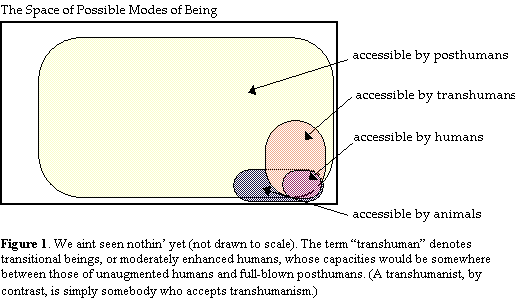
Transhuman, or trans-human, is the concept of an intermediary form between human and posthuman.[1] In other words, a transhuman is a being that resembles a human in most respects but who has powers and abilities beyond those of standard humans. These abilities might include improved intelligence, awareness, strength, and/or durability. Transhumans appear in science-fiction, sometimes as cyborgs or genetically-enhanced humans.
History of hypotheses
[edit]In his Divine Comedy, Dante Alighieri coined the word "trasumanar" meaning "to transcend human nature, to pass beyond human nature" in the first canto of Paradiso.[2][3]
The use of the term "transhuman" goes back to French philosopher Pierre Teilhard de Chardin, who wrote in his 1949 book The Future of Mankind.
Liberty: that is to say, the chance offered to every man (by removing obstacles and placing the appropriate means at his disposal) of 'trans-humanizing' himself by developing his potentialities to the fullest extent.[4]
And in a 1951 unpublished revision of the same book:
In consequence one is the less disposed to reject as unscientific the idea that the critical point of planetary Reflection, the fruit of socialization, far from being a mere spark in the darkness, represents our passage, by Translation or dematerialization, to another sphere of the Universe: not an ending of the ultra-human but its accession to some sort of trans-humanity at the ultimate heart of things.[5]
In 1957 book New Bottles for New Wine, English evolutionary biologist Julian Huxley wrote:
The human species can, if it wishes, transcend itself—not just sporadically, an individual here in one way, an individual there in another way, but in its entirety, as humanity. We need a name for this new belief. Perhaps transhumanism will serve: man remaining man, but transcending himself, by realizing new possibilities of and for his human nature. "I believe in transhumanism": once there are enough people who can truly say that, the human species will be on the threshold of a new kind of existence, as different from ours as ours is from that of Peking man. It will at last be consciously fulfilling its real destiny.[6]
One of the first professors of futurology, FM-2030, who taught "new concepts of the Human" at The New School of New York City in the 1960s, used "transhuman" as shorthand for "transitional human". Calling transhumans the "earliest manifestation of new evolutionary beings", FM argued that signs of transhumans included physical and mental augmentations including prostheses, reconstructive surgery, intensive use of telecommunications, a cosmopolitan outlook and a globetrotting lifestyle, androgyny, mediated reproduction (such as in vitro fertilisation), absence of religious beliefs, and a rejection of traditional family values.[7]
FM-2030 used the concept of transhuman as an evolutionary transition, outside the confines of academia, in his contributing final chapter to the 1972 anthology Woman, Year 2000.[8] In the same year, American cryonics pioneer Robert Ettinger contributed to conceptualization of "transhumanity" in his book Man into Superman.[9] In 1982, American Natasha Vita-More authored a statement titled Transhumanist Arts Statement and outlined what she perceived as an emerging transhuman culture.[10]
Jacques Attali, writing in 2006, envisaged transhumans as an altruistic vanguard of the later 21st century:
Vanguard players (I shall call them transhumans) will run (they are already running) relational enterprises in which profit will be no more than a hindrance, not a final goal. Each of these transhumans will be altruistic, a citizen of the planet, at once nomadic and sedentary, his neighbor's equal in rights and obligations, hospitable and respectful of the world. Together, transhumans will give birth to planetary institutions and change the course of industrial enterprises.[11]
In March 2007, American physicist Gregory Cochran and paleoanthropologist John Hawks published a study, alongside other recent research on which it builds, which amounts to a radical reappraisal of traditional views, which tended to assume that humans have reached an evolutionary endpoint. Physical anthropologist Jeffrey McKee argued the new findings of accelerated evolution bear out predictions he made in a 2000 book The Riddled Chain. Based on computer models, he argued that evolution should speed up as a population grows because population growth creates more opportunities for new mutations; and the expanded population occupies new environmental niches, which would drive evolution in new directions. Whatever the implications of the recent findings, McKee concludes that they highlight a ubiquitous point about evolution: "every species is a transitional species".[12]
Transhumans in fiction
[edit]Examples of transhuman entities in fiction exist within many popular video games. For example, the Bioshock media franchise depicts individuals receiving doses of a substance called ADAM, harvested from a fictional type of sea slugs, able to give the user fantastical powers through genetic engineering. Thus, previously standard humans can gain the ability to summon ice, wield lightning, turn invisible, and commit other seeming miracles due to their enhancement.[13]
A 2014 article from Ars Technica speculated that mutating clumps of mobile genetic elements known as "transposons" could possibly be used as a semi-parasitic tool to raise people to a higher status in terms of their abilities, making at least part of the game's scenario theoretically plausible.[13] Similar commentary later occurred from gamers with the advent of CRISPR gene editing.
Transhumans also have played a major role in the Star Trek media franchise. For example, in "Space Seed", the twenty-second episode of the first season of Star Trek: The Original Series that initially aired on February 16, 1967, a charismatic and physically intimidating genius called Khan Noonien Singh attempts to take control of the Enterprise operated by the show's protagonists. The selectively bred individual had advanced beyond simple human status and nearly succeeds. The starship's crew opt to exile the leader and his league of similar beings to a habitable but isolated alien planet instead of assigning a true punishment per se, a ruling which he accepts without protest. Played by Ricardo Montalbán, Khan returns in the 1982 film Star Trek II: The Wrath of Khan, which broadly serves as a sequel to the episode. References to "Space Seed" appear in episodes of Star Trek: Deep Space Nine, Star Trek: Enterprise, and the 2013 film Star Trek Into Darkness as well.
References
[edit]- ^ Bostrom, Nick (2002–2005). "The Transhumanist FAQ" (PDF). World Transhumanist Association. Archived from the original (PDF) on 31 December 2006. Retrieved 27 August 2006.
- ^ "Trasumanar (neologism)". danteworlds.laits.utexas.edu. Retrieved 2021-08-24.
- ^ "Paradiso 1 – Digital Dante". digitaldante.columbia.edu. Retrieved 2021-08-24.
- ^ Teilhard, Pierre (1949-02-02). "The Future of Mankind". Retrieved 13 January 2011.
- ^ Teilhard, Pierre (1950-04-27). "The Future of Mankind". Retrieved 13 January 2011.
- ^ Huxley, Julian (1957). "Transhumanism". Archived from the original on 22 May 2011. Retrieved 13 January 2011.
- ^ FM-2030 (1989). Are You a Transhuman?: Monitoring and Stimulating Your Personal Rate of Growth in a Rapidly Changing World. Viking Adult. ISBN 0-446-38806-8.
- ^ Vita-More, Natasha (2000). "FM-2030 One of the Spearheading Transhumanists". Archived from the original on 24 January 2007. Retrieved 16 February 2007.
- ^ Ettinger, Robert (1974). Man into Superman. Avon. ISBN 0-380-00047-4. Archived from the original on 2013-08-28.
- ^ Vita-More, Natasha (2003) [1982]. "Tranhumanist Arts Statement". Retrieved 16 February 2006.
- ^
Attali, Jacques (2011) [2009]. A Brief History of the Future: A Brave and Controversial Look at the Twenty-first Century. Translated by Jeremy Leggatt. Skyhorse Publishing Inc. ISBN 9781611450132. Retrieved 2013-09-18.
Vanguard players (I shall call them transhumans) will run (they are already running) relational enterprises in which profit will be no more than a hindrance, not a final goal. Each of these transhumans will be altruistic, a citizen of the planet, at once nomadic and sedentary, his neighbor's equal in rights and obligations, hospitable and respectful of the world. Together, transhumans will give birth to planetary institutions and change the course of industrial enterprises.
- ^ "Human evolution, radically reappraised". World Science. 27 March 2007. Retrieved 3 April 2007.
- ^ a b "Science inches closer to real BioShock-style plasmids". 12 February 2014.
External links
[edit]- Space of Possible Modes of Being
- World Transhumanist Association
- Teilhard de Chardin and Transhumanism
- Transhuman documentary

| Taxonomy (Hominins) |
| ||||||||||||||||||||||||||
|---|---|---|---|---|---|---|---|---|---|---|---|---|---|---|---|---|---|---|---|---|---|---|---|---|---|---|---|
| Ancestors |
| ||||||||||||||||||||||||||
| Models |
| ||||||||||||||||||||||||||
| Timelines | |||||||||||||||||||||||||||
| Others | |||||||||||||||||||||||||||


Transhuman
View on GrokipediaDefinition and Principles
Core Concepts and Goals
Transhumanism encompasses philosophies that advocate the use of scientific and technological means to radically extend human capabilities and transcend biological limitations, guiding humanity toward a posthuman future characterized by enhanced intelligence, longevity, and adaptability. This approach rejects static views of human nature, emphasizing instead the potential for self-directed evolution through rational interventions in fields such as neuroscience, nanotechnology, and artificial intelligence.[7][8] Central goals include achieving indefinite healthy lifespans by overcoming aging and disease, expanding cognitive faculties to enable superior problem-solving and creativity, and realizing morphological freedom—the autonomy to modify one's physical form, sensory experiences, and mental processes according to individual preferences. Proponents envision these advancements alleviating involuntary suffering, broadening mental horizons, and fostering diverse modes of existence beyond current human constraints, while prioritizing the well-being of all sentient beings, including future artificial intelligences.[9][8] Underlying principles stress dynamic optimism about technological progress, perpetual self-transformation, and the intelligent application of technology to challenge limits like death and scarcity, within frameworks that promote individual choice, open inquiry, and spontaneous social order. Extropianism, a prominent variant, outlines boundless expansion of life and knowledge, rejecting taboos against altering nature and advocating pragmatic engineering to actualize these aims.[7][9]Philosophical Underpinnings
Transhumanism draws its philosophical foundations from evolutionary humanism, as articulated by biologist Julian Huxley, who coined the term in his 1957 essay "Transhumanism." Huxley envisioned humanity transcending its current biological constraints through deliberate scientific and technological intervention, describing it as "man remaining man, but transcending himself, by realizing new possibilities of and for his human nature." This perspective positions humans as active agents in their own evolution, moving beyond passive natural selection to achieve enhanced forms, such as a "Homo superior," via applied science rather than reliance on undirected processes.[10][3] Earlier roots trace to Renaissance humanism, exemplified by Giovanni Pico della Mirandola's 1486 Oration on the Dignity of Man, which emphasized human self-determination: individuals could "fashion yourself in the form you may prefer" through intellect and will. Enlightenment thinkers further developed this into rational humanism, with Francis Bacon's 1620 Novum Organum advocating empirical science for mastery over nature and Marquis de Condorcet's 1795 Sketch for a Historical Picture of the Progress of the Human Mind forecasting indefinite progress through medical and technological advances. These ideas reject supernatural or fatalistic constraints, prioritizing critical reason, autonomy, and meliorism—the belief in ongoing human improvement.[10] In its modern form, transhumanist philosophy crystallized through Extropianism, formulated by Max More in the 1990 Principles of Extropy, which promote perpetual progress, self-transformation, practical optimism, intelligent technology use, open society, self-direction, and rational thinking. Unlike traditional humanism, which focuses on cultural and ethical refinement within biological limits, transhumanism extends to radical morphological freedom—the right to modify one's body and mind via biotechnology, AI, or nanotechnology—to overcome aging, disease, cognitive bounds, and mortality. This framework affirms the desirability of transitioning to posthuman states, guided by life-promoting values and applied reason.[11][3] Philosophers like Nick Bostrom reinforce these underpinnings by framing transhumanism as an outgrowth of secular humanism, committed to accelerating intelligent life's evolution beyond human limitations through science, while critiquing apologism—the notion that altering natural conditions is inherently wrong. Core tenets include confidence in technology's capacity for net benefits, such as vastly extended healthy lifespans and enhanced intelligence, balanced against risks like existential threats, yet grounded in empirical optimism rather than utopian guarantees.[10][11]Historical Development
Early Precursors
The pursuit of human enhancement beyond natural biological limits traces back to ancient civilizations, where quests for immortality reflected early aspirations to transcend mortality. In the Sumerian Epic of Gilgamesh, composed around 1700 BCE, the titular king seeks eternal life after the death of his companion Enkidu, obtaining a rejuvenating plant from the sea but ultimately failing when it is stolen by a serpent, symbolizing the frustration of such endeavors through mythical means.[10] Ancient Greek mythology provided further precursors through figures embodying technological defiance of human constraints. Prometheus stole fire from the gods to bestow advanced capabilities upon humanity, enabling crafts and knowledge that elevated human potential, though punished with eternal torment for overreaching. Similarly, Daedalus engineered wings for himself and his son Icarus, attempting flight as a form of bodily augmentation, with Icarus's fatal hubris underscoring risks of unchecked enhancement.[10] Medieval alchemy represented a proto-scientific attempt to achieve physical immortality and human perfectibility. Alchemists pursued the elixir vitae to conquer aging and death, alongside efforts to create artificial life such as homunculi, as defended by 13th-century scholars like Albertus Magnus and Thomas Aquinas against theological opposition. These pursuits blended empirical experimentation with esoteric goals, laying groundwork for later chemical and biological sciences aimed at bodily transformation.[10] During the Renaissance, philosophical humanism emphasized human agency in self-directed evolution. Giovanni Pico della Mirandola's Oration on the Dignity of Man (1486) argued that humans, lacking fixed form, could ascend toward divine likeness through intellect and will, positioning humanity as architects of its own nature rather than passive recipients of fate.[10] Enlightenment thinkers advanced these ideas toward empirical science as a tool for human dominion over biology. Francis Bacon, in Novum Organum (1620), promoted inductive method to expand human powers and relieve suffering, while his utopian New Atlantis (published posthumously 1627) depicted a society using advanced "Salomon's House" laboratories for medical prolongevity, mechanical prosthetics, and environmental control to enhance life.[10] René Descartes, in Discourse on the Method (1637), envisioned mechanistic medicine treating the body as a machine repairable to defeat diseases and senescence, enabling mastery over health akin to engineering.[10] Marquis de Condorcet, in Sketch for a Historical Picture of the Progress of the Human Mind (1795), forecasted indefinite life extension through perfected sciences, rejecting natural death as an artifact conquerable by reason. Benjamin Franklin (1706–1790) experimented with electrical resuscitation and expressed desires for suspended animation to await future revivals, bridging personal aspiration with proto-cryonic concepts.[10] In the 19th century, Russian cosmism synthesized religious and scientific imperatives for transcendence. Nikolai Fyodorov (1829–1903), a philosopher and librarian, advocated "active evolution" wherein humanity would harness technology to achieve physical immortality, resurrect all past dead via scientific reconstruction of atoms, and regulate nature to eliminate death, framing these as moral duties rooted in familial and cosmic unity rather than mere individual gain.[10]Emergence of Modern Transhumanism
The modern transhumanist movement coalesced in the late 1980s amid growing interest in applying emerging technologies to overcome biological limitations, distinguishing itself from earlier speculative ideas by emphasizing practical, optimistic advocacy for human enhancement. A foundational step was the publication of the inaugural issue of Extropy: The Journal of Transhumanist Thought in 1988 by philosopher Max More and legal scholar Tom Morrow (later Tom Bell), which introduced extropianism as a set of principles promoting boundless expansion, self-direction, and dynamic optimism through rational technological progress.[10] In 1990, More further defined the philosophy in his essay "Transhumanism: Towards a Futurist Philosophy," advocating for the use of science, reason, and market incentives to achieve indefinite lifespan extension, superintelligence, and personal morphological freedom.[10] The Extropy Institute, co-founded by More in 1992, served as the first dedicated organization to advance these concepts, organizing conferences, newsletters, and online forums that attracted intellectuals focused on cryonics, nanotechnology, and artificial intelligence as tools for transcending humanity.[10] This period also saw contributions from figures like K. Eric Drexler, whose 1986 book Engines of Creation popularized molecular nanotechnology as a means for precise matter manipulation and human augmentation, influencing transhumanist discussions on engineering superior bodies and minds.[10] Concurrently, futurist FM-2030 (Fereidoun M. Esfandiary) bridged earlier optimism with modern rhetoric through his 1989 book Are You a Transhuman?, which provided a diagnostic framework for evaluating one's adaptability to rapid technological change and predicted widespread human optimization by 2030.[12] By the mid-1990s, transhumanism had evolved into a networked community via email lists and early internet platforms, setting the stage for broader institutionalization. The founding of the World Transhumanist Association (WTA) in 1998 by ethicist Nick Bostrom and philosopher David Pearce marked a key milestone, creating an international nonprofit to coordinate advocacy, ethical analysis, and public discourse on enhancement technologies while issuing declarations on responsible development.[10] This organization, later rebranded Humanity+, helped legitimize transhumanism within academic and policy circles by prioritizing evidence-based risks and benefits over unsubstantiated utopianism.[10]Key Milestones
In 1957, biologist Julian Huxley coined the term "transhumanism" in his essay "Transhumanism," envisioning a future where humanity transcends its biological limitations through scientific and technological means.[10] This marked a pivotal shift from philosophical speculation to an explicit advocacy for human enhancement.[3] The 1960s saw the practical initiation of cryonics as a transhumanist strategy for life extension, with Robert Ettinger's 1964 book The Prospect of Immortality proposing the freezing of human bodies for future revival using advanced technology.[10] This led to the founding of the Alcor Life Extension Foundation in 1972, which developed vitrification techniques to preserve biological structures at cryogenic temperatures.[10] Similarly, the Cryonics Institute was established in 1976 to provide affordable full-body suspension services.[10] The 1980s and 1990s formalized transhumanism as an organized intellectual movement. Eric Drexler's 1986 book Engines of Creation introduced the concept of molecular nanotechnology for atomic-scale engineering of matter, including human augmentation, and prompted the founding of the Foresight Institute to guide its ethical development.[10] In 1988, Max More and Tom Morrow launched Extropy: The Journal of Scientific Humanism, which evolved into the Extropy Institute by 1992, promoting principles like boundless expansion and self-transformation through technology.[10] Max More further refined the definition of transhumanism in his 1990 essay, distinguishing it from posthumanism by emphasizing enhancement without abandoning human values.[13] The late 1990s witnessed institutional consolidation, with Nick Bostrom and David Pearce founding the World Transhumanist Association (now Humanity+) in 1998, which issued the first Transhumanist Declaration outlining goals such as overcoming aging, cognitive enhancement, and equitable access to enhancements.[10] This was complemented by the establishment of the Institute for Ethics and Emerging Technologies in 2004 to address moral implications of enhancement technologies.[10] In the 2000s, Ray Kurzweil's 2005 book The Singularity Is Near popularized the idea of a technological singularity, predicting exponential progress in AI and biotechnology leading to radical human transformation by 2045.[13] The Methuselah Foundation's founding in 2003 accelerated anti-aging research funding, supporting initiatives like the Mouse Prize for longevity breakthroughs.[13] These milestones underscore transhumanism's transition from fringe ideas to a structured advocacy for technology-driven human evolution.Key Figures and Organizations
Influential Thinkers
Julian Huxley, an evolutionary biologist and the first Director-General of UNESCO from 1946 to 1948, coined the term "transhumanism" in his 1957 essay "Transhumanism," where he envisioned humanity transcending its biological limitations through scientific and technological means to achieve greater fulfillment.[2] Huxley's formulation emphasized evolutionary progress beyond the human condition, stating, "man remaining man, but transcending himself, by realizing new possibilities of and for his human nature."[14] His ideas built on earlier evolutionary humanism, influencing subsequent thinkers by framing transhumanism as a naturalistic successor to traditional religion.[15] Fereidoun M. Esfandiary, known as FM-2030, was a Belgian-born Iranian-American futurist who popularized transhumanist concepts in the late 20th century through works like Are You a Transhuman? (1989), which included a self-diagnostic test to assess one's alignment with transhuman ideals such as embracing technology for personal evolution.[16] Born in 1930, FM-2030 advocated for a shift from "animal-human" biology to "transhuman" enhancements, predicting by 2030 humans would achieve widespread physical and cognitive upgrades via biotechnology and cybernetics.[17] He exemplified these principles by opting for cryonic preservation upon his death in 2000, viewing it as a bridge to future revival technologies.[18] Max More, born in 1964, advanced transhumanism through extropianism, a philosophy he defined in his 1990 essay "Transhumanism: Toward a Futurist Philosophy," which outlined principles like boundless expansion, self-transformation, and dynamic optimism to overcome human limits.[7] As founder of the Extropy Institute in 1992, More promoted proactive technological progress, influencing organizational efforts in cryonics and life extension; he later served as CEO of the Alcor Life Extension Foundation.[19] His work emphasized individual agency in morphological freedom, critiquing static humanism in favor of perpetual self-upgrading.[20] Nick Bostrom, a Swedish philosopher born in 1973, co-founded the World Transhumanist Association (now Humanity+) in 1998, providing an institutional platform for advocating enhancements in cognition, healthspan, and resilience against existential risks.[21] In essays like "Transhumanist Values" (2001), Bostrom articulated core tenets such as exploring posthuman states while prioritizing diversity and informed consent in technological adoption.[22] His 2004 paper "A History of Transhumanist Thought" traces intellectual lineage from precursors like J.B.S. Haldane to modern applications, underscoring ethical frameworks for superintelligence and longevity.[23] Ray Kurzweil, an American inventor and futurist born in 1948, has propelled transhumanist discourse through predictions of the technological singularity, detailed in The Singularity Is Near (2005), where he forecasts by 2045 the merger of human and machine intelligence enabling indefinite lifespan extension via nanotechnology and AI.[24] Kurzweil's law of accelerating returns, based on empirical trends in computing power doubling roughly every 18 months since the 1930s, underpins his advocacy for uploading consciousness and reversing aging through molecular repair.[25] As Director of Engineering at Google since 2012, he integrates these ideas into practical AI development, projecting radical abundance by mid-century.[26] Aubrey de Grey, a British gerontologist born in 1963, focuses on engineering negligible senescence via the SENS (Strategies for Engineered Negligible Senescence) framework, targeting seven damage types in aging cells for repair to achieve "longevity escape velocity" by 2036–2040 for those alive today.[27] Founding the SENS Research Foundation in 2009, de Grey's approach treats aging as a solvable engineering problem rather than inevitable entropy, amassing over $25 million in funding by 2015 for preclinical trials in damage-repair therapies like allotopic expression of mitochondrial genes.[28] Though he rejects the transhumanist label personally, his work aligns with core goals of radical life extension, influencing biotech investments exceeding $1 billion annually in anti-aging by 2020.[29]Major Organizations and Initiatives
The Extropy Institute, established in 1992 by Max More and Tom Morrow following the launch of Extropy magazine in 1988, served as a foundational organization in transhumanism, promoting extropianism—a philosophy centered on boundless expansion, self-transformation, and technological advancement to counter entropy and human constraints. It organized conferences, published newsletters, and fostered networks among early proponents until disbanding in 2006, after declaring its core objectives largely integrated into broader discourse.[10] Humanity+, originally the World Transhumanist Association founded in 1998 by philosophers Nick Bostrom and David Pearce, operates as the leading international nonprofit membership organization dedicated to advocating the ethical application of science and technology for human enhancement, including longevity extension and cognitive augmentation. It maintains the Transhumanist Declaration, updated in 2009, and supports global events and policy discussions on responsible technological progress.[9][30] The Institute for Ethics and Emerging Technologies (IEET), launched in 2004 as a technoprogressive think tank, analyzes the societal impacts of innovations like artificial intelligence and biotechnology, emphasizing their potential to enhance freedom, opportunity, and diversity in democratic contexts while addressing risks through policy recommendations. It publishes the Journal of Ethics and Emerging Technologies and hosts affiliates focused on ethical frameworks for transformative advancements. The 2045 Initiative, initiated in 2011 by Russian entrepreneur Dmitry Itskov, constitutes a prominent research network pursuing radical life extension via cybernetic means, including the Avatar Project for transferring human consciousness into holographic or robotic embodiments by 2045. It coordinates international scientists in neuroscience, robotics, and brain emulation to develop prototypes for non-biological immortality.[31] Political entities like the U.S. Transhumanist Party, formed in 2014 under Gennady Stolyarov, represent transhumanist advocacy in governance, endorsing platforms for accelerated scientific research, morphological freedom, and opposition to age-related disease through evidence-based policies. Similar parties have emerged in countries including the UK and Italy, aiming to embed enhancement technologies into legislative agendas.[32]Technological Foundations
Biotechnology and Longevity Research
Biotechnology in transhumanist thought emphasizes interventions to repair or reprogram biological aging processes, aiming for indefinite healthy lifespan extension through targeted molecular therapies. Proponents argue that aging results from accumulative cellular and tissue damage, addressable via regenerative medicine, gene editing, and senescent cell clearance, rather than mere disease treatment. Empirical evidence from animal models supports partial reversal of age-related decline, though human translation remains limited by complexity of systemic interactions and off-target effects.[6] The Strategies for Engineered Negligible Senescence (SENS) framework, proposed by biomedical gerontologist Aubrey de Grey, outlines seven categories of aging damage—including cell loss, mitochondrial mutations, and extracellular aggregates—for periodic repair using biotechnologies like stem cell replenishment and lysosomal enhancement. Established as the SENS Research Foundation in 2009, the organization has funded preclinical studies demonstrating feasibility in mice, such as allotopic expression of mitochondrial genes to mitigate mutations. Despite de Grey's 2021 departure amid unrelated personal allegations, SENS continues advocating damage-repair paradigms, influencing longevity research by shifting focus from slowing aging to comprehensive rejuvenation.[33][34] Gene editing technologies, particularly CRISPR-Cas9 developed in 2012, enable precise modification of aging-associated genes, such as those regulating telomere length, epigenetic clocks, or senescence pathways. In laboratory settings, CRISPR has rejuvenated senescent stem cells by targeting p16INK4a and other markers, restoring proliferative capacity in aged mice tissues. Human applications remain exploratory; for instance, editing Yamanaka factors for partial cellular reprogramming has extended mouse lifespan by up to 30% in controlled studies, but risks like tumorigenesis necessitate causal validation beyond correlative biomarkers. Transhumanist advocates view these as foundational for transcending genetic limits, though critics note evolutionary trade-offs where longevity genes correlate with reduced fertility or cancer resistance in natural populations.[35][36] Senolytics, compounds selectively eliminating senescent cells that secrete pro-inflammatory factors (SASP), represent another biotech avenue, with preclinical data showing 20-30% lifespan extension in mice via drugs like dasatinib plus quercetin. Clinical trials, including a 2019 pilot in diabetic kidney disease patients, confirmed senescent cell reduction without severe adverse events, while a 2025 study in older adults assessed cognitive and mobility improvements post-intermittent dosing. Unity Biotechnology's trials for ophthalmic conditions reported modest vision gains in phase 2, underscoring potential for frailty reversal, yet longevity endpoints require longitudinal evidence amid senescence's heterogeneous roles in tissue homeostasis.[37][38][39] Prominent organizations driving this research include Altos Labs, launched in 2021 with $3 billion funding from investors like Jeff Bezos, focusing on cellular reprogramming for age reversal; the Buck Institute for Research on Aging, operational since 2002, which elucidated hallmarks like genomic instability; and Calico Life Sciences, Alphabet-backed since 2013, targeting interventions in yeast, worms, and mice models. These efforts have accelerated senomorphic and epigenetic therapies, with over 20 senolytic candidates in pipelines by 2025, though regulatory hurdles persist due to aging's non-disease status under FDA frameworks. Transhumanist integration posits biotech convergence with AI for personalized protocols, prioritizing empirical biomarkers like DNA methylation clocks over speculative immortality claims.[40][41]Artificial Intelligence and Neural Interfaces
Artificial intelligence (AI) and neural interfaces represent core technological pillars in transhumanist aspirations to augment human cognition and achieve symbiosis between biological brains and computational systems. Transhumanists advocate for AI not merely as an external tool but as an integrable extension of human intelligence, potentially enabling superhuman reasoning and problem-solving through direct neural linkages. This vision posits that advanced AI could amplify cognitive capacities, allowing humans to process vast datasets, simulate complex scenarios, and overcome biological constraints on memory and computation.[42] Such enhancements are theorized to facilitate a "cognitive singularity," where human-AI fusion accelerates innovation beyond current evolutionary limits.[43] Neural interfaces, particularly brain-computer interfaces (BCIs), provide the hardware foundation for this integration by enabling bidirectional communication between neurons and digital systems. Early BCI prototypes, developed since the 1970s, focused on recording neural signals for basic control of cursors or prosthetics, but recent advances emphasize high-channel-count implants with thousands of electrodes to capture fine-grained brain activity.[44] For instance, Utah arrays and silicon-based probes have evolved into flexible, biocompatible materials like carbon nanotubes and polymers, reducing tissue damage and improving signal stability over months-long implants.[45] These interfaces decode motor intentions or sensory inputs via machine learning algorithms, translating spikes into commands with latencies under 100 milliseconds.[46] Prominent developments include Neuralink's N1 implant, a wireless device with 1,024 electrodes threaded into the cortex by robotic surgery, first tested in humans in January 2024 for quadriplegia patients to control computers via thought.[47] By July 2025, Neuralink had implanted the device in its ninth participant, demonstrating cursor control, gaming, and rudimentary speech decoding in clinical trials like PRIME and CONVOY, which target paralysis restoration.[48] The company raised $650 million in Series E funding in 2025 to scale trials, achieving FDA Breakthrough Device Designation for speech applications, with participants reporting bandwidth increases to over 100 bits per second.[49] Beyond medical restoration, transhumanist proponents view such systems as precursors to elective enhancements, like uploading skills or interfacing with AI for augmented decision-making, though current implementations remain limited to therapeutic contexts due to biocompatibility and decoding accuracy challenges.[50] AI integration with neural interfaces amplifies these capabilities through closed-loop systems, where real-time feedback adapts stimulation to user intent, as seen in DARPA-funded projects combining deep learning with electrocorticography for epilepsy treatment and potential cognitive boosting.[44] Peer-reviewed studies highlight AI's role in enhancing signal processing, with convolutional neural networks improving decoding fidelity by 20-30% in non-invasive EEG setups, paving the way for hybrid human-AI cognition.[51] In transhuman frameworks, this convergence could enable "whole brain emulation," digitizing neural patterns for substrate-independent minds, though empirical evidence remains confined to animal models and low-fidelity human trials, with no verified instances of consciousness transfer.[52] Ongoing research prioritizes scalability, with 2025 advancements in optical and ultrasonic interfaces exploring non-invasive alternatives to invasive implants for broader adoption.[53]Nanotechnology and Cybernetic Enhancements
Nanotechnology in the context of transhumanism envisions nanoscale machines capable of repairing cellular damage, reprogramming biological processes, and enabling radical human augmentation, as theorized by early proponents like K. Eric Drexler in his 1986 book Engines of Creation, which proposed molecular assemblers for atom-by-atom construction.[54] Current applications remain focused on medical interventions rather than full enhancement, with nanobots primarily in experimental stages for targeted drug delivery and diagnostics; for instance, ultrasound-driven nanorobots have shown promise in preclinical trials for precise tumor targeting, though routine clinical use is not yet achieved as of 2025.[55][56] The global nanorobots healthcare market, valued at USD 9.15 billion in 2024, is projected to reach USD 38.66 billion by 2034, driven by hybrid multifunctional designs that combine propulsion and therapeutic functions, indicating incremental progress toward transhumanist goals like in vivo tissue repair.[57] However, self-replicating or general-purpose nanobots capable of widespread human enhancement remain speculative, limited by challenges in biocompatibility, power supply, and control at the atomic scale.[58] Cybernetic enhancements involve the integration of electronic, mechanical, or robotic systems with human physiology to restore or exceed natural capabilities, aligning with transhumanist aims of merging biology with machinery for superior strength, endurance, or sensory input.[59] Advances in bionic prosthetics exemplify this, such as MIT's 2024 neural-controlled leg prosthesis, which uses targeted muscle reinnervation surgery to interface directly with the peripheral nervous system, enabling amputees to achieve near-natural gait patterns with reduced metabolic cost compared to conventional devices.[60] AI-integrated bionic arms, like those developed by Atom Limbs in 2024, provide multi-articulated dexterity approximating full human motion range through pattern recognition algorithms that interpret electromyographic signals, surpassing earlier myoelectric prosthetics in responsiveness.[61] Exoskeletons represent another frontier, with powered suits enhancing load-bearing capacity for able-bodied users; for example, military-grade systems tested by 2023 allow soldiers to carry up to 100 kg with minimal fatigue, demonstrating potential for civilian augmentation in labor-intensive tasks.[62] These developments prioritize empirical functionality over speculative superhumanism, with ongoing research emphasizing osseointegration and sensory feedback to minimize rejection risks, though long-term durability and ethical integration into non-medical enhancement remain unresolved.[63]| Technology | Key Advance | Year | Source |
|---|---|---|---|
| Nanorobots for drug delivery | Hybrid multifunctional designs for tumor targeting | 2025 projections | [56] |
| Neural-controlled bionic leg | Restores natural gait via muscle reinnervation | 2024 | [60] |
| AI-powered bionic arm | Full range of motion via EMG pattern recognition | 2024 | [61] |
| Powered exoskeleton | Enhances load capacity to 100 kg | 2023 trials | [62] |