
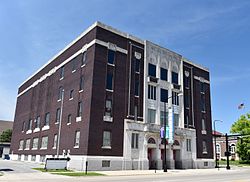


Community hub
Recent from talks
Contribute something
Nothing was collected or created yet.
Waterloo, Iowa
View on Wikipedia
Waterloo is a city in and the county seat of Black Hawk County, Iowa, United States.[3] It is the eighth-most populous city in Iowa, with a population of 67,314 at the 2020 census.[4] Waterloo comprises a twin conurbation with neighboring municipality Cedar Falls, and is the larger of the two cities. The Waterloo – Cedar Falls metropolitan area has an estimated 170,000 residents.
Key Information

.jpg)


.png)


Waterloo is a major manufacturing, commercial, and cultural center in Northeast Iowa. Locally known as the "Factory City," John Deere brand agricultural machinery has been produced in the city for over a century.[5] Waterloo is bisected by the Cedar River flowing southeastward.
History
[edit]

Waterloo was originally known as Prairie Rapids Crossing.[6] The town was established near two Meskwaki American tribal seasonal camps alongside the Cedar River. It was first settled in 1845 when George and Mary Melrose Hanna and their children arrived on the east bank of the Red Cedar River (now just called the Cedar River). They were followed by the Virden and Mullan families in 1846. Evidence of these earliest families can still be found in the street names Hanna Boulevard, Mullan Avenue and Virden Creek.
On December 8, 1845, the Iowa State Register and Waterloo Herald was the first newspaper published in Waterloo.[7]
The name Waterloo supplanted the original name, Prairie Rapids Crossing, shortly after Charles Mullan petitioned for a post office in the town. Since the signed petition did not include the name of the proposed post office location, Mullan was charged with selecting the name when he submitted the petition. Tradition has it that as he flipped through a list of other post offices in the United States, he came upon the name Waterloo. The name struck his fancy, and a post office was established under that name. There were two extended periods of rapid growth over the next 115 years. From 1895 to 1915, the population increased from 8,490 to 33,097, a 290% increase. From 1925 to 1960, population increased from 36,771 to 71,755. The 1895 to 1915 period was a time of rapid growth in manufacturing, rail transportation and wholesale operations. During this period the Waterloo Gasoline Traction Engine Company moved to Waterloo and, shortly after, the Rath Packing Company moved from Dubuque. Another major employer throughout the first two-thirds of the 20th century was the Illinois Central Railroad. Among the others was the less-successful brass era automobile manufacturer, the Maytag-Mason Motor Company.[8]
On June 7, 1934, bank robber Tommy Carroll had a shootout with the FBI when he and his wife stopped to pick up gas. Accidentally parking next to a police car and wasting time dropping his gun and picking it back up, Carroll was forced to flee into an alley, where he was shot. He was taken to Allen Memorial Hospital in Waterloo, where he soon died.
Waterloo suffered in the agricultural recession of the 1980s; its major employers at the time were heavily rooted in agriculture. John Deere, the area's largest employer, cut 10,000 jobs, and the Rath meatpacking plant closed altogether, losing 2,500 jobs. It is estimated that Waterloo lost 14% of its population during this time.[9] Today the city enjoys a broader industrial base, as city leaders have sought to diversify its industrial and commercial mix. John Deere remains a large employer for Waterloo, but employs only roughly one-third the number of people it did at its peak. Layoffs in 2024 and 2025 further reduced John Deere's presence in the city.[10][11]
African American community
[edit]In 1910, black railroad workers were brought in as strikebreakers to the Waterloo area.[12][13] Black workers were relegated to 20 square blocks in Waterloo, an area that remains the east side to this day.[12][13] In 1940, more black strikebreakers were brought in to work in the Rath meat plant.[14] In 1948, a black strikebreaker killed a white union member. Instead of a race riot, a strike ensued against the Rath Company. The National Guard was called in to end the 73-day strike.[14]
Civil rights
[edit]United Packinghouse Workers of America became the main union of the Rath Company, welcoming black workers,[15] but United Auto Workers Local 838 continued to refuse black members.[16] With the power of the union, Anna Mae Weems, Ada Treadwell, Charles Pearson and Jimmy Porter formed an anti-discrimination department at Rath by the 1950s. This department helped organize protests against local places that discriminated against blacks.[12]
Porter would go on to organize the first black radio station in Waterloo, KBBG, in 1978.[13][15] Weems became the head of the anti-discrimination department and local NAACP chapter.[12]
On May 31, 1966, Eddie Wallace Sallis was found dead in the local jail. The black community felt the death was suspicious, and protests were held. On June 4, Weems led a march on city hall to encourage investigation into his death.[13][15] The march led to the creation of the Waterloo Human Rights Commission, which lasted only a year due to lack of funding.[14]
On Sept. 7, 1967, a city report, "Waterloo's Unfinished Business", was released.[17] The report covered the ongoing problems in housing, education and employment faced by Waterloo's black community. It confirmed the housing bias faced by black residents, that many of the schools were generally 80% of one race, and that 80% of black residents held service jobs.[17] In a 2007 article, the Courier covered some changes in the 40 years since, finding that housing was now mostly divided by socioeconomic status, schools still violated the desegregation plan, and black unemployment was still double that of white residents.[17]
The Iowa Supreme Court outlawed school segregation in 1868.[14] A 1967 commission found most schools were still segregated and recommended immediate desegregation, which Mayor Lloyd Turner opposed.[15] In 1969, the Waterloo school board voted to allow open enrollment in all their schools to encourage integration. Many parents felt it was not enough.[15] Despite the efforts between 1967 and 1970, already-black schools in the area increased in their segregation.[15]
Protests and riots
[edit]By the 1960s, Rath was declining and jobs there were harder to come by. A federal government program trained 1,200 local youths with the promise of summer jobs, only to hire two as bricklayers.[12] Starting in the summer months of 1966,[18] Waterloo was subject to riots over race relations between the white community and the black community. Many white residents expressed confusion as to why riots were occurring in Waterloo,[15][18] while younger black residents felt they were being treated unfairly, as their conditions seemed worse than those of their white neighbors.[18] In 1967, the black population of Waterloo was equivalent to 8%, and according to the Courier, had a 4% unemployment rate.[18] Waterloo was segregated at the time, as 95% of its black population lived in "East" Waterloo.[18] While the white community felt East High was integrated with a 45% black student body, the black community pointed out that the elementary school in East Waterloo had only one white pupil.
Protests were mostly organized by black youths aged 16–25.[17][18] Protests became riots when the youth felt protesting wasn't effective.[18] Protests turned into riots in July 1968[18] and reached a critical mass by September, with buildings on East 4th street torched and vandalized.[17]
In August 1968, East High students Terri and Kathy Pearson gave the principal a list of grievances detailing how they felt the discrimination could be lessened. The principal refused to implement any of the requested changes.[15] Student protests and walkouts continued through September. Students were angry that no African American history course was being taught, and that interracial dating was discouraged by teachers and administrators.[15]
On September 13, 1968, during an East High School football game, police attempted to arrest a black youth.[13] He resisted arrest, drawing attention of students in the stands. Black students fought and argued with the police, and police responded by using clubs and mace.[15] The riot continued into the east side of Waterloo, with a subsequent fire that claimed a lumber mill and three homes. There was an attempt to set East High on fire as well.[15] The riot lasted until midnight and resulted in seven officers injured and thirteen youths jailed. The National Guard was called in the following day. The riots were called off and a solution was reached thanks to civil rights leader William G Parker.[15]
21st century
[edit]In 2003, Governor Tom Vilsack created a task force to close the racial achievement gap in Waterloo.[19] In 2009, a fair housing report, "Analysis of Impediments to Fair Housing Choice", compiled by Mullin & Lonergan Associates Inc., found Waterloo to be Iowa's most segregated city.[16] "Historical patterns of racial segregation persist in Waterloo. Of the 20 cities in Iowa with populations exceeding 25,000, Waterloo ranks as the most segregated".[16]
Many activists who participated in the original protests feel that Waterloo has remained the same.[13][17] In 2015, The Huffington Post listed Waterloo as the 10th worst city for black Americans.[20] The site noted that the city's black residents have a 24% unemployment rate compared to 3.9% for whites, giving Waterloo one of the highest black unemployment rates among Midwest cities.[13] Waterloo still has a higher percentage of blacks than most Iowa cities.[13]
In December 2012, Derrick Ambrose Jr. was shot by a police officer. Ambrose's family maintains he was unarmed, while the officer stated that he felt his life was in danger. A grand jury acquitted the officer. The shooting sparked outrage in the community.[13]
Flood of 2008
[edit]
June 2008 saw the worst flooding the Waterloo – Cedar Falls area had ever recorded; other major floods include the Great Flood of 1993. The flood control system constructed in the 1970s–90s largely functioned as designed.[citation needed]
Geography
[edit]
According to the United States Census Bureau, the city has a total area of 63.23 square miles (163.76 km2), of which 61.39 square miles (159.00 km2) is land and 1.84 square miles (4.77 km2) is water.[21]
The average elevation of Waterloo is 846 feet above sea level. The population density is 1101 people per square mile, considered low for an urban area.[22]
Climate
[edit]Waterloo has a humid continental climate zone (Köppen classification Dfa),[23] typical of the state of Iowa, and is part of USDA Plant Hardiness zone 5a.[24] The normal monthly mean temperature ranges from 18.5 °F (−7.5 °C) in January to 73.6 °F (23.1 °C) in July. On average, there are 22 nights annually with a low at or below 0 °F (−18 °C), 58 days annually with a high at or below freezing, and 16 days with a high at or above 90 °F (32 °C). As the mean first and last occurrence of freezing temperatures is October 1 and April 29, respectively, this allows for a growing season of 154 days. Temperature records range from −34 °F (−37 °C) on March 1, 1962, and January 16, 2009, up to 112 °F (44 °C) on July 13 and 14, 1936, during the Dust Bowl. The record cold daily maximum is −16 °F (−27 °C) on February 2, 1996, while conversely the record warm daily minimum is 80 °F (27 °C) on July 31, 1917, and August 16, 1988.[25]
_-_Waterloo_Area,_IA(ThreadEx).svg)
Normal annual precipitation equivalent is 34.60 inches (879 mm) spread over an average of 112 days, with heavier rainfall in spring and summer, but observed annual rainfall has ranged from 17.35 to 53.07 inches (441 to 1,348 mm) in 1910 and 1993, respectively. The wettest month on record is July 1999 with 12.82 inches (326 mm); on the 2nd of that month, 5.49 inches (139 mm) of rain fell, making for the heaviest rainfall in a single calendar day. The driest months are October 1952 and November 1954 with trace amounts in each month.[25]
Winter snowfall is moderate, and averages 35.3 inches (90 cm) per season, spread over an average of 27 days, and snow cover of 1 inch (2.5 cm) or more is seen on 67 days, mostly from December to March. Winter snowfall has ranged from 11.6 inches (29.5 cm) in 1967–68 to 68.5 inches (174.0 cm) in 1904–05. The most snow in a calendar day and month is 13.2 and 33.9 inches (33.5 and 86.1 cm) on January 3, 1971, and in December 2000, respectively.[25]
| Climate data for Waterloo Regional Airport (1991–2020 normals,[a] extremes 1895–present) | |||||||||||||
|---|---|---|---|---|---|---|---|---|---|---|---|---|---|
| Month | Jan | Feb | Mar | Apr | May | Jun | Jul | Aug | Sep | Oct | Nov | Dec | Year |
| Record high °F (°C) | 65 (18) |
78 (26) |
87 (31) |
100 (38) |
108 (42) |
107 (42) |
112 (44) |
110 (43) |
102 (39) |
95 (35) |
83 (28) |
74 (23) |
112 (44) |
| Mean maximum °F (°C) | 47.5 (8.6) |
51.7 (10.9) |
70.5 (21.4) |
82.7 (28.2) |
88.8 (31.6) |
93.3 (34.1) |
94.3 (34.6) |
91.7 (33.2) |
90.6 (32.6) |
82.9 (28.3) |
67.5 (19.7) |
51.5 (10.8) |
95.9 (35.5) |
| Mean daily maximum °F (°C) | 28.2 (−2.1) |
32.6 (0.3) |
46.5 (8.1) |
60.9 (16.1) |
72.8 (22.7) |
82.2 (27.9) |
85.0 (29.4) |
82.9 (28.3) |
76.8 (24.9) |
63.0 (17.2) |
47.1 (8.4) |
33.7 (0.9) |
59.3 (15.2) |
| Daily mean °F (°C) | 19.4 (−7.0) |
23.9 (−4.5) |
36.7 (2.6) |
49.4 (9.7) |
61.5 (16.4) |
71.5 (21.9) |
74.5 (23.6) |
71.9 (22.2) |
64.6 (18.1) |
51.6 (10.9) |
37.4 (3.0) |
25.3 (−3.7) |
49.0 (9.4) |
| Mean daily minimum °F (°C) | 10.7 (−11.8) |
15.2 (−9.3) |
26.9 (−2.8) |
37.9 (3.3) |
50.2 (10.1) |
60.8 (16.0) |
64.0 (17.8) |
61.0 (16.1) |
52.4 (11.3) |
40.2 (4.6) |
27.7 (−2.4) |
17.0 (−8.3) |
38.7 (3.7) |
| Mean minimum °F (°C) | −16.0 (−26.7) |
−9.8 (−23.2) |
2.2 (−16.6) |
20.4 (−6.4) |
32.9 (0.5) |
45.7 (7.6) |
51.2 (10.7) |
48.2 (9.0) |
34.7 (1.5) |
21.5 (−5.8) |
7.9 (−13.4) |
−7.3 (−21.8) |
−19.6 (−28.7) |
| Record low °F (°C) | −34 (−37) |
−31 (−35) |
−34 (−37) |
−4 (−20) |
22 (−6) |
33 (1) |
42 (6) |
33 (1) |
19 (−7) |
0 (−18) |
−17 (−27) |
−29 (−34) |
−34 (−37) |
| Average precipitation inches (mm) | 1.10 (28) |
1.14 (29) |
1.98 (50) |
4.04 (103) |
4.61 (117) |
5.72 (145) |
4.34 (110) |
4.17 (106) |
3.14 (80) |
2.76 (70) |
1.85 (47) |
1.44 (37) |
36.29 (922) |
| Average snowfall inches (cm) | 10.1 (26) |
9.3 (24) |
4.6 (12) |
1.7 (4.3) |
0.1 (0.25) |
0.0 (0.0) |
0.0 (0.0) |
0.0 (0.0) |
0.0 (0.0) |
0.3 (0.76) |
3.1 (7.9) |
9.9 (25) |
39.1 (99) |
| Average precipitation days (≥ 0.01 in) | 8.1 | 8.0 | 10.1 | 11.5 | 12.9 | 11.8 | 8.9 | 8.8 | 8.7 | 8.5 | 8.1 | 8.4 | 113.8 |
| Average snowy days (≥ 0.1 in) | 6.8 | 6.3 | 3.2 | 1.1 | 0.1 | 0.0 | 0.0 | 0.0 | 0.0 | 0.4 | 2.5 | 6.2 | 26.6 |
| Average relative humidity (%) | 73.0 | 73.8 | 72.7 | 66.4 | 65.7 | 67.7 | 71.9 | 73.7 | 73.7 | 69.9 | 74.8 | 77.2 | 71.8 |
| Average dew point °F (°C) | 14.0 (−10.0) |
18.9 (−7.3) |
30.4 (−0.9) |
42.1 (5.6) |
52.9 (11.6) |
62.1 (16.7) |
66.4 (19.1) |
64.0 (17.8) |
56.1 (13.4) |
45.0 (7.2) |
32.7 (0.4) |
19.6 (−6.9) |
42.0 (5.6) |
| Source: NOAA (relative humidity and dew point 1961–1990)[25][26][27] | |||||||||||||
Demographics
[edit]| Census | Pop. | Note | %± |
|---|---|---|---|
| 1870 | 4,337 | — | |
| 1880 | 5,630 | 29.8% | |
| 1890 | 6,674 | 18.5% | |
| 1900 | 12,580 | 88.5% | |
| 1910 | 26,693 | 112.2% | |
| 1920 | 36,230 | 35.7% | |
| 1930 | 46,191 | 27.5% | |
| 1940 | 51,743 | 12.0% | |
| 1950 | 65,198 | 26.0% | |
| 1960 | 71,755 | 10.1% | |
| 1970 | 75,533 | 5.3% | |
| 1980 | 75,985 | 0.6% | |
| 1990 | 66,467 | −12.5% | |
| 2000 | 68,747 | 3.4% | |
| 2010 | 68,406 | −0.5% | |
| 2020 | 67,314 | −1.6% | |
| Iowa Data Center[4] | |||
2020 census
[edit]| Race / Ethnicity (NH = Non-Hispanic) | Pop 2000[28] | Pop 2010[29] | Pop 2020[30] | % 2000 | % 2010 | % 2020 |
|---|---|---|---|---|---|---|
| White alone (NH) | 55,419 | 51,254 | 44,321 | 80.61% | 74.93% | 65.84% |
| Black or African American alone (NH) | 9,468 | 10,488 | 12,031 | 13.77% | 15.33% | 17.87% |
| Native American or Alaska Native alone (NH) | 132 | 145 | 145 | 0.19% | 0.21% | 0.22% |
| Asian alone (NH) | 581 | 710 | 2,016 | 0.85% | 1.04% | 2.99% |
| Pacific Islander alone (NH) | 29 | 171 | 707 | 0.04% | 0.25% | 1.05% |
| Other race alone (NH) | 136 | 94 | 223 | 0.20% | 0.14% | 0.33% |
| Mixed race or Multiracial (NH) | 1,176 | 1,717 | 3,078 | 1.71% | 2.51% | 4.57% |
| Hispanic or Latino (any race) | 1,806 | 3,827 | 4,793 | 2.63% | 5.59% | 7.12% |
| Total | 68,747 | 68,406 | 67,314 | 100.00% | 100.00% | 100.00% |
As of the census of 2020,[31] the population was 67,314. The population density was 1,092.8 inhabitants per square mile (421.9/km2). There were 31,603 housing units at an average density of 513.1 units per square mile (198.1 units/km2). The racial makeup of the city was 72.4% White, 17.3% Black or African American, 2.5% Asian, 0.5% Pacific Islander, 0.3% Native American, and 3.3% from other races or two or more races. Ethnically, the population was 7.1% Hispanic or Latino of any race.
2010 census
[edit]As of the census[32] of 2010, there were 68,406 people, 28,607 households, 17,233 families residing in the city. The population density was 1,114.3 inhabitants per square mile (430.2/km2). There were 30,723 housing units at an average density of 500.5 units per square mile (193.2 units/km2). The racial makeup of the city was 77.3% White, 15.5% African American, 0.3% Native American, 1.1% Asian, 0.3% Pacific Islander, 2.6% from other races, and 3.0% from two or more races. Hispanic or Latino people of any race were 5.6% of the population.
There were 28,607 households, of which 29.9% had children under the age of 18 living with them, 40.3% were married couples living together, 14.9% had a female householder with no husband present, 5.1% had a male householder with no wife present, and 39.8% were non-families. 31.6% of all households were made up of individuals, and 11.2% had someone living alone who was 65 years of age or older. The average household size was 2.35 and the average family size was 2.95.
The median age in the city was 35.9 years. 23.7% of residents were under the age of 18; 10.4% were between the ages of 18 and 24; 26.4% were from 25 to 44; 25.5% were from 45 to 64; and 14% were 65 years of age or older. The gender makeup of the city was 48.4% male and 51.6% female.
Metropolitan area
[edit]The Waterloo-Cedar Falls Metropolitan Statistical Area consists of Black Hawk, Bremer, and Grundy counties. The area had a 2000 census population of 163,706 and a 2008 estimated population of 164,220.[33]
Waterloo is next to Cedar Falls, home to the University of Northern Iowa. Small suburbs include Evansdale, Hudson, Raymond, Elk Run Heights, Gilbertville, and Washburn.
The largest employers in the Waterloo/Cedar Falls MSA, according to the Cedar Valley Regional Partnership of Iowa, as of 2021 include (in order): John Deere, Tyson Fresh Meats,[34] the University of Northern Iowa, Omega Cabinetry, Bertch Cabinet, Target Regional Distribution Center, Croell Redi Mix, Cuna Mutrual, and CBE Companies.[35]
Arts and culture
[edit]The Cedar Valley Arboretum & Botanic Gardens is a 40-acre (16 ha) public garden located directly east of Hawkeye Community College. Admission is $5/adult and $2/child, under five and members are free.[36]
The tropically themed Lost Island Waterpark, which opened in 2001, has regularly been featured in USA Today's Top 10 waterparks in the United States listings.[37] It was joined in 2022 by Lost Island Theme Park, which received industry awards recognition for its interactive dark ride Volkanu: Quest for the Golden Idol.[38]
The Iowa Irish Fest [39] is held in Waterloo in early August, and the National Cattle Congress is held there in September.
Silos & Smokestacks National Heritage Area
[edit]Silos & Smokestacks National Heritage Area (SSNHA) preserves and tells the story of American agriculture and its global significance through partnerships and activities that celebrate the land, people, and communities of the area. SSNHA is one of 62 federally designated National Heritage Areas and is an Affiliated Area of the National Park Service. Through the development of a network of 113 partner sites, programs and events, SSNHA's mission is to interpret farm life, agribusiness and rural communities-past and present. Waterloo partner sites include the Waterloo Center for the Arts and the Grout Museum. The SSNHA office is located in the Fowler Building, Suite 2, 604 Lafayette Street.[40]
Waterloo Center for the Arts
[edit]The Waterloo Center for the Arts (WCA) is a regional center for visual and performance arts. It is owned and operated by the City of Waterloo with oversight by the advisory Waterloo Cultural and Arts Commission. The center is located at 225 Commercial Street. It is also an anchor for the Waterloo Cultural and Arts District (a State of Iowa designation).[41]
The permanent collection at the WCA includes the largest collection of Haitian art in the country, Midwest Regionalist art (including works by Grant Wood and Thomas Hart Benton), Mexican folk art, international folk art, American decorative arts, and public art.[41]
President Barack Obama gave a speech here on August 14, 2012, during the 2012 presidential campaign. Originally scheduled for 7:45 pm, the speech was delayed by about 15 minutes, when Obama made an unannounced stop in neighboring Cedar Falls for a beer at a pub.[42][43][44]
Included in the WCA is the Phelps Youth Pavilion (PYP), which opened in 2009. The PYP is an interactive children's museum. PYP provides additional gallery and studio space.[41]
The Riverloop Amphitheater, completed in 2011, is an outdoor plaza and amphitheater available to rent for events and weddings. The Riverloop Amphitheater also is home to Mark's Park, a water park playground open to the public.[41]
The WCA also houses the Waterloo Community Playhouse, the oldest community theatre in Iowa (operating since 1916), and the Black Hawk Children's Theatre, that started in 1964, then, merged with the Waterloo Community Playhouse in 1982. Both perform in the Hope Martin Theatre, which opened in 1965. The theatre's administrative offices are located across the street in the historic Walker Building.[45]
Grout Museum District
[edit]


Established in 1932, the district started with an endowment set up in the will of Henry W. Grout.[46] The district is a nonprofit educational entity that is active in engaging the students and all people from the surrounding communities. It is accredited by the American Alliance of Museums.[47]
The Grout Museum of History and Science, the first museum which would grow into the museum district, was displayed for many years in the building that was the local YMCA. The current building was completed and opened to the public as a not-for-profit museum in 1956.[47]
The Sullivan Brothers Iowa Veterans Museum was opened in November 2008 at a cost of $11 million, funded in part by a citizens' grassroots campaign.[47]
The Rensselaer Russell House is at 520 W. 3rd Street. Built in 1858, it is listed on the National Register of Historic Places. Rensselaer and Caroline Russell built the house utilizing Italianate architecture in 1861 for $5,878.83.[47]
The Carl A. and Peggy J. Bluedorn Science Imaginarium opened in 1993 and provides both interactive exhibits and formal demonstrations in various fields of science.[47]
The Snowden House is a two-story brick Victorian era house listed on the National Register of Historic Places was built in 1875. The house was once used as the Waterloo Woman's Club.
Library
[edit]Waterloo has one central public library. Each year, thousands of community members visit the library, borrow materials, get help from librarians, and use our computers and Wi-Fi. A detailed look at library usage, services, and collections, can be found here.
The library is governed by a board of trustees board of trustees, nominated by the city mayor and confirmed by the city council.
The Waterloo Public Library is in a renovated Great Depression era building that served as a post office and federal building. The building was renovated in the late 1970s for use as a library. In 2021, the Waterloo Public Library celebrated 40 years at its Commercial Street location.
Two New Deal-funded murals by artist Edgar Britton are on display at the library. Exposition is an image of the National Cattle Congress, and Holiday is of a picnic.
In popular culture
[edit]The 2015 film Carol uses Waterloo in a major plot point.[48]
In the 2022 film The Whale, the missionary Thomas, played by actor Ty Simpkins, says he was from Waterloo, Iowa.
In the 2022 film The Menu, the Chef played by actor Ralph Fiennes, says he was from Waterloo, Iowa.
Sports
[edit]Waterloo hosted a National Basketball Association (NBA) franchise for the 1949–50 season, being one of the smaller cities to have had a major league franchise in a Big Four American sport. The Waterloo Hawks (who hold no relation to the Atlanta Hawks) were a founding member of the NBA (under that name), but folded after one season.[49]
Waterloo hosted the Waterloo Microbes and Waterloo Hawks teams of minor league baseball, with professional baseball play beginning in 1895.
Waterloo is home to the junior ice hockey team Waterloo Black Hawks of the United States Hockey League. They play out of Young Arena.
Waterloo is home to the summer collegiate baseball team Waterloo Bucks of the Northwoods League.[50] The team was formed in 1995 and plays their home games at Riverfront Stadium (Waterloo). Until 1993, the stadium hosted a succession of professional minor league baseball teams.
Waterloo is also home to the Iowa Woo, an arena football team of The Arena League. They play at The Hippodrome.
Government
[edit].jpg)
Waterloo is administered by the mayor and council system of government. One council member is elected from each of Waterloo's five wards, and two are elected at-large. The current mayor is Quentin Hart. He is the city's first black mayor.
The city holds elections to elect its mayor and city council every two years, in odd-numbered off-year elections. Mayoral elections are held every two years, meanwhile each city council seat is up for grabs every four years.
| Member | Seat | Entered office | Next election |
|---|---|---|---|
| Quentin Hart | Mayor | January 1, 2016 | 2025 |
| Rob Nichols | At-large | January 1, 2022 | 2025 |
| Steve Simon | At-large | January 1, 2024 | 2027 |
| John Chiles | Ward 1 | January 1, 2022 | 2025 |
| Dave Boesen | Ward 2 | January 1, 2020[b] | 2027 |
| Nia Wilder | Ward 3 | January 1, 2022 | 2025 |
| Belinda Creighton-Smith | Ward 4 | March 14, 2023 | 2027 |
| Ray Feuss | Ward 5 | December 17, 2018 | 2025 |
Education
[edit]Hawkeye Community College is located in Waterloo. Neighboring Cedar Falls is home to the University of Northern Iowa.
Almost all of the city is within the Waterloo Community School District.[51] The three public high schools in the city are Waterloo West High School, Waterloo East High School, and Expo High School. Additionally, a portion of the city is within the Cedar Falls Community School District.[52]
Waterloo's private high schools are Waterloo Christian School and Columbus Catholic High School, which is supported by the Catholic parishes of Waterloo and Cedar Falls. Waterloo Christian is a non-denominational college preparatory school located on the grounds of Walnut Ridge Baptist Church. The school's colors are green and yellow, and its mascot is the "Regent". Columbus' mascot is the "Sailor", a connection to the school's namesake Christopher Columbus, and its colors are green and white.
There is also a wide array of elementary and junior high schools in the area, with open enrollment available.
Media
[edit]Radio
[edit]- FM stations
- AM stations
Television
[edit]- 2 KGAN (CBS, Fox on DT2) – located in Cedar Rapids
- 7 KWWL (NBC, Heroes & Icons on DT2, MeTV on DT3) – located in Waterloo
- 9 KCRG-TV (ABC, MyNetworkTV on DT2, The CW on DT3) – located in Cedar Rapids
- 12 KIIN (PBS/Iowa PBS) – located in Iowa City
- 20 KWKB (TCT, This TV on DT5) – located in Iowa City
- 28 KFXA (Dabl) – located in Cedar Rapids
- 32 KRIN (PBS/Iowa PBS) – located in Waterloo
- 40 KFXB-TV (CTN) – located in Dubuque
- 48 KPXR-TV (Ion) – located in Cedar Rapids
- The Courier, daily newspaper
- The Cedar Valley What Not, weekly advertiser
Infrastructure
[edit]![[icon]](https://en.wikipedia.org/wiki/File:Wiki_letter_w_cropped.svg) | This section needs expansion. You can help by adding to it. (November 2010) |
Transportation
[edit]Waterloo is located at the northern end of Interstate 380. U.S. Highways 20, 63, and 218 and Iowa Highway 21 also run through the metropolitan area. The Avenue of the Saints runs through Waterloo.
American Airlines provides non-stop air service to and from Chicago from the Waterloo Regional Airport as of April 3, 2012. As of October 27, 2014, American Airlines runs two flights to/from Chicago O'Hare (ORD). Departures to Chicago are early morning and mid/late afternoon. Arrivals are early/mid-afternoon and evening.
Waterloo is served by a metropolitan bus system (MET), which serves most areas of Cedar Falls and Waterloo. Most routes meet at the central bus station in downtown Waterloo. The system operates Monday through Saturday. During the week the earliest bus is at 5:45 am from downtown Waterloo, and the last bus arrives downtown at 6:40 pm. Service is limited on Saturdays.
Waterloo is served by one daily intercity bus arrival and departure to Chicago and Des Moines, provided by Burlington Trailways. New service to and from Mason City and Minneapolis/St. Paul provided by Jefferson Lines started in the fall of 2009, however was canceled in 2012.[53]
There are currently four taxi operators in Waterloo and Cedar Falls: First Call, Yellow, City Cab, Cedar Valley Cab, and Dolly's Taxi.
The Chicago Central railroad runs through Waterloo.
Utilities
[edit]The MidAmerican Energy Company supplies Waterloo with electricity and natural gas. The Waterloo Water Works supplies potable water with a capacity of 50,400,000 GPD (gallons per day) with an average use of 13,400,000 GPD and a peak use of 28,800,000 GPD. News reports indicate that 18.5% of the system's output in 2013, or 851 million gallons, was unaccounted for.[54] Sanitation service (sewage) is operated by the city of Waterloo, with a capacity of 36,500,000 GPD and an average use of 14,000,000 GPD.[55]
Healthcare
[edit]Waterloo is home to two hospitals, Mercy One Waterloo Medical Center, which has 366 beds, and Unity Point Health Allen Memorial Hospital, with 234 beds. Neighboring Cedar Falls is home to Sartori Memorial Hospital, with 83 beds. The Waterloo-Cedar Falls metropolitan area has 295 physicians, 69 dentists, 52 chiropractors, 24 vision specialists and 21 nursing/retirement homes.[56]
Notable people
[edit]
- Julie Adams (1926–2019), actress[57]
- Jerome Amos Jr. (born 1954), politician[58]
- Michele Bachmann (born 1956), politician[59]
- Hal C. Banks (1909-1985), corrupt Canadian labour leader
- David Barrett (born 1977), American football player
- William Birenbaum (1923–2010), educator[60]
- Horace Boies (1827–1923), politician[61]
- Bob Bowlsby (born 1952), athletics administrator
- Jack Bruner (1924–2003), baseball player
- Don Denkinger (1926–2003), baseball umpire
- Adam DeVine (born 1983), comedian, actor and writer
- Loren Doxey, physician and murderer[62][63]
- Pearlretta DuPuy (1871–1939), zither player and clubwoman[64]
- Rich Folkers (born 1946), baseball player and coach
- Travis Fulton (1977–2021), boxer and mixed martial artist
- Dan Gable (born 1948), wrestler and coach
- John Wayne Gacy (1942–1994), serial killer[65]
- Kim Guadagno (born 1959), politician[66][67]
- Mike Haffner (born 1942), American football player
- Nikole Hannah-Jones (born 1976), journalist[68]
- Lou Henry Hoover (1874–1944), First Lady[69]
- MarTay Jenkins (born 1975), American football player[70]
- Anesa Kajtazović (born 1986), politician
- Arthur Rolland Kelly (1878–1959), architect[71]
- Chris Klieman (born 1967), football coach,
- Bonnie Koloc (born 1946), singer-songwriter[72]
- John Hooker Leavitt (1831–1906), politician[73]
- Jason Lewis (born 1955), politician
- Jack Little (1899–1956), songwriter
- J. J. Moses (born 1979), American football player[74]
- Charles W. Mullan (1845–1919), politician[75]
- Larry Nemmers (born 1943), American football official[76]
- Thunderbolt Patterson (born 1941), professional wrestler
- Joe Pelton (born 1977), poker player
- Don Perkins (1938–2022), American football player
- Cal Petersen (born 1994), ice hockey player
- Gordon Randolph (1915–1999), journalist[77]
- Alfred C. Richmond (1902–1984), U.S. Coast Guard Admiral
- Mike Ritland, US Navy SEAL
- Gertrude Ina Robinson (1868–1950), harpist, composer and writer
- Reggie Roby (1961–2005), American football player[78]
- Zud Schammel (1910–1973), American football player[79]
- Sean Schemmel (born 1968), voice actor
- Duane Slick, (born 1961) painter and professor[80]
- Tom Smith (born 1949), football player
- Vivian Smith (1891–1961), suffragist
- Paul Sohl (born 1963), U.S. Navy Rear Admiral
- Tracie Spencer (born 1976), singer-songwriter[81]
- Darren Sproles (born 1983), American football player; running back for fifteen seasons
- Bradley Steffens (born 1955), writer[82]
- Suzanne Stephens (born 1946), clarinetist and basset horn player[83]
- Sullivan Brothers, U.S. Navy sailors and brothers[84]
- Corey Taylor (born 1973), musician
- Michael Townley (born 1942), agent
- Mike van Arsdale (born 1965), mixed martial artist
- Mona Van Duyn (1921–2004), poet[85]
- Emily West (born 1981), singer[86]
- Nancy Youngblut (born 1953), actress
- Pat McLaughlin (born 1950), singer-songwriter[87]
- Bruce B. Zager (born 1952), judge
Twin towns and sister cities
[edit]Waterloo is twinned with:


See also
[edit]
Notes
[edit]- ^ Mean monthly maxima and minima (i.e. the expected highest and lowest temperature readings at any point during the year or given month) calculated based on data at said location from 1991 to 2020.
- ^ Boesen originally served in one of the at-large seats until December 31, 2023. He was elected to the Ward 2 seat in the 2023 city elections, and took office on January 1, 2024.
References
[edit]- ^ a b c U.S. Geological Survey Geographic Names Information System: Waterloo, Iowa
- ^ "2020 U.S. Gazetteer Files". United States Census Bureau. Retrieved March 16, 2022.
- ^ "Find a County". National Association of Counties. Retrieved June 7, 2011.
- ^ a b "2020 Census State Redistricting Data". census.gov. United states Census Bureau. Retrieved August 12, 2021.
- ^ "(H)our History Lesson: War Manufacturing in Waterloo, Iowa, World War II Heritage City (U.S. National Park Service)". www.nps.gov. Retrieved June 26, 2025.
- ^ "City Profile". public.iastate.edu. Archived from the original on June 25, 2008. Retrieved December 20, 2017.
- ^ The History of Black Hawk County. Chicago: Western Historical Company. 1878. pp. 383 (pdf-375).
- ^ Clymer, Floyd. Treasury of Early American Automobiles, 1877–1925 (New York: Bonanza Books, 1950), p.93.
- ^ "City Profile". Archived from the original on June 25, 2008. Retrieved September 10, 2007.
- ^ Baskins, Kevin. "John Deere continues 2024 layoffs, cutting more workers from Waterloo Works". Des Moines Register. Retrieved September 2, 2025.
- ^ "Deere Announces Another Round of Layoffs, More than 230 Employees Impacted". Farm Equipment. Retrieved September 2, 2025.
- ^ a b c d e Halpern, Rick; Horowitz, Roger (March 1, 1999). Meatpackers: An Oral History of Black Packinghouse Workers and Their Struggle for Racial and Economic Equality. NYU Press. ISBN 9781583670057.
- ^ a b c d e f g h i "Waterloo rallies to combat violence, racial divides". Des Moines Register. Retrieved February 15, 2016.
- ^ a b c d Foster, Deborah (October 26, 2015). "The 10th Worst City for African Americans in the U.S. has a Story: This is How the Dream Derailed: The History of African Americans in Waterloo, Working at Rath, Where is Today's Local 46?". Medium. Archived from the original on February 23, 2016. Retrieved February 15, 2016.
- ^ a b c d e f g h i j k l Schumaker, Kathryn (2013). "The Politics of Youth: Civil Rights Reform in the Waterloo Public Schools". The Annals of Iowa. 72 (4): 353–385. doi:10.17077/0003-4827.1740.
- ^ a b c Jamison, Tim. "Report: Waterloo is Iowa's most segregated large city". Waterloo Cedar Falls Courier. Archived from the original on February 23, 2016. Retrieved February 15, 2016.
- ^ a b c d e f Writer, AMIE STEFFEN Courier Staff (September 9, 2007). "Waterloo race relations still an issue 40 years after city report". Waterloo Cedar Falls Courier. Retrieved February 15, 2016.
- ^ a b c d e f g h "The Telegraph – Google News Archive Search". news.google.com. Retrieved February 15, 2016.
- ^ Wind, Andrew. "Vilsack looking to Waterloo in closing achievement gap for black males". Waterloo Cedar Falls Courier. Retrieved February 15, 2016.
- ^ "The Worst Cities For Black Americans". Huffington Post. October 6, 2015. Retrieved February 15, 2016.
- ^ "US Gazetteer files 2010". United States Census Bureau. Archived from the original on July 2, 2012. Retrieved May 11, 2012.
- ^ "City Data website". Waterloo-Iowa. Retrieved November 24, 2010.
- ^ Kottek, M.; Grieser, J. R.; Beck, C.; Rudolf, B.; Rubel, F. (2006). "World Map of the Köppen-Geiger climate classification updated" (PDF). Meteorol. Z. 15 (3): 259–263. Bibcode:2006MetZe..15..259K. doi:10.1127/0941-2948/2006/0130.
- ^ "USDA Plant Hardiness Zone Map". USDA/Agricultural Research Center, PRISM Climate Group Oregon State University. Archived from the original on February 27, 2014. Retrieved September 12, 2016.
- ^ a b c d "NowData – NOAA Online Weather Data". National Oceanic and Atmospheric Administration. Archived from the original on May 30, 2021. Retrieved June 26, 2021.
- ^ "Station: Waterloo Muni AP, IA". U.S. Climate Normals 2020: U.S. Monthly Climate Normals (1991–2020). National Oceanic and Atmospheric Administration. Archived from the original on June 10, 2024. Retrieved June 26, 2021.
- ^ "WMO Climate Normals for WATERLOO/WSO AP IA 1961–1990". National Oceanic and Atmospheric Administration. Archived from the original on June 10, 2024. Retrieved September 12, 2016.
- ^ "P004: Hispanic or Latino, and Not Hispanic or Latino by Race – 2000: DEC Summary File 1 – Waterloo city, Iowa". United States Census Bureau.
- ^ "P2: Hispanic or Latino, and Not Hispanic or Latino by Race – 2010: DEC Redistricting Data (PL 94-171) – Waterloo city, Iowa". United States Census Bureau.
- ^ "P2: Hispanic or Latino, and Not Hispanic or Latino by Race – 2020: DEC Redistricting Data (PL 94-171) – Waterloo city, Iowa". United States Census Bureau.
- ^ "2020 Decennial Census: Waterloo city, Iowa". data.census.gov. U.S. Census Bureau. Retrieved July 22, 2022.
- ^ "U.S. Census website". United States Census Bureau. Retrieved May 11, 2012.
- ^ United States Census Bureau. "Cumulative Estimates of Population Change for Metropolitan Statistical Areas and Rankings: April 1, 2000 to July 1, 2008". Archived from the original on July 30, 2009. Retrieved July 11, 2009.
- ^ FOLEY, RYAN J. (May 5, 2020). "Nearly 1,400 Tyson workers at 3 Iowa plants get coronavirus". KGAN. Retrieved May 5, 2020.
- ^ "Leading Employers - Cedar Valley Regional Partnership". www.cedarvalleyregion.com. Retrieved January 4, 2023.
- ^ Cedar Valley Arboretum & Botanic Gardens
- ^ "Top-Rated Waterpark in USA - Lost Island".
- ^ "VOLKANU - Quest for the Golden Idol Dark Ride | Sally Dark Rides".
- ^ Iowa Irish Fest
- ^ "Silos & Smokestacks National Heritage Area". Retrieved January 19, 2016.
- ^ a b c d "Waterloo Center for the Arts/Directory". Waterloo Center for the Arts. Retrieved August 4, 2011.
- ^ "Local". Archived from the original on August 23, 2012.
- ^ "Excitement builds for Obama's Waterloo, Iowa, appearance | Iowa news". siouxcityjournal.com. August 14, 2012. Retrieved August 19, 2016.
- ^ "Obama Stops For 'Just One' More Beer – ABC News". Abcnews.go.com. August 14, 2012. Retrieved August 19, 2016.
- ^ "The History of Our Theatre in Waterloo". WCP & BHCT. Archived from the original on March 28, 2012. Retrieved August 4, 2011.
- ^ Eldridge, Mary Beth. "Brief Biographies of Early Residents of Waterloo, Black Hawk Co., Iowa". Retrieved June 30, 2011.
- ^ a b c d e "The Grout Museum District". homepage. Retrieved November 24, 2010.
- ^ "Cate Blanchett in 'Carol': Cannes Review". The Hollywood Reporter. May 16, 2015. Retrieved February 15, 2016.
- ^ "Waterloo Hawks Historical Statistics and All-Time Top Leaders".
- ^ "Waterloo Bucks".
- ^ "Waterloo" (PDF). Iowa Department of Education. Archived from the original (PDF) on April 8, 2020. Retrieved April 7, 2020.
- ^ "Cedar Falls" (PDF). Iowa Department of Education. Retrieved April 7, 2020.[permanent dead link]
- ^ "Jefferson Bus Lines discontinues service to Mason City".
- ^ Russell, Shelley (April 14, 2014). "Waterloo missing 851 million gallons of water". KWWL News. Archived from the original on April 21, 2015. Retrieved August 12, 2014.
- ^ "Cedar Valley Alliance". Utilities. Archived from the original on July 8, 2011. Retrieved November 30, 2010.
- ^ "Greater Cedar Valley Alliance". fact sheet 2009. Archived from the original on June 13, 2010. Retrieved November 30, 2010.
- ^ Fleig, Shelby (February 19, 2019). "Iowa-born actress Julie Adams, famous for 'Creature From the Black Lagoon,' dies at 92". Des Moines Register. Retrieved March 5, 2019.
- ^ "State Representative". Iowa Legislature. Retrieved May 18, 2024.
- ^ Condon, Patrick (January 6, 2011). "Waterloo native Bachmann of Minnesota tests Iowa presidential waters". WCF Courier. Retrieved May 1, 2011.
- ^ Fox, Margalit. "William M. Birenbaum, College Leader, Dies at 87", The New York Times, October 8, 2010. Accessed October 10, 2010
- ^ "National Governors Association". Horace Boies. Archived from the original on November 6, 2010. Retrieved December 2, 2010.
- ^ Ancestry.com
- ^ "Dr. Doxey's Body in River, Thought to Have Killed Self," St. Louis Post-Dispatch, page 1
- ^ Binheim, Max; Elvin, Charles A (1928). "Dupuy, Pearlretta (Mrs. Robert G.)". Women of the West; a series of biographical sketches of living eminent women in the eleven western states of the United States of America. p. 38. Retrieved August 8, 2017.
- ^ Lohr, David. "Boy Killer: John Wayne Gacy". Crime Magazine. Archived from the original on August 5, 2011. Retrieved June 27, 2011.
- ^ "State of New Jersey". Office of the Lieutenant Governor. Archived from the original on December 1, 2010. Retrieved December 4, 2010.
- ^ "BALLOT*PEDIA". Kim Guadagno. Retrieved December 4, 2010.
- ^ "Waterloo native wins Pulitzer Prize". May 4, 2020. Retrieved May 5, 2020.
- ^ Allen, Anne Beiser (2000). An independent woman: the life of Lou Henry. Greenwood Press. pp. 5–9. ISBN 0-313-31466-7.
- ^ "National Football League". MarTay Jenkins. Retrieved December 7, 2010.
- ^ "PCAD – Arthur Rolland Kelly". pcad.lib.washington.edu. Retrieved November 30, 2018.
- ^ Van Matre, Lynn (December 4, 1988). "Bonnie Koloc". Chicago Tribune. Retrieved January 4, 2012.
- ^ "John H. Leavitt, History of Waterloo, Waterloo Public Library". Archived from the original on February 5, 2006.
- ^ "Houston Texans". JJ Moses Bio. Archived from the original on May 4, 2019. Retrieved May 4, 2019.
- ^ "Judge Mullan Dies Thursday in Rochester", The Des Moines Register, March 9, 1919, pg. 1, 2
- ^ Sulivan, Jim (December 30, 2007). "Official notice: Nemmers ready to hang up his whistle". WCF Courier. Retrieved March 17, 2011.
- ^ Boards at Ancestry
- ^ "Pro-Football-Reference". Reggie Roby bio. Archived from the original on November 24, 2007. Retrieved December 7, 2010.
- ^ "PRO-FOOTBALL Reference". Zud Schammel. Retrieved December 17, 2010.
- ^ American Indians and Popular Culture: Media, Sports, and Politics. Volume 1 of American Indians and Popular Culture. Santa Barbara, California: ABC-Clio. 2012. pp. 201–202. ISBN 9780313379901.
- ^ "DiVA station". Tracie Spencer bio. Archived from the original on January 10, 2013. Retrieved December 6, 2010.
- ^ Robert L. Pincus (May 25, 2008). “Steffens takes top honor at book awards bash.” San Diego Union Tribune.
- ^ "Suzanne Stephens – Clarinet, Basset-Horn and Bass Clarinet". Stockhausen.org. Retrieved August 19, 2016.
- ^ John R. Satterfield, We Band of Brothers: The Sullivans & World War II (Parkersburg, IA: Mid-Prairie Books, 1995). ISBN 0-931209-58-7
- ^ "Mona Van Duyn (1921–2004)". Library of Congress. Retrieved March 5, 2019.
- ^ Bialas, Michael (May 18, 2010). "Finally on the Road, Emily West Keeps 'Em Laughing, Crying". Huffington Post. Retrieved March 17, 2011.
- ^ Kinney, Pat (December 3, 2005). "Where Are They Now? Pat McLaughlin". The Waterloo-Cedar Falls Courier.
- ^ "Waterloo (USA)". giessen.de (in German). Giessen. Archived from the original on October 30, 2020. Retrieved October 30, 2020.
- ^ "Международни контакти". targovishte.bg (in Bulgarian). Targovishte. Archived from the original on November 3, 2020. Retrieved October 30, 2020.
- ^ "Waterloo City Council tackles rezoning, sister city, neighborhood crime". kwwl.com. KWWL News. November 25, 2019. Retrieved October 30, 2020.
External links
[edit]
- City website
- Waterloo Convention and Visitors Bureau
- Waterloo Chamber of Commerce
- City Data – comprehensive statistical data and more about Waterloo, Iowa
- Historic
Municipalities and communities of Black Hawk County, Iowa, United States | ||
|---|---|---|
| Cities |  | |
| Townships | ||
| CDP | ||
| Other unincorporated communities | ||
| Footnotes | ‡This populated place also has portions in an adjacent county or counties | |
| International | |
|---|---|
| National | |
| Geographic | |
| Other | |

Waterloo, Iowa
View on GrokipediaWaterloo is a city in Black Hawk County, Iowa, United States, serving as the county seat.[1] Located along the Cedar River in northeastern Iowa, it forms the core of the Waterloo-Cedar Falls metropolitan area.[2] As of July 1, 2024, the population stands at 67,477.[3] The city originated from early settlements established around 1845, with formal development accelerating after it became the county seat in 1855; it was named after the Battle of Waterloo.[1] Waterloo emerged as a manufacturing hub in the late 19th and early 20th centuries, ranking among Iowa's top industrial centers by 1909, driven by sectors such as agricultural equipment production at facilities tied to John Deere and meatpacking at Rath Packing Company.[4] By 2023, manufacturing remained the dominant employer with over 6,500 workers, followed by health care and social assistance and retail trade.[5] The city's economy has diversified into logistics, food processing, and information technology within the broader Cedar Valley region.[6] Waterloo achieved national prominence due to the Sullivan brothers—George, Francis, Joseph, Madison, and Albert—who all perished on November 13, 1942, aboard the USS Juneau during World War II, marking the largest combat-related loss of life from a single American family.[7] This tragedy prompted policy changes in the U.S. military regarding family member assignments and inspired widespread home-front mobilization efforts in the city, which sent over 8,100 residents to serve, with at least 225 fatalities.[8] The Cedar River's floods, notably in 2008, have periodically challenged infrastructure, underscoring the area's vulnerability to natural events despite its industrial resilience.[9]
History
Founding and early settlement (1845–1900)
The first permanent European-American settlement in the Waterloo area occurred in the summer of 1845, when George W. Hanna, his wife Mary, their two young children, and Mary's brother John Melrose arrived by ox team on the east bank of the Cedar River in what is now Black Hawk County. [10] [11] These settlers were attracted to the site's natural advantages, including the river's rapids for potential water-powered mills, adjacent timber stands for building materials and fuel, and expansive prairies for farming. [1] The location had previously been referred to as Prairie Rapids, reflecting the open grasslands and river ford used by earlier travelers. [12] The name Waterloo emerged in the early 1850s, supplanting Prairie Rapids after Charles Mullan petitioned for a post office; the U.S. Post Office Department approved "Waterloo" in a decision that stuck for the growing village, with plats recorded under that name by 1854. [13] One account attributes the choice to the 1815 Battle of Waterloo, where British and allied forces defeated Napoleon, though post office records indicate it was selected from available names to avoid duplication. [14] Hanna contributed to early infrastructure by opening the first store and serving as a justice of the peace, while other pioneers like William Virden and E.D. Becker joined, establishing basic claims amid the challenges of frontier life, including interactions with displaced Sauk and Meskwaki peoples following the Black Hawk Purchase of 1833. [13] Settlement expanded modestly through the 1850s, driven by Iowa's territorial opening and influx of migrants from eastern states seeking land under the Preemption Act of 1841. [15] Key developments included the construction of the first flour mill in 1855, harnessing the Cedar River's flow, and a wagon bridge across the river in 1859, facilitating trade and access to adjacent Cedar Falls. [16] The first school opened in 1854 in a private home, and a newspaper, the Iowa State Register and Waterloo Herald, began publication around 1845–1851, though records vary. [17] Waterloo was formally incorporated as a town on July 1, 1868, by the Iowa General Assembly, reflecting a population that had grown to approximately 2,500 by the 1860 census, supported by agriculture, small-scale milling, and proximity to emerging rail lines. [18] By 1900, the population reached about 12,600, marking steady if unspectacular growth amid Iowa's broader agrarian expansion. [19] Throughout this period, the community remained predominantly of Northern European descent, with settlers establishing Protestant churches and basic governance structures; economic viability hinged on the river's hydropower potential rather than large-scale industry, setting the stage for later railroad integration. [20] No major conflicts or epidemics disrupted early consolidation, though periodic flooding posed risks to riverside claims. [1]Industrial growth and railroad era (1900–1940)
![Waterloo-Iowa-West-Fourth-Street-1910-postcard.jpeg][float-right] Railroads were central to Waterloo's economic expansion from 1900 to 1940, enabling efficient transport of agricultural products and manufactured goods while attracting industries reliant on regional supply chains. The Illinois Central Railroad maintained extensive shops in the city, supporting maintenance and operations that bolstered local manufacturing. The Chicago Great Western Railroad provided direct links to Chicago, facilitating growth in livestock processing and related sectors by improving access to markets.[21][22] Industrial development accelerated alongside rail infrastructure, with the population rising from 12,319 in 1900 to 36,280 by 1920, fueled by over 100 manufacturing establishments that capitalized on the transportation network. The Rath Packing Company, established in 1891, expanded its pork processing operations along the Cedar River with direct rail sidings from the Illinois Central, becoming a major employer in meatpacking by processing hogs shipped from surrounding farms. This industry thrived due to Iowa's agricultural output and rail efficiencies, though labor practices evolved, including hiring black workers during the 1911–1915 railroad strike at Illinois Central shops.[23][24][25] In 1918, Deere & Company acquired the Waterloo Gasoline Engine Company for $2.25 million, initiating tractor production with models like the Waterloo Boy and establishing the city as a key center for agricultural machinery. This move integrated local engine expertise with Deere's plow manufacturing, leading to rapid employment growth to over 3,000 workers by the late 1920s as demand for mechanized farming equipment rose. The rail connections ensured timely distribution of tractors to Midwest farmers, reinforcing Waterloo's reputation as a factory hub.[26][27] By 1940, Rath Packing and Deere dominated the economy, though the Great Depression curtailed expansion in the 1930s, with factories adapting to reduced demand while maintaining core operations supported by federal programs and rail logistics. Diversified manufacturing, including canneries and foundries, further benefited from the era's rail density, which placed nearly every Iowan within 25 miles of a station by the early 1900s.[2][28]World War II migration and post-war expansion (1940–1960)
During World War II, Waterloo underwent substantial population growth fueled by internal migration to its wartime industries, as the city transitioned into a key contributor to the national defense effort. The population increased from 51,743 in the 1940 census to 65,198 by 1950, reflecting the broader U.S. pattern of domestic relocation for factory jobs amid the largest internal migration in American history.[29] [30] John Deere's Waterloo Tractor Works, a major employer, shifted production to military components, including transmissions for M4 Sherman tanks and airplane parts, earning the Army-Navy "E" production award multiple times starting in July 1942.[31] Concurrently, the Rath Packing Company, the nation's largest single-unit meatpacking facility by 1941, expanded operations to fulfill lucrative contracts supplying meat to U.S. troops, drawing workers to its Cedar River plants.[32] [33] This migration included participants in the Second Great Migration, with African Americans moving northward from rural South to urban industrial centers like Waterloo for opportunities in meatpacking and machinery production, doubling the local Black population since the war to nearly 9 percent by the early 1950s.[34] [35] The influx transformed Waterloo into a "boom town," where diverse workers intermingled in factories, supported by rail infrastructure that facilitated supply chains and labor mobility.[36] Postwar expansion sustained this momentum through the 1950s, as returning veterans and continued migration propelled the population to 71,755 by the 1960 census, underpinned by surging demand for farm tractors and meat products amid agricultural recovery and suburbanization.[29] John Deere capitalized on peacetime tractor needs, while Rath Packing maintained its scale with diversified processing of hogs, beef, and lamb, though labor tensions emerged with union strikes in 1948.[37] [32] The era solidified Waterloo's identity as Iowa's industrial hub, with manufacturing employment tied directly to regional farming output and national economic growth.[38]Civil unrest and social tensions (1960s–1980s)
In the 1960s, Waterloo experienced escalating racial tensions rooted in de facto segregation in housing and education, despite many Black residents securing industrial employment during and after World War II migration from the South. The Black population, which reached about 8% of the city's total by 1967, lived primarily in the East Side's "Black Triangle" neighborhood, where substandard housing and limited access to quality schools persisted amid white flight and discriminatory practices by real estate agents and lenders. Younger Black activists rejected the older generation's acceptance of these conditions in exchange for job stability, organizing demonstrations against police harassment, employment discrimination, and school inequalities, which highlighted systemic barriers not fully captured by official poverty statistics showing relative economic parity.[25][39][34] These frictions erupted into violence in July 1967, when Black youths protesting police treatment clashed with authorities, resulting in broken windows, damaged vehicles, and arrests amid broader national "long hot summer" disturbances. Tensions reignited on September 13, 1968, during an East High School football game, where a physical altercation between police and a young Black man sparked a riot that spread through the East Side, leading to widespread arson, looting, and destruction of over 70 white-owned businesses along East Fourth Street, with estimated property damages exceeding $2 million in 1968 dollars. Citywide curfews were imposed, martial law declared, and the Iowa National Guard deployed to restore order after several nights of chaos that injured dozens and resulted in hundreds of arrests, underscoring failures in local responses to youth-led demands for equity despite Governor Harold Hughes' statewide anti-racism initiatives.[40][41][42] School desegregation efforts in the 1970s, including busing implemented after 1968 unrest exposed stark disparities at East High School—where Black students faced overcrowded conditions and Eurocentric curricula—further fueled social friction, with student walkouts and administrative clashes persisting into the decade. Civil rights activism continued through groups like the Black Hawk County Urban League, advocating for fair hiring and housing, but economic stagnation from early deindustrialization signs exacerbated resentments, as Black unemployment rates climbed amid plant slowdowns. By the 1980s, overt riots subsided, yet underlying tensions manifested in rising youth gang activity and police-community distrust, compounded by the farm crisis's ripple effects on the local economy, which hit working-class neighborhoods hardest without triggering large-scale disorder.[43][44][45]Deindustrialization and revitalization efforts (1990s–present)
The closure of the Chamberlain Manufacturing Company in the mid-1990s exemplified Waterloo's ongoing deindustrialization, leaving behind a contaminated brownfield site that employed hundreds and contributed to local economic stagnation after the facility ceased operations.[46][47] Similarly, the Construction Machinery Company went out of business in the late 1990s, resulting in abandoned buildings prone to vandalism and arson, further eroding the industrial tax base and employment in manufacturing sectors tied to agriculture and heavy equipment.[48] John Deere, a cornerstone employer with plants in Waterloo producing tractors and engines, faced recurrent layoffs amid global competition and automation; for instance, the company laid off more than 550 workers in 2015, with additional cuts of 310 in 2024 and over 100 later that year, reflecting persistent vulnerability in the sector despite periodic hiring.[49][50] These losses compounded effects from earlier 1980s closures like Rath Packing, driving unemployment in the Waterloo-Cedar Falls metropolitan area to averages of 5-7% in the 1990s, with peaks exceeding 10% during the 2001 and 2008-2009 recessions as manufacturing jobs—historically 20-30% of local employment—evaporated due to offshoring and technological shifts.[51] The city's population, which stood at 66,467 in 1990, grew modestly to about 68,747 by 2000 but began stagnating and declining thereafter, reaching 67,314 by 2020, as outmigration offset natural growth amid reduced industrial opportunities.[52][53] In response, Waterloo initiated targeted revitalization starting in 2000 with a $200,000 EPA Brownfields Job Training and Development grant to assess and clean contaminated urban sites, aiming to reclaim derelict industrial properties for mixed-use development and boost downtown livability.[54] The city acquired sites like Chamberlain in 2005 for remediation, while the New Waterloo initiative leveraged over $70 million in public and private investments since 2000 to diversify the economy toward healthcare, education, and logistics, including redevelopment of the former Rath Packing site via a 2022 EPA cleanup grant application.[46][55][56] Complementary efforts, such as the 2000 Rath Area Neighborhood Plan and historic preservation strategies, focused on adaptive reuse of structures to stimulate retail and residential growth, contributing to unemployment stabilization around 4% by the mid-2020s through partnerships with regional entities like the Greater Cedar Valley Alliance.[57][58]Geography
Location and physical features
Waterloo is situated in Black Hawk County in northeastern Iowa, United States, where it functions as the county seat and central hub of the Cedar Valley region.[59] The city occupies geographic coordinates of approximately 42°30′N 92°21′W.[60] It encompasses a total area of 63.23 square miles (163.76 km²), consisting of 61.39 square miles (159.00 km²) of land and 1.84 square miles (4.76 km²) of water.[61] The terrain features an eroded glacial plain shaped by Pleistocene glaciations, dominated by loamy to sandy till deposits overlying older glacial sediments.[62] The Cedar River flows northward through the city, dividing it into east and west sections and forming a broad valley that influences local drainage and flood dynamics.[63] Underlying bedrock consists of Devonian limestone from the Cedar Valley Group, exposed in some river cuts but generally covered by glacial drift.[64] Average elevation stands at 846 feet (258 meters) above sea level, with gently rolling topography typical of the Iowan Erosion Surface in northeastern Iowa.[65] Soils are predominantly fertile silty loams derived from glacial till and loess, supporting agriculture in surrounding areas.[66]Climate and environmental factors
Waterloo, Iowa, features a humid continental climate classified as Dfa under the Köppen system, marked by four distinct seasons, including hot and humid summers, cold winters with snowfall, and moderate transitional periods.[67][68]| Month | Avg Max (°F) | Mean (°F) | Avg Min (°F) | Precip (in) | Snow (in) |
|---|---|---|---|---|---|
| January | 27 | 19 | 10 | 0.8 | 8.0 |
| February | 31 | 22 | 14 | 1.2 | 7.0 |
| March | 46 | 36 | 26 | 2.1 | 5.0 |
| April | 61 | 49 | 37 | 3.7 | 1.0 |
| May | 72 | 61 | 49 | 4.5 | 0.1 |
| June | 81 | 70 | 59 | 5.0 | 0.0 |
| July | 84 | 74 | 63 | 4.9 | 0.0 |
| August | 82 | 71 | 60 | 4.3 | 0.0 |
| September | 75 | 63 | 51 | 2.6 | 0.0 |
| October | 62 | 50 | 39 | 2.5 | 0.5 |
| November | 46 | 36 | 27 | 2.0 | 3.5 |
| December | 32 | 23 | 15 | 1.0 | 8.4 |
| Annual | 58 | 48 | 37 | 34.6 | 33.5 |
Demographics
Population trends and census data
The population of Waterloo, Iowa, grew substantially from its mid-19th-century founding through the mid-20th century, driven by industrialization and wartime migration, before entering a period of stagnation and gradual decline amid deindustrialization. The city's first federal census enumeration after incorporation in 1857 recorded modest numbers, but rail and manufacturing expansion fueled acceleration: from 12,667 residents in 1900 to 26,270 in 1910 and 36,280 in 1920. This upward trajectory persisted into the Great Depression era, reaching 46,191 by 1930 and 51,743 by 1940, followed by postwar booms that elevated the count to 65,198 in 1950, 71,755 in 1960, 75,533 in 1970, and a peak of 75,985 in 1980.[19] Subsequent decades reflected economic contraction, with the population falling to 66,467 in 1990 amid manufacturing job losses, rebounding modestly to 68,747 in 2000 due to temporary stabilization, then dipping to 68,406 in the 2010 Census and further to 67,314 in 2020.[19] Annual U.S. Census Bureau estimates post-2020 show continued erosion, with the figure at 66,798 as of July 1, 2022, attributable to outmigration exceeding natural increase amid regional economic pressures. The Waterloo-Cedar Falls metropolitan statistical area, encompassing the city, mirrored this pattern at a slower rate, holding at approximately 168,000 residents through 2023.[76]| Census Year | Population |
|---|---|
| 1900 | 12,667 |
| 1910 | 26,270 |
| 1920 | 36,280 |
| 1930 | 46,191 |
| 1940 | 51,743 |
| 1950 | 65,198 |
| 1960 | 71,755 |
| 1970 | 75,533 |
| 1980 | 75,985 |
| 1990 | 66,467 |
| 2000 | 68,747 |
| 2010 | 68,406 |
| 2020 | 67,314 |
Racial, ethnic, and age composition
As of the 2023 American Community Survey estimates, Waterloo's population of approximately 66,900 is composed of 67.1% non-Hispanic White residents, 16.9% non-Hispanic Black or African American residents, 7.6% Hispanic or Latino residents of any race, 2.6% non-Hispanic Asian residents, and 3.99% non-Hispanic individuals identifying as two or more races.[53] Smaller shares include 0.7% non-Hispanic American Indian and Alaska Native, and 0.1% non-Hispanic Native Hawaiian and Other Pacific Islander.[53] These figures derive from U.S. Census Bureau data and reflect a majority White population with a notable Black minority, consistent across multiple analyses of recent ACS tabulations.[77]| Racial/Ethnic Group | Percentage |
|---|---|
| White (Non-Hispanic) | 67.1% |
| Black or African American (Non-Hispanic) | 16.9% |
| Hispanic or Latino (any race) | 7.6% |
| Asian (Non-Hispanic) | 2.6% |
| Two or More Races (Non-Hispanic) | 4.0% |
| Other groups (Non-Hispanic) | 1.8% |
Household and family structures
In Waterloo, Iowa, recent estimates indicate approximately 28,900 total households, with an average size of 2.3 persons per household and 2.95 persons per family household. Family households comprise about 55% of the total, while nonfamily households, including those consisting of individuals living alone or with non-relatives, account for the remaining 45%. These figures reflect a structure characterized by smaller living units compared to historical national norms, influenced by aging population segments and economic factors favoring independent residences.[53][80][79] Among family households, married-couple families represent the predominant type at roughly 40-47% of all households, underscoring a continued reliance on two-parent structures despite broader societal shifts toward diverse arrangements. Single-parent families, however, are significant, with female householders without a spouse present comprising about 15% of family households and male householders about 6%, leading to single-parent units making up 13% of total households. These proportions exceed state averages for rural areas, correlating with higher poverty exposure: 11.5% of all families live below the poverty line, with single-parent configurations facing elevated risks due to single-income constraints and childcare demands.[79][81][77][82] Marital status among adults mirrors this household composition, with 42% currently married, lower than the Iowa statewide figure of around 52%, and higher shares never married (about 35%) or divorced/widowed (20-25%). This pattern aligns with urban demographic trends, including younger median ages (37) and diverse racial-ethnic makeup, which empirically link to delayed marriage and elevated family fragmentation rates.[83][84]Economy
Primary industries and manufacturing base
Waterloo's manufacturing base originated in the late 19th and early 20th centuries, leveraging the region's agricultural economy to produce farm machinery and processed goods. By 1904, the city ranked tenth among Iowa's manufacturing centers, ascending to seventh by 1909, with early factories focusing on implements tied to corn and livestock production. This foundation solidified by 1940, when two dominant sectors—agricultural tractor production at John Deere and meatpacking at Rath Packing Company—drove the local economy, employing thousands and earning Waterloo the nickname "Factory City."[2] John Deere remains the cornerstone of Waterloo's manufacturing, with its Waterloo Works facility producing tractor transmissions, cabs, and components since the early 20th century. The plant employs approximately 5,300 workers as of recent city data, making it the area's largest private employer and a hub for precision engineering in agricultural equipment.[85][86] Food processing complements this base, historically through Rath (now Tyson Foods), which operates a major poultry facility employing 2,300 and processes millions of birds weekly, reflecting Iowa's livestock strengths.[85] Recent expansions underscore resilience in specialized manufacturing. In 2024, CPM Holdings opened a 172,000-square-foot facility consolidating production of pellet mills, hammermills, and equipment for animal feed and biofuels, serving global markets.[87] International Paper announced a 900,000-square-foot warehouse and distribution center in 2025, enhancing logistics for paper products.[88] These developments, alongside advanced manufacturing at the TechWorks Campus—featuring 3D printing labs—position Waterloo as a center for ag-related fabrication amid broader Iowa trends in machinery and processing.[89]Major employers and workforce dynamics
John Deere Waterloo Operations, a major manufacturing facility producing agricultural equipment such as tractors and combines, employs around 5,000 workers, making it the largest private employer in the area despite recent indefinite layoffs totaling over 1,000 positions since early 2024 due to declining farm commodity prices and reduced equipment demand.[90][91] Tyson Fresh Meats operates a pork processing plant employing approximately 2,900 people, contributing significantly to the local food manufacturing sector.[90] Other key employers include cabinet manufacturers Bertch Cabinet (925 employees) and Omega Cabinetry (994 employees), as well as the Target Regional Distribution Center (840 employees) handling retail and grocery logistics.[90]| Employer | Industry | Approximate Employees |
|---|---|---|
| John Deere Waterloo Operations | Agricultural Equipment Manufacturing | 5,000[90] |
| Tyson Fresh Meats | Pork Processing | 2,900[90] |
| Bertch Cabinet | Cabinet Manufacturing | 925[90] |
| Omega Cabinetry Ltd. | Cabinet Manufacturing | 994[90] |
| Target Distribution Center | Retail Distribution | 840[90] |
Unemployment, income, and poverty metrics
As of August 2025, the unemployment rate in the Waterloo-Cedar Falls metropolitan statistical area, which encompasses Waterloo, stood at 4.4 percent, reflecting a slight increase from 3.5 percent in April 2025.[51] This rate aligns closely with Iowa's statewide unemployment figure of approximately 3.8 percent as of recent local area statistics, though it exceeds the national average amid broader manufacturing sector fluctuations in the region.[95] The median household income in Waterloo for 2023 was $56,344, marking a modest increase from $54,104 in the prior year but remaining below the Waterloo-Cedar Falls metro area's $68,916 and Iowa's statewide median of around $70,000.[53] Per capita income in the city averaged $42,506 during the same period, lower than the metro area's real per capita personal income of $53,983 (in chained 2017 dollars) and indicative of income disparities tied to the local workforce's concentration in blue-collar manufacturing roles.[96][97] Poverty metrics reveal challenges, with 16.4 percent of Waterloo residents living below the federal poverty line in recent estimates, higher than the metro area's 13 percent and Iowa's approximately 11 percent.[96][98] This rate, derived from American Community Survey data, correlates with elevated poverty among certain demographic groups and underscores the impact of deindustrialization on lower-wage households, despite targeted local workforce development initiatives.[81]Government and Politics
Municipal structure and administration
 and Steve Simon (through 2027), alongside ward representatives John Chiles (Ward 1, through 2025), Dave Boesen (Ward 2, through 2027), Nia Wilder (Ward 3, through 2025), Dr. Belinda Creighton-Smith (Ward 4, through 2027), and Ray Feuss (Ward 5, through 2025).[100] The mayor, elected citywide to a four-year term, presides over council meetings, appoints department heads and board members subject to council approval, and may veto ordinances, which the council can override by a two-thirds vote per Iowa statute.[101] Quentin Hart has held the office since January 2016, making him the first African American mayor in city history; he is the incumbent in the November 4, 2025, election facing Ward 2 Councilor Dave Boesen.[102] Unlike council-manager systems, Waterloo lacks an appointed professional manager, with administrative operations directed by the mayor through departments such as finance, public works, and community development.[99] The mayor's annual salary was set at $94,000 effective January 1, 2020, with provisions for annual adjustments.[103] Numerous boards and commissions, including those for planning, zoning, and human rights, assist in specialized governance; these are appointed by the mayor and confirmed by the council, typically serving three-year terms to provide citizen input on policy.[104] This structure supports decentralized decision-making while maintaining elected oversight, though local discussions have periodically raised proposals to transition to a council-manager model for enhanced professional administration.[105]Electoral history and political affiliations
Municipal elections in Waterloo are nonpartisan, conducted in odd-numbered years for the mayor and city council positions. Quentin Hart, the incumbent mayor since 2014 and aligned with Democratic networks including the NewDEAL organization, won reelection to a fifth term in November 2023, defeating challenger Wayne Nathem with approximately 55% of the vote.[106][107] Hart's tenure reflects a focus on economic development and public safety amid the city's industrial heritage and demographic shifts.[108] In the 2021 municipal elections, Waterloo's city council achieved a historic majority-Black composition, with three of four contested wards electing Black candidates alongside incumbent Ward 4 Councilor Jerome Amos.[109] This outcome underscored evolving voter priorities in a city with a significant African American population, though council races remain officially nonpartisan. The 2025 elections, scheduled for November 4, feature Hart seeking a sixth term against challengers including Dave Boesen and Matthew C. Gardner, amid discussions of infrastructure, crime reduction, and fiscal management.)[110] In partisan contests, Black Hawk County voters, who predominantly reside in Waterloo and neighboring Cedar Falls, have favored Democratic presidential candidates in recent cycles but with narrowing margins indicative of a rightward trend. In 2020, Joe Biden secured 53.5% of the county's presidential vote against Donald Trump's 44.5%, continuing a pattern of Democratic wins since 2008 while reflecting gains for Republicans since 2016 driven by working-class voter realignments in manufacturing-heavy areas.[111] Voter registration in the county stood at 80,826 as of October 2025, with independents comprising a growing share amid declining party loyalty statewide.[112] Local Republican efforts aim to capitalize on these shifts, targeting council seats and state legislative races in the district encompassing Waterloo.[113]Public Safety and Crime
Historical crime patterns
Historical violent crime rates in Waterloo, Iowa, mirrored broader U.S. patterns of elevation during the late 20th century followed by a sustained decline into the 2010s, though city rates remained above state and national averages. Federal Bureau of Investigation Uniform Crime Reporting (UCR) data indicate a marked reduction in violent offenses per 100,000 residents from the mid-2010s onward, with the rate falling from 965.55 in 2015 to 502.54 in 2017—a decline of approximately 48% over two years.[114] This downward trend aligned with national improvements in policing, incarceration policies, and socioeconomic factors post-1990s peak, though Waterloo's baseline remained elevated relative to Iowa's statewide violent crime rate, which hovered around 250-300 per 100,000 during the same period.[115]| Year | Violent Crime Rate (per 100,000 population) |
|---|---|
| 2014 | 955.26 |
| 2015 | 965.55 |
| 2016 | 740.47 |
| 2017 | 502.54 |
Current statistics and trends
In 2023, Waterloo recorded 5,146 total crimes, a 6.59% decrease from 5,509 in 2022, with violent crimes declining 3% and property crimes falling 16.98%; homicides dropped from nine to three.[120][121] This continued a downward trend in overall offenses following peaks during the early 2020s, attributed locally to enhanced policing and community initiatives, though violent crime remained elevated relative to state averages.[122] Preliminary data for 2024 indicated a reversal, with the overall crime rate rising approximately 2% year-over-year, driven primarily by an 11.14% increase in property crimes, including burglary (up 23%), theft from vehicles (up 12%), and vandalism (up 14%).[122][123][124] Violent crime rates stabilized or slightly declined over the 2020-2024 period, averaging around 476 per 100,000 residents—higher than Iowa's statewide rate of about 300 per 100,000 but below national peaks in larger urban areas—encompassing assault at 486 per 100,000 (versus 283 nationally) and robbery at 55 per 100,000 (versus 136 nationally).[125][126] Homicides held at three in 2024, consistent with the 2023 low.[122]| Crime Category | 2023 Incidents | Change from 2022 | 2024 Trend |
|---|---|---|---|
| Total Crimes | 5,146 | -6.59% | +2% overall |
| Violent Crimes | Not specified numerically | -3% | Stable/slight decline |
| Property Crimes | Not specified numerically | -16.98% | +11.14% |
| Homicides | 3 | -67% (from 9) | Stable at 3 |
Responses and controversies
In response to persistent violent crime, particularly youth-related incidents, Waterloo city leaders and community organizations have collaborated on initiatives to curb gang activity and firearm offenses, including partnerships with federal agencies like the ATF, which resulted in charges against 19 individuals for gun law violations in 2021.[129] The U.S. Attorney's Office and local police launched the SAFE initiative in 2018 to target high-risk offenders, contributing to an overall crime decline of more than 30% since 2009, though violent crimes required ongoing focus.[130] By 2023, total reported crimes dropped 6.59% from 2022 levels, with violent crimes down 3% and property crimes falling 16.98%, attributed to enhanced enforcement and community programs addressing youth violence.[120][131] Under Police Chief Joel Fitzgerald, appointed in 2019 as the department's first Black leader, reforms included banning chokeholds, prohibiting racial profiling, mandating intervention against excessive force by peers, and investigating all misconduct complaints, which helped mitigate racial tensions following George Floyd's death in 2020 by fostering direct engagement with protesters and adopting community-oriented policing.[132] These changes faced internal backlash from the police union and retired officers, who criticized low morale and leadership style, amid broader resistance to accountability measures in a department with historical use-of-force issues.[132] Controversies have centered on alleged excessive force and symbols perceived as racially insensitive. In 2016, the city settled three lawsuits brought by Black residents against white officers: one for $100,000 involving a 17-year-old slammed into a sidewalk in 2014, another for $70,000 over a 2013 stun gun and knee strike during a party dispersal, and a third for an unspecified amount concerning a handcuffed 13-year-old girl; settlements were paid by insurers without admitting liability, with the chief citing training gaps rather than intentional misconduct.[133] In 2020, advocates demanded removal of the department's griffin patch—adopted in 1964—claiming its design evoked Ku Klux Klan imagery and fostered distrust in the Black community (17% of the population); the police defended it as a symbol of vigilance, but a rebranding committee was formed, leading to its eventual phase-out from uniforms.[134][132] Body camera footage from 2022 captured officers making derogatory remarks about a suspect prior to an arrest, which the local NAACP president described as unprofessional and damaging to community trust, exacerbating perceptions of bias in a city with documented racial divides.[135] Federal courts dismissed two excessive force claims against Waterloo officers in 2024, ruling the actions constitutional, including in a fatal shooting reviewed by the Iowa Attorney General's Office, which found legal justification.[136][137] In 2025, the city council approved over $31,000 in paid time off for a former officer charged with vehicular homicide while intoxicated, drawing scrutiny over accountability for off-duty conduct.[138]Education
Primary and secondary schools
The Waterloo Community School District operates 19 schools serving approximately 10,606 students in pre-kindergarten through grade 12, making it one of the largest districts in Iowa with a student-teacher ratio of 14:1.[139] The district includes nine elementary schools for grades pre-K through 5, such as Kingsley Elementary and Waterloo Poyner Elementary; three middle schools for grades 6 through 8, including Bunger Middle School and Central Middle School; and two traditional high schools, Waterloo East High School and Waterloo West High School, for grades 9 through 12, supplemented by the Waterloo Career Center offering technical education pathways.[140] Enrollment has remained stable, with 10,008 students reported for the 2023-24 school year.[141] District-wide academic performance, as measured by the Iowa School Performance Profiles, showed significant gains in the 2024-25 ratings released by the Iowa Department of Education, with an average score increase of 26.7 points across schools and a growth rate of 7.6%; 14 of 18 schools improved their rankings, including Kittrell Elementary rising 52 points.[142] State assessment proficiency rates stand at 53% for core subjects, below the state average, while the four-year graduation rate is 71%.[143] [144] Approximately 60% of students are from minority backgrounds, reflecting the district's diverse urban demographics.[144] Private options include the Cedar Valley Catholic Schools system, which operates St. Edward Elementary School (pre-K through 5), Blessed Maria Assunta Pallotta Middle School (6 through 8), and Columbus Catholic High School (9 through 12) with 247 students, emphasizing faith-based education alongside academics.[145] Other smaller institutions, such as Cedar Ridge Christian School and Waterloo Christian School, provide alternative K-12 programs focused on religious instruction.[146] These private schools enroll a fraction of the total K-12 population in the area, with acceptance rates around 80% for top-rated ones.[147]Higher education institutions
Hawkeye Community College, a public two-year institution, serves as the primary higher education provider in Waterloo, with its main campus located at 1501 East Orange Road.[148] Founded in 1966 as Hawkeye Institute of Technology to address vocational training needs amid industrial growth, it expanded to offer associate degrees, transfer programs, and continuing education, renaming to Hawkeye Community College in 1993.[149] The college enrolls approximately 5,300 credit students annually, including 1,791 full-time undergraduates, alongside 20,000 in non-credit courses, with a student-faculty ratio of 17:1 supporting hands-on career preparation in fields like manufacturing, health sciences, and business.[150][151][152] Allen College, a private institution specializing in healthcare education, operates at 1825 Logan Avenue and traces its origins to 1925 as a diploma nursing program affiliated with Allen Hospital (now part of UnityPoint Health).[153] It evolved into a degree-granting college by 1989, emphasizing small classes and clinical training with high certification pass rates in nursing and allied health.[154] Programs include Bachelor of Science in Nursing, diagnostic medical sonography, medical imaging, medical laboratory science, public health, and graduate options like Master of Science in Nursing, preparing students for regional healthcare demands.[155] Upper Iowa University maintains a regional center at 3563 University Avenue, extending its private liberal arts offerings through flexible, accelerated formats tailored for working adults.[156] The Waterloo site delivers associate, bachelor's, and master's degrees, with emphasis on teacher education, business, and online-hybrid delivery to accommodate non-traditional learners in the Cedar Valley area.[157] This outpost supports Upper Iowa's broader network, founded in 1857, by providing accessible pathways without a full residential campus presence in Waterloo.[158]Educational outcomes and challenges
Waterloo Community Schools, the primary public district serving the city, reports proficiency rates on state assessments (ISASP) that lag behind Iowa averages. In elementary grades, approximately 54% of students achieve proficiency in reading and 58% in mathematics, while middle school proficiency drops to 25% for both subjects, and high school rates are 19% for reading and 17% for math.[159] District-wide, about 53% of students meet proficiency in core subjects based on state testing data.[143] The four-year adjusted cohort graduation rate for the class of 2023 stood at 71.7%, below the statewide average of around 88%.[160] Recent assessments show some progress, with 14 of the district's 18 schools improving or maintaining higher performance categories in the 2024-25 Iowa School Performance Profiles, contributing to statewide gains where 56% of schools now rank in the top three tiers.[161] [162] However, overall district scores remain in lower accountability bands, with persistent gaps in student growth and subgroup performance.[163] Key challenges stem from socioeconomic factors, including high poverty levels qualifying many schools as Title I eligible and a student body where roughly 60% identify from Black and Brown communities facing historical disparities.[164] [165] Achievement gaps are evident, with lower test scores among low-income and minority students compared to white and higher-income peers, exacerbated by demographic shifts in Iowa public schools where students of color now comprise 27% statewide but drive larger gaps in districts like Waterloo.[166] [167] Inadequate targeted funding for high-poverty schools hinders efforts to address these disparities, as noted in state analyses calling for cost-based allocations to close gaps. [168] Despite literacy initiatives showing gains in early grades, systemic issues like past designations of persistently lowest-achieving schools underscore ongoing needs for intervention.[169] [170]Healthcare
Major facilities and services
UnityPoint Health - Allen Hospital, located at 1825 Logan Avenue, operates as a 204-bed not-for-profit community hospital serving the Cedar Valley region, including Waterloo, with comprehensive inpatient, outpatient, and emergency care.[171] It functions as a Level III trauma center, handling acute injuries and providing 24-hour emergency services.[172] The facility offers specialties such as cardiovascular and thoracic surgery, urology, and occupational medicine through affiliated clinics.[173] [174] MercyOne Waterloo Medical Center, situated at 3421 West 9th Street, is a 366-bed full-service multi-specialty hospital delivering acute, sub-acute, and outpatient health care to the Waterloo area.[175] Designated as a Level III trauma center, it provides emergency services and advanced treatments across various medical fields.[176] The center emphasizes patient-focused care, including diagnostic imaging, surgical procedures, and wellness programs.[177] Additional services in Waterloo include community health clinics like Peoples Community Health Clinic, which offers medical, dental, and behavioral health care for underserved populations in multiple languages.[178] Black Hawk County Public Health supports preventive services, disease prevention, and access to essential health resources for residents.[179] Specialized providers, such as Cedar Valley Medical Specialists, deliver targeted care in areas like internal medicine and pediatrics since 1995.[180]Access and health disparities
Access to healthcare in Waterloo remains challenged by transportation limitations, particularly for low-income residents, Black/African American individuals, and immigrant/refugee communities concentrated in areas like ZIP code 50703, where public transit is car-dependent and services such as the MercyOne Care-A-Van provide targeted non-emergency transport.[181] Approximately 76.1% of adults in Black Hawk County report a primary care visit within the past year, supported by a provider ratio of 150.22 per 100,000 residents—higher than Iowa's state average of 116.95—though statewide physician shortages exacerbate wait times and specialist access.[181] Uninsured rates stand at about 4.39% countywide as of 2023, with 24.36% relying on Medicaid, yet barriers like cost and lack of culturally relatable providers persist, affecting 10.5% of surveyed residents.[182] [181] Health disparities in Waterloo are pronounced along socioeconomic and racial lines, with ZIP code 50703—predominantly east Waterloo—exhibiting the county's lowest median household income of $44,834 and highest poverty rates, correlating with elevated risks of lead exposure in older housing stock and rent burdens exceeding 50%.[181] Obesity affects 37.5% of adults countywide, rising to 52.6% among Black residents, while diabetes prevalence is 11.4% overall but disproportionately impacts Black, Marshallese, Burmese, and Congolese populations; these outcomes trace to social determinants including food insecurity (9.9% overall, higher for children at 15.4%) and historical redlining, which impeded investment in minority neighborhoods and sustained unequal access to preventive care.[183] [181] [184] Racial inequities extend to economic stability, where white households in Waterloo hold median incomes 81% higher than Black households, alongside more than double the homeownership rate, limiting wealth-building and health-promoting stability.[185] Mental health access reveals further gaps, with Black and low-income groups reporting higher unmet needs amid 4.2 average mentally unhealthy days per month, prioritized in county improvement plans alongside equity initiatives targeting barriers like stigma and distrust.[183] [186] Black Hawk County's life expectancy of 77.1 years lags state benchmarks, with premature death rates at 7,400 per 100,000, underscoring causal links between these disparities and environmental/economic disadvantages rather than isolated behavioral factors.[181] [183]Infrastructure
Transportation networks
Waterloo is served by Interstate 380 (I-380), which terminates at its northern end in the city at the junction with U.S. Route 218 (US 218) and U.S. Highway 20 (US 20), providing direct access to Cedar Rapids approximately 50 miles south and connections to the broader Interstate system via I-80 near Coralville.[187][188] U.S. Route 63 (US 63) traverses Waterloo as a major north-south artery, facilitating travel toward Oskaloosa to the south and New Hampton to the north, with expressway segments enhancing freight and commuter efficiency.[188] Additional connectivity includes proximity to Interstate 35 (I-35) via US 20 east, supporting regional logistics for manufacturing and agriculture in Black Hawk County.[188] The Waterloo Regional Airport (ALO), located on the city's north side adjacent to Iowa Highway 218, operates as a general aviation facility with two runways and accommodates around 75 based aircraft, generating approximately 20,000 annual air traffic operations.[189] Commercial service, primarily through Allegiant Air, has seen growth, with July 2025 marking the highest enplanements since May 2019 at over 4,100 passengers, doubling the prior year's figure amid post-pandemic recovery.[190] Ground access includes shuttle services like Red's Limo and integration with local transit.[191] Rail infrastructure centers on the Canadian National Railway (CN) railyard in central Waterloo, which handles freight switching and supports industrial distribution, alongside connections from the Iowa Northern Railway (IANR) and Union Pacific (UP), enabling shipments to Manly, Cedar Rapids, and beyond.[192][193] The recently established Waterloo Railroad, operating under Jaguar Transport since 2024, manages the former UP Waterloo Industrial Lead leased from IANR, focusing on local switching operations.[194] Public transit is provided by the Metropolitan Transit Authority (MET Transit), operational since 1972 and serving Waterloo and Cedar Falls with fixed-route bus services, including real-time tracking and routes like the Yellow Line to Cedar Falls.[195] The system, part of the Iowa Northland Regional Transit Commission, emphasizes accessibility and covers key urban corridors, with fares structured for general and reduced rates to support daily commuting.[195][196]Utilities and public services
Waterloo's electricity and natural gas services are provided by MidAmerican Energy Company, a regulated utility serving the region with a commitment to rate stability, including no electric rate increases through at least 2013.[197] The Waterloo Water Works, a municipal entity governed by a board of trustees, supplies potable water drawn from groundwater sources, treating and distributing it for residential, industrial, and fire protection uses while maintaining compliance with federal quality standards.[198] Annual drinking water quality reports from the Water Works confirm consistent adherence to EPA regulations, with infrastructure investments ongoing to replace aging facilities.[198] Wastewater management falls under the city's Waste Management Services Department, which operates and maintains the collection system, transporting sewage to two primary treatment plants located at 3505 Easton Avenue and a pretreatment anaerobic lagoon at 2749 Independence Avenue.[199] Between 2015 and 2025, the city invested over $100 million in sewer infrastructure upgrades, including separation of combined systems to reduce overflows, enabling compliance ahead of an EPA consent decree deadline and improving public health protections against untreated discharges.[200] Public sanitation services, coordinated through the Public Works Department's Sanitation Division, include weekly curbside collection of garbage, yard waste, and bulk items for city residents, with recycling handled via contract with Republic Services.[201] The department employs 79 staff across divisions including streets, traffic, and animal control, supporting broader public works functions like maintenance of municipal infrastructure.[201] Billing for water and sewer services is managed centrally, with options for in-person, phone, or online payments.[202]Recent developments in urban planning
In 2023, the City of Waterloo updated its Comprehensive Land Use Plan, emphasizing sustainable growth through targeted zoning adjustments, infrastructure enhancements, and economic incentives to attract industrial and residential development while preserving existing neighborhoods.[203] The plan prioritizes railroad access improvements and business relocation incentives to bolster logistics and manufacturing sectors, addressing historical underutilization of brownfield sites.[203] Progress toward the city's 2030 Vision Plan accelerated in fiscal year 2025, with construction permits totaling a record $304 million—nearly double the prior high—driven by $166.5 million in industrial, commercial, and residential investments by mid-year.[204] Housing development contributed significantly, permitting over 267 new residential units in the prior year, supported by $1.7 million in state grants for neighborhood revitalization.[205] Downtown redevelopment projects included conversions of former industrial sites, such as the Grand Hotel into mixed-use space and the Rath Packing Plant into commercial facilities, aiming to enhance walkability and retail density.[206] Infrastructure initiatives focused on connectivity and resilience, including municipal fiber optic deployment to support remote work and high-speed access for businesses and schools.[207] In November 2024, the city received $750,000 in federal funding to plan railyard relocation and rail enhancements, reducing urban congestion.[208] Street reconstruction efforts and proposals for two-way traffic conversions on key arteries, such as those tied to federal grant applications in June 2025, seek to improve traffic flow and pedestrian safety amid growing development pressures.[209][210]Culture and Recreation
Arts institutions and museums
The Waterloo Center for the Arts functions as the city's primary visual arts institution, maintaining permanent collections of Midwest art, American decorative arts, and international folk art, including a significant assemblage of Mexican folk art and the world's largest public collection of Haitian art. Housed in five galleries along the Cedar River, it presents rotating exhibitions such as "Cielo Y Tierra: Mexican Traditional Painting" and ongoing displays of Haitian iron works and paintings. The center additionally operates the Phelps Youth Pavilion, an interactive children's area blending art and science education, and offers classes and events to promote community engagement with the arts.[211] The Waterloo Community Playhouse serves as a key performing arts venue, staging live theater productions including musicals like The Sound of Music and children's shows through its Black Hawk Children's Theatre affiliate. Founded as a nonprofit community organization, it provides opportunities for local actors, directors, and audiences to participate in dramatic arts.[212] Several museums in Waterloo emphasize historical and cultural preservation, often incorporating architectural and artifact-based exhibits. The Grout Museum District, established in 1932 and accredited by the American Alliance of Museums, oversees sites such as the Rensselaer Russell House Museum—a restored 1861 Italianate mansion deemed Iowa's finest example of the style and listed on the National Register of Historic Places—and the Sullivan Brothers Iowa Veterans Museum, which documents Iowa's military history from the Civil War onward through artifacts, oral histories, and exhibits honoring local veterans like the five Sullivan brothers lost in 1942.[213][214] The African-American Historical and Cultural Museum, founded in 1996, collects and interprets artifacts related to African American experiences in the Cedar Valley, focusing on regional narratives through exhibits and educational programs; it reopened to the public in March 2025 after a period of dormancy.[215][216]Sports and community events
Waterloo hosts professional and semi-professional sports teams, including the Waterloo Black Hawks of the United States Hockey League (USHL), a Tier I junior ice hockey franchise founded in 1962 that plays home games at Young Arena. The Black Hawks have secured three Anderson Cups as regular-season champions in 1980, 1981, and 2004, along with two Clark Cup playoff titles in 1980 and 2004.[217] The Waterloo Bucks, a summer collegiate baseball team in the Northwoods League, compete at Riverfront Stadium, drawing local crowds for non-professional play.[218] The Iowa Woo, an arena football team in The Arena League, plays at the National Cattle Congress grounds and emphasizes high-energy matches as a newer professional outlet in the city.[219] High school athletics in Waterloo, primarily through Waterloo West High School and Waterloo East High School in the Iowa Alliance Conference, feature strong programs across sports like football, basketball, volleyball, and track. Wrestling stands out, with Waterloo schools producing 160 individual Iowa High School Athletic Association state champions and 26 team titles since the tournament's inception, including 17 from West High (most recently 1989) and eight from East High (most recently 1983).[220] The city's Waterloo Leisure Services department supports youth and adult recreation with programs in football, basketball, swimming, volleyball, track, golf, softball, baseball, t-ball, indoor soccer, tennis, cheerleading, ice skating, and hockey, utilizing facilities like Young Arena for skating and rinks.[221] Community events in Waterloo blend sports, culture, and local traditions, with over 11 annual large-scale festivals. My Waterloo Days, held June 5–8, marks a 40-year tradition featuring parades, fireworks, rides, and community gatherings.[222] The Great Race on June 22 is a prominent running event attracting participants for competitive footraces.[222] Iowa Irish Fest, Iowa's largest Irish cultural celebration in downtown's Lincoln Park, includes music, dance, athletics like games and sports demonstrations, and draws thousands annually.[223] Other events such as the Mayor's Fireworks on July 5 and the Friday Loo Golf Tournament foster community engagement through competitive and festive activities.[224]Local festivals and heritage sites
Waterloo hosts numerous annual festivals that highlight its cultural diversity and community spirit, with 11 large-scale events drawing participants from the Cedar Valley region.[225] My Waterloo Days, a tradition spanning over 40 years, occurs in early June and features parades, live music, food vendors, and family activities across the city, scheduled for June 5-8 in 2025.[222] [226] The Iowa Irish Fest, held in downtown's Lincoln Park, is Iowa's largest Irish cultural celebration, offering music, dance, sports, and family programming typically in September.[223] Other notable events include the Food Truck Festival in late August at RiverLoop Expo Plaza, featuring regional vendors and scheduled for August 30, 2025; Iowa Oktoberfest, a two-day German-themed event with beer gardens and live music in downtown; and ¡Fiesta!, a Latino culture celebration organized by the Waterloo Center for the Arts.[227] [228] [229] Additional festivals such as IBosnaFest, the Holiday Arts Festival in November with over 40 artists, and the National Cattle Congress, which provides year-round community events, further enrich the local calendar.[229] [230] [225] The city's heritage sites emphasize its industrial past, military contributions, and architectural legacy, preserved through the Grout Museum District and National Register listings. Established in 1932 and accredited by the American Alliance of Museums, the Grout Museum District comprises multiple facilities, including the Grout Museum of History and Science with exhibits on local history and natural science, and the Rensselaer Russell House Museum, an Italianate-style home listed on the National Register of Historic Places.[213] [214] The Sullivan Brothers Iowa Veterans Museum, part of the district, honors Iowa veterans from the Civil War to the present day through interactive exhibits, artifacts, and over 1,500 oral histories collected since 2003.[231] Waterloo maintains 29 properties on the National Register of Historic Places, including districts like the Walnut Street Historic District, a residential area with 111 buildings dating to around 1880.[232] The Historic Preservation Commission oversees efforts to recognize and protect these sites, promoting cultural heritage through walking tours and preservation initiatives.[233]
Media
Newspapers and print outlets
The Waterloo-Cedar Falls Courier serves as the primary daily newspaper for Waterloo and surrounding areas in Black Hawk County, Iowa, covering local news, sports, business, and community events.[234] Founded on January 18, 1859, as the Black Hawk Courier, it has operated continuously as a print publication, initially from facilities on Waterloo's west side, and expanded with milestones such as introducing color printing in 1959 and remodeling its building that year.[235] Ownership transitioned from local families, including the Hartman and von Lackum lines, to corporate control in the early 1980s, with Lee Enterprises acquiring it in April 2002 as part of a purchase of 16 newspapers from Howard Publications for $694 million.[236] In response to declining print demand, the newspaper reduced its print editions to three days per week starting June 20, 2023, while maintaining daily digital content.[237] Beyond the Courier, Waterloo supports limited other print outlets, primarily community-focused magazines. Neighbors of Waterloo, a monthly publication launched in 2021 by Best Version Media, is mailed to targeted households in the area and emphasizes local family stories, business features, events, and resident-submitted content alongside print advertisements.[238] Historical print newspapers from Waterloo, dating back to the 1860s, are preserved in archives such as those at the University of Northern Iowa's Rod Library and online databases, providing resources for genealogical and local history research but no longer in active production.[239]Radio and television stations
Waterloo lies within the Cedar Rapids-Waterloo radio market, which encompasses Black Hawk County and surrounding areas, with stations primarily owned by Townsquare Media and NRG Media.[240] Local programming focuses on music formats including country, classic rock, and contemporary hits, alongside news and talk. AM stations like KWLO (1330 AM) provide local news and sports coverage.[241]| Call Sign | Frequency | Format | Owner |
|---|---|---|---|
| KKHQ | 98.5 FM | Top 40 | Townsquare Media[242] |
| KCRR | 97.7 FM | Classic rock | Townsquare Media[243] |
| KOEL-FM | 92.3 FM | Country | Townsquare Media[244] |
| KFMW | 107.9 FM | Active rock | NRG Media[240] |
| KOKZ | 105.7 FM | Classic hits | NRG Media[240] |
| KBBG | 88.1 FM | Urban contemporary (educational) | Black Hawk Broadcasting[245] |