


Community hub
Recent from talks
Contribute something
Nothing was collected or created yet.
Western Ghats
View on Wikipedia
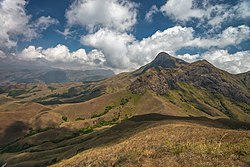
The Western Ghats, also known as the Sahyadri, is a mountain range that stretches 1,600 km (990 mi) along the western coast of the Indian peninsula. Covering an area of 160,000 km2 (62,000 sq mi), it traverses the Indian states of Gujarat, Maharashtra, Goa, Karnataka, Kerala, and Tamil Nadu. The range forms an almost continuous chain of mountains along the western edge of the Deccan Plateau, from the Tapti River to Swamithoppe in Kanyakumari district at the southern tip of the Indian peninsula. The Western Ghats meet with the Eastern Ghats at Nilgiris before continuing south.
Key Information


Geologic evidence indicates that the mountains were formed during the break-up of the supercontinent of Gondwana. The mountains arose along the west coast of India somewhere in the late Jurassic and early Cretaceous periods when India separated from the African continent. The mountains can be roughly divided into three parts: the northern section with an elevation ranging from 900–1,500 m (3,000–4,900 ft), the middle section starting south of Goa with a lower elevation of less than 900 m (3,000 ft), and the southern section where the altitude rises again. The Western Ghats have several peaks that rise above 2,000 m (6,600 ft), with Anamudi (2,695 m (8,842 ft)) being the highest peak. The average elevation is around 1,200 m (3,900 ft).
The Western Ghats form one of the major watersheds of India, feeding many perennial river systems that drain almost 40% of the land area of the country. Because of the higher elevation of the Deccan plateau on the west, most rivers flow eastwards towards the Bay of Bengal, resulting in chiselled eastern slopes and steeper western slopes facing the Arabian Sea. The Western Ghats play an important role in determining the climate and seasons in India. It blocks the rain-bearing monsoon winds flowing eastward from the Arabian Sea, resulting in rainfall along the western coast. By the time the air rises above the mountains it is dry, forming a rain shadow region with very little rainfall on the leeward side towards the interior of the Deccan plateau.
The Western Ghats region is a biodiversity hotspot. It contains a large number of different species of flora and fauna, most of which are endemic to this region. At least 325 globally threatened species occur in the Western Ghats. The region was declared as a UNESCO World Heritage Site in 2012.
Etymology
[edit]The name Western Ghats derives from the word ghat and the cardinal direction in which it is located with respect to the Indian mainland. Ghat, a term used in the Indian subcontinent, depending on the context, could either refer to a range of stepped hills such as the Eastern Ghats and Western Ghats, or a series of steps leading down to a body of water or wharf.[1][2] As per linguist Thomas Burrow, the word Ghat was derived from similar words used in various Dravidian languages such as kattu (mountain side, ridge, or dam) in Tamil, katte (dam), gatta (mountain), and gattu (bank or shore) in Kannada, and katta (dam), and gatte (shore or embankment) in Telugu.[3] The ancient name for the mountain range is Sahyadri, derived from Sanskrit, meaning benevolent or tolerant mountain.[4]
Geology
[edit]The Western Ghats are the mountainous faulted, and eroded edge of the Deccan Plateau. Geologic evidence indicates that they were formed during the break-up of the super-continent of Gondwana. After the break-up, the Deccan plateau was formed by basalt rocks, which caused the western side to rise at an elevation.[5]
Geophysical evidence indicates that the mountains arose along the west coast of India somewhere in the late Jurassic and early Cretaceous periods when India separated from the African continent.[6] Several faults triggered the formation of Western Ghats, then interspersed with valleys and river gorges. Because of the elevation of the Deccan plateau on the west, most rivers flow from west to east, resulting in chiselled eastern slopes and steeper western slopes facing the sea.[6]
Geography
[edit]
The Western Ghats extend from the Satpura Range south of the Tapti River in the north and runs approximately 1,600 km (990 mi) to the southern tip of the Indian peninsula, where it ends at the Marunthuvazh Malai at Swamithoppe in Kanyakumari district.[7][8] It covers an area of 160,000 km2 (62,000 sq mi), traversing the Indian states of Gujarat, Maharashtra, Goa, Karnataka, Kerala, and Tamil Nadu.[9]
Topography
[edit]
The Western Ghats form an almost continuous chain of mountains running parallel to the western coast of India along the Arabian Sea.[10] The average elevation is around 1,200 m (3,900 ft).[11] There are three gaps in the mountain range: the northernmost Goa Gap, formed 65–80 million years ago (Mya), the oldest and widest Palghat Gap, formed 500 Mya, and the southernmost, narrowest Shencottah Gap.[12] The narrow coastal plain between the Western Ghats and the Arabian Sea is known as the Western Coastal Plains.[13]
The mountains can be roughly divided into three parts: the northern section with an elevation ranging from 900–1,500 m (3,000–4,900 ft), the middle section starting from the south of Goa with a lower elevation of less than 900 m (3,000 ft), and the southern section where the altitude rises again.[10] The Western Ghats meet with the Eastern Ghats in the Moyar River valley in the Nilgiris before continuing south.[14][15] The Western Ghats have many peaks that rise above 2,000 m (6,600 ft), with Anamudi (2,695 m (8,842 ft)) being the highest peak.[16]
Hydrography
[edit]The Western Ghats form one of the major watersheds of India, feeding many perennial rivers. These major river systems drain almost 40% of the land area of the country.[17] The major river systems originating in the Western Ghats are the Godavari, Kaveri, and Krishna.[10][18] Most rivers flow eastwards towards the Bay of Bengal owing to the steeper gradient moving from east to west, and many smaller streams drain the region, often carrying a large volume of water during the monsoon months.[17] The streams and rivers give rise to numerous waterfalls in the region.[19] The rivers have been dammed for hydroelectric and irrigation purposes, with major reservoirs spread across the region.[20][21]
Climate
[edit]
The Western Ghats play an important role in determining the climate and seasons in India. During the dry summer months of April – May, heat builds up on the land, which draws air from the sea. The air, which picks up moisture along the way and flows eastward from the Arabian Sea, is blocked by the Western Ghats.[22] The rising air cools and brings about orographic precipitation along the western coast.[23] This signifies the onset of the monsoon season in June. By the time the air rises above the mountains, it becomes dry, resulting in a rain shadow region with very little rainfall on the leeward side towards the interior of the Deccan plateau. The monsoon winds rounding up the peninsula and moving from the east from the Bay of Bengal pass over the Eastern Ghats and bring the majority of the rainfall to the plains up north.[24]
Climate in the mountains shows variations with altitude across the range. Due to its physical proximity to the equator and the Arabian Sea, the region experiences a warm and humid tropical climate throughout the year. Mean temperatures range from 20 °C (68 °F) in the south to 24 °C (75 °F) in the north. Subtropical or temperate climates, and occasional near-zero temperatures during winter are experienced in regions with higher elevations. The coldest period in the region are the wettest monsoon period in the southern part of the mountain range.[25] Annual rainfall in this region averages 100 cm (39 in) to 900 cm (350 in), with an average rainfall of 250 cm (98 in). The total amount of rain does not depend on the spread of the area; areas in northern Maharashtra receive heavy rainfall followed by long dry spells, while regions closer to the equator receive lower annual rainfall and have rain spells lasting several months in a year.[25]
Biodiversity
[edit]The Western Ghats region is a biodiversity hotspot.[26][27] It consists of nearly 30% of all the species of flora and fauna found in India, most of which are endemic to this region.[28][29] At least 325 globally threatened species occur in the Western Ghats.[9]
Flora
[edit]The Western Ghats consist of four tropical and subtropical moist broadleaf terrestrial ecoregions of the Indomalayan realm, with the northern portion of the range generally drier than the southern portion.[30] These include the following:

| Region | Area | Areas covered |
|---|---|---|
| North Western Ghats montane rain forests[31] | 11,900 sq mi (31,000 km2) | Goa, Karnataka, Maharashtra, Tamil Nadu |
| South Western Ghats montane rain forests[32] | 8,700 sq mi (23,000 km2) | Kerala, Tamil Nadu |
| North Western Ghats moist deciduous forests[33] | 4,831 sq mi (12,510 km2) | Gujarat, Karnataka, Maharashtra |
| South Western Ghats moist deciduous forests[34] | 2,382 sq mi (6,170 km2) | Karnataka, Kerala, Tamil Nadu |
Other types of ecosystems include dry deciduous forests on the leeward rain shadow region, scrub forests at the foothills, peat bogs, and swamps.[35] Montane grasslands are found in high altitude locations in the south Western Ghats interspersed with sholas, a unique type of stunted tropical montane forest found in the valleys between the mountains.[36]
Earlier sources indicated about four to five thousand vascular plant species of which nearly one-third was endemic to the region.[37] Later studies and publications have recorded 7,402 species of flowering plants occurring in the Western Ghats of which 5,588 were described as indigenous, 376 are naturalized exotics, and 1,438 species are cultivated or planted.[38] Among the indigenous species, 2,253 species are endemic to India and of them, 1,273 species are exclusively confined to the Western Ghats. 645 tree species were recorded with a high endemic ratio of 56%. There are 850 to 1,000 species of bryophytes, including 682 species of mosses (28% endemic) and 280 species of liverworts (43% endemic), 277 species of pteridophytes and 949 species of lichens (26.7% endemic).[39]
Fauna
[edit]The Western Ghats are home to thousands of species of fauna, including at least 325 globally threatened species.[40] As per a 2010 report, following is the distribution of faunal species in the Western Ghats apart from more than 6,000 insect species.[35][41]
_at_Periyar_National_Park_%26_Wildlife_Sanctuary.jpg)
| Taxonomic group | Species | Endemic | % Endemic | Endangered |
|---|---|---|---|---|
| Mammals | 120 | 14 | 12% | 31 |
| Birds | 508 | 19 | 4% | 15 |
| Amphibians | 121 | 94 | 78% | 43 |
| Reptiles | 156 | 97 | 62% | 5 |
| Fishes | 218 | 116 | 53% | 1 |
The Western Ghats region has one of the highest tiger populations, estimated at 985 in 2022.[42] The Western Ghats ecoregion has the largest Indian elephant population in the wild, with an estimated 11,000 individuals across eight distinct populations.[43][44] Other mammals include endangered and vulnerable species such as the lion-tailed macaque, Nilgiri tahr, leopard, Nilgiri langur, dhole, and gaur.[45][46][47] The endemic Nilgiri tahr, which was on the brink of extinction, has recovered and had an estimated 3,122 individuals in 2015.[48][49] Smaller endemic species include the Malabar large-spotted civet, Nilgiri marten, brown palm civet, stripe-necked mongoose, Indian brown mongoose, small Indian civet, and leopard cat.[50][51]
.jpg)
As per a 2014 report, at least 227 species of reptiles are found in the Western Ghats.[52] The major population of the snake family Uropeltidae is restricted to the region.[53] Several endemic reptile genera and species occur here, with the region having a significant population of mugger crocodiles.[54] The amphibians of the Western Ghats are diverse and unique, with a high proportion of species being endemic to the tropical rainforests of India.[55] New frog species have continued to be discovered in the 21st century.[56] Frogs of the genera Micrixalus, Indirana, and Nyctibatrachus, toads like Pedostibes, Ghatophryne, and Xanthophryne, arboreal frogs like Ghatixalus, Mercurana, and Beddomixalus, and microhylids like Melanobatrachus are endemic to this region.[57]
There are at least 19 species of birds endemic to the Western Ghats, including the endangered rufous-breasted laughingthrush, the vulnerable Nilgiri wood-pigeon, white-bellied shortwing, and broad-tailed grassbird, the near threatened grey-breasted laughingthrush, black-and-rufous flycatcher, Nilgiri flycatcher, and Nilgiri pipit, and the least concern Malabar (blue-winged) parakeet, Malabar grey hornbill, white-bellied treepie, grey-headed bulbul, rufous babbler, Wayanad laughingthrush, white-bellied blue-flycatcher, and the crimson-backed sunbird.[58]
- Fishes and molluscs

There is a higher fish species richness in the southern part of the Western Ghats. There are 13 genera entirely restricted to the Western Ghats (Betadevario, Dayella, Haludaria, Horabagrus, Horalabiosa, Hypselobarbus, Indoreonectes, Lepidopygopsis, Longischistura, Mesonoemacheilus, Parapsilorhynchus, Rohtee, and Travancoria).[59] The most species-rich families are the Cyprinids (72 species), hillstream loaches (34 species; including stone loaches, now regarded a separate family), Bagrid catfishes (19 species), and Sisorid catfishes (12 species).[60] The region is home to several ornamental fishes like the Denison (or red line torpedo) barb,[61] melon barb, several species of Dawkinsia barbs, zebra loach, Horabagrus catfish, dwarf pufferfish and dwarf Malabar pufferfish.[62] The rivers are also home to Osteobrama bakeri, and larger species such as the Malabar snakehead, and Malabar mahseer.[63] A few are adapted to an underground life, including some Rakthamichthys swamp eels,[64] and the catfish Horaglanis and Kryptoglanis.[65] 97 freshwater fish species were considered threatened in 2011, including 12 critically endangered, 54 endangered, and 31 vulnerable.[59] The reservoirs in the region are important for their commercial and sport fisheries of rainbow trout, mahseer, and common carp.[66] There are more than 200 freshwater fish species including 35 also known from brackish or marine water.[67] Several new species have been described from the region since the last decade (e.g., Dario urops and S. sharavathiensis).[68][69]
_(7438942216).jpg)
Seasonal rainfall patterns in the Western Ghats necessitate a period of dormancy for its land snails, resulting in their high abundance and diversity, including at least 258 species of gastropods from 57 genera and 24 families.[70] A total of 77 species of freshwater molluscs (52 gastropods and 25 bivalves) have been recorded from the Western Ghats, but the actual number is likely higher.[59] This includes 28 endemics. Among the threatened freshwater molluscs are the mussel species Pseudomulleria dalyi, which is a Gondwanan relict, and the snail Cremnoconchus, which is restricted to the spray zone of waterfalls.[59] According to the IUCN, four species of freshwater molluscs are considered endangered and three are vulnerable. An additional 19 species are considered data deficient.[59]
- Insects
There are roughly 6,000 insect species.[71] Of the 334 Western Ghats butterfly species, 316 species have been reported to occur in the Nilgiri Biosphere Reserve.[72] The Western Ghats are home to 174 species of odonates (107 dragonflies and 67 damselflies), including 69 endemics.[59] Most of the endemic odonate are closely associated with rivers and streams, while the non-endemics are typically generalists.[59] There are several species of leeches found all along the Western Ghats.[73]
Threats and conservation
[edit]
Historically, the Western Ghats were covered in dense forests. which formed the natural habitat for wildlife along with the native tribal people. Its inaccessibility made it difficult for people from the plains to cultivate the land and build settlements. After the establishment of British colonial rule in the region, large swathes of territory were cleared for agricultural plantations and timber. The forests in the Western Ghats were severely fragmented due to clear-felling for plantations.[74] The introduction of non-native species threatened the rare endemic species and habitat specialists, which depleted faster than other species.[75] Complex and species-rich habitats like the tropical rainforests are much more adversely affected than other habitats.[76] The primary threats to fauna were not only from habitat loss, but also from overexploitation, illicit grazing, mining, poaching, and introduced species.[59][35]
The Government of India has established many protected areas, including two biosphere reserves, 13 national parks to restrict human access, several wildlife sanctuaries to protect specific endangered species, and many reserve forests.[77] The Nilgiri Biosphere Reserve, comprising 5,500 km2 (2,100 sq mi) of the forests, forms the largest contiguous protected area in the Western Ghats.[78] In August 2011, the Western Ghats Ecology Expert Panel (WGEEP), appointed by the Union Ministry of Environment and Forests to assess the biodiversity and environmental issues of the Western Ghats, designated the entire region as an Ecologically Sensitive Area (ESA) and assigned three levels of Ecological Sensitivity to its different regions.[79][80] Subsequent committees formed have recommended various suggestions to protect the region.[81] In 2006, India applied to the UNESCO Man and the Biosphere Programme (MAB) for the Western Ghats to be listed as a protected World Heritage Site.[82] In 2012, 39 sites divided into seven clusters across the Western Ghats, were declared as World Heritage Sites.[83][84]
See also
[edit]References
[edit]- ^ Sunithi L. Narayan; Revathy Nagaswami (1992). Discover Sublime India. University of Michigan. p. 5.
- ^ "Ghat definition". Cambridge dictionary. Archived from the original on 30 January 2019. Retrieved 30 January 2019.
- ^ Jaini, Padmanabh S. (2003). Jainism and Early Buddhism. Jain Publishing Company. p. 528. ISBN 978-0-8958-1956-7.
- ^ Subhash C. Biswas (2014). India the Land of Gods. Author Solutions. p. 76. ISBN 978-1-4828-3655-4.
- ^ Barron, E.J.; Harrison, C.G.A.; Sloan, J.L. II; Hay, W.W. (1981). "Paleogeography, 180 million years ago to the present". Eclogae Geologicae Helvetiae. 74 (2): 443–470.
- ^ a b "Formation of Western Ghats". Indian Institute of Science. Archived from the original on 21 May 2024. Retrieved 1 December 2023.
- ^ "Western Ghats Biodiversity Hotspot". World Atlas. 16 June 2021. Retrieved 2 July 2024.
- ^ "Western Ghats topographic map". topographic-map.com. Retrieved 2 July 2024.
- ^ a b "Western Ghats – UNESCO World Heritage Centre". Archived from the original on 4 July 2018. Retrieved 15 January 2019.
- ^ a b c "Western Ghats". Britannica. Archived from the original on 21 May 2024. Retrieved 1 December 2023.
- ^ "The Peninsula". Asia-Pacific Mountain Network. Archived from the original on 12 August 2007. Retrieved 19 March 2007.
- ^ V. V. Robin; Anindya Sinha; Uma Ramakrishnan (2010). "Ancient Geographical Gaps and Paleo-Climate Shape the Phylogeography of an Endemic Bird in the Sky Islands of Southern India". PLOS. 5 (10): e13321. doi:10.1371/journal.pone.0194158. PMC 2954160. PMID 20967202.
- ^ Population of India. Economic and Social Commission for Asia and the Pacific, United Nations. 1982. p. 2.
- ^ Eastern Ghats Environment Outlook (PDF). CGRI (Report). March 2024. p. 24. Retrieved 1 June 2025.
- ^ Imperial Gazetteer of India: Provincial Series. Vol. 17. Superintendent of Government Print. 1908. p. 144.
- ^ "7 major mountain ranges in India: Some of the highest mountains in the world". India Today. 3 April 2017. Archived from the original on 23 August 2020. Retrieved 5 September 2020.
- ^ a b Shanavas P H; Sumesh A K; Haris P M (2016). Western Ghats - From Ecology To Economics. Educreation Publishing. pp. 27–29. ISBN 978-9-3852-4758-3.
- ^ Dhruv Sen Singh (2017). The Indian Rivers: Scientific and Socio-economic Aspects. Springer Nature. p. 309. ISBN 978-9-8110-2984-4.
- ^ Patricia Corrigan (2019). Waterfalls. Infobase Publishing. p. 131. ISBN 978-1-4381-8252-0.
- ^ "Indian Dams by River and State". Rain water harvesting. Archived from the original on 19 March 2007. Retrieved 19 March 2007.
- ^ Samani, R.L.; Ayhad, A.P. (2002). "Siltation of Reservoirs-Koyna Hydroelectric Project-A Case Study". In S. P. Kaushish; B. S. K. Naidu (eds.). Silting Problems in Hydropower Plants. Bangkok: Central Board of Irrigation and Power. ISBN 978-90-5809-238-0.
- ^ "Indian monsoon". Britannica. Archived from the original on 1 August 2016. Retrieved 1 December 2023.
- ^ "Orographic precipitation". Britannica. Archived from the original on 5 January 2020. Retrieved 1 December 2023.
- ^ "Climate of Western Ghats". Indian Institute of Science. Archived from the original on 21 May 2024. Retrieved 1 December 2023.
- ^ a b R.J. Ranjit Daniels. "Biodiversity of the Western Ghats - An Overview". Conservation of Rain forests in India. Wildlife Institute of India. Retrieved 1 December 2023.
- ^ Myers, N.; Mittermeier, R.A.; Mittermeier, C.G.; Da Fonseca, G.A.B.; Kent, J. (2000). "Biodiversity hotspots for conservation priorities". Nature. 403 (6772): 853–858. Bibcode:2000Natur.403..853M. doi:10.1038/35002501. PMID 10706275. S2CID 4414279.
- ^ Migon, P. (2010). Geomorphological Landscapes of the World. Springer. p. 257. ISBN 978-90-481-3054-2.
- ^ "Western Ghats". WWF. Archived from the original on 21 May 2024. Retrieved 1 December 2023.
- ^ "A biodiversity hotspot". Archived from the original on 18 January 2019. Retrieved 15 January 2019.
- ^ "Tropical and subtropical moist broadleaf forest". WWF. Archived from the original on 21 May 2024. Retrieved 1 December 2023.
- ^ "North Western Ghats montane rain forests". WWF. Archived from the original on 21 May 2024. Retrieved 1 December 2023.
- ^ "South Western Ghats montane rain forests". WWF. Retrieved 1 December 2023.
- ^ "North Western Ghats moist deciduous forests". One Earth. Archived from the original on 21 May 2024. Retrieved 1 December 2023.
- ^ "South Western Ghats moist deciduous forests". One Earth. Archived from the original on 21 May 2024. Retrieved 1 December 2023.
- ^ a b c "Western Ghats, data sheet". UNESCO. 22 May 2017. Archived from the original on 21 May 2024. Retrieved 1 December 2023.
- ^ S. M. Thomas; M. W. Palmer. The montane grasslands of the Western Ghats, India:Community ecology and conservation (Report). Oklahoma State University. Archived from the original on 21 May 2024. Retrieved 1 December 2023.
- ^ Western Ghats, IUCN technical evaluation (Report). UNESCO. Archived from the original on 17 August 2022. Retrieved 1 December 2023.
- ^ Nayar, T.S.; Rasiya Beegam, A.; Sibi, M. (2014). Flowering Plants of the Western Ghats, India. Jawaharlal Nehru Tropical Botanic Garden and Research Institute. ISBN 978-8-1920-0989-6.
- ^ K. N. Nair (2017). The Genus Syzygium Syzygium Cumini and Other Underutilized Species. CRC Press. ISBN 978-1-3516-4506-5.
- ^ Nameer, P.O.; Molur, Sanjay; Walker, Sally (November 2001). "Mammals of the Western Ghats: A Simplistic Overview". Zoos' Print Journal. 16 (11): 629–639. doi:10.11609/jott.zpj.16.11.629-39. S2CID 87414084.
- ^ Myers, N.; Mittermeier, R.A.; Mittermeier, C.G.; Fonseca, G.A.B.Da; Kent, J. (2000). "Biodiversity Hotspots for Conservation Priorities". Nature. 403 (6772): 853–858. Bibcode:2000Natur.403..853M. doi:10.1038/35002501. PMID 10706275. S2CID 4414279.
- ^ Qureshi, Q.; Jhala, Y. V.; Yadav, S. P. & Mallick, A. (2023). Status of tigers, co-predators and prey in India 2022 (PDF) (Report). National Tiger Conservation Authority & Wildlife Institute of India. Archived (PDF) from the original on 5 May 2024. Retrieved 27 April 2024.
- ^ "Elephant Reserves". ENVIS Centre on Wildlife & Protected Areas. Archived from the original on 20 May 2017. Retrieved 30 January 2016.
- ^ "Census population 2005" (PDF). Note on Project Elephant. Ministry of Environment and Forests. 2007. Archived from the original (PDF) on 12 March 2012. Retrieved 30 January 2016.
- ^ Singh, M.; Kumar, A.; Kumara, H.N. (2020). "Macaca silenus". IUCN Red List of Threatened Species. 2020 e.T12559A17951402. doi:10.2305/IUCN.UK.2020-2.RLTS.T12559A17951402.en. Retrieved 11 November 2021.
- ^ Singh, M.; Kaumanns, W. (2005). "Behavioural studies: A necessity for wildlife management" (PDF). Current Science. 89 (7): 1233. Archived from the original (PDF) on 13 January 2007.
- ^ Malviya, M.; Srivastav, A.; Nigam, P.; Tyagi, P.C. (2011). Indian National Studbook of Nilgiri Langur (Trachypithecus johnii) (PDF). Wildlife Institute of India and Central Zoo Authority. Archived (PDF) from the original on 23 September 2015. Retrieved 7 February 2016.
- ^ "Nilgiri tahr population over 3,000: WWF-India". The Hindu. 3 October 2015. Archived from the original on 8 February 2016. Retrieved 1 May 2016.
- ^ Molur, S.; Brandon-Jones, D.; Dittus, W.; Eudey, A.; Kumar, A.; Singh, M.; Feeroz, M.M.; Chalise, M.; Priya, P. & Walker, S. (2003). Status of South Asian Primates: Conservation Assessment and Management Plan (C.A.M.P.) Workshop Report, 2003. Coimbatore: Zoo Outreach Organization/CBSG-South Asia.
- ^ Mudappa, D.; Noon, B.R.; Kumar, A. & Chellam, R. (2007). "Responses of small carnivores to rainforest fragmentation in the southern Western Ghats, India". Small Carnivore Conservation. 36: 18–26.
- ^ Mudappa, D.; Helgen, K.; Nandini, R. (2016). "Viverra civettina". IUCN Red List of Threatened Species. 2016 e.T23036A45202281. doi:10.2305/IUCN.UK.2016-1.RLTS.T23036A45202281.en. Retrieved 11 November 2021.
- ^ Srinivasulu C; Srinivasulu B; Molur S (2014). The Status and Distribution of Reptiles in the Western Ghats, India: Conservation and Management Plan. Coimbatore: Wildlife Information Liaison Development Society. p. 160. ISBN 978-81-88722-40-2.
- ^ Greene, H. W. & R. W. Mcdiarmid (2005). Wallace and Savage: heroes, theories and venomous snake mimicry, Ecology and Evolution in the Tropics, a Herpetological Perspective. University of Chicago. pp. 190–208.
- ^ Harry V., Andrews. "Status and Distribution of the Mugger Crocodile in Tamil Nadu". WII. Archived from the original on 20 December 2004.
- ^ Karthikeyan, V. A Report on the Survey of Rainforest Fragments in the Western Ghats for Amphibian Diversity (Report). Archived from the original on 15 December 2005.
- ^ Radhakrishnan, C.; Gopi, K.C. & Dinesh, K.P. (2007). "Zoogeography of Nasikabatrachus sahyadrensis Biju and Bossuyt (Amphibia: Anura; Nasikabatrachidae) in the Western Ghats, India". Records of the Zoological Survey of India. 107 (4): 115–121. doi:10.26515/rzsi/v107/i4/2007/159116. S2CID 251728922.
- ^ An evaluation of the endemism of the amphibian assemblages from the Western Ghats using molecular techniques (PDF) (Report). Dehra Dun: WII. Archived from the original (PDF) on 19 December 2008.
- ^ "Restricted-range species". BirdLife EBA Factsheet 12 : Western Ghats. BirdLife International. 1998. Archived from the original on 2 January 2009. Retrieved 3 December 2009.
- ^ a b c d e f g h Molur, M.; Smith, K.G.; Daniel, B.A. & Darwall, W.R.T. (2011). The status and distribution of freshwater biodiversity in the Western Ghats, India (PDF). IUCN Red List of Threatened Species – Regional Assessment. ISBN 978-2-8317-1381-6. Archived (PDF) from the original on 3 April 2015.
- ^ Raghavan; Prasad; Ali; Pereira (2008). "Fish fauna of Chalakudy River, part of Western Ghats biodiversity hotspot, Kerala, India: patterns of distribution, threats and conservation needs". Biodiversity and Conservation. 17 (13): 3119–3131. Bibcode:2008BiCon..17.3119R. doi:10.1007/s10531-007-9293-0. S2CID 7563806.
- ^ Raghavan, R.; Philip, S.; Ali, A. & Dahanukar, N. (2013). "Sahyadria, a new genus of barbs (Teleostei: Cyprinidae) from Western Ghats of India". Journal of Threatened Taxa. 5 (15): 4932–4938. doi:10.11609/JoTT.o3673.4932-8.
- ^ "Zoologica" (PDF). Archived from the original (PDF) on 16 July 2004. Retrieved 18 December 2006.
- ^ Benziger, A.; Philip, S.; Raghavan, R.; Ali, P.H.A.; Sukumaran, M.; Tharian, J.C.; Dahanukar, N.; Baby, F.; Peter, R.; Devi, K.R.; Radhakrishnan, K.V.; Haniffa, M.A.; Britz, R.; Antunes, A. (2011). "Unraveling a 146 years old taxonomic puzzle: Validation of Malabar Snakehead, species-status and its relevance for channid systematics and evolution". PLOS ONE. 6 (6) e21272. Bibcode:2011PLoSO...621272B. doi:10.1371/journal.pone.0021272. PMC 3123301. PMID 21731689.
- ^ Gobi, K.C. (2002). "A new synbranchid fish, Monopterus digressus from Kersla, Peninsular India". Rec. Zool. Surv. India. 100 (1–2): 137–143. doi:10.26515/rzsi/v100/i1-2/2002/159618. S2CID 87291325.
- ^ Vincent, M.; Thomas, J. (2011). "Kryptoglanis shajii, an enigmatic subterranean-spring catfish (Siluriformes, Incertae sedis) from Kerala, India". Ichthyological Research. 58 (2): 161–165. Bibcode:2011IchtR..58..161V. doi:10.1007/s10228-011-0206-6. S2CID 39313203.
- ^ Sehgal, K. L. "Coldwater fish and fisheries in the Western Ghats, India". FAO. Archived from the original on 22 October 2008. Retrieved 22 September 2008.
- ^ Dahanukar, N.; Raut, R.; Bhat, A. (2004). "Distribution, endemism and threat status of freshwater fishes in the Western Ghats of India". Journal of Biogeography. 31 (1): 123–136. Bibcode:2004JBiog..31..123D. doi:10.1046/j.0305-0270.2003.01016.x. S2CID 83574801.
- ^ Britz, A.; Philip (2012). "Dariourops, a new species of badid fish from the Western Ghats, southern India" (PDF). Zootaxa. 3348: 63–68. doi:10.11646/zootaxa.3348.1.5. S2CID 87261596. Archived from the original (PDF) on 8 February 2020.
- ^ Sreekantha; Gururaja, K.V.; Remadevi, K.; Indra, T.J.; Ramachandra, T.V. (2006). "Two new species of the genus Schistura McClell and (Cypriniformes: Balitoridae) from Western Ghats, India". Zoos' Print Journal. 21 (4): 2211–2216. doi:10.11609/jott.zpj.1386.2211-6.
- ^ Madhyastha N. A.; Rajendra; Mavinkurve G. & Shanbhag Sandhya P. Land Snails of Western Ghats (Report). WII. Archived from the original on 17 July 2009.
- ^ George, M. & Binoy, C.F., An Overview of Insect Diversity of Western Ghats with Special Reference to Kerala State, Dehra Dun: WII, archived from the original on 16 March 2009, retrieved 24 July 2007
- ^ George, M. & Kumar, M.M. State of the Art Knowledge on the Butterflies of Nilgiri Biosphere Reserve (Report). Dehra Dun: WII. Archived from the original on 8 January 2009.
- ^ Chandra, M. (1976). "On a Small Collection of leeches from Maharashtra State, India" (PDF). Records of the Zoological Survey of India. 69 (1–4): 325–328. doi:10.26515/rzsi/v69/i1-4/1971/161420. S2CID 251700847. Archived (PDF) from the original on 6 October 2016. Retrieved 5 October 2016.
- ^ "Colonisers ruined Western Ghats, says study". The Times of India. 28 November 2018. Archived from the original on 21 May 2024. Retrieved 1 December 2023.
- ^ "Alien, Invasive and thriving: Native plants choked in Western Ghats". The Hindu. 9 September 2019. Archived from the original on 21 May 2024. Retrieved 1 December 2023.
- ^ Kumar, Ajith. Impact of rainforest fragmentation on small mammals and herpetofauna in the Western Ghats, South India (PDF) (Report). Salim Centre for Ornithology and Natural History, Coimbatore. Archived from the original (PDF) on 19 December 2008.
- ^ "Protected areas". Government of India. Archived from the original on 21 May 2024. Retrieved 1 December 2023.
- ^ "The Nilgiri Bio-sphere Reserve". Archived from the original on 28 September 2006.
- ^ Gadgil, M. (31 August 2012). "Report of the Western Ghats Ecology Expert Panel" (PDF). Westernghatindia.org. Part 1. Ministry of Environment and Forests, Government of India: summary XIX. Archived (PDF) from the original on 20 September 2015. Retrieved 4 May 2012.
- ^ "Vested interests in Western Ghats". Deccan Herald. Archived from the original on 4 March 2016. Retrieved 5 May 2016.
- ^ "Report is anti environmental". The Hindu. Archived from the original on 4 January 2016. Retrieved 14 May 2016.
- ^ "World Heritage sites, Tentative lists, Western Ghats sub cluster". UNESCO. 2007. Archived from the original on 12 November 2022. Retrieved 30 March 2007.
- ^ "UNESCO heritage sites". UNESCO. Archived from the original on 18 January 2013. Retrieved 30 March 2007.
- ^ "UN designates Western Ghats as world heritage site". Times of India. 2 July 2012. Archived from the original on 26 December 2018. Retrieved 28 July 2013.
External links
[edit]- Western Ghats, UNESCO World Heritage site
- Western Ghats, WWF


| International | |
|---|---|
| National | |
| Geographic | |
| Other | |

 Media related to Western Ghats at Wikimedia Commons