


Community hub
Window
View on Wikipedia | This article has multiple issues. Please help improve it or discuss these issues on the talk page. (Learn how and when to remove these messages)
|

.jpg)

.jpg)


A window is an opening in a wall, door, roof, or vehicle that allows the exchange of light and may also allow the passage of sound and sometimes air. Modern windows are usually glazed or covered in some other transparent or translucent material, a sash set in a frame[1] in the opening; the sash and frame are also referred to as a window.[2] Many glazed windows may be opened, to allow ventilation, or closed to exclude inclement weather. Windows may have a latch or similar mechanism to lock the window shut or to hold it open by various amounts.
Types include the eyebrow window, fixed windows, hexagonal windows, single-hung, and double-hung sash windows, horizontal sliding sash windows, casement windows, awning windows, hopper windows, tilt, and slide windows (often door-sized), tilt and turn windows, transom windows, sidelight windows, jalousie or louvered windows, clerestory windows, lancet windows, skylights, roof windows, roof lanterns, bay windows, oriel windows, thermal, or Diocletian, windows, picture windows, rose windows, emergency exit windows, stained glass windows, French windows, panel windows, double/triple-paned windows, and witch windows.
Etymology
[edit]The English language-word window originates from the Old Norse vindauga, from vindr 'wind' and auga 'eye'.[3] In Norwegian, Nynorsk, and Icelandic, the Old Norse form has survived to this day (in Icelandic only as a less used word for a type of small open "window", not strictly a synonym for gluggi, the Icelandic word for 'window'[4]). In Swedish, the word vindöga remains as a term for a hole through the roof of a hut, and in the Danish language vindue and Norwegian Bokmål vindu, the direct link to eye is lost, just as for window. The Danish (but not the Bokmål) word is pronounced fairly similarly to window.
Window is first recorded in the early 13th century, and originally referred to an unglazed hole in a roof. Window replaced the Old English eagþyrl, which literally means 'eye-hole', and eagduru 'eye-door'. Many Germanic languages, however, adopted the Latin word fenestra to describe a window with glass, such as standard Swedish fönster, or German Fenster. The use of window in English is probably because of the Scandinavian influence on the English language by means of loanwords during the Viking Age. In English, the word fenester was used as a parallel until the mid-18th century. Fenestration is still used to describe the arrangement of windows within a façade, as well as defenestration, meaning 'to throw out of a window'.
History
[edit]

The Romans were the first known to use glass for windows, a technology likely first produced in Roman Egypt, in Alexandria c. 100 AD[citation needed]. Presentations of windows can be seen in ancient Egyptian wall art and sculptures from Assyria. Paper windows were economical and widely used in ancient China, Korea, and Japan. In England, glass became common in the windows of ordinary homes only in the early 17th century whereas windows made up of panes of flattened animal horn were used as early as the 14th century. In the 19th century American west, greased paper windows came to be used by pioneering settlers. Modern-style floor-to-ceiling windows became possible only after the industrial plate glass making processes were fully perfected.
Technologies
[edit]In the 13th century BC, the earliest windows were unglazed openings in a roof to admit light during the day.[citation needed] Later,[when?] windows were covered with animal hide, cloth, or wood. Shutters that could be opened and closed came next.[when?] Over time, windows were built that both protected the inhabitants from the elements and transmitted light, using multiple small pieces of translucent material, such as flattened pieces of translucent animal horn, paper sheets, thin slices of marble (such as fengite), or pieces of glass, set in frameworks of wood, iron or lead. In the Far East, paper was used to fill windows.[1] The Romans were the first known users of glass for windows, exploiting a technology likely first developed in Roman Egypt. Specifically, in Alexandria c. 100 CE, cast-glass windows, albeit with poor optical properties, began to appear, but these were small thick productions, little more than blown-glass jars (cylindrical shapes) flattened out into sheets with circular striation patterns throughout. (Compare traditional church windows made of stained glass.) It would be over a millennium before window glass became transparent enough to see through clearly, as we expect now. (However, ancient Roman windows were still very useful, as they presented "an often-overlooked advance in heating technology (allowing solar heat to enter a home or building while preventing the warmed air from escaping)."[5]) In 1154, Al-Idrisi described glass windows as a feature of the palace belonging to the king of the Ghana Empire.[6][7]
Over the centuries techniques were developed to shear through one side of a blown glass cylinder and produce thinner rectangular window panes from the same amount of glass material. This gave rise to tall narrow windows, usually separated by a vertical support called a mullion. Mullioned glass windows were the windows of choice[when?] among the European well-to-do, whereas paper windows were economical and widely used in ancient China, Korea, and Japan. In England, glass became common in the windows of ordinary homes only in the early 17th century, whereas windows made up of panes of flattened animal horn were used as early as the 14th century.[8]
Modern-style floor-to-ceiling windows became possible only after the industrial plate glass-making processes were perfected in the late 19th century.[9] Modern windows are usually filled using glass, although transparent plastic is also used.[1]
Fashions and trends
[edit]![[icon]](https://en.wikipedia.org/wiki/File:Wiki_letter_w_cropped.svg) | This section needs expansion. You can help by adding to it. (January 2023) |
The introduction of lancet windows into Western European church architecture from the 12th century CE built on a tradition of arched windows [10] inserted between columns,[11] and led not only to tracery and elaborate stained-glass windows but also to a long-standing motif of pointed or rounded window-shapes in ecclesiastical buildings, still seen in many churches today.
Peter Smith discusses overall trends in early-modern rural Welsh window architecture:
Up to about 1680 windows tended to be horizontal in proportion, a shape suitable for lighting the low-ceilinged rooms that had resulted from the insertion of the upper floor into the hall-house. After that date vertically proportioned windows came into fashion, partly at least as a response to the Renaissance taste for the high ceiling. Since 1914 the wheel has come full circle and a horizontally proportioned window is again favoured.[12]
The spread of plate-glass technology made possible the introduction of picture windows (in Levittown, Pennsylvania,[13] founded 1951–1952[clarification needed]).
Many modern day windows may have a window screen or mesh, often made of aluminum or fibreglass, to keep bugs out when the window is opened. Windows are primarily designed to facilitate a vital connection with the outdoors, offering those within the confines of the building visual access to the everchanging events occurring outside. The provision of this connection serves as an integral safeguard for the health and well-being of those inhabiting buildings, lest they experience the detrimental effects of enclosed buildings devoid of windows. Among the myriad criteria for the design of windows, several pivotal criteria have emerged in daylight standards: location, time, weather, nature, and people. Of these criteria, windows that are designed to provide views of nature are considered to be the most important by people.[14]
Types
[edit]
Cross
[edit]A cross-window is a rectangular window usually divided into four lights by a mullion and transom that form a Latin cross.[15]
Eyebrow
[edit]The term eyebrow window is used in two ways: a curved top window in a wall or an eyebrow dormer; and a row of small windows usually under the front eaves such as the James-Lorah House in Pennsylvania.[16]
Fixed
[edit]A fixed window is a window that cannot be opened,[17] whose function is limited to allowing light to enter (unlike an unfixed window, which can open and close). Clerestory windows in church architecture are often fixed. Transom windows may be fixed or operable. This type of window is used in situations where light or vision alone is needed as no ventilation is possible in such windows without the use of trickle vents or overglass vents.
Single-hung sash
[edit]A single-hung sash window is a window that has one sash that is movable (usually the bottom one) and the other fixed. This is the earlier form of sliding sash window and is also cheaper.[1]
Double-hung sash
[edit]A sash window is the traditional style of window in the United Kingdom, and many other places that were formerly colonized by the UK, with two parts (sashes) that overlap slightly and slide up and down inside the frame. The two parts are not necessarily the same size; where the upper sash is smaller (shorter) it is termed a cottage window. Currently, most new double-hung sash windows use spring balances to support the sashes, but traditionally, counterweights held in boxes on either side of the window were used. These were and are attached to the sashes using pulleys of either braided cord or, later, purpose-made chain. Three types of spring balances are called a tape or clock spring balance; channel or block-and-tackle balance, and a spiral or tube balance.
Double-hung sash windows were traditionally often fitted with shutters. Sash windows can be fitted with simplex hinges that let the window be locked into hinges on one side, while the rope on the other side is detached—so the window can be opened for fire escape or cleaning.
Foldup
[edit]
A foldup has two equal sashes similar to a standard double-hung but folds upward allowing air to pass through nearly the full-frame opening. The window is balanced using either springs or counterbalances, similar to a double-hung. The sashes can be either offset to simulate a double-hung, or in-line. The inline versions can be made to fold inward or outward. The inward swinging foldup windows can have fixed screens, while the outward swinging ones require movable screens. The windows are typically used for screen rooms, kitchen pass-throughs, or egress.
Horizontal sliding sash
[edit]A horizontal sliding sash window has two or more sashes that overlap slightly but slide horizontally within the frame. In the UK, these are sometimes called Yorkshire sash windows, presumably because of their traditional use in that county.
Casement
[edit]
A casement window is a window with a hinged sash that swings in or out like a door comprising either a side-hung, top-hung (also called "awning window"; see below), or occasionally bottom-hung sash or a combination of these types, sometimes with fixed panels on one or more sides of the sash.[2] In the US, these are usually opened using a crank, but in parts of Europe, they tend to use projection friction stays and espagnolette locking. Formerly, plain hinges were used with a casement stay. Handing applies to casement windows to determine direction of swing; a casement window may be left-handed, right-handed, or double. The casement window is the dominant type now found in modern buildings in the UK and many other parts of Europe.
Awning
[edit]_Light.jpg)
An awning window is a casement window that is hung horizontally, hinged on top, so that it swings outward like an awning. In addition to being used independently, they can be stacked, several in one opening, or combined with fixed glass. They are particularly useful for ventilation.[18]
Hopper
[edit]A hopper window is a bottom-pivoting casement window that opens by tilting vertically, typically to the inside, resembling a hopper chute.[19]
Pivot
[edit]A pivot window is a window hung on one hinge on each of two opposite sides which allows the window to revolve when opened. The hinges may be mounted top and bottom (Vertically Pivoted) or at each jamb (Horizontally Pivoted). The window will usually open initially to a restricted position for ventilation and, once released, fully reverse and lock again for safe cleaning from inside. Modern pivot hinges incorporate a friction device to hold the window open against its weight and may have restriction and reversed locking built-in. In the UK, where this type of window is most common, they were extensively installed in high-rise social housing.
Tilt and slide
[edit]A tilt and slide window is a window (more usually a door-sized window) where the sash tilts inwards at the top similar to a hopper window and then slides horizontally behind the fixed pane.
Tilt and turn
[edit]A tilt and turn window can both tilt inwards at the top or open inwards from hinges at the side. This is the most common type of window in Germany, its country of origin. It is also widespread in many other European countries. In Europe, it is usual for these to be of the "turn first" type. i.e. when the handle is turned to 90 degrees the window opens in the side hung mode. With the handle turned to 180 degrees the window opens in bottom hung mode. Most usually in the UK the windows will be "tilt first" i.e. bottom hung at 90 degrees for ventilation and side hung at 180 degrees for cleaning the outer face of the glass from inside the building.[20]
Transom
[edit]A transom window is a window above a door. In an exterior door the transom window is often fixed, in an interior door, it can open either by hinges at top or bottom, or rotate on hinges. It provided ventilation before forced air heating and cooling. A fan-shaped transom is known as a fanlight, especially in the British Isles.
Side light
[edit]Windows beside a door or window are called side-, wing-, margen-lights, and flanking windows.[21]
Jalousie window
[edit]
Also known as a louvered window, the jalousie window consists of parallel slats of glass or acrylic that open and close like a Venetian blind, usually using a crank or a lever. They are used extensively in tropical architecture. A jalousie door is a door with a jalousie window.
Clerestory
[edit].jpg)
A clerestory window is a window set in a roof structure or high in a wall, used for daylighting.
Skylight
[edit]
A skylight is a window built into a roof structure.[22] This type of window allows for natural daylight and moonlight.
Roof
[edit]
A roof window is a sloped window used for daylighting, built into a roof structure. It is one of the few windows that could be used as an exit. Larger roof windows meet building codes for emergency evacuation.
Roof lantern
[edit]A roof lantern is a multi-paned glass structure, resembling a small building, built on a roof for day or moon light. Sometimes includes an additional clerestory. May also be called a cupola.
Bay
[edit]
A bay window is a multi-panel window, with at least three panels set at different angles to create a protrusion from the wall line.[2]
Oriel
[edit]An oriel window is a form of bay window. This form most often appears in Tudor-style houses and monasteries. It projects from the wall and does not extend to the ground. Originally a form of porch, they are often supported by brackets or corbels.
Thermal
[edit]Thermal, or Diocletian, windows are large semicircular windows (or niches) which are usually divided into three lights (window compartments) by two mullions. The central compartment is often wider than the two side lights on either side of it.
Picture
[edit]A picture window is a large fixed window in a wall, typically without glazing bars, or glazed with only perfunctory glazing bars (muntins) near the edge of the window. Picture windows provide an unimpeded view, as if framing a picture.[23]
Multi-lite
[edit]A multi-lite window is a window glazed with small panes of glass separated by wooden or lead glazing bars, or muntins, arranged in a decorative glazing pattern often dictated by the building's architectural style. Due to the historic unavailability of large panes of glass, the multi-lit (or lattice window) was the most common window style until the beginning of the 20th century, and is still used in traditional architecture.
Emergency exit/egress
[edit]An emergency exit window is a window big enough and low enough so that occupants can escape through the opening in an emergency, such as a fire. In many countries, exact specifications for emergency windows in bedrooms are given in many building codes. Specifications for such windows may also allow for the entrance of emergency rescuers. Vehicles, such as buses, aircraft, and trains frequently have emergency exit windows as well.[24]
Stained glass
[edit]
A stained glass window is a window composed of pieces of colored glass, transparent, translucent or opaque, frequently portraying persons or scenes. Typically the glass in these windows is separated by lead glazing bars. Stained glass windows were popular in Victorian houses and some Wrightian houses, and are especially common in churches.[25]
French
[edit]A French door[26] has two columns of upright rectangular glass panes (lights) extending its full length; and two of these doors on an exterior wall and without a mullion separating them, that open outward with opposing hinges to a terrace or porch, are referred to as a French window.[27] Sometimes these are set in pairs or multiples thereof along the exterior wall of a very large room, but often, one French window is placed centrally in a typically sized room, perhaps among other fixed windows flanking the feature. French windows are known as porte-fenêtre in France and portafinestra in Italy, and frequently are used in modern houses.
.jpg)
.jpg)
Double-paned
[edit]
Double-paned windows have two parallel panes (slabs of glass) with a separation of typically about 1 cm; this space is permanently sealed and filled at the time of manufacture with dry air or other dry nonreactive gas. Such windows provide a marked improvement in thermal insulation (and usually in acoustic insulation as well) and are resistant to fogging and frosting caused by temperature differential. They are widely used for residential and commercial construction in intemperate climates. In the UK, double-paned and triple-paned are referred to as double-glazing and triple-glazing. Triple-paned windows are now a common type of glazing in central to northern Europe. Quadruple glazing is now being introduced in Scandinavia.
Hexagonal window
[edit]
A hexagonal window is a hexagon-shaped window, resembling a bee cell or crystal lattice of graphite. The window can be vertically or horizontally oriented, openable or dead. It can also be regular or elongately-shaped and can have a separator (mullion). Typically, the cellular window is used for an attic or as a decorative feature, but it can also be a major architectural element to provide the natural lighting inside buildings.
Guillotine window
[edit]A guillotine window is a window that opens vertically. Guillotine windows have more than one sliding frame, and open from bottom to top or top to bottom.
Terms
[edit]EN 12519 is the European standard that describes windows terms officially used in EU Member States. The main terms are:
.jpg)
- Light, or Lite, is the area between the outer parts of a window (transom, sill and jambs), usually filled with a glass pane. Multiple panes are divided by mullions when load-bearing, muntins when not.[28]
- Lattice light is a compound window pane madeup of small pieces of glass held together in a lattice.
- Fixed window is a unit of one non-moving lite. The terms single-light, double-light, etc., refer to the number of these glass panes in a window.
- Sash unit is a window consisting of at least one sliding glass component, typically composed of two lites (known as a double-light).
- Replacement window in the United States means a framed window designed to slip inside the original window frame from the inside after the old sashes are removed. In Europe, it usually means a complete window including a replacement outer frame.
- New construction window, in the US, means a window with a nailing fin that is inserted into a rough opening from the outside before applying siding and inside trim. A nailing fin is a projection on the outer frame of the window in the same plane as the glazing, which overlaps the prepared opening, and can thus be 'nailed' into place. In the UK and mainland Europe, windows in new-build houses are usually fixed with long screws into expanding plastic plugs in the brickwork. A gap of up to 13 mm is left around all four sides, and filled with expanding polyurethane foam. This makes the window fixing weatherproof but allows for expansion due to heat.
- Lintel is a beam over the top of a window, also known as a transom.
- Window sill is the bottom piece in a window frame. Window sills slant outward to drain water away from the inside of the building.
- Secondary glazing is an additional frame applied to the inside of an existing frame, usually used on protected or listed buildings to achieve higher levels of thermal and sound insulation without compromising the look of the building
- Decorative millwork is the moulding, cornices and lintels often decorating the surrounding edges of the window.
Labeling
[edit]The United States NFRC Window Label lists the following terms:
- Thermal transmittance (U-factor), best values are around U-0.15 (equal to 0.8 W/m2/K)
- Solar heat gain coefficient (SHGC), ratio of solar heat (infrared) passing through the glass to incident solar heat
- Visible transmittance (VT), ratio of transmitted visible light divided by incident visible light
- Air leakage (AL), measured in cubic foot per minute per linear foot of crack between sash and frame
- Condensation resistance (CR), measured between 1 and 100 (the higher the number, the higher the resistance of the formation of condensation)[29]
The European harmonised standard hEN 14351–1, which deals with doors and windows, defines 23 characteristics (divided into essential and non essential). Two other, preliminary European Norms that are under development deal with internal pedestrian doors (prEN 14351–2), smoke and fire resisting doors, and openable windows (prEN 16034).[30]
Construction
[edit].svg)


Windows can be a significant source of heat transfer.[31] Therefore, insulated glazing units consist of two or more panes to reduce the transfer of heat.
Grids or muntins
[edit]These are the pieces of framing that separate a larger window into smaller panes. In older windows, large panes of glass were quite expensive, so muntins let smaller panes fill a larger space. In modern windows, light-colored muntins still provide a useful function by reflecting some of the light going through the window, making the window itself a source of diffuse light (instead of just the surfaces and objects illuminated within the room). By increasing the indirect illumination of surfaces near the window, muntins tend to brighten the area immediately around a window and reduce the contrast of shadows within the room.
Frame and sash construction
[edit]Frames and sashes can be made of the following materials:
| Material | Thermal resistance | Durability | Maintenance | Cost | Recycled content | Comment |
|---|---|---|---|---|---|---|
| Wood | very good | variable | low | average | high | a well-maintained wood window built before 1950 can last 50–100 years[32][33] |
| uPVC ("vinyl") | very good | very good[i] | very low | average | very low | has a life span of 25–50 years in average[33] |
| Aluminum | very good[ii] | good | very low | low | typically > 95% | mostly thermally broken by a thermal insulation profile |
| Composites | very good | good | very low | high | high | used in modern buildings |
| Steel | medium | superior | very low | high | > 98% | typically welded at corner joints |
| Fiberglass | very good | very good[i] | very low | high | medium |
- ^ a b PVC and fiberglass frames perform well in accelerated weathering tests. Because PVC is not as strong as other materials, some PVC frames are reinforced with metal or composite materials to improve their structural strength.
- ^ Modern aluminium window frames are typically separated by a thermal break made of a glass fibre reinforced polyamide. With a 34 mm thermal insulation profile it is possible to reach Uf= 1.3 W/m2K for a metal window. This greatly increases thermal resistance, while retaining virtually all of the structural strength.
Composites (also known as Hybrid Windows) are start since early 1998 and combine materials like aluminium + pvc or wood to obtain aesthetics of one material with the functional benefits of another.

A special class of PVC window frames, uPVC window frames, became widespread since the late 20th century, particularly in Europe: there were 83.5 million installed by 1998[34] with numbers still growing as of 2012.[35]
Glazing and filling
[edit]Low-emissivity coated panes reduce heat transfer by radiation, which, depending on which surface is coated, helps prevent heat loss (in cold climates) or heat gains (in warm climates).
High thermal resistance can be obtained by evacuating or filling the insulated glazing units with gases such as argon or krypton, which reduces conductive heat transfer due to their low thermal conductivity. Performance of such units depends on good window seals and meticulous frame construction to prevent entry of air and loss of efficiency.
Modern double-pane and triple-pane windows often include one or more low-e coatings to reduce the window's U-factor (its insulation value, specifically its rate of heat loss). In general, soft-coat low-e coatings tend to result in a lower solar heat gain coefficient (SHGC) than hard-coat low-e coatings.
Modern windows are usually glazed with one large sheet of glass per sash, while windows in the past were glazed with multiple panes separated by glazing bars, or muntins, due to the unavailability of large sheets of glass. Today, glazing bars tend to be decorative, separating windows into small panes of glass even though larger panes of glass are available, generally in a pattern dictated by the architectural style at use. Glazing bars are typically wooden, but occasionally lead glazing bars soldered in place are used for more intricate glazing patterns.
Other construction details
[edit]Many windows have movable window coverings such as blinds or curtains to keep out light, provide additional insulation, or ensure privacy. Windows allow natural light to enter, but too much can have negative effects such as glare and heat gain. Additionally, while windows let the user see outside, there must be a way to maintain privacy on in the inside.[36] Window coverings are practical accommodations for these issues.
Impact of the sun
[edit]Sun incidence angle
[edit]Historically, windows are designed with surfaces parallel to vertical building walls. Such a design allows considerable solar light and heat penetration due to the most commonly occurring incidence of sun angles. In passive solar building design, an extended eave is typically used to control the amount of solar light and heat entering the window(s).
An alternative method is to calculate an optimum window mounting angle that accounts for summer sun load minimization, with consideration of actual latitude of the building. This process has been implemented, for example, in the Dakin Building in Brisbane, California—in which most of the fenestration is designed to reflect summer heat load and help prevent summer interior over-illumination and glare, by canting windows to nearly a 45 degree angle.
Solar window
[edit]Photovoltaic windows not only provide a clear view and illuminate rooms, but also convert sunlight to electricity for the building.[37] In most cases, translucent photovoltaic cells are used.
Passive solar
[edit]Passive solar windows allow light and solar energy into a building while minimizing air leakage and heat loss. Properly positioning these windows in relation to sun, wind, and landscape—while properly shading them to limit excess heat gain in summer and shoulder seasons, and providing thermal mass to absorb energy during the day and release it when temperatures cool at night—increases comfort and energy efficiency. Properly designed in climates with adequate solar gain, these can even be a building's primary heating system.
Coverings
[edit]A window covering is a shade or screen that provides multiple functions. Some coverings, such as drapes and blinds provide occupants with privacy. Some window coverings control solar heat gain and glare. There are external shading devices and internal shading devices.[38] Low-e window film is a low-cost alternative to window replacement to transform existing poorly-insulating windows into energy-efficient windows. For high-rise buildings, smart glass can provide an alternative.
Gallery
[edit]- Various windows
-
 Ancient Egyptian sandstone window grill from a palace of Ramesses III, now in the Metropolitan Museum of Art (New York City)
 -
 Fragment of a Roman window glass plate dated to 1st to 4th century CE. Note the obvious curvature; this is not a flat pane
 -
 Indian window of the Kalleshvara Temple (India)
 -

-

-

-
 Part of a Romanesque stained glass window with Kings David and Solomon from Cathédrale Notre-Dame de Strasbourg (Strasbourg, France)
 -
 North transept windows in the Chartres Cathedral (Chartres, France)
 -
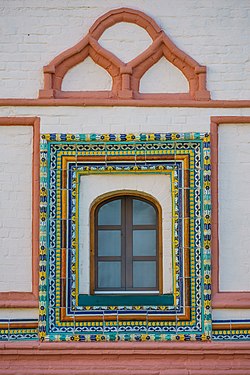
 Flamboyant Gothic window of a stair tower (Toulouse, France)
 -
-

-

-

-

-
 Louis XVI round window of the Petit Trianon (Versailles, France), with a festoon-derived ornament at the top
 -
 Neoclassical group of windows, on a lateral side of the Romanian Athenaeum (Bucharest)
 -
 Gothic Revival window of a house on Strada Jean-Louis Calderon (Bucharest)
 -
 Egyptian Revival windows of a building in Place du Caire (Paris)
 -
 Romanian Revival window of a house on Bulevardul Dacia (Bucharest)
 -
 19th century Eclectic Classicist windows on Rue Molitor (Paris)
 -
 Beaux-Arts window of the Stroescu House on Strada Dianei (Bucharest)
 -
 Art Deco house with stained glass windows on Stillemansstraat (Sint-Niklaas, Belgium)
 -
 Chicago windows of the Reliance Building (Chicago)
 -
 Art Nouveau windows of the Horta Museum (Brussels)
 -
 Window with shutters of the Lutheran wooden church in Born auf dem Darß (Germany)
 -
 Serving window of a Mexican restaurant in the city of Chico (California)
 -
 Postmodern windows of the Cité de la musique (Paris)
 -
 Contemporary windows of Cathedral Plaza Bucharest
 -
 Very high windows in the entrance to a residential building in Ystad


.jpg)


.jpg)

.jpg)
.jpg)
.jpg)


.jpg)
.jpg)

_1.jpg)

_3.jpg)

_-_Chicago,_Illinois.JPG)

,_Born_a._Dar%C3%9F.jpg)
,_Chico.jpg)

.jpg)

See also
[edit]- Airflow window – Ventilated double glazing
- Architectural glass – Building material
- Crown glass – Early type of window glass
- Demerara window – Colonial architecture-style window
- Display window – Shop display window
- Fortochka – Small ventilation window, mostly found in Russia
- Glass mullion system – Glazing system using clamps and plates
- Greased paper window – Window made of paper coated with grease
- Insulated glazing – Construction element consisting of at least two glass plates
- Plate glass – Glass made of flat sheets
- Porthole – Window of a ship
- Rose window – Circular window found in Gothic churches
- Window covering – Material used to cover a window
- Window tax – Property tax based on the number of windows in a house
- Witch window – Window rotated 45° from vertical
References
[edit]- ^ a b c d "Window". Britannica. Retrieved May 19, 2012.
- ^ a b c "Window". The Free Dictionary By Farlex. Retrieved May 19, 2012.
- ^ "New Oxford American Dictionary". 2010.
- ^ "Hvaðan kemur orðið gluggi? Af hverju notum við ekki vindauga samanber window?". Vísindavefurinn (in Icelandic). Retrieved September 17, 2018.
- ^ Carrier, Richard (2017). The Scientist in the Early Roman Empire. Durham, North Carolina: Pitchstone Publishing. p. 218. ISBN 978-1-63431-106-9.
- ^ Kevin Shillington (2013). Encyclopedia of African History 3-Volume Set. Routledge. p. 564. ISBN 978-1-135-45670-2.
- ^ Fage, J. D. (1957). "Ancient Ghana: A Review Of The Evidence". Transactions of the Historical Society of Ghana. 3 (2): 3–24. JSTOR 41405704.
- ^ Langley, Andrew (2011). Medieval Life. Eyewitness. Dorling Kindersley. p. 16. ISBN 978-1-4053-4545-3.
- ^ "Float Glass".
- ^ Kleinschmidt, Beda Julius (1912). . Catholic Encyclopedia. Vol. 15.
In general two or three windows united in a group, as was later the rule in Roman architecture, were even then of frequent occurrence in the early Christian architecture of Asia Minor. The form of the window is nearly everywhere the same; a rectangle that usually has a rounded top, but seldom a straight lintel.
- ^ Kleinschmidt, Beda Julius (1912). . Catholic Encyclopedia. Vol. 15.
The place of the window was determined by the architectural membering of the basilica, the distance between two columns generally indicating the position of a window.
- ^ Smith, Peter (1985). "21 Rural Building in Wales". In Thirsk, Joan (ed.). The Agrarian History of England and Wales. Vol. 5: 1640-1750 2: Agrarian change. Cambridge: Cambridge University Press. p. 781. ISBN 9780521257756. Retrieved January 18, 2023.
- ^
Rybczynski, Witold (May 13, 2008) [2007]. "Ranchers, Picture Windows and Morning Rooms". Last Harvest: From Cornfield to New Town: Real Estate Development from George Washington to the Builders of the Twenty-First Century, and Why We Live in Houses Anyway. New York: Simon and Schuster. p. 207. ISBN 9780743235976. Retrieved January 18, 2023.
The casual, spread-out ranch house [...] by 1950 accounted for nine out of ten new houses. [...] Its one extravagance was a large window facing the street - the picture window. As far as I have been able to determine, picture windows made their first appearance in Levittown, Pennsylvania.
- ^ Kent, Michael; Schiavon, Stefano (2022). "Predicting Window View Preferences Using the Environmental Information Criteria" (PDF). LEUKOS. 19 (2): 190–209. doi:10.1080/15502724.2022.2077753. S2CID 251121476. Retrieved November 9, 2022.
- ^ Curl, James Stevens (2006). Oxford Dictionary of Architecture and Landscape Architecture, 2nd ed., OUP, Oxford and New York, p. 214. ISBN 978-0-19-860678-9.
- ^ Harris, Cyril M. (1998). American Architecture: An Illustrated Encyclopedia. New York: W. W. Norton.
- ^ NKBA (National Kitchen and Bath Association) (October 29, 2013). Kitchen & Bath Residential Construction and Systems. John Wiley & Sons. ISBN 978-1-118-71104-0.
- ^ Nielson, Karla J. (September 15, 1989). Window Treatments. John Wiley & Sons. p. 45. ISBN 0-471-28946-9.
- ^ Allen, Edward; Thallon, Rob (2011). Fundamentals of Residential Construction (3rd ed.). Hoboken, NJ: Wiley. p. 654. ISBN 978-0-470-54083-1.
- ^ "Tilt-and-Turn Windows Gain Popularity". June 11, 2021. Archived from the original on January 25, 2023. Retrieved January 25, 2023.
- ^ Curl, James Stevens. "Flanking window". A Dictionary of Architecture and Landscape Architecture. 2nd ed. Oxford England: Oxford University Press, 2006. 285. Print.
- ^ Sarviel, Ed (1993). Construction Estimating Reference Data. Craftsman Book Company. ISBN 978-0-934041-84-3.
- ^ "Picture window". The Free Dictionary. Farlex. Retrieved May 19, 2012.
- ^ "U.S. Dept. of Transportation: Safety information for bus/motorcoach passengers" (PDF). Archived from the original (PDF) on September 23, 2008. Retrieved February 11, 2012.
- ^ "Stained glass". The Free Dictionary. Farlex. Retrieved May 19, 2012.
- ^ French Door, Merriam-Webster Online Dictionary, access date July 4, 2017
- ^ French window, Merriam-Webster Online Dictionary, access date July 4, 2017
- ^ Brett, Peter (2004). Carpentry and Joinery (2, illustrated ed.). Nelson Thornes. p. 255. ISBN 978-0-7487-8502-5.
- ^ Windows and Heat Loss Archived August 27, 2010, at the Wayback Machine, NFRC Heat Loss Fact Sheet
- ^ "CPR guideline" (PDF). Archived from the original (PDF) on November 6, 2013. Retrieved February 13, 2013.
- ^ Carmody, J., Selkowitz, S., Lee, E. S., Arasteh, D., & Willmert, T. (2004). Window Systems for High-Performance Buildings. New York, NY: W. W. Norton & Company, Inc.
- ^ "Saving Windows, Saving Money: Evaluating the Energy Performance of Window Retrofit and Replacement". Resource Library – National Trust for Historic Preservation. National Trust for Historic Preservation. Retrieved March 31, 2020.
- ^ a b Peterson Wasielewski, Shannon. "Windows: Energy Efficiency Facts and Myths" (PDF). Washington Department of Archaeology and Historic Preservation. Retrieved March 31, 2020.
- ^ Pritchard, Geoffrey (1999). Novel and Traditional Fillers for Plastics: Technology and Market Developments. iSmithers Rapra Publishing. p. 95. ISBN 978-1-85957-183-5.
- ^ "Global Vinyl Windows Market to Reach 163 Million Units by 2017, According to a New Report by Global Industry Analysts, Inc". PRWeb. April 18, 2012. Archived from the original on January 31, 2013. Retrieved February 11, 2012.
- ^ Howell, Sandra C. (1976). Designing for the Elderly; Windows. Massachusetts Institute of Technology. Department of Architecture. Design Evaluation Project.
- ^ "MIT opens new 'window' on solar energy". Web.mit.edu. July 10, 2008. Retrieved February 11, 2012.
- ^ Beckett, H. E., & Godfrey, J. A. (1974). Windows: Performance, design and installation. New York, NY: Van Nostrand Reinhold Company.
External links
[edit]

| Shared rooms | |
|---|---|
| Private rooms | |
| Spaces | |
| Technical, utility and storage |
|
| Great house areas | |
| Other | |
| Architectural elements | |
| Related | |

| International | |
|---|---|
| National | |

Window
View on GrokipediaEtymology and Origins
Etymology
The word "window" derives from the Old Norse term vindauga, literally meaning "wind-eye," a compound of vindr ("wind") and auga ("eye"), referring to an opening that allowed air to pass through like an eye exposed to the wind.[6] This Norse origin entered English during the Viking Age, reflecting the influence of Scandinavian settlers on the Anglo-Saxon language.[7] In Middle English, it appeared as wyndowe or windohe around the late 13th century, gradually replacing the native Old English eagþyrl ("eye-hole") and becoming the standard term by the 14th century.[6] Parallels exist in other Germanic languages, though many adopted forms from Latin rather than purely native compounds; for instance, modern German Fenster stems from Old High German fenstar, borrowed from Latin fenestra ("window" or "opening"), while Dutch venster follows a similar path through Middle Dutch from the same Latin root.[8] These borrowings highlight how Latin terminology spread via Roman influence and ecclesiastical Latin into continental Germanic tongues during the early medieval period.[9] In Romance languages, Latin fenestra directly shaped terms like French fenêtre, inherited through Old French fenestre as an "opening for light," and Italian finestra, maintaining the classical sense of a wall aperture. Spanish ventana, however, diverges, deriving from Vulgar Latin ventāna, a diminutive related to ventus ("wind"), emphasizing airflow similar to the Norse etymology.[10] This Latin influence underscores the shared Indo-European roots for architectural openings across European languages, often tied to concepts of air and visibility. Originally connoting a functional "eye to the wind" for ventilation in pre-glazed structures, the term's meaning shifted over centuries to denote any framed opening in a building, increasingly associated with light admission and later transparent materials, as architectural practices evolved from simple holes to sophisticated designs.[6][11]Early Origins
The earliest known evidence of window-like openings dates to the Neolithic period at the site of Çatalhöyük in central Anatolia, Turkey, around 7000 BCE. In these densely packed mud-brick houses, small internal openings in the walls, measuring approximately 0.4–0.5 meters wide and 0.6–0.7 meters high, facilitated light penetration and air circulation between adjacent rooms, while external walls generally lacked such features to maintain structural integrity and privacy.[12] These openings, often positioned above high thresholds, represented a basic architectural adaptation for ventilation in enclosed living spaces without formal streets or doors on ground level.[13] In ancient Egyptian architecture, windows typically appeared as narrow slits, particularly in pyramids and tombs from the Old Kingdom onward (circa 2686–2181 BCE), designed to regulate light entry and fulfill symbolic roles. For instance, serdab chambers in mastaba tombs featured small slits allowing limited light from adjacent chapels to reach statue niches, enabling the ka (spiritual essence) of the deceased to interact with the outside world while preserving the tomb's dim interior to deter direct sunlight and evoke eternal darkness.[14] In temples like Karnak, clerestory slits high in the walls of hypostyle halls permitted controlled illumination over central aisles, creating dramatic light effects that symbolized divine presence without overwhelming the sacred spaces below.[15] Mesopotamian and Indus Valley civilizations (circa 3500–1900 BCE) employed similar rudimentary openings covered by functional materials for protection. In Mesopotamian mud-brick structures, wall apertures were often shielded with wooden shutters or woven reed mats to block dust and wind while permitting airflow, reflecting adaptations to arid environments.[16] Indus Valley homes at sites like Mohenjo-Daro featured small, high-placed vents rather than full windows facing streets, similarly covered to ensure privacy and ventilation in urban layouts.[17] Across these early societies, glass was absent, with translucent coverings made from stretched animal membranes, oiled cloth, or plant fibers providing the only diffusion of light through openings.[18]Historical Development
Ancient and Medieval Periods
In ancient Greek and Roman architecture, windows primarily served to admit light and air while integrating with structural and aesthetic elements. Greek buildings featured simple rectangular or square openings, often unglazed and covered with shutters or animal membranes, but Roman innovations advanced this further. A notable example is the oculus, a circular opening in domes that symbolized a connection to the divine and allowed natural illumination; the Pantheon in Rome, constructed around 126 CE under Emperor Hadrian, exemplifies this with its 8.7-meter-diameter oculus at the dome's apex, which not only lightens the structure but also serves as a dramatic light source.[19] Romans also employed latticed wooden screens, known as cancelli or grilles, to diffuse light and provide privacy in public spaces like basilicas and private homes, enhancing the interplay of light and shadow in interior designs. The introduction of glass marked a significant advancement in Roman window technology during the 1st century CE, coinciding with the invention of glassblowing around 50 BCE in Syria, which enabled the production of larger, thinner panes. Elite residences in cities like Herculaneum and Pompeii, preserved by the eruption of Vesuvius in 79 CE, reveal cast or blown glass sheets fitted into wooden or bronze frames, offering better insulation and transparency than previous materials like mica or cloth. These early glass windows were luxury items, used sparingly in wealthier homes to filter light while protecting against weather and insects, as evidenced by fragments excavated from sites such as elite residences in Pompeii.[20] By the late Roman period, such glazing appeared in public baths and villas, transitioning windows from mere apertures to valued architectural features. During the medieval period in Europe, window design evolved in response to both defensive needs and religious symbolism, particularly in ecclesiastical architecture. Early medieval structures, such as Norman castles from the 11th century, incorporated narrow lancet windows—tall, slender openings with pointed arches—for defensive purposes, minimizing vulnerabilities while allowing minimal light and archer fire. In contrast, the Gothic style emerging in the 12th century emphasized expansive glazing to flood interiors with divine light, using lead-came technique where H-shaped lead strips held pot-metal colored glass pieces together, enabling intricate designs. Iconic examples include the rose windows of 12th-13th century cathedrals like Chartres (c. 1215), circular tracery-filled compositions symbolizing the eye of God or cosmic order, often paired with lancet windows below to narrate biblical stories through stained glass narratives.[21] This lead-came method, refined by monastic workshops, allowed for larger, more vibrant panels that transformed church spaces into illuminated "Bibles of the poor" for illiterate congregations. Islamic architecture during the medieval era introduced innovative window screens that balanced ventilation, privacy, and aesthetics, influencing broader regional designs during the 12th century. Mashrabiya, latticed wooden enclosures projecting from building facades, originated in the Middle East and North Africa, with early examples traceable to Abbasid Baghdad in the 12th century. These screens, carved with geometric patterns, allowed cool air to circulate while diffusing sunlight and concealing interiors from public view, aligning with cultural norms of seclusion (hijab) and passive cooling in hot climates; notable implementations grace Mamluk-era buildings like the 14th-century Sultan Hassan Mosque in Cairo.[22] Mashrabiya thus served dual functional and ornamental roles, adapting Roman lattice traditions to Islamic geometric artistry. By the late medieval period, windows had shifted from primarily functional slits in prehistoric and early fortifications—mere openings for light and defense—to profound symbolic elements in religious buildings, where they embodied spiritual illumination and theological narratives. In both European Gothic cathedrals and Islamic mosques, expansive glazed or screened windows elevated architecture toward transcendence, paving the way for Renaissance expansions in transparency and scale.[23]Modern Evolution
The introduction of counterbalanced sash windows in late 17th-century England represented a pivotal evolution in window design during the waning years of the Renaissance, enabling smoother vertical sliding for improved ventilation without the need for propping or hinges. These windows, featuring pulleys and lead weights to balance the sashes, first appeared in royal commissions such as Whitehall Palace in 1662 and spread rapidly across Europe, offering greater flexibility in airflow and light control compared to fixed or hinged medieval precedents.[24] By the early 18th century, this innovation had become integral to urban and residential architecture, facilitating easier operation in multi-story buildings.[25] In the Georgian era (1714–1830), sash windows matured into symmetrical multi-pane configurations, epitomized by the six-over-six grid pattern, which balanced classical proportions with functional glazing using thinner muntins and larger panes as glass production improved. This design emphasized aesthetic harmony in terraced houses and townhouses, aligning with the period's neoclassical ideals while allowing for efficient ventilation in densely populated cities.[26] During the subsequent Victorian period (1837–1901), these forms persisted but incorporated more ornate details, such as marginal glazing bars and bay extensions, to enhance residential facades amid rapid urbanization, though the core six-over-six layout retained its prominence for visual symmetry.[27] The Industrial Revolution profoundly influenced window evolution by enabling mass production of iron frames, which supported expansive glazing and shifted designs toward larger picture windows for unobstructed views and illumination. A landmark example was the Crystal Palace of 1851 in London, constructed with prefabricated cast-iron columns and over 300,000 panes of sheet glass, demonstrating how industrialized methods could create vast, transparent enclosures previously impossible with wood or stone.[28] This era also saw regional divergences: in France, traditional casement windows—hinged at the sides for outward opening—remained favored in 19th-century architecture for their seamless sightlines and compatibility with ornate ironwork, contrasting with the American preference for double-hung sashes, which provided superior cross-ventilation in expansive colonial and Victorian homes.[29][30] Concurrently, the push for larger window openings accelerated in urban settings to harness natural light, particularly in factories where expansive iron-framed glazing illuminated work floors, reducing reliance on dim artificial sources and boosting productivity in textile mills like those in Lowell, Massachusetts.[31] In residential contexts, this trend manifested in broader sashes and picture windows that flooded homes with daylight, reflecting broader societal shifts toward healthier, brighter living environments amid industrialization's grime.[32]Technological Advancements
Following World War II, the adoption of aluminum extrusions for window frames gained momentum in the 1950s, offering lightweight construction and corrosion resistance compared to traditional wood or steel alternatives.[33] Vinyl extrusions emerged around the same period, first produced in Germany in 1954 due to postwar wood shortages and high aluminum costs, with U.S. manufacturers like Andersen introducing hollow vinyl window sashes by 1959 for cost-effective, low-maintenance applications.[34] These materials enabled mass production of durable frames suitable for modern residential and commercial buildings, reducing installation weight and improving weather resistance. A pivotal advancement in glass production came with the float glass process, invented by Pilkington Brothers Limited in 1959, which involves floating molten glass over a bed of molten tin to create uniform, distortion-free sheets on a large scale.[35] This method revolutionized flat glass manufacturing by eliminating the need for grinding and polishing, allowing for consistent optical quality and sizes up to several meters wide, which became the dominant technique worldwide by the 1960s.[36] In the 1970s, low-emissivity (Low-E) coatings were introduced to window glass, consisting of thin metallic oxide layers that selectively reflect infrared radiation while transmitting visible light, thereby enhancing energy efficiency during the oil crisis era.[37] By the 1980s, insulated glass units (IGUs) incorporating argon gas fills between panes further reduced thermal conductivity, as argon—a denser, inert gas—limits convective heat transfer more effectively than air, with widespread adoption driven by building energy codes.[38] Electrochromic glass emerged from 1990s prototypes, featuring thin films that reversibly tint via low-voltage electrical application, allowing dynamic control of solar heat gain and glare without mechanical shading.[39] Initial developments by firms like Asahi Glass produced small-scale prototypes (e.g., 0.6 m x 0.8 m panels) based on tungsten oxide electrochemistry, paving the way for commercial products in the 2000s that integrate with building automation systems for improved occupant comfort and energy savings.[40]Aesthetic Trends
During the 17th and 18th centuries, Baroque and Rococo aesthetics profoundly influenced window design, emphasizing elaborate ornamentation and dynamic forms to evoke grandeur and movement. Baroque windows featured dramatic curves and integrated lighting effects, often using arched transoms to frame views and enhance spatial illusion, as seen in the flowing masses of structures like the Pilgrimage Church in Wies, Germany (1745), where numerous windows diffused light for ethereal interiors.[41] Rococo refined this with asymmetrical designs and sinuous arcs, incorporating higher-placed transoms that made upper casements smaller, promoting a playful, ornate elegance suited to 18th-century tastes, exemplified in asymmetrical window arrangements that blended structure with intricate decoration.[41][42] In the 1920s, the Bauhaus movement introduced modernist minimalism to window aesthetics, prioritizing functional simplicity and expansive glazing over decorative excess. Architects like Walter Gropius favored large, undivided panes and ribbon windows to create "walls of glass," as in the Fagus Factory (1925), where single-pane glass corners and thin mullions maximized light and blurred indoor-outdoor boundaries, reflecting the school's embrace of modern materials like steel and glass for airy, unadorned spaces.[43][44] This approach emphasized horizontal lines and modular systems, reducing visual clutter to highlight the building's form and natural illumination. The 1980s saw postmodern revivals that reacted against modernism's austerity by reintroducing divided lights and historical motifs, blending irony with classical references for eclectic expression. Designs often employed false sash bars on two-light windows to mimic traditional divided panes, evoking 19th-century sash aesthetics without functional muntins, as in whimsical structures that mixed playful ornamentation with vernacular elements.[45] Influenced by theorists like Robert Venturi, these windows incorporated bright colored frames and punch-out openings with historical allusions, such as exaggerated pediments or motifs, to contextualize buildings through symbolism and pluralism.[46] In the 21st century, biophilic design trends have shifted window aesthetics toward seamless natural integration, prioritizing expansive views to foster human well-being and environmental connection. Core patterns include visual connections to nature through unobstructed window vistas of vegetation or water, which reduce stress and enhance cognitive function, as evidenced in guidelines recommending daily exposure to biodiverse outdoor scenes via large openings.[47] Contemporary implementations favor slimmer frames and mulled units for broader glass surfaces, allowing diffuse daylight and prospect views that support circadian rhythms and urban harmony, with triple-pane systems enabling larger installations without compromising efficiency.[48] Regional aesthetics further diversify these trends, contrasting Japan's shoji screens with Scandinavia's floor-to-ceiling windows in their approaches to light and nature. Japanese shoji, with translucent rice-paper panels on wooden lattices, diffuse soft light to create serene, minimalist interiors that harmonize with gardens and seasonal shifts, embodying wabi-sabi principles of impermanence and mindfulness.[49] In contrast, Scandinavian designs employ vast, light-framed glass expanses from floor to ceiling to combat long winters, flooding spaces with brightness and emphasizing hygge through functional simplicity and neutral tones that invite the outdoors in.[49]Types
Fixed and Non-Operable
Fixed and non-operable windows, also known as fixed windows, are sealed architectural elements that do not open or move, primarily designed to admit natural daylight and offer unobstructed views without providing ventilation.[50] These units feature stationary glass panes securely integrated into a frame, eliminating the need for operable components and focusing on aesthetic and luminous functionality.[51] Common subtypes include picture windows, which are large, often single-paned installations intended to frame scenic exterior views like landscapes or gardens, maximizing visual expanse and light entry. Another subtype is clerestory windows, positioned high on walls to capture overhead light and illuminate interior spaces without compromising privacy or wall space below.[52] These windows offer advantages in energy efficiency, as their lack of moving parts ensures superior air-tightness and reduces heat loss or gain compared to operable designs, contributing to lower heating and cooling demands.[53] In modern construction, fixed windows are extensively used in curtain wall systems, which consist of non-structural glass facades hung on the exterior of buildings, particularly in commercial skyscrapers to create expansive, light-filled envelopes.[54] Historically, fixed windows trace back to ancient Egyptian temples, where clerestory designs were employed to channel divine light into hypostyle halls, as seen in structures like the Temple of Karnak from the 13th century BC.[55] In contemporary applications, they continue to dominate high-rise architecture, enhancing the sleek, transparent aesthetics of urban skyscrapers while integrating advanced glazing techniques for weatherproof sealing.[56] A key limitation of fixed and non-operable windows is their inability to facilitate natural airflow, necessitating reliance on mechanical ventilation systems to maintain indoor air quality.[57]Vertically Sliding
Vertically sliding windows, also known as sash windows, feature one or more panes that move up and down within a frame to facilitate ventilation and access for cleaning. These windows originated in Europe during the late 17th century, with the earliest documented double-hung sash appearing around 1701 in England, though they quickly spread to the American colonies by the early 18th century.[58] By the Georgian period in Britain (1714–1837), vertically sliding designs became a hallmark of residential architecture, prized for their elegant proportions and functional operation.[59] The single-hung sash window consists of a fixed upper pane and a movable lower sash that slides vertically upward, making it a space-efficient option commonly found in colonial American homes from the 18th century onward.[60] In contrast, the double-hung sash allows both the upper and lower sashes to slide independently, often balanced by counterweights connected via pulleys and cords or modern spring mechanisms, enabling full ventilation from either the top or bottom and easier interior cleaning by tilting the sashes inward.[61] A guillotine window variant, typically without counterbalances, relies on manual lifting secured by pins or latches, representing a simpler, more economical form historically used in budget-conscious constructions.[62] These windows excel in tight spaces where swinging designs would intrude, such as narrow hallways or above furniture, while promoting cross-ventilation without obstructing views or requiring outward projection.[63] However, older versions can suffer from drafts due to gaps around the sliding tracks if not properly sealed, though modern iterations incorporate weatherstripping, low-emissivity glazing, and insulated frames to enhance energy efficiency and reduce air leakage.[61] Evolving from their 17th-century English roots, contemporary vertically sliding windows now meet stringent building standards for thermal performance, often achieving U-factors as low as 0.25 through advanced materials like vinyl or fiberglass sashes.[60] The sash frame, typically constructed from wood or durable composites, supports these mechanisms while maintaining aesthetic continuity with historical styles.[58]Horizontally Sliding
Horizontally sliding windows, commonly referred to as slider windows, consist of one or more sashes that move parallel to the frame along horizontal tracks, enabling side-to-side operation ideal for wide openings.[64] These designs typically feature panels configured in pairs, where one sash remains fixed while the other slides across it, or both sashes move to allow full aperture access for enhanced ventilation and views.[65] A key advantage of horizontally sliding windows lies in their ease of operation across large spans, requiring minimal space and effort to open fully, which makes them particularly suitable for patio areas and contemporary residential settings.[66] Their horizontal orientation facilitates broad sightlines and promotes a seamless indoor-outdoor connection, contributing to their widespread adoption in modern architecture.[64] The track systems in these windows incorporate roller bearings to ensure smooth, low-friction movement of the sashes, reducing wear and operational noise over time.[67] Sealing mechanisms, such as brush weatherstrips along the tracks and silicone gaskets at the meeting rails, help maintain energy efficiency by preventing air and water infiltration.[68] Variants of horizontally sliding systems include folding configurations with accordion-style panels that stack compactly to one side, allowing nearly complete openings for expansive access in architectural applications.[69] Horizontally sliding windows gained significant popularity in 20th-century suburban architecture, particularly postwar developments, where they supported the era's emphasis on indoor-outdoor flow by integrating living spaces with patios and gardens.[70] This trend was advanced by modernist pioneers like Le Corbusier, who patented innovative sliding sash designs in the 1920s to promote transparency and functional openness in residential and commercial buildings.[71]Hinged and Swinging
Hinged and swinging windows operate by rotating on hinges, allowing the sash to open either inward or outward relative to the building's wall plane, providing effective ventilation and often superior sealing compared to sliding alternatives. These windows are distinguished by their pivot-based mechanics, which enable the sash to swing fully open, maximizing airflow while compressing weatherstripping for enhanced energy efficiency and weather resistance. Common in both residential and commercial applications, they emphasize durability through robust hinge systems and are operated via cranks, levers, or manual pushes.[61][72] Casement windows are side-hinged units that swing outward like a door, typically operated by a hand crank or lever for precise control. Hinged on one vertical side, the entire sash rotates perpendicular to the frame, allowing up to a 90-degree opening for optimal ventilation and views. This design presses the sash firmly against the frame and weatherstripping when closed, creating a tight seal that minimizes air leakage and improves weatherproofing, making them suitable for various climates.[61][73][72] Awning windows feature hinges at the top of the frame, with the sash projecting outward from the bottom to create a canopy-like effect. This configuration directs airflow inward while shielding the interior from direct rain, allowing ventilation even during light precipitation. Often used above doors or in wet areas like kitchens and bathrooms, awning windows provide unobstructed views and security when partially open, with the sloped opening preventing water intrusion.[61][73] Hopper windows are bottom-hinged, with the sash tilting inward from the top, offering a compact solution for limited spaces. This inward swing facilitates easy cleaning from inside and is ideal for basement or utility areas, where it promotes cross-ventilation without protruding into walkways. The design ensures secure closure against the frame, though they are typically smaller to accommodate the inward motion.[61][4] Hinge types for these windows include butt hinges, which consist of two leaves connected by a pin for simple pivoting; pivot hinges, allowing rotation around a central axis for balanced swing; and continuous hinges, which run the full length of the sash for added strength and even load distribution. Butt hinges are the most common for residential casements due to their reliability, while continuous types enhance durability in heavier or larger installations by reducing stress points.[74][75] Hinged windows have been prevalent in Europe since medieval times, where side-hung casements were a standard feature in stone and timber-framed buildings for light and air circulation. By the 17th century, they dominated European architecture before evolving with sash designs. In modern construction, aluminum-framed versions of hinged windows are widely used in high-rise buildings for their lightweight strength, corrosion resistance, and slim profiles that suit contemporary aesthetics. These aluminum systems support large spans while meeting stringent building codes for wind loads and thermal performance. Locking hardware, such as multi-point mechanisms, further secures these swings against forced entry.[58][76][77][78]Projecting and Specialty
Projecting windows extend outward from the building's exterior wall, creating additional interior space while maximizing natural light and outward views. These designs differ from flush-mounted windows by altering the facade and room geometry, often requiring specialized framing to integrate with the structure. Common in residential and commercial architecture, they enhance spatial perception without encroaching on floor area beyond the projection itself. Bay windows consist of three or more panels that project from the wall at angles, typically forming a polygonal alcove that expands the usable interior space. This configuration, often with a flat or angled base, originated in medieval Europe to capture more light in narrow urban lots and became widespread during the Victorian era for aesthetic and functional appeal.[79][80] Oriel windows represent an elevated variant of bay windows, positioned on upper stories and supported solely by brackets or corbels without ground-level foundation. Emerging in Gothic architecture during the 14th century, particularly in England and France, they served to illuminate tall interiors like chapels and halls while adding ornamental depth to facades.[81][82] Pivot windows operate via hinges located at the center of the frame, allowing the sash to rotate either horizontally or vertically up to 180 degrees. This mechanism facilitates easy cleaning from inside, as the window can swing inward for access to both sides, and provides controlled ventilation without obstructing interior space.[83][84] Tilt-and-turn windows offer dual functionality as a European standard, tilting inward from the top for secure ventilation or swinging fully open like a casement from the side via a single handle mechanism. Developed in Germany in the mid-20th century, this design complies with EN 14351 standards for performance and safety, emphasizing versatility in modern energy-efficient buildings.[85][86] These projecting and specialty windows increase interior light penetration compared to standard flush designs and broaden panoramic views, fostering a sense of openness. However, their extension demands structural reinforcement, such as reinforced lintels or additional framing extensions, to bear cantilevered loads and prevent settling or facade stress.[61][87]Roof and Overhead
Roof and overhead windows integrate into roofs or ceilings to admit zenith light, enhancing interior illumination without occupying wall space. These structures, often glazed for optimal daylight penetration, include fixed and operable variants designed to capture diffuse overhead light while minimizing direct solar glare.[88] Skylights represent a primary form of roof-integrated glazing, consisting of fixed or operable dome or flat glass panels installed directly into the roof surface. Fixed skylights provide passive daylighting through non-opening units that admit soft, diffuse light from above, while operable versions allow ventilation by opening outward or via hinged mechanisms. Dome shapes, such as pyramidal or arched designs, effectively shed moisture and capture light from low angles, making them suitable for varied roof pitches.[88] Roof windows, typically sloped and top-hinged, facilitate both illumination and attic ventilation, commonly appearing in dormer configurations to transform underutilized roof spaces. These units pivot from the top for easy operation, even in low-ceiling areas, and integrate seamlessly into pitched roofs to bring natural light and air circulation to lofts or bonus rooms. Their design supports emergency egress in some models, enhancing safety alongside functionality.[89] Roof lanterns function as elevated, miniature glazed structures that protrude above the roofline, offering multi-directional light through surrounding transparent panels. Positioned on flat roofs, they resemble compact conservatories, elevating headroom while flooding interiors with overhead and lateral daylight from all angles. Modern iterations feature slim frames and advanced glazing to suit both traditional and contemporary extensions.[90] Installation of roof and overhead windows presents challenges, particularly in ensuring waterproofing through proper flashing and selecting UV-resistant glazing to withstand prolonged exposure. High-quality metal flashing must be layered with roofing materials to create a durable seal against leaks, which can lead to rot or mold if improperly installed; additionally, low-E or tinted glazing mitigates UV damage and heat gain. Sheet waterproofing applied over flanges further protects against water infiltration and ice dams in colder climates.[88][91] Historically, roof-integrated glazing found prominent use in Victorian greenhouses, where sloped glass roofs at 30- to 45-degree angles maximized light penetration for plant propagation. These structures employed thin panes—around 2 to 2.8 mm thick—with wet or dry glazing methods using putty or metal clips to secure them, allowing efficient water shedding via minimal overlaps. Such designs, often in lean-to or span configurations, oriented south-facing to optimize seasonal sunlight while reducing frame shadows through lighter iron or wood supports.[92] Contemporary innovations include solar tube variants, which pipe light through reflective tubing as an efficient alternative to traditional skylights. These systems feature a roof-mounted dome capturing sunlight, channeled via highly reflective rigid or flexible pipes to an interior diffuser, delivering even illumination to remote spaces like hallways or closets. Installation costs range from $600 to $1,000, offering energy savings by reducing reliance on artificial lighting and improving occupant well-being through natural daylight.[93]Decorative and Artistic
Decorative and artistic windows prioritize aesthetic appeal, symbolism, and visual enhancement over primary functional roles, often incorporating intricate designs, materials, and motifs to elevate architectural spaces. These elements have been integral to building design across eras, serving as canvases for artistic expression in religious, residential, and public structures. Stained glass windows, a hallmark of decorative glazing, consist of colored glass pieces assembled within lead came frames to create pictorial or abstract compositions that filter and tint incoming light. Originating in antiquity but reaching artistic zenith in the Gothic period, they were extensively used in medieval European cathedrals to depict biblical narratives and saints, transforming interiors with vibrant, ethereal illumination. The 13th-century Chartres Cathedral in France exemplifies this tradition, featuring over 170 windows with more than 2,500 square meters of original medieval glass, including the renowned Chartres blue achieved through cobalt oxide impurities in the molten glass. These windows not only served symbolic purposes, such as educating illiterate congregations through visual storytelling, but also influenced later Renaissance and Victorian revivals in secular buildings like homes and civic halls. Transom windows, typically small horizontal panes positioned above doors, allow light passage while adding ornamental flair, often framed with arched tops or decorative muntins to complement entryway architecture. Common in Victorian and Edwardian homes, they enhanced natural illumination in hallways without compromising privacy, and their designs frequently incorporated fanlights or geometric patterns etched into the glass. In American colonial architecture, transoms evolved from simple clear panes to more elaborate versions with stained or frosted elements, as seen in Federal-style buildings where they symbolized openness and elegance. Sidelights, narrow vertical windows flanking doorways, provide symmetrical visual balance and decorative accents, frequently featuring etched, beveled, or stained glass in Victorian-era designs to evoke opulence. These panels, often paired with transoms to form a complete entry surround, were popular in 19th-century British and American residences, where intricate floral or neoclassical motifs etched via acid or sandblasting techniques added texture and light diffusion. The etched glass in sidelights of Queen Anne-style homes, for instance, highlighted craftsmanship while framing the door as a focal point of hospitality. Jalousie windows, characterized by adjustable horizontal louvers or slats of glass, wood, or metal, offer decorative ventilation with a rhythmic, slatted aesthetic suited to warm climates. Patented as early as 1901, they gained popularity in the mid-20th century, particularly from the 1940s onward, in tropical regions like Florida and the Caribbean for their ability to modulate light and airflow while providing a modern, louvered pattern reminiscent of shutters. Designs featuring overlapping slats cranked open or closed blend functionality with visual appeal in mid-century modern architecture.[94] French windows, essentially full-height casement windows that function as glazed doors, emphasize elegance through their tall, narrow proportions and paired configuration, often opening inward or outward to create seamless indoor-outdoor connections. Originating in 17th-century France as an evolution of casement designs, they became a staple in neoclassical and Georgian architecture, with multiple panes divided by muntins for a refined, symmetrical look. In English country homes, French windows were celebrated for their graceful lines and ability to frame garden views, influencing global residential styles into the 20th century.Terminology
Structural Components
The structural components of a window form the foundational framework that defines the opening, supports the glazing, and integrates the unit into a building's architecture. These elements include the fixed frame, which encloses the window, and any movable parts like the sash, while additional members such as jambs, sills, heads, muntins, and mullions provide stability, division, and aesthetic division. Understanding these components is essential for proper installation, maintenance, and energy performance, as they determine how the window interacts with the surrounding structure.[95] The jambs are the vertical members that form the sides of the window frame, extending from the head to the sill and providing the primary support for the window's alignment within the wall opening. They house hardware such as hinges or tracks for operable windows and contribute to the overall rigidity of the unit. In construction, jambs are typically sized to match the rough opening depth, ensuring a secure fit against the building's framing.[95][96] The sill and head serve as the horizontal boundaries of the frame, with the sill forming the bottom exterior ledge that directs water away from the building and the head capping the top interior or exterior surface. The sill often includes a sloped profile to prevent moisture infiltration, while the head supports the weight above the window and may incorporate drip edges for weather resistance. Together, these members complete the rectangular enclosure, distributing loads from the sash or glazing to the surrounding structure.[95][97] A key distinction in window anatomy lies between the frame and the sash: the frame is the fixed, stationary structure that mounts into the wall opening and receives the glazing or sash, whereas the sash is the movable assembly of stiles and rails designed to hold the glass panes and facilitate operation in windows that open. In fixed windows, the frame directly supports the glazing without a separate sash, emphasizing the frame's role as the unchanging backbone. This separation allows for versatility in design, where the frame remains durable and weatherproof while the sash enables functionality.[95][97] Muntins are the vertical or horizontal bars that divide the glazing within a single sash or pane into multiple smaller lights, serving both structural and decorative purposes. True muntins, also known as authentic divided lites, physically separate individual glass panes and provide support for each, a method common in historic or traditional windows before large-sheet glass became affordable. In contrast, simulated muntins or grilles are non-structural overlays—often applied to both sides of a single large pane—that mimic the appearance of divided lights without compromising modern insulation benefits. These simulated versions use adhesive, snap-in, or between-the-glass designs to achieve the grid effect.[95][98][99] Mullions are structural posts or bars, either vertical or horizontal, that join two or more individual window units into a larger assembly, providing essential support for multi-window configurations such as bay or clerestory setups. Unlike muntins, which operate within a single window, mullions bear significant loads and may be integral to the frame or added as reinforcing elements during installation. They enhance both the stability and visual continuity of fenestration in architectural designs.[95][100] Common materials for these components include wood, vinyl, aluminum, and fiberglass, selected based on durability, insulation properties, and aesthetic preferences.[96]Operational Terms
Operational terms in window design and function refer to the vocabulary describing the movable elements and mechanisms that enable the operation, securing, and maintenance of windows. These terms are essential for understanding how windows facilitate ventilation, access, cleaning, and emergency egress while maintaining energy efficiency and security. Standardized definitions from industry associations ensure consistency in architectural specifications and building practices.[95] The sash is the movable frame assembly that holds the glazing in a window, allowing it to slide, tilt, or swing relative to the fixed frame. In operable windows, the sash is designed to move within tracks, grooves, or on hinges to open or close the window, providing ventilation or access. This component is central to the window's dynamic functionality, as its movement directly controls airflow and light entry.[101] Mechanisms for operating and securing the sash include latches, locks, and cranks, which ensure controlled movement and safety. A latch is a fastening device that holds the sash in the closed position through friction or a simple mechanical catch, often allowing easy manual release without a key for routine operation. Locks, in contrast, provide enhanced security by requiring a key or tool to disengage, preventing unauthorized opening of the sash. Cranks, typically part of a geared operator system, enable the rotation needed to open or close hinged sashes in casement or awning windows, converting manual turning into linear or angular motion for smooth operation.[102][103] Weatherstripping consists of flexible, compressible materials applied along the edges of the sash and frame to create a seal that minimizes air infiltration and water penetration during operation or when closed. This sealing element is crucial for maintaining the window's performance after repeated opening and closing cycles, reducing drafts and enhancing thermal isolation without impeding sash movement. Common materials include foam, rubber, or vinyl, which compress under the sash's pressure.[101] Terms describing the actions of the sash highlight the diverse ways windows operate to meet user needs, such as ventilation or cleaning. Tilt refers to the inward pivoting of the sash from the top or bottom, often in double-hung or single-hung designs, allowing the interior side of the glass to be accessed for washing without full removal. Swing describes the outward or inward rotation of the sash on side hinges, as seen in casement windows, which maximizes airflow when fully opened. Slide indicates horizontal or vertical translation of the sash along tracks, common in gliding or hung windows, providing a space-efficient opening mechanism. These actions are engineered for ease of use and durability, often incorporating balances or operators to counterbalance the sash weight.[101][95] Egress pertains to the operational capability of a window to serve as an emergency escape route, requiring the sash to fully open to a minimum clear area sufficient for safe exit, typically in bedrooms or basements per building codes. Such windows must operate quickly and without tools, ensuring unobstructed passage for rescue or evacuation in fire or other emergencies. Hinges may support this function in swinging designs, but the focus remains on the sash's unobstructed movement.[104]Measurement and Standards
Window measurements distinguish between the rough opening, which is the framed aperture in a building's wall, and the window unit dimensions, which refer to the actual size of the installed window assembly. According to ASTM E2112 Standard Practice for Installation of Exterior Windows, Doors and Skylights, the rough opening must be larger in both width and height than the net dimensions of the window unit to accommodate shimming, leveling, and secure fastening during installation.[105] Typically, this difference amounts to 1/4 to 1/2 inch on each side for most vinyl and wood units, ensuring proper fit while preventing distortion or air leakage. In the United States, residential windows are commonly manufactured in standardized sizes to simplify production, installation, and replacement. These sizes vary by window type and manufacturer, but certain ranges and popular dimensions are prevalent. For double-hung and single-hung windows (the most common types):- Widths: typically 24 to 48 inches (common: 24, 28, 32, 40, 44, 48 inches)
- Heights: typically 36 to 72 inches (common: 36, 44, 48, 52, 54, 60, 62, 72 inches) A frequently cited average or popular size is 36 inches wide by 60 inches tall.
Construction Methods
Frame and Sash Materials
Window frames and sashes form the structural backbone of windows, supporting the glazing and enabling operation while influencing durability, aesthetics, and energy performance. Window frame materials are the primary structural components of window frames, influencing durability, maintenance, energy efficiency, insulation, and suitability for different climates in replacement windows. Materials selection balances factors such as thermal conductivity, resistance to environmental degradation, maintenance requirements, and cost, with each option offering distinct advantages and limitations. Fiberglass, composed of glass fibers reinforced with polyester resin, is extremely strong (significantly stronger and more rigid than vinyl), dimensionally stable with low thermal expansion matching glass to preserve seals, and resistant to warping, cracking, rotting, moisture, insects, UV fading, and extreme temperatures (from -40°F to 180°F). It provides excellent energy efficiency when insulated, achieving low U-factors (0.25-0.35 Btu/hr-ft²-°F). Lifespan typically 30–50+ years (commonly 35–40) with minimal maintenance. Best for harsh climates and long-term durability, though with higher upfront cost (often 20-50% more than vinyl). Vinyl (uPVC) Vinyl windows, also known as uPVC or PVC windows, feature frames made from unplasticized polyvinyl chloride (uPVC). They emerged as a popular modern alternative in the late 20th century, widely used in residential construction for their affordability, low maintenance, durability, and excellent thermal insulation properties due to multi-chambered designs that trap air and reduce heat transfer. Vinyl frames resist corrosion, moisture, insects, and do not require painting; they clean easily with soap and water. They offer good insulation with U-factors typically 0.25–0.35 Btu/hr-ft²-°F. Vinyl performs well in various climates and is particularly suitable for hot climates because of its natural resistance to heat conduction, UV rays, and humidity, helping maintain cooler indoor temperatures and reduce cooling costs. However, in intense heat (e.g., direct sun in southern U.S., Texas, Florida, Arizona), high-quality vinyl with thicker walls (0.075–0.080 inch), internal reinforcements (metal or composite), and UV stabilizers is essential to prevent warping, bowing, or discoloration. Key energy performance metrics for hot climates include low solar heat gain coefficient (SHGC ≤0.25–0.30) and U-factor (≤0.35 or lower), achieved with double- or triple-pane glazing, low-E coatings (low solar gain type), argon/krypton gas fills, and proper sealing. Compared to alternatives, vinyl insulates better than basic aluminum (unless thermally broken) and requires less upkeep than wood, while fiberglass offers superior strength in extremes but at higher cost. Popular high-quality brands for hot/extreme climates include Milgard (Tuscany/Trinsic series), Simonton, JELD-WEN, and premium uPVC lines like Okna, Soft-Lite, Sunrise, Gorell, Affinity, and GEALAN. Avoid low-end thin-walled vinyl in intense sun. Vinyl windows typically last 20–30+ years with quality manufacturing and installation. ENERGY STAR and NFRC ratings guide selection for climate zones emphasizing low SHGC in southern/hot areas. Aluminum (thermally broken or coated) offers exceptional strength-to-weight ratio, rigid slim profiles ideal for large or modern designs, and resistance to warping, impact, and corrosion (enhanced by powder coating or anodizing). Lifespan 20–30+ years with low maintenance. Naturally high thermal conductivity (around 120 Btu/hr-ft-°F) leads to poor insulation and potential condensation unless thermally broken (e.g., polyurethane or polyamide struts, increasing cost 20-30%). Ideal for coastal/high-wind areas due to strength and corrosion resistance. Wood (often clad) has been a traditional choice due to natural beauty, workability for custom shapes/finishes, and good insulation (R-values around 1.0-2.0 per inch). Species like pine (affordable), oak (strong, rot-resistant), and mahogany are common. Susceptible to rot, warping, and insects without maintenance (paints/sealants require periodic reapplication). Lifespan 20–60 years with care; clad versions (exterior clad in vinyl or aluminum) greatly improve exterior durability and reduce upkeep. Best for traditional aesthetics. Composite materials, blending wood fibers or particles with plastics like PVC or polypropylene, offer wood aesthetics with synthetic durability, resisting moisture absorption (under 1% swelling) better than solid wood. Thermal performance comparable to vinyl (U-factors around 0.3), with potential recyclability. May exhibit slight color fading from UV over decades. Performance between fiberglass and vinyl.| Material | Key Advantages | Key Drawbacks | Typical U-Factor (Btu/hr-ft²-°F) | Typical Lifespan |
|---|---|---|---|---|
| Wood | Natural insulation, customizable, aesthetic beauty | Prone to moisture damage, high maintenance unless clad | 0.3-0.5 (with proper sealing) | 20-60 years (with care) |
| Vinyl (uPVC) | Affordable, low-maintenance, good insulation, suitable for hot climates with high-quality construction | Thermal expansion; can warp/fade/brittle in extremes without thicker walls, reinforcements, UV stabilizers | 0.25-0.35 | 20-40+ years |
| Aluminum | Strong, slim profiles, corrosion resistant (coated/ broken) | High conductivity without thermal breaks | 0.4-0.7 (unbroken); 0.25-0.35 (broken) | 20-30+ years |
| Fiberglass | Extremely durable, stable in extremes, low maintenance | Higher cost | 0.25-0.35 | 30-50+ years |
| Composite | Hybrid benefits, moisture-resistant | Potential UV fading | 0.28-0.35 | 30-50 years |