


Community hub
Recent from talks
Contribute something
Nothing was collected or created yet.
Angle
View on Wikipedia

In geometry, an angle is formed by two lines that meet at a point.[1] Each line is called a side of the angle, and the point they share is called the vertex of the angle.[2][3] The term angle is used to denote both geometric figures and their size or magnitude. Angular measure or measure of angle are sometimes used to distinguish between the measurement and figure itself. The measurement of angles is intrinsically linked with circles and rotation, and this is often visualized or defined using the arc of a circle centered at the vertex and lying between the sides.
Fundamentals
[edit]There is no universally agreed definition of an angle.[4] Angles can be conceived of and used in a variety of ways and while valid definitions may be given for specific contexts, it is difficult to give a single formal definition that is completely satisfactory in capturing all aspects of the general concept of angle.[5]
One standard definition is that an angle is a figure consisting of two rays which lie in a plane and share a common endpoint. Alternatively, given such a figure, an angle might be defined as: the opening between the rays; the area of the plane that lies between the rays; or the amount of rotation about the vertex of one ray to the other.
More generally, angles are also formed wherever two line segments come together, such as at the corners of triangles and other polygons,[2] or at the intersection of two planes or curves, in which case the rays lying tangent to each curve at the point of intersection define the angle.[6]
It is common to consider that the sides of the angle divide the plane into two regions called the interior of the angle and the exterior of the angle. The interior of the angle is also referred to as an angular sector.[7][8][a]
Notation and measurement
[edit]


An angle symbol ( or , read as "angle") together with one or three defining points is used to identify angles in geometric figures. For example, the angle with vertex A formed by the rays and is denoted as (using the vertex alone) or (with the vertex always named in the middle). The size or measure of the angle is denoted or .


In geometric figures and mathematical expressions, it is also common to use Greek letters (α, β, γ, θ, φ, ...) or lower case Roman letters (a, b, c, ...) as variables to represent the size of an angle.[12] Angular measure is commonly a scalar quantity,[13] although in physics and some fields of mathematics, signed angles are used by convention to indicate a direction of rotation: positive for anti-clockwise; negative for clockwise.[14]
Units of measurement
[edit]Angles are measured in various units, the most common being the degree (denoted by the symbol °), radian (denoted by the symbol rad) and turn. These units differ in the way they divide up a full angle, an angle where one ray, initially congruent to the other, performs a compete rotation about the vertex to return back to its starting position.[15]
Degrees and turns are defined directly with reference to a full angle, which measures 1 turn or 360°.[16] A measure in turns gives an angle's size as a proportion of a full angle and a degree can be considered as a subdivision of a turn. Radians are not defined directly in relation to a full angle (see § Measuring angles), but in such a way that its measure is 2π rad, approximately 6.28 rad.[17]
Addition and subtraction
[edit]

The angle addition postulate states that if D is a point lying in the interior of then:[18] This relationship defines what it means to add any two angles: their vertices are placed together while sharing a side to create a new larger angle. The measure of the new larger angle is the sum of the measures of the two angles. Subtraction follows from rearrangement of the formula.[18]

Types
[edit]Common angles
[edit]
- An angle equal to 0° or not turned is called a zero angle.[19]
- An angle smaller than a right angle (less than 90°) is called an acute angle.[20]
- An angle equal to 1/4 turn (90° or π/2 rad) is called a right angle. Two lines that form a right angle are said to be normal, orthogonal, or perpendicular.[21]
- An angle larger than a right angle and smaller than a straight angle (between 90° and 180°) is called an obtuse angle[20] ("obtuse" meaning "blunt").
- An angle equal to 1/2 turn (180° or π rad) is called a straight angle.[19]
- An angle larger than a straight angle but less than 1 turn (between 180° and 360°) is called a reflex angle.
- An angle equal to 1 turn (360° or 2π rad) is called a full angle, complete angle, round angle or perigon.
- An angle that is not a multiple of a right angle is called an oblique angle.
Adjacent and vertical angles
[edit]-
 Angles A and B are adjacent.
 -
 Angles A and B, and pair C and D are two pairs of vertical angles. Hatch marks indicate equality between pairs.


Adjacent angles (abbreviated adj. ∠s), are angles that share a common vertex and edge but do not share any interior points. In other words, they are angles side by side or adjacent, sharing an "arm".
Vertical angles are formed when two straight lines intersect at a point producing four angles. A pair of angles opposite each other are called vertical angles, opposite angles or vertically opposite angles (abbreviated vert. opp. ∠s),[22] where "vertical" refers to the sharing of a vertex, rather than an up-down orientation. A theorem states that vertical angles are always congruent or equal to each other.[23] A transversal is a line that intersects a pair of (often parallel) lines and is associated with exterior angles, interior angles, alternate exterior angles, alternate interior angles, corresponding angles, and consecutive interior angles.[24]
Combining angle pairs
[edit]When summing two angles (either adjacent or separated in space), three special cases are named complementary, supplementary, and explementary angles.
Complementary angles are angle pairs whose measures sum to a right angle (1/4 turn, 90°, or π/2 rad). If the two complementary angles are adjacent, their non-shared sides form a right angle. In a right-angle triangle the two acute angles are complementary as the sum of the internal angles of a triangle is 180°. The difference between an angle and a right angle is termed the complement of the angle.[6]
Supplementary angles sum to a straight angle (1/2 turn, 180°, or π rad). If the two supplementary angles are adjacent, their non-shared sides form a straight angle or straight line and are called a linear pair of angles.[25] The difference between an angle and a straight angle is termed the supplement of the angle.[26]
Explementary angles or conjugate angles sum to a full angle (1 turn, 360°, or 2π radians).[27] The difference between an angle and a full angle is termed the explement or conjugate of the angle.[28][29]
Examples of non-adjacent complementary angles include the consecutive angles of a parallelogram and opposite angles of a cyclic quadrilateral. For a circle with center O, and tangent lines from an exterior point P touching the circle at points T and Q, the resulting angles ∠TPQ and ∠TOQ are supplementary.
-
 Angles
aandbare complementary angles -
 Angles
aandbare supplementary angles -
 Angles
AOBandCODare explementary or conjugate angles


Polygon-related angles
[edit]
- An angle that is part of a simple polygon is called an interior angle if it lies on the inside of that simple polygon. A simple concave polygon has at least one interior angle, that is, a reflex angle. In Euclidean geometry, the measures of the interior angles of a triangle add up to π radians, 180°, or 1/2 turn; the measures of the interior angles of a simple convex quadrilateral add up to 2π radians, 360°, or 1 turn. In general, the measures of the interior angles of a simple convex polygon with n sides add up to (n − 2)π radians, or (n − 2)180 degrees, (n − 2)2 right angles, or (n − 2)1/2 turn.
- The supplement of an interior angle is called an exterior angle; that is, an interior angle and an exterior angle form a linear pair of angles. There are two exterior angles at each vertex of the polygon, each determined by extending one of the two sides of the polygon that meet at the vertex; these two angles are vertical and hence are equal. An exterior angle measures the amount of rotation one must make at a vertex to trace the polygon.[30] If the corresponding interior angle is a reflex angle, the exterior angle should be considered negative. Even in a non-simple polygon, it may be possible to define the exterior angle. Still, one will have to pick an orientation of the plane (or surface) to decide the sign of the exterior angle measure. In Euclidean geometry, the sum of the exterior angles of a simple convex polygon, if only one of the two exterior angles is assumed at each vertex, will be one full turn (360°). The exterior angle here could be called a supplementary exterior angle. Exterior angles are commonly used in Logo Turtle programs when drawing regular polygons.
- In a triangle, the bisectors of two exterior angles and the bisector of the other interior angle are concurrent (meet at a single point).[31]: 149
- In a triangle, three intersection points, each of an external angle bisector with the opposite extended side, are collinear.[31]: 149
- In a triangle, three intersection points, two between an interior angle bisector and the opposite side, and the third between the other exterior angle bisector and the opposite side extended are collinear.[31]: 149
- Some authors use the name exterior angle of a simple polygon to mean the explement exterior angle (not supplement!) of the interior angle.[32] This conflicts with the above usage.
Plane-related angles
[edit]- The angle between two planes (such as two adjacent faces of a polyhedron) is called a dihedral angle.[6] It may be defined as the acute angle between two lines normal to the planes.
- The angle between a plane and an intersecting straight line is complementary to the angle between the intersecting line and the normal to the plane.
Measuring angles
[edit]Angle measurement encompasses both direct physical measurement using a measuring instrument such as a protractor, as well as the theoretical calculation of angle size from other known quantities. While the measurement of angles is intrinsically linked with rotation and circles, there are various perspectives as to exactly what is being measured, including amongst others: the amount of rotation about the vertex of one ray to the other[33]; the amount of opening between the rays[34]; or the length of the arc that subtends the angle at the centre of a unit circle.[35]
The measurement of angles is inherently different from the measurement of other physical quantities such as length.[36] Angles of special significance (such as the right angle) inform the systems and units of angular measurement, which is not the case for length where the units of measurement (metres, feet) are arbitrary.
Broadly there are two approaches to measuring angles: relative to a reference angle (such as a right angle); and circular measurement.
Reference angle
[edit]A chosen reference angle (right angle, straight angle or full angle) can be divided into equal parts, and the size of one part used as a unit for measurement of other angles.
In the most common method of practical angular measurement a right angle is divided into 90 equal parts called degrees, while in the rarely used centesimal system, a right angle is divided into 100 equal parts called gradians.[37][38]
Circular measurement
[edit]
With circular measurement an angle is placed within a circle of any size, with the vertex at the circle's centre and the sides intersecting the perimeter.
An arc with length s is formed as the perimeter between the two points of intersection, which is said to subtend the angle. The length s can be used to measure the angle's size θ, however as s is dependent on the size of the circle chosen, the measure must be scaled. This can be done by taking the ratio of s to either the radius r or circumference C of the circle.
The ratio of the length s by the radius r is the number of radians in the angle,[35] while the ratio of length s by the circumference C is the number of turns:


The value of θ thus defined is independent of the size of the circle: if the length of the radius is changed, then both the circumference and the arc length change in the same proportion, so the ratios s/r and s/C are unaltered.[nb 1]
The ratio s/r is called the "radian measure"[18] or "circular measure"[39][38][40] of an angle, but is also used to define a unit of measurement called a radian, which is defined as an angle for which the ratio s/r = 1.[39] Thus, the measurement of an angle given by s/r can be thought of in two ways: firstly as a measure in terms of the angle's own proportions (ratio of arc length to radius), or secondly as the quantity of units in the angle (ratio of arc length of measured angle to arc length of unit angle).[41][38]
Units
[edit]The following table lists some notable units used to represent angles.
| Name (symbol) | Number in one turn | 1 unit in degrees | Description |
|---|---|---|---|
| turn | 1 | 360° | The turn is the angle subtended by the circumference of a circle at its centre. A turn is equal to 2π or 𝜏 radians. |
| degree ( ° ) | 360 | 1° | The degree may be defined such that one turn is equal to 360 degrees. |
| radian (rad) | 2π | 57.2957...° | The radian is the angle subtended by an arc of a circle that has the same length as the circle's radius. |
| grad (gon) | 400 | 0.9° | The grad, also called grade, gradian, or gon, is defined such that a right angle is equal to as 100 gradians. The grad is used mostly in triangulation and continental surveying. |
| arcminute ( ′ ) | 21600 | 1/60° | The minute of arc (or arcminute, or just minute) is a sexagesimal subunit of a degree. |
| arcsecond ( ″ ) | 1296000 | 1/3600° | The second of arc (or arcsecond, or just second) is a sexagesimal subunit of a minute of arc. |
| milliradian (mrad) | 2000π | 0.05729...° | The milliradian is a thousandth of a radian. For artillery and navigation a unit is used, often called a 'mil', which are approximately equal to a milliradian. One turn is exactly 6000, 6300, or 6400 mils, depending on which definition is used. |
Dimensional analysis
[edit]In mathematics and the International System of Quantities, an angle is defined as a dimensionless quantity,[42] and in particular, the radian is defined as dimensionless in the International System of Units.[43] This convention prevents angles providing information for dimensional analysis. For example, when one measures an angle in radians by dividing the arc length by the radius, one is essentially dividing a length by another length, and the units of length cancel each other out. Therefore the result—the angle—doesn't have a physical "dimension" like meters or seconds.[44] This holds true with all angle units, such as radians, degrees, or turns—they all represent a pure number quantifying how much something has turned.[45] This is why, in many equations, angle units seem to "disappear" during calculations, which feels inconsistent and can lead to mixing up angle units.[46][47]
This has led to significant discussion among scientists and educators. Some scientists have suggested treating the angle as having its own fundamental dimension, similar to length or time.[48] This would mean that angle units like radians would always be explicitly present in calculations, facilitating dimensional analysis. However, this approach would also require changing many well-known mathematical and physics formulas, making them longer and perhaps a bit less familiar.[49] For now, the established practice is to write angle units where appropriate but consider them dimensionless, understanding that these units are important but behave differently from meters or kilograms.[50]
Signed angles
[edit]
An angle denoted as ∠BAC might refer to any of four angles: the clockwise angle from B to C about A, the anticlockwise angle from B to C about A, the clockwise angle from C to B about A, or the anticlockwise angle from C to B about A, It is therefore frequently helpful to impose a convention that allows positive and negative angular values to represent orientations and/or rotations in opposite directions or "sense" relative to some reference.
In a two-dimensional Cartesian coordinate system, an angle is typically defined by its two sides, with its vertex at the origin. The initial side is on the positive x-axis, while the other side or terminal side is defined by the measure from the initial side in radians, degrees, or turns, with positive angles representing rotations toward the positive y-axis and negative angles representing rotations toward the negative y-axis. When Cartesian coordinates are represented by standard position, defined by the x-axis rightward and the y-axis upward, positive rotations are anticlockwise, and negative cycles are clockwise.
In many contexts, an angle of −θ is effectively equivalent to an angle of "one full turn minus θ". For example, an orientation represented as −45° is effectively equal to an orientation defined as 360° − 45° or 315°. Although the final position is the same, a physical rotation (movement) of −45° is not the same as a rotation of 315° (for example, the rotation of a person holding a broom resting on a dusty floor would leave visually different traces of swept regions on the floor).
In three-dimensional geometry, "clockwise" and "anticlockwise" have no absolute meaning, so the direction of positive and negative angles must be defined in terms of an orientation, which is typically determined by a normal vector passing through the angle's vertex and perpendicular to the plane in which the rays of the angle lie.
In navigation, bearings or azimuth are measured relative to north. By convention, viewed from above, bearing angles are positive clockwise, so a bearing of 45° corresponds to a north-east orientation. Negative bearings are not used in navigation, so a north-west orientation corresponds to a bearing of 315°.
Equivalent angles
[edit]- Angles that have the same measure (i.e., the same magnitude) are said to be equal or congruent. An angle is defined by its measure and is not dependent upon the lengths of the sides of the angle (e.g., all right angles are equal in measure).
- Two angles that share terminal sides, but differ in size by an integer multiple of a turn, are called coterminal angles.
- The reference angle (sometimes called related angle) for any angle θ in standard position is the positive acute angle between the terminal side of θ and the x-axis (positive or negative).[51] Procedurally, the magnitude of the reference angle for a given angle may determined by taking the angle's magnitude modulo 1/2 turn, 180°, or π radians, then stopping if the angle is acute, otherwise taking the supplementary angle, 180° minus the reduced magnitude. For example, an angle of 30 degrees is already a reference angle, and an angle of 150 degrees also has a reference angle of 30 degrees (180° − 150°). Angles of 210° and 510° correspond to a reference angle of 30 degrees as well (210° mod 180° = 30°, 510° mod 180° = 150° whose supplementary angle is 30°).
Related quantities
[edit]For an angular unit, it is definitional that the angle addition postulate holds, however some measurements or quantities related to angles are in use that do not satisfy this postulate:
- The slope or gradient is equal to the tangent of the angle and is often expressed as a percentage ("rise" over "run"). For very small values (less than 5%), the slope of a line is approximately the measure in radians of its angle with the horizontal direction. An elevation grade is a slope used to indicate the steepness of roads, paths and railway lines.
- The spread between two lines is defined in rational geometry as the square of the sine of the angle between the lines. As the sine of an angle and the sine of its supplementary angle are the same, any angle of rotation that maps one of the lines into the other leads to the same value for the spread between the lines.
- Although done rarely, one can report the direct results of trigonometric functions, such as the sine of the angle.
Angles between curves
[edit]
The angle between a line and a curve (mixed angle) or between two intersecting curves (curvilinear angle) is defined to be the angle between the tangents at the point of intersection. Various names (now rarely, if ever, used) have been given to particular cases:—amphicyrtic (Gr. ἀμφί, on both sides, κυρτός, convex) or cissoidal (Gr. κισσός, ivy), biconvex; xystroidal or sistroidal (Gr. ξυστρίς, a tool for scraping), concavo-convex; amphicoelic (Gr. κοίλη, a hollow) or angulus lunularis, biconcave.[52]
Bisecting and trisecting angles
[edit]The ancient Greek mathematicians knew how to bisect an angle (divide it into two angles of equal measure) using only a compass and straightedge but could only trisect certain angles. In 1837, Pierre Wantzel showed that this construction could not be performed for most angles.
Dot product and generalisations
[edit]In the Euclidean space, the angle θ between two Euclidean vectors u and v is related to their dot product and their lengths by the formula

This formula supplies an easy method to find the angle between two planes (or curved surfaces) from their normal vectors and between skew lines from their vector equations.
Inner product
[edit]To define angles in an abstract real inner product space, we replace the Euclidean dot product ( · ) by the inner product , i.e.


In a complex inner product space, the expression for the cosine above may give non-real values, so it is replaced with or, more commonly, using the absolute value, with


The latter definition ignores the direction of the vectors. It thus describes the angle between one-dimensional subspaces and spanned by the vectors and correspondingly.


Angles between subspaces
[edit]The definition of the angle between one-dimensional subspaces and given by in a Hilbert space can be extended to subspaces of finite number of dimensions. Given two subspaces , with , this leads to a definition of angles called canonical or principal angles between subspaces.





Angles in Riemannian geometry
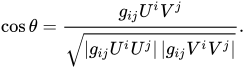
[edit]In Riemannian geometry, the metric tensor is used to define the angle between two tangents. Where U and V are tangent vectors and gij are the components of the metric tensor G,
Hyperbolic angle
[edit]
A hyperbolic angle is an argument of a hyperbolic function just as the circular angle is the argument of a circular function. The comparison can be visualized as the size of the openings of a hyperbolic sector and a circular sector since the areas of these sectors correspond to the angle magnitudes in each case.[53] Unlike the circular angle, the hyperbolic angle is unbounded. When the circular and hyperbolic functions are viewed as infinite series in their angle argument, the circular ones are just alternating series forms of the hyperbolic functions. This comparison of the two series corresponding to functions of angles was described by Leonhard Euler in Introduction to the Analysis of the Infinite (1748).
History and etymology
[edit]The word angle comes from the Latin word angulus, meaning "corner". Cognate words include the Greek ἀγκύλος (ankylοs) meaning "crooked, curved" and the English word "ankle". Both are connected with the Proto-Indo-European root *ank-, meaning "to bend" or "bow".[54]
Philosophers have debated the nature of angles for millennia, with some arguing that angles are a measure (quantity), and others saying they are a kind of shape defined by the lines that bound it (qualitative relation), and still others saying an angle is both.[55] Pedagogically, the accepted answer is that angles are defined as figures, and the measure of an angle is defined as the number of congruent non-overlapping copies of a unit angle necessary to cover the angle and its interior. Angles are said to be equal in measure and similar or congruent in shape.[56]
Euclid defines a plane angle as the inclination to each other, in a plane, of two lines that meet each other and do not lie straight with respect to each other. According to the Neoplatonic metaphysician Proclus, an angle must be either a quality, a quantity, or a relationship. The first concept, angle as quality, was used by Eudemus of Rhodes, who regarded an angle as a deviation from a straight line; the second, angle as quantity, by Carpus of Antioch, who regarded it as the interval or space between the intersecting lines; Euclid adopted the third: angle as a relationship.[57]
Vertical angle theorem
[edit]The equality of vertically opposite angles is called the vertical angle theorem. Eudemus of Rhodes attributed the proof to Thales of Miletus.[58][23] The proposition showed that since both of a pair of vertical angles are supplementary to both of the adjacent angles, the vertical angles are equal in measure. According to a historical note,[23] when Thales visited Egypt, he observed that whenever the Egyptians drew two intersecting lines, they would measure the vertical angles to make sure that they were equal. Thales concluded that one could prove that all vertical angles are equal if one accepted some general notions such as:
- All straight angles are equal.
- Equals added to equals are equal.
- Equals subtracted from equals are equal.
When two adjacent angles form a straight line, they are supplementary. Therefore, if we assume that the measure of angle A equals x, the measure of angle C would be 180° − x. Similarly, the measure of angle D would be 180° − x. Both angle C and angle D have measures equal to 180° − x and are congruent. Since angle B is supplementary to both angles C and D, either of these angle measures may be used to determine the measure of Angle B. Using the measure of either angle C or angle D, we find the measure of angle B to be 180° − (180° − x) = x. Therefore, both angle A and angle B have measures equal to x and are equal in measure.
Angles in geography and astronomy
[edit]In geography, the location of any point on the Earth can be identified using a geographic coordinate system. This system specifies the latitude and longitude of any location in terms of angles subtended at the center of the Earth, using the equator and (usually) the Greenwich meridian as references.
In astronomy, a given point on the celestial sphere (that is, the apparent position of an astronomical object) can be identified using any of several astronomical coordinate systems, where the references vary according to the particular system. Astronomers measure the angular separation of two stars by imagining two lines through the center of the Earth, each intersecting one of the stars. The angle between those lines and the angular separation between the two stars can be measured.
In both geography and astronomy, a sighting direction can be specified in terms of a vertical angle such as altitude angle or elevation with respect to the horizon as well as the azimuth with respect to north.
Astronomers also measure objects' apparent size as an angular diameter. For example, the full moon has an angular diameter of approximately 0.5° when viewed from Earth. One could say, "The Moon's diameter subtends an angle of half a degree." The small-angle formula can convert such an angular measurement into a distance/size ratio.
Other astronomical approximations include:
- 0.5° is the approximate angular diameter of the Sun and of the Moon as viewed from Earth.
- 1° is the approximate angular width of the little finger at arm's length.
- 10° is the approximate angular width of a closed fist at arm's length.
- 20° is the approximate angular width of a handspan at arm's length.
These measurements depend on the individual subject, and the above should be treated as rough rule of thumb approximations only.
In astronomy, right ascension is usually measured in angular units that are expressed in terms of time based on a 24-hour day.[59]
| Unit | Symbol | Degrees | Radians | Turns | Other |
|---|---|---|---|---|---|
| Hour | h | 15° | π⁄12 rad | 1⁄24 turn | |
| Minute | m | 0°15′ | π⁄720 rad | 1⁄1440 turn | 1⁄60 hour |
| Second | s | 0°0′15″ | π⁄43200 rad | 1⁄86400 turn | 1⁄60 minute |
See also
[edit]- Angle measuring instrument
- Angles between flats
- Angular statistics (mean, standard deviation)
- Angle bisector
- Angular acceleration
- Angular diameter
- Angular velocity
- Argument (complex analysis)
- Astrological aspect
- Central angle
- Clock angle problem
- Decimal degrees
- Dihedral angle
- Exterior angle theorem
- Golden angle
- Great circle distance
- Horn angle
- Inscribed angle
- Irrational angle
- Phase (waves)
- Protractor
- Solid angle
- Spherical angle
- Subtended angle
- Tangential angle
- Transcendent angle
- Trisection
- Zenith angle
Notes
[edit]- ^ This approach requires, however, an additional proof that the measure of the angle does not change with changing radius r, in addition to the issue of "measurement units chosen". A smoother approach is to measure the angle by the length of the corresponding unit circle arc. Here "unit" can be chosen to be dimensionless in the sense that it is the real number 1 associated with the unit segment on the real line. See Dimitrić (2012), for instance.
- ^ An angular sector can be constructed by the combination of two rotated half-planes, either their intersection or union (in the case of acute or obtuse angles, respectively).[9][10] It corresponds to a circular sector of infinite radius and a flat pencil of half-lines.[11]
References
[edit]- ^ Heath, Thomas Little; Heiberg, J. L. (Johan Ludvig) (1908), The thirteen books of Euclid's Elements, Cambridge, The University Press, p. 176,
A plane angle is the inclination to one another of two lines in a plane which meet one another and do not lie in a straight line.
- ^ a b Hilbert, David, The Foundations of Geometry (PDF), p. 9
- ^ Sidorov 2001
- ^ Saxon, John, H, Algebra I An Incremental Development
{{cite book}}: CS1 maint: multiple names: authors list (link) - ^ Henderson (2020), Experiencing Geometry- Euclildian and non-Euclidian With History, Pearson Prentice Hall, ISBN 978-1-4297-9985-0
- ^ a b c Chisholm 1911.
- ^ Evgrafov, M. A. (1966), Analytic Functions, W. B. Saunders
- ^ Papadopoulos, Athanase (2012), Strasbourg Master Class on Geometry, European Mathematical Society, ISBN 978-3-03719-105-7
- ^ D'Andrea, Francesco (2023), A Guide to Penrose Tilings, Springer, ISBN 978-3-031-28428-1
- ^ Bulboacǎ, Teodor; Joshi, Santosh B.; Goswami, Pranay (2019), Complex Analysis: Theory and Applications, Walter de Gruyter GmbH & Co KG, ISBN 978-3-11-065803-3
- ^ Redei, L. (2014), Foundation of Euclidean and Non-Euclidean Geometries according to F. Klein, Elsevier, ISBN 978-1-4832-8270-1
- ^ Aboughantous 2010, p. 18.
- ^ "NIST Guide to the SI, Chapter 7: Rules and Style Conventions for Expressing Values of Quantities", NIST, 2016, retrieved 2025-08-08,
α is a quantity symbol for plane angle.
- ^ De, Villiers (2020), "The Value of using Signed Quantities in Geometry" (PDF), Learning and Teaching Mathematics, 29 (2020): 30–34, hdl:10520/ejc-amesal_n29_a8.pdf-v29-n2020-a8, retrieved 2025-08-08
- ^ Weisstein, Eric W., "Angle", mathworld.wolfram.com, retrieved 2025-06-13
- ^ Weisstein, Eric W., "Degree", mathworld.wolfram.com, retrieved 2025-06-14
- ^ Weisstein, Eric W., "Radian", mathworld.wolfram.com, retrieved 2025-06-14
- ^ a b c Moise, Edwin E. (1990), Elementary geometry from an advanced standpoint (PDF) (3rd ed.), Addison-Wesley Publishing Company
- ^ a b Moser 1971, p. 41.
- ^ a b Godfrey & Siddons 1919, p. 9.
- ^ Moser 1971, p. 71.
- ^ Wong & Wong 2009, pp. 161–163
- ^ a b c Shute, Shirk & Porter 1960, pp. 25–27.
- ^ Jacobs 1974, p. 255.
- ^ Jacobs 1974, p. 97.
- ^ Rhoad, Richard; Milauskas, George; Whipple, Robert; McDougal Littell (1991), Geometry for enjoyment and challenge, Internet Archive, Evanston, Ill. : McDougal, Littell, p. 67, ISBN 978-0-86609-965-3
- ^ Willis, Clarence Addison (1922), Plane Geometry, Blakiston's Son, p. 8
- ^ Halsted, George Bruce (1899), Elementary Synthetic Geometry, Wiley, p. 7
- ^ Linton, John Alexander (1973), Phase and amplitude variation of Chandler wobble (Thesis), University of British Columbia, doi:10.14288/1.0052929,
The latitude of a point on earth is defined as the conjugate of the angle between the point where the rotation axis pierces the celestial sphere (celestial pole) and the point where the local vertical pierces the same sphere (zenith).
- ^ Henderson & Taimina 2005, p. 104.
- ^ a b c Johnson, Roger A. Advanced Euclidean Geometry, Dover Publications, 2007.
- ^ D. Zwillinger, ed. (1995), CRC Standard Mathematical Tables and Formulae, Boca Raton, FL: CRC Press, p. 270 as cited in Weisstein, Eric W., "Exterior Angle", MathWorld
- ^ Serra, Michael (2008), Discovering geometry : an investigative approach, Emeryville, CA : Key Curriculum Press, ISBN 978-1-55953-882-4
- ^ Alexander, Daniel C. (2006), Elementary geometry for college students, Internet Archive, Boston, MA : Houghton Mifflin, ISBN 978-0-618-64525-1
- ^ a b International Bureau of Weights and Measures (2019), The International System of Units (SI) (PDF) (9th ed.), ISBN 978-92-822-2272-0, archived from the original on 2021-10-18
- ^ Grötschel, Martin; Hanche-Olsen, Harald; Holden, Helge; Krystek, Michael P. (2022), "On Angular Measures in Axiomatic Euclidean Planar Geometry", Measurement Science Review, 22 (4): 152–159, doi:10.2478/msr-2022-0019, hdl:11250/3033842
- ^ Loney, Sidney Luxton (1893), Plane trigonometry, p. 1
- ^ a b c Todhunter, Isaac (1864), Plane Trigonometry: For the Use of Colleges and Schools. With Numerous Examples, MacMillan and Company
- ^ a b Loney, Sidney Luxton (1893), Plane trigonometry, p. 5
- ^ "Earliest Known Uses of Some of the Words of Mathematics (R)", Maths History, retrieved 2025-08-01
- ^ Quincey, Paul; Mohr, Peter J.; Phillips, William D. (2019), "Angles are inherently neither length ratios nor dimensionless", Metrologia, 56 (4): 043001, arXiv:1909.08389, doi:10.1088/1681-7575/ab27d7
- ^ "ISO 80000-3:2006 Quantities and Units - Space and Time", 2017
- ^ The International System of Units (PDF), V3.01 (9th ed.), International Bureau of Weights and Measures, Aug 2024, p. 137, ISBN 978-92-822-2272-0
- ^ Leonard, William J. (1999), Minds-on Physics: Advanced topics in mechanics, Kendall Hunt, p. 262, ISBN 978-0-7872-5412-4
- ^ French, Anthony P. (1992), "What happens to the 'radians'? (comment)", The Physics Teacher, 30 (5): 260–261, doi:10.1119/1.2343535
- ^ Prando, Giacomo (2020), "A spectral unit", Nature Physics, 16 (8): 888, doi:10.1038/s41567-020-0997-3
- ^ Oberhofer, E. S. (1992), "What happens to the 'radians'?", The Physics Teacher, 30 (3): 170–171, doi:10.1119/1.2343500
- ^ Quincey, Paul; Brown, Richard J C (2016), "Implications of adopting plane angle as a base quantity in the SI", Metrologia, 53 (3): 998–1002, arXiv:1604.02373, doi:10.1088/0026-1394/53/3/998
- ^ Quincey, Paul (2021), "Angles in the SI: a detailed proposal for solving the problem", Metrologia, 58 (5): 053002, arXiv:2108.05704, doi:10.1088/1681-7575/ac023f
- ^ Aubrecht, Gordon J.; French, Anthony P.; Iona, Mario; Welch, Daniel W. (1993), "The radian—That troublesome unit", The Physics Teacher, 31 (2): 84–87, doi:10.1119/1.2343667
- ^ McKeague, Charles P. (2008), Trigonometry (6th ed.), Belmont, CA: Thomson Brooks/Cole, p. 110, ISBN 978-0495382607
- ^ Chisholm 1911; Heiberg 1908, p. 178
- ^ Robert Baldwin Hayward (1892) The Algebra of Coplanar Vectors and Trigonometry, chapter six
- ^ Slocum 2007
- ^ Morrow, Glenn Raymond (1992) [1970], A commentary on the first book of Euclid's Elements, pp. 98–104,
the angle as such is none of the things mentioned but exists as a combination of all these categories
- ^ Jackson, Stanley B. (1967), "Congruence and measurement" (PDF), The Arithmetic Teacher, 14 (2): 94–102, doi:10.5951/AT.14.2.0094, retrieved 2025-08-08
- ^ Chisholm 1911; Heiberg 1908, pp. 177–178
- ^ Euclid, The Elements Proposition I:13.
- ^ Snell, Ronald Lee; Kurtz, Stanley E.; Marr, Jonathan M. (2019), "Introductory Material", Fundamentals of radio astronomy: astrophysics, Boca Raton, FL: CRC Press, Taylor & Francis Group, ISBN 9781498725798
Bibliography
[edit]- Aboughantous, Charles H. (2010), A High School First Course in Euclidean Plane Geometry, Universal Publishers, ISBN 978-1-59942-822-2
- Dimitrić, Radoslav M. (2012), "On Angles and Angle Measurements" (PDF), The Teaching of Mathematics, XV (2): 133–140, archived (PDF) from the original on 2019-01-17, retrieved 2019-08-06
- Godfrey, Charles; Siddons, A. W. (1919), Elementary geometry: practical and theoretical (3rd ed.), Cambridge University Press
- Henderson, David W.; Taimina, Daina (2005), Experiencing Geometry / Euclidean and Non-Euclidean with History (3rd ed.), Pearson Prentice Hall, p. 104, ISBN 978-0-13-143748-7
- Heiberg, Johan Ludvig (1908), Heath, T. L. (ed.), Euclid, The Thirteen Books of Euclid's Elements, vol. 1, Cambridge: Cambridge University Press.
- Jacobs, Harold R. (1974), Geometry, W. H. Freeman, pp. 97, 255, ISBN 978-0-7167-0456-0
- Moser, James M. (1971), Modern Elementary Geometry, Prentice-Hall
- Sidorov, L. A. (2001) [1994], "Angle", Encyclopedia of Mathematics, EMS Press
- Slocum, Jonathan (2007), Preliminary Indo-European lexicon — Pokorny PIE data, University of Texas research department: linguistics research center, archived from the original on 2010-06-27, retrieved 2010-02-02
- Shute, William G.; Shirk, William W.; Porter, George F. (1960), Plane and Solid Geometry, American Book Company, pp. 25–27
- Wong, Tak-wah; Wong, Ming-sim (2009), "Angles in Intersecting and Parallel Lines", New Century Mathematics, vol. 1B (1 ed.), Hong Kong: Oxford University Press, pp. 161–163, ISBN 978-0-19-800177-5
This article incorporates text from a publication now in the public domain: Chisholm, Hugh, ed. (1911), "Angle", Encyclopædia Britannica, vol. 2 (11th ed.), Cambridge University Press, p. 14

Further reading
[edit]- Brinsmade, J. B. (1936), "Plane and Solid Angles. Their Pedagogic Value When Introduced Explicitly", American Journal of Physics, 4 (4): 175–179, doi:10.1119/1.1999110
- Brownstein, K. R. (1997), "Angles—Let's treat them squarely", American Journal of Physics, 65 (7): 605–614, doi:10.1119/1.18616
- Eder, W E (1982), "A Viewpoint on the Quantity "Plane Angle"", Metrologia, 18 (1): 1–12, doi:10.1088/0026-1394/18/1/002
- Foster, Marcus P. (2010), "The next 50 years of the SI: a review of the opportunities for the e-Science age", Metrologia, 47 (6): R41 – R51, doi:10.1088/0026-1394/47/6/R01
- Leonard, B. P. (2021), "Proposal for the dimensionally consistent treatment of angle and solid angle by the International System of Units (SI)", Metrologia, 58 (5): 052001, doi:10.1088/1681-7575/abe0fc
- Lévy-Leblond, Jean-Marc (1998), "Dimensional angles and universal constants", American Journal of Physics, 66 (9): 814–815, doi:10.1119/1.18964, ResearchGate:253371022
- Mills, Ian (2016), "On the units radian and cycle for the quantity plane angle", Metrologia, 53 (3): 991–997, doi:10.1088/0026-1394/53/3/991
- Mohr, Peter J.; Phillips, William D. (2015), "Dimensionless units in the SI", Metrologia, 52 (1): 40–47, arXiv:1409.2794, doi:10.1088/0026-1394/52/1/40
- Mohr, Peter J.; Shirley, Eric L.; Phillips, William D.; Trott, Michael (2022), "On the dimension of angles and their units", Metrologia, 59 (5): 053001, arXiv:2203.12392, doi:10.1088/1681-7575/ac7bc2
- Quincey, Paul (2016), "The range of options for handling plane angle and solid angle within a system of units", Metrologia, 53 (2): 840–845, doi:10.1088/0026-1394/53/2/840
- Romain, Jacques E. (1962), "Angle as a fourth fundamental quantity", Journal of Research of the National Bureau of Standards Section B, 66B (3): 97, doi:10.6028/jres.066B.012
- Torrens, A. B. (1986), "On Angles and Angular Quantities", Metrologia, 22 (1): 1–7, doi:10.1088/0026-1394/22/1/002
External links
[edit]

- , Encyclopædia Britannica, vol. 2 (9th ed.), 1878, pp. 29–30
| International | |
|---|---|
| National | |
| Other | |

Angle
View on GrokipediaDefinition and Fundamentals
Definition
In geometry, a ray is defined as a half-line that originates at a fixed point, known as the endpoint, and extends infinitely in one direction.[7] An angle is the geometric figure formed by two such rays, referred to as the sides or arms of the angle, that share a common endpoint called the vertex.[8] One ray is designated as the initial side, and the other as the terminal side; the measure of the angle corresponds to the amount of rotation about the vertex required to align the initial side with the terminal side.[8] This configuration lies within a plane, defining a plane angle as the inclination between the two rays that intersect but do not form a straight line. Plane angles are fundamental to two-dimensional geometry, whereas solid angles extend this concept to three dimensions as a measure of the cone-like region subtended by a surface at a point, equivalent to the area projected onto a unit sphere centered at that point.[9] The basic measure of a plane angle, denoted θ, is given by the ratio of the arc length s between the initial and terminal sides on a circle centered at the vertex to the radius r of that circle, specifically considering the smaller arc for angles less than or equal to 180°: This formulation arises from the geometric properties of circular arcs and provides a dimensionless quantity for the angle's magnitude.[8] Basic classifications of plane angles based on their measures include the right angle, which measures exactly 90°; the acute angle, measuring less than 90°; and the obtuse angle, measuring between 90° and 180°.[10] For instance, the corner of a square forms a right angle, while angles in an equilateral triangle are acute. These examples illustrate how angle measures determine the spatial relationships in simple geometric figures.Notation and Representation
In geometry, angles are denoted using the symbol ∠ followed by three capital letters, where the middle letter specifies the vertex and the outer letters indicate the endpoints of the rays forming the angle, such as ∠ABC for the angle at B between points A, B, and C.[11][12] This three-letter convention ensures unambiguous identification, particularly in diagrams with multiple angles sharing a vertex.[12] For general or variable angles in mathematical expressions, Greek letters such as θ (theta), φ (phi), or α (alpha) are standardly employed to represent unknown or parametric angles.[13] In triangle geometry, angles are conventionally labeled with capital letters corresponding to their vertices—∠A, ∠B, ∠C—where ∠A lies opposite side a, ∠B opposite side b, and ∠C opposite side c.[14] Directed angles, which account for orientation (typically measured counterclockwise), may be represented using the variant symbol ∡, as in ∡ABC to denote the signed angle from ray BA to ray BC; arrows on rays in diagrams can further indicate direction.[15] In contrast, undirected angles emphasize magnitude alone and use the standard ∠ symbol without directional markers. Diagrammatic conventions often include a small arc drawn between the rays to visually delineate the angle, aiding clarity in sketches.[11] In typesetting systems like LaTeX, the command\angle generates the ∠ symbol for precise mathematical notation, such as $\angle ABC$.[16] To maintain precision in multifaceted figures, the full three-point notation is preferred over single-letter abbreviations, minimizing potential misinterpretation.[12]
Measurement and Units
Angles are measured by quantifying the amount of rotation between two rays sharing a common vertex, or equivalently, in the context of circular geometry, as the ratio of the arc length subtended by the angle to the radius of the circle.[17] For the radian unit, this principle is formalized as , where is the angle in radians, is the arc length, and is the radius.[18] The primary units for measuring angles are degrees and radians. A degree, denoted by the symbol °, divides a full circle into 360 equal parts, so one degree represents of a complete rotation.[3] This system originates from the ancient Babylonian sexagesimal (base-60) numeral system, which facilitated subdivisions into minutes (1/60 of a degree) and seconds (1/60 of a minute) for precise measurements.[19] In contrast, the radian measure, often denoted simply as rad or without a unit, defines a full circle as radians, where one radian corresponds to the angle subtended by an arc equal in length to the radius.[20] Other units include gradians (also called gons, denoted gon or grad), which divide a full circle into 400 equal parts for applications in surveying and engineering, and revolutions (or turns), where one revolution equals one complete rotation around a circle.[21][1] Conversions between units are essential for calculations across contexts. Specifically, radians equals 180 degrees, leading to the general conversion formula .[22] From a dimensional analysis perspective, angles are fundamentally dimensionless quantities because they arise as ratios of lengths (arc length to radius), yielding a pure number independent of the unit system.[23] However, in some physical and engineering contexts, angles are assigned a distinct dimension [angle] to track consistency in equations involving trigonometric functions or rotations.[24] Common tools for measuring angles in degrees include the protractor, a semicircular instrument marked in degree increments, historically used for navigation and drafting since the early modern period.[25]Basic Properties and Operations
Types of Angles
Angles are classified based on their measures or relationships to other angles in plane geometry. Measure-based classifications categorize angles according to their degree values relative to a full circle of 360° or a straight line of 180°. An acute angle measures less than 90°[1]. A right angle measures exactly 90°[1]. An obtuse angle measures greater than 90° but less than 180°[1]. A straight angle measures exactly 180°[1]. A reflex angle measures greater than 180° but less than 360°[1]. Relationship-based classifications describe angles in terms of their positions and interactions with adjacent or intersecting elements. Adjacent angles share a common vertex and one common ray but do not overlap in their interiors[26]. Vertical angles are formed when two lines intersect, consisting of the pairs of opposite angles at the intersection point; these pairs are always equal in measure[1]. Complementary angles are two angles whose measures sum to 90°[1]. Supplementary angles are two angles whose measures sum to 180°[27]. The equality of vertical angles is established by the vertical angle theorem, a fundamental result in Euclidean geometry attributed to Thales of Miletus and formalized in Euclid's Elements (Book I, Proposition 15)[28]. The theorem states that if two straight lines intersect, the vertical angles formed are equal. The proof relies on the axioms of equality and the property that adjacent angles on a straight line sum to two right angles (180°). Consider two lines AB and CD intersecting at point E. Angles ∠AEC and ∠AED are adjacent on line CD and thus sum to 180°. Similarly, ∠AED and ∠DEB are adjacent on line AB and sum to 180°. By the transitivity of equality, subtracting the common ∠AED from both sums yields ∠AEC = ∠DEB. The same reasoning applies to the other pair of vertical angles, ∠AED = ∠BEC[28]. In examples involving intersecting lines, adjacent angles form linear pairs that are supplementary, summing to 180°, while the opposite vertical angles remain equal regardless of the specific measures. For instance, if one angle in the intersection measures 70°, its adjacent angle measures 110° (supplementary), and the opposite vertical angle also measures 70°[1]. These classifications apply to angles in the plane without reference to polygonal interiors.Angle Addition, Subtraction, and Equivalence
Angle addition refers to the operation of combining two angles to form a new angle, interpreted geometrically as the total rotation from the initial side of the first angle through the second. In Euclidean geometry, when two angles are adjacent—sharing a common vertex and a common side—the angle addition postulate asserts that the measure of the combined angle equals the sum of the measures of the individual angles. Formally, if point lies in the interior of , then where denotes the measure in degrees or radians.[29] This postulate underpins many constructions, such as determining unknown angles in diagrams where adjacent angles form a straight line or intersect. For instance, adding a 30° angle to a 60° angle yields a 90° right angle, illustrating how addition operationalizes angular relationships in polygons and figures.[29] Angle subtraction, the inverse of addition, measures the angular difference as a rotation in the opposite direction from one angle to another. Derived from the angle addition postulate, the angle subtraction theorem states that if and with interior to and interior to , then , allowing the isolation of the difference angle.[30] This operation is essential for applications involving directed angles, such as calculating deviations in geometric configurations or differences within triangles; for example, subtracting 60° from a 90° angle in a right triangle leaves a 30° remainder, aiding in side-length computations via the law of sines.[31] Angles exhibit equivalence through the concept of coterminal angles, which are angles that, when drawn in standard position, terminate at the same ray on the unit circle despite differing measures. Two angles and are coterminal if their difference is an integer multiple of a full rotation, specifically for some integer , or equivalently in radians, .[32] The general formula for generating coterminal angles is where adding or subtracting multiples of (or radians) accounts for complete revolutions without altering the terminal side. This equivalence arises from the periodic nature of the circle: a proof follows from the fact that rotating by returns any ray to its original position, so iterative additions preserve the endpoint on the circumference.[33] Coterminal angles thus represent the same orientation modulo full rotations, facilitating consistent trigonometric evaluations across equivalent measures.[22]Signed and Reference Angles
In trigonometry, angles can be assigned a sign to indicate direction of rotation from the initial side. A signed angle is positive if measured counterclockwise from the positive x-axis and negative if measured clockwise. This convention arises in the standard position, where the vertex of the angle is at the origin and the initial side lies along the positive x-axis; the terminal side then determines the angle's measure.[34][35] The reference angle provides a way to simplify calculations by relating any angle to an acute angle with the same trigonometric properties relative to the axes. Defined as the acute angle formed between the terminal side of the given angle (in standard position) and the nearest x-axis, the reference angle is always between 0° and 90° (or 0 and π/2 radians). Its value depends on the quadrant: in Quadrant I, it equals the angle θ itself; in Quadrant II, it is 180° - θ; in Quadrant III, θ - 180°; and in Quadrant IV, 360° - θ.[36][37][38] Reference angles are particularly useful for evaluating trigonometric functions of angles in any quadrant, as the functions' values can be determined from the reference angle with appropriate sign adjustments based on the quadrant. For instance, for an angle θ = 150° in Quadrant II, the reference angle is 30°, and sin(150°) = sin(30°) = 1/2, while cos(150°) = -cos(30°) = -√3/2. Similarly, a signed angle of 120° is coterminal with -240°, both sharing the same reference angle of 60° for trigonometric computations.[39][40] In the context of complex numbers, the argument arg(z) of a nonzero complex number z = x + iy represents the signed angle that the vector from the origin to the point (x, y) makes with the positive real axis, measured counterclockwise as positive. The principal argument is typically taken in the interval (-π, π], allowing negative values for points in the lower half-plane. This signed angle facilitates polar representation, z = |z| (cos θ + i sin θ), where θ = arg(z).[41][42][43]Angles in Euclidean Geometry
Angles Between Lines and Curves
In Euclidean geometry, the angle between two intersecting lines is defined as the smaller of the two angles formed at their point of intersection, which is always between 0° and 90°. This measure captures the deviation in direction between the lines. For lines in the coordinate plane with slopes and , the tangent of this angle is given by the formula This formula derives from the difference in the inclinations of the lines, where the slope represents the tangent of the angle that the line makes with the positive x-axis.[44] Special cases arise based on the relationship between the slopes. If , the numerator is zero, so , implying ; the lines are parallel and do not intersect unless coincident. If (or ), the denominator is zero, making undefined and thus ; the lines are perpendicular. These conditions highlight fundamental orthogonality and parallelism in line configurations.[44] In coordinate geometry, lines are often represented using direction vectors to describe their orientation. A line with slope has a direction vector , which points along the line and encodes its steepness relative to the axes. This vector representation facilitates geometric analysis without relying on explicit intersection points. For example, consider the lines (slope ) and (slope ). Substituting into the formula yields so , confirming the lines are perpendicular as expected from their symmetric orientations.[44] The concept extends naturally to curves in the plane. The angle between two curves at a point of intersection is the angle between their tangent lines at that point, determined by the slopes of the tangents. These slopes are obtained from the first derivatives: if the curves are given by and , then and at the intersection , and the same formula for applies. This approach relies on local linear approximations via calculus to quantify the curves' directional difference. To compute it, first solve for intersection points by setting , then evaluate the derivatives there.[45]Interior and Exterior Angles in Polygons
In polygons, the interior angles are the angles formed at each vertex inside the closed shape. For a simple polygon with sides, the sum of the interior angles is . This formula arises from triangulating the polygon, which divides it into non-overlapping triangles; since each triangle has interior angles summing to , the total sum for the polygon is . For example, a triangle () has interior angles summing to , a quadrilateral () to , and a pentagon () to . In a regular polygon, where all sides and angles are equal, each interior angle measures . This follows directly from dividing the total interior angle sum by . Irregular polygons also obey the same total sum formula, but individual angles vary; in convex polygons, all interior angles are less than , while in concave polygons, at least one interior angle exceeds . Exterior angles are formed by extending one side of the polygon at each vertex and measuring the angle between that extension and the adjacent side. The exterior angle at a vertex equals minus the interior angle at that same vertex, as they form a linear pair. For any simple convex polygon, the sum of the exterior angles, taken in one direction around the polygon, is always , corresponding to a full turn. In regular polygons, each exterior angle is .Angle Bisectors and Trisectors
An angle bisector is a ray or line segment that divides an angle into two congruent angles of equal measure. In the context of a triangle, the internal angle bisector from a vertex intersects the opposite side and divides it into two segments proportional to the lengths of the adjacent sides, according to the angle bisector theorem: if the bisector from vertex meets side at , then . This theorem holds for any triangle and provides a key property for solving geometric problems involving proportionality. The construction of an angle bisector using only a compass and straightedge is a classical Euclidean method. To bisect with vertex , place the compass at and draw an arc intersecting rays and at points and , respectively. Then, from and , draw equal arcs that intersect at a point inside the angle. The line from through is the bisector. In an isosceles triangle with , the angle bisector from vertex coincides with the median and altitude to base , simplifying constructions and proofs due to the symmetry. In coordinate geometry, the direction of the angle bisector between two rays originating from the origin with direction vectors and (neither zero) can be determined vectorially. The bisector direction is along the vector , which normalizes the vectors to unit length before adding them, ensuring the result bisects the angle by equalizing the angular deviation. This formula arises from the property that the bisector equidistant in angular terms from the two rays corresponds to the sum of their unit directions. Angle trisectors divide an angle into three equal parts, but unlike bisection, arbitrary trisection cannot be achieved with compass and straightedge alone. Pierre Wantzel proved this impossibility in 1837 using field theory, showing that trisecting a general angle like requires constructing lengths not obtainable in quadratic extensions of the rationals, as the minimal polynomial for is cubic. However, exact trisection is possible with additional tools, such as the Archimedean spiral: draw the spiral from the vertex, intersect it with a circle of appropriate radius centered at the vertex, and connect the intersection points to the vertex to form the trisectors. For practical purposes, approximate trisectors can be constructed using iterative methods, such as repeatedly halving the angle until sufficiently small and adjusting, or employing geometric approximations like D'Ocagne's method involving a semicircle and midpoints to achieve errors less than for typical angles. These approximations are useful in applications where exactness is not required, such as drafting or numerical simulations.Angles in Trigonometry and Circles
Circular Measurement
In circular geometry, the radian serves as the natural unit for measuring angles, defined as the central angle subtended by an arc whose length equals the radius of the circle.[46] Formally, the radian measure is given by , where is the length of the arc and is the radius.[46] Since the circumference of a circle is , a full rotation around the circle corresponds to an angle of radians.[46] This definition ties angular measure directly to the geometry of the circle, making radians particularly suited for applications involving circular motion and curvature. The radian offers key advantages over other units, primarily because it is dimensionless, allowing seamless integration into physical and mathematical equations without unit conversion complications.[47] In calculus, radians simplify the derivatives of trigonometric functions; for example, the derivative of is only when is in radians.[48] This property extends to rotational dynamics, where angular velocity naturally yields linear velocity in consistent units.[47] To relate radians to degrees, multiply the degree measure by ; thus, radians.[49] Here, . For small angles in radians, the approximation holds, which is valuable in approximations for pendulums and optics.[50] A practical consequence of the radian definition is the arc length formula , enabling direct computation of arc measures from angular subtends.[51] In a circle, the central angle subtended by an arc of length is , representing the angle at the circle's center.[46] By contrast, an inscribed angle—formed by two chords sharing a common endpoint on the circumference and intercepting the same arc—measures half the central angle.[52] For instance, if a central angle is radians (120°), the inscribed angle intercepting the same arc is radians (60°).[52]Common Angles and Their Trigonometric Values
Common angles in trigonometry refer to specific measures, such as 0°, 30°, 45°, 60°, and 90°, along with their radian equivalents of 0, π/6, π/4, π/3, and π/2, whose exact trigonometric values are derived from fundamental geometric properties and are essential for simplifying calculations and proving identities.[53] These values are obtained primarily from the side ratios in special right triangles, such as the 30°-60°-90° triangle with sides in the ratio 1 : √3 : 2 and the 45°-45°-90° triangle with sides 1 : 1 : √2, applying the Pythagorean theorem to ensure exactness.[53] For instance, in the 30°-60°-90° triangle, the sine of 30° is the opposite side over the hypotenuse, yielding sin(30°) = 1/2, while cos(60°) = 1/2 follows similarly.[53] The unit circle further confirms these values, where the coordinates of points corresponding to these angles on the circle of radius 1 give (cos θ, sin θ); for example, at 45° or π/4, the point (√2/2, √2/2) provides both sin(π/4) = √2/2 and cos(π/4) = √2/2.[53] Tangent values are then computed as the ratio sin θ / cos θ, such as tan(60°) = √3.[54] The following table summarizes the exact values for sine, cosine, and tangent in the first quadrant:| Angle (degrees) | Angle (radians) | sin θ | cos θ | tan θ |
|---|---|---|---|---|
| 0° | 0 | 0 | 1 | 0 |
| 30° | π/6 | 1/2 | √3/2 | √3/3 |
| 45° | π/4 | √2/2 | √2/2 | 1 |
| 60° | π/3 | √3/2 | 1/2 | √3 |
| 90° | π/2 | 1 | 0 | undefined |