


Community hub
Recent from talks
Contribute something
Nothing was collected or created yet.
Diana (mythology)
View on Wikipedia | This article has an unclear citation style. The reason given is: article uses full and short citations. Pick one style, and then use it consistently. (January 2025) |
| Diana | |
|---|---|
Goddess of the hunt, wild animals, fertility, and the Moon[1] | |
| Member of the Dii Consentes | |
 Statue of Diana-Artemis, fresco from Pompeii, 50–1 BCE | |
| Symbol | Bow and quiver, deer, hunting dogs, crescent moon |
| Temples | Sanctuary at Lake Nemi, Temple of Diana (Rome) |
| Festivals | Nemoralia |
| Genealogy | |
| Parents | Jupiter and Latona |
| Siblings |
|
| Children |
|
| Equivalents | |
| Greek | Artemis, Hecate |
| Religion in ancient Rome |
|---|
 |
| Practices and beliefs |
| Priesthoods |
| Deities |
| Related topics |
Diana[a] is a goddess in Roman religion, primarily considered a patroness of the countryside and nature, hunters, wildlife, childbirth, crossroads, the night, and the Moon. She is equated with the Greek goddess Artemis, and absorbed much of Artemis' mythology early in Roman history, including a birth on the island of Delos to parents Jupiter and Latona, and a twin brother, Apollo,[2] though she had an independent origin in Italy.
Diana is revered in modern neopagan religions including Roman neopaganism, Stregheria, and Wicca. In the ancient, medieval, and modern periods, Diana has been considered a triple deity, merged with a goddess of the moon (Luna/Selene) and the underworld (usually Hecate).[3][4]
Etymology
[edit]The name Dīāna probably derives from Latin dīus ('godly'), ultimately from Proto-Italic *dīwī, meaning 'divine, heavenly'.[5][6] It stems from Proto-Indo-European *diwyós ('divine, heavenly'), formed with the stem *dyew- ('daylight sky') attached the thematic suffix -yós.[7][8] Cognates appear in Myceanean Greek di-wi-ja, in Ancient Greek dîos (δῖος; 'belonging to heaven, godlike'), and in Sanskrit divyá ('heavenly' or 'celestial').[9]
The ancient Latin writers Varro and Cicero considered the etymology of Dīāna as allied to that of dies and connected to the shine of the Moon, noting that one of her titles is Diana Lucifera ("light-bearer").
... people regard Diana and the moon as one and the same. ... the moon (luna) is so called from the verb to shine (lucere). Lucina is identified with it, which is why in our country they invoke Juno Lucina in childbirth, just as the Greeks call on Diana the Light-bearer. Diana also has the name Omnivaga ("wandering everywhere"), not because of her hunting but because she is numbered as one of the seven planets; her name Diana derives from the fact that she turns darkness into daylight (dies). She is invoked at childbirth because children are born occasionally after seven, or usually after nine, lunar revolutions ...
- --Quintus Lucilius Balbus as recorded by Marcus Tullius Cicero and translated by P.G. Walsh. De Natura Deorum (On the Nature of the Gods), Book II, Part ii, Section c [10]
Description
[edit]As a goddess of the countryside
[edit]The persona of Diana is complex, and contains a number of archaic features. Diana was originally considered to be a goddess of the wilderness and of the hunt, a central sport in both Roman and Greek culture.[11] Early Roman inscriptions to Diana celebrated her primarily as a huntress and patron of hunters. Later, in the Hellenistic period, Diana came to be equally or more revered as a goddess not of the wild woodland but of the "tame" countryside, or villa rustica, the idealization of which was common in Greek thought and poetry. This dual role as goddess of both civilization and the wild, and therefore the civilized countryside, first applied to the Greek goddess Artemis (for example, in the 3rd century BCE poetry of Anacreon).[12]
By the 3rd century CE, after Greek influence had a profound impact on Roman religion, Diana had been almost fully combined with Artemis and took on many of her attributes, both in her spiritual domains and in the description of her appearance. The Roman poet Nemesianus wrote a typical description of Diana: She carried a bow and a quiver full of golden arrows, wore a golden cloak, purple half-boots, and a belt with a jeweled buckle to hold her tunic together, and wore her hair gathered in a ribbon.[11] By the 5th century CE, almost a millennium after her cult's entry into Rome, the philosopher Proclus could still characterize Diana as "the inspective guardian of every thing rural, [who] represses every thing rustic and uncultivated."[13]
As a triple goddess
[edit]Diana was often considered an aspect of a triple goddess, known as Diana triformis: Diana, Luna, and Hecate. According to historian C.M. Green, "these were neither different goddesses nor an amalgamation of different goddesses. They were Diana...Diana as huntress, Diana as the moon, Diana of the underworld."[4] At her sacred grove on the shores of Lake Nemi, Diana was venerated as a triple goddess beginning in the late 6th century BCE.


Andreas Alföldi interpreted an image on a late Republican coin as the Latin Diana "conceived as a threefold unity of the divine huntress, the Moon goddess and the goddess of the nether world, Hekate".[15] This coin, minted by P. Accoleius Lariscolus in 43 BCE, has been acknowledged as representing an archaic statue of Diana Nemorensis.[16] It represents Artemis with the bow at one extremity, Luna-Selene with flowers at the other and a central deity not immediately identifiable, all united by a horizontal bar. The iconographical analysis allows the dating of this image to the 6th century at which time there are Etruscan models. The coin shows that the triple goddess cult image still stood in the lucus of Nemi in 43 BCE. Lake Nemi was called Triviae lacus by Virgil (Aeneid 7.516), while Horace called Diana montium custos nemoremque virgo ("keeper of the mountains and virgin of Nemi") and diva triformis ("three-form goddess").[17]
Two heads found in the sanctuary[18] and the Roman theatre at Nemi, which have a hollow on their back, lend support to this interpretation of an archaic triple Diana.[19]
As goddess of crossroads and the underworld
[edit]The earliest epithet of Diana was Trivia, and she was addressed with that title by Virgil,[20] Catullus,[21] and many others. "Trivia" comes from the Latin trivium, "triple way", and refers to Diana's guardianship over roadways, particularly Y-junctions or three-way crossroads. This role carried a somewhat dark and dangerous connotation, as it metaphorically pointed the way to the underworld.[4] In the 1st-century CE play Medea, Seneca's titular sorceress calls on Trivia to cast a magic spell. She evokes the triple goddess of Diana, Selene, and Hecate, and specifies that she requires the powers of the latter.[4] The 1st century poet Horace similarly wrote of a magic incantation invoking the power of both Diana and Proserpina.[22] The symbol of the crossroads is relevant to several aspects of Diana's domain. It can symbolize the paths hunters may encounter in the forest, lit only by the full moon; this symbolizes making choices "in the dark" without the light of guidance.[4]
Diana's role as a goddess of the underworld, or at least of ushering people between life and death, caused her early on to be conflated with Hecate (and occasionally also with Proserpina). However, her role as an underworld goddess appears to pre-date strong Greek influence (though the early Greek colony of Cumae had a cult of Hekate and certainly had contacts with the Latins[23]). A theater in her sanctuary at Lake Nemi included a pit and tunnel that would have allowed actors to easily descend on one side of the stage and ascend on the other, indicating a connection between the phases of the moon and a descent by the moon goddess into the underworld.[4] It is likely that her underworld aspect in her original Latin worship did not have a distinct name, like Luna was for her moon aspect. This is due to a seeming reluctance or taboo by the early Latins to name underworld deities, and the fact that they believed the underworld to be silent, precluding naming. Hekate, a Greek goddess also associated with the boundary between the earth and the underworld, became attached to Diana as a name for her underworld aspect following Greek influence.[4]
As goddess of childbirth
[edit]Diana was often considered to be a goddess associated with fertility and childbirth, and the protection of women during labor. This probably arose as an extension of her association with the moon, whose cycles were believed to parallel the menstrual cycle, and which was used to track the months during pregnancy.[4] At her shrine in Aricia, worshipers left votive terracotta offerings for the goddess in the shapes of babies and wombs, and the temple there also offered care of pups and pregnant dogs. This care of infants also extended to the training of both young people and dogs, especially for hunting.[4] In her role as a protector of childbirth, Diana was called Diana Lucina, Diana Lucifera or even Juno Lucina, because her domain overlapped with that of the goddess Juno. The title of Juno may also have had an independent origin as it applied to Diana, with the literal meaning of "helper" – Diana as Juno Lucina would be the "helper of childbirth".[4]
As a "frame god"
[edit]
According to a theory proposed by Georges Dumézil, Diana falls into a particular subset of celestial gods, referred to in histories of religion as frame gods. Such gods, while keeping the original features of celestial divinities (i.e. transcendent heavenly power and abstention from direct rule in worldly matters), did not share the fate of other celestial gods in Indoeuropean religions – that of becoming dei otiosi, or gods without practical purpose,[24] since they did retain a particular sort of influence over the world and mankind.[25] The celestial character of Diana is reflected in her connection with inaccessibility, virginity, light, and her preference for dwelling on high mountains and in sacred woods. Diana, therefore, reflects the heavenly world in its sovereignty, supremacy, impassibility, and indifference towards such secular matters as the fates of mortals and states. At the same time, however, she is seen as active in ensuring the succession of kings and in the preservation of humankind through the protection of childbirth.[citation needed] These functions are apparent in the traditional institutions and cults related to the goddess:
- The legend of the rex Nemorensis, Diana's sacerdos (priest) in the Arician wood, who held the position until someone else challenged and killed him in a duel, after breaking a branch from a certain tree of the wood. This ever open succession reveals the character and mission of the goddess as a guarantor of kingly status through successive generations.[26] Her function as bestower of authority to rule is also attested in the story related by Livy in which a Sabine man who sacrifices a heifer to Diana wins for his country the seat of the Roman empire.[27]
- Diana was also worshiped by women who wanted to be pregnant or who, once pregnant, prayed for an easy delivery. This form of worship is attested in archaeological finds of votive statuettes in her sanctuary in the nemus Aricinum as well as in ancient sources, e.g. Ovid.[26]
According to Dumezil, the forerunner of all frame gods is an Indian epic hero who was the image (avatar) of the Vedic god Dyaus. Having renounced the world, in his roles of father and king, he attained the status of an immortal being while retaining the duty of ensuring that his dynasty is preserved and that there is always a new king for each generation. The Scandinavian god Heimdallr performs an analogous function: he is born first and will die last. He too gives origin to kingship and the first king, bestowing on him regal prerogatives. Diana, although a female deity, has exactly the same functions, preserving mankind through childbirth and royal succession.
F. H. Pairault, in her essay on Diana, qualified Dumézil's theory as "impossible to verify".
Mythology
[edit]
Unlike the Greek gods, Roman gods were originally considered to be numina: divine powers of presence and will that did not necessarily have physical form. At the time Rome was founded, Diana and the other major Roman gods probably did not have much mythology per se, or any depictions in human form. The idea of gods as having anthropomorphic qualities and human-like personalities and actions developed later, under the influence of Greek and Etruscan religion.[28]
By the 3rd century BCE, Diana is found listed among the twelve major gods of the Roman pantheon by the poet Ennius. Though the Capitoline Triad were the primary state gods of Rome, early Roman myth did not assign a strict hierarchy to the gods the way Greek mythology did, though the Greek hierarchy would eventually be adopted by Roman religion as well.[28]
Once Greek influence had caused Diana to be considered identical to the Greek goddess Artemis, Diana acquired Artemis's physical description, attributes, and variants of her myths as well. Like Artemis, Diana is usually depicted in art wearing a women's chiton, shortened in the kolpos style to facilitate mobility during hunting, with a hunting bow and quiver, and often accompanied by hunting dogs. A 1st-century BCE Roman coin (see above) depicted her with a unique, short hairstyle, and in triple form, with one form holding a bow and another holding a poppy.[4]
Family
[edit]When worship of Apollo was first introduced to Rome, Diana became conflated with Apollo's sister Artemis as in the earlier Greek myths, and as such she became identified as the daughter of Apollo's parents Latona and Jupiter. Though Diana was usually considered to be a virgin goddess like Artemis, later authors sometimes attributed consorts and children to her. According to Cicero and Ennius, Trivia (an epithet of Diana) and Caelus were the parents of Janus, as well as of Saturn and Ops.[29]
According to Macrobius (who cited Nigidius Figulus and Cicero), Janus and Jana (Diana) are a pair of divinities, worshiped as the sun and moon. Janus was said to receive sacrifices before all the others because, through him, the way of access to the desired deity is made apparent.[30]
Myth of Actaeon
[edit]Diana's mythology incorporated stories which were variants of earlier stories about Artemis. Possibly the most well-known of these is the myth of Actaeon. In Ovid's version of this myth, part of his poem Metamorphoses, he tells of a pool or grotto hidden in the wooded valley of Gargaphie. There, Diana, the goddess of the woods, would bathe and rest after a hunt. Actaeon, a young hunter, stumbled across the grotto and accidentally witnessed the goddess bathing without invitation. In retaliation, Diana splashed him with water from the pool, cursing him, and he transformed into a deer. His own hunting dogs caught his scent, and tore him apart.[4]
Ovid's version of the myth of Actaeon differs from most earlier sources. Unlike earlier myths about Artemis, Actaeon is killed for an innocent mistake, glimpsing Diana bathing. An earlier variant of this myth, known as the Bath of Pallas, had the hunter intentionally spy on the bathing goddess Pallas (Athena), and earlier versions of the myth involving Artemis did not involve the bath at all.[31]
Worship in the classical period
[edit]
Diana was an ancient goddess common to all Latin tribes. Therefore, many sanctuaries were dedicated to her in the lands inhabited by Latins. Her primary sanctuary was a woodland grove overlooking Lake Nemi, a body of water also known as "Diana's Mirror", where she was worshiped as Diana Nemorensis, or "Diana of the Wood". In Rome, the cult of Diana may have been almost as old as the city itself. Varro mentions her in the list of deities to whom king Titus Tatius promised to build a shrine. His list included Luna and Diana Lucina as separate entities. Another testimony to the antiquity of her cult is to be found in the lex regia of King Tullus Hostilius that condemns those guilty of incest to the sacratio to Diana. She had a temple in Rome on the Aventine Hill, according to tradition dedicated by king Servius Tullius. Its location is remarkable as the Aventine is situated outside the pomerium, i.e. original territory of the city, in order to comply with the tradition that Diana was a goddess common to all Latins and not exclusively of the Romans. Being placed on the Aventine, and thus outside the pomerium, meant that Diana's cult essentially remained a foreign one, like that of Bacchus; she was never officially transferred to Rome as Juno was after the sack of Veii.
Other known sanctuaries and temples to Diana include Colle di Corne near Tusculum,[32] where she is referred to with the archaic Latin name of deva Cornisca and where existed a collegium of worshippers;[33] at Évora, Portugal;[34] Mount Algidus, also near Tusculum;[35] at Lavinium;[36] and at Tibur (Tivoli), where she is referred to as Diana Opifera Nemorensis.[37] Diana was also worshiped at a sacred wood mentioned by Livy[38] – ad compitum Anagninum (near Anagni), and on Mount Tifata in Campania.[39]
According to Plutarch, men and women alike were worshipers of Diana and were welcomed into all of her temples. The one exception seems to have been a temple on the Vicus Patricius, which men either did not enter due to tradition, or were not allowed to enter. Plutarch related a legend that a man had attempted to assault a woman worshiping in this temple and was killed by a pack of dogs (echoing the myth of Diana and Actaeon), which resulted in a superstition against men entering the temple.[40]
A feature common to nearly all of Diana's temples and shrines by the second century CE was the hanging up of stag antlers. Plutarch noted that the only exception to this was the temple on the Aventine Hill, in which bull horns had been hung up instead. Plutarch explains this by way of reference to a legend surrounding the sacrifice of an impressive Sabine bull by King Servius at the founding of the Aventine temple.[40]
Sanctuary at Lake Nemi
[edit]
Diana's worship may have originated at an open-air sanctuary overlooking Lake Nemi in the Alban Hills near Aricia, where she was worshiped as Diana Nemorensis, or ("Diana of the Sylvan Glade").[41] According to legendary accounts, the sanctuary was founded by Orestes and Iphigenia after they fled from the Tauri. In this tradition, the Nemi sanctuary was supposedly built on the pattern of an earlier Temple of Artemis Tauropolos,[42] and the first cult statue at Nemi was said to have been stolen from the Tauri and brought to Nemi by Orestes.[11][43] Historical evidence suggests that worship of Diana at Nemi flourished from at least the 6th century BCE[43] until the 2nd century CE. Her cult there was first attested in Latin literature by Cato the Elder, in a surviving quote by the late grammarian Priscian.[44] By the 4th century BCE, the simple shrine at Nemi had been joined by a temple complex.[43] The sanctuary served an important political role as it was held in common by the Latin League.[45][46]
A festival to Diana, the Nemoralia, was held yearly at Nemi on the Ides of August (August 13–15).[47] Worshippers traveled to Nemi carrying torches and garlands, and once at the lake, they left pieces of thread tied to fences and tablets inscribed with prayers.[48][49] Diana's festival eventually became widely celebrated throughout Italy, which was unusual given the provincial nature of Diana's cult. The poet Statius wrote of the festival:[4]
- "It is the season when the most scorching region of the heavens takes over the land and the keen dog-star Sirius, so often struck by Hyperion's sun, burns the gasping fields. Now is the day when Trivia's Arician grove, convenient for fugitive kings, grows smoky, and the lake, having guilty knowledge of Hippolytus, glitters with the reflection of a multitude of torches; Diana herself garlands the deserving hunting dogs and polishes the arrowheads and allows the wild animals to go in safety, and at virtuous hearths all Italy celebrates the Hecatean Ides." (Statius Silv. 3.I.52–60)
Statius describes the triple nature of the goddess by invoking heavenly (the stars), earthly (the grove itself) and underworld (Hecate) imagery. He also suggests by the garlanding of the dogs and polishing of the spears that no hunting was allowed during the festival.[4]
Legend has it that Diana's high priest at Nemi, known as the Rex Nemorensis, was always an escaped slave who could only obtain the position by defeating his predecessor in a fight to the death.[41] Sir James George Frazer wrote of this sacred grove in The Golden Bough, basing his interpretation on brief remarks in Strabo (5.3.12), Pausanias (2,27.24) and Servius' commentary on the Aeneid (6.136). The legend tells of a tree that stood in the center of the grove and was heavily guarded. No one was allowed to break off its limbs, with the exception of a runaway slave, who was allowed, if he could, to break off one of the boughs. He was then in turn granted the privilege to engage the Rex Nemorensis, the current king and priest of Diana, in a fight to the death. If the slave prevailed, he became the next king for as long as he could defeat his challengers. However, Joseph Fontenrose criticised Frazer's assumption that a rite of this sort actually occurred at the sanctuary,[50] and no contemporary records exist that support the historical existence of the Rex Nemorensis.[51]
Spread and conflation with Artemis
[edit]
Rome hoped to unify into and control the Latin tribes around Nemi,[45] so Diana's worship was imported to Rome as a show of political solidarity. Diana soon afterwards became Hellenized, and combined with the Greek goddess Artemis, "a process which culminated with the appearance of Diana beside Apollo [the brother of Artemis] in the first lectisternium at Rome" in 399 BCE.[52] The process of identification between the two goddesses probably began when artists who were commissioned to create new religious statues for Diana's temples outside Nemi were struck by the similar attributes between Diana and the more familiar Artemis, and sculpted Diana in a manner inspired by previous depictions of Artemis. Sibyllene influence and trade with Massilia, where similar cult statues of Artemis existed, would have completed the process.[43]
According to Françoise Hélène Pairault's study,[53] historical and archaeological evidence point to the fact that the characteristics given to both Diana of the Aventine Hill and Diana Nemorensis were the product of the direct or indirect influence of the cult of Artemis, which was spread by the Phoceans among the Greek towns of Campania Cuma and Capua, who in turn had passed it over to the Etruscans and the Latins by the 6th and 5th centuries BCE.
Evidence suggests that a confrontation occurred between two groups of Etruscans who fought for supremacy, those from Tarquinia, Vulci and Caere (allied with the Greeks of Capua) and those of Clusium. This is reflected in the legend of the coming of Orestes to Nemi and of the inhumation of his bones in the Roman Forum near the temple of Saturn.[54] The cult introduced by Orestes at Nemi is apparently that of the Artemis Tauropolos. The literary amplification[55] reveals a confused religious background: different versions of Artemis were conflated under the epithet.[56] As far as Nemi's Diana is concerned there are two different versions, by Strabo[57] and Servius Honoratus. Strabo's version looks to be the most authoritative as he had access to first-hand primary sources on the sanctuaries of Artemis, i.e. the priest of Artemis Artemidoros of Ephesus. The meaning of Tauropolos denotes an Asiatic goddess with lunar attributes, lady of the herds.[58] The only possible interpretatio graeca of high antiquity concerning Diana Nemorensis could have been the one based on this ancient aspect of a deity of light, master of wildlife. Tauropolos is an ancient epithet attached to Artemis, Hecate, and even Athena.[59] According to the legend Orestes founded Nemi together with Iphigenia.[60] At Cuma the Sybil is the priestess of both Phoibos and Trivia.[61] Hesiod[62] and Stesichorus[63] tell the story according to which after her death Iphigenia was divinised under the name of Hecate, a fact which would support the assumption that Artemis Tauropolos had a real ancient alliance with the heroine, who was her priestess in Taurid and her human paragon. This religious complex is in turn supported by the triple statue of Artemis-Hecate.[16]
In Rome, Diana was regarded with great reverence and was a patroness of lower-class citizens, called plebeians, as well as slaves, who could receive asylum in her temples. Georg Wissowa proposed that this might be because the first slaves of the Romans were Latins of the neighboring tribes.[64] However, the Temple of Artemis at Ephesus had the same custom of the asylum.
In Rome
[edit]
Worship of Diana probably spread into the city of Rome beginning around 550 BCE,[43] during her Hellenization and combination with the Greek goddess Artemis. Diana was first worshiped along with her brother and mother, Apollo and Latona, in their temple in the Campus Martius, and later in the Temple of Apollo Palatinus.[11]
The first major temple dedicated primarily to Diana in the vicinity of Rome was the Temple of Diana Aventina (Diana of the Aventine Hill). According to the Roman historian Livy, the construction of this temple began in the 6th century BCE and was inspired by stories of the massive Temple of Artemis at Ephesus, which was said to have been built through the combined efforts of all the cities of Asia Minor. Legend has it that Servius Tullius was impressed with this act of massive political and economic cooperation, and convinced the cities of the Latin League to work with the Romans to build their own temple to the goddess.[65] However, there is no compelling evidence for such an early construction of the temple, and it is more likely that it was built in the 3rd century BCE, following the influence of the temple at Nemi, and probably about the same time the first temples to Vertumnus (who was associated with Diana) were built in Rome (264 BCE).[43] The misconception that the Aventine Temple was inspired by the Ephesian Temple might originate in the fact that the cult images and statues used at the former were based heavily on those found in the latter.[43] Whatever its initial construction date, records show that the Avantine Temple was rebuilt by Lucius Cornificius in 32 BCE.[42] If it was still in use by the 4th century CE, the Aventine temple would have been permanently closed during the persecution of pagans in the late Roman Empire. Today, a short street named the Via del Tempio di Diana and an associated plaza, Piazza del Tempio di Diana, commemorates the site of the temple. Part of its wall is located within one of the halls of the Apuleius restaurant.[66]
Later temple dedications often were based on the model for ritual formulas and regulations of the Temple of Diana.[67] Roman politicians built several minor temples to Diana elsewhere in Rome to secure public support. One of these was built in the Campus Martius in 187 BCE; no Imperial period records of this temple have been found, and it is possible it was one of the temples demolished around 55 BCE in order to build a theater.[42] Diana also had a public temple on the Quirinal Hill, the sanctuary of Diana Planciana. It was dedicated by Plancius in 55 BCE, though it is unclear which Plancius.[42]
In their worship of Artemis, Greeks filled their temples with sculptures of the goddess created by well-known sculptors, and many were adapted for use in the worship of Diana by the Romans, beginning around the 2nd century BCE (the beginning of a period of strong Hellenistic influence on Roman religion). The earliest depictions of the Artemis of Ephesus are found on Ephesian coins from this period. By the Imperial period, small marble statues of the Ephesian Artemis were being produced in the Western region of the Mediterranean and were often bought by Roman patrons.[68] The Romans obtained a large copy of an Ephesian Artemis statue for their temple on the Aventine Hill.[11] Diana was usually depicted for educated Romans in her Greek guise. If she was shown accompanied by a deer, as in the Diana of Versailles, this is because Diana was the patroness of hunting. The deer may also offer a covert reference to the myth of Acteon (or Actaeon), who saw her bathing naked. Diana transformed Acteon into a stag and set his own hunting dogs to kill him.
At Mount Tifata
[edit]
In Campania, Diana had a major temple at Mount Tifata, near Capua. She was worshiped there as Diana Tifatina. This was one of the oldest sanctuaries in Campania. As a rural sanctuary, it included lands and estates that would have been worked by slaves following the Roman conquest of Campania, and records show that expansion and renovation projects at her temple were funded in part by other conquests by Roman military campaigns. The modern Christian church of Sant'Angelo in Formis was built on the ruins of the Tifata temple.[42]
Roman provinces
[edit]In the Roman provinces, Diana was widely worshiped alongside local deities. Over 100 inscriptions to Diana have been cataloged in the provinces, mainly from Gaul, Upper Germania, and Britannia. Diana was commonly invoked alongside another forest god, Silvanus, as well as other "mountain gods". In the provinces, she was occasionally conflated with local goddesses such as Abnoba, and was given high status, with Augusta and regina ("queen") being common epithets.[69]
Household worship
[edit]Diana was not only regarded as a goddess of the wilderness and the hunt, but was often worshiped as a patroness of families. She served a similar function to the hearth goddess Vesta, and was sometimes considered to be a member of the Penates, the deities most often invoked in household rituals. In this role, she was often given a name reflecting the tribe of family who worshiped her and asked for her protection. For example, in what is now Wiesbaden, Diana was worshiped as Diana Mattiaca by the Mattiaci tribe. Other family-derived named attested in the ancient literature include Diana Cariciana, Diana Valeriana, and Diana Plancia. As a house goddess, Diana often became reduced in stature compared to her official worship by the Roman state religion. In personal or family worship, Diana was brought to the level of other household spirits, and was believed to have a vested interest in the prosperity of the household and the continuation of the family. The Roman poet Horace regarded Diana as a household goddess in his Odes, and had an altar dedicated to her in his villa where household worship could be conducted. In his poetry, Horace deliberately contrasted the kinds of grand, elevated hymns to Diana on behalf of the entire Roman state, the kind of worship that would have been typical at her Aventine temple, with a more personal form of devotion.[12]
Images of Diana and her associated myths have been found on sarcophagi of wealthy Romans. They often included scenes depicting sacrifices to the goddess, and on at least one example, the deceased man is shown joining Diana's hunt.[11]
Theology
[edit]Since ancient times, philosophers and theologians have examined the nature of Diana in light of her worship traditions, attributes, mythology, and identification with other gods.
Conflation with other goddesses
[edit]
Diana was initially a hunting goddess and goddess of the local woodland at Nemi,[70] but as her worship spread, she acquired attributes of other similar goddesses. As she became conflated with Artemis, she became a moon goddess, identified with the other lunar goddesses goddess Luna and Hekate.[70] She also became the goddess of childbirth and ruled over the countryside. Catullus wrote a poem to Diana in which she has more than one alias: Latonia, Lucina, Juno, Trivia, Luna.[71]
Along with Mars, Diana was often venerated at games held in Roman amphitheaters, and some inscriptions from the Danubian provinces show that she was conflated with Nemesis in this role, as Diana Nemesis.[11]
Outside of Italy, Diana had important centers of worship where she was syncretised with similar local deities in Gaul, Upper Germania, and Britannia. Diana was particularly important in the region in and around the Black Forest, where she was conflated with the local goddess Abnoba and worshiped as Diana Abnoba.[72]
Some late antique sources went even further, syncretizing many local "great goddesses" into a single "Queen of Heaven". The Platonist philosopher Apuleius, writing in the late 2nd century, depicted the goddess declaring:
"I come, Lucius, moved by your entreaties: I, mother of the universe, mistress of all the elements, first-born of the ages, highest of the gods, queen of the shades, first of those who dwell in heaven, representing in one shape all gods and goddesses. My will controls the shining heights of heaven, the health-giving sea-winds, and the mournful silences of hell; the entire world worships my single godhead in a thousand shapes, with divers rites, and under many a different name. The Phrygians, first-born of mankind, call me the Pessinuntian Mother of the gods; the native Athenians the Cecropian Minerva; the island-dwelling Cypriots Paphian Venus; the archer Cretans Dictynnan Diana; the triple-tongued Sicilians Stygian Proserpine; the ancient Eleusinians Actaean Ceres; some call me Juno, some Bellona, others Hecate, others Rhamnusia; but both races of Ethiopians, those on whom the rising and those on whom the setting sun shines, and the Egyptians who excel in ancient learning, honour me with the worship which is truly mine and call me by my true name: Queen Isis."
- --Apuleius, translated by E. J. Kenny. The Golden Ass[73]
Later poets and historians looked to Diana's identity as a triple goddess to merge her with triads heavenly, earthly, and underworld (cthonic) goddesses. Maurus Servius Honoratus said that the same goddess was called Luna in heaven, Diana on earth, and Proserpina in hell.[3] Michael Drayton praises the Triple Diana in poem The Man in the Moone (1606): "So these great three most powerful of the rest, Phoebe, Diana, Hecate, do tell. Her sovereignty in Heaven, in Earth and Hell".[74][75][76]
In Platonism
[edit]Based on the earlier writings of Plato, the Neoplatonist philosophers of late antiquity united the various major gods of Hellenic tradition into a series of monads containing within them triads, with some creating the world, some animating it or bringing it to life, and others harmonizing it. Within this system, Proclus considered Diana to be one of the primary animating, or life-giving, deities. Proclus, citing Orphic tradition, concludes that Diana "presides over all the generation in nature, and is the midwife of physical productive principles" and that she "extends these genitals, distributing as far as to subterranean natures the prolific power of [Bacchus]."[13] Specifically, Proclus considered the life-generating principle of the highest order, within the Intellectual realm, to be Rhea, whom he identified with Ceres. Within her divinity was produced the cause of the basic principle of life. Projecting this principle into the lower, Hypercosmic realm of reality generated a lower monad, Kore, who could therefore be understood as Ceres' "daughter". Kore embodied the "maidenly" principle of generation that, more importantly, included a principle of division – where Demeter generates life indiscriminately, Kore distributes it individually. This division results in another triad or trinity, known as the Maidenly trinity, within the monad of Kore: namely, Diana, Proserpine, and Minerva, through whom individual living beings are given life and perfected. Specifically, according to a commentary by scholar Spyridon Rangos, Diana (equated with Hecate) gives existence, Proserpine (equated with "Soul") gives form, and Minerva (equated with "Virtue") gives intellect.[77]
In his commentary on Proclus, the 19th century Platonist scholar Thomas Taylor expanded upon the theology of the classical philosophers, further interpreting the nature and roles of the gods in light of the whole body of Neoplatonist philosophy. He cites Plato in giving a three-form aspect to her central characteristic of virginity: the undefiled, the mundane, and the anagogic. Through the first form, Diana is regarded as a "lover of virginity". Through the second, she is the guardian of virtue. Through the third, she is considered to "hate the impulses arising from generation." Through the principle of the undefiled, Taylor suggests that she is given supremacy in Proclus' triad of life-giving or animating deities, and in this role the theurgists called her Hekate. In this role, Diana is granted undefiled power (Amilieti) from the other gods. This generative power does not proceed forth from the goddess (according to a statement by the Oracle of Delphi) but rather resides with her, giving her unparalleled virtue, and in this way she can be said to embody virginity.[78] Later commentators on Proclus have clarified that the virginity of Diana is not an absence of sexual drive, but a renunciation of sexuality. Diana embodies virginity because she generates but precedes active fertility (within Neoplatonism, an important maxim is that "every productive cause is superior to the nature of the produced effect").[77]
Using the ancient Neoplatonists as a basis, Taylor also commented on the triadic nature of Diana and related goddesses, and the ways in which they subsist within one another, partaking unevenly in each other's powers and attributes. For example, Kore is said to embody both Diana/Hecate and Minerva, who create the virtuous or virgin power within her, but also Proserpine (her sole traditional identification), through whom the generative power of the Kore as a whole is able to proceed forth into the world, where it joins with the demiurge to produce further deities, including Bacchus and "nine azure-eyed, flower-producing daughters".[78]
Proclus also included Artemis/Diana in a second triad of deities, along with Ceres and Juno. According to Proclus:
- "The life-generating triad begins with Demeter who engenders the entire encosmic life, namely intellectual life, psychic life and the life that is inseparable from body; Hera who brings forth the birth of soul occupies the cohering middle position (for the intellectual goddess outpours from herself all the processions of the psychic kinds); finally, Artemis has been assigned to the end of the trinity because she activates all the natural formative principles and perfects the self-completeness of matter; it is for this reason, namely because she supervises natural development and natural birth, that the theologians and Socrates in the Theaetetus call her Lochia."[77]
Proclus pointed to the conflict between Hera and Artemis in the Illiad as a representation of the two kinds of human souls. Where Hera creates the higher, more cultured, or "worthy" souls, Artemis brings light to and perfects the "less worthy" or less rational. As explained by Ragnos (2000), "The aspect of reality which Artemis and Hera share, and because of which they engage in a symbolic conflict, is the engendering of life." Hera elevates rational living beings up to intellectual rational existence, whereas Artemis's power pertains to human life as far as its physical existence as a living thing. "Artemis deals with the most elementary forms of life or the most elementary part of all life, whereas Hera operates in the most elevated forms of life or the most elevated part of all life.[77]
Worship in post-Roman Europe
[edit]
Sermons and other religious documents have provided evidence for the worship of Diana during the Middle Ages. Though few details have been recorded, enough references to Diana worship during the early Christian period exist to give some indication that it may have been relatively widespread among remote and rural communities throughout Europe, and that such beliefs persisted into the Merovingian period.[79] References to contemporary Diana worship exist from the 6th century on the Iberian peninsula and what is now southern France,[79] though more detailed accounts of Dianic cults were given for the Low Countries, and southern Belgium in particular. Many of these were probably local goddesses, and wood nymphs or dryads, which had been conflated with Diana by Christian writers Latinizing local names and traditions.[79]
In the Low Countries
[edit]The 6th century bishop Gregory of Tours reported meeting with a deacon named Vulfilaic (also known as Saint Wulflaicus or Walfroy the Stylite), who founded a hermitage on a hill in what is now Margut, France. On the same hill, he found "an image of Diana which the unbelieving people worshiped as a god." According to Gregory's report, worshipers would also sing chants in Diana's honor as they drank and feasted. Vulfilaic destroyed a number of smaller pagan statues in the area, but the statue of Diana was too large. After converting some of the local population to Christianity, Vulfilaic and a group of local residents attempted to pull the large statue down the mountain in order to destroy it, but failed, as it was too large to be moved. In Vulfilaic's account, after praying for a miracle, he was then able to single-handedly pull down the statue, at which point he and his group smashed it to dust with their hammers. According to Vulfilaic, this incident was quickly followed by an outbreak of pimples or sores that covered his entire body, which he attributed to demonic activity and similarly cured via what he described as a miracle. Vulfilaic would later found a church on the site, which is today known as Mont Saint-Walfroy.[80]
Additional evidence for surviving pagan practices in the Low Countries region comes from the Vita Eligii, or "Life of Saint Eligius", written by Audoin in the 7th century. Audoin drew together the familiar admonitions of Eligius to the people of Flanders. In his sermons, he denounced "pagan customs" that the people continued to follow. In particular, he denounced several Roman gods and goddesses alongside Druidic mythological beliefs and objects:
"I denounce and contest, that you shall observe no sacrilegious pagan customs. For no cause or infirmity should you consult magicians, diviners, sorcerers or incantators. ..Do not observe auguries ... No influence attaches to the first work of the day or the [phase of the] moon. ... [Do not] make vetulas, little deer or iotticos or set tables at night or exchange New Year gifts or supply superfluous drinks... No Christian... performs solestitia or dancing or leaping or diabolical chants. No Christian should presume to invoke the name of a demon, not Neptune or Orcus or Diana or Minerva or Geniscus... No one should observe Jove's day in idleness. ... No Christian should make or render any devotion to the gods of the trivium, where three roads meet, to the fanes or the rocks, or springs or groves or corners. None should presume to hang any phylacteries from the neck of man nor beast. ..None should presume to make lustrations or incantations with herbs, or to pass cattle through a hollow tree or ditch ... No woman should presume to hang amber from her neck or call upon Minerva or other ill-starred beings in their weaving or dyeing. ... None should call the sun or moon lord or swear by them. ... No one should tell fate or fortune or horoscopes by them as those do who believe that a person must be what he was born to be."[81]
Legends from medieval Belgium concern a natural spring which came to be known as the "Fons Remacli", a location which may have been home to late-surviving worship of Diana. Remacle was a monk appointed by Eligius to head a monastery at Solignac, and he is reported to have encountered Diana worship in the area around the river Warche. The population in this region was said to have been involved in the worship of "Diana of the Ardennes" (a syncretism of Diana and the Celtic goddess Arduinna), with effigies and "stones of Diana" used as evidence of pagan practices. Remacle believed that demonic entities were present in the spring, and had caused it to run dry. He performed and exorcism of the water source, and installed a lead pipe, which allowed the water to flow again.[82]
The "Society of Diana"
[edit]Diana is the only pagan goddess mentioned by name in the New Testament (only in some Bible versions of Acts 19; many other Bibles refer to her as Artemis instead). In the Middle Ages, legends of night-time processions of spirits led by a female figure are recorded in the church records of Northern Italy, western Germany, and southern France. The spirits were said to enter houses and consume food which then miraculously re-appeared. They would sing and dance, and dispense advice regarding healing herbs and the whereabouts of lost objects. If the house was in good order, they would bring fertility and plenty. If not, they would bring curses to the family. Some women reported participating in these processions while their bodies still lay in bed. Historian Carlo Ginzburg has referred to these legendary spirit gatherings as "The Society of Diana".[83]
Local clergy complained that women believed they were following Diana or Herodias, riding out on appointed nights to join the processions or carry out instructions from the goddess.[84] The earliest reports of these legends appear in the writings of Regino of Prüm in the year 899, followed by many additional reports and variants of the legend in documents by Ratherius and others. By 1310, the names of the goddess figures attached to the legend were sometimes combined as Herodiana.[84] It is likely that the clergy of this time used the identification of the procession's leader as Diana or Herodias in order to fit an older folk belief into a Biblical framework, as both are featured and demonized in the New Testament. Herodias was often conflated with her daughter Salome in legend, which also holds that, upon being presented with the severed head of John the Baptist, she was blown into the air by wind from the saint's mouth, through which she continued to wander for eternity. Diana was often conflated with Hecate, a goddess associated with the spirits of the dead and with witchcraft. These associations, and the fact that both figures are attested to in the Bible, made them a natural fit for the leader of the ghostly procession. Clergy used this identification to assert that the spirits were evil, and that the women who followed them were inspired by demons. As was typical of this time period, though pagan beliefs and practices were near eliminated from Europe, the clergy and other authorities still treated paganism as a real threat, in part thanks to biblical influence; much of the Bible had been written when various forms of paganism were still active if not dominant, so medieval clergy applied the same kinds of warnings and admonitions for any non-standard folk beliefs and practices they encountered.[84] Based on analysis of church documents and parishioner confessions, it is likely that the spirit identified by the Church as Diana or Herodias was called by names of pre-Christian figures like Holda (a Germanic goddess of the winter solstice), or with names referencing her bringing of prosperity, like the Latin Abundia (meaning "plenty"), Satia (meaning "full" or "plentiful") and the Italian Richella (meaning "rich").[84] Some of the local titles for her, such as bonae res (meaning "good things"), are similar to late classical titles for Hecate, like bona dea. This might indicate a cultural mixture of medieval folk ideas with holdovers from earlier pagan belief systems. Whatever her true origin, by the 13th century, the leader of the legendary spirit procession had come to be firmly identified with Diana and Herodias through the influence of the Church.[84]
Modern development and folklore
[edit]The Golden Bough
[edit]_The_Golden_Bough_-_Joseph_Mallord_William_Turner_-_Tate_Britain.jpg)
In his wide-ranging, comparative study of mythology and religion, The Golden Bough, anthropologist James George Frazer drew on various lines of evidence to re-interpret the legendary rituals associated with Diana at Nemi, particularly that of the rex Nemorensis. Frazer developed his ideas in relation to J. M. W. Turner's painting, also titled The Golden Bough, depicting a dream-like vision of the woodland lake of Nemi. According to Frazer, the rex Nemorensis or king at Nemi was the incarnation of a dying and reviving god, a solar deity who participated in a mystical marriage to a goddess. He died at the harvest and was reincarnated in the spring. Frazer claimed that this motif of death and rebirth is central to nearly all of the world's religions and mythologies. In Frazer's theory, Diana functioned as a goddess of fertility and childbirth, who, assisted by the sacred king, ritually returned life to the land in spring. The king in this scheme served not only as a high priest but as a god of the grove. Frazer identifies this figure with Virbius, of which little is known, but also with Jupiter via an association with sacred oak trees. Frazer argued furthermore that Jupiter and Juno were simply duplicate names of Jana and Janus; that is, Diana and Dianus, all of whom had identical functions and origins.[85]
Frazer's speculatively reconstructed folklore of Diana's origins and the nature of her cult at Nemi were not well received even by his contemporaries. Godfrey Lienhardt noted that even during Frazer's lifetime, other anthropologists had "for the most part distanced themselves from his theories and opinions", and that the lasting influence of The Golden Bough and Frazer's wider body of work "has been in the literary rather than the academic world."[86] Robert Ackerman wrote that, for anthropologists, Frazer is "an embarrassment" for being "the most famous of them all" and that most distance themselves from his work. While The Golden Bough achieved wide "popular appeal" and exerted a "disproportionate" influence "on so many [20th century] creative writers", Frazer's ideas played "a much smaller part" in the history of academic social anthropology.[86]
The Gospel of the Witches
[edit]
Folk legends like the Society of Diana, which linked the goddess to forbidden gatherings of women with spirits, may have influenced later works of folklore. One of these is Charles Godfrey Leland's Aradia, or the Gospel of the Witches, which prominently featured Diana at the center of an Italian witch-cult.[84] In Leland's interpretation of supposed Italian folk witchcraft, Diana is considered Queen of the Witches. In this belief system, Diana is said to have created the world of her own being having in herself the seeds of all creation yet to come. It was said that out of herself she divided the darkness and the light, keeping for herself the darkness of creation and creating her brother Lucifer. Diana was believed to have loved and ruled with her brother, and with him bore a daughter, Aradia (a name likely derived from Herodias), who leads and teaches the witches on earth.[87][84]
Leland's claim that Aradia represented an authentic tradition from an underground witch-cult, which had secretly worshiped Diana since ancient times has been dismissed by most scholars of folklore, religion, and medieval history. After the 1921 publication of Margaret Murray's The Witch-cult in Western Europe, which hypothesized that the European witch trials were actually a persecution of a pagan religious survival, American sensationalist author Theda Kenyon's 1929 book Witches Still Live connected Murray's thesis with the witchcraft religion in Aradia.[88][89] Arguments against Murray's thesis would eventually include arguments against Leland. Witchcraft scholar Jeffrey Russell devoted some of his 1980 book A History of Witchcraft: Sorcerers, Heretics and Pagans to arguing against the claims Leland presented in Aradia.[90] Historian Elliot Rose's A Razor for a Goat dismissed Aradia as a collection of incantations unsuccessfully attempting to portray a religion.[91] In his book Triumph of the Moon, historian Ronald Hutton doubted not only of the existence of the religion that Aradia claimed to represent, and that the traditions Leland presented were unlike anything found in actual medieval literature,[92] but also of the existence of Leland's sources, arguing that it is more likely that Leland created the entire story than that Leland could be so easily "duped".[93] Religious scholar Chas S. Clifton took exception to Hutton's position, writing that it amounted to an accusation of "serious literary fraud" made by an "argument from absence".[94]
Modern worship
[edit]Because Leland's claims about an Italian witch-cult are questionable, the first verifiable worship of Diana in the modern age was probably begun by Wicca. The earliest known practitioners of Neopagan witchcraft were members of a tradition begun by Gerald Gardner. Published versions of the devotional materials used by Gardner's group, dated to 1949, are heavily focused on the worship of Aradia, the daughter of Diana in Leland's folklore. Diana herself was recognized as an aspect of a single "great goddess" in the tradition of Apuleius, as described in the Wiccan Charge of the Goddess (itself adapted from Leland's text).[95] Some later Wiccans, such as Scott Cunningham, would replace Aradia with Diana as the central focus of worship.[96]
In the early 1960s, Victor Henry Anderson founded the Feri Tradition, a form of Wicca that draws from both Charles Leland's folklore and the Gardnerian tradition. Anderson claimed that he had first been initiated into a witchcraft tradition as a child in 1926,[97] and that he had been told the name of the goddess worshiped by witches was Tana.[98] The name Tana originated in Leland's Aradia, where he claimed it was an old Etruscan name for Diana. The Feri Tradition founded by Anderson continues to recognize Tana/Diana as an aspect of the Star Goddess related to the element of fire, and representing "the fiery womb that gives birth to and transforms all matter."[98] (In Aradia, Diana is also credited as the creatrix of the material world and Queen of Faeries[99]).
A few Wiccan traditions would elevate Diana to a more prominent position of worship, and there are two distinct modern branches of Wicca focused primarily on Diana. The first, founded during the early 1970s in the United States by Morgan McFarland and Mark Roberts, has a feminist theology and only occasionally accepts male participants, and leadership is limited to female priestesses.[100][101] McFarland Dianic Wiccans base their tradition primarily on the work of Robert Graves and his book The White Goddess, and were inspired by references to the existence of medieval European "Dianic cults" in Margaret Murray's book The Witch-Cult in Western Europe.[101] The second Dianic tradition, founded by Zsuzsanna Budapest in the mid-1970s, is characterized by an exclusive focus on the feminine aspect of the divine, and as a result is exclusively female. This tradition combines elements from British Traditional Wicca, Italian folk-magic based on the work of Charles Leland, feminist values, and healing practices drawn from a variety of different cultures.[102][100]
A third Neopagan tradition heavily inspired by the worship of Diana through the lens of Italian folklore is Stregheria, founded in the 1980s. It centers around a pair of deities regarded as divine lovers, who are known by several variant names including Diana and Dianus, alternately given as Tana and Tanus or Jana and Janus (the later two deity names were mentioned by James Frazer in The Golden Bough as later corruptions of Diana and Dianus, which themselves were alternate and possibly older names for Juno and Jupiter).[103] The tradition was founded by author Raven Grimassi, and influenced by Italian folktales he was told by his mother. One such folktale describes the moon being impregnated by her lover the morning star, a parallel to Leland's mythology of Diana and her lover Lucifer.[83]
Diana was also a subject of worship in certain Feraferian rites, particularly those surrounding the autumnal equinox, beginning in 1967.[104]
Legacy
[edit] | This section needs additional citations for verification. (May 2025) |
In language
[edit]Both the Romanian words for "fairy" Zână[105] and Sânziană, the Leonese and Portuguese word for "water nymph" xana, and the Spanish word for "shooting target" and "morning call" (diana) seem to come from the name of Diana.
In the arts
[edit]
.jpg)
Since the Renaissance, Diana's myths have often been represented in the visual and dramatic arts, including the opera L'arbore di Diana. In the 16th century, Diana's image figured prominently at the châteaus of Fontainebleau, Chenonceau, and at Anet, in deference to Diane de Poitiers, mistress of Henri of France. At Versailles she was incorporated into the Olympian iconography with which Louis XIV, the Apollo-like "Sun King" liked to surround himself. Diana is also a character in the 1876 Léo Delibes ballet Sylvia. The plot deals with Sylvia, one of Diana's nymphs and sworn to chastity, and Diana's assault on Sylvia's affections for the shepherd Amyntas.
In literature
[edit]- Diana Soren, the main character in Carlos Fuentes' novel Diana o la cazadora soltera (Diana, or The Lone Huntress), is described as having the same personality as the goddess.
- In Jonathan Swift's poem: "The Progress of Beauty", as goddess of the moon, Diana is used in comparison to the 17th/early 18th century everyday woman Swift satirically writes about. Starts: 'When first Diana leaves her bed...'
- In Geoffrey of Monmouth's Historia Regum Britanniae ("History of the Kings of Britain"), Diana leads the Trojan Brutus to Britain, where he and his people settle.
- Diana is the principal character in the children's BBC television series The Moon Stallion by Brian Hayles (1978); Diana is played by the actress Sarah Sutton.
- In Rick Riordan's Camp Half-Blood Chronicles, Diana acts as the Roman incarnation of Artemis, although she does not appear until The Tyrant's Tomb. Throughout The Heroes of Olympus, along with the other gods, Artemis is split between her Greek and Roman incarnations. In The Tyrant's Tomb, Apollo summons his sister for help against Tarquin and his undead army. Diana appears with the Hunters of Artemis to slay Tarquin and his army and she heals Apollo's wounds before departing again.
- In Shakespeare

- In Shakespeare's Pericles, Prince of Tyre Diana appears to Pericles in a vision, telling him to go to her temple and tell his story to her followers.
- In All's Well That Ends Well Diana appears as a figure in the play and Helena makes multiple allusions to her, such as, "Now, Dian, from thy altar do I fly..." and "...wish chastely and love dearly, that your Dian/was both herself and love..." The Steward also says, "...; Dian no queen of virgins,/ that would suffer her poor knight surprised, without/ rescue in the first assault or ransom afterward." It can be assumed that 'Dian' is simply a shortening of 'Diana' since later in the play when Parolles' letter to Diana is read aloud it reads 'Dian'.[106]
- In games and comics
- The character of Diana from the video game League of Legends is largely based on the goddess.
- William Moulton Marston drew from the Diana archetype as an allegorical basis for Wonder Woman's proper name, Princess Diana for DC Comics. Most versions of Wonder Woman's origin story state that she is given the name Diana because her mother Hippolyte was inspired by the goddess of the moon that Diana was born under.
- Diana also is one of the primary gods in the video game Ryse.
- In the manga and anime series Sailor Moon, Diana is the feline companion to Chibiusa, Usagi's daughter. Diana is the daughter of Artemis and Luna. All of these characters are advisers to rulers of the kingdom of the moon and therefore have moon-associated names.
In painting and sculpture
[edit]

.jpg)


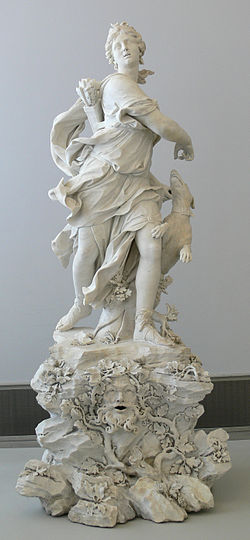
Diana has been one of the most popular themes in art. Painters like Titian, Peter Paul Rubens, François Boucher, Nicolas Poussin and made use of her myth as a major theme. Most depictions of Diana in art featured the stories of Diana and Actaeon, or Callisto, or depicted her resting after hunting. Some famous work of arts with a Diana theme are:
- Diana and Actaeon, Diana and Callisto, and Death of Actaeon by Titian.
- Diana and Callisto, Diana Returning from the Hunt, Diana Resting After a Bath, and Diana Getting Out of Bath by François Boucher.
- Diana Bathing With Her Nymphs by Rembrandt.
- Diana and Endymion by Poussin.
- Diana and Callisto, Diana and Her Nymph Departing From Hunt, Diana and Her Nymphs Surprised By A Faun by Rubens.
- Diana and Endymion by Johann Michael Rottmayr.
- Diana Wounded, bronze statue by Sir Edgar Bertram Mackennal, housed in Tate Gallery of London (purchased 1908).[107]
- The famous fountain at Palace of Caserta, Italy, created by Paolo Persico, Brunelli, Pietro Solari, depicting Diana being surprised by Acteon.
- A sculpture by Christophe-Gabriel Allegrain can be seen at the Musée du Louvre.
- Diana of the Tower a copper statue by Augustus Saint-Gaudens was created as the weather vane for the second Madison Square Garden in 1893. It now is on display at the Philadelphia Museum of Art
- A sculpture by French sculptor François-Léon Sicard in the Archibald Fountain, Sydney, NSW, Australia [108]
- In Parma at the convent of San Paolo, Antonio Allegri da Correggio painted the chamber of the Abbess Giovanna Piacenza's apartment. He was commissioned in 1519 to paint the ceiling and mantel of the fireplace. On the mantel he painted an image of Diana riding in a chariot possibly pulled by a stag.
- Fuente de la Diana Cazadora [Fountain of the Huntress Diana], a fountain sculpture of huntress Diana with arrow pointing skyward, stands in the roundabout at Paseo de la Reforma, Zona Rosa, Mexico City's Mexican Federal District.
- Diana of the Chase, a bronze statue by Anna Hyatt Huntington in 1922. Diana was a defining symbol at the time, placed at institutions, such as the Fogg Art Museum at Harvard University, the New York Historical Society in New York City, and the Huntington Art Gallery in San Marino, California. One of the most notable of replicas can be found at Brookgreen Gardens in South Carolina, which was founded by Anna Hyatt Huntington and her husband Archer Milton Huntington in 1932.
- Beaux Arts architecture and garden design (late 19th and early 20th centuries) used classic references in a modernized form. Two of the most popular of the period were of Pomona (goddess of orchards) as a metaphor for Agriculture, and Diana, representing Commerce, which is a perpetual hunt for advantage and profits.

There are many statues of Diana the Huntress in Yambol, Bulgaria.
In film
[edit]- In Jean Cocteau's 1946 film Beauty and the Beast, it is Diana's power which has transformed and imprisoned the beast.
- Diana/Artemis appears at the end of the 'Pastoral Symphony' segment of Fantasia.
- In his 1968 film La Mariée était en noir François Truffaut plays on this mythological symbol. Julie Kohler, played by Jeanne Moreau, poses as Diana/Artemis for the artist Fergus. This choice seems fitting for Julie, a character beset by revenge, of which Fergus becomes the fourth victim. She poses with a bow and arrow, while wearing white.
- In the 1995 comedy Four Rooms, a coven of witches resurrects a petrified Diana on New Year's Eve.
- French based collective LFKs and his film/theatre director, writer and visual artist Jean Michel Bruyere produced a series of 600 shorts and "medium" film, an interactive audiovisual 360° installation (Si poteris narrare licet ("if you are able to speak of it, then you may do so" ...... ) in 2002, and a 3D 360° audiovisual installation La Dispersion du Fils[109] from 2008 to 2016 as well as an outdoor performance, "Une Brutalité pastorale" (2000), all about the myth of Diana and Actaeon.
In music
[edit]- Diana is a character in Hippolytus and Aricia, an opera by Jean-Philippe Rameau.
- For the album art of progressive metal band Protest the Hero's second studio album Fortress, Diana is depicted protected by rams and other animals. The theme of Diana is carried throughout the album.
- The Norwegian classical composer Martin Romberg wrote a mass for mixed choir in seven parts after a selection of poems from Leland's text Aradia, in which Diana features heavily. The Witch Mass was premiered at the Vestfold International Festival in 2012 with Grex Vocalis. In order to create the right atmosphere for the music, the festival blocked of an entire road tunnel in Tønsberg to use it as a venue.[110] The work was released on CD through Lawo Classics in 2014.[111]
- Artemis, and subsequently Diana, is used as focal point in "Artemis", track twelve of AURORA's 2022 album The Gods We Can Touch
Other
[edit]- In the funeral oration of Diana, Princess of Wales in 1997, her brother drew an analogy between the ancient goddess of hunting and his sister – "the most hunted person of the modern age".
- DIANA Mayer & Grammelspacher GmbH & Co.KG, an airgun company, is named after Diana, the goddess of hunting.[112]
- The Royal Netherlands Air Force 323rd Squadron is named Diana and uses a depiction of Diana with her bow in its badge.[113]
- In Ciudad Juárez in Mexico a woman calling herself "Diana Huntress of Bus Drivers" was responsible for the shooting of two bus drivers in 2013 in what may have been vigilante attacks.[114][115]
- Diana is commemorated in the scientific name of a species of coral snake, Micrurus diana.[116]
See also
[edit]Notes
[edit]- ^ Latin: [diˈaːna]; conservative pronunciation: [diːˈaːna]. The name was also written as Deiana by the Romans.
References
[edit]- ^ "Diana – Roman Religion". Encyclopædia Britannica.com. Retrieved 21 November 2018.
- ^ Larousse Desk Reference Encyclopedia, The Book People, Haydock, 1995, p. 215.
- ^ a b Servius, Commentary on Virgil's Aeneid 6.118.
- ^ a b c d e f g h i j k l m n Green, C. M. C. (2007). Roman Religion and the Cult of Diana at Aricia. New York: Cambridge University Press.
- ^ G.Dumézil La religion Romaine archaique Paris, 1974, part 3, chap. 1.
- ^ de Vaan 2008, p. 168.
- ^ Mallory & Adams 2006, p. 408–409.
- ^ Ringe 2006, p. 76.
- ^ Beekes 2009, p. 338.
- ^ Cicero, Marcus Tullius; Walsh, P.G. (2008). The Nature of the Gods (Reissue. ed.). Oxford: Oxford University Press. pp. 70–72. ISBN 978-0-19-954006-8.
- ^ a b c d e f g Poulsen, B. (2009). Sanctuaries of the Goddess of the Hunt. In Tobias Fischer-Hansen & Birte Poulsen, eds. From Artemis to Diana: The Goddess of Man and Beast. Museum Tusculanum Press. ISBN 8763507889, 9788763507882.
- ^ a b Cairns, F. (2012). Roman Lyric: Collected Papers on Catullus and Horace. Volume 301 of Beiträge zur Altertumskunde. Walter de Gruyter, 2012.
- ^ a b Proclus, Platonic Theology Book VII.
- ^ "CNG-Ancient Greek, Roman, British Coins". www.cngcoins.com.
- ^ Alföldi, "Diana Nemorensis", American Journal of Archaeology (1960:137-44) p 141.
- ^ a b A. Alföldi"Diana Nemorensis" in American journal of Archaeology 64 1960 p. 137-144.
- ^ Horace, Carmina 3.22.1.
- ^ Excavation of 1791 by cardinal Despuig not mentioned in the report: cf. P. Riis who cites E. Lucidi Memorie storiche dell'antichissimo municipio ora terra dell'Ariccia e delle sue colonie Genzano e Nemi Rome 1796 p. 97 ff. finds at Valle Giardino.
- ^ NSA 1931 p. 259-261 platesVI a-b.
- ^ Aeneid 6.35, 10.537.
- ^ Carmina 34.14 tu potens Trivia...
- ^ Horace, Epode 17
- ^ Dionysius Hal. VII 6, 4: the people of Aricia help Aristdemos in bringing home the Etruscan booty.
- ^ Mircea Eliade Tre' d'histoire des religionsait Paris, 1954.
- ^ G. Dumezil La religion Romaine archaique Paris 1974, part 3, chap.1.
- ^ a b Ovid Fasti III, 262–271.
- ^ Titus Livius Ab Urbe Condita 1:31–1:60.
- ^ a b Gods and Goddesses of Rome. Nova Roma.
- ^ Ennius, Annales 27 (edition of Vahlen); Varro, as cited by Nonius Marcellus, p. 197M; Cicero, Timaeus XI; Arnobius, Adversus Nationes 2.71, 3.29.
- ^ Macrobius Saturnalia I 9, 8–9; Cicero De Natura Deorum ii. 67.
- ^ Schlam, C.C. (1984). Diana and Actaeon: Metamorphoses of a Myth. Classical Antiquity, Vol. 3, No. 1 (Apr., 1984), pp. 82–110.
- ^ Pliny the Elder Naturalis Historia XVI, 242.
- ^ CIL, 975; CIL XIV,2633.
- ^ Hifler, Joyce. "The Goddess Diana. " Witches Of The Craft. [1] (accessed November 27, 2012).
- ^ Horace, Carmina I 21, 5–6; Carmen Saeculare.
- ^ CIL XIV,2112.
- ^ CIL, 3537.
- ^ Livy Ab Urbe Condita XXVII 4.
- ^ Roy Merle Peterson The cults of Campania Rome, Papers and Monographs of the American Academy in Rome, 1919, pp. 322–328.
- ^ a b Plutarch, Roman Questions, 3.
- ^ a b Porteous, A. (2001). The Forest in Folklore and Mythology. Courier Corporation. ISBN 0486420108, 9780486420103
- ^ a b c d e Carlsen, J. (2009). Sanctuaries of Artemis and the Domitii Ahenobarbi. Tobias Fischer-Hansen & Birte Poulsen, eds. From Artemis to Diana: The Goddess of Man and Beast. Museum Tusculanum Press. ISBN 8763507889, 9788763507882.
- ^ a b c d e f g Gordon, A.E. (1932). "On the Origin of Diana", Transactions and Proceedings of the American Philological Association 63 (1932, pp. 177–192) p 178.
- ^ Supposed Greek origins for the Aricia cult are strictly a literary topos. (Gordon 1932:178 note, and p. 181).
- ^ a b commune Latinorum Dianae templum in Varro, Lingua Latina V.43; the cult there was of antiqua religione in Pliny's Natural History, xliv. 91, 242 and Ovid's Fasti III 327–331.
- ^ Poulsen, B. (2009). Introduction. Tobias Fischer-Hansen & Birte Poulsen, eds. From Artemis to Diana: The Goddess of Man and Beast. Museum Tusculanum Press. ISBN 8763507889, 9788763507882.
- ^ The date coincides with the founding dates celebrated at Aricium. Arthur E. Gordon, "On the Origin of Diana", Transactions and Proceedings of the American Philological Association 63 (1932, pp. 177–192) p 178.
- ^ Ovid, Fasti, trans. James George Frazer, Loeb Classical Library (Cambridge, MA: Harvard University Press, 1931), 3:259–275.
- ^ Anguelova, V. N. (2011). The Sound of Silence: Sacred Place in Byzantine and Post-Byzantine Devotional Art.
- ^ Fontenrose, J. (1966). The Ritual Theory of Myth. University of California Press, ch. 3.
- ^ Gordon, Arthur E., "On the Origin of Diana," 186; and Encyclopedia Britannica, 1911, "Nemorensis Lacus," 369, which cites Strabo, Pausanius, and Servius as the first sources for the rex N. legend.
- ^ Gordon 1932:179.
- ^ "Diana Nemorensis, déesse latine, déesse hellénisée" in Mélanges d' archéologie et d'histoire 81 1969 p. 425-471.
- ^ Servius ad Aeneidem II 116; VI 136; Hyginus Fabulae 261.
- ^ Ovid Metamorphoses XIV 331-2 Scythicae regnum nemorale Dianae; Lucanus Pharsalia III 86 "qua sublime nemus Scythicae qua regna Dianae". Silius Italicus Punica IV 367; VIII 362; Valerius Flaccus Argonauticae II 305.
- ^ Jean Bayet, "Les origines de l'Arcadisme romain" p.135; M. P. Nilson Griechische Religionsgeschichte Munich 1955 p. 485 ff.
- ^ Strabo V 249: αφιδρύματα της ταυροπόλου.
- ^ Suidas s.v. :η Άρτεμις εν Ταύροις της Σκυθίας τιμωμένη; η από μέρους, των ποιμνίων επστάσις. η ότι η αυτη τη σελήνη εστι καί εποχειται ταύροις. Darehnberg -Saglio-Pottier Dictionnaire des antiquités s.v. Diana fig.. 2357.
- ^ Hesichius s.v. Tauropolai; Scholiasta ad Aristophanem Lysistrata 447; Suidas above; Photius Lexicon s.v. Tuaropolos; N. Yalouris Athena als Herrin der Pferde in Museum Helveticum 7 1950 p. 99; E. Abel Orphica, Hymni I in Hecaten 7. Hymni magici V in Selenen 4.
- ^ Servius ad Aeneidem VI 136.
- ^ Aeneis VI 35; F. H. Pairault p. 448 citing Jean Bayet, Origines de l' Hercule romain p. 280 n. 4.
- ^ Hesiod Catalogueedited by Augusto Traversa, Naples 1951 p. 76 text 82; R. Merkelbach, M. L. West Fragmenta Hesiodea Oxonii 1967, fragment 23.
- ^ Orestia cited by Philodemos Περι εύσεβείας 24 Gomperz II 52: fragment 38 B; Pausanias I 43, 1; II 22, 7.
- ^ as quoted by Dumézil La religion romaine archaique Paris, 1974, part 3, chap. 1.
- ^ Livy, Ab urbe condita, 1.45
- ^ "Apuleius". 24 November 2014.
- ^ John Scheid (2003) [1998]. An Introduction to Roman Religion [La Religion des Romains]. Translated by Janet Lloyd. Bloomington, IN: Indiana University Press. p. 66.
- ^ Nielsen, M. (2009). Diana Efesia Multimammia: The metamorphosis of a pagan goddess from the Renaissance to the age of Neo-Classicism. In Tobias Fischer-Hansen & Birte Poulsen, eds. From Artemis to Diana: The Goddess of Man and Beast. Museum Tusculanum Press. ISBN 8763507889, 9788763507882.
- ^ Diane Abnobae: to Diana Abnoba. Deo Mercurio. Access date 21 Nov 2018.
- ^ a b "Diana, Roman religion". Encyclopædia Britannica. Retrieved 25 August 2015.
- ^ "Latin Oration". scribd.com.
- ^ Nicole Jufer & Thierry Luginbühl (2001). Les dieux gaulois : répertoire des noms de divinités celtiques connus par l'épigraphie, les textes antiques et la toponymie. Paris: Editions Errance. ISBN 2-87772-200-7. p.18.
- ^ Apuleius (1998). The Golden Ass. Penguin classics. ISBN 978-0140435900.
- ^ Alexander Chalmers, Samuel Johnson (1810), The Works of the English Poets, from Chaucer to Cowper VOL.IV p.421.
- ^ Gil Harootunian, Gil Haroian-Guerin (1996). The Fatal Hero: Diana, Deity of the Moon, As an Archetype of the Modern Hero in English Literature, p.261.
- ^ Edited by Cesare Barbieri and Francesca Rampazzi (2001), Earth-Moon Relationships p.7. ISBN 0-7923-7089-9.
- ^ a b c d Rangos, S. 200. Proclus and Artemis: On the Relevance of Neoplatonism to the Modern Study of Ancient Religion. Kernos [Online], 13 | 2000, Online since 21 April 2011, connection on 01 May 2019. DOI : 10.4000/kernos.1293
- ^ a b Taylor, T. 1816. The Six Books of Proclus, the Platonic Successor, on the Theology of Plato.
- ^ a b c Filotas, Bernadette. Pagan Survivals, Superstitions and Popular Cultures in Early Medieval Pastoral Literature. PIMS, 2005. ISBN 0888441517, 9780888441515
- ^ History of the Franks, Book VIII, 195.
- ^ McNamara's translation of the Vita Eligii.
- ^ Arnold, Ellen F. Negotiating the Landscape: Environment and Monastic Identity in the Medieval Ardennes (The Middle Ages Series). University of Pennsylvania Press, 2012. ISBN 0812207521, 9780812207521.
- ^ a b Magliocco, Sabina. (2006). Italian American Stregheria and Wicca: Ethnic Ambivalence in American Neopaganism. Pp. 55–86 in Michael Strmiska, ed., Modern Paganism in World Cultures: Comparative Perspectives. Santa Barbara, CA: ABC-Clio.
- ^ a b c d e f g Magliocco, Sabina. (2009). Aradia in Sardinia: The Archaeology of a Folk Character. Pp. 40–60 in Ten Years of Triumph of the Moon. Hidden Publishing.
- ^ Frazer, Sir James (1993). The Golden Bough. London: Wordsworth.
- ^ a b Lienhardt, Godfrey (1993), "Frazer's anthropology: science and sensibility", Journal of the Anthropological Society of Oxford, 24 (1): 1–12, ISSN 0044-8370
- ^ Charles G. Leland, Aradia: The Gospel of Witches, Theophania Publishing, US, 2010
- ^ Hutton, 2000, p. 199.
- ^ Clifton, p. 62.
- ^ Russell, Jeffrey (1982). A History of Witchcraft: Sorcerers, Heretics and Pagans. Thames and Hudson. p. 218. ISBN 0-19-820744-1.
- ^ Rose, Elliot (1962). A Razor for a Goat. University of Toronto Press. pp. 148–53. ISBN 9780802070555.
{{cite book}}: ISBN / Date incompatibility (help) - ^ Hutton, 2000, pp. 145–148.
- ^ Hutton, Ronald (1991). The Pagan Religions of the Ancient British Isles: Their Nature and Legacy. Oxford University Press. p. 301.
- ^ Clifton, p. 67.
- ^ Kelly, A. The Gardnerian Book of Shadows. Accessed online 26 Nov 2018 at http://www.sacred-texts.com/pag/gbos/index.htm
- ^ Cunningham, S. (2009). Cunningham's Book of Shadows: The Path of An American Traditionalist. ISBN 0-73871-914-5. Llewellyn: Woodbury, MN.
- ^ Wallworth, William (2015). "Victor Henry Anderson (1917–2001)". Deadfamilies.com. Archived from the original on 19 February 2015. Retrieved 19 February 2015.
- ^ a b Faerywolf, S. (2018). Forbidden Mysteries of Faery Witchcraft. Llewellyn Worldwide. ISBN 0738756644, 9780738756646
- ^ Gary, Gemma (2018). "Forward". In Leland, Charles G. Aradia or the Gospel of Witches. London: Troy Books Publishing.
- ^ a b Adler, Margot. Drawing Down the Moon: Witches, Druids, Goddess-Worshippers, and Other Pagans in America Today. Boston: Beacon press, 1979; 1986. ISBN 0-8070-3237-9. Chapter 8: Women, Feminism, and the Craft".
- ^ a b "The McFarland Dianics – A Chronology – Spring Equinox, 2000". Archived from the original on 27 July 2011.
- ^ Budapest, Zsuzsanna. Holy Book of Women's Mysteries, The. 1980 (2003 electronic). ISBN 0-914728-67-9.
- ^ The Encyclopedia of Modern Witchcraft and Neo-Paganism, Shelley Rabinovitch & James Lewis, page 262, (2004)
- ^ Butyrin, Svetlana. "Early Autumnal Festival". Accessed online 26 Nov 2018, http://www.phaedrus.dds.nl/mabon5.htm
- ^ Zână in DEX '98
- ^ Cross, Wilbur L. (1993). The Yale Shakespeare: the complete works. United States of America: Barnes & Noble. pp. 365–399. ISBN 1-56619-104-1.
- ^ Encyclopædia Britannica, ed. 1911, vol. 24, pg. 505, Plate IV.
- ^ "City of Sydney". Archived from the original on 8 April 2003.
- ^ "N E W M E D I A A R T . E U". www.newmediaart.eu. Retrieved 28 July 2024.
- ^ "Report from the planning of the concert". tb.no. 12 April 2012.
- ^ "Witch Mass on CD". challengerecords.com.
- ^ "DIANA Mayer & Grammelspacher GmbH & Co.KG – THE DIANA TRADEMARK." COMPANY | THE DIANA TRADEMARK. [2] (accessed November 27, 2012).
- ^ "F-16 Units – RNLAF 323rd squadron". f-16.net.
- ^ Tuckman, Jo (6 September 2013). "Diana Huntress of Bus Drivers instils fear and respect in Ciudad Juárez". The Guardian. Retrieved 20 September 2018.
- ^ "Diana, Hunter of Bus Drivers". This American Life. Retrieved 20 September 2018.
- ^ Beolens, Bo; Watkins, Michael; Grayson, Michael (2011). The Eponym Dictionary of Reptiles. Baltimore: Johns Hopkins University Press. xiii + 296 pp. ISBN 978-1-4214-0135-5. ("Diana", p. 72).
Bibliography
[edit]- Beekes, Robert S. P. (2009). Etymological Dictionary of Greek. Brill. ISBN 978-90-04-32186-1.
- Mallory, James P.; Adams, Douglas Q. (2006). The Oxford Introduction to Proto-Indo-European and the Proto-Indo-European World. Oxford, England: Oxford University Press. ISBN 978-0-19-929668-2.
- de Vaan, Michiel (2008). Etymological Dictionary of Latin and the other Italic Languages. Brill. ISBN 9789004167971.
- Ringe, Don (2006). From Proto-Indo-European to Proto-Germanic (PDF). A Linguistic History of English (1st ed.). New York City: Oxford University Press. ISBN 978-0-19-928413-9. OCLC 64554645. OL 7405151M. Wikidata Q131605459.
- A. Alföldi "Diana Nemorensis" in American Journal of Archaeology 64 1960 p. 137-144.
- A. Alföldi Early Rome and the Latins Ann Arbor 1964 p. 47-100.
- E. Paribeni "A note on Diana Nemorensis" in American Journal of Archaeology 65 1961 p. 55.
- P. J. Riis "The Cult Image of Diana Nemorensis" in Acta Archaeologica Kopenhagen 37 1966 p. 69 ff.
- J. Heurgon in Magna Graecia 1969 Jan. Feb. 1969 p. 12 ff.; March Apr. p. 1ff.
- J.G. Frazer Balder the Beautiful II London 1913 p. 95 ff.; 302 ff.
- L. Morpurgo "Nemus Aricinum" in MonAntLincei 13 1903 c. 300 ff.
- A. Merlin "L'Aventin dans l'antiquité" Paris BÉFAR 97 1906.
- G. Wissowa Religion und Kultus der Römer Munich 1912 p. 198 ff.
- F. Altheim Griechischen Götter im alten Rom Giessen 1930 p. 93–172.
- A.E. Gordon "On the Origin of Diana" in Transactions of the AMerican Philological Association 63 1932 p. 177ff.
- A.E. Gordon Local Cults in Aricia University of California Publications in Classical Archaeology 2 1934 p. 1ff.
- J. Heurgon "Recherhes sur... Capoue préromaine" in BÉFAR 154 Paris 1942 p. 307 ff.
- J. Gagé "Apollon Romain" in BÉFAR 182 Paris 1955.
- J. Bayet Histoire politique et psychologique de la religion romaine Paris 1957 p. 20 ff., 39ff.
- K. Latte Römische Religionsgeschichte Munich 1960 p. 169–173.
- R. Schilling "Une victime des vicissitudes politiques, la Diane latine" in Hommages á Jean Bayet, Collection Latomus 45 Bruxelles 1960 p. 650 ff.
- A. Momigliano "Sul dies natalis del santuario federale di Diana sull' Aventino" in RAL 17 1962 p. 387 ff.
- G. Dumézil La religion romaine archaïque Paris 1966 p. 398 ff.
External links
[edit]

- Landscape with Diana and Callisto painting page
- Diana and her Nymphs painting description
- The Warburg Institute Iconographic Database (ca 1150 images of Diana)
| Deities |  | |
|---|---|---|
| Legendary figures | ||
| Legendary beings | ||
| Texts | ||
| Concepts and practices | ||
| Philosophy | ||
| Events | ||
| Objects | ||
| Variations | ||
| See also | ||
| International | |
|---|---|
| National | |
| People | |
| Other | |


Diana (mythology)
View on GrokipediaEtymology and Origins
Linguistic Roots
The name Diana originates from Latin, where it functions as a feminine form denoting divinity, derived from dīus ("godly" or "daytime sky") or dīwus ("divine").[4] This root connects to the Proto-Italic dīwī, signifying "heavenly" or "celestial," reflecting an association with luminous or sky-related qualities inherent to early Indo-European conceptions of deity.[5] Linguistically, Diana traces to the Proto-Indo-European (PIE) root dyēus (or dyeu-), meaning "to shine" or denoting the bright sky/heaven, which underlies terms for gods across Indo-European languages, such as Greek Zeús, Latin deus ("god"), and Sanskrit dyáus ("sky").[6] [7] The formation likely involves a thematic suffix -yós yielding diwyós ("divine" or "sky-related"), adapted into Italic through syncope from Old Latin Dīvāna, emphasizing a goddess-like essence tied to celestial brightness rather than direct Greek borrowing from Artemis.[8] This etymology underscores Diana's indigenous Italic identity, distinct from but parallel to Greek lunar-huntress archetypes, prioritizing semantic ties to divine luminosity over later syncretic influences.[9]Indigenous Italian Foundations
The cult of Diana originated among the ancient Latin peoples of central Italy, with its primary center at Aricia, a town situated near Lake Nemi (modern Nemi), where votive offerings and sanctuary remains attest to worship practices dating to the archaic period (circa 700–500 BCE).[10] This Italic foundation emphasized Diana as a goddess of sylvan landscapes, wild nature, and fertility, distinct from later Hellenistic overlays that equated her fully with Artemis.[11] Archaeological evidence from the site, including terracotta figurines and ritual deposits, indicates local devotion focused on woodland rites and protection of game and livestock, reflecting indigenous agrarian and hunting traditions rather than imported Greek mythological narratives.[12] Central to the Arician cult was the sacred grove (nemus Aricinum), where Diana Nemorensis presided over rituals involving purification, oaths, and communal festivals that united Latin tribes.[13] The priesthood, embodied by the rex nemorensis—a title held by a fugitive slave who claimed office by plucking a golden bough from an oak tree and then fought challengers to the death—embodied archaic Italic elements of sacral kingship, exile, and perpetual vigilance, possibly echoing pre-urban tribal customs among the Volsci and Latins.[11] These practices, documented in Roman sources like Strabo and Pausanias but rooted in local topography and flora, predate significant Etruscan or Greek influences, underscoring Diana's role as a territorial deity safeguarding boundaries and natural resources.[10] By approximately 550 BCE, the cult was transferred to Rome, likely under the auspices of early kings like Tullus Hostilius or Servius Tullius, who established her temple on the Aventine Hill as a federal sanctuary for Latin allies, plebeians, and slaves.[10] This integration highlighted Diana's indigenous appeal to marginalized groups, with August 13 marked as her festival (Nemoralia), involving torchlit processions and offerings of game, which preserved Arician customs amid urban expansion.[11] The persistence of these foundations, evident in numismatic depictions and inscriptions, demonstrates how Diana's Latin core—tied to light (*dius), openness, and vital forces—shaped her identity before 4th-century BCE Hellenization amplified hunting and chastity motifs.[13]Divine Attributes and Roles
Huntress and Protector of Wildlife
Diana served as the Roman goddess of the hunt, embodying the prowess and independence of the wilderness hunter. Roman hunters invoked her prior to expeditions, offering vows for successful kills and safe returns, as evidenced in ancient literary depictions where she leads nymphs and hounds in pursuit of game.[2] Her attributes included a bow, quiver of arrows, and sometimes a spear, symbolizing precision and dominance over prey such as deer and boar, which were sacred to her cult.[3] In iconography from Republican and Imperial eras, Diana appears as a vigorous maiden dressed in a chiton or deer skin, torch in hand for night hunts, underscoring her mastery of both daylight and nocturnal pursuits. Artifacts like bronze statuettes and frescoes portray her with loyal hunting dogs, highlighting the symbiotic bond between divine huntress and beast in Roman ritual practice.[14] This imagery reinforced her patronage over venatores, professional hunters in arenas and forests alike. As protector of wildlife, Diana safeguarded the natural balance, presiding over forests and ensuring the proliferation of game animals essential to her worshippers' sustenance. Her sacred groves, notably the nemus Aricinum at Lake Nemi, were preserved as inviolable habitats where human interference was minimized, reflecting taboos against desecration that maintained ecological sanctity in Italic tradition.[1] Votives of animal figures deposited at her shrines indicate supplications for the health and fertility of wild herds, positioning her as a guardian against overhunting or natural calamities afflicting beasts.[15]Lunar Deity and Virgin Chastity
In Roman mythology, Diana's identification as a lunar deity emerged primarily through syncretism with the Greek goddess Artemis, who was conflated with Selene, the personification of the moon. Early Italic traditions centered Diana on terrestrial domains such as hunting and fertility at sanctuaries like Aricia, without explicit celestial ties, but by the late Republic, literary and cultic sources integrated lunar attributes, including depictions of her wearing a crescent moon diadem and guiding a moon chariot across the night sky.[16][2] The antiquarian Varro explicitly linked Luna, the Roman moon goddess, with Diana, associating both with chastity and childbirth in etymological discussions preserved in later compilations.[16] This fusion reflects Hellenistic influences on Roman religion, where Diana absorbed Selene's nocturnal sovereignty, evidenced in Augustan-era poetry like Ovid's Fasti, portraying her as ruler of the silver orb.[2] Diana's attribute of virgin chastity, paralleling Artemis, positioned her as one of Rome's three perpetual maidens alongside Vesta and Minerva, having sworn an eternal vow against marriage granted by Jupiter.[15] This chastity manifested in myths emphasizing her inviolable purity, such as in Ovid's Metamorphoses (circa 8 CE), where she transforms the hunter Actaeon into a stag for unwittingly viewing her bathing nude with her virgin nymphs, underscoring divine retribution against voyeurism and threats to her sanctity.[17] Ancient iconography reinforces this, portraying Diana with attributes like the bow and quiver symbolizing self-reliant virginity, while her role as protectress extended to human virgins and women seeking aid in preserving chastity or navigating childbirth without compromising purity.[3] Roman texts, including Propertius' elegies (circa 16 BCE), invoke her as virgo (virgin) to invoke safeguarding of feminine autonomy, distinct from marital fertility roles assigned to other deities.[18]Fertility, Childbirth, and Chthonic Associations
Diana's Italic origins emphasized her as a woodland deity who facilitated fertility among humans and animals alike, with worshippers dedicating anatomical votives at her sanctuaries to petition for conception and successful reproduction. Terracotta offerings depicting wombs, phalluses, and infant figures, dated from the 4th to 1st centuries BCE, have been excavated at the Nemi grove, reflecting her role in promoting human fecundity independent of her later syncretism with the chaste Greek Artemis.[19] These artifacts, distinct from hunting-themed dedications, underscore an indigenous emphasis on Diana as a patron of natural increase, particularly for lower-class women and slaves who formed her primary devotees at Aricia.[20] In childbirth, Roman women invoked Diana—sometimes under the epithet Lucina—for protection during labor, attributing to her the power to ease deliveries and safeguard newborns, a function paralleled in her mythological assistance at her own birth from Leto.[15] This invocation persisted despite her virginity, likely rooted in pre-Hellenistic Italic traditions where lunar cycles symbolized gestational phases rather than abstinence; votive evidence from Nemi includes models of mothers with infants, offered post-partum to fulfill vows for safe outcomes around 300–100 BCE.[21] Literary sources like Propertius describe her as a divine midwife, invoked alongside Juno Lucina, highlighting her practical cultic utility for plebeian matrons facing high maternal mortality rates in antiquity. Chthonic dimensions emerged through Diana's epithet Trivia, denoting her dominion over crossroads (trivium), liminal spaces tied to passage between worlds, where she merged with Hecate as a mediator of death and rebirth. This syncretism, evident by the late Republic, positioned Trivia-Diana as an infernal aspect in the triple goddess schema—earthly huntress, celestial Luna, and subterranean guide—facilitating transitions akin to birth's emergence from darkness.[22] At Nemi, ritual slaying of the Rex Nemorensis priest symbolized vegetative renewal intertwined with underworld forces, evoking fertility cycles where death precedes growth, as inferred from the site's arboreal and aquatic motifs linked to chthonic waters.[20] Such associations, while secondary to her sylvan identity, informed nocturnal rites at crossroads, where offerings appeased her for averting ghosts and ensuring safe passage, blending Italic earth cults with Greek infernal influences.[23]Mythological Accounts
Genealogy and Family Ties
Diana is consistently portrayed in Roman sources as the daughter of Jupiter, the supreme deity and king of the gods, and Latona (also known as Leto in Greek traditions), a Titaness associated with modesty and dark nights.[24][1][25] This parentage aligns her with the Olympian lineage, though Latona's Titan origins introduce a generational distinction from Jupiter's primary divine progeny.[24] Her most prominent familial bond is as the twin sister of Apollo, the god of prophecy, music, and the sun, with whom she shares a birth on the island of Delos following Latona's wanderings to evade Juno's wrath.[25][26] This twinship, established in Roman lore by at least the fourth century BCE, underscores their complementary domains—Diana over the hunt and moon, Apollo over light and arts—without evidence of rivalry or additional siblings in core genealogies.[26] As a perpetual virgin goddess, Diana bore no children or consort, a trait reinforcing her independence from marital or reproductive ties and distinguishing her from fertility-focused deities in the pantheon.[24][1] Familial associations beyond her immediate nuclear kin are limited to attendant nymphs, such as those in her hunting retinue, who function more as symbolic companions than blood relations.[24]Actaeon and Voyeuristic Transgression
In Ovid's Metamorphoses (Book 3, lines 138–252), the hunter Actaeon, grandson of Cadmus and trained by the centaur Chiron, accidentally enters a sacred grove while pursuing game with his fifty hounds.[27] There, he beholds the goddess Diana—Roman counterpart to the Greek Artemis—bathing nude among her nymphs in a clear pool, her divine form exposed in a moment of ritual purity.[27] Enraged by this unintended violation of her chastity, Diana splashes him with water from the spring, transforming him into a stag with budding antlers, while cursing him to retain human consciousness but lose his voice, preventing him from explaining the mishap.[27] Fleeing in terror, the metamorphosed Actaeon is pursued and savagely torn apart by his own pack of hounds, fulfilling a prophecy that he would be destroyed by his "dogs" as punishment for presuming to rival Jove by gazing upon the goddess's nudity.[27] This narrative, drawn from earlier Greek traditions but elaborated by Ovid around 8 CE, underscores the irrevocable boundary between mortal sight and divine inviolability, where even accidental voyeurism constitutes hybris—an overstepping of limits that invites catastrophic retribution.[17] The episode highlights Diana's unyielding commitment to virginity, portraying her not as a passive victim but as an active enforcer of chastity, whose wrath enforces a cosmic order prioritizing sacred seclusion over human curiosity or error.[28] Ancient interpretations framed Actaeon's gaze as a symbolic transgression against the goddess's parthenia (virgin state), akin to profane intrusion into a temenos (sacred enclosure), with the stag transformation inverting the hunter's dominance over nature and amplifying his alienation.[29] Later Greco-Roman sources, including Nonnus's Dionysiaca (5th century CE), variably depict the incident as fated or lust-driven, but consistently emphasize the erotic peril of the male gaze upon female divinity, serving as a cautionary tale against erotic presumption in a pantheon where gods demand optical deference.[30] Ovid's ambiguous close—dividing opinion on whether Diana's justice was excessive—invites reflection on causal realism in myth: the transgression's involuntariness does not mitigate punishment, revealing divine agency as absolute rather than proportional to mortal intent.[31] This motif influenced philosophical views, such as in Plutarch's Moralia, where it exemplifies the dangers of unchecked perception disrupting ethical boundaries.[28]Other Encounters and Divine Interventions
In Ovid's Metamorphoses, Diana encounters her nymph Callisto, a devoted follower who had been seduced by Jupiter disguised as the goddess herself; upon discovering Callisto's pregnancy, Diana exiles her from the sacred band of companions to preserve the group's chastity, though Juno later transforms the nymph into a bear. This intervention underscores Diana's strict enforcement of virginity among her attendants, reflecting her role as guardian of purity rather than direct causation of the nymph's ultimate fate. Diana joins Apollo in punishing Niobe, queen of Thebes, for her hubris in claiming superiority over Leto by boasting of her fourteen children; the goddess slays Niobe's seven daughters with arrows, mirroring Apollo's killing of the sons, an act that reduces Niobe to a weeping stone on Mount Sipylus. This collective divine retribution, detailed in Metamorphoses Book 6, emphasizes familial solidarity among the gods against mortal insolence toward their parentage. When the nymph Arethusa, pursued by the river god Alpheus, reaches Ortygia in supplication, Diana responds by opening a chasm in the earth, allowing Arethusa to descend to the underworld and emerge as a sacred spring in Syracuse, thereby thwarting the god's advances while preserving the nymph's form. This transformative aid, recounted in Metamorphoses Book 5, illustrates Diana's protective intervention for her fleeing votaries through environmental manipulation. In Virgil's Aeneid, Diana intervenes on behalf of her devotee Camilla, a warrior virgin slain by the Rutulian Arruns during the Italian War; the goddess dispatches her nymph attendant Opis from the heavens to avenge the death, with Opis slaying Arruns via a hurled spear as retribution. This act in Book 11 highlights Diana's role in safeguarding her chastely militant followers amid Trojan-Italian conflicts, aligning her favor with martial defense rather than mere hunting prowess.Ancient Cult Practices
Sanctuary at Lake Nemi and Rex Nemorensis
The sanctuary of Diana Nemorensis was situated on the northern shore of Lake Nemi, a volcanic crater lake in the Alban Hills approximately 30 kilometers southeast of Rome, known in antiquity as the "Mirror of Diana." This site served as a federal sanctuary for the Latin League, with cult activity dating back to at least the 6th century BC, though major monumental construction occurred around 300 BC. The complex included a temple dedicated to Diana, a sacred grove, and terraces built into the slopes, reflecting its role as a center for Italic worship predating significant Greek influence.[32][33] Central to the cult was the priesthood of the Rex Nemorensis, or "King of the Wood," who served as high priest of Diana and held the exclusive right to bear arms within the sanctuary. This position was uniquely occupied by a runaway slave, emphasizing the site's appeal to marginalized groups such as slaves and plebeians, who formed the core of Diana's devotees. The priesthood embodied a violent, perpetual cycle of succession, distinguishing it from standard Roman religious offices.[32][12] The ritual for claiming the priesthood required a challenger—another fugitive slave—to first pluck a "golden bough" from a tree in the sacred grove, a feat symbolizing divine favor or ordeal, as described by ancient authors including Strabo in his Geography (5.3.12). Success entitled the aspirant to duel the incumbent Rex to the death; the victor assumed the role but lived in constant vigilance against new challengers, ensuring the priest's tenure was marked by fear and bloodshed. This practice, attested in sources like Pausanias and Plutarch, underscored the chthonic and liminal aspects of Diana's worship at Nemi, linking human sacrifice to renewal and the goddess's dominion over woods and wilds.[32] Archaeological excavations, particularly from the late 19th to early 20th centuries and renewed efforts in the 21st, have uncovered terraced structures, votive offerings including terracotta figures and anatomical models, and evidence of ritual feasting, confirming the sanctuary's prominence from the archaic period onward. Pre-Roman lithic artifacts suggest even earlier human activity tied to hunting, aligning with Diana's role as huntress, while the site's destruction by fire in 19 BC, as noted by ancient records, highlights episodes of conflict possibly linked to the volatile priesthood.[33][12][34]Temples in Rome and Provinces
The principal temple of Diana in Rome stood on the Aventine Hill and was traditionally founded by King Servius Tullius during his reign (conventional dates 578–535 BC) as a unifying sanctuary for the Latin League.[35][36] This edifice served as the league's federal religious center, where annual sacrifices on August 13 were shared among delegates from Latin cities, symbolizing their alliance under Roman hegemony; it also preserved the league's foundational charter.[35] No physical remains of the original structure survive due to subsequent urban development and lack of excavation, but ancient authors like Dionysius of Halicarnassus confirm its role in fostering inter-city cooperation through ritual participation.[36] The temple's plebeian associations, linked to the Aventine's lower-class residents, underscore Diana's appeal to non-elite Romans as a protector of the marginalized.[35] Smaller shrines to Diana existed elsewhere in Rome, such as near the Circus Maximus, but none rivaled the Aventine temple's political and cultic significance; these were often tied to her roles in hunting guilds or women's invocations for safe childbirth.[36] The Aventine site remained active into the Imperial period, with restorations possibly under emperors like Domitian, who favored Diana's iconography, though evidence is primarily numismatic and literary rather than archaeological.[35] In the Roman provinces, temples dedicated to Diana reflect her syncretism with local deities and adaptation to frontier contexts, often in military or civic settings. At Nemausus in Gallia Narbonensis (modern Nîmes, France), a well-preserved temple attributed to Diana features a rectangular vaulted hall measuring approximately 14.5 by 9.5 meters, flanked by staircases, dating to the 1st–2nd century AD; its dedication aligns with Diana's role as a woodland and huntress goddess in Celtic-influenced regions.[37] In Moesia Superior (modern Serbia), the site of Timacum Minus yielded three votive monuments confirming a temple to Diana, active from the 2nd to 4th century AD, linked to mining communities and her protective aspects over laborers and natural resources.[38] Further east, in the province of Asia, the grand Temple of Artemis at Ephesus—rebuilt in Roman times and rededicated under Diana's name—housed 127 marble columns and served as a major pilgrimage center until its destruction in 262 AD by Goths, blending Greek architectural scale with Roman imperial patronage.[39] Archaeological evidence from provinces like Germania Superior also attests to Diana's cult in hybrid forms, such as Diana Abnoba (fused with a local forest goddess), with altars and small temple-like structures in the Black Forest region from the 2nd century AD onward, emphasizing her chthonic and sylvan domains amid frontier defenses.[40] These provincial sites, often modest compared to central Italian ones, highlight Diana's utility in Romanization efforts, where her worship integrated with indigenous traditions to legitimize imperial control over rural and extractive economies.[38]Rituals, Votives, and Priesthoods
The priesthood of Diana at her sanctuary in Nemi, known as the rex nemorensis or "king of the wood," was uniquely held by a runaway slave who gained the position by plucking a branch from a sacred tree—interpreted as the Golden Bough—and then slaying the incumbent priest in ritual combat.[32] This priest bore arms within the sacred grove, a privilege denied to others, and maintained perpetual vigilance against challengers, reflecting the cult's archaic, violent selection process tied to Diana's chthonic and wild aspects.[41] The role persisted into the Roman imperial period, with the grove sacred to Diana Nemorensis, an Italic form of the goddess emphasizing her dominion over the woodland hunt.[32] In Rome, the temple of Diana on the Aventine Hill, dedicated around 578–535 BCE under King Servius Tullius, functioned as a focal point for plebeian and Latin worship without a similarly documented specialized male priesthood; instead, the cult welcomed both men and women, including slaves, aligning with Diana's protective role over the lower classes and fugitives.[36] This sanctuary hosted assemblies of the Latin League and emphasized communal rites rather than a singular priestly figure.[35] Central to Diana's cult were the Nemoralia, held annually from August 13 to 15 near Lake Nemi, featuring torchlit processions around the "mirror of Diana," garlanded participants, and ritual hair-washing before adorning with flowers; no blood sacrifices occurred, with offerings limited to fruits, cakes shaped like stags, and prayers inscribed on ribbons tied to sacred trees.[42] [43] The festival enforced a temporary cessation of labor for slaves and a ban on hunting, underscoring purification, peace, and reverence for the goddess's woodland domain.[44] Votive offerings at Nemi included terracotta anatomical models, particularly of uteri, deposited by women seeking aid in childbirth, alongside tablets recording vows and healings, attesting to Diana's role as a therapeutic deity beyond hunting.[21] Small stag figurines and other woodland-themed dedications reinforced her protective oversight of wildlife and fertility, with such practices spanning from the Bronze Age into the early Common Era.[11]Theological Conceptions
Syncretism with Greek Artemis
The syncretism of the Roman goddess Diana with the Greek Artemis emerged during the period of intensified Hellenization in Italy, approximately from the 4th century BCE, coinciding with Greek cultural penetration via trade, southern colonies, and later Roman conquests. This process integrated Artemis' core attributes—virginity, the hunt, and guardianship over wild animals and young women—into Diana's Italic framework, transforming her from a primarily local woodland and fertility deity into a multifaceted huntress. Literary evidence from Republican and Augustan eras, such as Virgil's Aeneid and Ovid's Metamorphoses, routinely applies Artemis' myths to Diana without distinction.[3][45] Prior to this overlay, Diana's cult at Aricia (near Lake Nemi) emphasized chthonic, fertility, and sylvan aspects, as indicated by votive offerings and the ritual combat of the Rex Nemorensis priesthood, features without direct Greek antecedents in Artemis' worship. The identification facilitated the transfer of specific narratives, including Diana's (as Artemis') birth to Leto on Delos, her twinship with Apollo, and punitive interventions like the drowning of the Aloadae giants or the flaying of Marsyas, adapted into Roman poetic traditions by the 1st century BCE. Archaeological parallels, such as terracotta figurines and reliefs from Latium depicting bow-wielding figures, reflect this evolving iconography, blending indigenous motifs with Hellenistic styles.[10][3] In the Roman Empire's eastern provinces, syncretism extended to the prominent cult of Artemis Ephesia, an Anatolian-Greek hybrid revered for fertility and abundance, whom Romans explicitly termed Diana; this is attested in inscriptions and the multi-breasted xoanon statue replicated in Roman contexts from the 1st century CE onward. Retained differences included Diana's stronger lunar associations, often conflated with Luna in Roman theology, and her role in state cults like the Aventine temple shared with Ceres and Liber, underscoring a pragmatic Roman adaptation rather than wholesale replacement of Italic elements. This fusion exemplifies broader Greco-Roman religious interpretatio, where functional equivalences prioritized cultic utility over doctrinal purity.[3][46]Philosophical and Neoplatonic Views
In ancient philosophical traditions, myths involving Diana were frequently subjected to allegorical exegesis to uncover deeper ethical, physical, or metaphysical truths, a practice originating with early interpreters like Theagenes of Rhegium around the 6th century BCE and later systematized by Stoics and Middle Platonists.[47] Her role as huntress was often read as emblematic of the soul's disciplined pursuit of virtue amid chaotic natural impulses, with chastity signifying detachment from bodily passions and alignment with rational order.[48] Such readings privileged causal explanations rooted in observable cosmic cycles, interpreting Diana's lunar associations as representations of periodic renewal and the mediation between celestial stability and terrestrial flux, rather than literal anthropomorphic agency.[3] Neoplatonists, building on Platonic ontology, integrated Diana—syncretized with Artemis—into a hierarchical emanation from the One, viewing her as a divine power manifesting in the encosmic realm. Proclus (c. 412–485 CE), in his commentaries on Plato's Timaeus and Cratylus, positioned Artemis as a progeny of Kore (Persephone) within the Eleusinian theological framework, embodying the guardianship of virtue and the soul's integrity against material corruption.[49] He linked her to the Chaldean Oracles' triad of encosmic Hecate, soul, and virtue, where she functions as a purifying force enabling ascent toward the intelligible, her hunting attributes symbolizing the intellect's targeted separation of essential forms from sensible illusions.[50] This interpretation underscores causal realism in Neoplatonic theurgy, positing Diana's rituals as participatory mechanisms for soul-catharsis, grounded in the moon's empirically observed influence on tides and growth cycles as analogies for psychic modulation.[51] Porphyry (c. 234–305 CE), Plotinus' editor and proponent of allegorical myth-interpretation, extended such views indirectly through works like On the Cave of the Nymphs, where lunar and nymphic symbols—akin to Diana's domain—denote the soul's descent into generation and potential return via philosophical discipline.[52] Unlike literal cultic portrayals, these Neoplatonic frameworks demythologize Diana as an intermediary hypostasis, emphasizing her empirical ties to wilderness and chastity as metaphors for the undiluted pursuit of first principles over partisan or anthropocentric narratives. Proclus further differentiates her from higher gods like Athena by locating her efficacy in the vital, pre-sensible layers of reality, where she presides over birth, death, and wild potency without compromising monistic unity.[49]Post-Classical Continuity and Decline
Medieval European Remnants
In medieval Europe, remnants of Diana's worship manifested primarily in folk beliefs condemned by ecclesiastical authorities as illusory or demonic, rather than organized cults. The Canon Episcopi, a circa 900 AD ecclesiastical text attributed to Regino of Prüm, explicitly denounced popular convictions that women and men participated in nocturnal processions led by Diana, described as the "goddess of the pagans," or sometimes conflated with Herodias, traversing great distances at night before returning home deceived by the devil.[53][54] This document, incorporated into later canon law collections, evidences the endurance of pre-Christian motifs associating Diana with night travel, wilderness hunts, and female-led spectral gatherings, interpreted by the Church as heretical superstitions rather than genuine divine encounters.[53] Such beliefs persisted particularly in regions with strong Roman cultural legacies, like northern Italy, where Diana was invoked in agrarian and nocturnal rituals. Inquisitorial records from 1390 in Milan document a trial of a woman accused of belonging to the "Society of Diana," confessing to adoration of the goddess as queen of the night and participation in secretive gatherings honoring her.[55] These accounts, drawn from trial testimonies, suggest localized survivals linking Diana to fertility, lunar cycles, and women's societies, though framed by inquisitors as diabolical pacts.[55] By the late Middle Ages, Diana's attributes merged into broader witchcraft lore, with figures like Martin of Arles in the 15th century referencing her leadership of airborne "night hosts" of women, echoing earlier condemnations but indicating ongoing folk transmission.[56] Northern European variants show thinner continuity, with Diana occasionally substituted for indigenous huntresses like Holda in wild hunt traditions, but lacking deep cultic roots beyond literary or clerical allusions.[57] Ecclesiastical sources, while biased toward demonization, provide the primary evidence for these remnants, as no archaeological or textual proof exists for active temples or priesthoods post-antiquity; instead, Diana's medieval presence reflects causal persistence of oral folklore in rural, less Christianized peripheries, gradually eroded by institutional orthodoxy.[58]Encounters with Christianity
The earliest recorded encounter between the cult of Diana and Christianity occurred in Ephesus during the apostolic era, where the preaching of Paul around 52-55 AD led to widespread conversions that threatened the local economy tied to Diana's worship. Artisans, led by a silversmith named Demetrius, incited a riot in the theater, decrying the endangerment of "the temple of the great goddess Diana" and her global magnificence, as new believers publicly burned sorcery books and rejected idol-making.[39] This episode, involving thousands, highlighted immediate religious and material conflicts, with the crowd chanting devotion to Diana for two hours before Roman authorities dispersed them to avert further unrest.[39] As Christianity ascended to state religion, systematic suppression intensified under Emperor Theodosius I, whose edicts from 391 AD banned all pagan sacrifices—public and private—and mandated the closure of temples across the empire, directly impacting Diana's sanctuaries, including the prominent Temple of Artemis (equated with Diana) in Ephesus and the Aventine temple in Rome.[59] These measures, enforced by prefects like Cynegius in the East, aimed to eradicate divination and ritual practices central to Diana's cult, such as offerings for hunting success and chastity vows, reflecting Christianity's monotheistic intolerance for polytheistic survivals.[59] Enforcement varied regionally, but the policies marked a causal shift from tolerance to prohibition, driven by theological exclusivity and imperial consolidation rather than isolated mob actions. A culminating act of destruction targeted Ephesus's Temple of Artemis in 401 AD, when John Chrysostom, then Archbishop of Constantinople, led a mob to raze the remaining structure and pulverize its cult statue, an event later praised by Cyril of Alexandria as vanquishing demonic forces.[39] Though the temple had suffered earlier Gothic arson in 262 AD, Chrysostom's campaign symbolized Christianity's assertive eradication of pagan icons, with materials repurposed for Christian buildings; similar fates befell other Diana sites, accelerating the cult's institutional collapse amid edicts prohibiting even gazing at damaged idols.[39] These encounters underscored causal pressures—evangelical competition, legal bans, and targeted demolitions—that dismantled Diana's priesthoods and festivals by the early 5th century, though isolated rural practices lingered longer.[59]Modern Interpretations and Evidence
Folklore and 19th-Century Revivalism
The Canon Episcopi, a medieval ecclesiastical text dating to around 900 CE and incorporated into canon law collections by the 10th century, describes certain women who professed belief in nocturnal flights through the air alongside Diana dea paganorum (Diana, goddess of the pagans) and her entourage, interpreting such convictions as illusory deceptions by the devil rather than genuine supernatural events.[60] This reference attests to lingering folk perceptions of Diana as a leader of otherworldly processions in early medieval Europe, potentially echoing pre-Christian processional rites associated with the goddess, though church authorities dismissed them as pagan superstition without empirical basis.[61] Similar motifs appear in later medieval and early modern accounts of purported witchcraft, where Diana or syncretized figures like Herodias were invoked as nocturnal mistresses of spectral hunts or gatherings, suggesting fragmented survivals of her woodland and lunar attributes in rural European lore, particularly in regions with Roman cultural continuity such as Italy and Gaul.[53] These beliefs, often recorded in inquisitorial records rather than independent folk transmissions, indicate causal persistence of classical pagan elements amid Christian dominance, but lack direct archaeological or ethnographic corroboration beyond textual attestations. In 19th-century Italy, American folklorist Charles Godfrey Leland documented traditions among Tuscan peasants portraying Diana as the paramount deity of a subterranean witch cult, with her daughter Aradia dispatched to impart magical arts against oppression; these were compiled in Aradia, or the Gospel of the Witches (1899), purportedly from a manuscript by informant Maddalena.[62] While containing verifiable fragments of regional incantations and motifs—such as lunar invocations and herbal lore—scholars assess the text's overarching narrative as Leland's synthetic reconstruction, blending authentic dialectal survivals with romantic embellishments drawn from classical sources and comparative mythology, rather than a pristine folk "gospel."[63] Parallel scholarly efforts revived Diana's cult through anthropological lenses, notably in James George Frazer's The Golden Bough (first edition 1890; expanded 1906–1915), which analyzed the Arician priesthood of Diana Nemorensis as a ritual paradigm of fertility kingship and sacrificial renewal, drawing parallels to global folklore patterns of dying-and-reviving deities to explain her as a vegetation goddess ensuring seasonal rebirth.[64] Frazer's comparative method, grounded in ethnographic reports from indigenous traditions, posited empirical regularities in human religious evolution—such as sympathetic magic underlying hunt and agricultural rites—but has faced critique for overgeneralization from disparate data without accounting for cultural specificities.[65] This work catalyzed academic interest in pagan survivals, influencing interpretations of Diana's folklore as vestiges of primal causal mechanisms for controlling nature, though subsequent anthropology emphasized contextual variability over Frazer's universalism.Neopagan Adoptions and Critiques
In Stregheria, a modern tradition of Italian-American witchcraft emerging in the late 19th and early 20th centuries, Diana holds a central role as the Triformis goddess embodying the moon, hunt, and witchcraft, often invoked alongside a horned god. Practitioners construct altars with symbols of forests, arrows, and lunar phases to honor her, performing rituals for protection, fertility, and magical empowerment drawn from folkloric grimoires. This veneration traces primarily to Charles G. Leland's 1899 text Aradia, or the Gospel of the Witches, which portrays Diana as the divine ancestress of witches, birthing the rebel goddess Aradia to teach sorcery against oppression.[66][67] Dianic Wicca, founded by Zsuzsanna Budapest in California during the 1970s amid second-wave feminism, adapts Diana as an archetype of the virgin huntress and protector of women, emphasizing goddess monotheism in women-only covens focused on personal healing, menstrual rites, and resistance to patriarchy. Rituals invoke her for autonomy and wild nature, often blending Roman attributes with broader pagan symbolism like the triple goddess (maiden, mother, crone). This form rejects male deities or participants in core practices, positioning Diana as a symbol of female sovereignty.[68] These adoptions face scholarly scrutiny for lacking verifiable continuity with ancient Roman cult practices, which emphasized public festivals, votive offerings at sites like Nemi, and integration into state religion rather than secretive, individualistic witchcraft. Leland's Aradia authenticity remains contested, with historians like Ronald Hutton arguing it comprises fabricated or heavily romanticized narratives influenced by 19th-century occultism, not empirical folk transmission from antiquity. Stregheria's reconstruction is further critiqued as an American-invented synthesis of folklore reclamation, diverging from Italian vernacular magic's Catholic-infused benandanti traditions without primary evidence of Diana-centric covens persisting post-Christianization. Dianic interpretations impose contemporary gender politics, overlooking archaeological and textual data showing Diana's priesthoods included men and her worship served civic, not exclusively feminist, ends. Reconstructionist neopagans, prioritizing ancient sources like inscriptions, contend such eclectic revivals prioritize subjective experience over causal fidelity to historical causation, yielding practices untethered from verifiable ancient causality.[66][63][69]Recent Archaeological Discoveries
In 2025, researchers rediscovered a long-lost inscribed marble plaque in Naples, confirming the presence of a Temple of Diana in the ancient city; the artifact, found beneath the floors of a basilica amid Roman masonry fragments, references the goddess's cult and suggests her worship extended beyond major Roman centers like Nemi or the Aventine.[70] Excavations at the Sanctuary of Diana Nemorensis near Lake Nemi from 2009 to 2021 yielded pre-protohistoric lithic artifacts, including flint tools indicative of Paleolithic or Mesolithic hunting activities, predating the site's establishment as a Roman cult center around 300 BCE by millennia and challenging assumptions of its purely Italic origins.[34] Recent 2025 fieldwork at Nemi further documented Etruscan bronzes and ongoing 3D reconstructions of the sanctuary's structures, highlighting continuous veneration layers from protohistoric to imperial periods.[71] In June 2024, digs in Vibo Valentia, southern Italy, uncovered a marble-lined Roman swimming pool from the 2nd-3rd century CE, accompanied by a statue of Diana the huntress, Corinthian columns, and mosaic fragments, likely part of a private elite villa complex rather than a public temple.[72] A 2017 excavation in Terracina's former AGIP area revealed a 2nd-century CE marble statue of Diana in the Roman baths, depicting the goddess in dynamic hunting pose with bow and quiver; analysis via integrated scientific methods confirmed its local provenance and ritual significance, informing broader Mediterranean cult patterns.[73]Enduring Legacy
Linguistic and Symbolic Impacts
The etymology of Diana traces to the Proto-Indo-European root dyew- or dyeu-, connoting "to shine" or "bright/heavenly," which evolved into Latin diviana or diana, emphasizing her lunar and divine attributes as a goddess of light and the sky.[5][6] This root parallels cognates in other Indo-European languages, such as deus (god) in Latin and Zeus in Greek, linking celestial luminosity to concepts of the sacred and diurnal cycles.[74] Linguistically, the goddess's name has endured as a widespread feminine given name in Romance and Germanic languages, retaining connotations of divinity, purity, and independence; its adoption surged in the Renaissance and persisted into the modern era, with over 100,000 bearers recorded in the U.S. alone by 2020 census data equivalents, often invoked to evoke mythological grace rather than direct worship.[6] No widespread derivational words beyond the proper noun exist in major lexicons, though regional toponyms like Monte Diana in Italy preserve her cultic associations with sacred groves.[75] Symbolically, Diana's core emblems—the crescent moon (representing nocturnal cycles and chastity), bow and arrow (denoting the hunt and unerring autonomy), and stag or hind (symbolizing wild fertility and protection)—have influenced Western semiotic traditions, appearing in heraldic devices and astronomical iconography to signify untamed nature and feminine sovereignty.[76] These motifs, rooted in her role as patroness of wilderness and childbirth, persist in non-religious contexts like environmental emblemata, where the huntress archetype underscores self-reliance, though empirical continuity derives more from artistic transmission than unbroken cultic practice.[75]Depictions in Literature and Visual Arts
In ancient Roman literature, Diana appears as the chaste goddess of the hunt and wilderness, often embodying themes of purity and retribution. Ovid's Metamorphoses (c. 8 CE) features her prominently in Book 3, where the hunter Actaeon accidentally witnesses Diana and her nymphs bathing; enraged, she transforms him into a stag, dooming him to be torn apart by his own hounds, underscoring her unyielding defense of modesty.[27] Virgil's Aeneid (c. 19 BCE) portrays Diana as a divine protector of female warriors, notably in her speech to the nymph Opis in Book 11, urging vengeance for the Volscian warrior Camilla, whom Diana had nurtured from infancy, thus linking the goddess to martial independence and maternal oversight.[77] Visual depictions of Diana in ancient art emphasize her as an active huntress, frequently shown with bow, quiver, and deer. The Diana of Versailles, a marble statue in the Louvre (Roman copy of a Greek bronze original c. 325 BCE), captures her in dynamic motion, striding forward while drawing an arrow from her quiver, attired in a short chiton and himation for agility, symbolizing poised readiness in the chase.[78] Frescoes from Pompeii, such as those in the House of the Vettii (1st century CE), illustrate sacrificial scenes honoring Diana, portraying her amid nymphs and hounds, reflecting her cultic worship and integration into domestic Roman piety.[79] During the Renaissance, artists revived classical myths, often drawing from Ovid to depict Diana's encounters with mortals, blending erotic tension with moral allegory. Titian's Diana and Actaeon (1556–1559, National Gallery, London), commissioned for Philip II of Spain, dramatizes the bathing scene with vivid flesh tones and turbulent water, highlighting Actaeon's intrusion and Diana's wrathful transformation, showcasing the era's mastery of color and narrative depth.[80] Later interpretations, like Johannes Vermeer's Diana and Her Companions (c. 1653–1656, Mauritshuis), present a serene, clothed Diana resting with attendants, employing chiaroscuro to evoke quiet introspection rather than action, adapting the goddess to 17th-century ideals of female virtue.[81]Influences in Music, Film, and Popular Culture
The myth of Diana has influenced classical music through operas and ballets centered on her encounters with mortals, such as the hunter Actaeon, whom she punished by transforming into a stag after he viewed her bathing. Marc-Antoine Charpentier's Actéon (1684), an opera-ballet, directly adapts this narrative, emphasizing Diana's virginity and wrath as core themes.[82] Similarly, early French operas like those exploring the Endymion myth portray Diana succumbing to passion for the sleeping shepherd, blending her lunar and chaste attributes with erotic tension, as seen in works from the late 17th century.[82] In ballet, the Diana and Actaeon pas de deux, originating in Cesare Pugni's score for Le Corsaire (1858) and later interpolated into La Esmeralda, showcases her as a dynamic huntress partnering with Actaeon in virtuosic displays. Modern compositions include Ben Jonson's 1611 poem "Queen and Huntress" (an ode to Diana as Cynthia), frequently set to music, evoking her nocturnal sovereignty over chastity and the wild.[83] In film, Diana appears directly in early cinema, such as the 1916 silent short Diana the Huntress, which depicts her mythological hunt and dance amid woodland scenes.[84] Walt Disney's Fantasia (1940) features her as a blue-skinned centaur in the "Pastoral Symphony" segment, frolicking with fauns and embodying her association with nature and the hunt.[85] Contemporary interpretations include Matthew Barney's Redoubt (2019), where the goddess manifests as a modern female hunter navigating Idaho's wilderness, reinterpreting her punitive gaze through engraving and pursuit motifs.[86] Her archetype also permeates superhero narratives; Wonder Woman's civilian name, Diana Prince, draws explicitly from the Roman goddess, symbolizing truth, justice, and martial prowess akin to the huntress's domain, as creator William Moulton Marston incorporated mythological elements of strong, independent femininity.[87][88] In broader popular culture, Diana's imagery recurs in video games and television, often as a fierce, lunar warrior. The League of Legends champion Diana (introduced 2012) embodies the goddess's moon-worshipping, blade-wielding aspects, with abilities referencing her crescent motifs and solitary vow. Adaptations like the Percy Jackson film series (2010–2013) include her Roman form alongside Greek counterparts, highlighting her role in divine hunts and chastity oaths. Post-hardcore tracks such as Less Art's "Diana (Half of Her)" (2017) invoke her as a vengeful huntress, channeling vigilante rage in lyrics about pursuit and retribution.[89] These depictions underscore Diana's enduring appeal as a symbol of untamed autonomy, though modern renditions sometimes amplify her ferocity over classical restraint.References
- https://en.wiktionary.org/wiki/Diana
- https://en.wikisource.org/wiki/The_Golden_Bough/The_King_of_the_Wood