Hubbry Logo
ActivismActivismMain
Open search
Activism
Community hub
Activism
logo
8 pages, 0 posts
0 subscribers
Be the first to start a discussion here.
Activism
Activism
from Wikipedia

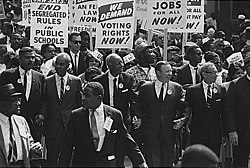
Civil rights activists at the March on Washington for Jobs and Freedom during the civil rights movement in August 1963.
A women's liberation march in Washington, D.C., August 1970.

Activism consists of efforts to promote, impede, direct or intervene in social, political, economic or environmental reform with the desire to make changes in society toward a perceived common good. Forms of activism range from mandate building in a community (including writing letters to newspapers), petitioning elected officials, running or contributing to a political campaign, preferential patronage (or boycott) of businesses, and demonstrative forms of activism like rallies, street marches, strikes, sit-ins, or hunger strikes.

Activism may be performed on a day-to-day basis in a wide variety of ways, including through the creation of art (artivism), computer hacking (hacktivism), or simply in how one chooses to spend their money (economic activism). For example, the refusal to buy clothes or other merchandise from a company as a protest against the exploitation of workers by that company could be considered an expression of activism. However, the term commonly refers to a form of collective action, in which numerous individuals coordinate an act of protest together.[1] Collective action that is purposeful, organized, and sustained over a period of time becomes known as a social movement.[2]

Historically, activists have used literature, including pamphlets, tracts, and books to disseminate or propagate their messages and attempt to persuade their readers of the justice of their cause.[3] Research has now begun to explore how contemporary activist groups use social media to facilitate civic engagement and collective action combining politics with technology.[4][5] Left-wing and right-wing online activists often use different tactics. Hashtag activism and offline protest are more common on the left. Working strategically with partisan media, migrating to alternative platforms, and manipulation of mainstream media are more common on the right (in the United States).[6] In addition, the perception of increased left-wing activism in science and academia may decrease conservative trust in science and motivate some forms of conservative activism, including on college campuses.[7] Some scholars have also shown how the influence of very wealthy Americans is a form of activism.[8][9]

Separating activism and terrorism can be difficult and has been described as a 'fine line'.[10]

Definitions of activism

[edit]

The Online Etymology Dictionary records the English words "activism" and "activist" as in use in the political sense from the year 1920[11] or 1915[12] respectively. The history of the word activism traces back to earlier understandings of collective behavior[13][14][15] and social action.[16] As late as 1969 activism was defined as "the policy or practice of doing things with decision and energy", without regard to a political signification, whereas social action was defined as "organized action taken by a group to improve social conditions", without regard to normative status. Following the surge of "new social movements" in the United States during the 1960s, activism came to be understood as a rational and legitimate democratic form of protest or appeal.[17][18][19]

However, the history of the existence of revolt through organized or unified protest in recorded history dates back to the slave revolts of the 1st century BC(E) in the Roman Empire, where under the leadership of former gladiator Spartacus 6,000 slaves rebelled and were crucified from Capua to Rome in what became known as the Third Servile War.[20]

In English history, the Peasants' Revolt erupted in response to the imposition of a poll tax,[21] and has been paralleled by other rebellions and revolutions in Hungary, Russia, and more recently, for example, Hong Kong. In 1930 under the leadership of Mahatma Gandhi thousands of protesting Indians participated in the Salt March,[22] as a protest against the oppressive taxes of their government, resulting in the imprisonment of 60,000 people and eventually independence of their nation. In nations throughout Asia, Africa and South America, the prominence of activism organized by social movements and especially under the leadership of civil activists or social revolutionaries has pushed for increasing national self-reliance or, in some parts of the developing world, collectivist communist or socialist organization and affiliation.[23] Activism has had major impacts on Western societies as well, particularly over the past century through social movements such as the Labour movement, the women's rights movement, and the civil rights movement.[24]

Types of activism

[edit]
Barricade at the Paris Commune, March 1871.

Activism has often been thought to address either human rights or environmental concerns, but libertarian and religious right activism are also important types.[25] Human rights and environmental issues have historically been treated separately both within international law and as activist movements;[26] prior to the 21st century, most human rights movements did not explicitly treat environmental issues, and likewise, human rights concerns were not typically integrated into early environmental activism.[27] In the 21st century, the intersection between human rights and environmentalism has become increasingly important, leading to criticism of the mainstream environmentalist movement[28] and the development of the environmental justice and climate justice movements.

Human rights

[edit]

Human rights activism seeks to protect basic rights such as those laid out in the Universal Declaration of Human Rights including such liberties as: right to life, citizenship, and property, freedom of movement; constitutional freedoms of thought, expression, religion, peaceful assembly; and others.[29] The foundations of the global human rights movement involve resistance to colonialism, imperialism, slavery, racism, segregation, patriarchy, and oppression of indigenous peoples.[30]

Environment

[edit]

Environmental activism takes quite a few forms:

Animal rights

[edit]

Shareholder activists

[edit]

Libertarian and conservative

[edit]

Activism is increasingly important on the political right in the United States and other countries, and some scholars have found: "the main split in conservatism has not been the long-standing one between economic and social conservatives detected in previous surveys (i.e., approximately the Libertarian right and the Christian right). Instead, it is between an emergent group (Activists) that fuses both ideologies and a less ideological category of 'somewhat conservative' Establishment Republicans."[25] One example of this activism is the Tea Party movement.[25]

Pew Research identified a "group of 'Staunch Conservatives' (11 percent of the electorate) who are strongly religious, across-the-board socially and economically conservative, and more politically active than other groups on the Right. They support the Tea Party at 72 percent, far higher than the next most favorable group."[25] One analysis found a group estimated to be 4% of the electorate who identified both as libertarians and staunch religious conservatives "to be the core of this group of high-engagement voters" and labeled this group "Activists."[25]

Methods

[edit]
The longest running peace vigil in U.S. history, started by activist Thomas in 1981

Activists employ many different methods, or tactics, in pursuit of their goals.[2] The tactics chosen are significant because they can determine how activists are perceived and what they are capable of accomplishing. For example, nonviolent tactics generally tend to garner more public sympathy than violent ones.[31] and are more than twice as effective in achieving stated goals.[32]

Historically, most activism has focused on creating substantive changes in the policy or practice of a government or industry. Some activists try to persuade people to change their behavior directly (see also direct action), rather than to persuade governments to change laws.[33] For example, the cooperative movement seeks to build new institutions which conform to cooperative principles, and generally does not lobby or protest politically. Other activists try to persuade people or government policy to remain the same, in an effort to counter change.

Greta Thunberg a Swedish climate activist is known for founding the Fridays for Future movement.

Charles Tilly developed the concept of a "repertoire of contention", which describes the full range of tactics available to activists at a given time and place.[34] This repertoire consists of all of the tactics which have been proven to be successful by activists in the past, such as boycotts, petitions, marches, and sit-ins, and can be drawn upon by any new activists and social movements. Activists may also innovate new tactics of protest. These may be entirely novel, such as Douglas Schuler's idea of an "activist road trip",[35][36] or may occur in response to police oppression or countermovement resistance.[37] New tactics then spread to others through a social process known as diffusion, and if successful, may become new additions to the activist repertoire.[38]

Activism is not an activity always performed by those who profess activism as a profession.[39] The term "activist" may apply broadly to anyone who engages in activism, or narrowly limited to those who choose political or social activism as a vocation or characteristic practice.

Helena Alviar Garcia has combined activism with her work as a legal scholar, resulting in academia being seen as activism.[40]

Political activism

[edit]

Judges may employ judicial activism to promote their own conception of the social good. The definition of judicial activism and whether a specific decisions is activist are controversial political issues.[41] The legal systems of different nations vary in the extent that judicial activism may be permitted.

Activists can also be public watchdogs and whistle blowers by holding government agencies accountable to oversight and transparency.[42]

Political activism may also include political campaigning, lobbying, voting, or petitioning. Often political activists also publish their ideas themselves via newsletters, periodicals, presses, or digital media.[3]

Political activism does not depend on a specific ideology or national history, as can be seen, for example, in the importance of conservative British women in the 1920s on issues of tariffs.[43]

Political activism, although often identified with young adults, occurs across peoples entire life-courses.[44]

Political activism on college campuses has been influential in left-wing politics since the 1960s, and recently there has been "a rise in conservative activism on US college campuses" and "it is common for conservative political organizations to donate money to relatively small conservative students groups".[7]

While people's motivations for political activism may vary, one model examined activism in the British Conservative party and found three primary motivations: (1) "incentives, such as ambitions for elective office", (2) "a desire for the party to achieve policy goals" and (3) "expressive concerns, as measured by the strength of the respondent's partisanship".[45]

In addition, very wealthy Americans can exercise political activism through massive financial support of political causes, and one study of the 400 richest Americans found "substantial evidence of liberal or right-wing activism that went beyond making contributions to political candidates."[8] This study also found, in general, "old money is, if anything, more uniformly conservative than new money."[8] Another study examined how "activism of the wealthy" has often increased inequality but is now sometimes used to decrease economic inequality.[9]

Internet activism

[edit]

The power of Internet activism came into a global lens with the Arab Spring protests starting in late 2010. People living in the Middle East and North African countries that were experiencing revolutions used social networking to communicate information about protests, including videos recorded on smart phones, which put the issues in front of an international audience.[46] This was one of the first occasions in which social networking technology was used by citizen-activists to circumvent state-controlled media and communicate directly with the rest of the world. These types of practices of Internet activism were later picked up and used by other activists in subsequent mass mobilizations, such as the 15-M Movement in Spain in 2011, Occupy Gezi in Turkey in 2013, and more.[47]

Online "left- and right-wing activists use digital and legacy media differently to achieve political goals".[6] Left-wing online activists are usually more involved in traditional "hashtag activism" and offline protest, while right-wing activists may "manipulate legacy media, migrate to alternative platforms, and work strategically with partisan media to spread their messages".[6] Research suggests right-wing online activists are more likely to use "strategic disinformation and conspiracy theories".[6]

Internet activism may also refer to activism which focuses on protecting or changing the Internet itself, also known as digital rights. The Digital Rights movement[48] consists of activists and organizations, such as the Electronic Frontier Foundation, who work to protect the rights of people in relation to new technologies, particularly concerning the Internet and other information and communications technologies.

Many contemporary activists now utilize new tactics through the Internet and other information and communication technologies (ICTs), also known as Internet activism or cyber-activism. Some scholars argue that many of these new tactics are digitally analogous to the traditional offline tools of contention.[49] Other digital tactics may be entire new and unique, such as certain types of hacktivism.[34][50] Together they form a new "digital repertoire of contention" alongside the existing offline one.[51] The rising use of digital tools and platforms by activists[52] has also increasingly led to the creation of decentralized networks of activists that are self-organized[53][54][55] and leaderless,[47][56] or what is known as franchise activism.

Economic activism

[edit]

Economic activism involves using the economic power of government, consumers, and businesses for social and economic policy change.[57] Both conservative and liberal groups use economic activism as a form of pressure to influence companies and organizations to oppose or support particular political, religious, or social values and behaviors.[58] This may be done through ethical consumerism to reinforce "good" behavior and support companies one would like to succeed, or through boycott or divestment to penalize "bad" behavior and pressure companies to change or go out of business.

Brand activism[59] is the type of activism in which business plays a leading role in the processes of social change. Applying brand activism, businesses show concern for the communities they serve, and their economic, social, and environmental problems, which allows businesses to build sustainable and long-term relationships with the customers and prospects. Kotler and Sarkar defined the phenomenon as an attempt by firms to solve the global problems its future customers and employees care about.[60]

Consumer activism consists of activism carried out on behalf of consumers for consumer protection or by consumers themselves. For instance, activists in the free produce movement of the late 1700s protested against slavery by boycotting goods produced with slave labor. Today, vegetarianism, veganism, and freeganism are all forms of consumer activism which boycott certain types of products. Other examples of consumer activism include simple living, a minimalist lifestyle intended to reduce materialism and conspicuous consumption, and tax resistance, a form of direct action and civil disobedience in opposition to the government that is imposing the tax, to government policy, or as opposition to taxation in itself.

Shareholder activism involves shareholders using an equity stake in a corporation to put pressure on its management.[61] The goals of activist shareholders range from financial (increase of shareholder value through changes in corporate policy, financing structure, cost cutting, etc.) to non-financial (disinvestment from particular countries, adoption of environmentally friendly policies, etc.).[62]

Art activism

[edit]

Design activism locates design at the center of promoting social change, raising awareness on social/political issues, or questioning problems associated with mass production and consumerism. Design Activism is not limited to one type of design.[63][64]

Art activism or artivism utilizes the medium of visual art as a method of social or political commentary. Art activism can activate utopian thinking, which is imagining about an ideal society that is different from the current society, which is found to be effective for increasing collective action intentions.

Fashion activism was coined by Celine Semaan.[65] Fashion activism is a type of activism that ignites awareness by giving consumers tools to support change, specifically in the fashion industry.[66][67] It has been used as an umbrella term for many social and political movements that have taken place in the industry.[68] Fashion Activism uses a participatory approach to a political activity.[69]

Craft activism or craftivism is a type of visual activism that allows people to bring awareness to political or social discourse.[70] It is a creative approach to activism as it allows people to send short and clear messages to society.[71] People who contribute to craftivism are called "craftivists".[72]

Activism in literature may publish written works that express intended or advocated reforms. Alternatively, literary activism may also seek to reform perceived corruption or entrenched systems of power within the publishing industry.

Science activism

[edit]

Science activism may include efforts to better communicate the benefits of science or ensure continued funding for scientific research.[73][74] It may also include efforts to increase perceived legitimacy of particular scientific fields or respond to the politicization of particular fields.[75] The March for Science held around the world in 2017 and 2018 were notable examples of science activism. Approaches to science activism vary from protests to more psychological, marketing-oriented approaches that takes into account such factors as individual sense of self, aversion to solutions to problems, and social perceptions.[76]

Other methods

[edit]

Activism industry

[edit]

Some groups and organizations participate in activism to such an extent that it can be considered as an industry. In these cases, activism is often done full-time, as part of an organization's core business. Many organizations in the activism industry are either non-profit organizations or non-governmental organizations with specific aims and objectives in mind. Most activist organizations do not manufacture goods,[citation needed] but rather mobilize personnel to recruit funds and gain media coverage.

The term activism industry has often been used to refer to outsourced fundraising operations. However, activist organizations engage in other activities as well.[77] Lobbying, or the influencing of decisions made by government, is another activist tactic. Many groups, including law firms, have designated staff assigned specifically for lobbying purposes. In the United States, lobbying is regulated by the federal government.[78]

Many government systems encourage public support of non-profit organizations by granting various forms of tax relief for donations to charitable organizations. Governments may attempt to deny these benefits to activists by restricting the political activity of tax-exempt organizations.

See also

[edit]

References

[edit]

Further reading

[edit]
Revisions and contributorsEdit on WikipediaRead on Wikipedia
from Grokipedia

Activism encompasses vigorous, direct efforts to influence or alter social, political, economic, or environmental conditions, often through methods like protests, , boycotts, and that surpass conventional political engagement. These actions typically aim to challenge power structures or norms perceived as unjust, drawing on collective mobilization to amplify demands for reform.
Historically, activism has catalyzed landmark changes, including the abolition of , advancement of , establishment of labor protections, and progress in civil rights, by shifting public discourse and compelling institutional responses. Nonviolent strategies, when sustained and broadly resonant, have proven particularly effective in achieving policy concessions, as evidenced by empirical analyses of campaigns like those for voting rights. In contrast, modern digital activism excels at rapid awareness-raising and fundraising but frequently falters in translating virtual support into substantive outcomes, a phenomenon termed slacktivism. Despite successes, activism's defining characteristics include inherent risks of escalation to violence or coercion, which can provoke backlash and erode legitimacy. Research highlights associations between certain activist orientations—particularly in environmental domains—and traits like Machiavellianism or narcissism, potentially prioritizing symbolic gestures over pragmatic, evidence-based solutions. Performative elements, driven by social signaling rather than causal impact, further complicate assessments of efficacy, as they may foster division without addressing root mechanisms of change. Overall, activism's impact hinges on strategic alignment with empirical realities and public priorities, rather than unyielding ideology.

Definitions and Conceptual Foundations

Core Definition and Scope

Activism denotes the practice of individuals or groups undertaking vigorous, intentional actions to promote, oppose, or alter social, political, economic, or environmental conditions. Unlike mere verbal endorsement or passive affiliation with a cause, it requires direct engagement, such as organizing events, disseminating strategically, or confronting authorities, with the aim of influencing , norms, or behaviors. This emphasis on action stems from a recognition that systemic change demands more than , often involving personal risk or to challenge entrenched power dynamics. The scope of activism extends across diverse methods and contexts, from institutionalized approaches like petitions and legal challenges to noninstitutionalized tactics including strikes, boycotts, and public demonstrations. It applies to varied causes, encompassing efforts to advance , environmental protections, or economic reforms, as well as initiatives to resist regulatory overreach, cultural shifts, or ideological impositions. Sociologically, activism functions as a core component of social movements, where collective mobilization amplifies individual efforts to address perceived injustices or opportunities, though its boundaries blur with related activities like routine political participation when actions intensify toward disruption or visibility. While activism overlaps with —defined as representational efforts within systems like —it is distinguished by its frequent reliance on extra-institutional, confrontational strategies that prioritize immediate impact over procedural navigation. Empirical studies highlight that successful activism often correlates with sustained and adaptability, as seen in historical cases where direct actions shifted , but it can also provoke backlash if perceived as coercive or unsubstantiated. This breadth underscores activism's role not as an ideologically uniform pursuit but as a pragmatic tool for causal intervention in societal structures. Activism is characterized by direct, intentional actions intended to effect social, political, or , often through public and confrontation with established power structures, distinguishing it from , which typically involves representing interests through institutional mechanisms such as recommendations, legal arguments, or legislative influence without necessarily engaging in disruptive tactics. For instance, advocacy may focus on disseminating information or negotiating within existing frameworks, as seen in efforts to shape via expert testimony, whereas activism prioritizes visible, pressure like rallies or boycotts to challenge norms directly. Lobbying, a subset of advocacy, specifically targets lawmakers or officials to sway decisions through persuasion, access, and , contrasting with activism's broader reliance on escalation that may bypass formal channels altogether. This distinction highlights activism's emphasis on amplifying marginalized voices via non-institutional means, potentially including symbolic disruption, rather than elite-level bargaining, though overlaps occur when activists adopt as a complementary . Protests and civil disobedience represent tactical expressions within activism rather than equivalents; protests involve organized public demonstrations to signal dissent and build solidarity, while entails deliberate, nonviolent law-breaking to expose injustices, both serving activism's goal of catalyzing broader societal shifts but not encompassing its full scope, which includes , networking, and sustained campaigns. Empirical analyses of movements, such as the U.S. civil rights campaigns of the , illustrate how these methods fueled activism's momentum without defining it exclusively, as long-term organizing and cultural were equally pivotal. Activism further diverges from militancy or by adhering, in most scholarly and historical framings, to nonviolent principles that prioritize and public legitimacy over through harm, though fringe elements in some movements have blurred this line, prompting distinctions based on premeditated versus defensive or symbolic resistance. on indicate that activist groups endorsing violence often face diminished public support and legal repercussions, underscoring causal realism in favoring restraint for sustainable change, as evidenced by comparative studies of nonviolent versus armed campaigns where the former succeeded at rates over twice as high from 1900 to 2006.

Historical Evolution

Ancient and Pre-Modern Forms

In ancient , written records from the third millennium BCE document petitions submitted by individuals or groups to kings, requesting intervention for grievances including protection from arbitrary officials, debt remission, or restitution of property, functioning as formalized appeals to mitigate abuses of power. These letters, often inscribed on clay tablets, illustrate early mechanisms of where subjects invoked royal justice codes like those of (c. 2100 BCE) or (c. 1750 BCE), which mandated equitable treatment to maintain . Kings periodically issued edicts annulling debts or freeing bondservants, responding to accumulated pressures from such appeals, though enforcement varied and primarily served to legitimize monarchical rule rather than empower petitioners independently. In the early , plebeians mounted organized withdrawals known as , beginning with the first instance in 494 BCE amid ongoing wars and debt crises exacerbated by patrician creditors' influence over magistrates. Approximately 20,000 plebeians retreated to the , halting labor and to coerce concessions, resulting in the establishment of the tribunate—an with power over patrician decisions and for its holders. Subsequent secessions in 449 BCE and 287 BCE yielded further reforms, including the Lex Hortensia equating plebiscites with binding , demonstrating how mass abstention from civic duties forced structural changes without outright . These actions arose from class antagonisms, where plebeians, comprising the bulk of soldiers and farmers, leveraged numerical superiority against an minority controlling land and priesthoods. Pre-modern Europe saw recurrent peasant uprisings against feudal exactions, with the English of 1381 exemplifying collective resistance to economic impositions following the Black Death's labor shortages. Triggered by a third of one per adult in 1381—intended to fund wars but regressive on the impoverished—tens of thousands, led by and John Ball, assembled in and , abolishing in charters from local lords and marching on to petition King Richard II for wage freedoms and tax relief. The revolt claimed over 1,500 lives in suppressions but highlighted ideological critiques of hierarchy, as Ball's sermons invoked equality before God. Similarly, the in France (1358) involved 5,000–8,000 peasants burning noble manors in response to wartime ravages and seigneurial dues, while the of 1525 mobilized up to 300,000 across principalities against enclosures, tithes, and , drawing on Lutheran rhetoric for demands in the . These revolts, often crushed with thousands executed, stemmed from demographic recoveries post-plague clashing with entrenched obligations, yet prompted localized concessions like reduced labor services in some regions.

19th and Early 20th Century Developments

The marked the rise of organized activism amid rapid industrialization, urbanization, and the spread of Enlightenment ideals, fostering movements aimed at addressing social injustices through petitions, public meetings, and moral suasion. In Britain, the abolitionist campaign culminated in the Slavery Abolition Act of 1833, which emancipated over 800,000 enslaved people in British colonies, driven by figures like and supported by Quaker-led societies formed as early as 1787. In the United States, the was established in 1833, with activists such as , who escaped slavery in 1838, employing speeches, newspapers, and the to advocate for immediate emancipation, contributing to the tensions leading to the Civil War (1861–1865) and the 13th Amendment abolishing slavery nationwide. Parallel to , the movement emerged, with the 1848 in New York issuing the Declaration of Sentiments, modeled on the Declaration of Independence, demanding , education, and property rights for women; organizers and drew from Quaker traditions and abolitionist networks. This laid groundwork for campaigns, though early efforts focused on state-level reforms, such as granting women the vote in 1869. Temperance activism, blaming alcohol for family breakdown and poverty, saw the form in 1826, achieving partial bans in several states by mid-century, often led by evangelical Protestants intertwining moral reform with social control. Labor activism intensified with the factory system's harsh conditions, prompting early strikes like the 1827 tailors' walkout for wage increases and the 1835 New York textile workers' demand for a 10-hour day. The Knights of Labor, founded in 1869, pursued broader reforms including equal pay for women and Chinese exclusion, peaking with the 1886 in , where a bomb explosion during a rally for an eight-hour day killed several, highlighting tensions between workers and authorities. In , the of 1871 represented radical worker self-governance, with communards establishing elected councils, workers' cooperatives, and secular education during its 72-day existence from March 18 to May 28, before brutal suppression by national forces claimed over 20,000 lives. Entering the early 20th century, suffrage activism grew militant; in the UK, Emmeline Pankhurst's , formed in 1903, employed hunger strikes and , securing limited voting rights for women over 30 in 1918. In the US, the , evolving from 19th-century roots, lobbied for the 19th Amendment, ratified in 1920 after decades of parades and constitutional campaigns. Labor saw the (IWW) organize in 1905, advocating direct action like the involving 20,000 workers for better wages, reflecting a shift toward class-based confrontation amid rising union membership from 2 million in 1900 to over 5 million by 1920. These developments underscored activism's evolution from moral persuasion to institutional and disruptive tactics, often intersecting with emerging socialist ideologies.

Mid-20th Century and Post-War Shifts

Following , activism underwent significant transformations driven by wartime experiences that exposed domestic inequalities amid global fights for freedom, alongside the economic and political weakening of colonial powers. In the United States, the return of African American veterans highlighted racial segregation's contradictions, catalyzing the modern starting in the mid-1950s. Key milestones included the 1954 Supreme Court decision in declaring school segregation unconstitutional, the 1955 sparked by ' arrest on December 1, 1955, and the 1963 March on Washington, where over 250,000 participants demanded jobs and freedom. These efforts emphasized non-violent , influenced by Mahatma Gandhi's methods, and leveraged emerging television coverage to build national sympathy and pressure for legislative change, culminating in the banning discrimination and the securing electoral access. Globally, post-war decolonization marked a profound shift toward nationalist activism in and , as European empires, exhausted by conflict, faced independence demands from mobilized populations. Between and 1960, approximately three dozen territories gained autonomy or independence, including in 1947 under leaders like and in 1957 led by . These movements often combined non-violent protests, strikes, and armed resistance against colonial rule, accelerated by the ' 1945 formation and anti-imperial rhetoric from both superpowers during the , though outcomes varied with some involving prolonged violence like Algeria's war from 1954 to 1962. This era transitioned activism from intra-imperial reform to sovereignty struggles, reshaping international norms toward . In parallel, traditional labor activism experienced relative decline in Western nations amid post-war prosperity and anti-union policies. In the U.S., union membership peaked at around one-third of non-farm workers in the but faced setbacks from the Taft-Hartley Act, which curtailed strikes and organizing, leading to fewer work stoppages by the . This shift reflected broader changes from class-based mobilization to identity-focused campaigns, as economic growth reduced immediate grievances while governments prioritized stability, though sporadic unrest like the 1946 strikes involving over 4.6 million workers signaled initial volatility before stabilization. Overall, mid-20th-century activism increasingly emphasized , media amplification, and transnational over purely economic demands.

Late 20th Century to Present

The late 20th century saw activism diversify into targeted campaigns against specific global injustices, such as the AIDS crisis, where groups like , founded in 1987, employed tactics including die-ins and disruptions of pharmaceutical pricing meetings to accelerate drug approvals and research funding, contributing to the development of treatments like AZT by 1987. Anti-apartheid efforts peaked in the with international boycotts and divestment campaigns, pressuring South Africa's government to release in 1990 and end apartheid by 1994. Environmental activism professionalized through organizations like , which conducted high-profile actions such as the 1985 thwarting of French nuclear tests at Moruroa Atoll, leading to policy shifts like the 1986 French testing moratorium. These movements increasingly relied on media amplification, though empirical analyses indicate mixed policy impacts, with AIDS activism yielding faster FDA approvals but limited long-term healthcare reforms. The 1990s marked the emergence of anti-globalization protests, exemplified by the 1994 in utilizing early for global solidarity and the 1999 WTO Seattle protests, which drew 40,000 participants and disrupted trade talks, highlighting labor and environmental concerns. Disability rights activism secured the Americans with Disabilities Act in 1990 following Capitol Crawl demonstrations by activists rejecting wheelchairs to symbolize exclusion. Conservative activism gained traction with the Moral Majority's influence waning but seeding opposition to abortion and , influencing the 1994 Republican "Contract with America" midterm gains. Digital tools began evolving activism, with email lists and websites enabling coordination, though studies show early online efforts often supplemented rather than replaced physical mobilization. In the 2000s, massive anti-Iraq War protests on , 2003, mobilized 6-10 million people across 60 countries, the largest single-day demonstrations in history, yet failed to avert the invasion, underscoring limits of global opinion against state power. The Tea Party movement arose in , protesting the Obama administration's stimulus and healthcare reforms through tax day rallies in over 750 U.S. cities, shifting Republican politics toward fiscal conservatism and aiding 2010 midterm victories that blocked aspects of the . This period saw activism's ideological polarization, with left-leaning campaigns focusing on inequality and right-leaning on government overreach, as Tea Party influence persisted in primaries. The 2010s ushered in digitally fueled movements, with the Arab Spring starting in in December 2010 via coordination, toppling dictators in and by 2011 but often yielding instability rather than stable democracy, as seen in Egypt's 2013 military coup. in 2011 occupied Zuccotti Park, popularizing "We are the 99%" rhetoric and influencing discourse on income inequality, though it achieved no direct policy wins like transaction taxes. , formalized in 2013 after Trayvon Martin's killing, amplified police reform demands through 2014 Ferguson protests and 2020 unrest, correlating with temporary budget reallocations in cities like but persistent crime rate increases post-2020 defunding efforts. #MeToo, exploding in 2017, led to over 200 high-profile accusations and executive ousters, accelerating laws in states like New York by 2019. From 2020 onward, activism adapted to the with anti-lockdown protests in and the U.S., such as Michigan's 2020 Capitol occupation against stay-at-home orders, influencing policy reversals in states like by mid-2021. Populist right-wing mobilization, evolving from Tea Party into MAGA rallies supporting , peaked with the January 6, 2021, Capitol events, reflecting grievances over elections and immigration but resulting in legal repercussions rather than certification challenges. Climate activism intensified via Greta Thunberg's 2018 school strikes, inspiring 2019 global actions with 7.6 million participants, pressuring corporate net-zero pledges but limited empirical emission reductions attributable directly to protests. Overall, digital platforms have scaled participation—e.g., hashtags mobilizing millions—but fostered slacktivism and echo chambers, with studies showing online engagement rarely translates to sustained offline impact without institutional ties. Mainstream media's selective coverage, often favoring progressive causes, has skewed perceptions of activism's breadth, underrepresenting conservative mobilizations despite their electoral effects.

Categories of Activism

Progressive and Left-Leaning Activism

Progressive and left-leaning activism involves organized efforts to promote , economic redistribution, , and environmental protections, often through demands for greater government intervention and challenges to established power structures. This form of activism emerged prominently during the in the United States, spanning roughly from the 1890s to the 1920s, when reformers targeted industrial excesses, political corruption, and social ills, leading to enactments such as the of 1906 and the establishment of the in 1913. Key tactics included , grassroots mobilization, and lobbying, which contributed to antitrust laws breaking up monopolies like in 1911. In the mid-20th century, left-leaning activism expanded into civil rights and anti-war campaigns, exemplified by the 1963 March on Washington, where over 250,000 participants advocated for racial equality and economic justice, influencing the and Voting Rights Act of 1965. Labor movements, such as the ' strikes in the 1930s and 1940s, secured rights under the Wagner Act of 1935, boosting union membership to 35% of the workforce by 1954. Environmental activism gained traction with groups like the , pushing the Clean Air Act of 1970 amid concerns over pollution, though empirical assessments show mixed long-term efficacy in reducing emissions without corresponding economic costs. Contemporary progressive activism, as seen in movements like following the 2014 , emphasizes identity-based grievances and systemic critiques, employing protests, campaigns, and calls for policy shifts such as police reform. Pew Research indicates that self-identified Progressive Left individuals exhibit high political engagement, with 86% voting in the 2020 election compared to 71% nationally, often prioritizing issues like racial equity and . However, studies on outcomes reveal challenges; for instance, "defund the police" initiatives in cities like correlated with a 21% increase in 2020, prompting public backlash and reversals. Academic analyses, potentially influenced by institutional left-leaning biases, frequently overstate successes while underreporting like polarization or economic disruptions from disruptive tactics. Left-leaning activism often intersects with single-issue causes but is characterized by a preference for collective over individual agency, favoring regulatory expansions over market solutions. Empirical data from Pew surveys show consistent ideological consistency among activists, with Progressive Left favoring government activism on issues like and by margins exceeding 80%. While historical reforms demonstrably advanced worker protections and , recent efforts face scrutiny for efficacy, as evidenced by stagnant wage growth despite union advocacy and limited global emission reductions post-Paris Agreement despite intensified climate protests. Source credibility in evaluating these outcomes warrants caution, given prevalent left-wing orientations in media and scholarly institutions that may selectively highlight progressive gains.

Conservative and Right-Leaning Activism

Conservative and right-leaning activism encompasses organized efforts to promote policies emphasizing intervention, free-market economics, traditional social institutions, individual liberties such as , national , and resistance to expansive welfare states or progressive cultural shifts. These movements often prioritize empirical outcomes like through and lower taxes, as seen in advocacy for supply-side reforms that correlated with GDP expansions in the 1980s under President Reagan, where real GNP grew 3.5% annually from 1983 to 1989. Activists in this sphere typically mobilize through organizations, , and electoral challenges, countering what they view as overreach by bureaucratic elites, with successes including the defeat of expansive federal programs and judicial reversals of prior precedents. In the United States, the Tea Party movement, emerging in 2009 amid opposition to the and rising deficits, exemplified fiscal conservative activism by channeling public discontent into political action. Rallies drew thousands protesting , leading to Republican gains of 63 House seats in the 2010 midterms, shifting control and stalling further expansions of federal healthcare mandates. This wave influenced subsequent policy debates, contributing to the 2017 , which reduced the corporate rate from 35% to 21% and spurred a 2.9% GDP growth rate in 2018. Social conservative activism has focused on life issues and Second Amendment rights. The annual March for Life, held since 1974 following , consistently attracts tens of thousands—estimated at over 100,000 in recent years—to advocate for fetal protections, sustaining pressure that culminated in the 2022 Dobbs v. Jackson decision overturning federal abortion rights and returning regulation to states. Similarly, the (NRA), established in 1871 and politically active since the 1970s via its Institute for Legislative Action, has lobbied against restrictive gun laws, blocking measures like assault weapon bans post-1994 and correlating with stable or declining rates in states with permissive carry laws, such as a 7.7% drop in murders from 2019 to 2020 in right-to-carry jurisdictions. Cultural campaigns have targeted perceived erosions of traditional norms, as in Phyllis Schlafly's 1970s effort to oppose the , mobilizing state-level activism that secured ratification failures in key legislatures by 1982, preserving distinctions in areas like military draft obligations. In , right-leaning anti-immigration activism has driven policy shifts, with movements supporting parties like Austria's Freedom Party, which won 29% in 2024 elections amid public concerns over unchecked inflows exceeding 1 million asylum seekers in alone from 2015-2016. This advocacy prompted stricter EU-wide border controls and national deportations, reducing irregular crossings by 38% in 2024 compared to 2023 peaks. Such efforts often face amplified scrutiny from mainstream outlets, which may underreport supportive polling data showing majority preferences for reduced migration in countries like and .

Non-Ideological and Single-Issue Activism

Non-ideological activism encompasses efforts to effect change through pragmatic, evidence-driven means detached from overarching political doctrines, prioritizing measurable outcomes over ideological purity. Such approaches often foster cross-partisan alliances by appealing to shared empirical realities, such as quantifiable risks to public safety or gains from targeted reforms. Single-issue activism, closely aligned with this mode, concentrates resources on rectifying one discrete problem, minimizing internal conflicts that plague broader movements and enabling sharper . This focus can amplify impact, as campaigns avoid the trade-offs inherent in multi-issue platforms, though they risk capture by ideological actors over time. A paradigmatic case is (MADD), founded on September 5, 1980, by Candace Lightner following the death of her 13-year-old daughter Cari, killed by a repeat drunk driver in . Initially a response to lax enforcement and sentencing for impaired driving, MADD pursued non-partisan legislative reforms, including mandatory minimum sentences and vehicle ignition interlocks, without tying to left- or right-wing agendas. By 1984, its lobbying secured the , raising the U.S. threshold to 21 and correlating with a 13% drop in youth traffic fatalities. MADD's sustained efforts yielded broader results: alcohol-impaired driving deaths fell from over 25,000 annually in 1980—a rate of one every 21 minutes—to approximately 10,500 by , representing a 58% reduction adjusted for and vehicle miles traveled. The organization influenced over 1,000 state-level laws by 2020, including .08% blood alcohol limits adopted nationwide by 2004, backed by data showing enforcement reduced by up to 7%. Unlike ideologically driven groups, MADD's success stemmed from data-centric messaging and alliances with , insurers, and lawmakers across spectra, demonstrating single-issue tactics' capacity for enduring policy shifts. Other instances include targeted public health campaigns, such as early anti-tobacco litigation focusing solely on ordinances in the 1990s, which secured smoking bans in 70% of U.S. worksites by 2000 without broader anti-industry dominating initial phases. Similarly, community-driven efforts against specific industrial hazards, like the 1980s resident activism leading to the U.S. program's creation for toxic site remediation, emphasized empirical contamination data over partisan framing. These cases illustrate how non-ideological, single-issue activism leverages verifiable causation—linking exposures to health outcomes—to drive remediation, often outpacing diffuse ideological counterparts in legislative uptake.

Methods and Approaches

Non-Violent and Institutional Tactics

Non-violent tactics in activism include marches, boycotts, sit-ins, and , designed to challenge unjust policies through moral suasion and mass participation rather than force. These methods draw from principles articulated by figures like in his 1849 essay on and Mahatma Gandhi's campaigns, which emphasized non-cooperation with oppressive systems. Empirical analysis of 323 campaigns from 1900 to 2006 by and Maria J. Stephan found non-violent resistance succeeded in 53% of cases, compared to 26% for violent efforts, attributing success to higher rates of participant mobilization—non-violent campaigns attracting over 11% of a versus under 1% for violent ones—and greater third-party support. Key non-violent strategies involve dilemma actions, where activists force authorities into choices that reveal repression or concessions, such as peaceful protests met with disproportionate force, thereby delegitimizing opponents. Examples include the 1963 March on Washington, which drew 250,000 participants and pressured federal action on civil rights legislation, culminating in the Civil Rights Act of 1964. Boycotts, like the 1955 Montgomery Bus Boycott led by Martin Luther King Jr., lasted 381 days and economically strained the system, leading to a Supreme Court ruling against segregated buses on December 20, 1956. Such tactics rely on broad participation to sustain pressure, with studies indicating non-violent movements' ability to induce security force defections through demonstrated popular commitment. Institutional tactics operate within established frameworks, such as elected officials, circulating petitions, ballot initiatives, and legal challenges, to achieve policy changes via democratic processes. involves organized to influence , as seen in the Aerospace Industries Association's 2023 "Second to None" campaign, which mobilized public support for defense funding increases. Petitions serve to aggregate public will, with historical efficacy in initiatives like California's Proposition 13 in 1978, which capped property taxes after gathering over 1 million signatures. Ballot measures exemplify direct institutional engagement, enabling voters to bypass legislatures; from 1990 to 2020, over 250 such initiatives passed in U.S. states on issues ranging from hikes to marijuana . Legal institutionalism includes strategic litigation, such as the NAACP's campaign leading to in 1954, which dismantled school segregation through amicus briefs and test cases. These approaches complement non-violent actions by embedding gains in law, though they require navigating entrenched interests and may face delays; research indicates institutional tactics succeed when aligned with shifts, as in environmental influencing corporate standards via shareholder resolutions. Unlike disruptive methods, institutional tactics minimize backlash by framing demands as reformist, yet critics note potential capture by elites, reducing radical change. Combined, non-violent and institutional tactics have driven transitions to in over 50 countries since 1900, per dataset analyses, by leveraging participation and legitimacy over coercion.

Digital and Media-Based Strategies

Digital activism encompasses the use of internet-based tools, including platforms, to mobilize supporters, disseminate information, and coordinate actions for social or political causes. Emerging prominently in the early 2010s, these strategies leverage platforms like (now X) and to facilitate rapid communication and global reach, as seen in the Arab Spring uprisings of 2010–2011, where coordinated protests in countries with limited , mobilizing over 50,000 participants in some instances despite penetration rates below 30%. Empirical analyses indicate that engagement often correlates positively with offline participation, rather than substituting for it, enabling hybrid models where digital tools amplify traditional organizing. Key tactics include hashtag campaigns, which aggregate user-generated content to build visibility and solidarity. For instance, the #BlackLivesMatter hashtag, originating in 2013 following the acquittal of in the Trayvon Martin case, generated millions of posts and was credited by 67% of surveyed Americans with highlighting police violence against Black individuals, influencing media coverage and policy debates on . Similarly, #YesAllWomen in 2014 expanded discussions on gender-based violence, fostering and support networks among users while encountering backlash, demonstrating hashtags' dual role in consensus-building and polarization. Research on hashtag activism for issues like shows that tweet timing, sender credibility, and content framing—such as emotional appeals—affect engagement rates, with peak activity during events boosting retweets by up to 20–30% but yielding variable translation to sustained action. Online petitions and crowdfunding platforms further extend these strategies by quantifying support and funding grassroots efforts. Platforms like have hosted petitions garnering tens of millions of signatures, such as the 2012 petition against the (SOPA), which contributed to its legislative defeat through widespread digital advocacy. Crowdfunding via raised over $10 million for causes tied to the 2020 protests, enabling bail funds and community aid, though outcomes depended on integration with offline logistics. Live-streaming and viral videos, disseminated via or , provide real-time documentation of events, as in the 2019–2020 , where footage evaded state and sustained international pressure. Media-based strategies involve digital amplification to influence traditional outlets, creating feedback loops where online virality prompts broadcast coverage. Studies reveal that while digital tools excel at awareness-raising—evidenced by a 2013–2023 analysis showing 34% of U.S. users joining cause-based groups—their causal impact on remains contested, often limited by "slacktivism" where low-effort shares substitute for commitment, leading to rapid hype without proportional . Peer-reviewed reviews emphasize that hinges on bridging online echo chambers with diverse audiences and offline enforcement, as pure digital efforts frequently dissipate without institutional follow-through, per analyses of over 100 campaigns from 2005–2020. Moreover, platforms' algorithmic biases and government digital repression—such as content throttling—can undermine reach, as documented in cases from to .

Confrontational and Disruptive Methods

Confrontational and disruptive methods in activism encompass tactics designed to interrupt daily routines, economic activities, or public order to compel attention to grievances and force concessions from targets. These approaches, often termed , prioritize immediate obstruction over persuasion through dialogue or legal avenues, aiming to impose tangible costs on opponents or authorities. Such methods include blockades, occupations, property , and clashes with security forces, distinguishing them from non-violent institutional tactics like petitions or by their intent to disrupt "business as usual" without reliance on elite mediation. Historical precedents trace to events like the of 1871, where insurgents erected barricades on to resist government forces, symbolizing armed disruption against centralized power, resulting in over 20,000 deaths during the subsequent suppression. In the early , British suffragettes employed chaining to railings and window-breaking campaigns from 1903 onward, with acts like the incident where Emily Wilding Davison's fatal collision with the king's horse amplified visibility but provoked public backlash. These tactics escalated confrontations, leading to of hunger-striking prisoners and contributing to the eventual 1918 voting reforms, though causal links remain debated amid broader wartime pressures. Mid-20th-century examples include labor strikes with mass , such as the 1934 involving waterfront blockades that halted city operations for four days, securing union recognition through economic paralysis rather than negotiation. Civil rights activists in the U.S. used sit-ins, like the 1960 Greensboro event where four students occupied a Woolworth's counter, sparking nationwide disruptions that desegregated facilities by July 1960, demonstrating how targeted interruptions could leverage media amplification despite arrests exceeding 3,000. However, escalation to riots, as in the 1965 Watts uprising with widespread and causing $40 million in damages, often alienated moderates and prompted repressive responses like the Kerner Commission's critique of underlying conditions over tactical endorsement. Contemporary applications feature environmental groups like Extinction Rebellion's 2018-2019 London blockades, which glued activists to roads and bridges, disrupting transport for days and prompting parliamentary climate declarations, yet surveys indicated 60% public opposition due to inconveniences. Similarly, Just Stop Oil's 2022 actions, including soup-throwing at artworks and motorway gluing, garnered headlines but empirical analysis shows such extreme disruptions reduce bystander support by framing activists as harmful outliers. Studies confirm that while moderate disruption maintains non-violent discipline can elevate issue salience, highly counter-normative tactics like diminish popular backing, with experimental data revealing 10-20% drops in sympathy post-exposure. In ideological contexts, left-leaning groups like Antifa have utilized formations since the 1999 WTO protests, involving masked property vandalism and street confrontations that disrupted summits but correlated with policy inertia on critiques. Right-leaning instances, such as the 2021 U.S. Capitol incursion on , employed breaches and occupations yielding 174 arrests and five deaths, yet polls post-event showed 70% of Republicans viewing it as legitimate expression while broader condemnation fueled legislative crackdowns. Empirical reviews indicate disruptive methods succeed when amplifying radical flanks that pressure moderates, but frequent failure stems from backlash, with non-violent variants outperforming violent ones in 53% of historical campaigns per datasets spanning 1900-2006. Overall, these tactics' efficacy hinges on contextual calibration, where over-escalation invites state repression and public disaffection, underscoring causal trade-offs between visibility and viability.

Effectiveness and Outcomes

Empirical Evidence from Studies

A comprehensive compiled by political scientists and Maria J. Stephan analyzed 323 major campaigns for significant political change between 1900 and 2006, finding that succeeded in 53% of cases compared to 26% for violent campaigns. Nonviolent methods proved more effective due to their ability to attract broader participation, sustain loyalty among participants, and impose higher costs on regimes through economic disruption and defections by , rather than through military confrontation. Successful nonviolent campaigns also correlated with more stable democratic transitions, reducing relapse into or in the subsequent decade. Subsequent analyses of protest dynamics indicate that nonviolent actions primarily mobilize existing sympathizers by signaling commitment and building community cohesion, while more disruptive tactics can compel concessions from initially resistant elites by raising the perceived costs of inaction. A study of U.S. protests from to 2004, drawing on event data from over 23,000 demonstrations, identified three mechanisms linking protests to policy outcomes: signaling grievances to elites, empowering marginalized communities through collective efficacy, and posing credible threats to institutional stability. However, effectiveness varies by context; for instance, protests in repressive regimes show diminished impact without international support or internal elite divisions, as evidenced in a meta-review of movement outcomes emphasizing dependency on political opportunities and . Experimental and survey-based studies reveal risks of backlash from extreme tactics, such as or confrontations with authorities, which erode public support for the broader movement. In six experiments involving hypothetical and real-world scenarios (e.g., or racial protests), participants exposed to descriptions of extreme actions reported lower for the cause and reduced willingness to donate or participate, attributing the to ideological rather than legitimate . Radical flanks within movements can paradoxically boost support for moderate factions by highlighting contrasts, but only if the radicals remain a minority; widespread adoption of disruptive methods triggers generalized disapproval. These findings underscore a : while mild activism sustains participation, aggressive approaches may alienate moderates without guaranteeing concessions, particularly in polarized societies where media amplification heightens visibility of negative incidents. Online activism complements offline efforts but yields mixed results; a review of psychological studies found positive correlations between digital engagement (e.g., sharing petitions) and real-world , yet "slacktivism" often fails to translate into sustained action due to low commitment thresholds. Longitudinal tracking of activists shows enduring boosts in political participation from early involvement, but causal links to policy success remain contingent on scaling to mass levels, as smaller-scale efforts rarely shift entrenched interests. Overall, empirical affirm that activism's impact hinges on method, scale, and type, with nonviolent, mass-oriented strategies outperforming alternatives in historical aggregates, though recent trends (post-2006) suggest declining success rates amid adaptive state repression.

Documented Successes

Activism has demonstrably influenced policy reforms and societal shifts in cases where sustained mobilization aligned with public pressure and institutional leverage. The U.S. exemplifies this through nonviolent protests that catalyzed federal legislation addressing racial discrimination. The , initiated December 5, 1955, following ' arrest, lasted 381 days and ended with a ruling on November 13, 1956, mandating desegregation of Montgomery's buses, marking an early victory against . The 1963 March on Washington, drawing over 250,000 participants, amplified demands for economic justice and civil rights, contributing to the momentum for the , signed by President on July 2, 1964, which outlawed segregation in public places and based on race, color, , , or . This was followed by the Voting Rights Act, enacted August 6, 1965, which prohibited racial discrimination in voting and led to a surge in Black voter registration from 23% in 1964 to 61% by 1969 in the South. The movement in the United States, spanning over seven decades of advocacy, secured the 19th Amendment to the , ratified on , 1920, which prohibits denying the right to vote on account of sex and enfranchised approximately 26 million women. Campaigns by organizations like the combined petitions, parades, and lobbying, achieving partial state-level wins before federal success, with granting women as early as 1869. International anti-apartheid activism pressured South Africa's regime through boycotts and sanctions, contributing to the system's dismantling. The global , active from the 1960s, organized consumer boycotts and divestment campaigns that isolated the economy, with U.S. universities and states divesting billions by the 1980s. These efforts, alongside internal resistance, facilitated the unbanning of the in 1990 and all-race elections on April 27, 1994, resulting in Nelson Mandela's presidency and the formal end of apartheid laws. Other instances include the abolitionist campaigns in Britain, where a 1791 boycott of slave-produced sugar mobilized and contributed to the Slave Trade Act of 1807, banning the trade within the . In the environmental domain, grassroots mobilization for on April 22, 1970, involving 20 million Americans, directly spurred the creation of the Environmental Protection Agency and passage of the Clean Air Act amendments that year, which established national air quality standards and reduced pollutants like lead by over 98% by 2020. These outcomes highlight activism's potential when leveraging , economic pressure, and alignment with shifting elite consensus, though causal attribution requires accounting for concurrent factors like wartime contributions in or Cold War geopolitics in anti-apartheid efforts.

Failures, Unintended Consequences, and Backlash

Disruptive protest tactics, such as or blocking public infrastructure, have frequently provoked public backlash, eroding support for the underlying causes. A study analyzing public reactions to protests found that by demonstrators reduces perceived reasonableness and identification with the movement, leading to diminished for its goals. Similarly, experimental demonstrates that extreme actions, like those involving norm-breaking disruption, trigger backlash by alienating moderate supporters, as participants in controlled scenarios reported lower endorsement of the activists' objectives when tactics escalated beyond non-violent boundaries. This pattern holds across contexts, where scholarly analyses indicate that while such methods may garner media attention, they often fail to convert bystanders into allies, instead fostering perceptions of illegitimacy. The 2020 Black Lives Matter (BLM) protests exemplify unintended consequences, including a surge in urban violence that correlated with rising homicide rates in affected cities. Data from major U.S. municipalities showed homicides increased by an average of 30% in 2020 compared to prior years, partly attributed to the "Ferguson effect," where reduced policing due to activist pressure and officer demoralization led to depolicing and unchecked crime. Public support for BLM, which peaked at 67% in June 2020, declined to 51% by 2023, with many citing riot-related destruction—estimated at $1-2 billion in insured damages—as a factor in waning approval. Quantitative analysis of protest events further revealed that violent incidents had a statistically significant negative impact on subsequent movement support, while peaceful demonstrations showed neutral or slightly positive effects. Environmental activism has encountered similar failures through high-profile disruptions, such as road blockades and by groups like and , which have alienated broad publics. Surveys indicate that 46% of respondents reported decreased support for climate causes following such actions, with only 13% expressing increased backing, as the tactics were viewed as infringing on daily life without proportional policy gains. Empirical modeling of shifts post-disruption events, including soup-throwing at artworks, showed short-term salience boosts overshadowed by long-term fatigue and resentment, where novel extremism initially draws eyes but erodes trust as repetition sets in. These outcomes underscore a causal dynamic: aggressive methods amplify but invite counter-mobilization, as evidenced by rising opposition to net-zero policies in polls tracking protest exposure. Broader include societal polarization and institutional distrust, where activism's confrontational turns exacerbate divisions rather than resolve them. Research on social movements highlights how policy "successes" can inadvertently fragment coalitions, as seen in post-achievement infighting within groups, leading to stalled momentum. In polarized environments, backlash manifests as reactive , with studies documenting increased conservative turnout and policy reversals following perceived overreach, such as anti-fossil fuel blockades strengthening fossil-dependent voter bases. While some movements achieve tactical wins, empirical reviews emphasize that failures often stem from neglecting audience psychology, resulting in net losses through reputational harm and foregone moderate alliances.

Criticisms and Controversies

Performative and Virtue-Signaling Aspects

Performative activism refers to public displays of support for a cause that prioritize visibility and personal image over substantive impact, often manifesting as low-cost gestures such as posts or symbolic actions without follow-through. Virtue signaling, a related concept, involves expressing moral positions to enhance one's social reputation rather than to drive policy or behavioral change, as defined in psychological literature as engagement in public moral discourse for reputational gain. These practices have proliferated with digital platforms, where low-effort actions like hashtags or changing profile pictures—termed "slacktivism"—allow participants to signal without incurring significant costs. Empirical studies indicate that performative elements are common in modern activism. In a 2025 qualitative analysis of young adults' participation, 50% of respondents cited motives aligned with virtue signaling, such as boosting , though participants viewed it as a developmental rather than inherently negative. on slacktivism shows mixed outcomes: while some token actions correlate with increased perceptions and potential , others lead to satisfaction that inhibits deeper engagement, as low-stakes online participation fulfills moral needs without prompting offline efforts. For instance, a survey found that while Americans perceive as aiding movements, a notable portion dismisses it as "slacktivism," associating it with distraction over . Critics argue that these aspects undermine activism's goals by fostering and backlash. In protests, performative tactics like gluing to artworks or disrupting events have drawn accusations of prioritizing media attention over evidence-based , with showing short-term opinion shifts but risks of alienating the public and eroding support for underlying issues. Performative in movements such as often involves reputational posturing without sustained commitment, exacerbating divisions as actions serve ego enhancement rather than causal mechanisms for change. Psychological studies link higher narcissistic traits to increased virtue signaling in activism, suggesting self-interest drives participation in visible but superficial ways, potentially crowding out genuine efforts. Such behaviors contribute to broader toward activism, as they signal moral superiority without , diverting resources from verifiable strategies. In higher education contexts, surveys of over 1,400 undergraduates from 2023–2025 revealed performative signaling as a social liability that fragments and prioritizes appearances over substantive . While some evolutionary perspectives frame virtue signaling as an adaptive tool for norm enforcement, its dominance in activism risks reducing movements to reputational games, where empirical progress yields to performative metrics like viral shares. This dynamic, amplified by platform algorithms rewarding over outcomes, has led to documented failures, such as e-petitions dismissed by firms due to perceived slacktivist origins.

Ideological Imbalances and Cultural Disruptions

Activism in modern Western contexts displays a pronounced ideological imbalance, with left-leaning participants and causes overwhelmingly represented in major movements and efforts. A 2017 tracking survey found that political activism surged post-2016 U.S. election, with left-leaning individuals reporting higher involvement in community causes and s compared to their right-leaning counterparts. Similarly, a 2023 analysis of social media activism revealed that attendees of s—7% of U.S. adults—were disproportionately Democratic or left-leaning, reflecting broader patterns in event participation. This skew aligns with institutional dynamics, as academia and , which often incubate and amplify activism, exhibit systemic left-wing biases that prioritize progressive narratives while underrepresenting conservative or libertarian activism. Such imbalances arise from differential engagement levels, where liberals score higher on traits like , correlating with participation, whereas conservatives emphasize and institutional stability, leading to preference for electoral or legal channels over street activism. Empirical studies on political intolerance further highlight asymmetries: left-wing groups often express greater toward conservative activists, driven by perceived threats from ideological outgroups, exacerbating the underrepresentation of right-leaning . In the U.S., for example, data from the General Social Survey and related polls show that while overall party affiliation hovers near parity (around 30-36% Democrat/Republican since 2020), activist cohorts in domains like or skew 70-90% left, per analyses of rally demographics. This disparity is not merely participatory but structural, as funding and organizational networks for activism—often tied to progressive philanthropies—reinforce the tilt, marginalizing efforts on issues like free speech or traditional values. These imbalances foster cultural disruptions by enforcing rapid, uneven shifts in societal norms, often through mechanisms like , which leverages public shaming to penalize perceived ideological deviations. A Pew survey indicated that 44% of Americans view as more about than , correlating with self-reported increases in and anxiety among targets, as documented in psychological studies on its fallout. Cancel campaigns, amplified via , have led to measurable effects such as job losses (e.g., over 100 high-profile cases from 2017-2020 involving academics and media figures for historical statements) and heightened , with 62% of U.S. adults in a 2020 Cato Institute poll reporting they restrain opinions due to fear of backlash. Broader cultural disruptions manifest in polarized shifts within institutions: activism-driven campaigns have altered media content, with a 2019 NSF-funded review noting movements' influence on via norm enforcement, often sidelining dissenting views and eroding pluralism. For instance, disruptive tactics in climate activism, such as 2022-2023 road blockades by groups like , provoked public backlash while accelerating corporate virtue-signaling, yet empirical polling shows net negative approval for such methods among moderates (e.g., 65% opposition in surveys). This pattern extends to everyday behavior, where ideological monocultures in activist spheres contribute to echo chambers, reducing cross-ideological dialogue and amplifying cultural fragmentation—evident in rising affective polarization, with interparty trust dropping to 20-30% in U.S. data since 2010. Mainstream sources frequently frame these disruptions as progressive advances, but their own left-leaning orientations limit scrutiny of how such activism stifles causal inquiry into unintended harms like diminished institutional trust.

Economic and Societal Costs

Disruptive activism, including riots and infrastructure blockades, generates substantial direct economic costs through property destruction and policing expenditures. The civil unrest associated with 2020 protests in following George Floyd's death inflicted insured damages of $1 billion to $2 billion, surpassing prior records for in insurance history and excluding uninsured losses, shortfalls, and elevated premiums for affected urban areas. Similarly, in the , Just Stop Oil's motorway disruptions, such as those on the M25 in , incurred over £760,000 in immediate economic harm from traffic delays, alongside costs exceeding £20 million by December 2023 to contain such actions. These expenses, funded by taxpayers, divert resources from public services and impose opportunity costs on productivity, as blockades and vandalism compel reallocations that burden non-participants disproportionately. Indirect economic repercussions extend to reduced and local economic contraction in protest-affected regions. Analyses of historical urban riots demonstrate persistent negative effects on budgets and growth, with unrest prompting higher expenditures on while deterring commercial activity. For instance, the 2020 events disproportionately damaged minority-owned businesses, exacerbating economic vulnerabilities in communities ostensibly targeted for . Empirical models of social unrest further link intensity to macroeconomic drags, including lowered consumer confidence and supply chain interruptions, as seen in spikes far exceeding long-term averages for losses. On the societal level, activism frequently intensifies polarization, eroding interpersonal trust and civic cohesion. Research shows that heightened perceptions of political division, often fueled by activist , correlate with reduced social trust, discouraging cooperation and amplifying in-group biases that fragment communities. Over five decades, this dynamic has coincided with partisan divergences in institutional confidence, where activist-driven narratives deepen divides, leading to outcomes like policy gridlock and escalated interpersonal . Such erosion manifests in measurable societal strains, including spiteful behaviors across ideological lines and from politicized daily interactions, which undermine collective resilience and public expertise. While intended to advance causes, these patterns highlight activism's role in fostering environments less conducive to deliberative governance.

The Activism Ecosystem

Professionalization and Organizations

The professionalization of activism marks the from episodic, volunteer-led efforts to formalized operations staffed by paid experts, including lobbyists, researchers, and communications specialists. This transition intensified in Western countries after the 1960s, as movements in civil rights, , and peace advocacy sought institutional stability amid expanding legal and regulatory opportunities. By the 1970s, social movements increasingly adopted bureaucratic structures, reducing reliance on confrontational tactics in favor of professional strategies like policy advocacy and coalition-building with governments and corporations. Key organizations driving this professionalization include nongovernmental organizations (NGOs) that operate as quasi-corporate entities with global reach and multimillion-dollar budgets. , established in 1961 by British lawyer , grew into a network employing over 500 professional staff by 2020, focusing on documentation, legal campaigns, and partnerships with international bodies like the . Environmental NGOs such as , founded in 1971, exemplify the model with specialized teams conducting scientific assessments and media operations; its annual budget exceeded $400 million in 2022, funded largely through individual donations and grants. In the United States alone, about 1.5 million NGOs engage in as of 2025, many professionalized to influence policy through expertise rather than street protests. Professionalization introduces operational efficiencies but also structural dependencies. Organizations require steady revenue—often from foundations, governments, or corporate partnerships—which incentivizes measurable outputs like reports and lawsuits over transformative change, a process termed "NGOization." Empirical analyses show professional staff prioritize funding sustainability and institutional growth, such as expanding mailing lists and donor bases, which can marginalize grassroots volunteers who focus on local mobilization and ideological purity. This dynamic has led to critiques that career activists form an insulated class, less accountable to affected communities; for example, in progressive causes, professional NGOs have supplanted working-class bases, fostering elite-driven agendas detached from broader public support.

Funding Mechanisms and Influences

Activist organizations rely on diverse funding mechanisms, including individual donations, philanthropic grants, , and occasionally government allocations, which collectively enable mobilization but also introduce external influences on priorities and tactics. Individual contributions, often facilitated through platforms like for left-leaning causes or for conservative ones, accounted for over $1.5 billion in small-dollar donations during the 2020 U.S. election cycle, allowing rapid scaling of campaigns but tying success to donor sentiment volatility. has emerged as a tool, with platforms such as raising millions for protests and bail funds; for instance, Black Lives Matter-related campaigns collected over $90 million in 2020, democratizing access but exposing funds to platform risks and uneven distribution. Philanthropic foundations dominate institutional funding, disproportionately supporting progressive activism through structured grants that prioritize social justice, environmental, and equity initiatives. Organizations like the , funded by , have disbursed billions since 1979 to advocacy groups, influencing global campaigns on migration and , though critics argue this fosters dependency and agenda alignment over organic movements. Similarly, the and have allocated hundreds of millions annually to nonprofit networks, with data from 2023 showing progressive causes receiving 70-80% of such grants from major U.S. philanthropies, reflecting donor preferences that skew toward institutional left-leaning priorities amid documented ideological imbalances in elite giving. Billionaire donors amplify this through "dark money" channels, such as donor-advised funds and fiscal sponsors like , which funneled tens of millions in 2023 to activist coalitions, enabling anonymous influence on policy while providing tax deductions that shift public burdens. These mechanisms exert causal influence by conditioning grants on measurable outcomes or alignment with funder goals, often professionalizing activism and sidelining dissenting voices within movements. For example, Michael Bloomberg's $21 billion in philanthropic commitments by 2025 has backed urban policy and climate activism, correlating with shifts in municipal agendas but raising concerns of where funded groups prioritize donor-favored metrics over broader efficacy. grants, though less central, supplement via agencies like USAID or EU programs, awarding $500 million+ yearly to NGOs for advocacy; however, strings attached—such as compliance reporting—can align recipients with state interests, as seen in U.S. for international that favors certain ideological framings. Overall, concentration in progressive networks, per analyses from groups tracking nonprofit flows, perpetuates systemic biases, with conservative activism relying more on direct corporate or membership models, underscoring how resource disparities shape activism's landscape and outcomes.

Grassroots vs. Institutional Dynamics

activism originates from decentralized, volunteer-driven efforts by individuals and local communities responding to perceived injustices, often without reliance on centralized funding or professional hierarchies. This contrasts with institutional activism, which operates through established organizations, non-profits, and groups that leverage dedicated resources, staff expertise, and to pursue changes. The former emphasizes organic mobilization and adaptability to local contexts, while the latter prioritizes , legal , and sustained pressure on elites. In dynamics, high personal motivation and proximity to issues enable rapid responses and innovative tactics, such as community blockades or petitions, fostering broad participation when nonviolent methods engage at least 3.5% of a , as evidenced in historical analyses of successful campaigns. However, these efforts frequently face challenges from limited , leading to burnout and fragmentation, with movements dissipating after initial surges unless they institutionalize. Institutional dynamics provide advantages in endurance and access to policymakers, with professional organizations conducting and litigation that have secured legislative wins, such as environmental regulations through groups like the since the 1960s. Yet, reliance on grants and donors can introduce misalignments, where priorities shift toward funder agendas over constituent needs, resulting in . Tensions between the two arise from disjunctures in goals and methods; for example, in New York City's school reform debates during the , grassroots parent groups demanded community control, clashing with national civil rights organizations advocating centralized standards, highlighting how institutional actors may overlook local demands. Empirical research on anticorruption efforts shows that elite-grassroots divides reduce overall efficacy, as top-down strategies lack the legitimacy of bottom-up mobilization, while pure lacks the infrastructure for long-term impact. Successful outcomes often involve hybrid models, where grassroots fervor supplies mass legitimacy—driving events like the 2011 Arab Spring uprisings—and institutions channel it into policy, though state-influenced "grassroots" movements, as in since the 1990s, blur lines and serve regime interests rather than genuine change. Academic studies, often produced within institutionally affiliated environments prone to favoring structured advocacy, underscore that grassroots roles in organizations enhance activist retention and efficacy, as seen in Uruguay's Broad Front party where empowering local organizers boosted participation rates by integrating bottom-up input. Conversely, purely institutional approaches risk performative outcomes detached from public sentiment, contributing to backlash when perceived as out of touch, such as in elite-led human rights campaigns criticized for top-down imposition over local agency.

References

Add your contribution
Related Hubs
User Avatar
No comments yet.